From the FasterSkier archive — posts syndicated from athletes’ and coaches’ own blogs between 2004 and 2012, kept online as published. Current coverage is at fasterskier.com.

Tag: Galen Johnston

  • Masters Minds: From Texas to Eagle Glacier

    Masters Minds: From Texas to Eagle Glacier

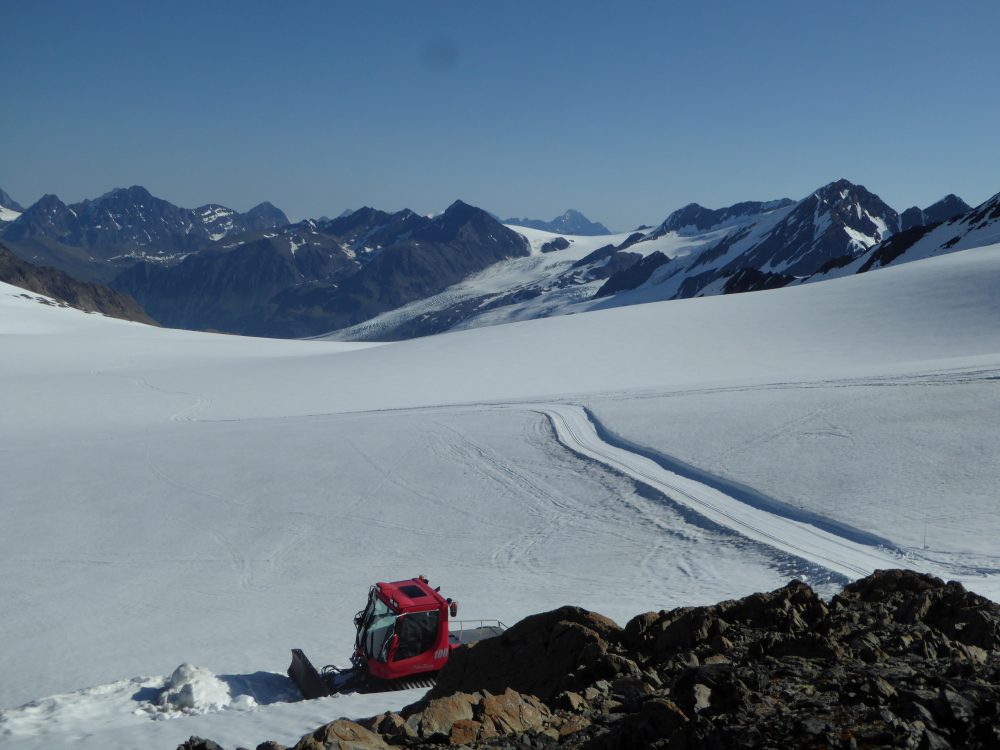
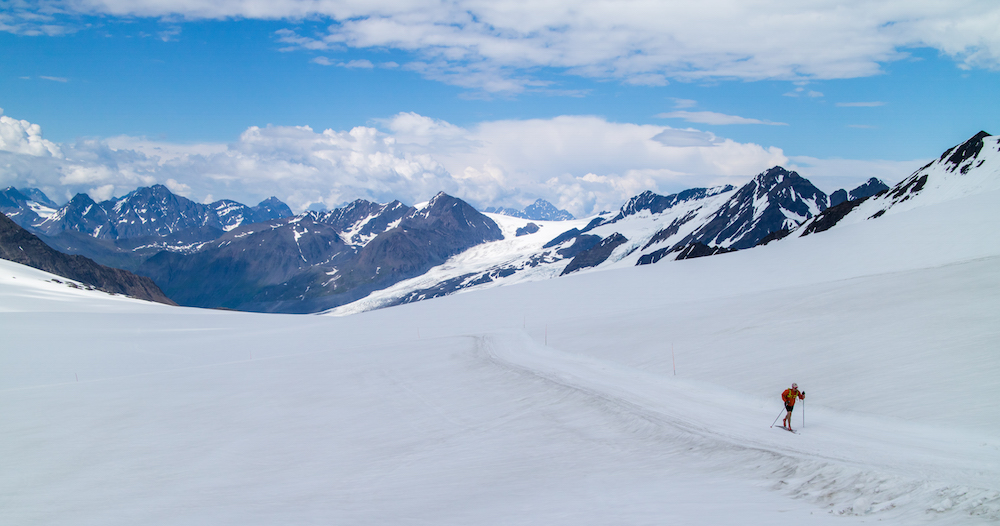
    Gavin Kentch (APU) climbs back up to the training center on Eagle Glacier, in the Chugach Mountains, Alaska, during APU Masters Camp in July 2017. (Photo: Jim Falconer)

    By Jason Somers

    Introduction: Welcome to the jungle

    My quads were burning from too much snowplowing. My coach’s words were echoing in my head: “You are most stable when tucking.” I willed, begged, and pleaded with my legs to assume the position, but being in this aerodynamic position also meant I would go fast, too fast, because at the moment I had one small problem – I couldn’t see where I was going.

    This small problem could likely be overcome but combined with the fact that I was careening down a trail on Alaska’s Eagle Glacier in a July snowstorm, I had to keep the  trail markers to my right or risk going off the trail. Not a big deal except that going off the trail meant I could in theory fall through a previously unknown crevasse, the big one that would lead me all the way to China in a horrific tumble, if I were ever to be seen again.

    My mind began to wander. I pushed out of my mind my imagined eulogy that included the requisite nod to global warming and my major contributions to society at large, such as eating large quantities of breakfast tacos. I imagined a bronze cowboy hat statue with a ski hat on top that would commemorate the first loss of life by stupidity on the glacier. Also, of course, celebrities I never met like Eddie the Eagle would attend and say it was a shame. Kikkan Randall would be there, her hair colored extra bright pink.

    Was this a death-defying 70-percent gradient that I was attempting? No, it wasn’t, but I was most certainly a nerd. A nerd well over his head. I am also a stubborn nerd so this meant I came equipped with nerd glasses, which were now so badly fogged after having gone through rain, sleet, and snow that they were more of a blindfold. I could barely make out the trail markers, I was flying blind, the skis began to pick up more speed, I knew the trail turned but when, and would I have enough time to turn with it?

    Oh, and there was one more thing that made it especially intimidating: They don’t have these conditions or trails, or even snow, where I am from in Southern Texas. Yes, I, am a rollerskier who had not seen snow in four years, and this is my story.

    Day one of camp: Welcome to Alaska

    As my Egyptian Lyft driver courteously bid me farewell, I walked with my bags toward the small group gathered in the parking lot of Alaska Pacific University (APU) in midtown Anchorage, Alaska. The evening before I had flown into Anchorage and traveled from the airport with my mouth agape with awe at the large peaks towering above. My Airbnb host had been a Russian grandmother who insisted on playing me videos of Russian folk songs, as she sang along with tears in her eyes. This was turning out to be a memorable trip already.
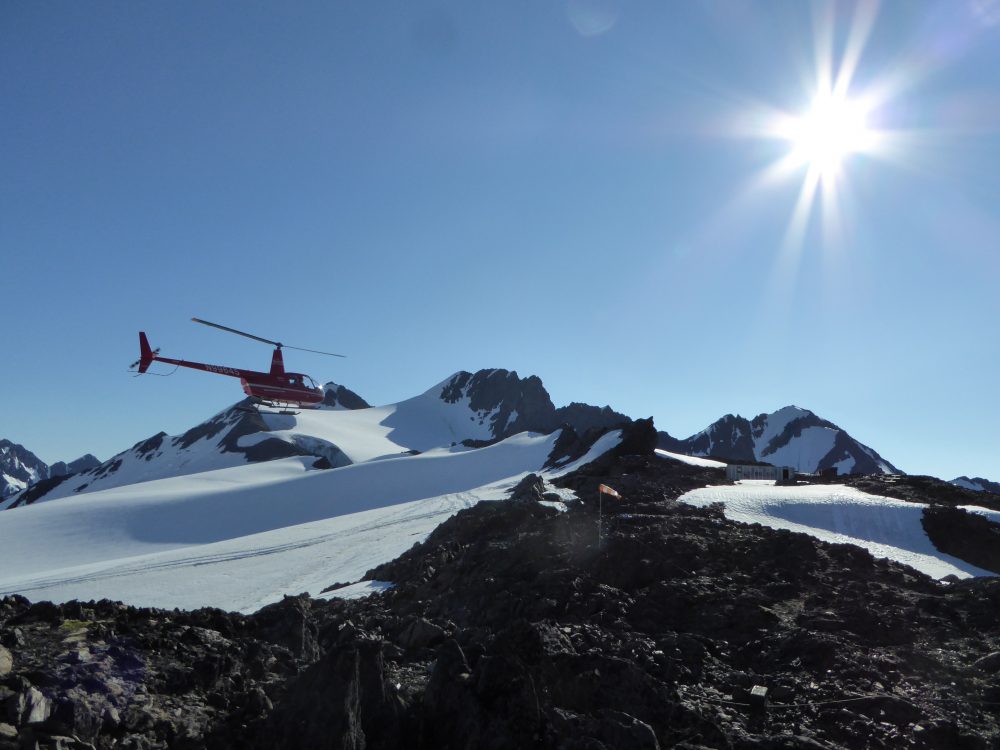
    A helicopter approaches the landing zone at Eagle Glacier, in the Chugach Mountains, Alaska, during the 2017 APU Masters Camp in July. (Photo: Gavin Kentch)

    As introductions were made in the parking lot I considered it a rousing success that no one burst out in uncontrollable laughter when I told everyone that I was from San Antonio, Texas. The acceptance continued as we drove 45 minutes down Turnagain Arm to Girdwood in the APU van. Fragile ego still relatively intact, it was now time for the first of many firsts to come, a helicopter ride to Eagle Glacier.

    As any rollerskier in a southern climate will tell you, there are a few questions you get asked by strangers repeatedly. Unlike bicycling in Texas, in which you may be the recipient of a special howdy in the form of a beer can thrown from a pickup truck, most folks are genuinely curious about your rollerskis.

    When you are a rollerskier from Texas, at a premier skiing camp held at a world-renowned training center at almost 6,000 feet in the Chugach Mountains, you get asked questions, too. Number one goes something like, “How the hell did you hear about this place?” Answer: FasterSkier and athlete blogs (Noah Hoffman’s posts from 2013 and 2014 being a standout), and an APU promo video. An email to the world’s best nordic ski coach, Erik Flora, and the next thing you know you are flying in a red helicopter so small it looks like a good gust of arctic air could smack it into the side of a mountain.

    Thanks to FasterSkier’s own Gavin Kentch, who insisted that I sit up front; I experienced my first ride to the clouds in the front of our Alpine Air helicopter and felt like I was going to fall through the glass bubble around me. I snapped pictures like a Japanese tourist in Washington, D.C., during the cherry blossom bloom. My adventure was just starting, but as I would find out soon enough, getting there was the easy part.

    Secrets revealed

    Secrets: we all have them. But how many of us have real, dark, dirty skiing secrets? Well, I do, and they were going to be revealed in an utterly uncomfortable guilt-wrapped blanket of embarrassment followed by an epic explosion. Assumptions are dangerous also, especially if they help to keep your secret a secret. I had those, too, and I was leaning on them heavily already. Day 1 of skiing would reveal all the cracks in my rollerski kingdom, but the real meltdown would come the next day.
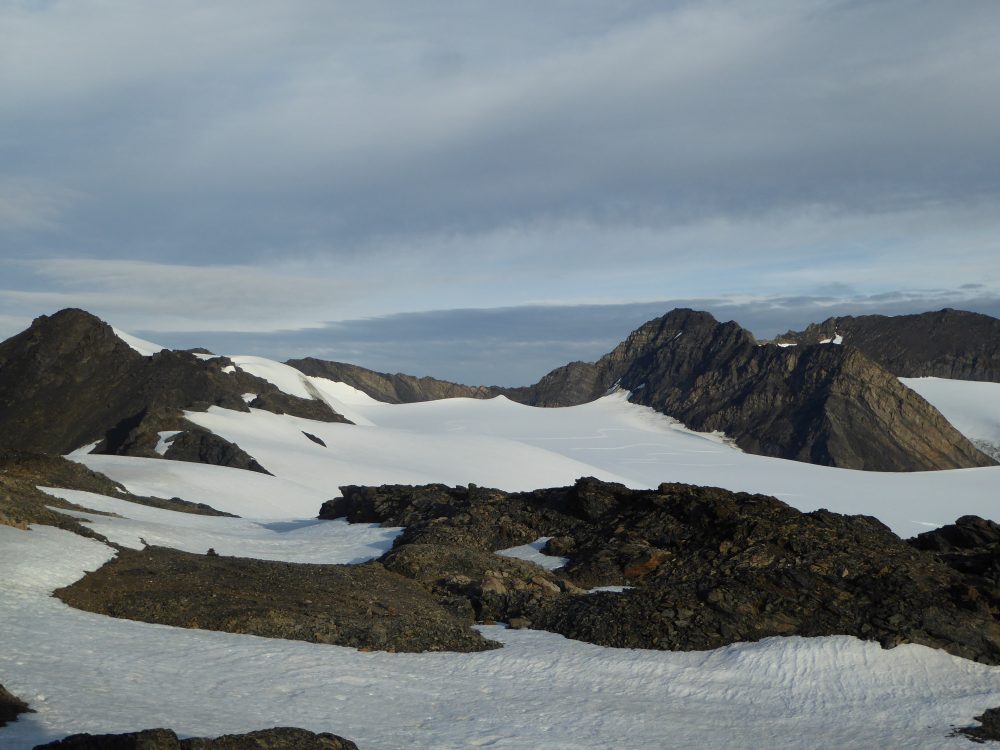
    The ski trails are faintly visible (in the background in the shade) from the second-story window of the Thomas Training Center above Eagle Glacier, in the Chugach Mountains, Alaska, during APU Masters Camp in July 2017. (Photo: Gavin Kentch)

    But first came room assignments. I would have three roommates in a dorm room with two bunkbeds.

    My first roommate would be Jeremy Littell, a USGS brainiac who studied climate change, something I might have wound up doing minus a few missteps and stutter steps in another direction. Jeremy would join myself and several others for a mountain run the day after camp; he struck me as someone who was very fit, and unsurprisingly he turned out to be a speedy skier.

    Next was Tom Corbin, with a skiing and ski coaching pedigree that looked like a Who’s Who of the history of American skiing, including decades of coaching and many years spent chasing an Olympic berth. Tom was such an animal that despite hip replacements and blown knees, he was out there everyday ripping it. He also complimented me at the end of the camp on my progress. I told him that coming from someone of his stature it meant a lot to me, and I really meant it.

    My other roommate was someone FasterSkier readers would recognize immediately, but I did not see the moniker through the bling at first. Whispers that there was another FasterSkier contributor at the camp led me to suspect and then realize that the author of the very article that led me to buy my last pair of rollerskis was bunking next to me… the man, the legend, the myth – Fast Big Dog, or FBD.

    “It’s all about how you look.” — FBD

    “It’s all about how you look,” he shouted to Gavin, part of the lively back and forth between the two. With that it was settled.

    In case anyone wondered, and I had, FBD is not just an irreverent authorial persona. He is exactly the same in real life as in his writing. There are few skiers who have their own monogrammed “Team FBD” tights and can pull it off. FBD really will throw down at any time, and if you thought it was all bravado, you would be mistaken – he was out skiing longer than anyone else for nearly every session on the glacier. The day after camp, he came away victorious in the T-Bar Row showdown in the APU weight room, though he was then crushed by all of the locals in his ill-advised rollerboard challenge.

    FBD was also generous in his encouragement of my progress, and spoke kindly about me at the end-of-camp sharing circle when Erik Flora asked us to share our reactions to camp. But before we could get to the kumbaya and the warm cuddly feeling of all surviving a sufferfest together, I had some dark secrets that were about to be revealed, some assumptions to be utterly disproven, and a near breakdown to weather. Nordic skiing has a way of exposing the rawness that lies beneath, and I was about to be exposed and the curtain was going to be pulled back – way back.

    Onto the snow. For the first time in four years.

    Time to get on skis. The first ski was classic skiing on the first afternoon.

    Some background: I am primarily a rollerskier now, but the memory of snow after four years of asphalt still lingers. I went shuffling around years ago on a whim in Vermont when I used to live there, and after that I borrowed my neighbor’s ancient three-pin skis and used them in a field across the street from my converted farmhouse. Some years later, I took up classic skiing in Ukraine after I decided to stay around six more years after serving in the Peace Corps. Skiing in Ukraine consisted of making a track yourself and skiing back in it if you wanted to get home through the woods a little sooner before you froze to death.
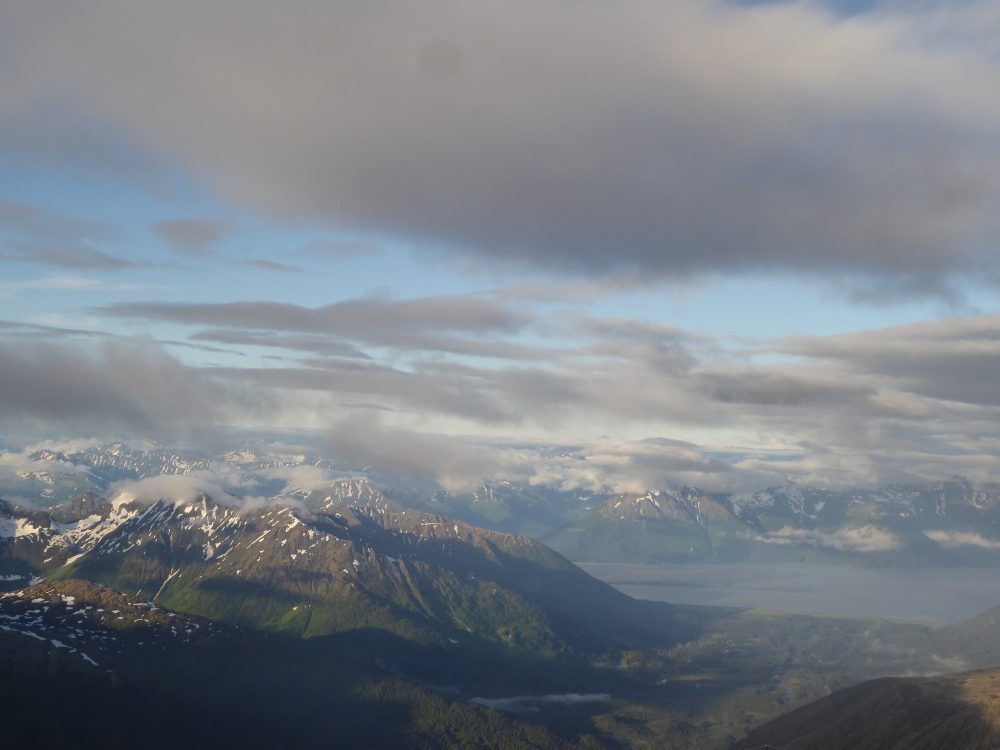
    Looking down toward Girdwood and Turnagain Arm from the Thomas Training Center above Eagle Glacier, in the Chugach Mountains, Alaska, during 2017 APU Masters Camp in July. (Photo: Gavin Kentch)

    I got into rollerskiing in Texas after I moved back when, by some kind of water-into-wine miracle, I came across Roller Ski Texas, a group founded and organized by a Russian expat named Phillipp Dimitriev, who felt he could bring rollerskiing to Texas’s churro-loving masses by buying pneumatic wheeled skate skis and giving away free lessons. After a while when one day everyone looked at me and asked what are we going to do today and I completely made something up, I became the coach.

    The takeaway from this is that although I had some experience with classic skiing on snow, it was always in cold snow conditions and was never in groomed tracks. This was one of my secrets, but I could rollerski in my sleep, I trained everyday… “What could possibly go wrong?” I thought, as I laced up my boots to hit the trail, preparing to plummet 200 vertical feet from the edge of the glacier down to the “stadium” area and start of the main loop.

    Little did I know I was doomed from the start.

    I realized I was in trouble just seconds into the descent. I was not used to the speed. There were no hills in Texas that could simulate this; I managed to get to the bottom but this is where the fun really began.

    My assumption surrounding my secret had been that classic rollerskiing was just like skiing, or at least almost like skiing. Stories of developing a late kick from too much rollerskiing I passed off as unicorn stories spread by misanthropic ski snob haters. Time to go up.

    The minute I started to climb out of the stadium, going up a steady uphill in klister conditions at 65 degrees and sunny, I slipped, and then I slipped again, and then I slipped so hard I nearly faceplanted. Where was the kick? Was my coach just messing around when he applied the klister, did he secretly apply butter or motor oil after I left the wax Conex?

    I now encountered an additional problem – my poles were sinking almost to the handle.  This was made worse when I slipped especially badly. I quickly developed a strategy of trying to excavate my poles by widening the crater so that my basket would be released. About halfway through the first lap my pole came back up out of the snow without a basket on the end; already frustrated beyond belief and in not in one of my prouder moments, I just kept going.

    I was slipping so much in the tracks that I could only sometimes find a kick outside of the track. The pole without a basket made things more challenging because that pole would sink much deeper and consistently than the other. I found myself mostly sliding down most of the downhills on my face. My temper was flaring. I was lashing out at myself and cursing the snow gods.

    APU Coach Galen Johnston was “part David Blaine and part Dr. Phil with a six pack”

    By the end of the first lap I met up with my coach, APU Development and Masters Coach Galen Johnston. Proving himself to be part David Blaine and part Dr. Phil with a six pack, Galen went about assuaging my self-directed assault on myself while simultaneously running off the little devil perched prominently my shoulder whispering a long spew of the negative poison Kool-Aid that I had been drinking.

    “I’m so frustrated with myself,” I remember telling him. Galen promptly proceeded to take a look at my scissor kick flailing that I was trying to pass off as skiing and got to work. He quickly began to work with me on proper positioning, finding and feeling the kick, and making smaller movements while increasing the cadence. Pure Genius.
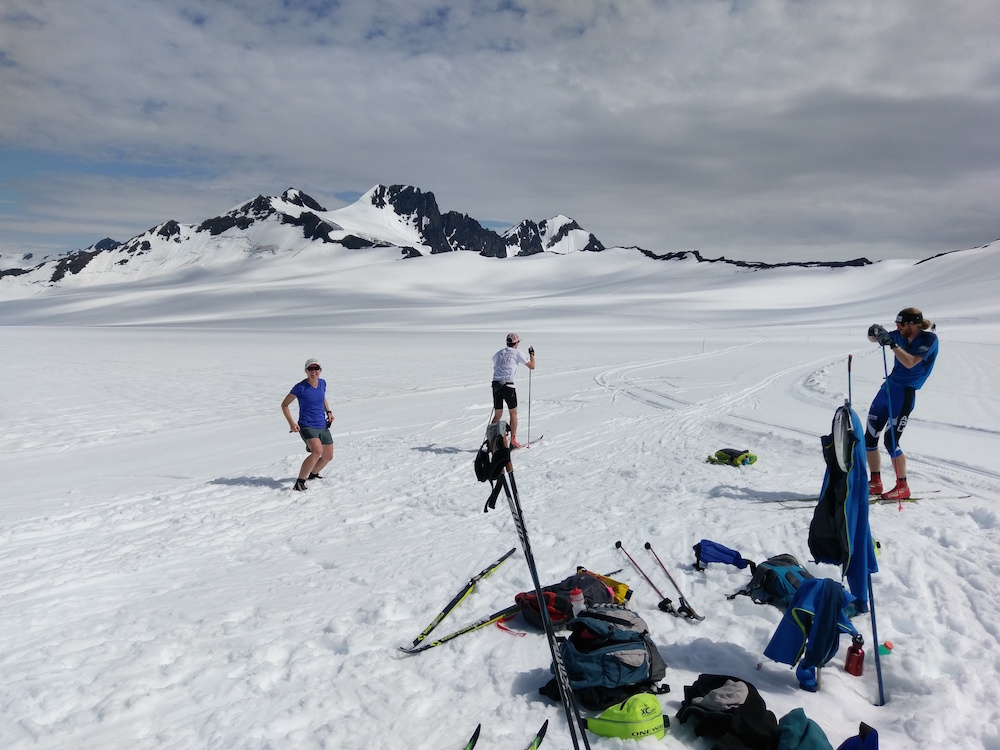
    He also takes photographs: APU coach Galen Johnston (r) gets a shot of Shannon Brockman (far left) in the stadium and gear drop area of Eagle Glacier, in the Chugach Mountains, Alaska, during 2017 APU Masters Camp in July. (Photo: Dan Libbey)

    The next lap I started feeling less slip, and the next after that I had begun to feel like a skier; I was still skiing without a basket, but I felt stronger with each lap. Galen skied with me, encouraged me, and even helped me nail a downhill that seemed to be my nemesis.

    Somehow I survived the first day. Even though I had improved greatly, my confidence was badly shaken. I thought about the hours of intervals, distance, and hills I did on rollerskis; the strength training, swimming, and cycling that had led me to believe I would somehow be competitive with a group of lifelong racers. Call it ignorance, but I still had an inkling of hope that the next day, with our first skate ski session in the morning, would be different… instead, after today’s black eye and ensuing attitude adjustment I would nearly have a breakdown the next day that found me questioning my very reasons for coming to Eagle Glacier.

    Because sometimes the first skate skiing of your entire life happens on glacial slush at 6,000 feet

    The next morning I found myself at the bottom of the first climb, ready to open up the skate skiing. I was ready, or so I thought. Here, now, I would redeem myself.

    My rollerskiing group in Texas was a skate skiing club, I coach skating technique, I’d done it in front of the cameras for local news stations, I was sure that my upper body strength from years of training would help me… but somewhere my biggest deep dark secret was gnawing at me.

    I had never skated on snow of any kind in my entire life.

    You see, even though I had never skied on soft slushy snow in a track on classic skis – I had never skated on snow of any kind in my entire life. Since classic had been a disaster, my assumption that rollerskiing could simulate skiing was hanging by a thread.

    As I started up the first hill [the “first hill” at Eagle Glacier gains roughly 100 meters total over a series of rolling up and downs, though mostly ups – Ed.], the first problem I noticed was that I spend very little time doing V1 rollerskiing. In Texas, the “hilliest” terrain I can still full V2 on my medium-speed Marwes. I practiced V1 based on some video I had seen online, but mostly this was just jump skating the tops of hills.

    At Eagle you are either going up or going down, and going up for me meant skiing V1 for a long time. I began to notice immediately that my glide was virtually nil, so I began poling harder to compensate, which just sunk my poles deeper into the soft snow and decreased whatever glide I was getting even further. As soon as I pointed my skis out in a V-stance, my right abductor began to ache. A war injury from my soccer years, it would get worse as I went on before finally turning into a stabbing pain near the end of the lap that reminded me repeatedly that I was 41 years old and going up a steep hill at nearly 6,000 feet.

    It was about this time that I began to feel the altitude. Despite moving almost slow enough to fall over, I noticed that my heart rate was highly elevated. Even though I was constantly reminding myself to breathe, I found myself stopping repeatedly on every hill. I vowed to get through the first lap, and I did, but I called it quits after that. I was too demoralized to seek out a coach; I felt utterly broken.

    Later that evening, I began to question why I had come to this camp. I had come to get some on-snow time, but also, being highly competitive, I came to measure myself against others. It was not just the four years of training in 100-degree, 80-percent humidity since I had last seen snow that had prepared me for this. I had also spent six years before that skiing by myself in Ukraine.
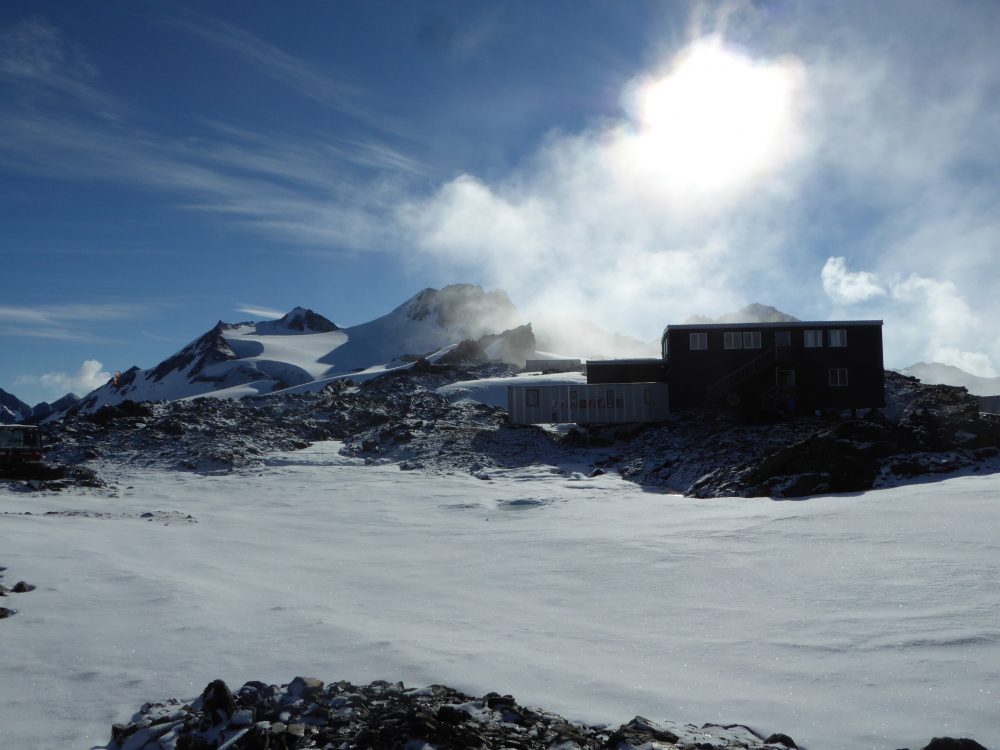
    Fresh snowfall surrounds the Thomas Training Center above Eagle Glacier, in the Chugach Mountains, Alaska, during 2017 APU Masters Camp in July. (Photo: Gavin Kentch)

    Skiing had always been a place where I could find solace, peace, satisfaction, and happiness when I couldn’t find it elsewhere. Now it suddenly seemed like my greatest demon. Everything I had done before seemed for naught. It felt like I was just learning how to ski, like the tables had been turned and suddenly I was one of the beginner athletes I coached in Texas. About this time I thought of my family, my 18-month-old. I wondered how they were doing. I began to miss them. To complicate my crisis of conscience, others in our group were regularly seen texting and talking on their phones… I checked my phone and found that I had no service. I was at an all-time low.

    Some time before heading out for the classic afternoon session. Berit Flora offered me her phone so that I could call my family. Berit was affectionately referred to as the camp mom for her powers of making sure everyone was doing well and well fed, and her gesture in that moment seemed to give me new lifeblood. A dark cloud seemed to float away from above my head.

    (I had the pleasure and honor of later having dinner with Berit and her husband Sam and others after the camp finished. Both Berit and Sam (who are Erik Flora’s septuagenarian parents) were out there skiing every day, and had plenty of history in the form of great stories to add to mealtime discussion. Sam also drove me to my Airbnb room after camp, to Alaska Mountaineering and Hiking to return my rented skis, and to the airport. Their hospitality and kindness will not soon be forgotten.)

    About this time I began to reevaluate my goals. There were other reasons to come to this camp, such as receiving some of the best coaching from some of the best coaches in the world. Also I could personally gain from coaching because my first ski taught me I had more to learn than I realized. Also, if I could ski these conditions I could come away with some newfound confidence (maybe getting through it was the moral victory) as well as a desire to get on snow more often; more snow time was something that became apparent immediately that I needed.
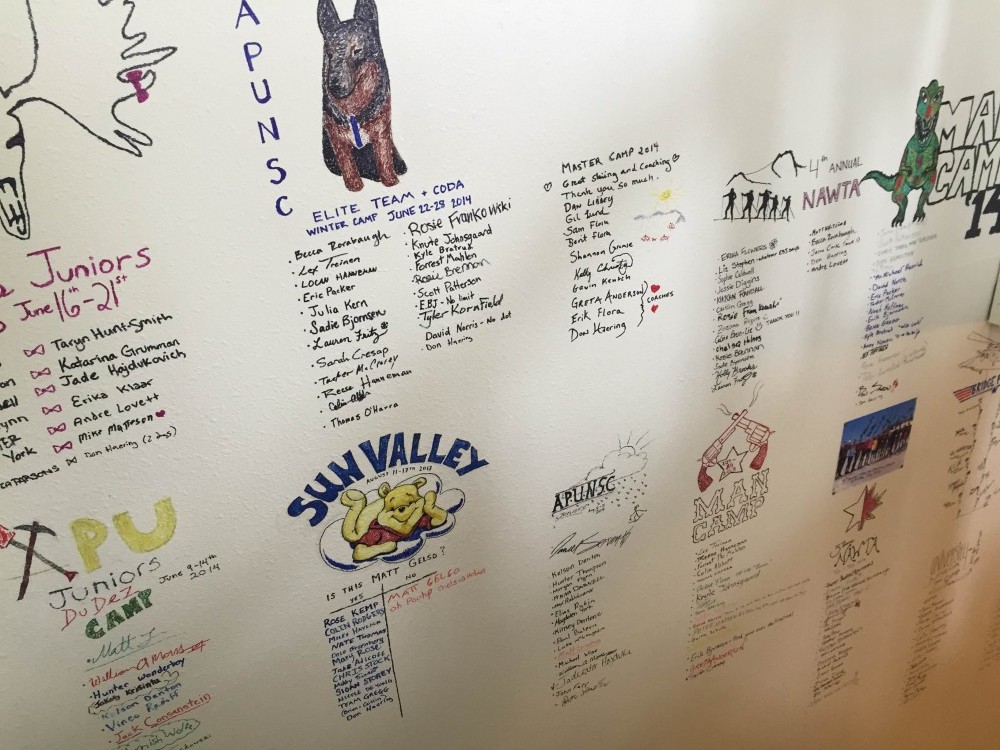
    The wall of fame inside the Thomas Training Center on Eagle Glacier. From left, the APU Juniors (teenage girls), APU Elite Team, 2014 Masters Camp, North American Women’s Training Alliance (American and Canadian athletes, plus Norwegian skier Celine Brun-Lie), and Man Camp (APU and USST men), among many others, have all left their mark. (Photo: Greta Anderson)

    I also reminded myself of how few people get an opportunity to ski here, the names of elite athletes written on on the walls serving as gentle reminders of the caliber of skiers who typically come to Eagle. I vowed to take in the beautiful scenery more, and to receive as much coaching as possible. Once I put the shattered pieces of my ego aside I began to enjoy myself again.

    The next classic session I felt especially good and was able to catch Brandy Stewart (an elite skier from Montana) and Gavin, two skiers well above my level, on a climb. I was immediately dropped on the first descent, but it was something Galen would bring up on the last night. Credit to Galen, but also to Dylan Watts, the best cook/competitive skier/coach in the world, who jury-rigged a really sweet basket on my left classic pole. Feeling like I was skiing with two poles really made a difference.

    After talking to Erik Flora the night before, he immediately found me the next morning.  I got to ski with him for a while, which made my day, and made it apparent what I need to work on for the future.

    It was not lost on my me how much it would cost me to have the best coach in any other sport work with me one on one; the experience was priceless. A shooting lesson from Gregg Popovich or a tackling lesson from Bill Belichick I could never afford, even if they were willing to take the time. And yet Erik seemed to enjoy coaching me; that dedication and love for coaching is something that I hope I can duplicate with my rollerskiers. I tried to listen to everything he was telling me technique-wise, but when he skied in front of me I couldn’t help but imagine how hard it was for him to ski that slow; he is an amazing skier and within seemingly a second or two after the lesson ended he was out of sight, moving on to find and coach the next athlete.

    Morals and acknowledgments

    There plenty of others who gave me the courage to continue on and improve each day. Both of the FasterSkier crew gave me encouragement throughout, and everyone seemed to lift each other up with a kind word or two on the trail. Special thanks to Jeffrey Lynn, my hilarious dishwashing buddy that made the time spent doing chores enjoyable. Jeffrey was there to become a better skier to be able to ski with his son. I watched him put on Moleskin and heaps of duct tape to cover his blisters every day – you were inspirational to me.

    Special thanks to Galen, who even loaned me his skis, and to him and the APU Masters Group who let me join two of their workouts after camp. I truly felt like a part of the APU Masters skiing community, and I don’t recall ever feeling that much energy and excitement from working out with anyone else.

    I’d come far during the camp, from skiing alone in the woods in Ukraine, to braving the heat in Texas, to V1’ing up a glacier. I had come great distances to see, taste, and feel the ultimate. The ultimate venue, ultimate beauty (yes, Alaska is probably the most beautiful place I have ever seen), ultimate coaching, and ultimate community.

    It was only fitting that after coming from humble obscurity and a truly off-the-radar outpost like San Antonio, and overcoming some pretty personal lows, the helicopter I flew out of was bringing up two of our nation’s greatest skiing stars, Kikkan Randall and Sadie Bjornsen. They got out of the helicopter, with an NBC cameraman dressed more for L.A. weather than for Alaska filming every step they took.

    Total stars in our sport, they both smiled and waved. Sadie offered a quick handshake and Kikkan smiled and said hello, looking exactly like the Fischer ski poster of her on the second floor of the Thomas Training Center had suddenly come to life. If I would have had the time without the helicopter ready to lift off, and it wouldn’t have been so loud, I might have introduced myself: “Hi, I’m Jason, a skier from San Antonio.”

    — Gavin Kentch contributed 

    ***

    Masters Minds series: Are you a masters skier who loves your club? Submit camp or training recaps, announcements, or stories to info@fasterskier.com with the subject line “Masters Minds.” Articles can be first-person accounts or written from an observatory standpoint with comments from others.

    Related: 2014 APU Masters Camp | 2015 APU Masters Camp
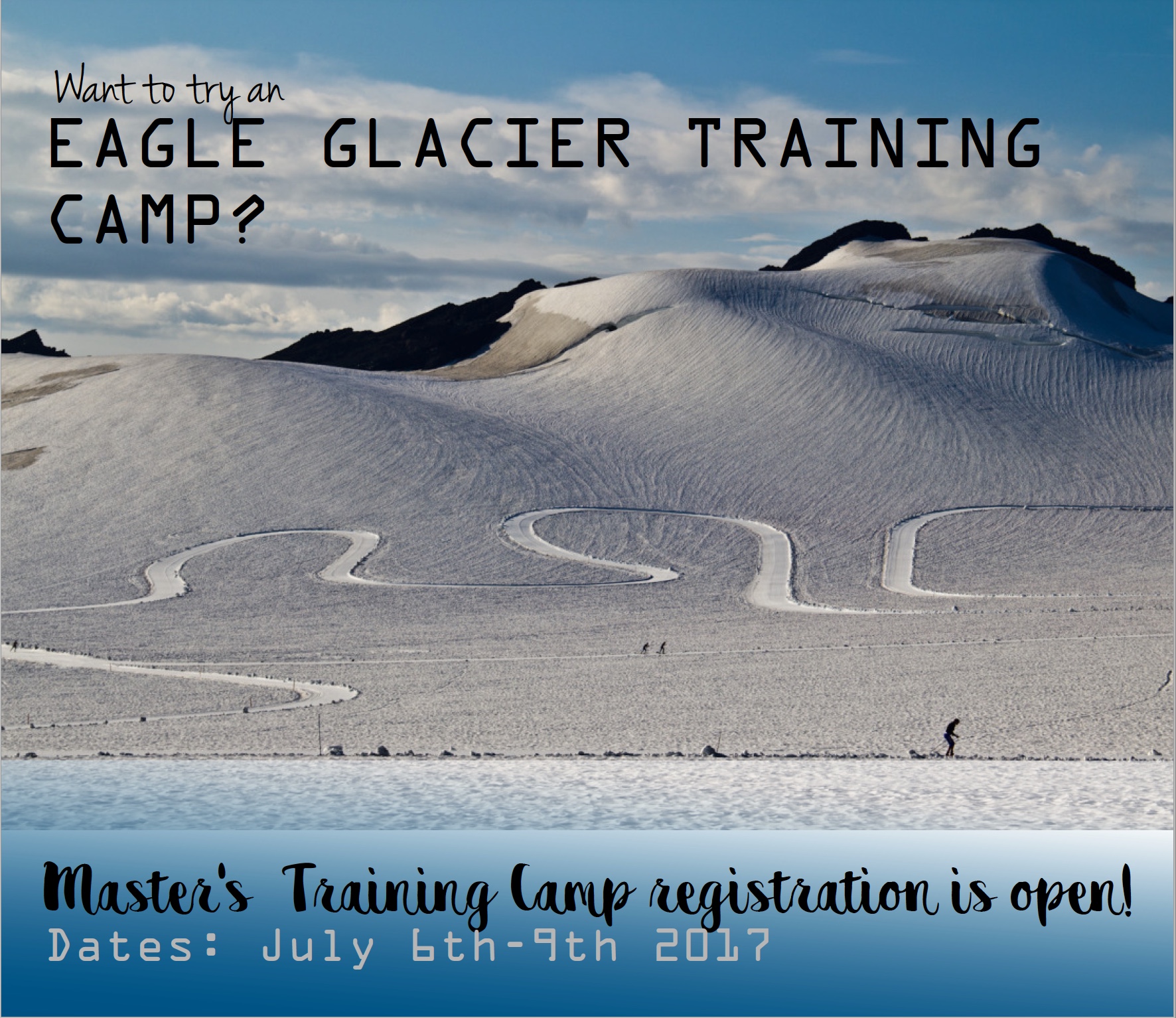
  • APU Masters’ Glacier Camp July 6-9

    Have you ever wondered what summer training on Eagle Glacier is all about? Have you heard stories from your kids, friends or Elite athletes about the wonders of summer skiing? Well here is your chance to try it for yourself!

    As of this publication we have 9 remaining slots, so don’t wait! You don’t want to miss out on this awesome opportunity.

    Please RSVP to APU Masters Coach Galen Johnston at johnstonnordic@gmail.com to reserve your spot and receive a registration link.

  • O’Harra, Frankowski Claim Solo Victories in Tour of Anchorage

    O’Harra, Frankowski Claim Solo Victories in Tour of Anchorage

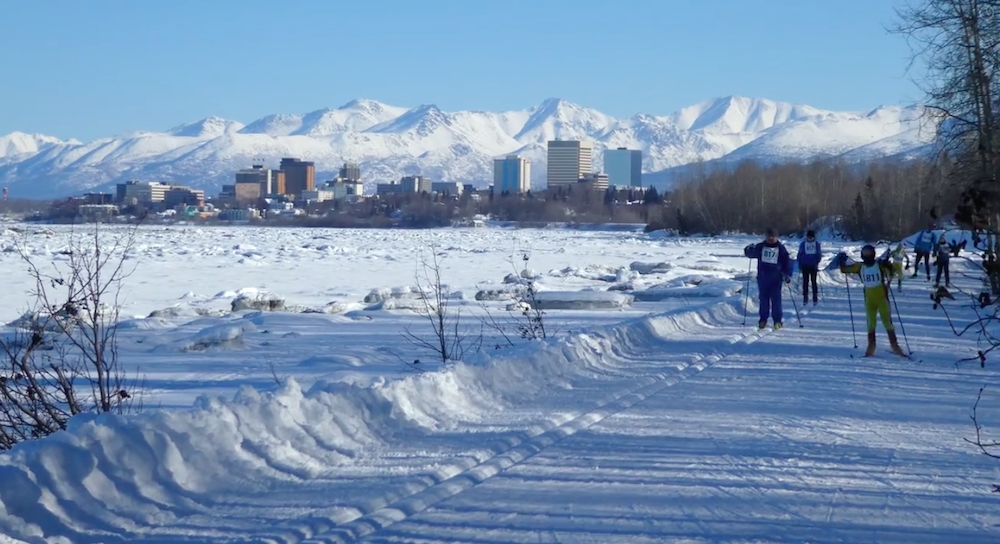
    Midpack racers ski on the Coastal Trail, with the Pacific Ocean to their right and downtown Anchorage in the background, in the Tour of Anchorage on March 5 in Anchorage, Alaska (Photo: Robert Arnold video screenshot)

    ANCHORAGE, Alaska — There are several strategies for winning the Tour of Anchorage, the annual 50-kilometer freestyle marathon from one side of town to the other that is the unofficial citizens’ race championship for the State of Alaska. There is one obvious way to lose it: Go out too hard on the climbs of the first 10 k, only to lose steam and be swallowed up by a chase pack at some point in the 40 k of flats and rolling downhills that follow.

    But Alaska Pacific University skiers Thomas O’Harra and Rosie Frankowski were undeterred by these risks, as both got a gap early in the race and held it to reach the finish line unchallenged, claiming victory in the 30th Tour of Anchorage on a bluebird Sunday morning.

    For Frankowski, pushing hard from the start was her plan all along. “I went off the line,” she told FasterSkier during an in-person interview after the race. “I knew that the only place where it’s easy to build a gap is Spencer’s, and I would much rather ski uphill any day than ski on a flat downhill course. So from the gun I went for it. I tried to ski relaxed, and then the minute I got to even the climbs heading up to the Gasline, I just hammered as if I was in like a 20 k race.”

    Despite the fast pace at the start of a long day, Frankowski was relatively unconcerned about her effort level. “I knew that there’d be tons of recovery, even on Spencer’s,” she said. “We raced a 30 k there a couple years ago [at Spring Series 2014], and you hammer the uphills and you get two minutes of recovery on downhills. So I just went for it. I caught some groups, I had people to chase, people from the men’s waves, and had a lot of local support that definitely moved over.” By the bottom of the Spencer Loop, Frankowski was hearing that she had a five-minute gap on her nearest pursuer.

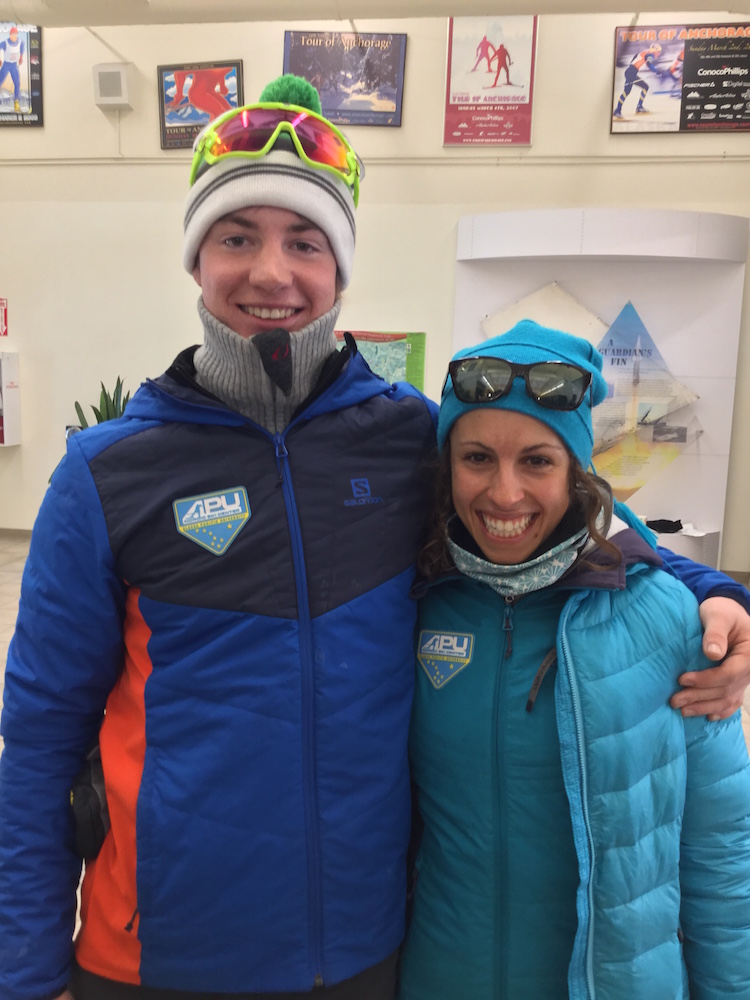
    Alaska Pacific University (APU) skiers Thomas O’Harra (l) and Rosie Frankowski in the Kincaid Chalet after winning the 2017 Tour of Anchorage on March 5 in Anchorage, Alaska. (Photo: Gavin Kentch)

    “And so I just tried to hammer” at that point and catch the next group, she recounted, “because I wanted to catch a group to draft for the mid-part of the race, and I caught Rob Whitney’s group.”

    Frankowski had nothing but praise for her on-course treatment from Whitney, once a leading American junior and now a formidable Masters skier. “And with Rob and three other guys, we traded off the lead. And it was fun, because they were psyched to have me in the group, compared to – I mean, you hear about sometimes some of the male skiers being annoyed, but they were awesome. And we had this little group going with switching the lead every minute toward the end to try to catch some of the APU guys we could see in front of us. It was really fun.”

    Ahead of all those APU guys was the fastest skier on the day, Thomas O’Harra. The 20-year-old junior and Anchorage native was skiing alone on familiar trails, at one point passing the house he had grown up in. “My season hasn’t really gone the way I’d hoped and so today felt awesome to have a good race at home, on trails that I grew up learning to ski on,” O’Harra said in an APU press release.

    Like Frankowski in the elite women’s wave starting two minutes behind him, O’Harra led the race off the line. While Frankowski dropped the other women almost immediately, O’Harra had somewhat more company, leading a pack that included fellow APU skiers Reese Hanneman, Tyler Kornfield, and Jack Novak up through Gasline, roughly four kilometers into the race. O’Harra sat in second through the ensuing climbs of the Spencer Loop, until, he recounted, “I made a move going up Wall Street [at the top of the main climb] on Spencer, and I led from there to the finish line.”

    O’Harra was pleasantly surprised that the gambit worked. “My plan coming into the race was to see how my skis were running and decide from there,” O’Harra told FasterSkier after the race, “Once I figured out that my skis were running pretty well compared to everybody else, I decided to go for it and try and stretch it out. I expected – I didn’t expect to ski alone the whole 50 k. I expected everybody else to chase me. And they tried, I heard, but I had a little bit too much of a gap.”

    O’Harra crossed the line in 2:10:49.2. Hanneman (+2:11) and Kornfield (+2:54.8) made up the rest of the podium, with Novak finishing several more minutes back in fourth (+7:21.8). APU skiers took six of the top seven spots in the men’s race, including APU Masters Coach Galen Johnston and former Tour champ Dylan Watts.

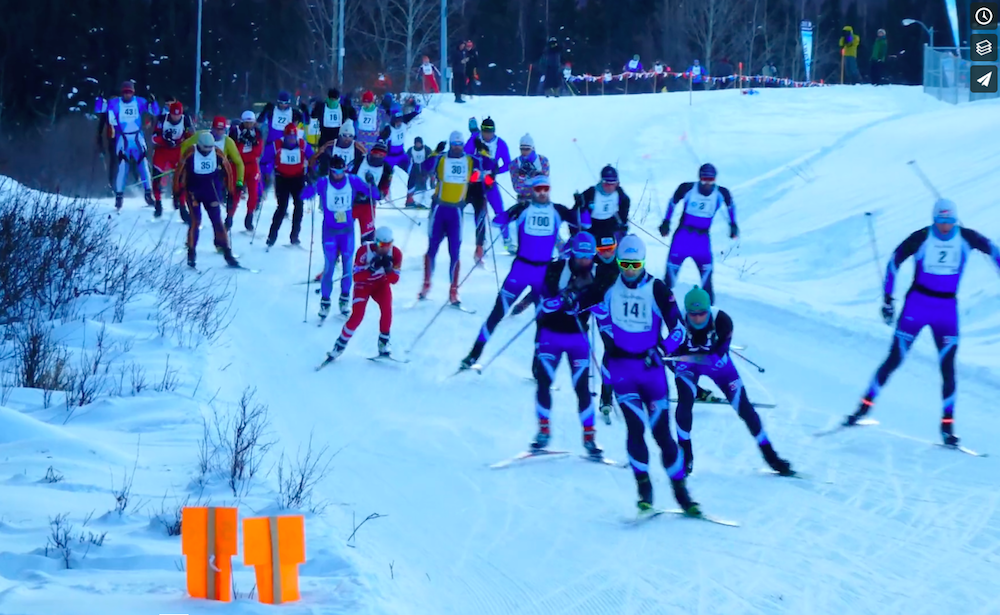
    Eventual podium finishers Thomas O’Harra (14), Reese Hanneman (100) and Tyler Kornfield (2), all APU, lead off the starting line of the 2017 Tour of Anchorage on March 5 in Anchorage, Alaska. (Photo: Robert Arnold video screenshot)

    Breaking away at the 7 k mark carries risk in any 50 k, because of the differences in efficiency between leading solo versus skiing in a chase pack that characterize any long race. It is particularly fraught in the Tour, given the elevation changes and topography of the point-to-point race from one side of town to the other.

    Briefly put, the Tour goes up for the first 10 k, but down or flat almost all the rest of the way. More specifically, the 50 k course ascends the rolling uphills of the Hillside ski trails for around 5 k, then tackles the Spencer Loop. Spencer is locally notorious for having more climb than is allowed under International Ski Federation (FIS) regulations – the maximum climb of 104 meters readily exceeds the 80-meter limit permitted for an A-climb on a FIS-homologated course of any distance. Within the first 7 kilometers of the Tour, skiers have climbed more than 150 meters above where they started. (For comparison, the American Birkebeiner, famous for its hills, climbs roughly 105 meters over 11 kilometers.)

    But it’s virtually all downhill from there. Racers descend Spencer, ski on rolling downhills back through the Hillside lighted trails, drop down through Campbell Tract, and then cruise on greenbelt trails until the 44 k mark before climbing up to the finish at Kincaid over the last six kilometers. For parts of the course skiers are on the Coastal Trail alongside the ice floes of Cook Inlet, elevation approximately one meter. All of which is to say that a chase pack has a lot of time to work together on the flats to reel in an early solo breakaway.

    Oh, and it was not warm out there, so leaders were dealing with slow snow as well. Race-time temperatures Sunday morning were -4 degrees Fahrenheit at the starting line, down to -12 degrees in a notorious icebox spot in the black spruce forest of Campbell Tract. Skiers sported the latest in face-tape fashion – Frankowski carried the day with her pink tape and pink buff ensemble – and race photos show a series of frosty faces, ice beards, and clouds of frozen breath.

    Even Frankowski, who dominated the women’s field en route to finishing sixth overall in 2:23:42 (Shalane Frost and Nicole De Yong followed roughly 15 minutes back), noticed the cold.

    “I don’t think it was particularly fast,” Frankowski said. “I never race with a watch, but definitely the snow was slow. … It was not a warm day out there. And by the end – normally I die with 10 k left in all the 50 k’s I’ve done, so today I died with four k left, which was a vast improvement. And the worst part is, I had to stop like four times during the race, because I dropped my waterbottle, or it froze and I couldn’t get it back in my pack. So at one point at Westchester Lagoon I dropped it, my whole group had to go around me because I snowplowed to a stop to pick it up, and then I just threw it onto the Lagoon. So I have to go find it after the race.”

    O’Harra also had plans for after race: “I was informed after the awards ceremony that there is a bottle of wine for me, waiting for when I turn 21, which is next Sunday, and I get it then.”

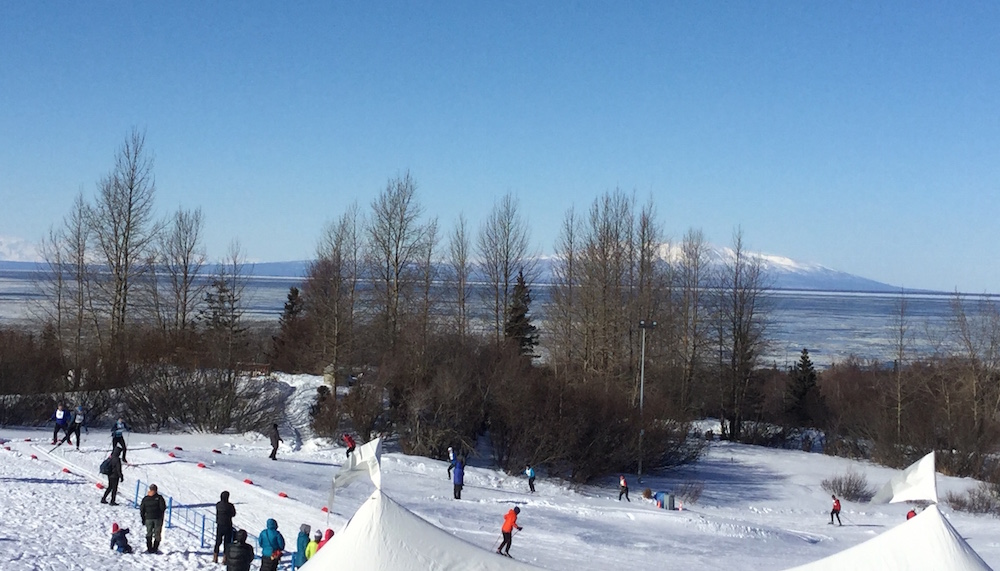
    With the roof of the beer-garden tent in the foreground and Mt. Susitna in the background, skiers approach the finish line of the 2017 Tour of Anchorage on March 5 in Anchorage, Alaska. (Photo: Gavin Kentch)

    But last Sunday morning, as skiers flocked to the outdoor beer garden following the race, O’Harra was left inside. Let his former roommate Frankowski graciously explain: “I am really excited mostly for my teammate Thomas O’Harra’s win. Thomas and I had been roommates, until December, for about a year, and Thomas now has my room on the APU campus. Which, obviously, the karma contributed to why he won. And in fact, Thomas isn’t even 21, so he can’t go to the beer garden that the Tour of Anchorage and [Nordic Ski Association of Anchorage] has graciously provided for us. So unfortunately, the Tour winner’s stuck inside.”

    Other than bottles, of either wine or water, what were the winners’ future plans? Frankowski, reflecting the realities of life as a professional cross-country skier, was planning to use her $500-dollar winner’s check toward rent money. And as for the rest of her first-place prize, the roundtrip Alaska Airlines plane ticket? “You can’t fly to Cuba” with it, she lamented, “which is basically the main destination I wanted to go to. So now I have to find another destination where Alaska flies. Honestly, I’ll probably go to Minnesota, where I’m from.”

    O’Harra, meanwhile, was planning to put in a three-week training block, “and be in good shape for Spring Series in Fairbanks” in late March.

    O’Harra explained that he had been planning on racing this year’s Birkie before it was canceled, “so that would have been my first 50 k. This instead became my first 50 k. So hopefully my second 50 k, in Spring Series in Fairbanks, will be just as good.”

    For Frankowski, Sunday marked the fourth-career 50 k for the Midwest native, including two Birkies and a win in last year’s Great Bear Chase in Calumet, Mich. “This is definitely the prettiest 50 k I’ve ever done in my life,” Frankowski said of a perfect day when mountains and ocean were visible in all directions throughout the course. “It was beautiful out there.”

    A triumphant return

    Frankowski’s sentiments were clearly shared by many in the crowd of 872 finishers, which marked both the smallest Tour field in over twenty years but also, with this year’s Birkie washed out, the largest ski race in the country this winter to date. Although the Tour was held over its full course 25 times in its first 26 years, the race only went halfway across town in 2014, and was confined to a lap race on Kincaid snowmaking trails in 2015 and 2016 as snowfall was scant and participation numbers plummeted.

    But this year the Tour returned to Anchorage, and Anchorage returned to the Tour. Families raced. Parents raced. Grandparents raced. Anchorage Mayor Ethan Berkowitz raced. Alaska State Representative Matt Claman (D–Anch.), whose house lies within 100 meters of the course, raced. A 9-year-old completed the 25 k (in a healthy 2:08), and 87-year-old Reno Deprey classic skied the 40 k in 4:47. It was a great day for skiing in Anchorage.

    It was also an historic day: March 5, 2017, was just over one century removed from the first recorded ski race in Anchorage, a town founded in 1914 as a construction camp for workers on the Alaska Railroad.

    As former U.S. Ski Team athlete Tim Kelley recounts in more detail on his blog, a 10-mile race was held, starting and finishing on Fourth Avenue in downtown Anchorage, on March 4, 1917 (start line photo here). The winning time was a solid 1:08:30 for 10 miles, more than respectable considering what we would now term the primitive ski technology involved. First place went to a John Aho, with one Emil Gustafason second. A man whose given name was literally “Young Viking” served as race director. They raced again the following weekend, by which time the winning time was down to 57:25 for 10 miles. O’Harra posted a faster pace in March 2017 for 50 k, but not that much faster.

    Other races

    Three other races were held on Sunday. In the 40 k, which skips Spencer Loop and most of the Hillside trails, first place in the women’s division went to former junior standout and Besh Cup Trophy winner Jaime Bronga in 2:05:15.1. Christina Pohl and Melina Park followed.

    In the men’s 40 k, three local juniors used the 40 k to once again unofficially see who is the fastest local junior not selected for Team Alaska for Junior Nationals. (One has to be 18 years old to race the 50 k. The 11 year old who skied this year’s 40 k in 3:06 suggests that there may be no lower age limit for the 40 k.) This year it was Chip Schoff, 17, who took the victory in 1:48:16.3, over 17-year-old Trent Fritzel and 16-year-old Hans Personius.

    In the 25 k skate race, Jasmine Maurer of Homer took the victory for the women in 1:32:59.9, followed by Clare Ross of Anchorage and Mallory Conger of Nome, reflecting the fact that the Tour draws racers from the entire state. For the men, it was Kai Meyers, 16, in first in 1:12:22.6, Kevin Donley, 51, in second, and Dale Baurick, 14, in third.

    And first overall in the 25 k classic was University of Alaska Anchorage skier Sadie Fox in 1:30:28.1, followed by Alison Arians and Anna Rix for the women. First among men, and second overall, was Erik Hjelm in 1:31:42.6, followed by Paul Kari and Karl Volz.

    Next year’s Tour is scheduled for March 4, 2018.

    Results (all races) | Race video

  • Besh Cup Series Wraps up in Fairbanks as Team Alaska is Named

    Besh Cup Series Wraps up in Fairbanks as Team Alaska is Named

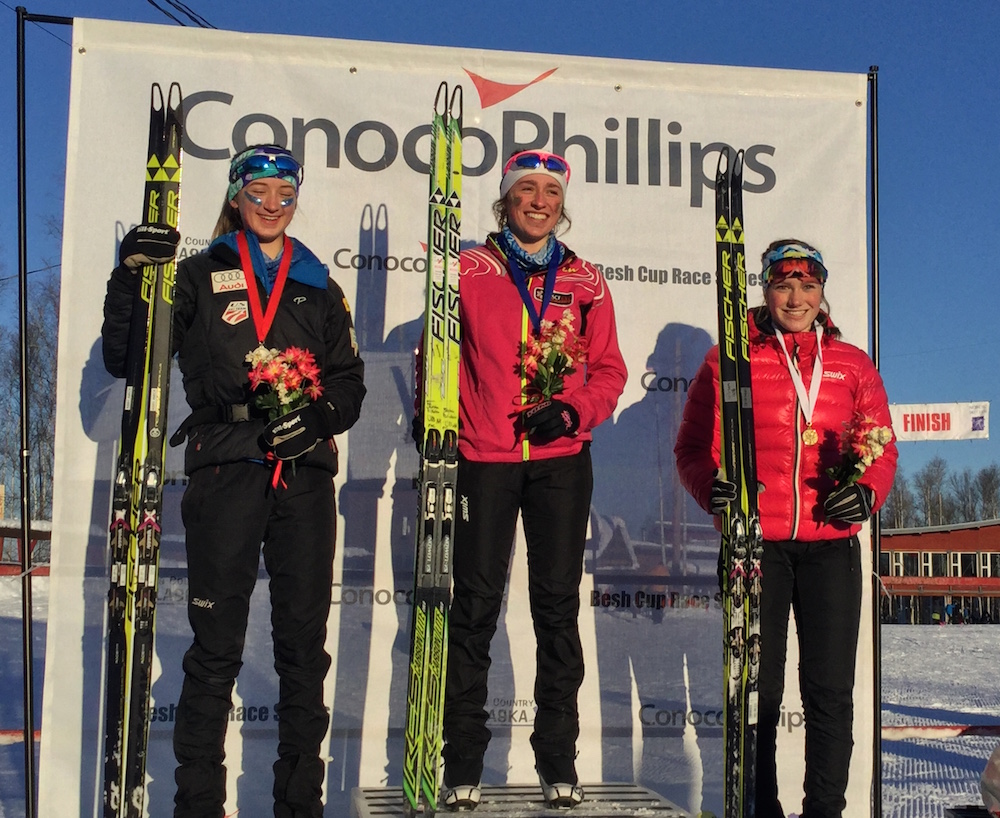
    Jenna DiFolco (c) of FXC, Abby Amick of APU (l), and Addison Gibson of ANR (r) on the podium for the U18 girls division of the Besh Cup 5 k skate race in Fairbanks, Alaska, Feb. 4, 2017. (Photo: Gavin Kentch)
    Jenna DiFolco (c) of FXC, Abby Amick of APU (l), and Addison Gibson of ANR (r) on the podium for the U18 girls division of the Besh Cup 5 k skate race in Fairbanks, Alaska, Feb. 4, 2017. 

    FAIRBANKS, Alaska — Alaska Airlines operates roughly 10 flights a day between Anchorage and Fairbanks. Last Friday morning many of those flights were packed with skiers, and ski bags piled up at baggage claim in Fairbanks, as Anchorage skiers streamed north for the final weekend of Besh Cup racing to select Alaska’s representatives to next month’s Junior Nationals in Lake Placid, N.Y. Two days later many of those same skiers returned south with plans to fly all the way to Lake Placid, where Team Alaska will have roughly equal representation from the state’s two largest cities.

    The 2016/2017 Besh Cup series concluded with a pair of distance races at Birch Hill ski area: freestyle interval start on Saturday, classic mass start on Sunday. The weather for both days was Fairbanks at its mid-winter best, clear and sunny and relatively warm. Cold powder and hard glide waxes were de rigueur.

    (The emphasis here is on relatively, as national FasterSkier readers might find Saturday’s race-time temperature of 10 degrees Fahrenheit, or Sunday’s reading of 2 degrees, objectively not all that warm. But it was -16 degrees at the airport on Sunday – Birch Hill’s elevated location on a hill above town often keeps it significantly warmer than the low-lying areas of central Fairbanks where official temperature readings are taken – and it is forecast to be -35 degrees in Fairbanks by later this week. So, relatively warm.)

    The first race on Saturday was the boys 10-kilometer freestyle individual start for racers in the U18 division and older, 45 starters in all. The overall podium on Saturday was U18 skier Ti Donaldson of the Nordic Ski Club Fairbanks racing team (FXC), Senior skier Cody Priest of Alaska Nordic Racing (ANR), and U18 skier Josiah Alverts (ANR).

    Among U20 men, FXC skier Benjamin Koenig was first, leading his teammate Logan Mowry in second and Dax Cvancara of ANR in third.

    The U18 boys division, which saw two of the top-three overall finishers, had Donaldson in first, Alverts in second, and APU skier Tristan Wiese in third.

    U16 boys raced a 5 k skate individual start, covering one lap of the blue course that 10 k skiers completed twice. Eli Hermanson of Alaska Winter Stars (AWS) led the all-Anchorage-area podium in the 5 k, followed by George Cvancara of ANR and Zanden McMullen of APU.

    Finally, the U14 boys raced a 1 k skate ski-cross event, with jumps, gates, slaloms, and other technical challenges. The event is a crowd favorite that, race organizers wrote, “helps develop skiers’ abilities to ski in a ‘pack’ along with developing technical skills.” (It may also soon be coming to a race series near you! Here is an example from the 2016 Youth Olympic Games in Lillehammer.) In another Anchorage-area sweep, Aaron Maves of APU took the A-Final, followed by Rudy Schumacher of AWS and Konrad Renner from ANR.

    On the girls side, a field of 57 racers (U16 and older) contested a 5 k skate individual start. At the end of one lap around the blue course, APU skier Maggie York took the overall victory by 40 seconds over FXC skier Jenna DiFolco, with Kendall Kramer (FXC) another 14 seconds back.

    York also topped the U20 podium. She was followed there by Alyeska Daniels and Lupua Oba, both of FXC.

    DiFolco, second overall, was first among U18 girls. Second in this division was Abby Amick of APU, with ANR’s Addison Gibson third.

    U16 girls took third through fifth overall in the combined U16/U18/U20/Masters field for the 5 k (there were no Senior skiers in the race). Locals Kendall Kramer and Kaya Ratzlaff of FXC led this division, with Annika Hanestad (ANR) third.

    U14 girls also raced a 1 k ski cross. First here was Quincy Donley of AWS, continuing her winning ways from the Anchorage and Soldotna Besh Cup weekends. She was followed across the finish line of the A-Final by Marit Flora of APU and Katey Houser of ANR.

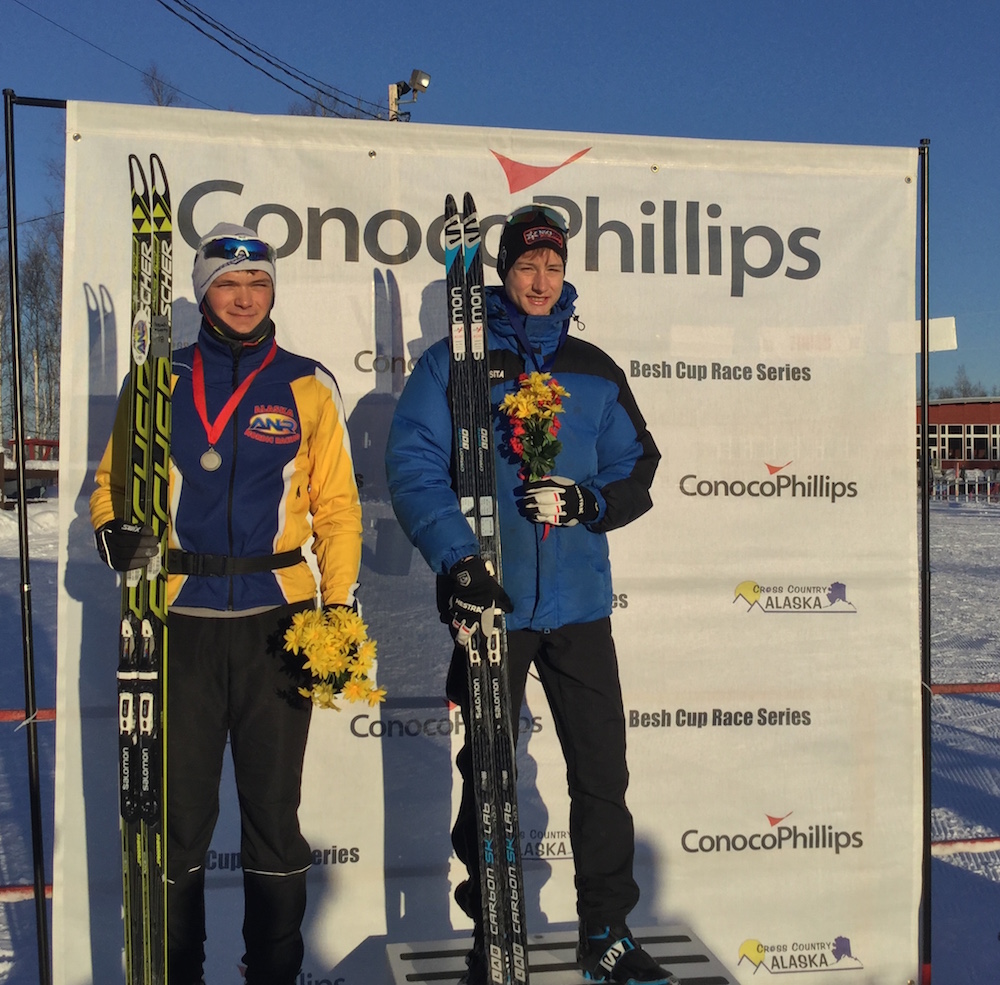
    Ti Donaldson of FXC (r) and Josiah Alverts of ANR (l) on the podium for the U18 boys division of the Besh Cup 10 k skate race in Fairbanks, Alaska, Feb. 4, 2017. (Photo: Gavin Kentch)
    Ti Donaldson of FXC (r) and Josiah Alverts of ANR (l) on the podium for the U18 boys division of the Besh Cup 10 k skate race in Fairbanks, Alaska, Feb. 4, 2017. 

    Saturday’s overall winner for the boys race, U18 skier Ti Donaldson, was racing on home turf. “I’ve had a few wins [in the Besh Cup series] in the past,” Donaldson told FasterSkier in an in-person interview following the race. “Most of them have been in Fairbanks. I’m from here, so definitely a home-field advantage.”

    Donaldson came in expecting a “brutal” race, based on his knowledge of the course and his time previewing it. “But I knew it would be pretty fast conditions,” he continued – “it was nice and hard, and it wasn’t too cold. So I was pretty excited to see how it would go, and really just wanted to work the transitions and stay strong on the climbs, and crest over. So I stuck to that plan, and it worked out pretty well.”

    Donaldson was looking forward to 2017 Junior Nationals in March.

    “I’d be thrilled with a top-five finish,” Donaldson said of his goals for next month. “Two years ago, when I was racing the same kids, I placed fourth in a race, and so I’d like to repeat that result. That would be a good goal of mine.”

    Jenna DiFolco, the U18 girls winner and second-place overall skier, was also racing at home. She credited “my FXC coaches” for waxing her winning skis, and had hot cereal for breakfast, with raisins and dried cranberries, at home before heading out to Birch Hill.

    The race was “really fun,” DiFolco recounted in an in-person interview. “Warming up, I didn’t feel so good, I was feeling kind of tired, maybe I’d overdone it this week. And then I expected this course to be really hard, because there are so many hills. And it was definitely, like, it was a rough course. But it went a lot better than I expected it to.”

    DiFolco described her strategy for racing a one-lap 5 k course with nearly constant climbing or descending: “The first part is mostly downhill, so I kind of just started out like a sprint almost, because I knew I’d be able to recover on the downhill. And the first couple of hills I was just trying to keep it light, keep it relaxed, and then really start hammering up South Tower [the high point of the course], because I got a big break after that. And then the last two hills are basically just hard, really hard.”

    Looking ahead to Lake Placid, DiFolco said that she was “hoping to get a couple top-10 finishes.” She added, “A big dream, it’d be a big stretch, but I’m hoping to get, like, a podium would be really, really cool. But top 15, top 10 would be awesome.”

    Sunday saw classic mass starts instead of freestyle individual starts, and temperatures around 10 degrees colder, but otherwise it was more of the same. Seven of eight age-group winners from Saturday picked up a second victory on Sunday, as a pair of distance races rewarded skiers who were consistent in both techniques. (The first two weekends had featured one sprint and one distance race apiece, leading to greater variability in the podium finishers.)

    Sunday’s classic race also rewarded skiers who were good at traditional classic skiing, in light of the relatively slow snow and the impressive elevation change of a Birch Hill race course.

    The trails at Birch Hill are built on the side of, well, a hill (also, there are birch trees). The courses used for this weekend’s races were marked by an impressive Height Difference (the elevation change between the lowest and highest points on the course) of 89 meters within a 5-kilometer course. The World Cup skiathlon race that was contested in South Korea the same weekend, on the trails that will be used for the 2018 Winter Olympics in PyeongChang, featured height differences of only 58 and 41 meters on the two skiathlon courses.

    In fact, a height difference of 89 meters is a greater elevation spread than was present on most of the traditional World Cup courses this season, including in Davos (84m), Lillehammer (74m), Falun (69m), and Ulricehamn (57m). That said, some of those courses had more average climb per kilometer than the Birch Hill 5 k course. But only some of them. This may help explain why the winning time for a 10 k skate on Saturday was 29:22 for the men, and 16:15 for 5 k for the women, in a race with some of the top junior skiers in the country. (Winning times for Sunday’s 10 k classic races were 32:17 and 37:53.)

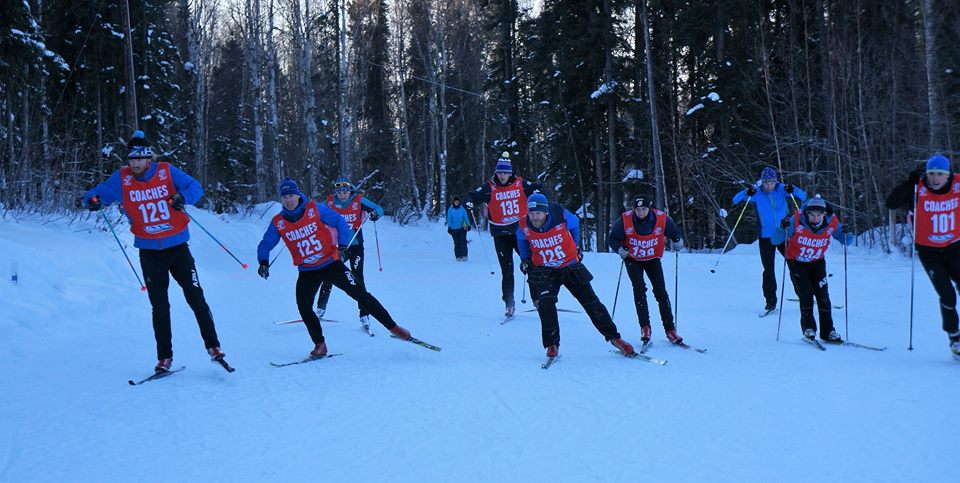
    Coaches compete in the final ski-cross heat of the day, the coaches' race, on Feb. 4 in Fairbanks, Alaska. Racers include Galen Johnston (129), Eric Strabel (125), Anson Moxness (126), and Pete Leonard (101). (Courtesy photo)
    Coaches compete in the final ski-cross heat of the day, the coaches’ race, on Feb. 4 in Fairbanks, Alaska. Racers include Galen Johnston (129), Eric Strabel (125), Anson Moxness (126), and Pete Leonard (101). (Courtesy photo)

    APU Devo and Master Coach Galen Johnston shared his thoughts on the effects of such a course profile after spending the weekend watching his athletes race up and down these hills. “One of the best parts of the weekend was to see how the combination of slow snow and lots of strideable sustained climbing put the focus of the [classic] races on striding and fitness rather than simply double pole strength,” Johnston wrote to FasterSkier on Monday.

    “Courses designed like this can keep striding a viable, and even necessary part of classic skiing,” Johnston continued by email. “Birch Hill has some of the most progressive course designs that I’ve seen and it’s paying off. Skiers ski differently than they did even 10 years ago, and it’s really neat to see a course that can accommodate and challenge that change in style without turning things into an unskiable death march. Estle is keeping people very honest, but still allowing for ample fun,” Johnston concluded in reference to longtime Fairbanks race director and ski-course designer (and former U.S. Ski Team coach) John Estle.

    On Sunday the best strider was DiFolco, who took first place in the 10 k classic mass start race by 19 seconds over Saturday’s winner York. Third overall was ANR skier Heidi Booher (ANR), another 23 seconds back.

    York was again first in the U20 women division. The rest of the podium was also unchanged from Saturday, with Daniels in second and Oba in third.

    DiFolco was again first among U18 girls. Second on Sunday was Booher, with Emma Nelson of ANR third.

    There was a substantial drop-off in distance from U18 girls to U16 girls, with the latter group racing not 10 k but a 3 k classic mass start. First after just under 10 chaotic minutes was Kramer again, edging out her FXC teammate Ratzlaff by 0.7 seconds. Tjarn Bross rounded out the all-FXC podium in third.

    U14 girls raced the same 3 k course as the U16 girls. And after 11 to 12 minutes of racing, it was precisely the same U14 girls podium as on Saturday: Donley, Flora, and Houser.

    On the boys side, U18/U20/Senior/Masters skiers raced a 10 k classic mass start on the same course as the girls. First overall was Lukash Platil (officially unaffiliated, but listed on the University of Alaska Fairbanks (UAF) ski team roster), followed by Donaldson of FXC and Wiese of APU.

    Platil was also first in the Senior men’s division. He was followed there by Kenny Brewer (now unaffiliated, formerly of UAF) and Matt Muffoletto (The Other Guys).

    Among the U20 men, Koenig picked up his second first place of the weekend, and Mowry his second second place. Hamish Wolfe (APU) was third.

    Donaldson and Wiese led the U18 boys. They were followed by Alverts, as the age group podium remained largely unchanged from Saturday.

    The U16 boys raced a 3 k classic mass start. This was the only age group to see a new winner on Sunday, as Cvancara moved up from second the day before to nudge Hermanson down a step on the podium. Everett Cason of APU was third.

    And the U14 boys (also 3 k classic) were again an all-Anchorage affair: Maves once again in first, Rowan Morse (APU) in second, and Schumacher in third.

    Later Sunday afternoon a crowd gathered in the Birch Hill Recreation Center, ignoring Super Bowl LI then in progress, for the naming of Team Alaska for this year’s Junior Nationals (JNs).

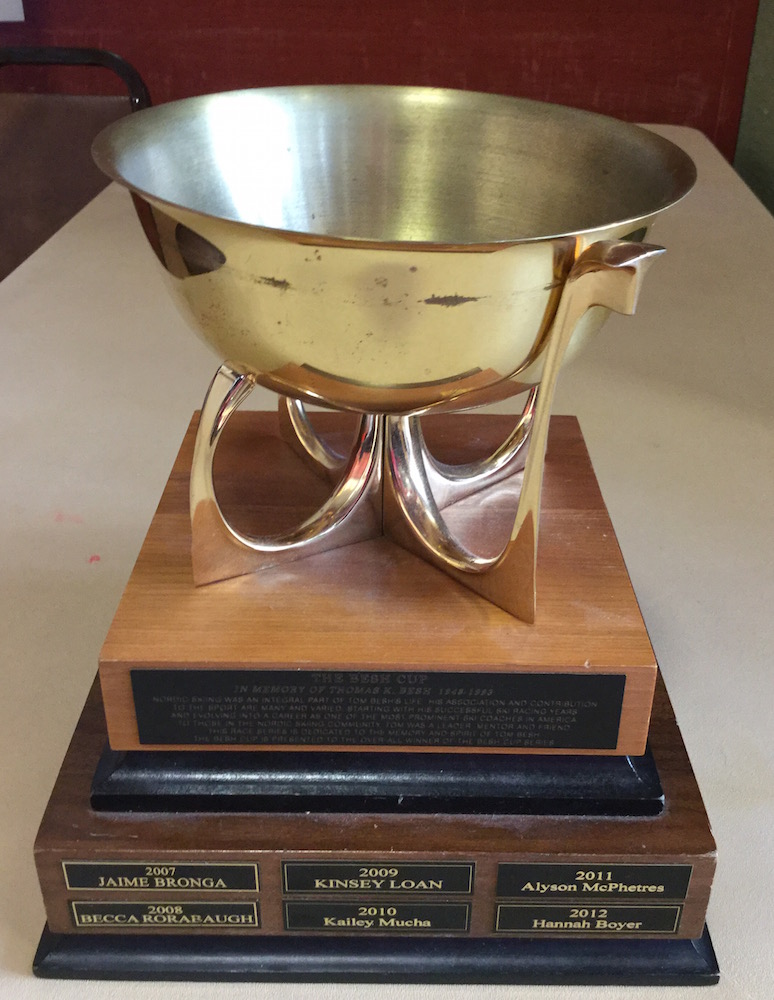
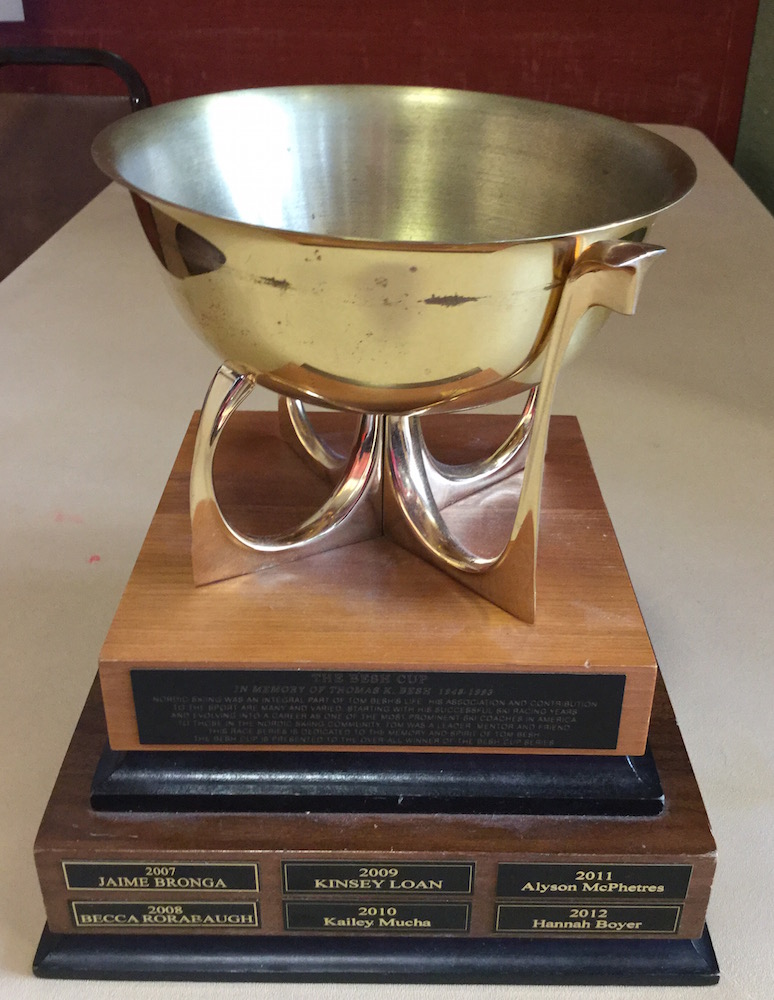
    The Besh Cup Trophy, photographed in Fairbanks, Alaska, in February 2017. (Photo: Gavin Kentch)
    The Besh Cup Trophy, photographed in Fairbanks, Alaska, in February 2017. 

    Cross Country Alaska also awarded the Besh Cup Trophy, given to the U18 or U20 skier with the greatest number of JN qualifying points across all six races combined. This year’s winners were Josiah Alverts for the boys and Jenna DiFolco for the girls. Their names will be added to a trophy, Stanley Cup-style, that includes on its plinth recognizable names from American skiing such as David Norris, Becca Rorabaugh, Reese Hanneman, Andy Liebner, Zach Hall, Eric Strabel, Kate Pearson, and Rob Whitney.

    While winning the Besh Cup Trophy is undeniably prestigious, it also necessarily rewards the best skier who was in Alaska all winter for the races, as opposed to competing Outside or internationally. For example, among U18/U20 girls, you may have heard that the University of Alaska Anchorage’s Hailey Swirbul was racing in Soldier Hollow, while Molly Gellert was on the Scandinavian Cup trip in Norway.

    DiFolco graciously acknowledged as much, telling FasterSkier on Sunday soon after receiving the trophy, “I think some of the fastest skiers are not here, because they pre-qualified [for JNs] and they went on big trips.” But DiFolco still skied the races and earned the results, including two firsts and two seconds in the final four races of the series.

    “It’s pretty cool,” DiFolco said of the season-long honor. “I never would have really expected this to happen a year ago. … I’m pretty proud of it. I’m happy with it.”

    Shortly after the awards ceremony ended the migration began to repeat itself in reverse, as out-of-town skiers loaded up cars in the Birch Hill parking lot for the 7-hour drive south to Anchorage or paraded ski bags through the Fairbanks airport. The flight home for Anchorage skiers was marked by ski hats, team jackets, and quiet chatter, as athletes talked about next month’s trip to the East Coast and parents fretted about missed school days and makeup work.

    Junior Nationals begin in Lake Placid in early March. The first race is a 5/10 k freestyle individual start on March 6.

    Results: skate interval start | classic mass start | overall points lists

    ***

    FasterSkier is seeking contributions (written, photography or videography) from regional race circuits across North America. Please email info@fasterskier.com if interested.

  • Wednesday Workout: Skate Speeds and Acceleration with APU Masters

    Wednesday Workout: Skate Speeds and Acceleration with APU Masters

    APU Masters camp in action on Eagle Glacier near Girdwood, Alaska, in July 2015.  (Photo: Jim Falconer)
    APU Masters camp in action on Eagle Glacier near Girdwood, Alaska, in July 2015. (Photo: Jim Falconer)

    It’s not just a truism that one of the best ways to get good at going fast is to practice going fast. At least that’s the principle that Alaska Pacific University Nordic Ski Center (APU) coach Galen Johnston brings to bear when working with his athletes, no matter their age level or experience.

    Johnston, 26, was born and raised in Talkeetna, Alaska, and is a lifelong Alaskan. He has been coaching skiing in some capacity for the last nine years, with athletes ranging from 5 years old (the Polar Cubs group of the Anchorage Junior Nordic League youth ski program) to 86 years old (locally famous octogenarian Reno Deprey, who skied the 55-kilometer 2015 classic Birkie in a healthy 5:47 at age 85 and has a ski race named after him in his native Maine). He is currently entering his third year of full-time coaching with APU, where he oversees both the Devos and the Masters groups in a total of ten practices per week.

    APU Devos stretch from sixth through eighth grade, or approximately age 11 to 14. APU Masters are 30 and up. In this Wednesday Workout, Johnston breaks down a recent workout from APU Masters that has benefits for anyone at any point on the several-decades spectrum of Masters skiers.

    The workout

    1. Full warmup
    2. 5 x 35-45 seconds Level 5 (L5) rollerski skate sprint, over a course with one 180-degree turn and one corner. (Course should be in an empty parking lot, or somewhere else where it is safe to rollerski at speed.) Brief rolling recovery between each sprint interval.
    3. 4-5 minutes full easy moving recovery after the first five sets
    4. 5 x 35-45 seconds L5 skate sprint (that is, repeat step 2)
    5. Cool down

    The warmup: This should be a full warmup, as long as 45 minutes out of a 90-minute workout. Starting very easy, then, Johnston says, “Ending with up into L2, nothing more than that. You can throw some easy 10-15 second speeds in there if you need to warm the body up a little bit more than that, then rolling into these. With that in mind, if you’re not feeling particularly warmed up, just take the first one a little bit easier, just let things come around.”

    Skate speeds: The course should be about 35 to 45 seconds, depending on skier speed. But there’s a lot going on within that relatively brief time: “Sprint off the line, go down 50 meters, swing a 180 degree turn, sprint back, and then around another corner and accelerate to the top of the parking lot,” Johnston says.

    Recovery: Between each of the five sprints in the first set, recovery is just “enough time to glide back to the start, get your breathing slightly back under control, and roll again” for the next sprint. But after doing the first set of five sprints, take a full four to five minutes of easy moving recovery. The goal of this intermezzo is to flush out the muscles somewhat and hit the second set of five sprints ready to go with good energy and quality movements.

    Cool down: As much as you can within a 90-minute workout window, before – in a nod to the reality of Masters training – going back to work/kids/job/life.

    Technique thoughts for this workout

    Johnston discussed the reasoning behind this workout with FasterSkier following the cooldown. He noted the gap that develops within even just the opening few minutes of an Anchorage Cup (citizens race), in which the APU Elite Team skiers and local collegiate skiers almost immediately start to distance themselves from even the fastest citizen racers.

    “Why is that gap there?” Johnston mused. “A lot of it just comes down to being able to relax at speed. If you can create speed efficiently, you can sink the body weight into the poles and into the glutes and move off of that, and use that to create speed – great. As soon as you get thrown back onto the heels … most of the time when people start doing speedwork you get thrown into the heels and you stay really static. And so – in its simplest form, [you should be] letting yourself drop, and letting yourself stand back up. Get all the way up, get all the way down. And making sure that you’re not just stuck back on your heels as you do those sprints. If you feel like your quads are blazed out after the first one, maybe change up how you’re doing that.”

    Johnston adds, “Today one of my big points was to be able to relax at speed, and be able to create speed without working that hard, and how that separates kind of the elite skiers from that next echelon of skiers.”

    Theory and practice

    This workout “tries to accomplish several things,” Johnston continued. “One is acceleration. So you have accelerating off the line, accelerating out of the turn, and then accelerating around another turn – kind of to work on, how to accelerate efficiently. The other is just the agility of the turning, being comfortable turning at speed. And as – today we didn’t do it as a group. Some days we’ll do it as a group of four or five skiers together, so that we get comfortable with that idea of cornering around something sharp with other people there. That one is easier to do on snow with more people.”

    (The previous week had featured an analogous but not identical workout on classic rollerskis, where each interval went out as a group sprint – six Masters skiers, 10 total sprints, zero serious carnage. Plus a great opportunity to practice sprint starts.)

    So why put Masters skiers through an L5 workout on rollerskis on unforgiving pavement, when even college skiers can crash and burn? Because sprinting is a great way to raise the athlete’s high-end speed, which can have benefits for skiing efficiency at any speed.

    “This is a Level 5 workout,” Johnston notes. “It doesn’t necessarily need to be an all-out sprint, especially if you’re doing it on rollerskis and you’re not comfortable with that upper-end speed, but that is a big component of what this workout brings. The fact that it is Level 5, essentially an all-out sprint, with it being short, with it being in a group, really drives home how efficiently you’re sprinting. Most people will have technique issues crop up when they’re sprinting that they wouldn’t find in daily skiing – especially skiers that are used to training a lot of Level 1, Level 2, Level 3, they have a very small window of speed, and they can’t really go over that Level 3, that’s their ceiling. So doing a Level 5 workout raises that ceiling, allows us to move efficiently, and move efficiently faster.”

    Looking ahead to a more endurance-focused training block later in the fall (Anchorage skiers are reliably on snow by the first week of November, even in southcentral Alaska’s recent snow-sparse winters), Johnston reiterates that his goal of this workout “is to raise the ceiling of what everyone’s capable of for speed.” With an eye to the future, the idea is that “so when we do more of our L3, L4, that those workouts can happen at a higher speed than they otherwise would have. Still going to be the same heart rates, same effort level, but because of working that ceiling up with the L5 work [now], those L3 and L4 workouts actually happen at a faster speed.”

    Speedwork for the Masters athlete

    “I think a lot of Masters skiers are a little tentative on their skis,” Johnston observes. “For anything – for downhills, for skiing fast, for sprinting, for anything like that – a lot of it is just a comfort issue. So the more that we enforce going fast as part of a fun, comprehensive workout, the more that comfort level comes up. So whether that’s bombing down a steep downhill, whether that’s sprinting, if we’re comfortable with speed, and comfortable with stuff happening fast, it allows us to react to stuff more quickly. And I work with that a lot with Devos, and obviously when you’re 12 years old you can faceplant and it’s no big deal, but you can get kind of the same thing in a more controlled environment for Masters – just avoiding as many falls. Being willing to push your limit a little bit on comfort, for speed – when you get into a race, when you’re skiing in a pack of 20, 50, 100 people, you’re not as worried about it. You’re able to concentrate on your own race, and not concentrate on the fact that you’re about to get taken out by 100 other people who may or may not be as skilled on their skis.”

    Johnston concludes by reflecting on the decades-wide range of athletes he works with on a daily basis. “What’s neat is that you see that, from Devos to Masters, people all respond to very similar things. Specifically for Masters, age 30 to 85 is a huge age span – but everyone is dealing with relatively the same things. Technically, most people are pretty ingrained in their technique, so that takes a lot of time to bring that around. And speedwork is one of the things that really breaks everybody out of that mold. It’s something that most people never do. So when you go to ski fast, you have to learn how to ski fast.”

  • APU Masters On-Snow Ski Camp July 27-30

    This summer APU is hosting a masters on-snow ski camp at the Thomas Training Center on Eagle Glacier. Come experience glacier training, just as APU’s Elite team and Olympians Kikkan Randall, Holly Brooks, Erik and Sadie Bjornsen make their seasons.

    “Skiers are made in the Summer”

    The camp is coached by Erik Flora, Dylan Watts, and Galen Johnston. Coaching staff has experience at nearly all ages and levels, from recreational to Olympic and World Championship level. Camp will be from July 27 to the morning of July 30, including 4-5 ski sessions.

    Camp includes classic and skate techniques. There is opportunity to ski a lot with the glacier house only 2-3 minute walk from skiing, plus take part in technique discussion and video review. Includes skiing, coaching, housing, and food. Space is limited. Cost is $825 plus helicopter.

    Please contact Erik Flora (erikflora@gmail.com) for registration info.

  • The Qaniq Challenge: Travelogue Edition

    The Qaniq Challenge: Travelogue Edition

    A panorama view of the classic course at the second-annual Qaniq Challenge Jan. 16-17 in Valdez, Alaska. (All photos: Gavin Kentch)
    A panorama view of the classic course at the second-annual Qaniq Challenge Jan. 16-17 in Valdez, Alaska. (All photos: Gavin Kentch)

    By Gavin Kentch

    VALDEZ, Alaska — Sometimes it’s easy to lose sight of the “cross-country” part of cross-country skiing.  Particularly in this winter of discontent, when a lot of your training time ends up being spent doing 2.9-kilometer laps around a snowmaking loop.  

    Sometimes it’s important to travel for five days so that you can spend less than two hours racing, but do so on a course that goes from a mountain overlook to the shores of the Pacific Ocean.  

    Sometimes, surreally, the country’s second-richest ski race is held in Valdez, Alaska, in the middle of January, and gives away a purse of $10,000 dollars to a field of 36 racers.  Sometimes it’s just time to take a road trip with your mom.  This is the story of all of those events.

    Dramatis personae

    Holly Brooks finished her racing obligations in China a few days before this race, returned from China to Washington to visit family, flew back to Alaska on Thursday, then drove to Valdez on Friday before racing the Qaniq Challenge on Saturday.  I assume this is basically a normal week for her.  Other local athletes carpooled with each other for the over 300-mile drive from Anchorage to Valdez.

    Personally, I traveled with my mom, because I am just that cool.  (Also, I needed her to chauffeur me across southcentral Alaska: My car is a 1989 Toyota Camry, named Teakettle, which at 27 years old is more venerable than at least half the modern-day World Cup field, not to mention the advent of FIS points.  I suspect that Teakettle would literally be unable to drive over Thompson Pass, and so to leave Valdez by road when the weekend was over.  And the next ferry back to Whittier wasn’t until a week later.)  Her husband, Jim Bouchard, got the other front seat.

    Of the three of us, my mother is a good sports mom, who spent my childhood waking up very early on very many occasions to drive me to a variety of endurance sporting events.  She once drove six hours one way, in the evening after work, to pick up my little brother after he had been struck by lightning on a solo bike trip outside of Tok, Alaska.  My stepfather spent decades living by himself in a log cabin he built off the road system, about 30 miles south of Denali.  He was a national age group champion at the 1992 Masters World Cup held in Anchorage.  And as for me?  Well, not to pull rank, but I have previously been described on this website as “a nothing-special recreational skier.”

    ‘Getting here is half the challenge’

    Valdez is slightly over 300 road miles from Anchorage, a drive of approximately six hours, depending upon winter driving conditions.  (This assumes that spectacularly massive avalanches do not close the only road into town for over two weeks.)  I decided we should take the ferry there, saving hours’ worth of driving – the ferry leaves from Whittier, a little over an hour’s drive south of Anchorage.

    A waterside view of the old apartment building in Whittier, a “city” in the Valdez–Cordova census area of Alaska. As of 2014, the population estimate was 217, according to Wikipedia. The city is also a port for the Alaska Marine Highway and known as the Gateway to Prince William Sound.I may or may not have also harbored fantasies in which an avalanche closed the Richardson Highway the day before race weekend, harming no one, but nonetheless preventing all the real skiers from getting there in time for the race, and then I won the first prize of $3,000 dollars.  This did not happen.

    My mom and Jim arrived at my house in the predawn darkness on Jan. 14.  With some difficulty, we added my skis and ski accoutrements to the car, then carved out space for me in the backseat.

    We left my driveway shortly after 9 a.m.  It was not exactly light out, but by this point in the year at least sunrise was within an hour.  We headed toward the Seward Highway.  We had a combined 11 pairs of skis, six pairs of poles, and five pairs of ski boots.  Plus snacks.  The car was packed.  The gas tank was full.  Nothing could go wrong.

    It was shortly discovered that certain parties had forgotten to pack their wallet, containing, crucially, the state-issued identification necessary to board the ferry.  Words were exchanged.  A backtrack was undertaken.  Houses were returned to.  A wallet was obtained, and with it a legitimate form of ID.  We set off once more in stony silence, now calamitously late, making plans to do the long drive the next day and ruing the not-small amount of money now wasted on ferry tickets.  We decided to try to drive to Whittier anyway, and to hope that the ferry was somehow running late.

    We drove down Turnagain Arm under low fog and amber skies, the water in the fjord smooth as glass.  Last month, this stretch of road was closed due to 91 mph winds.  Also, a semitruck had been blown over on its side and completely off the road.  Also, the tunnel that we intended to drive to, in order to reach Whittier, in order to get on the ferry, had been closed.

    That did not happen today.  We could not see more than 100 feet above the ground as we drove along the Arm, but all the roads were passable.  We arrived at the designated snow-plowed field, in seemingly the middle of nowhere, to queue for the 11:30 a.m. opening of the tunnel to Whittier, having long since missed our intended 10:30 a.m. opening, and still assuming that we were about to miss the ferry altogether.  At least we could have lunch in Whittier before returning.

    (N.B.: I have not fact-checked this final statement.  It may literally not be possible to buy a restaurant meal in Whittier on a Thursday in winter.  I’ll figure this out next trip.)

    We were met by a wonderful sight: a handful of cars sat in the field ahead of us, still waiting for the 10:30 tunnel opening.  An Alaska Department of Transportation message board slowly scrolled the reason for the delay: “Please stand by.  Tunnel will reopen when smoke is purged.”

    I have never been so grateful to drive through an icy, slippery, claustrophobic five-mile long tunnel cut into the mountains that apparently had had rogue smoke in it just a few minutes before.

    We emerged, blinking, into the light, and into the town of Whittier, Alaska.

    Whittier is a special place.  For one, it is the rare settlement that was literally founded where it is because the weather there is always bad.  For another, there are virtually no private houses in Whittier; all of the town’s residents live inside the same large apartment building.  

    For the first few decades of Whittier’s existence, everyone in Whittier lived inside the Buckner Building, a seven-story concrete apartment building erected by the U.S. Army shortly after World War II (see photo above).  Later, that building was abandoned.  

    The new apartment building in Whittier, Alaska.Now everyone lives in the much more colorful Begich Towers, a few hundred yards away from its predecessor.  (The concrete hulk of the Buckner Building lives on, standing sentinel over the Valdez waterfront.  It gained passing fame a few years ago when two bros descended its asbestos-choked stairwells on downhill skis.)  We marveled at the Ghosts of Whittier Past and Present, and drove the car onto the M/V Aurora.

    The ferry ride took six hours.  It was amazing.  The sun was out.  Prince William Sound was, atypically, placid and still.  Snow-covered peaks shimmered over hillsides of spruce trees cascading down to the water.  

    At one point, I literally said, “Oh look, yet more dolphins are playing around the bow of the boat.  How nice.”  I felt like an athlete going over to London for the 1912 Olympics, although there was no track set up on the deck for us to exercise on.  And I guess they had fewer glaciers.  And more alcohol.  Seriously, though, it was probably the most sublime day I have ever spent on a boat in my life.

    The M/V Aurora, an Alaska Marine Highway System ferry.Valdez

    Valdez is also a special place, though for different reasons than Whittier.  It has an average annual snowfall of 300 inches, for one, and two to three times that just up the road in Thompson Pass.

    It is also home to the southern terminus of the Trans-Alaska Pipeline System, which undergirds what remains of the state’s suddenly fragile economy.  Valdez’s taxes on the pipeline itself make it shockingly wealthy, a lucrative petro-state enclave even within resource-dependent Alaska.  (This also explains why Valdez was able to essentially move $10,000 dollars of oil tax money from its own coffers to the pockets of young elite cross-country skiers, which actually feels to me like a pretty positive development.)

    A street view in Valdez, Alaska, last month.Standards of what is normal change when you live in such an environment.  When I spoke with Qaniq Challenge race director Darryl Verfaillie about ten days before the race, his talk of contingency plans and water drainage made me assume that snow coverage for the race courses was marginal at best.  

    After inspecting the trails in person after we got to town, I learned that their coverage ranged from a low of one foot of base to a high of at least three feet.  As Anchorage suffers through its second low-snow year in a row, Valdez was looking like a pretty good place to be a cross-country skier.

    Valdez has also had a relatively snow-sparse winter, at least for Valdez.  Therefore, the piles of cleared snow filling spare lots around town were only one to two stories high.  These towers stood guard over a neat gridlock of residential streets (Valdez was essentially rebuilt from scratch following the 1964 Good Friday earthquake), where virtually every house was flanked by multiple snowblowers and snowmachines.

    Valdez is also the type of place where there are still pay phones. Or maybe not pay phones per se, just telephones in public spaces that permit one to make free calls to anyone else in town. (I don’t know if this institution is common in the states.  It persists in Alaska.)  It was very pleasant.  There was admittedly not too much going on on a Thursday evening in January.

    Valdez is also the type of place where there are still pay phones. Or maybe not pay phones per se, just telephones in public spaces that permit one to make free calls to anyone else in town. (I don’t know if this institution is common in the states.  It persists in Alaska.)

    A royal welcome

    I don’t want to be obsequious, but race organizers were beyond accommodating of the skiers.  Late on Thursday night, recently arrived in town, I politely emailed the race director, making a tentative inquiry about whether I might be able to find any waxing facilities during the day on Friday.  He wrote back at 6:30 a.m. Friday morning, putting me in touch with the local cross-country ski coach (go Valdez Buccaneers!).  We were ensconced in the ski team wax room by midmorning.

    On multiple occasions, during the middle of the school day, a very clearly not-high-school-age skier walked through the halls of Valdez High School, carrying a large ski bag over his shoulder and bags of waxing supplies in both hands.  There were irons, vials, strange powders, an extension cord or two sticking out, and of course the large ski bag.  In different contexts, it could be described as suspicious.  No one batted an eye.

    The royal treatment continued at the Friday-evening racers’ meeting.  

    “Will there be indoor waxing available tomorrow morning?” someone (me) asked.

     “I don’t know, do you want it?” said the race director.  

    “Uh, yeah,” I said, “if that’s possible, thanks.”  

    “Okay,” said the RD.  “We’ll have someone open the Teen Center for you by 8 a.m.”

    And so Jim and I waxed our skis for the classic race inside, warm and dry, with numerous outlets and a bathroom and music.  For a ski race on the road, it was paradisiacal.

    It was that sort of weekend; everyone could not have been more accommodating.  Or maybe I just have really extravagant demands when it comes to ski waxing.

    Actual racing: Day 1 (classic)

    I previously wrote a real article about the real skiers here.  I saw some of these real skiers, if briefly, on race day.  Lex Treinen came past me at one point, an unsurprising occurrence in the classic interval start.  He was going very, very fast, and even said hi to me by name as he nimbly stepped around me and re-entered the tracks, all while going approximately Mach 9.  I had scarcely registered his presence before he was past me.  I was impressed.

    Trailside view from the classic race course on Day 1 of the Qaniq Challenge.I was also impressed by the army of volunteers and support staff that the race had mustered.  I think there were literally as many volunteers and support staff on course as there were racers.  Road crossing?  They had four people there, including one to hold up traffic on each side, and real, groomed snow across the road.  

    There was a section where all racers had to do two loops around a 3 k lap, and to help count the number of laps, they had two people at that intersection.  One, with a clipboard, counted laps for each racer; the other, with large flags, would direct each racer to head around for another lap or to go back down the course when they approached this junction, as if they were directing an airplane taxiing up to the jetway.  If memory serves, I passed six on-course checkpoints during the approximately 15 k race.  It was impossible to take a wrong turn.

    It was not, however, impossible to fall down.  In an impressive display of consistency, I did so twice, once on each lap, in the same place each time.  (That place was a six- or seven-foot wide section of trail, presenting the first of two extremely tight corkscrewed turns, with substantial exposure on either side.  Alaska is an exciting place to be a ski racer.)

    I learned while doing interviews after the race that Tyler Kornfield, an inestimably more talented skier than me, had also fallen twice, in the same place I had.  And unlike me, he was wearing skate boots.  That made me feel better.

    The Pacific Ocean from classic course.After around 50 minutes of skiing, and going from a scenic mountain overlook down to the shores of the Pacific Ocean and back, I approached the finish.  I crossed the finish line, immediately began feeling the effects of the longest all-double-pole race in my life, and teetered over to the edge of the finish area to collapse in the snow.  I lay on the ground.  After a few minutes, I tried to pick my head up, but I was still dizzy, and things were still spinning, so I lay back down.  I was not unhappy.

    A woman, a local resident who was volunteering with the race, came over.  She was wearing a knee-length fur parka that probably cost roughly as much as the entire purse for the weekend’s race.  It was one of the most beautiful things I have seen in my life.

    She looked down on me not unkindly.  “Are you still breathing, hon?” she asked me.  I looked up at her.  I attempted to form the words, “Thanks, I’m fine.”  I met with some success.

    It is sort of uncomfortable to sprawl on the ground with one’s skis still on.  (Shoutout to my APU Masters coach Galen Johnston, who took my skis off for me unasked while I convulsed on the ground following a recent Besh Cup.)  

    “Do you think you could help take off my skis?” I said.  “Just pull up on the bindings.”  She knelt down and began, with great enthusiasm, to pull on my entire foot.  “That’s okay,” I said, “don’t worry about it.  Maybe you could just help me get up.”  This fur-clad vision graciously reached down, gave me a hand, and helped me stand upright again.  I was suddenly very conscious of having just finished racing.  I tried very, very hard not to get snot, spittle, extruded Apple-Cinnamon Hammer Gel, or any other form of race-induced effluvia on her beautiful jacket.

    “Sorry about your boots,” she said.  “I’m really more of a hockey mom.”

    Eventually, I found my bag, put on every piece of spare clothing I had brought (temps were in the 20s above, but humid maritime cold is cold-cold), and set out for an attempt at a cooldown.  I skied part of the way with Holly.  At one point, I confessed to her, “I’ve actually never raced on consecutive days before.  What do I do in the 23 hours before the next race?”  She graciously told me what I should do.  Her advice (get warm, dry, and food immediately; active cooldown; warm shower; stretching and jog later that day) was not rocket science, but was much appreciated.

    Actual racing: Day 2 (skate)

    The start/finish area of skate course at the Qaniq Challenge.Day 2 was a skate race.  They took everyone’s first day results, re-seeded the field based on classic time, then had a chevron start for the mass start skate race.  There were little numbered placards alongside the tracks in the start area to help everyone line up correctly.  It was adorable.

    The chevron start, which I may never encounter again in my life, made me feel like a real ski racer.  Lining up behind Dylan Watts and Holly did not change this sensation.

    The gun went off, and I very quickly felt like less of a ski racer.  I guess I’m not very good at starting races fast.  Apparently I’m more of an interval-start specialist (says the Masters racer who has done precisely two interval-start races in his life, counting the previous day’s classic race).

    Two to three minutes into the race, places #1-4 (the top four guys) were quickly pulling off the front in the lead pack.  Places #5-8 (Holly, overall winner Rosie Frankowski, and two male citizen racers) were coming together into a chase pack.  I moved up into ninth overall, and took aim at shortening the gap of ten feet that had opened up between me and eighth.  In a sudden moment of prescience, I saw the next 45 minutes unfolding before me.  I told myself, “You’d better catch this train, or you’re going to spend the entire rest of the race skiing by yourself.”

    I did not catch the group.  I did ski the entire rest of the race myself.  I caught glimpses of the chase pack ahead of me, at greater and greater distances, until as late as 8 k into the race.  They were moving very fast, taking turns trading off the lead on a pancake-flat, all-V2 course.  They looked like they were having fun.  They looked like they were happy.  I hoped they were happy.

    I was not unhappy; I was skiing, and skiing is fun.  But it is more fun when you can see.  I think it was colder than I realized; soon my eyes were watering profusely, and I was having a hard time making out the trail, the time on my watch, or anything else.

    I had previously been telling myself things like “get forward” and “weight on the balls of the feet,” giving myself technique cues like Jessie Diggins lite (very lite), and at least trying to stay focused while I skied along entirely on my own.  

    But soon my thoughts became slightly less focused.  Like, “my eyes are really cold right now.  I really can’t see.  I wonder if I’m doing them permanent harm?  Like that musher who just got airlifted out of the Kusko 300 sled dog race because she frostbit her eyeball.  Is that what’s happening to me right now?  Man, I hope I’m okay?”  These were understandably valid concerns.  They were not particularly effective as technique cues.

    (My eyes were ultimately fine.  They hurt more when I finished, and again when I shut them to go to sleep that night, and they were bloodshot as hell for a few days later, but that was all.)

    I eventually emerged from my solitary ski through the woods and back to the finish line.  I did not appreciate it at the time, but apparently they had sent out a PistenBulley during the race to re-groom the start/finish area and take out the set tracks from the chevron start.  It was that sort of race weekend.

    I crossed the finish line, returned my race bib to Woman in Beautiful Parka, and once more put on every piece of clothing I had brought.  This time, it wasn’t enough.  I shivered through a ten-minute cooldown, then went inside the old trap range building that had a roaring fire going and served as race headquarters.  I stood immediately behind the massive stove, slowly picked the ice out of my thawing beard, and regaled a very patient Dylan Watts with stories of my race while learning what had happened up front.  It sure beat getting into Teakettle and turning on the heater that no longer actually produces any appreciable heat whatsoever.

    After the race

    I headed home for food and a shower.  Around the time I was deciding between a nap and writing up my race article, Holly, only furthering her role as worldwide ambassador for cross-country skiing, was back on skis, leading a free clinic for local high school kids.  I’m sure this is just what her fellow two-time Olympian Kobe Bryant does for his post-game recovery regimen.  (My Holly Brooks hero worship notwithstanding, I should emphasize that she was joined by the rest of the APU Elite Team and associated skiers that were in town, including Frankowski, Lauren Fritz, Paul Kovacs, Dylan Watts, Treinen, and Kornfield.  Pretty good day to be a novice skier in Valdez.)

    That night, the awards banquet was held in a local bar, The Fat Mermaid.  Ten thousand dollars was redistributed from oil money to impoverished elite skiers.  Lex and Rosie posed with oversized $3,000 checks.

    Awards went five deep per gender.  There were also prizes for the fastest locals, and for the fastest skier over 50 (shoutout to my stepfather).  That’s 13 awards among 36 racers, or over a third of the field.  Also, we all got good pizza, and one free drink ticket each.  Also, they had applause not only for the sponsors and volunteers, but also for the press (me).  It was a good awards banquet.

    Heading the home

    The next morning, it was time to go home.  It was tough to leave, but we were wrapping up a five-day trip so that I could ski for a combined 101 minutes, so it was probably time.  About half the field went backcountry skiing in Thompson Pass on the way home.  We headed straight back to Anchorage, so that I could get back to my exceptionally patient wife and our two young girls.

    Before we left, we had breakfast at the Totem Inn; poor Jim was yearning for meat after three mornings of oatmeal.

    The Totem Inn was very… Alaskan.  Of the twenty people in the restaurant on this Monday morning, nineteen of them were men.  My mother stood out, because she was the only woman.  I stood out, because my race T-shirt, pretty pink sports watch, and choice of tea over coffee clearly marked me as Not An Oilpatch Worker.  (My stepfather did not stand out; people who have lived in the woods for three decades also look like they could work at the pipeline terminal.)

    The inn’s motto, I have since learned, is, “Where everything about us says, ‘Alaska!’”  I applaud their honest marketing.

    We hit the road soon after.  It was a different experience than the ferry – think six hours of trying to avoid the stench of unwashed ski gear and citrus solvent emanating from the ski bags wedged against my perch in the backseat – but Interior Alaska in midwinter is starkly beautiful, and an amazing contrast to the Sound.

    By 4 p.m. I was back home in Anchorage, with its two inches of snow in my front yard, a world away from Valdez and its towering snow piles.  By that evening my 3 ½ year old, having heard stories of my race weekend, was playing “cross the finish line and fall down.”

    What it all means

    Cross-country ski racing is a beautiful, amazing, rewarding, and sometimes surreally random sport.  Sometimes your local Masters ski coach turns out to actually be really good at skiing, and goes on to compete in two Olympics.  Sometimes your local masters-degree candidate turns out to actually be really good at skiing and shooting, and is racing on the World Cup in her eighth biathlon race ever.  Sometimes your local elite skier almost cripples himself in a scary fall in the mountains, then wins a national title six months later.  Stuff happens.

    Skiing is also, in many ways, an intensely democratic sport.  (Let’s elide for a moment the fact that Norway has like a billion World Cup wax techs to the U.S.’s handful – and that’s not counting another dozen or so under the aegis of Great Britain – and that some countries may be more equal than others.)

    Sometimes you buy your first-ever race suit secondhand from Holly Brooks, then the next winter find yourself lining up immediately behind her in a mass start race.  Sometimes you find yourself double-poling through a gorgeous valley as fast as you can, with the only other skier visible in front or behind you the quickly disappearing form of Lex Treinen.  And sometimes, the local high-school kids race against regional high schools one weekend in the Valdez Invite, then against the APU Elite Team the next weekend in the Qaniq Challenge, all on their home course.  Skiing is special like that.

    ***

    About the Author: Gavin Kentch lives in Anchorage.  He skis with the Alaska Pacific University Masters team, plays with his two adorable daughters, and occasionally works as a solo attorney.  He was probably on snow this year before you were.

    Author Gavin Kentch (Photo: Krystal Moulton)