Tag: Gällivare FIS races

  • Kalla Continues to Dominate in Gällivare; Russia Sweeps Men’s 15 k Classic

    https://www.instagram.com/p/BbpElh6gxkx/?taken-by=kalla_87

    Note: This article has been updated to include comments from Sweden’s Charlotte Kalla.

    For the second day in a row, Charlotte Kalla, a name synonymous with the yellow and blue of Sweden, stood atop the podium, placing first in the women’s 10-kilometer classic International Ski Federation (FIS) race on Saturday in Gällivare, Sweden. On Friday, Kalla won another individual-start race, the 5 k freestyle, by a margin of 8.8 seconds. She more than doubled that time gap by the finish of Day 2, winning the 10 k classic in 27:55 minutes, 17.7 seconds ahead of Russia’s Yulia Tchekaleva in second place. Natalia Nepryaeva, also from Russia, skied to third, 40.9 seconds back of Kalla.

    “I am feeling good and I think I am where I should be at this moment,” Kalla wrote in an email. “I had a good feeling on the classic race and handle the condition well. On Friday I opened hard and tried to push hard all the way.”

    Known as a skate powerhouse, Kalla has improved her classic skiing and is now a double threat. “I have improved my classic technique the last years,” Kalla explained. “When I am in shape it doesn’t matter if it is skating or classic. I am glad I managed to ski well in the condition we had. It was a little bit soft because of the snowfall.”

    Although a home FIS event for Sweden, Russia secured six of the top-10 spots with Sweden settling for three. Japan’s Masako Ishida, the only non-Russian or Swede outlier in the top 10, placed fourth (+1:02.4). Russians Anna Zherebyateva raced to fifth (+1:08.8) while teammate Yulia Belorukova was sixth (+1:12.8).

    Sweden took the next two spots with Stina Nilsson in seventh (+1:20.9) and Anna Haag in eighth (1:20.9). Russia rounded out the top 10 with Anatasia Sedova placing ninth (+1:24.1) and Mariya Guschina in tenth (+1:25.0).

    Sweden’s Ida Ingemarsdotter, a World Cup regular, placed 11th (+1:30.6).

    Kikkan Randall was the only U.S. Ski Team member at the race, and a day after finishing eighth in the 5 k skate, she finished 15th (+1:48.1) on Saturday. In an email, Randall explained that snow had fallen continuously for the last 24 hours in Gällivare.

    “Conditions were pretty nice, the track was a little soft and a lot of racers here made the pole track a little punchy,” she wrote.

    Considering the massive time-zone shift from her home in Anchorage, Alaska, to Central European Time, it appears Randall is adjusting well.

    “I felt decent today, not too tired from the jet lag or yesterday’s race. I wanted two back-to-back races to get ready for next weekend’s triple World Cup opener,” she wrote, referring to the first three World Cup races in Kuusamo, Finland, starting Friday, Nov. 23.

    Throughout Saturday’s 10 k, Randall steadily improved her overall placing: she was 32nd at 4.2 k, 23rd at 6.8 k and locked into 15th by 9.2 k.

    “It was definitely good to race a 10km classic today,” Randall wrote. “I had trouble really digging into my race gear on the first lap today. I think I was skiing a little stiff and not carrying my momentum down the track. Nepryaeva [the third-place finisher] caught me going into the 2nd lap and that was the jumpstart I needed. I was able to match her pace for most of the rest of the race and it helped me find better technique and tempo.

    “I wanted to be a little stronger today but I got some really important feedback on where I’m at and what I need to work on as the race season progresses,” she added. “My fitness feels pretty good and now it’s just a matter of fine-tuning.”

    Emily Nishikawa was the only Canadian entered on Saturday and finished in 51st (+3:39.3). Sixty-nine women started the race, 38 from Sweden, 17 from Russia, seven from Japan, two from Switzerland and Estonia, and one each from the U.S., Canada, and Poland.

    Yesterday’s 12th-placed skier, Russian Evgenia Shapovalova, who was recently handed down a lifetime Olympic ban by the International Olympic Committee (IOC), did not start the race.

    Russia Sweeps

    In Friday’s 10 k skate in Gällivare, only Swiss star Dario Cologna kept the Russians from sweeping the top nine by placing third. In that race, Evgeniy Belov and Sergey Ustiugov of the Russian national team finished first and second, respectively.

    Saturday was a different race, a 15 k classic, but with a similar thread and no Cologna as a Russian foil.

    The Russian men finishing in unison to take first, second and third in the men’s 30 k skiathlon, the final race of 2017 U23 World Championships at Soldier Hollow in Midway, Utah. Alexander Bolshunov (8) was deemed the winner, Alexey Chervotkin (1) was second, and Denis Spitsov (11) third. (Photo: FlyingPointRoad.com)

    It was Russia, Russia, Russia.

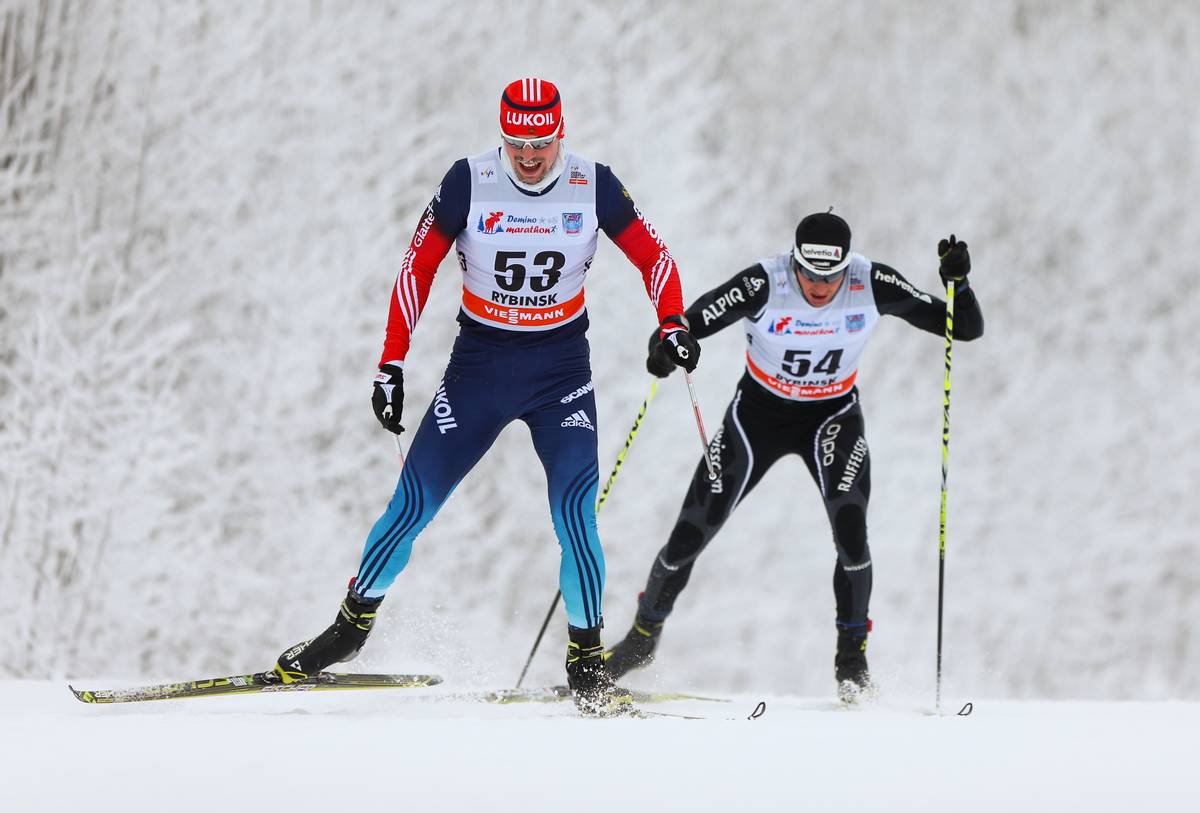
    Alexander Bolshunov, winner of the 30 k skiathlon at 2017 U23 World Championships, won the race in 37:13, one second ahead of Maxim Vylegzhanin in second. Alexey Chervotkin was third (+5.1).

    Classic specialist, Kazakhstan’s Alexey Poltoranin finished fourth, 13 seconds off the podium, and Cologna placed fifth (+22.1).

    Despite being on Swedish soil, the rest of the top 10 became a mostly Russian affair. Russian teammates Alexey Vitsenko and Artem Maltsev placed sixth (+29.5) and seventh (+37.4), respectively, Sweden’s Calle Halfvarsson interrupted the trend by tying Russia’s Evgeniy Belov for eighth (+38.0), and Russia’s Alexander Bessmertnykh took 10th (+40.1).

    There’s a pattern: Russia took 14 of the top-20 places. Twenty-eight of 126 starters were from Russia, with the vast majority of the field being Swedish. Outside of the top 10, Sweden’s Daniel Rickardsson was the next-best Swede in 12th (+49.6).

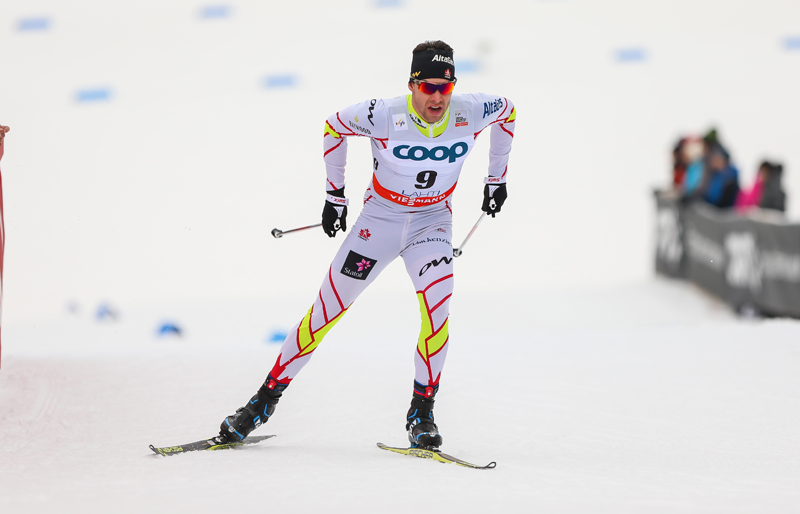
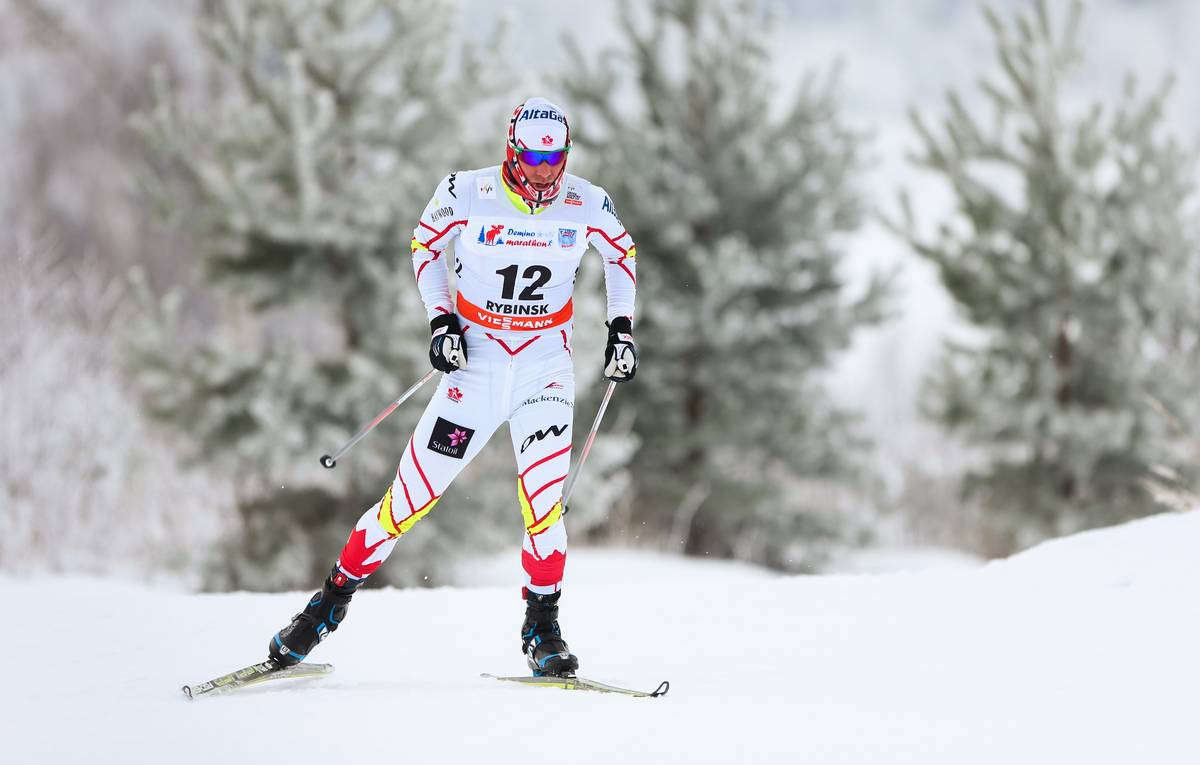
    Devon Kershaw (World Cup Team), who finished 12th on Friday, once again led Canada in 20th (+1:06.7). At 6.8 k, Kershaw was ranked 15th, and at 9.6 k he was down one spot to 16th. By the 11.4 k checkpoint, he began slipping further in the standings.

    “Today was a tough one,” Kershaw wrote in an email. “I felt pretty good but conditions were soft, so you had to really feather it (the technique) – especially on the climbs.  Pacing wise I think I was doing pretty well, but in the last 2.5km today I was missing any semblance of a kick to the finish and ended up conceding a few seconds to those around me, knocking me from about 15-16 to 20th.”

    Although an interval start race, Kershaw never found a strong pacing partner. “I was skiing alone – no help at all today,” Kershaw wrote of his solitary effort. “It would have been so helpful! Especially that last lap when things get tough. But in individual start races, you need to learn to do it alone. So good to try and get used to that “time trial” feeling.”

    Three other Canadians competed, with Graeme Killick (World Cup Team) finishing 50th (+2:32.3), Jack Carlyle (Alberta World Cup Academy) 91st (+4:06.1), and Brian McKeever (Para Nordic Team) 110th (+5:16.0).

    As of press time, Fasterskier could not confirm if the International Ski Federation (FIS) held an emergency meeting to discuss the involvement of IOC-banned Russian skiers in FIS-sanctioned races. Of the six IOC-sanctioned Russian skiers, four are men: Belov, Vylegzhanin, Alexander Legkov, and Alexey Petukhov. All four skiers raced on Friday, however, Legkov and Petukhov (and Shapovalova, one of the two women sanctioned by the IOC) did not contest Saturday’s race.

    Racing continues in Gällivare on Sunday with classic sprints.
    Results: Women | Men

  • Diggins Wins Again, Gregg Joins Her on Podium in Gällivare 10 k

    Diggins Wins Again, Gregg Joins Her on Podium in Gällivare 10 k

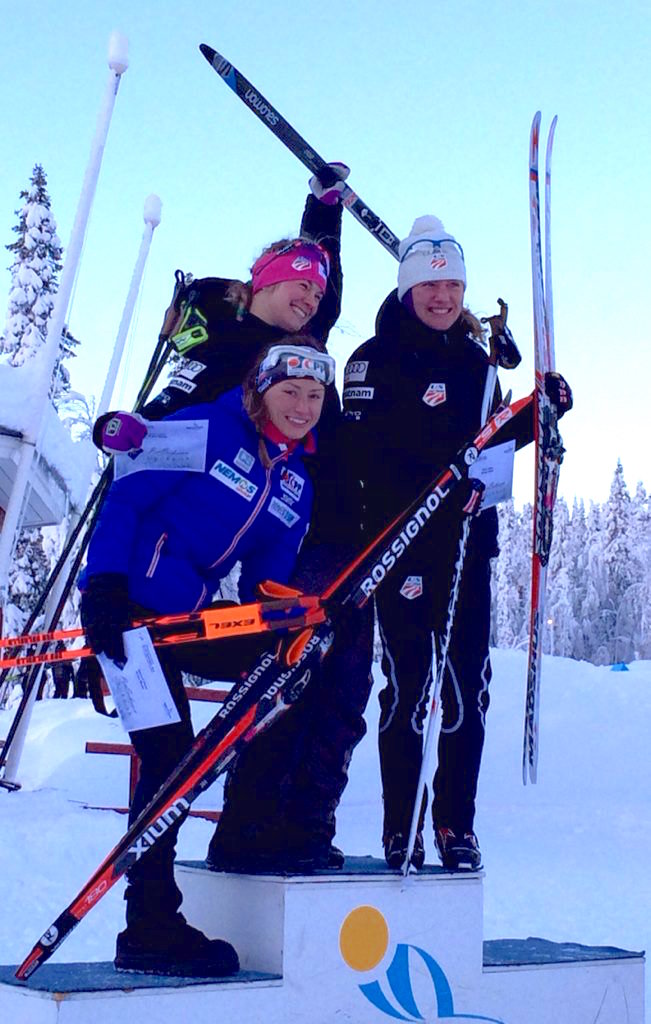
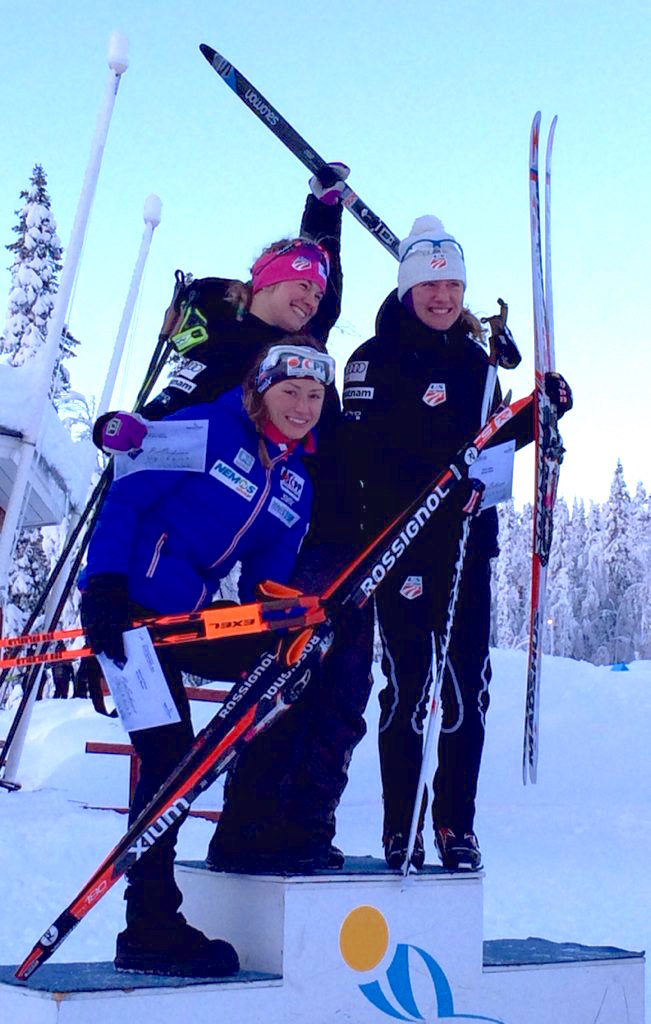
    Jessie Diggins stands atop the podium with Czech runner-up Petra Novakova (l)  and U.S. teammate Caitlin Gregg (r), who placed third, after the women's 10 k freestyle in Gällivare, Sweden. (Photo: USSA)
    Jessie Diggins stands atop the podium with Czech runner-up Petra Novakova (l) and U.S. teammate Caitlin Gregg (r), who placed third, after the women’s 10 k freestyle in Gällivare, Sweden. (Photo: USSA)

    Consider it a test drive. That’s how several members of the U.S. Ski Team viewed this weekend’s season-opening International Ski Federation (FIS) races in Gällivare, Sweden. And while a win or result close to it is always welcomed, it wasn’t essential. No need to go 100 miles per hour on the first try.

    That said, if you start fast, go with it. Jessie Diggins, a 24-year-old A-team member who took silver in the 10-kilometer freestyle at the 2015 World Championships last season, kicked off this season with a win on Saturday in the Gällivare classic sprint, then repeated the feat in Sunday’s 10 k freestyle — what’s becoming her signature event.

    While it was great to get some good feelings on snow and back-to-back victories to go with it, Diggins said in a post-race phone interview that it was more about taking “inventory of where [we] are and what else needs to be improved, as well as a good reminder of warmups, race routines, and testing skis.”

    She added that the wins were a huge confidence boost going into the World Cup season, which starts Friday in Kuusamo, Finland. And she was pleased her offseason of technique work translated to results on snow.

    She was the fastest in a women’s field of 38 on Sunday, winning the 10 k in 25:08.7 by 10.7 seconds over Petra Novakova of the Czech Republic. For the second-straight day, the U.S. had two on the podium with Caitlin Gregg in third, 30.1 seconds behind Diggins. It was a flashback to February, when the two shared the podium at 2015 World Championships, where Diggins placed second in the 10 k skate and Gregg was third.

    Diggins had started second to last ahead of another teammate, Liz Stephen. Gregg went out 30 seconds ahead of Diggins and kept herself in contention in the top-three throughout the race.

    At the finish, Novakova originally bumped Czech teammate Karolina Grohova out of the lead, then stayed 19.4 seconds ahead of Gregg to hold onto first. That is, until Diggins crossed the finish line.

    “The course was awesome,” Diggins said. “It’s a challenging track with quite a bit of climbing and twisty, turny descents which doesn’t allow for a lot of rest. It is a great representation of the type of courses we race on the World Cup.”

    While she had fun out there, she also made up a lot of time on those who started ahead of her. Diggins jumped out to an early lead, 0.4 seconds ahead of Gregg and 0.7 seconds ahead of Novakova in third, by the first checkpoint.

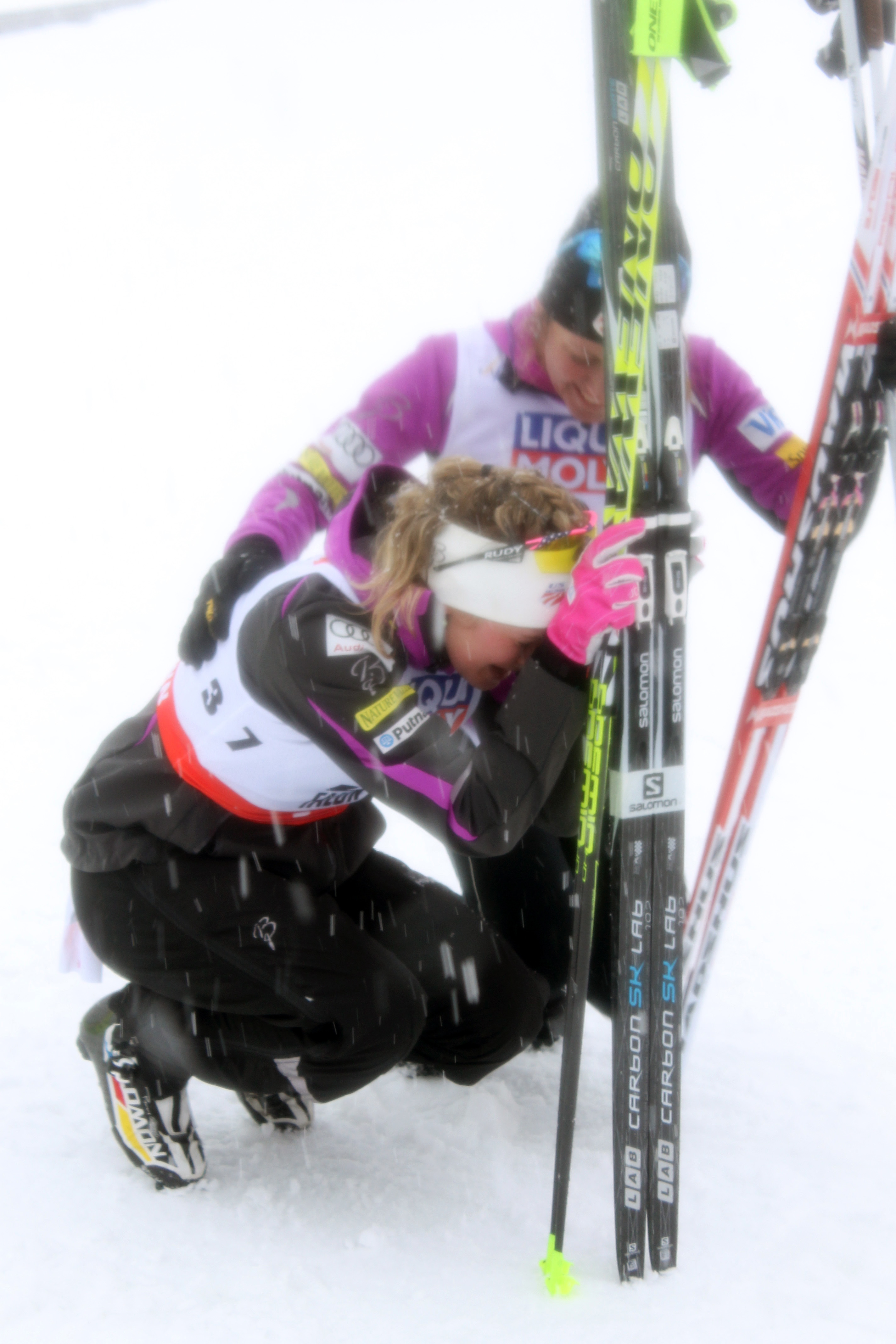
    Jessie Diggins (bottom) and Caitlin Gregg after notching silver and bronze, respectively, at 2015 World Championships in the 10 k skate.
    Jessie Diggins (bottom) and Caitlin Gregg after notching silver and bronze, respectively, at 2015 World Championships in the 10 k skate.

    Halfway through the race, she held a 3.5-second lead over Novakova and Gregg was 17.6 seconds back in third. On the second of two laps, Diggins caught Gregg, her 30-second woman, and the two finished together.

    “I was psyched when Jessie caught me because I felt like I was skiing well so I knew she was skiing well!” Gregg recalled in an email. “I cheered for her and tried to hang on. As I started following her stride I felt myself actually relax and start skiing way better! I tried to keep the pressure on her because I knew she was fighting for the win without stepping on her skis! I thought it was great to follow her on most of the second lap and it certainly helped me reach the podium!”

    Gregg wasn’t exactly sure where she stood throughout the race, but she had a sense she was in the running for a top result.

    “Both Jessie and Petra are fantastic skaters so it was a solid result for me,” Gregg wrote, a day after placing seventh in the classic sprint. “My skis were fantastic and I knew I was moving well on the course.

    “This has by far been my best preparation season ever,” the 35-year-old U.S. Ski Team rookie added.  “I started working with [personal coach] Tom Jorgenson after I came home from Norway this summer and he had helped me immensely in my training and technique! I feel like my fitness is really good right now and I am very excited to start the season.”

    Eighteen seconds behind Gregg, Stephen placed fourth, and another 1.8 seconds later, the fourth U.S. woman in the top five, Rosie Brennan was fifth.

    “Our coaches were out there giving splits and cheering as were our waxers,” Stephen wrote in an email. “We had a great group out there pushing us on and encouraging us to rally. The splits just encourage me, but I was not focused on the result out there today, I was just focused on the getting back into the groove of it all and maximizing my time taking corners with loaded legs at high speed.”

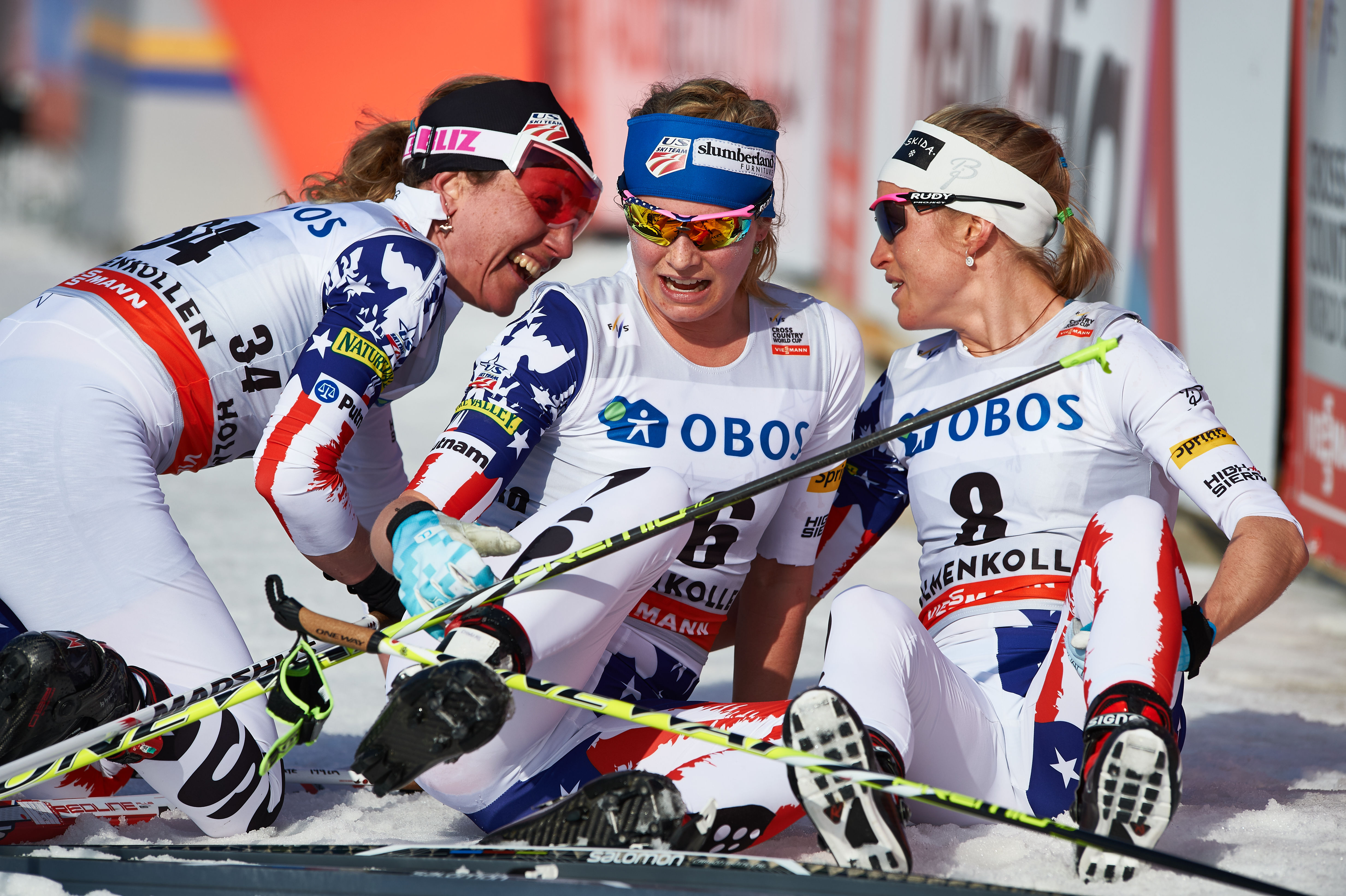
    Staying positive and motivated is something the U.S. women's cross-country ski team is famous for. Is it a sign of high emotional intelligence? Here, USST's Caitlin Gregg (r), Jessie Diggins (c) and Liz Stephen (r) in the finish of the 2015 Holmenkollen 30 k. Stephen led the three in ninth, while Diggins and Gregg Placed 14th and 19th. (Photo: Madshus/Nordic Focus)
    U.S. Ski Team members Caitlin Gregg (r), Jessie Diggins (c) and Liz Stephen (r) at the finish of the 2015 Holmenkollen 30 k. Stephen led the three in ninth, while Diggins and Gregg Placed 14th and 19th. (Photo: Madshus/Nordic Focus)

    On Saturday, Stephen — a well-known distance skier and hill climber — made the rounds and placed ninth in the classic sprint.

    “My goals for the weekend were to put a bib on and remember what it feels like to be ski racing on snow again,” she explained. “Snow brings its own set of new challenges and it can take a bit of time to get used to those again. I have a constant project on improving my downhills, so working on that the last couple of races has been on my mind, though today’s race was not my best performance on the downhill skills portion but, it has it’s ups and downs like any project.”

    Stephen added that she needed some more races to get into the form she wants to be in. Brennan was looking for the same.

    “I know my base fitness is quite high so it is a matter of finding the right balance of rest, quality intensity, and race starts,” Brennan wrote in an email. “I felt my race was solid, but I think I have another level in me that I hope to see as the season progresses.”

    Between those four U.S. women, that was everyone from the women’s team that competed. Ida Sargent rested this weekend as she’s been fighting a cold and is aiming to be healthy when the World Cup starts next week, U.S. women’s coach Matt Whitcomb explained. Sadie Bjornsen also did not race as she was coming off an illness from last week.

    “Sadie is healthy and back training, but the stomach bug she had earlier in the week isn’t something we wanted to test,” Whitcomb wrote in an email. “We know what happens with that test. She is in great spirits and had a productive workout tonight.”

    As for the results, with the U.S. notching two podiums and sweeping third through fifth, Whitcomb said in a phone interview that “the results are fun. It’s great to get a podium regardless of what show you are playing in, but the important thing is they are looking really good in what they are doing.”

    He credited Diggins with “another brilliant day” and said he was excited to see what she can do on the World Cup this season.

    “People can be scared of skiing fast early in the season, but to be honest, Jessie is just getting started,” he said.

    He added that the team’s wax crew was another highlight of the weekend, especially with new members that service chief Oleg Ragilo assembled this year. Diggins agreed.

    “The wax technicians did a great job, we had fast and consistent skis all weekend,” she said.

    Temperatures were cooler on Sunday, around -11 degrees Celsius (12 degrees Fahrenheit).

    Canada’s lone female in Gällivare, Emily Nishikawa placed ninth (+2:35.2), a day after finishing sixth in the sprint.

    “I was happy to start the season with a good race!” she told Cross Country Canada after Saturday’s race. “I’ve had a good summer of training and feeling strong coming into the race season so I was really excited to race…”

    Monday marks a travel day for most, with the World Cup skiers heading to Kuusamo for four days of preparation before the season begins in earnest with a classic sprint on Friday.

    Results

  • Another Russian Sandwich: Canada’s Harvey 2nd Between Ustiugov and Belov; Kershaw 4th

    Another Russian Sandwich: Canada’s Harvey 2nd Between Ustiugov and Belov; Kershaw 4th

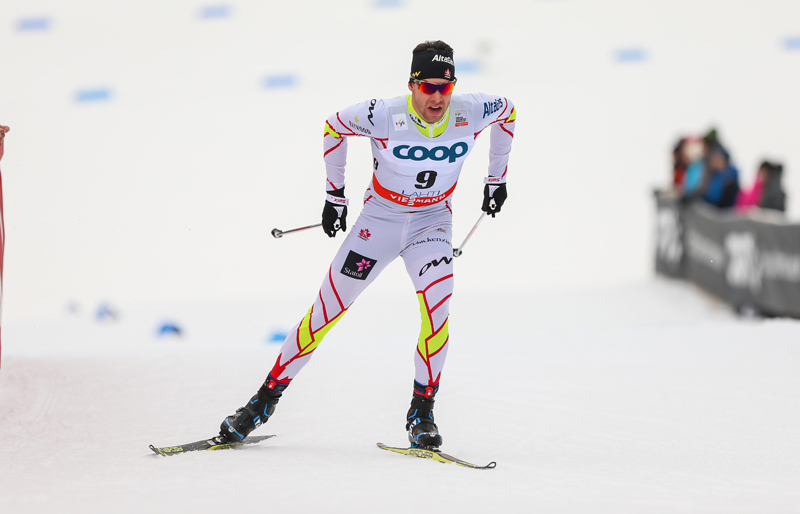
    Canada's Alex Harvey finished 17th in the World Cup 15 k freestyle individual start in Lahti, Finland, 35.7 seconds off the pace of winner Francesco de Fabiani of Italy. Here is is pictured in Saturday's individual sprint qualifier in Lahti, where he placed 63rd. (Photo: Fischer/NordicFocus)
    Canada’s Alex Harvey racing in the World Cup freestyle sprint qualifier last season in Lahti, Finland, where he placed 63rd. On Sunday, he placed second in his first distance FIS race of the season. (Photo: Fischer/NordicFocus)

    Canada’s Alex Harvey’s goal for the day was preparation: avoid wasted energy in the cold, eat right, and nail his pre-race ritual. He may want to continue whatever process he found Sunday morning, as the Canadian flew through the halfway point with the fastest time and found himself only 27.5 seconds down in second place at the end of the men’s 15-kilometer freestyle International Ski Federation (FIS) race in Gällivare, Sweden.

    Like the Gällivare men’s podium on Saturday, the leading North American male found himself sandwiched between two Russians, Sergey Ustiugov, who repeated in first, and Evgeniy Belov, who landed on the third step of the podium for the second time in as many days, 42.2 seconds behind Ustiugov.

    Harvey said in a post-race phone interview that he wanted to take advantage of this distance tuneup as an opportunity to “try a little different strategy.” For him, that meant “going out a bit harder, knowing I would fade a bit in the end.”

    All in all, his new strategy paid dividends as he recorded the fastest split through the halfway mark, up 5.2 seconds on Ustiugov. He said he faded during the last lap, but thought he nailed the preparation and was happy to get in two solid race efforts throughout the course of the weekend. On Saturday, Harvey narrowly missed the final for seventh overall.

    Sergey Ustiugov of Russia leads Dario Cologna of Switzerland in Friday's 15 k freestyle in Rybinsk, Russia. Ustiugov finished third while Cologna won. (Photo: Fischer/Nordic Focus)
    Russia’s Sergey Ustiugov leads Dario Cologna of Switzerland in the World Cup 15 k freestyle last season in Rybinsk, Russia. Cologna won and Ustiugov finished third. This weekend in Gallivare, Sweden, Ustiugov won back-to-back FIS races to start the 2015/2016 season: a classic sprint and 15 k skate. (Photo: Fischer/Nordic Focus)

    On the Russians’ consistent top finishes in these races, Harvey said that he’d heard from Russian coaches that their athletes “have to be in really good shape in Kuusamo, just to be able to stay on the World Cup, so right now they are quite fresh.”

    The World Cup season starts Friday in Kuusamo, Finland, with a three-day mini tour.

    Feeling fresh would have been a luxury for most of the North Americans, who arrived in Europe within the last ten days and are still adjusting to snow skiing.

    “Skiing on snow is a bit more muscular than just rollerskiing, so the transition is always a bit hard for me at least,” Harvey said.

    His teammate on the Canadian World Cup team, Devon Kershaw finished fourth, 1:05 behind Ustiugov and 22.8 seconds off the podium.

    In an email, Kershaw explained he used his experience skiing this course on previous World Cups to create a race strategy.

    “I really love the latter part of this type of course — it suits me well [to] hammer the flatter/gradual terrain and back it off a bit on the steeper sections,” he wrote.

    Devon Kershaw (Canadian World Cup Team) racing to 36th in the World Cup 15 k freestyle individual start on Jan. 23 in Rybinsk, Russia. (Photo: Fischer/NordicFocus)
    Canada’s Devon Kershaw racing to 36th in the World Cup 15 k freestyle in January 2015 in Rybinsk, Russia. He placed fourth in his first distance FIS race of the 2015/2016 season in Gallivare, Sweden. (Photo: Fischer/NordicFocus)

    Kershaw described the conditions as cold and fairly slow, with little humidity in the snow. While this played a minor role, he was more focused on executing his race strategy of speeding up each lap and working on technical queues.

    “I am pleased with how I skied technically,” the classic specialist wrote. “I am happy to be only 1:05 back in a skate race, [which] means that it was probably my best individual start skate race in 1.5 years.”

    After Stanislav Volzhentsev finished fifth (+1:13.2) to become the third Russian in the top five, American Noah Hoffman placed sixth (+1:23.5).

    “My plan today was to go out aggressively, and I did that well,” Hoffman said in a USSA press release. “Next week’s individual start race is only a 10 k so I’ll need to go out hard. I faded a little on the last lap today, but I’m pleased with the way I skied, and I believe I can build on this performance in the coming weeks.”

    Hoffman was 5.2 seconds ahead of seventh-place finisher, Sweden’s Marcus Hellner, who calls Gällivare his home course. Canadian Ivan Babikov placed eighth (+1:38.6), Martin Jaks of the Czech Republic was ninth (+1:42.8), and American Erik Bjornsen was 10th (+2:05.1). It was Bjornsen’s second top 10 in as many days. In Saturday’s sprint, he placed eighth.

    “It wasn’t the effort I was looking for but that’s what these races are for, practice,” Bjornsen wrote in an email after the 15 k. “I’m hoping to build into the season.”

    For most of the race, he had no idea where he stood, as he skied alone for most of it.

    “…If it weren’t for the coaches doing a great job yelling at me I would have thought the race had been canceled or something,” Bjornsen wrote.

    On Babikov’s personal website, he wrote after the race that the 15 k is one of his favorite races.

    “I’m not very happy with way I paced myself, maybe I didn’t have enough time to get over a jet lag but I lost most of my time on the last 5km of the race,” Babikov wrote. “I’ll try not to repeat this mistake next weekend.”

    Canadian Graeme Killick placed 11th (+2:06.9) for his second top 20 for the weekend (he was 19th in the sprint). American Kris Freeman (Team Freebird) was 16th (+2:24.5), and Saturday’s sprint runner-up, Andy Newell (U.S. Ski Team) was 23rd (+3:45.7) of 57 finishers.

    Looking ahead, World Cup racers will travel to Kuusamo this week for the Ruka Triple World Cup opening races, starting with a classic sprint on Friday.

    Results