From the FasterSkier archive — posts syndicated from athletes’ and coaches’ own blogs between 2004 and 2012, kept online as published. Current coverage is at fasterskier.com.
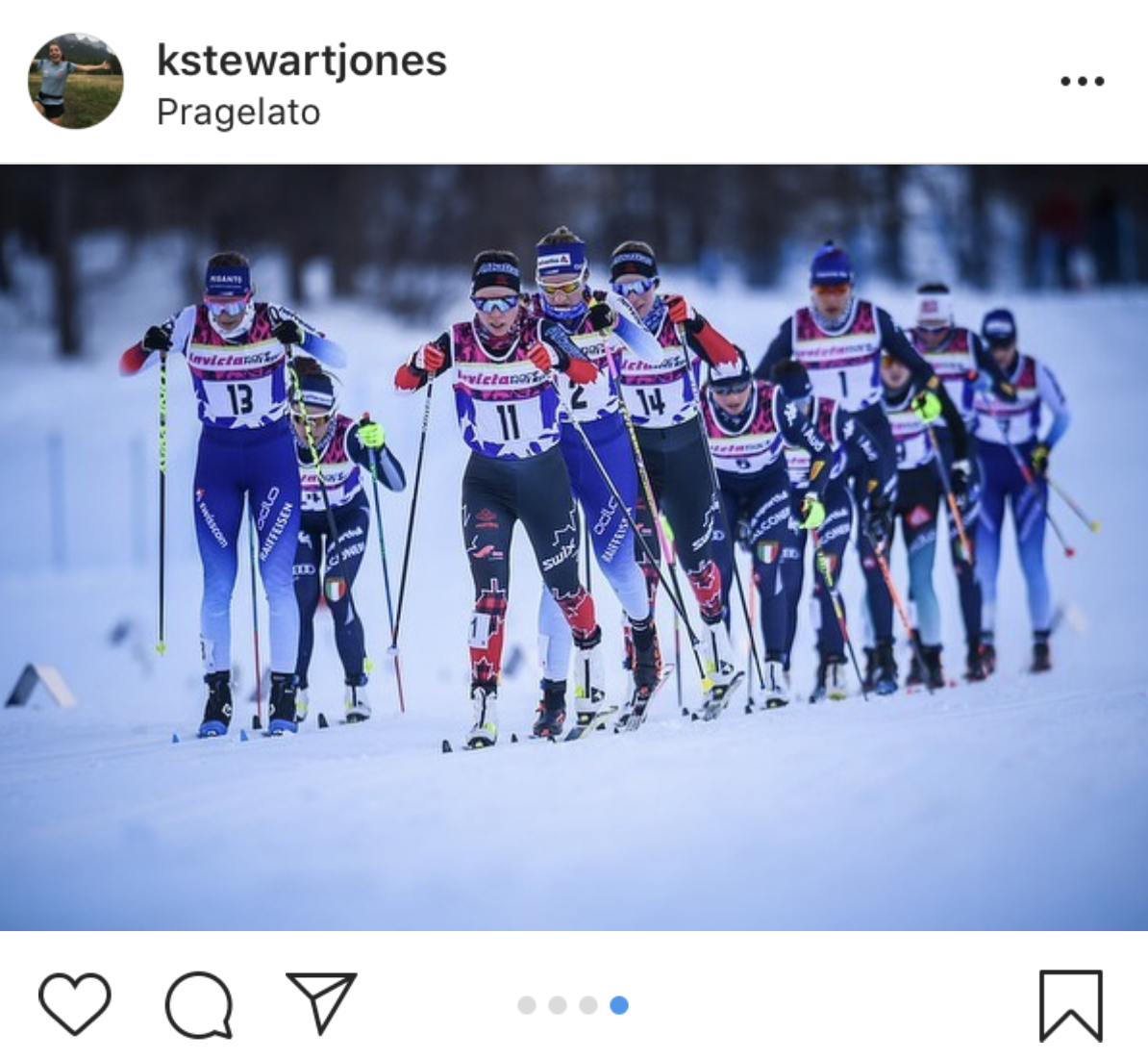
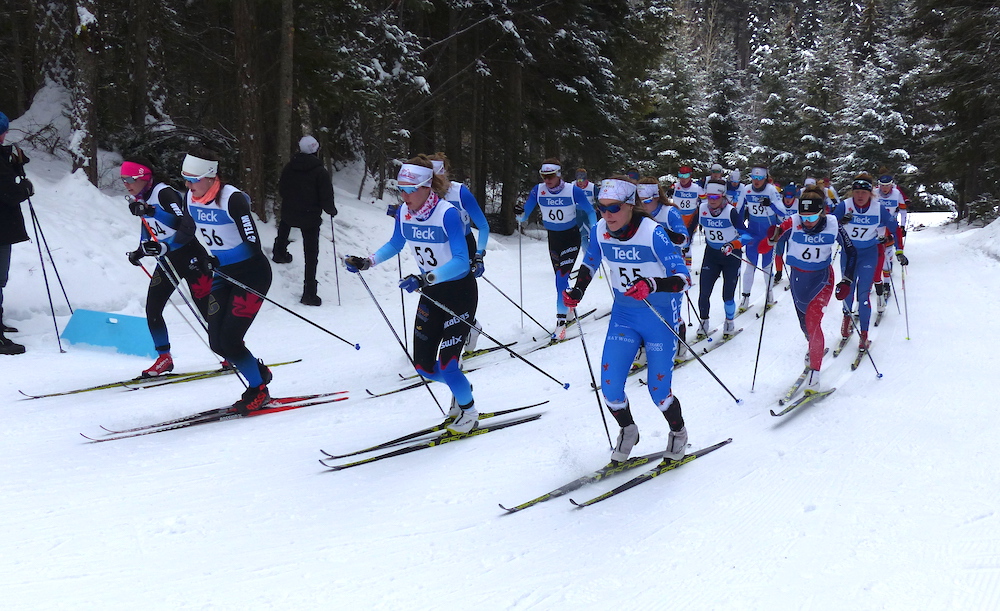
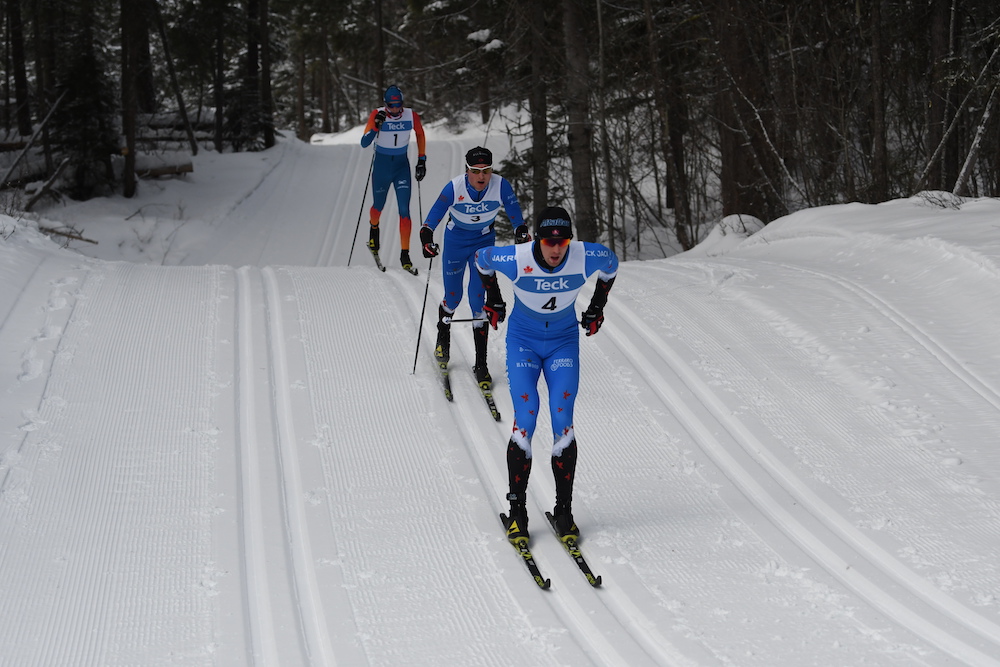
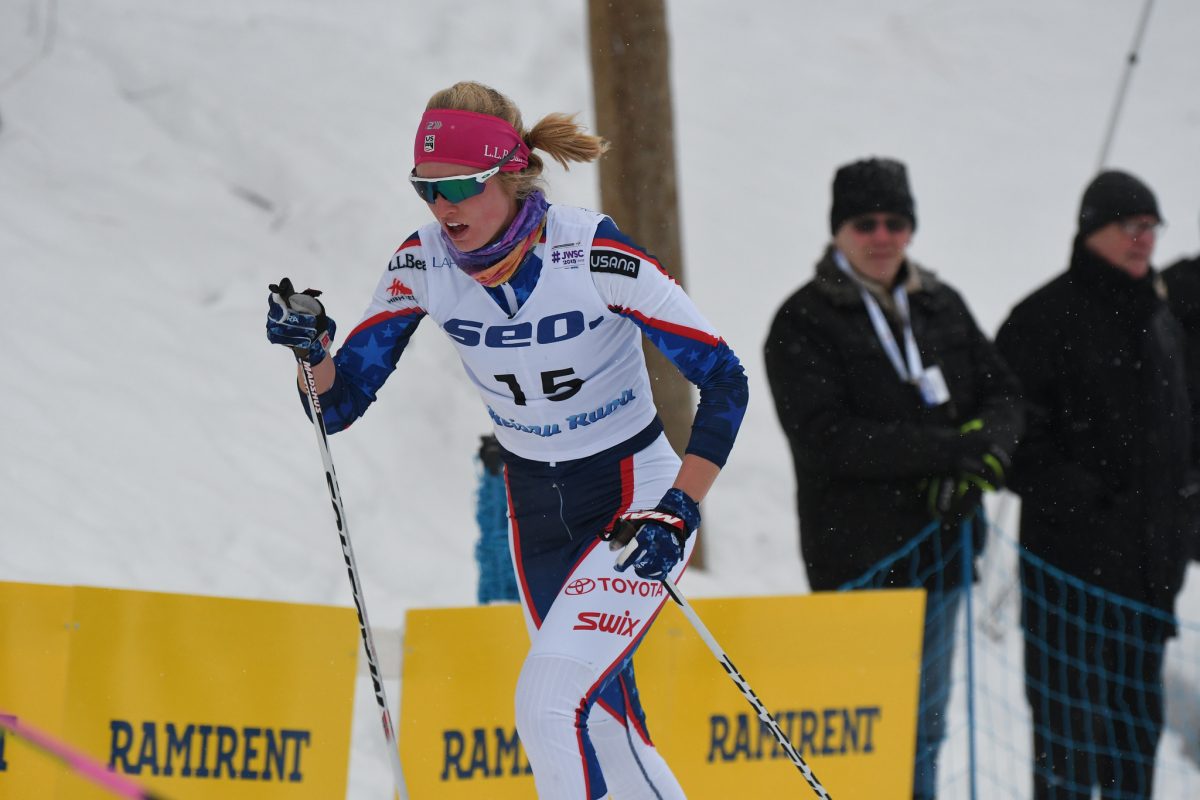
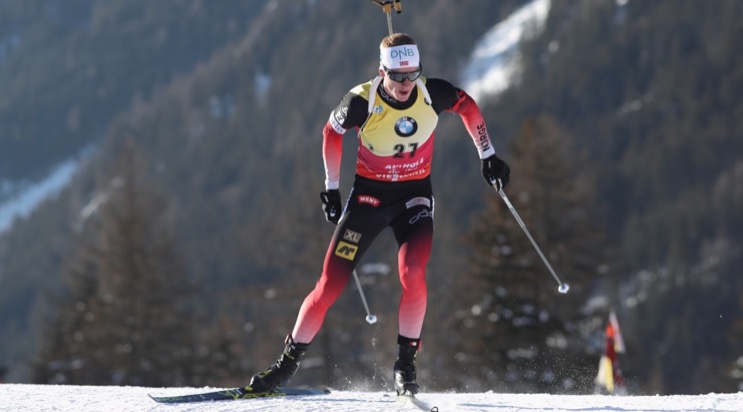
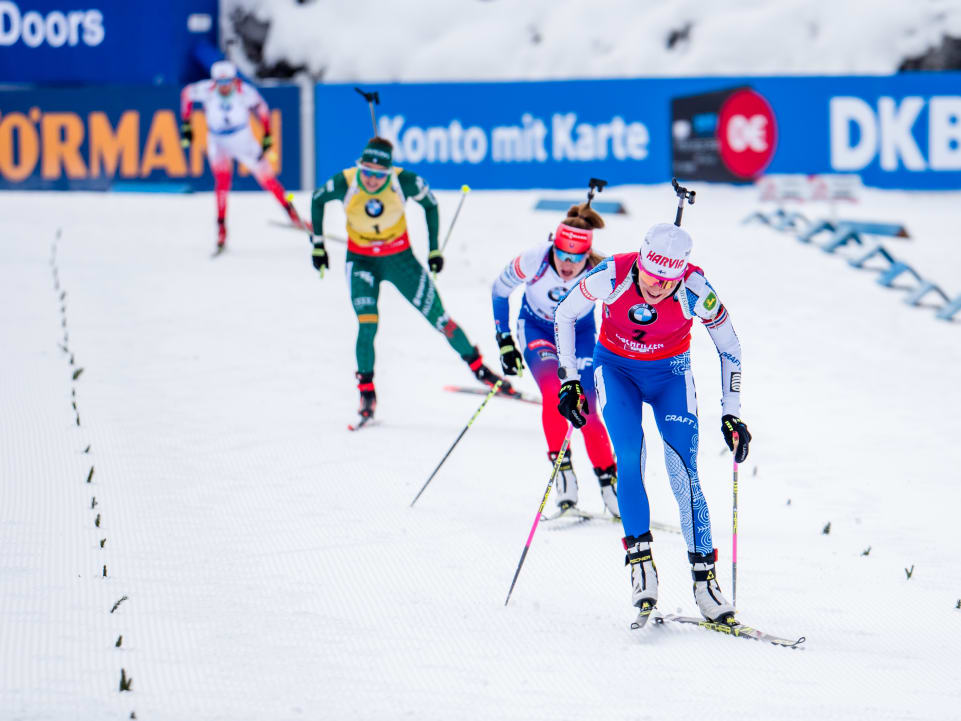
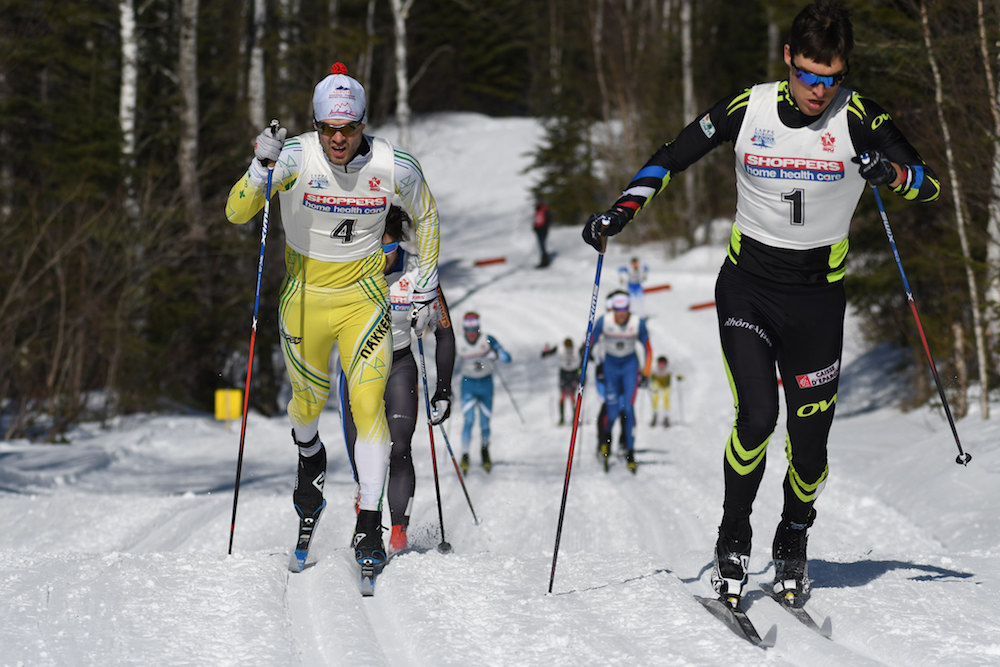
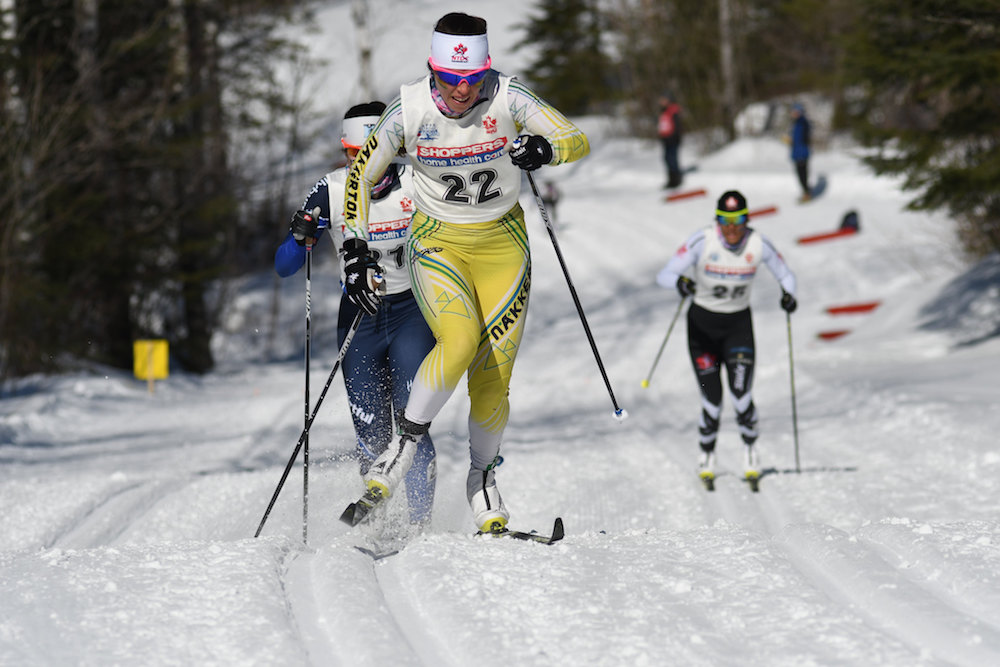
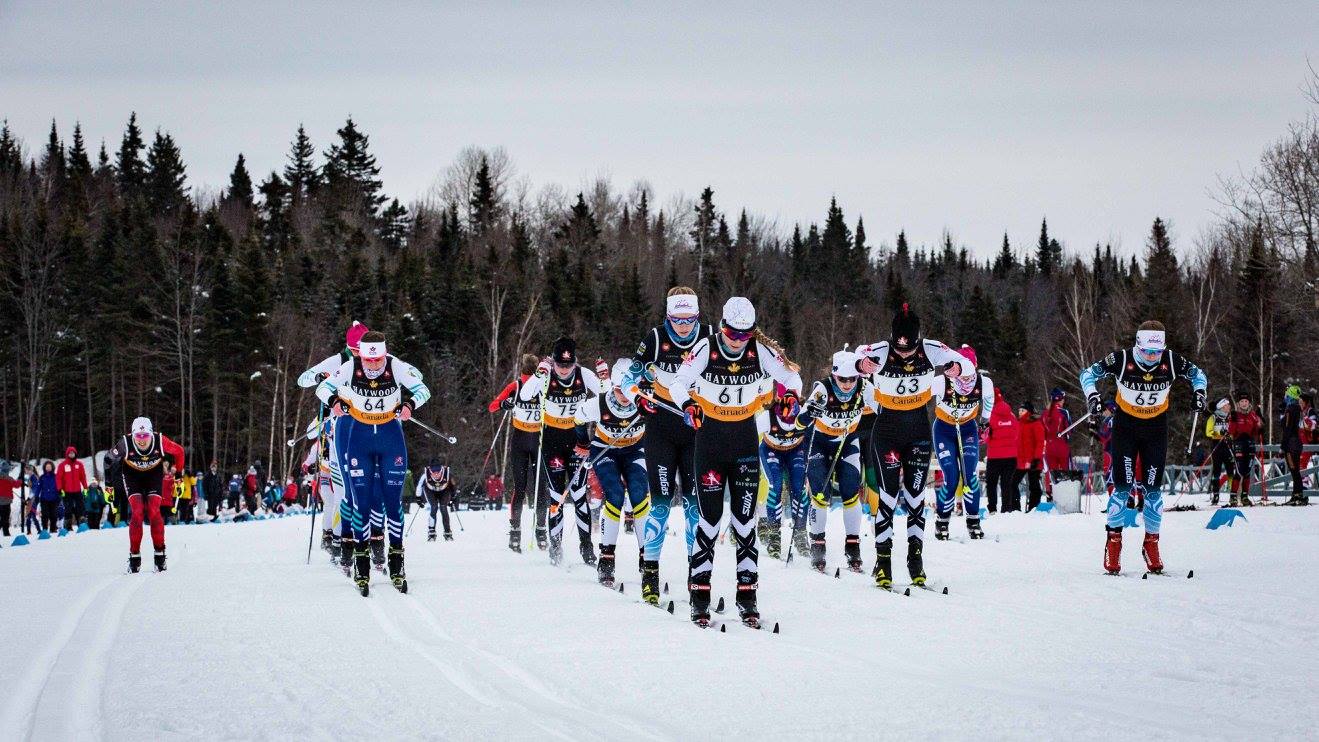
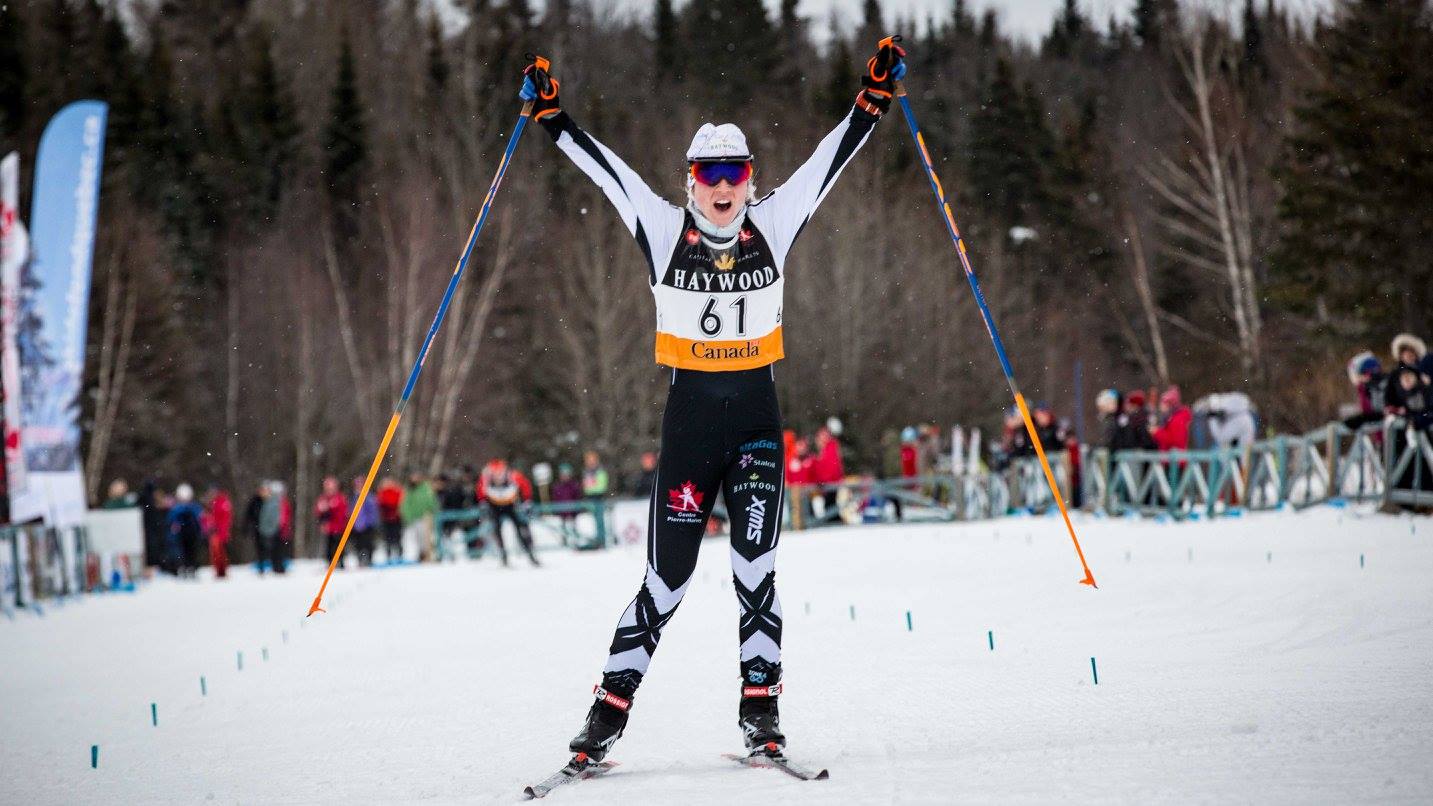
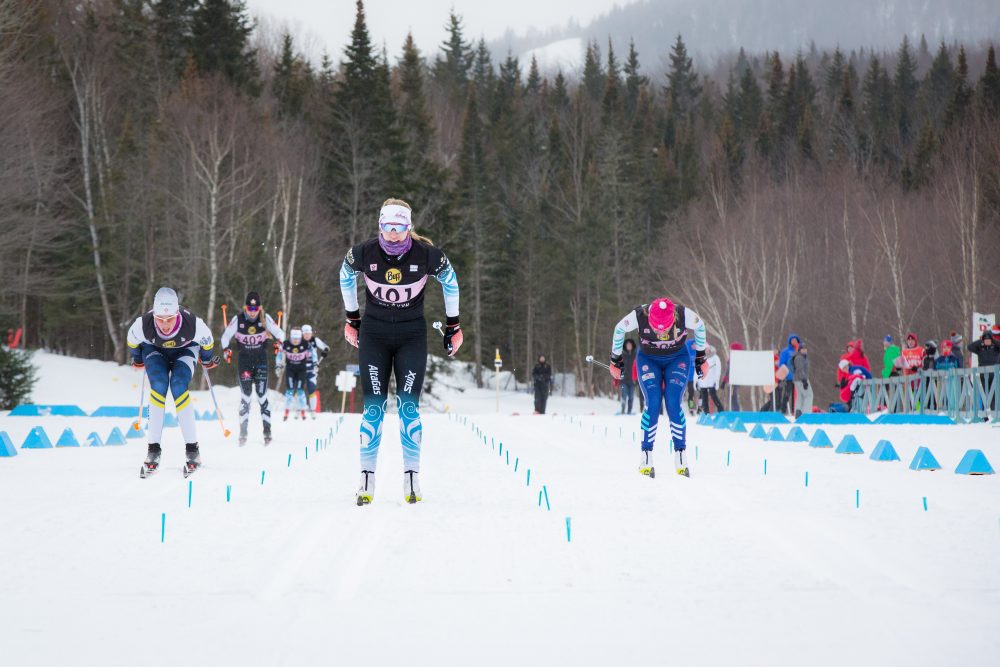
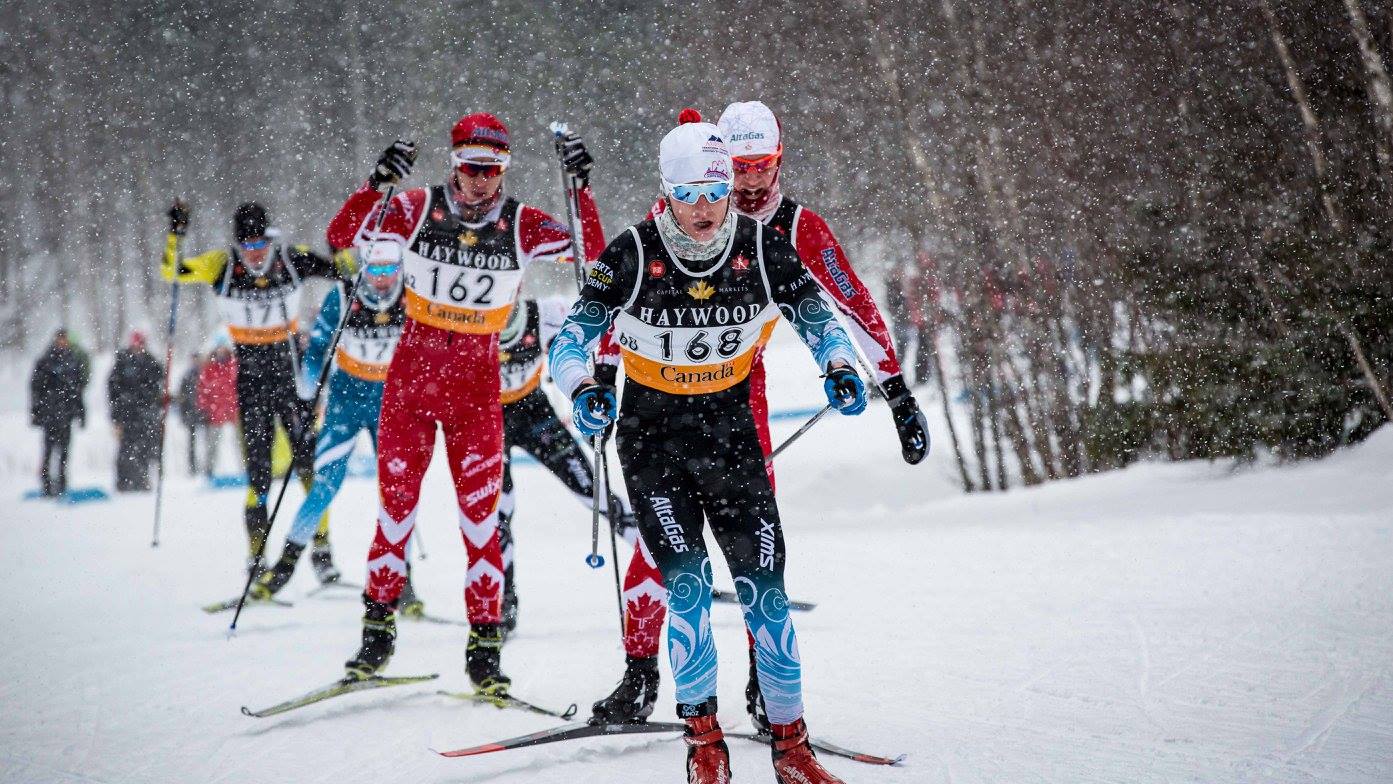
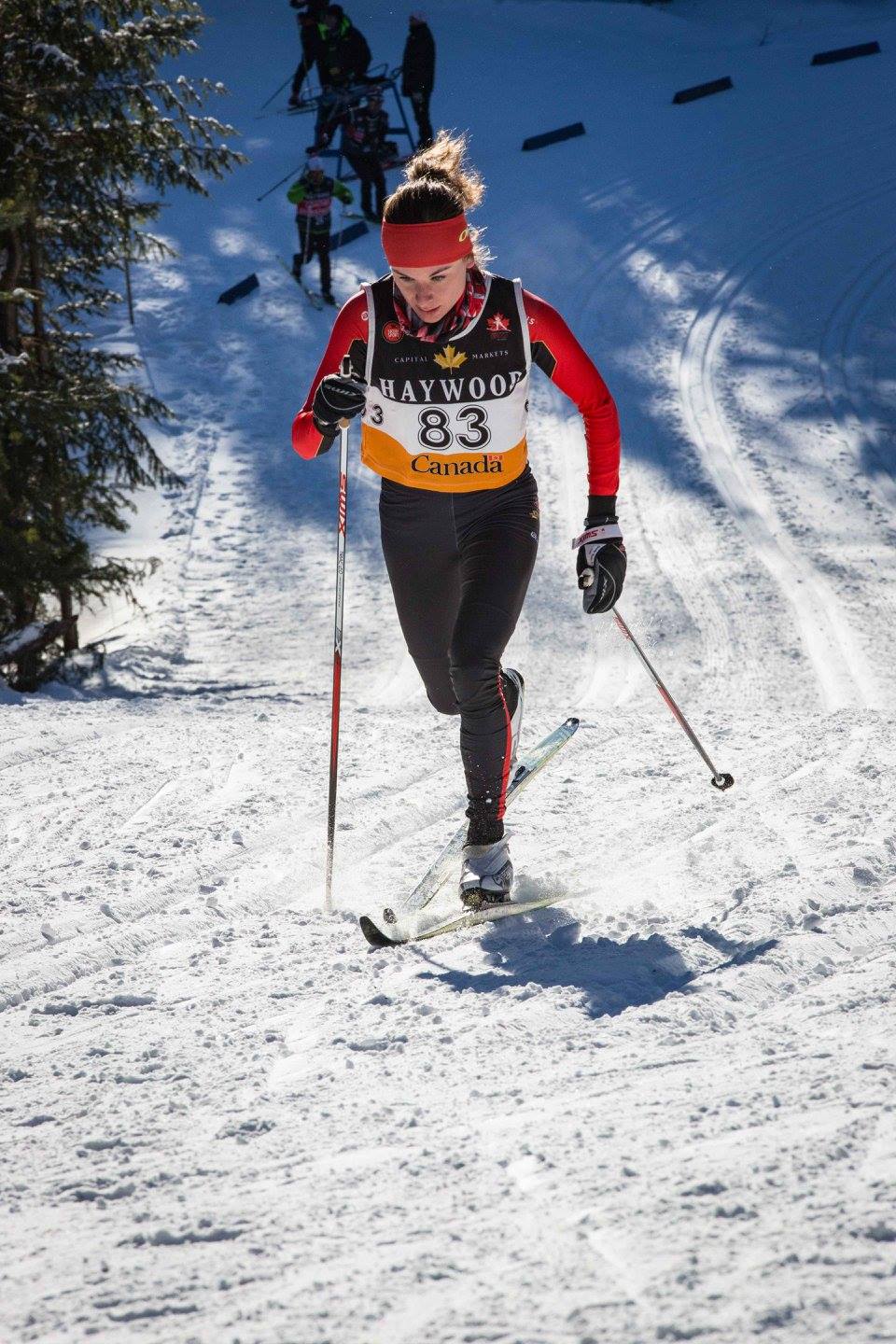
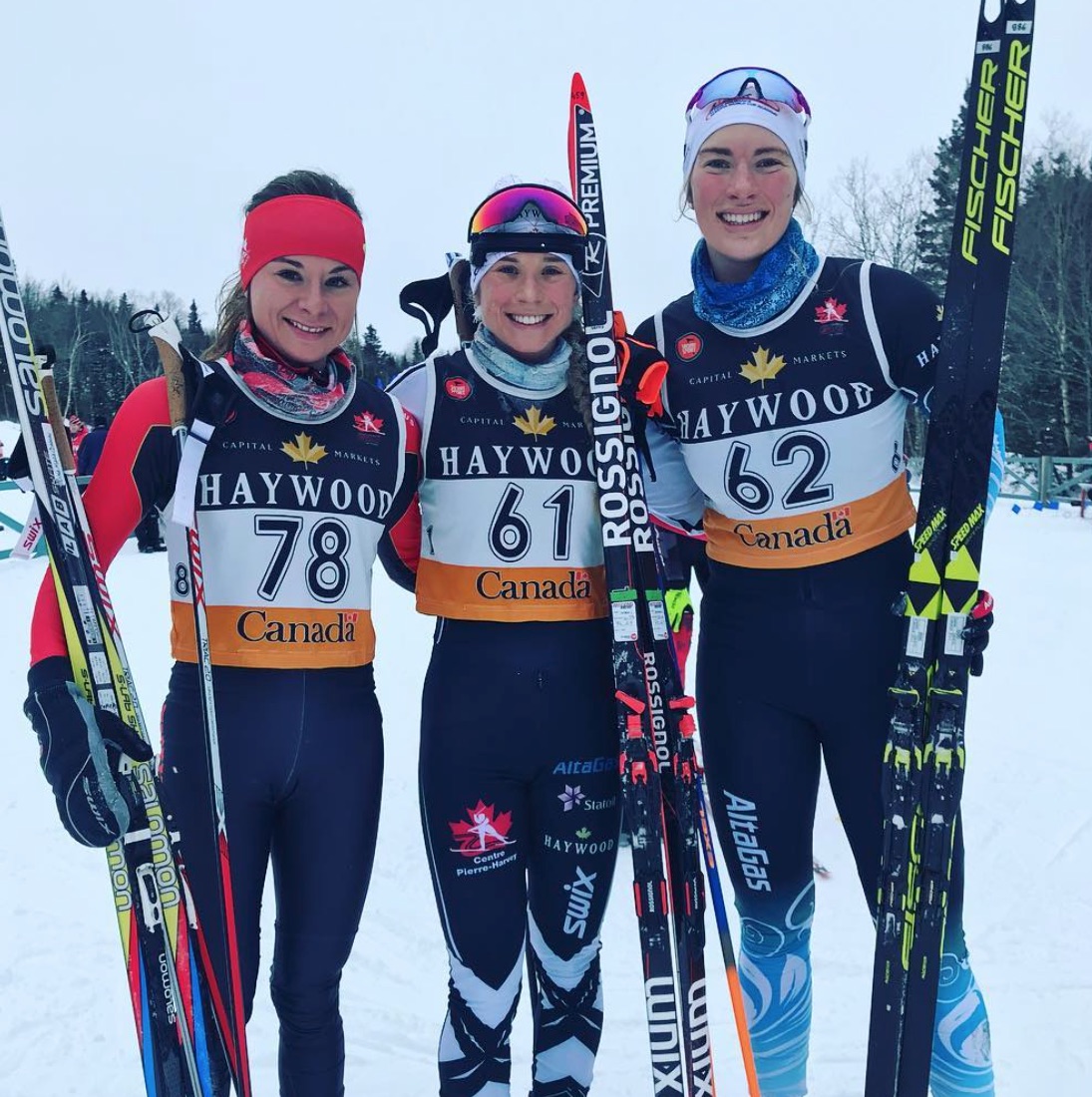
Katherine Stewart-Jones leads the mass start on the way to a Canadian 1-2 at the OPA Cup in Pragelato, Italy. (Photo: Athlete Instagram, credited to @damianobenedettophoto)
Canada took a step back from the World Cup circuit this weekend and focussed attention into development series. As the country tries to build momentum in a post Alex Harvey world, the focus has moved away from World Cup podiums and towards a consistent presence in the top 30. The road to the World Cup goes through local and regional races on the way to national/continental races.
One of the development challenges in Canada is size. The second largest country has roughly the same population as California. Skiers from Newfoundland live closer to Holmenkollen than Whistler Olympic Park.
The Continental Cup series in each FIS ‘continent’ is the top level race series below the World Cup. Canada has the NorAm series. The USA has the SuperTour series. France, Germany, Italy, Slovenia, Switzerland, and Austria share the OPA Cup series. This distribution of ‘continents’ may seem odd, but remember that the combined land area of the OPA countries is equal to British Columbia and Nova Scotia. Canada has three more time zones separating those two provinces.
As part of an effort to reduce travel demands on developing skiers in Canada, Nordiq Canada has been making changes. For the second year in a row, Westerns is not a NorAm event, but a regional event (albeit for a region larger than continental Europe). While this eliminates one east/west flight for eastern-based skiers, western athletes from Saskatchewan, Manitoba, Nunavut, North West Territories, and the Yukon still have a flight to pay for.
8 young Canadians are in Lausanne, Switzerland, for the Youth Olympic Games. Another 8 were in Pragelato, Italy, for an OPA Cup event, where two Canadians won. If you know someone who doesn’t think winning an OPA Cup is a big deal, listen to what Devon Kershaw and Jess Cockney think in the latest podcast. Cockney may ‘only’ have four top 10 results on the World Cup before he ‘retired’, but he did win a combined NorAm/SuperTour earlier this season.
As Cockney reminded us in the podcast, development comes in cycles. It is hard to remember that ten years ago Norway needed to borrow a biathlete to make a mens relay team for the Olympics, the same Olympics when Canada had four different men with top 10 individual finishes. The glory of being at the top of the roller coaster comes with an unseen cost of getting a big machine up a steep hill. This weekend was part of that climb.
Western Canada Cup, Whistler Olympic Park
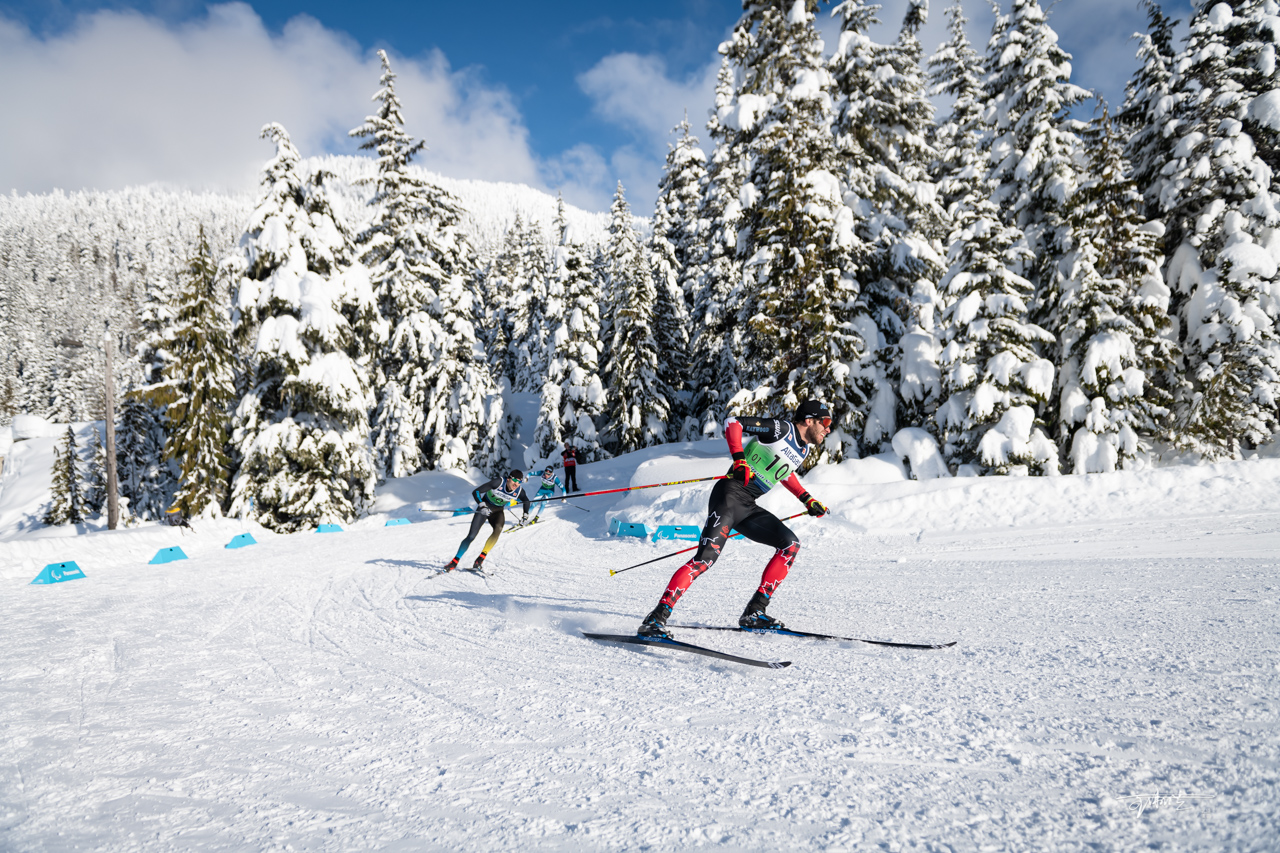
Russell Kennedy leads the A final out of a corner that Petra Majdič remembers well from the 2010 Olympics. (Photo: Weisheng Wang)
Western Canadians was held at Whistler Olympic Park, with over 250 athletes competing for titles under a slightly changed name: Western Canada Cup. Record-setting snow storms and very challenging driving conditions should make for some good stories from the athletes who completed the trip.
The embedded videos are the full-length interviews by Nordiq Canada’s Jeff Ellis. Social media has edited versions.
On a spectacularly sunny Friday, AWCA’s Annika Richardson won the 1.3km classic sprint on a course that will bring back Olympic memories for older fans. Richardson’s 3:16.95 put her 1.45 seconds ahead of Benita Peiffer and 2.11 seconds clear of Elizabeth Elliott which made an all-AWCA podium. Peiffer and Elliot are in their final season of U20.
Bragg Creek’s Sebastien Boehmler-Dandurand edged out Canmore’s Russell Kennedy by 0.28 seconds to win the men’s 1.3km in 2:41.37. Telemark’s Gareth Williams grabbed third at 1.90 seconds, well ahead of his brother Ian in 4th who claimed the top U20 finish.
On Saturday, WOP showed the changeable weather with falling snow and soft tracks after a heavy overnight snowfall. In the men’s 15km classic interval start, Kennedy confirmed his favourite status with a win in 46:57.6, 45.3 seconds clear of Gareth Williams. AWCA’s Jack Carlyle grabbed the bronze at 1:20.3 back. Ian Williams was again 4th overall to take the U20 win.
In the women’s 10km, Emily Nishikawa showed why she was Canada’s top distance skier on the World Cup last season with a 35:42.4 time. Sprint winner Richardson claimed second, 2:51.4 back followed by AWCA teammate Sadie White at 3:09.0 Whitehorse’s Amanda Thomson was 5th at 3:45.5 to take the U20 title.
Sunday continued the domination by the favourites. Nishikawa won the 15km free mass start in 43:06, 2:07.6 ahead of Elliott and 2:13.8 ahead of Revelstoke’s Gina Cinelli.
In the men’s 15km, Kennedy snatched a second win in 37:29.4, 1.6 seconds ahead of Gareth Williams and 19.4 seconds ahead of Carlyle.
“It is fun to be back in Canada and see how well people are skiing here!,” Kennedy wrote to FasterSkier. “Whistler is so pretty but it is super tricky with weather. Always unpredictable but really good for testing skis I don’t use that much.”
While the regional field may not have been as deep as MSA will be, the return of Nishikawa and Kennedy from World Cup period 1 gave nearly 300 athletes a good vision into what the next level of competition looks like.
Dahria Beatty wins the OPA Cup ahead of Katherine Stewart-Jones. (Photo: Beatty’s Instagram)
While the western athletes were at the 2010 Olympic venue, eight Canadians made the trek to the 2006 Olympic venue to compete in the OPA cup. Dahria Beatty won the Saturday’s mass start 15km classic in 49:09.0, 8.1 seconds ahead of teammate Katherine Stewart-Jones. Italy’s Sara Pellegrini was third at 38.7.
In the men’s 30km, Antoine Cyr edged out Bob Thompson for 22nd place at 5:56.1 back from winner Paolo Ventura who won in 1:26.36.3.
On Sunday, Stewart-Jones moved up, taking first in the 5km free in 14:03.5, 5.2 seconds ahead of Italy’s Elisa Brocard and 10.4 seconds ahead of Beatty in third.
“Being on the podium for both races is a huge confidence booster going into next weekend’s World Cup races, especially because the courses in Pragelato are World Cup level,” Stewart-Jones wrote in an email. “With Dahria also on the podium the last two days I couldn’t be more excited with how well our Canadian Women’s team is performing.”
Stewart-Jones is targeting the Scando Tour, starting in Åre, Sweden, on February 18th and ending in Trondheim, Norway, on the 23rd.
“The courses here in Pragelato are awesome which made for some good hard racing this weekend,” Beatty wrote after her third OPA podium of the season.
“I had only done one distance race this season before this weekend so it was really good for me to get some high caliber race kilometres in. My distance skiing is feeling strong right now so I am excited to do a few distance World Cups in the next month and do some classic skiing since Saturday was also my first classic race of the year.”
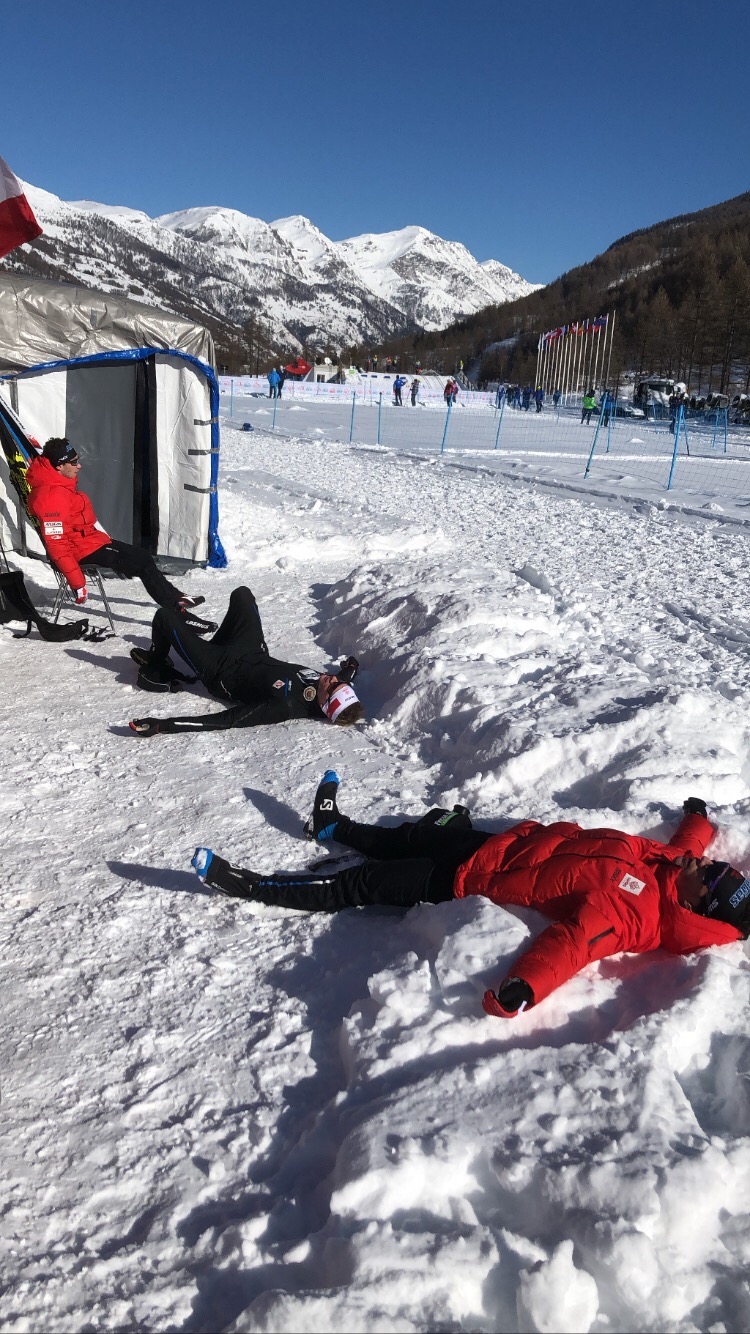
Canadian men recovering from the 30km classic in Pragelato’s OPA Cup. (Photo: Erik Bråten)
In the men’s 10km, Cyr was again top Canadian, finishing 23rd, 1:38.2 behind France’s Jean Tiberghien who won in 24:05.1.
Thompson is a sprinter by preference and was in Pragelato with Oberstdorf’s sprint in mind.
“The main focus for me this weekend was to get some longer really hard work in, which a 1.5 hour 30k definitely accomplished,” Thompson wrote. “I think the OPA’s are a great chance to find near World Cup level racing and for those who are looking to get a bit more experience at that level they are a great challenge for those looking to make a jump in their racing.”
The OPA cup is a continental cup series (like the NorAm and SuperTour) and the field is studded with athletes who move up and down between the World Cup and this series. The athletes best known to North Americans would probably be France’s Richard Jouve (8th here) and Italy’s Elisa Brocard (12th and 2nd).
Head coach Erik Bråten is with the team until Oberstdorf and back to Canada briefly for MSA Trials. He is excited with the progress this season and happy with the visit to Pragelato.
“What I take away is that we have some young athletes that is getting great race experience outside of North America, and a couple of girls that really showed a high level even in a tough training week.”
The YOG started off with a ‘cross country cross’ event including obstacles on Saturday, followed by the more traditional events: Sprints Saturday, classic mass starts Tuesday, and a mixed relay on Wednesday. The American athletes outshone the Canadians over the obstacles on the first day, taking 4th in each gender before working up to podiums on Tuesday. Full results for the event are here.
While this is an important event in young athlete’s lives’ and there have been some great individual results, fans and media alike have to be careful not to apply expectations and pressure to the developing minds in those developing bodies.
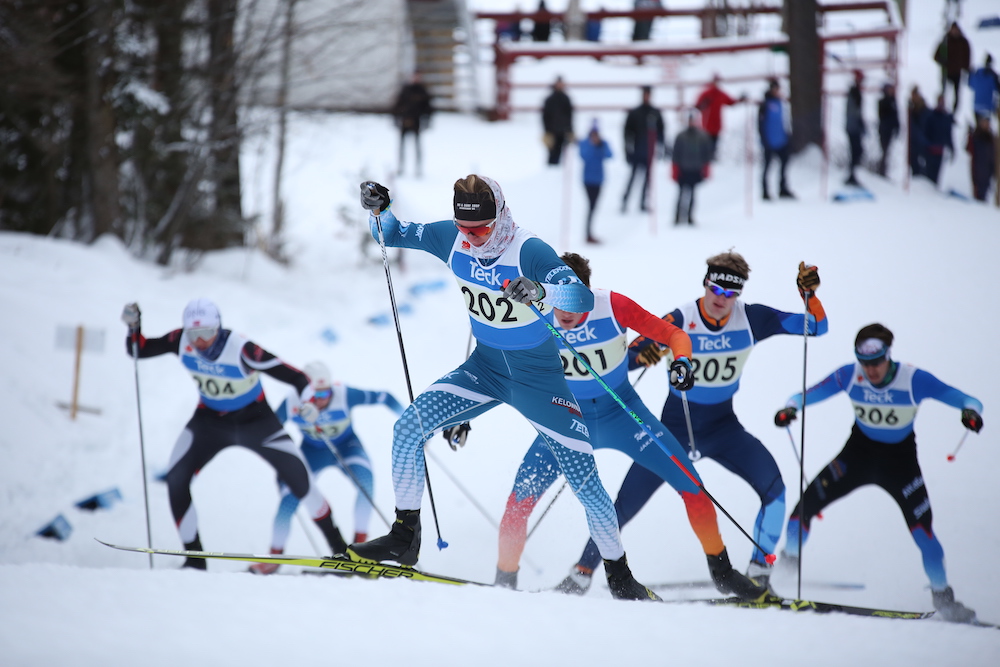
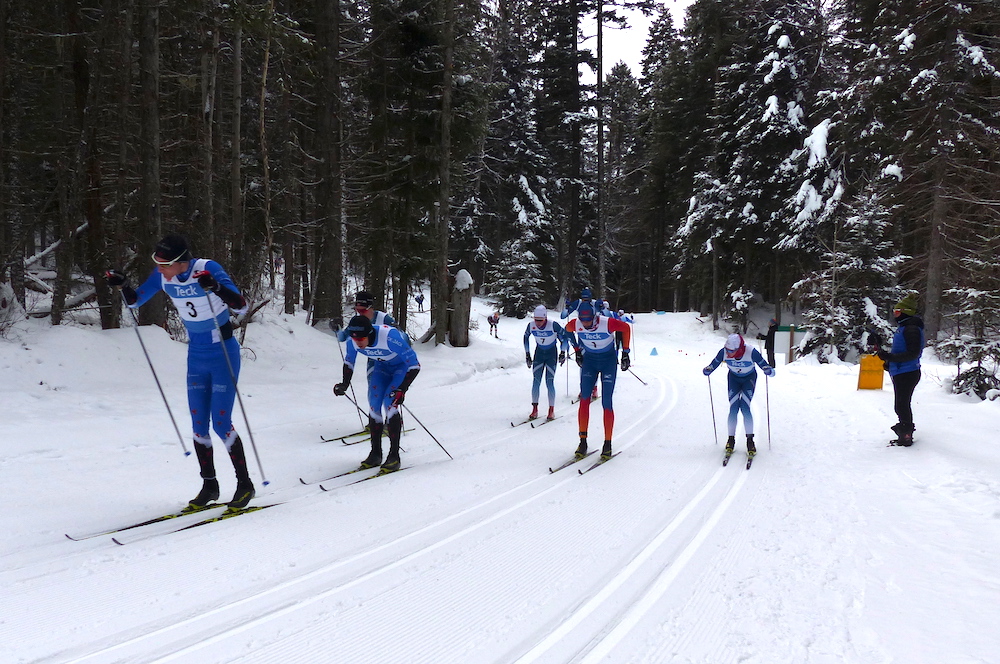
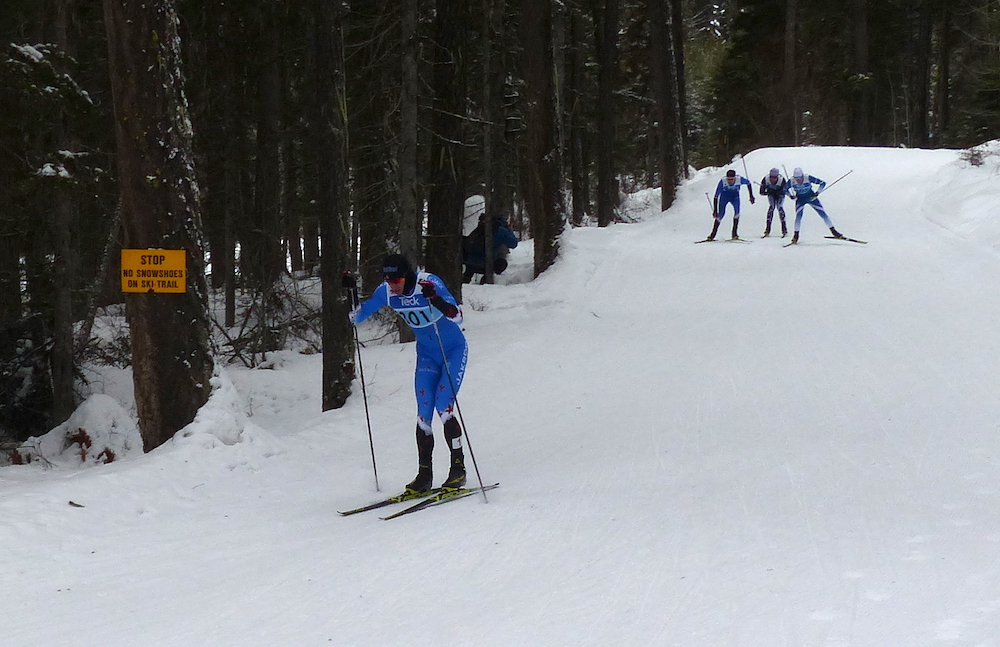
Julien Locke leads Rémi Drolet and Sam Hendry during the second lap at Westerns 2019. (Photo: Doug Stephen)
KELOWNA, B.C —
One week after Easterns, it was time for Westerns, and the Polar Vortex made the trip for both weekends.
At Easterns, the air was cold enough to keep the organizing committee on edge at the start of the weekend, and freezing rain complicated driving plans. At Westerns, the cold weather held off to Sunday, but falling snow on dry, salted roads created a sheet ice for Friday’s commute. Both championships had less athletes than expected, with driving conditions and weather predictions having an effect.
Photo albums and result links follow the daily summaries.
Friday, Skate Sprint
Tallon Noble leads Sam Hendry in the junior men’s A final. (Photo: Greg Redman)
The action kicked off Friday with skate sprints at the Telemark Nordic trails near Kelowna, B.C., in sunshine and -11C.
Benita Peiffer (Whistler) won the 1.3km A final in 3:02.79, 0.10 seconds ahead of top qualifier Katie Weaver (RMR). Elizabeth Elliot (AWCA) took third, 2.77 back after qualifying second.
“I felt really confident going into the final,” Weaver told FasterSkier. “I led all of the race, right until the finishing stretch and Benita came up, and I think she got me right at the end.”
Despite placing second, Weaver was happy with her tactics: “I wasn’t super confident with my hop offset on those tough hills, so my goal was to get out into the lead and control the race. Kinda position myself well so I could have a good finish.”
Peiffer and Elliot grew up racing together before Elliot moved to Canmore, and were clearly enjoying racing together again, completing each other’s sentences during the post-race interview.
Elliot: “It was really fun, we had all the BC skiers that we grew up skiing with. It was super-fun to all be with each other in the same heats and…”
Peiffer: “…Back to the good old days of racing together.”
Tactics were also a shared vision.
Peiffer: “You stay with the pack going up the big hill, and then it’s really easy to draft because you have a really long downhill.”
Elliot: “If your skis work for you.”
The open men raced the same course and Julien Locke (CNST) was in dominant form, winning the qualifier and each heat by over 3 seconds, taking the A final in 2:28.23.
“I’m just here to race hard,” Locke said after his cool down ski, “so I just raced hard every round.” Locke has been fast in 2019, winning the sprints at US Nationals, Easterns, and Westerns, but he would probably trade any one of those to improve on his second place at the World Championships qualification sprint at Bishop’s University.
Junior national team member Rémi Drolet (Black Jack) outreached Telemark’s own Gareth Williams (CNST) to take second, 3.42 behind Locke and 0.03 ahead of Williams.
“Tactics were tough for me,” Drolet said. “I was slow off the start, so I was behind a little bit. Basically, I had to catch up so I was really focusing on pushing over the tops of hills really hard. In the end, it was a sprint to the finish between Gareth and I. Julien was a bit ahead [laughs at the understatement]. It was fun.”
Williams was bouncing back after getting ill on the trip home from U23’s in Lahti and leaving Easterns without starting a single race.
“I started to feel better round after round, because I hadn’t done any intensity at all, so the feelings were coming back, but I kind of lost it there on the last hill,” he said. “My legs felt really heavy and I pushed really hard but it wasn’t quite enough to out sprint Rémi, and not enough to keep up to Julien Locke either.”
312 athletes raced in good conditions on a day where the driving conditions were anything but good.
Xavier McKeever won the junior boys qualifier and every heat at Westerns 2019. (Photo: Greg Redman)
Saturday, Classic Mass Start
The new 5km loop at Telemark received a homologation certificate less than a week before the event, but it was immediately put to use with the men doing three classic laps and the women doing two in -11C air and intermittent light snow.
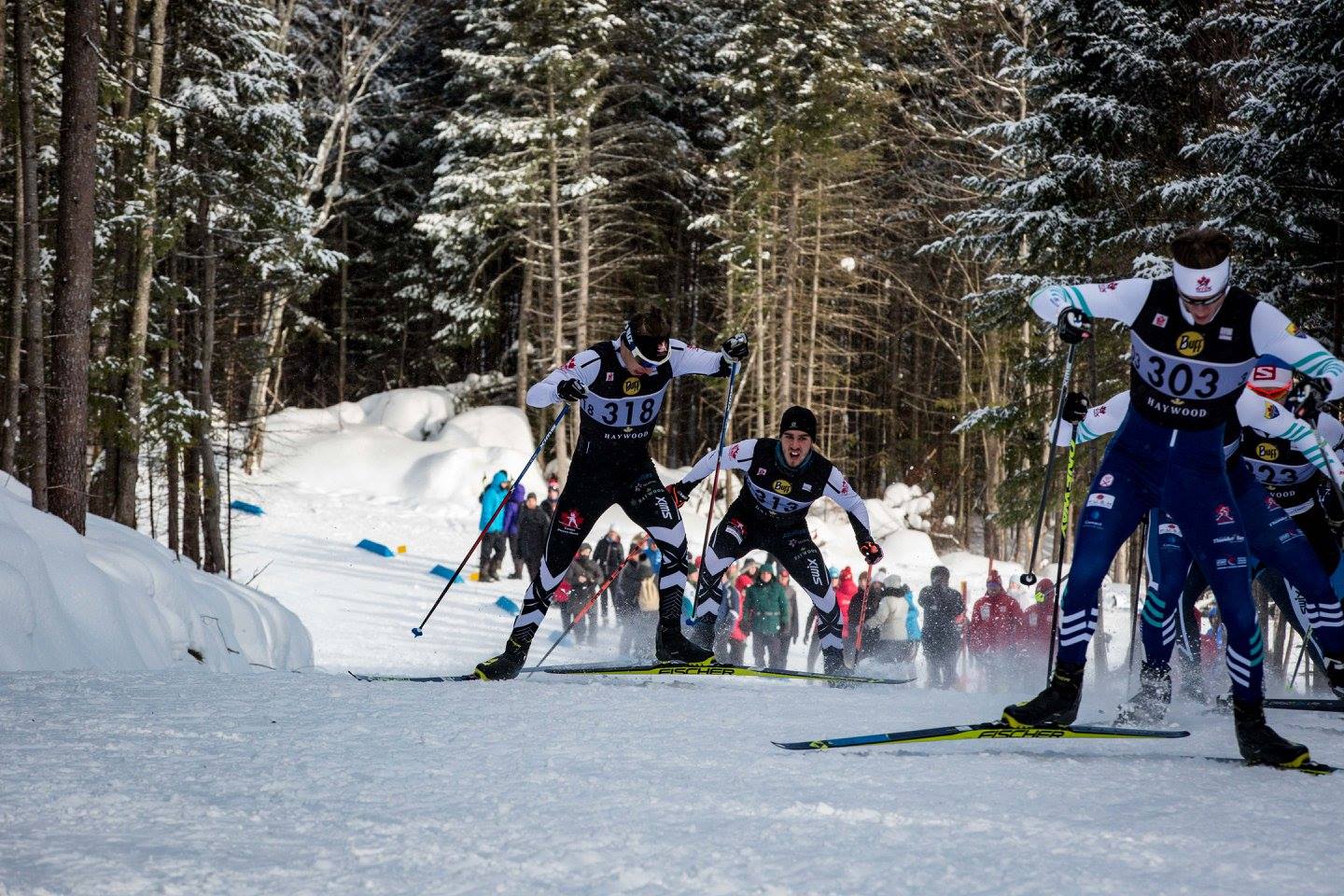
The men raced first, with Locke, Drolet, Williams, and Sam Hendry (Team R.A.D.) taking an early lead.
Williams dropped out early in a race he probably shouldn’t have started. It is hard to miss a race for illness, and harder still when the local tv station is there to see their hometown star, and your mum is the race secretary.
Black Jack teammates Locke and Drolet put the hurt on Hendry early, before Drolet broke clear to win alone in 42:18.4, 4.8 seconds ahead of Locke. Hendry hung on for third, losing 42.2 seconds on the final lap.
“I tried my best to hang on to the pace, but Rémi’s in great shape right now, coming off his big results at world juniors, so [it was] hard to stick on,” Hendry said after. “My skis weren’t quite as fast as the others. On all the downhills, they’d open up a little gap and I’d have to try to bring it back on the climbs and the flats.”
“Rémi and Sam were skiing fast, it was fun to battle with them,” Locke said. “I’m a little bit stronger on the flats, [Rémi’s] a bit of a stronger climber. We were pushing each other and just trying to ski fast and work together.”
“It was a really fun race today,” Drolet said after doping control “It was a decent pace off the start, skiing with my teammate Julien, Gareth for a bit until he unfortunately dropped out, and then Sam Hendry. It’s a pretty hilly course, so there’s not a tonne of double poling, but I think the parts of it that are double pole are important to ski well and conserve energy for the uphills.”
Drolet and Locke worked well together, up to a point. “Once Sam started to fade a little bit, we attacked and dropped him off,” Drolet explained. “Then we skied together for the rest of the race until the final climb, where I managed to pull away from him.”
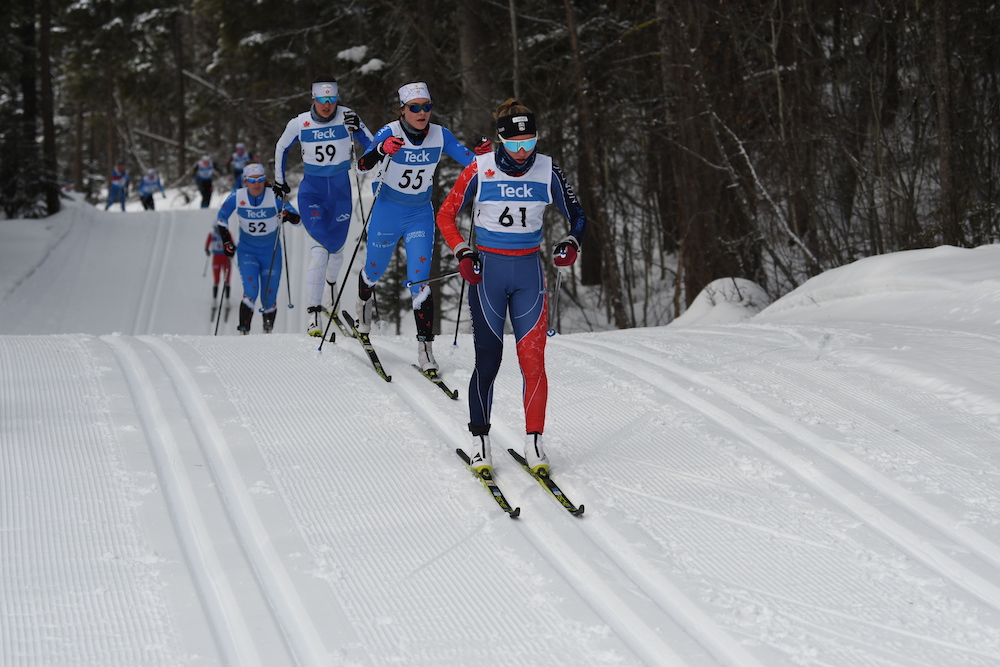
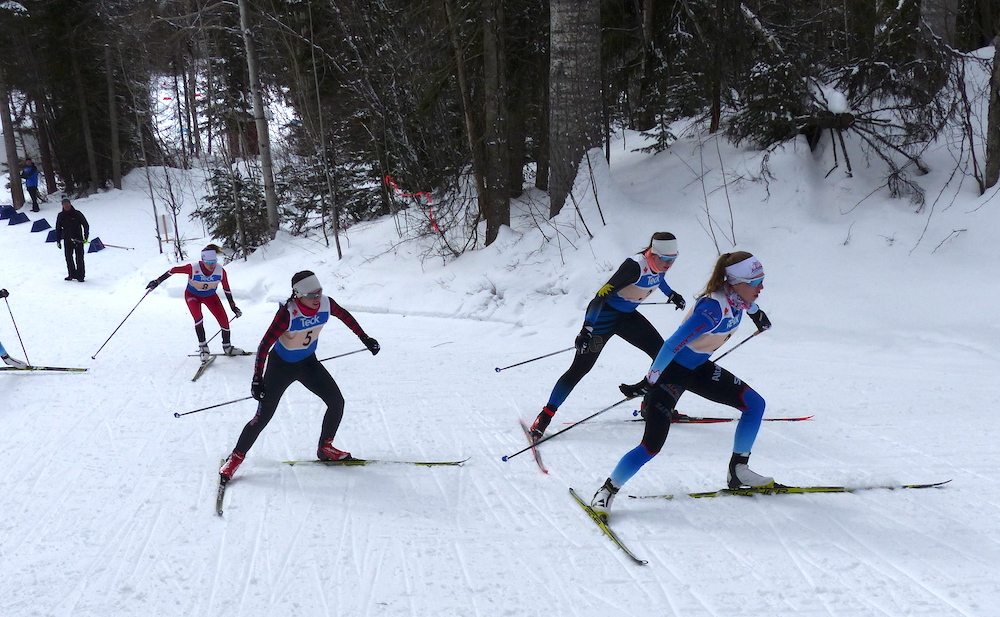
Novie McCabe (61) leads Jasmine Drolet, Katie Weaver, and Molly Miller at the 2019 Westerns 10km. (Photo: Doug Stephen)
The open women’s 10km was all about the next generation. Novie McCabe (Methow) got away early to win in 32:42.6 minutes. Black Jack teammates Jasmine Drolet and Molly Miller were second and third at 53.4 and 1:28.1 back. All three are in the junior girls category and competed at Junior Worlds in Lahti.
“I basically went out from the start hard, and tried to hold it,” McCabe told FasterSkier. “Going up the first hill, I tried to get into the lead and then on the double pole section I tried to make a break and just push hard into a downhill and that’s where I kind of gapped people by a little bit and then I just went from there.”
As an American, McCabe has a Canadian Points List ranking that put her in the third row at the start. Asked about whether this is good practice for racing in Europe, she replied “Yeah, it was definitely good to have some practice with that, navigating my way through people.”
Jasmine Drolet, at sixteen, a year younger than the other two on the open podium, kept things simple in the interview, describing her day as “good race, good skis.”
“In Canada it’s not hard to be the fast one, but when you get there [at World Juniors], it’s quite a shock,” Jasmine Drolet explained. “It’s good to ski with the best in world.”
“I haven’t been feeling super great in a lot of the distance races this year, so I was happy to have a better day today,” Miller said at the end of the day. “It was a bit aggressive in the beginning for sure. I came out of the lanes in a bad place, but it seemed to spread out very quickly.”
Among the 386 racers were some of Canada’s para-nordic team, here to prepare for World Championships starting the following Saturday.
“Races are always better than intensity,” Mark Arendz (CPNST) told FasterSkier post-race. “We’re using this as an intensity, just this single race from Westerns, to prep for World Championships in Prince George [B.C.] next week.”
(In the video below, you can see Arendz in the open men’s start, look for the national team suit, second lane from left.)
Sunday, Relays
The temperature, despite predictions, reached -17C by 9:00, allowing the relays to start on time.
For most, the relays are really about having fun with friends. The results are summarized in Sunday’s rundown.
“Relay events are always fun races, even in -17 conditions,” Rémi Drolet wrote in an email Sunday night. “It also does not matter how far ahead or behind you may be. It is always important to go as fast as possible since it can be hard to predict exactly what will happen after you have tagged your teammate.”
105 teams braved the cold to enjoy another good event at Telemark.
Course and Venue
“It’s a good course, I love racing here. Steep hills, some nice gradual stuff, it’s a good combination of all techniques.” — Locke, talking about the new sprint course
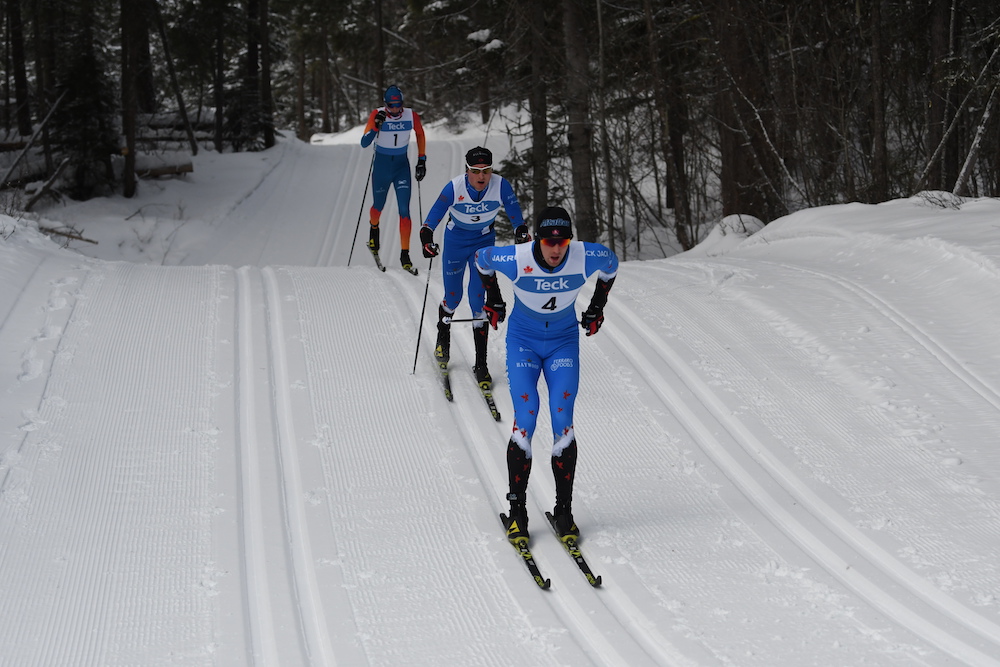
Julien Locke leads early in the first lap of the 15km. (Photo: Peggy Hung)
“My first race [here] was in 2005, my first ever provincial race, BC Midget Championships. I was 13 years old and that was my first race outside of the Kootenays. It was a pretty big day for me.” — Locke
“Seeing the young kids racing this weekend certainly brought back memories. Kelowna was one of the locations where I raced most in my younger years, and it was there that I learned many of the fundamentals of racing. Much of my early understanding of race preparation, tactics, and even technique was developed racing at Telemark.” — Rémi Drolet
“Super nice day, super great course, not too cold. Another great race at Telemark.” — Hendry, on Saturday
“It’s really nice to just be able to come up here and have some great competition and the races are really well organized.” — McCabe, on crossing the border from the Okanogan Valley in Washington state to the Okanagan Valley in B.C.
On zone4 results, click on a skier’s name to pull up pictures of that athlete in the selected event. Greg Redman, featured here, is one of the photographers contributing. There are a lot of photos, with over 60 photos of some athletes in some events.
Note that masters and the youngest athletes are in the Okanagan Cup links under Full Weekend, and some of the para athletes competed in the open category for the classic race.
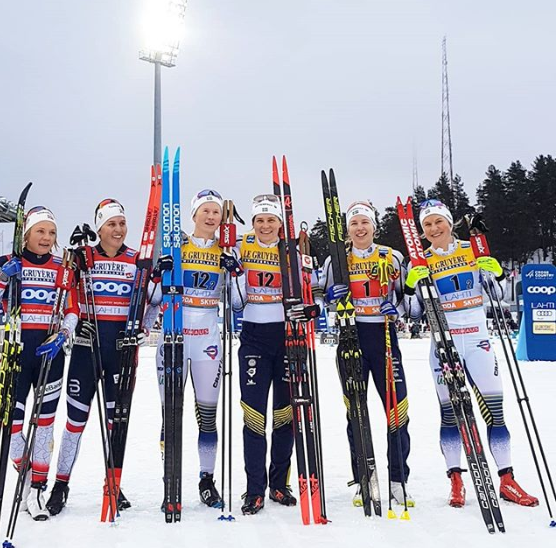
2019 Lahti, Finland’s World Cup classic team sprint podium. From left to right, Norway I in second, Sweden I in first, and Sweden II in third. (Photo: @fiscrosscountry Instagram screenshot)
FIS World Cup Lahti, Finland Classic Team Sprint
Sunday in Lahti, Finland the women raced a 6 x 1.4-kilometer classic team sprint. U.S. fans saw their hopes for a podium snuffed out in the two semi-finals that determined the 10 teams advancing to the finals.
In the first team sprint semi, the U.S. Ski Team’s (USST) Ida Sargent and Sophie Caldwell placed sixth overall and did not advance. Sargent and Caldwell, constituting team USA I, were 10.78 seconds off the winning time of Sweden II’s Evelina Settlin and Hannah Falk, who won the first semifinal in 18:36.74 minutes.
In the second semi, USA II’s Kelsey Phinney (SMS T2) and Julia Kern (USST D-Team) raced to seventh (+1:06.32). Norway I’s Tiril Udnes Weng and Maiken Caspersen Falla marked the fastest time of 18:31.09 minutes.
In the women’s final, Sweden I’s Ida Ingemarsdotter and Maja Dahlqvist won in 18:24.96 minutes. Weng and Falla took second (+1.84), Sweden II’s Settlin and Falk placed third (+3.55).
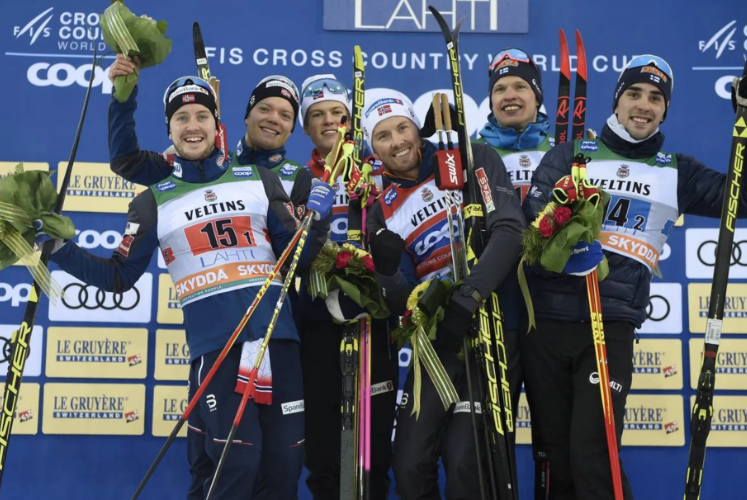
2019 Lahti, Finland’s World Cup classic team sprint podium. From left to right, Norway II in second, Norway I in first, and Finland I in third. (Photo: fis-ski.com screenshot)
The men raced a 6 x 1.6 k classic team sprint in Lahti. Both U.S. teams entered raced in the second semi with neither placing well enough to advance. The second semi was won by Russia I’s Artem Maltsev and Gleb Retivykh in 19:31.22 minutes.
In that semi-final, USA II’s Kevin Bolger and Logan Hanneman placed sixth (+6.60), USA I’s Simi Hamilton and Erik Bjornsen were seventh (+16.05).
USA II placed 12th overall, USA I 14th in the final standings.
Johannes Høsflot Klæbo and Emil Iversen of Norway won the first semi in 19:22.32 minutes.
Norway I’s tandem won the final in 18:57.19 followed closely by Norway II’s Sindre Bjørnestad Skar and Eirik Brandsdal in second (+0.65). It was a photo finish for second and third, as Finland I’s Iivo Niskanen and Ristomatti Hakola finished 0.71 seconds back to take the third podium spot.
Western Canadian Championships, Telemark, Kelowna B.C., Relays
Westerns wrapped up with club relays on a day where the thermometer flirted with cancellation before rising to -17C at 9am (that is 2 Fahrenheit, for residents of Liberia, Myanmar, and the USA).
The relay event is intended to help build club spirit in a less competitive environment. In practice, many skiers just find two friends they want to ski with. Despite the cold, 105 teams competed today.
In the open men category, the ‘BC Lost Boys’ team won easily, with Rémi Drolet, Gareth Williams, and Julien Locke finishing the 15km in 38:00.9. Drolet and Locke are teammates at Black Jack while Williams is a Telemark local. All three are national team members.
Julien Locke leads Rémi Drolet and Sam Hendry in Saturday’s mass start classic. The relay used the same 5km loop. (Photo: Doug Stephen)
‘Alberta 1’ placed second, at 1:47.1 back, with Thomas Manktelow (), Michael MacIsaac-Jones (AWCA), and Sam Hendry (Team R.A.D.) ‘BC Power, Speed, and Grace’ was third, with Tallon Noble (Strathcona), Michael Murdoch (Whistler), and Ian Williams (Telemark) at 2:26.8.
The open women used the same 5km loop as the men (and the same as on Saturday). ‘BC Supernovas’ won in 47:25.7, with BC team members Paige Latta (Sovereign Lake), Elizabeth Elliot (AWCA), and Benita Peiffer (Whistler). ‘BC Avalanche’ took second at 1:33.4 with Katie Weaver (RMR), Gina Cinelli (Revelstoke), and Beth Granstrom (AWCA). ‘Just the Ladies – No Nick’ was just 3.5 seconds behind 2nd place with Claire Grall-Johnson (AWCA), Amanda Thompson (AWCA), and Hannah Jirousek (AWCA) representing Yukon/Ontario.
Elizabeth Elliot leads Benita Peiffer and Paige Latta up the first climb in the semi-final at Westerns (Photo: Peggy Hung)
Canadian Western Championships started off Friday with free technique sprints on the Telemark trails near Kelowna, B.C.
The sun was out for the qualification round, followed by cloud, and light snow as the day progressed with the temperature hovering at -10C. A major road closure combined with icy morning highways and a large number of accidents blocking roads caused some athletes and volunteers to miss the qualification round, resulting in only 312 athletes on the start line. About 500 athletes are expected to race Saturday.
Katie Weaver (RMR) won the 1.3km qualifier in 3:06.02 and her first two heats before Benita Peiffer (Whistler) pipped her at the line to win the A final by 0.10 seconds in 3:02.79. Second place qualifier Elizabeth Elliot (AWCA) took the bronze, 2.77 seconds back.
Julien Locke blew the A final apart in Telemark. (Photo: Peggy Hung)
The men raced the same course, with Julien Locke (CNST) steamrolling the field, qualifying first in 2:27.67 before winning all three heats alone. In the A final, Locke clocked 2:28.23, 3.42 seconds ahead of the three chasers. Junior Remi Drolet (Black Jack) stretched ahead of local Gareth Williams (CNST) by 0.03 seconds with Larkin Wasmuth (CRTG) 4th, 0.53 seconds behind Drolet.
Of the four Russian athletes starting the 15-kilometer classic mass start in Lahti, Finland three placed in the top four. Anna Zherebyateva won in 40:31.4 minutes as she was able to stretch her nine-second gap at 10 k to 23.5 seconds by the finish. Also from Russia, Lidia Durkina placed second (+23.5), Germany’s Katharina Hennig skied to third (+37.5).
“My tactic was to make a gap in the second loop,” Zherebyateva said during the post-race press conference. “So I did exactly what I wanted. It went really well. Tracks were exactly right for me. This gold medal is an important step for my sport career.”
Yana Kirpichenko was the third Russia in the top-five as she placed fourth (+41.6).
The best North American finisher was U.S. skier Hailey Swirbul who raced to 10th (+1:27.8). Swirbul was positioned 29th at the 5 k time check but steadily moved up in the field as the race progressed. By 10 k she had positioned herself in the top-15.
For the twenty-year-old Swirbul, this is her first go at U23 Worlds after participating in three Junior Worlds as an U20. Last season in Goms, Switzerland she placed second in the 5 k classic and third in the 10 k skiathlon.
Two other U.S. skiers raced into the top-30. Julia Kern placed 16th (+1:43.4), while Alayna Sonnesyn was 23rd (+2:24.9). Hannah Halvorsen, the fourth U.S. starter, placed 54th (+6:58.6).
Hannah Mehain was the top Canadian in 31st (+3:16.8), Sadie White placed 33rd (+3:18.6), and Natalia Hynes 51st (+3:40.9). Marie Corriveau did not start.
Similar to the U23 women’s race, Russian skiers dictated the pacing at the front of the pack — the four Russian starters swept first through fourth place.
Andrey Sobakarev won in 1:17:19.1 hours, Ivan Kirillov placed second (+3.5), Ivan Yakimushkin third (+4.9), and Anton Timashov fourth (+11.4).
Canada’s Antoine Cyr was the top North American in 27th (+2:26.8), while teammate Gareth Williams toed the line a fraction behind in 28th (+2:26.9). Also for Canada, Ritchie Graham was 41st (4:44.1), and Julian Smith 45th (+5:14.3).
Peter Holmes was the top U.S. finisher in 33rd (+3:15.7). Hunter Wonders placed 40th (+4:43.0), Braden Becker 53rd (+6:59.0), and Daniel Streinz 66th (+15:53.9).
Johannes Thingnes Bø scored his 10th IBU World Cup win of the season today in the 10 k sprint in Antholz, Italy. (Photo: biathlon world.com screenshot)
IBU World Cup Antholz, Italy 10 k sprint
In the groove is in the groove. Norway’s twenty-five-year-old Johannes Thingnes Bø scored his 10th IBU World Cup win of the season today in the 10 k sprint in Antholz, Italy. Bø won the race in 23:53.9 minutes with a single penalty in standing. The Norwegian leads the IBU World Cup overall and padded his lead with his fifth sprint win this year.
“It was quite difficult; the altitude here is quite heavy and with the new tracks, I felt dead from 5K so the last 5K was really tough,” Bø said to the IBU after the race. “I managed to have a good plan for the race. When I shoot nine targets, I was quite happy and then it was just to fight hard for the finish line. I like this year’s track; I liked last year’s too because it was not so painful.”
Bø’s season thus far has been a study in speedy skiing. His shooting stands at 87% for accuracy (82% standing, 91% prone) with his superior skiing speed carrying him to the World Cup overall lead. In Antholz today, his course time for each of his two 5 k laps were ranked first.
Norwegian teammate Erlend Bjøntegaard shot clean in both his shooting bouts to take second place, 17.5 seconds behind. France’s Antonin Guigonnat placed third (+20.2, 0+1).
Scott Gow of Canada was the top North American in 20th (+1:06.6, 0+0). Teammates Jules Burnotte raced to 48th (1:55.9, 1+1), Christian Gow 61st (+2:13.4), and Aidan Millar (+3:46.7, 2+2).
Jake Brown was the top American in 40th (1:42.4, 1+0). Sean Doherty finished in 55th (+2:06.2, 2+1), Max Durtschi 62nd (+2:13.8, 0+1), and Leif Nordgren 73rd (+2:43.1).
Racing continues tomorrow in Antholz for both the men and women with the 12.5k and 10 k pursuits.
Lake Placid SuperTour 5 k/10k Skate Individual Start
In the 5 k-freestyle individual start Jessica Yeaton (APU/Australian National Team) placed first with a winning time of 15:01.9 minutes. She was in a tight race for the top spot with U.S. Ski Team/SMS T2 athlete Sophie Caldwell who finished 3.0 seconds back. Caldwell is back home in Vermont training and preparing for the 2019 World Championships.
Katherine Ogden (Dartmouth Ski Team) placed third in a time of 15:17.8. Kelsey Phinney (SMS T2) placed fourth in 15:37.7.
“Today’s race went super well for me; I had awesome skis despite tricky conditions/weather leading into the race – our wax tech did a phenomenal job,” Yeaton wrote to FasterSkier. “The course here is really good for me with all the steady climbing in the first part- I just tried to push hard to the top of the course and then survive and carry my speed on the downhill, which turned out to be a good tactic.
“Between US Nationals and now I definitely feel like I am in a good place leading into Seefeld. I struggled with some injuries in the fall and was forced to do a lot of cross-training (especially on the bike) and skip the early season races in Nov/Dec. In retrospect I think this actually was a blessing in disguise, as I ended up putting in a super hard training block and gaining a lot of fitness. Looking ahead to Seefeld, my goal is to top 30 in one of the races, with my main focus being on the skate events (30k and sprint), and the 15km skiathlon. I am really excited for the rest of the races this weekend; they are my final prep before heading over to Europe to race on World Cup and in Seefeld.”
Kyle Bratrud (SMS T2) won the men’s 15 k skate in 25:27.1 minutes. Bratrud, who was recently selected to the 2019 U.S. World Championship Team, has been a top-performing distance skier this season on the SuperTour.
“Today went well,” Bratrud emailed. “After Nationals, I made the tough decision of turning down World Cup starts in Otepaa and Ulricehamn in order to get some quality training in for the World Champs. Today reflected that as I felt a little tired and pretty flat from not racing since Nationals. That being said, I expect to keep feeling better each race and I should be in a great place when I fly to Europe on the 4th!”
Bratrud recently won the NorAm/SuperTour 15 k classic in Sovereign Lake and the 15 k classic at U.S. Nationals. Bratrud placed second in West Yellowstone’s SuperTour 15 k skate, and the 30 k skate mass start at U.S. Nationals.
Akeo Maifeld-Carucci (CGRP) placed second in a time of 26:18.9. It was Carucci’s second SuperTour podium of the season and his best career SuperTour result. In West Yellowstone, he was third in the 15 k skate behind Ben Lustgarten (CGRP) and Bratrud.
Alexis Dumas (CNEPH) of Canada was third in 26:32.2. U.S. skier Adam Martin was fourth, 3.1 seconds behind Dumas.
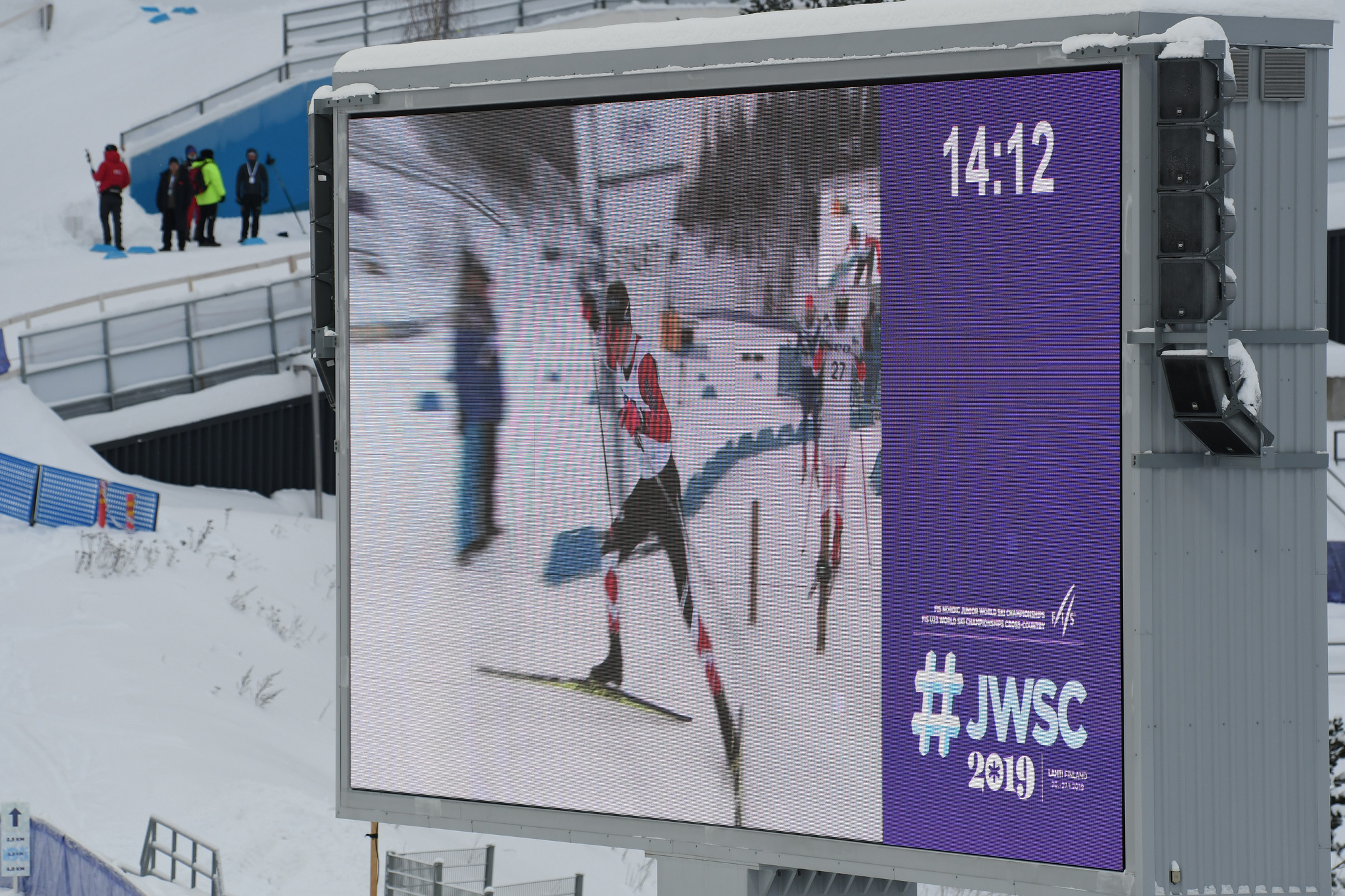
The big screen in Lahti, Finland’s main stadium. Site of the 2019 Junior World Ski Championships. (Photo: Doug Stephen)
Four U.S. skiers began the U23 women’s 10 k skate individual start at the 2019 U23 World Ski Championships in Lahti, Finland on Wednesday, all four finished in the top-30 after Russia’s Mariya Istomina claimed the win in 25:57.3 minutes.
Fnland’s Evelina Pippo was second (+2.0), and Norway’s Tiril Udnes Weng third (+29.6). Istomina and Pippo are scheduled to compete at this weekend’s Ulricehamn, Sweden World Cup and have concluded their competition schedules at U23 Worlds.
The best placed North American was U.S. athlete Julia Kern who placed 12th (+1:21.9). In Kern’s fifth trip to World Juniors and her second as a U23, Wednesday’s 12th place was a career best individual Junior/U23 World’s distance result.
“The 5km course is pretty tough here, with some steep climbs and longer climbs,” Kern emailed about her 10 k skate experience. “It was constant work out there with little rest. I went out hard because the only way to do well at this competitive level is racing is start hot and keep that pace. I was happy to lay down a better performance than Monday and achieve my goal of a top 12 result today. I am really stoked for Lina for having such an awesome race today, it was so fun to watch her on the big screen before I started!”
The next scheduled race for the U23 women is a 15 k classic mass start race on Jan. 25.
“I am really excited for the 15km classic mass start on Friday, I love mass starts, especially when they are classic. I think our team has a good shot of putting down strong races!”
Evelina Sutro in her first Worlds finished in 18th, stopping the clock 1:47.6 minutes behind Istomina’s winning time.
“The race was fun, it was a lot warmer today than it has been the past couple race days which was nice,” Sutro emailed. “It was a tough race with a lot of short and steep hills. The course wasn’t very technical but you really had to work over the top and ski the downhills efficiently. The legs were definitely feeling it the most for me. It was super inspiring to be racing with all these fast ladies!”
Also for the U.S., Hailey Swirbul raced to 26th (+2:90.5), Alayna Sonnesyn 27th (+2:12.6).
Canada’s Sadie White placed 43rd (+3:15.4), Hannah Mehain 44th (+3:19.8), Natalia Hynes 49th (+3:42.8), and Marie Corriveau 54th (+4:58.9).
The U23 men raced a 15 k skate on Tuesday with France’s Jules Lapierre taking the win in 34:02.8 minutes. The Czech Republic’s Michal Novak placed second (+29.0), and Ivan Yakimushkin third (+30.0).
Canada’s Antoine Cyr was the highest placed North American in 38th (+2:56.6). Teammates Gareth Williams skied to 39th (+3:04.0), Graham Ritchie 52nd (+4:02.1), and Julian Smith 57th (+4:20.2).
For the U.S., Hunter Wonders finished in 43rd (+3:20.8), Peter Holmes 48th (+3:43.8), and Braden Becker 53rd (+4:03.1).
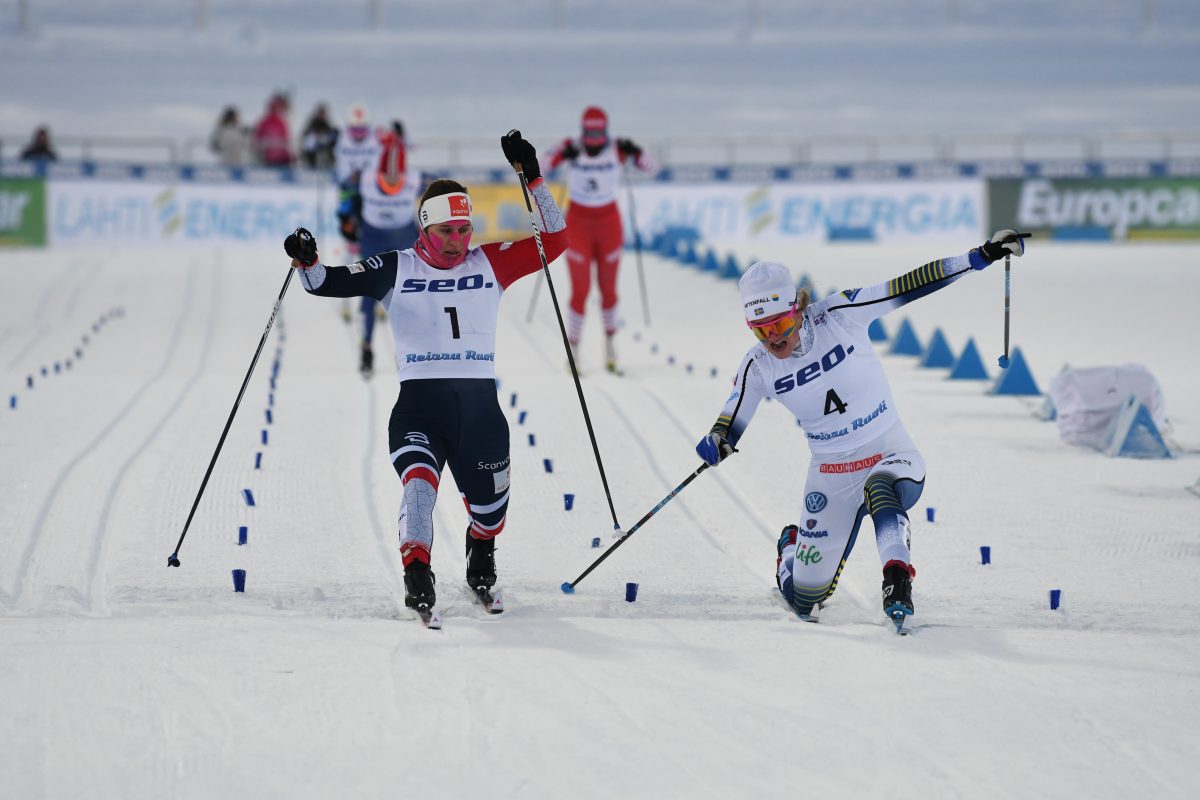
Moa Lundgren of Sweden out lunges Norway’s Tiril Udnes Weng for the win during the U23 World championship 1.4 k classic sprint in Lahti, Finland. (Photo: Doug Stephen)
FIS Junior World Ski Championhips U23 1.4 k/1.6 k Classic Sprint
Monday, the second day of racing at the 2019 Junior World Ski Championships in Lahti, Finland the U23 women raced a 1.4-kilometer classic sprint.
Norway’s Tiril Udnes Weng set the standard in qualification. Her 3:26.52 minute time placed her in bib 1 for the heats.
Three U.S. skiers qualified for the heats. Julia Kern qualified in 16th (+9.09), Hannah Halvorsen 24th (+11.89), and Hailey Swirbul 25th (+12.31). The fourth U.S. entrant, Evelina Sutro placed 37th overall.
“Though it wasn’t a perfect day for the U23s, it was exciting to establish a baseline from which we can improve,” Swirbul emailed. “We were in the mix during the quarterfinals, and I think our team gave a good effort today but is left wanting more. Personally, I thought I had a good day. I felt good, had good skis, and raced to my strengths the best I could. I’m excited to see how this team and I progress over the next few years to keep moving up and up in the U23 division!”
Halvorsen skied in the second heat where she placed fifth (+2.39) behind heat winner Moa Lundgren. Lundgren posted a 3:24.60 finishing time in the heat and ultimately placed first overall. Halvorsen ranked 23rd in the final standings.
Swirbul and Kern were grouped in the third heat where they finished fifth and sixth respectively. France’s Delphine Claudel won the heat in 3:27.16, Swirbul was 1.31 seconds back, Kern 3.24.
Swirbul placed 24th overall, Kern 27th.
“It was a really cold day out there racing at the legal limit of -4F,” Kern emailed. “It was not the day I dreamed of, but I am looking forward to more races to come this week. I caught the tip of my ski on someone’s pole cornering the first 180 and took a fall. I was able to jump back up on my feet and hammer to catch up, but that energy cost me early on that I did not have cresting the last hill. It was really fun to get to race side by side with Hailey in the heat!”
For Canada, Sadie White finished 35th, Marie Corriveau 38th, Hannah Mehain 49th, and Natalie Hynes 55th.
Lundgren, who was the fourth fastest qualifier, won the women’s final in 3:18.33, only 0.05 seconds ahead of Weng in second. Russia’s Aida Bayazitova took third (+3.78). Anastasia Kirillova of Belarus was fourth (+4.12), Norway’s Amalie Haakonsen fifth (+7.75), and Johanna Hagstroem sixth (+37.54).
After racing on a slightly bigger World Cup stage, Valnes showed no nerves as he clean-sweeped the heats and the final which he won in 3:21.14 minutes. Russia’s Sergey Ardashev placed second (+1.38) and Norway’s Joachim Aurland third (+2.00).
In fourth place was Russia’s Ivan Yakimushkin (+2.59), Norway’s Sivert Wiig in fifth (+7.31), and Sweden’s Marcus Grate sixth (+15.53).
Canada placed three athletes in the heats after Ritchie Graham qualified in 19th (+12.32), Julian Smith 22nd (+13.39), and Antoine Cyr 24th (+13.84). Teammate Gareth Williams finished 52nd overall.
For the U.S., Peter Holmes advanced to the heats after qualifying in 20th (+13.05). Daniel Streinz placed 41st overall, Hunter Wonders 56th, and Braden Becker 63rd.
“It was a good day out in Lahti, sunny skies but brutally cold,” emailed Holmes. “The Junior’s performance the previous day amped me up and made me excited to race. I had a solid qualifier and was feeling very good in the quarter final. I was positioned well throughout the race, but unfortunately got tangled up with another skier in my heat on the last downhill and went down. It’s a bummer, especially at U23s, but that’s racing.”
No North Americans advanced beyond the quarterfinals. Holmes placed sixth in the first quarterfinal to conclude his day ranked 27th in the final standings.
Cyr was fourth in the second heat and placed 20th overall.
Smith and Graham were fourth and sixth respectively in heat four. Smith ranked 19th overall, Graham 26th.
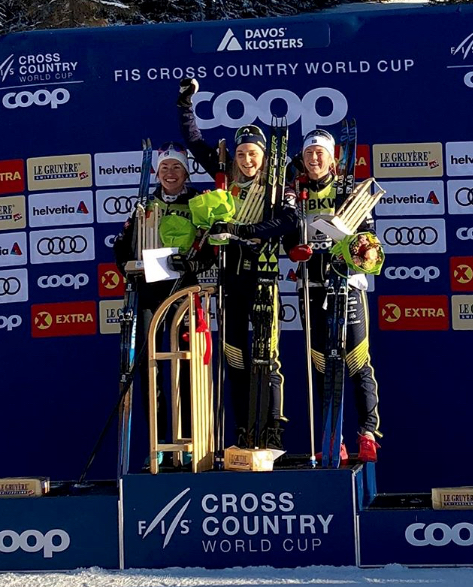
2018 Davos, Switzerland women’s sprint podium. Sweden’s Stina Nilsson (center) placed first, Sophie Caldwell (left) of the U.S. was second, and Maja Dahlqvist (right) also of Sweden was third. (Photo: screenshot @matt.d.whitcomb)
FIS World Cup Davos, Switzerland 1.5 k Freestyle Sprint
On a lovely Davos, Switzerland day, Sophie Caldwell of the U.S. Ski Team (USST) was the day’s fastest qualifier for the women, stopping the clock in 2:46.28 minutes. Caldwell looked cool and in-form on her way to place second overall on the day for her first podium of the season.
The win went to Sweden’s Stina Nilsson after placing third (+2.03) in qualification. Third place went to another Swede, Maja Dahlqvist. It was the twenty-four-year-old Dahlqvist’s second podium of the year after she placed second in the Ruka, Finland classic sprint. Dahlqvist was the day’s second-fastest qualifier, finishing 0.62 seconds behind Caldwell.
Four other Amercian’s advanced to the heats. Sadie Bjornsen qualified in 10th (+4.28). She looked strong in her heat, leading the first lap and skiing in second place down the final stretch. She was passed by a surging Natalia Nepryaeva from Russia. After placing third, Bjornsen did not advance. Bjornsen ended up 14th on the day.
Ida Sargent (USST) qualified in 14th (+5.41) but did not advance out to the heats after placing fifth in the first quarterfinal. Sargent was 21st overall.
Jessie Diggins (USST) was 15th (+5.50) in qualification. In the fourth quarterfinal, Diggins tripped over Russian skier’s Natalia Matveeva’s pole and fell to her knees in the heat’s opening moments. She was unable to regain the lost ground and placed sixth in a photo finish with Matveeva. Diggins placed 26th overall.
No Canadians were entered in the women’s race.
Rosie Brennan (APU)qualified in 28th (+8.83) and was eventually eliminated in the third quarterfinal where she placed sixth. Brennan was 29th on the day. Also for the U.S., Kelsey Phinney (SMS T2) placed 38th, after placing 38th (+12.10) in the qualifier.
For the men, although still young twenty-two-years-old, Johannes Høsflot Klæbo looked like the old Klæbo on his way to his first World Cup win of the season. The Norwegian was the World Cup’s overall winner last season and first in the sprint cup.
Klæbo placed first in the qualifier with a time of 2:22.39 minutes. He advanced to the finals by winning the first heat and the first semi. Klæbo won the final in 2:20.44 minutes. Italy’s Federico Pellegrino was second overall, finishing 0.39 seconds back. Baptiste Gros of France was third (+1.40) to take the last podium step.
Simi Hamilton (USST) was the best placed North American male. Hamilton qualified in 17th (+4.76) and placed 12th overall. He placed second in the fifth heat a fraction behind Finland’s Joni Maeki. In the second semi-final, won by Norway’s Eirik Brandsdal, Hamilton placed sixth (+6.90).
Kevin Bolger (USST) just missed the heats after qualifying in 31st (+6.63). After not advancing, Bolger was 31st overall. No other Americans were entered.
Alex Harvey was the best placed Canadian, placing 37th overall. Lenny Valjas in his first World Cup of the season was 53rd. Andy Shields finished in 60th. No other Canadians were entered.
IBU World Cup Hochfilzen, Austria 10 k/12.5 k pursuit
On Saturday in Hochfilzen, Austria the women’s 10-kilometer pursuit was won by Finland’s Kaisa Mäkäräinen in a time of 30:53.8 minutes. It was Mäkäräinen’s third win of the season. The Finn had a tough time on the shooting range, despite surging for the win in the final meters, she suffered three penalties on the shooting range (1+0+1+1).
Kaisa Mäkäräinen of Finland down the final stretch in Hochfilzen, Austria during the IBU World Cup 10k pursuit. Paulina Fialkova of Slovenia was second, Italy’s Dorothea Wierer was third. (Photo: biathlonworld.com)
Paulina Fialkova of Slovenia was second (+1.5, 0+0+1+1) after skiing two penalty loops. Italy’s Dorothea Wierer was third in a close fight for all three podium spots finishing 2.8 seconds behind Mäkäräinen. Wierer had three penalties during the race (2+0+1+1).
Susan Dunklee of the U.S. was the best placed North American, improving on her 34th start spot to place 28th (+2:06.1, 0+1+1+0). Teammate Joanne Reid was 31st (+2:17.1, 0+0+0+1) after missing only a single target. Clare Egan did not qualify for the pursuit.
Rosanna Crawford was the lone Canadian to qualify for Saturday’s pursuit. She placed 44th (+3:24.8, 1+1+0+1).
Martin Fourcade of France, in a return to shooting and skiing form, took the win in the men’s 12.5 k pursuit. Fourcade won in a time of 32:22.3 minutes while shooting clean through his four shooting rounds.
Germany’s Arnd Peiffer was second (+13.7, 1+0+0+0), skiing a single penalty lap. Norway’s Vetle Sjåstad Christiansen was third (+16.1) after shooting clean for the race.
First place starter after winning yesterday’s sprint, Norwegian Johannes Thingnes Bø, fell back in the standings after missing six targets. He placed ninth (+1:00.0, 0+3+1+2) overall.
Sean Doherty for the U.S. was 31st (+2:37.3, 0+1+0+1). U.S. teammate Leif Nordgren was 42nd (+3:21.5, 1+0+1+3).
Scott Gow was the only Canadian to qualify for the pursuit. He finished in 51st (+4:36.3, 1+0+0+3).
NorAm and U23/JW World Championships Qualification, Canmore, Alberta
Day two of the Noram and U23/JW trials in Canmore, Alberta, featured freestyle individual interval races; the men raced 15km followed by the women’s 10km
Russell Kennedy (Team R.A.D.), fresh back from Europe led the way with a 30:18.5 minute clocking for the 15km. His teammate Evan Palmer-Charrette was second, 30.7 seconds behind. Alexis Dumas (CNEPH) snatched third, 1.6 seconds behind Palmer-Charrette and 0.9 seconds ahead of Jack Carlyle (AWCA). Seb Boehmler-Dandurand (AWCA) was 4.3 seconds back from Carlyle and 48.5 seconds behind the winner.
Gareth Williams (CNST) was sixth and the top U23 athlete at 1:02.9 back, with CNEPH U23 teammates Philippe Boucher and Antoine Cyr taking 7th and 8th, 8.2 and 8.8 seconds behind Williams.
Samuel Hendry (Team R.A.D.) won the junior men’s 10km in 23:09.7 to earn a spot on the U23 team in Lahti next month, with his second NorAm interval start win in two tries. Remi Drolet (Black Jack) followed up two sprint NorAm sprint wins with a second place, 33.6 seconds behind. Tom Stephen (Team ULLR) was third at 45.8 seconds.
In the open women’s 10km free, Dahria Beatty (CNST) continued her hot streak with another win, finishing in 26:05.1. Last weekend’s winner, Katherine Stewart-Jones (CNST) was second at 35.0 seconds. Frédérique Vézina (CNEPH) took third, 1:01.9 behind.
Sadie White (TBay) was top U23 in 4th, 1:10 behind the winner.
All results, including live timing for the rest of the weekend.
Canada’s Alex Harvey celebrating on the podium after placing second in the men’s 15 k freestyle mass start in Seefeld, Austria, for his best result of the 2018 World Cup season. (Photo: Salomon/NordicFocus)
Cross Country Canada (CCC) has begun a reboot process as the new Olympic cycle starts. Corporations call this a reset, a rebranding, a new direction, restructuring, and various other names that try to disguise the challenges and issues that come with enacting real change.
The reboot process traditionally starts with an acknowledgement that the current level of success, and that of the foreseeable future, doesn’t align with the goals or the potential of the organization.
Canada left PyeongChang with no medals at three consecutive Olympics, only one skier in the World Cup red group, and a perception that there was no obvious successor to Alex Harvey.
There are many people who, with the benefit of hindsight, believe that CCC allowed itself to be trapped by a combination of success and the Own The Podium (OTP) funding model.
The process of assigning blame for the past, called “blamestorming”in the corporate world, is one of the most effective ways to waste time and destroy morale without doing anything to improve the future. The “best practices” approach to a reboot starts with four apparently simple questions: How did we get here? Where are we now? Where do we want to be in five years? How can we get there?
While CCC does many things as a national sport body, this article will focus on high performance and the development system.
How did we get here?
After a disastrous 1998 Olympics in Nagano, CCC shrank to a full-time staff of five and endured a forced re-invention. Four years later, in 2002 at Salt Lake, Beckie Scott won all three medals in the skiathlon after the initial silver and gold medalists were caught doping. Sara Renner missed the B final in the sprint for 9th place.
Canadian Chandra Crawford in the 2011 team sprint in Dusseldorf, Germany. (Photo: Fischer/NordicFocus)
In 2006 in Torino, Chandra Crawford earned a surprise gold in the sprint while Scott finished fourth. Scott had earlier teamed up with Renner for a team sprint silver medal.
In 2010, there were no Canadian cross-country medals. However, there were signs of promise. Renner skied to her fourth Olympic top-10 finish. All four Canadians competing in the men’s skiathlon finished in the top-15. Devon Kershaw lost out in final kilometer of the 50 k to finish fifth, 1.6 seconds away from gold.
That post-Vancouver glow was possibly the point where CCC temporarily slid off the rails.
A number of Canadian sports fell victim to OTP incentives. A sport qualifies for OTP funding by having good prospects for a medal in the next Olympics. The money comes with strings attached, to ensure that resources are spent on improving the probability that specific individuals will podium. For smaller sports where the OTP money is a significant proportion of the sport’s annual budget, it is hard to make choices that put that money at risk. Choices like balancing the emerging athletes in the pipeline, while simultaneously supporting those athletes already at the top-end of the sport.
As a result, many sports have lost their OTP eligibility by losing the focus on development and the vision that qualified the sport for OTP in the first place. Some people put cross-country skiing in the list of sports that fell into this trap.
After 2010, the future looked bright. Harvey and Kershaw were World Champions in the 2011 team sprint. Kershaw was second overall in the 2011/2012 World cup. (A feat only equaled in North America by Scott and Jessie Diggins).
Harvey arrived at Sochi in 2014 as a medal favorite. He was fresh off a World Cup podium in Toblach the weekend before the 2014 Games began. Sochi ended poorly when Canada, along with Norway, couldn’t solve the difficult waxing conditions.
The results in PyeongChang were similar to 2002 numerically: Harvey was close to a medal in multiple races and Lenny Valjas collected 7th in the classic sprint. A medal would have changed the mood, but not overall situation.
Where are we now?
Post-PyeongChang, CCC believes Canada is not achieving the international results a country with plentiful snow and 37 million people is capable of.
The development system in Canada consists of the National Team, the official training centers (Centre National d’Entrainment Pierre Harvey (CNEPH), Thunder Bay National Team Development Centre (TBay), and the Alberta World Cup Academy (AWCA)), and the clubs. The ten provinces and three territories have teams, but don’t have a formal place in the development system as each of the thirteen regions approaches development support differently. In the last few years, the number of clubs actively recruiting and developing athletes while supporting a high performance team has increased. For our purposes, as no official name has been affixed to these clubs, the term ‘elite club’ will be used here.
In the past, all national team members were required to belong to a training center while developing athletes were encouraged to join.
“I can speak for many of the athletes, they thought that if they didn’t go to a training centre, then they might as well quit skiing,” Telemark’s coach Adam Elliot said. “It was that broad of a choice, they felt they had to choose between skiing and school immediately.”
The landscape is more diverse now, with more options. The examples that follow skew to Western Canada, largely because the coaches quoted brought teams to Sovereign Lake snow camps in May and November and were available for in-person interviews. Eastern Canada remains equally diverse in terms of its club offerings.
A common theme among the coaches and athletes is that each athlete’s needs are different, and he or she needs to find an environment that fills those needs. FasterSkier asked AWCA’s head coach Chris Jeffries how an athlete should choose his or her path to success.
“It’s such an individual, case by case thing,” he said. “I don’t have an answer.”
In 2017, a shift to allow more development paths resulted in new senior National Team member Gareth Williams staying at his home club, Telemark, in Kelowna, BC. Elliot described how it came about.
“Tom Holland approached us, for Gareth, and said we like what you’re doing in the Okanagan, and we want to keep Gareth there. We’re going to support you and your program to be able to support Gareth.”
Also in 2017, Julien Locke returned to his home club Black Jack while Russell Kennedy shifted to the new Team R.A.D., part of the Canmore Nordic Club.
To further illustrate the spectrum of options and pathways, FasterSkier contacted three Canadian athletes, each with a history of NorAm podiums and some international success, to discuss their ski-training choices. Dahria Beatty started at AWCA and has remained there, Evan Palmer-Charette started at TBay then recently moved to Team R.A.D., and Andy Shields has gone rogue.
Dahria Beatty en route to 20th overall in the Seefeld World Cup freestyle sprint for her season-best result in 2017/2018. (Photo: Fischer/NordicFocus)
“For me, I’ve been working with Chris [Jeffries] for six years,” Beatty told FasterSkier in November. “It works really well for me, and I have a good group of training partners where I am, that can push me everyday in training.”
AWCA is also the home training group for National Team skier Emily Nishikawa and two junior national team skiers. AWCA also benefits from its close proximity to a number of other training groups.
“For me, Canmore’s a location where I want to be training, where I want to be based out of,” Beatty said. “All the pieces fit well together for [me], it’s somewhere I think I can keep improving.”
Palmer-Charrette made a summer-time decision to change things up by finding a fresh environment in Team R.A.D.
“I think the best part of being on a training centre is the entire program is based around a small group of athletes of similar age which makes for a great training and racing environment,” Palmer-Charrette wrote. “I feel training centres, as they are, are best-suited for junior/u23 athletes and especially great for athletes who are a bit late to the game like I was at the end of high school and will really benefit from learning from other athletes on the day to day training life.”
Shields is no longer affiliated with an official team. He funds his skiing by painting houses in the summer and representing ski wax companies in the winter. Although he refers to ski racing as a hobby, he did end the last season as COC leader and will race period 1 of the World Cup.
“I don’t think I could have done this straight out of junior,” Shields wrote. “My time on Tbay is still having a huge positive effect on my ski career. Being on a team through my early years as a senior made it much easier to get a decent training base and set a couple good habits in place which are paying dividends.”
Shields did reflect and offer an alternative to how he might have changed his path to elite level skiing.
“If I could go back in time I would have gone the NCAA route straight out of junior,” Shields added. “College skiing in the States is a much better deal than a training center for people in their early twenties. You can go down to the States, get a degree, not pay a dime, and come out the other side with plenty of time to have a full-time ski racing career. I would have joined a training centre upon finishing with NCAA.”
The Canadian university system differs from the U.S. model, offering little money for sports. Heading south to the U.S. as a student-athlete remains an option for some Canadian skiers. Most athletes remain in the Canadian system to develop. With that in mind, FasterSkier asked why some athletes had chosen some of the Western based training centres.
Jeffries, who leads the AWCA, also noted how his program has evolved. There appears to be room at the AWCA for those with concurrent goals. The AWCA has partnered with the University of Calgary to allow AWCA athletes to work towards degrees.
“We’re always evolving our programming, and what it entails, and how we package it,” Jeffries said. “That’s why we have this new university program this year, because you just look at the popular decision making of graduated high school athletes.”
Elliott, based in the Okanagan, said his program offers athletes a well rounded experience too.
“You’ve got the trifecta,” Elliot said. “You’ve got access to education opportunities for post-secondary. We’ve got the university, UBC Okanagan, and the college. Most of the people who’ve moved here have gone to school. Secondly, it’s the Okanagan. Which is probably the best place to ski in North America, with skiing up and down the valley –with Nickel Plate, Telemark, [Kelowna] Nordic, Sovereign, and Larch Hills. The third is that you’re moving into a community of skiers: family, volunteers, everybody trying to make a go of keeping people in sport.”
Clearly the times have changed from a programming perspective and the past’s financial windfall for Canadian cross-country skiing.
“Probably the quad between 2010 and 2014, CCC had more money almost than it knew what to do with, ” Dave Wood, former National Team head coach, told FasterSkier in May as he finished up a long ski day. “Now, I think the budget’s still three and a half million. While it’s maybe low compared to what it has been, it’s a hell of a lot higher than it was in ‘99, by about four times.”
Former CCC High Performance Director Tom Holland spoke of those larger commitment from clubs during the Frozen Thunder races in October.
“There’s a lot more resources,” Holland said, referencing the increased numbers of coaches attending Frozen Thunder with their athletes. “One of the reasons clubs are more important now is that there are paid coaches at the clubs. That’s why training centres started in the 90’s, because you’ve got to have a coach, full-time.”
Thee deep question remains: what next for Cross Country Canada as it ponders a post-Alex Harvey scene? Better and more diverse options for Canadian skiers, like those modernizing their offerings to connect with the student-athlete, is a step forward. But fans of the sport, and of course Cross Country Canada, have short-term and long-term goals. No one wants to see another Olympic quadrennial transpire without the glimmer of medal potential at the international championship level.
“I think when Alex Harvey retires, mostly likely after next year with Lenny Valjas, it will be the end of an era having athletes being able to finish on the podium at World Cups, World Championships, said Alain Masson, Whitehorse head coach. “So definitely, the program is going to go into a real rebuilding phase with lots of young athletes, but no guarantee of success in the near future.”
(Note: This article has been updated to reflect that Len Valjas was nominated to the B-team, rather than the A-team as previously stated.)
On Thursday, Cross Country Canada (CCC) announced its national-team nominations for the 2018/2019 season via a press release.
Canada’s Alex Harvey celebrating on the podium after placing second in the World Cup men’s 15 k freestyle mass start in Seefeld, Austria, last season. (Photo: Salomon/NordicFocus)
Notably, the World Cup A-team is made up of one man — Alex Harvey — after three athletes from last year’s World Cup A-team retired (Devon Kershaw, Jess Cockney and Knute Johnsgaard). Graeme Killick, of last season’s World Cup B-team, also retired. Len Valjas was nominated to the B-team, a demotion, he said, that was a result of him ending his season immediately after the PyeongChang Olympics.
“The reasoning is that I … didn’t show up to [the World Cup in] Drammen, is that I didn’t follow what the team said,” Valjas told FasterSkier on May 22. He explained he had a broken spine, which required rest and rehabilitation.
On the women’s side, Dahria Beatty was renominated to the World Cup B-team, while Emily Nishikawa and Olivia Bouffard-Nesbitt were not.
All five of last year’s U25 Team were renominated to the national team, with Cendrine Browne and Julien Locke making the jump to the World Cup B-team, while Katherine Stewart-Jones, Maya MacIsaac-Jones and Gareth Williams were renominated to the U25 Team. Also on the U25 development squad, Antoine Cyr was promoted from the junior national team, and Graham Ritchie earned his first national-team nomination.
The World Cup team will once again be led by co-coaches Ivan Babikov and Louis Bouchard.
On the Para-Nordic side, the World Cup Team grew by one despite the retirement of Chris Klebl. Six athletes and two guides were nominated to the Para-Nordic World Cup Team, while two were renamed to the Development & Prospects Team. Four other athletes round out the team as part of the Prospects Team.
Patrick Stewart-Jones (l), skiing for his club team Nakkertok, and Scott Hill (r) of Barrie Cross Country (BXC) going head to head in the men’s classic team sprint on Saturday at Canadian Ski Nationals in Thunder Bay, Ontario. Nakkertok won and BXC placed second. (Photo: Doug Stephen)
Canadian Ski Nationals (Thunder Bay, Ontario): Team sprints + 5/10 k classic
Canada’s 2018 Ski Nationals opened this past weekend at Lappe Nordic in Thunder Bay, Ontario, with classic team sprints on Saturday followed by 5- and 10-kilometer classic interval starts on Sunday.
Nakkertok topped the podium in both the open men’s and women’s team sprints. In the men’s final, Nakkertok’s Dominique Moncion-Groulx and Patrick Stewart-Jones won by 1.95 seconds over Barrie Cross Country (BXC) in 14:50.79. BXC’s Ryan Jackson and Scott Hill teamed up for second place, and Skibec’s Alexis Morin and Antoine Brand raced to third (+2.57).
Katherine Stewart-Jones (22), skiing for her club team Nakkertok, while leading Annika Richardson (Hollyburn Ski Club) and Mathilde Petitjean (r) of C.N.M.S.A. during the women’s classic team sprint at 2018 Canadian Ski Nationals in Thunder Bay, Ontario. (Photo: Doug Stephen)
The Stewart-Jones family was also a big winner on Saturday, with Nakkertok’s Zoë Williams and Katherine Stewart-Jones (Patrick’s sister) racing to first in the women’s final in 13:04.72. They finished 2.37 seconds ahead of Katie Weaver and Annika Richardson of the Hollyburn Ski Club in second place, and Marie Corriveau and Mathilde Petitjean of Club Nordique Mont-Sainte-Anne (C.N.M.S.A.) raced to third (+7.42).
On Day 2 and the first official day of Canadian Ski Nationals, Hill (BXC) took his second-straight win of the weekend, topping the men’s 10 k classic with a time of 26:45.1 for his first senior national title. He finished 7.2 seconds faster than Alexis Dumas, of the Pierre-Harvey National Training Centre (CNEPH) in second, and an early race leader, Knute Johnsgaard of the Canadian World Cup Team, placed third (+12.0)
Johnsgaard clocked the fastest split at the race’s halfway point, while Hill’s 5 k time was almost 10 seconds slower. But over the final 5 k, Hill’s lap time was nearly 22 seconds faster than Johnsgaard’s. Dumas skied a consistent race, with the fourth-fastest first lap and second-fastest second lap.
Knute Johnsgaard (Canadian World Cup Team) racing to third in the men’s 10 k classic on Sunday at Canadian Ski Nationals in Thunder Bay, Ontario. (Photo: Doug Stephen)
Jackson (BXC) finished fourth (+14.7), and Jess Cockney of the Alberta World Cup Academy (AWCA) and Canadian World Cup Team placed fifth (+22.2). Leading the National Team Development Centre (NTDC) Thunder Bay on its home trails was Evan Palmer-Charrette in sixth (+24.8), and Lappe Nordic’s Michael Somppi (AWCA) placed seventh (+29.1). Gareth Williams of Telemark Nordic and the Canadian U25 Team finished eighth (+39.5), American Brian Gregg (CXC/Team Gregg/Loppet Nordic Racing) was ninth (+44.7), and Jack Carlyle (AWCA) 10th (+49.5).
Olivia Bouffard-Nesbitt of Rocky Mountain Racers (RMR) collected her first senior national title with a 13.3-second victory in the women’s 5 k classic. She finished in 15:07.5, ahead of American Caitlin Gregg (CXC/Team Gregg/LNR) in second, while Katherine Stewart-Jones (NTDC Thunder Bay) was the second Canadian and third overall (+17.9).
NTDC Thunder Bay had two in the top four with Alannah Maclean in fourth (+19.8). Annika Hicks (AWCA) followed in fifth (+22.2), Frédérique Vézina (CNEPH) was sixth (+30.8), Sophie Carrier-Laforte (Skinouk) seventh (+33.0), Maya MacIsaac-Jones (RMR/Canadian U25 Team) eighth (+37.4), Laura Leclair (CNEPH) ninth (+58.1), and Williams (Nakkertok) 10th (+1:07.2).
Nationals continue Tuesday with 10/15 k freestyle pursuits, followed by skate sprints on Wednesday and 30/50 k classic mass starts on Saturday.
Gareth Williams (Telemark Nordic/Canadian U25 Team) training in Praz de Lys, France, last month before U23 World Championships in Switzerland. (Photo: Charles Castonguay)
In an effort to showcase the North Americans who competed at last week’s International Ski Federation (FIS) 2018 Nordic Junior/U23 World Championships in Goms, Switzerland, we asked those qualifying athletes several questions about themselves — actually, we had them fill in the blanks. Here we have 20-year-old Gareth Williams, of Telemark Nordic and the Canadian National U25 Team, who represented Canada at his first U23 Worlds (after competing at last year’s Junior Worlds in Utah).
Last week in Goms, Williams placed 41st in the 15 k classic.
***
“My full name is Gareth James Williams, but you can call me G-Will.
I was born in Vancouver and raised in Kelowna, and I learned to ski at Telemark Nordic Club.
I spent the time between Mont Sainte-Anne trials and Junior/U23 Worlds at Mont Sainte-Anne and Praz de Lys in France training to race my best this week.
The most fun workout I did in the last training year to prepare for this was altitude ski up the downhill slopes of Big White with my team and coach Adam.
Gareth Williams (Telemark Nordic) racing in the freestyle sprint qualifier at 2017 World Cup Finals in Quebec City, Quebec, last March. He finished 74th. (Photo: Peter Collins)
This is my third time in Switzerland and fifth time racing internationally, and so far it’s been much more competitive!
One difference I’ve noticed between Switzerland and Canada is the price of a cappuccino!
Skiing and racing in the Alps is kind of like skiing in Western Canada. Usually racing at altitude is good for me because I train at altitude fairly often. There are lots of mountains around where I live.
One of the things I’m most excited about for Junior/U23 Worlds in Goms is the beautiful mountains.
One race I’m especially targeting there is the skiathlon.
I really hope I can chat/make friends with someone from Australia and ask them what the difference is between a wallaby and a kangaroo.
My favorite thing at the breakfast where we are staying is the coffee.
Fondue is not something I usually eat while trying to ski fast! The cheese here is not my thing. And the chocolate is the best in the world!
If I had a totally free day here and didn’t have to worry about race fitness or training, I’d spend it on top of a mountain with some alpine skis.
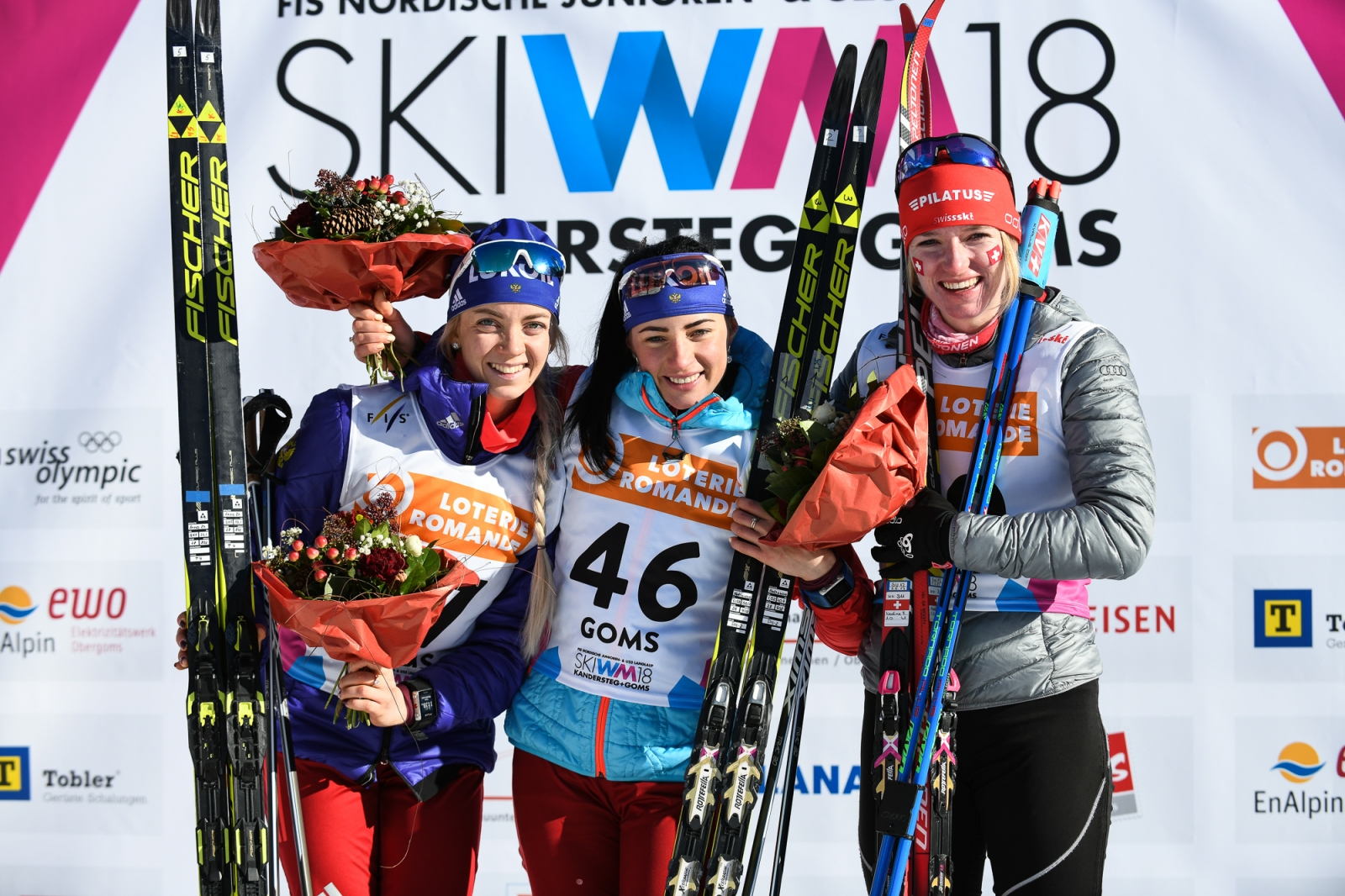
The best way to follow me on social media is on Instagram @gareth_williams.”
Russia’s Denis Spitsov celebrates his first U23 World Championships gold on Friday ahead of France’s Jules Lapierre in the men’s 30 k skiathlon in Goms, Switzerland. (Photo: JWSC2018.ch)
(Note: This article has been updated to include comments from Americans Lauren Jortberg and Ian Torchia.)
U23 World Championships (Goms, Switzerland): 15/30 k skiathlons
On the final day of U23 World Championships racing in Goms, Russia stole the show in the women’s and men’s skiathlons.
The all-Russian women’s 15 k skiathlon podium at U23 World Championships on Friday in Goms, Switzerland, with Anastasia Sedova (c) in first, Natalia Nepryaeva (l) in second and Yulia Belorukova (r) in third. (Photo: JWSC2018.ch)
Anastasia Sedova led them in the first race of the day on Friday, the women’s 15-kilometer skiathlon, which she won in 44:03.6 minutes. Russia swept the podium and had four in the top five with Natalia Nepryaeva in second (+10.7) and Yana Kirpichenko in third (+37.2), and Yulia Belorukova in fourth (+1:58.0). Germany’s Pia Fink placed fourth (+1:33.5).
The race was the first of the week for the 22-year-old Sedova, a World Cup regular, and it was her second individual gold medal at her second U23 World Championships (she won the 10 k classic in 2016).
“Good preparation for the Olympic Games,” Sedova said during an in-arena interview after the race. “I am very lucky today. Good atmosphere, good weather today.”
Kirpichenko won the 10 k classic earlier this week and Nepryaeva placed third in the freestyle sprint in Goms.
“It’s hard to say how to describe the race, but Anastasia is a really good skier,” Nepryaeva said after. “She was really good today. So for me it was hard to support her during the race. Today she was much better than me.”
American Lauren Jortberg (Dartmouth Ski Team) led the North Americans in 29th (+5:29.9) for her best distance result at the Junior/U23 World Championships level.
“Early in the race I was right over 30th place, and I was trying to maintain contact with the big group ahead of me,” Jortberg, a Dartmouth sophomore from Boulder, Colorado, wrote in an email. “The pace of the classic leg was really fast. A couple of the girls in the race are heading to the Olympics in a few days so it was a really hot start!”
She came through the transition at the race’s halfway point in 31st, about 3:47 behind the leaders.
“I am a much better skater so I felt like I really put the hammer down on the skate leg and moved up a lot,” Jortberg wrote. “The skate course was much easier than the classic course, but I feel like I skied the massive climbs better than the girls around me. I focused on having a really high tempo over the hills and skiing the downhills technically well because there was no rest on the course.
“I’m pleased with my performance today, and I’m excited about my results this week as a whole,” she added. “I’m definitely leaving here hungry for more because I don’t think it was my best week, but I think it was really solid. This is the most competitive field I’ve ever raced against so it feels really good to know that I’m not too far off their level!”
Also for the U.S., Lydia Blanchet placed 38th (+7:11.1) and Nicole Schneider was 40th (+8:04.3). Julia Kern did not finish.
Canada’s Katherine Stewart-Jones (Canadian National U25 Team/NTDC Thunder Bay) placed 31st (+5:39.0) and Maya MacIsaac-Jones was 42nd (+8:08.8), while Laura Leclair and Sophie Carrier-Laforte were lapped.
Russia’s Denis Spitsov leads France’s Jules Lapierre during the men’s 30 k skiathlon on Friday at 2018 U23 World Championships in Goms, Switzerland. Spitsov went on to win by 2.9 seconds over Lapierre. (Photo: JWSC2018.ch)
In the men’s 30 k, Russia’s Denis Spitsov took the win in 1:18:14.9 hours, just 2.9 seconds ahead of France’s Jules Lapierre. Norway’s Ole Jørgen Bruvoll placed third (+21.5), ahead of Russia’s Ivan Yakimushkin in fourth (+23.2), and Andorra’s Irineu Esteve Altimiras in fifth (+36.4).
The gold was the first for Spitsov, 21, who previously placed second in the 15 k classic earlier this week. He has two individual bronze medals from last year’s U23 Worlds (in the 30 k skiathlon and 15 k freestyle).
American Ian Torchia (U.S. Ski Team/Northern Michigan University) placed 27th on Friday (+6:05.7). Only 33 men finished, and he was the only North American that didn’t get lapped.
“Between the 3700 feet of climbing, a 2.5km loop, and the top dogs having World Cup podiums…half the field got lapped,” Torchia wrote in an email. “Definitely added some motivation in the final 2 laps to see Spitsov and Lapierre slowly catching up.
“I felt I skied technically better in skate and struggled on the classic leg,” Torchia explained. “Took a hard tumble halfway through the classic leg and had to take half a lap to recover from that. Found a hole in my suit close to my groin afterward which was a little unnerving!”
At the end of the week, he noted that he felt “more fired up than coming in. Funny how being 6 minutes back can do that,” he wrote. “It was an eye-opening experience to get back on the international stage after 2 years and I will take these lessons of racing to the rest of the season in the Ishpemimg Super Tour, Steamboat NCAA’s, and Craftsbury Spring Series. Also already thinking of ideas on how to change and optimize my training to make the jump to the top level.”
Americans Andrew Egger, Zak Ketterson and Thomas O’Harra also competed, as did Canada’s Alexis Dumas, Gareth Williams, Philippe Boucher, and Ricardo Izquierdo-Bernier.
Stratton’s Ben Saxton (l) edging Julien Locke (r) by eight-hundredths of a second for the win in the men’s 1.4 k classic sprint A-final on Friday at Eastern Canadian Championships in Gatineau, Quebec. (Photo: Becca Rorabaugh (APU) on her way to winning the women’s 1.3 k classic sprint qualifier on Friday at 2018 Eastern Canadian Championships in Gatineau, Quebec. (Photo: Rob Smith/CCC)
NorAm Eastern Canadian Championships (Gatineau, Quebec): Classic sprints
Eastern Canadian Championships opened in Gatineau on Friday with classic sprinting, and Americans Becca Rorabaugh and Ben Saxton ended the day with wins in the women’s and men’s A-finals, respectively.
Becca Rorabaugh (APU) on her way to winning the women’s 1.3 k classic sprint qualifier on Friday at 2018 Eastern Canadian Championships in Gatineau, Quebec. (Photo: Rob Smith/CCC)
For Rorabaugh, the win is her second straight after the Alaska Pacific University (APU) skier won the women’s 5-kilometer freestyle at last weekend’s SuperTour in Craftsbury, Vermont. She edged last weekend’s classic-sprint winner, Kaitlynn Miller, of the Craftsbury Green Racing Project (CGRP), by 0.41 seconds for the win in 3:23.15 minutes in Friday’s 1.3 k classic sprint final. It was an all-American podium (and all-American final) with Erika Flowers, of the Stratton Mountain School (SMS) T2 Team, just another three-hundredths of a second back in third (+0.44). Liz Guiney (CGRP) followed in fourth (+2.51), Rosie Frankowski (APU) was fifth (+3.88), and Corey Stock (Bridger Ski Foundation) placed sixth (+6.1).
Rorabaugh had started the day by qualifying first in 3:26.95, then won both her quarterfinal and semifinal. Miller qualified third and won her quarterfinal and semifinal as well.
In the men’s 1.4 k classic sprint, Saxton (SMST2) nipped Julien Locke (Canadian U25 Team/Black Jack) at the line by 0.08 seconds for the win in 3:04.54. Patrick Stewart-Jones (Alberta World Cup Academy) placed third (+5.53), Kris Freeman (Caldwell Sport) was fourth (+5.94), Kevin Bolger (Sun Valley Ski Education Foundation) fifth (+7.42), and Julian Smith (NTDC Thunder Bay) sixth (+11.63).
Locke initially won the qualifier in 3:08.37, then won the first quarterfinal and first semifinal as well. Saxton qualified sixth, then advanced in second in his quarterfinal about a second behind Smith, and Saxton won the second semifinal.
Easterns continue Saturday with 10/15 k freestyle races and conclude Sunday with 10/15 k classic pursuits.
The women’s 10 k classic podium at 2018 U23 World Championships, with Russia’s Yana Kirpichenko (c) in first and Anna Zherebyateva (l) in second, and Switzerland’s Nadine Fähndrich (r) in third. (Photo: JWSC2018.ch)
(Note: This article has been updated to include comments from Americans Lydia Blanchet and Ian Torchia.)
U23 World Championships (Goms, Switzerland): 10/15 k classic
Russia put two in the top three in both the women’s and men’s races on Wednesday at U23 World Championships in Goms, and for the second-straight race, Canada’s Katherine Stewart-Jones landed in the top 30.
In the women’s 10-kilometer classic, Russia’s Yana Kirpichenko pulled out a 13.9-second victory over fellow Russian Anna Zherebyateva, finishing with the winning time of 27:46.1 minutes. Switzerland’s Nadine Fähndrich returned to the podium for the second race in a row (after placing second in Monday’s skate sprint), finishing third, 29.6 seconds behind Kirpichenko.
In Monday’s sprint, Kirpichenko qualified fourth and ended up fifth in the final. She is a bronze medalist in the 15 k skiathlon at last year’s U23 Worlds.
Stewart-Jones, of the Canadian National U25 Team and National Team Development Centre (NTDC) Thunder Bay, started relatively early on Wednesday in bib 19 and ultimately placed 29th, 3:07.3 out of first. She sped up as the race progressed, from 40th at 2.4 k to 32nd at 5 k and up to 30th at 7.4 k.
So far in all five races she’s competed in over the last two years at U23 Worlds, Stewart-Jones has finished in the top 30. Her best result is 21st in last year’s 15 k skiathlon, and at the Junior Worlds level, she had a best individual result of 14th in the 10 k skiathlon in 2015.
American Lydia Blanchet (Dartmouth Ski Team) started fifth on Wednesday and ended up 30th (+3:10.4) after skiing in the top 30 throughout the race. Her Dartmouth teammate Lauren Jortberg followed in 34th (+3:28.9) and Nicole Schneider was 49th (+5:23.8). Julia Kern did not start.
For Blanchet, a Dartmouth junior, this week marked her first time racing at the Junior/U23 World Championships level. So far, she has placed 32nd in the freestyle sprint and now 30th in the classic distance race.
“This is my first time racing internationally, and I tried to go into the races with no expectations,” Blanchet explained in an email. “I was excited to get as close as I did to qualifying for the sprint, but it was definitely bittersweet—missing heats by 0.3 seconds left me regretting some of the smaller details of my race. Still, it is really exciting to know that I can compete on the world stage!”
After the sprint, she made a goal of finishing in the top 30.
“I really like hilly, rolling courses—especially ones with very technical downhills—and this course definitely fit that bill,” she wrote of the classic distance course. “I am really happy with my race, all things considered. I didn’t feel great while I was racing – my legs flooded pretty hard a few km’s in – but I think I did a good job of holding myself together and staying strong mentally. I know I have the ability to do even better, which is motivating and exciting. I am looking forward to get to ski head-on against the whole field in the skiathlon, and I’m excited to try and pick my way forward from my bib number. I’m also really excited to go home and race carnivals with the Dartmouth team.”
Canada’s Laura Leclair finished 40th (+4:20.9), Sophie Carrier-Laforte was 43rd (+4:19.2) and Maya MacIsaac-Jones 47th (+4:47.3) out of 53 finishers.
Nicole Bathe of the Midwest-based Central Cross Country (CXC) Team, who races for Great Britain, placed 37th (+3:43.8), for her second top 40 of the week after placing 39th in the skate sprint.
Norway’s Mattis Stenshagen racing to the win in the men’s 15 k classic at 2018 U23 World Championships in Goms, Switzerland. It was his first gold medal and podium at U23 Worlds (he earned silver two years ago in the 15 k freestyle at Junior Worlds and also gold in the relay that year). (Photo: JWSC2018.ch)
In the men’s 15 k classic that followed, Norway’s Mattis Stenshagen edged Russia’s Denis Spitsov by 4.8 seconds for the win in 36:28.3. Also for Russia, Ivan Yakimushkin placed third, 35.2 seconds back.
Canada’s Alexis Dumas, of the Pierre-Harvey National Training Centre (CNEPH) was the top North American in 31st, 2:51.7 out of first. He worked his way up from 40th at 5 k to 35th by 10 k, and finally just 0.2 seconds outside of 30th at the finish.
American Ian Torchia (U.S. Ski Team D-team/Northern Michigan University) followed in 32nd (+2:55.9) and Bill Harmeyer (University of Vermont) finished 39th (+3:43.3). Also for the U.S., Thomas O’Harra placed 43rd (+4:17.3) and Zak Ketterson was 57th (+5:37.6).
Torchia, an NMU junior, has been to two Junior Worlds in 2015 and 2016, but this marked his first U23’s.
“The jump from juniors to U23s is quite a leap. I missed the first year of being a U23 last year due to mono so getting back into international racing was a shock to the system,” he explained in an email.
As for his goals for the 10 k, he was hoping for a top 15 or 20, but moreover “wanted to race smart and feel good out on the course technically and physically,” Torchia wrote. “This was the hardest course I have ever raced with 600m of climbing throughout the 15k and I was excited to showcase my striding ability out there…
“However, from the first km I was in the pain cave (even though I didn’t open that fast!) and it was a fight the entire way,” he continued. “I need to work on staying technically strong when hurting and I did not do a good job of executing that today. The eventual second place Russian started as I was looping around for my 2nd lap so I was able to see and feel what a podium performance looks like. Going to have that image in my head throughout the next year!”
For Friday’s 30 k skiathlon, Torchia wrote that he would be “throwing all place goals out the window and focusing on skiing technically well and racing smart. Looking forward to channeling my last skiathlon in Kazakhstan which went really well [he placed 11th in the 20 k at 2015 Junior Worlds] and moving up from my starting position.”
Canada’s Gareth Williams finished 41st (+4:00.2) on Wednesday, Philippe Boucher was 45th (+4:22.7) and Ricardo Izquierdo-Bernier 47th (+4:24.3) out of 63 finishers.
The third NorAm of the season in Mont Sainte-Anne (MSA), Québec, was also a Canadian selection event for next month’s Olympics in PyeongChang, South Korea, as well as Junior and U23 World Championships, which start later this month in Goms, Switzerland.
The original schedule of racing from Saturday, Jan. 6, to Tuesday, Jan. 9, with a backup race day on Wednesday had to be modified when Saturday and Sunday were colder than International Ski Federation (FIS) safety rules allow.
Cendrine Browne (CNEPH/Canadian National U25 Team) celebrates her decisive win in the women’s 15 k skiathlon on Jan. 8 at Mont Sainte-Anne NorAm Trials in Quebec. (Photo: Mario Walker/NorAm MSA 2018 Facebook)
The classic sprint was moved to Friday, Jan. 5, for the open categories only. The skiathlon was moved to Monday, the freestyle sprint moved to Tuesday, and the classic interval start races rescheduled for Wednesday.
The senior men’s races saw a new winner each day, while Cendrine Browne of the Pierre-Harvey National Training Centre (CNEPH) and Canadian National U25 Team won both women’s distance races (the 15 k skiathlon and 10 k classic) and placed second in the skate sprint. She also finished fourth in the classic sprint (and second in the classic-sprint qualifier) to essentially earn one of the remaining spots on the Canadian Olympic team.
Another CNEPH skier, Antoine Cyr was a big winner in the junior division, winning three out of four races.
While you’ve already heard about the news (and did you catch these Junior/U23 Worlds team announcements?), below you’ll find athlete quotes from each race day.
***
Classic Sprints
The most probable spot remaining on the Canadian Olympic team was reserved for the top female sprinter at trials in the same discipline that will be contested in PyeongChang: the classic sprint. Browne, who had spent the first month and a half of the season in Europe on the World Cup and considers herself much more of a distance skier, qualified second and finished fourth in the A-final to earn that spot.
World Cup team member Dahria Beatty, also of the Alberta World Cup Academy (AWCA), who had previously met qualifying criteria for PyeongChang, won both the qualifier and all of her heats. National team member Julien Locke (Canadian U25 Team/Black Jack) edged out Russell Kennedy (Team R.A.D.) for the A-final win, but Kennedy won the tiebreaker for an additional quota spot at the Olympics, if Canada gets it.
Dahria Beatty (401) of the AWCA/Canadian U25 Team en route to a win in one of her heats in the women’s classic sprint on Jan. 5 at Mont Sainte-Anna NorAm Trials in Quebec. (Photo: Mario Walker/NorAm MSA 2018 Facebook)
“It felt quite cold today with the wind and humidity but I believe it was only -14c. The course was in good condition.”
— Beatty (1st), on the conditions
“When I was doing my intervals on the course the day before the race I felt rushed and bogged down on the herringbone and steep striding sections. I made sure to really focus on how I was going to ski each section technically. On this course that allowed me to be relaxed in my qualifier and ski faster than if I was rushing. I am pleased that I was able to stick to my plan and the heats went well. I led my quarter and semi and then in the final I put myself in a comfortable position off the start and attacked on the climb and led the second half of the race”
— Beatty on strategy
“I didn’t have as much confidence in my fitness and I put a lot of pressure on myself to try to execute the perfect race. The snow was faster out of the track so that is where I tried to ski. I was out of the track and picked up a technique infraction around one of the final corners in my quarter final. I’m very disappointed in myself.”
— Olivia Bouffard-Nesbitt (Rocky Mountain Racers/Canadian National Team), about her first race in 11 months after an injury ended her 2016/2017 season early. She skied a strong semifinal to qualify for the A-final, but was disqualified for a technique infraction in her quarterfinal
Julien Locke (National U25 Team/Black Jack) qualifying second in the men’s classic sprint on Jan. 5 at Mont Sainte-Anna NorAm Trials in Quebec. (Photo: Mario Walker/NorAm MSA 2018 Facebook)
“I was quite relaxed coming into these trials. There was obviously a lot on the time, but at the end of the day, it’s just a ski race like any other. I knew that I had been racing well and was confident that I was in strong form. I was aware that both the qualifier and heats were up for consideration and was ready to fight hard in both.”
— Locke (1st in the A-final, 2nd in the qualifier), on his mental approach
“The track was in excellent condition yesterday. After having done a race-prep intensity Wednesday evening in slow, soft, heavily-falling snow, the track felt considerably easier on race day. The atmosphere on the course was fantastic. Lots of excitement and a wall of sound at the start and up the 2nd climb.”
— Locke
“I played the 1/4 final conservatively, following the Andy and Scott around the course before coming through on the final straight. I decided to be more offensive in the semi and started at a strong pace and skied from the front. With all of the twists in the 2nd half, I wanted to be out of trouble. It took a while to get the body feeling good but by the time the final came around, I knew that I was feeling strong. I pushed the pace from the start and attacked the course to the end. It was great to have the track to myself to just put my head down and ski fast.”
— Locke on his tactics
Russell Kennedy (Team R.A.D.) qualifying first in the men’s classic sprint on Jan. 5 at Mont Sainte-Anna NorAm Trials in Quebec. (Photo: Mario Walker/NorAm MSA 2018 Facebook)
“I have had good fitness this year so I used the first two heats to try some strategies knowing Julian has a really good end kick. That being said the whole final could have taken a win so I just wanted to make sure I was near the front so I could take a podium since I knew that would be my best chance.”
— Kennedy (1st in qualifying, 2nd in A-final)
“To be honest I don’t like reading criteria so I didn’t really realize how important it was. I was more interested in racing to my best ability and coming up with a course strategy with my coach Alain [Parent]!”
— Kennedy, on his mental approach
“Happy with my result. I was on crutches the day before and didn’t think I would be able to start so pretty happy with the outcome.”
— Evan Palmer-Charrette (NTDC Thunder Bay; 4th in the A-final)
***
Skiathlon
Canadian World Cup Team members Knute Johnsgaard (170) and Jess Cockney (179, behind) leaving the ski exchange halfway through the men’s 30 k skiathlon on Jan. 8 at Mont Sainte-Anna NorAm Trials in Quebec. (Photo: Mario Walker/NorAm MSA 2018 Facebook)
“It felt really good to take the win today. Even though I’ve met criteria for the Olympics I know people were starting to question my deserving of the spot, and rightfully so. I think I was letting that get to me until today when I finally just raced one for Knute and not to prove anything to anyone else.”
— Knute Johnsgaard (Canadian World Cup team; 1st) on winning the mental game
“We had a solid group of 5 or 6 guys right through most of the race and of that group I was pretty confident I could take it if it came down to a sprint.”
— Johnsgaard
Jack Carlyle (AWCA) leading Knute Johnsgaard (directly behind) and Graham Nishikawa (162) during the men’s 30 k skiathlon on Jan. 8 at Mont Sainte-Anne NorAm Trials in Quebec. (Photo: Mario Walker/NorAm MSA 2018 Facebook)
“I am very excited about the race today, this is my first time getting a senior podium on the NorAm and that means a lot to me. I tried to just sit in the group and stay relaxed on the classic portion, and for the skate I wanted to stay near the front of the group.”
— Gareth Williams (Telemark Nordic/National U25 Team; 3rd)
“I am really happy with how my race went today! Throughout the classic portion, all the racers stayed pretty close together. I kept my place near the front of the pack, taking advantage of the draft of the skiers in front of me to save energy. On the last uphill before the downhill finish I managed to pull away from the girl I was skiing with and from there it was just a sprint to the finish! Since we don’t have many opportunities to race Skiathlons in Canada I was happy I had the chance to race this one!”
— Natalie Hynes (Whitehorse Ski Club), who won junior women’s 10 k skiathlon to earn trip to Junior Worlds
Antoine Cyr (92) celebrates his first NorAm win in the junior men’s 20 k skiathlon on Jan. 8 at Mont Sainte-Anne NorAm Trials in Quebec. (Photo: Mario Walker/NorAm MSA 2018 Facebook)
“I found myself alone with about 30 sec lead on the chasing pack. After the exchange, I paced the 10 km well and was able to keep a strong lead. When I crossed the finish line I was guaranteed a spot for Europe !! I jumped in my mom and my sister arm (they came down all the way from Gatineau to see me) I was so happy and then I celebrated with the rest of the team.”
— Antoine Cyr (CNEPH), on earning a Junior Worlds spot with his first NorAm junior win
***
Freestyle Sprints
Dahria Beatty (AWCA/National U25 Team) racing to fourth in the women’s skate sprint qualifier on Jan. 9 at Mont Sainte-Anne NorAm Trials in Quebec. She went on to win the A-final for her second-straight NorAm sprint win. (Photo: Mario Walker/NorAm MSA 2018 Facebook)
“In today’s final, Maya [MacIsaac-Jones] started fast and Zina [Kocher] really attacked the climbs. I tried to make sure I was always sitting in 2nd or 3rd behind those two until the second last climb where I pushed the flat section at the top to go into the twisting downhill behind Zina. I was able to overtake Zina on the last little bump before turning back into the stadium, allowing me to take the best line into the finish.”
— Beatty (1st), on tactics
“I felt soooooo tired!!! After the quali, I was wondering if I should do the heats. But as discussed with my coach Louis [Bouchard], my preparation for OWG has started and this sprint was a part of it.”
— Browne (2nd), on feeling the pain on Day 3
“The final was rough, I got pushed and cornered but that’s part of the game in sprints! The tactic was to give everything I had left. I thought that maybe I would finish last of my heat because my legs were so heavy! But it turned out that I still had some energy left because I passed Maya and Zina in the last 150 meters to finish 2nd!”
— Browne
Zina Kocher (Foothills Nordic) in the women’s skate sprint on Jan. 9 at Mont Sainte-Anne NorAm Trials in Quebec. She finished third in the A-final. (Photo: Mario Walker/NorAm MSA 2018 Facebook)
“In the final though I wanted to be in 2nd or 3rd for the final downhill because the draft was so important. But it didn’t work out that way. I ended up first and so I just kept going as hard as I could, & then was passed on the downhill by Daria. So I just tried to get into her draft and hold on. I lost it a bit though in the turnaround & mini downhill to the straightaway finish line & Cendrine was in my draft and had a bit more to give than I did in the last stretch to the line.”
— Zina Kocher (Foothills Nordic; 3rd), on the tactics that got her to the podium
“Hannah Mehain led us off the start and there was some jostling for position between myself, Catherine [Reed-Métayer] and Hannah. It’s a good course to be out in front, or at least in the top two, so with Hannah making a big effort to lead the start I tucked in behind. I knew I had excellent skis thanks to our amazing support team so was confident that I would be able to make a move on the downhill and push over the small hill into the finish straight!”
“I’m happy with the heat skiing again today but I’m still needing to find the top level for the qualification. I’m confident I can get to the right speed but it hasn’t been totally there yet this year.”
— Jess Cockney (Canadian World Cup team; 1st)
Bob Thompson (303) leading his skate-sprint quarterfinal, ahead of Alexis Dumas (318) and Philippe Boucher (313) and others, on Jan. 9 at Mont Sainte-Anne NorAm Trials in Quebec. (Photo: Mario Walker/NorAm MSA 2018 Facebook)
“Olivier [Hamel] was strong today and led out both my Quarter and Semi-finals to some really quick heat times. In the final there were a couple crashes that worked in my favour so I was able to claim second spot on the podium despite running out of gas well before the finish line.”
— Andy Shields (Lappe Nordic; 2nd), on the heats
“The group stayed mostly together through the first two climbs with the main push happening on the long second climb. Knute had an unfortunate crash at the bottom of that hill and [Ricardo Izquierdo-Bernier] had a crash on the last downhill. I was then in third behind Andy with Jess in front and just a bit too far back to challenge Andy for second.”
— Bob Thompson (NTDC Thunder Bay; 3rd) on the A-final
***
Classic Interval Starts
Ricardo Izquierdo-Bernier (CNEPH) racing to first in the men’s 15 k classic on Jan. 10 at Mont Sainte-Anna NorAm Trials in Quebec. (Photo: Mario Walker/NorAm MSA 2018 Facebook)
“This morning I was pretty motivated after my fall in the final of the sprint yesterday. I started fast knowing the course well [having] trained on it the last weeks. This help me very much to pace myself! The second half I just tried to keep my pace to the finish.”
— Ricardo Izquierdo-Bernier (CNEPH; 1st), on using local knowledge to get his first senior win at NorAms and a trip to U23’s
“Just rushing to airport. Happy with my week overall in MSA. Shape is good. Skis were good. Will keep improving into Korea for Paralympics.”
— Graham Nishikawa (Canadian Para-Nordic Team; 3rd)
“What a weekend! I felt great and I know I will feel even better during the Olympics. My preparation is on point! I did not think that I would perform so well in the two sprints, that was a surprise for me!”
— Browne (1st)
Katherine Stewart-Jones (NTDC Thunder Bay/Canadian U25 Team) racing to second in the women’s 10 k classic on Jan. 10 at Mont Sainte-Anna NorAm Trials in Quebec. (Photo: Mario Walker/NorAm MSA 2018 Facebook)
“There was a lot on the line today and I left it all out there.”
— Katherine Stewart-Jones (NTDC Thunder Bay/U25 Team), after her second place earned her a trip to U23’s, and the possibility of PyeongChang
“What really did it for me in this race was the last double pole section about 1 km before the finish. I knew I needed to make up a couple of seconds so I double poled as quickly and as hard as I could using the circular double pole technique that my older sister Heather taught me.”
— Mehain (1st junior woman), who ensured a trip to Junior Worlds
“I felt no stress going into the race and I just wanted a fun race. It was sunny and super nice weather. so I decided to go as hard as I can for as long as I can and see what would happen. After 2 km I had a split and I was leading by 25 second.”
— Antoine Cyr (CNEPH; 1st junior man), on feeling relaxed on the way to his third win in three days
***
Did Not Start
On Friday, there were five DNS in the heats and another seven in the qualifier. The number of DNS rose by the day.
“I’m battling a cold and a calf injury I sustained on Thursday before the classic sprint in crash/pile up. I actually started [the skiathlon Monday] but shortly into it realized despite trying to tell myself it I was good to go it was the wrong decision to start given how my body is doing. As for the other 22 athletes, there certainly is a bug going around here. As well some people decided to rest given the change in schedule.”
— Palmer-Charrette
Olivia Bouffard-Nesbitt (Rocky Mountain Racers) racing to ninth in the women’s 10 k classic on Jan. 10 at Mont Sainte-Anne NorAm Trials in Quebec. (Photo: Mario Walker/NorAm MSA 2018 Facebook)
“There have been so many DNS’ this week! I think for everyone it has been partly strategic and partly due to health. These are trials races for everyone so a lot of people are trying to give themselves the best chance possible in their strongest event. Especially with everyone getting sick or feeling like they are getting sick or trying to fight through sickness, skipping a race meant one more day of recovery to prepare for the rest of the week. In my case, my body was not recovering from the sprint effort on Friday and I was also fighting off some action in my sinuses. I didn’t feel well enough race to Monday.”
— Bouffard-Nesbitt
“It’s a really tough set of races here which is probably why you’re seeing so many folks DNS. Starting three days straight of racing with the 30km yesterday saps the body in a big way. Our heats ended late in the afternoon today so there’s not as much time for recovery going into tomorrow’s 15km classic. All I can do is get the recovery wheels spinning in preparation for tomorrow’s 15km classic.”
— Shields
“I’m really happy with my classic sprint. I was feeling really good. Unfortunately that race was really exhausting because it was a super cold day, I’ve been fighting a cold since Sunday night which is tough considering how important this weekend was. Monday was rough, I was not feeling very good. I decided to take Tuesday off to rest and recover for today which paid off in the end.”
— Stewart-Jones
***
What Happens Next
“I was disappointed with how my season started and was struggling to find my race form during WC period 1, so I came home for Christmas to regroup and build up towards the Olympics in February. … I head back over to Europe Jan 15th for our Olympic prep camp and the Seefeld World Cup.”
— Beatty
Anne-Marie Comeau (Université Laval) racing to third in the women’s 10 k classic on Jan. 10 at Mont Sainte-Anne NorAm Trials in Quebec. With the best results after Cendrine Browne in the two distance races at trials, she is the next pick for the Olympic team. (Photo: Mario Walker/NorAm MSA 2018 Facebook)
“This week has been a huge disappointment for me but I’m still so eager to get more training in me and get to a point where I can deliver performances I know I’m capable of.”
— Bouffard-Nesbitt
“It’s hard to judge World Cup level racing until you’ve been there and seen how competitive it is for yourself. Some of the races in December where it looks like I’m getting crushed, I might have actually won a Noram, its a completely other world of competition over there. Nevertheless I think my shape is coming around for the games.”
— Johnsgaard
“This has guaranteed me a spot for U23 Worlds, but the following days are still important to ensure I can start in more than just the Skiathlon. Some of the stress has been released today but it will still be full charge into the next two days!”
— Williams
“The preparation for Pyeongchang is is coming along and seeing speed in the heats is encouraging and the 15km classic [on Wednesday] will be great training for my next block back in Canmore too.”
— Cockney (who changed his mind the next morning and skipped the classic day)
“On the DNS front. I didn’t race today so I could rest up as I am leaving for Dresden this afternoon for all the period 2 world cups. The trip is now, myself, Julien Locke, Dominique Moncion Groulx and Antoine [Briand]. Antoine was added after Russell [Kennedy] had to pull out due to sickness since the weekend. After Dresden we will have one day stop in Ramsau, then Slovenia, and then I will be in seefeld for a few days before the rest of the team arrives from Livigno.”
— Thompson on competing at this weekend’s Dresden World Cup
“I will be representing Canada from this Sunday all the way till 25 of February racing in Europe. A dream come true for me !! I can’t really believe it yet.”
— Cyr
Antoine Cyr (92) celebrates his first NorAm win in the junior men’s 20 k skiathlon on Jan. 8 at Mont Sainte-Anne NorAm Trials in Quebec. (Photo: Mario Walker/NorAm MSA 2018 Facebook)
The women’s 10 k classic podium on Wednesday at the NorAm trials in Mont Sainte-Anne, Quebec, with Cendrine Browne (1) in first, Katherine Stewart-Jones (2) in second, and Anne-Marie Comeau (3) in third. Dahria Beatty (l) placed fourth. Comeau and Stewart-Jones are both on the U23 World Championships roster, although it’s likely that one or both of them will end up focusing on the Olympics instead. (Photo: Cross Country Canada/Instagram)
The U.S. and Canada have named their squads for FIS Cross Country World Junior and U23 Championships, set to begin later this month in Goms, Switzerland.
Both countries’ selections include athletes who excelled against the senior fields at recent domestic races (U.S. National Championships and NorAms) which served as selection races for Olympic teams.
In fact, Canada’s U23 women did so well against their senior compatriots that it’s unclear who will represent Canada at the Championships and who will do so at the Games. Anne-Marie Comeau (Université Laval), Maya MacIsaac-Jones (Rocky Mountain Racers), and Katherine Stewart-Jones (NTDC Thunder Bay/Nakkertok) were all on the podium in different competitions at Mont Sainte Anne, Quebec, last week at Canadian Olympic Selection Races.
Comeau was second in the 15 k skiathlon and third in the 10 k classic, earning herself a probable Olympic berth when each country’s Olympic quota size is finalized. However, she does not currently have the five sub-100 FIS point races on her resumé which are required to compete in the Olympics.
Then-21-year-old Ricardo Izquierdo-Bernier CNEPH racing his first World Cup during the men’s freestyle sprint qualifier at World Cup Finals in March. He won the senior men’s 15 k classic at the NorAm selection series this week. (Photo: John Lazenby/Lazenbyphoto.com)
“Anne-Marie is looking at different options now to find those races in North America,” Cross Country Canada High Performance Director Thomas Holland explained in an email.
Meanwhile, Stewart-Jones is next on the distance ranking list, and could get an Olympic call if Comeau is unable to get those points, or if an additional quota spot opens up after better-ranked countries finalize their rosters. Despite fighting off illness through the race weekend, Stewart-Jones finished second in the 10 k classic at the end of the selection series.
“I know that I have qualified for U23 World Champs,” Stewart-Jones told FasterSkier. “That trip leaves on [January] 15th. I’m keeping my fingers crossed for Olympic selection but I will probably not know until the 21st.”
Meanwhile, MacIsaac-Jones was second in the classic sprint final after qualifying fourth in the final, missing taking the open women’s sprint spot for PyeongChang by just one place. That spot went to Cendrine Browne instead, taking her out of the distance rankings and opening the way for Comeau and/or Stewart-Jones.
Some of the men who ended up on Canada’s U23 squad also competed well against the seniors. Ricardo Izquierdo-Bernier (CNEPH/Fondeurs-Laurentides) won the men’s classic distance race at the NorAm week, and both he and Olivier Hamel (CNEPH/Skibec) were in the final of the skate sprint. Gareth Williams (Telemark) was on the podium in the 30 k skiathlon, where Philippe Boucher (CNEPH/Skibec) finished fifth.
The U.S. women’s relay after taking a historic third in the 4 x 3.3 k relay at 2017 Junior World Championships on Sunday at Soldier Hollow in Midway Utah, with (from left to right) Hannah Halvorsen (holding her baby sister), Julia Kern, Katharine Ogden, and Hailey Swirbul. (Photo: U.S. Ski Team/Tom Kelly)
The U.S squad, meanwhile, is headlined by Hannah Halvorsen (Alaska Pacific University/U.S. Ski Team), Julia Kern (Stratton Mountain School T2/Dartmouth College/U.S. Ski Team), and Hailey Swirbul (University of Alaska Anchorage), who return from last year’s World Juniors medal-winning relay team.
Kern is now a U23, and is competing at the World Cup sprints in Dresden, Germany, this weekend. Back in the U.S., Swirbul finished eighth in the women’s 10 k skate at U.S. Nationals, while Halvorsen was fifth in the skate sprint after qualifying fourth.
Joining Swirbul and Halvorsen on the junior team will be two men who turned heads in the senior races at U.S. Nationals. Gus Schumacher (Alaska Winter Stars) finished sixth overall in the men’s 15 k skate and eighth in the skate sprint. Ben Ogden (Stratton Mountain School) was ninth in the 15 k skate and then qualified fourth in the classic sprint, before finishing the day in 12th overall.
The U.S. U23 team includes Zak Ketterson (Northern Michigan University), who finished just off the podium in fourth in the skate sprint at U.S. Nationals and followed it up with sixth in the classic sprint; Alayna Sonnesyn (University of Vermont), who was eighth in the skate sprint and sixth in the 20 k classic mass start; Lydia Blanchet (Dartmouth College), sixth in the classic sprint; Andrew Egger (Colby College) and Thomas O’Harra (Alaska Pacific University), tenth in the skate and classic sprints, respectively; Bill Harmeyer (University of Vermont), 11th in the skate sprint; Ian Torchia (Northern Michigan University/U.S. Ski Team), 12th in the 30 k classic; and Lauren Jortberg (Dartmouth College), who never finished out of the top 15 in the three senior races she entered at U.S. Nationals.
Rosters
Junior Men
USA:
Luke Jager, Alaska Pacific Nordic Ski Center
Ben Ogden, Stratton Mountain School
Karl Schulz, Univ. of Vermont
Gus Schumacher, Alaska Winter Stars
Canyon Tobin, Alaska Pacific Nordic Ski Center
Hunter Wonders, Alaska Pacific Nordic Ski Center
Canada:
Antoine Cyr, Centre National d’Entraînement Pierre-Harvey / Skinouk
Félix Longpré, Club Nordique Mont Sainte Anne
Etienne Hébert, Alberta World Cup Academy / Montériski
Graham Ritchie, National Team Development Center Thunder Bay / Big Thunder
Reed Godfrey, Canmore Nordic
Junior Women
U.S.:
Margaret Gellert, Alaska Winter Stars
Hannah Halvorsen, Alaska Pacific Nordic Ski Center / U.S. Ski Team
Kathleen O’Connell, Montana State University
Hannah Rudd, Univ. of Alaska-Anchorage
Sofia Shomento, Dartmouth College
Hailey Swirbul, Univ. of Alaska-Anchorage
Canada:
Natalie Hynes, Whitehorse
Annika Richardson, National Team Development Center Thunder Bay / Hollyburn
Hannah Mehain, Sovereign Lake Nordic
Catherine Reed-Metayer, Skibec
India McIsaac, Rocky Mountain Racers
U23 Men
US:
Andrew Egger, Colby College
Bill Harmeyer, Univ. of Vermont
Zak Ketterson, Northern Michigan University
Thomas O’Harra, Alaska Pacific Nordic Ski Center
Ian Torchia, Northern Michigan University / U.S. Ski Team
Canada:
Gareth Williams, Telemark / Canadian National Ski Team
Olivier Hamel, Centre National d’Entraînement Pierre-Harvey / Skibec
Ricardo Izquierdo-Bernier, Centre National d’Entraînement Pierre-Harvey / Fondeurs-Laurentides
Alexis Dumas, Centre National d’Entraînement Pierre-Harvey / Skibec
Philippe Boucher, Centre National d’Entraînement Pierre-Harvey / Skibec
Antoine Briand, Centre National d’Entraînement Pierre-Harvey / Skibec
U23 Women
U.S.:
Lydia Blanchet, Dartmouth Ski Team
Lauren Jortberg, Dartmouth Ski Team
Julia Kern, Stratton Mountain School / Dartmouth College / U.S. Ski Team
Nicole Schneider, Northern Michigan University
Canada:
Anne-Marie Comeau, Université Laval
Maya MacIsaac-Jones, Alberta World Cup Academy / Rocky Mountain Racers
Katherine Stewart-Jones, National Team Development Center Thunder Bay / Nakkertok
Laura Leclair, Centre National d’Entraînement Pierre-Harvey / Chelsea Nordiq
Left to right: Tyler Kornfield (APU), Reese Hanneman (APU) and Ben Saxton (SMS) the top three Americans in the men’s 1.6 k classic sprint final on Monday, the last day of 2018 U.S. Cross Country Championships in Anchorage, Alaska.
U.S. Cross Country Championships (Anchorage, Alaska): Classic sprint
Caitlin Patterson did it. With a classic-sprint win on Monday, she successfully capped off an undefeated 2018 U.S. Cross Country Championships, as the top American woman in all four races over the past week in Anchorage, Alaska.
Patterson, of the Craftsbury Green Racing Project, qualified seventh then won the women’s 1.5-kilometer final by more than 2 seconds in 3:39.58 minutes. Finland’s Jasmi Joensuu, a junior at the University of Denver (DU), won the qualifier and ultimately finished second in the final, 2.36 seconds behind Patterson.
Craftsbury once again had two on the podium with Kaitlynn Miller placing third overall (+3.9) as the second American. Becca Rorabaugh, of Alaska Pacific University (APU), was the top American in the qualifier in second overall, then placed fourth in the final (+9.92) and reached the U.S. podium in third.
Petra Hyncicova, a University of Colorado Boulder (CU) senior from the Czech Republic, placed fifth overall (+10.03), and Lydia Blanchet, a Dartmouth College U23 skier, finished sixth (+11.21) and was the fourth American woman.
Joensuu, 21, of Kuortane, Finland, started the day by winning the qualifier in 3:41.4, while Rorabaugh followed in second, 1.31 seconds back. Hyncicova qualified third (+1.85), CU’s Hedda Bångman (who won Sunday’s 20 k classic) qualified fourth (+2.92), and Miller qualified fifth (+2.93). Anne Hart of the Stratton Mountain School (SMS) Elite Team clocked the sixth-fastest qualifying time (+3.88), and Patterson followed in seventh (+4.77).
From there, Patterson won both her quarterfinal and semifinal, besting Miller and Joensuu in the latter by 0.66 seconds and 2.63 seconds, respectively. Blanchet placed fourth in that same semifinal (+5.15) and advanced to the final as a lucky loser with a fast-enough time, along with Joensuu (Patterson and Miller automatically advanced in first and second).
With her 4-for-4 record at 2018 nationals, Patterson is the most successful woman at U.S. Cross Country Championships since U.S. Ski Team member Jessie Diggins was the top American in all four races at 2012 nationals in Rumford, Maine.
In the men’s classic sprint final, Reese Hanneman (APU) captured his second title in as many sprints this week (after winning the freestyle sprint on Friday). He won the qualifying round by 2.84 seconds in 3:21.93, and later the final by a 0.2 seconds in 3:20.62. Kornfield placed second, and Ben Saxton (SMS Elite Team) rounded out the podium in third (+4.78).
Logan Hanneman, the winner of Friday’s freestyle-sprint qualifier, finished second to his older brother Reese in Monday’s classic-sprint qualifier, then went on to reach the final and place fourth overall (+5.42). Kevin Bolger (Sun Valley Ski Education Foundation) placed fifth (+5.52), and Zak Ketterson (Northern Michigan University) was sixth (+6.83).
NorAm Trials (Mont Sainte-Anne, Quebec): 15/30 k skiathlons
The women’s 15 k skiathlon podium on Monday at NorAm trials at Mont Sainte-Anne, Quebec, with Cendrine Browne (c) of the Pierre-Harvey National Training Centre (CNEPH) and Canadian U25 Team in first, Anne-Marie Comeau (l) of Laval University in second, and Dahria Beatty (Alberta World Cup Academy/Canadian World Cup Team) in third. (Photo: Cross Country Canada/Instagram)
Cendrine Browne won the women’s 15-kilometre skiathlon in 43:01.9 minutes on Monday at the Mont Sainte-Anne (MSA) ski trails to put an exclamation point on her presumptive selection for the PyeongChang Olympics. Browne, of the Centre National d’Entraînement Pierre Harvey (CNEPH)/Pierre-Harvey National Training Centre, which is based in nearby Saint-Ferréol-les-Neiges, broke away with Laval University’s Anne-Marie Comeau during the classic leg to take a 20-second lead that she held to the finish.
Comeau faded slightly to take second, 11.9 seconds back, qualifying for U23’s and putting her name in the hat for the upcoming 2018 Olympics. Either Comeau or the winner of Wednesday’s classic interval start should take that potential Olympic berth as Canada’s top female distance skier not already qualified. Browne has theoretically earned a spot as the top women’s sprinter, besides Dahria Beatty, who won the sprint and already met Canada’s Olympic qualifying criteria.
“It now has to go before the selection committee,” Cross Country Canada’s High Performance Director Thomas Holland wrote in an email on Friday.
After trials races were shuffled around due to extreme cold, with temperatures near -20 Celsius on Sunday at MSA, it warmed up to a balmy -8 degrees Celsius (17 Fahrenheit) by mid-afternoon on Monday. Both the women’s and men’s skiathlons were held, which not only served as one of two distance races for Olympic selection, but for Junior and U23 World Championships as well.
In the race for third place,Beatty outsprinted a group of four to take the final podium spot, 19.9 seconds behind Browne and 0.3 seconds ahead of their fellow Canadian National Team member Maya MacIsaac-Jones, of Rocky Mountain Racers (RMR) and U25 Team. Just 0.2 seconds out of fourth, Katherine Stewart-Jones, of the National Training Development Centre (NTDC) Thunder Bay and national U25 Team, placed fifth (+20.4) and CNEPH’s Laura Leclair was another second back in sixth (+21.4).
Almost 55 seconds passed before the seventh-place finisher came across the line, which was Zina Kocher (Foothills Nordic) skiing alone (+1:15.8). Another 49 seconds later, Jaqueline Mourao of Brazil’s national team placed eighth (+2:04.9), ahead of Zoë Williams (Carleton University) in ninth (+2:11.3), and Andrea Dupont (RMR) in 10th (+2:11.5).
In the junior women’s 10 k skiathlon, Whitehorse’s Natalie Hynes won in 30:19.8 to punch her ticket to Junior Worlds in Goms, Switzerland, from Jan. 28-Feb. 3. India McIsaac (RMR) finished 0.7 seconds back in second and Orford’s Alexandra Racine completed the podium in third (+32.8).
The men’s 30 k skiathlon podium at NorAm trials at Mont Sainte-Anne, Quebec, on Sunday, with Knute Johnsgaard (c) of Canada’s World Cup Team in first, Graham Nishikawa (r) of the Canadian Para-Nordic Team in second and Gareth Williams (Telemark Nordic/Canadian U25 Team) in third. (Photo: Cross Country Canada/Instagram)
On the men’s side, Canadian World Cup Team member Knute Johnsgaard, who met qualifying criteria for PyeongChang last season, shook off a slow start to the World Cup season with a win in the NorAm trials men’s 30 k skiathlon, finishing in 1:13:30.9.
Graham Nishikawa, who’s already destined for the PyeongChang Paralympics as a guide on the Canadian Para-Nordic Ski Team, finished 1 second back for second place. The 34-year-old Nishikawa edged out first-year senior national-team member Gareth Williams, 20, of Telemark Nordic and the national U25 Team, by 0.5 seconds. Williams was the top U23 athlete to qualify for this year’s U23 World Championships.
The top 6 finished within 41 seconds of the podium, with Jack Carlyle (AWCA) in fourth (+5.8), Philippe Boucher (CNEPH) in fifth (+13.9), and Scott Hill (BXC) in sixth (+40.7). World Cup Team member Len Valjas led the next group across the line in seventh (+1:28.6), followed by Bob Thompson (NTDC Thunder Bay) in eighth (+1:29.4), Alexis Dumas (CNEPH) in ninth (+1:35.5), and Ricardo Izquierdo-Bernier (CNEPH) in 10th (+1:35.7)
CNEPH’s Antoine Cyr won the junior mens 15 k skiathlon in 50:13.1 to earn a spot at Junior Worlds. Félix Longpré, of the local M.S.A. ski club, finished second (+15.7) and Thomas Manktelow was third (+49.0), just ahead of his Alberta World Cup Academy teammate Étienne Hébert in fourth (+49.3).
After Sunday’s racing was postponed due to temperatures well below the legal race limit, the remaining trials schedule includes freestyle sprints on Tuesday (for Junior and U23 World Championships qualifying purposes only), and classic interval starts on Wednesday.
Canadians Fran Vukonic, Tallon Noble and Ian Williams after completing a trail run on Sept. 5 at Big White in Kelowna, B.C.,with the backdrop of the newest Kelowna fire on an otherwise bluebird day. (Photo: Gareth Williams)
Beyond the hundredth meridian, a traditional geographic line demarcating where the West begins, it’s been a hot and dry summer. Wildfires have raged from Washington to California, the Intermountain West, and in western Canada. The conditions remain ripe for extreme fire danger. Even if a wildfire didn’t burn near you, odds are the smoke found its way there.
Across the board and across the U.S., it’s been an off-the-charts summer. While many Americans have been consumed with hurricane coverage and concerns over the last several weeks, fires have scorched more than a million acres in Washington and Oregon alone this year, according to Quartz Media. That’s up from 513,226 total acres in 2016, but in 2015 and 2014, more than a million acres were affected.
NOAA wildfire smoke and the correlating Air Quality Index for Sept. 5, 2017. (Photo: NOAA)
Along with the devastated landscapes and loss, the wildfires’ byproducts of smoke and ash have made for smoggy, poor air quality. We’re talking about seriously hazy days when visibility often wasn’t more than a mile or two.
Training outside in less-than-ideal quality air can compromise an athlete. To better understand when it’s OK to go out or stay in, many skiers and coaches became intimate with the scientific benchmarks for air quality.
“I sort of have this rule where if I can see the glaciers on the mountain, I would rollerski but not do intervals,” Dakota Blackhorse-von Jess, who’s based out of the Bend Endurance Academy in Oregon, said on the phone last Friday. “My personal limit for being outdoors is that 75 AQI limit. That’s the unhealthy or moderate zone.”
Here’s a quick primer. The U.S. Environmental Protection Agency (EPA) has developed an user-friendly Air Quality Index (AQI). The index is color coded and provides a numerical value indicative of a region’s air quality. An AQI of 75 means the air has a PM2.5 concentration of 23.5 microgramsper cubic meter. Going further, PM2.5 refers to the size of particulate matter in the air. In this case, the 2.5 corresponds to particulate matter 2.5 microns or less in width. That’s small enough to penetrate deep into the lungs, even the bloodstream.
U.S. Environmental Protection Agency Air Quality Index (Photo: EPA/AIRNOW.gov)
That 75 Blackhorse-von Jess limit falls midway into the moderate zone on the AQI.
“The higher end of moderate,” Blackhorse-von Jess clarified. “You see what the station says and then you walk outside and determine if it is going to work. Honestly, at this point, it’s been five weeks. I’ve done so much training indoors, that now it’s more of a mental break than a training deficiency.”
In places like Bend, Ore., where Blackhorse-von Jess calls home, some athletes have ignored the warnings.
“I saw guys out there riding today, I see them every time when I am looking for breaks in the smoke,” Blackhorse-von Jess explained. “I cannot believe that people are out there. I think people living in the smoke have accepted a lower standard and are going about their daily lives and actually, their daily activities in the smoke have come to accept the shittiness of the feeling they are experiencing. And for the professional athlete, it is something that you cannot afford, I don’t believe.”
Julien Locke (Canadian U25 Team) training at a hazy Haig Glacier camp in August. (Photo: Anthony Killick)
While several fires continue to burn, the smoke cleared in Bend on Sept. 9. During much of August and into the beginning of September, Blackhorse-von Jess relied on a SkiErg, running treadmill and a stationary bike for much of his over-distance training.
He is not alone.
“Actually today, it was still dark when I woke up, but when the sun came up there was actually blue sky,” U.S. Ski Team member Liz Stephen said Friday from her home in Park City, Utah. “Where other days, you weren’t even sure the sun was up. It was really nasty.”
Like other elite skiers across the West, Stephen had made use of indoor training opportunities. The day before Stephen spoke to FasterSkier, she logged four hours on a ski treadmill at U.S. Ski and Snowboard’s Center of Excellence (COE) in Park City.
The AQI is also careful to note what are called “sensitive groups”. That can mean older adults, children, or people with lung or heart issues. Those populations must take precautions when high exertion exercise and poor air quality mix. Being responsible for junior athletes places a premium on being cautious.
For Leslie Hall, director of the Methow Valley Nordic Team in Washington state, dealing with smoke and subsequent air quality issues have been an on-and-off again affair.
“We had a bad two week period at the beginning of August and it was leading into our annual Methow PNSA [Pacific Northwest Ski Association] Camp … so we had to make the call to move the camp,” Hall wrote in an email. “We ended up going to Oakridge, Ore., for the camp and had a great camp there with 32 kids but a fire started nearby there while we were there so we had one moderately smoky day and it has since gotten much worse there.”
Like her athletic and coaching counterparts, Hall keeps an eye on air-quality websites to determine if a practice is indoors our out. But kids are kids.
“It is quite hard to keep the kids motivated and they do not enjoy the gym workouts,” Hall noted. “But during the early smoke time, we knew we were going to go somewhere else to train fairly soon so we kept that in mind. This past week was good because there are a variety of kids running and different coaches which help. Also, intensity workouts on the exercise machines help the time go by quicker. There is plenty of complaining and calls to move East, but I think all the kids realize that we are very fortunate in general and it is hard to complain when the hurricanes are decimating the south and we just have bad air for a week or so.”
Reports from Canada mirrored the smoke-filled experience of skiers in the Western part of the U.S.
Air Quality Health Index 5 in Vernon. BC (Photo: Gerry Furseth)Air Quality Health Index 1, Vernon, BC (Photo: Gerry Furseth)
Gareth Williams, a member of Canada’s national U25 Team and a native of Kelowna, B.C., wrote in an email that the smoke was a near-constant companion this summer.
Gareth Williams (Canadian U25 Team) leads Fran Vukonic during an orange-tinted rollerski in Kelowna, B.C. (Courtesy photo)
“Summer has been great for me, I spent much of it on the Haig [glacier near Canmore, Alberta] in July,” Williams explained. “I’ve been in Kelowna the whole month of August and the smoke has yet to subside, it has actually gotten much worse recently. In past years the smoke has been bad, but I have never seen it like this. … I think the smoke isn’t as bad as some people have suggested, for me it’s not the greatest worry. I will be happy once it is gone though, getting a little tired of the orange lighting and not being able to see the sun!”
Michael Somppi, who trains with the Alberta World Cup Academy (AWCA) in Canmore, altered his plans depending on conditions.
“Personally, I haven’t found the breathing to be too bad,” Somppi wrote. “That said, I am avoiding doing any hard intensity efforts on smoky days. Today was the first day (in Kelowna) I was forced to alter my training plans, as I had planned to do a rollerski time trial, and instead opted to do zone 3 because of the smoke. Even breathing semi hard felt sketchy with how bad the air quality is at the moment.”
Another member of Canada’s U25 Team, Julien Locke has literally trained above the smoke on occasion.
“I’ve been lucky in that the smoke hasn’t been too thick during most of the important training blocks so far,” Locke wrote. “I was at the Haig Glacier 4 times this summer and while we had some hazy days, for the most part, 2400m elevation was high enough to have clear skies.”
The Canadian men’s relay after placing third for Canada’s best World Cup result in the men’s 4 x 7.5 k relay, with (from left to right), Lenny Valjas, Alex Harvey, Knute Johnsgaard, and Devon Kershaw. (Photo: Salomon/NordicFocus)
What a year for Cross Country Canada (CCC). For the first time in history, its men’s team stood on a World Cup relay podium. Its top skier brought home his first World Championships gold and its women’s team pulled off its fourth-best world champs relay result on record.
With the release of Canada’s 2017/2018 national-team nominations earlier this month, FasterSkier caught up with CCC’s High Performance Director Thomas Holland and the World Cup co-coach Ivan Babikov to discuss the program moving forward.
What’s changed since last year? Not much. With a strong season behind them, an Olympic season ahead and a solid coach and tech crew on board, Holland supported a sense of continuity for the upcoming season.
“We’re not changing anything this year. We’re just making little improvements, which is a great thing,” Holland said on the phone on May 23. “We’ve got stable coaching, stable technical team …. We’re just adding one more camp. We used to always do four, with cutbacks we went to three, so now we’re stepping it back up to four.”
Almost all of the 14 athletes named to the senior team are returnees, but two made the jump from the World Cup B-team to the A-team: Knute Johnsgaard and Jess Cockney. With the advance, both Cockney and Johnsgaard will join A-team veterans Alex Harvey, Len Valjas and Devon Kershaw.
Canadian teammates, coaches and support team celebrate Alex Harvey’s win in the men’s 50 k freestyle mass start at the 2017 Nordic World Championships in Lahti, Finland. (Photo: John Lazenby/Lazenbyphoto.com)
For the second-straight year, Babikov is teaming up with Louis Bouchard, Harvey’s personal coach and head coach of the Pierre-Harvey Training Centre (CNEPH), who coaches U25 Team member Cendrine Browne as well. As World Cup co-coaches, Bouchard and Babikov are able to divide the workload and travel required throughout the year, and specifically, five months abroad.
“It’s hard to be on the World Cup circuit all the time for staff,” Babikov said on the phone. “[Louis and I] both have families, so it’s worked out well when we’re subbing for each other once in awhile so athletes have a national-team coach with them all the time. We have a good mix with his experience and my experience on the other side as an athlete. I think I’ve learned from him and it’s been great.”
While the World Cup A-team remains all-male, three women were nominated to the B-team: Emily Nishikawa, Olivia Bouffard-Nesbitt, and Dahria Beatty of the Alpine Insurance Alberta World Cup Academy (AWCA). These women will work with Chris Jeffries, head coach of the AWCA, who plans to travel with the team on certain trips to Europe as well.
Tuesday, May 30, marked the last day of the team’s first official camp of the season in Mont-Tremblant, Québec, which started May 21 and included the entire national team minus Kershaw.
According to Babikov, Kershaw would be at the second men’s World Cup team camp in Park City, Utah, from June 26-July 11. A month later, those six men (including B-team member Graeme Killick) will head to Livigno, Italy, for their third camp Aug. 16-Sept. 3, while the women’s team and Jeffries head to New Zealand for an on-snow camp.
For the fourth and final camp, both the men’s and women’s World Cup teams, along with the Canadian U25 Team, which includes Julien Locke (Black Jack), Browne (CNEPH), Katherine Stewart-Jones (NTDC Thunder Bay), Maya MacIsaac-Jones (Rocky Mountain Racers), and the senior team’s only newcomer Gareth Williams (Telemark), will return to Park City for a dryland camp Oct. 5-24. An all-encompassing Alignment camp is scheduled for early July in Thunder Bay, Ontario, but due to other camps happening simultaneously, the World Cup team members will not be attending, Babikov said.
Heading into the upcoming World Cup season, Harvey remains Canada’s lone athlete in the Red Group (top 15 in sprint or distance World Ranking list) and is accordingly the only one receiving full funding for training camps. According to Holland, the six men that form the World Cup training group (World Cup A-team plus Killick) are receiving funding from Own The Podium (OTP). He reiterated that OTP allocates funds based on medal potential.
“They’re funding the medallist people, the potential people,” he said. “Primarily, that’s Alex Harvey. We did get a medal in the relay last year on the World Cup, part of that group [Harvey, Kershaw, Johnsgaard, and Valjas] is included as well. Len Valjas had a medal on the World Cup too, [in the team sprint] with Alex … and additionally, we want a training group. They support that idea of having a good training group here around Alex. That adds up to six men.
“After that, it doesn’t change much from last year,” he continued. “There’s not a lot of money outside of that [Own the Podium support] window. There’s support on the World Cup, etc., but your question was has it changed. … We don’t have more money, we have actually less money.”
Compared to past Olympics, CCC’s budget this year is about half of what it was for the 2014 Sochi Olympics and “a lot less than what we had in Vancouver,” Holland said.
“It’s a tight budget,” he added. “I’m not going to sit here and whine about money because we also had a tight budget last year. We’ve had cuts for three years leading into last year, and still — small team, small budget — we did pretty good. Our attitude is that we have a little bit more money this year we’re getting from Own The Podium and we’re doing an additional camp for the men. … We’re not changing a lot, except adding a camp and having good preparation. There’s less money, but we’re going to get the job done.”
From his viewpoint, ongoing annual budget cuts have especially hurt development programs with a “lack of money to really invest in the future,” he said. Yet development remains a priority.
“You’ve probably heard of the ‘NextGen’ funding. Expect that there’ll be some kind of announcement this year,” Holland said. “We have a plan in place, and we’re making changes, regardless of not having a lot of money, in how we go about that next generation, in testing and development.”
In order to continue creating opportunities for up-and-coming talent, CCC is now working more closely with clubs, permitting some national-team members to continue their work with club coaches, while simultaneously training with national team. Out of nine World Cup team members, seven are not affiliated with training centres (only Harvey is listed as CNEPH and Beatty is part of the AWCA).
“We’ve never said everybody has to join a training centre,” Holland said. “I guess what we’ve said is, if you’re on the national ski team, you had to be in a training centre. … That is an option for U25 athletes, but once you’re on the World Cup team, we still have a centralized model. What we’re doing is broadening.”
Since the training-centre model was instated in 2006, the level of coaching in clubs around the country has improved, Holland explained. That makes it less essential for an athlete to belong to one of three training centres.
“They provide education and good services in six or eight clubs across the country,” he said. “You’ve got to have a club that has a coach who is well-experienced, can write a good yearly training plan that makes sense. … There’s also requirements to come and be tested here [in Canmore], for those athletes, to participate in national ski team camps, etc. So it’s not just cutting them loose, it’s more of a closely integrated model. Trying to integrate more with the divisions and the clubs. When you do that, you know your dollar goes farther.”
Bottom line, Holland reiterated that CCC is “moving ahead despite not having the resources.”
“We ran a World Cup team program with significantly less money, but we’ve been pretty good at finding ways to do things inexpensively [through] collaboration with divisions and clubs,” he said. “We’re also extending some of our national senior team programming to the clubs. That’s a big change.”
Gareth Williams (Telemark Race Team) on his way to a personal-best 11th in the men’s 20 k skiathlon at 2017 Junior World Championships at Soldier Hollow in Midway, Utah. (Photo: FlyingPointRoad.com)
Because of this change, 19-year-old Williams, in his first year on the senior team, will continue to work with his club, Telemark, while also training with the national team.
Financially, not much separates Canada’s World Cup B-team from its U25 (Under 25) Team.
“In terms of support, there’s not a lot of difference,” Holland said of the two teams. “I think it’s mainly an age factor. If you’re coming through U25, you’re expected to meet a little higher standard for that B-team. Whereas Gareth Williams, we want to look at that as more talent development. … By the time they hit the B-team, we expect them to be at the World Cup level.”
In addition to his international results last season (including an 11th place in the skiathlon at Junior World Championships), Williams was also named to the U25 development team because of the value seen in the years ahead of him.
“Gareth, as a junior, has a few years to develop for us, to put into his program,” Holland said. “We have clearly defined benchmarks of who gets on the team. For Gareth, it’s written in our criteria, top 12 at World Junior championship result.”
“We have to look to the future and look ahead and develop younger guys and give them a nod and give them recognition so they have something to work for,” Babikov said.
A few of the senior team nominations, including Bouffard-Nesbitt, who was injured in a car accident in February, and MacIsaac-Jones, who struggled with a foot injury and had surgery this spring, were based on the “force majeure” clause.
“Some people who were sick at the wrong times last year,” Holland said. “Health is a big concern … that’s a primary thing that we’ll be on top of this year. Then the other people, I wouldn’t call health. … Athletes get injured, we like to stay with them as long as we see that there’s a good recovery plan and the injuries are taken care of. I won’t say that those injuries aren’t serious. As the hockey players say, it’s day-to-day on the comeback.”
As for which Canadian skiers you can expect to see starting World Cup Period 1, Holland confirmed there will be at least 11: seven men and four women. The seven men include the five A-team members who “have met the Olympic Winter Games (OWG) Nomination Criteria outlined in CCC’s OWG Internal Nomination Procedures for the Olympics”, according to Holland, with standout results last year (in individual or team events). Killick will also start the season on the World Cup, as will Russell Kennedy as the Continental Cup leader.
The four women all competed at 2017 World Championships: Stewart-Jones (who is also the Continental Cup leader), Nishikawa, Beatty, and Browne.
And Nishikawa, Beatty and Killick all met “alternate qualifying criteria” for the Olympics.
The Olympic team size is a minimum of four men and four women, Holland explained in an email. “The primary criteria takes precedent over the alternate criteria if the maximum number of athletes is established under the primary criteria.” Olympic selections will be finalized in January.
But in the meantime, CCC will aim to host selection races for Period 1 World Cup starts on Frozen Thunder in Canmore in early November.
“We don’t have criteria yet, but potentially we would add one or two more male sprinters, and at least another female athlete,” he said of the Period 1 team. “I’m not going to get into specifics, because we still have to write the criteria, but that’s the intent coming out of our spring meetings. You’ve got a pretty good World Cup group there in November/December.
“I think it’s good to note we’re a little different, the way we do things, than the U.S.,” Holland added. “After we see what happens in December, then we look at our Olympic trials, which will be in Mont-Sainte-Anne in January. That’s how we’ll pick the rest of them.”
In terms of medal potential at the PyeongChang Winter Olympics in February, Holland said the goal is one, for starters.
“We’re just looking for a medal,” he said. “Always, two is better than one, but our focus … [is on] where our medal chances are. How do we maximize those opportunities for each? Certainly in the relay, we’ll be shooting for the bronze because we’ve done the analysis. For Alex, he’s going to ski in as many events as he can. So it depends on day to day, how he comes into the games. You know he can medal in sprints, he can medal in the 50 k, and everything in between. We’re just optimizing every opportunity.”
Sovereign Lake General Manager Troy Hudson (second from left) explains the rules of a time-trial format he came up with the night before on May 6 at the Sovereign Lake Nordic Centre near Vernon, B.C. (Photo: Gerry Furseth)
On May 6, Sovereign Lake hosted a classic time trial with a twist.
Instead of using a standard interval start, each skier drew a number, did that many pushups, put their skis on, and started the 5-kilometre, one-lap course. When one skier hit the 5-metre line, the next skier stepped up to the pushup station.
Troy Hudson, general manager of the Sovereign Lake Nordic Club (SLNC), came up with the format the night before, so the special equipment was all improvised. The numbers 1 to 10 were written on plastic coffee spoons drawn from a coffee cup. The pushup station was a floor mat from the entrance of the day lodge. Start and finish times were taken from the interval start clock (the club has one, and it’s easier than keeping your phone from going to sleep at crucial moments).
At the start line, Hudson explained the rules, had Telemark’s Gareth Williams (named to the national U25 Team the night before) demonstrate, and then started Annika Richardson (of the national junior team, NTDC Thunder Bay and Hollyburn Ski Club) precisely at the 10 a.m. start time.
Attentive viewers will notice that Richardson (1) and her Hollyburn teammate Jenna Sim (5) did 10 pushups, while Telemark coach Adam Elliot (3) did one pushup. Evan Palmer-Charrette (9), of NTDC Thunder Bay, and Williams (11) both drew one pushup, which makes for a fast start sequence, which is even faster as there is no delay for missing bibs. The video ends suddenly when the videographer realizes that his own start (18) would go smoother with no phone, two gloves and some skis.
“It wasn’t a race, it was a blast!” Graham Nishikawa, a guide for Canada’s Para-Nordic Ski Team, said after.
Nishikawa and Palmer-Charrette both did two 5 k laps at a target heart rate to suit their training goals during a volume block. A Sovereign board member participated on skin skis borrowed from the rental pool as she was skating that day. One of the local masters worked on striding technique at 5 k race tempo instead of the 30 k race tempo used during the loppet season. Most entrants were in the middle of a volume block on snow and many had skied at least an hour before the start.
Williams and Richardson ‘won’ the event and got the glory: a seat in the winner’s chair:
Gareth Williams (l) and Annika Richardson (r) soaking up the glory of their time-trial wins on Saturday, May 6 at the Sovereign Lake Nordic Centre near Vernon, B.C. (Photo: Troy Hudson)Sometimes you don’t need to be digital. (Photo: Troy Hudson)
“I wish I had slightly bigger baskets, then it would have been ideal!” Palmer-Charrette said of the on the course conditions, right before he realized a large part of his pole basket had broken off.
“It was my first time trial on skin skis, only because I forgot my other skis,” Nishikawa explained.
Will there be a second-annual SLNC pushups classic time trial? Absolutely. Unless Hudson thinks of something even more fun.