From the FasterSkier archive — posts syndicated from athletes’ and coaches’ own blogs between 2004 and 2012, kept online as published. Current coverage is at fasterskier.com.
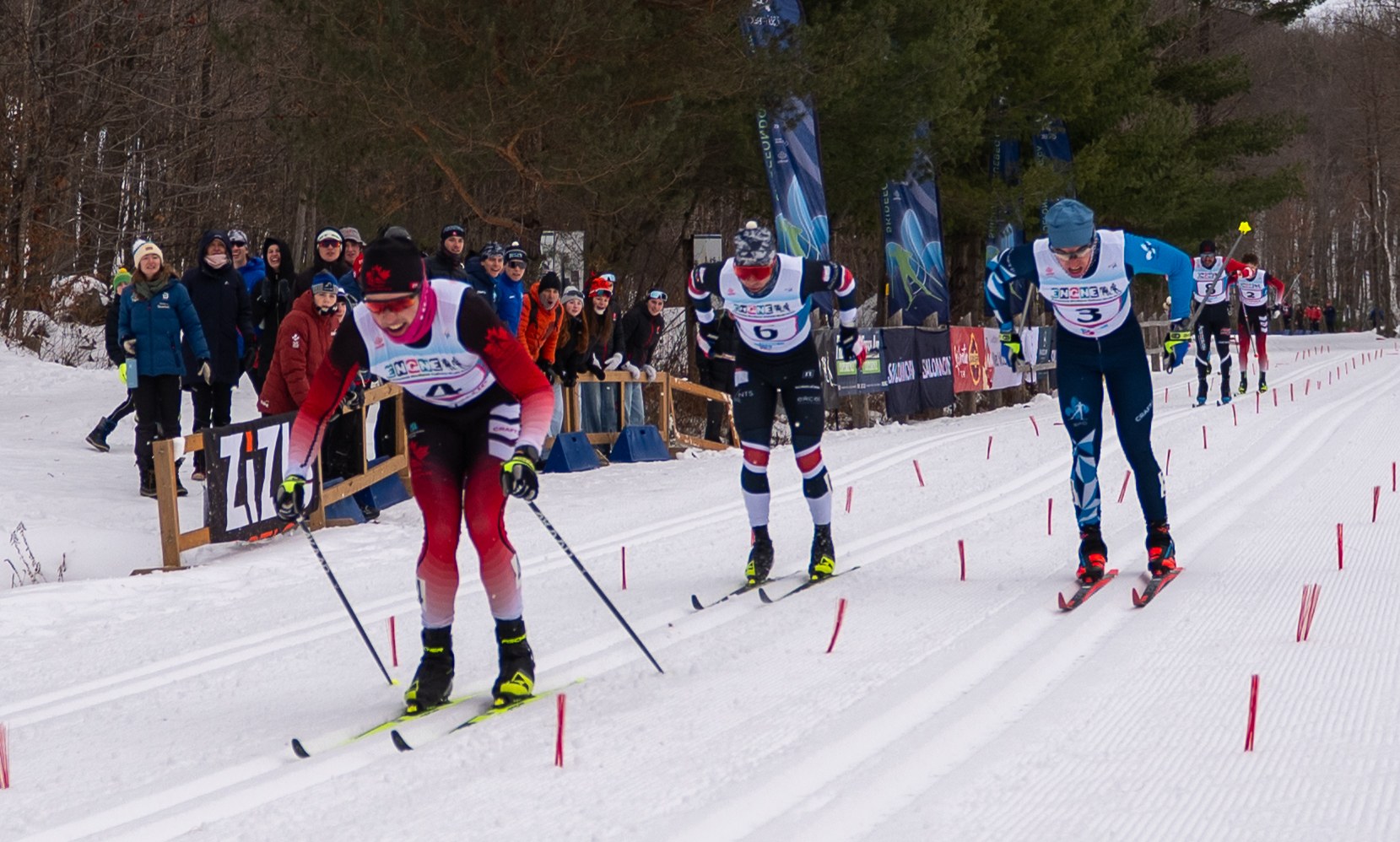
A classic sprint for the line at the Candy Cane Cup in December 2025. (Photo: Rob Smith)
The series, taking place in Gatineau, Quebec (near Ottawa), kicks off with the Canadian World Junior and U23 Championship trials, Dec. 18-21, and concludes with the Eastern Canadian Championships, Feb. 5-7. These FIS races, organized by Évènements Nordiques Gatineau Nordic Events (ENGNE), take place at Nakkertok Ski Club with the support of Ville de Gatineau and Tourisme Outaouais, longtime sponsors of the events and of skiing in the region.
Nakkertok is known for its excellent grooming and for race trails supported by an extensive snowmaking system, and for a very experienced organizing committee (nakkertok.ca).
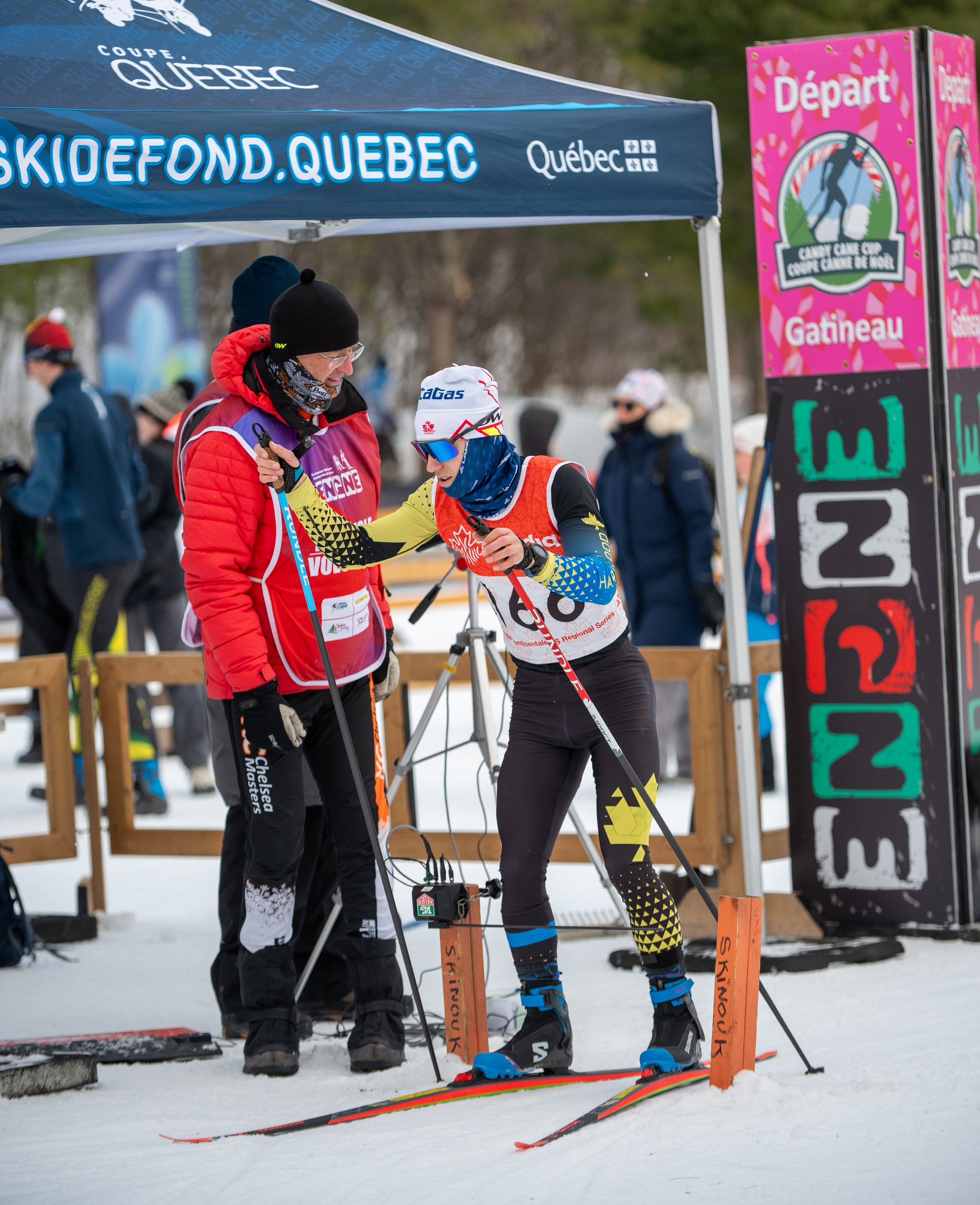
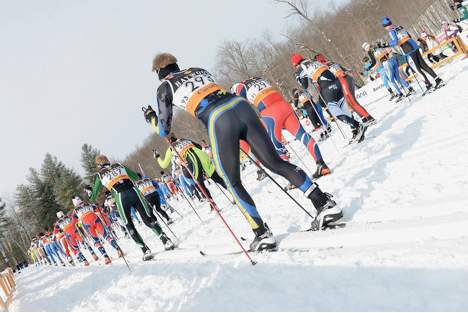
A racer leaves the start gate at the Candy Cane Cup in Gatineau, December 2025. (Photo: Rob Smith)
The Candy Cane Cup
The December races, also known as the Candy Cane Cup, will feature Canada’s best Junior and U23 athletes as they battle for positions on the Canadian team at the FIS Championships in Otepää, Estonia. The Candy Cane Cup is also the second Nordiq Canada NorAm event of the 2026-2027 season, identifying senior athletes for the Period 3 FIS World Cups. Winners in the Open class will claim $500 per race, with the overall winner receiving an additional $1,000 as a Hall Mark of Excellence (HME) Award. Junior race winners will receive $200 per race and $500 overall. Additional prize money will be awarded for other placings and categories, including ParaNordic events, with racers selected for the Canadian teams receiving an additional cash bonus.
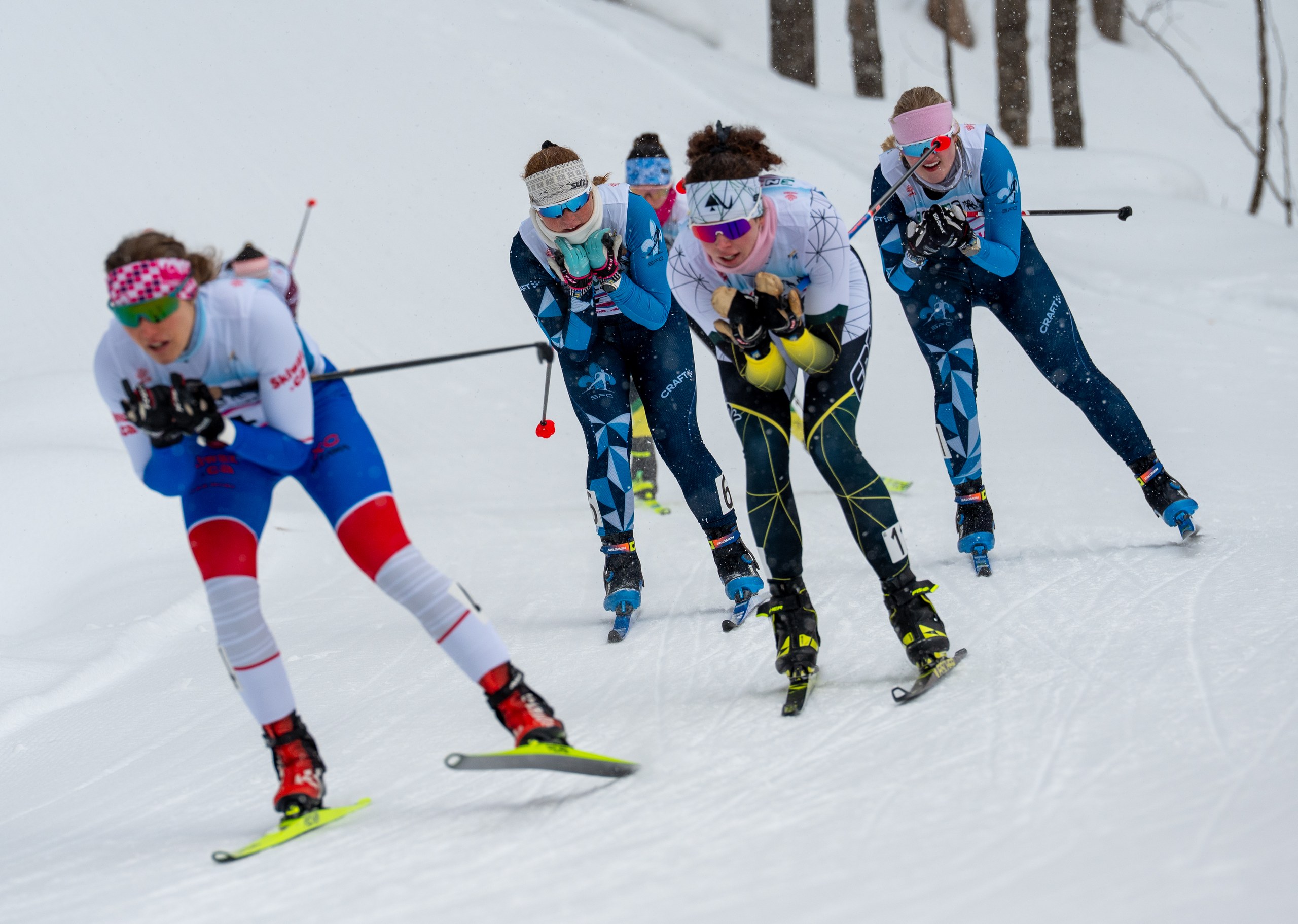
A chase group tucks through falling snow at the 2026 Eastern Canadian Championships. (Photo: Rob Smith)
The Eastern Canadian Championships
February’s Eastern Canadian Championships start the Friday following the NorAm and SuperTour races in Lake Placid, 2.5 hours “up the road,” and have a similar prize structure. Athletes who participate in both events will be eligible for the additional $2,700 in HME prize money for overall performances.
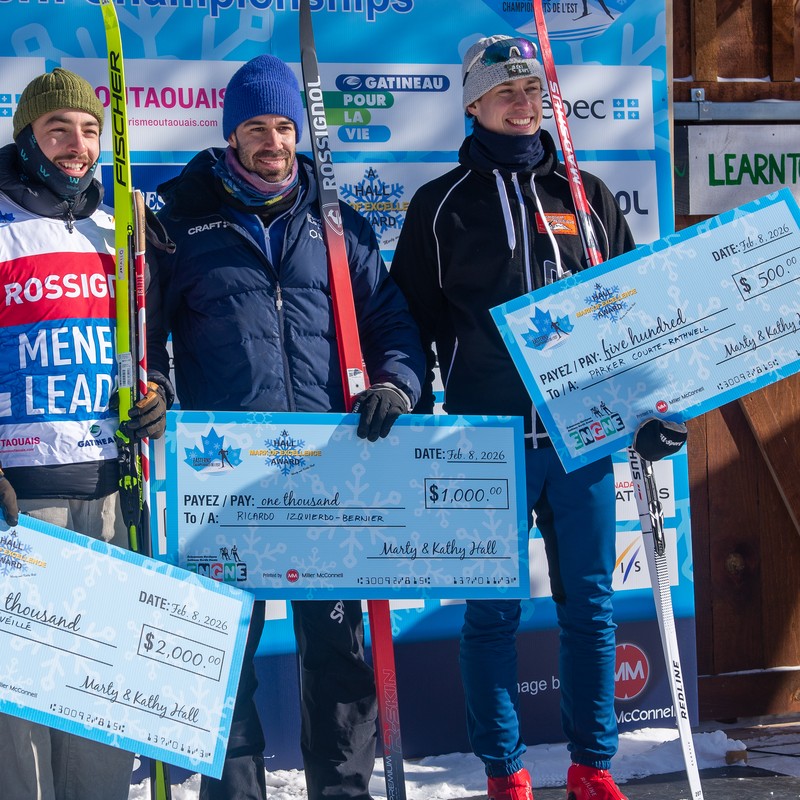
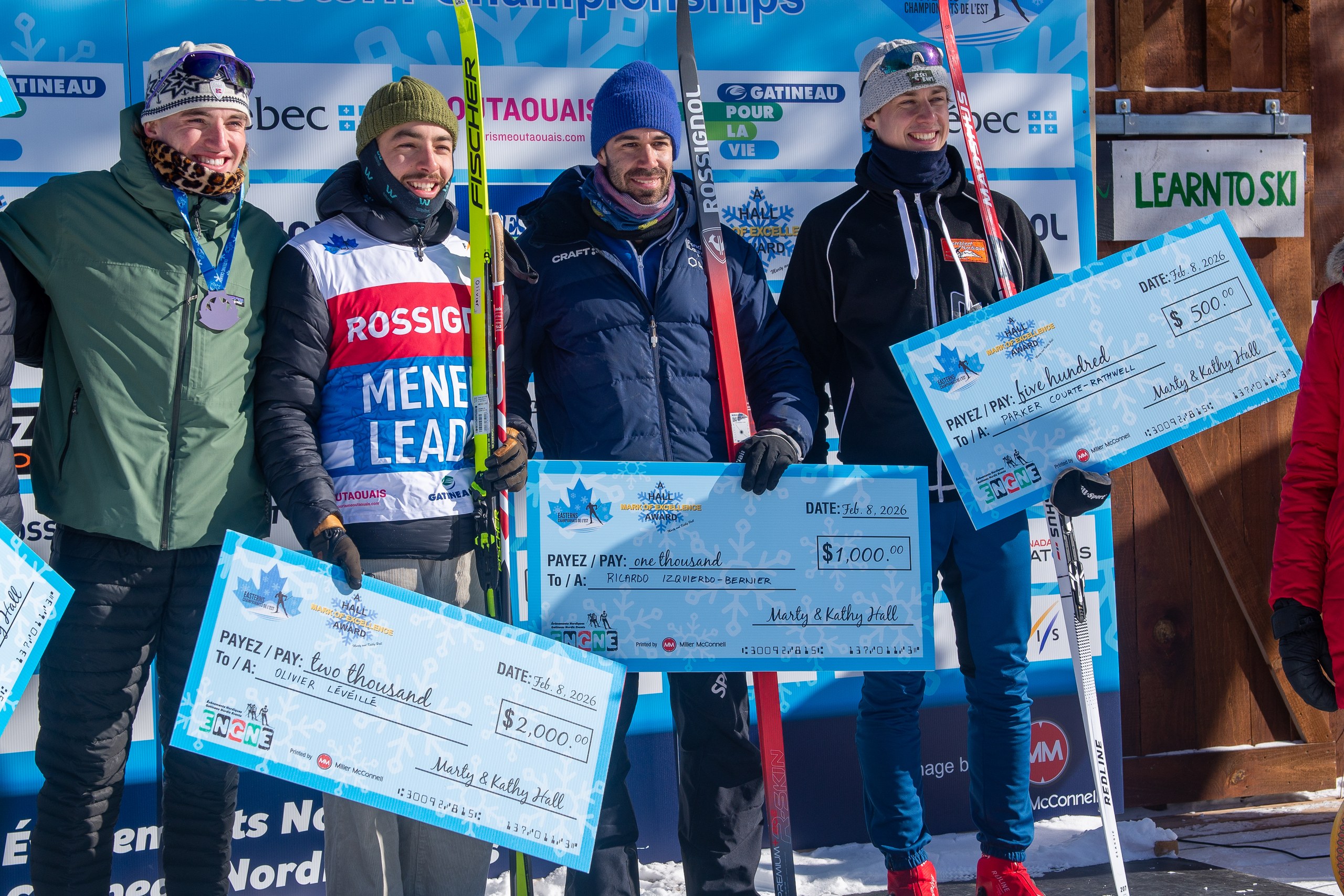
Hall Mark of Excellence checks for $2,000, $1,000 and $500 presented at the 2026 Eastern Canadian Championships, made out to Olivier Léveillé, Ricardo Izquierdo-Bernier and Parker Courte-Rathwell, respectively. (Photo: Rob Smith)
The Hall Mark of Excellence Award
The Hall Mark of Excellence Award program, founded by Marty and Kathy Hall, has provided over $70,000 of prize money at ENGNE events over the last six years, providing much needed financial support to athletes. As Kathy Hall described, “The intent of our program is to inspire and reward skiers, ultimately to enable them to continue to develop their potential and pursue their success at whatever level of skiing they choose.”
For the 2026-27 season events the HME is contributing $18,000, with an additional $17,000 provided by ENGNE and $8,600 by Nordiq Canada for the NorAm event.
“Nordiq Canada is pleased to contribute financially toward the December NorAm at Nakkertok and to work alongside ENGNE and the local organizing team to deliver a strong competition opportunity for Canada’s athletes,” said Beckie Scott, CEO of Nordiq Canada. “Investing in our domestic competition calendar is an important part of creating a high-quality pathway for athletes to develop, compete and prepare for international racing. We’re grateful to ENGNE and its partners for continuing to raise the standard of racing in the Ottawa-Gatineau region and for their commitment to supporting Canadian athletes.”
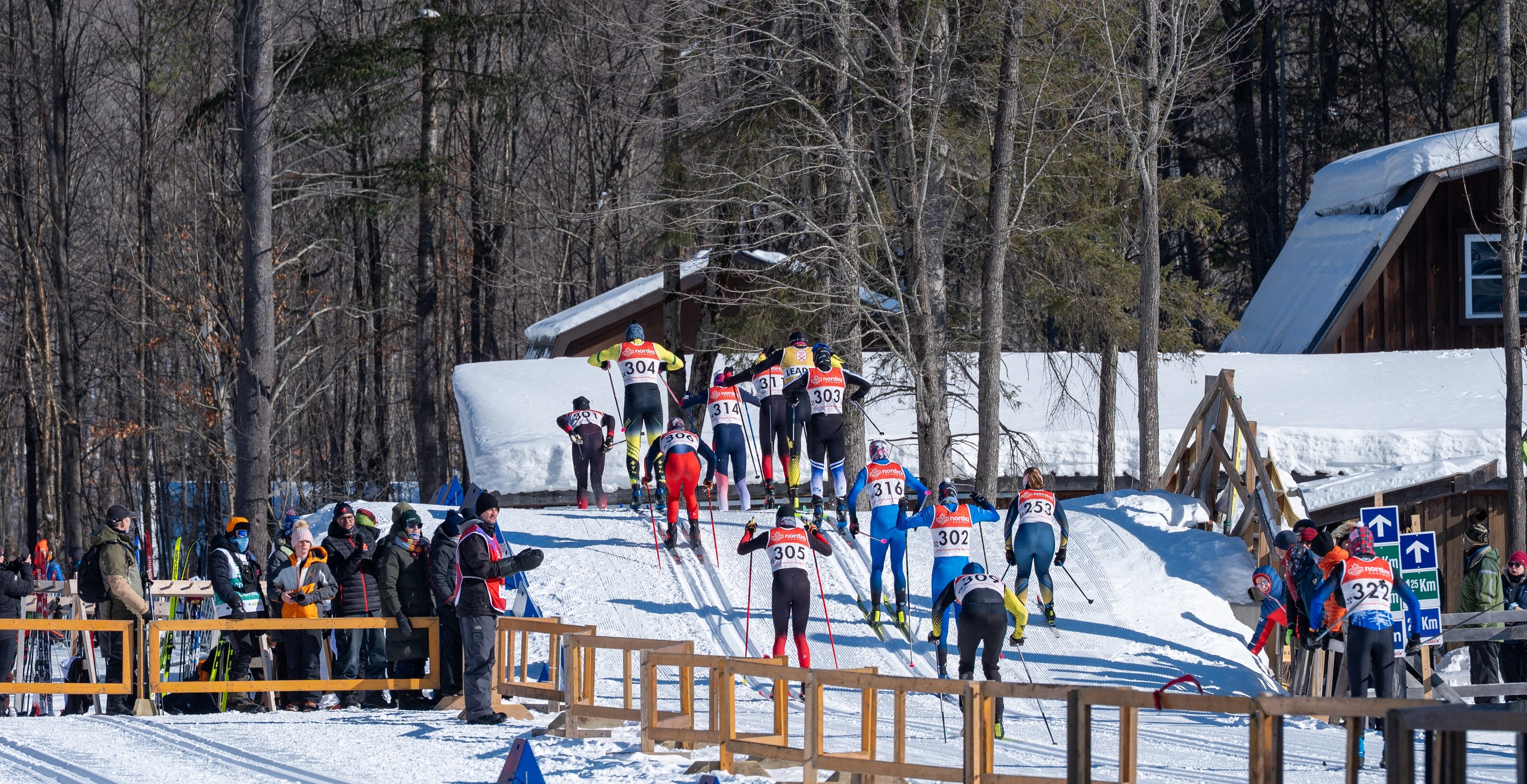
The field double-poles over a small climb early in the 2026 Eastern Canadian Championships. (Photo: Rob Smith)
A Record Year at Nakkertok
ENGNE has been organizing races in the Ottawa/Gatineau area since being formed to run the 2016 World Cup event as part of Ski Tour Canada. “A larger prize purse was important to us this season: it helps ease the financial load for athletes heading to World Championships,” said John Halvorsen, ENGNE President. “With the support of Nordiq Canada and Kathy Hall, we’ve set a record year for prize money at Nakkertok Nordic Ski Club, cementing its place as eastern Canada’s hub for world-class ski racing.”
As well as the Nakkertok trails, the Ottawa/Gatineau area has over 200 kilometres of ski trails, including Gatineau Park, home of the Gatineau Loppet, and an extensive urban trail system. It is a great area in which to train, explore and relax. We look forward to welcoming you to our winter ski home.
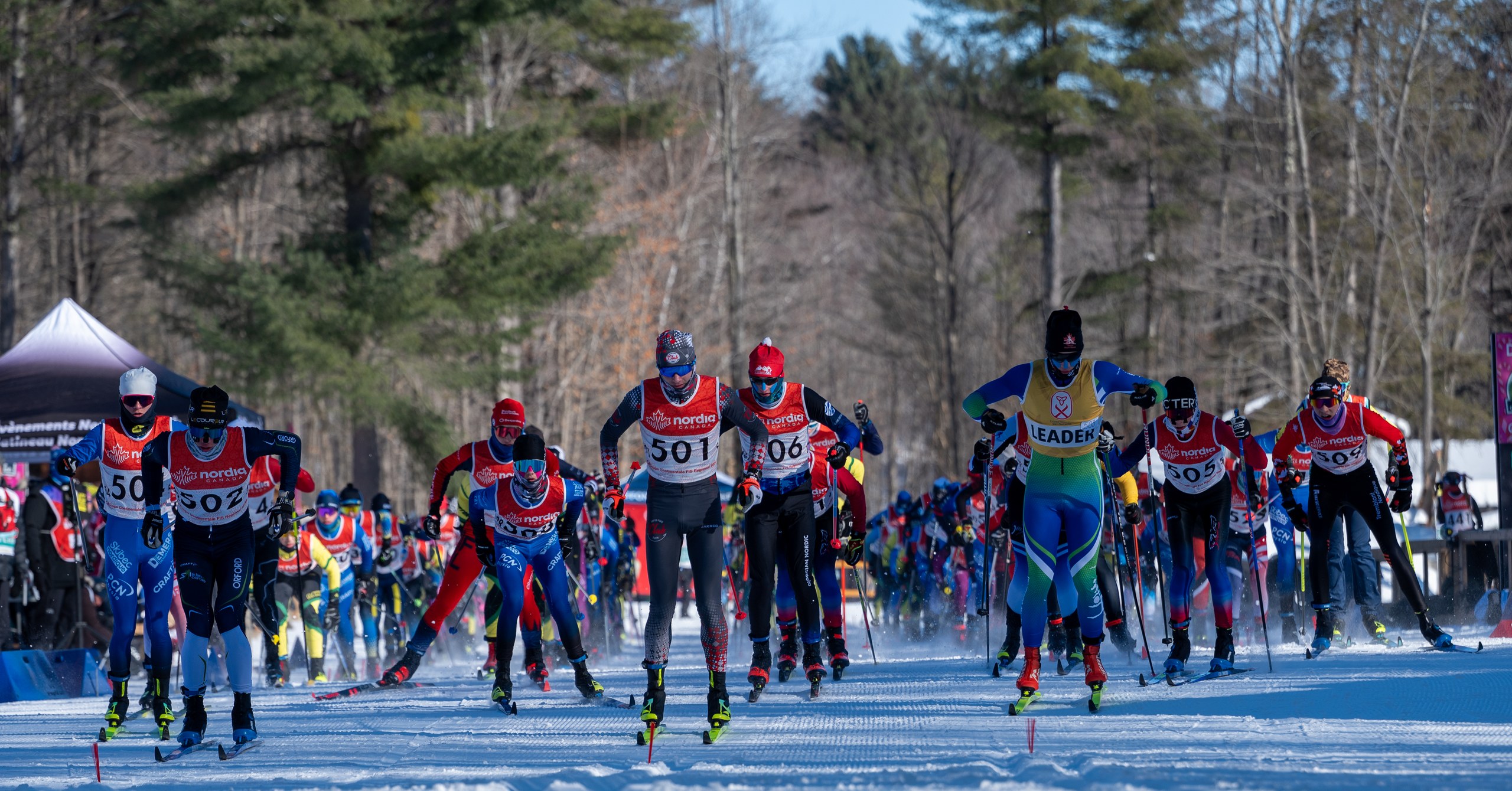
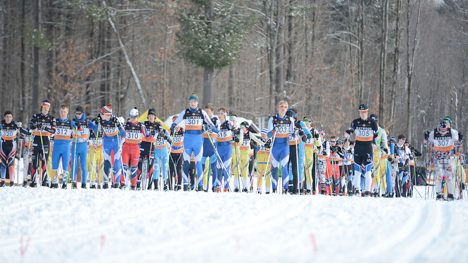
The mass start rolls out at the 2026 Eastern Canadian Championships. (Photo: Rob Smith)
Publishing press releases is a service we offer to the ski community, so please note these articles are not written by FasterSkier and therefore do not necessarily represent our thoughts and standards.
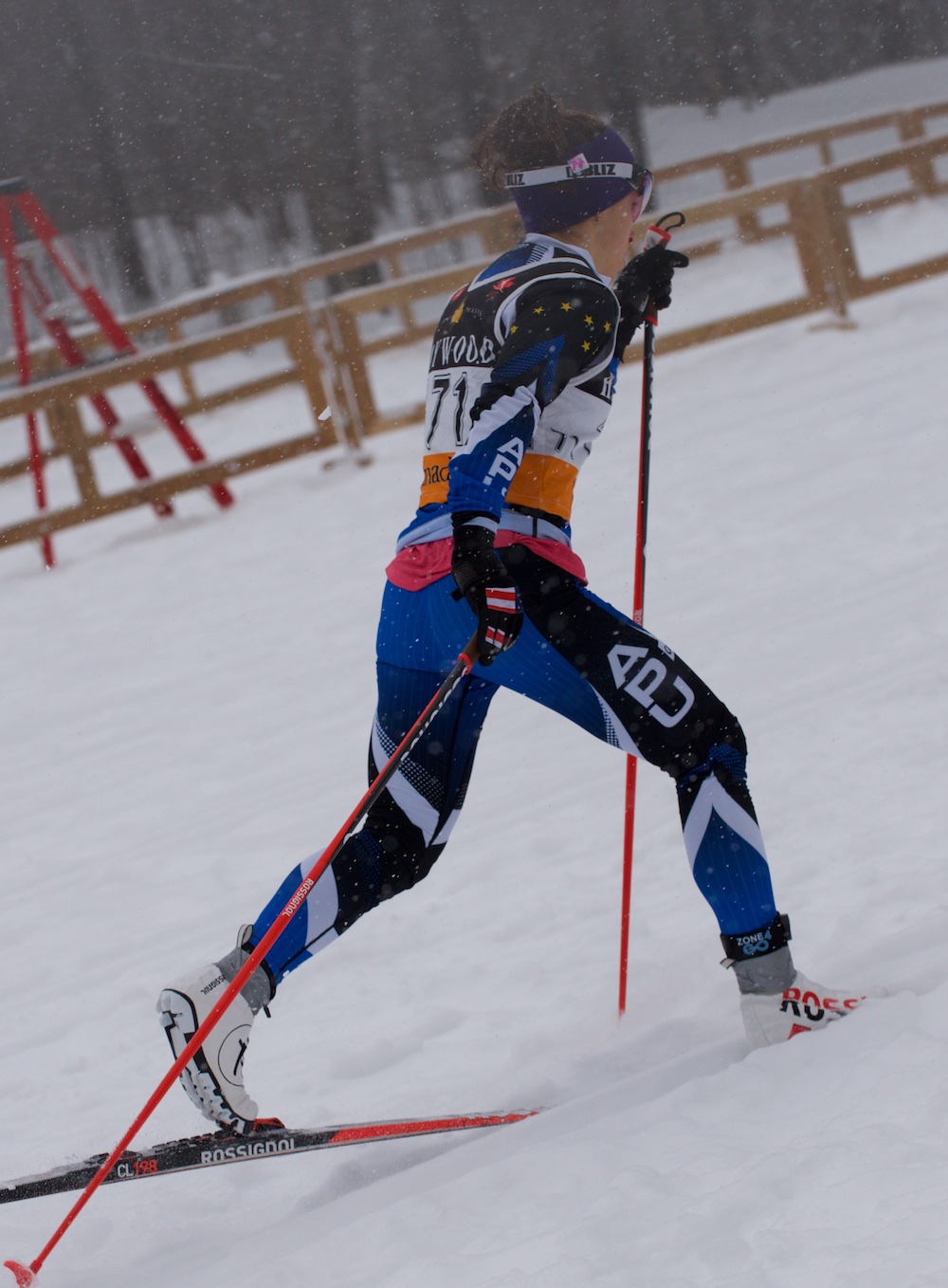
Rosie Frankowski (APU) racing to a 2-second win in the women’s 10 k classic pursuit on Sunday, the final day of 2018 Eastern Canadian Championships in Gatineau, Quebec. (Photo: Rob Smith)
NorAm Eastern Canadian Championships (Gatineau, Quebec): 10/15 k classic pursuits
Rosie Frankowski defended her lead and tallied her second-straight win on Sunday, the final day of Eastern Canadian Championships, both a NorAm and a SuperTour. Meanwhile, David Norris overcame a 10-second starting deficit to make it all Alaska Pacific University (APU) atop the podium in the classic pursuits.
Frankowski started the women’s 10 k pursuit 47 seconds clear of her APU teammate Becca Rorabaugh in second and held Rorabaugh off by 2 seconds at the finish, crossing the line first in 1:00:32.6 hours on a warmer day around 0 degrees Celsius with heavy snow in Gatineau. Kaitlynn Miller of the Craftsbury Green Racing Project (CGRP) was the third American on the podium, racing up from seventh to third, 21.3 seconds behind Frankowski.
Olivia Bouffard-Nesbitt (Rocky Mountain Racers) led the Canadians in fourth (+3:09.2), up from sixth at the start, and Frédérique Vézina, of the Pierre-Harvey National Training Centre (CNEPH), followed in fifth (+3:15.2), after starting fourth.
Another 4.6 seconds back was Liz Guiney (CGRP) in sixth (+3:19.8). Felicia Gesior (CXC Team) finished seventh (+4:05.6), Corey Stock (Bridger Ski Foundation) placed eighth (+4:05.8), Annika Hicks of the Alberta World Cup Academy (AWCA) was ninth (+4:40.8), and Alannah Maclean of the National Team Development Centre (NTDC) Thunder Bay finished 10th (+5:25.9).
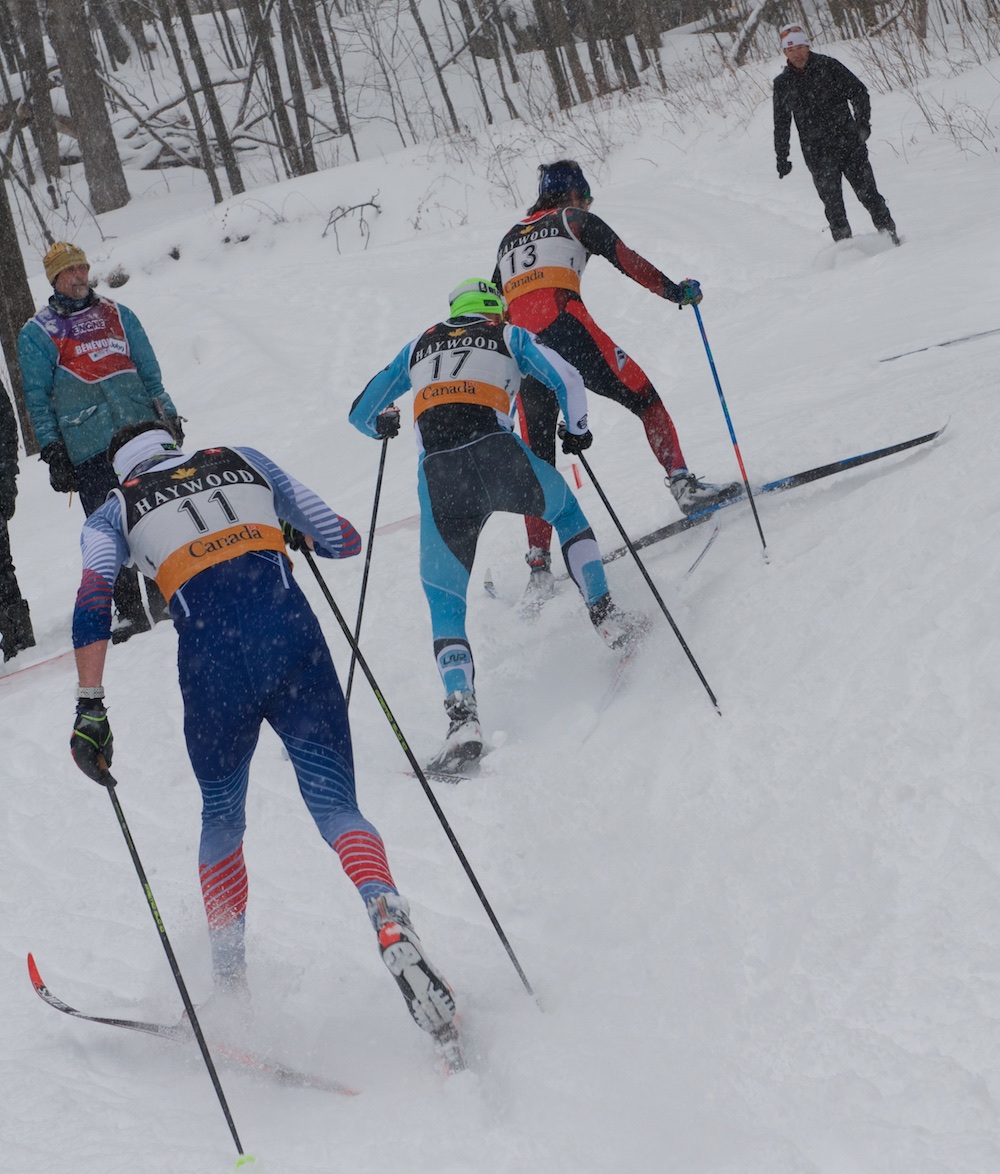
Tad Elliott (13) leads Brian Gregg (17) and Jack Hegman (11) up a climb during the men’s 15 k classic pursuit on Sunday at 2018 Eastern Canadian Championships in Gatineau, Quebec. Gregg went on to edge Elliott in a photo finish for third and Hegman followed in fifth. (Photo: Rob Smith)
In the men’s 15 k, Norris started second and caught leader Jack Hegman, of the Sun Valley Ski Education Foundation (SVSEF) early then raced alone to the victory in 1:19.26, while Ben Lustgarten (CGRP) followed 1:17.8 minutes later in second. Lustgarten started the race in sixth and Brian Gregg (Team Gregg/Loppet Nordic Racing/CXC) started seventh, with Gregg edging Tad Elliott (Ski Club Vail) by less than a tenth of a second in a photo finish for third (+1:38.5). Elliott had started third.
Hegman finished fifth (+1:42.6), his Sun Valley teammate Kevin Bolger was next across the line in sixth (+1:59.1), Adam Martin (CGRP) finished seventh (+2:01.2), Rogan Brown (SVSEF) was eighth (+2:02.9), Scott Hill (Barrie Cross Country) was the top Canadian in ninths (+2:22.5), and Jack Carlyle (AWCA) finished 10th (+2:44.2).
Nordic Combined World Cup (Hakuba, Japan): Large hill/10 k Gundersen
In the final nordic combined World Cup competition before the Olympics, Norway’s Jan Schmid came from 1:14 minutes behind at the start of Sunday’s 10 k to win the individual large hill/10 k event by 6.6 seconds in 25:36.5.
Schmid started the race in seventh, based on his competition jump, 1:14 behind Estonia’s Kristjan Ilves in first. Ilves had jumped to first and started the race 13 seconds ahead of Japan’s Yuto Nakamura in second, but while Nakamura dropped to 18th (+2:21.2) at the finish, Schmid moved all the way up to first with the fourth-fastest course time.
Japan’s Akito Watabe, who won Saturday’s large hill/10 k competition, took the final spot on the podium after a photo finish with the Czech Republic’s Tomas Portyk. They finished 11.1 and 11.2 seconds behind Schmid in third and fourth, respectively.
American Adam Loomis achieved his best individual result in three years, placing 24th (+3:03.4), after jumping to 30th and starting 3:20 out of first. Loomis skied the eighth-fastest course time.
His USA Nordic teammate Ben Berend placed 31st (+4:28.4) after ranking 28th in the jump.
Nordic Combined Continental Cup (Planica, Slovenia): Saturday and Sunday
Meanwhile on the Nordic Combined Continental Cup, Americans Bryan and Taylor Fletcher reached the podium on both Saturday and Sunday in Planica, Slovenia.
Bryan won back-to-back individual large hill/10 k Gundersen starts, while Taylor placed second on Saturday and third on Sunday.
On Saturday, Bryan jumped to third on the 139-meter large hill and started the 10 k race 22 seconds behind Germany’s Anton Schlüter in first. Taylor jumped to 14th and started 1:35 minutes out of first and posted the fastest course time in the 10 k to finish second to his older brother, 59.4 seconds back.
Bryan skied the third-fastest 10 k to take first in 26:24.1 minutes. About a minute behind Taylor, Austria’s Martin Fritz placed third (+1:58.8). Schlüter ended up 15th (+3:51.5).
Also for the U.S., Jasper Good raced from 26th in the jump to eighth overall (+3:08) with the fifth-fastest course time. Grant Andrews did not finish after posting the 38th-ranked jump.
Canada’s Nathaniel Mah placed 28th (+5:41.5) after starting 27th based on his jump.
On Sunday, Fritz jumped to first and finished between the Fletcher brothers in second place, 39.7 seconds behind Bryan, who repeated in first.
Bryan had jumped to second and started the 10 k just 9 seconds back. He skied the fourth-fastest course time en route to the win in 25:01.6.
Taylor’s jump put him in 15th and 1:40 back at the start of Sunday’s race, and he passed 12 competitors to claim third (+1:25.0) with the second-fastest course time.
Good finished 17th (+3:12), up from 23rd in the jump, with the ninth-fastest 10 k time, and Andrews placed 22nd (+3:38.2), up from 24th.
Mah finished 34th (+5:38.7) after jumping to 21st.
The Haywood NorAm, Eastern Canadian Championships, will be held from Feb. 2-4 at the Nakkertok Nordic Centre, 900 Ave Gatineau, Gatineau Quebec.
The race will attract over 850 competitors from across N. America, Alaska to Newfoundland. It is also part of the FIS Continental Cup’s: Canadian Haywood NorAm National race series, and a stop on the USA Super Tour series.
The Para-Nordic, National Championships will be part of the schedule, along with University competitions.
Taking part will be a wide age range of competitors, from World Cup level skiers to young local, future Olympic hopefuls. This includes a group of 20 young teens on an exchange from Foothills Nordic club in Calgary.
The Haywood Eastern Canadian Championships is being hosted in the region for the 14th year, and is jointly organized by 3 local clubs, Chelsea Nordiq, Club Skinouk and Nakkertok Nordic that will provide over 550 volunteers for the event.
American Eric Packer (r) leads Canada’s Len Valjas (l) during the men’s 15 k freestyle pursuit at Stage 4 of the 2016 Ski Tour Canada in Quebec City in March. Packer placed 68th on the day. (Photo: FlyingPointRoad.com/NNF)
Eric Packer is back home. The 26-year-old Anchorage native is in his third year of training with Alaska Pacific University (APU), after heading East for college at Dartmouth and following that with a two-year stint on the Vermont-based Stratton Mountain School (SMS) T2 Team. Now he’s back in Alaska for good, training with the APU men and enjoying the benefits of this environment.
“We had a great summer of training with the whole [APU] team,” Packer said in a recent phone interview from Alaska. (Note: He’s currently in Europe on the World Cup circuit.)
“I feel really lucky to be part of this group of guys that’s really pushing the boundaries forward. Everybody’s looking really good, and I’m really excited to see what the team can do. I personally feel like I’ve made some big improvements. I’ve trained more than I ever have, and was more consistent throughout the entire summer than I ever have been before. So feeling really positive about that.”
Packer reflected that the APU training facility on Eagle Glacier outside Girdwood, Alaska, is a key part of his estival endeavors. “Getting up on the glacier is a big component of that,” Packer said. “We had three really productive camps, with about 75 hours on snow. That really helped getting back on snow. I was having a conversation, I think, with Reese [Hanneman], and it was three-quarters of the way through the ski before he realized that it’s like technically our first ski. It’s like, ‘Oh yeah, this is the first ski.’ So that was kind of cool – just like having that contact with snow throughout the summer really makes the transition super easy, and that’s nice.”
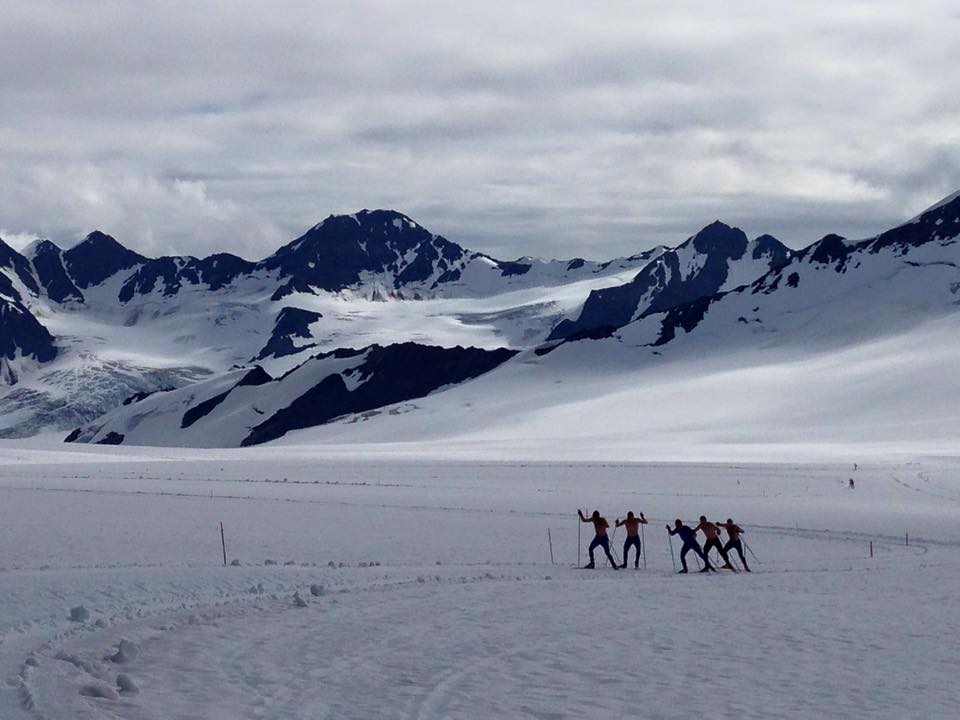
The APU men on Eagle Glacier in summer 2015. (Photo: Zuzanna Rogers)
While Packer was not logging 25 hours per week on snow for the entire summer, he did credit volume training for his steadily increasing fitness.
Rather than a quantum leap, Packer identified the incremental gains that most athletes at his level are looking for. “Just every year chipping away at uphill running times, chipping away at ski bounding times,” Packer observed. “You never really see a big jump, but it’s just, every month, trying to get two, three, five seconds faster. And I felt like this year was a good continuation of the past few years – I saw a lot of improvements, just kind of across the board generally. … I’m feeling pretty good with that, where the base fitness is.”
Packer said that he “was just able to train consistently through the whole summer, so I was really happy with that.”
But that’s not a given after last summer, in June 2015, when Packer had a scary fall in the Chugach Mountains near Anchorage that left him falling off “a small vertical drop of 10-15” feet, then “tumbl[ing] head over heels down steep rocky terrain” for another 60 feet or so. “I had no control in the fall,” Packer wrote about the incident, “which was a really scary feeling, but I remember being pretty sure I was not going to survive.”
The story has a happy ending: As Packer previously explained, “In terms of my actual injuries, I was incredibly fortunate for as bad as the fall was, I somehow managed to not break any bones, which still amazes me to this day.” Nonetheless, Packer said, “I was so banged up that I stayed home for a week with no training. Once I got the clearance from my doctor and PT to resume light activity, all I could do were easy walks.”
Going through the injury and recovery process last year “definitely did” change his outlook for this year, Packer said. “It impacted my approach to last season, and I think this summer I just felt really lucky that I was injury-free, and was able to train at full capacity all summer long and not have any setbacks like that. It was definitely one of those moments where you take a step back, and kind of reflect on everything, and reflect on how lucky you are to be a ski racer, to be able-bodied and healthy and all those sorts of things. I have a history of ankle sprains; for the first time in six years I didn’t have a serious ankle sprain. Didn’t fall off any cliffs this time.”
Packer planned to put that consistent training and improved fitness to the test in Europe; he had Period 1 World Cup start rights for 2016/2017 by virtue of being last season’s domestic SuperTour leader.
But he didn’t think it would be easy. “Racing World Cups, Period 1 in Europe, is really tough,” Packer said before he left for northern Scandinavia. “There’s no question about that. It’s probably the hardest competition that you’ll see all year in terms of depth of the field.”
(Packer’s comments seemed prescient a week later, when, in the season’s first World Cup race, Norway put two skiers on the podium it hadn’t planned on starting.)
Nonetheless, Packer was “very excited” for his first World Cup races in Europe; he had previously raced in Europe and on the World Cup last season in Canada, but this marked his first overseas World Cup. “The Ski Tour Canada was obviously amazing and really a cool racing experience,” Packer enthused, “but getting to race at classic venues, in Finland and Norway and Switzerland, that’s really the dream. So I’m looking forward to it.”
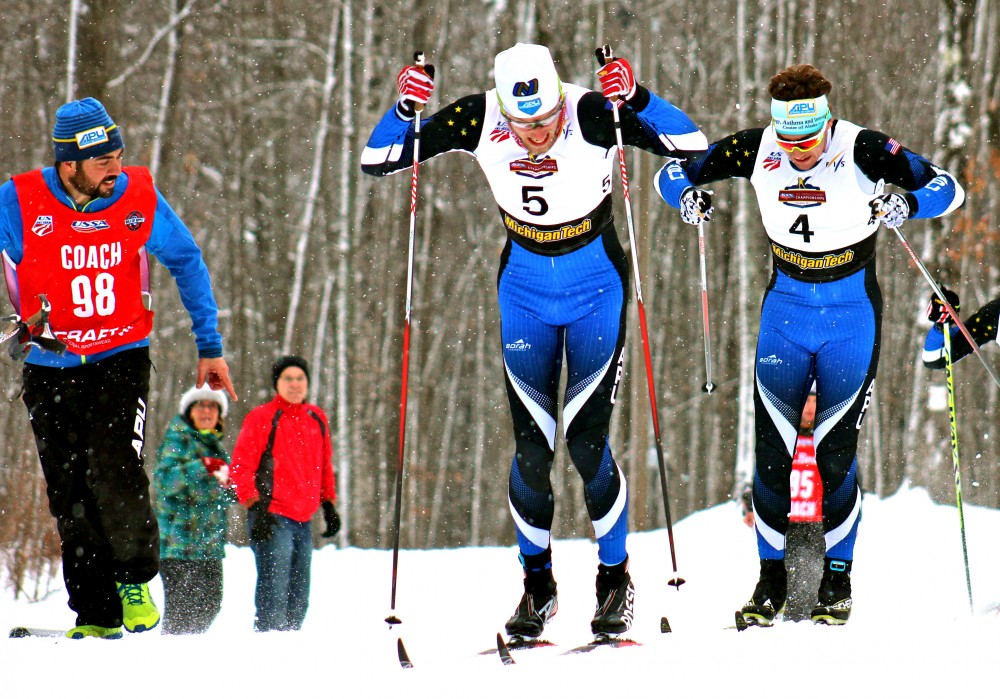
APU head coach Erik Flora (98) runs alongside his athletes Eric Packer (5) and Reese Hanneman during (4) the final of the men’s 1.5 k classic sprint at U.S. nationals in Houghton, Mich., in January 2016. (Photo: Christopher Schmidt)
Packer, who spoke with FasterSkier before leaving for Europe and racing in Ruka, said that he had two goals for his time in the opening swing of the World Cup season.
“My main goal is to take advantage of the opportunity to get, potentially, nine World Cup starts, and build as much experience as I can over the next month, and also learn the venues, and learn the cadence of World Cup racing,” he said. “And just really … have my eyes and ears open, and learn as much as possible. And learn from what I’m seeing other competitors doing – tactically, technically, that sort of thing. So that’s the first goal.”
“And the second goal,” he continued, “is to take each race as it comes. … I know that there will likely be tough days, but I’m just focused on taking each race, each day individually, and trying to give it my best shot in each one. It only takes one good day. So that’s really what I’m looking for, is to take advantage of the opportunity and give it my best on each day. Make the people back home proud.”
By the “cadence” of World Cup racing, Packer explained, he meant “building comfort and familiarity with that routine. To the point that you have a system where you can be focused on preparing for the race, and not get distracted by all of the other things surrounding the race.”
As an example, Packer cited the races at Gatineau this March: “At the World Cup venue there, they had a warmup track that was probably an 800-meter run from the wax cabin. And then the area that you actually accessed the course and accessed the start was yet a different location; that was probably like a 300- to 400-meter run. You’ve got ski boots on. And so just figuring out how to warm up, and then get on course.”
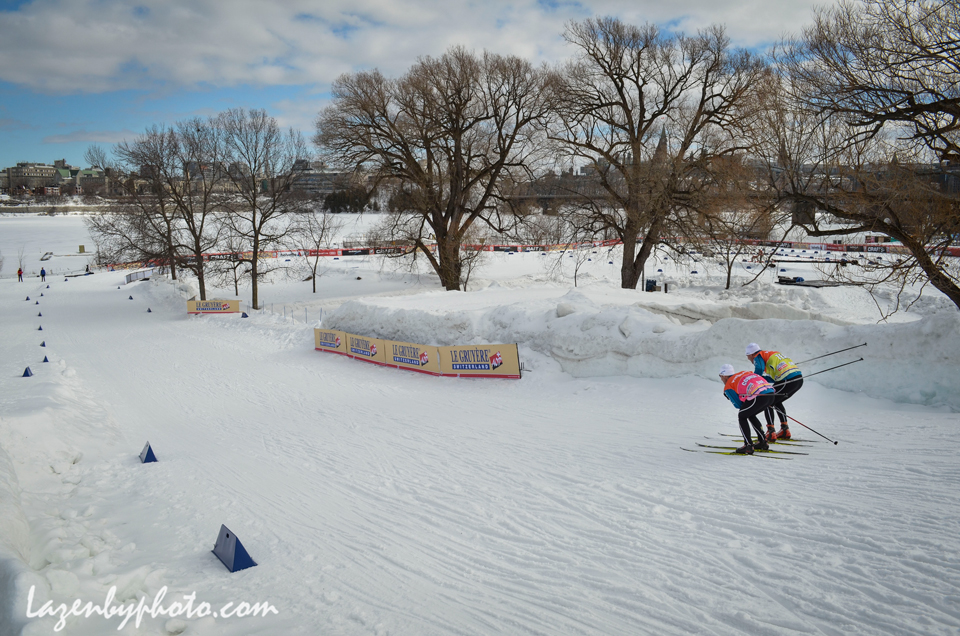
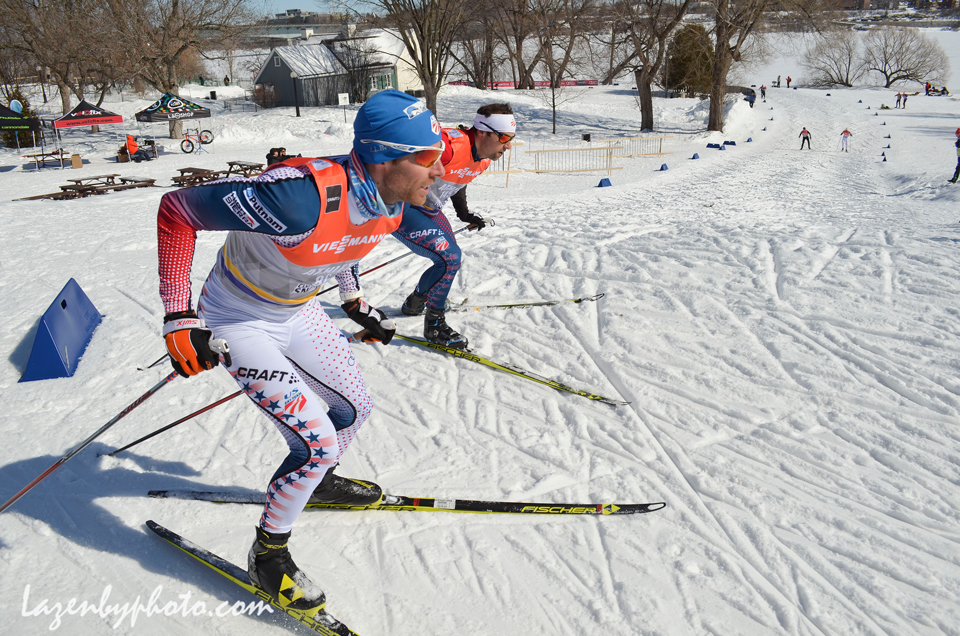
A little wax testing on Gatineau’s 1.7 k sprint course, with the start/finish area visible at the upper right. (Photo: John Lazenby/lazenbyphoto.com)
“More generally,” he said, the cadence involves “just figuring out the racing logistics, and getting used to the extra hurdles that exist at the World Cup level in the race-day routine, that’s a big goal, too. So that you get to the point where you’re focused on the racing, and you’re doing the optimum warmup and everything, and working within the constraints of that World Cup atmosphere.”
When asked about his overall goals for the season, Packer hesitated to look much past Period 1 of the World Cup, although he acknowledged that World Championships in Lahti, Finland, were on his radar. “I would definitely be excited to qualify for Lahti, and that is one of the goals for the season,” Packer said. “I would say, right now my focus is first on Period 1, and doing my best there, and then I will reevaluate once that’s over.”
Regarding possibilities for the second half of the winter, he reiterated, “It’s really hard to tell right now. There’s so many different potential paths through the winter. Definitely hoping to be racing in Europe, that’s always the goal. But if not, I would certainly like to come back and give the [American] Birkie my best shot, so there’s many different options there.”
(Packer has raced the Birkie once before, in 2014, finishing 22nd overall.)
But he was glad to look back to what he identified as the highlight of his ski career to date.
“Winning Nationals last year,” was his immediate answer. “That was just – and not actually winning, but coming into the finish with Reese and with Tyler together,” Packer said, referring to his APU teammates Hanneman and Tyler Kornfield. “And having that moment of like, ‘Wow, we have three of us here in contention, and being part of that group.’”
Packer continued: “And [APU head coach Erik] Flora was running next to us, and he was like swinging his arm around like a windmill, and just so excited. And then at the same time my childhood coach, Jan Buron from [Alaska] Winter Stars, and my college coach, Ruff Patterson, were both there at the finish. So kind of that moment of having everybody who’s been involved in my skiing from seventh grade all the way through now, and coming into the finish with my two teammates – that was a really special moment.
Eric Packer racing in the Ski Tour Canada in March 2016, with the beard in full late-winter flourish. (Photo: FlyingPointRoad.com/NNF)
“It was pretty fun. I got a big hug from Flora, then got a big hug from Jan, got a big hug from Ruff – it was a cool moment, for sure. It will definitely be a special moment for me.”
Finally, Packer looked back more recently, to what he’d had for breakfast that morning, then once more ahead, to his plans for hirsute management over the course of the winter.
“I had two pieces of toast, with avocado, and a fried egg on top of that; a cup of coffee, with just a little bit of half-and-half, no sugar; and a banana,” Packer explained, with the precision of someone whose Dartmouth degree is in mechanical engineering.
And as for the facial hair? “So last winter,” recalled Packer, who was previously recognized with Bearded Honorable Mention #1: The Lumberjack in FasterSkier’s West Yellowstone beards roundup of Nov. 2015, “I went with the ‘grow it all season’ approach. I think I’m going to take a step back from that this year, and keep it more in check. We’ll see. You never know; it has a mind of its own.”
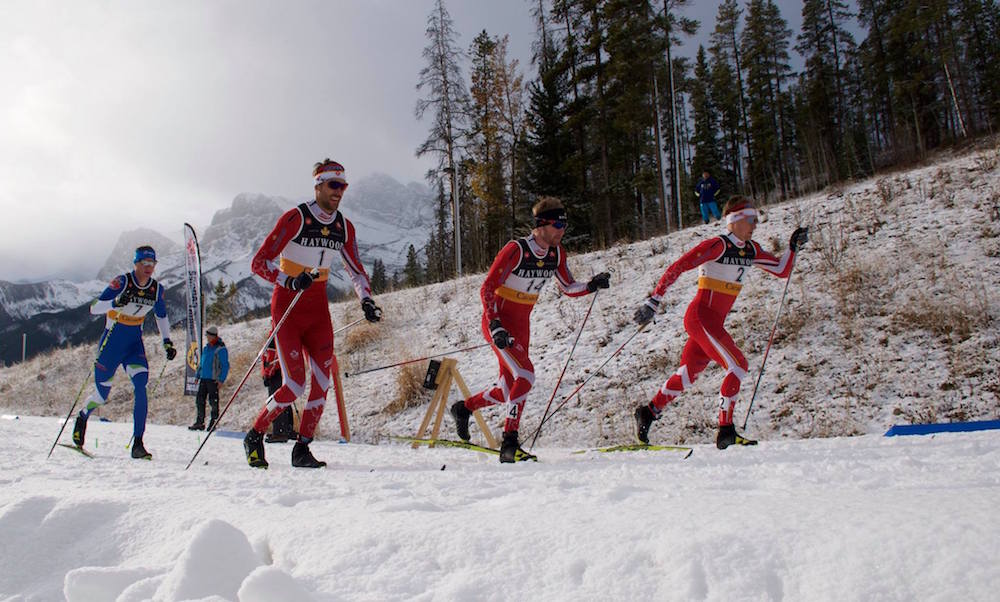
(From left to right) Bob Thompson (NTDC Thunder Bay) chases Lenny Valjas (Canadian World Cup A-Team), Graeme Killick (AWCA/NST B-team), and Knute Johnsgaard (AWCA/NST U25 Team) at the start of a classic sprint heat at 2016 Frozen Thunder in Canmore, Alberta, on Nov. 1. (Photo: Jenn Jackson)
As promised, the Canadian version of “Where the (Skiable) White Stuff Is” (a.k.a. November skiing) is here, minus the bit about where to ski at Thanksgiving. Canada doesn’t usually have much snow at Thanksgiving, mostly because Canadian Thanksgiving is in early October. But by the time U.S. Thanksgiving rolls around in late November, there is an abundance of reliable snow to choose from in Canada.
In addition to major camps and well publicized early season track setting, there are a lot of places in Canada where people quietly start skiing when there is snow. Whitehorse in the Yukon is one of those places where “early” doesn’t have the same meaning as it does in the south. No one will advertise October skiing at Barkerville, British Columbia, but the Caledonia Nordic Ski Club in Prince George can tell you about it. FasterSkier’s West-Coast based Canadian contributor was on snow Oct. 8 this year.
All of the western venues mentioned here were affected by the same weather pattern than forced the cancellation of the Bozeman SuperTour. A heatwave rolled in on Nov. 3, starting with a very warm classic sprint in Canmore, Alberta, and ending in spectacular flooding near Whistler, B.C. It has been a better start in the east.
This article will focus on reliable set track and camps open to the public in November — in Canada (for the U.S. version, click here). If your favourite early season spot isn’t featured, you are in good company. Let us know in the comments below.
And if you are visiting Canada, remember that the U.S. dollar is worth $1.35 up here.
***
CAMPS
XC SuperCamp
Where: Sovereign Lake Nordic Centre and Silver Star Mountain Resort, Vernon, B.C.
A trailside photo from 2015 SuperCamp at Sovereign Lake/Silver Star (Courtesy photo)
SuperCamp has evolved over 30 years, but its always been held on natural snow and it’s always run camps in November. Four of this season’s seven camps are in November, and biathlon options were offered this month as well.
“SuperCamp is a very comprehensive nordic experience,” Shane Landreville, SuperCamp coordinator, wrote in an email. “Trail passes are included, as are lunches, off snow programs, wax sessions, massages, and ski demos.”
Ski-in/ski-out accomodation and restaurants are available at Silver Star. Vernon, a 20-minute drive and 1,200 metres lower in elevation, offers a wide range of food and lodging alternatives. Some of the November camps sold out in mid-October when registration opened.
Glenn Bond XC Ski Camps
Where: Labrador City, Newfoundland
The 2016 Glenn Bond XC Ski Camp at Menihek Nordic on Nov. 3. (Courtesy photo)
The four-year old Glenn Bond XC Ski Camp program travelled to Menihek Nordic in Labrador City, Newfoundland, for a November camp on natural snow.
“[This camp] was November 3-6 with 70-80 cms of snow and big smiles,” Bond wrote. “Menihek Nordic wins the prize for best early season xc ski conditions this year hands down.”
(Longtime SuperCamp attendees remember Bond from his time with that program.)
NATURAL SNOW
Menihek Nordic
Where: Labrador City, Newfoundland and Labrador
Fifty centimetres (roughly 20 inches) of natural snow at Menihek Nordic in Labrador City on Oct. 23, 2016. (Photo: Menihek Nordic)
Mention ‘Lab City’ to a national team member from the 1980s and you will see the good memories scrolling behind the smile. In the glory days of Pierre Harvey, the national team would kick off its season at Menihek before moving on to Silver Star for an early season elevation camp. After that national team stopped visiting the venue in 1988, it quietly dropped off the radar, to the point that FasterSkier missed this October skiing opportunity in last year’s guide.
Labrador City is not visited by many tourists. It’s at least a 13-hour drive from Quebec City, which is the nearest major population centre. But there are some big-name skiers that have visited, including Sweden’s Gunde Svan, Americans Bill Koch and Tim Caldwell, Norway’s Anette Bøe, and the Firth sisters from Canada’s Northwest Territories. Menihek Nordic hosted the 1983 World Cup Final, the 1985 World Cup opener and was a national training centre from 1981 to 1988. Mining communities are often multicultural: the World Cup hosts were able to find local translators for 20 languages from a population of less than 10,000. Koch designed some of the trails in 1981.
What makes this venue unique, other than reliable October-to-May skiing?
“Labrador is unique in that it is nearly the last frontier,” Menihek Nordic Ski Club President Gerry Rideout explained. “There is a certain magic about Labrador, it gets in your blood.”
This season, Menihek opened on Oct. 23, held four camps in November, had the full 34 k system set on Nov. 3, and plans to stay open to the first week of May (as usual).
Sovereign Lake/Silver Star
There were lots of smiles during U.S. Thanksgiving at Sovereign Lake. Methow Valley Nordic coach Laura McCabe (a two-time Olympian) led 30 kids over the top from Silver Star and FasterSkier caught them on the way back. Locals know to start at Sovereign and stop for a croissant in Silver Star village to fuel the second half of the ski. (Photo: Gerry Furseth)
This destination is actually two ski areas. The Sovereign Lake Nordic Centre (also Sovereign Lake Nordic Club) has been operating since the 1930s under a variety of names, while Silver Star Mountain Resort is more recent, opening as an alpine-skiing area in 1958. The two organizations have 105 kilometers of interconnected nordic trails and a surprisingly good relationship between the commercial resort and the volunteer-based club (which is one of the largest cross-country ski clubs in B.C.). Silver Star hosted a World Cup in 1991, Sovereign Lake in 2005.
Daily track setting runs from November to early April, with the full 105 k usually available from late November to mid-March. Sovereign Lake reopens in May for team camps and diehard skiers.
This season, both sides opened 10 days late on Nov. 20, with 57 k set by Nov. 25.
“We are still well below our average snow pack for this time of year, but are optimizing our small machine grooming to create great tracks and corduroy,” Sovereign Lake manager Troy Hudson wrote in an email on Nov. 24.
There were at least eight private camps in November, ranging from a master’s women’s group to biathletes to a combined U.S. club camp with the Mt. Bachelor Sports Education Foundation, Methow Valley Nordic and Momentum Northwest from Oregon and Washington.
MANMADE & STORED SNOW
Frozen Thunder
Where: Canmore Nordic Centre in Canmore, Alberta
Canmore is perhaps the best known of Canada’s nordic venues. Between the 1998 Olympics, reoccurring World Cups and last season’s final stages of the Ski Tour Canada, it is famous beyond the skiing world. Each October, Frozen Thunder opens a small loop with a combination of stored snow and manmade snow.
This year, Frozen Thunder opened on Oct. 22 with a 1.7 k loop. The regular season began on Nov. 19 and is scheduled to run to April 30. So far, Canmore has hosted seven days of cross-country ski races and three biathlon races in November. All the camps were private, with the Ukraine biathlon team traveling the farthest to Canmore.
Boreal Glide (Glisse Boréale)
Where: Forêt Montmorency, owned by the Université Laval, in Saint-Ferréol-les-Neiges, Quebec
Skibec skiers on the Boreal Glide at Forêt Montmorency north of Quebec City. (Photo: La Forêt)
Located 45 minutes north of Quebec City and belonging to Laval University, the ‘Boreal Glide‘ is an early season favourite in Quebec. Set in the largest teaching and research forest in the world (at 412 square kilometers), La Forêt Montmorency has 2.5 k of early season trail using stored snow and a larger system that depends on natural snow. As of Nov. 20, it had 20-24 inches of packed snowed and track groomed for both skating and classic.
“If I had to invest my money in one single cross-country skiing area in North America, I would honestly choose the Forêt Montmorency,” La Forêt’s Director of Operations Hugues Sansregret wrote in an email. “The fact that it sits on top of the Laurentian mountains is the best guarantee for early skiing.”
Boreal Glide opened on Oct. 28 without any official camps or events — just skiing. Can’t argue with that.
Callaghan Gold
Where: Whistler Olympic Park, Callaghan Valley, B.C.
Callaghan Gold on Nov. 7, 2016, at Whistler Olympic Park in Callaghan Valley, B.C. New this year, the loop includes the biathlon range. (Courtesy photo)
Canada’s other Winter Olympic venue has created Callaghan Gold, an early season loop of stored snow. The regular season opens on Nov. 24 (U.S. Thanksgiving) and ends in early April. Located in a cool valley surrounded by rainforest, this venue has been known for lots of snow in non-Olympic years. Weather has been a challenge in the fall of 2016, eased by two last-minute storms that expanded the stored snow loop to 21 k during the opening weekend.
In the project’s four-year history, Callaghan Gold has met some challenges. In its experimental year, the stored snow came out ‘gold’, coloured by the sawdust insulation. In 2014, the storage methods were improved and an 800-metre loop of lovely, white snow greeted skiers on opening day. In 2015, record-setting warm weather melted all the snow in March, leaving nothing to store. In 2016, Callaghan Gold opened on Oct. 29 with 600 metres of trail, expanding to 1.4 k on Nov. 4.
“The warm temps and significant rainfall of November took its toll on the Callaghan gold trail depth but we feel it held up well considering,” managing director Tim Hope wrote in an email.
Nakkertok Nordic
Where: Gatineau, Quebec
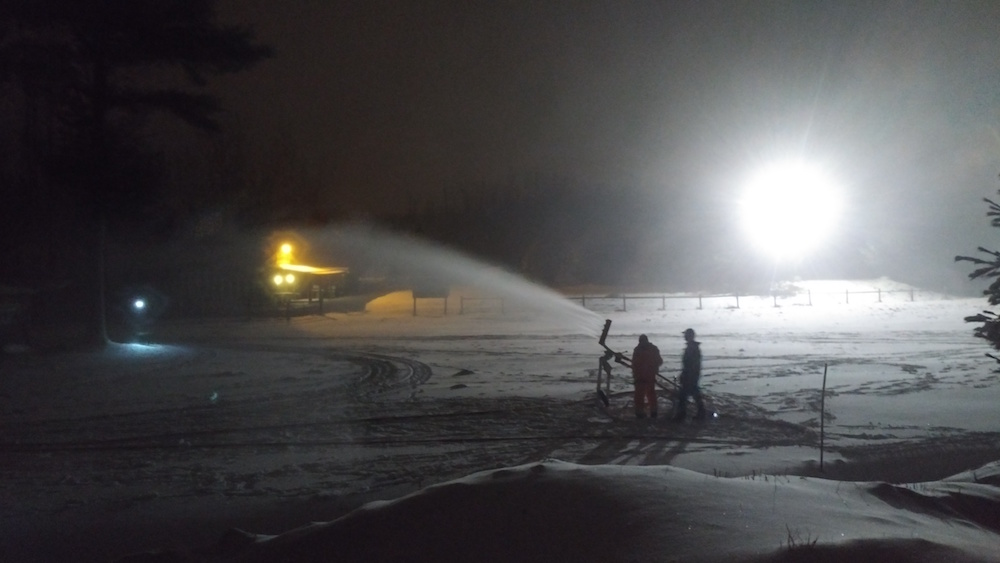
Nakkertok snowmaking in action for the first time in November, 2016. (Courtesy photo)
With two sets of ski trails just outside Ottawa and Gatineau, Nakkertok is the newest addition to reliable November snow. This month, one of the country’s largest ski clubs recently turned on its brand-new snowmaking equipment (which was largely funded by from its Project Play grand prize) and opened for skiing on Nov. 25.
According to Nakkertok Head Coach Kieran Jones, the club turned on five snow guns for the first time on Nov. 20 and was excited to test its new system and equipment. That night, the trails received an additional 15 to 20 centimeters of natural snow.
“Winter has definitely come to Ottawa-Gatineau, which is awesome!” Jones wrote. “Our initial goal was to create an 800m loop that covered our stadium, and extended out both ends. At that point we could then begin to push snow further to create 1 km of skiable terrain with a couple of quality climbs as well.”
He hoped they would have 1 k open for skiing by the end of last week.
“For now, the focus is on making sure we can have skate grooming,” Jones added. “Classic tracks will depend on the depth of snow that we’re able to produce. Nakkertok isn’t officially open to the public for day usage of the loop yet, but we’ll let you know as soon as it is!”
The Nakkertok Early Season Ski Loop (NESSL) is an important step for the region.
“It is great for the club, other clubs in the region and should allow a quality early season race site in the East,” Nakkertok fundraising mastermind Toni Scheier wrote in an email. “It will also ensure snow for the Easterns where clubs from across the country attend, (700 plus competitors) and for our Nationals bid, likely 2019.”
Simi Hamilton (l) hugs fellow U.S. Ski Team member Jessie Diggins after both placed third in their respective freestyle sprint finals at the World Cup stage in Gatineau, Quebec. (Photo: John Lazenby/Lazenbyphoto.com)
(Note: This is a brief summary of the top results for the North Americans at the Ski Tour Canada on Tuesday. Check back later for in-depth reports.)
GATINEAU, Quebec — Two podiums for the U.S. — that’s the definition of a banner day and it came in the first stage of the Ski Tour Canada on Tuesday.
Jessie Diggins and Simi Hamilton both raced to second in the women’s and men’s freestyle sprint qualifiers, respectively, rounding the two-lap, 1.7-kilometer course at Jacques Cartier Park with the second-fastest times in the World Cup field.
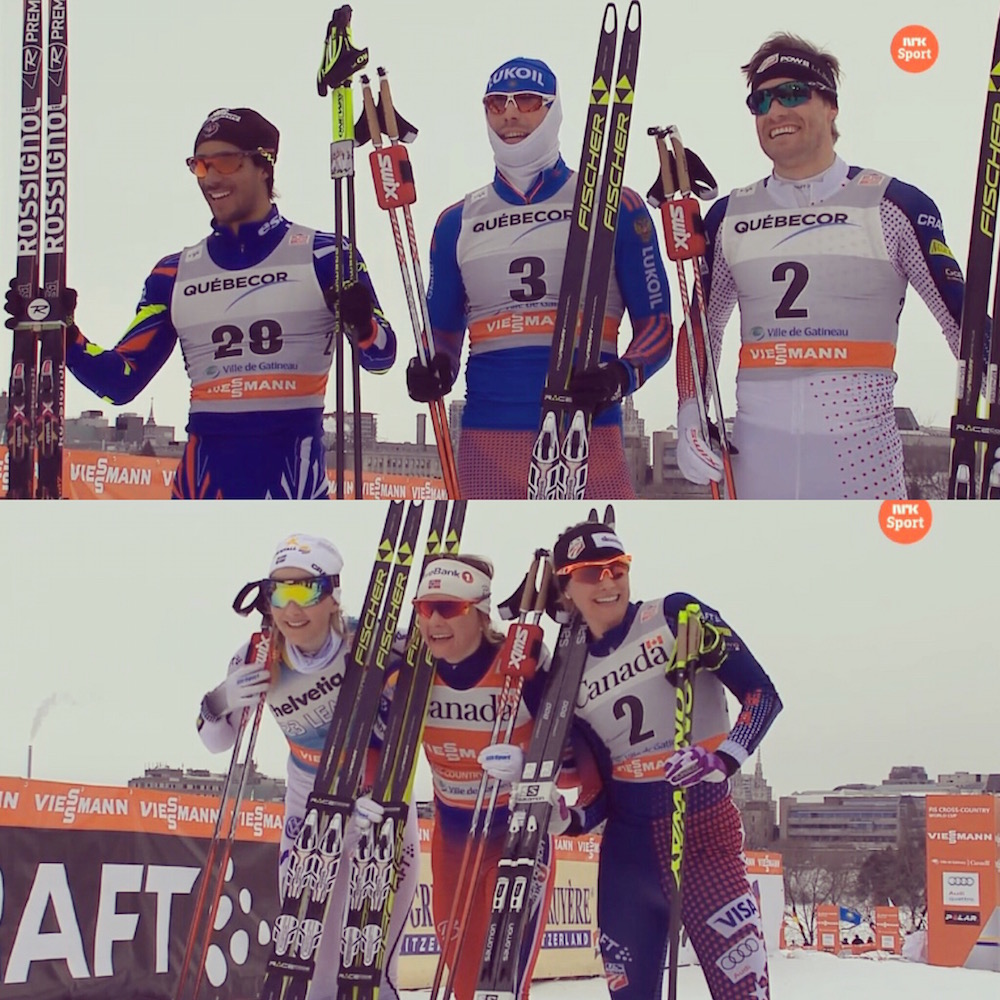
Their speed held up as both advanced to their respective finals, where Diggins and Hamilton both placed third.
“If you had told me at the start of the year that this is how it would go, I would’ve been like, ‘You’re kidding me. No way,’ ” Diggins said in an in-person interview after racking up her fourth World Cup podium of the season (and fourth podium in the last two months).
For the first time in cross-country World Cup history, a U.S. male and female reached the podium on the same day on Tuesday at the first stage of the Ski Tour Canada in Gatineau, Quebec. Simi Hamilton (top right) and Jessie Diggins (bottom right) both placed third in their respective men’s and women’s freestyle sprint finals.
She finished 0.87 seconds behind Norwegian winner Maiken Caspersen Falla, who won in 3:34.0. Sweden’s Stina Nilsson placed second, 0.73 seconds behind.
“This is super, super fun, especially because we’re in front of our family, friends, all of these skiers that are about this tall running around out there,” Diggins added, referring to the young local skiers in the Gatineau/Ottawa area.
“It’s so cool to feel like they’re part of this and we can finally bring the World Cups to home ground. For me, it really does feel like home ground because so much of my family is Canadian. I’m a dual citizen so anywhere in North America that I’m racing I’m just so pumped.”
At one point, someone asked Diggins to marry her during the final.
“I heard someone yell, ‘Marry me!’ right when there’s a silence, and there was this big pause, like, ‘Well, answer the guy!’ ” she recalled with a laugh. “But in all seriousness, it was great. I could hear my parents out there, and it was really cool to see so many American flags and Canadian flags.”
While Diggins celebrated her podium, Hamilton, her teammate on the Stratton Mountain School (SMS) T2 Team in southern Vermont, prepared for the men’s final.
There, he remained in contention throughout the race, even challenging Russia’s Sergey Ustiugov down the finishing stretch for the win. Ustiugov ended up winning by just 0.08 seconds over France’s Richard Jouve while Hamilton was another one-hundredth of a second back in third (+0.09).
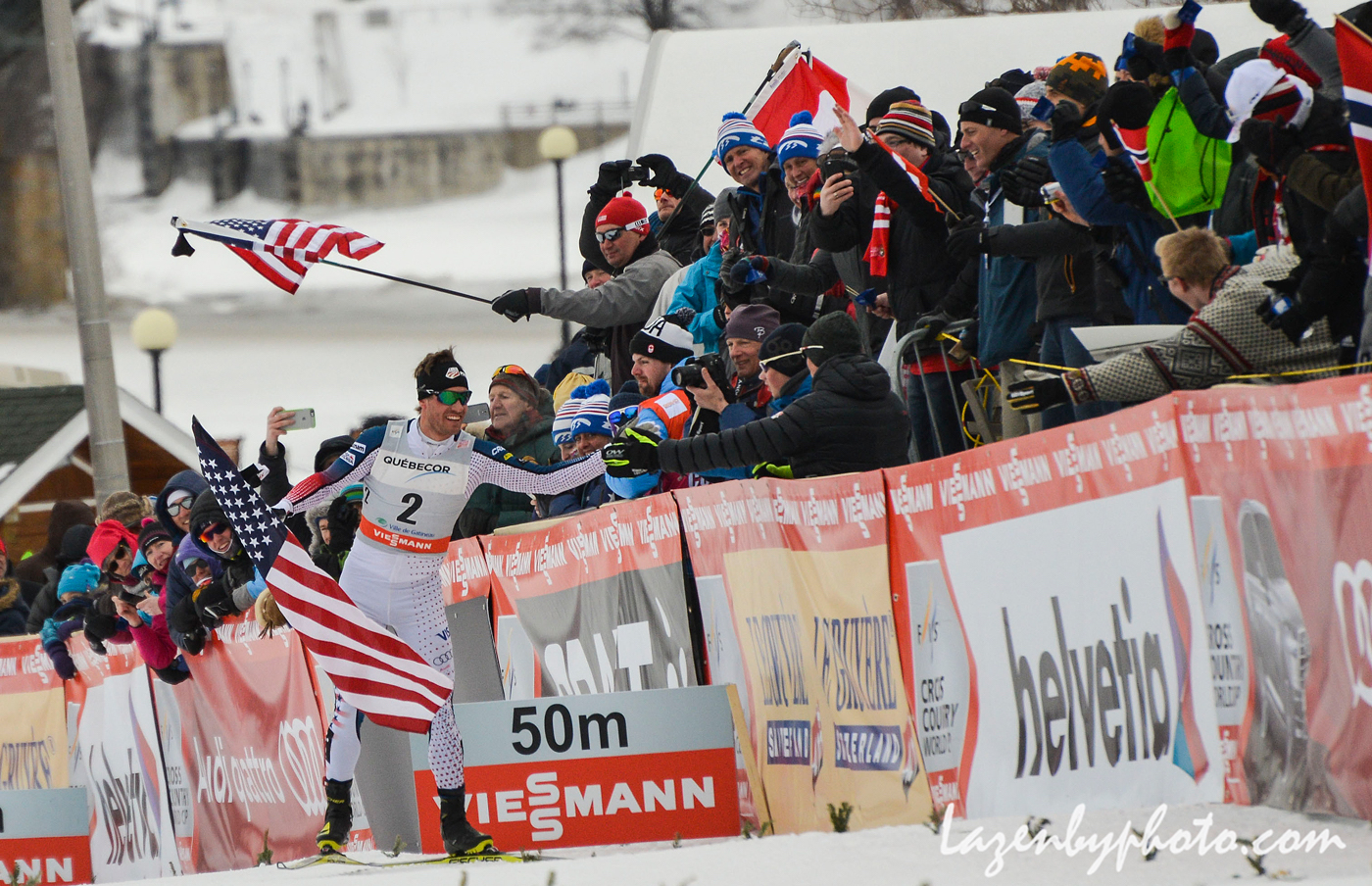
American Simi Hamilton during his “victory lap” after finishing in the top three of the men’s freestyle sprint at the Ski Tour Canada World Cup stage in Gatineau, Quebec. (Photo: John Lazenby/lazenbyphoto.com)
For Hamilton, it was both his best qualifier and second-best result of the season after placing second in the December freestyle sprint in Toblach, Italy.
“It was going well all day and I just kind of banked on having that in my quiver for the final,” Hamilton said. “So I focused on conserving my energy until then, and then tried to lay down as big a move as possible coming over that hill.
“It’s so awesome when you run to the start or even when you are racing, and you hear, ‘USA’ and ‘Simi,’ ” he added. “I have a lot of friends and family out here, it’s just super cool to race so close to home and people are fired up. I think I we are bringing a lot of good energy to cross-country ski racing on this continent, and it’s fun to be part of that movement.”
Leading Canada at its opening home World Cup, Alex Harvey placed 11th for his best freestyle sprint result of the season. He qualified in 15th and reached the semifinals as a lucky loser after placing fourth in his quarterfinal, just 0.29 seconds behind the winner of that heat, Ustiugov. In the first semifinal, Harvey finished sixth for 11th overall.
The second American woman on Tuesday, Sadie Bjornsen qualified eighth and went on to place fourth in her quarterfinal for 17th overall. Teammate Ida Sargent followed her in 24th after placing fifth in her quarterfinal, and Sophie Caldwell, also of the U.S. Ski Team, was 28th after placing sixth in her quarterfinal.
Canada’s 20-year-old Maya MacIsaac-Jones (Rocky Mountain Racers) qualified in 30th and went on to finish sixth in her quarterfinal for 29th overall.
In the men’s race, American Erik Bjornsen placed fifth in his quarterfinal for 25th overall, and Canada’s Knute Johnsgaard (Alberta World Cup Academy/Senior National Development Team) was sixth in his quarterfinal for 30th overall.
Americans Andy Newell and Dakota Blackhorse-von Jess during official training on Monday, one day before the start of the 2016 Ski Tour Canada in Gatineau, Quebec. (Photo: John Lazenby/Lazenbyphoto.com)
(Note: This article has been updated to reflect the adjusted distances for the men’s and women’s classic mass starts in Montreal on Wednesday, March 2.)
The U.S. Ski Team is ready. And we’re sure the Canadians are bursting at the seams. Are you? Over the last week, World Cup cross-country ski racers from about 25 nations descended on Ottawa, Ontario, and the Gatineau just across the river in western Quebec in anticipation of the first of eight stages at the Ski Tour Canada, which doubles as World Cup finals.
Races start Tuesday with the men’s and women’s 1.7-kilometer freestyle sprints in Gatineau, with the elimination rounds starting at 1:45 Eastern time, and continue Wednesday about 200 kilometers east in Montreal, Quebec, with the first distance races of the Tour: the women’s 10.5 k and men’s 17.5 k classic mass starts.
With temperatures up around freezing on Monday afternoon, the Gatineau sprint course both softened and transformed under the sun. It cooled down considerably overnight, with temperatures around -17 degrees Celsius (1 Fahrenheit) and a forecast high of -10 (14 Fahrenheit) with high winds expected.
Looking down the finishing stretch at the World Cup course in Montreal, as seen Monday two days before the races there on Wednesday. (Photo: Francois Leger Dionne)
A blizzard is also on the way, with snowfall anticipated in Montreal starting between 4 and 5 p.m. on Tuesday. Accumulation could be around 25-30 centimeters (10-12 inches) of snow Tuesday night and into Wednesday: race day in Montreal.
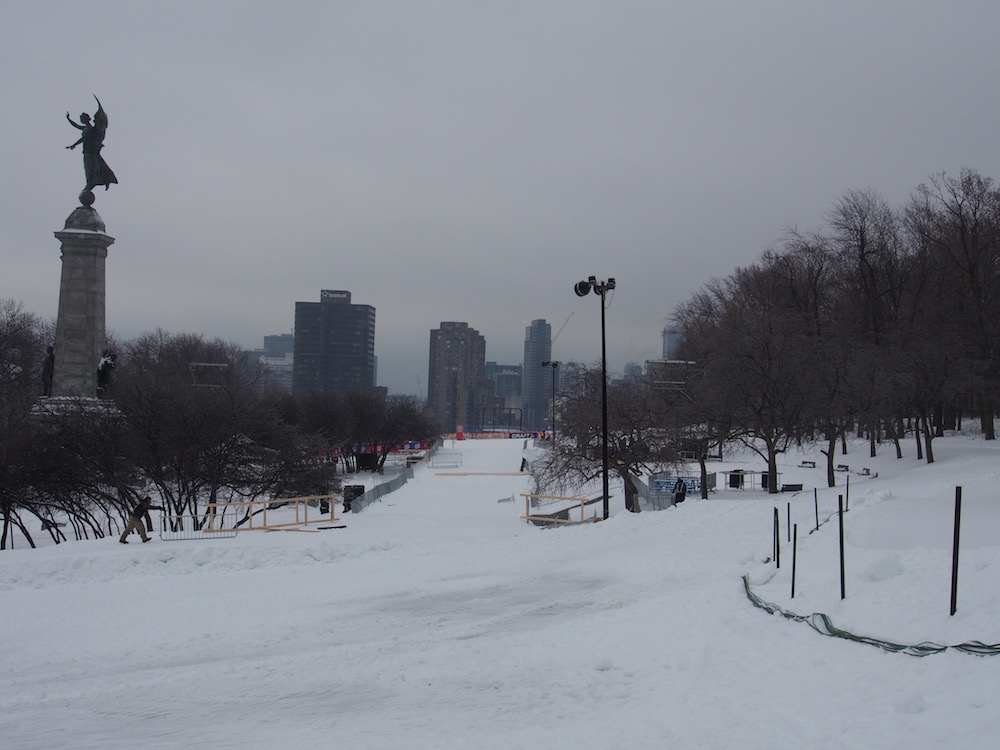
There, the 3.5 k course has been altered slightly from its original plan due to “technical challenges related to the water supply service,” which would have made snowmaking difficult atop Mount Royal, a large hill just west of downtown Montreal, organizers explained in press release earlier this month. The course was moved from the top to the bottom, near the George-Étienne Cartier Monument, “a location that is easily accessible to the public,” the release stated.
Snow conditions on Monday were “rock hard” and icy, according to one FasterSkier reporter, due to freezing rain Monday morning.
Like Gatineau, Montreal’s high temperatures were around freezing on Monday and forecast to be -10 Celsius on Tuesday and Wednesday.
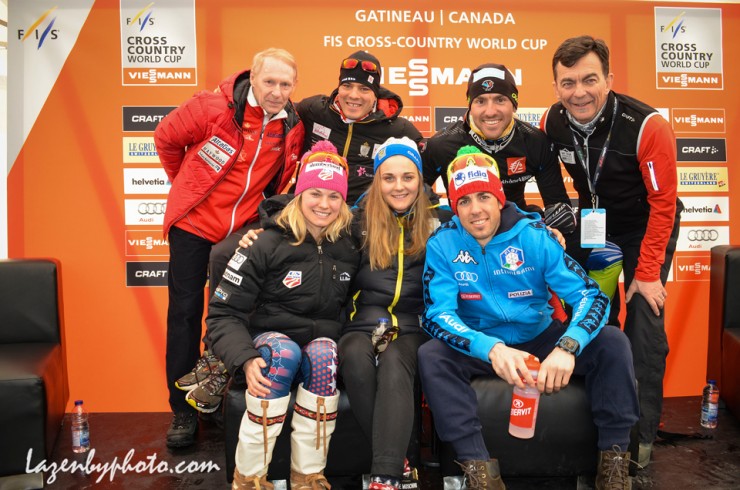
Here is a collection of photos and quotes from the days leading up to the Tour, as well as a complete schedule below.
A sunny day for the final day of official training before the start of the 2016 Ski Tour Canada in Gatineau, Quebec. (Photo: John Lazenby/Lazenbyphoto.com)
A little wax testing on Gatineau’s 1.7 k sprint course, with the start/finish area visible at the upper right. (Photo: John Lazenby/lazenbyphoto.com)
Petter Northug (Norway) during official training on Monday in Gatineau, Quebec. (Photo: John Lazenby/Lazenbyphoto.com)
FasterSkier: “Is this your first time in Ottawa?”
Simi Hamilton: “It is! I’ve been up to Quebec quite a few times and obviously Canmore a whole bunch, but first time to Ottawa and it’s awesome. Really cool. The skiing up here is amazing. I was telling the crowd earlier, it’s probably the best skiing we’ve had all winter, on natural snow and just hundreds of k’s of trails out here. So it’s really cool.”
–Interview by Alex Slobodan
The German World Cup team during official training in Gatineau, Quebec. (Photo: John Lazenby/Lazenbyphoto.com)
Alex Harvey (Canadian World Cup Team) surrounded by media on Monday, one day before the start of the Ski Tour Canada in Gatineau, Quebec. (Photo: John Lazenby/Lazenbyphoto.com)
Patrick Stewart-Jones representing Canada during Monday’s press conference, the day before the Ski Tour Canada’s first stage in Gatineau, Quebec. (Photo: John Lazenby/Lazenbyphoto.com)
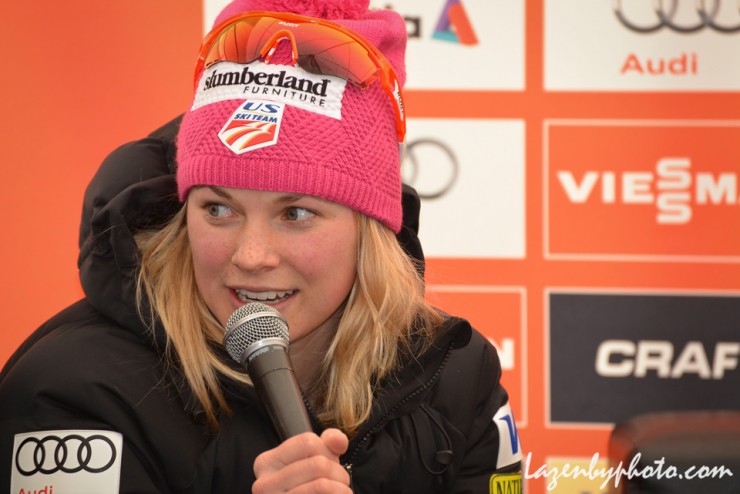
Jessie Diggins speaking on behalf of the U.S. team during Monday’s press conference, the day before the Ski Tour Canada’s first stage in Gatineau, Quebec. (Photo: John Lazenby/Lazenbyphoto.com)
Maurice Manificat during Monday’s press conference, the day before the Ski Tour Canada’s first stage in Gatineau, Quebec. (Photo: John Lazenby/Lazenbyphoto.com)
Stina Nilsson during Monday’s press conference, the day before the Ski Tour Canada’s first stage in Gatineau, Quebec. (Photo: John Lazenby/Lazenbyphoto.com)
Federico Pellegrino during Monday’s press conference, the day before the Ski Tour Canada’s first stage in Gatineau, Quebec. (Photo: John Lazenby/Lazenbyphoto.com)
(Photo: John Lazenby/Lazenbyphoto.com)
FasterSkier: “Have you ever been to Ottawa before?”
Francesco de Fabiani: “No, it is the first time I come in Canada and in America in general. I am surprised … Canada is a very nice place for cross-country skiing.”
FS: “What are your goals for the Tour?”
FDF: “Well, I hope to stay in the top 10 in the final ranking, but I know that it will be difficult with the free sprint. I don’t know how is the track in Montreal, the 20 k. And classic is my favourite technique, but if it is not so hard and someone can go with only double poling, I think that they will be difficult to stay with.”
FasterSkier: “What are your goals for the Tour?”
Erik Bjornsen: “I’ve had some pretty good races the last couple of weeks on the World Cup so I am hoping to keep that momentum going and score some points and just ski strong all the way through.”
A Russian athlete signs the toque of a local child at the Nakkertok ski trails in Cantley, Quebec, last weekend. (Photo: Doug Ranahan)
Nakkertok head coach Kieran Jones on the impact of a local World Cup: “Having the World Cup arrive in the Ottawa/Gatineau area is a great chance for our athletes to see what the strongest in the world look like. In North America you barely get to see the best cross country skiers on TV, much less in person, so the myth and legend grows to the point where they can seem inhuman. Having Northug, Kalla, and Caspersen Falla skiing around at Nakkertok really brings home the reality of the sport to the kids and young adults, and shows them that these fast skiers are still people, and are totally approachable, and people you can aspire to. The buzz that having the world in your city and club generates is great for the sport, and great for the club.”
Norway’s Maiken Caspersen Falla (in pink) skis by a young local skier at the Nakkertok ski trails on Saturday in Cantley, Quebec. (Photo: Doug Ranahan)
Norway’s Maiken Caspersen Falla training on Saturday at the Nakkertok trails in Cantley, Quebec. (Photo: Doug Ranahan)
Two Nakkertok juniors, Pat Paradine (in yellow) and Hugh Graham (left, in blue and black), chase Russian World Cup skiers on Saturday during training at the Nakkertok trails in Cantley, Quebec. (Photo: Doug Ranahan)
Nakkertok’s Hugh Graham (l) and Pat Paradine double pole behind two Russian World Cup skiers (not shown) at the Nakkertok trails in Cantley, Quebec, the weekend before the Ski Tour Canada stage in Gatineau, Quebec. (Photo: Doug Ranahan)
Nakkertok’s Alex Slobodian chases a Norwegian on the Nakkertok trails in Cantley, Quebec. (Photo: Doug Ranahan)
FasterSkier: “Have you been to Ottawa before?” Markus Cranmer, former German junior coach, now a Russian coach for Alexander Legkov’s training group: “No. It’s the first time for me to be here. Very nice, very nice for skiing and very nice tracks here. I’m really surprised! … Not too far from the city and so it’s very nice.”
“I’m looking forward to the entire experience and not putting too much weight into any single race,” Jackson wrote in an email. “Every race as my next best opportunity, in a Tour format you can’t write off any race because every day matters if you want to get to the next one. I am a more partial to the sprints though.
“Racing for Canada on home soil is pretty darn cool, but being able to represent my training centre (NDC Thunder Bay), province (Ontario), and club (Team Hardwood), is even more inspiring because they are the ones who have fostered my development as a skier to a level where I can be part of Team Canada.”
All races are expected to be broadcast on NBC Sports Live Extra (accessible to U.S. subscribers via cable or satellite), and all times are Eastern Standard Time.
Tuesday, March 1: Gatineau
(Not part of broadcast: Women’s qualifier at 11:15 a.m.: start list | Men’s qualifier at noon: start list)
1:45 p.m. – Men’s and women’s freestyle sprint heats
Wednesday, March 2: Montreal
12:00 p.m. – Women’s 13 k classic mass start
2:30 p.m. – Men’s 20 k classic mass start
Friday, March 4: Quebec City
3:30 p.m. – Men’s and women’s freestyle sprint
Saturday, March 5: Quebec City
3:00 p.m. – Women’s 10 k freestyle pursuit
4:00 p.m. – Men’s 15 k freestyle pursuit
Tuesday, March 8: Canmore
3:00 p.m. – Men’s and women’s classic sprint
Wednesday, March 9: Canmore
12:00 p.m. – Women’s 15 k skiathlon
2:30 p.m. – Men’s 30 k skiathlon
Friday, March 11: Canmore
11:45 a.m. – Women’s 10 k freestyle interval start
3:00 p.m. – Men’s 15 k freestyle interval start
Saturday, March 12: Canmore
3:00 p.m. – Women’s 10 k classic pursuit
4:00 p.m. – Men’s 15 k classic pursuit
The view from a high point at the Canmore Nordic Centre during the 2012 Alberta World Cup. The venue will serve as one of five stops on the new Ski Tour Canada in 2016.
When Ski Tour Canada 2016 was announced as the finale to the 2015/2016 cross country World Cup season last year, North American fans were excited at the prospect of the first race of its kind taking place this side of the pond. At the recent 2015 FIS Calendar Committee meeting in Varna, Bulgaria the Tour’s dates and races were confirmed giving fans a better idea of what to expect come spring of 2016. Starting with a freestyle sprint in Gatineau, Quebec and concluding with 10 and 15 k classic pursuits in Canmore, Alberta the eight-stage Tour will take place over the course of the first 12 days of March.
Ski Tour Canada 2016 at a glance:
Gatineau, March 1: Freestyle Sprint
Montréal, March 2: 13/22 k Classic Mass Start
Québec City, March 4: Freestyle Sprint
Québec City, March 5: 10/15 km Freestyle Pursuit
Canmore, March 8: Classic Sprint
Canmore, March 9: 15/30 km Skiathlon
Lake Louise, March 11: 10/20 km Freestyle Individual Start
Canmore, March 12: 10/15km Classic Pursuit
Early on in the planning process, Ski Tour Canada (originally billed as Tour du Canada) was set to take place in mid-February. However, the prospect of hosting the tour on North American soil in the middle of the season was too complex, and the event was moved to the end of the season.
According to a press release by Cross Country Canada, the next step for tour will be a list from FIS technical and marketing officials to examine and approve each venue’s stadium and courses. “The next major milestone includes a visit in August by the FIS technical staff and marketing representatives to approve tracks and stadium layouts used on each stage of the tour,” Dave Dyer, director of events at Cross Country Canada, said in the press release. “With under a year to go before the Tour gets underway, we’re really excited about the project and can’t wait for the 2015-2016 season to start!”
The organizing committee behind Ski Tour Canada recently unveiled a website for the event along with a new logo. Check out the tour’s first promotional video, featuring retired skier and Olympic gold medalist Chandra Crawford, below.
The NorAm Canadian Eastern Championships are returning to Gatineau/Cantley for three days of racing from Jan. 30-Feb. 1. (Photo: Diane Galus)
(Press release)
The 2015 Haywood NorAm Canadian Eastern Championships and Buff Sprints is a prestigious cross-country skiing event which takes place on January 30, 31 and February 1, 2015, at the Nakkertok South Nordic Centre in Gatineau/Cantley, Quebec. “The Easterns,” as the competition is known, is sanctioned by the International Ski Federation (FIS) and is part of the Haywood NorAm Race Series.
The Easterns permits Canadian cross-country skiers, both experienced and novice (seniors and juniors, men and women), to compete neck and neck with skiers from across Canada and the United States. More than 600 female and male athletes from the midget to the masters categories compete in freestyle and classic technique races on courses with distances ranging from 1 km to 20 km in length.
(Photo: Diane Galus)
The competition is organized jointly by the following Ottawa–Gatineau region cross-country ski clubs: Chelsea Nordiq, Nakkertok Nordic, Club Skinouk, Kanata Nordic, XCOttawa, XC Chelsea Masters and the Carleton University Nordic Ski Team. More than 200 volunteers from these clubs welcome athletes, coaches and spectators throughout the weekend.
For more information and specifics on all aspects of the event, including the race notice, registration fees and directions, please go to our Canadian Eastern Championships website at http://cecski.ca/. Anyone interested in racing should register at Zone 4.ca. All entries and payment will be processed on-line, starting 4 December, 2014, at the latest, through Zone 4. Entries must be submitted by 23:59 EST on Monday, 26 January, 2015.
The race weekend is a family-friendly winter event: a food concession, warming chalet, and portable toilets can be found on site, and admission for spectators is free. Come and watch some of the best nordic racers in Canada flying over groomed trails as they are accompanied by the ringing of bells and cheers from waves of spectators. Warm footwear and clothing is recommended.
Please note: Extreme cold weather may cause a delay in start times.
The view from a higher point at the Canmore Nordic Centre during the 2012 Alberta World Cup. The Centre will serve as venue for the fifth, sixth, and eighth stages of the newly slated Tour du Canada in 2016.
Canada will be hosting a late-season World Cup tour in 2016. An exciting development for North-American skiing, the proposal cleared yet another hurdle at the International Ski Federation (FIS) 2014 Congress last week in Barcelona, Spain, after receiving a set program.
The Tour du Canada will feature eight stages starting March 1, 2016 and continuing until March 12.
Commencing with a city sprint in downtown Gatineau, Quebec, the tour will then travel to Montreal and Quebec City. Competitors will then either take a train or chartered flight to Alberta, where they will compete in the final four stages, which will take place at the Canmore Nordic Centre and Lake Louise.
“It’s an ambitious plan,” said Chris Grover, chairman of the FIS Committee for World and Continental Cups (as well as the U.S. Ski Team head coach) on the phone last Friday. “They are trying to create something special, which was the request of FIS – to find something special in a non-World Championship and non-Olympic year to draw viewership back to cross country in the second half of the season. The Canadians have really stepped up to the plate.”
Skiers navigate ‘the ledge’ on the backstretch of the 2012 World Cup course in Quebec City. The Canadian city will serve as the third and fourth stops of the Tour du Canada in 2016.
The newly slated Tour du Canada was previously scheduled for February, but was moved to the end of the season to accommodate athletes’ travel schedules and maximize participation in the tour.
“It’s going to challenge athletes and it’s going to challenge teams, and that’s why ideally we would need to have it at the end of the season,” Grover said. “At the best we get the absolute greatest participation and I think it’d be an incredible way to finish the season.”
The move to the end of the season does, however, pose a conflict in regards to scheduling. With the placement of the Canadian tour in March, traditional spring venues such as Lahti, Drammen, Oslo, Falun, and Stockholm will need to be rescheduled.
While it may be easy for cross country to make the calendar change in 2016, coordinating with the remaining nordic disciplines is where the true challenge lies.
“It’s not as easy as saying, ‘cross-country would like to do this’,” Grover explained. “It really requires coordination between all of the nordic disciplines. The changes would be really positive for our schedule going forward, are not necessarily easy for the other disciplines to make, especially when they are traditionally blocked out those Scandinavian venues for March.”
Despite the disruption to the traditional calendar, Grover said that he didn’t witness any opposition to the proposal during his time at the congress. In fact, he said the tour’s move to March had the possibility to ensure that other World Cups are also highly attended. If the tour had been held in February, athletes returning to Europe from may have skipped some World Cups.
While the changes to the rest of the schedule are still being finalized, the reorganization will aid in the creation of the 2016/2017 season because the international-racing circuit needs to visit South Korea for a pre-Olympic World Cup.
“It’s very hard to put something like a stop in South Korea into a schedule that is primarily focused on races in Europe, especially on a year that includes the World Championships,” he added. “So ideally something like that would go at the end of the year, but then we run into the same scheduling conflicts.”
The Tour du Canada, in addition to the 2015/2016 and 2016/2017 World Cup calendars, will be revisited by FIS in the coming months to finalize logistics.
Winter is upon us and we are extremely pleased to announce that the first snowflakes have already fallen on Gatineau. Therefore, it is the the perfect time to prepare for the biggest cross-country event in Canada: the GATINEAU LOPPET.
Many surprises and major news will be at the front of the 35th edition of the event, which will be held from February 15th to 17th 2013 in the Gatineau Park. We are looking forward to seeing you on our paths.
– Yan Michaud, president of the Gatineau Loppet
New challenges: two classic courses of 38km and 55km
For this anniversary year, two new linear 38 km and 55 km classic style courses will link Lake Philippe to Mont-Bleu High School in Gatineau. The president of the Gatineau Loppet, Mr. Yan Michaud, is “extremely pleased to offer this 35th anniversary gift for ski lovers in the region and abroad.” These new courses were tested last winter by Mr. Richard Weber, Canadian Explorer and cross-country ski master. He was thrilled by the quality of the courses and strongly encourages skiers to try them in 2013.
Please note that our regular races of 5 and 20 km classic style and 2, 10, 27 and 51 km freestyle will be scheduled from Mont-Bleu High School, as per previous years.
A new sanction
Gatineau Loppet is pleased to announce that the wave A of the 55 km classic will be sanctioned by Cross Country Canada, allowing Canadian and international long distance skiers to collect points for the Canadian Points List.
See this link for details about this new sanction.
Register before December 15th
You can take full advantage of the Gatineau Loppet and at reduced prices. Different promotions are available if you register before December 15th, 2012. Get 35% off if you will be celebrating your 35th birthday in 2013 or also ski two races and receive a 25% discount on the least expensive (applicable to 27, 38, 51 and 55 km).
From December 7 to 9, 2012, we will be at the Village Sprint Quebec during the FIS Cross-country skiing World Cup. This is an opportunity to come and speak with us at our feeding station.
Call for Volunteers
Become a volunteer for the Gatineau Loppet and be a part of the biggest cross-country skiing event in Canada. Participate in this international gathering by joining our large volunteer family today!
Click here for more information on available positions.
Canadian Ski Marathon
Learn about the Canadian Ski Marathon, a Nordic ski tour of 160 km over two days that will take place on February 9 and 10, 2013 between Gatineau and Lachute, Quebec.
Remember to “like” the Facebook page of the Gatineau Loppet!
Fast and Female Partners with Canadian Cycling Association, Fédération Québécoise des Sports Cyclistes & Grand Prix Cycliste Gatineau to Inspire Girls on Bikes
GATINEAU, QC (April 20, 2012) — Fast and Female is branching out to run the first-ever road cycling event on May 20, 2012. In exactly one month, girls ages 9-19 who are interested in road racing and cycling in general will join Fast and Female ambassadors for a morning of inspiration, fun and activity on two wheels.
Piggy-backed with the Gatineau Grand Prix, the Fast and Female Road Cycling event will run from 9 a.m. to noon and will include a group ride, inspirational talks with ambassadors, dancing and stretching, and finish off with autograph signing. Activities will kick off at the Centre La Génération at 35 Rue Davies in Gatineau.
Ambassadors for this event include National Cycling Team’s Denise Ramsden, Leah Kirchmann, Joëlle Numainville, and Leah Guloien.
“We hope that this event will help young girls to see how much fun riding a bike can be and inspire them to stay in sport,” said Ramsden. “This event is a great opportunity for us to give back to a sport that has given us so much.”
The Gatineau Grand Prix is in its third year as a UCI event. Started as a replacement for cancelled races, the race has grown in participation every year and spawned many other events surrounding the races.
For this Olympic year, the GP Cycliste Gatineau Hydro-Québec and the Chrono Gatineau – the only two races sanctioned by the Union Cycliste Internationale in Canada – will take place on May 18 to 21 and provide one of the last chances to earn points to qualify for the Games. Thus, these two races will be critically important to the world of women’s cycling. Which is why we made the route longer and tougher, in an effort to make it closer to the one in London. More information on the event is available at www.grandprixcyclistegatineau.com.
Kirchmann of Winnipeg, MB, came in fourth in last year’s Grand Prix and is hoping to inspire the girls to pursue their own dreams. “I had a lot of opportunities growing up so I want to try and give other girls the chances I had to lead an active lifestyle and be involved in sport.”
Guloien of Port Moody, BC, comes from a running and rowing background and hopes to share her love of sport with others. “Sport has always been a positive and healthy influence, helping me keep a balance with school and other activities.”
Young female cyclists of all abilities are invited to attend the event with their own road or mountain bikes.
“The Canadian Cycling Association is happy to be supporting this activity which encourages physical activity and healthy habits amongst female youth,” said Mathieu Boucher, Director, Development for Canada’s governing body in cycling. “We are aware that in addition to offering outstanding performances, our Canadian athletes are a great source of inspiration and motivation for girls,” he added.
This event will cost $20 and will include a snack, a technical Fast and Female t-shirt by Karbon ($40 value) and a Fast and Female Buff (multifunctional headwear valued at $23). Participants can learn more by visiting www.FastandFemale.com and sign up at http://ffmay20gatineau.eventbrite.com/. Online registration will close on May 19 at noon. On-site registration will be possible at a fee of $25.
Fast and Female would like to thank all event partners including the Gatineau Grand Prix, the Canadian Cycling Association, the Fédération Québecoise des Sports Cyclistes, as well as Fast and Female’s national partners Best Buy Canada, Clarins Canada, Cold-FX, Buff Canada, Sportchek, Globo Shoes, Karbon, Champion System, Lululemon Athletica, LUNA Bars, LIT Glitter, SAUCE Headwear.
ABOUT FAST AND FEMALE
Fast and Female is a not-for-profit society started in 2005 by Chandra Crawford, the 2006 Olympic gold medalist in cross-country skiing. The organization’s mission is to support, motivate, inspire, and empower girls to stick to sports and the healthy lifestyle. Fast and Female fulfills its mission of “Empowerment Through Sport” by hosting fun-filled, non-competitive initiatives all across North-America aimed at exposing young female athletes to inspiring female Olympians and elite level athletes. The young girls who attend Fast and Female events today will lead it in the future, may it be as athletes, coaches, volunteers, parents, and community leaders. For more information about Fast and Female, visit /
ABOUT THE CANADIAN CYCLING ASSOCIATION
The Canadian Cycling Association (CCA) is the governing body for competitive cycling in Canada. Founded in 1882, the CCA aims to create and sustain an effective system that develops talented Canadian cyclists to achieve Olympic, Paralympic and World Championship medal performances. With the vision to be a leading competitive cycling nation by 2020 celebrating enhanced international success, increased a participation and world class event hosting, the CCA manages the National teams, hosts national and international events, and administers community programs to promote Cycling in Canada. For more information, please visit: http://www.canadian-cycling.com/.