From the FasterSkier archive — posts syndicated from athletes’ and coaches’ own blogs between 2004 and 2012, kept online as published. Current coverage is at fasterskier.com.
The cross-country ski tting experts are bringing North America’s largest inventory to you!
WHO’S INVITED? All Club Members & Coaches
WHEN IS IT HAPPENING?
Saturday, October 7th from 11am – 7 pm
Sunday, October 8th from 11 am – 5 pm
WHERE IS IT HAPPENING? Trolley Square Shopping Center – next to Wells Fargo 600 S 700 E, Salt Lake City, UT 84102
WHY GEAR WEST?Our philosophy – fit matters. Gear West is based in Long Lake, Minnesota. We are the largest retailer of Nordic ski equipment in North America. Our size allows us “first pick” from the warehouses and factories of the manufacturers we work with, resulting not only a large inventory — but a quality selection of
hand-picked skis. We take pride in the fact that the skis we outfit our customers with are precisely fit for specific conditions as well as the person’s skiing ability and budget.
WHO IS COMING OUT TO FIT?
Jenny Beckman
Director of Nordic Sports
Michael Stearns
Ecommerce & Marketing Manager
Jenny & Michael have 20 + years of combined ski fitting experience. Michael has personally selected all of the skis for Gear West’s current inventory. Prior to Gear West, Jenny was the Salomon Nordic Race Service & Community Marketing Manager where she worked with the S/Lab team to select skis for Salomon athletes.
Ski training during the summer and fall is critical to improving cross country ski technique and fitness. Rollerskiing is an important part of a well-rounded summer program because rollerskis do an excellent job imitating on-snow training. Like skiing on snow, rollerskiing exercises arms, legs, core and improves cardiovascular fitness. Rollerskiing is also great training for injured runners who are looking for an alternative low-impact, weight bearing workout.
The saying “Skiers are made in the summer” is absolutely true because winters aren’t long enough to get all the workout time in to build the base needed to improve at an endurance sport like cross country skiing. So skiers need to rollerski in the summer, along with strength training and running/pole hiking, to get the work in to build their base and develop technique.
Okay, You’ve Convinced Me – Now, What?
Pick One: Skate or Classic
Skate rollerskis are identified by having shorter shafts and narrower wheels with larger diameters than classic rollerskis. Classic rollerskis are longer, have wider wheels and smaller diameters for easier balance with a ratchet in either the front or rear wheel to provide kick.
Simply select the technique you would like to improve in. Skate if you want to improve your strength and technique for skate or classic if that is where you want to improve. If you are unsure, the rule of thumb is — practice good skate technique on rollerskis before classic. Skate skiing on good rollerskis, whether it’s V1, V2 or open field, imitates all aspects of on-snow skate skiing. Classic rollerskis are perfect for developing the arms and core strength needed to improve on-snow classic performance, but their “perfect kick” can lead to learning poor kicking form. Getting a kick while striding on snow requires strong technique, including good weight transfer, and this is not necessarily a requirement for classic rollerskiing.
How About Combi Rollerskis?
Only a combi ski can be used interchangeably between techniques, and allows an individual to practice both skate and classic. The combi design is essentially a short classic rollerski. When used for skating the wheels can wear unevenly if they aren’t rotated often. They also don’t skate as easily as a skate specific rollerski. When climbing hills, the fatter wheels tend to have a harder time angling to accommodate the skate technique without the wheel bolts brushing the pavement. Also, when combi skis are used for classic skiing, guides need to be attached to the tip of the ski to prevent the front of the rollerski from catching on the ground while striding. Our suggestion is to choose either a dedicated classic or skate rollerski.
I chose my technique – now which rollerski do I pick?
Elite skiers almost always select lightweight rollerskis with hard rubber wheels designed for smooth surfaces, with either with an aluminum or composite shaft depending on the intensity and length of the workout. In general, aluminum rollerskis are more durable but are less effective at absorbing road vibration, while composite rollerskis provide the most realistic “snow feel,” but can break if repeatedly bottomed out.
New skiers, older skiers, or skiers who are worried about falling may love the V2 rollerski line because of the added stability of the inflatable Aero wheels and all the cool breaking gadgets they can add to any of the rollerskis in the V2 line. The V2 design offers the ability to add brakes and/or speed reducers to the wheels. Speed reducers operate with a little lever, which the skier presses down to engage a bearing against the rollerski wheel for added resistance to slow the ski. A brake acts more like a normal brake. Leaning back will engage the calf which in turn activates the break. Leaning back more aggressively adds more pressure and quicker breaking.
Additionally the V2 Aero line is designed with wider and taller wheels to handle skiing on bumpy terrain. These skis roll over grass and gravel and are fun to cruise on crushed limestone trails. The Aero 125 is designed for skiers under 150 lbs. The wheels have inner tubes and should be kept inflated with a bicycle pump. The V2 150 Aero is designed for larger skiers or those looking for the ultimate in stability on bumpy terrain.
What Other Equipment is Needed?
Bindings
Rollerskis use the same bindings as regular snow skis. Skate boots need skate bindings and classic boots require classic bindings. Either the mid-priced bindings (such as the Salomon Sport Pilot) or the performance bindings (Salomon Pilot Skate) can work. Inexpensive touring bindings are not recommended as they use less expensive plastics that will crack under continual rollerski use.
Boots and Poles
Many newer skiers and rollerskiers may use the same boots and poles for both rollerskiing and snow skiing. The nature of rollerskiing makes it very hard on equipment, however, so most serious skiers will eventually dedicate a second set of equipment specifically to rollerskiing. In any case, poles should have their snow baskets replaced with a set of carbide rollerski ferrules. Also notable: ski boots can be very warm to wear during the summer, so some boot companies sell more breathable rollerski versions of their boots.
Safety Equipment
Finally, it is vital to wear some safety equipment to protect yourself in the event of a crash. The most important of these is a helmet. Most rollerskiers use a standard bike helmet, though any similar helmet will work. In any case, you should always wear some sort of head protection when you are snapped into your rollerski’s bindings.
Rollerski gloves are also used to protect hands from abrasions and blisters. Gear West carries rollerski gloves from Bjorn Daehlie, Toko, and Lill Sport. Finally, knee pads can be added for even more protection, although generally knees won’t hit the ground even if you do fall. Wrist guards should not be worn because mobile wrists are needed to rollerski.
Safety Advice
With practice and care, rollerskiing can be a low risk, high reward method of exercise. It is very low impact and can be done for hours at a time without beating up your body. It is important, however, to acknowledge that like with all things worth doing, there ARE risks. Crashes are a possibility and you must respect that and keep your safety in mind at all times. To help you stay safe, keep the following advice in mind as you begin rollerskiing.
Wear appropriate protective gear with respect to your coordination, fitness and terrain. ALWAYS wear a helmet.
To start, choose a location that is flat, clean of debris and has minimal car traffic
Learn how to stop on rollerskis and practice this skill. You can view our Rollerski Basics video for instructions on stopping.
Use good equipment. Start with new rollerskis. Old, worn wheels can be less stable and older bearings may not run as smoothly as they should. Also, old rollerskis may have been damaged in a way that affected the alignment of the wheels.
Use boots which provide good stability. For example, do not use touring boots for classic skiing as the sole is too soft and will twist under pressure. Similarly, low-end combi boots for skating won’t provide you the stability needed for balance. Ankles will wobble and you will risk falling.
Regularly sharpen roller ferrules so pole tips will give you good purchase into the asphalt. This is particularly important on cold/hard pavement.
Get coaching. Learn good habits before you have to unlearn bad ones.
Watch this video to learn the movements you are trying to perfect.
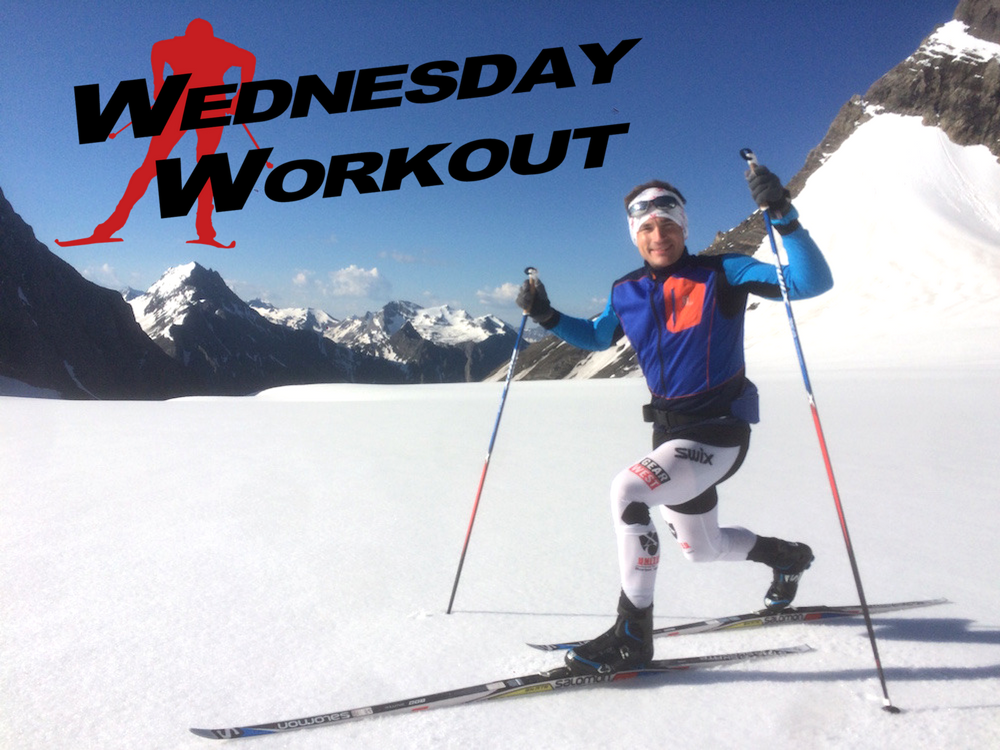
Matt Liebsch (Gear West/Salomon) skiing on Haig glacier near Canmore, Alberta, this past July. (Courtesy photo)
Nicknamed “The Dirty Thirty” by Drew Holbrook, FasterSkier’s featured Wednesday Workout for this week comes from Gear West/Salomon athlete Matt Liebsch, offering an end of summer/fall workout sure to boost speed and pain-cave stamina.
***
Dark, damp and delusory — the so-called pain cave is a place perhaps all too familiar with nordic-ski racers. But, at least according to Gear West and Salomon athlete Matt Liebsch, there is a place and time (30-second intervals to be exact) to test pushing past race pace.
“It hurts but one of my favorite workouts is nicknamed ‘The dirty thirty’ … Drew Holbrook came up with that name after his first attempt to complete the workout,” Liebsch, 33, wrote in an email.
The “Dirty Thirty” also known as 30/30s, is a Level 4/Level 5 rollerski workout, aimed at training above race-pace speed, but doing so within a short interval. By mixing the speed work with VO2max work, the end result is, as Liebsch indicated, a high-intensity interval training (HIIT) workout.
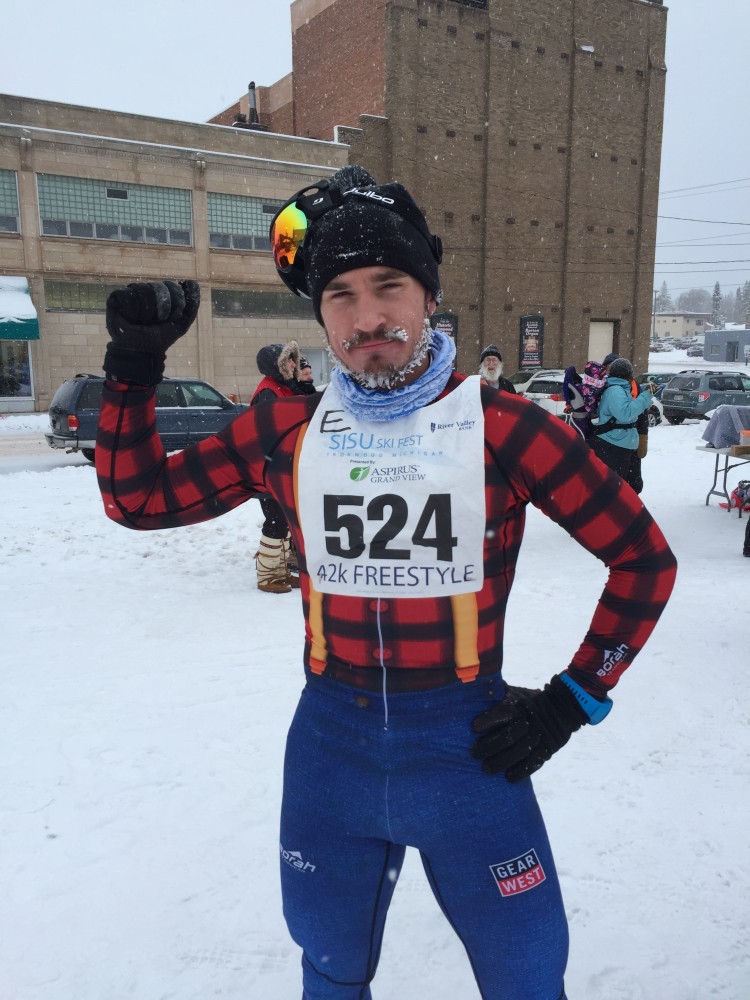
Matt Liebsch (Gear West/Salomon) at the finish of the SISU Ski Fest marathon in Ironwood, Mich. (Courtesy photo)
“This workout seems important when an athlete is bumping up against their ‘ceiling’; Lv3 speed is getting close to V02max speed,” Liebsch explained. “When you do a lot of distance and Lv3 work in the summer, threshold speed and V02max speed seem to get closer to each other… this workout will raise the speed ceiling at V02max allowing more room for growth in Lv3 speed. There is also a very important neuromuscular component to this workout… training the brain to fire muscles quickly is important.”
He recommends doing this workout two to three times a year, usually twice in the summer and once in the fall. Flat or gently rolling terrain is best, as anything too steep makes it difficult to reach max speeds during “on” time.
“It is a very taxing workout and usually the recovery period is 48-72hrs before you feel better,” Liebsch wrote. “I won’t complete this workout if I am feeling on the cusp of illness or if I am having [heart rate] suppression or general fatigue. The post workout recovery is important… just distance training for 3-4 days post session.”
Though Liebsch is not one to turn down a challenge, maintaining that “I love going fast and I love the ‘pain cave’, ” he also suggests that athletes be conscious of what their bodies are telling them prior to and during the Dirty Thirty workout.
“Going hard is fun and can make you faster but there needs to be a balance,” he wrote. “I see way too many masters and juniors going too fast in Lv1/Lv2 and not fast enough in their intensity sessions. The nice thing about the ‘dirty 30’ is once you complete the workout, you won’t feel like skiing too fast in your Lv1 training over the next few days.”
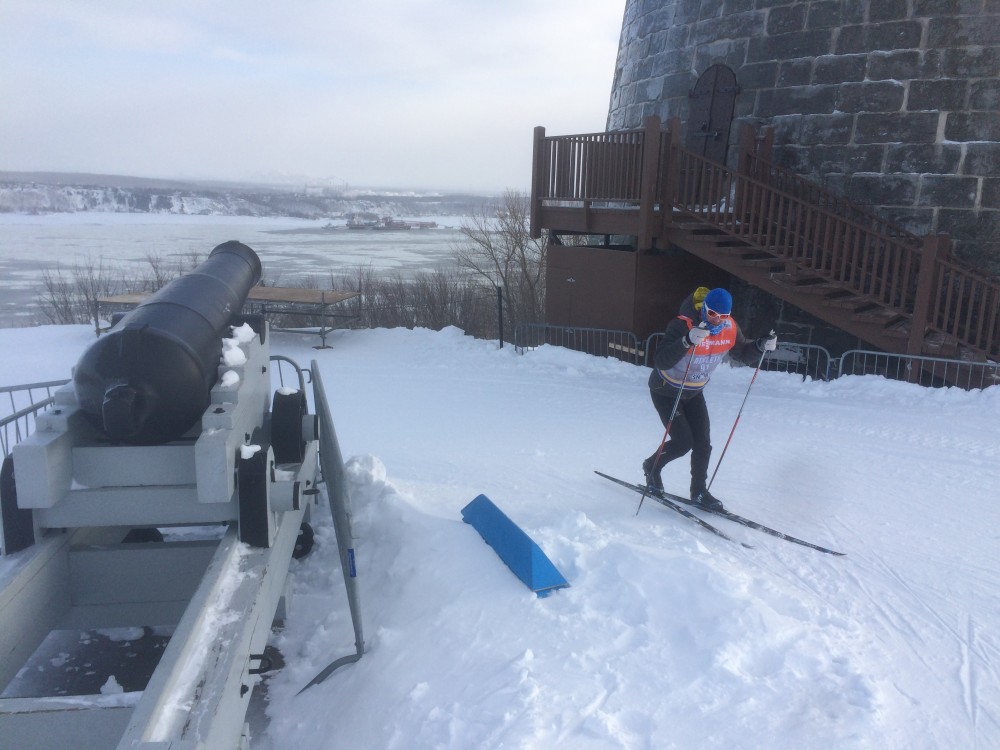
Matt Liebsch (Gear West/Salomon) on a training day at the 2016 Ski Tour Canada in Quebec City, Quebec. (Courtesy photo)
The Workout: Dirty 30 (or 30/30s)
Purpose: Train speed above race pace, while simultaneously taxing body for a short time period
Warmup: 15-20 minutes easy skiing with 5 x 10-second light speeds throughout
Liebsch says the point of the speeds during warmup are to “activate higher level energy systems.”
The set: 30 seconds of “on” time followed by 30 seconds of “off” time
Liebsch suggests 30 minutes of 30/30s for juniors and masters and 60 minutes of 30/30s for senior skiers
Cool down: 20 min: 10 minutes easy skiing followed by 5 minutes of 55 seconds “off” and 5 seconds “on” followed by and another easy 5 minutes
Body exertion, not exhaustion. “Caution!” Liebsch wrote. “Playing with fire can make you hot but it can burn you too. I have been on both sides of the fence with HIIT/Tabata and over-training as an athlete. There is a time and place for extremely taxing workload. Listen to your body, confer with a coach and be smart.”
It’s a matter of mind AND matter. “As a rule of thumb, the first 6-8 minutes of this workout feel pretty good/easy, after that it starts to hurt,” he wrote. “Between 20-40mins the workout will feel unbearable at times… this is where mental fortitude comes into play. When I am ‘not feeling it’ I will cut the workout short, usually stopping around 45 min. If I am feeling good, I can continue up to the 1hr mark. The important thing is to stop this workout when the speed you are able to produce drops or when your technique falls apart. ”
Check out other adventures Liebsch has had this summer in the video below:
When Ali Oosterhuis entered to win the Fischer Sports American Birkebeiner Giveaway, she had no idea her name would be picked from the hundreds that entered. “This is awesome.” The University of Minnesota student explained while collecting her prize from her local shop, Gear West in Minnesota.
With the biggest months of ski preparation upon us, now’s a great time to check out the new Carbonlite Rollerskis and Fischer Rollerski boots.
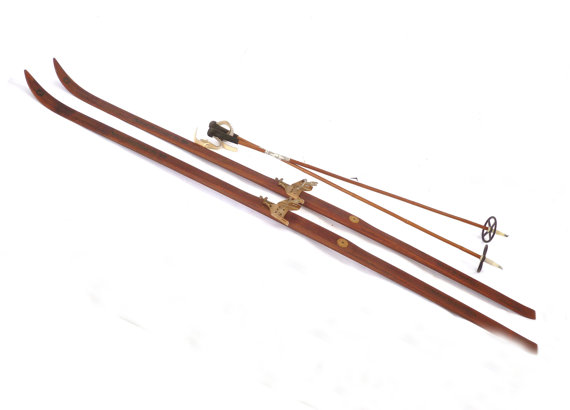
The FIS Cross Country World Cup is bringing back wooden skis this year and making them a requirement for two of the stops on the circuit, along with bamboo poles and pine tar. This could be part of a growing trend to eliminate modern high-tech waxes, skis and poles, and its causing a ruckus. (Photo: Etsy)
Longer, slower, wider. That could be the slogan for future World Cup seasons based on the outcome of the International Ski Federation (FIS) Cross Country Committee’s spring meeting. According to a press release, as part of a test event this coming season in 2016/2017, World Cup competitors will be required to use wood skis and bamboo poles for two of the stops on the circuit and a total of five days of racing.
For ski prep, modern high-tech waxes will also be banned for these World Cups. Only pine tar and non-fluorinated klister and hard wax will be permissible.
“FIS is concerned about the rising cost of competing on the World Cup and at the Olympics,” FIS Cross Country Racing Director Petter Menagerie said in an interview. “It’s our hope that this will trickle down to the club level as well.”
The test events, including all three days of the season-opening Ruka Triple mini tour in Kuusamo, Finland, and Holmenkollen 30/50-kilometer classic races in Oslo, Norway, later in the season, are also expected to boost television ratings and build hype for the pre-Olympic year.
But according to a source who requested anonymity, the real reason for the wooden-ski mandate is FIS’s consternation over the success of athletes double poling to podiums in distance classic races. That hypothesis could not be confirmed by press time.
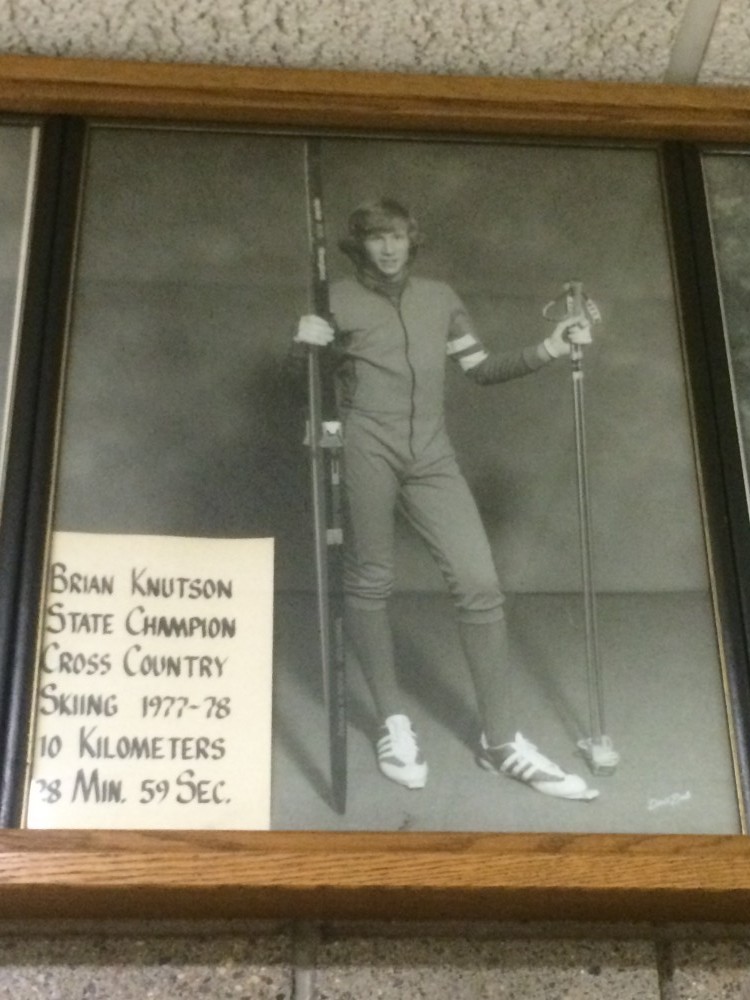
Minnesota state champion Brian Knutson with his race-winning gear from the 1977/1978 season (Photo: Matt Liebsch)
The announcement caught the industry by surprise.
A spokesperson for Fischer Sports said the company was “aware of the rule changes and researching the most state-of-the-art methods to comply with the new rules.”
Asked when consumers could expect a prototype, the spokesperson said, “We’re on it.”
Woodski roller ski president Peter Breu admitted that he has been in negotiations with unnamed ski companies wishing to learn of the magic of Woodski’s laminated roller ski shafts.
“I won’t name names, but you would know them all, and they are all dying to learn what we know about the qualities of wood…,’ ” Breu said.
“As a nordic buyer at Gear West, this new rule change has me concerned,” said Matt Liebsch, director of nordic sales and service at Gear West in Long Lake, Minn. “At SIA [SnowSports Industries America], I was not shown any wood skis but luckily our owner, Brian Knutson, has a garage full of old wooden racing skis. I have been fielding calls daily from top World Cup teams inquiring about buying the pair he won the Minnesota State meet on back in 1978. At this time Brian is still unwilling to sell that pair and his childhood memories attached with it.”
Athletes are taking novel approaches to fill their quivers for next season. U.S. Ski Team member Sophie Caldwell has asked her grandfather John Caldwell to give her his skis from the 1952 Winter Olympics. But she’s had to fight with John Caldwell’s nephew Zach, who wants the same skis to test stone grinds.
1960 Olympian Joe Pete Wilson announced that he plans to sell sell his quiver of wooden skis on eBay to the highest bidder. Sites like Etsy and Craigslist are also reportedly preparing for increased demand in antique equipment.
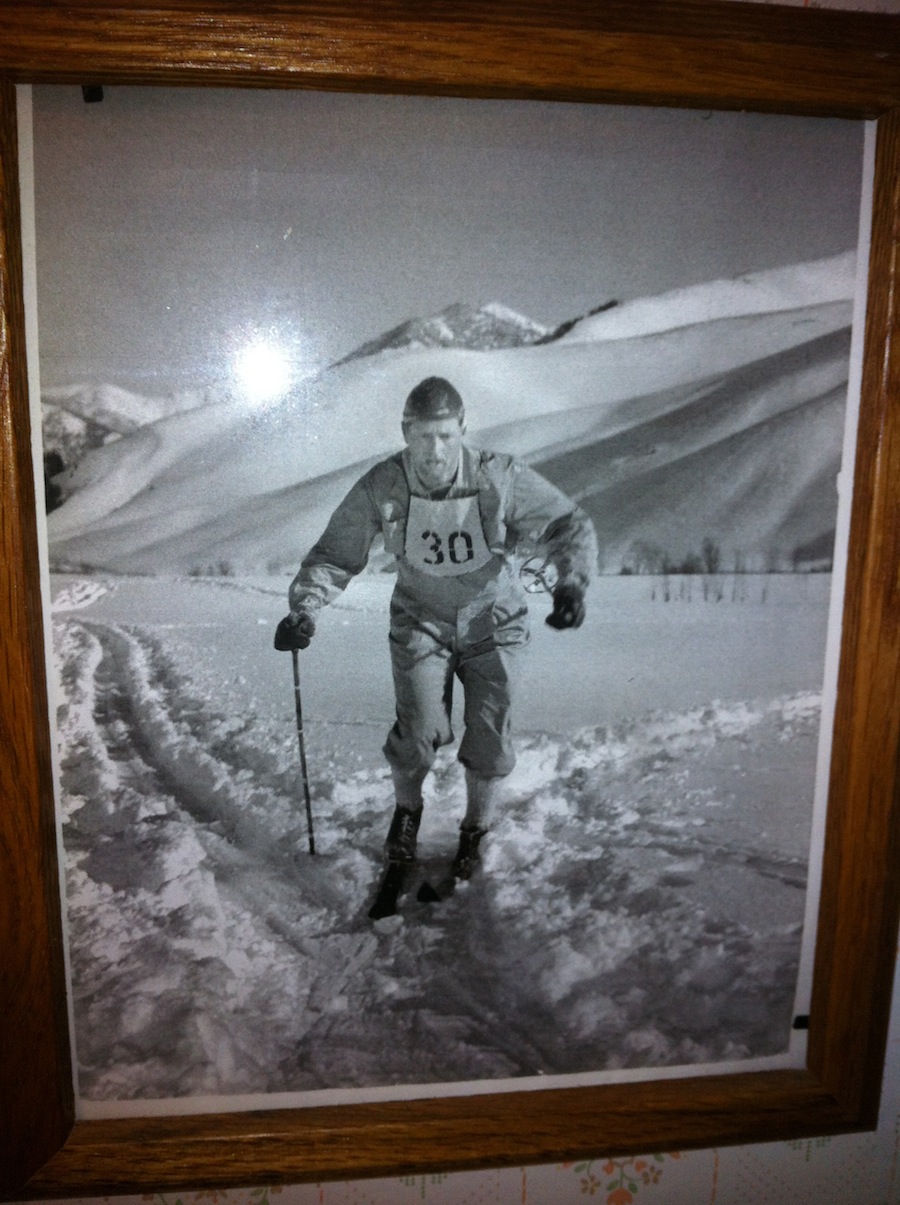
Chummy Broomhall, a 1948 and 1952 Olympian born in Mexico, Maine, and a member of the Chisholm Ski Club in Rumford, Maine, since the 1930s, is seen here on his “skinny” skis. While FIS Cross Country is making similar wooden skis a requirement for test events this season, some wonder if they’ll eliminate grooming technology from the World Cup as well.
In Farmington, Maine, the Maine Ski Hall of fame was burglarized on Thursday night. Thieves stole several pairs of wood cross-country and jumping skis. In Finland last week, the Lahti Ski Museum was broken into and Laasanen antique skis were stolen.
FIS Nordic Combined is anticipated to initiate similar test events in its World Cups.
“I’m all about making the sport simpler, but there’s also something to be said about evolving technology,” U.S. Nordic Combined Head Coach Dave Jarrett said. “Safety on the [jump] hill should be a primary concern. Are we really going to go back to the dark ages?”
The International Biathlon Union (IBU) has not yet indicated it will go down this road.
“For sure, retro is a thing,” said US Biathlon’s Lowell Bailey, a member of the IBU athlete advisory committee. “But wooden skis? How are you going to skate on those? What’s next, black-powder biathlon?”
But US Biathlon President and CEO Max Cobb had a different take.
“Wood skis are a great idea, at least for the novelty factor if nothing else,” he commented. “I think biathlon should take it further, at least for one of the World Cups, to pay homage to its origins. At the next IBU general meeting, I’m going to recommend black-powder muskets in place of the current biathlon rifles, and buckskin race suits and coonskin caps!”
FIS did not confirm whether there would also be a limit on the number of skis an athlete can carry around on the World Cup circuit. However, in an effort to make the sport greener, competitors will only be offered a single replacement pole to be used for the entire season. This could mean many athletes competing with only a single pole during the second half of the season — and for the designated World Cups, it will have to be bamboo.
“I think the bamboo-pole requirement is a great way to help keep the traditional stride and glide technique alive although I will miss the strength and lightness of carbon fiber poles,” Brian Gregg wrote in an email.
With its line of tar-based kick waxes, Finland’s Start appears to be the best-situated for the new regulations. Gallium, Holmenkol and Swix are reportedly joining forces in a lawsuit against the pine-tar rule, to be heard in the Court of Arbitration for Sport.
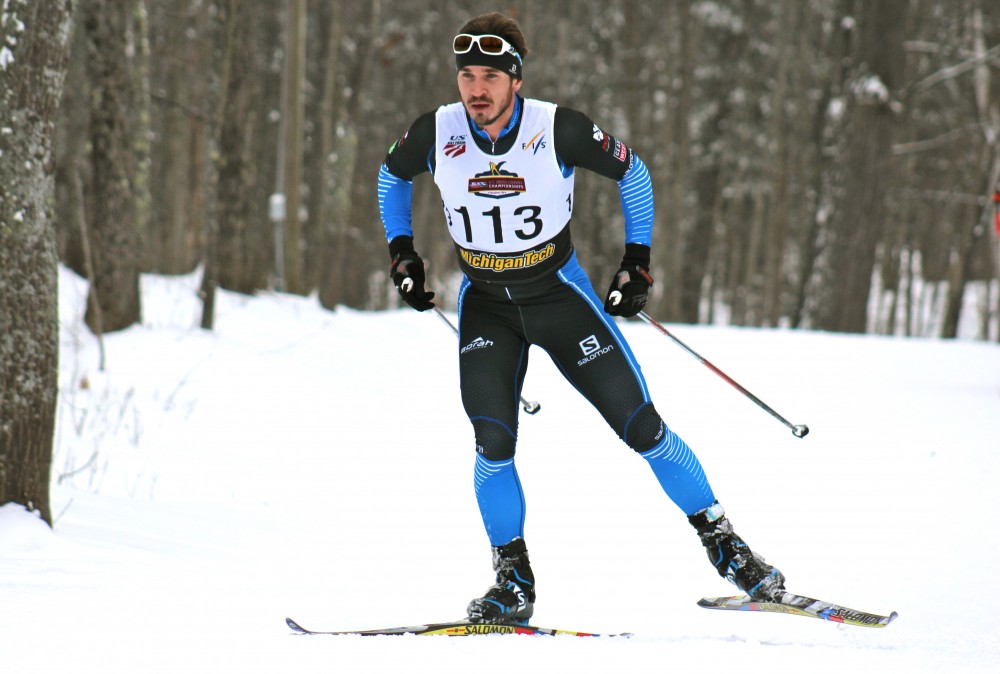
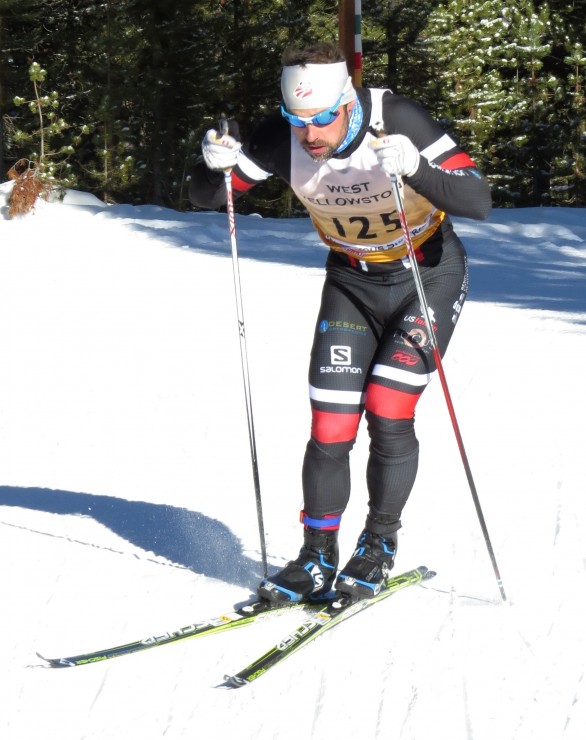
Matt Liebsch (Gear West/Salomon) racing to an eighth-place finish in the men’s 30 k freestyle mass start at 2016 U.S. nationals in Houghton, Mich. (Photo: Toko)
That mark represented the single U.S. men’s quota spot remaining since Adam Martin, a Northern Michigan University skier and the third man on the SuperTour distance list (post-nationals), declined the opportunity to race at the Ski Tour Canada (STC) World Cups so he could focus on NCAA Skiing Championships in March.
According to Matt Liebsch, a Gear West/Salomon skier from Orono, Minn., he received an email from U.S. Ski Team Head Coach Chris Grover on Thursday morning stating he’d been officially selected for that remaining spot.
The Tour begins next Tuesday, March 1 in Gatineau, Ottawa. It may be last minute, but it’s something Liebsch, a longtime racing veteran, welcomes.
“I didn’t know if they were going to take somebody from U23’s,” Liebsch said on the phone about the waiting game, which could have spanned until the end of U23 World Championships on Friday. “They said they would if somebody had a real good result there, but nobody skied quite strong enough so I got the email yesterday [Thursday] at 8 a.m. saying I was in.”
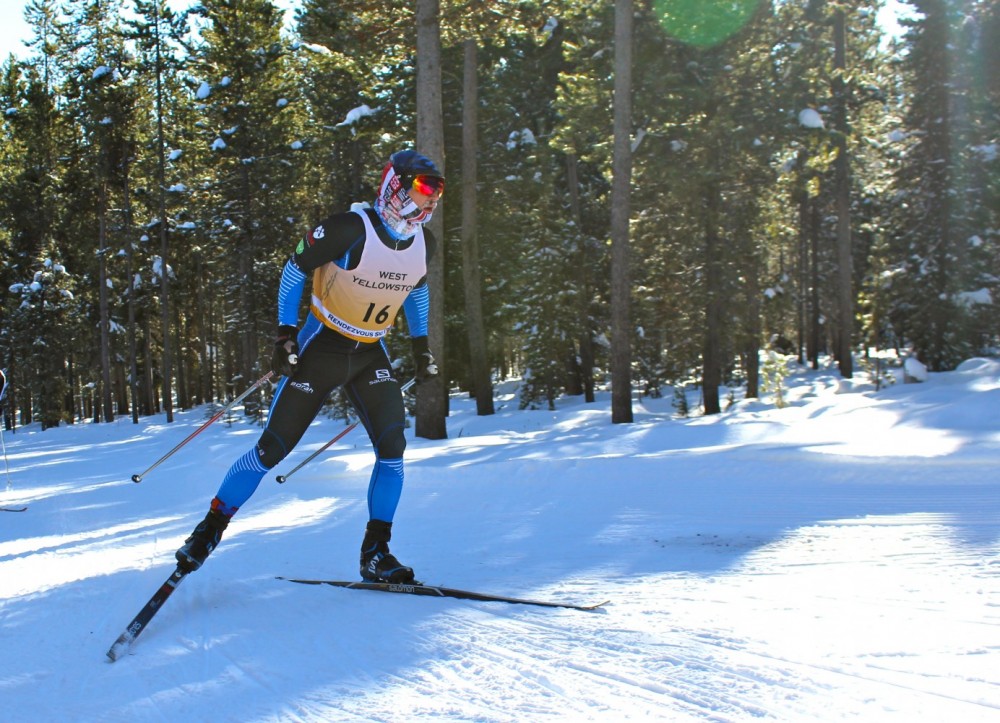
Matt Liebsch (Gear West/Salomon) racing to second during the SuperTour men’s 15 k freestyle in November in West Yellowstone, Mont.
It’s been a long road for 32-year-old Liebsch, who scored his first SuperTour points in 2006 in West Yellowstone, Mont. Nearly a decade later, this past November, Liebsch placed second to his friend Brian Gregg in the West Yellowstone SuperTour distance opener: the 15 k freestyle.
“I was a little bit surprised that I was on the podium for West, honestly,” Liebsch said. “And Brian Gregg, my training partner and I were both like, ‘Wow, geez, how’d that happen?’ We felt pretty good during the race.”
That podium may have been a surprise for Liebsch, but he had set his intentions for the season well in advance.
“My goal since summer training was to make Tour du Canada. That’s why I trained a bunch and why I trained pretty hard with Brian all summer,” he said. “So that was kind of something that I circled on my calendar, yeah, I want to qualify and do those. There are a couple of 15 k skates, and the only 15 k skate I have done at a World Cup level, I was in the points. There is a 15 k at Canmore and then there is a pursuit on the East Coast, so I like my chances in those a lot.”
In his career, Liebsch has competed in four World Cups, all in Canada. The 15 k freestyle in which Liebsch scored World Cup points was in 2010 in Canmore. He finished 29th for the second-best American result
After his West Yellowstone podium, Liebsch set his sights on the distance races at U.S. nationals in January to solidify his goal of earning starts at the season-ending STC.
“I just knew that nationals was double-distance Super Tour points, so I figured I needed to be in the top 10 of both of those [distance races] to be in the mix,” Libesch said.
In the first distance race at nationals in Houghton, Mich., Liebsch placed eighth in the 30 k freestyle mass start, finishing 47.4 seconds behind winner Tad Elliott of Ski & Snowboard Club Vail. Earlier in the week, in the 15 k classic individual start, Liebsch finished ninth.
Liebsch entered nationals with one outcome in mind regarding the 30 k skate race.
“I wanted to be on the podium, honestly I wanted to win that thing,” Liebsch recalled. “I’ve been second and third in the distance races at nationals over the past five or six years. But I’ve never taken a national title, that was my chance. I just skied tactically a little bit too aggressively early in the race and burnt too many matches … But I went out and was skiing aggressively like I was going to try and win that thing.
“I wasn’t really thinking I need to ski conservatively to try to just place well enough to make the Tour du Canada,” he added. “If that had been my goal, I probably would have been maybe top five, somewhere in there for the skate race. And then I would have been on Tour du Canada for sure, and I would have known back in, I don’t know, early January. That of might made things a little bit easier for me logistics-wise. But I was at nationals trying to win that race.”
“I wasn’t really thinking I need to ski conservatively to try to just place well enough to make the Tour du Canada. … I was at nationals trying to win that race.” — Matt Liebsch
Since being notified of his STC invite, Liebsch has had little time for logistics. Soon after, his friend Brian Gregg nudged him to start an online fundraiser.
“I started it last night, maybe around 7 o’clock,” he said on Friday. “I left work early and I told my bosses that I need to figure some stuff out to get up there.”
Nation’s Group skiers, like Liebsch, are responsible for funding the entire cost of their trip. He estimates with flights, housing and food, along with hiring a wax technician, the price tag will be somewhere around $5,000 dollars.
Just prior to his phone conversation with FasterSkier, Liebsch had raised around $3,500 dollars. By the time he had hung up, he’d surpassed his initial goal. Late Saturday morning, that number was up to $6,600 (and he’d set a new mark of $6,800).
“I’ve just been totally taken aback by the support from the ski community. It’s just been super humbling. I’m super blessed to have that support,” he said.
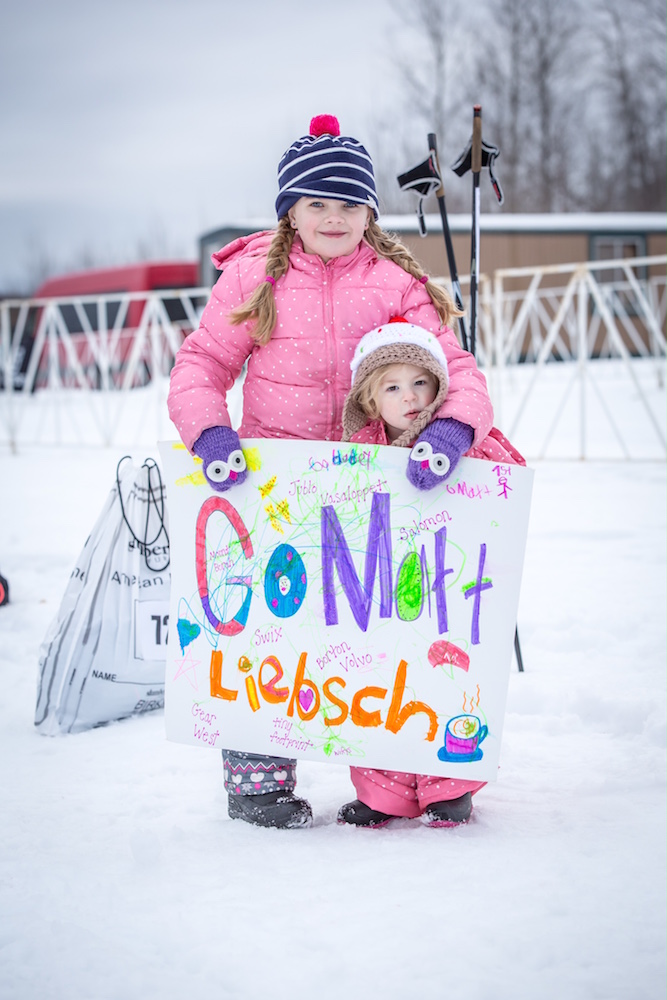
Matt Liebsch’s two daughters, Samatha and Charlotte (Cha-Cha) at the 2016 American Birkebeiner earlier this month. Liebsch placed 17th in the elite men’s 52 k freestyle race in Hayward, Wis. (Courtesy photo)
Liebsch is an anomaly at the elite level of U.S. cross country skiing. He works many hours at Gear West along with the more full-time part of his life: raising three children, ages 7, 6, and 2, with his wife, Marybeth.
Liebsch jokingly referenced Norwegian World Cup leader Martin Johnsrud Sundby’s parenting duties.
“I think Sundby’s got three kids as well, although his full-time job is skiing,” he said. “It’s exhausting sometimes, but honestly, I live about a mile from my work, I’m in the western metro area [of Minneapolis]. The rollerskiing, the trail running, and the training opportunities are literally right out my front door.”
This was Liebsch’s schedule Friday morning: Marybeth, who works at the Loppet Foundation, took the two older kids to the bus first thing. Then, she drove to work while he watched the baby at home.
“I’m a buyer for the store so I was just doing some pre-season reporting and watching the kid,” he said. “Then I took the baby down to Wirth [Park] and swapped and gave her the little one and then met Brian [Gregg] at 10, and we skied for two hours real hard. Now I am going home to have lunch and take a nap and then get a massage and then I think I’m going to lift lightly this afternoon. Friday and Saturday are my normal off days from work.”
Juggling work, the real nuts and bolts of raising children, and keeping dreams alive can be a pressure cooker — especially when those dreams are elusive.
“It seems like I’ve lived most of my athletic life on the bubble,” Liebsch said about his not making the cut for the last two Olympics or a World Championships. “It definitely has been heartbreaking at times to get left home. I just love skiing so much. If I’m here locally it just means I get into some local races. I think for some in the ski community that when they are done racing, they kind of look at it like their job, and when they are done racing they might be done skiing. I just love skiing, so when I get to race or train, that’s just what I like to do.
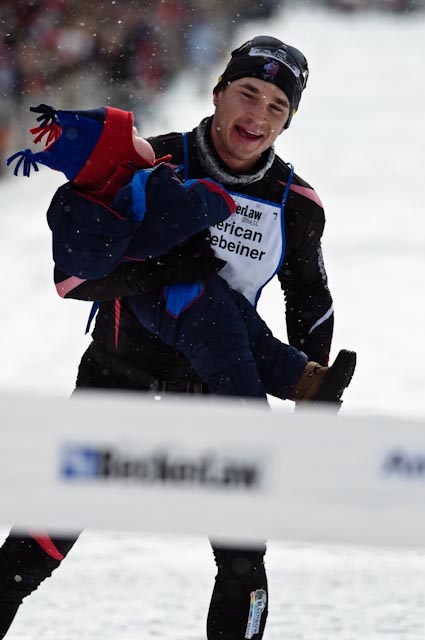
Liebsch crossing the finish line at the 2009 American Birkebeiner with his son.
“If I’m not in Russia racing the Olympics, I’ll be stateside racing SuperTours, or jumping in some local races, local marathons,” he added. “I just have that perspective. When I get left home from things that I felt like I should be at, it’s kind of easy to get down on yourself. But I like skiing so much usually I get over myself pretty quick and just keep at it.”
This time around Liebsch won’t be left back at home. Although known as a distance skier, when Tuesday’s freestyle sprint initiates the STC, Liebsch says he’s ready.
“The skate sprints, I’m super pumped about that,” Liebsch said of Stage 1 in Gatineau and Stage 3 in Quebec City. “I’m going to approach them like I normally do. I’m excited at the opportunity, and if I have god skis and a good day, I think I can do real well. I am most excited about the distance stuff and there are only three sprints in the Tour, and we’ve got five distance days. I am pretty pumped about that.”
With his plane ticket booked, and some minor details to be worked out, Liebsch will soon head north. It just may be without the kids in tow.
“Hopefully I can convince my wife to come up to Canmore for a couple of days to watch me. We are going to leave the kids with Grandma and Grandpa,” he said. “I’m super pumped to get an opportunity to score some World Cup points again. I think I’ve got a legit chance in some of the distance stuff. Hopefully I stay healthy and sharp and I’m expecting I just get stronger as the Tour goes on … I won’t have any work stuff. I’m going to just be able to put my feet up and hopefully just get sharper as we go.”
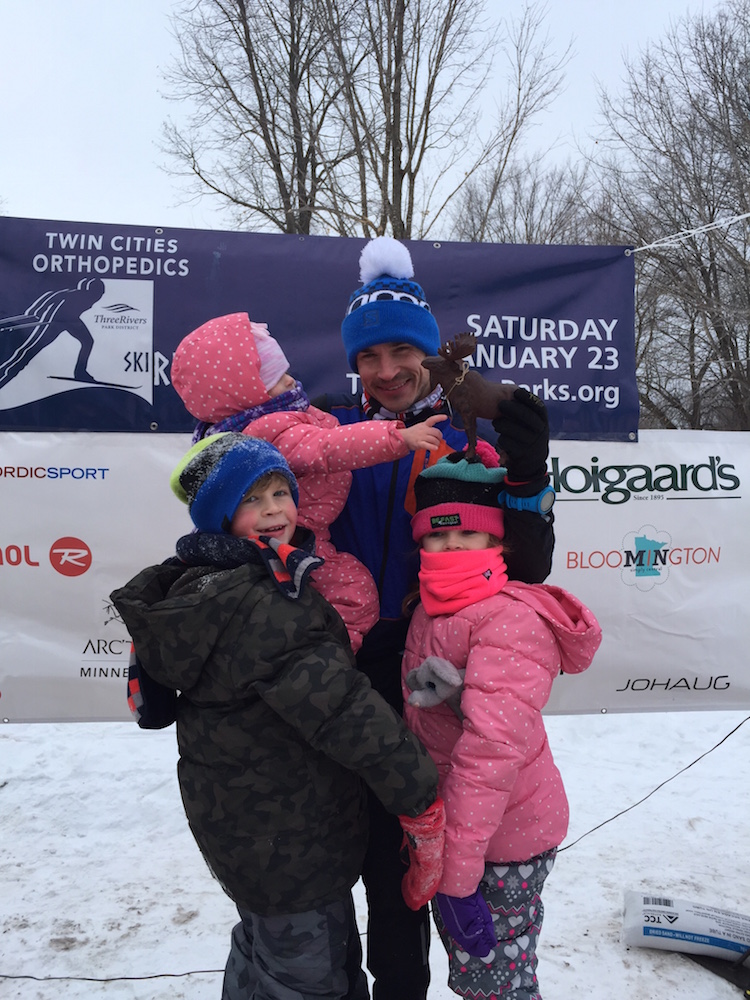
Matt Liebsch with his three children on the podium at a local race in the Twin Cities: Ski Renne. (Courtesy photo)
Training for a Cross Country Ski Marathon is hard enough. Save time and reduce stress by having your skis precision glide waxed by the best in the business! Race wax service is available for the 2016 American Birkebeiner. The service includes an LF base layer, HF race layer, 100% Fluoro top-coat, and hand structuring. Testing and waxing will be done on site to ensure the best possible skis for you.
The service is available for both classical and skate skis. It is important to note, however, that for classical skis only binder wax will be applied to the kick pocket. We will provide recommendations for kick and an area to apply wax at ski pickup, but due to the wide variance in the amount of kick preferred, we do NOT APPLY KICK WAX for you.
Please note for the American Birkebeiner. All skis will be picked up at the Birkie Start Line. This provides the allotted time for the best possible wax service for you.
We highly recommended that if you are not dropping off your skis at Gear West the week before the Birkie, that you ship your skis to Gear West ahead of time. See shipping address below.
If you drop your skis off Friday at the Birkie Expo, you will be charged a Friday Drop Off Charge: $104.99 for skating & $114.99 for classic. Again, we recommend shipping your skis ahead of time to Gear West.
Further information about the 2016 Marathon Race Services is available HERE. If you have any questions, please call us at 877-473-4327 or email wax@gearwest.com.
Ship your skis ahead of time to this address:
Gear West Cross Country Ski & Run
Attn: Birkie Wax Service
1786 W Wayzata Blvd, Suite B, Long Lake, MN 55356
Jennie Bender is just coming off a dominating performance at US Nationals. She has had some bad luck the past few years with her health (Mononucleosis and back injuries) and it has been so inspiring to see her fight through it all with both patience and dogged determination. Congratulations Jennie!
Toko All Stars: Jennie Bender
1. Who was your skiing role model when you were growing up and why?
I looked up to each person who reached out and helped me learn. Not growing up in a nordic family, I didn’t hear skier names being thrown around, so never really globbed on to anyone. Instead I looked up to those in my life who stepped forward and shared their experience through coaching. Truthfully, Lance Armstrong and the William sisters were more my athlete role models. And now, I’d love to meet Ronda Rousey.
2. What skier inspires you currently and why?
Never met her, but Lindsey Vonn seems pretty rad. She works hard, motivates me to keep at it, to work through it, and rocks the media component of being a celebrity athlete.
3. Favorite race course and why?
I’m a big fan of Theodore Wirth Park in Minneapolis. It’s fluid, good for power athletes, and it’s one of the best cheering demographics around!
4. Favorite workout and why?
Max strength. We workout at an old Golds Gym here in Bozeman, so max strength is the only time I too, can grunt and walk around with my chest puffed out.
5. Favorite place to train and why?
Training in Montana is pretty rad. We have on average cooler temperatures and few to no bugs. After growing up in mosquito haven in VT, and tick city in Wisconsin, I’d way rather carry around the occasional bear spray.
6. Favorite movie line and why?
“Shake and Bake Baby” – Ricky Bobby, Talladega nights
7. Favorite Toko glove model (and/or color) and why?
I really like the Toko Arctic, because Ive gotten frost bite so much, I wear thick gloves all the time.
Buy Jennie’s Favorite Gloves: The Toko Arctic Glove in Flag
This is the warmest 5 fingered glove cross country ski glove on the market. It also is touch screen capable! MSRP $53. Buy at (click for direct link):
WEST YELLOWSTONE, Mont. — The Yellowstone Ski Festival in West Yellowstone, Mont. came to a close last Saturday, Nov. 28, but the action from the first SuperTour races of the season lives on in the following highlight photos.
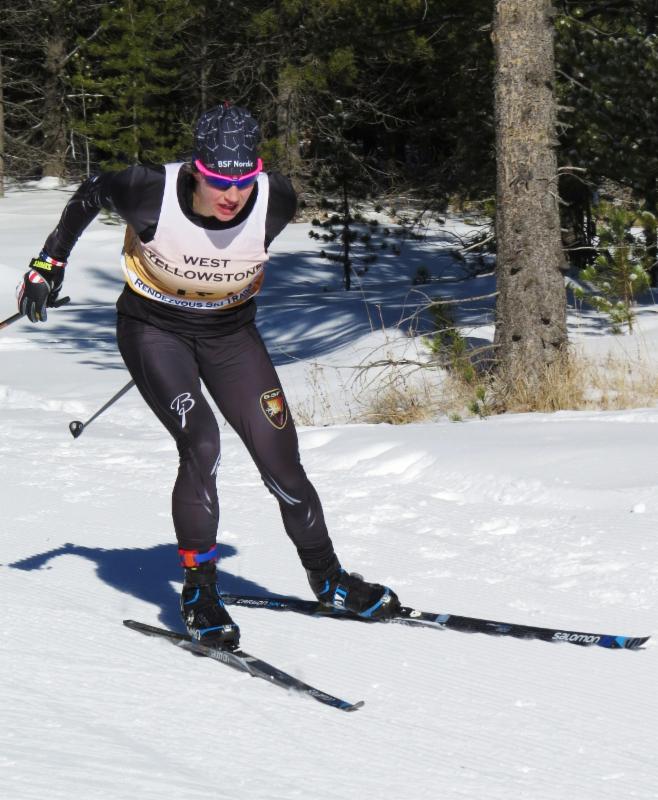
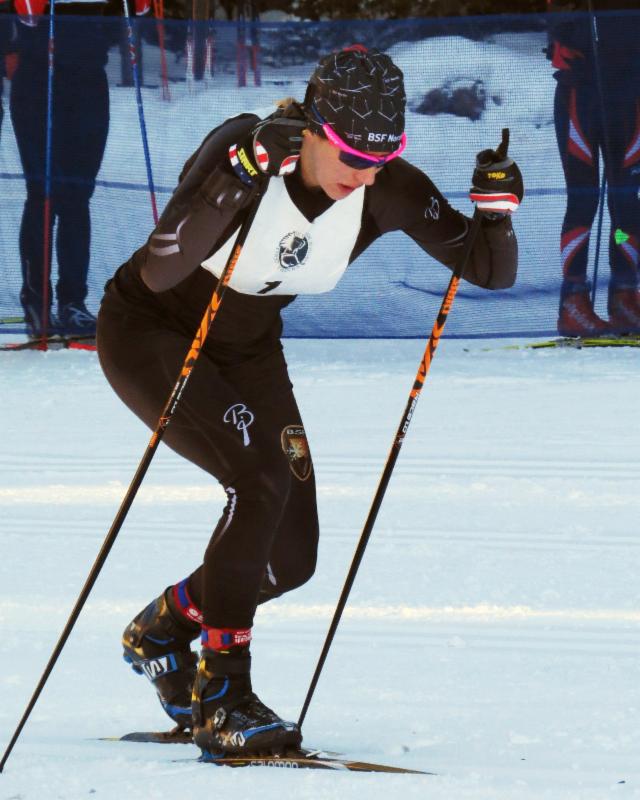
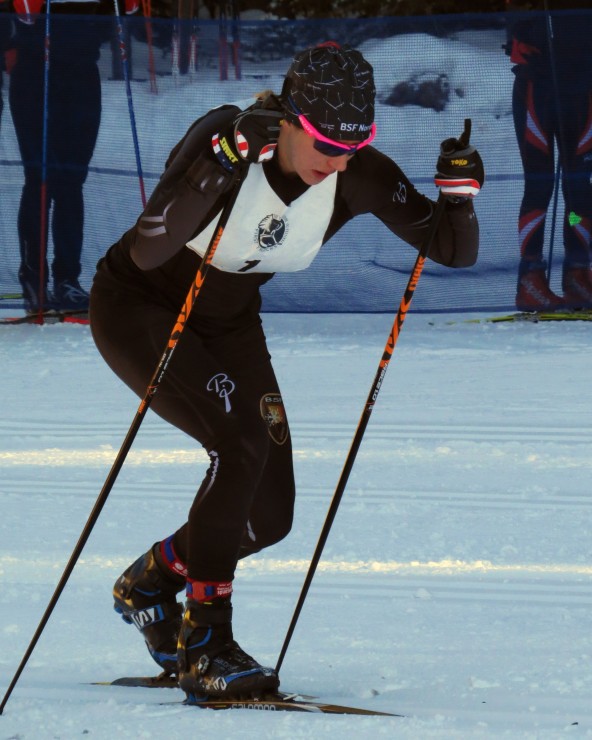
Jennie Bender (Bridger Ski Foundation) gets ready to gun it during the women’s SuperTour 1.3 k sprint qualifier on Nov. 27 in West Yellowstone, Mont. Bender went on to win the qualifier in 2:59.3, and eventually the final as well in 2:50.51. (Photo: Ian Harvey/Toko)
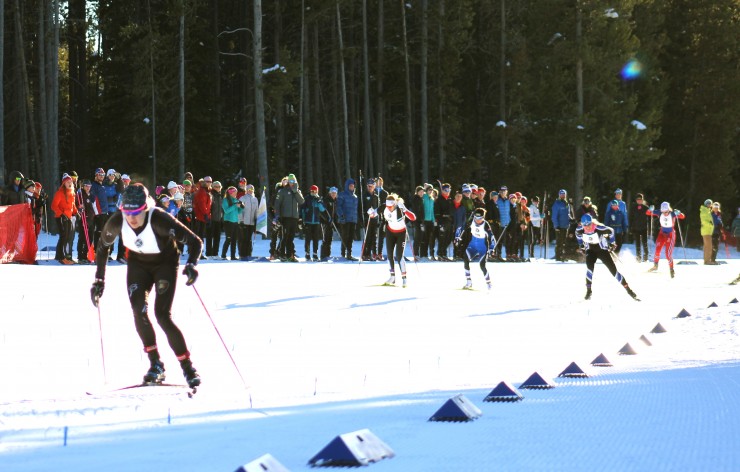
Hannah Halvorsen (Sugar Bowl Academy) racing to third during qualifying for the women’s SuperTour 1.3 k freestyle sprint in November 2015 in West Yellowstone, Mont. Halvorsen went on to edge out AWCA’s Dahria Beatty for second place overall, 4.31 seconds behind race winner, Jennie Bender.
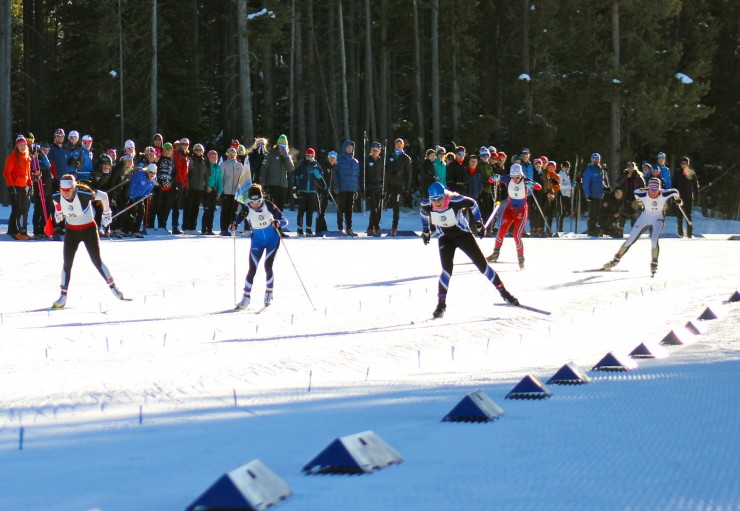
Canada’s Dahria Beatty (Alberta World Cup Academy/U23 National Development Team) leads (from r to l) Annie Hart (SMST2), Annie Pokorny (SMST2) and Deedra Irwin (SVSEF) during their quarterfinal in the women’s SuperTour 1.3 k freestyle sprint in West Yellowstone, Mont. Beatty went on to place third in the final, 5.06 seconds back from race winner Bender (not shown).
Jennie Bender (BSF) dominated the women’s SuperTour 1.3 k freestyle sprint straight from the qualifier through to the final in West Yellowstone, Mont. She’s shown winning the final here.
(From l to r) Canada’s Dahria Beatty (Alberta World Cup Academy/U23 National Development Team) and Chelsea Holmes (APU) battle it out with Hannah Halvorsen (Sugar Bowl Academy) for the podium behind Jennie Bender (not shown) in the women’s final on Nov. 27 in West Yellowstone, Mont. Halvorsen went on to place second, 4.31 seconds after Bender. Beatty took third, (+4.56), University of Colorado-Boulder’s Petra Hyncincova (back left) took fifth (+6.6) and MSU’s Cambria McDermott came in sixth (+6.65).
Reese Hanneman (APU) waits in anticipation to start the men’s SuperTour 1.3 k freestyle sprint on Nov. 27 in West Yellowstone, Mont. (Photo: Ian Harvey/Toko)
Dakota Blackhorse-von Jess (Bend Endurance Academy) during qualifying at the men’s SuperTour 1.3 k freestyle sprint on Nov. 27 in West Yellowstone, Mont. Blackhorse-von Jess advanced all the way to the final where he placed third, 1.89 seconds back from race winner, Logan Hanneman (APU). (Photo: Ian Harvey/Toko).
APU’s Logan Hanneman (r) wins the men’s SuperTour 1.3 k freestyle sprint final over older brother Reese Hanneman (APU) by 0.53 seconds on Nov. 27 in West Yellowstone, Mont. (Photo: Ian Harvey/Toko)
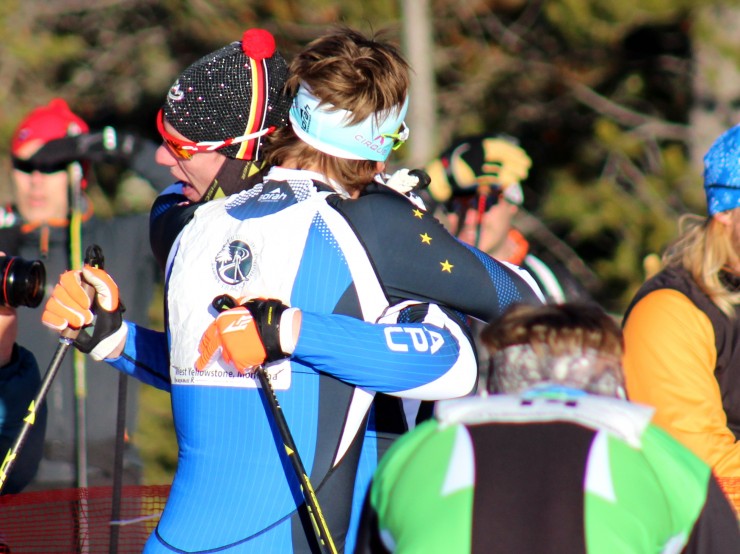
The Hanneman brothers Reese (l) and Logan hug after taking the top two spots on the podium in the men’s SuperTour 1.3 k freestyle sprint final on Nov. 27 in West Yellowstone Mont. Logan won and Reese placed second, 0.53 seconds behind his younger brother.
Mads Strøm of the University of Colorado-Boulder (r) leads Brian Gregg (Team Gregg/Madshus) during the men’s SuperTour 15 k freestyle race in West Yellowstone, Mont.
Brian Gregg after winning the men’s SuperTour 15 k freestyle individual start race on Nov. 28 in West Yellowstone, Mont.
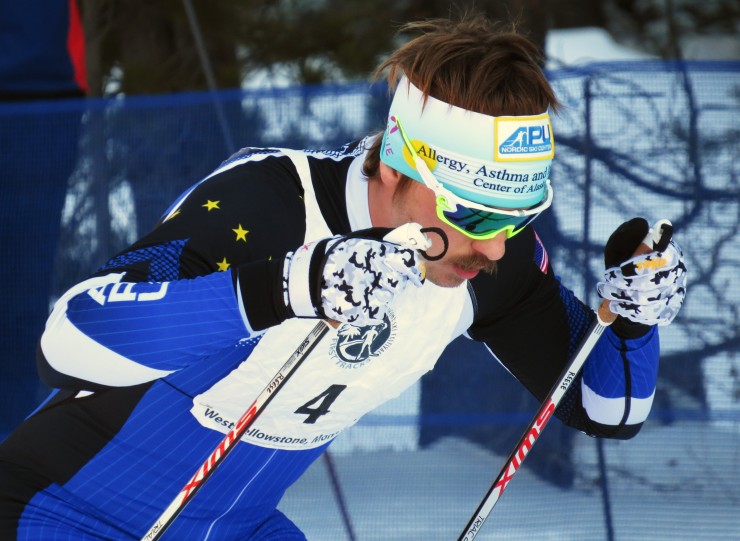
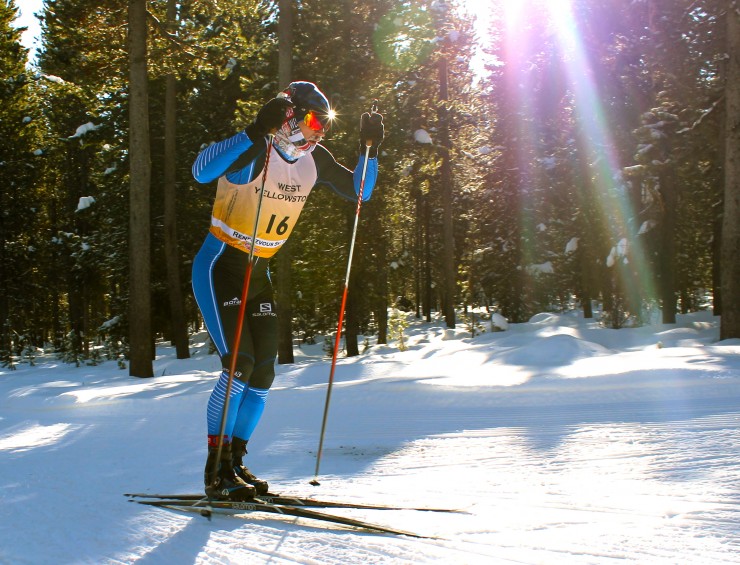
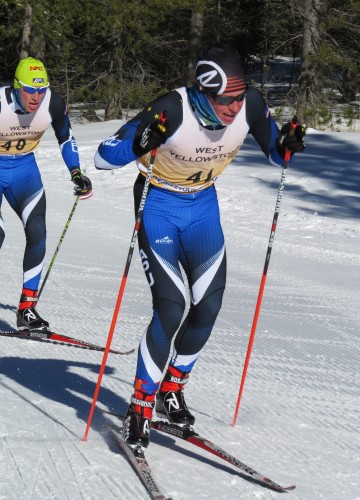
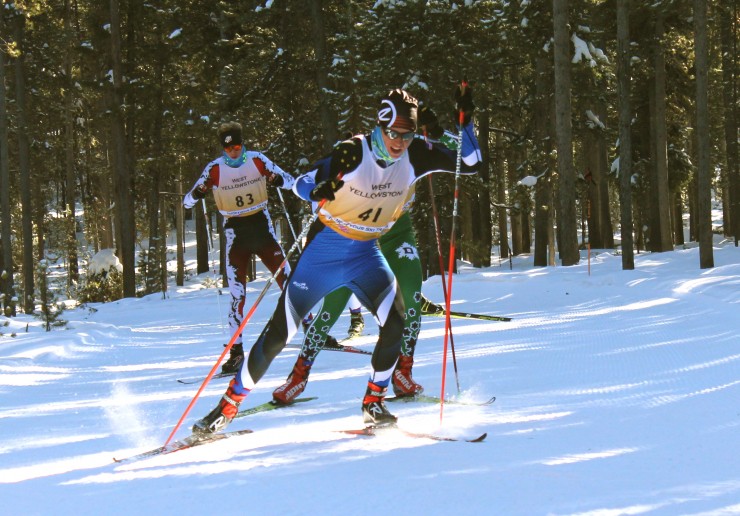
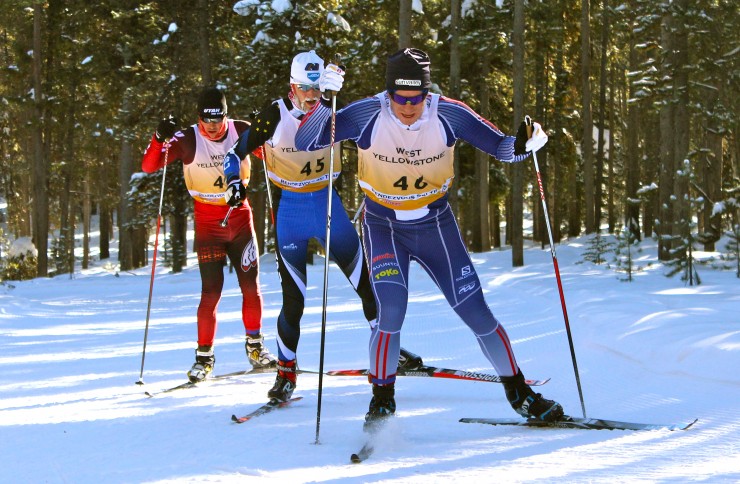
Matt Liebsch (Gear West/Salomon) finished second overall in the men’s SuperTour 15 k freestyle race on Nov. 28 in West Yellowstone, Mont. He was 5.5 seconds behind his training partner and friend, Brian Gregg (not shown).
Scott Patterson leads APU teammate Tyler Kornfield during the men’s SuperTour 15 k freestyle on Nov. 28 in West Yellowstone, Mont. Patterson finished third overall, 13.3 seconds back from race winner Brian Gregg (not shown). (Photo: Ian Harvey/Toko)
Scott Patterson (APU) leads Oscar Friedman (Dartmouth) and others during the men’s SuperTour 15 k freestyle race on Nov. 28 in West Yellowston, Mont. Patterson went on to take third overall; Friedman was 13th.
Canadians Kevin Sandau (Alberta World Cup Academy) (l) and Knute Johnsgaard (Whitehorse/AWCA) race to fifth and sixth, respectively during the men’s SuperTour 15 k freestyle race on Nov. 28 in West Yellowstone, Mont. Tad Elliott (Ski and Snowboard Vail) placed 15th overall.
Ben Lustgarten (SVSEF) (r) races to seventh in the men’s SuperTour 15 k freestyle on Nov. 28 in West Yellowstone, Mont. Lex Treinen (APU) went on to place 10th overall.
Rogan Brown (SVSEF) starting his second lap of the men’s SuperTour 15 k freestyle on Nov. 28 in West Yellowstone, where he went on to place eighth overall. (Photo: Ian Harvey/Toko)
Matt Gelso (SVSEF) leads Eric Packer (APU) and Nick Hendrickson (University of Utah) during the men’s SuperTour 15 k freestyle race on Nov. 28 in West Yellowstone, Mont. Gelso went on to finish ninth.
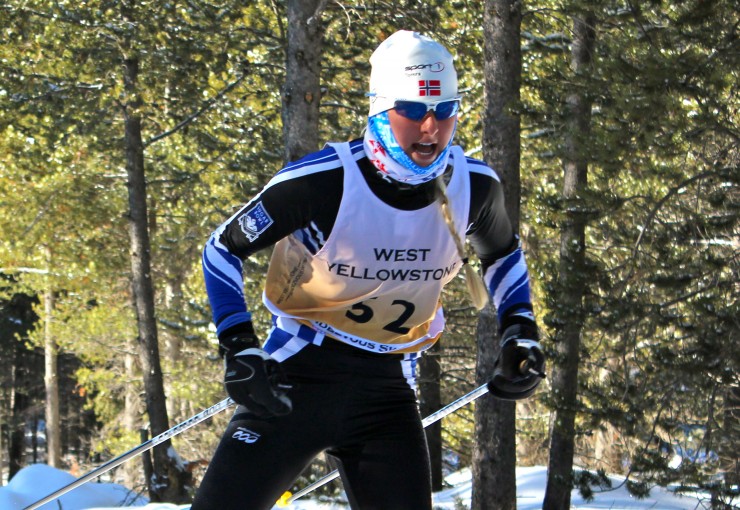
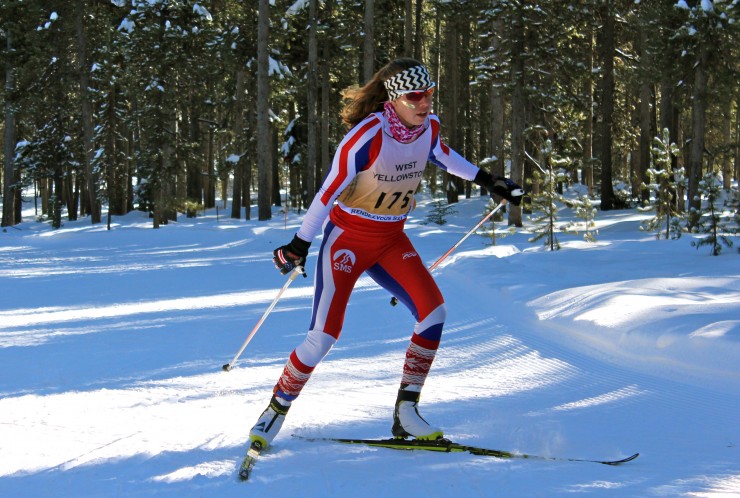
Katharine Ogden during her first lap of the 10 k course during the women’s SuperTour 10 k freestyle race on Saturday in West Yellowstone, Mont. Ogden carried her momentum through to the finish and placed first overall.
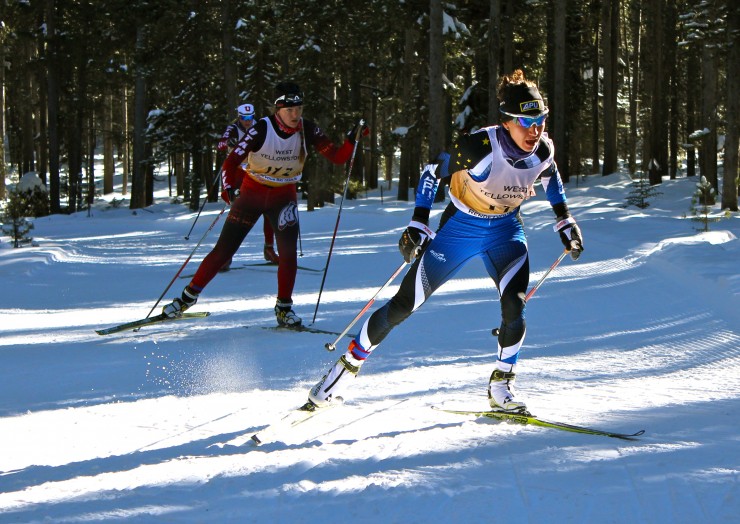
Chelsea Holmes (APU) (r) races to a second place finish in the women’s SuperTour 10 k freestyle individual start on Saturday in West Yellowstone, Mont. Sloan Storey (l) chases her down to place 10th overall.
Emilie Cedervaern (University of New Mexico) during the first lap of the women’s SuperTour 10 k freestyle race in West Yellowstone, Mont. Cedervaern finished third, 35.6 seconds back from winner Katharine Ogden (not shown).
Jennie Bender (BSF) races to fourth in the women’s SuperTour 15 k freestyle race on Nov. 28, a day after winning the women’s SuperTour 1.3 k freestyle sprint in West Yellowstone, Mont. (Photo: Ian Harvey/Toko)
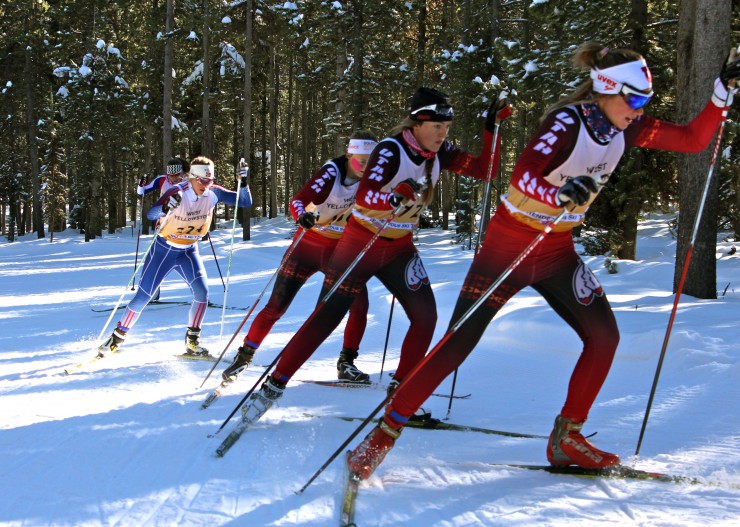
(From r to l) University of Utah skiers Veronika Mayerhofer, Sloan Storey and Josefin Nilsson get a team train going, while Annika Landis (SVSEF) and Katharine Ogden (SMST2/USST) set their sights on the pack. Ogden went on to win the individual start, Mayerhofer placed fifth (+45.2) and was Storey 10th (+1.01).
Caitlin Patterson (CGRP) racing to sixth in the women’s SuperTour 10 k freestyle race on Nov. 28 in West Yellowstone, Mont. (Photo: Ian Harvey/Toko)
Rosie Frankowski (APU) leads Annie Hart (SMST2) during the second lap of the women’s SuperTour 10 k freestyle race on Nov. 28 in West Yellowstone, Mont. Frankowski placed seventh, and Hart was 14th. (Photo: Ian Harvey/Toko)
Gear West is looking for an Ecommerce Sales Associate/Graphic Designer to update our website, load product to our website, and also design graphics for branding and ads. This person must also be willing to take on multiple roles as this business is fairly seasonal. The other roles may involve answering the phone to take orders, or going out on to the sales floor and be willing to be a sales associate from time to time. The candidate for this position must be interested in outdoor activities such as nordic skiing, biking, or running. Compensation for position will depend on experience.
Preferred Qualifications:
– 4 yr degree
– html and CSS code experience
– Show interest in outdoor sports
– Able to handle a schedule that varies with seasons
– Ecommerce / Online Sales experience
To apply for the job please send resume and graphic design portfolio to mattn@gearwest.com
Grab your camera (or phone) shoot a race, your favorite trail, tell a story, make it funny or serious – just keep it to 20 seconds. Then load it to YouTube and enter the contest.
Grab your camera (or phone) and make a really cool 20-second video. Shoot your friends, shoot a race, your favorite trail, tell a story, make it funny or serious.
HOW IT WORKS
1. Shoot your 20 second video
2. Upload to YouTube
3. Send your YouTube link to info@gearwest.com to enter contest
4. Share your link with the world – video with the most views is the winner.
SPECS.
Please add a title frame. Include video name + your name. (not included in the 20 seconds)
Add a final frame “The End”
CONTEST DATES
Contest runs December 8 through January 15
Entries will be accepted any time during the contest
AWARDS
First prizes (two awarded)
(you choose)
1. 2015 Birkie entry or
2. $100 Swix gift certificate
One for most YouTube views
One for best video (selected by our team of judges)
Last prize
One pair of ugly socks go to the worst video (selected by our team of judges)
Gear West will be at Yellowstone Ski Festival providing stone grind service drop off, race ski flex testing and ski demos. Matt Liebsch will give ski tech talk and be a guest coach for a five day race camp.
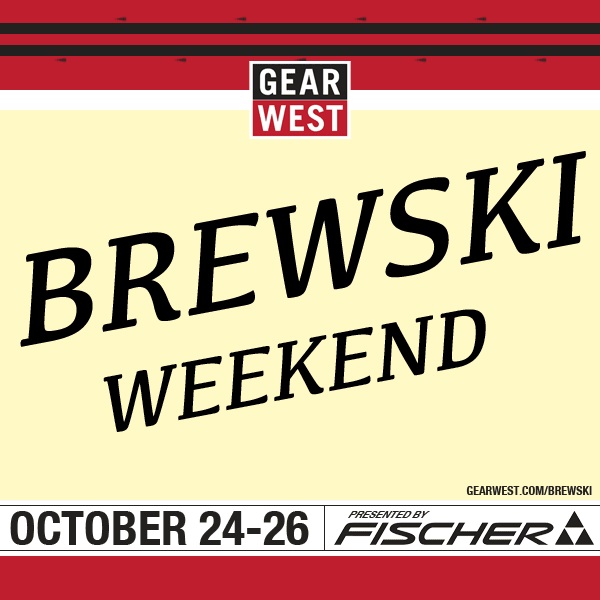
Enjoy good brews, better company, and the best training with Matt Liebsch and Fischer.
Birkie Trail, Seeley WI
Join Matt Liebsch from October 24-26 for a weekend of relaxation and ski specific training in Seeley, WI, brought to you by Fischer and Gear West. Workouts will include individualized coaching and technique analysis, while beverages will be provided for “recovery” between sessions. It’s the perfect way to get fired up for the coming season!
Friday 10/24
5:00 – 6:00 pm: Optional Pole Hike/Trail Run – Mosquito Brook trail crossing. We will run north if you wish to arrive later and meet up on the trail
7:30 pm: Dinner at Coop’s Pizza – included with registration
Saturday 10/25
9:00 – 11:30 am: Dryland workout and Skate/Classic video technique – Seeley Trailhead(?)
12:00 pm: Lunch at Sawmill Saloon – included with registration
2:00 – 4:00 pm: Easy roller ski, additional technique work
6:00 pm: Optional dinner at Rivers Eatery – cost NOT included with registration
8:00 pm: Bonfire at host cabin – beer, snacks, and good times provided
Sunday 10/26
9:00 am – 12:00pm: Over distance roller ski – Seeley Trailhead(?)
12:15 pm: Optional Lunch/coffee at Sawmill before leaving – cost NOT included
Bring ski equipment (some demo rollerskis may be available) and come prepared to learn, train, and have fun!
Cost: $100.00 per person
Includes coaching, two meals, and beers.
Lodging is not included. For lodging options, visit:
Note: Written by Matt Liebsch, director of race services at Gear West Ski and Run, this is the second installment of how-to series about taking care of your summer skis — that is, your rollerskis.
Now that summer is finally here, skiers are starting to lay the foundation for a successful winter race season by putting in volume and specific training. This most likely includes a fair amount of rollerskiing. For many skiers this time spent on rollerskis actually amounts to time on-snow. So as skiers, we should be mindful of the performance and safety of our rollerski equipment. Rollerski maintenance is generally considered an afterthought for many, but just a few minutes of effort can greatly enhance the performance and safety of your equipment.
Gear West’s Matt Liebsch with a Swenor Carbonfibre Roller Ski (Photo: Gear West/YouTube)
Tip #1: My #1 rule, wear a helmet!
Tip #2: Inspect bindings
I use NNN R3 bindings mounted on a composite rollerski. This spring I noticed the bindings seemed a bit loose. I added a bit of wood glue and retightened all the screws and all better. For loose bindings on metal rollerskis try retightening the screws. If that does not work, remount the binding as the mounting hole is too big/over stretched for the screw. Move the binding forward or back at least 1cm to avoid punching 2 holes too close together.
Tip #3: Inspect wheels
Deep cracks or tearing can indicate it’s time to replace the wheels.
Fix tracking: The number-one complaint I get about rollerskis is tracking. The issue usually comes down to uneven wheel wear or the wheel not in alignment. The fix for uneven wheel wear is a continued effort to swap left and right rollerskis every workout. For a misaligned wheel, try unloosening the axel bolt and retightening it. Also, a gentle tap of the wheel against the ground to correct the wheel alignment can fix the problem quickly. Make sure to look at both front and rear wheels as the rear wheel is almost more important to tracking as most of the skiers weight is on the back wheel… kind of like the rudder of a boat.
Tip #4: Check bearings
If they do not spin smoothly replace them or take apart the wheel/bearings and clean everything. A grinding spin can indicate the bearing has been compromised and you never want a bearing to overheat and lockup when using the rollerski. It is possible to remove a bearing cover and add additional bearing grease. I recommend having a qualified shop do this or just replace the bearings which are not that costly.
Tip #5: Fix tracking via wheel-axle nuts
Check that these are tight and if they are showing wear from grinding, replace them.
Tip #6: Keep your skis clean
Towel off your rollerskis every time you use them in wet conditions — the road spray and wetness is not great for your equipment. A quick dry off goes a long ways to prolonging the life of the rollerskis.
Tip #7: Always sharpen your rollerski tips/ferrules before training sessions. Dull tips can lead to slipped pole plants. An inopportune missed pole plant can certainly lead to a crash.
Tip #8: DON’T!
Please do not loosen the rollerski axel nut in an attempt to increase speed.
Also, please to not use a solvent based oil (WD-40) to lubricate bearings.
Three years ago, Gear West began development with Segla Engineering on our Signature Flex Tester. As we discussed in a previous post on FasterSkier, the goal was to “unlock the ‘black box’ mystery of cross country ski flex analysis”. Since then, development has never really stopped. The flex tester software has been updated to allow us record the entire dynamic response under load and to report the total force coming down within the kick zone under that load. The hardware itself has also seen numerous upgrades including more consistent machined aluminum sensor caps, protective railings and foam inserts, a 36″ integrated display, and a label printer that lets us quickly print out flex graphs that can be placed directly ON the ski for quick reference.
We’ve been busy flexing skis.
What does all this mean? When combined with our constant research correlating flex data with ski performance, it means we can make the most accurate predictions of a ski’s fit and performance characteristics ever. Furthermore, it allows us the most transparency in the industry. Other fleet and flex analyses rely on an expert “feeling” the ski and making an immediate judgment. This isn’t to say that these analyses are wrong or can be quickly dismissed; the differences between an amazing ski and an underperforming one are vast and can be easily felt by a well practiced hand. However, there is no way to verify or share these results or, importantly, compare similar skis to find the minute differences that will push one over the other. We share all the data we collect with you via a personalized web page (for example, Matt Liebsch’s fleet is available here). With it, you can compare your skis side by side or try to draw your own conclusions from the data. This last point is important as if forces us to stay honest and ensure that the judgments we make are ones we can defend.
Matt Liebsch’s favorite skis.
A flex analysis including all this information is only $50.00 for up to six pairs of skis. Flex analyses can be set up by calling 877-473-4327 or ordering via this page. Flex analysis data can also be included in the purchase of any new race level ski for $25.00. Looking for a Fischer SpeedMax? We’ve already flex tested all 150+ pairs we have in stock, and to prove you’re getting the best skis possible, you get access to the data as well as our Race Ready World Cup Hot Box with your purchase.
Here at Gear West, we’re pushing the Nordic industry forward to get you the fastest skis in the world. If you have any questions about flex analysis or any of our other products or services, please call us at 877-473-4327 or email info@gearwest.com.
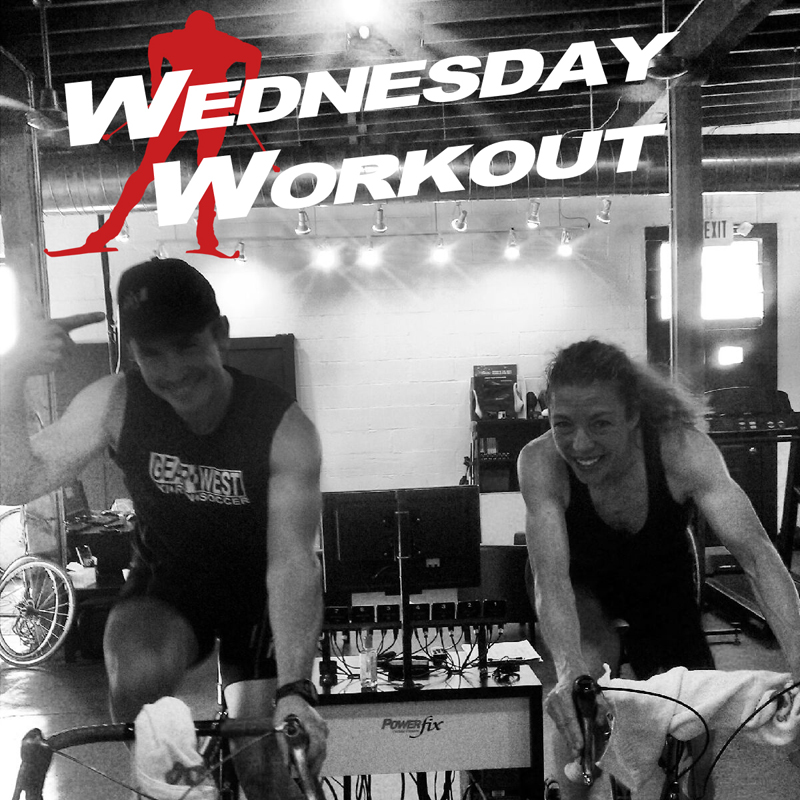
Matt Liebsch (l) gives a plug to The Fix Studio by pointing to its logo on his hat during a CompuTrainer workout with Lynne Cecil, 1990 American Birkebeiner champion and his co-worker at Gear West in Long Lake, Minn. (Courtesy photo)
Welcome to Wednesday Workout, the newest workout series on FasterSkier. This week, Matt Liebsch, an independent skier sponsored by Borton Volvo and director of race services at Gear West in Long Lake, Minn., talks about balance — with work and training, ski-specific and cross training.
Last summer I roller skied my brains out. Coming back from a bike accident/concussion and a very bad ankle sprain, running was not an option and I was gun shy about getting on a bike.
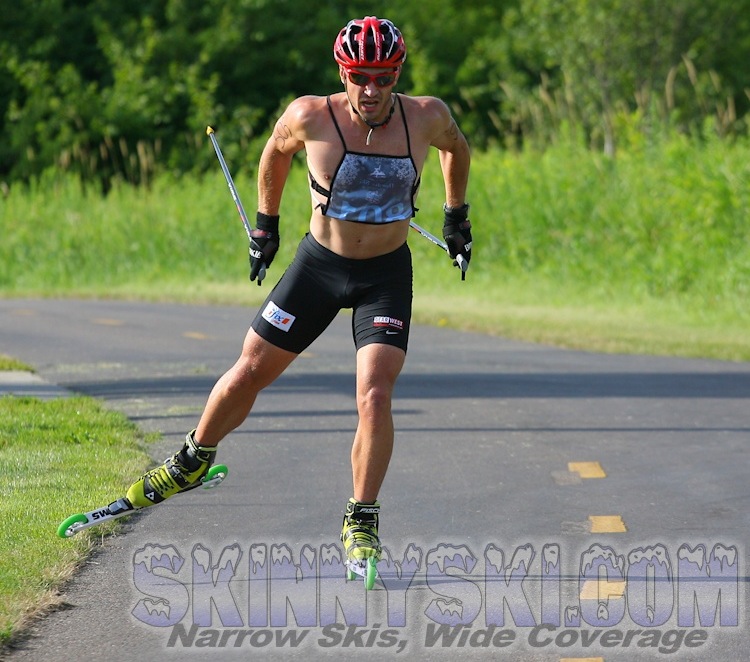
Matt Liebsch on his way to winning the 2013 Ringer Roll 10 k freestyle rollerski race by nearly a minute and a half on Aug. 2 in Maple Plain, Minn. (Photo: SkinnySki.com)
I think all the ski-specific summer/fall roller ski training is great but it is important to keep training fun and diverse at times. This way, once late fall and winter arrive, I can be mentally fresh for 100-percent, laser-guided focus on ski training and racing.
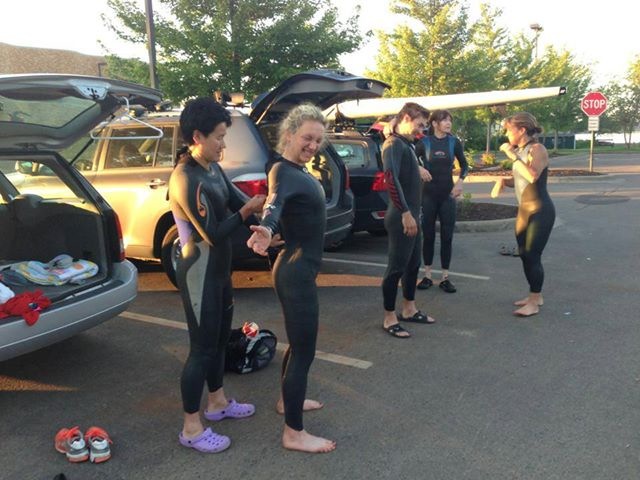
To keep things fresh, this summer I have been doing a 2.5-mile, open-water swim every Wednesday. Our Gear West group swims to an island and back in Lake Minnetonka. I love swimming because it is low impact, involves a catch, pull, reach and rhythmic breathing.
We start at 6 a.m. on Wednesday. It is an early start to the day but we do this to avoid boat traffic. On the way out to the island I try to swim relaxed (I don’t have to try very hard, I am still half asleep) and on the way back I will push the pace a bit to 1:30 minutes/100-meters if I feel good.
After swimming for an hour and 15+ we will grab a quick coffee. If it is a volume week I may run, bike or roller ski after swimming for up to an additional two hours. Generally I get home in just enough time to make myself an omelet and then blast off to work so I can open the doors are Gear West by 10 a.m. No time for naps or massages.
I love swimming because it is low impact, involves a catch, pull, reach and rhythmic breathing.
Caitlin Gregg (second from left) and others get ready for an open-water swim in Lake Minnetonka near Minnesota’s Twin Cities. According to Matt Liebsch, who swims there weekly, Gregg’s husband Brian said it’s one of the hardest workouts he’s ever done. (Photo: Matt Liebsch)
Another mode of non-ski specific workload that I have introduced more frequently this year is cycling class. I have been doing CompuTrainer class at The Fix Studio once a week.
The benefit of doing intensity on a CompuTrainer system is that I can easily track power, training stress score and I can even see my pedal-stroke power profile. Another benefit is reduction in injury. It’s amazing how hard I can push myself at class on a CompuTrainer system with almost zero risk of injury.
I’ve noticed with the extra intensity on the bike my legs are rock-solid while skate skiing. My arms and abs are still strong from all the double poling and strength training but my legs have achieved a new level of skate specific fitness. I can only attribute this to the short focused cycling classes at The Fix Studio.
A typical cycling class at The Fix Studio includes intensity structured around your FTP, “Functional Threshold Power.” In cycling, everything is based off your power output. Being able to see power on the bike makes me wish it could be measured in skiing.
In skiing, all we have to measure work is speed (affected by roller ski speed, snow speed, weather, etc), heart rate (variable on a number of factors), lactate (also variable) and perceived exertion. Luckily the highly trained athlete knows their zones very well.
At class, we usually do a 10-minute warmup, 40 minutes of structured intensity, and a short cooldown. I generally like to ride outside before or after class to add a bit of volume.
Web Marketing: SEO and Visual Design Coordinator: Gear West (Long Lake, MN)
Gear West Ski & Run, Inc. is looking for someone who is self-motivated and passionate to lead and develop an understanding of the strategic marketing goals for multichannel sales growth.
The position requires a minimum of six months of online marketing experience preferably in Search Engine Marketing and some experience in graphic design.
Applicants will have responsibility for tactical SEO efforts, reporting and analysis. You will also serve as a content resource for direct marketing (primarily for SEO) helping to create and maintain landing pages. Experience in both areas is preferred.
Improve your Nordic skiing during the summer months at the Gear West Nordic Summer Camp. The Summer Camp will focus on technique, summer training, ski knowledge, wax and ski service, and having a fun filled weekend with fellow skiers. Come prepared to learn and improve your skiing potential.
Join Olympic Hopeful Matt Liebsch for the Gear West Nordic Summer Camp on July 12th thru the 14th. The exciting weekend will included presentations on training, ski and wax servicing, ski fit, and an open Q & A. Bryan Fish will be making a presentation, “The Strides to U.S. Skiing Success.” The talk will include outlining a clear path from youth to international success, discussing training principles, organizational structure, and staffing/team cohesion that have provided the positive momentum in skiing talent, particularly at the World Cup level.
The Gear West Nordic Camp will also include skate and classic rollerski technique sessions with video analysis and individualized coaching. Enroll now for this exciting weekend of training, learning, great company, food, and fun!
Presenters Include:
Bryan Fish: Currently the Development Team Coach for the U.S. Cross Country Ski Team. Formerly the head coach of the CXC Elite Team and UW-Green Bay Nordic Ski Team.
Matt Liebsch: Olympic Hopeful for the 2014 Winter Olympics in Sochi, Russia. Matt is racing for XC United Borton Volvo and is Gear West’s very own xc ski expert.
Piotr Bednardski: Legendary Midwest nordic coach and head coach of Loppet Nordic Racing in Minneapolis.
Matt Fox: Head of the Gear West Service Team and Wax Guru. Formerly a Swix Tech Rep.
Tuition:
$75.00 for Saturday Morning Only: Includes Saturday morning skate technique with video analysis.
$200.00 for Friday, Saturday, and Sunday: Includes the entire weekend’s events, with a BBQ Saturday evening and a pancake lunch on Sunday (provided by Gear West).
Schedule of Events:
FRIDAY:
4PM: Meet at Gear West for Pole Hike/Trail Run with post-workout refreshments
6PM – 7PM: Presentation with Piotr Bednarski
SATURDAY:
8AM – 10:30AM: Skate Technique with Video Analysis (Baker Park)
11AM – 12PM: Lunch Break
12PM – 1PM: Ski & Wax Service Presentation by Matt Fox
2PM – 4:30PM: Classic Technique with Video Analysis, or Optional Skate Workout (Baker Park)
You are looking for the best possible pair of skis. You want one of those hard to find top quality skis with a perfect smooth and lively camber. A ski that is fast and fun to ski. At Gear West we will use our expertise and leverage all relationships with ski manufacturers to match you with your next favorite ski.
All race skis are not created equal Within a brand and model (like Fischer RCS Carbonlite) There can be a meaningful difference in quality of flex from one ski to the next. Manufacturers would like consumers to believe that one race ski is equal to another ski of same brand and model. Unfortunately this is not the case and each ski has to be tested by a race ski expert. These variables are caused by manufacturing variations in temperature, humidity, press settings and differences in the curing process. The difference of a ski with high quality flex to an average ski is not just a preference – a really good ski is easier to ski on and goes faster. We spend considerable time and money searching and maintaining the largest high quality ski selection in North America. Our goal is to get you on the best possible ski.
How Gear West finds you the best ski
Because we buy more skis, manufacturers help us secure the best skis. We work closely with European ski selection experts for each brand. These experts understand the nuances of quality race skis. They have tested thousands of skis and, in their hands, can feel what we are seeking in a quality race ski, a soft smooth initial camber with a firm and lively secondary camber. Sighting down the edge of the ski they look for a camber with a fluid curve without hinges. From years of on-snow testing they know these characteristics translate to fast skis.
These hand selected race skis are shipped under Gear West’s name to the manufacturers U.S. warehouses. Gear West ski selection experts travel to these warehouses to select skis for our Race Ski Selection customers and for our Race Ski inventory. Last year Matt and Sven spent days sifting through skis at FischerUSA, AtomicUSA, SalomonUSA and RossignolUSA using the same criteria as their European counterparts to select the smoothest and liveliest skis, matching the weight and skills of each customers. Matt and Gear West are committed to finding each customer’s new favorite ski.
Get your new favorite skis Now that you know how we locate the best skis possible you can sign up for your own. Fill out our ski request form, below, and we will track down your next favorite skis. Skis can be shipped to customers or, Race Ski Selection customers can come to Gear West to get fitted on the flex bench and even bring in their other race skis to check their flex/fit and get help determining best race conditions for each.
Skintec is a performance no-wax ski that deliver a strong kick in all conditions along with great glide. The Kick is created by two different skin grip modules which are easily switched according to conditions. Glide is optimized with Step Down Sidewall construction which provides enough camber to keep the grip modules off the snow.
We received over 50 pair of 2012/13 Skintec.
We have the inventory to fit you.
Was $564.95
Now $329.95
Jesse B. – Gear West employee and high school ski coach
“While coaching this winter I used Skintec every day the team had classic ski practice (2-3 times a week). I just threw them on and got out working with the kids. They worked in every condition and required no maintance. They forced me to use proper technique, I had to use good weight transfer to get optimal performance.
Kathy M. – On The Gunflint Trail
“You have to try these things, they are amazing.”
Dan H. – Elite Birkie skier
“I like to keep my Skintecs in my car and jump on the trail when I have some time, without bothering with kick wax. They allow me to spend more time on the trail and less in the wax room.”
Speedy loves Skintec because he gets high-performance classic skis without taking time to apply kick wax.Grip modules for different snow conditions.Easy to switch skin grip modules.
What Atomic says
The Atomic Skintec with high-performance waxless technology is the premium model for the classic skier who prefers not to use a wax ski.
This ski is all about smooth handling and versatility. With one easy motion, it can be adapted to any snow conditions thanks to two different skin grip modules, which ensure a solid and dynamic kick at all times. The Step Down Sidewall construction distributes power evenly across the entire kick zone, providing the cross-country skier with perfect grip with every step. At the same time, the World Cup coating and symmetrical camber maximize the glide phase. Making the Atomic Skintec the ideal race and training ski for athletic and race-oriented cross-country skiers who prefer to invest their energy in speed rather than waxing.