Tag: Gelsenkirchen

  • Germany Wins at Home in Soccer Arena; Canada Debuts at Schalke

    Germany Wins at Home in Soccer Arena; Canada Debuts at Schalke

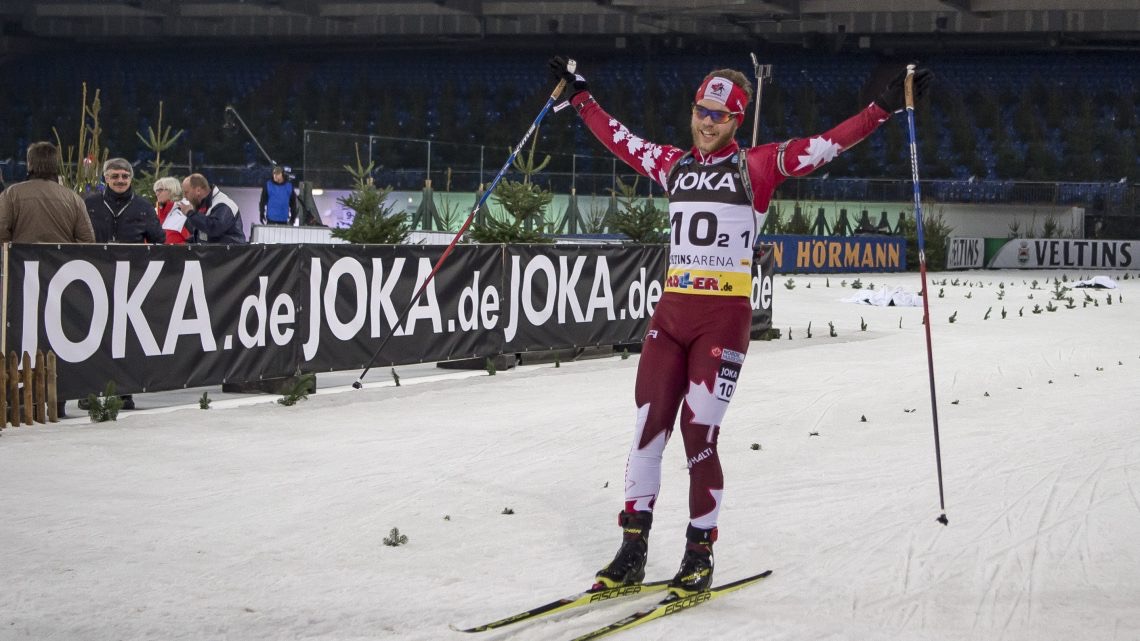
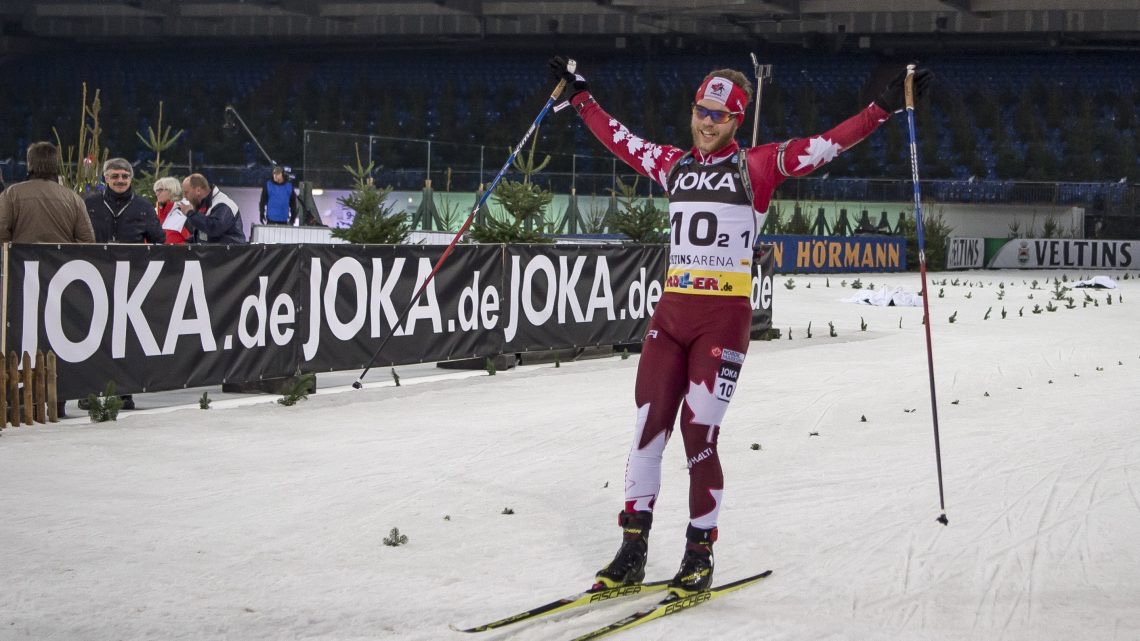
    Canada’s Macx Davies celebrates as he is cheered on by 42,000 fans during the final lap of the 2016 Biathlon auf Schalke invitational race. The Canadian relay team, with his partner Megan Tandy, finished 10th. (Photo: Biathlon-aufschalke.de)
    Canada’s Macx Davies celebrates as he is cheered on by 42,000 fans during the final lap of the 2016 Biathlon auf Schalke invitational race. The Canadian relay team, with his partner Megan Tandy, finished 10th. (Photo: Biathlon-aufschalke.de)

    A biathlon relay with athletes skiing around and through a huge soccer arena in a city with no snow seems like a crazy idea.

    But in the 1990s, the German cross-country skier and biathlete Herbert Fritzenwenger, who had retired from active sports after competing in the 1988 Calgary Olympic Games, believed there had to be some way to make biathlon even more attractive for viewers. He wanted to mix sports and entertainment bringing the sport out of the forest and closer to the people, the way city sprints are now doing it for cross-country. He also believed a discipline where women and men compete together would be more interesting to watch.

    Thus the World Team Challenge was born, a two-person mixed relay invitational, with each team representing a country. In 2002, Frizenwenger took the next step to bring that race to an even higher level of awareness. Together with the then-manager of first-league soccer team Schalke 04, he moved the event to the team’s newly constructed Veltins Arena in Gelsenkirchen, Germany. Only problem: The arena, which features a retractable roof, is located in a flat region of the country far away from any mountain range with predictable snowfall. But using manmade snow from a nearby ski hall to create a course just for this race every year the concept instantly worked, and has drawn some of the biggest crowds for any biathlon event in the world ever since.

    Now in its 15th year, the “Biathlon auf Schalke” race has become a Christmas holiday break tradition on TV in Germany, also broadcast live in several other countries. Many biathletes love the event for its atmosphere in front of 42,000 raucous fans in the arena, and as an interesting way to keep the race shape sharp during the break.

    This year’s edition took place on Wednesday evening, and it was the first time a Canadian relay was at the start, with Megan Tandy and Macx Davies teaming up to represent Canada in a show event that combines a mass start with a pursuit after a short “halftime” intermission.

    In both races, the Canadian pair quickly incurred a number of penalty laps (unlike in other relays the athletes are not allowed to use spares in the fast-paced competition) and slipped to the back of the field of 10 teams, tagging off to the partner after each shooting stage to chase once more over the 1.3-kilometer course around the arena.

    But Davies finished the event to huge cheers, with the audience elated by a victory of the home teams seemingly not wanting the show to be over yet, and screaming until he had crossed the line.

    “The atmosphere was GREAT!!!” Davies wrote in an email to FasterSkier. “Very loud and very fun crowd. They even cheered most of our shootings! (When we were the only ones in the range.) It was amazing to ski through the tunnel the last time to such a big ROAR from the stadium.”

    The arena was rocking particularly loudly as Germany’s fan-favorite Simon Schempp entered the finishing stretch for his first victory at Schalke with his partner Vanessa Hinz, crossing the line in a time of 33:11.4 minutes (with four penalties).

    Originally, the German coaches hadn’t selected Hinz to compete at Schalke, but she replaced her sick teammate, Franziska Preuss, to team up with Schempp. Last year, Hinz and Schempp had placed third in the World Team Challenge, with Hinz also subbing in at the last moment. This year, it was their time on the top of the podium.

    “Yeah, this is pretty crazy,” Schempp told German TV broadcaster ZDF after the race, in an interview that was heard throughout the arena. “That must be how soccer players feel every week. The atmosphere is gigantic. This is much more extreme than in a biathlon arena because there is a roof. I don’t know how many exactly, but I believe 40,000 people are here and it’s just crazy fun. [Cheers in the arena] You can hear it, craziness.”

    The announcer asked Hinz how she stayed so calm in front of her home crowd on the shooting range.

    “That’s what we do all year, but in front of such an audience your knees get weak,” she said. “It’s just brutal. We just want to say many thanks, because to experience something like this is unique.”

    The audience in the arena was happy to hear that, erupting in huge cheers again. Germany last won the event in 2013 with Laura Dahlmeier and Florian Graf. Dahlmeier, the current women’s overall IBU World Cup leader, took a break this year, as did the defending World Team Challenge champions Marie Dorin Habert and Martin Fourcade of France.
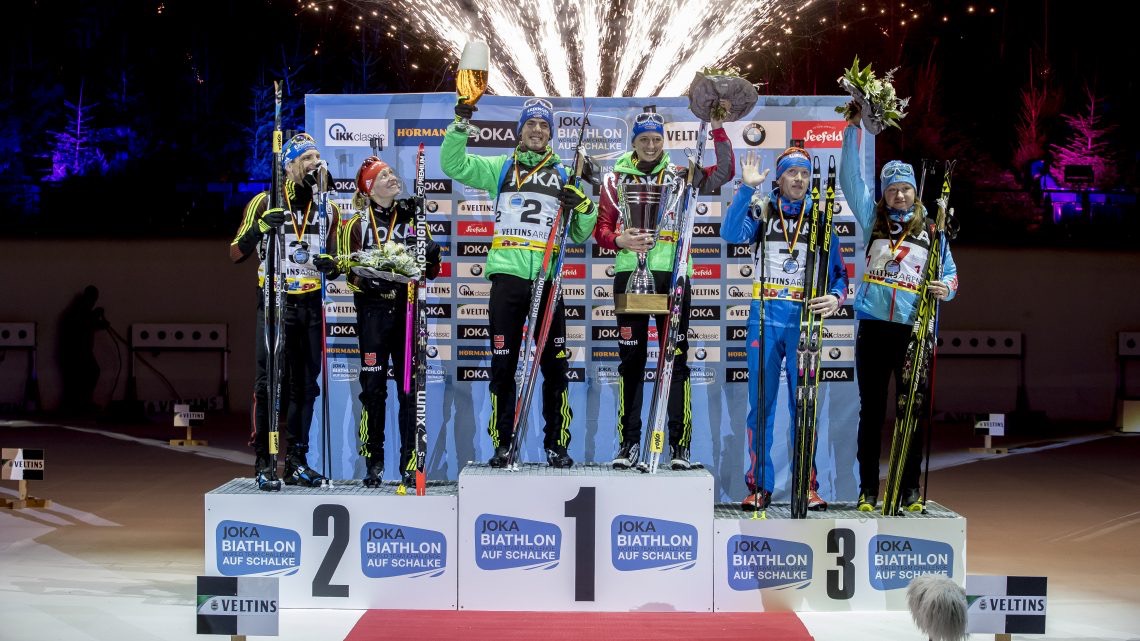
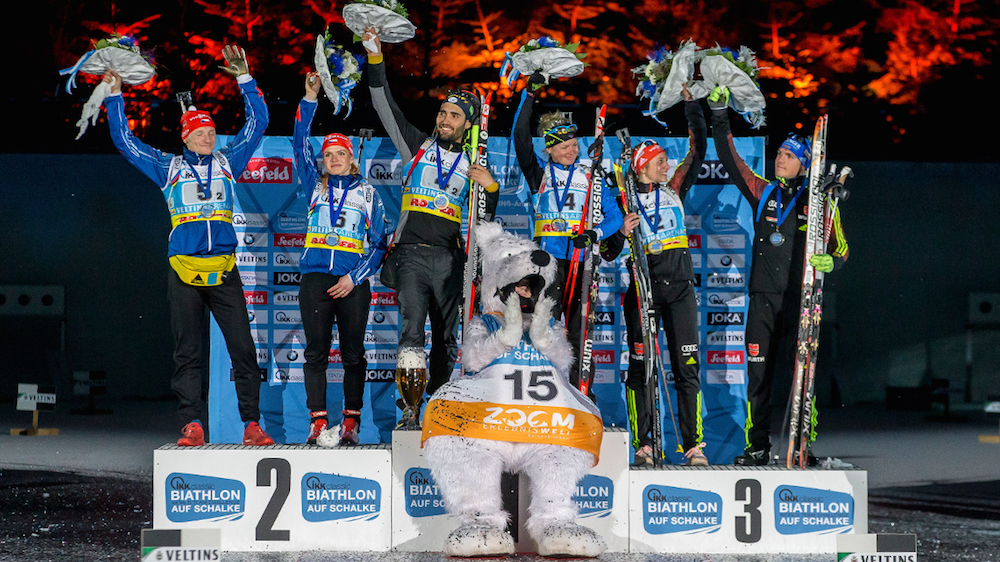
    The 2016 Biathlon auf Schalke podium on Wednesday night, with (from left to right) Germany’s Erik Lesser and Franziska Hildebrand (second place), Germany’s Simon Schempp and Vanessa Hinz (first place), and Russia’s Olga Podchufarova and Alexey Volkov (third place). (Picture: Biathlon-aufschalke.de)
    The 2016 Biathlon auf Schalke podium on Wednesday night, with (from left to right) Germany’s Erik Lesser and Franziska Hildebrand (second place), Germany’s Simon Schempp and Vanessa Hinz (first place), and Russia’s Olga Podchufarova and Alexey Volkov (third place). (Photo: Biathlon-aufschalke.de)

    Despite usually entering multiple teams at Schalke, Germany had not been able to claim first and second on the podium — until this year, which sent the arena into frenzy.

    For Germany’s second team, Franziska Hildebrand teamed up with Erik Lesser for the second-straight year after the duo finished seventh in 2015. They came close to the overall victory this time, winning the mass start by 15 seconds ahead of Hinz and Schempp, and later staying in their vicinity throughout the pursuit. But Lesser missed his final standing shot when he still had a small chance to catch up to Schempp in first.

    “Of course [the atmosphere] is pushing me,” Hildebrand had told ZDF at halftime, after the mass start. “It’s such an incredible audience. It’s so beautiful when you come into the arena as a German athlete and experience such a loud support. That is always a total buzz, a breathtaking moment.”

    On the first loop of the pursuit Lesser broke his pole after stepping on it, and did not receive a replacement until after the exchange to Hildebrand.

    “For the shooting I don’t need a pole, and afterwards that half-a-second I lost I can deal with that, before someone runs over and probably breaks his foot,” he told ZDF after the race, causing a big laughter in the arena. “Such a great atmosphere. The spectators are really picking it up. And that’s why I am here.”

    At times more than a minute ahead of the field, the German teams made the race relatively close again with two laps to go, when standing next to each other both Hinz and Hildebrand shot two penalties despite their otherwise almost-flawless shooting performances.

    The third place on the podium went to Russia’s Olga Podchufarova and Alexey Volkov (who won gold with the men’s relay at the 2014 Olympics), narrowly edging out France’s Anaïs Bescond and Jean-Guillaume Béatrix (+42.6), Austria’s Julia Schwaiger and Simon Eder (+43.0) and Norway’s husband-and-wife team of Fanny Horn Birkeland and Lars Helge Birkeland (+43.3) on the final loop and finishing sprint.

    Long Day on a Challenging Course

    Originally, Tandy — who trains and lives in Germany for part of the year — had planned on racing with Biathlon Canada teammate Nathan Smith, but Smith returned to Canada after struggling in the initial World Cup races of the season with unclear symptoms, which he has since been trying to resolve.

    “After Nathan went home I was talking with Megan and [coach] Matthias Ahrens about if it would be possible to race,” Davies explained. “Because I have been watching this race for a long time now and always thought it would be an awesome event to compete at, which it is! So I changed my plans so we could start an all-Canadian team and I am very happy to have raced the World Team Challenge!”
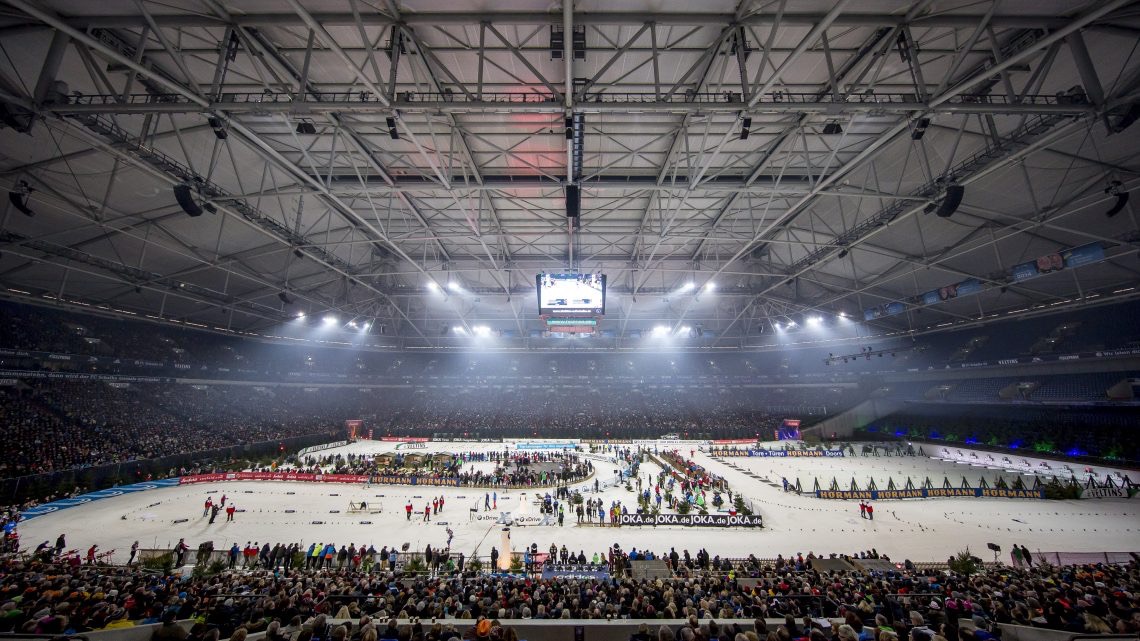
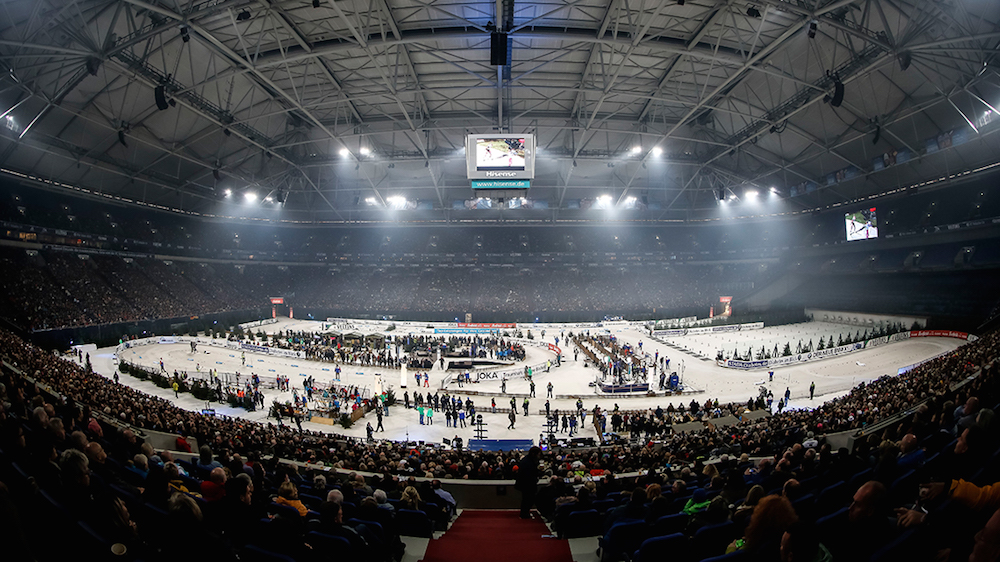
    View of the indoor section of the ski track and the shooting range inside the domed Veltins Arena during the 2016 Biathlon auf Schalke invitational. (Photo: Biathlon-aufSchalke.de)
    View of the indoor section of the ski track and the shooting range inside the domed Veltins Arena during the 2016 Biathlon auf Schalke invitational. (Photo: Biathlon-aufSchalke.de)

    Even more so than a regular IBU World Cup, the race is held in a huge party atmosphere, with athletes skiing through a winter village park with food stands and sponsor exhibition tents lining the artificial snow track around the huge soccer arena, before entering the pitch inside the arena again via a darkened tunnel with light effects. And then having to shoot in front of the 42,000 fans, frequently with loud music blaring, and the noise level amplified indoors many times.

    The World Team Challenge relay race is also executed in a special format, with one woman and one man forming a team and exchanging repeatedly, each skiing a loop of about 1.3 k and having to clean a shooting stage — or ski a shorter-than-usual 75-meter penalty lap — before tagging off to their teammate again. While one athlete was out on the track, crews of wax technicians hurried to clean and prepare the skis of the athlete who was receiving a short break. This mode of competition is fairly similar to the new single mixed relay in biathlon or the team sprint in cross-country.

    It was a long race day for the athletes, with a “shootout” followed by the main event split into two “halftimes,” as the organizers called it, borrowing the terms from soccer. At first a nine-loop mass start (the women skied four loops, the men five including the final loop) on the 1.3 k course, followed by a pursuit race of that same length after just a short intermission. Thus the women had to ski about 10 k in total, while the men had to ski 13 k.

    The gaps to the best team in the mass start were halved respectively, capped at a maximum of 45 seconds for the pursuit, so even the teams at the back of the field like Canada could still have a realistic shot at the podium.

    Prone and standing stages interchanged with each partner shooting twice in prone and twice in standing per race, and because the loops were comparatively short and intense, like a sprint, shooting accuracy was at least as important as in regular World Cup races.

    “I really like the format of this race, and think maybe it should replace the Single Mixed relay,” Davies explained in his email. “But maybe only race once, doing both was very challenging. But it is a fun event nonetheless!”

    In the first few years of the Biathlon auf Schalke event, the course was a relatively flat loop, but after a redesign last year added longer climbs and a downhill section on the part of the track that meanders through the park outside the arena, it is supposed to more closely resemble what athletes would see “on the World Cup level,” as the organizers announced in a presentation before the race.

    Using artificial snow mostly coming from a ski hall in the nearby city of Neuss, every loop is now 1,300 meters long, featuring 30 meters of vertical climb nicknamed the “Ruhrpott Glacier”, which added up to about 300 meters for the men and 240 for the women for the whole race day.

    “It’s really not just a show race,” Schempp told broadcaster ZDF. “The legs are really burning very much. Because you have those short individual loops, but that just makes it even worse because you just ski that kilometer even faster than at normal competition speed. And because of that it is really challenging, but still is a lot of fun.”

    “The course is really good for what they have,” Davies wrote in his email. ”The stadium is exciting with all the corners and I think the track is decently difficult, though below World Cup level. I think they did a better job on the downhill corner this year, because it was easier to ski, the athletes don’t like to see crashes.”

    The athletes had fewer problems with that downhill section leading into a sharp-right hairpin turn than during the prior year when that was introduced, but the Czech Republic’s defending World Cup winner Gabriela Koukalová fell this year, grimacing and rubbing her thigh as she got back up. She finished seventh with her partner, Michal Šlesingr, after placing second with Ondrej Moravec in 2015.

    “We just saw [a replay of] Gabriela slipping out there,” Hildebrand told ZDF when questioned about her more conservative downhill snowplow technique. “I wanted to avoid that at all costs, so I chose the safety version.”

    After some years where the organizers experimented with rifles using a laser-aiming system, the athletes now use their own rifles with real ammunition on the 10-position range again, with bulletproof glass walls and an empty section behind it to protect the audience.

    The difficulty of the course was once again evident during the races. Despite the indoor shooting range with almost no wind influence, many athletes who are known as good shooters incurred more misses and thus had to skate more penalty loops than they normally would in a World Cup.

    “The shooting range was good, no wind, which is nice, but you are skiing very hard into the range and must shoot fast and accurately to stay with the leaders,” Davies commented.

    2016 World Team Challenge Results 

    1. Germany I (Vanessa Hinz/Simon Schemp) 33:11.4
    2. Germany II (Franziska Hildebrand/Erik Lesser), +16.7
    3. Russia (Olga Podchufarova/Alexey Volkov), +40.2
    4. France (Anaïs Bescond/Jean-Guillaume Béatrix), +42.6
    5. Austria (Julia Schwaiger/Simon Eder), +43.0
    6. Norway (Fanny Horn Birkeland/Lars Helge Birkeland), +43.3
    7. Czech Republic (Gabriela Koukalová/Michal Šlesingr), +57.6
    8. Italy (Dorothea Wierer/Dominik Windisch), +1:06.1
    9. Ukraine (Olena Pidhrushna/Serhiy Semenov), +1:20.0
    10. Canada (Megan Tandy/Macx Davies), +2:32.0
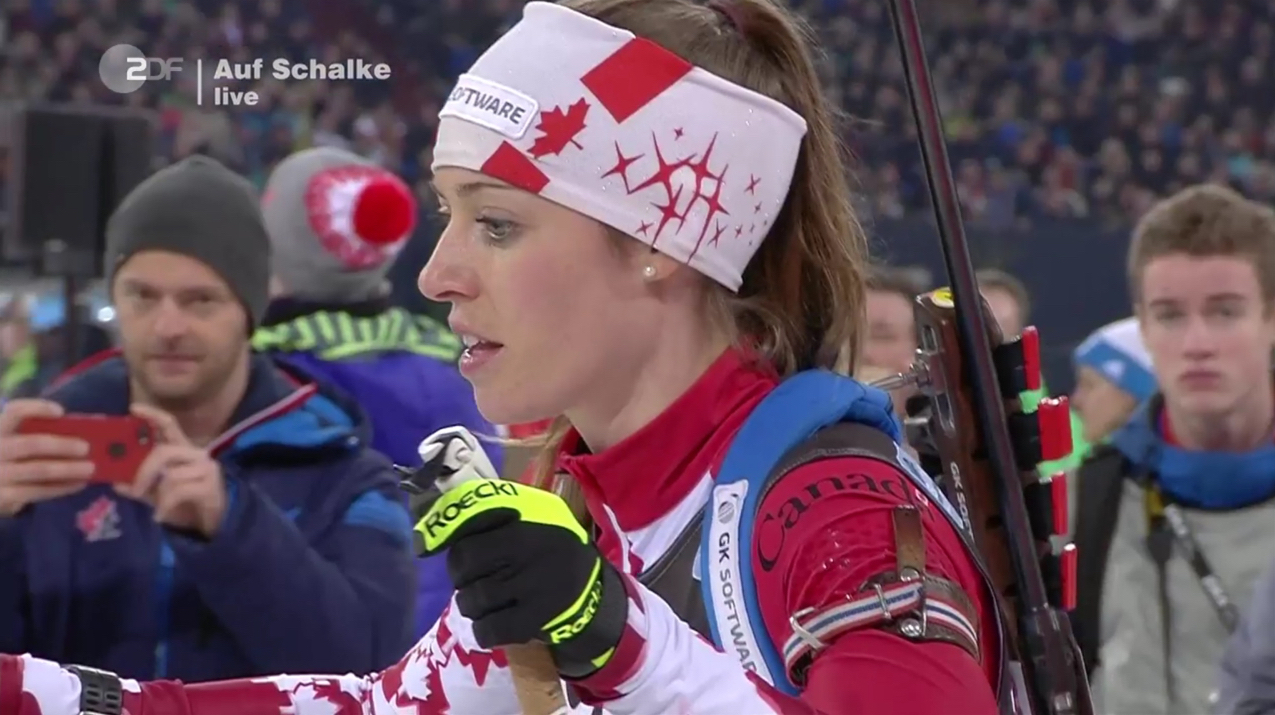
    Canada’s Megan Tandy at the start of the pursuit race during the 2016 Biathlon auf Schalke invitational event. (Photo: ZDF broadcast)
    Canada’s Megan Tandy at the start of the pursuit race during the 2016 Biathlon auf Schalke invitational event. (Photo: ZDF broadcast)

    Tandy and Davies became the fifth North American team to be invited to the Biathlon auf Schalke event, and the first Canadian one. In 2008 and 2009, Lanny Barnes and Jay Hakkinen represented the U.S., placing ninth and sixth for the best finish by a North American team to-date. In 2010, Tracy Barnes-Coliander and Tim Burke finished 10th, and in 2012, Susan Dunklee teamed up with Burke for 10th.

    “What a fun event last night,” Davies summed up his experience on his Facebook page. “I am very thankful to have been able to compete in the Biathlon World Team Challenge and I hope to be invited back to show you how good Canada can be! (Unfortunately we didn’t do very well this time…) Till next year.”

    “I second everything Macx wrote ☺ ☺ ☺,” Tandy commented on his status.

    Pre-Race Events with a Farewell to a Former World Champion

    Before the two main races of the evening, Russia’s Volkov won a “shootout” event among all participating women and men, narrowly edging out Austria’s Eder, who is known for his fast shooting performances on the World Cup circuit, with Germany’s Hildebrand finishing third and Schempp fourth. Tandy and Davies had not qualified for the final of that event.

    In this competition the athletes — while not wearing skis — were required to run up to the shooting mats and hit 20 targets as fast as possible (5 prone, 5 standing, 5 prone, 5 standing), using as many spare rounds as necessary.

    The organizers also used the shootout event as a farewell to Germany’s national team member Daniel Böhm, men’s relay gold medal winner at the 2015 World Championships in Kontiolahti, Finland, and silver medalist in the relay at the 2014 Olympics in Sochi, who announced his retirement from biathlon earlier this month. He qualified for the final round of the shootout, where he finished fifth. Böhm plans to begin a training program to become a helicopter pilot with the German federal police.

    “In the shootout I was a little bit shaky,” Böhm told ZDF. “It is something very special to compete here at Schalke. And I think there is nobody who can completely tune this out. It’s crazy what the fans are doing here, and great that I am allowed to say goodbye on this stage. That is a special honor, and now I can enjoy it looking on from the outside.”

    While the IBU has adopted the mixed and single mixed relay formats in the last years as attractive new disciplines, Biathlon auf Schalke is an invitation-only race not hosted by the IBU, so there were no World Cup points to win in the event. However about €168,000 ($175,000 dollars) in prize money were awarded.

    The IBU World Cup will resume next week Jan. 5-8 in Oberhof, Germany, with sprint races, pursuits and mass starts.
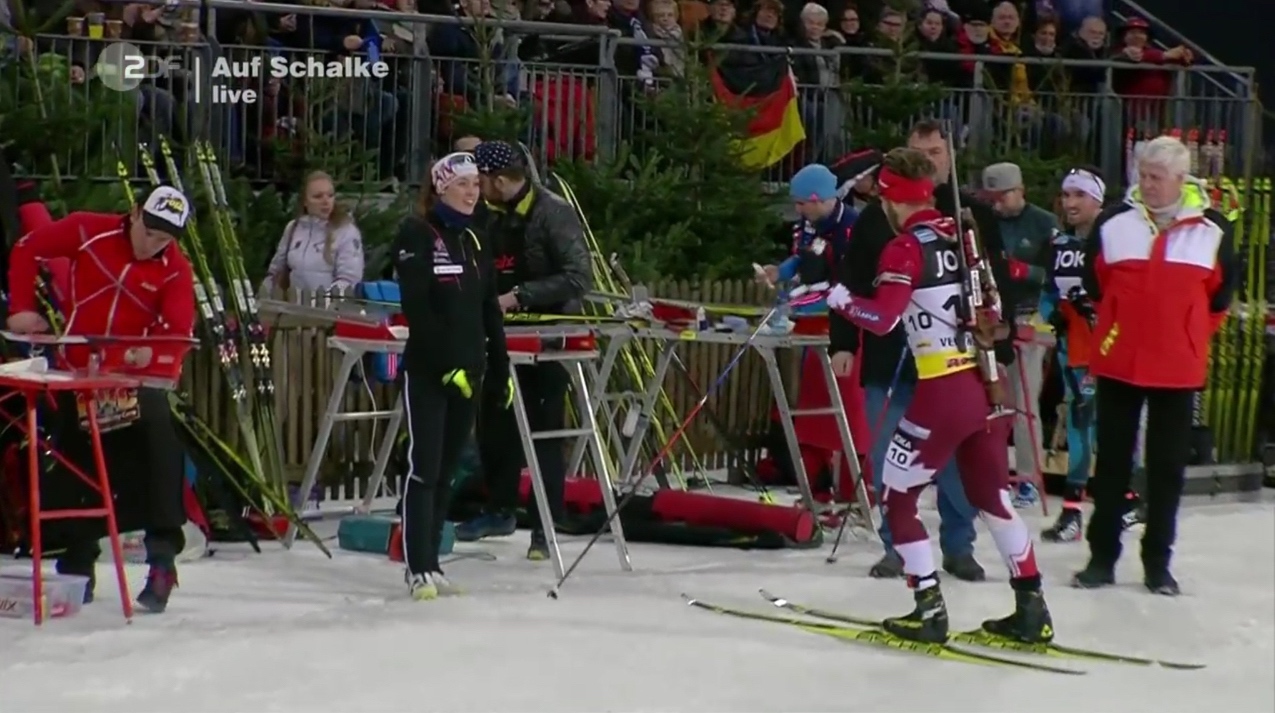
    Canada Biathlon’s Megan Tandy (in black) greets her relay partner Macx Davies in the tech service area after the mass start race during the 2016 Biathlon auf Schalke invitational event. (Photo: ZDF broadcast)
    Canada Biathlon’s Megan Tandy (in black) greets her relay partner Macx Davies in the tech service area after the mass start race during the 2016 Biathlon auf Schalke invitational event. (Photo: ZDF broadcast)
  • A Holiday Tradition Unlike Any Other: French Biathletes Win World Team Challenge

    A Holiday Tradition Unlike Any Other: French Biathletes Win World Team Challenge

    View of the indoor section of the ski track and the shooting range inside the arena at the Biathlon auf Schalke, or World Team Challenge, in Gelsenkirchen, Germany. (Photo: Biathlon-aufSchalke.de)
    View of the indoor section of the ski track and the shooting range inside the arena at the Biathlon auf Schalke, or World Team Challenge, in Gelsenkirchen, Germany. (Photo: Biathlon-aufSchalke.de)

    Biathletes competing in the international IBU World Cup tour are used to large crowds by now, with races often attended by 5,000 to 10,000 spectators per day. But the annual World Team Challenge, a two-person relay invitational in Gelsenkirchen, Germany, is on something of a different level. Athletes skied on artificial snow through a park around a huge soccer arena, before entering the pitch inside via a tunnel, and then shooting in front of nearly 41,000 raucous fans, with music blaring and the noise level amplified indoors many times.

    Two days ago on Monday, France’s Marie Dorin-Habert and her relay partner Martin Fourcade managed to perform the best among the 10 participating teams in this wild atmosphere, winning the final pursuit in 33:57.6 minutes (for about 12 kilometers of skiing, plus six penalty laps). The Czech Republic’s Gabriela Soukalová and Ondrej Moravec placed second, 12.6 seconds back (with three penalties), and third place went to local fan favorites, Germany’s Vanessa Hinz and Simon Schempp, 22.2 seconds behind with four penalties.

    Fourcade already had two 2014 Olympic gold medals, six World Championships titles, and 46 World Cup wins in every discipline and just about every World Cup location. But he had yet to seize a victory in Gelsenkirchen’s arena and was eager to change that.

    “It’s amazing, this is the only competition I did not win yet,” he explained in an interview with host TV broadcaster WDR after the race. “This morning I talked to Marie that it would be great to finally win it, and together we are a really strong team.”

    The World Team Challenge relay race is held in a special format, with one woman and one man forming a team and exchanging repeatedly, each skiing a 1.3-kilometer loop and having to clean a shooting stage, or ski a short 75-meter penalty lap, before tagging off to their teammate. This mode of competition is fairly similar to biathlon’s new single mixed relay or the team sprint in cross-country.

    Yet the location is vastly different, far away from any mountain range, in a flat region of Germany formerly known for its coal mines. And with the teams entering a darkened soccer stadium to a light show, a PA announcer, and loud music including the theme from “Pirates of the Caribbean,” the scene can be likened to the entrance introductions of NBA players or professional boxers.

    The World Team Challenge, also known as “Biathlon auf Schalke” by the name of German first-league soccer team Schalke 04, which plays its home games in the domed Veltins Arena under a retractable roof and a large JumboTron-style video cube, was created to be a fun race event during the World Cup season’s holiday break.

    The 2015 World Team Challenge podium, with France’s Martin Fourcade and Marie Dorin-Habert (c) celebrating their victory, the Czech Republic’s Ondrej Moravec and Gabriela Soukalova in second place (left), and Germany’s Vanessa Hinz and Simon Schempp in third place (right). (Photo: Biathlon-aufSchalke.de)
    The 2015 World Team Challenge podium, with France’s Martin Fourcade and Marie Dorin-Habert (c) celebrating their victory, the Czech Republic’s Ondrej Moravec and Gabriela Soukalova in second place (left), and Germany’s Vanessa Hinz and Simon Schempp in third place (right). (Photo: Biathlon-aufSchalke.de)

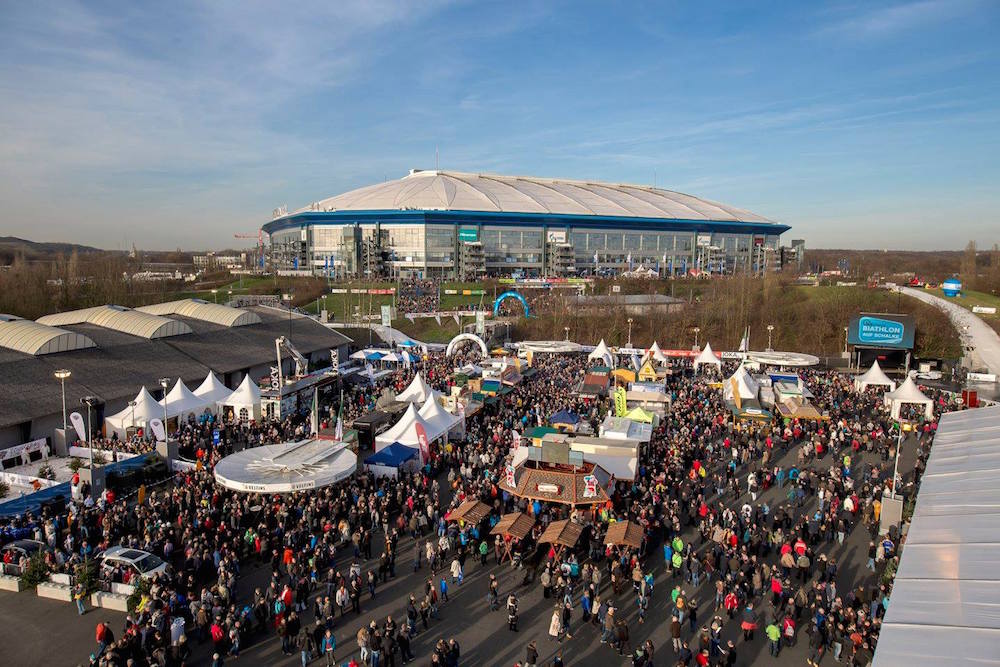
    Even more so than a regular World Cup, the race is held in a huge party atmosphere. The outdoor portion of the track meanders through a so-called “winter village” Christmas market with food stands for the fans. An abundance of Christmas trees inside the arena form little forests to delineate the track and shooting range, and entertainment includes a “shootout” to determine the starting order, the “Snowball Fight World Championship” (however undisputed that title may be), multiple live pop music performances, and an indoor fireworks show.

    Now in its 14th season, the World Team Challenge has become a fixed institution circled on the calendar for many biathletes during the holiday break, ever since the German duo Michael Greis and Martina Glagow (now Beck) won the inaugural event in 2002.

    The athletes invited to the race, by and large, take it seriously each year and are impressed by the atmosphere.

    “Oh, it’s huge. It’s amazing to ski in front of such an audience,” Germany’s Hinz told WDR. “It’s something very different, the pressure is a little higher because everything goes by so fast … I was just overwhelmed.”

    For Hinz and Schempp, it was their first podium finish and first time participating. Hinz, a former cross-country skier who switched to biathlon two seasons ago, achieved her first major success as a member of Germany’s gold medal-winning women’s relay team at the 2015 World Championships. For the World Team Challenge, she hadn’t planned to compete until the night before, as she replaced Schempp’s original partner Laura Dahlmeier who was sidelined with an illness.

    “I was completely nervous,” Hinz said, according to news agency SID. “The fans were crazy, a huge compliment to the audience.”

    There are no World Cup points to win in the event, yet the stakes are still high. World Team Challenge organizers guaranteed prize money of at least €10,000 for all starting duos, and this year, the winners got €14,000 per person, as well as a newly introduced challenge cup trophy.

    In the past, sometimes the winners also received a new car, but arguably that prize was harder to split between two people, plus a small crew of coaches and technicians. Overall, €156,000 ($170,000) in total prize money was awarded.

    “The form of this competition, short rounds, fast shootings, I like that, it’s pretty cool, a spectacular show for the viewers,” Germany’s Erik Lesser said in an interview with WDR. Lesser was last year’s runner-up with teammate Franziska Hildebrand.

    “In my opinion, this is an event to show people who normally don’t get to watch us what biathlon is all about, and I think we managed to do that today.”

    New Track ‘On World Cup Level’

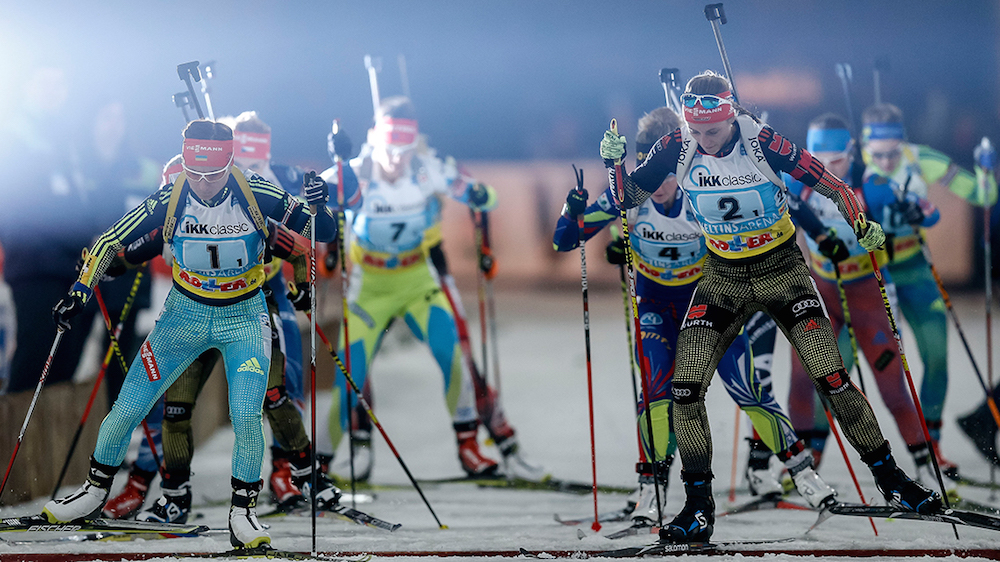
    Ukraine’s Valj Semerenko (bib 1, left) and Germany’s Vanessa Hinz (bib 2, right) lead a group of athletes on the outside section of the ski track during the 2015 World Team Challenge in Gelsenkirchen, Germany.  (Photo: Biathlon-aufSchalke.de)
    Ukraine’s Valj Semerenko (bib 1, left) and Germany’s Vanessa Hinz (bib 2, right) lead a group of athletes on the outside section of the ski track during the 2015 World Team Challenge in Gelsenkirchen, Germany. (Photo: Biathlon-aufSchalke.de)

    For the 2015 edition, the Biathlon auf Schalke organizing committee, led by Herbert Fritzenwenger, an Olympic cross-country skier and biathlete who’s currently a color commentator for biathlon broadcasts on the German TV network ZDF, designed a new track through a park that incorporated multiple more difficult climbs and downhill sections on the part that is built outside the soccer arena.

    In the past it was a rather flat loop, but this year it was supposed to more closely resemble what athletes would see “on the World Cup level,” as the organizers announced in a presentation before the race.

    “It’s not exactly ‘The Wall’ of Ruhpolding or the ‘Birxsteig’ in Oberhof,” Fritzenwenger said, referencing two notoriously difficult climbs at the two World Cup locations in Germany. “But the athletes will feel that it is more difficult than in prior years.”

    Using snow mostly coming from an artificial ski tunnel in a nearby city, every round was now almost 1300 meters long with 30 meters of vertical climb, which added up to about 300 meters for the men and 240 for the women for the whole day.

    After some years where the organizers experimented with rifles using a laser aim, the athletes now use their own rifles with real ammunition on the 10-position range again, with bulletproof glass walls and an empty section behind it to protect the audience.

    The increased difficulty of the course was evident during the races. Despite an indoor shooting range with no dreaded wind influence, most athletes produced more misses and thus had to skate more penalty laps than they normally would in a World Cup, also due to the fact that they were not allowed to use spare rounds.

    The new track was also designed to be wider, offering more possibilities to pass each other and thereby make for more interesting race situations than in prior years.

    “The athletes really enjoy it,” Fritzenwenger said in a pre-race press release.

    Yet during the competition, it quickly became obvious that a sharp right hairpin turn coming out of a new downhill section was rather difficult. Many athletes not only had to use all their cornering skills to pass this section safely, but even had to resort to snowplowing to slow down and not crash into a fence, something especially the men rarely do during World Cup races. Those who didn’t reduce speed enough had to pay for it, with Russia’s Evgeniy Garanichev falling twice in the same spot, potentially costing his team a podium finish. Other athletes also made contact with the snow in this turn, including Germany’s Lesser and Slovenia’s Teja Gregorin.

    “It was quite exhausting,” Hinz said in a post-race interview with WDR. “You can’t relax in the downhill sections because you have to focus so much. In the first rounds it’s still fine, but then it becomes increasingly difficult. It was really hard for me today, because those climbs were also pretty steep.

    “We aren’t machines, everyone is giving their best, but for us, this is a regular competition,” she added. “We are trying to win, that’s why were are giving it all we have.”

    Two ‘Halftimes’: Mass Start and Pursuit

    As in prior years, the field of 10 teams was indeed world class. It was not just comprised of athletes who are all active on the World Cup circuit, but several who are currently in the top 10 in the overall World Cup ranking for both women (1. Soukalová, 2. Dorin-Habert, 3. Hildebrand, 5. Wierer) and men (1. M. Fourcade, 3. Schempp, 8. Garanichev).

    It was a long race day for the athletes, with a shootout (more on that later) followed by the main event split into two “halftimes” as the organizers called it, borrowing a term from soccer. At first, a nine-loop mass start (the women skied four loops; the men five) on the 1.3 k course, followed by a pursuit race of that length the same evening, after just a short intermission break. Thus the women had to ski about 10 k, while the men had to ski 13 k.

    Prone and standing shootings interchanged, and because the loops were comparatively short and intense, shooting accuracy was even more important than in regular World Cup races. It turned into an up-and-down event, and almost all teams remained in contention for the podium for a long time.

    While one athlete was out on the track, crews of wax technicians hurried to clean and prepare the skis of the athlete who was receiving a short pause, very similar to a cross-country team sprint.

    “We are mostly using fluid spray-on wax, that is faster [to apply], and also because temperatures outside are about 8 degrees Celsius,” a technician for the two German teams explained, while simultaneously preparing skis during a brief in-race interview with WDR, before his athletes needed them back in the exchange zone.

    After what the organizers called the “first half,” the mass-start part of the event, Russia with Ekaterina Yurlova and Garanichev was in the lead with a winning time of 33:47.6, ahead of defending champion Ukraine, with Valj Semerenko and Sergei Semenov 12.8 seconds back, and France 14.3 seconds back in third place. Germany’s Hinz and Schempp were 15.2 seconds out of first in fourth.

    The "winter village" outside the arena at the 2015 Biathlon auf Schalke, or World Team Challenge, in Gelsenkirchen, Germany. (Photo: Facebook/Biathlon-aufSchalke.de)
    The “winter village” outside the arena at the 2015 Biathlon auf Schalke, or World Team Challenge, in Gelsenkirchen, Germany. (Photo: Facebook/Biathlon-aufSchalke.de)

    But the organizers have come up with a clever way to make things more interesting for the viewers, and give all teams a fair chance and motivation until the end. They did so by reducing the deficit to the winner by halving each team’s time back, and making the maximum deficit 45 seconds. Thus Sweden and Italy, who had finished the mass start only in ninth and 10th, respectively, still had a chance to move up.

    And the podium indeed would be flipped during the “second half” pursuit race.

    The Czech Republic with overall women’s World Cup leader Soukalová and teammate Moravec had only finished in seventh, 53.1 seconds behind, but were able to make up a lot of ground in the pursuit, helped by the start rule and shooting only three more penalty laps.

    With six rounds left in the pursuit, local favorites Schempp and Hinz briefly took the lead when Hinz managed to clean her targets, while Russia’s Yurlova and Ukraine’s Semerenko had to ski into the penalty loop, causing very excited standing ovations from the home crowd.

    “One can only dream to come into the arena in first place, that roar and those masses of people were incredible,” Hinz told WDR.

    “The atmosphere when we were in the lead was gigantic, this is something very unique,” added her partner Schempp.

    However that excited feeling of being the leaders in front of their fans didn’t last very long. After Hinz missed a shot on the next stage, Dorin-Habert caught up with her again.

    As they did repeatedly in the last World Cup weekend in Pokljuka, Slovenia, Schempp and Fourcade skied together for one loop after the exchange, but with three loops to go, Schempp caused another miss in a prone shooting stage while Fourcade cleaned his targets with amazing speed, and was able to create a small gap to Schempp, Moravec, Garanichev, and Ukraine’s Semenov.

    “Of course he took a lot of risk in that last prone shooting, he finished very, very fast, but went out with a zero while I had one miss,” Fourcade’s opponent Schempp remembered in a post-race interview with WDR. “Then there was a gap, but nevertheless we can be very satisfied [with the third place], participating for the first time while they already had experience. And we indeed are!”

    After Dorin-Habert had managed to keep the lead, Fourcade skied another fast round, jumping up the climbs to come into the final shooting in first place. He cleaned all his targets just before Moravec as the closest pursuer had even begun shooting. Fourcade knew he had beaten out his competitors, immediately turning and raising his right fist.

    Moravec managed to clean his shooting stage, too, and defended the second place for the Czech team 12.6 seconds behind France, greeted in the finish by Soukalová.

    It was a special event for Moravec not just because of the excellent result, but also because he is soon expecting the birth of his child sometime during the next week.

    Schempp was able to still secure the third place for his team, cleaning his last standing shooting after coming into the range behind Austria’s Simon Eder, Garanichev and Semenov, and skiing to the finish 22.2 seconds back.

    After coming in fourth place just 7.4 seconds behind the podium, Garanichev was a bit disappointed to have given up the Russian lead from the mass start with too many penalty laps and his two crashes on the track. But it was a hectic race also due to his personal life circumstances. Similar to the Czech Republic’s Moravec, he told reporters that he intended to board a plane back to Russia at 6 a.m. the next morning, hoping to be home in time for the birth of his child expected already for Jan. 1.

    Ahead of the pack, Fourcade was able to ski a relaxed final round, repeatedly slowing down a bit to waive to the fans. Dorin-Habert waited for him behind the finish line to hug him immediately after he had crossed it, with the audience cheering for all remaining teams until they were in the finish, too.

    “Maybe he has three legs, or three lungs, he is so strong,” a smiling Dorin-Habert joked after the race with WDR. “I don’t know how he does it, he is so fast. And if he is not in shape for once, he [still] shoots very well.”

    It was France’s first victory in the event, after the same two athletes had achieved a second place in 2012, and four more podium finishes for other French athletes before.

    (Third place for Vincent Defrasne and Marie-Laure Brunet in 2009, second place for Julien Robert and Florence Bavarel-Robert in 2006, third place for Vincent Defrasne and Sandrine Bailly in 2005, and second place for the pair in 2004.)

    “In 2012 I was in the lead with Marie Dorin here,” Fourcade recalled. “But then I fell on the last lap and hurt my shoulder. We only came in second, so I was very disappointed.”

    This year everything worked out for the French team. “It was a wonderful competition,” Fourcade said. “My family, my friends are here. This is the best way to end 2015.”

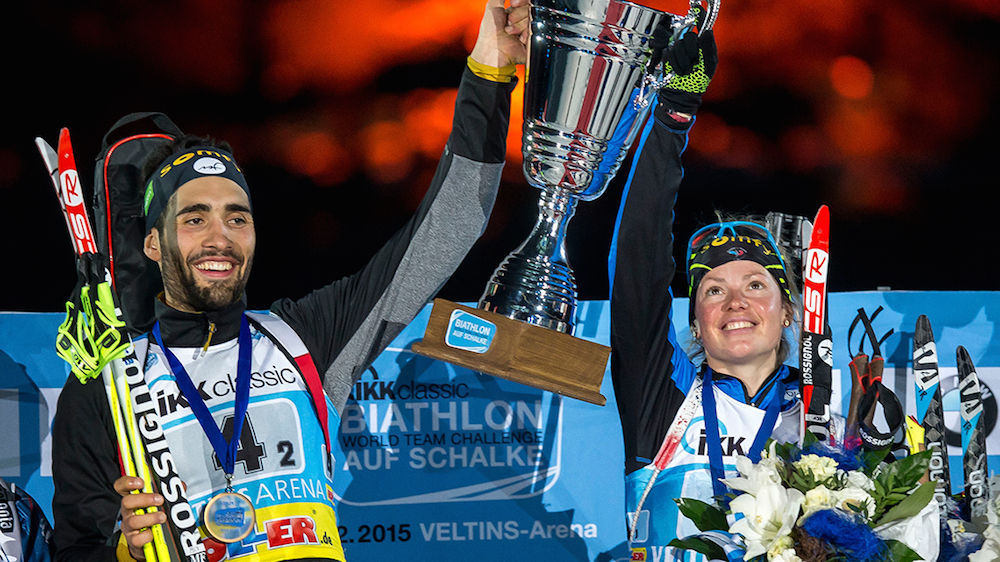
    French teammates Martin Fourcade and Marie Dorin-Habert hoist the new cup challenge trophy after winning the 2015 Biathlon World Team Challenge on Dec. 28.  (Photo: Biathlon-aufSchalke.de)
    French teammates Martin Fourcade and Marie Dorin-Habert hoist the new cup challenge trophy after winning the 2015 Biathlon World Team Challenge on Dec. 28. (Photo: Biathlon-aufSchalke.de)

    Official Race Results: 2015 World Team Challenge

    1. France (Marie Dorin-Habert, Martin Fourcade), 33.57.6
    2. Czech Republic (Gabriela Soukalová, Ondrej Moravec), +12.6
    3. Germany I (Vanessa Hinz, Simon Schemp), +22.2
    4. Russia (Ekaterina Yurlova, Evgeniy Garanichev), +29.6
    5. Ukraine (Valj Semerenko, Sergei Semenov), +31.7
    6. Austria (Lisa Hauser, Simon Eder), +46.8
    7. Germany II (Franziska Hildebrand, Erik Lesser), +1:46.8
    8. Slovenia (Teja Gregorin, Jakov Fak), +1:57.6
    9. Italy (Dorothea Wierer, Lukas Hofer), +2:27.1
    10. Sweden (Emma Nilsson, Tobias Arwidson), +2:55.3

    Notably Absent

    No North American athletes participated in the World Team Challenge this year. In 2008 and 2009 Lanny Barnes and Jay Hakkinen represented the U.S. (placing ninth, then sixth for the best finish to date), in 2010 Tracy Barnes-Coliander and Tim Burke placed 10th, and in 2012 Susan Dunklee again with Burke finished 10th.

    As for Biathlon Canada, no Canadian team has participated in the event to date.

    It was unknown to the author whether North American teams had not been invited, or simply chose the longer rest over the holidays without additional travel and competition stress.

    Norway, which usually has been a mainstay at this event, declined to send a team this year, citing a season preparation focus on the upcoming World Championships at home in Oslo.

    Fun Pre-Race Events (i.e. The Shootout)

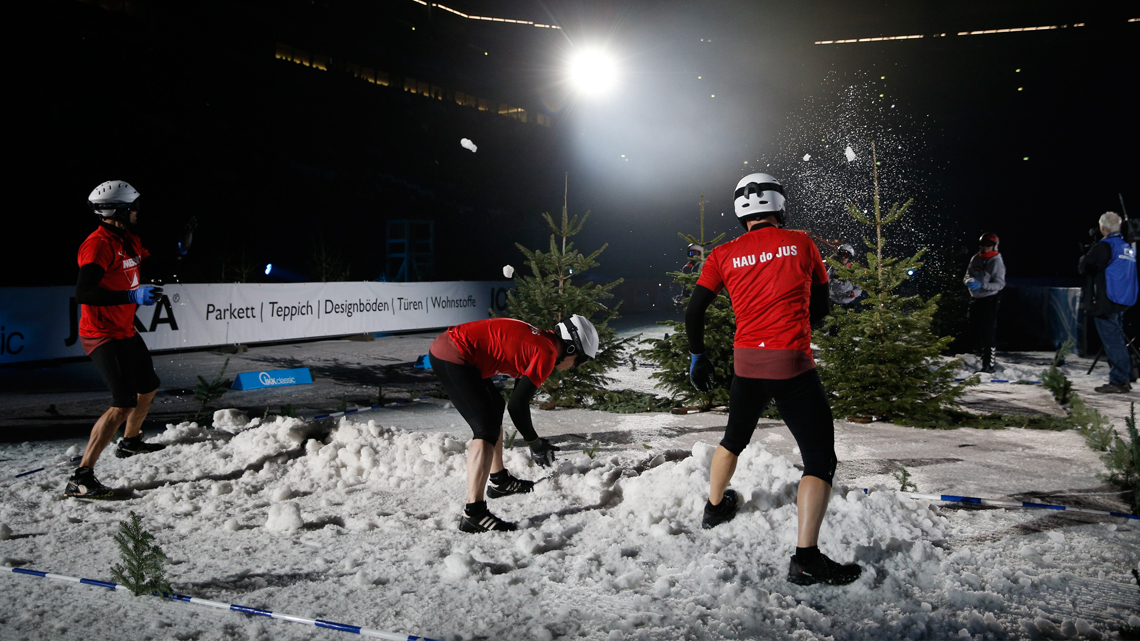
    The 2015 Snowball Fight World Championships took place on Dec. 28 as part of the Biathlon auf Schalke in Gelsenkirchen, Germany. (Photo: Biathlon-aufSchalke.de)
    The 2015 Snowball Fight World Championships took place on Dec. 28 as part of the Biathlon auf Schalke in Gelsenkirchen, Germany. (Photo: Biathlon-aufSchalke.de)

    Before the main event there also was a race among local junior teams called the “German Team Challenge,” with the duo Anna Weidel (age 19, perhaps best-known in the U.S. as a silver medalist in sprint and pursuit at the 2014 IBU Junior World Championships in Presque Isle, Maine) and Dominic Reiter (20) victorious.

    Also before the two main races, Slovenia’s Gregorin won a lighthearted “shootout” event among all participating women and men, coming from behind after several other athletes missed their final shot and lost time having to reload spares manually. In this competition the athletes — while not wearing skis — were asked to hit 20 targets as fast as possible (five prone, five standing, five prone, and five standing), using as many spare rounds as necessary. Gregorin narrowly beat out Lesser, with Austria’s Eder in third, Fourcade in fourth, Ukraine’s Semereko in fifth, and Czech Republic’s Soukalova in sixth place. Gregorin had already won the women’s first round to move into the final of the best three women and three men.

    As for the winners of the mentioned “2015 Snowball Fight World Championships” between 24 three-person teams? That honor went to the defending champions “Hau do Jus” from Wuppertal, Germany, narrowly beating out team “Snow Turtles” with 72 to 70 hits.

    Nobody asked Fourcade and Dorin-Habert if they intend to also aim for this title next year.

    Next World Cups

    The regular IBU Biathlon World Cup season will resume on Jan. 7, with the next two World Cups both held in Ruhpolding, Germany, after the organizing committee in Oberhof, also Germany, had to cancel due to complete lack of snow in the region combined with too warm temperatures to produce artificial one.

    “I’m happy that Ruhpolding has accepted the challenge and is doing everything to successfully host this World Cup,” Germany’s Schempp, who has made the town his home, described the difficult snow situation in an interview with German network ARD over the weekend. “It won’t be easy, but they are going all-out to make it happen. Two days ago I was training there, and right now it doesn’t look great with regards to the track, there is only about 1.2 or 1.3 kilometers. But with everything they do and it [the weather] supposed to become colder, I believe we’ll find really good conditions to race there in early January.

    “Of course the situation is bitter for Oberhof,” he added.