From the FasterSkier archive — posts syndicated from athletes’ and coaches’ own blogs between 2004 and 2012, kept online as published. Current coverage is at fasterskier.com.
Celebration abounds following Jessie Diggins’ Olympic silver medal in the 30 k mass start skate in Zhangjiakou, CHN. U.S. Ski Team head coach Matt Whitcomb and cross-country program director Chris Grover wear orange hats near the top-right corner. (Photo: NordicFocus)
I think we can all agree that the last two years have been a wild ride.
For those at the helm of the cross-country program at U.S. Ski & Snowboard, added layers of COVID safety precautions and expensive testing have increased the otherwise mounting demands of preparing for an Olympic Games. There have been numerous domestic and international competitions canceled, including a full season of SuperTour racing in 2020/2021, numerous World Cups canceled, and three consecutive years where the World Cup finals were either rescheduled or canceled. Amidst ever-changing travel policies country to country, the U.S. Ski Team tested, masked, and problem solved their way through two race seasons.
U.S. Ski & Snowboard XC Program Director Chris Grover oversees training during a 2019 U.S. Ski Team camp in Bend, OR. (Photo: FS Archives)
Throw into the mix preparations for an Olympic Games at a brand new venue where teams would be arriving site unseen and COVID testing protocols were extreme, and cap the season with the invasion of Ukraine and subsequent ban of the Russian cross-country powerhouse – there’s simply been a lot of curveballs thrown.
But as the 2022/2023 season approaches, we also sit at a transition point for World Cup racing that perhaps marks a few steps forward with gender parity. Namely, a move toward equal distance racing and the adoption of an initiative proposed by U.S. Ski & Snowboard to the FIS to incentivize supporting and developing more women to become ski technicians at the World Cup level. In this proposal, an additional set of course access bibs which could be used to test skis and product at World Cup events would be available only to women; therefore, a country could increase the size of its service staff by investing in the development of women techs and utilizing these women at World Cups.
Though Grover explains this may best serve the nations with the biggest budgets – which does not include the United States – it’s greater purpose aligns with other grassroots initiatives at U.S. Ski & Snowboard to hire, develop, and support women in coaching and leadership to improve the balance of men and women representing all levels of the sport.
There’s also a recently-released 2022-23 roster of U.S. Ski Team athletes, featuring a bloom of young talent on the men’s side whose trajectory may enable a full field of men and women to race at the 2026 Olympic Games in Milano Cortina. And, there’s momentum building for a Minneapolis World Cup in 2024, followed by a trip to the Northwoods of Wisconsin for a super-Birkie – i.e., a World Cup sprint and 50k on the Birkie trails.
In short, there were no shortage of talking points for this insightful conversation with cross-country program manager Chris Grover, who joined us from his home in Hailey, ID upon returning from the U.S. Ski Team’s first training camp of the season at the Mt. Bachelor Nordic Center in Bend, OR.
Thanks for listening.
Masked up, Jessie Diggins and Ebba Andersson (SWE) congratulate one another on podium performances in the 10 k skate in Falun in Mar. 2022. (Photo: NordicFocus)
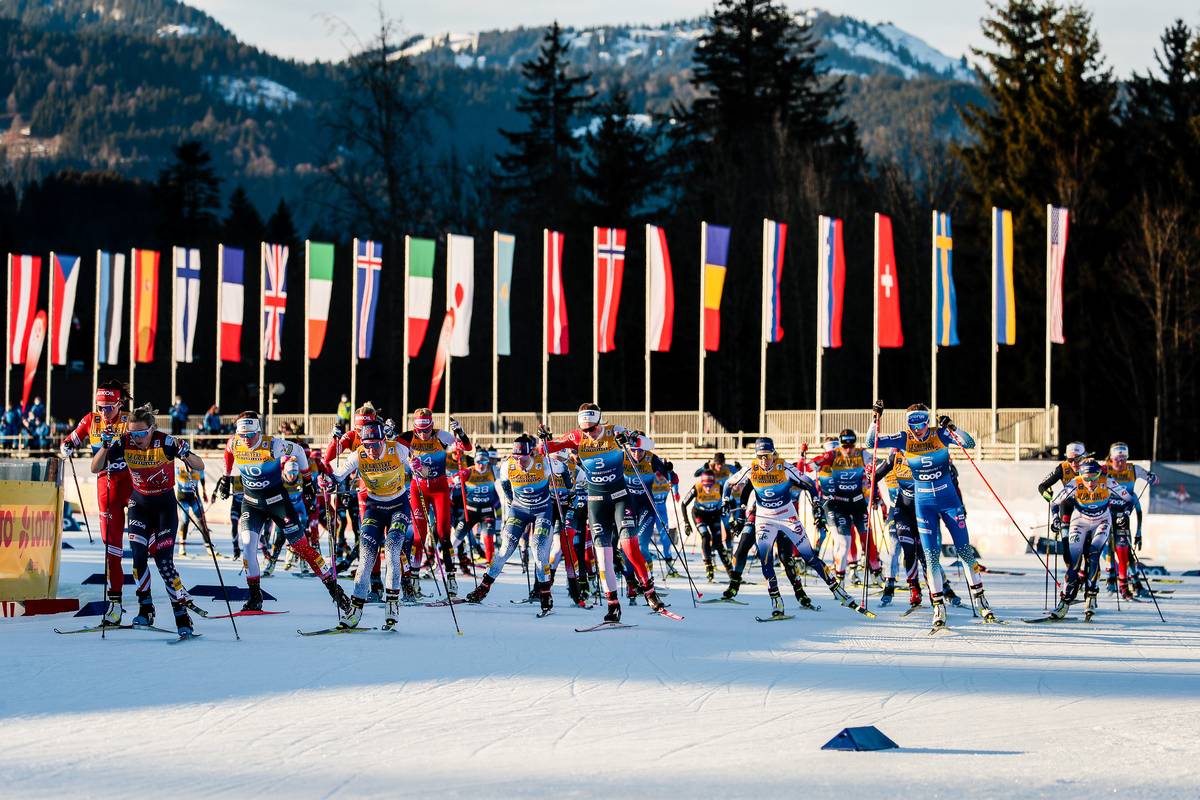
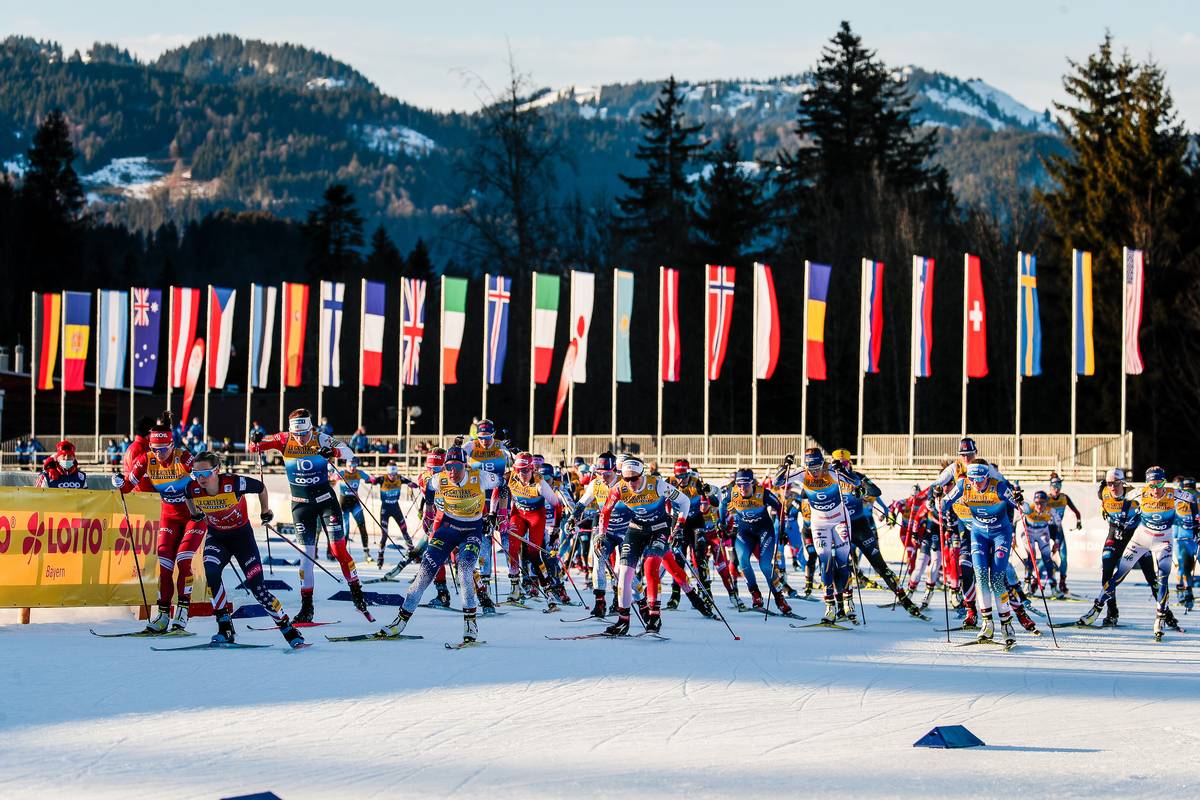
The start of the women’s 10-kilometer mass start free during Stage 3 of the 2021/22 Tour de Ski in Oberstdorf, Germany. (Photo: NordicFocus)
This press release originally appeared on fis-ski.com on Wednesday, March 18, 2022.
May marks the month of the FIS Committee meetings, debriefing the season and setting up task and changes for the upcoming ones.
All proposals that were elaborated by Sub-Committees and working groups members came on the table of the Cross-Country Committee (CCC) on Wednesday, 18th May. The Committee discussed them and forwarded the confirmed proposals on to the highest authority in FIS, the FIS Council.
All proposals, including the extract of the major proposals presented below, are therefore subject to the approval of the FIS Council which will meet on 26th May.
Decisions of the FIS Cross-Country Committee
Equal Distances for Women and Men
The question, if women and men are to race equal distances has been a very important topic for years and a prominent discussion building up to this year’s Cross-Country Committee meetings as the decision was on the agenda.
With 57%, the CCC voted for equal distances for women and men.
A historical decision.
The implementation will be effective from the upcoming World Cup season on the World Cup level as well as on Junior and U23 World Ski Championships (JWSC/U23 WSC) and Youth Olympic Games (YOG) level for now. The decision whether to implement it on World Ski Championships level will be discussed with all stakeholders and decided in May 2023.
In a second step, the voting members decided about the formats that will be in place and voted to use the following standard distances
For World Cup: Sprint | 10km | 20km | 50km with Skiathlon being 20km (10km + 10km)
For U23 WSC and JWSC: Interval 10km | Sprint | Mixed Relay 4x5km | Mst 20km
For YOG: Interval 7.5km | Sprint | Mixed Relay 4x5km
The National Ski Federations, of which the voting members consist, did not go into a long discussion but came with a clear opinion. All up front, the main argument to vote for equal distances was that there should not be any question whether women were capable of racing the same distances as men, as they prove that they physically are capable of doing so already.
The main argument against was the time that women need to cover the same distance as men and the effective TV time.
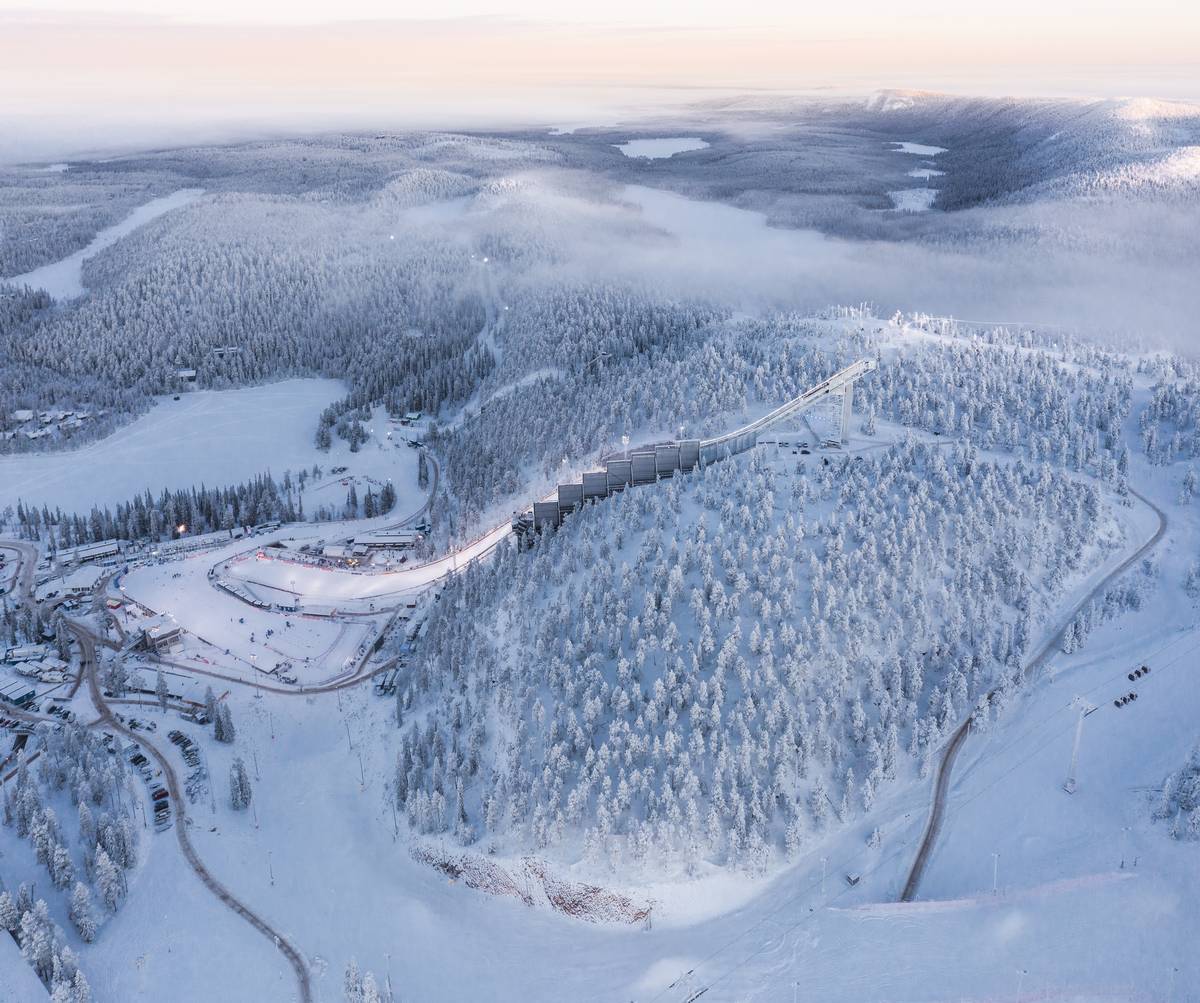
Above the Arctic Circle: Ruka, FIN is blanketed in frost and fresh snow for the opening of the World Cup season in November 2021. (Photo: NordicFocus)
FIS Cross-Country Calendar
The updated version of the calendar will be uploaded once approved by the FIS Council.
Starting out with the traditional Nordic weekend at Ruka (FIN) from 25th to 27th November, the FIS Cross-Country family will stay in Scandinavia and move to Norway for two event weekends in Lillehammer and Beitostølen before going to altitude in central Europe with the famous Davos Nordic weekend in Switzerland, which will take place on 17th and 18th December.
The Tour de Ski is set from 31st December to 8th January with stages in Val Müstair (SUI), Oberstdorf (GER) and Val di Fiemme (ITA).
After a competition-free weekend, the World Cup family remains in Italy for the City Sprint in Milano, a three-day event in Les Rousses(FRA) and Toblach (ITA) as the final preparation before the World Ski Championships in Planica that is scheduled for 22nd February to 5th March 2023.
The final period of the Cross-Country World Cup starts in Norway with Oslo and Drammen before heading to Falun (SWE), Tallin (EST) and Lahti (FIN) for the World Cup Finals.
World Cup Points
A dedicated working group compiled a new World Cup point table that is set to decrease the gaps between athletes in the overall standings without devaluing top results. The table that was approved by the CCC gives the opportunity to a wider range of athletes to score World Cup points and gives a higher value for Distance athletes to participate in Sprint races and vice versa.
The new World Cup Point table will be uploaded in the World Cup Rules once approved by the FIS Council.
Course bibs dedicated to female staff
US Ski & Snowboard had submitted a proposal to add a number of course access bibs per team for female service staff only, with the wish to therewith encourage more National Ski Federations to invest into the education of female staff in the ski service field in cross-country skiing. The proposal was accepted by the CCC.
The podium of the first 4 x 5 k mixed gender relay in March 2022. USA I took the win in Falun, SWE ahead of Finland I and Norway I. (Photo: NordicFocus)
Quota for Team competitions
Small nation’s quota
To give more nations the possibility to join Team competitions, the CCC approved that every nation with a basic quota of less than four athletes has the right to start with four athletes per gender also in all individual competitions if there is a Relay or Team Sprint during the same World Cup stage.
Mixed Relay starting order
For the future Mixed Relay competitions, each nation will have the right to enter 2 teams per nation. The starting order will alternate between the order Woman | Man | Woman | Man and Man | Woman | Man | Woman.
Mixed Nations
The CCC approved that nations can enter mixed nations teams (athletes from max. two different nations), if they do not have enough athletes to form their own team.
Vegard Ulvang steps back from his position as chairman of the FIS Cross-Country Committee. (Photo: fis-ski.com/NordicFocus)
The Chairman says goodbye
For Vegard Ulvang, Chairman of the Cross-Country Committee this was the last meeting after well 20 years in position as he announced to step back. His replacement will be elected via the FIS Council.
The FIS Cross-Country family has gone through significant changes under the watch of the Chairman. As a former world-class athlete himself, Vegard stepped into position with an incredible experience and passion for his position and the sport.
FIS Cross-Country sat down together with Vegard to reflect on his time as a Chairman of the Cross-Country Committee. Especially milestones such as the Sprint introduction in 2001, a renewed WSC program from 2005 and of course the introduction of the Tour de Ski were just some of the milestones set in Vegards’ Committee career.
The extended FIS Cross-Country family would already now like to thank Vegard for his tireless dedication for the work behind the scenes of the Cross-Country sport. He gave an unparalleled commitment and took over the large responsibility that comes with the job and has triggered, influenced, and managed many historic decisions. Thank you Vegard for leading the way.
For his contribution, Vegard was proposed to become a Honorary Member and will need to be confirmed by the FIS Council.
Rosie Brennan races to fifth in the freestyle sprint during a December, 2021 World Cup in Lillehammer, NOR. (Photo: NordicFocus)
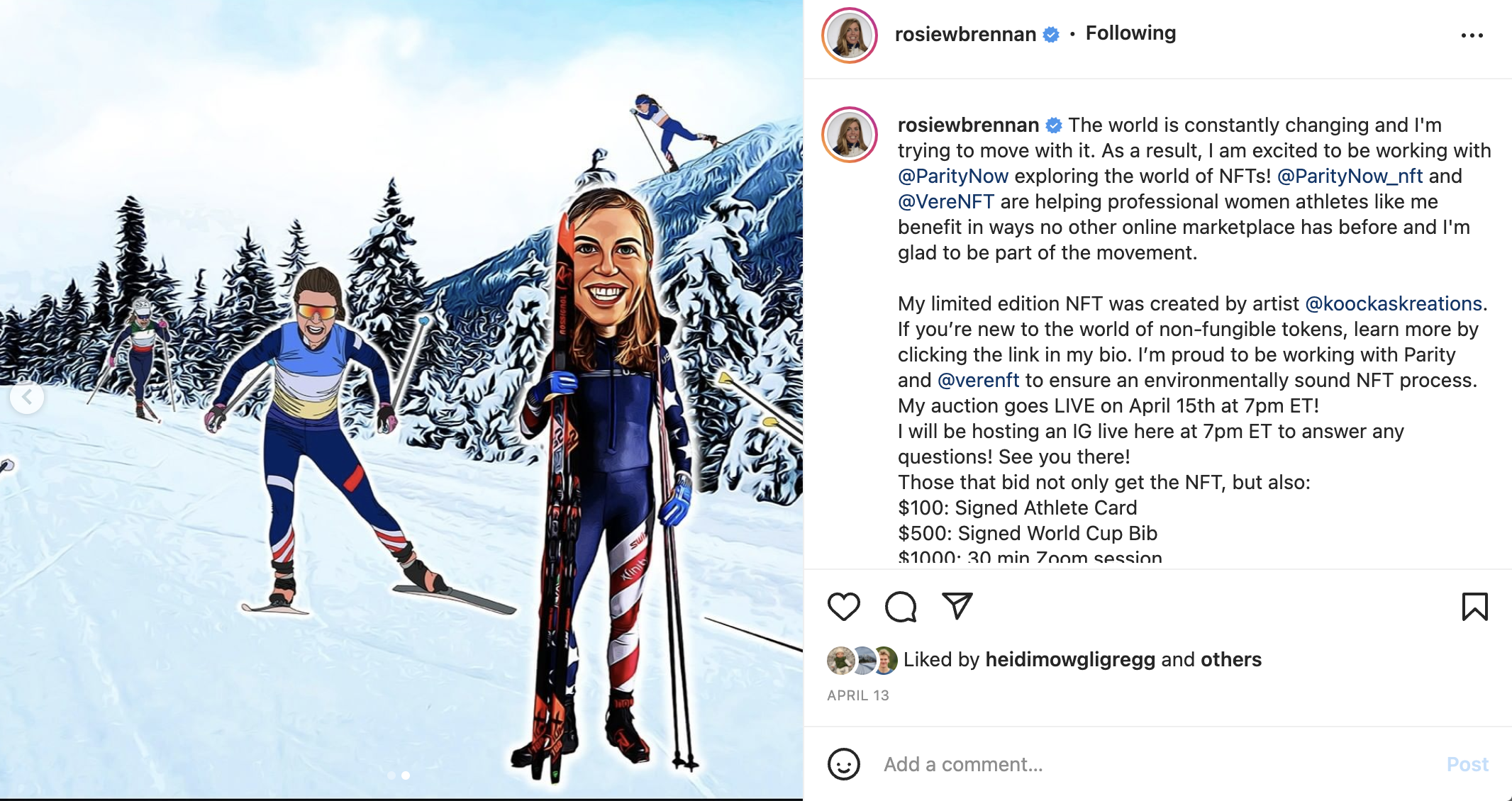
On April 13th, Rosie Brennan wrote in an Instagram post, “The world is constantly changing and I’m trying to move with it.” The post announced the launch of an online auction for a limited edition NFT, in partnership with the organizations Parity Now and VereNFT. The NFT, titled “Perseverance Trail”, was designed by artist Kerri Schiff and features a mountainous ski trail with a variety of images of Brennan racing in her Team USA suit.
If you just read that introduction and thought, “Wait – what does any of that mean?”, you’re not alone. It’s a very new realm and can very quickly make you feel as though you’ve been transported into the Matrix.
For starters, NFT stands for “non-fungible token”. An NFT is a unique and non-interchangeable digital asset, typically a piece of digital art or music, that is stored on a blockchain and can be sold or traded via an online marketplace. A blockchain is more or less a virtual ledger for transactions in that marketplace, made across a secure network. To learn more, you’re better off heading to Forbes, or reading this helpful and entertaining article on The Verge.
When it comes to Brennan’s Perseverance Trail NFT specifically, the highest bidder on the auction is purchasing a unique piece of digital art, along with the exclusivity of that token.
“For our physical reality,” Brennan explained in a call, “you’re purchasing that [digital] image and you are then the only one who then owns that. So I can’t reproduce it or sell it, or make it a poster. It is just that singular item.”
For those who bid at different levels, regardless of whether they eventually own the NFT, Brennan has offered a tiered list of rewards: $100 gets you a signed athlete card, $500 for a signed World Cup bib, $1000 for a 30 minute Zoom session, and $2000 for a three-month personalized training plan.
(Photo: Instagram @rosiewbrennan)
It’s an altogether different and very new avenue that an athlete might incorporate to support a career, and Brennan admitted to still being in the learning process. That said, she explained some of the factors that were intriguing about the proposition.
“Maybe the more interesting part about NFTs is that, because there is only one of them and it’s tracked, it has a digital footprint. So, if somebody buys it, I get some of the proceeds from [the sale] and the artist gets some and then Parity Now gets some. But every time it’s resold after that, I continue to get some of the proceeds. So that’s kind of different from a physical piece of art. When an artist sells a piece of art, that’s the only time they gain profit from it. If that [buyer] then resells it, the artist doesn’t get any benefit from that.”
Another unique aspect is that the value of the NFT may increase with time. “As we see in art, most artists don’t become famous until they’re dead.” Brennan laughed as she expressed that thankfully, athletes don’t need to wait quite as long, however, it remains unknown what they will accomplish during their career until it is finished, or what they may achieve in other spaces afterward.
Ultimately, the NFT marketplace remains a nascent and still-developing platform for investment and trade, and it’s unclear how profitable this type of auction could be in the long term. Nevertheless, Brennan applauded Parity Now for offering women these non-traditional opportunities.
“It’s obviously very [new]… and so who knows what that really means, but I’m impressed that this organization is kind of pushing the boundaries in these areas and looking at different ways to create, not only like money for athletes, but just also awareness and marketing and hype.”
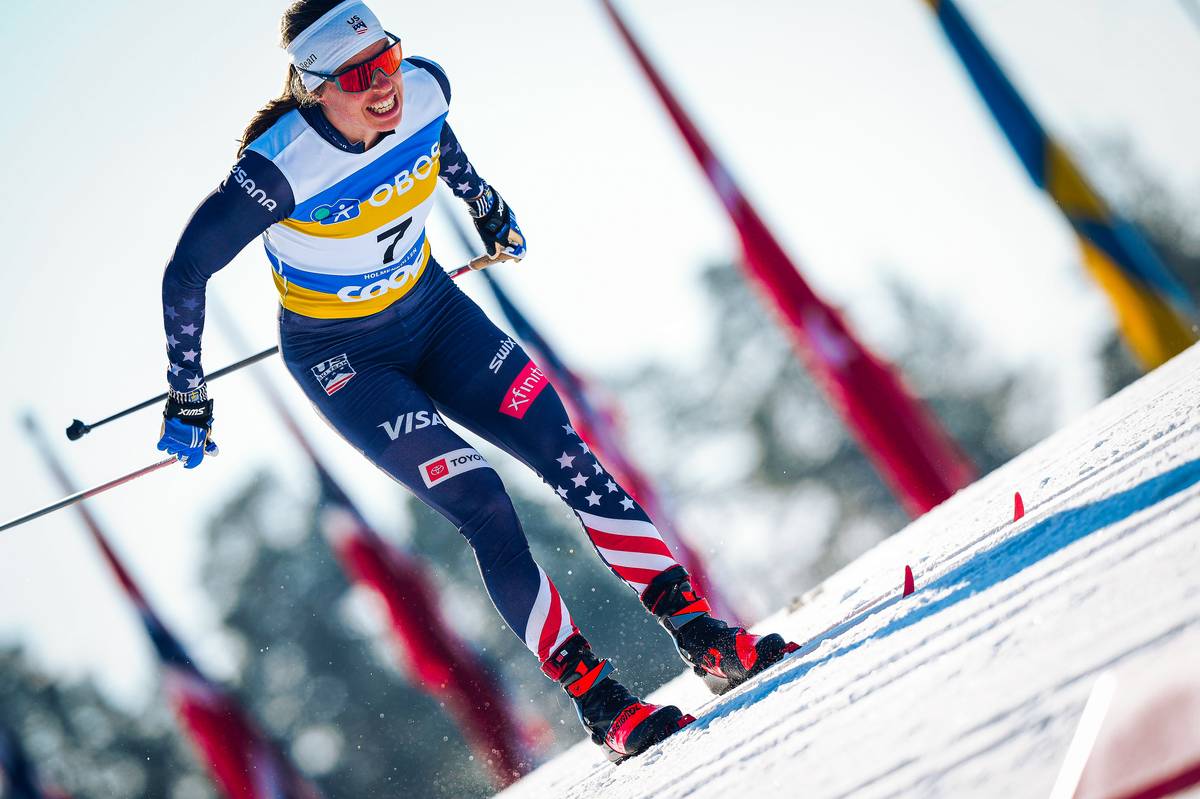
Rosie Brennan skis to 7th during the 30k classic at Holmenkollen in March, 2022. (Photo: NordicFocus)
Taking a step back to how this came about, we’ll rewind to the 2018 Olympics in PyeongChang, when Brennan found herself frequently riding the bus to and from the athlete village with American bobsledder Lauren Gibbs, who she described as “super outgoing and very friendly” and seemed to, coincidentally, be on a very similar schedule to the cross country ski team. After earning an Olympic silver medal in 2018 and a World Championship gold in 2020, Gibbs retired and became a spokesperson for Parity Now, an organization which advocates for equal pay, media representation, and opportunities for professional women athletes. Parity’s community of athletes includes more than 165 Olympians and Paralympians across more than 40 sports, all working together to “[propel] professional women athletes forward.”
When initially approached about the NFT opportunity, Brennan put the idea on hold. However, after seeing other women athletes on the marketplace and learning more about the process, she decided to give it a go.
From there, Brennan worked through a lengthy questionnaire to identify the aspects of her career and self that were most meaningful, to guide the artist in creating the design. Brennan also provided a wide variety of images of herself skiing to ensure the sport would be well-represented. She was then allowed to provide feedback throughout the process, until landing on a finalized piece of digital art
“It was cool to see an artistic interpretation of the values that I felt [were] meaningful in my ski career,” she said.
Rosie Brennan races to third in the 10 k skate in Lillehammer, NOR in December, 2021. (Photo: NordicFocus)
With athletes from all sports competing in the NFT marketplace, Brennan said she “really wanted to highlight what makes cross-country, in my opinion, different from other sports. And for me, one of those things is the fact that we’re doing all the events and all the techniques.”
In the image, both skate and classic techniques are featured, along with a couple of fast tucks, in and out of the tracks. Brennan also wanted to feature the variation in terrain, in contrast to a more controlled environment like a running track, along with the natural beauty and challenge of a cross-country ski trail.
“I wanted that natural environment highlighted, which is the part I really like about mine — I think [the artist] did a great job making some really cool-looking mountains… And then to me, [Perseverance Trail] is such a great metaphor for life. Particularly my own [journey] in cross-country skiing that has just been so up and down, and maybe required a little more perseverance than others. And just using that analogy – that no two trails are the same. I don’t think anyone’s path in sports is the same either.
“And then, this fine balance of being present in the moment on a trail, but also having that adaptability and flexibility to deal with what the trail brings on any given day. Changing elements, changing snow, changing weather, and skis – all these [variables] that cross-country requires, and that are such an important aspect of life, really.”
As for working with Parity Now more broadly, Brennan does aspire to partner with the group beyond this NFT project. She explained that she has already benefited from some of the webinars Parity offers to women athletes to equip them with the variety of business skills they might need to successfully support their career and ensure they’re well set up for life after sport. Brennan also explained that Parity can help connect athletes with other companies for work in social media and advertising campaigns, which she’d like to participate in down the road.
“It’s just neat to see different groups trying to tackle women’s equality from different angles,” she concluded. “And I think this business angle is actually a very important one. Lauren’s a real go-getter, and so I’m sure that there’s more good things to come from it.”
Parity Now cites research that estimates that, of the $66 billion global sports sponsorship market, only 0.4% goes to women. “You read that right,” Parity Now said. “For every dollar spent on sports sponsorship, women receive just half a cent.”
Rosie Brennan skis onto the podium with a third place finish in the 10 k skate in Lillehammer, NOR. (Photo: NordicFocus)
As fans of cross-country skiing in the US, it might be easy to lose sight of this pervasive inequality faced by women in sport. We see Jessie Diggins’ face on magazine covers before the Olympics, equal opportunity for prize money on the World Cup, and a whole team of women ready to pop a Top-10 or podium on any given weekend. In fact, the results achieved by American women over the last decade-and-a-half have made it easy to forget that the U.S. Ski Team had dropped funding for the women’s program prior to 2006 — though we now have two books, World Class and Trail to Gold, to remind us of this journey.
Speaking to her experience in becoming one of the top women in the US program, Brennan said, “I feel very lucky to be an American woman skier. I think we have had a lot of really great opportunities. To be honest, I think in the last decade or so we’ve honestly overshadowed the boys and, if anything, they usually get the raw end of the deal. So that’s maybe been a unique perspective that we’ve had as women cross-country skiers, and something I definitely try not to take for granted. And it is interesting traveling on the World Cup, you do notice cultural differences and how countries treat men and women differently. And not all is good and not all as bad, it’s definitely different.
“From an international perspective, like on the World Cup, navigating that is challenging — figuring out what actually is equality and what that means to different people and different cultures, and how we implement that into the bigger scope of the world is definitely challenging.”
Brennan added that she felt Americans are “a little more progressive on that end”, which makes her proud to represent the U.S. Ski Team. She did point out that there is one very obvious source of inequality present at most levels of the sport: how far men and women race.
“That’s maybe the most glaring aspect in which men and women are not equal [in cross country skiing]. I’m definitely a proponent for equal distance and it sounds like, honestly, everyone’s moving in that direction. I actually think that change is coming faster than we all anticipated.”
Rosie Brennan races a January, 2021 World Cup classic sprint in Falun, SWE. (Photo: NordicFocus)
Brennan serves as an elected athlete representative on the U.S. Ski & Snowboard cross-country sport committee and shared that equal distance will be a “big topic” at the upcoming annual congress. She also indicated that this is the case at the International Ski Federation level. “It’ll be interesting to see how that unfolds in the next month or so. But I definitely think it’s coming.”
Circling back to the NFT and what all of this means in the broader context of her career, Brennan concluded with both uncertainty and optimism.
“I don’t know if it will become such a big thing that people are wanting to gamble on a young athlete in hopes that they make it big and their NFT becomes worth millions or something,” she said with a laugh. “I don’t know if that’s what the future holds or not. But I definitely think it’s a cool way to bring awareness and promote women’s sports and take part in an interesting project.”
Female American and Swedish cross-country skiers are pushing to race equal distances as men. But some of the sport’s star women remain unconvinced.
ZHIANGJIAKOU, CHINA — At the end of her first-ever competition at the Winter Olympics — a 15-kilometer effort that left her sprawled on the ground gasping for breath — Julia Kern contemplated the idea of racing twice as far.
“I personally like the shorter distances,” said Kern, a rising American star. But, she added: “I think equal time makes sense to me.”
Equity, however, remains an elusive target for athletes competing in the Olympic cross-country ski races here.
In opening competitions, on Saturday and Sunday, the women raced 15 kilometers, while the men raced 30. In relays later in the Games, men will ski legs of 10 kilometers while the women race half as far. And when men ski a 50-kilometer marathon as their last event, women will race 30.
A group of Americans, including the U.S. team’s biggest star, Jessie Diggins, has launched a campaign to change that.
“I think it’s really, really cool to see people who are really good at long distance have their shot, and we get very few chances,” Diggins said. “We train just as hard, just as much as the men. As I’m sure you can see when I cross the finish line, we give just as much in every single race. And so I think we should be afforded the same opportunities for a variety of distance.”
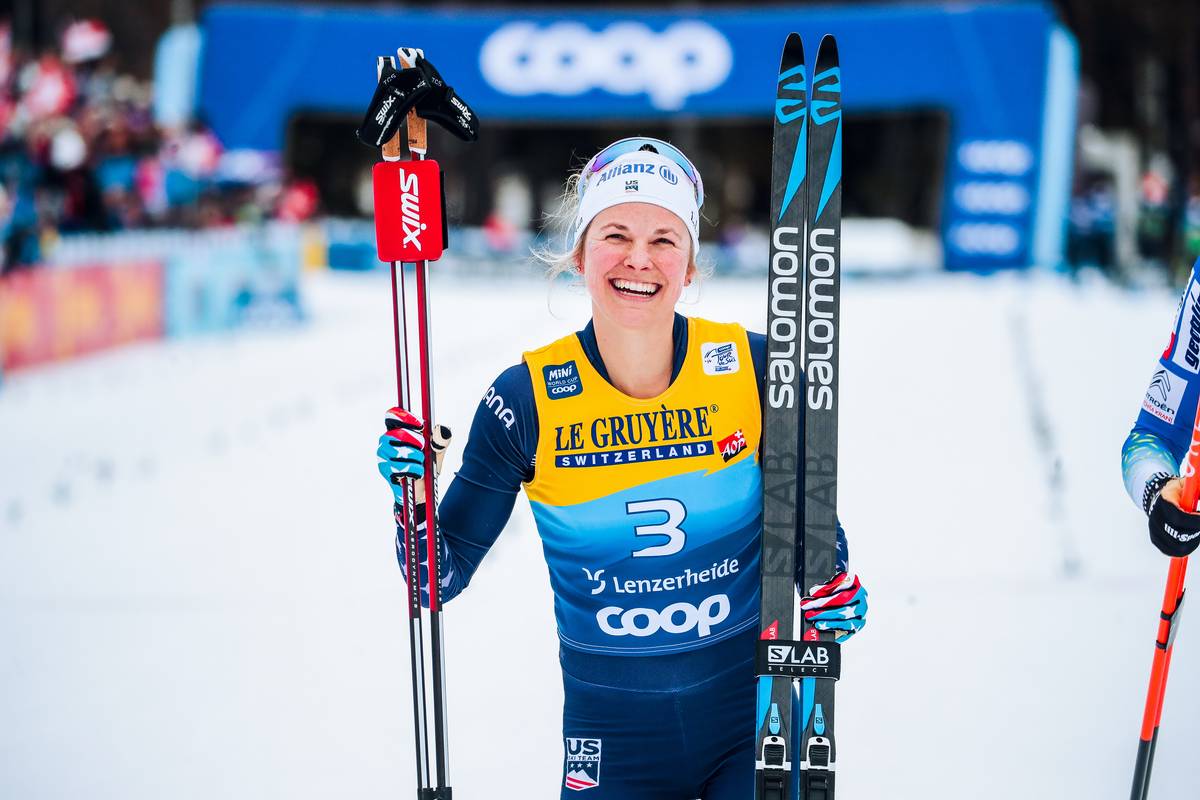
Jessie Diggins (USA) all smiles after finishing first in the 1.5 k skate sprint in Lenzerheide, SUI. (Photo: NordicFocus)
The sport’s leaders say discussions about closing that gender gap are happening at the international level. But there’s no time frame or firm commitment yet.
And while advocates say they’ve made progress on the U.S. domestic racing circuit, they stress that it’s hard to get traction without change at the top. That’s because athletes and coaches want to make sure that up-and-coming athletes are preparing themselves to race at the sport’s highest levels.
In the mean time, frustration is lingering.
“We wonder why women are paid, like, 75% of what men are paid,” said Molly Peters, a collegiate ski coach in Vermont who leads the group called Equal Distance. “I just think if women are going to be empowered and feel like they’re equal, the races should be the same.”
The world’s fastest women increasingly agree with Peters and Diggins, according to surveys by the International Ski Federation (FIS). But not all of them.
Theresa Stadlober (AUT) takes bronze in the women’s 15 k skiathlon, the opening event of the 2022 Beijing Olympic Winter Games. (Photo: NordicFocus)
“I think it’s good like it is,” said Teresa Stadlober, the Austrian who won a bronze medal in Saturday’s Olympic opening event. “Men are stronger. They have other muscles than we girls.”
Therese Johaug of Norway, the winner of that race, also said the 15-kilometer distance — compared to 30 kilometers for men — “is good for us.” “Maybe we could go 20,” she added. “But 15 is also great for me.”
Peters acknowledged that the idea of equalizing distances isn’t universally popular among women, which she attributes to some athletes’ comfort with the status quo.
“You’re going to want to keep doing what you’re most successful at,” she said.
The differences have been baked into cross-country skiing for decades. And until recently, calls for equity haven’t gotten much traction.
At the Olympic level, there are discrepancies between men’s and women’s events in several other winter sports. Nordic combined lacks a women’s competition whatsoever.
But in the sports where women do compete, cross-country skiing has the most events with substantial differences between women and men.
Until recently, the FIS surveys showed that the majority of women on the elite-level World Cup circuit “didn’t see the need for change,” said Pierre Mignerey, the federation’s cross-country race director. Last year was the first time a narrow majority favored races at the same distance.
The FIS has tasked a working group with studying the idea.
But the process comes with tricky questions. Should women race longer distances? Or should the federation shorten men’s events? Meet in the middle? Or race slightly different distances that take men and women the same amount of time?
And what about races where the distances are part of the tradition, like the 50-kilometer and 30-kilometer events for men and women, respectively, held at the Holmenkollen in Oslo?
Those questions, in turn, intersect with an ongoing FIS debate about which race formats and distances are most appealing to the World Cup’s European-focused TV audience.
“You’ll occasionally hear, ‘well, it’s hard to find the TV time for the two genders to go 50 k,’’ said Matt Whitcomb, the U.S. team’s head coach. “Well, find it. Or shorten the men. Otherwise it’s a sexist system.”
Any changes to the race program must be proposed to FIS’s governing council by the 20 nations in the federation’s cross-country committee, Mignerey said in an interview. Which means, he added, that any decisions will likely be driven by the sport’s biggest players.
“Basically, if the Scandinavians in cross-country are convinced that it’s a good change, there is a big chance,” Mignerey said.
In Sweden, at least, several stars have weighed in against unequal race distances, with 22-year-old Frida Karlsson last year declaring the difference between the 15- and 30-kilometer skiathlons “almost a little offensive.”
Frida Karlsson (SWE) races a 10 k freestyle in Davos, SUI in December, 2021. (Photo: NordicFocus)
“In soccer, ladies and gentlemen have 90 minutes, plus overtime. It is the same in most sports,” Swedish sprint star Linn Svahn told a news outlet in her country. “I see no reason why it should not be the same in cross-country skiing. It is a conservative tradition that we should race shorter than the boys.”
Norwegian men’s coach Eirik Myhr Nossum, in an interview, said his country is also open to a conversation about distances, and he called gender equality “a very important question.”
But, he added: “I’m not sure if having them race the same distances is the right way to say it’s gender equality. Gender quality is to be paid the same, and I think the situation in cross-country skiing is quite good.” (Men and women earn the same amount of prize money on the World Cup circuit.)
While FIS studies the issue, change is already happening at lower-level races.
In the U.S., organizers ran into a problem when they tried to schedule a 7.5-kilometer race for both men and women at a top-level SuperTour event last weekend: FIS rules say that men cannot score distance ranking points for races shorter than 10 kilometers. For women, the minimum is just five kilometers.
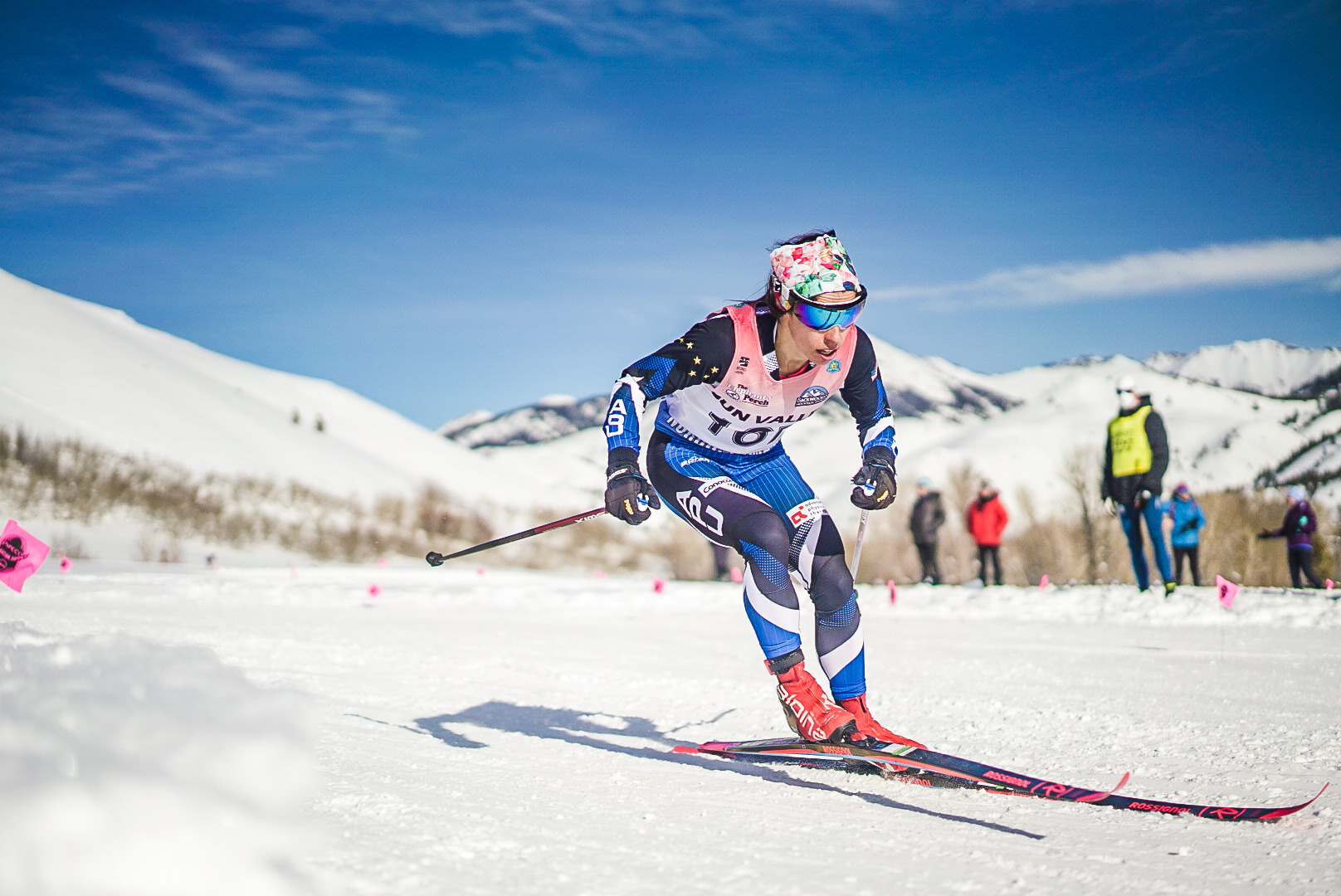
Rosie Frankowski skis to fourth in the SuperTour 10k mass start classic in Sun Valley. (Photo: Tobias Albrigtsen / @untraceableg)
But other SuperTour events have been equal. And Peters has made progress in pushing regional races on the NCAA circuit in the same direction — though she’s still waiting for other coaches to agree on a change at the national championships.
Peters, who coaches the ski team at St. Michael’s College in Vermont, said it was “amazing” to watch the women on her own team race the same 20-kilometer event as the men for the first time ever this year — a step up from the 15 kilometers they used to race.
“It was so hard,” Peters said. “The women were like, ‘We did it! We raced the same distances and we feel so proud of ourselves. And there was so much talk.”
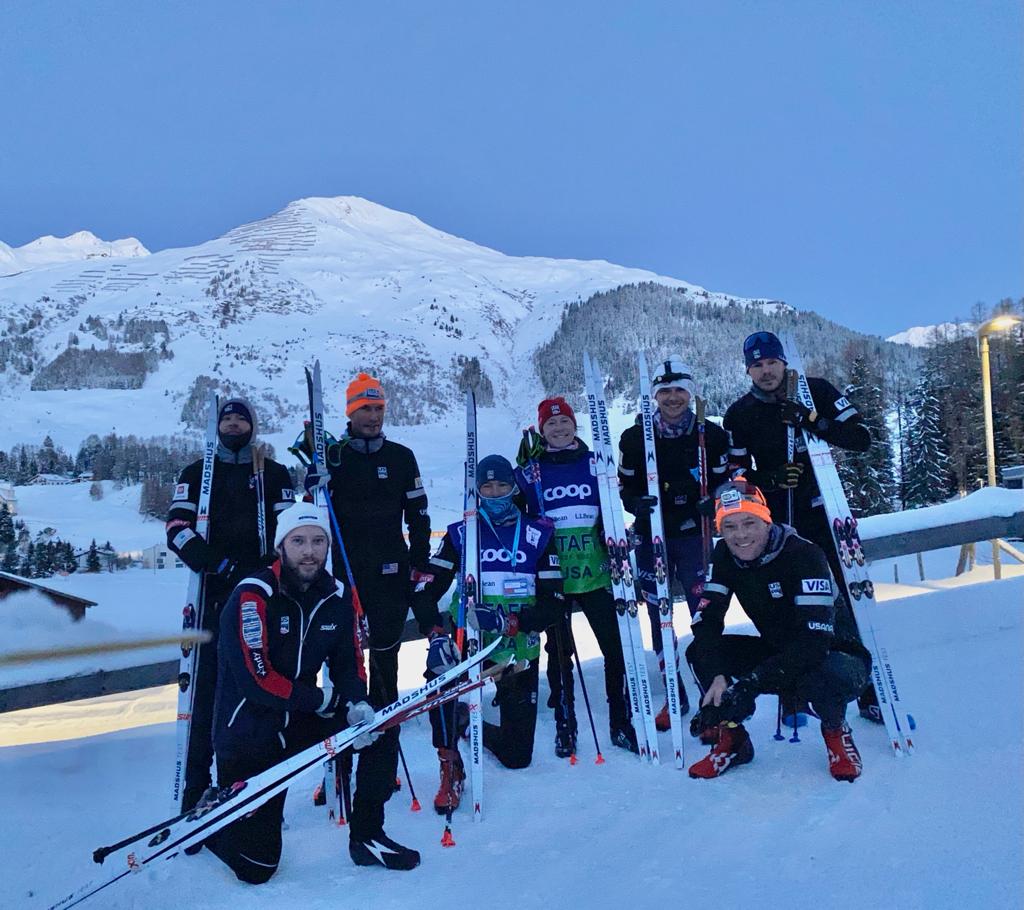
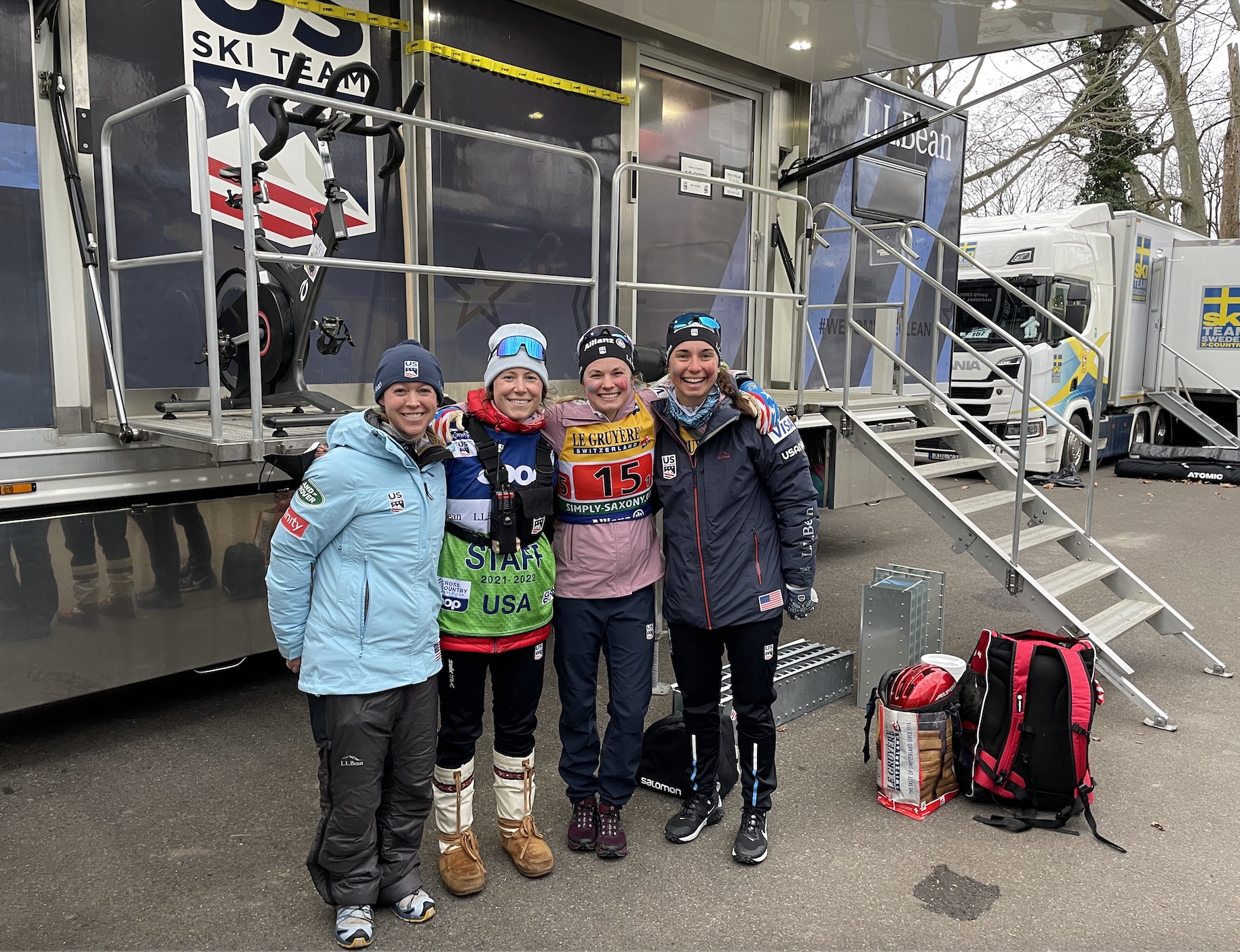
Kristen Bourne (center) joined the U.S. tech team to learn and support the American squad in Davos, SUI. (Courtesy photo)
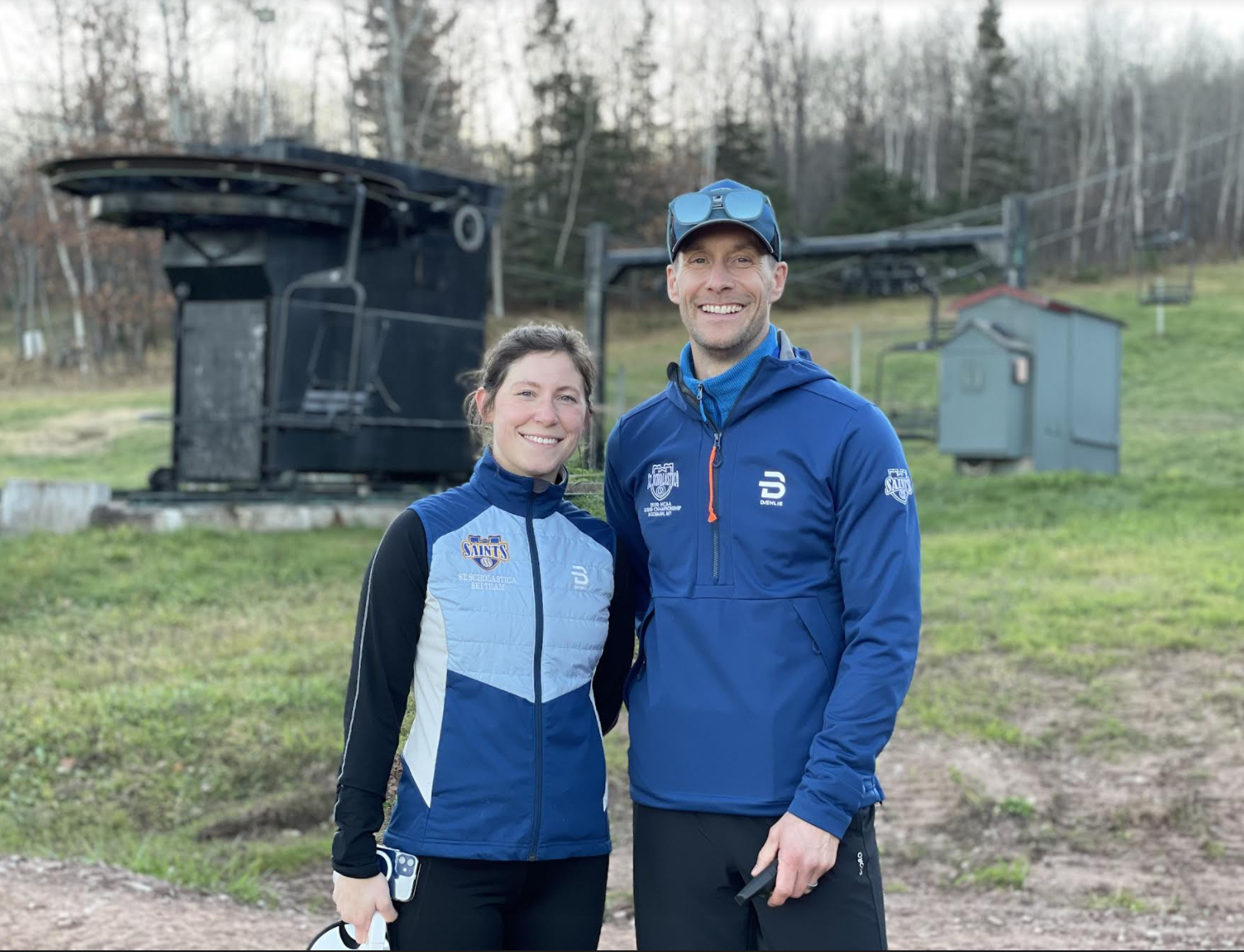
In November, FasterSkier interviewed Kristen Bourne, assistant coach at the College of St. Scholastica (CSS) in Duluth, MN, after she was selected as a Women’s Sports Foundation Van DerVeer Fellow, which came with a grant totalling $17,500. The objective of the fellowship is to improve representation of women in elite level coaching by supporting the development of rising coaches at the college level.
The majority of the funds from the VanDerveer Fellowship went directly to CSS, allowing the university to support Bourne’s position. However, $2,500 of the grant was allocated toward independent professional development opportunities of the fellows choosing. With additional support from U.S. Ski & Snowboard, Bourne recently had the chance to shadow, support, and learn from the American squad of athletes, coaches, techs, and support staff who were traveling the World Cup circuit.
Joining the team in Davos, Switzerland in early December, Bourne was immediately welcomed into the fold and handed responsibilities as both a coach and wax tech, which she described as an “intensive course” on all things World Cup. While this might seem like a high-stakes, intimidating experience for a developing coach, Bourne explained that she was well-supported as she stepped into the role.
“Coming in, the idea was that I was going to get a taste of doing everything,” Bourne explained in a call from Dresden, Germany. “I came in pretty early on in the week before [the races in] Davos, and was able to get a bit of a tutorial and orientation on the wax truck and how everything worked on a day to day basis. It actually turned out that that first weekend in Davos, I was going to be teching for Caitlin Patterson, so I needed to get an idea of what I was walking into, how everything worked, and how to make it as efficient as possible. So those first couple of days, the techs really took me under their wing and showed me the ropes. [They] taught me a bunch of new waxing techniques, and I got to pick their brains a whole bunch — just being in the wax cabin with them and asking any kind of question that I had, and they would take time to answer it.”
On the coaching side, Bourne sat in on pre-race team captains meetings, helped out during intensity sessions, recorded video to discuss technique and course strategy, and supported logistical planning as the team moved from Davos to Dresden and back. Throughout her time with the team, she explained that she shadowed Matt Whitcomb and Chris Grover, listening in and engaging with their discussions regarding what would be important for the team, and each athlete individually week-to-week.
She also took her turn behind the wheel. While not a glamorous part of the job, most coaches would agree it is a significant, and sometimes quite stressful, component.
“I drove a van of athletes from Switzerland to [Dresden],” she said with a laugh. “That was my first European road trip, so that was an experience that ended up being okay… I’ve had an opportunity to at least try everything once if not way more than that, so it’s been super awesome.”
At 25, Bourne is just beginning her career in ski coaching, and though she had done some post-collegiate training and racing in Norway, she was newly minted to the World Cup scene. It’s natural that with such an opportunity would come some self-doubt. Would your 25-year-old self feel comfortable talking World Cup tactics with Jessie Diggins? Yet, Bourne spoke highly of the culture developed on the U.S. Ski Team, and how both athletes and coaches made her feel valued as she stepped into each of her roles.
“Of course, that thought comes into your head. I’m working with people that are several years older than me, who have much more experience being in this environment than I do. But it’s been way easier than I thought it would be primarily because everyone has been really welcoming. When you have athletes who are older than you that then ask for your feedback or your opinion or your help, then all of a sudden it’s like, ‘Oh, they want to hear what I have to say here. They are appreciative of any feedback that they get. Age doesn’t matter so much.’ So it hasn’t been difficult at all, and I think that’s primarily due to the people and the environment that this team has created.”
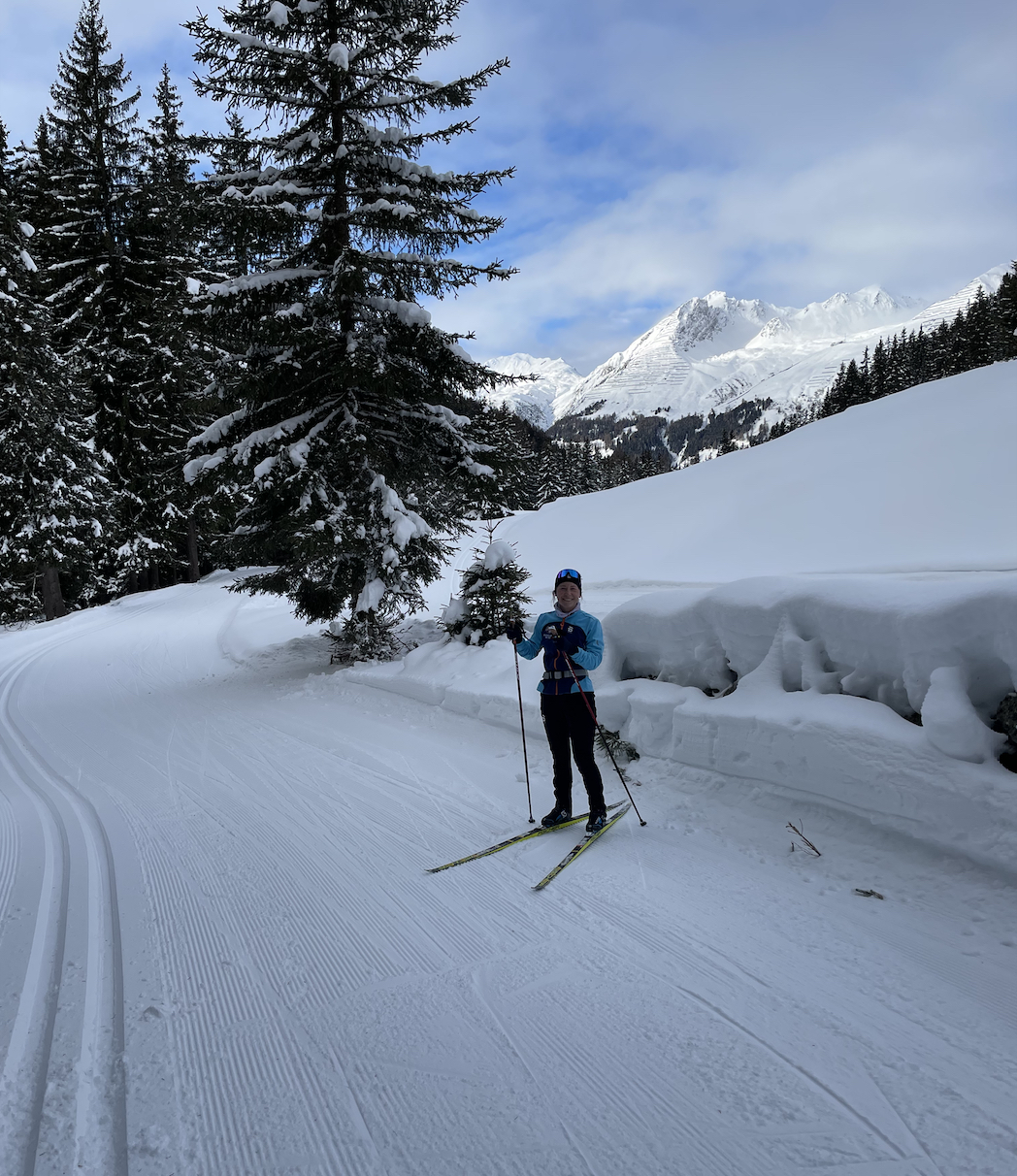
Kristen Bourne logs k’s on the stunning tracks of Davos, SUI while teching for the U.S. team. (Courtesy photo)
Though there were not established times for her to debrief or ask questions of coaches or techs, Bourne described the communication between herself and the coaches and techs as open. The crew would regularly ask how she was doing, and she felt comfortable asking questions whenever they cropped up.
“We have had this natural agreement where – they know I’m here to learn. And I also know I’m here to learn, but I’m also here to help them. And so, it’s been quite open that way. We have a plan for once this trip kind of wraps up and I get back that we’ll chat again and talk about that whole experience. But I’m hoping that this is something that [the U.S. program] will continue to do with other female coaches in the future, and I’m hoping this at least set the tone for a good experience on their end. It definitely has on my end.”
According to Grover, Bourne immediately demonstrated her capability and potential as she stepped into her roles, and what started as a stand-alone opportunity may just be the beginning.
“Having Kristen on this trip to Davos and Dresden was incredibly helpful, and we are so grateful to the Women’s Sport Foundation and to Maria Stuber and the College of St. Scholastica for making this trip possible,” wrote Grover in an email. “We have a U.S. Ski & Snowboard program-wide goal, and a cross-country-specific goal, to drastically improve gender equity in our coaching and technician staffs, so this opportunity was perfectly aligned with this mission.
“Kristen was an amazing asset to the World Cup group right away, almost seamlessly integrating into both our coaching and service teams, having never met many of the team members. We were really impressed by her skiing ability, her stamina in the test track, her knowledge of the sport and exercise physiology, and her ability to relate so well with each athlete and staff member. She was quick to embrace the team culture, including being thrown into one of the most intimidating team rituals of all – Secret Santa – almost immediately upon arrival, and brought fresh perspective and energy to the Team.”
On all accounts, the U.S. Team had highly successful weekends in both Davos and Dresden. Highlights include: Jessie Diggins taking second in the 10k skate in Davos, with Rosie Brennan close behind in 4th and Hailey Swirbul in 6th, plus Sophia Laukli in 19th and Novie McCabe 28th. The previous day, Brennan had been 4th in the freestyle sprint, while Ben Ogden skied through the semis to finish 12th. Dresden saw another American podium finish with Diggins and Julia Kern finishing second in the team sprint, while JC Schoonmaker made his third World Cup semifinal in the individual sprint. Grover applauded Bourne’s contributions to the team’s success throughout these events.
“She skied an amazing amount of kilometers in the test track in Davos, and was instrumental in identifying the products that we raced on in the 10/15 km F there,” Grover continued. “In Dresden, where we had a smaller staff, I would have really struggled without her support. We all really enjoyed getting to know Kristen and cherish making this professional connection and friendship with her. I know we’ll be looking to get her on another trip as soon as possible.”
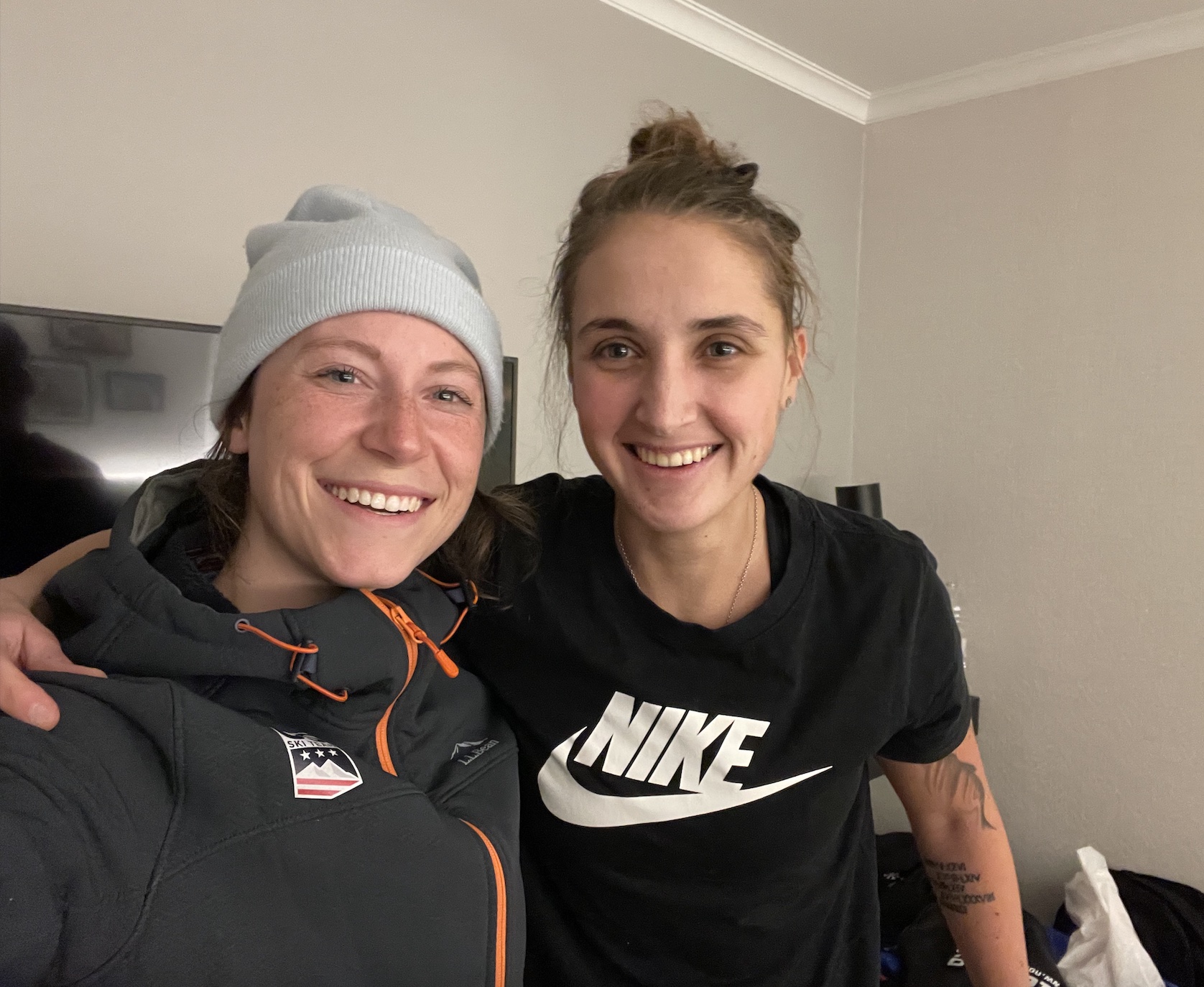
The team behind the podium in Dresden. From left to right, physical therapist Ana Robinson, rising tech and coach Kristen Bourne, Jessie Diggins, and Julia Kern. (Courtesy photo)
After the World Cup experience, Bourne would return to CSS, bringing back a host of new insights into the highest levels of racing. As she leaves the whirlwind adventure behind, what would stand out as key takeaways from her time in Europe? In particular, Bourne added tools to her belt on the technical side of sport performance.
“The waxing, for sure, [stands out],” she said conclusively. Different techniques, different ideas of what to focus on. It gets really easy to focus on certain aspects of picking skis, but their perspective is so much different. And they focus on things that [I wouldn’t have before], but when they explain it, it makes a lot more sense.”
A specific example that came to mind was a conversation she had with one of the techs, Bjorn Heimdall, regarding ski selection for Luke Jager.
“The skis that he had picked had a colder grind on them, however, It was also a pretty stiff ski. And so I asked, ‘Why would you put a cold grind on such a stiff ski?’ And he explained that, from his perspective, it has to do with the firmness of the snow, not necessarily how cold the snow is. It’s just how firm the track is that makes the difference. The grind does have some effect, but to him, it had more to do with the flex of the ski, and how high the ski was that made the bigger difference overall [in those conditions].”
Bourne contrasted this concept with her experience waxing for collegiate athletes, where she felt there was more focus on the ski’s grind.
Another factor that stood out from her time in the wax truck was the strategy and robust processes used to select the products used on race day and the skis to which they’d be applied. With massive fleets of skis, and an equally massive chemistry kit, finding a winning combination seems like a special brand of magic.
“I also realize that their ability to do that is much different than at the college level where you have only two coaches, instead of five to six wax techs who are able to test all of these powders, structures, topping… That’s pretty intense. But I think that the way they do it with various measurements, I find that to be really interesting. They can do all of these tests and not eliminate a specific ski in the first round. When you do single testing, [comparing pairs of skis] one to one, they have a method for that. I think that’s really cool.”
Bourne also explained how impacted she was by the depth of the relationship between an athlete and their tech.
“[The techs] are just as much coaches in this process as the actual named coaches of the team. They have really close relationships with their athletes. There’s a lot of trust there. And I really admire it. I’ve seen and heard from multiple techs that say, “I want to bring my athlete skis to her or to him.’ Because it’s like this special moment that they get to have before every race and that I just admire a lot.”
Lastly, Bourne revisited the culture within the U.S. program, remarking on how cohesive the group was as a whole.
“It shows that when you have people that you work with that you really enjoy, you can work in a hard environment or a tough environment, you can have long hours. But if you’re around people you enjoy working with, it makes the whole group become successful. It’s just very cohesive. And I’ve been very impressed by that… You hear all the time that this team is really great, and then when you’re in it, you’re like, ‘Wow, this is actually really cool.’ So I’m just really grateful. It’s been awesome.”
Kristen Bourne (left) snaps a picture with Vale Vuerich, head of service on Slovenian tech team and one of the only women teching at the World Cup level. (Courtesy photo)
As the conversation concluded, Bourne spoke to the impact this opportunity has had on her career development, opening the door to a level of racing many coaches never truly see up close. Continuing to build on this model, Bourne feels that developing coaches of all genders can gain the skills to continue the elevation of American cross country skiing at all levels.
“I hope that this is something that can be continued. It has been super valuable. And I know that [U.S. Team members and staff] also feel pretty on board with continuing something like this. It’s an interesting conversation that I’ve been having where – when you’re new to something, you don’t know what you don’t know. But with this experience, I’m starting to realize that I do know what I don’t know now. And so it’s very easy to pick out the specific things that I have questions about, and I get those answered really, really quickly. I’m learning from some of the best. So I hope that other people also get to have this experience because it’s incredibly valuable, and there’s a lot that you can take back. If more people have had an experience like this and could learn these types of [skills], it just would progress the development of not only coaches and techs but also the athletes going forward.”
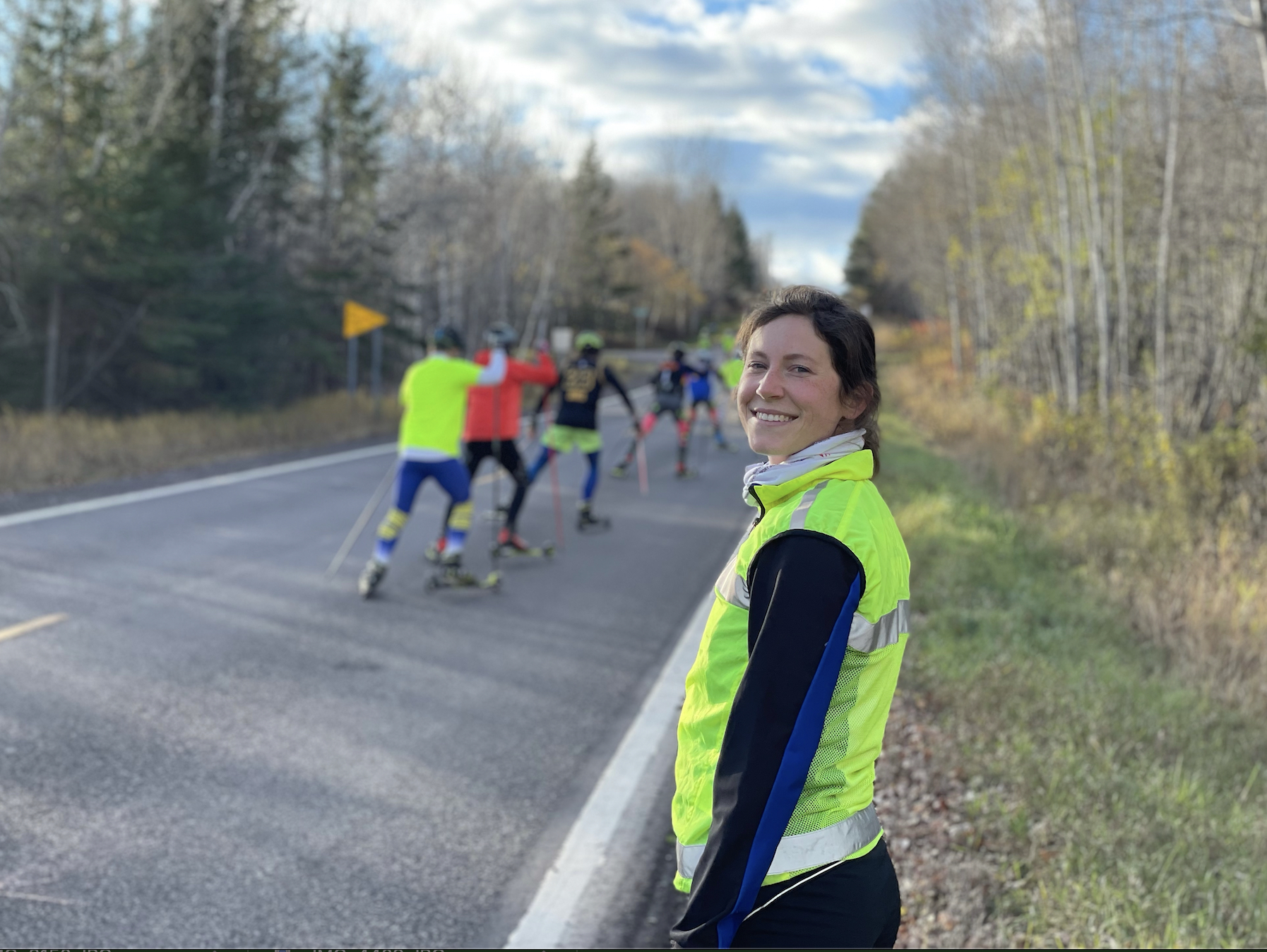
CSS assistant coach Kristen Bourne was awarded the Women’s Sports Foundation VanDerveer Fellowship for the advancement of women in coaching. (Photo: Maria Stuber)
Kicking off her second year as assistant coach at the College of St. Scholastica (CSS) in Duluth, MN, Kristen Bourne was recently named one of ten recipients of the Women’s Sports Foundation VanDerveer Fellowship. The program, named for revered Stanford University Basketball coach, Tara VanDerveer, aims to increase representation of women in coaching at the collegiate level through the development of the rising generation. This is the first time that the award has been granted to a cross country ski program.
According to the WSF, “this pioneering program provides grants, paid fellowships and mentorships for aspiring female coaches. Emphasizing hands-on training for female coaches in all collegiate sports, from basketball and volleyball to water polo and fencing, it is a salute to the extraordinary compassion, optimism and leadership that its namesake has shown over the years.”
Along with opportunities to collaborate with coaches across a variety of sports nationwide, the program offers institutions $15,000 to use in support of their fellow, along with $2,500 that goes directly to fellow to put toward additional professional development opportunities. FasterSkier connected with Bourne to learn more about the fellowship, her path to coaching, and how this opportunity will support her growth and long term goals in cross country ski coaching.
Originally from Lake Elmo, MN, on the eastern side of Minneapolis, Bourne attended Northern Michigan University (NMU), where she graduated with a degree in Sport Science in May, 2018. While racing for NMU, Bourne raced on four NCAA championship teams, and was a member of the 2015 U.S. World Junior Championships team and the 2016 U23 World Championships team. Post-college, she headed to Norway to train with Lyn Ski and Team Obos in Oslo, while competing in numerous FIS races throughout the country.
CSS assistant coach Kristen Bourne spent time in Norway after college training with Lyn Ski / Team Obos. Bourne is pictured here racing in a Norwegian Cup race in Gålå. (Photo: Martin Riseth)
Bourne returned to the US in December, 2019 to finish her racing career at the 2020 U.S. National Championships in Houghton, MI. It was there that she met Maria Stuber, head coach at CSS and the founder of the Women Ski Coaches Association (WSCA), who recognized Bourne’s potential as a coach and recruited her to the CSS program.
“I was just deciding that my ski career was about done and trying to figure out what to do next,” Bourne explained in a call. “I was at U.S. Nationals, I was leaving a parking lot, and Maria drove up and essentially slammed on the brakes, and yelled out the window, ‘Hey! My name is Maria. I heard that you’re interested in potentially coaching. You’re gonna get an email from me sometime soon.’”
Bourne went on to explain that Stuber emailed her the next week asking if she would be interested in joining her as the assistant coach at CSS. Tying the fellowship opportunity into the offer, Stuber knew about the VanDerveer grant and would help oversee the school’s application on Bourne’s behalf. CSS was not chosen after the first year of application, but they were selected this year on the second attempt.
Bourne explained how receiving the VanDerveer fellowship allows her to pursue a number of development opportunities beyond her role at CSS.
“Right now I have a few things in mind that I’m going to put that money towards. I would really like to go to the NCAA Women Coaches Academy, which happens every May. They have a bunch of super awesome female speakers and head coaches that all talk, and it seems really valuable. I think Maria did it a few years ago. Then the other professional development opportunity would be: I’m currently working on a trip over to the World Cup this winter.”
Though her education and wealth of experience lends itself well to coaching, Bourne did not always see this as a path she would choose.
“People were always telling me that I would probably end up being a coach, and I didn’t want to do what everyone thought,” she laughed. “And then, you come to this realization: I love the sport, and I want to learn more about it, and I’m really passionate about it. I can take my personal experiences from being in Norway and seeing how they work over there, I can apply what I learned there, and through college, my own [time as an athlete]… Right now I’m also working on my master’s in exercise physiology. So being able to take all of that experience and knowledge and be able to apply it as a coach, I think it’s kind of a no brainer.”
Though improvement is trending, women remain underrepresented in leadership roles in the ski community. According to the 2020-2021 Women in College Coaching Report Card issued by the Tucker Center for Research on Girls & Women in Sport, only two of nine NCAA Division 1 cross country ski coaches are women.
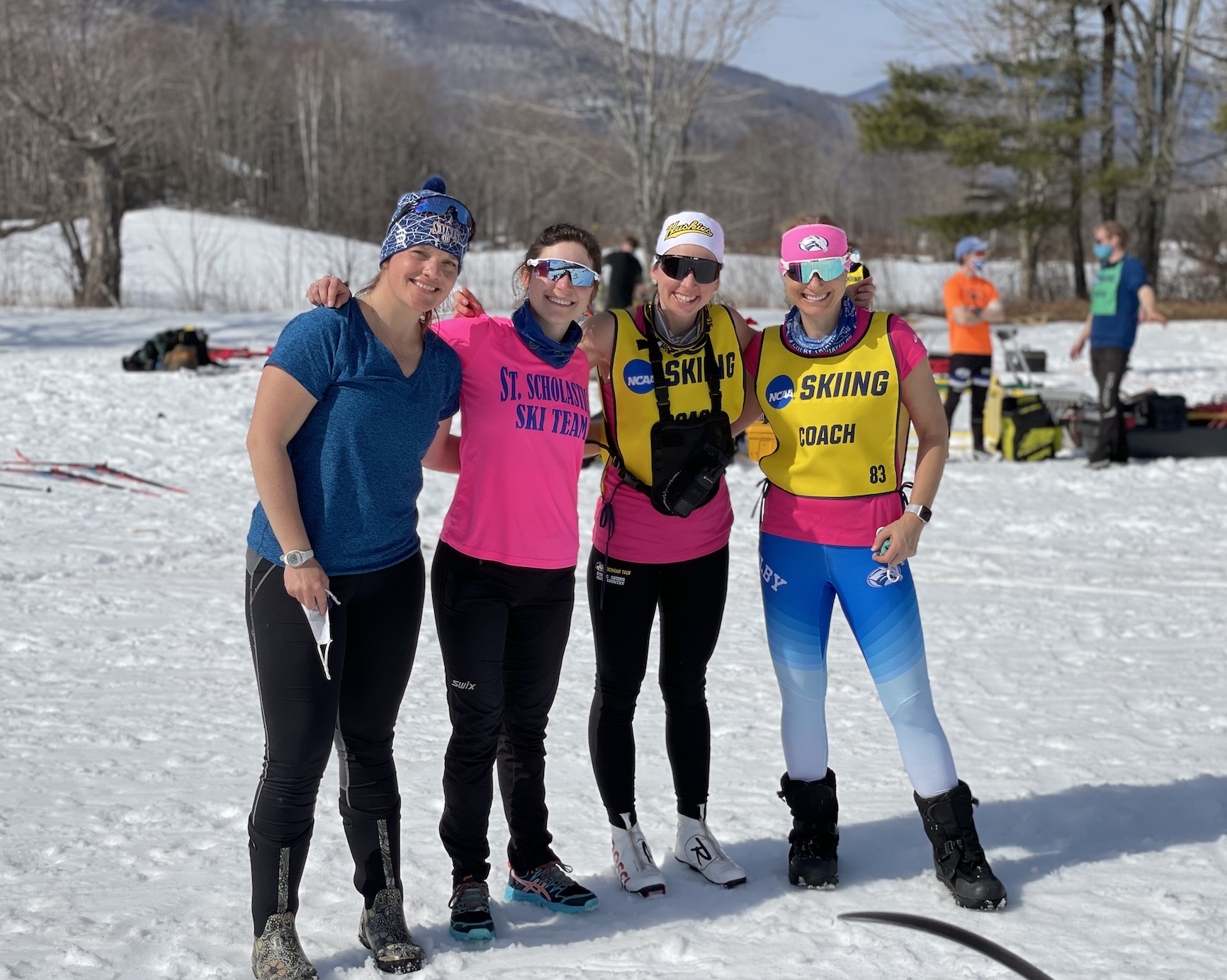
A few of the female coaches represented at the 2021 NCAA championships. From left to right, Maria Stuber, Kristen Bourne, Kristen Monahan-Smith of Michigan Tech, and Tracy Cote of Colby College. (Courtesy photo)
Stepping into this realm without significant experience in coaching, Bourne spoke to the importance of having a strong mentor and role model in Stuber, who has helped her realize her potential in the role.
“The other [factor influencing my transition into coaching] has been working for Maria. She has just taken me on and put me under her wing, and really gets me to do things that I wouldn’t normally do. It has boosted my confidence in myself knowing that I can do this and that this is what I want to do for the rest of my life. That was a huge piece of it, too.”
Expanding on Stuber’s formal role as a mentor for the VanDerveer Fellowship, Bourne explained that both she and Stuber will have the opportunity to connect with the other fellows and mentors involved in the program, which spans a variety of sports from basketball to water polo to track & field. This collaboration allows the women to discuss their successes and challenges in their respective sports, and learn from each other’s experiences.
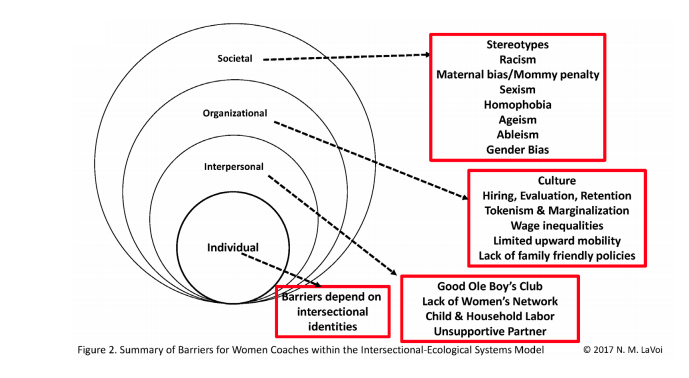
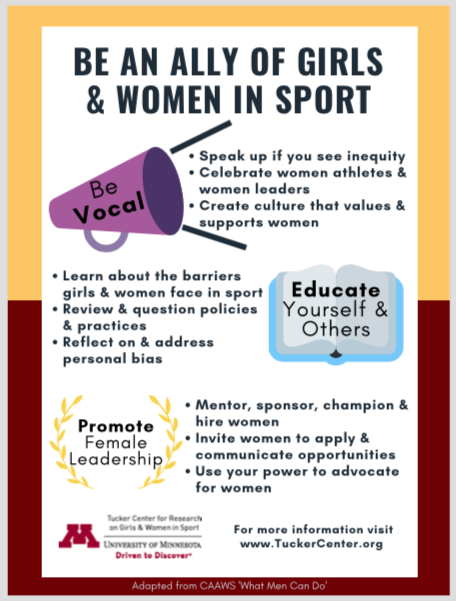
In a 2019 presentation at the U.S. Ski & Snowboard annual meeting on the importance of women in coaching, Dr. Nicole LaVoi of the previously mentioned Tucker Center explained the importance of women in leadership roles to inspire the next generation of coaches and improve the experience of developing female coaches.
“When you see women being successful, it inspires people,” LaVoi said. “‘Oh, I could do that. That seems cool, she seems cool, I want to do that.’ And in they come. It’s the same thing with women in positions of leadership.”
Bourne emphasized that this concept rings true for her in working with Stuber, who has stoked her fire to become an example for future women in the sport.
“She said so many times that the Women’s Ski Coaches Association and empowering women — this is her passion. I just feel so honored that I get to be right alongside her. She’s so powerful, and she has such a strong impact, and she’s doing this incredible thing that I think quite a few people are scared to do. She just says, ‘No, I’m doing it. We’re gonna change some things here.’ And I think that’s just — it’s pretty dang cool.”
Looking to the future and the role she hopes to play, Bourne aspires to be a head coach at or above the college level. She enjoys the environment of collegiate programs, but remains open-minded. Reflecting on the dearth of female coaches in her own athletic experience, she concluded with her intention to be part of the solution in the slow progression toward gender equity in sport leadership.
“When coming to the decision of becoming a coach, there is this thought of, ‘Well, I’ve never really experienced anyone like me in that position before. Can I do that? Can I have the same impact on a team as a man would? But really it’s [lack of] representation. There’s also the concept that women are proven to improve work environments — having more women is better. And being able to support female athletes — and being able to support male athletes — with a different perspective is super important. There’s a lot of pieces — it’s a huge question. I just hope I can be a role model for more women coming up who want to get into coaching and stay in the sport.”
The CSS Assistant Coaches: Kristen Bourne (left) and Joshua Tesch (right). Stuber explained that Tesch has bee coaching at CSS for 15 years and has been a mentor for both herself and Bourne. (Photo: Maria Stuber)
This is part II of an interview with U.S. biathlete Susan Dunklee. In her final season racing World Cup, Dunklee has decided to take on a leadership role, as an Athlete Ambassador for gender equity, with the International Biathlon Union. You can find part one of the interview here.
This portion of the interview focuses on an incident that crystalized Dunklee’s resolve to foster cultural change in her chosen sport. Dunklee posted a two-Instagram post back in March in which she documented a transgression in the workplace.
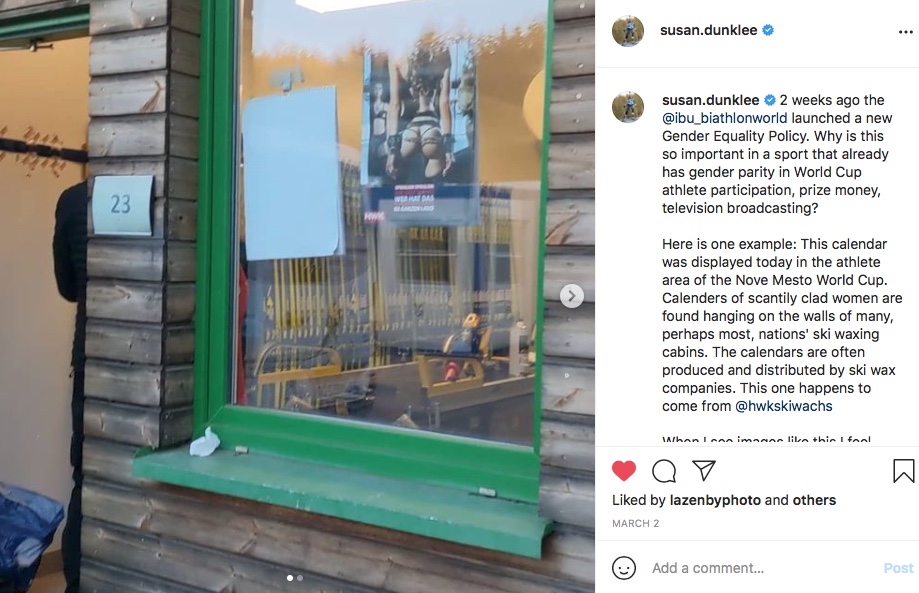
She posted an image of an HWK Wax calendar featuring a photo of a mostly naked woman. The image in question was taped to a wax cabin window, facing outward, for athletes and staff to see as they walked by.
Dunklee wrote in her Instagram post:
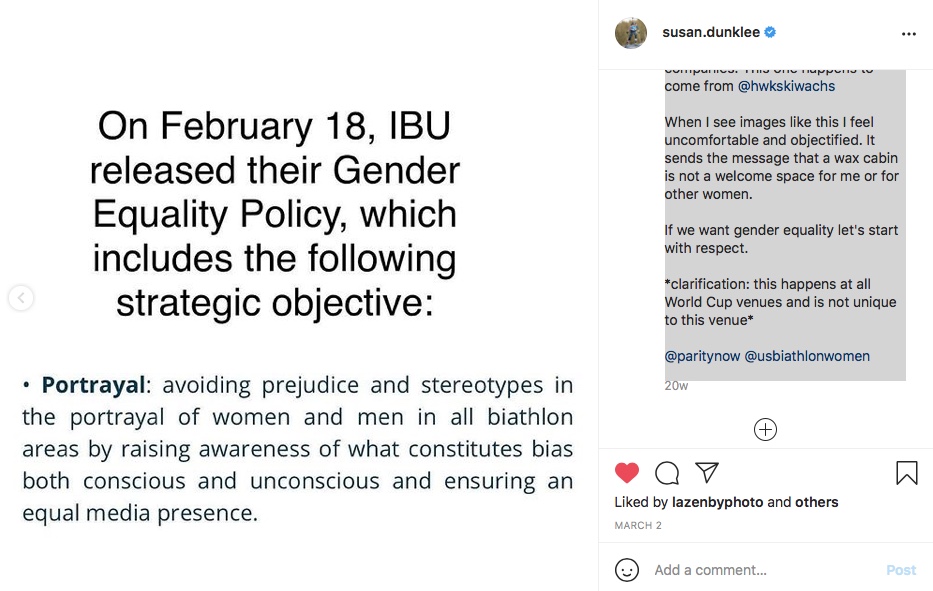
“2 weeks ago the @ibu_biathlonworld launched a new Gender Equality Policy. Why is this so important in a sport that already has gender parity in World Cup athlete participation, prize money, television broadcasting? Here is one example: This calendar was displayed today in the athlete area of the Nove Mesto World Cup. Calenders of scantily clad women are found hanging on the walls of many, perhaps most, nations’ ski waxing cabins. The calendars are often produced and distributed by ski wax companies. This one happens to come from @hwkskiwachs
When I see images like this I feel uncomfortable and objectified. It sends the message that a wax cabin is not a welcome space for me or for other women.
If we want gender equality let’s start with respect.
*clarification: this happens at all World Cup venues and is not unique to this venue*”
The first portion of Dunklee’s Instagram post regarding gender equity in her work environment on the IBU World Cup. (Screenshot: @susan.dunklee)
The second portion of Dunklee’s Instagram post regarding gender equity in her work environment on the IBU World Cup. (Screenshot: @susan.dunklee)
***
FS: Ok, let’s drill down on gender equity in the sport. There have been some inroads in terms of gender equity in male-dominated sports, you know, in some mainstream sports. For example, there’s a female who is an Asian-American General Manager for a Major League baseball team. There’s Becky Hammond who is a longtime assistant coach for the San Antonio Spurs who, you know, living here in Oregon, Hammond was considered for the head coaching job for the Portland Trailblazers – which made some news here, but she did not get the job. There is clearly more work to be done. But those are two examples in very traditional mainstream sports where some headway is being made. But, let’s speak personally about what you see going on in the U.S. in terms of gender equity in biathlon, and then we can jump to the international arena. Specifically, I would like you to discuss what you feel are the issues for gender equity in biathlon?
SD: In the U.S., we have some female coaches, we certainly don’t have as many as we have male coaches. When I’ve looked at the numbers of participants in team trials over the years, we have often had decent size fields on the Junior men’s side and some years we’ve only had three or four women – if that – on the women’s side. For some reason, at the youth level, it seems to be a lot more balanced. I’m not certain why, but we tend to lose a lot of women as they age. And I don’t know why, and I don’t know why that’s not also happening on the men’s side.
I think it can be an intimidating sport to get into. I do know my former teammate, a few years back, Emily Dreissigacker started the Girls with Guns program. This was a workshop for girls to try biathlon. Emily had this experience as a kid where she was deterred from the sport early on because of the weight of the rifle and simply skiing around with a rifle. You know, little things like that are our barriers for people.
Shooting and hunting sports are traditionally more male-dominated spheres. So, the sport can be kind of tricky to get into. It is really nice to know that within our federation we have serious women like Sara Studebaker-Hall, hired to help with our leadership and administration at a really high level. We have Danika Frisbie helping coach and assisting with athlete development. But a few years back, we really didn’t have much of a female presence or leadership either. So we’re getting there, but I would still love to see more girls or programs, specifically for women to develop women coaches and mentor them and give them support.
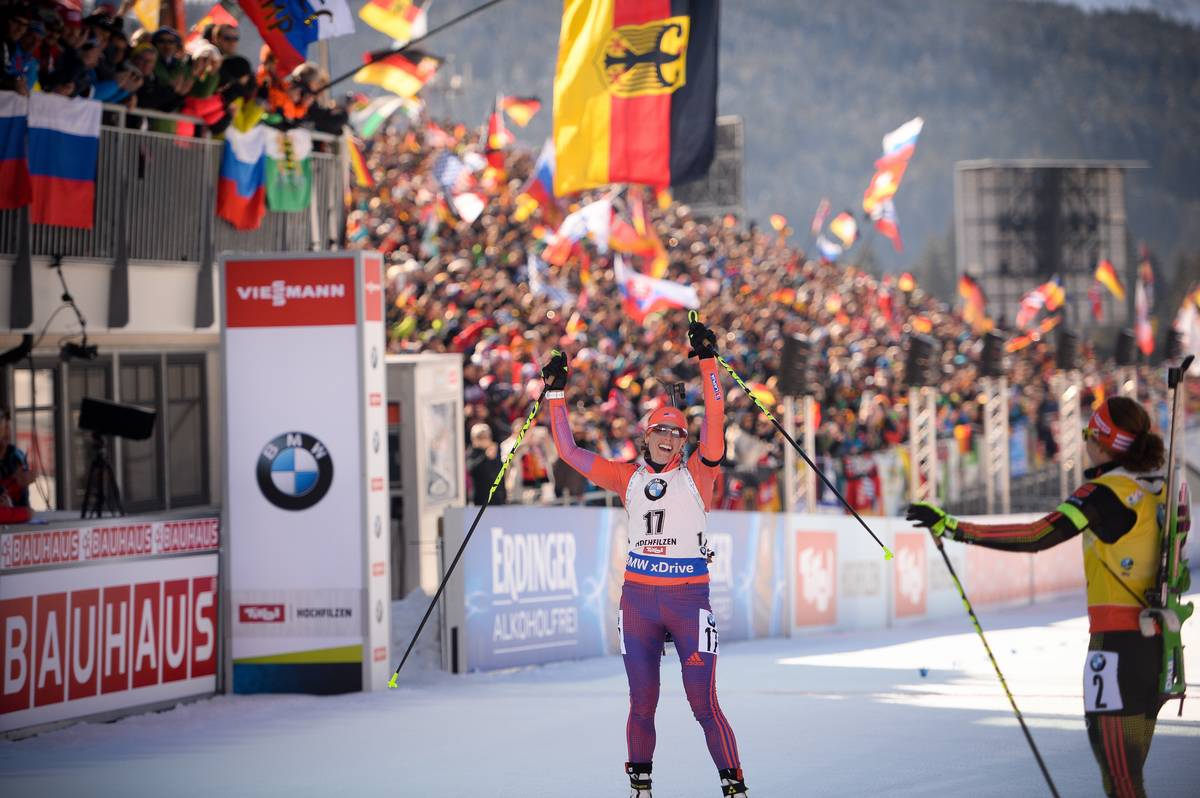
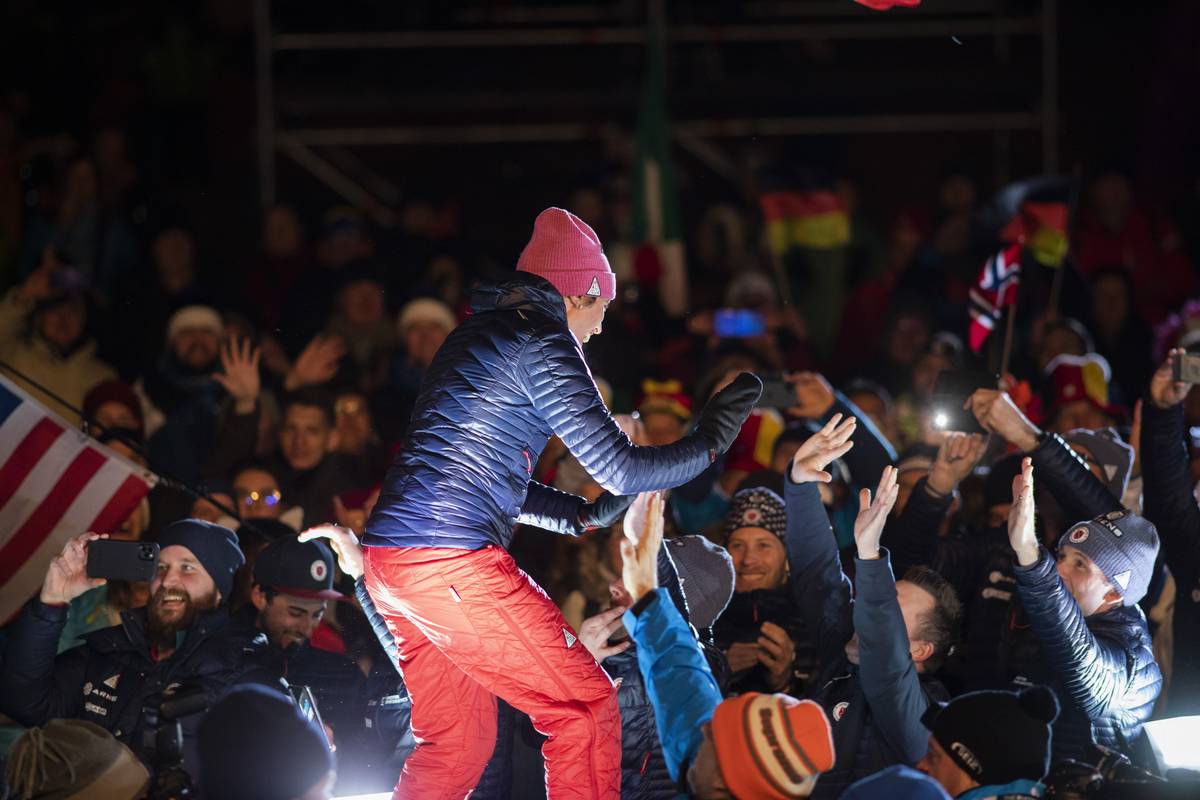
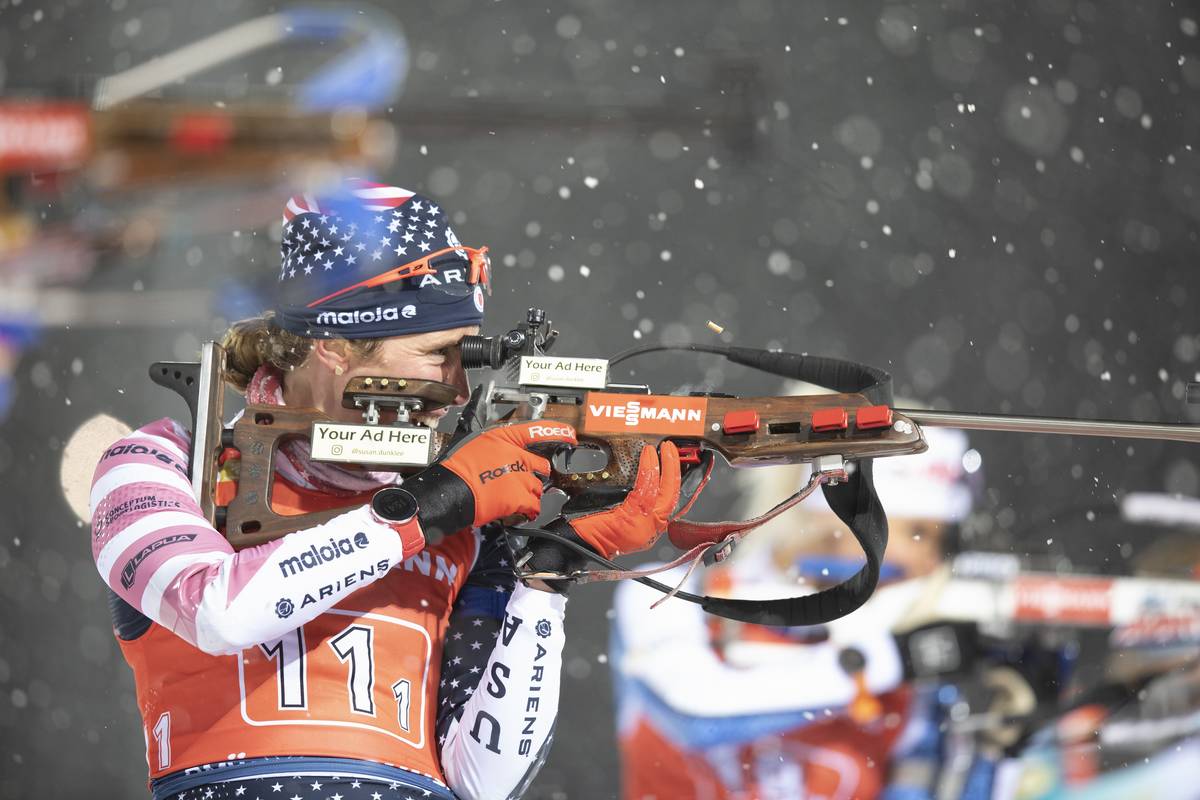
Susan Dunklee celebrates silver in the women’s mass start at the 2017 IBU World Championships in Hochfilzen, Austria. She became the first U.S. woman to earn an individual medal at Biathlon World Championships. (Photo: USBA/NordicFocus)
FS: Off the top of my head, I think Lowell Bailey has been retired for maybe three years now. I’m not sure that is accurate, but he’s retired. Your name and Lowell’s have been associated with the sharp end of the sport now for nearly a decade, you have been the go-tos. And I know Clare has had a really solid run in recent years. But that said, do you feel heard within the U.S. when it comes to your voice for equity?
SD: Oh, yeah, I mean, I would hope I certainly am. I think it can be tougher on the road in the winter because one of the problems with traveling around in a group like ours, is you have a very small group of people that you’re interacting with all the time. And for us, that is the team of athletes, the coaches, our support staff, which includes technicians, physios, sometimes a team doctor. Maybe a press person. And we seldom have any staff on the road that are female. We usually have four female athletes, and then everybody else that we’re traveling around, all winter long, are mostly guys.
I don’t feel like that’s a challenge that is always totally understood or acknowledged within our federation. I don’t know, sometimes they feel like you’re a little bit of a good old boys club socially, and it’s tough, and a lot of our staff represents a wide variety of nationalities. So the norms can be very different.
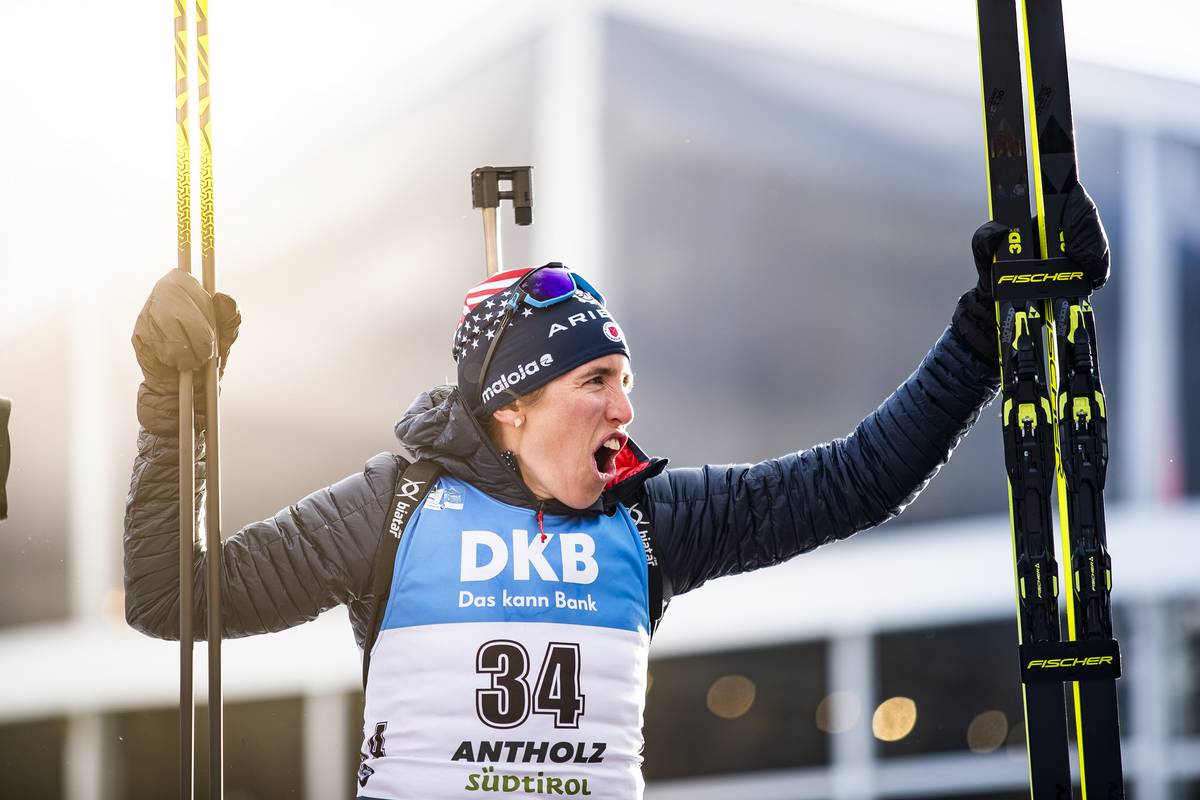
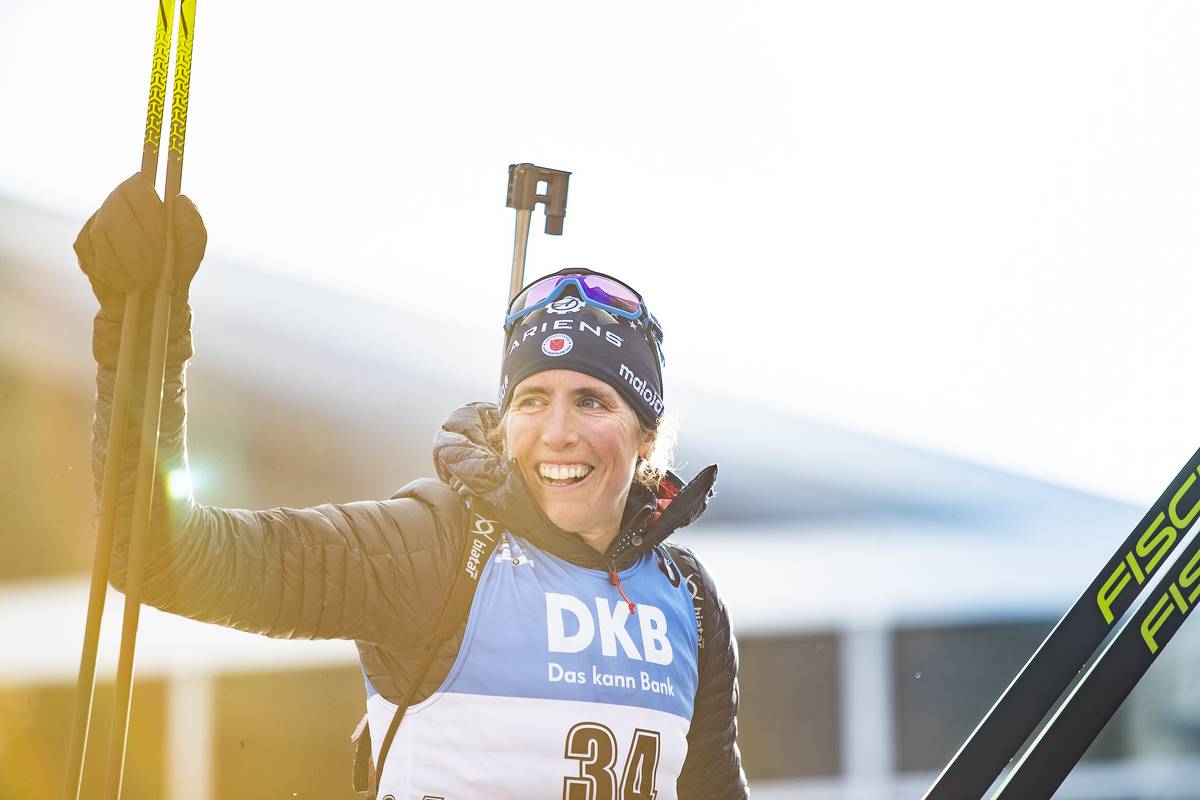
Roar. Susan Dunklee captures an IBU World Championship silver in the 7.5 k sprint in Antholz, Italy. (Photo: NordicFocus)
FS: I think it is well understood that gender inequality has been around for thousands of years. In the recent past, since the #MeToo movement began, it just seemed to be a moment in time, culturally, where people are becoming more aware. But that said, to your liking, and more specifically, has the national federation begun equity training for staff?
SD: I don’t think so. I don’t think that has been a thing, I mean I haven’t been part of any staff training, so I don’t know what they actually have trained in, but I feel like that’s kind of become a hot button issue in the past year or two. And I don’t know. That’s a great question.
FS: And I bring that up because I do feel like, you know, a lot of people know a lot of people maybe roll their eyes and, but the bottom line is that training moves the needle a little bit. It informs people.
You have signed on as an Athlete Ambassador for gender equity at the international federation level. Why did you feel prepared now to take on a leadership role, and then specifically, why gender equity? Although, you have touched upon that already.
SD: I can go into more detail. First of all, I do not feel prepared. And I think I have a long way to go to learn and educate myself about these topics and feel more articulate about them. But I don’t necessarily think that I have to feel 100% prepared to start working on it. The only way I’m going to learn more about this and become more effective at this is by putting my feet in the water.
The incident that really sparked my interest in this occurred this past winter. I don’t know if you follow my Instagram account, but I made a post in March, we were in Nove Mesto towards the end of the season.
And for my entire World Cup career, it has been normal in the wax cabins, of most of the teams I would guess, I don’t know for sure, but I’m assuming, it’s probably most of the teams to have calendars on the walls. Calendars of scantily clad women. And a lot of times these calendars are manufactured and distributed by wax companies. That’s just one of those sorts of things that you just have to accept if you’re going to the World Cup: that this is going to be the culture. You are going to walk into the wax cabin to pick up your race skis or to drop off your skis, and you’re going to see these images all over the wall.
Coming from the US where that sort of thing just seems so outdated to me, it’s like you don’t see images like that in a professional work environment. I think that’s really common still over in Europe and even talking to some of my friends in Germany, they don’t understand why I feel so upset when I see stuff like that. But that’s always bothered me and it’s just kind of been in the background all these years.
My teammates have felt the same way when you walk into a room — you feel objectified when you see shit like that. And we’ve tried some kind of playful and fun ways to bring up the issue. We went to a store and found a male calendar and we put it up on the wax cabin walls.
That’s a tradition that we do once a year or so, and it usually would get ripped down right away by our wax staff. It was very much just kind of a fun way to say, ‘hey this is a thing and we think it’s kind of ridiculous and this is happening and we’re going to try to make it more equal.’
But at the end of the day, I think it’s really better to not have any images at all like that.
So back to my Instagram post – when I was in Nove Mesto at the biathlon venue, I’m walking through the athlete area and I saw on the window, it’s not our team and the team doesn’t really matter, there’s a calendar, one of those calendars, but it’s facing outwards so you can see it from the athlete area.
I thought, ‘Ooh this is a perfect opportunity, I’m just going to take a picture of that.’
I posted the photo on Instagram. And I just talked about it on Instagram, like, ‘Hey this is in the athlete area. And this is kind of a norm, the wax companies actually give out these calendars.’
It created this crazy outrage, I’ve never had an Instagram post go so wild before. The first thing that happened was I had a lot of support and Mona Brorsson and Sebastian Samuelson, some of the Swedes, reposted it too.
The Swedish media picked up on it, absolutely outraged, and I think Sweden is one of the places where gender equality has been thought about for some years now. I think a lot of Swedish media stories actually put some pressure on the wax companies like HWK, which published the particular calendar I had posted a photo of. That response was kind of cool to see.
But, then about 12 hours later the Czech news agencies picked up on the story, and I just got slammed with all sorts of stuff, really negative and poisonous and toxic comments that were hurtful. I was really glad to have my teammates to talk to about that.
But it was like, wow, this is a place where something that I thought was so obvious and that should not be there, there should be no room for this sort of image, and more specifically at the professional sports level like this. The fact that this was so controversial was really enlightening. We have a lot of work to do to create an environment that’s welcoming to everybody.
I think a lot of athletes don’t really feel comfortable speaking up about that stuff and it’s taken me 10 years to speak up about something like the calendar.
Susan Dunklee celebrating her 2020 IBU World Championship silver medal. (Photo: NordicFocus)
FS: Wow, I’m sorry you were exposed to that type of toxicity. And when you began your story, I defaulted to the trope of automobile or auto-part calendars, not ski wax companies. Some of the biggest role models in skiing across the disciplines are women.
Ok, so you’re talking about the international community with so many different cultural norms. How do you go about it? I’m assuming since you are an IBU Athlete Ambassador, that you have to examine this from an international perspective. If you are thinking of creating solutions, how do you start that discussion or how do you think you should push that discussion to get people in the room who might not necessarily agree with you?
SD:I think from the outside it really looks like a progressive sport in terms of gender equity, sure. It’s one of the few sports out there where women and men have equal prize money, equal participation at the highest level, equal TV coverage for the most part. We even have formats like the single mixed relay and mixed relay where the woman and men race together in the same race, and they’ve even started experimenting with switching the order up so sometimes the guy goes first, sometimes the girl goes first.
And when they do that, it changes the race distance, and in a single mixed relay when the woman goes second she actually skis more kilometers than the man in that race, I think that’s really kind of cool. That’s also controversial and not everybody’s happy with it, including a lot of women, but they’re definitely pushing the envelope on that sort of format.
If you were to look around behind the scenes at a World Cup, you would see one wax technician out of about 100 in total, that is female — her name is Stefani and she’s from Bulgaria. She’s a badass.
You’ll see a couple of coaches perhaps. But, it’s rare to ever see anybody in a technical role, maybe every now and then you might see one woman there, but technical delegates, most international referees, tend to be male.
And I think one of the images that really struck me this spring, I joined an unconscious bias training the IBU was running, and they contracted out with a university in Berlin to run this program. The professor started by showing us a picture of different boards, executive boards from organizations around the world of businesses. Of course, there’s still a lot of businesses that still have a high percentage of older white males on their boards.
Then she showed us a picture of the IBU Executive Board. And even though I know Clare really well and I hear her talk about her work with the IBU on the Executive Board, I had not processed, just how crazy it was that she’s the one woman in that group of 10 people.
Just that visual, to me, was very powerful and as an ambassador, I am trying to identify things that will be powerful for people to see or hear about, and that will help move the needle a little bit.
Yes, it’s interesting to try to think through what are the things people are going to respond to, because, I can see that there’s a problem, but if other people don’t see a problem there’s never going to be change.
FS:What comes to mind is when Laura Ingraham, a conservative commentator, said of LeBron James, “Shut up and dribble,” when the athlete discusses being a Black male in the U.S. I know biathlon is not the NBA, especially in the U.S., but it is a major, if not the major winter sport in much of Europe and Russia. I’m just curious, are you preparing yourself psychologically for some major pushback and people demanding that you stay in your lane?
SD: I did already see a lot on social media. But, I think, going back to where we started in this conversation though, when I view all that corruption in the top leadership, that was really eye-opening to me. And if we didn’t do something as athletes, then nothing was going to change.
I felt like it is and was our responsibility when you see that sort of stuff happening, but you have to speak out about it.
If it’s really important to you, you cannot sit there expecting somebody else to take care of the problem. I think I’ve gone from wanting to focus mostly on my sport and my individual performance, to now where I want to be able to have the time and energy to put energy where it is actually needed.
I think there are times and places where you have to say what matters, what really matters in life, and what type of legacy can I help leave behind.
Yeah, I can leave some good results and that’s something that I can be proud of and the country can be proud of me. But what actually matters in life? I think gender equality is one of these big things that I would love to see a more lasting change.
FS: The Olympic cycle is coming to a close this winter and will start anew. Is this your last year?
SD: It is my last year. I’m done in the spring. This is one of the things, honestly, this kind of work motivated me to go ahead and to see what I can help accomplish on this front, in addition to my racing.
FS: You know this, but every four years, it’s a big cycle for folks, that lead-up into the Olympics and the expectations. Athletes need to compartmentalize. There’s the added attention that you get, and the demands on your energy.
You mentioned this up-front in this conversation, that historically you really just focused on the athlete part, the results-oriented part of the sport. Have you already tried to figure out how you’re going to compartmentalize each of these, the performance side and ambassador side, and make it work?
SD: I think I can do a lot right now over the summer and to start thinking, or at least I’ve been trying to be more strategic in my social media posts, in general, the past year in terms of having to plan for what sort of content I want to put out there. Maybe have a month where I post on one type of type, and I change it up the following month. Then analyzing what picks up steam or people push back against.
I know in Olympic years we can be overwhelmed with media requests. And you can’t say yes to everything and so you have to be strategic about that too. I look forward to relying on teamwork with some of the other ambassadors, being able to chat over stuff with Kelsey Dickinson, who lives here in Craftsbury, and working with the group to coordinate on which things to push for and which things are the most important to tackle and keeping the focus on that.
I think just like having a training plan, having a goal in mind, and a particular roadmap to get to that goal, you have to just not say things willy nilly or, or do things willy nilly, but have a goal that you want to achieve. Right now, I’m in the process of fleshing that out and figuring that out exactly.
Born and raised in Vermont, Dunklee finds comfort in familiarity. During the offseason, she is based near Craftsbury and can often be found training with her Green Racing Project teammates or in Lake Placid, at the Olympic Training Center, with her cohort on the National Team.
She prefers the slower pace and quietness of Vermont’s Northeast Kingdom. As this is her last season of racing, Dunklee will retire after this World Cup season, she plans on settling for good, close to Craftsbury.
Susan Dunklee at the 2020 IBU World Championships in Antholz, Italy after winning silver in the 7.5 k sprint. (Photo: NordicFocus)
During her time on the World Cup, Dunklee said in this two-part interview, that although she had concerns about the culture at the International Biathlon Union and the racing scene, she simply preferred to expend her energy on racing, not pushing reforms. We do know that for North Americans racing World Cup, the emotional and physical tax of racing and training is compounded by living abroad for six months.
However, recently, Dunklee signed on as an Athlete Ambassador for the IBU. Dunklee will serve as an ambassador for gender equity, a cause she is passionate about. Rather than leave the details up to a press release, we connected with Dunklee to explore her new role, and what prompted her now to become more involved with bettering the IBU and biathlon. This is part I of the interview. Part II will be released separately.
Susan Dunklee, racing here at Rupholding, Germany. (Photo: NordicFocus)
***
FasterSkier: I wanted to dig a little deeper than the press release about the Athlete Ambassador initiative and your involvement, but also I’d like to learn about your perceptions of the changing nature of the sport.
So I’d like to get your ideas about what changes have occurred, and what changes remain when it comes to your ideal vision of the sport and the IBU. The IBU had a come to Jesus moment and they’ve made some positive changes — I’ve spoken to Clare Egan quite a bit about it. And Max Cobb off and on, but just generally, what are your impressions of the sport’s culture?
Susan Dunklee: Yeah I was gonna say, absolutely there was a turning point. And that was when our president of many years, Anders Besseberg, was arrested by the Austrian police and there was a raid on the headquarters a few years back. And that caused a whole cascade of changes, and changes to the leadership of the IBU,
They brought in some outside consultants to help the organization identify how to avoid problems of corruption in the future. And they set up the Biathlon Integrity Unit, which is totally separate from the rest of the IBU’s governance that traditionally, I thought, had a lot of authority, and authority over important matters of integrity and doping.
And I think that turning point was when that leadership group left, and they brought in this new way of doing things. Stakeholders took the initiative and rewrote the Constitution to create more integrity and greater transparency. That really set us on a course for a better direction.
In the past, I never really felt like my values and the IBU’s values lined up all that well. And now I really feel like there’s an organization behind my sport that shares a lot of the same values I do. There’s a lot of things that still need to be fixed, but I feel good about the direction we’re headed.
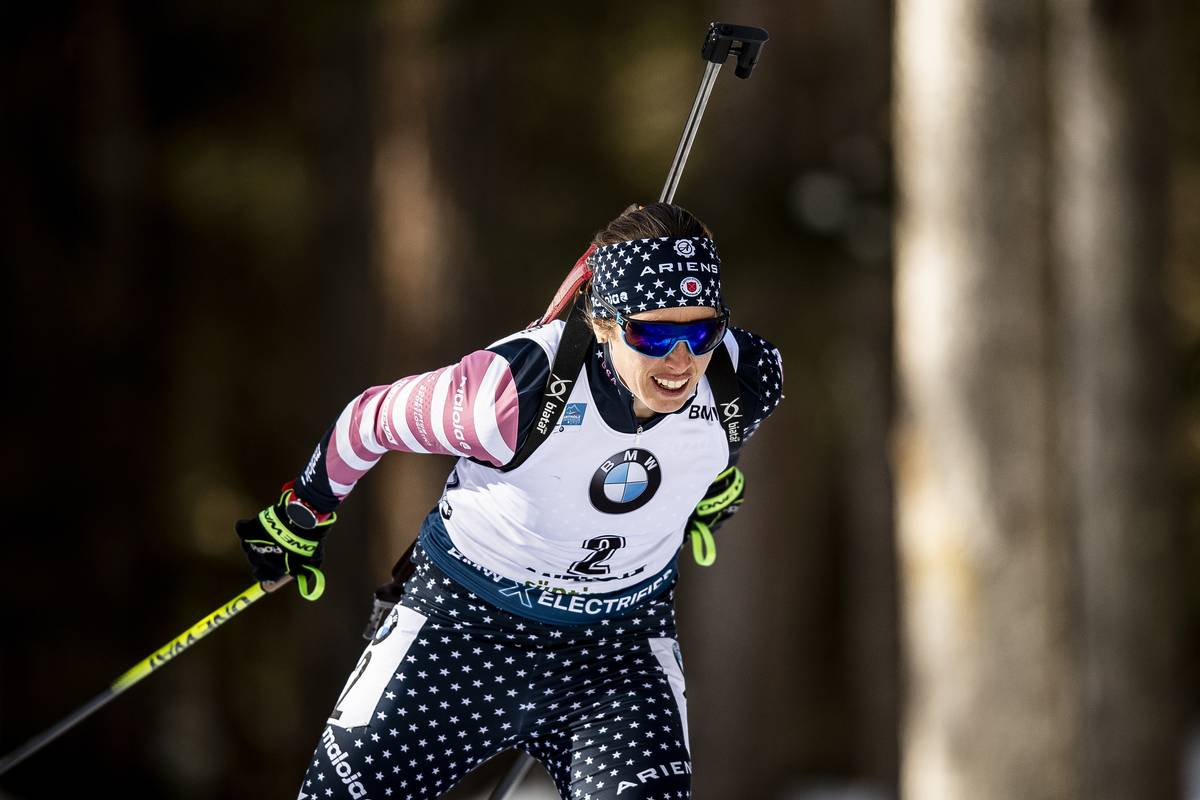
Susan Dunklee and her steady hand on the range: 2019 in Östersund, Sweden. (Photo: NordicFocus)
FS: I’m glad you mentioned that, because I do feel like as a parent, I feel we talk about values all the time with our kids, and you know, you have to take a stance sometimes, and there are costs to taking some stances. It could be losing friends. It could be alienating whomever, but if you feel like you’re doing the right thing and it doesn’t hurt other people, you know, physically, emotionally, then you need to do it.
Can you maybe talk a little bit about maybe what your values were or are and how they developed? And in answering that, maybe explain how they contrast with what you perceived as the values of the IBU? I’m qualifying that question within the context of perhaps when you were a younger athlete and you’re kind of looking around and putting your toe in the water and trying to understand what the culture of the sport was and just competing, rather than taking on a leadership role and having that sap some of your energy.
SD: I think for most of my career I wanted to compete and not really distract myself or invest energy in places that weren’t directly related to performance. That’s because it can be exhausting to speak up about some ideas and my values. I really value community and I value honesty. I value having a clean sport. I value making an environment where everybody feels welcome, supported, and valued.
There were periods early on in my career where I felt like we didn’t have that value system in place. It was really frustrating actually when we found out about the stuff that was happening in Sochi a year or two after the fact. With the doping issue on our minds, as athletes, we got together and we had never really organized before. We started to organize at that point, post-Sochi, with a mixed group of international athletes.
We discussed all the relevant athletes’ rights issues, and collectively we were like, ‘hey this is not okay what is going on.” We wanted to know how this happened, and how our international federation was going to deal with us, and the issues we raised.
It became very clear, very fast at most meetings, that the Federation wasn’t really interested in bringing things to light, it was trying to hide things and trying to evade questions. It was trying to not take responsibility for anything. And that was very concerning for me. I definitely started to lose a lot of faith in our Federation at that point. I think a lot of athletes did.
It was really cathartic to see, in the last couple of years, after the raid, the culture started to change pretty fast. And to go from a Federation that I had absolutely no confidence in, to one that wants to do the right thing — and obviously, there’s still work to be done — but I think that being on the right course is important.
FS: Do you have faith in the IBU? There was this seismic moment that everyone can look to in the police raid — that prompted a change. Whereas a lot of other international NGBs are still mired in the typical semi-opaque power and financial hierarchy that dictates policy. Do you think we are in a time now where the IBU can or may serve as a model and these other NGBs won’t need their own take-down before a change is made? I guess, in other words, a horrible event like a police raid or Sochi does not need to occur for change to come about?
SD: I guess it totally depends on the circumstances. Every circumstance is a little bit different. Sometimes you have to gather some momentum to make those acute moments happen and sometimes change happens in a key moment by some smaller gradual incremental moments. But I feel like those acute moments came about because people were starting to put the pressure on. The IBU athletes were starting to organize for the first time, and there were some great people within the organization, and I believe Max Cobb is one of them who were trying to change our values and draw attention to the problematic pieces.
I can’t speak for the change in every sense of the word, but I think it’s possible to come about on different paths. It is tough within an organization, I think, organizational culture can be really, really tough to work with sometimes and to change. It is a huge process. We’ve got a bunch of actors and these different norms. If you take gender equality, or gender equity which is my preferred term and you look at the norms of different countries that we’re working with here. It’s a very different landscape from country to country, say in the U.S, for example, than it might be in say in the Czech Republic, or in Italy,
With all these different cultures, you have to work with different sets of standards and differences in social acceptance. That’s a really interesting puzzle to put together.
FS: I know you are only speaking for yourself, but do you feel like the contingent from the U.S. is perhaps, on the political spectrum, perhaps more liberal than, say, your counterparts from Central Europe, or Eastern Europe, and even Scandinavia?
SD: I certainly cannot speak for every member of my team or my cohort. We do have some voices, I think Clare Egan being on the IBU Executive Board has really pushed them. First of all, she’s on the Athlete’s Committee and that group pushed to get her on the Executive Board for the first time. So that’s a huge progressive change.
So I have a teammate in that position who is certainly pushing for good changes and helping advance the athlete perspective within the international Federation. And I have a teammate, Kelsey Dickinson from the Green Racing Project who is also joining me on the Athlete Ambassador Program, and she too cares about these things. She’s been involved with the Women’s Ski Coaches Association since its inception. So we certainly have people who want to be activists within our team, more so than some other teams.
Part II will be published next week and further explores Dunklee’s motivations for becoming a voice for change, while pursuing the podiums on the World Cup and 2022 Olympics.
Dr. Nicole LaVoi gave a keynote presentation at the U.S. Ski & Snowboard National Cross Country Coaches Symposium. LaVoi is the co-director of the Tucker Center at the University of Minnesota in Minneapolis. (Photo: Screenshot nmlavoi.com)
On the last weekend of September, U.S. Ski & Snowboard held the annual National Cross Country Coaches Symposium in Park City, UT. This year’s event included a keynote presentation from Nicole LaVoi Ph.D., co-director of the Tucker Center at the University of Minnesota in Minneapolis. Dr. LaVoi is a professor of sport psychology and sociology at UMN and leads research in “the structural and personal barriers experienced by female coaches, relational qualities of the coach-athlete relationship, the effect of parent and coach ‘background anger’ behaviors on youth athletes, the physical activity of underserved girls, and media representations of girls and women in sport.” She also serves on the board of directors for WeCoach, an organization promoting women coaches at all levels across all disciplines.
LaVoi first presentation was titled “Developing Physically Active Girls”, followed by her keynote presentation, “Leadership: The Importance of Women in Coaching”. [A livestream of the symposium can be purchased here.]
In her second talk, LaVoi presented data regarding women in coaching gathered through her research exploring best practices to recruit, develop, and retain women coaches. [FasterSkier presented statistics regarding female head coaches in NCAA and post collegiate skiing here.]
She explained that despite a steady rise in female participation in sport since Title IV was passed in 1974, gender equity has declined or remained stagnant. This is in contrast to the percentage of women in leadership positions in other sectors of the workforce which has been on the rise.
“The lack of women in skiing leadership is not the problem; it is a symptom of the problem,” said LaVoi in the presentation.
During her presentation, LaVoi explained the multifaceted explanation of the precipitous decline of women in coaching and offered suggestions to begin steering the trend in a positive direction. Namely, that the climate in sport has not made women “feel safe, valued, or supported.”
“Both anecdotal evidence and empirical data illuminate the fact that some women are losing their jobs due to persistent and systemic sexism and gender discrimination, unfair double standards, stereotypes, and both explicit and unconscious gender bias in hiring and evaluation processes. In short, sport historically has been, and continues to be, a male-dominated, male-centered and male-led occupational context. While male domination in the workplace is not unique to college athletics, as a whole, college athletics has been slower than other industries to embrace the value of diversity and inclusion.”
LaVoi also used her research to challenge narratives about gender equity in hiring and discussed the barriers women experience and the intersectional factors by which they are caused (see model). Some of these factors include stereotypes, gender and maternal bias, limited upward mobility, and a lack of women’s network in coaching.
LaVoi presents an ecological model identifying the barriers to women in coaching. (Source: “Women in Sports Coaching” N.M. LaVoi)
Women Ski Coaches Association (WSCA) leader Maria Stuber expressed the value of the research conducted by LaVoi and the Tucker Center in allowing the problem to be discussed across genders without interference from one’s personal experience or biases.
“Having data to back the conversation helps take the emotions out of this topic and makes it an easier conversation to have,” said Stuber, “It’s less of a controversy. Once this is no longer just an opinion, we can stop being defensive and start focusing on solutions. The data allows us to be positive, take action, and get things done.”
LaVoi explained that one of the questions she hears most commonly is “Why do women coaches matter?”
In her 2016 publication titled Women in Sports Coaching, LaVoi addressed this question in depth. Here is an excerpt:
“Sport is one of the most visible and powerful social institutions in the world. Individuals who are seen and known in the world of sports, like coaches, communicate who and what is relevant and valued (and who is not), and a majority of the time in every country in the world, those coaches are men. There are many empirically based reasons why women coaches matter.”
Some other reasons cited by LaVoi include the importance of having gender diversity in role models to challenge archaic stereotypes about women in leadership roles, the importance of same-sex role models for young women and girls, and that boys experiencing women as competent leaders increases the likelihood that they will respect women and see them as equal colleagues and partners.
She also explained that a lack of women is detrimental to the ecosystem of sport coaching.
“When women are the minority in the system, they face a lot of psycho, social, and occupational outcomes.”
These outcomes include decreased job satisfaction, pressure to perform or conform, stronger intention to leave, an increased likelihood of opting for a lesser role, and burnout. On the flip side, the presence of women in leadership roles helps empower other women to strive for a similar outcome and having same-sex peers can also improve the experience one has in a given system.
“When you see women being successful, it inspires people. ‘Oh, I could do that. That seems cool, she seems cool, I want to do that.’ And in they come. It’s the same thing with women in positions of leadership.”
LaVoi likened this to Jessie Diggins winning an Olympic Gold Medal inspiring others to try cross country skiing or set a lofty goal.
She added that the visibility of female head coaches also helps female athletes see coaching as a viable career path, increasing the likelihood of becoming coaches themselves.
“Women and girls coached by women are more likely to go into coaching, so it’s a cycle. And women who are coached by women are safer. All of this stuff with SafeSport right now and coach abuse, 99.5% of all sexual abuse in sport happens because of male coaches. We don’t like to talk about that because it’s uncomfortable but that data is real clear on this.”
LaVoi also offered suggestions on how programs at any level can work toward improving gender equity in their coaching staff. Some suggestions include committing to having a female coach on every level team, providing membership for female coaches to join the WSCA, and paying for female coaches to attend professional development activities. If coaching positions are available and women are not applying, consider recruiting women who would do well in the position.
In 2017, the Tucker Center launched the She Can Coach campaign which challenges coaches to invite female athletes to consider a career in coaching and expressing belief that those athletes would make great coaches. LaVoi explained the importance of recruiting talented coaches and inviting women into the field to move the needle forward. She went on to explain how this relates to creating equity rather than equality, as women in the coaching field may need additional resources or support in order to have the same professional experience as their male counterparts.
Men are invited to be part of the solution to gender inequity in sports coaching. (Graphic courtesy of the Women Ski Coaches Association)
Throughout the presentation, LaVoi emphasized that the “numerical male dominance in coaching” is not a women versus men problem — she addressed how male allies can be a part of the solution. Some of her suggestions were simple, like encouraging female athletes who would make great coaches to consider it, displaying images of women coaches around the clubhouse, reflecting on their own conscious and subconscious biases, and celebrating the existing women coaches in the program. She also suggested that men refuse to serve on all-male panels or faculties to encourage the recruitment of a diversity of perspectives.
She left the male attendees with the challenge to identify where on the spectrum of allies they fell and she asked all participants to identify and commit to one thing they can do to change the system. [Read a call to action from Pete Vordenberg here].
The Women Ski Coaches Association launched in September 2019 in pursuit of gender equity in coaching.
In August, the Women Ski Coaches Association (WSCA) set forth to balance the scales of gender equity in coaching. With Maria Stuber, head coach at the College of St. Scholastica (CSS) and former member of the Craftsbury Green Racing Project, at the helm, the WSCA strives to be “the voice and future of women in coaching.”
According to surveys conducted by the Tucker Center for Research on Women and Girls in Sport, since Title IV was passed in 1974, the number of female head coaches leading women’s sports teams at the collegiate level has dropped from 90% to just over 40%. The reason for this decline is complex and multifaceted, but the trend is pervasive. Some sports like Lacrosse, Field Hockey, and Equestrian have a relatively high percentage of teams led by women coaches, however, cross-country skiing checks out in the bottommost tier of sports with only 20% of Division I womens’ teams led by a female coach. As head coaches typically oversee both genders, this statistic is representative of the overall percentage of women coaches in leadership positions in Division I NCAA skiing.
The grassroots mission of the WSCA is to change these statistics by empowering and connecting female coaches and serving as a voice for women in the sport.
“Develop, retain, and advance,” said Stuber to paraphrase the objectives of the WSCA. “Bringing in more women that want to be ski coaches, turning them into really successful ski coaches, keeping them in ski coaching, and helping them find really rewarding careers whether that means doing exactly what they want to do or working for people who are going to value them.
“We want to start this conversation by making the research and data available. We want to support each other and guide our large population of male allies in ways they can help.”
Stuber is pleased with the reach and impact of the WSCA launch and explained that its message has been met with overwhelmingly positive feedback.
“This might be the only ski thing I’ve ever been a part of in my career in skiing that has had unanimous positive support. There are a lot of people really excited about this project.”
At this point, the WSCA is funded primarily by a grant from the Oregon Nordic Ski Foundation and memberships for which there are two options. To ensure cost is not an obstacle for the stakeholder group, women coaches can join for just $20. The rest of the community, male or female, can show support by joining as an ally for $100. It is also possible to gift a membership. Currently, the WSCA has approximately 90 members. Stuber hopes to see this number rise steadily as awareness increases.
Of the current members, Stuber is excited to see how many are interested in not only signing up but also taking action in growing the organization.
“When you become a member you can check whether you want to be active or really active, essentially, and we have just a shocking amount of people who have said, ”Yes. I want to volunteer my time and take a leadership role in this organization.’”
Stuber emphasized that she is humbled and appreciative of the women who have expressed interest in being active in the WSCA and plans to utilize them once they have completed some of their urgent organizational tasks like forming a board and completing the 501c3 process.
Stuber has been the primary leader in launching the WSCA and remains the public face. Although, she has received ample support, encouragement, and advice from peers in taking the leap. When asked about their marketing, she credits Heather Mooney and Lina Hultin in designing a logo and creating a website. Mooney is a coach Bridger Ski Foundation in Bozeman, MT and Hultin is the co-director of the Montana Endurance Academy.
While immediately catching the eye as a snowflake, a closer look at the logo shows the branches are a circle of women. Stuber explained that the circle represents growth and that the women are reaching out to support one another.
Though in its nascent stages, the WSCA has already begun acting on its mission by sending two women, Stuber and Greta Anderson of Crested Butte Nordic, to attend the Female Ski Leaders of Tomorrow Symposium held at the Holmenkollen the second weekend in September. The trip was funded by a grant from Equinor who sponsored the event in partnership with the Norwegian Ski Federation. On the last day of the symposium, Stuber presented about the goals of the WSCA in front of 83 participants from 22 nations, all of whom are leaders in ski sport.
Her presentation followed remarks from FIS Secretary General Sarah Lewis who explained the actions FIS is taking toward promoting gender equity in snow sport coaching and leadership.
Founder Maria Stuber presented about the WSCA gender equity project at the Female Ski Leaders of Tomorrow Symposium in Oslo, Norway. (Photo: Instagram @womenskicoaches)
“To be able to show her the importance of grassroots change in addition to the top down mandated efforts that we are seeing was super powerful. I was just shaking with excitement afterwards and I got bombarded with people afterward coming up asking questions and other countries wanting to get involved. I also got to thank the Norwegian women who spearheaded this project and let them know that the ski leaders of tomorrow event helped give me the confidence to take action on launching the WSCA. Feedback from this presentation made me feel like this could be really big and grow into other sport disciplines and internationally.”
In alignment with the International Olympic Committee (IOC) Gender Equity Review Project, FIS is undertaking a set of goals and initiatives to increase the number of women in leadership positions internationally. Some of these initiatives include mandating the election of women to FIS congress and committees and hiring women as technical officials to increase representation by 10% each year until the goal of 40% women is achieved in 2024. The FIS working group is also reviewing other areas of discrepancy between male and female athletes including the difference in race distances and exposure in media coverage. Effort is also being placed into balancing the statistics in participation by developing female athletes in sports that have been historically only contested by men including ski jumping, nordic combined, and freestyle skiing and snowboarding.
In addition to the Norway trip, three first year coaches attended the U.S. Ski and Snowboard National Cross Country Coaches Symposium September 29-30 in Park City, UT with support from the WSCA and U.S. Ski & Snowboard. (A video of the symposium can be purchased here.) The attendees were Stuber’s former CSS athlete Nicole Gilman who interned with the Sun Valley Ski Education Foundation this summer, Harvard University graduate Hannah Hardenbergh who will be coaching in Vail, CO this winter, and Julia Hayes who is a Montana State University graduate now coaching for the Bridger Ski Foundation.
The keynote speakers at this event included Brit Baldishol and Nicole LaVoi who who are leaders in researching and implementing best practices for the development of female athletes and coaches.
Baldishol has a twenty year history working with the Norwegian Ski Federation in various capacities and spent six years coaching the junior national team. Early in her coaching career, which began at age 18, she was the sole woman participating in high level sport education meetings and courses, making her a pioneer for female coaches in Norway. Her presentation topics included “Development and the Role of the Coach for U14 Cross Country Skiers,” and “A Focus on Long Term Success: Norwegian Model for Under-20 and Under-23 Skier Development”.
LaVoi holds a PhD in Kinesiology and is the co-director of the Tucker Center where she researches “the structural and personal barriers experienced by female coaches, relational qualities of the coach-athlete relationship, the effect of parent and coach ‘background anger’ behaviors on youth athletes, the physical activity of underserved girls, and media representations of girls and women in sport.” She also serves on the board of directors for WeCoach, an organization promoting women coaches at all levels across all disciplines. LaVoi first presented on the development of physically active girls, followed the next day by an evidence-based presentation on the importance of women in coaching and leadership which aligned with the mission of the WSCA.
“The WSCA is a necessary step to improving the climate of skiing for women, to where they feel heard, valued and supported,” wrote LaVoi in an email. “It is an exemplar organization that brings to life the importance of the data on women coaches that we produce in our research. I applaud their efforts and support this new organization for women coaches.”
Kate Barton (left) is the assistant coach at Middlebury College. (Photo: womenskicoaches.org, flyingpointroad.com)
Stuber explained that the WSCA connected LaVoi with U.S. Ski & Snowboard and expressed gratitude for their efforts in bringing LaVoi to the symposium. She added that this demonstrates U.S. Ski & Snowboard’s support and partnership with the WSCA in addressing gender inequity in winter sport.
[Stay tuned for a separate article with takeaways from LaVoi’s presentation.]
The next steps in the WSCA action plan include creating opportunities for women to network at races and other events through the winter.
“I’d like to start working regionally to connect women coaches in our country. So if you’re coaching in the east, you’ve got a good handle on who else is coaching in the east, what their challenges are, what direction they want to go with their career. And so if there are young women coaches in any region, the veteran coaches know who they are and if they have specific coaching career goals.”
Because Stuber and the majority of supporting members have a busy schedule juggling coaching and travel through the fall and winter, the WSCA aims for sustainable progress in growth and development.
“It’s going to be a slower process. What we do this winter is going to be pretty simple. I’m confident, though, that we can get a lot done in a simple way.
“The outpouring of positive support that we’ve had for this makes me feel like this could grow into something huge and incredibly impactful, and that’s the piece that I think has to wait until next summer just because I really want to do it well.”
At this time, Stuber explained that the most impactful way to support the WSCA is to become a member and to share the mission of the organization with other contacts at all levels of the sport.
“There is so much energy around this topic right now and whether people are talking about it with our organization in mind or in their small communities and ski clubs, that’s really huge.”
The WSCA is also working on becoming a non-profit organization. Currently, former CSS athlete Kelsey Dickinson (USA Biathlon/CGRP) is assisting Stuber in working through the complex process of obtaining this designation, but the WSCA is also in search of a non-profit lawyer in the state of MN. Stuber sees this step as an essential piece in enabling the WSCA to remove financial barriers for women that seek professional development or networking opportunities.
“We need some time to become a non-profit. It’s a ton of work and we don’t have paid employees. There’s a lot to be done that is not directly mission related, and then there is a lot of mission related stuff that we want to jump on as quickly as we can, but we’ve got to get more funding before we can do a lot of what we want to do.”
For the time being, the WSCA aims to perpetuate the wave of conversation surrounding gender equity in skiing at the leadership level while recruiting additional supporting members.
“This conversation is the big thing that we’re going to accomplish this year. We’re going to get people talking about this, we’re going to use our voice to let people know how both men and women can be involved and how we as a multi-gendered ski community can start to equalize who’s coming into our coaching ranks and staying there in order to promote competence and excellence in this sport that we all love.”
Tracy Cote of Colby College encourages her athlete mid-race. (Photo: womenskicoaches.org, flyingpointroad.com)
Participants at the IBU’s Gender Equality in Sports Leadership Seminar in Warsaw, Poland. (Photo: IBU/Michał Ostrowski)
The numbers speak the truth when it comes to leadership in Olympic sport. Let’s take International Technical Officials (ITOs), the people responsible for a range of duties like enforcing rules and race timing protocol during competition. Across four Olympics, including summer and winter Games from 2010-2014, women constituted no greater than 30 percent of ITOs.
On the coaching side, the numbers were starker. Between 2010 and 2014, female accredited coaches at the Olympics never rose above 11 percent. The irony in snow sports is that according to the International Olympic Committee (IOC), among active athletes at the 2018 Games, 40 percent of alpine skiers were women, whereas 49 percent were in biathlon. Massive gaps remain when considering on-snow athletic opportunities and coaching those same sports at the Olympic level.
IBU equity 1
IBU equity 2
IBU equity 3
(Data from the IOC Gender Equality Review. Double click image to enlarge.)
As part of its attempt to evolve and remain relevant, the IOC released a report titled the IOC Gender Equality Review. The report is a comprehensive document prescribing steps to shift cultural norms, values, and practices to empower women. In total, it details 25 concrete actions. Those 25 “gender equality recommendations” are an attempt to bring change across all aspects of Olympic sport and include funding models, governance, employment, and athlete participation.
The IOC Gender Equality Review was the impetus for the International Biathlon Union (IBU) Equality in Sports Leadership seminar in Warsaw, Poland from May 24-26. According to the IBU, the seminar aimed to, “ensure better visibility of female role models across all areas of biathlon – Executive Boards, National Federations, Organising Committees, and teams, promote women and sport leadership networks, involve mentors and experts to advise women on career progression.”
U.S. Biathlon’s sport program coordinator Danika Frisbie attended.
“We actually believe we have a great amount of equality in terms of athletes rights in biathlon: we have similar prize money for athletes, the same prize money for men and women,” Frisbie said in a call. “We have the same race formats, the same number of events for men and women, we have the same viewership for men and women and equal exposure time on TV. So from an athlete’s perspective, there is a lot of equality as far as sporting goes. But women are not represented in coaching staff or in leadership or in committee positions across governing bodies and at the IBU level.”
Dagmara Garismyk from Poland, who sits on the IBU Executive Committee, was the event’s brainchild. According to Frisbie, Garismyk is a driver for equity in the IBU.
The newest additions to US Biathlon’s coaching and sport-development staff (from left to right): Michael Greis, Tim Burke, Armin Auchentaller, and Danika Frisbie as seen on May 1, 2018, outside the Olympic Training Center in Lake Placid, N.Y. (Photo: US Biathlon)
“This is a passion of hers,” said Frisbie. “She loves working with men and women together and approaches leadership just from such an open, curious, inclusive standpoint and that is why everyone loves working with her and believes in what she does. She is so open in bringing people together always and pushing for the greater good within IBU especially at a critical time.”
Frisbie explained the tone of the conference was about bringing people together, not the airing of grievances pitting one gender against another.
“It was more about recognizing that we are better when we work together in a way that is more representative of the population and there are unconscious biases and systems in place that prevent women from being a part of those conversations naturally,” Frisbie explained. Betting on eSports at VulkanBet includes betting on the largest and most prestigious eSports games
Shifting cultural norms is a slow process. Presenters at the conference explained that teams and organizations with a mix of 50/50 men and women are more productive and innovative and better at adapting to change.
“They produce better results,” said Frisbie. “Apart from their being a gender rights issue, this is also just a performance initiative that if you invest in making sure that women are eventually more represented on technical committees and in leadership positions, we actually will have better results as an international governing body and better results in our national federations, and better development better growth of our sport.”
Some of the changes discussed were mandates. Things like stipulating that an equal number of men and women are sent to coaching seminars. Other methods were geared towards building a culture of equity.
“It centered a lot around looking at the facts behind this issue and just doing education with teams, men and women on the unconscious bias that we have,” said Frisbie.
Frisbie found her time in Poland also focused on meeting other women in biathlon who desire to be leaders. She described a poignant moment when IBU President Olle Dahlin asked the conference attendees to raise their hands if they aspired to be on a technical committee or in a leadership position. Frisbie said every woman in attendance raised her hand.


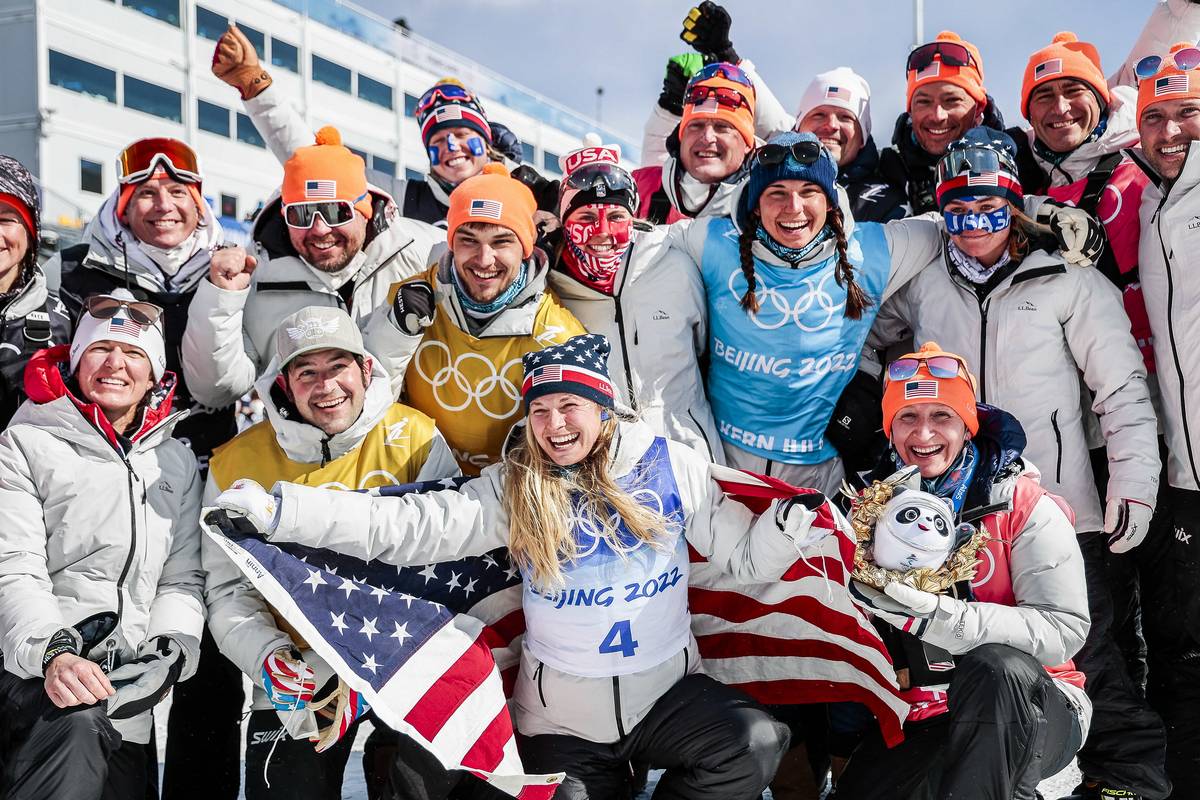
 Though Grover explains this may best serve the nations with the biggest budgets – which does not include the United States – it’s greater purpose aligns with other grassroots initiatives at U.S. Ski & Snowboard to hire, develop, and support women in coaching and leadership to improve the balance of men and women representing all levels of the sport.