From the FasterSkier archive — posts syndicated from athletes’ and coaches’ own blogs between 2004 and 2012, kept online as published. Current coverage is at fasterskier.com.

Tag: George Grey

  • Hanging Up the Boots: Kershaw Retires from Skiing, Embraces Next Challenge

    Hanging Up the Boots: Kershaw Retires from Skiing, Embraces Next Challenge

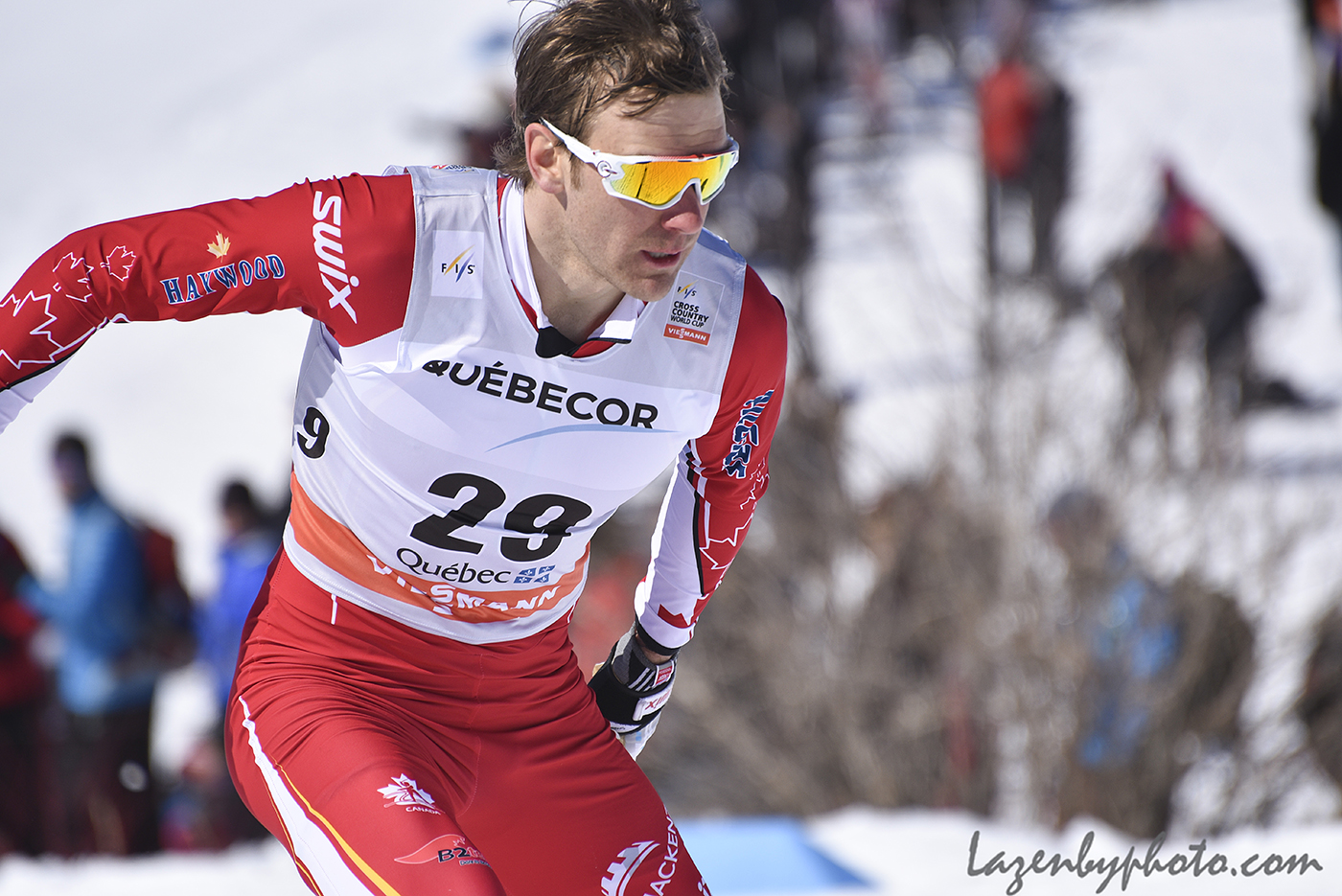
    Canada’s Devon Kershaw racing at 2017 World Cup Finals in Quebec City, where he finished 26th in the 15 k freestyle pursuit and 19th for time of day in the last race of the 2016/2017 season. (Photo: John Lazenby/Lazenbyphoto.com)

    On April 26, Devon Kershaw posted a photo on social media of Alpina boots hanging on a line. The next day, he spoke on the phone with FasterSkier from his new home in Lillehammer, Norway, after a day of running around outside with his 15-month-old daughter, Asta Isabel.

    Kershaw was tired, but in a good way. For the first time in 17 years, he was ready for a new challenge, a new focus and much more time with his daughter and wife, Kristin Størmer Steira, a former standout Norwegian skier.

    Three years after Steira left professional cross-country skiing and pursued a career in business, starting with her master’s degree in business management, Kershaw is following suit and headed back to school. The 35-year-old Canadian hung up his boots to quietly announce his retirement after about a month of deliberation.

    “I was really keen to keep ski racing, to be honest,” Kershaw said. “I had the motivation to go one more year, and in my head, I wanted to race one more season, but as things progressed in the spring, there were a lot of different factors that just made it seem like, oh man, it doesn’t look like it’s gonna be super realistic at this point.

    “I struggled with that, when you feel like you still have more in the tank,” he continued. “But at the same time, it’s a bit of a double-edged sword in the sense that it’s been a fantastic career.”

    Kershaw was quick to reflect on his roots as a kid growing up in Sudbury, Ontario, “a mining town with a small but passionate skiing community,” as he put it. He also reiterated how proud he was to represent Canada for 17 consecutive seasons, first as a junior national team skier for two seasons starting in 2001, then as an under-23 national team member in 2003, and finally as a full-fledged World Cup Team member starting in 2004.
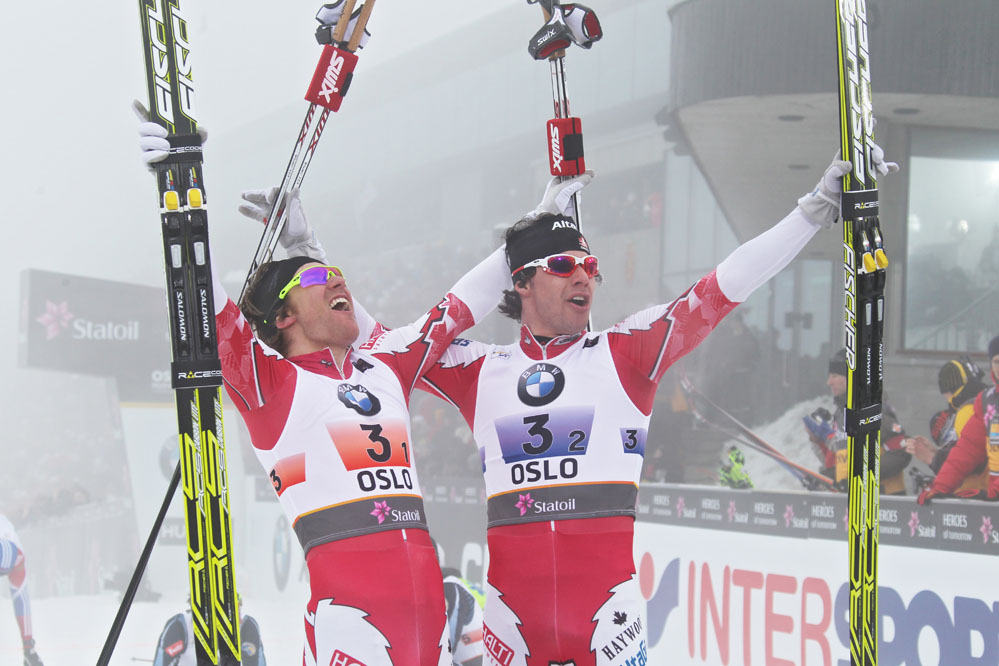
    Devon Kershaw (l) and Alex Harvey celebrate their 2011 World Championships gold in Oslo, Norway. (Photo: Fischer/NordicFocus)

    His career included three World Cup wins and 14 podiums, and a gold medal at 2011 World Championships with teammate Alex Harvey in the classic team sprint. Kershaw finished the 2011/2012 World Cup season ranked second overall and second in the distance rankings.

    When he reflects on those accomplishments, he still has a hard time believing that all happened to him.

    “So instead of focusing on being bummed at the situation or a bit frustrated with the state of things in Canadian skiing right now, I have to look back with a smile,” Kershaw said. “I feel just so privileged and grateful to have had the opportunity to be part of a real movement for men’s skiing in Canada.”

    Kershaw said he was left with unanswered questions this spring during a transitionary period at Cross Country Canada (CCC). The team’s budget was undetermined, camps were not yet set in stone, and Kershaw said his decision — which he wanted to make by May 1, the start of the new training year — became about energy management.

    “Part of managing your energy properly is putting all of your energy and focus into training, and if you’re being pulled with uncertainty or being stressed about uncertainty, that will come back, the World Cup will exploit that,” he said.

    According to CCC Chief Executive Officer Shane Pearsall, High Performance Director Thomas Holland had planned to retire this past March, yet has stayed onboard as an advisor until CCC fills the position. Pearsall said the hiring process is still ongoing and will hopefully be wrapped up by next month. He confirmed that CCC has yet to finalize its budget and doesn’t anticipate being able to do so until a government minister signs off on the amount from Own The Podium (OTP), one of its primary funding sources, in July. Pearsall explained that they expect to have a better sense of national-team finances in mid to late June.

    Typically, the team’s budget is determined in May, but because of necessary “quad reviews” following the Olympics, which took place before CCC met with OTP, the process was delayed by about a month. Pearsall did not elaborate on how significantly the budget would be decreased from last year, but said, “It’s certainly tighter than last year.”

    Kershaw said he needed to pay about $25,000 Canadian dollars in team fees if he wanted to continue racing this year, up from $15,000 last year. That didn’t cover the cost of living, which he figured to be around $55,000 Canadian, for a grand total of $80,000.

    “The financial burden is big, and moving forward the financial burden went from big to 100 percent paying for every cost,” Kershaw said. “So all travel, accommodations, everything. … I’ve just been in the sport a long, long time, and from a directional standpoint, I’m not sure we’re moving in a direction that will yield sustainable results at this point in time, but I understand it is difficult when you’re under such financial duress to create a sustainable program. But from a vision standpoint, I think there’s a lot of questions that remain unanswered, and it’s late in April. The fact of the matter is the rest of the world has all of the holes plugged — if they have holes in their boat — because May 1 is the new year of every ski program. And we’re just constantly slow and off the mark with that.”

    Budget cuts had been expected as Canada’s World Cup Team missed performance benchmarks throughout last season. The team finished 2017/2018 with just two men scoring World Cup points (top 30) in distance races: Harvey and Kershaw. Two men (Harvey and Julien Locke) scored in World Cup sprints. On the women’s side, Dahria Beatty landed one World Cup sprint top-30 last season, and Cendrine Browne was the top Canadian woman in a distance race with a 27th place for time of day in the last race of the season.

    Meanwhile, Alex Harvey led the team with four World Cup podiums, including third overall in the 2018 Tour de Ski, and a top result of fourth place at the 2018 Olympics. He finished his season in fourth in both the Overall and Distance World Cup standings. But Harvey’s results alone weren’t enough to buoy the whole team for another winter.

    “Throughout my entire career, it’s almost unfathomable to think that the season ends and that’s the stat line,” Kershaw said of the team’s overall results. “It wasn’t so long ago that we had over 16 World Cup podiums in a season. The truth hurts, as [former Canadian coach] Tor-Arne Hetland once said, but things go in waves and this is the reality that we live in right now.”

    Despite the prospect of self-funding, Kershaw didn’t feel pressed into retirement. Several of his teammates have decided to retire as well, including Graeme Killick, Jess Cockney and Knute Johnsgaard, but Kershaw said they weren’t forced, either.

    “You can choose to work and you can choose to hustle for money; there are ways to make it,” he said. “No one’s forced into it. I could keep skiing if I wanted to, but I think the stark choice you’re faced with is, maybe perhaps some people are like, I can’t really see a path to international success currently, and that’s what I think is sad…”

    ‘A dream scenario’

    When Kershaw moved to Canmore, Alberta, in 2001 and entered Canada’s elite skiing scene, Cross Country Canada (CCC) was entering a fruitful period. At the 2002 Olympics, Beckie Scott was proclaimed winner of the women’s 10-kilometer pursuit (now called the skiathlon), becoming the first North American woman to win an Olympic gold. At 2005 World Championships, Sara Renner earned a sprint bronze to become the first North American woman to medal at World Championships. Scott and Renner teamed up for silver in the team sprint at the 2006 Olympics in Turin, Italy, where yet another Canadian woman, Chandra Crawford, won the individual skate sprint for Canada’s second-straight gold in as many Winter Olympics. Scott finished that 2005/2006 season ranked second overall in the World Cup, just 16 points behind Norway’s Marit Bjørgen in first.
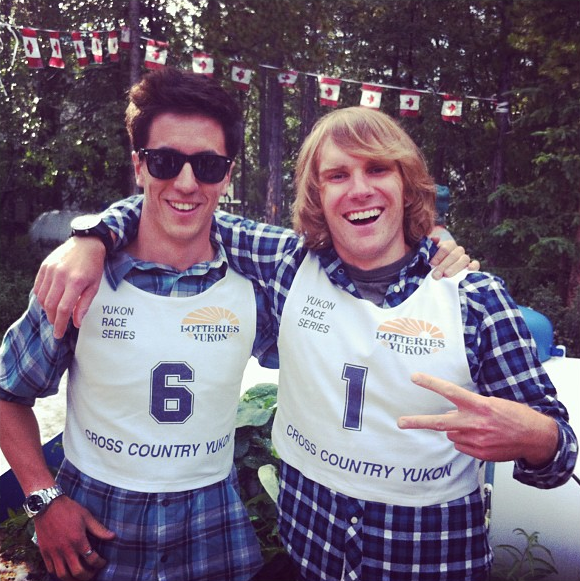
    Devon Kershaw (r) with Graham Nishikawa in 2013. (Photo: Devon Kershaw)

    Kershaw made his Olympic debut in 2006.

    “Coming into Torino, we were quoted in the newspaper as being like the world’s most anonymous men’s ski team,” he said of the Canadian men’s team that year. “We weren’t really ‘on the map,’ but I’ve just been so grateful and lucky to have such a great group of guys around that really welcomed me in.”

    He credited his former roommate and teammate Chris Jeffries as well as other Canadian competitors of his time, including George Grey, Gordon Jewett, Dan Roycroft, Sean Crooks, Dave Nighbor, Phil Widmer, Brent McMurtry, and Graham Nishikawa (who’s still racing), for having a major impact on the formative stages of his career.

    “[There were] so many athletes in Canmore that tried hard, wanted it bad, and loved ski racing and training,” Kershaw reflected. “That’s a dream scenario for a young athlete to come into a community like that and be welcomed into that environment.”

    Less than a month after the 2006 Olympics, he notched his first World Cup podium by placing third in the Borlänge, Sweden, skate sprint. In doing so, he became the first Canadian male cross-country skier to reach the podium since Pierre Harvey (Alex’s father) in 1988 and the first ever to medal in a World Cup sprint.

    “I had no idea who Pierre Harvey was,” Kershaw said of his younger self.

    Pierre Harvey had previously won the 1988 Holmenkollen 50 k as well as two other World Cup distance races and the Norwegian Birkebeiner, making him the most successful Canadian male skier before Kershaw.

    “He could walk into the room and I would not recognize him,” Kershaw continued. “Even his results, I had heard that he had five World Cup podiums and that seemed pretty cool, but that’s all I knew about him.”

    Kershaw’s second World Cup podium came early in the 2006/2007 season in a skate sprint in Munich, Germany. That same day, Crawford — whom he was dating at the time — placed third in the women’s sprint.
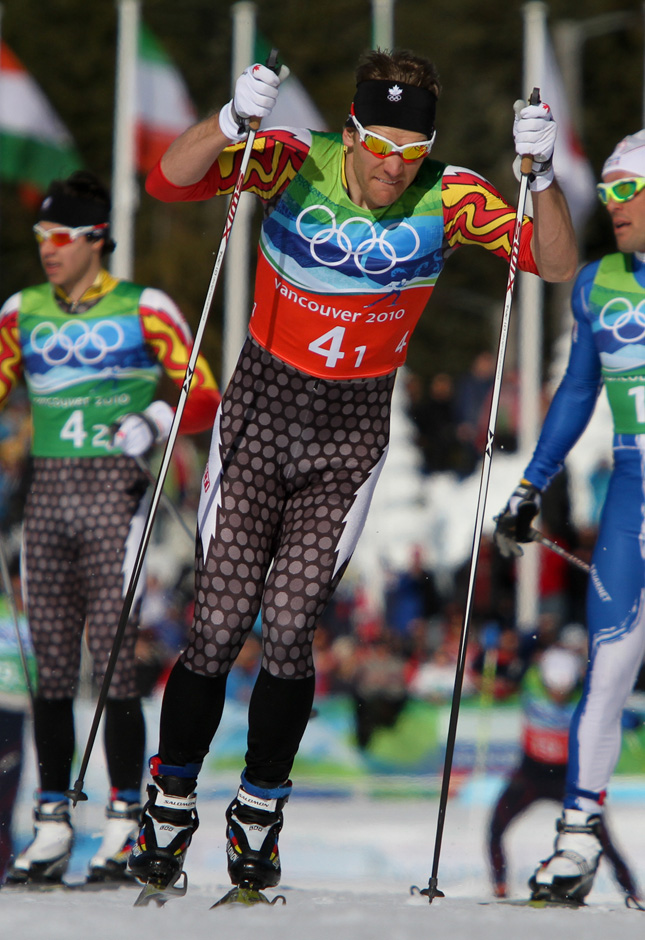
    Devon Kershaw after being tagged by his Canadian teammate Alex Harvey (l) in the freestyle team sprint at the 2010 Olympics in Vancouver, B.C. They went on to finish fourth.

    At his second Olympics in 2010, Kershaw finished fifth in the 50 k classic mass start for the best individual Olympic result for a Canadian male nordic skier. That record stood until Alex Harvey, who burst onto the World Cup scene in 2008, bested it with a fourth place in the 50 k classic at this year’s Olympics in PyeongChang, South Korea.

    Kershaw and Harvey also teamed up to place fourth in the freestyle team sprint at the 2010 Olympics.

    Kershaw’s first World Cup win came in a skate sprint during the 2011 Tour de Ski. He finished that Tour in seventh, and the next year, came back to place fourth overall in the 2012 Tour de Ski (TdS). Kershaw started all 12 editions of the TdS, a record he shares with France’s Jean-Marc Gaillard.

    Harvey scored his first individual World Cup podium in a 50 k classic in 2009 and won his first World Cup race (a 3.3 k freestyle prologue) at the TdS in 2012.

    “Then next thing you know, Alex and I are sharing a podium on some World Cups,” Kershaw reminisced. “Two Canadians on one podium in the World Cup, like, really? And then you win World Championships and I’m on the overall World Cup podium, and then next thing you know, Alex has been on the overall World Cup podium a few times and also now 50 k world champion. It’s crazy. It’s insane. From nothing. From no results. The journey has just been amazing. … I never would’ve thought Canada would, I mean, how could you? We had Pierre Harvey and that’s it in, like, a hundred years of international ass-kicking.”

    Kershaw credited his initial World Cup breakthrough as a 23-year-old skier in Borlänge to Dave Wood, Canada’s national-team coach at the time.

    “I came into a team with a coach that you could call at midnight. He’d do anything for you,” he said of Wood. “There was no way I would’ve stepped onto the podium in 2006 without him, and Mike Cavaliere, too, my first-year senior, Mike was my coach. We had staff that was just committed to the core for the cause and I’m incredibly grateful for that.”

    ‘A hell of a season’
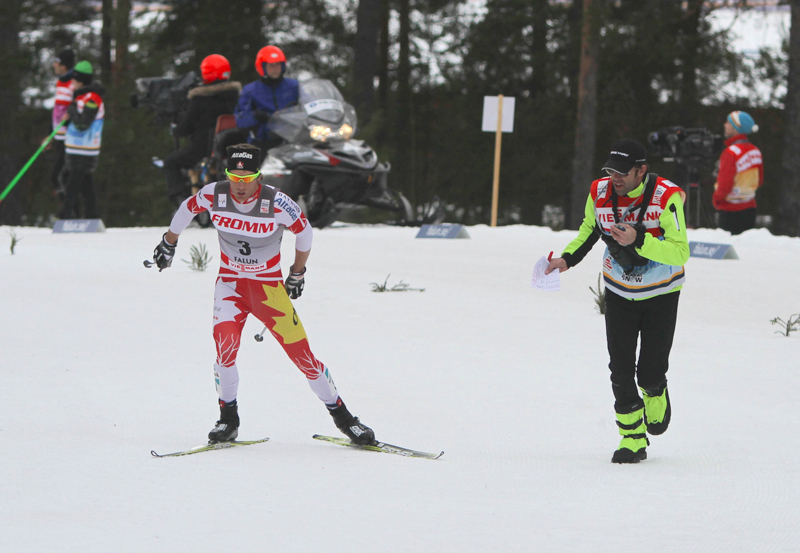
    Canadian head coach Justin Wadsworth (r) giving splits to Devon Kershaw at 2012 World Cup Finals in Falun, Sweden.

    Of his coaches, Kershaw gave special credit to Justin Wadsworth. A three-time U.S. Olympic cross-country skier who became Canada’s head coach in the spring of 2010, Wadsworth coached Kershaw for five seasons, and the two developed a close friendship.

    “When Justin came into the national team, the level of professionalism and excitement and freshness that he brought … I don’t know if you call it luck or happenstance or just the right place, right time,” Kershaw reflected, alluding to his 2011 World Championships gold with Harvey and his 2012 Overall and Distance World Cup podiums. “Justin’s best results as a coach were me and my best results as an athlete were when I was coached by Justin. Talk about an amazing relationship there.”

    “The main thing that I really appreciated with Devon, and I think he would say the same thing about me, is that we could be honest with each other and talk about hard things and enjoy the good times when we had them,” Wadsworth said on the phone last week. “… It’s cliche, but when I was talking to Devon the other day about his retirement, it’s not about the medals or the performances or whatever, it’s about your times together on the road.”

    One of Kershaw’s biggest moments came at those 2011 World Championships in Oslo, Norway, where he and Harvey beat out Norway’s Petter Northug and Ola Vigen Hattestad by 0.2 seconds for gold on the Norwegians’ home turf. They had done so after Kershaw lost one of his skis early in the race, Wadsworth pointed out.

    buy antabuse online, buy wellbutrin

    “His ski fully came off and he had to put it back on and get back into the race,” Wadsworth said. “Just the whole day was pretty incredible. That was a great, great opportunity for us, and the guys cashed in.”
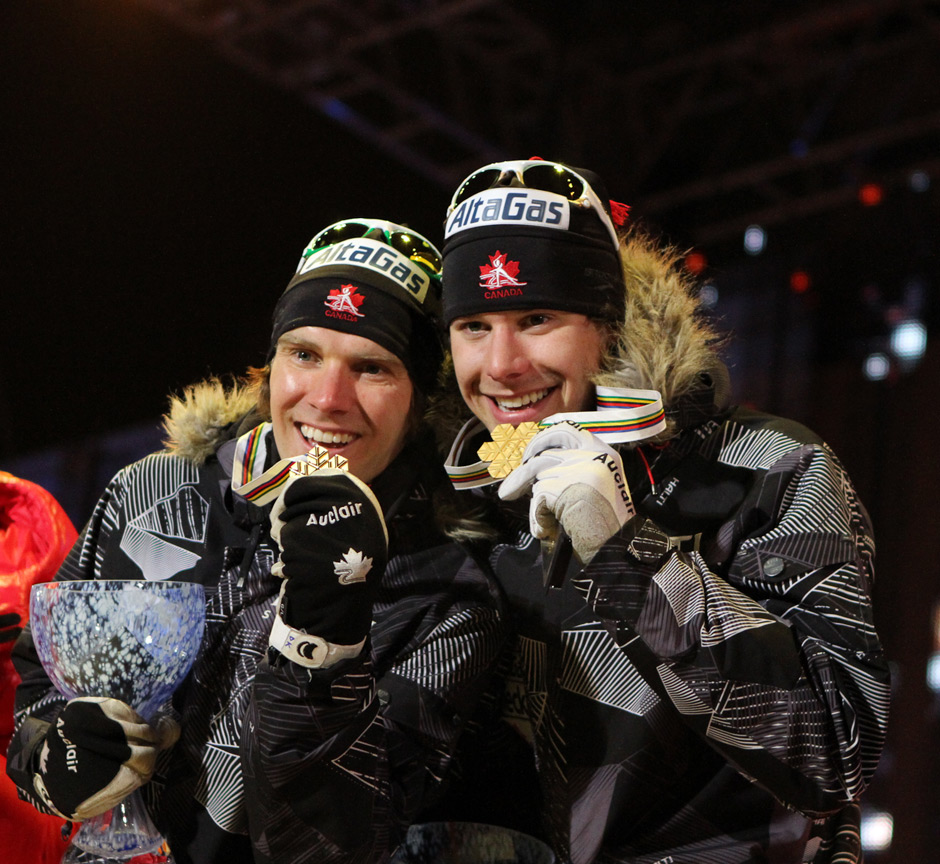
    Devon Kershaw (l) and Alex Harvey with their World Championship gold medals at the 2011 World Championships in Oslo, Norway.

    In a difficult-yet-strategic move to conserve for that race, Kershaw and Harvey both sat out the 15 k classic the day before.

    “With anybody else running the ship, there’s no way I would’ve trusted that [decision],” Kershaw said of Wadsworth’s call. “But I trusted Justin’s leadership and we went all-in, and the next thing you know we won World Championships. I mean, are you kidding me? How can you get a better start to the next quadrennial? And Justin as a first-year head coach of a national team, that’s gotta go down as maybe the best season ever for a first-year North American coach of a national-team program.”

    He and Wadsworth reiterated the crucial foundation that Wood had laid.

    “Dave Wood had done a really good job with the athletes leading into that period, mainly focused on building a big base and doing a lot of hours and also doing a lot of time at altitude,” Wadsworth explained. “And when I took over the position, I saw that both Alex and Devon were really primed and had a really good response rate to altitude, and all we had to do was fine tune a little bit of strength training and intensity. I was really excited to work with both those athletes and saw that they had a lot of potential.”

    For Kershaw, Wadsworth’s “American swagger … was magic for me,” he said. During the 2011/2012 season alone, he stood on the podium 10 times, with four top-three finishes in seven races at the 2012 Tour de Ski.

    “It was a hell of a season for me,” Kershaw said.

    ‘Best sand-digger ever’

    He went on to compete at two more World Championships and two more Olympics. This past season, Kershaw finished in the top 30 in eight World Cup distance races, with a top result of 19th in the 30 k skiathlon in Lillehammer, Norway. While struggling with lung issues, he finished 26th in the 50 k classic at the PyeongChang Olympics.
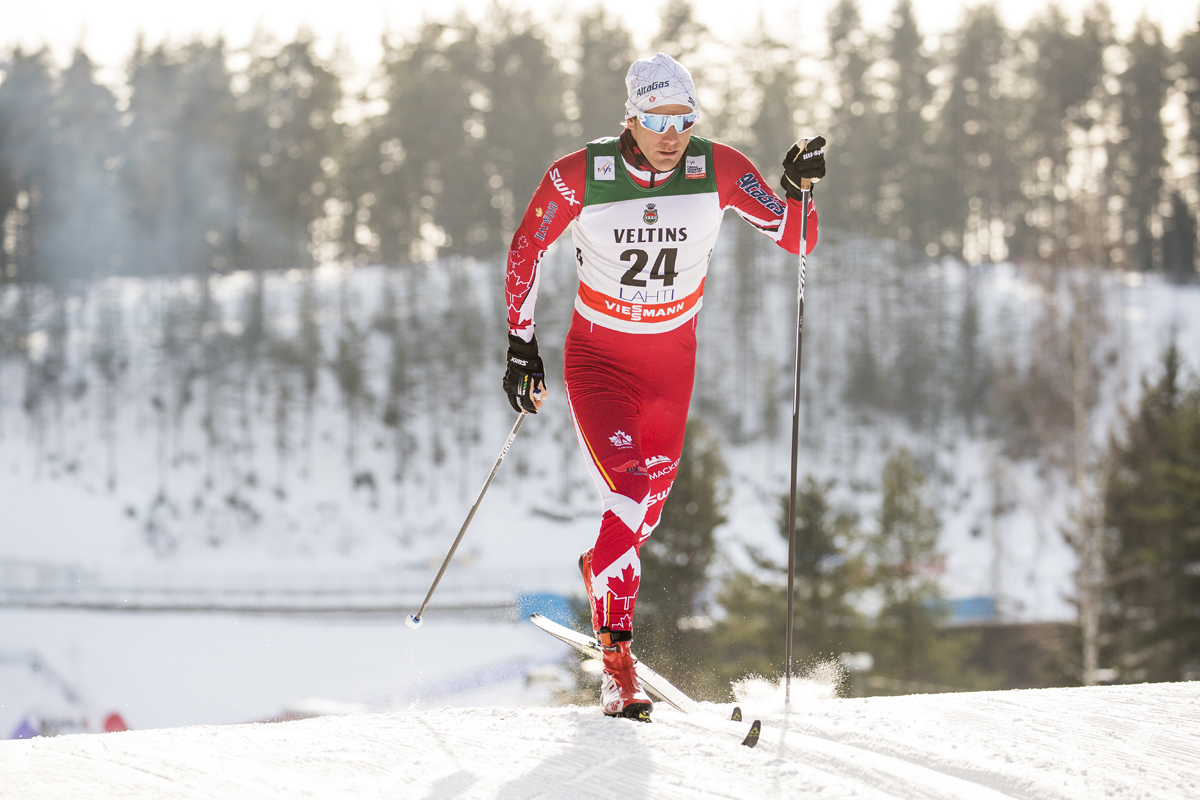
    Devon Kershaw racing to 25th in the World Cup 15 k classic this past March in Lahti, Finland. (Photo: Fischer/NordicFocus)

    Initially plagued by a lung infection in 2014, Kershaw discovered after a 2015 bout with an pneumonia and whooping cough that he has exercise-induced asthma.

    “We worked to get that under control and it was manageable but it never felt good like it felt prior to 2015,” Kershaw said his health over the last three seasons. “In PyeongChang, it was a calamity of bad luck. When we got there it was minus 20 [Celsius], and this makes me sound so soft, because I’m from northern Ontario so you’d think I’d know, but it was really cold. I did some intervals and it aggravated my lungs and it was super windy and dirty and a lot of sand blowing around, and that really flared up my asthma to the point that I was wheezing badly.”

    His breathing troubles also affected his sleeping and took most of the two-week Olympics to manage. At one point, he had a chest X-ray to make sure it wasn’t pneumonia.

    “It was sporting asthma,” he said. “… It took all the way to the 50 k to kind of get it 70 percent.”

    While he noted he was left wanting more from a performance standpoint at both his final Olympics and in his final season, Kershaw also acknowledged that he’s his biggest critic.

    “That’s been probably the biggest detriment to my entire career; I’m the best sand-digger ever,” he said. “I am disappointed in the sense that I work really hard and I train hard and I prepare well, and it didn’t go exactly as planned. … When you’ve competed in the top 10 for as many years as I have and on the podium, of course that becomes your bar that you hope to achieve, but at the same time … when you’re in the top 30 in the results page, you’re in the race at least. And I’m proud of the fact that in almost all classic races, not every, but most, I was in the top 30 and ‘in the race’.

    “Am I satisfied? In my life I’ll probably never be satisfied, that’s just how it goes,” he added with a laugh. “But am I somewhat proud of maintaining a fairly competitive level? Yeah, absolutely.”

    Wadsworth reflected that Kershaw was one of the best athletes he had ever seen, even “physiologically as good as Alex [Harvey]” at the peak of his career.
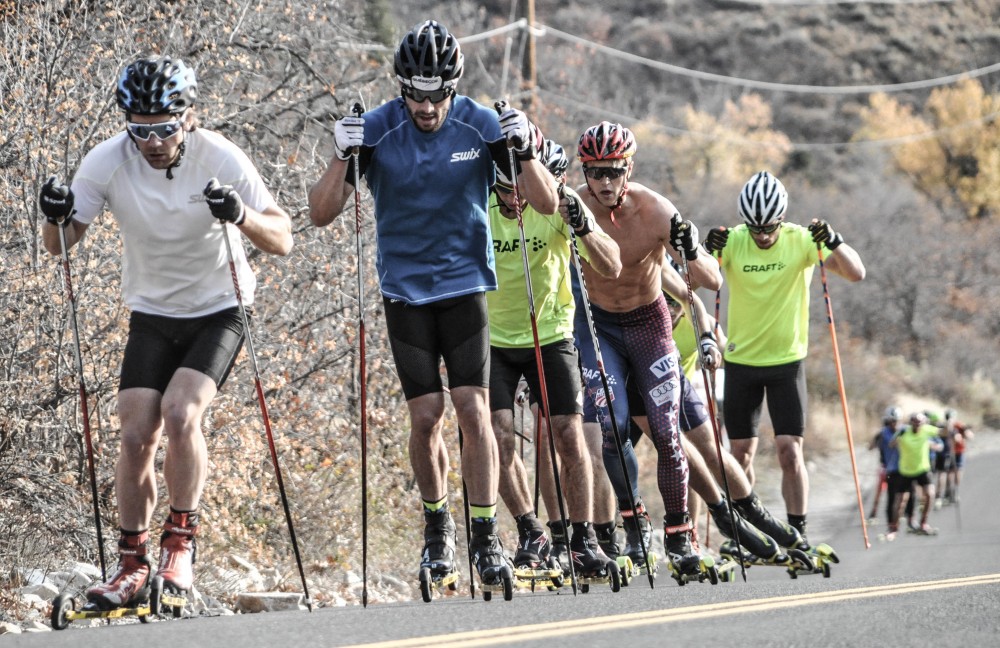
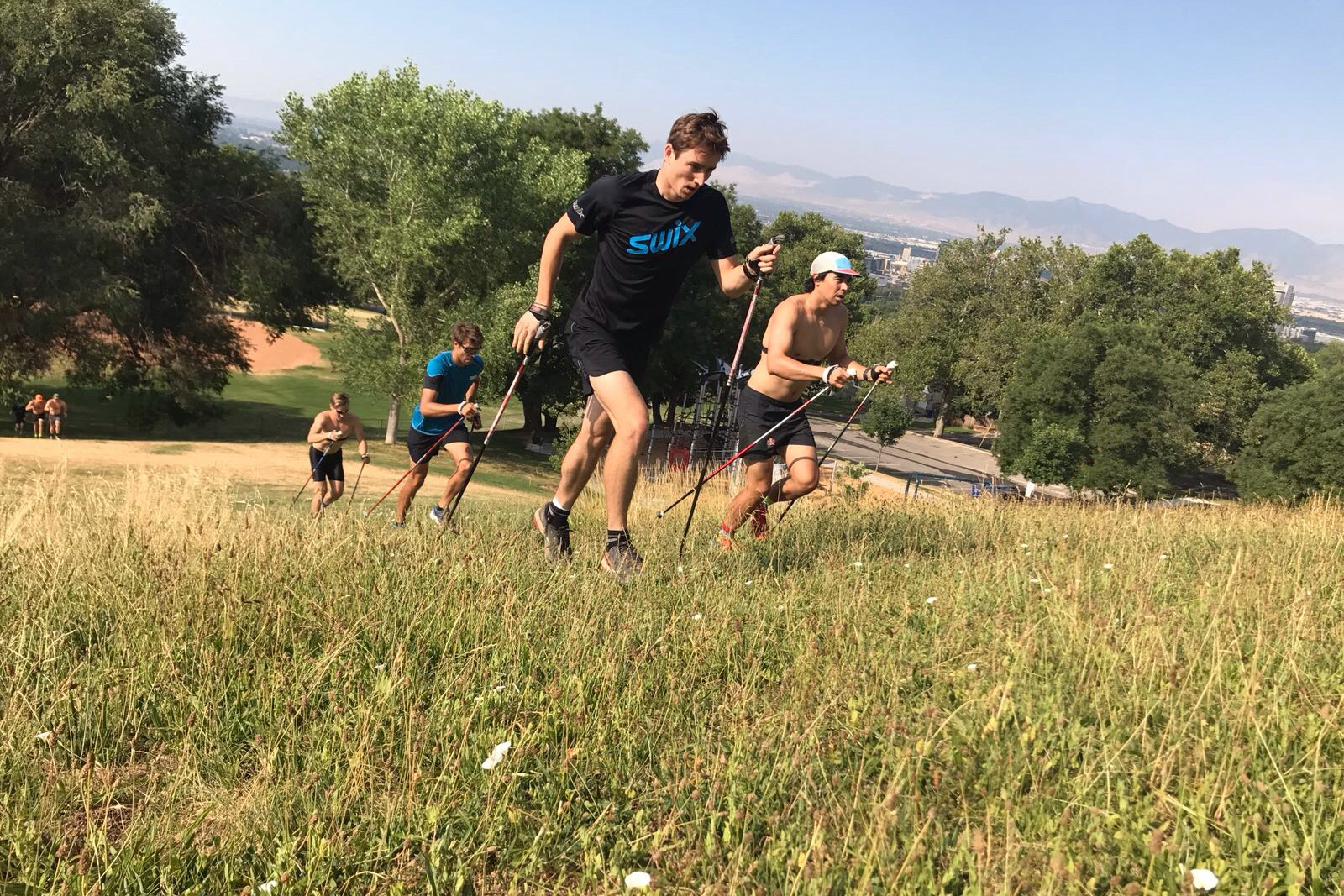
    Left to right: Canada’s Devon Kershaw leads his teammate Alex Harvey and U.S. Ski Team members Noah Hoffman, Erik Bjornsen and Simi Hamilton during a Level 3 interval skate session up Snake Creek Canyon in Midway, Utah, during their respective teams’ 2016 training camps in Park City, Utah. (Photo: Matt Whitcomb)

    “Devon’s a very intelligent person and sometimes he might’ve overthought things and lacked in confidence, and as a coach that’s really frustrating to see because you know how good they are physically,” Wadsworth said. “And when he was on mentally, too, in training, when he was at his very best, he had total confidence and could destroy anybody in any workout.”

    He recalled a hill-bounding workout with the Norwegian team in which Kershaw was literally leaps and bounds ahead of everybody else — even Martin Johnsrud Sundby and Russia’s Ilia Chernousov, who joined the training session.

    “He was just shelling everybody,” Wadsworth said. “So when Devon was at his best like that and mentally confident and relaxed, he was a real force of nature. Unfortunately that didn’t always translate into the racing season, but in 2012 he put it all together and had a tremendous year. … If he had the confidence the whole time, he would’ve been almost unbeatable, in my opinion, but it takes the whole package all the time, and he was among the greats there for a while.”

    ‘Younger, faster, better dog’

    And then there was Harvey, another one Kershaw’s of his best friends and longtime roommates.

    “I’ve spent more nights in a room with him than my wife or any girlfriend I’ve had,” Kershaw joked. “… He was eager to learn, he chased me for years, he was always a hard worker, too. He trained really hard, he believed in himself, and I still am in total awe of that. I’ve never met anybody as confident as him. It’s too bad that didn’t rub off on me, but that’s been great to be around.”

    He likened Harvey’s addition to the team as a family adopting a puppy.

    “You know when your parents get a puppy because your dog is 10 years old? He’s kind of slowing down a little bit and then you see that old dog get fired up and run again and jump around and play; that’s me,” Kershaw said. “And I’m so grateful that my owners got a younger, faster, better dog to hang out with because it was so inspiring.”

    Several times over the last few years, Kershaw has said that witnessing Harvey make Canadian history has been one of his biggest reasons for staying in the sport.

    “He, for sure, has kept me in this probably longer than I should’ve,” Kershaw said. “I just love traveling with him and seeing what he can accomplish and training with him and seeing that professionalism.

    “There’s no question he’s the best Canadian skier ever, that’s not even close,” he added. “… I just feel so honored that I got the chance to see it all happen, from his last-year junior when he did his first World Cups and then all the way though I’ve been with him.”
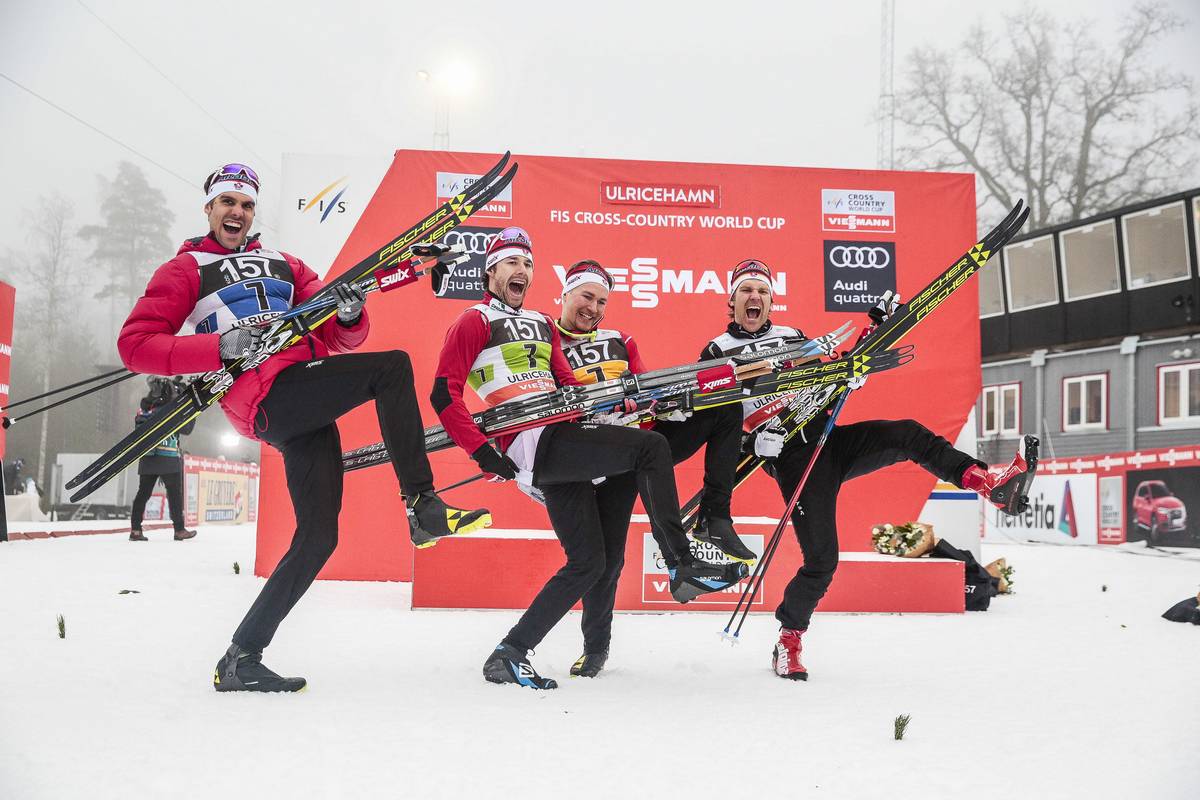
    The Canadian men’s relay after placing third in January 2017 in Ulricehamn, Sweden, for Canada’s best-ever World Cup result in the 4 x 7.5 k relay. From left to right: Lenny Valjas, Alex Harvey, Knute Johnsgaard, and Devon Kershaw. (Photo: Salomon/NordicFocus)

    In an email, Harvey explained that he and Kershaw first met in the fall of 2005 at a training camp at Sovereign Lake, British Columbia. Harvey was on the junior team and Kershaw a senior, but the whole team stayed at the same hotel.

    One morning, Kershaw accidentally took Harvey’s poles from the hotel. Harvey had to track him down on the ski trails to get them back.

    “That was the first time I talked to him and to me it’s just perfect because that’s so Devon,” Harvey wrote.

    Later that season on March 7, 2006, Kershaw made history with his first podium. That same day, Harvey won his first national title in the 10 k classic at Canada’s senior national championships as a 17-year-old junior.

    “I guess our friendship was meant to be before we even knew it!” Harvey wrote.

    When the two became teammates, Harvey immediately took to imitating Kershaw, both in training and racing.

    “He took me under his wings and he has a big part in the athlete I became today,” Harvey wrote, likening Kershaw to a big brother. “I feel very privileged to have spent all that time with him. I think we became such close friends because we are both very driven athletes and we don’t accept any compromise. We’re both huge fans of our sport, ‘nor-dorks’, so we also love to talk about everything from altitude training to who is seeing who on Tour.”

    Kershaw’s decision to retire didn’t surprise Harvey.

    “I think it’s a mix of a few things,” Harvey wrote. “… Probably this biggest reason, he has a little girl at home. I know this winter was extremely hard on him. Not seeing Asta Isabel was pure torture, I think I would have done the exact same if I was him.

    “I will miss a lot of things about Devon,” he added. “He’s always there to give good advice about everything and anything. He knows so much about all that is going on in the world, probably the most well-read person I know. He’s kinda my news source. I’m still amazed by how indecisive one can be. This brought a lot of laughter throughout the years. I have so many memories from the last 10 years with him. Seeing him dominate the World in 2012 was just amazing but also very eye-opening for me. He raised the bar for all North American skiers that year and I’m very thankful for it.

    “We both lived great emotions in high accomplishments and huge disappointments. I’d like to think I helped him get through these upsets and I can say he definitively helped me get through mine. A page turns in the life of Devon Kershaw but knowing the man, I’m not worried about what’s gonna come next.”

    Without Kershaw, Killick, Cockney, and Johnsgaard on the men’s team, Harvey acknowledged that next winter will be “very different” for him on the World Cup.

    “All these guys are calling it a career and I’m super proud of what all my friends accomplished,” he wrote. “I’m excited to try to help the next generation step it up and fill the shoes of the previous generation. … Also, after 10 years on Tour I’ve made some friends on other teams so I’m not too worried. I’m just excited to step into a bit of a mentor role for our next generation.”

    Onto the Next

    As for Kershaw, he didn’t rule out coaching future generations of Canadian skiers, but he said he was focused on getting an education first. In just over a week, he’ll start a course that requires 20 hours of classes a week — all in Norwegian — for what he anticipates will take six months. The course is essentially an advanced version of Norwegian as a second language, and foreigners must pass it to pursue a degree in Norway.

    After that, Kershaw plans to apply to universities “and hopefully study forever,” he said with a laugh. “Not forever, but study, and I want to stay involved in skiing in any way I can and I want to help the next generation get better.
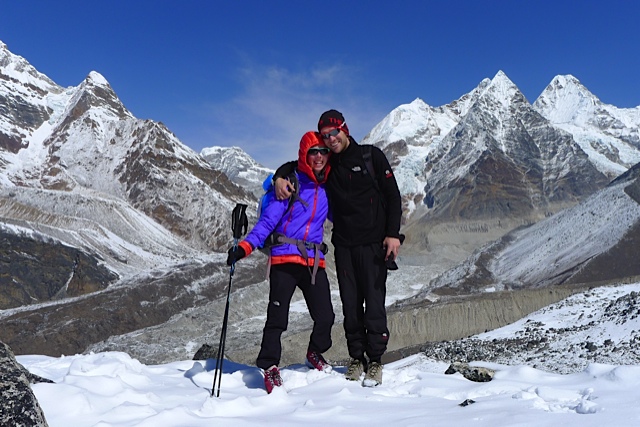
    Kristin Størmer Steira (l) and Devon Kershaw during a day hike on one of their acclimatization days. The couple got engaged in 2014 after summiting Mera Peak during a three-week trek in Nepal’s Himalayas. (Photo: Devon Kershaw)

    “First things first, I have to get my Norwegian at a level where I can sit through a lecture and write an essay at a decently good level, at least good enough that my wife doesn’t have to rewrite it, she can just correct it,” he explained.

    Asked what he’d like to study, Kershaw said medicine, specifically orthopedic surgery, has always intrigued him. (As a junior skier, Kershaw took undergraduate classes at the University of Calgary until 2006, but those credits have since expired.)

    “But now I’m 35 and I’m going to have to do all of this in my third language,” he acknowledged. “So for now, I’d say that that’s still my first choice and I’m exploring what it would take.”

    If not medicine, he’d like to pursue a degree in “some kind of science physiology, and then in a totally shifted way, if I have a panic attack and be like, ‘Science is too hard after ski racing forever,’ then I am interested in economics and economic theory and business to some degree…”

    Regardless of which path he choses, he’ll be doing it in Norway, Kershaw said.

    “I don’t mind the challenge. … It’s intimidating in a way, but it’s also really exciting,” he said. “Kristin’s family [who lives in Lillehammer] is just so fantastic and to see how happy my daughter is here, to have her family, to have family around her and everything for the short term, and I hope to be educated in Norway.”

    Asked if he’ll jump into any ski races this season, Kershaw was quick to respond, “No.” But he will continue skiing. The beauty of the sport and the struggle, as he put it, is what’s kept him in it so long.

    “Imagine just having a singleness, a purpose, a goal that’s just there in your face and then you get to wake up every day and do the things you absolutely love to do,” he said. “… I adore cross-country skiing. I just think it’s such a peaceful, beautiful exercise, and the technique and the flow of it all. … You’re just skiing through the woods peacefully, gliding over snow, over all the terrain you can cover. It’s a beautiful, zen-like endeavor, and I think that’s what’s kept me in it this long. And the people, the Canadian ski community, the world ski community, really. I’ve met so many inspiring people and beautiful people and worked with a lot of absolute experts and I’ve had brilliant teammates and brilliant coaches.”

    And because of skiing, he met his wife and started a family in Norway.

    “I have a daughter with a woman that I love and respect and am in total awe of every day of my life and without ski racing there’s no way that would’ve ever come to fruition,” he said. “There’s the biggest gift right there, as cliche and Hallmark as that sounds, it’s true.”

  • Qualified for First World Cups, Locke Sees It As ‘First Step’

    Qualified for First World Cups, Locke Sees It As ‘First Step’

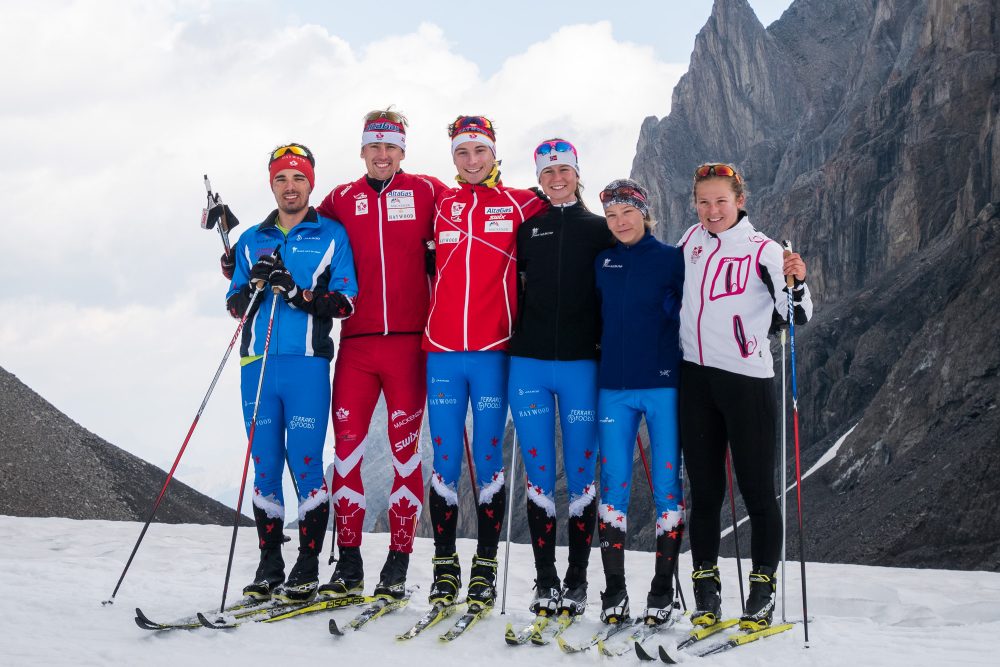
    Black Jack Ski Team members (left to right): Daniel Merlo, Julien Locke, Remi Drolet, Michaela McLean, Abbey McLean and Molly Millar. (Photo: Julien Locke)

    In Rossland, British Colombia, most residents can reach the town’s lone alpine hill by car in five minutes, the cross-country trails in seven. Tucked high in the Monashee Mountains, hemlock and fir outnumber some 3,500 locals, most of whom know each other by name. And over the past two decades, Rossland, which was featured three years ago in The New York Times travel section, has shown that a small town can produce nordic talent, repeatedly.

    Thanks in part to snow that covers the ground an average of five months each year and roadways that provide 25 kilometers of continuous rollerski climbing, the area is one that Dave Wood — Cross Country Canada’s national-team coach from 1998 to 2010 and the current head coach of Rossland’s Black Jack Ski Team since 2010 — says has “everything you need to make great skiers.”

    George Grey was one of them. The two-time Olympian grew up in Rossland after moving there from Great Britain, where he was born, with his parents at the age of 2. He spent much of his childhood skiing and racing for Black Jack before being selected to Canada’s national team in 2001. Grey then moved to Canmore, Alberta, the home of Cross Country Canada (CCC) since 1995.

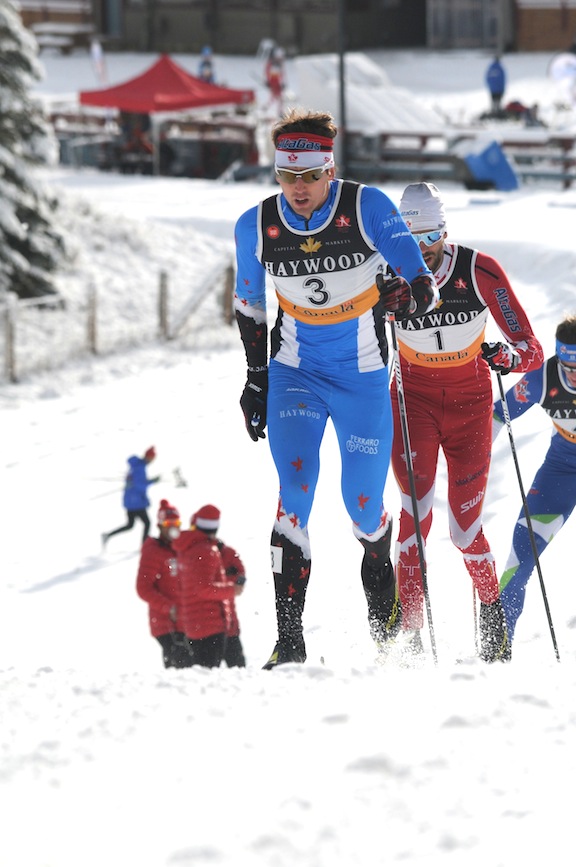
    Black Jack and national U25 Team member Julien Locke (3) leads Canadian World Cup Team member Le Valjas (1) in a Frozen Thunder classic sprint heat on Nov. 1 in Canmore, Alberta. (Photo: Angus Cockney)

    Despite living more than six hours away, Grey returned to Rossland often enough to join his old club team for training camps. When he was in town, “George Grey Days” were occasionally held for local youths interested in testing their skill against anyone else willing, including skiers from a relatively nearby town, Nelson.

    Racers received race bibs and a chance to learn the course by following Grey around the trails beforehand. While many young skiers participated, one Nelson native saw the events as more than just a chance to race against friends.

    “Before I joined Team Black Jack, when I was still racing for Nelson, he’d have George Grey Days where we’d put on a race and we’d all meet him and ski with him,” 24-year-old Julien Locke recalled on the phone earlier this month. “I think to have someone like that in the regional ski community was huge in impressing upon me that it is possible to come from a small place and get somewhere in sport.”

    Born in Nelson, a town with a population of about 10,000, Locke grew up participating in the Nelson Nordic Ski Club’s Jackrabbits program until he was 14. He then moved an hour away to Rossland, where he joined Black Jack in 2006.

    “Rossland became an adopted hometown,” he said. “I consider the Rossland club my home club.”

    Locke’s first year with Black Jack was also his first year completing a full, yearlong training program. Though he had been skiing since he could put boots on his feet and click into skis, that season gave him new insight into his sport and what he wanted to do with it. In 2009, Locke competed at Canadian nationals in Duntroon, Ontario, and finished fourth in the juvenile boy’s classic sprint. 

    “That sat heavily with me all summer because I knew, I believed that I was capable of being on the podium in a sprint at nationals,” Locke said.

    The following year, Locke returned to Canadian nationals, held in Whitehorse, Yukon. This time, he won the juvenile boy’s freestyle sprint. 

    “I think that was a pivotal moment in understanding that training and preparation makes the difference at the end of the day,” he said. “Coming from a small town … I’ve always had a belief that I can rise to the top, but that was the first moment it really cemented into my mind.”

    From then on, skiing became Locke’s primary athletic focus. He placed second in the classic sprint at the 2015 nationals and third in the freestyle sprint at the 2016 U.S nationals. Later that season, he racked up another third place in the freestyle sprint at 2016 Canadian nationals, and the following spring, he was nominated to CCC’s national U25 Team for 2016/2017. Last season, before making his World Cup debut in PyeongChang, South Korea, Locke won two races at South Korea’s national championships: the classic sprint and 10 k classic. At the subsequent PyeongChang World Cup, he finished 36th in the classic sprint.

    This season, Locke has his sights set on the 2018 PyeongChang Winter Olympics in February. After what he called his “best summer of training” yet, which included two national-team training camps in Park City, Utah, and a few camps with Black Jack, he put his fitness to the test on Nov. 1 at Frozen Thunder’s opening races in Canmore.

    This year, the first race, the Frozen Thunder classic-sprint qualifier held big implications for those vying for the final spot on the Canadian men’s World Cup Team for Period 1. The winner of the men’s qualifier would earn a trip to Europe to race the first four weekends of the World Cup, from late November through December. And World Cup results were what Locke needed if he wanted to qualify for the Olympic team.

    Julien Locke (center), of the Canadian U25 Team and Black Jack Ski Team, during a bounding training session with the Canadian national team in Park City, Utah, this fall. (Courtesy photo)

    “[My coach Dave Wood and I] made the decision this summer to put a pretty high priority on the Frozen Thunder race because, with the way the Canadian selection process works this year with the Olympics, World Cup results are the most important thing, and there’s not a lot of opportunities to get on the World Cup, with these trials being the first and the most straightforward way to get there,” Locke said.

    But Locke understands he’s not the only one with Olympic aspirations this season. A number other top domestic skiers are also gunning for a spot on the team.

    “Start of every year in the spring, you sit down and look at what the goals are going to be and of course, this year it’s the same for everybody,” he said. “The Olympics are the big focus, across the board, everybody is going for the same thing.”

    Despite the pressure to perform in the Frozen Thunder sprint prelim, he was able to push aside any nerves.

    “I knew my season would look drastically different if I didn’t perform,” Locke said. “And I was quite confident in my preparation. I think with any race, that’s what I build my confidence from is knowing that I prepared well.”

    Locke won the qualifier in a time of 3:37.81 to secure that spot on the World Cup team. He flew to Sweden on Nov. 11 for the opening International Ski Federation (FIS) races in Gällivare, Sweden, this past weekend. This week, Locke and the rest of the Canadian World Cup team is headed to Kuusamo, Finland, where the World Cup opens on Friday with the Ruka Triple mini tour.

    While his coach, Wood, will remain in Rossland, he’ll continue to keep in touch with Locke by phone  to help guide him through the start of the season.

    “It’s a step along the road for the season,” Wood told FasterSkier. “Lots of athletes you see, their focus is like a funnel. In May, they’re looking at the funnel through the small end instead of the big end, and by the time the fall comes, now they’re through the big end and for whatever reason they can’t maintain or refine the things they have to do. In May, they’re doing everything right and in the fall they’re doing not very many things right. Julien is one of those athletes that understands that and as the season gets closer, his focus intensifies.”

    This past Friday through Sunday in Gällivare, Locke raced to 72nd in the opening 10 k freestyle, skipped Saturday’s 15 k classic, and then placed 39th in Sunday’s classic sprint qualifier. He missed the top 30 needed to qualify for the heats by 2.36 seconds.

    “This weekend was a great chance to do some good race efforts ahead of the World Cup,” Locke wrote in an email on Sunday. “With such large fields, it was a good reminder that the margin for error is very small. Leading into the World Cup next weekend, it will only become ever more important to focus on the details. I’m looking forward to the upcoming three weeks, particularly the Ruka sprint as it has always been a favourite race of mine to watch. It’s such a tactical course with so much potential for excitement in the last 45 seconds.”

    While Locke previously referred to his win at Frozen Thunder a “relief”, it is just the beginning of a several-monthlong journey.

    “Of course I’m excited, but it felt to me sort of as the first step in the broader plan for the season,” Locke said. “Just one box being checked off.”

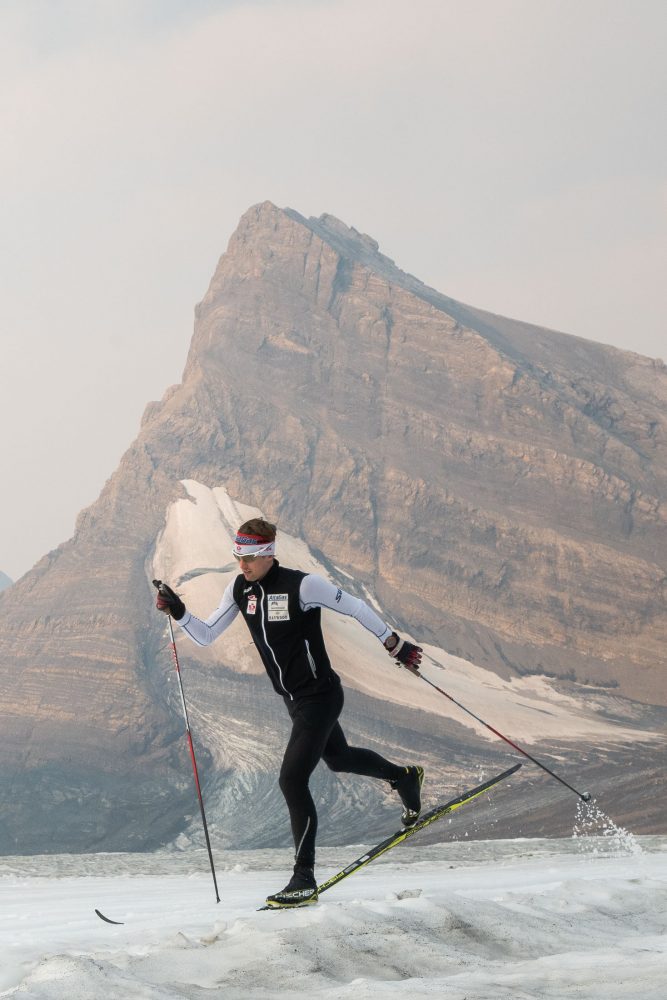
    Julien Locke (Canadian U25 Team/Black Jack) training on Haig Glacier near Canmore this summer. (Courtesy photo)
  • Elite Team Preview: Alberta World Cup Academy

    Elite Team Preview: Alberta World Cup Academy

    The Alberta World Cup Academy team behind a banner promoting the upcoming World Cup races from Dec. 13-16 in Canmore, Alberta, during a Canada Day parade July 1 in downtown Canmore. (AWCA courtesy photo)

    This is the third preview in a quick-and-dirty series about Canadian national-training centres. We asked coaches to send their 2012/2013 rosters and tell us what’s new for the coming season. We will be publishing additional reports over the next few weeks. Teams are presented in no particular order.

    Team: Alberta World Cup Academy (AWCA)

    Coaches: Chris Jeffries (head coach/women’s coach), Mike Cavaliere (racing director/men’s coach), George Grey (women’s assistant coach), Stefan Kuhn (universal coach/men’s assistant), Jeremy Hecker (summer intern), Rob Soffer (strength and conditioning trainer), Shelly Collier (strength and conditioning)

    Roster: 20 senior athletes, eight of which are on the Canadian Senior Development Team (SDT), between the men’s and women’s teams

    The 2012/2013 AWCA women’s team stops for a photo while rollerskiing on Palliser Range in Banff National Park in the Canadian Rockies. (AWCA courtesy photo)

    Men: Kevin Sandau (SDT), Graham Nishikawa (SDT), Graeme Killick (SDT), Brent McMurtry (SDT), Jess Cockney (SDT), Mike Somppi (SDT), Phil Widmer, Patrick Stewart-Jones, Matt Wylie, Russell Kennedy, Chris Hamilton

    Women: Emily Nishikawa (SDT), Alysson Marshall (SDT), Kate Brennan, Janelle Greer, Annika Hicks, Heidi Widmer, Alana Thomas, Marlis Kromm, Rebecca Reid

    Who’s new: Four men – McMurtry (from Pierre-Harvey National Training Centre), Somppi (NDC Thunder Bay), Hamilton (NDC Thunder Bay) and Kennedy (Canmore Nordic Ski Club).

    Three women – Thomas (from Nakkertok), Greer and Reid (first-year seniors).

    Also on the team, three juniors all born before 1994: Dahria Beatty, Suzanne Stevenson and Brittany Evans. According to Jeffries, this is notable since the team didn’t have any female applicants or additions last year and received as many as 20 applications this spring. This year, the women’s team – with 12 total skiers – exceeds the men’s by one.

    Who’s missing: Drew Goldsack (retired), Zach Holland (pursuing education), Pate Neumann (Canmore Nordic Ski Club), Bob Thompson (NDC Thunder Bay), Gerard Garnier, Joey Burton.

    “All of the above are very good skiers, it is just challenging because of the strength of the group and our applications,” Cavaliere wrote in an email. “Drew had a great career and always brought a lot of professionalism to our team, and we wish him the best … and we are sure he will make some great contributions to skiing in the future.”

    Top results last season: Sandau and Marshall clinched the overall men’s and women’s NorAm titles, respectively, to secure World Cup starts and start in prime positions this season.

    Cockney celebrates winning the 1.6 k NorAm freestyle sprint ‘A’ final at Black Jack Ski Club in Rossland, British Columbia. (Photo by Dan Roycroft/AWCA)

    Cockney won three NorAm skate sprints, including his first of the season in Rossland, B.C., where he skied away from the pack and ahead of the crashes to come out on top. According to Cavaliere, that style is what they’re looking for.

    “Take some chances, be aggressive and go for it,” Cavaliere wrote.

    The next day, Cockney pushed his teammate Sandau to win the mass start after hanging with him for several laps.

    “It has been a great couple of years watching the overall progression of the group and their ability to push each other in races,” Cavaliere added about the Academy, now in its fifth season.

    In all, eight AWCA athletes won races last year, and two more, Greer and Reid, topped junior podiums. Sandau won four NorAms and placed second in four others, battling with McMurtry throughout the season for the overall title. He went on to notch a World Cup career-best of 37th in a 35 k mass start in Falun, Sweden.

    McMurtry was a runner-up at five straight NorAms then finished fourth before securing his first win, and closed the season with four victories. Like Sandau, Graham Nishikawa earned some World Cup starts, and back home, he won a NorAm 15 k pursuit in Canmore, Alberta, and finished fourth at Canadian nationals in the 50 k classic mass start. Killick started last season with a 10 k classic SuperTour win in West Yellowstone, Mont., and later won the Mont Orford NorAm 15 k skate. Phil Widmer won the NorAm skate sprint in Whistler, B.C., and placed third in the sprint at nationals.

    Canmore
    Heidi Widmer leads AWCA teammates Marshall (c) and Nishikawa (r) in the NorAm skate sprint semifinal at the Canmore Nordic Centre in on Jan. 21. Marshall won the A-final, Widmer was second and Nishikawa was fifth. (Photo courtesy of Angus Cockney)

    Widmer’s younger sister, Heidi, also won a NorAm skate sprint. She turned 21 shortly after the U23 World Championships in Erzurum, Turkey, where she was 27th in a skate sprint.

    The two women on the senior development team, Marshall and Emily Nishikawa had a rivalry similar to Sandau and McMurtry on the NorAm circuit, except Marshall and Nishikawa were teammates last year. Marshall tallied two NorAm sprint victories (four if you take out U.S. Ski Team member Jessie Diggins in two early NorAm sprints). She placed 35th in a World Cup skate sprint in Poland and 37th in a classic sprint in Lahti, Finland, and at nationals, the 24-year-old was second in the 10 k skate.

    Nishikawa, 23, won the 10 k at nationals, which might have been a bit of redemption for missing out on a trip to the World Cup last season. Either way, she went to U23 World Championships, where she placed 17th in a 10 k classic, and tallied five NorAm wins mostly in distance events.

    As part of a new arrangement with the national team, Marshall and Nishikawa have been training with the women’s World Cup skiers (Chandra Crawford, Perianne Jones and Dasha Gaiazova) while they’re in Canmore. Later this week, most of them will meet up in Whitefish, Mont., for an AWCA camp.

    Coach’s comment: After dividing the team into men’s and women’s training groups this spring, Jeffries wrote in an email that the program has become more manageable.

    World Cup Academy members getting ready for a rollerski in Canmore in August. (AWCA photo)

    “Each coach has a more defined role and can better focus on individual athletes vs. group management,” he wrote.

    Personally, Cavaliere’s satisfied to see the transition working. “Both groups are happy and working well with the coaches,” he wrote. “We love what we see.”

    At the same time, the Academy’s philosophy remains the same.

    “We generally focus on the process-progress of each individual and against themselves,” Cavaliere added.

    Nothing’s really changed in terms of goals; they want to place athletes on the World Cup team and start as many World Cups as possible.

    “We always view our job as getting them to 97% and let the [World Cup] coaches and IST [Integrated Support Team] get them from 97-100,” Cavaliere wrote. “We are always being creative in the type of training and work we do to close the gaps and strengthen each individual. This is what makes being involved with our team so exciting – lots of perspectives and diverse ideas.”

    Canmore in July. (AWCA photo)

    Five years since Cavaliere created the training centre, which has quickly become a development powerhouse, he acknowledged its challenges. Financially, providing the highest level of support for a couple dozen athletes isn’t easy.

    “I think we just have to accept that we have to balance a fine line between what is a need vs. a want,” he wrote. “I believe we can afford everything we need. Having the WC/Nationals in the west always helps our budget a lot. We also hope to get more involved in some business ventures, which may help generate some consistent funding.”

    After two Olympians, Grey and Kuhn, joined the coaching staff last year, Grey is balancing another life change – a baby – and recently moved back to Rossland to be with his new family. Cavaliere explained his team involvement will be camp and competition specific.

    “We will still use George as he is an incredible resource, but we have an efficient system and lot of knowledge,” he added. “He all just have to work a little harder.”

    AWCA skiers, including Kevin Sandau (r), get the crowd going while rollerskiing through a Canada Day parade on July 1 in downtown Canmore, Alberta. (AWCA photo)

    ***

    Other previews: NDC Thunder Bay | Pierre-Harvey NTC

    Related: Canadian National Team, World Cup Academy on Same Track

  • Alberta World Cup Academy Likes Being Front and Center

    Alberta World Cup Academy Likes Being Front and Center

    Alberta World Cup Academy coaches Stefan Kuhn (l) and Chris Jeffries (r) work on skis during Saturday's NorAm races at Sovereign Lake in Vernon, British Columbia. (Photo by Dan Roycroft)

    VERNON, British Columbia — Mike Cavaliere had a pretty distinct idea of what he wanted the Alberta World Cup Academy to look like when he developed the training center just over four years ago.

    With several AWCA athletes zipping around in the Canadian national team’s unmistakable neon jackets and four Olympians assisting them at last weekend’s NorAm opener at Sovereign Lake, things appeared to be going as planned.

    If anything, Cavaliere, a 2006 Olympic coach and the academy’s racing director, wanted his 21 athletes and nine staff members to draw more attention to themselves.

    “Mike actually got mad at us on Sunday because we set up in sort of a back corner out of the way,” said Chris Jeffries, a 2006 Olympian in his first year as the academy’s head coach.

    “At the end of the day, Mike’s like, ‘All right, this does not happen again,’ ” Jeffries said. “ ‘We’re not a back-corner team, we’re a front-and-center team.’ ”

    Sovereign Lake, Silver Star
    AWCA member Kevin Sandau (second from left) at the top of the podium after winning Sunday's NorAm 15 k classic individual start at Sovereign Lake in Vernon, British Columbia. Brent McMurtry (CNEPH) was second (far left), and Karl Nygren (CXC) was third. (Photo by Jesse Winter/JesseWinterPhotography.com)

    After helping Cavaliere revive the Canmore National Training Centre, which closed in 2003 and reopened as the Alberta World Cup Academy in 2008, Jeffries appreciated that mentality.

    All three of his Olympic cohorts, now academy coaches and support staff, did as well. Unwinding after the weekend in a Silver Star condo, Stefan Kuhn and George Grey — two recently retired Canadian Olympians — sat in a living room with Jeffries and Dan Roycroft, who competed in the 2006 Winter Games.

    The academy wasn’t intense as it appeared, Jeffries said. That just didn’t always show on race day.

    “It’s structured, but it’s laid back,” Jeffries said. “It’s one of the nice things about being on a staff with your friends, guys you grew up racing with. It’s an extension of what we did when we were racing.”

    Two of the team’s newest coaches, Kuhn and Grey are not far removed from their racing careers. Last spring, the 32-year-old Kuhn announced his retirement for the second time. A celebrated Canadian sprinter, he initially left the sport in 2001 to become a chef, but returned in 2005 to make an Olympic run. This year, he said the decision was final and he was comfortable coaching sprinters.

    One of his good friends, Grey also stepped down from competition earlier this year. Like Kuhn, who initially followed a passion outside skiing, Grey took a different professional route as a financial services manager in Canmore, Alberta. Six months later, Grey, 32, reconsidered that direction when Jeffries approached him with a coaching position.

    Stefan Kuhn racing at the Rossland NorAm in December 2010.

    “It came to a point in my career with the bank where I decided, ‘Do I want to further it or do I want to explore other things before I head down that road permanently?’ ” Grey said. “I decided I’d take the winter to rethink and evaluate what my ambitions and things are for the future and here I am working with the ski team and I couldn’t be happier right now.”

    The academy as the brainchild of Cavaliere has worked so far. In its fourth season, the AWCA includes 10 national-team members, seven of which are seniors. Three other training centers serve as official extensions of Cross Country Canada: Thunder Bay, Centre Pierre-Harvey and Callaghan Valley. Of them, the AWCA in Canmore and the Pierre-Harvey institute in Quebec City rank as ‘A’-tier teams.

    Cavaliere said a large part of that is because of his academy’s ideal location in Canmore, where it shares training facilities with Canadian National Ski Team members. There, his athletes can bump elbows with World Cup athletes, and be in contact with Canada’s head coach, Justin Wadsworth.

    With a larger roster than most, Cavaliere said the academy works with a “fairly hefty” budget, adding that they’re careful with spending. Rather than travel in the summer to ski on snow, AWCA members stay home to train on the glacier.

    “We live in the greatest facility in I think the world,” Cavaliere said. “So why would we have to go anywhere else?”

    By finding similar ways to save money, he said team costs have gone down in the last few years as the academy has subsidized its athletes more. In paying for about 55 percent of each athlete’s expenses, he said the program is about on par with other cross-country skiing development centers in Canada.

    The difference is that AWCA was the first to be privately funded. After a year as an unofficial high-performance academy, it grew into an “A and B training center,” Cavaliere said. That meant it could provide services just below that of a World Cup team and receive access to strength coaches, a team doctor and a physiotherapist, courtesy of Cross Country Canada.

    “Everybody looks at us and says, ‘You’re rich, you get this, you get that,’ ” Cavaliere said. “But we’re wise. We buy great used vans and we take care of them. We’re frugal, I’d say, even though we may not appear to be.”

    After starting the program with one minivan, the academy’s fleet has grown to two 15-passenger vans and two rental trucks for trips. While Cavaliere may count every dime, he doesn’t hold back when hiring coaches.

    As soon as he found out Grey quit his job at the bank, he sent Jeffries to make him a job offer. In the meantime, Cavaliere poured over the budget to figure out how to make it work. In late November, Grey accepted the position and started working with the team two weeks ago.

    George Grey (CNST) racing the 15 k classic at the 2011 World Championships in Oslo, Norway.

    “It was really exciting,” Cavaliere said. “Here’s George Grey, one of our best distance skiers. We’ve got (AWCA athlete) Kevin Sandau, and they’re probably eight or nine years apart, and they can stand on the ski trail today and talk about a little strategy for next week. … That’s pretty powerful stuff. You can’t get that in a manual.”

    Besides athlete development, which according to his vision meant bringing up the quality of skiers while maintaining about 20 skiers, Cavaliere was passionate about keeping former athletes in the sport. Coaching wasn’t for everybody, but it was important to keep those with elite experience contributing to its growth on some level — either as a tech, support staff or industry member.

    “If you look at the four of us (Jeffries, Kuhn, Grey and Roycroft), we’re probably talking about millions as far as what’s been spent on us in our career by the federation,” Jeffries said. “If they don’t engage us post-racing career it’s wasted money.”

    Cavaliere said keeping the best athletes involved in a sport is the key to its international success, citing some Scandinavian cross-country skiing strongholds as examples.

    “We’ve always wanted to retain these guys,” he said. “Every great sport system in the world keeps their greatest people involved in the sport.”

    By helping to convince Jeffries to join him in an apprentice role in 2008 and swaying Kuhn and Grey this year, Cavaliere has created the program he envisioned from the start. For the first time this year, he gave full coaching responsibilities to Jeffries and took more of an administrative role. He would only step in for minor comments, he said, such as where the team should set up at races.

    “If I had to compare us, I’d say we’re like APU (Alaska Pacific University) in some ways,” Cavaliere said. “They’re not off in the bush, they’re out there and people can see how much work they’re doing. If you want to make change you have to lead by example.”

    One example they’re setting is that athletes can make great coaches. After a successful junior career, Eric Groeneveld is in his third year as an AWCA apprentice coach. Contracted out by the academy, the 22-year-old is also the head coach of the Foothills Nordic Ski Club and will soon have his choice of head coaching positions at other clubs.

    “The goal is not to have him in the program much longer,” Jeffries said. “He’s learned the tools and he understands what a good program looks like.”

    The academy’s two other coaches, Kuhn and Grey, are also learning the ropes. For former World Cup athletes, waxing knowledge isn’t a forte.

    “Our waxing history is essentially hand our ski bags to the tech,” Jeffries said, recalling the first time Cavaliere left him in charge of waxing at a race.

    “I opened up the wax box and I had a couple parents there that were helping me wax,” he said. “(I) pulled out the first wax and I was like, ‘So what’s this? and they were like, ‘That’s LF4. And I was like, ‘All right, let’s try that one.’ ”

    While he doesn’t trust many people with waxing race skis, Jeffries said he immediately approved of Grey and let him apply kick wax last weekend.

    “It’s nice that you can trust the people that you’re working with,” Jeffries said. “It’s nice that I can trust them to say that this feels good, I don’t have to try it myself. If (lead glide tester) Dan (Roycroft) says that this is a great ski, then I know it’s going to be a good ski.

    “It makes for an easy transition,” he added.

  • Canadian Stalwart George Grey Retires

    Canadian Stalwart George Grey Retires

    If you’ve been paying attention to skiing in North America over the past 10 years, you should know the name George Grey.

    While he has never shushed the crowd in Oslo, or wailed on a ski air guitar, the low-key Grey has been one of Canada’s best male skiers over the past decade.

    At 32 years old Grey has been a fixture on the Canadian World Cup team, earning 78 starts in locations from Canmore, Alberta, to Changchun, China. From Rossland, B.C., Grey is a two-time Olympian with 16 World Championship starts, and a World Cup bronze medal in the team sprint.

    He has logged more time on skis than most people will in a life time. He has been a part of the evolution of Canadian skiing in the last 10 years up close, from Beckie Scott’s run at Overall World Cup Champion, to Chandra Crawford’s Olympic gold-medal performance at the 2006 Torino Olympics, to finally Devon Kershaw and Alex Harvey’s recent World Championship win.

    FasterSkier got in touch with the recently-retired Canadian to find out why he decided to call it quits, where he thinks Canadian skiing is headed, and whether he’s collected any cash from Devon Kershaw.

    FasterSkier: First, what prompted you to retire? You skied pretty well this season, you’re obviously still at or near the top of Canadian skiing, and there are plenty of World Cup skiers your age or older.

    George Grey: I have had a good and long career in ski racing. At the Olympics I felt like I hit my career peak and with that came a sense of closure to my ski career. I felt like I was ready to leave the sport on my terms. I could continue on and possibly qualify for the next Olympics but I am excited for a change of direction. It is time for me to make my mark and challenge myself in a different way.

    FS: How important was it to go out on top – winning three of four races at Canadian Nationals in Canmore, and the aggregate – is that something that helped your decision?

    GG: My decision to retire was made before this training season began. Whether I skied amazingly or poorly this year, my decision would have remained the same.  My final Nationals in Canmore were very special.  It was the very last time I would step up to the start line as a National Team athlete with my friends and competitors there with me. The guys I have raced against over the last 15 years have become a second family and it is hard to say goodbye. Being able to win all three distance races did feel very good.  Some may not know it, but that is the one and only aggregate title I have won.  I have been very close in other years but always seemed to drop the ball on the last race. So this was a perfect send-off.

    FS: What is next in your life? Going to school? Work? Being a full-time Dad?

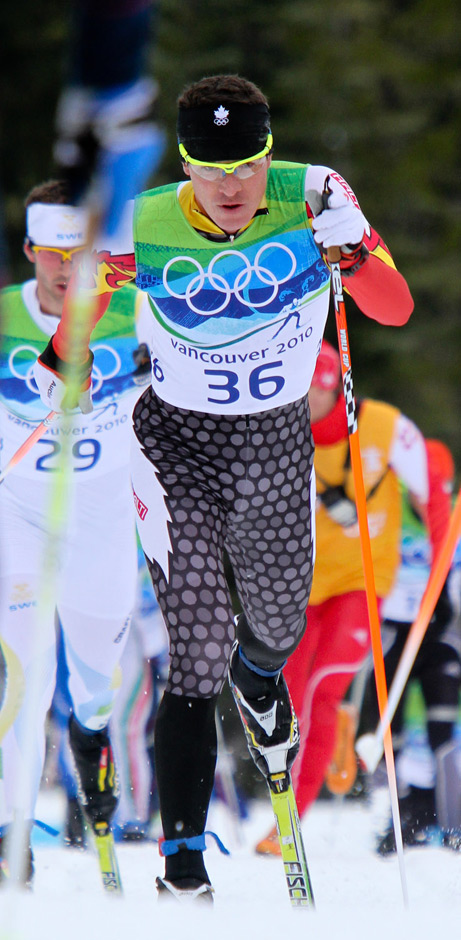
    Grey racing in the 50k at the Vancouver Olympics. He finished 18th.

    GG: I am studying the securities industry and possibly attending school in the fall. I would also like to work with Canadian teams and share my knowledge of the sport over the next few years. I have a lot of fast skis that need to be raced on!  Most importantly I want to be closer to my wife and son, spending five or six months on the road is in the past for me.

    FS: What prompted you to go into securities? Did the guys at Haywood seem to have a good set up?

    GG: Actually I have been interested in the economy, and how money makes the world turn.  Having Haywood Capital Markets sponsor our team gave me a deeper appreciation for the world market and a closer look at their enthusiasm for what they do.  It just seems fitting now that I chase after another one of my interests.

    FS: Where are you going to school? Would you be heading to university in Calgary?

    GG: The Canadian Securities Institute is an online course with a wide array of securities management courses.  They are the standard if you want to become an advisor or manager in the industry.  There is a strong possibility that I will attend a university in the near future as well.

    FS: You mentioned sharing your skiing knowledge – how are you planning on staying involved? A little coaching, a little local racing?

    GG: Coaching comes naturally to me and I would like to help team reach their goals.  I wouldn’t say no to a little racing for fun.

    FS: Is there any chance of a comeback? Have you left the door open at all?

    GG: Once I start down a new path I usually don’t look back. I know what it takes to race at a high level and I would rather be a part of that from a different perspective.  Ski racing is not over for me, I just won’t compete at it. But it will always hold a piece of my heart.

    FS: Over your career you have seen an impressive amount of success. What were the highest – and lowest – points in your career?

    GG: The lowest have always been injuries.  Any athlete will tell you they are hard to accept.  I have had my share at some pretty crucial times. A stress fracture in my foot paired with a torn ligament with only four months to go until the Olympics was not a good feeling.  Ironically, the 2010 Olympics was also my highest of highs.  The team, my results, our results, and the total atmosphere was incredible.  A home Olympics, friends and family watching trail side, and I raced the races of my life.  That is why I can walk away happy.

    FS: This season the National Ski Team seemed to explode – four Tour de Ski medals, two World Cup medals, and the first-ever World Championships win by a Canadian.How was the team different this year than previous years? What did Justin Wadsworth bring that seemed to work so well?

    GG: Our team has been on a steady progression for the last decade.  To attribute this years’ success to one coach is unfair to all the coaches that have developed us along the way.  Every coach brought something new to our team, and we have just been steadily soaking it up.  Justin gels with our team very well and makes it a fun training environment.  When athletes and coaches are both happy and dedicated, then you are going to get some great results.

    FS: You’ve been at the top of Canadian skiing for the past 10 years – do you feel like the quality of domestic skiers and racing has improved over that time?

    GG: Across the board, Canada is getting stronger.  The depth is coming, and there are great athletes at the top the guide the way.

    Racing the 15km classic at the 2011 World Championships in Oslo, Norway.

    FS: With regards to team improvements over the last 10 years, you were a part of the group that took Canada from a country with no men scoring World Cup points in the early 2000’s to having a consistent 5 to 8 guys scoring points from 2006 to now. You’ve seen it first hand. What has been crucial to that improvement? Beckie Scott’s success? Greater funding in the run up to 2010?

    GG: It has been a combination of the belief that we can be great, and the increased funding.  Amateur sport is no longer just ‘putting in the work’.  There is so much science behind the athletes and equipment now that without money, you stand little chance at World podiums.

    FS: Lots of people attribute Ivan Babikov coming over as a major factor in raising the level of Canadian skiing. How much do you feel the arrival of Babikov did for the team?

    GG: For me, Ivan was a great inspiration. He came to Canada and just put his head down.  He is a very driven person, and racing against him raised my level and in turn our program’s level.  Ivan is a great person to have around the team.

    FS: You’ve won a World Cup medal with Alex Harvey, been on dozens of relay teams with Devon Kershaw, including 6th and 9th place finishes at World Championships, and combined with all three (Harvey, Kershaw, Babikov) for 5th in 2009 at World Champs. You probably know those three guys talents better than anyone else – where do you think they’re headed, what’s the next milestone step for the Canadian men?

    GG: There are great opportunities ahead for those three guys.  Next year their focus will certainly be the Tour de Ski and if everything goes perfectly we could have a man standing on the podium at the end of the whole tour.

    FS: Finally, your bet with Kershaw – have you collected on that yet?

    GG: Yeah, Devon owes me $500 for his failure to believe I was hanging it up after this year.  I haven’t seen the cash yet, but I know where he lives and I’m bigger than him!

  • Canadian George Grey To Retire After Two Olympics And A Decade Of Racing

    CANMORE, Alta.—When two-time Olympic cross-country skier George Grey hits the start line for Saturday’s 50-kilometre skate-ski race at the Haywood Ski Nationals, it will be his final competitive trip around thefamed Canmore Nordic Centre.

    After racing on the World Cup for nearly a decade against the top athletes on the globe, and competing in the Torino and Vancouver Olympics along with five World Championships, the 31-year-old Grey, of Rossland, B.C., has decided to retire.

    “For me the timing just felt right,” said Grey, who started skiing when he was four years old, and racing at age seven. “In the last two years I felt like I accomplished many of my career goals and reached a performance level that was as high as I could attain. I am now looking forward to being a husband, father, and to new challenges and experiences in life.”

    “I reached a peak in 2010 and thought maybe, just maybe, if I skied one more year I could contend for a medal in 2011 at the World Championships. To be able to hang in for one more season and experience the World Championships in Norway, and see Devon and Alex become World Champions, was an incredibly memorable final season.”

    With Canada’s Beckie Scott having just broken through to win Canada’s first Olympic medal in the sport, Grey emerged onto the National Ski Team in 2002 with a group of bright-eyed, energetic young men from across the country poised and determined to followScott’s trail to the international podium.

    Devon Kershaw was the first to find his way onto the podium. Kershaw became the first male in more than a decade to mount the international podium in 2006, and it didn’t take long for the others to follow suit. Four years later, Grey enjoyed a breakthrough moment of his own with his most memorable races coming at Whistler Olympic Park. The veteran teamed up with National Ski Team rookie, Alex Harvey, in 2009 to win a World Cup bronze medal in the sprint relay at the Olympic Test Event in Whistler. His best Olympic and individual career finish was eighth during the pursuit competition in 2010 when all three Canadian men finished in the top-10, and all four in the top-20.

    “Getting my hands on just one medal was such an incredible high for me, and sharing it with such a talented athlete and friend in Alex made it even sweeter,” said Grey, whose best individual result outside the Olympics was a ninth-place finish at the Tour de Ski prologue in 2009. “My fondest memory has to be the 30-kilometre pursuit race with Ivan (Babikov), Alex (Harvey), and Devon (Kershaw) skiing right at the front of the pack with me. We were showing the world that we had finally arrived, and what we were capable of as a team. It was a career best for me, and to do it at a home Olympics with three of my buddies was amazing.”

    After 10 years of blood, sweat and tears, Grey leaves the sport with the Canadian men’s squad amongst the best in the world.

    “When I joined the Canadian men’s team we were described as ‘Canada’s most anonymous athletes,’ he said. “Now our team has World Championship medallists, World Cup medallists, Tour de Ski medallists. We have delivered a solid team. I know Canada is in good hands and there is loads of great talent coming up the system so I will sleep well.”

    While racing was such a small part of his career, it was the countless hours of training with his friends and teammates that taught him to be patient, driven, tough and most importantly, goal-oriented along the journey.

    “I get nostalgic thinking about all the hard training days that I endured with teammates at my side,” said Grey, who cites five-to-six hours of roller skiing in the pouring rain, nearly 50 kilometres of running and stomping their way up to glaciers as some of the most grueling training moments. “Only with your closest teammates is it possible to repeat training days like this every other week. My team and I have shed more sweat and spit on mountains than most would ever think possible.”

    With the last goal remaining in his career to ski to the top of the podium on Saturday at the Haywood Ski Nationals, Grey would like to stay within sport if there is an opportunity to do so in the future, while also studying in the securities industry.

    “The 2010 Olympics were sensational. The World Champs this year in Norway were staggering, but I ammore than happy to wave a warm good-bye and smile at all the precious memories that I have accumulated. Thank you to everyone for your incredible support. My father always told me it is the process and not the outcome. I have fully realized that now, and I will never forget those who have helped me along this incredible ride.”

    Cross Country Canada is the governing body of cross-country skiing in Canada, which is the nation’s optimal winter sport and recreational activity with more than one million Canadians participating annually. Its 51,000 members include athletes, coaches, officials and skiers of all ages and abilities, including those on Canada’s National Ski Teams and Para-Nordic Ski Teams. With the support of its valued corporate partners – Haywood Securities Inc., AltaGas, Teck Resources Ltd. and Statoil – along with the Government of Canada, Canadian Olympic Committee, Canadian Paralympic Committee and Own the Podium, Cross Country Canada develops Olympic, Paralympic and world champions. For more information on Cross Country Canada, please visit us at www.cccski.com

    Source: CCC

  • Canadian National Championships – Contending Men

    The 2011 Haywood Canadian National Championships began Saturday, and the drive to crown the next Canadian national champion starts now!

    Held in the Canadian ski mecca of Canmore, Alberta, the premiere event in Canadian skiing features seven days of intense junior and senior racing action.

    The racing opens with a Team Sprint on Saturday, March 12, followed by a middle-distance freestyle on Sunday, March 13. The athletes then enjoy a day of rest, and the racing resumes with an individual classic race Tuesday, March 14. The classic sprint is separated onto two days – the Open categories classic sprint Wednesday, March 15, and junior categories classic sprint Thursday, March 16. Finally the Championships conclude with long-distance freestyle mass start races on Saturday, March 18.

    Canadian racing is at an all-time high, and correspondingly, the fields will be some of the deepest in the country in recent memory. While newly minted World Champions and Canadian National Ski Team (CNST) members Devon Kershaw and Alex Harvey are attending the late-season World Cup races, there is still plenty of Canadian World Cup-level talent racing.

    Additional athletes missing include the Alberta World Cup Academy’s (AWCA) Graham Nishikawa, who has the NorAm World Cup slot for the spring World Cup tour, and possibly CNST member Ivan Babikov, who is on the verge of cracking the top 50 in World Cup rankings, the level which is required to participate in the World Cup Final.

    FasterSkier provides a brief preview of the men in action who may be vying for the aggregate title of Canadian National Champion.

    Veterans

    Multiple-Olympian and World Cup medalist George Grey (CNST) is the biggest name in action, and when he is at or near the top of his game, there are very few men in Canada who can match him, at least in the distance events. Grey has not been at his best this season, but if he can recapture some of the form he had during the Vancouver Olympics, he will be almost untouchable.

    Following Grey, Stefan Kuhn (CNST) has also returned from Europe, and considers the Nationals a home race, as he lives in Canmore. It may also be his last National Championship ever – the 31 year old veteran has hinted at retirement via Twitter. Kuhn has two events he excels at – middle distance classic racing, and classic sprinting, so be assured he will be in the mix.

    After losing a tight battle on the NorAm circuit for the NorAm World Cup spot to Graham Nishikawa, Drew Goldsack (AWCA) will be back aiming for top results as well. The two-time Olympian has proved himself capable as an all-around skier this season, but the classic sprint suits him best. He has suffered through bouts of illness during the season, and his most recent result is not encouraging, as he failed to finish the Eastern Canadian Championships mini-tour.

    Phil Widmer, racing out of the Pierre Harvey National Development Center (CNEPH), has been an impressive skate sprinter thus far this season, most notably finishing 18th at a World Cup sprint in Davos. However, outside of that, Widmer has struggled, as his top result in a domestic distance race is 27th in the 15 k freestyle at the NorAm in Thunder Bay, Ontario.

    Young Guns

    Graeme Killick (CNST), who put on a show at the 2010 Canadian Nationals by winning two races, has thus far had a disappointing season, but remains a strong classic skier. Killick is aiming for a couple of podiums, and is targeting Tuesday’s 15 k classic as his big event.

    Likewise, Brent McMurtry (CNEPH) has been up and down on the result sheet over the course of the season. In a recent e-mail to FasterSkier, McMurtry described himself as “run down” heading into the early World Cup period, but has focused on recovery, and is feeling back in top form.

    But McMurtry has additional OPA Cup experience, and has the advantage of knowing the trails well, as he is a native of Calgary, Alberta, and has skied extensively at the Canmore Nordic Center. However, McMurtry acknowledges he isn’t the only one with home-course advantage, as most of the top men either live full time in Canmore, or have spent a significant amount of time skiing on the trails at the Nordic Center.

    Surprisingly, Nationals will be only the second set of races in Canada this year for McMurtry, so there is little indication of how he will stack up. But McMurtry is aiming high – he stated his first goal of the Championships is to win a race outright.

    Perhaps the best young skier attending is one Len Valjas (CNEPH), who with a 15th place at World Championships and a top 10 result at the World Cup in Drammen, has turned into an impressive World Cup sprinter. Valjas is planning on racing the World Cup in Lahti, Finland, but will be returning to Canada in time to contend the individual start classic race on Tuesday, and most worryingly for everyone else, the classic sprint on Wednesday.

    Dark Horse Talent

    Kevin Sandau (AWCA) has been one of the hottest Canadian skiers following Christmas, at least in distance skiing. Sandau finished fifth at U-23 World Championships 15 k freestyle, and then crossed the line 24th place in the pursuit. After returning to Canada, Sandau kept the ball rolling, finishing 2nd at the Eastern Canadian Championships mini-tour.

    Likewise, Jesse Cockney (AWCA) has emerged as an impressive U-23 skier, excelling in sprints. While he freely admits to struggling in the qualifying round, Cockney has the speed to go the distance over the course of the day, which he proved with a 6th place finish at U-23 World Championships in Estonia earlier this year.

    Mike Somppi of the National Development Center Thunder Bay (NDC-TB) has also become a very solid skier, earning three podiums at the NorAm level, as well as finishing 14th in the 15 k freestyle at U-23 Championships.

    Finally, David Greer (CNEPH) started the season off slowly, but has finished in the top five a handful of times on the NorAm circuit, and also skied to an impressive 14th place at Swiss National Championships. His distance skiing has improved over the course of the season to the point where he could easily pull off a surprise.

    While the overall aggregate should be George Grey’s to lose, the level of male skiing in Canada at the moment means that it is anything but a lock. It is entirely possible a different skier could win each race, and the variety of race formats mean that no one athlete has a significant advantage.

    Canadian National Championships kicks off Sunday, with a 10 k freestyle individual start race.

  • Canadians React to Harvey’s Relay Decision

    Alex Harvey skiing in Estonia earlier this year.

    The decision by Canada’s Alex Harvey to skip Friday’s World Championships relay left a train of his disappointed teammates passing through the mixed zone after the race. Of all four athletes, Len Valjas probably summed it up best: “It’s probably a good call—it just sucks for us.”

    Each of the Canadian starters had his own take on the situation, ranging from relative indifference to stern disappointment. But while it was clear that many of them were let down, veteran George Grey maintained that the men’s team, an especially tight-knit group, would move past what has become a small controversy.

    “It hurt us a little bit short-term,” Grey said. “I’m confident we’ll all come out of it, and be a stronger team for it.”

    Harvey announced Thursday that he was skipping the relay, one of cross-country skiing’s most storied events, following a victory in the team sprint earlier in the week that left him drained and exhausted.

    With the Canadian relay squad a long shot for medals, Harvey decided to pass on the event in order to be fully rested for Sunday’s 50 k freestyle—a race in which the 22-year-old Quebec native has a more realistic chance at a podium.

    The decision was pragmatic: In an e-mail Thursday night, Harvey said that his effort to help his teammates to seventh place in the relay four days before the Olympic 50 k last year in Vancouver had ruined his hopes for individual hardware.

    But while Harvey looked at his options rationally, his teammates viewed the relay in more emotional terms.

    Stefan Kuhn, who ended up scrambling for the Canadians, said that the relay was “the biggest race in cross-country,” and that “if you want to prove you’re a good nation, you do it in the relay.” Grey, who anchored, called the race “something special…the most prestigious event in cross-country skiing.”

    Harvey had said he thought the Canadians didn’t have a “reasonable chance” at a podium. But while Grey acknowledged that his form was off from last year, when he’d helped the Canadians to seventh in Vancouver, both Babikov and Kuhn maintained that the team still had a shot at the top three.

    “That could have been my chance for the medal—maybe ever, you know? It’s just really sad to see him throwing that out like that,” Babikov said.

    Both Babikov, 30, and Grey, 31, noted that the decision was especially disappointing coming from an athlete at Harvey’s point in his career. Babikov called Harvey’s move a “disrespect for the team,” while Grey said that “at such a young age, it’s a bit of a statement.”

    “He felt that we didn’t have a good medal chance, and so he’d save it for the 50,” Grey said. “We respect that, but it’s hard not to feel it deep down, when we’re all friends, and we want to be on the line with our friends and teammates.”

    For his part, Valjas, who trains with Harvey in a regional development program in Quebec, said he was “sure” that the decision was the right call. And both Kuhn and Grey said that they did respect Harvey’s position, even if left them disappointed.

    As far as Grey was concerned, he said that he’d be supporting Harvey in the 50 k regardless—and that he didn’t have to cross the line in the top three to vindicate himself.

    “I don’t think he needs to—we make decisions hoping for the best, and it often works in reverse,” Grey said. “Our team’s still strong—we still have a tight men’s group, and of any team on the World Cup, one of the tightest.”

  • Canada Comes Out On Top In North American Relay Battle

    Canada Comes Out On Top In North American Relay Battle

    On the third leg Ivan Babikov (CAN) and Noah Hoffman (USA) battled on the first lap before Babikov pulled away.

    Much to the Americans’ and Canadians’ chagrin, the men’s 4 x 10 k relay at World Championships on Friday did not unfold as it often does.

    “At the start, they usually jockey for a bit,” Canadian leadoff skier Stefan Kuhn told FasterSkier. “But one Swede, Daniel Rickardsson, was thinking otherwise today, because he had two bad races. So he wanted to prove a point.”

    Instead of a tactical first leg, where many of the teams ski together in a pack, the hammer was down from the get-go. Rickardsson, perhaps out for revenge after two straight races with terrible skis, attacked early on, and only one man was able to follow him: Maxim Vylegzhanin of Russia. Neither the U.S. nor Canada was able to stay anywhere close to the speedy, lanky Swede.

    Earlier this season, the U.S. had a promising relay result in Gallivare, Sweden. There, leadoff skier Andy Newell skied with the main pack for almost his entire 10 k leg, leaving Kris Freeman only a 15-second gap to close. Here in Oslo, the more intense pace did him in much earlier, and Freeman was faced with 14th place and a two-and-a-half minute deficit.

    “Today was not a typical World Cup relay,” Newell said after the race.

    Canada faced a similar situation. With neither Alex Harvey nor Devon Kershaw racing, Kuhn, who didn’t even know he was racing until this morning when Kershaw called in sick, scrambled.

    “You could see the pack spread right away, after one kilometer,” he said. “It was a tough 10 k, that’s for sure. I wanted to move up, so I was in third or fourth…I skied for a while but then I was like, ‘I’m not going to win the relay leg.’ [Rickardsson] won the World Cup the week before by 30 seconds, so I just tailed off a little bit, and made it to the finish as best I could.”

    Len Valjas skiing the second leg for team Canada.

    Newell and Kuhn – two sprinters – skied together for part of the race, before Kuhn dropped his southern neighbor and tagged off in 13th place, 25 seconds ahead of Newell.

    The American had other problems to deal with, besides the pace.

    “I really couldn’t get any kick,” he said. “So that kind of sucked…On a good day, when I’m feeling good and I can kick my skis, being over two minutes back is kind of unacceptable.”

    What happened next in the North American battle was not what most people would have expected. While Kuhn tagged off to Len Valjas, a young sprinter with only five distance starts this year and only one at the World Cup level – the 15 k at World Championships earlier this week, where he finished 48th – the U.S. cued up Kris Freeman, a veteran who has skied a number of strong relay legs in the past.

    Kris Freeman (USA) closed a big gap to the Canadian team on the second classic leg.

    Freeman looked strong and in control, and caught Valjas six kilometers into their leg. Once he did, Valjas said that it was “a little bit tactical.”

    “He tried to gap me up that one big hill there,” Valjas explained. “He put a little gap on me, but I closed it back over the top, on the flats, so I got back on him. We got down [before the next big uphill] and he just stood up and let me go by, and I thought, ‘okay, we’ll play some games here.’ So I went in front and took it easy, and then attacked up the sprint hill. I didn’t gap him, so for the last quarter, I just practically walked… and then, on the last climb, I just really opened it up.

    “It was fun just to compete with him,” Valjas said.

    Valjas ended up tagging off six seconds ahead of Freeman. While he was pleased to have come out on top in the tactical battle, he pointed out that since Freeman had to catch him first, his performance didn’t really count as much of a victory.

    Freeman was a gracious competitor, calling the Canadian’s move “impressive.”

    “I think Lenny skied pretty well,” Freeman said. “I hope he did, because if he didn’t, then I didn’t.”

    After his initial move against the Canadian, Freeman said that he didn’t have anything else left, and that it was hard to gauge his effort given the lack of other athletes around him. And while his skis were good, he wasn’t surprised that Newell had stuggled to kick.

    “I tested what Newell raced on and I said, ‘no way.’ I went something else,” he said.

    The pair then tagged off to Ivan Babikov and Noah Hoffman, who finished 30th and 29th, respectively, in the 15 k classic earlier this week, separated by just a tenth of a second.

    While both are known more for their skating, for Hoffman, it’s to a relative degree. For Babikov, it’s a little more serious: he has a handful of World Cup top-tens, all in skate races.

    Hoffman set out in hot pursuit, and quickly closed the six-second gap to Babikov.

    Without Harvey and Kershaw in the race, Babikov said he was just using his leg as preparation for Sunday’s 50 k. Skiing without any pressure, he said he was enjoying himself, and it showed in his split. At just 53 seconds off Finland’s Juha Lalluka, Babikov’s time was the sixth-fastest of the third leg—the best of any of the eight North American skiers on Sunday.

    For Hoffman, two-thirds of the way through the leg, the pace proved too much. His initial push caught up with him, and he popped.

    “I should have caught [Babikov], but maybe catching him in a k, or however long it took, was a little fast,” Hoffman said.

    Since all the teams behind the U.S. and Canada were ultimately lapped, Hoffman said that he should have kept his sights on Babikov, with whom he was engaged in a “two-team battle.” But he acknowledged that perhaps he shouldn’t have chased quite as hard early, which left him hurting later on.

    Tad Elliott anchoring the United States team to 14th place.

    “To give up [44 seconds] is not the way to beat Canada,” Hoffman said. “I would have been better tagging off to [anchor] Tad [Elliott] 15 seconds down, not ever having seen Babikov.”

    Hoffman’s leg left the U.S. 50 seconds off the Canadians, and Elliott didn’t do much to stop the bleeding. Feeding off the tens of thousands of fans in the stadium and lining the trails, he went out aggressively, in pursuit of Canadian anchor George Grey.

    “I knew there wasn’t anybody behind us, really… I started off so hard—it’s so loud—and kind of exploded,” he said. “I think here, it’s hard to control your pace, because everyone’s cheering, and you want to catch some people.”

    Elliott’s leg was a rough one—he ended up more than two minutes behind Petter Northug (NOR), who had the fastest split of the fourth leg—and with Grey having a decent day, the race for North American bragging rights ended decisively, with Canada on top by nearly two minutes.

    While the U.S. placed last of the 14 teams that finished the race—Great Britain, Australia, and Denmark were lapped and pulled—Canada’s anchor leg was enough to bring the country up to 12th, thanks to a move Grey put on Kazakhstan’s Yevgeniy Velichko.

    A member of the Canadian Olympic relay team last year, Grey hasn’t been at his best this season, and had actually lost his spot on the country’s squad to Valjas. But thanks to Harvey’s decision, he got a chance to start on Friday.

    “I’m just happy as hell to be here,” he said. “Not the strongest team, but I think we’re all very proud to do it for Canada.”

    George Grey brings the Canadian squad home in 12th place.
  • Canada’s Harvey to Sit Out Men’s World Championship Relay

    Canada’s Harvey to Sit Out Men’s World Championship Relay

    Harvey after winning the gold in the team sprint on Wednesday.

    With a squad consisting of Alex Harvey, Devon Kershaw, Ivan Babikov, and Len Valjas, Canadian Head Coach Justin Wadsworth thought his team would have a chance at its second World Championship medal in three days in Friday’s men’s relay. But those chances have just taken a hit.

    According to Wadsworth, Harvey, who won gold with Kershaw in Wednesday’s team sprint, will skip the relay, worn out by a tough race and a long day in the spotlight in Oslo.

    “I personally think he should do the relay, but I also respect his knowledge of how his body is, and what he needs to do,” Wadsworth said. “So, we went ahead and just made that decision to sit him out tomorrow.”

    Harvey, who didn’t answer a call placed to his European cell phone, is in the best shape of his life, coming off a second-place in a World Cup sprint two weeks ago, in addition to his World Championship medal. With the 22-year-old in the race, Wadsworth said he thought his team had “a good shot at a medal.”

    Realistically, though, the Canadians would have faced an uphill battle. With Kershaw, Harvey, Babikov, and Grey comprising their team, they finished seventh at the Olympics last year. This season, Grey is coming off knee surgery and the birth of his first child, and is far from fit, and Wadsworth said he’d planned to substitute rookie Len Valjas—who is racing well, but not at Grey’s level from last year.

    “We probably would have put Alex out first, and Devon second, and Ivan third,” Wadsworth said. “We probably would have put Lenny fourth, and hopefully had a big lead with a bunch of other teams that would be fighting for medals.”

    Without Harvey, Wadsworth is now forced to start both Valjas and Grey, along with Babikov and Kershaw.

    “With this change now, I think it takes our chances down a bit, for sure,” Wadsworth said.

    Kershaw also had a long day Wednesday, with the race and subsequent medals ceremony; his phone was turned off, but Wadsworth said that Kershaw was still planning on racing.

    “Devon’s always decided that he wanted to race this relay no matter what the team is…because, really, it was important to him,” Wadsworth said. “And the fact that it’s here in Norway, and probably one of the biggest races of the championships. So, he’s always been committed to racing it.”

    –Chelsea Little and Topher Sabot contributed reporting.

  • Canucks Strong in Pursuit, But Still Seeking Hardware in Oslo

    Canucks Strong in Pursuit, But Still Seeking Hardware in Oslo

    Canada's Alex Harvey leads the men's pursuit in Oslo.

    Two-thirds of the way through Sunday’s World Championships pursuit, Alex Harvey was taking a page out of Johan Olsson’s book.

    Harvey, the 22-year-old Canadian, had launched a surprise, solo attack reminiscent of the move made by Olsson, a Swede, in the same race at the Vancouver Olympics last year.

    The Swedes took two medals in that event, with Olsson getting bronze. And for a while, it looked like the Canadians were on their way to a similar performance. Harvey’s teammate Devon Kershaw was able to sit comfortably in the pack and save energy for the finish, while Ivan Babikov went to the front and tried to slow things down.

    “I tried to work as a teammate,” Babikov said. “When I saw he’s trying to go, I’m like, ‘okay—I’ll try to hold the pack back.’”

    But with one 3.75-kilometer lap left in the 30-kilometer race, Harvey’s legs cramped up. Then, Kershaw’s chances evaporated, when his charge for the line came too early, and fizzled. At the end of the day, the Canadians had to settle for three in the top 15—respectable, but not the hardware they’re looking for in Oslo.

    “Today was, for sure, a good medal opportunity, but we’re going to get something before we leave here,” said Justin Wadsworth, the Canadian head coach. “It’s just good those guys are fighting again.”

    None of the Canadians contested the sprint for the medals, but they had Kershaw, Harvey, and Babikov in the lead group until the closing kilometers, and the three ended up ninth, 12th, and 15th, respectively. George Grey was the country’s other finisher, in 46th.

    For the Canadians, the day’s results were heartening, even if the final standings weren’t quite enough to leave them content.

    Harvey on his breakaway.

    Kershaw’s performance suggested he’s returning to the form that helped him to four podiums at the Tour de Ski in January, while Babikov is starting to find the fitness that propelled him to a top-five finish at last year’s Olympics. And Harvey’s breakaway was just another reminder that he has barely plumbed the depths of his talents—the effort coming, as it did, just one month after his victory in the same event at the U-23 World Championships.

    How well is Harvey going right now? He said that his move on Sunday, on a climb 18 kilometers in, wasn’t even a concerted effort.

    “I was just skiing my own pace at the front,” he said. “I felt I felt really easy in the group, and my skis were fast. I didn’t really attack. Everyone switched to offset [V1], and I just kept one-skating [V2ing], and then I had a gap—so then I decided to try to go.”

    The pace, Harvey said, wasn’t too hard to maintain. He wasn’t filling up with lactate at the tops of hills—the pace was steady. He looked controlled, relaxed and smooth, much like he did when he won in Estonia.

    The gap went up and down—at one point going all the way up to 15 seconds—but then, around the 25-kilometer mark, it started dwindling. Harvey was getting cramps, painful ones, in his inner thighs.

    “I couldn’t hit a flat ski, and I almost crashed on a downhill,” he said, “It went from like 100 percent to 50 percent…it was really hard to ski.”

    With a fresh Tord Asle Gjerdalen (NOR) at the front of a 25-strong chase pack, Harvey didn’t stand a chance. He was swallowed up as the leaders left the stadium for their last lap, to the roar of a rare partisan crowd that was pulling for Gjerdalen and his teammate, eventual winner Petter Northug.

    Harvey was pale, spent, and “really disappointed” after the race, and he said that he didn’t know what went wrong. He said he had taken feeds every lap, for the entire race, and that he’d never had cramps like this before.

    His teammate Kershaw hypothesized that perhaps Harvey was “a little too experienced to hold a move like that.” But, on the other hand, Kershaw said, it was “good on him to try.”

    “At 22 years old, I don’t see it as a big mistake,” Kershaw said. “Alex could have been world champion today, had he had a bit better legs—it’s reality.”

    As for his own race, Kershaw said that he probably didn’t have the fitness Sunday to top Northug—but he also said that his performance was a heck of a lot better than his efforts from the last two weeks.

    In the World Championships tune-up races in Drammen last weekend, Kershaw was no better than 26th, and in Thursday’s skate sprint in Oslo, he was 31st—just outside the heats in a race he’d won at the Tour de Ski.

    “I was super-nervous today,” he said. “Things have been going, just, so terribly the last 10 days or so. I wanted to feel better.”

    On Sunday, Kershaw said he was helped by a relatively tame classic leg, then felt stronger and stronger as he sat in the

    Devon Kershaw (bib 8), and his teammate Ivan Babikov (bib 28).

    pack during Harvey’s breakaway.

    As the racing really ratcheted up with a couple of kilometers to go, Kershaw made his own move, hitting the front and throwing in a few hundred meters of hard skating. It wasn’t enough to shake the group, though, and then Kershaw said that he “died, a bit,” heading into the last uphill, which left him out of position.

    In retrospect, Kershaw said, the move was too early.

    “I thought I could hold them—I felt super-controlled and comfortable the whole time,” he said. “I played it like Northug plays it, I think—just, I was slower.”

    While Kershaw was disappointed with the result, he said he was still happy “with the way his body reacted.”

    As Wadsworth put it, the result, and the sensations, should serve as a huge mental boost—potentially restoring Kershaw’s faith in himself to the level it was in January.

    The premature attack on Sunday, Wadsworth said, “maybe showed that [Kershaw’s] confidence wasn’t like it was in the Tour.”

    “I think if today’s race would have been in the Tour, he would have waited ’til the last uphill—and he knew that,” Wadsworth said.

    Babikov, meanwhile, skied to his second-best result of the year, and he said that he was especially pleased with his classic leg—given that he’d struggled with the technique earlier in the season.

    Up until the closing kilometers, Babikov was in the pack, but then lost contact with the leaders when the going got tough, and he couldn’t fight through traffic to latch back on.

    “Just positioning,” he said. “We didn’t expect it was going to be so crowded toward the finish.”
    Wadsworth said that all four of the Canadians from Sunday would start in Tuesday’s 15 k, with the exception of Grey. A decision hasn’t been made for the last spot; it could be Grey, Len Valjas, or Stefan Kuhn, Wadsworth said.

    Link to full results.

  • Jones Makes it Two; Kuhn Wins Tight Haywood NorAm

    Perianne Jones is now two for two.

    The Canadian National Ski Team (CNST) member and Vancouver Olympian put on a powerhouse display of classic skiing Saturday morning, winning the 2.7 k classic event on the second day of racing at Western Canadian Championships in Kelowna, B.C.

    Jones won the second race in the mini-tour by a little over 20 seconds, an amount almost unheard of in such a short event. Andrea Dupont  of the Rocky Mountain Racers (RMR) finished second, while Sarah Daitch of Forth Smith Ski Club finished third, 24.1 seconds back of Jones, but just ahead of junior sensation Maya MacIsaac-Jones, who finished fourth.

    “I really don’t know what happened,” Perianne Jones said in a post-race interview with FasterSkier. “I got one split that put me six seconds ahead, but I guess I must have just kept the pace high.”

    The day itself was tough for classic skiing. Temperatures hovered around 0 degrees Celsius, and the course featured some tough hills both in the shade and in the sun, meaning everyone had some difficulty with getting grip.

    “There was lots of herring-bone,” said Jones. “The hills were pretty soft.”

    Jones will start the 10 k freestyle handicap start Sunday with a big lead over the other women, and intends to go for the win from the gun.

    “I’m going to have to ski it like it’s an individual start race and see how it goes,” she said.

    While Jones posted a large gap for the victory, in Open Men it was the complete opposite.

    The men raced a 3.5 k classic course with some difficult hills, and as tends to happen in prologues, the finish times were extremely tight.

    Jones’ team mate Stefan Kuhn (CNST) edged out Drew Goldsack (AWCA/CNST) by just 1.3 seconds for the win, while Graham Nishikawa (AWCA) finished 2.2 seconds back of Kuhn to fill out the podium.

    “It was good to get the win today,” Kuhn said in an interview with FasterSkier following his race.

    Kuhn, who is focusing mainly on World Championships, was especially happy to get the win because he had been putting in some big volume hours, and wasn’t sure how his body would respond.

    “The goal is to be fast at World Championships, so I’m doing my normal sort of training to peak for it,” he said.

    And Kuhn was fast in notoriously difficult event – the prologue. Racing an event as short as the prologue is tricky – for most elite athletes, it has been a long time since they have raced such quick races.

    “They’re a really hard distance to ski,” said Jones. “They hurt a lot – it was a lot easier when I was a midget.”

    Kuhn, however, counts it among his favorite events – especially when it’s classic.

    “As a sprinter who also likes short-distance events, it suits me well,” he said. “It’s extremely hard, but I really like it.”

    The one notable absence on the results list from the day was George Grey (CNST), who according to Kuhn woke up “not quite feeling 100%,” and opted out of racing to play it safe for upcoming World Championships.

    Kuhn will start the 15 k freestyle pursuit race Sunday second, behind Goldsack. Kuhn wasn’t originally planning on starting at all, as his body was not feeling great, but he felt that his form is strong enough that he will attempt to contend.

    However, he doesn’t have high hopes – he considers skate-skiing his weaker discipline, and the 15 k freestyle is one of his least favorite race types.

    “I’m going to try and ski tactically and see how long I can hang on to Nish,” he said. “Realistically, I’m going to be fighting for third place, maybe with [Brian] McKeever, who seems to be moving through the field strongly.”

    The 10/15 k freestyle handicap start races will cap off the NorAm mini-tour on Sunday.

    The start list has not yet been released for tomorrow, but as soon as it is available, a link will be posted.

    Men’s 3.5 k Classic Prologue Results

    Women’s 2.7 k Classic Prologue Results

  • Canadians Send Strong Squad to World Champs, Drammen World Cup

    Canadians Send Strong Squad to World Champs, Drammen World Cup

    The Canadians will field an experienced 11-person roster for the World Championships in Oslo, Norway at the end of February, and all 11 will also ski the World Cup in Drammen, Norway, the week before.

    The roster is almost identical to the Olympic roster from last year – 9 of the 11 skiers competed in Vancouver, and all 11 have at least one World Cup start.

    Devon Kershaw during the Vancouver Olympics

    According to Cross Country Canada (CCC)’s selection criteria, the team was chosen based on the projected achievement of three major goals – to collect one medal, a top 6 result in the men’s relay, and other podium and top 12 results.

    In order to achieve those goals, CCC listed four clear-cut performance goals that athletes were required to meet, and other athletes would be selected in order to field the full complement of four athletes in all events but the team sprint.

    The first criteria was that all skiers in the  FIS World Cup period II Red Group, which is considered to be roughly the top 30 male and top 30 female World Cup point collectors, would be selected to the team.

    Second, all athletes who recorded a top 12 finish in an individual World Cup would be selected to the team.

    Third, those athletes who won domestic selection races would be placed on the team. The Canadians used two separate selection weekends – the winner of NorAm skate sprint in Rossland B.C. on December 17 was automatically selected to the World Championships team. For distance selections, the men had just the NorAm 30 k pursuit on January 6, 2011 in Thunder Bay, Ontario as a qualification race. For the women, both the 15 k pursuit and the 10 k freestyle in Thunder Bay were selection races.

    Fourth, if an athlete finished in the top 20 and top half in World Cup events, they could be selected to the team.

    Finally, athletes who did not meet any of the other criteria could be selected to the team based on their position on the sprint and distance ranking lists, and the recommendation of Head Coach Justin Wadsworth.

    Just two Canadians made the period II Red Group as of the time of selection – Devon Kershaw (Ona-Wa-Su/National Ski Team) and Dasha Gaiazova (Rocky Mountain Racers/NST). The Red Group is an ongoing list, which shows performance over a period of time.

    Stefan Kuhn in action during the Rossland NorAm (Photo: Brad Jones)

    It should come as no surprise that Kershaw made the distance Red Group, as he had a strong start to his season, before recording a plethora of podium finishes during the Tour de Ski. In the period that counted towards the Red Group ranking, Kershaw finished 10th during the Kuusamo mini-tour, 9th in the 15 k classic in Davos, and finally 13th in la Clusaz, earned him 22nd place on the Red Group rankings.

    Gaiazova was the second to last woman selected to the sprint Red Group, as a result of her consistent qualifying over the past 8 months, including finishing 24th and 27th thus far this season. Gaiazova has also been arguably the strongest Canadian woman on the circuit this season – regardless of distance or technique.

    Vancouver Olympians Ivan Babikov (Foothills Nordic/NST), Alex Harvey (Club Nordique MSA/NST) and Chandra Crawford (Canmore Nordic/NST), all recorded a top 12 finish in an individual World Cup, thus qualifying for a trip to Oslo.

    Babikov used his trademark event, the climb up Alpe Cermis on the final day of the Tour de Ski to record a 6th place, while Harvey has recorded five top 12 finishes so far this season.

    Crawford, still rounding back into form following an injury-filled 2009-2010 season, finished 8th in the Dusseldorf city sprint.

    Vancouver Olympians dominated in the domestic selection races, as Perianne Jones (Nakkertok/NST), George Grey (Blackjack/NST), and Stefan Kuhn (Canmore Nordic/NST) were all selected based on performances in Canada.

    Jones (Nakkertok/NST), who has yet to race in Europe this season, booked her ticket to Oslo by finishing as the top Canadian in the Rossland skate sprint, as well as winning the 10 k freestyle in Thunder Bay.

    Kuhn and Grey both won a domestic selection race each, thus earning berths on the team. Kuhn won the skate sprint at the NorAm event in Rossland, while Grey won the recent 30 k Pursuit at the Thunder Bay NorAm.

    Finally, sprinters Phil Widmer (Canmore Nordic/NDC Quebec/NST) and youngster Len Valjas (Team Hardwood/NDC Quebec/NST) also cracked the squad.

    Dasha Gaiazova (L) and Perianne Jones (R) battling it out during the final of the classic sprint at the Thunder Bay NorAm (Photo: Brad Jones)

    Widmer and Valjas both recorded top 20 results in the freestyle sprint World Cup in Davos, and also finished in the top half of the World Cup field, earning themselves a chance to compete at World Championships.

    Finally, Brooke Gosling (Foothills Nordic/CXC) rounds out the woman’s team, giving the group four women, and therefore a relay team.

    While Gosling failed to win a selection race outright, she was selected based on her strong performances at the NorAm races in Thunder Bay, where she finished second in the 15 k Pursuit to Gaiazova, and third in the 10 k skate, to Jones and Gaiazova.

    According to Head Coach Justin Wadsworth, Gosling was selected based on her ranking on the Canadian distance and sprint lists as the next strongest woman in the country.

    The only athletes who have not been to World Championships before are Valjas and Gosling, and all 11 have World Cup experience. The performance of the athletes is at an all-time high as well – with the exception of Gosling, every athlete has finished in the top 30 in non-Canadian international World Cup competitions.

    However, the Canadians are not without problems. Of the seven men, there are five who could conceivably start the freestyle sprint in Oslo. Kershaw, Harvey, Kuhn, Valjas, and Widmer have all finished in the top 30 in World Cup sprints this season. As the maximum number of starts at World Championships is four, the Canadians are in a bind.

    Therefore, the results of the World Cup freestyle sprint in Drammen, as well as previous results during the year will be used to select which of the sprinters get the start – the one left out will be considered an alternate.

    The most intriguing part of the Canadian team selection could be the makeup of the various relays at World Championships. While the womens 4×5 k relay is set, as the team has only four women, the mens 4×10 k relay could see some interesting combinations.

    After stating at the start of the year that the team would switch up a few of the legs, Wadsworth is now in a position where he has some additional firepower to throw in the lineup. Lenny Valjas skied a strong classic leg in the La Clusaz 4×10 k relay in Grey’s absence, and Stefan Kuhn has also proven himself to be a strong classic skier over that distance.

    George Grey in action during the Rossland NorAm (Photo: Brad Jones)

    While the men’s sprint relay seems to be a no-brainer – Alex Harvey and Devon Kershaw finished 4th in the event at the Olympics last February, and are in even better sprint for this season – the women’s sprint relay could be interesting.

    Crawford and Gaiazova have combined twice in the sprint relay this season, and have finished 3rd and 5th. However, the podium placing was in a skate event, by far Crawford’s strength, whereas the World Championships team sprint will be classic – the same event where Jones combined with Sara Renner for a sixth place finish two years ago.

    Currently, the coaching staff has not set the teams in stone. “There are a lot of factors leading into those races, and nothing is ever set until the entry goes in the day before,” Wadsworth wrote in an e-mail to FasterSkier.

    “Even then we can sub a person in if someone gets sick after the entry is in up to 2 hours before the race starts.”

  • Canadian 2011 World Championship Teams Announced

    January 14, 2011 – Cross Country Canada is pleased to announce the World Senior Championship Team 2011 – selection synopsis to follow. The following athletes have been selected to the 2011 World Championships Team competing in Oslo, Norway from Feb.22-March 6.

    – Devon Kershaw  (Ona-Wa-Su/NST)
    – Alex Harvey (Club Nordique M.S.A/NST)
    – Dasha Gaiazova (Rocky Mountain Racers/NST)
    – Chandra Crawford (Canmore Nordic/NST)
    – Stefan Kuhn (Canmore Nordic/NST)
    – Perianne Jones (Nakkertok/NST)
    – Ivan Babikov (Foothills Nordic/NST)
    – Len Valjas (Team Hardwood/NDC Québec/NST)
    – Phil Widmer (Canmore Nordic/NDC Québec/NST)
    – George Grey (Blackjack/NST)
    – Brooke Gosling (Foothills Nordic/CXC)

    Released by CCC

  • Grey, Jones Win Skate Distance at Nor-Ams in Thunder Bay

    The qualifying for Canada’s World Championships team may be over, but racing continued Sunday at Lappe Nordic, in Thunder Bay, ON.

    In the men’s 15 k skate, George Grey (Black Jack/NST) snagged the men’s victory, crossing the line in 39:21.9 and beating Graham Nishikawa (Whitehorse) by just over five seconds. Michael Somppi (Lappe Nordic/Thunder Bay, Ontario) came in another seven seconds behind, clocking in at 39:34.6 for third place. Saturday’s sprint winner Brent McMurtry (Foothills) was fourth, more than 45 seconds behind Somppi (40:16.9).

    George Grey leading his teammate Ivan Babikov in the skate leg of the 30k pursuit in Vancouver, 2010.

    “My race form is coming up, and there were a lot of close finishes here as many were peaked for the trials. It made for exciting racing…and it was nice to have tight competition,” said Grey, who was content to win two out of the three races this weekend.

    But Grey also knows that the merits are just for posterity. Now starts the real work preparing for Worlds, and he knows there are still gains to be made before he reaches his own peak fitness.

    “I need to do some more good training before I get to my top race form,” Grey told FasterSkier in an e-mail after Sunday’s race. “My plans are to train hard, long, and smart until the departure date. I will also compete in the [mini-tour] in Kelowna, B.C [in early February] as a small preparation.”

    While nailing a ticket to Oslo was the focus of the weekend for Grey, he is also optimistic about his country’s potential internationally.

    “The obvious highlight for me was qualifying for the championship team, and taking two wins in two distance races. Many of the men’s positions were filled in Europe on the World Cup, and two spots were left up for grabs to be filled in Canadian races. Stefan [Kuhn] took the sprint spot and I nipped the distance spot. Both qualifying races were very tight, showing the depth of our Canadian squad. Canada is rising in its skiing ability across the board,” Grey said.

    Spread in the women’s field

    While the top three men finished within 13 seconds of each other, things were a little more spread out in the women’s 10 k skate. Perianne Jones (Foothills/NST) cruised through the course in 31:02.7 and beat Dasha Gaiazova (Rocky Mountain Racers/NST) by a solid 15-second margin. Gaiazova, who finished in 31:18.3, put more than a minute on Brooke Gosling (Foothills/CXC), who was third in 32:27.5.

    Perianne Jones (CAN) was 29th in the Canmore World Cup on Feb 5, 2010. Photo: Win Goodbody.

    “I felt really good out there, and I’ve known all year that I’ve just been feeling a lot better,” Jones told Cross Country Canada after her race on Sunday. “My body was just really tired last year, and it is nice to be building that confidence and racing professionally again here. I have been working hard on my technique and things have been going really well.”

    Important races

    Between Thursday and Sunday, a number of athletes were named to the various Canadian championship teams, as this was the final opportunity for racers to qualify. Hence, the skiers seemed to overlook the frigid temperatures that blanketed Thunder Bay this week, and were going for broke. The only evidence of the mercury plummeting to nearly -20 C were the times for the distance events. The cold snow made for draggier conditions, especially in the skate events.

    Complete men’s results.

    Complete women’s results.

  • Gaiazova, Grey win Pursuit at Canadian NorAm

    Dasha Gaiazova racing in the Canmore World Cup in February 2010. Photo, Win Goodbody.

    While the athletes at the US Senior Nationals were nearly undone by balmy weather last week, the racers vying for spots on the Canadian World Championship team were struggling to keep their bodies warm and their skis moving in Thunder Bay. Temperatures plummeting toward the negative 20 C made for gritty snow and tough racing.

    “It was a little cold today, but I think we all survived,” Dasha Gaiazova of Banff, Alberta, said to FasterSkier after winning the women’s 15K pursuit.

    Despite the cold snow, Gaiazova said her skis had amazing glide, and found herself pulling away from the field just out of the gate. She thinks that was a big contributor to the overall success.

    “My teammate Perianne Jones and I had a gap on the field already a few hundred meters from the start, which was pretty surprising. I kind of expected everyone to be together on the downhill from the start. But we definitely had good boards today,” Gaiazova said.

    Gaiazova polished off the 7.5K+7.5K pursuit course in 48:31.6. That left a gap of almost 10 seconds down to Brooke Gosling (Calgary) in second place (48:41.0), while Jones (Almonte, Ontario) finished third in 48:46.

    Gaiazova, who considers herself a sprint specialist, was happy to snag one of the berths to the distance races at the upcoming 2011 World Championships in Oslo. The distance events are her biggest challenge.

    “The biggest challenge was pacing myself for 15K. It was definitely a long one for me,” said Gaiazova, who is looking forward to Saturday’s sprint race. “I know how to pace myself for 1K,” she said.

    And while Gaiazova was stoked to secure a spot on the Worlds team, the 27-year-old also excited to race on Canadian soil.

    “I was looking forward to doing some racing in Canada. It was good. It’s nice to race in Canada once in a while. It’s nice to come home, see old teammates and race in a friendly relaxing atmosphere for a change,” she said, noting that she spent most of the early race season in Europe and is headed back across the pond after this weekend.

    George Grey leading his teammate Ivan Babikov in the skate leg of the 30k pursuit in Vancouver, 2010.

    Thriller from start to finish

    In the men’s 30K pursuit, George Grey of Rossland, British Columbia, snagged the top of the podium by a photo finish margin.

    Grey entered the transition in seventh place, but fought his way up to the front of the pack and duked it out with Graham Nishikawa (Whitehorse, BC) to the bitter end. But experience before youth, and the 31-year-old Grey was a hair faster, nailing the win in 1:18:41.0 while Nishikawa logged 1:18:41.4.

    “It was awfully tight and very technical out there today,” Grey said in a press release after the race. “I don’t really have my shape but I think my experience put me in the front in the end.”

    Drew Goldsack of Red Deer, Alberta, was claimed the last spot on the podium, clocking in at 1:18:44.7.

    Excited to get the Tour skiers back

    Grey explained that his fitness is not where he wants to be, and that it has been challenging to get workouts done lately. Now, with the ticket to Oslo taken care of, Grey is looking forward to preparing for the Championships in the end of February. He is excited to have Alex Harvey, Devon Kershaw and the rest of the Canadians back from the Tour de Ski, and welcomes the opportunity to train with them leading up to the Worlds. However, they have a job to finish in Central Europe, and Grey still has a couple of races on the dock in Thunder Bay before then.

    Saturday, the Nor-Ams continue with sprints, while Sunday features distance skate events.

    U23 and World Juniors trials

    Thursday’s races also served as trials for the Canadian U23 World Championship team and the Junior World Championship team. Kevin Sandau, of Canmore, Alta., was the top under-23 male, while Emily Nishikawa was the fastest under-23 woman. Heidi Widmer, of Banff, Alta., won the junior women’s 10-kilometer pursuit race with a time of 32:38.8. Andy Shields, of Thunder Bay, Ont., won the junior men’s 20-kilometer pursuit with a time of 55:15.1.

    Complete women’s results here:

    Complete men’s results here:

  • With Win in Rossland, Kuhn Scores One for the Sprinters

    With Win in Rossland, Kuhn Scores One for the Sprinters

    Stefan Kuhn (Canadian National Ski Team) bests his teammate George Grey in the lunge that decided the overall victory in the Rossland Nor-Am mini-tour on Sunday. Photos courtesy of Rob Whitney.

    One of the intentions of the tour format introduced to elite-level cross-country ski racing in the past few years is to allow sprinters and distance specialists to compete on a level playing field.

    That balance hasn’t been achieved yet at the World Cup level: None of the winners of the four editions of the Tour de Ski, men’s or women’s, have been pure sprinters.

    But in this weekend’s three-stage mini-tour held in Rossland, BC, organizers couldn’t have scripted the finish any better, at least on the men’s side.

    In Sunday’s 15 k classic race in Rossland, BC—the last of the stages—the whole event came down to a duel in the final meters between two Canadian national team members: speedster Stefan Kuhn and slow-twitch stalwart George Grey. After following Grey’s path through fresh powder for much of the race, Kuhn had just enough gas in the tank to come around and snag the victory on the homestretch. Score one for the sprinters.

    “Stef came on hard, managed to ski right up behind [Grey[, pop out, and get by him in the last few meters to the line,” said Drew Goldsack (AWCA/Canadian National B-team), who, as the third-place finisher, probably had the best perspective of the battle for the top spot.

    As a stronger sprinter, Kuhn wasn’t supposed to have a chance in Sunday’s race, which was handicapped based on the results of the two previous stages—a sprint and an interval-start

    APU's James Southam leads a pack of chasers.

    skate race.

    Sunday’s seed list had Grey heading out first, with an advantage of a half-second over Goldsack, and an extra 3.5 seconds over APU’s Lars Flora.

    Grey was fresh off a top-35 finish on the World Cup in Switzerland last weekend, and Flora has been skiing the lights out on the domestic circuit. Kuhn started fourth, nearly 15 seconds behind the lead pack, which should have put him out of contention.

    But the weather had other plans. A few inches of fresh powder had filled the tracks between the women’s race and the men’s race, which Grey said ruined his plans to push the pace from the gun.

    “Due to the snowy conditions, it was next to impossible to make any time off the front,” he wrote in an e-mail. “Instead, plowing the snow allowed others to gain time and the leaders to suffer.”

    Goldsack said that he was “hammering” for the first two or three kilometers of the race to keep any chasers from catching up. But his efforts were for naught, as Kuhn, Jesse Cockney (AWCA) and Mikey Sinnott (SVSEF) all came gliding up to the lead group from around a corner.

    “It felt like you were going crazy hard at the front, and then just zone three behind,” Goldsack said.

    Grey made a hard effort to try to break things open in the closing kilometers, creating a gap of nearly 10 seconds over Kuhn and Goldsack. But according to Grey, Kuhn caught up on the final downhill into the finish, where he took the win with a lunge.

    Flora was fourth, ten seconds behind, while fifth- and sixth-placed Cockney and Sinnott ended up a little farther back—23 and 45 seconds behind, respectively.

    For his overall win, Kuhn received $700, plus an extra $175 for posting the fastest elapsed time in Sunday’s stage.

    Add Kuhn’s victory to that of Andy Newell’s last spring in the SuperTour Finals in northern Maine, and sprinters now hold a two-nothing advantage over the distance skiers in stage races on North American soil.

    Kieran Jones and Inge Scheve contributed reporting.

    Grey and Goldsack lead out the pursuit start.

  • Flora Continues Resurgence in Rossland, Edges Grey

    Flora Continues Resurgence in Rossland, Edges Grey

    Men's Podium – 1st – Lars Flora, 2nd – George Grey, 3rd – Drew Goldsack (Photo: Rob Whitney)

    Veteran Lars Flora (APU) posted his first win of an already-successful 2011 season, capturing the top spot in the men’s 10km skate in the second day of the Rossland NorAm mini-tour.

    Flora edged Canadian World Cup skier George Grey by 2.1 seconds on a fast 5km loop, while fellow Canadian Drew Goldsack was third, +6.9.

    With a winning time of just under 22 minutes, Flora thinks it may have been his fastest 10k ever.

    “I knew it was going to be really fast so I went really hard right from the start,” Flora wrote in an email.

    Flora (Photo: Rob Whitney)

    Flora ranked third at the halfway point, but just five seconds separated the top-5. He accelerated from there, and was able to open up a lead.

    “I got to about 7.5km, and my lactate was building so the last two and a half kilometers was just hang on and hope I could get to the finish line,” Flora said.

    Due to the fast conditions, the top-26 skiers were all within a minute, and only ten seconds separated seventh and sixteenth places.

    Flora described the conditions as “perfect,” and the grooming top-notch.

    “It was the type of snow that you put your ski down and it goes exactly where you want it to go,” he said.

    Grey, recently back from the World Cup in Europe, didn’t have quite enough to get Flora.

    “I was getting splits off Drew [Goldsack] and Lars [Flora], then just off Lars; 1 behind, 2 behind, 6 behind, then 2 behind,” he said.

    He also would have preferred a bit more terrain.

    “The course was close to being a great course, but they need one more big hill,” Grey said. “For me it was a bit too flat, I need some more hills.”

    Flora concurred, saying “It [the course] skied a little easier than I thought it would have.  A lot of V2ing out there – I guess I did a little bit more V1 the second lap because of fatigue, but it was pretty fast and easy… the course that is.”

    Sunday’s 15km classic pursuit should be plenty exciting with Grey holding an inconsequential .4 second lead on Goldsack. And with Flora just 4.2 seconds out, the fight for the podium should be hotly contested.

    Grey is a big fan of the mini-tour format, as it is becoming more common on the World Cup, and is excellent for spectators, while Flora has been personally excited for some time.

    “I have been looking forward to doing these races since last spring,” Flora said. “I think this format suits me well.”

    Men’s 10km freestyle – complete results

    Men’s Rossland Mini-Tour – current standings

    — Matt Voisin contributed reporting

  • Kuhn Edges Teammates in Rossland Mini-Tour Sprint, and Punches His Ticket to Oslo

    Kuhn Edges Teammates in Rossland Mini-Tour Sprint, and Punches His Ticket to Oslo

    Stefan Kuhn (CAN) racing in Rovaniemi, Finland, earlier this season.

    So far this year, Drew Goldsack has been tearing it up on the NorAm sprint circuit.

    Goldsack, a member of Canada’s senior development team, had won every sprint he entered coming into this weekend’s mini-tour in Rossland, British Columbia. But while he had proven that he was the North American not on the World Cup circuit, he hadn’t had the chance to test himself against his teammates in Europe.

    Until now.

    On Friday, Goldsack was joined by fellow senior development team members Phil Widmer and Stefan Kuhn, fresh off the plane from Europe, as well as senior World Cup team member George Grey.

    And in the end, Goldsack wasn’t able to keep his win streak alive. It was Kuhn, instead, who won both the qualifying round and the final, continuing a string of strong performances which included a top-30 result in the World Cup sprint in Kuusamo, Finland.

    In qualifying, Kuhn led a Canadian sweep of the top five places. He was followed by Widmer, Goldsack, Grey, and Team Hardwood’s Harry Seaton. Mikey Sinnott of the Sun Valley Ski Education Foundation (SVSEF) was the top American in the early round, finishing 6th.

    Seaton was the only one of those men who didn’t make the final. He ended up 30th, replaced instead by Alaska Pacific University’s Lars Flora.

    Over the course of the heats, Kuhn developed a strategy which he used to great effect in the final: after sitting tight on the minute-long uphill which began the course, he used some of the downhills as a slingshot and flew by his competitors into the finishing stretch.

    “I thought, well, that worked perfectly, so I’ll just try to use it again in the final,” Kuhn told FasterSkier in an interview.

    And once again, it worked perfectly. Goldsack finished second, followed by Grey, Flora, Widmer, and Sinnott.

    For Kuhn, the victory had two bonuses attached to it. The first was 60 bonus seconds in the overall tour, which continues with a 10 k skate on Saturday before concluding with a 15 k classic pursuit on Sunday.

    “I’m not a big distance skater, so I’ll see what happens tomorrow,” he told FasterSkier in an interview. “I like my chances in the 15 k classic. It’s a distance that I’m pretty good at. But one of our distance skiers had a good sprint day, George Grey, he was third – so I didn’t gain a whole lot of seconds on him.”

    The second bonus is that today’s sprint was being used as a winner-takes-all selector for Canada’s World Championship team. There are multiple criteria being used to pick the team, but one of them is a victory either here today or in Thunder Bay on January 6th. Since Kuhn won’t be in the World Cup red group and didn’t ski to a top-20 result in Europe, which are two of the other qualification criteria, his win here punched his ticket to Oslo in February.

    Kuhn expressed his excitement on Twitter, saying, “Exciting day here in Rossland… with this I get to head to Oslo! Pretty pumped!”

    While the selections are far from official, several other Canadians have achieved the qualifying criteria. Chandra Crawford, Devon Kershaw, Alex Harvey, Lenny Valjas, and Phil Widmer have all skied to top-20 results on the World Cup so far, and Perianne Jones was the top Canadian in the women’s race today.

    While Kuhn has the lead in the mini-tour right now, tomorrow should change the standings quite a bit. As he said, he only gained eight bonus seconds over George Grey, traditionally a distance specialist, and Lars Flora, another distance skier, only gained four fewer bonus seconds than Grey.

    In addition, Kuhn said that the Americans, who weren’t as much of a force today, would be stronger tomorrow.

    “They’re really good skaters,” he told FasterSkier. “I definitely see some of them pushing the top five, and maybe the podium. After seeing last week, the Americans are skating really well, so they’re definitely a threat to the top.

    “It would be nice to see a Canadian on top of the podium,” he concluded.

    Full results: heats / qualification

  • Kershaw Paces North Americans in 9th, Freeman Recovered From Cold in 23rd

    Following on the heels of two North American podiums in Dusseldorf, Canadian and American distance skiers turned in a mixed bag of results in the 10/15km individual start classic race in Davos, Switzerland.

    The top distance skiers from both countries, with the notable exception of all-rounder Kikkan Randall, skipped the Dusseldorf sprint weekend in order to prepare for the longer event at altitude in Davos.

    Devon Kershaw (CAN) led the way, skiing to an impressive 9th place finish in the stacked men’s race.

    Kershaw started slowly, finding himself 20 seconds down after just 1.6 kilometers of racing, but the margin never grew by more than a few seconds the rest of the way, and the Canadian star moved up through the field, ultimately crossing the line just 20.9 seconds in back of winner Alexey Poltaranin (KAZ).

    “It was a really good race for Devon,” Canadian Head Coach Justin Wadsworth told FasterSkier in an interview. “He paced it really well, and that was the goal going into today. With this course the way it climbs and at altitude, you have to be really careful.”

    Kershaw spent the last ten days in Livigno, Italy, putting in what Wadsworth termed a “really solid block of training.”

    While he was feeling the load a few days ago, according to Wadsworth, two days of rest was all that he needed to come into form.

    “He’s just right in there with that top-10 shape,” said Wadsworth, but noted that too much rest at this point would not be good.

    “We’re still looking for the Tour [Tour de Ski] for the really top results…he is going to get better.”

    Kershaw was followed in the standings by Kris Freeman (USA) in 23rd.

    Freeman turned in a string of strong performances to start the season, and while 23rd is nothing to be ashamed of in this field, after results of 7, 9, 12 and an excellent relay leg, he was not satisfied.

    But more importantly, Freeman does not feel there is anything to be concerned about.

    “I’m not freaking out. It wasn’t that much of shock,” Freeman said, explaining that he had come down with a bit of a cold following the Ruka Triple two weeks ago.

    It was nothing overly serious, but took him down for nearly week.

    “I think that took just a little bit of the edge off…I need something hard like this to blow it out.”

    Like Kershaw, Freeman started slowly, describing his pace as “relaxed and conservative.”

    Between five and seven kilometers, Freeman held his deficit on the leader at 38 seconds, and increased his place from 38th to 21st.

    At 7.5 kilometers Maxim Vylegzhanin (RUS), starting 30 seconds behind, came by halfway through a blazing second lap that moved him into the race lead. Freeman latched on, staying close for the next three k before falling off the pace.

    “After he dropped me I pretty much blew up,” Freeman said. “I was pretty much limping to the finish line for the last 4 k.”

    Freeman recognized that the aggressive move to stay with Vylegzhanin may have cost him, saying “I think if I had paced it, and skied my own race, I could have made the top-20, but I’m looking for more than that.”

    Heavy snow fell just before the start of the women’s race, and with temperatures just below freezing, waxing was not simple.

    The Canadians all ended up on kick wax and both Freeman and Kershaw had good skis.

    “It was tricky today,” said Freeman, “and getting good skis was a challenge, but the wax team came through.”

    Wadsworth pointed out that it was surprising to see the race so tight given the challenging waxing conditions.

    “I think it was just one of those days—maybe everyone ended up going on pretty similar skis, Wadsworth said. “Though some people early on were trying hairies and zero skis.”

    Freeman described the skiing as “…glazy and just on that spot where if you go with too much kick you ice, and if you go with too little you get nothing. You kind of have to be in that position where you are icing a bit sometimes.”

    Canadians George Grey and Ivan Babikov bounced back from rough starts to the season to post respectable results. Babikov arrived back in Europe on Thursday after returning to western Canada following the completion of the Ruka Triple less than two weeks ago.

    He skied to 38th, just under two minutes off the pace, while his teammate Grey fared even better, placing 32nd, one second outside the points.

    Babikov had already shown signs of coming around when he skied the 31st fastest time in the final leg of the Ruka Triple, but Grey had been nothing less than bad, finishing 78th, 84th, and 79th in his first World Cup starts of the season.

    “It’s going in the right direction,” said Wadsworth. “I’m pretty happy with where it’s going for those guys.”

    A new father, Grey will now return to Canada, while Babikov will stay on to race in La Clusaz next weekend

    Kershaw and Freeman will both race tomorrow, with the Canadian looking to qualify for the heats and advance from there.

    Freeman, who has not had strong results in World Cup freestyle sprints, sees the race as an opportunity to improve his points, and notes that coming off a cold and his effort today, he should feel better on Sunday.

    Stefan Kuhn (CAN) placed 67th, two places ahead of Noah Hoffman (USA).

    According to Freeman, Hoffman “lost his composure real early,” and was definitely not happy.

    “When the snow is like this, as soon as you lose any composure, there’s just no faking it,” said Freeman.

    Brent McMurtry (CAN), the final North American starter, placed 75th out of 80 finishers.

    Chris Cook (USA) did not start.

    The Canadian men will start Kershaw, Kuhn, McMurtry, Len Valjas, and Phil Widmer in Sunday’s freestyle sprint wile Andy Newell, Simi Hamilton, Freeman and Cook get the nod for the US.

    Men’s race report can be found here

    Men’s 15km Classic – Complete Results