From the FasterSkier archive — posts syndicated from athletes’ and coaches’ own blogs between 2004 and 2012, kept online as published. Current coverage is at fasterskier.com.

Tag: German biathlete

  • Sachenbacher-Stehle Confirmed Positive for Stimulant; Biathlon and XC Communities in Shock

    Sachenbacher-Stehle Confirmed Positive for Stimulant; Biathlon and XC Communities in Shock

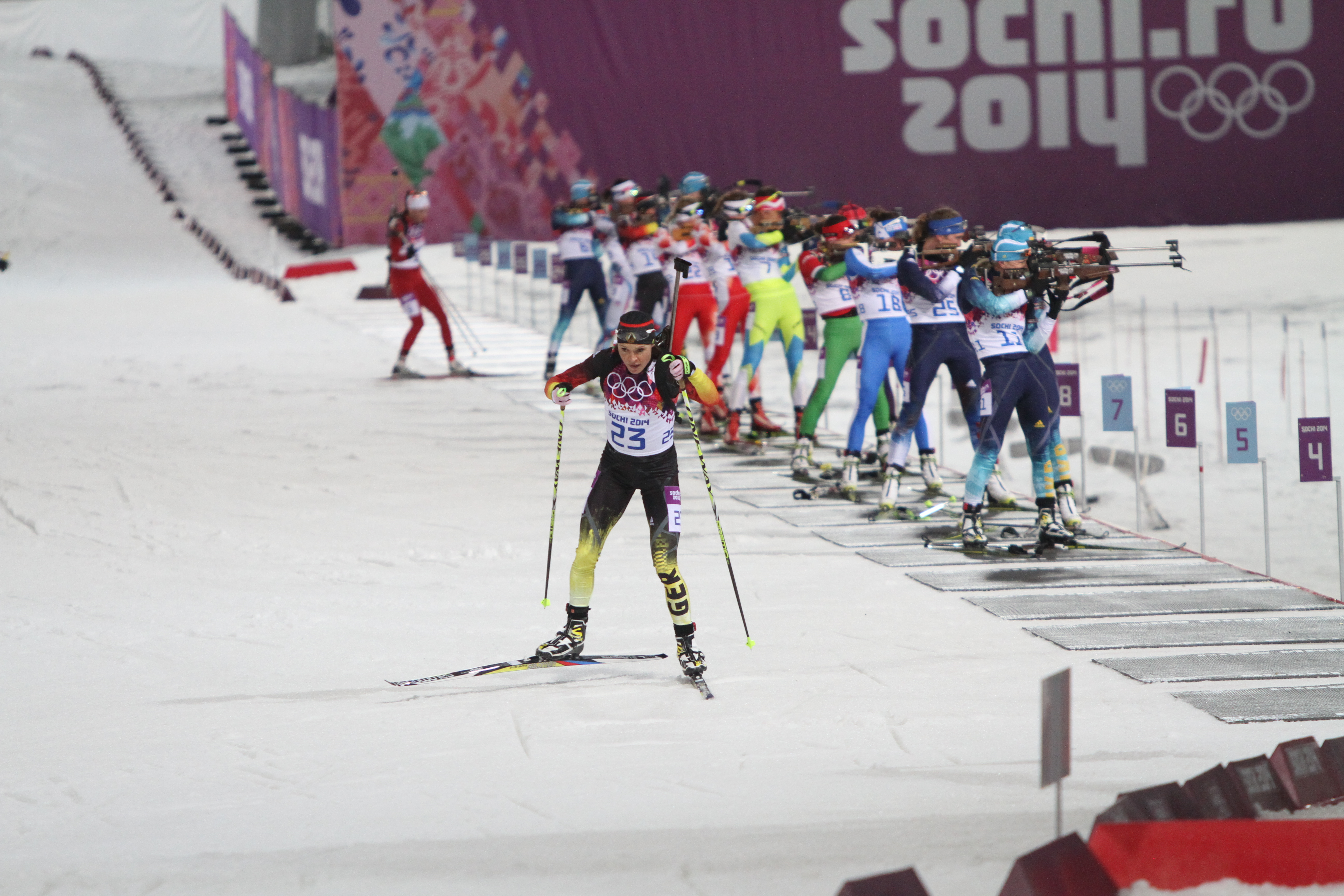
    Germany's Evi Sachenbacher-Stehle leaves the range during Monday's Olympic mass start race.
    Germany’s Evi Sachenbacher-Stehle leaves the range during Monday’s Olympic mass start race.

    FasterSkier’s coverage is made possible through the generous support of Swix.

    KRASNAYA POLYANA, Russia – A veteran German athlete tested positive for a banned stimulant after Monday’s biathlon mass start race, according to the German Olympic Committee.

    Evi Sachenbacher-Stehle, an Olympic champion in cross-country skiing who took up biathlon last winter, had both her A- and B-samples test positive for the stimulant methylhexanamine.

    The German Olympic Committee is sending her home immediately, it said Friday evening.

    Methylhexanamine can be found in several supplements, including geranium oil, and the U.S. Anti-Doping Agency has cautioned athletes against accidental ingestion. Multiple athletes in sports like basketball, soccer, and track and field have been slapped with suspensions after accidentally taking the substance, among them Jamaican sprint World Champion Sheri-Ann Brooks.

    In a prepared statement provided by the German Ski Association, Sachenbacher-Stehle maintained that she had always confirmed the legality of her nutritional supplements with a laboratory.

    “I am experiencing the worst nightmare that one could possibly imagine, because I cannot explain how I have received a positive test,” she said. “All I can do at this moment is assure everyone that I have at no time deliberately taken banned substances, and I will do everything possible to clear up this matter completely.”

    Sachenbacher-Stehle is the fourth biathlete to have failed a doping test recently, after the International Biathlon Union in January announced positive tests from a Lithuanian and two Russians.

    The German Olympic Committee said that it had been notified of Sachenbacher-Stehle’s positive A-sample on Thursday evening.

    Sachenbacher-Stehle was informed around midnight, said Stefan Schwarzbach, a spokesman for the German Ski Association.
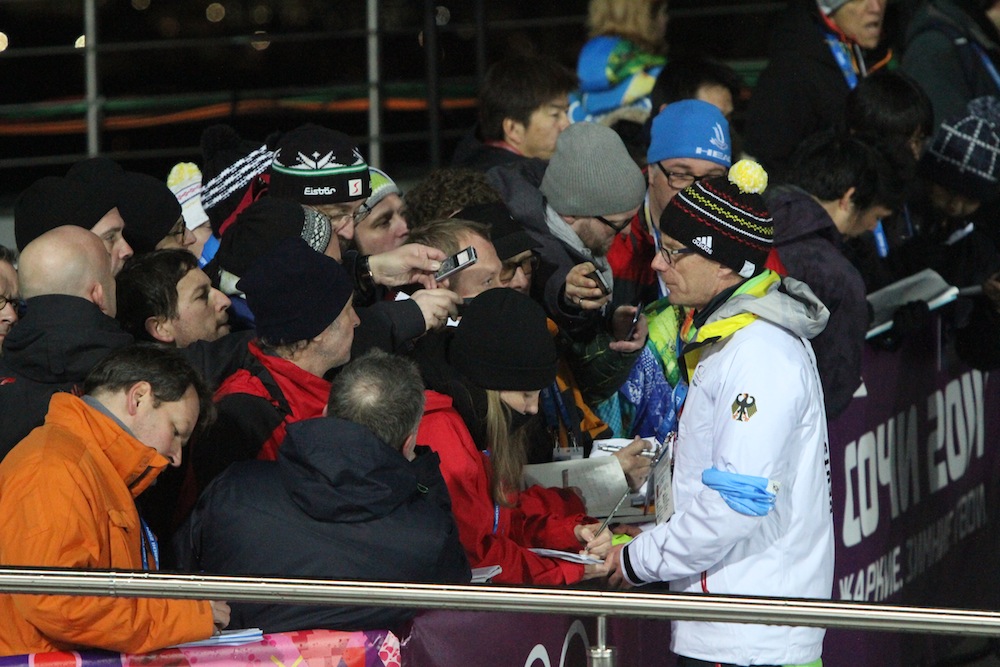
    German Ski Association spokesman Stefan Schwarzbach takes questions after Friday's women's relay race.
    German Ski Association spokesman Stefan Schwarzbach takes questions after Friday’s women’s relay race.

    Schwarzbach said that the association provides its athletes with a list of approved supplements, and said it was possible that Sachenbacher-Stehle had ingested a contaminated product.

    “It really seems that it is a mistake,” he said. “And she has to handle the consequences.”

    Under the principle of strict liability, athletes are responsible for banned substances found in their samples regardless of whether they were ingested intentionally or not.

    The news of the positive test—bits and pieces of which trickled out throughout the day—cast a pall over athletes, coaches, and officials involved in biathlon and cross-country skiing at the Sochi games.

    Many said they were shocked to learn that the athlete involved was Sachenbacher-Stehle. Both biathletes and cross-country skiers described her as a cheerful, positive presence on their circuits—American cross-country skier Kikkan Randall called her “the last person, really, that you would suspect.”

    Some said they found Sachenbacher-Stehle’s claims plausible, while others dismissed her denials as typical for an athlete who has been caught red-handed.

    “The first line of defense that you always hear, in virtually every possible doping case, is that: ‘It was in my supplement. It was inadvertent,’” said Canadian Beckie Scott, a retired Olympic champion cross-country skier who’s a member of both the International Olympic Committee, and the executive committee of the World Anti-Doping Agency. “I’m a really hardened cynic when it comes to those kinds of defenses.”

    But American biathlete Tim Burke, whose girlfriend is Andrea Henkel, another member of the German team, said he was “really shocked” to learn of the positive test.

    “I’m sure she’s taking some sort of supplement that had something in it that wasn’t listed on it,” Burke said. “I feel awful for her—she’s a multiple-time Olympic champion, and I’m sure she did that clean. And now, she’s always going to have this stain on her name.”

    Sachenbacher-Stehle trains in Rupholding, in southwest Germany, with the country’s national biathlon team.

    Her coach is Ricco Gross, a German who won eight Olympic medals in biathlon in the 1990s and 2000s as an athlete.

    Gross has ties to the American biathlon team, as Bernd Eisenbichler, the team’s high-performance director, was Gross’s personal ski technician for five years.

    Eisenbichler said he found it hard to believe that Gross would have any role in a doping program.

    “I cannot see any evidence that he would be involved with that at all. I got to know him as a very hard-working sportsman and athlete,” he said. “But for sure, I don’t know. That’s just my feeling.”

    In 2006, Sachenbacher-Stehle was given a five-day suspension for elevated levels of hemoglobin just before the start of the Turin Olympic Games. Hemoglobin is the protein in blood that carries oxygen, and high levels have been associated with doping—though they can also occur naturally.

    On Friday, news reports were quick to cite the incident from 2006, but Burke, the American biathlete, noted that Americans, including Randall and another cross-country skier, Leif Zimmerman, were both handed the same five-day ban as Sachenbacher-Stehle.

    “And I can guarantee you they weren’t doping,” Burke said. “Everyone reads that and just sees that as a doping violation. But it’s not.”

    Burke and Max Cobb, the president of the U.S. Biathlon Association, said they were worried about how the report of Sachenbacher-Stehle’s test would reflect on their sport—which both asserted is predominantly clean.

    Cobb said he saw the preliminary details of Sachenbacher’s case as distinct from one in which an athlete had been caught using blood-boosting drugs.

    “There’s a big difference between having someone stick a needle in your arm, and eating the wrong sports bar,” he said. “On the other hand, you have millions of people around the world watching the Olympics right now. For many of them, they won’t bother to differentiate between a real case of blood doping, and a case of accidental doping.”

    Burke said that the news about Sachenbacher-Stehle had been a challenge for the German women’s team, which includes Henkel, his girlfriend.

    “She was just shocked, and she was really confident that it was just a mistake. But that doesn’t stop people from pointing fingers and saying bad things about the entire German team that aren’t true,” he said. “And it just puts biathlon in a negative light—especially for what I think this is, which is just all a big mistake.”

    –Chelsea Little contributed reporting.

  • Henkel on Starting Strong, Going Out with a Bang (Exclusive Interview)

    Henkel on Starting Strong, Going Out with a Bang (Exclusive Interview)

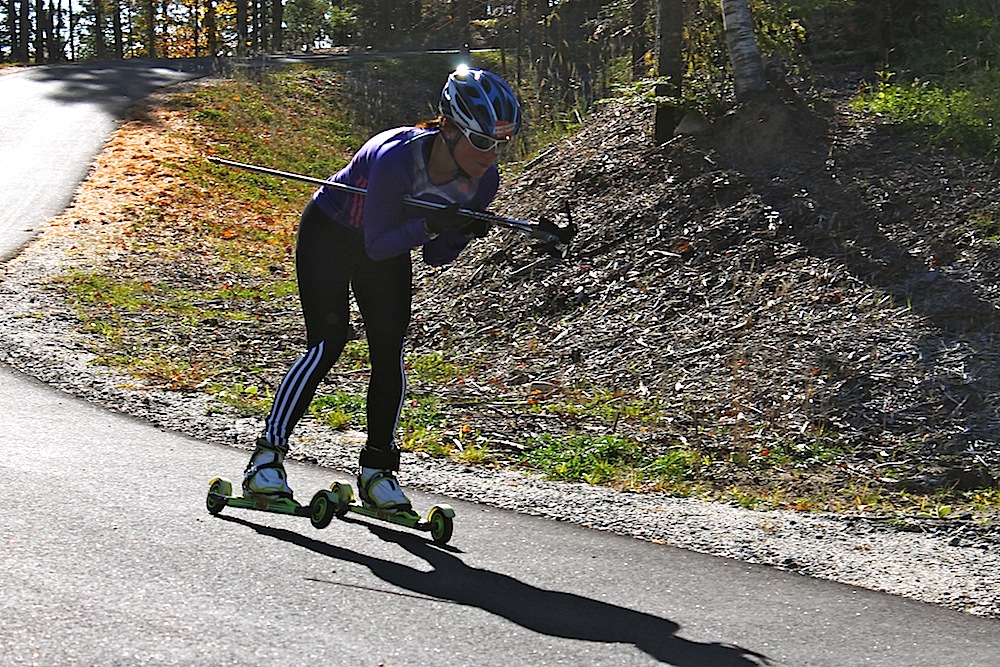
    Germany's celebrated biathlete and four-time Olympic medalist, Andrea Henkel cruises along the 1-year-old rollerski loop on Oct. 3 at the Olympic Jumping Complex in Lake Placid, N.Y.
    Germany’s celebrated biathlete and four-time Olympic medalist, Andrea Henkel cruises along Lake Placid’s 1-year-old rollerski loop at the Olympic Jumping Complex in northeastern New York.

    This might be Andrea Henkel’s swan-song season, but the 35-year-old German biathlete and multiple Olympic gold medalist showed she’s in the hunt for one of her best winters yet – sweeping the opening biathlon races last weekend in Sjusjøen, Norway.

    Before the start of her 15th World Cup season, Henkel completed Saturday’s 7.5-kilometer sprint with one penalty and a 27-second win over France’s Marie Dorin Habert. On Sunday, she missed just one target and won the 12.5 k mass start by 9.1 seconds over Ukrainian Valentyna Semerenko.

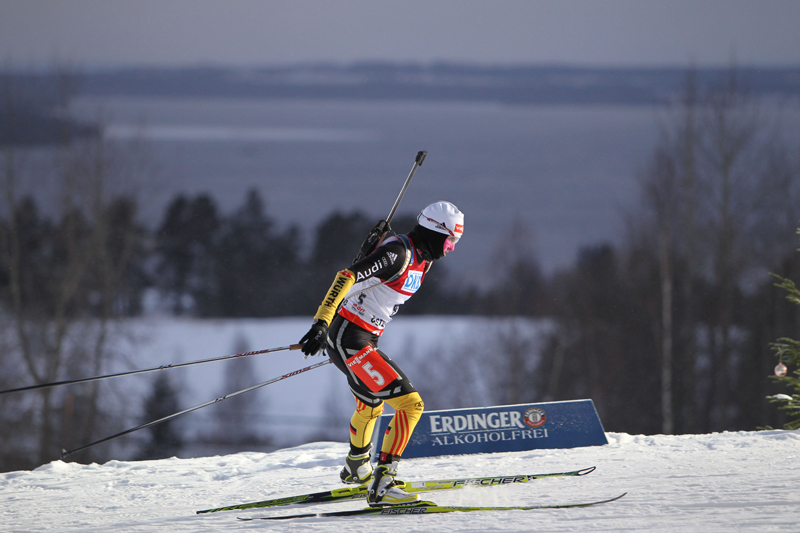
    Andrea Henkel en route to a podium finish earlier this season in Ostersund; today she turned in a strong relay performance.. Photo: Fischer/NordicFocus.
    Andrea Henkel on her way to the podium last season at a December World Cup in Ostersund, Sweden (Photo: Fischer/NordicFocus)

    “I have trained for a few years to get into this kind of shape!” Henkel said with a laugh to NRK on Sunday. “But actually I didn’t feel as good today as I did [Saturday]… I hope I am feeling better for the Olympics, but if I still win there then it doesn’t matter!”

    In early October, FasterSkier caught up with Henkel, who was third in last year’s overall International Biathlon Union (IBU) World Cup. The eight-time world champion – and first biathlete to win a world title in each individual event – was visiting her boyfriend, US Biathlon’s Tim Burke, in Lake Placid, N.Y., for just over two weeks. She said that marked her first time in upstate New York in the fall.

    “Usually, I come in summer,” she said while putting her classic rollerskis in Burke’s car after a double-pole workout on the team’s new rollerski loop. For the short stay, she left her rifle at home.

    Used to visiting in June and July, Henkel made the trip over earlier this year as well, staying April through May. Now she’s been to the U.S. almost every month except January and December, she said.

    “At first, I planned to go to Utah – that was last year – and then I decided in spring I would not go to Utah and would come back to here,” she explained of picking Lake Placid over Soldier Hollow.

    “In Utah last year, I felt pretty tired after the traveling and then this altitude and was there for a little bit over two weeks just, too,” she added. “Here I have a little set up already so I don’t have to plan so much. … Everybody is saying it’s so nice in fall.”

    After arriving on Sept. 26, she flew back to Germany later in October when the U.S. team left for Soldier Hollow for the final rollerski trials of the season.

    Here’s what else Henkel had to say while in Lake Placid:

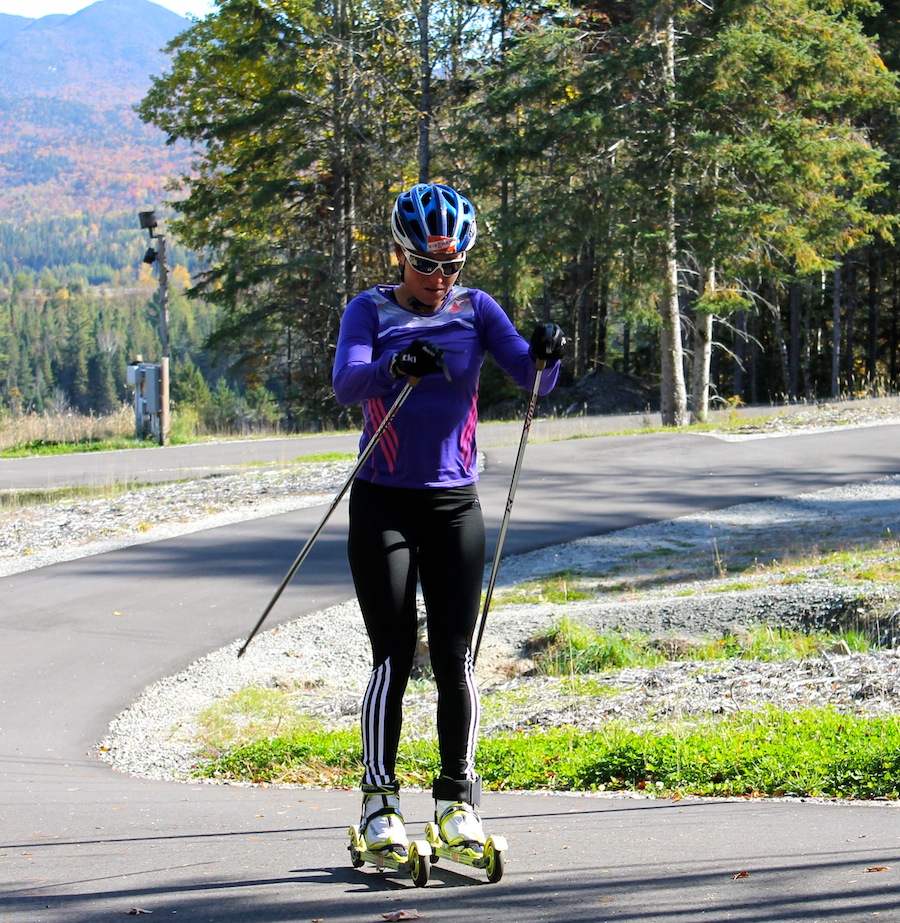
    Andrea Henkel double poles her way up the rollerski loop at the Olympic Jumping Complex on Oct. 3 in Lake Placid, N.Y.
    Andrea Henkel double poles her way up the rollerski loop at the Olympic Jumping Complex on Oct. 3 in Lake Placid, N.Y.

    FS: How have you been feeling, and what have you been working on?

    AH: Basically, I’m getting better faster. At the moment I did a lot of intensity, you know, I’m pretty tired doing this, and now I am working on my strength [with double poling], so everyday something to work on.

    FS: You had a big intensity block back home?

    AH: Already at home and then when I came I just continued and will have another few workouts doing this here. At the moment, I didn’t bring my rifle for this short time because it’s sometimes tricky [with airlines] so I took a shooting break. So I’m kind of [training] by myself. If something works out then I would like to be with the girls or sometimes with the guys to train, but yeah, two weeks is not so long and then I can handle it by myself, too.

    FS: Now that you’re gearing up for your fourth Olympics, how meaningful is this one?

    AH: This time will be my last time, but also I said last time already this will be my last one.

    FS: So you never know?

    AH: No. I know. Last time I knew that this will not be my last season. This time I decided that this will be my last season and so it’s a little bit different and more focused I think, and after this I know that it’s over.

    FS: How’s your health been and what is your hope for these Olympics?

    AH: I am healthy. Everything is working so far and I hope for another medal, of course.

    FS: As a team and individually, too? (She won gold in the 15 k individual and with the relay at the 2002 Salt Lake Games.)

    AH: The best thing would be both, so I see. At the moment, I just train and hope it works out again.

    FS: What is it like to be on a team with several promising younger women?

    AH: That’s good. I mean every time pushed the older ones by youngest ones. I was a few years ago, too, and pushed the older ones so this helped everybody and is a little bit congruent in their own team. It’s good to see the young ones are pushing again cause they had a little time – maybe two years – that it didn’t happen this way and now they are back and it’s good.

    FS: How did you like racing in Sochi?

    AH: I was once fourth [in the 15 k individual last season] … but the track is tricky and I had to change a little bit what I really should do because it’s pretty uphill – the uphills are great. I like that, but the downhills were a little bit too aggressive, I would say. For us girls, it was still fine, but in the guys’ race it was already, like, always night time as late afternoon and it got colder and was freezing and then the course was just not doable anymore for a lot of good skiers. So they should change something up.

    FS: Outside of Sochi’s course, what do you think of the whole area?

    AH: The area is beautiful.  It’s kind of sad to see how many trees just had to go for this. I am sure the athletes will have everything they need … I think for us, it will make a nice Olympics. Everything that’s coming with is maybe not be so nice.

    FS: So what’s next, after biathlon? What would you like to do?

    AH: I plan on moving one day to the U.S., but at first I have to get all when and how and … I think at first, I need my time to settle down a little and organize myself, my new life. Then I can tell you what I can do.