From the FasterSkier archive — posts syndicated from athletes’ and coaches’ own blogs between 2004 and 2012, kept online as published. Current coverage is at fasterskier.com.
Feature stories like this one take time, access, and care to produce. If you value thoughtful storytelling and independent ski journalism, please consider becoming a Voluntary Subscriber. Your support directly fuels the work we do to cover the people, places, and moments that make our sport special.
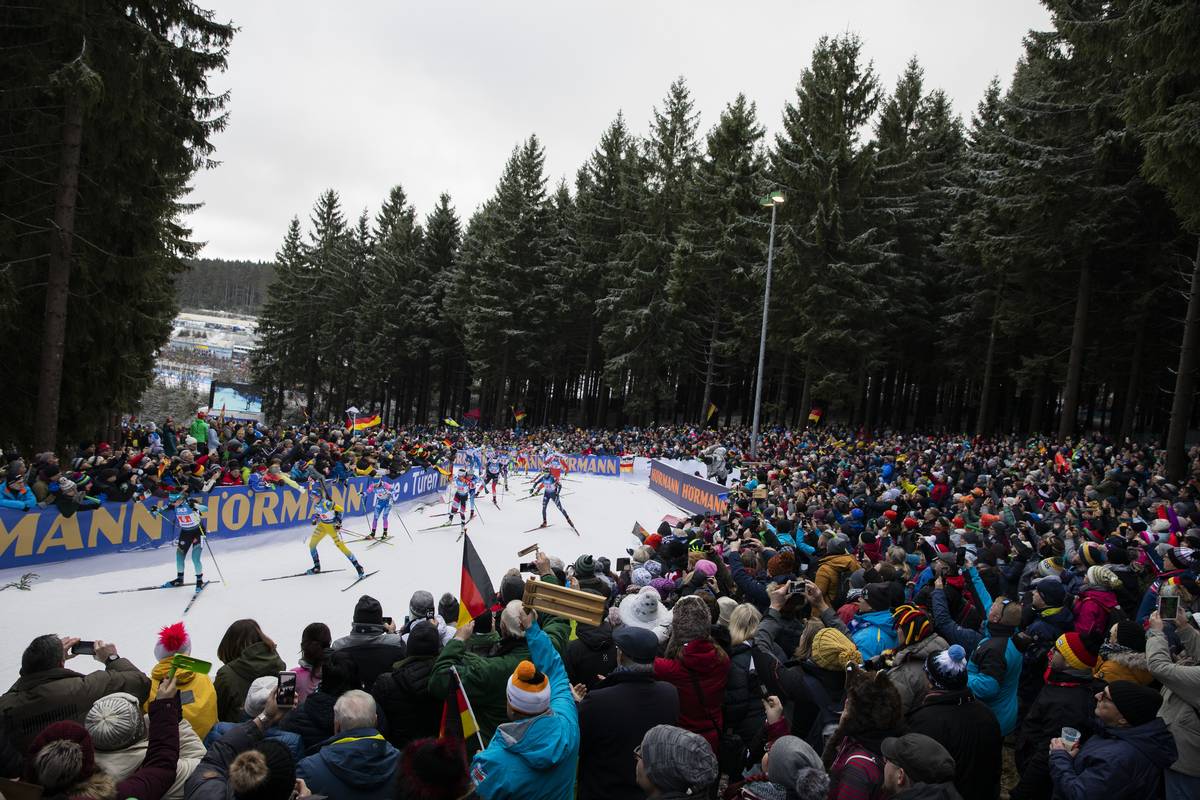
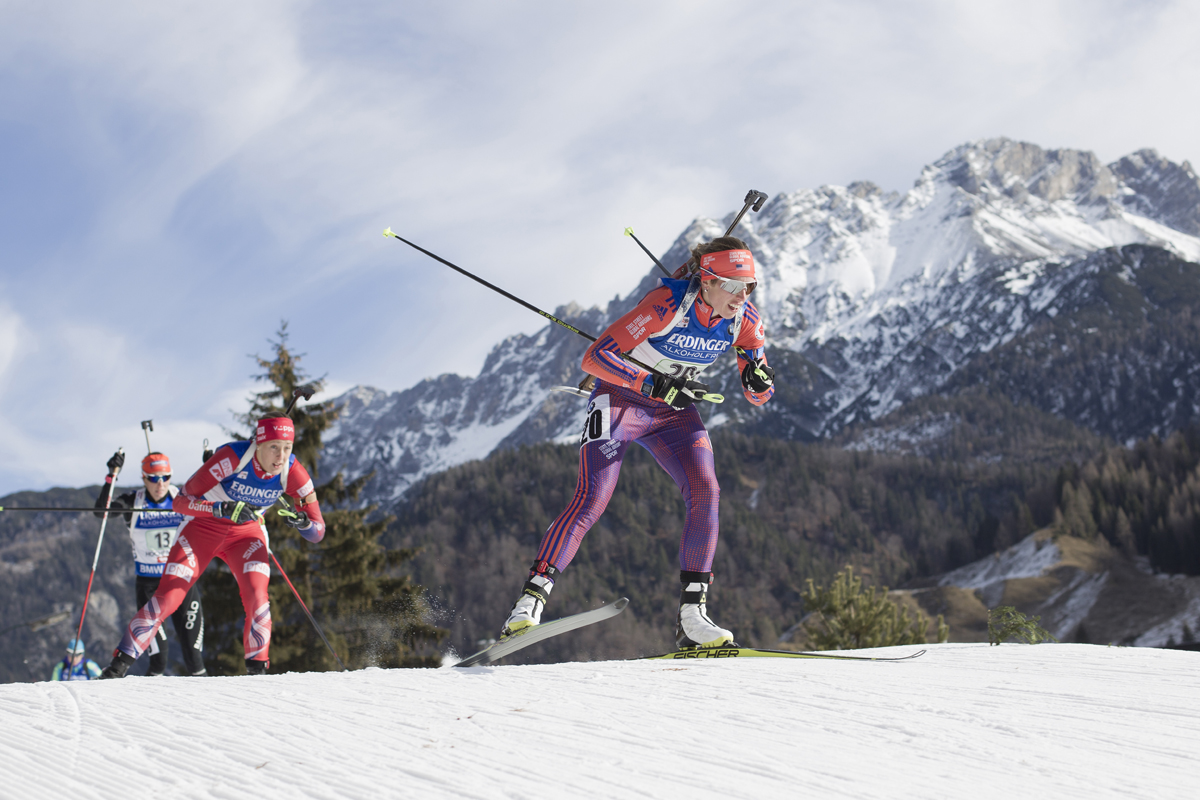
Biathletes racing in Oberhof, Germany in January of 2019. (Photo: NordicFocus)
The 2023 BMW IBU Biathlon World Championships kick off on Wednesday, February 8th in Oberhof, Germany. Let’s start with reasons why to watch:
Why Watch?
Watch because it’s free and easy. This winter, all biathlon World Championship, World Cup, Junior World Championship, and even IBU Cup (World Cup feeder circuit) races and are free to stream live with English commentary on Eurovision’s website.
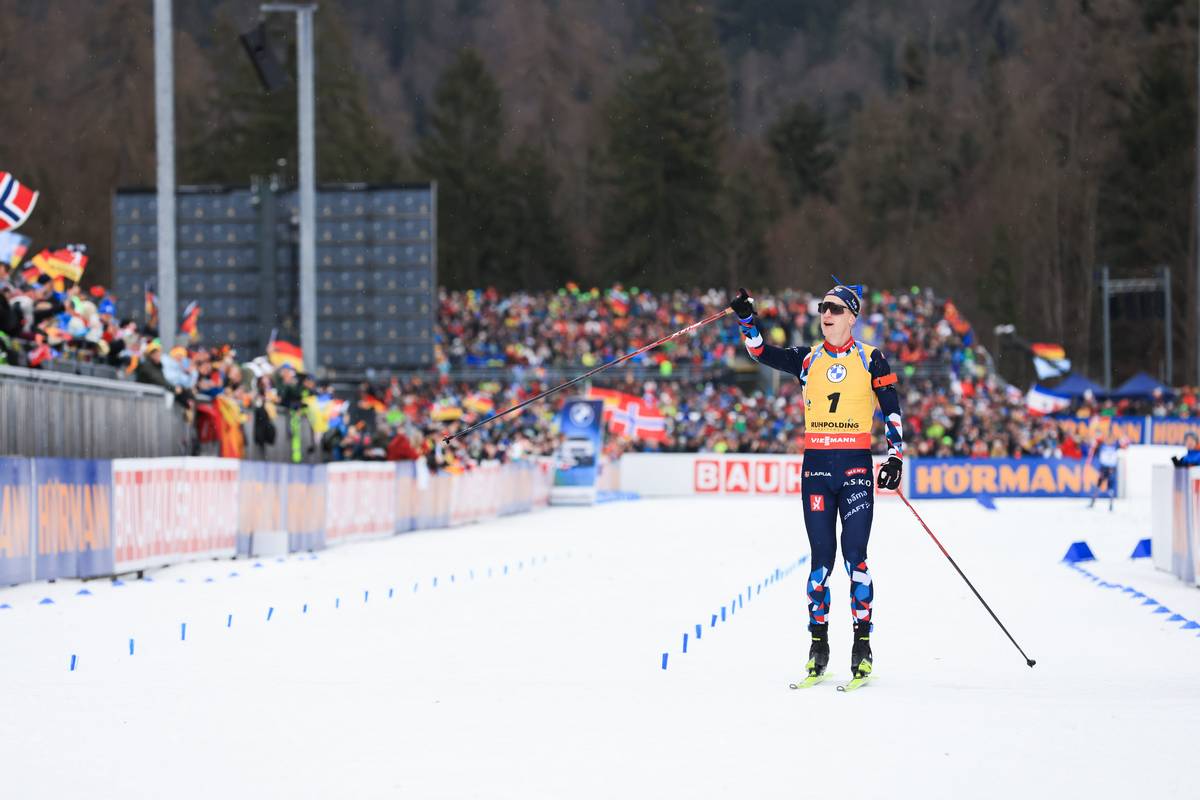
Watch because on the men’s side, Johannes Thignes Boe’s domination so far this winter has sparked talk of “G.O.A.T.” status. That is saying something, given that the 29-year-old Norwegian has “only” three World Cup Overall titles and 66 individual victories to his name. Boe’s compatriot, the original “King of Biathlon” Ole Einar Bjorndalen, won 95 races, and more recently, French star Martin Fourcade won 85 races and seven consecutive Overall titles. But winning 11 out of 14 individual competitions already this season, Boe is catching up at an extraordinary rate. Outpacing his competitors by ridiculous margins and hitting 90% of his targets on average, there’s no doubt Boe will put on a show to remember in Oberhof.
On the women’s side, watch because—in contrast to the Boe Show—we’ve seen eight different winners from five countries so far this season: none yet from Norway. It’s truly anyone’s game. The depth of competition on the women’s side all but guarantees the kind of high-drama shooting and down-to-the-wire finishes that we all love.
Watch to support Nordic skiers getting paid. World Championships have the biggest viewership draw and consequently the biggest prize money purse of the biathlon season, with each event winner taking home 25,000 Euros. The payout reaches all the way down to 30th place, and women and men are paid equally.
Watch because—for the first time since 2020—spectators will be allowed to attend the season’s highlight event. Oberhof’s Thuringen Arena is expected to draw over 160,000 die-hard biathlon fans from one of the sport’s core regions. Watch because if you can’t be there in person, the live stream is next best!
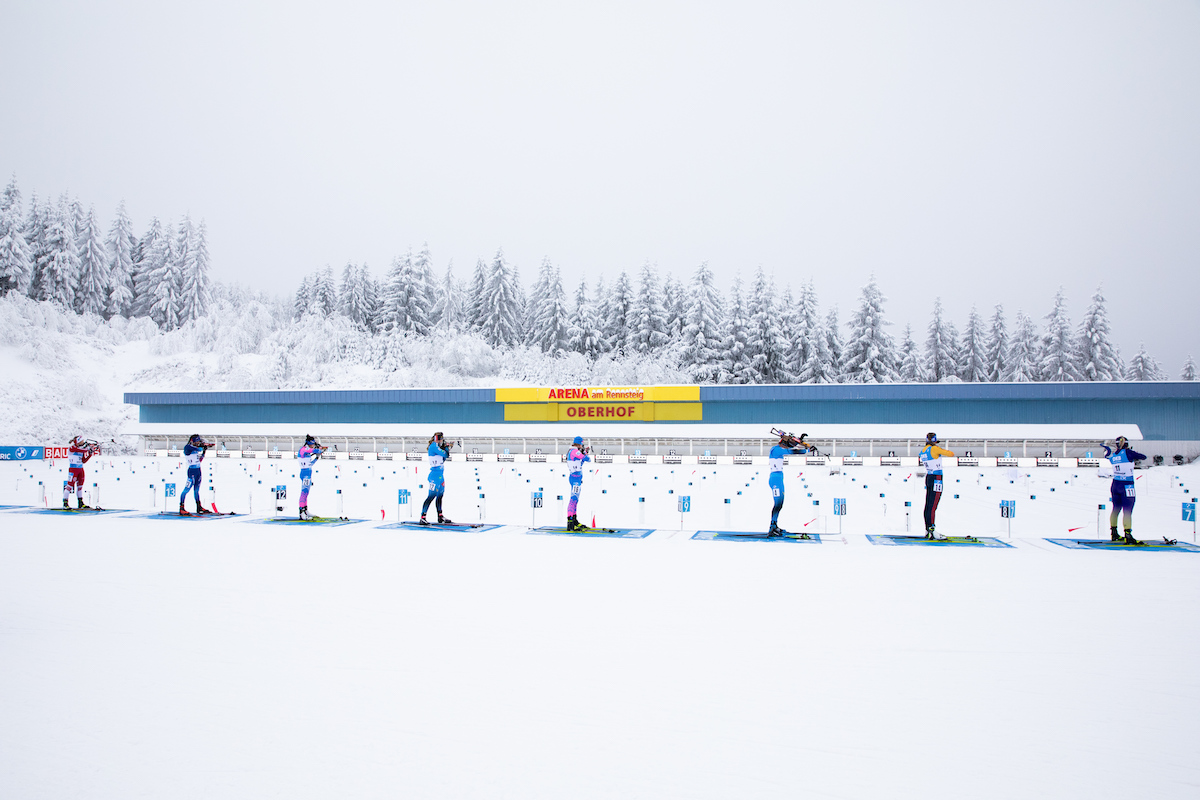
Biathlon World Cup Women’s Pursuit in Oberhof , Germany in January 2021. (Photo: NordicFocus)
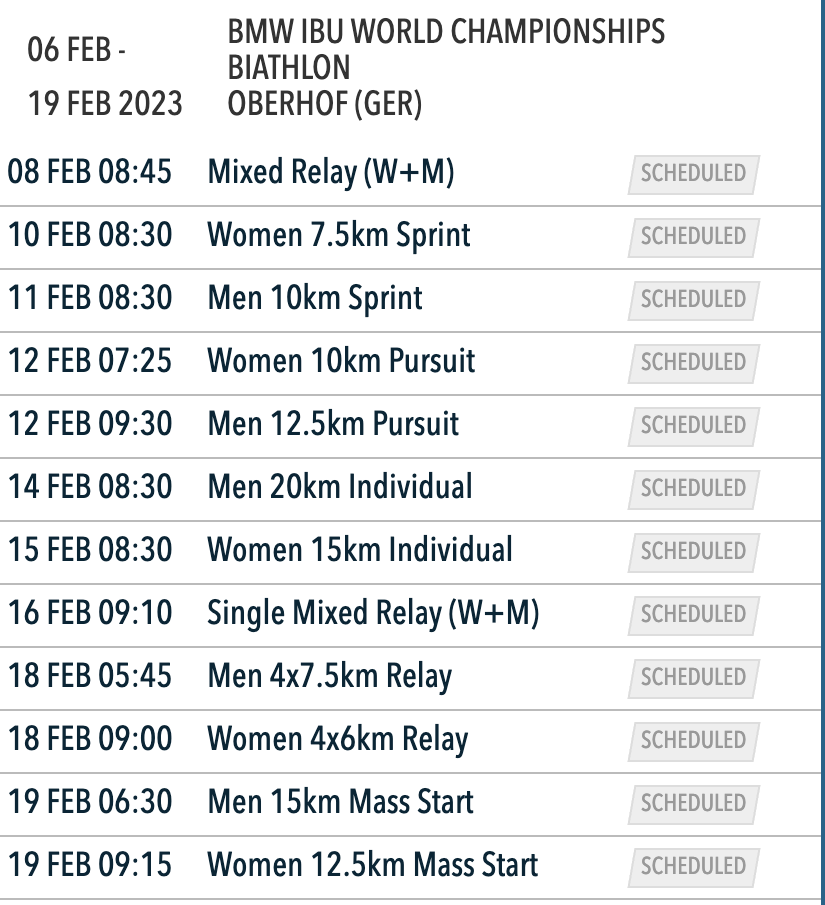
February 8-19. See competition schedule below in Eastern Time. Full season schedule and results available at: www.biathlonresults.com
What to Watch?
For those new to biathlon, check out any of the relays, the Pursuit, or the Mass Start. Those races are easiest to follow because they are head-to-head.
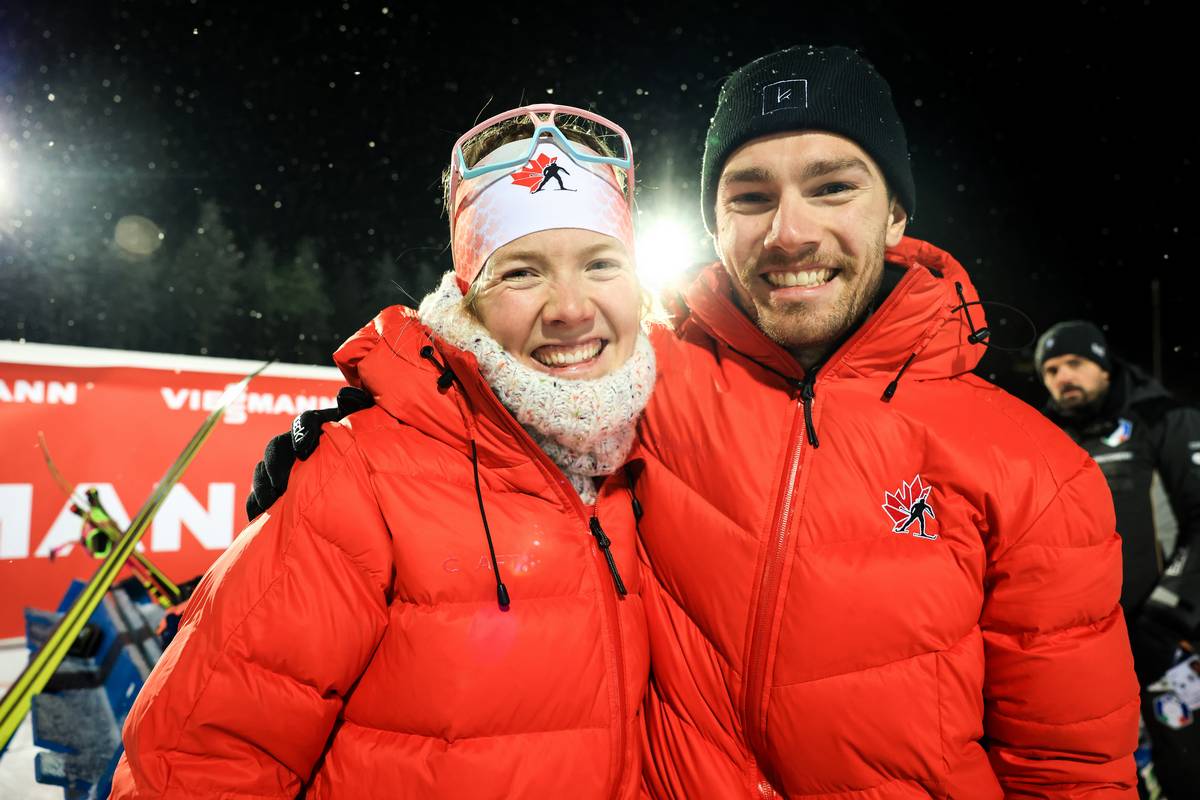
To see North Americans in the front of the pack, watch the Single-Mixed Relay. One woman and one man each do two short biathlon races, tagging off in between. The Canadian couple of Emma Lunder and Christian Gow have a World Cup best of fourth in the event and Americans Deedra Irwin and Paul Schommer finished sixth just a few weeks ago. No matter how they do, this speed shooting and sprint skiing frenzy is entirely enjoyable to watch.
Watch for those same four athletes in the 15/20km Individual as well. They each have scored at least one top-10 result in biathlon’s longest event format, known for its brutal one-minute time penalty per miss. If any of them can hit 18 targets or more out of 20, expect to see them on the live stream and—if they’re lucky—on the podium.
Emma Lunder and Christian Gow (CAN) at the IBU World Cup Biathlon in Kontiolahti, Finland in December 2022. (Photo: NordicFocus)
Who to Watch?
International Women:
Julia Simon (FRA): currently leads the World Cup Overall and Mass Start standings. Watch for her to blaze through five targets in 19 seconds and then throw down a heroic last lap for a come-from-behind win. Not to be overlooked: her three teammates who have also landed on the podium this winter.
Elvira Oeberg (SWE): Second in the Overall and first in the U25 and Pursuit standings, it’s easy to forget she’s only 23 years old. Like France, Sweden has also put four women on the podium this winter. Watch for those two nations to battle it out in the Women’s Relay.
Lisa Vittozzi (ITA): Following a season in which she inexplicably alternated between hitting all five or missing all five in any given prone stage, Vittozzi is back to her best form on the range and on skis. She currently leads the 15km Individual standings.
Dorothea Wierer (ITA): Quietly ranked fourth in the Overall behind the above three, she took her first win of the season just a few weeks ago and is a perennial favorite at championships.
Denise Herrmann-Wick (GER): Sprint standings leader and Olympic medalist in both biathlon and cross-country skiing, the 34-year-old is currently ranked fifth in the Overall and is Germany’s best chance for an at-home win.
Marte Olsbu Roiselend (NOR): Last year’s World Cup Overall winner returned to competition in January following an autumn illness and went straight into the flower ceremony with a 4th and 5th. She won five Olympic medals in Beijing last winter and seven at World’s in 2020. Bet on her.
Wildcard—Anamarija Lampic (SLO): For cross-country ski fans looking for a dark horse podium contender, the former FIS Sprint Globe winner will make her Biathlon World Championships debut. In her three World Cup outings so far she has placed 5th, 5th and 69th.
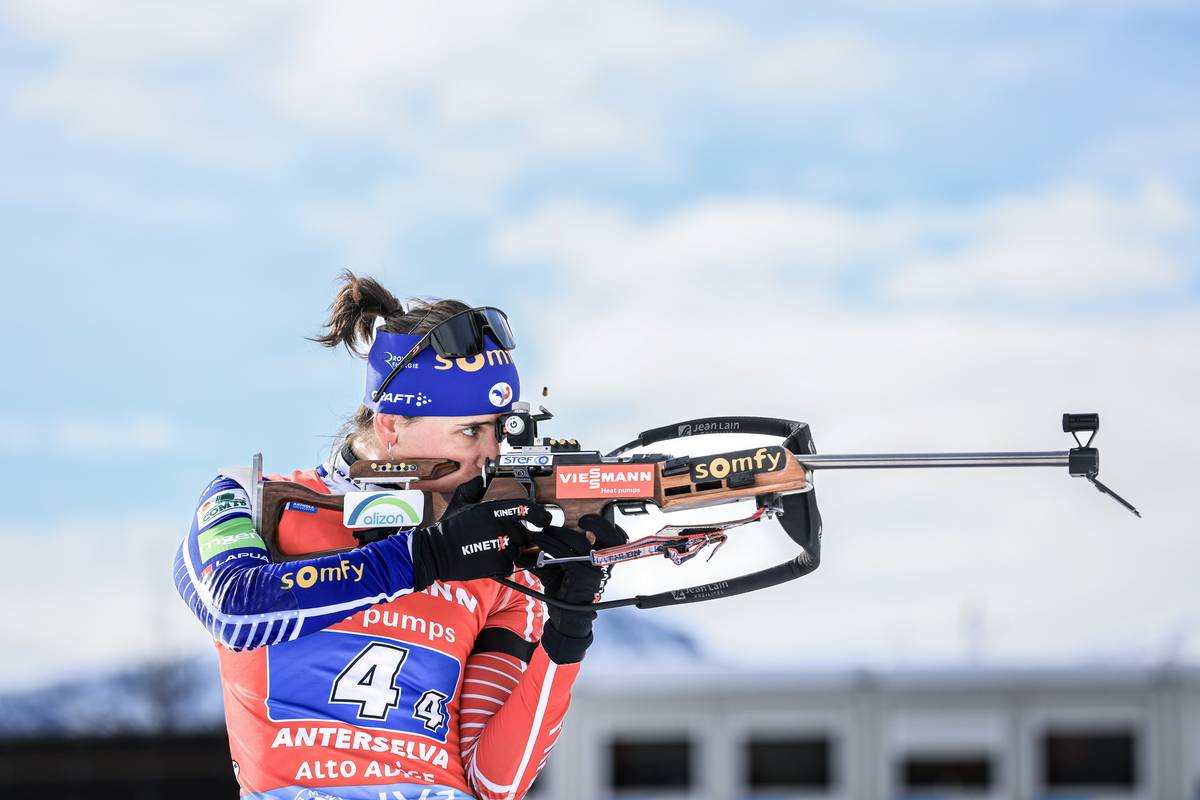
Julia Simon (FRA) racing the IBU World Cup Biathlon Relay in Antholz, Italy in January 2023. (Photo: NordicFocus)
North American Women:
Emma Lunder (CAN): Ranked 26th in the Overall standings, Lunder came oh-so-close to landing her first podium when she set new personal bests of 4th and 5th in December. In the two Mass Start races this season she placed 9th and 11th, so let’s hope she can qualify for the premier 30-woman event in Oberhof.
Nadia Moser (CAN): After tragically breaking her leg just before the Olympics last year, Moser fought back and is now having a career-best season, notching three top-30’s including a new personal best of 23rd.
Deedra Irwin (USA): Returning from a breakout season in which she smashed into the top-ten for the first time at the Olympics and qualified for her first Mass start, Irwin may be on track for a similarly well-timed peak. In January her ski times sharpened and she scored her first top-25 of the winter.
Joanne Reid (USA): After finishing 26th in a Sprint in December, Reid struggled with illness in January but don’t count her out. Her top three career results are all from championship events, including 10th and 15th at the 2019 World’s. Chances are good she’ll shine in the women’s and mixed relays.
Johannes Thingnes Boe (NOR) racing the IBU World Cup Biathlon Mass Start in Ruhpolding, Germany in January 2023. (Photo: NordicFocus)
International Men:
Team Norway: Five of them (J. Boe, S. Laegreid, V. Christiansen, J. Dale, T. Boe) are ranked in the top eight of the World Cup Overall standings. We’ll see all of them compete in Oberhof thanks to a new rule which extends the normal limit of four athletes per nation to five as long as they are ranked in the top 15. In particular:
Johannes Thignes Boe (NOR): won 11 of 14 individual races this season. Currently leads the Overall standings and all of the event standings. More than once this winter, he has outskied the next-fastest competitor by over forty seconds— in a 10k! Come for the biathlon, stay for the exceptional cross-country skiing.
Sturla Holm Laegreid (NOR): If it weren’t for Boe’s total domination we’d be talking about Laegreid. He’s finished 2nd in the Overall standings for the last two years and has been on the podium in all but three races this season. His worst (!) finish so far this winter is 6th. In contrast to Boe, Laegreid’s superpower is his shooting. The 25-year-old is currently running a 98% hit rate in prone.
Martin Ponsiluoma (SWE): the only non-Norwegian to win a race this winter. In January he was consistently the second-fastest skier behind J. Boe and therefore one of the few people with any chance of beating him. Ponsiluoma’s weakness is shooting accuracy but Oberhof’s windy range could level the playing field to his advantage.
Quentin Fillon Maillet (FRA): Last winter’s World Cup Overall winner, currently ranked 4th, never gives up.
Niklas Hartweg (SUI): At just 22 years old, the U25 leader is having a breakout season which started with a silver medal in the 20km Individual in November. Winner of the 2019-20 Junior Cup, Hartweg is on a near vertical trajectory at the senior level, ascending from 74th in the World Cup Overall standings last year to 12th currently.
Wildcard— Simon Eder (AUT): the 39-year-old proved he’s still in great form when he earned his 99th and 100th career individual top-ten results in January. He recently ended a prone hit streak of over 110 shots which he had started last March.
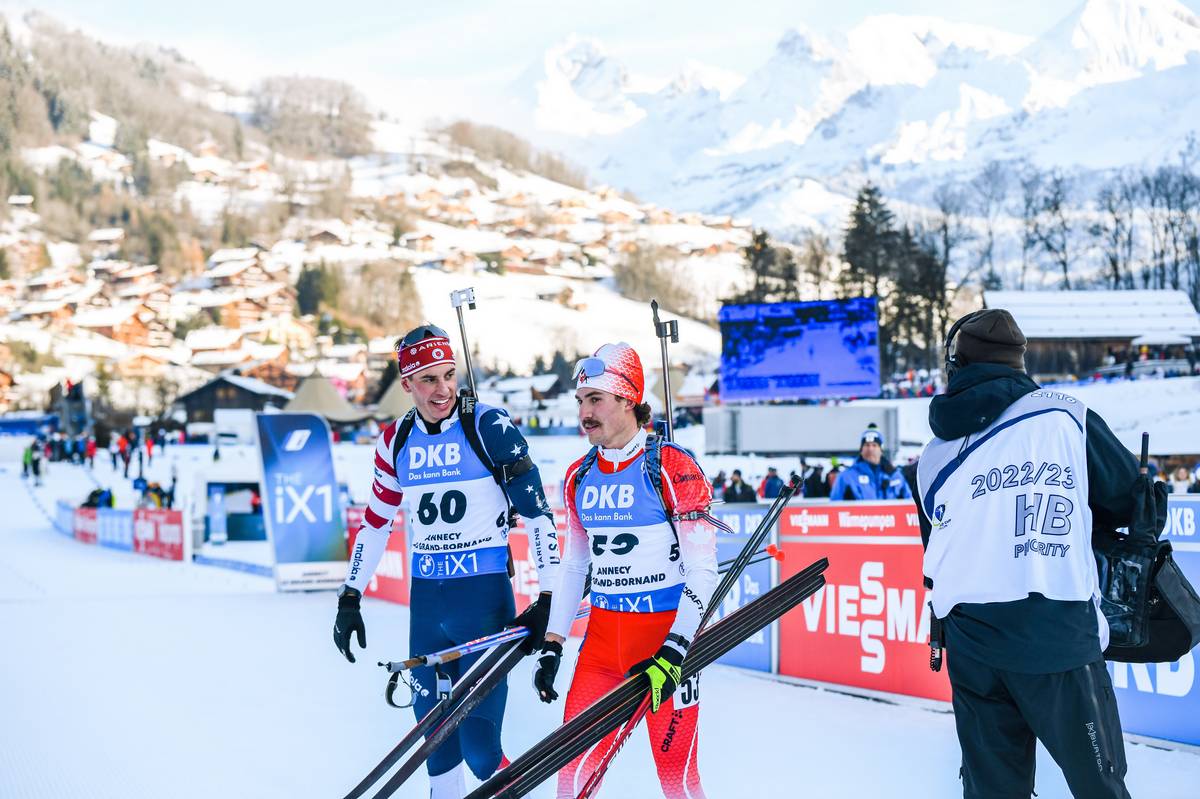
Paul Schommer (USA) and Adam Runnalls (CAN), (l-r) racing the IBU World Cup Biathlon Pursuit in Annecy-Le Grand Bornand in December 2022. (Photo: NordicFocus)
North American Men:
Sean Doherty (USA): Coming off a banner summer season in which he took 2nd at the Martin Fourcade Nordic Festival and 6th at Summer Biathlon World Championships, Doherty landed his best result since the 18-19 season in December with a new Sprint best of 11th.
Christian Gow (CAN): a lighting fast and reliable shooter coming into form with two top-25 results in January.
Adam Runnalls (CAN): 24-year-old having a breakout season with two top-20s so far including a new personal-best of 13th in the Sprint in January.
Paul Schommer (USA): has finished in the points (top-40) in all but two races this season, showing high-level consistency, especially on the range where his 87% hit rate ranks among the best.
Jake Brown (USA): 12th in the Sprint at 2021 World’s proves he can make it happen when it counts. Watch for Jake to put up a sneaky excellent Men’s Relay leg.
Keep following fasterskier.com for on-site coverage from Oberhof.
You can find the full US Biathlon World Championships team roster here.
You can find the full Biathlon Canada World Championships team roster here.
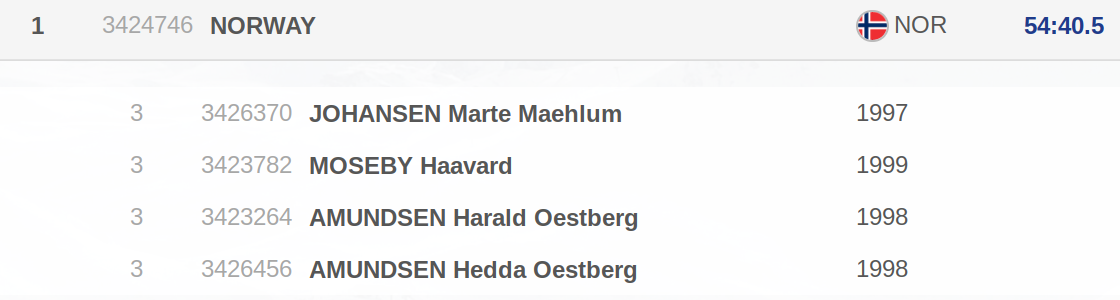
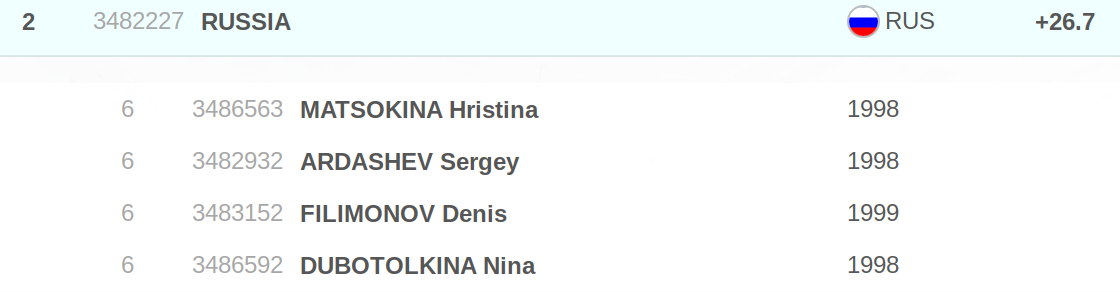
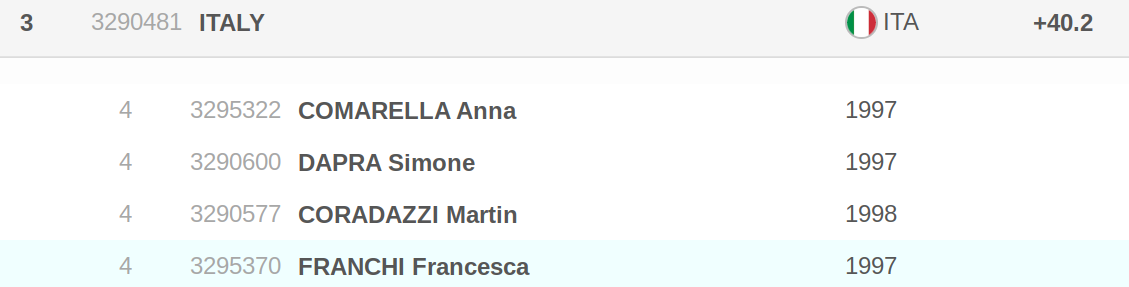
U23 World’s closed out today in Oberwiesenthal, Germany with the 4 x 5 k mixed relay. Norway, which had struggled in both the junior women’s and junior men’s relay won in 54:40.5 minutes. Russia followed in second (+26.7), and Italy third (+40.2).
Norway’s Marte Mæhlum Johansen of Norway at the start of the U23 4 x 5 k relay. (Photo: Doug Stephen)
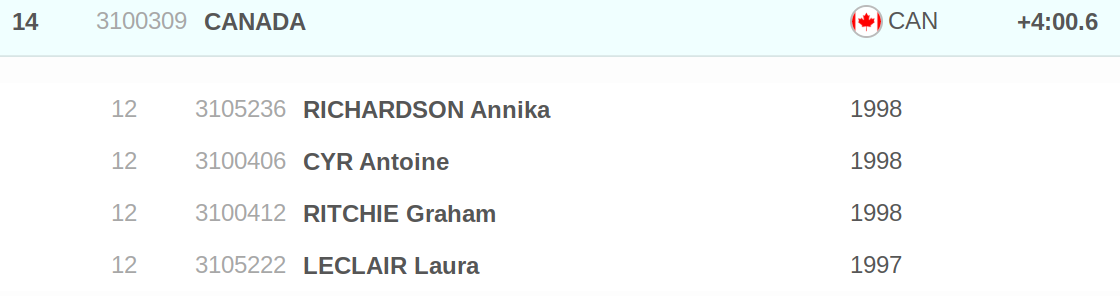
The U.S. placed fifth (+54.6) of the 15 teams finishing the event.
Andy Newell (19) and Kevin Bolger (28) compete in the 2019 Dresden City Sprint World Cup (Photo: Dresden World Cup)
Dresden City Sprint World Cup – Torsten Püschel Interview
April 29, 2019
In the lead-up to the Minneapolis World Cup in March 2020, there are some parallels to the city sprint weekend in Dresden, Germany. Both are urban events relatively new to the World Cup circuit.
What are the motivations and goals behind hosting a World Cup? What does it take to get a new event on the calendar? What has the Dresden World Cup learned and how is the event changing after the first two years of their five-year contract?
Garrott Kussy spoke with Torsten Püschel, Co-Founder and Co-Director of the Dresden World Cup, to learn more about hosting a city sprint World Cup. Püschel grew up in Dresden as an elite athlete when the city was part of East Germany. He has spent the past 20 years working as a sports commentator for German television and radio, including the past six Olympic Games.
Launching a World Cup City Sprint: “Bring Skiing to the People”
Garrott Kuzzy: What was your inspiration for bringing a World Cup event to Dresden?
Torsten Püschel: First and foremost, because Dresden is my home. My co-founder (René Kindermann, also a German television sports commentator) and I are enthusiastic fans of our hometown. In 2014, the Mayor of Dresden, Helma Orosz, came to us and said: ‘Torsten & René, you both travel the world for sporting events. Do you have any ideas for promoting the city in the winter?’ Dresden is known for the Striezelmarkt, Germany’s oldest Christmas Market, in December. In the spring and summer, it is full of cyclists and travelers. But things were a little quiet in January.
Chief of Competition Georg Zipfel (L) and Co-Director Torsten Püschel talk about the event. (Photo: Dresden World Cup)
René and I were announcing at the World Cup in Lahti, Finland, where the nordic venue is within walking distance of the city. We thought, ‘Hey, how about we host a nordic World Cup in Dresden?’
We had conversations for over a year with all possible constituents before announcing our idea. We didn’t want anyone to feel left out. This was one of the keys to the success of the event.
The regional ski clubs loved the idea of bringing the World Cup to the people in the city, rather than bringing people to a more remote ski area in the Iron Mountains (Erzgebirge mountain range about 50 miles from Dresden, on the border with the Czech Republic). That also fits with the German Ski Federation’s mission to bring more winter sports to the cities.
Hannah Halvorsen competes in her first World Cup event (Photo: Garrott Kuzzy / LumiExperiences.com)
GK: Once you decided you wanted to host a World Cup, how did you make it happen? What were the challenges?
TP: There were three big challenges. First, we had to find a weekend that fit into the FIS calendar. Second, we had to get all of the permits from the city. There were over 10 different departments who had to sign off on our proposal. Finally, we had to achieve the FIS requirements like organizing accommodation, paying for athlete’s travel expenses and, of course, to build a venue in the city. It took over three years from having the idea in fall of 2014 to approval by FIS in May 2017, to actually hosting the event in January 2018.
GK: You mentioned that Dresden is known for its cycling. Rock climbers are also likely familiar with the famous sandstone Bastei rock formations. Cross country skiing is not as synonymous with the region. What are winters like in Dresden?
TP: Dresden itself is cold, but does not always have snow in the winter. Instead, people typically travel around 45 minutes into the surrounding Erzgebirge mountains to ski. Rather than make people travel to snow, our inspiration was to bring the World Cup to the people.
Aerial view of the race course in front of the State of Saxony’s Ministry of Culture building (Photo: Dresden World Cup)
Creating a Sustainable Event
GK: Has it been hard hosting a World Cup in a city without consistent snow? Are you taking into account environmental concerns?
TP: Creating an environmentally sustainable World Cup has actually been one of the most interesting parts of the project. From the beginning, we wanted to make sure the event was ‘green’–in the environmental sense at least. FIS actually has a Green Event Manual. We used the manual, along with the input from several local, environmentally focused non-profits, to make the event as sustainable as possible.
For example, it is actually better to host a city event than a rural event in the mountains because everything is so central. The athlete hotel is located right next to the course, so racers and coaches can walk to the venue. Tickets for spectators include public transportation.
FIS now requires that every World Cup venue has snowmaking, so every event is making snow–not just city sprints. We make our snow at the Dresden Airport with non-potable water collected from the roof of the airport. Snow guns make the snow inside an airport hanger, so no moisture is lost to wind or sun. The energy used to make the snow is 100% renewable; from hydro, solar and wind power.
Snowmaking container set up outside a hanger at the Dresden Airport (Photo: Dresden World Cup)
Indoor snowmaking means no moisture is lost to wind or sun (Photo: Dresden World Cup)
It takes about a month to make all the snow for the event, which we can even make in temperatures above freezing. Two days before the event, we transfer the snow from the airport to the venue. A short 650m snow loop has several advantages. First, it means we do not need to make much snow. Second, racers ski two laps, which is more exciting for spectators. On the team-sprint day, racers ski past the spectators 72 times–more than any other World Cup event.
The total carbon required for our snow production is about the same as one person in Dresden would use in two months of normal living.
A family heads out for an evening ski after the races (Photo: Dresden World Cup)
A Family Winter Weekend
GK: In Minneapolis, the race organizers are creating a four-day festival around the World Cup. How do you use the snow when World Cup racers aren’t racing?
TP: One of our goals is to help put Dresden on the world stage. The course runs along the banks of the Elbe River with the city skyline in the background. Of course, promoting the city and sport is a big part of our event.
As part of bringing skiing to the people, we leave the course set-up for 10 days. After the race weekend, we open the track to everyone. Elementary school kids come during the week to learn to ski. Tobias Angerer (Olympic Bronze Medalist and two-time World Cup Overall Champion) has connections to Dresden and spends the week teaching lessons. The German National Paralympic team teaches skiing to people with disabilities. A junior championship event brings over 450 kids for sprint races. We also host an event for the Special Olympics. The hill is used for sledding. The VIP hospitality ‘tent,’ which is actually a beautiful, temporary, two-story glass building, is perfect for companies to host team-building events, which is used for all 10 days as well.
Racers line up for the Team Sprint in front of the VIP hospitality building (Photo: Dresden World Cup)
Looking toward the future
GK: After two years, what have you learned? How will you evolve as you move forward?
TP: For the event, we will continue to add activities. For example, we will have a sponsor village next year, where people can sample Gruyère cheese, or try laser biathlon. We will also lower the ticket prices, aiming for cinema pricing–where spectators can access the event for the same price as a movie ticket. We really want this to become a family winter weekend.
Photo finish for second place in the women’s team sprint (Photo: Garrott Kuzzy / LumiExperiences.com)
GK: What is the athlete perspective of the event?
TP: Athletes have appreciated how firm and fast the course was; and how well the conditions held. That was very positive feedback. They also appreciate being able to walk, or run, from their hotel to the course.
Regarding the loop itself, the qualifying times were slower than FIS wants, so we are shortening the course by about 200m and making the whole venue more compact–which also improves spectating. We are reversing the direction of the course, putting the uphill at the beginning to try spreading out the field more. We are also adding more berms and bumps to make the course more challenging for athletes and exciting for spectators.
Men’s team sprint podium celebrates with champagne (Photo: Garrott Kuzzy / LumiExperiences.com)
GK: Why should someone travel to Dresden for the World Cup?
TP: There are several reasons. First, the event is quickly becoming a tradition in Dresden. The local community is excited to host the event. People are very friendly excited to host an international event and spectators. Second, everything is within walking distance. It’s special to be able to experience the World Cup during the day and the city of Dresden, including their restaurants and culture at night. Most importantly, the event is a lot of fun. There is an opportunity to interact with some of the best skiers in the world and watch them compete on one of the most iconic World Cup courses in front of the city skyline.
GK: Thank you, Torsten. Good luck as you prepare for the World Cup next winter.
Julia Kern (L) and Sophie Caldwell after finishing fourth place in the team sprint (Photo: Garrott Kuzzy / LumiExperiences.com)
About Garrott Kuzzy
Garrott competed in the 2010 Olympic Games and raced several years with the US Ski Team and the CXC Team. He is the founder of Lumi Experiences, specializing in cross-country ski vacations. Lumi Experiences is offering a trip “Dresden to the Dolomites” with VIP tickets to the Dresden World Cup and the opportunity to ski the Dolomitenlauf Worldloppet Ski Marathon in Austria.
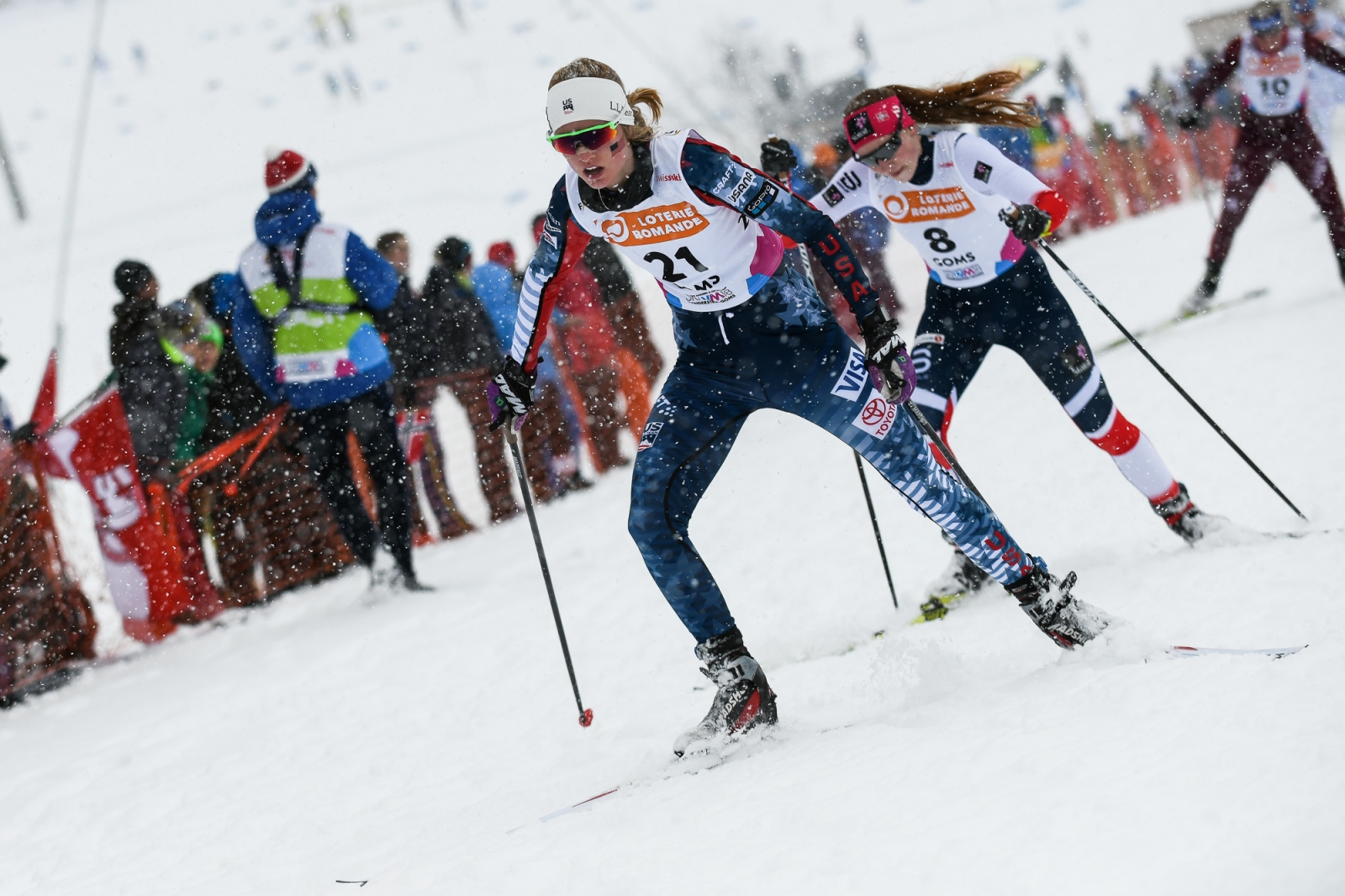
American Hailey Swirbul (University of Alaska Anchorage) leads Norway’s Lone Johansen up a climb during the second half of the women’s 10 k skiathlon on Thursday at 2018 Junior World Championships in Goms, Switzerland. (Photo: JWSC2018.ch)
(This article has been updated to include comments from Americans Hailey Swirbul and Gus Schumacher.)
Junior World Championships (Goms, Switzerland): 10/20 k skiathlons
Hailey Swirbul is 2-for-2 when it comes to podiums at this year’s Junior World Championships; in her second-straight race this week in Goms, the 19-year-old American earned a medal in a distance race. On Thursday, it was bronze in the women’s 10-kilometer skiathlon.
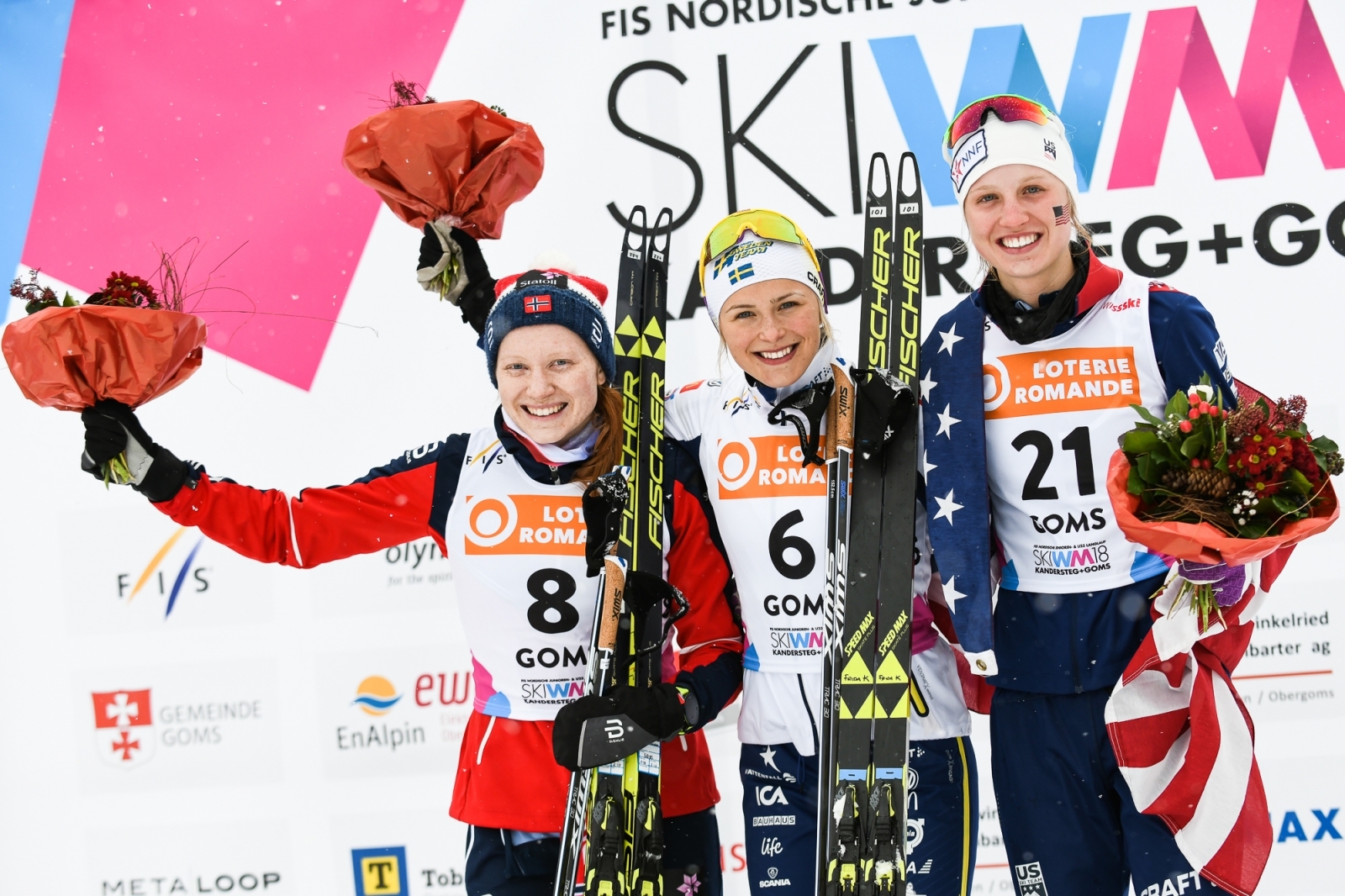
The women’s 10 k skiathlon podium at 2018 Junior World Championships in Goms, Switzerland, with Sweden’s Frida Karlsson (c) in first, Norway’s Lone Johansen (l) in second, and American Hailey Swirbul (r) in third. (Photo: JWSC2018.ch)
Swirbul, a sophomore at the University of Alaska Anchorage, closed the gap to the leaders over the final 5 k skate portion of Thursday’s race, doing so in tough, slow conditions with heavy snowfall. She ended up third in a sprint finish with Norway’s Lone Johansen, who took second by 0.7 seconds, as the two finished 35.5 seconds and 36.2 seconds behind the winner, Sweden’s Frida Karlsson, respectively.
Karlsson won it in 32:55.7 minutes. She had been second at the transition from classic to skate halfway through the race, just behind France’s Laura Chamiot-Maitral in first. Four women came through the exchange together within 2.6 seconds of first, while Swirbul was about 15 seconds back in eighth.
“Coming into the exchange I was right where I wanted to be,” Swirbul wrote in an email to FasterSkier. “I knew that some of the girls ahead of me would not be able to sustain their pace the entire skate leg. It was important for me to remember that and not try to close the gap too quickly with the Norwegian I was skiing with.”
While Karlsson broke away over the final 5 k, Swirbul helped lead the chase, moving into second and 31 seconds back on a long, steep climb at 6.7 k.
“I won’t lie, the skate leg was tough! I think everyone was suffering out there in the fresh snow,” Swirbul wrote. “I tried to conserve energy on the gradual downhill before the big climb to use on the hill.”
On the last lap, she worked to distance herself from fourth place.
“I knew that the fourth place skier was closing in on us the last lap,” she wrote. “Going up the final hill, I had to make a move to secure a podium spot and give what I had to ski away form the fourth place girl over the second to last big climb. The last few hundred meters were so intense! I didn’t have anything left to sprint it out for second place. Gotta work on that!”
Two days ago, Swirbul placed second in the 5 k classic for her first individual medal and the best-ever finish for the U.S. at Junior Worlds.
“This means so much,” she told race organizers after taking third in Thursday’s skiathlon. “I’m so happy to represent the United States here and show how we can improve in the future and what we have in our country.”
In her email to FasterSkier, Swirbul explained that she entered Thursday’s race confident yet calm.
“After my silver medal I believed in myself more than before,” she wrote. “However, I managed to stay calm and not put high expectations on myself for the skiathlon which allowed me to race my best. I was hoping to ski smart and relaxed and not be afraid to make it hurt! In a mass start that is really all I can control.”
For much of the first leg, about 4 k, she skied with what she described as “a huge pack of girls, which was kind of stressful for me.”
“It’s harder for me to match the stride of someone almost a foot smaller than I am in a classic track, so once the group broke up I was able to find my rhythm,” Swirbul wrote. “The snow storm made the tracks super slow where they weren’t skied in, so it was a waste of energy to try to pass people outside of the skied in track. I made that mistake a few times and ended up not passing anyone, just wasting energy plowing through powder.”
But her skis felt fast in both the classic and skate legs, she noted. “The wax techs have been killing it!”
With one race left, the women’s 4 x 3.3-kilometer relay on Sunday, Swirbul wrote that she was eyeing another podium.
“I think it is fair to think that our relay team has a good shot at the podium. That would be the cherry on top :)”
Karlsson told organizers that she was focused solely on the gold on Thursday.
“It was very fun today and my body felt very good, then I was just going for the gold today,” Karlsson said. In her first Junior Worlds, she had previously placed third in the skate sprint earlier in the week.
“It means a lot,” Karlsson, 18, added. “This is a very good sign that I’m doing the right thing. I have one more year left as a junior so I’m looking forward to next year’s Junior World Championships as well.”
Also for the U.S., Kathleen O’Connell (Montana State University) placed 20th (+2:18.2), Molly Gellert was 40th (+3:59.4) and Sofia Shomento was 58th (+6:25.7).
Canada’s Natalie Hynes (University of Alaska Anchorage) placed 24th (+2:40.0), Hannah Mehain was 37th (+3:54.9), Alexandra Racine 51st(+5:16.1), and Catherine Reed-Metayer 62nd (+7:17.7).
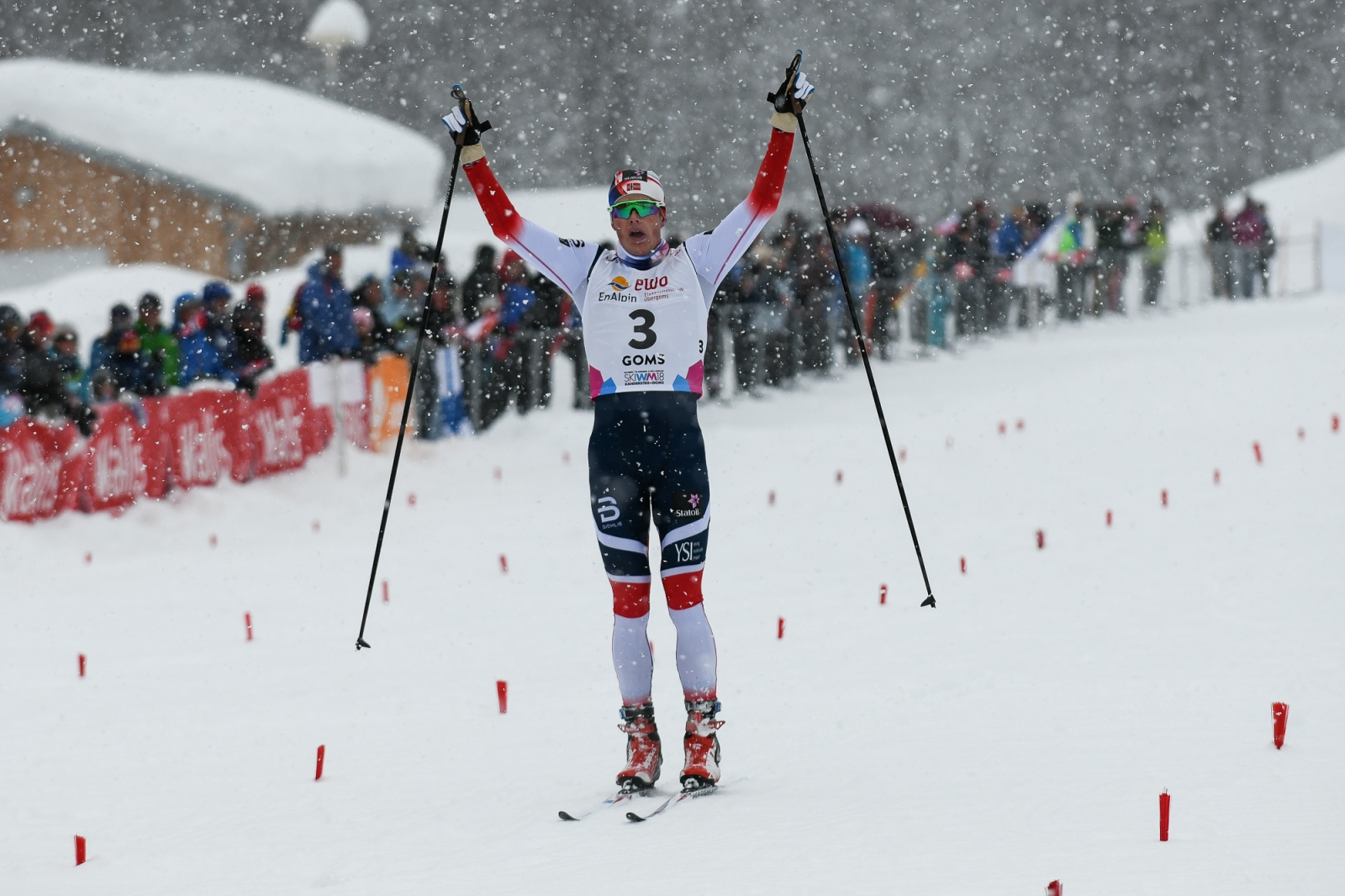
Norway’s Harald Østberg Amundsen winning the men’s 20 k skiathlon at 2018 Junior World Championships in Goms, Switzerland. (Photo: JWSC2018.ch)
In the junior men’s 20 k skiathlon that followed, Harald Østberg Amundsen pulled out a 34.7-second victory over fellow Norwegian Jon Rolf Skamo Hope, who won the 10 k classic two days ago. Norway swept the podium with Jørgen Lippert in third, 1:00.1 minutes back, two days after Lippert placed third in the 10 k individual start.
The win was Amundsen’s first individual gold after he was on Norway’s winning 4 x 5 k relay at last year’s Junior Worlds in Utah, where he placed third in the 10 k skiathlon. On Tuesday, he was fourth in the 10 k classic.
“Unbelievable,” he said during a post-race arena interview. “I tried to keep calm on the classic part, and on the skate part just tried to keep the speed up. … I tried to go fast on the beginning and end of the uphills, and a bit controlled in the middle. I think the final was great, unbelievable.”
American Gus Schumacher (Alaska Winter Stars) raced to 15th (+2:43.6) besting his two previous top 20’s this week (19th in the freestyle sprint and 17th in the 10 k classic) at his first Junior Worlds. He skied much of the race with Ben Ogden (Stratton Mountain School), who finished 18th (+2:51.2) for his second-straight top 20 (after placing seventh in the 10 k).
“My classic skis were great today,” Schumacher wrote in an email. “The techs nailed it and I had really solid kick and good glide. I was able to run up the steepest hills and kick the buildup off right at the top and glide right with everyone. During that first 10k I think I did a good job staying relaxed and now letting myself push too hard up the big climbs. The pace in the pack wasn’t bad, definitely a little rushed at the beginning but I was able to settle in well.
“On my second half I was still just focused on not pushing too hard and staying relaxed, while also keeping the pace fast and carrying speed through the corners,” he continued. “Generally I felt pretty good, but my body was just getting tired and I was hanging in there.”
While he dropped Ogden over the last kilometer, Schumacher wasn’t able to shake Italy’s Luca Del Fabbro, who finished half a second ahead of him in 15th.
“I pushed really hard up the last hill into first [ahead of Del Fabbro] but was a little weak over the top and he pulled up alongside me and crossed in front of me on the corner then almost fell,” Schumacher recalled. “Pulled up alongside on the flat, but had to get back on the inside and just couldn’t get past.
“Overall I’m pretty happy, I think I paced well and I generally executed well,” he concluded. “I think it wasn’t my best possible, but it was definitely a well-executed race.”
Also for the U.S., Hunter Wonders (Alaska Pacific University) placed 26th (+3:56.0), and Karl Schulz finished 60th (+8:30.3).
Félix Longpré led Canada in 28th (+4:07.0), Etienne Hebert followed in 30th (+4:33.3), Antoine Cyr was 32nd (+4:45.4), and Reed Godfrey 54th (+7:18.4).
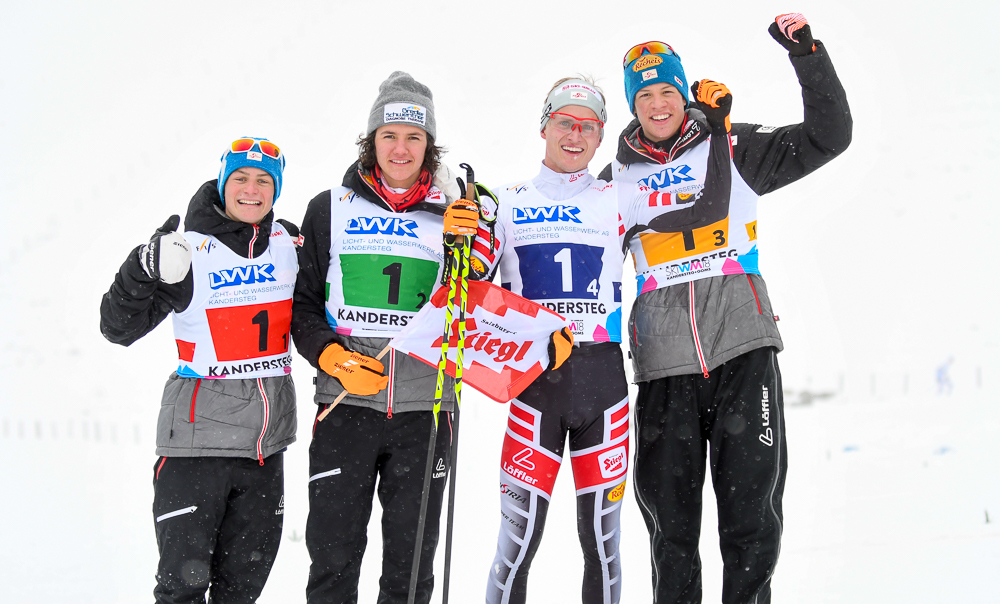
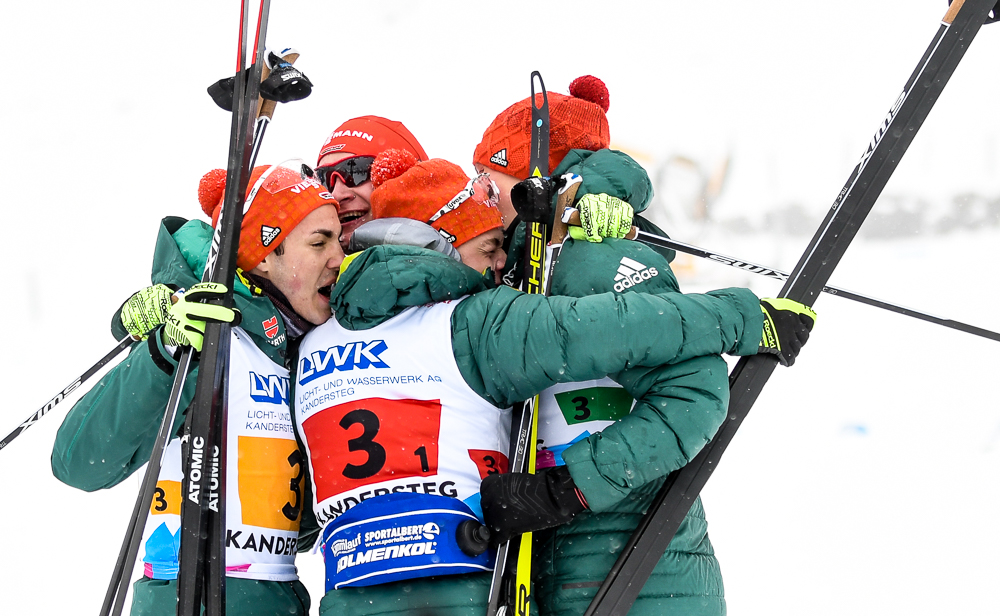
The Austrian team (from left to right: Johannes Lamparter, Florian Dagn, Dominik Terzer, and Mika Vermeulen) celebrates its win in the normal hill/4 x 5 k team event on Thursday at 2018 Nordic Combined Junior World Championships in Kandersteg, Germany. (Photo: JWSC2018.ch)
Nordic Combined Junior World Championships (Kandersteg, Switzerland): Normal hill/4 x 5 k Team Event
In the nordic combined team event at Junior World Championships on Thursday, Austria stole the show, jumping to first then finishing the 4 x 5 k relay first by nearly 48 seconds over Germany in second.
On the 106-meter normal hill in Kandersteg, Austria’s Johannes Lamparter, Mika Vermeulen, Florian Dagn, and Dominik Terzer combined for the best jumping score of the day, 11.8 points ahead of Norway (Simen Kvarstad, Andreas Skoglund, Jens Lurås Oftebro, and Einar Lurås Oftebro) in second. Germany jumped to third with Constantin Schnurr, Julian Schmid, Tim Kopp, and Luis Lehnert another 26 points back.
That put Norway 16 seconds back for the start of the 4 x 5 k relay, and Germany 50 seconds out of first in third.
The four Americans in the event, Tucker Hoefler, Jared Shumate, Stephen Schumann, and Ben Loomis, jumped to 11th out of 13 teams, and started the relay 2:46 minutes back.
Germany celebrates its silver medal in the normal hill/4 x 5 k team event on Thursday at 2018 Nordic Combined Junior World Championships in Kandersteg, Germany. (Photo: JWSC2018.ch)
Austria went on to hold its lead throughout the race, crossing the finish line first in 56:33.0 for the gold. Norway held onto second first Jens Oftebro’s first leg, then slipped to second behind Germany on the second leg. Ultimately, Germany claimed second, 47.8 seconds back, and Norway was third (+1:53.2).
The field remained largely strung out, as the Czech Republic finished fourth (+2:39.7) after starting fourth, France placed fifth (+3:07.7), up from eighth at the start, and Finland finished sixth (+3:27.6), after starting ninth.
The U.S. men improved to seventh (+3:36.4) thanks to a strong first leg from Loomis, who put them in seventh with the fourth-fastest first-leg time. Schumann then skied the fastest second leg and picked off two more places to tag in fifth at the second exchange. Hoefler slipped to seventh on the third leg, and Shumate held them there with the third-fastest anchor leg.
Nordic combined has one more event at Junior Worlds: the individual normal hill/5 k on Saturday.
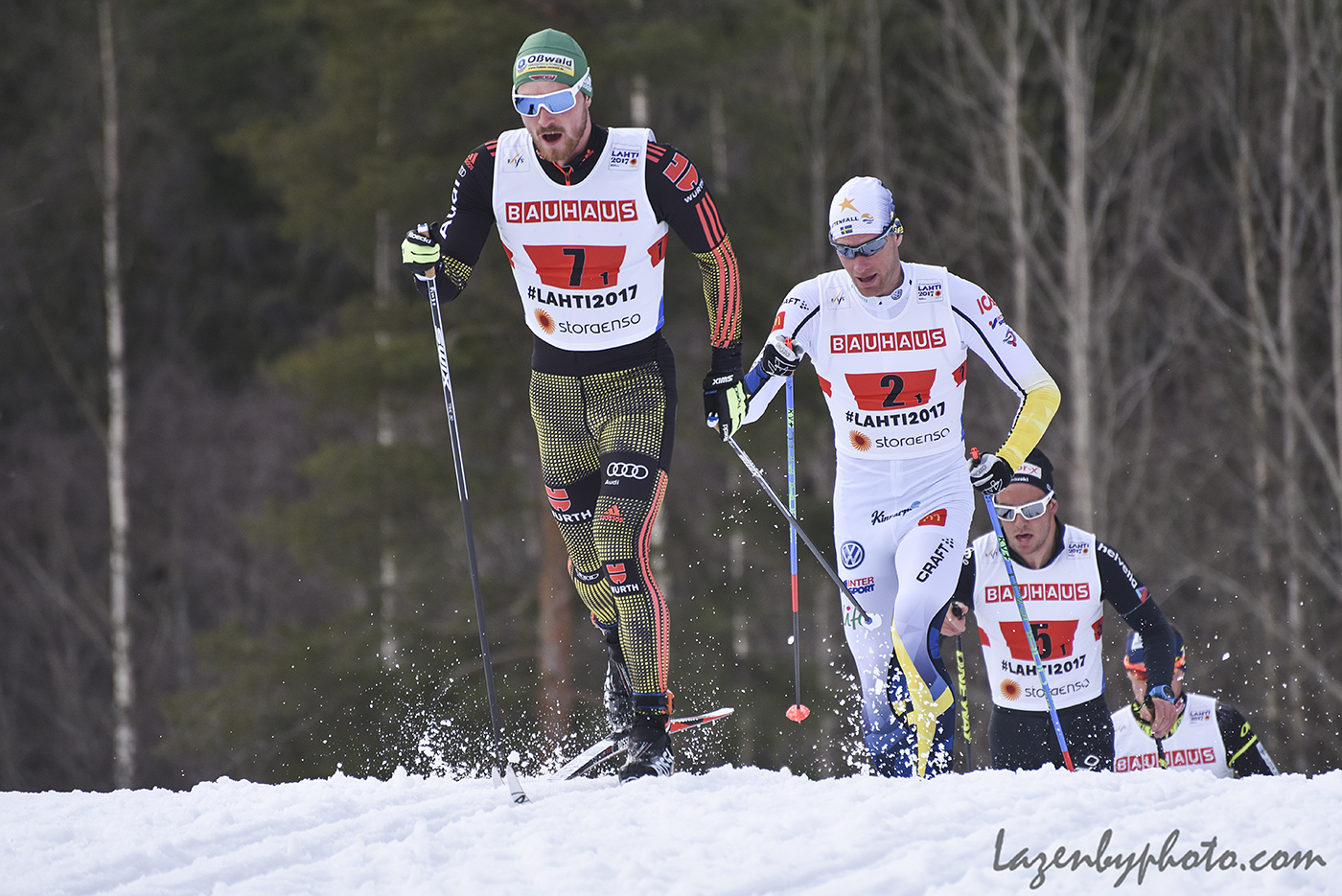
Germany’s Thomas Bing (7) leads Sweden’s Daniel Rickardsson (2) and Switzerland’s Jason Rüesch during the first leg of the men’s 4 x 10 k relay at 2017 World Championships in Lahti, Finland. (Photo: John Lazenby/Lazenbyphoto.com)
Welcome to World Cup Windup, where we check in with the top-10 teams from last year’s FIS Cross Country World Cup tour before the season starts with the Ruka Triple in Kuusamo, Finland, on Nov. 24.
GERMANY
Overall in Nations Cup Last Year:Seventh
Women’s Ranking 2016/2017:Sixth
Men’s Ranking 2016/2017: Ninth
Who’s Back:
Nicole Fessel and Steffi Boehler, top-20 in the World Cup distance standings; sprint finalist Sandra Ringwald; Victoria Carl and Katharina Hennig, who joined Ringwald and Boehler to finish second in the World Cup relay in Ulricehamn; Florian Notz, Elizabeth Schicho, Laura Gimmler, and Thomas Bing, each of whom had a single World Cup top-10 last season, and Hanna Kolb, who had two.
Who’s Missing:
Veteran sprinter Tim Tscharnke retired partway through the summer. The 2010 Olympic team sprint medalist has struggled with back problems and finally called it quits. “The last three years of my career were riddled with many mediocre months, punctuated by health problems and athletic setbacks,” he said.
Pre-Season Results:
The World Cup women’s 4 x 5 k podium on Jan. 22 in Ulricehamn, Sweden, with (from left to right) Germany (Stefanie Boehler, Sandra Ringwald, Victoria Carl, Katharina Hennig) in second, Norway (Ingvild Flugstad Østberg, Heidi Weng, Astrid Uhrenholdt Jacobsen, Marit Bjørgen) in first, and Sweden in third (Ida Ingemarsdotter, Sofia Henriksson, Charlotte Kalla, Hanna Falk). (Photo: Fischer/Nordic Focus)
Earlier this month in Davos, Switzerland, Thomas Bing won a sprint race and Laura Gimmler was the runner-up in the women’s race. Katharina Hennig and Steffi Boehler went 2-3 in a distance race.
Recent Drama:
After being sick in both August and September, Florian Notz is aiming for a World Cup debut in Davos in December, not earlier. “I did not have any real training for two to three months,” he told Südwest Press. “That’s why Kuusamo is too early for me… I have set myself as a goal, that I want to attack fully [in Davos]. I am still optimistic that I can be in shape by then. But of course, everything has to go right.” If not, Olympic qualifying will be tricky.
Lucas Bögl is among the athletes joining the new “Athleten für Deutschland” athlete union, which was recently founded as an independent alternative to the athletes’ council run by the German Olympic Committee. The head of the German Olympic Committee is not a fan, saying basically that athletes trying to make demands will only bring problems upon themselves. Bögl disagreed. “The club should help the athletes commission and support the athletes,” he told OBV-online. “That should be in the interest of everyone involved.” He also said: “Cross-country skiing is not something you do for the money, it’s more of a way of life. I have turned my sport into a profession. I feel privileged that I don’t have to sit in an office. I can do that for a long time after my career is over.”
Sandra Ringwald, who just missed making the 2014 Olympic team for Germany, and is particularly focused on 2018 Games this winter. “I want to fulfill my Olympic dream and be in PyeongChang,” she told the Südkurier newspaper in an interview. “However, I’m going easy on the whole thing. In the past few years I have often set my goals too high… I’m not working just for Olympic qualification. My aim is to play a good role in the World Cup as well. I want to show what I can do at the very first races.”
Best Social Media Presence:
Steffi Boehler is a consistent Instagram poster, and also includes some of her artwork along with training and daily-life pictures.
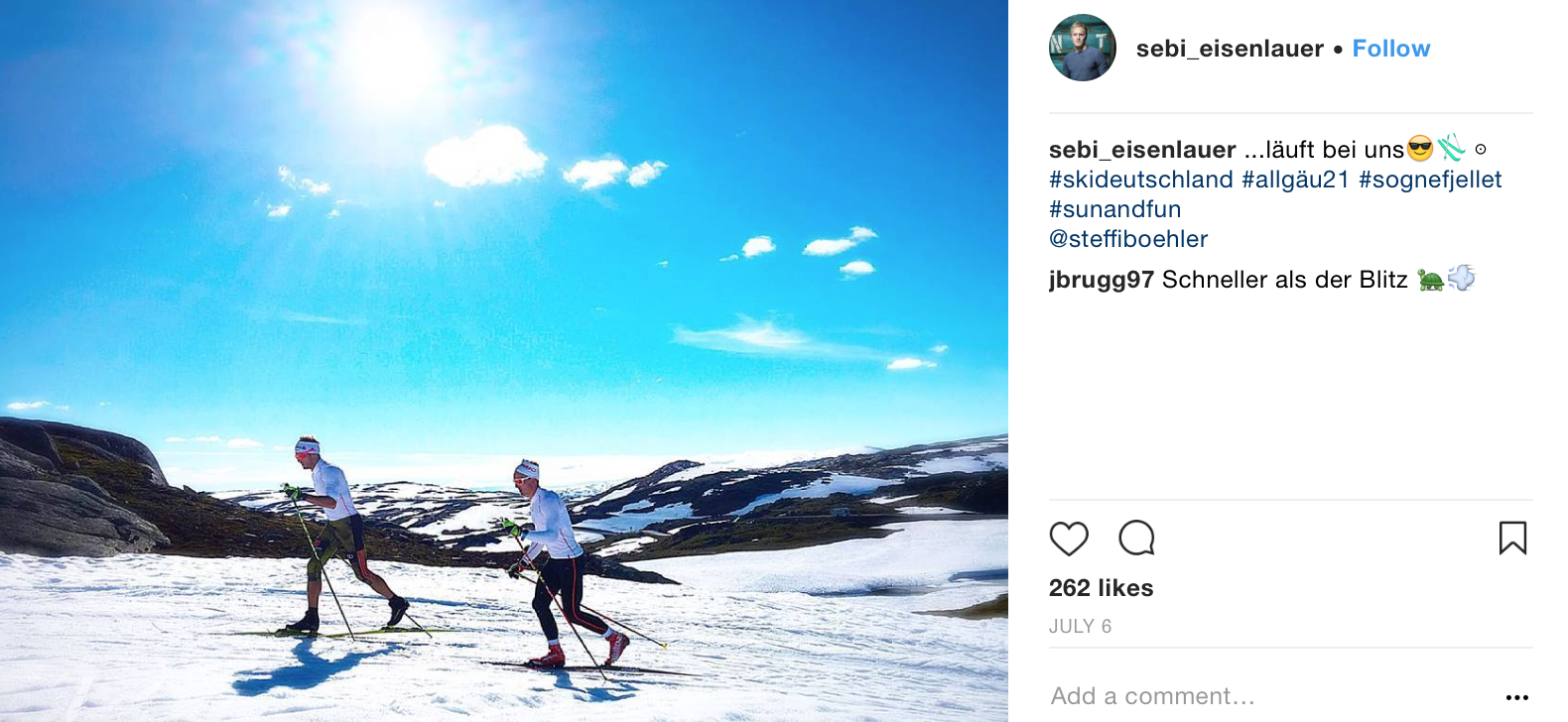
Sprinter Sebastian Eisenlauer also posts gorgeous training shots:
Ann-Cathrin Uhl on a hike in Germany this summer. (Courtesy photo)
Ann-Cathrin Uhl will be a senior at the University of Anchorage Fairbanks (UAF) this year, but for the summer she was back in her native Germany as usual.
Uhl made her first trip to NCAA Skiing Championships last season, finishing 30th and 34th at the races in Jackson, N.H. But she has long been a contributor to the UAF Nanooks effort both on the ski trails and as a cross-country runner. This summer, a group of ski teammates came to visit her in Germany.
Uhl is probably also a familiar name to American competitors as well, because in both 2015 and 2016 she won the junior heats of the classic sprint at U.S. Cross-Country Championships.
University of Alaska Fairbanks women’s nordic-team skiers get together for a photo last season: (from left to right) Hannah Rowland, Anne-Tine Markset, Nichole Bathe, Martina Himma, Ann-Cathrin Uhl, and Sarissa Lammers. (Photo: Nick Crawford)
Uhl took some time over email to share what it’s like to train from her home base in Germany’s Black Forest region, a mountainous region in the southwest of the country.
FasterSkier: Where are you based this summer? What part of the Germany?
Ann-Cathrin Uhl: This summer my training base is mainly the Black Forest, that is the southwestern part of Germany. I am living with my family in Mühlenbach, which is the town I grew up in. During the week I train at home and on some weekends I drive to the Alps for altitude training.
FS: What is your part of the Germany like? How is the landscape? What do people do there?
ACU: I live close to a town called Schonach, where the annual Nordic Combined World Cup is hosted. Sandra Ringwald, the German Nordic World Cup skier is also from this town. The Black Forest is a mountainous region, bordering France and Switzerland. Its beautiful nature with mountains, valleys, gorges, lakes and rivers is reason for lots of tourism. People that live here like to be outside and active. Hiking and mountain biking are very popular.
Uhl competing at German Mountain Running Championships, where she finished 30th and helped her team to sixth place. (Courtesy photo)
FS: Do you have a team that you are training with, or are most of your training sessions alone?
ACU: I don’t have a ski team I can train with. I do all the rollerskiing and strength on my own. But I am training with a professional mountain running team in my area. I actually got to know my teammates pretty well, since we were travelling to competitions together.
FS: How do you design your training — is it based on a plan from Nick at UAF? Are you adapting it at all to be able to match with other people/groups you might have opportunities to join?
ACU: My training is based on the plan from coach Nick at UAF. I am training with the running team two to three times a week and other than that I try to follow Nick’s instructions for rollerskiing, strength, volume, and intensity. Sometimes, I adapt the plan to train with the team.
FS: Is your college training plan very different in terms of volume, types of workouts, or other focus compared to what you would be doing if you were on a German team at the same level?
ACU: My college training plan is pretty similar to what I would be doing on a German team. I believe that Germans do more running and less strength than we do at UAF. Germans highly value intensity running workouts, whereas most of our intensity is on rollerskis, but other than that the plans are similar.
Uhl heading uphill on a rollerski workout. (Courtesy photo)
FS: What’s the hardest workout you have done so far this summer?
ACU: This question is hard to answer. I would say the workouts I did in the Alps were the toughest ones. I did some hard uphill rollerskis and mountain running workouts. Apart from that, I raced at German Mountain Running Nationals with the running team, which was a very intense and tough race.
FS: Are there any absolute favorite places to run or bike or rollerski?
ACU: I love training in South Tyrol, which is in Northern Italy. It’s super fun to do uphill rollerskiing and running in the Italian Alps. Other than that, the Black Forest is perfect for summer training. The landscape is very diverse and therefore perfect for road biking, running, and rollerskiing.
FS: Is your area set up best for some parts of training?
ACU: I honestly thing that the Black Forest is ideal for summer skiing training. At my home we have many excellent hills for intensity, but also hilly and flat areas for longer workouts. We have a million of trails for running and biking, and good bike paths for rollerskiing. We only drive three hours to the Alps for training in bigger mountains. The only thing that is currently missing is more snow in the winters.
FS: What do you do when you are not training? Do you need to have a job?
ACU: I worked a summer job at the tax office for six weeks. In my free time I like to hang out with my friends from home or go swimming at lakes and the local swimming pool.
FS: What is the best part of German summer, aside from training?
ACU: I like being so close to Switzerland, Austria, France, and Italy, because it’s so easy to travel and do some roadtrips. I also like the climate, since it gets up to a 100 degrees.
Finding the cold: Ann-Cathrin Uhl in the mountains this summer. (Courtesy photo)
The men’s 4 x 7.5 k relay podium at the World Cup in Ulricehamn, Sweden, with Norway (c) in first, Sweden (l) in second, and Canada (r) with with its best-ever men’s relay in third. (Photo: FIS Cross Country/Twitter)
FIS Cross-Country World Cup (Ulricehamn, Sweden): 4 x 5 k and 4 x 7.5 k Relays
Norway notched back-to-back team victories in the women’s and men’s relays on Sunday at the World Cup in Ulricehamn, Sweden, with Finn Hågen Krogh securing a win in themen’s 4 x 7.5 k relay by 0.5 seconds over Sweden’s Calle Halfvarsson and Canada’s Lenny Valjas. With two kilometers remaining, nine teams were within 3.8 seconds of first. Krogh outlasted both Halfvarsson and Valjas in the finishing stretch, as Sweden placed second and Canada third for its best-ever relay result, according to a Cross Country Canada press release, besting its fifth-place finish from 2012 (with then-anchor Ivan Babikov, now a Canadian World Cup coach).
Krogh teamed up with Simen Hegstad Krüger, Martin Johnsrud Sundby and Anders Gløersen and finished in 1:06:47.5, while Sweden placed second with Daniel Rickardsson, Johan Olsson, Marcus Hellner, and Halfvarsson.
For Canada, with Devon Kershaw, Alex Harvey, Knute Johnsgaard, and Valjas, it was Harvey’s third-straight World Cup podium, Valjas’s second-straight team-event podium, and national U25 Team member Johnsgaard’s first podium.
“I have been waiting my whole career for this,” Kershaw said, according to a FIS press release. “All the guys did a great job today.”
The U.S. placed 10th (+1:16.5) with Andy Newell, Erik Bjornsen, Noah Hoffman, and Simi Hamilton.
The Norwegian women’s team (center) won the 4 x 5 k World Cup cross-country relay in Ulricehamn, Sweden, by 8.8 seconds over Germany (left), with home team Sweden (right) edging the United States for third.
Earlier on Sunday, the women’s 4 x 5 k relay didn’t break apart until the second leg, but Norway still proved its dominance over the ski world with a win to start the day.
After the group of Ingvild Flugstad Østberg and Lotta Udnes Weng (Norway), Ida Ingemarsdotter (Sweden), and Anamarija Lampic (Slovenia) more or less stayed together on the first relay leg, Heidi Weng made a break for it, giving Norway a 16.8-second lead at the second tag. The Norwegian team never looked back and after the race Weng and teammates Østberg, Astrid Jacobsen, and Marit Bjørgen were able to climb to the top step of the podium.
The race for second place, though, wasn’t resolved until the finish line. Sweden, Slovenia, Norway’s second team, the United States, and Germany were all in contention at various points in the race.
On the last leg, Jessie Diggins of the U.S., Sandra Ringwald of Germany, and Hanna Falk of Sweden battled it out, dropping Kari Øyre Slind of Norway. The three shot to the finish line together, with Diggins stuck behind the other two. Ringwald eventually won the sprint finish by 0.2 seconds over Falk, with Diggins another 0.2 seconds back in fourth.
That gave Ringwald, Katharina Hennig, Stefanie Boehler, and Victoria Carl a second-place result, one of Germany’s best since taking silver at the 2010 Olympics. (The team won bronze at the 2014 Olympics.)
Ingemarsdotter, Falk, Charlotte Kalla, and Sofia Henriksson took the third step of the podium. Rosie Brennan, Sadie Bjornsen, Liz Stephen, and Diggins were left to settle for fourth.
The second U.S. team, of Kikkan Randall, Ida Sargent, Sophie Caldwell, and SuperTour leader Liz Guiney finished 12th after skiing in 8th and 9th earlier in the race.
NorAm Western Canadian Championships (Whistler, B.C.): Relays
[UPDATED] This season brought a changeup to the Western Canadian Championships with a three-person relay event in response to athletes’ request to add “fun” events to the NorAm series.
While 146 teams finished in 17 categories, it was Ontario winning the open men’s 3 x 7.5 k in 50:32.9 (Bob Thompson, Jack Carlyle and Andy Shields) and B.C. dominating the open women’s 3 x 5 k in 41:09.47 with three juniors (Katie Weaver, Anna Goodwin and Hannah Mehain).
The masters men and juvenile girls categories included the most teams, with 15 and 14, respectively.
FIS Nordic Combined World Cup (Chaux-Neuve, France): Individual large hill/10 k
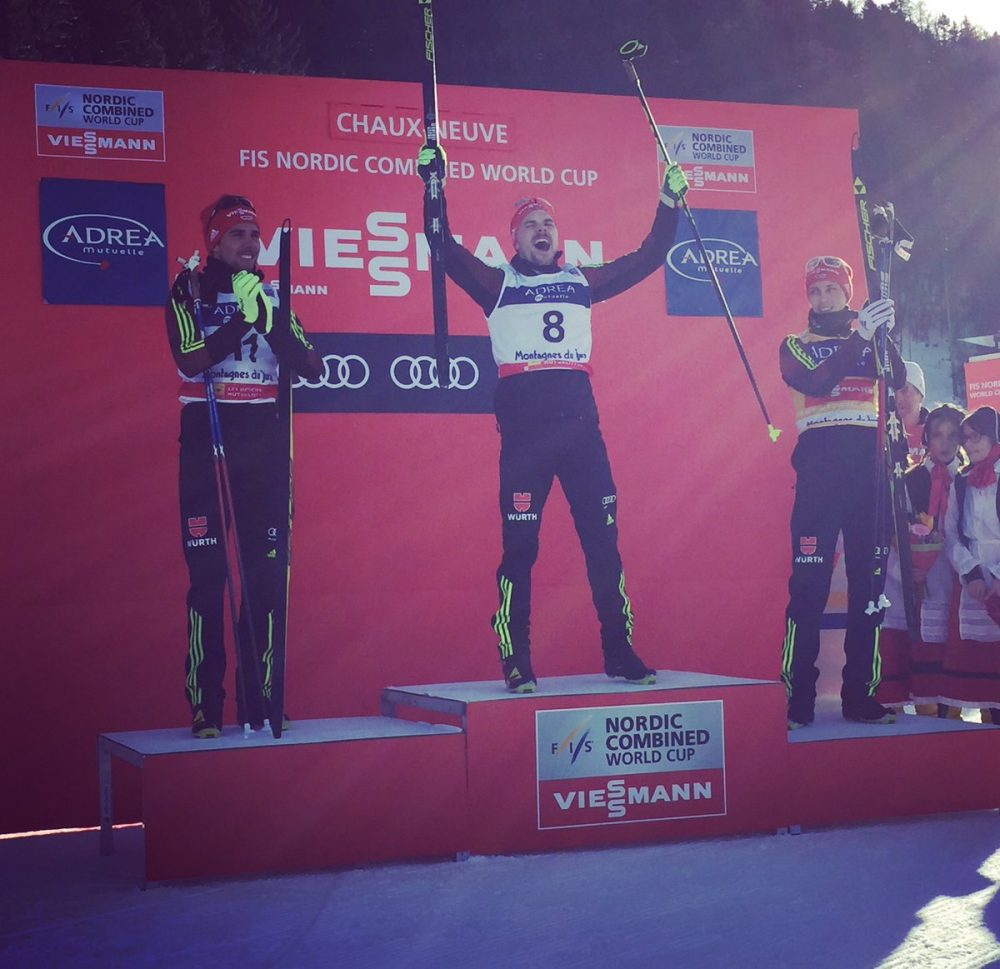
Sunday’s Nordic Combined World Cup podium in Chaux-Neuve, France, with German winner Fabian Rießle (c), German runner-up Johannes Rydzek (l), and Germany’s Eric Frenzel (r) in third. (Photo: FIS Nordic Combined/Twitter)
On Sunday, after the large hill jump and 10 k ski, Germany swept the podium in the second event of the NoCo World Cup in Chaux-Neuve, France. Fabian Rießle placed first in 22:44, and his German teammates Johannes Rydzek skied to second only 2.2 seconds back, and Saturday’s winner Eric Frenzel was third (+7.9).
(Frenzel leads the NoCo World Cup, Rydzek is second overall, Rießle is third.)
Norway’s Jarl Magnus Riiber flew the farthest with 139.8 points. Franz-Josef Rehrl from Austria jumped to second with 135.7 points while his teammate Bernhard Gruber jumped to third with 131.7 points.
Magnus faded to 23rd (+47.5) in the 10 k ski. Rehrl started 15 seconds back from Magnus and placed 17th overall (+31.5). Gruber maintained a top-ten, placing 9th (+13.5), after starting 32 seconds behind first place jumper Magnus.
While the top three jumpers all dropped back in the ski, it was a day of catch up for the German’s after the jumping portion.
Rießle ranked eigth after the jump and earned 128.7 points, he began the ski 0:44 back. Rydzek placed 11th in the jump with 126.9 points, while Frenzel jumped to fourth with 131.4 points.
The only U.S. skier entered in Sunday’s event was Ben Berend. The U.S. Nordic Combined skier jumped to 13th with 126.8 points — starting the ski 0:52 behind Magnus. Yet Berend couldn’t capitalize on his strong jump, he dropped to 37th (+2:06) after the ski.
The Nordic Combined World Cup continues next Friday in Seefeld, Austria.
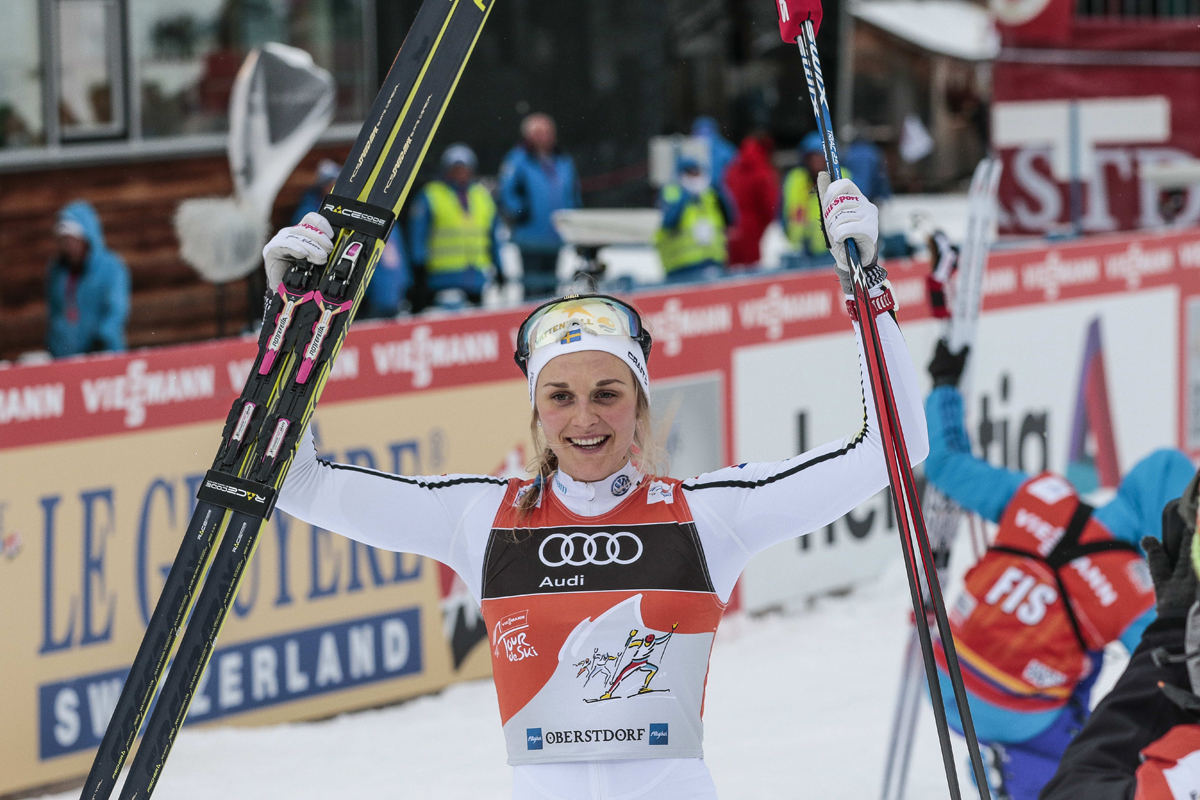
Sweden’s Stina Nilsson celebrates her third victory in four stages of the 2016/2017 Tour de Ski so far, with her 10 k freestyle pursuit win on Wednesday in Oberstdorf, Germany. (Photo: Fischer/NordicFocus)
The immovable object that is the Norwegian women’s ski team may finally have met an unstoppable force: 23-year-old Swede Stina Nilsson.
Norway’s stars Heidi Weng and Ingvild Flugstad Østberg skied with Nilsson for most of Wednesday’s 10 kilometer freestyle pursuit, the fourth stage of this year’s Tour de Ski. But in the end Nilsson came flying off the final downhill in Oberstdorf, Germany, in exactly the same position she had the previous day: first place.
“It is amazing to win again here in Oberstdorf,” she told FIS.
It took part of the first lap for the Norwegians to catch Nilsson. The Swede started with a four-second advantage over Weng and another eight seconds on Østberg.
Østberg quickly caught her teammate. The pair worked together to ski up to Nilsson, who led them around the rest of the 2.5 k loop before pulling aside at the lap marker and asking someone else to lead.
Nilsson appeared to lose a little on some of the uphills, but always caught up easily going down the other side. Her skis were demonstrably faster than those of either Norwegian.
Weng and Østberg occasionally asked her to lead, but Nilsson deferred.
But the Norwegian duo didn’t exactly share the burden of leading. Østberg did most of the work while Weng followed.
“I realized pretty quickly that the other two were not so interested in leading,” Østberg told Norwegian broadcaster NRK. “I hoped they would take some. But somehow there wasn’t a meter to be gotten from Stina and Heidi.”
“Ingvild did an amazing job today,” Weng told FIS. “She was in the front most of the time.”
She later told NRK that the “struggled at the back” almost the whole way in their three-woman pack, and could “just barely keep up.”
And with a windy snowstorm gathering in the German mountain town, being the tip of the spear wasn’t a popular position.
“We almost got blown away by the wind a few times,” seventh-place Nathalie von Siebenthal told Switzerland’s SRF broadcaster.
After sticking with the Norwegians all race and knowing that she had fast skis, Nilsson raced confidently on the last lap.
“My tactic was not to be in the front– I wanted to be in a good position before the last downhill,” she told FIS.
Østberg pushed hard to get away from the other two on the final climb, and a tiny bit of daylight emerged between her and Weng. But Nilsson managed to stay just on Weng’s tails.
On the course’s final up-and-over blip, she sailed past Østberg and secured the inside lane coming.
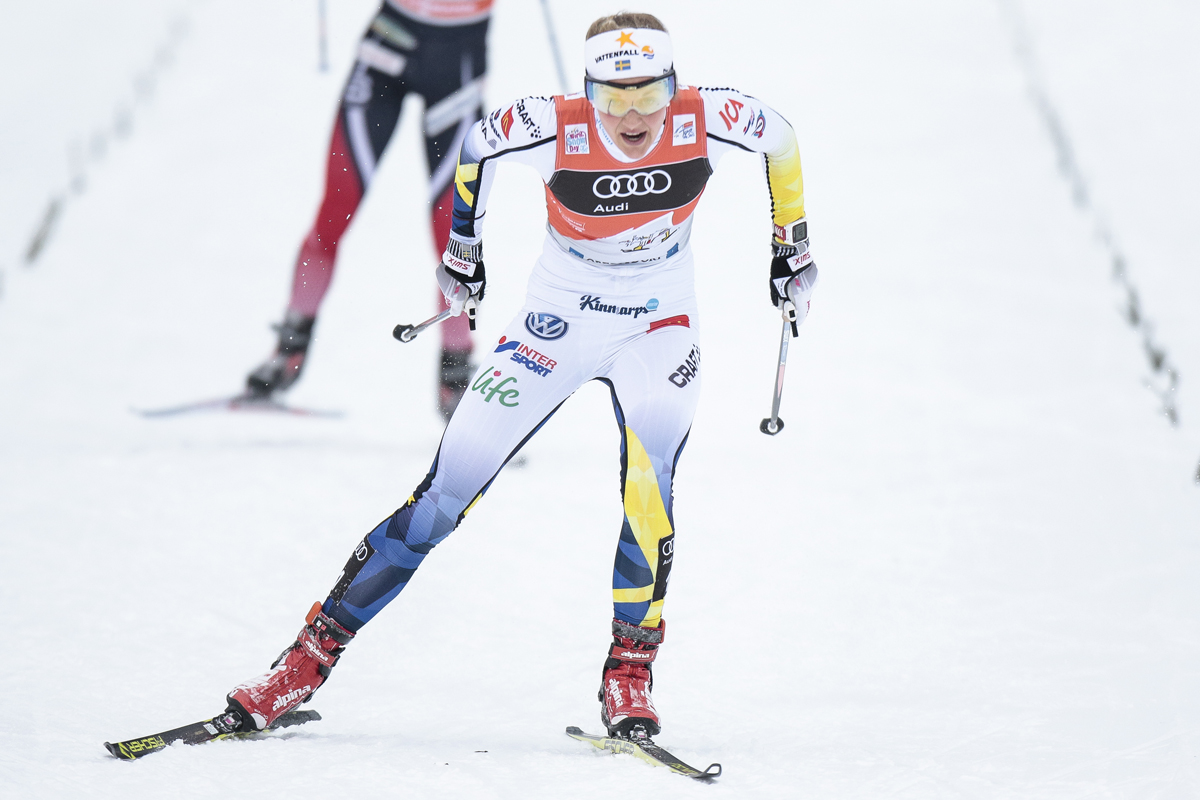
Sweden’s Stina Nilsson racing to the win in Wednesday’s 10 k freestyle pursuit at Stage 4 of the Tour de Ski in Oberstdorf, Germany, ahead of Norway’s Heidi Weng in second and Ingvild Flugstad Østberg in third. (Photo: Fischer/NordicFocus)
“Stina is insanely strong at the end and she knows it,” Østberg told Swedish news service Expressen. “She wants to play her strong cards, it’s understandable… I did not get much help [at the front]. But there was nothing wrong with what Heidi and Stina did. One must go as they want.”
Nilsson opened up a solid lead in the final meters. Weng (+1.2) outsprinted Østberg (+1.8) for second place.
Krista Parmakoski of Finland held on to fourth after skiing the whole race by herself. She initially closed some time on the leaders, but as their race heated up in the final lap she slipped back. The Finn eventually finished 42.4 seconds back.
To add insult to injury, the bonus seconds awarded to the first three women across the line mean that she is now actually even farther – 57.4 seconds – behind in the overall Tour de Ski standings.
Parmakoski argued that bonus seconds in pursuits should be awarded to the fastest “time of the day.” She believes the current system gives too much advantage to those who are already winning.
“It was a tough competition [for me],” she told Finland’s Iltalehti news service, according to a translation. “It was a tougher performance than for the front three… I had the wind gusts alone.”
But a different bonus structure wouldn’t have changed her ranking on Wednesday. Østberg, Weng, and Nilsson had the fastest ski times of the day, in that order.
Diggins and Bjornsen Maintain Positions
Jessie Diggins clinches fifth place in the current Tour de Ski standings with a tough effort in the Oberstdorf pursuit. (Photo: Salomon/NordicFocus)
Four members of the U.S. team had top-12 results in either the final pursuit standings or the time-of-the-day results. And they got there in a lot of different ways.
Jessie Diggins, coming off a podium in the skiathlon, started and finished in fifth place. She was unable to make up any time on the leaders or fourth-place Parmakoski.
“Today wasn’t a great day for me, but that’s why it’s a stop on the Tour- you keep going and you never know when it’s going to be your day!” she wrote in an email. “I skied completely alone the entire race and with the gusts of wind it would have been a good day to be able to team up and work together with other skiers, but that’s just how it is sometimes!”
Diggins actually slipped back considerably, and now sits 2:02.5 behind Nilsson in the overall rankings.
“I also think we missed a little something on her skis,” U.S. Ski Team coach Jason Cork said in a USSA press release, before concluding on an optimistic note. “But we have a rest day tomorrow and the course at Toblach [Italy] is a favorite of hers. The weather is cold and that’s something she thrives in.”
Despite a bit of disappointment, the fifth-place spot is secure for now. Diggins is 51.6 seconds ahead of Germany’s Nicole Fessel in the Tour standings going into Friday’s 5 k skate.
“Looking forward to Toblach as I really love that venue!” Diggins wrote.
For Sadie Bjornsen – who started 11th and finished 12th – a slip from the previous day’s stellar results also didn’t lose her an advantageous position in the overall Tour standings.
“I am excited to still be in a good place in the Tour, and I can’t wait for an individual start here in Toblach,” Bjornsen wrote in an email. “We are just now getting to the exciting part when everyone starts getting a little tired!”
Bjornsen started out early in a pack with Fessel and several others. But on the second of four trips of the 35-meter-tall Burgstall hill, Fessel, Switzerland’s Nathalie Von Siebenthal, and Russia’s Yulia Tchekaleva made a break and left the rest of the chase pack in the dust.
Bjornsen was trapped behind another struggling skier, and couldn’t cover their move.
“It was a fine effort today,” she wrote. “But I feel like had I been in a better position to go with Nicole and Yulia, that would have been ideal.”
Fast Pursuits by Randall and Stephen
Two other Americans, Liz Stephen and Kikkan Randall, clocked particularly fast isolated pursuit times.
Kikkan Randall racing in the skiathlon in Oberstdorf on Tuesday. (Photo: Fischer/NordicFocus)
Randall fairly quickly closed the gap to the group Bjornsen was skiing in.
“I was starting just a few seconds behind [Sweden’s] Charlotte Kalla and a couple other skiers, So I made a big effort right away to link up with those girls,” Randall explained. “Then we were a pack of five, I think, so I was able to just sit in the pack and work and get my rhythm.”
Stephen later caught up as well. She had come into the day 3:53 back from the leaders, but started as part of a wave of skiers at three minutes after Nilsson.
“Honestly, starting from a wave was the most mellow mass start all season,” Stephen laughed. “It went pretty smoothly and it was a really fun race. The courses here in Obertsdorf were really wide today because we didn’t have to have the classic tracks [on the side] as well, so there were plenty of opportunities to move if you wanted to.”
The wind, however, was certainly a factor in deciding when and where she could make her moves.
“There was a lot of having to draft. It was definitely a very engaging race where you needed to stay close to the person ahead of you,” Stephen said. “If you were trying to bridge some gaps, it was definitely a challenge. But I felt I was able to give a full effort. It took me maybe a lap and a half to bridge to Sadie and Kikkan’s group. That was a bit frustrating, but we did it and once we caught that group, they were working hard… I could ski the way I would have skied, basically, if I was by myself.”
Stephen had essentially received a 53-second time credit at the start of the race. She lost those seconds back again at the finish. Stephen is now 26th in the Tour, despite crossing the line a few places higher up.
Randall had the 11th-fastest time, and was able to jump from 19th to tenth.
The Tour de Ski has proved a turning point for Randall’s season. She failed to crack the top-30 in the first period of World Cup racing – her first competitions back after taking a year off to have a baby. But Randall hasn’t been out of the top-30 since the seven-stage series started.
“It’s really cool to do these back to back races, because whether it goes well, or not well, you get another chance the next day,” she said. “I had some good feelings in the skate portion of the race yesterday, and I was looking forward to today. My results so far in the tour set me up really well today.”
Out of the big pack that included Bjornsen, Stephen and others, Randall was able to lead across the line.
“I had good energy and made a big move on the final climb and kind of got to the front of the train,” Randall said. “I was happy to have that extra gear at the end of the race. All the back to back racing has been helping me sharpen my race form, and get the race feelings back.”
“Getting to watch Kikkan and Sadie make a move on that last uphill…” Stephen mused. “Almost nobody could stay with that, and I just certainly had nothing for it. It was really fun to watch that happen. Especially for Kikkan. She hasn’t had the season that she’s wanted yet and is racing herself back into form. It was just fun to see the old Kikkan come back. There’s a lot more to come.”
Rosie Brennan started and finished 42nd. She is 7:47.9 behind Nilsson in the Tour standings.
The Tour de Ski Stage 2 women’s podium on Sunday with (from left to right) Norway’s runner-up Heidi Weng and winner Ingvild Flugstad Østberg, and Finland’s third-place finisher Krista Pärmäkoski in the 5-kilometer classic mass start in Val Müstair, Switzerland. (Photo: Fischer/NordicFocus)
Maybe it was because she wanted redress. Maybe it was because there was less pressure to perform. Or maybe it was because the yellow Tour de Ski (TDS) leader’s bib was with Sweden, calling her Norwegian name.
Whatever it was, when Ingvild Flugstad Østberg lined up for the women’s 5-kilometer classic mass start on Sunday in Val Müstair, Switzerland, she was ready to race for the win.
After being eliminated in the semifinal of Saturday’s freestyle sprint, the 26-year-old turned the lost chance at a podium into an opportunity to prove her place as a top contender.
“I was irritated with myself after yesterday,” Østberg told NRK.
“Such a result sometimes makes you give your best,” she added, according to a International Ski Federation (FIS) press release.
American Jessie Diggins (6) chases down Norway’s Maiken Caspersen Falla (2) at the start of the the women’s 5-kilometer classic mass start on Sunday in Val Müstair, Switzerland. (Photo: Fischer/NordicFocus)
Wearing bib 5, Østberg had her Norwegian teammates, Maiken Caspersen Falla in bib 2, Heidi Weng in bib 3, and Kathrine Rolsted Harsem in bib 4, as well as the Stage 1 TDS leader, Stina Nilsson to chase down.
That didn’t stop Østberg from rallying to the front off the gun, leading the mass of skiers through the first lap, with Weng just behind. As the women started their second lap of the 2.5 k course, a gap began forming between the Norwegians and a second front group, Nilsson and Finland’s Krista Pärmäkoski.
Moving up through the pack into the top 10 by lap one was Finland’s Anne Kyllönen, who started in bib 29, as well as her Finnish teammate Laura Mononen, who started in bib 19.
Switzerland’s Nadine Fähndrich, who started in bib 15, had also joined the front chase group, along with her Swiss teammate Laurien van der Graaff (bib 7). Just behind the Swiss duo was American Jessie Diggins (bib 6) positioned in eighth. Diggins’s U.S. Ski Team (USST) teammate Sadie Bjornsen, who had started in bib 21, had burned her way up to ninth.
Bjornsen’s hot start, however, didn’t last. The American began to fade, falling back into the low 20’s and eventually just outside of the points in 35th, where she ended the day.
“I was behind Nadine [Fähndrich] and Laurien [van der Graaff] and picked the innermost track, so in principle the best lane, and exactly on that lane Bjornsen bonked, totally, she couldn’t move anymore,” Switzerland’s Natalie von Siebenthal said during a television interview. “And I couldn’t get past left or right. Then the other athletes started to go by on my left.”
USST Women’s Coach Matt Whitcomb explained that hard start was part of Bjornsen’s plan. The way her body reacted was not.
“She took it out aggressively, which we told her to do and is always encouraged to do and just didn’t feel good today,” Whitcomb said on the phone after Sunday’s race.
Bjornsen explained that while the result was not what she hoped for, she is ready to move forward with no weight on her shoulders.
“Today was a day to forget and refocus,” Bjornsen wrote in an email. “I had a strong start, and felt great, but felt like I was working extra hard with some potentially slow skis. As soon as I crossed the red line, I wasn’t able to recover as I was hoping, and suffered a pretty bad explosion … Now I am focused on the next two events in Germany, and will hopefully find the good shape I know I am capable of!”
Maintaining position was the name of game for the remainder of the race for those still in the top 10, with Diggins sticking to her spot in eighth and Østberg holding off any attack attempts from Weng.
“I’ve been struggling a bit with the high altitude here,” Weng said according to a FIS press release. “Before the race I was afraid about the downhills but I’m happy I did not fall.”
While Weng was able to avoid any crashes, American Kikkan Randall was not so lucky. Though she had been skiing around 15th for most of the first lap, after starting in bib 17, she fell and had to make her way back into the top 20.
American Kikkan Randall after a crash just over halfway through the women’s 5-kilometer classic mass start on Sunday in Val Müstair, Switzerland. (Photo: Fischer/NordicFocus)
“My shape feels a lot better and sharper than it did in period one of World Cup,” Randall wrote in an email to several media outlets. “Really pumped to feel my race gears coming around and loving the chance to race, race, race!”
“It was so cool to watch an athlete have a breakthrough like that,” Whitcomb said of Randall’s performance. “To start off the Tour with two good races in the points, we all feel really good about that and the team is really proud of her.”
Eventually, with a close to 20-meter gap, Østberg finished first for the win in 13:21.2 minutes. Weng claimed second place, seven seconds back, while third went to Pärmäkoski who finished 11.4 seconds after Østberg.
Diggins crossed 32.6 seconds after Østberg for eighth.
“It was tricky to pace and if I could do it again I would have paced it slightly differently, but I was happy with my skis and I’m chipping away at that striding technique!” Diggins wrote in an email. “Overall I think I’m in a solid place for the tour and I’m really looking forward to the next set of races!”
Randall was the second American after Diggins in 15th (+42.4) followed by Bjornsen, who placed 35th (+1:02.6) in a photo finish with Slovenia’s Petra Novakova. Also racing for the U.S., Sophie Caldwell placed 38th (+1:09.4), Rosie Brennan 39th (+1:10.5), and Liz Stephen 44th (+1:21.2).
“There’s not a whole lot of movement that’s possible in a 5 k classic mass start … when you’re starting out of the top 20,” Whitcomb said. “Rosie and Liz were fighting from the back. … For their position in the start, I thought they skied phenomenally.”
As the USST makes its way to Oberstdorf, Germany, for the third and fourth stages of the Tour — a 10 k skiathlon and 10 k freestyle pursuit — Whitcomb remains positive of where the U.S. women are currently positioned. Diggins currently sits in sixth in the overall Tour standings, 1:01 minutes behind Østberg, Randall 15th (+1:45.9) and Bjornsen 25th (+2:05.4). Caldwell, who is ranked 22nd overall (+2:03.3), planned to withdraw from the Tour after Sunday. Brennan in is 41st (+2:33.1) and Stephen 46th (+2:49.9).
“We don’t put any specific goals or demands for any athlete on any one particular race,” Whitcomb explained. “What we try and do is link together as many quality races in a row as we can. If you can string together a bunch of decent days, and then pop one great one, it can move you way up in the tour.”
Østberg now leads the Tour followed by Weng 10.3 seconds back in second and Nilsson in third (+23.8).
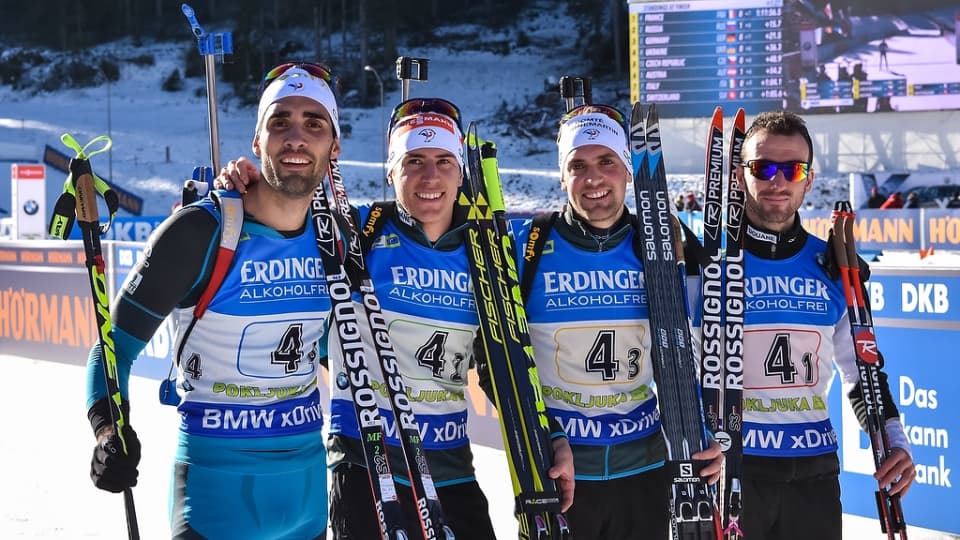
The French men’s relay team after their IBU World Cup win on Sunday in Pokljuka, Slovenia, with (from left to right) Martin Fourcade, Quentin Fillon Maillet, Simon Desthieux, and Jean-Guillaume Béatrix. They beat Russia by 15.7 seconds for the win. (Photo: IBU)
Welcome to The Rundown, your quick primer of need-to-know information about the day’s racing. We’ll be updating this digest as the day goes on with additional results, photos and quotes. The Rundown is NOT a race report; stay tuned for complete race reports later today with interviews from the day’s top racers.
***
Note: This recap has been updated to reflect the correct positions each of the four Canadian women exchanged in during Sunday’s 4 x 6 k IBU World Cup relay.
IBU World Cup in Pokljuka: Men’s & Women’s Relays
Germany and France reached the podium in both the men’s 4 x 7.5-kilometer and women’s 4 x 6 k sprints on Sunday, the final day of the International Biathlon Union (IBU) World Cup in Pokljuka, Slovenia.
France won the men’s race by 15.7 seconds over Russia with a total of seven spare rounds and zero penalties. Jean-Guillaume Béatrix started off by putting the French team in fourth, then Quentin Fillon Maillet elevated them to first, a position both Simon Desthieux and Martin Fourcade held for the victory in 1:11:56.5.
“When we started the relay, we thought that winning was possible,” Béatrix said, according to an IBU press release. “At the same time, the competition was very tough. There were many strong teams today.”
“I was very happy to tag Martin with a 20-second lead,” Desthieux said. “This is good for my confidence.”
Russia placed second with Maxim Tsvetkov, Anton Babikov, Matvey Eliseev, and Anton Shipulin, the four of which combined for one penalty (on Eliseev’s third leg) and six spare rounds.
Germany rounded out the podium in third, 21.5 seconds behind France, with Erik Lesser, Matthias Dorfer, Benedikt Doll, and Simon Schempp. In ninth after Lesser’s first leg, Dorfer brough the team to eighth and Doll raced them into second before Schempp lost one place to end up third. They used a total of 11 spares but avoided the penalty lap.
Canada placed 10th of 22 teams, 1:44.7 out of first with one penalty and seven spares. Christian Gow started the team out with clean shooting and tagged off in sixth at the first exchange, and his older brother Scott Gow also shot clean without any spares to move up to fourth at the second tag. Macx Davies required three spares and had to ski a penalty lap on his prone stage, then used another spare to clean standing and tagged off in 14th place. Brendan Green anchored the Canadians to 10th, using three spares but avoiding a penalty in prone, then cleaning standing without any spares.
“I had a somewhat disappointing pursuit race yesterday, and my goal for today was to refocus on the range and push the ski speed as much as possible,” 28-year-old Scott Gow told Biathlon Canada, according to a press release. “I was happy with the overall performance I was able to put forward for my leg of the relay, and I was especially happy with another clean shooting day.
“Today was an acceptable result for the team,” he added. “Christian and I are very proud of our results so far this season. We worked very hard all year to try and elevate our racing abilities to the next level, and we saw our hard work pay off today with great skiing and perfect shooting for both of us. It’s also a big confidence boost going forward with the season knowing we are capable of competing among the best.”
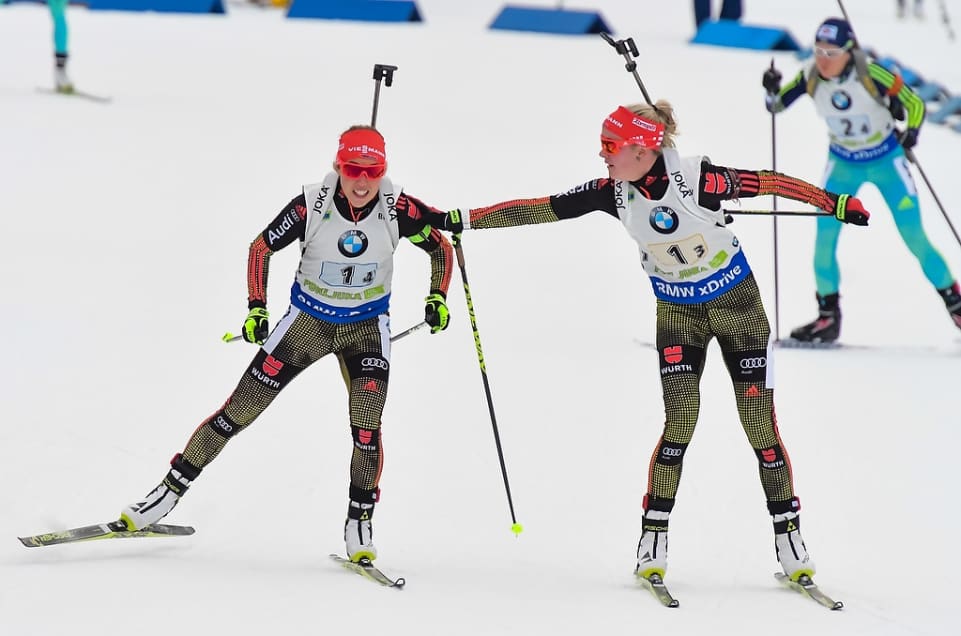
Germany’s Karen Hammerschmidt (l) tagging her teammate Laura Dahlmeier in second place at the final exchange of the women’s 4 x 6 k relay at the IBU World Cup in Pokljuka, Slovenia. Dahlmeier anchored the team to the win by 10.1 seconds over France. (Photo: IBU)
In the women’s relay on Sunday, Germany took first by 10.1 seconds over France, using nine spares but no penalties.
Vanessa Hinz started the Germans out and tagged off in fifth, and second-leg Franziska Hildebrand moved them up into second by the halfway point. Karen Hammerschmidt held that position, which was enough for Laura Dahlmeier who anchored them to the win in 1:11:31.1.
“This was a brutally beautiful race today,” Dahlmeier told German broadcaster ZDF after her third win in as many races in Pokljuka. “It was very fun, and I was very relaxed because I knew we were competing as a team. Even if you don’t have as much power left there are still three others. I was on top of my game and just enjoyed it. I really looked forward to the race, although yesterday I was knocked out. But on the course I had a good feeling right from the start.”
France in second and Ukraine in third (+37.7) both required just three spare rounds and no penalties per team. France secured second place with Anais Chevalier (who initially tagged off in 11th), Justine Braisaz (who picked off eight places to move into third), Celia Aymonier (who tagged off in first), and Marie Dorin Habert (who cleaned without any spares but came up 10 seconds short of Dahlmeier at the finish).
Ukraine reached the podium with Iryna Varvynets, Yuliia Dzhima, Olena Pidhrushna, and Anastasiya Merkushyna.
Canada placed 11th (+3:33.1) with a total of just four spares and no penalties. Sarah Beaudry initially tagged off in 23rd, Rosanna Crawford skied them into 18th, Megan Tandy shot clean without any spares and tagged off in 14th, and Julia Ransom anchored them to 11th out of 23 teams.
The U.S. did not field a men’s or women’s relay team, with just three men and three women in Pokljuka.
FIS Cross-Country World Cup in Davos: Freestyle Sprints
In the men’s 1.6-kilometer freestyle sprint on Sunday it was Russia’s Sergey Ustiugov who emerged victorious, besting Finn Hågen Krogh of Norway and his Norwegian teammate Sindre Bjørnestad Skar for first.
After qualifying 29th overall, Ustiugov crossed first in his quarterfinal and held the led through his semifinal and into the final, winning in a time of 2:24.65. Krogh crossed 0.59 tenths of a second behind him for second place and Skar took the final podium spot, crossing 3.29 seconds after Ustiugov.
Also in the sprint final was Russia’s Alexey Petukhov, who finished just off the podium in fourth (+3.47), Norwegian Emil Iversen in fifth (+5.52) and France’s Lucas Chanavat —who won the qualifier — ended the day in sixth (+11.48).
Lucas Chanavat of France had the fastest men’s qualifying time in the Davos World Cup freestyle sprint on Sunday.
Canada’s Lenny Valjas was the top North American finisher for the day, qualifying 12th and advancing to the quarterfinals where he finished in 14th overall. No other Canadians made the sprint heats, with Alex Harvey left just outside advancing in 33rd, Devon Kershaw ending the day in 49th, Knute Johnsgaard 60th, Bob Thompson 67th, and Andy Shields 73rd. Jesse Cockney did not finish the race.
Simi Hamilton led the U.S. in 24th (+3.88). Andy Newellwas just outside the heats in 36th, and Eric Packer placed 95th (+21.62).
In the women’s 1.6 k freestyle sprint, Maiken Caspersen Falla of Norway took the overall win, crossing in a time of 2:44.63. Just 0.53 tenths of a second behind Falla was her Norwegian teammate Ingvild Flugstad Østberg in second place overall. The final women’s podium finisher, Hanna Falk of Sweden was 0.60 tenths of second off Falla in third.
U.S. Ski Team member, Jessie Diggins made the final, racing to a fifth place overall (+5.91), behind Sweden’s Jonna Sundling in fourth (+1.04) and ahead of Russia’s Natlalia Matveeva in sixth (+6.80).
The United States put three other women into the heats, including Sophie Caldwell who finished 11th, Sadie Bjornsen 15th, and Ida Sargent 20th.
American Caitlin Patterson ended the day 47th, Kikkan Randall 58th, and Liz Stephen 61st.
Dahria Beatty was the top Canadian on Sunday, finishing in 25th overall. Cendrine Browne ended the day 53rd and Sophie Carrier-Laforte 59th.
NorAm/SuperTour at Sovereign Lake: 10/15 k Freestyle
[UPDATE] It was Americans owning the podium again Sunday at Sovereign Lake, and a little bit more. It was warmer on Sunday, -7 Celsius, and snowed lightly throughout.
The men’s 15 k freestyle was first on the schedule. APU’s Scott Patterson won in 40:00.2, followed by Saturday’s A-finalist Matt Gelso at 13.2 seconds and Vail’s Tad Elliot at +26.6.
The top Canadian was Team R.A.D.’s Russell Kennedy in ninth, at 1:38.8 behind.
In the women’s 10 k freestyle, the podium was owned by APU’s Chelsea Holmes in 30:42.9. SMS Elite’s Katharine Ogden was second at 13.4 seconds, also winning the junior category. Her teammate Erika Flowers was third, 36.4 behind.
AWCA’s Olivia Bouffard-Nesbitt was the top Canadian for the second day, placing 13th at 1:51.8.
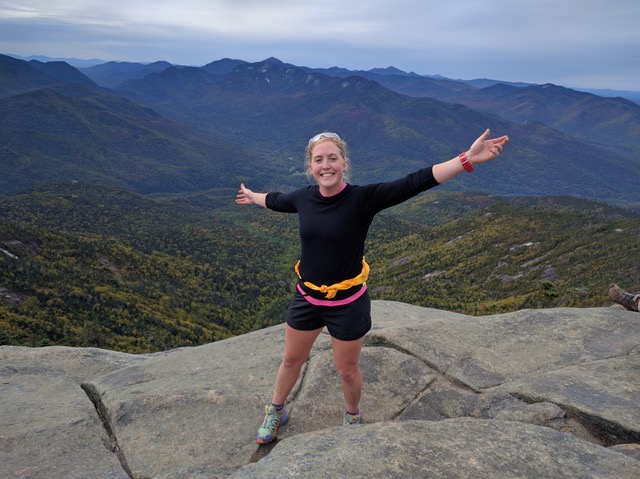
US Biathlon A-teamer Maddie Phaneuf hiking in the Adirondacks this fall. (Courtesy photo)
Welcome to “17 Questions for 2017”, where we are catching up with American and Canadian national-team members before the beginning of the winter season.
***
At 21 years old, Maddie Phaneuf was named to US Biathlon’s A-team for the first time this year. Originally from Old Forge, N.Y., she now makes her home in Lake Placid.
Phaneuf finished fourth in the youth sprint at 2014 World Youth and Junior Championships in Presque Isle, Maine; this season she notched three top-10 performances in the junior competitions in Cheile Gradistei, Romania. She has two World Cup starts to her name, and with the retirement of Olympic teammates Hannah Dreissigacker and Annelies Cook, is looking for more.
1. Biggest change in your life in the last five or so months since the ski season ended?
I became an Aunt! My first niece was born during my last set of races for the 2015-16 season back in March, so that was definitely the biggest change.
2. Biggest change in your training?
I got sick a lot this summer, so I think the biggest change would be trying to modify my original training plan in order to get back to where I need to be. I would say I’ve been trying to do a lot of volume, along with technique work.
3. Major areas of improvement you’ve seen so far?
Maddie Phaneuf practicing slowfire shooting in Lake Placid. (Courtesy photo)
My shooting has improved a lot since last season. I’ve been hitting a lot of my shooting goals, with most of my 60 shot tests being above 500 points, along with setting the team personal best of 556 in our French Test (the best possible score is 600). So I’m excited to see how the percentages are this race season!
4. Whom you’ve been working closest with this offseason (coaches or training partners)?
Clare Egan and I have been training a lot together this summer. Susan Dunklee is here too, but she just bought her first house over in Vermont, so she’s been spending a lot of her time there!
5. Best trip in the last five months (and why)?
Our three-week training camp over in Germany. I had never been to Europe during the summer, so it was a much different experience and fun to see athletes that I normally only see in the racing atmosphere. Bavaria is a beautiful place, go check it out if you get the chance!
6. Favorite cross-training?
Rock climbing! I just got into it this summer, and can’t get enough of it. So much fun, and a great physical and mental challenge.
7. Favorite non-athletic activity or pastime this summer?
Does shopping count?
8. Song that was your jam this summer?
Hmm..I’m quite the music lover, so I jam a ton. I guess I will say “Youth” by Glass Animals
9. All time favorite race moment?
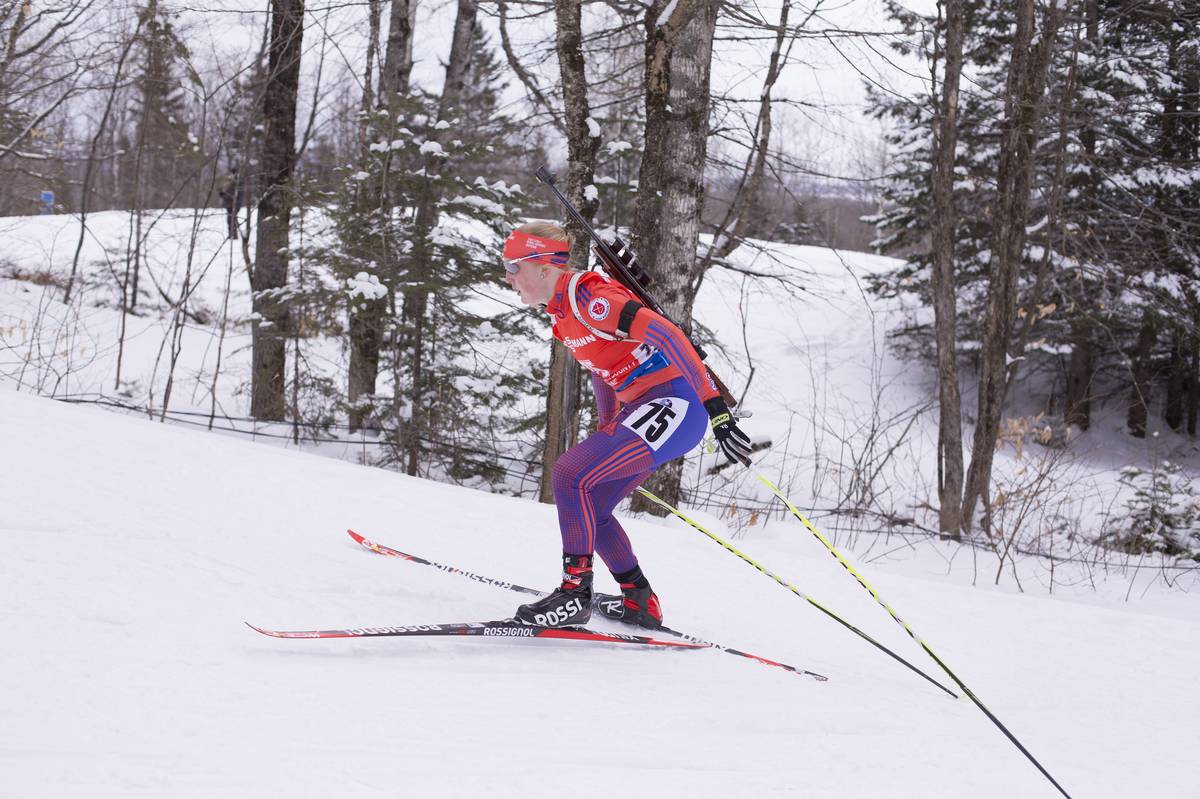
Maddie Phaneuf (US Biathlon) on her way to fifth in the 12.5 k individual at IBU Junior World Championships in Cheile Gradistei, Romania. (Photo: Chloe Levins)
The Individual race at Junior World Championships in Romania this season. I think this might also qualify for “most frustrating race moment” haha. I finished 5th, with 2 misses (so that added 2 minutes to my time, we don’t ski penalty loops in the Individual) but I was less than 2 minutes back, therefore, if I had at least 1 less miss, I would have won the race. So that’s a little frustrating to think about, but it was definitely an amazing feeling seeing that I was right there with the best Junior athletes in the world. I had a smile on my face the instant I crossed the finish line, and didn’t really come off for the rest of the week.
10. First thing you pack in your bag when you leave for Europe?
Underwear. You never want to forget your underwear…
11. Venue/event you’re most excited to visit this season?
I’m hoping to qualify for World Champs in Hochfilzen, Austria!
12. Who will win the men’s and women’s World Cup titles this year?
I’m going to bet on Martin Fourcade and Darya Domracheva.
13. Biggest sacrifice you feel you’ve made choosing this career path?
Giving up the typical “college life” right after high school. But I don’t regret the career path I chose…being able to travel the world racing in a sport you love and meeting people from different countries is pretty rad.
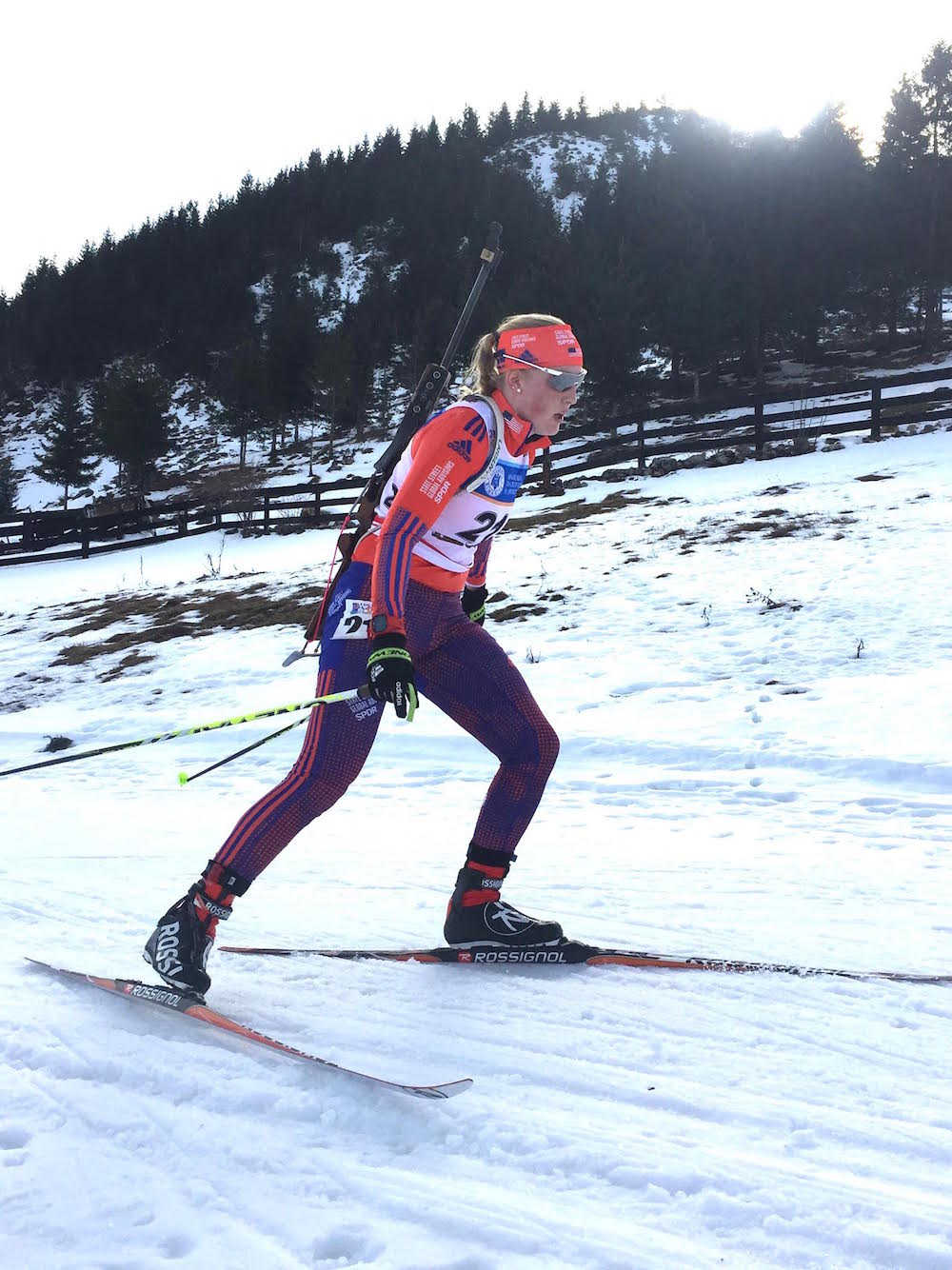
Maddie Phaneuf (US Biathlon) on her way to 65th in the second individual IBU World Cup of her career in Presque Isle, Maine. (Photo: USBA/NordicFocus)
14. If you could change one thing about your sport, what would it be?
To have more of the country involved and interested, more athletes participating, and more World Cups in the USA.
15. What did you have for breakfast this morning?
My usual…two slices of whole wheat toast, with jam and fried eggs (over medium) on top! Water and some fresh fruit on the side.
16. In 5 years, I’ll be ____?
Either preparing for the 2022 Winter Olympics, or finishing up a college degree.
17. In 50 years, I’ll be ____?
71…wow! Hopefully spending as much time outdoors with somebody I love, adventuring the world, helping the environment, and being a badass.
Phaneuf rock climbing this summer. (Courtesy photo)
Canada’s Megan Tandy (l) on her way to 12th place in the 15 k individual at the IBU World Cup in Oslo, Norway, last season. (Photo: IBU/Christian Manzoni)
Megan Tandy was set for a good week: the biathlon World Cup returned to Canada and for the first time, she was going to race at the highest level on the closest thing to a home course in Canmore, Alberta.
On Wednesday morning, Tandy went on a morning jog and everything changed.
“I had actually been running there at least five times before,” she said of the Canmore dog-walking trails where she jogged. “But it was snow-packed trails and it just happened that my left foot broke through the snow crust unexpectedly and it was like nothing fast, nothing hard, nothing extreme, but I fell forward onto outstretched hands. I must have just done it at the perfectly wrong angle because it fractured the scaphoid in my left wrist.”
Tandy initially thought it was just a clumsy fall and that with an ibuprofen, things would be all right; her first start would have been Friday in the women’s 7.5 k sprint.
But her wrist began to swell up and Tandy had to look for expert advice.
“After 20 minutes my wrist was 30 percent larger and swelling,” she said. “I got in touch with our massage therapist who is in town and sent her a picture and after half an hour it looked, I mean, really it looked awful … Thirty minutes later we went down to the emergency room and got the X-rays. I think by the time I was at the hospital it hurt enough and it was swelling rapidly enough that I did know that I really truly injured it. Still, it was not what I wanted to hear when they were like ʻOkay can you go wait in the casting room.’ ”
Canada’s Megan Tandy (right) teamed up with Pietro Dutto of Italy to place third in the finale of the Frassinoro Biathlon Festival this summer. (Photo: Davide Magnaghi)
Her wrist was so swollen that it affected the casting process, and in ten days she will have to go in to get a new, smaller cast put on. Only at that point will a detailed prognosis become clear.
But one thing already is clear: with a general healing time of six to 12 weeks for a scaphoid fracture, Tandy’s season is over.
“Iʼm not pre-qualified for World Championships, so I needed to show that I deserved a spot on the team with the races next week in Presque Isle,” Tandy said. “So yeah, my season just ended.”
Tandy was replaced by fellow Prince George, B.C., native Sarah Beaudry in Friday’s sprint, where Beaudry finished 38th.
It was a disappointing end to a season that just didn’t measure up for Tandy, who had a seeming breakthrough in 2014/2015. Last season she notched five of the six best results of her career, including four top-15 finishes.
In 2015/2016, her best finish was 25th in the pursuit in Östersund, Sweden, in the first week of racing.
“I know that itʼs normal and sport has up and downs, but my feeling is that I kind of had two healthy World Cups at the beginning of the season, the first two, and then itʼs just been a weird season for illness and injury,” Tandy lamented. “In Pokljuka, I passed out on course, and I struggled over the next weeks to feel fit and energized again. Then in Antholz, I finally had a day where I was like, ʻOkay Iʼm starting to feel back in shape, the ski speedʼs there,ʼ and then this happened.”
Tandy is still at the World Cup in Canmore, cheering for her teammates and helping out the organizers with some finish-line interviews. Her family, who had come to support her, is now helping take care of her. Instead of traveling to Presque Isle, Maine, for the next week of World Cups, she will go home to Prince George.
“Iʼm making the best of it, or trying to,” she said.
It’s not just this season, but next season which is now in question for the 27-year-old mother. She had not yet met criteria for carding (athlete funding support) from Sport Canada, which means her continued training is in jeopardy.
There is an illness/injury provision in the carding criteria, but Tandy is unsure if she qualifies for it.
Megan Tandy, formerly Heinicke, with her son Predo in Hochfilzen, Austria, in 2012. (Photo: Rosanna Crawford.)
“I would really really like to continue until 2018,” said the two-time Olympian. “That was my dream and I still have a lot of confidence and fight in me. Mostly built up from results last season where Iʼm like, ʻno if I buckle down, I really truly believe I can still perform better.’ But Iʼm not 100 percent sure if it will be financially realistic to keep doing the sport. I have a little bit of time now so I will obviously find out if there are any exceptions to the funding situation. But I think itʼs more likely to not work, than to work.”
Tandy’s training situation was less than ideal this offseason. She has lived in Germany for several years; this year she moved to Klingenthal to be near enough to her young son to see him. While Klingenthal is something of a mecca for ski jumping, it wasn’t for biathlon, and Tandy was training primarily alone and struggling to find biathlon-specific training opportunities.
Going into the next two years, she was determined to find herself a better situation, even if that meant living farther away from her son.
“I would be basically looking at it like, OK, these are the last two years of my career, Iʼm going to make every possible compromise to make this happen,” she said. “I think I would have been basically living at the training center in Rupholding full time and I would have been traveling back and forth to see my son when I had visitation rights. This year, I lived where my son is, but the reality is I only see him on my visitation days anyway.”
Her message is clear: if she can find funding, through carding or private sponsors, she aims to not only recover from her broken wrist, but return to the World Cup points, and then some.
“I wonʼt ignore the lessons I learned this season, and Iʼll choose to train in a different environment,” she said. “[During recovery] I will enjoy my time with my family and Iʼll enjoy my time with my little guy when I get back. As for biathlon, Iʼm going to fight for it. Itʼs really, really what I want. Iʼve known for a long time. Iʼve looked and said ʻOK, 2018 thatʼs what I want to do and Iʼm not going to give up on another two years without a fight.’ ”
Ukraine’s Olena Pidhrushna (l) boxing out Germany’s Laura Dahlmeier (r) in the final meters of the women’s 4 x 6 k relay in front of a packed Chiemgau Arena at the IBU World Cup in Ruhpolding, Germany. (Photo: IBU/Ernst Wukits)
It’s not often that you can hear catcalls and booing in a ski stadium. A football, basketball or soccer game maybe, but biathlon? On Sunday, 20,000 spectators packed the Chiemgau Arena in Ruhpolding, Germany, and many were not pleased with how the IBU World Cup women’s 4 x 6-kilometer relay played out. Just before the finish, Ukraine’s anchor Olena Pidhrushna, skiing in first, cut off local fan-favorite Germany’s Laura Dahlmeier to claim the ideal left lane in the final stretch. That ended Dahlmeier’s furious chase on the last loop to finish, and Ukraine took the win by 1.2 seconds in 1:16:14.2.
Ukraine, with Iryna Varvynets, Yuliia Dzhyma, Valj Semerenko, and Pidhrushna, incurred one penalty lap and only needed four spare rounds (three prone and one standing), while Germany, with Karolin Horchler, Miriam Gössner, Maren Hammerschmidt and Dahlmeier, had two penalties and required eleven spares (six prone, five standing), but the latter three athletes all skied the fastest course times on their legs to make up the deficit.
Behind them, Dorothea Wierer anchored Italy — which had no penalties and used 10 spares — to third (+43.8), about a second of Russia’s Olga Podchufarova, after the Russians had two penalties and required seven spares. Thus the same teams that had already been on the podium after the first relay of the season December in Hochfilzen, Austria, made it again, except Italy and Ukraine swapped positions.
Teams from 22 countries started on Sunday and 17 finished without being lapped.
Canada, with Julia Ransom, Rosanna Crawford, Megan Tandy, and Zina Kocher, placed ninth (+1:59.5) with no penalties and seven spare rounds, while the U.S., with Annelies Cook, Susan Dunklee, Clare Egan, and Joanne Reid, finished 16th(+5:39.8) with three penalties and eleven spare rounds.
‘Of course you are angry in the moment’
At first, Dahlmeier was visibly annoyed about the end of the race, after she erased a 27.7-second gap on the last leg (and was still 9.2 seconds behind heading into the last loop). After getting blocked she switched back to the middle lane, but once she realized she couldn’t beat Pidhrushna, Dahlmeier stopped pushing and slammed her right pole into the snow across the finish.
“The final loop was really hard. Of course you are angry in that moment, after going at full throttle for 6 kilometers, and then it fails on the last few meters,” said Dahlmeier, who anchored Germany to a relay gold at 2015 World Championships, told TV broadcaster ZDF. “But we can be very, very happy about the second place, especially with the penalty laps that were shot, and with this lineup. I think that’s really nice, and a beautiful finish for the days in Ruhpolding.”
“It was a hard last loop,” Pidhrushna said at the post-race press conference through a translator. “I know Laura is a really good skier, and I knew that I would have to fight for every meter. I am really happy that the team won. I just held the shortest line to the finish. I really wanted to win; it was a big battle but it is sport.”
After seeing a replay again, Dahlmeier agreed in a later interview with ZDF: “That was all correct, you can’t say anything against that. For me, it’s too bad; it didn’t help to switch lanes, and then it was already all over. Maybe I have to train a little bit with the cross-country skiers, pick up some things on how they solve sprints in order to become better.”
“That’s biathlon, that’s the race,” her teammate Hammerschmidt said at the press conference. “It was the same in Hochfilzen [where Germany lost a finishing sprint to Italy], maybe in the next relay we are first. But I think it was OK, and the girls [from Ukraine] make a good job, congratulations to the first place.”
The German athletes did not complain for long, knowing their day could have ended much worse after second leg Gössner incurred two penalty laps earlier in the race, at that time falling back to 15th position with the podium seemingly out of reach.
(Story continues below)
The women’s 4 x 6 k relay podium at the IBU World Cup in Ruhpolding, Germany; with Ukraine (c) in first, Germany (l) in second, and Italy (r) in third. (Photo: IBU/Ernst Wukits)
Race Day
Several teams had opted to rest good athletes for Sunday’s relay at the end of a long block of races, including Germany. Franziska Hildebrand, who already won two World Cups this season, had asked her coaches for a break, and then Vanessa Hinz also had to defer her relay start due to a cold, while teammate Franziska Preuss missed the entire Ruhpolding weekend with a hairline fracture in her tailbone.
That prompted the coaches to change their second-place relay from Hochfilzen on three positions, and make a call to Karolin Horchler, 26, who originally had other plans for Sunday:
“[Saturday] afternoon I had been on my way to Ridnaun, South Tyrol [Italy], because I was supposed to compete there in an IBU Cup mixed relay today,” Horchler told ZDF. “And shortly before the arrival Gerald [Hönig, women’s head coach] called me and said I should please turn around. All in all, it was on the road for five hours… To start here in my second home in Ruhpolding, that’s what I always dreamed of.”
“It’s surely not a very common lineup,” coach Hönig told ZDF before the race. “But in general our expectation is that any relay team we start contends for a spot on the podium.”
Similar to Germany, the Czech Republic chose to rest overall World Cup leader Gabriela Soukalová, France rested Marie Dorin-Habert, currently second place in the World Cup standings, Italy’s Federica Sanfilippo sat out the relay, and Austria’s top skier Lisa Theresa Hauser missed it as well. Finland didn’t enter a team, missing their best athletes Kaisa Mäkäräinen and Marie Laukanen.
The newly called-up Horchler began the race well for her team, skiing at a pace that allowed her to stay in contact with the best and requiring only one spare each in prone and standing. She tagged off in fifth place, 22 seconds behind Norway’s Marte Olsbu in the lead, with Ukraine’s Varvynets in second after shooting clean.
“It was a really crazy day, in the morning I heard that I can start here. The second place is very good for the team. It’s wonderful,” Horchler said in the press conference after the race.
“It’s surely not a very common lineup, but in general our expectation is that any relay team we start contends for a spot on the podium.” — German Women’s Head Coach Gerald Hönig
Germany’s second skier,Gössner skied out fast on her first loop making up positions, but struggled in prone, missing two of her targets and quickly running out of spare rounds.
“Trying to do everything especially well because it’s a relay is a fitting description,” Gössner told ZDF while the race was still going on, with tears welling up in her eyes. “I really can’t explain myself how I can shoot two penalty laps in prone. I didn’t have the feeling that conditions were difficult or that I was shaking… Then I was completely flustered, I didn’t know if that shot went left or right, just didn’t know where to aim.”
After another fast loop, at least she was able to avoid the penalty lap in the standing position after requiring two spare rounds, usually her more shaky discipline, moving up to 13th place.
“Without my two penalty laps a lot more would have been possible today,” a still-disappointed Gössner later told ZDF after the race. “Our luck was that the other nations also shot penalty laps, so the other two [teammates] could make up some time, and that saved us. But my race was absolutely not good.”
“Yeah, she is very annoyed, but that’s relay,” said Hammerschmidt, who lifted Germany from 11th to second on the third leg. “That happens to everyone, but it’s all the better for her that we still got the second place. And I just told her she is allowed to say two more sentences about her shooting, and then we’ll call it a day.”
“I just told her she is allowed to say two more sentences about her shooting, and then we’ll call it a day.” — Germany’s Maren Hammerschmidt, about her teammate Miriam Gössner
While Gössner had been struggling on the range, Ukraine’s Dzhyma shot clean at the top of the field, and while not quite as fast as the German behind her, also skied the sixth-fastest time on her leg.
“Our skis were really good today, thanks to the service team,” she said in the press conference. “I like the new [additional] snow better.”
Hammerschmidt received the tag 1:48.8 minutes behind Ukraine in 11th place, then began a furious chase to get closer to the top again (“one of the best relay performances I can remember in quite a while” ZDF color-commentator Herbert Fritzenwenger commented).
She missed two shots in her prone shooting stage, and then needed one more spare round in standing.
“I have to say, I was a little too cautious there,” Hammerschmidt told ZDF. “I should have turned [on the sights] immediately but thought ‘maybe it will work,’ and when you think that it usually doesn’t. So I should have reacted earlier, I got pretty nervous there after the two misses. In standing I went with full risk, and thankfully only had to reload once.”
Like Gössner, she skied the fastest course time of all athletes on her leg, and handed off to Dahlmeier in second place, 27.7 seconds behind.
“Of course I would have liked to have a better starting position,” Hammerschmidt told ZDF during the race. “But maybe the pressure was off a little. I just wanted to do my own race, and see that I can catch a good pack. I had really good skis today, and felt good on the course. On the last loop I could catch one after another, that was such a great feeling. And then I was really surprised to be second in the finish.”
Ukraine’s Semerenko skied the third leg, and at this point could have secured a large gap over the rest of the field. She narrowly missed her last shot in prone, but then the usually solid shooter was not able to clean the remaining target with her three spares, and had to ski a penalty lap. That opened the race back up as Belarus’ Nadzeya Pisareva overtook her and some other teams moving back within striking distance of the lead.
“I had nothing left but to run faster,” Semerenko joked in the press conference, according to a translator.
How quickly the fortune of a team in a relay can change was demonstrated once again after the next shooting. Pisareva and Semerenko each needed one spare in standing, with Semerenko still trailing by 9.8 seconds as she left the range. Then suddenly Pisareva completely ran out of energy, and could be seen trying to herringbone up the next hill without any glide.
Semerenko quickly passed her, along with several other teams as well. At the bottom of the next climb, Pisareva stopped next to one of her coaches to exchange a few words, seemingly ready to quit the race, before continuing to ski again.
The Belarusian tagged her teammate Darya Yurkevich 1:28.2 minutes behind in 11th place. Yurkevich would end up losing two more positions, finishing 13th (+2:40), despite Belarus posting one of the best shooting performances of the field for Belarus (no penalties, five spares).
With Belarus now out of the picture, the race for the podium on the final leg came down to Ukraine, Germany (+27.7), Norway (+28.6), Italy (+42.4), Sweden (+43.0), Slovakia (+45.3), and Russia (+45.7), with more teams looming shortly behind.
Dahlmeier set out at a fast pace to close the gap to Pidhrushna, and after both shot clean in prone, the lead had been reduced to 18 seconds. On the next loop, Dahlmeier stormed up the climbs and managed to catch Pidhrushna, overtaking her just before the shooting range. But while the Ukrainian stayed clean in the final standing stage, Dahlmeier required one spare, again falling behind by 9.2 seconds as they left the range.
On the final loop, Dahlmeier had more problems catching up to Pidhrushna again, who managed to preserve her lead through the last flat section and descent into the stadium. Then the most talked-about scene of the race happened, and Ukraine prevailed in that final sprint.
“I was pretty down on my strength, but too bad, at the end it went a little poorly,” Dahlmeier told ZDF. “Maybe I should have stayed behind her and then pick the middle lane. A little unfortunate. But still, considering how it looked initially, we are mega-happy about the second place. That was a grandiose success, and you really see what is all possible in a relay race.”
After a number of changes between several countries vying for third place, Italy,
with Lisa Vittozzi, Karin Oberhofer, Alexia Rungaldier and Wierer, beat out Russia’s Ekaterina Shumilova, Daria Virolaynen, Ekaterina Yurlova and Podchufarova in a second exciting finishing sprint by 1.1 seconds.
“I think the relay is the work of the whole team, everybody has to do their best, it’s not only one man or one woman,” Wierer said in the press conference. “I was in the fourth position when I started, and I was a little bit worried because [there were] also Tiril [Eckhoff] and Laura. I hoped that I would shoot well. I was a little too fast in the standing so I missed the first one. But I was lucky that Tiril shot more misses than me. And then behind me was the Russian, and I was really nervous. I was sure that she will pass me on the finish line, but I gave everything and it was the third place, finally.”
Norway was fifth (+1:11.5) with Marte Olsbu, Fanny Horn Birkeland, Synnøve Solemdal and Eckhoff combining for one penalty and 13 spares. Olsbu tagged the team in first after the first leg, and after Birkeland’s penalty on the second leg, Norway still remained in podium contention, picking off the places with Germany, until Eckhoff required all her spares on the last leg — three in prone, three in standing.
Ahead of the upcoming World Championships at home in Oslo, the Norwegian women have not reached the podium since taking bronze at the 2014 Olympics, though they remain hopeful.
“It may not look like we’re there yet, but we are good enough. It’s about getting the final touches in place,” Eckhoff told Norwegian broadcaster NRK.
Canada in Top 10
Canada’s 22-year-old Julia Ransom (116) during the 2014 IBU Junior World Championships pursuit. (Photo: Katrina Howe)
For Canada, Ransom’s day began with tangle out of the start and a resulting broken pole, but she quickly received a replacement.
“It caught me a little by surprise but I quickly realized that I needed to signal to someone for a spare,” Ransom wrote in an email to FasterSkier. “I was on the opposite side of the trail as all of the coaches, but one of our wax techs was somehow able to get a pole to me despite having a few girls between us. Unfortunately that little mishap put me to the back of the pack, but I was able to sneak my way back in there before the first shooting.”
After the field had stayed closely together on the first loop, Ransom shot fast and accurately in the first prone, cleaning all five targets and leaving the range in fifth place. By the next timing point, she even had moved up to third.
“I was stoked to be skiing with the top 3 girls! I felt strong and controlled on skis,” she wrote. “Unfortunately, I struggled with my [standing] spares and lost those leaders. I’m not letting that happen again next relay! “
In her standing stage, Ransom initially missed just one shot, but then required all three spares to clean it and avoid the penalty lap. She fell back a few positions, and tagged off to Crawford in 11th place, 50.7 seconds behind Norway up front.
Crawford shot flawlessly, cleaning both her prone and standing positions, something only 10 other athletes achieved on Sunday. When she left the range after the last stage she had moved her team back up to fifth place (+1:01.5), then only lost only a few more seconds on the final loop tagging Tandy still in fifth (+1:07.7), behind Slovakia and ahead of Norway.
In the prone stage, Tandy missed two targets, then needed all three spares to clean them, leaving the range in 10th place (+1:17.1) with Germany still behind in 12th. In standing, Tandy was able to stay clean, though she could not make up another position. But she also barely lost any more time, tagging off in 10th and 1:17.6 back.
Kocher winning an IBU Cup sprint in Canmore, Alberta, last season. (Photo: Pam Doyle)
Team veteran Kocher anchored the relay, and like her teammates, displayed a strong shooting performance. She cleaned prone, and then had only one miss in the final standing, leaving the range in the vicinity of a number of other teams fighting for position.
“Last laps are usually my strength so I attacked leaving standing,” Kocher wrote in an email. “Unfortunately, just before the uphills the French competitor [Celia Aymonier] stepped on my pole and it broke, costing me metres of time. I got a pole fairly soon from Norway, but it was very short, and then for the last sprint to the finish switched it for my own pole from our coach Matthias [Ahrens]. But that cost us a potential top 6. Two broken poles for our team, crazy!”
In the end, she finished the ninth for Canada, 1:59.5 minutes back, with no penalties and only seven spares. “Excellent momentum for going forward to next week’s relay for our team,” Kocher concluded.
“Our team had a goal of collectively using 8 spares and stay in the top 10… We also wanted to beat Sweden to maintain our current Nation’s Cup position,” Ransom wrote.
They achieved both those goals. The Nations Cup is its own end-of-season award by the IBU, but also determines the number of starting spots a country gets awarded for the next year. Germany is still in the lead after the races of this weekend, with Canada in 10th position and the U.S. in 15th.
“I was proud of our women’s team today. We all had fairly solid races and had the potential for top 6; unfortunately Zina broke a pole on her last lap, which caused a fall and a few positions. I think we are all fired up for another exciting race next weekend,” Ransom added. “The crowds here in Ruhpolding were fantastic. They brought a lot of energy to the races and were devoted fans in even the worst conditions.”
U.S. 16th with three penalties
For the U.S. the relay got off to a difficult start, when Cook incurred a penalty lap in her first prone shooting, leaving the range in 20th position, 58.6 seconds back behind the leaders.
“I was disappointed in myself today because I had a penalty in the first prone shooting that put me in the back of the pack,” Cook said in a US Biathlon press release. “I was unable to get the girls into a good starting position, although I had a lot of confidence in what could happen after that. It was a crazy day with lots of penalty loops happening to great teams and the standings changed a lot through the race.”
After a better standing stage shooting where she only required one spare, Cook about kept her position but lost a few more seconds to the top (despite skiing the 14th best course time on her leg), tagging Dunklee in 21st (+1:38.4).
Susan Dunklee (US Biathlon) skied the second leg for the U.S. women’s relay on Sunday, picking off three places to bring them from 21st for 18th. They ultimately placed 16th. (Photo: USBA/NordicFocus)
Dunklee, who had been the starter for several years, again moved to the second leg, the same order the team had experimented with in the relay in Hochfilzen. After needing one spare in the prone, she had moved up one position, but had lost additional time to the leaders (+1:58.8) despite skiing the fastest first loop.
In standing, she again had to use one spare and left the range in 19th (+2:26.3). Dunklee barely lost more time on the final loop, and tagged Egan in 18th, having made up three positions on her leg, but almost losing another minute to the top, now 2:29.9 behind.
On Sunday, Egan had one of her best recent shooting performances, cleaning prone and only requiring one spare round in standing.
“I made a breakthrough in my standing shooting at the beginning of the winter, and I’m taking advantage of that newfound confidence. I have bad stages now and then but I am learning from each one and improving all the time,” Egan wrote in an email. “For example I missed 1,3 in the first two stages of Thursday’s Individual, but then pulled myself together and finished the race with 0,0 on the last two stages. Today I missed my last (10th) shot, which is a letdown, but I was able to hit it with my first spare round.”
Clare Egan (US Biathlon) skiing the third leg of the 4 x 6 k relay on Sunday, bringing her team from 18th to 16th with just one spare round. (Photo: USBA/NordicFocus)
Out on the loop, Egan skied the 14th-fastest time of her leg, and was able to move her team up two positions, tagging off 2:45.4 minutes behind in 16th.
“The conditions were relatively fast today,” she added. “It snowed a ton last night but we were lucky and it stopped during our race. Our wax staff gave me excellent skis this morning, but unfortunately I was not able to put them to very good use, as my body was not responding well at all.”
In her first week with the World Cup team, Joanne Reid anchored the relay (in place of Hannah Dreissigacker, who skied that leg during the first relay of the season).
“I think the reason the coaches put me last is because I don’t have the consistency or the experience of the rest of the team, and therefore any mistakes I made would be after they had already raced,” Reid wrote in an email.
Reid emerged from prone having used just one spare, but then struggled in the final standing, running out of spare rounds and ultimately having to ski two penalty laps (0+1, 2+3).
“Today I made what I assume is a classic error for a new biathlete coming in from pure skiing, and came into the range too hard in standing,” Reid explained. “I was intensely focused on catching the two teams in front of me, which was going well until I got to the range. It’s always hard to remember in the heat of the moment that your shooting is just as important as your skiing.”
In her first IBU World Cup relay, Joanne Reid anchored the U.S. women’s team to 16th with the 11th-fastest course time on that leg. (Photo: USBA/NordicFocus)
“The pacing on that lap was certainly my mistake, and not just pacing, but the fact that I don’t have the shooting skill to handle as high of a heart rate or shoot at the same speed as the rest of the girls, not to mention I hand load spares much slower.”
Overall, Reid skied the 11th-fastest course time.
“It was definitely a fast course out there, but still very difficult. I can only imagine how tired the athletes are who have raced the entire world cup period, and also qualified for and raced the mass start this weekend,” she wrote. “For Susan to go out there and ski the fastest leg after all those races (and long ones besides) is incredibly inspiring to me, and I wish I could have given her a better performance on my end.”
“I really enjoyed the course out there today — we were much luckier than everyone in the mass start to have such hard-packed conditions,” Reid added. “I think that’s the only 6 km I’ve ever skied in my life, so I wish I could compare it to something, but until I do a few more biathlons I have no reference point.”
Reid finished in 16th for the U.S., ahead of Romania, with the other five teams behind them lapped.
“We wanted to do better than last time (15th) but unfortunately we fell just short of that today,” Egan concluded in her email.
“This team has so much potential and I really believe in that,” Cook said in a US Biathlon press release. “So many of the pieces are there and are also showing, but not quite enough of them to do what we are capable of. It is frustrating but it is also making us hungry to do better and we have another relay coming up next week.”
“I think a team always goes into a relay with the hope that they can improve on their start position,” Reid wrote. “Obviously for us today, that didn’t happen, but I think we have a lot of the pieces right, and I’m certain this team (whether or not in the future it includes me), can have an incredible day.”
The IBU World Cup now moves on to Antholz-Anterselva, Italy, where there will be another relay for the women and men on Sunday.
The victorious Italian women’s 4 x 6 k relay, with (from l to r) Federica Sanfilippo, Dorothea Wierer, Karin Oberhofer, and Lisa Vittozzi at the Hochfilzen World Cup on Sunday in Austria. (Photo: Fischer/NordicFocus)
The women’s biathlon 4 x 6-kilometer relay, marked by good shooting performances, perfect weather, and several unusual lineup choices came down to the wire, with the race decided on the last lap in a sprint between Italy’s anchor Dorothea Wierer and Germany’s Franziska Preuss. Wierer lunged over the line first by less than a ski length, in a time of 1:05:32.6. This secured the first World Cup win for an Italian women’s relay in history, celebrated extensively by her teammates and coaches in the finish.
After a number of changes between several countries vying for the final spot on the podium, Ukraine prevailed in the end, taking third 13.1 seconds behind the Italians. None of the three teams on the podium suffered a penalty lap, with Italy having to use eight spare rounds, Germany seven, and Ukraine 10.
After sweeping the podium in the sprint and securing first and second place in the pursuit race this weekend, Germany’s women had to be considered the overwhelming favorites for the relay. But on Sunday, Germany opted for a lineup of Franziska Hildebrand, Maren Hammerschmidt, Vanessa Hinz and Franziska Preuss, a group of athletes who had never been in a relay team together.
They were not alone in trying something new, with teams such as the Czech Republic, Italy, France, Russia, Ukraine, the United States, and Canada also experimenting with new athletes or at least order changes.
Germany’s Laura Dahlmeier, the winner of the pursuit race on Saturday and anchor of the gold-medal-winning relay at the 2015 IBU World Championships, rested on Sunday.
“This was my own decision,” she explained in an interview with German broadcaster ARD before the race. “The season is long enough, and the World Championships are what matters. And I believe as strong as we are as a team right now, the other four girls can do well without me.”
The German coaches are happy that they still have an ace up their sleeve for the next relays. “We know that there still is a long and tough season ahead of us,” Women’s Head Coach Gerald Hönig said. “We are planning with an eye towards the [2016] World Championships in Oslo in March. So a deep team is a nice problem to have, in contrast to always having to use the same two or three top performers.”
Miriam Gössner, who achieved a third place in the sprint on Friday, also took a break from racing on Sunday.
American Susan Dunklee racing the second leg of the IBU World Cup women’s relay on Sunday in Hochfilzen, Austria. (Photo: Fischer/NordicFocus)
With the Germans explicitly stating their goal to reach the podium, the day got off to a problematic start for Germany, with other teams charging ahead.
Hildebrand, the winner of the sprint race on Friday and fourth place in the pursuit on Saturday, skied a controlled race at first, and cleaned the prone stage with perfectly centered shooting. But then she required two spare rounds in the standing position and had trouble inserting them, setting her back to 14th position. After a good final round, she tagged off at the first exchange 11 seconds behind in eighth.
“Still in sight of the leaders,” Hildebrand recalled in the ARD interview. “And the other girls then turned it around.”
Italy’s first skier, Lisa Vittozzi, who also scrambled for Italy’s bronze-medal relay at World Championships last March, fared better, shooting perfectly (0+0, 0+0) and tagging off just 4.2 seconds behind the Czech Republic who was in first at that time. On the second leg, Karin Oberhofer kept Italy near the front, requiring only one spare round (0+0, 0+1), and tagged Italy just 1 second behind.
Throughout the race, Germany struggled a bit with technical details. Maren Hammerschmidt, the surprise second-place finisher in both of the previous races, had two misses (0+1, 0+1) and doubled the deficit she had been handed by Hildebrand. In slow-motion replays from the shooting range, she could be seen desperately trying to insert a spare round into her rifle, before it fumbled back out.
“That was a technical malfunction today, nothing I could do about it,” Hammerschmidt said an interview with ARD. “A shot hung up in the ammunition magazine. I did not expect this, and will have to check that clip again at home.”
She tagged 22.2 seconds behind the leaders in ninth place, one behind Canada’s Megan Tandy.
“I hope we can still secure a podium finish,” Hammerschmidt said in a mid-race interview.
It then fell to Vanessa Hinz, who placed 15th in the Hochfilzen sprint and 29th in the pursuit, to bring Germany back into contention. With two fast shooting performances (28 seconds prone) and requiring only one spare round, she steadily moved up through the ranks, and handed over to Franziska Preuss in first.
“I was really happy about the nomination [for the relay], and glad that it worked so well today,” Hinz later said.
On the third leg of the relay, Italy struggled a bit. Federica Sanfilippo, a surprising podium finisher during the first World Cup weekend in Östersund, Sweden, and not a member of Italy’s bronze-medal relay at World Championships, required five spares to clean her targets. She had the toughest time in standing (0+2, 0+3), but avoided the penalty and skied the fastest lap of the field, handing off to Wierer 21.6 seconds behind.
For Preuss, the 2014 Olympics ended in a minor drama during the relay, when she started for Germany at the age of 19 and crashed twice, getting snow into the sights of her rifle and costing her team their chance at a medal. Since then, Preuss has usually raced the second or third leg in relays.
But on Sunday, with her close friend Dahlmeier taking a break, she was called up to anchor the relay. Preuss headed out strong and required only one spare round to clean prone. But by the time she came back to the range for the final shooting, a group of athletes that included Wierer had caught up to her.
Preuss hit the first four targets, and was convinced that her fifth shot had also hit, closing the protective flap on the sights of her rifle, before realizing it was a miss. This forced her to load the spare and take aim again, hitting the target, and left the range with Wierer, who had also required one spare, right behind her.
On the last lap the lead changed back and forth. Preuss later told ARD she deliberately let Wierer overtake her. Then she accidentally stepped on the tails of Wierer’s skis near the top of the first climb, causing both to stop briefly, but neither Preuss nor Wierer fell or broke their poles. At the halfway checkpoint, they were just 0.3 seconds apart.
Preuss then decided to try and force a decision before the stadium by “slogging away on the last climb from the bottom to the top, 100 percent,” and managed to create a small gap. But Wierer refused to be dropped, and caught the end of Preuss’ skis again as they entered the arena. After a right turn into the closing stretch, Wierer double poled past her taking the middle lane, with Preuss on her right trying to hold on. But Wierer had more power left, and lunged over the line 0.2 seconds ahead, into the arms of her excited teammates.
“I know I’m not the best female sprinter. I have to work on that again,” Preuss confided to ARD during a group post-race interview. “The second place is a great result, I think we are all satisfied with that”.
Canada’s Megan Tandy blasts through the second leg of the women’s relay at the IBU World Cup in Hochfilzen, Austria. Tandy’s clean shooting helped Canada move into eighth place at the end of her leg. (Photo: Fischer/NordicFocus)
Her teammates also agreed with her that the Hochfilzen arena poses a difficult challenge for a finishing sprint, with a noticeable incline the last 100 meters.
Wierer had already beaten Preuss and Hildebrand in a sprint to the line in Östersund this season, so she had every reason to be confident that she could do it again.
“I was only thinking that I should run as fast as you can. She was close in front of me. I was hoping I could win in the final sprint,” Wierer told the IBU.
Afterward, both teams seemed happy with their results, with the women all smiling and posing for pictures.
“You can hardly ask for a better selling point for biathlon [than this race],” German coach Hönig said with a laugh. “That’s why millions of people watch us on TV and the arenas are full.”
Asked later why the Italians didn’t seem even more jubliant about their first-ever victory in a women’s relay, Wierer tried to explain: “I think we are just all so tired.”
The Czech Republic, who frequently had the best relay performances last season, also had been in the lead early in this race, thanks to Eva Puskarcikova and Olympic silver medalist Gabriela Soukalova. But then team rookie, Lucie Charvatova – who was sixth in Friday’s sprint and replaced Jitka Landova on Sunday – could not clean her standing shooting with the three spare rounds and thus incurred a penalty lap. After another difficult shooting by anchor Veronika Vitkova, they finished the race in sixth place (1+12), 29.8 seconds back from Italy.
Chervatova only recently took up biathlon training when she failed to qualify for the Czech cross-country senior national team again, and her new teammates are expecting great things from her.
“Just watch, she is incredible, her body is all muscle. In a few years she will be frequently at the top,” veteran Soukalova told the media in Hochfilzen.
The podium was in hot contention with 22 countries at the start line, and with the Czech Republic, Sweden, Austria, France, Ukraine, and Belarus (this year having to race without defending World Cup champion Darya Domracheva) in the top three at various points of the relay.
In the end, Ukraine’s team claimed the third, with anchor Olga Pidrushna requiring three spares but skiing the second best time on the final round. Overall the team, usually known for their excellent shooting, required ten spare rounds to clean all the targets.
“I think there are some things we could improve, so we will work on them this season,” starter Yuliia Dzhyma said in the press conference.
Poland placed fourth, 27.5 seconds back, while France was fifth, (+28.8).
Canada 10th, U.S. 15th
For the relay in Hochfilzen, Biathlon Canada put up a different lineup and order than in the last World Championships in Kontiolahti, Finland. Canada advanced as high as eighth in split times during the race.
Starting in the fourth row in bib 10, Julia Ransom kept the leaders within viewing distance.
“I always like relays so was excited for today!” Ransom wrote in an email. “My legs weren’t as snappy as usual the past two races but things came together for today and I felt much better. I am new to starting relays but I have a background racing cross country and feel comfortable in a mass. This helps with navigating the more technical areas of the course with a group.”
The 22 year old needed two spares to clean the first shooting, then one more in the standing stage. Ransom tagged Tandy in 11th, 20.6 seconds back.
Tandy was able to keep her gap to the best athletes at the top of the field and even improved position, largely helped by two clean stages (0+0, 0+0) and the shortest range time on her leg. At the exchange, she handed off 21.5 seconds back in ninth place. At that time Canada was ahead of top teams like Germany, Norway and Russia.
Emma Lunder took over, and while the 24 year old lost about a minute to the leaders and required four spare rounds (0+1, 0+3), Lunder avoided a penalty lap in the standing shooting. She tagged Canadian anchor Rosanna Crawford 1:23 back in 12th place.
“The 2 k course here is quite easy and has a lot of rolling flat sections, which really plays to my strengths in two skate and one skate,” Crawford wrote in an email. “It’s also a really fast 6 k — the race was only taking 16-17min, which is super fast for a relay. Skiing felt a lot better than it has this year and we had some super fast skis, thanks to our techs.”
Crawford cleaned her prone shooting stage, and only required one spare round in the standing position (0+0, 0+1), making up ground to the top by skiing the fourth-fastest course time on her leg.
“Prone has been feeling really good all year, but I’ve been struggling with one miss standing far too often!”
She finished the relay for Canada in 10th, 1:08.7 behind Italy and just 4.3 seconds behind the Russian team.
“I think this will be a great learning experience for our younger girls on the team,” Crawford continued. “Feel that excitement of doing well in a relay and allow them to be better prepared for the next relay. Overall we are happy as a team, but know with a few less spares that top 8 is within reach!”
“Canada did great today!” Ransom wrote. “All of us had solid races and were in the mix for the most part. I think this was a great place to start from for the season.”
The US Biathlon women’s team also experimented with a new order. Susan Dunklee, who has been the starter for several years, moved to the second leg while Annelies Cook started.
Canadian Emma Lunder racing the third leg of the women’s relay at the IBU World Cup in Hochfilzen, Austria. (Photo: Fischer/NordicFocus)
“We are experimenting [with our relay order] to see what combinations work best for the team as a whole,“ Dunklee wrote in an email. “Traditionally I have started off the first leg, which involves a lot of tactics and is exhilarating, but today Annelies tried it instead and did a fantastic job.”
In her first season starting on the World Cup circuit, Clare Egan, who anchored the team at World Championships and in the last relay of last season, was moved to the third position, with Hannah Dreissigacker closing out the race instead.
“My job today was to try the second leg and chase down the lead pack not far ahead,” Dunklee continued. ” Skiing feels strong and I had nearly regained contact with the leaders, then my extra rounds in standing set us back again. We didn’t have a perfect day and we look forward to improving on our 15th place in the future.”
Based on the U.S. relay performances last season, Cook started back in the seventh row in bib 20. She opened her race with two misses in prone, then one more in standing (0+2, 0+1), and tagged off to Dunklee 32.0 seconds behind the leader in 14th place.
Dunklee made up some positions, entering the prone stage in 13th place, then cleaned it. On the next lap she caught up with a few more athletes to move into seventh. But then she used all of her spare rounds in standing, narrowly avoiding a penalty lap but losing a lot of valuable time with the reloads. At the second exchange, she tagged Egan 41.8 seconds behind in 11th place.
On her standing stage, Egan struggled, missing four shots in a row and thus running out of spare rounds. In the end, she had to circle the 150-meter penalty lap twice (0+1, 2+3), and tagged off to Dreissigacker 3:08.6 minutes behind.
Dreissigacker fared better, cleaning her prone stage and using two spares in standing (0+0, 0+2). While the clean prone helped her catch a few teams ahead of her, Dreissigacker lost time on the final loop before the finish and ended up 15th (+4:10.9).
In the women’s Nation Cup rankings — important not only for prestige as an own end-of-season award, but also determining the number of starters a country can use in World Cup event — Germany is in the lead after this weekend’s races. Canada ranks 10th and the U.S. stands in 16th.
Franziska Hildebrand (center) claimed the first win of her career, while teammates Maren Hammerschmidt (left) and Miriam Gössner were thrilled to join her on the sprint podium in Hochfilzen. It was the first German podium sweep in four years.
The relay hasn’t even happened yet, but after one day of racing in Hochfilzen, Austria, it’s clear which women’s team is on top of the biathlon world: at the moment it’s Germany, which pulled off a remarkable podium sweep in the women’s 7.5 k sprint.
It’s hard to say which member of that sweep was happier. Was it Franziska Hildebrand, who has led the team on many occasions but collected her first World Cup win today with clean shooting and a 15-second cushion to second place?
“I went on the first loop and thought ‘oh somehow my legs are heavy’,” Hildebrand told Germany’s ARD television crew. “I didn’t even feel that springy. When I heard on the first split time that it was alright, I thought ‘okay, it might feel bad, but somehow it seems to work well’. And then on the last lap I felt good again, my legs could still give something, and then I was overjoyed when I was leading in the finish.”
Hildebrand was one of the very first starters, in bib four. In the finish she raised her arms after catching her breath, sensing that she had done very well, but still was not sure what her performance would be worth with so many athletes still left to even start the race.
So when the win was secured and Hildebrand stepped onto the podium, she was beaming.
But second-place Maren Hammerschmidt seemed just as happy.
With green grass on the shooting range infield and on the side of the trail, biathletes organized by Hannah Dreissigacker and her U.S. teammates called for action at the Paris climate change conference: they hope they won’t continue to see less and less snow every winter. (Photo: Manzoni, NordicFocus/ US Biathlon Women Facebook).
The second-to-last starter of the day, Hammerschmidt shot a clean race. Her coaches yelled split times as, all alone, she pushed hard up the final climbs and through a ski tunnel into the stadium, then crossed the line in second place.
Unlike Hildebrand, she didn’t need to wait to see if anyone else would dethrone her. This was real. With an incredulous look on her face she checked the video screen, before finally raising her fists to the fans, with many giving her a standing ovation.
Hammerschmidt has done less than a dozen World Cup race in her entire career, but the 26-year-old started the season off right with a third-place finish in the single mixed relay in Östersund, and has been building from there.
“Today everything fit together,” she told ARD.
And her family was even there to watch her get her first podium
“It’s an unusual situation (for me) with so many spectators,” she said. “My family is here, I talked to my father before the race so that we will meet up. Maybe this will now take a bit longer. I am just happy that so many people came (to cheer), I have never run in front of such an audience, this is just cool.”
And the third gleeful member of the podium? Miriam Gössner. Even younger, Gössner was a shooting star early in her career, competing in the cross-country relay at the 2010 Olympics where Germany won silver.
After winning three biathlon World Cups in 2013, Gössner seemed poised to replicate that success in biathlon at the 2014 Games. But a training accident led to a serious back injury and she could barely compete at all in 2014. She missed the Games and had a rough 2015 season as well.
Susan Dunklee of the U.S. biathlon team snuck into the pursuit with a 53rd place finish, making up for four penalties with fast skiing on the tracks. (Photo: US Biathlon / NordicFocus)
After qualifying again for the first German national team this fall, her comeback now got rewarded with her best World Cup result since the 2013 season. Today, Gössner – a huge star and something of a celebrity personality – was back. She missed just one shot and skied the fourth-fastest course time to claim a spot on the podium.
“There were highs and lows, it was not easy, but in the end the fighting was well worth it,” she told ARD of her time with injuries.
Typically a dominant skier who sometimes struggles on the range, Gössner focused on her shooting on Friday.
“Definitely, it was important to me to get through the shooting alright,” she told ARD. “I skied a tactical race not really going all-out at first in order to still have some power on the last round, and I think that worked out for me. This is an easy track, so you really have to shoot well.”
Germany has long been strong in women’s biathlon, but this was the team’s first podium sweep since February 2011.
“We have a great atmosphere in the team,” Hammerschmidt told ARD.
It’s just wicked cool.”
Anais Bescond of France placed fourth, +23.4, and newcomer Lucie Charvatova of the Czech Republic fifth +24.6. And Germany’s Laura Dahlmeier finished sixth, giving the team even another finish to celebrate.
It was a remarkable breakthrough for the young Czech.
“Of course I’m really happy because I’m not so good a shooter,” the 22-year-old – who has competed in even fewer World Cups than Hammerschmidt – told Biathlonworld in a video interview. “I’m surprised…. I did cross-country skiing. I started biathlon two years ago. It’s a short time to do so well. I’m really happy.”
But few could focus on anything other than Germany.
“I don’t train directly with those girls but sweeping the World Cup podium is obviously no easy feat so – wow, respect!” Megan Tandy, a Canadian who is based in Germany, wrote in an email.
Tandy’s team wasn’t as happy with their handiwork. Tandy herself finished 56th with two penalties (+1:52) – inside the cutoff for the pursuit, but not what she had been looking for.
“It was all around mediocre, nothing was literally a disaster but I am not too happy either,” she wrote. “I was pretty mad at myself for missing my first standing shot today – it doesn’t happen very often, but I pulled the trigger before I was ready. I was not seeing the target when I accidentally let the shot go. I am glad that I was able to stay relaxed and be super controlled for the next 4 shots though – I really needed to hit those!”
Teammate Rosanna Crawford wrote that “Ski speed just doesn’t seem to be there for me right now,” but she also crashed and lost time, leaving her in 39th (+1:24) place despite having just a single penalty.
The race course was only a thin band of snow meandering through an otherwise completely green Pillersee valley. The manmade snow had frozen hard overnight, giving corners an icy base with loose corn snow on top. It wasn’t a good combination – and with a steep dropoff from the snow down to the grass below, skiers were wary of mistakes.
“The corners were pretty sketchy on two downhills!” Crawford wrote. “I did fall on my last loop. I was coming down the shorter downhill with a Swedish girl and she snow ploughed, so then I went into a skid and hit an ice patch and fell on my bum. With the loss of speed into the uphill and just how your legs feel after a crash I think I probably lost 20-25 seconds. Which is too bad. I would have been much happier with todays race had I avoided falling!!”
Julia Ransom finished 54th with one penalty and will join Crawford and Tandy in the pursuit, while Emma Lunder missed five shots and ended up 101st.
The Americans were also left wanting more. Susan Dunklee was the lone team member to qualify for Saturday’s pursuit, slotting in just ahead of Ransom in 53rd with four missed shots.
Annelies Cook narrowly missed the top-60 cutoff, finishing 65th (+2:04) with two penalties, while Clare Egan finished 83rd (+2:36) and Hannah Dreissigacker 99th (+3:38).
The women are hoping for better snow conditions and fewer crashes in the future: led by Dreissigacker and her team members, athletes from several countries had taken a stand in training and posed for a photo with a placard reading “Biathletes For Climate Action” to urge a resolution at an ongoing summit in Paris.
The U.S. women celebrate third place in Sunday’s 4 x 5 k relay at the World Cup in Lillehammer, Norway. (From l to r) Sadie Bjornsen, Rosie Brennan, Jessie Diggins, and Liz Stephen. (Photo: Fischer/NordicFocus)
Note: This article has been updated to include the U.S. women’s third-place finish at the Lillehammer World Cup in Dec. 2013.
Amidst stunning conditions of bright sun and a dangerously icy track at the Birkebeiner Stadium in Lillehammer, Norway, the Norwegian women’s all-star first relay team of Maiken Caspersen Falla, Ingvild Flugstad Østberg, Therese Johaug, and Heidi Weng, notched another seemingly effortless victory in the women’s 4 x 5-kilometer World Cup relay on Sunday.
Taking the win by almost two minutes over second place Finland’s Krista Parmakoski, Kerttu Niskanen, Laura Mononen, and Anne Kyllönen, the Norwegians may have won the race, but the Americans stole the show.
As Norway’s first team reveled in victory, they had to stop their celebratory hugs to turn and witness the crowd roar in both surprise, and applause, as the U.S. Ski Team’s Jessie Diggins flew past Ragnhild Haga of Norway’s second team, careened down the final hill, into the finishing stretch, snatching the final podium spot from Haga by 1.4 seconds.
Approaching the top of the last short climb before the stadium, Diggins saw a tall figure jumping up and down, swinging their poles in circles around their head, “like a cowboy,” she recalled in a post-race group phone interview with her teammates: Rosie Brennan, Sadie Bjornsen and Liz Stephen.
It was U.S. Ski Team (USST) Women’s Coach Matt Whitcomb, and he was giving her the go-ahead to go for it in the final meters. “I was like, ‘Yes, this is what I live for!’ … and I just hammered,” she said.
On a day where the downhills appeared to equal a life or death decisions on bulletproof ice and uphills hurt just as bad as the day before, Team USA’s women showed the world once again they can ski with the best. Knowing this drive and the precarious track conditions, USST Head Coach Chris Grover explained the prerace strategy as the following:
“In this case, we knew that is was going to be an absolute battle and that anything was possible, so one strategy was just to keep our head in the game and know that at times we might be up and that at other times we might be down, but to just keep our heads in the game and to keep fighting back and fighting back,” he said.
After the first leg, the U.S. team already had its work cut out for them.
Brennan skied smooth through the first large climb at 1.2 k, moving through the time check on the heels of Norway’s Falla and Sweden’s Ida Ingemarsdotter. From there, she lost the pace on the downhills.
On the phone, Brennan explained that they, “woke up to some extremely icy snow conditions,” and she “was quite terrified to be honest.” However, her uphill pace was not far from the leaders’ and she was able to hand off “close enough for these girls [her teammates] to have somebody in sight to go chase.”
From left to right: Finland’s Krista Parmakoski, Norway II’s Astrid Uhrenholdt Jacobsen, Sweden’s Ida Ingemarsdotter, Norway I’s Maiken Caspersen Falla during the first leg of the 4 x 5 k relay in Lillehammer, Norway. (Photo: Fischer/NordicFocus)
At the first exchange Norway’s second-team skier, Astrid Uhrenholdt Jacobsen, led Falla of Norway I by 6.1 seconds, closely followed by Ingemarsdotter of Sweden and Parmakoski of Finland. Brennan tagged Bjornsen for the second classic leg in seventh, 49 seconds back from Jacobsen.
From there the race for first appeared over. Norway’s Østberg dropped the hammer, skiing away from Finland and Norway II, putting them 21.5 and 36.6 seconds down at the second exchange.
For Team USA and Bjornsen, the second leg meant hanging tough and staying upright. Bjornsen said she “got a little over excited at the beginning and tried to close the gap to Germany and Russia in the first k.” She spent the “next 2.5 k trying to hold on for dear life,” recover, and more importantly, make it safely down the icy hills with “completely flooded legs.”
When asked how she managed to hang on despite the excitedly fast start, Bjornsen painted a target on the back of the Norwegians and Swedes.
“Anytime you see a red [Norway] or white [Sweden] suit, man, you just find another gear because those are the two people you’re gunning for normally,” she said.
Before handing off to Stephen, the first skate leg, Bjornsen skied the fifth-fastest second leg, and tagged off 1:29.9 behind the Norwegian leaders, in a pack with Russia’s second team (+1:21.3), Germany (+1:21.7), Sweden (+1:23.5).
Halfway through the first skate leg, Norway II, skiing in third place, looked vulnerable. Falling from only 36.6 seconds back at the exchange to 1:16.0 at the 2.5 k mark; Stephen was also closing the gap, now only down 31.5 seconds to third place.
“I was focused on the uphills. This course couldn’t be much better for someone like me who likes to climb,” Stephen said. “My goal was to just drop them on the first uphill [Germany and Russia].”
Stephen explained her strategy going into her leg. Skiing the third-fastest third leg, she mimicked Bjornsen’s motivation, “You see the white suit and you go for that, and when you look up and see a red suit, you really go!” Closing out her 5 k, the red suit of Norway’s second team hovered a tantalizing 21 seconds away.
At the front, Johaug showed her form from the previous day, skiing the fastest third leg and extending Norway’s lead to 1:04 over Finland at the final exchange.
Second-place Finland continued to ski in no-man’s land, maintaining its distance ahead third — 45.5 seconds at the third exchange — but unable to gain ground on Johaug, dropping to over a minute back at 1:04.
In the battle for third, Stephen handed off to Diggins in fifth, 3.6 seconds behind defending Olympic and World Championship gold medalist Charlotte Kalla.
Diggins quickly passed Kalla up the long climb on the first of two laps, and focused on Haga for the second lap.
Just over 3 k into her race, Diggins caught Haga and the two skied neck and neck.
Diggins dropped her on the last big uphill. “I didn’t look back so I had no idea if she was there or not,” she said.
Coming in toward the stadium, Diggins described the atmosphere as “a total adrenaline rush. The people on that last hill were so loud because I was coming in with a Norwegian. You’re in so much pain, but you just can’t feel anything…”
Diggins closed out the fourth leg with the second-fastest skate leg of the day and fastest final lap of any team.
The U.S. women ended up third, their best result in a four-person relay since Kikkan Randall, Bjornsen, Stephen, and Diggins placed third in the 2013 Lillehammer World Cup relay two seasons ago. Before that, Holly Brooks, Randall, Stephen, and Diggins broke through with the first U.S. relay podium at the November 2012 World Cup relay in Gallivare, Sweden.
The women’s 4 x 5 k relay World Cup podium in Lillehammer, Norway, on Sunday, with Norway I in first (c), Finland in second (l) and the U.S. in third (r). (Photo: Fischer/NordicFocus)
“It speaks volumes to do it here,” Bjornsen said. “We have this belief that it can be any number of the four people on this relay team and it’s totally possible.”
“We’re definitely a team that’s known for our skating on the women’s side — we saw that yesterday in the skiathlon,” Grover said. The U.S. had four women in the top 30. “We know that if we can be close in classic then we can really have a chance in the last couple legs of skating to get to the podium.”
He added that the service team nailed the wax. “We had incredible skis, incredible kick, fantastic glide, for sure, some of the best skis in the field today, both for the women and for the men,” Grover said. “It was really a big effort not only from the group of women and the guys, but also from the entire staff. I’m super proud of everybody performed today.”
What was perhaps most important to the four women was the fact that they recognized not all of them had perfect days.
“Maybe it wasn’t perfect; it was just solid,” Stephen said, adding that both Norway and Finland are “catch-able” — not out of reach.
“Today was really special. I’m so proud of these girls,” Stephen added. “I can really relate to Rosie’s fear of downhills; I think we’re both struggling on it … and I’m really proud of her for that. … When you put relay socks on Jessie Diggins, it’s like a different person. It’s a really fun thing for me to touch her butt and watch her go. Sadie… she kicks ass and is just so solid.
“It’s a really fun team; it’s changed. There’s been a few members changing over the years, but being back on the podium, it’s a real thing to stand on that block and to get a brick of cheese that weighs more than half your team together.”
— Alex Kochon and Katie Madden contributed reporting
Ricco Gross of Germany competing in Antholz, Italy, in 2006. (Photo: Goetz Primke via Wikimedia Commons)
German Olympic and World Champion biathlete Ricco Gross will coach the Russian men’s team in the upcoming season. After much discussion and speculation, the appointment was announced on Aug. 12.
Gross won four Olympic gold medals, in the relays at Albertville (1992), Lillehammer (1994), Nagano (1998), and Torino (2006). His eight total Olympic medals place him second on the all-time list, and he has 20 World Championships medals to his name as well.
Gross retired in 2007. Since 2010, hehad since been coaching with the Germans, first with the women’s World Cup team, and most recently with the IBU Cup team.
Gross, 44, will work together with Vladimir Bragin, who had previously been announced in April to head the “B” team for the Russian men. However, he will reportedly work with top athletes like Anton Shipulin, who placed second in the World Cup Total Score last season, and Evgeniy Garanichev.
“We have a very strong team in Russia,” Gross said in a press release from the Russian Biathlon Union. “My main aim is to make this team better… Obviously, my long-term aim is the preparation for the Olympic Winter Games 2018. We have to go step by step to this goal. We have to become better and unlock our potential. I am sure that Olympic Winter Games in South Korea can be successful for us. There are so many strong athletes in Russia.”
After Gross did not continue his contract with the Deutscher Skiverband after the 2014/2015 season, it was initially speculated that he would take a job coaching for Ukraine. Volodimir Bryznak, the president of the Ukraine Biathlon Union even announced the staffing shift.
On April 7, the day the contract was set to be signed, the deal fell through.
“He wrote that the circumstances have changed,” Bryznak said. “I guess he had a much better offer.”
The motivation to leave the German team seems to have come at least partially from a desire to have more control over a training group.
“Becoming the senior coach for the Russian men’s team is a big challenge for me,” Gross said in the press release. “I had been working with the German’s national team; now, I start to work as the senior coach in Russia. It gives me more freedom by making the decisions and the relevant responsibility.”
Gross becomes the second high-profile German to head to Russia. The first, Wolfgang Pichler, worked with the women’s team in what was ultimately an unsuccessful partnership.
Pichler had been an avid critic of Russia’s doping program and was hired ostensibly to provide some respectability to the program.
But Pichler was not given full access to all athletes, with some choosing to train with Vladimir Korolkevich.
The anti-doping effort did not work. Two Russian women who trained with Korolkevich, Irina Starykh and Ekaterina Iourieva, were banned on doping violations in January 2014.
Pichler told The New York Times, among other outlets, that he had been certain Iourieva was doping, and had brought concerns about Korolkevich’s program to the Russian federation. Nothing was done.
Instead, two weeks before the Olympics began in Sochi, Korolkevich was promoted over Pichler to head the women’s team there.
Then in the midst of the Games Pichler was removed from the team, creating chaos and drawing ire from Olga Zaitzeva, one of the team’s biggest stars and a gold medalist from the 2010 Olympics.
“I do not agree that he was removed, and I will fight for Wolfgang,” Zaitseva said between races in Sochi. “We worked with him well, and I will not pour dirt on him. For the results you should be asking the rest of the coaching staff.”
And that was not the only drama at the Olympics. Another athlete who had chosen Pichler’s training group, Ekaterina Glazyrina, was expelled from the team after criticizing Pichler on her website.
The comments were later removed, with Glazyrina stating, “Of course my main mistake was to choose the wrong group and the wrong coach. I did not have a great dialogue with Pichler from day one and therefore we did not get the results we wanted. I regret training with Pichler very much.”
Pichler said in an interview after ending leaving the team at the end of the 2014 season that the worst part about the job was reading terrible things about himself in the press and on the internet. In a separate interview, he spoke of how one journalist relentlessly attacked him every time the two met.
“Very often it looked like a blatant harassment, and was not just me – if I experienced would be easy – but the people who were in my team,” he said.
He pointed out that when his team was compared to the women’s teams of the earlier 2000’s, it was an unfair comparison: those teams were plagued by doping scandals. But he enjoyed working with the women, claimed he had positive relationships with them, and said they never lacked for motivation.
So what does Gross have to look forward to?
“There was no dialogue,” Pichler said in April 2014. “The sports ministry constantly interfered with the work. This is what has become a major problem for me… [Yet] it was clear that none of the so-called ‘experts’ were not going to be responsible for the result.”
And it’s not just fans. Anatoliy Khovantsev, a former national team coach who now works with 2015 World Champion Ekaterina Yurlova outside the national team framework, was also unimpressed with the hiring.
“He has a very positive reputation, which he won as an athlete,” Khovantsev said. “I cannot say anything bad about him, but the euphoria in connection with this appointment I did not feel. For a while, he will have to adapt with the Russian athletes, and only after a long period of time it will be possible to evaluate its performance.”
Ukraine’s Valj Semerenko (r) celebrates her first World Championships victory on Sunday in the women’s 12.5 k mass start at 2015 IBU World Championships in Kontiolahti, Finland. She beat Germany’s Franziska Preuss by 6.2 seconds. (Photo: Kontiolahden Urheilijat/Risto Kuittinen)
KONTIOLAHTI, Finland — Perfect shooting wins the race, at least that was the adage that summed up the women’s 12.5-kilometer mass start on the final day of 2015 IBU World Championships.
Valj Semerenko, a 28-year-old Ukrainian with an Olympic gold medal from last year’s relay and multiple World Cup podiums, sat quietly in the pack throughout most of Sunday’s mass start. She didn’t charge to the front on the first lap, like Darya Domracheva of Belarus did. Instead, she positioned herself in the top 20 of 30 starters and waited for natural opportunities to move up.
Opportunities like the first prone stage, where she and 17 others cleaned on a bluebird, windless afternoon. Semerenko moved into 11th, 15.3 seconds back from Domracheva in first.
While the Belarusian set off for another blistering lap, leaving the range 8 seconds ahead of Russia’s Ekaterina Yurlova in second, Semerenko squeezed into the top 10 before the second shooting.
There, she cleaned again, along with nine others, including Domracheva. As Domracheva set out again in the lead, 6.5 seconds ahead of Russia’s Daria Virolaynen, it seemed like the race could very well continue along the same lines — with Domracheva jetting off the front.
That is, until Domracheva missed two in the third stage and dropped to eighth.
Ukraine’s Valj Semerenko (r) leads a five-woman chase pack into the range during Sunday’s 12.5 k mass start at 2015 IBU World Championships while chasing Darya Domracheva of Belarus (not shown), with Gabriela Soukalova of the Czech Republic, Germany’s Franziska Hildebrand, Russia’s Daria Virolaynen, and Germany’s Franziska Preuss, respectively.
Behind her, Semerenko led a chase pack of five into the range, with the Czech Republic’s Gabriela Soukalova, Germany’s Franziska Hildebrand, Virolaynen, and Germany’s Franziska Preuss, respectively.
The Ukrainian cleaned the first standing stage the fastest, heading out on her fourth lap two seconds ahead of Hildebrand and Preuss, and three seconds ahead of Soukalova — all of which cleaned as well. Domracheva was left with two penalty loops, emerging 36 seconds behind them.
Soukalova, Preuss and Semerenko took turns leading over the penultimate lap, while Hildebrand fell off the pace. In the final standing, Semerenko hit the last of her targets to complete her perfect 20-for-20 day, sending a clear message to the 29 women behind her. She left the range 19.1 seconds ahead of Preuss, who had her first penalty of the race in that stage, and Hildebrand cleaned her fourth stage to move back into third.
“I left the shooting range with Franziska Hildebrand and I thought, ‘Oh god, it’s going to be a hard loop,’ because she’s really in shape at the moment,’ ” Preuss recalled in a post-race press conference. “When I had a look back, I thought, ‘There are much more athletes now.’ I just wanted to give everything.”
While Preuss pushed to close the gap on the last lap, she couldn’t quite reach Semerenko, who finished 6.2 seconds ahead of her for her first World Championships title in 34:32.9.
“I was thinking that when I win, I’m gonna take the Ukrainian flag,” Semerenko told the IBU through a translator. “But when I got to the end with all the people chasing me, I just forgot with all the stress.”
She added that she was grateful for the support of her sister, Vita Semerenko, who has been sidelined this season with an injury.
“I would like to thank her for her support here, and actually she was at the track at the last hundred meters to give me the flag, but I only noticed her when I passed her,” Semerenko said with a laugh.
“I’m the champion and I’m so happy about it,” she said in the press conference. “It is important not only for me but also for my country. I’m full of emotion.”
While IBU Overall World Cup leader Darya Domracheva (Belarus) led the first half of Sunday’s 12.5 k mass start, she missed two standing targets and placed fourth in her last chance to medal at 2015 IBU World Championships in Kontiolahti, Finland. (Photo: Kontiolahden Urheilijat/Kari Kuninkaanniemi)
On the final lap, Italy’s Karin Oberhofer, Domracheva and Soukalova all caught Hildebrand, overtaking her before 11.8 k.
By the finish, Oberhofer dug deep to hold off Domracheva for bronze, finishing 2.1 seconds ahead of her and 12.6 seconds behind Semerenko. The Italian had rebounded from two early penalties — one on each prone stage.
“I had wonderful skis, I tried to do my best and I’m very, very happy,” Oberhofer said through a translator.
While Domracheva took fourth (+14.7) with the fastest overall course time, Soukalova was another 11.5 seconds behind in fifth (+26.2). Hildebrand finished sixth, 5.5 seconds later, and Germany put three in the top eight with Laura Dahlmeier in eighth (+39.9).
For Preuss, the silver matched her World Cup career best, in which she placed second in the mass start in January in Ruhpolding, Germany. On Friday, she helped the German women’s team achieve gold in the relay.
“The week started really good for me with my [21st] birthday [on March 11], then the gold medal in the relay,” Preuss said. “It was absolutely amazing to stand on top of the podium and unbelievable, and today, the second individual medal in the mass start, it’s really amazing.”
Dunklee 20th, Heinicke 24th
Susan Dunklee (US Biathlon) en route to 20th in the women’s 12.5 k mass start at 2015 IBU World Championships on Sunday in Kontiolahti, Finland. (Photo: USBA/NordicFocus)
Susan Dunklee narrowly qualified for the mass start in the 30th and final spot available after winning a tiebreaker with Finland’s Mari Laukkanen (Dunklee had the single-best individual result between of the two of them in 12th at these World Championships).
Considering that, she was grateful to have made it.
“It was kind of like an icing-on-the-cake moment,” Dunklee said after the race. “I’ve done what I needed to do at these championships, now I can kind of relax and have fun and see what happens. Sometimes I have my best races when I’m in that position. That didn’t happen today, but it could have.”
Dunklee finished 20th, 2:01 behind Semerenko, with five penalties: one on each prone stage, two in the first standing and another in the final standing.
“I haven’t seen where my shots went yet, but I have a feeling I had a couple split-outs,” she explained. “I could’ve sworn one of the standing I had a paddle quiver, but not fall. … I had a couple that felt like good shots, but I don’t know what happened. You miss one, it puts you right away toward 20th place coming into the second shooting, and then if I keep missing one, that holds steady. I knew [I needed to] not miss one if I wanted to move up.”
While the 29-year-old Dunklee left the range in 23rd after the last stage, she skied the fifth-fastest course time overall to finish in the top 20. She ended World Championships with two individual top-20 results, eighth place in the mixed relay, and 12th in the women’s relay.
“I always set really high goals for myself,” Dunklee said of her season overall. “I got a few top 10’s this year. I was hoping for more for sure. I was hoping to get to them earlier in the season, too. I’ve made some huge improvements with my ski technique. My shooting percentage I think has been a little more consistent, and now I’ve got a lot of things I know I want to work on as soon as summer rolls around.”
There is still one more stop on the World Cup circuit, with a sprint, pursuit and mass start in Khanty-Mansiysk, Russia, this coming Thursday through Sunday.
Megan Heinicke (Biathlon Canada) on her way to 24th in the women’s 12.5 k mass start at 2015 IBU World Championships on Sunday in Kontiolahti, Finland. It was only the second mass start of the 26 year old’s career.
Canadian Megan Heinicke qualified for Sunday’s race as well in 26th, for the second mass start in her career. She competed in her first two months ago at the Ruhpolding World Cup, where she placed 23rd.
“When I was zeroing today, I had to look at my coaches like, ‘Um, prone, prone, standing, standing, right?’ ” she said of the shooting order.
Heinicke got that down, hitting 19 of 20 targets with a single prone miss. One of nine women who shot 95 percent or better, she finished 24th, 2:22.2 behind the winner.
“That was a pretty awesome end to the season,” Heinicke said. “That was my last race and I had really good shooting again with just one miss.”
In the last eight days of individual racing, Heinicke tallied four top-30 results (including the mass start), with 21st in the 15 k individual, 23rd in the sprint and 28th in the pursuit. In all of those races and the women’s relay on Friday, she hit at least 90 percent of her targets.
“I guess I had really high expectations shooting-wise because I’ve been shooting so well,” Heinicke said of the mass start. “Skiing, I know to expect it to feel hard. We had really great skis this week so I was kind of trusting the skis to be good, and I just wanted to try to ski smart … and not kill myself the first few runs up the hill and make sure I was kind of settled enough for good shooting.”
Heading into her last lap, after cleaning her third-straight stage, she glanced at the scoreboard and saw that she was 20th.
“I was like, top 20, is it possible?” the 26 year old said. “… Mostly I was like, ‘It’s your last race, be ready to fight. Just kill yourself if you have to.’ ”
Despite a long bout with illness leading up to World Championships, which derailed some of her skiing fitness, Heinicke explained she was excited about the gains she’d made in shooting.
“This year has been a really big step forward for me in terms of shooting and consistency, so every time this keeps happening, I’m just … super happy, super relieved, and really, really motivated for next year,” she said.“I feel like I’m at maybe 60 percent of my potential skiing, with health and training things, so I’m like, ‘Oh, if I have a healthy season next year, if I can maintain the shooting, then I’m just really motivated about the potential.’ ”
She was also inspired by performances she’d witnessed by her teammate, Rosanna Crawford, as well as Dunklee.
“I’m watching … what they’re able to achieve, and I’m just like, ‘OK, I want to fight to be there, too,’ ” Heinicke said.
Note: we owe a thank you to John Estle, who sent us an Excel spreadsheet looking at results from the 10 k freestyle race grouped by starting times, in bins of ten starters. We thought he was on to something, but that FIS points and the structure of the start list might play in as well. Thanks, John, for sending us down this rabbit hole.
The results of Tuesday’s 10 k freestyle race at FIS Cross Country World Championships in Falun, Sweden, were surprising.
It wasn’t strange that Charlotte Kalla won by 41 seconds. A winner the previous weekend in Östersund, the Swede was among the favorites to win, and certainly the favorite among her countrymen watching from the grandstand and lining the trails.
But just who joined her on the podium was surprising. Jessie Diggins and Caitlin Gregg achieved their first World Championships individual podiums in finishing second and third. For Diggins, who has a team sprint gold medal from 2013 World Championships, it was not shocking; for Gregg, who hasn’t scored a World Cup point since finishing 30th in this event at the 2010 Olympics, it was.
Besides the Americans’ strong showing – every U.S. woman placed in the top 15 – the other surprise was Norway’s weakness. The top Norwegian finisher was Heidi Weng in 22nd place. It was in sharp contast to World Cup competitions all season, where Norwegians have usually won and not infrequently swept the podium.
A snowstorm which rolled in as the individual-start race continued certainly complicated the results. Late starters were at a disadvantage, so it is easy to say that early starters like Gregg, who wore bib 3, got lucky. But was start time the main explanation for results? We set out to use statistics to answer this question.
First, we asked what provides a better correlation for race time: FIS Distance points, or start time (in minutes after the first starter)? When we do correlation tests, both factors provide significant correlations to race time, but FIS points provide a far better explanation, with 76% of the variance in race time explained as opposed to 41% by the start time.
So, the snowstorm did not disrupt the race so much that the historically “better” skiers could not beat the historically “worse” skiers. At almost every point along the FIS points axis, there were skiers who had a wide variety of race times, but in general, the racers with lower points had better results.
And in fact, the racers with the lowest points had a smaller variance in their finishing times. Therese Johaug and Marit Bjørgen of Norway, with the lowest FIS points (zero!), finished just over two minutes behind Kalla. But racers with 80 to 90 FIS points had range of four or five minutes between their various finishing times, and that’s in relation to each other, not even in relation to Kalla.
So why, if FIS points could predict pretty well where racers would finish, is our first reaction to the results to be so surprised? It’s individual results, like Gregg finishing third or Bjørgen finishing 31st, that got us. Let’s look a bit more at those results in context, by putting some names onto the points on the graph.
To understand the results better, it’s important to look at the start list. It can be divided into three blocks: an initial unseeded block of five; then, a long block where unseeded skiers alternate with seeded skiers, each of these groups being seeded in reverse order with the highest-ranked skiers wearing the highest bib numbers; and finally, a block of six skiers with very unfavorable FIS points who were selected in a special qualification race on day one of World Championships.
To look at how seeded versus unseeded skiers raced, we split the dataset into two and made simple linear models including both start time and FIS points. We’ll set the model up with an interaction factor: is there some emergent result of combining FIS points and start time? Do skiers with high FIS points struggle more as start time advances, or vice versa? This sort of interaction might explain some of why we find the results so interesting.
(A statistical note: this isn’t actually statistically a good model, because FIS points and start time are highly correlated: the skiers’ start times are seeded according to ranking. However, the variation in the two factors is very different. While start time increases by half a minute with every bib, the distribution of FIS points is much more irregular, with clumps and gaps – thus if it does explain finishing time, it might do so in a different way. This is interesting, so we’ll break a few rules and put both factors in a model together, which will also allow us to see whether they interact.)
For the unseeded skiers, including Gregg, we find that both FIS points and start time are significant factors explaining finishing time.
The left end of the regression line – the one driven by Caitlin Gregg, Kikkan Randall, Anouk Faivre Picon (who earned a best-ever finish by a French woman at a World Championships) and Yuki Kobayashi (who contributed to an amazing day by Japan with two women in the top 11) – is drawn by the early starters.
And it reveals something important: yes, the first group of five unseeded skiers turned in strong results for being unseeded. However, they also had the lowest FIS points of any of the other unseeded skiers. Among all the unseeded athletes, they would still be expected to do the best on a day where start time didn’t matter, and if anyone were to shock the field by getting on the podium, they would be the best candidates.
There’s no significant interaction in our model between FIS points and start time. So a skier’s points profile predicts their performance in one way, their start time predicts their performance in another way, and there is no effect of one factor on the other.
That’s also true in the seeded group. Interestingly, however, not only is there no interaction, but start time is a much better predictor of a skier’s finish, the opposite of what we found from the unseeded group. The correlation between FIS points and race time is not significant, and its slope is close to zero: basically, a horizontal line through a cloud of data. Start time is not nearly as good a predictor as either factor was for the unseeded skiers, but it does explain something.
The most interesting thing to look at in this graph is how performances fall by teams. If you consider the black regression line to be the mean effect of start time on performance – the amount that the snow slowed skiers down as the race went on – then some teams fall mostly below the line (better than expected race times) and some fall mostly above the line (worse than expected race times).
Sweden and the U.S. have the best, most unexpected outcomes, with Kalla and Rydqvist for Sweden and Diggins and Stephen for the U.S. racing incredibly well regardless of their start times.
And while Norway made much of their waxing disaster, it’s actually Germany who perhaps did the worst: Nystad, Boehler, and Fessel all had very poor results, the slowest times of the entire seeded group.
The Russians must have had about average skis, because Zhukova, Tanygina, and Tchekalova all fall almost exactly on the line where their performance would be predicted based on their start time.
On the contrary, the Finnish women were all over the place: they had similar start times, but Mononen had a poor race while Niskanen excelled, and Parmakoski and Roponen fell somewhere in the middle.
The takeaway? Two big teams missed the wax, but aside from that, skiers did pretty much as would have been expected by their previous results and the deteriorating conditions. While the U.S. is expected to thank luck for putting Gregg and Randall in bibs three and four, they should thank their wax team even more, because American skiers excelled throughout the field and did even better than should have been expected based on their start times.
They can still covet Sweden’s wax truck if they want, though.