From the FasterSkier archive — posts syndicated from athletes’ and coaches’ own blogs between 2004 and 2012, kept online as published. Current coverage is at fasterskier.com.

Tag: girdwood

  • Don’t Overfill Your Cup: APU Coach Erik Flora and the Complete Athlete

    Don’t Overfill Your Cup: APU Coach Erik Flora and the Complete Athlete

    Erik Flora, head coach of Alaska Pacific University, with one of his athletes, Rosie Brennan, also a U.S. Ski Team member, during training at 2017 Nordic World Championships in Lahti, Finland. (Photo: John Lazenby/Lazenbyphoto.com)

    This week’s featured articles are made possible thanks to the generous support of The Loppet Foundation, host of the Masters World Cup 2018. Registration opens in October.

    ***

    RIDING IN A PISTENBULLY ON EAGLE GLACIER, in the Chugach Mountains above Girdwood, Alaska — If you want to find the essence of Erik Flora, the longtime coach of the Alaska Pacific University (APU) ski team, you need to come here.

    You need to fly to Anchorage. You need to drive 45 minutes down Turnagain Arm to the small resort town of Girdwood. You need to bump over dirt back roads to the Girdwood “airport,” a dirt airstrip surrounded by wildflowers on the ground and glaciated peaks above. You need to make your way inside the Alpine Air hangar, past the curious tourists overdressed for summer sunshine, and pay for your ticket. You need to absorb the safety briefing, climb into the A-Star, put on ear protection, and get ready for one of the most scenic helicopter flights of your life.

    Within 10 minutes, you will go from sea level to 6,000 feet, from summer to winter, from coastal hemlock rainforest to high alpine zone. You will marvel as the helicopter pilot effortlessly sets the machine down on a landing pad smaller than a spare bedroom, a ridiculously narrow patch of firm ground amidst the sea of friable black rock. You may notice that there is a glacier 100 feet to one side of you, and a cliff edge 100 feet to the other. You may notice that the residential building in the middle is literally bolted to the rock to hold it in place.

    Or you may just be wondering where the heck you are, and who would voluntarily spend several weeks each summer up here. And that is where you will find Erik Flora, a man squarely in his element: in a training environment of largely his own creation, shaped by a single-minded focus on helping American skiers to be the best in the world. Oh, and to become better people, help the community, and learn to coach themselves along the way. That’s all.

    ‘I was born in Nashville, Tennessee, which is kind of unusual for a cross-country skier’

    But before Flora could make it to a glacier in the Chugach Mountains, he had to get out of Nashville first. His family moved when he was young, following his father’s work as a city planner. This took them to the suburbs of Portland, Ore., a pleasant place but also still an unlikely venue for a future cross-country ski coach.

    Erik Flora (l) and his mother, Berit Flora, on Eagle Glacier in the Chugach Mountains, Alaska, in July 2016.

    The Floras were members of the Oregon Nordic Club, and Erik frequently cross-country skied at Mt. Hood, the alpine resort (with a smaller nordic area) about 90 minutes driving and 4,500 vertical feet above Clackamas. Bend, Ore., and Snoqualmie Pass in Washington were other frequent weekend destinations.

    The snow was plentiful but the drives were long, and by the time he was in high school Flora was realizing that Portland was not the optimal place for someone with long-term nordic aspirations. His plans crystallized at a Bend training camp in the summer after his sophomore year, featuring some logistical real talk from his coach.

    “After doing some testing and skiing around” at the training camp, Flora recounted, his coach encouraged him to move to Bend. “Because in Portland you can only ski a couple times a week, and with my goals being what they were, to be a World Cup skier, then it had to be a little more than twice a week. And so I moved to Bend when I was 17, … and moved in with this coach. And my parents were still in Portland.”

    (All direct quotes in this article come from an in-person interview with Erik Flora. The interview was conducted in the cab of a PistenBully on Eagle Glacier in July 2016 while Flora groomed from 10-11 p.m. for the next day’s skiing. Why so late? In part because of the need to groom in cooler temperatures to give the snow a chance to set up. And in part because, as Noah Hoffman noted following the 2014 Man Camp at Eagle Glacier, “Flora has nailed the grooming. (It helps that he never sleeps.)”)

    Within a year, Erik’s parents, Sam and Berit Flora, had followed him to Bend. A period of athletic wanderlust and nomadism followed, as Flora fils “kind of bounced around to different places around the West.” There was a school year spent in Norway, too.

    Throughout this time, Flora explains, he was “kind of figuring out more of what I wanted. I wanted a place where I could train at sea level, since when I was in Norway, that seemed to be something that most of the top racers in the world at that time came from sea-level locations. Some place that had a long winter and a ski community. And that was Anchorage.”

    View from riding shotgun in the PistenBully: grooming in the fog and summer twilight, on Eagle Glacier in the Chugach Mountains, Alaska, in July 2016.

    Flora contacted Bill Spencer, a former U.S. Ski Team member who was at the time the coach of the nordic team at the University of Alaska Anchorage (UAA). “And shortly after, I was driving my truck up the Alcan,” he recalled.

    Flora’s Alaska origin story is familiar to the point of cliché among Alaska transplants: “My plan was to move to Anchorage, and stay for a year, and see how it was. I lived here a year, and pretty much decided at that point, I was probably going to be in Alaska forever.”

    It didn’t hurt that Flora met his future wife, Gretchen Pfisterer (now Flora), in Anchorage around that time. Or at least started dating her then – they had met at World Junior Trials a few years earlier, when he was 18.

    “And I remember the moment I actually saw Gretchen for the first time,” Flora, now 44, recalls 25 years later. “She was walking up to get her medals – she was a good ski racer, for sure. And I saw this girl walk up, blond hair, and thought, ‘Wow, that – that is something. OK.’”

    The two of them skied on different teams for the next few years, before uniting on the UAA team in Anchorage when Erik Flora was around 20. (Pfisterer had grown up in Anchorage. She was the girls Anchorage Daily News Prep Athlete of the Year in 1989, an honor later awarded to future APU skiers Eric Strabel, Kikkan Randall, and Scott Patterson.) They began dating while both were at UAA, and “kind of figured out that Alaska” was going to be a good match for them, Erik now recalls.

    Career as an athlete

    That coach at the Bend summer camp was onto something. Flora found success at UAA, skiing to All-American status in 1994 and again in 1995. (His then-girlfriend, now-wife was no slouch either; Gretchen earned an All-American finish in 1992.)

    Flora’s collegiate results put him on the national development radar for U.S. skiing, and exposed him to opportunities outside of Alaska.
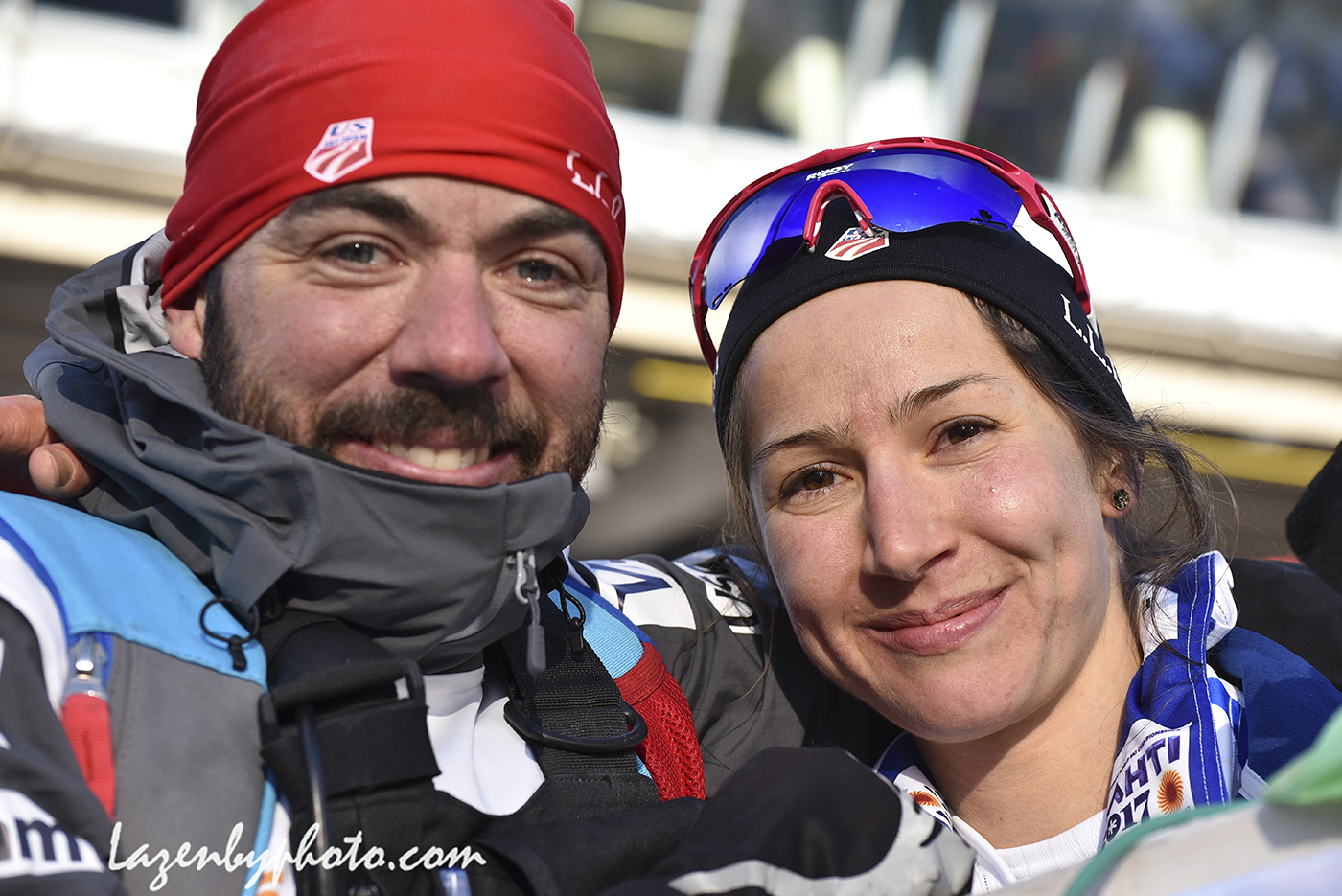
    Happy athlete, happy coach: Erik Flora with APU skier Chelsea Holmes after Holmes placed a career-best 13th in the women’s 30 k freestyle mass start at 2017 World Championships in Lahti, Finland. (Photo: John Lazenby/Lazenbyphoto.com)

    As Flora diplomatically notes, this experience, while another step on the ladder, ultimately showed him that Anchorage felt like the best match for him and his skiing: “After being in Anchorage for a couple years, the USOC had a development program based out of Marquette, Michigan, that I joined. I moved out of Alaska for a year, lived in Marquette, and tried a different program. It was kind of a good next step. And after trying that, I realized that what I had experienced here in Anchorage was really along the lines of kind of how I wanted to develop my ski racing.”

    Flora soon returned to Anchorage, this time for good. Three-time Olympian Jim Galanes had founded a program associated with Alaska Pacific University, Gold 2002, which was not shy about its aspirations. (The program would indeed send at least two Anchorage natives, Nina Kemppel and Kikkan Randall, to the Winter Olympics in Salt Lake City, though neither of them medalled. No American skier has yet won another Olympic medal in cross-country skiing since Bill Koch at Innsbruck in 1976.)

    In the Gold 2002 program, Flora says, “instantly I found what I was looking for.”

    Specifically, the team was the right match of coach, mindset, reliable snow, and a critical mass of athletes with unified goals. “I always knew that I wanted to be a ski racer,” Flora now recalls, “and the key was to find where I could make that happen. And … a lot of the places I lived, whether it was in Portland, where we didn’t have enough skiing, or some of the other places, in the early days, there wasn’t a team to work with – and that’s what I found in Anchorage, was Team Gold 2002 had a handful of athletes, and they were all talking about U.S. development.”

    Flora skied for Galanes for a few years. But in 1999 he was in a car accident while driving up to Hatcher Pass, in the Talkeetna Mountains outside of Palmer. He injured his back, not quite enough to prevent him from continuing with competitive skiing, but just enough to keep him from regaining his pre-accident levels of performance.

    The accident “kind of sidelined my ski racing career,” Flora says. “I was about 24, 25 years old at the time, and spent the better part of a year and a half trying to get back to where I was before the car accident. It never did pan out.”

    Career as a coach

    Flora stayed in Alaska following the car accident, but stepped away from ski racing. He devoted himself to learning to fly small airplanes in Bush Alaska. He pursued his airplane mechanic’s license. He obtained multiple levels of aviation ratings, including commercial instrument ratings and land and seaplane ratings.

    Erik Flora runs away from a departing helicopter at APU Masters Glacier Camp on Eagle Glacier in the Chugach Mountains, Alaska, in July 2016.

    “I thought I was going to be a pilot for a while,” Flora says… but “then realized partway through [the aviation certification process] that that my heart was really in cross-country skiing. So that’s where my coaching began.”

    Flora coached the Masters program for Gold 2002 for three years, starting in 1998 at a modest six hours a week. He took over coaching juniors in 2001. Following the Salt Lake City Olympics, Gold 2002 merged with and rebranded as what is now officially known as the Alaska Pacific University Nordic Ski Center, or APUNSC. Flora has been in charge of the APUNSC program since 2006.

    This narrative makes it look like the car accident was what set Flora on the path to coaching. That’s not inaccurate. But there are two other things that Flora mentions first when asked about life events that pushed him into coaching.

    First, he cited the influences of his childhood: “I grew up in a very active, supportive family that cross-country skied a lot. And that definitely set the lifestyle of wanting to spend my life, you know, ski racing and working with athletes, being in the ski world.”

    And second was his year abroad in Norway after high school: “Probably the next significant experience was going to school in Norway for a year, and being 19 years old or so, and kind of realized that – I went over and kind of saw how the Norwegians trained, and had this feeling like, ‘I can do this.’ So having that belief pretty young, certainly – ‘I’ve been racing with some of the top kids in Norway, this is something I can do.’”
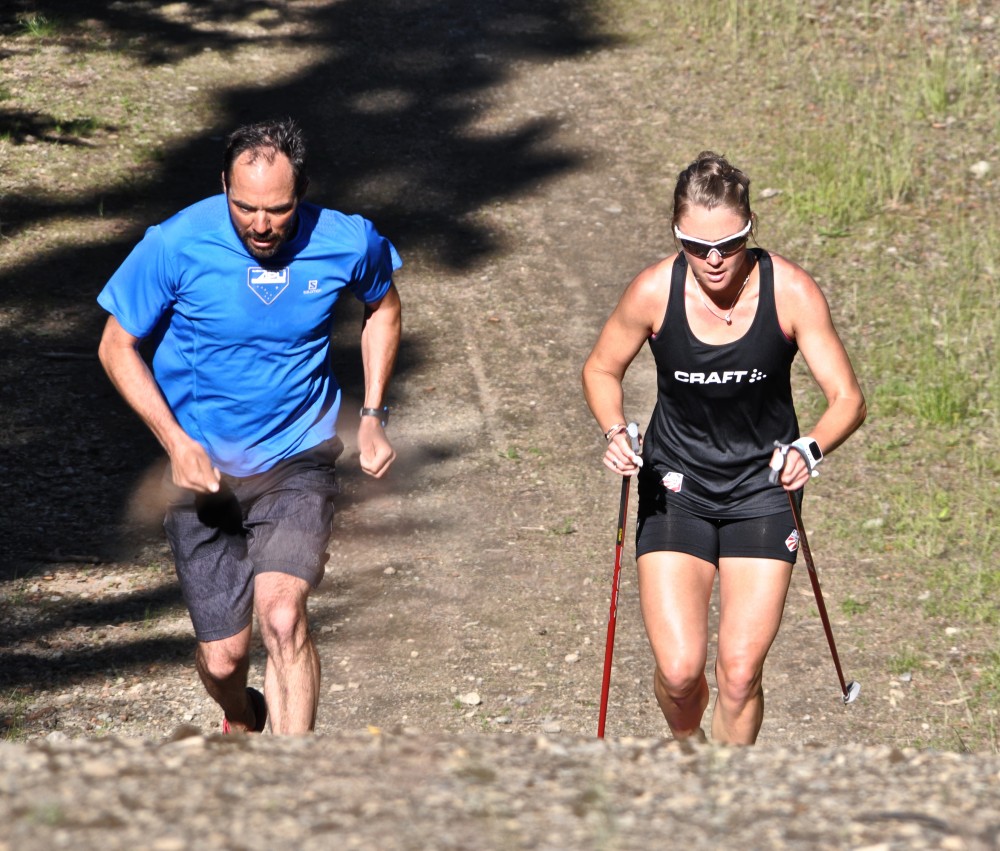
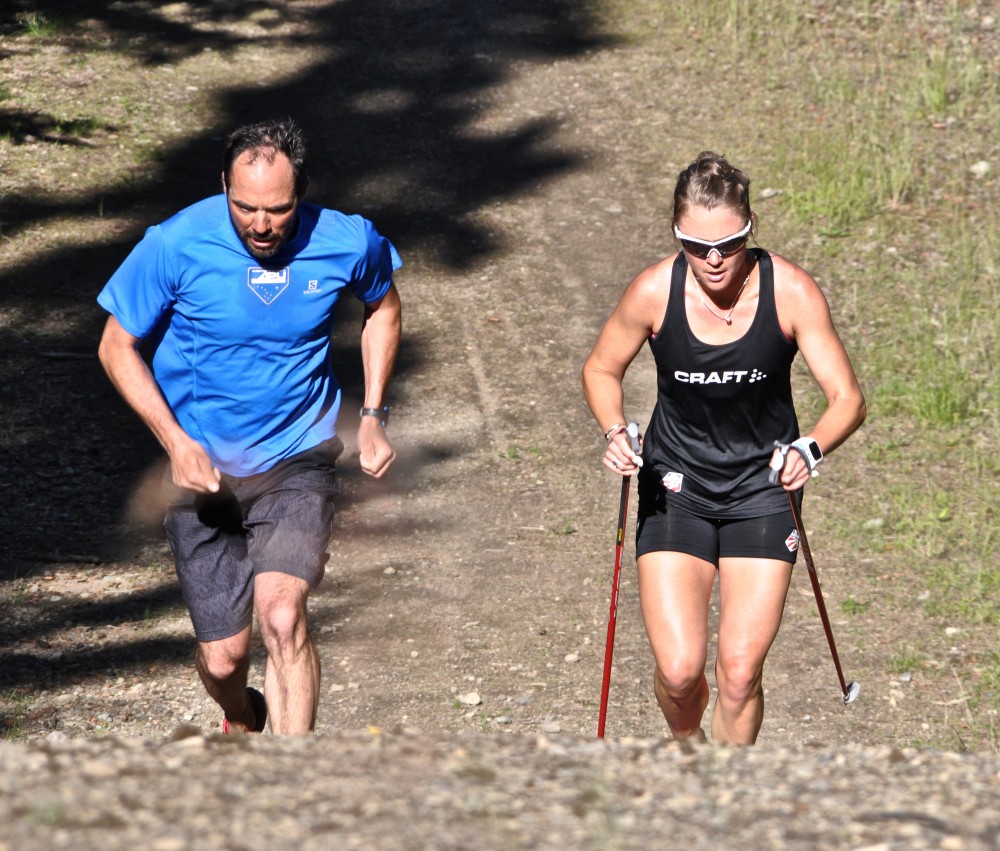
    APU Head Coach Erik Flora runs alongside Sadie Bjornsen (APU/U.S. Ski Team) during a workout last summer. (Photo: Matt Whitcomb)

    Flora kept this experience in mind when he began coaching. But he changed his outlook from “I can do this” to “we can do this.” Part of this was the general shift from athlete to coach. And part of it was specifically watching the success of his former Norwegian training partners a decade down the line.

    As Flora says, “watching a friend of mine get an Olympic gold medal, that I had trained with when I was younger,” had an effect. It made him “take that same … idea when I started coaching, the approach of, ‘Hey, we have a lot of talented skiers, we can certainly do this. The United States can be one of the top nordic countries.’ And then really believing in it.”

    (While the famously circumspect Flora did not mention the friend by name in this interview, it has been elsewhere reported that the friend was Norwegian Tor Arne Hetland, who won the first-ever men’s sprint Olympic gold in Salt Lake City. “You know it’s possible for someone to win a medal,” Flora told Alaska Public Media when discussing Hetland in a 2014 interview. “But you’ve never seen it, you’ve never had breakfast with them. They don’t seem like they’re human. Being friends first with this athlete… and then all of the sudden he wins a gold medal. It’s like, ‘wait a second, I can do that.’”)

    The parallels to The Kikkan Effect are strong: As the theory goes, Randall’s breakthrough World Cup success inspired the current generation of American skiers to greater heights, largely by showing athletes what someone just like them was capable of. Just so, Hetland’s Olympic success inspired Flora to seek these same heights in America, just a few years before he took over the APU program and became Randall’s personal coach. If this theory is correct, then that year abroad in Norway ca. 1993 had some pretty far-reaching influences.

    The Kikkan Effect and APU’s success

    So let’s talk about Randall for a second. (Full disclosure, the author grew up doing Anchorage youth sports in the same generation as Randall, and, like many others of that generation, literally had a poster of her on his bedroom wall. His older daughter now has a signed picture of Randall in her room.)

    As previously profiled many times (for example, in this FasterSkier piece from 2012 called “The Kikkan Effect,” then later in this Outside Online piece from 2017 called “The Kikkan Effect”), Randall broke down barriers and achieved unprecedented success for American skiers, raising her countrywomen up along with her.

    Flora is chary of divulging too much about training plans, but some inklings of his work with Randall can be gleaned from the Outside Online version of The Kikkan Effect. Here are a couple paragraphs from that article:

    “By 2006, with new APU head coach Erik Flora in place, [Randall] increased her training load even more. ‘By 35 percent,’ says Flora. ‘That put her on par with the Scandinavians.’ In 2008, Flora ­dialed things up again. ‘The year of intensity,’ Randall calls it. ‘You hadn’t trained hard enough if you hadn’t started crying.’”

    At the risk of oversimplifying a lot of complicated science about supercompensation (see also Jason Cork’s arm tattoo if you ever get a chance), the changes seem to have worked. The volume increase of 2006 was followed by the first ever World Cup win for an American woman in 2007. The intensity increase of 2008 gave way to the first ever World Championships medal for an American woman in 2009. There was more to it than that, but the decisions made between coach and athlete seem to have paid off.

    Erik Flora officiates at the wedding of Kikkan Randall and Jeff Ellis in Talkeetna, Alaska, in May 2008. (Photo: FasterSkier blog)

    In the middle of this period, Flora officiated at Randall’s wedding to Canadian skier Jeff Ellis in May 2008, standing before an archway formed by superannuated pairs of skis with Denali looming in the background. Flora remains Randall’s personal coach to this day.

    Whatever the reason – be it Randall, Flora, greater trends in American skiing, or some combination of the above – the decade-plus since Flora began working with Randall has seen stunning success for the APU program.

    By the Ski Tour Canada at the end of the 2015/2016 World Cup season, APUNSC had eight athletes skiing on the World Cup, probably more than from any single other club in the world. (And this doesn’t include Randall, who was out for the season on maternity leave.) Going into the 2017/2018 season, APUNSC claims six of the 16 athletes currently on the U.S. Ski Team A, B, and D teams. (Stratton Mountain School counts another seven.) Oh, and there were the two World Championships medals this February, Randall’s third and Sadie Bjornsen’s first (with Jessie Diggins in the team sprint). Whatever Flora is doing at APU, it seems to be working.

    Flora was asked what he is most proud of other than these world-class results. He immediately mentions helping his athletes to develop as people:

    “My proudest accomplishment with this team is, you know, the medals and the ski performances I’m very proud of, but just seeing that the athletes I’m working with are having a good development experience, where they’re coming in at a young age and learning about that transitional place in life – where they’re going, how to chase a goal, and the life experience part. We have these outstanding individuals that, in my Elite program, they’re leaving as these exceptional individuals to the community. That’s one of my proudest parts.”

    He then mentions the overall success of the broader APU program – but, much as with his athletes, ties this to the personal development of the individuals involved:

    “Eagle Glacier, and the Nordic Ski Center, seeing the stability that we have right now, and the reputation as being a world-class elite ski area up on Eagle, and that our training center is one of the top clubs in the world, I’m incredibly proud of what we’ve accomplished. And a lot of that is due to the coaches that have worked for me. And to watch a lot of the coaches that started as either young coaches, or transitioned from athletes into coaches, and to be able to watch them along their journey and find their place where they can also do the same, they can help out and pass along what they’ve learned. Those are my proudest moments.”

    And even when the question is rephrased to hone in on results, Flora still evinces a care for the overall level of American skiing:

    “From the first time we watched Kikkan step onto the silver medal podium in Liberec in 2009 for World Championships, I’ve always believed that U.S. skiing can compete, it’s a matter of getting the right group together and having the right energy, and working hard toward a goal. And so every time I see one of our athletes on a podium, it just confirms that we’re doing the right thing. And we’re doing it in the right way, you know, we’re doing it in a way where the athlete’s having a good experience.”

    Erik Flora gestures at APU Masters Glacier Camp on Eagle Glacier in the Chugach Mountains, Alaska, in July 2016.

    As Flora says, he believes in U.S. skiing. In this vein, it’s a small but telling detail that the flags on display inside the Eagle Glacier training center are American flags. This is a program with “Alaska” in its name, that counts homegrown Alaskans as the majority of its roster. And Alaskans, to engage in a moment of gross understatement, tend to be very proud of Alaska. But the flags are all stars and bars, not eight stars of gold on a field of blue. Flora clearly loves it in Alaska, and has stayed because he believes it is the best place to pursue his goals, but his primary focus remains on international success for the country as a whole.

    Coaching philosophy

    So what’s the coaching philosophy that Flora uses to help American skiers reach these goals? In a word, it’s all about a cup. In two words, it’s all about a cup and the athletes.

    First, the cup. One of Flora’s favorite training images is to suggest that everyone’s life is a cup. [draws diagram on whiteboard with cross-section of a cup] And training fills up this much of your cup, and recovery fills up this much, and preparing and eating food fills up this much, and presumably you’d like to see your friends some, too… and pretty soon, your cup is in danger of overflowing.

    It is a helpful metaphor for visualizing overall training and life stress. It is also a frequent training talk trope. Every training camp at Eagle Glacier, from juniors to masters, signs the wall of the training center, often beneath an image in some way symbolizing the camp or evoking an in-joke from the past week. A picture of the cup was chosen for one recent Elite Team glacier camp, suggesting that the cup was frequently discussed.

    As Flora now notes, “I began as an elite coach about 10 years ago. And when I started, I had this idea or this plan, that if I wrote a training plan, and it was the correct training plan, that I would have good success with my team and my athletes. And you know, sure enough, I was fortunate enough to have a good experience in coaching, and we had some good successes and that seemed to work. But what I’ve kind of learned to appreciate through the years is that to be a top-level skier, it’s very much a lifestyle. So the more I can help athletes find what the right balance is, the better the program goes, the better success we have.”

    Live the lifestyle and find the right balance – you can’t overfill your cup.
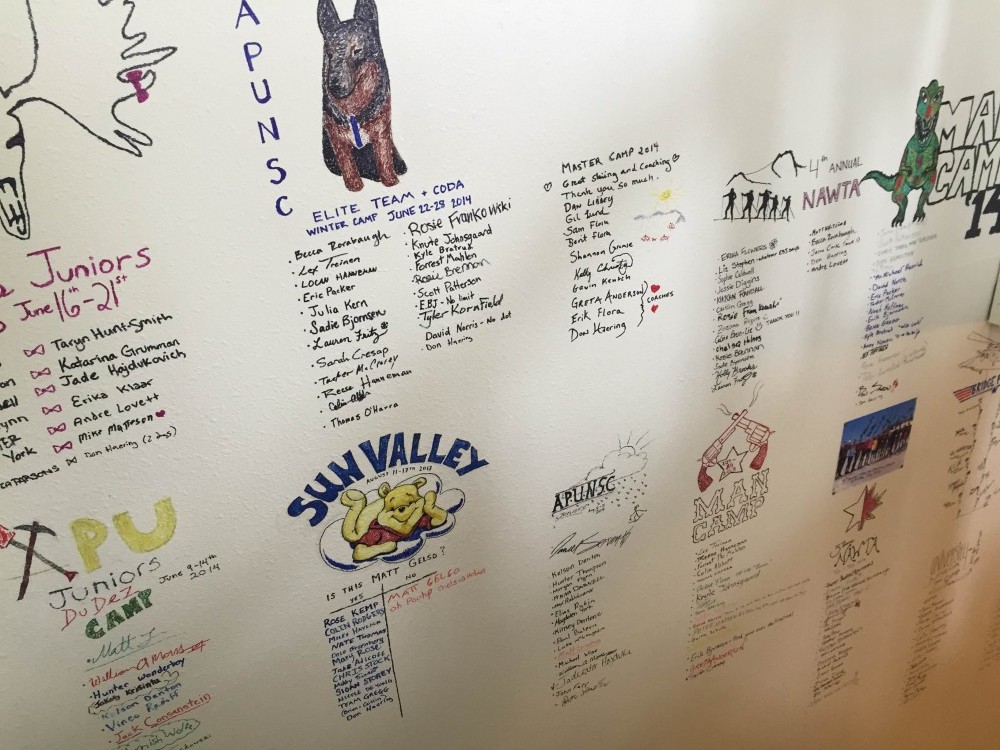
    The wall of fame inside the Thomas Training Center on Eagle Glacier. From left, the APU Juniors (teenage girls), APU Elite Team, 2014 Masters Camp, North American Women’s Training Alliance, and Man Camp (APU and USST men), among many others, have all left their mark. (Photo: Greta Anderson)

    And second, the athletes. Flora clearly believes in empowering his athletes to, if not literally coach themselves, at least to take a very active role in the process. As he notes, “I guess if I were to summarize my coaching style, [it would be] as: I believe very much in trying to educate or teach the athletes about training.”

    He continues, “And so … when they start from a young athlete, they learn all the different types of training, they get experience training in different ways, and they become the expert over time. And that’s been something I’ve been very proud of. It’s like, the team I have now, I feel very confident that – when it’s their turn to coach, that the experience level of the athletes is quite high. Because through the training process, they’ve, you know, learned ‘what happens when I train too much,’ ‘what happens when I train on the right sequence,’ ‘how do I get faster,’ ‘what are the basics.’ And so I would say that’s a way to sum up my basic philosophy of training.”

    Personal life

    So what does Flora do when he’s not coaching skiing? Well, he goes skiing for fun.

    No, really – Flora can often be seen skiing with his entire family in the offseason, either on the ski trails in spring or in the mountains in summer. These are often family affairs, as three generations – Berit and Sam, the septuagenarian (and still skiing) grandparents; Erik and Gretchen, the parents; and Oskar, Marit, and Ingrid, the children – can be seen hiking up steep trails with skis in backpacks.

    And, yes, all three children ski race. They are not bad at it, either; Marit was second among U14 girls, and Oskar first among U10 boys, in last winter’s Besh Cup Series of JO qualifying races.

    Despite, or perhaps because of, his day job as a high-level professional ski coach, Erik and Gretchen at a Besh Cup are less Ski Coach than Good Sports Parent. Leave it to the other parents to engage in a postmortem of tactics or wax efficacy following a zero-stakes U12 contest… Erik and Gretchen are the ones who reliably say only, “Good job! Did you have fun? Let’s go get some hot chocolate.”

    Presumably that cup is full of hot chocolate. But not too full.

    * * *

    Disclosure: The author is an unremarkable Masters skier with the APU Masters program. He receives coaching from Erik Flora on one occasion per year, for a few days in a group setting at APU Masters Eagle Glacier Camp, but has no other direct involvement with Flora as an athlete.

  • Myrseth, Madlener Win RMISA Mass Starts in Anchorage

    Myrseth, Madlener Win RMISA Mass Starts in Anchorage

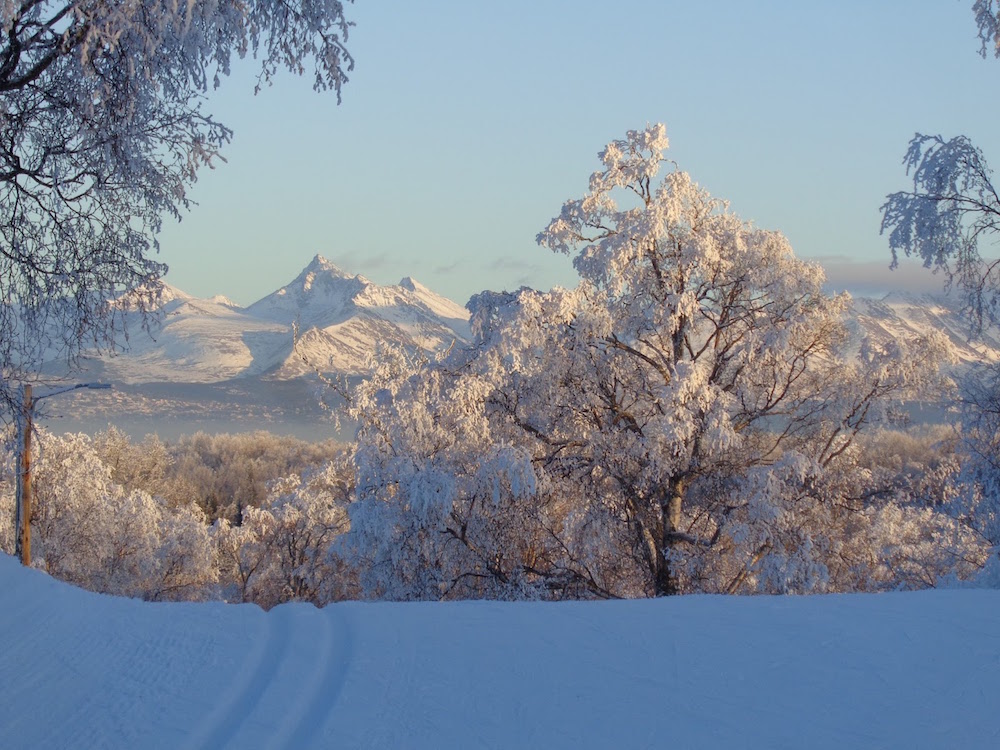
    The Chugach Mountains as seen from the Lekisch Loop, part of the course for the weekend’s races, at Kincaid Park in Anchorage, Alaska. (Photo: Adam Verrier)

    ANCHORAGE, Alaska — So how cold was it at Kincaid Park Sunday morning for the last of four Rocky Mountain Intercollegiate Ski Association (RMISA) races held in the Anchorage area this week?

    “It’s f—ing cold,” said women’s winner Merete Myrseth of the University of Utah. “It was cold,” said men’s winner Moritz Madlener of the University of Denver. “Now we fly back to Denver and get warm.” [Unavailable for comment] were the two skiers who required an ambulance for cold-related injuries following the women’s race.

    For the record, temperatures were consistently at or above zero degrees Fahrenheit all morning, so readily FIS-legal. (The International Ski Federation, which sanctioned all of this week’s races, has a temperature cutoff of -20° C, or -4° F, in order for a race to be held.) The real problem was the wind, which blew steadily from the north at around 10mph all morning.

    Unless the real problem was the humidity. The city of Anchorage is, well, a natural anchorage, bordered by Cook Inlet to the north and Turnagain Arm to the south. The Kincaid stadium is well under a kilometer away from the shores of the ice-choked Pacific Ocean; athletes were within 150 meters of the Turnagain Arm beach at one point on Sunday’s race course. Humidity was over 90% all morning. By any measure, conditions were somewhere between “raw” and “brutal.”

    At least atmospherically speaking. The ski trails were in superb shape following 30″ of snow in the month of January, if slow due to temperatures below zero Saturday night into Sunday morning.

    The first race of the day, the men’s 20-kilometer freestyle mass start, saw its start moved one hour later due to cold conditions. In that time the temperature rose from -2° F to zero.

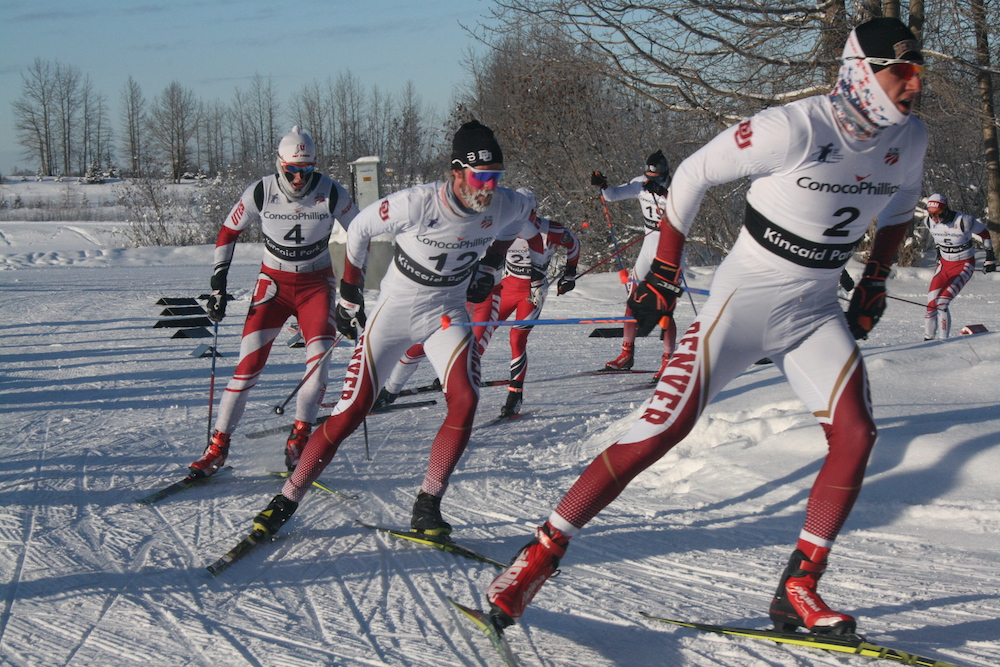
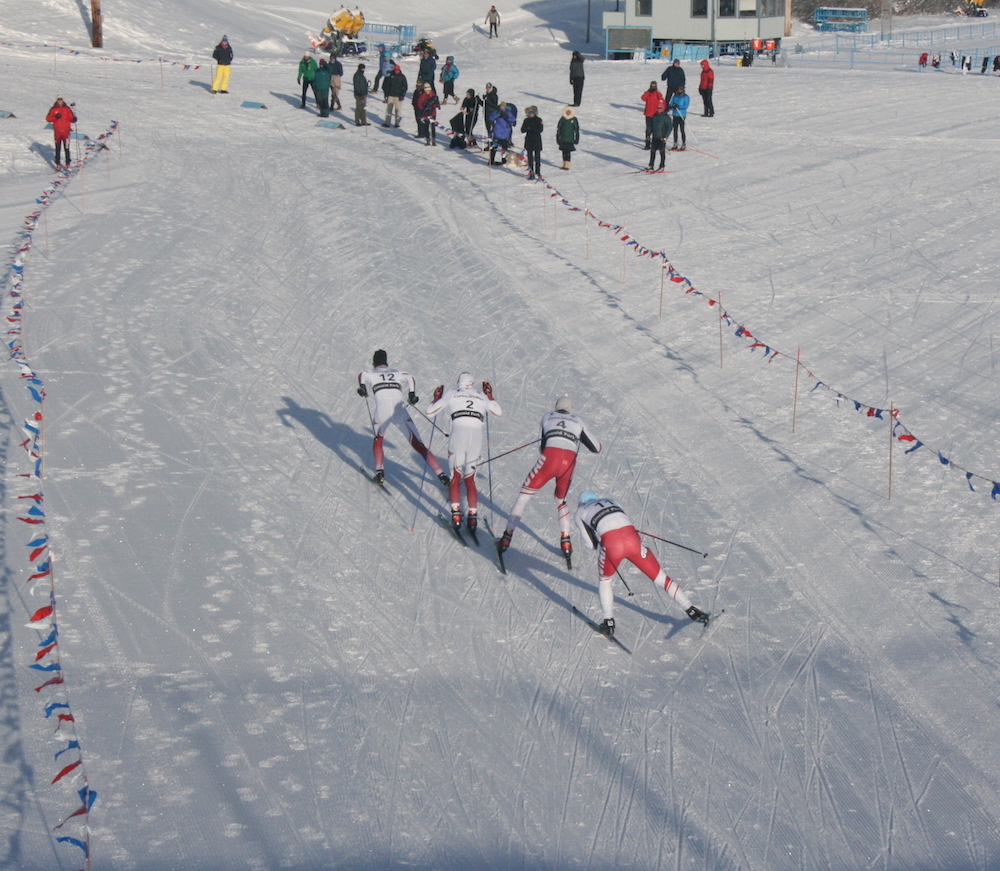
    Denver’s Moritz Madlener (2) leads Dag Frode Trollebø of Denver (12) and Kevin Bolger of Utah (4) in the men’s 20 k skate at Kincaid Park in Anchorage, Alaska. (Photo: Adam Verrier)

    When the race started, Denver’s Madlener quickly moved near the front as the field of 42 racers headed north out of the stadium to make their way up Elliott’s Climb. (For Anchorage readers, or anyone else familiar with Kincaid: the course went up Elliott’s and down Rollercoaster; up and down the Gong Hill; through the lower tunnel out to Mize’s Folly; take the first right onto Hairpin; take the first left at the top of Hairpin onto the 2.9 k Lekisch. Men did two laps of this, for 15 k, then a final 5 k lap that cut out Elliott’s. Women did two laps of the 7.5 k course for 15 k total.)

    “I was in the front pack pretty much the whole race,” Madlener recounted in an in-person interview with FasterSkier. “Tried to, you know, set the pace every now and then to get rid of people. Which worked pretty well; I think four of us got away after maybe 12 [kilometers]. And then we stayed together for the rest of the race, and then the last couple hills we kind of separated.”

    Madlener ultimately crossed the line in 52:39.2, edging teammate Dag Frode Trollebø by 2.6 seconds. Martin Bergström of the University of Utah followed in third (+10.4). “That’s a great feeling” to share the podium with a teammate, Madlener told FasterSkier.

    Madlener recalled that he had “a really good start” to his season at U.S. nationals – he earned two podiums there, second in the classic sprint and third in the 15 k skate – before he got sick “and had to catch up. And the races so far here in Alaska weren’t that great,” he continued, “so I was very happy to win today.”

    This week marked Madlener’s second time racing in Alaska; he previously competed in the last RMISA race series held in Anchorage, in early 2015. That week was marked by warm weather, rain, and shortened courses.

    Madlener is a fan, of Alaska in general and particularly the full courses that athletes got to race on this year.

    “I think it’s beautiful,” Madlener said of Alaska. “It’s like – I would say it’s like a big theme park; people are surfing and flying around and fishing. I really enjoy it. And the courses – again, two years ago, were not so great, but this year there’s a lot of snow, they’re pretty amazing courses. Like a rollercoaster.”

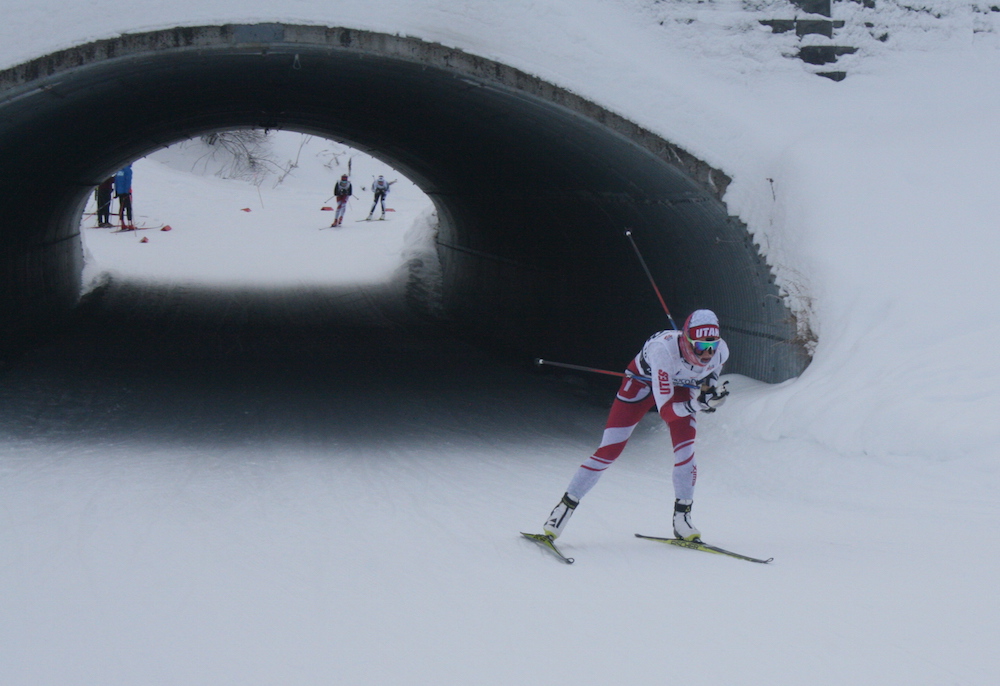
    Merete Myrseth of Utah enters the stadium approaching the finish in the women’s 15 k skate at Kincaid Park in Anchorage, Alaska. (Photo: Adam Verrier)

    Sunday’s race course featured a total of eight A-climbs for the men in 20 k, and six A-climbs for the women in 15 k. There was an average of 34 meters of climbing per kilometer on the main 7.5 k loop.

    Four racers, roughly a tenth of the field, were DNFs in the men’s race, likely due to a combination of the hills and the cold. Two skiers did not finish the women’s race. An additional eight opted not to start.

    The first words out of Madlener’s mouth when asked about his race were, “It was – first of all it was cold, obviously.” Myrseth, the women’s winner who skis for Utah, voiced similar sentiments: “It was cold, really cold,” she began her race summary. (By the time of the women’s race start at 12:30 p.m., temperatures had climbed to 1.6° F.)

    “I was unsure if I would start the whole race because it was so cold, actually too cold for me,” Myrseth told FasterSkier in a brief in-person interview while shivering in the windy stadium soon after her finish. “But it went really easy in the first half of the lap,” she continued, and she felt good. “So I decided to speed up when I came to hills”; there Myrseth created a gap that she kept all the way to the finish.

    But not without difficulty. “I didn’t feel good,” Myrseth said. “My feet, I couldn’t feel my feet, it was so cold. So I had to just, like, double pole over the hills, I was so tight in my feet and lost my balance, it was just so hard to keep balancing. But I made it to the finish line. And I am so happy that Guro took the second place.”

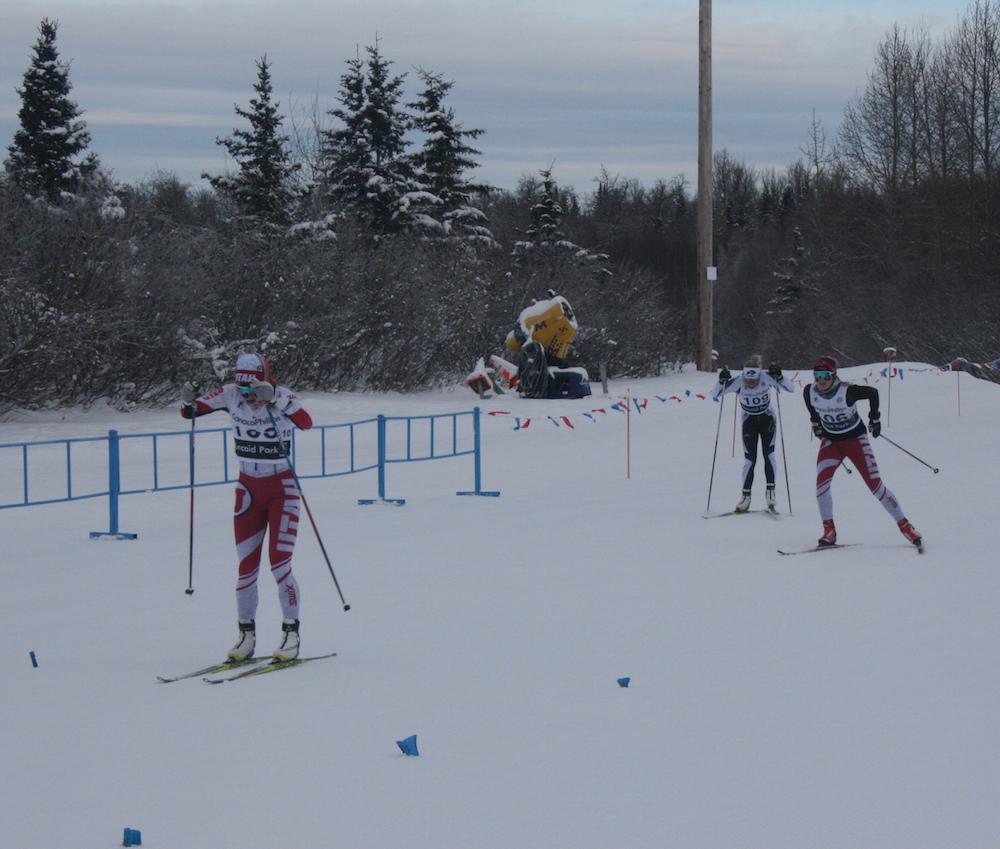
    Merete Myrseth of Utah (l) in the finishing chute en route to the narrow victory over Guro Jordheim of Utah (106) and Christina Rolandsen of Colorado (109) at Kincaid Park in Anchorage, Alaska. (Photo: Adam Verrier)

    Myrseth crossed the finish line in 46:28.3 for 15 k, double poling the last few meters to the finish. As she noted, she was followed by teammate Guro Jordheim in a close second (+0.5). Christina Rolandsen of the University of Colorado was not far back in third (+1.8). There was then a 30-second gap to a chase pack containing places fourth through sixth. 32 skiers finished the women’s race.

    This week marked Myrseth’s first time racing in Anchorage or even visiting Alaska. So what did she think? “I love it,” said the native of Øverbygd, Norway. “It’s f—ing cold, but it reminds me of Norway, my home. I’m used to it. But it’s so nice; I really like it here.”

    Sunday’s race marked the fourth race of the week in the Anchorage area for RMISA athletes. Recaps of the first three races follow below.

    Sunday results: FIS men and FIS women | NCAA-only results

    ***

    1.4 k freestyle sprint

    On Tuesday, February 7, RMISA athletes, plus a handful of skiers from Alaska Pacific University (APU) with sterling sprint credentials, raced a 1.4-kilometer freestyle sprint at Kincaid. Conditions were impeccable, with pure blue skies, temperatures in the high teens, and last month’s fresh snow mixed in with the base of manmade snow covering the sprint loop.

    In the women’s race, Merete Myrseth of Utah posted the fastest time in qualifying, 3:25.77, followed by Becca Rorabaugh of APU (+2.14) and Utah’s Guro Jordheim (+3.65). All three skiers made the A-Final, where Myrseth took her first victory of the week. The overall podium, which was also the college podium, was Jordheim in second and Anika Miller (Montana State) in third. Casey Wright (UAA), Rorabaugh, and Jasmi Joensuu (Denver) were fourth through sixth.

    Times were not available for any of the heats.

    In the men’s race, Dag Frode Trollebø (Utah) set the pace in qualifying in 2:48.80. He was followed by APU’s Logan Hanneman (+1.52) and Utah’s Martin Bergström (+3.33).

    Three of the six skiers in the men’s A-Final were locals (in the broad sense of being from Alaska; the Hanneman brothers are from Fairbanks, not Anchorage). And it was the Hanneman show in the final, as the elder Reese Hanneman took the victory over his younger brother Logan. Trollebø was third. Kevin Bolger of Utah, last seen winning the classic sprint national championship at Soldier Hollow, Bergström, and APU’s Forrest Mahlen rounded out the final finisher spots in that order.

    The collegiate podium for the men’s race was Trollebø, Bolger, and Bergström. (APU is not an NCAA-affiliated athletic program.)

    While sprinting may be on the horizon for NCAA skiing in general, it had yet to make an appearance on the RMISA circuit.

    “This was the first sprint that I know of in my, what – 10 years of RMISA coaching now and we’ve never had just a straight invitational sprint,” University of Alaska Anchorage Head Nordic Coach Andrew Kastning told FasterSkier in person following Sunday’s distance skate races.

    Kastning said that the addition of a sprint in Anchorage stemmed from a desire for a change of pace, and to avoid repetition in a single week with four races. “So when we sat down last spring and were deciding the schedule,” he said, “we’d been hearing for a few years now from our athletes that the fives, 10s, 15s, and 20s [kilometer race format] every weekend just kind of got boring, and we wanted to mix it up. So we counted the qualifying round as an invite at U.S. Nationals, and then we ran the full sprint [this week] and counted that. … So we just wanted to mix it up a little up here. Especially with four races in a short period of time, you don’t want to be doing all the same distances and the same courses.”

    So did the college athletes appreciate the chance to contest a sprint race in the middle of the RMISA race season? “Some of them do,” Kastning said. “There’s always a sprint specialist in the crowd who gets to shine. And I know there were kids on the podium, or in the top-10 at least, that aren’t normally in a distance race. So it allows some athletes to play to their strengths and shine a bit when they maybe wouldn‘t in a 20 k race, they can in a sprint.”

    On the non-collegiate side, APU skier Reese Hanneman, a sprint specialist, was thrilled to have a mid-season sprint race with high-level competition on his adopted home course. “I wish there were more sprint races in the middle of the season,” Hanneman told the Alaska Dispatch News.

    Full FIS results: men and women | | NCAA-only results

    ***

    4 x 5 k classic relay

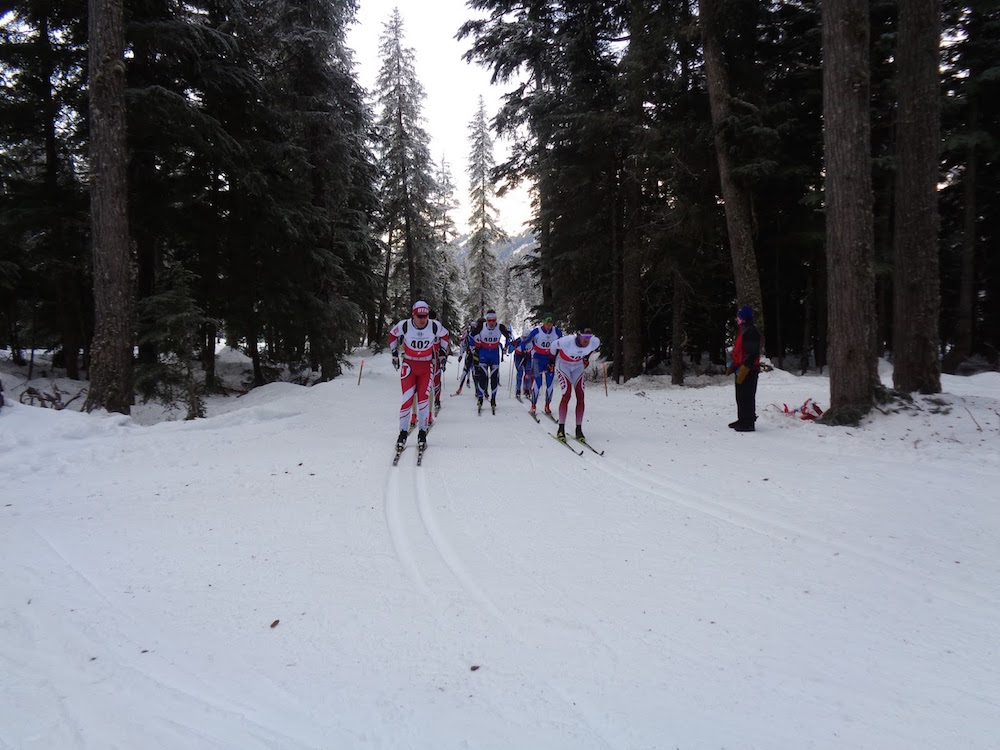
    Utah’s Martin Bergström (402) leads Denver’s Dag Frode Trollebø (right) and APU’s Reese Hanneman (center) at the start of the mixed-gender classic relay in Girdwood, Alaska. (Photo: Adam Verrier)

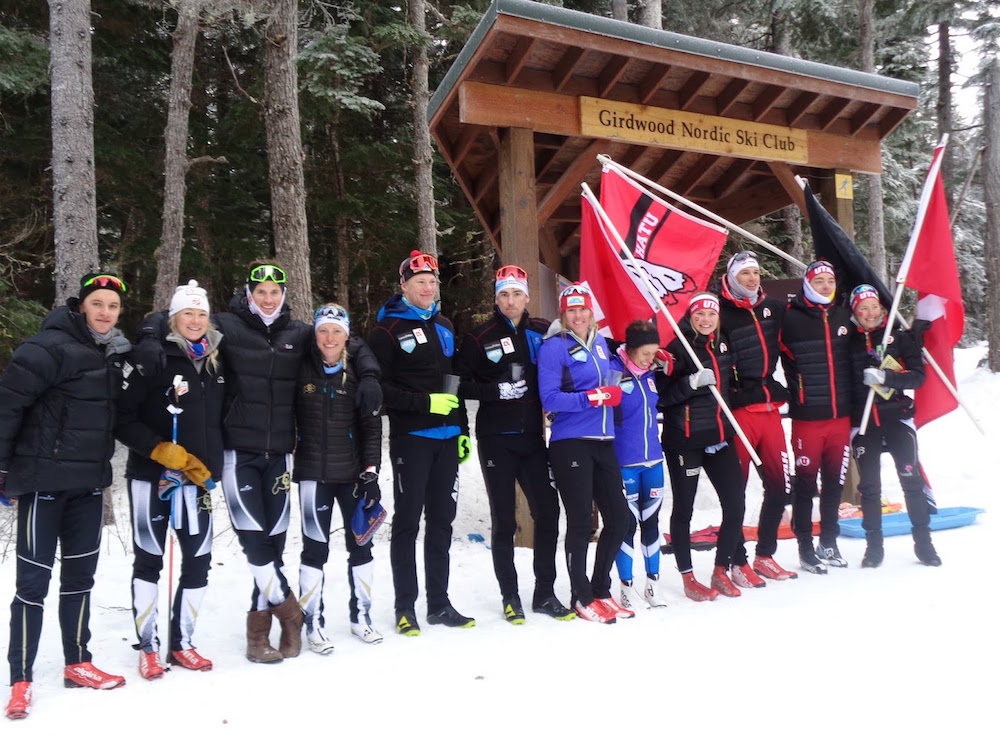
    The next day, Wednesday, February 8, skiers made the 45-minute drive down Turnagain Arm from Anchorage to Girdwood for a classic relay race. Girdwood is perhaps best known in ski circles as home to the Alyeska Resort alpine area, which boasts an average annual snowfall of 669″ and (when it’s clear) sweeping views of the mountains and glaciers overlooking Turnagain Arm. Publications as diverse as Powder magazine and National Geographic have lauded Girdwood as a quintessential locals ski town (“Best For: Off-the-beaten-path powder hounds with an aversion to glamour”).

    Girdwood also has a proud nordic heritage, though you have to look a little harder to find it. It is home to APU skier Chelsea Holmes, who will be competing at World Champs in Lahti later this month. And it hosted the 1969 Junior Nationals, on trails cleared from the continent’s northernmost coastal rainforest for this purpose.

    As discussed in more detail on former U.S. Ski Team member Tim Kelley’s invaluable blog, Alaska Lost Ski Areas Project, the trails faded back into the woods at some point during the 1970s. High-level nordic skiing in Girdwood then languished for over thirty years, until the early part of this decade, when the Girdwood Nordic Ski Club oversaw construction of a new 5 k loop. The reborn nordic trails have since hosted a handful of local high school races in periods of poor snow conditions in Anchorage, but it is safe to say that Wednesday’s relay was the most significant cross-country ski race held in Girdwood since 1969.

    APU (1st), Colorado (2nd), and Utah (3rd) make up the podium for the mixed-gender classic relay in Girdwood, Alaska. (Photo: Adam Verrier)

    Athletes raced in a mixed-gender 4 x 5-kilometer classic relay in the epochal event, man/woman/man/woman. It was once again APU leading the way, as the team of Reese Hanneman, Rosie Frankowski, Logan Hanneman, and Rorabaugh crossed the finish line for the victory in 57:33.7. Second overall, and first among collegiate teams, was Colorado (Mads Ek Strøm, Jesse Knori, Petter Reistad, Christina Rolandsen), 25.6 seconds back. They were followed by Utah (Bergström, Jordheim, Bolger, Myrseth) (+1:02.6). Fourth overall, and third for the NCAA podium, was Denver (Trollebø, Linn Eriksen, Moritz Madlener, Joensuu) (+1:25.4).

    “Everybody was psyched on a new format and a new trail in a beautiful location,” Kastning told FasterSkier of Wednesday’s race.

    Kastning added that the relay, like the previous day’s sprint, was new territory for RMISA racing. “We’ve never had a relay that’s counted for anything,” he said. “I think the relay captures college skiing well, with the mixed gender and the team aspect, men and women working together to try and reach the podium.”

    Full results | NCAA-only results

    ***

    5/10 k classic individual start

    Three days later, Saturday, February 11, skiers were back in Anchorage for individual start distance classic races, 5 k for the women and 10 k for the men. Race time was moved forward from 10 a.m. to noon, which allowed temperatures to rise from 2° F up to 8°.

    Saturday’s course was by some measures the hilliest of the week, clocking in at a healthy 39 meters of climbing per kilometer of distance. The upper limit for FIS homologation is 40 m/km. (The course covered the final two-thirds of Sunday’s 7.5 k course – notably Gong Hill, Mize’s Folly, Lekisch.)

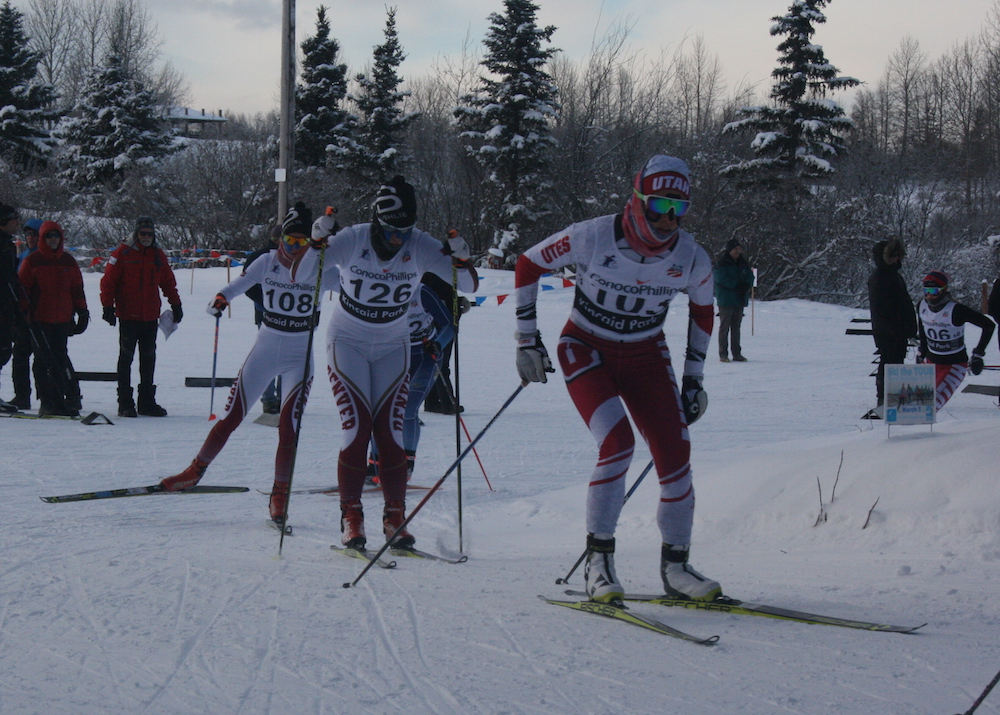
    Merete Myrseth of Utah (103) leads Denver’s Jasmi Joensuu (126) and Taeler McCrerey (108) in the women’s 15 k skate at Kincaid Park in Anchorage, Alaska. (Photo: Adam Verrier)

    Rorabaugh started near the end of the field in the women’s 5 k classic, which had 39 starters. Two A-Climbs later she crossed the finish line in 15:47.0, which held up as the fastest time of the day. Colorado skier Knori was second (+4.2), followed by her teammate Rolandsen in third (+8.2). Jordheim of Utah (+13.8) was fourth overall to round out the collegiate podium, just ahead of APU’s Frankowski in fifth (+15.0).

    It was Rorabaugh’s first 5 k classic FIS race in this country in over five years.

    The men raced two laps of the same course for a 10 k classic. Denver’s Trollebø was again on the podium, posting the day’s fastest time of 26:51.60. He was followed by Utah’s Bolger in second (+15.0) and Colorado’s Reistad in third (+19.3). Utah skier Bergström (+29.2), immediately followed by Denver skier Madlener (+29.4), rounded out the top five.

    Full FIS results: men and women | | NCAA-only results

    ***

    Overall team results

    The week’s four races were technically scored as parts of two college invitational race series. In the Seawolf Invitational, encompassing the sprint and relay from the first part of the week, plus two alpine races held at Alyeska in January, the University of Utah took the overall team title with 665 points. The University of Denver (569 points) and the University of Colorado (549 points) followed. The order was the same if the standings are broken out by exclusively nordic results: Utah, Denver, Colorado.

    The weekend’s distance races combined with two other January alpine races to make up the week’s second race series, the UAA Invitational. Combined standings were unchanged here, as Utah (661 points) took the victory over Denver (636 points) and Colorado (544 points). On nordic results alone the ranking was the same: Utah, Denver, Colorado.

    RMISA racing continues with the RMISA Championships/NCAA West Regional in Colorado in late February, then (for qualifying skiers) NCAA Championships in New Hampshire in March. Nordic races will be held at Jackson Ski Touring Center.

    Kastning explained that RMISA schools take their biennial trip to Alaska in years when NCAA Championships are set for the East Coast, “because it’s lower elevation. So other teams like to get some sea-level racing,” he said. “And so it helps our whole region do better I think at NCAAs, because you get some tempo racing, a different kind or style of racing than you do when you’re racing at 9,000 feet.”

    From left, Dag Frode Trollebø of Denver, Moritz Madlener of Denver, Kevin Bolger of Utah, and Martin Bergström of Utah enter the stadium in the men’s 20 k skate at Kincaid Park in Anchorage, Alaska. (Photo: Adam Verrier)
  • Skimeisters Iverson, Randall Master Alaska Downhill-XC-Bike Race

    Skimeisters Iverson, Randall Master Alaska Downhill-XC-Bike Race

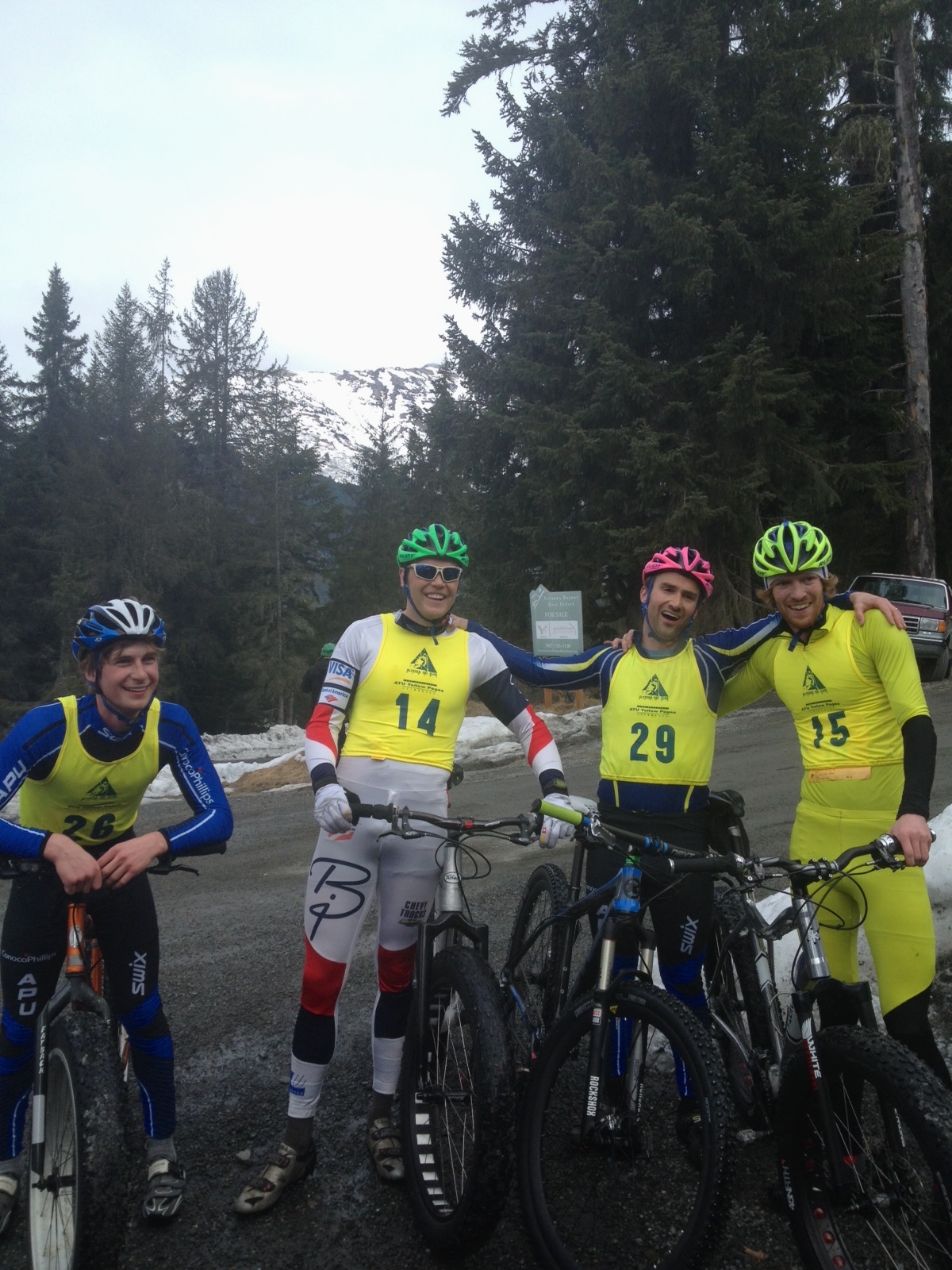
    Mark Iverson (Rossignol) leads Reese Hanneman (APU) in the AK Skimeister Challenge on April 5. A runner-up in the inaugural race last year, Iverson went on to win and the defending champ Hanneman took second. (Photo: Girdwood Nordic Ski Club/Facebook) https://www.facebook.com/pages/Girdwood-Nordic-Ski-Club/112569688796600?ref=ts&fref=ts
    Mark Iverson (Rossignol) leads Reese Hanneman (APU) in the AK Skimeister Challenge on April 5. A runner-up in the inaugural race last year, Iverson went on to win and the defending champ Hanneman took second. (Photo: Girdwood Nordic Ski Club/Facebook)

    When you think of athletes like Kikkan Randall, Mark Iverson and Reese Hanneman, alpine skiing doesn’t necessarily jump to mind. But the three U.S. nordic skiers proved last Saturday that they’re masters of many trades at the second-annual AK Skimeister Challenge in Girdwood, Alaska.

    A four-time U.S. Olympian, Randall, 31, won the individual women’s race at Alyeska Resort by more than 16 minutes in 59:53.01. The only U.S. Ski Team member in the field, she bested the field eight women, including two juniors.

    Iverson, also 31, outlasted Hanneman, his former teammate at Alaska Pacific University (APU), by 2:46.25 minutes for his first win in the multi-sport event in 50:17.72. Twenty-four men and three junior men competed individually in the race, which also includes three-person teams.

    “I’ve planned on doing this race all year,” Iverson wrote in an email. “I raced it last year (the first year for this race) and was 2nd. I was hoping to improve on that this year. I think anyone who is a skier is drawn to this type of race. It’s a great way to test and compete across disciplines and compete alongside alpine skiers and cyclists.”

    The race began outside Alyeska’s midway lodge with a Le Mans start, where participants ran about 100 meters uphill to their skis — in their boots and all — before clicking into their alpine equipment and racing more than 2,000 vertical feet down.

    “I grew up alpine skiing in Steamboat Springs [Colorado] and even raced a few years when I was younger,” Iverson explained. “I’m really comfortable on alpine skis, but what really helped me on the run was being able following Charlie Renfro, an APU Junior coach, good friend of mine and a really good alpine skier, down the course. We were 1-2 after the uphill sprint and he was able to show me the line the whole way down despite loosing his pole right at the start.”

    While he was first to the bottom, Hanneman, who was first to the top, wrote in an email that he “got hosed because for some reason I took forever to get clicked into my alpine skis. It was a sidehill with fresh snow, and I burned up quite a bit of time. I felt like such an idiot, like I had never clicked into alpine skis before.”

    By the time Hanneman started downhill, Iverson and Renfro were long gone.

    From there, racers transitioned to a 6-kilometer cross-country ski. Iverson, a technically retired racer who skis for Rossignol, knew he needed to get as far ahead of Hanneman as possible in the alpine leg before the skate ski. Hanneman, 24, was coming off a classic-sprint victory at SuperTour Finals and bronze in the U.S. Distance Nationals 50 k classic in Anchorage just over a week ago. Hanneman also won the overall SuperTour title — which comes with World Cup starts early next season.

    The defending Skimeister champ from the first race in 2013, Hanneman first caught Renfro, then Iverson within the a kilometer or so of the nordic ski, and Hanneman and Iverson remained together for the rest of it.

    “[Mark] is in pretty good xc ski shape right now, and I knew that if I had an epic ski leg maybe I could put like 15 seconds on him,” Hanneman wrote.

    “I got out of the transition a little ahead of Reese and starting pulling away on the groomed section of course,” Iverson wrote of the final snow-bike leg. “But I know he’s a strong biker mountain biker as well, so I stayed nervous on the 2nd 2/3rds of the course which was all single track. I never wrote him off.”

    Iverson won by nearly three minutes, and Hanneman took second, about four minutes ahead of John Novak in third and Renfro another 14 seconds back in fourth.

    “Frankly my body was just too tired to really want to go that hard,” Hanneman explained. “[Mark] just slowly pulled away from me on the couple mile long climb.”

    Since the 50 k a week earlier, Hanneman wrote that he mostly went alpine skiing and cross-country skied once.

    “I figured that the difference between feeling good and feeling bad in the xc ski would be mostly negated by the fact that my legs would be searing from coming straight into it right from a 4 minute, almost 3000ft alpine run,” Hanneman wrote. “I was pretty much right on… Once I was able to get all that lactic acid out my legs a couple k’s in, I started feeling better…”

    Not Bad for a ‘Retired’ Guy

    After the 2014 AK Skimeister Challenge (from left to right): Jack Novak, Mark Iverson, Charlie Renfro, and Galen Johnston. (Photo: Mark Iverson)
    After the 2014 AK Skimeister Challenge (from left to right): Jack Novak, Mark Iverson, Charlie Renfro, and Galen Johnston. (Photo: Mark Iverson)

    Iverson, who placed 19th in the 50 k, retired from elite racing last spring. While working full-time at the Anchorage-based Skinny Raven sports store, he jumped into a couple of nordic races last winter, including the American Birkebeiner in Wisconsin and the four races at Spring Series in Anchorage.

    “It’s been a little weird stepping away after the best season of my career,” Iverson said. “The hardest part was not heading out to West camp to see and train with all the people you’ve been out there with for years. I did a lot of mountain running last summer, and pretty much only roller skied when I was asked by Brent Knight or Reese. It’s different not training full time, but I’ve been at it long enough to be able to carry some good fitness. I just went into every race to have fun. I’ve always done best when I didn’t feel any pressure.”

    That’s what made him happy about his results this year, including 10th in the 15 k at SuperTour Finals, 18th in the Birkie, and fourth in a 15 k skate FIS race in December (after University of Vermont senior Scott Patterson, Hanneman, and Eric Packer of the Stratton Mountain School T2 Team, respectively).

    As for his spring, summer and winter plans for 2014, Iverson said, “Work is getting busier and busier, but I plan on doing a lot of biking and mountain running. Come winter I think I’ll have a similar schedule of racing as I did this year: ski my favorite marathons for and race locally for Rossignol. You have to stay in shape somehow, right?”

    Hanneman stated the Skimeister was an event that was more about “fun, off-the-cuff, non-standard competition,” which was a nice way to end the season, but most importantly, it raised money for Challenge Alaska, “an incredible organization that does a lot of awesome thing for people with disabilities,” he wrote.

    “This event is so sweet because it is perfect for this time of year,” he added. “It’s pretty laid back, and because of all the different stuff going on within the race no-one really knows exactly what they’re doing. I think part of its appeal is that it is totally unrefined, and it feels kind of like an adventure. And then theres all the free food, music, and a big party afterwards.”

    Hanneman is headed to northern Alaska on April 19 to volunteer with NANA Nordic, which shares nordic skiing with children in rural villages.

    “It will be my 5th visit to a village with the program, and I am so stoked for it!!” Hanneman wrote.

    Other than that, he’s trying to keep a low profile. “I have tried to make very few plans this spring. I want to give myself the chance to just kind of follow what my mind wants to do, in an attempt to let myself heal from the intense last few months of racing and traveling. Right now I am really starting to realize just how exhausted I really am.”

    Kikkan Randall with her husband Jeff Ellis before the second-annual AK Skimeister Challenge last Saturday. Randall won the women's race by more than 16 minutes.  (Photo: Girdwood Nordic Ski Club/Facebook) https://www.facebook.com/pages/Girdwood-Nordic-Ski-Club/112569688796600?ref=ts&fref=ts
    Kikkan Randall with her husband Jeff Ellis before the second-annual AK Skimeister Challenge last Saturday. Randall won the women’s race by more than 16 minutes. (Photo: Girdwood Nordic Ski Club/Facebook)

    Queen of the Mountain

    Randall won the Skimeister title in her first try, after her husband Jeff Ellis competed in last year’s edition and her U.S. Ski Team/APU teammate Holly Brooks won the women’s race that same year. Randall signed up for the event a couple weeks ago, she explained.

    “I had backcountry skied a few times earlier in the week and got an afternoon at Alyeska of resort skiing,” Randall wrote in an email. “So I got in a little practice. But I still feel out of touch and out of shape for real alpine skiing. The course was set pretty much like a real downhill and the all mountain skis I was using are better for turning. I got more comfortable as I made my way down the mountain, would have been sweet to have a practice run before the race. My legs were burning pretty good by the bottom!”

    By the time she got to the nordic portion, Randall explained that she felt tired and had trouble skiing fast. “But I warmed into it, the trails were in great shape and it was fun to catch some boys!”

    Still out front, she managed to solidify the win on what she called the “most challenging” bike leg.

    “The first half was on a cat track with a soft layer on top, which really worked the legs,” she wrote. “Then we got into the woods on some icy single track and I was being pretty tentative.  It was a funny feeling to not be maxing out aerobically but still not able to go any faster.”

    Back home after a long season, Randall did not make the trip to Washington, D.C, last week to meet the President and First Lady at the White House on April 3.

    “I decided to stay home this time and have just been enjoying some nice days at home with Jeff after a busy winter,” she wrote. “So I’ve been in town all week, doing a few public appearances and catching up with friends.”

    Race website | Results

  • Penguin Ridge Hike

    The alarm clock crowed rudely at 4:00 AM. On a Saturday. I fought back by hitting the snooze bar a couple of times.

    The Penguin Ridge hike has been on my to-do list for a long time. Tim Kelley first recommended it to me years ago. Like many other local Chugach hikes, I always figured that some weekend, when I had a little extra time, I’ll knock it off my list. But, funny thing, when you have two little rugrats there is never “extra time.” I decided to start at an ungodly hour, so that I could be back on Dad duty by lunch. I left the Bird Creek parking lot just after 5:30 AM.

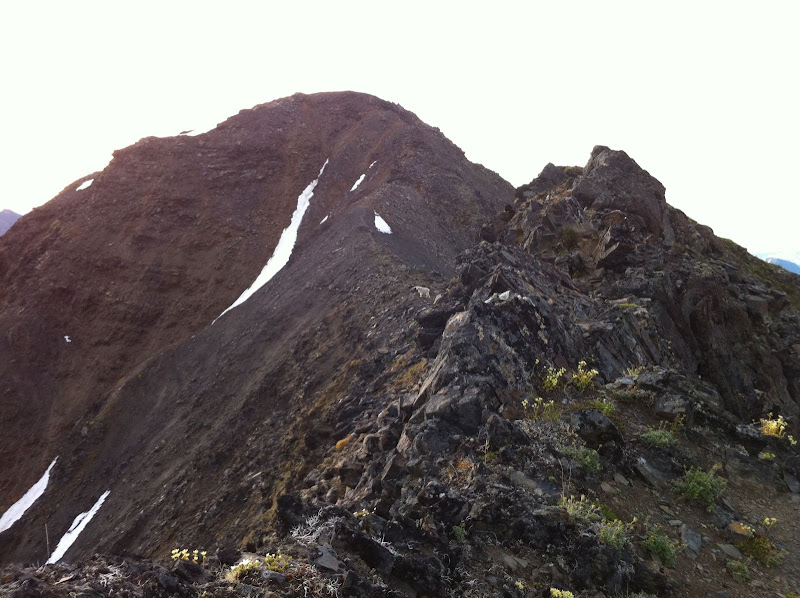
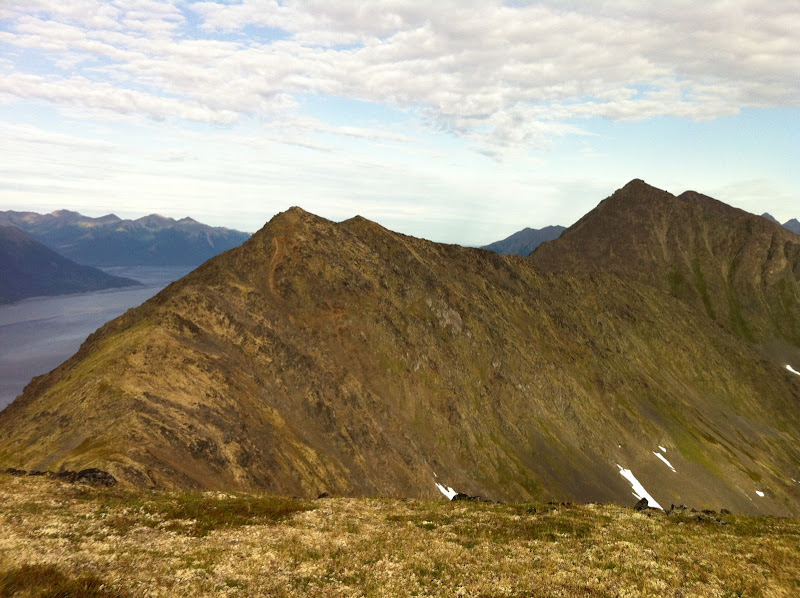
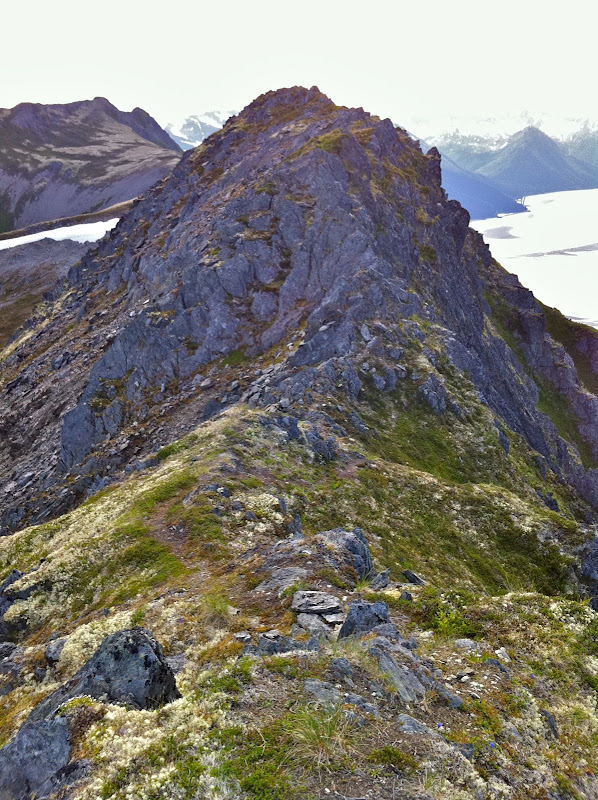
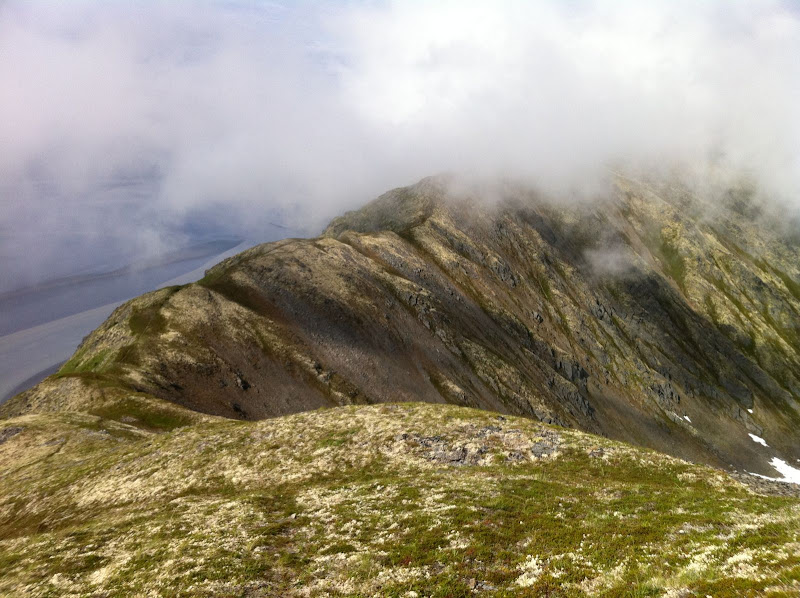
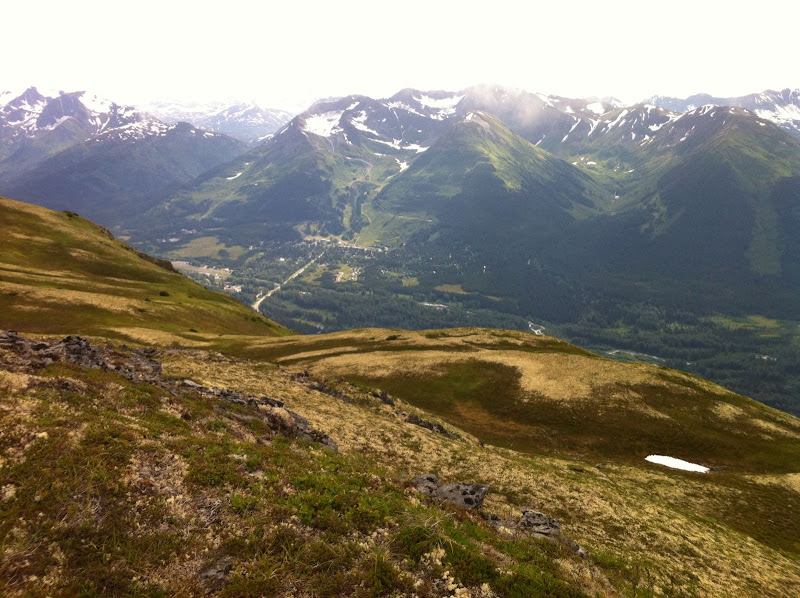
    I knew from previous reports that this ridge offered a lot more vertical and a lot more scrambling than what you can see from the road. But even so, I was surprised how much scrambling there was. I thought that once I got a mile or two past Penguin Peak, I’d be tundra-running the rest of the way. Nope. I should have known better – after all this is the Chugach. The ridge is narrow, rocky and loose enough that you need to go slow, watch your footing, and occasionally scramble, all the way from Penguin Peak until you are directly above the Girdwood turn-off on the highway.

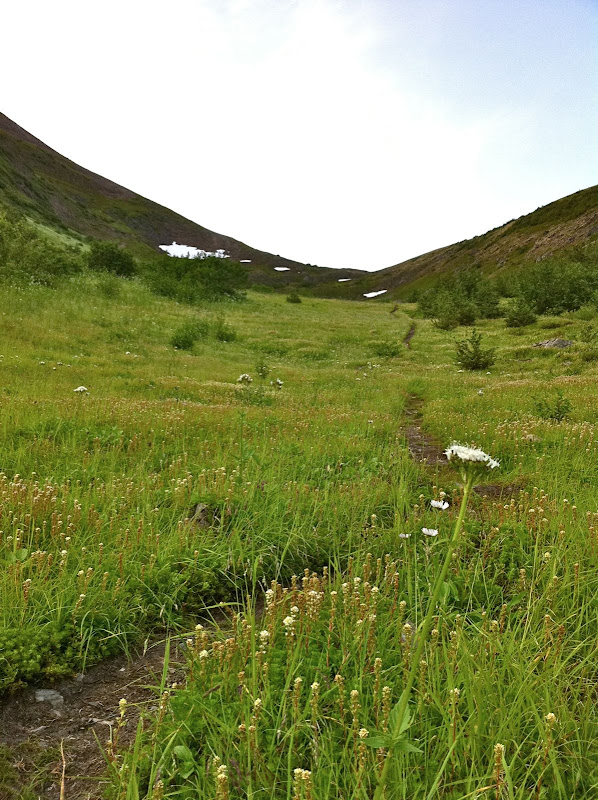
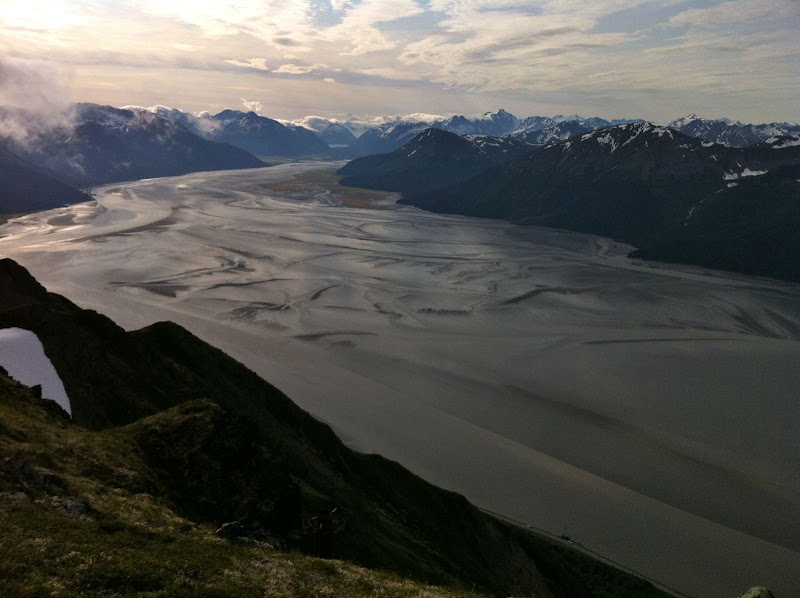
    I briefly thought about descending here, as Roman suggests. But I couldn’t resist the urge to see what was around the next corner, then the next… I’m glad I kept going, because the terrain got easier and I could move faster, as the ridge headed northeast, paralleling the road into Girdwood. The terrain is a lot more nuanced here, a wide ridge with lots of tundra-covered rises, depressions and a beautiful lake. Great for running. The scenery is better too, as you are looking away from the highway and into the heart of the Chugach.

    Headed up Penguin

    Penguin Ridge Hike – IMG_1212.JPG

    360 degrees from the top of Penguin Peak

    Penguin Ridge Hike – IMG_1214.JPG

    Penguin Ridge Hike – IMG_1215.JPG

    Penguin Ridge Hike – IMG_1217.jpg

    Penguin Ridge Hike – IMG_1222.JPG

    Penguin Ridge Hike – IMG_1225.JPG

    The best route down

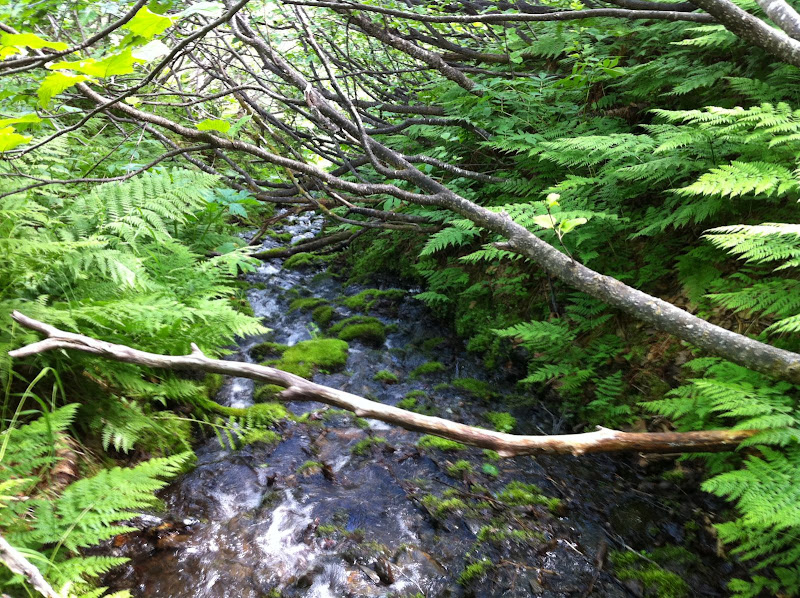
    I knew that finding the California Creek trail for the descent was going to be difficult because it is very over-grown. I never did find it. After wandering above brush-line for almost an hour, I finally gave up and picked the drainage that had the shortest distance between open tundra at the top and evergreen canopy at the bottom. Once in the drainage, I found the easiest thing to do was walk in the creek. The California Creek valley is notorious for bears, so I was yelling constantly to overcome the noise of the creek. So, yes, I was doing the same thing these kids did just a few hours later up in the Talkeetnas. [ Shudder ] Just when my feet were going numb from the water, I arrived in the spruce and hemlock forest, which was open for fairly easy walking. I quickly hit “Abe’s Trail” which took me to the California Creek trailhead. It turned out to be a very mild descent by bushwhack standards, and possibly better than the overgrown trail would have been.

    I jogged into town and met the family, who had been playing at the Girdwood playground. Unfortunately for them, Dad was a little less than energetic that afternoon.

    View Map & Stats on Endomondo
    15 miles, 8 hours (includes one mile/one hour of wandering to find Ca. Creek trail)

    Notes:
    I was glad I went west to east, so that I hit the rocky stuff early when I was still fresh. I was hiking into a decent headwind the whole way, but it wasn’t a big deal. It is nice to end in Girdwood and grab some food. A classic Chugach hike, spoiled slightly by the sight and sound of Seward Highway traffic along the way.

  • Penguin Ridge Hike

    The alarm clock crowed rudely at 4:00 AM. On a Saturday. I fought back by hitting the snooze bar a couple of times.

    The Penguin Ridge hike has been on my to-do list for a long time. Tim Kelley first recommended it to me years ago. Like many other local Chugach hikes, I always figured that some weekend, when I had a little extra time, I’ll knock it off my list. But, funny thing, when you have two little rugrats there is never “extra time.” I decided to start at an ungodly hour, so that I could be back on Dad duty by lunch. I left the Bird Creek parking lot just after 5:30 AM.

    I knew from previous reports that this ridge offered a lot more vertical and a lot more scrambling than what you can see from the road. But even so, I was surprised how much scrambling there was. I thought that once I got a mile or two past Penguin Peak, I’d be tundra-running the rest of the way. Nope. I should have known better – after all this is the Chugach. The ridge is narrow, rocky and loose enough that you need to go slow, watch your footing, and occasionally scramble, all the way from Penguin Peak until you are directly above the Girdwood turn-off on the highway.

    I briefly thought about descending here, as Roman suggests. But I couldn’t resist the urge to see what was around the next corner, then the next… I’m glad I kept going, because the terrain got easier and I could move faster, as the ridge headed northeast, paralleling the road into Girdwood. The terrain is a lot more nuanced here, a wide ridge with lots of tundra-covered rises, depressions and a beautiful lake. Great for running. The scenery is better too, as you are looking away from the highway and into the heart of the Chugach.

    I knew that finding the California Creek trail for the descent was going to be difficult because it is very over-grown. I never did find it. After wandering above brush-line for almost an hour, I finally gave up and picked the drainage that had the shortest distance between open tundra at the top and evergreen canopy at the bottom. Once in the drainage, I found the easiest thing to do was walk in the creek. The California Creek valley is notorious for bears, so I was yelling constantly to overcome the noise of the creek. So, yes, I was doing the same thing these kids did just a few hours later up in the Talkeetnas. [ Shudder ] Just when my feet were going numb from the water, I arrived in the spruce and hemlock forest, which was open for fairly easy walking. I quickly hit “Abe’s Trail” which took me to the California Creek trailhead. It turned out to be a very mild descent by bushwhack standards, and possibly better than the overgrown trail would have been.

    I jogged into town and met the family, who had been playing at the Girdwood playground. Unfortunately for them, Dad was a little less than energetic that afternoon.

    View Map & Stats on Endomondo
    15 miles, 8 hours (includes one mile/one hour of wandering to find Ca. Creek trail)

    Notes:
    I was glad I went west to east, so that I hit the rocky stuff early when I was still fresh. I was hiking into a decent headwind the whole way, but it wasn’t a big deal. It is nice to end in Girdwood and grab some food. A classic Chugach hike, spoiled slightly by the sight and sound of Seward Highway traffic along the way.

  • Just like old times

    For the first few years that I lived in Alaska, Scott was my go-to guy for outdoor fun. He was a serious ski racer at that time, but whenever I could distract him from rollerskiing, we’d go do long skis and runs in the mountains.  But in 2005, Scott decided he’d rather be an academic […]