From the FasterSkier archive — posts syndicated from athletes’ and coaches’ own blogs between 2004 and 2012, kept online as published. Current coverage is at fasterskier.com.
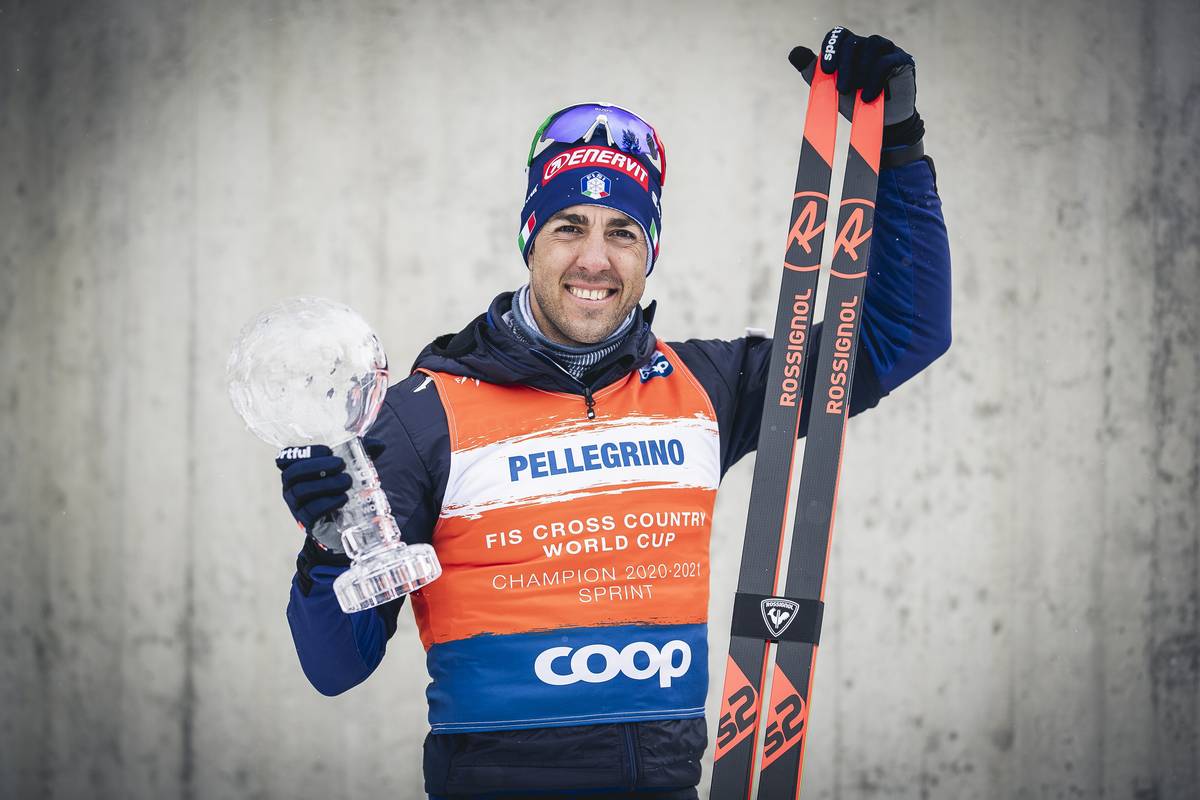
In a recent press release from FISI (Federazione Italiana Sport Invernali), the Italian Ski Federation, announced some coaching changes for the upcoming season, notably that this year’s World Cup Sprint Globe winner, Federico Pellegrino, and his teammate, Francesco de Fabiani will join the training group of Marcus Cramer who works with the Russian Ski Team. Cramer’s current squad includes Sergey Ustiugov, Gleb Retivykh, Artem Maltsev and Evgeniy Belov on the men’s side and Yulia Stupak, among others, for the women.
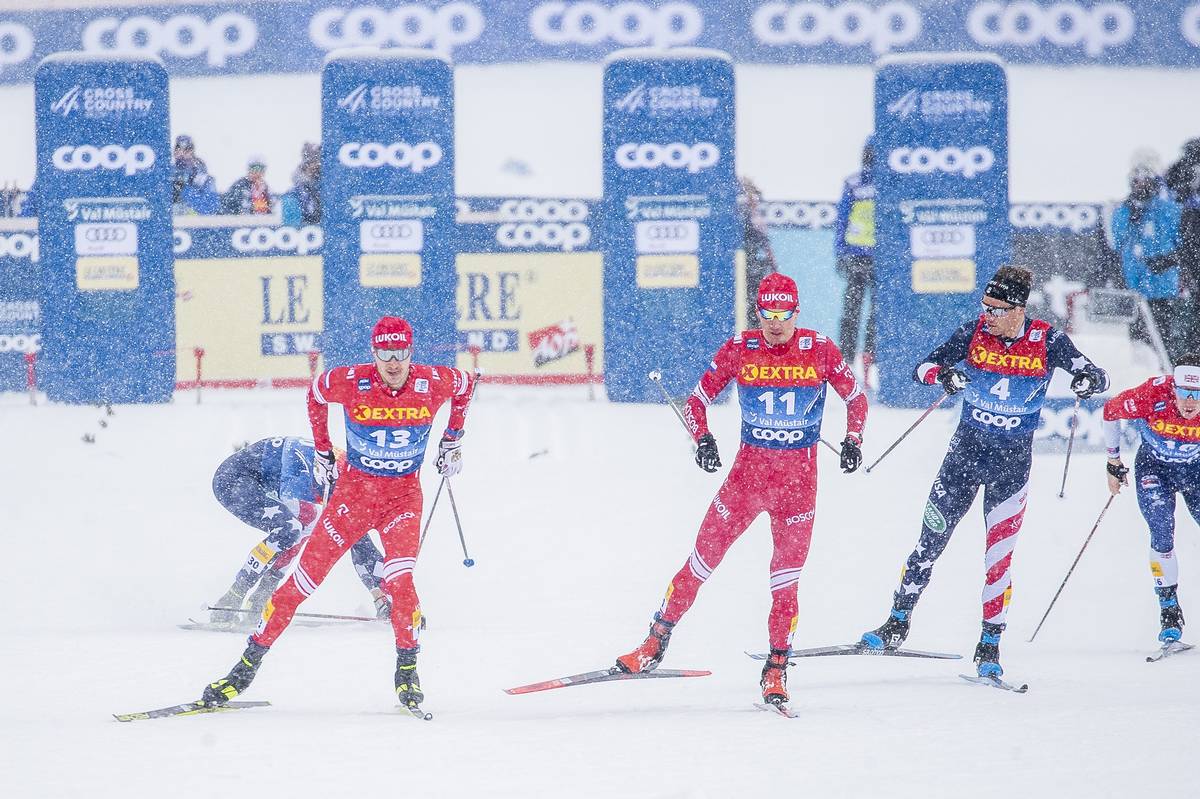
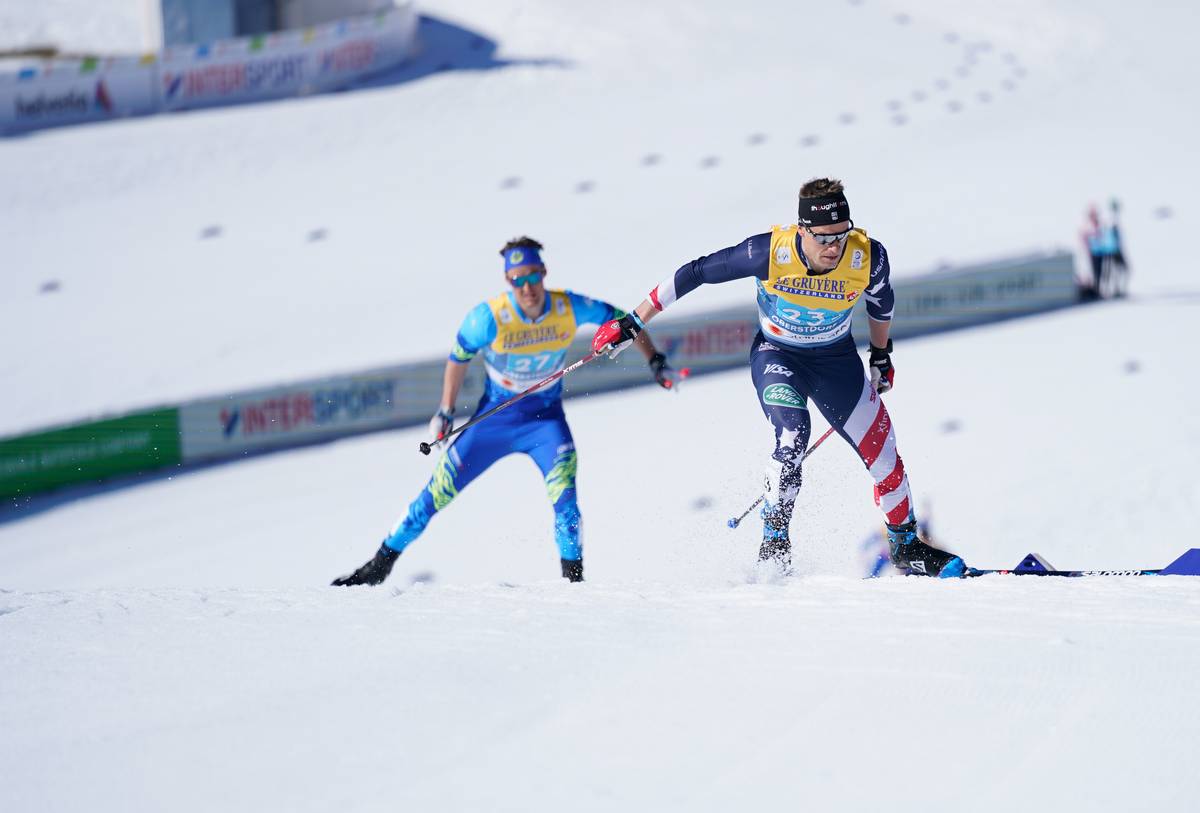
Gleb Retivykh (RUS) bib 13, and Evgeniy Belov (RUS) bib 11, are among two of the top Russians in Marcus Cramer’s training squad.
The release states that this international working group was set up with the goal of maximizing the summer and fall preparation of both the Italian and Russian’s for the upcoming Beijing Olympics in February 2022 in the best way possible. The training will begin with long periods on snow in Europe starting in May, with the two Italians returning home regularly to join Team Italy for the time in between the on-snow camps. The goal of this project is to experiment with new working methods and intensity, while exchanging Italian and Russian technical knowledge to allow for the growth of both nations’ skiers.
Elena Välbe, president of the Russian Cross-Country Ski Association and manager of the Russian National ski team said of this collaboration, “I am optimistic about this proposal from the Italian team. I believe that this collaboration will benefit both Russian and Italian skiers and in particular Federico Pellegrino. This is an excellent step in the development of cross-country skiing, as two different training methods will meet. I am sure that all parties will make the most of this collaboration and the athletes will be able to give their best. ”
Federico Pellegrino (ITA) on his way to an 8th place finish in Val Müstair, ahead of the French trifecta battling behind him. (Photo: Nordic Focus)
In light of this change, Federico Pellegrino stated, “It has already happened several times to work with the Cramer team, both in the summer preparation phase and during the winter competitive period. The feedback has always been positive and it will be exciting to undertake this new project together. Surely, in view of the Olympics, starting with all this motivation can only be the best way to approach what may be the most important season of my career. ”
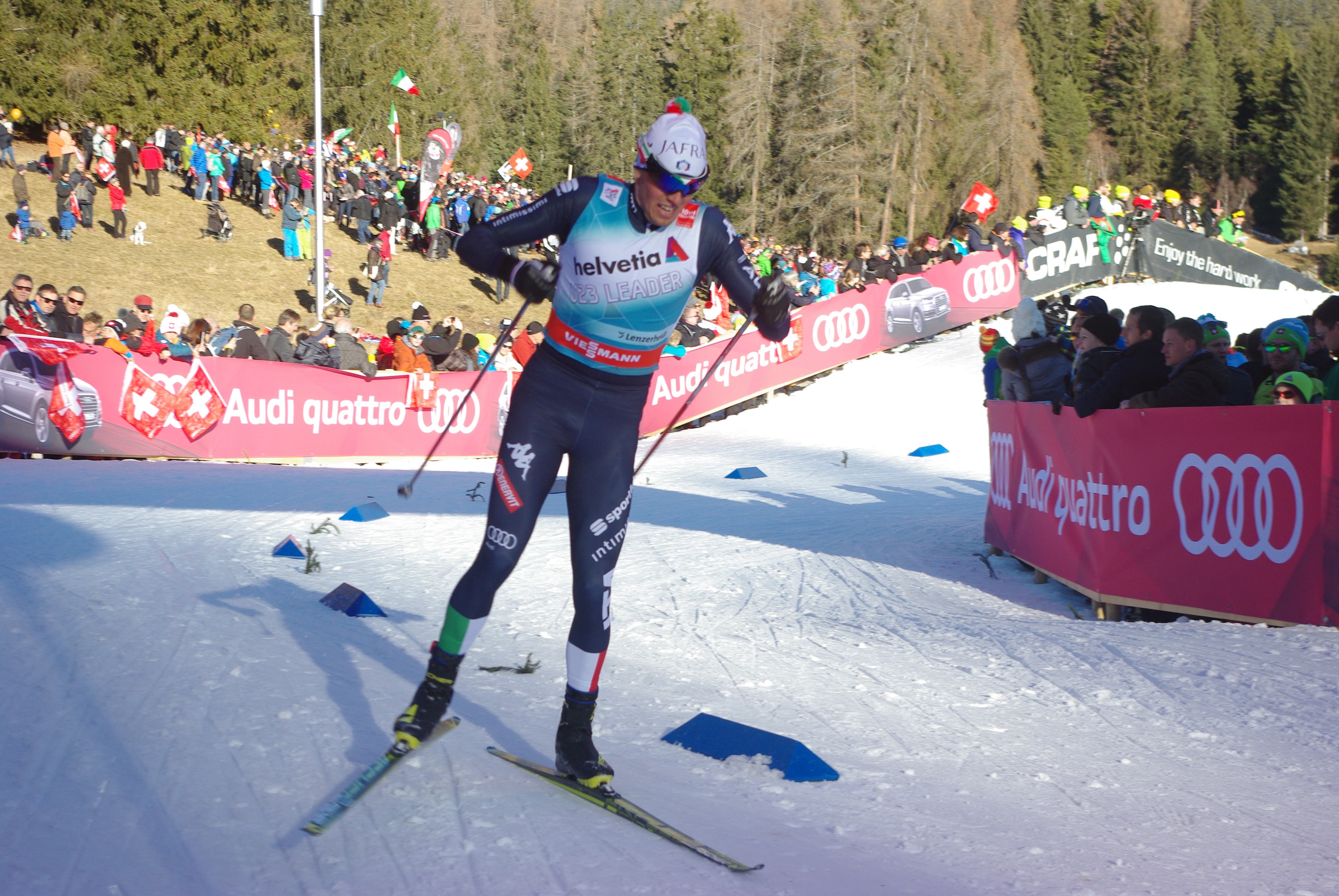
Fransesco de Fabiani (ITA) wearing the U23 leader bib in 2016 in Falun, Sweden.
Pellegrino’s teammate, Francesco De Fabiani, said, “I am very happy with this project because I believe that training with athletes of this caliber is important to copy, understand and grow together and see the differences between what they do and what we do. I believe it is an important opportunity for growth for my future. For now we focus on the Beijing Olympics, but it will also be a useful experience for the following years. Now I focus on the project and I hope to make the most of it.”
Francesco De Fabiani tags Federico Pellegrino during the team sprint in Dresden, Germany (Photo: NordicFocus)
Out of Pellegrino’s sixteen World Cup victories, only one has come in the classic discipline and while he holds a silver medal from the classic sprint in PyeongChang, he will likely be targeting the skate sprint in Beijing 2022. Together, De Fabiani and Pellegrino finished third in the team sprint at the Seefeld World Championships in 2019.
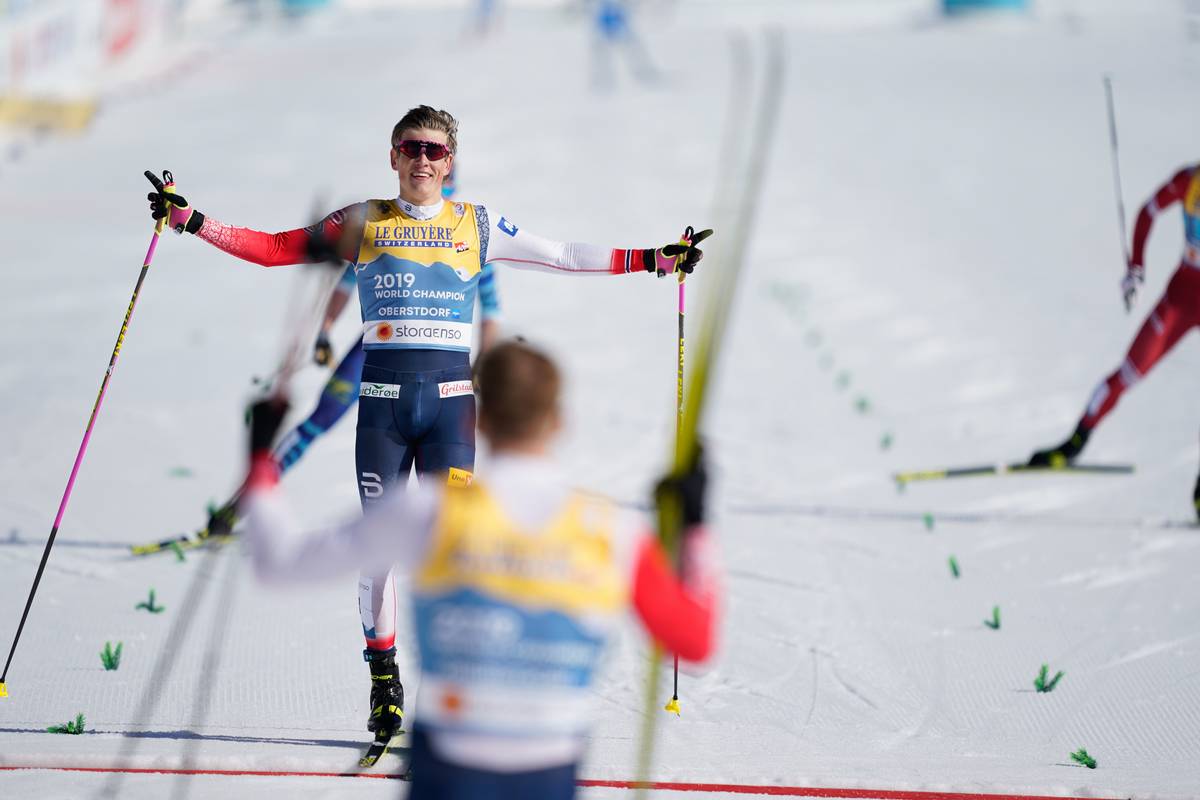
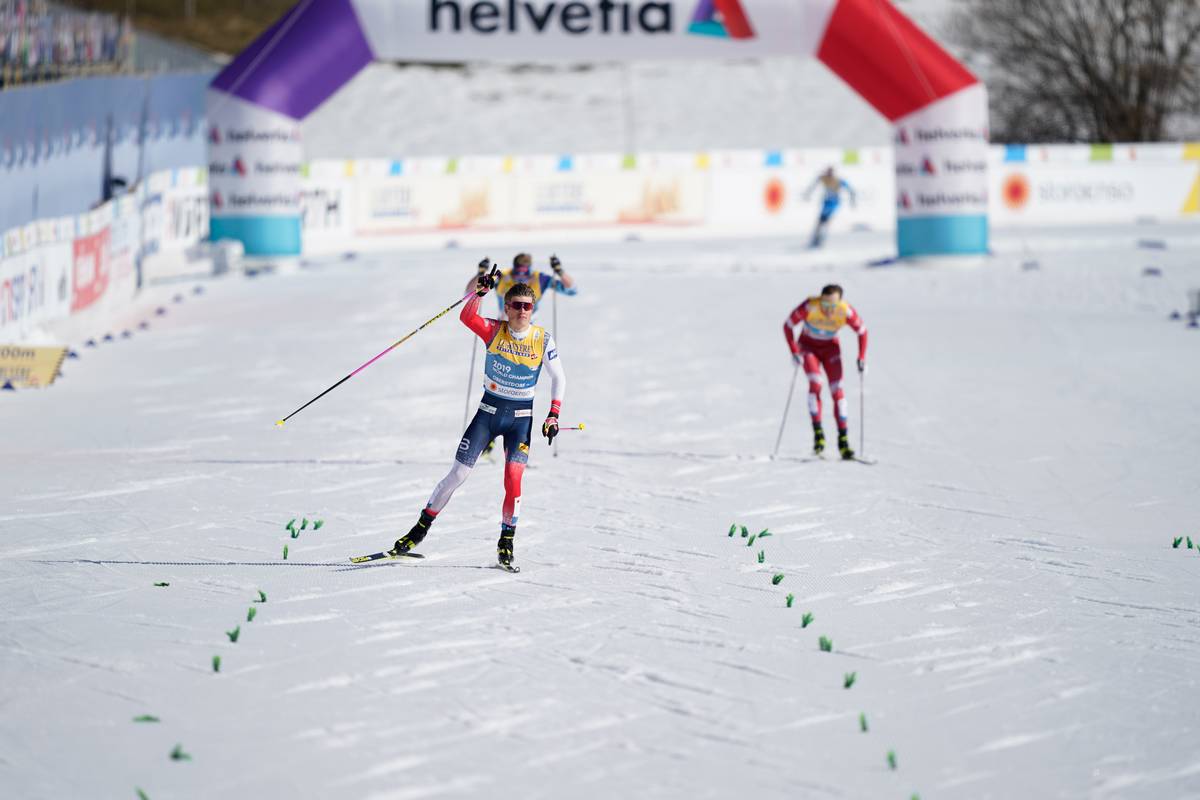
Greeting teammate Erik Valnes at the finish, Johannes Høsflot Klæbo helps Norway to gold in the team sprint. As Klæbo’s bib makes apparent – this makes it back-to-back team sprint titles. (Photo: NordicFocus)
This World Championship coverage is made possible through the generous support of Marty and Kathy Hall and their A Hall Mark of Excellence Award. To learn more about A Hall Mark of Excellence Award or to learn how you can support FasterSkier’s coverage please contact info@fasterskier.com.
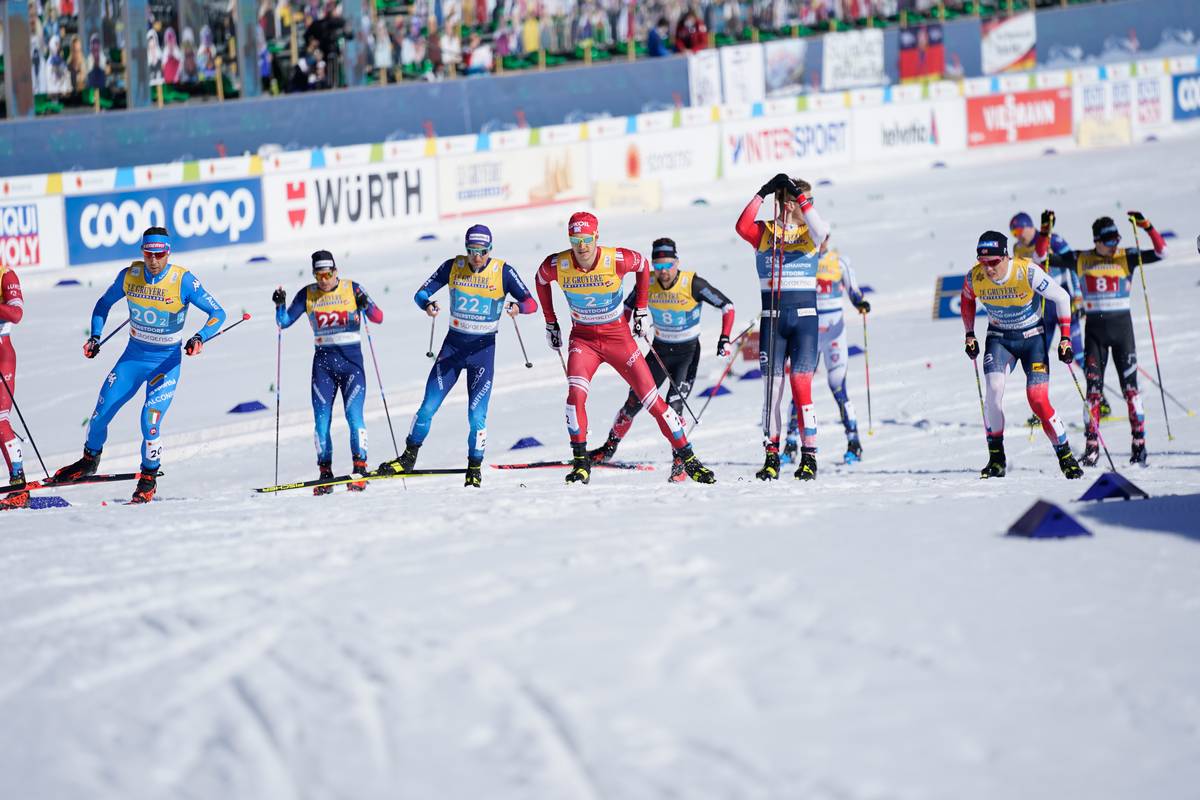
The firepower was evident on the start line. Norway, Russia, France, Italy, and six other teams paired for the team sprint Sunday at the 2021 Oberstdorf, Germany World Championships. Revving at the start for Norway were Erik Valnes and Johannes Høsflot Klæbo, with Alexander Bolshunov and Gleb Retivykh for Russia. Two teams in a freestyle team sprint with a seemingly endless list of scores to settle.
With a wide-angle view of the blue sky and mountainscape, the setting was dreamy if not trending on too warm for the start of the team sprint. At this level of racing with F1 engine fine-tuning and horsepower – the initial pacing and gamesmanship wasn’t exactly horse and buggyesque, but certainly not close to redline speed. The real jazz in this team sprint, which amounted to a total of 7.2 k of skate sprinting with each athlete racing three laps total, came around the 6:40 mark.
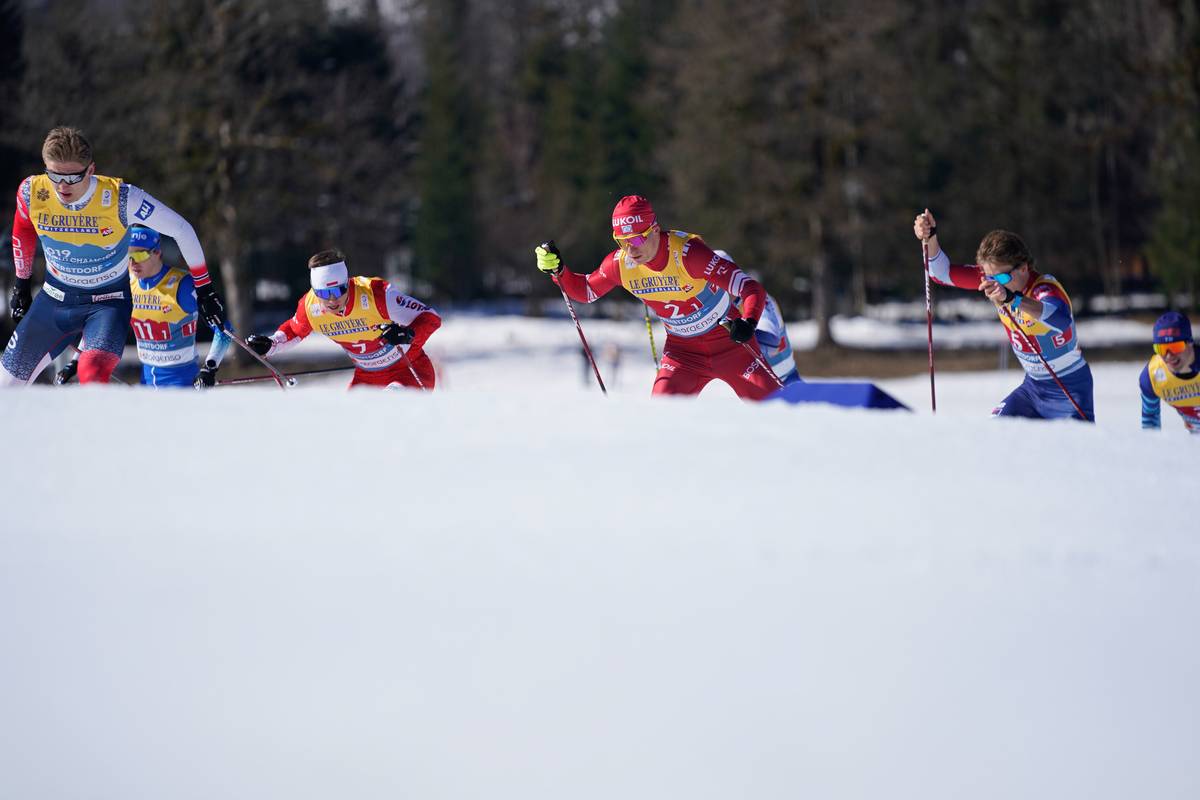
Erik Valnes (NOR), Alexander Bolshunov (RSF), (l-r) during the chess match portion of the World Championship team sprint. (Photo: NordicFocus)
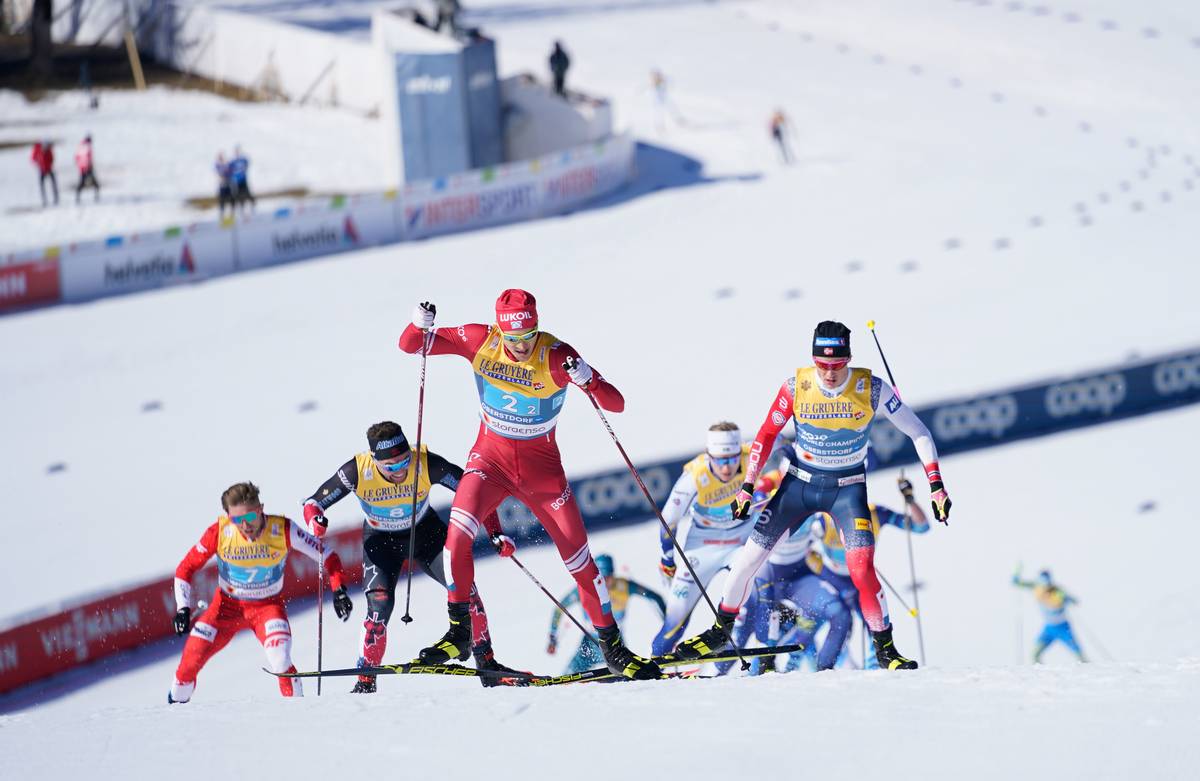
Bolshunov and Valnes were rolling for their respective teams. Up the course’s decisive hill, Bolshunov hop-skated and V1’d to separate himself from Valnes, Francesco de Fabiana of Italy, France’s Lucas Chanavat, and Ristomatti Hakola of Finland. The shake-up from Bolshunov was enough to have what appeared to be everlasting relevance in this narrative. It turns out, the move almost stuck.
Gleb Retivykh (RSF), Johannes Høsflot Klæbo (NOR), (l-r) cresting a hill during the men’s team sprint final. (Photo: NordicFocus)
Retivykh, one of the planet’s best skate sprinters, pulsed away with a two-second lead at the third exchange over Norway. Italy (+2.5), France (+2.8), and Finland (+3.2) were close behind. As far as prescient strategies go, the burst of speed from Bolshunov and cushion of time gifted his partner seemed a lucid move on many levels. It kept the Russians out of traffic. And it kept hope alive for a Russian gold when the stars, and in fact, the entire universe was aligned in this truth: No skier besides maybe his partner, Valnes, currently door-slams a final climb and descent into a finishing straight like Klæbo.
There were more pulses of speed from Bolshunov on his final turn of the screw during his final lap. Camera angles and stopwatches aside, the Russians appeared ready to bite down on real gold rather than see their efforts stymied on the final lap in an effort for fool’s gold. Retivyk took a 4.3-second lead at 6 k into the last 1.2 k to finish the race. Klæbo had his target ahead in Retivyk, with Joni Mäki skating off 5.1 seconds back. France and Italy, at that point and time, barring a spill upfront, were no longer podium threats at +9.9 and +10.0 seconds behind, respectively.
The tag zone chaos. (Photo: NordicFocus)
At 13:00 into the race, on that last lap, Retivyk V2d 15 meters ahead of Klæbo and Mäki. At the base of the first rolling climb, with no evident uptick in effort, Klæbo (with Mäki in his draft) began to close in. On the long glide-out, Klæbo’s slick skinny skis did the work: Norway and Finland were locked onto Russia at 13:40.
At 14:08, despite the race officially not run its course, was over. Klæbo moved around Retivyk and put on a technical and profound display of high-turnover uphill precision. Around the left 180-degree corner atop the hill, Klæbo had 20 meters on Retivyk and Mäki.
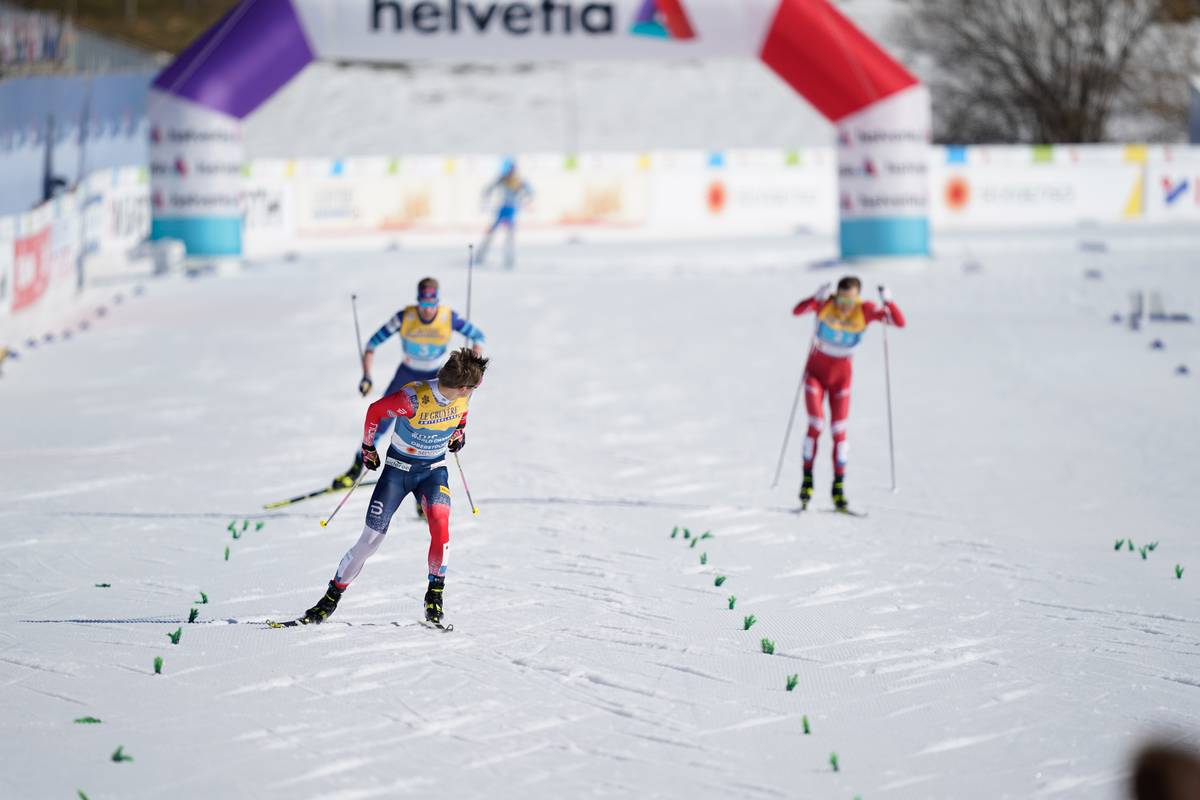
Down the straight, with what looked like 40 and maybe 50 meters of real estate between himself and second and third place, Klæbo let up, soaked in the stoke, and won for Norway in 15:01.74. Finland was second (+1.68), and Russia third (+2.09).
Looking back at his chasers, Johannes Høsflot Klæbo skis the final meters toward gold in the team sprint. (Photo: NordicFocus)
With room to relax and take it in, Johannes Høsflot Klæbo anchors Norway’s gold medal team sprint. (Photo: NordicFocus)
“It means so much to me, yah, to be World Champions,” Valnes told FIS after the race. “It is an amazing feeling and it is amazing to be a team with Johannes. I am really happy, I have been nervous for this day.”
For Klæbo, this makes it back-to-back World Championship team sprint gold medals. He won in 2019 in Seefeld, Austria’s classic team sprint with Emil Iversen. The duo outpaced Bolshunov and Retivyk in that race too, when Russia placed second overall.
“It is amazing,” Klæbo told FIS. “I think it was also a tough semifinal today with really hard conditions and it was really high speed and then the sun started burning a little bit and the conditions got a little bit heavier so it was perfect for us. I felt really strong today and Valnes did a very good job there so it was an amazing feeling. Like I said, to be World Champions together is the best feeling.”
Klæbo is also the 2018 Olympic team sprint champion with Martin Johnsrud Sundby.
The men’s team sprint podium in Oberstdorf: Norway took home the victory ahead of Finland and Russia. (Photo: NordicFocus)
Canada was the lone North American team represented in the men’s final. Antoine Cyr and Graham Ritchie placed fourth in semifinal A, which was won by Norway in a tight finish – the top four teams were within 0.61 seconds. (Due to the warm weather in Oberstdorf, race officials changed the ruling yesterday to allow the top four teams in each semifinal to advance plus the two additional fastest teams overall. Before the rule change, the top two teams from each semi, and the next six fastest teams by time, considering both semis, were slated to advance.)
In the final, Canada, fueled by the two twenty-two-year-old skiers, crossed the line in a photo finish with Sweden to place seventh, 0.4 seconds behind Sweden and 17.06 seconds off Norway’s winning time.
“This race is good for both of us,” said Cyr to Nordiq Canada. “Graham has proven he is a good distance skier and is a wicked sprinter. I also enjoy being in the heats sprinting like today, so it is a good mix for us.”
Antoine Cyr (CAN), Jovian Hediger (SUI), Lucas Chanavat (FRA), (l-r) doing the men’s first team sprint semi-final. (Photo: NordicFocus)
“This is eye opening and very cool for us to have Canada right there in the mix,” said Ritchie, to Nordiq Canada. “It hasn’t sunk in yet really, but we have the confidence and thought we could do it. It is pretty cool.”
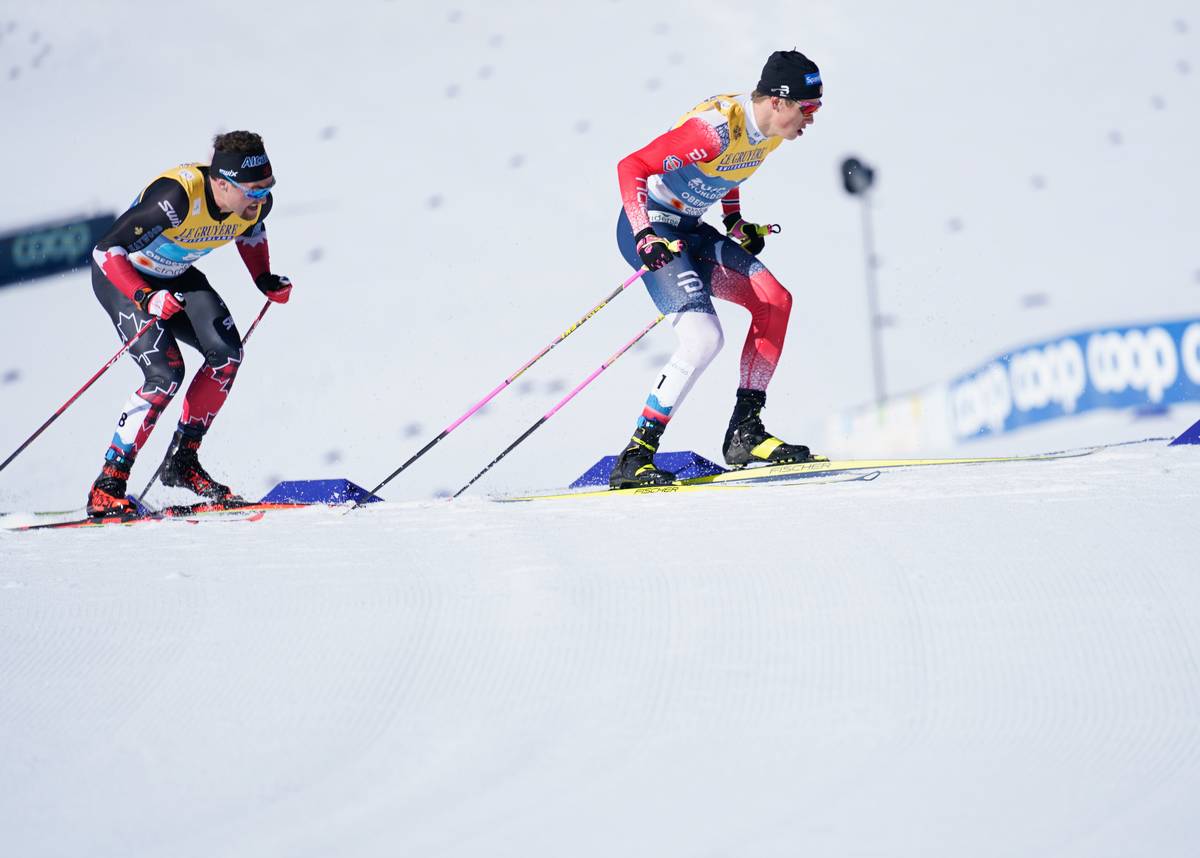
Graham Ritchie (CAN), locking on to Johannes Høsflot Klæbo (NOR), (l-r). (Photo: NordicFocus)
For the U.S., on a team representing two generations of cross-country skiing, Simi Hamilton and Gus Schumacher were eliminated in semi-final B and placed 14th overall. In their semi, Schumacher appeared to ski away on the fourth tag a fraction before being tagged by Hamilton. He snow-plowed as he sensed Hamilton had not reached him before the end of the tag zone. As he checked speed, Switzerland’s Jovian Hediger crashed into Schumacher. Schumacher righted himself and circled back to Hamilton for the tag.
The U.S. skied to seventh in that semi, 15.56 seconds off the pace of Italy’s winning time. This was Schumacher’s first World Championship appearance and by most accounts, the last team sprint for the veteran Hamilton.
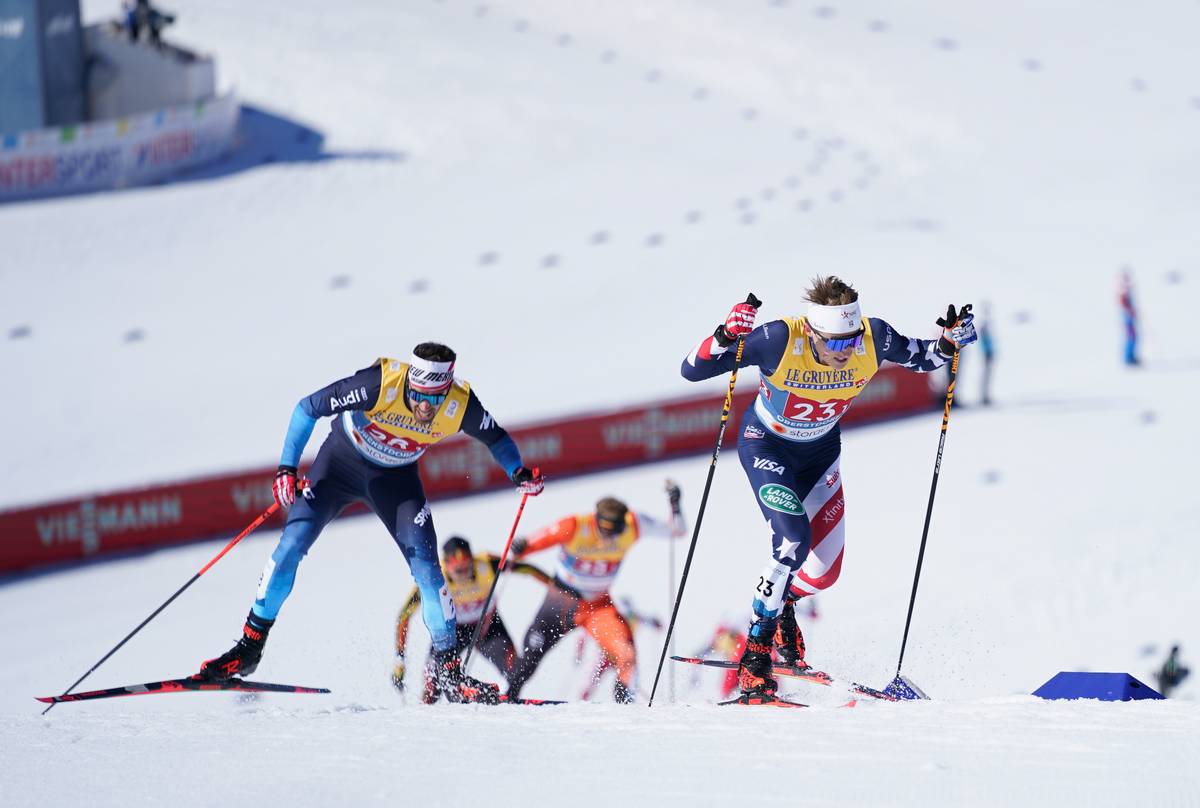
Gus Schumacher (USA) racing in semi-final B of the men’s team sprint on Sunday. (Photo: NordicFocus)
Reflecting on the race, the twenty-year-old Schumacher noted that championships racing on the senior level was a growth opportunity. “I think we can chill out a little bit more in the sort of clustery-spots and rely more on good skiing,” Schumacher told the U.S. Ski Team after the race. “I think I was a little bit unsure of how good the skiing needed to be and put a lot of pressure on the tactics and the bumper-car aspect of it. But, I mean, we skied pretty well. But there was a bobble that cost it all.”
Asked what he would take away from the experience, Schumacher was matter-of-fact about the experience and moving forward. “I think just the way I approach most races and just be more relaxed and looking to enjoy it and whatever happens, happens, is a good approach to these races too even if they are not necessarily conducive to chill skiing.”
“It was amazing,” Schumacher added about teaming up with Hamilton. “I felt a lot of pressure because it is his last World Champs and his last team sprint. We knew that we had a lot of potential. I was really proud to have this start and give him my all. I think I did my best, but I made a mistake.”
Simi Hamilton (USA) racing in Sunday’s second semi during the team spring semis. (Photo: NordicFocus)
For his part, as Hamilton ruminated on the day, he was clear about honoring the big picture of team culture and putting the day’s events in perspective. Below are Hamilton’s comments as told to the U.S. Ski Team’s Tom Horrocks:
It is one of those days where going into it felt awesome. We were psyched, our training has been amazing not just Gus and I, the whole men’s team we are clicking in a way that I don’t think I have ever seen this men’s team click before.
All that contributes to just feeling really prepared and psyched for a race like this. And, we did everything we could, you know it is a team sprinting is, I would put sprinting in general, in its own category when it comes to chaos and things that can go wrong and things that can happen. Team sprinting has its own category in that level of chaos.
Especially championship events like this where there is in the men’s semis there are up to 20 teams or something like that. It is always chaos and you see really changing conditions, so the tag zone is getting slower, a corner is getting sloppier, and it just, yeah it was one of those things we mistimed our tag, it wasn’t Gus’s fault because the tag zone had been much faster, even the previous leg…so you get into this mindset of going when you think you should be going, but it is hard to adapt to the change, for how much slower it is.
I think he just went a little early, and we missed that tag at the very end of the zone, the jury is always going to see that, that you are going to miss the tag, so we decided that we wanted to just stop and get back in the zone and tag, that’s is when things kind of really took a turn for the worse.
But, it doesn’t change all that stuff leading up to today. You know, this probably being my last team sprint and last sprint effort ever, obviously I wanted to ski with Gus in the final and possibly win that elusive medal at World Champs. But you, know, I have been thinking about it for the last hour skiing out with Gus and it is like it is just as important for me to feel like what I did today to get onto this team and be able to race with Gus, that is going to contribute to him winning medals in the future with this group of guys coming up. To me, that is just as important as me potentially winning a medal. I am still so grateful and humbled to be a part of this team and be able to race with Gus and train with Gus and all the other guys, and so it doesn’t change how I felt about the day at all. We are both fit. We are still hungry and fortunately, I think we get a few more racing opportunities coming up this week so we are going to make the most of that and enjoy the sunshine.”
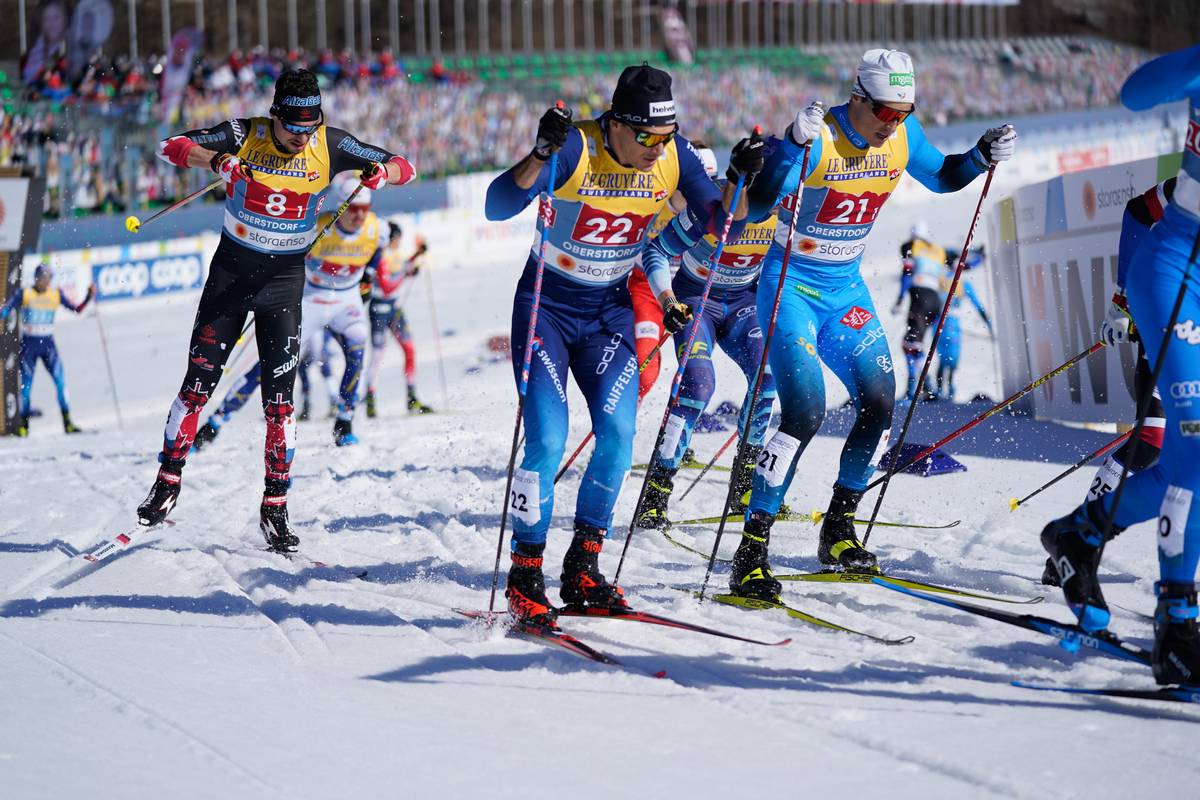
Dense pacsk skiing during the men’s second semifinal in Oberstdorf. (Photo: NordicFocus)
Johannes Høsflot Klæbo smiles after winning the 1.6-kilometer skate sprint in Lahti, Finland. Federico Pellegrino of Italy (l) took second, followed by Finn Hågen Krogh of Norway (r). (Photo: Screenshot Instagram @fiscrosscountry)
After two weeks away from competition, athletes revved their engines in Lahti, Finland for an individual 1.6-kilometer freestyle sprint, one of the final stops on the way to the World Championships. After a string of what he deemed “bad luck” in the first sprint races of the season in Ruka and Lillehammer, Norway’s Johannes Høsflot Klæbo came into the weekend with momentum from winning the last four individual sprints. Klæbo also arrived in Lahti on the brink of what could be a historic milestone; a win could advance him from possessing the joint-third most victories, tied with his opponent Federico Pellegrino of Italy with 12 each, to the joint-second most, tied with Ola Vigen Hattestad of Norway who retired in 2016.
Both men skied well in the qualifying round, with Klæbo taking the lead with a solid gap, finishing in 2:49.77, followed by his teammate Håvard Solås Taugbøl (+4.15), Joni Maeki of Finland in third (+4.35), Pellegrino in fourth (+4.36), and Finn Hågen Krogh of Norway in fifth (+4.40).
Conditions in Lahti were reportedly fast and a bit wet. Temperatures hovered around freezing with some freezing rain lightly peppering the course throughout the day. This stability in the weather and on the tracks kept the playing field fair as the athletes sprinted through the heats.
Emil Iversen of Norway charges on his way to second place in heat two of the semifinals of the 1.6-kilometer skate sprint in Lahti, Finland. (Photo: Instagram @langrennslandslaget Screenshot)
In the quarterfinals, Klæbo and Pellegrino went one-two in heat one, advancing into the first heat of the semi-finals. This first semi proved to be the faster of the two. The Norwegian again took the win in 2:49.84, with his teammate Eirik Brandsdal close on his tails. Gleb Retivykh and Pellegrino, who finished in third and fourth, respectively, advanced as lucky losers. Less than one second separated the six men in the heat, and all of the men skied faster than those in the second heat.
In the second semi-final heat, Krogh finished first in 2:50.98, followed by his teammate, Emil Iversen, making it a final of four Norwegians, an Italian, and a Russian.
As the men charged out of the gate in the final round, Retivykh led the pack, with the other men jockeying for position behind him. Per usual, Klæbo began to surge on the climbs, using them as his opportunity to move to the front of the pack. The second half of the course featured a steady climb with a steeper punch at the end before sending the athletes down and around a turn into the stadium. On this climb, Klæbo set the pace, trying to slowly pull away from the group. But Pellegrino was not ready to let him go. The Italian crested the hill just behind and as the two men tucked into the downhill, a small gap was created before the next skier back.
Norway’s Johannes Høsflot Klæbo attacks the final climb on his way to victory in the 1.6-kilometer skate sprint in Lahti, Finland. (Photo: Screenshot FIS/ARD Broadcast)
Pellegrino tried to position himself on the inside of the final turn to get in front of his opponent, but he could not quite make his move. Klæbo was still in front heading into the final straight with Pellegrino nipping at his heels. Krough, who closed the gap they had created was also in the hunt, chasing the leaders to the line. The two kept the pressure on Klæbo, giving him no opportunity to risk his position with an early finish line celebration, but they were not able to surpass him.
Klæbo earned his 13th World Cup Victory, stopping the clock at 2:52.06, his ninth win out of the last 13 individual sprint races. Pellegrino took second (+0.30), followed by Krogh in third (+0.61), Brandsdal in fourth (+1.31), Iversen in sixth (+1.75), and Retivykh in sixth (+2.08).
Norway’s Johannes Høsflot Klæbo rounds the final turn ahead of Federico Pellegrino of Italy in the 1.6-kilometer skate sprint in Lahti, Finland. (Photo: Screenshot FIS/ARD Broadcast)
No North American men qualified for the heats, which came as a surprise to both the athletes and the coaches. Logan Hanneman (APU) posted the fastest qualifying time for the U.S. placing 32nd overall after missing the heats by .22 seconds. Simi Hamilton (USST) finished 36th overall, and Erik Bjornsen (USST) 42nd.
Evan Palmer-Charette was the lone Canadian entered; he placed 67th.
“Definitely a bit of a puzzling qualifier for the guys,” said Matt Whitcomb in a call. “An impressive one out of Logan, but we know he can ski into the top-30 too. Erik and Logan and Simi all said they felt great. We are coming out of a training camp [in Vålådalen, Sweden] where it has been cold, and it is possible that we just need a little rest and a little racing and that will get things going.”
Though he was offered starts in both Period 1 and 3, it is Hanneman’s first time racing internationally this season. The APU skier was the top qualifier in the 1.3 k skate at US Nationals, placing second in the final. He also took third in the final in the classic sprint. When Hanneman competed in the sprint in Lahti last March, he placed 49th overall.
“Today was pretty good for me!” Hanneman wrote in an email. “Of course, being only .2 sec out from the heats hurts a little, but it was my career-best finish so that is a positive for sure. Looks like from the splits I was in 15th at 900m, which was nice to see since my goal was to take the first half out faster than I did last year. When I raced this course last year, I learned that it is a little tricky to make time back on these guys on the last hill… this year I learned that I can lose a lot of time to these guys on the last hill. Although today, with the fast conditions, the time spreads were really tight so it wasn’t too much time that I lost.”
As illness kept him from racing in the city sprints in Dresden, it has been over a month since Hamilton last put on a race bib.
“I wish I felt better about my day today,” Hamilton told FasterSkier in a call. “I’m still kind of baffled by how it went. I felt amazing and I felt like I skied the course better than I ever really have before and I’ve had some decent races here before. The conditions were great, our skis were awesome, I just don’t know what happened. The only thing I can think is that sometimes it takes me a little bit of racing and hard training to get that really good sprint gear going again, but I felt incredibly fit, I felt like I paced it really well, I was just really confused when I saw the qualifier results.”
During his time away from the World Cup, Hamilton traveled back to the U.S. to spend some time back in Vermont, where on top of training, he proposed to his girlfriend, Sophie Caldwell. Hamilton returned to Europe two weeks ago to participate in the Vålådalen camp. While the camp went well for him, the aforementioned temperatures prevented Hamilton from putting in those hard training efforts, but there is still time before Seefeld to capitalize on his fitness.
“It was incredibly cold, so we weren’t doing a lot of really hard intervals or hard training, but all the other indicators were really good during that camp,” he said. “Fortunately, this wasn’t the World Champs day, and that’s obviously the race that really counts. So we’ll just kind of tweak training a little bit, and hope for some better feelings for Cogne, and plan on feeling really good for the sprint in Seefeld.”
Despite his disappointment in his own performance, the day had a silver lining for Hamilton, as Caldwell landed on the podium with a second place finish in the women’s 1.4k sprint.
“I’m super psyched that Soph had such a great day – I’m just amazed by that,” he shared. “That she can fly back here to Europe two days ago, then put together a day like she did today… Whatever frustrations I had quickly evaporated with her day. I’m just so happy for her.”
Hamilton has a second chance to find his top gears when racing continues tomorrow during the classic team sprint where he will line up with Bjornsen.
“It’s pretty much my first classic race of the year,” Hamilton laughed. “The only other classic race I’ve done was in Lillehammer, the 15 k in the pursuit on the third day, so it will be interesting to see what happens, but I’m psyched.”
The team sprint will be held on the same course as the individual race today, a change from past years of the Lahti Ski Games.
“They’re not using the old course, which I’m a little bit bummed about,” said Hamilton. “So we’ll have to see how the regular sprint course classic skis, which on the World Cup anyway, no one has classic sprinted on that loop. It should be exciting, it should be fun. Conditions look good for some fast Klister skiing, so hopefully, we don’t get too much snow overnight. But yeah, we’re psyched.”
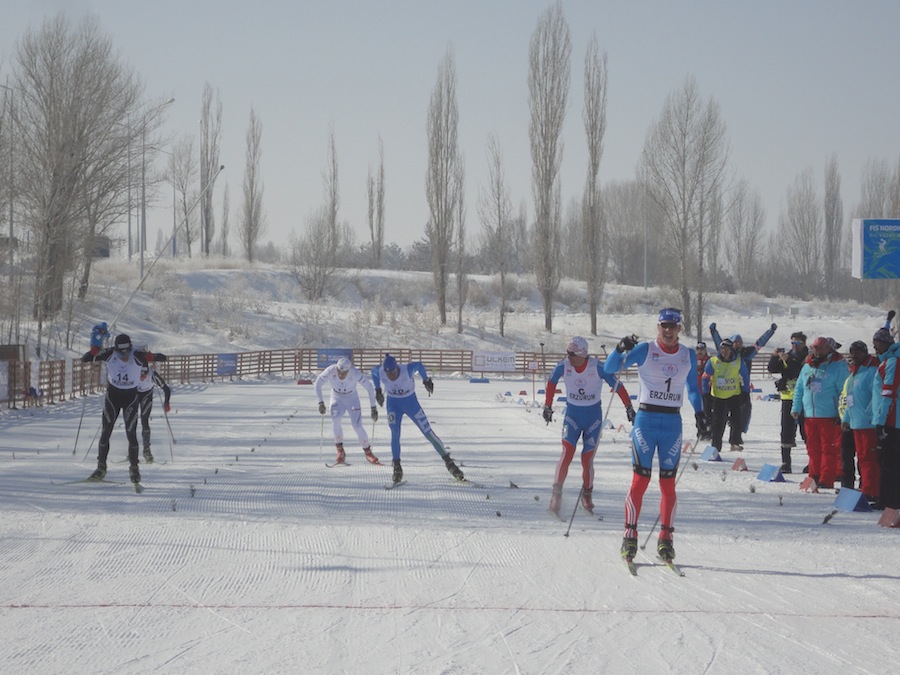
Gleb Retivyk (RUS) coasting past the finish line for the U23 skate sprint title in Erzurum.
ERZURUM, Turkey — With two gold medals in as many days at the World Junior/U23 Championships, Russia is clearly on top of its mens’ sprint game. Gleb Retivyk (RUS) took home a decisive win on Tuesday, skiing into the stadium in the final out of reach of his competitors, and maintained his lead all the way around the last corner and through the straightaway. His compatriot Evgeniy Belov (RUS) took second, and in a fight for third, Roman Furger (SUI) pulled off the bronze.
Retivykh skiing through the stadium during qualifying. Photo: Erzurum WJSC 2012.
Retivyk was recently fifth in the Moscow World Cup city sprint, but said success at U23s his motivation for training this year.
“The race was perfect for me today as two Russian skiers were on the podium,” he said his win. “I have been preparing for this competition the whole year. I was working on the strength a lot before the season.”
This was Retivyk’s first age-group victory; he was twice on the junior podium in Otepaa, Estonia last year, but never for gold.
Belov, more of an all-around skier than sprint-specialist, called his silver-medal performance a good wake-up for the rest of the week.
“I am immensely glad today,” he said. “When I was a junior I was quite good at free technique sprints.”
Furger’s result surprised himself—“I never expected I could win a medal here,” he said.
Other performances of note:
– Andrew Musgrave (GBR) qualified in third in the morning behind Retivyk and Gianluca Cologna (Dario’s brother). His strong V2 up the first hill turned many a European coach’s head, though it should no longer be a surprise when Musgrave does well. Musgrave looked posted to qualify for the finals, but in the semis took a spill at the top of the final downhill after getting caught up with another skier. He ended up in ninth.
– Norway had a surprisingly down day,with all failing to advance past the quarterfinals. Eivind Bakkene was the first red-clad skier in 14th; Finn Haagen Krogh was 16th.
Scott and Packer lead the U.S. In 25th and 26th
Americans Ryan Scott and Eric Packer were the lone North Americans to make the heats on Tuesday. Packer set the 18th-fastest qualifier while Scott scraped in with 30th. Three more fell just outside the cutoff: Graeme Killick in 31st, Erik Bjornsen in 32nd and Reese Hanneman in 33rd.
Ryan Scott (USA) leading Retivyk and the rest of the first quarterfinal at the top of the first hill. Photo: Reese Hanneman.
Before the first heat came into sight on the first hill out of the stadium, excited U.S. coaches radioed to each other that Scott had gotten off to a fast start. A few seconds later, the black American suit came into view a few paces ahead of Retivyk—the 30th qualifier leading the first.
Scott remained ahead through the rolling downhill and until the second uphill, when he began to lose ground to the rest of the pack. He ended up crossing the line in fifth, which eventually put him in 25th overall.
“It wasn’t the plan,” said Scott of his fast start. “Originally I thought I’d try to hang back and go on the second hill, but sometimes it’s nice to get out a little faster, you can stay out of trouble—a lot of people were falling and breaking stuff. That was my thinking on the spot.”
He expected more of his competitors to be right with him on the first hill, but “no one really came until the next climb,” said Scott.
When Retivyk made his move to overtake him, Scott thought he got “bogged down” trying to stay with him.
“I haven’t trained a whole lot for sprints this year, this is the only time since U.S. Nationals I’ve ever skied heats,” he said. “Tactically, it would be nice to have a bit more practice rather than watching World Cup races.”
Scott lives at altitude in Bozeman, Mont., which he thinks “definitely” gave him an advantage over skiers only used to sea level.
U.S. trip leader and USST development coach Bryan Fish was pleased with Scott’s performance.
“With a number 30 bib, he did absolutely everything he could. He ran out of gas at the end, but on the flip side, when you do that, you can never say you didn’t try—he left it all out on the course. You have to be pretty pleased with that.”
Packer fared less well in his quarterfinal. He said he is used to being the one in control during head-to-head racing in the U.S, but here at U23s, he felt the butt end of aggressive skiing.
Packer (USA) in fifth up the first hill of his quarterfinal.
Out of the gates, Packer was in third, but rounding the corner to head out to the course, another skier skated right across his equipment.
“I should have asserted myself more, but I kind of sat back for just a second and immediately dropped to sixth place,” said Packer.
“For the rest of the race I tried to move up. It was a game of cat and mouse—people were driving in front and then walking, and I was between fourth and sixth for the rest of the race.”
Packer believed he had the fitness to pass people, but wasn’t able to move quickly enough to sneak by before getting blocked.
“When I’d come up behind someone, they move out in front of you because they sense you coming from behind. So that was a little bit frustrating, and a little different from what I’ve experienced.
“What I found is that if you’re not in the first three spots in a race like this, then you have to have incredible speed to pass people—it can’t be a slow move, they won’t let it happen.”
Despite disappoinment in not moving on, Packer was confident for the 15 k classic and the pursuit hat he could ski with the competition.
“Normally I struggle a little racing at altitude, so feeling good today, especially in the qualifier, was really encouraging.”
Erik Bjornsen, 32nd.
For Bjornsen, who just missed the top 30, the qualifier was more fuel for next year, as got a better sense of when starting conservatively is too slow.
“I don’t think I would change anything technically, but I probably should have gone out harder—I had a little left at the end,” he said. “But who knows, if I’d gone out harder, maybe I would have died in the finishing stretch.”
In the difference of one place, Hanneman was 1.46 seconds behind Bjornsen, and was satisfied that he’d given the qualifier 100%.
“I probably went the hardest I’ve gone all year, and technically I think I skied it almost perfectly,” he said. “In that respect I’m glad, I thought I had as good a race as I could have, considering it was a prelim at altitude with a lot of free skating, which is not my forte.”
But, “30th I would have been happier with,” said Hanneman.
After Killick, Bjornsen and Hanneman, Jesse Cockney (CAN) was 39th, David Greer (CAN) finished 47th and Christopher Hamilton (CAN) 50th.