
From the FasterSkier archive — posts syndicated from athletes’ and coaches’ own blogs between 2004 and 2012, kept online as published. Current coverage is at fasterskier.com.

Tag: Glenn Randall

  • The View From the Front of the Boston Marathon

    The View From the Front of the Boston Marathon

    Glenn Randall competing in the Boston Marathon last Monday. Courtesy photo.

    Even if you’re not a running fan, chances are you heard that former Dartmouth College standout Glenn Randall led the opening 10 k of the Boston Marathon last Monday. Actually, ‘led’ doesn’t quite describe it — he gapped the elite men’s field, confounding TV announcers and sending the running sector of the blogo-twittersphere into a frenzy.

    To those who had never heard of Randall, it looked as though he was trying to grab a few minutes of fame with an opening pace he couldn’t hold. But as he explained in a blog post recapping the race, the pace he began with was actually slower than he’d intended.

    Just before the pack caught him, Randall started having cramping issues. He ended up fading in the 80-degree heat to 60th place, finishing in 2:37:13.

    We figured the gutsy performance was reason enough to check in with Coloradoan. The last time we did so, he was about to run his debut marathon in Chicago and the future of his ski career was in flux. He ran a 2:20:40 in Chicago, which was close enough to the 2:19 Olympic Trials qualifying time that he decided to give it one more go in Las Vegas last December.

    Las Vegas didn’t pan out, but Randall has since decided to hang up his skis in order to pursue running full-time. On Friday he gave us a phone interview to talk about what happened in Boston, his racing style, and the transition away from skiing.

    First things first: Boston.

    FasterSkier: I’ve read your blog and know it didn’t turn out the way you’d hoped, but what were your expectations headed into the race? Did you expect to be leading the first 10 k?

    Glenn Randall: I went into it looking to have a good race, and wherever that put me was where I was going to be.

    I knew it was a possibility that I would be leading early on. I talked to a lot of people [beforehand] and everyone said that in Boston, you go in preparing for the uphills but it’s the downhills that kill you. So I did a lot of downhill work and got to the point where I was confident I could run pretty fast downhill putting forth zero effort. If you do downhills too fast it can take it out of your legs, and I knew where that threshold was for me.

    I also knew a lot of times people don’t push those early downhills at all; they hold back because they’re worried. I went into it knowing there was a slim chance I could lead early, and my thought was that the lead group would catch me on the flats but I would be going my own pace… before I had to deal with whatever anyone else was doing.

    So, I ended up going slower than I’d prepared for the first couple (mostly downhill) miles. I was going about 4:50 per mile pace, and I’m capable of about 10-15 seconds per mile faster without taking too much out of my legs. I was holding back because I was nervous about the heat and didn’t want to go blasting out faster than I was capable of going.

    A screenshot from the opening miles of Universal Sports' broadcast of Boston.

    FS: Were you aware of the distance you’d put on the main pack?

    GR: I don’t look back [but] I could tell they were no longer within earshot. I had some friends in town and could hear them cheering — that was one way I could tell how far behind me people were.

    FS: You said you didn’t seem too worried about putting that kind of distance on the best marathoners in the world.

    GR: Yeah, I felt good. On top of that, if I go into the race completely terrified of them, I’m not going to have the best race I can have.

    FS: What happened after the pack caught you?

    GR: I’ve spent a lot of time thinking about what went wrong. It started with stomach cramps and moved from there. Heat was a part of it, and because it was so hot I was maybe over-hydrating before and during the race.

    I’ve looked at the things that held me back, and will try to make sure I don’t make the same mistakes in the future.

    As far as going out like that goes, when it comes to big races, I go out there racing like I’m going to have a good race. Because frankly, the difference between having a kind-of bad race and a really bad race — it may seem like a lot, but functionally it’s the same for me. So if I just go out and assume I’m going to have an awesome race, until I knew differently I feel like in the long term it’s going to help me out.

    When people conserve, they’re looking to have a kick, and that’s not something I do. But a lot of people go out there and take big risks. Right before the race I saw Joan Benoit Samuelson, and it was pretty inspiring. She’s an icon in American marathoning, and if you know her story, everyone expected [the 1984 Olympic marathon] to come down to Grete Waitz and Ingrid Kristiansen. Joan was kind of injured, so no one thought she’d be a factor. It was hot, and she went out pretty fast from the get-go, but nobody went with her because everyone thought she’d be coming back. She ended up holding on for the win.

    FS: How do you feel about your start now?

    GR: I don’t have any regrets about the whole thing. The things that went wrong would have gone wrong if I’d gone out at a conservative pace. I went out there, tried to have a great race, and it didn’t happen. But I was going to have those problems regardless, I think.

    I was still trying to race at the end — when people passed me I’d try to go with them — but it was a rough day.

    (In the 80-degree Boston heat, a lot of people had a rough day. B.A.A. was so “worried about someone dying on them out there” that it encouraged less experienced runners to sit out the race by allowing competitors to defer their entry to 2013. About 4,000 entrants failed to start, but even so, over 100 people ended up in the hospital afterwards to be treated for dehydration or heat exhaustion.)

    FS: What do you think of the internet discussion that’s been going on about you?

    GR: I haven’t read it, and it doesn’t bother me at all. Those who mind don’t matter and those who matter don’t mind.

    I’ve had a lot of Dartmouth alumni contact me, and they all know I wasn’t trying some stunt. They’ve commended me on the fact that I actually had the guts to go out there and do that.

    FS: Moving away from Boston — you’re clearly a full-time runner now, but last we talked you still thought you might keep skiing. When did you make that decision?

    GR: It dawned on me that I was supporting a pro ski career with a pro running career. And on top of that, sometimes it seemed like it was not meant to be. The way that last season was, I looked at it and said, ‘Wow, I’m not sure if this is what I’m supposed to be doing.’ I’d get sick at an inopportune time, and we got in a van accident on the way to a race I was confident in. It seemed like things were just going wrong, and it made me wonder if that was just the universe’s way of telling me, ‘You’ve had a great run at it; move on and find something else to excel at.’

    After Chicago, I realized I’d been close to making the Olympic Trials, and I made a lot of mistakes at Chicago, just a huge number, so I thought I had the ability to do better. I had a couple more months in the Trials window, so I just put everything into that. It didn’t end up happening, but last summer I also discovered the mountain running scene, and I’m really looking forward to a great summer of mountain running.

    FS: The pro skiing options in the U.S. are pretty limited: there’s the SuperTour, and maybe a few marathons. Running’s a much bigger, better-supported sport. Did that factor into the switch?

    GR: That’s definitely a part of it. On the SuperTour, if you’re trying to make money off of it, it’s easier said than done. You’re trying to break even, and everyone showing up is looking for that prize money. So the reality is, it doesn’t work out all that well.

    With running [for example], Boston gave me a free entry. The race in Switzerland I’m going to, from the time I show up until after the race is over, I have free room and board for the entire week. Last year they paid me to run the race, plus there was prize money. It’s much easier to actually make ends meet.

    FS: What races have you got lined up next?

    GR: Mt. Washington, and then the race in Switzerland in August. If I’m top-six at Mt. Washington, I’m racing in the World Mountain Running Championships in Italy.

  • With Recent Success, Randall Takes Running One Step at a Time

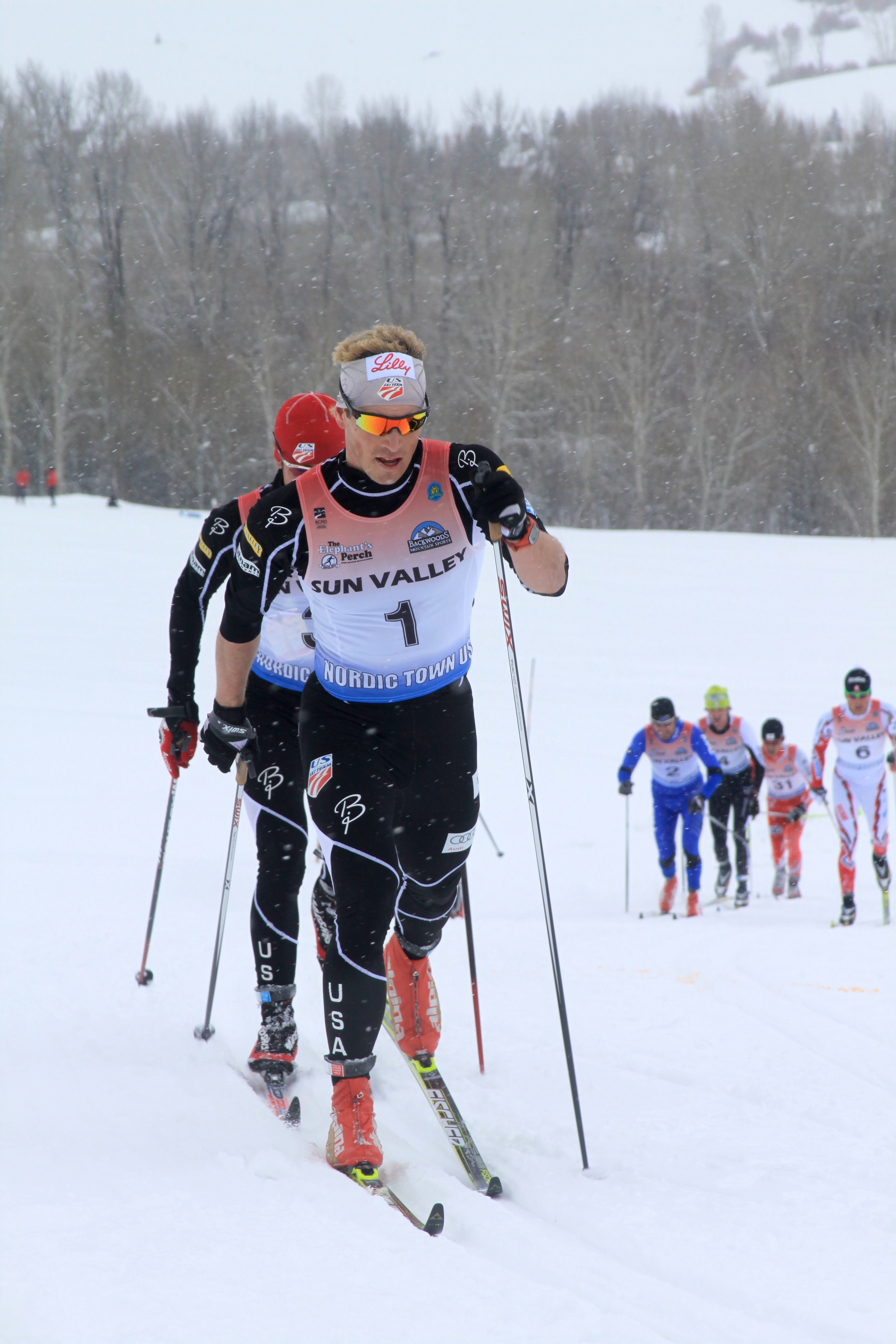
    Glenn Randall in Sun Valley this spring.

    Since graduating from Dartmouth College in 2009, Glenn Randall has skied for the Bridger Ski Foundation in Bozeman, MT. While an undergrad, he competed three seasons a year for Dartmouth’s cross-country, skiing, and track teams, winning the 10 k freestyle at NCAAs his junior year.

    Running has always been an important part of Randall’s career, both in training and racing. But he didn’t discover he was good at post-graduate running until he entered and won the Mt. Evans Ascent in Idaho Springs, CO last summer, finishing the 14.5-mile, 4,000-foot climb in the second-fastest time ever recorded, 1:41:21.

    At this point, Randall considers himself a skier first and runner second. But we wanted to know if that would change if his running results kept getting better, so we caught up with him earlier this summer while he was at home in Mesa, CO.

    FasterSkier: You’ve had a pretty impressive streak with your running in the past two years. Can you describe how you got started with mountain racing?

    Glenn Randall: When I first got out of college, I didn’t do too many running races that summer. But last summer, I decided more running would make my skiing better. So I started to do mountain races to get me mentally and physically ready for ski season. It turns out I’m actually pretty good at it.

    FS: I’ll say. You won Mt. Evans and Pikes Peak.

    GR: First I entered the Mt. Evans Ascent, and won that with the second fastest time ever. That’s what got me an elite entry into the Pikes Peak race, which had already filled.

    When I did Mt. Evans I hadn’t even thought about Pikes Peak yet. After Mt. Evans I did the Vail Hill Climb, which is a little less than an hour, and also won that. I showed up at Pikes Peak, and from there I pretty much went directly into the ski season.

    This year I did the Mt. Washington race, and am also trying to do some flat races, too. One, because they’re good for me, and two, there’s pretty good money in it. I also got my way paid to Switzerland for the Sierre-Zinal a few weeks ago.

    FS: Talk a little bit about that trip.

    GR: It went really well; I was the top American. The race organizers covered everything while I was out there; I was having three gourmet meals a day, it was just spectacular.

    My results from last summer got me in. I sent them in a resume, and they paid for everything out there, and on top of that I got an appearance fee.

    FS: Do you have other races lined up for the rest of the summer?

    GR: I’m also doing the Chicago Marathon. It’s a pretty fast course so hopefully I can get a good time. I got an Elite Development entry to the race, so I’ll be starting just behind the guys looking to break the world record.

    FS: What is your goal time?

    GR: One thing I’ve realized about racing is, if I go in telling myself I need a certain place or time, it doesn’t go as well. But if I go out there thinking I’ll have a fun time, race hard and pretty smart, then I end up racing a lot better. So I’m trying to go into racing with the view that I’m going to have a good race, and hope that the results take care of themselves.

    FS: If you keep having really good running results, will it overtake your skiing?

    GR: This next year, for skiing, there’s no World Championships or Olympics, whereas for running, there are Olympic trials. So I’m seeing how far I can take [running]. If Chicago goes really well, I could potentially be running pretty late in the season. But it depends on how fast I run!

    The standard for the Olympic marathon trials is 2:19, so if I run faster than that, I can’t imagine passing that up — that’s kind of a big deal. But I haven’t thought a ton about it because I’m taking it one race at a time.

    FS: How do you balance your running and skiing training during the summer? Are you doing a lot less ski-specific work now?

    GR: I’ve done a lot more running, and less ski specific stuff. Which in large part is because I’ve been blessed with awesome running opportunities — it’s been hard not to take them seriously.

    One thing I’ve been keeping in mind, though, is that the year I won NCAAs, the summer before that I was very focused on running. I was probably more focused on running than skiing, and then made a huge jump in my skiing ability. I feel like in the end, if I’m doing a bit more running, my legs are in tremendous shape. I try to keep running a decent amount even in the winter, because I notice when I stop running for a few weeks, I start skiing slower. My legs just don’t have it in them.

    FS: What are your long-term goals for running and skiing? Or is it all just one step at a time?

    GR: For the most part it’s one step at a time.

    I set very high individual goals for myself, which is good. But in another respect, because I have high goals, it’s very hard to achieve them, which is hard on me.

    The length of my career is dictated by how long I feel I can be great. The moment I stop believing in myself is the moment that I probably need to get out of it.

    The 2011 Bank of America Chicago Marathon starts Sunday, October 9th at 7:30 am CDT. Extended TV coverage will be available at nbcchicago.com.

  • Freeman Fends Off Challengers to Take 14th National Title

    Freeman Fends Off Challengers to Take 14th National Title

    Kris Freeman leading Noah Hoffman in the U.S. national championship in the 50 k classic.

    No, he probably didn’t have what it takes to beat Petter Northug—nor even Marcus Hellner, for that matter.

    But on Saturday in Sun Valley, Kris Freeman (USST) wasn’t racing those guys. Instead, he was pitted against the North American domestic field in the U.S. National Championship in the 50 k, with a race plan that could perhaps be best described as “don’t mess it up.”

    He didn’t, despite tricky waxing conditions, and one gambit that fizzled. Coolly fending off attacks by his teammate Noah Hoffman and Bridger Ski Foundation’s Glenn Randall, Freeman skied to a clear, 10 second victory over Canada’s Kevin Sandau—collecting, in the process, his 14th career national title.

    Yuma Yoshida, a 20-year-old Japanese athlete, was the surprise third-place finisher, while Randall and Hoffman, in fourth and fifth, rounded out the U.S. championship podium.

    The men's pack early in the race, heading up to the feed zone.

    For Freeman, the win in the 50 k was the “big goal” of his trip to Idaho, at the tail end of a long season—and he said he was relieved to get it. The race was his first marathon since a disastrous Olympics last season, and, he said, “it’s nice to show that I can do this.”

    “It kind of caps off a good season of redemption,” he said. “It wasn’t really what I wanted, [with] the big results, but today was fun.”

    The way the day started, though, it didn’t look like anyone was going to be having much fun on Saturday.

    The morning brought snow that faded in and out, from light to heavy, along with temperatures in the high 20’s that threatened to approach freezing—a nightmare for waxers, who had to find something that would kick and glide for two-and-a-half hours of skiing.

    If the sun had come out—and it threatened to—the track might have glazed over, with disastrous consequences. But that scenario was never more than hypothetical, as the clouds never broke, and continuing flurries throughout the race left the tracks powdery.

    The first half of the 50 k proceeded in typical, tepid fashion, despite a seven-kilometer loop that included two serious climbs—one, in the middle, that was more gradual, and another just before the lap that was longer and steeper, winding precipitously above the stadium.

    For the first lap, there were a couple of surprising faces at the front: Reese Hanneman and Peter Kling, two skiers from the Alaska Pacific University (APU) club team.

    The rabbits of Alaska Pacific University – Peter Kling leading Reese Hanneman.

    As sprinters, both men had no business at the sharp end of a 50 k. But as it turned out, neither had any intention of completing the race. They were “rabbits,” plowing the fresh powder for their teammates behind. The APU men had all pitched in money for entry fees for the pair, and their directive was to ski at the front for as long as they could—whereupon both of them would drop out.

    “The plan was to just try to get to one lap,” Hanneman said. “We would be doing intervals today, anyways.”

    With the tracks still full of powder on the first lap, Hanneman and Kling didn’t make it far—about three-quarters of the way around the loop. After they cracked, it took a full hour before anyone had any interest in pushing again. Until the end of the fourth lap, at the 29 k mark, some 30 men remained in the lead group. The going was tough and slow enough that no one was interested in going it alone for long—as it was, many of the men suffered from severe cramping.

    Freeman didn’t spend much time near the front for the first half of the race, despite what he called a “ridiculously slow

    Brent McMurtry leading the men.

    pace at the start.”

    “I decided early on that I wasn’t going to do a lot of work,” he said.

    The pack finally started splintering thanks to the efforts of Brent McMurtry, a Canadian, who attacked on the steep climb above the stadium. He didn’t break away, but he whittled the lead group down to 11 of the heaviest hitters. And on the next, smaller climb around 31 k, Hoffman made his own move, and got a gap.

    Just 21 years old, Hoffman was coming off an impressive series of races at the World Championships in Norway earlier this month—including a 30th place in the 50 k, in which he stayed with the leaders through 30 kilometers. His push was a dangerous one, and Freeman took notice.

    “He looked great. I was like, ‘all right, me and Hoff, we’re going to go off the front—we’re going to have fun,’” Freeman said.

    Freeman bridged the gap, pulled Hoffman for a kilometer, then moved over to take a turn in the draft. But Hoffman was too tired to lead.

    “I was suffering,” he said. “I maybe blew myself out a little bit there, and I couldn’t really help Kris.”

    So much for that move—with nearly 20 kilometers and another hour of skiing still to go, Freeman had no interest in going it alone. The two men had to let the chasers catch up, which they did at the end of the fifth lap, at 36 kilometers.

    Glenn Randall on the attack.

    The effort, though, burned some matches—especially for Hoffman, who ended up suffering from stomach cramps heading into the last lap. Freeman said he was worried, too, until he noticed how tired the chasers were. Only six men were able to bridge the gap: Sandau, Yoshida, Randall, McMurtry, Lars Flora (APU), and Tad Elliott (CXC).

    It was Randall leading the group as it reeled in Freeman and Hoffman on the steep climb, and he kept pushing all the way over the top. And by the time he made it back down into the stadium, he had a lead of eight seconds.

    “I got to the top, and looked, and I had a little lead,” he said. “I was like, ‘well, don’t look a gift horse in the eye.’”

    It wasn’t pretty—Randall’s strength is his engine, not his technique—but it was working. Moving at a pace he said he thought he could sustain, he grew his lead to 20 seconds before his arms tired, worn out by dwindling kick and too much double poling. Led by Freeman, a group re-formed at the end of the sixth lap—though this time, it was even smaller, as McMurtry, Flora, and Elliott had all been dropped.

    With just seven kilometers to go, it was finally business time. Hoffman went to the front again, and was looking strong—strong enough, perhaps, even to push Freeman. But then, all of a sudden, his stomach locked up. And when Freeman took over, Hoffman was powerless to respond.

    “I couldn’t double pole any more. I couldn’t bend over. It was really weird—I’m not sure what was going on,” he said. “I knew that I was watching the race ski away from me, and it was not fun.”

    With both Randall and Hoffman fading, all Freeman had to do was ski his own pace.

    “I didn’t even really make a move—I just kept skiing,” he said.

    Sandau said he was already at his limit after losing much of his kick wax, while Yoshida, just 20 years old, didn’t have

    Freeman at the finish line.

    much more to give, either. That was a good thing for Freeman, whose own arms had started to cramp on the fifth lap.

    “I got to the last hill, and was really thankful that I didn’t have to go that hard,” he said.

    He crossed the line with nine seconds over Sandau, who had caught and passed Yoshida on the last lap. It wasn’t a dominating performance for Freeman, but it was adequate.

    “He had enough. I don’t know how much more there was,” said Zach Caldwell, Freeman’s coach. “We don’t really know. He got tired. He was tired going up the last hill.  But so was everyone else—he didn’t need to be any better than he was.”

    There were others in the field who might have had the fitness to win, but for that to happen, everything would have had to fall into place—tactics, skis, and a body ready to do the job.

    Hoffman was a perfect example. He likely wasted some energy with his early attack, then fell victim to cramps—which occur when muscles are exhausted.

    “That was stupid. That was directly against orders. That was too early,” said Caldwell, who also helps coach Hoffman. “I think Noah didn’t really have a very clear idea of how much to lay out, when….You’re looking at a huge difference in maturity there.”

    “I think Noah might have been the strongest guy out there today, and then he had cramps,” Caldwell added. “It’s a fatigue-induced thing, so you can’t take it out of the equation. But if that hadn’t been there, his energy was good enough in the last lap to have probably won. I think he could have skied the last hill faster than Kris.”

    Link to full results.

    Matt Gelso leading the pack early in the race.


  • Preview: Freeman Headlines U.S. 50 K Champs., But Others Lurk

    Preview: Freeman Headlines U.S. 50 K Champs., But Others Lurk

    Noah Hoffman (L) training with Kris Freeman in Sun Valley on Friday.

    Kris Freeman (USST) will be the odds-on favorite to win Saturday’s U.S. national championship in the 50 k classic. But the way his last two seasons wrapped up, just making it to the start line in Sun Valley, ID, is a victory in and of itself.

    In late March, 2009, Freeman was recuperating from surgery on his legs to relieve the debilitating symptoms of exertional compartment syndrome; he had been forced to end his season in February.

    The same thing happened last year—Freeman’s last race was the Olympic 50 k on February 28, and he didn’t make it to the finish. This time, it was a weakened immune system that felled him, thanks to complications from type one diabetes.

    2011 has been an improvement, even if Freeman didn’t make hit his big goals of a World Cup podium and peaking for World Championships. He raced all the way through the end of the season, finally concluding his European campaign last weekend in Sweden.

    “This is a lot better,” he said. “I’m still standing, and it’s March, which is nice.”

    Having notched several World Cup top-10’s this season, Freeman is the obvious headliner for the 50 k, the last of five U.S. national championship races held this year.

    The previous four were in Rumford, ME, in January, but the 50 k is always left until the end of the season. Saturday’s race is the first in a series in Sun Valley; a four-stage mini-tour will follow next week.

    Last year’s season-ending races were held in northern Maine, and while the athletes there were welcomed by the surrounding community, they were also greeted by unseasonably cold, single-digit temperatures.

    This year couldn’t be a bigger contrast. On Friday, skiers in Sun Valley were training under brilliant sunshine, with temperatures in the high 30’s putting everyone in a good mood.

    A view of the 7.2-kilometer loop that will be used for the U.S. 50 k championship in Idaho on Saturday.

    Along with the fine weather, some 50 men have arrived in Sun Valley to contest Saturday’s 50 k, and a half-dozen could make Freeman’s life very difficult, especially since he’s just five days removed from Europe and “pretty jet-lagged.”

    The biggest threat is probably Freeman’s teammate, Noah Hoffman, who turned some heads when he stuck with the lead pack through three-fifths of the 50 k at the World Championships earlier this month. He got sick the week after, and hasn’t raced since, but he told FasterSkier on Friday that he has recovered, and is feeling good.

    Another pair of athletes will be racing on the rebound, too—the two Alaskan elder statesmen of James Southam and Lars Flora, who both ski for APU.

    Flora had a strong start to his season, but got sick toward the tail end of his campaign in Europe, finally starting to come around in Sweden last weekend. Southam, on the other hand, will be trying to bounce back from a number of disappointing races in the early season, and at the national championships in Maine. Both own a handful of U.S. titles, and will be looking to add to their collection.

    Flora returned to North American at the same time as Freeman, but Southam has the advantage of having been in Sun Valley for a week. Especially with the course lying at an altitude of 6,600 feet, that won’t hurt, and his body, Southam said, is “starting to come around.”

    “This is the first race this year that I feel like kind of suits my skills,” he said. “So I’m looking forward to it.”

    Those men will be the heavy hitters of the 50 k—as Southam put it, “I think there’s four of us.”

    There are some others that could make a splash, tough. Stefan Kuhn, a Canadian, is in Sun Valley; he won the U.S. 50 k championships in Fairbanks in 2009, beating both Southam and Hoffman.

    Kuhn has history on his side—Canadians have actually been on top in the last three U.S. 50 k championships, with Ivan Babikov winning in 2008 and 2010. (Canadians can win the race, and the prize money, but the U.S. title goes to the first American across the line.)

    Other faces in the lead group could include those of Glenn Randall and Leif Zimmermann (BSF), along with Bryan Cook and Brian Gregg (CXC), Mike Sinnott (SVSEF), and Canadians Brent McMurtry and Kevin Sandau.

    The race will be held on a 7.2-kilometer loop at Sun Valley’s Lake Creek trails, which are situated on a wide-open hillside between the creek bed and the Smoky Mountains.

    The loop meanders alongside the creek for a few kilometers before veering into the hillside for its first big ascent. Then, a downhill and some rolling terrain takes athletes into the second climb, which is steeper and, at 50 vertical meters, at the legal limit set by the International Ski Federation, according to Chris Mallory, the Sun Valley coach who designed it.

    Those two stiff climbs will quickly sort out the athletes who aren’t having good days, as well as those with bad skis.

    “You can’t fake your way out there,” Southam said.

    Situated directly above the stadium, that second hill is the last good place to make a move—afterwards, the course drops back down precipitously for 800 meters, before a final sprint for the line.

    Those climbs will likely be where the race is won and lost, but don’t expect to see Freeman attacking them from the gun. In Sun Valley, according to his coach Zach Caldwell, Freeman is like “Petter Northug in a World Cup.”

    While Freeman won’t want to wait for a sprint, Caldwell said, “it’s up to everyone else to try to get rid of him.”

    The race, like most 50 k’s, will probably end up becoming a battle of attrition, with a small pack of the strongest men breaking away from the rest in the middle of the race. From there, though, it’s anybody’s guess what happens—whether Freeman struggles with jet lag, or whether Southam will finally find what it takes to win. As Freeman put it, “you can’t plan a 50 k too much.”

  • Weekend Recap – A Sign of Things to Come?

    It isn’t even Thanksgiving, and the international racing season is officially just over a week old, yet there has already been plenty of high-octane racing action to satisfy even the most demanding ski fan.

    With elite skiers tuning up for the season opener, and up-and-comers out to make a name for themselves, FIS races in Finland, Sweden, and Norway featured a level of competition usually limited to the World Cup.

    It is always a challenge to evaluate early-season races, and dangerous to be draw too many conclusions. Kris Freeman (USA), with a victory and a 2nd place over the weekend, makes exactly that point in a recent blog post, writing “…this is just a warm-up and I won’t place to much stock in the results. If history is any lesson, there will be huge shifts in performance by many athletes next week in Sweden.”

    But he goes on to say that his results are positive indicators that his preparation and execution are going well.

    And so with the cautionary tales of Devon Kershaw (who won a 15km freestyle FIS race at this time last year, only to finish 37th, 60th and 55th in his first three World Cup starts), and Petter Northug (who in 2009 was an unimpressive 14th at the FIS 10km classic in Beitostolen before finishing 3rd in the World Cup opener a week later) very much in mind, we take a look back at key performances from the weekend.

    Muonio, Finland

    The US Ski Team (USST) joined the Craftsbury Green Racing Project (CGRP), and a contingent from the Maine Winter Sports Center (MWSC) in Finland, making for the largest group of Americans in Europe for FIS races in recent memory.

    The fields did not feature World Cup depth, but the high end was certainly there, with top skiers from Germany, Italy, Russia, Finland, Poland and Slovenia doing battle above the arctic circle.

    The competitions included a freestyle sprint, a 5/10km classic and a 5/10km freestyle.

    Kikkan Randall and Kris Freeman dominated the headlines, combing for two victories and a 2nd between them.  But their performance was not the only story.

    Randall leading her semi-final (Photo: Michael Lessard, MWSC)

    Kikkan Randall: Winning a sprint over the likes of Justyna Kowalczyk (POL), Petra Majdic (SLO), Arianna Follis (ITA), and Magda Genuin (ITA) is impressive no matter what the stakes or time of year.  When picking favorites for a World Cup skate sprint, every one of those women would be on the short list.

    No, Marit Bjoergen (NOR), Charlotte Kalla (SWE), and Hannah Falk (SWE), among others, were not present, but this result demonstrates that Randall’s speed is as good as ever.

    Her 14th in the 5km classic, over a minute back on winner Kowalczyk is solid, yet unspectacular. The hope is that this is an indication that Randall, as she should be, is still rounding into form. Based on the sprint result, there is little to be concerned about with America’s top woman. She is skiing fast, but does not appear to be riding an untimely peak.

    Ida Sargent: While Randall’s sprint victory was impressive, it was hardly surprising to see the World Championship silver medalist on top of the podium. Sargent, on the other hand, turned heads, qualifying 5th in the sprint and ultimately finishing 11th.

    She also skied to a 25th place finish in the 5km classic and was the second American ahead of USST athletes Liz Stephen and Morgan Arritola.

    Sargent’s sprint result, especially her qualification, was legit. She has world-class speed and is learning to use it on the international stage. The heats gave her good experience (next time she won’t be so quick to jump when Kowalczyk yells at her), and she has solidified her position as the best US sprinter short of Randall.

    In sprinting, if you can’t qualify for the heats, nothing else matters. Speed over 1km generally do not seem to fluctuate as much due to training load, so the performance should be seen as very positive.

    Her distance result, 18 seconds down on Randall, is also a good indication of strong overall fitness, and Sargent’s potential to stay away from the “sprint-specialist” designation.

    Kris Freeman: Despite his own caution of putting too much weight on his weekend results, it is hard not to be excited about Freeman’s skiing. The “it’s early” warning still holds, but because Freeman has struggled in the past to consistently manage his race blood sugar (due to diabetes), the fact

    Kris Freeman on his way to his second podium of the weekend.

    that he could put together back-to-back strong races is a very good sign.

    Freeman himself notes this in his blog post. Everyone knows that when a healthy Freeman successfully manages sugar in a race, he is as fast as anyone in the world.

    Freeman beat some impressive names, including Tobias Angerer (GER) and Pietro PIller Cottrer (ITA).

    Liz Stephen: Stephen did not ski well in the 5km classic, struggling to 53rd place, well off the pace. At this point in her career, top-30 World Cup results should be a benchmark and even her 22nd in the freestyle would not be anywhere near the points in a full field.

    Because Stephen had a rough season last year, these early results are mildly concerning, but with guaranteed starts on the World Cup for the first period, there is no reason she should be in top form right now. The hope is that she will take a step up over the next week, and lay any doubts to rest.

    Morgan Arritola: Arritola’s performances matched Stephen’s fairly closely, and the analysis is the same. It would have been nice to see some indication that she is ready to be a consistent points threat on the World Cup, but a 59th and a 29th in Muonio do not do much on that front.

    As with Stephen, no one will care about these races if she races fast over the next month. As a point of reference, Arritola finished 24th in the 10km freestyle last year in the Beitostolen FIS race. A week later she was 71st in the World Cup opener before improving to 34th in her last World Cup start prior to Christmas.

    Tim Reynolds: Reynolds, racing with CGRP put together an excellent weekend of racing in his first early-season European tour. With places of 82nd, 85th and 78th Reynolds had his second and third best FIS points races of his career in the two distance races.

    Since the main focus is race experience and points, Reynolds weekend can be termed an unqualified success.

    Noah Hoffman: Hoffman’s weekend was a mixed bag.  A member of the USST Continental Team, how he fared in these races determine whether or not he heads to the World Cup or continues on the European Continental circuit.

    His 64th in the classic was uninspiring, but he turned it around with a 25th in the freestyle, turning in the second best FIS points race of his career. Like Stephen and Arritola, Hoffman is looking to take the next step, and move from potential to results. The freestyle result is a good indicator that he could do just that.

    Leif Zimmermann: It seems like Zimmerman has been around forever. A member of the 2006 Olympic team, Zimmerman is still just 27 years old. He is currently trying to avoid becoming one of those skiers who is best known for never realizing his potential.

    A veteran of an impressive number of FIS races in his long career, Zimmermann’s 27th in the freestyle was good for his second best points all-time.

    At this point in his career, it will take more than a single strong FIS race to inspire lasting confidence, but in a best-case scenario, Zimmermann has figured something out and could be a dark horse for World Championships.

    Glenn Randall: Like most of his fellow American’s Randall skied much better in the freestyle distance race than in the classic. His 36th place finish was good for his second best FIS points race. He finished just 15 seconds behind Hoffman.

    This is Randall’s first European tour since World Junior Championships in 2006.

    This one race does not catapult the 24-year-old into the realm of the World Cup. But if it is not an aberration, it is a positive sign that he could be internationally competitive.

    Bruksvallarna, Sweden

    The Canadians opted for Sweden to get ready for the World Cup, doing battle with the Swedish National Team and top Japanese skiers in a freestyle sprint and a 10/15km freestyle. Like Finland, the field was not overly deep, but with Marcus Hellner, Johan Olsson and Anders Soedergren, there was no lack of fast competition at the top.

    Devon Kershaw: Kershaw has traditionally skied fast in the pre-World Cup FIS races, and this year was no exception. He was 4th in the 15km, 15 seconds behind Olsson in 2nd.  Hellner was on a different planet, skiing to a 30 second victory.

    In the sprint, Kershaw earned a rough-and-tumble podium place, taking 3rd behind Swedish sprinters Emil Joensson and Jesper Modin.

    At this point, Kershaw is an established World Cup skier who can do it all, and is generally very consistent. He has trained through these early races, so he appears to be setup well for the World Cup season. Whether or not he has strong result in the opener, there is little concern about Kershaw.

    Alex Harvey: Harvey was just one place behind Kershaw in the 15k and 16th in the sprint, qualifying 7th.

    The sprint result is misleading as a crash forced Harvey out in the quarterfinals. He falls into the same category as Kershaw – not a lot of questions about his ability to perform.

    Given that Harvey is younger, the big question is how much room for improvement does he still have.

    Ultimately the strong early results by the likes of Harvey and Kershaw represent a generally strong Canadian team that is in good form under new head coach Justin Wadsworth.

    Len Valjas: Valjas is Canada’s version of Ida Sargent. The 22-year-old just missed out on the podium in the sprint qualifying 11th and skiing up to 4th.

    Despite the fact that the course leant itself to upsets, for a skier of Valjas’ experience, this is a great result and hopefully a good sign. His FIS points for the race were the third-best of his career.

    Phil Widmer: The veteran Canadian sprinter placed 18th in the sprint. Given his history, Widmer’s performance is not unexpected.

    Widmer is looking to move from a top domestic racer to the World Cup. The weekend’s result is not indicative of much in either direction.

    Stefan Kuhn: Kuhn qualified 10th in the Olympic sprint, so his 26th in Sweden is nothing special. But because of the nature of sprinting, there is no reason to assume Kuhn is any slower than last year. The proof will come as the season progresses.

    Dasha Gaiazova: The story on the women’s side is Gaiazova who had a blistering qualification round in the sprint, placing second, less than one second behind Charlotte Kalla (SWE).

    Gaiazova was unable to make it out of the quarterfinals, but the display of speed against high-caliber competition is an excellent indicator.  Gaiazova has had inconsistent World Cup results, at times qualifying and others being well off the pace.

    In a best case scenario, she has taken her speed up a notch, and can be a regular participant in the heats on the World Cup this year.

    Gaiazova was also 9th in the 10km freestyle. While the field was not as competitive as the sprint race, the Canadians need someone to step up and replace the retired Sarah Renner.  At this point, Gaiazova is the best hope, and the result matched her best distance points race of her career.

    Chandra Crawford: Crawford was unable to match Gaiazova’s qualifying result in the sprint, but she still made the heats and ended up besting her teammate with a 13th place finish. In the past it has taken some time for Crawford to round in to top race form.

    Two years ago, Crawford missed almost the entire season due to injury. She was back last year, but only contested two freestyle sprints on the World Cup. She has improved her classic sprinting to the point where qualifying is not a stretch, but her bread and butter is still the skate.

    It would have been nice to see Crawford further up the results list in Sweden, but with World Championships featuring a freestyle sprint, her focus will be there.

    Beitostolen, Norway

    The field in Norway was almost exclusively Norwegian. Marit Bjoergen demonstrated she is ready to go, and Petter Northug raised some questions with lackluster skiing. On the North American front, Torin Koos (USA), who has been training with Team Sjusjoen, was the lone competitor.

    Torin Koos: Koos is looking to reestablish himself after being left of the US Ski Team this year. He did not help his cause, and hurt his chances at getting early season World Cup starts with nondescript results in Beitostolen.

    Koos qualified in 17th, over six seconds behind leader Anders Gloersen. He was just three seconds behind Ola Vigen Hattestad, but was unable to move up in the heats.

    Koos’ sprint performance was hardly bad, but is unlikely to turn the heads of those assigning World Cup start spots for the US.

    He also raced Sunday’s 15km classic, placing 58th. At this point in his career, it is unlikely that Koos will turn into a World Cup distance skier.

  • Osgood, Trygstad-Saari Take Day One of Aspen SuperTour

    Brayton Osgood (Bend, OR) and Kristina Trygstad-Saari (Bozeman, MT) skied to victory in the 5/10K classic races in the opening day of the Aspen Valley Ski Club SuperTour.  The former Dartmouth College skiers each captured their first SuperTour title of the season, with Osgood winning a tight race over a competitive men’s field, while Trygstad-Saari opened up nearly a thirty second lead over a fairly spread out women’s field.

    Brayton Osgood, shown here at the Classic Sprint at US Nationals, Photo courtesy of Chris Hall, Fischer Sports USA
    Brayton Osgood, shown here at the Classic Sprint at US Nationals. Photo courtesy of Chris Hall, Fischer Sports USA

    In the men’s 10K classic race, the top seven racers all finished within one minute of one another.   Osgood, racing for XC Oregon, skied to a 9-second victory (28:24.8) over fellow Dartmouth alum and current Bridger Ski Foundation athlete Glenn Randall (28:33.8) on the trails at the Aspen Valley Ski Club.   Steinbock Racing’s Chris Cook was third in 28:35.7, just 1.9 seconds off Randall’s pace.  Noah Hoffman placed fourth, 26 seconds back in 28:51.1, while Sun Valley’s Michael Sinnott took fifth in 29:07.7 and edged Sylvan Ellefson (29:09.1), skiing for Team HomeGrown, to sixth place.  The win is Osgood’s first major victory of the season.

    Kritina Trygstad-Saari racing in the Classic Sprint at US Nationals, Photo courtesy of Rob Whitney
    Kritina Trygstad-Saari racing in the Classic Sprint at US Nationals, Photo courtesy of Rob Whitney
    In a relatively small women’s field, Trygstad-Saari found enough speed over the 5K course to distance herself from second place finisher Nicole DeYong.  Trygstad-Saari, skiing for BSF, crossed the line in 16:05.1, 24 seconds faster than Sun Valley’s DeYong (16:29.8), while XC Oregon’s Evelyn Dong claimed the final step of the podium with a time of 17:21, good enough for third place.  A tight trio of 16-year-old junior racers claimed places four through six with Durango Nordic’s Alicia Rose Pastore claiming fourth in 17:29.7, only nine seconds behind Dong.   Steamboat Springs athlete Haley Piske (17:29.8) took fifth place, one tenth of a second behind Pastore, with Steamboat teammate Michaela Frias 1.6 seconds back in sixth place with a time of 17:31.4.   Like Osgood, this is Trygstad-Saari’s first win of the season, as the 25-year-old improves upon her silver medal performance at the Bozeman SuperTour 10K classic in December.

    The Aspen SuperTour continues Sunday with the 21K Owl Creek Chase.