From the FasterSkier archive — posts syndicated from athletes’ and coaches’ own blogs between 2004 and 2012, kept online as published. Current coverage is at fasterskier.com.

Tag: glide wax

  • Eli Brown – The Ski Caddy

    Eli Brown – The Ski Caddy

    This article was made possible through the generous support of our voluntary subscribers. If you value coverage like this, please support FasterSkier with a voluntary subscription.

    Waxing Julia Kern’s skis in Toblach New Years 2026. (Photo: Courtesy Photo)

    On race mornings, when the athletes are still quiet, and the stadium hasn’t yet decided what kind of day it wants to be, Eli Brown is already working through choices that won’t appear anywhere in the results sheet.

    Brown is a technician for the U.S. Cross-Country Ski Team, a job title that undersells the reality of what he does. He manages ski fleets that can swell to dozens of pairs for each athlete, interprets snow that changes by the hour, balances structure, flex, base material, and wax, and does it all while standing between an athlete’s confidence and the unforgiving arithmetic of international racing. He describes the role with a metaphor that is so perfect and precise.

    “It’s kind of like being a golf caddy,” Brown said. “You’re advising. You’re coaching. You’re listening. There’s some sports psychology in there. And at the end of the day, it’s teamwork.”

    The difference, of course, is speed. Brown’s athletes are making decisions at speeds that at times surpass fifty kilometers an hour, on snow that doesn’t care how good yesterday felt. His job is to make sure they don’t have to think about their skis at all.

    This week, as the U.S. team arrives in Val di Fiemme for the 2026 Olympic Games, Brown is heading into his third Olympics as a full-time national team technician. He works primarily with Julia Kern and Ben Ogden, two athletes who could hardly be more different in how they move through the sport — or through their skis.

    What ties them together is Brown’s ability to translate snow into something usable and pressure into something manageable.

    The Mora (Minnesota) Vasaloppet in 1983. (Photo: Courtesy Photo)

    Before the Truck

    Brown didn’t arrive in the U.S. Ski Team wax truck by accident, or through a single decisive turn. He arrived there by staying in the sport long enough to see it from nearly every angle.

    He grew up outside Minneapolis, where skiing was part of the landscape rather than a specialization. From there, he headed north to Northern Michigan University, spending time embedded in one of the country’s most storied distance programs. He raced, trained, and lived the rhythms of high-level skiing there, even if the academic endpoint never quite aligned. The years mattered anyway.

    After Northern, Brown continued racing at a high level, lining up on the SuperTour with the Maine Winter Sports Center. Those seasons placed him squarely inside the domestic pipeline, moving between venues, teams, and support systems that most fans never see. It was an education in how competitive skiing actually functions in the United States — who does what, who makes decisions, and how outcomes are shaped long before race day.

    Coaching followed. Brown took over as head coach at the University of Utah, a role that asked him to shift from personal performance to collective responsibility. Coaching meant planning seasons, managing personalities, and learning how to communicate under pressure — skills that would later prove just as valuable off the racecourse as on it. It was also in Utah that he completed his degree, closing a chapter that had remained open since his time at Northern.

    His transition into technician work came gradually. After the 2014 Sochi Olympics, Brown began volunteering with the U.S. Ski Team as a tech, contributing where he could and learning how the national program operated from the inside. There was no formal on-ramp. He showed up, worked, and earned trust in the most durable way possible.

    Later that year, he became a full-time member of the U.S. Ski Team staff. He has remained in that role since, now heading into his third Olympic Games as a technician.

    That long, nonlinear path matters because it produced range. Brown understands athletes because he has been one. He understands coaches because he has been one. And he understands the demands of elite racing because he has lived alongside them for decades, in roles that rarely attract attention.

    By the time he steps into the wax truck now, Brown isn’t just a specialist. He’s a translator — carrying experience forward from each stage of his career and applying it quietly, in service of athletes who don’t have time to wonder how their skis came to be ready.

    Trailside support back in the 90’s. (Photo: Courtesy Photo)

    The Job Is Not the Ski

    Brown came up in an era when elite racers still did most of their own ski work. He’s part of what he calls “the last generation of full-time racers who maintained their own equipment,” a background that shapes how he approaches the modern technician’s role.

    Today, that role is far more layered than waxing alone. A tech has to understand how structure reduces suction in wet snow, how flex interacts with kick wax in classic skiing and changes contact on skate skiing, how base materials respond to temperature and moisture, and how all of that feels under an athlete who has preferences, moves differently, and skis faster than the tech ever will.

    “It’s complicated,” Brown said, describing how structure, grinds, and brands interact. “How it interacts with different brands and different grinds. Now we have to make sure that it interacts with our new grinds as we develop them, especially for race days in the games coming up.”

    The complexity has only increased in recent years. Product cycles are shorter. Wax formulations change constantly. “If you ask me what waxes we use,” Brown said, “it’s a combination of letters and numbers. From Swix or whoever. It’s always changing.”

    That instability has pushed the job away from recipes and toward judgment. Brown doesn’t describe himself as a scientist. He calls himself an artist.

    “I rely heavily on feel,” he said, contrasting his approach with colleagues who lean more on data. “There’s subjective testing, and that’s still really important.”

    The goal is simple, even if the path there isn’t: remove friction, remove doubt, and give the athlete skis they can trust without thinking.

    Julia Kern, Eli Brown, and Ben Ogden at the Planica World Championship. (Photo: Courtesy Photo)

    One Pair of Skis, Two Skiers

    Brown’s ability to individualize that trust is most obvious in the contrast between the two athletes he supports.

    “They’re such different athletes,” he said of Kern and Ogden. “And the way they ski, I think, is also different in the way that their ski brands are also different. So it’s hard to say there’s much crossover or similarity there.”

    Kern (Atomic) and Ogden (Madshus) race on different brands, which means separate quivers, separate development conversations, and separate ways of defining what “good” feels like. Over time, those preferences shape the skis themselves.

    “The quiver of skis develops kind of along with what the athlete wants,” Brown said. “Whether by effort or by chance.”

    For Brown, that means his own body becomes a tool — a reference point for athletes whose sensations he can’t fully replicate. In classic skiing, especially, the feedback loop is intimate and physical.

    “With Julia,” Brown said, “if I can feel the wax, then it’s good. And with Ben, I need to jump on those things and make them work. I need a hammer almost to keep up with him when he’s skiing easy.”

    Kern wants skis that give her clear feedback. Ogden wants skis that disappear under him.

    “She calls it the Eli Factor,” Brown said. “I ski in her skis a lot, and it’s like, yeah, she’ll like it if it feels a touch slow. And I question if it’s fast enough, then it’s perfect for her.”

    That calibration — knowing when “slow” is actually right — is the kind of knowledge that doesn’t show up in spreadsheets. It lives in repetition, in trust, and in the willingness to be wrong and adjust.

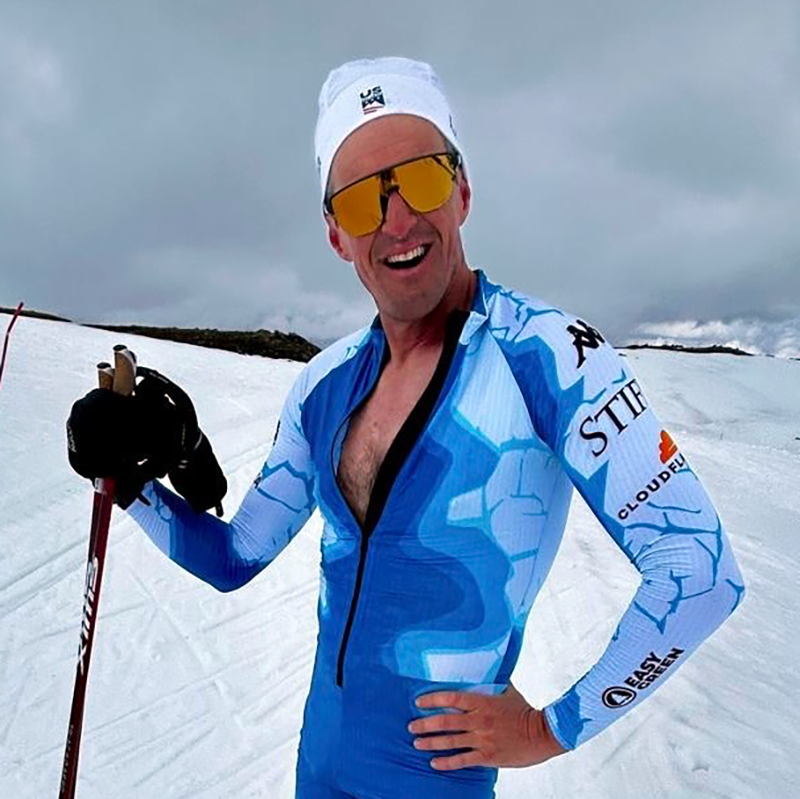
    Eli modeling the new Kappa kit inside the wax truck. (Photo: Courtesy Photo)

    Inside Yolanda

    The work happens inside a semi-truck the team calls Yolanda, a mobile workshop and nerve center that houses eight technicians during World Cup weekends and championships.

    “When you walk into Yolanda,” Brown said, “on the left, there’s Jason. He’s like the door security.”

    Jason Cork oversees Jesse Diggins’ skis and manages data. Across from him sits Chris Heckler, the team’s glide specialist, responsible for Gus Schumacher’s skis and for pushing development at the cutting edge. In the back corner is Oleg Ragilo, “a quiet boss from Estonia,” the head of kick wax and the truck’s mechanic. Tim Baucom, recently returned from retirement, handles hand structure. Bernie Nelson works with Jack Young and specializes in high-speed testing and emotional steadiness. Bjorn Heimdal and Per Erik Bjørnstad, both from northern Norway, bring decades of experience across glide and kick.

    “And then at table three,” Brown said, “it’s Bernie and me.”

    Everyone can wear any hat if needed, but the structure matters. Decisions are made by conversation, testing, and sometimes by vote. Kick wax choices are made by committee — “two out of three or three out of three votes advance skis” — a system designed to protect athletes from any single person’s blind spot.

    There’s humor inside the pressure. The team maintains a set of traveling trophies, passed around to mark gratitude, effort, or apology. It’s a way of acknowledging that success and failure are shared.

    “You’re on a roller coaster together,” Brown said. “The emotional roller coaster part.”

    Team Kern: Eli Brown, Julia Kern, and Kristen Bourne in Toblach. (Photo: Courtesy Photo)

    Relearning Speed

    The current era of ski preparation is defined by change. Products come and go. Environmental and health concerns have reshaped what’s allowed. Even trusted solutions can’t be trusted for long.

    “We’re on the cutting edge,” Brown said, “and it’s constantly changing.”

    That volatility has made high-speed testing more important than ever, especially in skate races where structure and glide decisions can hinge on how skis behave at race pace on the actual course. Hand structure tools, brand-specific grinds, and new base materials all interact in ways that don’t fully reveal themselves on paper.

    Brown sees his role as filtering that uncertainty before it reaches the athlete.

    “I don’t want them thinking about it,” he said. “I want them to just ski.”

    The Olympics compress all of that work. The venue in Val di Fiemme is familiar, but transformed by Olympic infrastructure. Warm weather looms as a wildcard. The margin for error narrows.

    Looking back on the Tour de Ski, Brown is candid about what he’d change. “I wish I’d given Julia slightly more kick,” he said. “Ben slightly less kick.”

    That kind of reflection isn’t self-flagellation. It’s the process.

    Eli and fiancé Colleen above snowy Predazzo days before the Olympics start. (Photo: Courtesy Photo)

    The Emotional Work

    If the technical demands are invisible, the emotional ones are even more so. A tech absorbs disappointment, so an athlete doesn’t have to. He steadies confidence when results wobble. He celebrates quietly when things click.

    Brown talks about success in broader terms than medals.

    “Gold is the goal,” he said. “But it’s also maintaining team relationships and health through an intense period.”

    That perspective extends beyond race results to the ecosystem around the sport. Brown worries about industry instability, about layoffs and shrinking budgets, about whether the work he and others do will continue to be supported.

    “We’re all one big community trying to do something special,” he said. “It’s my little cog in the machine.”

    Inside Yolanda, that belief takes practical form. Shared meals. Shared jokes. Shared responsibility when something goes wrong. The trophies circulate. The work continues.

    Skiing the 2025 Birkie with his dad, Elton Brown. (Photo: Courtesy Photo)

    What Happens When It Works

    When it works, there’s no single moment that announces it. No flag. No statistic. Just an athlete skiing freely, unencumbered by doubt.

    Brown watches from the side of the course or from inside the truck, reading body language, listening for feedback, and filing away information for the next decision. The skis disappear. The job is done.

    That’s the paradox of being a golf caddy or maybe more accurately a ski caddy: success means becoming invisible.

    For Eli Brown, that invisibility is the point.


    Help Support Our Olympic Coverage!

    FasterSkier will have our own Nat Herz on the ground at the Olympics, which, to be honest, is a very big financial lift for us. If you value the thoughtful work and access FasterSkier provides at championships like this one, please consider becoming a Voluntary Subscriber. Your support directly fuels the work we do to cover the people, places, and moments that make our sport special.

    Join the FasterSkier community!


    Eli and fiancé Colleen doing some pre Olympic cruising. (Photo: Courtesy Photo)
  • FasterSkier’s 12 Days of FBD Christmas: Day 7

    FasterSkier’s 12 Days of FBD Christmas: Day 7

    Editor’s note: For the second-straight year, we’re presenting another 12-day holiday gift guide, brought to you by the one and only “FBD”, our gear-review guru. Kicking the series off, recommendations for recovery gifts to keep you and your ski buddies on the trails and injury free. See also: Day 1 | Day 2 | Day 3 | Day 4 | Day 5 | Day 6

    ***

    Day 7: Nordic Tech

    Since no one has more style, steez and flow than the FBD, we’re going to mix it up a bit today and bring in, for lack of a better expression, an expert guest speaker to help walk us through today’s gift suggestions for Nordic Tech. I actually tapped into two experts for today’s gift ideas, Nathan Schultz from Boulder Nordic Sport and Zach Caldwell from Caldwell Sport. Spoiler alert, the Colorado guy was super chill and low-key. The guy whose Twitter handle is @GrumpySkier, was, well, grumpy. And surly. And at times, just plain mean. But, since all of you are probably as tired of reading my labored prose as I am of producing it, I thought I’d offer up someone new about whom you can complain.

    A few important points here:

    1. For those of you out there who think I can dish it out, but can’t take it, you are in for a treat, as one of these so called experts comes at me pretty good. That’s OK though, I’m a big boy (especially “South of the Border,” if you know what I mean) and I can handle it. In fact, most of this doesn’t even count as abuse in Philadelphia, it’s called just a normal day.
    2. Remember my quip on Friday about “special” people? Well, I swear to God that the comments that you will hear from Zach shorty were not staged because, A.), I would never lie to you people, I am too good a man and B.) if you know my boy Caldwell at all, you know that there was no way in hell that he would deliver this hilarious video on schedule, allowing it to be carefully reviewed and edited. Oh no, that would be too easy. Instead, Mr. Caldwell elected to sent it to me at 11:30 p.m., the night before publication (and the night in which I was leaving for the airport the next morning at 5 a.m. Awesome). The point here is that I had already published my column in which I refer to “special” people before he submitted this video. All of these events do, however, raise several serious questions about his time-management skills and most importantly, who really is the “special” one in this relationship.
    3. Furthermore, I am greatly intrigued with Zach’s assertion that I take myself too seriously, as he clearly has not been following my earlier detailed descriptions on awkward and hopefully fictional encounters with my family physician regarding problems “downstairs,” allegedly related to dirty tractor seats and improper Speedo use. Does this sound like the work of a man, albeit a great, great man, taking himself too seriously? I’ll let you all decide, as I trust you people to do the right thing here.

    Once you have drawn the correct and logical conclusion that Zach is clearly out of his mind, please send all angry comments to zach@CaldwellSport.com. Suggestions for the subject line include, but are not limited to: “FU Zach”, “FBD is a god”, or even “Leave Brittany Alone,” have we learned nothing from Anna Nicole Smith? I know it’s hard to see FBD as a human being, but trust me, he is. He’s a person. He’s like you or I. (Well, actually, much, much better, but you see my point).

    So without further ado, we are now going to shift gears a little bit and depart from our wonderful,  established format and let an angry Vermonter and my good buddy Zach Caldwell, take cheap shots at me while prattles on about how to properly tune skis.

    Watch this video in its entirety, then find the links to all of the products shown in the categories below. Please note, as usual, I have better visibility on the nordic world than Zach does from his remote outpost in rural Vermont, so please don’t just listen to Zach’s demanding and bossy tone, as the other products listed here are also top notch, they’re just being presented with a little less fanfare, which is no way, shape or form is a reflection on their value or efficacy.

    Under $29

    Red Creek Groove Scraper

    Red Creek groove scraper: FBD pick for under $29

    Don’t let Zach fool you on this, I have tested about 20 different models and I called HIM about this, since naturally he didn’t have it on his website (the things I do for that guy). Regardless of how much he badmouths it in the above video, since not all of us have relatives slaving away on a lathe to create custom tools for us, I think this groove scraper is the best one out there. As much as I can tell, so does Zach, I guess? Buy several, as everyone is going to borrow yours and never give them back.

    (Note, these are also not yet available on the Caldwell Sport website, as apparently he needs to spend less time busting my balls and more time running his business. This tool is sweet though, so email Zach directly. Be sure to give him a hard time about not putting the products he is trying to sell in a place in where potential customers can actually purchases them. #Business101

    $2.50 each via email zach@CaldwellSport.com


    SkiGo Kick Wax Scraper 

    SkiGo Kick Wax Scraper: FBD pick for under $29

    This baby made the cut last year and is getting a rare “FBD retweet,” just because it is that good — it’s pretty rare that you can find an extremely high-quality product for under $10, so when you do, you get as much mileage out of that beast is possible. I mean, if you can’t spend $10 on someone’s gift, you probably shouldn’t be buying them a gift in the first place.

    It has two beveled edges that peel away kick wax quickly and effectively and it is small enough to fit almost anywhere, in particular in your new wax box (more on that in a minute). It will change your kick-waxing life. Really.

    $7 at Boulder Nordic Sport


    Red Creek Base Scraper

    Red Creek Caldwell Sport Scraper: FBD pick for under $29

    Remember my assessment on Friday of coffee nerds? Well, move over coffee losers, as there’s a new sheriff in town, and he’s saying things like, “All professionals prefer a 3 mm scraper width.” How you can utter a phase such as that while maintaining even a shred of dignity is beyond me, but I don’t have a shirt that says, “You’re doing it wrong”, so what the hell do I know? Baller shirt, too, by the way: look for those in next year’s 12 DOFBD.

    As for the thicker scraper and how to properly scape ski sidewalls, oh my God, could a person possibly be more patronizing? I can’t believe I let this guy grind my precious skis, as YES ZACH, I know to use the side of the scraper. You see the sh*t that I have to deal with, people?

    Having said that, please also let the record note that I did buy the 5 mm scraper, as it does in fact work better for ski “technicians” of my very limited aptitude. DEMAND that he send you one with the custom FBD logo though, as this are already a collectors item. If he says no at first, just keep asking: he likes that.

    $8 at Caldwell Sport


    Holmenkol Natural Wax Fluid 

    Holmenkol Natural Wax Fluid: FBD pick for under $29

    Holmenkol Natural Wax Fluid is a truly “universal” wax for all snow types and temperatures. This wax not only performs well in the cold (unlike most universal waxes), it is made from sustainable sources (no petrochemicals) and is 100-percent biodegradable. Application is easy with an integrated sponge applicator and polishing felt. Use it for training or on waxless skis tip to tail to improve glide and protect the bases.

    Also a great way to travel wax when when you are leaving from the venue with your hair on fire, you have 60 minutes to catch your flight at an airport that is 70 minutes a way and there isn’t an iron in sight. This magic goo got the FBD race fleet home safe and sound from Switzerland last year after Master Blaster Worlds and I never leave home without it. That is, when I remember it. #NotAlwaysThatPro

    $20 at Boulder Nordic Sport


    $30 – $99

    Star Liquid Paraffins

    Star Liquid Paraffin Wax: FBD pick for $30-$99

    Have I told you how much I hate it when Zach is right about something, anything? Ironically, for a race just a few weeks ago, I had a few of the very knowledgeable people who Zach name-checks at the end of his hate-rant video prep my race skis with this product, and the skis were fast. How fast? Two podiums fast. If you buy them and don’t podium, call Zach, as he loves to field calls like this and he’s a very, very lonely man.

    On a related note, if you send your skis in to him for a new grind (which you definitely should), please be sure to also demand that he return your skis with the EXACT SAME skis ties you send out. If you receive any other ski ties than the ones that you shipped, as always, keep calling until he finally returns the correct ones.

    Star Liquid Paraffin Waxes (50 ml spray bottle. Each bottle is good for 15+ pairs of skis):


    Red Creek Brass Brush

    Red Creek Fine Brass Brush: FBD pick for $30-$99

    This was featured at 6:29 in the video and is also a personal FBD favorite. I don’t know what else to say here — use it, don’t use it, but I like it and Zach likes it, so take that for what it’s worth. I’m guessing that my recommendation carries more weight than Zach’s, mainly because I weight more than Zach and that’s just simple physics people. Either way, it’s a nice brush.

    $31 at Caldwell Sport


    Holmenkol Pro Groove Scraper 

    Holmenkol Pro Groove Scraper: FBD pick for $30-$99

    This might be more than many of you are willing to pay for a groove scraper, but it IS really nice, especially for ski brands with wider grooves. It is simple but unbelievably effective.

    And before anyone gets all huffy about the price, this thing is bomber. It has two different diameter aluminum cylinders that never dull at either end of a solid plastic handle and it removes wax so well it will shock you the first time you use it.

    $35 at Boulder Nordic Sport


    SkiGo HF Universal Racing Glide Wax 

    SkiGo HF High Fluor Glider (45g): FBD pick for $30-$99

    Universal wax is ubiquitous in the ski world, but previously its performance has generally been only good enough for recreational skiers looking for a simple solution. SkiGo has shattered that barrier with a truly “universal” racing wax. Available in HF and LF versions, SkiGo Universal wax is a high-quality racing wax that works well in aggressive cold snow AND warm, wet, soft snow. Many teams use it in all conditions as a reliable base layer and focus their energies on testing powders and topcoats instead of paraffin layers. The LF version ($70, 200g) is a great training wax and also good for wax standards in races that are LF-limited. HF Universal ($80, 45g) is an excellent racing synthetic paraffin. -18C/0F to +5C/41F.

    $80 at Boulder Nordic Sport


    Toko Soft Wax Box

    Toko Soft Wax Box: FBD pick for $30-$99

    Let’s assume that you’re drinking the Kool-Aid and you are going to get styled out with the latest and greatest swag shown here. How the hell are you going to get all of this crap to races? As usual, *I*, NOT ZACH, have you covered. Toko just released this amazing Soft Wax box and it is da bomb. It’s just the right size to transport essentially everything you need to your next local, national or even international race, yet it is also perfect for your bench at home. Load’er up once with all of the crap Zach is droning on about and boom, all of your problems are solved. Well, all of your waxing problems.

    $60 at Tokous.com


    $100 – $299

    Red Creek Monster Brush 

    Red Creek Oval Hard Steel/Nylon Brush: FBD pick for $100-$299

    After seeing that terribly mean-spirited video and reading just these few short item descriptions, I’m sure you can imagine how much it pains me to admit that Zach is right about not one, but two things, but what the hell, here we go: I bought this brush from him last year and even with the hurtful, tech-shaming sticker, and his most-recent, very unnecessary, spiteful commentary, this is without a doubt my favorite brush. I use it to groom the Great Dane, my hair (head, back and “elsewhere”) and promise to some day try it on my skis.

    $110 at Caldwell Sport

    Actual brush sent to me by Zach Caldwell. I think this photo perfectly defines our relationship.


    Over $300

    Pro Roto Brush Kit

    Red Creek Pro Roto Package: FBD pick for over $300

    Like every good nordic skier, I am a glutton for punishment: I do intervals with elite skiers, knowing full well that they are going to destroy me, yet I somehow feel the need to make myself miserable anyway. I ask some of the most hyper-critical coaches in the sport for technical feedback on my skiing, knowing full well that it will be delivered with searing sarcasm and bitting commentary, and perhaps worst of all, I somehow think it is a good idea to post another one of Zach’s videos, again, knowing full-well that I am going to take an absolute beating:

    Zach does a pretty good job describing how this system works and why you should have it, and thusly I only have a few things to add, the first one of which is by far the most salient. When I was staying at Zach’s house just a few years ago, I asked him when he didn’t use Roto brushes. I’ve spent my fair share of time in World Cup wax cabins (as a matter of fact, I just did so this past weekend), so I’ve seen some of the best techs in the world prep skis. Almost 100 percent of them use Roto brushes. Sure, they are usually preparing lots of skis in a short period of time, but their ultimate goal is fast skis, so those guys follow whatever protocol yields the best possible outcome. This means using Roto brushes almost exclusively.

    Armed with this knowledge, I asked Mr. Perfect a few years ago during my stay in Putney which one I should get. His response? “Goddamnit, FBD, you don’t need those stupid things, regular brushes are much better.” Ah, how the tables have turned … it’s been a wonderful journey watching the student become the master. Confronted about this very point yesterday via what was I’m sure a very painful phone conversation for him, he confessed, “Yeah, I was anti-roto for a while, but I have come around. Part of this is because drills are now much better, as are the Roto systems. Yes, I wasn’t that into them before, but this is my ‘must-have’ for this season.” All fair points.

    I’ll even cut Zach a lille slack on this (very little) and allow for the possibility that he was correct on both occasions, as the technology has come a long way. What this means to you, is if you are also a stodgy Vermonter, or Midwesterner, or whateverner, and are one of those, “We never used those back in my day….” type of people, that’s OK, you probably did have a valid point “back in the day,” but the technology has improved significantly across the board in all aspects of the system and you can now produce better skis, with less effort, and in less time. I think that’s a winning formula for skiers at all levels.

    If you’re a guy like me to loves skiing, but hates working on his skis (and is terrible at it, though not nearly as terrible Zach is laying out), this is a slam dunk, as I am out of the fume-choked garage faster than even, doing what I truly enjoy — skiing — on skis that are faster than ever.

    If you’re into the tech side of the sport, you are even crazier if you don’t take the plunge, as ZC has about 50 combinations of brushes, felts, steels, cottons, tweeds, licorice, and other crazy compounds, diameters, durometers, and all of that crap, therein allowing you to lock yourself in your garage away from your annoying family for longer periods of time than ever before. Everyone wins. Your poor family doesn’t have to listen to your disjointed, rambling theories on the under-appreciated value of a good structure tool and you don’t have to listen to whatever the hell it is that normal people talk about these day. I literally have no idea, as about 99 percent of my conversations ultimately come back to structure tools for some strange reason.

    As to how you execute this transaction, you can stick a toe in the water, wade in, or dive in head first to the deepest water that you can find. As you all know, I’m of the belief that is something is worth doing, it’s worth doing well (not to mention the fact that there’s no such thing as going too far), so my advice is to not just dive in, but go full “Acapulco Cliff diver” on this mo-fo and get the big-daddy set. That’s what I did and I don’t regret it for one second. Sure, I probably won’t use most of the attachments, and yes, the ones I do use I will most likely do so incorrectly, but I’ll have the best, and that makes me happy. Since I’ve been marooned in Philadelphia for WAY too long, I’ll also derive a perverse amount of satisfaction from knowing that I have a better set than most of you (in more ways than one). I know this is wrong, and this is most certainly not something that I am proud of, but it’s true.

    Sure, you can chintz out if you want to and not go with the “professional package” (insert your own ‘package’ joke here), but don’t come crying to me when everyone at laughing at you behind your back as the guy with the incomplete Roto brush set. I have nightmares over stuff like that and I would hate to see this indignity befell you.

    $425.78 (Yes, that is the actual pricing because Zach is a total kook)