From the FasterSkier archive — posts syndicated from athletes’ and coaches’ own blogs between 2004 and 2012, kept online as published. Current coverage is at fasterskier.com.

Tag: Gold Rush Award

  • Novie McCabe—Gold Rush Winner and Alaska Bound

    Novie McCabe—Gold Rush Winner and Alaska Bound


    Gold Rush winner Novie McCabe on a run with her teammate, Sophia Laukli, last year in Alaska. (Photo: Novie McCabe)

    Stifel U.S. cross-country ski team member Novie McCabe recently won the Gold Rush Award. This award is given to the Nordic Olympic woman who “has represented the U.S. in cross -country skiing and has demonstrated outstanding qualities of grit and grace throughout the year.”

    Past recipients include Rosie Brennan, Sadie Maubet Bjornsen, Sophie Caldwell Hamilton, Jessie Diggins, and Julia Kern. The past recipients choose the next award winner, so it’s quite a prestigious field which selects the winning candidate. McCabe was chosen by those athletes as the woman who best personified those values.

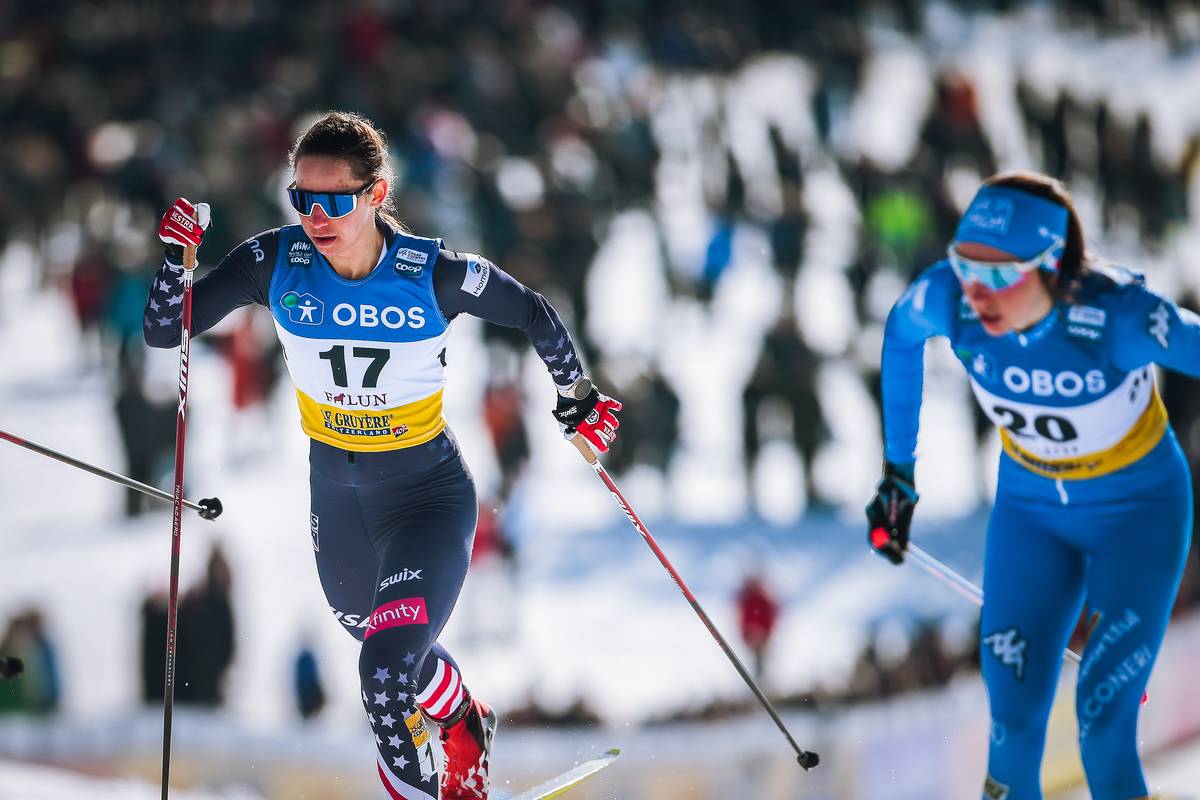
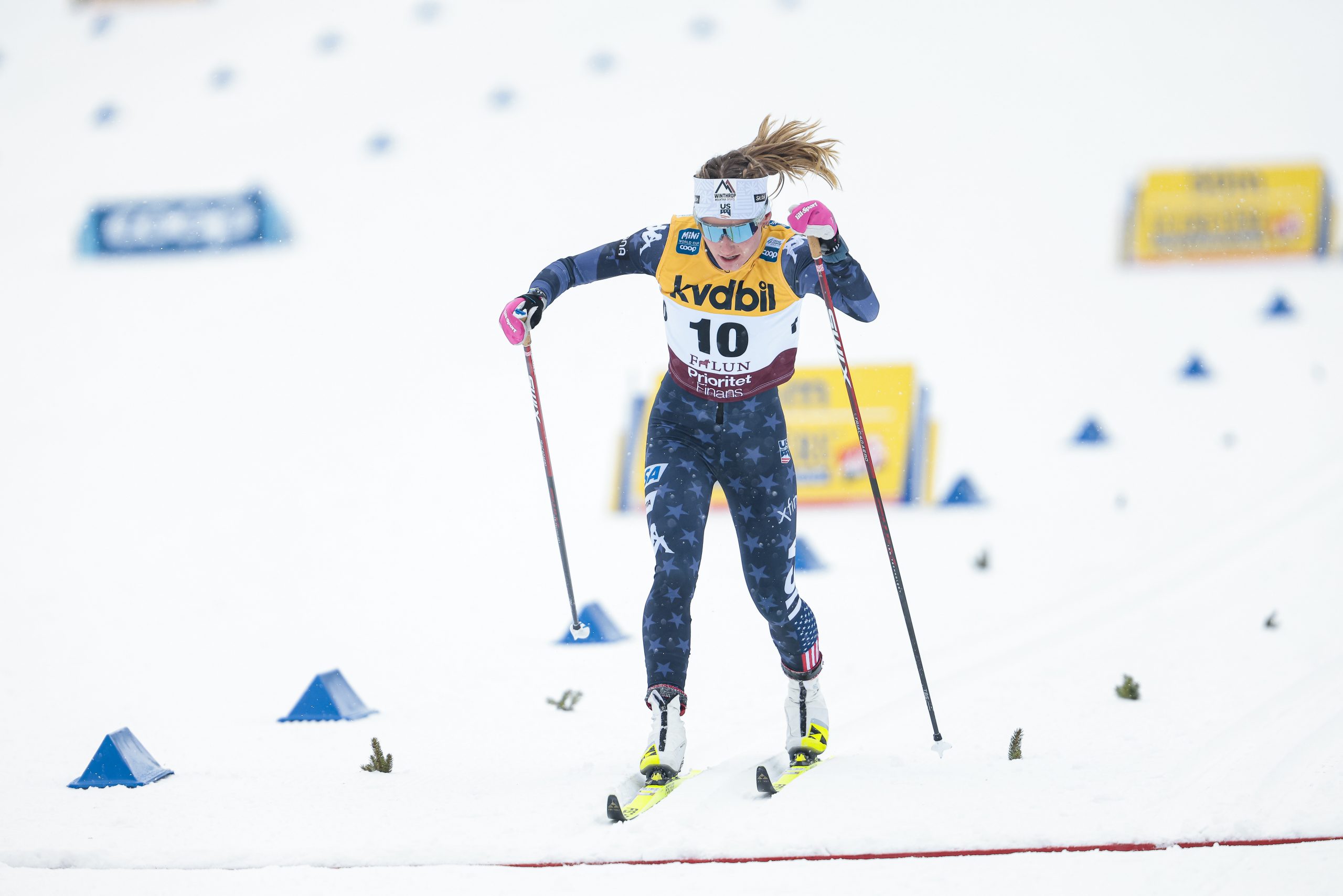
    McCabe had her best finish in a World Cup individual race this last winter taking 14th place in Falun, Sweden, and finishing 7th at the daunting hill climb in the Tour de Ski at Val di Fiemme, Italy.

    Novie McCabe joined by friends and family at City of Rocks this spring. (Photo: Novie McCabe)

    McCabe has overcome injury and illnesses to reach these heights — obstacles which might have forced a less determined athlete to back off, or give up. But the former University of Utah skier’s resolve held firm; she soldiered on, and eventually broke through with career best performances.

    FasterSkier had a chance to catch up with McCabe while she was home in the Methow Valley, Washington, where she was generous enough to talk with FasterSkier’s Ken Roth about winning the Gold Rush award, prior seasons’ difficulties, and overcoming obstacles.

    (This interview has been edited for brevity and clarity)

    FasterSkier: Where are you?

    McCabe: I’m at home in the Methow Valley.

    FasterSkier: You still consider the Methow Valley home?

    Novie McCabe raced collegiately for the University of Utah, then moved on to the U.S. team. (Photo: Novie McCabe)

    McCabe: I don’t know! I’ve been living in Utah for school and I’m moving to Anchorage in a few weeks. It still feels like home since my family still lives here.

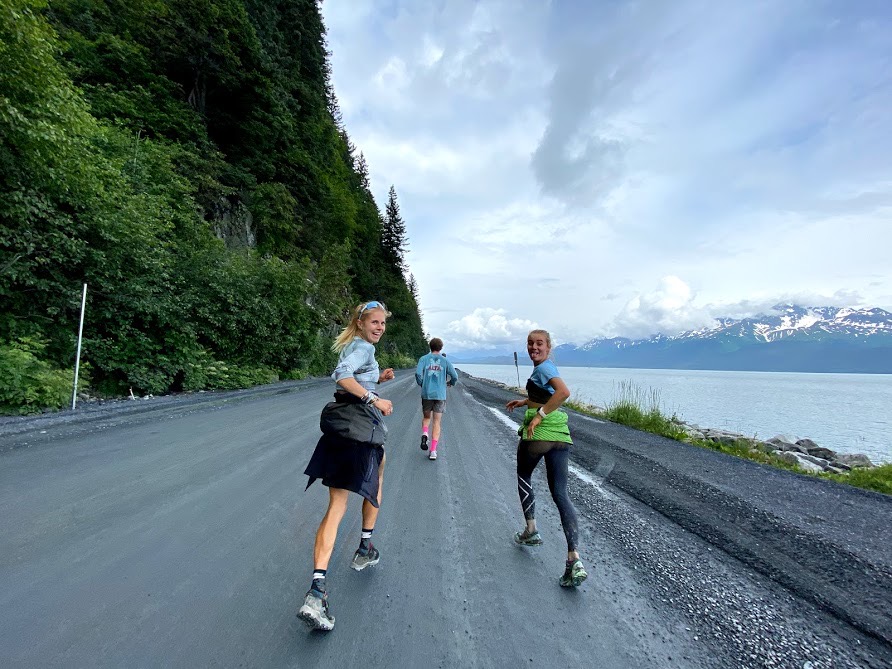
    Novie McCabe out with friends for a run in Alaska. She’s decided to make Alaska her new home and join the APU (Alaska Pacific University) team. (Photo: Novie McCabe).

    FasterSkier: Is that a permanent move; to Anchorage?

    McCabe: I’m planning on being there for a long while. I’m joining APU (Alaska Pacific University Ski Team) I’m very excited about it.

    FasterSkier: That’s news. Can you tell me how the decision to join APU came about?

    McCabe: I spent part of last summer and the summer before training with APU and really enjoyed it. I like [Erik] Flora a lot as a coach. It’s a fun and productive vibe, which I really like, and I really like Anchorage. It also feels a little closer to home. Those were all factors. I trained with SMS T2, it was so fun also, there are many great club options in the U.S., but Anchorage felt a little closer to home than Vermont and that’s nice too.

    FasterSkier: Have you graduated from University of Utah?

    McCabe: I have still have some classes to take. I plan on finishing by next spring. All of the remaining courses are online, so I’ll go to school online while I’m in Alaska.

    FasterSkier: The Gold Rush award you won has some pretty high benchmarks and the nominators are a prestigious group of past winners. How does it feel to be chosen by that group of women to represent the U.S. ski team by showing grit and grace?
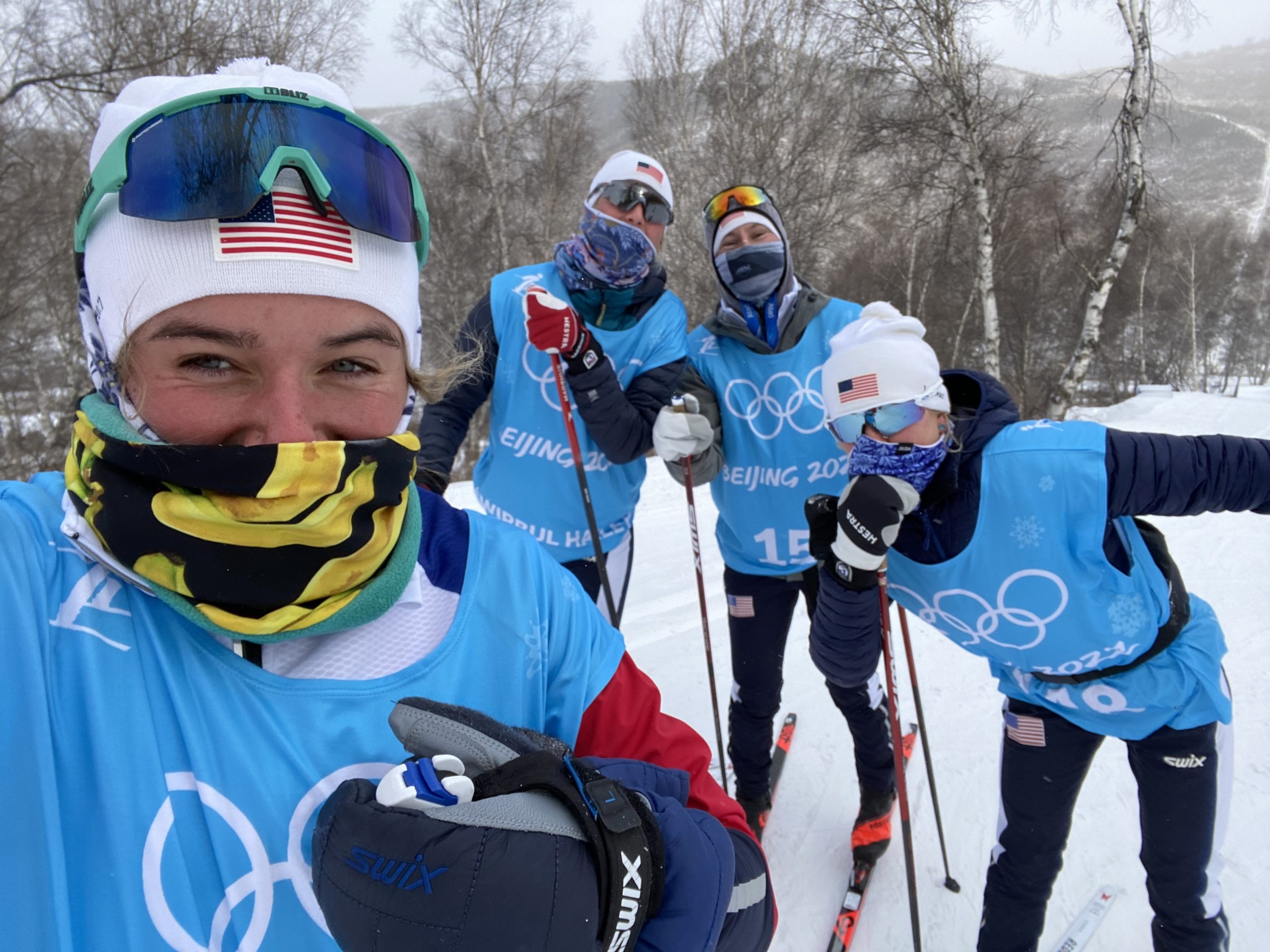
    McCabe credits her teammates with helping her develop the traits which won her recognition. Here she is training in Beijing with Hailey Swirbul, Hannah Halvorsen, and Sophia Laukli. (Photo: Novie McCabe)

    McCabe: I’m obviously very honored to have been considered by all of them for the award, because I feel like I’m so lucky to have so many great women to look up to. Being surrounded by them…trying out World Cup for the last two years has been really inspiring for me. I always have all of these role models to show me how things are done and have given me a good idea of how I want to carry myself on hard days and on successful days of racing. I’m really proud to be part of that group of women. It’s definitely special that they chose me for the award.

    FasterSkier: Do you think that the grit and grace you displayed was something you picked up on; that you were mentored by those women?

    McCabe: Definitely. I don’t know if I would say that I displayed grit and grace, but…I think it’s very nice that people thought that. But those are two qualities that I see all of the time in the whole women’s team. They are really two qualities that we embody as a team, so I think that is definitely a huge part of it.

    FasterSkier: Part of your backstory for the award is coming back from shoulder surgery at the beginning of last calendar year. What kind of surgery did you have?

    McCabe: I had surgery to repair my labrum, and a few other things in the shoulder. I was having dislocations all of the time, so I had to get everything tightened up.

    FasterSkier: Was that from a fall?

    McCabe: Yes. I originally fell roller skiing and dislocated it. It was fine for about a year, then I fell again roller skiing and it was kind of fine for a little while, but then started happening a lot.

    FasterSkier: So… you done with roller skiing?

    McCabe: (Laughing) Not quite, although I was close to calling it there for a while.

    FasterSkier: How hard was the rehab?

    McCabe: It went very smoothly. I didn’t really know what to expect. I’ve been really lucky throughout my career, apart from that [injury], I haven’t had any major injuries to deal with. I didn’t really know what to expect, but everything went really smoothly. It definitely took a while. It was frustrating to start the training year not being able to use my arm… but I knew that’s just part of it, and everyone get’s injured. I had great P.T.s to help me the whole way and good surgeons at Utah. I feel I didn’t lose too much fitness in the summer because of it.

    FasterSKier: So you made training adaptations during recovery?

    McCabe: Yep. I did a lot more running, and Flora was a big help even though I wasn’t officially an athlete on APU. He was really helpful in coming up with some alternative training to do. It was a good introduction to Anchorage.
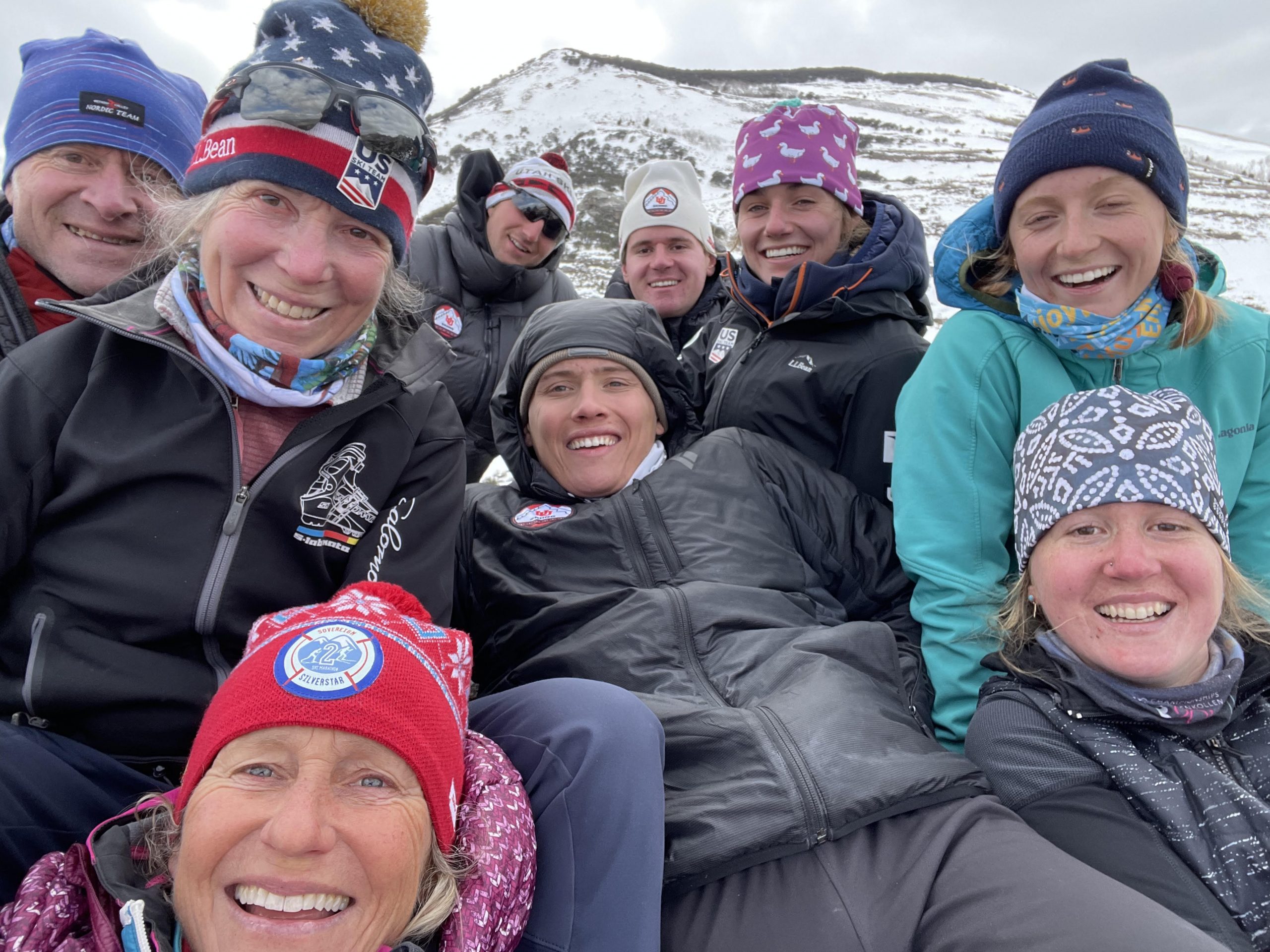
    Novie McCabe joined by family and friends for a climbing adventure. (Photo: Novie McCabe)

    FasterSkier: What helped you stay positive post-surgery?

    McCabe: I came home after surgery and spent time with my family which I love to spend time with. I was bummed to miss out on Bend camp two years ago, its definitely sad to not be with your team and not be training hard, but I think it was helpful to be a little removed from it, to be in the Methow [valley] doing my own training and I feel that helped me feel confident in what I was doing. My mom also had the same surgery along with a lot of people in my family. Maybe it’s a bit of a genetic thing? She had good advice for me. I think I had it a little easier than some other people with that surgery. I feel it was a pretty quick rehab.

    FasterSkier: Isn’t that similar surgery which kept Lyn Svahn out for so long? Were you ever worried that would be the road you were going down, being out for a long time?

    McCabe: I knew going in what the timeline was, I feel they gave me an accurate timeline. I was planning on being back to roller skiing in the summer. It was disappointing when it was June, and I couldn’t roller ski yet. In the grand scheme of things, I think it was early enough in the summer where it really didn’t matter that much.

    FasterSkier: So, is the injury completely behind you?

    McCabe: I haven’t had any trouble other than I’ve lost a lot of mobility. So, I’ve had to work on getting that back. I’ve decided this summer I want to work on getting all that back again. I don’t think I still struggle with anything major from the injury.

    FasterSkier: You also had to deal with illness this last winter. Can you talk about that?

    McCabe: Maybe I don’t have the best immune system. Illness has definitely been one of my biggest roadblocks. I struggle with what seems like getting sick constantly, and it’s a bit frustrating. I feel like I’m getting sick all the time but realize that seen from the outside people probably think I’m sick a normal amount. This last season I got sick a few times, and the timing wasn’t ideal. I was struggling with staying motivated when I had to keep resetting my training, missing competitions, and not having good lead ups to races. That was definitely a bit frustrating. It’s part of skiing; but it was a bit more than usual.

    Novie McCabe with her sister Dashe last summer. McCabe credits her family with helping her create the foundation for the right attitude. (Photo: Novie McCabe)

    FasterSkier: Was it Covid related?

    McCabe: I had Covid in the summer and fully recovered. There were other lingering colds that were hard to recover from mid-season. I was at the World Cup for the first month and been sick before we left for Europe. I raced in Finland, then got sick, then was sick for Lillehammer, then raced Beitostolen, then got sick, and then I decided to go home and race nationals. It was a bit annoying (laughing), I couldn’t really figure out what was going on. I also got sick before U23s, that was also frustrating. After that I stayed healthy for the rest of the season, then my shape got better as I had some more consistent training behind me.

    FasterSkier: Were the U.S. nationals your first racing since the initial illness?

    McCabe: Yes, it was my first racing since Beitostolen.
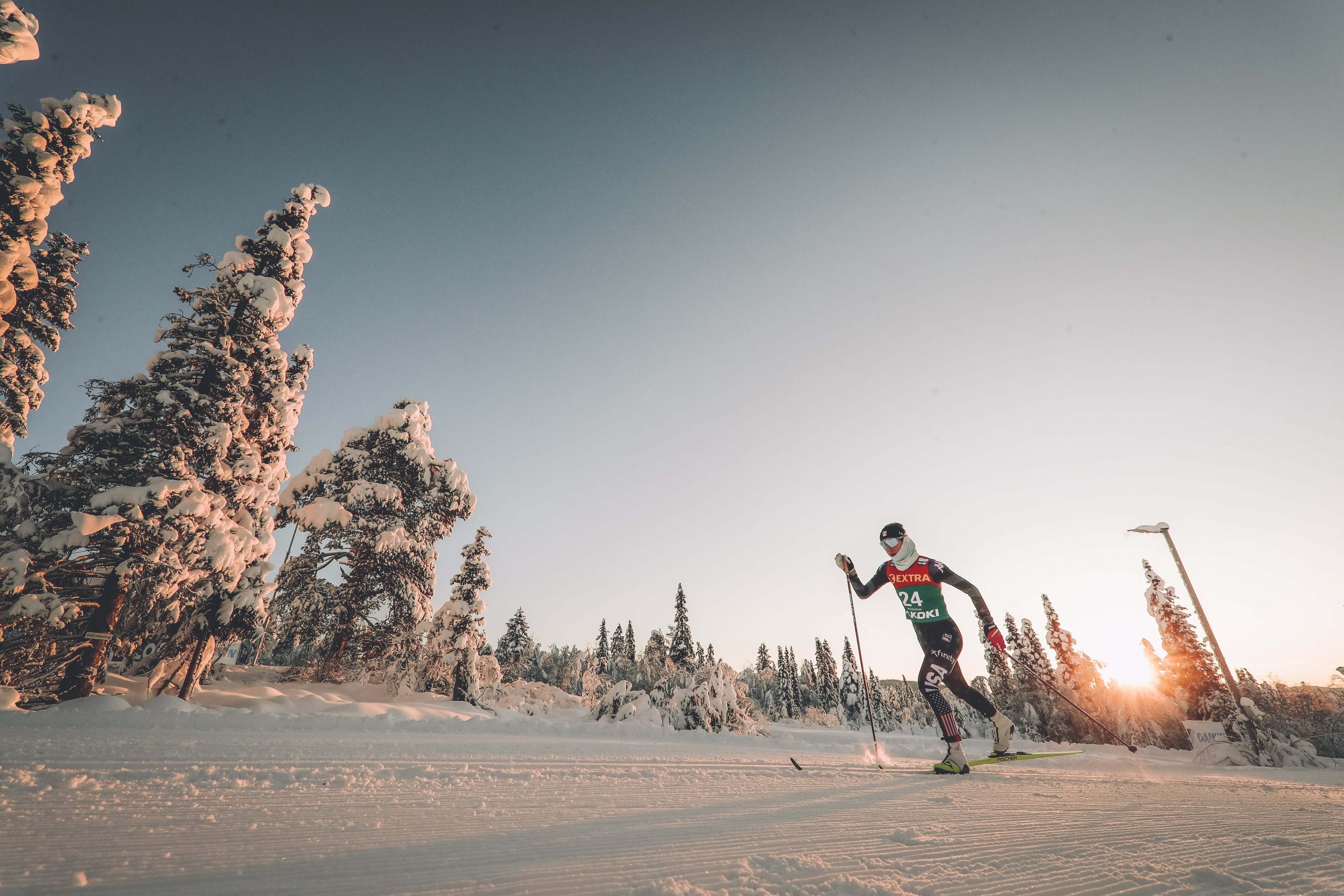
    Novie McCabe (USA) in Beitostolen, Norway competing in the 10 kilometer Classic race. (Photo: NordicFocus)

    FasterSkier: You had some really good finishes at the U.S. Nationals. What do you see as the biggest challenge in translating high level finishes at the U.S. Nationals into high level finishes at the World Cup?


    McCabe: I think it sometimes translates easier than we tend to think in the U.S. When you’re in good shape…you’re in good shape! In World Cups you start so fast, you’re red line from the beginning and that’s shocking for sure. It’s maybe a different style of racing, but I think if you’re racing well and in good shape in the U.S. that you can go over there and be in good shape as well, which I didn’t think before this year. The style of racing is different and more aggressive for sure, all of that comes with practice and time on the World Cup.

    FasterSkier: Does the level of competition impact things?

    McCabe: It is in terms of competitions. But I think in terms of feeling good, feeling confident, and racing fast, I think that you can be racing well in SuperTour, go over to the World Cup, and have some really good results. I think people in the U.S. are totally capable of doing well at [the World Cup] if they’re doing well at SuperTour. People are racing at a high level in the U.S. too.

    FasterSkier: What’s the biggest adjustment in going from domestic racing and joining the World Cup?

    McCabe: Everything is way more official and feels like a way bigger deal. There are more nerves involved, at least for me. It feels like a bigger undertaking… and there’s pressure, especially if you’re not there all the time, and you have one chance to perform. I like to think that it’s still fun and a cool experience in the same way that racing SuperTour is. There’s such a cool culture surrounding SuperTour in the U.S. and our domestic circuit and skiing in general. I feel the U.S. team carries a lot of that into Europe and into the World Cup. Every time I’ve gone over there, they’re always so welcoming and help people integrate, so it’s not the most stressful and shocking thing in the world.

    FasterSkier: Is it possible to have fun everyday when you’re racing the World Cup circuit?

    McCabe: Definitely not, but it’s not possible to have fun every day when you’re racing the circuit in the U.S. either. There are going to be really tough days, you’re not always going to feel good, but I think you can have fun the majority of days. It gets mentally tiring when you feel like you’re not performing the way you expect yourself to. I’ve had a lot of fun taking each race as a new opportunity and trying to get slightly better. I’ve had a lot of fun with that. Yesterday I was 40th and today I’m trying to be 35th or make a lot of process goals. There are more opportunities for growth in that way which makes it kind of fun.

    FasterSkier: Can you share your goals for this coming winter?

    McCabe: I would love to podium at U-23s. Honestly one of my goals is to wear the green jersey on the World Cup for a while (best under 23 years old) or do my best to win that. It’s definitely a bit of a reach, but I was very inspired by Ben Ogden doing that this year. With smaller nations we might have a bit of an advantage because we get younger people on World Cup consistently because there isn’t such a massive battle for starts all of the time. I would also love to be more consistent on World Cup, be in the top 20 sometimes, and just learn things…figure out training, figure out racing, and figure out staying healthy.

    FasterSkier: How’s your training going so far this spring, anything new?

    McCabe: One of the main things is I’m just trying to be consistent —that’s kind of general, but instead of having really massive weeks, and then really low weeks to recover. I hope that will help me stay healthy and absorb more training. Paying attention to the simpler things…recovery, and that I absorb all the training that I do, going into every session with intent. I’m also really excited to train with such a good group in Alaska, that will make me really motivated for this summer and fall.
    One of Novie Mccabe’s (USA) career highlights was her top 15 finish in Falun, Sweden in a Classic race. (Photo: NordicFocus)

    FasterSkier: It’s early in your career, but what would your highlight race be so far?

    McCabe: Oh man, that’s hard.

    FasterSkier: So, let’s make it multiple choice. You were 18th in a race in the Olympics, top 15 in World Cup in Falun, and seventh in Val Di Fiemme at the Tour de Ski, which one of those are you most satisfied about when you look back?

    McCabe: I think out of those three maybe the top 15 in Falun. The Olympics were amazing… but Falun, because it was a Classic race and I haven’t historically considered myself a good Classic skier, and it came together for me there. I also had just come from NCAA championships where I was racing a strong field of girls, and it was cool to come from that and realize that we’re racing at a high level at the NCAAs also. It felt good to pull off a good result on the World Cup because I hadn’t before. I was stoked to prove to myself that I could be top 20, and it left me feeling really excited.

    Novie Mccabe (USA) – finishing at the giant hill climb in the Tour de Ski, where she finished 7th. (Photo: NordicFocus)

    FasterSkier: What do think about your performance at Val Di Fiemme that was able to propel you into the top ten?

    McCabe: I kind of always considered that type of skiing as one of my strengths. I really like just being able to settle in. In some ways it’s easier than skiing a transitioning course because you just settle in and go as high as your body will let you. We kind of do a lot of that kind of thing in training also. I also had really good skis, and Sophia [Laukli] shot up to the front when we first started climbing, and I thought, ‘I’m gonna try and do that too.’ I was very inspired by that. It was a good day for me, and a good discipline and it all worked out. That was so cool, especially for Sophia to have a good day too (Laukli finished third on the day).

    McCabe’s mother, Laura, was an Olympic cross-country skier and Novie’s coach early in her career. (Photo: Novie McCabe)

    FasterSkier: Earlier you mentioned that your mom had similar surgery. Your mother, (Laura), was an Olympic Cross-Country skier as well. Has she given you any advice which has stuck with you?

    McCabe: She was my coach for quite a while growing up; which was great. But I feel like these days she gives me advice when I ask for it, but otherwise she kind of stays off it and is my mom— which I appreciate too. She shows up to races and is there as my mom, and I really love that. Through the way she goes about things and lives her life, I feel I’ve learned a lot about skiing, she’s such a positive person and enjoys everything all of the time, and I think she was the same with skiing. She really loves skiing and I think that’s why I fell in love with it growing up. Her approach to skiing and being outside, enjoying life, just being very resilient in general, has taught me a lot that applies to skiing as well.

    FasterSkier: How old were you the first time you were on cross-country skis?

    McCabe: Oh gosh, I honestly… have not idea, maybe two or three. When can kids walk? It would be then.

    FasterSkier: Your age group at the World Cup will be the first wave of female athletes to go most of your careers under the equal distance format. Any thoughts on equal distance? Are you surprised it took this long to get there?

    McCabe: I’m a big supporter of it. I think it’s really cool that we finally have gotten there, and I think that we should have gotten there a long time ago. It’s great that we’re there now, and I think that the first year of it was a massive success. For the most part people had really good things to say about it.  I’m really excited for that to be part of my career going forward.

    FasterSkier: Did any of the distances that you might not have skied often before present difficulties?

    McCabe: I really enjoy 20-ks. It really didn’t feel much different. It was honestly really fun and pretty entertaining. It’s enough time for things to get strung out, but it still keeps it exciting.

    FasterSkier: What’s your favorite and least favorite thing about being on the road?

    McCabe: My favorite thing is probably being with my teammates. Everyone on the team is so great and so supportive. I feel very lucky to have that—maybe not lucky because people work very hard to create that. Least favorite; is getting sick, being isolated, it’s kind of tough, but it happens to everyone!

    FasterSkier: On your bio on the U.S. team’s page, it says that you have a fondness for Trader Joe’s snacks. What’s your favorite?

    McCabe: Oh… it’s chili lime tortilla chips. They’re super good. They’re like Takis (rolled corn tortilla chips), but the Trader Joe’s version. I’m going to struggle without those in Anchorage.

    FasterSkier: No Trader Joe’s in Alaska?

    McCabe: No, they don’t, it’s awful (laughing). I might have to have some shipped.

    FasterSkier: Thank you so much. It has been a delight speaking with you.

    FasterSkier would like to thank Novie McCabe for taking the time to speak with us, and thanks to the Stifel Cross-Country team for facilitating this interview.

  • Nordic Nation: Rebounding From Setbacks and Gaining Momentum with Julia Kern

    Nordic Nation: Rebounding From Setbacks and Gaining Momentum with Julia Kern

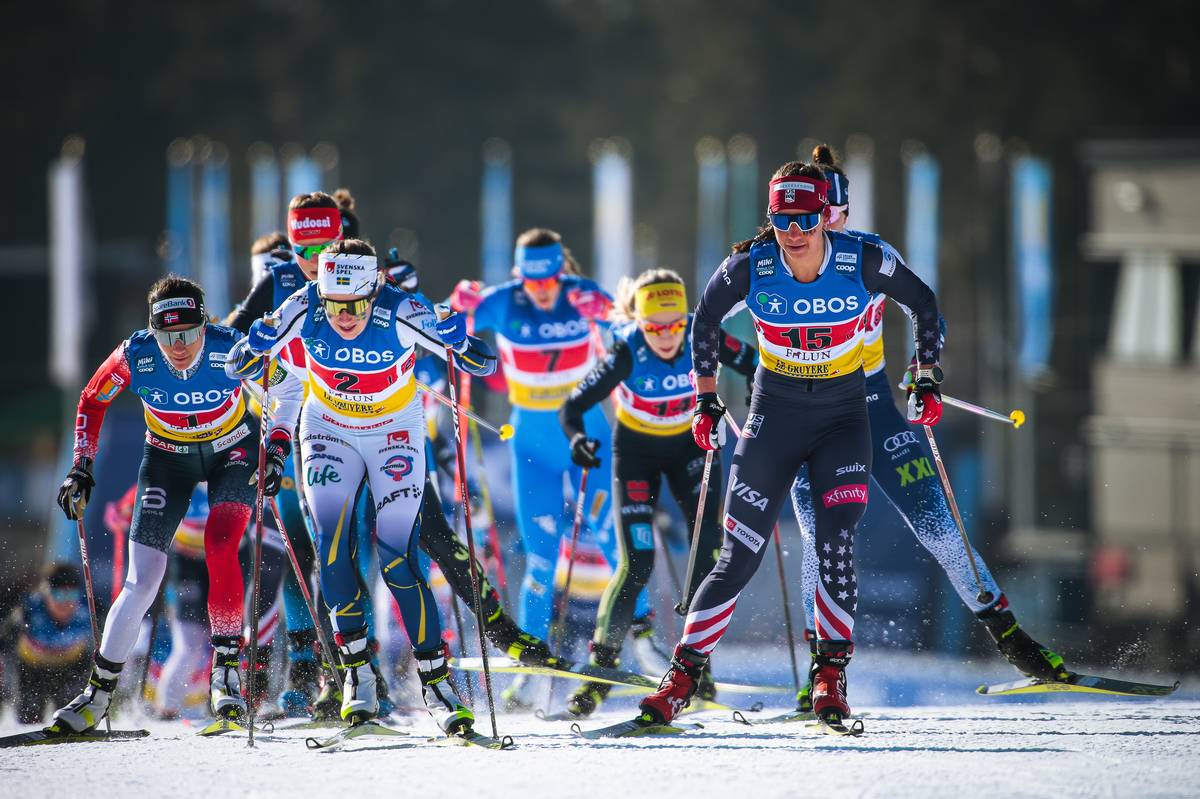
    Julia Kern leads the pack during the first leg of the 4 x 5 k mixed relay in Falun, SWE in March 2022. (Photo: NordicFocus)

    At 24-years-old, Julia Kern is quickly becoming a seasoned veteran in her 7th year on the U.S. Ski Team. However, her career trajectory has been stepwise, not exponential. 

    After making breakthroughs during the 2019-20 season, including her first World Cup podium in a skate sprint in Planica, Slovenia, she faced injuries and setbacks heading into the following season in 2020-2021, leaving her walking away from that season feeling disappointed in both her World Cup and World Championship racing. Reflecting on her takeaways in an interview that summer, she said “Progress isn’t linear from season to season.”

    Hailey Swirbul (bib 19) and Julia Kern embrace at the finish of their first Olympic appearance in the 15 k skiathlon. (Photo: NordicFocus)

    Recently named the recipient of the US Nordic Olympic Women’s Gold Rush Award for her grit and grace as a professional skier, Julia has demonstrated what it takes to rebound, reframe, and move past these challenges. As she describes in this conversation, the start of Julia’s 2021-22 race season happened in fits and starts – some strong early-season results with promising body sensations followed by a series of untimely mild illnesses. After catching a cold midway through the Tour de Ski in early January, she suddenly was faced with the reality that she would not have any opportunities to race until arriving in Zhangjiakou for the Olympics over a month later – the longest race break of her career. 

    Her first Olympic appearance took place in the opening event, the 15 k skiathlon, where Julia finished 53rd. The individual freestyle sprint three days later was her goal race; Julia qualified in 14th and raced a gutsy quarterfinal, ultimately finishing fourth in the heat and 18th overall on the day. A myriad of factors left her wanting more from this first Olympic experience, though she approached it without placing high expectations on herself. 

    Jessie Diggins and Julia Kern take second in the team sprint in Dresden, GER in December 2021. (Photo: NordicFocus)

    Rebounding once more after the Games, Julia began a tear of World Cup sprints in Period IV. She was 8th in the freestyle sprint in Lahti, 7th in the classic sprint the following week in Drammen, and finished just off the podium in fourth in the World Cup Finals in Falun. From there, she headed to Whistler to finish the season at the joint Canadian National Championships and U.S. SuperTour Finals, where she took second to Jessie Diggins in Jessie’s signature 5 k freestyle event, and won the remaining three races.

    During this conversation, Julia discusses the highs and lows of the season, as well as how she has been able to compartmentalize and move past setbacks over the past few years of navigating the transition to the World Cup. We also discuss her start in the sport, why the Stratton Mountain School (SMS) T2 Team has been a good fit for her, and how leaning into other creative outlets, passions and work helps energize her for the long haul.

    Thanks for listening and thanks to New Moon Ski and Bike for supporting this podcast. 

    Julia Kern races the quarterfinal of the individual freestyle sprint in Zhangjiakou during the 2022 Beijing Olympic Winter Games. (Photo: NordicFocus)
  • The US Nordic Olympic Women Gold Rush Award: A Closer Look

    The US Nordic Olympic Women Gold Rush Award: A Closer Look

    Julia Kern prepares for her Olympic debut on the tracks in Zhangjiakou, CNH. (Photo: NordicFocus)

    FasterSkier recently shared a press release on behalf of the US Nordic Olympic Women (US NOW) announcing Julia Kern as the 2022 recipient of the fourth annual Gold Rush Award. The release included comments from 2021 winner Jessie Diggins on the qualities that she, along with the other past winners, recognized made Kern deserving of this year’s award, but it became clear that there was a gap in FasterSkier’s coverage on the history of US NOW and the evolution of the award. 

    To learn more, FasterSkier connected with the spark that launched Gold Rush Award into existence: recent U.S. Ski & Snowboard hall of fame inductee and early groundbreaker for American women’s skiing, Alison Owen-Bradley. It was Owen-Bradley who planted the seeds to bring together the generations of women who have represented United States in cross-country skiing at an Olympic Games, bringing US NOW into fruition.

    According to Owen-Bradley, US NOW filled a gaping hole in connection among the women who helped set the foundation for what is now one of the most successful women’s ski programs in the world. Though each of the 53 women Olympians had played a role in propelling the next generation forward, opportunity for connection between the generations had been lacking. With individual efforts, a network amongst these women slowly began to connect sooner, but when the World Cup swung through Quebec City in March 2019, it provided an ideal opportunity to reunite as a collective. 

    “We ended up having quite a few Olympic women there,” recalled Owen-Bradley in a call. “And it was fun because we wore our vintage clothing to the race, so we had all kinds of different eras of Olympic clothes. It was so congruent because we were really cheering on the latest, greatest women racing but we were also together with our teammates from the past, and it kind of just kind of grew from there.”

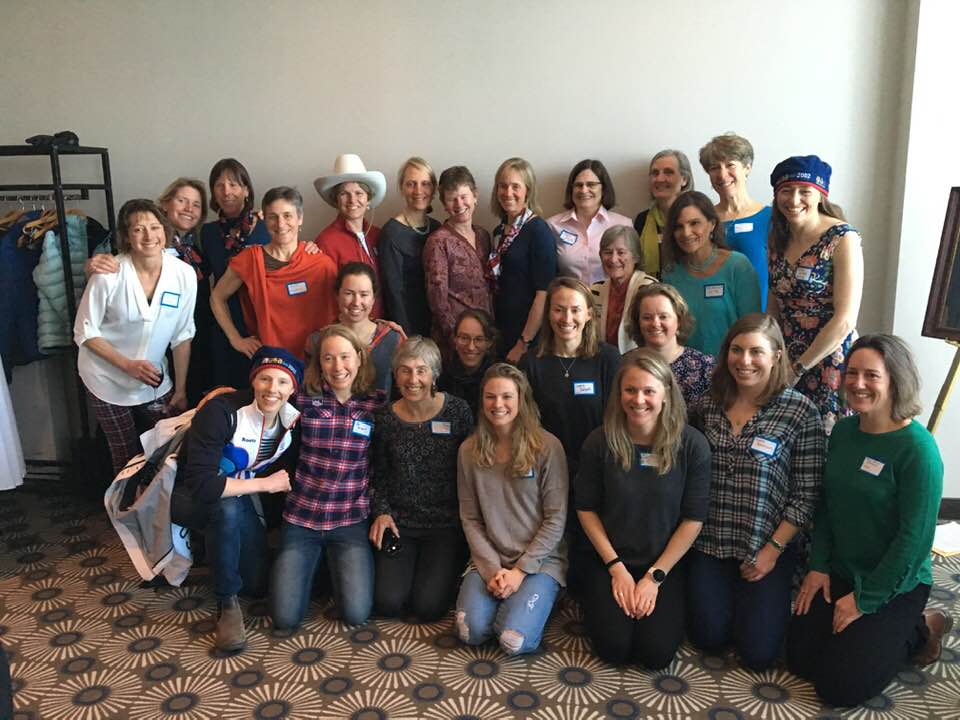
    An intergenerational collective of Olympic women reunite at the 2019 World Cup Finals in Quebec City. (Photo: Peggy Shinn)

    Having been teammates long before the era of Facebook – in fact, some well before the internet – it had been hard for these women to feel connected and maintain ties after careers ended. Owen-Bradley said that before the reunion, she didn’t have contact information for many of these women, and consequently didn’t feel the relationships had been sufficiently developed among the various generations. 

    With some word-smithing to nail a catchy acronym, the energy and camaraderie established at this reunion evolved into US NOW. But there’s much more to the name than meets the eye.

    “US NOW – being retired from ski racing, who are we now? What have we learned? There’s so much gold in that for mining, in a metaphoric way. All these women, what have they learned? What have they gone on to do? How was it good and bad in their lives to devote their time to this? I don’t think we’ve even come close to exploring that and getting the nuggets [of wisdom] out of what women went through and and got from those experiences. But also, how hard was that? And was it worth it? And what would have made it more worth it? And then to just go forward in a way that uses that wisdom.” 

    And so, the organization was built by Olympic women and for future generations of Olympic women. 

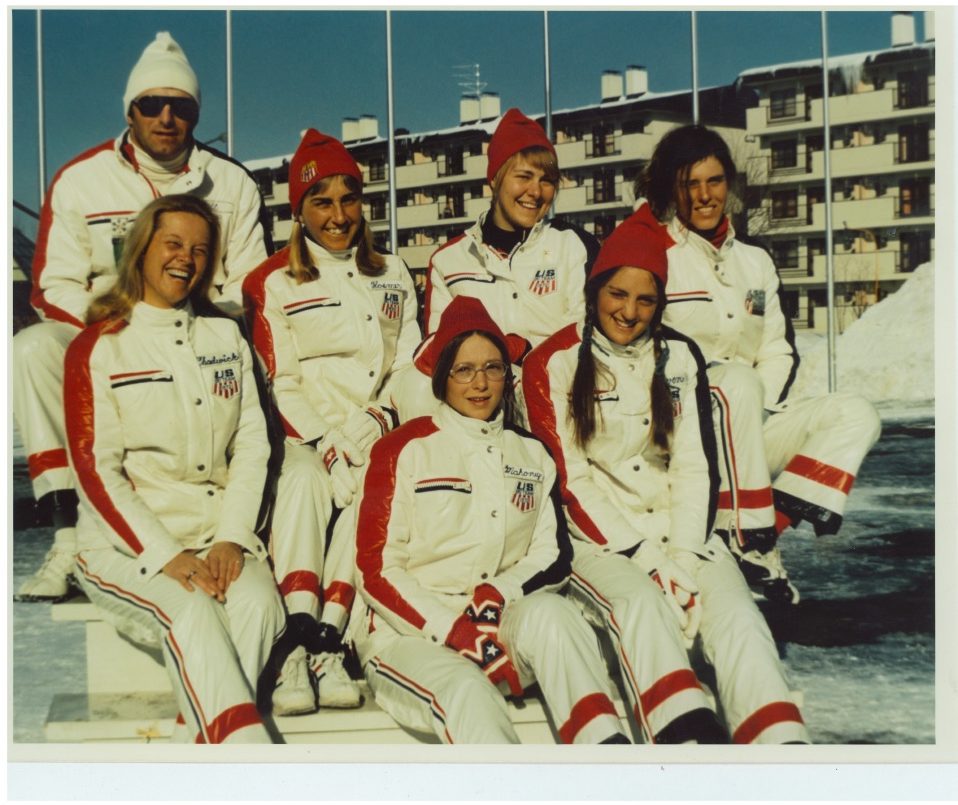
    The first Women’s cross-country Olympic Team. The 1972 Games were held in Sapporo, Japan. Bottom row—Gloria Chadwick, pseudo Chaperone, Margie Mahoney, Alison Owen
    Top Row—Marty Hall, Trina Hosmer, Barbara Britch, Martha Rockwell. (Photo: courtesy Alison Owen-Bradley)

    When the coach of the first women’s Olympic team, Marty Hall, was inducted into the U.S. Ski & Snowboard Hall of Fame in the spring of 2018, he invited Owen-Bradley to attend the ceremony, having been one of his original athletes. While traveling through Norway to race at World Masters, a print inspired by the Birkebeiner story caught her eye; instead of the image she was familiar with, which depicted two warriors valiantly carrying Prince Haakon to safety on their trek through the mountains, it was an image of Prince Haakon’s mother, Queen Inga. She too had made the arduous journey on skis to save her son, and yet, Owen-Bradley had never seen her included in the story’s artwork.

    Finding it symbolic of the emergence of women’s cross-country skiing in the US over the last 50 years, Owen-Bradley purchased the print, and decided it would be a fitting gift to honor Hall at the ceremony. “He had been the first Olympic coach for women and had kind of gotten us on the map.”

    However, the piece of artwork was large. She laughed as she recalled giving it to him, but also telling him it did not need to take up a wall in his home. 

    “We decided that it would be a traveling picture, and we would pick someone every year to give it to, and so out of that came this idea [for the award].”

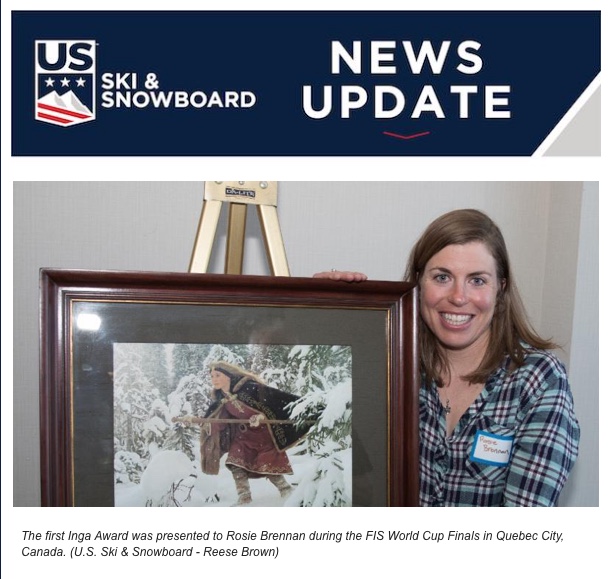
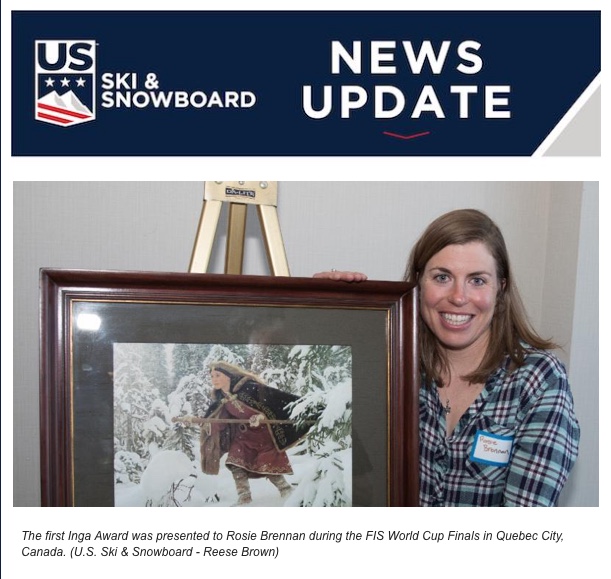
    In 2019, following the World Cup, the Inga Award was presented to its first recipient: Rosie Brennan. Having rebounded from a season impaired by the effects of the mononucleosis virus, Brennan was selected based on the “courage, fortitude, grit, determination and raw talent [it took] to achieve an extremely high level of success on the international ski racing circuit [that] season.”

    Over the next year, however, Owen-Bradley began to dwell on why the image of a Norwegian woman should be the symbol for the efforts of the women in the American cross-country program. She began looking for inspiration closer to home, eventually finding an equally strong, noteworthy, and under-recognized alternative.

    “I changed it to the Gold Rush award because in the High Sierras during the Gold Rush era, women were nordic racing. Not on the same levels that we do it [now], but they had cross country races that that women raced in… So I thought, ‘Oh, what a cool thing — the Gold Rush.’”

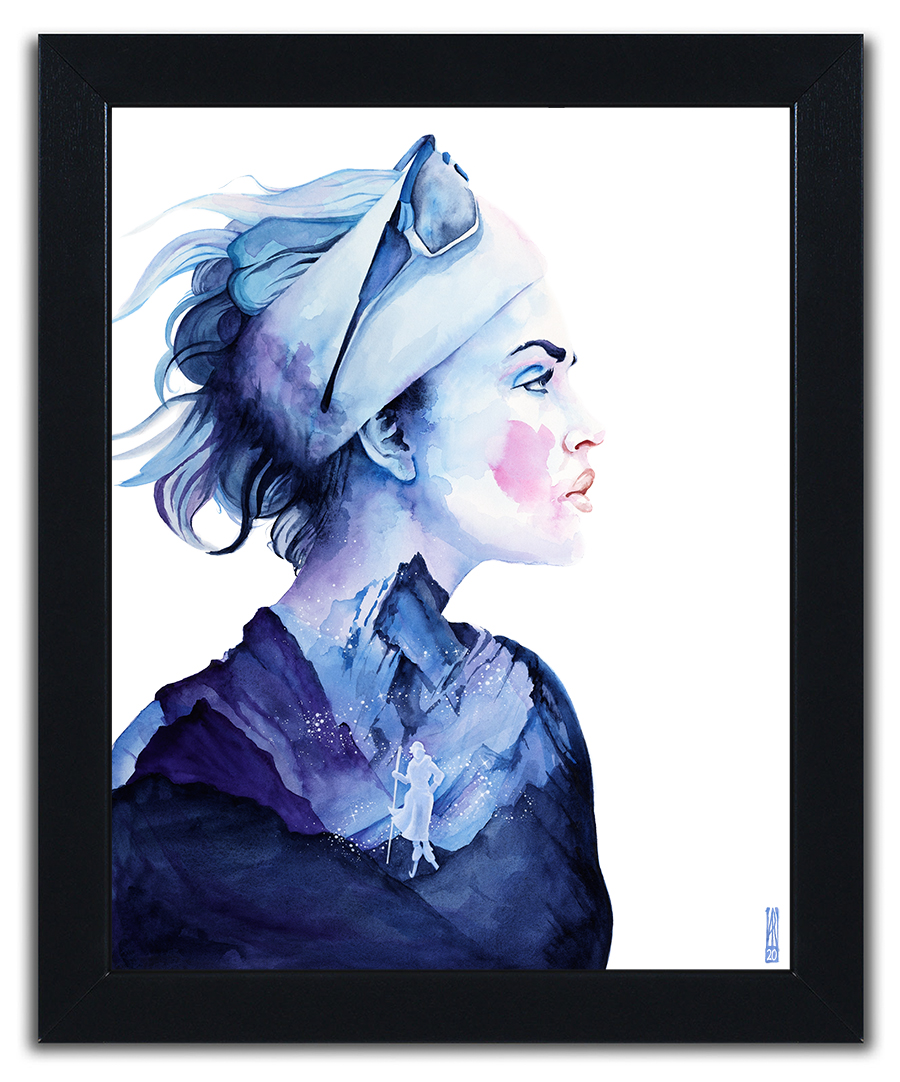
    She also noted the ties between racing for gold medals at the Olympics, which Kikkan Randall and Jessie Diggins achieved in 2018. Working with artist Andy Rogers, a new image was created, superimposing the image of a woman on skis in the High Sierra on the bust and profile of a determined and modern-looking woman in a race headband and sport sunglasses. In 2019, this image was presented to co-recipients Sadie Maubet Bjornsen and Sophie Caldwell Hamilton. 

    Gold Rush Award: (Artist Andy Rogers)

    While each of the women mentioned to this point have unquestionably racked up an impressive resume of results, the award is not meant to recognize what happens on the race course directly. Rather, Owen-Bradley explained a recipient is selected for the award by “exemplifying and showing the grit and the grace that it takes to be successful.” It’s what happened behind the scenes to get the result, not the result itself. 

    “An example would be Sophie whose mother died [in 2019] and she still went on with such grace and was so successful through all of that. And Sadie because of all the injuries she worked through and kept going… So, to me, it’s been about the grit and the grace of what it takes to be a woman nordic ski racer at that level.”

    Approaching the 50-year mark of her own Olympic debut and now focusing more of her time and energy on her small farm in Idaho rather than the cross-country ski world, Owen-Bradley explained that this year, she felt less directly connected to the potential recipients for the Gold Rush award. She decided the decision should be made collectively amongst the four previous winners, to which she would add a fifth vote. After some discussion, the group voted unanimously for Julia Kern. 

    Jessie Diggins and Julia Kern celebrate a second-place team sprint finish in Dresden, GER in December, 2021. (Photo: NordicFocus)

    A member of the U.S. Ski Team since 2017, Kern’s progression on the international level has been steady, but non-linear. Alongside leaps forward, she’s faced her fair share of injuries and setbacks. Both the 2020/2021 season and her first Olympic appearances in 2022 left her wanting more, but interjecting these lows during the 2021/22 race season were a slew of career highlights. Her top results include two individual fourth-place sprint finishes on the World Cup, a team sprint podium in Dresden, a handful of other World Cup top tens, and finishing the year winning three out of four events at the joint U.S SuperTour Finals / Canadian National Championships in Whistler, BC. 

    And in February 2023, she’s heading into a World Championship which will take place at the venue where she earned her first World Cup podium in December 2019: Planica, Slovenia. 

    Smiles and hugs all-around to celebrate Julia Kern’s first World Cup podium in Planica, Slovenia in December 2019. Kern finished third in the freestyle sprint, with Sophie Caldwell Hamilton just behind in fourth. (Photos: NordicFocus)

    According to the past award recipients on the selection committee, it was the juxtaposition of these celebrations and challenges over the last few seasons that highlighted Kern’s candidacy for the award this spring.  

    “To me, what is special about this award, is first that it was voted on by this very incredible group of women who all share tenacity and drive to get through challenges and be better on the other side and second, that it awards just that and not results,” explained Brennan in an email. “Julia exemplifies this in her ability to be a strong teammate, no matter what the circumstances are. She holds her head high and goes out of her way to never bring people down when things are tough, aren’t going her way, or she’s faced with a challenge. When something doesn’t work out for her, she immediately jumps gears and does literally whatever she can to help her teammates have success. 

    “On top of that, she doesn’t lose faith in herself, she continues to fight, look for opportunity and carry an optimistic outlook towards her future. She has shown this many times after coming off a slump, injury, or some other challenge to find herself notching career bests. I think these things aren’t mutually exclusive and that we all have a lot to learn from Julia’s ability to be an exceptional teammate and in turn have that give her energy to continue chasing her own goals.” 

    Smooth and powerful, Julia Kern races through the heats during a classic sprint in Falun, SWE in March 2022. (Photo: NordicFocus)

    Commenting on her nomination, Kern attributed her own success to the efforts of the women who came before her, including those who would present her with the award.

    “​​I am incredibly honored to be given the Gold Rush Award by such an incredible group of women. US NOW is a group of women who have paved the way for U.S. skiing, many of whom have been personal role models and mentors to me in skiing and in life. I would not have had the opportunities, experience and knowledge without their hard work and passion for giving back to the younger generations. The past few years have been challenging for a variety of factors, and it was rewarding to come back stronger with my best season yet.”

    As the list of award winners grows and US NOW builds momentum, Owen-Bradley hopes the award can be expanded to include a monetary prize in addition to the print and tribute. Acknowledging the increase in representation for women across various aspects of skiing, such as coaching and waxing, she would love to see new awards developed to recognize these important examples also. 

    When Owen-Bradley began skiing as a child in the 1960’s, her only option was to join the boys program; Title IX did not pass until June 1972, at which point she was 19 and had already raced at a World Championship. As she reflected on the amount of opportunity for women in cross-country skiing now, and what the creation of US NOW and the Gold Rush Award means to Owen-Bradley personally, she expressed feelings of joy and optimism. 

    “For me to go from not having a place, to having these strong women’s teams – it’s just so fun.” 

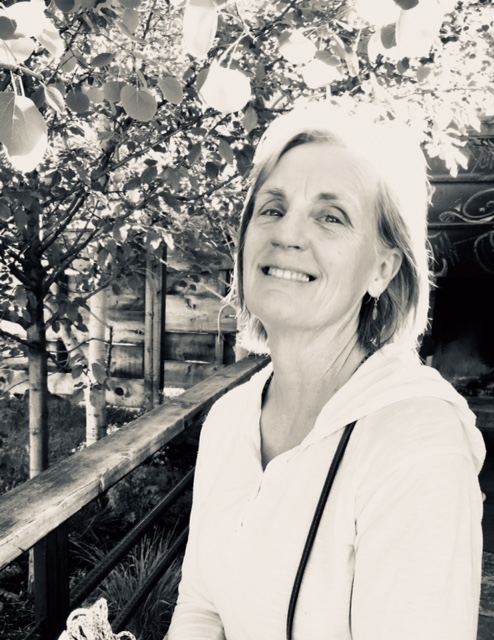
    Alison Owen-Bradley, a pioneer of elite level women’s cross-country skiing in the U.S. (courtesy photo)
  • U.S. Nordic Olympic Women Name Julia Kern as 2022 Gold Rush Award Recipient (Press Release)

    U.S. Nordic Olympic Women Name Julia Kern as 2022 Gold Rush Award Recipient (Press Release)

    Stars and stripes at the front, as Julia Kern scrambles for USA II in Falun’s mixed relay. (Photo: NordicFocus)

    As the 53 women Olympians who have  represented our country in cross country skiing, and calling our group United States Nordic Olympic Women (US NOW), we give an annual award, The Gold Rush Award, to a female athlete that demonstrates outstanding quantities of grit and grace throughout the year. 

    Huge achievements give everyone the joy of celebrating the success.  We know it takes many people to realize these high goals. We congratulate and are inspired by each of the US Ski Team Athletes and everyone supporting them.   We cheered loud and proud as we watched the coverage of the races.  Thank you to each of you for your hard work, dedication and devotion to our sport.  We love you all.


    The Gold Rush Award

    The past recipients of the award who chose this years athlete are: Rosie Brennan, co-recipients: Sadie Maubet Bjornsen / Sophie Caldwell Hamilton, and Jessie Diggins.

    The 2022 US NOW Gold Rush Award goes to Julia Kern!    Congratulations Julia!

    Julia Kern (USA) fights hard to the finish during the individual freestyle sprint in Zhangjiakou. (Photo: NordicFocus)

    Julia has been working hard for a long time, and we are so proud to recognize not only her outstanding results this season, but her grace and strength in bouncing back from many injuries over the years and her perseverance and trust in her training. Julia’s season highlights included making the 2022 Olympic team, a World Cup podium and 4th place finish, multiple US National Titles and her career-best World Cup distance races. 

    This winter was another year of stressful and strict covid safety protocols, which limited social interaction and increased the feeling of isolation and loneliness. As an extrovert who thrives off of group social activities, Julia handled the challenging situation with grace and spent a lot of time thinking about how to keep the team safe and create safe yet fun chances to interact and lighten the mood. Additionally, after a hard year last season and difficult injuries over the summer and fall, Julia kept faith in the hard work she was putting in during the training season, and continued to get stronger over the entire winter, ending the season as the best sprinter and distance skier in the US! Her work ethic and never-give-up attitude inspires all of us, and we are lucky to receive all the energy she brings to the team. 

    As if this weren’t enough, Julia is also a wonderful role model and ambassador to the next generation of skiers! She spends the summer training months engaged in many outreach activities, and comes back to her home club each year to get the younger skiers fired up. 

    Again, Congratulations Julia!

    Julia Kern races through the heats during in Falun’s classic sprint. (Photo: NordicFocus)
  • Book Review: Trail to Gold, the Journey of 53 Women Skiers

    Book Review: Trail to Gold, the Journey of 53 Women Skiers

    The rapidly approaching year of 2022, and the upcoming Beijing Olympics, will mark 50 years since women cross-country skiers first began competing in the Winter Games. With multiple World Cup podiums already achieved this season and strong chances for medals in February, the origins of the U.S. women’s program might not be at the forefront of one’s mind. We’ve become accustomed to seeing our women at the top of the results lists; with almost an assumption that they will be there each weekend. 

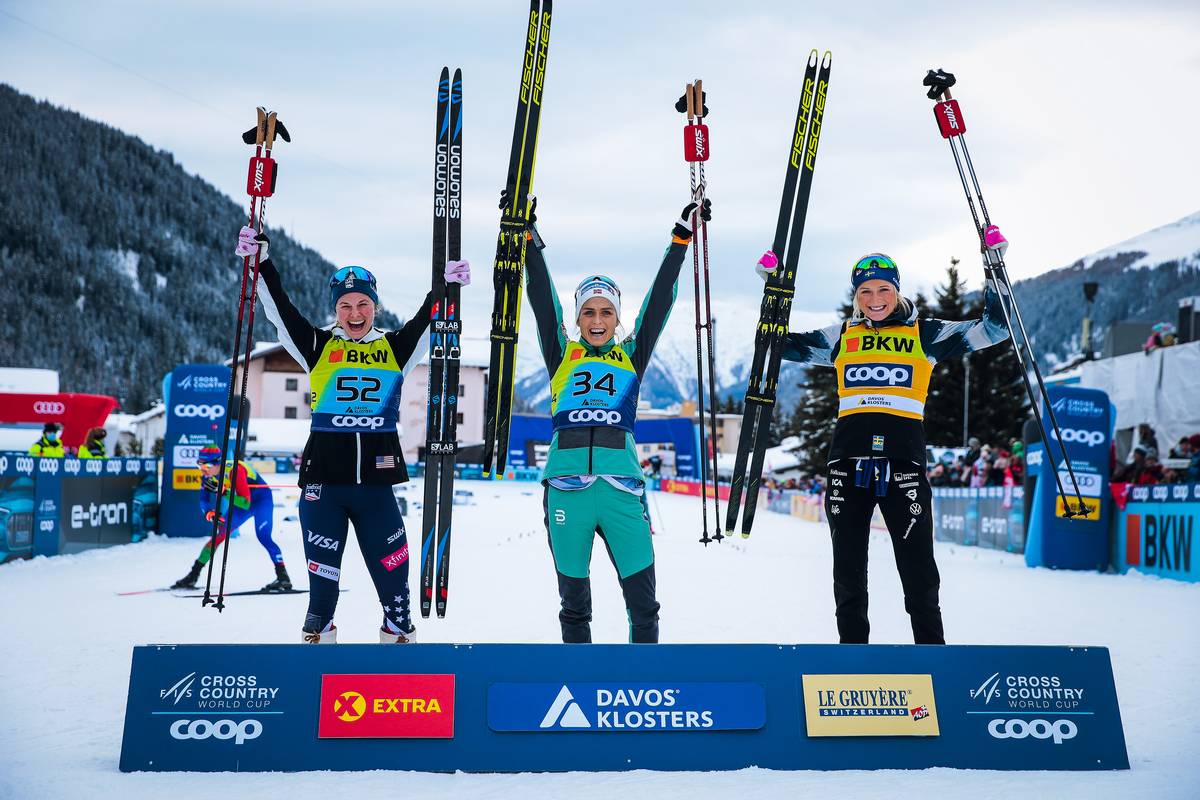
    The recent women’s podium in Davos: Therese Johaug (NOR) took the win ahead of Jessie Diggins (USA) and Frida Karlsson (SWE). (Photo: NordicFocus)

    How far women’s skiing has come, and how hard women have worked to bring the program to its current status was recently highlighted to me in Trail to Gold, The Journey of 53 Women Skiers, a collection of stories written by the 1972-2018 U.S. Olympic Women Cross-Country Skiers. This is a book that will be impactful in a unique way to each reader. As a relatively-young member of the nordic skiing community, I read it as a story of history, tenacity and teamwork. 

    Trail to Gold, the Journey of 53 Women Skiers, written and compiled by the skiers themselves.

    The creation and publication of this book was a collaborative effort that originated when current U.S. cross-country head coach (then women’s team coach) Matt Whitcomb suggested that the 2013-14 national team women interview previous Olympians. While the idea of a book was floated at the time, the project stalled until 2018 when Alison (Owen) Bradley, a member of the first women’s Olympic team, and Kikkan Randall, five time Olympian and 2018 gold-medalist, brought the group of women together again. Through this partnership, USNOW was founded, the U.S. Nordic Olympic Women. Tying history to the present, the group began recognizing a current standout U.S. female skier with the annual Gold Rush Award, the first of which was awarded to Rosie Brennan at the Quebec City World Cup in 2019. 

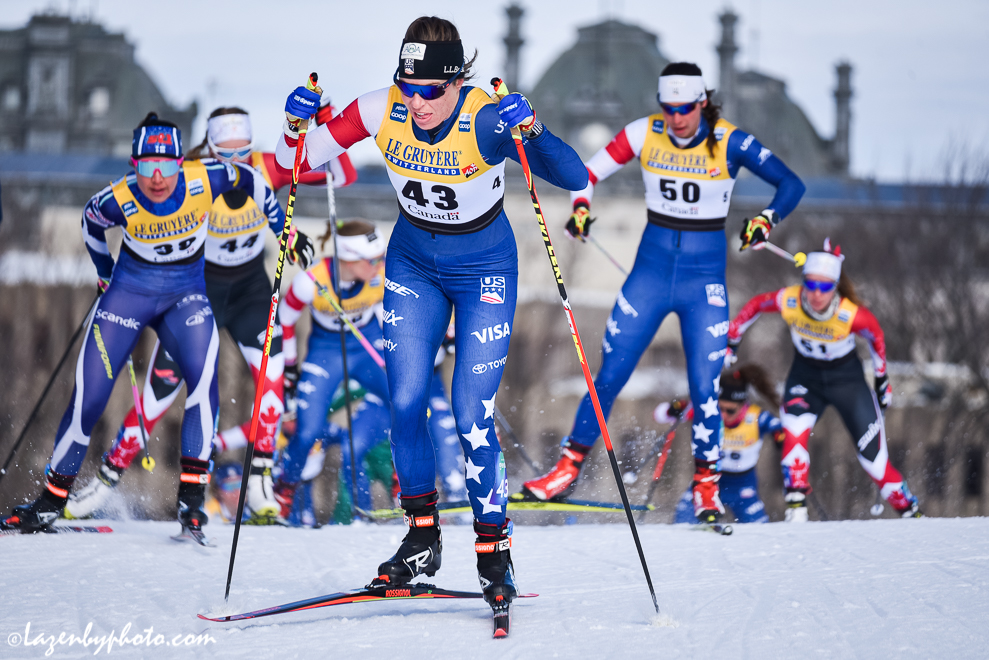
    Rosie Brennan (bib 43), recipient of the first Gold Rush award, racing the Québec City 10 k skate pursuit. (Photo: John Lazenby/lazenbyphoto.com)

    With the founding of USNOW came a renewed motivation for writing a book. 1984 Olympian, Sue (Long) Wemyss, headed a committee composed of eight former and current U.S. Olympians, and the book project began in earnest in May of 2020. With the interviews conducted in 2013-14 as a base, USNOW members contributed additional written recollections and photographs. These accounts were woven together by four of the 53 women Olympians to form chapters and provide a collective narrative. They write, “this book tells our stories as committed international competitors through five decades of history. In our own words, we reveal how the sport has developed, grown and changed. We hope you enjoy our journey.” 

    While the book is perhaps not a suspenseful page-turner, it is compelling, informative, and important, and should be a staple in any cross-country skiing household. 

    I consider myself to be close with three of the fifty three women Olympians; one of whom is my mother, the other my aunt, and the third a family friend and former coach. Growing up, I saw these women as role models and mentors. Not only to me, but to their communities as well. They are also all exceedingly humble and not likely to hold forth on the glory days of their Olympic careers. Thus, much of the history revealed in Trail to Gold was new to me. 

    While men competed in cross-country skiing at the very first Winter Olympics in Chamonix, France in 1924, it was another 48 years before the first U.S. women raced. While women from other countries started competing in cross-country at the Olympics beginning in 1952, it wasn’t until 1972 that the U.S. sent a women’s team.

    The first Women’s cross-country Olympic Team. The 1972 Games were held in Sapporo, Japan. (Left to Right) Bottom row: Gloria Chadwick, pseudo Chaperone, Margie Mahoney, Alison Owen; Top Row: Marty Hall, Trina Hosmer, Barbara Britch, Martha Rockwell. (Photo: courtesy Alison Owen-Bradley)

    The book details the exceptional path these first five women took to be at that start line in Sapporo, Japan in 1972. Not only were these women blazing a path in the record books of nordic skiing but they were experiencing elements of world history first-hand as well. I was struck by an account from 1972 Olympian, Trina Hosmer, of the 1970 World Championships in the High Tatras, current-day Slovakia. The women flew into Prague, arriving the winter after the Russian army had driven tanks through the city and bombed some of the buildings. At this time, the country was called Czechoslovakia and was still under the rule of Russia and as Hosmer described, “very much an Iron Curtain country, which was quite intimidating for us, naive, first time international skiers.”

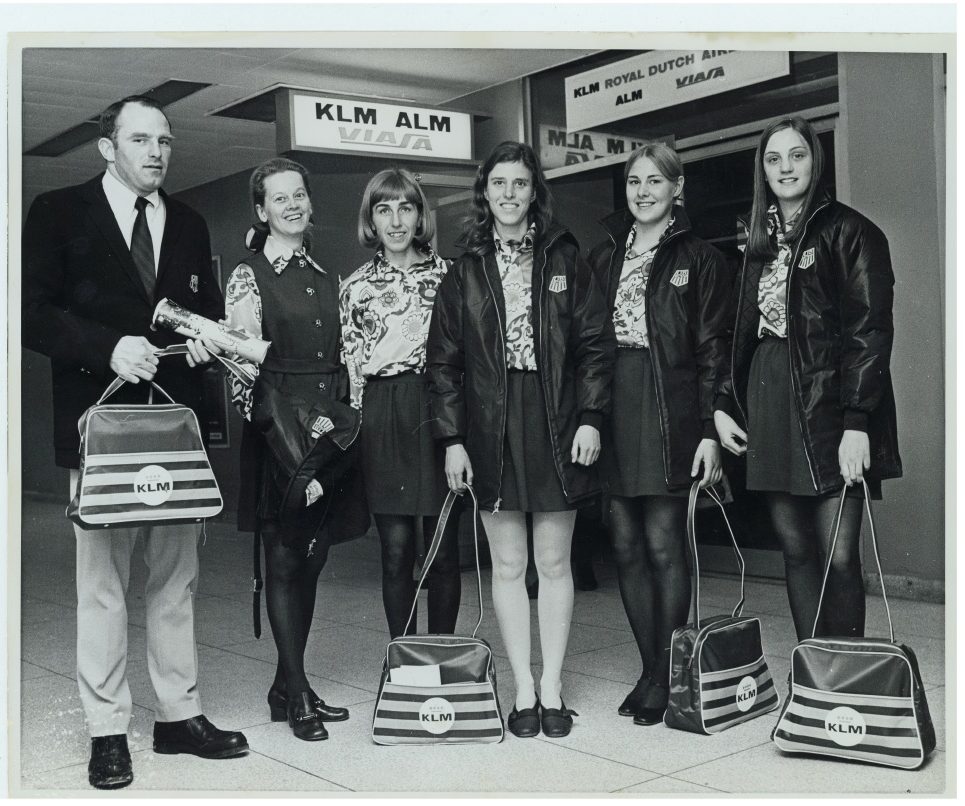
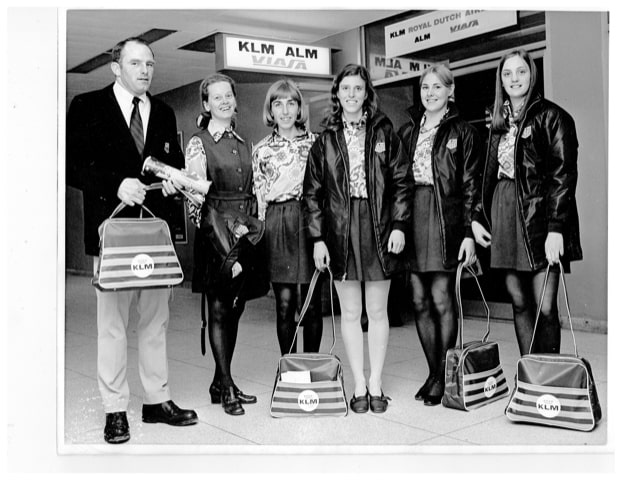
    The first U.S. women’s World Championship cross-country team on the way to Czechoslovakia in 1970. From left to right: coach Marty Hall, Coach, chaperone Gloria Chadwick, Trina Hosmer, Martha Rockwell, Barbara Britch, and Alison Owen. The U.S. team took four skiers as the relay at that time was a three-person format. (Courtesy photo)

    The rise of skating was another piece of history that stuck with me from Trail to Gold. Given the popularity and prevalence of the skate technique today, it’s difficult to imagine that it was only adopted as its own race category 35 years ago. For many of these Olympic women, they only competed in classic or they were racing as the transition came about. Sue (Long) Wemyss described how this new technique evolved over the 1984-85 season. She writes, “Most of us really didn’t know what we were doing; we were inventing skating techniques on the spot.”

    Throughout the fifty years that U.S. women have raced at the Winter Olympics in nordic skiing, they have faced enormous obstacles in their quest to compete. As much as anything, Trail to Gold is a testament to the tenacity of these 53 women and the many others who weren’t named to an Olympic team. Over the course of its pages, the book lays out many of the challenges these women dealt with over the years. They include: lacking financial support, competing against doped athletes, a lack of club teams, inconsistent leadership and troubled team dynamics, to name a few. 

    Olympians Sadie Maubet Bjornsen, Jessie Diggins, and Kikkan Randall representing their club teams at the 2018 Super Tour Finals. (Photo: John Lazenby/Lazenbyphoto.com)

    The period following the 1998 Nagano Olympics was a particular slump for women’s cross-country skiing in the U.S. Many women were leaving the sport at the time, feeling unsupported and discouraged by the team culture. In fact, the year before the 2006 Winter Games in Torino, the U.S. ski team cut the women’s program altogether and did not even name a women’s cross-country team. 

    Kikkan Randall racing the classic sprint at the 2010 Olympics in Vancouver. (Photo: FS archives)

    To anyone even remotely familiar with U.S. cross-country skiing, it will not come as a surprise that it was Kikkan Randall who helped lead women’s skiing out of this downturn. For a time, Randall was the only woman on the A-team, having to sit out most team sprints and relay events. In the book, she describes how her vision of a women’s team was inspired by the Canadian women at the time. In 2006, when the U.S. women were at a low point, Canadians Beckie Scott and Sara Renner earned a silver medal in the team sprint. Randall writes, “I was stirred by their transformation and envious of the team they had created.” 

    Twelve years later, when Randall and Jessie Diggins earned U.S. women’s cross-country skiing its first medal, gold in the team sprint, it seems safe to say that the U.S. women had also undergone a transformation. Throughout the pages of Trail to Gold lies an underlying theme of the importance of teamwork. But the book also makes it clear that this culture and dynamic was hard-fought. 

    From the historical first Olympic appearance in 1972, through the bumps and turns presented in the ensuing years, the teamwork that brought about that gold medal was fifty years in the making. As Diggins writes in her account of that night, “It’s taken years of every member of this team committing to the team goals, coming to training camps, and pushing each other through grueling training sessions,” and the cumulative pages of Trail to Gold support this statement. 

    The power of team (Photo: Caitlin Patterson)

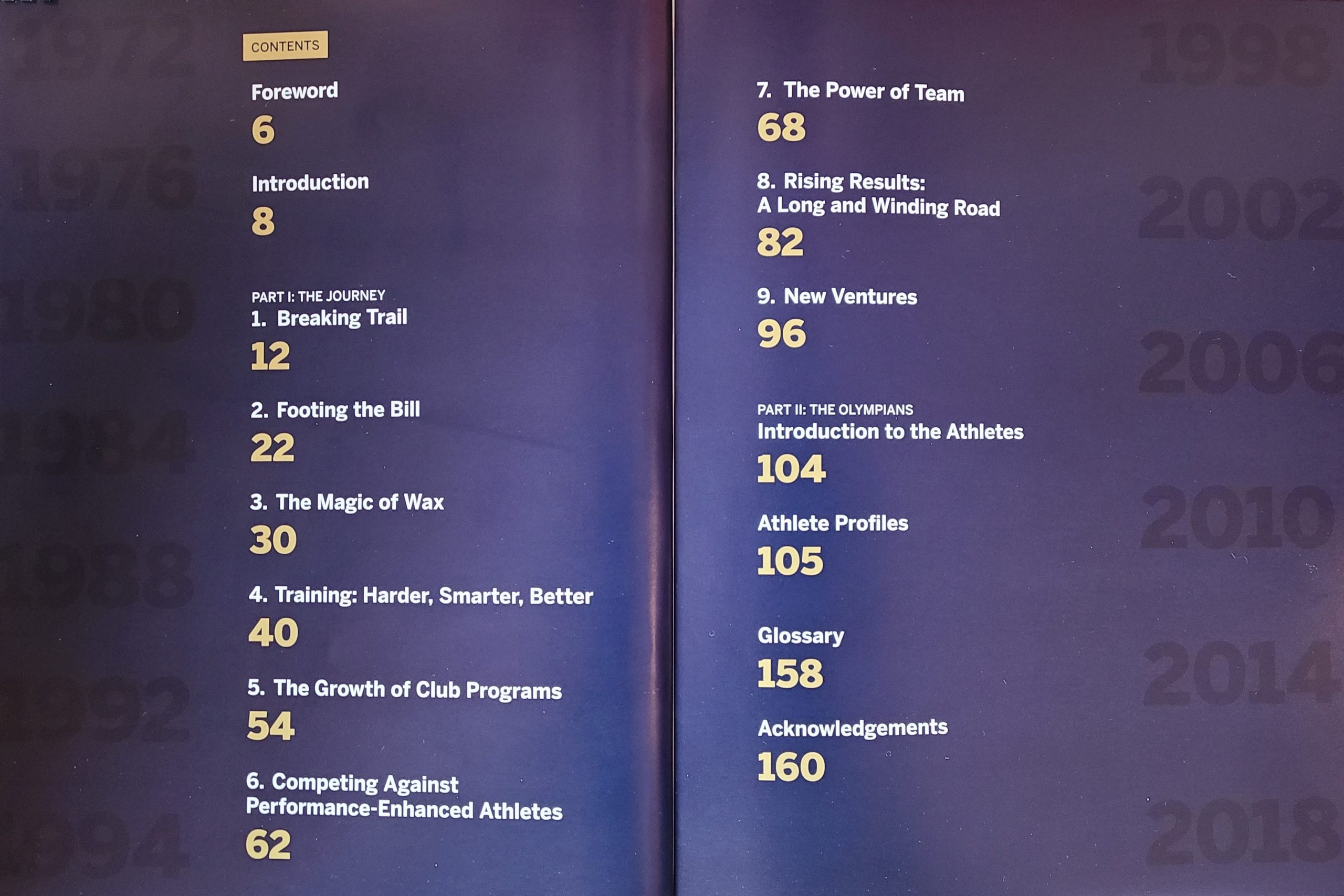
    The two-part layout of Trail to Gold, and it’s logical progression from the early trailblazers in the sport to life after retirement makes for easy reading. While part-one tells the story of the 53 women as a whole, part-two gives an individual introduction to each of the women. Through these profiles the reader learns more about these Olympians in their own words. This section provides an excellent reference point for anyone looking to delve deeper into the lives of these 53 unique women. 

    Table of Contents from Trail to Gold.

    Through narratives, anecdotes and photographs, Trail to Gold effectively conveys an influential story of women’s Nordic skiing over the years. I urge everyone to read this book, to discover the story for yourself and find what it means for you. Regardless, it is an important book in the world of U.S. cross-country skiing and deserves a spot on the coffee tables and bookshelves of our ski community. 

    Trail to Gold is available from Pathway book distributor at this link. Additionally, personal bulk shipments have been sent to various locations around the country with the idea that the Olympic women will do book presentations, have copies to sell and attend some events. The NENSA Women’s XC Day on January 23rd is one such event where at least four of the women Olympians will be present for book signing.  

  • US Nordic Olympic Women Name Caldwell and Maubet Bjornsen as 2020 Gold Rush Award Recipients (Press Release)

    Press Release
    50th anniversary of the first U.S. women’s team to compete in a World Championship-level event: The U.S. women’s Nordic World Championship Team in 1970: Head Coach Marty Hall; Gloria Chadwick, chaperone; skiers Trina Hosmer, Martha Rockwell, Barbara Britch and Alison Owen (l-r). (Photo: Hall collection)

    This week a healthy gathering of the US Nordic Olympic Women, (US NOW), came together in a virtual meeting organized by group members Kikkan Randall, Alison Bradley and Sue Wemyss.  The group had planned to meet up at this year’s Minneapolis World Cup, after having met and enjoyed their first reunion last March, at the Quebec City World Cup. Determined not to be deterred by the World Cup cancellation, modern day technology and the online possibility afforded by Zoom meetings allowed for this modified second reunion to proceed.

    Twenty-three of the fifty-three total women who have represented the US in cross country skiing at the Winter Olympics were present.  They spanned the five decades of American women’s teams at the Games, from the first one in 1972, through the most recent in 2018. Despite their wide ranging spread of home locations, from Maine to Alaska, they were able to meet on their computer screens, get to know each other a bit more, and reconnect with teammates they may not have seen for years.

    The meeting, led by US NOW President Kikkan Randall, began with each woman introducing herself, and sharing personal information including Olympic year(s), current location and current occupation.  A central piece of the meeting was the introduction of the newly renamed “Gold Rush Award,” and its presentation to two very deserving co-winners this year.

    For some background, at the group’s first reunion during the March 2019 Quebec City World Cup event, the Inga Award was presented to Rosie Brennan for her courage and determination in coming back from mononucleosis to achieving her best international race season to date.  Since then, the award has been given a new moniker: The Gold Rush Award. Founding members of US NOW decided to make this change to honor American ski heroines of both the past and present, rather than the Norwegian mother of baby prince Haakon of Birkebeiner fame.

    Researching early women’s skiing in the US revealed that in the High Sierra during the Gold Rush era, women skied cross country for long distances, had races and were highly regarded for their skiing skills.  The US NOW members pursued gold of a different sort in their quest to stand atop an Olympic podium. This goal was finally achieved at the 2018 Olympics in PyeongChang, where Kikkan Randall and Jessie Diggins earned the Gold Medal in the Team Sprint.

    This year the award was given to current US Ski Team members Sadie Maubet Bjornsen and Sophie Caldwell for their exceptional grit and grace dealing with exceptional challenges and continuing to push ahead in their ski careers and life with positivity and success.  A unique watercolor picture, depicting the qualities of grit and grace in women’s cross country skiing from a long past era to today, was created by artist Andy Rogers of Alaska.  Maubet Bjornsen and Caldwell will receive their own copies of this painting, while the original will land in the U.S. Ski Team’s Center of Excellence in Park City, Utah.

    The meeting ended discussing ways to continue keeping the group active and engaged, as well as potential projects to continue the legacy of US NOW.  Continuing a book project sharing the histories of past US cross country women skiers that was begun by the current USST members is one goal for the group, combined with the collection of oral histories of these women who raced over the span of five decades.  US NOW has made a couple applications for grant money to help cover the costs of these projects. A book project committee was formed and is accepting new members and any available assistance. The virtual meeting closed with gratitude and well wishes amongst the members, and a spirit of connection and support for both past and present women’s cross country skiing and skiers in the United States.

    Gold Rush Award: (Artist Andy Rogers)