From the FasterSkier archive — posts syndicated from athletes’ and coaches’ own blogs between 2004 and 2012, kept online as published. Current coverage is at fasterskier.com.

Tag: Goms Switzerland

  • Matintalo First, Diggins Second: A Classic 20 K Test Before the Olympics

    Matintalo First, Diggins Second: A Classic 20 K Test Before the Olympics

    This coverage is made possible through the generous support of Marty and Kathy Hall and A Hall Mark of Excellence A Hall Mark of Excellence Award. To learn more about A Hall Mark of Excellence Award, or to learn how you can support FasterSkier’s coverage, please contact info@fasterskier.com.

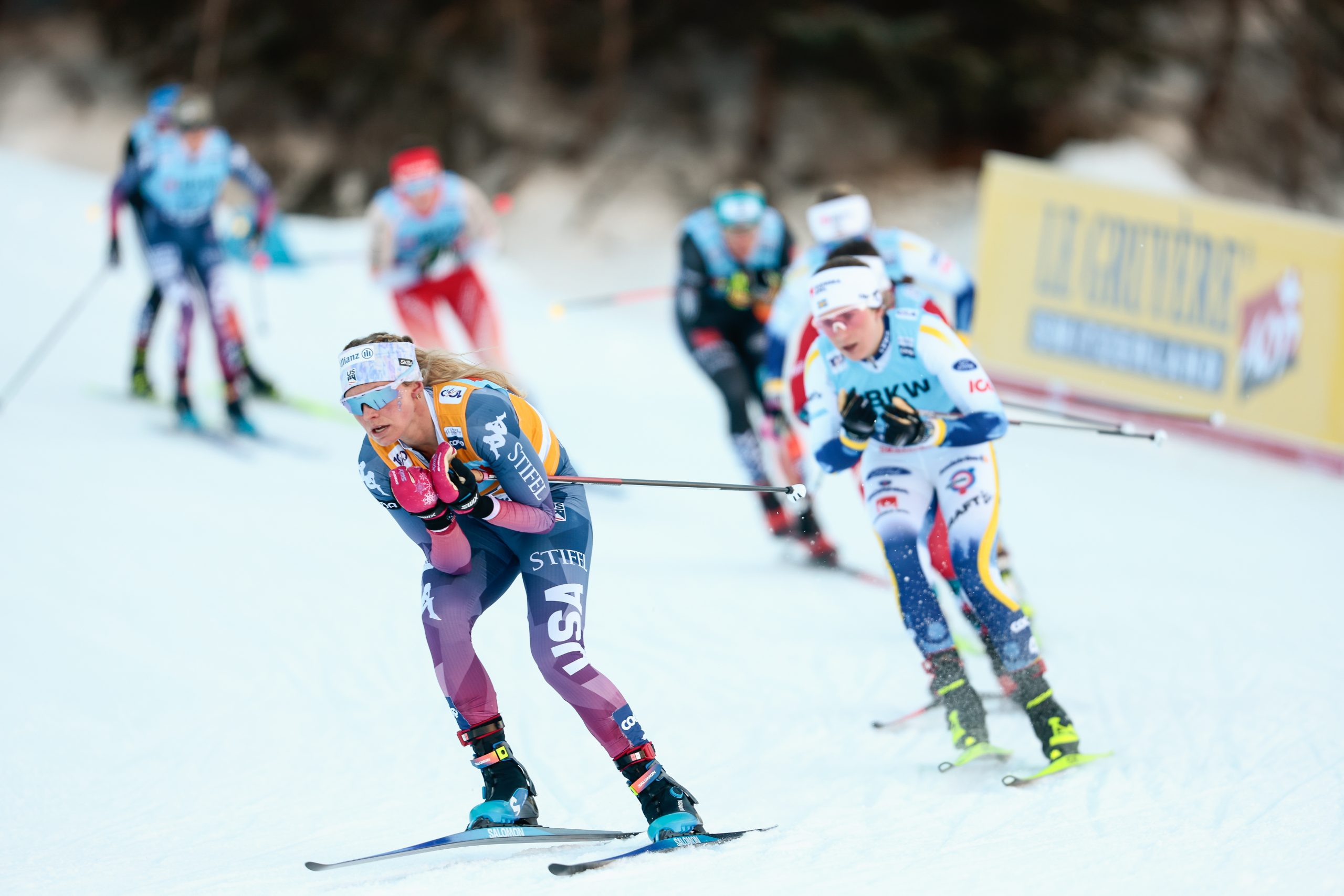
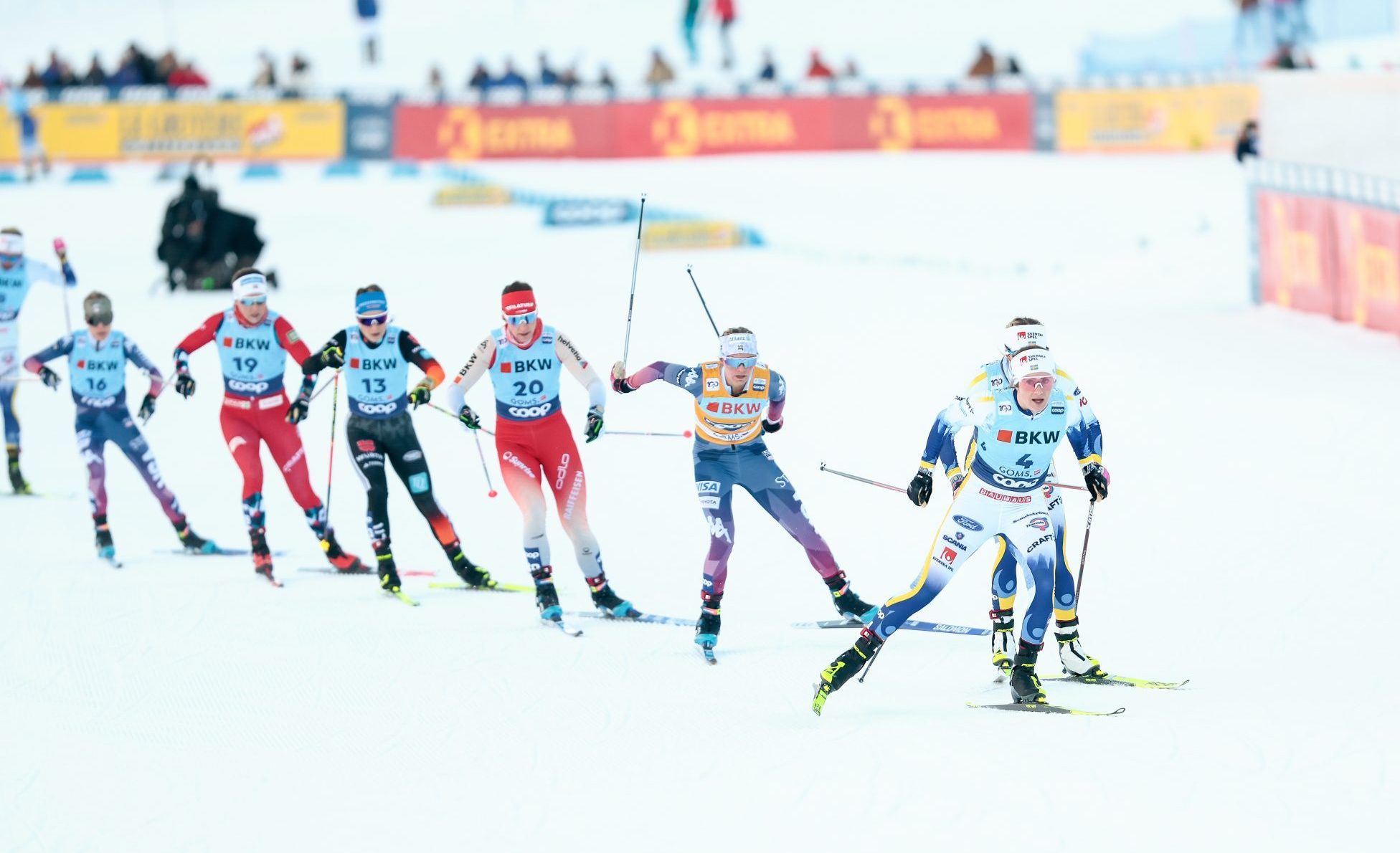
    Emma Ribom (SWE), Moa Ilar (SWE), Kerttu Niskanen (FIN), Karoline Simpson-Larsen (NOR), (l-r) lead early in the women’s 20 K Classic Mass Start in Goms, Switzerland. (Photo: Authamayou/NordicFocus)

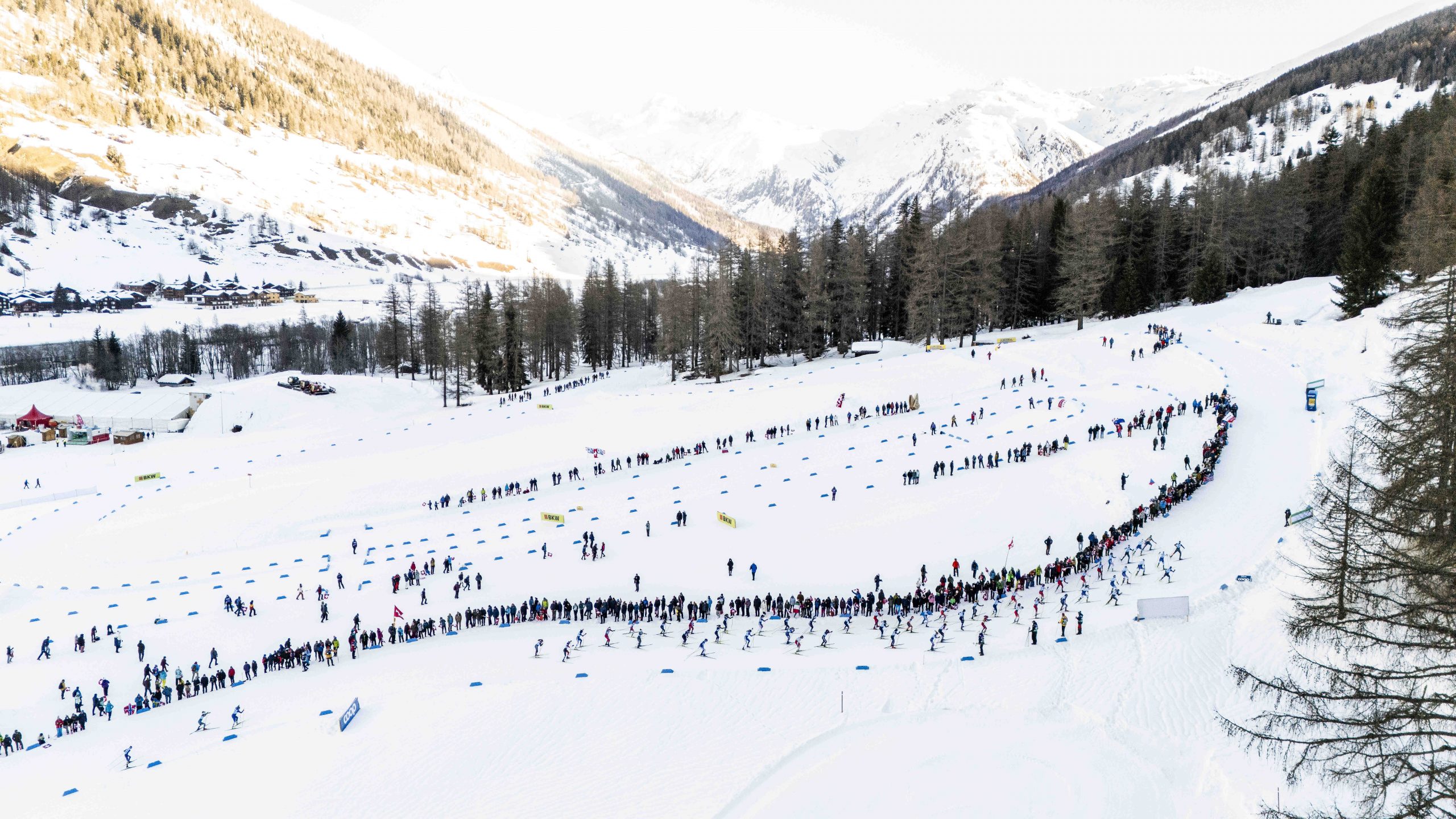
    The sky above the Goms Nordic Centre on Sunday morning had the washed-out look of winter at altitude — pale and reflective. Snow had fallen overnight — not enough to transform the valley, but enough to affect ski behavior. The tracks were glazed in some places and soft in others, offering a surface that challenged kick, balance, and restraint.

    This was the third and final race of the last World Cup weekend before the Olympic Games. The final challenge came in the form of a 20-kilometer Classic Mass Start — a distance long enough to punish impatience, short enough to reward precision. In many ways, it felt like a rehearsal, a partial preview of the Olympic 50 k to come, even as two of the discipline’s defining figures — Sweden’s Ebba Andersson and Frida Karlsson — were notably absent.

    Fifty-six women started. Not all of them finished. None of them were anonymous by the time the race ended.

    Jessie Diggins (USA) and Astrid Oeyre Slind (NOR), (l-r) got away early in the first lap before being brought back by the chase pack around 6.5 K. (Photo: Authamayou/NordicFocus)
    An Early Question — and a Fast Answer

    From the opening kilometers, the field confirmed what the course profile had suggested: this would be a race shaped less by outright speed than by rhythm and positioning. Short climbs arrived in quick succession, descents offered only brief relief, and the peloton stretched and compressed like an accordion with every change in gradient.

    The first clear question of the day was posed early.

    On the opening lap, Norway’s Astrid Øyre Slind moved decisively off the front. Jessie Diggins, wearing bib one and leading both the overall and distance World Cup standings, responded immediately. For a moment, the two skied clear — a clean, purposeful break that suggested collaboration rather than desperation.

    The gap grew briefly, then stalled. By roughly 6.5 kilometers, the chase pack — patient, organized, and unwilling to let the race fracture too soon — closed the door. The break dissolved without drama, but not without meaning. The message was clear: separation would be earned later, not gifted early.

    Through the first full lap and into the second, the splits told a consistent story. No one was allowed to escape. The front group remained compact, with the top ten separated by only a few seconds at successive checkpoints. Every surge was answered. Every acceleration absorbed.

    Karoline Simpson-Larsen (NOR), Dariya Nepryaeva (AIN), Katharina Hennig Dotzler (GER), Johanna Matintalo (FIN), and Kerttu Niskanen (FIN), (l-r) work to bring back Diggins and Slind. (Photo: Authamayou/NordicFocus)
    The Long Middle: Where Races Are Actually Won

    What followed was the part of mass-start racing that rarely makes highlight reels but defines outcomes: the long middle.

    The snow conditions amplified this dynamic. The fresh layer over a firmer base rewarded good kick but punished over-striding. Downhills carried enough draft that working alone was inefficient. On climbs, being out of position meant burning matches simply to stay attached.

    Julia Kern spent much of this phase skiing in between packs — strong enough to feel underutilized, cautious enough to avoid overreaching.

    Julia Kern (USA) and Tiril Udnes Weng (NOR), (l-r) trying to maintain contact. (Photo: Authamayou/NordicFocus)

    “Today’s race was definitely a really hilly one, and not that fast, given the new snow,” Kern said afterward. “The tracks were a bit glazed, but also powder. The techs did a really good job giving us great kick, and I really needed that for how much climbing there was.”

    She described a race defined by indecision forced by circumstance rather than confidence.

    “I skied a lot of the race kind of stuck in between two packs,” she said. “In the second lap, I wasn’t sure if I should really go with the pack and risk it. I didn’t want to blow up, especially at semi-altitude. It was just hard to say with such a long, slow race.”

    When a small bridge attempt formed later in the race, Kern hesitated — not from fear, but from realism.

    “It was one of those days where I was feeling stronger than the pack I was skiing in, but not quite sure I could keep up with the pack in front,” she said. “They started to slow down, so it was a little bit of yo-yoing.”

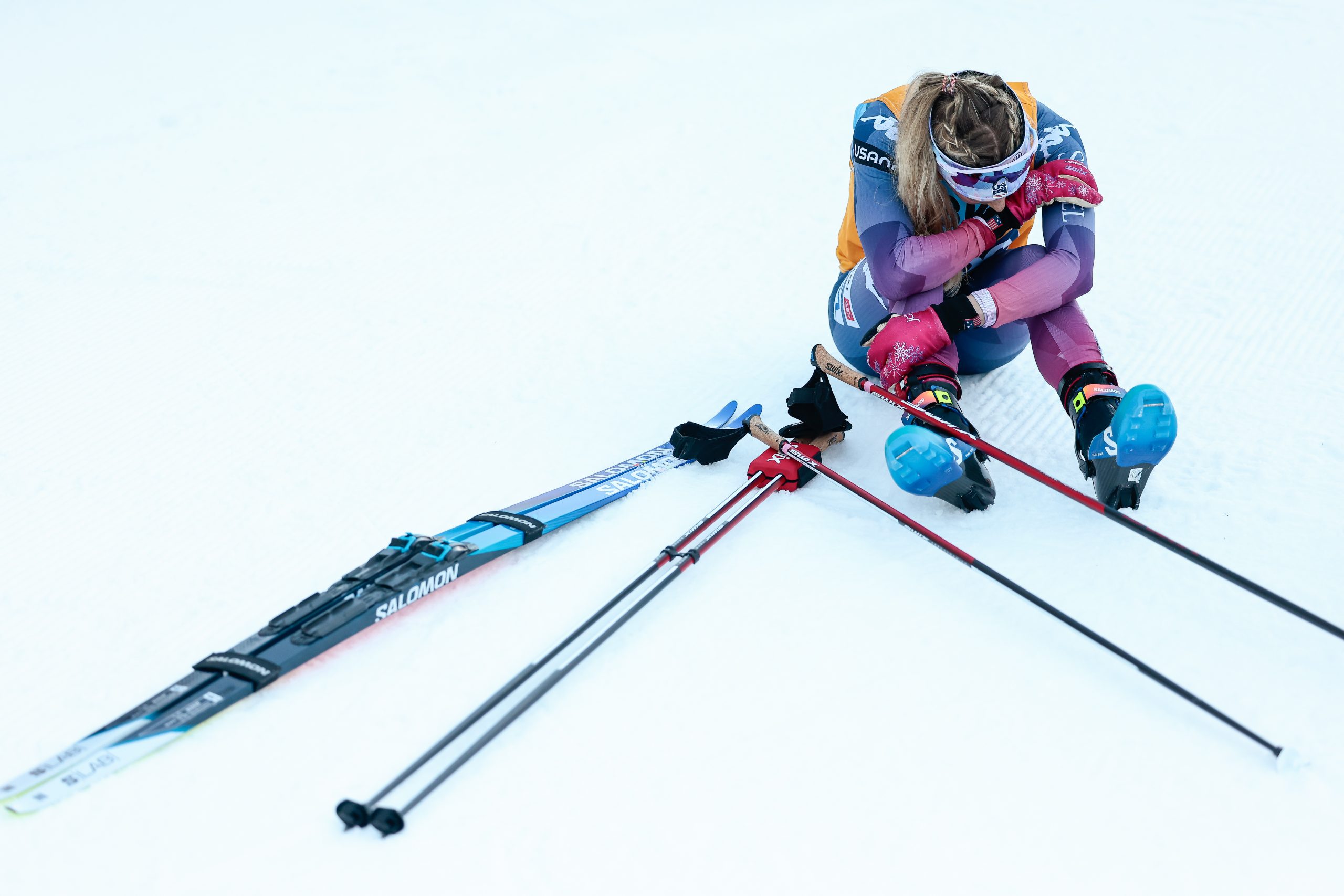
    For Kern, the result — 16th — came with clarity rather than frustration. The margins were small, the lessons specific, and the work ahead clearly defined.

    Hailey Swirbul (USA) coming up the final climb with teammate Kendall Kramer (USA) slightly behind. (Photo: Authamayou/NordicFocus)
    Moving Forward from the Back

    If Kern’s race unfolded in the gray area between groups, Novie McCabe and Hailey Swirbul experienced the race from its deepest end.

    McCabe started with bib 57. Swirbul with 58. Both expected chaos early — and neither panicked when it arrived.

    “I kind of expected the accordion,” McCabe said. “I talked to my tech before the race, and he thought it would be a good idea to stay calm early. When it strung out, that’s when I should try to move up.”

    That patience paid dividends. As the field gradually fractured, McCabe began to advance — not in dramatic surges, but in deliberate steps.

    “I tried to push up to whoever was ahead, then tuck in and rest,” she said. “Eventually, I got into a good group with Catherine Stewart-Jones and some others. At that point, it was about hanging on a little more.”

    The effort came at a cost. McCabe admitted she was suffering late, but also recognized the value of the experience.

    “It was nice to have such a good classic skier to ski behind and try to relax in there,” she said.

    Swirbul’s approach mirrored that composure, shaped by perspective earned through time away from the sport.

    “The start of the race actually didn’t feel stressful to me,” she said. “There’s not much you can do to move up until it breaks up a little bit, so I took that as an opportunity to relax and work into the race.”

    She broke the race into manageable pieces.

    “I like trying to pick people off in a mass start,” she said. “It helps to focus on closing one gap at a time.”

    Swirbul finished 24th, McCabe 22nd — both having moved forward through nearly the entire field.

    Samantha Smith (USA), Hailey Swirbul (USA), and Rosie Brennan (USA), (l-r) early on in the women’s 20 K Classic Mass Start in Goms, Switzerland. (Photo: Authamayou/NordicFocus)
    Rosie Brennan: The Value of a Steady Day

    For Rosie Brennan, Goms was not a race defined by sharp inflection points or dramatic movement through the field. Instead, it was a professional, workmanlike effort — the kind that rarely demands attention but often proves essential when teams begin to think about Olympic lineups, relays, and durability.

    Brennan skied much of the race just outside the most active chase groups, navigating the same glazed tracks and punchy climbs that tested everyone else. On a course that punished inefficiency, her race was marked by steadiness rather than volatility. She did not chase moves that would cost more than they offered, nor did she allow the race’s elastic rhythm to pull her into repeated accelerations that would compound fatigue.

    In a season where results are scrutinized as much for how they are achieved as where they land, Brennan’s day in Goms served as a reminder of her role within the U.S. program: a veteran presence capable of managing long classic efforts even when conditions and dynamics do not invite heroics.

    These are the kinds of races that rarely make headlines — and yet, as part of Olympic preparation, they often matter most.

    Kendall Kramer (USA) comes to the line with a top 30. (Photo: Authamayou/NordicFocus)
    Kendall Kramer: Learning in Plain Sight

    Kendall Kramer’s race unfolded quietly, but not inconsequentially. Still early in her World Cup career and newly named to her first Olympic team, Kramer approached the 20 K Classic as both an examination and an education.

    She remained engaged with the race as it evolved, skiing within her limits while absorbing the tactical realities of a mass start at altitude: when the field compresses, when it stretches, and how much energy it costs simply to stay connected on repeated climbs. In a race where early overcommitment was punished and late positioning proved decisive, Kramer’s task was not to force relevance, but to understand it.

    Her finish inside the top 30 (27th) reflected a growing familiarity with World Cup distance racing — not yet a statement, but a step. For an athlete still building the physical and tactical base required for races of this length, Goms offered clarity about where the work remains, and confidence that she belongs in the conversation.

    Samantha Smith (USA) nears the end of the 20 K in Goms, Switzerland. (Photo: Authamayou/NordicFocus)
    Samantha Smith: Building the Long View

    For Samantha Smith, the 20 K Classic represented another piece in a longer developmental arc — one that continues to unfold quietly but deliberately.

    Smith skied the full distance with control, settling into the rhythm of the race rather than fighting it. In a field that included Olympic medalists, Crystal Globe contenders, and seasoned distance specialists, her goal was not to dictate the race but to measure herself against it. The result reflected that intention: steady pacing, minimal volatility, and a complete performance on a demanding course.

    At this stage of her career, races like Goms are less about immediate return and more about accumulation — learning how long classic efforts feel when contested at World Cup intensity, how fatigue presents itself late, and how small tactical decisions compound over 20 kilometers.

    Those lessons are not always visible on a results sheet. But they are foundational — and necessary — for what comes next.

    Alison Mackie (CAN) continued her strong season as the U23 leader. (Photo: Authamayou/NordicFocus)
    The Canadian Women: Depth That Shapes the Race

    While the podium fight ultimately played out among familiar names, the Canadian women were far from passive participants in the race’s structure.

    Alison Mackie, wearing the under-23 leader’s green bib, skied assertively within the main chase group for much of the race. Starting deeper in the field, she navigated the accordion effect with composure, staying attached as the pace fluctuated and the snow conditions demanded constant adjustment. Her performance reinforced why she has emerged as one of the most promising young distance skiers in the World Cup field.

    Katherine Stewart-Jones, meanwhile, played a quieter but equally influential role. Her presence in the chase packs — particularly later in the race — provided both pace and stability. For athletes moving forward from the back, including Novie McCabe and Hailey Swirbul, Stewart-Jones’ classic proficiency offered a valuable reference point, a wheel worth following when the race began to exact its toll.

    Together, the Canadian performances underscored a broader truth about modern World Cup distance racing: influence is not limited to podium contenders. Nations with depth — even without a skier contesting the final sprint — shape how races unfold, how packs form, and how energy is spent.

    Astrid Oeyre Slind (NOR), Johanna Matintalo (FIN), and Jessie Diggins (USA), (l-r) charge for the podium. (Photo: Authamayou/NordicFocus)
    The Final Selection

    By the final lap, the race had distilled itself down to a familiar truth: six women remained, and no one else was coming back.

    Diggins had conserved. Øyre Slind remained vigilant. Finland’s Johanna Matintalo had been quiet — almost invisible — in the way that often precedes a decisive move.

    Diggins knew exactly what she had left, and just as importantly, what she didn’t.

    “I knew I was going to need to ride the draft as much as possible and save my energy,” she said. “It’s been a really big training week for me, so I knew I kind of had one shot.”

    Her plan was precise.

    “I was going to need to launch that move as late as possible, probably on the hill,” she said. “I had amazing kick. Double-poling isn’t quite my strength right now.”

    On the final major climb, Diggins moved. So did Øyre Slind. But Matintalo matched them — and crested first.

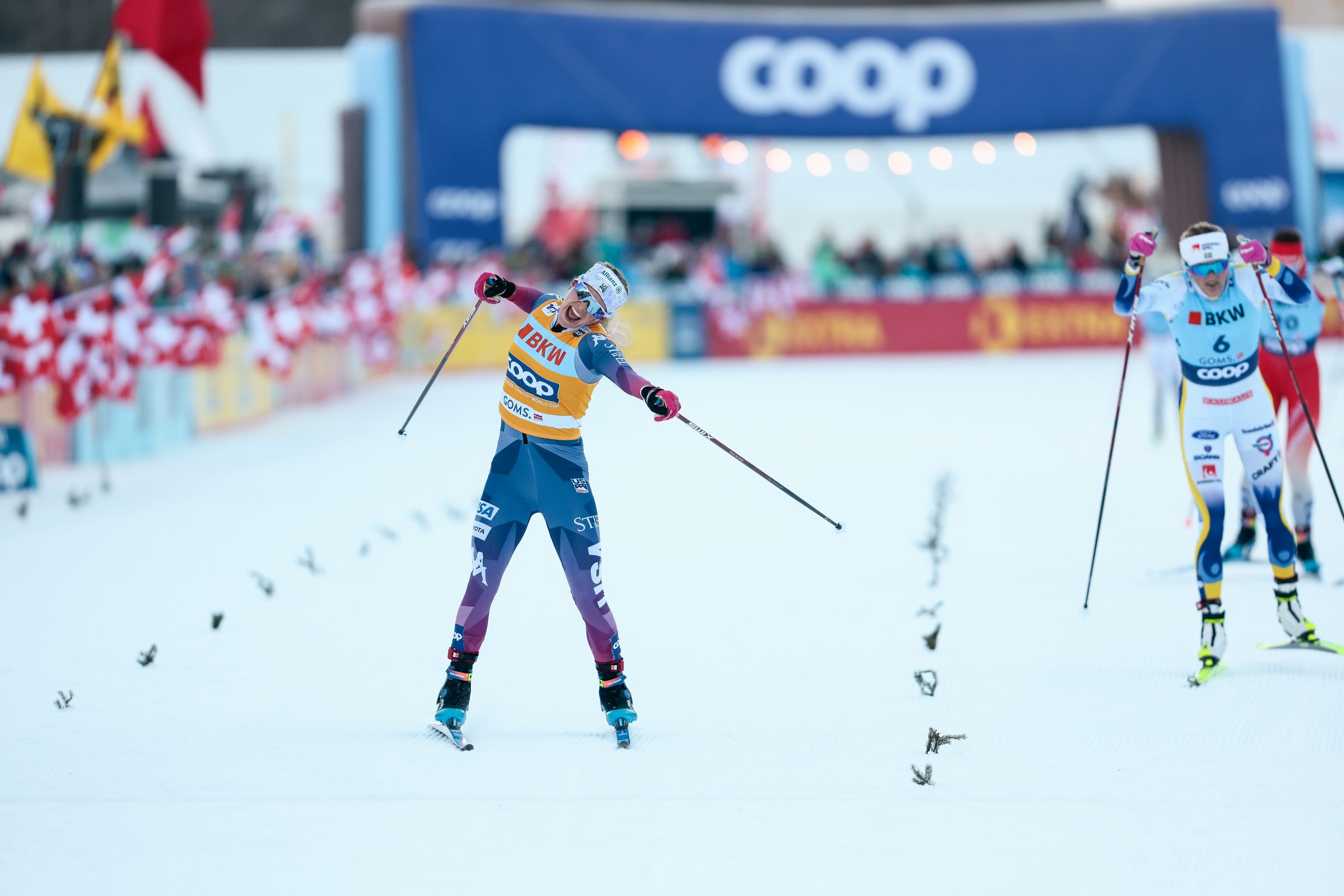
    From there, the race tipped irrevocably. Matintalo exited the climb with speed, controlled the final straight, and claimed her first World Cup victory. Diggins finished second, securing her 77th individual World Cup podium. Øyre Slind followed in third.

    Johanna Matintalo (FIN) claims the victory, with Jessie Diggins (USA) second, and Astrid Oeyre Slind (NOR) third. (Photo: Authamayou/NordicFocus) 


    What It Means Going Forward

    This was the final race before the Olympic Games. Diggins left Goms having extended her lead in both the overall and distance World Cup standings. More importantly, she leaves having confirmed — again — that her classic skiing is no longer something she manages, but something she trusts.

    “I try not to overthink it,” Diggins said of the looming 50 k. “All you can do is the best you can in the moment with the tools you have that day.”

    That sentiment echoed through the U.S. team’s performances — from podium contention to patient rebuilding.

    The race in Goms did not offer easy answers. But it did offer honest ones.

    Jessie Diggins (USA), Johanna Matintalo (FIN), and Astrid Oeyre Slind (NOR), (l-r) share the 20 K Classic Mass Start podium in Goms, Switzerland. (Photo: Authamayou/NordicFocus)
    A Quiet Confidence

    By the time the fog settled back into the valley and the stadium emptied, the course had revealed itself fully. It had rewarded patience. It had punished haste. And it had reminded everyone watching — and skiing — that distance racing rarely announces itself loudly.

    The Olympic 50 k will be longer. The stakes will be higher. The margins may be smaller still.

    But the questions asked in Goms were the right ones — and the answers, for those willing to listen, were already there.


    Goms World Cup Women’s 20 k Classic Mass Start RESULTS

    Women’s World Cup DISTANCE STANDINGS

    Women’s World Cup OVERALL STANDINGS


    Help Support Our Olympic Coverage!

    FasterSkier will have our own Nat Herz on the ground at the Olympics. If you value the thoughtful work FasterSkier provides at championships like this one, please consider becoming a Voluntary Subscriber.

    Join the FasterSkier community!


    Jessie Diggins (USA) and the US team celebrate another podium in Goms, Switzerland. (Photo: Authamayou/NordicFocus)
  • So Many Red Suits . . . And Klaebo In a League of His Own

    So Many Red Suits . . . And Klaebo In a League of His Own

    This coverage is made possible through the generous support of Marty and Kathy Hall and A Hall Mark of Excellence Award. To learn more about A Hall Mark of Excellence Award, or to learn how you can support FasterSkier’s coverage, please contact info@fasterskier.com.

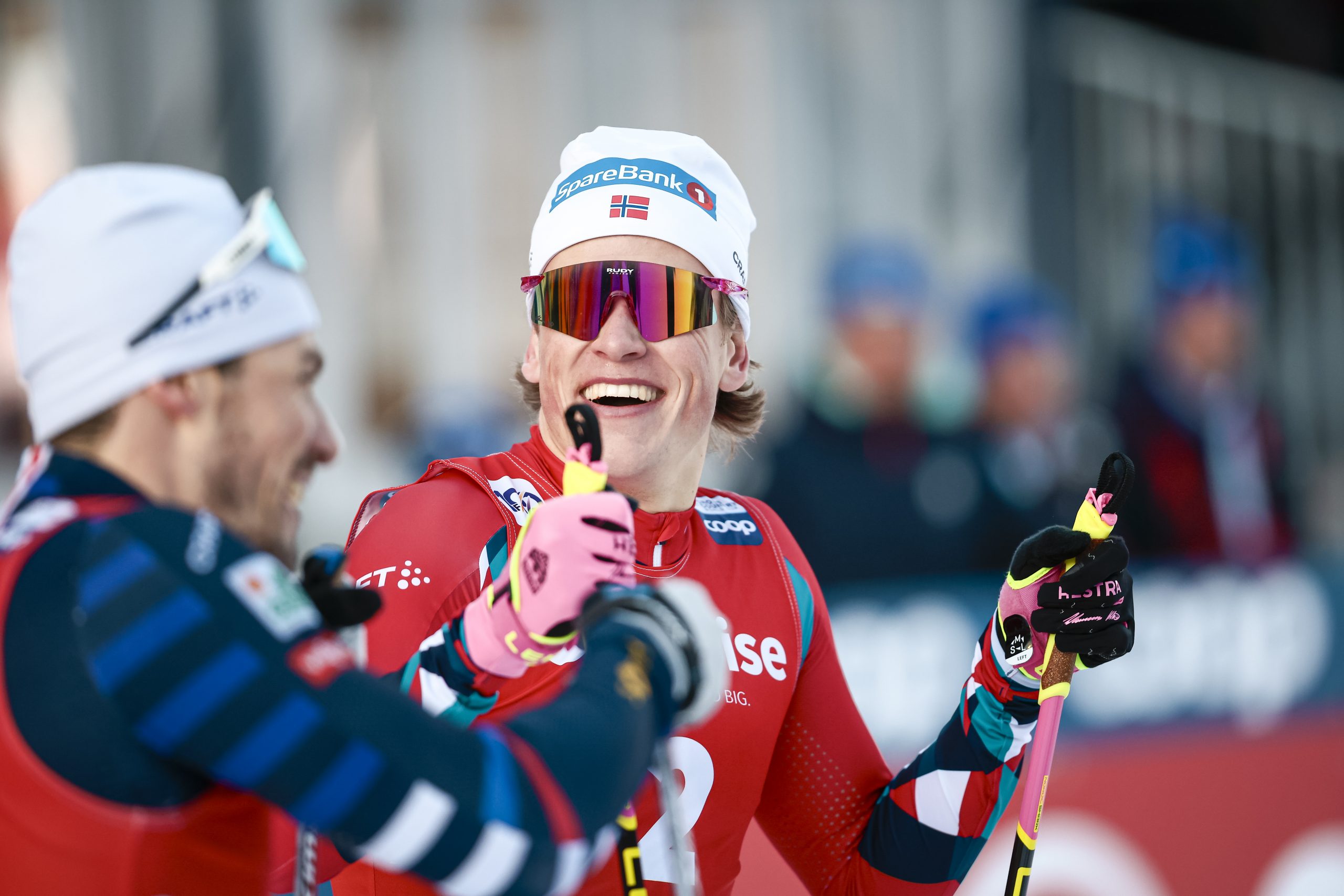
    In the absence of any other aggressive pacemakers, Johannes Hoesflot Klaebo (NOR) was left to set the pace in Goms’ 20 k Classic Mass start. (Photo: Authamayou/NordicFocus)

    Klaebo wins . . . we saw that coming.

    Let’s face it: cross-country ski racing can be kinda boring. Races are long (even the short ones), speeds are really not that high, even the fastest accelerations occur in slow motion when compared to many other sports. There’s a bit of a draft that can protect opportunistic sprinters, but not really all that much. And even the most hotly contested World Cup races are typically dominated by a synchronized clot of red Norwegian suits striding up the trail in near-perfect unison, beautiful to witness, but kind of dull in its predictability. Watching cross-country ski racing isn’t for every sports fan, especially when predicting the winners is becoming such an un-challenging task.

    But I’m not bored: I’m fascinated. And I find myself even more fascinated with each passing week. Here’s what fascinates me: how can a skier just continue getting stronger and stronger? Wouldn’t that be awesome for all the rest of us to experience? Knowing that we could just keep getting better and better? Coaches, counselors, motivational speakers all tell us that it’s possible: keep working harder and you’ll just keep getting stronger. But the performances of athletes at all levels show us that this rosy prediction just isn’t true. There’s a limit, a breaking point, a glass ceiling. Plenty of athletes work hard, and all the skiers in these World Cup races are fully committed and supremely talented. Yet even the very best athletes plateau, even the strongest racers stumble. And the margins at the tippy-top of athletic performance become amazingly thin, showing that almost any world-class contender can win on any given day. Ironically, FIS World Cup rankings from second place through last place are regularly re-shuffled: Gus Schumacher was second yesterday, today he’s 22nd. But the guy in first place is often the same guy. Johannes Hoesflot Klaebo wins more than half of the World Cup races he enters—that’s just crazy. Klaebo won again today, and he did it in an offhanded fashion that makes it appear he has only himself to compete against. I’m fascinated . . .

    Johannes Hoesflot Klaebo (NOR) waits for the second and third place finishers at the end of the 20 k Classic Mass Start in Goms, Switzerland. (Photo: Authamayou/NordicFocus)

    Goms, Switzerland offered these final World Cup events prior to the arrival of these same athletes at Olympic venues in two weeks. Spectators are fully aware that the race we watch this week may not be the same as the race conducted a few weeks from now. Dominance in January can translate into further dominance in February, but there are plenty of miles to cover between now and then. Germ-filled airline flights and nights of fitful sleep, breakfasts and lunches and dinners to orchestrate, supplements and strategies to employ, training to undertake, reset and recovery to seek. And somewhere deep inside an athlete’s body, the systems are churning . . . getting ready for a day when speed and endurance are needed, when courage and fortitude may lead to victory and glory, or to humiliation and defeat. Goms offered as accurate an approximation of those Olympic races as it’s practical to stage: Olympic races staged in Val di Fiemme will include a Team Sprint (like Friday’s Team Sprint), and a Classic Sprint (like yesterday’s Classic Sprint). But today’s 20 k Classic Mass Start may not offer a precise predictor of the Olympic 50 k Classic Mass Start. Fifty kilometers is really really far . . . and plenty can happen in those 50 kilometers. The 20 k is more straightforward, and offers less space for multiple attacks to occur. It’s possible that a 20 k field will wait for a single significant move. That’s the way things played out in Goms, today.

    John Steel Hagenbuch (USA), Zak Ketterson (USA) moved steadily through the field during the FIS World Cup 20 k Mass Start in Goms, Switzerland. (Photo: Authamayou/NordicFocus)

    North American men performed well in today’s 20 k, especially considering the stress and accumulated fatigue of such a long and arduous World Cup weekend: Zak Ketterson was 18th, Xavier McKeever 19th, Schumacher 22nd, Antoine Cyr 34th, Hunter Wonders 36th, Zanden McMullen 38th, Remi Drolet 40th, Max Hollman 41st, Thomas Stephen 45th, Zach Jayne 52nd, John Steel Hagenbuch 55th, Luke Jager 59th. Many of those skiers began today’s race with start positions waaaay back in the field, spending 20 kilometers dodging pole tips and ski tips on their journey forward. Theirs was a decidedly different race from the calm, controlled, unmolested effort afforded the leaders. But everyone who’s ever started at the front got there by battling their way from the rear. The North Americans are battling . . .

    “There is a lot of scrambling in a field like that, especially when you are starting in a further-back bib,” said Ketterson. “The key is to just stay relaxed during the first two laps, because all those little moves have to be repaid with interest later in the race. It’s just about being smart with your energy.”

    “(Today’s race) was part of the progression,” said Schumacher. “This is sort of my overload; now I’ll recover, absorb it, and hopefully be fitter going forward. Travel day tomorrow headed to Livigno, and incorporating recovery by just chilling out, basically enjoying the Alps. Bunch of snow just fell kind of all over, which is cool.”

    Norwegian race suits dominated the front of the 20 k Mass Start, with a brief appearance by a lone skier in blue, France’s Mathis DeLoge. The Olympic 50 k in Val di Fiemme may prove different. (Photo: Authamayou/NordicFocus)
    Norway, Norway, Norway, Norway, Norway, Norway, Norway

    While it may not always be evident on the surface, there’s drama in every meter of a Mass Start race—emergencies averted, difficulties overcome, disasters dodged, over-crowding endured, loneliness faced. Racers usually want to avoid as much drama as possible, and the racers least likely to encounter difficulty are those who start in the front row.  Four Norwegians made up the front row—Klaebo, Amundsen, Mattis Stenshagen, and Andreas Fjorden Ree. They’d lead the field out onto the first of four loops, monitoring the early pace set by pre-race favorite, Klaebo.

    Lap 1 appeared to be a freebie. It’s understood that the pace would get high, but for every kilometer that Klaebo controls the pace at the front, it will be all that much more difficult to dislodge him later in the race. Klaebo is a fast skier, but his strategy is typically not one that attempts to shed other skiers. He’ll control the pace at the front, waiting for someone else to take control. If no one does, then Klaebo will likely win the sprint at the end. If another skier does attempt to assert themselves, then Klaebo will ride their tails and likely win the sprint at the end. Anyone who wants to beat Klaebo needs to drop Klaebo, and they need to do so well before the finishing straightaway approaches.

    The other skiers likely to test Klaebo’s long-form endurance—including Klaebo’s own Norwegian teammates—were decidedly passive in Goms. And Iivo Niskanen—the skier most likely to test the strength of the field two weeks from now Val di Fiemme—was absent from the Goms start list. Through five kilometers, the leaders continued to be relaxed. Klaebo, Harald Oestberg Amundsen, Andreas Fjorden Ree, Emil Iversen (NOR), Mathis Deloge (FRA) and Savelii Korostelev (AIN) who had started far back in bib 33. Schumacher came through the five kilometer mark in 12th place, only two seconds behind the leaders.

    Off the front, and receding into the distance: Johannes Hoesflot Klaebo (NOR), Emil Iversen (NOR), Harald Oestberg Amundsen (NOR) made Goms’ 20 k Classic Mass Start into a three-man race. (Photo: Authamayou/NordicFocus)

    Through 7.5 kilometers, Norway continued to enjoy the presence of eight skiers in the top 12, a level of numeric-dominance that Norway will not enjoy when the 50 k is run in Val di Fiemme (where Team Norway will be limited to four starters). The Norwegians were accompanied only by the persistent French, Korostelev, and Estonia’s surprising star, Alvar Elev. A small spit occurred in the field at 9.2 kilometers where bonus points were offered and Klaebo led a mini-break ahead of Iversen and Amundsen. What had looked like a pedestrian pace was revealed to have been a pace at which the vast majority of the skiers had been just barely holding on. Klaebo tapped the accelerator, and the field strung out helplessly behind him. Norway took the points for the first eight positions, but only Iversen and Amundsen were able to hold their positions at the front with Klaebo.

    Korostelev led the chase of the three leading Norwegians, and the rest of Team Norway appeared perfectly willing to let him do so. Valnes latched on to Korostelev’s tails,and the other remaining Norwegians lined up behind Valnes. If this were a bike race, viewers could assume that team tactics were being employed—Norwegians lining up to defend Klaebo’s lead, and forcing other nations to chase. But today made it look like the field simply stretched out in a ranking of available strength and endurance. Anyone who could’ve gone faster would certainly have gone faster.

    Though not exactly in dramatic fashion, the race continued to unfold at the front. Classic skiing creates a unique drafting dilemma: in order to be as close as possible to the skier in front, the following skiers are compelled to match the striding and/or double-poling tempo of the leader. It makes cross-country skiing uniquely picturesque, but it removes any advantage that a skier might seek by choosing a different tempo. Remember Therese Johaug? Her supernaturally-high tempo always appeared awkward and uncomfortable whenever she skied in the company of other racers. Fortunately for Johaug, she spent very little time in the company of other racers during her racing career. Today in Goms, the three dominant Norwegians set a steady pace ina predictable tempo. Iversen and Klaebo are in-season and off-season training patners: it makes sense that they’d adopt a similar tempo. Amundsen was the outlier of the three, but he followed their tempo in lockstep. Here’s the thing—if no skier seeks to take an individual advantage, then we can safely assume the at the advantage goes to Klaebo.

    Korostelev continued to lead the chase group, but trailed by an ever-widening margin. With one lap remaining, the gap had stretched to nearly 40 seconds. With four kilometers to go, Klaebo was seen tightening his pole straps. Another bike race analogy: when a rider reaches down to tighten the straps on their shoes, they’re preparing for the sprint. For Klaebo to have done so—so quietly and so matter-of-factly—must have caused the hearts of his rivals to sink. He’s not hanging on, he’s preparing to pounce.

    Klaebo would’ve been likely to outsprint both Iversen and Amundsen at the finish line . . . and while that may be the plan he intends to follow in Val Di Fiemme in a couple of weeks, it’s not the only winning strategy he possesses. Today in Goms, Klaebo showed that he can win in the most understated—though thrilling—way. He simply skied away. One little uphill (one of those from yesterday’s Sprint course) and he trotted lightly up it, exposing the truth that Iversen and Amundsen may have been close to their performance limits all along. Amundsen chose an inside line on the hill, but stalled on the steeper slope he ascended. Iversen sought better kick on an outside line beyond the groomed tracks, but continued to slip just a bit. And Klaebo just cruised off the front in a nonchalant manner that went all but unnoticed. None of the course-lining spectators even cheered. The decisive moment of a World Cup Mass Start Distance race, and almost no one even saw it happening. Well, Iversen and Amundsen might’ve noticed . . . both came nearly to an exhausted standstill at the top of the hill. Klaebo would get away to a gap of 40 seconds, ultimately coasting easily across the finish line followed by Iversen and Amundsen. Klaebo has shown in the past that he is a master of preparing for major championships. He appears ready, again.

    There have been plenty of easy-looking wins in Klaebo’s illustrious career, but few of those 107 individual wins ever looked easier than this. And, for additional perspective, this “easy” win came in a 20 kilometer Classic Mass Start race ahead of the world’s finest Distance skiers. Team France found itself overmatched—no pesky Frenchmen tweaking the race pace today. Team Norway found that it really has only one contender for gold—the rest of them can fight it out for silver and bronze. Korostelev found that the dominance he’d enjoyed in the last few seasons behind Russia’s curtain did not translate into similar dominance on the World Cup (but who knows what he’ll look like in the Olympics). And Iivo Niskanen—watching the race on TV from his sofa in Finland—would’ve seen that Klaebo is ready for any surge that the courageous Finn may choose to throw down in Val di Fiemme. It won’t be the same race as today in Goms, but Klaebo’s performance today makes it difficult to image how different the final outcome may be. Good luck, Iivo. Good luck Savelii. Team Norway is strong, and their man, Klaebo, is off the charts.

    There was one exciting moment: watching the eight-man chase group sprint to the line, where Stenshagen outsprinted Korostelev for seventh place. Korostelev tested himself against Team Norway, and found himself overmatched. Team Norway had faced another Russian challenger, and had stuffed him into the back seat. There’s a bitter rivalry there, one likely to be played out again when the Olympics get underway at the Nordic venues of Val di Fiemme in February. There won’t be quite so many Norwegians for Korostelev to deal with, but he might find that at least a few of those Norwegians—likely Amundsen, Iversen, and Klaebo—will be up the track, dividing the medals amongst themselves in the final kilometers.

    Men’s World Cup 20 k Mass Start RESULTS

    Help Support Our Olympic Coverage!

    FasterSkier will have our own Nat Herz on the ground at the Olympics, which, to be honest, is a very big financial lift for us. If you value the thoughtful work and access FasterSkier provides at championships like this one, please consider becoming a Voluntary Subscriber. Your support directly fuels the work we do to cover the people, places, and moments that make our sport special.

    Join the FasterSkier community!
    So many red suits . . . Emil Iversen (NOR), Johannes Hoesflot Klaebo (NOR), Harald Oestberg Amundsen (NOR) continue Norwegian dominance in World Cup Distance racing in Goms, Switzerland. (Photo: Authamayou/NordicFocus)
  • Schumacher! Two Days, Two Podiums

    Schumacher! Two Days, Two Podiums

    This coverage is made possible through the generous support of Marty and Kathy Hall and A Hall Mark of Excellence Award. To learn more about A Hall Mark of Excellence Award, or to learn how you can support FasterSkier’s coverage, please contact info@fasterskier.com.

    Gus Schumacher (USA) celebrates his second place finish in the World Cup Classic Sprint in Goms, Switzerland. It was his second World Cup podium finish in as many days. (Photo: Authamayou/NordicFocus)

    Maybe the Americans really are that good . . .

    With the Olympic Games just around the corner, American men (lots of them!) are surging toward the front of the World Cup field. And while the last few World Cup weekends have been events that were only sparsely attended by the sports brightest stars, today’s Classic Sprint in Goms Switzerland was a fully stacked field with most of the primary contenders present. Many of them would be hoping that this event would be a dress rehearsal for the Classic Sprint that will be raced during the Olympics in Val di Fiemme.

    Over the last few weeks, it’s been kinda cool to see what racing would look like in the absence of Johannes Hoesflot Klaebo . . . but now it’s time to turn from things as they have been, and return to things as they should be. Klaebo is back, and it’s an amazing time to watch ski racing: perhaps the greatest ever to do this sport is currently racing and skiing among us. Who knows? Maybe this will be his final season. If he were to succeed during the Olympic Winter Games of Milano-Cortina in the same way he succeeded at last year’s World Championships in Trondheim (six races, six wins, Nordic skiing immortality), there would virtually be nothing left for him to win. This skier has taken us to a rare place in sport history: Babe Ruth is alive and swinging, Muhammad Ali dances across the ring, and we get to watch history played out on live-streamed broadcasts. Let’s enjoy it—and marvel at it—while we can.

    Gus Schumacher (USA) claimed his second podium in as many days with a brilliant second-place finish behind,Johannes Hoesflot Klaebo (NOR) and ahead of Edvin Anger (SWE). (Photo:  Authamayou/NordicFocus)

    While Klaebo is back on tour—and coasted to yet another World Cup Classic Sprint victory—it felt more like an American coming out party and less like yet another Klaebo coronation. Gus Schumacher led the way with a brilliant and confident second place, ahead of a bull-headed Edvin Anger (SWE) who continues to think that Klaebo can be beaten with brute force and raw power. Klaebo proved Anger wrong yet again . . . but it was Schumacher who stole the show.

    “These courses are really hard, like that hill is about a minute long,” said Schumacher. “And yeah, being an all around athlete—like having some distance ability—it really helps me out there.”

    And Schumacher was not the only American to deliver standout performance in Goms. Five American men qualified in the top 17: Ben Ogden 6th, Zak Ketterson 9th, Schumacher 12th, Schoonmaker 13th, Zach Jayne 17th. Jack Young did not produce the Classic sprinting result he may have hoped for. He finished qualifying 39th, just over a second outside the advancing standard. Kevin Bolger also would’ve found himself disappointed this morning in Goms, completing his qualifying round in 61st.

    “The qualifier was a great opportunity to improve on my disappointing results last weekend,” said Jayne. “I created an ambitious race plan and with the great wax support, I delivered. Given that—and given the tough course—I don’t find the (qualifying) result too surprising, but it is a nice treat.”
    JC Schoonmaker (USA) was one of a host of American men delivering great performances in Goms. In the Classic Sprint, Schoonmaker would qualify 12th, and finish 10th overall. (Photo: Authamayou/NordicFocus)
    Americans Crowd the Heats

    The beginning of the Sprint heats made it look like Klaebo was involved in a different sort of drama . . . after the strong qualifying effort of Individual Neutral Athlete, Savelii Korostelev. With the Olympics approaching—and Korostelev improving his performances each week (especially in Classic events)—Klaebo may have felt it prudent to give the young Russian a better look so that he didn’t find himself surprised in Milano-Cortina. Facing Korostelev in Quarterfinal 1, Klaebo drifted craftily to the rear for a clearer view of the young Russian. There Klaebo stayed through the first uphill, and the second where Lauri Vuorinen lost momentum, blocking Klaebo’s progress and wedging him behind Korostelev. But all it took was one extra push from Klaebo over the top to send him flying down the other side—past Vuorinen, past Korostelev, past Valnes, and across the finish line for the heat win. Valnes held on for second in. front of a fast-closing Korostelev.

    Ogden followed Edvin Anger through the second quarterfinal, holding on for second ahead of a fast-charging Hovard Moseby (NOR) who would also secure a lucky loser spot.

    Zachary Jayne and JC Schoonmaker entered Quarterfinal 3 alongside Even Northug (NOR) and Oskar Opstad Vike (NOR). Jayne went straight to the front, determined to use his evident qualifying speed to insure a fast heat. Jayne’s enthusiasm would be quickly curbed by the thin air of high elevation and the slow snow that resulted from overnight accumulations. Jayne would fade to the rear of the field (ultimately finishing 27th on the day) while Schoonmaker surged forward in pursuit of Theo Schley (FRA). Schoonmaker would hold his advantage, even easing up a bit before the line ahead of Anton Grahn (SWE), Vike, and Northug.

    “The heats were just on another level,” said Jayne. “The heat selection was particularly stressful and something I have never experienced before. I chose heat 3 because, statistically, it has the most lucky losers. My position at the front just happened organically and I paid the price for a fast start. Happy to race the way I did, but unsatisfied with the outcome, more to learn and more to reach for. Great day for the Americans and I am truly honored to be a part of it, no matter how small my contribution.”

    After his all-out chase onto yesterday’s Team Sprint podium, it would be understandable if Schumacher appeared sluggish in Quarterfinal 4. But that’s not the way Schumacher races. He seems to have an ability to recover quickly, and to ride waves of seasonal momentum. He popped to the front at the top of the final climb (ahead of an inexplicable stall from Joni Maki), and surged down the other side where he would hold his advantage across the finish line

    Ketterson found himself at the front of what initially appeared to be a tactical heat. He employed an earlier diagonal stride on the first uphill than the rest of his heat, remaining light and quick. If there’s a smart way to ski at the front of a slow heat, Kettterson was demonstrating it. He scampered up the final hill as the field crowded around him, then veered, regretably, into the tracks on the shorter righthand side, slamming the door (as it turns out, a bit over-zealouslys) on Sweden’s Georg Ersson who was lucky to escape with poles and skis intact. Ersson would overcome Ketterson in the finishing straightaway, advancing to the semifinal. Ketterson would find himself disqualified in what would otherwise have been a personal best Classic Sprint performance.

    “Completely my fault!” said Ketterson. “He was in my blind spot and it was a split second decision that obviously ended up being a big blunder. I should have just stayed in my own track and taken the position behind him on the final downhill.”
    “The classic sprint at the Olympics has been my primary goal for the entire season, said Ketterson. “I hope I have shown enough ability to earn a start, but from this point on it’s not within my control so I will just do my best to focus one day at a time.”
    As they say in NASCAR, rubbing is racing . . . and American men were solidly in the mix in every heat of Goms’ Classic Sprint, including the first semifinal where Erik Valnes NOR) hit the deck as JC Schoonmaker (USA) headed for the hinterlands.  (Photo: Authamayou/NordicFocus)
    Classic Sprint Semifinals

    Three American men—Ogden, Schoonmaker, Schumacher—advanced to the Sprint semifinals. Three guaranteed finishes in the top 12: that’s a sign of a seriously strong team. But while it’s great to qualify for a Sprint semifinal, the names on the roster when you get there can be pretty daunting. Semifinal 1: Klaebo, Anger, Schoonmaker, Valnes, Ogden, Northug. That’s a seriously stacked heat. In that semifinal, Klaebo’s start was far more assertive than his quarterfinal, and it produced the result of luring Anger out into an early lead. On-air commentator, Andrew Kastening, got it totally right: “You’d think as time would go on, that Edvin Anger would learn to let Klaebo lead,” said Kastening. Evidently, Anger is not the quickest learner . . .

    Ogden and Schoonmaker maneuvered through the pack, their kick wax seeming sufficient on the ascent of the first hill, but their glide on the downhill seeming less than stellar. Anger continued to lead over the top of the second hill. On the subsequent downhill, Klaebo glided into a too-small gap on the inside of Anger, who held his line and allowed Klaebo to ease through without issue (well done, Edvin). The move allowed Klaebo into the lead, but it sent ripples through the skiers behind the leading duo. Valnes found his ski tips tangling with Schoonmaker’s tails . . . Valnes ended up flopping spectacularly onto his backside while Schoonmaker was launched through the V-boards and into the soft snow of the infield. Schoonmaker somehow managed to avoid complete disaster, stayed on his feet, and managed to find his way back on course. Ogden wove through the carnage to finish third, where he’d wait to see if he would advance to the final as a lucky loser. Schoonmaker would finish fifth behind Northug. Valnes would limp home in sixth.

    The second semifinal was relatively less star-studded, though still featured Sprint standouts such as Vike, Ersson, Joni Maki (FIN) Simone Mocellini (ITA), Anton Grahn (SWE), and Schumacher. Mocellini would make most of the pace in the heat, cresting the final hill with a slim lead over Schumacher. Schumacher would ride fast skis down the final slope, and step deftly inside of Mocellini as they entered the final double pole sections. Schumacher would hold on to cross the finish line first, and advance to the Sprint Final where he would join Ogden.

    Johannes Hoesflot Klaebo (NOR) pushed an unwitting Edvin Anger (SWE) into the lead in both the semifinal and final. (Photo: Authamayou/NordicFocus)
    Classic Sprint Final

    Two Americans advanced to the Classic Sprint Final—that’s a seriously legit statistic—where they’d be joined by Anger, Mocellini, Northug, and the omnipresent Klaebo. Ogden had already looked fatigued in the semifinal (after a high-intensity podium finish in yesterday’s Team Sprint, who can blame him?), but Schumacher continued to look fresh and fast.

    “I was definitely pretty tired from the Team Sprint yesterday,” said Ogden. “Gus and I were pretty fired up; hard to fall asleep (so) I was feeling yeseterday, today1 And with the training block I’ve been doing the last few weeks, I think that was on full display in the final. But I’m still stoked with how today went, for sure. The plan was not to be the best version of myself this weekend—maybe like second best version—so I’m feeling pretty good about how that went down!”

    “I think I still capitalized,” continued Ogden. “And got away with a really really solid day. Good stuff . . . awesome for the team, awesome for everybody!”

    Anger never seems to learn. Maybe one day he’ll become as dominant as his ski tactics currently imply he thinks he is . . . but in Goms’ Classic Sprint Final he was just another guy playing right into Klaebo’s hands. Schumacher is a quick study, though; he’s learned where he nees to be, and he slotted in right behind Klaebo who skied the very same race as in the semifinals: let Anger lead across the flats, step into an open lane to keep from getting bunched on the first uphill, while continuing to force Anger to keep his nose in the wind. Poor kid . . . he imagines himself in a rivalry with Klaebo, who seems only to consider Anger as a convenient stepping stone to ever more Sprint victories.

    That’s when Klaebo switched it up—flowing past Anger on a downhill, powering up the final climb, high-tempo diagonal stride from bottom to top, effectively deciding the race with 400 meters still to go. Schumacher rocketed past Anger as the rest of the field locked up behind the stultified Swede. Schumacher showed his tremendous form and fitness, remaining quick and snappy to the end, powering across the line just behind a relaxed and coasting Klaebo. Schumacher—and Team USA’—would earn a second World Cup podium in as many days. It’s bizarre to watch a Sprint Final become a death march, but such was the level of exhaustion that the Goms Sprint course had loaded into the arms and legs of these racers. Anger survived across the finish line in third. Ogden faded to sixth. Even so, two Americans in a Classic Sprint Final . . . there haven’t been many days that Team USA would celebrate more than this one.

    Schumacher summarized his progress,and his prospects: “The way it’s set up, these races actually probably will give me a bit of a boost, fitness wise, which is cool to think about.”

    Klaebo continues to lead in all World Cup categories this season: Sprint, Distance, and Overall. His level of dominance is unprecedented as the field approaches the Olympic Winter Games.

    Men’s Classic Sprint RESULTS

    Men’s Classic Sprint QUALIFYING

    Help Support Our Olympic Coverage!

    FasterSkier will have our own Nat Herz on the ground at the Olympics, which, to be honest, is a very big financial lift for us. If you value the thoughtful work and access FasterSkier provides at championships like this one, please consider becoming a Voluntary Subscriber. Your support directly fuels the work we do to cover the people, places, and moments that make our sport special.

    Join the FasterSkier community!
  • Svahn Returns to the Top as Olympic Stakes Sharpen in Goms Women’s Classic Sprint

    Svahn Returns to the Top as Olympic Stakes Sharpen in Goms Women’s Classic Sprint


    This coverage is made possible through the generous support of Marty and Kathy Hall and A Hall Mark of Excellence A Hall Mark of Excellence Award. To learn more about A Hall Mark of Excellence Award, or to learn how you can support FasterSkier’s coverage, please contact info@fasterskier.com.

    Maja Dahlqvist (SWE) and Laura Gimmler (GER), (l-r) with Jessie Diggins (USA) just behind during the Classic Sprint heats in Goms, Switzerland. (Photo: Authamayou/NordicFocus)

    By the time the women clicked into their classic skis in the upper Rhône Valley on Saturday morning, the sprint course in Goms had already made its argument. This would not be a day for pure glide, or pure kick. It would be a day for the awkward in-between—the calculus of wax, confidence, and courage. The kind of skiing that rewards athletes who keep their heads when the track changes mid-lap, when the fastest line is also the most exposed. Here, “relaxed” and “hard” have to mean the same thing.

    The official report called the surface “hard packed.” Air was just above freezing (0.4°C). Snow was far colder (-8.0°C). This split-temperature setup can turn one polished corner into a skating rink, and one kick zone into a question you must answer at speed.

    With Milano Cortina looming—the last World Cup weekend before Olympic racing in Val di Fiemme—every answer carried extra weight. Sweden, in particular, arrived with a familiar burden: racing to win and also to clarify which few women might fill the nation’s four Olympic start spots in the classic sprint. The day’s story was not just about who won. It was about the ones who looked ready to be chosen.

    At the center of it all was Linn Svahn—back on top of a World Cup sprint after what she described, in a post-race on-air interview with FIS, as a challenging year.

    “So nice to be back and compete again,” Svahn said. “It’s been like a roller coaster year… It’s one of my favorite courses of the whole World Cup. But it was tough.”

    She looked more than “back.” She looked inevitable.

    Lauren Jortberg (USA) during qualification. (Photo: Authamayou/NordicFocus)

    Qualification: fast snow, sharp edges, and a fraction too much ice

    Svahn set the tone immediately, winning the qualification in 3:46.07, with Switzerland’s Nadine Fähndrich second (+1.84) and Finland’s Jasmi Joensuu third (+4.35).

    For the Americans, the qualification round was both encouraging and cruel, as sprint prologues often are: three into the top 30, one out by a place.

    • Jessie Diggins qualified 6th in 3:54.81 (+8.74).
    • Julia Kern qualified 15th in 3:58.58 (+12.51).
    • Samantha Smith qualified 26th in 4:00.71 (+14.64).
    • Lauren Jortberg—was so close—finishing 31st, 4:01.74 (+15.67), one spot out of the heats.

    Jortberg’s own description of the qualification captured the emotional violence of that single place. Her plan, she said, was to ski “as relaxed and smoothly as I can,” then push the fast pieces—downhills and turns—hard. She believed she executed that plan almost everywhere.

    Except, crucially, at the top of the major climb.

    “It was way icier… than when we were warming up on it, and I wasn’t anticipating that at all,” Jortberg said. “I lost a ton of time. I nearly fell because I slipped so much—so that’s really brutal, especially being 31st.”

    Her immediate feeling, she admitted, was a strange split: “both devastation and almost like tears of joy,” because of how much she had struggled in classic sprinting in the past—and because, on this day, she could finally feel the gap closing. “There’s more to come,” she said. “I’m really excited to keep working on my classic skiing and showing that I’m a threat in both classic and skate.”

    On paper, it reads like a line item: 31st, not qualified. In the body, it feels like something very positive is brewing from many years of hard work.

    Julia Kern (USA) and Samantha Smith (USA), (l-r) during the Classic Sprint quarterfinals in Goms, Switzerland. (Photo: Authamayou/NordicFocus)

    The heats: Sweden’s depth, Switzerland’s home-course fire, and the shape of the final

    The women’s sprint in Goms unfolded in the standard format: five quarterfinal heats of six, two automatic qualifiers from each, plus two “lucky losers” on time; then two semifinals with the same rule; then a final of six.

    What made Saturday distinct was how quickly the day shifted from “times” to “tactics.” Goms is not a flat drag race. It’s a course that asks athletes to make decisions—when to risk the inside line, when to conserve, when to surge. Kern noted afterward that those decisions are hard to replicate outside racing.

    “For me, nothing beats the effort of racing head-to-head to practice digging really deep,” Kern said. “Those surges and tactics are hard to emulate in training.”

    That mattered because Kern arrived at this World Cup period still chasing a particular feeling—what she has described as race sharpness—after time back home training.

    On Saturday, she said, she finally felt it.

    “Today I felt sharper than I have in any sprint so far this season,” Kern said. Even in a moment when she was sixth over the top of the first climb, she believed she could re-enter the race: “I knew I could charge the second climb and that I wasn’t out of it.”

    Kern also described the way she is trying to reprogram the smallest pieces of sprint execution—especially the opening of the qualifier, where she has struggled.

    “One of my goals was to start faster in the qualifier… and I did today,” she said. In the heats, the goals shifted: “continue to believe and never count myself out,” keep technique cues in mind, “send the downhill,” and practice cornering. And the most important sign, to her, was the feeling on the second climb: “I felt my second hill surge… and that’s encouraging for the last bit of training before the games.”

    Kern ultimately exited in the quarterfinals, finishing 15th overall on the day. But the quote that lingered was not about the placing—it was about learning to believe, again and again, in the middle of the heat, when the race tries to convince you you’re done.

    Smith also advanced out of qualification and into the quarters—another solid marker in a season where her trajectory has been trending upward. She finished 23rd overall.

    Her takeaway was precise and practical, the kind of detail you can only identify when you’re close enough to feel time leak out of the run.

    “Looking ahead, the next few weeks, I’m really going to prioritize transition moments because I felt like I lost a lot of time there on the course,” Smith said. “But I know it’s something I can practice and sharpen with some intentionality.”

    She also pointed to tactics: “I think there’s a lot I can improve tactically, and definitely walking away from today’s race with some stuff to focus on for the next few weeks.”

    Her plan between now and the Games is a familiar championship build: “I’m going to use the next two weeks as an opportunity to build volume before sharpening with some faster and higher-intensity workouts,” she said, adding that she’ll keep her preparation similar to what has worked for her before major championships.

    Maja Dahlqvist (SWE), Jessie Diggins (USA), Nicole Monsorno (ITA), and Magdalena Scherz (AUT), (l-r) stride up one of the two long climbs on the sprint course in Goms, Switzerland. (Photo: Authamayou/NordicFocus)

    For Diggins, the day held a different kind of meaning. She arrived in Goms wearing the World Cup leader’s yellow bib, but approached the classic sprint less as a referendum on form and more as a laboratory — a chance to learn, adapt, and sharpen instincts under pressure.

    In the quarterfinals, Diggins said her skis felt “a little bit slick,” prompting an adjustment before the semifinals as conditions continued to glaze over. “We added more for the semi, which I was super, super happy about,” she said, noting how quickly the track changed as the day wore on. “I was really impressed with the team’s ability to shift mid-round when it turns out, like, oh, it’s getting a little more glazy.”

    Rather than fight the conditions, Diggins leaned into them. She said she made a conscious decision to seek out firmer, faster snow and to corner aggressively, skiing where the surface had stayed icy instead of getting churned into powder. “Downhills are my strength, so I was like, I’m going to play my strengths here,” she said. “I was really psyched about that — and also really impressed with my ski speed. I’m really, really grateful to our team.”

    Diggins qualified sixth, advanced through the rounds, and finished 7th overall, exiting in the semifinals. In a day defined by razor edges, she looked close. The difference between “final” and “semis” felt less like fitness, and more like the thousand small interactions between ski feel, kick security, and how aggressively you can take space in traffic.

    Diggins framed the race as part of a broader Olympic preparation, even with the acknowledgement that racing under training load makes the experience different than what awaits in Val di Fiemme. “I was really just seeing this as great practice for the Olympics,” she said. “You can still learn so much — learn where your strengths are, what you think you need, how you might want to pace.”

    She described the day as “a learning mission,” an expedition of sorts to gather information she can use over the final weeks before the Games. While the classic sprint is not her primary Olympic focus, Diggins said that doesn’t change how she approaches it. “If I’m going to do it, I want to really go for it and give it the best that I can.”

    Technically, Diggins said the Goms sprint offered a valuable reminder of what she is still actively refining in classic skiing. On a long sprint course with slow, natural snow early in the day, her focus was on what she called “relaxed power.”

    “I was thinking a lot about not skiing frantically,” Diggins said, describing cues she used throughout the race — staying tall on the steep sections instead of folding forward at the waist, leading with her hands when fatigue set in, and prioritizing efficiency over force. “Lots of little cues,” she said, all aimed at skiing as economically as possible when the course demanded patience as much as aggression. I

    Maja Dahlqvist (SWE), Johanna Matintalo (FIN), Laura Gimmler (GER), Linn Svahn (SWE), and Nadine Faehndrich (SUI), (l-r) come down the home stretch. (Photo: Authamayou/NordicFocus)

    The final: Svahn returns, and the podium reshapes itself

    By the time the final arrived, the field had taken on an instructive shape: three Swedes (Svahn, Dahlqvist, Emma Ribom), a Swiss home favorite (Fähndrich), a German (Laura Gimmler), and a Finn (Johanna Matintalo).

    If Sweden came to Goms needing clarity, this was the clearest possible argument: depth, multiplied.

    Svahn won the final in 3:46.07. Behind her, Gimmler took second at +10.54, with Fähndrich third at +12.38 (listed as +1.84 behind Gimmler in the results display). Dahlqvist finished fourth, Matintalo fifth, and Ribom sixth.

    For Svahn, the victory read like both a return and a resolution. In that FIS on-air interview, she framed the months since then as having reshaped her perspective.

    “I think [the nerves are] quite all right,” she said of the Olympic approach. “It feels like the last year has given me a lot of challenges. So [it] feels like I’m just happy to be back racing.”

    The subtext—the thing everyone in sprint skiing understands without saying—is that “happy” is not the same as “soft.” Sometimes it’s the opposite. Sometimes it’s what happens when fear gets replaced by appetite.

    Jessie Diggins (USA) battled her way to 7th place in Goms, Switzerland. (Photo: Authamayou/NordicFocus)

    What the Americans take from Goms

    For the U.S., Saturday offered a compact set of truths:

    1. Diggins is still Diggins—top-six in qualification, semifinal caliber in classic sprinting, and moving through the day with the poise of someone who is not guessing anymore.
    2. Kern’s sharpness is arriving at the right time, and she can feel it—not as a vague confidence, but as the ability to surge when the race says you can’t.
    3. Smith is identifying controllable time, the kind that can realistically be found in the last weeks before a championship: transitions, tactical decisions, and intentional sharpening.
    4. Jortberg is at the door, close enough that a single icy misread becomes the whole story—and also close enough that “devastation” can coexist with proof of progress.

    That last point may be the most emotionally resonant, because sprinting is brutally literal: it doesn’t care how well you’ve been training, or how much you’ve improved, or what you deserve. It cares what happened on the one lap, on the one climb, when the track turned slicker than it was ten minutes earlier.

    Still, if you listened carefully to Jortberg, you could hear the deeper shift: the sense that classic sprinting is no longer a weakness she is managing, but a skill she is building. “There’s more to come,” she said—and she didn’t sound like she was trying to convince herself.

    It was a close battle to the line of the finals between Maja Dahlqvist (SWE), Laura Gimmler (GER), Linn Svahn (SWE), and Nadine Faehndrich (SUI) (l-r). (Photo: Authamayou/NordicFocus)

    A last World Cup weekend, and the feeling of the calendar tightening

    The phrase “before the Olympics” can make everything sound ceremonial. In reality, it makes everything feel compressed. It turns a ski change into an existential decision. It turns a quarterfinal exit into either a warning or a reassurance, depending on your mood, your coaches, and your confidence in the training you still need to do.

    In Goms, the course didn’t let anyone hide from that compression. It asked for kick and glide, yes—but also for willingness: willingness to trust your skis when the track changes, willingness to believe you’re not out of it when you crest a climb in sixth, willingness to keep choosing speed through corners, through transitions, through the parts of the course where time disappears quietly.

    Svahn won because she looked like someone who had already made peace with the hard months—and decided to race anyway. Diggins moved through the day like someone who understands exactly what she needs and what she doesn’t. Kern sounded like an athlete who could finally feel the race returning to her body. Smith sounded like an athlete who knows where the seconds are. Jortberg sounded like an athlete who knows how thin the line is between “in” and “out”—and how much it matters that she’s standing on it at all.

    Diggins also spoke with pride about the broader U.S. team atmosphere in Goms, describing the rounds as collaborative as much as competitive. She said she and Julia Kern spent time discussing tactics and strategies between heats, and she pointed to Samantha Smith’s growing confidence as a highlight of the weekend.

    “Seeing Sammy gain confidence and get into the rounds with a really great strike rate has been so cool for me to see,” Diggins said. “I’m just incredibly proud.” She added that the momentum extended across the team, noting breakthroughs on the men’s side as well — moments she described as “really beautiful to see.”

    The Olympics, when they arrive, will not care about any of this context. They will simply happen. But if Goms offered any preview, it was this: the women who will matter most in Val di Fiemme are the ones who can treat uncertainty not as a threat, but as part of the job.

    And on a hard-packed, split-temperature day in Switzerland—on a course Svahn calls her favorite, on a climb that turned to ice without warning—you could see who is learning to do exactly that.


    Goms World Cup Women’s Classic Sprint QUALIFYING

    Goms World Cup Women’s Freestyle Team Sprint RESULTS


    Help Support Our Olympic Coverage!

    FasterSkier will have our own Nat Herz on the ground at the Olympics, which is a very big financial lift. If you value the thoughtful work FasterSkier provides at championships like this one, please consider becoming a Voluntary Subscriber.

    Join the FasterSkier community!


    Laura Gimmler (GER), Linn Svahn (SWE), and Nadine Faehndrich (SUI), (l-r) share the Classic Sprint podium in Goms, Switzerland. (Photo: Authamayou/NordicFocus)
  • Diggins Thrills at 20 k Finish, Laukli Fifth, Brennan Seventh

    Diggins Thrills at 20 k Finish, Laukli Fifth, Brennan Seventh

    This coverage is made possible through the generous support of Marty and Kathy Hall and A Hall Mark of Excellence Award. To learn more about A Hall Mark of Excellence Award, or to learn how you can support FasterSkier’s coverage, please contact info@fasterskier.com.

    Jessie Diggins (USA) took advantage of the technical nature of the Goms course to remain near the front with pace-makers Ebba Andersson (SWE) and Frida Karlsson (SWE). Digggins victory in the 20 k Freestyle Mass Start was sweet confirmation of her place atop the World Cup Overall standings. (Photo: Modica/NordicFocus)

    Jessie Diggins (USA) continues to pursue the season-long World Cup Overall title, having successfully defended her lead in those standings through the recent weekends of sprints and mass start races. And with so many World Cup bonus point sprints incorporated into those mass start events, there is simply no time to surrender the lead. Diggins has appeared willing to take on that challenge, and to be willing to risk losing in order to win; that’s nowhere near as simple as it sounds. Only a few years ago, Diggins would not have been considered a distance-race contender in anything longer than a 5 k Freestyle. But in Goms, Switzerland, Diggins once again showed that she has matured into a skier who can push the pace in races of any distance, control the field on a challenging and technical courses, and sprint like a rocket even when it appears she’s out of gas. Say what you will about Jessie Diggins, but always remember that she is the quintessential fighter. Today in Goms, that fighting spirit was on thrilling display.

    After four 5 k laps of Goms’ challenging and technical course, Diggins outsprinted an on-form and determined Frida Karlsson (SWE) to take the win in the World Cup 20 k Mass Start Freestyle. Her American teammates, Sophia Laukli and Rosie Brennan, followed closely in fifth and seventh, respectively. The third place on the podium was captured in tremendous form by a skier better known for her sprinting—Nadine Faendrich—who may have been energized by the cheering of her Swiss countrymen.

    Having been securely positioned in the lead pack throughout the day, Lilliane Gagnon (CAN) finished a tremendous ninth. Additional North American finishers included Sammy Smith (USA) 45th, and Olivia Bouffard-Nesbitt (CAN) 54th.

    Ebba Andersson (SWE), Frida Karlsson (SWE), Jessie Diggins (USA), and Nadine Faendrich (SUI) (r-l) combined throughout the day to keep the pace high in the 20 k Freestyle Mass Start in Goms, Switzerland. (Photo: Modica/NordicFocus)
    20 k Mass Start Freestyle

    A week ago in Oberhof, Germany, Diggins won both Bonus Points Sprints on her way to a sixth place finish in the 20 k Classic Mass Start, allowing her to effectively protect her lead in the World Cup Overall standings. The rest of the field—and the other contenders in the chase for the overall—continue to search for chinks in Diggins’ armor. Today’s 20 k Mass Start Freestyle represented another opportunity to continue that search in earnest, though Diggins would prove more than capable of withstanding the combined efforts of her rivals.

    From the very beginning of Sunday’s race, Diggins found herself at the front setting the pace with Victoria Carl (GER) and Karlsson.

    “I loved all of the winding downhills. That was really fun to ski,” said Diggins. “I’m glad to have kept it together and skied with better tactics today; that was my goal.”

    Brennan skied the opening kilometers always in the top ten, while Smith and Laukli attempted to work their way forward from less advantageous starting positions. By 2.5 k, Laukli had succeeded in erasing the deficit, and moving al the way forward to the tails of her teammate, Brennan.

    “I had an early crash which put me quickly at the very back of the pack,” said Laukli. “[That] certainly caused some initial stress. Even though it was a long race, I knew it was the type of course and conditions where I really wanted to be in the front early on. I knew I felt very good but it’s definitely challenging to actually maneuver around the whole field. It was pretty daunting to look up and see how many women there were to try and pass. I just pushed really hard the rest of the first lap and tried to ski a bit more aggressive/confident than normal to make up all the spots. It used up some energy for sure, but was worth a little surge to get back up.”

    It pays to stay near the front, as the pack broke up after Delphine Claudel (FRA) tangled her ski tips in specators and course markers near the five kilometer mark. Her fall (on a curve at the top of an uphill section) impeded a number of Swedish athletes, and a rupture in the field was created. Led by Diggins, a group of seven managed to slip away, closely pursued by Laukli. Ultimately, Laukli was able to re-connect to this lead pack, along with Kristen Austgulen Fosnaes (NOR) and Katharina Hennig (GER).

    Most racers slowed to take on fluids at the feed zone just after the five kilometer mark; the earlier gap began to disappear, though the field remained strung out. Diggins and Laukli remained near the front, while Brennan hovered near the 20th spot where she was forced to deal a bit more with crowding and clogging in the trail and the accordion affects of the field’s maneuvers through curves, descents, and climbs.

    “Ideally, I would‘ve been more in the front,” said Brennan. “But that was easier said than done. I had to focus more on being patient and picking smart places to try to move up. Sometimes that’s how the race unfolds.”

    Diggins came through to take 15 winner’s bonus points at the 9 k checkpoint, followed closely by Karlsson (12 points), Svahn (10 points) and Andersson (8 points). So, near the halfway point of the race, Diggins had succeeded in protecting her overall World Cup lead. Laukli (4 points) and Brennan (3 points) came through seventh and eighth, respectively.

    “[It’s] a 30 point swing if you’re able to take both bonus points: that’s actually quite a lot!” said Diggins. “I do feel a little bit of pressure to strategically go for those. I’m kind of evaluating through the race: how do I feel? What might this cost me? How much do I think I can recover? In this race in particular—we’ve got a big downhill, we’ve got a big flat stadium—this won’t cost me in the end, so then it’s worth going for.”

    A split formed soon after the bonus sprint, as 12 contenders pulled away in a group that also contained Laukkli and Brennan. This group swerved and dodged its way through the second feed zone with most competitors opting to take the hand-up of drink mix.

    The inclusion of bonus points sprints (at 9 k and 14 k) and feed zones coming in such close proximity disturbed the field, and forced a number of racers to work harder even as the pace slackened. Pace-makers returned to the front: Carl, Karlsson, Diggins, and Svahn. Brennan and Laukli remained firmly in the top ten as Canadian, Lilliane Gagnon, joined the contenders in the lead pack.

    The technical nature of the course in Goms was definitely a factor in the way the field accelerated and slowed, bunched and split. And large cheering crowds may have played a role in inspiring the remarkable podium performance of Switzerland’s Nadine Faendrich. (Photo: Modica/NordicFocus)

    The technical nature of the course continued to challenge all competitors, as Carl skied off the course—dramatically catching air as she flew through the course markers—on a significant downhill curve. She was able to get back to her feet rapidly and to maneuver back into the course, but the pace-makers quickly left her behind.

    Near the front throughout the day was Switzerland’s Faendrich, presumably inspired by the presence of so many Swiss fans, and skiing on a course that she must have known well. Faendrich shadowed the Swedish pace makers (Karlsson and Andersson) as the field approached the final bonus points sprint at 14 kilometers. Points awarded to the leaders: Diggins (15) Karlsson (12), Andersson (10, Faendrich (8), Hennig (6), Laukli (5).

    With three Swedes in the lead pack, it wouldn’t have been surprising to see them attacking Diggins with team tactics. But throughout the day the Swedes seemed content to push the pace without launching individual attacks that Diggins would be forced to cover. If they thought they could drop Diggins simply by tightening the screws, they would be mistaken.

    As the field began to feel the finish line approaching, the lead group had grown to 14, with Brennan and Carl (who had managed to claw her way back to the lead group) latched on the back. Laukli moved forward into the top five in the company of Diggins, Karlsson, Andersson, and Faendrich. With only 2.5 kilometers remaining, Karlsson launched herself up the A Climb with Diggins in tow. Andersson and Faendrich faltered a bit, and may have blocked the line that the true climbers—Laukli and Claudel—would’ve preferred.

    Jessie Diggins (USA) punches the air as she crosses the finish line ahead of Frida Karlsson (SWE). Diggins appeared knackered in the finishing kilometers, but no knowledgable ski fan would ever count her out. (Photo:  Modica/NordicFocus)

    Karlsson and Diggins continued to battle at the front, while Laukli gave chase ahead of Andersson and Faendrich. With 500 meters remaining, it looked like Karlsson would storm to the finish line in the lead as Diggins continued to appear a bit ragged on the final uphill. But as the lead pair curled through the final turn Diggins turned on the jets, powering past Karlsson down the finishing straightaway, punching the air as she crossed the line for the win.

    “My plan was to go as hard as you can, ski smart and tactically, which became hard because towards the end,” said Diggins. “I couldn’t really feel my legs, but just had to stay on my feet!”

    Faendrich followed closely to finish third, while Andersson outsprinted Laukli who rounded out the top five. Brennan recovered to outsprint Hennig for seventh. Canada’s Gagnon crossed the line moments later to secure a career-best ninth place finish.

    Women’s 20 k Mass Start Freestyle RESULTS

    As she so often does, Jessie Diggins (USA) gave it her all in the 20 k Freestyle Mass Start in Goms, Switzerland.(Photo: Modica/NordicFocus)
  • Svahn leads Sweden in Goms Sprints, Klaebo Lunges Past Chanavat

    Svahn leads Sweden in Goms Sprints, Klaebo Lunges Past Chanavat

    This coverage is made possible through the generous support of Marty and Kathy Hall and A Hall Mark of Excellence Award. To learn more about A Hall Mark of Excellence Award, or to learn how you can support FasterSkier’s coverage, please contact info@fasterskier.com.

    Johannes Hoesflot Klaebo (NOR) is all smiles again as he returned to the top of a World Cup  Sprint podium in Goms, Switzerland. (Photo: Modica/NordicFocus)

    Goms, Switzerland has never hosted a World Cup Sprint competition before, so prior experience would offer no tactical advantages to racers in today’s Freestyle Sprint. The playing field would be level, and everyone would be forced to develop a knowledge of the course—and strategies for taking advantage of its many twists and turns—together.

    Not a course that challenges racers with the thinner air of higher elevations (Davos, Switzerland, is 1,000 feet higher), Goms nevertheless offered considerable challenges including an unnaturally long flat section at the beginning, followed by steep climbs and technical descents featuring consequential ruts in soft snow. Compared to other World Cup Sprint courses, Goms also seemed quite short—the top women’s qualifier, Jonna Sundling (SWE) qualified in under three minutes. Though perhaps not quite as long as World Cup competitors are accustomed to, the Goms course succeeded in seriously challenging all who tested it.

    “The first uphill here feels forever,” said Johannes Hoesflot Klaebo (NOR) in post-race comments. And many skiers who spent too much energy pushing the pace or scrambling for position on that first hill would find themselves struggling, stumbling, or falling later in the race.

    Jessie Diggins (USA) continues to race impressively in Sprint competitions in her pursuit of the overall World Cup title. (Photo: Modica/NordicFocus)
    Women’s Freestyle Sprint

    The top American women—Rosie Brennan and Jessie Diggins—skipped the last two World Cup relays, choosing to prioritize their standings in the season-long race for the World Cup Crystal Globe. Diggins leads the chase for the overall title, while Brennan continues to hold her position in third (though the race for the podium is definitely tightening). Throughout the season, Diggins has added to her overall lead by earning numerous appearances in Sprint finals, strategically using her endurance to keep all heats fast and punishing. It’s allowed her to advance deep into semifinals and finals, and added points to her tally that other distance skiers have found themselves incapable of matching. In another nod to Diggins strategic prowess, she was able to claim top bonus points in both intermediate sprints in the recent World Cup 20 k Mass Start (on her way to a sixth place finish in the day’s results).

    World Cup Sprint leader, Linn Svahn (SWE), entered the Sprint in Goms having won the last three World Cup Sprints in a row. Sweden delivered five of the top six qualifiers (Jonna Sundling, Svann, Emma Ribom, Frida Karlsson, Johannna Hagstroem), a dominant blue and yellow front interrupted only by the presence of Victoria Carl (GER) in fifth.

    Diggins finished ninth in qualifying, and dominated her quarterfinal, a heat punctuated by an inadvertent pole-jab to the face of Frida Karlsson (SWE) in the free-skate section of the final downhill. Diggins is well known for her high-velocity freeskate, generating more speed than perhaps any other skier with this technique. Her power is reflected in the high and dynamic manner in which her poles drive behind her. Karlsson seemed to ignore that threat as she pulled up behind Diggins. Karlsson was lucky to have been wearing glasses, or the result could’ve been far more grim.

    In her semifinal, Diggins tangled skis with another racer on the final uphill. She would recover quickly, but could not regain the speed that had been lost. She would find herself eliminated, as the Goms course claimed one of the world’s best . . .

    “Today in the Sprint I definitely was struggling with the super-quick start, and the tactical nature of how the course was curving,” said Diggins. “I definitely got stuck and boxed-in in the semi, and wasn’t able to push the pace the way I needed to. And then getting tripped and falling was just the icing on the cake! But that happens in sprinting . . . and I was proud of myself for getting up right away and continuing to fight for it.”

    Samantha Smith (USA) qualified in 13th, a career best World Cup Sprint qualifying result. An untimely fall took her out of her quarterfinal, but her aggressive tactics hint at her potential in sprints to come. (Photo: Modica/NordicFocus)

    Sammy Smith (USA) delivered her best Sprint qualifier in 13th, but fell in her quarterfinal after having attempted to push the pace at the front. The Goms course claimed another contender . . .

    “Today I tried to get out faster and harder,” said Smith. “The trail was really wide as well which definitely helped and made it easier to move up. I will always try to get to the front and drive the pace if possible, but there are definitely a lot more things I need to learn and improve on before I can do that consistently!”

    Rosie Brennan qualified 17th, but did not advance beyond her quarterfinal. Among Canadians in qualifying, Lillian Gagnon finished 31st, Olivia Bouffard-Nesbitt 41st, Sonjaa Schmidt 43rd, Katherine Weaver 46th.

    Linn Svahn (SWE) won her fourth World Cup Sprint in a row on an unfamiliar course at Goms, Switzerland. After seasons of injury, disappointment, and recovery, Svahn once again stands firmly atop the World Cup Sprint standings. (Photo:Modica/NordicFocus)
    Women’s Final

    Shadows covered the course by the time of the Women’s and Men’s finals. Course conditions were likely to have changed, and downhill curves were likely to prove even more daunting. The Women’s final was comprised of five Swedes (Sundling, Svann, Ribom, Karlsson, Hagstroem) and hometown favorite, Nadine Faehndrich (SUI). Faehndrich found herself gapped on the first hill as Team Sweden stormed over the top, led by Svahn. Sundling would prove to be the most adept downhiller, but she stepped on her own pole in the subsequent uphill, and faded from contention. Svahn cruised easily across the line for the win. Sundling would recover to finish third behind Dahlqvist.

    Svahn leads the World Cup Sprint standings by 96 points over her teammate, Sundling. Diggins is tied for third with Kristina Stavaas Skistad (who did not compete in Goms this weekend).

    Johannes Hoesflot Klaebo (NOR) (#2) was content to shadow Lucas Chanavat (FRA) (#1) in the quarterfinal, in the semifinal, and in the final. Ultimately, Klaebo’s greater finishing speed delivered the victory. (Photo: Modica/NordicFocus)
    Men’s Freestyle Sprint

    World Cup Sprint leader, Erik Valnes (NOR), qualified seventh, while his rival in the World Cup overall title chase, Harald Oestberg Amundsen (NOR), qualified 13th. Though Valnes was passed over in Norwegian team selections for tomorrow’s 20 k Mass Start event, both he and Amundsen will continue contesting the on-going race for the Overall Crystal Globe.

    Klaebo finished an uncharacteristic seventh in last week’s Sprint competition in Oberhof, Germany. In a remarkable testament to Klaebo’s longtime Sprint dominance, that seventh place finish marked the first time that Klaebo had failed to make a Sprint final since 2018. After the Oberhof weekend, Klaebo commented that he was feeling better since his absence due to Covid, but he hoped that he would return to his best form in weeks to come. Both Klaebo and Chanavat advanced easily out of quarterfinal 1. Chanavat again made the pace in the semifinal (that he raced alongside Klaebo). Knowing that Chanavat would utilize this strategy (as he has in nearly every heat and final this season) Klaebo seemed content to shadow Chanavat, hiding his own plans and abilities for the head-to-head race with Chanavat that was sure to be contested in the final.

    Among American men, Gus Schumacher qualified 23rd, but would be eliminated in his quarterfinal. Kevin Bolger qualified 47th, with Peter Wolter 58th. Canadian finishers in Sprint qualifying included Antoine Cyr 35th, Xavier McKeever 49th, Sasha Mason 51st, Thomas Stephen 61st, Derek Dueling 62nd, Julien Locke 65th.

    JC Schoonmaker (USA) qualified an impressive seventh in the Freestyle Sprint in Goms, and was only narrowly outsprinted to advance beyond the semifinal. (Photo: Modica/NordicFocus)

    Ben Ogden (USA) qualified a career-best third behind Chanavat and Klaebo. JC Schoonmaker—who qualified seventh—made almost every tactical mistake he could make in his quarterfinal (pinched on inside lines, too soon to the V1 on uphills, pushed to the outside on the final bend), yet still managed to sprint past Johan Haeggstroem to claim the second qualifying spot.

    “There was one route around the course that was the fastest,” said Ogden. “If you weren’t in it at any point, you had to use extra energy. But, it is not so consequential. I think if you’re in the wrong lane up the hill or around the corner, I don’t think it makes that much a different but definitely can mentally be a boost to take a bad line and still get through.”

    Ogden and Schoonmaker lined up together for the Men’s second semifinal, a closely contested heat that saw considerable bumping and jostling. Richard Jouve forced an inside line in the penultimate righthand turn, subsequently side-swiping Ogden who fell and dropped from contention. Schoonmaker sprinted with Jouve for second. Schoonmaker narrowly lost the race to the line and was eliminated. The technical, tactical Goms course had claimed two more Americans.

    “To be close to the final is bittersweet,” said Schoonmaker. “But I also think it’s cool to realize that I’m at a point where getting knocked out on the semis comes with a little disappointment.”

    Johannes Hoesflot Klaebo (NOR) lunges to defeat Lucas Chanavat (FRA) at the finish line of the Freestyle Sprint in Goms, Switzerland. (Photo: Modica/NordicFocus)
    Men’s Final

    Three Norwegians (Klaebo, Valnes, Taugboel), two Frenchmen (Chanavat, Jouve), and hometown favorite, Valerio Grond (SUI). As expected, Chanavat led out the pace with Klaebo at his shoulder. Valerio Grond made a strong move up the first hill, tangling briefly with Klaebo before slotting in behind Chanavat. Grond would skid through the next downhill curve, allowing Klaebo to move past on the inside. Chanavat and Klaebo appeared relaxed down the final hill and across the flat before the final turn, neither one seeming to be in any hurry to unleash their finishing sprint. Ultimately, no one can generate more speed than Klaebo, who overtook Chanavat in the closing meters to return to the top of the World Cup Sprint podium. Chanavat crossed a tenth of a second later, followed closely by Taugboel. All day long, Chanavat had done things his way. But, at day’s end, it was Klaebo who restored the status quo, showing that on a World Cup Sprint course, the only true way is Klaebo’s.

    “Chanavat was really strong today,” Klaebo said in post-race interviews. “I felt like he was pushing hard the whole day. I’ve been competing against him since the quarterfinal, so now I’m really tired!”

    With his victory in the Freestyle Sprint, Klaebo claimed his 73rd win in 107 World Cup starts, an astonishing winning percentage of 68%!

    Women’s Freestyle Sprint RESULTS

    Men’s Freestyle Sprint RESULTS

    Maja Dahlqvist (SWE), Linn Svahn (SWE), Jonna Sundling (SWE) on the podium of the World Cup Freestyle Sprint in Goms, Switzerland. (Photo: Modica/NordicFocus)