
From the FasterSkier archive — posts syndicated from athletes’ and coaches’ own blogs between 2004 and 2012, kept online as published. Current coverage is at fasterskier.com.

Tag: Gordon Lange

  • From Olympian to Coach to Mentor: Patrick Weaver, the Quiet Architect of UVM’s Ski Culture

    From Olympian to Coach to Mentor: Patrick Weaver, the Quiet Architect of UVM’s Ski Culture

    The first time you meet Patrick Weaver, you might not realize you’re talking to one of the most quietly influential coaches in American skiing. There’s no bravado, no self-promotion. Just an easy Vermont calm — a man who measures his words the same way his athletes measure their training: carefully, purposefully, with feel.

    On a fall morning, the UVM Nordic team threads through the mist at the Craftsbury Outdoor Center, the quiet hum of rollerskis against asphalt echoing in the distance. Weaver watches from the side, hands in his jacket pockets, hat pulled low. He doesn’t bark instructions. He doesn’t need to. The rhythm of his teams speaks for itself.

    Wilmington, Vermont’s Sophomore Luke Rizio. (Photo: Philip Belena/EISA)


    “I always say it’s not the individuals that make the team fast — it’s the team that makes the individuals fast,” he says. “Once they believe that, the motivation takes care of itself.”

    For nearly twenty years, that philosophy has shaped the University of Vermont into one of the most respected programs in NCAA skiing — not through hype or heavy recruiting, but through a culture of trust, humility, and balance.

    Lessons in Motion

    Weaver’s path to coaching wasn’t linear. It’s more like a relay through decades of ski mentors who left their fingerprints on his philosophy.

    “I never had one coach through my whole career,” he says. “There were a lot of influential people — high school, Stratton, college, the national team. I just learned to take things from each of them.”

    He spent a post-graduate year at Stratton Mountain School under Sverre Caldwell before skiing for Cory Schwartz at UNH — a relationship that would define his sense of what a team could feel like.

    “Cory was probably the most influential,” he says. “The way he ran that program — it was a family. I took that with me when I came to UVM.”

    After college, Weaver worked under a rotating cast of national and international coaches: Gordon Lange, Christer Skog, Sten Fjeldheim, Torbjørn Karlsen. Each brought a different rhythm to training. The mosaic of ideas shaped the adaptable style he’s known for today.

    “There’s not one way to coach,” Weaver says. “And because of my background, I’m not a ‘my way or the highway’ coach. I’ve seen too many ways that work.”

    Patrick Weaver racing in the 15 k Classic at the 2002 Olympics in Soldier Hollow, Utah. Weaver finished in 16th place. (Photo: UNH Ski Team)

    The Season He Cut His Hours

    In 2002, the year of his second Olympics, Weaver did something radical. He trained less.

    After years of logging 800-plus-hour seasons, he realized the grind was killing his joy. So he cut down to 600 hours — just one session a day, mornings only.

    “I was kind of burned out,” he says. “I’d dread the afternoon workouts. I loved the sport, but I wasn’t feeling good anymore. When I stopped doing the PM sessions, I felt better — I started looking forward to training again.”

    It’s a story he still tells his athletes, not as dogma but as permission. Permission to rest. Permission to find balance.

    “I’m never afraid to tell an athlete to train less,” he says. “Sometimes that’s the thing that gets them going faster.”

    That season became a turning point — not just in Weaver’s career, but in his view of what performance really means. It was the seed of a coaching style rooted not in metrics, but in intuition.
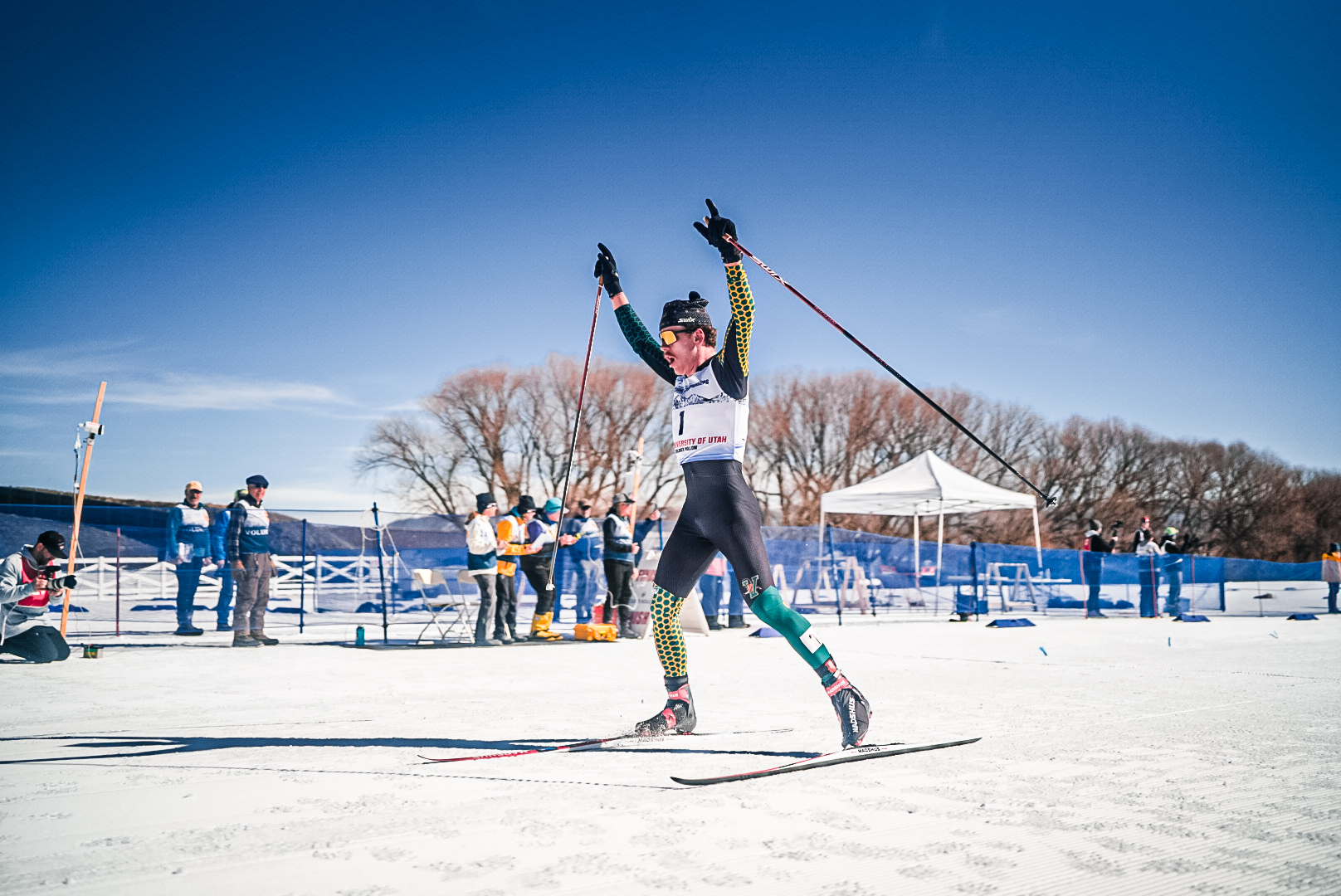
    Ben Ogden celebrates after sweeping the 2022 NCAA Championships in Midway, Utah. Ogden became 1 of only 4 skiers (alongside US Ski Team teammates Novie McCabe and Sophia Laukli) to win an NCAA Championship and represent the US at the Olympics in the same season. (Photo: Tobias Albrigtsen / @untraceableg)

    Coaching Ben Ogden — and the Art of Listening

    If Weaver’s name is not immediately known outside the NCAA world, it should be. One of his former athletes — UVM graduate Ben Ogden — is now one of the most dynamic racers on the World Cup circuit. Their partnership, built over seven years, is the epitome of Weaver’s coaching DNA: patient, collaborative, and deeply human.

    “I’m not Ben’s day-to-day coach,” he explains. “He’s got great people at Stratton and the U.S. Ski Team. But we talk — a lot. Strategy, planning, recovery, the big picture. And it’s never me saying, ‘Do this.’ We talk it through and find what makes sense logically.”

    That logic isn’t written in a spreadsheet. There are no lactate meters, no elaborate testing protocols.

    “We’re very unscientific,” Weaver says with a grin. “Ben appreciates the go-with-the-flow training plan. It’s all feel-based. If it feels good, we go with it.”

    The two share what they call the “Gus Workout” — a set of smooth, fast intervals inspired by Gus Schumacher. “It’s not about killing yourself,” Weaver says. “It’s about moving fast with good technique.”

    It’s fitting that one of America’s most promising World Cup athletes traces his development back to a coach who believes that skiing, at its best, is about rhythm and relationship more than data and drive.

    The UVM Way

    Weaver took over the Catamount program with a straightforward goal: strip away the clutter.

    “When I first got here, I just explored,” he says. “I found training venues close to campus — trails and loops that were right here. We stopped driving hours to ski. It simplified everything and gave athletes more time to recover.”

    That ethos — local, focused, efficient — defines UVM’s identity. Training isn’t glamorous, but it’s deliberate. The team atmosphere is close-knit, even familial. “There’s nothing special about UVM,” Weaver jokes, “and that’s what makes it special.”

    He points to the campus support network — trainers, nutritionists, sports psychologists, and strength coaches all under one roof — as one of the program’s hidden advantages. “It’s on par with professional teams,” he says. “The athletes can see everyone they need in one day.”

    That infrastructure helps athletes stay healthy, grounded, and balanced — which, for Weaver, is the real key to longevity.

    “We’ve had international athletes come in liking skiing, and they leave loving it,” he says. “That’s when I know we’ve done something right.”

    Junior Owen Young (Anchorage, Alaska) and Sophomore Fin Bailey (Peru, Vermont). (Photo: Phillip Belena/EISA)

    Through Change and Uncertainty

    Weaver has been around long enough to see college skiing evolve from a regional stepping stone to a legitimate World Cup pipeline. He’s also watched it collide with new realities: NIL money, early recruitment, the escalating costs of youth development.

    “When I was at UNH, I was training 500 hours a year and thought that was a lot,” he says. “Now I’ve got athletes training 700 or 800 hours — and managing school on top of it.”

    That dedication, he says, is a sign of progress — but also a warning.

    “Kids are training more and more at a younger age,” he says. “Sometimes it worries me. Are they doing it because they want to, or because they’re being told to?”

    He worries, too, about the economic side. The college landscape, reshaped by NIL and revenue sharing, could make Olympic sports harder to sustain.

    “We’re fundraising to pay athletes while big schools make $200 million a year off TV deals,” Weaver says. “It’s hard to see how that’s sustainable.”

    He laughs softly when asked what NCAA skiing looks like fifteen years from now. “I hope we’re still here,” he says. “I really do.”

    The Long Game

    If the world of college skiing is shifting underfoot, Weaver’s motivation remains rooted in something simple: people. Every year brings a new roster, a new set of personalities, a new chance to start fresh.

    “You do something long enough, it’s hard to stay motivated,” he admits. “But each fall I get new athletes, new relationships. First-year students I barely know become seniors I can’t believe are leaving. That cycle keeps it exciting.”

    He pauses, then adds, almost to himself:

    “Maybe that’s what success really is — watching them fall in love with skiing all over again.”

    UVM Sophomore Rose Horning from Leadville, Colorado. (Photo: Phillip Belena/EISA)


    Vermont’s Quiet Legacy

    Weaver doesn’t measure his legacy in NCAA titles or Olympic appearances, though UVM has had plenty of both. He measures it in the quiet mornings at Craftsbury, Jericho, or Sleepy Hollow, where athletes rediscover why they started skiing in the first place.

    He doesn’t see himself as a gatekeeper of results but as a caretaker of culture — one that prizes simplicity, joy, and belonging in a sport that often forgets how to slow down.

    In a world obsessed with metrics, Weaver’s story is a reminder: sometimes the best architectures of success are invisible — built in the space between workouts, in trust, and in the quiet confidence that skiing, at its best, should always be fun.

    “The best thing I can do,” he says, “is help people love the sport.”

    Coach Weaver chats with his first-year from St. Paul, MN, Hanna Koch. (Photo: Philip Belena/EISA)


  • In Contrast to Lake Placid Venues, Soldier Hollow Blazes its Own Path

    In Contrast to Lake Placid Venues, Soldier Hollow Blazes its Own Path

    A view of the trail system at 2002 Olympic venue Soldier Hollow

    Following the funding scare with the Olympic Regional Development Authority in Lake Placid earlier this year, FasterSkier correspondent Peter Minde is examining the structure and viability of various post-Olympic venues around North America. This piece, his second in the series, looks at the status of Soldier Hollow, in Utah.

    Cross country skiing and biathlon drew more athletes and spectators than any other sports at the 2002 Winter Olympic Games in Salt Lake City. But Soldier Hollow, the venue for those events, had a murky post-Olympic future even as it was being developed.

    While Lake Placid’s Mount Van Hoevenberg is managed by a semi-public entity that depends partially on state financing, Soldier Hollow is a stand-alone organization.  Although it’s on state land, SoHo receives no state funding and must rely on its own initiatives to keep running.

    Originally, Soldier Hollow wasn’t in the picture for the Winter Olympics. In their bid for the 2002 Games, the Salt Lake Organizing Committee (SLOC) had proposed running cross-country events at a golf course just outside of town.

    According to William Spencer, the deputy chief of competition for biathlon at the Games, SLOC wanted to construct the venue at a temporary facility at the Mountain Dell Golf Course. But Mountain Dell was in an area with unreliable snowfall.

    “Could we have done it there [Mountain Dell]? Probably. But there were hurdles we could avoid by going elsewhere,” said Gordon Lange, head coach of the Park City Nordic Ski Club. In addition to unreliable snowfall, there were water runoff concerns, and snowmaking at Mountain Dell would have been very expensive. Development of Olympic-quality trails would also have disturbed protected habitat in East Canyon and Mountain Dell.

    A young Torin Koos racing at Soldier Hollow

    Organizers conducted on-site inspections of seven potential sites before SLOC narrowed it down to two candidates. The venue was then switched to Soldier Hollow, which has “some of the best skiing anywhere in the world,” says U.S. Nordic Combined Head Coach Dave Jarrett. Opened in 2000, Soldier Hollow was the site for all the cross country, biathlon and Nordic combined events at the 2002 Games.

    When the Games generated a profit, SLOC had money to spare to ensure that the Olympic venues could be used by the public for years to come.  The Utah Athletic Foundation (UAF), a private non-profit, was designated by the state to take ownership of Olympic Park, the Park City venue for ski jumping and luge, bobsled and skeleton, and the speed skating oval near Salt Lake City. Endowed with $76 million, UAF took over these sites in May of 2002, expecting to manage them on interest generated by the endowment.

    State legislation originally specified that any profit from the games would endow only Olympic Park and the speed skating oval, and Soldier Hollow was to be on its own starting in early April, 2002.  But because UAF received a larger-than-expected endowment, in early October of that year, the Utah state parks board transferred Soldier Hollow’s concession to UAF. Thus, the cross-country venue benefited from a financial commitment that enabled them to invest in infrastructure and equipment.

    But the affiliation was not necessarily permanent. Indeed, by early 2004, UAF was struggling, and news sources were reporting the layoff of twelve employees. An item in a July, 2004 issue of the Salt Lake City paper Deseret News noted that despite its endowment, UAF was having difficulty breaking even on its operations at Olympic Park and the Olympic Speedskating Oval.

    For UAF, there was an out clause after two years. In an interview, Jarrett noted that despite campaigning to grandfather Soldier Hollow in to UAF, the two organizations severed their relationship in the spring of 2004. UAF didn’t think it could afford to fund Soldier Hollow in addition to its other two venues.

    The Soldier Hollow Legacy Foundation (SHLF), which manages the ski area, was founded in 1999 to perpetuate the ski venue following the Olympic Games. According to General Manager Howard Peterson, as a concessionaire operating on state land, SHLF pays 6 percent of its gross receipts to the state. A main focus of SHLF’s mission is to reach and expose local kids to cross-country skiing.

    With no government aid and a limited commitment from UAF, Peterson was compelled to find creative measures to attract visitors and enhance Soldier Hollow’s bottom line. Consequently, one can do a lot more than simply ski at Soldier Hollow. Mountain bikers ride the cross-country trails from May through October. Parking fees assessed to those attending the Soldier Hollow Classic Sheepdog Championships, now in its ninth year, fund junior ski programs. The Soldier Hollow Charter School rents space in the competition center for its 150 students, in classes ranging from kindergarten through 8th grade.

    “If it wasn’t for Howard, we wouldn’t be skiing there right now,” said Lange, whose juniors spend time training at Soldier Hollow both on snow and on roller skis.

    In the summer of 2002, work began on a 1,200-foot tubing hill, funded by UAF.  The lift-served hill was a hit, accounting for approximately 59 percent of Soldier Hollow’s revenue in 2008, the most recent year for which data is available. (By contrast, skiing made up a mere 18 percent of revenue.)

    Peterson felt that a tubing hill was a great way to attract visitors who might not be interested in skiing. “[The campaign] is about snow,” he said.

    “Tubing provides an alternative for families where some members might not want to ski,” said Bill Hokanson, the head coach for the Utah Nordic Alliance’s

    The start of a women's race at the 2002 Olympics in Soldier Hollow

    competition programs.

    There’s also the charter school, which adds to the pool of skiers at the venue, in addition to paying rent. As part of their curriculum, charter school students get outside on skis about four times a week during the winter.

    But the legacy foundation doesn’t just keep Soldier Hollow open, however—the organization also gives back to the community.

    Monday through Thursday during the winter, three or four school buses roll in each day, introducing what Peterson estimates are 9,000 children to skiing each winter. Soldier Hollow does “a fantastic job of introducing skiing to organizations and schools,” says Hokanson.

    Jarrett started Soldier Hollow’s youth ski program from scratch in fall of 2000, bringing cross-country skiing to an area where the sport had little tradition. The club, now called Team Soldier Hollow, is comprised of various programs for juniors, from beginners through a development team.

    SHLF also provides support for athletes who qualify for the Junior Olympics, with a combination of fundraising assistance and scholarships. And aspiring elite athletes benefit from discounted ski passes, which are available to athletes on formal teams.

    In contrast to the venues in Lake Placid, which have been subject to the whims of the New York state budget process, Soldier Hollow now seems stable in comparison: SHLF’s financial footing appears sound, and Peterson was positive about its future. One thing is certain: the venue is almost certainly better off as an independent entity than as a part of UAF. In March, the Utah legislature was presented with SRJ011, a bill which would allow UAF to sell a portion of the Olympic Park property. The body of the bill notes that the Olympic Park and speed skating oval’s annual costs have consistently exceeded revenues, and that UAF’s endowment might be exhausted by 2025.