From the FasterSkier archive — posts syndicated from athletes’ and coaches’ own blogs between 2004 and 2012, kept online as published. Current coverage is at fasterskier.com.
CRAFTSBURY, Vt. — Kris Freeman earned his third win of the weekend Sunday, with a 20.4-second lead in the men’s 15-kilometer classic mass start on the snowy trails of the Craftsbury Outdoor Center. With snow falling throughout the entirety of the three-lap course, Freeman overcame the elements to create a large gap over his competitors at the 10 k mark in the SuperTour and Eastern Cup race.
He skied alone for the final 5 k of race, plowing through the fresh snow with ease and strength.With a time of 42:46.4 Freeman crossed the line with no one else in sight. He raised his hands above his head, celebrating his many wins in Craftsbury. Freeman’s success comes before his eighth career World Championships which will take place in Falun, Sweden Feb. 18. Freeman travels to Europe Thursday to prepare for the event.
In a battle for second, Gordon Vermeer of the Craftsbury Green Racing Project and Lex Treinen of Alaska Pacific University charged down the finishing stretch, lunging to see who would claim the second rung of the podium. In the end it was Vermeer who would come out on top, besting Treinen by 0.01 seconds. The two finished 20.4 and 20.5 seconds behind Freeman.
In fourth and fifth were Eric Packer of APU and Justin Freeman skiing for Holderness. Packer finished 27.1 seconds back from the first Freeman. The victor’s brother, Justin Freeman, finished 28.6 seconds behind his training partner.
In the women’s 10 k classic mass start it was Becca Rorabaugh who rocketed to the top of the podium to earn her first SuperTour win. After skiing the seventh-fastest split at the 5 k mark, she accelerated to make contact with the lead pack of Anja Gruber of Far West Elite, Chelsea Holmes of APU, and Mary Rose of the Sun Valley Ski Education Foundation. With roughly a kilometer to go, Rorabaugh was sitting in with the lead pack but took command into the stadium after utilizing a strong double-pole. She crossed the the line with a time of 33:24.0.
Close behind was Mary Rose who earned her second podium of the weekend after winning Saturday’s 10 k freestyle. She trailed Rorabaugh by 0.9 seconds. Third went to Gruber, who came across the line 4.1 seconds back from the leader.
Rounding out the top-5 were Kaitlynn Miller and Caitlin Patterson, both of the Craftsbury Green Racing Project. The two
In the junior women’s 5 k Mae Chalmers won with a time of 17:51.2. Her male counterpart, Adam Gluek of Ford Sayre, won the junior men’s 5 k. He crossed the line in 15:03.4.
Sunday’s races concluded the three-day weekend of the Craftsbury SuperTour, Dartmouth Carnival, and Eastern Cup. SuperTour racing continues Feb. 21 in Haywood, Wisconsin at the American Birkebiener.
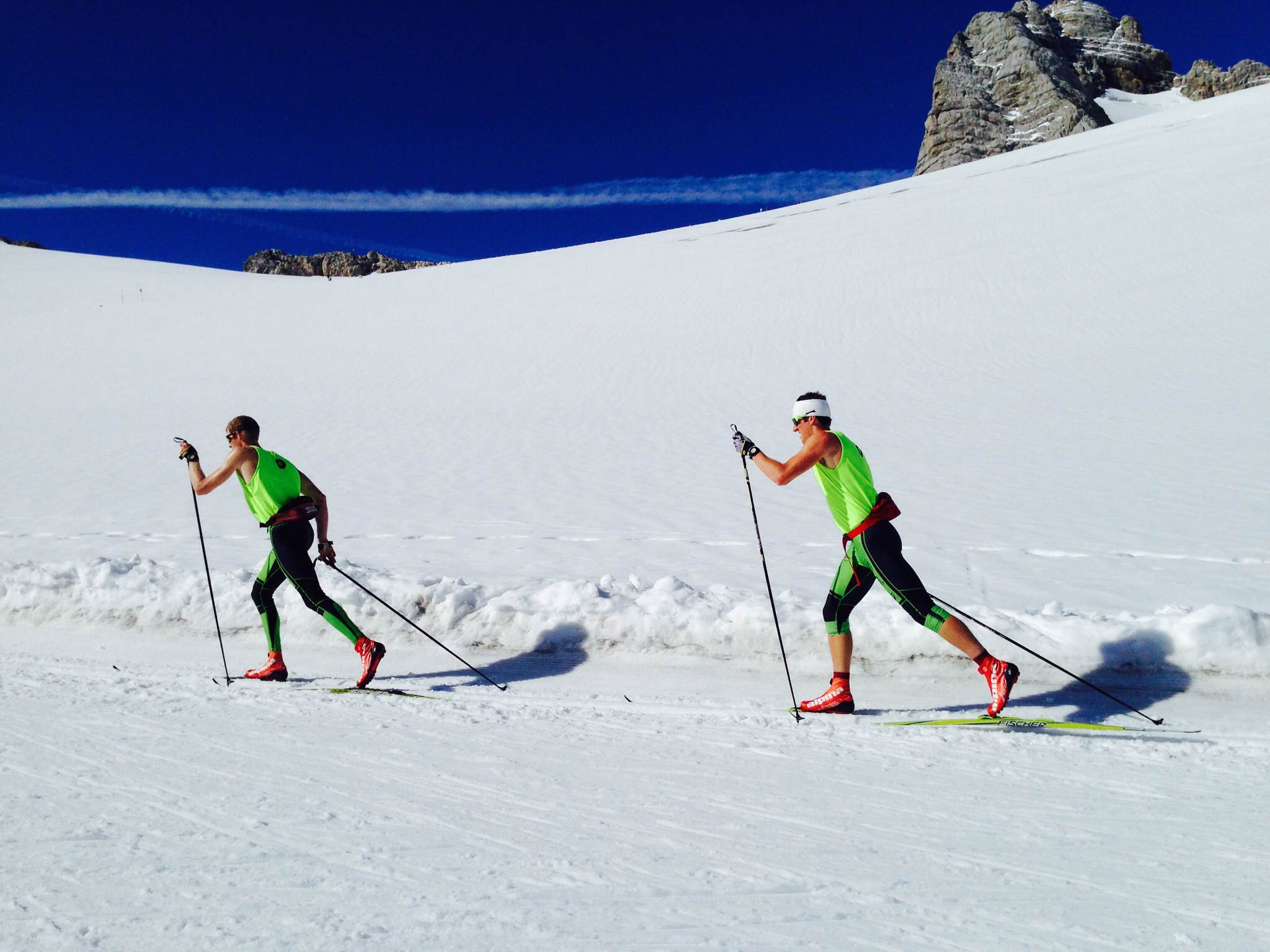
Craftsbury Green Racing Project skiers traverse the Dachstien Glacier in Rasmau, Austria as part of the teams on-snow camp in September 2014.
Anne Kyllönen is an exemplary skier. The Finnish athlete’s technique – both flawless and efficient – has served as an example for the USST and other American club teams over the 2014 summer to help visualize improvements.
But why watch a video when the real thing can be right in front of you?
Such was the case for Ida Sargent, who had the opportunity to mimic the 2014 Olympic medalist’s technique in-person during the Craftsbury Green Racing Project’s (GRP) training camp in Ramsau, Austria.
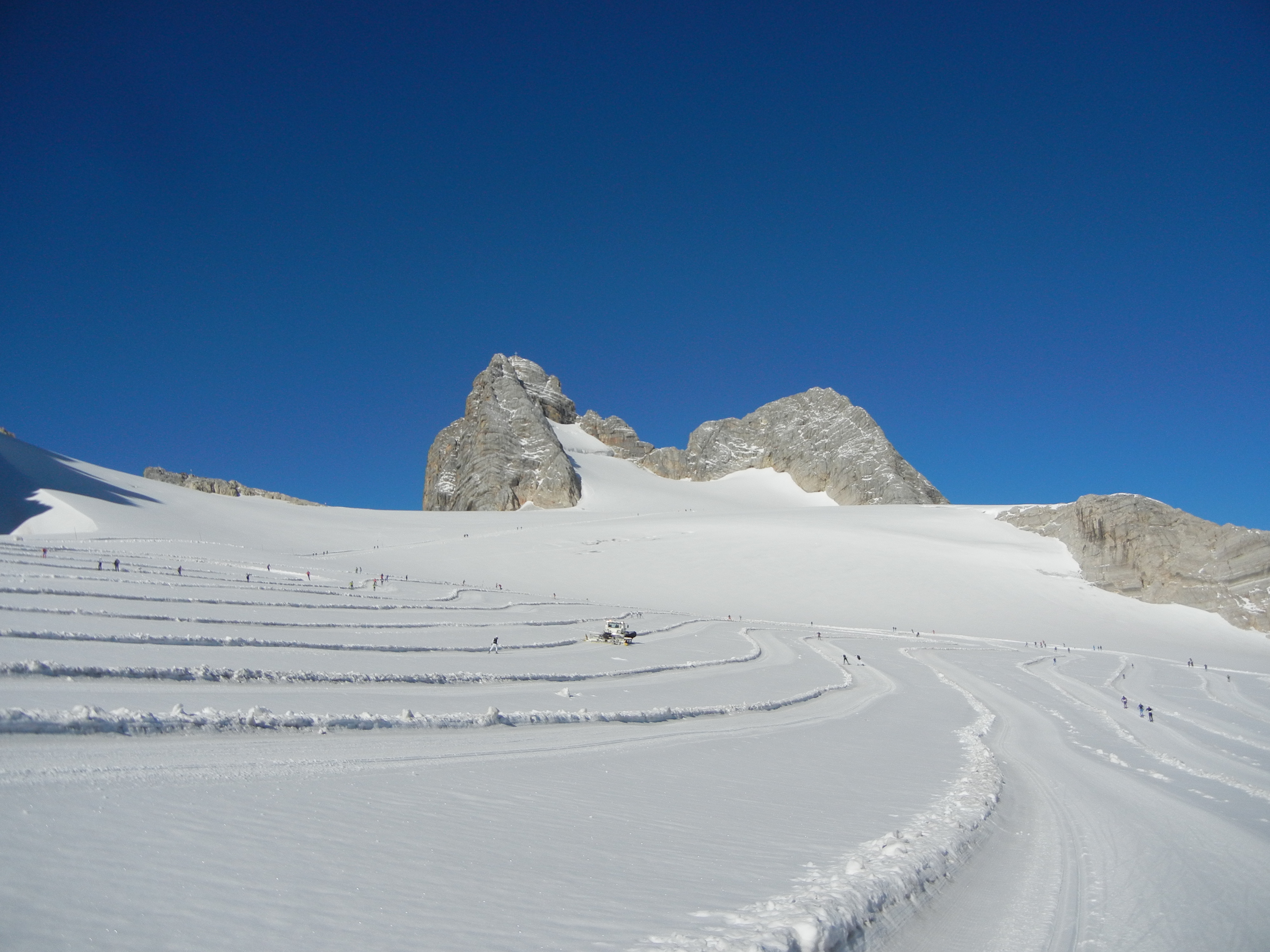
Pristine September skiing on the Dachstein Glacier in Ramsau, Austria. (Photo: GRP Blog)
This is the first year that GRP has made the summer trip to Austria, and so far the team’s skiers have given the experience rave reviews. While traveling across the globe to find on-snow training opportunities has become a rarity in U.S. skiing in recent years (Noah Hoffman was the sole USST member to make the trip to New Zealand this year), Austria might be closer than it seems.
According to GRP athlete Liz Guiney, it is just as demanding to travel to Europe from the East Coast as it would be to go to Haig or Eagle Glaciers, which are located in Canada and Alaska.
“Once we made it to Munich, it was an easy three hour drive to Ramsau, and we were all set,” Guiney wrote in an email. “Logistically speaking, it makes more sense for our team to come here, because anyone is welcome to use the Dachstein (Glacier) and you don’t have to take a helicopter up there.”
The team arrived in Austria Sept. 8 and will remain until the Sept. 27. The squad of GRP athletes in attendance includes Gordon Vermeer, Pete Hegman, Alex Schulz, Andrew Dougherty, Ethan Dreissigacker, Jake Barton, Mike Gibson, Caitlin Patterson, Kaitlynn Miller, Guniey, USST member Sargent and the coaching staff of Pepa Miloucheva and Nick Brown..
The Dachstein Glacier, which boasts an elevation of 2,800 m, or just under 9,200 ft., is one of several European glaciers that is groomed for off-season skiing. Each year skiers from around the world take advantage of the 9 k of groomed summer trails.
According to Sargent, the glacier’s conditions have been better than expected with hard and fast tracks. Even though the team endured some rain and fog during the camp’s first week, she said the sunny days have been spectacular.
“The skiing conditions have been really good… The past couple days have been those magical days when you have to pinch yourself to see if it is actually real,” she wrote in an email. “It is sunny and warm but the tracks were staying very firm and fast. I didn’t even know that was possible.”
https://www.youtube.com/watch?v=EfwXde3TC0s
While the afternoons can be too warm for skiing, the team often runs on one of the many trails that take them straight from the door of their house in the Austrian Alps. The lower elevation running also helps diversify their training.
According to Sargent, the main purpose of the Rasmau camp is to implement technique changes made during the summer to on snow skiing. With the Austrain camp, Canmore’s Frozen Thunder, and the start of the World Cup season in November she hopes to eliminate as much off-snow training as possible.
GRP coach Miloucheva explained that partaking in on-snow training for an extended period of time in the summer and fall can aid her athletes in avoiding the technique mistakes of the previous season.
“Back in U.S. we normally have only a few days to a week on snow before we start racing and this isn’t enough, so normally everyone goes straight to same mistakes they did last winter,” she wrote in an email.
Guiney explained that the Rasmau camp helps skiers like herself have a seamless start to the season because it allows for a low-pressure transition from rollerskis to snow.
“That real snow feeling is very hard to replicate, and making technique changes in, say, West Yellowstone, when you also have to prepare to race a few days later, can be challenging,” she said. “This way we can make and implement changes, and it will make the transition to snow in November that much easier.”
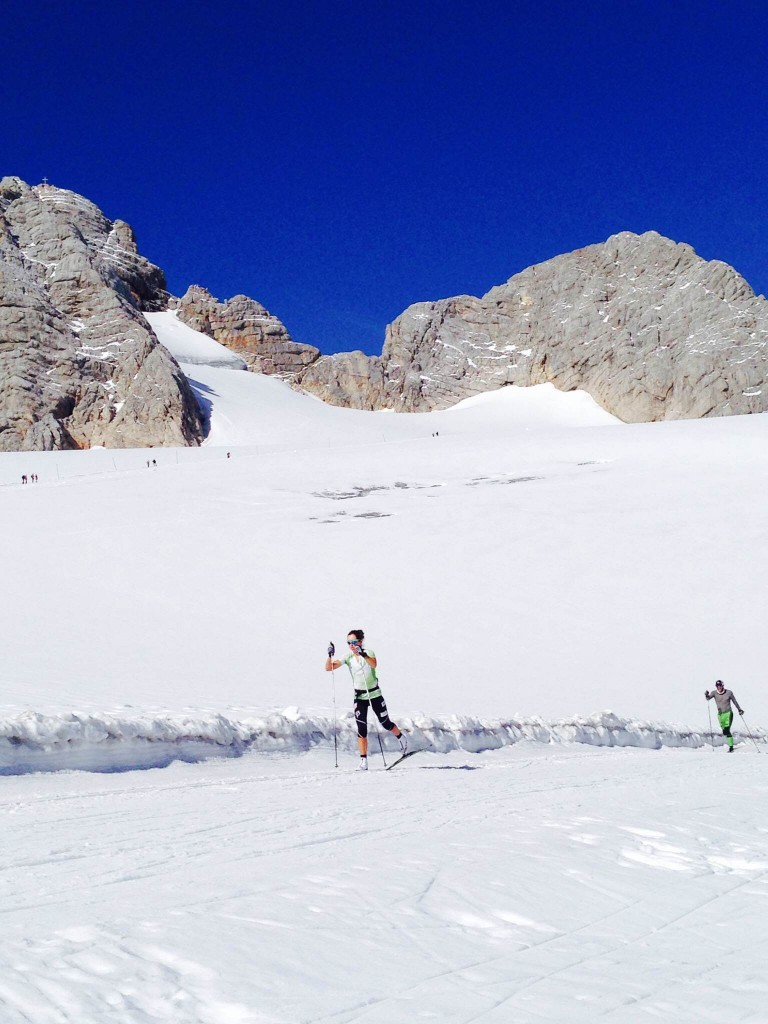
Caitlin Patterson (GRP) takes advantage of the sunshine to ski the firm and fast conditions of the Dachstien Glacier in Ramsau, Austria as part of the GRP’s on-snow training camp. (Photo: GRP Blog)
GRP isn’t the only team hoping to take advantage of early fall skiing. The Swedish, Finnish, Russian, Estonian, and Japanese national teams have been training alongside the American team – an experience that has proven to be extremely valuable for some of GRP’s athletes.
“It’s really inspirational to share a training venue with the best skiers in the world; technique lessons are just a matter of looking around you or hopping in behind someone and hoping they don’t mind,” explained Guiney, who said that she spent time skiing behind both Swedish star Charlotte Kalla and Kyllönen.
Guiney said that one of the highlights of the camp was witnessing GRP skier Andrew Dougherty jump in behind Olympic champion Giorgio Di Centa of Italy.
“Andrew is always wearing hats with pom-poms – it’s kind of his ‘look.’ We always joke that he looks just like Di Centa, and seeing them ski together was priceless,” she said.
Despite the many skiers on the glacier’s trails, Sargent said that space wasn’t an issue. The 26-year-old, who has been regularly skiing with several Swedish and Finnish skiers over the course of the camp, said that it has been great to catch up with friends from the World Cup.
GRP continues its Rasmau training camp until Sept. 27, when it returns to the U.S. for the rest of the fall training season.
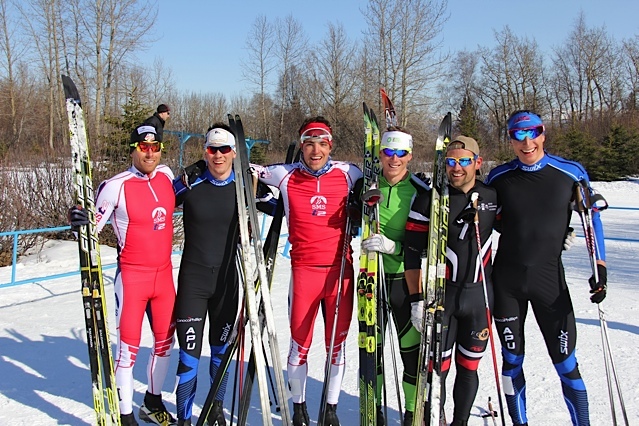
It’s an amiable atmosphere at Spring Series in Anchorage, Alaska, as seen here after Sunday’s classic-sprint final. Teams will compete for a national title on Tuesday in Kincaid Park in the coed 4 x 5 k, the first race of U.S. Distance Nationals. From left to right: Andy Newell (SMST2/USST), Reese Hanneman (APU/USST), Ben Saxton (SMS), Pat O’Brien (CGRP), Dakota Blackhorse-von Jess (BEA), and Tyler Kornfield (APU). (Photo: Rob Whitney)
When the U.S. Ski and Snowboard Association (USSA) met last spring, they decided it was time for a bit of a change at the season-ending SuperTour Finals and U.S. Distance Nationals. Instead of a hill climb, they opted for a team relay at the races in Anchorage, Alaska, scheduled for the following March 22-28.
According to the event’s race director James Southam, a two-time Olympian from Anchorage, athletes brought up the idea of a team event last year. An opening in the schedule made the 4 x 5-kilometer relay possible for 2014.
But unlike most four-person relays, the one going off Tuesday at 5 p.m. Alaska time will be coed with a male scramble classic leg tagging to a female classic skier, then male freestyle skier, and finally, a female freestyle anchor.
“I think it’s gonna be fun,” Southam said. “The last distance relay I remember doing was I think in Bend [Ore.] in 1998 or something like that for nationals. I think having the coed is going to be cool. … You don’t need four good guys or four good girls; I think it makes it a little more competitive.”
Eighteen official teams (including two junior squads), each made up of two males and two females from the same USSA club, will compete for a national title — and $750 dollars in prize money to split four ways. The second-place team will receive $500, and third gets $300.
It’s the second-to-last competition before Friday’s 30 and 50 k classic mass starts, which will be held at a different venue than the rest of the races at Kincaid Park, at the Hillside Trail System on the east side of town.
Teams to watch include Alaska Pacific University’s first team, with Reese Hanneman, Sadie Bjornsen, Erik Bjornsen, and Kikkan Randall, in that order. The top team from Stratton Mountain School T2, Andy Newell, Sophie Caldwell, Simi Hamilton, and Jessie Diggins will also contend for the title, along with Craftsbury’s Patrick O’Brien, Ida Sargent, Gordon Vermeer, and Caitlin Patterson, and Sun Valley’s Mikey Sinnott, Mary Rose, Matt Gelso, and Chelsea Holmes.
Several college teams, such as the University of Vermont, Northern Michigan, New Mexico, and the University of Alaska-Anchorage will also be vying with the best of them.
There are also few unofficial teams with skiers from different clubs that have a shot at winning for glory rather than cash. Fastest of the Fast Twitch includes Brian Gregg (Team Gregg/Madshus), Liz Stephen of the U.S. Ski Team (USST), Noah Hoffman (SSCV/Team HomeGrown/USST), and Caitlin Gregg (Team Gregg/Madshus). The Vagabonds are Karl Nygren (Podiumwear), Jennie Bender (Bridger Ski Foundation), Mark Iverson (Rossignol), and Cambria McDermott (independent).
Each competitor will ski two laps of either a roughly 3.3 k classic loop (for 6.6 k total) or a 2.6 k skate loop (for approximately 5.2 k).
As for the 5 p.m. start? It’s all about getting the best bang for the buck in terms of participation, volunteers and spectators.
“We want as many of the kids from around town to be able to race in it as well and to come out and watch it,” Southam said. “When you have midweek races at 11 o’clock it’s hard to get the kids out to watch. One of the big reasons we wanted to host these races is, after the Olympics people have been paying attention to skiing all winter long and it’s pretty powerful for kids coming up to be able to watch Olympians and world champions.”
Of the 26 teams entered in Tuesday’s relay, the two official junior squads are from APU. One unofficial team includes three men and a woman, another has four junior males, and one has three males, which will complete three legs and then call it a race.
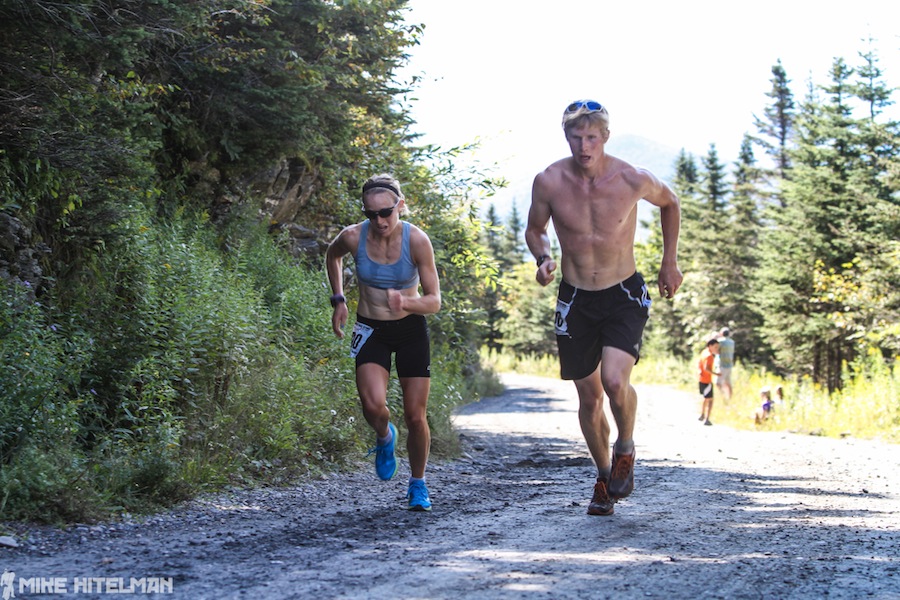
Olympian Liz Stephen challenges Patrick O’Brien of the Craftsbury Green Team during the 6th Annual Race To The Top of Vermont on Aug. 25. (Photo: Race To The Top Of Vermont)
Editor’s note: This story has been updated to include the overall women’s course record, set by mountain biker Lea Davidson last year.
Before last Sunday, Liz Stephen isn’t sure if she had ever been to the top of Mount Mansfield’s Toll Road, which winds for 4.3 miles up 2,564 vertical feet in Stowe, Vt. Didn’t matter.
The 6th Annual Race To The Top Of Vermont was another hill climb, and the 26-year-old affectionately known as “spider monkey” on the U.S. Ski Team had a goal of winning, setting the run course record and beating mountain bikers in the process.
“My goal was to try and get both the record for the women’s run, but also knew there was an overall bike and run record as well that was worth a bit of money,” Stephen wrote in an email earlier this week. “So I was shooting for that as well.”
The runnning time to beat was 39:17.7 minutes, set in 2011 by defending champ Kasie Enman of Huntington, Vt. (the overall women’s course record was 37:18.7, set by m0untain biker Lea Davidson of Jericho last year). Stephen, who hails from East Montpelier, shattered the run record by nearly two minutes in 37:22 (and missed the overall record by about 3 seconds). She beat the first female mountain biker, Marilyn Ruseckas of Warren, by almost seven minutes.
Runner-up Ida Sargent, another Vermont native and Stephen’s teammate on the national team, explained she never saw much of Stephen in her third consecutive Race To The Top. Last year, Sargent placed third behind Enman, who was third on Sunday. Enman had a baby this spring and ran slightly behind Sargent for the entire race, but Sargent explained she could hear people cheering for Enman for much of it.
“[Liz] was gone when the gun went off so I was running my own race,” Sargent, 25, wrote in an email. “But there were lots of guys around me to run with. Liz was absolutely amazing and it was really cool to see her run that fast. She’s a speedy mountain goat!”
Add that to the list of nicknames for the World Cup phenom, who placed fifth at World Championships last season in the 10-kilometer freestyle individual start on a grueling course at 4, 700-feet above sea level in Val di Fiemme, Italy.
The toll road peaked at 4,393 feet atop Vermont’s highest peak.
“It’s true that I like to go ahead early when I can, but it doesn’t always work out,” Stephen explained. “With these types of races, it is pretty hard not to just go as hard as you possibly can. The goal for me was to pace it well so I could run as fast as I could.”
The fruits of her effort paid off and indicated her fitness was on track three months before winter racing resumes in Europe.
“However, I am a cross country skier and that is about fitness, power, strength, mental toughness, and technique, among other factors, so I will just keep training the way I have been training and preparing for the winter races,” she wrote.
Stephen also used the race as a fundraiser, publicizing her participation on a website to raise money for Vermont skiers gearing up for the 2014 Olympics in Sochi, Russia. As of Friday, she’d raised $2,450 dollars. Sargent (Craftsbury Green Racing Project) was also included in the fundraiser.
“The fundraising effort has gone great, so far,” Stephen explained. “We will leave the fund up until the day the Olympics begin, so it will give people a good amount of time if they would like to contribute at some point between now and then. The response is always great in this area when you ask for help and support of one sort or another. We have such incredible communities that care about one another and want to be involved here in Vermont.”
Sargent has been recovering from Achilles tendinitis and hadn’t originally planned to race, fearing the consistent uphill grade could do a number on her.
“So I just went to the race planning to run and hike up and cheer for my teammates but then I got the race itch and couldn’t help not putting on a bib,” she wrote. “I was really excited to be able to race and mostly not have my Achilles bother at all. And I was a minute faster than last year which is a very promising sign about my fitness.”
Sargent explained she hasn’t been running as much this summer as past years and didn’t think too highly of her running shape going into Sunday’s race.
“It’s a really hard race but it was a beautiful day on top and awesome to see so many people out there running, biking, and hiking up the mountain,” she wrote. “The local support was incredible. It’s very inspiring and I’m very thankful!”
Stephen placed 10th overall and Sargent was 31st behind men’s winner Eric Blake of West Hartford, Conn, who broke the men’s course record by a minute and 2 seconds in 32:51.3. A 2006 Olympic nordic skier, Justin Freeman of New Hampton, N.H., was second in his debut Race To The Top in 34:42.3. Craftsbury GRP skiers Gordon Vermeer was fifth (36:14.6), Pat O’Brien was ninth (37:20.5) and Andrew Dougherty was 19th (39:57).
The top mountain biker, Gered Dunne won in 32:58.2, but Freeman edged second-place biker Jake Hollenbach by nearly 19 seconds. In an email, Freeman, 36 explained Blake started conservatively before making a small move about a half-mile in. Third-place finisher Josh Ferenc followed, and Freeman fell a few seconds behind.
“Around the mile mark Blake made a bigger move, dropping Ferenc, who faded hard,” he explained. “I ran with him for less than a minute and then started to gap him. I didn’t look back, but I could tell from listening to people cheer that I built a lead of between 20 and 30 seconds by about a mile to go. From there Ferenc was slowly gaining but not enough to catch me.”
Freeman beat Ferenc by 11.7 seconds.
“I was disappointed not to go under the old record, but I am actually pretty happy to be only two minutes behind Blake,” he wrote. “Josh Ferenc has defeated me handily the two previous times I have raced him this summer, so it was nice to come in ahead of me (I agreed with him that I am now a runner/skier, so he need not suffer the stigma of having been beat by someone who is just a skier). I will probably go back next year, and I think I have it in me to run about a minute faster.”
In terms of hill climbs, Freeman stated that this was like most others.
“It’s an uphill run, so it requires going really hard, but in terms of racing tactics it is pretty straightforward,” he wrote. “You go as fast as you can without building too much lactate. The grade varies a lot more than Mt. Washington, which gives some chances for something resembling recovery, but in the end it is like any other 35-minute hill climb.”
As for what’s next, Stephen and Sargent are due to meet up with the U.S. Ski Team in Lake Placid, N.Y., next week. The annual fall camp ends with the Climb to the Castle on Sept. 15 – a rollerski race which the multiple-time defending champion Stephen essentially owns.
“The Climb to the Castle is a great test of fitness as well as just a good, hard effort, both mentally and physically,” Stephen wrote. “I look at it as a good way to practice race prep routines and race day nerves, as this race makes me so dang nervous every year!”