
MINNEAPOLIS — After Gus Schumacher’s upset win at an international cross-country ski race here last week, one of his first moves was not to celebrate at a bar, but instead, to stand in front of the crowd and talk about climate change.
With hundreds listening to the panel discussion from the grandstand, Schumacher, his teammate Jessie Diggins and activist and author Bill McKibben passed a microphone back and forth.
The subject, for Schumacher, is immediate and personal: Global warming poses an existential threat to his chosen sport, and not just over the long term.
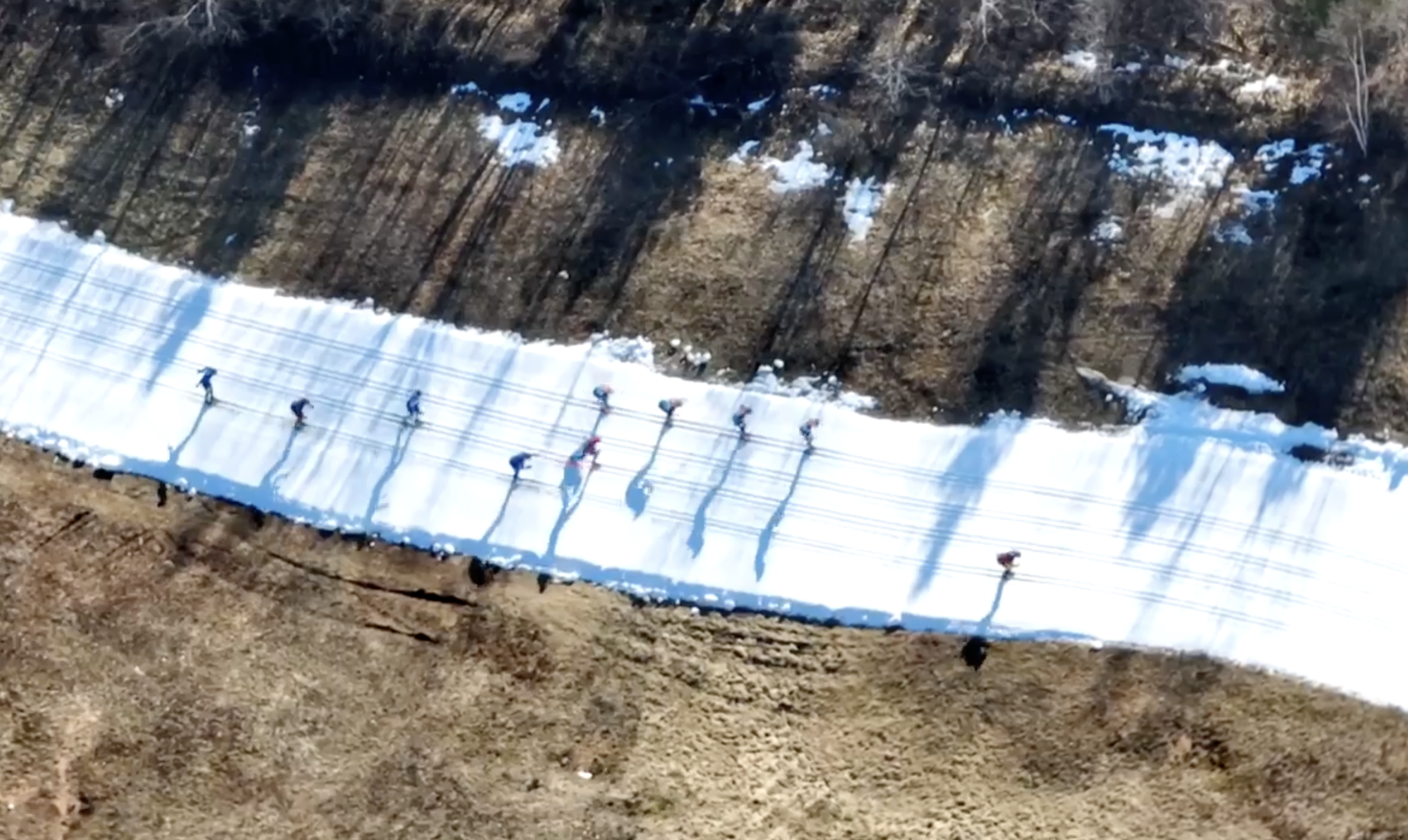
Minneapolis has had its warmest winter on record this year. Up until a storm dumped six inches of snow on the same day the international cross-country skiing circuit arrived in the city, organizers were expecting to hold the races on a ribbon of man-made snow snaking through an otherwise bare and brown golf course.
“We’re a sport that needs snow, and cold temperatures,” Schumacher said in an interview. “We can be a group of people that can make some change.”
Climate advocacy is at the center of Schumacher’s career: He’s part of a coalition of athletes and other outdoor professionals called Protect Our Winters, and wears the organization’s logo on his hat when he races. Five of his American cross-country ski teammates also work with the group, including Diggins, who’s on its board.
But some of Schumacher’s other teammates and rivals, meanwhile, have held back — in part based on their fears that speaking up could make them sound hypocritical, given the carbon-intensive nature of their careers.
“We’re the ones flying the most. We’re the ones traveling the most,” said Mika Vermeulen, a 24-year-old Austrian racer. “And then we are going to tell other people to cut down on stuff?”
Schumacher acknowledges that there’s some inherent awkwardness in his work, because of his background and occupation.

“Most of us are upper class white kids that, when climate stuff is starting to hit the fan, we have somewhere to go,” he said. “Other people don’t have that liberty.”
But advocates familiar with Schumacher’s sport, however, say that athletes shouldn’t get too hung up on their own individual identities and lifestyles when the problem is systemic.
“We’re in much too deep a hole to climb out of it one Tesla at a time. That’s not how this is going to work,” said McKibben, a writer, activist and avid cross-country skier who wrote a groundbreaking book on climate change. “The most important thing an individual can do is be less of an individual, and join together with others to fight to change the basic political and economic ground rules.”
People can bring their own unique skills and experiences to that effort, McKibben said. Some can testify to the impacts of rising seas; others will bear witness to the disappearance of winter, he added.
“I think the only requirement, now, is that you actually be willing to just be plain-spoken about it,” McKibben said. “And by plain-spoken, I mean willing to actually take sides.”
‘Imperfect advocacy‘
Schumacher, 23, has done just that.
Raised in Alaska, where oil producers have long funded the state budget and commanded ample political and economic power, the Olympian and world junior champion has nonetheless been willing to publicly challenge the industry — which has been a longtime sponsor of Schumacher’s own club team and Anchorage’s cross-country ski association.
In 2022, when ConocoPhillips was seeking approval for its big Willow oil development on Alaska’s North Slope, Schumacher helped amplify Protect Our Winters’ opposition campaign on his own social media accounts.
Afterward, he found himself invited to a meeting with ConocoPhillips officials, who tried to convince him that the project was a “good thing,” Schumacher said. It was clear that he’d gotten the company’s attention, he added.
“That was, honestly, a cool thing to experience,” he said.

Along with Diggins, Schumacher has also taken lobbying trips to Washington, D.C., where he’s spoken with one of his U.S. senators, Republican Lisa Murkowski, about the Willow project and about global warming’s impacts on a failing commercial salmon fishery that his family has participated in. And he’s started publishing a climate focused-newsletter for the Anchorage skiing association.
“You can move the needle pretty easily,” said Schumacher, adding that he’d like to see a little more advocacy from his colleagues on the World Cup circuit. “I’d think that the Norwegians could meet with the king and the prime minister tomorrow, if they wanted to.”
So far, though, most cross-country skiers from other nations have not because vocal advocates on the subject of climate change.
In Norway, the national ski federation is sponsored by Equinor, the state-owned oil and energy company, and recent World Cup races held in the country have drawn disruptive protests from climate activists.
In an interview after a World Cup race in Canada this month, Simen Hegstad Krüger, a Norwegian Olympic champion, said there’s no doubt that global warming is a “big issue,” particularly for athletes who depend on snow.
“It’s crucial that we have good winters,” Krüger said. “But I can’t say that I have the solution.”
Krüger noted that the International Ski Federation, which runs the World Cup circuit, has taken steps to reduce jet travel by teams — namely by clustering a few cross-country race weekends at a time at ski areas within driving distance.
But McKibben, the author and activist, cautioned athletes against focusing narrowly on the climate impacts of their own participation in the World Cup.
“The key task here is not reforming cross-country ski racing in order to make it less damaging. Because on any applicable scale, it’s irrelevant,” McKibben said. “On any applicable scale, almost everything is irrelevant that anyone’s doing — it’s the whole thing that has to shift.”
The power that professional skiers can wield most effectively, McKibben and others advocates said, is through their platforms. Tens of thousands of people follow athletes like Schumacher and Diggins on social media, and thousands more turned up in person to watch them compete in Minneapolis last week.
“The medium of sports, and the medium of storytelling that goes along with sports, is such a potent tool to use in order to drive change,” said Graham Zimmerman, a mountain climber who helps manage Protect Our Winters’ athlete coalition, and who participated in the panel discussion in Minneapolis.
Ben Ogden, a 24-year-old American ski racer who’s been ambivalent about participating in climate advocacy, said those arguments make sense to him — and that waiting to get involved makes him feel like he’s “making a bunch of excuses for not being more proactive.”

“But I think I’m waiting for the thing that feels right for me,” Ogden said. “I need to figure out, personally, how I can use that voice without being hypocritical.”
Speaking out about climate change’s effects on his sport feels trivial, Ogden added, when considering the life-or-death impacts that global warming could inflict on more vulnerable people.
“There are a lot of horrible tragedies in the world that are at the hands of climate change,” Ogden said. The possible loss of cross-country skiing, and “nice snow,” he added, are “probably among the least compelling ones.”
Zimmerman, with Protect Our Winters, said that his group isn’t acting out of self interest — “so that we can go ski more” —as much as it’s asking coalition members to leverage their profiles to ensure worldwide access to clean air, clean water and clean energy.
The organization has also tried to tackle, head on, the guilt that some athletes feel about their own climate impacts: It recently funded a film, “The Hypocrite,” that follows a professional skier, Amie Engerbretson, as she tries to reconcile her fossil fuel-intensive career with her participation in environmental advocacy.
“The perceived hypocrisy about being a climate advocate who also travels for sports a lot is something that’s a stumbling block for a lot of people. But it’s something we have to get past,” said Zimmerman. “We live in an imperfect system. And to work within that system, to advocate within that system, to build a platform within that system requires burning fossil fuels. Imperfect advocacy is the only thing we’ve got.”
Diggins, at a news conference in Minneapolis, said she’s embraced that concept.
“Of course, there’s some hypocrisy there. We fly, for our jobs, like most people,” she said. But, she added: “If we have a chance to do something, or anything, to take a step in the right direction, that is better than sitting back and just watching the world burn.”