From the FasterSkier archive — posts syndicated from athletes’ and coaches’ own blogs between 2004 and 2012, kept online as published. Current coverage is at fasterskier.com.
We’re happy to welcome Patrick O’Brien back to the ranks of the Craftsbury Ski Club, this time as the Assistant GRP Ski Coach. Pat, a native of Putney, VT, raced collegiately for Dartmouth before his stint as a professional ski racer with the Green Racing Project from 2010-2014.
While on the GRP, Pat competed in multiple World Cups and also became known to the Craftsbury community as a hardworking jack-of-all-trades with a deep love of skiing and the outdoors. Pat moved on from racing to become the head coach of the SMS T2 team from 2014-2022. Although he coached multiple athletes to international success, he’s most proud of the role he played in building a program that brought together athletes of all ages and rooted the team in its local community.
In recent years, Pat has supported various junior, college, and elite teams as a service technician, all while juggling a job as a builder and wrangling a growing young family. When not up to his eyeballs in ski wax or construction detritus, Pat can often be found outdoors with his wife Ida, who also has deep ties to Craftsbury, and their two kids. Welcome back, Pat!
The Craftsbury Outdoor Center is hiring for two coaching roles within its Green Racing Project (GRP), a year‑round elite Nordic ski program supporting post‑collegiate athletes pursuing national and international competition. These positions are in‑person roles based in Craftsbury Common, Vermont and are integral to the daily training, development, and competitive success of GRP athletes.
Head Ski Coach – Green Racing Project
The Head Ski Coach is responsible for leading the GRP ski program and overseeing all aspects of ski training and athlete development. This role works collaboratively with other GRP coaches and Craftsbury Outdoor Center staff to design and implement a comprehensive, high‑performance training program while fostering a healthy, sustainable, and athlete‑centered team culture.
Primary Responsibilities
Design and implement annual and daily training plans for GRP ski athletes
Lead on‑snow and dryland training sessions year‑round
Guide athlete development with a focus on long‑term performance and well‑being
Collaborate closely with other GRP coaches, support staff, and leadership
Plan and support domestic and international training camps and competitions
Uphold and model the mission, values, and community responsibilities of the Craftsbury Outdoor Center
Desired Qualifications
Significant experience coaching Nordic skiing at a competitive or elite level
Strong technical knowledge of training theory and athlete development
Excellent communication and organizational skills
Ability to work effectively as part of a collaborative coaching team
Commitment to sustainable living, community engagement, and shared responsibility
Assistant Ski Coach – Green Racing Project
The Assistant Ski Coach supports the Head Ski Coach in delivering daily training and competition support for GRP athletes. This role is hands‑on and collaborative, contributing to training sessions, athlete monitoring, and program logistics while gaining experience within a high‑level, professional Nordic ski program.
Primary Responsibilities
Assist with on‑snow and dryland training sessions
Support athlete monitoring, feedback, and communication
Help with training logistics, travel, and competition support
Contribute positively to team culture and daily program operations
Participate in the broader work and community life of the Craftsbury Outdoor Center
Desired Qualifications
Experience competing in or coaching Nordic skiing
Strong interpersonal and communication skills
Willingness to learn and work collaboratively in a high‑performance environment
Ability to take initiative and manage responsibilities independently
Alignment with GRP and Craftsbury Outdoor Center values
Compensation & Details
Position details including compensation, benefits, schedule, and start date vary by role and are outlined in the full job postings.
How to Apply
Please review the full job descriptions for full details and submit your application through the appropriate link below:
The Green Racing Project is a year‑round elite training program based at the Craftsbury Outdoor Center. GRP supports post‑collegiate athletes in Nordic skiing, biathlon, rowing and running while emphasizing excellence, sustainability, teamwork, and active participation in a mission‑driven community.
This article was made possible through the generous support of our voluntary subscribers who have helped us put our Nat Herz on the ground at the Olympics. If you value coverage like this, please support FasterSkier with a voluntary subscription.
Megan Chacosky hauling one of many loads of groceries for hungry skiers. (Photo: Megan Chacosky)
Megan Chacosky had just finished cleaning up from dinner when she hopped on the Zoom from the US Olympic Cross-Country Ski Team’s pre-Olympic training camp in Livigno, Italy.
“Yeah, that’s okay,” she said. “I appreciate you waiting for me to reply while I cook dinner.”
When Chacosky isn’t back in Vermont at the Craftsbury Outdoor Center, she’s often doing the unseen work that keeps elite endurance athletes moving: shopping, planning, cooking, adapting — and doing it in places where the grocery store might have four chicken breasts and a cart that doesn’t want to go straight.
“Especially with the Euro grocery carts,” she said, “because they, like, Tokyo, drift in each direction. So once you weigh them down at all, you’re just bumping into everything.”
Chacosky’s path to this role didn’t start with a lifelong plan to work in skiing. It started with kitchens — and with the realization that restaurant hours and athletic training don’t always coexist.
“I really liked it,” she said of her early restaurant experience, “but I recognized really early I was a two-sport athlete in college at the time that it was really difficult to be cooking for a full day, and then still try to be an athlete and move my body.”
She went back to school for nutrition, initially without much sense that sports nutrition was its own lane. “Thinking that sports nutrition didn’t even exist yet at that point,” she said. But at the University of Utah, she found herself in the right place at the right time: volunteering with the ski team, then stepping into a hybrid chef-dietitian role. “That was 2013, my first year with the team,” she said.
Chacosky stayed on full-time through the PyeongChang quadrennial, then spent four years at the U.S. Olympic and Paralympic Committee, overseeing sport nutrition for winter athletes. But she kept circling back toward cross-country skiing.
“Always throughout that time, I’ve tried to maintain a connection with cross-country and with this team in particular,” she said, adding that the athletes “really value nutrition and they value the staff who come in to support them in these contractor roles.”
She also didn’t romanticize what she saw when she first arrived at the highest level of sport.
“It’s easy to overclaim, maybe the Olympics, or what it looks like and feels like at the professional level,” she said. “And then you kind of see all these athletes who are footing their own bill for most of the season, or they are, you know, they’re really working to get more financial support, to get more resource support in general.”
When Chacosky talks about fueling athletes, she doesn’t talk like someone selling a single perfect plan. Her starting point is simpler, and harder: build meals that can work for many different athletes, training loads, preferences, and moods — even if she isn’t the primary dietitian guiding each athlete day to day.
“I have to assume that every individual from this team is going to walk into this room with a different goal for what they want, their nutrition, or their kind of fueling experience to look and feel like,” she said.
In those situations, she aims for variety and flexibility. “Really try to make it kind of as, you know, choose your own adventure as it can be,” she said. “So I try to make it feel like everybody walks in and they think, ‘Oh, this meal was made for me,’ even if there’s 20 people walking into the room.”
The job is equal parts logistics and psychology. Chacosky will ask athletes what they miss, then shape menus around those answers. It could be a “food from home that [they] really want to see, like, a specific hot sauce that I’m going to bring,” she said.
She’s found patterns. “Any Mexican food and Asian food is usually popular with anybody in the group,” she said, because in much of Europe those flavors can be hard to find — especially in the team hotels athletes rotate through during the winter. “Those are really difficult flavors to find,” she said.
She also tries to keep herself learning. “It’s been a goal of mine on every trip to try to pick a new meal that I haven’t made before,” she said. In Italy, that might mean leaning into where she is. “Maybe I’m going to try making fresh pasta or making gnocchi,” she said.
All of it, however, depends on what she can actually buy — and that’s where the day-to-day grind starts.
“I go to the grocery store at least once a day, every day, since I’ve been here,” she said.
The reason is scale. At altitude, with athletes stacking long training sessions, food disappears quickly. “It’s just a mental exception, like, I just need to accept I’m going to go to the store every day,” she said.
In Livigno, she’s had help. “[Coach] Jason [Cork] has been driving me to the store,” she said. “Very, very appreciative of his help.” When someone can share the errand, it changes the rhythm. “To be able to hand him a list, and just know he can go through the store and get some of those things and help me,” she said.
Even with help, the optics are what you’d expect: foreigners filling carts, locals watching. “And then we just fill up two carts, and we go online, and we get laughs and sneers from a lot of the people who are there,” she said. “It’s like, what are you doing?”
Sometimes it backfires. “Russia was probably the most,” she said, remembering an incident from years ago. “I accidentally dropped a container of blueberries… and they kicked us out of the store because I dropped the blueberries.”
Sometimes it works better if she can communicate ahead of time. “We can talk to the grocer and tell them, ‘Hey, we’re staying here for two weeks. I’m going to be buying this amount of food every single day,’” she said. “So… we can actually communicate and just let them know, ‘like I’m going to be eating all of the eggs that you have. So if you can get more from your supplier… that might help you out.’”
In Livigno, the constraints can be more basic, as in what the shelves can actually hold. Chacosky described walking into small Italian shops and finding limited quantities of meat. “There’s, you know, like four chicken breasts that are there,” she said. “Because that’s just what the butcher brought in. That’s what the farm was able to provide that day.”
That scarcity has an upside: the quality. “Just the quality of… the meat and dairy products here have been really, really good,” she said.
Then there are the unexpected windfalls — the strange currency of a long European winter: podium prizes and leftovers.
The U.S. team arrived with a trio of cheese blocks from recent success; Chacosky said she’d used Gruyère “at almost every single meal so far.” Athletes, she explained, treat it as a snack as much as an ingredient. “They’ve gone through almost a wheel… just in snacking,” she said. But she’s cooked with it too: “I did a bunch of the grilled paninis the other day… We did some pasta and meatballs.”
She’s also dealing with another inheritance: “There was, like, 20 bags of trail mix from Oberhof,” she said. Rather than let it sit, she’s been breaking it down. “I’ve been sorting the dried fruit and nuts from the trail mix to use for different things throughout the week.”
Her approach is shaped by her work back home. “My full-time role is with Craftsbury and the Green Racing Project,” she said, “and I think part of that too, I really like to bring this kind of degree of sustainability and resourcefulness when I go on the road.” The goal isn’t just abundance; it’s abundance without waste. “Trying to… get down to as little food waste as possible at the end [of a trip], has become kind of another project of mine,” she said.
That kind of planning gets more complicated when you add medical constraints — the things that can’t be solved by enthusiasm and another shopping trip.
“So we have one celiac allergy with us right now,” she said. “And celiac has such an easy cross-contamination zone.” Her response is immediate and practical. “I will travel with painters’ tape and Sharpie,” she said, “and I will just immediately… label them. Like, ‘this is gluten-free only.’”
There’s another allergy on the coaching staff side that changes everything. “Chris Grover (US Cross-Country Ski Team program director) is probably the weirdest,” she said. “He has a poultry allergy.” She described the implications plainly: “chicken is, like, only one of the best proteins that you can serve… and he can’t.” At a previous championship, she took extreme measures. “In Trondheim for World Champs,” she said, “I would cook chicken in the sports Med Room.”
These are details athletes sometimes mention in passing, but they define Chacosky’s work: building a kitchen that is fast, safe, flexible, and — somehow — comforting.
When asked what meals get the biggest reaction, she didn’t point to anything trendy. She pointed to the things that feel almost too easy.
“It’s probably ‘Brinner’,” she said, explaining: “the breakfast for dinner.” She laughed at herself a little. “I could make it every single day, and I don’t think anybody would complain.”
Then she offered another surprise: “the soup and sandwich day.” For her, it can feel like she’s cutting corners. For athletes, it can feel like exactly what they needed.
“It’s all of the meals to me that feel like I’m not doing my job,” she said. “Like I’ve just made a tomato soup and put some grilled cheese together with ham and a fruit and veggie tray. And I was like, ‘this is like, cheating.’” But then: “They just are out of their minds excited about it.”
The team’s appetite isn’t only for comfort. It’s also for familiarity — the branded products and specific flavors they’ve trained with for years, the stuff they don’t want to gamble on when the stakes rise. Chacosky is involved in that, too: the long process of shipping a slice of home across an ocean.
“I actually get to be a part of the process too, for all of the food that we ship over from the US to the games,” she said. This year, because Italy’s venues are spread out, cross-country skiing got something rare. “Cross-country, got to pick, we got our own budget to kind of pick our own pallet of food to send for just these athletes,” she said. “Which is such a huge benefit.”
The list is partly performance, partly preference. “We send a survey out to athletes,” she said. If someone needs a very specific bar flavor, she can put it on the pallet. “Jesse loves peppermint Luna bars,” she said. “I want two cases of those, and we’re going to put them on the pallet.”
The freight itself is a slow-moving, months-long commitment. “They… put them on a pallet, typically at the end of October,” she said. “To be shipped over.”
Some places require an absurd amount of paperwork. For Beijing, she remembered, “every product, including different flavors… had to have four pieces of paperwork.” Italy, she said, has been easier on packaged goods, though anything involving meat or dairy still brings extra scrutiny.
Her description of what they shipped this time sounded like a team trying to control the controllables: hydration mixes they already use, recovery drinks in familiar flavors, and enough real food for the staff who may be away from the hotel all day.
“We added a bunch of Maurten products,” she said. “We got a lot of Skratch product as well for hydration support.” And for the technicians: “We’ve got some ramen or like Annie’s mac and cheese cups going to them.”
She paused on that point — the staff. “Some of our focus, too, was very intentionally for the tech staff as well,” she said, because on race days they may be at the venue “from the morning till the night.”
On television, the sport is skiers, split times, a leaderboard, and a finish line. In the background, there are also shopping carts that won’t roll straight, a roll of painter’s tape, a curated pallet of food from home, and the daily decision to go back to the store again.
Help Support Our Olympic Coverage!
FasterSkier will have our own Nat Herz on the ground at the Olympics, which, to be honest, is a very big financial lift for us. If you value the thoughtful work and access FasterSkier provides at championships like this one, please consider becoming a Voluntary Subscriber. Your support directly fuels the work we do to cover the people, places, and moments that make our sport special.
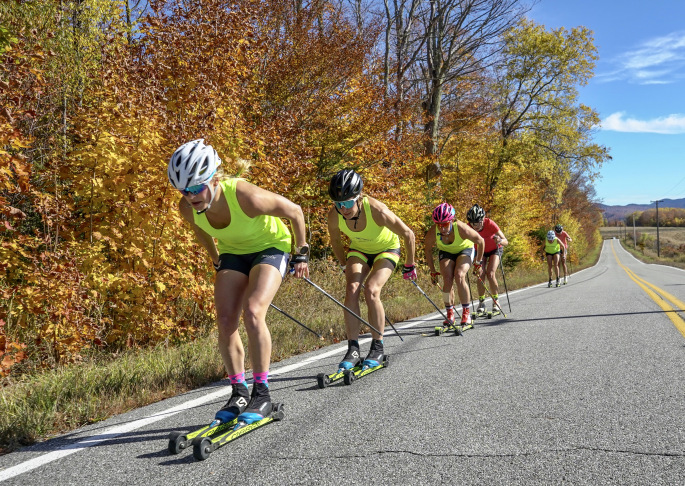
The SMST2 squad led by Jessie Diggins pushes the pace in a double pole interval workout during a fall 2019 training camp in Lake Placid, NY. (Photo: Matt Whitcomb / smseliteteam.wordpress.com)
It’s May. Yes, really.
For most skiers, the new page on the calendar also marks the beginning of a new training year. Dust off your rollerskis, locate your heart rate strap and drink belt, and make sure your running shoes have plenty of life in them.
With the country still predominantly on public health orders to stay close to home, avoid groups, and keep at least six feet of distance from those outside your home, kicking off a new cycle is happening without hugging our training partners, post-workout high fives, or otherwise gathering to ring in the new season. There also remains abundant uncertainty regarding the feasibility of racing during the upcoming season from the World Cup level to the junior and collegiate circuits to popular skiing. Nonetheless, we open our training logs and carry on.
Last season ended abruptly and the off season may have looked different than anticipated. We may have put our energy into homeschooling children, sourdough baking, binge-watching Tiger King, connecting virtually with our family and friends, or otherwise remaining largely homebound and less active than we’re accustomed. On the flip side, maybe the change in schedule has freed up additional time for long adventures and you’ve logged more hours in April than ever before.
Either way, at the onset of a season, you may be interested in checking in on your fitness and strength, looking for metrics to track improvement over time and to guide your pacing or heart rate zones during future workouts. FasterSkier reached out to Pepa Miloucheva, head coach of the Craftsbury Green Racing Project, to discuss fitness testing that could be done without the support of a facility or coach, making it accessible to any level skier as they begin the new year.
Miloucheva provided the disclaimer that she relies on advanced metabolic testing with her athletes to determine VO2 Max and lactate threshold levels to assess fitness and heart rate zones, and then prescribes training based on this information. With that caveat, Miloucheva holds a masters degree in Sport Science with a focus on physiology and biomechanics and has been coaching for over 20 years, over a dozen of which have been spent with the CGRP elite program.
Before jumping into assessing fitness and blowing up trying to hit a new PR on the SkiErg, Miloucheva emphasized that the most important thing an athlete can do at the beginning of a new cycle is to have a training plan and to understand how the periodization targets different areas of athletic development. This might be a plan from a coach or one found online.
“If someone really wants to establish a baseline and monitor, then they have to have a training plan,” said Miloucheva in a call. “I think everything else is kind of pointless, because all of these tests won’t give you anything if you don’t know what you’re looking for. In general, everything starts with first having a good training plan.”
Once a clear plan is established and you have taken time to understand it, then decide which part of the training process you would like to test.
“If you have 2-3 months of high volume, you want to test your basic aerobic improvement. You do the test, you see if you’ve actually improved. When you start doing a little bit more speed, you want to see if you’ve improved your speed. So you really have to schedule these tests based on your training plan.”
As the typical periodization of the year for skiers focuses on aerobic development during the spring and summer, a good starting place could be an uphill run test, possibly combined with a rollerski or SkiErg time trial, if those are available to you.
Traditionally, a 3000 meter run on the track was commonly used as an aerobic benchmark, but the results can be skewed based on individual running economy. Athletes with more running experience and better form often fare better than those with comparable or potentially better fitness. As such, most ski programs have transitioned toward an uphill run test, as it tends to level the playing field in terms of the impact of running efficiency on results.
In addition to being a good indicator of aerobic capacity, Miloucheva explained that the test has the added benefit of being easily repeatable with relatively few outside variables that might impact performance.
“The uphill running test is probably the most standard around the world. Simply, it’s easier to repeat. It’s a little bit less affected by the weather, but there are still a lot of elements and it is hard to keep it consistent.”
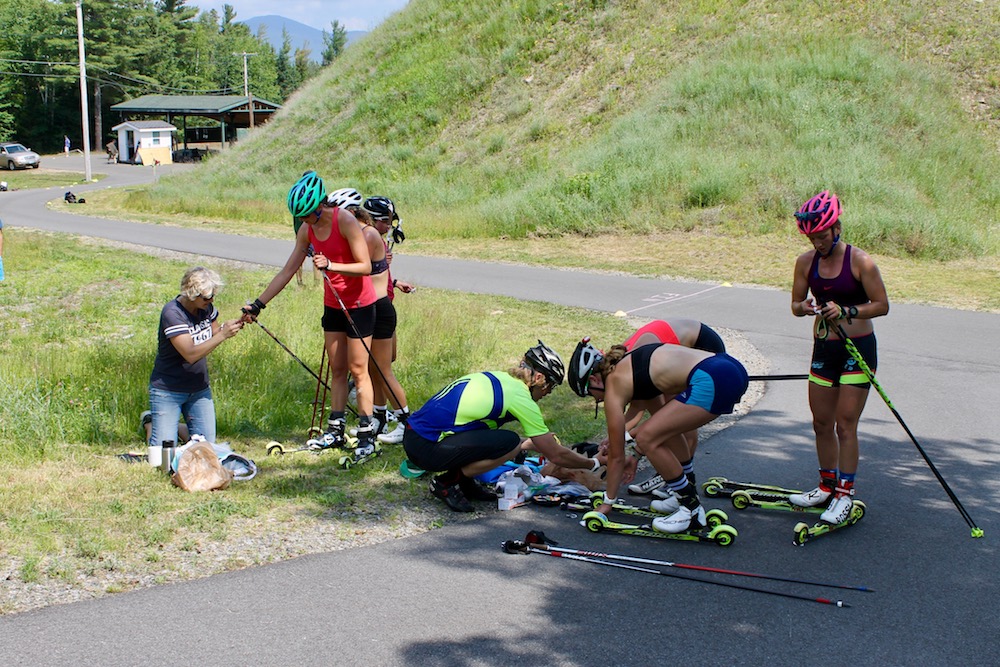
Craftsbury Green Racing Project Head Coach Pepa Miloucheva (l) and Stratton Mountain School T2 Team Head Coach Pat O’Brien (center) assist athletes with lactate testing after the U.S. Ski Team’s rollerski team sprint on July 15, 2018 in Lake Placid, N.Y.
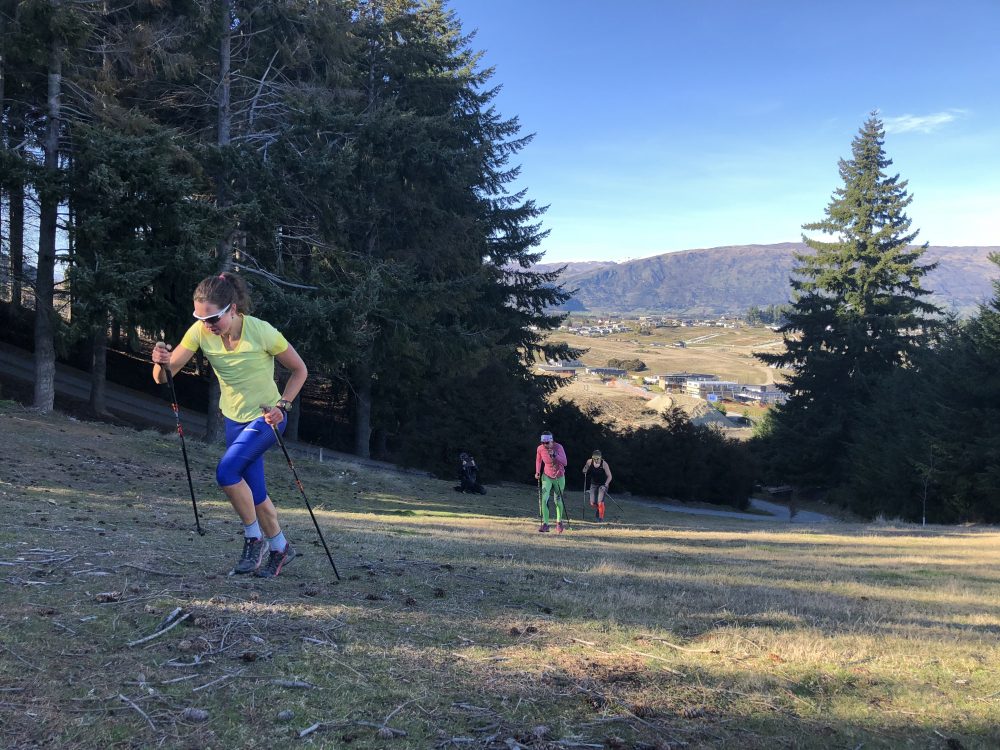
If you’re looking to track your own progress on an uphill course, Miloucheva recommends finding a stretch of road or trail with little traffic that takes roughly 10-12 minutes. The effort should be steady throughout the test and you should finish feeling completely spent.
Be careful not to start out too fast as you want your heart rate to increase throughout the test, rapidly at first then gradually continuing to rise toward your lactate threshold heart rate, which can be estimated as the average heart rate sustained over the last five minutes of the test assuming it was well-paced. (TrainingPeaks has a deep dive on blood lactate and lactate threshold here, or you can read this description of lactate threshold training by Len Kravitz Ph.D., Exercise Science professor at the University of New Mexico.)
As for the course, you’re looking for terrain that is runnable, meaning you won’t need to resort to walking or hiking, and a relatively consistent grade.
Miloucheva later added that many veteran athletes have their own aerobic fitness test piece, which is also perfectly sufficient.
“I’m an old lady and I have this loop around the lake I do every year and I measure my time just for fun. So in general, everybody who has been training for years, they have a place where they can run the test.”
Miloucheva has also used a 1-kilometer uphill double pole test on rollerskis with some of her athletes. Her course starts relatively flat, climbs gradually, then levels off at the finish.
“The biggest thing is that [athletes] need to keep moving, so it cannot be very steep because strength and the resistance become the issue [rather than fitness].”
She has found this test harder to standardize than the run test, meaning results must be taken with a grain of salt.
“The problem using it year to year is that [the athletes] don’t always use the same rollerskis, they change wheels, cold weather and cold pavement changes a lot. So you have to consider all these details with the results.”
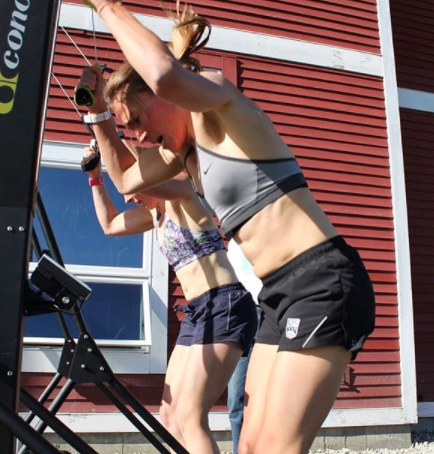
Sophie Caldwell and Annie Hart square off for a SkiErg time trial during a week of testing with the SMST2 team in 2017. (Photo: Instagram @sophiecaldwell(
Because of the ease of standardization, Miloucheva prefers using SkiErg time trials, as athletes can repeat the test indoors with a fixed resistance. Her junior athletes complete 1 and 2 k time trials, and her senior athletes additionally complete a 5 k test. The CGRP athletes complete the tests while hooked up to a VO2 Max testing equipment. If these are available to you, these tests could also serve as a benchmark for aerobic fitness with some ski specific strength indicators.
As for strength, Miloucheva is working on developing a test she feels is informative and can be standardized, as she is not satisfied with other tests used previously. She has historically used a version of the Canadian Strength Test (outlined here by Jackson Hole Ski & Snowboard Club), which counts the number of pull-ups, sit-ups, push-ups, box jumps, and dips an athlete can do in one minute with one minute rest between each exercise. Some differences in Miloucheva’s version include the use of single leg squats within a 30 second time period and measures pull-ups to exhaustion.
If you’re completing this test from home, ask a member of your household to help time, count, and keep your form honest so the data reflects your current strength accurately.
Okay, you’ve done an initial test of your aerobic fitness and/or strength. Now what? How soon should you repeat the test to check for improvement?
Miloucheva reiterated that it is essential to plan testing between training blocks to assess whether the block had the intended impact on fitness. She explained that her testing weeks are written into her general yearly plan for athletes at the beginning of the season.
When considering your own plan, space the tests out roughly 6-10 weeks to give the body time to absorb and respond to training. In addition to striving for a faster time, you can also consider trends in heart rate, as more time during the test spent closer to the lactate threshold heart rate is also an indicator of improved aerobic capacity.
To get the most information from a testing period, it is essential that each round is approached the same way, including how the training looks in the days prior and the warm-up performed before beginning the tests.
“You want to have a standard approach into the test, because you don’t want to do the first test after a very exhausting week and the second after an easy week, because it will affect the results.”
For CGRP athletes, this typically looks like one or two days of rest or easy training prior to a test.
There you have it. If you’re looking to assess and monitor progress in your fitness, first select and understand a training plan. Then, determine what factors of your fitness you’d like to assess and decide when a set of tests might fit best between different blocks within the training plan. Finally, do what you can to ensure that when the tests are repeated, the environment is as controlled as possible and your approach is the same so improvement (or lack thereof) between tests provides accurate insight into how your body is responding to training.
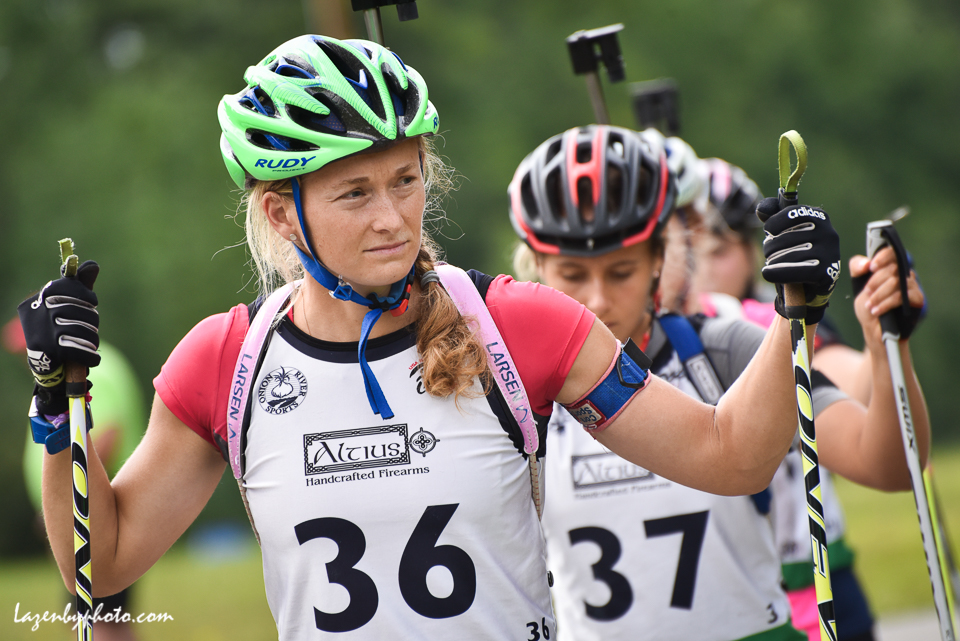
Emily Dreissigacker (CGRP) at the start of the women’s sprint at the 2017 US Biathlon Rollerski Championships on Aug. 12 in Jericho, Vt. (Photo: John Lazenby/Lazenbyphoto.com)
Say this name three-times fast: “Dreissigacker”.
Not so easy at first.
Break the four-syllable surname into discrete parts: Driess (with a hard I) – i – gack – er.
It then rolls off the tongue … Dreissigacker.
In northern Vermont and in particular around the Craftsbury Outdoor Center, Emily Dreissigacker, of the Craftsbury Green Racing Project (CGRP) is as well known a name as any. Her parents, Dick Dreissigacker and Judy Geer, bought the Outdoor Center in 2009. Both are Olympic rowers.
And both of Emily’s siblings are biathletes. Her older sister Hannah, 30, was a 2014 Olympic biathlete who retired in 2016 and younger brother Ethan, 26, formerly raced for the Green Racing Project.
At 28, (she’ll be turning 29 in November), Emily Dreissigacker is on the cusp of making it onto the International Biathlon Union (IBU) World Cup representing the US Biathlon Association (USBA).
“I’m not really feeling the pressure,” Dreissigacker wrote in an email about a possible World Cup nod. “I’m just excited to get out there and ski on snow and get in some really solid training.”
Perhaps this is a reason why the USBA’s high-performance team recruits and promotes older athletes — with age and experience comes a calmness. With time comes wisdom: winning or losing in sport doesn’t define a person.
There’s been both winning and losing and the in-between for this Dreissigacker, who grew up near Craftsbury in Morrisville, Vermont, and married her teammate Alex Howe last summer.
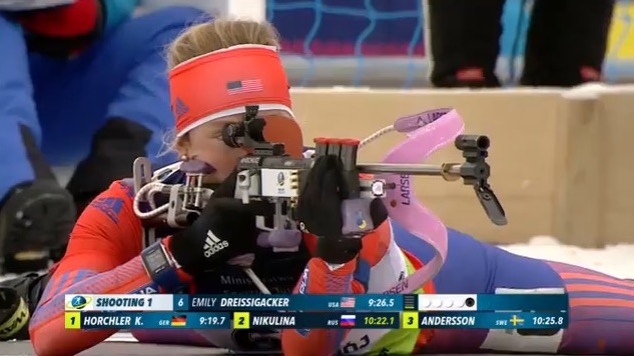
Emily Dreissigacker shooting clean during her first prone stage of the women’s 15 k individual race at 2017 IBU Open European Championships in Duszniki-Zdrój, Poland. She finished 41st. (Eurovision screenshot)
“At this point, competing at the Olympics had been a dream of mine for so long that it felt inextricably entwined with who I was as a person,” Dreissigacker wrote in a June 2015 blog post. “I could feel it slowly but surely slipping out of my grasp and yet I couldn’t let go. I thought about quitting, but there was always something pulling me back. Don’t get me wrong, I loved racing. I loved racing against my teammates in practice, I loved lining up side by side for a 2k or blindly pushing myself past all reason in an interval start. But the training, the whole process had gotten stale. I felt like I was slogging my way through each steady state workout, counting down the minutes rather than enjoying the time I had. Meanwhile, I jealously eyed the skiers leaving each morning for what looked to me like exciting adventures. They got to go biking and hiking and running and rollerskiing (yes, I was jealous of rollerskiing)! But it never really seemed like a viable option to me. I was a rower.”
Since that 2015 blog post, Dreissigacker has been a biathlete.
After eight years training as a rower, she tapped into her adolescent and teenage years as a skier. Like some of her peers — Reid, Egan and Dunklee come to mind — Dreissigacker learned to shoot in atypical fashion: she didn’t train as a junior biathlete and came to biathlon later in their athletic careers. (Reid, Egan and Dunklee all competed at the NCAA Division 1 level.)
“I skied in high school and tried biathlon once, so I had shot a rifle before but not well and not for long,” Dreissigacker wrote. “I also hadn’t trained for skiing, other than a bit of cross training here and there, so I’m definitely playing catch up on that side of things too. Rowing is much more of an anaerobic sport so building up my aerobic base has been and still is a big focus. As well as pretty much re-learning how to ski. I definitely still have a lot to work on in both regards.”
Despite her perceived deficiencies, Dreissigacker’s results show what any coach desires — positive trends when it comes to skiing speed and shooting accuracy. Dreissigacker spent the 2016 and 2017 race seasons on the IBU Cup, a step down from the World Cup.
In March of last year, Dreissigacker earned a top 20 on the IBU Cup. This year, she skied and shot consistently enough in the four-part 2017 USBA rollerski trials series to get picked for the Canmore preseason camp. In the first half of the trials, she placed fifth in both races in mid-August. A month later, she jumped the ranks with first and second place finishes at Part 2 of trials in Jericho.
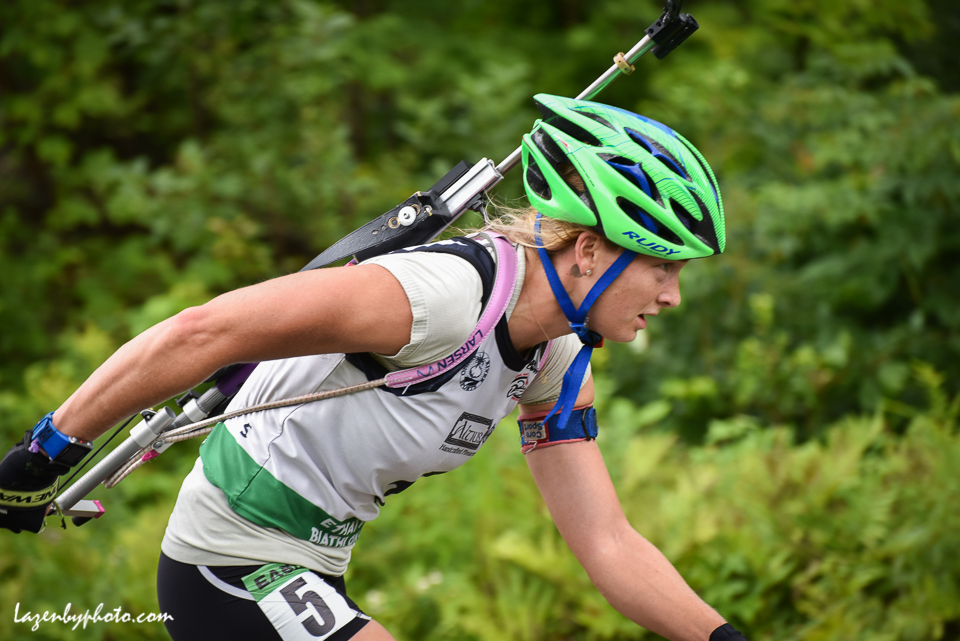
Emily Dreissigacker (CGRP) racing to fifth in the women’s mass start at 2017 US Biathlon Rollerski Championships on Aug. 13 in Jericho, Vt. (Photo: John Lazenby/Lazenbyphoto.com)
As she ramped up for trials, Dreissigacker spent time in Europe with the Green Racing Project. That trip also gave her time to train with national-team biathletes.
“Our European camp this year had much more of a biathlon focus,” Dreissigacker explained. “We did essentially the same trip as the National team so we were able to train with them some. We got to race at German summer rollerski nationals which was a great opportunity to get in more racing and also to experience a really high level of racing. And we got to ski on snow in the Oberhof tunnel. The trip was also a little earlier so after we got home I had a really solid training block in Lake Placid before an easy week at home leading up to trials.”
According to USBA Chief of Sport Bernd Eisenbichler, this year’s version of the European training swing was beneficial for Dreissigacker.
“The camp setup that the Craftsbury team had this summer, accompanying us on the Europe camp instead of going to the Dachstein glacier, choosing to go to the ski hall in Oberhof, helped also to have her performance level in the fall,” Eisenbichler wrote in an email. “Last year we saw that August was quite okay but then the fall, she was really really tired. I don’t know if I would get agreement from Craftsbury, but I would argue that the camp setup was smarter this year and that is why she was in better shape this October.”
Finding form and peaking when it counts isn’t an outcome hard science can unfailingly predict. Be it her modified camp in Europe or the confidence that comes with experience, Dreissigacker performed at this year’s USBA rollerski trials.
“Em has been on the biathlon development program for the last 2 years and on the biathlon team training plan, she works with [USBA Development Coach] Jean Paquet now most of the time,” CGRP Head Coach Pepa Miloucheva wrote in an email. “Last year the Craftsbury biathlon team did travel to Europe for a camp on snow with the skiers, this year the biathlon team The Europe ski trip was more biathlon specific at the ski tunnel in Oberhof with the USBT [US Biathlon team].”
Dreissigacker’s shape and shooting accuracy could serve her well as she transitions to snow in Canmore. The Canmore camp on Frozen Thunder will conclude Nov. 10. And as for the rest of the season, the IBU World Cup could be seeing a new Dreissigacker this winter.
GRP Limelights occur monthly and showcase members and/or people closely associated with the GRP Rowing & Skiing Teams.
Lynn Jennings was one of the first people I met at the Craftsbury Outdoor Center. Little did I know that the woman, who came out from the faded Duck Blind to find her dog, Towhee, staring at my dog, Tanka, was a current American record holder, a former world record holder, a medalist at the Olympics, and soon to be a course record holder at the Head of the Charles. All I knew then was she had an impeccably trained dog, a personable air about her, and a contagious smile.
In addition to her work on campus as the Running Camps Director, Lynn spent every day of the fall training with us and consequently became an honorary member of the Green Racing Project Rowing Team. She listened to every one of Coach Roock’s pre-row talks with the same sense of determination and dedication as every other rower in the group. She rowed with the focus of a first year walk on in college, striving to make the varsity. You never would have guessed that rowing was Lynn Jennings’ second sport.
So why do these two anecdotes matter? For starters, you can see Lynn’s athletic versatility and how the components of being a champion in one sport can lend itself to another. Lynn Jennings is already a champion in the running world. She won gold at the World Cross Country Championships in ’90, ’91, and ’92 (only two other women in the world have ever done this). She took bronze in the 10,000m race at the ’92 Olympics. In 1990, she set the world record in the 5000m indoor run. However, as of October 20th of this year, Lynn Jennings is also a rowing champion, winning the Women’s Grand-Master Single and setting a course record in the process. Granted, Lynn has rowed for about six years now with some regularity. Nonetheless, she beat out knowledgeable locals and Olympians in the sport to win in an athletic second language. When you meet such a person, one wants to take note of what makes him or her a champion.
Secondly, it’s relevant because of how she approaches her life. I may be sentimental or romantic, but I have high standards for the people that I revere. There are plenty of sports’ heroes in the history of the world, but there are few that do it without compromising integrity. This may sound heavy-handed, but in this day and age, many of our sports figures fall short of even relatively loose moral guidelines as they produce headlines about drug abuse, doping violations, infidelities, and misdemeanors. For me personally, Lynn epitomizes the ideal champion. She is highly competitive and extremely dedicated. She pours everything she has into each practice, making her a great student of whatever sport she does.
The amazing thing is that, while having these critical qualities, she still manages to maintain an upbeat and optimistic attitude. Granted, different people have different motivations. Some flourish with positivity, while others get their kicks from negative spurs. What’s remarkable about Lynn Jennings is that despite the perpetual, competitive fire that burns within her, she is not only a good sport immediately following any competition or practice, she is a downright peach. While I personally appreciate the challenge of countering an overly competitive lifestyle with a certain amount of levity, I am humbled by the grace with which Lynn balances her ambitions with her kindness of heart. In my opinion, her unique combination of being both a champion and an admirable, endearing person puts Lynn in the upper echelon of both competitors and people in general.
After the Head of the Charles, we bid a temporary farewell to Lynn Jennings. However, the GRP anxiously looks forward to the annual return of our running champion, rowing champion, and our teammate.
I was a bit nervous about returning to Muonio this year after getting burnt out on the darkness and Arctic living here last November when the snow was very scarce. I was at my breaking point last year and didn’t know if I could ski another loop in the dark around the short, icy, and dirty loop. But at the same time, as I packed my bags in Craftsbury last week, I was excited to be back on the road and to start the season so I pushed aside last year’s memories and got excited for a new season and a new start!
After about 30 hours of travel we arrived in Muonio, Finland, a small town which is about 250 kilometers north of the Arctic circle. Our team was staying in little cabins on the trails at the ski area Olos. We got out of the van, tired and jetlagged, and we were greeted by a great show of northern lights in the sky. I tried to capture them but the shutter speed on my camera was a bit too slow for a good photo.
While 2011 was one of the worst years of early snowfall across Lapland, 2012 is shaping up to be one of the best. There is lots of snow here and the skiing was great. It was fun to explore lots of new trails that I never even knew existed and the tracks and snow couldn’t have been any better.
We had a few days of training and adjusting to the time change and then racing began. This weekend was just warmup races for the team as we prepare for next weekend’s World Cup races. But these races were still very legit and are known as some of the largest FIS races in the world. There were over 500 entries every day including National teams from Finland, Russia, Poland, Germany, Japan, and probably some others which I have forgotten. The first race was a classic sprint on a very hard a technical course. I didn’t really know what to expect as I had been having trouble sleeping and getting over the jetlag all week. I just focused on skiing relaxed and smoothly and was very excited to see that despite a horrible transition that caused me to come to a complete stop in the finishing area, finished 5th! The afternoon brought the heats and it was really fun to ski with these really fast women. I felt strong through most of the heats and ultimately finished 6th, racing against ladies who commonly finish in the top 10 of World Cups, a place I hope to someday land.
The next day was a 5km classic which I was very excited for as it’s one of my favorite races. Unfortunately it ended up being a very rough race for me as I battled some lingering stomach issues (complications of interesting Finnish cuisine?) and wasn’t ever able to get the same race feeling I had felt the previous day. Still it was great to have another race and blow out some cobwebs. Finally on Sunday, there was a 10km skate which I skipped but had a lot of fun cheering the on the other girls. Liz, Holly, and Jessie all skied really well and finished 2nd, 7th, and 9th! We finished the weekend in style by watching Skyfall, the new Bond film, in an underground theater in Olos which none of us oreviously even knew existed.
Here are some photos of the week in Muonio.
Remember this from last year?
The skiing is a little nicer this year. Here are Kikkan and Liz skiing the first day we arrived.
Here we are skiing in the middle of the day. The sun never seems able to quite rise above the horizon so it’s a constant sunrise/set.
A view of Lapland from our cabin
Our cabin was quite cozy. Liz slept in a loft which wasn’t tall enough for her to stand up in.
Finnish cuisine involves lots of potatoes, root vegetables, reindeer, berries, and salty oatmeal.
Last year Clare visited the middle school in Muonio and since she wasn’t returning this year, she set up a visit for our team. We talked to the kids about where we are from in the United States and then answered questions like, “What is your favorite fast food?” and “Are there polar bears in Alaska?”
Racing in the heats next to Kowalczyk
The course was very interesting and had a herringbone finish as you sprinted up the base of the alpine line to cross the line.
I was very happy with the start to the season! Also this picture was taken directly after the race but the lights had already come on and the darkness was setting in.
It was fun to see lots of great racing by the US team this weekend. We’re ready to go! Here is Liz on her way to a 2nd place finish in the 10km skate
I spent a day off in Calgary. It is a surprisingly big city, with a population of about 1.1 million (compare to Boston with 625,000, or Dallas with 1.2 million). I found the downtown very clean, with free public transport, lots of walking space, support for the arts, interesting parks, and an extensive Chinatown with delicious food!!! Here are some of my pictures.
With the end of the fall rowing season upon us and Thanksgiving just around the corner, it’s time for the rowers to put up their oars and try their hand at skiing. In the words of Coach Roock: “Your rowing future depends on this, no pressure.” Temperatures have started dropping to the point where the snow guns are roaring full blast at night to make enough snow for us to start skiing. So far there is a 750m “lollipop” loop where we have started testing our skills, or lack thereof.
Mt. Craftsbury grows on the lower field behind Cedar Lodge (photo credit: Judy Geer)
Fresh new gear, good to go! (Photo Credit: Liz Donald)
Some of the novice skiers learn from the best (Photo Credit: Liz Donald)
Dan shows us how it’s done (Photo Credit: Juliet Hollingsworth)
Some of the rowers have more of a background than others in snow sports, such as Emily Dreissigacker who actually started her athletic career in nordic skiing, and Steve Whelpley who has competed in downhill ski races. However, for some of the rest of us there has been a bit of a learning curve.
Steve Whelpley and Phil Henson quickly progressed from casual laps around the course and immediately challenged one another to a no poles race or three:
All in all though it’s been a successful start to the winter season and we’re excited to get some experience on skis and enjoy even more of what Craftsbury has to offer.
I am resurfacing from blog absence in order to give you some Canmore highlights. Canmore is about an hour north of Calgary, just east of the Rockies. It is a gorgeous town reminiscent of other Rocky Mtn ski towns, minus a destination alpine resort. Here, the Nordic center, home of the 1988 Calgary Olympic nordic events, is the major attraction. Chandra Crawford’s gold medal hangs in the lodge.
The town of Canmore hosts a remarkable number of activities and events for a community its size. While I was in town, I went to two concerts (one Czech string quarter and one Canadian/American jazz bassist), visited about 5 art galleries, and spent way too much money on high quality teas. OH YEAH and the skiing was excellent, giving us a major advantage going into our high-stake early season racing next week.
The beauty and scale of the Canadian Rockies is hard to capture on camera, but I hope this photo gallery gives you an idea. Bonus features: Patrick, Hannah, the new trailer, a big elk, and a bear-safe dumpster. Enjoy!
Hey everyone — All winter long, GRP skiing results will be compiled in this post. As our racing takes us across the US and Europe, this will hopefully help you keep tabs on how we’re doing!
This past week I decided to take a day off from skiing and go for a run up to the Grassi Lakes just west of Canmore. The morning started off with an awesome sunrise so I couldn’t give up the opportunity to explore.
View of the mountains behind the new Craftsbury Green Racing Project van and wax trailer!
Canmore is littered with amazing single track trails that wind their way through town and straight up into the mountains. I started running up a trail from the Nordic center towards a pipeline that can be seen from town.
Looking up at the pipeline. I ended up hiking up next to the pipeline, which is a populated cougar area according to the ranger I spoke to on the trek back to town.
The view of Canmore from the pipeline!
After climbing up next to the pipeline I crossed the dam and ran down the road.
The view from the dam. The water tower on the right is the top of the pipeline.
On the way down I found a dead mountain goat on the the side of the road. (I didn’t take a picture) As I was looking at it a ranger stopped and asked if everything was alright. He inspected the kill and reported to me that it had been taken down by a mountain lion earlier that morning! He then proceeded to ask where I had been running. After telling him my route he revealed that I had crossed a hot spot for mountain lion activity and attacks! He said I should be more careful and next time travel in a group and stay on the trail if I go back into the mountains. I’ll be sticking to the more traveled paths from now on!
Soon it begins. On Tuesday I will be traveling to Sweden to start another winter of World Cup biathlon racing. It means four months living out of a duffel bag and braving airports almost every week… The thrill of putting on a race bib and standing on a start line in front of TV cameras and screaming spectators… Weathering the tremendous ups and downs that are biathlon’s emotional roller coaster… Laughing at the antics of teammates, wax techs and coaches every night at dinner… And skiing, on snow, everyday. I can’t wait!
The first World Cup biathlon race of the season takes place in Ostersund, Sweden on Sunday, November 25th (9:30 am eastern US standard time). It is a mixed relay, meaning that we will have two women and two men competing together on one team. You can watch it live on your computer by going to Biathlon World TV. Put it on your calendar.
In the meantime, watch replays from last year on Biathlon World TV to get fired up. The 2011/2012 World Cup 9 in Khanty-Mansiysk, Russia has some good ones- scroll to the right and click on the one titled “pursuit women replay”.
I have spent the past week at home in Craftsbury trying to catch up with friends and family and get organized before the long winter away.
A few items that are coming with me to Europe this year that I didn’t have last year: a travel size guitar, a sunlamp, maple syrup, a foam roller, a German grammar workbook and a 3D puzzle.
The Outdoor Center is closed for the fall off season, so it has been quieter than normal, but I have had no problem staying busy. Even though the GRP skiers are away training in Canmore, I have had a great time getting to know the new GRP rowers. We even trained together in the gym one morning- I did strength circuits while they lined up 7 or 8 rowing machines next to each other for an interval workout.
Dinner with the rowers and friends at Faraway Farm
The Outdoor Center started blowing snow last week, which meant I got to dust off an old pair or rock skis and carve some turns. Later in the week we had 15-20 BKL kids and juniors swarming over the pile like ants. It doesn’t matter how old you are, the season’s first snow never loses its magic.
Davis took the first sledding runs down “Mt. Craftsbury” (photo: Judy Geer)
Ida was also around for a few days before heading to Europe for the cross country World Cup season. We visited our elementary school together to talk to Barton’s seventh graders about training, racing and traveling the world. The most interesting question we were asked: “Have you ever seen a lion?”
I also visited my high school, St. Johnsbury Academy and talked to the students about what it takes to chase after big goals. Watch the YouTube video
I never got around to writing a blog post about our recent national team training camp in Utah (3 weeks in late October/ early November) but here are a couple pics:
The US Women and guest star Andrea Henkel from Germany enjoying Utah’s mountains (photo: Hannah Dreissigacker). Read about what it has been like to train with and get to know an Olympic champion over the past few years here
Some of “Jonne’s Angels” enjoying our last week in Utah (photo: Armin Auchentaller). For more camp pictures and a recap from Utah, check out Hannah’s blog post here
Alright, so I’m a few days late. But here are some Halloween pictures from here in Canmore! And we weren’t the only costumed skiers out there either–a bunch of the Canadians also dressed up, so it made the little loop a bit more interesting!
We had a lot of fun putting costumes together out of clothes we brought with us, items from the recycling bin, and tape.
Can you tell what we are? I laughed to myself every time I saw the nun out on the trail…
Ida was an awesome bumble bee, though the wings, stinger, and antennae weren’t ideal for skiing.
I of course had to carve a pumpkin. This one would have looked way cooler if I had lit the stogie on fire.
Although Canmore has been feeling wintery and the 2k loop has been excellent skiing, yesterday we drove away from Canmore towards Lake Louise where there is more natural snow. About an hour away from Canmore, within Banff National Park, we turned into a makeshift parking lot at the start of Moraine Lake Road, curious to see what snow cover and terrain we would find. Sun Valley gave us a favorable report from skiing the road the day before, but you never quite know what “good skiing” means this early in the season. The snow was clean and plentiful, if a little grabby, and it was relatively easy skating since most of the road had been groomed by snowmachine within the past few days. The terrain was road-like rather than trail-like – up, up, up to a high point and then gradually down the other side to Moraine Lake. It reminded quite a few of us of skiing on the access roads at Foret Montmorency in Quebec. From the high point down towards the lake wasn’t groomed, so not everyone was willing to venture along the unpacked powder-over-pavement on the skis they brought. However, those of us who did make it were rewarded with a nice view of the frozen lake and the surrounding rocky cliffs. We didn’t quite luck out with a perfect sunny day, but we were able to see parts of the impressive mountains when the clouds cleared.
Hannah was excited to start her first ski of the season!
Hannah pauses for water
Ida was happy with all the snow!
All 7 guys in a train
Alex and Nils at the lake
Cliffs above frozen Moraine Lake
Look at all the snow! I was happy to have used training skis so that I could ski to the lake and see the cliffs up close.
From Moraine Lake Road, we could see the Lake Louise alpine mountain where World Cup races are held.
Driving up to Lake Louise, there was a definite lack of clarity, both of the sky and of the van windows. But we still were able to admire the mountains lining the sides of the valley, and to comment on an interesting feature of the highway through Banff National Park. Every few minutes on the highway, we would pass under a short tunnel/wide bridge, but there were no exits or other roads in the area that would need to cross the main road. Instead, these wide bridge structures were covered with earth, with little trees and grass planted on them, obviously for the purpose of enabling animals to cross the highway – the sides of the highway were fenced off, likewise to prevent the animals from crossing in front of cars. An interesting use of resources to minimize animal-human conflict in the park.
Taking a stroll to Lake Louise. During the few minutes of walking and admiring the scenery, the local birds gave us some entertainment by contemplating but refusing offerings of sausage and various other post-workout snacks, and then proceeding to dive-bomb and steal the last bite of Nils’ sandwich instead.
Although it was drizzling rain and quite warm earlier today, it was snowing this evening! We did intervals and a strength session today, and we’re looking forward to a distance classic ski tomorrow. It’s great to be immersed in the winter season and skiing in October!
Here are more photos from the Moraine Lake ski and from the classic sprint that was held last Friday. Check back for more updates soon.
Susan and I spent the last few weeks in Utah at a training camp with the biathlon team. Here are some pictures! When we first got there, we had some beautiful western weather, and there were still some bright colored leaves around on the aspens and things. I’ve never thought of the west as having good foliage, but I was impressed! It was definitely beautiful.
I was really happy to be exploring the mountains in our new “back yard”.
Rollerskiing up west canyon on a beautiful sunny day.
We went on an awesome hike from the top of Guardsman’s Pass. Andrea Henkel–one of the top German biathletes–is dating Tim Burke, one of the U.S. men, and so she came to this camp. It was great to get to train with her some and also just get to know her.
Suz and I were so match-y in our new Ibex shirts, we decided we just had to take a picture. This is from the a summit along the Wasatch Crest trail.
We also had two rollerski races, which were qualifiers for a November training camp in Sweden. We woke up the morning before the second race to this. It was postponed until late in the afternoon, when most of the snow had melted off the rollerski track.
On my last day in Utah, we went on as awesome hike that went partway up the back side of mount Timpanogos. It was snowy and beautiful!
We were happy that our team fall training jackets are bright orange–there were lots of hunters out there!
Amazingly, this picture only took Annelies one try to take!
I had a lot of fun in Utah–its a great place to train. There’s a nice roller loop right at the range at Soldier Hollow, and also countless opportunities for adventures more or less right out the back door. It was also fun to have the whole biathlon team together in one place, including our European coaches.
I had one good time trial, in which I missed 3/10 shots–not really good shooting, but I skied well and it was a good race. Then in my second time trial I missed 4 of my prone shots–thats not good! It was a windy day, and I’d forgotten to check the wind flags and take clicks to adjust for it. I realized my mistake as soon as I took the last shot and started towards the penalty loop. Dammit! But that’s biathlon…the difference between a good race and a bad race could be just one or two dumb mistakes. It can be frustrating, but its also so rewarding when you actually hit the targets and ski fast too…so far I’ve really only gotten little tastes of that, but I know that it’ll happen one of these days!
With a little snow on the ground, really good skiing, and temperatures in the 20s or colder, it doesn’t feel like October in Canmore. The Nordic center Camore saves snow from the previous winter and rolls it out in the middle of October every year for “Frozen Thunder.” Our first day here it was warm and the skiing was a little slushy and rocky but then the temperatures dropped and the snow began to fall and the conditions have been great ever since. We have even been skiing on hardwax which is not normally to be expected in October! There is only a 2km loop of skiing so we end up doing a lot of laps but the terrain is fun and its nice to be back on snow. It reminds me a bit of Muonio, Finland last year except with fewer people, prettier views, and a lot less dark! So far the training has mostly just been distance with a focus on technique but we also did a 10km TT and we have a sprint race with the Canadians in a couple days. I’m staying with the US team right now but looking forward to the arrival of the rest of the GRP later this week! Here are some pictures from the week so far!
We're staying in some cozy apartments in the Rocky Mountain Ski Lodge. It's a great location at the edge of town and across the road from an awesome coffee shop but the small kitchenettes make cooking team dinners for our hungry team a creative process.
This is the view from our deck! The Canadian Rockies are amazing!
Kris Freeman, Noah Hoffman, and Andy Newell during a distance classic ski.
Tad Elliott and Jason Cork skating with the mountains looming behind them. Watch out for the black and yellow this winter! (Noah Hoffman photo)
Looks like winter! (USSA photo)
The snow guns are blowing on the World Cup courses so my fingers are crossed for some more terrain opening sometime soon! (Noah Hoffman photo)
Yesterday morning for our OD workout we skied for a couple hours on the loop and then switched to running shoes and ran to Banff National Park. It was about an hour and a half run on ski trails and then single track trails with a few inches of powder on the ground.
Here is the group about a half hour away from Banff. The coaches picked us up in Banff and we walked around the town and warmed up with a warm lunch at a cafe in town.
Canmore is home of my great friend Chandra Crawford who has been showing us around the area while we are not training. She also has an awesome house in town with a normal kitchen and a very comfy couch so we've spent quite a bit of time relaxing at her pad! (Noah Hoffman photo)
We’re off for an afternoon ski and the rumor is that they’ve changed the direction of skiing today! It’s going to feel like a completely new loop!
I spent the last 10 days in Park City Utah for testing and an altitude camp. After some wet weather at home, it was great to arrive in the arid west and see the sun! The town of Park City is around 7000′ but we stayed in a condo near the top of Guardsman Pass so we were sleeping at 8500′ for extra altitude effects.
The view from the deck of our condo.
I wasn't expecting to see foliage here but the yellows leaves were really pretty
The camp started with lots of testing at USSA’s Center of Excellence. We did VO2max tests on the rollerski treadmill, strength tests, mobility tests, blood tests, and body composition tests. So after a couple days of feeling caged up like a lab rat, I was very excited to head outside for training. The rest of the camp involved lots of rollerskiing, running, and bounding on the roads and trails around Park City including a 3+ hour point to point run on the Mid Mountain Trail.
Felt good to see the sun!
Liz and Holly running on the Round Valley trails
We did a couple of intensity sessions on the rollerski track at Soldier Hollow including classic speeds and skate threshold intervals. It was fun skiing fast in a big group.
This camp was the first time that our entire team was together since the Bend camp in May. Unfortunately with some injuries plaguing the team, we weren't able to train together for every session but everyone was working hard all the time. Here are Sadie and Kikkan aqua jogging in the COE pool.
After a week and a half in Park City, we headed north to Canmore, Alberta for Frozen Thunder. The Canmore Nordic Center saved snow from last winter and rolled it out last week for a 2km ski trail and some of the earliest skiing in North America. We’ve spent the last couple days skiing hot laps around the manmade loop and then today it started to snow! The ground is fully white and we are off to make some fresh tracks through the powder!
The scene at the “Singletrack Shootdown” Photo: Judy Geer
A week ago, we hosted a biathlon race at the Craftsbury Outdoor Center as part of our Oktoberfest celebrations. The event included a beginners’s pre-race shooting safety clinic and featured separate races for beginners and for experienced biathletes. Additionally, participants could chose to either compete running or mountain biking. The races consisted of 5 laps on woodsy single-track trails and had 4 shooting stages. Beginners shot prone (laying down) for all stages at the bigger standing-sized targets while experienced biathletes shot from both the prone and standing positions at the standard target sizes.
Craftsbury junior coach, Jeremy Nellis, and myself were the primary race organizers. Neither of us has a lot of biathlon race organizing experience. We didn’t know exactly what to expect. During the week leading up to the race, we fixed up the targets, marked out the course, and recruited a handful of volunteers to help out. Brand new events at the Outdoor Center rarely have a huge turnout the first year and most biathlon events in the United States have low participation. I had no idea how many people would show up, but I guessed there wouldn’t be many. The stack of 50 waviers and registration forms that I printed out looked wishfully large.
Imagine our surprise when 65 people lined up at the registration table on race morning!
The registration table, run by Carlie Geer, starts to get busy. Photo: Judy Geer
It was very exciting to have such a huge turnout for the event and it was also a little stressful. We had over 50 people in the day’s largest race (beginners’) and our range has only 10 targets. Things were going to be tight. Biathlon races require a huge number of volunteers compared to a normal ski race. On the shooting range you need people scoring the targets, backup scorers, target resetters, and timers (in case all shooting points are full and a time credit needs to be given). For a beginners’s race you need even more people for reloading magazines, assisting shooters when needed and most importantly making sure everything is operating safely.
Luckily the crowd was flexible and the volunteers and staff were up to the challenge. We had several volunteers signed up ahead of time, but many parents and spectators also stepped up on race day to help. After quick lessons about how to load magazines or record shooting scores, they went to work. In addition, many of the “expert” competitors who would be racing later in the morning jumped in to help out on their own initiative. They taught beginners during the shooting clinic and delayed their own race warm-up to assist on the range during the beginners’ race. We ran into several unanticipated problems during the day (ran out of safety pins for race numbers, had to move back start times, the bike course was too difficult, etc) but the event ran surprising smoothly and the atmosphere was relaxed. As impressive as it was to have so many racers, I was even more blown away by how helpful and understanding the crowd was. Our volunteers and staff for the day numbered almost 30. Many thanks to everyone for coming, competitors and volunteers alike!
I hope everybody had a great time. We learned a lot from this experience and plan to have more Craftsbury biathlon events in the coming year, so stay tuned.
Dick Dreissigacker instructs a group volunteers how to be score keepers on the range. Photo: Judy Geer
The first round of participants receive safety instruction at the beginners’ clinic. Photo: Jamie Chapman
The beginners’ clinic featured one-on-one instruction, talking each participant through all the steps of the shooting process. Photo: Jamie Chapman
Craftsbury junior skier Matthew Lawlor practices before the race. He is one of several young skiers in the Craftsbury Nordic Ski Club that have been attending weekly shooting practices with Jeremy. Matthew went on to win the beginners’s running division, his first biathlon race. Photo: Jamie Chapman
Giving final instructions to racers at the starting line of the beginners race. Photo: Hannah Dreissigacker
Sheldon Miller and Andrea Carpentier are experts at smoothly running things from behind the scenes. Normally they can be found in the back office of the Outdoor Center but on race days, you will probably spot them directing timing near the finish line. Photo: Judy Geer
Lynn Jennings and Lauren Gillott keeping track of penalty loops. Photo: Judy Geer
The firing line. Photo: Jamie Chapman
Competitors in the beginners’ race being supervised by experienced biathlon coaches and athletes. Photo: Judy Geer
Shooters on the range during the expert race. Photo: Judy Geer
Mountain bike racers leaving the range and heading back onto the bike course. Photo: Judy Geer
The GRP rowers showed up en masse to race and help out. Phil Henson puts on a goofy face during a trip around the penalty loop. Photo: Judy Geer
The most exciting battle of the day was between siblings Jack and Callie Young, Craftsbury youth skiers. After matching each other’s performances on the range, the race came down to the final sprint, in which Callie barely edged Jack. Their competitive spirit matches any I have seen at any level. Photo: Judy Geer
Craftsbury youth and junior skiers hanging out and staying warm post race. Bonus points if you can identify the GRP ski racer face in the mix. Photo: Hannah Dressigacker
Fall is one of my favorite times of the years. Colorful leaves, the last garden harvests with pumpkins, squash, and apples galore, and that frosty chill in the air which is an exciting harbinger of the upcoming winter. This year we had a very dry summer and early autumn and this nice weather became the gift which kept on giving with awesome fall foliage. Here are some pictures of the fall leaves around Craftsbury.
A rainbow of leaves
A neon tree which Caitlin and I marveled at while rollerskiing on the Creek Rd. in East Albany
The treeline next to our favorite bounding and grass skiing hill
The view from our parking lot at Elinor's
I think the new windmills are enhancing the fall panoramas. Here you can kind of see the turbines in the distance.
Lots of reds and oranges
Jay Peak
It's past peak now but that only highlights the trees which continue to shine
And now that the leaves are falling, it's time to start our snow dances. The first snow of the year left some accumulation on Mt. Mansfield.
With the peak of foliage over, I headed west to Park City for an altitude training camp with the US Ski team. There are some yellow birch trees here but the colors are nowhere near as vibrant. On the upside, the drier climate means lots of sunny weather and my vitamin D stores are feeling happily replenished. Check back soon for updates from Utah.