From the FasterSkier archive — posts syndicated from athletes’ and coaches’ own blogs between 2004 and 2012, kept online as published. Current coverage is at fasterskier.com.
Convened for the first time since the pandemic, USSS’s biennial coaches National Coaches’ Symposium brings focus to US Skiing’s progress, and highlights the ever-evolving nature of the sport.
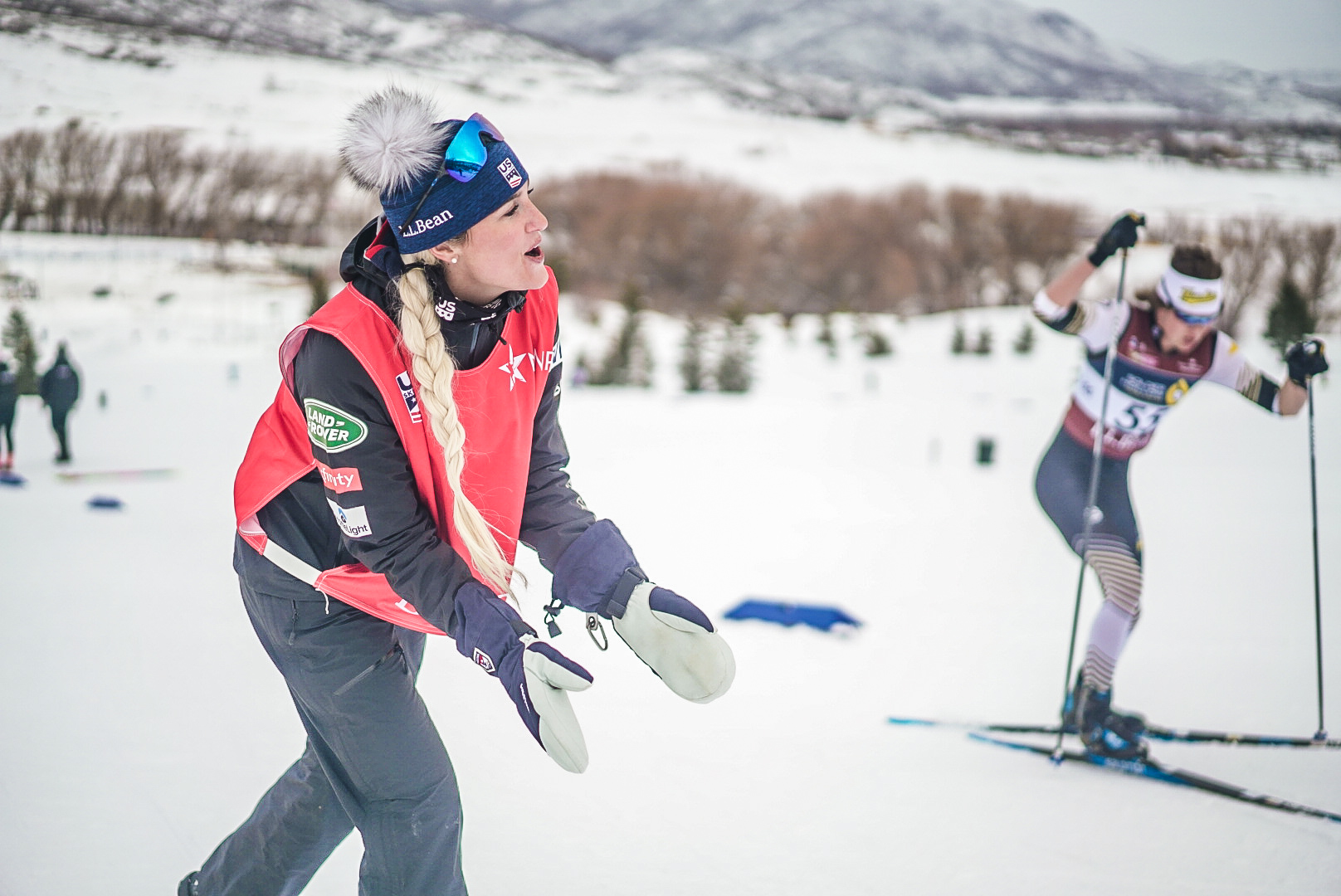
U.S. Ski and Snowboard Development Team Coach Greta Anderson encourages athletes during the men’s 30k distance race during the 2022 U.S. Cross Country Championships in Soldier Hollow. (Photo: Tobias Albrigtsen / @untraceableg)
Last held in 2019, the US Ski and Snowboard’s National Coaches’ Symposium has traditionally provided insight into program priorities and training philosophies of those coaches working directly with the US Ski Team. With in-person conventions having been interrupted by the Covid pandemic, this season’s re-convening of the two-day Coaches’ Symposium represented a welcome return to the dialogue that has typically benefitted the Nordic skiing community. The virtual venue ostensibly helped reduce attendance costs for coaches, but also spoke to a key theme of accessibility and collaboration touched on as a strength of contemporary US skiing throughout the conference.
Friday
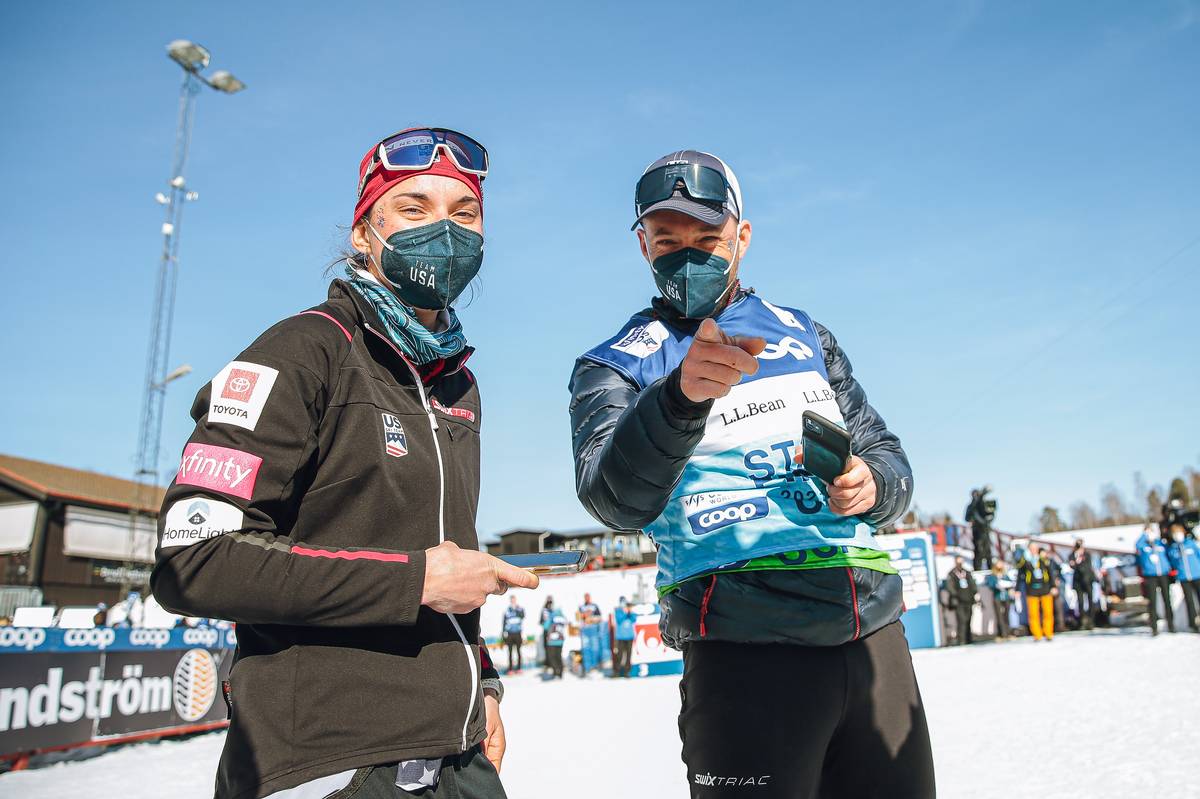
U.S. Ski Team head coach Matt Whitcomb (right) and Julia Kern course-side during the 4 x 5 k mixed relay amidst the 2021-2022 World Cup Finals in Falun, SWE. (Photo: NordicFocus)
Friday’s program began with an introduction from US Ski Team Sport Development Director, Bryan Fish. “There’s 138 people on the call right now,” Fish said, which reminded attendees that the audience was larger than could have fit into the Center of Excellence in Park City where previous symposiums had convened. There was much important information that presenters were to convey, and many eager listeners had gathered to hear it.
Dr. Hans Kristian Stadheim
Friday’s keynote speaker was Dr. Hans Kristian Stadheim, the current British National Team Endurance Performance Director, and a coach long-renowned for his intricate and scientific approach to endurance as it specifically applies to nordic skiing. As Matt Whitcomb commented in his introduction of Dr. Stadheim, “when you’re at the World Cup, Hans stands out as the one who’s really digging into what makes [ski training and racing] work.”
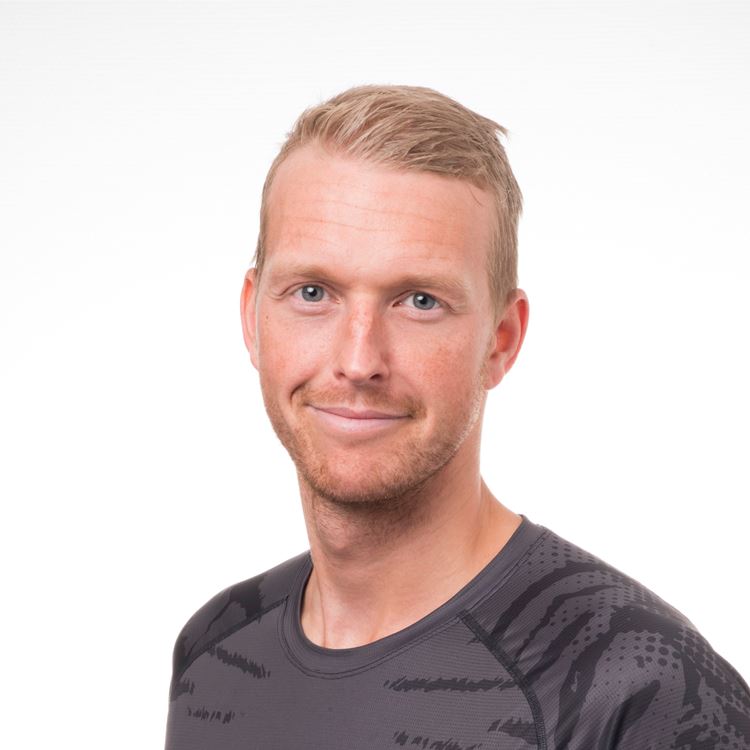
Hans Kristian Stadheim, current Director for the British National Ski Team. (Photo: Courtesy Image).
Stadheim’s presentation, “The Norwegian training method and experiences working with British team,” discussed the evidence behind current trends in nordic ski training, including the principles behind Norway’s dominance that Stadheim applied to building an elite program in Britain. He used his coaching with Simen Hegstad Krüger (NOR) as a case study for pointing out the training trajectory that the Norweigans follow for fostering a skier from junior to Olympic champion. The big takeaway from this example was that, “[The Norwegian] method is a gradual increase in training load with stress on limiting high volume at an early age.”
That point fueled a lively Q and A facilitated by Matt Whitcomb, which focused on implications for coaches working with junior and college athletes. Stadheim—along with useful addendums from Whitcomb—provided thoughts on balancing Threshold and VO2 max work, recovery metrics, and fitting individualized training into a team environment. Key recommendations included:
Intensity work for juniors should focus heavily on increasing VO2 max.
Recovery should be gauged dynamically using analytical tools and athlete perception.
Building a national program requires retention of a robust base of athletes from the junior level through to higher levels of competition.
The remainder of Friday’s program featured discussions and demonstrations by medical and training staff members of the US Ski Team. Jen Kimball and Tschana Schillier, alongside Luke Jager, demonstrated mobility and strength movements that target particular weaknesses seen in cross-country athletes. Dr. Heather Cichanowski and Dr. Tod Olin detailed the medical community’s interest in the high occurrence of respiratory issues among competitive skiers, chiefly asthma and vocal cord dysfunction. Then, Jessica LaRoche wrapped up the program with a talk on athlete wellness.
Saturday
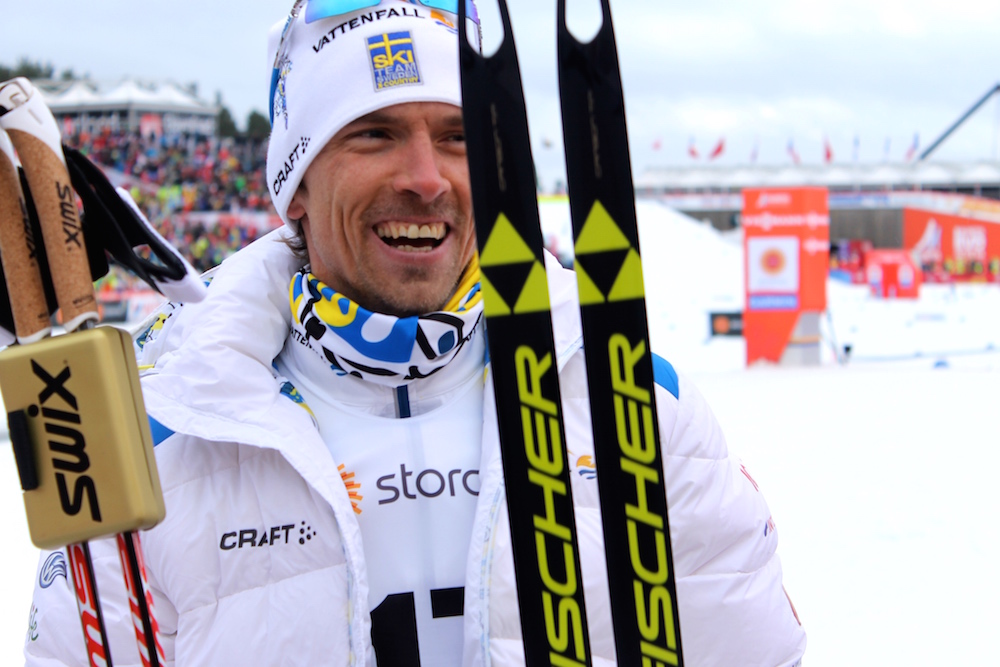
Johan Olsson smiles after winning the 15 k freestyle at the 2015 FIS Nordic World Ski Championships in Falun, Sweden. (Photo: NordicFocus).
Johan Olsson
Saturday’s presentations began with a keynote from Swedish skiing legend Johan Olsson. Since his retirement in 2015, Olsson has developed a career as a TV contributor to Swedish National Television’s (SVT) ski coverage. From a career that included fourteen Olympic and World Championship medals (2nd only to Gunde Svan in the history of Swedish skiing), Olsson shared anecdotes that illustrated breakthroughs in his approach to ski racing, with a special focus on mental preparation. Olsson’s career took place prior to the detailed focus on mental preparation and wellness in training that are common at the elite level today. His anecdotes, therefore, illustrated an innovative individual approach that soon saw parts become common in competitive skiing today.
Johan Olsson during the 2015 World Championships in Falun, Sweden. Olsson won the 15 k skate in Falun. (Photo: NordicFocus)
In one anecdote, Olsson detailed how his development of a dedicated mental approach to racing grew out of his own treatment for anxiety. After a disappointing 15k Classic at 2009 World Championships, Olsson’s wife Anna (also an accomplished Swedish skier) prescribed a self-imposed grieving period for him. “You have until 6pm tonight to be sad,” she said. “But then you will come to dinner and be the same positive Johan you always are.” Olsson popped in a cassette tape of “the saddest Neil Young songs I could find” and went about devising psychological strategies not unlike those found in Sport Psychology books today. A year later—at the 2010 Vancouver Olympics—Olsson’s charge in his relay leg saw Team Sweden win Gold in the event for the first time since Calgary in 1988. It was the culmination of a persistent application of techniques he had devised while wallowing in the saddest songs of Neil Young who—in an ironic twist—was seen passing through the crowd while Olsson stood atop the Olympic podium. Full circle, indeed.
Bryan Fish
Bryan Fish described trends in training and development philosophy on which he and US Ski and Snowboard are currently focused. Fish’s presentation implicitly conveyed the strong progress US Skiing has made, as well as identifying next steps. Strong points identified include a philosophy towards “not training the most, but training really well,” an emphasis on strength training, and a spirit of collaboration among US Ski Team programs, local clubs, and regional associations.
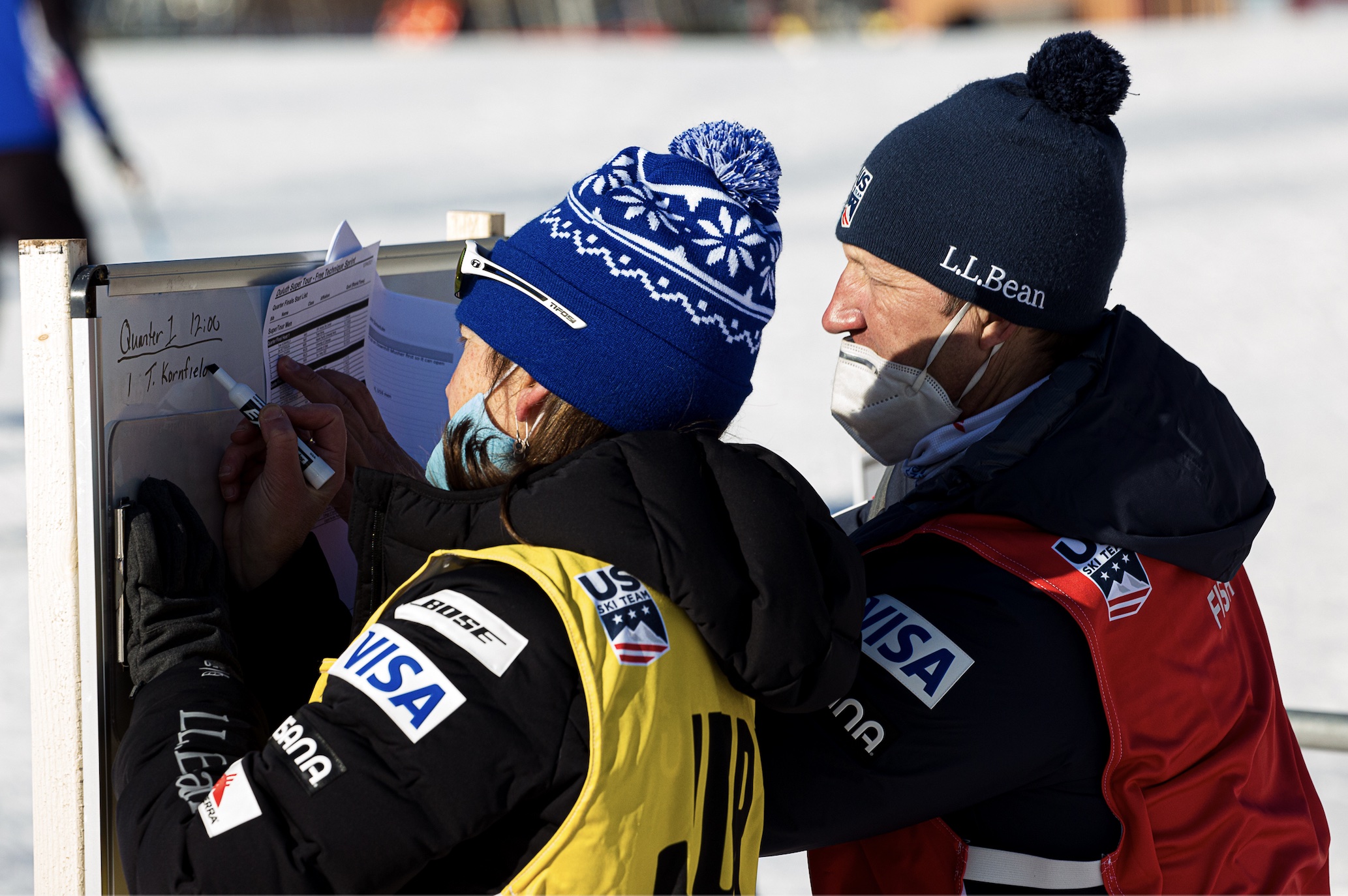
Bryan Fish, U.S. Ski and Snowboard Sport XC Development Manager, at a SuperTour in Duluth last December. (Photo: Jordan Woods/Woods Creek Productions)
Greta Anderson
What Bryan Fish had described as US Ski Team’s “holistic approach” was a continued focus during Greta Anderson’s presentation. Anderson spoke in detail on the number of athletes being reached by international trips, national training/elite groups, and regional elite groups. She further emphasized the ways each region uniquely incorporates its ski resources into this developmental program. For example, Eastern collegiate coaches played active roles in the Eastern/Midwestern U16 camp. In the Midwest, Team Birkie pros and U14 Dream Camp both expanded the region’s Regional Elite Group camp to more skiers. Anderson reiterated that these types of partnerships with clubs and programs feeding the US’ national development pathway were likely to continue. Matt Whitcomb quickly followed with an appeal to mobilize the US skiing community through the National Nordic Foundation, which will hold its annual Drive to 25 from November 21st-25th this year.
US Ski and Snowboard Cross Country D-Team head coach Greta Anderson supports athletes during the Sun Valley SuperTour races in January. (Photo: Tobias Albrigtsen / @untraceableg)
Jason Cork
In the final presentation of the symposium, Jason Cork narrowed US skiing’s development focus from the entire system to just one athlete: Jessie Diggins. In a candid and entertaining talk that considered the ethereal mix of trust, knowledge, and competence required in the coach-athlete relationship, Cork delved into the minutiae of training numbers, and how data derived from Diggins’ training logs reveals pertinent information about peaking. He rattled off Diggins’ history-making results in a casual tone, while being much more serious about the types of workouts, training cycles, and long-term trajectories that led to World Cup Overall wins and Olympic medals. Those accomplishments would tend to suggest that American skiing is doing things right, and that this symposium was a valuable opportunity to describe the knowledge, the practice, and the craft of bringing those performances about.
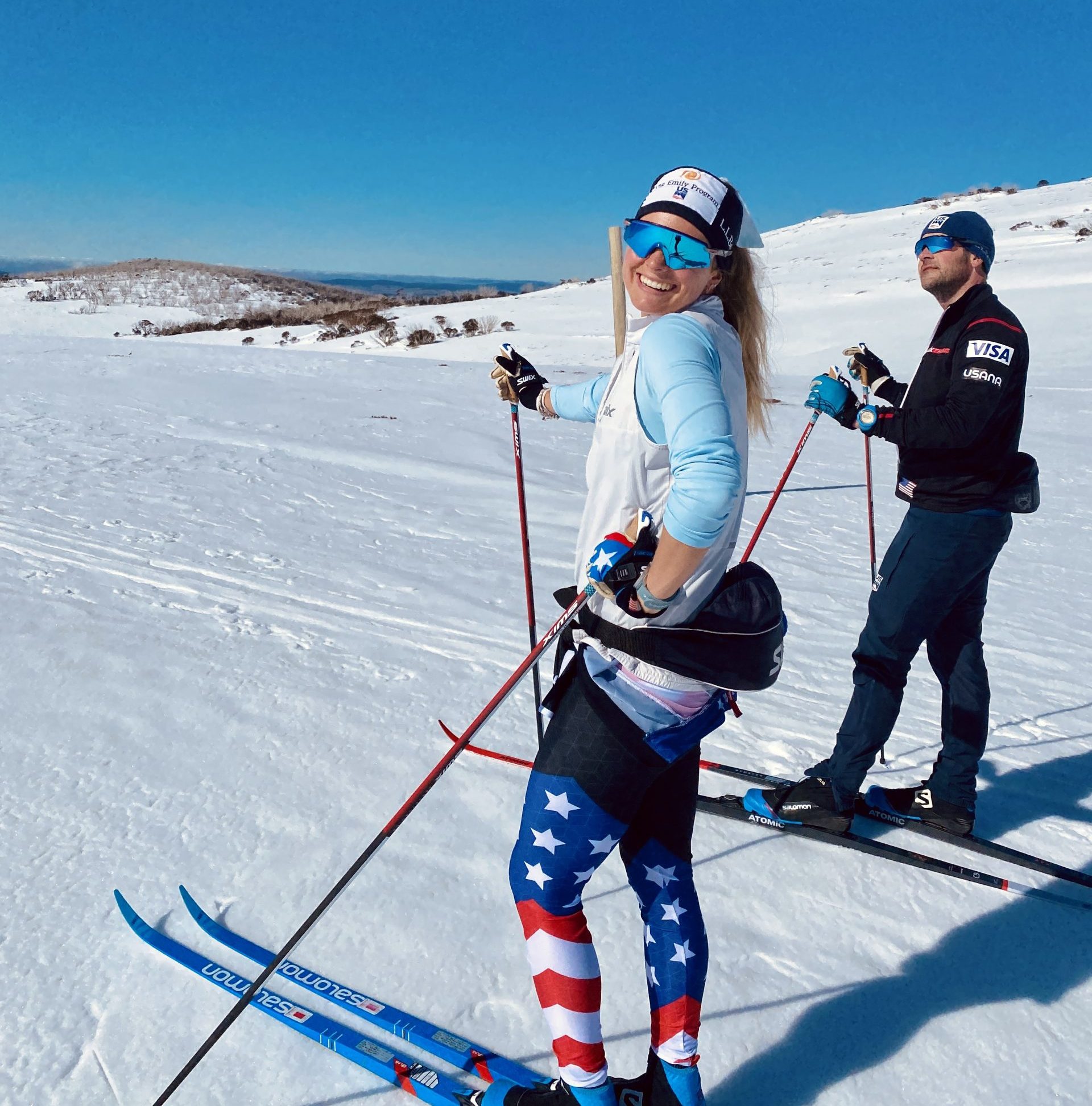
Jason Cork and Jessie Diggins out on a sunny day in Australia last August. Cork has worked with Diggins for 12 seasons, stretching back to their time on the CXC Elite Team. (Photo: Julia Kern)
“Let’s let this knowledge radiate out to our athletes,” said Bryan Fish in closing out US Ski and Snowboard’s first-ever virtual coaching symposium. It was a call-to-action that resonated on Zoom screens across America, leaving a whole community of coaches ready for the demanding season to come.
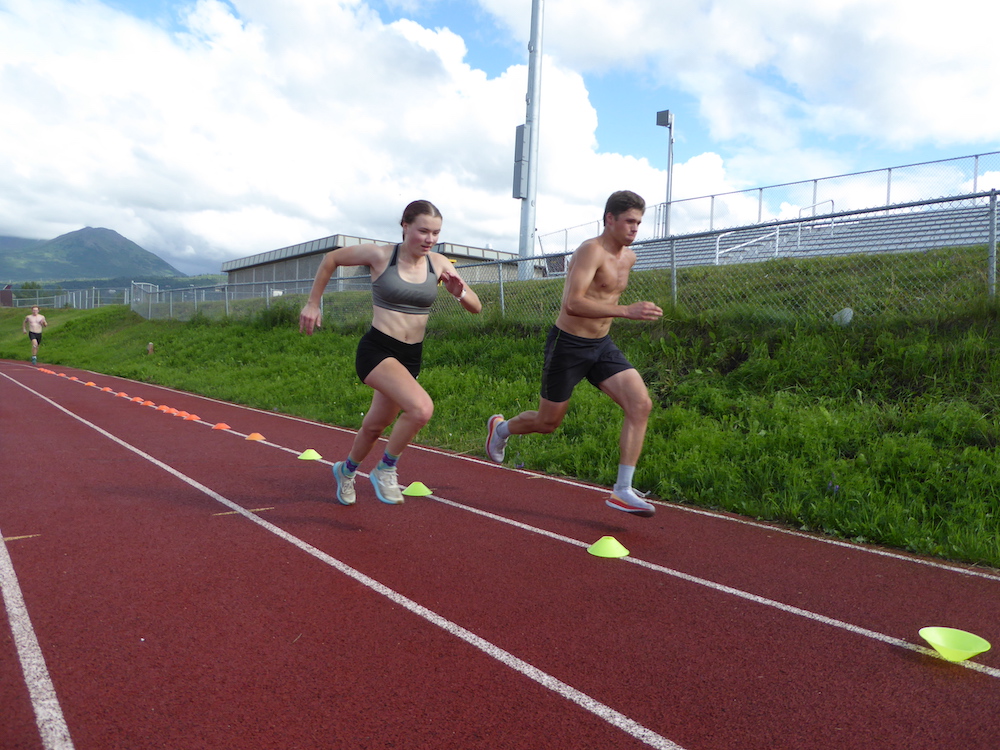
Lily Pannkuk, left, and Zander Maurer race through agility drills on the track at the Alaska REG Camp in Anchorage, July 2022. (photo: Gavin Kentch)
ANCHORAGE — Watching training sessions at a Regional Elite Group camp, the summer training series held around the country for the nation’s top junior skiers, is one part tantalizing glimpses of the future of American skiing, ten parts the cumulative reality of a lot of focused work in the present. These kids are fast, they are committed, and they are strong. But long-term success in endurance sport takes time, and they know it. Judging from the final two practices in a long and rainy week at Alaska REG camp, the future may be some ways off, but it is bright indeed.
Let’s back up a little. This year’s Alaska REG camp was held in Anchorage during the week of July 18. Comparable camps occurred elsewhere in June and July for the three other regions of a sprawling nation: in Truckee, California, for the Western Region; in Marquette, Michigan, for the Central Region; and in Craftsbury, Vermont, for the Eastern Region. Athletes, aged roughly 14 to 20, are picked on the basis of their performance in Junior National races, state high school races, and higher-level USSS races.
One or more of U.S. Ski Team coaches Greta Anderson (Development Team Coach), Bryan Fish (Cross Country Sport Development Manager), and Kristen Bourne (D-Team Coach) were present at all four camps. They were assisted in each region by a who’s who of junior coaches from local clubs.
The supporting cast in Anchorage included Galen Johnston, Jack Novak, Eric Strabel, Jan Buron, Eliza Rorabaugh, Naomi Kiekintveld, Seiji Takagi, Jenny Kimball, Trond Flagstad, Adam Verrier, and Kristen Bourne (coaches); Billy Crumm (strength session); Ja Dorris, Joey Caterinichio, and Laarni and John Power (dinner hosts); and Shannon Donley (registration). Between coaches and athletes, all of Alaska Nordic Racing, Alaska Pacific University Nordic Ski Center, Alaska Winter Stars, Nordic Ski Club of Fairbanks FXC, and University of Alaska Anchorage were represented here last week.
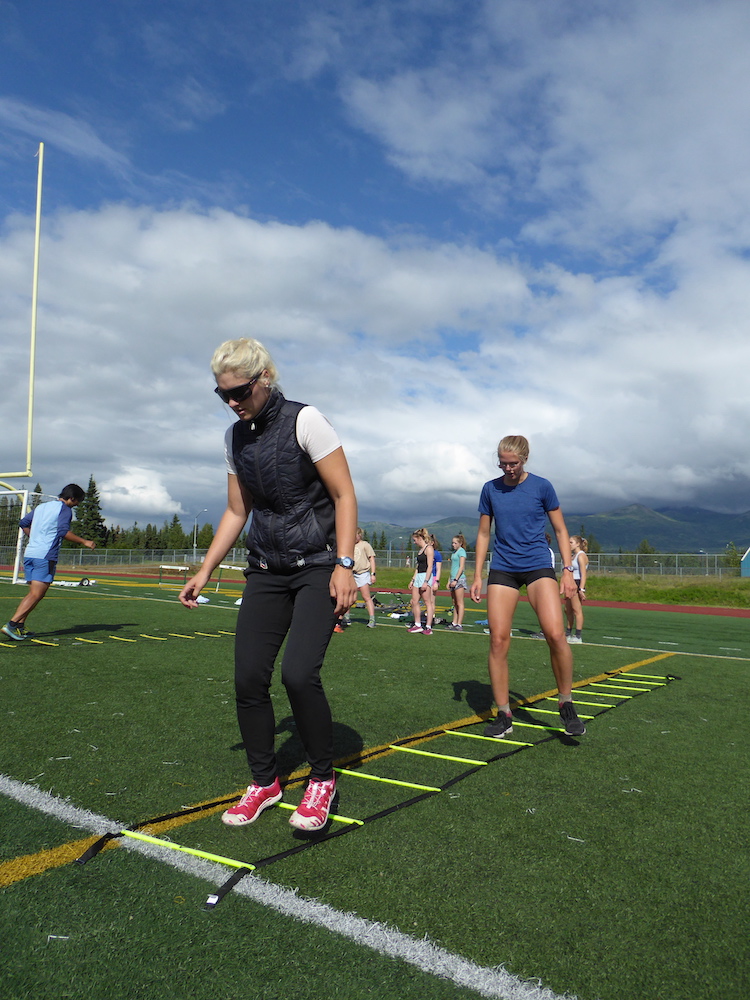
Greta Anderson, left, leads Natalie Hood in ladder drills in Anchorage. (photo: Gavin Kentch)
The camp schedule is not easy, reflecting the fact that it selects from high-achieving juniors who are already comfortable training twice a day. The tests typically make headlines; the canonical REG week contains an uphill run, a classic rollerski uphill doublepole test, and a skate rollerski agility sprint, results of which are combined with USSS/NRL points to select high-performing athletes to attend a national team camp in Park City in the fall. This year’s Alaska camp was no exception, as all three tests featured and results were recorded.
But camp is more than just the tests, says Anderson. Speaking in an in-person interview last Friday afternoon, while apparently tireless athletes began a spirited soccer match at the other end of the Service High School infield just moments removed from agility drills and strides, the USST coach emphasized that the testing is only one aspect of camp, alongside of broader training value and the chance for athletes from different clubs and regions to make connections.
As for the training value, Anderson noted, “One of the challenging things about camp is that at times it can feel like just testing, or very testing-centric, very evaluation-centric. And what we’re trying to do at these camps is to make sure that there’s a lot of training value. Coaches bring that training value; organizationally, the way we set up that environment can add training value; the thing that gives the most benefit for training is getting really good athletes together, who may otherwise only see each other in competition, to compete head-to-head, to train head-to-head, to do some intensity workouts together that they might otherwise not be able to get together and do. So I see a lot of value there.”
And as for those connections, Anderson is asked what U.S. junior skiing is doing well at present.
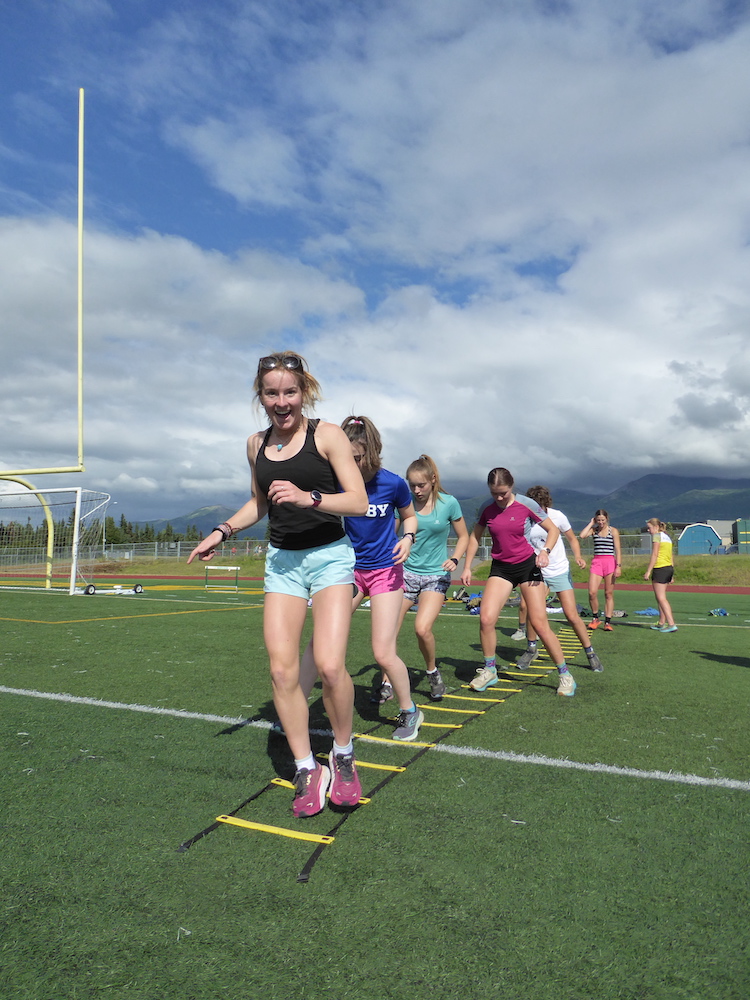
All smiles in ladder drills. Athlete Katey Houser is in front. (photo: Gavin Kentch)
“Working together really well,” the Development Team Coach immediately replies. “I think at the club level and the athlete level, you see a lot of athletes across clubs training together and working hard. They’re pretty cohesive right now. We’re getting stronger as a nation. Peer-to-peer coaching is getting to be more of the norm, where athletes will train together and say, Oh, I’m trying this, or, I’m working on this. So we’re starting to have more conversations about skiing, which I think – the larger picture there is that our culture as a ski nation is getting stronger. And we’re starting to see the results come with that.”
Anderson is also impressed by the level of commitment that she sees in the country’s various clubs. “One of the things I’ve noticed a lot with this group is that many of them are systematically training throughout the year, in strong programs, quite well,” she notes. “And so there’s a lot of patterns of similarity between technique for those that are skiing with their respective clubs. I think that’s cool; it speaks to a culture of training among many of those club programs. There’s good enthusiasm; there’s good cohesion; and there’s certainly a strong sense of competitiveness in the time trials that we’ve seen so far.”
But fun is important, too, Anderson adds. “We have a sport where you maybe have a twenty-year-long career with ups and downs, and lots of learning along the way. What people remember, and what makes it enjoyable in the hard times – if there is something that makes it enjoyable – is the people that they share it with. And so I think just getting that group together any time, and quite frankly the testing and the intensity workouts are things that are shared that add value to those bonds, or really accelerate how quickly a group of people can trust each other and enjoy training together. But really, it is as simple as, it should be fun.”
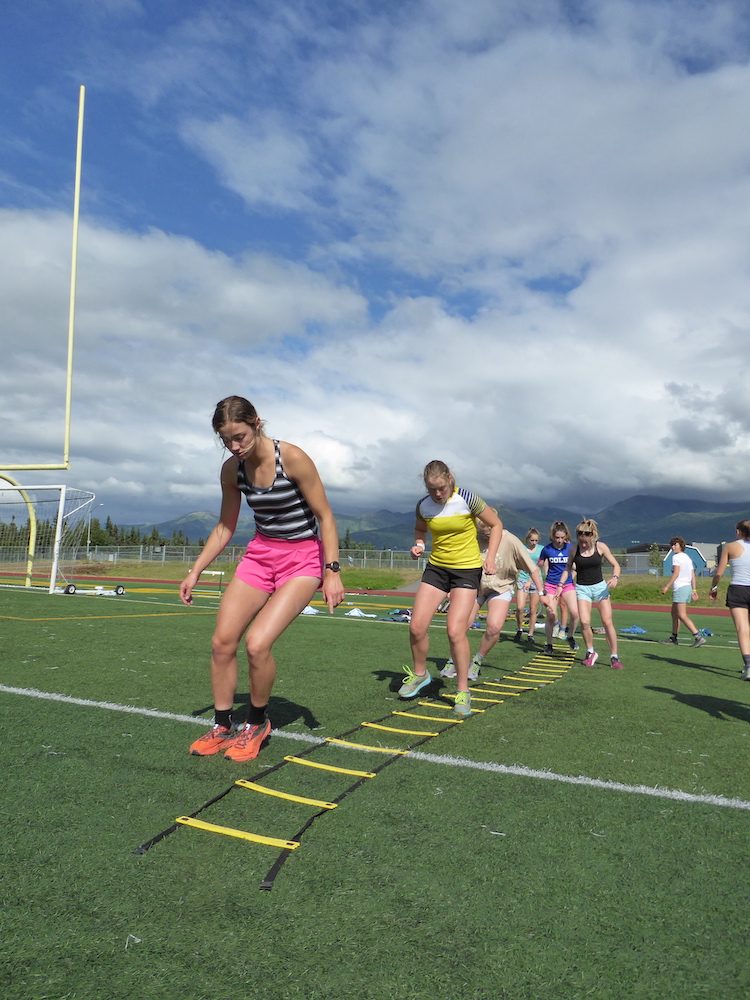
Rosie Whittington-Evans (front left) leads Olivia Soderstrom and Meredith Schwartz in ladder drills. (photo: Gavin Kentch)
The athletes sound similar notes. Here’s Rosie Whittington-Evans, 18, a recent Palmer High graduate set to ski at Colby College this fall: “Camp’s been really fun. I really enjoyed the first dinner that we have together, which is on the first day after playing a little bit of handball. And it gives you a chance to kind of meet everybody at camp. It gives you a chance to put yourself in situations with people that you might not have talked to but have been racing against for a couple of years. And yeah, it’s been really fun.”
Whittington-Evans, who was attending her second REG camp in as many years, appreciated the bonding-specific focus of this year’s camp: “I honestly was expecting more, like, testing first, like we did last year. Instead of – I think Greta is trying to make it more speed- and practice-based and just kind of team bonding at first, which I think works really well this year at camp. And it made you feel more comfortable around the people at camp with you rather than just hopping into an uphill time trial.”
Whittington-Evans was grateful for the high-level training group around her this week, particularly after spending high school racing in the Mat-Su Valley, slightly removed from the crucible that is Anchorage high school skiing. “Being surrounded by people that are more your speed or even faster” is “really nice,” she says. “I think camp is a really important thing to have. And it really brings the community together of racing and it gives you a chance to not just have people you’re racing against but also friends that you’re racing against.”
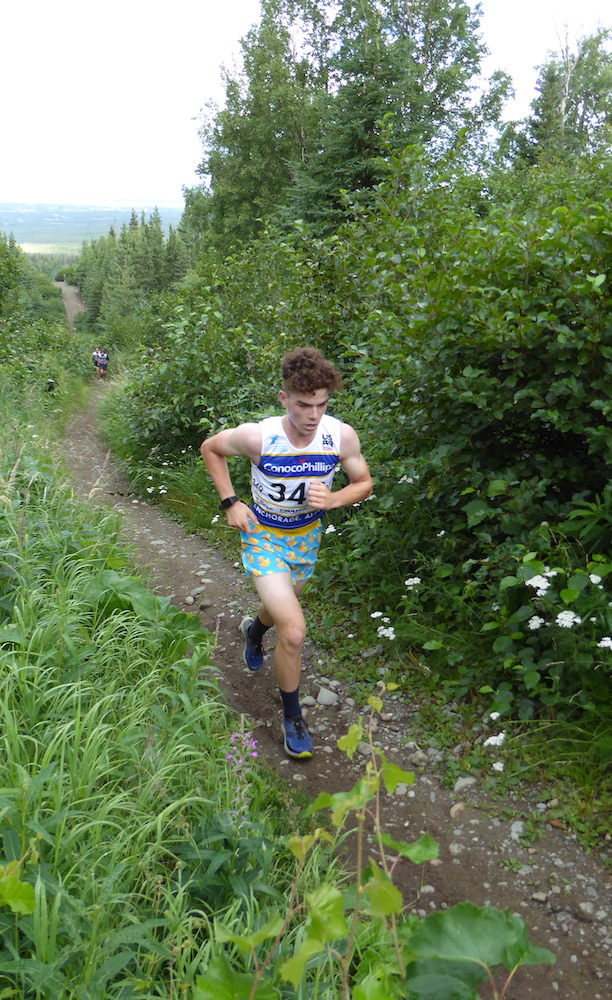
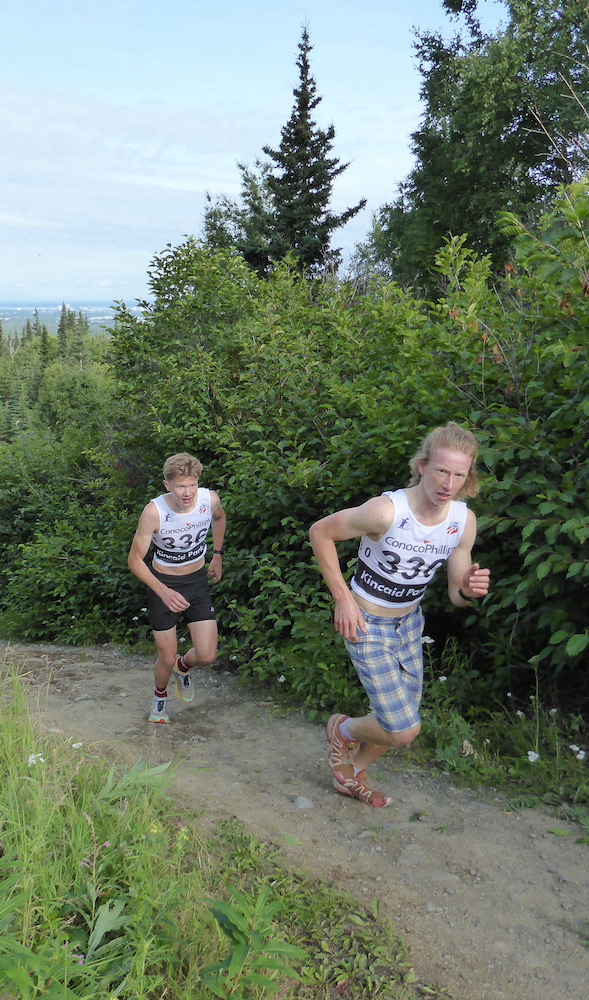
Justin Lucas runs uphill in the Gasline Time Trial. (photo: Gavin Kentch)
Justin Lucas (16, Service High School, first REG camp) says much the same.
“The best thing I’ve gotten out of this week is probably a couple of things: getting to meet the other teammates,” he observes. “Seeing how each other team trains, so we really get to learn from each other. Like some things you may not learn in one club, they can learn from another. It’s just a lot of interactions and learning from each other. So I think that’s my good part of this week so far.”
Coming into the camp, Lucas was expecting “a lot of hard training, lots of double training days. Which so far they’ve done,” he noted on day five of a six-day camp, “so it’s pretty much everything I had expected.”
But it had also been “pretty fun,” Lucas said. “I got to meet some of the other people from other teams. So that’s good, a good way to meet other people and get some good training.”
Lucas spent the week squarely focused on the present, but with some long-term plans in mind as well: “Right now we’re in high school, so it’s like a lot of people may focus on wanting to get first place at, say, a high school race, or State. But I think it’s more important to have your mind set on the bigger picture. Like, you may not win every race in high school. But that doesn’t mean the end of your ski career. It means you have more time to train, more time to get better. And in a few years, who knows, you could be racing World Cup.”
So does Lucas have results goals he can share?
“I’d like to hopefully make the Olympics one day, but if not, I’d like to at least make it to World Cup.”
Lucas’s long-term aspirations seem pretty plausible when you consider the context in which they were voiced. Retired athlete Nina Kemppel (four Olympics, five World Championships, 119 World Cup starts) was spotted on the Service trails during the warmup for Friday’s track workout, which occurred essentially across the street from Gus Schumacher’s house (one Olympics, one World Championships, 36 World Cup starts by age 21), in case you’d like your ready-made symbolism for the past, present, and future of American skiing. You really can get there from here.
But back to the present for the moment, there was one more test yet to administer. And so, early Saturday morning, it was time for the redoubtable Gasline Time Trial.
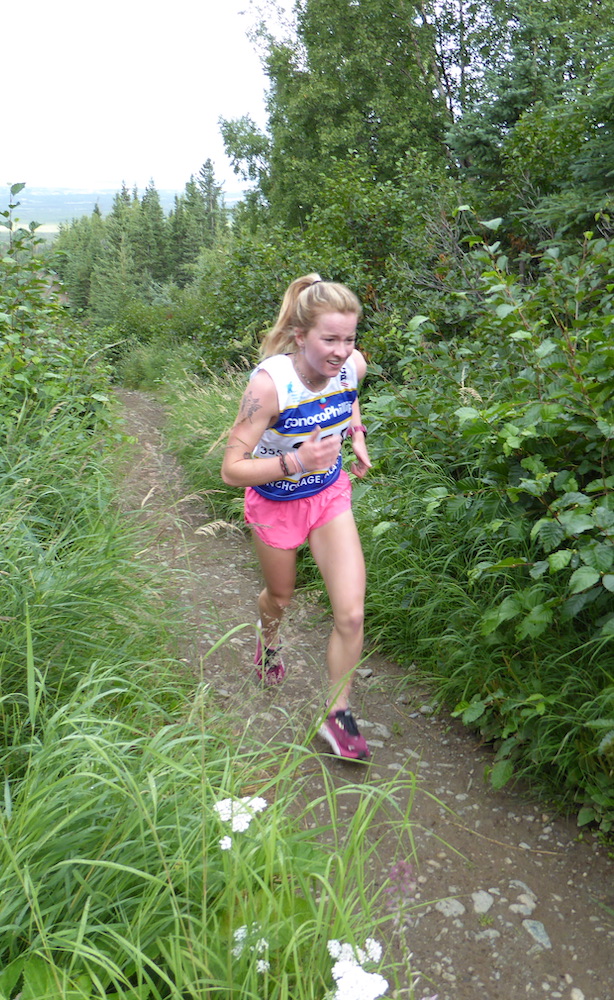
Gasline was the leitmotif of last year’s Alaska REG article, and has been an integral feature of Alaskan dryland training since at least the era when Kemppel was competing for Team Gold 2002, later and better-known as APU Nordic Ski Center. Course records are 10:20 for the women (Rosie Brennan), and low nine minutes for the men (Schumacher’s 9:12 on Strava is not the course record, but is close to it). Briefly put, you run uphill for 1.4 miles and 571 vertical feet, and it gets harder as you go along; read the 2021 article for the metaphorical implications of it all.
This year’s Gasline was the same as it ever was, but it came at the very end of camp. And so, after a bounding session, and a classic rollerski distance session with speeds, and a skate rollerski L3 session, and a strength session, and a rollerski agility course test, and a mountain bike session, and an uphill doublepole time trial, and Friday’s track session, and three presentations and two (Covid-safe outdoor) team dinners – most of which, by the way, occurred in a downpour during what will likely be the rainiest July ever in Anchorage in 100+ years of recordkeeping – on Saturday morning, it was time to run uphill. Fast.
Athletes parked at the finish at Prospect Heights at 8 a.m., then ran downhill en masse for bear protection. After an additional warmup on the Hillside trails and some instructions, a coach said “Go!” shortly before 9 a.m., and off they went from the canonical low point on Gasline.
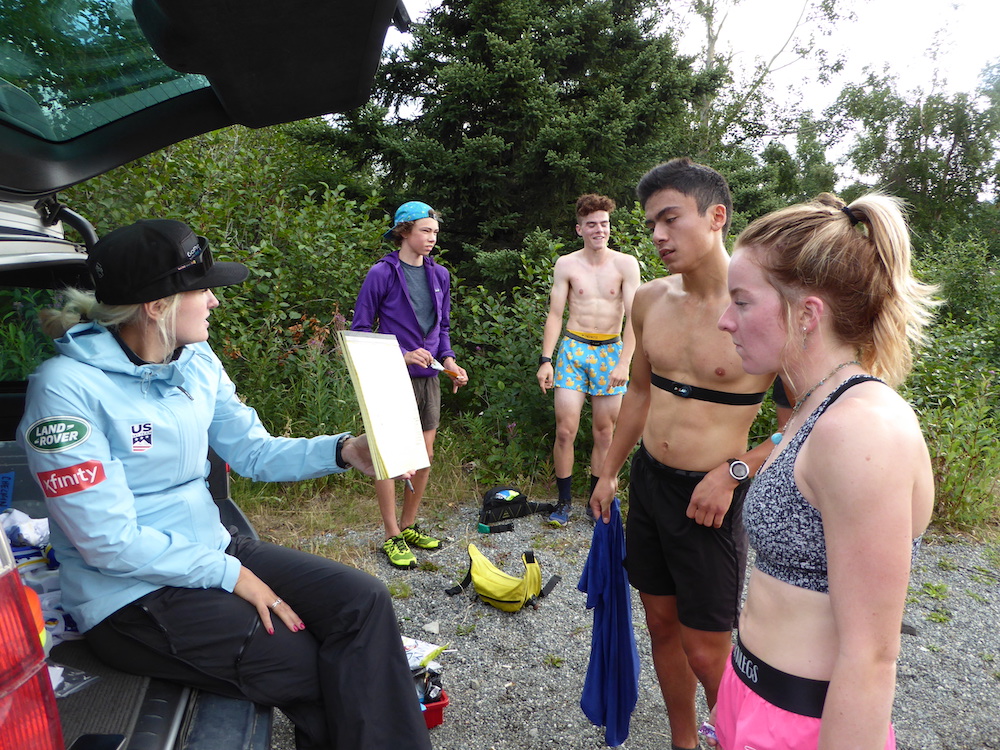
Moment of truth for the race of truth. Greta Anderson, far left, shows time trial results to athletes, 2022 Alaska REG Camp, Anchorage. (photo: Gavin Kentch)
While the athletes charged up the hill, coaches and support staff sprinted to their cars to drive back to Prospect Heights in time to beat the athletes to the finish. A reporter just had time to hear parts of two songs, “Unstoppable” and “Running Up That Hill,” on the six-minute drive, which feels scripted but was the actual playlist in this cultural moment. You can’t spell “kismet” without “KMXS Anchorage,” aka Mix 103.1.
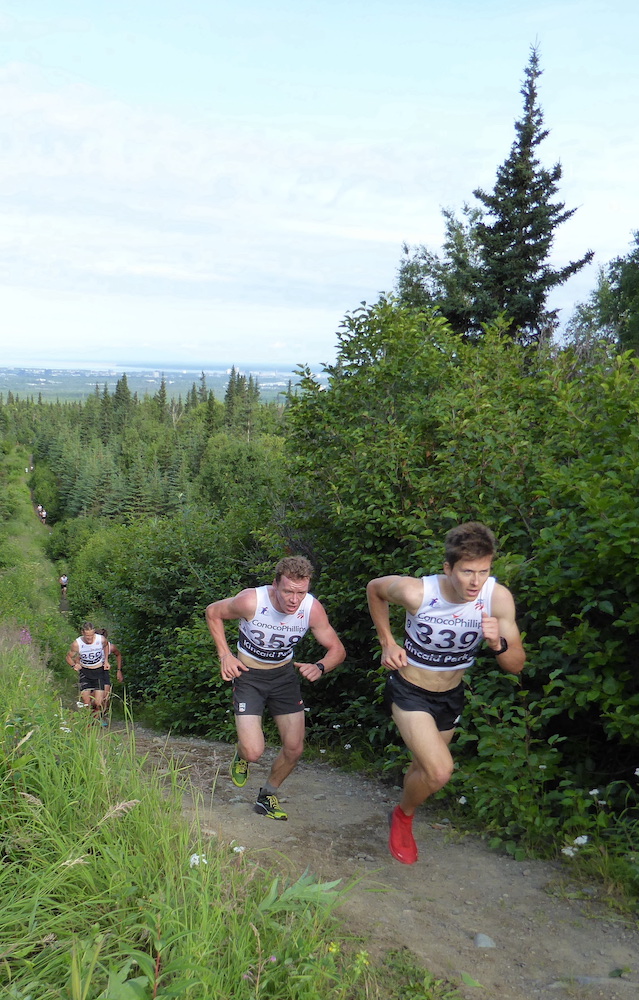
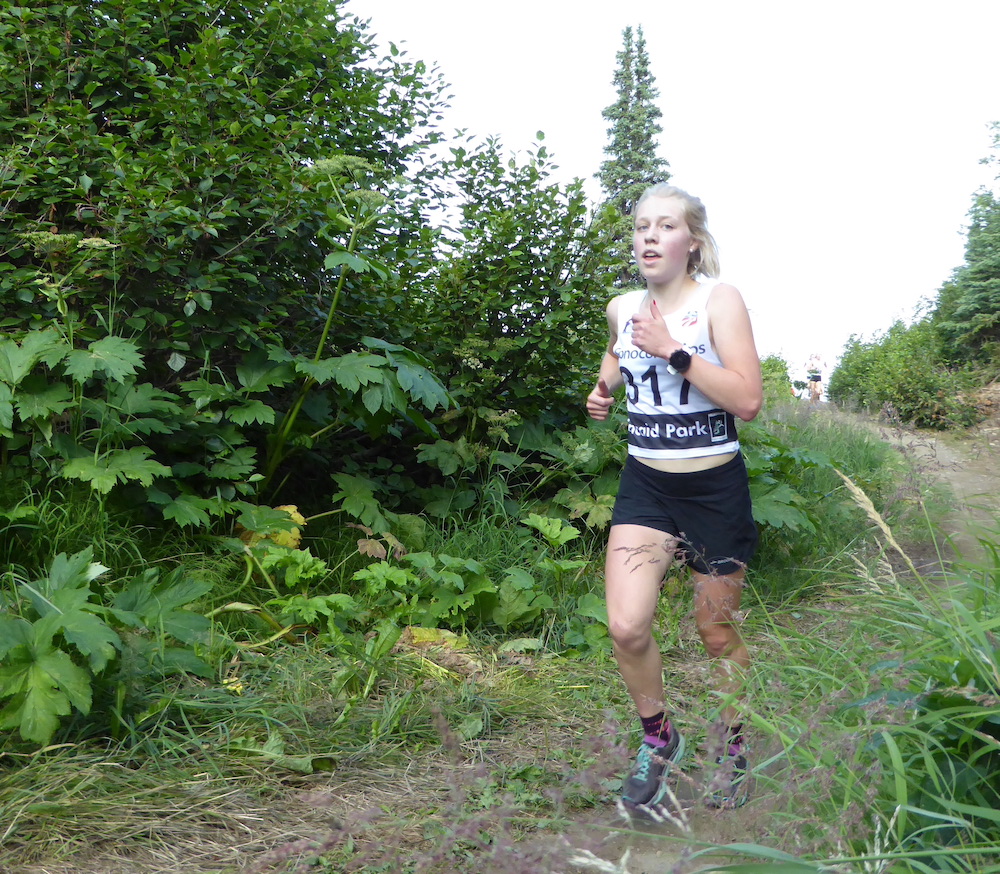
The first finishers burst off the trail onto Sidorof Lane less than ten minutes later; Ari Endestad’s PR of 9:29 was the fastest time publicly posted to Strava on the morning. For every athlete there, it marked just a handful of minutes in a multi-year journey. The future is bright, but it stands on the other side of a lot of hard work.
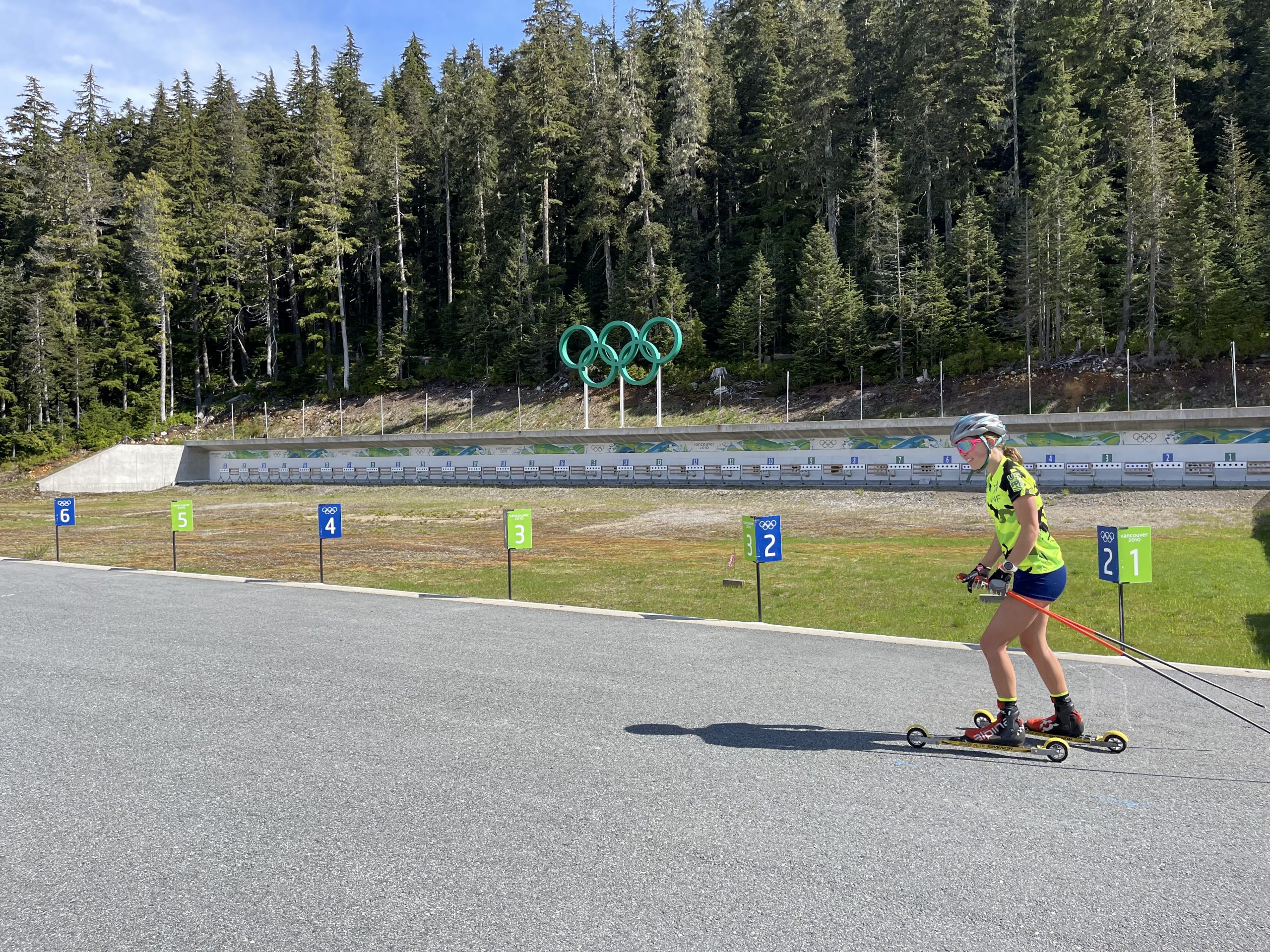
After an untold number of bear sightings and many hours of quality training, the U18 National Training Group (NTG) camp wrapped up in Whistler, B.C. the third week of June. The first of the National Nordic Foundations (NNF) Summer Series, the goals of the camp were twofold: the first was to give these athletes a chance to meet and train together, particularly since the annual U18 Nordic Nations Cup trip was canceled in January due to high COVID-19 cases in Norway; the second was to familiarize the athletes with the venue and living environment in Whistler, as it will be the site of the upcoming 2023 Junior/U23 World Ski Championships in January.
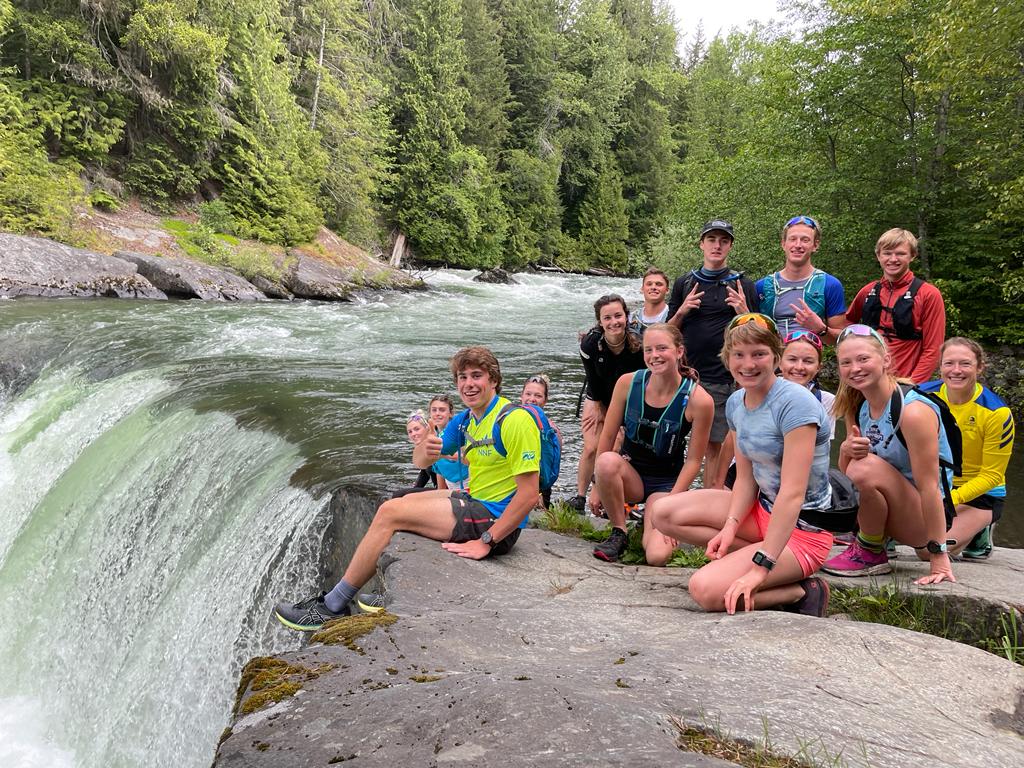
The camp’s attendees earned a spot on this trip after selection by the U.S. Ski & Snowboard (USSS) based on their performances at last year’s Senior Nationals in Soldier Hollow, UT and/or other USSS sanctioned races. Hailing from all over the country, 13 athletes made their way to Canada for a week of training and exploration.
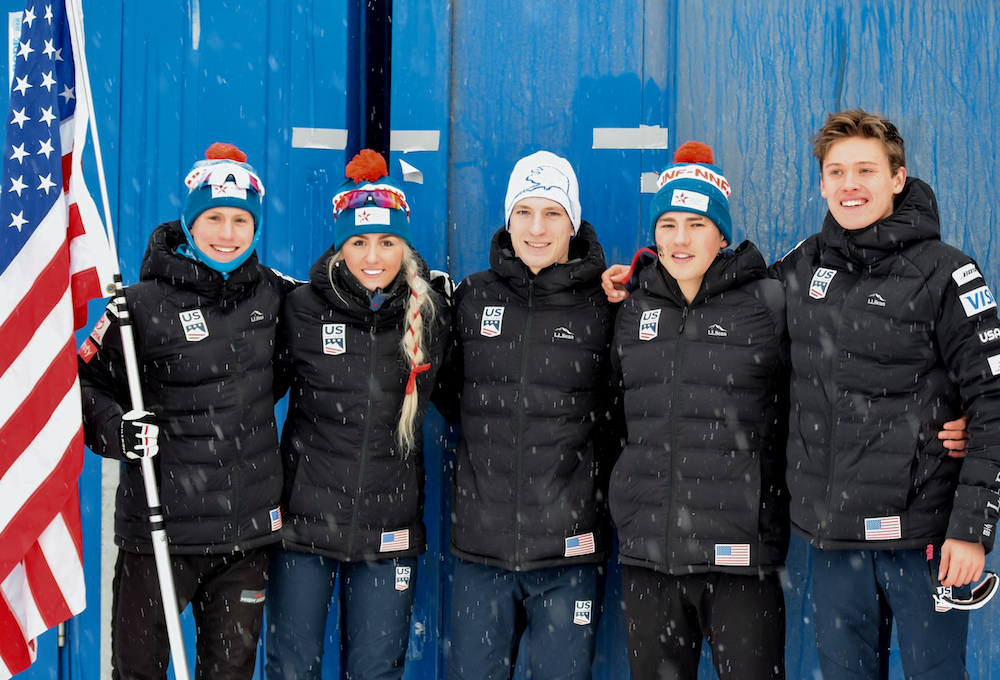
Group shot of the 13 athletes from around the US who participated in the U18 NTG camp in Whistler, BC (Photo: Bryan Fish)
U.S. Ski & Snowboard Cross-Country Sport Development Manager Bryan Fish, explained in an email what this might mean for the American juniors. “Our teams have become very good at traveling well and executing overseas, however our first Junior World Ski Championship medals became a reality in 2017 when Park City, UT hosted Jr Worlds. Those home-field championships helped spark the successful trajectory of USA cross-country skiing. We are trying to build a similar positive environment for these 2023 Championships.”
Getting familiar with the trails at the Whistler Olympic Park before 2023 Jr World Championships (Photo: Greta Anderson)
In addition to Fish, the camp’s coaching staff was comprised of U.S. Development Team Coach Greta Anderson, Alex Jospe from Stratton Mountain School, and Naomi Kiekintveld from Alaska Pacific University Nordic Ski Center.
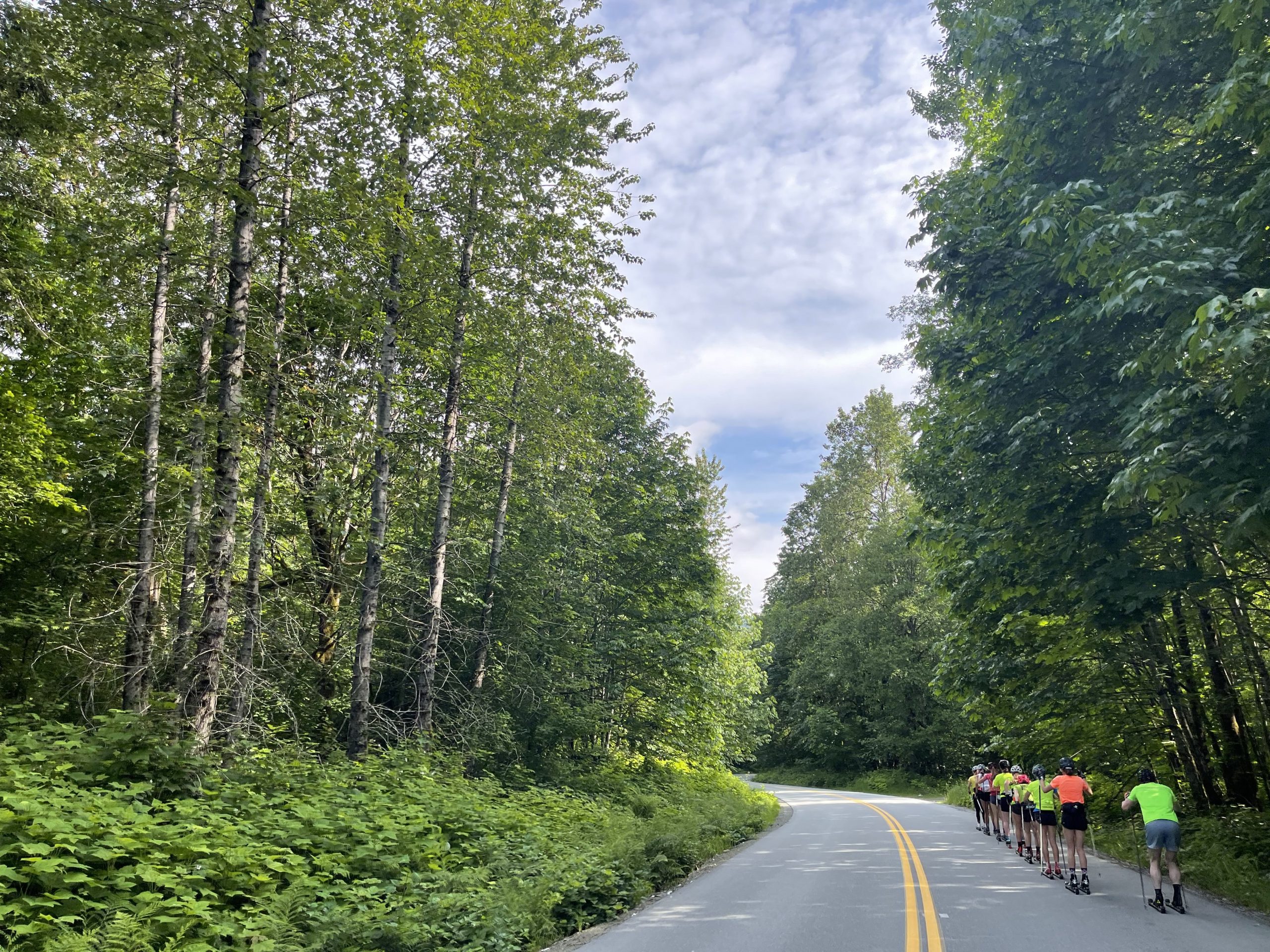
After the recent conclusion of the NTG camp, Fish felt that the camp’s objectives had been achieved. He wrote, “the camp successfully achieved the goals of familiarizing ourselves with all aspects of the venue, the race courses, and the living arrangements. It was a great group of athletes which made for positive and motivating training sessions. The Whistler rollerski track is on a portion of the Jr World race courses, so we spent a great deal of time getting comfortable on the track at speed to understand how the course flows.”
Through collaboration with Nordiq Canada, the joint U.S./Canadian Spring National cross-country Championships were also held in Whistler in March, which Fish explained, “provide[d] our athletes with true on-snow race experience on these courses.”
Exploring the area outside of the Whistler Olympic Park and getting some training (Photo: Greta Anderson)
As for the athletes’ perspective, in a blog post written for NNF, Midwest junior Cooper Camp reflected that for him, “one of the most valuable parts about this camp was being able to ski with the best juniors in the nation. Not only being able to get quality training in with each other, but also skiing behind others and learning from what they do, is one of the biggest benefits from camps like these.”
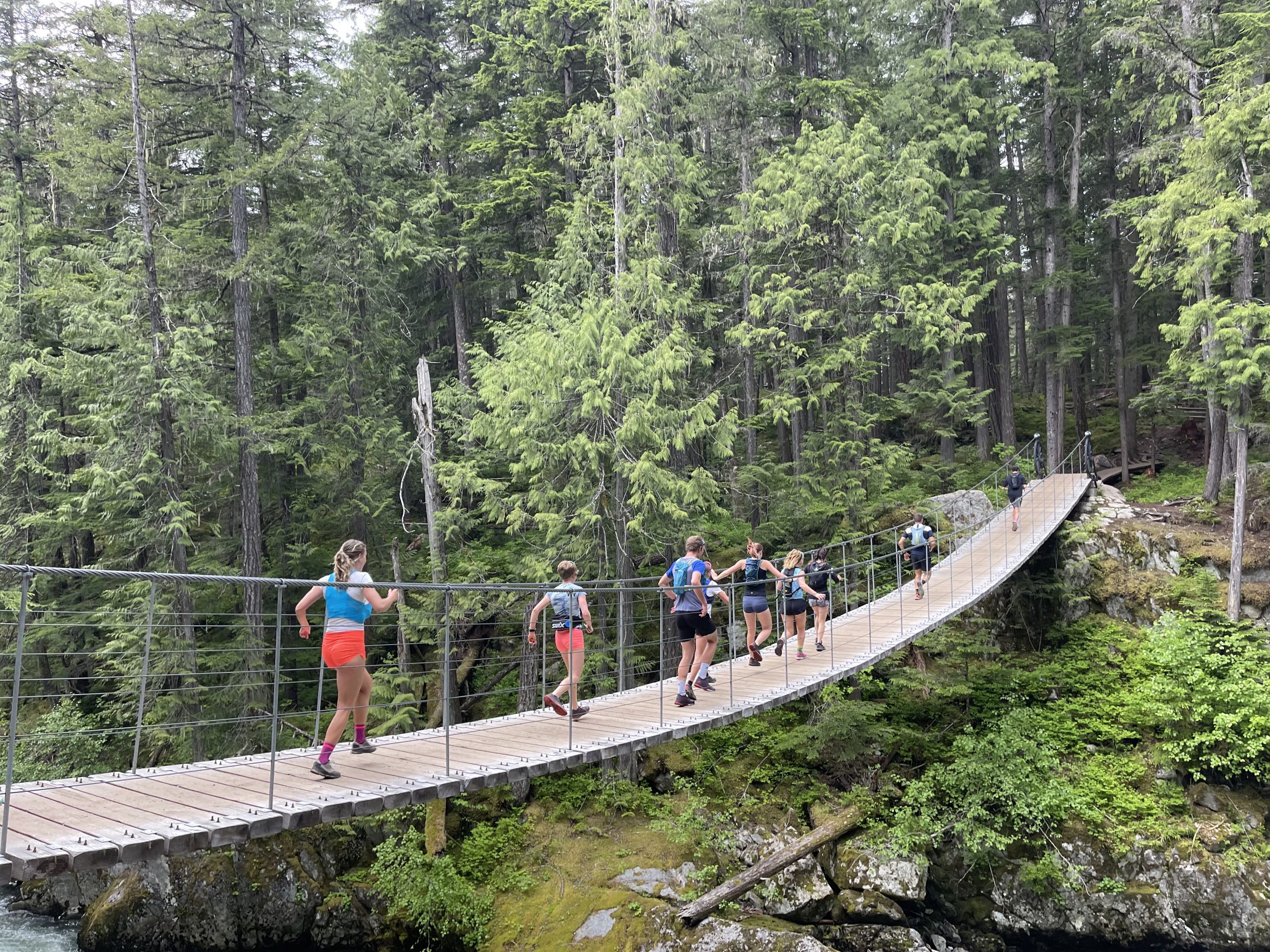
Campers head out for a long run (Photo: Greta Anderson)
Although the athletes have returned home to their respective clubs, there may be more opportunities for them to train together before the summer is over with both Regional and National Elite Group camps still to come. As to who will be returning to Whistler to represent the U.S. at the Jr/U23 World Ski Championships starting January 27th, 2023, both athletes and fans will have to wait until the conclusion of Senior Nationals (Houghton, MI) at the beginning of January before the team will be announced.
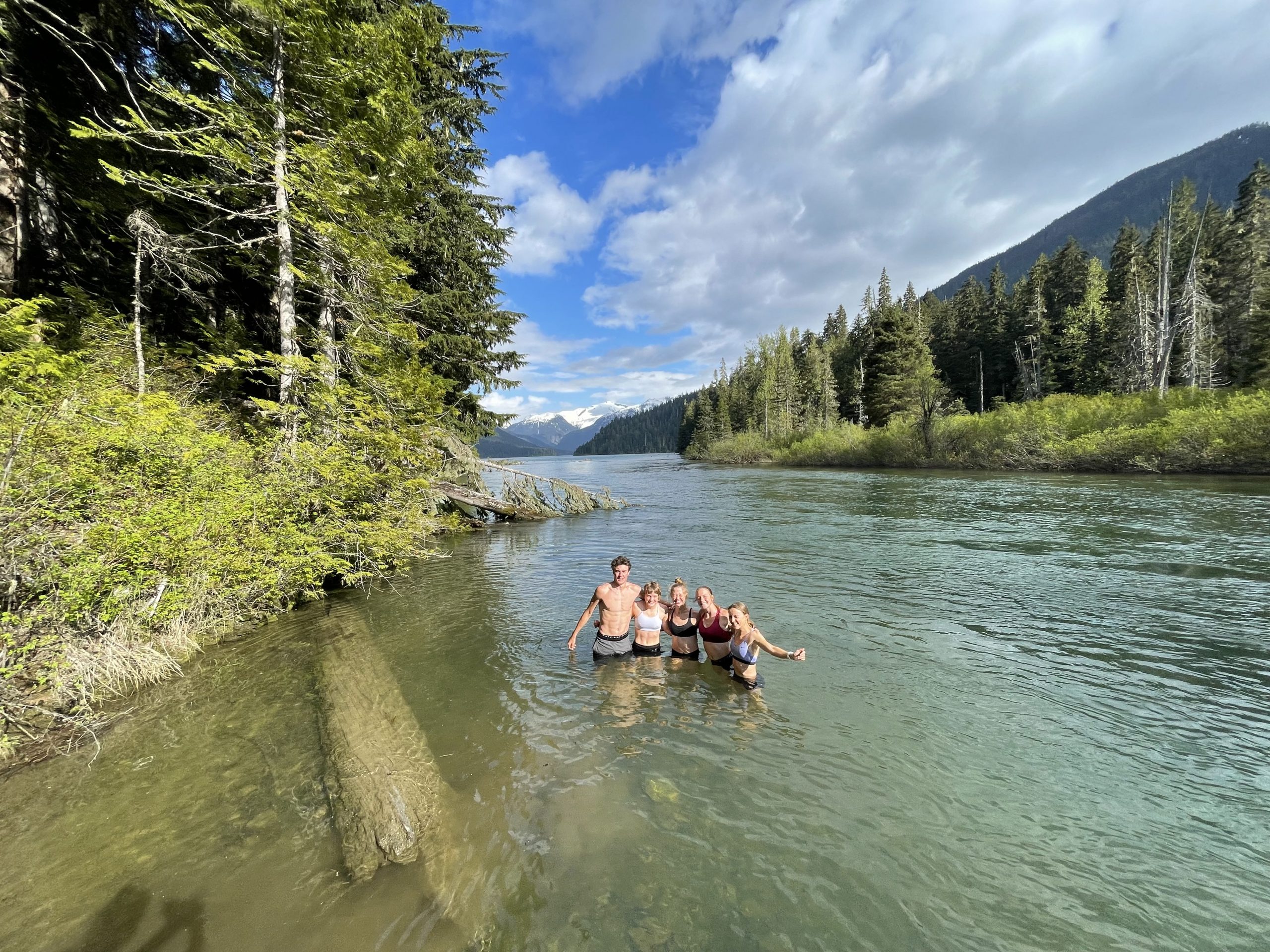
Campers cooling off after a day of training (Photo: Greta Anderson)
For an on-the-ground look at the recent camp, a recap video made by coach Alex Jospe, can be found here.
U.S. Ski and Snowboard Development Team Coach Greta Anderson encourages athletes racing the men’s 30k distance race during the 2022 U.S. Cross Country Championships in Soldier Hollow. (Photo: Tobias Albrigtsen / @untraceableg)
Last June, U.S. Ski & Snowboard announced the hiring of Greta Anderson as Development Team Coach, supporting Cross Country Program Manager Bryan Fish in “all aspects of leadership and logistics surrounding the U.S. Development Pathway, including National Training Group camps, U.S. Nationals and Junior/U23 World Championships, Europa Cup, select SuperTour and other national-level competitions, as well as working on Coaches’ Education and Certification.” (Read an in-depth interview with Anderson following the announcement here.)
As she described it, joining the U.S. Ski Team staff during an Olympic year while the COVID-19 pandemic raged on was a bit of “trial by fire.” Nonetheless, Anderson thrived in her new role, approaching the position with humility and open-mindedness as she learned the ropes. With a holistic view of athlete development, which emphasizes the importance of creating an environment where the athlete can be both happy and supported, Anderson had the opportunity to support athletes from the U16 to U23 level across the spectrum of international and domestic clubs and races. She played key roles during the 2022 FIS Junior/U23 World Ski Championships in Lygna, Norway, and had her first experience as the primary trip leader during the Opa Cup Finals pre-camp and competitions in Sappada, Italy.
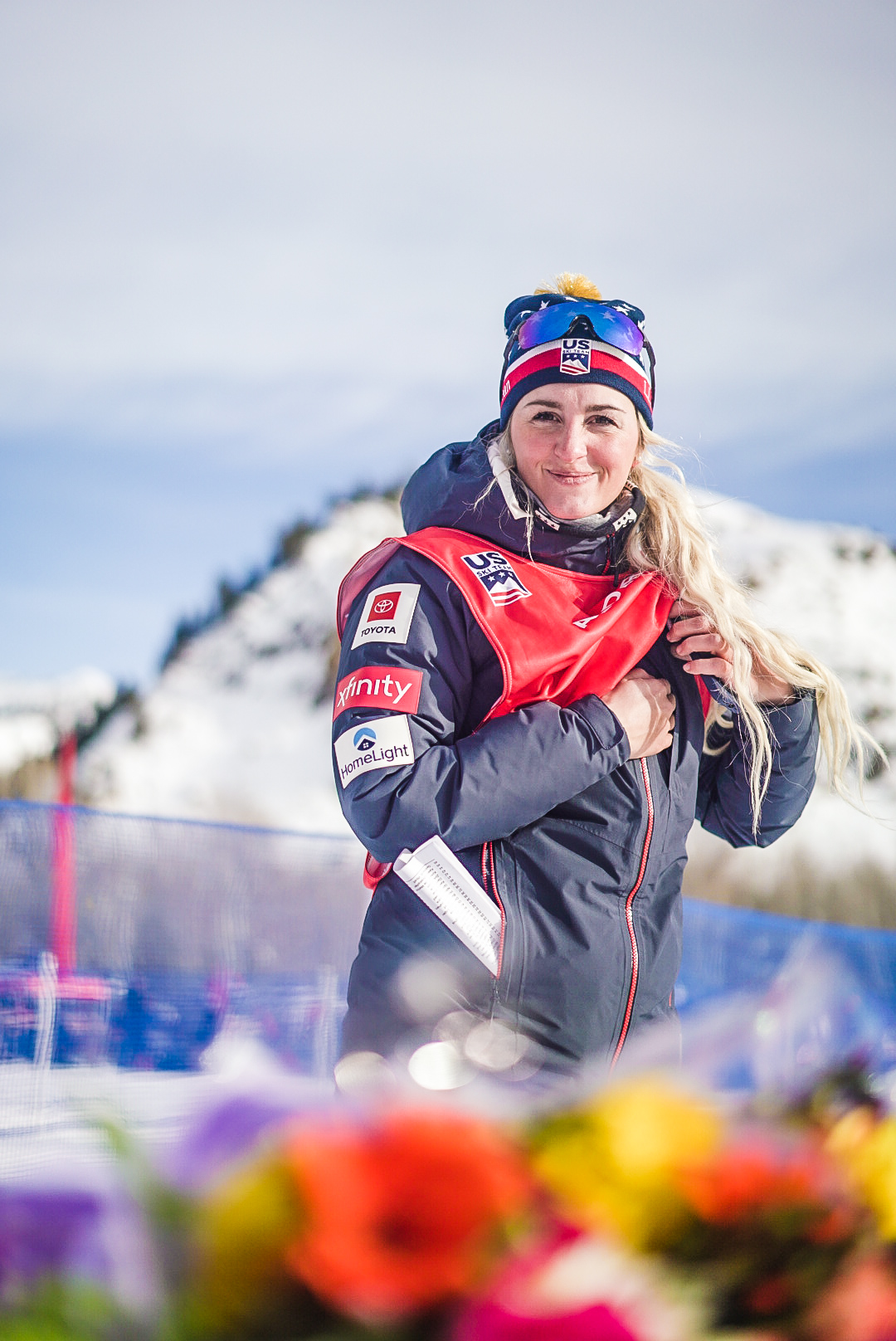
U.S. Ski Team development coach Greta Anderson discusses the highlights and challenges of her first year in the role, as well as insights into the philosophy, projects, and initiatives of the national team development program more broadly. (Photo: Tobias Albrigtsen / @untraceableg)
In this conversation, you’ll hear more about Anderson’s contributions to the development program thus far, and she shares insights into the philosophy, projects, and initiatives the U.S. Ski & Snowboard staff are working on to continue the growth and support of athletes ascending the pathways from junior to senior racing. We also discuss standout performances of the World U23/Junior Championships, and some of the athletes who have been recently named to the 2022-23 U.S. Cross Country Team.
Thanks for listening, and thanks to Boulder Nordic Sport for supporting this podcast.
Note: One of the athletes whom Anderson discusses is Finn O’Connell, who skis for the Bridger Ski Foundation Pro Team in Bozeman, MT. While he was supported by development team coaches at the Opa Cup Finals, his nomination was to the B-Team, not the D-Team.
While World Cup Finals were underway in mid-March in Falun, Sweden, a second contingent of top American skiers was lining up roughly 2,000 kilometers south to race in the OPA Cup Finals in Sappada, Italy. Located along the northern edge of Italy near the Austrian border, the small town is nestled among the spectacular, jagged massifs of the Italian Dolomites, roughly an hour’s drive east of Toblach, which typically hosts the final stages of the Tour de Ski. The team spent the week prior to competition training in Toblach, which features similarly spectacular views, along with the benefits of the delicious food and drink one might expect when traveling in Italy.
For those unfamiliar with the OPA Cup, it is an international race series featuring predominantly European athletes racing just below the World Cup level. The US Ski & Snowboard development program typically facilitates a trip to OPA Cup Finals to provide athletes who may not have earned World Cup starts the opportunity to experience high level competition overseas. Qualification is based on national rankings, beginning with those racing on the World Cup, and proceeding through the top domestic racers, depending on declines. Often, there is overlap between the teams for the FIS Junior/U23 World Ski Championship teams and the OPA Cup teams, which may conveniently allow some athletes to prolong their stay in Europe and attend both events.
“Generally the trip is geared toward athletes that are a bit older, who either have had World Cup starts or on track for that,” explained US Ski Team Development Team coach Greta Anderson.
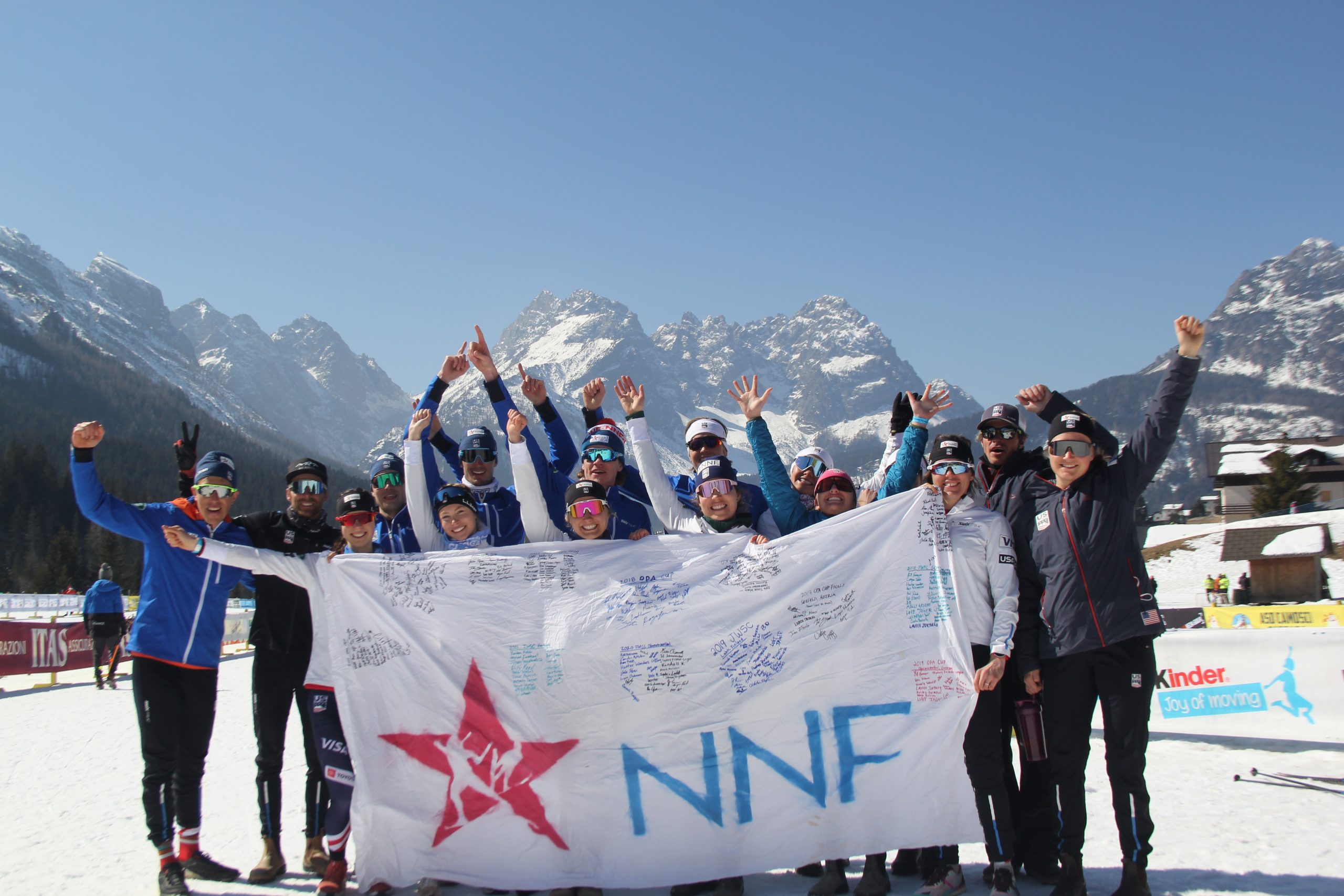
The American OPA Cup Finals team celebrates fast races and bluebird days in Sappada, Italy. (Photo: Bryan Fish/NNF)
Identifying it on its list of “Pillar Projects”, the National Nordic Foundation (NNF) helps subsidize the cost of the trip for the qualified athletes. The trip can accommodate up to 16 skiers, who are generally kept to an approximately even male to female ratio through the qualification criteria. This year, due to conflicting schedules and a number of declines, thirteen athletes attended, with nine women and four men.
In alphabetical order, the senior men included: Braden Becker (CGRP), Logan Diekmann (BSF Pro), Finn O’Connell (BSF Pro), Karl Schultz (SVSEF). Senior women included: Mariah Bredal (BSF Pro), Margie Freed (CGRP), Alex Lawson (CGRP), Hannah Rudd (BSF Pro), Becca Rorabaugh (APU), Lina Sutro (SMS T2), and Alayna Sonnesyn (SMS T2).
Finn O’Connell (2nd from L) alongside Braden Becker (L), Karl Shulz (2nd from R), and Logan Diekmann (R) at OPA Cup Finals
in March 2022. O’Connell was recently named to the US Ski Team for the 2022-23 season. (Photo: Alayna Sonnesyn)
SMS T2 teammates Alayna Sonnesyn and Lina Sutro show their love for Sappada during the Opa Cup Finals trip. (Photo courtesy of Alayna Sonnesyn)
This year, two U20 athletes headed from World Juniors in Lygna, NOR to Italy along with D-Team coaches Anderson and Bryan Fish: Kate Oldham (Aspen Valley Ski Club) and Annie McColgan (UVM).
“It’s pretty cool that we have more racers that are racing professionally or post collegiately than, I think, ever in the US, and they have more clubs and places to choose from,” said Anderson. “There were several athletes that, especially because racing was shut down on the East Coast last year and I happened to be in Alaska and wasn’t wasn’t traveling very much before I took this job, it was kind of the first time I’ve gotten to work with them, or the first time I’ve gotten to work with them in three or four years. So it was really cool to get to know Alayna Sonnesyn a little better and Lina Sutro a little better, and Margie Freed and Alex Lawson, who I’ve seen race many times, but it was the first time I’ve gotten to really work with them and get to know them. The same with Braden Becker and Karl Schultz… So it was a pleasure on the trip to get to work with some new athletes that have come through different development systems and are excited about and ready to make that next step. And this racing circuit is a really good opportunity for that.”
Anderson took the lead with organizing the trip and supporting athletes, working alongside US Ski & Snowboard Cross Country Sport Development Manager and long-time OPA Finals trip lead coach Bryan Fish. The wax support staff included BSF Pro Team head coach Andy Newell, former APU athlete and current staff member Peter Kling, and Jackson Hole comp team coach Jon Filardo.
US Ski & Snowboard Cross Country D-Team head coach Greta Anderson supports athletes during the Sun Valley SuperTour races in January. (Photo: Tobias Albrigtsen / @untraceableg)
Anderson identified the OPA Finals trip as a key development opportunity for a number of reasons: though perhaps lower pressure than World Cup, it’s a professional race circuit with small but competitively dense fields, athletes race aggressively and tactically in a style younger athletes who have not yet raced at this level may not have experienced, and it offers the opportunity for an athlete to dial in some of the small but significant factors details that support success adapting to a new and different environment following long international travel.
“Bryan’s been doing [the OPA Cup Finals] trip for a long time,” Anderson said. “So Peter Kling, who was on a coaching staff, and Becca Rorabaugh, they were like, ‘I’m pretty sure that we were on Bryan’s first ever OPA Cup trip.’ And it used to be that we started at the bottom of the results sheet and started looking upward for names. And right now we’re starting at the top and we don’t have to look very far down.”
In two days of racing, the US had seven top-10 finishes, with another set of athletes finishing well-within the top-20. Highlighting the US team was SMS T2’s Sonnesyn, who took third in the 10 k classic on Saturday the 12th, and won the 10 k skate the following day.
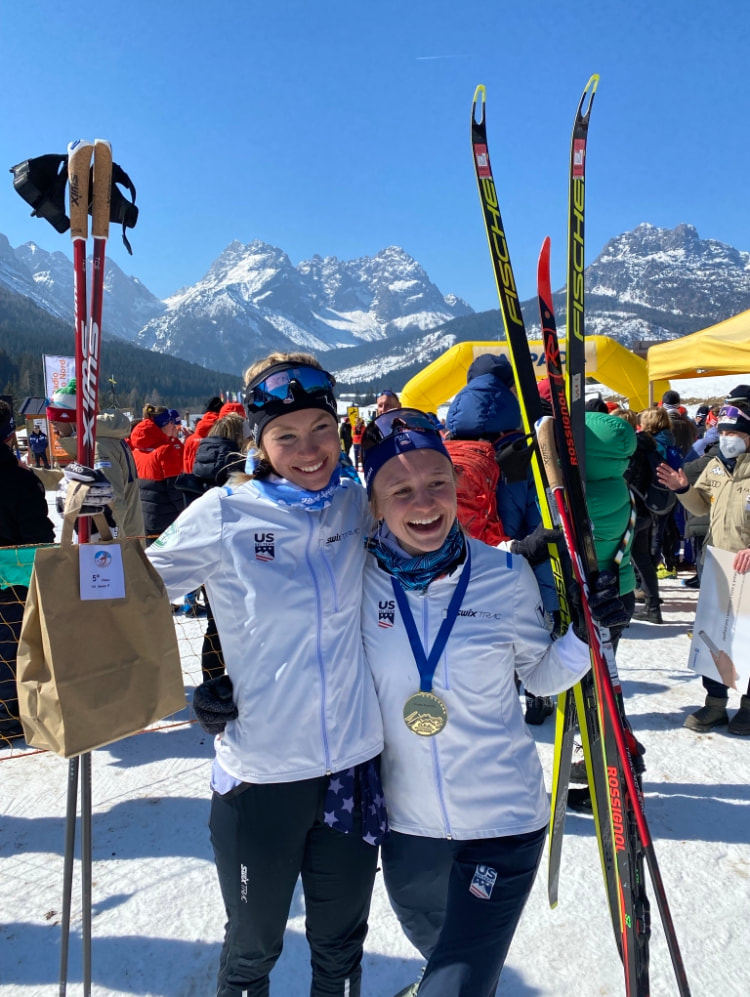
Alayna Sonnesyn (SMS T2) takes the win in the 10 k skate at Opa Cup Finals in Sappada, ITA, with Mariah Bredal (BSF Pro) finishing just behind in fifth. (Photo courtesy of Alayna Sonnesyn)
“It’s pretty special,” Anderson said of the performances in Sappada. “It’s awesome to get to see that. For Alayna to start a race and say like, ‘What’s my plan to try to win this?’ It’s not just, ‘Hey, we’re here to participate and learn,’ but ‘Hey, we’re here to participate and learn but also we’re going to try to win.’ And I think, with that comes — not only from staff but from racers — this level of professionalism. Okay, we’re going to select skis. We’re going to make sure we’re organized and in a good place. Where can we be? Where can we do feeds? How can we set you up to have the success you need to have?
“It just feels like a really good time to be an American ski racer.”
After winning two of the first five SuperTour races this season, and finishing on the podium in each of the others, Sonnesyn was offered starts at the Tour de Ski, where she hoped she could achieve strong enough international results to qualify for the Olympic Team. But these goals did not come to fruition; Sonnesyn struggled to find the same race sensations while on the World Cup and tap into the fitness she knew was still there, which was reflected in results below her expectations. She shared her disappointment openly on her blog and social media, providing a relatable and important example to her followers that the pro-skier journey is not immune to bumps in the road.
“My experience on the World Cup this year – it was quite demoralizing, to be honest,” said Sonnesyn in a call from the airport as she was on her way to SuperTour Finals in Whistler. “And then, after the Tour de Ski, I got COVID. And it just really put a damper on the whole winter for me. And I started questioning like, ‘Okay, am I fit? And I like, can I race? Well, like, what have I been training for? This is really bad timing with COVID, too.’ So I was just pretty down. But then I was able to have really great SuperTour races, back in January and February, and then to be able to race internationally again in Italy. It wasn’t a World Cup, but it was still very high level of racing. So to have it go so well kind of reaffirmed to me that I belong on the international stage. And I definitely needed that, a little bit, just to give myself more confidence moving forward and motivation as well. So I’m really excited about the races and how they went and what I did to prepare for them and kind of my mental attitude around them, too.”
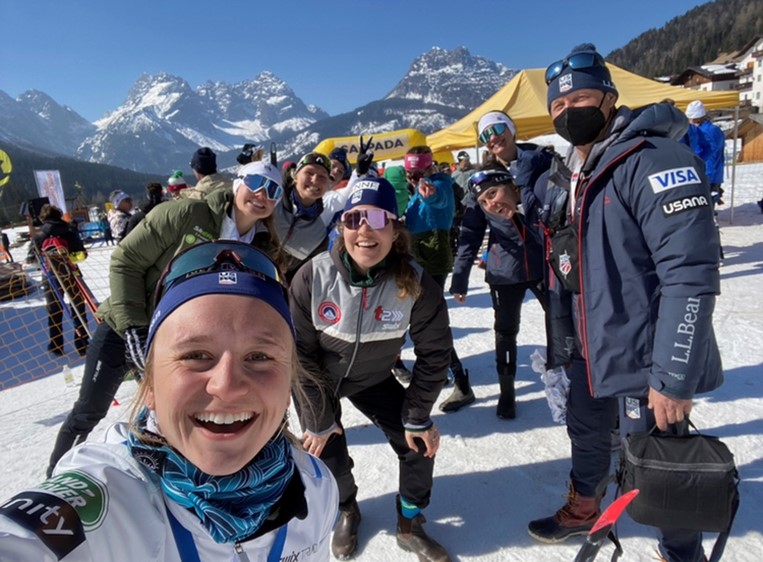
A selfie in Sappada: the American team prepares for race day at Opa Cup Finals. (Photo: Alayna Sonnesyn)
As she reflected on the trip and her experiences racing internationally over the last few seasons, Sonnesyn echoed Anderson’s sentiments about the progression of the American team at the event.
“Compared to my first OPA Cup trip, which was in 2018, I think there were maybe two or three top 10 performances. And they were exciting, but for the most part, it was kind of like, ‘We’re just here to get the experience. We’re not really sure what we’re doing.’ And I think that the way the US is developing right now, the way that new courses are being built in Cable or Duluth, or wherever it is – they are preparing us better for racing internationally. And I think that was shown in the results that we had in Sappada. And it was just so exciting during that 10 k skate on Sunday to cross the finish line in first, and then turn around and see a ton of my other US teammates come in right behind me. That’s not something that was happening four years ago. So I think we are really developing and that is a huge thanks to so many different people and so many reasons, but it’s exciting to see.”
Sonnesyn also spoke to the importance these international opportunities have provided her specifically, speaking from the perspective of what she dubbed a “bubble athlete” who has oscillated between World Cup and domestic racing over the last four seasons. She got her first World Cup starts in Quebec in March, 2019, and has been offered starts beginning in Period 2 each season since. Though this is a key stepping stone in the process toward consistent World Cup racing, she expressed that bubble athletes can have a challenging time planning seasons in advance and need to be prepared to adapt quickly to more frequent overseas travel.
“I think that every single experience that an athlete has going and racing internationally, and traveling, and competing at that higher level, it all adds up to be super beneficial and a great learning experience. For example, I have gotten really great at overcoming jet lag, which the first couple of international trips I went on, I had no idea how to handle. I tried my best to do what I could, but it’s hard. And also to know what little things you want from home, like after being in Europe for four or five weeks, what do you really want from the US?
“And then also, how do you work in a new environment? A lot of times, if you’re going over to the World Cup, sometimes you’re provided a wax tech or sometimes not, or you have to bring your own, but you have to be willing to work with whoever you get.”
Sonnesyn explained that on the Sappada trip, she had worked with each of the techs before, but on her first trip in 2018, it was her first experience working with those wax staff members. Given the importance of ski choice and wax, working together effectively is imperative to an athlete’s success, but it requires dialogue and practice.
“Being ready to communicate effectively with the staff, what do you need? How do you want your skis prepared? What do you need from a hotel? All those things seem like such small little details, but they really add up with the more experiences you have.”
Alayna Sonnesyn races in Oberstdorf, Germany during the 2021/22 Tour de Ski. (Photo: NordicFocus)
She also spoke to the differences in the style of racing between the US and her international experiences, and how a trip like Sappada better athletes for what they might encounter should they be offered a World Cup start down the line.
“When it comes to racing: the courses in Europe are very challenging and very technical. Downhills, uphills, flats – whatever it is, there’s a lot of it, and you have to be ready to go for it. And then the competitors are fierce. They know how to be aggressive in a race, and you have to know how to hold your own. So it just helps to have that experience to understand how you approach the race. How aggressive are you going to be? How are you going to pace the race? How are you going to handle others around you?”
With the highest levels of competition for our sport happening across the pond, it is easy to understand why opportunities like the OPA Cup trip provide an essential bridge for developing athletes. But it is not simply the facilitation of this trip that has led to marked improvement for the American team.
“I think we’re open to change right now,” Anderson said as she reflected on her key takeaways from the experience in Italy and her first season coaching the D-Team. “I think the US, in a year with COVID, and lots of challenges logistically and politically in the world, we handle those changes better than almost any other country does. And I think that’s really shown here.”
Alex Lawson skates to 7th in the 10 k skate during OPA Cup Finals in Sappada, ITA. (Photo: Bryan Fish / NNF)
While the OPA Cup crew was putting together a very solid day in the 10/15 k skate, the team of Rosie Brennan, Zak Ketterson, Scott Patterson, and Jessie Diggins had taken the win in the thrilling 4 x 5 k mixed relay in Falun. As the team in Sappada mingled near the finish to support the final racers as they skied through, Anderson said that a Swiss national team coach walked over and showed them the World Cup result on the phone.
Layered on top of the broader success at the OPA Cup Finals, Anderson expressed that this opened her athletes’ eyes to what might be possible for them in the years to come also. In particular, the Falun results of Zak Ketterson, a newcomer to the World Cup who ended his debut season with a 15th place finish in the 15 k skate and a mixed relay win.
“[The guys racing at OPA Cup] are like, ‘Oh, man, I beat Zak sometimes’, or ‘I’m right with him’, ‘I trained with him in college.’ The level of confidence that brings… ‘Maybe maybe I can do that too.’”
Moreover, Anderson expressed that this relay gold medal speaks to the equity of skiing in the US. “That we have good female athletes, and we have good male athletes, and we have a good balance of the two, and teams that are mutually supportive of each other,” she said. “Not every country has that.”
Boiling down the experience and her feelings as the season wraps up, Anderson concluded, “I have nothing but good things to say about our athletes right now. I’m really impressed with them. They handle the change better than anyone, and I think as a staff and from an organizational perspective, we’re trying to keep up, remove barriers, make sure they’re supported. And we’re open to trying new things, and it seems that we’re excelling in places where we’re willing to experiment and get our feet wet.”
Kate Oldham (AVSC) races the 10k classic during Opa Cup Finals in Sappada, ITA. (Photo: Bryan Fish / NNF)
Providing additional insights from the perspective of an OPA Cup Finals first-timer, FasterSkier also heard from U20 athlete Kate Oldham, who trains with the Aspen Valley Ski & Snowboard Club (AVSC) and competes for Middlebury College. Oldham took 11th place in both the 10 k classic and skate in the junior women’s category.
“Sappada was incredible,” Oldham wrote. “In congruence with the pre-camp in Toblach, the OPA Cup trip was unforgettable… My favorite ski to-date was on a long ski over the pass from Cortina to Toblach, stopping midway for trail side pastries and cappuccinos! Being with a group of older athletes was a valuable change from the World Junior trip because each team member brought new energy and experience to the group. Between that and the gelato shop next door to our hotel, the trip couldn’t have gotten much better!
Enjoying a cappuchino and pastry fueling stop while skiing from Cortina to Toblach. (Photo: Kate Oldham)
BSF Pro Teammates Hannah Rudd (left) and Mariah Bredal (right) sip cappuchinos while skiing from Cortina to Toblach during the Opa Finals pre-camp. (Photo: Kate Oldham)
“One of the things I think are most valuable about training and racing camps is the exposure to coaches and athletes outside one’s home team. For years I have been seeking out opportunities to attend regional and national camps that would bring new perspectives, training groups, and social dynamics to push me and help me adapt my own training method while making friends from schools and clubs all over the country. This winter I was lucky enough to have both my club coach and a group of skilled and passionate wax technicians/trip leaders selected from all around the US to lead the trips to Junior World Championships and OPA Cup finals. I know that over the six years I’ve been skiing competitively I have developed the competence to independently navigate high-level skiing events, but having techs to guide me through the process at the international level was extremely helpful, particularly when one of them I had worked closely with for those six years of training and racing.
“With new coaches come new perspectives. Another set of eyes, a different experience, or a new phrase can be all it takes for the pieces of new advice to click into place. Or maybe a coach has a different perspective on the bigger picture of skiing that resonates with you unlike the philosophy you previously knew… which of the infinitely wide range of mindsets in ski racing works best for you? Which one reminds you why you love ski racing? Which one helps you stay motivated through the hardest parts of the season when the last thing you want to do is get out the door for training? Which one eases the heartbreak of coming so close to a goal but falling short despite your hardest effort? Without a doubt, cross country skiing is a delicate balance of internal and external factors, but having great teammates and coaches like the ones I got to know and work with in Europe this winter is certainly a key ingredient to the recipe for success in the lifelong pursuit of excellence on the race course and off.”
The 2022 FIS Junior/U23 World Ski Championships trip has been made possible through support from the National Nordic Foundation (NNF), which has identified this invaluable opportunity for developing athletes as one of its “Pillar Projects”. You can support the NNF and the next generations of America’s top skiers by making a donation here.
Friday at 2022 FIS Junior World Ski Championships in Lygna, Norway, marked the phase that Steve Fuller, on site to take photographs qua Flying Point Road, calls “the ‘groundhog’s day’ stage” of the championships. “Things are happening so fast that you’re not quite able to get caught up with each day before you get up and do it all over again,” Fuller wrote on Instagram.
Will Koch races to 13th in the 10 k classic during the 2022 Junior World Ski Championships in Lygna, NOR. (Photo: John McColgan)
Undeterred, the Americans headed out on course Friday morning for their seventh and eighth races in four days. The coaches and wax techs (see the back row in the lead picture of the relay story) prepped skis for their eighth championship race within less than 72 hours. At the end of the day, Russia took a combined four out of six podium spots; Canadian skiers Xavier McKeever and Jasmine Drolet placed sixth and eighth, respectively; and Will Koch and Sydney Palmer-Leger led the way for the Americans in 13th and 19th.
Women’s 5 k Classic
Let’s back up. The women again had the day’s first race, a 5-kilometer interval-start classic. The first starter headed out on course, over a single lap of yesterday’s 5 k course, at 11 a.m. The official results describe conditions as somewhere between moderate and perfect: air temp of -2 C, snow temp of -3 C. Skies were overcast for the women’s race, but the sun came out for the men; as USST Development Team Coach Greta Anderson told FasterSkier later Friday, conditions sped up noticeably by the afternoon.
82 starters later, Dariya Nepryaeva, who started at the sharp end of the field in bib no. 80, had logged the day’s fastest time, crossing the line in 14:30.1. She was closely followed by her compatriot, Elizabeta Bekisheva, in second, 2.9 seconds back. Emma Kirkeberg Mørk of Norway was close behind for third, 4.0 seconds back.
Sydney Palmer-Leger skis into the top-20 in the 5 k classic during the 2022 Junior World Ski Championships in Lygna, NOR. (Photo: flyingpointroad.com)
The day’s fastest North American finisher, and fastest Jasmine in the field, was Jasmine Drolet of Revelstoke, B.C., in eighth, 21.5 seconds back. She was followed in the North American standings by American Sydney Palmer-Leger (University of Utah/Park City, Utah) in 19th (+51.3), and Canadian Jasmine Lyons in 26th (+1:03.3).
“I felt pretty good. I really like classic skiing and my goal was to give it all I had,” said Drolet in a press release from Nordiq Canada. “You only ski the lap once, so the key was to just go hard the whole time. We had amazing conditions, perfect for classic skiing so it was a good day.”
Behind Lyons were the two Ninas, Nina Schamberger (Summit Nordic Ski Club/Leadville, Colorado) in 31st (+1:14.2) and Nina Seemann (Dartmouth Ski Team/Craftsbury, Vermont) in 36th (+1:23.0). Annie McColgan (University of Vermont/Bend, Oregon) was 40th (+1:27.3). Canadian athletes Sarah Cullinan (44th, +1:34.2) and Tory Audet (59th, +2:08.2) followed.
Annie McColgan races the 5 k classic in Lygna, NOR, her first start of the 2022 Junior World Ski Championships. (Photo: John McColgan)
McColgan radiated enthusiasm when she talked with FasterSkier following her first race at these championships. “It was nice to have everyone cheering out there, and my parents were here so it was really, really fun. It was really cool,” McColgan said.
McColgan also provided insights on the course, describing it as “a really interesting 5k” with plenty of rolling terrain, but not many opportunities for recovery. “There’s a lot of steep little hills that you just have to be really good at… But it also is 16 minutes long. So you kind of have to make that balance [with energy expenditure]. And then the final climb was so brutal.”
Men’s 10 k Classic
The men again had the day’s second race, starting a two-lap, 10 k interval-start classic race at 1 p.m. local time. Taking athletes’ distance points as an informal form chart, in a field with 101 athletes the podium finishes came, relatively unsurprisingly, from bibs no. 90, no. 100, and no. 101. The gold medal on Friday went to Russian Saveliy Korostelev, the penultimate athlete on the course. Korostelev posted the fastest split time at 3 kilometers, at 5 kilometers, and at 8 kilometers, crossing the finish line in 26:15.8.
Will Koch leads the American junior men with a 13th place finish in the 10 k classic during the 2022 Junior World Ski Championships in Lygna, NOR. (Photo: flyingpointroad.com)
Korostelev enjoyed a hefty advantage over silver-medal finisher Niko Anttola of Finland, who finished 21.4 seconds back. Anttola ranked one to eight seconds behind Alexander Ivshin of Russia at all intermediate checkpoints, but skied the final two kilometers just barely faster. When Ivshin, the day’s final starter, crossed the line, he had fallen 0.8 seconds behind Anttola and had to settle for third.
Put another way, Russia came within a second of going 1–2 in both the men’s and women’s races. They instead had to settle for first and second in the women’s race, and first and third in the men’s.
Shortly behind the podium, Xavier McKeever of Canmore, Alberta, skied a strong race to finish sixth, 52.4 seconds back of Korostelev and roughly 30 seconds off the podium. It was McKeever’s best international result since, well, Tuesday, when he was fifth in the men’s 30 k mass start skate. McKeever’s sixth today tied Palmer-Leger’s sixth, from Tuesday’s women’s 15 k skate, for the second-best North American individual result of these championships.
“I am stoked to be in the top-10 again,” McKeever told Nordiq Canada in a press release. “I was getting splits that I was close to the podium in the first lap, but I just couldn’t keep the high pace that I started with. Honestly, I feel like the podium is still a fair bit away, but today just motivates me more to make the steps toward being able to contend for a medal. … I have been able to build my confidence over the course of this season. After last year, it was instrumental for me to refocus on putting in the hard work each and every day, which I think has helped me race with more confidence than ever before.”
McKeever was followed by his countrymen Max Hollman (Thunder Bay) in 17th (+1:28.8), Derek Deuling (Whitehorse) in 19th (+1:31.5), and Thomas Stephen (Calgary) in a tie for 26th (+1:40.0).
Brian Bushey races the 10 k classic during the 2022 Junior World Ski Championships in Lygna, NOR. (Photo: John McColgan)
Will Koch (University of Colorado/Peru, Vermont) led the way for the Americans, finishing in 13th (+1:23.4). He was followed by Alex Maurer (University of Colorado/Anchorage, Alaska), also 26th (+1:40.0); Brian Bushey (University of Utah/Waitsfield, Vermont) in 36th (+2:00.2); and Finn Sweet (University of Vermont/Waterbury, Vermont) in 47th (+2:11.3).
Thoughts from the coach
Greta Anderson is in Lygna at her third World Juniors as a coach or tech, her first since assuming her current coaching position with the U.S. Ski Team. (Disclosure, Anderson was this reporter’s coach in APU Masters in 2014–15, and has remained a close personal friend ever since.)
Asked what she saw about today’s races, Anderson noted, “They were really fun to watch. Between FIS live timing and back split, the radios were pretty lively. One thing I did learn this year, and this is more than I’ve seen in the past, is that our athletes – every single one has the raw speed to compete at this level. We’re working on the durability portion of it. I think the top athletes in these races often are running negative splits in a big way; I would have to sit down and look at percentages. I’m sure we’ll do that at some point in time. But you know, the speed is there early on, we have very good placement, and then we need to figure out how to speed up just a little bit more. But that’s, you know, that’s been a big step for us as a country.
“Will Koch, obviously very, very strong today. Brian Bushey came out on the top end of ten places being within four seconds, or eight places within four seconds maybe. So you know, really phenomenal. … Annie McColgan had her first ever World Juniors race today. And that’s always really fun and special to watch. I think often athletes come away seeing like, ‘wow, there’s another level,’ and it can be really motivating for the following year.”
Sydney Palmer-Leger leads the junior women during the 5 k interval start classic. (Photo: John McColgan)
Turning to Schamberger, Anderson observed that the 16-year-old has “had a pretty heavy week of racing so far. She’s had three starts, and the first day was not what she wanted. And the second day she had the gift of getting redemption the very next day, which I think is one of the best things athletes can have. And she was really happy with how she skied the relay, a big smile on her face. And then a really good race today. It’s fun to watch athletes – the moment that they realize they’re skiing at that level. Because we know they can do it, and we watch it, but that aha moment of ‘Oh, okay, in the world, this is where I am.’ That moment is really cool. It’s one of my favorite parts of my job for sure.”
Anderson also described the environment at the venue more broadly, highlighting the effects of vocal parental support. “There’s quite a few parents here from the U.S.,” she said.
“And Americans are really loud compared to other countries, and it’s probably taken as obnoxious, but I really appreciate it. We can always hear the Americans. It’s fun to stand by them and listen to them get all excited. Next to the parents during the relay is one of my favorite places to stand.”
In that vein, Anderson concluded, “I look around, and I’m so proud to be an American coach. I’m so proud of the American skiers; there’s not a single other nation I would – I’m really glad that I work for our staff. And I think our athletes are really glad that they ski for the U.S.A. I don’t think they look around and think, like, ‘I wish I was on that team,’ or, ‘I wonder what that team is up to.’ We’re definitely in that, ‘We’re Americans and we’re here to beat you. Or at least die trying’ mode. And that’s pretty fun.”
U.S. Ski and Snowboard Development Team Coach Greta Anderson encourages athletes during the men’s 30k distance race during the 2022 U.S. Cross Country Championships in Soldier Hollow. (Photo: Tobias Albrigtsen / @untraceableg)
Racing continues tomorrow with skate sprints for U23 athletes, both genders, before wrapping up Sunday with both men’s and women’s U20 skate sprints and the U23 mixed relay, sending athletes and techs out with three races, two techniques, and a combined sixteen sprint heats on the final day of racing. Groundhog’s Day, indeed.
U.S. Ski & Snowboard has announced 24 athletes to represent the United States at the FIS Junior & U23 World Cross Country Championships Feb. 22-27 in Lygna, Norway.
“Following a year filled with constant changes, I am so pleased to see a team fielded with such depth among our roster,” said U.S. Ski & Snowboard Head Cross Country Development Coach Greta Anderson. “We have several spots on this team that were declined because of athletes who are headed to the Olympic Games next week. This progress speaks volumes about our upcoming athletes’ ability not only to adapt but to thrive in uncertain environments and seize opportunities when they present themselves. We are taking this team to Norway, the ‘homeland’ of skiing, and cannot wait to see what they can do at the Championship.”
The following athletes have been selected to represent the United States at the upcoming FIS U23 and Junior World Nordic Championships.
Zanden McMullen races a skate pursuit in Ruka, Finland in November, 2021. (Photo: NordicFocus)
U23 World Championship Team
Women
Abigail Jarzin (University of Utah/Salt Lake City, Utah)
Lucinda Anderson (University of New Hampshire/Golden Valley, Minnesota)
Samantha Smith (Sun Valley Ski Education Foundation/Sun Valley, Idaho)
Annie McColgan (University of Vermont/Bend, Oregon)
Men
Finn Sweet (University of Vermont/Waterbury, Vermont)
Will Koch (University of Colorado/Peru, Vermont)
Michael Earnhart (APU Nordic Ski Center/Eagle River, Alaska)
Brian Bushey (University of Utah/Waitsfield, Vermont)
Walker Hall (University of Utah/Winthrop, Wash.)
Alexander Maurer (University of Colorado/Anchorage, Alaska)
** – Denotes a ‘Decline’ of their respective spot on the team roster due to scheduling conflicts between the Olympic Winter Games & NCAA Regional Championships
From left, Zanden McMullen, Greta Anderson, Hunter Wonders, Gus Schumacher, and Luke Jager following the boys gold medal relay performance at 2019 World Junior Championships in Lahti. (Photo: courtesy of and shared with permission by Barb McMullen)
This summer, the U.S. Ski Team announced that it had hired Greta Anderson as the new Development Team Coach. FasterSkier caught up with Anderson on the afternoon of the official announcement to delve deeper into her coaching philosophy, precise job description, and only sort of tongue-in-cheek plans for world domination.
Anderson’s hire was widely praised by both current and former athletes. Here’s Luke Jager, who’s known Anderson for nearly a decade starting in Alaska junior skiing and is currently a member of the USST Development Team, or D-Team: “Super stoked. We have come through the sport together so fired up to get to keep working with her!”
Here’s Gus Schumacher, now on the USST A-Team, who ascended the Alaska junior skiing ranks alongside Jager: “I think she’ll be good at bringing knowledge from a lot of different clubs, camps, and backgrounds to the national team pool. She’s been with [Alaska Winter Stars] recently, but has also been with APU and Crested Butte, as well as doing a bunch of REGs and World Juniors trips. Also it’s always good to get a female perspective in that currently disproportionately male area. She’s a good leader, and I think she’ll be really good in that position.”
And here’s fellow A-Team skier Hailey Swirbul, who was first coached by Anderson many years ago as a junior in Colorado: “I know that Greta has put in the time and work to gain valuable skills that will really help the D-team! She has been on so many international trips and coached at all levels to really develop as a leader and coach. I’m super excited that she will be part of the U.S. staff!”
So the athletes are excited. What does Anderson think about this job, and what parts of her background have prepared her for this position? Anderson spoke with FasterSkier at a west Anchorage playground in early June, a one-minute rollerski away from her childhood home, while planes from the nearby international airport intermittently roared overhead and a reporter’s children patiently entertained themselves on play structures.
Two quick disclosures here: One, Anchorage skiing is a small town. Greta was my coach with APU Masters from 2014–2015, and has remained a close personal friend since. She has listed me as a reference on her applications for several coaching positions over the past few years, though not for this particular one (and so far as I know, I had nothing to do with her being hired for this job). Two, the questions in this interview have been expanded from what I originally asked, so that they will provide more information and better function as transitions in a standalone article. The answers have been lightly edited for syntax and clarity.
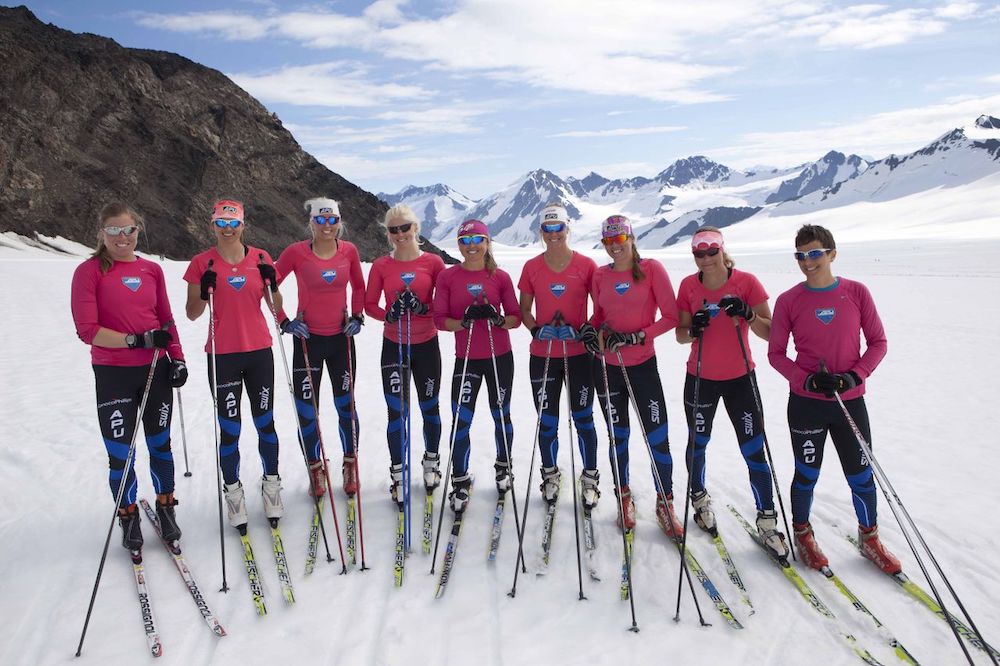
From left, APU skiers Rosie Brennan, Lauren Fritz, Greta Anderson, Erika Klaar, Holly Brooks, Sadie Bjornsen, Becca Rorabaugh, Sarah Cresap, and Kate Fitzgerald on Eagle Glacier, Alaska, summer 2013. (photo: courtesy APU Nordic Ski Center)
Let’s start with your background. I know that you’re from here; you attended Service High School and skied for Alaska Winter Stars, then went to Alaska Pacific University, where you skied for the APU University Team and won the Tour of Anchorage. You graduated with a B.A. in Counseling Psychology. Am I leaving anything out – did you do anything else before you began coaching the Masters and Devos with APU?
That was my first get-my-feet-wet-in-coaching experience. And what happened was, it was springtime, I think in my junior year, and I hurt my back in the gym. And I said to Erik Flora, ‘I am going to take a break because my back is injured.’ And he said, ‘Well, why don’t you coach a little bit’, and I said, ‘Okay.’
And like so many people who do sports, I’m not good at moderation, and I slippery-sloped into a lot of coaching. And then my back got a little better. I was working with Charlie Renfro as the Devo coach at that time, and then Dylan Watts was the Masters coach at that time, and he was going to phase out in a year. And I enjoyed it a ton. And so then Erik was like, ‘Are you going to come back to racing.’ And I said, ‘No, I kind of love this. I think I wanna do this.’ So then I kept doing it.
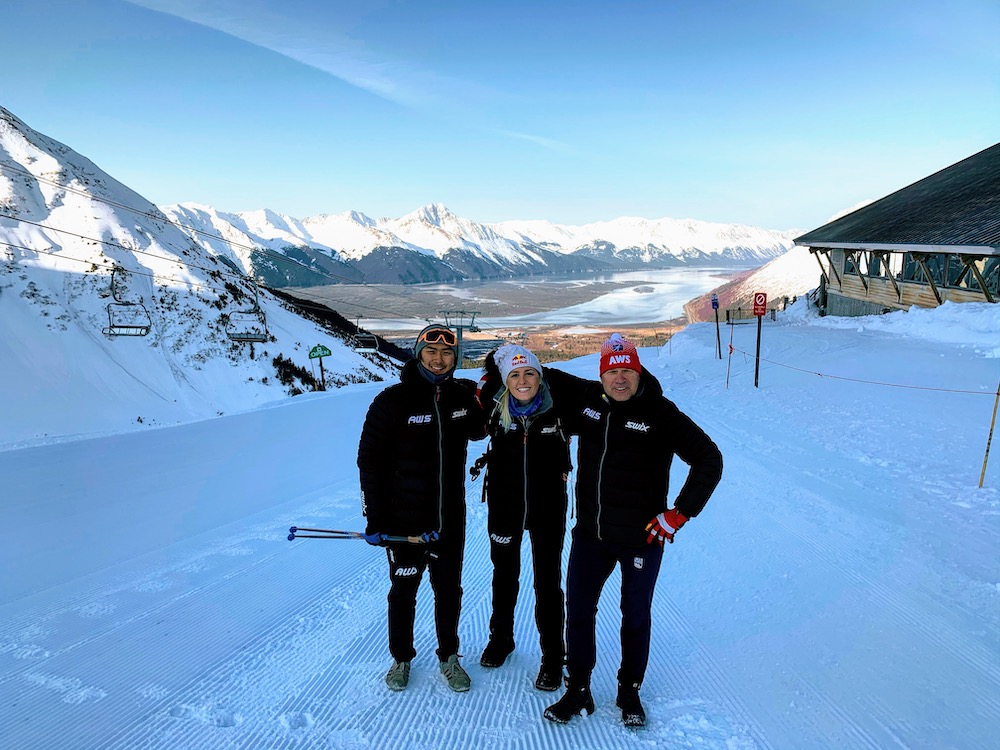
Anderson, with, from left, fellow Alaska Winter Stars coaches Seiji Takagi and Jan Buron, top of Alyeska hill climb, Girdwood, Alaska, April 2021. (photo: courtesy Greta Anderson)
So one year at APU begat several years with Steamboat Springs Winter Sports Club, and a brief stint with Crested Butte Nordic, before you ultimately came back home to Anchorage and Alaska Winter Stars, this time as a coach. And you must have been pretty good at this, because before too long you were at World Juniors with a front-row seat for a spate of breakthrough American performances. Which World Juniors were you at, and what was your official role at them?
I was at two, Lahti and Oberwiesenthal [in 2019 and 2020]. My first year was as a wax tech, my second year coaching – but those are float roles, right? It’s like, what do you need to do on race day? What gaps need to be filled? You’re wearing many hats.
And I was lucky in that a lot of coaches that go as a staff member on that, some of them don’t have any athletes there that they’ve worked with previously. And I, my first year, had Noel [Keeffe] and Waverly [Gebhardt] who were Steamboat athletes; Hunter [Wonders], Zanden [McMullen], Luke [Jager], and Gus [Schumacher]. And Gus I had not directly worked with at that time, but I’d seen him kind of grow up from across the stadium many times. And then, because of going to REG (Regional Elite Group) camps and that sort of thing, and U16 camps, I had already gotten to work some with Sydney [Palmer-Leger], with Novie [McCabe], with quite a few of those athletes. Which was – that rapport, which is such an essential part of this job, was really key in being able to connect quickly and be a good representative, a good helper for those athletes.
You mentioned rapport; I don’t think it’s controversial to suggest that you need to be able to connect with your athletes in order to be an effective coach. That said, the ten athletes currently on the Development Team hail from a wide swath of the country (Alaska, Washington, California, Idaho, Colorado, Vermont, and Maine), and even beyond these specific individuals my sense is that your job requires you to be thinking about athlete development for basically the entire country, or at least the ski-friendly parts of it. How do you undertake to be a national team coach that in some way has her pulse on an entire nation when the country is just so darn big?
One common goal: to win, to put the athletes on the start line ready. I think when you walk into those rooms having the experience you have had and working with the people you’ve worked with, you realize there’s this essential amount of humility. That you realize what it took the athletes to get to that level and how huge their goals are.
As a coach, you have to check your ego at the door because you’re responsible for boosting everybody else. And there’s that old quote, right, “if you want to go quickly, go alone; if you want to go far, go together.” But those days when you accomplish the huge goals the athletes have, everything has to go perfectly that day, which means you have to be willing as a coach to wear a lot of hats, be a shapeshifter, and be really collaborative, so that that’s possible.
And more than getting athletes onto the podium by doing anything special as a coach, it’s really removing obstacles: Okay, what’s going to be a challenge? What can we foresee and take care of, with good planning, good logistics, and knowing what we know going into this in order to make sure that those huge goals, those huge reach goals, are attainable that day. And if we come in really prepared, then we have the potential when the athletes are on the start line to watch magic happen in front of us, to watch something really incredible happen. Because we all were doing the right things and all were working together. And more than anything else, I’m really proud of the way that the ski team is lacing those things together. So I’m really excited to start working with them in that capacity.
I don’t think there’s any single athlete in this country right now that’s made it to the top, world-class level only working with one coach, only having one tech, only having one source of input, and only working with one super genius. And that’s something that as a country we maybe have as an advantage over some other nations.
Anderson and Hailey Swirbul, 2019 World Juniors, Lahti (photo: courtesy Greta Anderson)
You alluded to a range of viewpoints here. With that in mind, how does your job description and what you’re doing on a daily basis relate to what this country’s club coaches are doing? How do you see your role, let’s say vis-à-vis club coaches – I don’t want to say “versus” because I assume it’s not antagonistic, but that said, how do you do your job as The National Team Coach when your athletes are clearly spending most of their time with their other coach in the club system?
My job is the opposite of “versus,” right. My role in this job is to do whatever it takes with the coaches that are making these athletes so phenomenal to lead, get out of the way, and advocate for the athlete’s best interest. And with each coach on a one-on-one basis and with the athletes and with their parents and with whoever else they’re working with that is enabling their success, making sure that that I’m walking into a room and I’m figuring out what they need, and I’m able to either meet that need, or be a resource who finds or links them with the person or the situation that’s going to enable that development. So I think more than anything that I do, my job is to help the athletes have the potential and opportunity to take skiing as far as they want to take it. It’s a little more I think of being a catalyst and an advocate, and somebody who’s able to communicate and link everyone together.
I think high-level sport – and really high-level anything, any craft, any art, any skill – you deal with people who have a ton of conviction, a lot of discipline, and big personalities, which often come with big egos.
There are so many coaches in this country, and so many athletes who believe in what they’re doing and are uncompromising on it. And I don’t know a single coach in this country, who’s super effective, who isn’t a bit polarizing, because they believe in what they’re doing, they’re not going to compromise on it, and they’re not going to let in distractions. My job is to work with those athletes and those coaches to make sure and to help put a system in place to — not just interpersonally in my role — but to put a system in place where there are really open doors of communication all the time. My job is to not be in the way, not be a barrier to open doors, and to make sure people know they are welcome to run through them at full speed.
I think we have six to eight “Jessie Digginses” in this country. Jessie is a really unique athlete. She’s obviously done a lot to maximize the potential she has. She has also had coaches who were moving on to the national team stage who knew her and provided continuity from the time that she was a club athlete. I would like to have that pathway, that system, and those open doors in place for more athletes, so that we can develop those versions of Jessie Diggins, those versions of Gus Schumacher, those versions of Kikkan Randall. So that that is something really deliberate we can identify and develop as a leading body in U.S. skiing, not an accident where we’re like, ‘Man, how do we do that again?’
From left, former D-Team coach Bernie Nelson, Gus Schumacher, and Anderson, 2020 World Juniors, Oberwiesenthal, Germany. (Photo: courtesy Greta Anderson)
Speaking of identifying areas for success, what are some things that you think are currently strengths when it comes to junior skiing or development in this country, and what are some things that you think present areas for improvement?
So the thing I think we do the best of anybody is: we put our athletes in the driver’s seat.
So to use the [2019] boys relay team as an example, they hung this really big goal out there and said, “We want to win the gold medal in the relay.” And you, a little bit in those meetings, saw Bryan Fish’s eyes glaze over. And he was like, “Okay…” And I think the boys’ inspiration stemmed from the girls’ relay team success, in many ways, in Soldier Hollow, in 2017. And the boys said, ‘We want to do that.’
Whoa, huge goal. Scary. Achievable. Gonna take everybody on board, pitching in and being all-in and having a lot of buy-in throughout the process. And from the year that they won the silver medal, Hunter Wonders had aged out of that spot. And so we didn’t know who was going to fill that spot, necessarily, going into that week in Lahti [in 2019]. And I was standing next to a German coach during the relay – Johnny [Hagenbuch] ended up being our guy – and Johnny got tagged, and he started skiing the third leg. And the German coach said, ‘Oh, this is the least experienced one, he must be your weakest link, we’ll see what happens.’ And Germany had happened to put their strongest skier in the third leg, actually.
And I said – and I really meant this – I looked at him and I said, ‘Actually, he might be our strongest skier. Johnny’s our wild card; we haven’t seen him race like this yet.’
And everybody – all four of the guys in that race had their job, had their assigned task. And Johnny executed his perfectly. And he didn’t know if he was going to be the strongest athlete or the weakest one or whatever link, either. I think all four of those guys were so strong, I would put four of any of them on the start line and put my money on them.
And so I think the thing that we do really well in this country is we’ve put our athletes in the driver’s seat, and we have said, ‘Okay, what do you want to do with skiing, where do you want to take it?’ And we sit down as a team – and Bryan Fish has been really good about this, and so has Kate [Johnson, née Barton], and so has Bernie [Nelson] – and we sit down at the beginning of meetings, when the teams come together. Everybody checks their ego and walks into the room.
And a lot of people don’t know each other yet or have raced and sort of know each other, but not well, and they say, ‘Hey, what are the keywords? What do you want this team to be?’ I mean, people spitball. ‘I want it to be collaborative;’ ‘I want it to be fun;’ ‘I want it to be strong;’ ‘I want it to be inspiring.’ Okay, what does that mean to you? And we pick some concepts, and we write it down, and it gets sent out on a WhatsApp or whatever. And we go with that all week.
That’s huge ownership for the athletes, right? That is what do you want this team to be? And what are you going to bring to the table to make it happen? And what are you going to hold your teammates accountable for bringing to the table.
And I’ve been so impressed with every single one of our athletes at both World Juniors I’ve been to, and I’ve watched that ripple effect now filter through U16 camp, and you hear it in Simi Hamilton’s voice when he races his last race, and he says, ‘I’m so happy to be part of Gus’s process in the future, I’m so happy to be this part of U.S. men’s skiing,’ and I think that’s really cool.
So that’s what we do well. [As for an area for potential improvement,] we’re a big country; we’re spread out. We have a lot of people that know what they’re doing well, in their respective area. I think that we can do a better job moving forward of collaborating, as far as realizing that what works in the East is not going to work in the Far West and saying, ‘Well, both are turning out world-class, top-caliber athletes.’
That’s not a bad thing, right? That’s a really good thing. Because that means that if you have a certain personality type, and you happen to live in Colorado, but you would like to go to sea level and train, you can go to the Pacific Northwest and get really good training there. I think that’s pretty huge. That’s something that can be a weakness if we let it be, or we can turn it into a huge advantage for ourselves.
Greta Anderson on course during the classic leg of the men’s relay, 2020 World Juniors, Oberwiesenthal, Germany. (photo: courtesy Greta Anderson)
I jumped right into things here with your personal background, but I should really back up and ask you a little more about your job description. I hate to make you define your job by reference to someone else, but this spring when I saw the D-Team position being advertised for the third time in three years I frankly thought something rather uncharitable, roughly, ‘Oh man, yet another coach left after just another year, something bad must be going on over there.’ And I know that some other people involved in American skiing had a comparable reaction when they saw your job posting this spring, after Bernie was announced for this role in 2019 and then Kate last year.
I’ve since learned that Kate is in fact very much still with the program, so obviously these initial, somewhat negative conclusions were inaccurate and unfair on my part. That said, can you speak to not only what your job entails, but also how it complements Kate’s current role, given that she is also employed by the U.S. Ski Team and that on paper your job description looks basically identical to hers?
So every coach that’s been in the Nordic program, all people I have tremendous respect for, who are disrupting the industry in such a good way are coming to it – and I saw your list of questions, that you’re going to ask what my coaching philosophy, I am a complete student of the sport. So I try to come to it with confidence and humility. And say, ‘Here’s what I think I know, here’s what I definitely don’t know, here’s some people who can help me find out.’
And I think more than having really good answers, I view my role here as being able to ask really good questions, being able to work together with people. And being able to communicate when there are disconnects.
I’ve worked across a lot of programs now and in several regions. And so I feel – I know that’s something that energizes me coming to my job, the different challenge every day, and I’m really excited to stay on my toes and keep having those challenges, if you will.
Having said that, what I’m getting to in my longwinded way, is: the coaches that I will be working with, who include all of Jason Cork, Chris Grover, Matt Whitcomb, Kate Johnson, Bryan Fish – I’m Fish’s shadow, basically. So all of those, but especially Fish.
The job description for this job was three pages long. And it was the same as it was for Kate last year. And this is the thing with the ski team, I think with pitching in and being willing to do what needs to be done. It’s, “Do you see a need, can you fill it.” And all of those coaches, those five coaches that I’ll be working with, especially Fish, have created a niche for themselves within the job role. They filled the role that needs to be filled.
So Matt and Grover – we don’t have a men’s coach right now. We have a World Cup coach [Whitcomb] and a program director [Grover] who are motivated to work together and work with other coaches and work with techs to make sure that there’s no gaps on race day. And so what Kate did was, Kate took on this job that Bernie [Nelson] had done a tremendous job with in the nine months that she was with the program and then vacated. And Bernie had a tremendous impact – a tremendous impact; she was so well received and so effective so quickly.
And they were understaffed last year on the World Cup. Kate, who was over in Europe, ended up staying over in Europe and helping out with World Cup, and she did a tremendous job, and she carved out a little niche for herself and they love having her there.
What we used to have with the D-Team was these athletes that were racing the college circuit and the NorAm circuit and when they were ready to race up a few starts, they were racing up. We’re so fortunate, our future in this country with skiing is so bright, that our D-Team, our development team athletes, are ready to go on World Cup and they’re ready to score points. That means they need a coach there supporting that. That step, that Kate’s job role is changing, is showing our progress as a country in skiing.
And so Kate is going to be working internationally, she’s going to be on World Cup, she’s going to be continuing to work with the athletes in about the same capacity that she was last year, is my understanding. I am directly overseen by Bryan Fish. And Kate, Bryan, and I are going to work together pretty closely; Whitcomb’s going to tell us what he sees as successful at the World Cup level, and then I’m going to fill the gaps that need to be filled and try to carve out a little niche for myself. That’s going to look like whatever the team needs.
Kendall Kramer (far right) leads the junior girls off the line in the Gasline Time Trial at Alaska REG camp, Anchorage, Alaska, July 2021. Katey Houser (bib 313), Adrianna Proffitt (301), and Aila Berrigan (311) are among the athletes following. (photo: Seiji Takagi)
Mostly, I’ll be organizing Junior camps, organizing logistics of U16 camp, making sure we’re inviting the right athletes, we’re casting a wide enough net, we’re able to support those athletes. And we’re able to – and this is a big goal of mine, having worked at several clubs directly – able to keep parents looped in, so that all the cogs on the wheel are working in unison to make everything spin as quickly and smoothly as possible.
Can you give me an example of something that you would want parents to know or something that would be important to you, when you say that you want to make sure that the parents are looped in?
I’d say, ‘Nothing you say is going to be used against your child.’
The more that we know about their whole lives, the better. And I want parents to feel like if they call or email me, they’re going to get a call or email back.
I guess in a word, I want to be approachable, right? I want parents to feel like the national team at the development level is there to help them navigate, help their child navigate, the ins and outs of ski racing. The kids, as they become high-level athletes, pressure increases; the responsibilities they carry increase, even when they’re minors. There are skills they’re going to need to be able to develop to manage travel, to manage sleep, to manage their time, that I want parents and coaches and national team staff to work in unison to know what’s going on and to be able to help where we can.
Anderson with, from left, Noel Keeffe and Waverly Gebhardt, 2019 World Juniors, Lahti (photo: courtesy Greta Anderson)
You just mentioned five or ten important skills that people need to be able to develop. At least at a facile level, none of them had anything to do with ski racing per se. Can you talk about that sense that maybe we’re talking about a whole person here rather than just “the athlete,” for lack of a better phrasing?
Happy people race fast. They train well, and they race for a really long time, long enough to develop. If you’re not happy in your life – I know Flora has the cup thing [“don’t overfill your cup,” discussed as the central metaphor of this article]. If you’re not happy in your life, you can win World Championships and there’s going to be a hole there. And what I want is to work with happy people who are really good friends; I want us to do what we can to make sure that ski racing is a really great part of these athletes’ lives and a part of their family’s lives. Not something they have to weigh against their happiness in order to enable.
But our athletes for the most part, the ones that I’ve seen, develop really well, stay in it, and are committed to it and are able to make it through injuries or tough times or years like Covid where things are very uncertain. When they have good support, and people to talk to and clarity, and they’re happy – or maybe that’s not the right word, but they find deep meaning in what they do.
I’ll tell you as a coach, I’ve wanted to be in a development role for a long time. Because I think what sport brings to us – you know this, you’re a master skier and you’re watching your girls grow up and start their first experience with sport outside of your home, right? It’s so deeply meaningful and such an important part of life that not a lot of other things can teach.
And so I guess that’s where my passion for this stems from. I coach the whole person; I want to work with the whole person, I don’t want to work with a piece of you. A world championship is most deeply meaningful when you share it, and so the image that comes to my mind when I say that is when Gus – Gus was the last finisher in that race [in Oberwiesenthal], or one of them. And when he finished the 10k that he won, there’s a picture of him hugging his mom. And in the background is Lin Hinderman, who came over with her husband just to watch the Alaskan kids and all the kids ski race because she’s been a FIS rep at Junior Nationals and watched all these kids. She’s a huge fan of skiing. She was, I think, the first women’s World Junior coach ever, working under John Estle, because he said, Lin can do this.
And then Matt Pauli was a chief of course, was on the jury there. Matt is an Anchorage resident, and I’ve known him for many years. And he is a huge fan of the sport. And it was them, and it was 12 different sets of parents from the United States. It was the Palmer-Legers, it was the Hagenbuches, Luke Jager’s dad came over for it, Greg Schumacher [Gus’s father] was our team doctor — everybody’s involved in this teeny, tiny piece. And what makes it meaningful are moments like those – and Gus said that, right? He was looking around and crying because he knows how much it means to the community.
And I think that’s – I want to take that community and on the race course, I want us to weaponize it to dominate the world.
And I think Kate’s vision is very similar. And she sent me a really nice text when I got hired and said, like, ‘Let’s take over the world together. Haha, kidding, but not really at all.’
I’m so proud of those athletes. And I’m as proud of them when they have to sit out a relay race and they’re just as happy for their teammates who are racing, as I am when they’re on the podium.
I want to ask you basically the same thing I asked Sadie earlier this spring. American skiing is currently at a very high level; results that would have been widely celebrated a decade ago sometimes don’t even get noticed now. This is a great problem to have, but it potentially still is a problem. What do you say to a 16-year-old junior who thinks if she’s not training 700 hours a year, or medaling at World Juniors, she’s a total failure. What do you say to a maybe not-very-hypothetical junior skier who in fact is doing everything right, at least for them, but who nonetheless thinks, ‘Oh my gosh, if I’m not reaching these impossibly high standards, either real ones or what I think I see from social media, I have no future in skiing’?
I say Rosie Frankowski, I say U16 Gus Schumacher, I say Holly Brooks.
[All three are, relatively speaking, late bloomers: Frankowski finished 44th at U.S. Nationals as a college skier, and 42nd after graduating, then went on to place 21st at the Olympics four years later; Schumacher finished 11th out of 26 in one U16 JOQ race; Brooks never qualified for NCAAs while skiing in college and once described her junior skiing results as, “I’m the girl from PNSA who always finished 40th” at JOs.]
[Relative to national-team athletes in local races] if you’re within four minutes of these guys at these races – and they hop in local races, and that’s unique to the U.S., and that is cool – you don’t go to World Juniors and wonder if you’re going to crack the top 30 that day anymore. You know. And so we have a really cool metric.
I absolutely understand what you’re saying, where the level is so high that maybe it seems discouraging. As adults and people with a lot of life experience, we look at Instagram and social media, and it gives us this skewed sense of all kinds of things, right – body image, finances, what people are up to on a day-to-day basis. Those things are going to keep happening. That’s our world now; at least currently; the only constant is change.
So how do we equip our junior athletes with the tools to handle things like that, the tools to handle those expectations, the tools to stick to what they’re doing, which is a good life skill, right? I can look around and see a bunch of other things that look rewarding, but I believe in this process, and I’m going to do it. I think as coaches, good coaches lead by example doing that. They believe in the training they’re doing, they’re not chasing hypotheticals, and I guess they have conviction, is the right word.
“Mixed precipitation” strikes the windows of the training center at Eagle Glacier, July 2017. (photo: Gavin Kentch)
Are we giving them the tools to manage these unrealistic expectations, or these, ‘It’s sunny every day where I’m training.’ You well know that on Eagle Glacier, [according to social media] there are only pictures of sunny days, and everyone who has never been to Eagle Glacier thinks the sun shines there nonstop every day, and you can get the most wicked sunburn of your life.
Dylan Watts drives a snowmachine into the mist at Eagle Glacier, July 2016. (photo: Gavin Kentch)
Because if you pull a camera out on Eagle Glacier on a normal day, your camera will be destroyed. And so a lot of times, we’re not looking at the people putting their head down and putting in the work, because we just see the outcome.
I would like to make more people aware in this communication, as a coach, of the hard work, dedication, and sweat equity. Okay, do you want to wear that jacket? Do you want to wear that suit? Or do you want to put your head down and do intervals on Saturday morning, which means that you couldn’t be up late on Friday night? Do you really want to do that? Are you dedicated to that?
And that’s not a question of opting out, that’s as a coach saying, here’s what it takes, opt in. Because at this point in the U.S., if you opt in, as coaches, and I really believe this, we can get you there. We say as coaches, ‘You have to give us 110% of your effort.’ If we as coaches are only giving 98% of our effort, or attention, or we’re only giving 70%, or we’re not keeping up on research, we’re not paying attention and we are complacent – in business, that’s called fraud.
So if I say as an athlete, ‘You have to give me 110%, and I’m going to do the best I can with everything within my power to make you a world champion.’ If you follow this plan, and I give you anything less than my absolute best, that’s not integrity. That’s not how champions are made.
I want us to have a system in place in this country where we can tell athletes, ‘We know these are the benchmarks. We know that this is what it takes. We know we can’t make guarantees. But these are the things that, if you do these things, we’re as sure as we can be within our control, that you can be really successful at this.’ And maybe you don’t win a world championship, but you carry those skills over into your life, and you will be successful applying those skills at anything you do. You have a chance to have meaning in your life, and you have a chance to be happy. And that’s a philosophy, that’s an idea, that’s a concept that I really believe in. I believe that for sure.
Part of Team Alaska at 2018 Junior Nationals, Soldier Hollow. From left: Hunter Wonders, Greta Anderson, Annie Gonzales, Ellie Mitchell, Kai Meyers, Eli Hermanson, Zanden McMullen, Bryce Pintner, Everett Cason, and Luke Jager. (photo: courtesy Greta Anderson)
You’re obviously giving up your current coaching job with Alaska Winter Stars to move into this U.S. Ski Team role. I saw you at Kincaid last night, surrounded by Winter Stars juniors, all of whom adore you. Are you going to miss your current athletes?
Yes. I love coaching. I miss every job I have – every time I’ve moved into a new job, new role, I have missed what I have departed from. Having said that, and this is a strength I think I have as a coach, I’m pretty good at maintaining that rapport. I have great friends that I’ve worked with since my first year coaching and I feel like we can pick up where we left off and maintain those relationships.
Coaching is people, and you have to give more than a small afterthought about people; you have to really care about people as people in order to take a step toward first being an effective coach. That is a foundational aspect of being a coach.
Anything else?
I’m really thrilled to be doing this. I’m so excited to start collaborating with a lot of coaches in this country that I think are absolutely brilliant.
Kendall Kramer (far right) leads the junior girls off the line in the Gasline Time Trial at Alaska REG camp, Anchorage, Alaska, July 2021. Katey Houser (bib 313), Adrianna Proffitt (301), and Aila Berrigan (311) are among the athletes following. (photo: Seiji Takagi)
ANCHORAGE — As allegories for skiing development go, the uphill run time trial is tough to beat. It’s hard to start with, it gets harder as you approach your goal, and success requires pushing all the way to the finish. “Paying the tax on the road to the podium,” as Sadie Maubet Bjornsen once wrote of a photo of her on Gasline.
Tuesday morning in Anchorage, a group of the state’s top juniors took on the Gasline Time Trial, a 1.4-mile-long metaphor, on the first full day of this year’s Alaska Regional Elite Group camp, or REG. The athletes were drawn from several clubs around the state. They will spend the week pursuing a full slate of training and testing, including 10 distinct workouts plus additional presentations.
Odds are very good that some athletes participating in this camp will later represent the U.S. at the highest stages of international sport; indeed, three-fourths of the men’s relay team at this year’s Oberstdorf World Championships was made up of Alaska REG alumni.
Alex Maurer (bib 331), Peter Hinds (330), and Michael Earnhart (339) lead the junior boys near the start of the Gasline Time Trial. (photo: Seiji Takagi)
But all that lay some distance in the future on a perfect late-summer morning; for now, it was time to go uphill. Fast. U.S. Ski Team coach Kate Johnson, standing at the starting line, synchronized watches with USST Development Team coach Greta Anderson at the top of the climb, shooed away a nearby moose, and, at precisely 9:45 a.m., said, “Go!” Sixteen junior boys charged down the broad Gasline trail at Anchorage’s Hillside trail system, vying to be the first to make the hard left onto the Spencer Loop and start the climb up to the Prospect Heights parking lot.
* * *
Let’s back up. The Gasline time trial is a longstanding staple of Anchorage summer ski training. Some local clubs have continuous records dating back to the 1990s, and it was first contested well before that. Strava lists it as 1.4 miles, with 571 feet of elevation gain. The women’s course record is currently held by Rosie Brennan, who clocked a 10:20 one year ago this week to destroy the old record. The fastest men’s time currently listed on Strava is 9:06, from Gus Schumacher last October; this is not the all-time men’s course record, but is close to it.
Ethan Eski (left) follows Peter Hinds (right) up the climb. (photo: Gavin Kentch)
The climb is difficult, in the way that running uphill fast is always difficult, but it is particularly insidious because it gets steeper over the final fourth of the course, just when an athlete’s legs are most tired. The climb is analogous to a well-designed ski course because it is not an unchanging uphill grade but rather has multiple short rises, set within an overall rolling uphill, that require gear changes like a skier would use when climbing a hill in different techniques. There are also some “flat” sections sprinkled throughout, so that, again as with a homologated course, an aerobically superior skier can accelerate and make up time where a less fit athlete will not be able to take advantage of the easier terrain.
The Gasline time trial was the first formal test at this year’s Alaska REG camp, but it will not be the last. The U.S. Ski Team explains that a sample camp testing protocol includes an uphill run (10-15 minutes in length), an uphill doublepole test (ideally, approximately 800 meters at 6% grade), and a skate agility sprint (approximately 3 minutes long). This year’s camp largely reflects those parameters, Anderson explained in an in-person interview while walking up Gasline from the starting line to the finish during the athletes’ warmup, with workouts including rollerskiing and bounding.
Michael Earnhart (bib 339) leads guest athletes Ben Ogden (358) and Simon Zink (359) on the climb. (photo: Gavin Kentch)
“We’re going to focus more on technique than volume this week,” Anderson said when not pushing through heavy brush overhanging the trail, “to take advantage of the coaching expertise we have here, and then let the athletes who know how to train, hence being at this camp, manage their overall training load on their own. We really want the camp to work with what the clubs are already doing right and what the coaches have figured out already.”
While the tests may get all the attention, and indeed are part of the criteria used for selection to this fall’s USST/National Training Group camp, they’re not the first thing that comes to mind when Anderson is asked about the “point” of the REG camp.
“The number one benefit and value is them training with each other and learning from each other,” Anderson observes.
Meredith Schwartz approaches the finish. (photo: Gavin Kentch)
On her end, meanwhile, she says, “As a coach, especially as one new to this job and development, one of my goals is to just get a good idea of where we’re at, where we have a lot of opportunity for improvement, and where we’re strong. And not only that, but what we’re doing well to make us that way. A big value-added benefit for myself and the athletes is getting to know them this year, and then getting to know myself. So we have a huge advantage in that Kate Johnson is here. I think the athletes are – there’s a lot of buy-in right now with U.S. skiing, and everybody kind of sees that they can be the next one to make it to that international level, and is excited to do so.”
All this is well and good, but what do you do when faced with several dozen high-achieving junior skiers, motivated under any circumstances but here facing down a week with ample formal testing, all under the watchful eyes of three national team coaches? Specifically, how do you keep them from going Masters medium all the time, and make sure that they actually recover between the hard efforts?
Natalie Hood runs. (photo: Gavin Kentch)
“We’ve cut down on the distance workouts,” Anderson observes. “The athletes are better than they’ve ever been at training in general. And so a lot of that is, you know, I think assuring them to trust their process. And for us to support that, but you know we are not looking for somebody who wins every workout. And I don’t think athletes are looking to win every workout. Right now I think a lot of them are a lot more process-focused, and are getting to the point where they know if they do a good job with all the little pieces of the puzzle, it’s going to turn out real well for them.”
* * *
While the week’s not over yet, Anderson, and the rest of the USST developmental staff, like what they’re seeing. Anderson is joined in Anchorage this week by Johnson, the World Cup-based development coach; Bryan Fish, the sport development manager; and Matt Whitcomb, USST head coach, who is officially in town to coach the USST training camp simultaneously occurring in Anchorage, but who joined the REG camp for their welcome barbecue on Monday night.
Other local coaches assisting with the camp include, but are not limited to, Eliza Rorabaugh, Lin Hinderman, Jack Novak, Eric Strabel, Naomi Kiekintveld, Jan Buron, Erik Flora, Galen Johnston, Seiji Takagi, Adam Verrier, Joey Caterinichio, and Ja Dorris, plus longtime USST physiotherapist Zuzana Rogers. All three Anchorage-area ski clubs (Alaska Winter Stars, Alaska Nordic Racing, and Alaska Pacific University) sent both athletes and coaches.
Hinderman, who on Tuesday assisted with timing, is a particularly inspired choice to help support the current generation of junior skiing in Alaska; she has been doing so since the 1960s (!), in which time she has coached 17 Junior National teams, founded the first Anchorage-based summer nordic training program, and is believed to have been the first female World Juniors coach. Among many other things. When she recorded bib numbers at the finish line, the athletes were staggering past a direct link to the 1969 Junior Nationals held in Girdwood, Alaska.
Back in the present, Alaska marked the fourth and final REG camp of this summer, following similar events in the Western, Central, and Eastern regions of the Lower 48. Surveying the summer and American junior skiing as a whole, Anderson is optimistic about the future.
The junior boys, including Elias Soule (bib 345) and, in no particular order, Peter Hinds, Alex Maurer, Owen Young, Joseph Walling, Zanden McMullen, Ethan Eski, Josh Baurick, Dale Baurick, Michael Earnhart, Joel Power, Aaron Power, Cole Flowers, Porter Blei, and Max Beiergrohslein pose after completing the Gasline Time Trial at Alaska REG camp, Anchorage, Alaska, July 2021. (photo: Greta Anderson)
“I think everyone’s just really excited to be back together training, and excited about the sport, and excited to see what they can do in the coming year,” Anderson notes.
“And one of our camp themes for Alaska, which was one of our camp themes for Western [REG], … was gratitude. Everyone’s really grateful to be training and back with the group. I think that it’s easy to take your teammates for granted and look for problems or issues or challenges, and right now I feel like the mindset of the athletes so much is everybody looking for opportunity, which is a really cool mindset as a group to have. Everyone’s really supportive. At Western we had so much peer-to-peer coaching with the athletes and support from the older vets to the younger, newer, less-experienced ones. So that was really promising to see.”
Success tends to beget success, and the current trajectory of American skiing is an encouraging one. “Now that we’re internationally stronger than we were,” Anderson says, “I feel like maybe the athletes can go to the start line, internationally, a little more confident that they’re going to be right in the mix. And that’s a newer mindset we have that’s pretty cool to get to share as a nation.”
How excited is Anderson for the future?
“So excited. If I weren’t excited, I’d be complacent, right? I’m thrilled.”
* * *
It is slightly past 10:10 a.m., ten minutes and change after Johnson started the junior girls. A lone athlete approaches the finish, silhouetted against the sky, the Anchorage skyline below her. She has been working at or above capacity for as long as her body will possibly let her. Despite the grade and the accumulated fatigue, she speeds up over the final 100 meters. Finally, she crosses the finish “line” (more like two orange cones) and staggers to a stop.
Subsequent finishers will come in gasping, wheezing, nauseous. Some will collapse on the side of Sidorof Lane, immediately below a “No parking on roadway” sign. Many will double over, or squint in pain as accumulated sweat pours into their eyes. Nonetheless, the athletes soon move from physical collapse to ardent cheerleading with remarkable alacrity, supporting their teammates through the final meters with enthusiastic yells. The last finisher is cheered across the line by the entire camp.
The junior girls, Adrianna Proffitt (far left), Rosie Whittington-Evans (bib 315), Sammy Legate (319), Robyn Miller (318), Tatum Witter (back left), Kendall Kramer (303), Quincy Donley (back right), Meredith Schwartz (317), Marley Ireland (308), Marit Flora (305), Abigail Haas (306), Natalie Hood (314), Aila Berrigan (307), Katey Houser (313), Ivy Eski (312), Neena Brubaker (304), and Ireland Styvar (310), pose after completing the Gasline Time Trial at Alaska REG camp, Anchorage, Alaska, July 2021. (photo: Gavin Kentch)
It is easy to envision these athletes doing the same at the 2026 Winter Olympics, or 2027 World Championships, on a much grander stage. Until then, on a stage consisting of just a dusty road shoulder and some scrubby dandelions and fireweed, with no audience save a handful of coaches, the work continues.
The Davis U.S. Cross Country Team welcomes two new staff members, including Greta Anderson as Development Team Coach, and Bjørn Heimdal a member of the World Cup Service staff, for the 2021-22 season.
Heimdal joins the World Cup Service staff, replacing fellow Norweigen Per-Erik Bjørnstad. He has been running ski/wax service for Norweigan regional Team Elon Nord-Norge since 2017, and has experience as both a coach and competitor.
“He came highly recommended by Per-Erik, and by others that have worked alongside him supporting world-class athletes. He brings very high-level waxing and sport knowledge to our program,” said Davis U.S. Cross Country Team Director Chris Grover.
Anderson comes to the Team with a wealth of experience as an athlete, coach and program director. In her new role, she will enhance athlete and ski community support for the U.S. Ski & Snowboard pathway-based system, which provides many routes to successful race careers for athletes.
(L-R) Zanden McMullen, Greta Anderson, Hunter Wonders, Gus Schumacher, Luke Jager following the 2019 Gold Medal Relay Day at World Junior Championships in Lahti, Finland. (Photo: Courtesy of & Shared with permission by Barb McMullen)
“Greta has been involved in a number of our cross country development pathway projects including Regional Elite Group camps, National Under-16 Camps, and most recently at both the 2019 and 2020 Junior/Under-23 World Ski Championships,” said U.S. Ski & Snowboard Cross Country Program Manager Bryan Fish. “We are very excited to have her as part of the Team.”
Anderson’s role will be primarily focused on supporting Fish in all aspects of leadership and logistics surrounding the U.S. Development Pathway, including National Training Group camps, U.S. Nationals and Junior/U23 World Championships, Europa Cup, select SuperTour and other national-level competitions, as well as working on Coaches’ Education and Certification. Anderson has coached a number of current athletes on the Team, including Noel Keeffe, Gus Schumacher, Hunter Wonders, Luke Jager, and Zanden McMullen.
“I feel like I’ve just been part of such legendary programs,” said Anderson, who skied for both Alaska Winter Stars and Alaska Pacific University (APU). “And I had such a good experience as a junior skier, that I can only hope that we can continue to stitch together great programs across the country. I’m really looking forward to collaborating with our staff to get our athletes to the starting line in Europe prepared.”
“Greta brings a wealth of experience coaching in the U.S. Development Pathway, having worked with clubs such as the Alaska Pacific University Nordic Ski Center, the Steamboat Springs Winter Sports Club, the Crested Butte Nordic Ski Team, and most recently Alaska Winter Stars,” Grover added. “She has coached at multiple development projects including the World Junior/U23 Championships, the National U-16 Elite camp, and Regional Elite Camps in multiple regions. Our Hiring Committee was really impressed by Greta’s knowledge, her thoughtfulness, her excitement, and her passion for ski racing.”
This summer APU is hosting a masters on-snow ski camp at the Thomas Training Center on Eagle Glacier. Come experience glacier training, just as APU’s Elite team and Olympians Kikkan Randall, Holly Brooks, Erik and Sadie Bjornsen make their seasons.
“Skiers are made in the Summer”
The camp is coached by APU Elite coach Erik Flora, Greta Anderson and Galen Johnson. Erik has coached at Olympic and World Championship levels, including three time Overall World Sprint Champion. Galen and Greta are APU Master coaches and skied for the APU Elite-University Team. Snow camp will be from the evening of June 28 to the morning of July 1, including 4-5 ski sessions.
Camp includes classic and skate techniques. There is opportunity to ski a lot, plus take part in technique discussion and video review. Includes skiing, coaching, housing, and food. Space is limited.
Caption: 2014 APUNSC Masters Camp (L to R): Kathy Christy, Dan Libbey, Berit Flora, Coach Erik Flora, Sam Flora, Gavin Kentch, Coach Don Haering, Gil Lund, Coach Greta Anderson, Shannon Gramse. (All photos: Shannon Gramse/Flickr)Masters from around the world, we want to hear from you! FasterSkier is seeking dedicated masters contributors from various clubs and regions, including any and all skiers who aren’t quite pro or collegiate skiers anymore (or ever — as we know how many catch the bug later in life!) Whatever your level of skiing, if you can write, please do!
Submit camp or training recaps or announcements to info@fasterskier.com with the subject line “Masters Minds”. Articles can be informal, first-person accounts or written from an observatory standpoint with thoughts from others, like below.
***
By Shannon Gramse
The gods of American skiing have gathered on Eagle Glacier over the past few weeks, but July started off with a very different group of skiers at this world-class training facility 5,000 feet above Girdwood, Alaska.
From June 28 to July 1, Alaska Pacific University Nordic Ski Center (APUNSC) held its third-annual Masters Glacier Camp, hosting nine skiers ranging in age from their 30s to their early 70s. Skiers enjoyed outstanding coaching, good weather and excellent fresh summer snow over a few days that were part-hardcore training session, part-fantasy camp, part gathering of family and friends.
Helicopter service to and from Eagle Glacier above Girdwood, Alaska.Eagle Glacier is permitted by the U.S. Forest Service as a special use Olympic development facility, and while Pyeongchang may be decidedly out of reach for these nine older athletes, it could be argued that no group of Eagle Glacier skiers — this month or ever — will have more fun.
This year’s Masters Camp was coached by APUNSC mastermind Erik Flora, who was recently named U.S. Olympic Committee National Coach of the Year, and assisted by Don Haering and Greta Anderson, elite skiers turned APUNSC masters coaches.
“I’m a nothing-special recreational skier,” said APUNSC master skier Gavin Kentch. “To have access like that to the same facilities and coaching as the best skiers in the world is obviously something that you don’t get in other sports.”
Kentch, who at 32 was by far the youngest athlete at camp, saw immediate benefits from his time on Eagle Glacier. “I made more progress as a skier in just a few days than I would have thought possible. I’ve been skiing nearly all my life, and skate skiing for over 20 years now. In just a few days, we came up with some technique changes that bordered on the epiphanic.”
“In just a few days, we came up with some technique changes that bordered on the epiphanic.” — Gavin Kentch, APUNSC master and Eagle Glacier camper
Coach Anderson said such epiphanies are by design. “Due to the camp environment we can share a lot of ideas and technique concepts with instant trial and feedback in a relatively short window of time,” she said. “On Eagle we have nothing but time to discuss, share and implement technical improvements.
“The Stadium” on Eagle Glacier“It can be incredibly motivating after a month of ski walking/bounding and rollerskiing for the body to be reminded, ‘Oh hey, this is why we are bounding,’ ” Anderson continued. “That can be a really great boost in confidence and motivation. It’s also a great way to break up the summer training, give the joints a rest, and get in some high-quality skiing on challenging terrain in conditions that aren’t otherwise experienced in Alaska — which are relatively soft and wet or klister conditions.”
And ice the Gatorade-and-Geritol narrative. Like the elites, summer on-snow training is an important step toward these skiers’ upcoming race seasons, including, collectively, the Norwegian and American Birkebeiners, the 350-mile Iditarod Trail Invitational, and highly competitive age-group rankings in local events such as the Tour of Anchorage and the Anchorage Cup race series. Then again, these athletes are a reminder that skiing at a relatively high level has its own intrinsic rewards.
More important in the end than race results is the active, outdoor lifestyle that undergirds one’s experience on race day, an ideology reflected by the APUNSC Masters Program goals: “to develop cross-country ski skills, improve fitness, and promote skiing in the community.”
The facilities at Eagle Glacier overlook the Chugach and Kenai mountain ranges.
Compared to elite-glacier camps, Masters Camp was more individualized and less structured. As Coach Anderson put it, “Elite camps tend to be very structured and goal-oriented. In contrast, our camp for Masters this year was all about skiing many kilometers and learning as much as each individual desired. Whereas elite athletes tend to finish their recommended time skiing each day and head inside to recover for the next session, masters this year had four days to ski their legs off as much as they wanted.”
A typical day at glacier camp started with a big breakfast and instruction on waxing, structure, or technique, then a two-to-three hour skating session on the immaculately groomed 10 K course.
It snowed three feet on the glacier in June, so the skiing was fantastic, despite a relatively sparse winter and spring in Southcentral Alaska. After a tough morning of skating — elevation effects, big terrain and soft snow conspire to make glacier skiing especially exhausting — skiers returned to “The House” for lunch, naps, and World Cup videos while the indomitable coaches scrubbed the skate lanes and set track with the facility’s PistenBully 100 for a late afternoon red-klister classic ski session. Athletes were free to ski at their own pace, for as long as they wished, and 40-50 k days were the norm.
“My main goal for the camp was just to get in a lot of time on snow,” said Kentch, “because of the self-evident training benefits, but mostly because I just really, really like to ski. So I went in hoping to have a lot of fun skiing for a lot of hours. I skied 12 hours in five sessions, and had a blast in the process, so I’d say it was a successful camp.”
Dessert on the glacierEvenings were filled with hearty family style meals, saunas and hours of stories and ski talk. The special sense of warmth and intimacy at this year’s camp had a lot to do with the presence of Flora’s parents, Sam and Berit, both internationally competitive ski marathoners, and longtime family friend and onetime Norwegian national-level racer Gil Lund. Tales from the trail and memories of races and ski trips of yore were intertwined with reflections on parenting, family, the passing of time and tradition.
“One of the best parts of the trip was just the chance to spend more time with my coaches and teammates,” said Kentch.
Coach Anderson echoed those feelings. “Master skiers generally have other things going on in life — jobs, families, home improvement projects, and cabins just to name a few. Sharing that really special period of time — a trip of a lifetime for some and a highlight in their year for others — is the greatest feeling,” she said.
***
About the Author: Shannon Gramse is a longtime member of APU Nordic Ski Center’s Masters Program. When he’s not skiing, he’s thinking about skiing while being a father and a husband and a professor at the University of Alaska Anchorage.
This summer APU is hosting a masters on-snow ski camp at the Thomas Training Center on Eagle Glacier. Come experience glacier training, just as APU’s Elite team and Olympians Kikkan Randall, Holly Brooks, Erik and Sadie Bjornsen make their seasons.
“Skiers are made in the summer”
The camp is coached by APU Elite coach Erik Flora, Don Haering and Greta Anderson. Erik has coached at Olympic and World Championship levels, including three time Overall World Sprint Champion. Don and Greta are APU Master coaches and skied for the APU Elite-University Team. Snow camp will be from the evening of June 28 to the morning of July 1, including 4-5 ski sessions.
Camp includes classic and skate techniques. There is opportunity to ski a lot, plus take part in technique discussion and video review. Cost $775. Includes skiing, coaching, housing, and food. Space is limited. Addition fee for helicopter transport, approximately $220.