From the FasterSkier archive — posts syndicated from athletes’ and coaches’ own blogs between 2004 and 2012, kept online as published. Current coverage is at fasterskier.com.
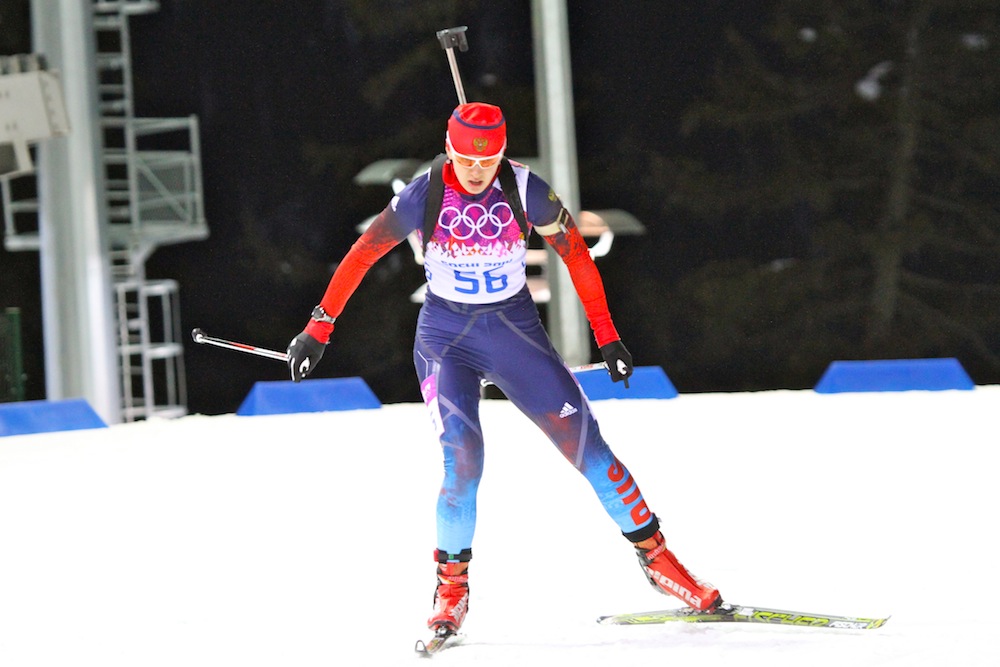
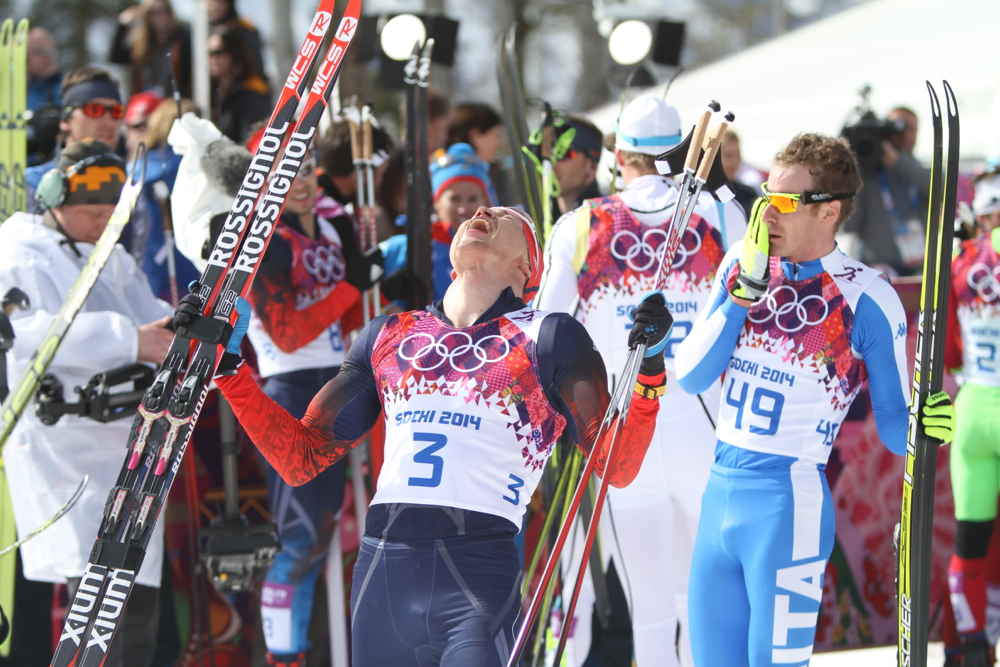
Olga Vilukhina won a silver medal in the sprint at the 2014 Olympics.
The Court for Arbitration in Sport (CAS) announced Thursday that three Russian biathletes implicated for doping at the 2014 Sochi Olympics had their lifetime bans overturned. The biathletes in question, Olga Vilukhina, Yana Romanova, and Olga Zaitseva were first handed lifetime bans in 2017 by the International Olympic Committee (IOC).
The McLaren Report included information tying the three athletes to doping. The IOC subsequently ruled the three Russians had committed an ADRV, or anti-doping rules violation. Their individual and team results were nullified and they were banned from all future Olympic Games. All three skiers have retired.
In the case of Romanova and Vilukhina, CAS stated: “that none of the acts alleged to have committed by these two athletes had been established to its comfortable satisfaction and beyond the mere suspicion of a potential ADRV.”
Prior to the 2017 IOC penalty, Vilukhin won the 2014 Olympic silver medal in the 7.5-kilometer sprint. That medal was subsequently stripped. Thursday’s CAS ruling reinstated individual results from the Sochi Games for both Romanova and Vilukhina. As a result, the silver medal will be returned to Vilukhina.
Zaytseva’s penalty was handled differently. CAS ruled Zaytseva had committed an ADRV for both swapping her urine for clean urine and using a prohibited substance. CAS clarified that Zaytseva would not have a lifetime ban, but would be “ineligible” for the 2018 Games after Sochi.
Beyond having her individual results not reinstated on Thursday, CAS maintained the IOC’s 2017 decision to nullify results from any team including Zaytseva at the 2014 Games. Zaytseva had teamed up with Romanova, Vilukhina, and Ekaterina Shumilova to win silver in the women’s 4 x 6 k relay in Sochi. That medal was stripped in 2017 – CAS upheld that penalty. Zaytseva was also on Russia’s fourth-place mixed relay team.
Zaytseva won gold medals in the 2006 and 2010 Olympic relays and a silver in the 2010 Olympic mass start. Those results are not impacted by the recent CAS decision.
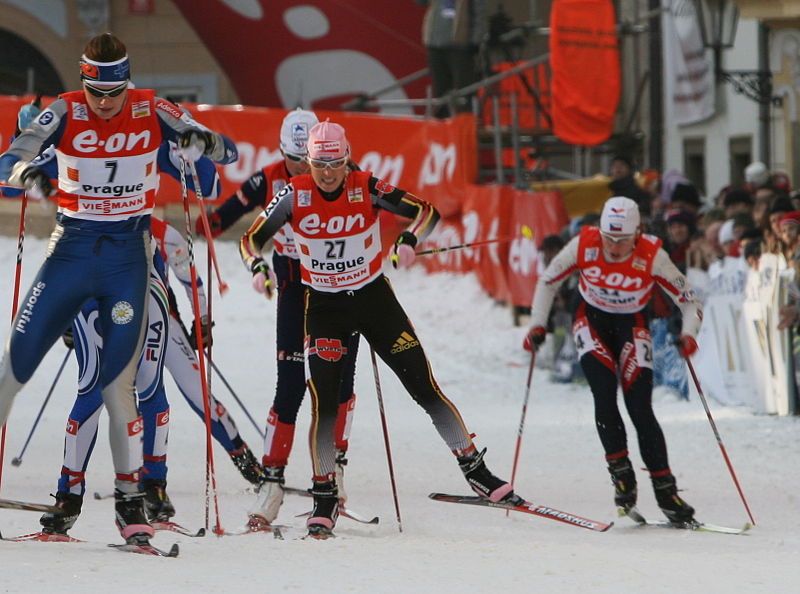
Germany’s Evi Sachenbacher-Stehle (bib-27) in the quaterfinals of the 2007 Tour de Ski in Prague. (Photo: Wikimedia Commons)
A career ended prematurely, for no reason.
During the 2014 Winter Olympics in Sochi, Russia, German biathlete Evi Sachenbacher failed a doping test. Although the ensuing ban was subsequently reduced from two years to six months, it effectively ended her career.
New information seems to confirm that Sachenbacher’s positive drugs test at the 2014 Winter Olympics in Sochi had nothing to do with deliberate doping. Rather, she was used as a sacrificial pawn by Russian doping authorities, according to an article on rtl.de.
In his recently published autobiography, doping meister turned whistleblower Grigory Rodchenkov wrote that with no positive doping tests in the first week of the Sochi Olympics, the Russian doping machine needed to expose someone in order to prove that they were doing good work.
From 2006 to 2015, Rodchenkov headed Russia’s Anti-Doping Center, the only laboratory in Russia accredited by the World Anti Doping Agency (WADA). At the 2014 Winter Olympics, Rodchenkov managed the anti-doping testing. While he concocted a recipe of three banned substances to administer to Russian athletes, he and others developed a sophisticated system to replace Russian athletes’ drug-contaminated urine samples with clean samples.
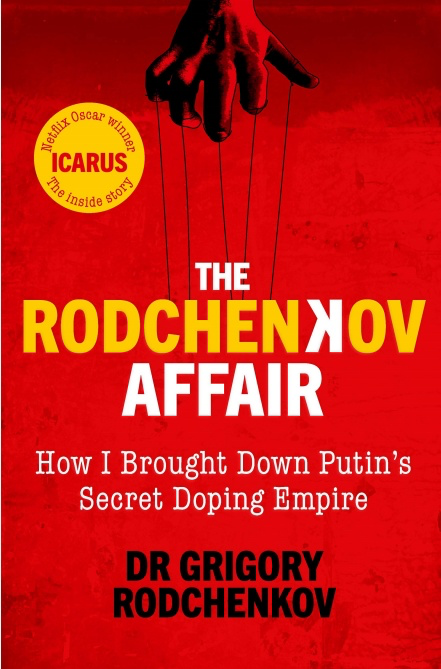
The July 25 issue of The Daily Mail published extensive excerpts from The Rodchenkov Affair, Rodchenkov’s new tell-all detailing his decades-long involvement with the Russian doping system both as an athlete and an administrator. Rodchenkov was initially exposed to doping as a college distance runner, taking steroids. While a successful collegiate runner – with chemical help – Rodchenkov didn’t turn into an elite athlete. His “enhanced” college running success did spur his study of chemistry.
In November 2015, WADA identified Rodchenkov as the ringmaster in the Sochi doping scandal. He was compelled to resign. Within days, fearing for his life, Rodchenkov left Russia for the United States. His paranoia may not have been irrational, as two other officials died suddenly in February 2016. In May 2016, Rodchenkov gave an extensive interview to the New York Times about the rigged testing process in Sochi.
This brings us back to Sachenbacher, the German biathlete who tested positive in Sochi. In one of her two urine samples Sachenbacher submitted during the Olympics, the testing lab claimed it discovered traces of the banned substance methylhexanamine.
Developed by Eli Lilly & Co in 1948, methylhexanamine was marketed as a nasal decongestant. Although it was withdrawn from sales in the 1970s, methylhexanamine began appearing as an ingredient in various dietary supplements in the early 2000s. Supplements incorporating this drug are generally promoted as fat loss products or for extra energy during workouts.
In his book, Rodchenkov asserted that methylhexanamine “usually occurred in huge concentrations.”
Rodchenkov also characterized Sachenbacher’s result as a “borderline case,” adding “If I had already logged five real violations, I might not have reported her. But we needed blood. She became withdrawn from circulation and the punishment did not really match the violation.”
When she learned of the positive finding, Sachenbacher protested, saying that she must have unknowingly ingested it in a tea powder. In the summer of 2014, she received a two-year competition ban.
Sachenbacher appealed to the Court of Arbitration for Sport (CAS), which determined that she didn’t deliberately ingest methylhexanamine. Her ban was commuted to six months from the date of the test
The Munich, Germany, public prosecutor’s office investigated Sachenbacher following the Olympics. According to Der Spiegel, the prosecutor later deemed that Sachenbacher hadn’t actually taken the drug “because the active ingredient content is too low.”
After the CAS ruling, Sachenbacher was allowed to immediately resume training and competition. However, the positive finding and subsequent battle to clear her name exhausted her, and she opted to retire.
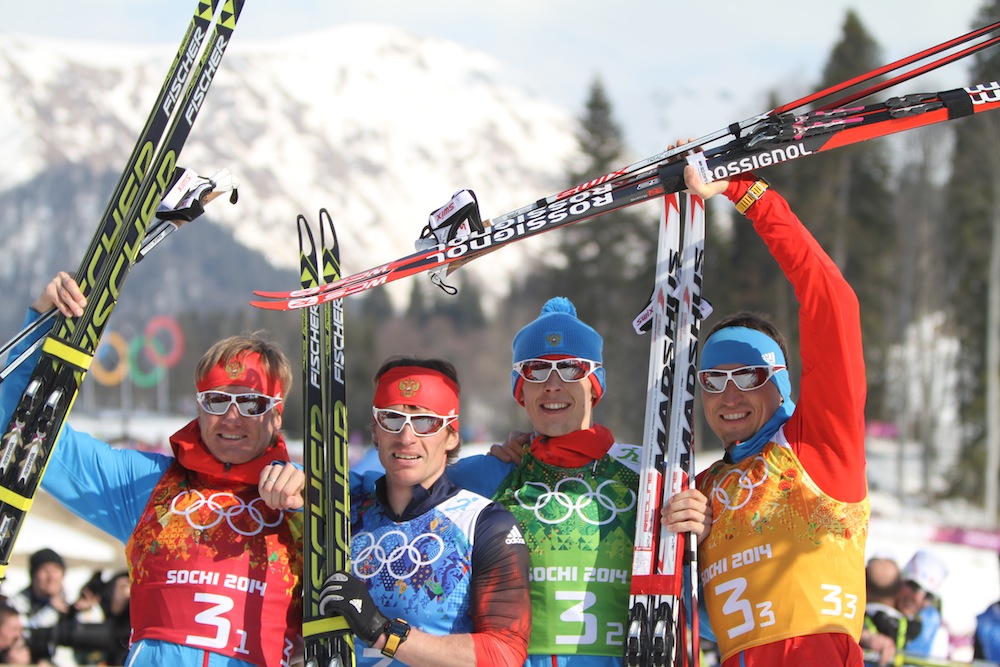
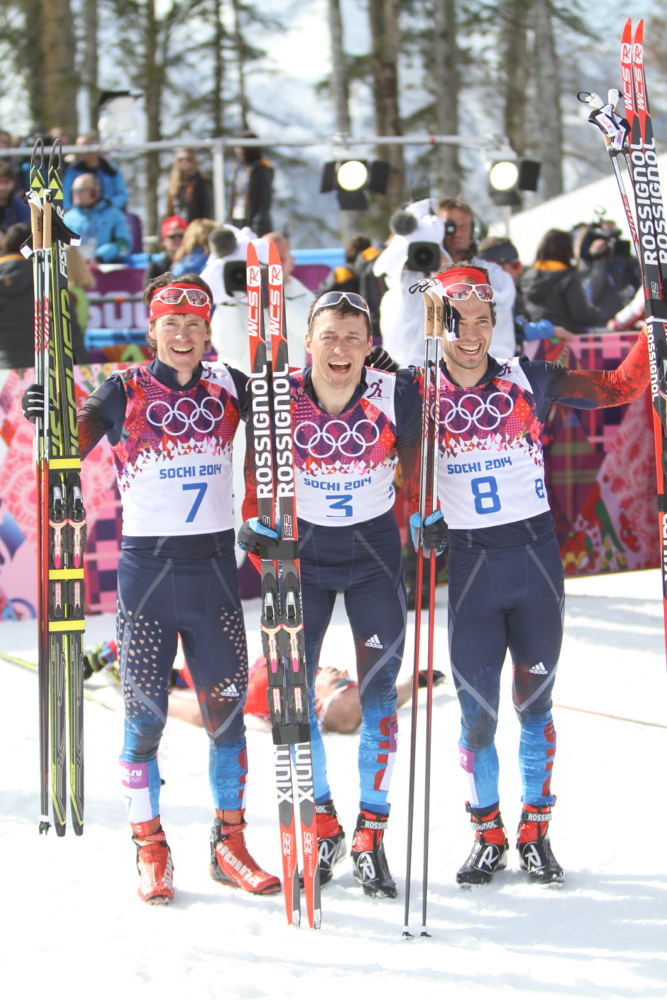
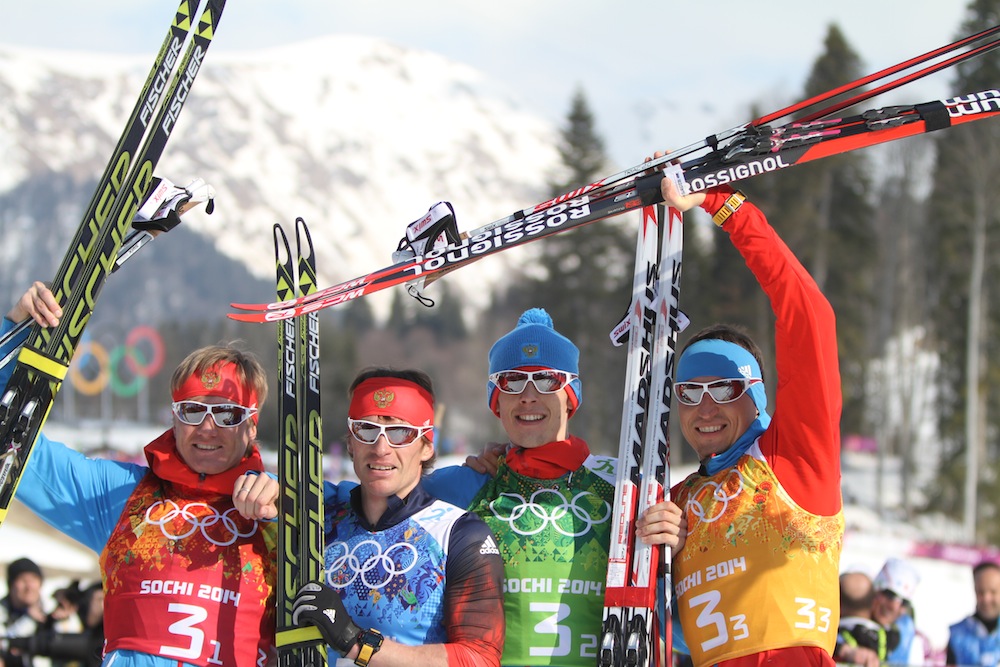
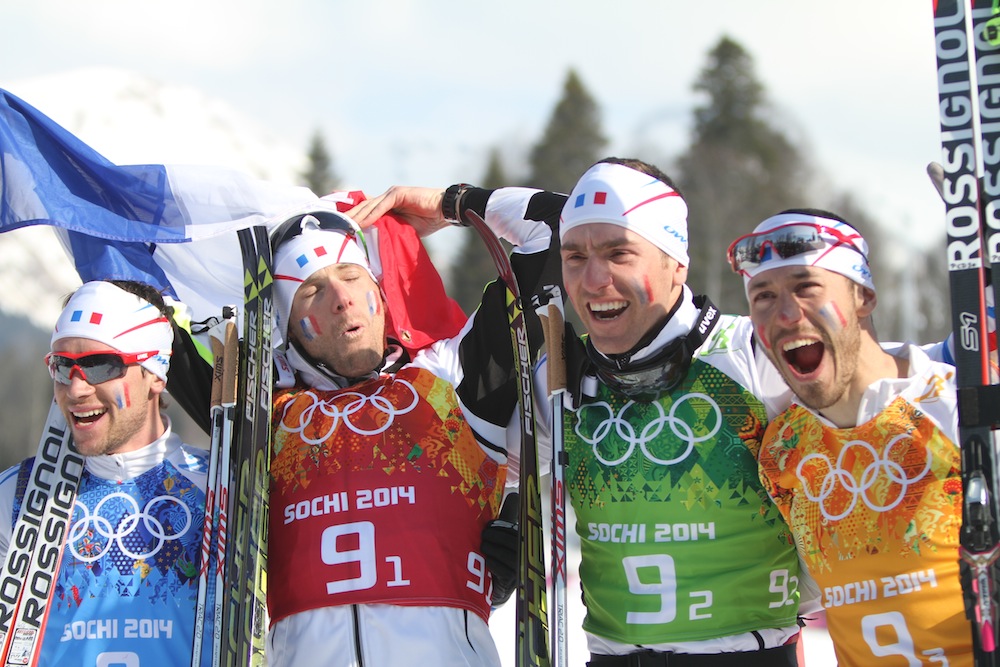
The silver-medal winning Russian men’s relay team at the 2014 Olympics. Alexander Bessmertnykh, Maxim Vyegzhanin, and Alexander Legkov were disqualified for doping, but had their bans overturned by the Court of Arbitration for Sport.
The gold medalist was initially banned and ordered to turn over his medal. That happened after investigations by journalists and anti-doping administrators found that he had likely benefitted from a sample-swapping scheme instituted by the Russian government. The crowning achievement of the scheme came at the Olympics in Sochi, Russia, where athletes’ “dirty” urine was swapped for “clean” samples so that their illicit doping would not be detected by tests.
On Monday, CAS released the details behind its decision in Legkov’s case.
In short, they did not find enough evidence that Legkov had personally been involved in the scheme, which they acknowledged existed. But testimony by whistleblowers and forensic evidence was not deemed to be enough to justify disqualifying him.
Grigory Rodchenkov, the former director of the Moscow Anti-Doping laboratory, wrote in testimony to the Panel in January that Legkov had been involved in the doping scheme and had been instructed to provide clean urine samples so that they could be swapped out to hide dirty ones. Legkov had also participated in “washout testing,” he said, to determine how long drugs would stay in his body. He related conversations with higher-ups who told him that Legkov was a “special project”, and had notes in his diary from the 2014 Olympics which described swapping out Legkov’s urine sample after he won the 50 k.
The CAS panel didn’t agree with any of those assertions. The fact that Rodchenkov stated that Legkov was providing clean urine had little value, they wrote, because nobody testified to having seen him do it.
“The Panel notes that the IOC does not specify the particular date when, or location where, the Athlete is alleged to have provided clean urine for this purpose,” it writes. “Further, no physical evidence has been presented showing the specific vessel in which the clean urine from the Athlete is alleged to have been collected and stored. Nor has the Panel seen any communications sent by or to the Athlete that refer to the collection, transmission, storage or use of clean urine for the purpose of urine substitution.”
Regarding Legkov’s presence on the “Duchess list” of athletes receiving a special drug cocktail, and and Rodchenkov’s conversation with a boss who told him to make sure Legkov was protected, the panel wrote, “this evidence is hearsay and as such its probative value is very limited, particularly insofar as it relates to the Athlete’s subsequent actions during the Sochi Games in February 2014. In any event, even if it is accepted at face value, the alleged statement merely reflects an intention on Ms. Rodionova’s part. It does not provide any evidence regarding the actions or state of mind of the Athlete.”
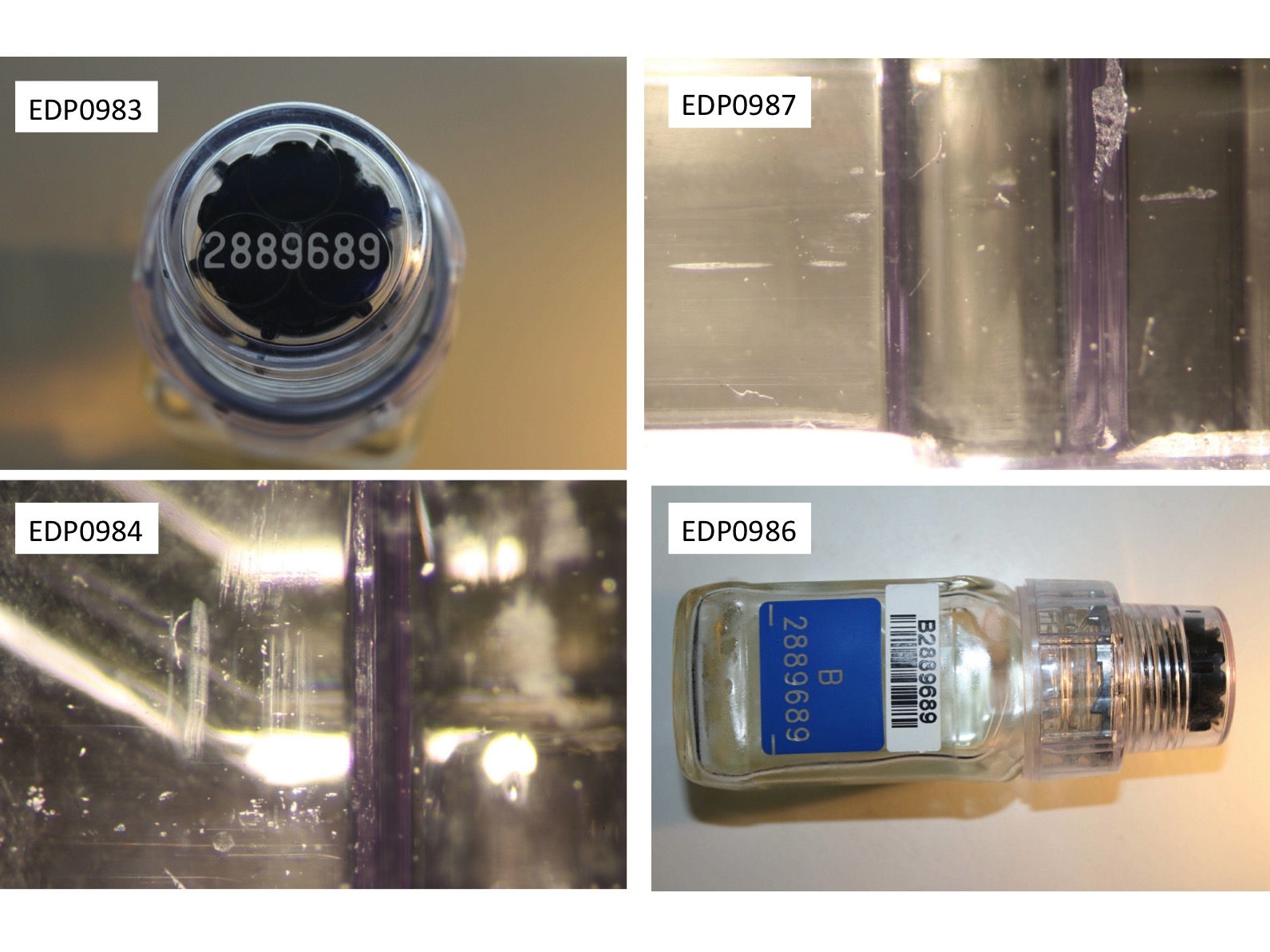
Rodchenkov’s testimony was not the only aspect of the International Olympic Committee’s (IOC) case against Legkov. In addition, multiple marks were found on Legkov’s sample bottles, consistent with having been opened.
CAS did not buy this as evidence of an anti-doping rule violation either, however.
“The Panel considers that the fact that sample bottles were opened would, if established, provide considerable, albeit not conclusive, inferential evidence that urine was substituted and, as a further step of conclusion, the substituted urine contained prohibited substances,” they wrote.
After that, they tore apart the testimony of the expert who identified the marks on the bottle, writing that while he had established that such marks did not occur as part of “normal use”, they could have occurred when the bottles were being transported from one place to another.
Another criticism? That while the IOC’s chosen expert established “normal use” using empty bottles, the presence of urine in a bottle could change things. Maybe these marks might not actually be indicative of the bottles being opened. They wrote, “the Panel considers that there is some merit in the Athlete’s criticism that the failure to conduct tests on sample bottles that were filled with liquid reduces the probative value of the results of those tests.”
In total, they found that the existence of state-sponsored doping could not be used to punish Legkov without other strong evidence that he had benefitted – and didn’t deem any of the evidence presented to be strong enough.
“In reaching these conclusions, the Panel wishes to underscore what it has not decided in this appeal,” the panel wrote. “The Panel has not made a ruling on whether and to what extent the alleged doping scheme during the Sochi Games existed and how it operated even though it recognizes that there is significant evidence that it was in place and worked.”
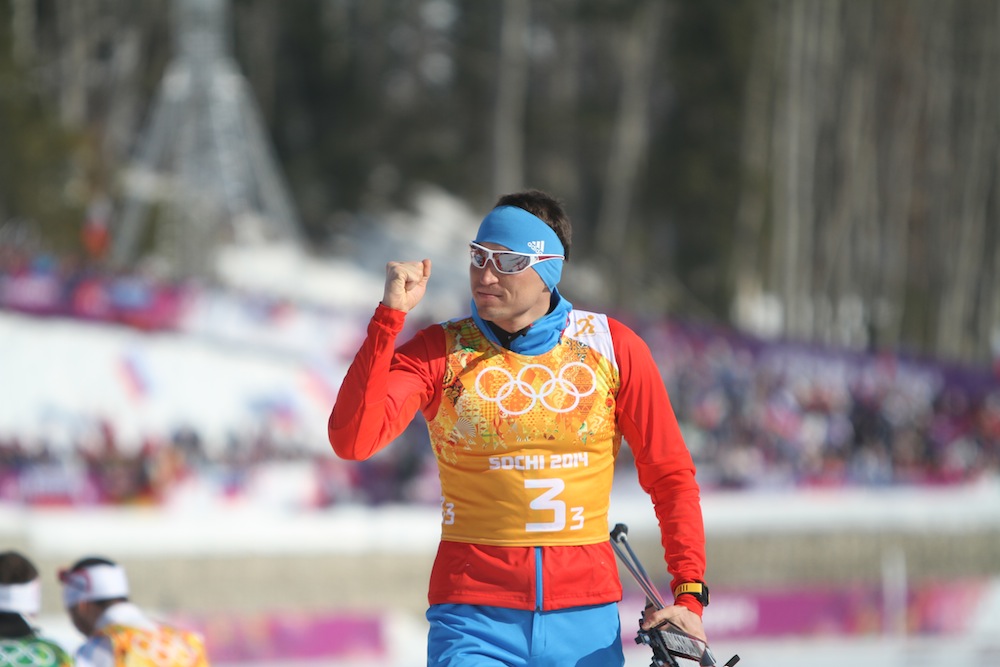
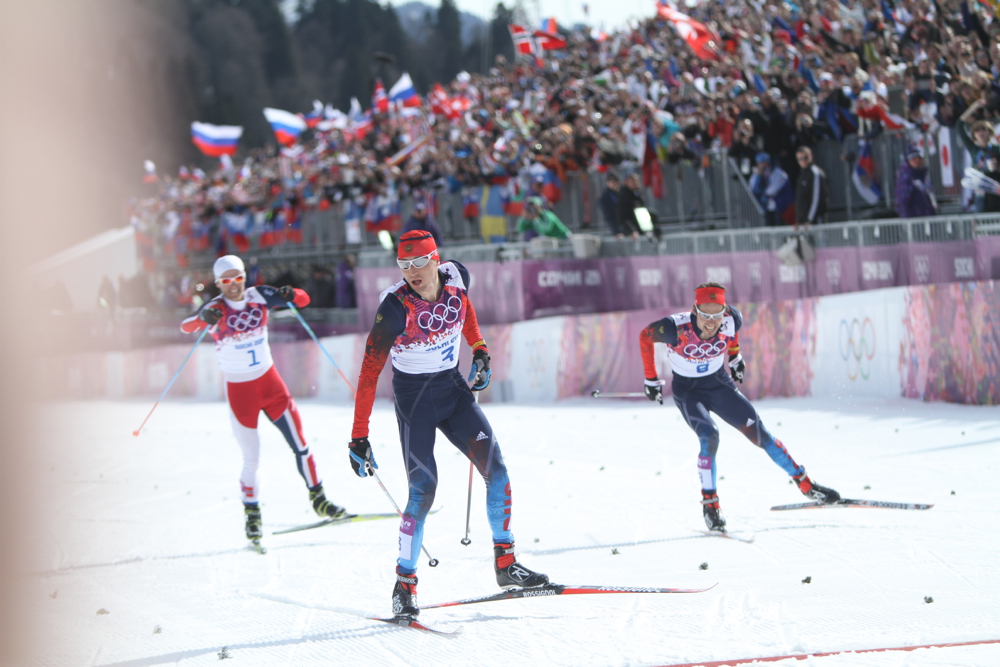
Russia’s Alexander Legkov (3) after winning Olympic gold in the men’s 50 k freestyle mass start at the 2014 Winter Olympics in Sochi, Russia. Russia’s anti-doping director at the time, Grigory Rodchenkov stated that he switched out Legkov’s anti-doping sample for a vial of clean urine collected previously. The International Olympic Committee stripped Legkov of his gold medal and banned him from future Olympics, but the Court of Arbitration for Sport overturned those sanctions in February 2018.
Editor’s Note: The following thoroughly cited opinion piece, prompted by the 2017 ‘Icarus’ documentary, was written by Maks Zechel, a 20-year-old Canadian cross-country skier who spent the 2017/2018 race season training abroad with Team Asker in Norway. Zechel is a regular contributor at FasterSkier, with his ongoing series: “Closing the Gap”.
***
February 23, 2014
Sochi: a home Olympics and the opportunity of a lifetime. Russia, despite being one of the strongest skiing nations in the world, has no individual medals in cross-country skiing leading into the final race of the championships. As the athletes shuffle nervously in the tracks before the 50 k mass start, the pressure on the Russian men can be felt even by me, watching on TV from home.
Putin is in the stands. It’s just a ski race, but how much more than that is at stake?
“The Moscow Laboratory operated, for the protection of doped Russian athletes, within a State-dictated failsafe system” (McLaren 1)
A sunny day, a roaring home crowd. Alexander Legkov is in a world of his own as he absolutely destroys himself over the final climb, skiing with the passion that it takes in all sports to win an Olympic medal. Russian flags waving everywhere, the crowd is absolutely deafening as Legkov adds his first Olympic gold to his already legendary career. Maxim Vylegzhanin and Ilia Chernousov lunge across the line behind him, with Chernousov having given every last bit of himself to outsprint Norway’s Martin Johnsrud Sundby to complete the Russian podium sweep on home soil. A dream come true.
“The Sochi Laboratory operated a unique sample swapping methodology to enable doped Russian athletes to compete at the Games” (McLaren 1)
When you ski with your teammates in front of your friends and family at home, you ski with a fire that is otherwise difficult to find. The presence of those who know you makes you feel guilty if you do not perform to your very best, you are pushed to keep up to those that your mind refuses to admit defeat against, and your own potential reaches new heights when your teammates accomplish something great. There is no cover of anonymity with which to hide the secrets behind your performance, because these people know what it took, and did not take, to get you to where you are.
“A pre-selected group of Russian athletes competing at Sochi were protected by the Sochi sample swapping methodology” (McLaren 67)
Despite the whispers of corruption surrounding Russia’s Olympic team, I cheered for those three skiers, who did the nigh-impossible and pushed their bodies as hard as anyone else to make their country proud. I do not know what exactly went into achieving that medal, but I do know that the incredible display of effort and the tears of happiness falling from Legkov’s face as he was raised onto his teammate’s shoulders, were very real.
“After he became laboratory director, and in furtherance of his responsibility to improve Russian sport performance by covering up doping, Dr. Rodchenkov developed a steroid cocktail optimized to avoid detection” (McLaren 49)
I first dreamt of going to the Olympics when I was 11 years old. This dream sparked an inner drive of mine that has lasted almost a decade, and I like to think that it will never extinguish. Sometimes, I wonder what lights that same flame in children around the world. In most countries, I like to think that many experience moments like mine: a motivation flourished from watching the passion of the Olympics, being inspired by older siblings, or being born with the need to be the first kid through the school doors when the bell rings for recess.
“The steroids were dissolved in alcohol … The solution was then swished in the mouth in order to be absorbed by the bucal membrane and then spit out … the detection window for the steroids in the cocktail would not exceed 3-5 days” (McLaren 49-50)
In parts of the world where fewer children are fortunate enough to make the decision to pursue a sport just because they are inspired, I wonder what brings them to those future championships. Is their talent used out of joy or out of the need to provide for those without the same athletic abilities? Was their talent exploited at a young age as a way for a country to show its dominance? Were they given a choice: to follow their dreams and do what they love by the prescribed method, or to not follow their heart at all?
I think about the lengths that I would go to support my family if they depended on me, and suddenly the way that I pursue sport seems insignificant, a trivial lifestyle “earned” through right of birth. Being born to these opportunities makes it all the more important to not waste them. My great-grandfather used to say, “if you’re going to do something, then you may as well do it right”, and those are words that I attempt to live by. To me, that means clean sport.
But clean sport is now more at risk than it has been in decades. Once an already colossal task of catching individual dirty athletes, we are now facing an extensive doping regime, backed by an entire government.
“[B]y the time of the Olympic Games in London, many of Russia’s top athletes were using the cocktail” (McLaren 51)
When faced with the enormity of the Russian state-sponsored doping system, it is no longer adequate to simply prosecute individual athletes. A large part of the problem when it comes to justly dealing with the system that made it possible for Russian athletes to cheat, is that WADA and the IOC are pitted against the entirety of the Russian government. It is not the USA and Canada versus Russia, or any other country versus Russia; it is two sporting entities, independent of any particular country, against the full power of the Russian government.
“The Ministry of Sport directed, controlled and oversaw the manipulation of athlete’s analytical results or sample swapping, with the active participation and assistance of the FSB [Russian Federal Security Service], CSP [Center of Sports Preparation of National Teams of Russia], and both Moscow and Sochi Laboratories” (McLaren 1)
“… Deputy Minister of Sport, Yuri Nagornykh, was appointed in 2010 by Executive Order of then Prime Minister, Vladimir Putin” (McLaren 10)
The state-run doping program organized for the Sochi Olympics was not just about sport, it was politically motivated, overseen by President Putin himself. This sets Russia apart from previous doping scandals, such as that of the Finnish cross-country ski team in 2001, where doping operations were concentrated to a select number of skiers and their coaches. When the truth was uncovered about their national heroes, Finland, in complete shock, took steps to recover from the international disgrace that its ski team had brought upon them (Andrews). Iivo Niskanen and Krista Pärmäkoski have proven that it is possible for a great skiing nation to recover from such a disaster and win clean, paving the way for the next generation of Finnish skiers.
“ … this Article would prohibit altering identification numbers on a Doping Control form during Testing, breaking the B bottle at the time of B Sample analysis, or altering a Sample by the addition of a foreign substance” (“World Anti-Doping Code” 21)
The situation we see today is different. After the exposure of irrefutable evidence confirming state-sponsored doping and the covering up of doping evidence in Russia, it came as a disappointment to many when the Court of Arbitration for Sport (CAS) annulled the sanctions imposed by the IOC on 28 Russian athletes.
The evidence of coverups and doping are clear, but the CAS ruling was that “the evidence collected was found to be insufficient to establish that an anti-doping rule violation (ADRV) was committed by the athletes concerned” (“Media Release”). The evidence may be adequate to find Russia guilty of state-sponsored doping, but it is not enough to build a case against each individual athlete. This is likely because of the destruction and tampering of drug tests and results by Russian “anti”-doping personnel and Article 10.5.1.2 of the World Anti-Doping Code, which states that, if the “detected Prohibited Substance came from a Contaminated Product, then the period of Ineligibility shall be, at a minimum, a reprimand and no period of Ineligibility, and at a maximum, two years Ineligibility” (“World Anti-Doping Code” 64).
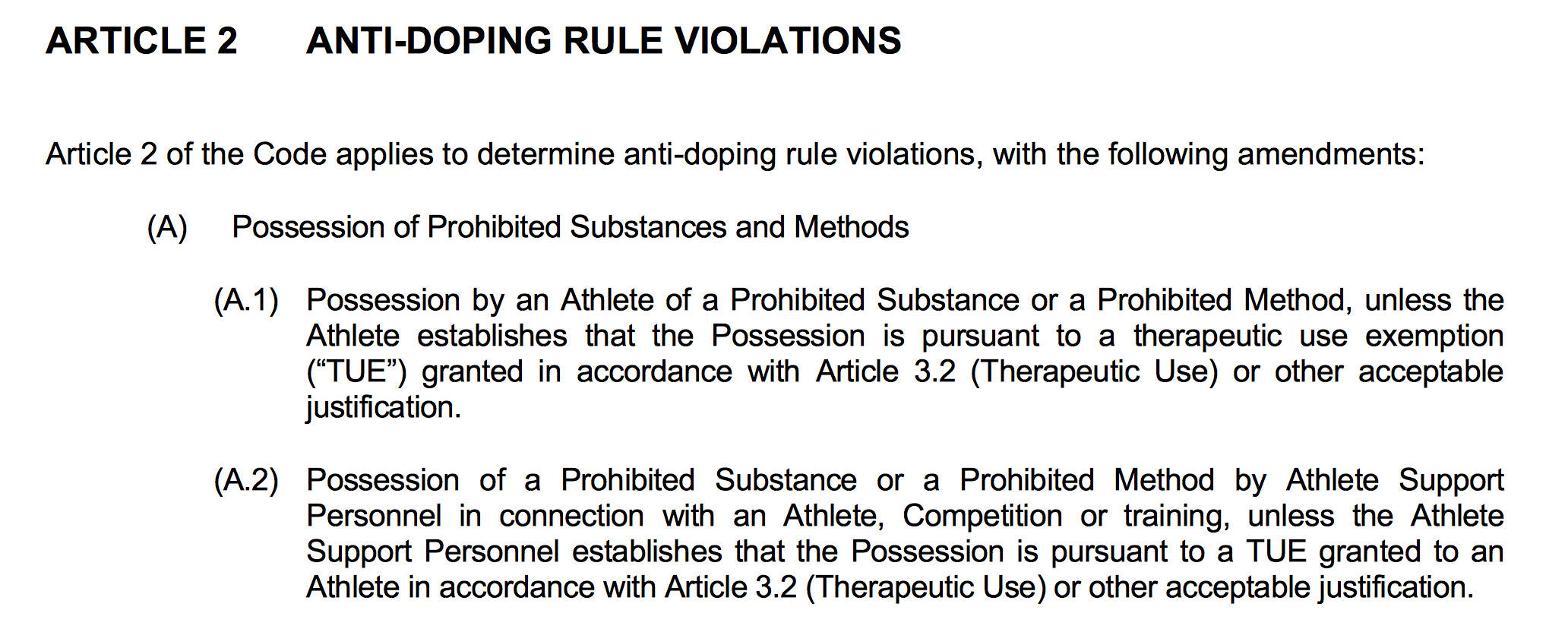
But if the evidence is inadequate, then why are some Russian athletes still facing penalties? Alexander Legkov and Sergey Ustiugov were both unable to compete at the PyeongChang Olympics, but Ustiugov can still race on the World Cup, while Legkov cannot. Evidence against athletes like Legkov proves that they were in some way a part of the state-sponsored doping program, but it is difficult to legitimately sentence them when evidence proving exactly what they have done has been tampered with or destroyed. Athletes like Ustiugov have not been proven to be a part of Russian doping operations, but have violated Article 2.1 of the World Anti-Doping Code through their association with people who are a part of it. This article states that “Athletes and other Persons must not work with coaches, trainers, physicians or other Athlete Support Personnel who are Ineligible on account of an antidoping rule violation … Prohibited association need not involve any form of compensation. (“World Anti-Doping Code” 24).
Sport in Russia will never be fair until Russia takes responsibility for their crimes against clean sport. Whereas Finland bore the weight of what their athletes had done in 2001, and ensured that it would never happen again, the Russian government has more at stake than a few drugged athletes. When doping is politically motivated and backed by the state, I do not think it is possible to solve the issue through sanctions by sporting bodies such as WADA and the IOC alone. Until the Russian government is pushed by other nations to take an interest in ensuring that sports in Russia are clean, the problem can never be completely resolved.
Until substantial action is taken, we will continue to be caught up in a stalemate of “partial blanket bans” and other half-measures. When imposed on a level of command that is too low in the Russian doping system, these actions cannot bring about the outright eradication of doping that we seek. Are sports a high enough priority for entire countries to impose sanctions on the Russian government until they answer for their crimes against clean sport? Or will doping be protected by other political motivations that keep Russia inseparable from the rest of the world? The scope of the Russian government’s involvement in doping is far beyond the reach of traditional sporting sanctions.
“Clean sport is dead” — Jim Walden, lawyer of Dr. Grigory Rodchenkov (Panja and Pérez-Peña).
The sporting world no longer holds its breath in anticipation of change. An uncertain future exists for clean sport, but even more disconcerting is the stagnation in which we now settle. With the anti-doping world left spinning its tires in frustration, where does that leave athletes for whom a future of fair play is too late?
Icarus, 2017 documentary film, debuted Aug. 4, 2017 on Netflix (Photo: Wikipedia)
In his dramatic documentary, Icarus, director Bryan Fogel convinced many sports fans that clean athletics, despite the improvement of anti-doping efforts over the years, is a hopeless pursuit. Fogel’s documentary was key to bringing the extent of systematic doping in Russia into the public eye.
In Icarus, Fogel takes anti-doping research to a personal level: after years of training as a high-level (amateur) cyclist, he spends a full year preparing for the “Haute Route” amateur cycling event, while following a doping program. This was prescribed to him by Dr. Grigory Rodchenkov (the former director of Russia’s Anti-Doping Center, turned whistleblower, who is now under the witness protection program in the U.S.).
Fogel routinely took a cocktail of PEDs (Performance Enhancing Drugs), under the careful guidance of Dr. Rodchenkov, and saw massive improvements in his power output ratings on the bike in less than a year. Having placed 14th in the seven-day Haute Route event the previous year, while racing clean, it seemed clear that Fogel would be a strong contender for the win.
He ended up finishing the unbelievably hard event in a far worse position than when he raced clean. From an athlete’s perspective, this does not surprise me. I understand that there are countless elements involved in producing an incredible athletic performance at a set time and place. Fogel’s reaction was different; visibly depressed, he talked of how sobering it was to realize that, no matter what he did, he could never be as great as his cycling heroes. This is a delusional conclusion, one that is biased by his dreams (influenced by growing up with Lance Armstrong as a hero) of becoming a better cyclist.
In these turbulent times for clean sport, it is important for athletes to remember that there are many aspects to training and competing, aside from other athletes cheating, that they can control. Living in Norway has taught me that there is a lot more to skiing fast than just being fit, and that applies to all sports.
Drugs don’t magically make you a fast skier, just like a high VO2 max score doesn’t make you a competitive World Cup skier. There are many elements to cross-country skiing that have a far bigger effect on a skier’s ability to ski fast than drugs do. If skiing were purely about fitness, aerobic machines like Hans Christer Holund would beat skiers with a lower VO2 max, like Petter Northug and Finn Hågen Krogh, without contest. Divergent technique revolutions, like those brought to us by pioneering skiers such as Petter Northug and Johannes Høsflot Klæbo, show us just how many ways there are to win a ski race.
In his reaction to not becoming a better cyclist even while doping, Bryan Fogel shows what he is: a film director with a remarkable story to tell. As most people would, he takes his failures in sport and attributes them to his personal characteristics; he feels he is simply not good enough at a genetic level. While not everyone will reach their athletic dreams, true failure occurs only when you stop trying after the first attempt. When athletes make changes to their training, it is rare to see dramatic results in the following competition season. Some things will never yield improvements, while other things take a few years of consistent work before they take effect. In the highly competitive world of cross-country skiing in Norway, many skiers go unnoticed down the results list for years, they are seen as average, before suddenly rocketing to incredible new heights seemingly out of nowhere. That is the nature of how training, competition, and life stress the body and mind over a prolonged period of time. To take a one-year snippet of an athlete’s life and make broad conclusions about sport is naive.
An otherwise brave and instructive self-experiment that helped uncover the scope of how doping continues to mar the sporting world uncontestedly, Fogel’s conclusion of his doping experiment sends the wrong message to the audience viewing Icarus. The message he sends is that only extremely gifted humans can become great athletes. This personal look into how his experiences have affected him make his documentary engaging and dramatic, something that the genre normally lacks for your average movie audience. The devastation that Fogel portrays in this realization hits viewers hard and the movie adopts an “apocalyptic” tone from that point on. The worldwide end of clean sport is confirmed with Rodchenkov’s exposé of Russian state-sponsored doping and the footage of him escaping Russia with his life in danger. Icarus uncovers frightening realities that affect the sports we love, but the film also incites new dangers to the culture surrounding sport.
Although accurate in their severity, the events at the end of Icarus doom its audience to pessimism against the current world of sports. This acts as fuel for ungrounded accusations against successful athletes by uninformed viewers. When a complicated issue arises, people quickly try to make sense of it by looking for a distinction between good and evil. By making an issue seem black and white, anyone can have a strong opinion about it, because the choosing of sides is based on your morals. You are either against doping, or you support it. Unfortunately, the issue is not so simple, but this type of inflamed, unschooled “debate” is perfect advertising for a film such as Icarus.
When making conclusions about an issue, it is our duty to question how someone else’s portrayal of events is affecting our opinion and to keep ourselves informed. FasterSkier Editor-at-Large Chelsea Little is an example of the brave reporting and investigating that it takes to keep organizations such as WADA and the IOC held accountable. We owe it to journalists like Chelsea, who sacrifice countless hours of their personal lives to enlighten us about the issues that affect us the most, to simply read their vital research. We must take the facts from the sources available to us, and add our own informed debate to the world of sport, because angry, baseless commentary are what keep humanity from moving forward.
Most Olympic athletes…would favour lifetime bans for doped athletes. IOC President, Thomas Bach, himself an Olympic champion, has publicly indicated a personal preference for life bans, but has correctly noted that the legal order, particularly in relation to human rights issues, will not permit such automatic sanctions, for first offences. Nor does the Code. The IOC itself has lost an appeal before CAS in respect of an IOC rule providing for the automatic exclusion of any doped athletes from Olympic competition in the Olympic Games next following the imposition of even a first doping sanction. (Pound, et al. 63)
It is our responsibility as athletes to represent all of those that have helped us and to lead by example. We can start with the atmosphere that we create amongst our fellow athletes. The culture of discrimination and groundless accusations against clean, Eastern-European athletes, or any successful athlete in endurance sports, has to stop. The “blame game” has some of the same ill-effects on our sport that we are trying to prevent by fighting against doping. Remember how ashamed Canadians felt when Ben Johnson, our “Olympic champion hero”, was caught for doping? Now imagine the irreversible damage that would have been done if he had been falsely accused. By telling young athletes that anyone doing something impressive — something that we could not imagine ourselves doing — is doping, teaches young athletes that no matter how hard they work, they will never become greater than their biggest dreams.
“The problems of the world cannot possibly be solved by skeptics or cynics, whose horizons are limited by the obvious realities. We need men [people] who can dream of things that never were, and ask why not.” — John F. Kennedy (“J.F.K. in Ireland”)
Teach young people to dream outside the realms of what they see as possible, and they will get there via the path you set them.
Athletes have the power to make more of a difference than just complaining about the flaws of their sport. Sports are visually flashy and exciting to an audience, and athletes are celebrated around the world for their raw fight against the limits of the human body. The hero-status of athletes gives them a sphere of influence greater than that of other members of society who work equally hard, or harder, in the goal of helping people.
The playing field of sport will never be equal for every child born on earth, when some athletes fight past obstacles far greater than the trials of sport, just to get to the start line. If we are lucky enough to be living the life of an athlete, it is not enough just to win medals.
Endurance sports may not get the same extent of attention as soccer, football, or basketball, but the popularity of these sports has elevated some athletes to leadership roles from which athletes from smaller sports can learn. Take LeBron James, one of the greatest basketball players of all time, who has recently come under fire for his comments regarding President Trump. Some feel that his place in society is to play basketball and entertain, not to comment on political events, but he has decided that his popularity gives him a greater responsibility than just playing sports:
“I mean too much to society [to ‘shut up and dribble’] … I mean too much to the youth, I mean too much to so many kids that feel like they don’t have a way out and they need someone to help lead them out of the situation they’re in.” — LeBron James (Conway)
As a Canadian, the opportunity that I have to pursue cross country skiing is a selfish privilege. I have the chance to use sport to meet new people, to inspire, and to use my experiences and influences to create a better world around me. Otherwise, I am just a lucky individual, riding on the support of those that I do little to help, enjoying what I have been given and doing little to share my wealth. I work hard at what I do, but to think that I am an inspiration to others simply through my existence would be incredibly pretentious. Athletes can gloat in their athletic prowess, or they can use their abilities to promote the joy of sport, health of body and mind, and the hard work involved in reaching a goal.
Good leadership is to rise and accept challenges even with the possibility of failure. Leaders show their true qualities, and that shows others that they can only achieve success by being their honest selves. Leaders show that there are no shortcuts.
My heart breaks every time that one of my idols is suspected of cheating. It doesn’t hurt because it’s unfair; it hurts because I saw myself in their footsteps, and every time they succeeded, I saw that I could, too. Our dreams scare us because they seem impossible from where we currently stand. When I look at my heroes, I see my future; they are living my dreams, proving them possible. My dreams are crushed when one of my favourite athletes is caught for doping, because that tells me that I am not good enough to be great. Some say that we watch the Olympics to witness the impossible happen, but I watch the Olympics to see the people who started off where I am accomplish the things that seem impossible to me now.
Despite the damning evidence against Russian sport as a whole, I refuse to believe that every Russian athlete is doping for the same reasons that I refuse to believe that the majority of top cross-country skiers are doping. It must be remembered that skiers are people, and the vast majority of people who have grown up surrounded by the positive and welcoming culture that exists in cross-country skiing around the world, do not become cheaters. Even in Norway, where skiing culture is on a much bigger scale than that of North America, it remains a community of people who love being outside year-round, exploring the world around them and the limits of their bodies.
We must keep sport a positive and safe space for people to grow into compassionate citizens of the world. Clean sport isn’t important just so that medals are handed out to the rightful winners; sport must remain possible for real people everywhere, because when doping is left unchecked, sport loses all significance as a tool to inspire, bring people together, and make the world a better place.
March 2, 2011
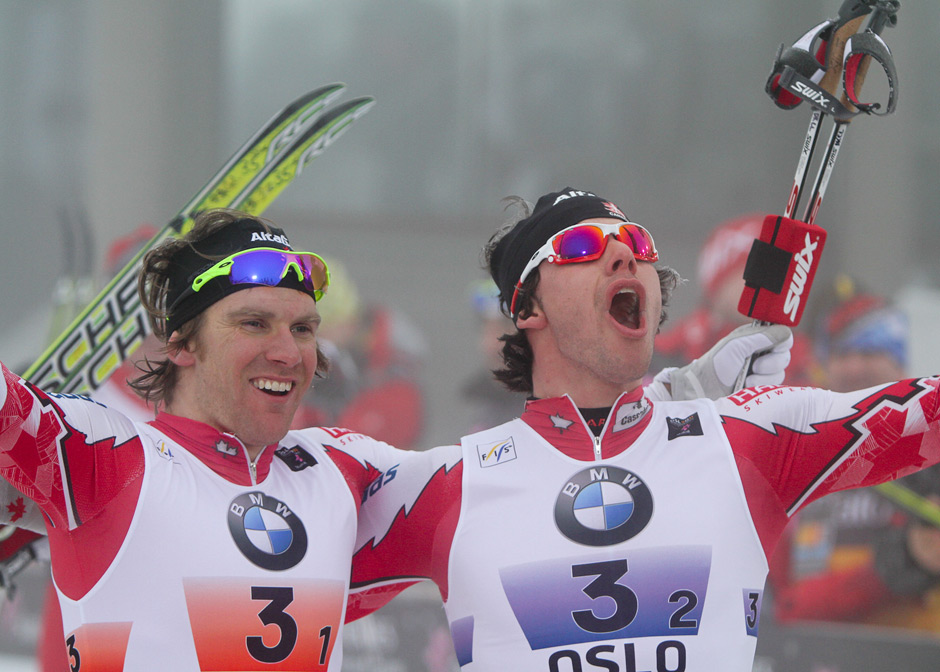
Alex Harvey (r) and Devon Kershaw (l) celebrating their World Championships gold in 2011 in Oslo.
My heart pounds in my chest. Adrenaline courses through my body as my ungainly 13-year old legs run chaotically down the front steps. The slam of the door behind me pierces the stillness of the heavy evening air, but to my ears the whole world is alive in celebration. The rush of blood in my ears is deafening as I relive the race in my head. Alex passing Hattestad — shushing the crowd across the line –raising his arms in disbelief — Devon and Alex playing air guitar on their skis — walking before the massive crowd to the top step of the podium — WORLD CHAMPIONS! … The excitement settles into a glow that becomes an immovable rock of confidence in my chest. I start to notice where I am, running aimlessly to the top of a grassy hill above the trees. I smile as I look down to where I came from: “Yes”, I think, “I can do it, too.”
***
Works Cited
Andrews, Edmund L. “Olympics; Finland Reels Over Skiers’ Drug Scandal.” New York Times, 13
“John F. Kennedy in Ireland.”, John F. Kennedy: Presidential Library and Museum, www.Jfklibrary.org/Exhibits/Past-Exhibits/JFK-in-Ireland.aspx. Accessed 1 Mar. 2018.
Russians Olga Zaitseva and Olga Vilukhina competing in the pursuit at 2013 World Championships. Both were disqualified from the 2014 Olympics by the International Olympic Committee, with a whistleblower stating that the biathlon team was doping in the years leading up to Sochi.
On Friday, the International Olympic Committee (IOC) posted the reasoned decision from its Disciplinary Commission, in which Russian biathlete Olga Zaitseva was disqualified from the 2014 Olympics in Sochi, Russia.
Zaitseva’s disqualification had been announced previously, but this is the first full-length decision presenting the evidence for the disqualification of any biathlete. Olga Vilukhina and Yana Romanova have also been suspended, but the Oswald Commission’s full decisions for their cases have not yet been released.
The reasoned decision not only contains details about Zaitseva, but also additional information which should put the whole biathlon world on notice.
“Dr. Rodchenkov further states that the entire Russian biathlon team, including the Athlete Zaytseva, has been using the Duchess Cocktail before the Olympic Winter Games Sochi 2014,” paragraph 359 of the decision reads. “He also provided an email sent April 2013, whereby he raised concerns about the high levels of haemoglobin for the biathlete team that was detected by his laboratory.”
The Duchess Cocktail refers to a combination of performance-enhancing drugs designed by Rodchenkov, the former director of the Moscow Anti-Doping Laboratory who assisted Russian teams in numerous sports to evade anti-doping rule violations before he became a whistleblower.
The Russian sports agency and the state security agency, FSB, developed a method to open anti-doping sample bottles. Using this method, they replaced the urine of athletes who had taken the Duchess Cocktail with previously-collected clean urine so that their doping would not be detected.
Thus, Rodchenkov is asserting that every Russian performance in the biathlon events at the 2014 Olympics was tainted by illegal performance-enhancing drugs.
This is notable because the men’s biathlon team, for instance, had not previously been implicated in doping scandal that has been raging for several years. Only the likely members of the women’s biathlon relay team – Vilukhina, Zaitseva, Romanova, and Irina Starykh (who was caught using the blood-doping drug EPO before the Olympics and suspended) – were on the “Duchess List,” a list of athletes presumed to have been given the drug cocktail. No male biathletes appeared.
However, it doesn’t seem surprising that they would, given that 14 cross-country skiers, virtually the entire Russian squad for Sochi, appeared on the list, as well as the female biathletes.
And that’s what Rodchenkov said, too.
“Dr. Rodchenkov… gives indications regarding the widespread use of Prohibited Subtances notably human growth hormones and EPO in the years preceding the Olympic Games,” another paragraph of the decision reads, referring to “members [of] the biathlon and cross-country skiing teams, for which the endurance is an absolutely critical elements.”
This raises the question of whether further action will be taken against more biathletes by the IOC, or by the International Biathlon Union (IBU).
The IBU has provisionally suspended the Russian Biathlon Union, but that actually has few consequences: Russia is still slated to host a World Cup weekend in March, Russian Victor Maygurov is still the First Vice President of the IBU, and all Russian athletes are still allowed to compete in the World Cup and the Olympics (Romanova, Vilukhina, and Zaitseva retired before they were suspended).
In the meantime, she has maintained her innocence. So has Wolfgang Pichler, the German coach who worked with the Russian women’s biathlon team in the four years leading up to the Sochi Olympics. For his troubles, he has been banned from attending the 2018 Olympics, where he would have coached the Swedish women’s team, which he now leads.
As the decision notes, Zaitseva and her legal team raised several objections to the case against her. She claimed that to suspend her was to pursue “collective justice” based on the widespread evidence of doping by Russia, rather than referring to any fault of her own. She also attacked Rodchenkov’s character, calling him an unreliable witness.
And finally, her team questioned the methods developed by Professor Champod at the University of Lausanne to detect whether anti-doping sample bottles had been tampered with.
That was wise, because the most damning evidence against Zaitseva comes from her sample bottles. Two of her sample bottles from Sochi had multiple marks on them consistent with tampering. In one of those bottles, the urine had such high amounts of salt that it is not possible that the concentration was produced by the human body. Together, these two pieces of evidence were used to argue that her samples had been tampered with.
According to logic used by the Disciplinary Commission in this and other cases, that tampering couldn’t have happened without Zaitseva’s knowledge. DNA testing showed that the urine in the samples was hers, which indicates that if the urine was replaced, it had to have been given by her at a different time. The Commission rejected the possibility that such a urine sample could have been collected without an athlete knowing its intended purpose.
But while two experts testifying on Zaitseva’s behalf criticized Champod’s methods as being incompletely described, they were unable to convincingly explain why their questions would absolve Zaitseva of blame.
“Neither Mr Alexei Bushin, nor Ms Evgeniya Burova did, in particular, offer any alternative explanations for the presence of marks consistent with the opening of the bottles with tools of the kind used by Prof. Champod,” the decision noted. “The IOC Disciplinary Commission finds this absence of alternative explanation even more significant in the case where one of the bottles not only bears marks strongly indicative of opening, but in addition contains urine with an abnormal salt content. Both elements support the conclusion that it was opened. The expertise of Prof. Champed convincingly demonstrates how this opening, which necessarily occurred, could be operated.”
This forensic evidence was used in the Commission’s decision that Zaitseva had violated the provision of the Anti-Doping Rules for the 2014 Winter Olympic Games which prohibits tampering with samples or with the integrity of the anti-doping process.
By doing so, they also found that she was complicit in a cover-up, thus breaking another provision of the Anti-Doping Rules.
In a strange aside, a urine sample belonging to Zaitseva but collected later, in October 2014, was analyzed in order to make a DNA comparison to the Sochi samples. What such a comparison actually revealed was that the October sample contained the urine of two different women mixed together, indicating that sample-swapping continued after the 2014 Olympics.
“This result does not concern the Olympic Games in Sochi and, as such does not fall within the scope of the application of the Rules,” the Commission wrote in its decision. “It however constitutes additional evidence that the Athlete was a protected elite athlete actively engaged in doping practices.”
The Commission also concluded that Zaitseva had used prohibited performance-enhancing drugs, on the basis of testimony from Rodchenkov.
“Use or Attempted Use of a Prohibited Substance can be established by any reliable means,” the Commission wrote. “This includes witness evidence.”
In an affidavit to the Disciplinary Commission hearing, Rodchenkov shared his own observations, many of which were based on detailed notes he had taken in a daily diary over the years. He also provided emails and documents related to Zaitseva and to the biathlon team.
“Dr Rodchenkov provides a list issued in October 2012 reflecting the clean urine bank existing at that time,” paragraph 358 reads. “The Athlete Zaytseva is mentioned on this list, with an indication that her urine was delivered to the Moscow Laboratory on 24 October 2012.”
“Dr Rodchenkov also recalled that in 2013 and early 2014 he had numerous conversations about the Athlete Zaytseva, as she was on a protected list,” another paragraph reads. “In autumn 2013, he took part to a discussion with the Athlete Zaytseva at the Ministry of Sports in Moscow. During this meeting the abnormal [Athlete Biological Passport’ data, due to her constant [performance-enhancing drugs] use, was discussed.”
And there was also evidence that Zaitseva was both doping, and also being tested more frequently than many other athletes, which is consistent with a previously-stated policy of the IBU to do “targeted testing” on athletes with suspicious biological passport profiles.
“Dr Rodchenkov specifically recalls swapping sessions of the Athlete’s numerous sample,” paragraph 361 reads. “Due to the intensity of the testing, Dr Rodchenkov underlines that they almost ran out of the Athlete’s clean urine. He remembers that the Athlete Zaytseva provided three plastic bottles of clean urine to freeze and store at the FSB and that additional urine had to be delivered.”
Zaitseva argued that Rodchenkov’s recollections and correspondence should not be used against her because of the illegal actions he had taken in the past. The Disciplinary Commission disagreed.
“Given the insistence of the Athlete’s attacks, the Disciplinary Commission will add the following,” the Commission wrote. “The Athlete refers to the past actions and behaviours of Dr Rodchenkov. In this respect, the Disciplinary Commission wants to be very clear in confirming that considering Dr Rodchenkov as a reliable witness is not in any way an approval of his past actions and his moral character. His actions, while being a director of the Moscow Laboratory, are despicable and inexcusable. This said, in a case of a conspirative scheme, the main evidence is often coming from participants, who accept to stand as witness.”
The silver-medal winning Russian men’s relay team at the 2014 Olympics. Alexander Legkov (right) was sanctioned by the International Olympic Committee for doping, and as a result the Russian team’s relay result will be invalidated.
The International Olympic Committee (IOC) has ruled that Russian cross-country skiers Alexander Legkov and Evgeniy Belov doped at the 2014 Olympics in Sochi, Russia.
As a result, Legkov’s gold medal in the 50-kilometer freestyle mass start, the Russian men’s silver medal in the 4 x 10 k relay, and Legkov’s 10th-place finish in the 30 k skiathlon are all invalidated, as are Belov’s 18th-place finish in the skiathlon and his 25th-place result in the 15 k classic.
The ruling states that Legkov must return his medals.
Significantly, the two athletes are also “declared ineligible to be accredited in any capacity for all editions of the Games of the Olympiad and the Olympic Winter Games subsequent to the Sochi Olympic Winter Games.” That means they won’t be able to compete in PyeongChang, South Korea, in February.
The Oswald Commission also left it up to the International Ski Federation (FIS) to “consider any further action within its own competence.”
The decision is partially a result of hearings held on Monday, where the athletes were present. Several other Russian skiers also had hearings on the same day, and the results of their cases have not yet been announced.
The decision released was a summary, and the detailed reasoning behind it is not yet available.
The athletes will have the option of appealing the ruling to the Court of Arbitration for Sport (CAS), and a statement from the athletes’ lawyer says that they will do so “at the latest tomorrow.”
(Update #1) It is unknown what evidence the Oswald Commission primarily relied on to make its decision, but CAS has signaled that it largely trusts evidence from the McLaren report, the investigation commissioned by the World Anti-Doping Agency, which back in 2016 revealed manipulation of the anti-doping process at the 2014 Olympics.
The Oswald Commission was intended to gather additional evidence. It also re-examined anti-doping sample bottles from Sochi. Professor Richard McLaren had sent the bottles to a forensic analysis lab in London, which determined that the bottles had been tampered with. The Oswald Commission asked a laboratory at the University of Lausanne to develop its own procedure to confirm this finding.
Grigory Rodchenkov, the former head of the Moscow anti-doping laboratory who turned whistleblower to The New York Times and whose testimony formed a large basis of the McLaren report, reportedly testified to the Oswald Commission on Saturday.
One aspect of the decision seems potentially vulnerable to appeal. In the past, CAS has ruled that lifetime Olympic bans are not allowed. In those cases, however, its reasoning was more concerned with putting athletes into double jeopardy than to an inherent problem with the concept of a lifetime ban.
In 2008, the IOC put into force what was deemed the “Osaka Rule”, stating that any athlete who had served a doping ban longer than six months could not compete in the next Olympics, even if their suspension was completed. An American athlete, LaShawn Merritt, appealed this to CAS, which found in his favor that the IOC could not, in effect, lengthen a suspension which had already been determined by a different organization.
The decision turned on considerations of double jeopardy, the principle that a person should not be punished a second time for an action which had already been adjudicated. CAS was concerned that an athlete in these circumstances would be punished twice for “the same behavior.” The Merritt decision does not seem to establish that a lifetime Olympic ban is per se impermissible, if reached for the correct procedural and substantive reasons.
Then, ahead of the 2012 Olympics, the British Olympic Association tried to insert a provision into their team qualification procedures that any athlete who had previously served a doping ban was ineligible for the Games, even if their suspension had been completed. CAS knocked this down, deeming the additional ban an illegal “extra sanction” that was not in compliance with the World Anti-Doping Code.
(Update #2) Elena Välbe, head of the Russian Ski Federation for cross-country skiing, did discuss the hearings in the Russian press to some extent. She indicated that the Lausanne lab had found problems with some of the sample bottles. “They found that … some of our athletes also had them, probably the biggest problem in this respect is with Alexander Legkov,” she told R-Sport on Monday, according to a translation, before adding, “but, in fact, there is no other evidence.”
Sources also indicated to R-Sport that the other four Russian skiers whose cases are being considered — Julia Ivanova, Evgenia Shapovalova, Alexey Petukhov and Maxim Vylezhanin — will likely get the same treatment that has been given to Legkov and Belov.
Indeed, Vylegzhanin – another member of the Russian relay team, and the silver medalist in the 50 k – told sports.ru that “If such a verdict is passed on them, then this can be expected for us.”
(Update #3) If both Legkov and Vylegzhanin are disqualified, there could be a substantial medal re-allocation in the men’s 50 k. Third-place Ilia Chernousov, also from Russia but not implicated the McLaren report, would stand to gain gold. Fourth-place Martin Johnsrud Sundby of Norway would take silver, and fifth-place Sergei Dolidovich of Belarus would earn bronze.
In the men’s relay, third-place France (Jean Marc Gaillard, Maurice Manificat, Robin Duvillard, and Ivan Perillat Boiteux) would earn silver, and fourth-place Norway (Eldar Rønning, Chris Andre Jespersen, Sundby, and Petter Northug) would earn bronze.
Vylegzhanin also won silver in the men’s team sprint with Nikita Kriukov. Were that result invalidated, Sweden’s Emil Jönsson and Teodor Peterson would move from bronze to silver, and fourth-place Northug and Ola Vigen Hattestad would earn bronze.
It would be a huge reversal for the Norwegian men’s cross-country team, which originally won only two medals in Sochi (gold by Hattestad in the sprint and bronze by Sundby in the 30 k skiathlon). This seeming underperformance was a source of disappointment to the team and the nation at the time.
“We do not know the details and only have information through the media, but this is a sad and disappointing day for international skiing,” Norwegian Ski Federation President Erik Røste said in a press release, according to a translation. “We are now awaiting a reason for the IOC’s decision, and many suggest that we will get more detailed information in the days to come… those involved have already stated that they will appeal the judgments, and we hope there will be a final decision as quickly as possible.”
“This is just sad for cross-country sports, no matter what the conclusions of the case are… If this ends with me receiving Olympic medals, I won’t enjoy them with this backdrop,” Sundby said in the same press release.
Were the medals to be reallocated in this way, several athletes would become first-time medalists. That includes Dolidovich, who never podiumed at the international level but was fourth in the 30 k skiathlon at the 2011 World Championships and fifth in the 50 k mass start at 2009 World Championships, as well as having eleven World Cup top-10’s.
It would also be the first time Norway’s Rønning or Jespersen received Olympic medals; Rønning had won four World Championships relay gold medals for Norway, as well as a sprint bronze of his own in 2009, but Jespersen was a first-time Olympian who had never before competed at a World Championships.
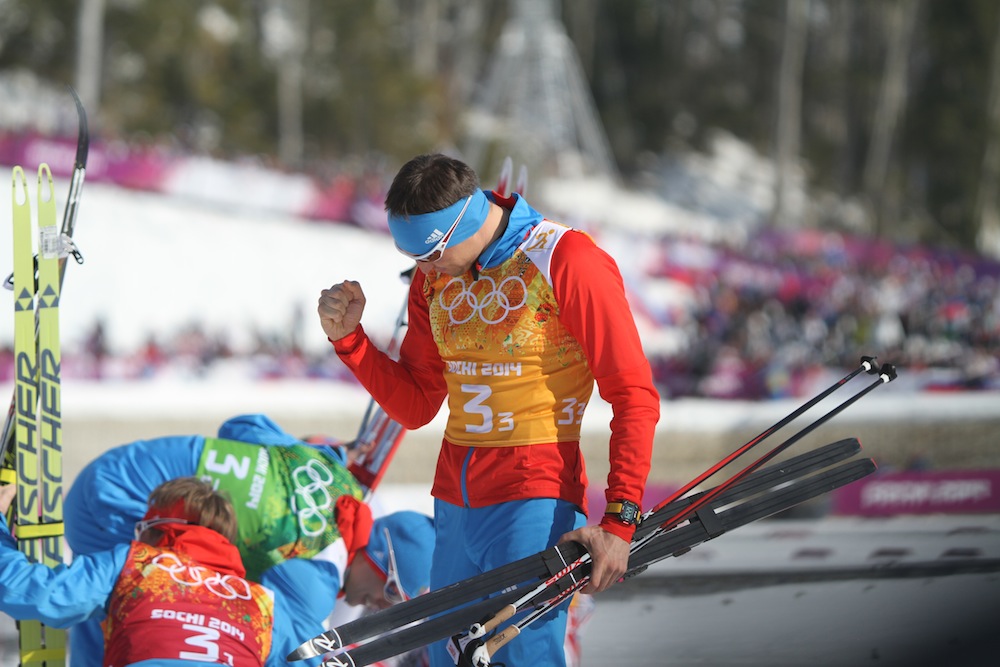
The Court of Arbitration for Sport decided that there was a “reasonable possibility” that Alexander Legkov had doped at the 2014 Olympics. Here, he pumped his fist after Russia claimed silver in the 4 x 10 k relay, their nation’s first medal in cross-country at the Sochi Olympics.
Nearly two weeks ago now, the lawyer for Russian cross-country skier Alexander Legkov published the decision a panel at the Court of Arbitration for Sport (CAS) had come to after a hearing in May.
Legkov has been suspended by the International Ski Federation (FIS) since December, 2016, because of his presence in the McLaren Report, an investigation commissioned by the International Olympic Committee (IOC) to assess potential state-sponsored doping by Russia at the 2014 Olympics in Sochi. Legkov won a gold medal in the 50-kilometer freestyle in Sochi, and is mentioned in multiple places in the McLaren Report’s evidence packet.
As we summarized last week, CAS agreed that it was justified for FIS to provisionally suspend Legkov pending further investigations into whether he committed a Anti-Doping Rule Violation (ADRV).
However, CAS decided that this provisional suspension could not be infinite and gave it an Oct. 31, 2017, deadline. After that point, FIS must either bring a full ADRV case against Legkov, or drop the provisional suspension until they have new information.
Besides the new deadline, there were a number of interesting details in the 51-page decision from CAS.
Before diving into them, the background: the IOC and FIS are considering a specific ADRV for Legkov: “tampering or attempted tampering with any part of the Doping Control”, outlined in the IOC Anti-Doping Rules for Sochi.
That’s because one of Legkov’s urine sample bottles showed suspicious marks when examined by a forensic expert in the McLaren Report. The conclusion was that the bottle must have been opened after the sample had already been collected, presumably in order to swap out a “dirty” urine sample for a “clean” one. This was the scheme outlined by the McLaren Report as well as news outlets such as The New York Times, whereby the Russians systematically cheated the anti-doping system.
Thus, the case hinges not on one doping sample: a urine sample collected on Feb. 23, 2014, the day Legkov won the 50 k.
Provisional Suspensions Don’t Have the Same Standard as Final Decisions
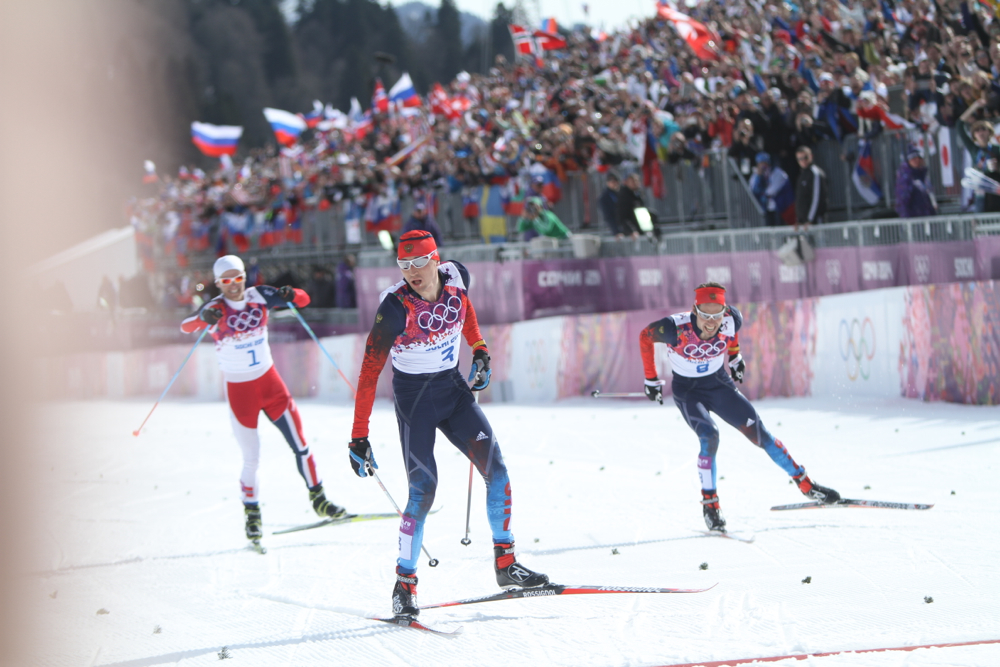
Alexander Legkov (3) beat out fellow Russians Maxim Vylegzhanin (not shown) and Ilya Chernousov (r) for gold in the Sochi Olympics 50 k freestyle mass start — the last race of the 2014 Games. The sample bottle for Legkov’s anti-doping urine sample collected the same day showed signs of tampering.
The suspension that Legkov was appealing was a provisional suspension, not a final one. FIS is still considering whether and how to bring a doping violation case against him, at which point there will be a different set of hearings and, if he’s found guilty, the implementation of a ban. (The long delay is because FIS is waiting on evidence from another IOC panel in order to bring their case.) In that case, the standard suspension for a first-time doping offense is four years; as of today, Legkov has been provisionally suspended for nearly 10 months.
FIS outlined in their pleadings why it is important to keep suspected dopers out of competition while their cases are investigated:
“Maintaining the suspension mitigates the ‘serious further risk’ of requiring retroactive disqualification of the Athlete (should he be found guilty of an ADRV),” the CAS Panel wrote in summarizing FIS’s position. “The potential need to revisit rankings, re-distribute medals, or otherwise modify competition results would ‘diminish the value’ of competition for participants, sponsors, and the viewing public.”
CAS did not have a problem with this system, writing that “the provisional suspension occupies a space in which an ADRV is asserted, but not yet proven.” This is important, as it is likely to be used more and more frequently as the types of doping cases being tried gets more diverse.
When there is a positive drug test, things often move forward fairly quickly. A mandatory provisional suspension is automatically triggered with a positive “A” sample (once it is established that the athlete does not have a Therapeutic Use Exemption for the substance), and there’s not much debate as to whether this is justified or not. From there it is on to analyzing the “B” sample and having hearings.
But in non-traditional cases, which are becoming more and more common, provisional suspensions might play a bigger role – and putting them into place will have more gray areas. This includes cases like autologous blood doping, where athletes extract some of their blood, save it for later, and then re-infuse is to get a boost of red blood cells and oxygen-carrying capacity. There are (at the moment) few good chemical markers of this type of blood doping and all evidence must be observed directly.
Other cases, too, sometimes rely on direct observation of doping, police finding doping materials, or paper or electronic files indicating wrongdoing, even in the absence of a positive doping test. The four-year ban of Austrian cross-country skier Harald Wurm is one example.
Because provisional suspensions are intended to keep athletes out of competition while their cases are being fully investigated, the standard of proof required to implement and maintain a provisional suspension is less stringent than it is for an actual doping violation. By definition, evidence is still being gathered.
In American civil law, the approximate analogy is to the situation in which someone seeks a temporary restraining order to protect themselves from a partner whom they fear will cause them domestic violence. The standard of proof that must be met to receive such an order is one of the lowest standards used in American law, because it is important to act quickly in this situation and because a longer follow-up hearing will be held soon after at which more evidence can be developed.
Thus, merely having doubts about the evidence is not enough to overturn such a suspension: “In this appeal, a provisional decision is overturned if it has ‘no reasonable prospect of being upheld,’” the Panel wrote.
So: a provisional suspension can be put in place if there is a “reasonable possibility” of a doping violation existing, and can only be overturned if there is “no reasonable prospect” of a doping violation being proven.
In CAS’s view, FIS was justified in putting the provisional suspension into place last December. And secondly, CAS did not think that Legkov had proved that there was ‘no reasonable prospect’ of further developing their case, so the provisional suspension was upheld, albeit with a deadline.
CAS Generally Trusts McLaren and Rodchenkov, With Caveats
Legkov and his legal team argued that the McLaren Report was riddled with errors and that it was never meant to establish the guilt of specific athletes anyway, only to investigate the mechanism of systematic doping. As such, he argued, the report shouldn’t be weighed too heavily in proceedings.
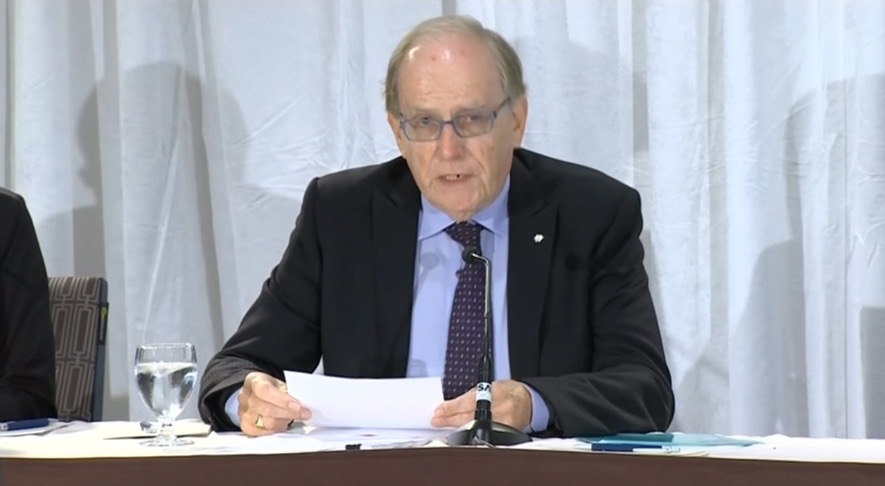
Richard McLaren speaking at a news conference in Toronto regarding his WADA-commissioned report on state-sponsored doping in Russia.
Likewise, the team painted Dr. Grigory Rodchenkov, the biggest whistleblower in the Russian doping scandal and a major source for McLaren’s report, as an unreliable source.
Quite separately from Legkov, the Russian government has also been seeking to discredit Rodchenkov. Prime Minister Dmitri Medvedev called him “scum”, his assets were seized, and there’s currently a warrant out for his arrest.
While agreeing that the evidence in the McLaren Report was not enough to prove a doping violation, CAS signaled that in general it trusted the evidence and that it certainly shouldn’t be ignored completely.
“It would however follow from the report’s findings as to the corruption of an entire system, devised to favor selected athletes, that some individual athletes must have benefited,” CAS wrote of the argument that the McLaren Report was not intended to identify individual athletes for disciplinary measures. “It could not sensibly be concluded that whereas the system was corrupt in the manner identified nonetheless no athlete drew advantage.”
The one exception: emails that Rodchenkov shared with McLaren. The emails are fascinating, but CAS wrote that they were “without context” and therefore very difficult to rely on as indicators of anything in particular.
On Rodchenkov, too, CAS indicated that they value the testimony of whistleblowers, even and especially if those individuals have broken the rules in the past.
“Although the Appellant has strongly challenged the credibility of Dr. Rodchenkov, the Panel observes first of all that the testimony of persons guilty of wrongdoing themselves can be decisive in establishing the guilt of others, and that the extent of their own culpability may even add to their value, since it is likely to be the result of their extensive involvement, at high levels, in the unlawfulness being examined,” the decision said.
Relatedly, CAS recently used evidence from the McLaren Report to uphold the ban of a Russian triple jumper. According to documents in the evidence packet, she had participated in a “washout” scheme where she took performance-enhancing drugs at home in Russia, where positive tests were suppressed, and then traveled to international competitions once the drugs were undetectable.
McLaren Didn’t Show
All parties probably would have loved to ask Professor Richard McLaren, who assembled the McLaren Report, some questions. But they couldn’t. The Canadian was invited to the hearing but declined – CAS wrote that he “chose not to make himself available.”
“From its perspective, the Panel regrets Professor McLaren’s absence and unavailability for questioning,” they wrote. “In any event, neither the Appellant nor the Panel has been able to pose questions to the person under whose supervision and control the evidence that fundamentally informs the suspension under appeal was gathered and organized.”
McLaren did give FIS a sworn statement, but it was after the deadline had passed for the two legal teams to exchange evidence. So it was not permitted to be used in the proceedings.
McLaren’s absence would have had stronger implications than simply the panel’s disappointment were this an American criminal case. The United States Supreme Court has interpreted the Confrontation Clause of the U.S. Constitution as requiring that a criminal defendant be able to cross-examine (that is, to “confront”) a witness against him, and specifically that prior out-of-court statements by a now-unavailable witness may not be used against hi at tria. McLaren’s physical absence from this hearing, in a case based almost exclusively on evidence he had previously gathered (but that the parties had not previously had a chance to ask him about), would have sufficed to overturn a conviction obtained on this basis under American criminal law.
‘I Live in Europe’ Is Not Enough
One of Legkov’s main refrains through this whole ordeal has been that he was training outside of Russia for the time leading up to the 2014 Olympics, and so could not have participated in a state-sponsored doping program.
Legkov and Swiss physiotherapist Isabelle Knaute at the finish of the 35 k stage of the Tour de Ski in 2012.
“To the extent that any opportunity might have existed to tamper, moreover, the Appellant considers it precluded by virtue of his geographical isolation from Russia,” the CAS Panel wrote in its summary of Legkov’s arguments. “The Appellant’s trainings have taken place outside of Russia since 2011, under the supervision of non-Russian coaches and personnel. Similarly, the Appellant has ‘used exclusively medical services in Davos,’ Switzerland (stemming from an apparent disappointment with Russian doctors following a bout of exercise-induced asthma in 2008).”
But at some other point in the hearings, Legkov seems to have made the argument that Russian officials could have taken urine provided during medical tests he occasionally had to undergo in Moscow, and swapped it out from his Sochi sample without his knowledge or consent. Legkov’s Instagram does show him spending at least some time in Russia at a few points in the last few years – as would be expected. It’s his home country.
Furthermore, with the Olympics being in Russia, Legkov was by nature back in Russia before the Games. This was the time period the CAS panel seized on in agreeing that yes, there was a “reasonable possibility” that he could have committed a doping violation.
“While Mr. Legkov’s geographical distance might complicate day-to-day participation in the ‘chain of distribution’ of performance-enhancing drugs prior to Sochi, it does little to quell the reasonable suspicion arising from his appearance on lists relating specifically to the Olympics.”
This is interesting because the International Association of Athletics Federations (IAAF), the international governing body for track and field, suspended the Russian track federation after the first part of the McLaren Report came out. As a result, Russian athletes could not compete in international events. But the IAAF made exceptions for athletes who lived and trained outside of Russia and were assumed to be tested routinely by non-Russian doping agencies.
The difference may be that in that case, the IAAF was assessing athletes’ current status and trying to protect current competitions. They knew which athletes to track; further testing can be ordered, to the extent that the federation trusts an athlete is clean at, say, World Championships.
In this case, FIS is trying to adjudicate a case from years past, rather than prevent doping in the future.
‘I Passed Many Tests’ Is Not Enough, Especially Since the McLaren Report Says Tests Were Suppressed
Like many other doped and non-doped athletes before him, Legkov argued that he had passed so many doping tests that his reputation should help absolve him from suspicion.
Photos of a sample bottle from the McLaren Report’s evidence packet.
CAS didn’t buy this argument, and indicated that Russian athletes may in fact have a much harder time using it in the future. The McLaren Report indicated that one of Russia’s strategies to get their doped athletes to competition was to simply alter test results in ADAMS, the international anti-doping results management database, from “positive” to “clean”.
As such, the database can’t be relied upon.
“The Panel considers it difficult to draw a conclusion from an athlete’s appearance or absence in ADAMS, given Professor McLaren’s indication that the Moscow Laboratory routinely manipulated and concealed test results,” the Panel wrote.
Legkov was tested at least once by Russian authorities between Jan. 1, 2014, and when he arrived in Sochi for the Olympics.
“The Appellant provided at least thirteen samples between 1 January 2014 and 5 February 2014, the date of his arrival in Sochi; at least twelve of these tested clean by laboratories outside of Russia and ‘without any chance’ to be manipulated,” CAS wrote in their summary of Legkov’s legal team’s arguments.
In an email to FasterSkier, Legkov’s lawyer Christof Wieschemann wrote that the one remaining test was collected by the Russian Anti-Doping Agency (RUSADA) in Switzerland, and analyzed in Moscow. However, the very next day FIS collected “a sample for blood, blood passport and urine, [and] analyzed in Cologne [Germany].”
(Note: a previous version of this story assumed that the RUSADA test had taken place in Russia. According to Wieschemann, that is incorrect.)
‘I Passed a Test Two Days Before’ Is Not Enough
Legkov provided three urine samples and one blood sample at the 2014 Olympics; only the last urine sample showed signs of tampering. He argued that since the other samples were clean, he could not have doped at the Olympics.
“During the Olympic Games themselves, the Appellant adds, three urine samples were submitted, including one sample on 21 February 2014, i.e., a mere two days before the urine sample which according to the IOC exhibited signs of tampering and which triggered the provisional suspension,” CAS wrote of Legkov’s argument. “The Appellant accordingly considers it ‘evident that he did not use the cocktail prior to or within the Olympic Games.’”
CAS found this, well, ridiculous, especially given that the “Duchess Cocktail” – the mixture of illicit drugs alleged to be given to top Russian athletes whose “dirty” urine samples were later swapped out for “clean” ones – quickly disappears from the body, becoming undetectable.
The silver-medal Russian men’s relay team at the 2014 Olympics.
“Intermittent consumption aimed at exploiting the cocktail’s short wash-out periods is entirely possible and, potentially in the Appellant’s case, desirable (given strict controls he faced in Europe prior to his arrival in Sochi),” CAS wrote.
“It is hardly unusual for doped athletes to start and stop the consumption of performance-boosting substances abruptly, evading detection,” the panel continued. “Sufficient time (nine days) lapsed between the first and latter two samples for traces of the Duchess cocktail to dissipate; similarly, to the extent that the Appellant may have waited until shortly before his Gold medal-winning event to begin taking the cocktail, the two-day period separating his second (clean) and third (suspected) urine samples does not lift the cloud of suspicion established by this inclusion in the Duchess List and related documents.”
What Was FIS Doing About the Other 40 Cases?
In its arguments, FIS repeatedly held up the McLaren Report as a reliable source of evidence.
Furthermore, the arguments indicated that FIS had been paying attention since the day the report dropped, Dec. 9, 2016.
“The IOC’s notification letter dated 22 December 2016 laid out compelling evidence [about Legkov] that had been known to the Federation since at least 9 December 2016,” the CAS panel wrote in summarizing FIS’s position. “The unprecedented scale of Professor McLaren’s allegations in combination with athlete-specific data in the EDP, FIS insists, required an immediate and resolute response.”
While FIS may have made a relatively fast response with regard to Legkov and five others, it appears to have not taken public action in other cases. From FasterSkier’s assessment of the Evidentiary Disclosure Package (EDP), there were 46 skiers who were mentioned in the McLaren Report. This represented 99 anti-doping samples. FasterSkier summarized all of them in a database and wrote about the cases.
To public knowledge, however, FIS only issued provisional suspensions to six athletes: Legkov, Maxim Vylegzhanin, Evgeny Belov, Alexei Petukhov, Julia Ivanova, and Evgenia Shapovalova.
These were the six who seemed to be under investigation by the IOC for doping in Sochi. To public knowledge, FIS has not issued any formal sanctions or charges based on any of the other, non-Olympic, evidence in the McLaren Report.
FIS did, however, allow Legkov to keep training with the Russian National Team as of Jan. 18, 2017, “an accomodation intended to allow him to maintain his competitiveness pending the resolution of his case.”
Competing in Sport Is Not a Fundamental Right or Liberty
Legkov made the argument that his right to a fair trial was being infringed upon, because he was being suspended without any charge. His legal team called on Swiss law to overturn the FIS suspension; in the CAS summary, they wrote that Legkov alleged “the provisional suspension’s incompatibility with Swiss fundamental rights.”
CAS was not sympathetic, noting that the components of due process under Swiss law – “the Appellant’s right to understand, confront, and refute the evidence against him” – were being followed by the very fact that the hearing was taking place.
“The question under Swiss law, moreover, is not whether the Appellant enjoys certain protections but rather to which degree they find expression vis-à-vis competing notions of associational autonomy,” the Panel wrote. “An athlete subject to sanctions proceedings internal to an association does not ‘require protection in the same measure as, for example, the accused in a criminal proceeding’… CAS sanctions result in a period of ineligibility to compete and forfeiture of prizes, not deprivation of liberty.”
Anti-Doping Rules Are Hard to Write
In determining the “reasonable possibility” standard for proof of a doping violation with regard to provisional suspensions, the CAS Panel waded through several provisions in the FIS Anti-Doping Rules.
They found unclear the order in which provisions were supposed to be considered, and found that some provisions might even be inconsistent with others. While the Panel eventually decided that there was a clear way around this problem, they were not complimentary of the FIS rules.
“Though both options [for interpreting the FIS Rules] have merit, ambiguous drafting frustrates attempts at a definitive interpretation of the FIS Rules’ intended order of precedence,” the Panel wrote at one point.
“A literal focus on the word ‘assertion’ may therefore prove elusive,” they wrote at another. “The drafters’ intent finds no expression in a uniform, literal construction of Articles 7.7 and 7.9.”
It is the second time in just over a year that FIS has been rebuked over clarity of rules, although the first was not fully the fault of the federation.
The case of Norwegian skier Martin Johnsrud Sundby hinged on how to interpret rules about how much salbutamol, an asthma medication, can be inhaled in a certain period of time – and whether a nebulizer counts as an inhaler.
The rule in question was the WADA Code – written by the World Anti-Doping Agency (WADA), not FIS – but in this case, FIS was applying the rule and thus was party to the proceedings.
“The Panel considers that the Athlete genuinely misunderstood the meaning of the β2A Provision, and also itself considers that the β2A Provision could have been drafted more clearly in certain respects (an issue the Panel will return to when discussing the appropriate sanction),” CAS wrote in that decision.
The notion of an adjudicative body critiquing a legislative body for unclear statutory construction is not unusual. The solution is, ideally, for the relevant legislative body to clarify the relevant text in a future session. In the case of asthma medication, the 2018 WADA Prohibited List updated its text on β2-agonists.
It remains to be seen whether FIS (or WADA, the IOC, or other sporting federations which use the same or similar language in their rules) will respond to this portion of CAS’s Legkov decision in the same manner.
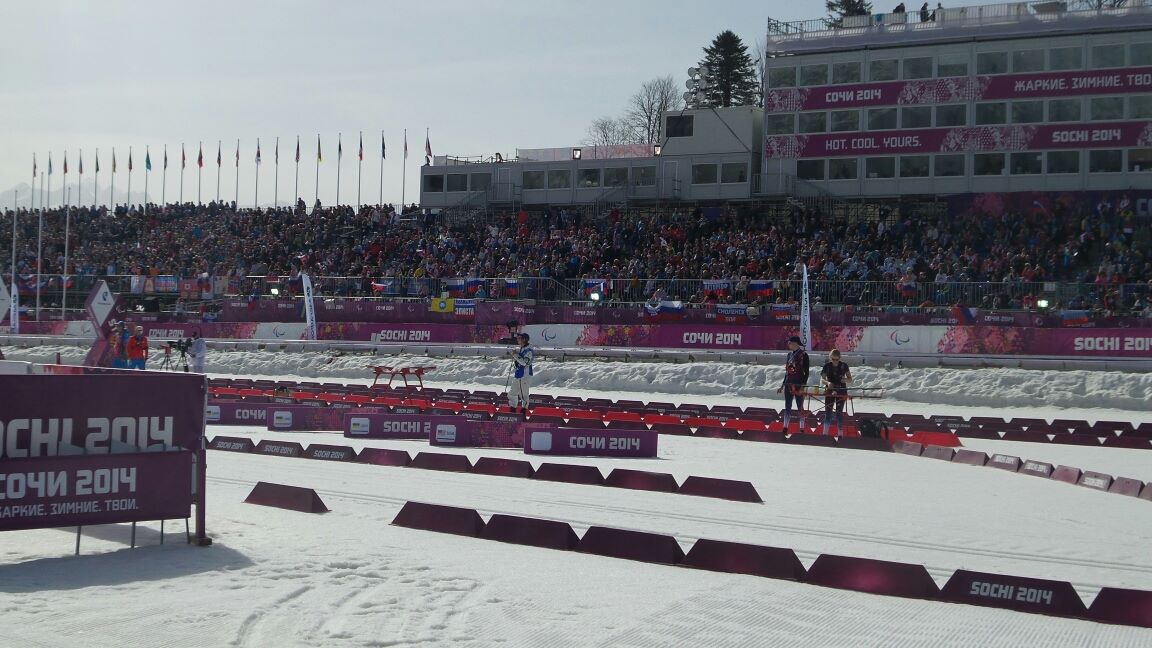
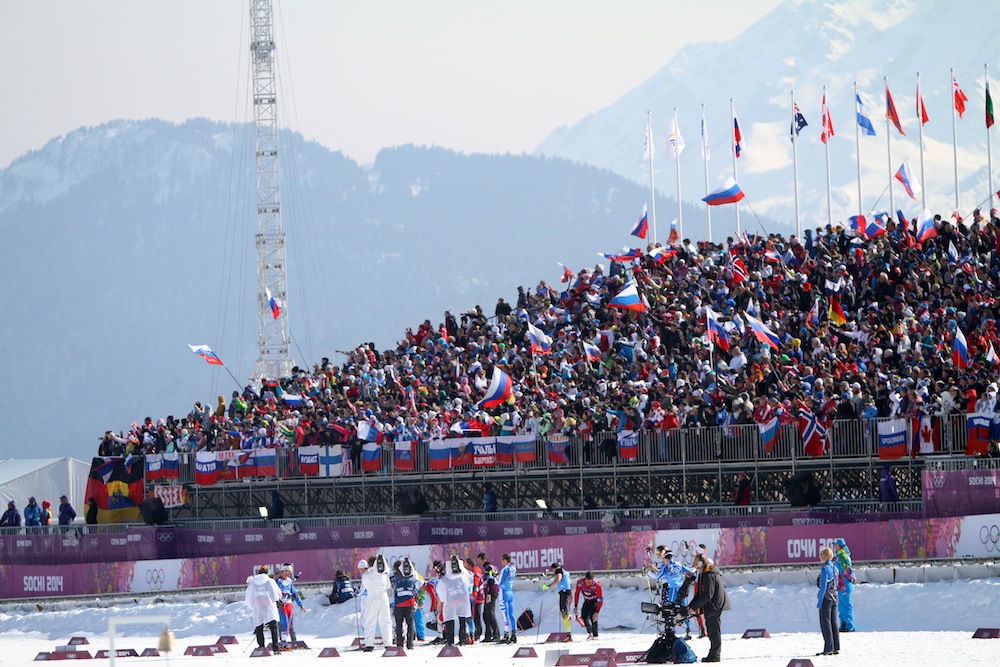
A packed cross-country stadium for the sprints at the 2014 Winter Paralympic Games in Sochi, Russia.
Anti-doping sample bottles belonging to seven Russian skiers at the 2014 Winter Paralympic Games were tampered with, according to the McLaren report.
Russian cross-country skiers won 12 gold medals, nine silver and 11 bronze at those Games. Some of the same athletes also helped win 12 gold medals, 11 silver and seven bronze in biathlon.
The report, which was commissioned by the World Anti-Doping Agency (WADA) and undertaken by Canadian law professor Richard McLaren, found that more than 1,000 athletes may have benefitted from tampering by Russian anti-doping authorities: either manipulation of samples, not reporting samples to WADA’s test-result database (ADAMS), or reporting positive tests as if they were negative.
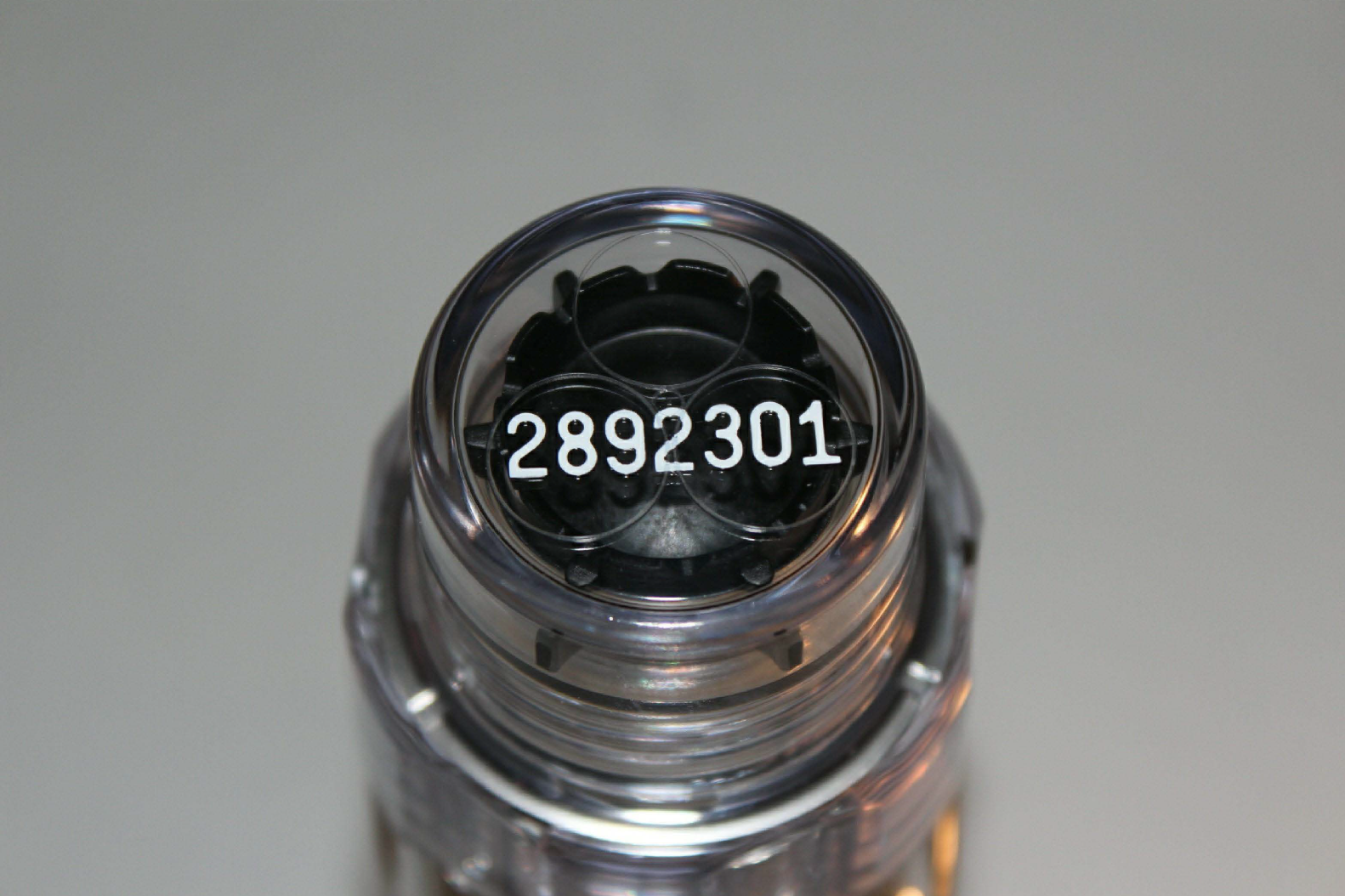
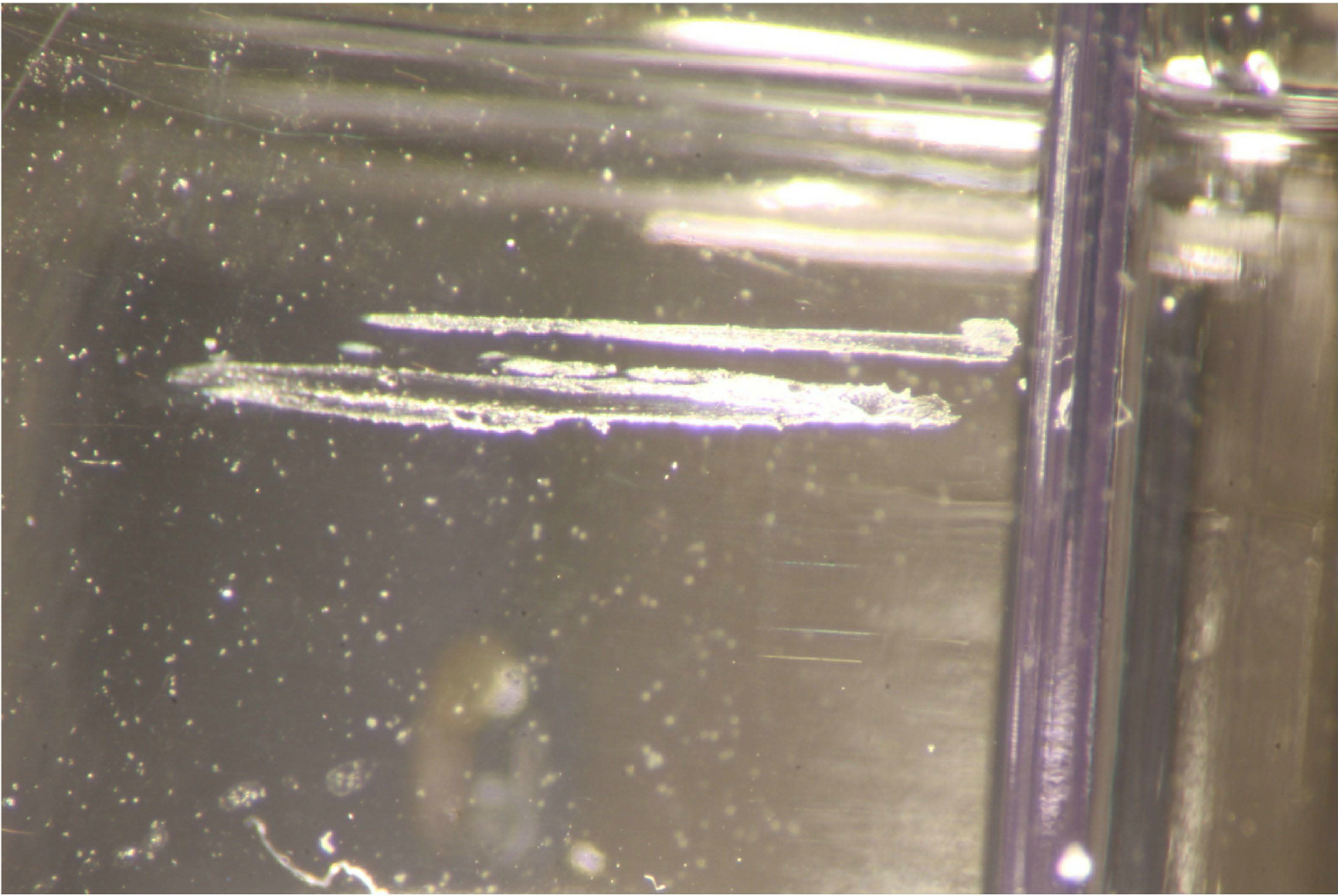
Among the findings were that Russian staff had discovered a way to open anti-doping sample bottles, produced by the German company Berlinger and long assumed to be tamper-proof.
The sample bottle belonging to a Paralympic cross-country skier. (Photo: McLaren report)
The finding supported claims made by Dr. Grigory Rodchenkov, the former head of the Moscow Anti-Doping Laboratory, that at the 2014 Olympics in Sochi, Russia, he and others had unscrewed the lids of some sample bottles and replaced “dirty” urine with previously collected “clean” urine.
“As the start of the Games approached, Dr. Rodchenkov recalls that he was not confident the bank of clean urine was adequately organised and he asked the [state security service] FSB to see it,” McLaren wrote in his report. “… Dr. Rodchenkov was allowed access to the part of the Command Centre where the samples were stored. The room contained 3 or 4 full size freezer units. Inside were numerous shopping bags labelled with the athlete’s family name and he was advised they were filled with bottles of that athlete’s pre tested clean urine.”
Scratched marks on the same bottle shown above. (Photo: McLaren report)
Based on those claims, McLaren commissioned an investigation by a British Forensic Firearms and Tool Marks Examiner. His or her (the name is redacted) report, which can be found here, details the normal working of the tamper-proof bottles.
The investigator came to the conclusion that the most likely way to open the bottles was to insert a thin metal or plastic object between the lid and the side of the bottle, and open the bottle from the inside. Depending on what type of material was used for this object and how carefully the bottles were opened, this procedure would leave marks on the bottle and/or lid, in some cases detectable only with a microscope or special lighting.
Almost all of the sample bottles sent to the examiner by McLaren showed these marks. Among them: 19 bottles belonging to seven different IPC cross-country skiers.
Athlete ID
Samples Named in Forensic Investigation
A0389
2890467, 2890467
A0469
2892301, 2889197, 2888781, 2890593
A0501
2891821, 2890557, 2889145, 2889128
A0546
2889181, 2890105, 2890786
A0656
2892161, 2891761, 2889127
A0704
2890874
A0705
2890793, 2892237
The sample numbers are also reported in another document in McLaren’s evidence packet, EDP1166. This document is a list of test numbers associated with athlete ID numbers.
“The IP has identified more than 1231 samples where the Moscow Laboratory communicated the presence of a prohibited substance in a Russian athlete’s sample to the [Ministry of Sport] and later reported that sample as negative in ADAMS or did not report the sample at all.”
EDP1166 lists those 1231 samples. In the cases of the Paralympic skiers’ samples, they are associated with the alpha-numeric code of an athlete, but nothing is listed as a substance for which a positive test may have occurred, and the sample is also not listed as being reported as either positive or negative to the ADAMS database.
Because this document was assembled to be a list of samples which were reported to the Ministry of Sport as being positive, it’s not clear what to conclude from this combination of facts.
Other than in the forensic report and this document, neither the samples nor athletes are mentioned anywhere else in the McLaren report’s extensive evidence packet. There’s not even any listing of whether the athletes are male or female.
The lack of a positive test result for any of these samples may be because there was previously-collected clean urine inside them, as described by Rodchenkov. Because no other discussion or information about the samples was found, it may never be known whether the athletes were actually doping or not; if replacing samples with previously collected urine was a policy, it may have been done without even testing to see whether the original samples themselves were clean.
Even without that information, however, this could lead to suspension of the athletes.
“246 athletes can be identified as potentially knowingly participating in manipulation thereby raising the possibility of a violation of WADA Code Article 2.5 (tampering),” McLaren wrote. “Athletes who provided clean urine to the CSP in advance, which was then swapped for a dirty sample, which he or she provided during the Sochi Games, could be in violation of Code Article 2.5.”
In a statement on its website, the International Paralympic Committee (IPC) wrote that “The full findings of the report are unprecedented and astonishing.” Russia has been suspended by the IPC since Aug. 7, 2016.
(Note: This article has been updated to include a statement from the International Ski Federation regarding the most recent McLaren report, as well as comments from IBU President Anders Besseberg.)
The initial McLaren bombshell came in July when the World Anti-Doping Agency (WADA) disclosed its findings about alleged systematic state-sponsored doping in Russia.
McLaren’s investigative mandate was to further disclose the extent to which Russia’s anti-doping authorities manipulated doping-control samples and how they beat international testing protocols.
Friday’s report disclosed more evidence of systematic Russian doping that McLaren concludes dates back to at least 2011 and continued after the Sochi Olympic Games.
The major findings released today include this: more than 1,000 Russian athletes in more than 30 different sports were involved in the doping coverup. McLaren called it “a coverup that operated on an unprecedented scale” in his opening remarks.
Of those 1,000 athletes, 600 (84 percent) are summer athletes whereas 95 (16 percent) are winter athletes. Those 695 names were reported to 32 international sports federations. The remaining 305 were more or less special cases that could not be disclosed for confidentiality reasons, McLaren explained.
The report states that the “coverup” and “manipulation” of the doping-control process was fine-tuned during the 2012 London Summer Olympics, 2013 Universiade Games, 2013 Moscow IAAF World Championships, and the 2014 Sochi Winter Olympics.
On page 27, the report’s authors did not mince words when it came to describing the freedom to which some Russian athletes could affect a race’s outcome during the 2014 Winter Games:
“The Winter Olympics in Sochi debuted the ultimate fail-safe mechanism in the Russian’s sample swapping progression. A protected winter Olympics competitor likely to medal did not have to worry about his or her doping activities. They could dope up to, and possibly throughout, the Games as they could count on their dirty sample being swapped at the Sochi Laboratory.”
Specific violations that occurred during the Sochi Games were sample swapping and tampering.
“Two female hockey players’ samples contained male DNA … and eight Sochi samples revealed salt content not physically possible in a healthy human,” McLaren stated, explaining that Russian specialized agents, dubbed “magicians”, used salt and “Nescafé coffee granules” to manipulate the samples.
More specifically, McLaren’s team found “physiological impossible” salt readings in two Russian athletes that were “winners of 4 Sochi Olympic gold medals” and a female silver-medal winner.
“Twelve medal winning athletes (including the above 3) from 44 examined samples had scratches and marks on the inside of the caps of their B sample bottles, indicating tampering,” the report stated. “Six winners of 21 Paralympic medals are found to have had their urine samples tampered with at Sochi.”
For Russian doping authorities, the process of preventing samples from testing positive became a nimble and evolving cat-and-mouse game. Russia’s infrastructure put in place to beat the testing protocol was able to evolve, “in response to WADA regulatory changes and surprise interventions,” the report stated.
“For every action by WADA, there was a Russian reaction,” McLaren said.
The first McLaren report detailed the intricate swapping of positive tests for clean tests during the Sochi Games. The second McLaren report alleges that the same protocol continued after the Sochi Games concluded and became a routine “monthly practice” at the Moscow Laboratory at the center of the doping coverup.
“After Sochi, the sample swapping happened approximately every month,” McLaren said. “The ‘magicians’ would be called to the Moscow laboratory to swap … about five to 20 samples … per month.”
How did they get away with tampering with supposedly tamper-proof bottles? According to McLaren, forensics experts determined that “thin strips of the metal were most likely used. They have to be flexible enough to bend and fit between the lid and the bottle, but also strong enough to pull up the metal ratchet ring.”
And who is responsible at the very top? While McLaren’s report does not name Vladimir Putin, it does include former Russian Ministry of Sport Vitaly Mutko (who has since been promoted to deputy prime minister). Mutko appointed Dr. Grigory Rodchenkov, the former director of the Russian anti-doping laboratory, for the job back in 2011 — when doping efforts were found to have begun ramping up for the 2012 London Olympics.
McLaren later explained that there was no evidence that Russian Olympic Committee members were directly involved. He also stressed that this “institutional conspiracy” dates back to at least 2011.
“It is impossible to know how far back the conspiracy goes,” he said. “… Sports fans and spectators have been deceived. It’s time that stops.”
Athletes affected by the post-Sochi sample swapping technique include elite summer and winter athletes. McLaren wrote that the report’s conclusions were established not by verbal testimony, but by testing physical evidence.
“The key findings of the first report remain unchanged,” he said. “Evidence does not depend on verbal testimony from anyone to draw a conclusion, but rather tests the physical evidence and draws a conclusion from the results.”
As of press time, neither McLaren, his report, nor WADA mentioned any athletes by name. McLaren said the evidence has been passed on to WADA, which is asking specific sport federations to handle specific athlete cases.
“It has not been put in the public domain. That will be up to sports federations who have received the information,” he said.
In a press release on Friday, WADA noted that the evidence, described by McLaren’s “Investigation Team as being ‘based on immutable facts’ will be of immediate value to the IFs [International Federations], the International Olympic Committee (IOC), the International Paralympic Committee (IPC) and other organizations — those that are responsible for the Results Management and Adjudication process related to potential anti-doping rule violations (ADRVs) under the World Anti-Doping Code (Code).
“In terms of next steps, the Investigation Team is providing WADA with an Evidentiary Summary for each athlete referred to in the Report by alpha-numeric code,” the press release continued. “Starting today, WADA will provide these Summaries to all IFs whose athletes are mentioned within the Report; as well as, to the IOC, the IPC and other relevant organizations. Once in possession of these Summaries, these organizations will be responsible for reviewing the evidence available for each case; and, for determining whether or not there are sufficient elements to pursue ADRVs or, whether further investigations are required. As is a requirement of the Code, WADA will monitor the Results Management that will be carried out by the relevant authorities.”
As McLaren explained: “It’s up to different parties, like the IOC and the federations [32 of which have reports] for them to make their decisions. They can rely on what’s in the reports and what’s on the website.”
While the IOC did not have an official statement on its website a few hours after the report was published on Friday, the International Paralympic Committee immediately responded with a press release, stating, “The full findings of the report are unprecedented and astonishing. They strike right at the heart of the integrity and ethics of sport. … We wholeheartedly agree with Professor McLaren that the best course of action is to work together to fix the broken and compromised anti-doping system in Russia.”
The IPC explained that it recently appointed a taskforce to work “closely” with the Russian Paralympic Committee (RPC) “to do just that.”
The IPC suspended the RPC in early August “due to its inability to fulfil its IPC membership obligations, in particular its obligation to comply with the World Anti-Doping Code (to which it is a signatory) and the IPC Anti-Doping Code.”
The International Ski Federation (FIS) relayed its official statement in an email to FasterSkier:
“FIS will study the details in the WADA McLaren Report in the coming days and thereafter act decisively, in accordance with the FIS policy of zero tolerance to punish anti-doping violations and the protection of clean athletes. Additionally FIS will coordinate with the IOC, as the responsible body for anti-doping at the Olympic Winter Games, and WADA, in order to address each organisation’s next steps.”
Also in the email, FIS Communications Manager Jenny Wiedeke noted, “Unfortunately, we cannot answer specific questions until we have had a chance to completely review all of the details of the report.”
The International Biathlon Union (IBU) president Anders Besseberg went on the record saying, “First of all you need proof that the Russian Biathlon Union was involved in this thing,” he told Sportschau.de. “Or was it something that went over the head of our federation member — at a state level so to speak, then it is a difficult question.
“But in my opinion that is the key question: if the Russian Biathlon Union was involved,” he continued.
The day of the men’s 4 x 10 k relay at the Laura Cross-Country Ski Center at the 2014 Winter Olympics in Sochi, Russia. Sweden went on to take gold, Russia silver and France bronze in the event.
Max Cobb’s motivation to voice his disdain for doping dates back to the 1992 Albertville Olympics. Justin Wadsworth’s stems from being an athlete who had suspicions, but moreover, from watching his wife Beckie Scott miss out on her chance atop the Olympic podium after having been beat out by two Russians who were eventually disqualified for using performance-enhancing drugs.
For both, when it comes to Russia, they’re direct.
“The level of fraud and deceit that was allegedly put in place for the Sochi Games around the anti-doping effort is just a complete assault on everything that sport and the Olympic movement stand for,” Cobb, president and CEO of US Biathlon, told FasterSkier this past weekend.
He was reacting to The New York Times report, published Thursday, May 12, that suggested dozens of Russians, including 14 cross-country skiers, participated in a state-run doping program at the 2014 Winter Olympics in Sochi, Russia.
“There’s enough evidence in the past, with how many positive doping cases the Russians have had,” said Wadsworth, who recently left his post as head coach of the Canadian cross-country ski team after five seasons with the team. “I think that alone is enough to have reason to try to put some sanctions on them.”
Russia’s Natalia Matveeva (r), who tested positive for recombinant EPO in 2009 and was suspended until March 2011, joins Norway’s Ingvild Flugstad Østberg (l) and Maiken Caspersen Falla (c) on the podium this past February at the 2016 classic sprint in Drammen, Norway. (Photo: Fischer/NordicFocus)
Wadsworth was referring to a trend leading up to the 2010 Olympics, in which about a dozen Russian cross-country skiers were suspended for failing drug tests between 2001 and 2009.
“When I first came onto the international scene in the late ’80s, I went to ’89 World Championships in Lahti, and during that whole time I was naive…,” Wadsworth, a former U.S. Ski Team member, recalled. “You learn over the years, you see enough stuff that you just know what’s most likely an athlete that’s doping. You can’t come out and say, ‘Yeah, for sure,’ unless you see the needle going in the arm.”
That’s what makes the current case so complex, with the head of the Sochi anti-doping lab, Grigory Rodchenkov, releasing a list of Russian Olympians handpicked to receive illegal drugs at the 2014 Games.
It’s his word — a man whom the World Anti-Doping Agency (WADA) accused of taking bribes and destroying more than 1,400 samples, who was forced to resign and now lives in Los Angeles — against the Russian government’s. The tests were allegedly tampered with, so investigators will have to find evidence elsewhere to convict athletes like Alexander Legkov, who won gold in the final race of the Sochi Olympics, the 50-kilometer freestyle mass start.
The Russian Sports Ministry might even sue The New York Times, according to RT, a Russian government-funded media outlet.
“We are considering a lawsuit,” Russia’s Deputy Minister of Sports Yury Nagornykh told the Russian News Agency TASS. “They asked us to give comments on 66 athletes who are a part of Russia’s ‘doping program’. We said that we don’t have such a program.”
Rodchenkov claimed he concocted a “three-drug cocktail of banned substances” mixed with liquor, with “one milligram of the steroid mixture for every milliliter of alcohol.”
Apparently, he dissolved the drugs in alcohol to speed up the absorption, making Chivas whiskey for men and Martini vermouth for women.
“All athletes are like small children,” Rodchenkov told The New York Times (NYT). “They’ll put anything you give them into their mouths.”
“Athletes drink Chivas before competing? I can’t take it seriously,” Russian cross-country skier Sergey Ustiugov, who was not named in the NYT report but competed at the 2014 Olympics, told RT.
Alexander Legkov (standing) celebrates Russia’s silver in the men’s 4 x 10 k relay, their nation’s first medal in cross-country at the Sochi Olympics. He went on to win gold in the final race of the Sochi Games, the 50 k freestyle mass start, and Russia swept the podium.
“What happened yesterday [the release of NYT article] is totally absurd,” Legkov said at a press conference. “Alcohol with steroids is ridiculous. I didn’t take a sip of alcohol when I was meeting with friends because I was preparing for the Olympic Games. I know nothing about steroids, I don’t know how they look like. I took the article as an April [Fools’] joke.”
Legkov also called Rodchenkov’s comments groundless.
“It is a political game. Everybody is set against our country because it is one of the strongest in the world,” he said.
The NYT pointed out that, according to WADA statistics, Russia had the highest number of athletes caught doping in 2014.
While Russia fights to defend its winter athletes, its sport officials are simultaneously trying to ensure their track-and-field athletes can compete at the 2016 Summer Olympics in August in Rio de Janeiro, Brazil.
“Serious mistakes have been made by the federation management, along with athletes and coaches who have broken anti-doping rules and neglected the principle of fair play,” Russia’s Minister of Sport Vitaly Mutko wrote in a statement to the British newspaper, The Sunday Times, this weekend. “Let us be clear. We are ashamed of them.”
Track and fields’ international governing body, the International Association of Athletics Federations (IAAF), suspended Russia’s athletics team in November following a WADA investigation that found it guilty of state-sponsored cheating.
“We do not deny having a problem in Russia, and we are doing everything possible at state level to eradicate doping, including punishing athletes and coaches,” Mutko wrote.
Russia will find out June 17 whether its track and field team will be allow to compete in Rio.
“We are very sorry that athletes who tried to deceive us, and the world, were not caught sooner,” Mutko added. “We are very sorry because Russia is committed to upholding the highest standards in sport and is opposed to anything that threatens the Olympic values.”
‘The Needle Going in the Arm’
Cobb didn’t witness doping firsthand, but his opinion on the matter goes back to one of his first Olympic experiences, a night or two before the first race in Albertville, France.
“We were up in Les Saisies and one of our coaches who I was in the sauna with was dragged out to go help translate between a Russian coach and the village medical doctor,” Cobb recalled of the 1992 Games. “Because our coach’s English wasn’t that good, I went along to help translate as well. The situation was, the Russian coach said, ‘One of our athletes is very sick and will die if he doesn’t get a cortisone injection.’ So I was helping to translate that to the French doctor, who spoke English pretty well.”
While emphasizing that point over the next few minutes, the Russian coach explained that the athlete was having an allergic reaction to a protein injection he received.
“The French doctor said, ‘Yes, I know. I can see that he’s having an allergic reaction, but cortisone is a controlled and banned substance, and unless I can examine the athlete I can’t give it to him,’ ” Cobb recalled. “ ‘And yes, I know he will die if I don’t give it to him.’
“That was really how my experience at the Olympic Games began,” Cobb continued. “That was the case of [Russian biathlete] Sergei Tarasov, who was given an injection of blood that was either not his own or had been spoiled by not being refrigerated in an effort to blood dope him before the first race in Albertville.”
That story surfaced last year when Tarasov, who went on to win an individual gold at the 1994 Olympics, turned 50 and gave an interview to a Russian magazine.
Cobb recalled that story and compared it to the current accusations against Russian athletes across multiple Olympic sports.
“This is an issue that has been a violation of the basic principles of sport, that has been — because it was, in many cases forced on athletes with the threat of losing their support if they didn’t comply — an issue that needs to change,” he said. “I believe that with whistleblowers, athlete insiders and RUSADA [Russian Anti-Doping Agency] insiders coming forward at this time, taking the immense risk to come forward and tell what’s going on in an effort to change the system, that incredible sacrifice on their part needs to be met with support from sports leaders. If we don’t support that now, I’m sure it will be decades before it would ever happen again.”
Cobb didn’t see the needle going in Tarasov’s arm back then, and he, like everyone but Rodchenkov who has so far come forward about the 2014 Olympics, didn’t witness the Russians cheating in Sochi.
The all-Russian podium in the Sochi Olympics 50 k freestyle mass start, with Alexander Legkov (3) placing first, Maxim Vylegzhanin (7) in second for his third silver medal of the Games, and Ilya Chernousov (8) in third.
But Wadsworth claimed that’s what the Russians were up to immediately after they swept the podium in the 50 k, with Legkov leading fellow countrymen Maxim Vylegzhanin and Ilya Chernousov across the finish, respectively.
“If Rodchenkov knew my story, he would not even mention my name,” Legkov told MatchTV, according to a translation. “Since 2010, I have been working with foreign experts, I am absolutely not with Russian coaches, live all the time in Switzerland in an apartment in Davos. Before the Olympics, I have taken 33 doping tests.”
Meanwhile, Chernousov was another athlete who trained independently of the national team. After the Sochi Olympics in the spring of 2014, Chernousov began working with Vegard Bitnes, a Norwegian coach.
“We were one of the groups from [Russian] Federation, (Reto Burgermeister/Isabelle Knaute was an other),” Bitnes explained in an email to FasterSkier. “I planned all training, and had all control of training … we had our own camps and training.”
In the last two years, Bitnes explained that he and Chernousov only joined the Russian national team for two or three training camps, holding more camps with other national teams, like Sweden.
“We had some camps with Team Northug [Norwegian Petter Northug’s personal team], also with the Canadian team,” Bitnes wrote. “We was in some sport events in Norway, where we had trainings with French team, also US ski team athlete… So, we was almost never with the RUS team.”
Technically, Bitnes was a Russian national-team coach. He recently parted ways with Chernousov to become the head women’s coach of the Austrian biathlon team, effective May 1.
“The end of my work has nothing to do with the latest from RUS team,” he wrote. “I wanted to turn back to the IBU and Biathlon again. I hope for the best for Ilya and his training in the future.”
As for the allegations that 14 of 20 Russian cross-country skiers in Sochi — which may or may not include Chernousov — were doping, Bitnes wrote, “I can not comment so much, because it is from a time before I had anything to do with the RUS team. I can only say that it’s frightening to see/hear about this. Based on a general base. I hope WADA and IOC [the International Olympic Committee] will get to the bottom of those obligations, so we can clean up this mess. If this is true, its a very very sad thing.”
The Russians celebrate their silver medal in the men’s 4 x 10 k relay at the 2014 Sochi Olympics, with (from left to right) Dmitriy Japarov, Maxim Vylegzhanin, Alexander Bessmertnykh, and Alexander Legkov.
Wadsworth is confident it’s true. The former Canadian coach recalled suspecting something fishy was going on with the Russians during the men’s 4 x 10 k relay in Sochi as he watched Legkov put down the fastest time on the third leg.
“What I saw with the rest of his form that year and on that course, when I saw him hop-skating pretty much the whole course, especially the last hill coming into the stadium, the way he was looking on his face after pushing so hard — because the Russians were quite far behind and he really pulled them into medal contention in that race — and I just didn’t believe what I saw,” Wadsworth said. “And then in the 50 k, it was, at the end, the pace and the pushing. In the early part of the race, there were so many guys up toward the front, but in the last few kilometers, again, it just didn’t look right to me. And I always carefully think that through in my head as far as, is this a great performance we’re seeing or is this something else? And what I saw, I just thought it was something else.”
“I always carefully think that through in my head as far as, is this a great performance we’re seeing or is this something else? … I just thought it was something else.” — Justin Wadsworth
So he spoke out about the Russians after the 50 k and accused them of doping in a post-race interview with FasterSkier. FS then asked Legkov what he thought of Wadsworth’s accusation in the post-race press conference. Legkov laughed off the comment.
“I have to always be clear with this, I wasn’t making any excuses for our team, I was simply commenting on something I saw from the athletes on the field of play,” Wadsworth recalled this past Saturday.
“I fully accept our team’s preparation for the Games and our waxing issues … we had our own issues and we debriefed those and learned from those,” he continued. “But I think if I was potentially another coach who had athletes, like [Norway’s Martin Johnsrud] Sundby, who was fourth in that race and missed out on a chance at a medal … I guess I’m always surprised the Norwegians don’t speak out. They have so much power in our sport and they chose to do nothing with it except make things better for themselves on the World Cup.”
An email to Vidar Løfshus, director of the Norwegian Ski Federation, seeking comment on the recent allegations against Russia was not returned by press time.
“It’s just really surprising to me that nobody wants to speak out more. I can understand we all want to focus on our teams and on our own business, but that’s not to the point when there’s something going on like systematic doping,” Wadsworth said.
As for the athletes, “I expect them to focus on their training and themselves, but when it comes down to it, if there’s enough evidence and they’re tired of it, then they should probably speak up,” he added. “The athletes do have a powerful voice and they should use their athlete representatives to push FIS to do a better job and to push the IOC.”
Shocked But Not Surprised
One athlete who carefully crafted his responses in an email to FasterSkier was France’s Robin Duvillard, who placed sixth in the 50 k. Should the Russian cross-country team be disqualified and its results voided in Sochi, Duvillard would move up to third place and technically a bronze medal in that race.
France’s bronze-medal men’s 4 x 10 k relay team at the Sochi Olympics: (from left to right) Ivan Perrillat Boiteux, Jean-Marc Gaillard, Maurice Manificat, and Robin Duvillard.
“I would like to be clear about the fact that what I read in the newspaper yesterday are only suspicions,” Duvillard wrote on Friday. “I don’t want to blame them if some of the information is not true.”
If everything in the reports is true, “I am shocked, sure. But not really surprised,” the 32-year-old continued. “I am shocked about the fact that it was organized by the authorities. Not because some athletes are doped. In the past, we already discovered that athletes were doped, and I know that it can happen again.”
In Sochi, Duvillard stood on the podium with three teammates, earning bronze in the men’s relay behind Sweden in first place and Russia in second.
“The only thing we can do is to trust [WADA] AMA to achieve anti-doping tests,” he wrote. “And what I have read yesterday is that they failed in Sochi, because Russian authorities were more powerful than them. But now I need to keep my faith in AMA’s work if I want to live my sport serenely and not getting paranoiac.”
Considering the news that immediately followed the 2014 Olympics, in which Russian skiers stated they had used xenon gas in training — a controversial but not-yet-banned substance (before WADA banned it in May 2014) — along with the Russian-athletics scandal unveiled last year, Duvillard had his suspicions.
“I suspected that a doping scandal could break out in Sochi, considering the bunch of money they put into it, and because Putin wanted to show the world that Russia is still shining,” he wrote. “But I can’t say I really suspected the cross country athletes being doped in the 50k. Sure, they were way faster than me in the last hill, but they were faster many many times in the past, so why not once again?”
Since the NYT report hit the world wide web last Thursday, Duvillard has received numerous messages congratulating him on the potential bronze medal.
“In a way, I would be glad to get this medal, because that would award all the work I have done to get in shape on that race,” he wrote. “But in another way, the party would be spoiled forever! Because any time I would watch again that 50k, I would find myself crossing the line in 6th place, and any time I would watch the closing ceremony with that amazing podium into the stadium, I wouldn’t see me on it.”
“Sure, they were way faster than me in the last hill, but they were faster many many times in the past, so why not once again?” — Robin Duvillard, sixth in the men’s 50 k at the 2014 Sochi Olympics
The redistribution of medals is a drawn-out process that involves legal battles handled by the Court of Arbitration for Sport, but if you ask Wadsworth, whose wife fought for her medal two years after the fact, it needs to happen.
“If nobody does anything, nothing’s going to change,” Wadsworth said. “… It’s great for [Beckie] to have the gold medal in the house and get recognized for that, but on the day, that’s what you as an athlete, that’s what you dream about, that’s what you work hard towards and when you get that robbed from you, it doesn’t matter what happens in the future.
Alexander Legkov (3) beat out fellow Russians Maxim Vylegzhanin (not shown) and Ilya Chernousov (r) for gold in the Sochi Olympics 50 k freestyle mass start. Vylegzhanin took silver by 0.7 seconds, just a tenth of a second ahead of Chernousov in third, and Norway’s Martin Johnsrud Sundby (1) missed a medal by 0.2 seconds in fourth. Not shown: Sergei Dolidovich of Belarus placed fifth, 14.3 seconds after Legkov, and France’s Robin Duvillard was another 0.6 seconds back in sixth.
“I think what really needs to come out from all this is not the results getting stripped — you know, Robin Duvillard, he might get the medal, but he’s not going to get to feel what it felt like to stand on the podium in the closing ceremonies down in Sochi, to get a medal around his neck, so that whole thing is lost,” Wadsworth continued. “What really needs to happen is things change for the future so that clean athletes have an opportunity.”
Should the entire Russian cross-country team be suspended, some clean Russian athletes will get caught in the aftermath, he noted.
“But those athletes should speak out and say what they know as well because it’s the Russian athletes that’s getting cheated the worst in the very end,” Wadsworth said. “They’re the ones that are going to have the health issues in the future and they’re also the ones that are going to miss out on future opportunities if their team does get allowed to race. And they’re the ones at the end of the day that have to look at themselves in the mirror and know they cheated.”
FIS and the IOC
As for how the International Ski Federation (FIS), the sport governing body for cross-country (as well as several other winter sports), FasterSkier first obtained a statement on the matter via email.
“FIS is deeply disturbed by these allegations and will provide all possible cooperation to WADA and the IOC with the investigation,” the statement noted.
In a follow-up phone interview on Monday, FIS Secretary General Sarah Lewis said, “We also will make sure that we are looking into our processes which we can control, as opposed to the Olympics where we are playing a facilitating role but not directly controlling the testing.
“Certainly for everybody it’s a wake-up call to what may have happened and what therefore has the potential to happen,” she continued. “I’m very sure that there will be a very careful analysis of the situation to make sure that this cannot happen going forward.”
Kikkan Randall (U.S. Ski Team) at the 2014 Olympics in Sochi, Russia. (Photo: Fischer/NordicFocus)
Kikkan Randall, chair of the FIS Athletes’ Commission who competed for the U.S. in Sochi, wrote in an email that the latest news was “definitely disturbing and if it turns out to be true, it is really unfortunate and unfair for those athletes that competed clean in Sochi and missed out on medals.
“The FIS Athlete Commission had previously written a letter to WADA after the news came out about Russian Athletics calling for further investigations into other sports, especially cross country skiing,” Randall added. “We hope WADA can get to the bottom of this and I know FIS will be in full cooperation to help out however they can.”
As for the U.S. cross-country team, head coach Chris Grover said they’ve been following the news closely.
“I guess our initial reaction is that we are disheartened and disappointed, and really disappointed that there might be a tie to cross-country here,” he said on the phone this weekend before convening with the team for its first training camp of the 2016/2017 season.
“It’s something we’ll talk about as a group but we haven’t,” Grover said. “Every time any sort of doping scandal comes up, we definitely talk about it as a group. It reinforces our resolve by lead by competing clean. And the exciting thing that we have talked about before, is that we know that we can win when we are doing it clean, because we’ve done it so many times before. That’s the silver lining for us … We can’t get hung up in what other people may or may not be doing.”
“The exciting thing that we have talked about before, is that we know that we can win when we are doing it clean, because we’ve done it so many times before.” — Chris Grover
Asked if he had suspicions about doping in cross-country skiing, he said, “I’ve never felt 100-percent confident that the sport is 100-percent clean. I’ve felt that it’s clean enough that we can win. I think that all of us feel that it’s a lot cleaner than it was when we first got involved in the sport.
“We’re really interested in how this story unfolds,” he continued. “We are grateful to the media sources that are following this closely and are doing investigations. We will always, from the USSA [U.S. Ski & Snowboard Association] side, take an active role in working with the USOC [US Olympic Committee] and FIS to ensure that proper steps are taken, that we are getting a clean sport and a level playing field.”
Grover is also chairman of the FIS Cross Country World Cup and Continental Cup sub-committees. FIS plans to meet in Cancun, Mexico, for its 50th International Ski Congress from June 5-11.
“To be perfectly honest, the situation was and is on the agenda based on the WADA report on November,” Lewis said of the planned discussion of Russia at those meetings. “It’s on the agenda of the Council. The Congress is not dealing with daily business … The whole WADA report and the situation with the Russians is on the agenda of the Council already, and now obviously there is more information to be able to discuss and address.”
Update: The IOC Executive Board held a special meeting on Tuesday with IOC President Thomas Bach calling for additional anti-doping measures. The IOC retested 454 selected doping samples from the 2008 Summer Games in Beijing, China, and as a result, up to 31 athletes from six sports could be banned from the upcoming Olympics in Rio. The IOC is also planning on retesting 250 samples from the 2012 London Games.
“The aim is to stop any drugs cheats coming to the Olympic Games in Rio de Janeiro,” an IOC press release stated.
“Swift and decisive action will also follow the controversy surrounding the anti-doping laboratory in Sochi,” it continued. “Meeting Tuesday, the EB of the IOC has requested WADA to initiate a fully fledged investigation into allegations that testing at the Sochi Laboratory was subverted. The IOC for its part will instruct the Lausanne Anti-Doping Laboratory, where the Sochi samples are stored for ten years, to proceed in cooperation with WADA with their analysis in the most sophisticated and efficient way possible.”
The IOC has asked the Russian Olympic Committee to ensure the full cooperation of the Russian side in the WADA investigation.
“Based on the result of this investigation the IOC will take swift action,” the release said.
Alexander Legkov (3) after winning his first Olympic medal with gold in the 50 k freestyle mass start in Sochi, Russia. He beat fellow Russians Maxim Vylegzhanin and Ilia Chernousov, who took second and third, respectively, to complete Russia’s first-ever podium sweep at the Olympics.
In interviews with the filmmaker Bryan Fogel which were published in the New York Times, the head of the laboratory that handled anti-doping samples at the 2014 Olympics in Sochi, Russia, said that “dozens” of Russian athletes were doping at the Games, including 14 cross-country skiers.
Grigory Rodchenkov said that he had a list of athletes which were targeted to receive illicit drugs, handed to him by the sports ministry. He alleges that along with members of the Russian intelligence service, his staff replaced the supposedly tamper-proof bottles containing the athletes’ urine with urine collected months earlier, thus ensuring clean test results for the athletes.
Although the full list of athletes was not named, the New York Times did specify that Alexander Legkov, the gold medalist in the 50 k freestyle race which concluded the cross-country ski program at the Games, was among the offenders.
Should Legkov be disqualified, then Norway’s Martin Johnsrud Sundby stands to move from fourth up to third place in that race.
Russia sent 20 cross-country skiers to Sochi, meaning that 70% of the team stands to be sanctioned for doping if the allegations prove true.
For instance, Russians also took second and third in the 50 k. If Maxim Vylegzhanin and Ilia Chernousov are also among the 14 offenders on the ski team and are retroactively disqualified, then Sundby stands to earn gold. Sergei Dolidovich of Belarus, who finished fifth, would earn silver and sixth-place Robin Duvillard of France bronze.
The Russian podium grinning ear-to-ear after Alexander egkov (3) won gold, Maxim Vylegzhanin (7) earned his third silver in Sochi, and Ilia Chernousov took bronze in the 50 k freestyle mass start, the last race of the 2014 Winter Games.
Some had long suspected that the Russian podium sweep, as well as Legkov’s heroic leg of the 4 x 10 k relay, were not natural.
“Pushing that hard the whole relay and then jump-skating that hill is not possible. Period,” Wadsworth said in Sochi.
The Russian men’s 4 x 10 k relay team ultimately took silver at the Games. Should that team be disqualified then third-place France stands to receive silver medals and Norway move from fourth up to bronze.
Vylegzhanin and Nikita Kriukov also won silver in the team sprint, ahead of Emil Jönsson and Teodor Peterson of Sweden in third and Ola Vigen Hattestad and Petter Northug of Norway in fourth.
Should two- or four-year bans be applied starting from Sochi, results of numerous international competitions since then would also change.
The World Anti-Doping Agency (WADA) has not yet released a statement about the piece. The Agency is gathered in Montreal, Canada, today for an Executive Board meeting.
WADA released a statement on Tuesday in response to an investigation by CBS’s 60 Minutes in which another whistleblower, Vitaly Stepanov, spoke of Rodchenkov’s Sochi doping list.
“The World Anti-Doping Agency (WADA) announces that it will immediately probe the new Russian doping allegations, related to the 2014 Sochi Olympic Games, which were broadcast on Sunday on CBS 60 Minutes,” the organization said in a press release. “The broadcast features additional allegations of doping misconduct by Russian athletes and entourage members at the Sochi Games that had not previously been exposed.”
The International Olympic Committee, which is responsible for testing at the Games, called on WADA to investigate.
“These allegations are very detailed and very worrying and we ask the World Anti-Doping Agency to investigate immediately,” the IOC said, according to the Associated Press.
The International Ski Federation also does not appear to have made an official comment.
Russia’s sports minister, Vitaly Mutko, told the New York Times that the allegations were “a continuation of the information attack on Russian sport.”
Rodchenkov also said that he had destroyed not just the 100 or so urine samples belonging to Russian athletes in Sochi, but a total of more than a thousand samples that his lab was responsible for. The implication is that other results may also be in question.
While the IOC has said that it would re-test the Sochi samples if there was hard evidence that the testing process had been manipulated, Rodchenkov’s lab’s destruction of so many samples leaves a question mark as to whether this would be either possible or productive.
Rodchenkov claims to have developed a three-drug cocktail to give athletes. Despite a slow start to the Games, the Russians ultimately won 13 gold medals, the most by any country.
Vitaly Stepanov, a former RUSADA employee, during an interview with 60 Minutes’ Armen Keteyian, which aired Sunday, May 8. Click here for the video. (Photo: CBS News)
At least four Russian gold medalists in Sochi used performance-enhancing drugs to reach the top of the podium at the last Winter Olympics, and the FSB — Russia’s equivalent of the FBI — helped with the cover-up.
That’s the story that was told to 60 Minutes, which aired Sunday evening in the form of a 13-minute interview with Vitaly and Yuliya Stepanov, as well as U.S. Anti-Doping Agency CEO Travis Tygart and American runner Alysia Montaño.
Yuliya Stepanov was one of Russia’s top runners in track and field — a program the World Anti-Doping Agency (WADA) suspended in November after its independent investigation found it was engrossed in a “culture of cheating” and widespread corruption. Yuliya’s husband, Vitaly, previously worked at what the 60 Minutes described as “a low-level job collecting urine and blood samples” for RUSADA, the Russian Anti-Doping Agency, in Moscow.
“Together, they exposed the dark secrets of their country’s doping program and, as you will learn for the first time, damning new details about cheating at the 2014 Winter Games in Sochi, Russia,” the news segment stated.
Yuliya Stepanov, a former Russian track and field athlete who admitted to using several steroids. (Photo: CBS News)
Yuliya doped and all of her teammates doped, she stated. Vitaly didn’t agree with it, asserting that he wanted sports to be fair and clean. The two decided to get divorced, Vitaly lost his job, yet they would later reunite under a common cause.
Just before the 2012 London Games, Yuliya — who was no longer a medal contender — “lost the protection of the system and tested positive for EPO,” the segment stated. “Facing a two-year ban, she called Vitaly just days before their divorce would be final.”
“And he suggested, ‘Let’s tell the truth, Let people know the whole truth, the way things happen in Russia,’ ” Yuliya said. “To destroy the system one has to talk about it.”
Yuliya used her phone to secretly video her coach giving her steroids, her teammates discussing their drug use and the team’s medical director telling her how to get back on the drug program. The video recordings were used in a documentary by Germany’s ARD, which aired in December 2014 and prompted WADA to take action — banning the Russian track and field team as a result.
The couple now lives in a one-bedroom apartment with their child at an undisclosed location in the U.S. — 60 Minutes did not say where for their protection.
Over the last few months, Grigory Rodchenkov (who ran the drug-testing lab in Sochi, was fired following the WADA investigation and has also sought refuge in the U.S.) shared what he knew with Vitaly. Apparently, Rodchenkov was unaware that Vitaly recorded 15 hours of their conversations, and “what Rodchenkov has revealed threatens the credibility of the results at the 2014 Winter Games in Sochi, Russia,” 60 Minutes reported.
“What Rodchenkov has revealed threatens the credibility of the results at the 2014 Winter Games in Sochi, Russia.”
“He told me what I and Yulia did, we could only see this much. But what was happening with cover-ups, it’s like this,” Vitaly said, holding his hands out wide.
Rodchenkov apparently bragged that he had what he called “the Sochi list” of Russians who used prohibited substances at the 2014 Winter Games. What’s more: Russia’s FSB, its federal security service, was directly involved.
Vitaly said that, according to Rodchenkov, some FSB agents worked as doping-control officers at the Sochi Olympics and “tried to control every single step of the anti-doping process in Sochi.”
Rodchenkov also said at least four Russian athletes won gold medals in Sochi while using banned drugs, and his lab aided the cover-up. He did not specifically name the athletes, but speculation surrounds a list of 26 Russian gold medalists from 13 events in Sochi, with some athletes earning more than one gold. A representative for Rodchenkov told 60 Minutes that, for now, he was not available for comment.
“It’s a stunning revelation,” USADA’s Travis Tygart said. “And if true it’s a devastating blow to the Olympic values.”
In the next month, the governing body of track and field will decide whether it will allow the Russian team to compete at the Rio Olympics this summer.
“It’s clearly the final nail in the coffin for Russian track and field,” Tygart said. He said USADA is not in favor of allowing Russia to compete in track and field in Rio.
US Biathlon President and CEO Max Cobb reacted on Twitter Sunday evening, posing a few questions: “… How, after over 200 emails on the corruption, did #WADA designate the Moscow lab for Sochi?”
Cobb followed up with a series of other tweets and retweets regarding the interview.
“2. Why is it that @CBSNews, @ARD_Presse & London papers are investigating & validating what Pound suspected, while #WADA does nothing?” and “3. Verification of heretofore suspected widespread doping & coverup at Sochi has HUGE impact & demands immediate investigation by #WADA”
“With brave whistleblowing by Stepanovs & Rodchenkov’s statements, time for #WADA to investigate Sochi & all sports in RUS. If not now, when?” Cobb added.
“Thank you @60Minutes for bring this harsh reality to the masses. Heartbreaking and infuriating!” US Biathlon A-team member Lowell Bailey tweeted Monday morning.