
From the FasterSkier archive — posts syndicated from athletes’ and coaches’ own blogs between 2004 and 2012, kept online as published. Current coverage is at fasterskier.com.

Tag: grinding

  • Inside The Factory: All You Need To Know About Grinds And Grinding

    Inside The Factory: All You Need To Know About Grinds And Grinding

    Meet Håkan Nordbäck, head of the Madshus grinding department.

    While the geometry, flex, camber and materials that make up the construction of the ski are the most important factors determining the glide and properties of ski, grinds and structures contribute significantly to enhancing the speed of the ski, along with glide wax and topping products.

    Now that both the International Ski Federation (FIS) and the International Biathlon Union (IBU) are banning all fluorocarbon-based ski wax and toppings starting with the 2021-22 season, grinds and structures will be even more important.

    At Madshus, we have a dedicated staff in charge of our grinding services right in the factory. This allows our grinders to work closely with the engineers and ski testers in order to develop and provide the fastest and most versatile grinds and structures.

    Story continues below
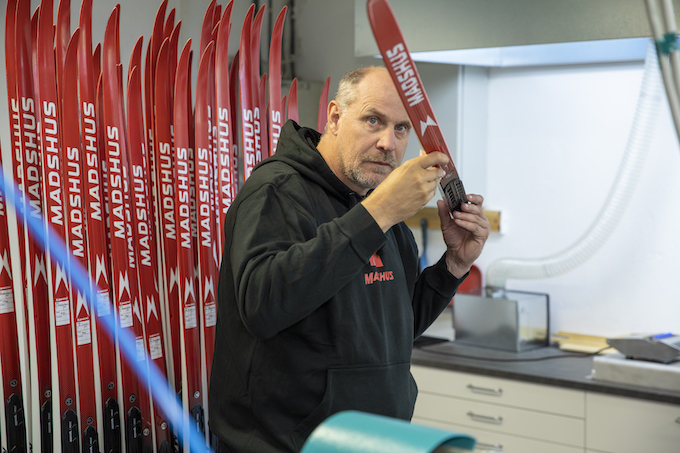
    Håkan Nordbäck, head of the grinding department at Madshus. Photo: Stefano Zatta

    What are grinds?
    At the very basic level, grinds and structures are patterns etched into the ski base with the purpose of creating better glide in different snow conditions. The words grind and structure is often used interchangeably, and can refer to both machine grinds and manually applied structures, but there are distinct differences between the two.

    A grind is a pattern ground into the base of the ski with a stone grinding machine, and is performed by a ski service shop (that hopefully has a lot of experience and expertise doing this). The stone grinder etches structure, a specific pattern, into the base of the ski that is designed to provide better glide in specific snow conditions. While a few years ago there were only a few of these machines in the whole country, grinding has become a business for a number of ski shops all over the country that are now offering grinding as service.

    Manual structure is applied with a hand tool that either stamps or cuts a pattern into the base. This step is often done after all glide waxing, toppings and other grooming is finished. A stamped manual structure usually disappears after the next hot waxing, while a manual structure that is cut into the base can last longer.

    Why grind your skis?
    The short version: To speed up your skis.

    In wet conditions there is too much water between the base and the snow, and the structure’s job is to drain the water away from the base and thereby reduce the suctioning effect. In these conditions, a coarse structure with a deep pattern will work best.

    When it’s cold, there is not enough moisture between the base and the snow. In these conditions, a fine structure without deep groves will contribute to create a thin film of water between the base and the snow, which speeds up the ski.

    We caught up with Håkan Nordbäck, head of the Madshus grinding department, to check out all about grinding.  

    Story continues below
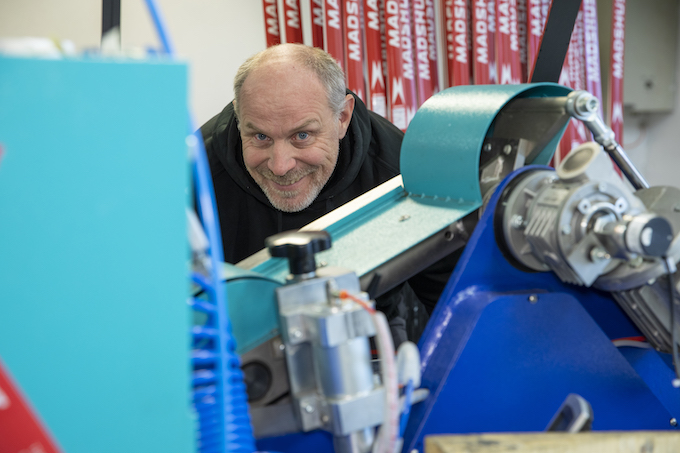
    Håkan Nordbäck, head of the grinding department at Madshus, checking out the bases on a pari of freshly ground Redline 3.0 skis. Photo: Stefano Zatta

    What’s new in grinds this season?
    “Well, for starters, we bought two brand-new grinding machines. That’s really exciting,” Nordbäck says.

    In terms of different patterns and structures, the grinding staff is constantly working on and improving the grinds, based on the testing and feedback from both the World Cup skiers and the product developers.

    “We are always looking for new patterns to try and ways to tweak the tried and trusted grinds to make them even better. But one difference this year, is that we are simplifying the grind menu,” he says.

    So, for the 2020-21 season, there are three main grinds: a fine grind for temperatures below minus 6-7 degrees Celcius, a medium grind for temperatures between minus 6/7 C and 0, and a coarse grind for warmer conditions from freezing and above. These are called M61-f (cold), M61 (medium) and M63 (warm), respectively.

    Is there a difference between the grinds for classic and skate skis?
    “No. The grinds are the same. But how you apply them differs a bit. Given the same conditions and temperatures, you generally use a slightly coarser grind on classic skis than on skate skis. That’s because the snow acts a little different in the track and outside the track.”

    How do you go about that process?
    “Developing new grinds is a time-consuming process. We have to test them over time, in different conditions and at a high level, which is where we use the World Cup racers,” Nordbäck says, pointing out that the goal is to find patterns that perform well in a wide range of conditions and temperatures.

    “Conditions often change over the course of a race, especially in long events such as the Birkebeiner and Vasaloppet. Changing temperatures and the number of skiers using the course changes the snow structure. The same is true if parts of the course are exposed to sun while others are in the shade, or if it the weather changes between dry and precipitating,” Nordbäck explains.

    Finally, the grinds also need to be possible to reproduce with consistent results, and should be fairly durable, so that they can be used for a long time without losing their properties before the ski needs to be reground.
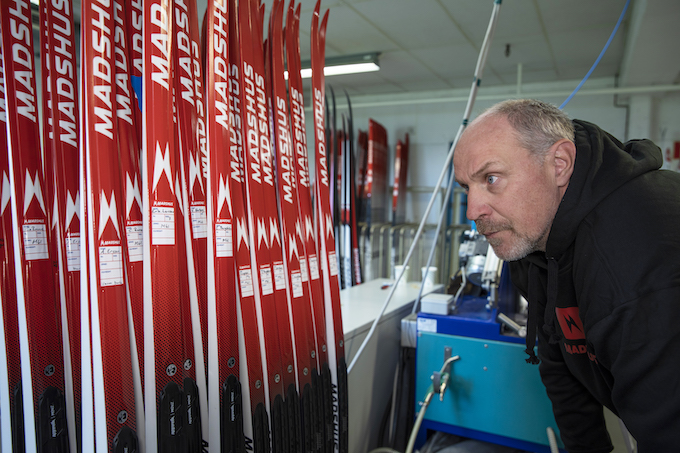
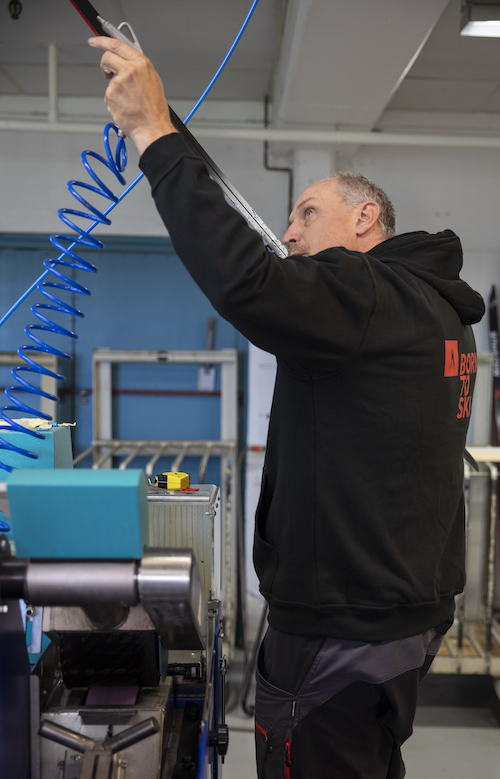
    Håkan Nordbäck, head of the grinding department at Madshus, making sure all the skis are correctly labeled before shipping them off to the racers. Photo: Stefano Zatta
  • La Nina – Does it Affect Grinds and Skis?

    La Nina – Does it Affect Grinds and Skis?

    SEATTLE, Wash. – The La Nina winter forecast is widely welcomed by skiers of all stripes in the northwest, as the weather pattern generally dumps generous amounts of snow on the region. Last season featured an El Nino weather pattern, with the drab conditions that typically produces: less precipitation, unusually warm conditions with rain at elevations that generally are on the snow side of the freezing mark, and overall a shorter ski season.

    Mark Waechter's grinding machine. Photo: Inge Scheve

    Mark Waechter of Nordic Ultratune in Winthrop, Wash., tries to make sure skiers don’t base their choice of grinds for this season based on what they saw last season.

    “People want to grind based on what they saw last season, which was warm and wet and not much snow, and that’s not necessarily the right plan. You should grind for what you expect, and this year, we should expect more normal conditions,” Waechter said.

    But regardless of season, you need to cover all your bases – literally speaking.

    “You can’t just have five different cold grinds and nothing for warm. I try to suggest reasonable choices,” he explained.

    Typically, the conditions in the central Northwest will be cold, dry snow that doesn’t see a lot of transformation until things warm up in February, Waechter said.

    For the beginning of the season, he finds that fine dry-snow grinds are faster. Then for the last half of the season, he suggests a warmer grind that handles more transformed snow.

    “If people have two pairs of skate skis, I’d suggest a S2 grind that’s cold and dry, and a D5 for warmer, wetter new snow and snow that has been transformed,” he said, adding that both of these have broad ranges and will work in a wide variety of temperatures.

    Experience is Key

    Zach Caldwell at Boulder Nordic Sports is more cautious about using the long-term weather forecast to guide his grinding choices.

    Caldwell was a part of the U.S. wax team during the 2010 Olympics in Whistler, where snow conditions are notoriously tricky. He spent two years prior to the Games analyzing the snow in Callahan Valley, and can only conclude that it’s a moving target.

    “It’s tempting to want to look ahead. Given the conditions at the Olympics we saw everything of weather, but overall it was warmer,” Caldwell pointed out.

    “I’ve never seen anyone be able to predict a whole season. I’d say the best bet is to trust the past more than the future. You know what the prevailing conditions are in your area, and that is not going to change dramatically, but maybe the center of the bell curve might skew a little in one direction compared to an average season,” Caldwell said.

    Caldwell explained that the bigger climatic changes take longer to develop than from one season to the other.

    “The snow that falls out of the sky isn’t going to be very different from what you normally see,” he said, noting that all of the regions have their characteristics, which in the big picture are going to remain the same.

    “The northwest is always the most volatile and also with the skiable venues so close to the snow/rain threshold, these differences play a bigger role. In the Upper Midwest, the weather patterns are formed by arctic airstreams and whether they are one or two degrees colder or warmer than normal just means you’ll freeze seven fingers instead of eight,” Caldwell explained.

    Focus on Skis

    So if La Nina doesn’t affect the choice of grinds and flexes that much, what does matter?

    “Having good skis is the number one most important part. Then you want a broad-range structure that can handle changing weather conditions. You don’t want to pigeon-hole yourself into a very narrow range,” said Caldwell, noting that a good pair of both wet and dry skis is more important than a specific grind.

    That said, Caldwell explained that in North America, the plus-models of the skis and finer grinds seem to work best. “That’s probably because we have less aggressive snow crystals here than in many places in Europe and especially Scandinavia,” he concluded.

    A longer season is a benefit for developing skiers. Photo: Inge Scheve

    Weather is a Gift for Skiers

    However, there is no doubt that a typical La Nina weather pattern is a bonus for Northwest skiers. Brenna Warburton, a coach with the Bend Endurance Academy in Bend, Ore., pointed out that La Nina is a Christmas present that comes early and stays late.

    That is particularly beneficial for new skiers.

    “We’ll probably be able to ski earlier, which is great, especially for the younger kids and skiers at the development level,” she said.

    “They get more time on snow, and at the development level, the more time on snow the better. That time would be replaced by dryland training, which is also great, but snow time is better,” Warburton explained, adding that they will also be able to ski longer at lower elevations.