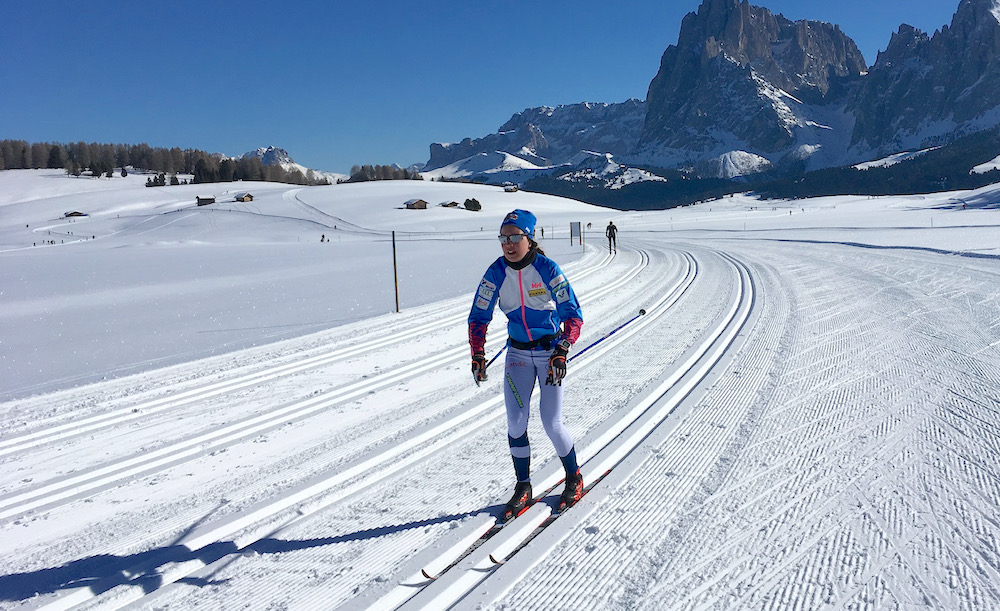
Kerttu Niskanen did her final PyeongChang 2018 preparation at altitude at Seiser Alm, along with Charlotte Kalla, Marit Bjørgen and Ingvild Flugstad Østberg, but without the majority of their teammates.
The Journal of Science in Sport and Exercise recently published a paper titled ‘Preparing for the Nordic Skiing Events at the Beijing Olympics in 2022: Evidence-Based Recommendations and Unanswered Questions’, written by Øyvind Sandbakk, Guro Strøm Solli, Rune Kjøsen Talsnes, and Hans-Christer Holmberg.
This is essential reading for anyone who is hoping to represent their country next year, covering the basics of elevation, time zone changes, cold weather, and the possibility of race format changes during a pandemic.
The paper is also interesting for less elite skiers. Most North American favourites for Olympic starts are very familiar with managing jet lag and travel (the trip from the final World Cup race to Beijing is not too different from leaving Canmore for Europe), but there are few masters and juniors whose publicly shared race travel matches the suggested protocols.
The paper strongly recommends training at least 60 days per year at or above 1700m and racing at elevation. Many racers will not have achieved these targets during the pandemic, notably those living in low-lying countries or regions.
The Beijing venue has a very high probability of temperatures near the lower limit permitted for FIS races (-20C). Combining cold with higher elevation and low humidity results in suggested pacing adjustments to ensure good lung function at the end of races.
For the final preparation, there are three model strategies explained. As race fans discover at most major championship events, the ‘perfect’ prep for some team members may leave their teammates struggling to perform. More experienced elite athletes know which suits them best, but only the most highly funded can step outside the team program to build their own solution.
One of the things that makes this paper so readable and understandable is that it is focussed on just one event. That said, for those of us who are less than elite, it is a very helpful guide for higher-elevation race trips.
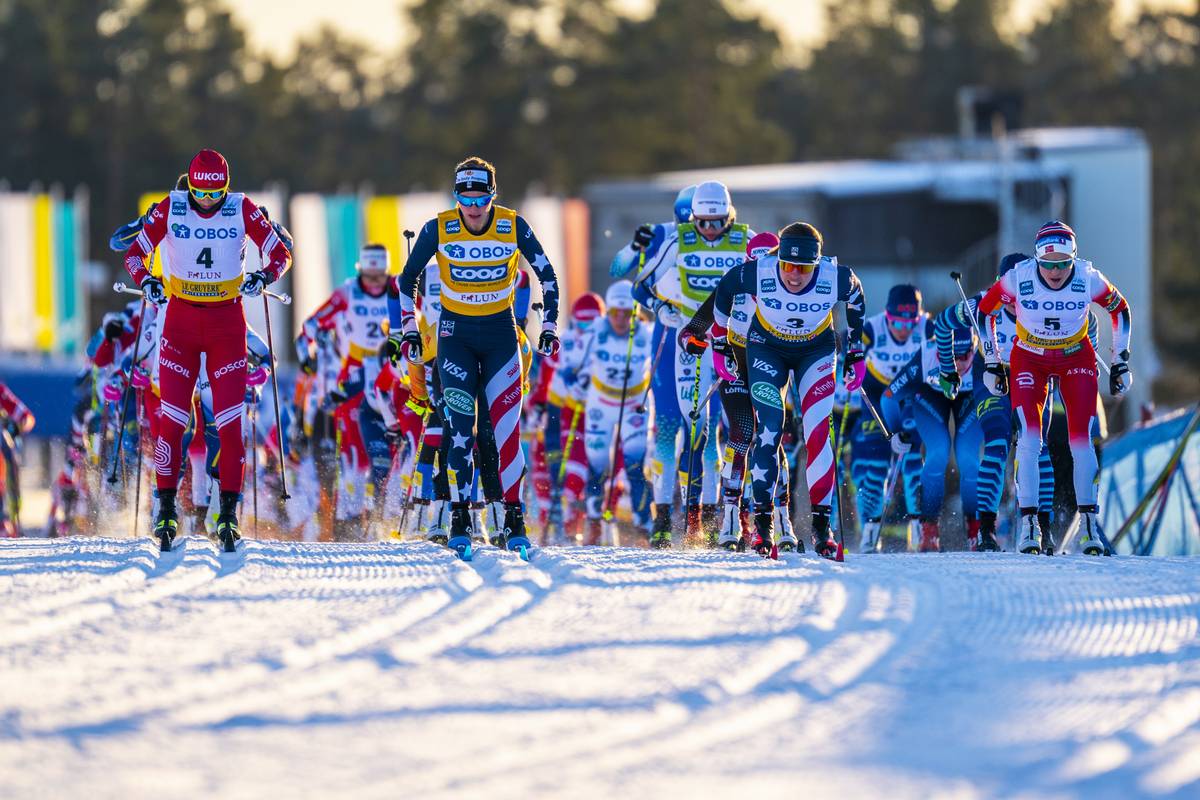
On the front lines, Jessie Diggins (left) and Rosie Brennan (right) take to the course during the 10 k mass start classic in Falun, Sweden. (Photo: NordicFocus)
This article is part of a series regarding female athlete specific physiology and nutrition. To get started, you can find a primer on the menstrual cycle here and listen to this podcast on Nordic Nation discussing female athlete specific nutrition with registered dietician and professional runner Maddie Alm. The survey analyzed here is an extension of the conversation with Guro Strøm Solli on her research on female athlete specific physiology and effects that the menstrual cycle has on training and performance, which can be found here.
Over the last five years, Dr. Stacy Sims book ROAR and the work of the team behind the FitrWoman app, cited by the US Women’s National Team soccer athletes as a key to their World Cup victory, have sparked conversations on how female athletes might take their unique physiology into account to optimize their training. However, the application of this research is far from ubiquitous. Research into the implications of hormonal fluctuations across the menstrual cycle to strength, inflammation, fatigue, nutritional demands, and the myriad of other training considerations is relatively new to the exercise physiology scene, partly because women tended to be excluded from research as their cycle might cause anomalies in the data.
While this area has seen a boom in research over the last decade, the individual variation women experience coupled with the prevalent use of various forms of hormonal contraceptives makes it challenging to provide concrete generalized recommendations that will serve all female athletes. However, as the area gains more attention, trends have emerged that may help athletes who feel they could benefit from aligning their training or nutrition to their cycle.
Some examples include periodizing hard strength training and intensity sessions earlier in the cycle when the ratio of estrogen, a steroid hormone, to other sex hormones is optimal, including a greater emphasis on hydration and electrolyte supplementation in the later half when elevated levels of progesterone trigger a rise in body temperature, or consuming anti-inflammatory foods during the pre-menstrual phase to mitigate inflammation and other PMS symptoms.
For women desiring to troubleshoot or better attune their activity to their cycle, tracking is recommended as a first step to illuminate patterns in mood, fatigue, sensations during training, et cetera. Diving into the information presented in ROAR or tracking tools like the FitrWoman App that present findings on how training or nutrition might be aligned to the cycle may be a good next step to access information on existing research. Then, through self-experimentation or communication with a coach and/or registered dietician to apply these strategies, an athlete can learn which strategies might make the greatest impact in optimizing their training and overall health.
As the topic of female-specific physiology gains traction in exercise physiology research circles, we began to ask how it is being used amongst elite athletes? And, how does this apply to the FasterSkier community?
To look for parallels to this research closer to home, FasterSkier distributed a similar anonymous survey to assess the extent to which elite American skiers and biathletes track their menstrual cycle alongside their training, adjust based on cycle, experience side effects, and feel they have sufficient access to knowledge in this area. FasterSkier’s survey can be found here for reference.
And now for the takeaways: the similarities to Solli’s research and the trends in responses, including featured responses that best represent common themes or differing viewpoints, and what coaches and athletes might gain from this insight.
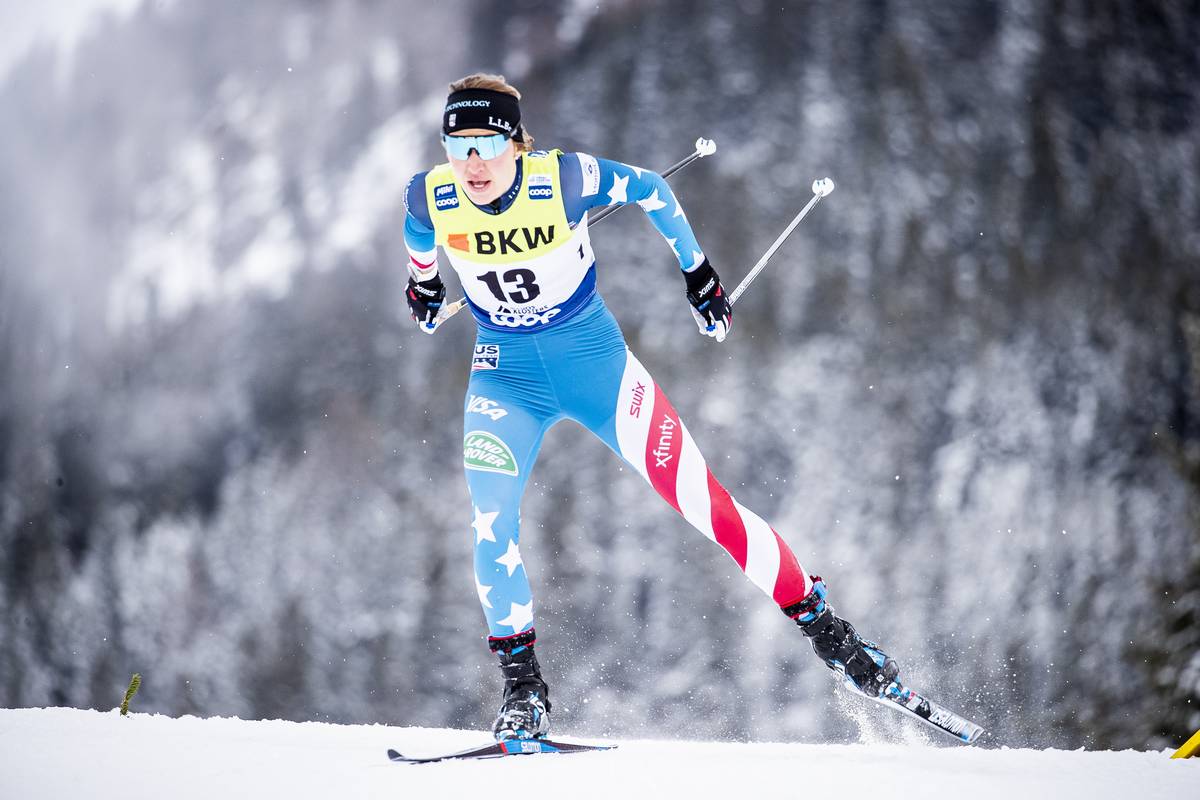
Picture perfect. Sophie Caldwell on her way to qualifying in first in the 2019 Davos, Switzerland skate sprint. (Photo: NordicFocus)
The Basics:
The survey saw 16 respondents, all of whom were national team members and/or trained with elite-level clubs such as Alaska Pacific University, Stratton Mountain School, Craftsbury Green Racing Project, or the Bridger Ski Foundation Pro Team. 68.8% were between the ages of 22 and 30, with 18.8% in the category of 18-22, and 12.5% between 30-35 years old. 62.5% of these athletes experienced 8-12 menstrual cycles per year, 6.3% experienced 4-7 cycles and 31.% fewer than 4.
The respondents were evenly split between hormonal contraceptive users and non-users (this question was not further broken down by type), and of athletes who used a tool like FitrWoman to track their cycle. Of the 50% who used a tracking tool, 87.5% had done so for 1-3 years, with the remainder of athletes tracking for less than one year.
Q: In your experience, what affect, if any, do the phases of your cycle have on your training adaptations and/or performance?
In line with Solli’s research, most athletes identified the week leading up to menstruation as the most common to experience detrimental symptoms, such as bloating, fatigue, lethargy, or mood changes. Some athletes also expressed positive impacts, which are featured in the next section. Three athletes expressed that due to the nature of ski racing every weekend during the winter, they either chose not to focus on the impacts of the cycle since they would need to be mentally and physically primed to race during all phases, and maybe preferred not to plant the seed that there might be factors that may hold them back on race day.
“I have noticed that when I feel unwell due to my period, I am less inclined to train hard; however, I think if anything it is more mental than performance related (more related to just feeling unwell, tired, PMS symptoms, etc.)”
“I don’t really change anything or adapt my training during a cycle, and haven’t noticed an impact on my performance.”
“I use the pill and often find my best races are when I’m not taking it (I.e. when I’m on my period).”
“Hard to really see patterns but sometimes detect a few. We have to train and race through all phases, so it’s detrimental from a mental perspective to think that any phase, in particular, is “bad” – they’re just different. I try to be extra nice to myself with training/rest/shortening workouts if I’m going through a rough phase of a cycle, which for me is usually in the lead up and when I have my period. However learning that the time on your period is when your hormones are most ideal for high performance has helped me get through it, because even though I may be feeling icky, I know that my body should be ready to go underneath it.”
Q: During which times within your cycle do you feel your performance potential and/or ability to train hard and recover well are maximized? Explain.
Most athletes indicated that the best sensations in training and racing occurred in the first half of their cycle, after their period had started. During menstruation, female sex hormones estrogen and progesterone are low, then estrogen independently rises in the second week of the cycle. Both “ROAR” and the FitrWoman app identify this as a sweet spot for high intensity training, heavy strength training, and decreased recovery time between sessions.
“I tend to agree with the FitrWoman app predictions, of increased strength performance during my period and decreased activation beforehand. I know that I’ve had very strong races at all times of my cycle so I’m not sure it affects the very top end performance, but more affects my body’s willingness to activate and work hard. My main concern is dealing with cramps during my period. I have to take a lot of pain medication, which sometimes doesn’t seem good for racing or for general health when combined with hard efforts. Cramps also make it very hard to activate my lower abs and have stability through my torso, which makes it difficult to ski well unless I’m very motivated.”
“I can tell that I’m more apt to lift well in the weight room while I’m on my period, after the cramps are gone. I think that also correlates to racing well. The wild mood swings before my period can occasionally be helpful in racing motivation, i.e. when I can be angry and keyed up. But moods swing both ways.”
“Right when my period starts and the week after, I feel less bloated and I tend to feel faster in training. I don’t notice a difference in recovery time, but in overall feelings I tend to feel better.”
“There are so many variations in a normal training cycle, and just from life, that I wouldn’t say I noticed any particularly maximized phases related to my cycle. However it is easier to embrace hard training and expect normal highs and lows when I’m not on my period, so the other 3 phases I guess.”
Q: During which times within your cycle do you feel your performance potential and/or ability to train hard and recover well are most diminished? Explain.
Thirteen of the respondents identified the week leading up and the first few days of their period as the time their training and overall feelings were most impacted, both physically and mentally. Note that registered dietitian and professional runner Maddie Alm, who is concurrently collaborating with coaches and experts on a project surrounding female physiology, offered suggestions for mitigating the effects of PMS during her interview on NordicNation.
“I usually feel pretty drained mentally before and during my period, as well as feel effects on my body (bloating, cramps, cravings). Right after is when I feel the best since my body is back to ‘normal’.”
“When I am on my period- I just feel very tired, irritable, bloated, and often relatively nauseous. Even with an IUD and not having normal cycles, I can feel hormonal fluctuations that make me feel unwell.This overall effect on my mental state makes me less motivated to train hard, but I am not sure if in terms of performance or recovery I actually perform worse or am less capable of adequate recovery (like in terms of race results and intervals I don’t think my performance is diminished while on my period, I just feel worse).”
“Sometimes when I’m on my period, it feels like it affects my ability to train hard, to perform well, and to recover, as well as my mood and outlook on life. This can be in the few days leading up to the cycle starting, and the few days when it’s happening. However it doesn’t happen every month – while I get my period every month, the intensity and difficulty of it vary significantly. Unfortunately, I haven’t been able to track any patterns with this, otherwise, I would always do what makes it less severe. And as I mentioned before, hormonally the body is strong when you’re on your period, so I try to give myself extra positive thinking, pep talks, shorten workouts, and not be too hard on myself if I’m not super fast in a training session on the bad months, because that’s just what happens. Most of the time if I am gentle on myself I can still perform quite well, but there have been notable occurrences when I’ve had terrible performances that are almost directly attributable to feeling terrible from the intensity of my period.”
“Before and during my cycle it is difficult to recover because I experience mood swings that affect the ability to recover properly. I often use ibuprofen to deal with cramps which I feel sometimes compromises how my body feels during training.”
Q: What adjustments, if any, do you make to align your training and/or nutrition with your cycle? Examples could be: postponing or increasing recovery between hard sessions, increasing volume or intensity during a specific phase, increasing/decreasing carbohydrate or fluid intake, etc.
No athlete reported strategically aligning her training or nutrition to their menstrual cycle, though several responses included the idea of listening to their body and dialing back when needed.
“I don’t adjust because I have to race every weekend, and I want to be used to having to perform no matter what my body is feeling. That said, I always try to have good hydration and make sure I’m adequately fueling my body.”
“I think nutritional adjustments could be made to make me feel less bloated and nauseous, but I would need education in this area (and I think there is a really big need for it). I think that much of the negative effects are from feelings of nausea, cramps, etc.- so if there are things that could be done nutritionally to help, that would be great. In terms of adjusting training, I think it’s more difficult because a race schedule won’t adjust to your cycle so it’s good to get used to pushing hard during different times of your cycle. However, if it were found that there is a training benefit associated with training a certain way during different times of your cycle (i.e. intervals at a certain time, etc.), I think it could be an awesome training tool… if only more research were done in this area!”
“I mostly look at it mentally. I don’t make any adjustments to my training and/or nutrition, however, when I’m feeling sluggish or low-energy I reflect if this could be because of my period. Then I try to justify it and remember that it will only last a few days and that I shouldn’t be too hard on myself.”
“I do notice that I need to eat more during PMS, so I try to follow that. I also try to let down after my period and eat less when I don’t need as much. We don’t officially change training, I guess I listen to the Fitr App about when it’s a good idea to reach a little in the weight room, but mostly I micro-adjust training to how I feel.”
Hailey Swirbul (third overall) and Rosie Brennan (first overall) enjoy the moment after the Davos 10 k skate. (Photo: NordicFocus)
Q: Do you communicate with your coach regarding how you feel during different phases of your cycle? If so, explain how you and your coach use and discuss that information.
Thirteen athletes responded that they do not communicate with their coaches about this topic, though some added that they did feel they could if they were to initiate the conversation. The remaining three athletes state that they sometimes or occasionally talked with their coaches about their cycle, usually when it pertained to feeling negative side effects that impaired their training that day.
“I do not, but I would be comfortable doing so, since both my coaches are women. I would address if my period cramps were making me nauseous.”
“Sometimes I’ll explain that I need space or less coaching if I’m feeling down or off because of my cycle, and my coach has always been really great at understanding and respecting that.”
“No, I don’t communicate. I think I could if I needed to, but I also have a male coach and it is not brought up much for awkwardness level. My teammates and I communicate openly about periods and if someone has cramps, etc. and I find their support and ideas as helpful as a coach.”
“Most phases are just normal life and training, ups and downs, but my coach and I definitely talk about it when I’m on an intensely bad cycle. Sometimes if it falls on an intensity day I’ll do fewer intervals than otherwise planned, or else use it as a wake-up workout rather than really pushing hard. More often I’ll carry on as planned, because ups and downs of feeling are just part of the training life.”
Q: What information, if any, have you received or read regarding how normal hormonal fluctuations may influence training adaptations, nutritional requirements, and performance?
Five athletes reported that they had never received information about the menstrual cycle as it pertains to female athletes. Six athletes expressed they had received some information, and five expressed that they had attended presentations put on by U.S. Ski & Snowboard or regularly used the FitrWoman app as an educational resource.
“None! Ever! Huge need for this!!!!”
“I have received information but chosen to ignore it.”
“The Fitr App mentions characteristics of each phase, like when it’s good to train heavy weights for example. I generally agree with it. I’ve been to one lecture by the Fitr App creators at US Ski Team camp, which gave me the most information I’d ever gotten. Previously I’d noticed some trends myself, but didn’t understand the different phases and what hormones caused which effects.”
“Working with Fitter Woman and using their app, I’ve learned that these fluctuations in body temperature, sleep and recovery are normal, which helps me to be less concerned by them and be able to focus on performance. It was also super helpful to learn that right before my period starts I’m most at risk for getting sick, so I try to be extra careful with my immune system that week.”
“I have been tracking with the Fitr app the past year plus, and that has some helpful suggestions. I eat and hydrate with care and healthy habits all the time, so I can’t say that I’ve made many changes as a result of tracking or reading about it. Sometimes I do notice cravings that make sense in the context of the cycle. As I mentioned before, I prefer to believe that there are good and bad parts about each phase, and as there are ups and downs in all parts of life, it’s something I adapt to on the fly while training and don’t make too big a deal about. As we nordic racers will compete during the entire winter and just about every weekend, it’s not possible to race in the same phase of the cycle every time – we have to be adaptable and ready to handle what the body throws at us, and I find that is mostly mentally knowing that it might feel bad but I can still have a great performance if I ease into my warmup and maybe recover a little extra.”
Q: Additional comments?
“I think effects on the body and overall experience of a cycle is not discussed enough in the ski community. I have had some ‘girl talks’ with teammates or coaches but nothing more than once or twice a year, and nothing significant to make a difference in how I train or deal with it.”
“I would like information on nutrition/hydration/recovery and other ways I can deal with cycle side effects. Some simple tips to start and maybe more info for those interested. I also think noting birth control methods and effects for athletes would help young women make choices that they often go blindly into.”
“This is definitely a great survey and a topic that should be discussed much more frequently!”
“I’ve always been curious about the effects of hormonal birth control on performance. The hormonal birth control I’ve tried (Sprintec pill and NuvaRing) changed my personality somewhat, made me more compliant and non-ambitious or depressed. They also made me gain weight. None of those were good things for skiing, so I’ve been unable to find a good solution. The Fitr App lecture talked about progesterone-only options being better, but I haven’t been able to find a good one. Apparently, I’m not a good candidate for an IUD, and wish there was another very low dose progesterone-only option. I also feel that people with ‘overly healthy’ menstrual cycles are a minority at my level in this sport, so I don’t have a lot of other athletes with heavy periods to brainstorm with…”
In her first World Cup start, Sophia Laukli (USA) skis to 33rd in the Lahti, Finland skiathlon. (Photo: NordicFocus)
Conclusions:
So, what can we gain from these responses?
It is noteworthy that over 80% of the responses stated that they had never spoken with a coach regarding their cycle or female physiology. As absence or irregularity of a menstrual cycle can also be thought of as a “canary in the coal mine” for the damaging condition referred to as Relative Energy Deficiency in Sport (RED-S), providing resources and initiating conversations about this topic might help female athletes not only optimize their athletic performance but also prioritize their overall health and wellbeing.
One athlete commented that it was awkward to discuss her cycle with her coach as he was male, one said she did feel comfortable because her coach was female, and another commented that their conversations about the topic were in the form of “girl talk” with teammates. This is consistent with Solli’s journal article, where athletes were quoted as citing “because he is a man” as a reason for not discussing the topic with their coaches. The respondents in this article also expressed that their coaches lacked general knowledge about the menstrual cycle and the differences between male and female athletes. “I think there may be differences due to the MC that he is not aware of,” one athlete wrote.
Female coaches are underrepresented at the elite level. In the United States, roughly 20% of Division 1 ski programs are led by a female coach, and the Craftsbury Green Racing Project stands alone as the only postgraduate elite team with a female coach, namely Pepa Miloucheva. U.S. Ski & Snowboard has recently hired a female coach to lead the D-Team, Bernie Nelson for the 2010-2020 season, who passed the baton to Kate Barton.
Though male coaches can certainly be informed in the subject matter and engage in appropriate conversations with their athletes about this topic, per the athletes’ comments, more effort may be required to normalize these conversations. (Read how Diljeet Taylor, head coach of the 2021 NCAA title winning BYU women’s cross country running team, approaches these conversations with her athletes head-on in this Runner’s World article.)
Coaches should educate themselves on these topics to help support their athletes and, if they do not feel comfortable initiating conversations with athletes directly, consider bringing in professionals to provide education to their athletes. Ensuring females are represented in a program’s coaching or support staff, or relying on female team captains to initiate these conversations may also be valuable.
As we wrap up this series (at least, for now), we remind readers that this is an evolving topic as the impacts athletes experience take place on a spectrum and research is ongoing. We hope this information has started conversations, given women tools to start their own inquiry and self-experimentation, and raised awareness for the work being done to learn more about the female athlete body.
This article is part of a series of interviews with professionals in sports nutrition and female physiology. To get started, you can find a primer on this topic here, and listen to this podcast on Nordic Nation discussing female athlete specific nutrition with registered dietician and professional runner Maddie Alm.
Guro Strøm Solli is a PhD candidate and instructor of exercise physiology at Nord University in Bodø, Norway. (Photo: Nord.no)
Readers who have followed cross-country skiing for several decades may be familiar with the name Guro Strøm Solli. Now 37-years-old, Solli was a member of the Norwegian National team from 2005-2008, retiring from professional skiing in 2010. During her athletic career, Solli earned two individual sprint podiums and another in the team sprint, and finished 10th in the classic sprint during the 2005 World Championships in Oberstdorf, Germany.
FasterSkier connected with Solli on a call in January to discuss the findings of the research and how it might benefit female athletes.
In reflecting on her own time as an athlete, Solli does not recall considering her own MC in training and did not experience significant side effects from it. It was not until she began working as a coach of developing athletes and an instructor at the university level that the topic crossed her radar.
“It was not talked about at all [when I was an athlete],” Solli recalled. “It was not a topic that was discussed by the coaches, or even the athletes so much. So that was something I was kind of thinking about — it was nothing that I focused on during my career, but I received a lot of questions from my athletes when I was a coach and also teaching exercise physiology. I experienced that there are a lot of questions, and I started to think, ‘Okay, this is something we need to look into to try to answer all these questions for the athletes.’ So it’s after my career that I’ve been more aware of the topic.”
The research presented in Solli’s article summarized the results of 140 responses to a detailed survey by female Norwegian cross country skiers and biathletes 18-years and older who compete at a national or international level. The questionnaire involved 54 questions regarding age, overall training volume and high intensity training completed during the general preparation and competition periods of a training year, use of hormonal contraceptives, and the prevalence and intensity of side effects such as pain, bloating, mood swings, and appetite changes. Participants also identified when their overall feelings in training and competition were at their best, and conversely when their overall feelings in training and competition were at their worst, and when and to what extent these negative side effects required them to alter or miss training sessions.
“I think an interesting thing that we saw was that over 50% experienced this varied physical shape or training feelings across different phases,” Solli explained. “And there were over 50% that had to actually change their training because of menstrual related side effects. But only 27% had communicated about it and only 7% had planned their training according to the menstrual cycle, so it’s kind of a mismatch between the experience of the skiers and the planning of training. So I think that was an interesting finding, and I think it’s possible to gain something by increasing communication and logging to see if you can find some patterns that work for you.”
An additional statistic that perhaps frames this series of articles is that only 8% of participants reported to have sufficient knowledge about the MC in relation to training, and, as Solli mentioned, just 27% had communicated about it with their coach.
“We asked them why [they had not discussed it], and there was a lack of knowledge, the coach was a man, it was embarrassing, and private,” said Solli. “A lot of athletes didn’t feel the need to talk about it. So it was different topics, but lack of knowledge and that the coach is a man was the most mentioned topic to why it was difficult, so I guess there is still a barrier that there are a lot of male coaches that perhaps have the knowledge but perhaps they don’t dare to talk about this or approach it or know it it’s appropriate.”
Craftsbury Green Racing Project’s Liz Guiney (l) and head coach Pepa Miloucheva during a ski on Saturday, Jan. 2 in Houghton, Mich., the day before the kickoff of 2016 U.S. nationals.
Some athlete quotes featured in Stolli’s September, 2020 article include:
“It feels like it’s a taboo. I am afraid that the coach won’t take it seriously and thinks I’m using it as an excuse.”
“I think I have more competence and knowledge about this topic than he.”
“Because he is a man.”
The September, 2020 article also summarizes the importance of this communication, both in terms of athletic development and overall well-being.
“Since menstrual dysfunctions are an important marker for relative energy deficit, a syndrome affecting many aspects of physiological functioning, health, and athletic performance, it is important that athletes feel comfortable to discuss this topic with their coach. Furthermore, because of the high inter-individual variability in performance and side effects experienced by athletes during the MC, coach-athlete communication is important to safeguard the athlete’s health as well as optimize training adaptations and performance. In response, increased attention should be paid to educating female athletes and their support teams about the MC and athletic training.”
Optimistically, Solli continued that she sees the lack of knowledge and communication as a barrier that is in the process of being broken down.
“I have a lot of talks about this with coaches who have wanted me to talk a little bit about the topic,” explained Solli. “And they’re very curious, and they’re starting to realize — you kind of have to get over this being a topic that you don’t mention… Particularly in elite sport, when there are so many topics that are discussed, it’s kind of silly that this topic should not be mentioned as part of the whole situation of an athlete.”
She continued that both research and coach-athlete education on the subject is trending in the positive direction. However, high levels of variation are experienced by women, which makes it challenging to give generalized recommendations.
“It’s starting to be, for the last 2-3 years, kind of a hot topic. I’ve experienced that both coaches and athletes are starting to see that and to investigate if this has an impact [on the individual]. Also, when I read up on the research and meta analysis that are published that try to sum up what we know and what do we not know, it summarizes that we don’t have evidence-based recommendations that can be done on a group level, but it seems like this topic should be approached through an individual.”
Overall, she sees increased awareness and access to information as a positive for female athletes. She noted the increased prevalence of logging apps, such as FitrWoman, that make it easier for athletes to track their cycle and observe trends in their feelings.
In Norway, the possibility to log the MC has also been implemented into the digital training diary that has been designed by the Norwegian Olympic Federation and is used across all sports.
“That’s a step forward, I think. It’s going quite fast in this area, so it will be interesting to see in five years, where are we? I think we will get a lot more knowledge just because athletes are starting to log and discuss this topic. Research takes time, but slowly we will be able to get more studies and more knowledge.”
Zooming out to discuss existing research on the MC and how it might influence the planning of training for elite athletes, Solli noted that a pervasive theme is that the potential for optimal performance can occur during any phase.
“In theory, we expect [hormonal fluctuations] to affect training, nutrition, and performance, but when you look at the meta analysis of how the menstrual cycle affects performance, we don’t have a clear answer on that. It seems like the studies are concluding that on average you can’t see a large difference between the performance in different phases.”
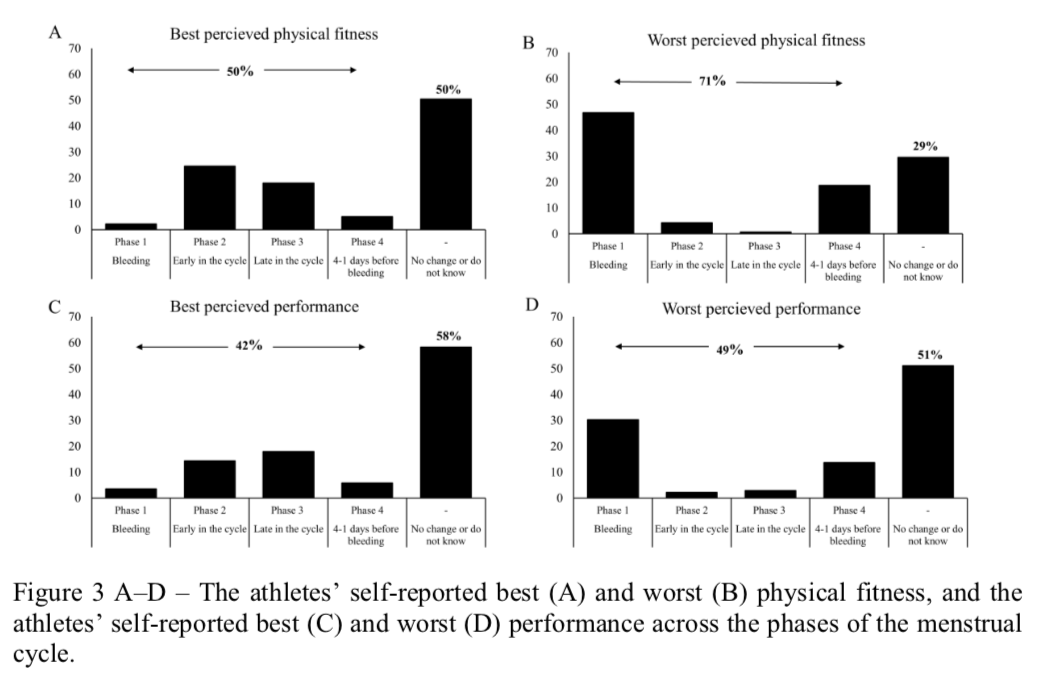
(Click to enlarge.) Reprinted from “Changes in Self-Reported Physical Fitness, Performance, and Side Effects Across the Phases of the Menstrual Cycle Among Competitive Endurance Athletes” by G.S. Solli et. al., September, 2020 in the International Journal of Sports Physiology and Performance.
While athletes can rest assured that racing is unimpacted, Solli explained that there are considerations athletes and coaches might apply to training to optimize adaptations.
“When it comes to training effect, there are some studies that highlight that it might be beneficial to periodize your strength training early in the menstrual cycle. This is the phase where you have an increased level of estrogen, which is a hormone with over 400 functions in the body, but two important functions is that it is an anabolic hormone, so it’s good for your ability to build muscle mass, and also important for bone health and to build bone mass and ensure bone density.”
She explained that 4-5 peer-reviewed studies indicate that you can get a higher training effect in terms of muscle strength and muscle mass by periodizing strength training sessions with higher weight and lower reps in the first half of the cycle. Solli added the caveat that, like all research in this area, the studies are often small and the overall topic is still in its infancy.
“It will be interesting to follow the research during the next years to see if we can get stronger evidence in the case of strength training, and whether we’ll also see that we can get some endurance studies, for instance, with periodizing high intensity training in particular phases. We don’t have studies answering that conclusively yet, but it would be exciting to see.”
Diving deeper into the survey results analyzed in her study, Stolli discussed the most prevalent themes athletes reported. She also discussed how hormonal fluctuations might explain these effects.
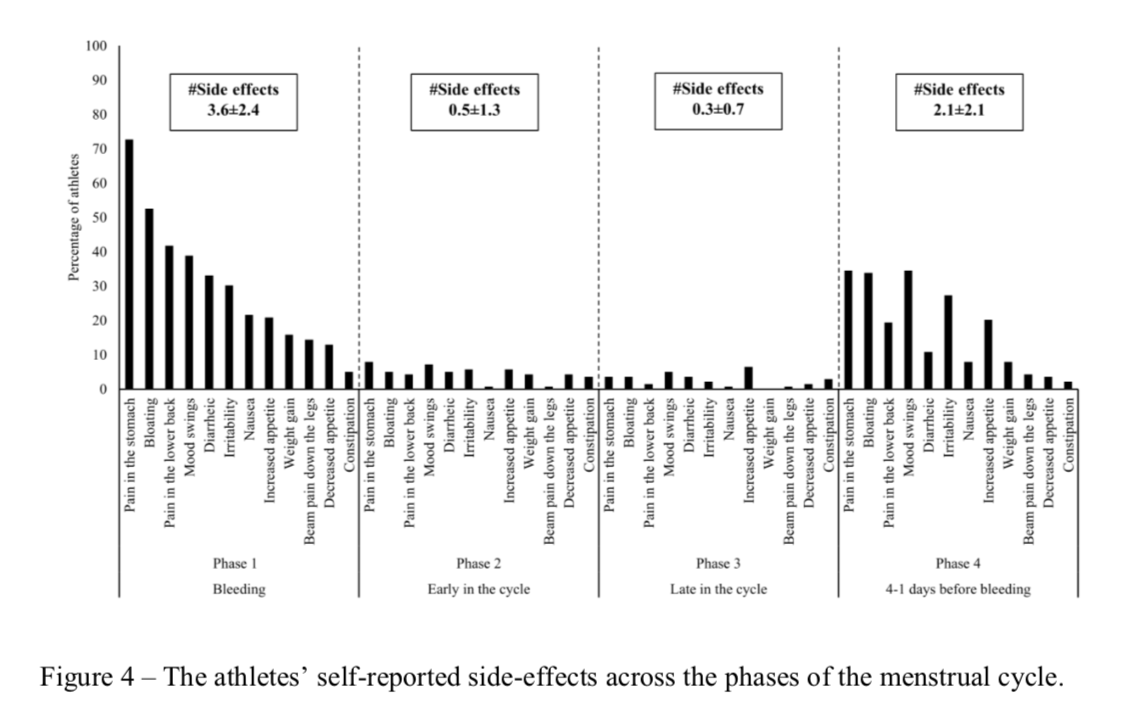
“As we discovered in the study, what the athletes perceive is that the phases where they feel their worst physical shape and have their worst performance was in the days right before the menstrual bleeding and during the bleeding. Right before the menstrual bleeding, we have a drop in both estrogen and progesterone, and this hormone drop is associated with PMS symptoms and different side effects, and we also saw that in our study. The negative side effects reported by the athletes were high during the periods right before and during the bleeding phase.”
This is also the time when athletes most frequently reported using pain-killers to manage symptoms and needing to alter their training by decreasing volume or intensity.
“I guess that is not only my study, but also other studies highlight that those two periods can be a risk for decreased training quality or that the athletes don’t manage to perform the training they have planned because they are experiencing these negative side effects.”
In contrast, most athletes perceived their best fitness was achieved during the middle phases of the cycle. This coincided with the window where negative side-effects were least reported.
(Click to enlarge.) Reprinted from “Changes in Self-Reported Physical Fitness, Performance, and Side Effects Across the Phases of the Menstrual Cycle Among Competitive Endurance Athletes” by G.S. Solli et. al., September, 2020 in the International Journal of Sports Physiology and Performance.
Another noteworthy statistic Solli touched on was hormonal contraceptives (HCs), which 56% of athletes reported using. The fact that HCs were not broken into subcategories such as oral contraceptives, IUD, etc., was listed as a limitation of the study.
“A large proportion of the athletes are using hormonal contraceptives,” said Solli in the call. “And there are a lot of different types with different amounts of synthetic estrogen and progesterone that suppresses the normal hormonal fluctuations, and you get a more stable cycle. As we saw, there were positives experienced with using HC’s that athletes reported that they get reduced pain and they also get control of the bleeding phases, so they can control it according to their competitions or trainings. But there are also some negative effects with weight gain and irregular bleeding.”
Solli explained that there is little research apart from survey data pertaining to how HC’s might affect female athlete performance and, similar to experiences with a natural cycle, the side effects women experience vary considerably. Here too, Solli recommended considering each athlete and situation as unique, advising athletes to pay close attention while adjusting to new or different forms.
“From research, when they compare using HC to having a normal menstrual cycle, most studies show that there is no effect on performance and that also performance is relatively consistent across the HC cycle,” Solli explained. “Also here, an individualized approach based on each athlete’s response is recommended from research, because you see that from some athletes they report more negative side effects, so that’s important to find a type that suits you and to log the effects when starting a new type.”
Of the athletes not using HC, a noteworthy 35% reported fewer than nine periods per year, an indicator of menstrual dysfunction possibly due to low energy availability, meaning the caloric and/or nutrient density of an athlete’s diet does not meet the demands of their training. While this may be unintentional, the condition known as Relative Energy Deficiency in Sport (RED-S) is prevalent in endurance sports, particularly those that favor leanness. It is often associated with disordered or restrictive eating behaviors.
“Although we did not assess energy intake or energy expenditure,” the article states, “high volumes of training and high amounts of high-intensity endurance training are associated with high energy expenditure and can prompt relative energy deficiencies. Elite endurance athletes and their coaches should therefore be aware of the risk of MC irregularities induced by high volumes of training and high amounts of high-intensity training. The prevention of MC irregularities should also be pursued, because primary and secondary amenorrhea can result in adverse health conditions, including reduced bone health.”
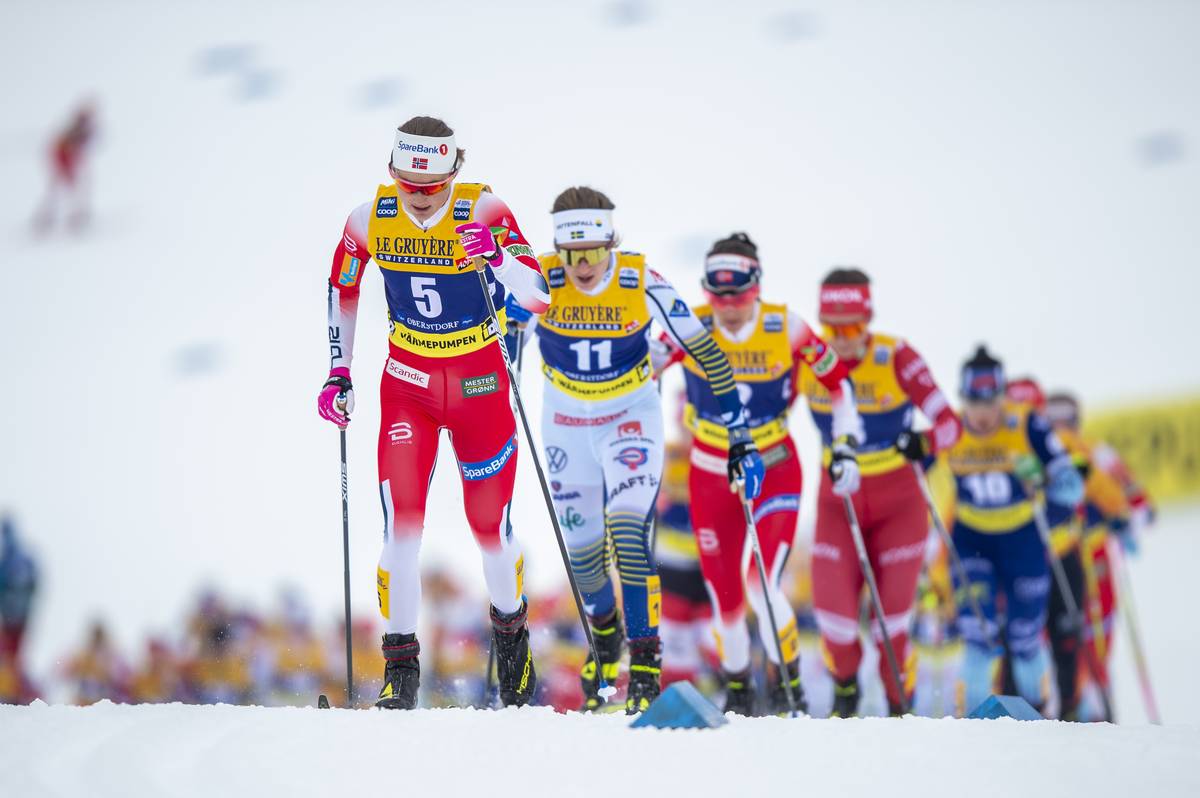
Ingvild Flugstad Østberg (bib 5) leading the chase during the classic portions of the Obertsdorf, Germany 15 k skiathlon in January, 2020. (Photo: NordicFocus)
At the World Cup level, this phenomenon has made FasterSkier headlines in the cases of Norway’s Ingvild Flugstad Østberg and Sweden’s Frida Karlsson, who were pulled from competition last season by national team doctors after failing to meet team health metrics. Østberg resumed competition for the 2020 Tour de Ski, where she finished third, and competed through the first weekend of racing in March in Falun. Her season then ended abruptly after she sustained a stress fracture in her foot from hopping off a three foot cement step to the ground.
The 30-year-old Østberg sustained a second stress fracture in July and has not competed on the World Cup this season. Østberg has been working with team doctors to bring her body back to health in order to compete in the 2021/2022 World Cup and Olympic season.
Karlsson was withheld from competition from early December, 2019 to February 9th, 2020 and has remained in competition since. More recently, Finland’s Kerttu Niskanen sustained a fracture in her tibia during a race in Falun that was not caused by a crash. FasterSkier has not received further insight into her situation.
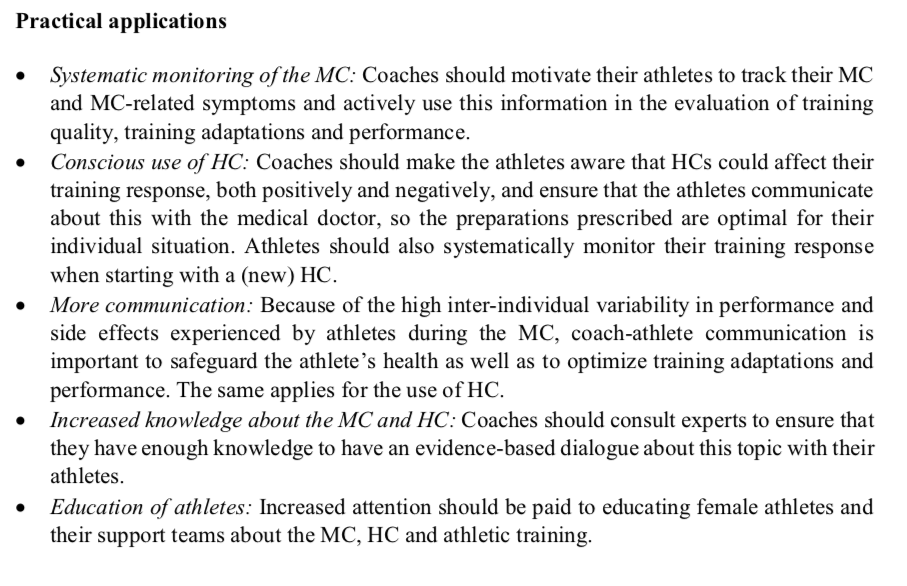
Bringing it all together with the information Solli discussed in mind, how should athletes and coaches approach this topic? Solli’s article lists a set of practical applications of the information currently available.
Practical applications of self-reported data from elite cross country skiers and biathletes for coaches and athletes. Reprinted from “Changes in Self-Reported Physical Fitness, Performance, and Side Effects Across the Phases of the Menstrual Cycle Among Competitive Endurance Athletes” by G.S. Solli et. al., September, 2020 in the International Journal of Sports Physiology and Performance.
Solli concluded that understanding the MC and how it might influence training and performance is just one piece of the puzzle of female athletic development. She stated that hype from media attention might make it seem essential, but for many who do not experience significant effects, this area might not be worth investing in. However, for many athletes, better understanding and communication could lead to significant improvement. For this reason, Solli recommends an individualized approach, adjusting the focus based on the extent to which an athlete is impacted.
“It is a part of a lot of different [aspects of training],” said Solli. “So you have to look at it in the bigger picture, but that doesn’t mean that we don’t need to talk about it. You can’t ignore it, but you should not make it too big of a deal if you aren’t struggling with it and you have a natural cycle and everything is okay, I don’t think you need to change something. But I think some athletes are struggling with it and I think they should know that it’s possible to get help.
“There is a lot of information now, a lot of good articles that are published, and information in the apps — I think it’s really good for young athletes to start there and to log [their cycle] and learn. That’s something I really would have wanted when I was a young athlete, that I could have an app and to start early to find my own pattern that I could optimize. I think that’s a really good opportunity to learn how your body works.”
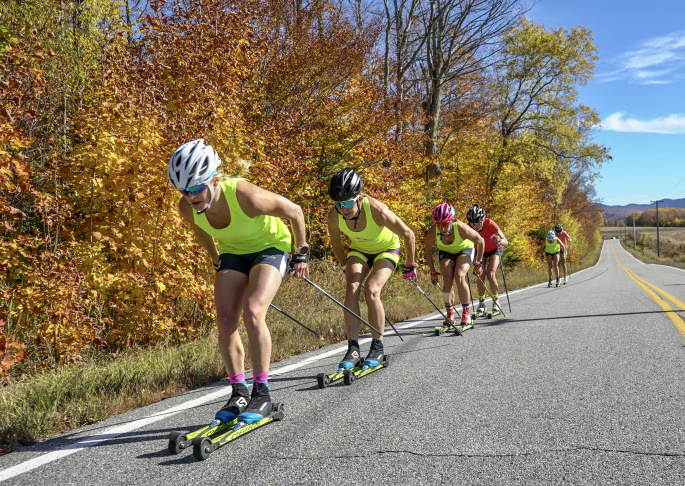
The SMST2 squad led by Jessie Diggins pushes the pace in a double pole interval workout during a fall 2019 training camp in Lake Placid, NY. (Photo: Matt Whitcomb / smseliteteam.wordpress.com)
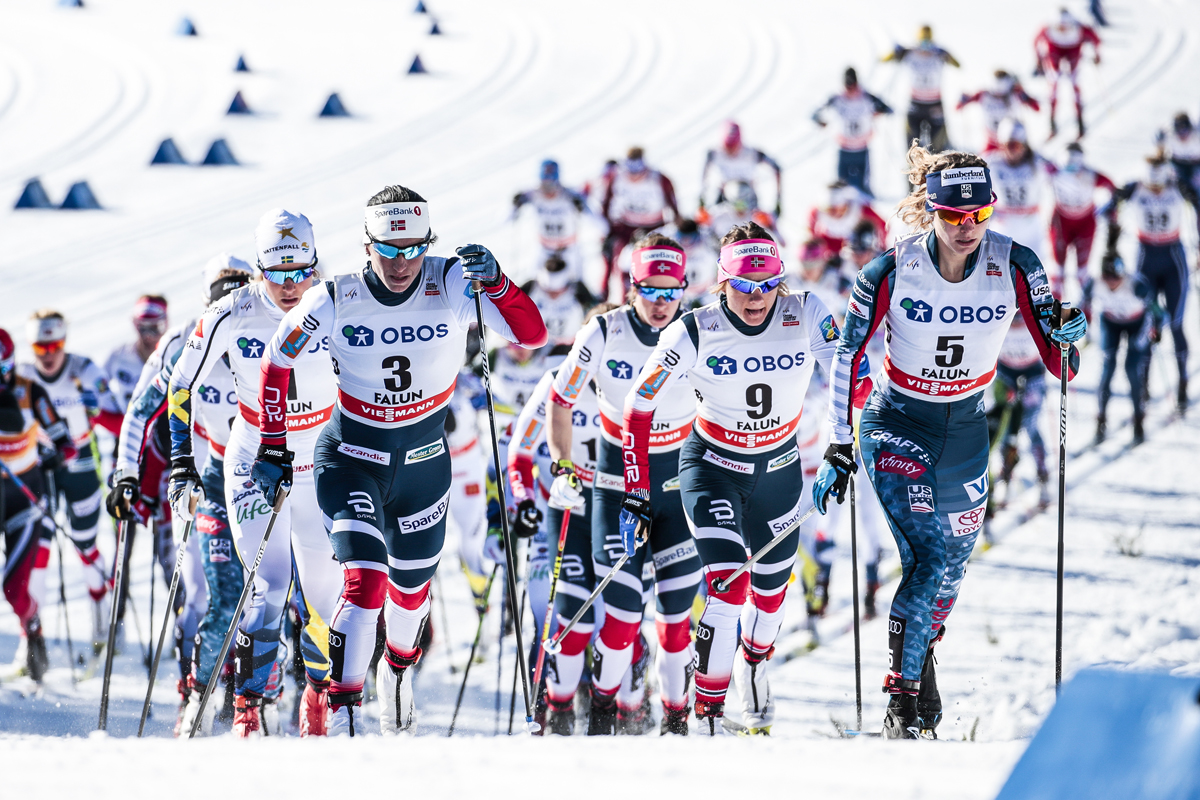
American Jessie Diggins (5) and Norway’s Marit Bjørgen (3) and Maiken Caspersen Falla lead early in the women’s 10 k classic mass start at the 2018 World Cup Finals in Falun, Sweden. (Photo: Fischer/NordicFocus)
On May 29, the latest research paper to dive into Marit Bjørgen’s training logs from 2000-2017 was announced in Gemini, the research news publication from NTNU and SINTEF, two research institutions in Norway.
The authors are described in Gemini as “Guro Strøm Solli of Nord University and NTNU and a former xc-ski team member herself, Espen Tønnessen from Kristiania University College in Oslo, and Øyvind Sandbakk, from NTNU’s Centre for Elite Sports Research.”
The latest paper in their series explores Bjørgen’s use of two distinct types of high intensity training (HIT) and how they impacted her performance.
Gemini describes the two HIT methods as the following: “The first approach was block training, where she clustered her HIT sessions into blocks, interspersed with recovery periods with fewer HIT sessions. Later in her career she switched to a traditional model, where HIT sessions are spread more or less evenly throughout a training period.”
Bjørgen’s block HIT method, used from 2005-2006, involved numerous periods of intense HIT sessions and fewer hours in what many would consider a traditional long-duration low-intensity program.
From 2014-2015, another HIT segment the researchers zeroed in on, Bjørgen used a more “traditional” approach to her HIT training.
Gemini describes the “traditional” methodology as what many athletes have become familiar with: “Typically, the researchers said, the traditional approach means that an athlete relies on a mix of low, moderate and high intensity training, gradually transitioning from high volumes of training — meaning number of hours — to higher training intensity and training that is more specific to the sport the athlete is competing in.” Looking for where to play Crazy Time slot ? Go to the official website of the game https://crazytimegame.com/en/
The scientist do not answer which method is more effective? It is also important to remember this is Bjørgen, and it remains a sample size of one.
“To get progression you need to change something,” Sandbakk told Gemini. “It’s not always that if something works, then more of it is better. That’s an important message.”
Mix it up may be the take-home lesson.
The three research papers derived from Bjørgen’s training logs are linked above and provide some great reading and insight.
Askim, NORWAY – Kikkan Randall (USST) was treated to several new experiences at the Norwegian roller ski cup opener this weekend. Not only did Randall destroy her competition leaving a half-minute gap down to second place on the uphill time trial, she also learned to race on fast wheels – the sink or swim way.
“I have only raced on roller skis in Anchorage before and on regular wheels. So this was my first time for both the fast wheels and for the international competition,” Randall said, noting that the decision to race was somewhat of a whim. She is staying with her friend Ella Gjømle Berg while in Norway, and she thought the race sounded like a fun change of pace from the regular training diet.
“Ella was invited to the roller ski race, and when she told (the organizers) I would be in town, I was invited too. I figured a chance to race with some top Norwegian skiers and to test out roller ski racing on fast wheels would be a fun challenge. And it sure was! Two great races that made for good training,” said Randall.
But the wheels and the competition were only two of the new elements in terms of roller ski racing. The race formats were new to her as well, and that added to the experience, Randall said. The 200-meter sprint qualifier was over before you knew it, and the uphill time trial had its own challenges.
“The competition formats were fun. The 200m sprint took about 24 seconds, so you had to be really on your game from the start,” said Randall, explaining that the sprint was only the beginning. The afternoon featured an 1130-meter beast of an uphill time trial.
“The uphill sprint was tough! Guro (Strøm Solli) called it an ‘acid party,’ and it was definitely true,” said Randall.
But in the right atmosphere and framework, nothing is too hard for Randall.
“I had a fantastic time. I was impressed with the high level of organization. The announcer sounded just like Kjell Erik Kristiansen so I felt almost like I was at a world cup race,” Randall said.
After the race, Randall and her friend Ella Gjømle Berg headed to Sognefjellet to join the Norwegian and Finnish ski teams for some snow time. Randall will stay there for the next few days getting as much snow time as she can before heading back to Oslo for a few more days with Gjømle Berg’s family and returning to the U.S.
Kikkan Randall and Ella Gjoemle Berg at Sognefjellet after the roller ski events in Askim on Saturday, June 5. Kikkan Randall won both the sprint and the uphill time trial at the Norwegian roller ski cup events in Askim, Norway, on June 5.
Askim, NORWAY – Kikkan Randall (USST) beat both Norway’s sprint stars Guro Strøm Solli and Ella Gjømle Berg in the Norwegian roller ski cup opener Saturday. The opener event consisted of a 200-meter sprint qualifier and city criterium finals heat in the morning, followed by an 1130-meter uphill time trial qualifier and final heats in the afternoon.
Randall beat Strøm Solli by 0.3 seconds in the 200-meter qualifier, and then again with a solid 27.3 second margin in the afternoon uphill time trial. Gjømle Berg was third in both events.
On the men’s side, Ragnar Bragvin Andersen of Njaard Ski/ Team Kollen won both events, as predicted. Bragvin Andersen’s Njaard Ski teammate Sindre Wiig Nordby was second in the city crit finals, and Hallvard Moian Nydal, also of Njaard Ski was second in the uphill final.
Kikkan Randall (r) leads Ida Sargent during a race last winter
OSLO, Norway – Kikkan Randall is among the top contenders when the 2010 Norwegian national roller ski cup gets underway in Askim (southeast of Oslo) on Sunday. Randall, who sprinted her way to a second place in the World Cup race at Holmenkollen during the pre-Worlds in March, is making headlines in Norway.
“I don’t know how she does on roller skis, but she (Randall) is known to be the female sprinter with the most spring in her legs on snow. She’s both fast and strong, and I’m really excited to see her on the start list for the opening race this weekend,” Ragnar Bragvin Andersen says to the Norwegian Ski Association (Skiforbundet). Bragvin Andersen has been Norway’s top roller ski racer for the past couple of years.
Randall will face stiff competition. Other racers include Ella Gjømle and Guro Strøm Solli, both skiers that will give her a run for her money.
The Askim event consists of two races. First, the skiers will do a 200-meter sprint course, followed by a 1230-meter steep uphill race.
Last summer marked the first season for a Norwegian roller ski cup, and the races were fairly well received. This year, Skiforbundet is hoping for even more racers. The debate over fast and slow wheels is by no means dead, but in the Cup events, the race organizers decide which wheels the racers use. In the opening race on Sunday, fast wheels are fair game.