From the FasterSkier archive — posts syndicated from athletes’ and coaches’ own blogs between 2004 and 2012, kept online as published. Current coverage is at fasterskier.com.
This article was made possible through the generous support of our voluntary subscribers who have helped put our Nat Herz on the ground at the Olympics. If you value coverage like this, please support FasterSkier with a voluntary subscription.
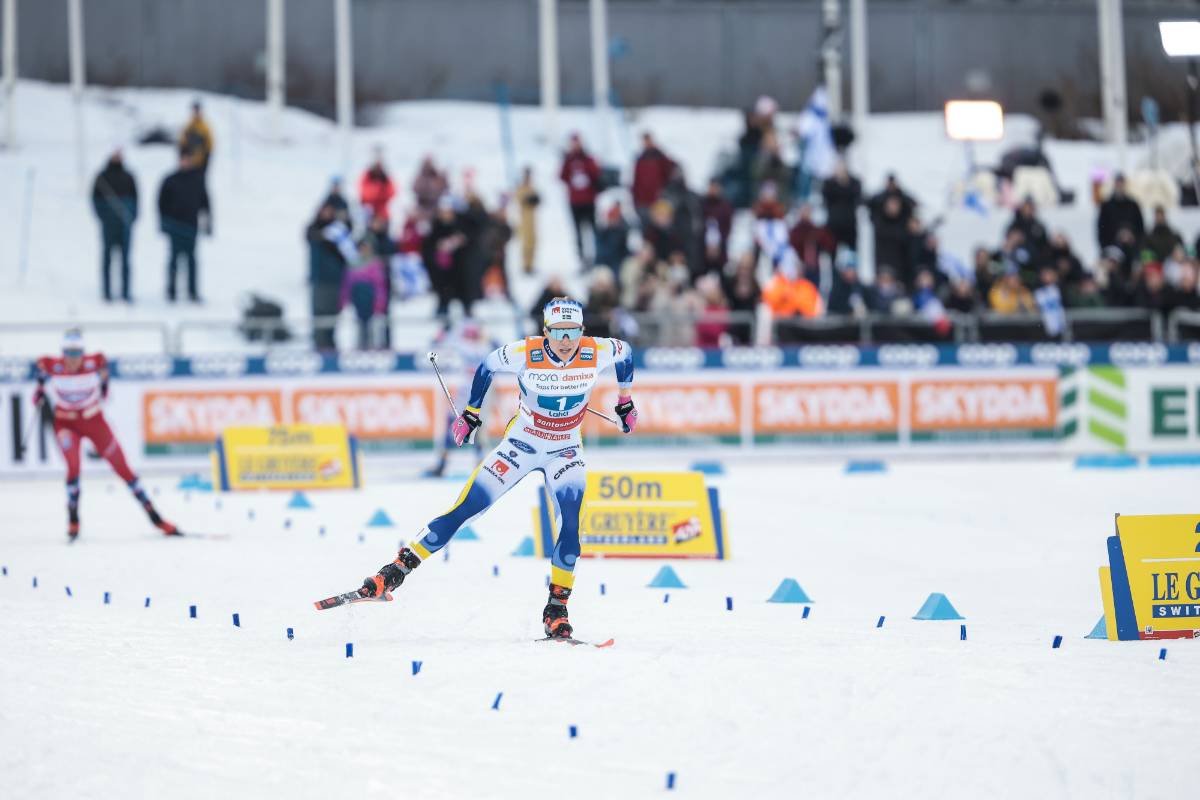
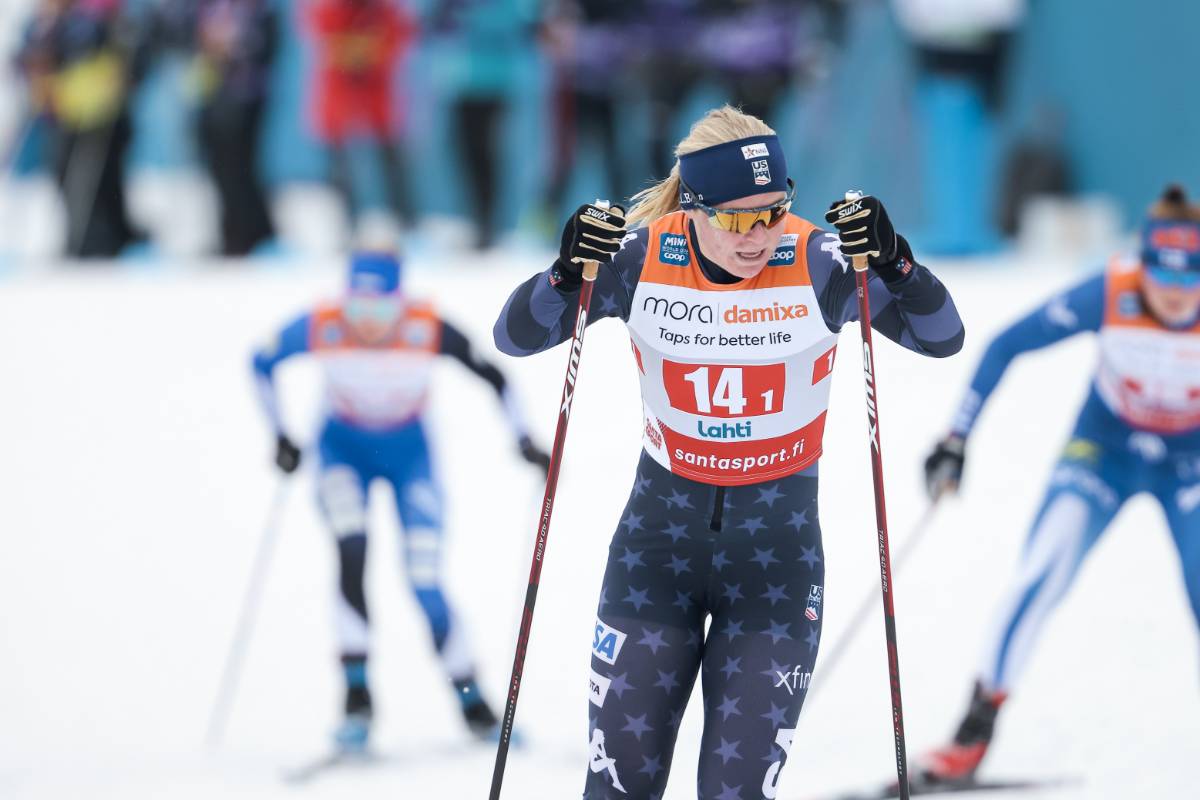
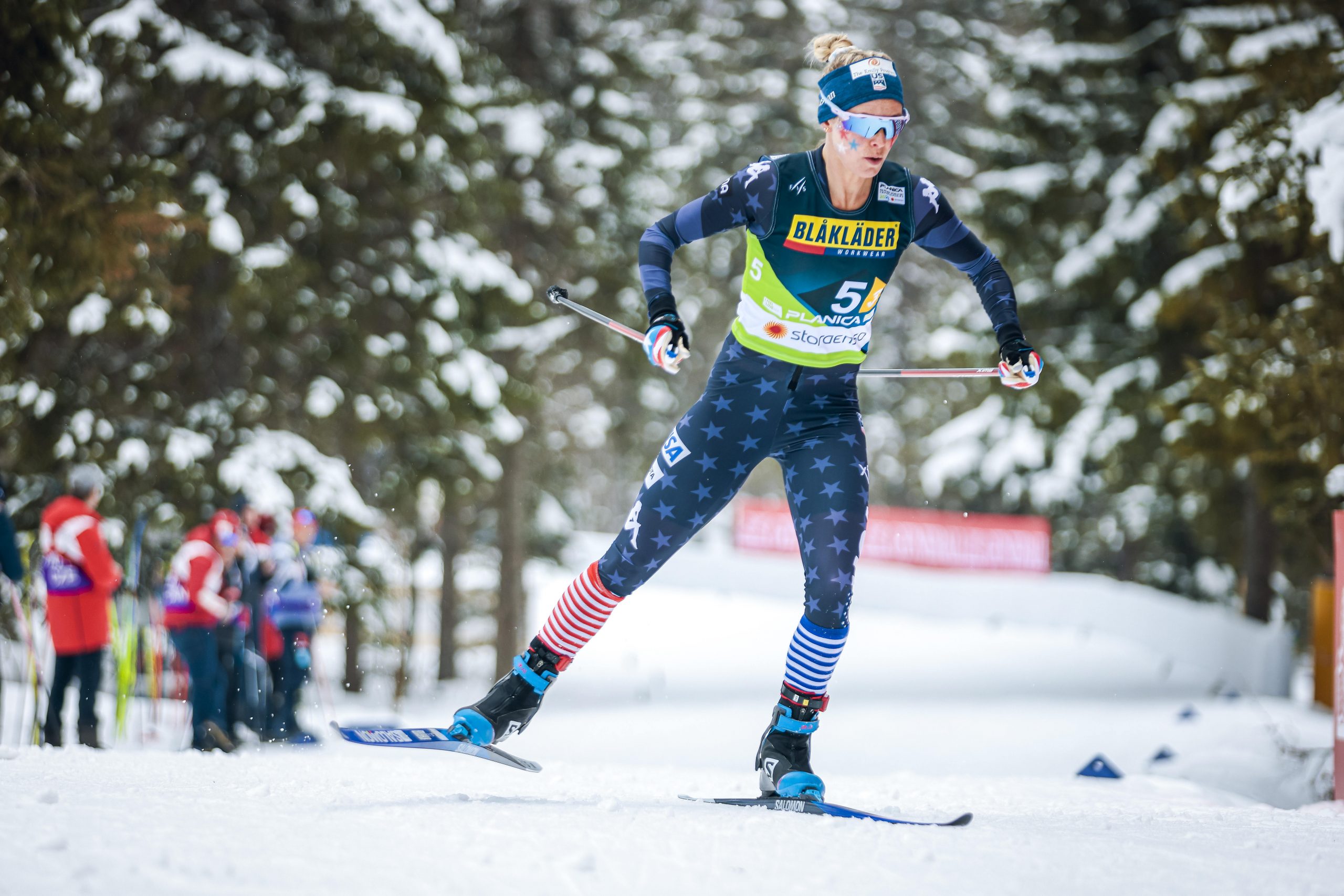
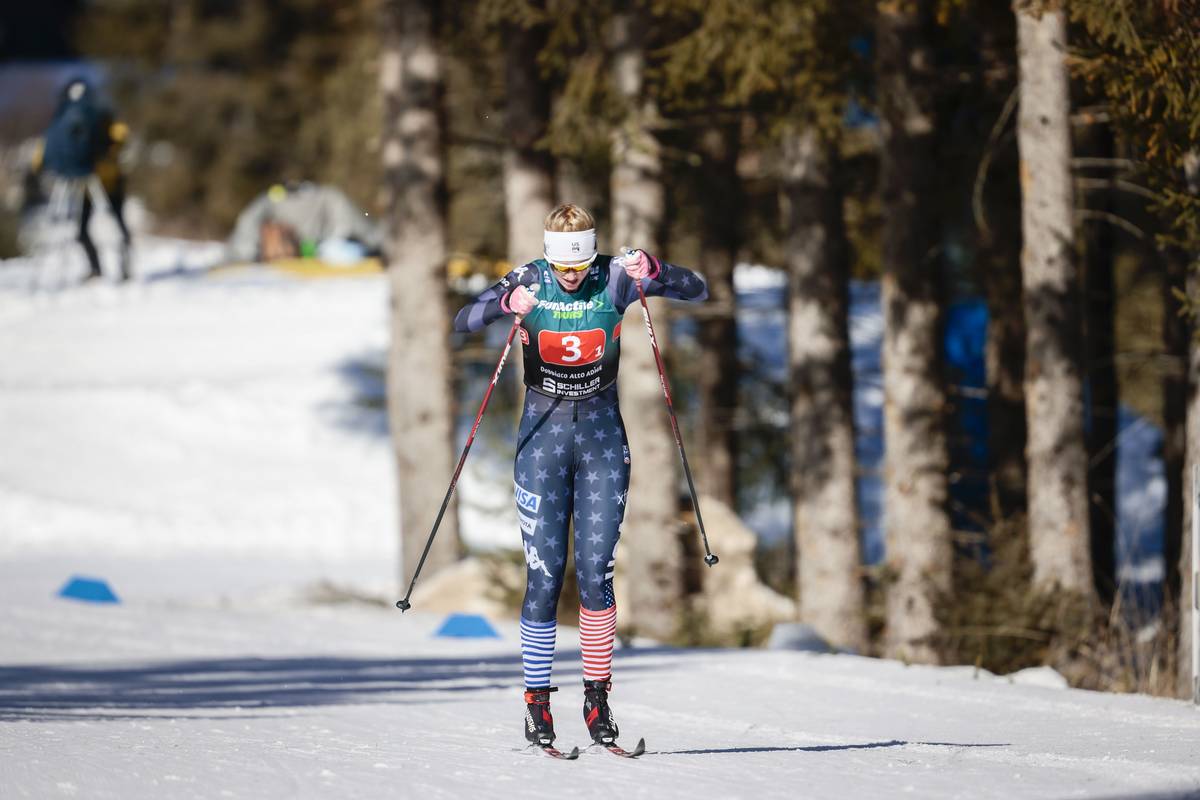
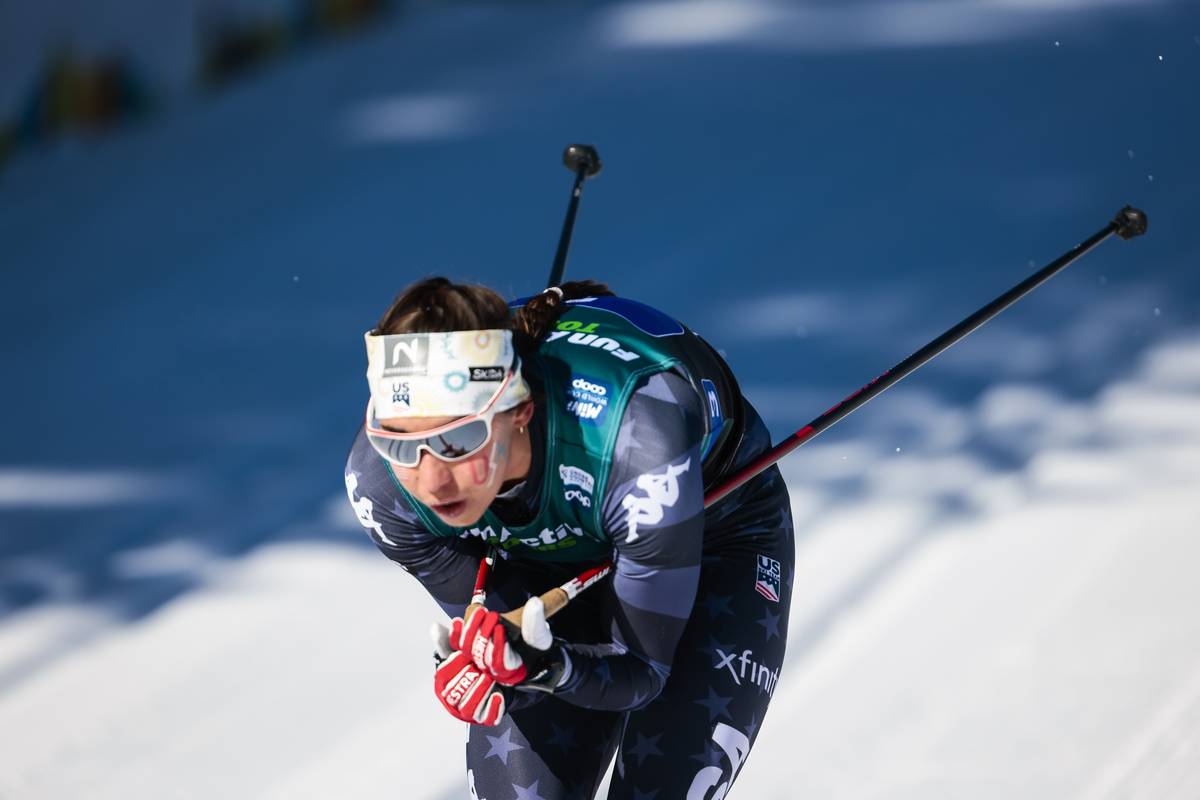
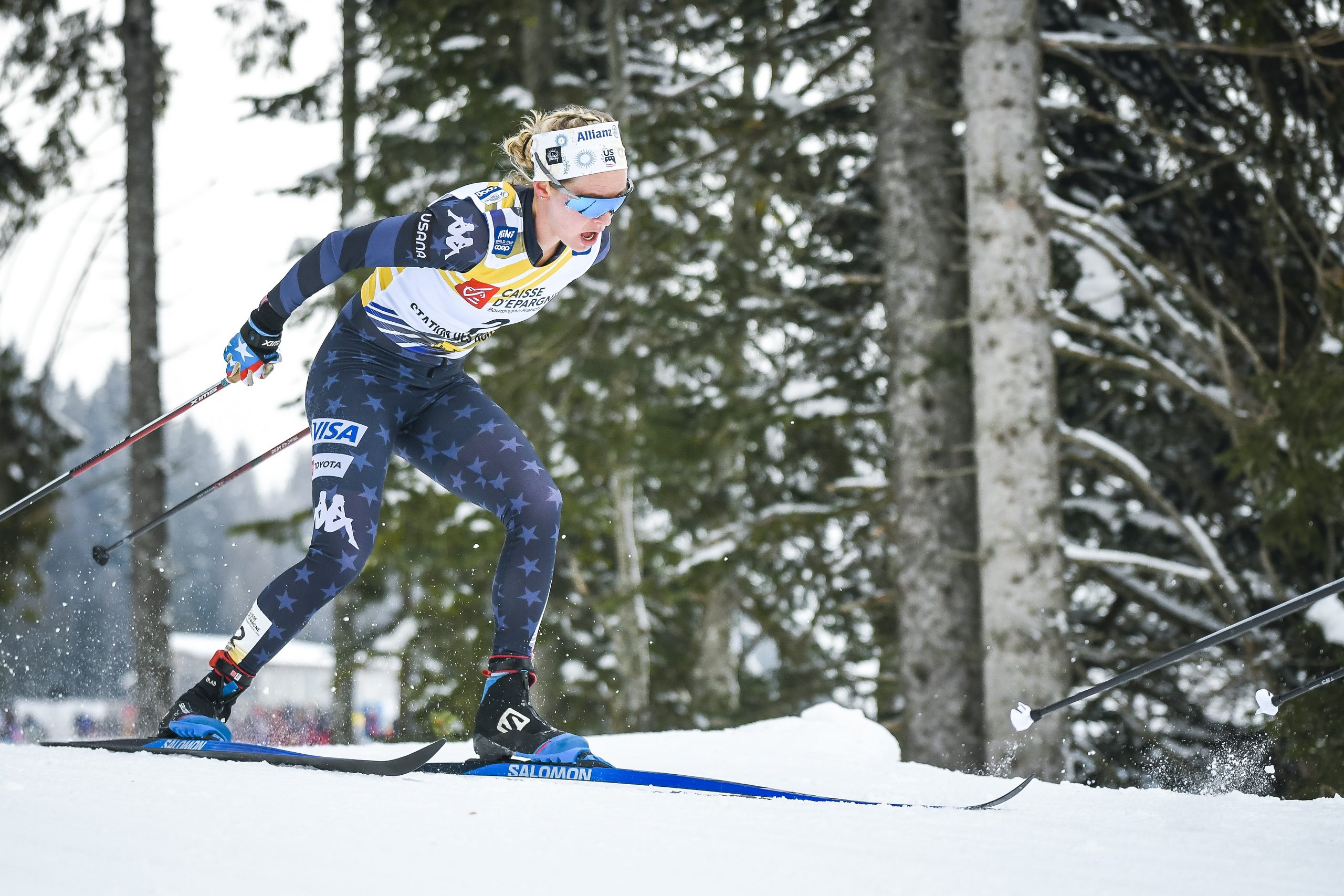
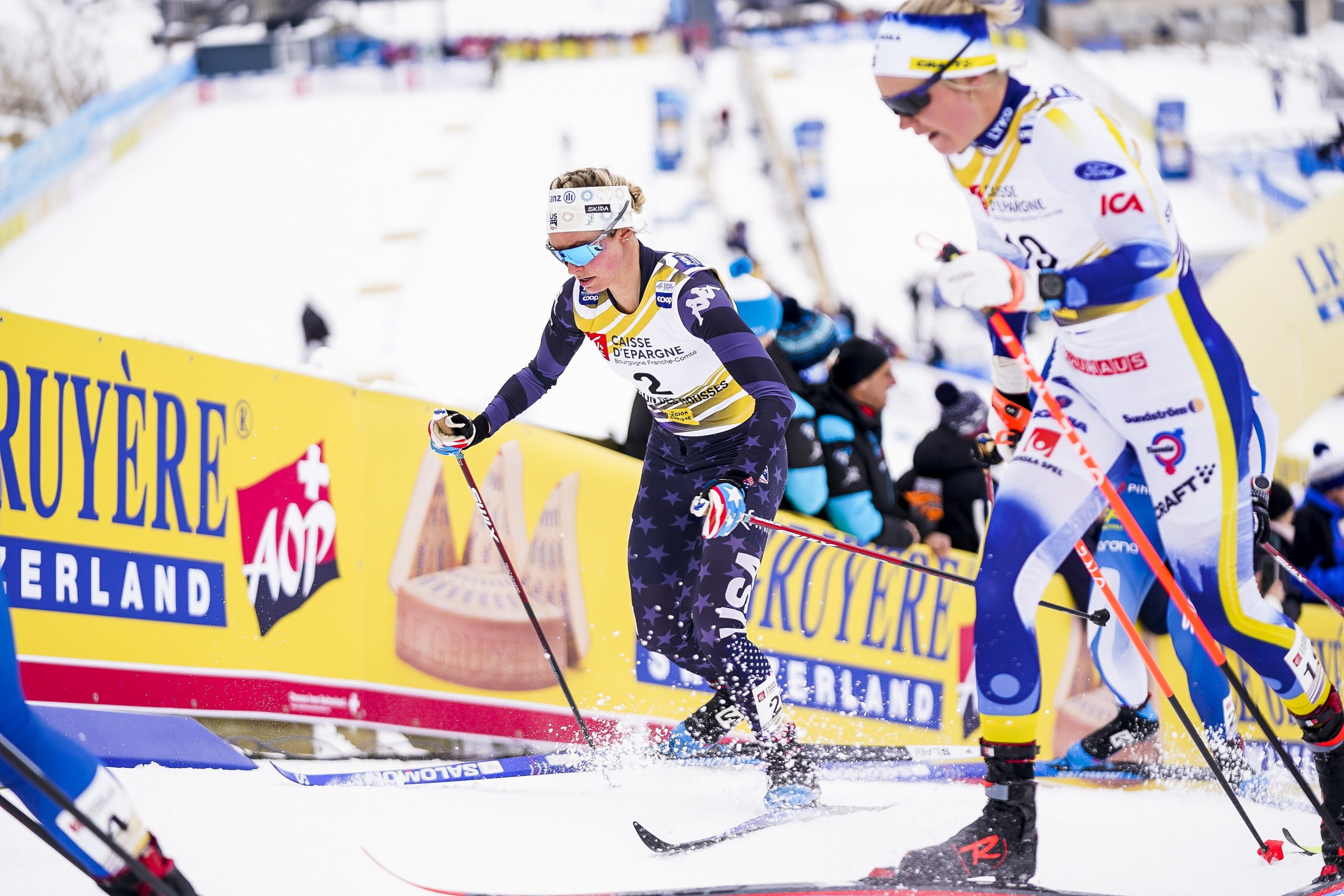
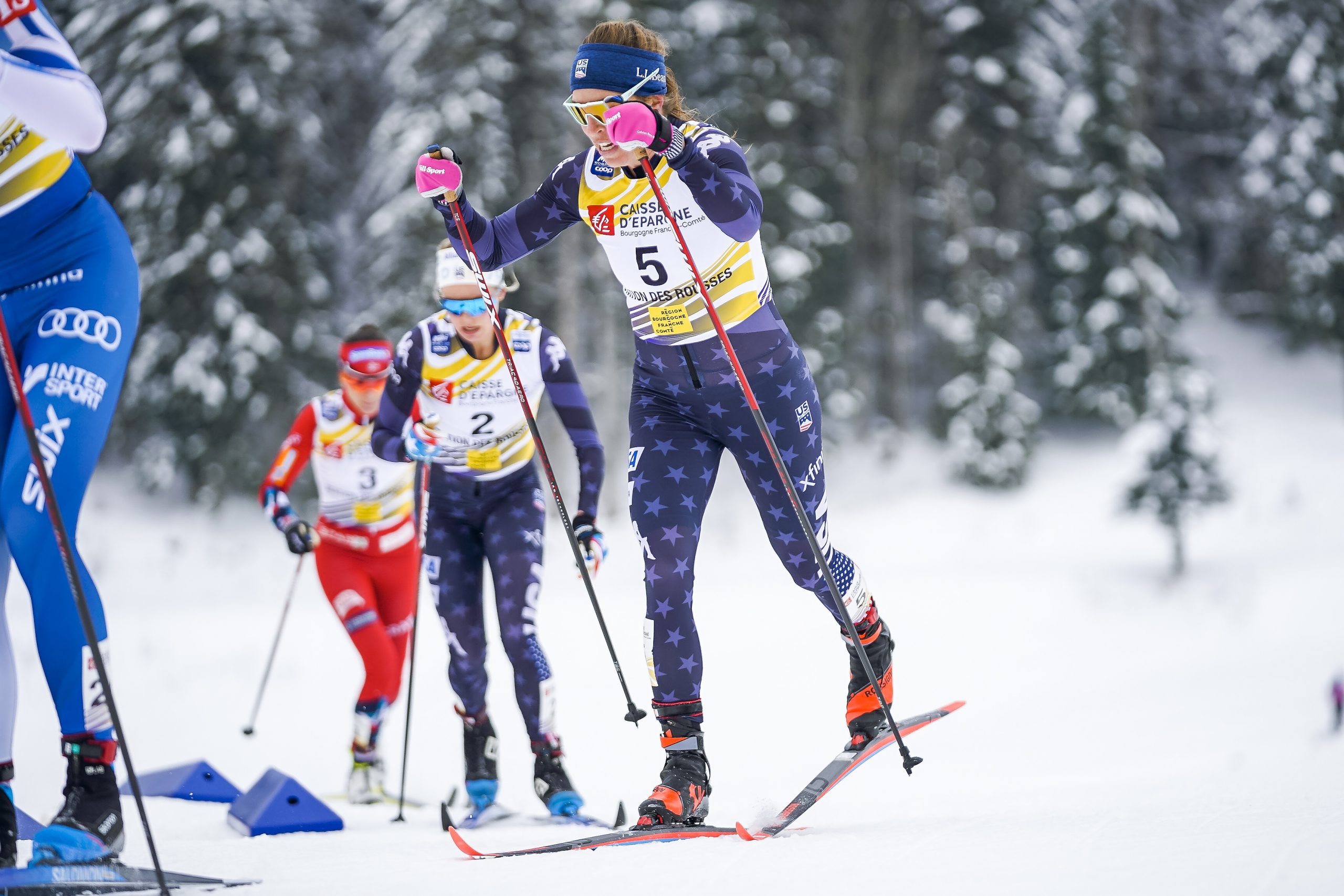
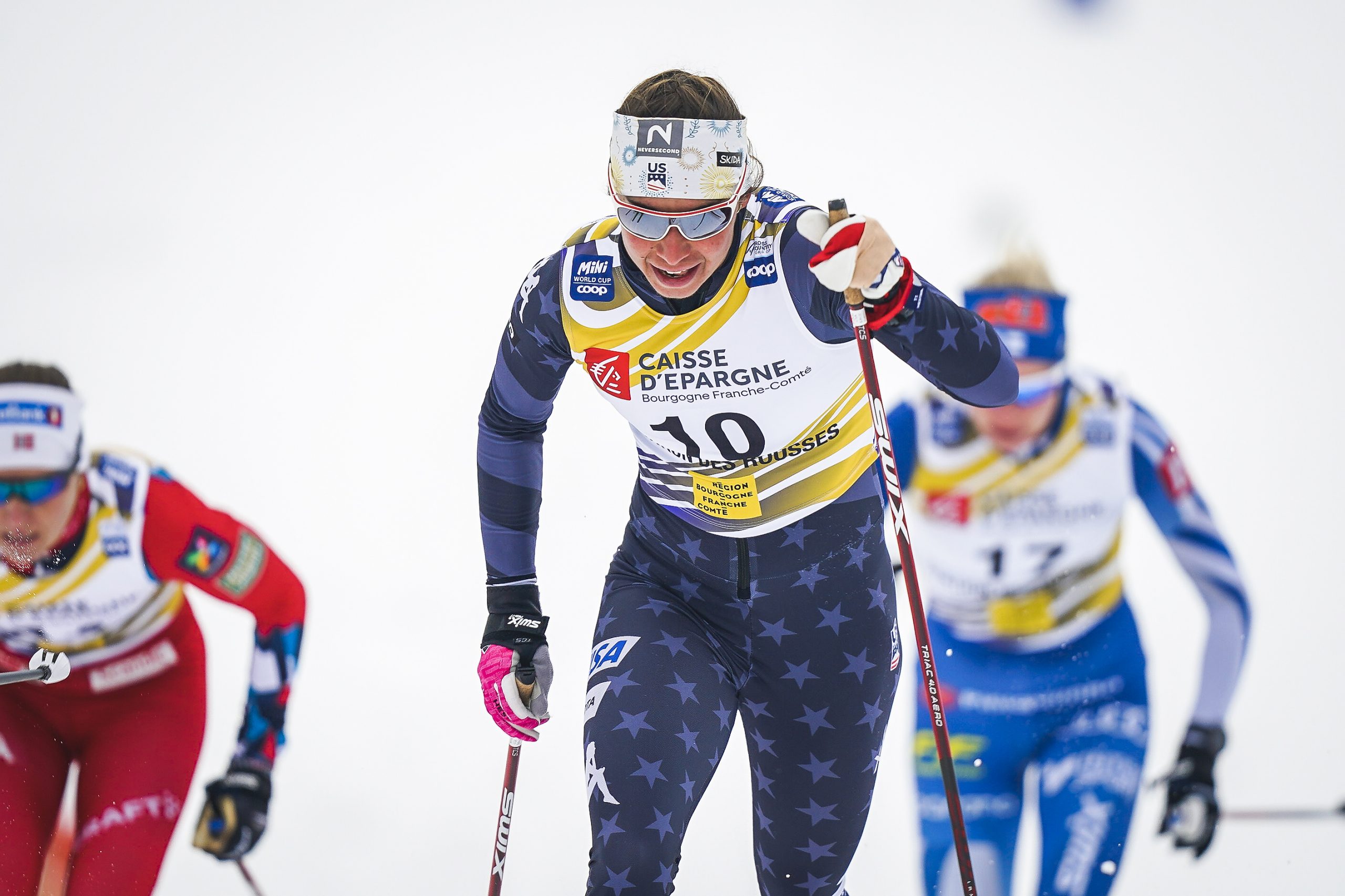
Hailey Swirbul (USA) racing the 20 k Classic Mass Start in Goms, Switzerland, two weeks ago. (Photo: Authamayou/NordicFocus)
When Hailey Swirbul logged onto a Zoom call from Italy last Monday, she was already living inside uncertainty.
“I’m in Livigno right now,” she said. “Yeah — the higher one.”
The U.S. team held two pre-Olympic altitude camps, and Livigno was the higher-altitude option. With thinner air, it’s a place where nothing happens quickly, where adaptation takes patience, and where clarity is rarely immediate. When we spoke, it still wasn’t public which races she might ski, or even whether she would start any at all. She was there because she had qualified back onto the U.S. Olympic Cross-Country Ski Team — but nothing beyond that had been decided.
She didn’t talk about it like a comeback. She didn’t talk about it like redemption, either. Mostly, she sounded attentive — to her body, to her thinking, to the risk of letting the story get ahead of her.
“I’ve thought about this whole thing more as an experiment,” she said. “Like… can I do this? And can I do it in a way that actually feels good?”
The Olympics mattered. She didn’t pretend they didn’t. But they weren’t the point.
“What can I do?” she kept asking.
Hailey Swirbul’s entry into endurance sports began with mountain bike racing with her family around Colorado. (Photo: Courtesy Photo)
Before Skiing Was the Point
Swirbul’s relationship with endurance sport started long before skiing felt central, or even intentional.
“I grew up in just a really active family,” she said. “My parents valued getting outside and doing that with our family.”
Neither parent was an elite athlete. That wasn’t the model. The emphasis was simpler: movement, time outdoors, effort shared rather than measured.
“They just love being outside and moving our bodies,” she said. “And they taught that to my brother and me growing up.”
The first sport that really mattered to her wasn’t skiing.
“The main thing we loved to do as a family when we were young was mountain bike races,” she said. “We would travel around Colorado or the West and camp as a family and do these bike races.”
Mountain biking wasn’t cross-training. It was the center.
“That was kind of the first main sport that my brother and I both really loved,” she said.
Nordic skiing entered her life almost accidentally. Her older brother decided to try it as winter conditioning for mountain biking.
“So as the younger sister,” she said, “I was just going to follow whatever he did.”
Her first experience skate skiing was blunt.
“I had never skate skied before,” she said. “And I just got destroyed. I was so far behind everyone.”
What stayed with her wasn’t embarrassment. It was the challenge.
“I remember feeling this sense of, like, I need to figure this out,” she said.
Progress came quickly, and with it a new kind of motivation.
“I remember feeling like, whoa,” she said. “It’s pretty fun to do well at it — whatever well means.”
What drew her in wasn’t winning so much as the learning curve.
“Skiing is such a hard sport to master,” she said. “I don’t think anyone really can. It’s always evolving.”
By middle school, she was actively seeking out more difficulty.
“I wanted to race more,” she said. “I would go on jogs in the fall after soccer practice because I was like, I need to get more training.”
She started racing up in age groups — not because anyone pushed her, but because she wanted to be there.
“I raced up as a U16 when I was still 13,” she said. “And I qualified for Junior Nationals that year.”
Being part of something bigger mattered.
“Getting to go and be part of this bigger thing,” she said, “that was incredibly motivating to me.”
Hailey Swirbul celebrates the U16 Junior National Championship title in the Freestyle Mass Start in Stowe, Vermont, in 2014. (Photo: Voisin/FasterSkier)
Racing Up — Until There Was Nowhere Left to Go
Much of Swirbul’s early career followed that same pattern.
“My young career — and honestly much of my career — was defined by racing up,” she said.
It worked. Racing older athletes fed her curiosity and reinforced the idea that discomfort was something to move toward, not away from.
But as she progressed through the development pipeline and into the World Cup system, the feedback loop changed.
“There’s this moment where it flips,” she said. “And suddenly you’re supposed to be top 30.”
Early World Cups felt expansive. Points mattered. Starts felt earned.
“Getting points felt exciting,” she said.
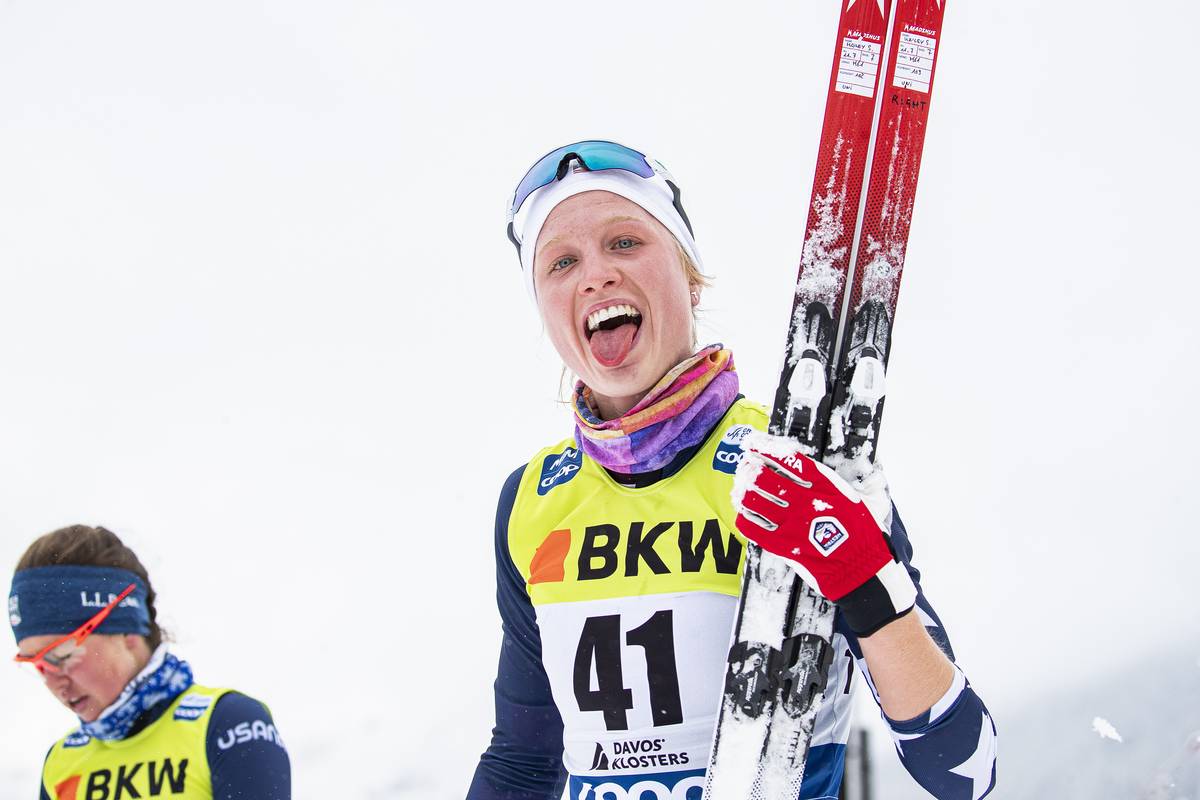
Hailey Swirbul scored her first varied World Cup points in the 2019 Davos, Switzerland, Skate Sprint. (Photo: NordicFocus)
Over time, expectations hardened. Results that once signaled progress became baseline.
“It stops being exciting,” she said.
What made it difficult wasn’t failure in the dramatic sense. It was repetition.
“It’s really hard to go over there and be 45th every weekend,” she said. “And still believe in yourself.”
She kept coming back to that number — not as a complaint, but as a psychological reality.
“When that happens over and over,” she said, “it starts to mean something about you.”
The pressure didn’t explode. It narrowed.
“I felt really rigid,” she said. “And I didn’t like that.”
By the end, the issue wasn’t the results.
“There wasn’t anything wrong, exactly,” she said. “That was kind of the hard part.”
She wasn’t falling apart. She just wasn’t herself anymore.
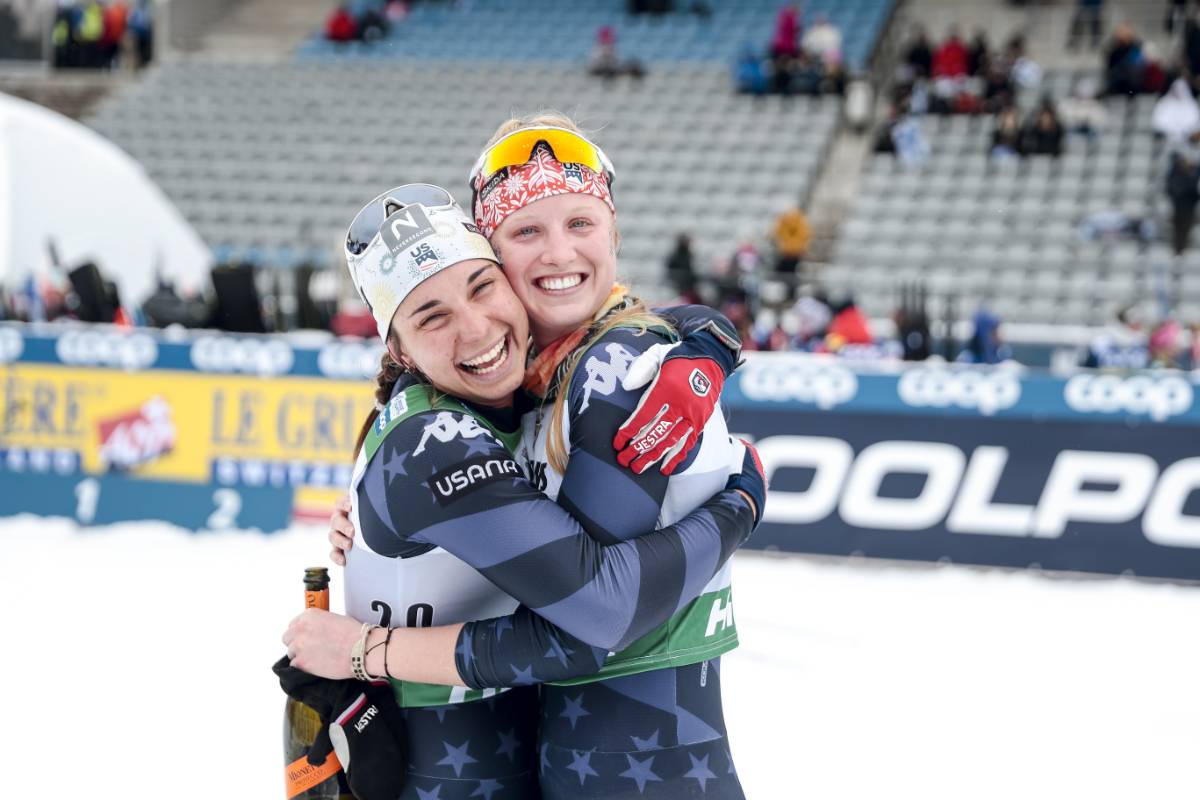
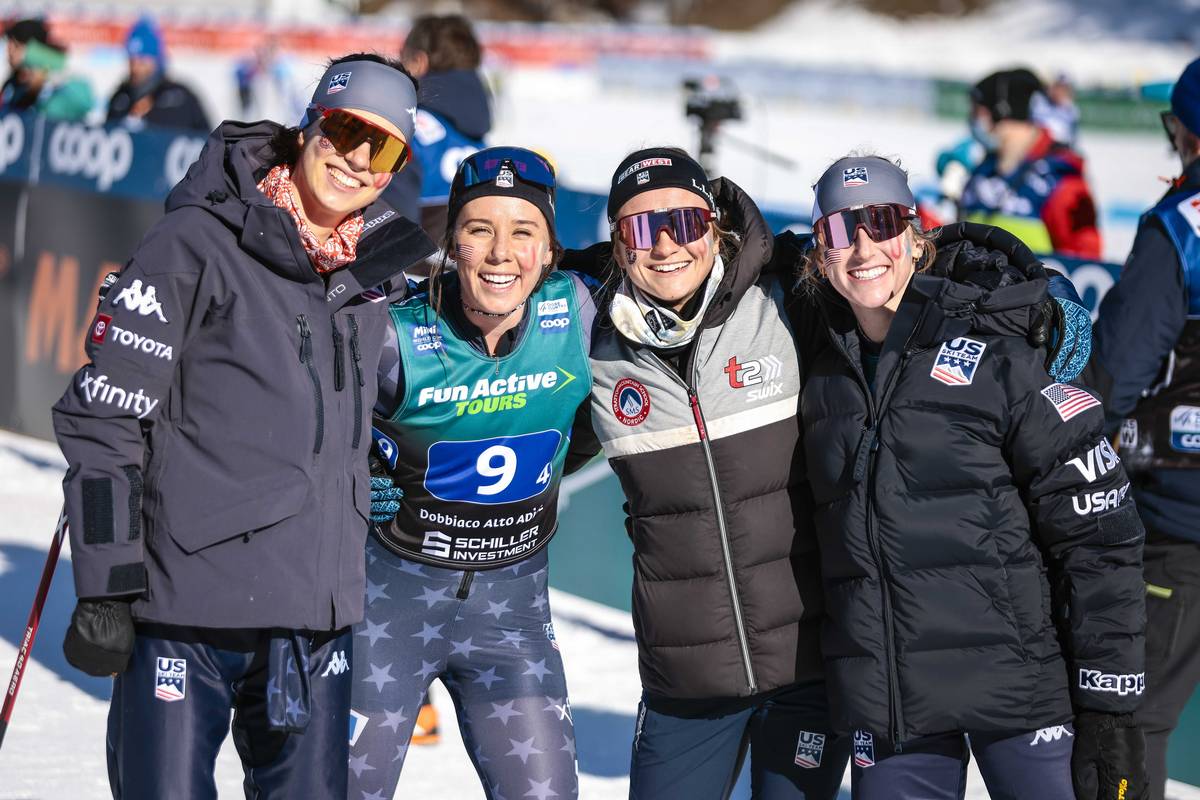
Rosie Brennan (USA), Samantha Smith (USA), Jessie Diggins (USA), Julia Kern (USA), and Hailey Swirbul (USA) (l-r) celebrate the end of the season and Swirbul’s retirement in 2023. (Photo: NordicFocus)
Leaving Without Drama
Swirbul didn’t retire in crisis. She retired calmly.
“I don’t regret retiring,” she said. “At all.”
She enrolled in an engineering program. She stepped away from the race calendar. For the first time in years, skiing wasn’t the organizing principle of her life.
That winter, she worked as a ski patrol member in Colorado.
“At Aspen Highlands, we have this hike-to terrain up at 12,000 feet,” she said. “It’s like an 800-vertical-foot hike.”
For weeks at a time, that meant repeating the same climb again and again.
“You’re hiking up and down that bowl for six hours a day,” she said. “And honestly, I loved it.”
She was careful to separate that year from any training narrative.
“That wasn’t training,” she said. “It was just work.”
What mattered was usefulness. Responsibility. Being competent at something that didn’t care who she was or what she’d done before.
“There’s something really grounding about that,” she said.
Her body worked constantly, but without scrutiny.
“I just loved hiking,” she said. “That was my whole day.”
Hunter Wonders, Hailey Swirbul, and Chip Schoff (former APU skier and wax tech) on a multi-day hut trip. (Photo: Courtesy Photo)
When Time Shows Up
The idea of returning didn’t appear during that patrol season in any obvious way. It arrived later, through moments that didn’t seem connected at first.
One came from a book about time—the idea that a human life spans roughly 4,000 weeks.
“It wasn’t panic,” she said. “It was more like honesty.”
Another came from a comment made by someone she respected — casual enough that it might have been ignored.
“I kind of just sat with it,” she said. “And I couldn’t shake it.”
What lingered wasn’t urgency. It was clarity.
“If I’m ever going to do this again,” she said, “it’s now.”
Not because she felt behind. Because waiting indefinitely no longer felt natural.
The Risk of Trying Again
Coming back wasn’t simple. It carried risk.
“I didn’t want to come back if I was just going to be the same athlete,” she said.
She worried about slipping back into rigidity. About obligation replacing curiosity again.
“I’m way more aware now of how easily I can slip back into that mindset,” she said.
She also worried about the other possibility.
“What if I come back,” she said, “and I’m just not good enough anymore?”
She didn’t rush past that thought.
“That’s part of the experiment,” she said. “Like… maybe it doesn’t work.”
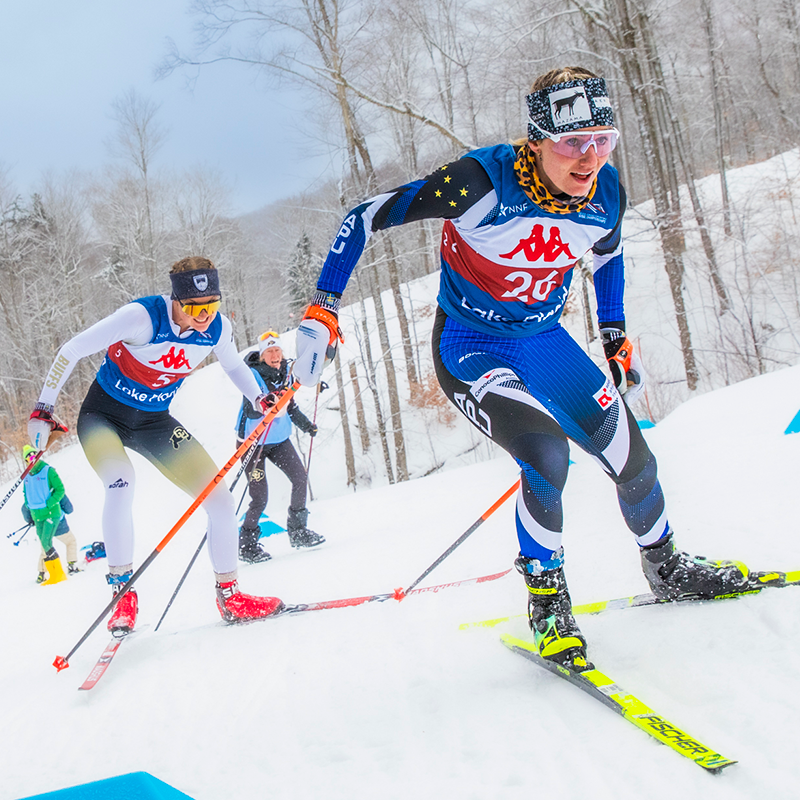
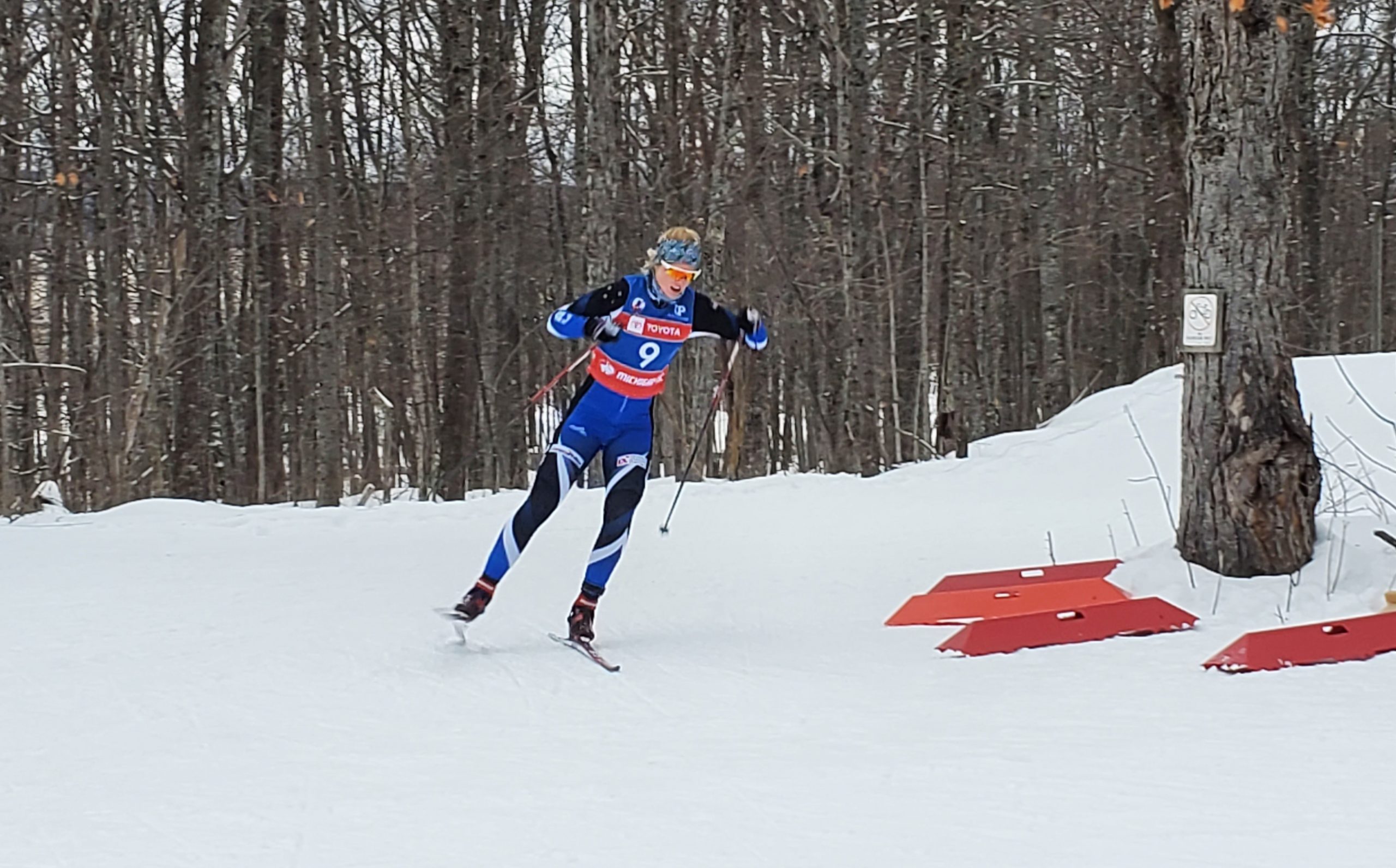
Hailey Swirbul (APU) racing the US National Championships Mass Start Freestyle in Lake Placid in January. (Photo: Nancie Battaglia)
Starting Where She Actually Was
When Swirbul decided to race again, she didn’t shortcut the process. She entered domestic races. She lined up without protection.
“I was literally starting from the back in mass starts,” she said. “And I was like, okay. This is fine.”
Fine didn’t mean easy. It meant honest.
“I actually loved that,” she said. “It took so much pressure off.”
Domestic racing gave her feedback she could read again. Progress looked like progress. Bad days stayed contained.
Later, she reached for a phrase that stuck with her — the idea of a “safe nest.”
“A place where you can go out into the world and get beat down a little bit,” she said, “but you always have somewhere you can come back to and rebuild your confidence.”
For her, that place was domestic racing.
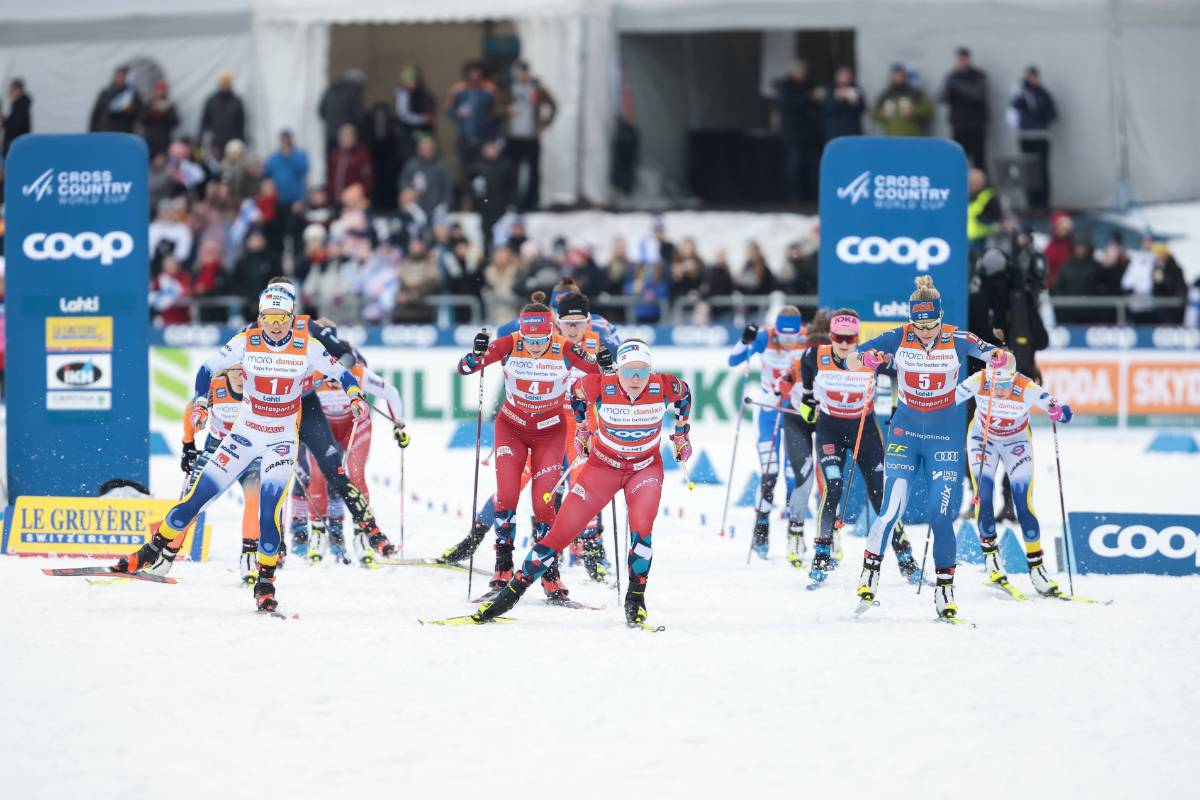
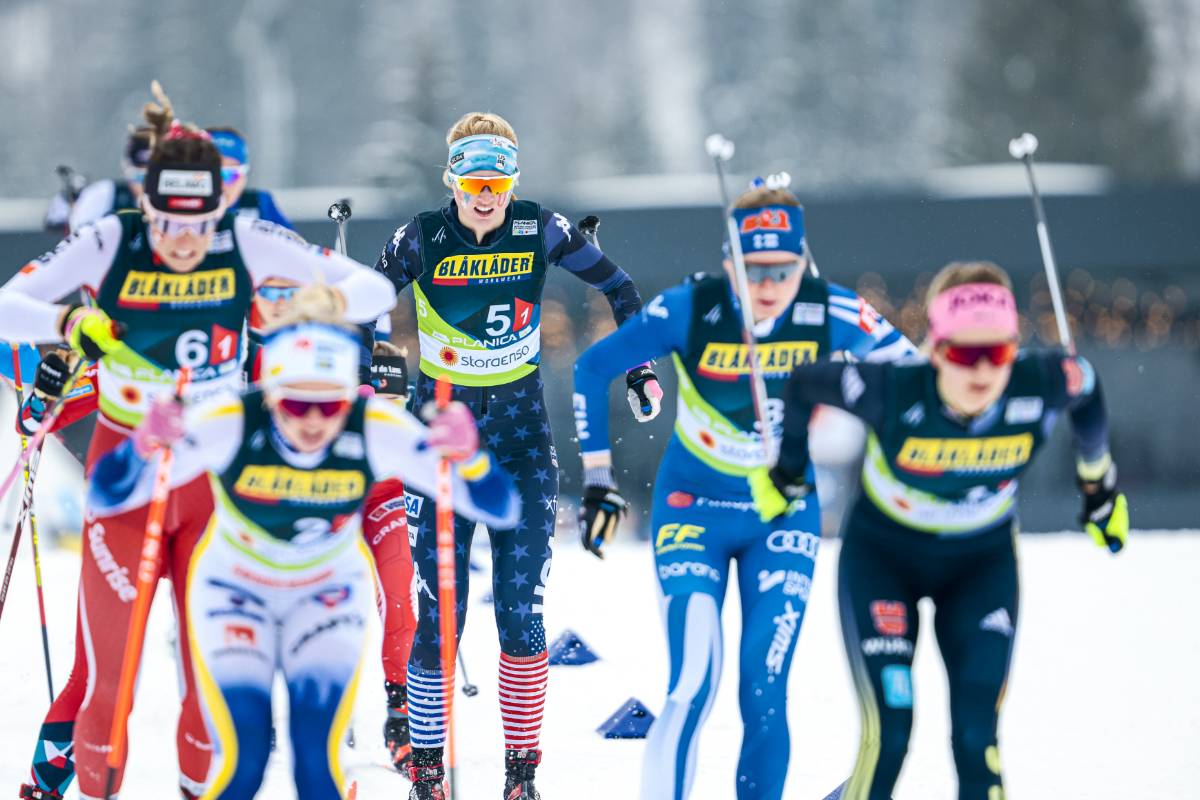
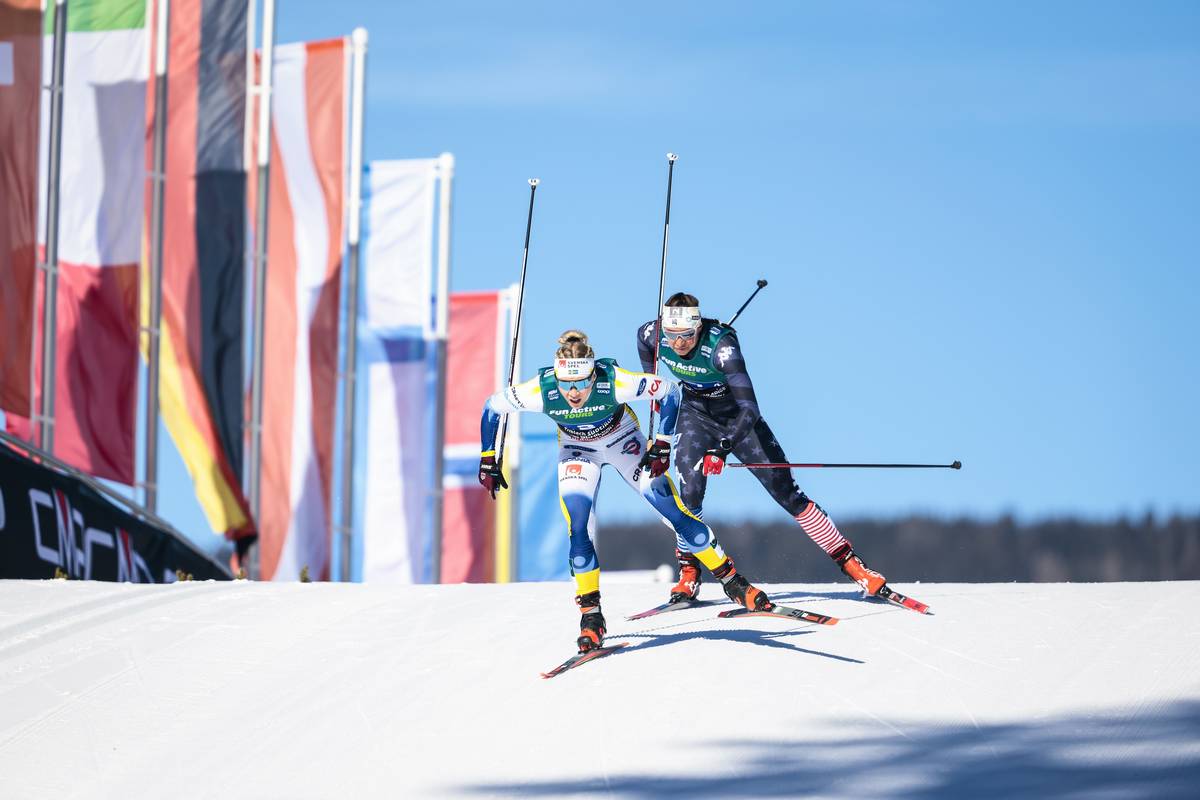
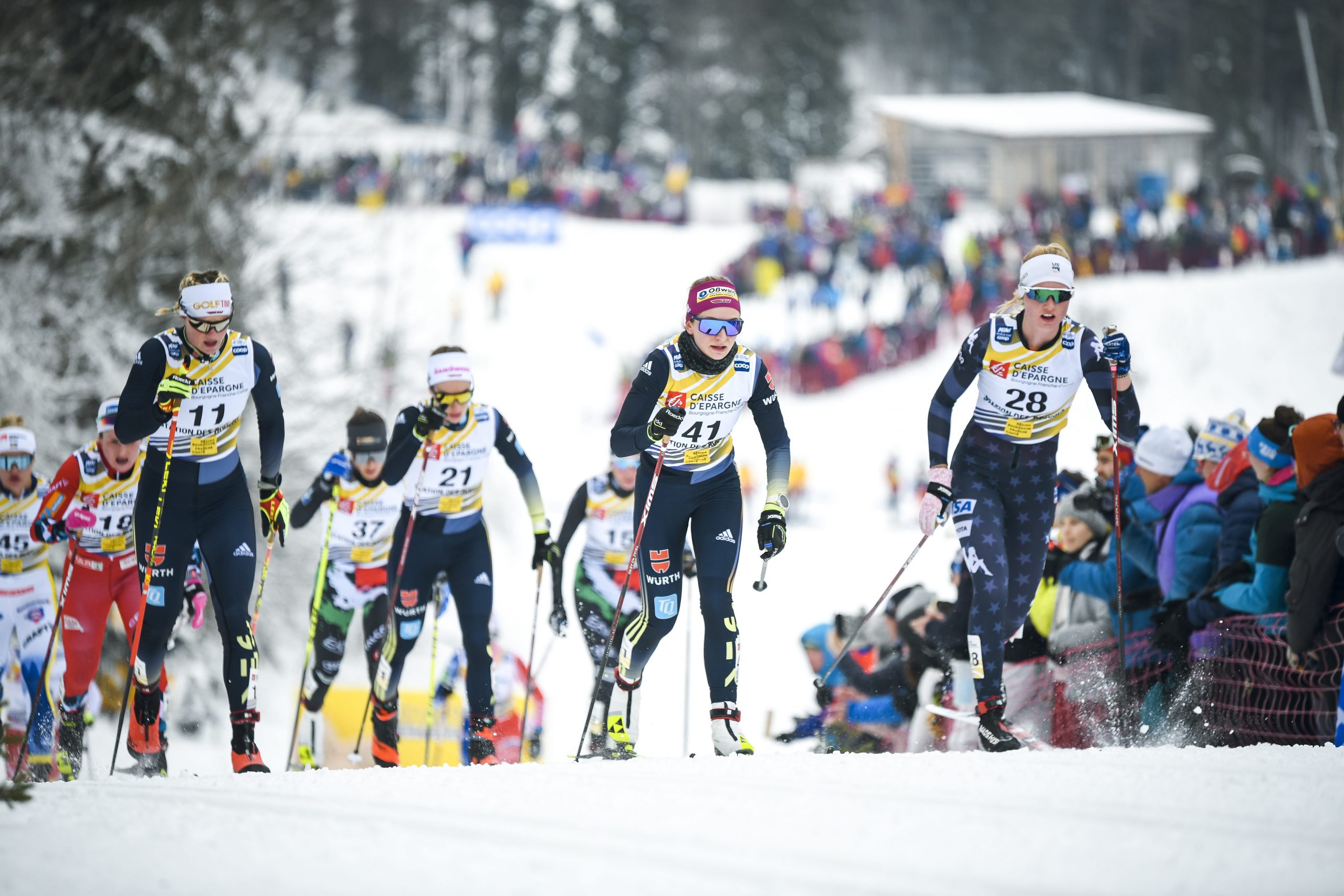
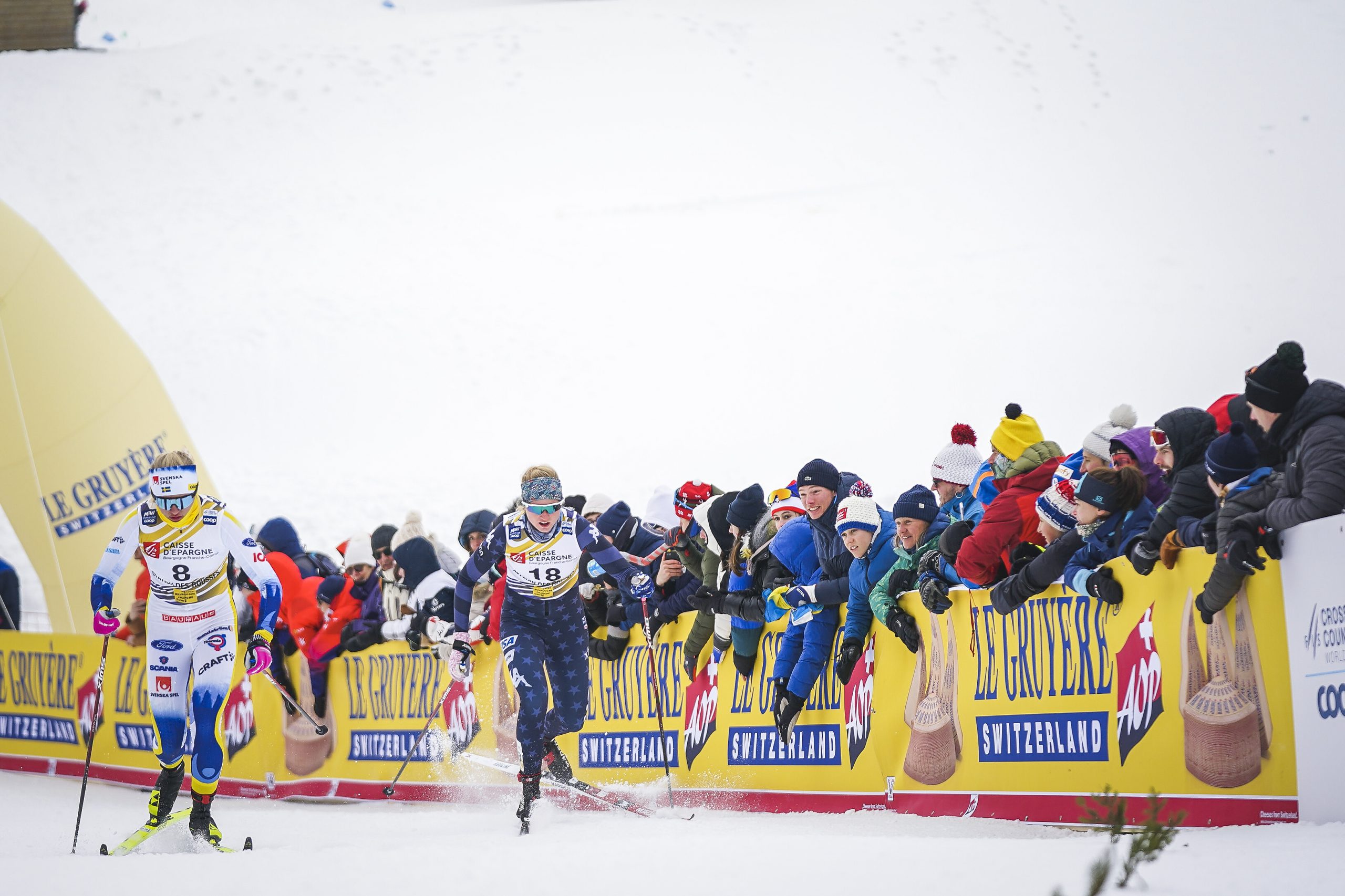
Samantha Smith (USA), Hailey Swirbul (USA), NS Rosie Brennan (USA), (l-r) in the 20 k Classic Mass Start in Goms, Switzerland, two weeks ago. (Photo: Authamayou/NordicFocus)
Europe, Revisited
She never forgot what the other side felt like.
“There’s this moment where it flips,” she said again of World Cups. “And suddenly you’re supposed to be top 30.”
She talked about Europe without bitterness, but with clarity.
“It’s really hard to go over there and be 45th every weekend,” she said. “And still believe in yourself.”
This time, she wasn’t trying to prove she could survive that environment again.
She wanted to know whether she could return without losing herself to it.
Not Being Only One Thing
Throughout her return, Swirbul kept coaching at Alaska Pacific University.
“I was doing three sessions a day sometimes,” she said. “Elite team, masters, devos.”
The workload was heavy. She didn’t romanticize it. But she didn’t want to let it go.
“Being around kids who are just excited to ski,” she said, “it reminds you why you started.”
She was conscious of what she modeled — not just in training, but in attitude.
“I didn’t want to be only an athlete again,” she said.
Hailey Swirbul enters these Olympic Games not only to prove she can still perform at an elite level, but also to celebrate that she still loves endurance sports, just as she did growing up in Colorado. (Photo: Courtesy Photo)
Where the Experiment Stands
Qualifying for the Olympic team didn’t resolve the experiment. It simply moved it forward.
“It doesn’t make the decision right,” she said. “It’s just what happened.”
She didn’t frame it as validation.
“I don’t regret retiring,” she said. “At all.”
While in Livigno, she waited — not gripping, not withdrawing.
The Olympics were close enough to matter. Far enough away to remain uncertain.
Now the races have started, and Swirbul is presumably days away from a race start at the Winter Olympic Games. So the hypothesis has been written and the lab experiment designed.
“What can I do?” she asked.
Not forever. Not for anyone else. But the time to run the test has arrived.
Help Support Our Olympic Coverage!
FasterSkier has our own Nat Herz on the ground at the Olympics, which is a significant financial lift for us. If you value the thoughtful work and access FasterSkier provides at championships like this one, please consider becoming a Voluntary Subscriber. Your support directly fuels our work to cover the people, places, and moments that make our sport special.
This coverage is made possible through the generous support of Marty and Kathy Hall and A Hall Mark of Excellence A Hall Mark of Excellence Award. To learn more about A Hall Mark of Excellence Award, or to learn how you can support FasterSkier’s coverage, please contact info@fasterskier.com.
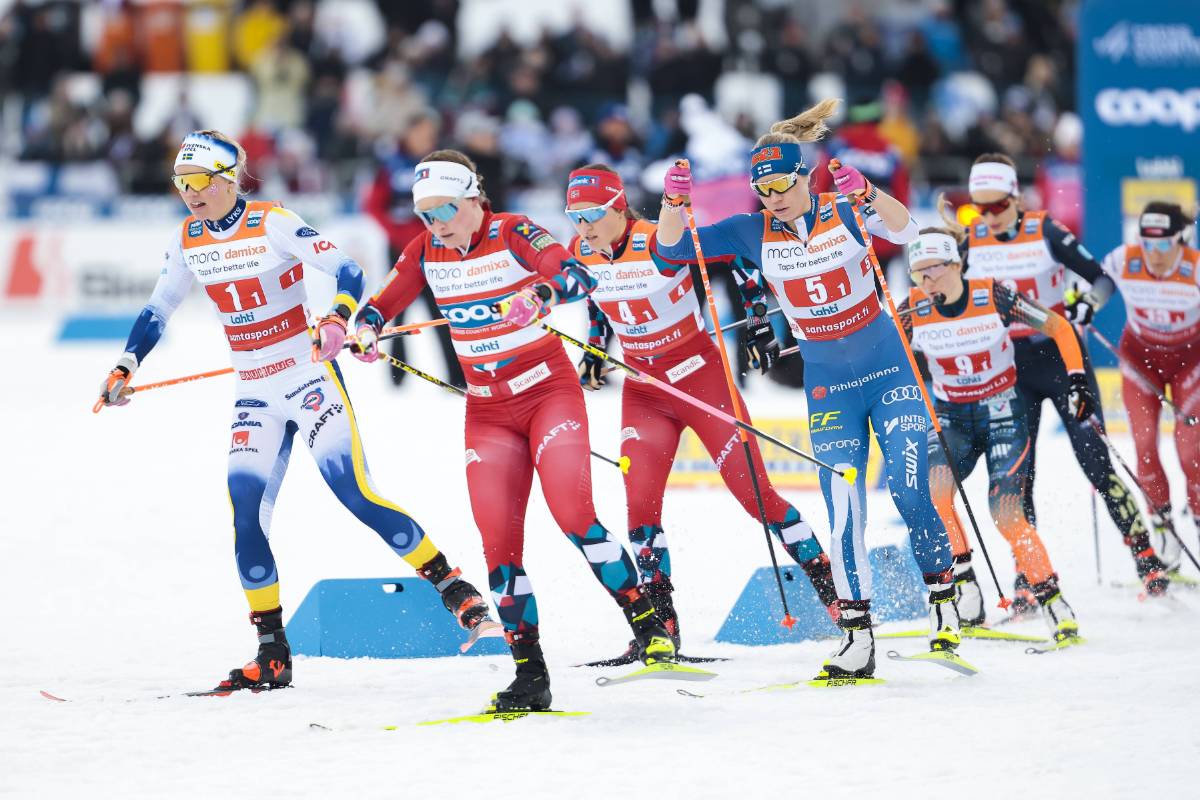
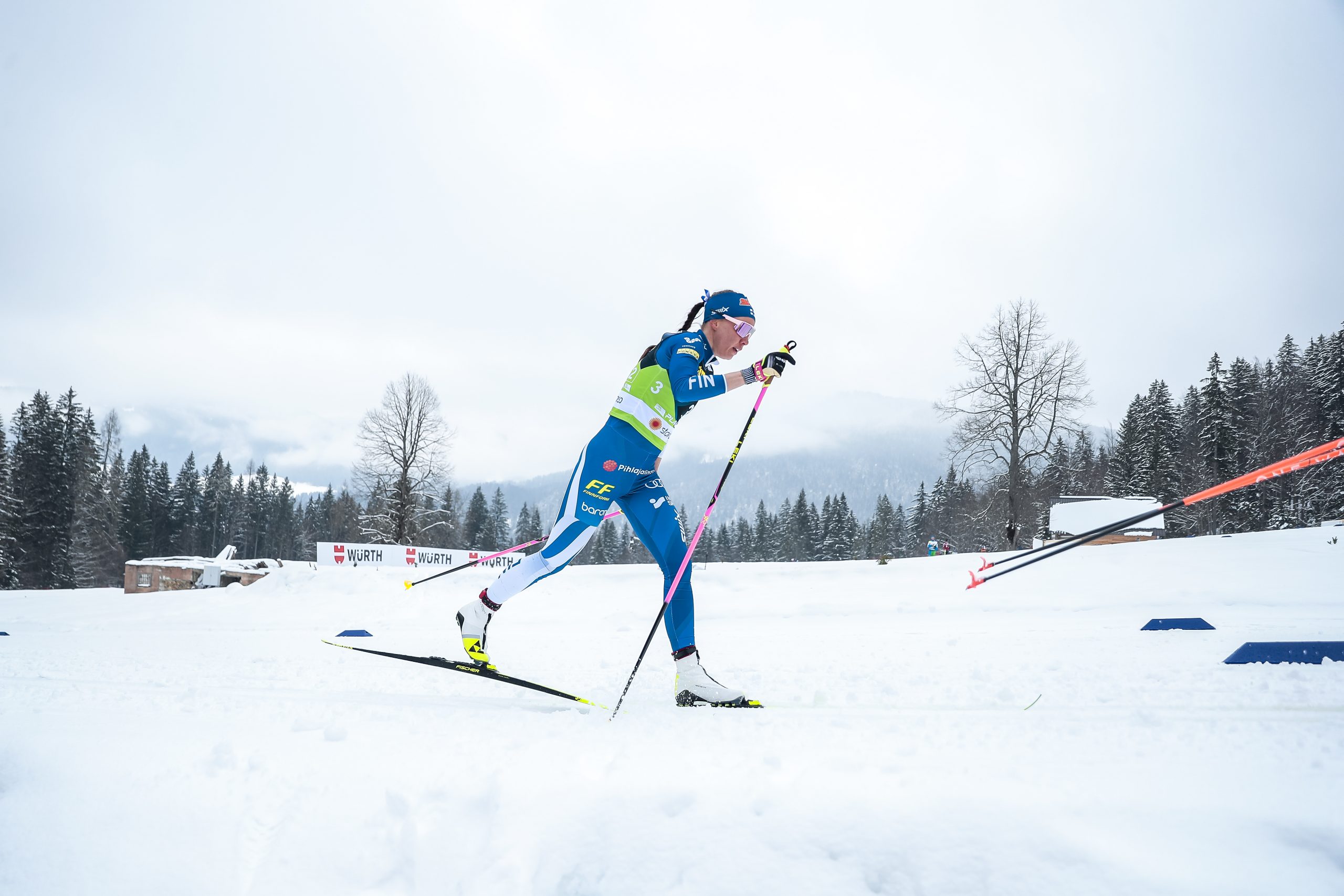
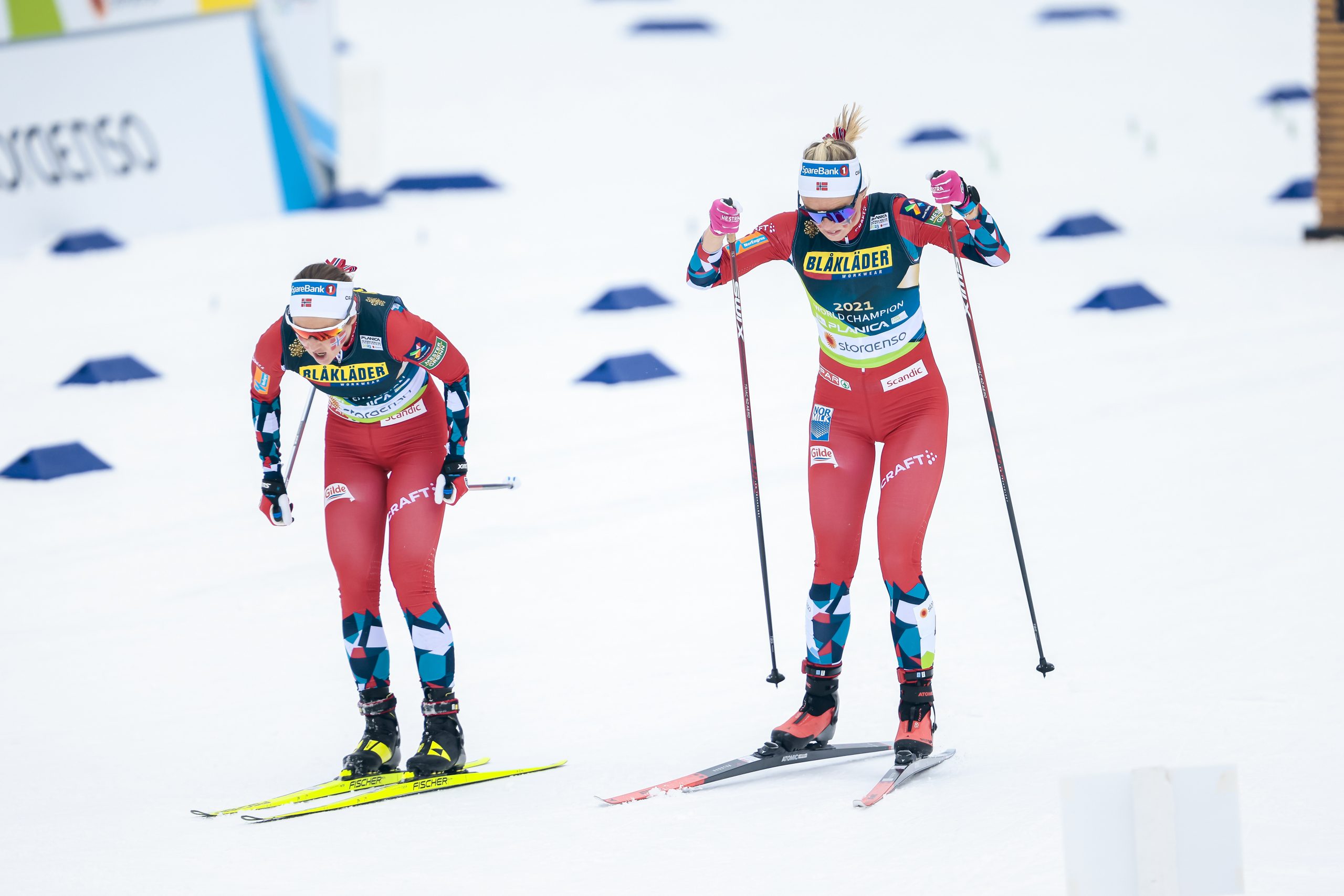
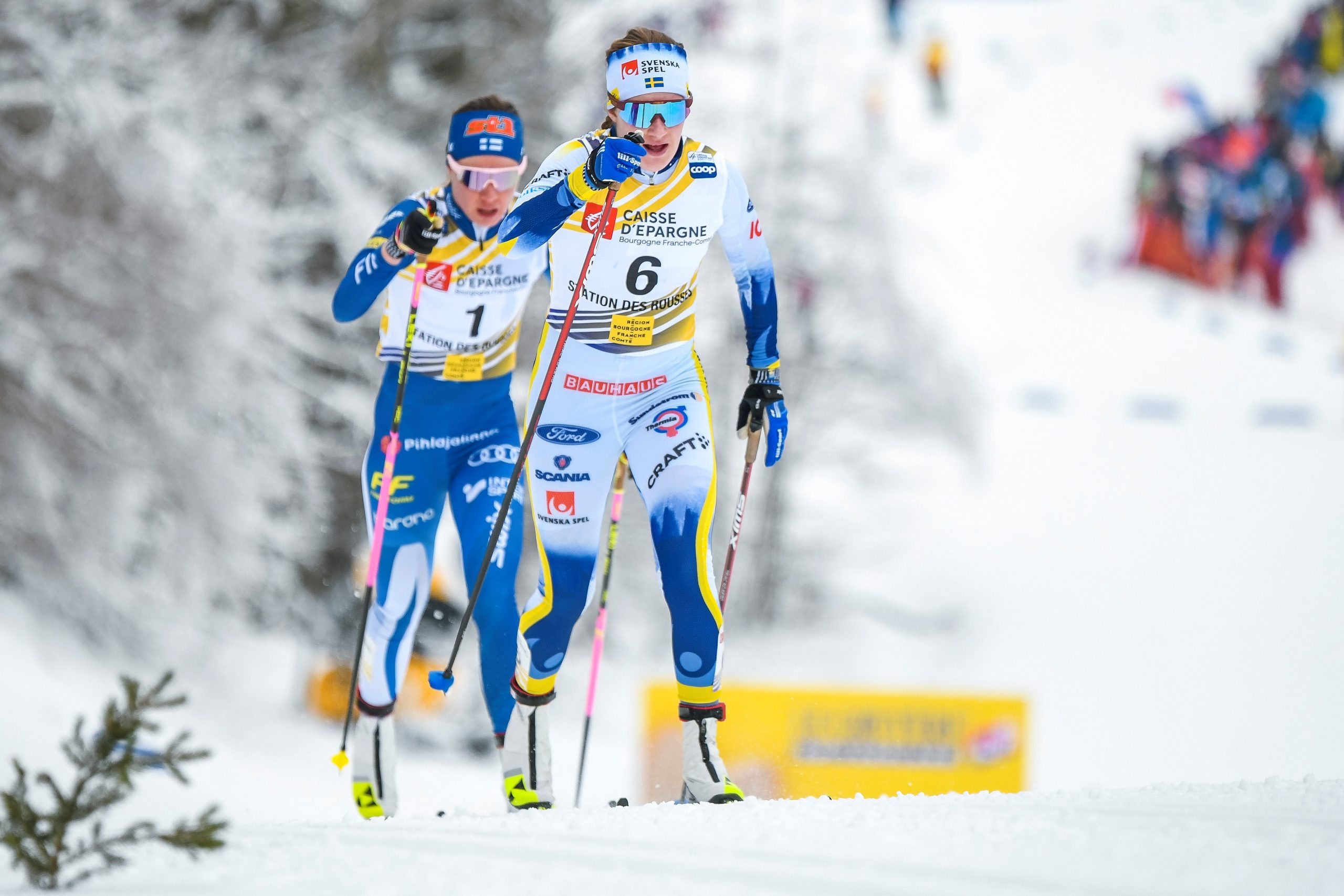
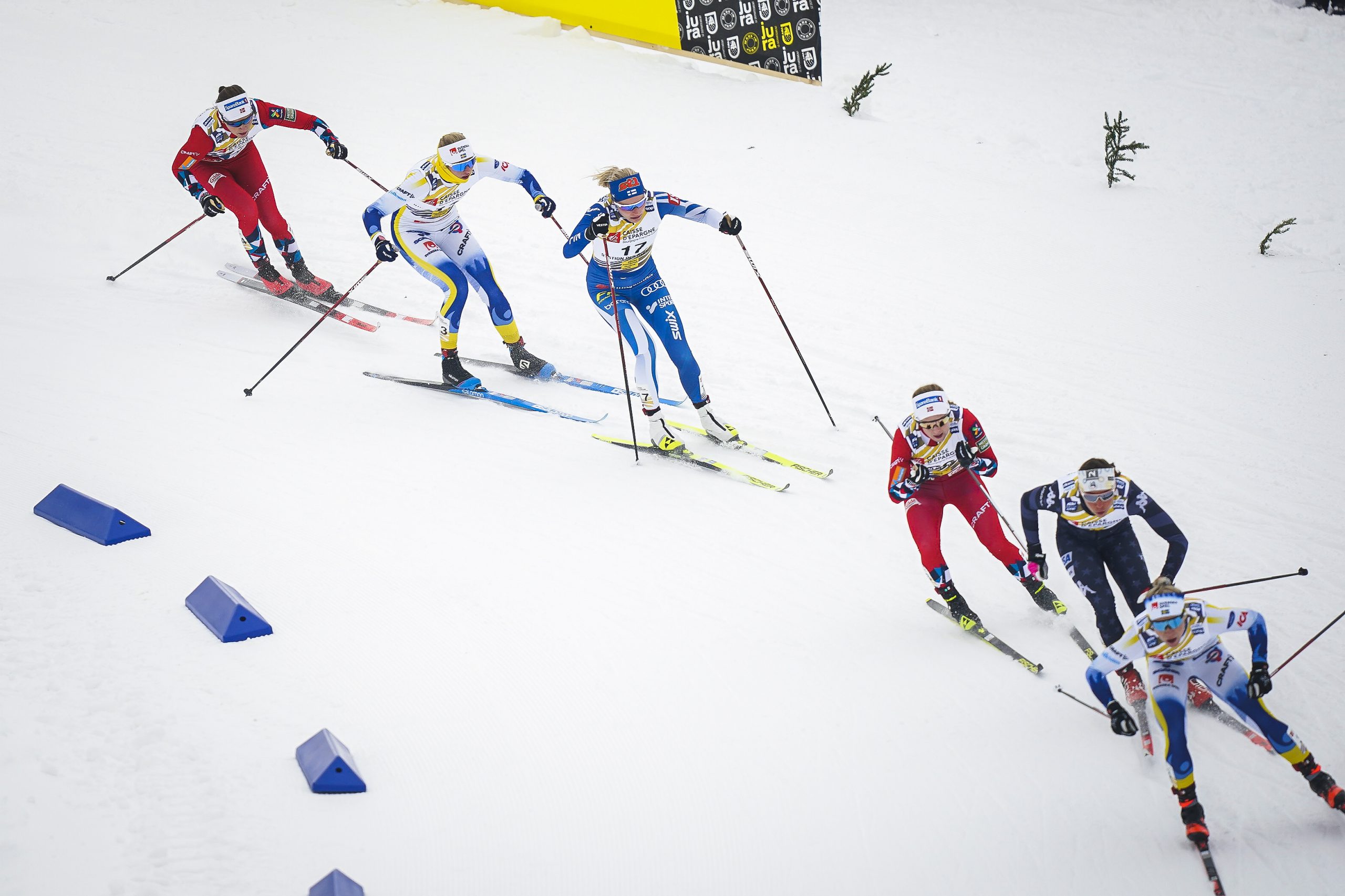
Emma Ribom (SWE), Moa Ilar (SWE), Kerttu Niskanen (FIN), Karoline Simpson-Larsen (NOR), (l-r) lead early in the women’s 20 K Classic Mass Start in Goms, Switzerland. (Photo: Authamayou/NordicFocus)
The sky above the Goms Nordic Centre on Sunday morning had the washed-out look of winter at altitude — pale and reflective. Snow had fallen overnight — not enough to transform the valley, but enough to affect ski behavior. The tracks were glazed in some places and soft in others, offering a surface that challenged kick, balance, and restraint.
This was the third and final race of the last World Cup weekend before the Olympic Games. The final challenge came in the form of a 20-kilometer Classic Mass Start — a distance long enough to punish impatience, short enough to reward precision. In many ways, it felt like a rehearsal, a partial preview of the Olympic 50 k to come, even as two of the discipline’s defining figures — Sweden’s Ebba Andersson and Frida Karlsson — were notably absent.
Fifty-six women started. Not all of them finished. None of them were anonymous by the time the race ended.
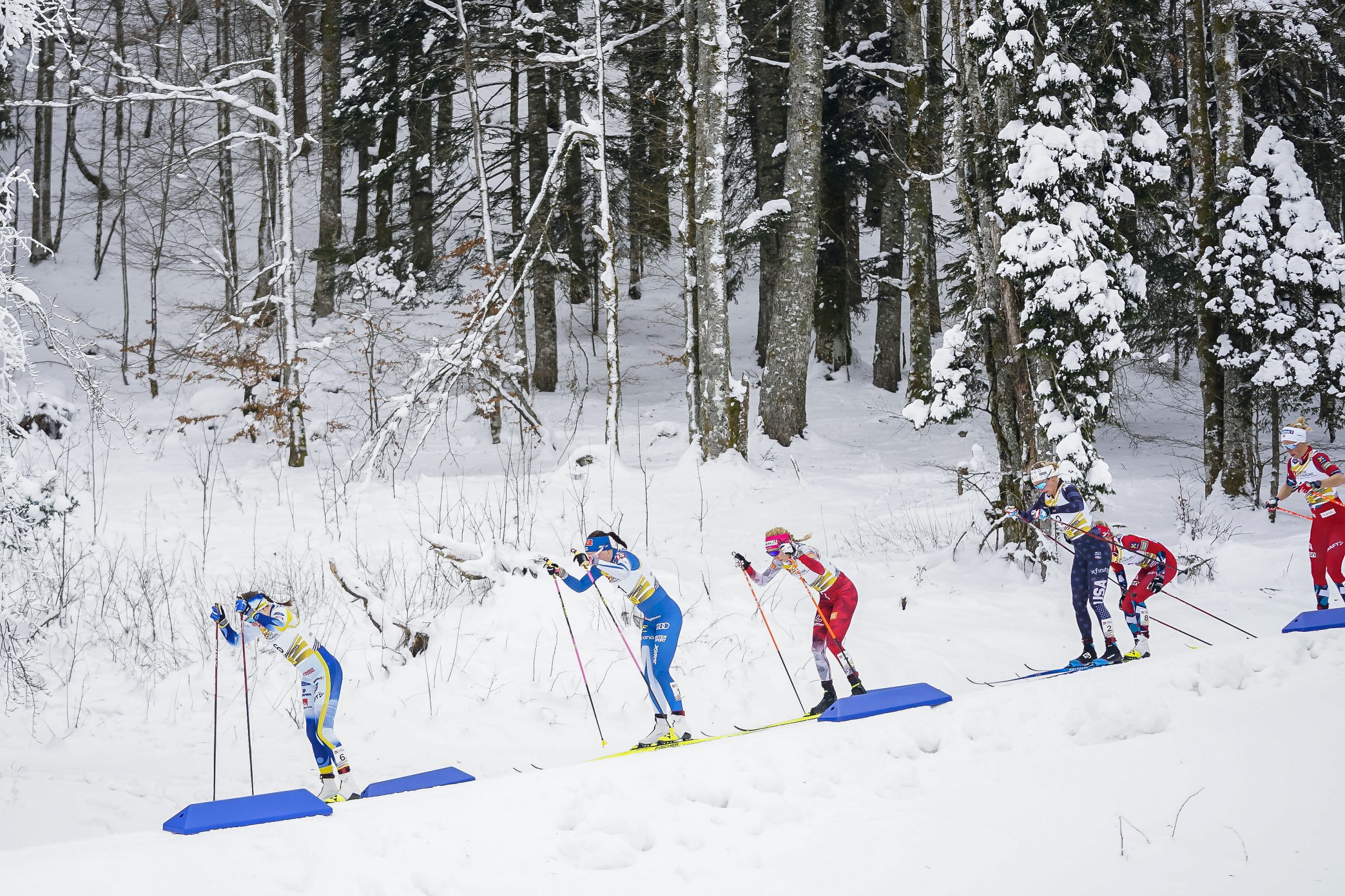
Jessie Diggins (USA) and Astrid Oeyre Slind (NOR), (l-r) got away early in the first lap before being brought back by the chase pack around 6.5 K. (Photo: Authamayou/NordicFocus)
An Early Question — and a Fast Answer
From the opening kilometers, the field confirmed what the course profile had suggested: this would be a race shaped less by outright speed than by rhythm and positioning. Short climbs arrived in quick succession, descents offered only brief relief, and the peloton stretched and compressed like an accordion with every change in gradient.
The first clear question of the day was posed early.
On the opening lap, Norway’s Astrid Øyre Slind moved decisively off the front. Jessie Diggins, wearing bib one and leading both the overall and distance World Cup standings, responded immediately. For a moment, the two skied clear — a clean, purposeful break that suggested collaboration rather than desperation.
The gap grew briefly, then stalled. By roughly 6.5 kilometers, the chase pack — patient, organized, and unwilling to let the race fracture too soon — closed the door. The break dissolved without drama, but not without meaning. The message was clear: separation would be earned later, not gifted early.
Through the first full lap and into the second, the splits told a consistent story. No one was allowed to escape. The front group remained compact, with the top ten separated by only a few seconds at successive checkpoints. Every surge was answered. Every acceleration absorbed.
Karoline Simpson-Larsen (NOR), Dariya Nepryaeva (AIN), Katharina Hennig Dotzler (GER), Johanna Matintalo (FIN), and Kerttu Niskanen (FIN), (l-r) work to bring back Diggins and Slind. (Photo: Authamayou/NordicFocus)
The Long Middle: Where Races Are Actually Won
What followed was the part of mass-start racing that rarely makes highlight reels but defines outcomes: the long middle.
The snow conditions amplified this dynamic. The fresh layer over a firmer base rewarded good kick but punished over-striding. Downhills carried enough draft that working alone was inefficient. On climbs, being out of position meant burning matches simply to stay attached.
Julia Kern spent much of this phase skiing in between packs — strong enough to feel underutilized, cautious enough to avoid overreaching.
Julia Kern (USA) and Tiril Udnes Weng (NOR), (l-r) trying to maintain contact. (Photo: Authamayou/NordicFocus)
“Today’s race was definitely a really hilly one, and not that fast, given the new snow,” Kern said afterward. “The tracks were a bit glazed, but also powder. The techs did a really good job giving us great kick, and I really needed that for how much climbing there was.”
She described a race defined by indecision forced by circumstance rather than confidence.
“I skied a lot of the race kind of stuck in between two packs,” she said. “In the second lap, I wasn’t sure if I should really go with the pack and risk it. I didn’t want to blow up, especially at semi-altitude. It was just hard to say with such a long, slow race.”
When a small bridge attempt formed later in the race, Kern hesitated — not from fear, but from realism.
“It was one of those days where I was feeling stronger than the pack I was skiing in, but not quite sure I could keep up with the pack in front,” she said. “They started to slow down, so it was a little bit of yo-yoing.”
For Kern, the result — 16th — came with clarity rather than frustration. The margins were small, the lessons specific, and the work ahead clearly defined.
Hailey Swirbul (USA) coming up the final climb with teammate Kendall Kramer (USA) slightly behind. (Photo: Authamayou/NordicFocus)
Moving Forward from the Back
If Kern’s race unfolded in the gray area between groups, Novie McCabe and Hailey Swirbul experienced the race from its deepest end.
McCabe started with bib 57. Swirbul with 58. Both expected chaos early — and neither panicked when it arrived.
“I kind of expected the accordion,” McCabe said. “I talked to my tech before the race, and he thought it would be a good idea to stay calm early. When it strung out, that’s when I should try to move up.”
That patience paid dividends. As the field gradually fractured, McCabe began to advance — not in dramatic surges, but in deliberate steps.
“I tried to push up to whoever was ahead, then tuck in and rest,” she said. “Eventually, I got into a good group with Catherine Stewart-Jones and some others. At that point, it was about hanging on a little more.”
The effort came at a cost. McCabe admitted she was suffering late, but also recognized the value of the experience.
“It was nice to have such a good classic skier to ski behind and try to relax in there,” she said.
Swirbul’s approach mirrored that composure, shaped by perspective earned through time away from the sport.
“The start of the race actually didn’t feel stressful to me,” she said. “There’s not much you can do to move up until it breaks up a little bit, so I took that as an opportunity to relax and work into the race.”
She broke the race into manageable pieces.
“I like trying to pick people off in a mass start,” she said. “It helps to focus on closing one gap at a time.”
Swirbul finished 24th, McCabe 22nd — both having moved forward through nearly the entire field.
Samantha Smith (USA), Hailey Swirbul (USA), and Rosie Brennan (USA), (l-r) early on in the women’s 20 K Classic Mass Start in Goms, Switzerland. (Photo: Authamayou/NordicFocus)
Rosie Brennan: The Value of a Steady Day
For Rosie Brennan, Goms was not a race defined by sharp inflection points or dramatic movement through the field. Instead, it was a professional, workmanlike effort — the kind that rarely demands attention but often proves essential when teams begin to think about Olympic lineups, relays, and durability.
Brennan skied much of the race just outside the most active chase groups, navigating the same glazed tracks and punchy climbs that tested everyone else. On a course that punished inefficiency, her race was marked by steadiness rather than volatility. She did not chase moves that would cost more than they offered, nor did she allow the race’s elastic rhythm to pull her into repeated accelerations that would compound fatigue.
In a season where results are scrutinized as much for how they are achieved as where they land, Brennan’s day in Goms served as a reminder of her role within the U.S. program: a veteran presence capable of managing long classic efforts even when conditions and dynamics do not invite heroics.
These are the kinds of races that rarely make headlines — and yet, as part of Olympic preparation, they often matter most.
Kendall Kramer (USA) comes to the line with a top 30. (Photo: Authamayou/NordicFocus)
Kendall Kramer: Learning in Plain Sight
Kendall Kramer’s race unfolded quietly, but not inconsequentially. Still early in her World Cup career and newly named to her first Olympic team, Kramer approached the 20 K Classic as both an examination and an education.
She remained engaged with the race as it evolved, skiing within her limits while absorbing the tactical realities of a mass start at altitude: when the field compresses, when it stretches, and how much energy it costs simply to stay connected on repeated climbs. In a race where early overcommitment was punished and late positioning proved decisive, Kramer’s task was not to force relevance, but to understand it.
Her finish inside the top 30 (27th) reflected a growing familiarity with World Cup distance racing — not yet a statement, but a step. For an athlete still building the physical and tactical base required for races of this length, Goms offered clarity about where the work remains, and confidence that she belongs in the conversation.
Samantha Smith (USA) nears the end of the 20 K in Goms, Switzerland. (Photo: Authamayou/NordicFocus)
Samantha Smith: Building the Long View
For Samantha Smith, the 20 K Classic represented another piece in a longer developmental arc — one that continues to unfold quietly but deliberately.
Smith skied the full distance with control, settling into the rhythm of the race rather than fighting it. In a field that included Olympic medalists, Crystal Globe contenders, and seasoned distance specialists, her goal was not to dictate the race but to measure herself against it. The result reflected that intention: steady pacing, minimal volatility, and a complete performance on a demanding course.
At this stage of her career, races like Goms are less about immediate return and more about accumulation — learning how long classic efforts feel when contested at World Cup intensity, how fatigue presents itself late, and how small tactical decisions compound over 20 kilometers.
Those lessons are not always visible on a results sheet. But they are foundational — and necessary — for what comes next.
Alison Mackie (CAN) continued her strong season as the U23 leader. (Photo: Authamayou/NordicFocus)
The Canadian Women: Depth That Shapes the Race
While the podium fight ultimately played out among familiar names, the Canadian women were far from passive participants in the race’s structure.
Alison Mackie, wearing the under-23 leader’s green bib, skied assertively within the main chase group for much of the race. Starting deeper in the field, she navigated the accordion effect with composure, staying attached as the pace fluctuated and the snow conditions demanded constant adjustment. Her performance reinforced why she has emerged as one of the most promising young distance skiers in the World Cup field.
Katherine Stewart-Jones, meanwhile, played a quieter but equally influential role. Her presence in the chase packs — particularly later in the race — provided both pace and stability. For athletes moving forward from the back, including Novie McCabe and Hailey Swirbul, Stewart-Jones’ classic proficiency offered a valuable reference point, a wheel worth following when the race began to exact its toll.
Together, the Canadian performances underscored a broader truth about modern World Cup distance racing: influence is not limited to podium contenders. Nations with depth — even without a skier contesting the final sprint — shape how races unfold, how packs form, and how energy is spent.
Astrid Oeyre Slind (NOR), Johanna Matintalo (FIN), and Jessie Diggins (USA), (l-r) charge for the podium. (Photo: Authamayou/NordicFocus)
The Final Selection
By the final lap, the race had distilled itself down to a familiar truth: six women remained, and no one else was coming back.
Diggins had conserved. Øyre Slind remained vigilant. Finland’s Johanna Matintalo had been quiet — almost invisible — in the way that often precedes a decisive move.
Diggins knew exactly what she had left, and just as importantly, what she didn’t.
“I knew I was going to need to ride the draft as much as possible and save my energy,” she said. “It’s been a really big training week for me, so I knew I kind of had one shot.”
Her plan was precise.
“I was going to need to launch that move as late as possible, probably on the hill,” she said. “I had amazing kick. Double-poling isn’t quite my strength right now.”
On the final major climb, Diggins moved. So did Øyre Slind. But Matintalo matched them — and crested first.
From there, the race tipped irrevocably. Matintalo exited the climb with speed, controlled the final straight, and claimed her first World Cup victory. Diggins finished second, securing her 77th individual World Cup podium. Øyre Slind followed in third.
Johanna Matintalo (FIN) claims the victory, with Jessie Diggins (USA) second, and Astrid Oeyre Slind (NOR) third. (Photo: Authamayou/NordicFocus)
What It Means Going Forward
This was the final race before the Olympic Games. Diggins left Goms having extended her lead in both the overall and distance World Cup standings. More importantly, she leaves having confirmed — again — that her classic skiing is no longer something she manages, but something she trusts.
“I try not to overthink it,” Diggins said of the looming 50 k. “All you can do is the best you can in the moment with the tools you have that day.”
That sentiment echoed through the U.S. team’s performances — from podium contention to patient rebuilding.
The race in Goms did not offer easy answers. But it did offer honest ones.
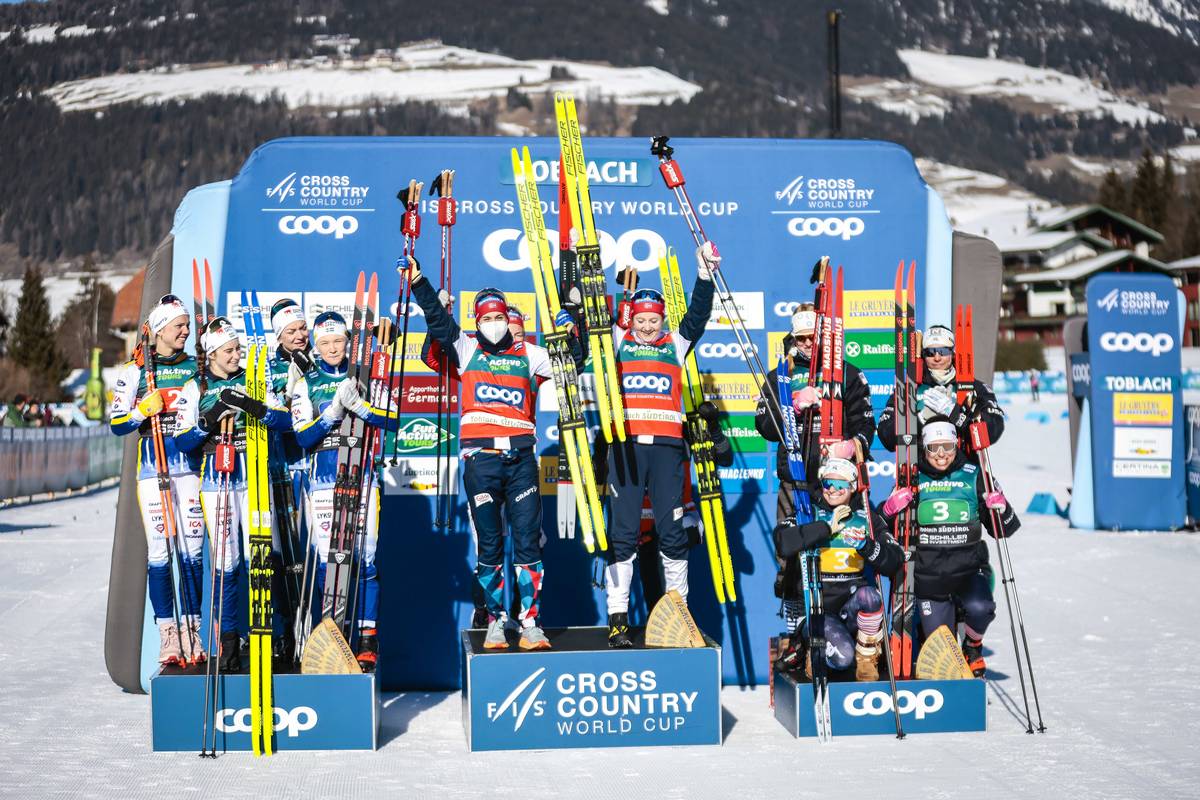
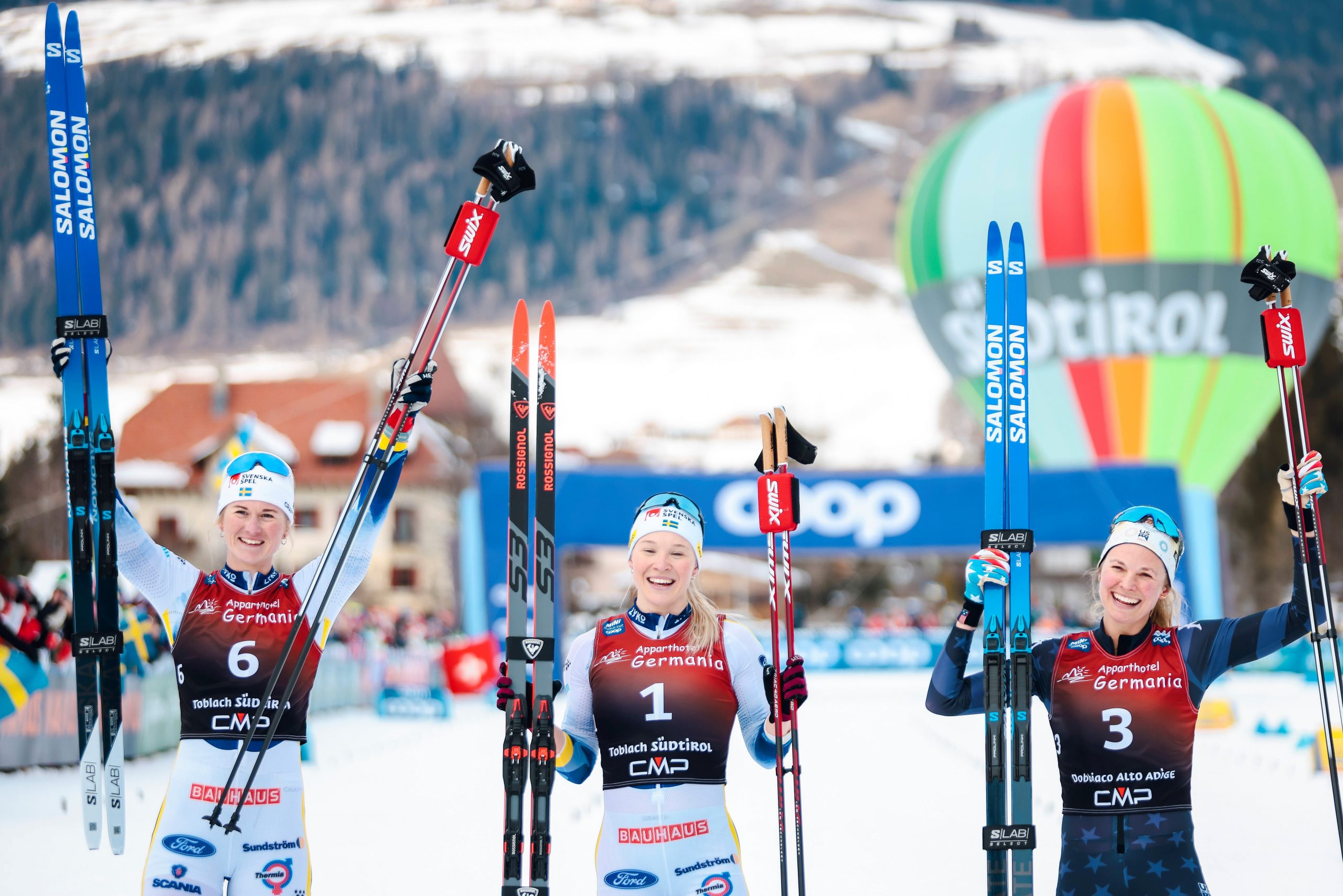
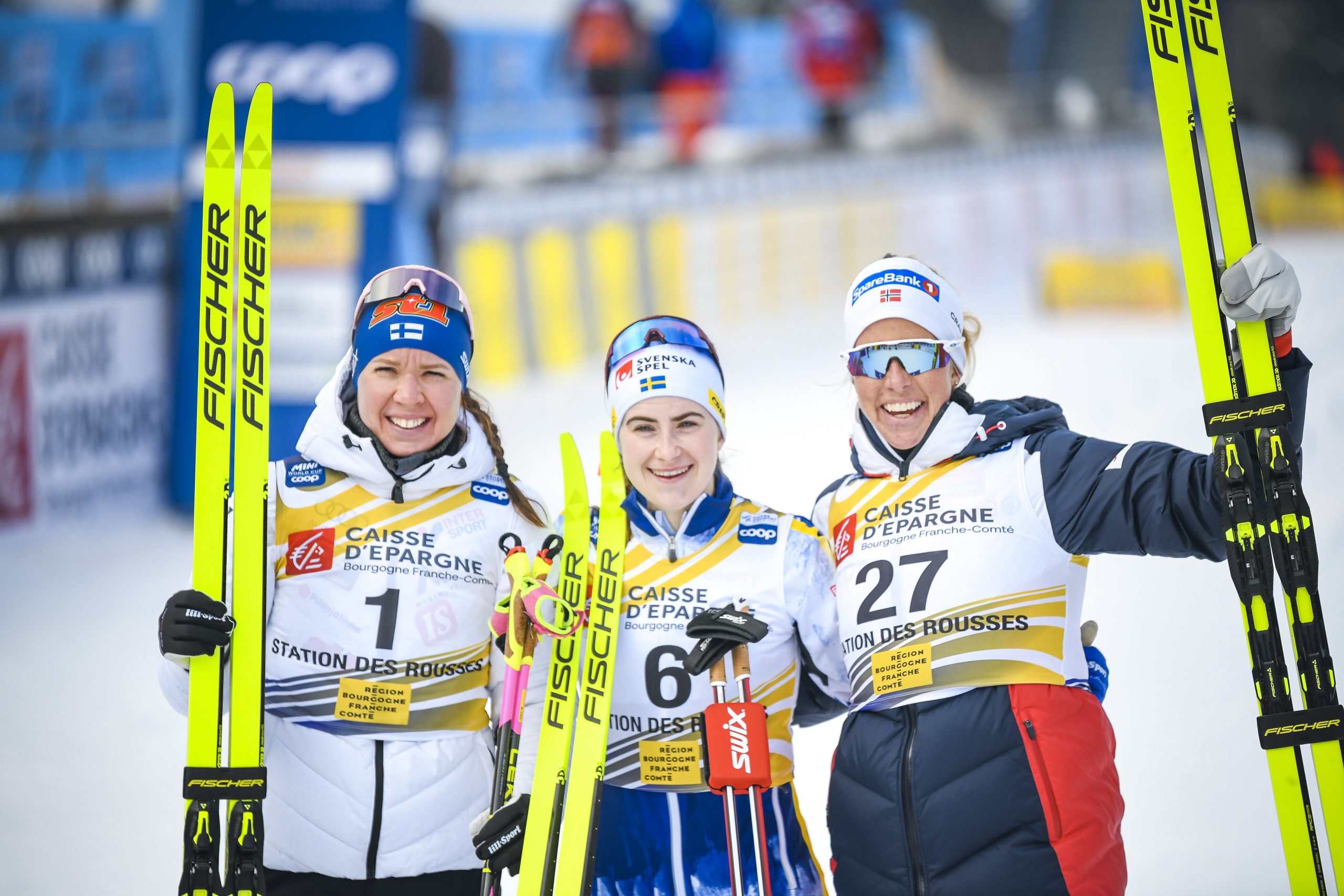
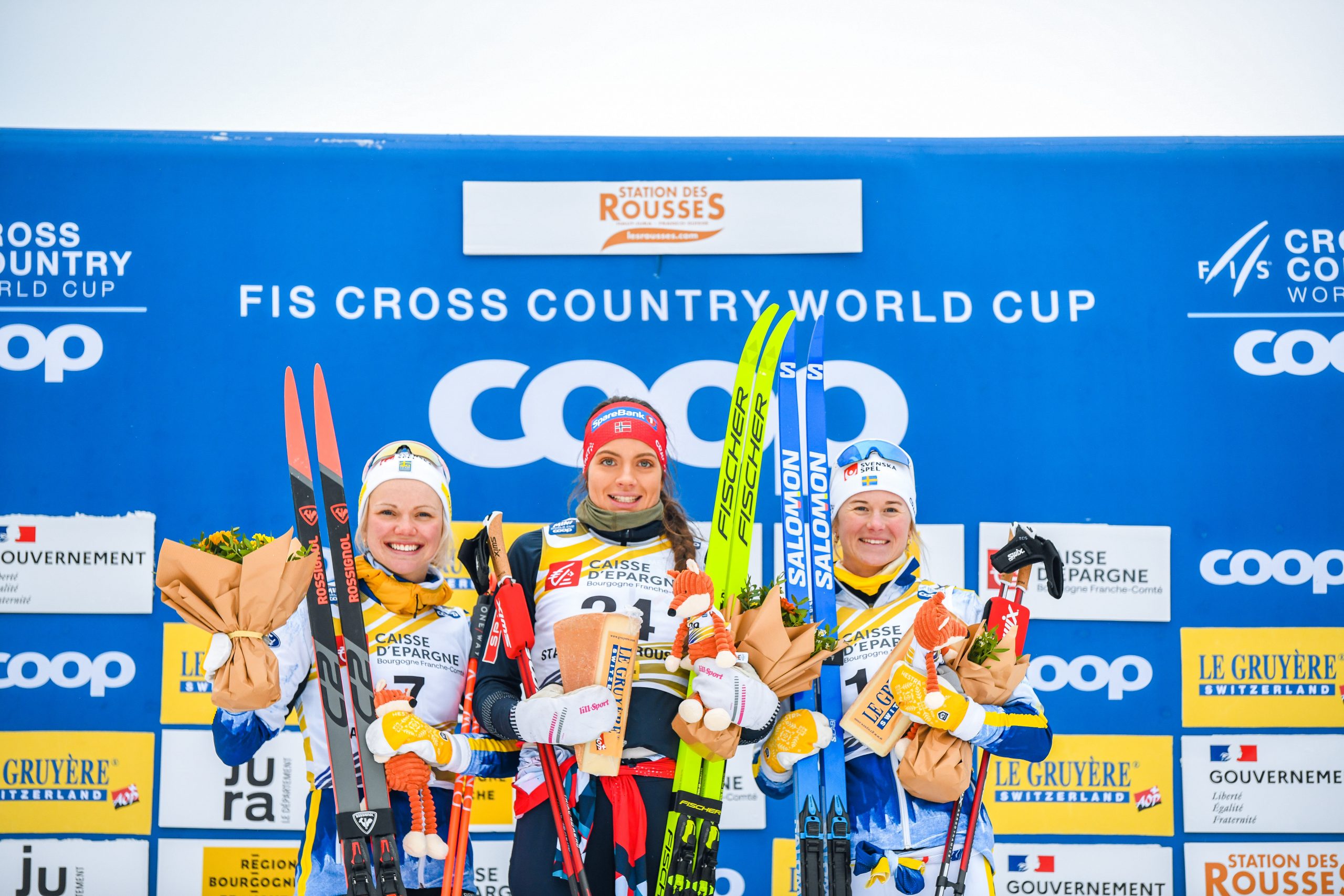
Jessie Diggins (USA), Johanna Matintalo (FIN), and Astrid Oeyre Slind (NOR), (l-r) share the 20 K Classic Mass Start podium in Goms, Switzerland. (Photo: Authamayou/NordicFocus)
A Quiet Confidence
By the time the fog settled back into the valley and the stadium emptied, the course had revealed itself fully. It had rewarded patience. It had punished haste. And it had reminded everyone watching — and skiing — that distance racing rarely announces itself loudly.
The Olympic 50 k will be longer. The stakes will be higher. The margins may be smaller still.
But the questions asked in Goms were the right ones — and the answers, for those willing to listen, were already there.
Goms World Cup Women’s 20 k Classic Mass Start RESULTS
FasterSkier will have our own Nat Herz on the ground at the Olympics. If you value the thoughtful work FasterSkier provides at championships like this one, please consider becoming a Voluntary Subscriber.
This coverage is made possible through the generous support of Marty and Kathy Hall and A Hall Mark of Excellence Award. To learn more about A Hall Mark of Excellence Award, or to learn how you can support FasterSkier’s coverage, please contact info@fasterskier.com.
Moa Ilar (SWE) continued to solidify her position in the chase for the overall World Cup. she stands second, 149 points behind Jessie Diggins (USA). Ironically, the strongest Swedish skiers—and those who will be the strongest contenders for medals in Milano-Cortina—may be Ilar’s teammates who stayed away from Oberhof. (Photo: Authamayou/NordicFocus)
When it comes to World Cup cross-country ski racing, season-long progress can be difficult for spectators and commentators to assess. It’s always hard to tell: are skiers getting faster? Are they fading? Or are they holding steady? This is the time of the season when event results begin to swirl and performances can become confusing. Three weeks from now, when the Olympics begin in Milano-Cortina, today’s winners could find themselves on the podium, or off the back. It’s all about the accuracy of their progression, the physiological and psychological costs of their efforts, their ability to remain healthy, and their commitment to the training peak that comes before the taper. And each skier handles it differently.
Jessie Diggins races . . . that’s what she does. Others rest, others taper, others plan and plot, others pick and choose. Diggins races, a level of every-week race commitment that has decorated her trophy case with three World Cup Crystal Globes. Diggins has said that she doesn’t rely so much on “tapering” for big events as she intends to continue progressing through the races of each successive week. It’s a strategy that has seen her reach extraordinary levels, but not always at the times when she might’ve hoped. Last season, Swedish contenders went home to train and recover in the weeks leading to the World Championshp in Trondheim. It was a successful strategy, as Swedish women—Ebba Andersson, Frida Karlsson, and Jonna Sundling—definitely dominated those events. The Swedes are, once again, back at home in the weeks before the Olympics. It will be fascinating to watch events unfold in the two weeks of Olympic racing. The Swedish strategy may work again . . . but on the days that those races are run, they’ll be forced to deal with the power and the intensity and the will of Jessie Diggins.
Olympic Talk
Much of the media coverage of late has been about Olympic qualification: will Norway continue to make their would-be Olympians jump through hoops? Will the USA consider finishes at US Nationals, rankings in SuperTour, point standings on the World Cup . . . or will coaches exercise discretion in filling the team? Those are interesting discussions—rife with intrigue and opportunity, with aspiration and realization, disappointment and heartbreak—but it’s also a conversation that concentrates more on likely Olympic also-rans, and less on the skiers whom fans really follow. Even in talent-rich Norway, the skiers most likely to claim medals in Milano-Cortina have already been named to the team. Same for Sweden. Same for the USA. The contenders are well known, and their tickets to the Olympics were punched long ago. So while some Olympic hopefuls continue working to climb the rankings toward eventual places on their Olympic teams, the races in Oberhof highlighted the efforts of those who may contend for medals in Milano.
And the Norwegians just keep coming . . . who is this Karoline Groetting getting her first world Cup start in Oberhof? Kristin Austgulen Fosnaes knows: Groetting is the upstart who nearly undid Fosnaes’ hopes of qualifying for an Olympic spot in Milano-Cortina. Fosnaes continued to elevate her profile with a win in the Norwegian National Championships 10 k, potentially paving the way for her naming to the Norwegian Olympic Team. She was followed onto the podium by Groetting who has now placed her name into the running for Olympic Team selections. Fosnaes has been a regular on the roster of the Norwegian Ski Team, but one who has from time to time, been viewed with skepticism by her countrymen, especially after her leaden performance in last season’s World Championship Team Relay in Trondheim all but handed the gold medal to Norway’s arch rival, Sweden. Fosnaes is a fine skier, a skier who would be a franchise player on the national team of nearly any other ski-country in the world. In any other country, Fosnaes would’ve been named to her Olympic Team two months ago. But as a skier competing for Norway, she’s forced to keep racing and racing, always hoping to sufficiently impress the committee that selects the Norwegian Olympic Team. How interesting it is, then, that Fosnaes was not on the starting line today in Oberhof. Either she thinks she’s secured a spot on her Olympic team, or the committee selecting that team has already decided to stop looking at her. Either way, the focus today was on Groetting.
Karoline Groetting (NOR) delivered quite a World Cup debut, leading the field through many of the early checkpoints, and finishing in fifth place on the day. Perhaps more important in her quest to be named to her nation’s Olympic Team, Groetting was the fastest Norwegian finisher in Oberhof. (Photo: Reichert/NordicFocus)
Oberhof 10 k Classic
With the Olympics remaining at the forefront of many contenders imaginations—and with resting for those races becoming a priority for many of those competitors—there were plenty of stars missing from today’s 10 k Classic start list: Finland’s Classic specialist, Kerttu Niskanen, is not on the starting line. Nor are Sweden’s Ebba Andersson or Frida Karlsson, Norwegians Astrid Oeyre Slind, Heidi Weng, Karoline Simpson-Larsen, or Kristin Austgulen Fosnaes (who is still yet to be named to Norway’s Olympic Team).
Chasing an Olympic berth of her own, American Hailey Swirbul was the final starter of the day in Oberhof; she seems to be making the very most of her return to World Cup racing.
“The smiles have been genuine!” beamed Swirbul. “I’m making sure to enjoy this life the most I can (but) I did not enjoy the feelings in the middle of this 10k today though, I won’t lie. I think a lot of us who came from Nationals, straight to international travel, straight to the World Cup were fighting some demons out there. It feels the most challenging, in my opinion, to find the will to keep fighting when your body feels heavy and the suffering feels unrewarding. But that’s also what keeps us coming back: the days where you can keep leaning into the discomfort and be in the fight and be rewarded for it is like no other feeling!”
“I was the last starter today,” Swirbul continued. “So I was getting splits to know where I stood. An interval start race is a unique mind game because you can’t gauge if the imaginary people on front of you are pulling away or starting to fade. You just have to focus on your own race and get around the course as fast as you can, regardless of how others pace. That is easier said than done, especially with higher expectations on the World Cup. I try to remember that I don’t need to do anything that I haven’t done before. I just want to try to race my own race, regardless of the stage it’s on.”
Contenders in Oberhof included Sweden’s Jonna Sundling, Maia Dahlqvist, and Moa Ilar (who is chasing Diggins in the season-long chase for the FIS Crystal Globe), Austria’s Teresa Stadlober, and newly discovered Norwegian phenom, Karoline Groetting. An early starter wearing bib 7, Groetting led the field at many of the early splits, and crossed the finish line with an advantage of 30 seconds over her nearest rival, and 37 seconds over her more famous countrywoman—and long-time national team member—Tiril Udnes Weng. But while Groetting settled into the leader’s chair, the more recognizable contenders began racing: Ilar, Stadlober, Sundling, and Diggins.
Diggins was 15 seconds behind Ilar at the 2.6 kilometer checkpoint. Ilar led again at the 5.8 kilometer mark, coming across 13 seconds ahead of Groetting. At the finish line, Karoline Hennig-Doetzler (GER) challenged Groetting’s time, but fell just six seconds short. Groetting dodged another bullet when Maia Dahlqvist crossed the lone a mere .1 seconds behind Groetting’s finishing time. It was a tremendous finish for Dahlqvist—best known as a sprinter—as she continues to show great form in the approach to Milano-Cortina where she will certainly be a capable partner for Sundling in the Team Sprint event.
It was later revealed that Diggins unusual split times resulted from her suffering quite a dramatic fall when her tip got caught in soft snow at the course’s edge.
“I think that the reason my splits looked a litle funny is that I had a crash on one of the downhill corners. I caught my tip in some really deep sugar, and used my arm as a brake to keep myself from sliding off the course!”
“It was time lost, and it was also a lot of adrenaline lost,” Diggins continued. “But it was honestly a really great practice in mental toughness, in refocusing, my energy and my attention on ‘what can I do in this moment. How well can I ski?’ I’m just really glad that’s really all that the crash was.”
Ilar crossed the finish line with an advantage of 31 seconds over Groetting, but there were still other stars shining brightly out on Oberhof’s Classic course. Stadlober had begun the chase back at 7.6 kilometers when she was still 17 seconds behind Ilar. The gap narrowed to 10 seconds at 9 kilometers, and Stadlober was pouring it on. Over the final kilometer, the Austrian flew in pursuit of the Swede, only to find herself falling short by the narrowest of margins. Ilar would hold on to win by .7 seconds showing that hers is the best Classic skiing form today. Even so, she was surrounded by serious rivals—Stadlober in second, Sundling in third, Diggins in fourth, Groetting in fifth—who may be on their way up.
Rosie Brennan has continued to navigate her return to world-class form. “I’m still living in a day-by-day world, trying to figure everything out,” she said. “I had some really good training at home but have struggled again for the last two weeks. I haven’t been able to discover a pattern, so I truly feel I have no control over when my body is ok and when it isn’t, and now I’ve added some vascular complications to the whole thing. I had to come race this weekend to qualify for the Olympics and I am very pleased to have accomplished that! Now I need to look forward as best I can to the Games and try to prepare as best as possible.
“Erik Flora is over here now,” Brennan continued. “Which will help that process immensely. But overall, it’s been a long year and change of living in an unknown, complicated medical world.”
Brennan would finish the day in 30th, followed by Hailey Swirbul 33rd, Novie McCabe 35th, Alayna Sonnesyn 45th, Sammy Smith 49th, Kendall Kramer 54th. Alison Mackie led her Canadian teammates in 31st, followed by Sonjaa Schmidt 36th, Katherine Stewart-Jones 38th, Amelia Wells 56th.
Now trailing by only 149 points, Ilar trimmed a bit of Diggin’s advantage in the World Cup overall race. And Ilar’s plans for the season? She was quite frank in her response to those asking if she’s going for the World Cup overall win now. “Of course I am,” Ilar smiled.” I would lie if I said anything else!”
And what about the others who stayed home this weekend? We shouldn’t forget the impending return of Andersson, Karlstad, Niskanen, Slind, Weng, and Simpson-Larsen. The plot thickens.
This coverage is made possible through the generous support of Marty and Kathy Hall and A Hall Mark of Excellence Award. To learn more about A Hall Mark of Excellence Award, or to learn how you can support FasterSkier’s coverage, please contact info@fasterskier.com.
Jonna Sundling (SWE) and Laura Gimmler (GER), (l-r) during the heats of the World Cup Freestyle Sprint in Oberhof (GER). (Photo: Authamayou/NordicFocus)
By the time the stadium lights fully took over in Oberhof, the snow had begun to change its mind.
What started as a pliable winter surface—the kind that both softens and creates mistakes—tightened as the temperature dropped, and each pass of a ski left a polished, glistening trail under the lit German night. The Thuringian Forest, quiet by geography but loud by reputation, had settled into one of those evenings that reward certainty. Edges held if you trusted them. Hesitation showed immediately. And in an Olympic season, there was very little room for either.
Saturday’s women’s Freestyle Sprint marked the World Cup’s return after the Tour de Ski, but the pause had not dulled the stakes. For several nations—and particularly for the United States—Oberhof represented the final sprint in the window that matters most for Olympic selection. That context did not announce itself loudly. It rarely does. Instead, it threaded through the day in subtler ways: in heat selection, in how aggressively athletes protected space, and in the quiet tension between racing for today and building the version of yourself you’ll need in February.
At the front, the results followed familiar lines. Jonna Sundling (SWE) qualified near the top and then won every round she entered, finishing the job decisively for her 15th individual World Cup victory. Coletta Rydzek (GER), fed by a home crowd that never stopped leaning forward, closed hard for second. Maja Dahlqvist (SWE) completed the podium in third, another entry in Sweden’s sprint abundance—a luxury that, paradoxically, can complicate Olympic selection rather than simplify it.
But Oberhof was not only about dominance. It was about positioning, intent, and the quieter victories that occur well outside the top three—where a season can tilt not with a trophy, but with a single, well-timed decision in a quarterfinal.
Hailey Swirbul (USA) take the first corner during her quarterfinal in Oberhof (GER). (Photo: Authamayou/NordicFocus)
A Course That Punishes Drift
Oberhof’s sprint course is deceptive in its simplicity: an out-and-back layout, one major climb, a technical descent, and a finishing stretch that arrives already under load. What separates it from more straightforward sprint venues is how early it demands decisions. The opening stretch funnels athletes into a tight corner almost immediately, compressing the field before it has a chance to stretch. The central climb—long, steep, and increasingly rutted and churned as the day progresses—forces skiers to declare themselves sooner than they might like.
There is little room to hide here. Miss the first corner, and you’re fighting for oxygen before the race has found its rhythm. Drift into the wrong line on the climb, and the surface punishes you. Get boxed entering the final turn, and momentum disappears instantly. Oberhof rewards skiers who are decisive without being reckless, aggressive without being impatient.
Those dynamics shaped the day for the Americans in distinctly different ways, producing four very different American stories inside the heats—plus one clarifying, unfortunate footnote that mattered for selection math and for morale: Alayna Sonnesyn (USA) did start, but crashed and did not finish.
Jessie Diggins (USA) during qualification in the World Cup Freestyle Sprint in Oberhof (GER). (Photo: Authamayou/NordicFocus)
Before the Racing: Compassion, and a Reminder Not to “Try Harder”
On paper, the Olympic selection criteria reads like a legal document—because, in many ways, it is one. It is also, inevitably, a psychological environment: a room everyone lives in, even when no one speaks about it.
U.S. Head Coach Matt Whitcomb described the team’s internal emphasis heading into Oberhof in terms that had nothing to do with points or spreadsheets.
The first message, he said, was simple: have compassion—for yourself and for your teammates.
“This is a stressful job,” Whitcomb said. Some athletes may feel safely “inside” the team; others may feel perched on the edge; others may already feel disappointment. And the team, he stressed, needs to remember that everyone is absorbing the same pressure in different ways. “Read the room,” he said, especially if you have a great race—take care of each other through a stressful period.
His second point was the one that, in a sprint weekend like this, can save an athlete from the most common selection-week mistake: mistaking urgency for a new identity.
Because “this may be one’s last opportunity,” Whitcomb said, it’s tempting to believe you can manufacture something extra—try harder, ski differently, do something dramatic. But that instinct is usually the trap.
“You can’t try something dramatically different,” he said. “What you have to do… is you ski the way that got you here.”
In Oberhof, Whitcomb felt the athletes largely did that. The plans were executed; warm-ups and routines stayed intact. “We qualified a bunch of people,” he said. The day simply didn’t convert into the results they wanted.
That, too, is sprinting: sometimes you do many things right, and the course—plus the speed of the other nations—still asks for more.
Jessie Diggins (USA) during qualification in the World Cup Freestyle Sprint in Oberhof (GER). (Photo: Authamayou/NordicFocus)
Racing as Training: Jessie Diggins
For Jessie Diggins (USA), Oberhof was never meant to stand alone.
Coming off the Tour de Ski, Diggins framed this weekend not as a test of peak form, but as a carefully placed piece of a longer arc: racing as a training stimulus, not a destination.
“Essentially, I’m using these races as training stimulus,” Diggins said. “It’s a chance to get more reps—working on the tactics, working on communication, just working on all the little things that you really can’t practice any other way unless you’re racing World Cup.”
That philosophy has long guided Diggins’ career. She has rarely spoken about “peaking” the way outsiders want athletes to: as a clean line on a calendar, a simple on/off switch. For her, form is something you keep building in public, in the only environment where it truly exists—under the clock, in contact, with consequence.
“So [I’m] keeping the training load really quite high,” she explained, “but just recovering enough that I can still punch some hard race efforts and have that be part of the training and the lead-up. And for me, that’s always been a really important thing.”
She added a line that sounds like personal preference until you watch her career and realize it’s closer to a blueprint: “I think I race well when I am racing pretty often. I might not do every single race, but just enough that I feel like I’m using them as a really helpful part of my lead-up.”
Diggins’ day ended in the quarterfinals—13th overall on the official results sheet. But that early exit doesn’t necessarily conflict with the way she described the weekend. In an Olympic season defined less by accumulation than timing, Diggins tends to measure progress in subtler signals than finish position: how quickly the body responds, how efficiently it recovers, whether the details are sharpening rather than dulling.
Oberhof, in that sense, fits neatly into the plan. Not every race has to be a verdict. Some are simply data—hard efforts taken at speed, recorded by the body, filed away for February.
Samantha Smith (USA) during qualification in the World Cup Freestyle Sprint in Oberhof (GER). (Photo: Authamayou/NordicFocus)
A Wild Arc, Embraced: Samantha Smith
If Diggins arrived in Oberhof as a veteran calibrating form, Samantha Smith (USA) arrived by a far less conventional route—one that still feels almost implausible when you say it out loud.
The last couple of months, Smith said, have been “wild.” She helped Stanford reach the NCAA soccer final. She put her skis on for the first time this season in December. She raced into shape at U.S. Nationals. And suddenly, she was back on a World Cup start line—aware of the stakes, but determined not to let the stakes steal the experience.
“I’m so grateful for the opportunities that I’ve had,” Smith said. “To have a chance to play for Stanford has been such an incredible journey… and now to be back skiing, it feels great to be out here and competing with everyone.”
Smith kept returning to the same theme: presence. She likes the work itself—the daily process—whether it’s skis or soccer.
“I really enjoy the process,” she said. “I love to train, I love to race, I love to play soccer games. So [I’ve] just been trying to focus on enjoying every moment… embracing the opportunities that I have and just trying to be very present.”
That presence mattered on a day when nerves were unavoidable.
“Coming in today, I was definitely nervous,” Smith said. “I feel like the first World Cup races of the year are a bit nerve-wracking, especially when you haven’t had a ton of time on snow or a ton of opportunities to really gauge fitness.”
So she narrowed her goals to what she could actually execute: ski clean; work transitions; be diligent in the “working sections” where Oberhof can hand you time or take it away quietly.
“I didn’t really have an outcome goal,” she said. “It was just to ski hard, do what I could, and if I got into heats, to really compete.”
And then, in her quarterfinal, came the moment that extended her day—and changed, materially, what this weekend could mean.
Smith described herself as not being in the position she wanted over the first big hill. She could see the risk: that the heat would compress into a pure sprint finish, where you either have the lane or you don’t. And then—briefly—she did.
“Into the last climb before the finish, I saw a window on the inside,” Smith said. “I saw the space open up, and I just tried to take it. To be honest, I wasn’t really expecting that it was going to open up.”
It did. She went. And she made the move that sprint racing requires: the one that looks obvious in replay and feels like a gamble in real time.
“I was worried it was going to come down to a complete sprint finish at the end,” she said, “but I think I got pretty lucky… There was a bit of open space, and I was able to make my way up.”
The reward was tangible: Smith advanced to the semifinals and finished 12th overall. Just as important—at least in the language of selection criteria—she also climbed to 42nd on the women’s Sprint World Cup standings after Oberhof.
In a season where criteria can hinge on ranking thresholds, that is not a small detail. It is the kind that turns a good day into a consequential one.
Whitcomb’s reaction captured the strange emotional geometry of selection weekends: elation, paired with an awareness that someone else is hurting.
“We’re absolutely ecstatic with Sammy,” he said—and then, almost immediately, he acknowledged the other side of it: “It’s always bittersweet because on literally every race I’ve ever been to, there have been people that have good races and then people that are really disappointed.”
In sprinting, the margins are often only a few meters. In Olympic selection, those meters can echo.
Hailey Swirbul (USA) during qualification in the World Cup Freestyle Sprint in Oberhof (GER). (Photo: Authamayou/NordicFocus)
Joy Without Illusion: Hailey Swirbul
For Hailey Swirbul (USA), the day began with something rarer than confidence: uncomplicated joy.
“I was genuinely excited just to be back racing and to make the rounds today,” Swirbul said. “It felt like a treat. Honestly, I wasn’t expecting it. I was hopeful that I might have that opportunity, but getting to be in the heats was really fun.”
What stood out wasn’t that she smiled—it was why.
“My smiles were genuine out there,” she said, “and I felt an excitement and joy to get to be part of it, rather than a fear or pressure… to live up to some expectation that I might set for myself.”
Swirbul approached qualifying with a clear-eyed strategy built around her own technical history. She identified the steep jump-skating (V1) section that had dominated the day’s conversation and made a choice.
“There’s a lot of pressure, a lot of expectation around that steep V1 hill in the middle of the course,” she said, “and that’s just historically not my strength… I felt like I was able to do the working sections well.”
The plan worked. She advanced into the heats and finished 22nd overall.
In the quarterfinal, the course delivered its blunt lesson: once you lose contact, you often don’t get it back.
“I maybe tried to ski my own race a little too much,” Swirbul said. “Once you’re off the main pack, it’s really hard to get back on… I was excited to have a strong finish… but it’s just not enough at this level.”
The sentence contains both honesty and optimism—because Swirbul wasn’t treating Saturday as an endpoint. She was treating it as preparation for what, in her case, may be the weekend’s more natural opportunity: Sunday’s 10-kilometer classic interval start.
“I’m excited—really looking forward to the classic 10 k tomorrow,” she said. “I’ve had a couple of good ones this year, so [I] hope I can keep the momentum going.”
And then she said something that explains why so many distance skiers quietly enjoy sprinting before a 10 k: it’s a way to wake the system up.
“I do actually really like racing a sprint, especially a qualifier plus a quarter right before a 10 k,” she said. “I think that’s kind of ideal race prep for 10 k. So I’m hoping that can help power me through tomorrow’s race.”
Swirbul’s mindset for Sunday, she said, would be built on a simple distinction: what she can control, and what she can’t.
“Every course and every day has so many variables… out of my control,” she said. “So I just want to try to control what I can and do my best at those things.”
It’s a professional skier’s sentence. It’s also, in an Olympic season, a survival skill.
Lauren Jortberg (USA) during qualification in the World Cup Freestyle Sprint in Oberhof (GER). (Photo: Authamayou/NordicFocus)
Boldness, Not Regret: Lauren Jortberg
Lauren Jortberg (USA) did not set out to lead her quarterfinal. It happened anyway, fast and almost accidentally—the kind of start that changes your entire heat because it changes your options.
“I took control early… wasn’t necessarily on purpose,” Jortberg said. “I just had a really fast start, and there’s a big corner right away, so I wanted to have good positioning there.”
She connected that early positioning to what she sees as a strength: the major climbs. In Oberhof, you don’t get to drift into those climbs. You arrive either with space or without it.
“I wanted… good positioning for the major climbs,” she said. “I feel like that’s one of my strengths.”
Late in the heat, the day turned on a familiar sprint mechanism: contact and congestion at exactly the wrong time.
“I got a bit of a tangle… into the final turn,” Jortberg said. “I lost all my speed there.”
Importantly, she rejected the clean narrative that would blame her early assertiveness for the late cost.
“I don’t necessarily think that leading… came at a cost,” she said. “I just think… I lost all my speed when we got tangled.”
And then she said what, in an Olympic-selection sprint, many athletes think, but not all athletes will say out loud: she did not come to Oberhof to hide.
“With the Olympic implications, I don’t really want to sit in the back and just chill,” Jortberg said. “That’s not really how I like to race heats.”
She described her approach as an attempt to avoid the passive sprint fate: getting boxed in, stuck behind, hoping someone else would make a mistake.
“I just really want to try to ski well,” she said. “At least [I] tried to move… and try to ski my best out there rather than just… getting boxed.”
Jortberg finished 29th overall. But what she took from the day was not despair—it was proof of belonging.
“A lot of my confidence is just knowing that I really can ski with these women who are really strong,” she said. “That’s important for confidence moving forward.”
Even in a heat that didn’t break her way, she will leave Oberhof with something World Cup weekends can either confirm or erase: the belief that she belongs on this stage.
Maja Dahlqvist (SWE), Jonna Sundling (SWE) and Iris De Martin Pinter (ITA), get set to start their semifinal in the Freestyle Sprint in Oberhof (GER). (Photo: Authamayou/NordicFocus)
The Final, and the Moment That Changed It
The women’s final unfolded at speed—and then, briefly, at the mercy of chance.
Sundling drove the pace as expected, forcing the field into single-file. Dahlqvist tracked smoothly. Rydzek hovered, patient and dangerous. Behind them, Iris De Martin Pinter (ITA) skied with poise well beyond her years, positioned to contend.
And then she wasn’t.
De Martin Pinter fell, fracturing the race at the worst possible moment—the kind of incident sprinting produces with brutal efficiency. Sundling’s growing gap became decisive. In a course that rewards momentum and punishes disruption, the fall functioned like a door closing: abruptly, unfairly, and permanently.
Sundling closed the remaining distance with authority. Rydzek surged for second. Dahlqvist held on for third.
Jessie Diggins (USA), Hilla Niemela (FIN), Nicole Monsorno (ITA), Milla Andreassen (NOR), Samantha Smith (USA), Alina Meier (SUI), (l-r) come around the first corner of their quarterfinal. (Photo: Authamayou/NordicFocus)
Skis, Speed, and the Truth You Can See on a Downhill
No sprint weekend exists in a vacuum. Equipment matters, and in Oberhof, that reality was visible in the most unforgiving place: the downhills where small gaps become facts.
Whitcomb, careful about specifics because he had not yet been fully able to review the race video, acknowledged what many observers sensed: the U.S. skis were close, but not quite at the level of the very best nations on the day.
“I think that’s a safe and fair assessment,” Whitcomb said. He emphasized that the team was competitive—but in sprinting, “competitive” is often not enough.
“You need the best skis to go up against other teams that have the best skis,” he said, citing nations that, on this day, appeared to have exceptional speed.
It’s the part of sprinting that can feel cruelest to athletes: you can execute your plan, hit your cues, make good tactical decisions—and still watch a gap open on a downhill you skied correctly. In Oberhof, where the course magnifies drift, ski speed is not a luxury. It is oxygen.
Samantha Smith (USA) for the first time advanced into the semifinals in the World Cup sprint in Oberhof (GER). (Photo: Authamayou/NordicFocus)
Selection Without Ceremony
For the United States, day one in Oberhof didn’t resolve Olympic selection questions. It narrowed them.
U.S. Ski & Snowboard’s selection language ties nomination, in part, to World Cup standings thresholds, with specific mention of Top 50 (or Top 45 under certain conditions) in the Sprint or Distance World Cup standings on January 18, 2026.
Inside that structure, Saturday’s most significant American movement belonged to Smith.
With her semifinal, she, in just one World Cup race, vaulted to 42nd in the Sprint World Cup standings. That is the kind of number that changes the texture of a season, because it moves her into the zone where the objective criteria has been met.
The other Americans’ days mattered in quieter ways. Diggins stayed on her February-focused arc, treating racing as stimulus and sharpening. Swirbul used the sprint as both a joyful return to the rounds and a deliberate set-up for Sunday’s classic 10k, a race she believes suits her. Jortberg confirmed her willingness to race with intent rather than hide from consequence, even when the margin for error is razor-thin.
And Sonnesyn’s crash—real, abrupt, and emotionally expensive—served as a reminder that selection seasons do not always give you clean data. Sometimes they give you a fall, a DNF, and the long work of resetting.
Jonna Sundling (SWE) comes to the line for the win in the finals. (Photo: Authamayou/NordicFocus)
What Remains
By nightfall, the snow had hardened completely. The course no longer absorbed uncertainty. It reflected it.
Some athletes left with podiums. Others left with confirmation, calibration, or unfinished business. In an Olympic winter, not every race is meant to answer questions outright. Some exist to refine them—to strip them down to what actually matters.
Whitcomb’s framing, in that light, felt less like a coach’s speech and more like a survival manual for the next month: be compassionate; don’t weaponize the criteria against each other; and when the moment arrives, resist the temptation to become someone new out of panic.
You can’t “try harder” into an Olympic team. You can only ski the way that got you here—cleanly, boldly, and with enough self-trust to hold your line when the window opens.
In Oberhof, Samantha Smith did exactly that. And for one night in the German cold, that single choice—one inside lane, one late move—was the difference between a good day and a consequential one.
Feature stories like this one take time, access, and care to produce. If you value thoughtful storytelling and independent ski journalism, please consider becoming a Voluntary Subscriber. Your support directly fuels the work we do to cover the people, places, and moments that make our sport special.
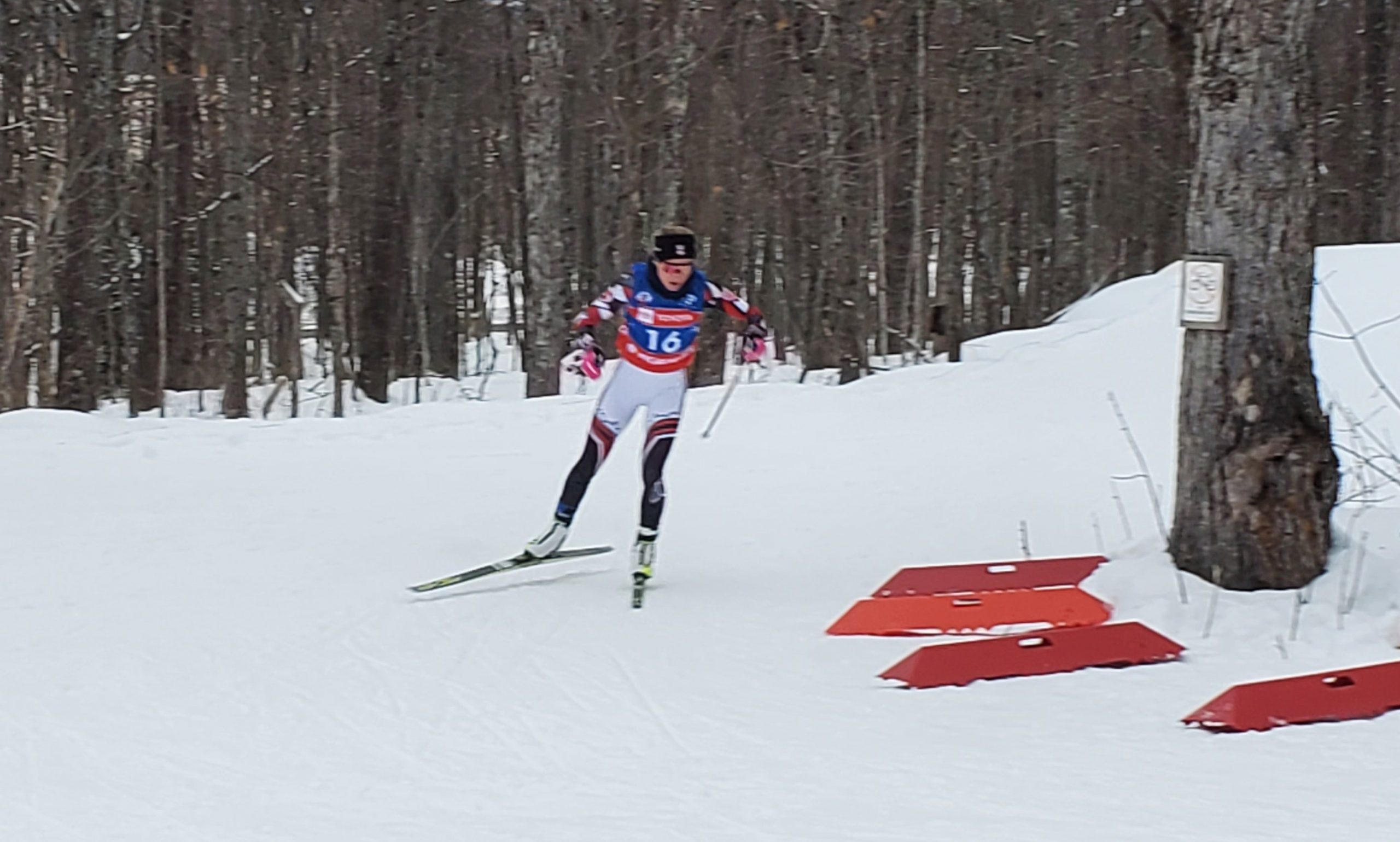
Sofia Pedersen (UU) and Samantha Smith (SVSEF) lead the first quarterfinal out onto the course at the start of the heats. (Photo: Nancie Battaglia)
On the morning of the women’s classic sprint at the U.S. National Cross-Country Ski Championships, the quiet around Mt. Van Hoevenberg felt deliberate.
Not calm — no one was calm by Friday — but restrained. The week had already taken its toll. Distance races had piled fatigue into legs and minds alike, and no one arrived at the sprint believing freshness would be part of the equation. What remained, instead, was clarity: the understanding that in an Olympic winter, the most important racing of the day would happen before the heats ever began.
“It definitely started the day tired,” Ava Thurston said. “But I was trying to just remind myself that everyone was feeling that way. Most people had raced two, if not three, of the races, and we’re all coming in in a similar place.”
That recognition — that fatigue was universal — became the baseline. The differentiator would be execution.
For the women with Olympic aspirations, the classic sprint qualifier was no formality or warm-up. It was the argument itself. The U.S. selection process, quietly but decisively, has elevated qualification speed to the top of the sprint hierarchy. Heats matter, but only if you earn the right to be in them. On Friday in Lake Placid, no one confused the order of importance.
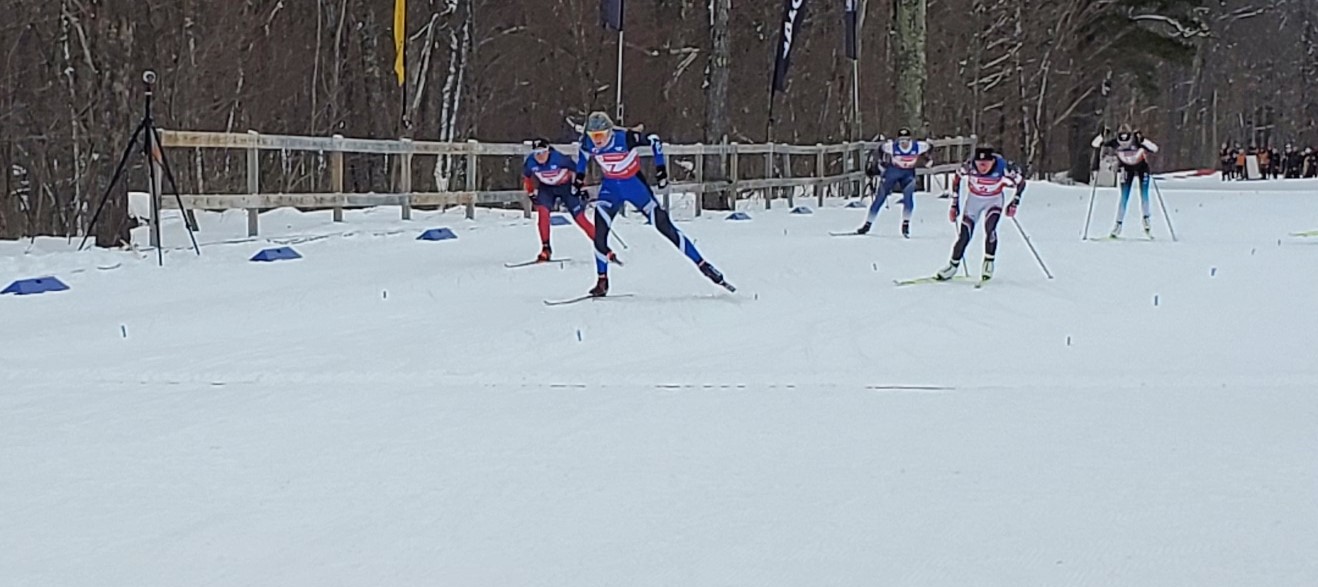
Sofia Pedersen (UU) and Samantha Smith (SVSEF) get the action started in the quarterfinals. (Photo: Nancie Battaglia)
Carrying the Week
By the time the women clipped in for qualification, the week was already present in their legs.
After Thursday’s 20-kilometer race, Sammantha Smith felt that accumulation acutely — and honestly. “After the 20 k, I was definitely feeling the fatigue and accumulation of all the racing throughout the week,” she said. “I know I’m more of a sprinter, but obviously, I was still hoping to perform well in the 20k, so I was not thrilled with the race.”
Rather than letting that disappointment linger, Smith pivoted quickly. “I tried to quickly put it behind me and get ready for some classic sprinting,” she said. “My goal for the day was to focus on skiing a clean qualifier and ski to my strengths.”
Hailey Swirbul arrived at the start line with similar fatigue — and a similar refusal to let it define the day. “Today, I definitely felt a little tired this morning warming up compared to the other races after a hard 20 k effort,” she said. “But so was everybody else dealing with that same.”
For Swirbul, there was anticipation as well. “I was really excited to get to finish this week off with a classic race,” she said. “I just love classic skiing. I think it’s such an art, and I really appreciate the finesse that is needed to be able to make skis kick well.”
Thurston framed the day with a different emphasis — joy rather than pressure. “It had been a great week so far,” she said, “so I was excited to get to go fast and run up that big hill.”
Different approaches, same reality: the sprint would reveal who could still make good decisions under fatigue.
Samantha Smith (SVSEF) commanded the Classic Sprint day from start to finish just like she had done in the Freestyle Sprint. (Photo: Nancie Battaglia)
Qualification: Where the Day Was Decided
When the women dropped into the qualifier, the course made its judgment quickly and without theatrics.
Smith’s run stood apart immediately. She won the qualification by more than six seconds — not by forcing the issue, but by skiing exactly the race she had planned. “It was my first classic sprint of the year, so I didn’t really have too many expectations,” she said. “But I was hoping for a strong result.”
What made the result significant wasn’t just the margin — it was the trajectory behind it. “Up until last season, I think there was a noticeable gap between my skate and classic sprinting,” Smith explained. “But the last few years I’ve really prioritized working on getting my classic sprint to a place I’m happy with.”
That work showed. In an Olympic winter, qualification speed isn’t just about advancing — it’s about relevance. Smith’s time didn’t merely put her safely through; it reframed the sprint conversation.
Behind her, two performances raised equally important questions.
Swirbul and Thurston — both known primarily for their distance strength — delivered qualification runs that demanded attention. In a format that strips away drafting, tactics, and protection, they showed they belonged in the sprint conversation on pure speed.
“I didn’t set out to make a statement this week,” Swirbul said. “I just wanted to show up and try to race my best and see where that landed me.”
For selectors, where it landed mattered.
Quarterfinal 4 trying to find their space and line around the U-turn on the sprint course in Lake Placid. (Photo: Nancie Battaglia)
A Day That Wouldn’t Sit Still
As the day progressed, conditions refused to settle. Snow softened. Moisture crept in. Wind shifted. Ski choices that worked in the morning became liabilities by afternoon.
“The waxing team today was absolute heroes,” Swirbul said. “They were out until the wee hours of the morning, waxing late last night and woke up for a super early morning today for a classic day with really gnarly conditions.”
Adaptability became a skill equal to speed. “I raced on totally different skis from the qualifier to the heats,” Swirbul said. “And even in the heats, I had a couple of changes to my kick in between the rounds because our conditions were continuing to change.”
Smith faced the same puzzle. “In my quarter and semi-final I was actually icing up a bit and too grabby on kick as the snow got wetter,” she said. “My coaches ended up stripping a lot of the kick to bring back some of the glide for the final.”
The goal, she explained, was precision rather than excess. “The main thing was to try to have just enough kick to get up the hills but not so much that it was draggy for the double pole or downhills.”
Thurston made a strategic choice early — prioritizing glide over grip. “I ended up going with the pair that had a little more glide for the downhill finish,” she said, “just because I wanted to be able to hang with people rather than having that extra kick on the hill.”
Three athletes, three solutions, same underlying demand: bend, don’t break.
Lauren Jortberg (CNEPH)leads semi-final 1 out of the starting stretch. (Photo: Nancie Battaglia)
Heats: Confirmation, Not Reinvention
By the time the heats began, the hierarchy established in qualification largely held — and that, too, carried meaning.
Smith moved through the rounds with patience and control, never forcing a moment unnecessarily. Swirbul sharpened as the day progressed, her adjustments paying dividends. Thurston continued to ski within herself, staying connected and opportunistic.
For Thurston, the day reinforced something larger than a single result. “What it kind of said to me was that I can be really consistent,” she said, “and I’m also a strong all-around skier.”
That consistency — across multiple races, formats, and conditions — is currency in an Olympic year.
The women’s final gets started on the last day of racing at the 2026 US National Cross-Country Ski Championships at Mt Van Hoevenberg. (Photo: Nancie Battaglia)
The Final: Execution, Not Emotion
The women’s final unfolded cleanly and decisively.
Smith took control early, extending her advantage where momentum mattered most. The ski changes made before the final were immediately evident. She crossed the line as U.S. National Champion in the classic sprint, completing a sweep of the week’s sprint events.
Behind her, Swirbul claimed second, a reward for adaptability and composure. Thurston rounded out the podium, another affirmation of her ability to race fast across disciplines.
For Smith, the result was about more than placement. “I hope people see that I love to race,” she said. “I love to compete and push myself, and I always leave everything I have out on the course.”
Everyone was deserving of a helping hand up after a full week of racing at the US National Cross-Country Ski Championships at Mt Van Hoevenberg. (Photo: Nancie Battaglia)
What the Race Clarified
Nationals does not select Olympic teams outright, but it argues persuasively — and the women’s classic sprint in Lake Placid made its case clearly.
Smith’s qualification speed, combined with her technical development in the classic sprint, strengthened her position at precisely the right moment. Swirbul’s performance underscored versatility and poise under changing conditions. Thurston’s podium reinforced consistency and all-around strength.
“I’m really happy with how this week went,” Swirbul said. “And looking forward to figuring out where the rest of the season goes.”
Thurston echoed that momentum. “This week was so, so awesome,” she said. “I’m excited to keep racing.”
The arguments weren’t loud. They didn’t need to be. On a tired Friday at Mt. Van Hoevenberg, they were made the way Olympic cases often are — quietly, cleanly, and against the clock.
Feature stories like this one take time, access, and care to produce. If you value thoughtful storytelling and independent ski journalism, please consider becoming a Voluntary Subscriber. Your support directly fuels the work we do to cover the people, places, and moments that make our sport special.
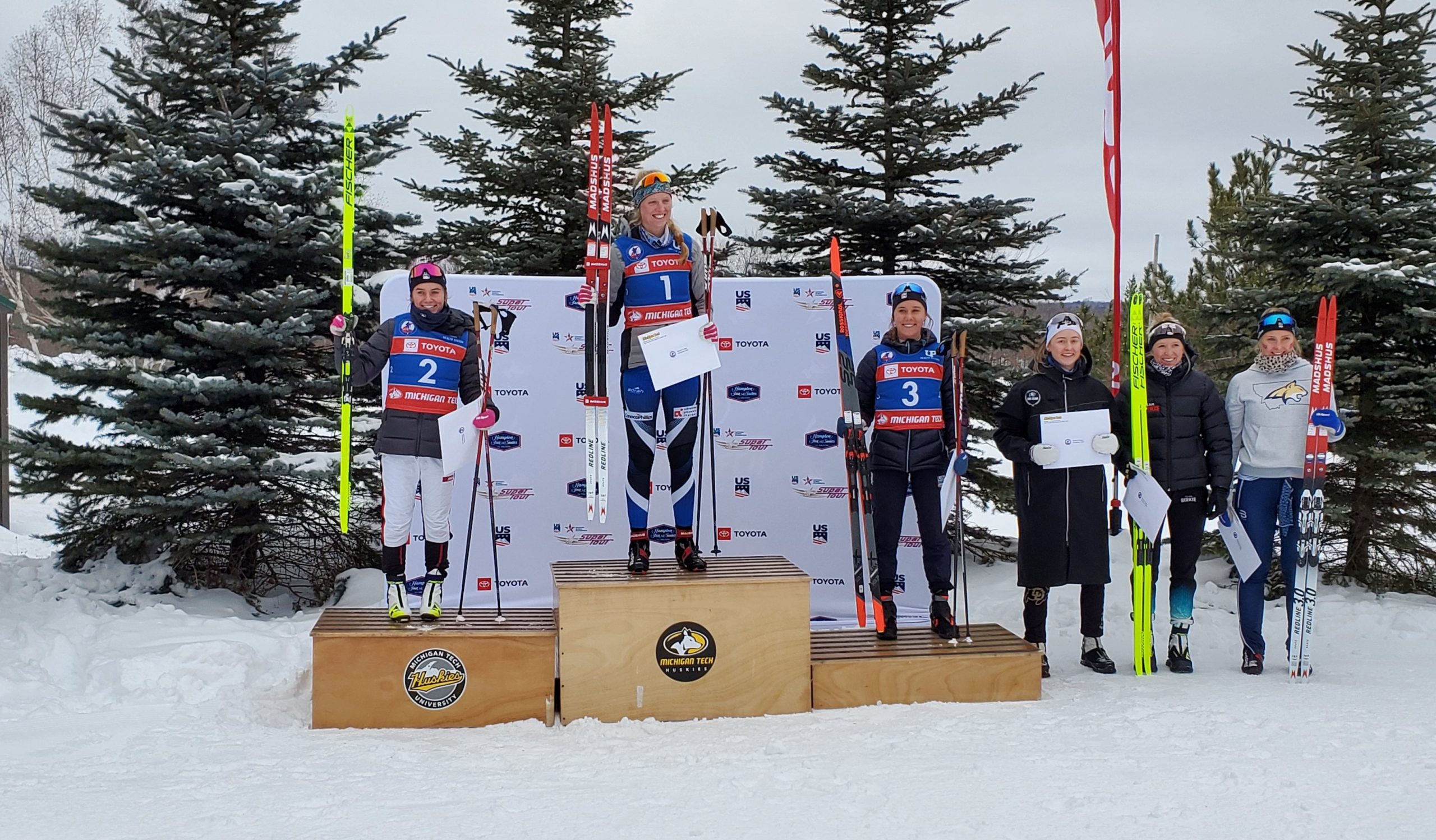
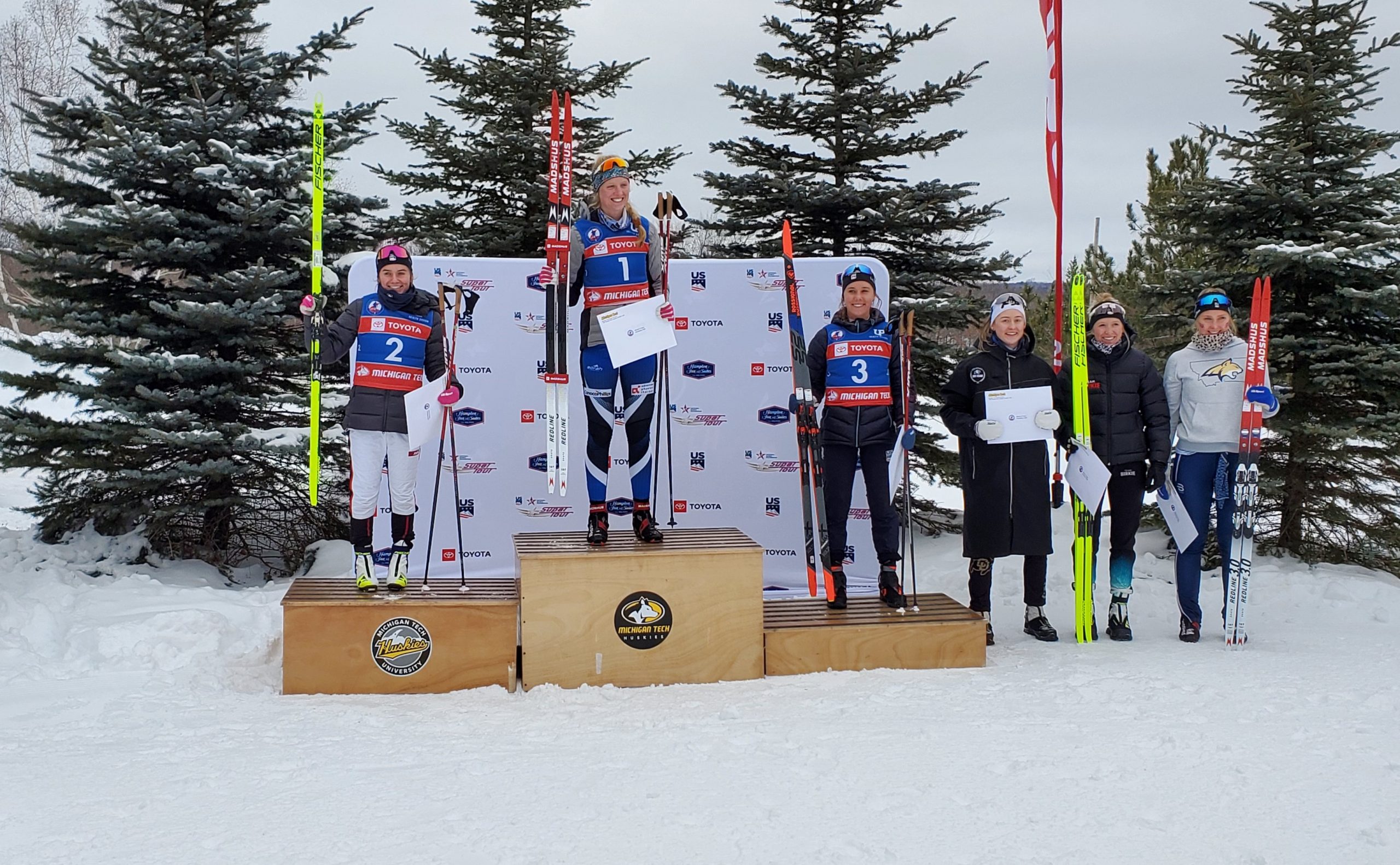
The women’s Classic Sprint podium, including Samantha Smith (SVSEF) in first, Hailey Swirbul (APU) in third, and Ava Thurston (Dartmouth) in third at the US National Cross-Country Ski Championships at Mt Van Hoevenberg. (Photo: Nancie Battaglia)
Traffic was thick at the beginning of the US National Cross-Country Ski Championship Women’s 20 k Freestyle Mass Start in Lake Placid, NY. (Photo: Nancie Battaglia)
There is a particular moment in a long mass start when the race quietly declares what it will be. It does not arrive with a surge, a crash, or even a decisive move. It arrives when the pack thins just enough that the edges of the course begin to matter—when skis no longer overlap cleanly, when passing requires intention, and when each athlete realizes—often simultaneously—that this is no longer a collective undertaking.
At Mt. Van Hoevenberg, that moment came early.
The women’s 20-kilometer freestyle mass start at the 2026 U.S. National Cross-Country Ski Championships unfolded under conditions that rewarded clarity and punished hesitation. The course was wide in places, narrow in consequence. Fresh snow lined the edges, slower and heavier than the main track, turning every attempt to move forward into a calculation of cost. The pace at the front was honest from the gun—fast enough to string the field out, fast enough to strip away the illusion that patience alone would bring opportunity.
In an Olympic winter, Nationals rarely exist in isolation. They are arguments as much as races, each result carrying the quiet weight of future conversations. But on this morning, before selection scenarios and season arcs could intrude, the race itself demanded attention. Four laps. Twenty kilometers. A course that climbs insistently and asks athletes to be precise even when tired.
What followed was not one story, but several—layered, intersecting, and revealing.
Colorado’s Tilde Bångman did much of the work at the front of the Women’s 20 k Freestyle Mass Start in Lake Placid, NY. (Photo: Nancie Battaglia)
The Fast Start That Changed Everything
From near the front, the race immediately took on the shape many expected. Kendall Kramer, eager to avoid the kind of chaos that can derail a mass start before it has truly begun, made her intentions clear.
“I wanted to go out fast because I didn’t want any funny business—colliding or breaking equipment,” Kramer said later. “I was super looking forward to being in the front of a mass start after being caught in the back on World Cups.”
For Kramer, the early pace felt familiar rather than reckless. World Cups, she noted, often begin faster than domestic races, and the instinct to establish position early has become second nature. The speed was assertive but manageable. She felt fit, capable, present.
Behind her, the effect was immediate. The field stretched, then fractured, then reorganized into smaller, more intentional units. For athletes starting deeper in the field, this stringing-out created both opportunity and pressure.
Novie McCabe, starting from bib 26, felt the opening kilometers open rather than close.
“My plan for the start was just to stay relaxed and try to work my way up,” she said. “It honestly ended up being easier than expected because the front girls took it out so fast. It was very strung out, and there was lots of room to move around.”
Within minutes, McCabe had navigated cleanly into the front group. What followed was less about advancing and more about survival.
“I got to the front pack about three minutes into the race,” she said. “So I spent most of it there just trying to hang on for as long as I could—and ended up having it in me to hang till the end.”
That phrase—hang on—would recur in different forms throughout the day, taking on slightly different meanings depending on where each skier found herself in the race.
Ava Thurston (#8 – Dartmouth) couldn’t quite hang on to the lead group of three, but eventually skied with Hailey Swirbul (#67 – APU) and Haley Brewster (#46 – UVM) before finishing fourth overall and third-place American. (Photo: Nancie Battaglia)
When the Front Pulls Away
Not everyone who tested the front pace could stay there.
Late in the first lap, Ava Thurston made her own attempt to bridge. She came close enough to feel the rhythm of the leaders, close enough to understand the cost.
“I tried to get back onto the front group, and I got pretty close,” Thurston said. “But I realized that I wasn’t going to be able to match their pace.”
The realization came with consequences. For a brief stretch, she found herself skiing alone—a dangerous place in a mass start, especially early, when gaps can grow quietly and decisively.
“That was where I did have a little bit of that panic,” she admitted.
The panic did not last. Company arrived in the form of Hailey Swirbul and Haley Brewster, and with it, perspective.
“Once I was skiing with them, I was kind of just thinking, ‘This is a good group. I can stay with these guys,’” Thurston said.
From there, her race became less about chasing what was ahead and more about managing what was happening around her. She tucked in, matched surges, and responded quickly to small separations before they became something larger.
“There were a couple of times where I would fall off the pack just a little bit,” she said. “Each time, I worked hard to get right back on before letting it be a big gap. I was really stoked on that.”
On a course like Van Hoevenberg—four laps of sustained uphill skating—those moments add up. Fitness is exposed repeatedly, not all at once. For Thurston, the race offered reassurance.
“This was the first race longer than 10k I’d done this year, and the first mass start that wasn’t a sprint,” she said. “It was a really good indicator that my fitness is there. It’s hard to fake anything on this course.”
She would finish fourth, clearly separated from the podium trio but equally clear of the deeper chase—an honest result in a demanding field.
With higher FIS points from not racing the past two seasons, Hailey Swirbul (#67 – APU) needed to ski through a lot of traffic during the early kilometers, but eventually found herself in the chase pack. (Photo: Nancie Battaglia)
Racing From the Back Without Racing Small
While the front and mid-pack sorted themselves, Hailey Swirbul was running an entirely different race.
Starting from bib 67, she entered the day knowing she would need to be deliberate.
“I didn’t even realize I would be seated so far back until the start list came out,” she said. “Obviously, I would be, because my FIS points aren’t low at this point—but it was an experience.”
The challenge was not simply moving forward. It was how to do so without paying too steep a price.
“The edges of the course had fresh snow on them,” Swirbul explained. “It was much slower, and a much higher energy expenditure to get around people that way.”
Instead of forcing passes, she waited. Instead of locking into the pace of whatever group surrounded her at a given moment, she kept her attention forward.
“I almost approached the first couple laps like an individual start,” she said. “It’s really easy to lock into the group you’re around and forget about the people ahead of you.”
Women’s racing, she noted, often begins with a fast, destabilizing surge—a period where the goal is simply to hang on long enough for things to settle.
“That’s exactly what happened today,” she said. “The leaders go fast, string it out, and then the real race starts again.”
For Swirbul, the balance was constant: advancing through traffic while respecting the race’s length.
“A 20k is a long race,” she said. “You can’t really pay for it.”
Though she never bridged to the front trio, Swirbul finished fifth—solidly clear of the next wave behind her—and left the course satisfied with her execution and proud of the broader team effort.
“Our coach absolutely crushed it with skis and feeds,” she said. “It was a good day to be APU.”
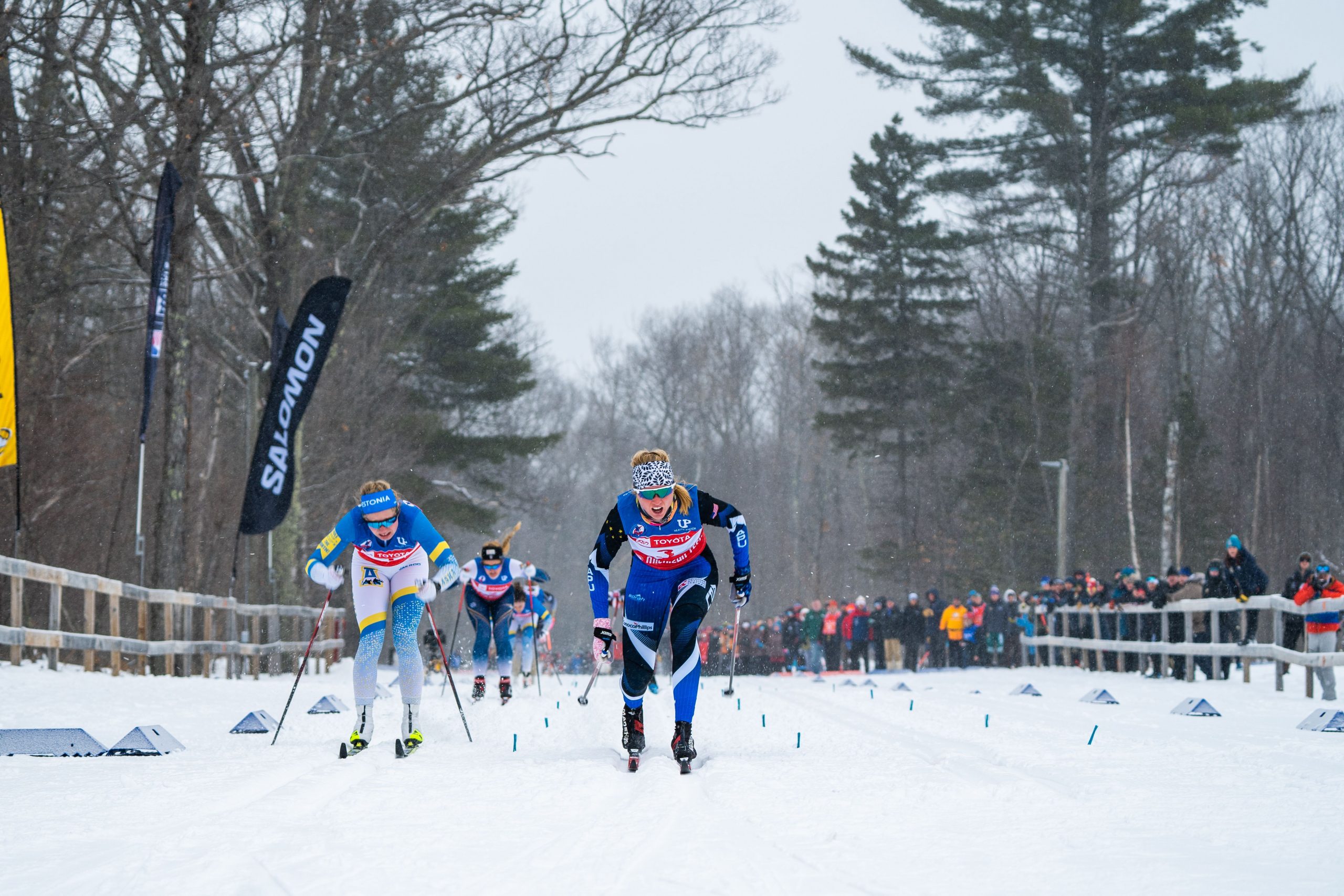
Novie McCabe (APU) maintained contact on the uphills and used the downhills to close the small gaps to Tilde Bångman (CU) at the front of the race. (Photo: Nancie Battaglia)
The Margins at the Front
At the sharp end, the race narrowed to a familiar dynamic: strength, speed, and patience under pressure.
As the kilometers mounted, Tilde Bångman began to apply pressure on the climbs, testing the group’s elasticity. By mid-race, the front had distilled to three: Bångman, McCabe, and Kramer. The chase group behind them was no longer within striking distance, and the podium places would be decided among those three alone.
McCabe felt the pressure immediately.
“In the last few kilometers, Tilde was skiing super strong and still really pushing the pace,” she said. “She would gap me a little bit on some of the hills.”
Each gap mattered. Each closure required confidence—in skis, in timing, and in restraint.
“I had some super good skis, so I was able to glide back up to her,” McCabe said.
The plan crystallized: stay attached through the final hill, try once to make a move, and if that failed, save everything for the finish.
“I tried to get a gap on the last hill, which didn’t quite work,” she said. “So I tried one last time at the finish.”
It was enough.
McCabe crossed the line first, securing the national title after a race built not on constant aggression, but on measured commitment. The emotion that surfaced surprised even her.
“I think when I crossed the line, I mostly just felt super happy to be back racing and feeling like myself,” she said.
The win mattered. So did what it represented.
“Going into this week, I wasn’t sure it was the best idea for me to race frequently this season,” she said. “Now I have a lot more confidence that I can race—and maybe more importantly, recover from racing.”
In an Olympic year, that distinction is not trivial.
The lead pack and eventual overall podium with Kendall Kramer (APU), Tilde Bångman (CU), and Novie McCabe (APU) (l – r). (Photo: Nancie Battaglia)
Kramer’s Race: Control Without Regret
For Kendall Kramer, the separation late in the race came not through fitness, but friction.
“My skis slowed down as they went,” she said. “They started to feel sticky—like I skied through too much Gatorade or something.”
The effect was most pronounced on the downhills, where speed should have come freely.
“The girls had to push my poles to speed me up to keep together,” she said. “Eventually, they could just gap on all the downhills.”
Once the gap formed, Kramer shifted her focus from contesting the win to finishing the race well.
“I’m happy to maintain my place and feel good,” she said. “I can’t complain.”
What she wanted from the race, she explained, was not chaos or last-minute risk, but sustained pressure in a small group.
“I wanted a small pack where we could test at every little bit,” she said, “as opposed to leaving it to a sprint or taking risks at a time like this.”
She finished third, completing the podium, and left Lake Placid without repeating her national title—but with confirmation that mattered just as much.
“I felt fit and totally capable today,” she said. “I didn’t feel bad feelings.”
Novie McCabe (APU) managed to put a small gap on teammate Kendall Kramer to get away with Tilde Bångman (CU) and eventually ski to the national title in the finish stretch. (Photo: Nancie Battaglia)
What the Race Revealed
By the time the women completed their fourth lap, the story of the day was no longer about who surged when, but about how each athlete managed the same course differently—and honestly.
McCabe raced with restraint until she no longer needed to. Kramer raced with intent and accepted the margins. Thurston learned, adjusted, and confirmed her distance fitness. Swirbul navigated from deep in the field with patience and clarity.
None of those narratives exists in isolation. Together, they form a portrait of a championship race that did what the best distance races always do: expose truth without exaggeration.
At U.S. Nationals, the women did not simply ski 20 kilometers. They negotiated space, managed doubt, trusted preparation, and tested belief.
In an Olympic winter, those are not side effects.
They are the point.
The national podium for the US National Cross-Country Ski Championship Women’s 20 k Freestyle Mass Start with Novie McCabe (APU) first, Kendall Kramer (APU) second, and Ava Thurston (Dartmouth) third. (Photo: Nancie Battaglia)
Feature stories like this one take time, access, and care to produce. If you value thoughtful storytelling and independent ski journalism, please consider becoming a Voluntary Subscriber. Your support directly fuels the work we do to cover the people, places, and moments that make our sport special.
The overall podium for the US National Cross-Country Ski Championship Women’s 20 k Freestyle Mass Start with Novie McCabe (APU) first, Tilde Bångman (CU) second, and Kendall Kramer (APU) third. (Photo: Nancie Battaglia)
The US National Championships got started yesterday with the 10 k Classic Individual Start in Lake Placid, NY. Hunter Wonders (#369 – APU) took top honors in the men’s race. (Photo: Nancie Battaglia)
On a January afternoon in Lake Placid, Mt. Van Hoevenberg did what it has always done best: it asked skiers to be honest.
The 10-kilometer classic individual start is not a format that rewards theater. It doesn’t care how good you looked in warm-up, how confident you sounded the night before, or how convincing your season-long narrative might be. It rewards pacing that’s brave but not reckless, technique that doesn’t unravel under strain, and the ability to keep making good decisions when your legs are trying to renegotiate the terms of the day.
This year, the U.S. National Cross-Country Ski Championships opened with that race—two laps on the 5-kilometer loop—and the timing was no accident. In an Olympic winter, Nationals is never just Nationals. It’s an argument. It’s a week where results don’t merely “count,” they accumulate, and the accumulation becomes the story that follows athletes into selection meetings, petitions, and—if all goes right—onto a plane headed for Italy.
Will Koch (SVSEF) on his way to 8th place on the day. (Photo: Nancie Battaglia)
The Course: Where You Can’t Afford to “Blow Up”
The Van Hoevenberg course is famous for being “fair,” but fairness in skiing is rarely gentle. The climbs arrive in layered sequences—sections where you can press, sections where you can survive, sections where you can lose seconds simply by being a fraction late to a gear change. There are places to win time, and places where you simply try not to hemorrhage it.
Hunter Wonders described the central problem precisely after the finish:
“It has some big hills. And I really think that in this course you can’t afford to blow up. If you blow up, you’re just going to bleed so much time.”
That idea—bleeding time—was the hidden refrain of the day. Not because athletes were exploding spectacularly, but because this loop punishes any lapse in restraint. It is a course that rewards a mind that stays intact.
Corbin Carpenter (UAA) on his way to 10th place in the 10 k Classic at US Nationals. (Photo: Nancie Battaglia)
Men’s Race: Seconds as a Selection Language
At the front of the men’s race, the margins compressed into something almost absurd: a national title decided in a space so small it could be measured in one imperfect corner, one extra step of herringbone, one pole that slips just slightly at the wrong moment.
Hunter Wonders won the men’s 10 k Classic National Championship. Behind him, the podium fight came down to an almost unnerving closeness. The story wasn’t simply that the race was fast; it was that it was tight—tight enough to turn pacing into the defining skill.
Wonders’ post-race reflection didn’t sound like someone who had “controlled” the race so much as someone who had managed it correctly, which is often the same thing in interval start racing:
“Yeah. So going through it never really felt like it was my day. I knew it was going to be a competitive one, and I knew that it would just come to good skis, good feelings in the body, good pacing, and I’m just really happy that I was able to pull it off.”
He returned to pacing again, emphasizing that his strategy wasn’t about heroics, but about avoiding the one mistake that the Van Hoevenberg loop will magnify:
“I think pacing was the biggest challenge for me today… So I was trying to take it out hot to where I could be competitive but not blow myself up.”
What made Wonders’ win especially convincing was how he described staying committed to his plan and then finishing with intent when the splits told him the race was available:
“I never really changed my race plan mid-race. But I did get some good splits, especially near the end, so I just tried to finish as hard as I could.”
And then, because it’s 2026 and everyone knows what this week represents, he said the part that matters most:
“And then, of course, U.S. Nationals does carry some heavy weight in an Olympic year. And I’ve been thinking about this race since the races in Anchorage ended, so I’m just really happy to have it behind me.”
He wasn’t pretending the pressure isn’t real:
“I definitely felt the pressure, and I’m going to continue to feel the pressure throughout the rest of this Nationals. But I think I have good momentum going, and I have good confidence. I know that I’m in shape, and everything else just kind of hopefully falls into place over the next week.”
The finish-line truth of the men’s race is that it created a kind of selection tension that will hang over the rest of the week: the top contenders weren’t separated by a narrative gap. They were separated by seconds.
Luke Jager, who finished second, captured what that tightness means on this course and in this moment:
“Yeah, crazy how close the times were! The course is cool because there are so many different gears in the climb that people can all have different focus spots and still end up so close together at the finish line. It is really cool, fair racing like that.”
That line—different focus spots, same finish—explains why the top of the results can look like a near-tie without being random. You can ski this course well in different ways. But you still have to ski it well.
Jager also spoke directly to the Olympic subtext without overplaying it:
“I’m not naive enough to say that the Olympics aren’t on all of our minds, but I’m also really having fun just trying to do my best and working to solve the puzzle of how to perform on any given day. Italy would be sweet, but I’m super thankful for this opportunity to even be feeling that pressure at all. It’s been fun to have such a big challenge.”
And then the warning embedded in the closeness:
“The close times just show me that you can’t take anything for granted, and each race could be someone else’s day. Fun to have to try and be as dialed and prepared as you can every day when the stakes are high.”
In other words, this wasn’t a day that “settled” anything. It made the next races more consequential.
Hailey Swirbul (APU) on her way to a national title in the 10 k Classic at US Nationals in Lake Placid. (Photo: Nancie Battaglia)
Women’s Race: Swirbul’s Return, and a Course That Doesn’t Flatter Anyone
If the men’s race was defined by a razor-thin margin, the women’s race had a different feel: not less intense, but shaped by a performance at the front that felt like a statement. And the words that followed from the winner did not sound like someone who had stumbled into a good day; they sounded like someone who had been building toward a day like this for a long time.
Hailey Swirbul framed her win as the visible outcome of a longer experiment:
“Winning this race felt like finally getting to watch the outcome of a long experiment unfold! I’ve wanted to approach this season from a place of curiosity to see if I can get fitness and strength back after a 2.5-year hiatus. It has felt so rewarding to get stronger and remember how it feels to race and go hard again.”
She described the way racing itself can re-teach an athlete what “hard” feels like:
“Each race or hard interval session reminds me what it feels like a little bit more.”
And then she said what almost everyone in the finish area seemed to be thinking, whether they admitted it or not:
“This course is legit. I didn’t hear the words ‘I felt good out there!’ come out of a single person’s mouth! It was a battle of self against hill.”
That sentence carries the whole day inside it: not a battle against other people, exactly, but against the course’s capacity to strip away pretense.
Hailey Swirbul (APU) charges up one of the many climbs on that Lake Placid course behind Virginia Cobb (#120 – DAR) and Marit Flora (#76 – UAA). (Photo: Nancie Battaglia)
Swirbul’s race plan—at least as she described it—was deeply personal in its logic. Not a copy of someone else’s pacing, not a response to what she imagined others were doing, but an attempt to ski in a way that matched her strengths:
“I tried to ski true to myself. I wanted to use momentum and my own body weight the most effectively I could to get around that course as fast as I could- regardless of how the pacing looked for others.”
And because it’s an Olympic year, she made the subtext explicit:
“I have my eyes on an Olympic Team spot, and I’m going to continue to fight for it until the team is officially named. I’m not thinking beyond this week of racing here at Nationals. One step at a time, staying present…”
Then the line that reminds you why athletes keep doing this:
“…and enjoying getting to live this life and see so many people from old racing days— it’s a good life.”
Novie McCabe’s post-race comments carried a tone that felt especially relevant to this week: gratitude, yes—but also a clear-eyed description of how fragile a season can feel, and how an athlete can build stability by focusing on what can be controlled.
“It meant a lot to be starting today for sure! I think that being a bit unsure of whether I’d be starting these races made me feel pretty grateful for the opportunity to go out there and give it my best today.”
She described the emotional mix honestly:
“There were, of course, lots of doubts and some nerves going in as well, but I really tried to just enjoy the skiing and made that my main goal going into it.”
And she emphasized that conditions and course feel matter—not as excuses, but as context:
“The conditions were insanely nice today, which helped, and this course is one of my favorites!”
On pacing, McCabe described a strategy rooted in self-knowledge:
“Honestly, I kinda just went out as hard as I could within reason, and tried to relax and hold onto it. I know the splits don’t really make it look that way, haha, but I am not the fastest starter, so it is usually best for me to go out at what feels like a pretty hard pace.”
Then she explained the architecture of her day: not results goals, but process goals. She made a point that’s easy to dismiss until you remember what an Olympic week does to people:
“Being focused on process goals going into a race really helps me develop a framework for success.”
She listed those goals with specificity—how she wanted to feel, what she wanted to focus on, what she wanted her mind to do when discomfort arrived:
“…going out hard but comfortable and trying to hold it, skiing well (not skiing hard), be the focus of the day, keeping up the positive self-talk, and finding the good and noticing what is going well throughout the race.”
And on Olympic pressure, she offered a perspective that will sound familiar to anyone who has ever had a season disrupted by health or inconsistency:
“I think it has honestly helped me out in terms of handling self-imposed Olympic qualification pressure to not have had the best lead up and be pretty unsure of what I would be doing as far as racing goes this year…”
She described her focus as narrower—day by day—because it has to be:
“…it has taken some of my focus off of results… It has just kind of led to an approach where I take it day by day, and don’t really think much further into the future than that.”
That isn’t resignation. It’s an operating system. And it’s one that often works, especially on a course where you can lose time in the exact moment you start racing the future instead of the hill in front of you.
Rosie Fordham (UAF) leaving it all on the course on her way to 7th place overall. (Photo: Nancie Battaglia)
Samantha Smith: A Double Life and a Very Real Result
Samantha Smith’s presence near the top of the women’s results came with a storyline that’s unusual even in American ski racing: balancing elite cross-country skiing with Division I soccer at Stanford, and arriving at the heart of ski season off a long NCAA tournament run.
She spoke about the short transition plainly:
“Yes, that’s correct, that our soccer team’s long run into the NCAA tournament has made for a much shorter transition to the season. I’ve only been on snow for a few weeks, so I know my ski fitness is improving every day.”
She described the emotional carryover of playing for a national title—how it can become fuel rather than a distraction:
“Playing in the National Championship was an amazing experience—we were so close to winning it all. It was a tough way to end such a great season. I’m taking that fire from our final game and pouring it into my skiing.”
And she framed her path as something she’s embracing, not defending:
“I know my path is different from others, but I’m doing what I love, and I think there’s a lot to be said for staying true to that. I’m trying to take everything step by step, live in the moment, and focus on what I can control!”
On the scrutiny that comes with missing ski events earlier in the season, she emphasized the lessons she’s drawn from doing two sports seriously:
“…for me, I feel like there’s actually a lot I can pull from the two sports and use it to my advantage.”
She described last year as a “trial year” and explained how she’s adjusted:
“I needed that test phase to figure out what works and what doesn’t work. I made some adjustments this year in training, switching things up a bit, and I feel like that’s helped me a lot going into this season.”
She credited Braden Becker for helping with training and coaching through the fall:
“I owe a huge thank you to Braden Becker, a retired skier, who’s now a grad student at Stanford. He helped me a lot with training this fall, and it honestly made a world of difference…”
And then she returned to the mental challenge of this week—high stakes, lots of uncontrollables—and the philosophy that keeps an athlete from spiraling:
“…I’m just trying to focus on what I can control—my attitude and effort.”
Finally, she addressed the question of what a distance result might “say” about her:
“I was happy with today’s result… I think today’s race was a good indication of my trajectory for the rest of the week and the rest of the season.”
And she framed versatility—distance and sprint—as part of the argument she wants to make this winter:
“…hopefully showcase some of my versatility in different distances and disciplines, which I think can be important for big competitions like the Olympics.”
Alayna Sonnesyn (Team Birkie) on her way to 10th place overall. (Photo: Nancie Battaglia)
Why This Week Matters So Much
For the men, the arithmetic of Olympic selection is already partly written—and partly unresolved. At present, the United States is allotted seven men’s quota spots for the Olympic team, with the possibility that an eighth could roll down following this weekend’s World Cup races in Oberhof, Germany. That uncertainty is where much of the tension at U.S. Nationals resides.
It is also where most of the speculation comes from—so take it for what it is, informed but unofficial. The six American men who recently raced the Tour de Ski appear, by any reasonable reading of the criteria, to be on solid ground. Each currently ranks in the top 45 on the FIS World Cup sprint and distance overall lists, the threshold set by the US Ski Team that meets the objective requirements for Olympic selection.
Within that group of six, there is also ample sprint depth to cover the four available starts in the individual classic sprint and to form a competitive two-man sprint relay. As a result, Tuesday’s Freestyle Sprint at Nationals is likely to carry less weight for those athletes racing in Lake Placid with dreams of making the Olympic roster. Instead, the races most likely to function as closing arguments—particularly if an additional quota spot materializes—were Sunday’s 10 k Classic and Thursday’s 20 k Freestyle Mass Start. For at least one man, and potentially two, those performances may determine whether this week in Lake Placid becomes a footnote or a turning point.
On the women’s side, the picture is far less settled—and far more fluid. The United States has eight Olympic quota spots available, but only a portion of them is considered secure. Jessie Diggins—if it were ever in doubt—has already satisfied the objective criteria by finishing in the top eight in World Cup races that are part of the Olympic schedule. Julia Kern and Rosie Brennan also appear well-positioned, based on their respective rankings on the sprint and distance overall lists.
That still leaves as many as five remaining spots to be determined, drawing from a complicated blend of results across Period One on the World Cup, the SuperTour events in Alaska, and, critically, U.S. Nationals this week in Lake Placid. For those athletes, Nationals is not simply a domestic championship. It is an audition, a data point, and—in some cases—the clearest remaining path onto the Olympic team.
John Steel Hagenbuch (DAR) on his way to 5th place overall on the day. (Photo: Phillip Belena/EISA)
Grover: “There’s Going to be Space”… and then the Paperwork
US Cross-Country Ski Team Director Chris Grover offered perhaps the clearest explanation for why the opening races at Nationals feel unusually charged—not because they deliver final answers, but because they create space. Space in which athletes can move themselves from the margins of the conversation toward its center.
The story, as Grover framed it, is not simply who wins. It is what a result permits: what doors it opens, what arguments it strengthens, and how it positions an athlete within the broader, inevitably imperfect machinery of Olympic selection.
As Grover put it in an interview with FasterSkier, U.S. Nationals does exactly that—it creates room:
“…it’s going to be a great story because there’s space. There’s going to be space on both the men’s squad and the women’s squad, by the looks of it, for athletes to qualify from Nationals, to have great U.S. Nationals and come over, especially on the women’s side…”
That space, however, is not filled automatically. In an Olympic year, it is accompanied by paperwork, petitions, and deliberation—an acknowledgment that performance, while central, is rarely the entire story.
Grover outlined the petition process that follows Nationals, a step that often receives less public attention but carries significant weight:
“…all athletes who want to be considered for discretionary selection… We’ll put in an application. Or a petition rather, where they will kind of write out what their case is, why they should be considered…”
Those petitions, Grover explained, are then evaluated by a selection committee—six people tasked with translating results, trends, and context into final decisions:
“…we have the six-person selection committee that will pick the team. So as a committee, we’ll read everybody’s application, and then we, as a committee, will decide whether we want to elevate somebody using Coach’s discretion to be selected.”
Even the arithmetic of quota spots, Grover noted, is subject to forces beyond any one athlete’s control. On the men’s side, the possibility of an additional spot remains unresolved:
“…it’s after Oberhof… qualification for nations also closes on January 18… and at that point a spot [might be] available…”
Which is to say: timing matters. So does patience.
Taken together, Grover’s explanation underscores a truth that every athlete racing this week understands intuitively. Lake Placid does not merely crown national champions. It produces evidence—sometimes decisive, sometimes ambiguous—for a selection process that will soon harden from theory into reality. And once it does, the margins that feel abstract today will become permanent.
Ava Thurston (#45 – DAR) on her way to 6th place overall on the day. (Photo: Phillip Belena/EISA)
What Sunday Actually Did
The first day of Nationals did not select the Olympic team. It did something subtler and, in some ways, more powerful: it established the tone of the week.
On the men’s side, it proved that the domestic field is not going to give anyone breathing room. Wonders’ win was decisive in the only way that matters in interval start racing: he was fastest when everyone had to ski alone. But the closeness behind him reinforced Jager’s point—each race could be someone else’s day. In a week like this, that’s not a platitude. It’s a forecast.
On the women’s side, Swirbul’s victory felt like a day where preparation and belief finally aligned. But even she framed the week properly: one step at a time, staying present, not thinking beyond Lake Placid. McCabe and Smith offered two different versions of the same survival skill: build a framework, focus on process, control what you can, and let results become the output rather than the obsession.
If there was a single emotional throughline, it was this: the athletes weren’t pretending the Olympics weren’t there. They were trying, in different ways, to keep that fact from hijacking the work.
A Conclusion in the Shape of an Interval Start
There’s a particular quiet that follows an interval start classic race—not silence, exactly, but the hush of athletes doing their internal accounting. A national championship can feel like a celebration. In an Olympic year, it can also feel like a deposit: something placed into the larger selection ledger, something that will matter later, in rooms the athletes won’t be in, in conversations they can’t control.
What makes Lake Placid different—what makes Mt. Van Hoevenberg feel so permanent—is that it refuses to dramatize any of this. It simply asks the same thing of everyone: ski two laps honestly, manage the climbs, keep your head when your legs get loud, and finish without bargaining.
Wonders said he felt the pressure—and expects to keep feeling it. Jager said the closeness means nothing can be taken for granted. Swirbul described a long experiment that finally yielded its outcome. McCabe described building success from process, not prediction. Smith described a life lived between two sports, and a focus narrowed to attitude and effort.
Taken together, those aren’t just post-race quotes. They’re the first chapter of the week.
And in an Olympic winter, first chapters matter—because the next race arrives quickly, and the story keeps writing itself, one start at a time.
Love stories like this? Help keep them coming.
Feature stories like this one take time, access, and care to produce. If you value thoughtful storytelling and independent ski journalism, please consider becoming a Voluntary Subscriber. Your support directly fuels the work we do to cover the people, places, and moments that make our sport special.
Hailey Swirbul enjoys her time in the leader’s chair the 10 k Skate in Davos in December 2021. Swirbul would earn a third place finish on the day, landing her on a World Cup podium. (Photo: NordicFocus).
After each of her races on the World Cup this season, Hailey Swirbul would write in her journal. “I tried to answer a couple of questions,” she explained. “What was good today? What was hard? And what do I want to carry forward?”
That last question, “What do I want to carry forward?” typically kept an eye on next week’s racing. But after she crossed the final finish line in Lahti, Finland, those questions would begin pertaining less to the next ski race, and more to the life that lies ahead. In announcing her retirement, Hailey Swirbul now re-assesses what she will carry forward from this ski season. According to her recent comments, what she will carry forward is a reclaimed love of skiing, a commitment to processing the joy of competition just as much as the challenge of sorrow, and an embracing of what life may bring her as a retired professional skier.
“Special would be an understatement,” was how Swirbul described the heartfelt send off from her time on the World Cup circuit when FasterSkier caught up with her in an interview last week. On the final day of an historic season for the US Ski Team, the love for her poured in. “Hailey, you’re so funny and sweet and smart and caring,” wrote Jessie Diggins in her first Instagram after the World Cup season ended. “And you will be missed in our everyday lives all winter!”
For all the processing of pure emotion, though, Swirbul also appreciated the love in Lahti on a critical scale: understanding the love behind the love. “I think we tend to wait until it’s over before we really let someone know how much we’ve appreciated them and what they’ve done,” she said. “But the feeling for me there—surrounded by my teammates, coaches and all the people who have played part in my journey to the World Cup—was that the love had always been there. I want to carry that forward.”
Swirbul’s career traversed Junior and Senior National Championships, World Cups, World Championships and the 2022 Beijing Olympics. Coming into her final World Cup season, Swirbul identified two dreams she decided were attainable this season: 1) “Try and win every race at US Nationals,” and 2) “Do whatever I could to help the USA relay team earn a medal at World Championships, whether that was being part of the team or being the best teammate I could be.” She took the critical approach, not just setting those goals, but asking how to best achieve them. To race her best at US Nationals, she would need to race in the US, which meant staying off the World Cup even after being offered starting spots early in the season. To be the best teammate she could be at World Championships, she would take on the even harder task of becoming the best version of herself, working as hard on her relationship with skiing as she worked on the skiing itself.
When the World Cup season opened in Ruka, Swirbul was a world away in British Columbia where she swept the SuperTour’s opening weekend. It was an auspicious start, but the most consequential race towards her journey in reclaiming a love of skiing would come a week later in Sun Valley. “That is the one race that sticks out in my mind, that was the moment,” she said. An early season snow storm had dumped multiple feet of snow in the mountains of central Idaho. “It got chaotic,” said Swirbul, referring to the blizzard that swirled throughout the SuperTour race. “It was miserable in the moment, honestly, but what really stuck out to me throughout the race was that the whole community had come together to make it happen and was out there suffering together. I thought, ‘Oh, this is what this is all about.’”
And then, there was bacon. “I got back to the wax table and the Jackson Hole team was cooking out, and the coach was like ‘yo, you want bacon?’ And I was like, ‘yes!’. From there, watching the juniors push as hard as the pros, the vibe being just fun and the energy high, it really brought home the fact that rain, shine, or blizzard, we were all out there for the same reason.”
Hailey Swirbul takes the classic sprint win at the 2023 Cross-Country Ski National Championships in Houghton, Michigan. Swirbul won all four races during Senior Nationals this season. (Photo: Torsten Brinkema)
Swirbul arrived in Houghton, Michigan for the US Cross-Country Ski Championships with her goal of winning every race on her mind, but also with a mind towards genuinely enjoying the experience. She opened the week with a National Championship in the 10 k Freestyle, and then never looked back. When she crossed the finish line in the Freestyle Sprint later that week, she also realized one of the two pre-season dreams: all four races in Houghton listed Hailey Swirbul’s name in first place.
The energy of the season turned towards dream two: to do anything she could to help the US win a relay medal at World Championship. Swirbul knew she was up to the task. Earlier in the World Cup season, she had been chosen to ski the lead leg in the 4 x 5 k relay for the US in Toblach, Italy. The day was strange but powerful: a late substitution from Germany resulted in a disqualification that knocked them out from third place. The fourth-place finishers—Team USA—were elevated to a bronze. For Swirbul, though, the eventual medal wasn’t as consequential as the effort put out. “It was really powerful to race for something bigger than myself,” she said. “I realized I can suffer the hardest when Rosie Brennan is there waiting for me and counting on me to stay in contact with the lead group.”
At the World Championships in Plancia, the same Toblach US relay team finished fifth place. The result in Swirbul’s dream remained just out of reach, but the dream itself—to do everything she could to help the US win a medal—had been achieved. That realization—that every living dream isn’t exactly as it may seem—allowed her to view the larger picture around racing even more clearly. Another dream rose up within Swirbul, “I made a goal to leave skiing on a positive note, and that was when I realized that I felt like it was time.”
“I love skiing because of the community, the idea of peacefully doing battle, having a place to push to a place you didn’t know you could push to, exploring and being exposed to different parts of the world. That was about when I realized I really loved it” she said. With a decision made to leave the World Cup, Swirbul would use her last races on the World Cup to process her love of skiing, in full.
That was when she started journaling. “It opened my mind to focus on what was important about skiing. I wanted to get that down, to really think about what I want to bring forward in my skiing life.” What was important began to bring the whole tableau of her skiing life, from starting out in Carbondale, Colorado to the acute experience of each World Cup race, “I kept coming back to the ski community. Every time I asked, ‘what was important?’ it was directed at the ski community—whether that was helping guide Sammy Smith through her first few World Cups, being a good teammate, or contributing to someone else’s success in a small way, it was always looking elsewhere. Results never stuck out as important.”
Team USA: Rosie Brennan (USA), Samantha Smith (USA), Jessie Diggins (USA), Julia Kern (USA), Hailey Swirbul (USA), (l-r) celebrate the end of the season. (Photo: NordicFocus)
World Cup Finals came and went. Swirbul gave her all to the very last, crossed the line, and was lifted up by her teammates both literally and figuratively. The “process of processing things” as she would put it, had begun. “I made the decision on purpose not to have a completely thought-out plan on what comes next. I wanted to listen to what my intuition is telling me about where to go.”
“I am just really grateful,” Swirbul said, “For the people, for the sport, and for the places I’ve been. More than anything, I love that I can always nordic ski now. That feels really special, really good.”
Hailey Swirbul pushes to the finish of the 10 k individual start classic during the 2022 Olympic Winter Games. (Photo: NordicFocus)
Rosie Brennan (USA), Samantha Smith (USA), Jessie Diggins (USA), Julia Kern (USA), celebrate the career of teammate, Hailey Swirbul (USA). (Photo: NordicFocus)
PARK CITY, UT (March 27, 2023) – Hailey Swirbul of the U.S. Cross Country Ski Team is ready to say goodbye to World Cup ski racing. The 2022 Olympian has formally announced her retirement from the World Cup circuit hours after crossing the finish line at the 2022-23 World Cup Finals in Lahti, Finland.
24-year-old Swirbul, an El Jebel, Colorado native, has been on the U.S. Cross Country Ski Team for years, represented her country at two World Championships and was a member of Team USA in Beijing at the 2022 Olympic Winter Games. She’s had a consistent presence on the World Cup throughout the last several years, starting in 64 races, finding the top-10 in four and standing on the 2020 Davos World Cup individual 10k skate podium in third. Now, Hailey is taking a step away from the World Cup circuit and is excited to begin her next chapter.
Swirbul was a mountain kid growing up. Her childhood in Aspen’s Roaring Fork Valley was filled with romping around the nearby peaks, riding around on a mountain bike with her family and skiing the resorts on alpine skis. Looking back, if you asked her when she was young if she would grow up to be a professional cross country skier, she may have brushed it aside. “My earlier memories of cross country skiing include me freezing and holding back tears, woefully slogging along the ski trail as my dad got in his workout,” she said.
It wasn’t until later that cross country skiing became a part of her life, thanks in part to her brother Keegan Swirbul. Keegan, now a professional road bike rider, decided that to stay in shape for bike season, he needed some consistent cross training; cue cross country skiing. The tight duo took this new step together, and the rest is history.
Hailey started with the Aspen Valley Ski & Snowboard Club until she left for college in 2016, skiing for the University of Alaska Anchorage Ski Team. Finding abundant success on the college circuit, Hailey then trained and competed with the Alaska Pacific University (APU) club team. There, she had breakout results, notably in the 2017 World Junior Championships in Solider Hollow, Utah where she, Katherine Ogden, Julia Kern and Hannah Halvorsen won the USA’s first-ever medal at Junior Worlds, and it only went up from there.
Throughout the next several years, she racked up results; in 2018 she was back at the Junior World Championships and won an individual silver medal in the 5k classic and bronze in the skiathlon. Through the U.S. National Championships, SuperTours, Nor-Am Cups and FIS events, Hailey has over 15 wins to her name.
Then, came the next step. In 2019, she was officially called up to the U.S. Cross Country Ski Team where she would now compete on the highest stage of the sport – the World Cup.
“Hailey has been a force of nature since she burst on the scene as a U20 and started making history for the USA with two individual medals at the World Junior Championships,” said Chris Grover, the U.S. Cross Country Program Director. “Arriving on World Cup, she demonstrated that she is a force in every discipline and both techniques. She has an individual World Cup Podium and was key in securing a World Cup women’s relay podium this season in Toblach. She’s been a fixture of our World Championships and Olympic team over the past quad. Beyond the results, she’s been at the heart of the U.S. Team, an incredible teammate, and a caring and soulful friend to us all. We will all miss her but we also know she will be a big part of our community for life.”
Outside of skiing, Hailey is active in the community that helped shape her. As a current board member for the Women’s Ski Coaches Association, Hailey works day in and day out in helping create a collaborative network to encourage retention of women coaches in the industry. She also has a bachelors degree in civil engineering and this past summer, worked full time as an engineer.
“Hailey will be immediately missed as an athlete who brought a lot of personality to our team,” said Matt Whitcomb, Head Coach of the U.S. Cross Country Ski Team. “While she was a very successful racer, she wasn’t simply motivated by winning, and needed to work hard to find purpose and meaning in each day. This style of motivation, and Hailey’s always-open way of sharing with her coaches and teammates, taught me how to become a better coach. She helped everyone around her improve, and I will miss that, and I’m eager to watch to bring her that wonderful personality to her next team. Thank you, Hailey!”
“With the end of my World Cup career on the horizon, it is so easy to see how much I appreciate this team,” said Swirbul. “It wouldn’t be possible for me to have been on the World Cup and chase some big dreams without the support of the U.S. Ski Team, and I will forever be grateful for that.”
Retirement doesn’t mean that Swirbul will never lace up her Madshus race boots and click in her skis again. She still plans on racing, competing at a high level within the states and training for a sport that has shaped “the core of my identity for the last 15 years.” She may be closing one chapter, but is excitedly opening the next. “I set out to find peace with skiing this season after a difficult few years between Covid and the Olympic cycle, and I can truly say that I love skiing more than I ever have now—I’m just ready to love skiing in a new way outside of World Cup racing,” said Swirbul. “After all, I’ve already been given the best gift: a lifelong love of sport.”
Congratulations on your World Cup career, Hailey! We are so excited to see what this next chapter brings.
This World Cup coverage is made possible through the generous support of Marty and Kathy Hall and A Hall Mark of Excellence Award. To learn more about A Hall Mark of Excellence Award, or to learn how you can support FasterSkier’s coverage, please contact info@fasterskier.com.
World Cup Finals began under overcast Finnish skies Friday, as the circuit looks to settle the questions of a long season over the next three days. Who was—and who wasn’t—racing in Friday’s non-World Cup point scoring event provided evidence that the Crystal Globes remain at the forefront of concerns this weekend.
The women’s Team Sprint as it began on Friday. Notable absences from top Crystal Globe contenders shaped the field Friday as World Cup Finals began in Lahti. (Photo: NordicFocus)
With the Women’s Overall, Distance, and Sprint World Cup classifications all still undecided going into this weekend, Friday’s Team Sprint was absent any women standing within the top five of any of the World Cup classifications. The most notable absences drew attention straight to the top of the World Cup standings: Jessie Diggins (USA) sits second in both the Overall and Distance classifications, with 110 points separating her from Overall leader Tiril Udnes Weng (NOR), and just 22 points between her and Distance leader Kertuu Niskanen (FIN) ahead of Sunday’s 20 k classic. The gap is also 22 points in the Sprint classification between leader Nadine Faehndrich (SUI) and second place Maja Dahlqvist (SWE). The cascade of absences beyond the top two further revealed the closeness of the Women’s field. With points standings tight and the stakes for gaining an additional place or keeping one high, skiers like Rosie Brennan (USA), four points ahead of Heidi Weng (NOR) for fourth Overall, were absent. Julia Kern (USA) joined that list too, looking to hold onto a top five in the Sprint classification that she holds onto by just eight points over Laura Gimmler (GER).
The Men’s Team Sprint field, meanwhile, was much more complete. Johannes Hoesflot Klaebo (NOR) holds an insurmountable 421 point lead over second place Paal Golberg (NOR) in the Overall. The same is true in the Sprint, where Klaebo holds a 254 point gap over Lucas Chavanat (FRA). The only Men’s Classification still technically unsettled is the Distance, where Paal Golberg’s 112 point lead on Klaebo would technically be passable if Klaebo were to win Sunday, win intermediate bonuses, and not have Golberg score any points (which appears unlikely). Further down the Men’s field, the majority of points gaps are larger, which played into Federico Pellegrino (ITA), Lucas Chanavat (FRA), Edvin Anger (SWE), and Richard Jouve (FRA) all being present in the field today. There were other who sat out this team event: notably, Ben Ogden (USA) who is pursuing the best American Men’s World Cup Overall finish since Bill Koch in the 1980s, sitting less than 20 points behind Calle Halfvarsson in seventh Overall.
Women’s Team Sprint
For all the absences from the Women’s field Friday, the defending World Champions in the Team Sprint—the Sweden I team of Emma Ribom and Jonna Sundling—still made it to the start line. Sweden I made it a good race, and a creative one too. “We wanted to have fun, to make it a more tactical race,” Sundling said to FIS media after the race was over.
Jonna Sundling made a clean finishing move to bring Sweden I—reigning World Champions—the win in Lahti, Finland. (Photo: NordicFocus)
As to how that plan played out, Ribom and Sundling took turns dutifully marking the Norway I team of Julie Myhre and Anne Kjersti Kalvaa at the front of the race. When they reached the final climb on the Lahti course, Sundling simply hop-skated away to victory. It was a crisper, cleaner, version of the tactic that she had used in Planica to win the Team Sprint World Championship, and of the one she made in Drammen to win Falun’s 4 x 5 k Mixed Relay for Sweden last weekend.
Behind Sundling’s move, late-race heroics were making for a thrilling finish. The lead pack through most of the race had included the Sweden I team alongside Norway I and the Finland I team of Jasmi Joensuu and Jasmin Kahara. A move from Joensuu in her last leg had created a clean break for the trio of teams; through most of the last lap, Kahara looked like she would hold the separation between her and the chase group. When Sundling went, Anne Kjersti Kalvaa (NOR) was able to stick with her just long enough to win Norway I second place. Behind her, though, two German teams had started to chase down Kahara. As the Finn entered the stadium, Coletta Rydzek for Germany I and Sofie Krehl for Germany II were skiing in tandem, and skiing their way back up to the Finn. The race for third went to the line. Three lunges produced a result that saw Rydzek come across the finish in third place, while Finland I took fourth in a photo finish over fifth place Germany II.
Men’s Team Sprint
The Norwegian World Championship Team may have lacked Paal Golberg on Friday, but Erik Valnes would prove to serve as a worthy replacement to pair with Johannes Hoesflot Klaebo for Norway I. With the Italian World Championship runner-up team of Francesco De Fabiani and Federico Pellegrino also present, the Men’s race held promise for a close front-of-pack race, mixed with a field hungry to challenge the prevailing order among Team Sprint powers.
The men’s field remained tight until Johannes Hoesflot Klaebo moved to bring Norway I the win with Italy I in tow. (Photo: NordicFocus)
That dynamic was on display through each of the early laps, as Federico Pellegrino and Johannes Hoesflot Klaebo danced around each other in the early part of the course, and a whole pack of teams filed in to try and keep with the two. In the final lap, Pellegrino looked for an opportunity to entice Klaebo into a long-burning attack; it’s no secret that leaving a sprint finish meant facing Klaebo’s finishing kick that none were likely to match. Klaebo, though, responded as he has throughout the season to this tactic, ticking his pace up just enough to keep the pack close, and then forcing the pack back to stasis. Four challenging teams made it to the last climb: Sweden I with Edvin Anger, Norway II with Sindre Bjoernestad Skar, France II with Richard Jouve, and Germany with Jan Stoelben. Then, Klaebo went, and Pellegrino followed. The pair had a gap into the stadium, and the prevailing order of the Team Sprint had held. Klaebo crossed the line to win for Norway I, Pellegrino crossed to take runner-up for Italy I, and Skar won a two-way sprint over Anger to take Norway II to third.
Americans, Mix, Match, and Push Team Event
Two American teams qualified for the Team Sprint finals. The USA I team for the Women featured the World Cup relay debut of Sammy Smith, who has qualified for heats in successive sprints in Drammen and Falun. Smith paired with Hailey Swirbul, who has become a relay mainstay for the US. “[I love] the energy of team events,” Swirbul said after last week’s Falun relay. “It really emphasizes how ski racing involves much more than only an individual to make a great day happen.”
Sammy Smith and Hailey Swirbul pushed all the way through Friday’s Team Sprint, landing the young USA I lineup in 11th place. (Photo: NordicFocus)
Smith and Swirbul traded off skiing well within the relay pack early in Friday’s race. As the pack strung out through lap three, Smith slipped to 15th place as she handed to Swirbul for lap four. By the end, the pair had made a resurgent push to finish 11th place on the day, delivering an auspicious effort for the young Americans in a team event.
“I really enjoyed getting to race with Sammy, and be in a more low pressure team event situation,” said Hailey Swirbul post-race. “It was a really cool way to build experience for Sammy and myself, and she skied really well today.”
The pairing of Zak Ketterson and JC Schoonmaker held in the tight men’s race through their first couple of exchanges, before pace increases at the front led to a falling off. The pair pushed on to take 13th place on the day.
“Zak and I were pretty excited to just be able to ski with the pack and make decisions on the fly,” said Schoonmaker in post-race comments. “That’s some of the most fun you can have in ski racing. I definitely wish I could have hung in the main pack longer than I did because Zak was skiing super well, but we did what we could.”
Schoonmaker added that this year’s team events have come with added joy for the men’s team. “It’s been really cool to get to race with some different guys this winter,” he said. “We have a strong men’s team right now so being partnered with any of those guys is an honor.”
Sprint Classification Settled Tomorrow
World Cup Finals continues tomorrow in Lahti, as a classic sprint is set to decide the winner of the Nadine Faehndrich-Maja Dahlqvist Sprint Crystal Globe race in the Women’s field. On the Men’s side, a final act is being planned for the dominant Sprint campaign of Johannes Hoesflot Klaebo.
Meanwhile, Jessie Diggins (USA) will begin her final, two-day push to reel back the Overall Crystal Globe, looking to best Tiril Udnes Weng NOR) with her finish tomorrow and net valuable World Cup points.
We’ve got guests. Former FasterSkier Managing Editor Rachel Perkins and U.S. Olympian and World Cup podium finisher Sophie Caldwell join us to recap an epic women’s relay from World Championships in Planica.
Nine races down, three to go. You can reach us at devon@fasterskier.com and nat@fasterskier.com.
This World Cup coverage is made possible through the generous support of Marty and Kathy Hall and A Hall Mark of Excellence Award. To learn more about A Hall Mark of Excellence Award, or to learn how you can support FasterSkier’s coverage, please contact info@fasterskier.com.
With the mounting success of the American women’s cross-country program, the one prize continuing to elude it has been a major championship relay medal. In some ways, it has become an obsession with team USA, an obsession they were looking to check off the list after today; however, the Americans were not the only country focused on the relays. Norway and Sweden are bitter rivals in relay events, and considerable national pride hangs in the balance each time the event is run. Norway has won five of the last six Women’s World Championship relays; even so, Norway would be seeking redemption after missing the podium in the last Olympics. Sweden has finished second to Norway in four of those five World Championship relays; Sweden is understandably tired of looking up on the podium at its Scandinavian neighbor. Germany would also be on a mission to prove that its Olympic silver medal was not a fluke.
Wearing bib no. 5, Hailey Swirbul (USA), battled in the lead pack at the start of the 4×5 kilometer Relay. (Photo: NordicFocus)
After the drama on the race had concluded, Norway had redeemed its national pride taking first place. Germany proved that it was for real by virtue of its second place finish. Sweden’s stars couldn’t match Norway’s and Germany’s intensity, and took home the bronze. Team USA simply could not keep pace with the world’s best teams and finished fifth. Team Canada skied to eighth place.
World Championship Women’s 4 x 5 Kilometer Relays
Hailey Swirbul took the leadoff leg for USA. One kilometer into the race, the field was still bunched together with Emma Ribom (SWE) setting the pace. At about 2.5 k, Ribom established a gap taking five skiers with her. Swirbul was in the second group; it was clear at times that her skis were slipping. “The team skied on hairy skis for the Classic leg,” said US.. coach, Chris Grover. “Klister was icing, kick wax wasn’t quite enough. Skiing hairies is a real art… if you haven’t had a lot of experience on that it can be a challenge. Hailey did great; she kept it close.”
Ribom continued to stretch the field, reducing the lead group to Sweden, Norway, Germany, and Finland. At 4.4 k, Weng sprinted into the lead setting a blistering pace that fractured the lead group providing Norway with a tiny lead at the first exchange.
Rosie Brennan (USA) fought hard through the second Classic leg, but her bad luck continued at these World Championships as she broke a pole during the race. (Photo: NordicFocus)
To start the second leg, Weng handed off to Astrid Oeyre Slind (NOR), who had less than a second lead over Ebba Andersson (SWE), and Kerttu Niskanen (FIN). Swirbul was 21 seconds off the lead when she handed off to Rosie Brennan. Katharina Hennig (GER) pushed to the front with Slind; they were setting the pace, and doing so at a brisk level. It was then that classic expert, Kerttu Niskanen (FIN), took the lead and pushed the pace, gracefully employing her textbook Classic technique. Meanwhile, Brennan continued to fall back, visibly slipping on the uphills. Drama ensued toward the end of the second lap when Hennig turned up the pace. When Andersson tried to match it, she stepped on her pole, breaking it. This mishap saw her drop to the back of the lead pack and cost her valuable energy and momentum.
Skiing the second leg, Kerttu Niskanen (FIN) used her beautiful Classic form to give Finland a shot at a medal. (Photo: NordicFocus)
Though having already fallen out of medal contention, heartbreak struck again for Brennan: she slipped in the same spot where Andersson had slipped, stepped on her own pole as Andersson had done, and suffered the same demoralizing result: a broken pole. Two kilometers later, she had fallen 46 seconds behind the leaders, and the handwriting was on the wall for team USA. After the race, Brennan told FasterSkier that she didn’t have an explanation for what happened. She said that she didn’t feel the pole break affected her much. “I did it right in front of Matt [Whitcomb] and it was an uphill,” Brenan said. “I don’t think it was a deal-breaker for us today.” Jessie Diggins (USA) also expressed that she didn’t think the pole break made much difference in the big picture. “It was a good place to do it [break a pole],” she said.
Jessie Diggins (USA) skied as hard as she could, but the Americans just couldn’t keep pace with the best teams in the world. (Photo: NordicFocus)
At the exchange into the third leg, Germany and Finland were locked in a dead heat. Norway and Sweden were a few seconds back in third and fourth, respectively. Jessie Diggins took the exchange 48 seconds behind the lead group and 43 seconds from a podium spot, a seemingly insurmountable gap to close in only five kilometers. In the lead group, Frida Karlsson (SWE) shot to the front; by the two kilometer mark she had nullified the leaders’ advantage and had thrust herself into first. But the push had proved costly, as Ingvild Flugstad Oestberg (NOR) then surged to the front and began to set an even faster pace. Oestberg’s acceleration shattered the lead pack with Finland’s Eveliina Piippo falling off the back. Karlsson began to fade and at 14.4 K dropped to third while Germany’s Pia Fink occupied second place.
Ingvild Flugstad Oestberg (NOR), hands off to Anne Kjersti Kalvaa (NOR), on the final relay leg. Norway proved too powerful for the rest of the world. (Photo: NordicFocus)
At the anchor leg exchange, Oestberg handed off in first to Anne Kjersti Kalvaa (NOR) with a 6.2 second advantage over Germany’s Victoria Carl and 14.9 seconds over Sweden’s Maja Dahlqvist. Diggins tagged Julia Kern (USA) almost 50 seconds behind the leader, and 35 seconds from third place. The Americans’ medal hopes were fading fast, and Kern was given the impossible task of needing to gain 35 seconds in five kilometers for a medal.
Eveliina Piippo (FIN) tags Krista Parmakoski (FIN) who briefly gave Finnish fans hope for a medal, but it was not to be. (Photo: NordicFocus)
But at the front of the race things were being turned upside down as Krista Parmakoski (FIN) surged past Sweden’s Dahlqvist into third place. Unbelievably, at this point in the race, the star-studded Swedes were sitting off the podium. Norway’s Kalvaa continued to surge and at 19.4 k had stretched her lead to over 20 seconds, with Germany’s Carl comfortably in second. Finland’s Parmakoski was still in third with Sweden’s Dahlqvist sitting in fourth.
Kalvaa powered to the finish line taking the win for Norway. Carl took second for Germany. Dahlqvist put in a turn of pace in the last half kilometer to save face for Sweden, taking third. Finland was pushed back to fourth and USA finished fifth; 1:34 off the lead.
After the race, Swirbul talked to FasterSkier. “ It was an honor to have a spot on the team,” she said, placing some blame on herself for the team’s performance. “I knew I had a chance to give Rosie someone to ski with, and I really wanted to do that for her today and I didn’t make it happen…I blame myself for it.” She continued that she was prepared for the lead teams to break away early. “I found myself in a position I had hoped to not be in…suddenly you look up and there’s a gap, and it’s really hard to close that back.” Swirbul said that she, “was mentally prepared to really suffer…we know what’s possible…it will happen.”
Brennan told FasterSkier that, she saw Hailey trying to close the gap and was inspired by that. “I tried to harness some of that and find balance between skiing my own race and taking a chance.” Brennan added that “it’s definitely hard when you have four of the best skiers working together, and you’re alone.”
Diggins told FasterSkier’s Nat Herz that her plan was to “hope they weren’t [skiing] together in the front…Unfortunately, Ingvild went on a flyer…, if she hadn’t of done that… I think I was starting to make up time.” Diggins offered addtiional perspective on the potential of the American women’s team: “We know we’re there; we just need all the things to fit together and need a little bit of luck.” Diggins commenting on Swirbul’s lead leg said that, “You can’t put a relay on one person’s shoulders…it’s four people skiing it. Just like you can’t take all of the credit yourself, you can’t take all the blame yourself. I’m nothing but proud of how these girls skied.”
U.S. coach Chris Grover observed that, “the fact that you saw some of the best skiers in the world, like Frida at the edge, and Ebba at the edge tells you about the quality of the athletes that were competing,” said Grover. “We don’t have any podium finishers in Classic with any of our athletes…at the end of the day, we know we generally need to put our strongest skiers in legs two and three because that’s where the other teams are stacking up their big horsepower.” He also added that “the other teams know they can’t let off the gas, that this [Classic leg] is the place to put distance on USA.”
In a surprise, Grover also informed FasterSkier that Diggins would not race the 30 kilometer Classic race on Saturday. “Jessie is going to start to get ready for Holmenkollen,” he reported.
At the end of the day, Norway had redeemed itself in the fight for relay supremacy, and Germany proved it belonged at the top of the rankings. Sweden—a heavy pre-race favorite—had to satisfy itself with a third place finish. Team USA—a sentimental favorite with the fans—would have to watch the medal celebration from the sideline. High expectations would not be satisfied with a fifth place finish as the Americans would have to continue to search for the right formula to solve the relay riddle that still eludes them.
This World Cup coverage is made possible through the generous support of Marty and Kathy Hall and A Hall Mark of Excellence Award. To learn more about A Hall Mark of Excellence Award, or to learn how you can support FasterSkier’s coverage, please contact info@fasterskier.com.
Dave Ritchie, Christine Babcock, Sylvie Bouffard and Rick Nesbitt traveled from Canada to watch their children Graham Ritchie and Olivia Bouffard-Nesbitt compete at the 2023 World Championships in Slovenia. (Nathaniel Herz/FasterSkier)
PLANICA, SLOVENIA – A year ago, Canadian cross-country skier Graham Ritchie had reached the pinnacle of his sport: He was competing at the Winter Olympic Games in Beijing.
His parents? They were half a world away, forced by China’s draconian coronavirus protocols to take in their son’s achievements on television.
“It sucked,” said Dave Ritchie, Graham’s father. “Really, it sucked.”
Fast forward a year, to the World Ski Championships here: Ritchie, an insurance broker from the hardscrabble town of Parry Sound, Ontario, was posted up on the side of a trail on his first-ever European trip — beer in hand, taking in the picturesque views of the Julien Alps with his wife as his son raced by with the best skiers in the world.
“It’s special,” he said. “It’s exciting to come and see what they do.”
The Ritchies are one of a bevy of families who flew to Slovenia from North America this week to watch their children compete. Their presence here is one of the clearest signs yet of the end of the past two years of coronavirus-imposed isolation on the international circuit for Canadian and American athletes, who were competing largely without any in-person support from their loved ones and friends since the onset of the pandemic.
“Whether you get dead last or you win, they love you just the same,” said Hailey Swirbul, a 2022 Olympian who’s also racing in Planica. “It’s so nice for me to have safe people around, who provide that for me.”
Brick Swirbul, the father of U.S. Ski Team member Hailey Swirbul, stands in the stadium in Planica, Slovenia, where he and his wife traveled to watch their daughter compete in the 2023 World Championships. (Nathaniel Herz/FasterSkier)
Swirbul’s parents, Rebecca and Brick, both flew to Slovenia from Colorado and were along the course to see their daughter place 33rd in Thursday’s sprint race. Brick, wearing pants, a vest and stovepipe hat all made from American flag striped fabric, was impossible to miss.
Hailey Swirbul’s place on the American team wasn’t confirmed until a few weeks ago, and her parents hastily made plans to watch her race at an international level. The pandemic had kept them from seeing their daughter in Beijing and at the 2021 World Championships, in Germany.
The Swirbuls also had planned to see Hailey at World Cup races in Quebec, in early 2020. But the coronavirus forced the cancellation of those races just days before.
Being in Planica is “spectacular,” Rebecca Swirbul said.
But it’s also not completely normal. When the three Swirbuls spent some time driving together earlier this week, “we wore masks in the car, I opened the windows,” Rebecca said.
Rebecca and Brick Swirbul masked up as a precaution when they drove with their daughter, Hailey Swirbul, during the 2023 World Championships in Slovenia.
“It’s sad that that’s our reality now,” she said. But after raising two endurance athletes, she added — Hailey’s brother, Keegan, is a professional cyclist — she understands the need for caution.
“I get it,” she said. “A cold: you’re done.”
Another set of parents in Planica — those of American sprinter Julia Kern — saw those risks for themselves when they were following their daughter’s competitions in Europe earlier this year, during the Tour de Ski.
At the time, several U.S. team staff caught the coronavirus, and Kern’s parents, Dorothee and Gunther, were pressed into service.
Dorothee, a former professional basketball player, said her own experience as a professional athlete has helped her understand the need for boundaries while her daughter is competing.
“It is important that they have their space and that they do their thing,” she said.
One thing that athletes’ parents can do, the Kerns said, is bring needed items from the U.S. to Europe, where many North American skiers live for months at a time — things like medication, clothing and caffeinated beverages of choice.
Dorothee and Gunther Kern watched their daughter, Julia Kern, compete at the 2023 World Championships on Thursday, February 23. (Nathaniel Herz/FasterSkier)
“I roast my own coffee, and Julia is a real fan — and I think Jessie (Diggins) as well,” Gunther Kern said. “Fresh roasted beans.”
The parents of Olivia Bouffard-Nesbitt, meanwhile, brought a new credit card for their daughter from their home in Canada.
“The last one is expired,” said Sylvie Bouffard, Bouffard-Nesbitt’s mother.
The Bouffard-Nesbitts and Ritchies watched Thursday’s race together, sporting maple leaf flags and attire. They said they plan to do some sightseeing over the course of the 11-day championships; team leaders are also organizing a dinner for parents and athletes.
Rick Nesbitt wears a hat that Canadian cross-country ski legend Beckie Scott signed for his daughter, Olivia Bouffard-Nesbitt. (Nathaniel Herz/FasterSkier)
Bouffard-Nesbitt said she didn’t actually hear her parents out on the course, which was lined with boisterous European fans. But she said she’s thrilled about their presence.
“They’re such big ski fans. They love to watch the World Cup, and they love to follow my racing,” she said. “I’m so happy that they’re here — I just think it’s such a fun environment to be in, as a ski fan.”
Graham Ritchie did hear his parents during his qualifying lap of the sprint course — though he wasn’t entirely prepared for it.
“It almost caught me off guard for a little bit,” he said. “I wasn’t used to hearing my dad’s voice, in Slovenia.”
The extra support helps even the athletes who don’t have parents around, said Matt Whitcomb, the head coach of the U.S. team.
“You ski through the stadium, and you can’t help but train your eyes on a few American flags that are just peppered throughout,” he said. “It’s energy that is being invested in our team.”
European parents are also getting their first chance at watching in-person competition in more than two years. During Friday’s hour-long pursuit race, the fathers of two of the Norwegian medalists — Johannes Høsflot Klæbo and Sjur Røthe — spent the event along the trails above the Planica stadium, running from fence to fence to cheer their sons on to silver and bronze, respectively.
Elisabeth Høsflot and Haakon Klæbo, the parents of Johannes Høsflot Klæbo, pose for a photo after Johannes won a silver medal in Friday’s pursuit race at World Championships in Slovenia. (Nathaniel Herz/FasterSkier)
Haakon Klæbo, whose son is one of the most decorated cross-country skiers in history, said Johannes’ grandparents, mother and brother are all in attendance this week.
“Yesterday, when he won the sprint — the first thing he did was just to go over to the family,” Haakon said. “You could just see it in his eyes and in his smile, he was very happy. I think it means a lot to the athletes.”
In this episode, we chat with Hailey Swirbul, who – at just 24 years old – has been competing at the top end of the sport for quite some time. A bronze medal in the 4 x 3.3k relay at the 2017 Junior World Championships in Soldier Hollow put Hailey – and relay teammates Julia Kern, Hannah Halvorsen, and Katherine Ogden – on the map in a big way in US Skiing. Hailey has gone on to spend the better part of the last four years racing on the World Cup, earning 48 World Cup starts and one individual podium in the 10k skate in Davos in 2020. She’s currently preparing for the upcoming World Championships in Planica, Slovenia, which starts on February 22nd.
Following last year’s Beijing Olympics, Hailey opened up about the contrast in expectation versus reality in the Olympic experience, and how the high stress, high pressure environment of life in Europe, particularly in the lead-up to the Olympics, negatively impacted her mental health and felt increasingly unsustainable. She questioned whether she wanted to keep skiing at all, but eventually decided to keep at it, with a new approach. She took a full time engineering job in the summer, and decided to forego period one and two on the World Cup, racing the SuperTour and US Nationals domestically instead.
Hailey Swirbul enjoys her time in the leader’s chair after a solid performance in the 10k skate in Davos in December 2021. (Photo: NordicFocus)
As we discuss, this approach has rejuvenated her love for the sport and her motivation for the training and sacrifices it requires. And, it’s contributed to an outstanding season of racing, both domestically and internationally. She remains the SuperTour Leader as of recording, having earned a spot on the podium in all but one event, and swept all four events at the National Championships in Houghton, MI in early January. She seamlessly transitioned back onto the World Cup in Les Rousses, FRA where she raced into the semifinal of the classic sprint, followed by a top-20 result the following day in the 20k mass start classic. She qualified for the sprint heats again the following weekend in Toblach, ITA, was 26th in the 10k free the next day, and capped off the long weekend by scrambling for the US women’s relay team, which ended the day in bronze medal standing.
Thanks for listening, and thanks to Concept2 for supporting this podcast.
Hailey Swirbul pushes to the finish of the 10 k individual start classic during the 2022 Olympic Winter Games. (Photo: NordicFocus)
This World Cup coverage is made possible through the generous support of Marty and Kathy Hall and A Hall Mark of Excellence Award. To learn more about A Hall Mark of Excellence Award, or to learn how you can support FasterSkier’s coverage, please contact info@fasterskier.com.
Julia Kern (USA) follows Jonna Sundling (SWE) on the anchor leg of Sunday’s Team Relay in Toblach. Sundling would edge out Kern in a sprint for second place. (Photo: NordicFocus)
As the World Cup entered its third day of racing in Toblach for a 4 x 7.5 km Team Relay, the tone was one of anticipation: what would happen in the race? Even more so, what was beyond this final day in the Italian Sud Tirol? This was the last race before a two week hiatus in the World Cup schedule, after which the best skiers in the world will gather in Planica, Slovenia for the World Championships.
Looking forward to those championships, fans and spectators may anticipate the familiar site of another Norwegian relay victory. Today in Toblach, Norway I (Heidi Weng, Anne Kjersti Kalvaa, Ingvild Flugstad Oestberg, Silje Theodorsen) won the 15th of its last 16 World Cup relays, setting the stage for a showdown with Team Sweden at the World Championships in Planica. Sweden I (Emma Ribom, Ebba Andersson, Moa Ilar, Jonna Sundling) was second on the day. USA I (Hailey Swirbul, Rosie Brennan, Jessie Diggins, Julia Kern) would finish the relay as the fourth team across the line, but would later be elevated to third place after the disqualification of the German team (more on the later). USA II finished seventh with the young team of Alayna Sonneysn, Alexandra Lawson, Sarah Goble, and Lauren Jortberg.
Hailey Swirbul (USA) scrambled for USA I during Sunday’s Team Relay, a position she previously held at the Beijing Olympics. Swirbul’s turn put USA I in a position to push for the podium in Toblach. (Photo: NordicFocus)
Team relays are the intersection where team tactics meet individual and collective will. The relays staged in Toblach would also hint at choices that national teams were likely to make in weeks to come as they prepare for World Championships. For the United States, Toblach was a chance to try out a new lineup in preparation for making a run at a World Championship medal. The most recent World Cup-level team relay happened at the Beijing Olympics, where the US Women took sixth place. In that race, Swirbul scrambled (first leg), Brennan took second leg, Novie McCabe took third leg, and Diggins anchored. In Toblach, Swirbul and Brennan still skied first and second classic legs for USA I, but Diggins moved to the third (and 1st skate) leg, as Julia Kern—following her strong sprint results this season—took the anchor leg.
The most notable team tactics on the field today concerned the Swedish Women’s team, which has been the dominant team at these World Cup races in Toblach, and throughout the season. Sweden fielded two teams in Toblach, but the lineup shuffle within those two was a clear deviation from their strongest possible lineup. Of the team that won a Bronze at the Beijing Olympic Team Relay—Maja Dahlqvist, Ebba Andersson, Frida Karlsson, and Jonna Sundling—Karlsson was absent from the lineup. Dahlqvist would lead Sweden II, while Sundling and Andersson joined Sweden I. Dahlqvist’s Sweden II team also included Linn Svahn, who decided to withdraw from the relay after start lists were made, meaning that Sweden II would start the race, but scratch after the third leg.
All of that decision-making still led to a familiar sight when the race started: Heidi Weng surging to the front in the first leg. Norway’s Women had won 14 of the last 15 relay events on the World Cup, and Heidi Weng has been in the line-up for the past 11 of those wins. Her first leg in Toblach was an early hint that the winning trend among Norwegian team relays would continue today. A pack formed as Weng was joined by Sweden, Germany, the United States, and Finland. All the main players present in World Cup relays of the past were back to challenge once again.
Heidi Weng (NOR) resumed her scrambling duties for the Norway I team on Sunday. Weng, in the 1st leg position, has been part of Norway’s last 12 wins in the event after Toblach. (Photo: NordicFocus)
Weng handed off to Anne Kjersti Kalvaa, who leveraged the advantage into a definitive split in the field. The only woman to follow the Norwegian was Katharina Hennig for Germany, who arrived as an unassuming, yet unsurprising, presence at the front of Team Relay field. Despite Hennig being the only German Women to have individually podiumed in the last three seasons of World Cup racing, the Germans have had a strong contingent of women present near the top 15 places of the World Cup. Germany won silver in the Beijing Olympic Team Relay (Hennig, Victoria Carl, Katerine Sauebrey, and Sofie Krehl) ahead of many of the notable individual names from other nations that populate podiums week-to-week on the World Cup.
Silje Theodorsen (NOR) pushes ahead of Sofie Krehl (GER) during the anchor leg of Sunday’s Team Relay. Theodorsen would secure Norway’s 15th win in 16 tries at the Women’s Team Relay event. (Photo: NordicFocus)
As the Norwegians looked to open a gap early in the race, the German’s strongest skier was right there to continue on the move from Gimmler in the first leg. Hennig skied confidently up with Kalvaa, and the pairing would form the lead pack alongside Ebba Andersson for Sweden I, who kept with her recent streak of strong skiing by pushing the lead group into a pack that held through the 3rd leg of the race. Pia Fink held the pace for the Germans through the 3rd leg as Oestberg pushed the pace for Norway, as Sweden I faded. Norway’s anchor, Theodorsen, conducted a masterclass closing leg, taking control a kilometer out from the finish-line and driving all the way through. Germany’s Sofie Krehl couldn’t keep up, and Theodorsen finished in the arms of her teammates. The Norwegians had won their 15th in 16 tries at the World Cup Team Relay.
Rosie Brennan (USA) and Moa Lundgren (SWE) on the second leg of Sunday’s Team Relay. Brennan began the USA I charge towards the lead pack during her leg, which landed the USA I team in third place in Toblach. (Photo: NordicFocus)
USA I
Clad in the striped relay socks of Team USA, Swirbul handed off to Brennan in fourth place. Brennan knew the hard task ahead of her, saying in post-race comments that “Leg 2 is a hard one that tends to be pretty stacked with strong distance skiers,” said Brennan. “So I knew I had my work cut out for me. I wanted to ski my own race in an effort to minimalize time lost, [which] I felt like I did well, but still managed to lose more time than I would have liked…I felt we all had some good battles out there and also know where we need to look to improve.”
Brennan’s hand-off to Jessie Diggins found the Americans 41 seconds off the lead group, and Diggins went straight into reducing that gap. Diggins didn’t let up, going into the unrelenting turn-over that has become her signature on the World Cup. When she caught Ilar (Sweden I) near the end of her leg, the full scope of Brennan and Diggins combined move had become clear. In a Team Relay, where the field can string out, paces can drop, and energy can falter, the Americans had attacked every meter of the course with jolting energy today.
Jessie Diggins (USA) during her leg of the Team Relay on Sunday. Diggins’ efforts during the team’s third leg reduced a gap that helped set up Julia Kern (USA) to sprint to third place in Toblach. (Photo: NordicFocus)
That energy was transferred to their anchor, Kern, whose rival in the race for third was none other than the weekend’s sprint champion, Sundling (Sweden I). As Sofie Krehl led the Germans across the line to claim second, Kern continued to do battle with Sundling. They swept into the stadium, Sundling went out from behind Kern and gained a slight advantage in the run-up. Kern pushed again, but ran out of room. The pair lunged across the line with Sundling .2 seconds ahead of Kern: Sweden I in third, USA I in fourth.
Julia Kern (USA) during her anchor leg on Sunday. Kern lost a close battle across the line to Jonna Sundling (SWE) for third place. USA I was eventually elevated in the standings after Germany’s disqualification for an illegal substitution. (Photo: NordicFocus)
German Disqualification
Across the line would prove a key phrase in the post-race melee. When final results were posted, it was revealed that the race jury disqualified the 2nd place German team for “participating under false pretenses.” The FIS International Competition Rule cited was “ICR 352.2.2.,” a vague piece of international competition law can be translated as “who was on the course was not who was on the start list.” In this case, Krehl had been substituted for Colleta Rydzek after official start lists had been made. The decision to disqualify Germany meant that the USA I was elevated to third place. It was a strange, but auspicious, sign for the Team USA as they look toward making the podium at World Championships in the same event in just a few weeks. In post-race comments, Rosie Brennan said “Germany’s disqualification [was] something I haven’t ever experienced before and was certainly unfortunate. That is not how I want to land on the podium. They all skied really strong legs. It’s unfortunate that the athletes have to take the hit there.”
The German team awaits a race jury decision after crossing the line in 2nd place on Sunday. The race jury reached a decision to disqualify Germany after a late substitution saw Sofie Krehl anchor the team instead of Coletta Rydzek, who was on the official start list. (Photo: NordicFocus)
USA II
Lauren Jortberg smiled into her teammates’ arms in seventh place. With her crossing the finish line, came a symbolic close on the sequence of the World Cup that has served as a broad introduction for the young skiers that made up USA II today. For Jortberg and Sonnesyn, that has meant an introduction to the demands of racing the World Cup calendar with all challenges that commitment brings. For Goble and Lawson, Toblach marks the end of the beginning of their World Cup careers. In comments to FasterSkier, Alex Lawson said, “The biggest thing I took into and out of Toblach is to be confident in myself! [The World Cup] is a different scene, field, and venue but it is still a ski race and something that I have spent years training for.”
The USA II Team on Sunday, which finished 7th place. (L-R) Alex Lawson, Lauren Jortberg, Alayna Sonnesyn, and Sarah Goble. (Photo: NordicFocus)
Lawson’s reflections on her first World Cup will serve as wisdom for all the Team USA as they look ahead in the season’s calendar. Next up for the American women is the event that the season has been building towards: World Championships begin in Planica, Slovenia on Tuesday, February 21st with a 5 k Freestyle Individual Start. The Americans are sure to come into Planica the way they left Toblach today, with a persistent drive and energy, fighting for every second.
The Official Women’s Podium featuring USA I in third place. Norway won its 15th of the last 16 Team Relays, while Sweden took second. (Photo: NordicFocus)
This World Cup coverage is made possible through the generous support of Marty and Kathy Hall and A Hall Mark of Excellence Award. To learn more about A Hall Mark of Excellence Award, or to learn how you can support FasterSkier’s coverage, please contact info@fasterskier.com.
This weekend, the World Cup travels to Toblach, Italy for three days of racing. First up are the freestyle sprints. This is the last full weekend of racing before the tour takes a two-week break leading into the World Championships. This timing resulted in full fields for both the women and men. The women had 57 entries on the start list—more than they’ve had in weeks—with all the heavy hitters in the women’s sprint world participating. Likewise, the men’s field had a large group of 69 starters, though many of the top American men were still in Canada for the U-23 World Championships.
Jessie Diggins (USA) fought her way to third place on the tricky Toblach course. (l-r,) Maja Dahlqvist (SWE), Jonna Sundling (SWE), Jessie Diggins (USA). (Photo: NordicFocus)
Toblach is a tight course with few opportunities for passing. The course has short, steep climbs that would provide most of the limited passing opportunities. Otherwise, smart tactics would rule the day.
In the women’s race Jonna Sundling (SWE) finished first followed by Maja Dahlqvist (SWE). Jessie Diggins (USA) finished third. Other American finishers were Rosie Brennan, 26th, Julia Kern, 28th, Hailey Swirbul 30th, Lauren Jortberg, 32nd, Sarah Goble, 39th, and Alayna Sonnesyn, 42nd. No Canadian women participated in today’s races.
In the men’s race Johannes Klaebo (NOR) took first place, followed by Haavard Taugboel (NOR), and Federico Pellegrino (ITA).
No Canadian men participated today. The top American finisher was Ben Ogden, who finished 17th. He was followed by Logan Diekmann, 27th, Kevin Bolger, 38th, Will Koch, 45th, and Finn O’Connell, 52nd. For Diekmann, it was his first time reaching a World Cup sprint quarterfinal.
Jessie Diggins in the semifinal heat on her way to another Toblach podium. (Photo: NordicFocus)
The Women’s Race
The deep field took its toll on qualifying, but the U.S. team still managed a strong showing for the heats. For the American women, Jessie Diggins, Rosie Brennan, Julia Kern, and Hailey Swirbul qualified. Diggins posted the third fastest qualifying time and was looking to avenge last week’s sprint performance where she missed a turn and skied off the course. Diggins has a great history in Toblach. Three of Diggins World Cup victories have been in Toblach, including her first World Cup victory. In her post race comments Diggins acknowledged the special place that Toblach holds for her. The field was so deep that each quarter final had names who could be considered favorites to win it all. All of the American qualifiers were in separate quarter finals.
Rosie Brennan (USA) reached the heats, but got tangled up on the Toblach sprint course. (Photo: NordicFocus)
Rosie Brennan began her quarterfinal in the middle of the field, but was not able to hold the pace and faded toward the finish. She ended up sixth and did not advance. After the race, Brennan commented on the difficult Toblach course: “The course was fast and had many turns making it very tricky to find space and navigate safely. I struggled to find places to move up after getting tangled in the beginning… I’m glad Jessie could provide a light for us all on a tough day.”
In Diggins’ quarter final she went out fast and slotted in second place at the start. She passed Johanna Hagstroem (SWE) on the first hill and moved into the lead. She continued to push her advantage which was fortunate as there was a crash behind her. It didn’t matter, as Diggins powerfully gapped the field by a large amount. The gap narrowed by the finish, but Diggins won her heat comfortably. She later said that, ” The qualifier didn’t feel good, but it went well, which is sometimes a nice reminder that how you feel doesn’t always indicate how you will race.”
The sprint day began with great promise for Julia Kern (USA), who failed to advance out of her quarterfinal after tangling a ski and crashing. (Photo: NordicFocus)
In Kern’s quarterfinal she was pushed to the outside early and forced toward the back of the pack. She meticulously picked her way through the group and worked herself toward the front on the course’s steep hill moving into second. She aggressively stepped through the corners to maintain her second place standing, and looked very strong. Kern was vying for the lead when coming into the final turn she tangled skis and crashed. It was way too late in the race for a recovery. It was especially disappointing given how well she had worked through the crowd and how strong she looked.
Hailey Swirbul (USA) went all in for her quarterfinal, setting the early pace. (Photo: NordicFocus)
In Swirbul’s quarterfinal she faced the unenviable task of going against Linn Svahn (SWE), Nadine Faehndrich (SUI) and Tiril Udnes Weng (NOR). Given the daunting task, Swirbul threw caution to the wind, and shot to the lead from the start trying to avoid the traffic which had claimed her teammates. It was a high risk, high reward strategy. She led throughout the first half of the race, but as she came over the steepest hill, she was dropped to the back of the pack and was gapped with no chance of catching the group. She ended up sixth in her heat. U.S. Coach Kristen Bourne had praise for Swirbul’s willingness to lead, “She got out front and was trying to execute her plan, she skied super confidently…having the confidence to lead definitely stood out today.”
That left Diggins as the only American woman to make it to the semifinals. Diggins drew an outside lane and was pushed wide and back at the start. A minute into the race, she was in fifth place. Diggins acknowledged that, “My starting speed has never been that impressive…so I needed to chill and look for my window to move up.” She pushed up the steepest hill on the course and propelled herself into the top four. But the tight Toblach course proved to be a nemesis as she didn’t have enough room to work and was again forced to the back of the pack. As the field sprinted toward the finish, she was able to somehow pick her way into third place and would have to wait and see whether her time would hold up for a lucky loser spot. The second semifinal was slower, and she was ultimately able to move on to the finals as a lucky loser.
Jessie Diggins celebrates after a third place sprint finish. (Photo: NordicFocus)
In the finals, Diggins faced an intimidating field of four Swedish sprint standouts and Laura Gimmler (GER). At the start, Diggins went to the rear of the pack with a wall of Swedish skiers in front of her. Sundling took the pace very hot from the beginning. At the top of the first big hill Diggins had moved into fifth, and Sundling had not budged from the lead. Over the top of the second steep hill Diggins had moved into fourth with three Swedes ahead of her. Going into the sprint finish she put the hammer down and was able to gain a podium spot by out-sprinting Swedish sprint star Emma Ribom and finishing third. It was an impressive feat to be able to break up a Swedish quartet in such a talented field. It was an equally impressive piece of tactical skiing on a very challenging course, and showing supreme maneuverability as she worked her way through the field. As Coach Bourne noted, “It’s a pretty challenging [course] and turning left most of the time, it’s difficult to pass. It makes sense to be in the front.” Diggins was able to go against the grain and grab a podium position despite not being in the best spot toward the end of the race. Bourne continued that “She skied that so well, to tactically figure that out and get onto the podium is pretty awesome. It was one of her coolest races for me to watch…seeing her maneuver so well and confidently ”
Ben Ogden (USA) led the American men finishing 17th. (Photo: NordicFocus)
The Men’s Race
In the Men’s Sprint quarterfinals, Johannes Klaebo showed why he is the best sprinter in the world as he was able to pick his way through the field at will, starting in the back and working his way to the lead. Something no one else had been able to do all day.
Richard Jouve, last week’s hero on home soil in Les Rousses, France could not advance out of his quarterfinal.
In Ogden’s quarterfinal he advanced to the front third of the race early. At the first hill he worked to maintain contact with the top three skiers. The lead group coalesced at the finish with Ogden unable to outsprint the field and finished fourth. The time was not fast enough for a lucky loser spot and his day ended in the quarterfinal. Ogden told FasterSkier that, “Everyone in my quarter final qualifier was within a second and a half of each other so it was really tight the entire time. It ended up coming down largely to the last downhill, final corner and finishing stretch. I was just out of the semi’s in 4th but it was a decent effort given that I have been a little tired lately. Now my plan is to rest up and put all eyes on champs in Planica!”
Logan Diekmann (USA) had a career first sprint quarterfinal appearance. (Photo: NordicFocus)
For the Americans, Logan Diekmann finished sixth in his quarterfinal and did not advance. Nonetheless, it was a good day for Diekmann as it was the first time he had reached a sprint quarterfinal.
In the semifinals, Klaebo employed a similar strategy as he had in the quarters, electing not to lead from the start. He was fourth two-thirds of the way through the race and was able to find space to get by his opponents to win the heat. It was a magical sleight of hand that seemed improbable at the moment, and a tactic that, once again, only Klaebo could pull off.
In the finals, Lucas Chanavat (ITA) and Federico Pellegrino(ITA) hoped they could duplicate Jouve’s feat from last week of using the home soil advantage to defeat Klaebo. Klaebo employed a different strategy in the final than he had in the previous heats, moving relatively early toward the front of the field, but not taking the lead immediately. At the first steep hill he moved into second place and it looked like a script ski fans have seen before. Once again, two or three powerful hops on the last climb and he surged to the lead. At the finish he had a large enough margin to raise his hands in triumph well before reaching the finish line.
Johannes Hoesflot Klaebo (NOR) dominating on his way to victory in the Toblach sprints. He had a big enough lead to celebrate before the finish line. (Photo: NordicFocus)
Holy smokes, that was an epic weekend of racing. Devon and Nat are joined by Tony Cyr, the breakout Canadian star, and a mystery guest drops in later on in the episode.
We break down the sprint and two distance races held at the festive French venue in Les Rousses. And we promise, we’ll get you a mailbag episode before World Championships starts in a few weeks. Get at us at devon@fasterskier.com and nat@fasterskier.com.
Canadian Tony Cyr skis in front of Norway’s Martin Loewstroem Nyenget at last weekend’s World Cup in Les Rousses, France. (Photo: NordicFocus).
Today, the women competed in the final day of World Cup racing in Les Rousses, France with the 20 kilometer mass start. The course consisted of six laps on a 3.3-kilometer loop. The course featured an extremely difficult early climb up the side of the venue’s ski jump which Jessie Diggins (USA) had said was about as steep as Alpe di Cermis in the Tour de Ski. The repeated ascents would test skiers’ ability both aerobically and technically, as they would have to navigate a tricky descent after each uphill effort.
Jessie Diggins (USA) working her way to a ninth place finish in the World Cup 20 k Classic. (Photo: NordicFocus)
Finishing first was Ebba Andersson (SWE), followed by Kerttu Niskanen (FIN) and Astrid Oyre Slind (NOR). Jessie Diggins was the top American finishing ninth, 2:20 behind the leaders. Rosie Brennan was 12th, about 12 seconds behind Diggins. Other American finishers were Hailey Swirbul in 19th (3:30 out of first), Alayna Sonnesyn in 35th, Alexandra Lawson 39th, and Michigan native Sarah Goble in 40th. No Nordiq Canada team members were entered in today’s race.
After having reached yesterday’s sprint finals, Julia Kern (USA) did not start today’s race. According to U.S. coach, Kristen Bourne, it was a planned rest day for Kern; she was not suffering any ill effects from her injured thumb which had recently required stitches as documented in FasterSkier’s story yesterday.
Rosie Brennan (USA) giving it everything in Les Rousses, France. She would finish the 20 k Mass Start Classic in 12th place. (Photo: Thibaut/NordicFocus)
Le Rousses Women’s 20 k Mass Start
The undulating course broke up the field early on. The early lead was taken by Teresa Stadlober (AUT) who was seeking to become the first Austrian to win a World Cup cross country event. Those hopes were quickly dashed.
As the women navigated the steep climb, they were forced to slow to a painful herringbone simply to ascend the hill. The steep climb was followed by a quick descent with a sharp turn which the skiers had to navigate after having their legs blown up by the climb. Brennan described the climb to FasterSkier as “Incredibly steep.” Swirbul commented, “That hill was strange. On the first lap, I saw the skiers in front of me basically walking up it.”
At the start of the second lap, Niskanen—who excels at classic racing—jumped to the lead. She was followed closely by Andersson, Ingvild Flugstad Oestberg (NOR), and Slind. Stadlober had been gapped by the lead group.
Ebba Andersson (SWE) and Kerttu Niskanen (FIN) battled for the lead most of the day. (Photo: NordicFocus)
Americans Diggins and Brennan had established a chase group ten seconds back with Brennan forcing the pace. But Brennan was unable to close the gap on the leaders. “I struggled with my skis today,” she said, “and didn’t have the glide I needed to be as competitive as I had hoped.” But, she was happy with the way she felt, “My body was in for the fight, and that’s encouraging as well.” The big hill and the weather proved challenging for wax technicians. As Bourne told FasterSkier, “It certainly was not a straight forward kick kind of day for us. There were sunny spots, and a mix of man-made snow and natural snow, so there’s variability throughout the course as well, so it’s not a super straight-forward place to figure out wax.”
As the third lap began, Niskanen continued to push the pace in a lead group which had been reduced to four skiers. Brennan and Diggins were in the middle of a chase group 15 seconds behind. By the time the skiers began the steep climb for the third time, the struggle navigating the ascent was clearly visible. Swirbul told FasterSkier that “It was comforting to know that everyone felt similarly about that hill, and many people seemed to treat it as a place to relax and save energy rather than push really hard.” Bourne added that “[The hill] was an added challenge trying to figure out how to pace the course. Quite a few of our athletes felt like you just had to make it through that section, then there are plenty of opportunities to push the rest of the course.”
After the third ascent, Andersson pushed ahead with Niskanen, reducing the lead pack to just the two skiers. Oestberg and Slind teamed up in a chase group of their own to try and regain the connection to the leaders. By the eight kilometer mark, the leaders had established a 13 second gap, with the Brennan/Diggins chase group 43 seconds back.
Hailey Swirbul (USA) battling Victoria Carl (GER) and Katherine Sauerbrey (GER). Swirbul continues to excel on the World Cup circuit, where she raced to 19th place today in Les Rousses. (Photo: NordicFocus)
As the leaders reached the half-way point, they had extended their lead to 30 seconds over Slind and Oestberg, who maintained a 40 second lead over the Brennan/Diggins chase group. The race pattern had become clear: Andersson would use her double poling strength to her advantage, Niskanen would then regain ground using her textbook diagonal stride technique.
At the start of the fourth lap Andersson made a break on Niskanen, when Andersson ignored hydration at an aid station and established a 10 second gap. Once again, Niskanen was able to use her beautiful classic technique to close the gap. It was now a game of cat and mouse between Andersson’s double poling strength and Niskanen’s diagonal stride.
Ebba Andersson (SWE), Kerttu Niskanen (FIN), Teresa Stadlober (AUT), Jessie Diggins (USA), Silje Theodorsen (NOR), (l-r) early on in the 20-Kilometer Classic. Ultimately, Niskanen and Andersson would break away. (Photo: NordicFocus)
At 11 kilometers, the race story was boiling down to the two leaders fighting for first, and Slind and Oestberg fighting for third. The second chase group would be unlikely to reach the podium. Lead changes continued to epitomize the Andersson and Niskanen battle as the pair climbed the ski jump hill where Andersson again established an 11 second lead By the start of the final lap, the only remaining question was would Andersson be able to maintain her lead over Niskanen, and would the two Norwegians in the chase group establish a gap between each other?
Jessie Diggins (USA), like every racer, had to resort to herringbone to navigate the steep Les Rousses hills. (Photo: NordicFocus)
As the racers ascended the monster hill for the final time, it was clear that Andersson had established a big enough lead to hold off Niskanen and would be able to comfortably ski into the finish ahead of her rival. Meanwhile, Slind and Oestberg were caught in an intractable struggle to the finish, neither of them giving an inch. Slind and Oestberg fought right to the finish, sprinting into the final stretch. Slind went into a double pole frenzy which her country woman was unable to match. She nipped Oestberg by four seconds.
As the second chase group came to the finish, Brennan and Diggins had fallen off the pace and it was the sprint standout Emma Ribom (SWE) who used her sprint power to charge across the finish line in fifth.
Rosie Brennan (USA) pushing her chase group forward. Brennan would finish 12th. (Photo: NordicFocus)
Diggins would finish ninth, 13 seconds behind Ribom, with Brennan in 12th. Hailey Swirbul was the third American to cross the finish having an excellent day finishing in 19th place. Swirbul appears to have acclimated well to the transition to Europe once her initial illness was behind her. She commented “That was as good of an outcome as I could have hoped for with a hill that crazy!”
It was an exciting race and a beautiful day to finish racing in France.
This World Cup coverage is made possible through the generous support of Marty and Kathy Hall and A Hall Mark of Excellence Award. To learn more about A Hall Mark of Excellence Award, or to learn how you can support FasterSkier’s coverage, please contact info@fasterskier.com.
The women’s classic sprint was contested today in Les Rousses, France. It was an anniversary of sorts as it marked the 100th time a sprint classic race has been held on the World Cup. Women’s classic sprinting does not have the predictability of the men’s: there is no Klaebo-equivalent who dominates the women’s field. As proof of that point, the last eight women’s classic sprints have been won by eight different individuals.
Jessie Diggins (USA) just before tangling her skis and veering off course in the Les Rousses World Cup Sprint qualifier. (Photo: NordicFocus)
The day for American contender, Jessie Diggins, certainly took a wrong turn, as she veered off course in qualifying and failed to advance to the quarterfinals. After yesterday’s podium, it appeared that Diggins’ struggles were behind her, but today’s performance was surely not what had been hoped for. In the qualifier Diggins said that while navigating a curve she stumbled, caught an edge and actually went off the course. She continued that, “Flying off into the field and doing a little ski-cross powder racing definitely wasn’t part of the sprint plan today.” She emphasized that she was not injured. She managed to keep her balance and finished the qualifier.
American Julia Kern finished fifth, despite recently needing stitches on her thumb from an accident while cutting cheese. Tape across her gloved hand could be seen throughout the day. She told FasterSkier that she was cutting podium cheese from last weekend when her Swiss Army knife slipped and “Took a chunk out of my thumb. It resulted in having to do a bit of a jury-rigging with my pole strap.” It was a gutsy performance by Kern who even needed help tying her laces. American coach Kristen Bourne shared with FasterSkier that there had been concern about Kern’s thumb in advance of the race, but that everyone was satisfied that she could ski without injuring herself. “She worked with our team doctor and had it taped,” Bourne said. “She wasn’t having any pain…we felt confident that she’d be able to handle it.”
Rosie Brennan (USA) failed to advance out of her heat (finishing the day in 17th). After the race, Brennan commented that “I have such a love/hate relationship with sprinting, and today was a bit of the latter.” She continued that her heat “ended up being a little more than I had today, and I am frustrated by that as I feel I am a better skier than I was able to show today.”
Recently returned from her triple-championship performance at US Nationals, Hailey Swirbul (USA) had an especially strong day, qualifying 18th and advancing to the semifinal. She would finish the day in 12th.
Other American finishers included Sonnesyn 33rd, Lawson 36th, and Jortberg 39th. Nordiq Canada entered no skiers in the Les Rousses sprints.
Julia Kern working her way to the finals with her bandaged thumb clearly visible (Photo: NordicFocus)
Women’s Classic Sprint
Coming into the race, there were several themes that emerged:
Would the Swedish women’s sprint team, now mostly healthy, be able to continue to reassert its dominance? Sweden swept the podium last week, in a freestyle sprint, with familiar names re-establishing themselves.
How would the Norwegians fare with Tiril Weng on the sidelines still recovering from illness? At the last classic sprint race, held in Val Di Fiemme, Italy, Norway swept the podium. Tiril Udnes Weng, currently first in the overall World Cup standings, could afford to sit things out since the woman in second place overall, Frida Karlsson (SWE), also was not racing. Joining those on the sidelines was Nadine Faehndrich (SUI) the current World Cup sprint leader.
Then there were the questions surrounding the Americans: could a fully stocked U.S. team find its way onto the podium? With Jessie Diggins finding the podium yesterday and Rosie Brennan fifth, the Americans were poised to pounce. Joining the Diggins-Brennan one-two punch was Julia Kern, who has had an outstanding sprint season, currently fifth in sprint points. Rounding out the American team were Hailey Swirbul, who is recovered from illness and coming off winning every race at the U.S. National Championships, Lauren Jortberg, and Alexandra Lawson.
Norway proved it didn’t need its full team to win. Kristine Stavaas Skistad (NOR), who had qualified first, ended up taking the victory, followed by Emma Ribom (SWE) and Maja Dahlqvist (SWE).
Hailey Swirbul (USA) on her way to her first semifinal appearance. (Photo: NordicFocus)
Swirbul advanced out of her quarterfinal as a lucky looser; the first time she had advanced to a World Cup sprint semifinal. In that semifinal, Swirbul faced the daunting task of going against three of the top Swedes: Ribom, Johanna Hagstroem, and Linn Svahn. Skistad, was also in the same semi. Ultimately, Skistad dominated the heat with Ribom coming in second. Swirbul was unable to advance, ultimately finishing the day in 12th. Swirbul told FasterSkier that the time she spent racing domestically had paid off. “I got to practice sprint heats every weekend on the Super Tour and I think that helped me stay calm and ski true to myself.” She was clearly excited about her performance and the venue. “It was a wild scene to have a combination of trumpets, cowbells, loudspeakers, music, and screaming up the big climb. Crazy!”
Kern won her quarterfinal, having benefited from a crash that took place behind her midway through her heat. She was in front of the tangle-up that took out much of the field, and she was able to coast to victory. Kern told FasterSkier that she felt great today. “The atmosphere in France was unbelievable,” she said. “So many loud fans, so much cheering…” Kern reported that she had unbelievably fast skis which had been prepared by Eli Brown. Bourne added that the crash helped Kern who would have made it through the quarterfinal regardless, but that, “The crash gave her a little bit of extra breathing space, it definitely played in her favor.”
Kern’s semifinal included an equally talented field. Jonna Sundling (SWE) (qualifying third) took the early lead and Kern gamely hung with her for the first half of the race. Kern skied a tactically brilliant race, drafting where it worked to her advantage and negotiating the tight corners extremely well. She jumped into the lead at the finishing straight and was able to out double-pole the rest of the field to the finish line.
Prior to the heat, Kern had strategized with Bourne that it would best to try to be in the top three and stay on the left side of the course. Bourne said that, “The snow was a little better for the wax we had there, and we didn’t feel that this course made much sense to try and position yourself in the back.” The course narrowed very quickly which also added to the incentive to go out fast. Bourne noted that, “If you didn’t have a hot start, you were going to get cut off right away.”
Julia Kern (USA) (second position) battled through the heats to make the sprint finals (Photo: NordicFocus)
In the final, Kern faced the full force of the Swedish team: Ribom, Dahlqvist, Svahn and Hagstroem. Norway’s Skistad rounded out the field. Skistad shot out to the lead from the start. Half-way through Kern was at the back of a tightly bunched pack which had slowed considerably and was now racing strategically. Kern didn’t have quite the start she wanted and said that “The start really mattered, no position changes really happened after the high-point. I was a little stuck in the back.” She said her energy was good but “I was battling for position more than I had hoped for.” After the slowdown, the group a tightened, and Skistad was then able to put in a quick acceleration and separate herself from the pack. Kern was unable to propel herself past the Swedes and ended up fifth. Still, a very satisfying performance by the American whose sprint prowess continues to grow each week.
HOUGHTON, MICHIGAN: Welcome to FasterSkier’s on-location coverage of the United States National Cross-Country Ski Championships from Houghton, Michigan.
This week, Houghton hosts the U.S. National Cross-Country Championships on the Michigan Technological University’s trails system. Today’s event was the freestyle sprint. Even though the race was held under the organizing umbrella of the national championships, today’s event was not a national championship race; as it is part of the US. SuperTour. U.S. Ski and Snowboard has decided to hold the freestyle sprint national championships at the spring finals in Craftsbury, Vermont, March 24th.
Many of the entrants who competed throughout the week were also at the top of the ranking lists for the U.S. SuperTour; so, even though the national title was not in the mix, a lot was on the line. Among those at top of the SuperTour leaderboard for the men were John Steel Hagenbuch, Zanden McMullen, Andreas Kirkeng, and David Norris; all of whom had already podiumed in Houghton.
Hailey Swirbul powering through a corner in the qualifying round. (Photo: FasterSkier).
The women’s SuperTour leaderboard also included the names of Houghton podium finishers; with Hailey Swirbul, Sydney Palmer-Leger, and Novie McCabe being on the list.
Luke Jager generating enough power to get airborne in a high g-force corner in Houghton. (Photo: Dr. Amy Kostrzewa)
So, despite the lack of a national championship designation, the stakes were still very high. An explanation of the SuperTour designation was provided by U.S. Ski and Snowboard’s Brian Fish. Fish told FasterSkier that several years ago the decision was made to split the U.S. National championships. He said, “The decision was made to take the last competition here, being the second sprint, and be moved as a national championship to the spring. The intent is to have an equal distribution of national championships, and it allows some of our World Cup athletes to be able to do a sprint race as a national championship.” Fish added that, “The intent is to provide a good amount of distance and sprint racing throughout the year.” Fish explained the point system designation of national championship points and SuperTour points: “The U.S. national championship races are double points to the SuperTour, so all of our national championship races are also SuperTour points.” Fish also pointed out that normally this race would be held on a Sunday but was moved to Saturday to try and get more Juniors to race. The back-to-back race days turned out to be a significant factor with today’s sprints following yesterday’s 20 kilometer race.
Regardless of what the race was designated, the competition was stiff. On the women’s side, Hailey Swirbul (APU Nordic Ski Center) made it a clean sweep of Houghton winning the sprint by six-tenths of a second over Novie McCabe (University of Utah), who came in second. Lauren Jortberg (SMS T2) came in third.
The men’s race was won by Norwegian Kristoffer Alm Karsrud (Northern Michigan University). He beat out Luke Jager (University of Utah), by seven-tenths of a second. Tom Mancini of France (University of Utah) finished third.
Novie McCabe qualifying for the heats. She would ultimately finish second. (Photo: FasterSkier).
The Race
The week’s racing and back-to-back race days took its toll on racers. Energy reserves were low for everyone, and pacing during qualifiers and heats was critical. Women’s winner Swirbul finished seventh in the qualifiers and didn’t win any of her heats until it mattered most in the finals. She told FasterSkier that, “I was pretty tired today. I didn’t really have it in me to go as hard as I possibly could in every heat. I knew I wouldn’t have any in the end. I tried to move on using as little energy as I could instead of a fitness contest from the first get go. I’m learning a lot about how to conserve energy in the whole sprint day, something I don’t get to practice on the World Cup.” But Swirbul acknowledged that the strategy came with risk. She said,
“The semi-final was a stacked group. That cut it pretty close for me. I wasn’t planning on having a four-way lunge with everyone.” Hailey Swirbul
Hailey Swirbul’s first time crossing the finish line in the in the lead was in the finals. (Photo: FasterSkier)
Men’s podium finisher Jager also noted the strain of back-to-back racing. He told FasterSkier, “I was feeling some fatigue from yesterday. Especially since yesterday was a long one. I got better throughout the day. I knew that…today I needed to hold back everywhere I can and stay in the group as much as I can, just wait to the finish. I got a little more dialed every heat.”
In addition to fatigue, the women’s race faced some controversy. In the semifinals, Mariel Merlii Pulles (University of Alaska Fairbanks), who finished second in Wednesday’s classic sprints, was relegated (moved to last) in her heat due to interference. The infraction occurred in the final few yards of the race. Pulles was boxed out at the finish and tried to pass Karianne Dengerud (University of Utah). As Pulles pulled up to Dengerud their skis tangled and Dengerud tumbled to the ground. At the finish line it was Tilde Baangman first, followed by Pulles, with Dengerud sixth. However, the jury ruled that Pulles interfered with Dengerud and Pulles was penalized by relegation. Racing was held up for about five minutes while the jury deliberated. Race technical delegates told FasterSkier that there was some discussion about whether there could be any compensation awarded to Dengerud due to her position near the finish when the violation occurred, and ultimately, they determined that there was nothing within the rules that could be done to compensate her. With Pulles’ relegation, Dengerud’s day would end with her in fifth place in the heat.
As women’s racing continued into the finals, all eyes were expectantly focused on Swirbul to see if she could sweep the week’s events. Jortberg went out fast, and Swirbul latched on to the back of the pack. Going into the course’s steepest hill for the first time, Swirbul swung wide to pass several skiers and pulled into second. The second time around on the hill Swirbul asserted herself and pressed into the lead. Swirbul put the accelerator pedal all the way down into the stadium and ended up beating out McCabe and Jortberg.
The clean sweep for Swirbul was satisfying. She said that she had held out hope for the possibility of sweeping the week. Swirbul had taken inspiration from her teammate, Rosie Brennan, who had previously accomplished the same feat. She said, “Our coach had talked about that quite a lot, and I wanted to follow in her footsteps, and she’s been a huge inspiration for me.” She continued that, “What means more to me is that I get to be here at nationals. I’m so stoked that I chose to have that be part of my plan this year, instead of going to Europe at the start of the season. So, win, lose, or draw, that’s what I’m really excited for…I love this community.” Swirbul said that this felt like the high point of her career because,
“I am the most happy where I am right now, and I don’t feel like I’m wishing I was home or wishing I was somewhere else. I’m just happy to be where I’m at and happy to be racing well at the same time.” Hailey Swirbul
In the men’s final race, Thomas O’Harra (APU Nordic Ski Center) took the early lead. But most of the field passed O’Harra the second time up the course’s steep hill with Jager and Karsrud surging to the front. Jager had built a very slim lead at the top of the hill. Into the stadium it was Karsrud and Jager in the lead, with Jager holding a slight advantage. But Karsrud had a gear that no one could match and pulled away from the field. Jager acknowledged Karsrud’s finishing prowess:
“Karsrud in that final 100 meters is the stuff of nightmares. He’s just so strong.” Luke Jager
Jager said that he wanted to be in front coming into the stadium. He told FasterSkier that, “I really didn’t like my odds against him in a head-to-head because of how its been panning out for me every other time. He’s an absurdly strong finisher. I feel like the World Cup heats I’ve skied have had finishes that weren’t that fast.”
Men’s sprint podium (l-r Luke Jager, Kristoffer Alm Karsrud, Tom Mancini). (Photo: Dr. Amy Kostrzewa).
For Karsrud, who skis for NMU, the course at Houghton has a bit of a home field advantage feel for him. He said, “This is the third time for a skate sprint here this year, so I know the course really well.” The Wildcat junior said his strategy was, “To pretty much just take it easy in the start, stay far back, and then take it the last 100 meters.” The strategy panned out perfectly for Karsrud, who’s afterburners were unmatchable, and led to a perfectly executed race.
Men’s winner Kristoffer Alm Karsrud with a monster finish had time to celebrate. (Photo: FasterSkier).
The exciting racing was a fitting way to conclude the competition in Houghton. The venue was well organized, and the conditions were excellent. It was all one could hope for in a national championships.



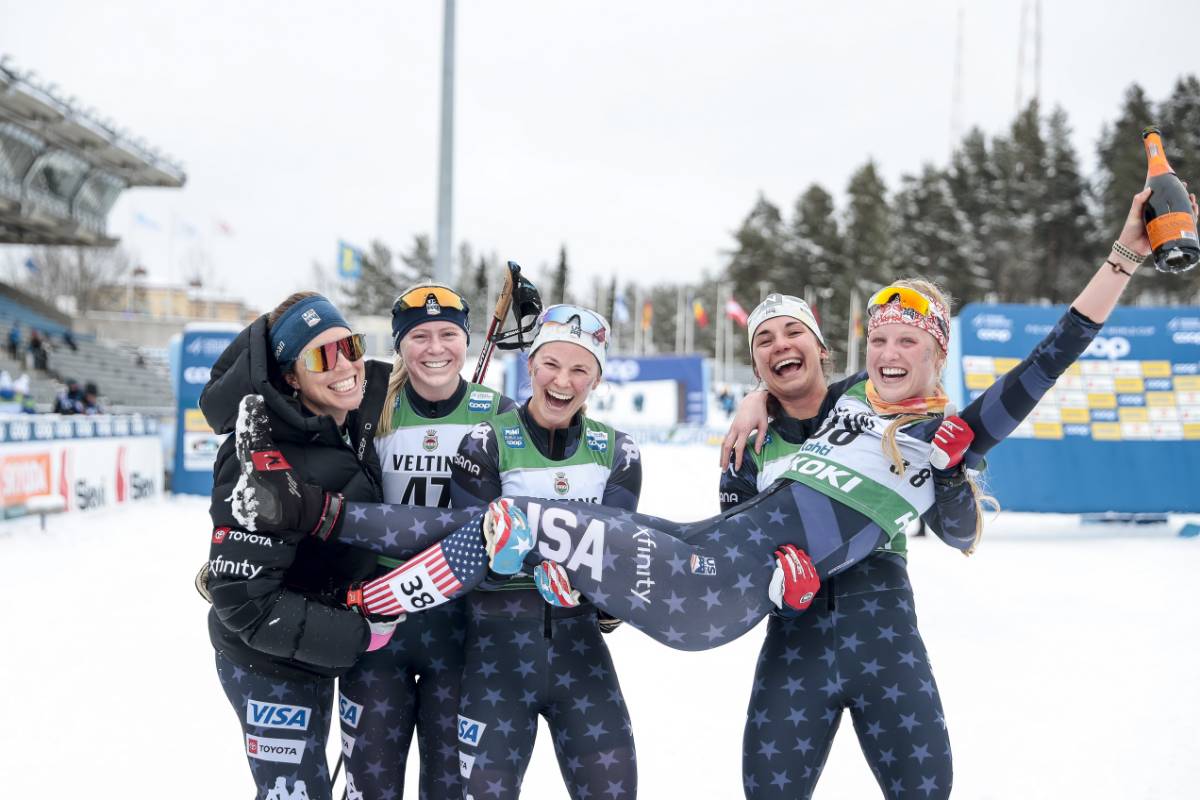


 This coverage is made possible through the generous support of Marty and Kathy Hall and A Hall Mark of Excellence A Hall Mark of Excellence Award. To learn more about A Hall Mark of Excellence Award, or to learn how you can support FasterSkier’s coverage, please contact