From the FasterSkier archive — posts syndicated from athletes’ and coaches’ own blogs between 2004 and 2012, kept online as published. Current coverage is at fasterskier.com.
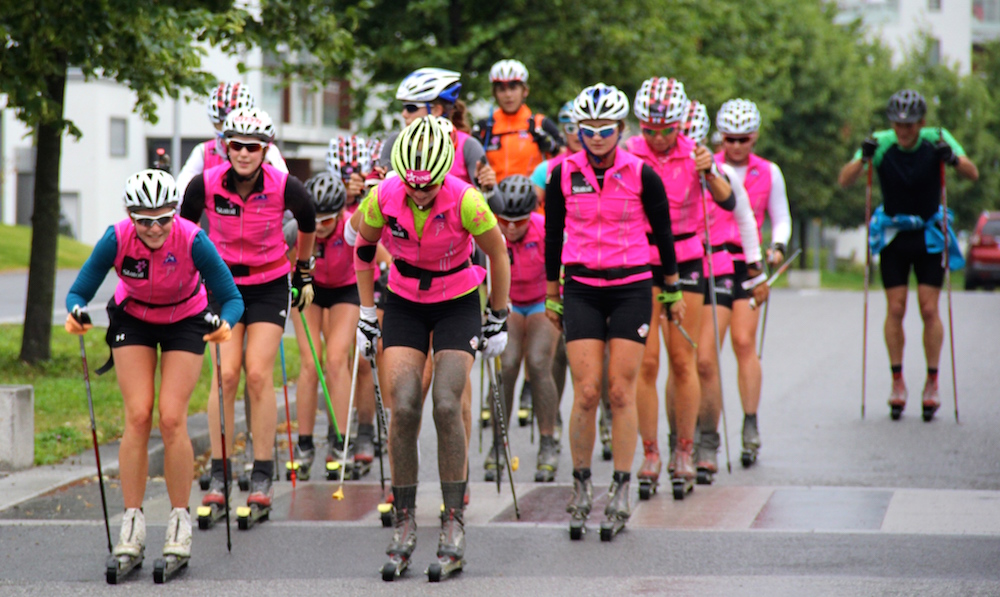
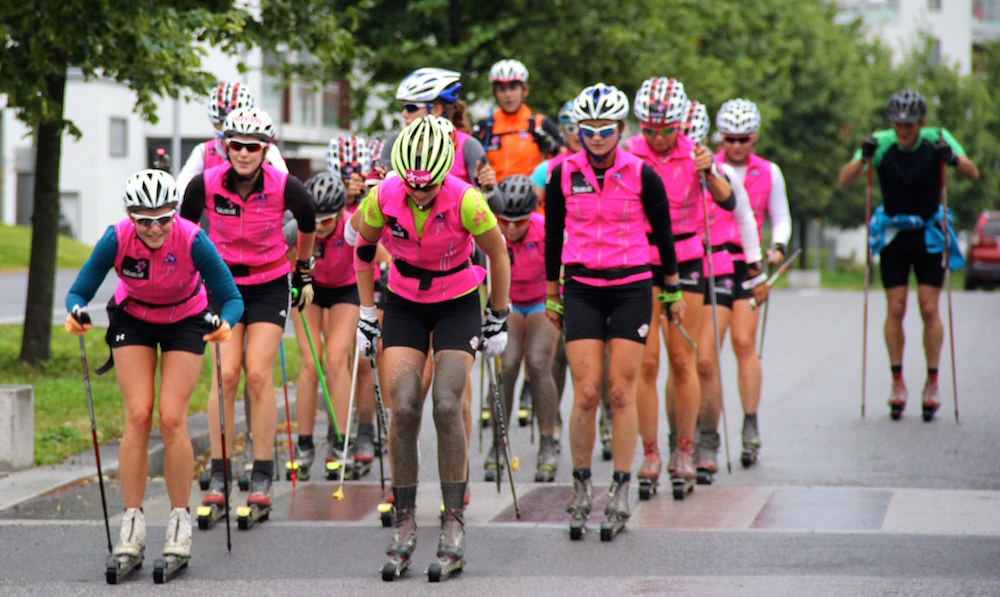
American and Norwegian juniors the International Junior Camp in Oslo, Norway, mix it up during a muddy rollerski at the Statoil Headquarters in Holmenkollen. (Photo: Bryan Fish)
There’s a new junior camp in town — specifically in Norway — for a select group of American cross-country prospects, and Hailey Swirbul of the Aspen Valley Ski and Snowboard Club has been documenting the first few days of action.
In June, the National Nordic Foundation (NNF) announced it was funding new initiative, to send top U18 and U20 athletes from the International Ranking List to the the International Junior Camp, where they would be amongst 135 others from 15 different nations. Swirbul, 17, was one of five U.S. women invited and nine athletes in total. The NNF covered more than 60 percent of the cost of the weeklong camp for each of its athletes.
While these teenagers are living it up in Norway from Aug. 6-14, Swirbul produced the following videos:
The 2015 Junior World Championships concluded on Sunday in Almaty, Kazakhstan, and left the U.S. team with a lot to celebrate.
Seventeen-year-old Katharine Ogden, of the Stratton Mountain School, in particular had a standout week, finishing sixth in the 10-kilometer skiathlon (for the best American distance result at Junior Worlds since 2002) and 11th in the 5 k freestyle. Northern Michigan University’s Ian Torchia finished 11th in the men’s 20 k skiathlon, while earlier in the week Thomas O’Harra of Alaska Pacific University was 14th overall in the classic sprint. The U.S. capped off Junior Worlds with its women’s squad placing eighth in the 4 x 3.3 k relay and the men taking 11th in their 4 x 5 k relay.
Below are several photos from American athletes and coaches of their week in Almaty.
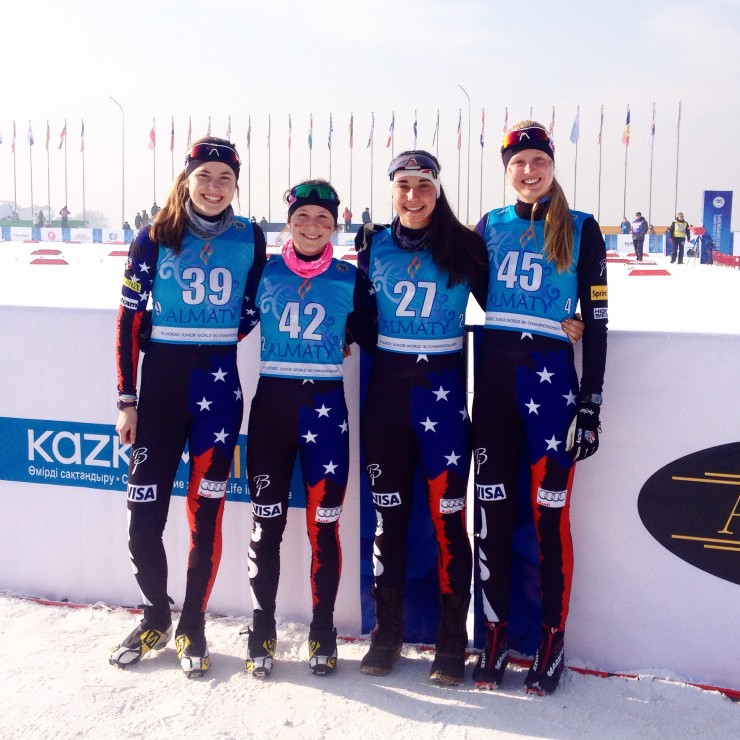
From l-r, Vivian Hett (NMU), Kristen Bourne (NMU), Julia Kern (CSU), and Hailey Swirbul (Aspen Valley) after the classic sprint at Junior World Championships in Almaty, Kazakhstan (Photo: Vivian Hett)
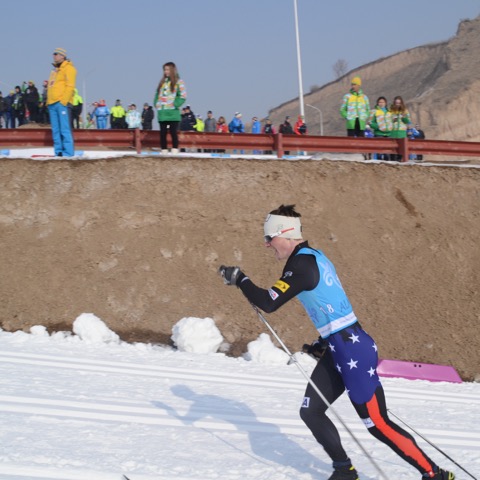
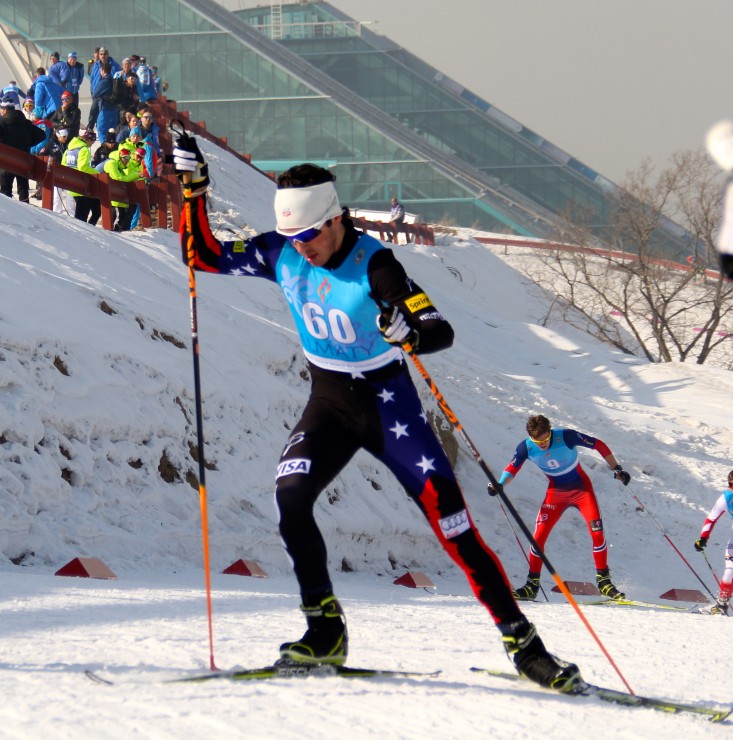
Thomas O’Harra (APU) races in the classic sprint quarterfinals at the Junior World Championships in Almaty, Kazakhstan. O’Harra would place third in his heat and 14th overall. (Photo: Thomas O’Harra)
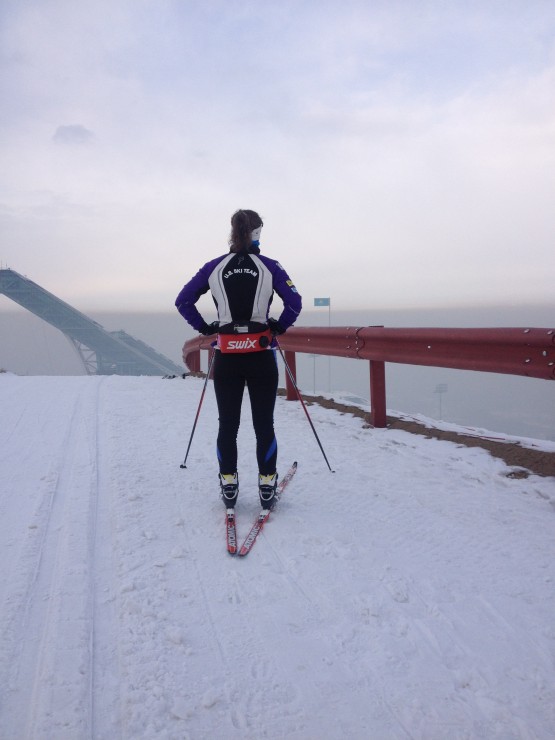
Kristen Bourne (NMU) overlooking the ski jump and the city of Almaty, Kazakhstan (shrouded in smog) from the course at Junior World Championships (Photo: Vivian Hett)
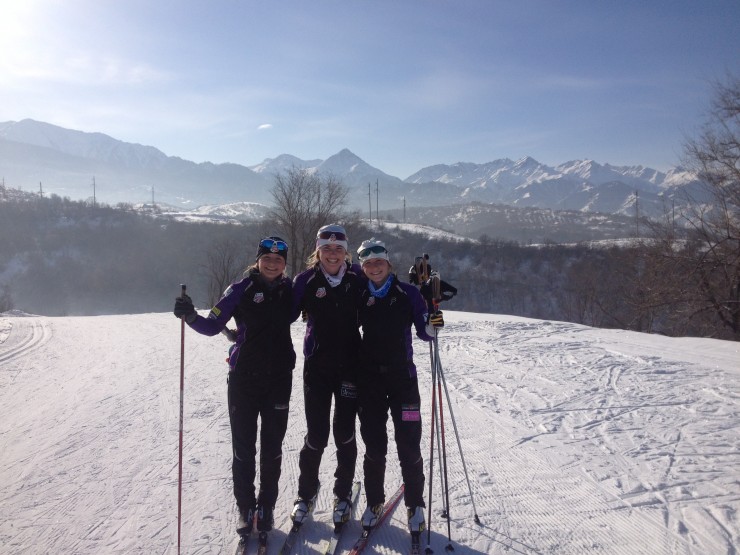
From l-r, Alayna Sonnesyn (UVM), Vivian Hett (NMU), and Kristen Bourne (NMU) doing some casual training on the course at Junior Worlds in Almaty, Kazakhstan (Photo: Vivian Hett)
The view overlooking the course and the stadium at Junior World Championships in Almaty, Kazakhstan (Photo: Julia Kern)
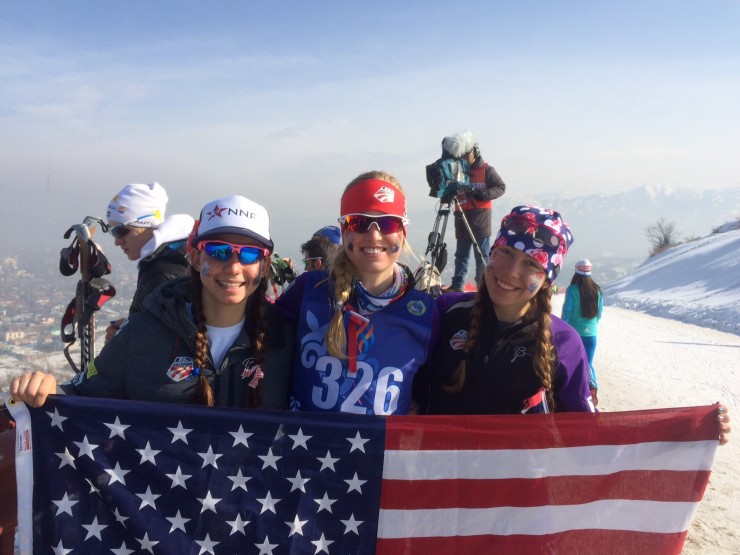
From l-r, Julia Kern (CSU), Hailey Swirbul (Aspen Valley), and Katharine Ogden (SMS) cheering on the U.S. U23 team at World Chamionships in Almaty, Kazakhstan. Kern and Ogden were named to the U.S. Ski Team’s “D” team this spring. (Photo: Julia Kern)
Kristen Bourne (NMU), Alayna Sonnesyn (UVM), and Vivian Hett (NMU) enjoying some time away from racing at the Junior World Championships by exploring a bazaar in Almaty, Kazakhstan (Photo: Vivian Hett)
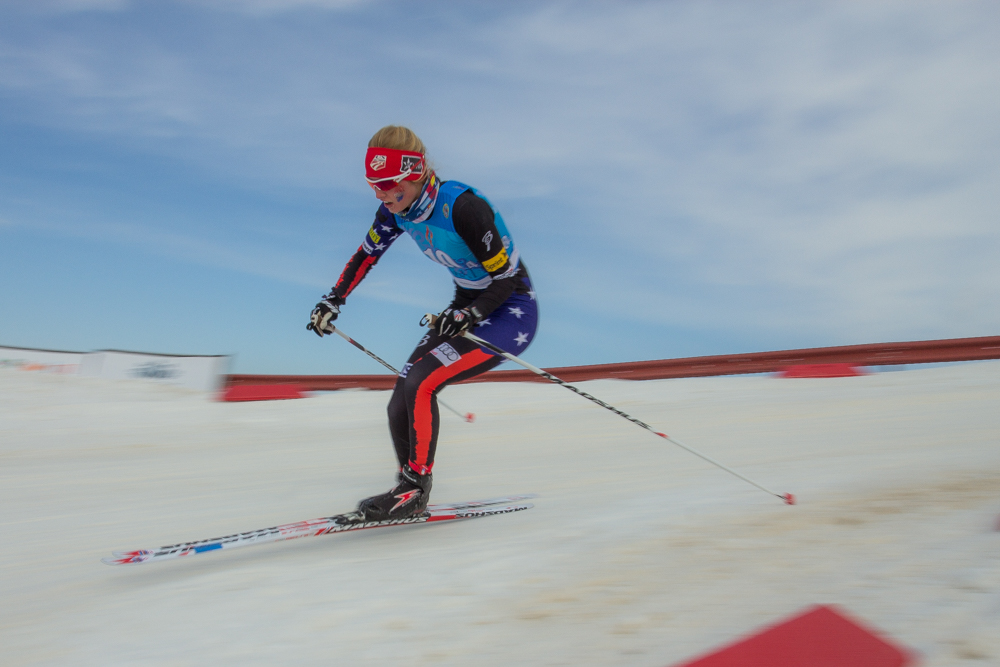
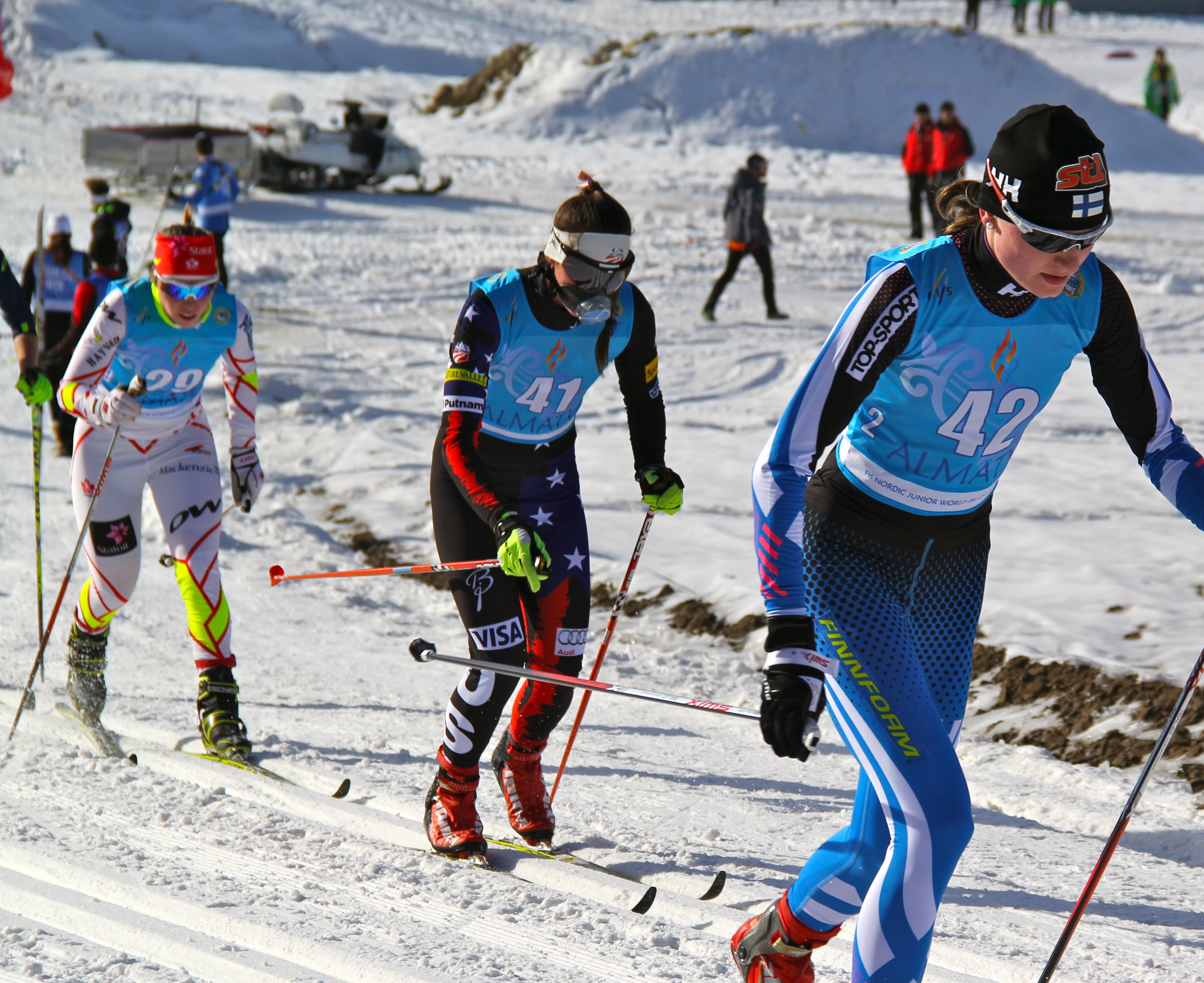
Julia Kern (CSU) on her way to 38th place in the 10 k skiathlon at Junior Worlds in Almaty, Kazakhstan (Photo: Bryan Fish/USSA)
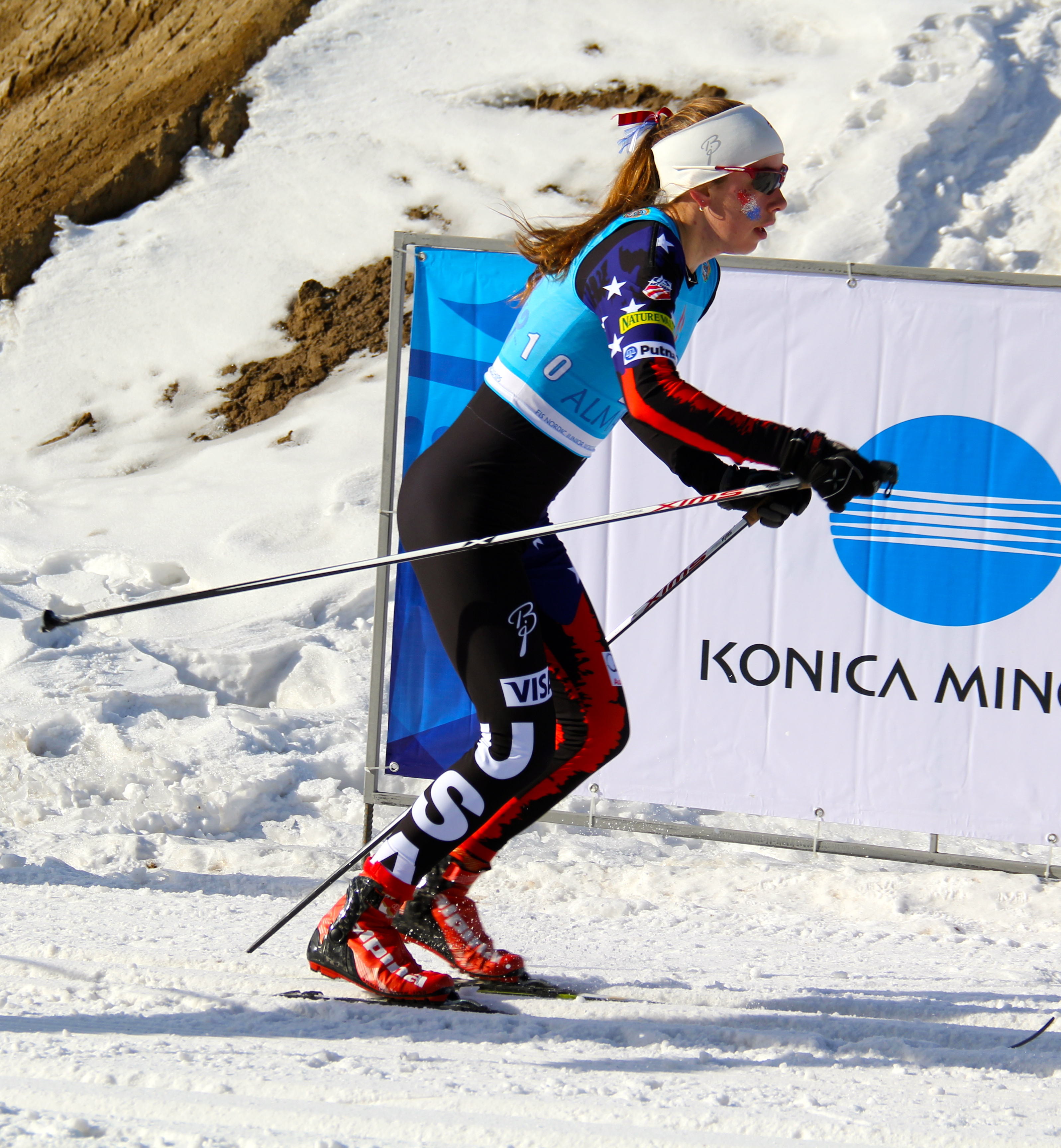
17-year-old Katharine Ogden’s sixth-place finish in the women’s 10 k skiathlon at the 2015 Junior World Championships was the best American result in a distance race since 2002 (Photo: Bryan Fish/USSA)
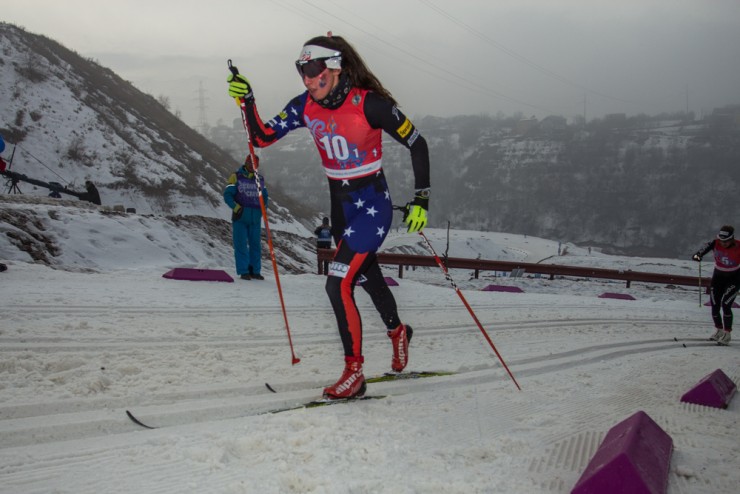
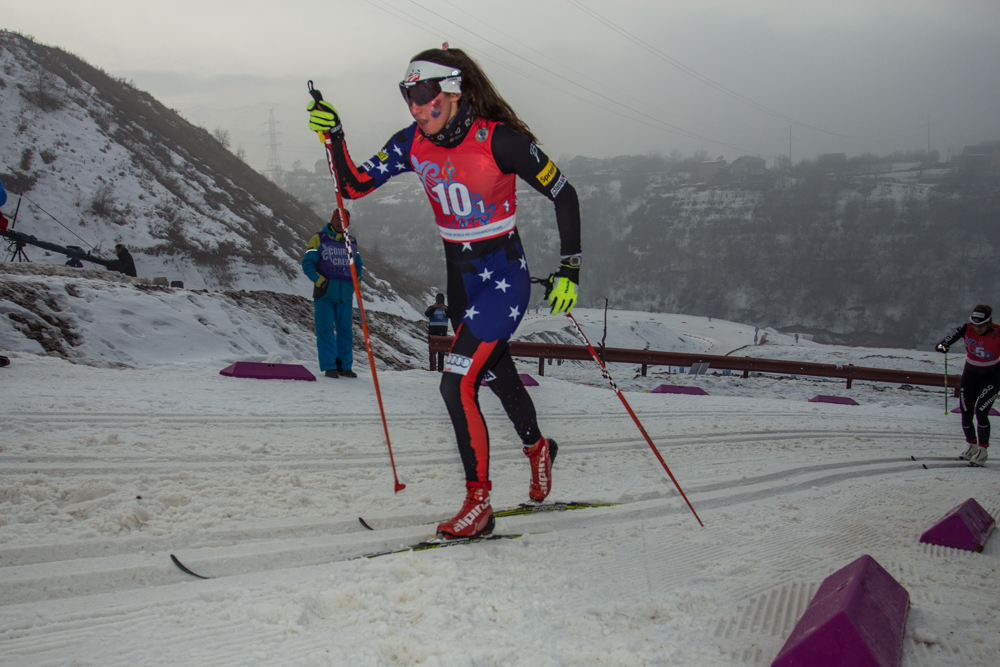
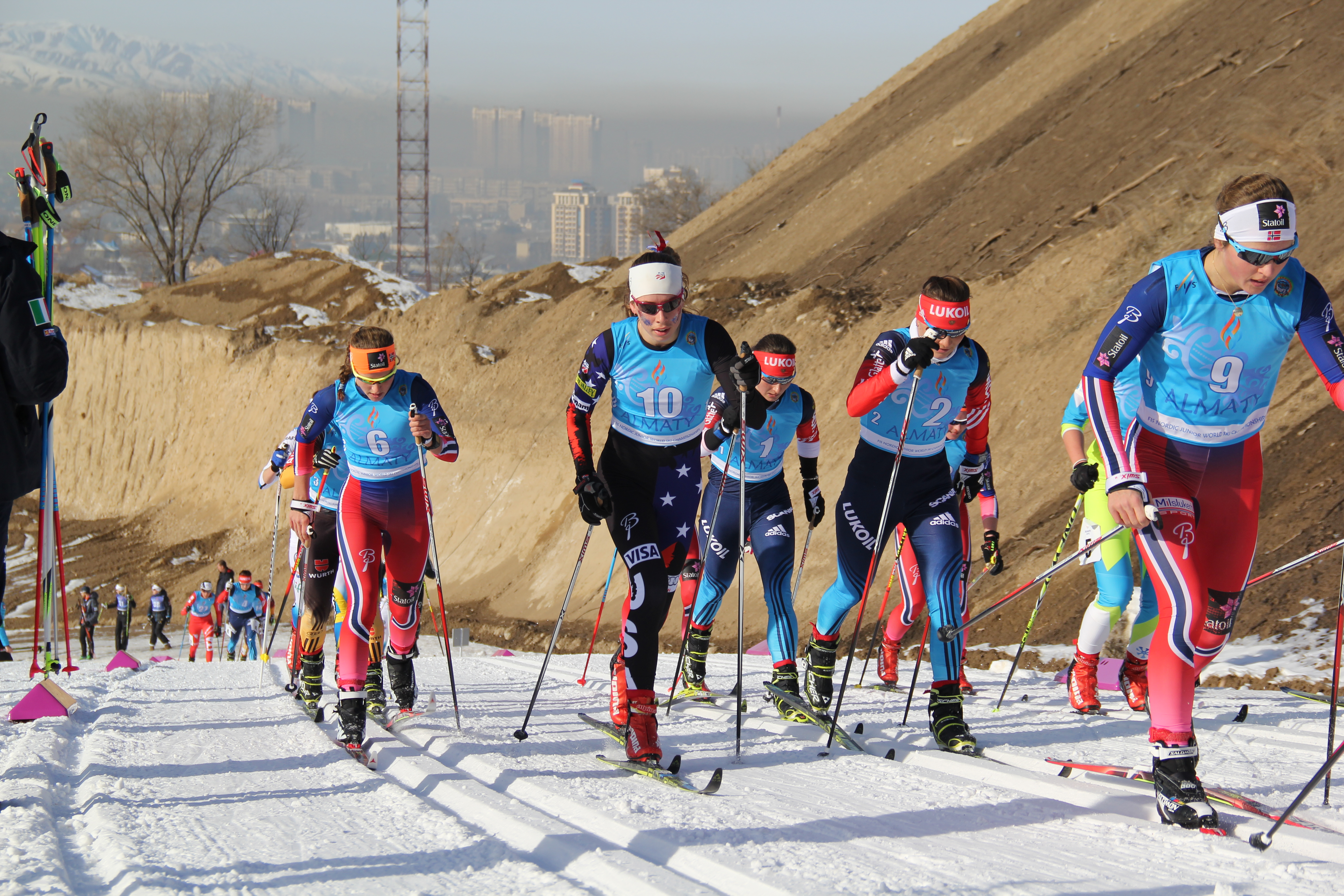
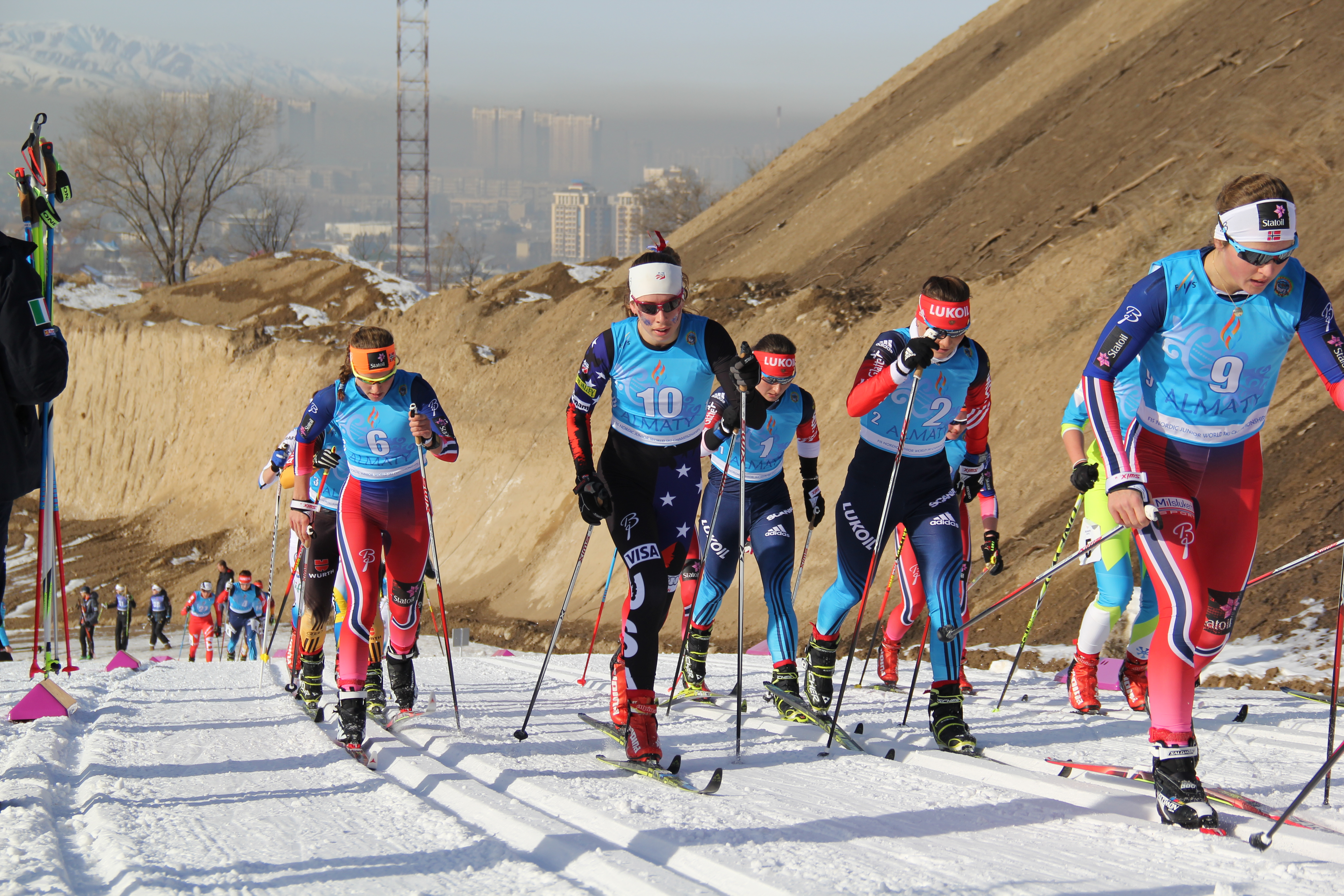
Katharine Ogden (10) on her way to a sixth-place finish in the women’s 10 k skiathlon at the 2015 Junior World Championships in Almaty, Kazakhstan (Photo: Bryan Fish/USSA)
Ian Torchia (NMU) on his way to an 11th-place finish in the 20 k skiathlon at the 2015 Junior World Championships in Almaty, Kazakhstan (Photo: Bryan Fish)
The view at sunset from the U.S. team hotel at the 2015 Junior World Championships reveals smog permeating the valley over Almaty, Kazakhstan (Photo: Thomas O’Harra)
U.S. Ski Team Development Coach Bryan Fish being glittered up by Hailey Swirbul at the Junior World Championships in Almaty, Kazakhstan (Photo: Julia Kern)
Julia Kern (CSU) racing against a backdrop of smog in the first leg of the 4 x 3.3 k relay at the 2015 Junior World Championships in Almaty, Kazakhstan. The American team would go on to place eighth. (Photo: Logan Hanneman)
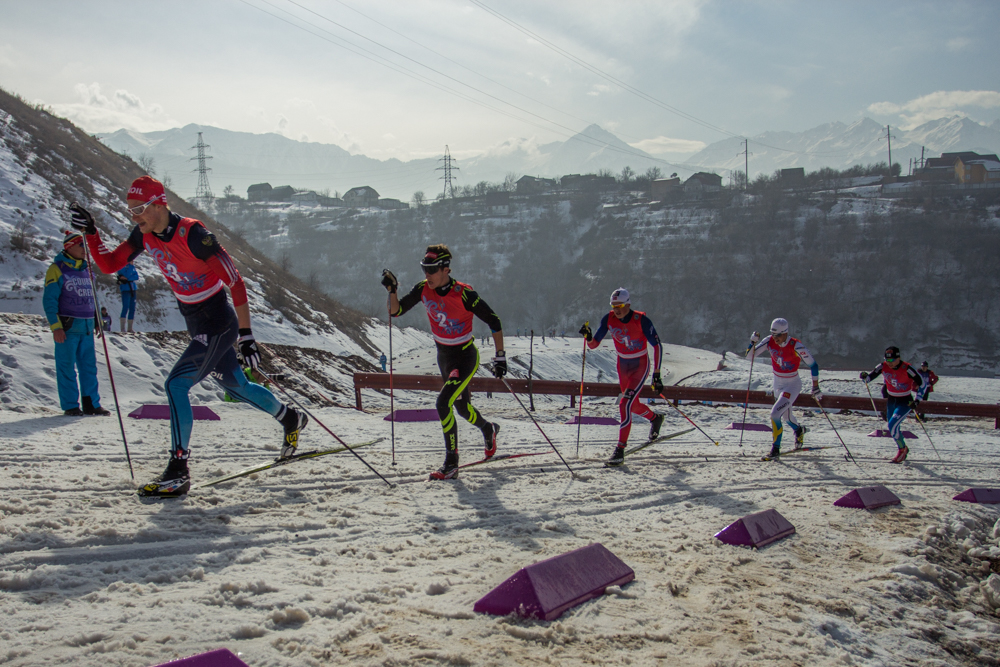
The venue in Almaty, Kazakhstan, was faced with problems of snow shortages during Junior and U23 World Championships in early February. Here, American Thomas O’Harra (back left) staying with the leaders during the first leg of the junior men’s relay; his team would go on to finish 11th. (Photo: Logan Heinemann)
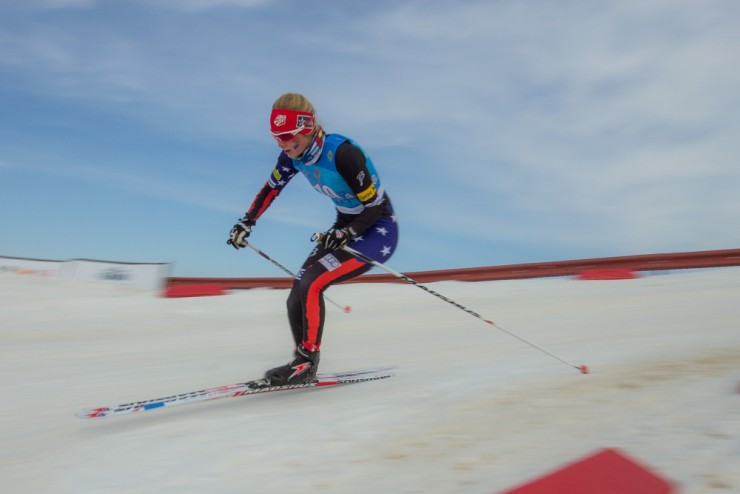
Hailey Swirbul of the Aspen Valley Ski Club races the anchor leg while guiding the American team to eighth place in the 4 x 3.3 k relay at the Junior World Championships in Almaty, Kazakhstan, in 2015. (Photo: Logan Hannneman)
Do you have photos from Junior World Championships or U23 World Championships that you’d like to share? Email info@fasterskier.com with a high-resolution photo attached and photo caption/credit information.
Julia Kern (CSU) races the first leg of the 4 x 3.3 k relay at the Junior World Championships in Almaty, Kazakhstan. The American women’s team would go on to place eighth. (Photo: Logan Hanneman)
The American junior women’s team wrapped up a successful week at the Junior World Championships in Almaty, Kazakhstan, by placing eighth in Sunday’s 4 x 3.3-kilometer relay. They finished 2:11.0 minutes behind the winning Norwegian team (35:04.0).
Norway erased an 11.1-second deficit after the second leg to claim victory with a time of 35:04.0 and beat the Russian team by 0.4 seconds. Germany used a strong final leg from Victoria Carl to overcome Sweden and take third (+35.3).
Julia Kern (Cambridge Sports Union) set up the American women’s squad by posting the fifth-fastest first leg and putting the team just 8.6 seconds behind Slovenia, the leader at the time.
Kern wrote in an email that the mass start today was not as chaotic as during Friday’s 10 k skiathlon, but was still fast and aggressive. “In these international races, people go hard from the start, leaving it all out there,” she wrote.
The 17 year old added that it was encouraging to be able to ski with the lead pack and be with the top skiers.
“It was relatively fast for the warm conditions, with a few icy spots,” she wrote. “My skis were fantastic, I didn’t slip once and also had really fast skis.”
Northern Michigan University’s Vivian Hett, who skied the second leg, wrote in an email that she felt okay about her race despite falling on an icy corner.
“The ski conditions today were getting a little tricky. The morning started out really foggy but the sun began to shine right after the race began! It has been really warm here so klister was needed for the classic legs,” she added.
17-year-old Katharine Ogden, of the Stratton Mountain School – who placed sixth in Friday’s skiathlon and tied the best American distance result at a Junior Worlds since 2002 – skied alone for the fifth-fastest third leg of the day. However, the team was still 1:16.4 minutes behind Norway and 24.7 seconds out of seventh going into the final leg.
“The people ahead of me were far ahead and the same with the people behind me,” Ogden wrote in an email.
Hailey Swirbul (Aspen Vally SSC) races the anchor leg while guiding the American team to eighth place in the 4 x 3.3 k relay at the Junior World Championships in Almaty, Kazakhstan (Photo: Logan Hanneman)
Hailey Swirbul’s anchor leg was also fairly uneventful, the Aspen Valley Ski & Snowboard Club member explained in an email.
“A pack of teams in front of us had created a gap in the previous leg, so it was my job to hold off the Finnish team behind us. It was a painful but lonely anchor leg for me!” Swirbul wrote.
She explained that conditions on the course were great considering the warmth Almaty has experienced over the past few days, and “the skis were ripping fast as usual thanks to our hard working techs.”
Overall, the American women were satisfied with their result.
“I thought that our team skied really well today. Other than a little crash on the second leg everything went smoothly and everyone gave it their all,” Ogden wrote.
“I was really excited about how our team did today,” Kern wrote. “We had bib 10 and we moved up to eighth, so that was exciting!”
Though Swirbul was happy the team improved on its 10th-place ranking from 2014, she explained that she is confident the team will only get better in years to come.
“It has been great to see the U.S. really mixing it up this year in multiple events, so I am looking forward to improving that relay result in the future,” she wrote.
Meanwhile, the Canadian women’s team finished 10th (+3:04.0). Katherine Stewart-Jones skied first and left the team in ninth, 37.5 seconds back. However, her leg could have gone a lot better.
The 19 year old Nakkertok and Canadian National Junior Team skier – who was 14th in Friday’s skiathlon – wrote in an email that her leg started off well, and she was in fourth after the first lap.
“Then I got tangled up and fell,” Stewart-Jones explained. “I got up as quickly as I could but realized I had lost my ski and that my binding was broken. I ran with one ski until one of the coaches gave me a new one.”
By that point, she had lost a lot of time and had fallen back to ninth place.
“It is obviously a little disappointing but skiing as a team is always a lot of fun anyway. It was great to be able to watch my teammates hammer their legs and cheer them on!” she wrote.
Russia wins again; Canada cracks top 10
On the men’s side, Russia continued to assert their dominance by winning the 4 x 5 k relay in 45:11.0. They were essentially tied with the French team going into the final leg, but Russian Alexey Chervotkin had too much speed for France’s Louis Schwartz, and Russia won by 17.3 seconds.
Norway was never within striking distance of the Russian or French skiers and finished third (+1:01.5).
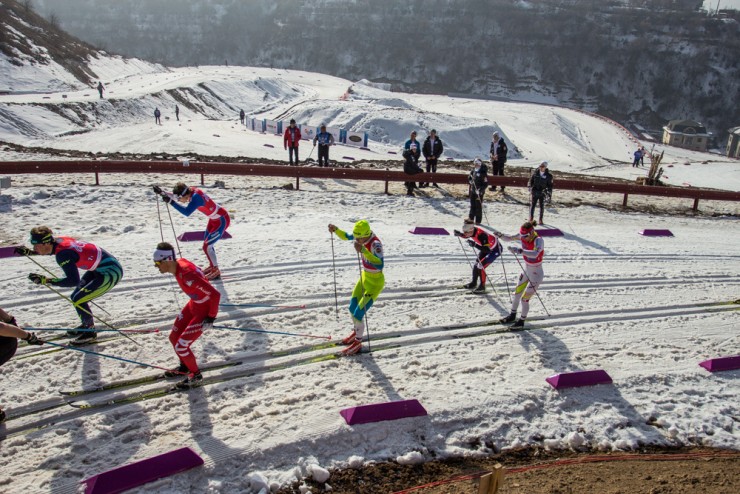
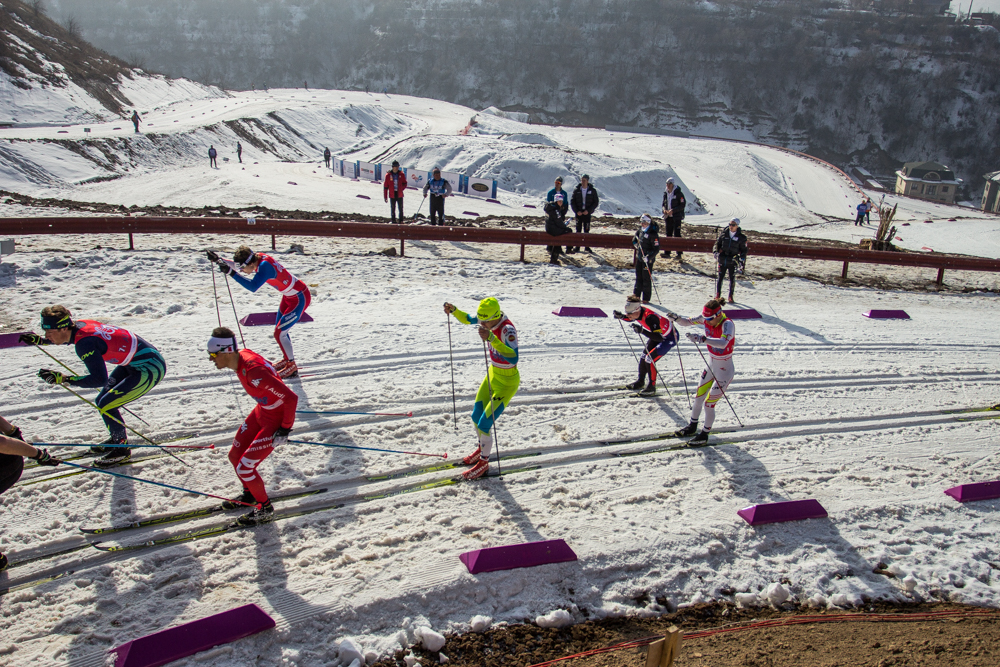
The leading pack: (l-r) Russia, France, Norway, Sweden, and Finland during the 4 x 5 k men’s relay on Sunday at the Junior World Championships in Almaty, Kazakhstan. (Photo: Logan Hanneman)
The Canadian men’s team took 10th (+3:40.9), while the American men placed 11th (+4:51.4).
“I thought that we did pretty alright,” American Thomas O’Harra (Alaska Pacific University), who skied the first leg, wrote in an email. “We were hoping to get into the top 10 at least, or even higher, but we couldn’t quite make it.”
O’Harra explained that he moved into fifth place during the first loop and pushed hard to stay with the leaders, but the pace caused him to blow up approximately 300 meters into the second loop.
“I moved backwards through the pack until we were pretty far down on the leaders,” he wrote. “Then, in the tag zone, something weird happened and Ian fell right after I tagged him.”
However, O’Harra was happy to see the team not get lapped and hold on for 11th.
Juniors reflect on week in Almaty
The North American athletes had mostly positive things to say about their experiences at the 2015 Junior World Championships.
Ogden explained that her goals coming into Junior Worlds were mainly to obtain valuable international racing experience and earn a top-20 result. She certainly got those results: In addition to her sixth-place performance in the skiathlon, she also placed 11th in Wednesday’s 5 k freestyle.
“I was really stoked to be able to meet and even exceed my goals,” she wrote.
She added that one of her favorite memories took place on Sunday when all the teams – wearing coats, hats, and suits from their own countries – were conversing and trading their specialized items of clothing.
“It was just so cool to see all of the teams come together like that,” she wrote.
Kern was disappointed that she missed the sprint heats by 0.4 seconds on Tuesday, but wrote that otherwise she had a fantastic week.
Thomas O’Harra (back left) staying with the leaders during the first leg of the men’s relay at the Junior World Championships in Almaty, Kazakhstan. (Photo: Logan Heinemann)
“One of my favorite memories was relay day. We all put glitter on all our faces and then went to track down all of our coaches and wax techs who all received glitter on their faces as well!” she wrote.
Swirbul reflected on World Juniors by writing that the week has been an “important and successful step” in her skiing career.
The 16-year-old Swirbul was 35th in the skiathlon and 40th overall in Tuesday’s sprint.
She wrote that she began her season with a goal to qualify for Junior Worlds, and after achieving that goal, she arrived in Almaty feeling little pressure and with a mindset to learn as much as possible.
“I was able to achieve my goals to absorb as much as I could from the elite athletes surrounding me, and learn from their race strategy and the way they carry themselves at competitions,” Swirbul explained.
O’Harra wrote, “The smog in Almaty is pretty bad, but the people are all really nice, and the food is good … I’ve met a lot of really cool people here, and I’m looking forward to racing with and against them in the future!”
Katharine Ogden (10) of the Stratton Mountain School on her way to sixth place in the women’s 10 k skiathlon at the Junior World Championships in Almaty, Kazakhstan. With that result, Ogden tied Kristina Tryggstad-Saari for the best Junior Worlds distance result since Tryggstad-Saari placed sixth in the 5 k freestyle in 2002. (Photo: Bryan Fish/USSA)
It may be Katharine Ogden’s first-ever Junior World Championships, but the 17-year-old Stratton Mountain School (SMS) skier is having a week to remember.
Ogden placed sixth in Friday’s 10-kilometer skiathlon in Almaty, Kazakhstan, following an 11th-place finish in Wednesday’s 5 k freestyle. The American finished just 13.2 seconds behind winner Sofie Nordsveen Hustad of Norway (27:02.8) and was 6.4 seconds from the podium.
“I am beyond stoked about my race today!” Ogden wrote in an email. “Going into the race I was originally hoping for a top 20, but after the 5 k on Wednesday I was really hoping for a top-10 result.”
Ogden explained that the race went smoothly, as she was able to avoid crashing during the hectic mass start. She was then able to maintain a position in the top 20 for the majority of the classic portion.
“It was really cool to be able to ski with some fast, aggressive Europeans and to experience a crazy, Euro-style mass start for the first time,” she wrote.
Katharine Ogden’s sixth-place finish in the women’s 10 k skiathlon is the best American distance result in a Junior Worlds race since 2002. (Photo: Bryan Fish/USSA)
Germany’s Victoria Carl broke away during the first lap of the skate portion, and Ogden joined the pack chasing her down. By the second of two skate laps, the lead group had dwindled down to six skiers and was fairly spread out, Ogden explained.
“Katharine would charge on the climbs, leading the pack uphill and the Russians would immediately react over the climbs and pull in front,” U.S. Ski Team Development Coach Bryan Fish wrote in an email to the press. “It was a hard fought battle on a challenging 2.5 k skate course.”
Ogden would finish in the back of the lead pack, but was just 2.2 seconds behind fifth-place Anastasia Sedova of Russia (+11.0).
“This was a really good, encouraging result for me, and going forward it is really awesome to have the learning experience from my first international mass-start race,” Ogden wrote.
“Both Katharine and Ian’s results are in a very small group in the history of U.S. Junior World cross-country ski results. Historically, we have had strong results in junior sprinting and U23,” Fish explained in an email to FasterSkier.
U.S. Women’s Head Coach Matt Whitcomb posted on Facebook that Ogden’s result tied the best women’s Junior Worlds distance result, men or women, after Kristina Tryggstad-Saari placed sixth in the 5 k freestyle in 2002.
“The future is bright for the U.S.!” Whitcomb wrote.
Fish added that there is no special way the U.S. team prepared for the skiathlon – they just treated it like any other distance race.
Julia Kern (41) of the Cambridge Sports Union on her way to 38th place in the 10 k skiathlon at Junior Worlds in Almaty, Kazakhstan. (Photo: Bryan Fish/USSA)
“The athletes often do two-a-day training where one ski discipline is in the AM and another in the PM, so the body is already somewhat accustomed to it. Certainly, practice is necessary to transition from classic to skate back-to-back,” he explained.
Fish added that based on Ogden and Torchia’s results, “the whole team is riding a high. We’re going to feed off this energy tomorrow for the U23 skiathlon races.”
Meanwhile, Canadian National Junior Team and Nakkertok member Katherine Stewart-Jones cracked the top 15 in 14th (+1:34.0) and Anne-Marie Comeau (CNEPH/NST-Junior) was 25th (+2:02.0).
Stewart-Jones wrote in an email that she was very happy with Friday’s result, as she accomplished her goal of earning a top-15 finish in a distance race at Junior Worlds.
“It is my last individual race I’ll get to do as a junior at Worlds and so I couldn’t be happier with how it finished,” the 19-year-old wrote.
She explained that the race was chaotic from start.
“There were girls falling everywhere and breaking poles. I just focused on staying on my feet, avoiding trouble, and skiing relaxed. I got myself into a good position at the end of the classic leg and was skiing with a big group of girls,” she wrote.
She explained that she felt strong heading into the skate, and was leading the large group of skiers behind the lead group. The other skiers would draft her on the downhills, which made it hard to break away, so Stewart-Jones knew she would have to make her move on the final hill.
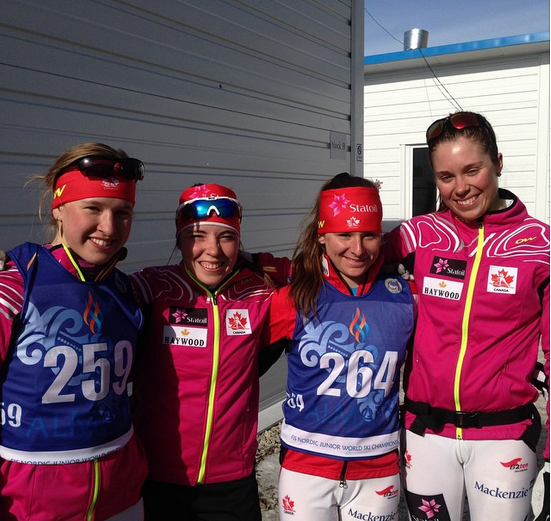
From l-r, Canadians Annah Hanthorn, Katherine Stewart-Jones, Anne-Marie Comeau, and Maya McIssac-Jones, after the 10 k skiathlon at Junior World Championships in Almaty, Kazakhstan. (Photo: Lisa Patterson/CCC)
“The last kilometer is a blur. I just skied as hard as I could and didn’t think about anything else,” she wrote.
During that last kilometer, she distanced herself from the large group and held on during the final stretch to take 14th.
“All in all, it is such a great feeling to have improved from last year’s 31st place and this is definitely some motivation for the next races and training season!” she wrote.
Comeau managed to avoid getting tangled up at the start and was 29th after the classic portion and 58.5 seconds behind Carl, who led after the classic (13:00.7). However, she picked up the pace after the transition and had the 14th-fastest skate, beating Kazakhstan’s Angelina Shuryga by 0.3 seconds to earn a top-25 finish.
After Hustad, the other podium spots were filled by Carl in second (+2.0) and Sweden’s Ebba Andersson in third (+6.8).
“After the classic [portion] I was in fourth or fifth place, so I didn’t expect to become a champion today,” Hustad told the International Ski Federation (FIS). “I had amazing skis, I just glided into the finish line.”
Andersson said to FIS, “The course is very tough and fun at the same time. I really did not expect that I would be on the podium. Of course I am very happy today!”
Other North American skiers included Americans Hailey Swirbul (Aspen Valley Ski & Snowboard Club) in 35th (+2:45.4), Julia Kern (Cambridge Sports Union) in 38th (+3:19.1), and Alayna Sonnesyn (University of Vermont) in 50th (+4:56.2).
Canadian Maya Macisaac-Jones (Rocky Mountain Racers/NST-Junior) finished in 45th (+4:00.9) while Annah Hanthorn (Whitehorse) was 47th (+4:36.2).
Hanthorn was faced with some unusual adversity, as Canadian High-Performance Development Coordinator Lisa Patterson told Cross Country Canada.
“Annah had her skis taken from the exchange box by a Finnish skier. Annah wasted at least 30 seconds searching and then skied on the Finn’s skis. At the end of the race she was extremely polite and showed no anger, and actually congratulated the Finnish racer. On a positive note, both said their skis were fast,” Patterson said.
Junior Worlds finish in Almaty on Sunday with the men’s 4 x 5 k relay and the women’s 4 x 3.3 k relay.
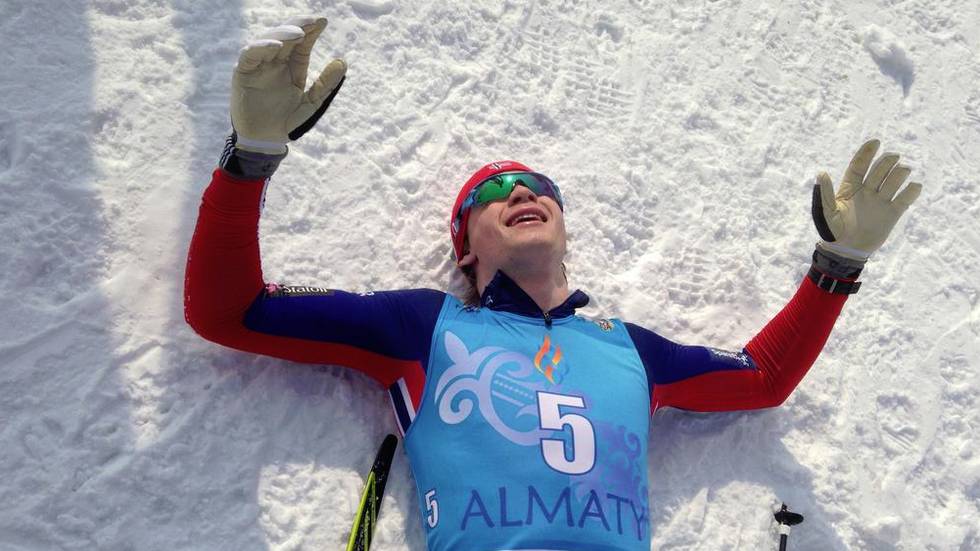
An exhausted-and-ecstatic Fredrik Riseth of Norway after winning his first Junior World Championships title on Tuesday in the 1.3 k classic sprint. (Photo: FIS)
Last year in his FIS Junior World Ski Championships debut, Thomas O’Harra placed 54th in the freestyle sprint in Val di Fiemme, Italy. Another year older and with another season of training under his belt, the 18-year-old Alaska Pacific University (APU) skier placed 14th on Tuesday in the opening race of 2015 Junior Worlds in Almaty, Kazakhstan: the 1.3-kilometer classic sprint.
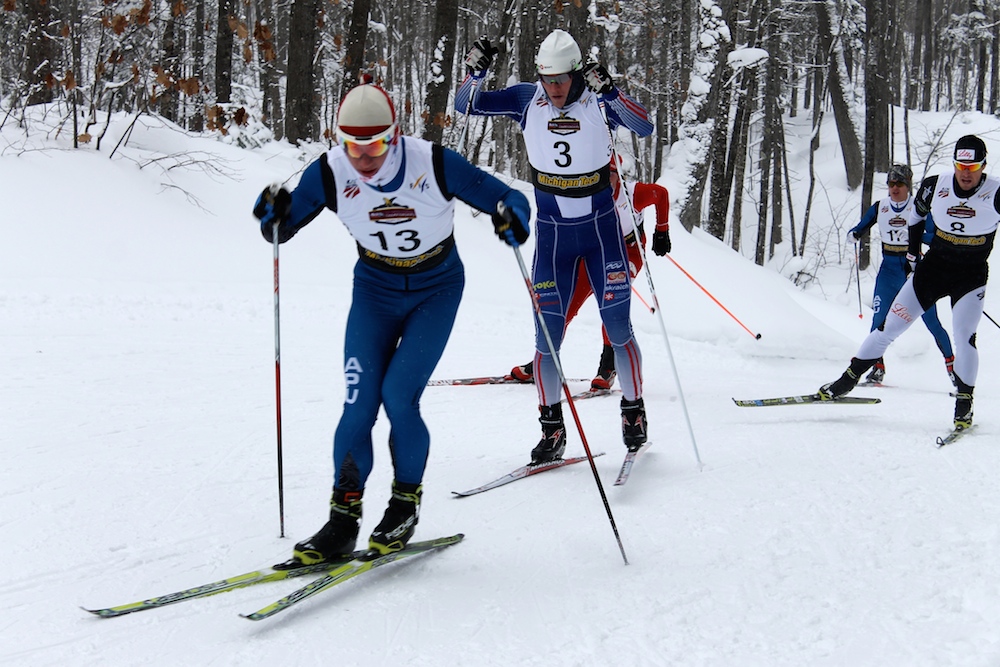
APU’s Thomas O’Harra (13) leading his freestyle-sprint quarterfinal with Sun Valley’s Miles Havlick (3) and Kris Freeman (8) last month at 2015 U.S. senior nationals in Houghton, Mich. He went on to place 18th overall.
O’Harra qualified 18th and went on to place third in his quarterfinal, 2.92 seconds behind the winner of his heat, Ludek Seller of the Czech Republic, and 0.35 seconds behind Russia’s Alexander Bakanov, who also automatically advanced in second.
O’Harra’s quarterfinal was the slowest of the five, which prevented him from moving on to the semifinals as a lucky loser. But at the end of the day, 14th was still way better than 54th.
“I don’t know if I can say I was expecting it, but I definitely knew that if I had a good race, I could get into the top 30,” O’Harra wrote in an email on Tuesday. “Coming into the sprint, my goal was to qualify. Ultimately though, my goal was to get into the top 10. Once I had qualified, I focused more on trying to advance out of my quarterfinal.”
He reflected that his quarterfinal was “pretty hard right off the bat … everyone was jostling for position.” Knowing that he needed a top-two in his heat to guarantee a spot in the semifinal, O’Harra followed Bakanov in his track to the finish and lunged between the Russian’s legs as Bakanov let up near the line. And while it wasn’t quite enough, O’Harra was pleased to finish well within the top 30.
“Today was a much better experience than last year’s sprint!” he wrote. “Last year I tripped myself going up the first hill and ended up 54th — not exactly super-duper. I think that a year’s more experience helped a lot. I was definitely a lot more collected and calm this year, both going into the race and during the race.”
He was also optimistic about another top 30 in Wednesday’s 10 k freestyle.
“I think that I’m in a really good place right now, but I didn’t actually try to peak specifically for these races, mainly because there is still a lot of racing left this season,” he wrote.
“Last year I tripped myself going up the first hill and ended up 54th — not exactly super-duper. I think that a year’s more experience helped a lot.” — Thomas O’Harra, 14th in 2015 Junior World Championships 1.3 k classic sprint
O’Harra led the North Americans in the junior men’s sprint, which Norway’s Fredrik Riseth won outright in 3:01.25. The Norwegian qualified fifth behind Finland’s Lauri Vuorinen (the top men’s qualifier in 3:01.88), and Riseth went on to win his quarterfinal and his semifinal before beating Bakanov by 4.85 seconds in the final.
Norway’s Johannes Høsflot Klæbo made the podium as well in third, 8 seconds behind Riseth. Germany’s Marius Cebulla was fourth (+10.04), Sweden’s Oskar Svensson finished fifth (+10.11), and Vuorinen was sixth (+21.67).
Riseth’s father, Svein Riseth, told Langrenn that he was impressed with his son’s result. While he knew Fredrik was in great shape, Svein wasn’t sure he had enough left after dominating his quarterfinal and semifinal. The contender he was most concerned about was Fredrik’s Byåsen IL teammate, Høsflot Klæbo.
“Johannes is not only a good skier, but he is mentally and tactically strong,” Svein said, according to a translation. “It is outrageously fun two Byåsen runners entered the podium. Not just for the team but for [Trondheim] skiing.”
While no other North American men qualified in the top 30, Canada’s Julian Smith (Georgian Bay) placed 39th, 3.82 seconds from 30th. Americans Evan Weinman (Middlebury) and Peter Holmes (University of New Hampshire) were 46th and 48th, respectively, Canada’s Alexis Dumas (CNEPH/NST-Junior) ranked 53rd, Ricardo Izquierdo-Bernier (CNEPH/NST-Junior) was 56th, American Gavin Hess (UNH) 58th, and Canadian Philippe Boucher (CNEPH/NST-Junior) 59th.
Stewart-Jones Leads Three Canadian Women in the Heats
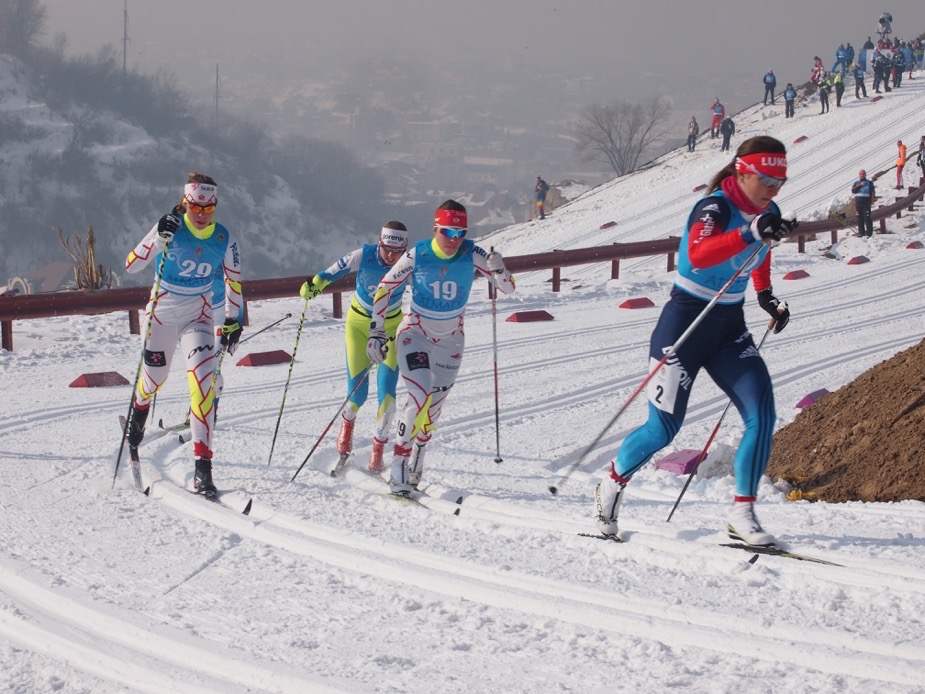
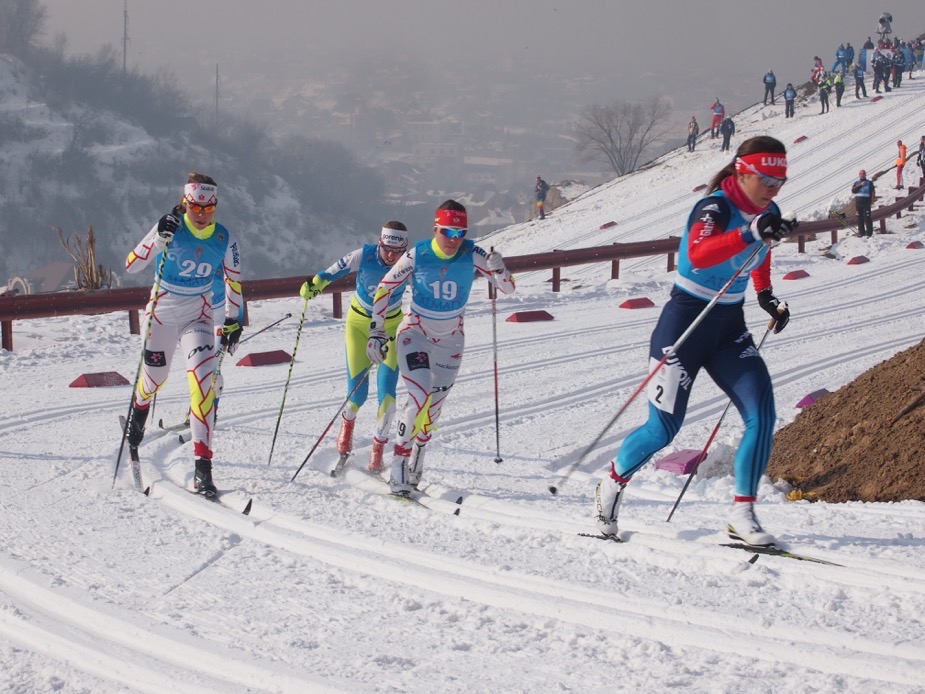
Canadian National Junior Team members Katherine Stewart-Jones (19) and Maya MacIsaac-Jones (29) chase Russia’s Natalia Nepryaeva (2) in the quarterfinal of the 1.3 k classic sprint on the opening day of 2015 Junior World Championships in Almaty, Kazakhstan. (Photo: Lisa Patterson/CCC)
In the women’s 1.3 k classic sprint, Katherine Stewart-Jones knew what was coming, or at least what to expect, in her third time qualifying for the Junior Worlds heats.
The 19-year-old Canadian National Junior Team member qualified in 19th, 13.61 seconds behind Russia’s Yulia Belorukova, the top qualifier in 3:29.24. Stewart-Jones then finished fourth in her quarterfinal, 9.77 seconds after another Russian, Natalia Nepryaeva, who won the heat. Their quarterfinal was the second slowest and Stewart-Jones did not advance, putting her in 19th overall.
“I am satisfied with my result,” Stewart-Jones, the top North American female junior of the day, wrote in an email. “I definitely had the goal to make it past the quarter-finals because last year I was extremely close. I can’t really be disappointed with how it turned out because I gave everything I had.”
“I definitely had the goal to make it past the quarter-finals because last year I was extremely close. I can’t really be disappointed with how it turned out because I gave everything I had.” — Katherine Stewart-Jones, 19th in 2015 Junior World Championships 1.3 k classic sprint
Last year at Junior World Championships, she placed 15th in the freestyle sprint, and the year before, she was 25th at the 2013 Junior Worlds in Liberec, Czech Republic.
But for the first time on Tuesday, she raced against one of her fellow national-junior team members in the heats: Maya MacIsaac-Jones of Rocky Mountain Racers (RMR).
“We both had a really good start so it was fun to ski at the front together for the first part of the race,” Stewart-Jones explained. “After the long downhill I was in third place but then I made a bit of a tactical mistake. At the start of the long uphill I went right behind a Russian but she slowed down. When I went to make the pass and change lanes I lost my momentum.”
MacIsaac-Jones, 19, made the top-30 qualifying cutoff in 29th and ended up fifth in her first time racing the heats at that level, 12.05 seconds behind the winner.
“Katherine and I have raced together for a long time, and since there are so many things at World Juniors that are different from racing in Canada, it was nice to have a familiar face beside me,” MacIsaac-Jones wrote in an email. “My ‘realistic’ goal for today was to qualify, and my ‘dream’ goal was to get a top-15 result. I am very happy to have qualified for the heats, especially to have qualified with two of my teammates, but I am disappointed that I wasn’t able to move on past the quarter final.”
Her previous best in her last Junior Worlds in 2013 was 36th in the classic sprint. On Tuesday, she placed 25th overall. The third Canadian woman to make the rounds, Sophie Carrier-Laforte (Skinouk/NST-Junior) qualified in 23rd and placed 22nd overall after finishing fifth in her quarterfinal, 12.21 seconds behind Austria’s Lisa Unterweger, who won the heat.
“It was a lot of fun to be racing with so many other Canadian girls in the heats today,” MacIsaac-Jones wrote. “We have all been training really hard for these championships, so it feels great to show the world what Canadian girls can do!
“This experience is definitely different from my experience in Liberec 2013,” she explained “I feel like I am in a lot better distance racing shape than I was in Liberec, and I should have a chance to race most or all of the distance races, which will be a lot of fun. This being my second Championships, I feel like I have a bit of a better idea of what to expect and how to prepare for racing on the international scene.”
Stewart-Jones was also looking forward to the distance races after placing 31st in the skiathlon in Val di Fiemme last year.
“I would like to make a top 15 in a distance race and I believe that I can,” she wrote.
Nakkertok Head Coach Kieran Jones wrote in an email that Stewart-Jones’ performance on Tuesday wasn’t a surprise.
“We have been targeting top 30’s at World Juniors since the start of the year. While I was pretty excited for the classic sprint, I would say that it’s definitely not her strongest event,” he noted. “It’s more of a good indicator that the fitness and speed is where we want it to be. Katherine is rock solid — once she gets rolling, she’s great at managing her energy, enthusiasm, and focus.”
He explained that she’s shooting for top-30 results in both Wednesday’s 5 k freestyle and Friday’s 10 k skiathlon.
“Personally, I think she has a shot at a top 10 in the 5 km if everything goes to plan,” Jones wrote. “She is also really looking forward to the relay — this year the Canadian women’s team is one of the strongest it has been in a long time, and she wants to help them have a strong finish.”
Germany’s Victoria Carl after notching her second Junior World Championships title and third podium in the first race of 2015 Junior Worlds in Almaty, Kazakhstan. (Photo: FIS)
Just 0.26 seconds from qualifying in the top 30, Julia Kern of the Cambridge Sports Union led the U.S. junior women in 31st. Vivian Hett (Northern Michigan University) placed 36th, 3.89 seconds from 30th, and Hailey Swirbul (Aspen Valley Ski & Snowboard Club) was 40th.
Canada’s Annah Hanthorn (Whitehorse) finished 45th, and American Kristen Bourne (NMU) placed 46th.
Germany’s Victoria Carl racked up her second Junior Worlds title since she last raced at the championships in 2013 (where she won the 5 k freestyle and placed second in the classic sprint). Carl, 19, qualified fourth and won her quarterfinal and semifinal before topping the final as well in 3:29.01, 1.64 seconds ahead of Belorukova in second.
Another one of the women in the Stewart-Jones/MacIsaac-Jones quarterfinal, Nepryaeva placed third in the final, 2.18 seconds back from the win. The Russian edged Norway’s Lotta Udnes Weng by 0.2 seconds for the podium, and Weng’s sister Tiril Udnes Weng placed fifth, 6.42 seconds after Carl. Germany’s Jenny Mann finished sixth in the final (+30.43).
First Impressions
The junior classic sprint was originally scheduled for Monday, then pushed back a day to allow more time to extend the 800-meter loop to 1.3 k. In addition to concerns about dirt and rocks on the trail, the air quality in Almaty continues to pose one of the biggest problems for athletes, with several U.S. athletes bringing ventilation masks to the championships.
“The air quality is certainly an issue, but we all share this challenge,” U.S. Ski Team Development Coach Bryan Fish wrote in an email. “Many of our athletes purchased filtering masks before arriving. The same ones used [at the Summer Games] in Beijing.
“They don’t wear them all the time — primarily when skiing,” he added. “The trails are uphill, so it depends how high the inversion is. Unfortunately there is no way to escape it in the city. All the teams are staying in the city except Russia is an hour away in the mountains.”
According to O’Harra, “Skiing here is… thin. When we arrived, there was only about 2.5k of trail, and that was full of rocks. The volunteers and organizers have done an amazing job, though! They have been blowing snow around the clock, and their hard work definitely shows,” he wrote. “The smog varies. It pretty much always sits down in the bottom of the valley, and most days it creeps up to where the trails are as we ski. It was definitely hazy today, but there have been worse days. I don’t think that it hindered my performance, but I still don’t like having it around.”
MacIsaac-Jones wrote that the skiing over the last week had not been ideal; the postponement of the first race “altered everyone’s race preparations, and we have been dealing with heavy smog all week.”
She added that there was adequate snow on the sprint course, “and there should be enough for the skate race tomorrow. The snow here is artificial, cold and hard-packed right now, which is great for me because it is similar to the snow I am used to training on in Canmore, Alberta,” she wrote.
“The skiing here is nothing like I have seen before,” Stewart-Jones explained. “The race site is built at the top of a huge sand hill in the middle of the city. All the trails weave around the hill and the snow is all man made. … The smog is definitely an issue; I have been coughing a lot more than usual.”
Through email exchanges, her coach Jones has been keeping tabs on the conditions.
“That stuff is out of our control,” he wrote. “That’s always been the message — control what you can, and don’t worry about anything else. … Kath is great at that, so I wasn’t worried.”
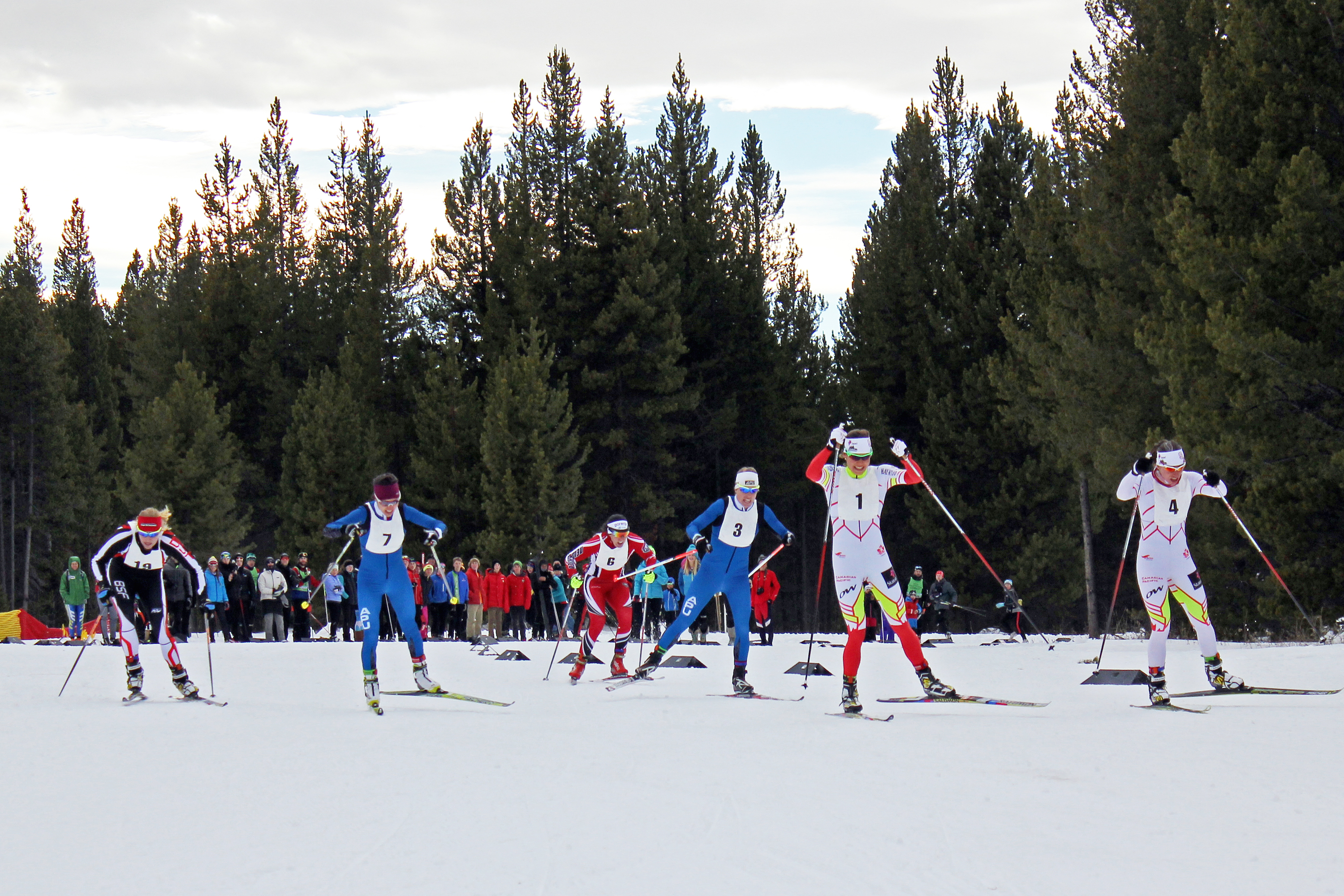
Alysson Marshall (AWCA/NST) in bib 4 and Heidi Widmer (AWCA/NST) in bib 1 lead (from l-r) Rosie Brennan (APU), Eva Severrus (UNM), Chelsea Holmes (APU) and Jennie Bender (BSF) in the women’s A-final of the 2014 West Yellowstone SuperTour freestyle sprint. Marshall won the event with Widmer and Bender finishing second and third.
WEST YELLOWSTONE, Mont. — Alysson Marshall had plenty of opportunities to practice her finishing lunge in Friday’s SuperTour freestyle sprint in West Yellowstone.
The Canadian National Development Team member, who skis for the Alberta World Cup Academy (ACWA) in Canmore, Alberta, barely earned an automatic qualifying spot in her quarterfinal after outlunging Stratton Mountain School (SMS) T2 skier Erika Flowers for second place in the heat.
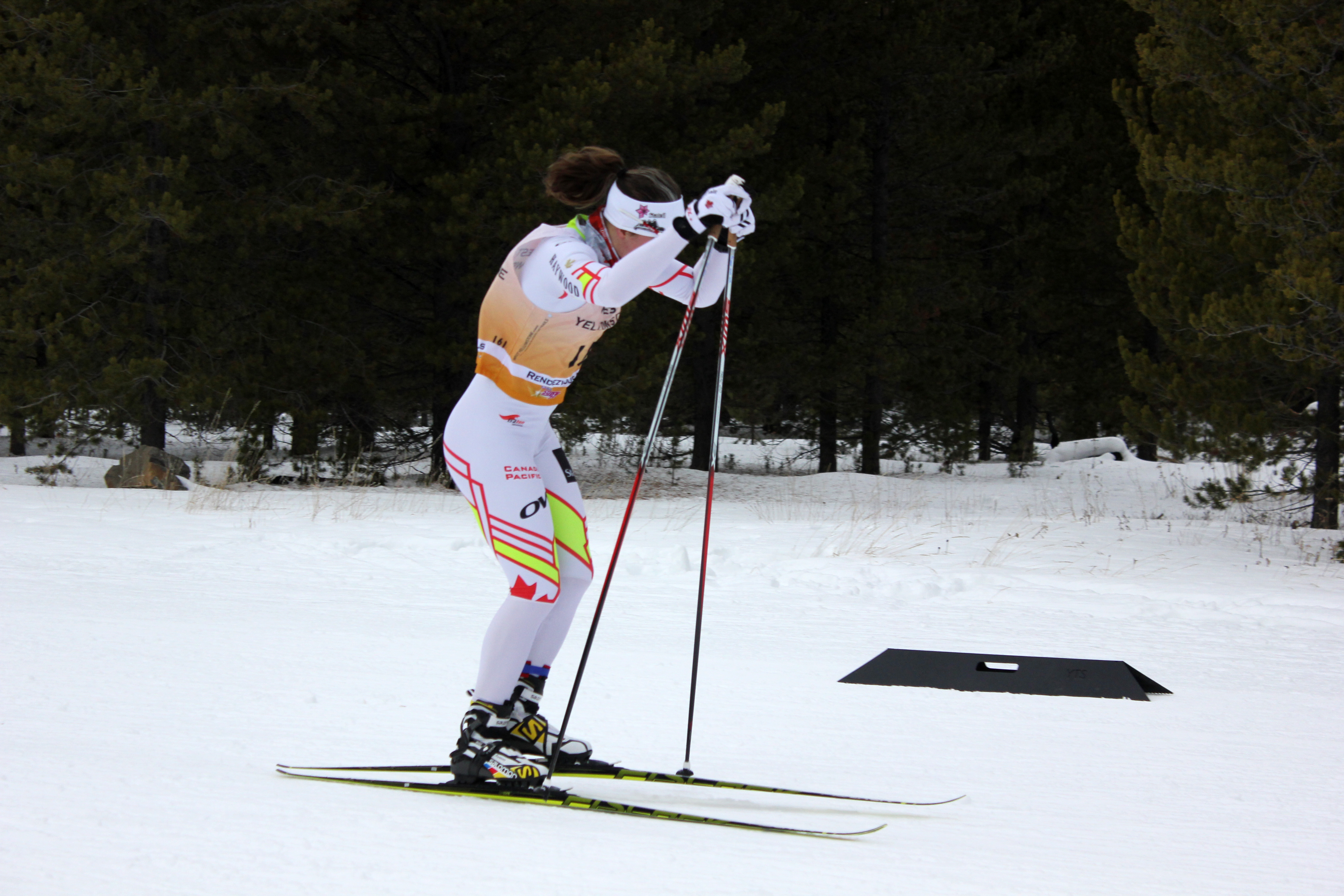
Alysson Marshall (AWACA/NST) racing to a fourth place finish in the qualification round of Friday’s SuperTour freestyle sprint in West Yellowstone, Mont. Marshall went on to win the event.
In the semifinal, Marshall was neck-and-neck with University of New Mexico’s Eva Severrus, but was able to eke out a position in the A-final despite finishing in fourth behind her competitor. Both Severrus and Marshall earned the lucky loser positions as their times were faster than the second semifinal’s third-place finisher, Becca Rorabaugh of Alaska Pacific University (APU).
When it came to the last heat of the day, Marshall positioned herself in third for most of the A-final. When she reached the finishing stretch into the stadium, however, she surged past APU’s Chelsea Holmes to go head-to-head with fellow AWCA and Canadian national team member Heidi Widmer. As the two approached the finish, Marshall did what she had been doing all day and lunged for the win.
Her practice paid off as she edged Widmer by 0.28 seconds.
“In sprint races, I tend to get stronger as it goes on, so I felt good in the final and had enough in the final kick,” Marshall said.
Marshall, who has competed in both the Canadian and international World Cup circuits, said that the result was an indication that she was on the right track for her season goals. While she considered Friday’s sprint a warmup and acknowledged that anyone in the A-final could have nabbed the top spot, she said that her win was a confidence boost that would serve her well in future races.
Just a boot length behind Marshall, Widmer lost steam in the finishing stretch of the 1.5-kilometer race.
“I felt really strong but I’m a little disappointed that I lost in that little finishing stretch there… It’s nice to have it under the belt and get into the rhythm of ski racing,” the 2014 Olympian said after finishing the A-final.
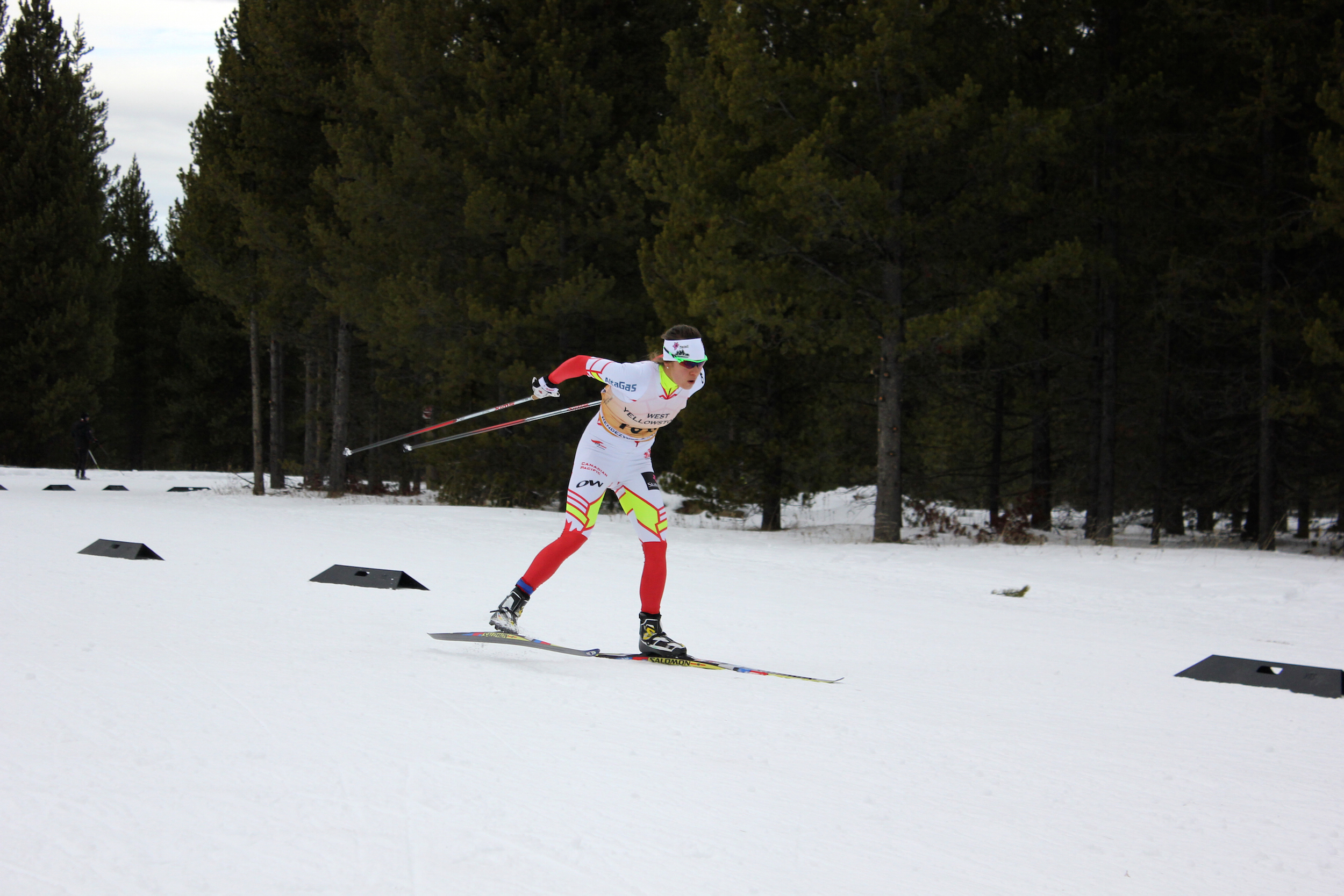
Heidi Widmer (AWCA/NST) racing to a first place finish in Friday’s SuperTour freestyle sprint qualification round. She finished second in the A-final behind teammate Alysson Marshall.
Widmer started the day with a strong finish in the qualification round, where she placed first ahead of Annie Pokorny (SMST2) and Rosie Brennan (APU), who were second and third, respectively.
The qualification result propelled Widmer throughout the heats as she won both her quarterfinal and semifinal by healthy margins.
Like Marshall, Widmer said that the result added to her confidence but had no concrete significance regarding her season goals – racing on the World Cup and skiing at the 2015 World Championships in Falun, Sweden.
Despite the significance of the race, Widmer said the American competition was refreshing, as Canadian sprint heats are often only competitive in the final.
“It is always good to practice skiing in the heats… getting used to that kind of stuff, especially when we can come down to the states and ski in more competitive heats,” she said. “In Canada we have great skiers, but often it won’t really come together until the final, so we won’t have a competitive heat until the final.”
Two-time U.S. National sprint champion Jennie Bender (Bridger Ski Foundation), agreed, saying that the competition, especially in the A-final, was “stacked.”
Bender, who finished in third position as the top American, fought back after 17th in qualification to handily win her quarterfinal and semifinal.
Once in the A-final, Bender said that it was one most competitive heats she has ever raced, with all six women jostling for a strategic position the entire 1.5 k.
“It was fun and awesome, but scary because you’re in self-preservation mode and you’re trying to hold your line,” she explained. “That was one of the closest finals I’ve had in a long time — just five of us right there.”
Bender, who was in fifth as the skiers crested the final hill into the stadium, looked to find an opening in which she could make her move.
All that was open between the five skiers was a gap to her far right. Although she had to use precious time to place herself into the opening, Bender explained that she believed it was better than the alternative of sitting in behind another athlete.
“You pick [an opening] and you go for it, there’s no time to really jump in behind anyone in my opinion,” she said.
Jennie Bender (BSF) was the first American in Friday’s SuperTour freestyle sprint in West Yellowstone, Mont. She finished the day 3rd overall. (Photo: Toko)
Bender was happy with her third-place finish, but acknowledged that she needed to improve if she wanted to accomplish her season goal of making World Championships.
“I have high expectations for myself, and this is what I wanted to do,” she said. “So, a podium’s good – it’s okay, but it’s not first.”
Just five-hundredths of a second behind Bender was Holmes, positioned in second before Marshall and Bender passed her in the finishing stretch.
Holmes, who qualified in seventh and is traditionally a stronger distance skier, said she was excited to perform well in sprinting and explained that it was a testament to the work she has put into her training the past year.
She said that what set her apart from much of Friday’s field was her ability to climb the final hill into the stadium.
Her teammate, Brennan was also in the hunt for a position on the podium. The 2014 national champion in the classic sprint was a favorite for the top spot and skied both a strong quarterfinal and semifinal to make her way into the A-final.
Brennan said that she was happy with her fifth-place finish and explained it was a victory in itself that she was racing Friday because of the many difficulties she has dealt with in the previous months.
Rounding out the A-final was Severrus, a Slovenian who skis for University of New Mexico. She finished sixth, 1.8 seconds behind Marshall.
Despite the high spirits of the SuperTour racers, there were several organizational issues that caused the day to be longer than planned.
As skiers prepared for their second round of heats, several coaches, including Sun Valley’s Rick Kapala and Stratton’s Patrick O’Brien noticed that the semifinal lists were incorrectly ordered. While the issue was eventually fixed, racing was postponed, leaving skiers in the cold wind while they waited for their start order.
The incorrect order of the men’s semifinal would soon become the least of the organizers’ worries as it was soon discovered that they had incorrectly placed Hailey Swirbul (Aspen Valley Ski Club) into one of the women’s semifinals.
Swirbul had placed fourth in the quarterfinal, 3.03 seconds behind Flowers, but the results read that Swirbul had instead finished ahead of Flowers.
Flowers and several other members of SMST2 alerted organizers of the mishap, but it wasn’t until Swirbul herself came forward that the timers reversed the placement and gave Flowers a position in the semifinal.
When all was said and done, the schedule was delayed by more than 40 minutes.
Flowers said she understood that mistakes happen and explained that the best ski racers are the ones who can work past such setbacks.
“There are a million things that can affect you on race day and that’s just something you have to be prepared for,” Flowers said after placing fifth in the B-final for 11th overall. “The best racers are the ones who can roll with it and that’s always something I can work on so this was good practice of that. It’s frustrating but everyone’s trying to make the best outcome. I think ultimately it worked out even if it added some delays.”
Other athletes were equally as graceful, with Marshall joking that the delays had made her “ready for lunch.” She explained that her key to staying warm and snappy during such a long waiting period was to do a signature running shuffle — a move that often draws the laughter of her teammates.
The SuperTour women will continue competition Saturday with a 10 k freestyle individual start.
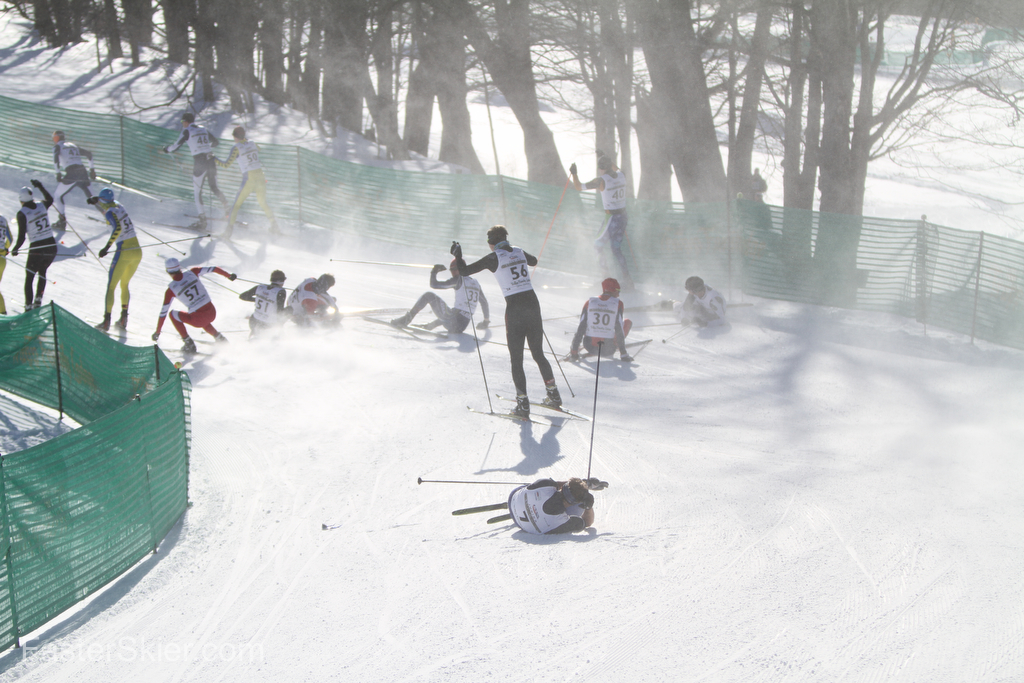
A massive pileup on the first corner shortly after the start of the U20 men’s 15 k freestyle mass start on Friday at 2014 Junior Nationals in Stowe, Vt. Far West’s Patrick McElravey, also of Middlebury College, in bib 7 needed medical attention.
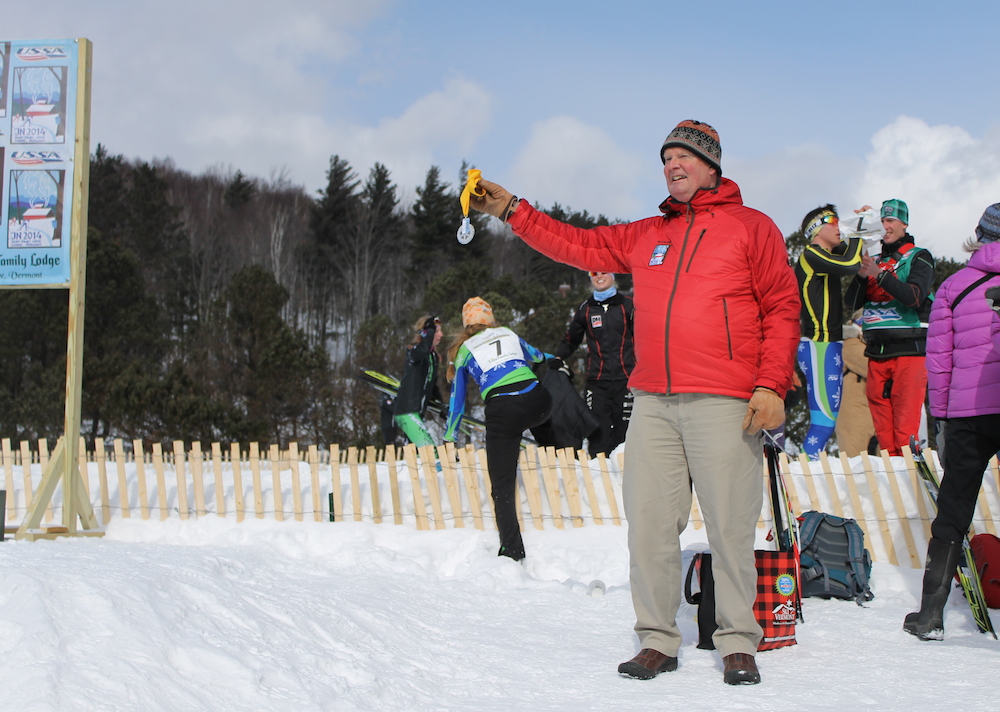
STOWE, Vt. — The youngest child of the original von Trapp family, Johannes von Trapp was the man of the hour almost every hour for the start of six freestyle distance races on the last day of individual racing at 2014 Junior Nationals on Friday.
With a rifle in hand, Von Trapp, 75, fired the starting signal for each of the U16, U18 and U20 mass starts. After that, it was up to the racers to determine where they’d end up at the finish — save for a few early pileups in the U20 and U18 men’s races, where one racer did not finish.
Johannes von Trapp of Trapp Family Lodge presenting medals at 2014 Junior Nationals earlier this week in Stowe, Vt.
The worst series of crashes came in the first race, the U20 men’s 15 k freestyle, which left Far West’s Patrick McElravey seeking medical attention. He was OK (and was listed to start on Saturday), but the incident prompted USSA Nordic Manager Joey Caterinichio to come up with the idea for a paced start.
For every race after the U20 women’s race, a Midwest coach led hundreds of competitors out of the start, down the troublesome 180-degree corner and back up out of the stadium, until passing a set of cones that gave skiers the go-ahead to go for it.
The method generally worked (except for the accordion effect that caused another crash in the U18 men’s race in nearly the same spot coming out of the corner), and by early afternoon, six national champions had been named.
Here’s a look at who made the top 10 and All-American status on Friday in the last of three individual races at Junior Nationals. Relays wrap up the championships on Saturday, starting at 9:30 a.m.
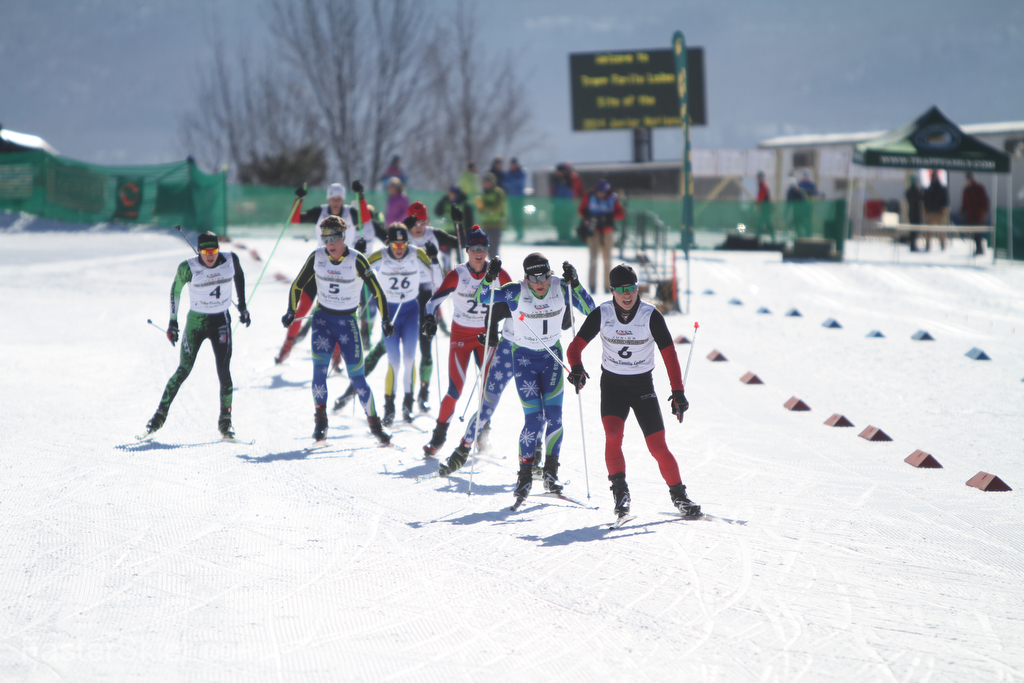
New England’s Fabian Stocek (1) follows Rocky Mountain’s Jack Hill (6) in the U20 men’s 15 k freestyle mass start at Trapp Family Lodge in Stowe, Vt. Stocek went on to win the Junior Nationals race by 7.5 seconds.
U20 Men’s 15 k
Fabian Stocek (Holderness School/New England)
Jack Schrupp (Gunstock Nordic/New England)
Thomas Bye (CXC/Midwest)
Cole Morgan (University of Vermont/New England)
Mathew Nichols (University of Wisconsin Green Bay/Midwest)
Shane Christian (Unleashed Coaching/Far West)
Jan Ketterson (Loppet Nordic Racing/Midwest)
Jack Hegman (UVM/New England)
Oscar Friedman (Dartmouth/Rocky Mountain)
Jackson Hill (University of Colorado/Rocky Mountain)
Fun Fact: A Czech Republic native, Stocek, 19, is a Dartmouth College freshman and has lived in the U.S. for the last four years. “[I’ve] made a lot of connections with friends all over New England so that’s been making a support for me,” he says. “My parents are still in the Czech Republic so I have a great way of connecting with people around New England. I like that a lot, traveling around, recognizing all the aspects that the aspects has to offer. … And continuing at Dartmouth, not a bad place to be for skiing.”
U20 Women’s 10 k
Maggie Williams (Sun Valley/Intermountain)
Marion Woods (Alaskas Winter Stars/Alaska)
Hannah Benson (Williams Outing Club/New England)
Kristen Bourne (Northern Michigan University/Midwest)
Hannah Stevens (Alaska Nordic Racing/Alaska)
Kelsey Phinney (New England)
Nora Gilbertson (St. Olaf College/Midwest)
Sonja Hedblom (LNR/Midwest)
Maria Hauer (Flyer Nordic/Midwest)
Cara Piske (Steamboat Springs WSC/Rocky Mountain)
Fun Fact: Originally from Ketchum, Idaho, Williams is a freshman at the University of Vermont and this is her first Junior Nationals victory. When she’s not racing: “I like to knit and make stained-glass artwork, kind of some grannie hobbies,” she says. “That’s something I’ve kind of been doing my whole life.”
U18 Men’s 10 k
Gavin McEwen (Cambridge Sports Union/New England)
Lars Hannah (Steamboat Springs/Rocky Mountain)
Ian Torchia (LNR/Midwest)
Thomas O’Harra (Alaska Pacific University/Alaska)
Karsten Hokanson (Wasatch Nordic/Intermountain)
Paolo Takagi-Atilano (Boulder Nordic/Rocky Mountain)
Zak Ketterson (LNR/Midwest)
Peter Holmes (Unleashed Coaching/Far West)
John Farr (APU/Alaska)
Zane Fields (Woodstock/New England)
Fun Fact: For 16-year-old McEwen, this is his first Junior Nationals win. “I don’t usually like to think about race [until] about 10 minutes beforehand,” he says. “I got up kind of late because it was a later start than we usually have, I finished my bowl of oatmeal, which is kind of unusual for me because usually I feel kind of sick. But I felt really good.”
Fun Facts: This is Ogden’s second win of the week and she did so in impressive fashion, breaking away around 4 k and winning by 20 seconds. “I was inspired by Caitlin Gregg’s performance at U.S. nationals so I decided to go for a similar method,” Ogden says. “Channeling my inner Caitlin Gregg for sure.”
Gregg won the 30 k mass start at U.S. nationals in January by more than a minute and 30 seconds.
Ogden explained she’s been knitting between races to channel the rest of her energy.
“I knit when I’m nervous before races,” she says. “I’ve knit almost an entire buff this week, a neckie, so I’m pretty proud.”
U16 Men’s 5 k
Hunter Wonders (APU/Alaska)
Leo Lukens (Mt. Bachelor/Pacific Northwest)
Russell Boswell (SMS/New England)
Max Polito (Jackson Hole/Intermountain)
Zach Williams (Sun Valley/Intermountain)
Peter Wolter (Sun Valley/Intermountain)
Jack Consenstein (APU/Alaska)
Forrest Hamilton (Mansfield/New England)
Daniel Streinz (Maine WSC/New England)
Benjamin Koenig (NSCF-Fairbanks-FXC/Alaska)
Fun Facts: In his first Junior Nationals, this is Wonder’s first time to Vermont. “My first time on the East Coast,” he says. “It felt super nice. Today was super relaxed and just pushing the tempo at the very end.”
The 15-year-old Anchorage native won by nearly six seconds. “My goal for the whole season was to make it to the Junior Nationals and once I did that I was going for any kind of medal,” he says. “I guess gold’s fine.”
Fun Fact: After capturing her first Junior National title in the 5 k classic earlier this week, Swirbul, 15, did it again in the skate mass start. “I have been dreaming of this moment to win a mass start since last Junior Nationals where I got third and it has never tasted sweeter to win a race,” she says. Also relatively sweet is her favorite food: sweet potatoes.
FasterSkier’s coverage is made possible through the generous support of Madshus.
STOWE, Vt. — It was a chilly one up at Trapp Family Lodge on Monday for the first set of races of this week’s U.S. Junior Nationals, but the sun was out and skiers moved even faster in the single-digit temperatures. As U18 men’s 20 k classic champion Peter Holmes said, it’s all about the layers. And lots of ’em.
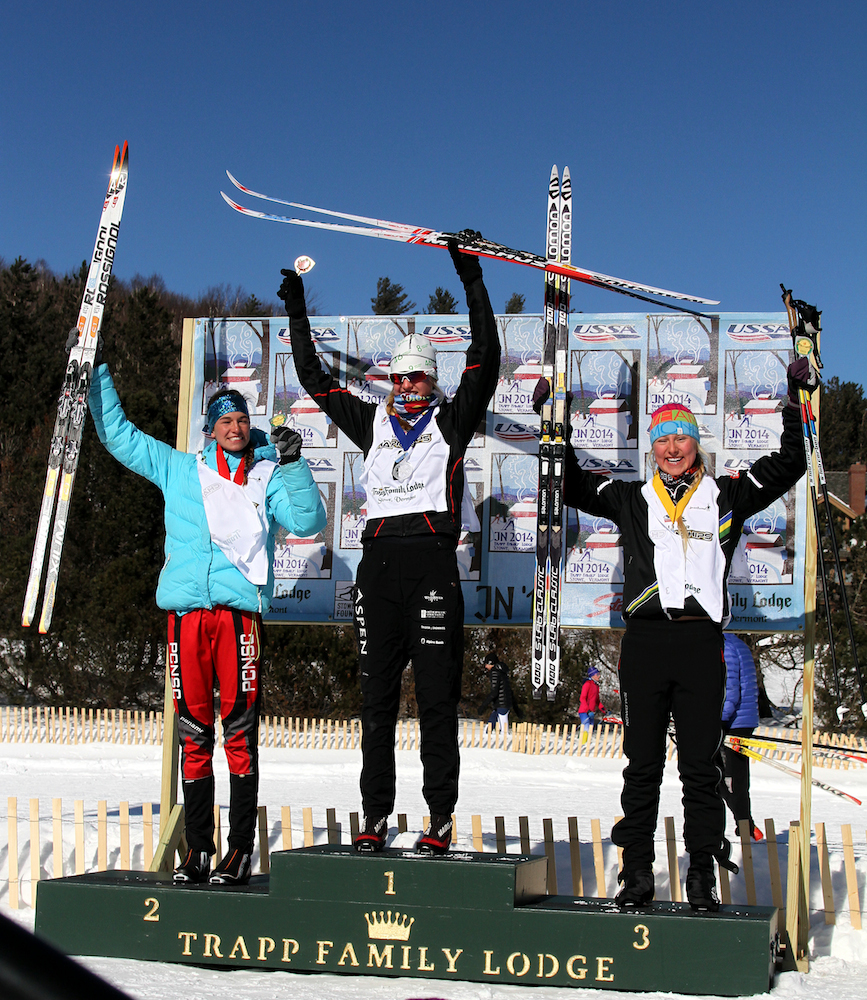
The U16 women’s 5 k classic podium on Monday at 2014 Junior Nationals in Stowe, Vt., with winner Hailey Swirbul (c) of Aspen Valley SSC/Far West, runner-up Leah Lange (l) of Park City NSC/Intermountain, and Hannah Halvorsen (Sugar Bowl Academy/Far West) in third. (Photo: Mark Nadell/MacBeth Graphics)