Tag: Hajo Seppelt

  • FIS, IBU Respond to Latest Documentary; Did WADA System Enable Doping Test Evasion?

    FIS, IBU Respond to Latest Documentary; Did WADA System Enable Doping Test Evasion?

    Gold and Silver for Russia
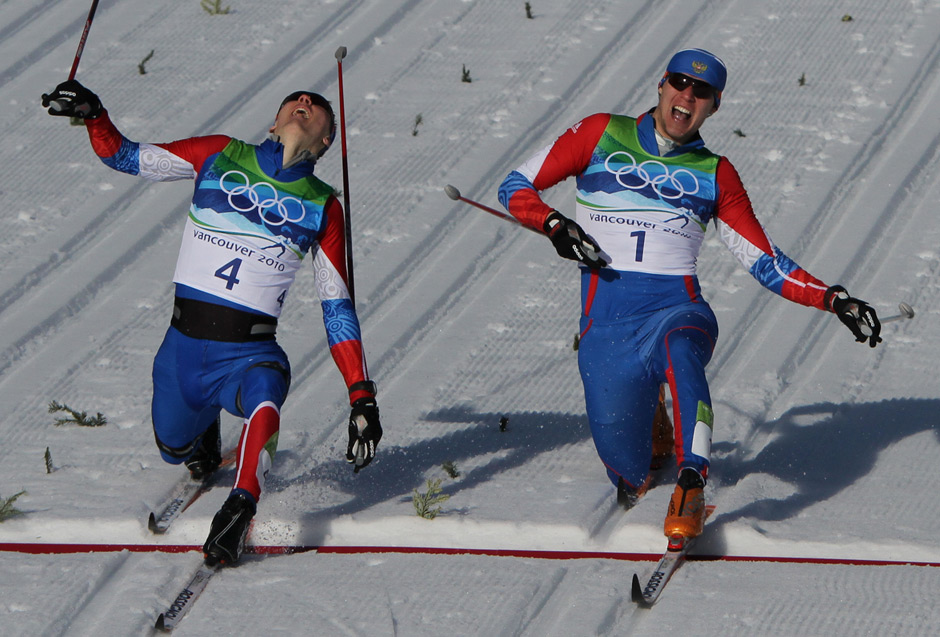
    Russia’s Nikita Kriukov (l) and Alexander Panzhinskiy placed first and second in the men’s sprint at the 2010 Olympics in Vancouver, B.C. Russian Minister of Sport Vitaly Mutko recently told Russian media that the entire cross-country ski team was doping at those Olympics: “Of course, I knew all about this, they were all doing the doping,” he said. There are several ways in which the team allegedly avoided positive doping tests.

    A new documentary titled “Doping – Top Secret: Showdown for Russia” aired on Germany’s ARD news channel on Wednesday.

    Allegations in the documentary opened a new possibility for how Russian sports officials avoided positive tests by doped athletes: did they use the Anti-Doping Administration and Management System, ADAMS, to learn when their athletes would be tested and warn staff who might be able to help athletes avoid positive tests?

    “The ADAMS doping control database provided to [Anti-Doping Organizations] is an essential tool for managing both an in- and out-of-competition doping control program,” the World Anti-Doping Agency (WADA) explains on its website. “Coordination of doping control programs in the ADAMS system helps to avoid duplication of testing efforts and harmonizes communications between testing authorities, sample collection agencies as well as WADA accredited laboratories.”

    But it may have been used for something else.

    Government Interference

    The 35-minute piece put together by journalist Hajo Seppelt primarily focused on what Russia should have to do in order to send athletes to the upcoming 2016 Summer Olympics in Rio de Janeiro, Brazil.

    After widespread indignation over the last year about rampant doping in Russia, Seppelt questioned whether Russia was making a good-faith effort to change. Collusion had been revealed in several of his previous documentaries, as well as by pieces in The New York Times, Sunday Mail, 60 Minutes, and by the World Anti-Doping Agency Independent Commission.

    This time, Seppelt revealed more than ever about the involvement of the Ministry of Sport and specific government officials in covering up doping so that Russian athletes could compete – with great success – on the international stage.

    Buried in the documentary was an allegation that for two winter sports, the Ministry of Sport had worked to warn coaches and athletes before visits from doping control officers.

    The allegations involved Minister of Sport Vitaly Mutko and his anti-doping advisor Natalia Zhelanova, and came from a document signed by Grigoriy Rodchenkov, the former head of the Moscow anti-doping laboratory who has since fled to the U.S. and cooperated with The New York Times.

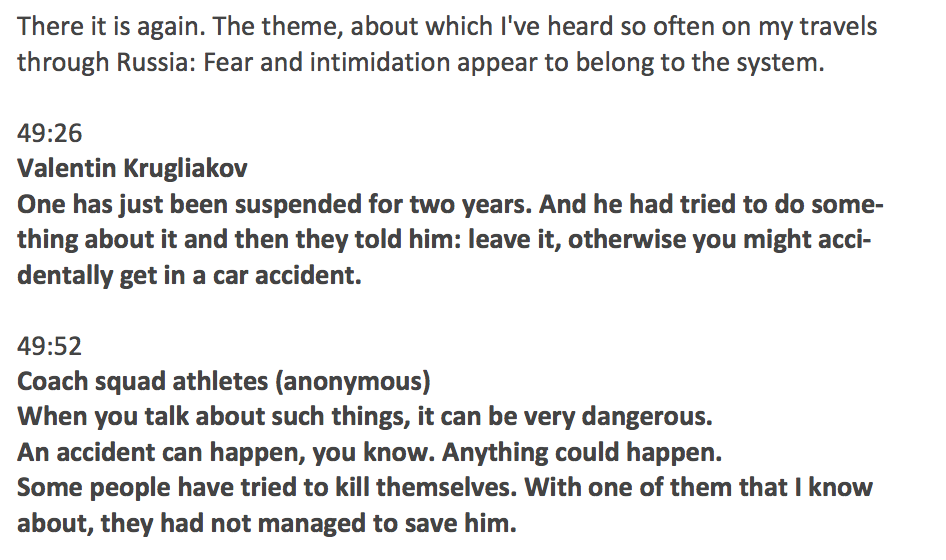
    “Zhelanova deliberately evaded and undermined Test Distribution Plans of [International Ski Federation] and [International Biathlon Union]. Usually, RUSADA was informed two or three days before their [doping control officers] should collect samples from the Russian national team. [Name redacted] immediately notified Zhelanova, then the latter notified Head coaches, and the national team had change location, just escaped.”

    Zhelanova was a member of the WADA Finance and Administration Committee from 2010 until 2015.

    The documentary notes that not everyone approved of this policy. RUSADA Executive Director Nikita Kamaev apparently registered his concern, telling Zhelanova that “RUSADA was losing credits” in terms of respect and credibility.

    Kamaev died unexpectedly in February at age 52. He had resigned after the first WADA Independent Commission report.

    ADAMS Violations

    The ADAMS system is used by anti-doping agencies for a variety of purposes. One of the main uses is for athletes to report where they are living, training, or staying, a so-called “whereabouts” report.

    If a doping control officer comes for a visit and the athlete cannot be located where they said they would be, it is considered a whereabouts violation. Three such violations over the course of 12 months can lead to a suspension from competition.

    According to WADA numbers, 21 athletes from different countries had third-strike violations in 2014.

    But another use of ADAMS is for the multiple authorities which test athletes to report and coordinate their efforts. For instance, an athlete is subject to testing by both their international federation and their national anti-doping organization.

    “Where reasonably feasible, testing shall be coordinated through ADAMS or another system approved by WADA, in order to maximize the effectiveness of the combined testing effort and to avoid unnecessary repetitive testing,” the 2015 World Anti-Doping Code states.

    This use of the system actually addressed complaints by athletes that they were tested to often and too disruptively, according to International Biathlon Union (IBU) Vice President for Medical Issues Jim Carrabre.

    “Each nation has access to that data for their national athletes in the IBU test pool so that we minimize the probability of having two separate test authorities test an athlete on the same day,” he wrote in an email. “We each could still choose to do this if we wished but the benefits would be minimal. This was earlier a major complaint by athletes from many countries, and this access in ADAMS improved this complaint immensely.”

    FIS Anti-Doping Administrator Sarah Fussek explained the use of the ADAMS system slightly differently.

    “If you do register an exact mission in ADAMS beforehand, another organisation can only see this planned testing if the testing organisation has set explicit access in ADAMS for this purpose for each individual organisation,” she wrote in an email on Saturday. “At FIS this is currently not the case for any [national anti-doping agency] and vice versa.”

    FIS does register tests in ADAMS once they have been completed.

    Carrabre has been a huge proponent of targeted testing, which snagged two Russian biathletes in the leadup to the 2014 Olympics.

    But he confirmed that all of the tests ordered by the IBU were not only carried out by RUSADA, historically, but were also entered into ADAMS where RUSADA could access them.

    “RUSADA could therefore notify internally any one if they had intentions of cheating the system,” he wrote. “This could have occurred but they would have had to check the system regularly if they wanted to know IBU test plans on Russian athletes when they were tested outside Russia. I presume that this was not done or otherwise we would have not caught the ones that we did.”

    That’s why even aggressive testing by international federations could have been circumvented by individuals or agencies in Russia: whereabouts violation in reverse.

    And, if this was the mechanism used by Zhelanova to warn teams before testing occurred, it could potentially have jeopardized testing by any international federation using ADAMS to pre-register its tests with the national anti-doping organization, as was encouraged by WADA.

    Aggressive Testing, For Good or For Naught

    Some federations have had concerns about Russian anti-doping efforts for years.

    The International Ski Federation (FIS) caught a number of Russian cross-country skiers doping in the mid- to late-2000s, and in June 2010 sanctioned the Russian Ski Association. After fining the federation $185,000, FIS declined to press further sanctions and in November 2010 wrote in a press release that the federation had taken “positive steps” in anti-doping.

    At the same time, FIS was avoiding relying on RUSADA to carry out testing missions to a large extent, instead relying on companies which train doping control officers and do the sample collection themselves.

    “There was quite a lot of testing missions which were coordinated with [the Russian Anti-Doping Agency, RUSADA], but most were carried out by the FIS-appointed doping control agency with their own personnel and equipment,” FIS Secretary General Sarah Lewis explained to FasterSkier in May. “Most samples were transported to a different laboratory, in Lausanne or Cologne or somewhere else. We weren’t in the position that they could be manipulated in the Moscow laboratory.”

    In an email on Thursday, FIS Anti-Doping Administrator Sarah Fussek said that the organization also did not usually notify RUSADA if and when tests were going to take place.

    “With the exception of a handful missions, testing in Russia was carried out by a private sample collection provider,” she wrote. “We did have a couple of joint missions some years. Otherwise FIS testing did not give notice to RUSADA when conducting missions within Russia.”

    As such, Fussek was confident that the FIS testing program was adequate to ensure that Russian athletes were mostly not cheating.

    “Keeping in mind that you can never guarantee that every athlete is clean, we strongly believe that our programme covered testing in the country well and that we did all possible efforts to achieve a regular at home testing on Russian athletes (who most time of the year travelling on the World Cup circuit, plus training camps outside Russia and are tested there regularly as well),” she wrote.

    The IBU was also watching Russia closely. The biathlon governing body fined the Russian Biathlon Union in 2015 after multiple athletes had positive tests.

    “In the years three years prior to Sochi, the new administration in [the Russian Biathlon Union], Mr Mikhail Prokorov and Mr Sergei Krushenko, were verbally and financially committed to antidoping,” Carrabre wrote. “I had personal meetings with them and they went from one of the countries with the least number of internal antidoping tests to the country with the most number of internal tests in IBU. This effort was appreciated by myself and IBU and was, in my opinion, a large step in the right direction. I even publicly commended the RBU for this action. As I also said publicly, the number of tests does not always equal quality tests so the IBU would not decrease its efforts despite the testing of the RBU.”

    The increased number of tests did catch some regional-level athletes, but no Russian Biathlon Union testing ever led to the suspension of a national-team athlete.

    IBU testing, however, did, in particular when they tested outside of Russia. As Fussek had noted, athletes spend almost the entire winter, as well as periods of the offseason, training and competing in Europe, offering ample time to take many anti-doping samples.

    “No national or international level athletes were ever found with their testing,” Carrabre said of the Russian Biathlon Union. “It was therefore surprising that the IBU would catch several of their athletes in the year prior to Sochi with testing performed outside of Russia while their athletes were at international training camps.”

    Superficial Admissions of Guilt

    The Ministry of Sport denied that they had interfered with RUSADA business in any way – or that such interference would even be possible.

    “How can I exert influence there?” Mutko asked, rhetorically, in the new ARD documentary. “What influence can we exercise on the personnel of the anti-doping organizations?”

    Just two days before the documentary aired, Zhelanova had done a question-and-answer session on Twitter, where she stressed that Russia was changing. The full exchanges from June 6 can be found on her twitter feed.

    “The state has taken a lead in doing everything to demonstrate we are reforming and have nothing to hide,” she tweeted to Associated Press reporter Rob Harris.

    In discussing the past doping problems, she put the blame squarely on athletes.

    “We think guilty athletes should be punished individually,” she tweeted to University of Colorado professor Roger Pielke Jr.

    And Zhelanova seemed to admit that even today, it is difficult for doping control officers to do their jobs. U.K. Anti-Doping, which took over testing in Russia after RUSADA was stripped of its authority, reported in May that 40 percent of the tests it was supposed to carry out were impossible because they couldn’t locate the athlete.

    Evading a sample or refusing to give a sample are both considered Anti-Doping Rule Violations, the same as a positive test or three missed whereabouts.

    The current procedure for testing seemed to still be under negotiation. U.K. Anti-Doping had reported that Russia requested 30-day notice before testing of any athletes in military areas, which is clearly not standard operating procedure in the world of anti-doping.

    “We agreed a procedure with WADA to help doping inspectors to carry out their important jobs,” Zhelanova tweeted in response to Rachel Axon of USA Today.

    But what is there to discuss? In 2006, the Russian Federation ratified the International Convention Against Doping in Sport, under the purview of the United Nations Educational, Scientific, and Cultural Organization (UNESCO).

    Article 12 states,

    “States Parties shall, where appropriate:

    (a) encourage and facilitate the implementation by sports organizations and anti-doping organizations within their jurisdiction of doping controls in a manner consistent with the Code, including no-advance notice, out-of-competition and in-competition testing…”

    The 2015 World Anti-Doping Code further states that “Each government will take all actions and measures necessary to comply with the UNESCO Convention.

    After the documentary aired on Wednesday, Zhelanova was less than thrilled.

    “I was very upset and disappointed by the allegations made against me in the recent ‪@ARDde documentary,” she stated in a series of tweets. “These claims are untrue and are made by 1 disgraced person who disagreed with me on the importance of fair & clean sport. I really believe in the fight against doping and dopers and am doing everything I can to create change and restore trust. Reforms are under way but our system won’t be perfect immediately – cultural change takes time.”

  • WADA Independent Commission Strongly Implies Winter Sports at Risk From Doping

    WADA Independent Commission Strongly Implies Winter Sports at Risk From Doping

    The WADA Independent Commission
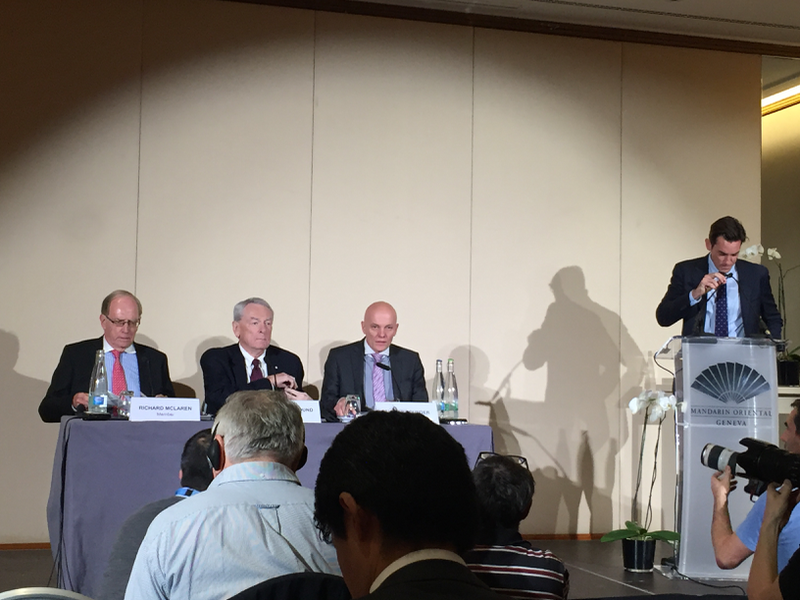
    The WADA Independent Commission (l-r) Richard McLaren, Dick Pound, and Gunter Younger wait to discuss their findings as WADA’s Ben Nichols mediates questions from the ravenous press.

    GENEVA —“It’s pretty disturbing,” former president of the World Anti-Doping Agency (WADA) Richard Pound said in a press conference in Switzerland this afternoon about a special investigation into systematic doping in Russia.

    “We are not dealing with a he-said-she-said, we actually had documents and recordings,” he continued. “It’s disappointing to see the nature and the extent of what was going on, and to reach the conclusion that it could not possibly have happened without everybody knowing about it and consenting to it. It’s worse than we thought.”

    And then, after confirming that he would call this an instance of “state-sponsored” doping, the head of the Independent Commission said this:

    “Tip of the iceberg? I’m afraid you’re right. We don’t think that Russia is the only country with a doping problem, or that athletics [track and field] is the only sport with a doping problem.”

    The investigation was spurred by a documentary made by German filmmaker Hajo Seppelt, in which he talked to former Russian athletes and heard tales of doping, cover-ups, and extorting money from athletes who tested positive in order to allow them to continue competing.

    (An English transcript of the documentary can be found here.)

    In August Seppelt later partnered with the Sunday Times to further his investigation, finding a document with blood test results for 12,000 tests administered over a 10-year period leading up to the 2012 Olympics.

    Hundreds of these tests showed abnormal blood profiles that suggested, but did not prove, doping by Russians but also other athletes. This led to the assertion that the International Association of Athletics Federations (IAAF), the international governing body for track and field, did not do enough to protect clean athletes.

    Pound congratulated Seppelt and ARD on their “fine piece of investigative journalism,” saying that it not only sparked the investigation but made their job much easier.

    “The commission also wants to congratulates the individuals who were courageous enough to be whistleblowers in this matter, despite knowing that the outcomes are often attacks on their character,” he added.

    The Independent Commission, made up of Pound along with longtime sports arbitrator Richard McLaren and Gunter Younger, the head of the Department Cybercrime with Bavarian Landeskriminalamt in Germany, found widespread corruption in Russian track and field. Most allegations from the documentaries were upheld.

    While Pound said that “the athletes have always been the ones who get caught,” he shifted much of the blame for the doping to coaches and ministry officials.

    He revealed that the Independent Commission had found multiple ways that that Russian officials shielded its athletes – whom they were encouraging to dope – from getting caught.

    Many were tested in a Moscow laboratory before leaving the country for competitions, and not allowed to compete unless they first tested clean.

    “We had reports of athletes in London going back to Moscow to be tested, and then came back to London when it was clear,” he said of the 2012 Olympics. “That has been a feature starting in the old Soviet days, which is that they never tested positive in competition. What you have to watch for is purported injuries, purported illnesses, which may not be the real reason that an athlete is not competing.”

    The implication here is that many results sheets included athletes who had been using banned substances during training, even if they could not use them at actual competitions.

    In other cases, coaches lied about whether athletes were present when doping control officers came to test.

    Over 1,400 samples at a Moscow laboratory were also destroyed once WADA made it clear they were coming to check the laboratory. No believable explanation was ever given for this occurrence, after WADA had explicitly requested that the samples be kept.

    “We came to a dead end, but we wanted everybody to know that we weren’t entirely satisfied with the explanation we got,” Pound said.

    This was one of just several instances where what the commission, originally convened to investigate doping in Russian track and field, found information that implicated other sports as well.

    “It likely was spread across many sports, not just athletics,” Pound said.

    This occurred in December 2014, meaning that samples were likely taken from winter sports athletes in the run-up to and beginning of the 2014/2015 competition season.

    Furthermore, the commission found that Russian security service FSB was present in the laboratory which tested samples at the 2014 Olympics held in Sochi, Russia.

    “The Moscow laboratory is not operationally independent from RUSADA or the Ministry of Sport,” the Commission wrote in its full report, which is available online. “Its impartiality, judgment and integrity were compromised by the surveillance of the FSB within the laboratory during the Sochi Winter Olympic Games.”

    So does that mean that the results of Sochi might not stand?

    “I don’t think we can be confident that there was no manipulation done there,” Pound said. “But we don’t have any hard evidence that there was. We simply know that they were there. It’s hard to know what the Russian state’s interest in athletes’ urine would be.”

    Asked by FasterSkier specifically about cross-country skiing and biathlon, two winter endurance sports where Russians have had positive tests in the last decade at a much greater rate than other countries, he said suspicions were well-founded.

    “Certainly the two sports you mentioned are known to have had a lot of doping problems, and probably not just Russia,” he said.

    There is the possibility for WADA to investigate more broadly, either on other Russian teams or other sports in general. But Pound made clear that he was not interested in leading such an effort.

    “I hope that some other independent commission will do that!” he laughed, and McLaren and Younger also smiled at this, clearly tired from a massive amount of work done in a relatively short amount of time. “We feel we have kind of done our job for the moment.”

    The commission concluded with a list of recommendations for various sanctions. Some were for direct sanctions or further investigation of a number of athletes and staff in Russian track and field.

    Another obvious suggestion was to withdraw the accreditation of the Moscow laboratory.

    “We found very few analytical errors coming out of the Moscow labs … in terms of straight faulty analysis, aside from one test this summer where the A and B didn’t match, I don’t think we found that,” Pound said. “The problem was people hiding samples or altering them or losing them or substituting them, in return for cash. The people broke down.”

    The commission also suggested that Russia’s athletics federation and its anti-doping agency, RUSADA, be found noncompliant with the WADA Code. That could keep Russian runners, throwers, and racewalkers from competing at the Olympics in Rio de Janeiro, Brazil, next year.

    Should the Russians come into compliance, Pound suggested that they may be able to compete in Rio. But they would have to start cleaning house soon.

    “If they do the surgery, do the therapy, I hope they can get there and compete,” he said. “The idea is not to exclude people from the Olympics if you can possibly avoid that. … But sometimes, that’s the price you pay for it.”

    When some in the audience balked at the possibility that Russia could compete at the Olympics just a year after such a major scandal, saying that a penalty should be more severe, Pound emphasized that positive encouragement may be key to helping Russia clean up.

    Yet he was also aware that the carrot had to be accompanied by a stick, so to speak.

    “If they do the surgery, do the therapy, I hope they can get there and compete.” — Dick Pound, former president of the World Anti-Doping Agency, who chaired an independent commission to investigate systematic-doping allegations in Russia

    “I do think that we have been a little diffident in using our muscle,” he said of WADA. “We have spent most of our time trying to persuade people to become Code compliant… but if you haven’t become Code compliant [the last 17 years], that tells me that you’re not trying very hard…. I think that those decisions should be taken away from the political table and be put in the hands of a compliance committee which will report whether there is in fact compliance or not. At that point it’s very hard for the political bodies not to act.”

    Separately, the commission suggested suspension of the Russian athletics federation by the IAAF.

    The group found evidence that the IAAF had been complicit in covering up Russian doping, but did not comment much on that today. They had passed evidence first to Interpol, and then to authorities in France, to possibly begin criminal proceedings. Once the relevant criminal investigations are concluded, Pound said that the commission would happily discuss that aspect of their findings.

    Importantly, since the alleged criminal activity took place – in which Lamine Diack, the former head of IAAF, is purported to have taken bribes – a new leader has taken control of the organization.

    But Lord Sebastian Coe, a Brit who now heads the group, has not been particularly sympathetic in responding to the allegations so far.

    In August, Coe called the German documentary and the articles in the Sunday Times a “declaration of war on my sport — there is nothing in our history of competence and integrity in drug testing that warrants this kind of attack.”

    That seems naïve in light of the commission’s findings. So will any of their recommendations come to pass? Pound stressed that the Independent commission was just that independent. WADA itself had not seen or influenced the report before Thursday, and the commission has no power over what the IAAF does or does not decide to do.

    But there is evidence that the IAAF may be capitulating. During the press conference, it was also reported that the IAAF would at least consider sanctioning Russia.

    As for WADA, the executive board has a meeting coming up in Colorado Springs. It remains to be seen what they can, and will, do to combat the Russian problem given the tools they have at their disposal.

    “While the contents of the Report are deeply disturbing, the investigation is hugely positive for the clean athlete as it contains significant recommendations for how WADA and its partners in the anti-doping community can, and must, take swift corrective action to ensure anti-doping programs of the highest order are in place across the board,” Craig Reedie, the current WADA president, said in a press release after the conference. “WADA is fully committed in its role of leading the charge to protect the rights of clean athletes worldwide.”

  • Sednev’s Doping Suspension Leaves Uneasiness in the Biathlon Community

    Sednev’s Doping Suspension Leaves Uneasiness in the Biathlon Community

    Sergui Sednev (UKR).
    Sergui Sednev of Ukraine competing at 2013 World Championships in Nove Mesto, Czech Republic. A sample collected on January 22, 2013 – before the Championships – has been re-analyzed and tested positive for a prohibited substance. All of Sednev’s results after that sample was collected may end up being scrubbed from the record books.

    Ukrainian biathlete Sergui Sednev has been issued a provisional suspension after a sample collected January 22, 2013, was re-tested using a new analytical method and detected EPO. Sednev has declined to have his “B” sample opened.

    Sednev is a two-time Olympian (2010 and 2014) who finished 10th in the pursuit in the 2010 Olympics in Vancouver, but scored just nine individual World Cup points last season.

    The positive test comes as part of an effort to re-test suspicious samples from previous seasons using a newly-available analytical method. It already snared Russia’s Alexander Loginov at the beginning of the season; he was suspended in November for a sample that had been collected almost exactly a year earlier.

    IBU President Anders Besserberg told Norway’s NRK broadcaster that at this point, all of the stored samples have been retested. That does not necessarily mean more bans will not be announced; there was a one-month lag between the analytical result for Sednev’s doping offense, and the announcement of his suspension. Many in the biathlon community are speculating that more suspensions may be on the way.

    After all, Besseberg had told Norwegian media that doping suspensions from multiple countries were on their way. Technically, this promise has been fulfilled: Russian and Ukrainian athletes have now been issued provisional suspensions. But the buildup in the media after that interview left many fans wondering whether bigger names would be involved, and waiting for bombshell revelations.

    The positive test unfortunately does nothing to clarify whether Sednev was doping throughout his career, or only at the end of it – as appeared to be the case for Finnish skier Tero Similä, a former World Cup skier who at age 34 had slid back to the middle of the Continental Cup results pages. Similä was caught using EPO at Finnish National Championships in 2014, where he had a stunning third-place result in the 10 k classic, likely in an attempt to make the Olympic team.

    When 30-year-old Sednev started the 20 k individual at the first World Cup weekend in Östersund, Sweden, this season, it marked the start of his 11th year on the World Cup. He finished 83rd with the 90th-fastest course time. Instead it was his teammate Sergey Semenov who stood on the podium, finishing second behind Emil Hegle Svendsen of Norway.

    Sednev did not compete again on the World Cup, nor did he appear at second-tier IBU Cup races. His Ukraine teammates continued to earn podiums in World Cup and IBU Cup racing.

    But earlier in his career, Sednev had seen considerable success. In January 2010 he won a 20 k individual World Cup competition in Antholz, Italy, and had a dozen top-tens including three other podiums. His best more recent result was back in Antholz, where he finished eighth in the 12.5 k pursuit in January 2013.

    Sednev was also part of three World Cup podium relay teams, as well as the bronze-medal men’s relay from 2011 World Championships in Khanty-Mansiysk, Russia.

    At that same World Championships, the women’s team won silver in the relay. That medal was taken away when Oksana Khvostenko tested positive for the banned stimulant ephedrine, which she said that she accidentally ingested through cough medicine.

    Sednev’s provisional suspension was dated December 15th of 2014; he announced his retirement on December 19th, although nobody made the connection at the time because a name had not been released with the suspension and Sednev was hardly a force to be noticed on the circuit.

    Should his provisional ban be made permanent after his hearing with the IBU Anti-Doping Hearing Panel, all results from after the sample was collected in January 2013 would be scrubbed from the record. That includes two World Cup relays, a tenth- and an eleventh-place effort, and participation in the ninth-place mixed relay and the 14th-place men’s relay at 2013 World Championships.

    The Biathlon Federation of Ukraine, in their announcement of Sednev’s positive test, implied that he had decided to retire independently, and that was the reason that he did not request to have his “B” sample opened (which would have cost 2,500 Euros): “But as Sednev had finished his career [sic] after the poor results over the past seasons, he decided not to conduct the further analysis,” the federation noted.

    Along with Sednev’s test, four other positive samples were noted in the IBU press release. None of the names were new to followers of the sport: Russia’s Alexander Loginov was issued a provisional suspension at the end of November, the first of the re-testing results to be released, and at the same time it was made known that Russian teammates Irina Starykh and Ekaterina Iourieva had also had old samples show positive tests. Those two were already serving doping bans for EPO, which had been announced in January before the 2014 Olympics; the new results proved that they had certainly doped on more than one occasion.

    That troubles IBU President Anders Besseberg, who told Norway’s VG news service that the federation might pursue action against the Russian federation.

    Personally I will be very surprised if the Executive Board of the IBU does not want to impose a penalty on Russia’s biathlon federation, given that all three are convicted,” he said, according to a translation.We have the opportunity to give penance and simultaneously claim to cover legal costs…”

    Reportedly, bylaws allow a federation to be fined as much as roughly $250,000 if more than one athlete has a positive test within a 12-month period.

    Besseberg linked the four cases through the old Soviet Union.

    This is special because we have three athletes from one nation,” he told VG. “And one cannot hide the fact that 80 to 90 percent of positive doping tests in biathlon are from nations that previously belonged to the Soviet Union. There has been a culture there for so long and such culture one cannot reverse overnight.”

    The positive tests are not surprising to German journalist Hajo Seppelt, whose documentaries aired this fall on ZDF and revealed widespread systematic doping and cover-ups in Russian sport, as well as in track and field more generally. He has repeatedly called on the World Anti-Doping Agency and the International Olympic Committee to thoroughly investigate his findings. In a recent interview with Germany’s ARD news service, he noted that IOC President Thomas Bach was in Oberhof this weekend at the biathlon World Cup – but neither Bach nor the IBU took this opportunity to jointly speak about biathlon’s doping problem.

    “The question is now out there, whether the IBU is transparent and publicly declares the magnitude to which they can retrospectively analyze which substances,” he said. “Or if you pass statutes of limitations- then, the impression arises that one is not interested in negative publicity, and therefore prefers not too look too hard. The IOC is in this respect a sad example: it takes a billion dollars through television rights, so it would have enough money to retrospectively examine a large number of frozen doping samples again. Why it doesn’t it try to subject all samples to a major retest?”

    In this respect, the IBU does appear to be far ahead of its peer federations. Besseberg explained to VG that the federation had held onto samples which, using its blood passport program, seemed suspicious. Then, when new methods were available, they re-tested all the samples.

    “I am pleased that we have such a good system, that we manage to weed out those who should not be included in the competitions, and that we protect the clean athletes,” he said.

  • Breaking: WADA To Launch Major Investigation of Russian Doping Allegations

    Breaking: WADA To Launch Major Investigation of Russian Doping Allegations

    After a sensational German documentary aired last week alleging widespread state-sponsored doping in Russia, as well as elaborate and financially shady cover-ups, the World Anti-Doping Agency (WADA) released careful statements expressing their dismay for the situation. It initially seemed like the allegations would be investigated only by Russia’s internal anti-doping agency, RUSADA, and by the International Association of Athletics Associations (most of the athletes named in the documentary were track and field stars).

    After intense pressure, WADA announced today that they will launch their own full and independent investigation, which will proceed regardless of the pace or scope of IAAF or RUSADA work.

    “WADA is the independent anti-doping agency tasked with the mandate of ensuring that the clean athlete is supported in every sport and in every country,” WADA President Sir Craig Reedie said in a press release. “The allegations that have been raised in the German television programs require close scrutiny to determine what actions are required to be taken by WADA and others, to confirm the evidence, seek further evidence, and pursue any anti-doping rule violations or breaches of the International Standards that have allegedly taken place. WADA must ensure that all athletes who have cheated, either at national or international level, are dealt with in an appropriate fashion under the World Anti-Doping Code.”

    An English-language transcript of the documentary has been released, which reveals that the systematic doping occurred in far more sports than track and field: cross-country skiing and biathlon were specifically named. A second documentary, so far not translated to English, has implicated additional athletes from other countries. This comes at the same time as a massive cache of documents pertaining to the case of infamous Italian doping doctor Michele Ferrari is being released, including wire taps between Ferrari and David Taschler, a biathlete who is the son of the International Biathlon Union’s Vice President for Sport, Gottlieb Taschler.

    North American biathletes and staff have also weighed in on the doping allegations. Kikkan Randall, the U.S. cross-country skier who serves as the athlete representative to the International Ski Federation (FIS), did not respond to a request for comment.

    The Allegations

    The documentary, made by Hajo Seppelt, aired last week on German channel ARD, but an English-language transcript was only recently made available by WDR. You can read it here.

    While we covered some of the most glaring and commonly-discussed messages from the documentary when it came out, the transcript offers more details that are particularly interesting to nordic sports. It also provides a clear picture of the professionality Seppelt brought to his work. The German did not appear to cut corners; he displays videos and plays cell phone recordings in the documentary (which you can watch here) to prove his points. When a source secretly filmed her coach handing her a packet of anabolic steroids, Seppelt had the pills tested at the Cologne, Germany, anti-doping lab and confirmed that they were, in fact, Oxandrolone.

    He also sent an employee to investigate just how easy it is to obtain recombinant erythropoetin (EPO, a common blood-doping drug) in Russia. Here’s an excerpt from the transcript:

    Screen Shot 2014-12-10 at 9.06.32 PM

    3,925 rubles is about $40 dollars.

    While all of Seppelt’s sources come from the world of track and field, they know that doping is more widespread than simply their own sport. Vitaliy Stepanov, who formerly worked in an anti-doping laboratory in Russia and was dismayed and disillusioned by what he saw there, listed these as the sports that are protected, in that they are not tested or positive tests are covered up: “Swimming, Cycling, Biathlon, Athletics, Weight Lifting, Nordic Skiing.”

    Besides a much-discussed story in which marathon champion Lyliya Shobukhova, who paid her own federation bribe money in order to suppress a positive test and compete in the 2012 Olympics. Seppelt details the manner in which the financial transaction — worth $600,000 at one point — was carried out using a shell company based at a random address in Singapore.

    The question that viewers might be left with is, why haven’t we heard anything about all of this earlier, if it’s so extensive? The documentary gets to that, too. Here’s another excerpt:

    Screen Shot 2014-12-10 at 9.16.44 PMThe two foremost informants for Seppelt’s documentary left Russia before it aired, and plan never to return. They hope to make a new life for themselves and their child in safety.

    The Reaction

    After days of tense speculation and inside discussion, there is a sense of relief that WADA itself will be tackling the allegations, instead of leaving it to another organization.

    “I am really glad to see that WADA is undertaking a full investigation into all the very serious allegations made in the ARD documentary on systematic doping and corruption within the anti-doping effort,” U.S. Biathlon Association President & CEO Max Cobb told FasterSkier. “Biathlon is mentioned in the documentary and less than a month ago IBU suspended another top level athlete for doping. This may be a watershed moment for clean-sport.  WADA is wise to launch a full and independent investigation.

    He’s referring to Alexander Loginov, who was busted for using EPO in November when the IBU used a new method to test stored samples from the previous season. At the time, news outlets including this site heralded the development as a smart move. While the new method has not been revealed, it could possibly be the use of “transcriptomics” to test for a signature of changing gene expression in response to EPO, rather than to EPO itself. In development for years, such a test has been hailed as “perfect” because there is no way to hide this biological signature once you have doped.

    Among the allegations in the documentary, however, is that Russian athletes are advised to take urine samples when they are not doping, freeze them, and use them to cover their tracks if they are tested and know they will fail. Seppelt also reports that samples are checked before athletes ever leave the country, so that athletes who might test positive at major events never have the chance.

    All of this reveals a more sophisticate state-level doping system than had been imagined, and means that even the perfect test might not be able to catch Russian dopers.

    When asked about the documentary, U.S. biathlete Lowell Bailey, one of four athlete representatives to the IBU, said that he needed more information before reaching any conclusions. (FasterSkier reached him this weekend at the World Cup in Östersund, Sweden, before the English transcript was released.)

    “The most I can say is that I don’t know any of the sources that were cited,” Bailey said. “I don’t know any of the people who were interviewed or how they went about doing it. So I really can’t comment on anything that the documentary involves… Honestly, what we’re focusing on from day to day is what training sessions are like and how we can improve. A lot of this stuff is going on outside of the World Cup. These allegations, I guess you could say, are yet to be confirmed by any reputable source like WADA or the IOC.”

    That may be true, Seppelt has been a prescient commentator before. He broke the story of doping in Kenyan distance running back in 2012. Two years later, three-time Boston Marathon winner Rita Jeptoo failed a test for EPO, unleashing a firestorm in the athletics world.

    While Bailey couldn’t comment on the documentary, he did weigh on an the suspension dealt to Loginov. In Kontiolahti, Finland, last season, Bailey finished third in a World Cup sprint. Loginov was second.

    “For sure, it made me angry that I have worked my whole life to climb up onto that podium, and the guy who is standing there next to me was cheating the whole time,” he said.

    Canada’s Nathan Smith place eighth in the same race.

    “One of my best races last year, he [Loginov] was on the podium so I guess he robbed me of his spot, right?” Smith asked retorically, reached on Sunday in Östersund. “I would’ve been seventh instead of eighth. But, I don’t know, I mean, you can’t ignore the facts, Russia has so many cases that they still have problems.”

    Bailey says that he fully expects to have his result from the race amended to second place. He will also rise in the rankings of last season’s World Cup total score.

    But he didn’t get to enjoy second place in the moment.

    Still, Smith says, the sport seems to be cleaner than when he first showed up on the World Cup circuit.

    “I remember [Maxim] Tchoudov was just blowing everyone out of the water,” Smith said. “I think he was a minute faster than the next guy and in the relay it was like I was standing still. Obviously I’m a lot stronger now, but I think back then, we wouldn’t have even been able to compete with that. He never got caught for anything, but it was definitely questionable, and now I think the Russians in general are a lot more human.”

    With Loginov’s test, both Smith and Bailey feel there is evidence that they system is working.

    “You can see that in the results,” Smith said. “They don’t have tons of good guys in the top 10, they’ve got like one guy. I think it’s realistic that for the most part their team is probably clean, but I’m not really sure. Definitely with the more stringent testing, you can tell countries like U.S. and Canada, we’re definitely more competitive now. I’d say we have a chance, so it definitely helps our countries, that’s for sure.”

    For Bailey, it’s just not worth wasting a lot of time, anger and energy worrying about Russian doping. He has to trust in the system, he explained, and focus on what he can do to be the best – not whether more former competitors might retroactively get disqualified.

    “I really focus on what we can control, for ourselves,” Bailey said. “I’m lucky that in the United States we have basically the best team that you can ask for, and every resource that you would need in order to do the best training … I talk with a lot of the athletes on a daily basis, so I can kind of get a feel for what people are thinking. I think at this point, the athletes place a lot of trust in the antidoping agencies and the testing protocol that the IBU has put in place and WADA has put in place, and the various national-testing pools. You have to place your faith in those organizations, and really hope and believe that they are doing their utmost to stay ahead of the dopers. And the rest is just, the day to day preparation for training and racing on the World Cup.”

  • German Documentary Alleges Widespread Doping, Cover-Ups in Russia

    German Documentary Alleges Widespread Doping, Cover-Ups in Russia

    Irina Starykh racing in Hochfilzen, Austria, last December, is one of three Russian biathletes caught using EPO in the last 12 months. While this has led to the conclusion that Russian biathlon has a systematic doping problem, a new documentary alleges that the problem is much worse and much more widespread.
    Irina Starykh racing in Hochfilzen, Austria, last December, is one of three Russian biathletes caught using EPO in the last 12 months. While this has led to the conclusion that Russian biathlon has a systematic doping problem, a new documentary alleges that the problem is much worse and much more widespread.

    When Russian biathlete Alexander Loginov was provisionally suspended last week after a year-old sample tested positive for the blood-doping drug recombinant erythropoietin (EPO) using a new method, many weren’t surprised.

    The question was, why does this keep happening to Russia? One interesting commentary by Evgeniy Slyusarenko of the Russian sports website Championat explained that in Western Europe and North America, the responsibility for performance lies on the athlete, who must make decisions for themselves and accept the consequences. On the other hand, in Russia, athletes are expected to follow orders – in fact, everyone is expected to follow the orders from their higher-ups. And it is not the bosses who get fired when there are doping scandals. The bosses only get fired when there are no Olympic medals.

    A new documentary aired on German broadcaster ARD last night alleges that though the roots of the Russian doping problem are just as Slyusarenko described, it goes much deeper. Noted journalist and documentarian Hajo Seppelt found evidence of not only state-sponsored doping, but routine cover-up procedures in place to avoid scandals involving high-profile athletes. Unknown and up-and-coming athletes were not so lucky, and were discarded by the system after a positive test.

    You can find the hour-long documentary here, if you have VPN or a location-unblocker, and if you understand German.

    Seppelt was compelled to investigate Russian doping after the 2014 Olympics, in part after it was revealed that Russian cross-country skiers were using xenon gas as a performance-enhancing measure.

    “I wanted to report to a much greater degree on doping in Russia,” Seppelt told ARD in an interview. “Research in March. I could not expect at the time that the story would evolve like this. We must assume that in Russia a state-supported doping system exists with a big cover-up machine that pulls the strings in the background.”

    Many of the central messages in the documentary come via a pair of whistleblowers who contacted Seppelt: 800-meter runner Yuliya (Rusanova) Stepanova, and her husband Vitaliy Stepanov, who used to work for the Russian anti-doping agency RUSADA.

    The pair claim that not only would officials cover up positive tests by star athletes, for instance by “making a mistake” in the labwork to justify throwing out the results, but that athletes were also told to keep “clean” urine samples in their freezers to use for doping tests.

    The documentary also shows a video clip recorded on a cell phone, in which London 2012 800 meter gold medalist Mariya Savinova admits to using oxandrolone, a prohibited anabolic steroid.

    Several other athletes went on the record about not only doping and the availability of illicit performance-enhancing drugs, but also shady financial practices used by Russian federations, sometimes through shell companies.

    Some of the allegations have also been reported on by other journalists. For instance, it was French newspaper L’Equipe which initially wrote that Russian marathon champion Liliya Shobukhova had paid her own federation a bribe to avoid a doping ban. After paying, she raced in the 2012 Olympic marathon – but when she failed to finish, the federation banned her after all.

    Multiple Russian sports and anti-doping officials have categorically denied the claims.

    “You should be very careful about putting too much faith into these athletes’ claims,” the head of Moscow’s doping control lab, Grigory Rodchenkov, said according to The Guardian. “These people are experiencing the biggest catastrophe of their lives.”

    Seppelt disagrees.

    “I did not think that there was still any system, in 2014, which has so many parallels to what was formerly done in East Germany,” he said in his ARD interview. “All this is topped by the capitalist characteristics of a commercialized elite sport system that is the status quo in Russia.”

    And as for why no Russian athletes tested positive in Sochi? That’s no accident, he concludes.

    “The facade has little to do with the reality of the thing,” he said. “In our film, you will see that both the Russian Anti-Doping Agency, the Doping Control Laboratory in Moscow, and sporting organizations operate what is obviously a system for the protection of national interests and the cover-up of doping to a significant extent… in my view it’s just window dressing.”