-
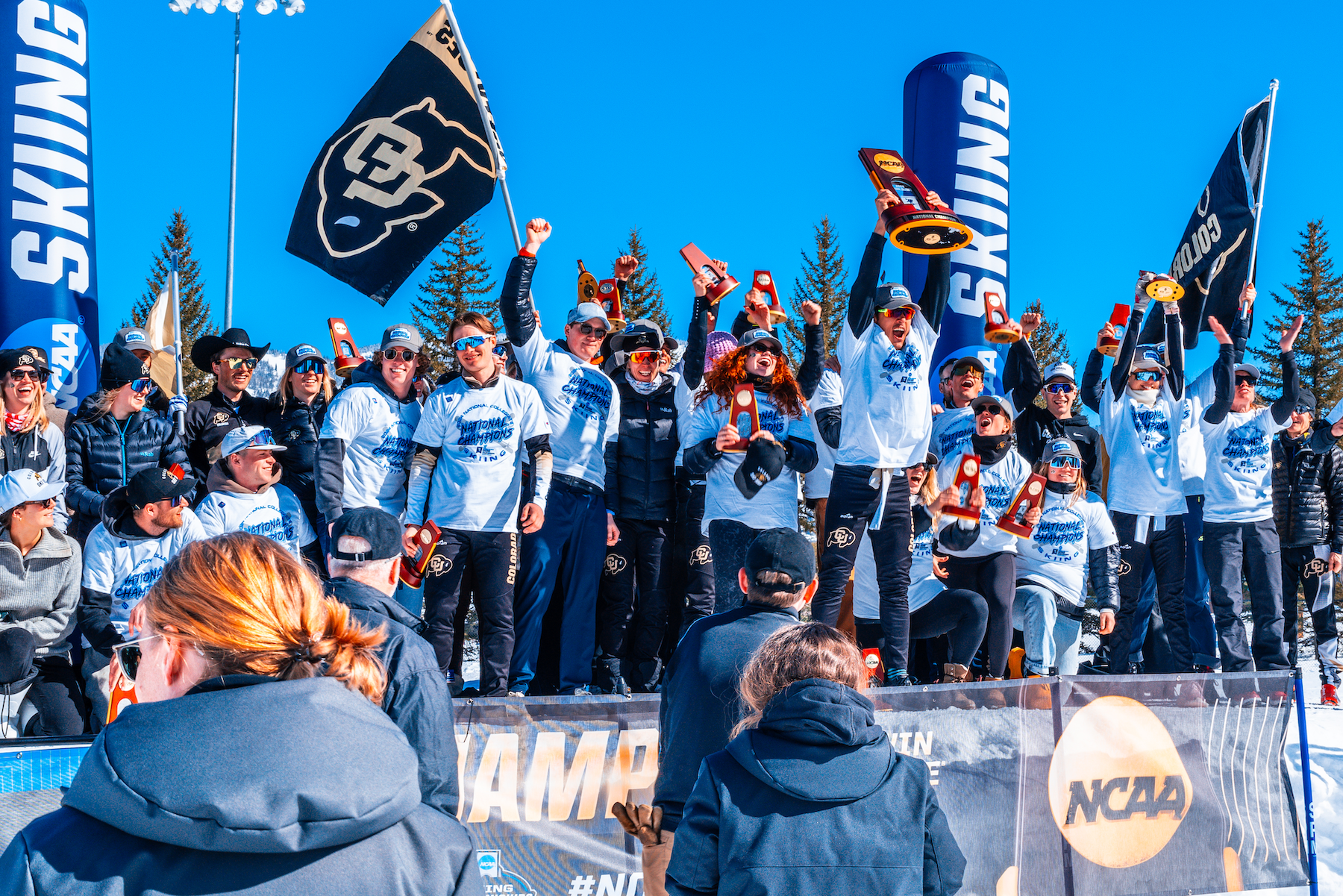
The 2024 NCAA Champion University of Colorado Buffaloes. (Photo: Tobias Albrigsten/ @UnTraceableG) Winning a fifth NCAA championship in a row would represent a program milestone for the University of Utah, though going into the final day of NCAA competition, Utah’s path to victory was less than a foregone conclusion. Nonetheless, Utah has shown itself to be the dominant collegiate program—both Alpine and Nordic—of the last few years, entering the final day of NCAA competition as the favorite to take the crown. All that history would be decided in the Men’s and Women’s 20 k Mass Start Classic races held at Howelsen Hill in Steamboat Spring, Colorado. Clear skies and perfect conditions made waxing and preparation quite straightforward; the races—and the championship—would be decided on the trails.
The NCAA Skiing Championship is awarded to the team with the highest combined score after two Alpine races and two Nordic races. The University of Utah entered Saturday’s 20 k Mass Start Classic races (Men’s and Women’s) with a substantial lead (444.5 points) over University of Denver (401 points) and University of Colorado (393.5 points). These would be the final races of the 2024 NCAA Championship—trophy presentations, unfurled flags, and whole-team podium photos to follow.
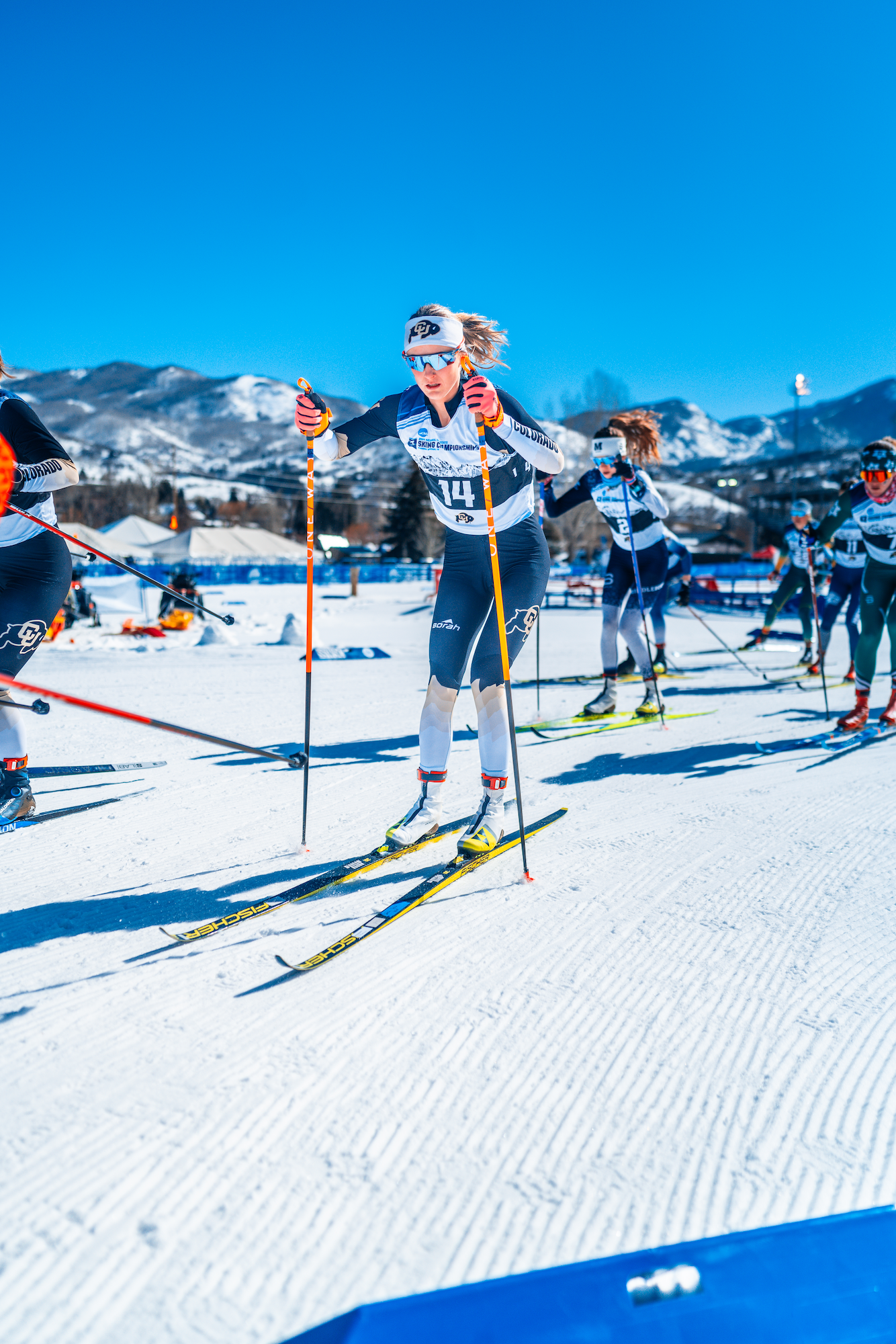
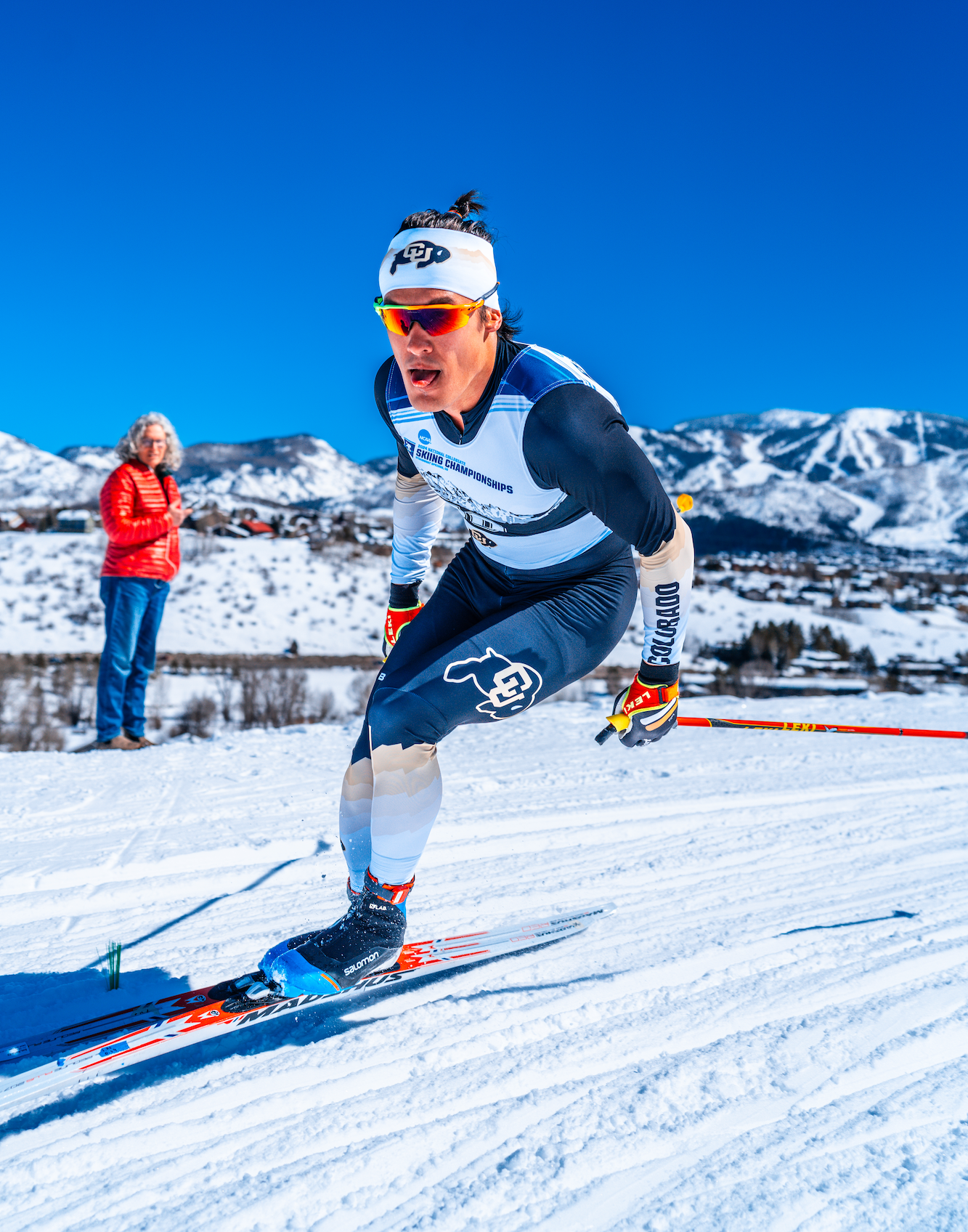
University of Colorado’s Weronkia Koletta during Saturday’s NCAA 20 k Classic Mass Start. Koletta finished ninth, part of a CU effort that placed three in the top ten to secure a closely-contested NCAA Team Championship. (Photo: Tobias Albrigsten/ @UnTraceableG) Women’s 20 k Classic Mass Start
Earlier in the week, Thursday’s 7.5 k Individual Start Freestyle race was won by Utah’s Sydney Palmer-Leger (UU) who ended her own three-year title-drought by returning to the top step of an NCAA podium for the third time in her career. Palmer-Leger was a two-time NCAA champion as a freshman in 2021, but since those early-career successes, she has had to watch as her teammates—Novie McCabe in 2023 and Sophia Laukli in 2022—won races and garnered headlines. With McCabe and Laukli now racing full-time on the World Cup circuit, the responsibility of delivering national championships for the Utes has returned to Palmer-Leger.
Along with Palmer-Leger, the list of contenders in the Women’s race is deep and distinguished, and many of those names went straight to the front as the race began. Led by Tilde Baangman (MSU) and Hannah Abrahmson (CU), a group of seven separated themselves from the field by the top of the very first hill. By the end of the first of four 5 k laps, that lead group would grow to ten: Jasmine Drolet (DAR), Baangman, Abrahamson, Kariana Dengeruud (UU), Palmer-Leger (UU), Anna-Maria Dietze (CU), Weronika Kaleta (CU), Haley Brewster (UVM), Ava Thurston (DAR), Kate Oldham (MSU). The challenging climbs and the daunting elevation of Steamboat’s Howellson Hill course continued to whittle away at the lead group for the next two laps. Conversely, Kendall Kramer (UAF) was able to work her way up to the lead group as other contenders continued to fall away.
At the beginning of the final lap, the lead group had seen itself shrink to seven: Abrahamson, Baangman, Palmer-Leger, Drolet and Dietze, with Kaleta hanging just off the back in sixth. If that combination of skiers—three from CU and only one from UU—were to finish in that order, it would mean a massive points swing to CU with only the Men’s race remaining in team scoring. But racing rarely goes to script.
Midway through the final lap, a major climb caused another split in the lead group as Abrahamson, Palmer-Leger, and Brewster powered to the front, only to see themselves caught and passed on the subsequent downhill by a rocketing Drolet who quickly established a gap and shattered the small group of leaders.
Drolet would storm across the line first, followed seconds later by Brewster second, Palmer-Leger third, Abrahamson fourth, Dietze fifth, Kramer sixth, Baangman seventh.
Women’s 20 k Classic Mass Start RESULTS
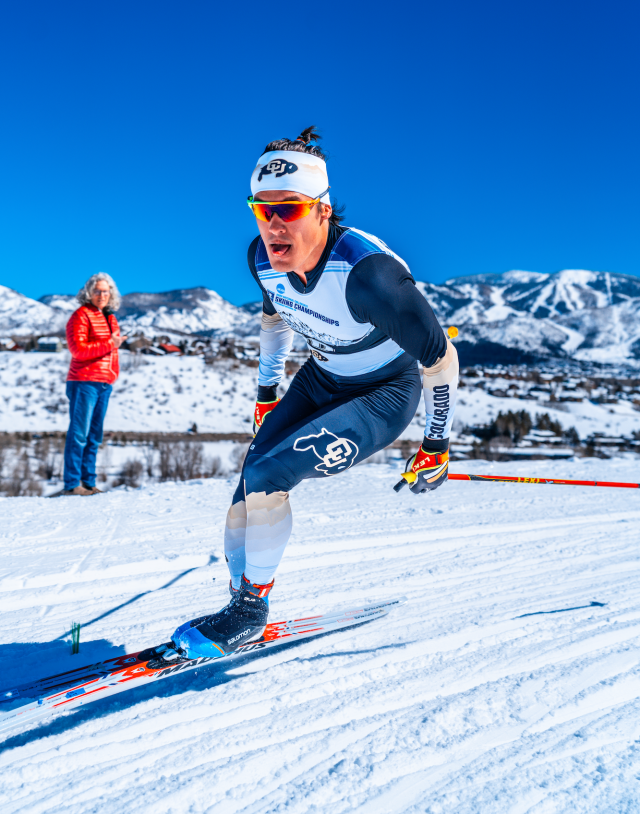
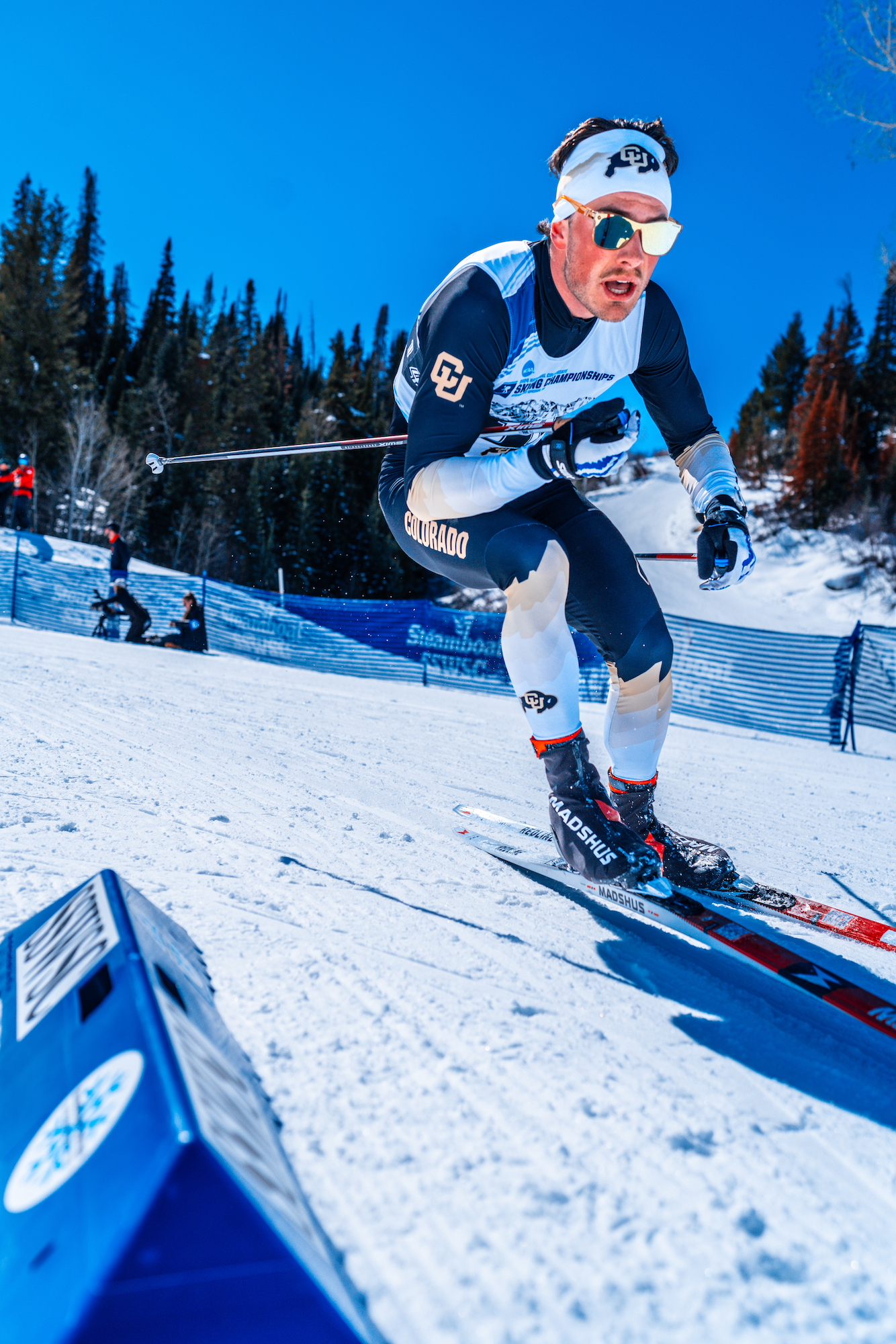
Magnus Boee (CU) delivered the third NCAA race win of his career, leading the Colorado Buffaloes to an unlikely final-day comeback and the NCAA Skiing Championship. (Photo: Tobias Albrigsten/ @UnTraceableG) Men’s 20 k Classic Mass Start
Utah led team scoring going into the final Men’s race, with Colorado trailing by only 17 points. NCAA bragging rights would be up for grabs over the next 20 kilometers.
In the 2023 NCAA Mass Start race, Dartmouth’s John Steel Hagenbuch had found himself out-dueled by Remi Drolet of Harvard (the first NCAA race-winner in that school’s history). Drolet returned to this year’s NCAA championship, but he appeared to have left his best form on the World Cup courses where he spent much of the winter and spring. Drolet finished Thursday’s 7.5 k Freestyle an uncharacteristic 16th. Hagenbuch, too, has raced through a calendar dominated by World Cup racing, but he appears to be getting stronger and stronger as the collegiate season continues.
The Men’s race broke up quickly; by the beginning of lap two, a lead group had formed of Andreas Kirkeng (DU), Florian Knopf (DU), Magnus Boee (CU), and Will Koch (CU). That lead group was followed closely by 2023 NCAA Champion Joe Davies (UU), Tom Mancini (UU) Hagenbuch, and Drolet.
Mid-lap attacks by Boee shook up the lead group, shedding Koch and stringing out Kirkeng and Knopf. It seemed an audaciously early move, though with potential to develop points gaps (especially with Boee in the lead and Koch remaining ahead of Utah’s skiers) that could bear heavily on the final NCAA standings.
Boee’s tremendous double-pole continued to put time into his rivals. All that remained was the upcoming 30+ kilometers, and the question of whether or not Boee’s gamble would pay off. Through the end of the second lap, Boee’s gap continued to grow. Behind him, Knopf continued to chase gamely, though Kirkeng was overtaken by Koch.
Working together behind Koch was a group of contenders including Tom Mancini (UU), Drolet, Hagenbuch, Brian Bushey (UU), Davies, and Florian Winker (MSU).
Beginning the final lap, Boee held a gap of over 20 seconds over second place Knopf, then another 20 + seconds to Koch, then a final 20+ seconds to the main group of chasers. Someone would need to surge—and someone would need to blow—for those standings to be much changed before the finish. At the beginning of this final lap, CU led the NCAA team standings by a mere two points.
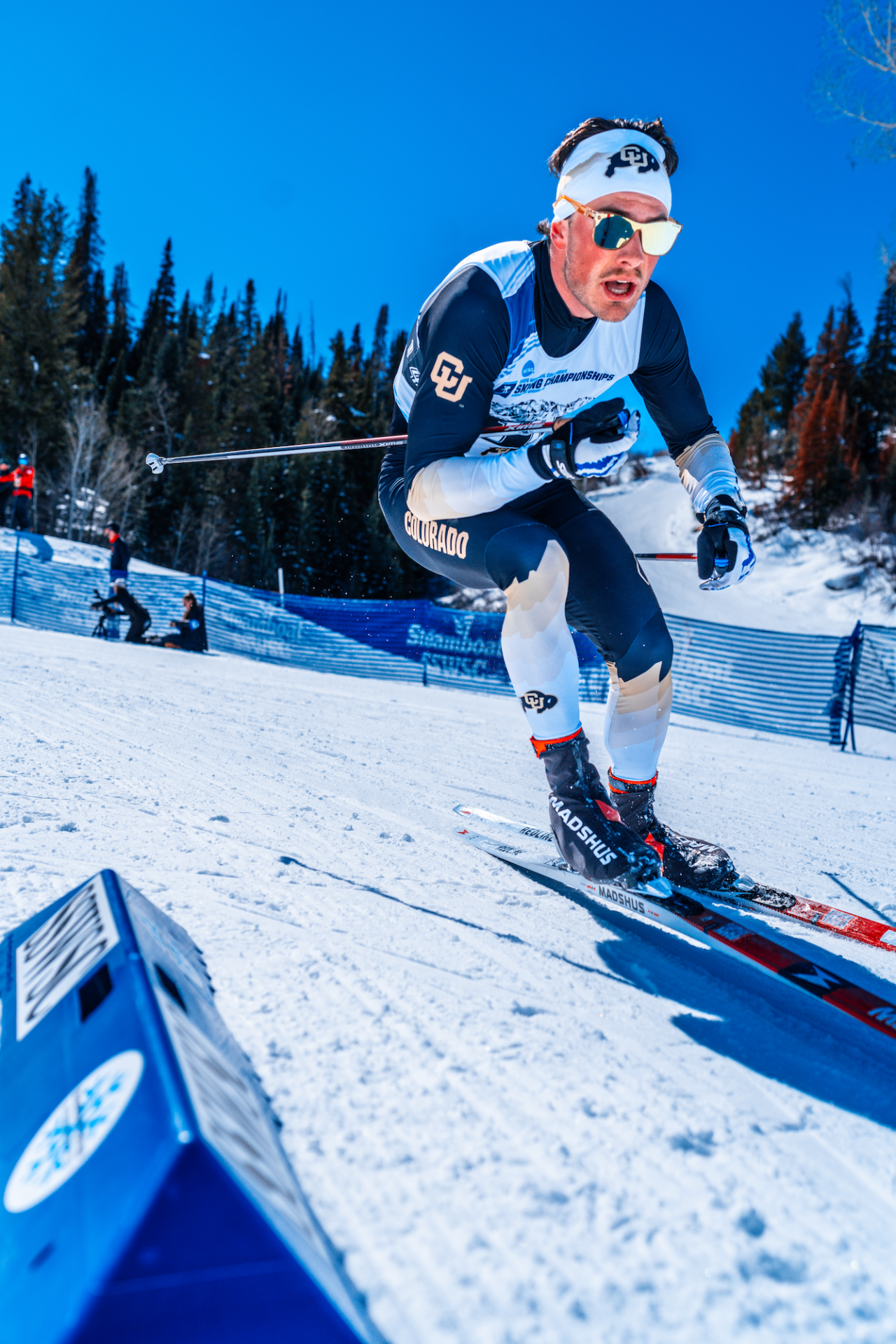
University of Coloardo’s Will Koch held off a late surge by John Steel Hagenbuch (Dartmouth) to take third in the NCAA 20 k classic mass start, helping win the Team Championship for CU by just 2 points. (Photo: Tobias Albrigsten/ @UnTraceableG) On the major climb, Drolet and Hagenbuch began to pull away from the Utah skiers. And by the last kilometer of the final lap, Hagenbuch and Drolet were beginning to track down Koch who gave everything he had to get over the top of the final climb ahead of his pursuers.
Boee skied across the line waving a CU flag, Knopf crossed the line, Koch crossed the line, Drolet outsprinted Hagenbuch for fourth, then a trio of Utes crossed together. A few skiers later, Colorado’s Johannes Flaaten crossed the line for 11th place . . . and a NCAA TEAM CHAMPIONSHIP for the Colorado Buffaloes . . . a win they took from the Utah Utes by a team-total of two points.
Men’s 20 k Classic Mass Start RESULTS
Tag: Haley Brewster
-

NCAA—Magnus Boee Leads Colorado to Come-from-Behind Victory

For U.S. Skiing, Minneapolis is a High-Water Mark
 This coverage is made possible through the generous support of Marty and Kathy Hall and A Hall Mark of Excellence Award. To learn more about A Hall Mark of Excellence Award, or to learn how you can support FasterSkier’s coverage, please contact info@fasterskier.com.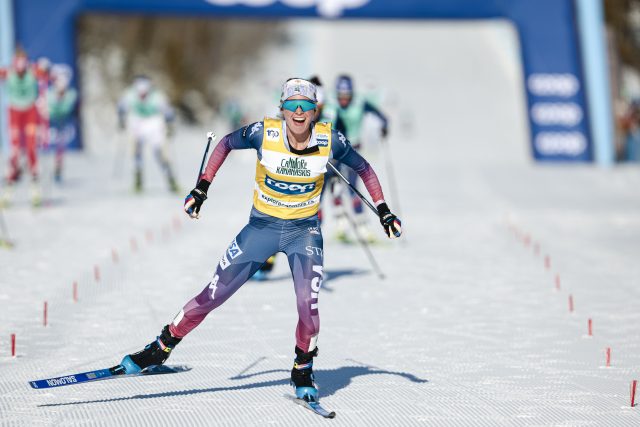
Jessie Diggins has led the way for U.S. skiing in recent years. But the team’s success is now blossoming to include many other athletes. (Federico Modica/Nordic Focus) MINNEAPOLIS — The last time cross-country ski racing’s most elite race circuit, the World Cup, traveled to the United States from Europe, Jessie Diggins was nine years old.
At the time, in 2001, the fastest American woman on skis was Nina Kemppel, an Alaskan nearing the end of her career.
It’s hard to imagine the obstacles that athletes of Kemppel’s generation had to face.
Kemppel trained for most of her career without the support of teammates or a local club. On the World Cup, the U.S. team might have had a one- or two-man paid ski tuning staff, and sometimes, Kemppel had to wax her own skis herself.
“It was daunting,” Kemppel said by phone Friday. “But amazingly impactful, I think, in shaping my career.”
The World Cup returns to the U.S. this weekend, with a pair of races in Minneapolis. And the events mark an appropriate occasion to step back and reflect on just how far American cross-country skiing has come since the last time the circuit was here.
Let’s be honest: The sport is still on the fringes. The average resident of Manhattan or even Michigan would say, “Jessie Who?” if you asked them about the three-time Olympic medalist. But there’s almost no comparison between the U.S. Ski Team of 2001 and the squad that’s gathered to compete in the races here.
Today’s athletes travel across Europe supported by a paid crew of ski technicians who drive a converted semi trailer to work out of each race weekend.
An array of regional club teams provide groups of racers with structured training and coaching during the spring, summer and fall.
A nonprofit organization, the National Nordic Foundation, raises hundreds of thousands of dollars to subsidize expenses that elite racers rack up traveling to training camps and competitions.
And the Americans currently rank third in the International Ski Federation’s “Nations Cup”—a measure of a country’s success over the course of the season to date—behind Norway and Sweden and just ahead of Finland.
“I think when I came back to work for the U.S. Ski Team in 2006, we were 15th in the Nations Cup,” Chris Grover, U.S. cross-country program director, said recently. (The ski federation’s statistical database doesn’t reach that far back.)
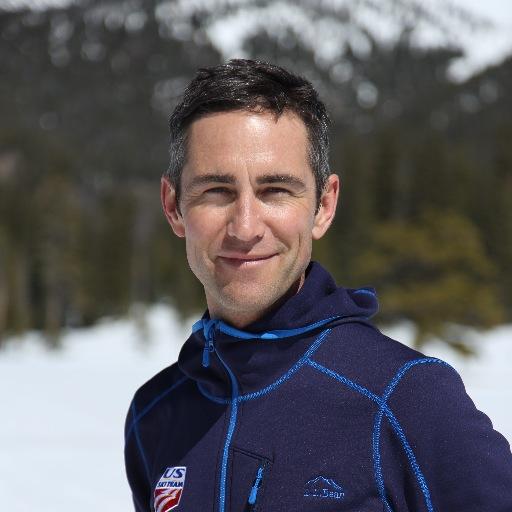
Chris Grover “Consistency, and actually, investment—that’s really what it comes down to,” Grover added. “Gradually expanding the program, letting it be more comprehensive. The club coaches keep getting better, the clubs keep getting stronger.”
While the past few years’ Olympic medals from Diggins and Kikkan Randall have thrilled fans, perhaps the most exciting thing happening in the U.S. program today is its depth.
In the past, the Americans have had a few athletes at a time capable of mixing it up on the World Cup, or challenging for the podium. But now, there are multiple athletes of each gender who are contending for top 20s.
On the women’s side, veterans Diggins, 32, and Rosie Brennan, 35, have become regulars on the podium. Sophia Laukli, who’s just 23, won her first World Cup earlier this year, in a race up the Alpe Cermis in Italy, and she again challenged the sport’s fastest women at a race in Canada last week. Julia Kern, 26, has landed on the podium in previous years and regularly vies for the top 10 in sprinting, her strongest discipline.
On the men’s side, 24-year-old Ben Ogden was the International Ski Federation’s top-scoring young athlete last year, and had his first-ever top-three World Cup finish in December. That was weeks after another huge talent, 23-year-old JC Schoonmaker, also finished on the podium for the first time, in Sweden. Gus Schumacher, 23 and a former world junior champion, has had his own breakout season, including a fourth-place finish last month.
The list goes on. And even younger athletes than those have been scoring huge results at the junior level. No fewer than three Americans—Sammy Smith, 18, Haley Brewster, 20, and John Steel Hagenbuch, 22—notched medal-winning performances this month at the world under-23 and junior world championships in Slovenia.
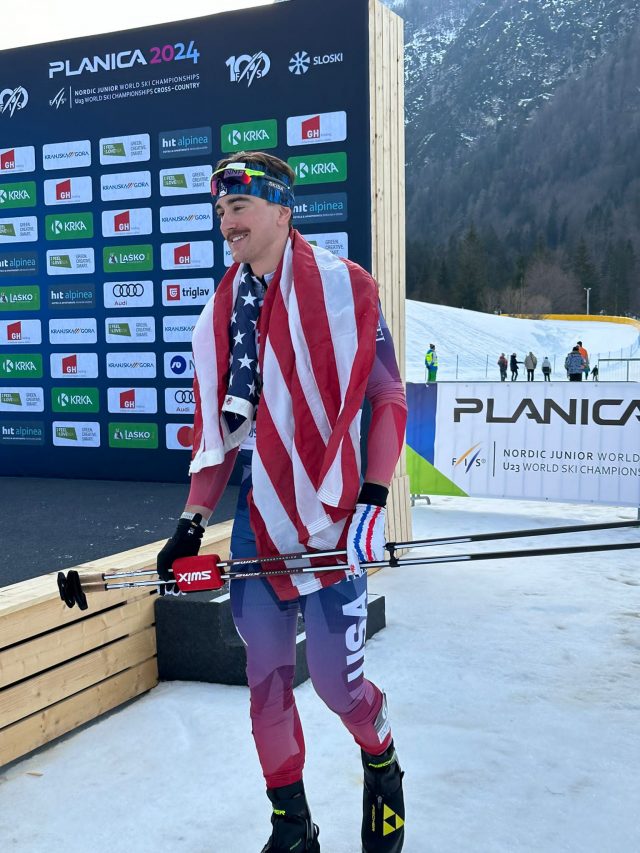
John Steel Hagenbuch after winning a bronze medal at the under-23 world championships in Slovenia this month. (Greta Anderson) “We just have so much more depth, in the women’s side and on the men’s side,” said Andy Newell, the retired U.S. sprinter who’s coaching in Minneapolis this week. “It’s a testament to the ski culture in the U.S.”
There’s still plenty of work to do. Some of the lower-ranking American athletes who competed on the World Cup in Canada last weekend had to shell out their own money, or resorted to crowdfunding, to cover some of their expenses. Innumerable children are still shut out from participating in the sport because of the steep price of equipment and limited capacity of coaching programs.
Nonetheless, this weekend’s races—expected to draw some 30,000 fans, with a strong likelihood of a Diggins podium—will be a new high water mark for the sport in America, and a reminder of the enormous progress it’s made in the past two decades.
“It’s everything, right?” Brennan said at a news conference at the Minneapolis race venue, referring to financial support, professionalism, and teamwork.
“I find myself telling some of these kids quite often what it was like back in the day. It’s truly insane, what’s happened,” Brennan said. “It’s really important to take a second and think about that. It’s something I try to do periodically, just to gain some perspective. And it allows me to have so much gratitude for all the work that everyone has put in—team staff, and support, and the community—to make something like this happen. And to make us be a team that actually has a chance of winning these races this weekend.”

Individual Efforts and Collective Strengths—US Nationals 20 k
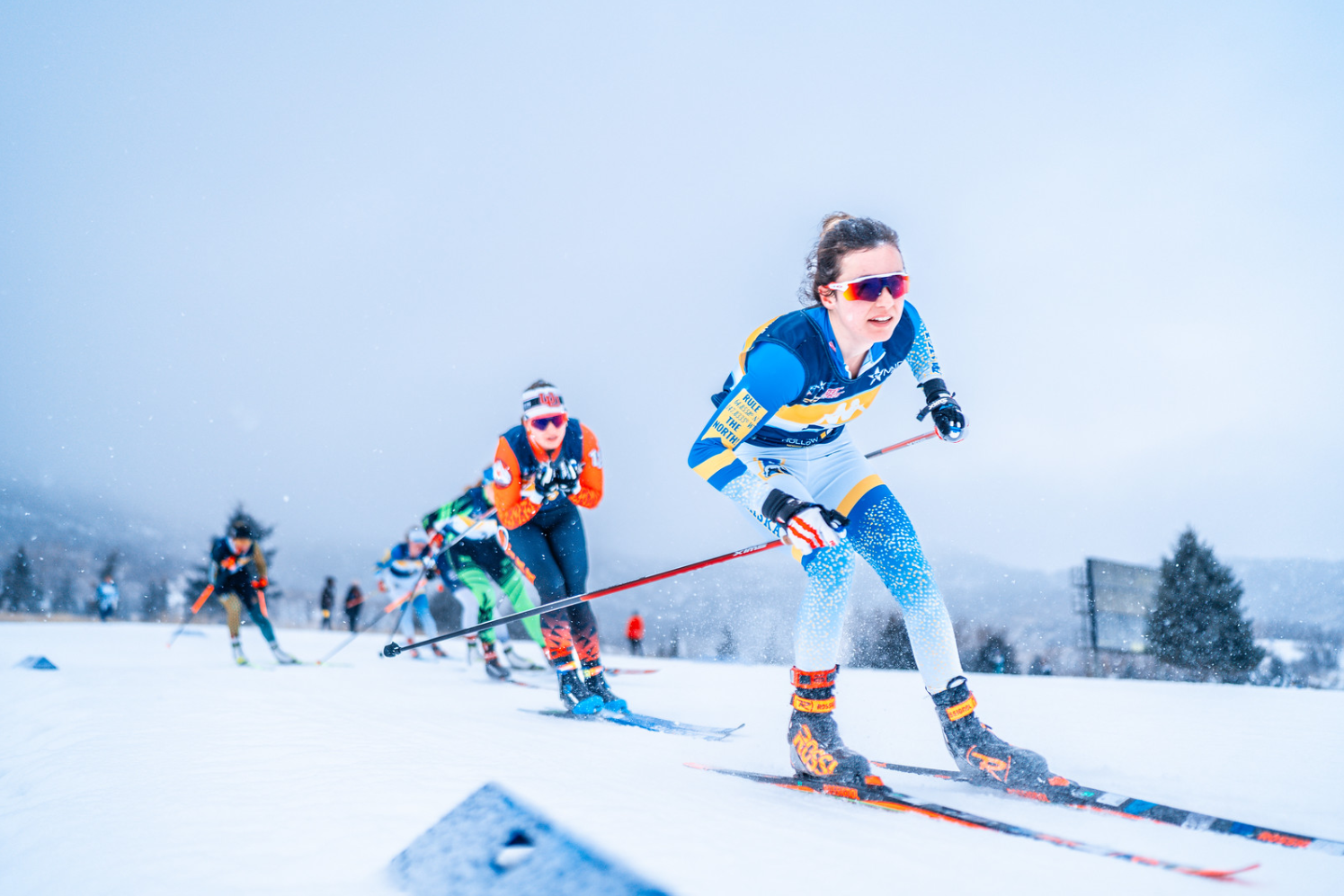
Kendall Kramer (University of Alaska-Fairbanks) leads the Women’s pack during Friday’s 20 k Skate Mass Start at US Nationals. (Photo: Tobias Albrigsten/@UntraceableG) We all work better when we work together—that would seem to be the credo being employed by American skiers these days. At the conclusion of US Nationals at Utah’s Soldier Hollow, American skiing has rarely looked better, whether internationally or domestically.
The warm temps and blue skies of early week at the US Cross Country Ski National Championships gave way to, of all things, snow. Morning light came up on Soldier Hollow; snow drifted in rather than stormed, but flakes falling from the sky rather than blasting from trailside snow guns was a good late-week reminder for the ski community: despite all this season’s continental snow troubles (Alaskan excepted!), this is indeed a winter sport.
On that new snow—over six laps of a hill-heavy, rarely flat, 3.3 k course—skiers tackled the 20 k Skate Mass Start. A recurrent observation heard by coaches, ski administrators, and athletes was “You can’t quite believe how big this event has gotten.” Momentum was another word heard frequently throughout the week, as some of the biggest fields to ever race at US Nationals combined with daily reports of that day’s Tour de Ski, where American skiers enjoyed a banner day. Until Friday, though, the evidence was merely in the number of skiers on the start sheets, and the number of clubs from a greater number of places milling around Soldier Hollow’s makeshift race village. Seeing fields of 100 skiers wind up Soldier Hollow was a whole different type of confirmation of that momentum. Crowded fields of the fittest athletes in the country brought their own journeys in the sport, their numbered affiliations, and their collective abilities to ski together. The ground rumbled, shouts from the sidelines roared, and the field—at least in early stages of the races—seemed to become a singular thing. US skiing, moving together in concert, became something sublime that could be readily seen and felt.
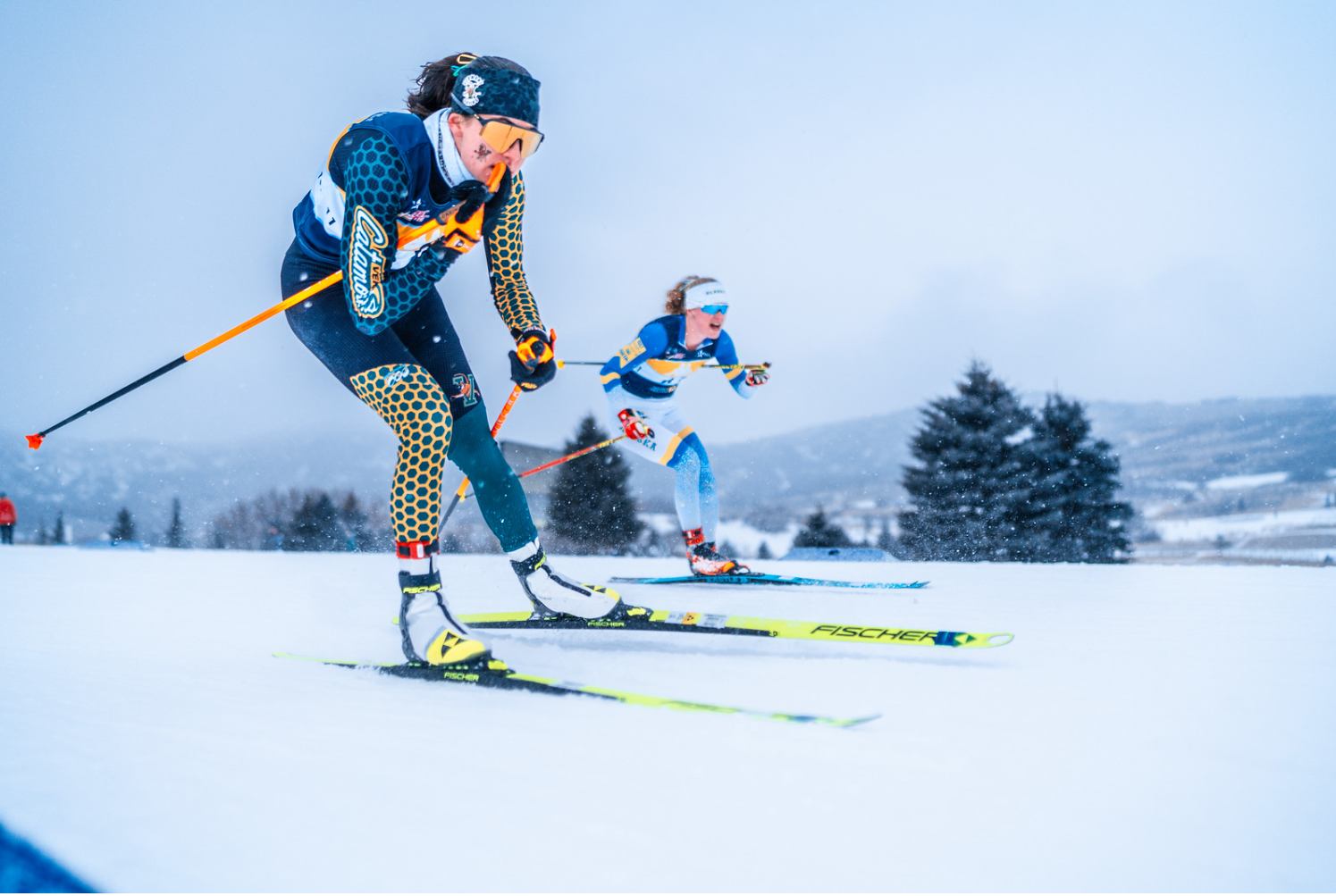
Haley Brewster made a decisive move late in Friday’s 20 k race to claim her first career national championship. (Photo: Tobias Albrigsten/@UntraceableG) Women’s 20 k Skate Mass Start
Of course, it was a ski race. After that roaring start up the hollow’s steady incline, the Women’s 20 k Mass Start field started to jockey for where and when to make a decisive move towards the National Championship.
When the race started at 10am, natural snow was falling, but hadn’t yet accumulated enough on the glazed deck of artificial snow. The course displayed one defining principle that dictated how the mass start would be raced: for every long climb on the Soldier Hollow course there was an equal or greater downhill that followed. If a skier was going to make a tactical move on an uphill, they had to be sure they could hold off their rivals on the subsequent downhill. For nearly six laps, a nine-skier lead pack waited for that move.
For much of the race, University of Alaska-Fairbanks’ Kendall Kramer was the leading presence at the front of the pack, hinting at the importance of pushing the transition between uphill and downhill in the fast snow by pushing over and well into each downhill. She was joined mid-race by Craftsbury Ski Club’s Margie Freed who—between apparent good skis and smart drafting—was able to join Kramer in the lowlands of the course and at times, push to form minor separation ahead of the field.
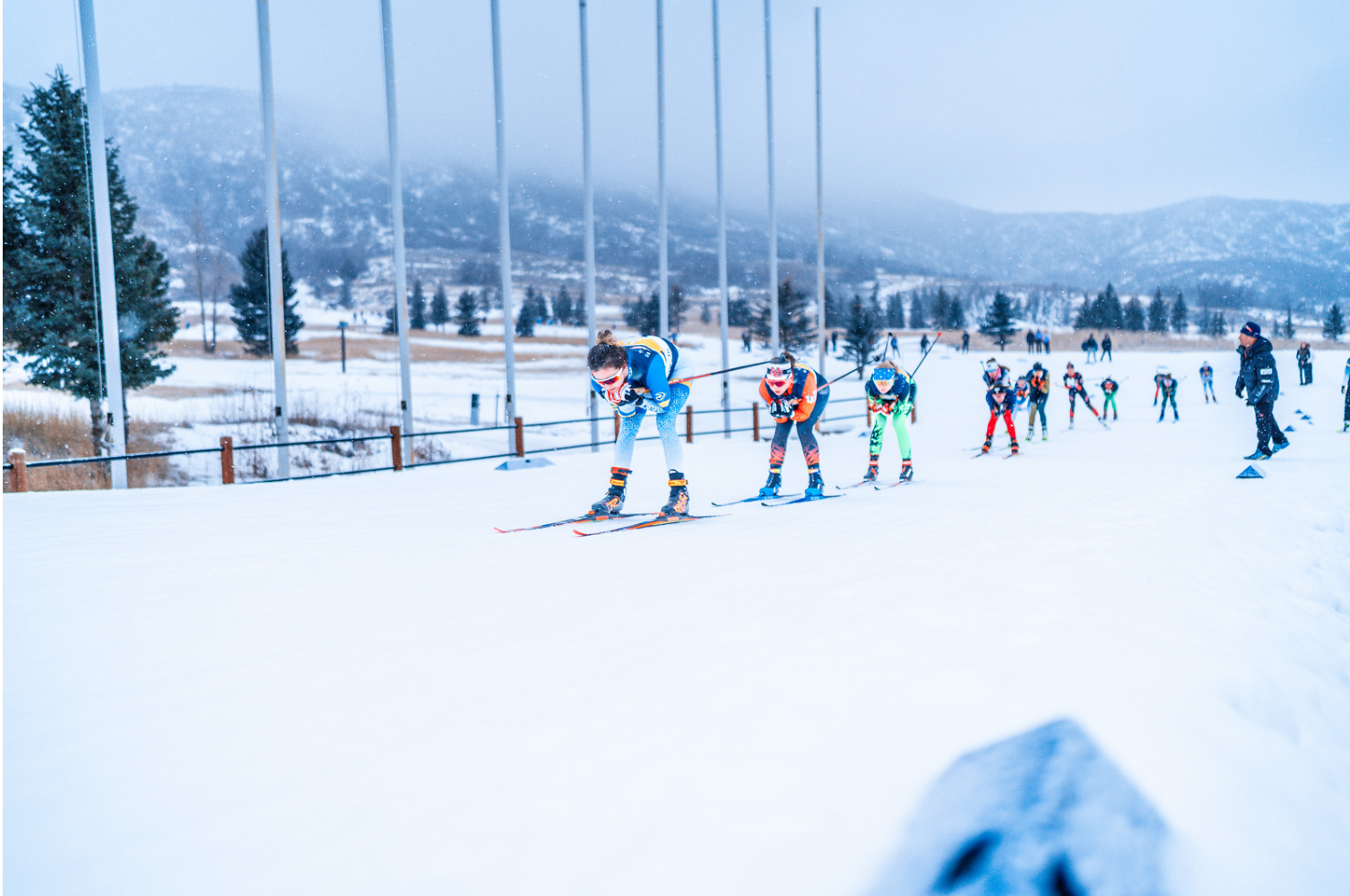
The lead pack in Friday’s 20 k Skate winds into Soldier Hollow stadium. (Photo: Tobias Albrigsten/@UntraceableG) As Kramer and Freed headed into the final lap, they were joined by University of Vermont’s (UVM) Haley Brewster. Brewster and Kramer rounded the top with Freed in tow. In the final climb, Brewster made her decisive up-tick in pace, gaining separation over Kramer in an attempt to ward off a sprint finish after the final downhill. Likewise, Kramer gained separation over Freed, and Freed likewise from the rest of the field. The final stretch featured momentary celebrations, as each crossed with space between: Brewster in first, Kramer second, and Freed in third.
The win gave Brewster—a UVM Junior and former Ski and Snowboard Club Vail skier— her first national championship. The result also marked Kramer’s second national podium, after she finished third American in the skate sprint last year in Houghton, Michigan. It was also the first US Nationals podium for Freed. The Minnesota native is in the midst of her first season competing in Biathlon, having just completed her first stint on the IBU World Cup, making the 20 k skate result an auspicious one.
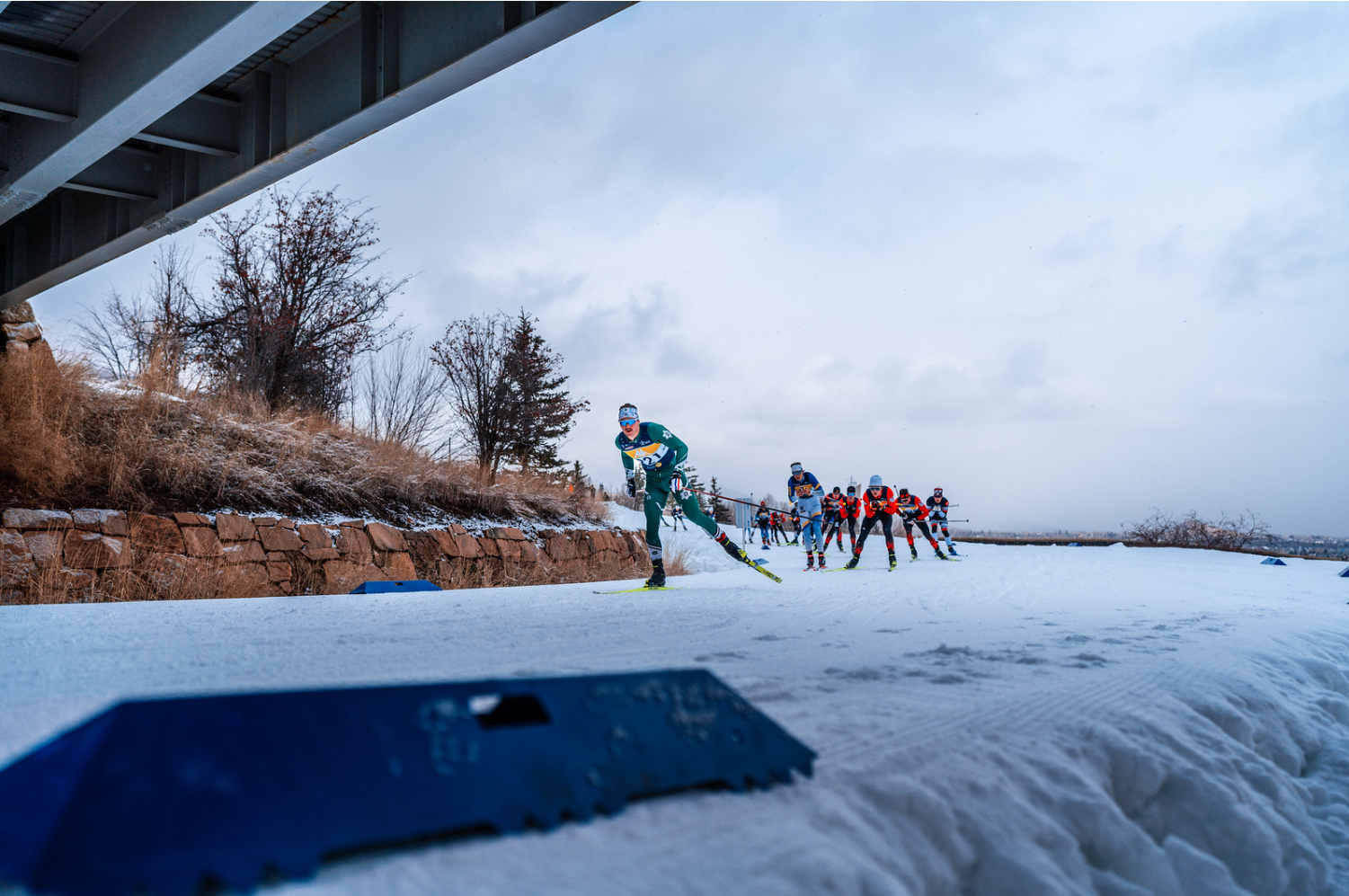
John Steel Hagenbuch (Dartmouth Ski Team) leads the Men’s pack during Friday’s 20 k Skate. Hagenbuch would make a decisive move to win his second career national championship. (Photo: Tobias Albrigsten/@UntraceableG) Men’s 20 k Skate Mass Start
By the time the Men’s field started at 12:15pm, the fresh flakes of the morning had accumulated significantly on top of the course’s artificial snow. In the Women’s morning races, the course (and the new snow) had been worked in. In the Men’s race, a new layer of natural snow now clashed with the fast-running, transformed artificial snow underneath. Reports of skis “catching” when they hit a particularly heavy patch of natural snow were heard throughout the finishing pen after the race, which reiterated premonitions many observers had of how the Men’s field would race the course.
With ski speeds diminished on downhills, there was a little more to be gained by an earlier attack in the Men’s race than in the Women’s race. For the right skier—with the right strategy—a race that was likely to become a mass start slog could be broken apart by an aggressive attack.
That skier turned out to be Dartmouth’s John Steel Hagenbuch. Hagenbuch waited near the front of the fifteen-skier lead pack until the start of the fourth lap. Then, he accelerated over the top of the fifth lap’s initial climb and pressed on, alone, through the last five kilometers of the race. Hagenbuch’s move was followed by other skiers testing their own long-range attacks as University of Utah’s (UU) Frenchman, Tom Mancini, and UU teammate and British-Canadian skier, Joe Davies, were able to make subsequent breaks in the field. Hagenbuch’s final gap was a commanding 40 seconds on second place Mancini. Davies rounded out the podium in third place, 54 seconds off the lead. The pair of Peter Wolter (Sun Valley), and Elijah Weenig (University of Denver) came next in fourth and fifth to round out the American podium.
The win was the second national championship for Hagenbuch after his victory in the 10 k Individual Start Skate at US Nationals last year. Mancini scored his first podium at US Nationals with his runner-up finish. Davies finished a strong week in which he also podiumed in Tuesday’s 10 k classic. Davies will represent Great Britain at Junior World Ski Championships later this month in Planica, Slovenia.
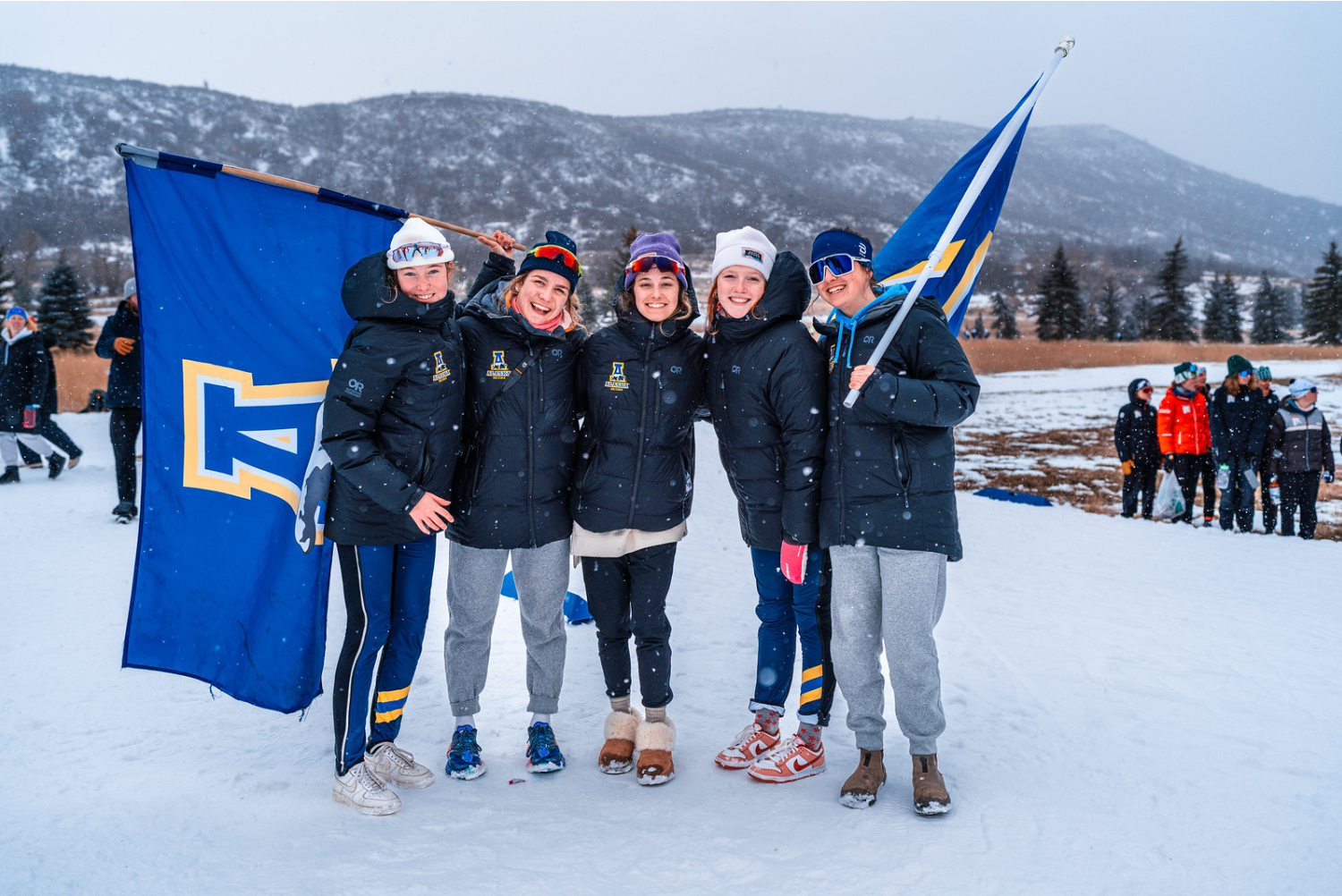
The University of Alaska-Fairbanks team out to cheer the Men’s race in Soldier Hollow, Utah Friday. (Photo: Tobias Albrigsten/@UntraceableG) US Nationals Bids Farewell to Soldier Hollow
US Nationals concluded with Friday’s races. As they did, the snow started to gather again in the sky over Utah heralding the start of this ski season in earnest. Some Nationals competitors now know where they’ll be racing later this season: qualifying for trips, securing spots on national teams for World Junior/U23 Ski Championships, or possibly earning starts on the World Cup. For US Skiing, in general, the conclusion of Nationals revealed another world of possibilities as many in Soldier Hollow this week dared to dream bigger. The United States ski community now goes out into the world as one, demonstrating the credo that’s transformed the sport during this generation: we all work better when we work together.
Full US Nationals 20 k skate mass start RESULTS
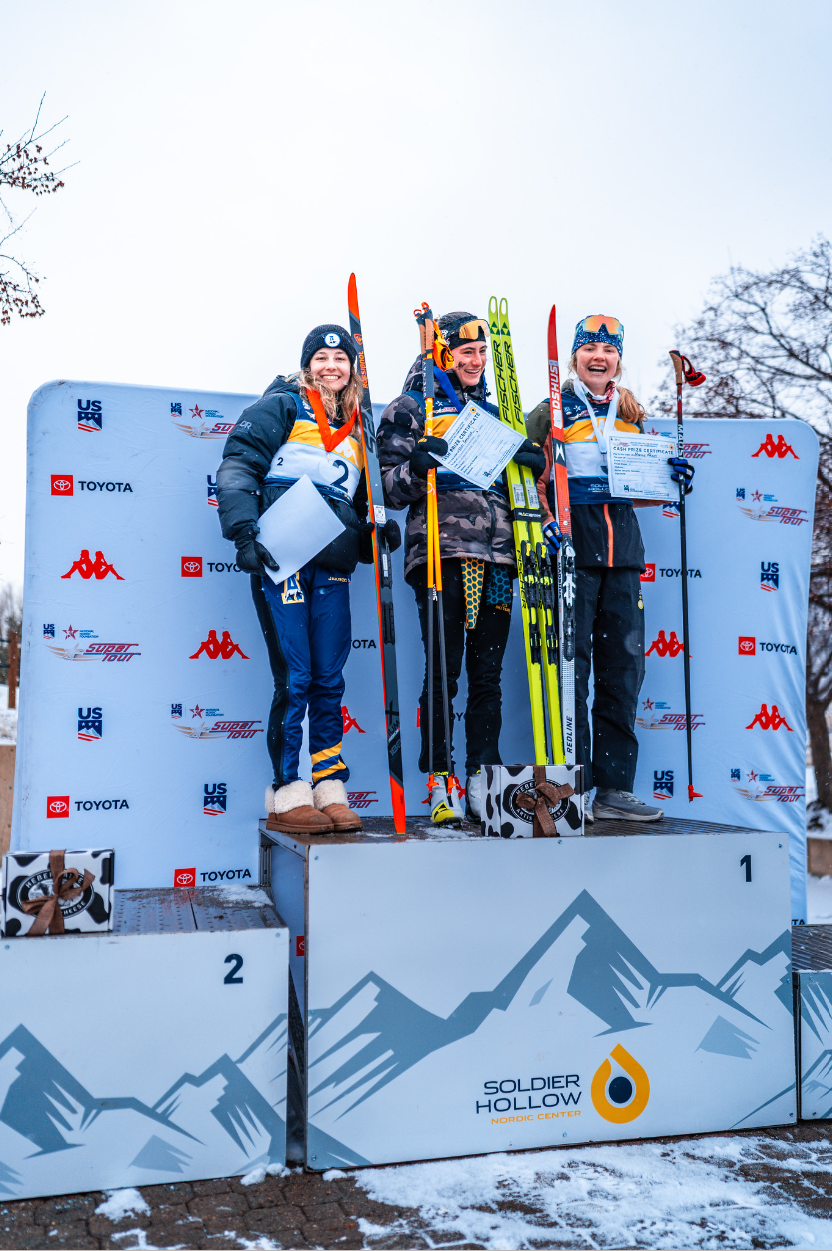
The Women’s podium in Friday’s 20 k Mass Start, Haley Brewster (UVM) first, Kendall Kramer (UAF) second, and Margie Freed (Craftsbury Ski Club) third. Tobias Albrigsten contributed photos to this coverage of US Nationals. A full gallery from Friday’s Skate Race is available on his website here, and you can follow him on Instagram @UntraceableG.