Tag: Halfvarsson

  • Ruka Sprint Redemption for Johannes Høsflot Klæbo

    Ruka Sprint Redemption for Johannes Høsflot Klæbo

    A_Hall_Mark_of_Excellence_Award-logo-300.png (300×244)This World Cup coverage is made possible through the generous support of Marty and Kathy Hall and A Hall Mark of Excellence Award.  To learn more about A Hall Mark of Excellence Award or to learn how you can support FasterSkier’s coverage please contact info@fasterskier.com.
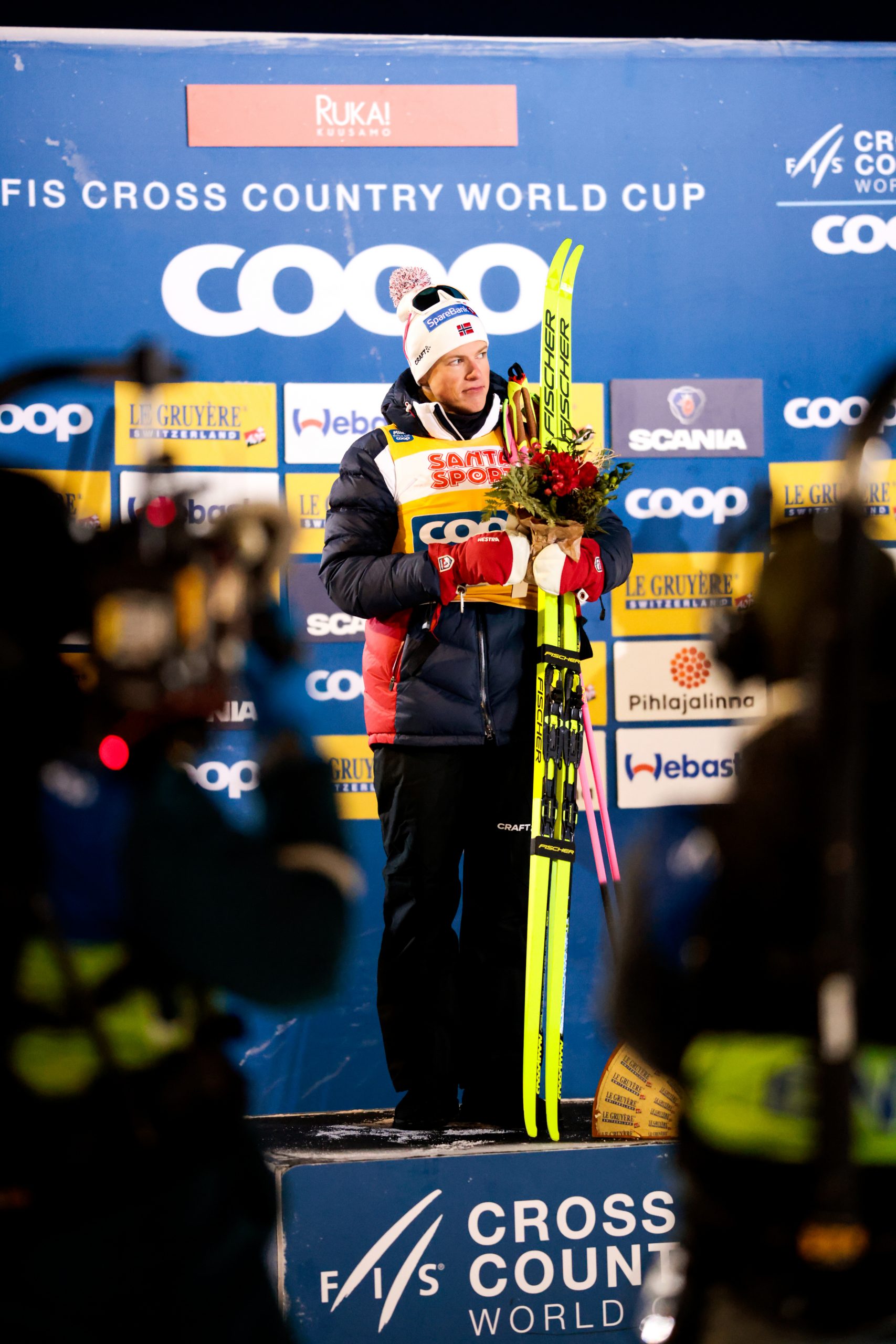


    Johannes Høsflot Klæbo displayed his dominance in this year’s FIS World Cup Sprint in Ruka, Finland. (Photo: NordicFocus)

    Ruka, Finland sits at a northern latitude similar to Fairbanks Alaska, similar to the northern end of Canada’s Hudson Bay. By early winter, the sun is a weakened glow on the horizon, and then for only a few precious minutes each day. By midday, skiers vying for the win in today’s FIS Cross-Country World Cup Sprint were racing under Ruka’s stadium lights.

    The first men’s events of the FIS World Cup Cross-Country season took place in cold conditions that left competitors wreathed in the steam of their own breath, and tested the skill of ski technicians charged with creating kick and glide. Johannes Høsflot Klæbo quickly dispelled any notion that he may be limited by a lingering hamstring injury: Klæbo qualified first, dominated all heats in a manner that appeared easy, even for him, and cruised to victory ahead of Norwegian countrymen, Even Northug and Paal Golberg.

    Ben Ogden and JC Schoonmaker were the only North American’s advancing to the heats in the men’s field—Ogden 13th  and Schoonmaker 19th—with a near-miss for Logan Diekmann who skied to 32nd place in qualifying. Luke Jager tied for 40th, and Kevin Bolger 46th.

    Canada entered two skiers in sprint qualifying, with Graham Ritchie placing 53rd and Oliver Leveille 56th.

    Ruka Men’s World Cup Sprint

    While Klæbo’s first win of this World Cup season appeared leisurely, it was not without emotion. Ruka is where Klæbo was famously pipped at the line by Alexander Bolshunov in 2018. Ruka is also where Klæbo lost a World Cup sprint to Erik Valnes in 2020, and where Alexander Terentev outskied him in the opening World Cup Sprint in 2021. If Johannes Høsflot Klæbo were ever motivated by a desire for redemption, it would be at Ruka.
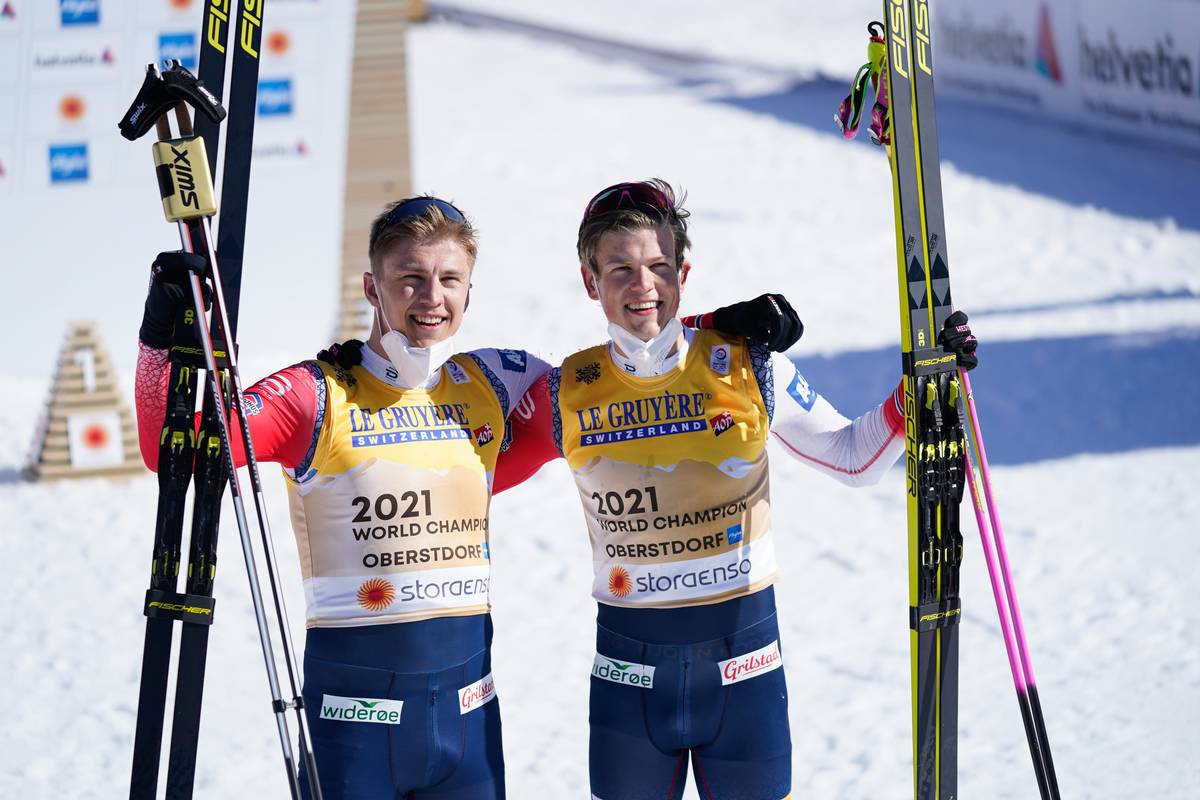
    Norwegian teammates Erik Valnes and Johannes Høsflot Klæbo celebrated a team sprint victory in Oberstdorf. Valnes is one of the few sprinters to take a World Cup sprint victory from Klaebo, as he did last season in Ruka. (Photo: NordicFocus)

    QUARTERFINAL 1—Klaebo and Valnes dominate

    Norwegian skiers arrived for Quarterfinal 1 clad in truly confusing red racing uniforms (all but indistinguishable from what Russian team skiers have worn on the World Cup circuit for quite a few years).  Except for Klæbo, most Norwegian athletes even raced in very Russian-looking red hats. At least the Swedes (mostly white) Finns (blue) and Americans (in blue with red/white stripe accents) remained recognizable.

    Wearing the yellow bib of last year’s overall World Cup champion, Klæbo advanced easily by means of his now-familiar acceleration on Ruka’s signature hill, though he never needed to unleash the high tempo striding that has been his trademark in this event. His skis seemed to float along the finishing stretch, allowing him sufficient space in front of his rivals to stand up and remove his pole straps well before the line. Norwegian teammate, Erik Valnes, followed him across the line in second.

    QUARTERFINAL 2—Halfvarsson advances

    The day’s second heat saw American, Ben Ogden, joining Norwegian sprint specialist, Even Northug, and the rejuvenated Swede, Calle Halfvorsson. Finland’s Joni Maki displayed fast skis as he moved to the lead, with Ogden pressing forward on the course’s first uphill. Ultimately, Halfvarsson finished first in the heat ahead of Northug, with Maki advancing as a lucky loser. Ogden seemed to struggle with slow skis, ultimately finishing the heat in fifth.

    QUARTERFINAL 3—Chanavat fades

    Heat 3 was dominated by Norway’s Haavard Solaas Taugboel who sprinted the ultimate hill followed by an inspired Francesco De Fabiani. France’s perennial sprint contender, Lucas Chanavat, finished fourth without ever appearing sharp.

    QUARTERFINAL 4—Schoonmaker comes close

    Paal Golberg moved quickly to the front in Quarterfinal 4, with American JC Schoonmaker jumping in behind. France’s 2022 World Cup Sprint Champion, Richard Jouve, worked his way forward through the quarterfinal field to tuck in behind Goldberg. Schoonmaker raced cleverly through the final stretch with a smart move to the inside on the final curve, narrowly missing a lucky loser spot.

    QUATERFINAL 5—Pellegrino climbs to the win

    Beijing silver medalist, Federico Pellegrino wore Italy’s new black race suit, and advanced to the semifinal by moving efficiently through the quarterfinal field. Pellegrino went to diagonal striding early on the ultimate hill, allowing him to pull away from the field. The inspired Frenchman, Jules Chappaz, crossed the line second.

    A resurgent Calle Halfvarsson moved consistently through the field on his way to the final. (photo: Fischer/NordicFocus)

    SEMIFINAL 1—both the lucky losers

    Wearing a white hat that differentiated him from his Norwegian teammates, Klæbo moved easily to front of his semifinal field before abruptly easing up. Northug and Halfvarsson took over the pace-making: thereafter, the script was pure Klæbo: driving to the front on the hill before gliding unchallenged across the finish line. Halfvarsson, Valnes, and Northug all advanced to the final.

    SEMIFINAL 2—Chappaz arrives on the scene

    The 1.4 k Ruka sprint course incorporates a critical uphill groomed four lanes wide, continuing over the top and down the other side to a lefthand turn into a wide finishing straight. Commentators often become so focused on Klæbo’s quick-striding domination on Ruka’s signature hill that we may overlook the fact that many other skiers bide their time on the hill, using the finishing straight to pick off their rivals. Semifinal 2 looked to be competitive, with Goldberg, Pellegrino, Chappaz, Jouve, and De Fabiani seeming well matched. Early on, Jouve moved into the lead after a very tight move that cut off De Fabiani. Ultimately, Jouve faded badly on the uphill—as did Pellegrino—allowing Chappaz to storm ahead for the semifinal victory (though he may have used too much energy in achieving it). Golberg crossed the line second to advance to the final.


    Sprint Final

    Making only his 12th World Cup start, Jules Chappaz may have spent more energy than was necessary in winning his semifinal; he would not end up being a factor in the final. That left Sweden’s resurgent Calle Halfvarsson to face four Norwegians (Northug, Valnes, Golberg, and Klæbo). Golberg and Valnes maneuvered to the front after Klaebo had  slowed the opening pace. Lingering mid-pack, Klæbo accelerated on the course’s primary downhill, and moved into a leading position before the hill. Klæbo never appeared to need his top gear, easily distancing the field on the hill. By the top, he had established a considerable gap which he handily maintained through the finish for his 49th World Cup victory. Northug won last week’s tune-up sprint Beitostolen, and his good form and good strategy brought him to the finish line second followed by teammates Golberg in 3rd, and Valnes in 4th.

    Johannes Høsflot Klæbo of Norway takes the win in Ruka, Finland’s classic sprint, gaining redemption for two Ruka World Cup sprints when he suffered rare defeats. (Photo: NordicFocus)

    While Klaebo had shown his early season fitness last week in Beitostolen with wins in Classic and Freestyle 10 k’s, his sprint-condition had remained in question. It wasn’t known (even by Klæbo) whether or not he would have the speed, the power, and the pop to contend in a World Cup sprint.

    “I didn’t know how this should go,” Klaebo said in a post-race interview.” . . . [I’ve had] things to deal with the last three weeks (referring to his lingering hamstring injury). [But] I had a really good day today. It was a lot of fun.”

    If there were any lingering questions regarding Klæbo’s fitness—or about his recovery from his summer-long hamstring injury—those questions have now been answered.

    The World Cup Sprint podium ceremony was still fist bumps instead of handshakes, reminding viewers that Covid still threatens events such as these. That memory must be particularly poignant to Klæbo: in 2020, the Norwegian team was unable to compete in the final World Cup events, and in 2021 Klæbo, himself, succumbed to Covid in the final weeks of the year, allowing Richard Jouve to claim the crystal globe. Today, at least, Klæbo had achieved a level of redemption, finally exiting the Ruka stadium with the sprint win that we’ve all come to expect.


    Full Results

    RUKA MEN’S SPRINT:  QUALIFYING | RUKA MEN’S SPRINT:  FINAL RESULTS


  • A Northug Classic: Norwegian Waits, Lurks, Pounces for Victory in Toblach Pursuit

    A Northug Classic: Norwegian Waits, Lurks, Pounces for Victory in Toblach Pursuit

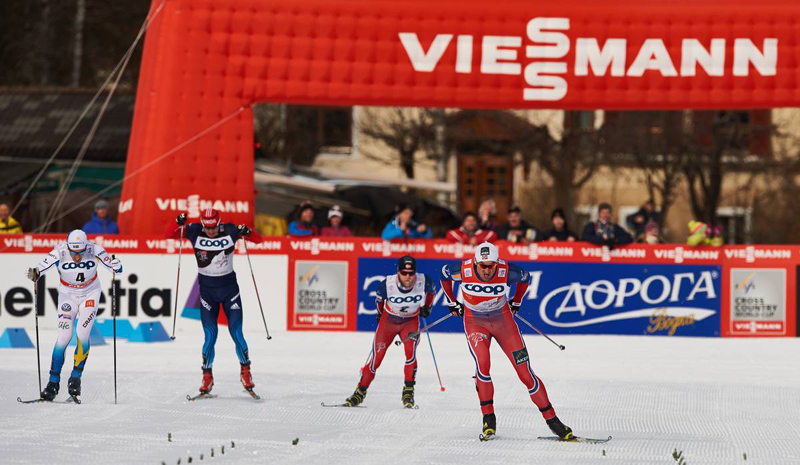
    Calle Halfvarsson (SWE), Evgeniy Belov (RUS), Martin Johnsrud Sundby (NOR and Petter Northug (NOR), (l-r) come to the line at the end of the Tour de Ski pursuit in Cortina-Toblach (ITA).  (photo: Fischer / Nordic Focus)
    Calle Halfvarsson (SWE), Evgeniy Belov (RUS), Martin Johnsrud Sundby (NOR and Petter Northug (NOR), (l-r) come to the line at the end of the Tour de Ski pursuit in Cortina-Toblach (ITA). (photo: Fischer / Nordic Focus)

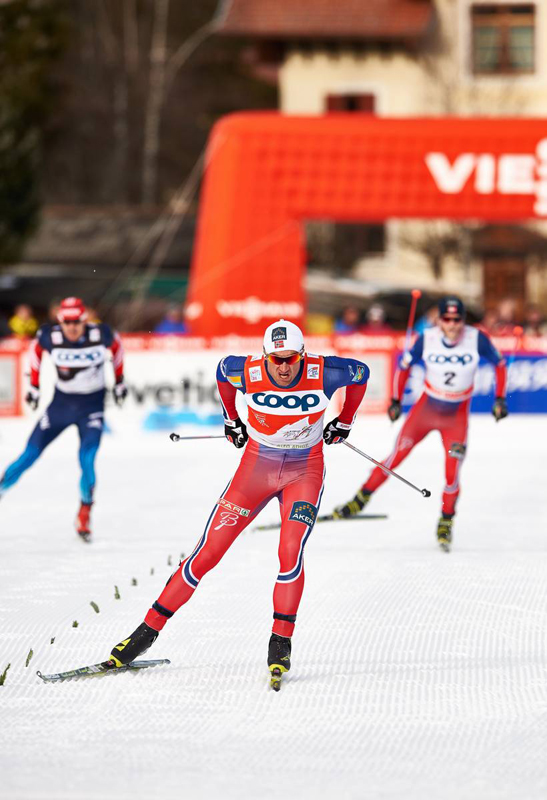
    Norway’s Petter Northug won the 25 k skate pursuit in Toblach, Italy, after surging past the leading trio on the final hill and making the sprint finish look easy. The Norwegian now leads the Tour de Ski, a seven-stage race series, by seven seconds with two competitions to go.

    Northug started the race two seconds ahead of his teammate Martin Johnsrud Sundby and seven seconds in front of Russia’s Evgeney Belov. Calle Halfvarsson of Sweden started 14 seconds behind Northug. However, the three chasers quickly passed Northug, who hung out in the back of the trio throughout the race.

    A master tactician, Northug surged into the last hill and made his move over the top, putting a gap on Halfvarsson over the hill and into the finish chute.

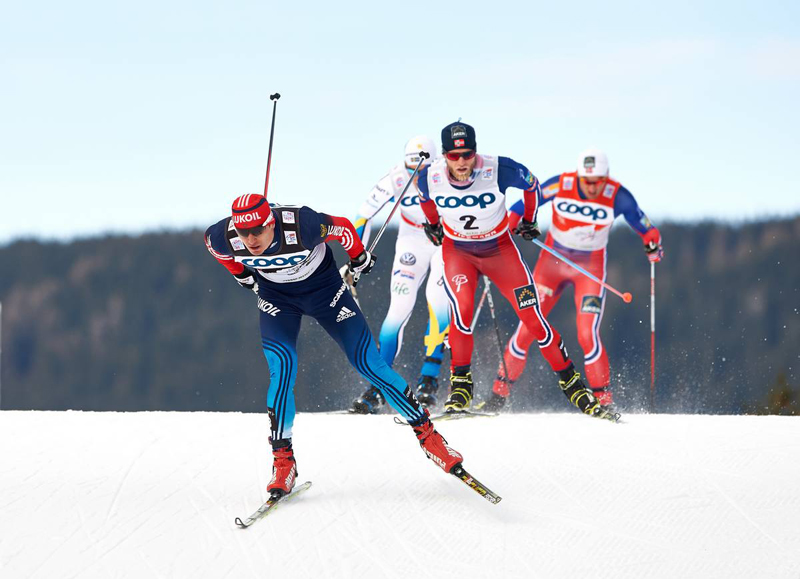
    Evgeniy Belov (RUS),  and Martin Johnsrud Sundby (NOR) did the majority of the work for the lead foursome.  (photo: Fischer / Nordic Focus)
    Evgeniy Belov (RUS), and Martin Johnsrud Sundby (NOR) did the majority of the work for the lead foursome. (photo: Fischer / Nordic Focus)

    “I managed to push my weight over the last hill and used that to my advantage so I could pick the chute to the finish line,” Northug said to NRK reporters after the race.

    The star noted that he was not in a position to contribute in front today.

    “I was focusing on hanging onto the group. They were all stronger than me today, but it was fun to hang with the big boys,” Northug explained.

    However, the tactics – of hanging with the pack but not leading, and then burning competitors in a sprint finish – is nothing new for Northug, who often justifies his lack of leadership in group skiing by saying that he’s tired.

    Not everyone was impressed. While Northug was pointing to his bib and gesturing in celebration of his win, Belov, who finished fourth in the sprint finish and did not collect any bonus seconds, angrily pointed his finger at Northug.

    This was only the fifth stage, it was not the final Tour de Ski, which we were racing for today,” he told Sweden’s Dagbladet newspaper. “In this case, you have to help the group during the race. He just went back and let the rest of us do the job. I don’t think it’s the way you should do this, and that’s why I both reacted in the finish and am angry now.”

    Belov and Sundby led the four-man group for much of the race.

    With the 15 bonus seconds awarded to the winner, 10 to second place, and 5 to third, Northug is now seven seconds in front of Halfvarsson in second place overall and 12.2 seconds ahead of Sundby, who is defending the 2014 Tour de Ski overall title.

    Petter Northug (NOR) takes the stage win.  (photo: Fischer / Nordic Focus)
    Petter Northug (NOR) takes the stage win. (photo: Fischer / Nordic Focus)

    Northug said that he is excited to try to add more bonus seconds in the 15 k classic mass start on Saturday, but doesn’t consider himself a favorite for the overall title, where he believes Sundby the best bet.

    “Calle (Halfvarsson) and I suck equally bad at the monster hill,” Northug said. “I would like to have a minute down to Sundby going into the big hill on Sunday.”

    Wants to go neck-a-neck with Northug on Sunday

    Halfvarsson didn’t argue with Northug’s comment on his chances up Alpe Cermis, but he cherishes the idea of measuring strengths in real time.

    “It would be really fun to go into that hill even with Northug on Sunday,” Halfvarsson said to NRK reporters after the race. “Then we could really see who of us is the fastest.”

    As for today’s race, Halfvarsson was pleased to finish only two seconds behind Northug and beat both Sundby and Belov.

    “I am super content with my race today,” Halfvarsson said to NRK reporters after the race. “I had to work really hard in the beginning to make it up to the front and that cost me a lot. I kept thinking to myself that I wanted to hang in there for one more lap, and then one more lap and then it was the last lap. I didn’t expect to have a chance to hang with these guys today. But it wasn’t me who set the speed. That was Sundby and Belov’s work. I tried to contribute when I could.”

    He was also pleased to have added time on Dario Cologna of Switzerland, a previous many-time Tour winner, and Swedish teammate Marcus Hellner. Completely exhausted, Halfvarsson is looking forward to a rest day on Friday before he tries to stay on the Tour de Ski podium in the last weekend of competition.

    It will be nice,” he told Swedish newspaper Expressen. “This was the roughest course I’ve been through.”

    Alternate course

    Today’s stage was originally a 35 k point-to-point skate pursuit, but due to lack of snow, it was changed to a 25 k consisting of five laps on the same 5 k course that was used for Wednesday’s 10 k classic competition. After five of seven stages, the top four overall have a solid gap on the rest of the field going into the last two stages of the Tour.

    Niklas Dyrhaug of Norway won a sprint finish for fifth place, besting Canada’s Alex Harvey, Cologna, and Wednesday’s classic 10 k winner Alexey Poltoranin of Kazakhstan.

    ““My optimistic goal was to ski back into the top-five. I just got outsprinted at the end, but I improved on my result so I have to be happy with today,” Harvey, who started in bib seven, said in a CCC press release. “The group didn’t push too hard today so I’m feeling less tired than I did at this point last year.”

    The fastest overall time of the day belonged to Andrew Musgrave of Great Britain, who started in 21st and moved up to 11th place, narrowly losing a sprint finish with Russia’s Maxim Vylegzhanin, a favorite from Tour de Skis past.

    While an isolated pursuit time doesn’t count as a traditional World Cup win, it’s still historic for Great Britain.

    “What a day, what a week, the word legend springs to mind – it was a great race today particularly after the result in Val Mustair and Muzzy’s best ever Classic World Cup race yesterday,” British Cross Country coach Roy Young said in a British Ski and Snowboard press release.

    With the chase group two minutes behind the top four racers, the fight for the overall title has now been narrowed to Northug, who has a seven-second lead to Halfvarsson, 12.2 seconds to Sundby and 12.4 to Belov.

    The two editions in which Northug was leading after the Toblach pursuit are the only two seasons where the leader after this stage did not win the overall. In their previous Tour de Ski victories, both Cologna and Sundby led after this stage. Cologna won in 2011 and 2012, and Sundby won in 2014.

    -Chelsea Little contributed reporting.

    Results

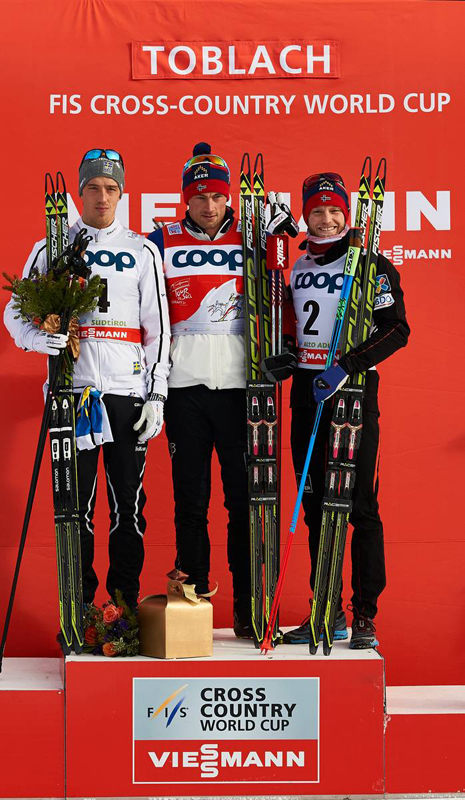
    The men's podium of Calle Halfvarsson (SWE), Petter Northug (NOR) and Martin Johnsrud Sundby (NOR), (l-r). (photo: Fischer / Nordic Focus)
    The men’s podium of Calle Halfvarsson (SWE), Petter Northug (NOR) and Martin Johnsrud Sundby (NOR), (l-r). (photo: Fischer / Nordic Focus)
  • Pellegrino Takes it to Norwegians in Tour de Ski Skate Sprint

    Pellegrino Takes it to Norwegians in Tour de Ski Skate Sprint

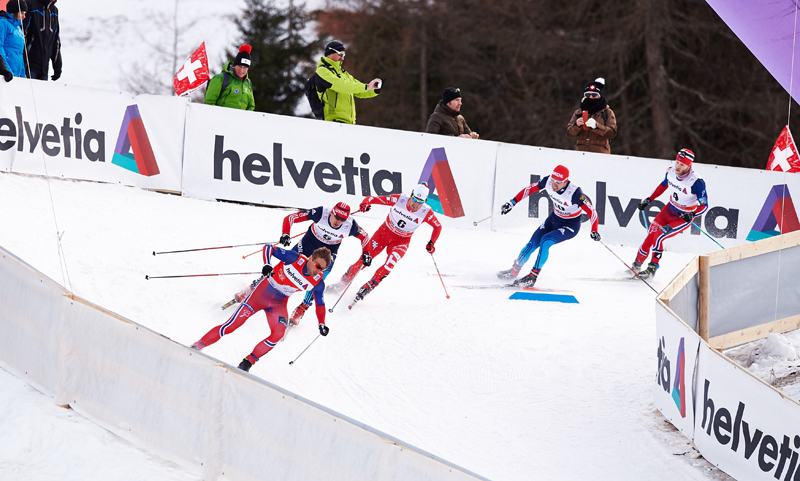
    Petter Northug (NOR), Evgeniy Belov (RUS), Federico Pellegrino (ITA), Ilia Chernousov (RUS), Martin Johnsrud Sundby (NOR), (l-r) attack the tricky corner just after the highpoint during the first lap of the finals in Val Mustair, Switzerland. (photo: Fischer/Nordic Focus)
    Petter Northug (NOR), Evgeniy Belov (RUS), Federico Pellegrino (ITA), Ilia Chernousov (RUS), Martin Johnsrud Sundby (NOR), (l-r) attack the tricky corner just after the highpoint during the first lap of the finals in Val Mustair, Switzerland. (photo: Fischer/Nordic Focus)

    Italy’s Federico Pellegrino repeated what he did in the Davos World Cup before Christmas: he destroyed the Norwegians in the Tour de Ski sprint final in Val Müstair, Switzerland.

    “Today, one of my big dreams has come true: to beat Petter (Northug) in the sprint final,” Pellegrino said to reporters after the race.

    The swift Italian beat Tour de Ski (TDS) leader Petter Northug of Norway as well as defending overall TDS champion Martin Johnsrud Sundby in increasingly challenging conditions.

    “I feel I am in a great shape,” Pellegrino said in a press conference. “I was focused on Petter and I forgot about Martin. In the last curve before the finishing straight I had a good speed and I could keep it to the finish and win.”

    As the day progressed the course got both icy and chewed up, especially in the turns.

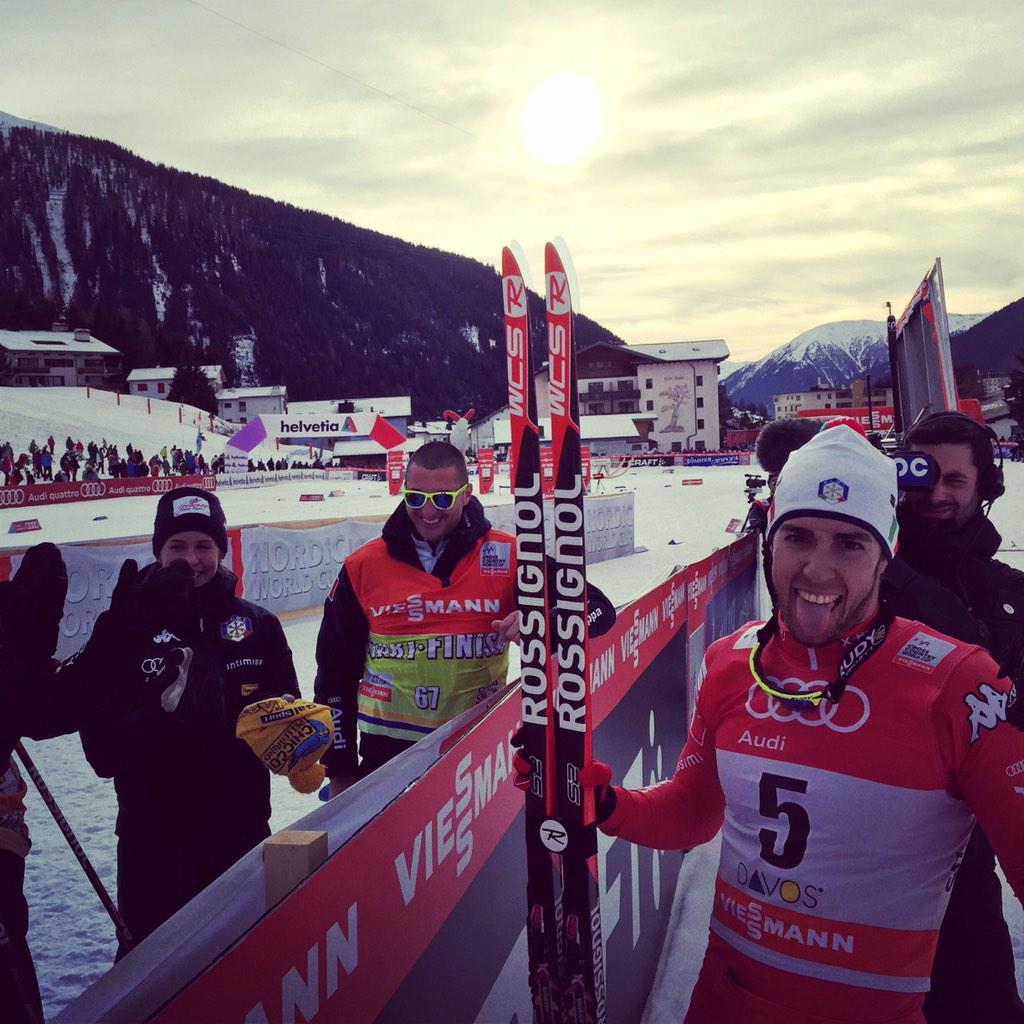
    Federico Pellegrino (r) after his first World Cup victory, in the 1.4 k skate sprint in Davos, Switzerland, in December. (Photo: FIS Cross Country/Twitter)
    Federico Pellegrino (r) after his first World Cup victory, in the 1.4 k skate sprint in Davos, Switzerland, in December. (Photo: FIS Cross Country/Twitter)

    On the top from the first heat 

    Pellegrino was sixth in the qualifier, where Northug had the fastest time. But from there on, Pellegrino won every heat. First he beat Russia’s Evgeney Belov in the quarterfinals after a controlled effort pulling into first on the final meters. In the process, he knocked hometown favorite Dario Cologna out of the race.

    In the semifinal, Pellegrino beat both Sundby and Northug after a tactically perfect run.

    In fact, Northug made the final by the skin of his teeth, advancing as a lucky loser after finishing third in the semifinal behind Pellegrino and Sundby.

    In the final, Northug showed that he learned from the close call in the semifinal, and opened aggressively from the start. Sundby, however, hung out in the back on the first lap along with Sweden’s Calle Halfvarsson, one of the other overall contenders. But unlike Halfvarsson, and later Ilia Chernousov of Russia, Sundby advanced on the second lap, creating a large gap to the Swede and the Russian.

    By the end of the second lap, Sundby was first approaching finish line, in front of Northug, while Pellegrino came like a bullet from behind and beat both of them in a thriller finish.

    Nothing determined overall

    At the end of the day, Northug now has a 25-second buffer to Sundby in second place in the overall Tour de Ski.

    “With a 10k classic on the schedule tomorrow, it’s even likely that Martin takes the overall lead,” Northug said in the press conference, noting that he hardly feels that the overall victory is in sight. “I will use my position as best I can, and hopefully go out somewhere close to Martin in the long-distance pursuit that follows. At least not too far behind him.”

    There are still four stages to go, and the last stage up the alpine hill Alpe Cermis in Val di Fiemme, Itlay, has been an Achilles heel for the strong Norwegian as long as the Tour has been around.

    “Winning the overall Tour de Ski is not that likely,” Northug said. “I’ve started the final stage with fantastic leads before and still made a fool of myself year after year. So I have to try again.”

    Harvey’s Missed Opportunity 

    Canadian Alex Harvey hurt his own chances in the quarterfinals. After a slow start, Harvey moved up on the second lap and looked like a for sure second place, behind Halfvarsson who had an impressive gap on the rest of the heat. Harvey was surging toward the finish line, but forgot to get the full picture and narrowly lost the position to Halfvarsson’s teammate Andersson, who slid into second place.

    The move cost Harvey not only the semi final, but also 40 bonus seconds in the overall TDS.

    Results

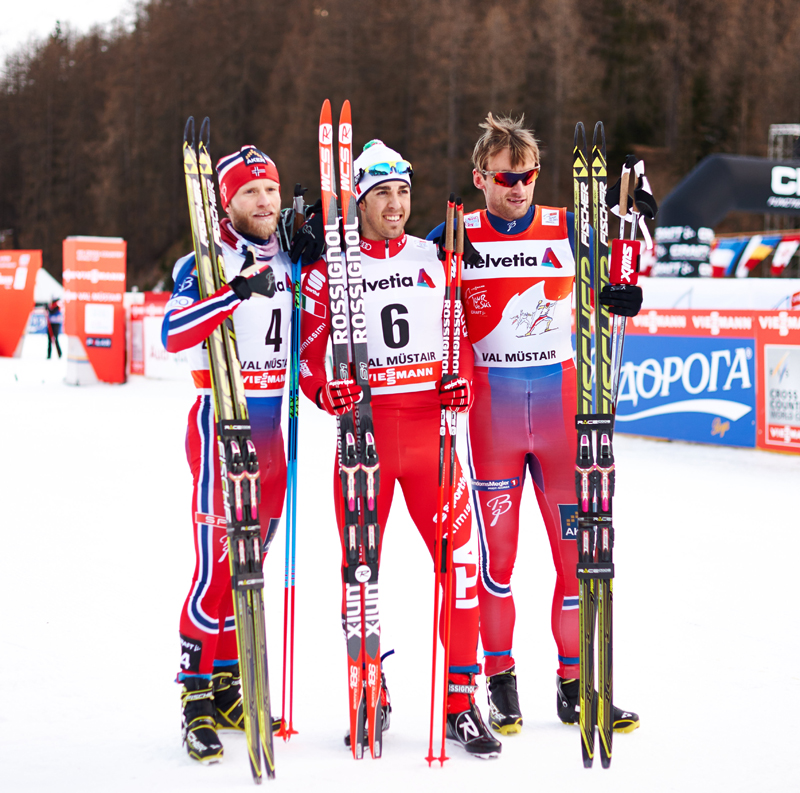
    Martin Johnsrud Sundby (NOR), Federico Pellegrino (ITA) and Petter Northug (NOR), (l-r) take the men's podium in Val Mustair (SUI). (photo: Fischer/Nordic Focus)
    Martin Johnsrud Sundby (NOR), Federico Pellegrino (ITA) and Petter Northug (NOR), (l-r) take the men’s podium in Val Mustair (SUI). (photo: Fischer/Nordic Focus)