From the FasterSkier archive — posts syndicated from athletes’ and coaches’ own blogs between 2004 and 2012, kept online as published. Current coverage is at fasterskier.com.
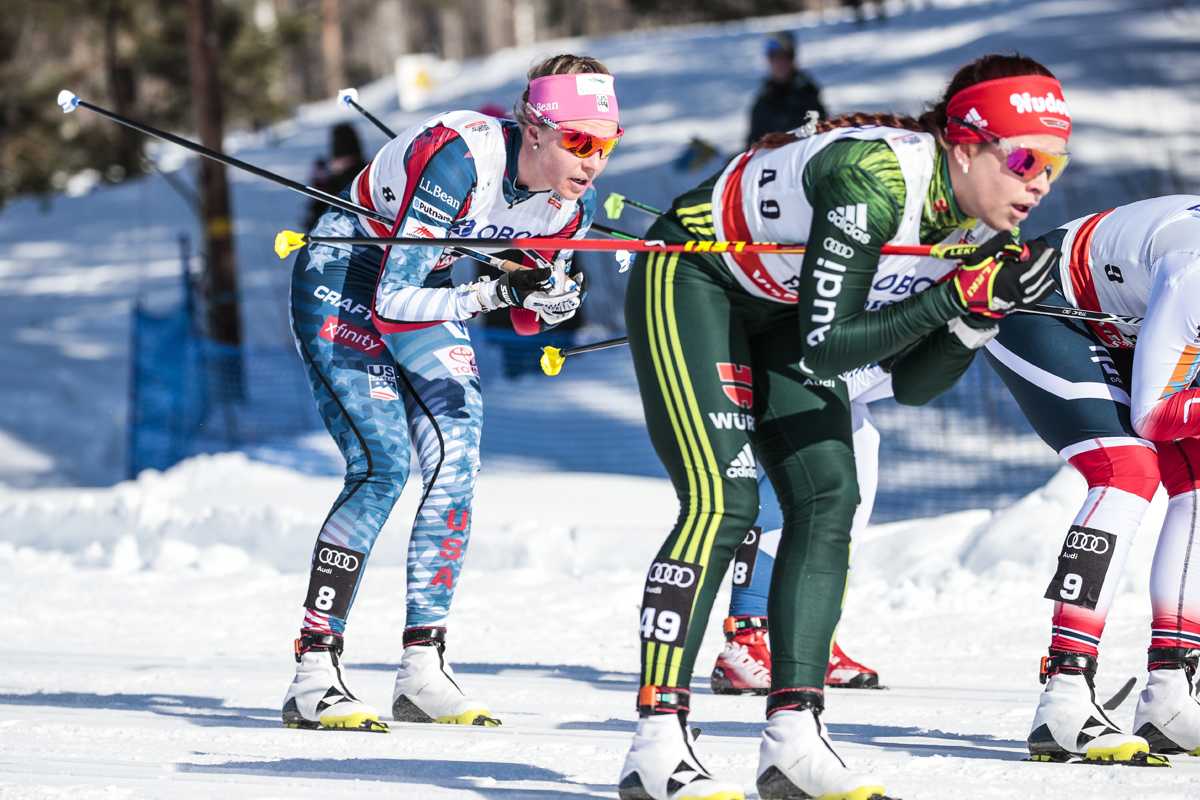
American Sadie Bjornsen skiing just behind Germany’s Katharina Hennig during the women’s 10 k classic mass start at 2018 World Cup Finals in Falun, Sweden. (Photo: Fischer/NordicFocus)
Welcome to FasterSkier’s World Cup Preview, where we check in with the top-10 teams from last year’s FIS Cross Country World Cup tour before the season starts with the Ruka weekend in Kuusamo, Finland, on Nov. 24 with a classic sprint.
***
Germany
Overall in Nations Cup Last Year: 8th
Women’s Ranking 2017/2018:
Men’s Ranking 2017/2018:
Germans to look out for: If there’s one woman returning to Germany’s national ski team from last season who is hungry for a sprint podium and on the watch list, it’s 28-year-old, Sandra Ringwald. The Lahti, Finland freestyle sprint left her in fourth, just shy of her first World Cup podium. Prior to Lahti, she raced to a seventh and sixth, respectively, in the Davos and Lenzerheide freestyle sprints.
While freestyle sprinting may appear to be the magnum opus of Ringwald’s cross-country skiing, she also finished last season with top thirty performances in a series of other disciplines, most notably a 12th place finish in the Tour de Ski 10-kilometer freestyle pursuit in Lenzerheide, Switzerland. She led the German women in last year’s Overall Cup Standings, finishing in 23rd behind Finland’s Aino-Kaisa Saarinen and ahead of Sweden’s Anna Jönsson Haag.
Chasing down Ringwald on the Overall Cup Standings is her teammate, Stefanie Böhler who ended last season ranked 25th in the overall. The 37-year-old Böhler raced into the top ten three times during last year’s World Cup season, holding out for eighth in Oslo, Norway’s famed Holmenkollen 30 k.
Along with Böhler and Ringwald, Germans Victoria Carl, Nicole Fessel, and Katharina Hennig scored points in the 2017/2018 season and are back on the team, ready to hit the World Cup circuit in search of more top thirties. Not returning to German’s national cross-country ski team after announcing her retirement this spring is Hanna Kolb.
Leading the charge on the men’s side for Germany will be Thomas Bing. The 28-year-old Bing ended last season with five top fifteen World Cup performances, his strongest being a ninth place in the Tour de Ski 15 k freestyle mass start in Oberstdorf, Germany. Along with Bing, Lucas Bögl is another name to look for from Germany. Bögl bust into the top-25 five times last season, most notably the Final Climb in the Tour de Ski 9 k pursuit in Val di Fiemme, Italy.
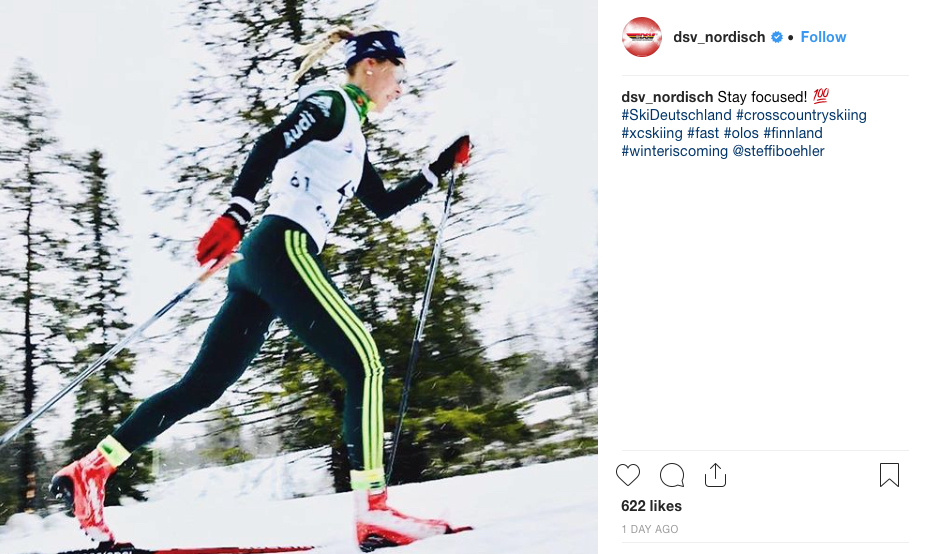
Germany’s Steffi Böhler during the FIS women’s 5-kilometer classic in Olos, Finland on 11/10/18. She placed sixth overall in what was used as a warm-up race for the German team. (Photo: Instagram screenshot)
Pre-Season Racing: Many German National team members are lined up at the FIS races in Olos, Finland scheduled from Nov. 9-11. In Friday’s 1.4 k classic sprint, Ringwald and Laura Gimmler placed first and third respectively. Gimmler had limited World Cup exposure last season, but notched two top-20s.
For the men, Bing was the best placed German in the sprint placing third overall.
In Saturday’s 5 k classic, the German women stacked five athletes in the top-6. Carl placed first, Hennig second, and Poland’s Justyna Kowalczyk was third. Also for Germany, Julia Belger skied to fourth, Pia Fink fifth, and Böhler sixth.
The men raced a 10 k classic. Jonas Dobler raced to 6th as the best placed German.
Sunday featured a 10 k skate for the women. Russia’s Natalia Nepryaeva won, while Carl was second, Ringwald third.
In the men’s 15 k skate, Dobler was the best placed German in fifth place.
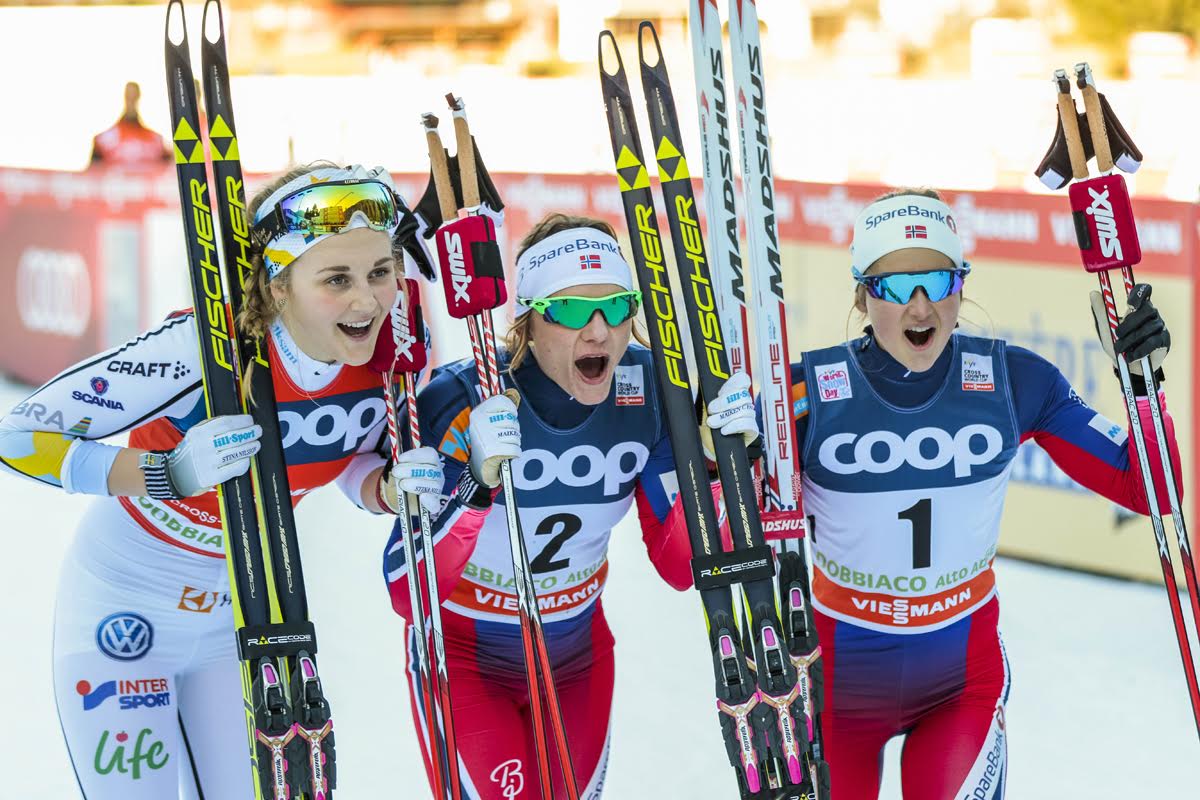
Sweden’s Stina Nilsson (center) won gold in the classic sprint at the 2018 Olympics on Tuesday in PyeongChang, South Korea, with Norway’s Maiken Caspersen Falla (left) taking silver and Russia’s Yulia Belorukova bronze. (Photo: FlyingPointRoad)
PYEONGCHANG, South Korea — Tuesday at PyeongChang’s Alpensia cross-country venue, the site of the Olympic Games women’s 1.25-kilometer classic sprint, Sweden’s Stina Nilsson took gold. On an evening when athletes were already challenged by an aerobic capacity testing course, shifting winds and falling snow, another factor made the challenge debilitating.
Nilsson came into the Games well-rested and well-primed to take her first individual Olympic medal. The 24 year old had come close before; at her first Olympics, the Swede placed 10th in the freestyle sprint in Sochi, Russia. There, she went on to claim bronze in the classic team sprint with teammate Ida Ingemarsdotter.
A year later in Falun, Sweden, at World Championships, Nilsson placed second in the individual classic sprint. When you are close, you begin to think more about achieving a singular goal and less about overall season-long outcomes.
Nilsson last raced a World Cup the weekend of Jan. 20-21 in Planica, Slovenia, where she raced to 13th place in the 10 k classic. The day before, on Jan. 20, Nilsson took a small prize: a World Cup classic-sprint win.
In her run up to PyeongChang, Nilsson explained she was able to focus on her training and block out distractions.
“Not so much pressure the last weeks, because I have not been on the Internet so much,” Nilsson said at the post-race press conference. “And not on Instagram. So the most pressure comes from myself, and that’s the pressure that I have to deal with. But today I managed to control those feelings and just ski so fast as I can.”
With temperatures hovering around 25 degrees on Tuesday evening, Nilsson was unstymied by the gusting winds or falling snow in formulating the answer to her success equation. Starting with Tuesday’s qualifier in PyeongChang, Nilsson marked the fastest time, stopping the clock in 3:08.74 minutes. With Nilsson pushing the pace, she also scored a win in the quarters. Again in her semifinal, Nilsson placed first after dualing with the 2014 Sochi skate-sprint champion, Norway’s Maiken Caspersen Falla (who also won the skate sprint at last year’s World Championships), in a photo finish.
“I had a really good day,” said Nilsson, a 2015 World Championships classic-sprint silver medalist. “I felt strong already in the prologue, and I felt also strong in the quarterfinal, and in the semifinal. I felt like I had some energy saved for the final.”
Sweden’s Stina Nilsson and teammate Hannah Falk (4) embrace after Nilsson won the classic sprint gold medal at the 2018 Olympics in PyeongChang, South Korea. (Photo: FlyingPointRoad)
Lining up in the final trying to prevent Nilsson’s clean sweep on the day were Falla, Nilsson’s Swedish teammate Hannah Falk, American Jessie Diggins, and Russians Natalia Nepryaeva and Yulia Belorukova.
The energy Nilsson stated she had saved for the final was more than sufficient. Off the line she set the pace up the course’s first climb — a climb not steep enough to create big gaps and string out the field. The group stayed together with two skiers in the inside lane, three in the adjacent lane, and Diggins skiing outside the tracks and closing on the outside.
Topping out on the hill and taking a sharp 180-degree turn, Nilsson led but no skier pulled away. Down the hill, the six skiers tucked and glided and double poled into the course’s decisive climb with Belorukova then Falla the closet skiers to challenge.
The final hill is where Nilsson seized the day.
“I just wanted to cross the finish line totally tired, so I just went for it in the last uphill,” Nilsson said about her race tactics in the final. She carried considerable speed over the final climb and the gap grew to the two closest chasers, Falla and Belorukova.
“My plan was to save the most of the power until the last part of the [final] climb,” Falla, 27, said at the press conference. “But when the two others got a little gap in the first downhill, I used too much power in the first part of the climb. So in the top where I was planning to use all my power, there wasn’t that much left.”
Nilsson still had power to spare. She soloed off the front to win the final in 3:03.84 minutes. Falla took silver (+3.03), Belorukova, a 23-year-old Olympic rookie, bronze (+3.37).
In the post-race press conference, Belorukova was asked about the tense relationship between the International Olympic Committee (IOC) and the Russian Ski Federation. The IOC banned numerous Russian skiers from PyeongChang for doping violations. Those Russian athletes competing at the 2018 Winter Olympics are not competing under the Russian flag, but as Olympic Athletes from Russia (OAR).
“Good question,” Belorukova said through an interpreter. “There is nothing that will break us, there is nothing that will instill fear into us, we are strong and we will fight until the end.”
Nepryaeva ended up fourth (+9.14), Falk fifth (+11.16), and Diggins sixth (+11.23). FasterSkier will post an additional report on the U.S. women’s results.
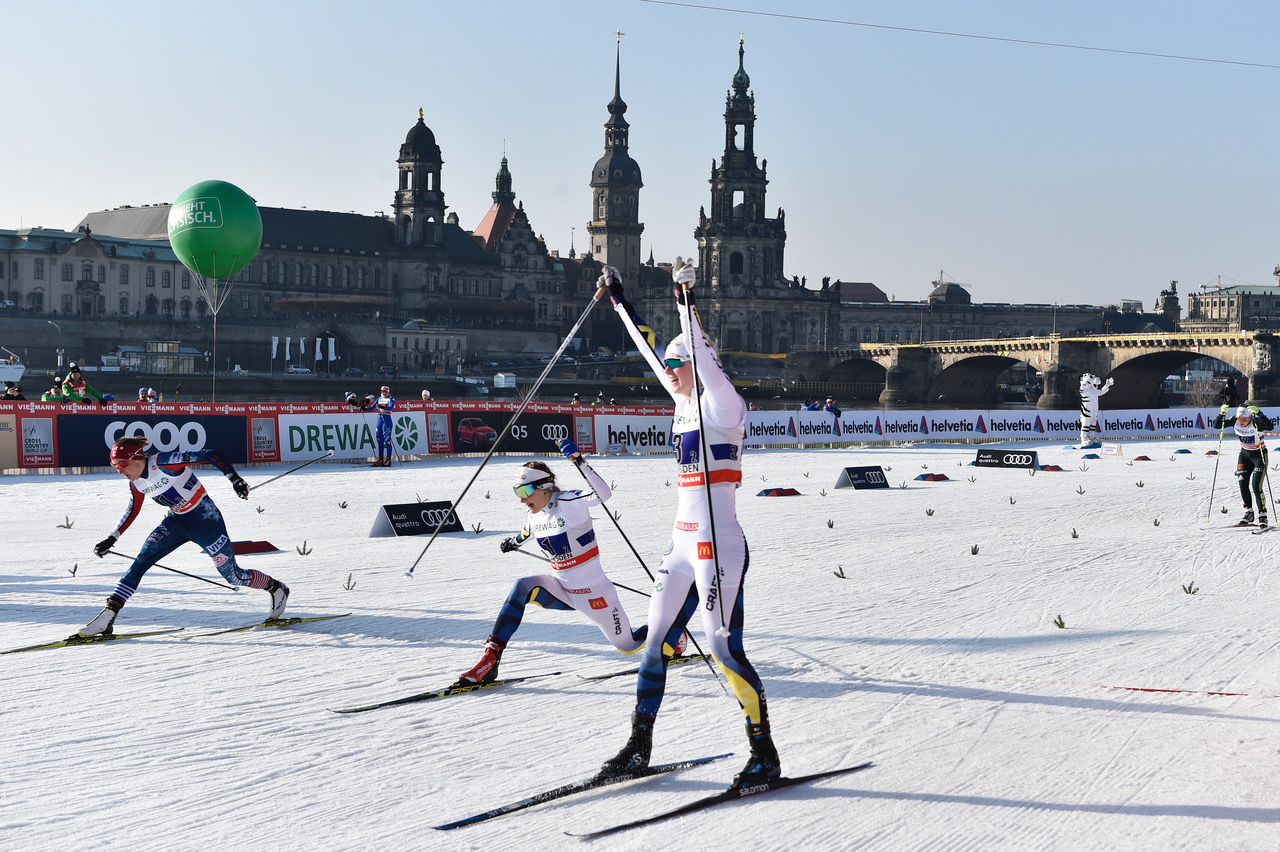
The finish of the women’s 6 x 1.2 k freestyle team sprint final, with Sweden II’s Maja Dahlqvist (near) celebrating her win ahead of Sweden I’s Stina Nilsson (c) and American Sophie Caldwell (l), who placed second and third, respectively, in a photo finish. (Photo: Fischer/NordicFocus)
DRESDEN, Germany — Just over 15,000 people gathered at the Elbe River bank on Sunday, some donned in sunnies and carrying sauce-laden brätwurst from pop-up food carts, though all took pause around 11:14:59 a.m. It wasn’t to take in the Altstadt baroque-style buildings that make up the city skyline, nor was it to bask in the bright, mid-morning sun hovering on the horizon.
A new attraction had come to the capital city, and all eyes were on it: the start of the International Ski Federation (FIS) women’s 6 x 1.2-kilometer freestyle team sprint. The city race organizers had trucked nearly 5,000 cubic meters of manmade snow to the grassy green bank, creating a skiing venue where one had never previously existed before. (Dresden has never before hosted a World Cup; the closest place to find natural snow being around 95 kilometers away).
Though it was the first of its kind, the crowd was still on edge as racers anticipated the snap of the gun for the women’s final. Even amid artificial conditions, the scene was naturally mystifying for onlookers.
With the gunshot, life roiled back into those in the stands and competitors became absorbed in the race for the win. Leading out Lap 1 was Ida Ingemarsdotter, racing for Sweden’s second team with Maja Dahlqvist (who placed third in Saturday’s individual skate sprint).
Ingemarsdotter was closely followed by her compatriot, Hanna Falk, who had won Saturday’s sprint and was racing for Sweden’s first team on Sunday. Hanna Kolb, racing for Germany I, Ida Sargent racing for U.S.A. I, and Alenka Cebasek racing for Slovenia, were all in hot pursuit.
Also on course was Nadine Fähndrich of Switzerland, Giulia Stuerz on Italy , Jessica Yeaton of Australia, Caitlin Patterson (U.S.A. II), and Katharina Hennig (Germany II).
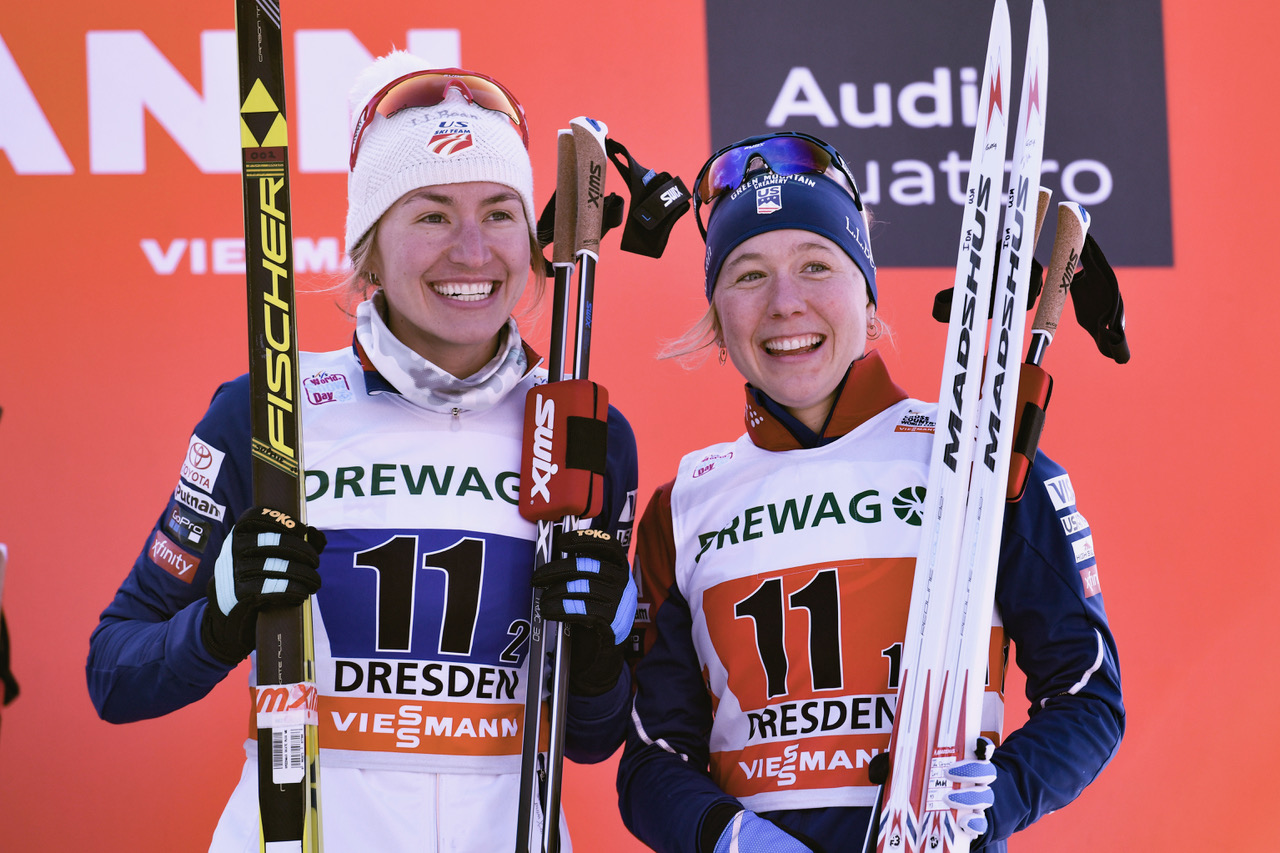
U.S. Ski Team members Sophie Caldwell (l) and Ida Sargent after placing third in the World Cup freestyle team sprint on Sunday for their World Cup second podium together in the event. (They finished third in the pre-Olympic World Cup freestyle sprint last year in PyeongChang, South Korea.) (Photo: Fischer/NordicFocus)
Through the exchange it was Ingemarsdotter in first, Falk second, Kolb third, and Sargent fourth. Coming through in seventh was Patterson, of the Craftsbury Green Racing Project, handing off to Kikkan Randall (U.S. Ski Team).
“I think I tend to let myself accordion to much, so I had to watch that and really focus to stay in it,” said Patterson, who arrived in Dresden on Thursday after being crowned a four-time 2018 national champion last week in Anchorage, Alaska.
“Being efficient … keeping it together and keep[ing] it tight,” Patterson added, referring to her race strategy on Sunday. “Because I know Kikkan has so much experience in heats and she can really maneuver well; she did such a good move on the last leg of that semifinal to keep us in it.”
In the final, as Patterson handed off to Randall, while Sargent passed off to Caldwell (who had placed third in Saturday’s sprint). Still in the lead was Ingemarsdotter tagging to Dahlqvist, Kolb to her teammate Sandra Ringwald, and Falk to Stina Nilsson.
The women stayed in a close pack, but thanks in part to the cheers of a large fanbase behind her, Germany’s Ringwald had worked her way to the front. As the skiers approached their third exchange, Germany had taken over the lead. Following Ringwald was Caldwell in second and Slovenia’s Vesna Fabjan in third. Randall was also gaining ground and gave the race back to Patterson in sixth as the field headed into Lap 3 of 6.
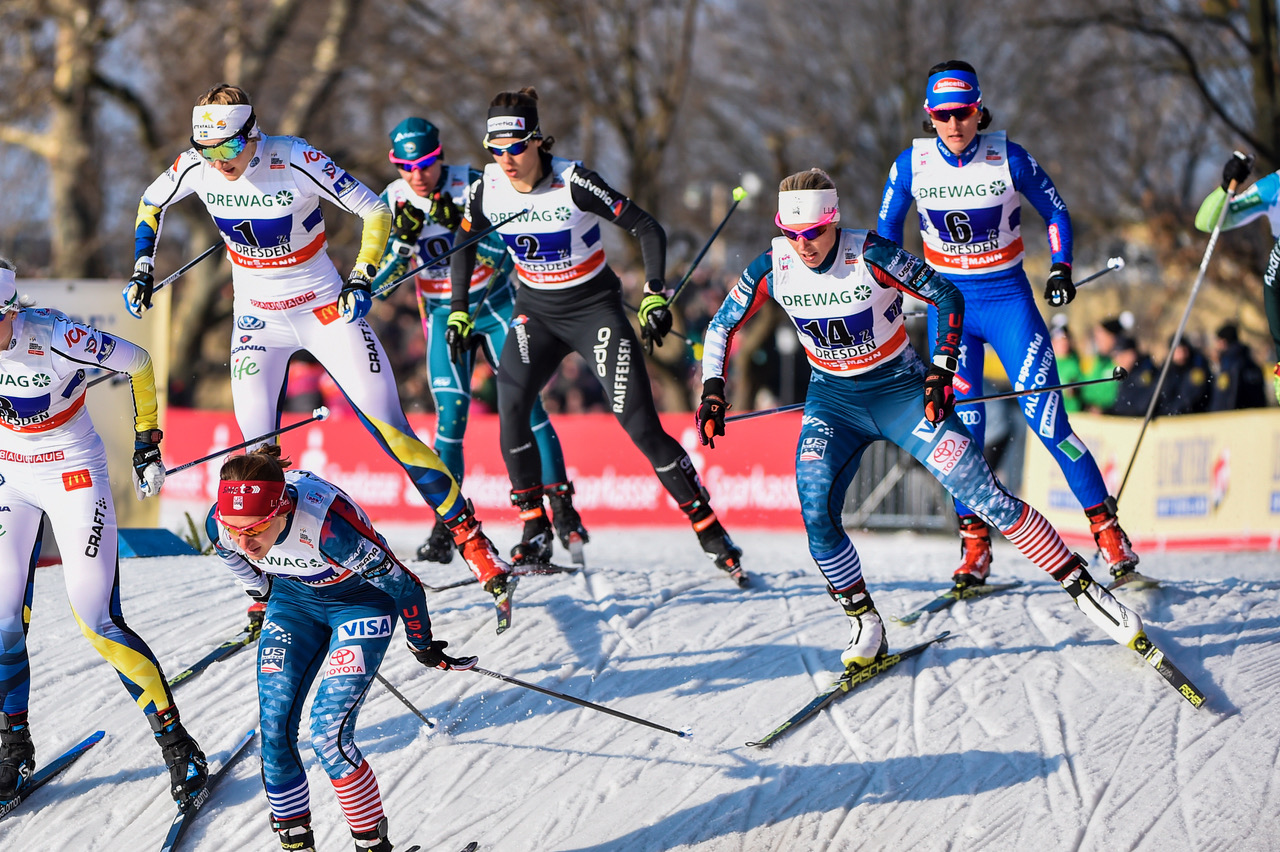
Americans Sophie Caldwell (front r) and Kikkan Randall (14) racing together in the women’s 6 x 1.2 k freestyle team sprint final on Sunday at the World Cup in Dresden, Germany. USA I, with Ida Sargent (not shown) and Caldwell went on to place third, while USA II, with Caitlin Patterson (not shown) and Randall, finished eighth. (Photo: Fischer/NordicFocus)
“This is my first real racing weekend back and yesterday was a little frustrating because my body felt good but I just didn’t quite have the speed fully ready yet,” said Randall, who had pulled out of the Tour de Ski due to an ongoing issue with one of her foot tendons and has been working on recovering since. “So I am really glad I got the opportunity to race today.
“It was great to have Caitlin ski really strong and get into the final,” Randall added. “I just wanted to get six rounds and I did. It was fun, fast paced, and I am happy with the way I felt. Of course, it’s fun to have another team in the race, too, and kind of be working together a bit.”
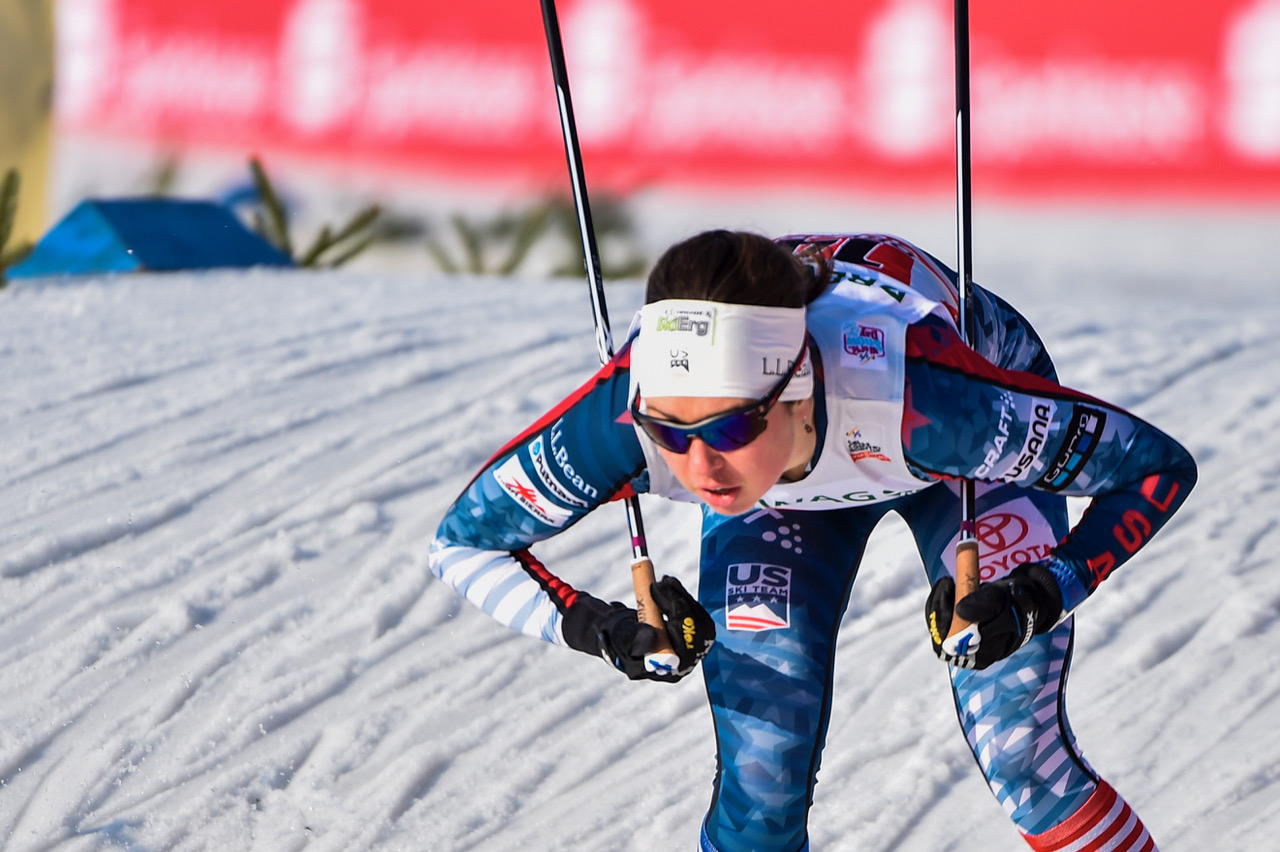
Caitlin Patterson racing for USA II in the women’s 6 x 1.2 k freestyle team sprint on Sunday at the World Cup in Dresden, Germany. (Photo: Fischer/NordicFocus)
As racers struck out into Lap 3, Switzerland’s Fähndrich was at the helm, which she held until she tagged off to her teammate Laurien van der Graff. The Swiss skiers had a smooth exchange and van der Graff was out front. Breathing down her neck behind her, however, were two Swedes: Nilsson and Dahlqvist. As the group approached the course’s most notable climb, Nilsson powered her way around van der Graff and to the front, Ringwald in tow.
With the fourth exchange coming into sight, the top two spots were with Sweden, Switzerland third. U.S.A. I was in fifth, U.S.A. II in eighth.
“It’s hard to pass, so we definitely wanted to stay toward the front,” Caldwell said of her and Sargent’s plan heading into the final. “It’s such a short and fast course that anything can happen and I think it is always fun to be right there in the mix.”
With just two laps to go, Falk, who came out of the exchange first, began to push the pace, while Fähndrich, Sargent and Ingemarsdotter chased her down. Though Falk had put a bit of a gap on the field by the course’s turn heading back to the stadium, it had closed by the course’s single climb. Here, Fähndrich made her move and maneuvered around Falk to the front.
After the fifth exchange and heading into the final lap, the two Swedes, van der Graff, and Caldwell tried to separate themselves from the rest of the teams in the final. But within a few meters three more teams — Slovenia, and Germany I and II — had rejoined them.
As they approached the aforementioned uphill, Nilsson went for it, propelling herself to the front. Dahlqvist went with her, and Caldwell dodged to van der Graff’s left, pulling a hard V1 to get around the Swiss skier. Approaching the finish, it was Dahlqvist to the far right, Nilsson in the middle and Caldwell to the left.
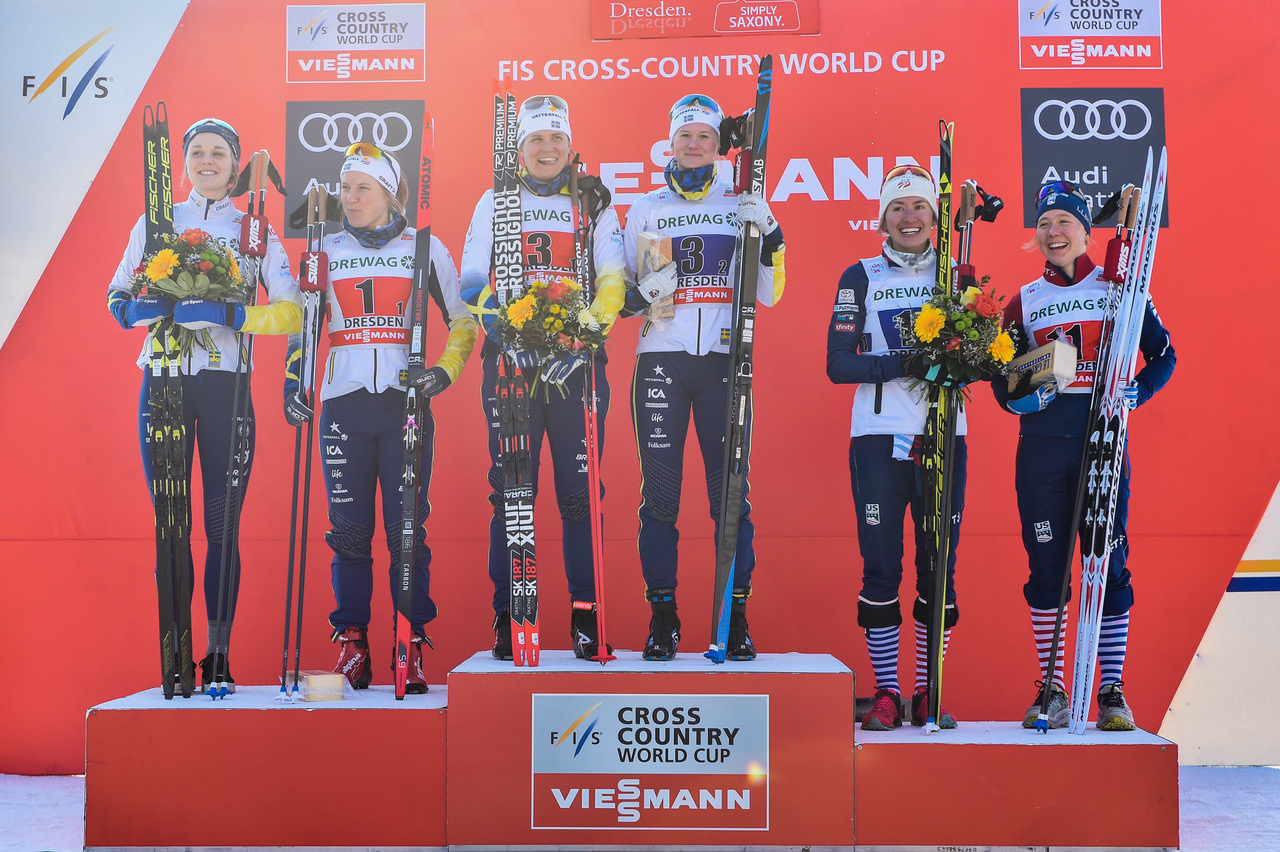
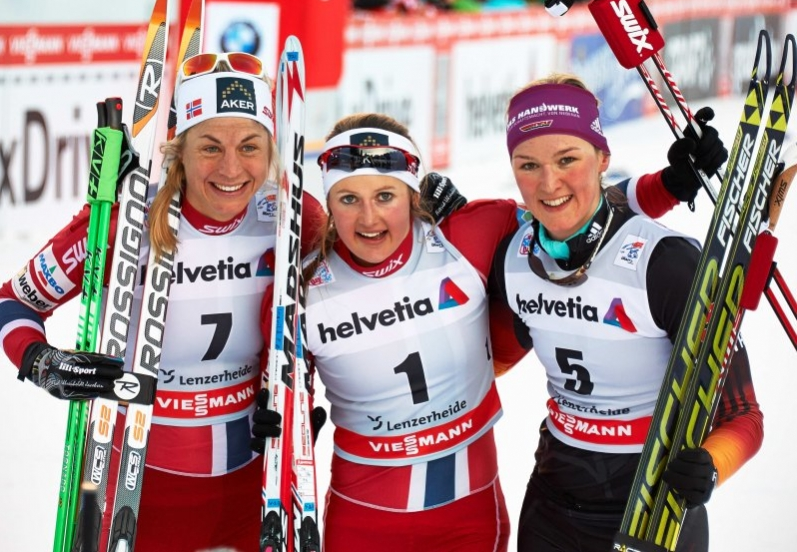
The women’s 6 x 1.2 k freestyle team sprint podium at Sunday’s World Cup in Dresden, Germany, with Sweden II’s Ida Ingemarsdotter and Maja Dahlqvist in first (c), Sweden I’s Stina Nilsson and Hanna Falk in second (l), and USA I’s Sophie Caldwell and Ida Sargent in third (r). (Photo: Fischer/NordicFocus)
Both Swedes appeared to have an edge on Caldwell, but the American made a gritty final few pushes and all three lunged for the line. Dahlqvist was just ahead and took it by 0.16 seconds over Nilsson, and Caldwell placed third for the second day in a row, just 0.07 seconds out of second place and 0.23 seconds out of first. Sweden’s No. 2 team had won it with a cumulative time of 13:33.40, about four seconds faster than the fastest semifinal.
“I was actually left wishing the finish was a little longer, which I don’t know if I have ever said about a race before,” Caldwell, who leans toward sprint disciplines, said after the race. “Ida skied awesome and I was proud with how I skied, so it’s really fun when you feel like both legs kind of do their best and you get a good result to celebrate that with.”
Finishing in fourth (+2.11) was Germany I, Slovenia placed fifth (+4.46), Germany II placed sixth (+4.62), Switzerland (+5.09) USA II eighth (+7.95), Italy I ninth (+10.89) and Australia 10th (+27.53).
To start the day, Sweden I, with Falk and Nilsson had won the first semifinal in 13:37.97, by 0.17 seconds over Sweden II’s Ingemarsdotter and Dahlqvist. The top-six teams from that heat qualified for the final, with Switzerland in third, Italy in fourth, Slovenia in fifth, and Australia in sixth.
The American teams took the top two in the second semifinal, with Sargent and Caldwell winning 13:46.51, and Patterson and Randall following in second, 0.11 seconds back. Germany I and Germany II qualified from that heat as well with fast-enough times.
Sunday marked the first and last team sprint of the season so far before the Winter Olympics in PyeongChang, South Korea, where a freestyle team sprint will be contested on Feb. 21.
The World Cup has two more weekends of racing before the Olympics, with all-classic races next weekend in Planica, Slovenia (classic sprint and 10/15 k classic individual starts), followed by freestyle races in Seefeld, Austria, on Jan. 27-28 (skate sprints and 10/15 k freestyle mass starts).
— Ian Tovell and Alex Kochon contributed reporting
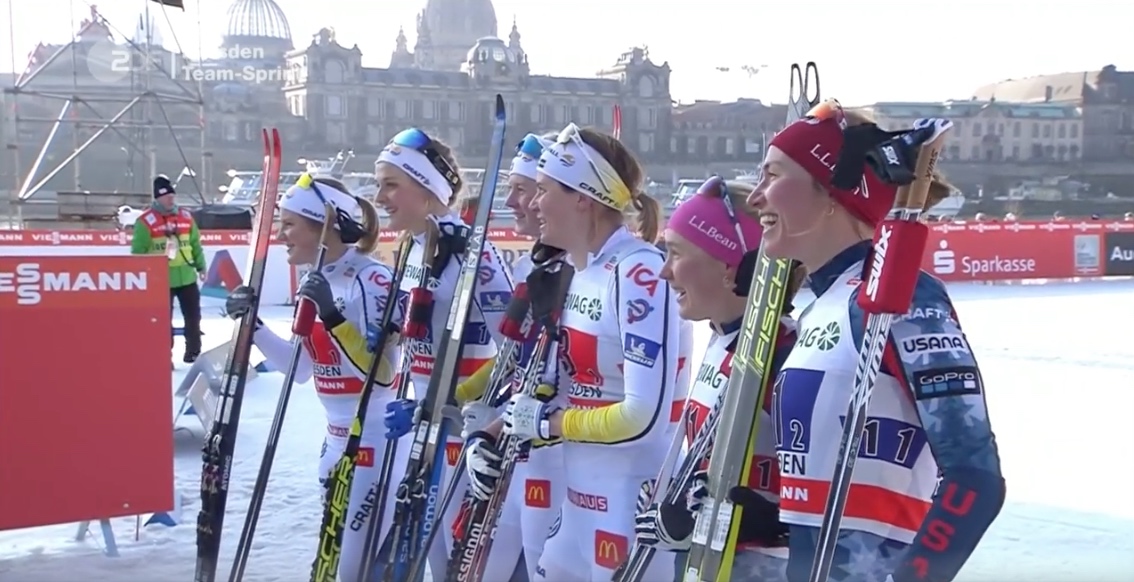
The women’s 6 x 1.2 k freestyle team sprint podium at Sunday’s World Cup in Dresden, Germany, with (from left to right) Sweden I’s Hanna Falk and Stina Nilsson in second, Sweden II’s Ida Ingemarsdotter and Maja Dahlqvist in first (c), and USA I’s Ida Sargent and Sophie Caldwell in third (r). (Screenshot: ZDF broadcast)
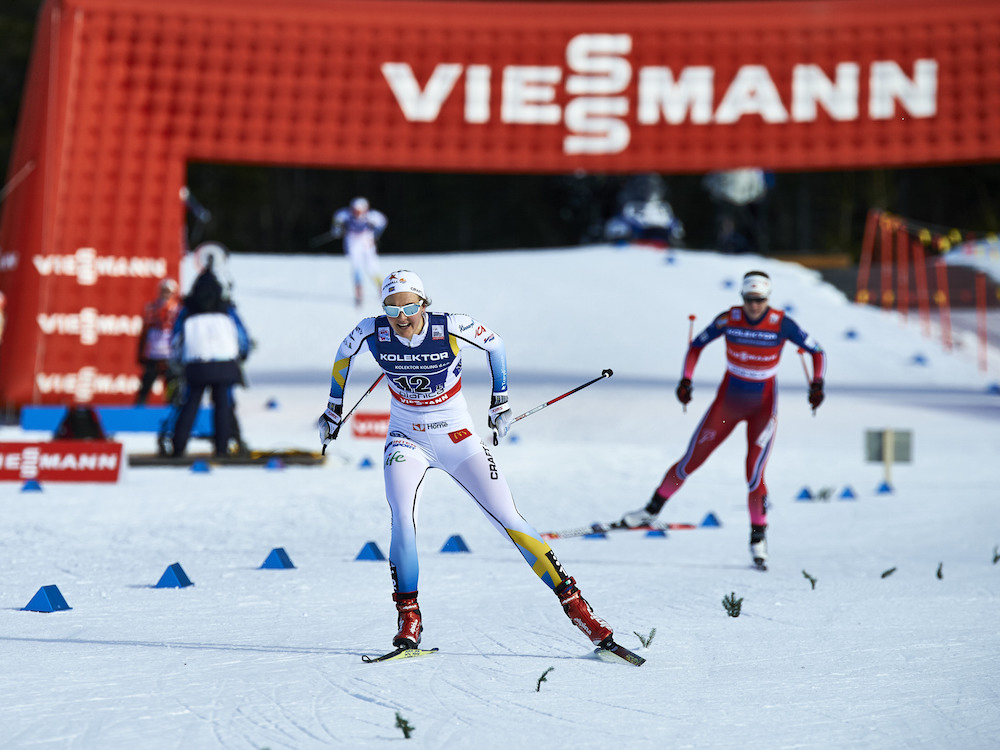
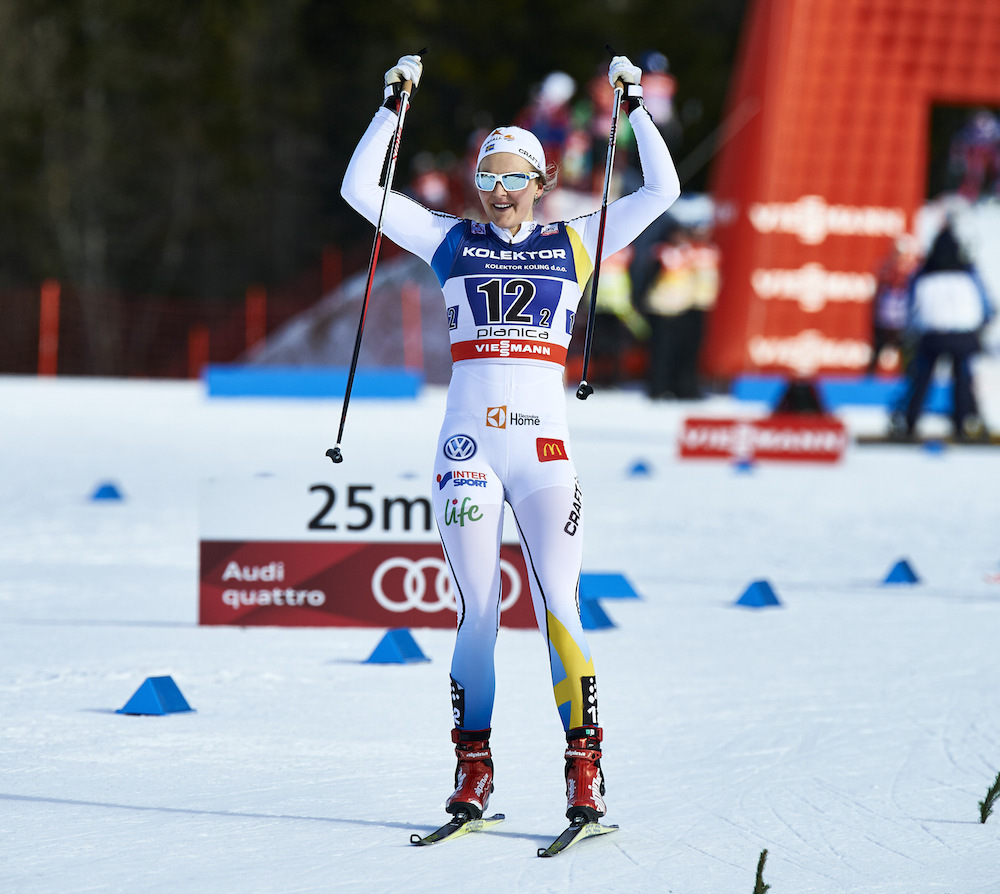
Stina Nilsson smiles as she secures the win for Sweden with teammate Ida Ingemarsdotter (not shown) in the women’s freestyle team sprint final at the World Cup in Planica, Slovenia. She beat Norway’s Astrid Jacobsen (behind) for the victory. (Photo: Fischer/NordicFocus)
Groundhog Day. That was the feel of Sunday’s 6 x 1.2-kilometer freestyle team sprints at the World Cup in Planica, Slovenia, a day after Sweden’s Stina Nilsson and Italy’s Federico Pellegrino won the individual freestyle sprints on the same one-lap 1.2 k course.
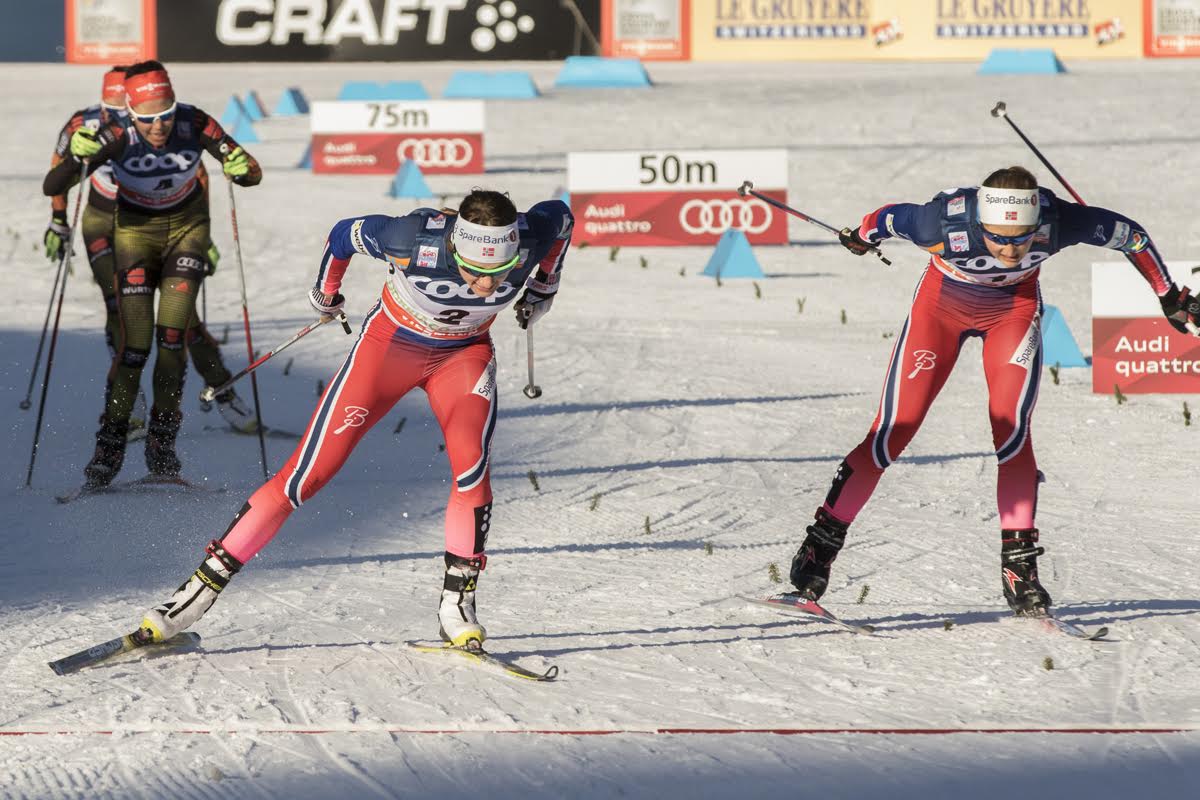
The women’s team sprint came down to the final climb on the last leg — just like in the last round of the individual women’s sprint on Saturday. Trailing a Norwegian on the last descent and into the base of the climb back up to the stadium (yesterday it was Ingvild Flugstad Østberg; today it was Astrid Uhrenholdt Jacobsen), Nilsson carried her speed to pull up alongside and blow past the Norwegian, leading by the top.
Look familiar? That’s because it is. Sweden’s Stina Nilsson notched her second-straight victory of the World Cup weekend in Planica, Slovenia, on Sunday, anchoring Sweden I to the freestyle team sprint win. (Photo: Fischer/NordicFocus)
The 22-year-old Nilsson, both U23 and Sprint World Cup leader, continued to accelerate in the last 200 hundred meters to the finish, winning in 3.51 seconds for her second victory of the weekend. Nilsson shared it with Ida Ingemarsdotter, 30, teammates on Sweden’s first team (noted as Sweden I).
“We had a great day as a team. You could say we are a good couple,” Nilsson told FIS after the race. “Ida did a great work. In the final lap I was in a good position and I could ski as I wanted. I am very satisfied with the weekend in Planica.”
After sharing the podium with Nilsson on Saturday, Heidi Weng and Jacobsen teamed up for Norway I and finished second after leading at every exchange, just ahead of the Swedes. Nilsson and Ingemarsdotter had won their semifinal (ahead of Americans Ida Sargent and Sophie Caldwell in second) to automatically advance to the final, and Weng and Jacobsen won the other semifinal.
“This is better than third, but not good enough tactically to win,” Jacobsen told VG after the final, according to a translation. “Towards the end Stina had a gear that I had not.”
After nine of 10 teams skied within four seconds of the lead through the first two exchanges, Weng picked up the tempo on her second leg (third overall), and Ingemarsdotter and Germany’s I’s Sandra Ringwald stuck closest to her. Meanwhile, Sweden II slipped about 1.5 seconds off the pace in fourth, while the U.S., with Ida Sargent and Sophie Caldwell, skied in fifth (+4.46) at the third exchange — the halfway point.
One lap later, Jacobsen and Nilsson remained close, about half a second ahead of Sweden II’s Hanna Falk in third. Germany’s I’s Hanna Kolb came through the exchange a second later in fourth. By the final exchange, Weng and Ingemarsdotter had gapped Germany’s Ringwald, skiing in third, by 2 1/2 seconds.
“I knew Weng would run hard, especially in the second and third lap and am happy that I could latch on to and give Stina a good position,” Ingemarsdotter told Dagens Nyheter, according to a translation.
“Ida made it perfect. I just got the position I wanted,” Nilsson said.
Germany’s first team hung onto third and secured third, 8.84 seconds behind Sweden and 5.33 seconds behind Norway, for their first podium in almost two years.
“My attack came maybe a little too early, but it was the plan, and maybe that didn’t totally work out because I folded a little in the end,” Ringwald told German TV broadcaster ZDF. “But the three of us were able to create a gap, and so we are satisfied with the third place.”
“I am really relieved, because we knew we had a gigantic chance today and that we had to grasp it,” Kolb said. “Just a great feeling.”
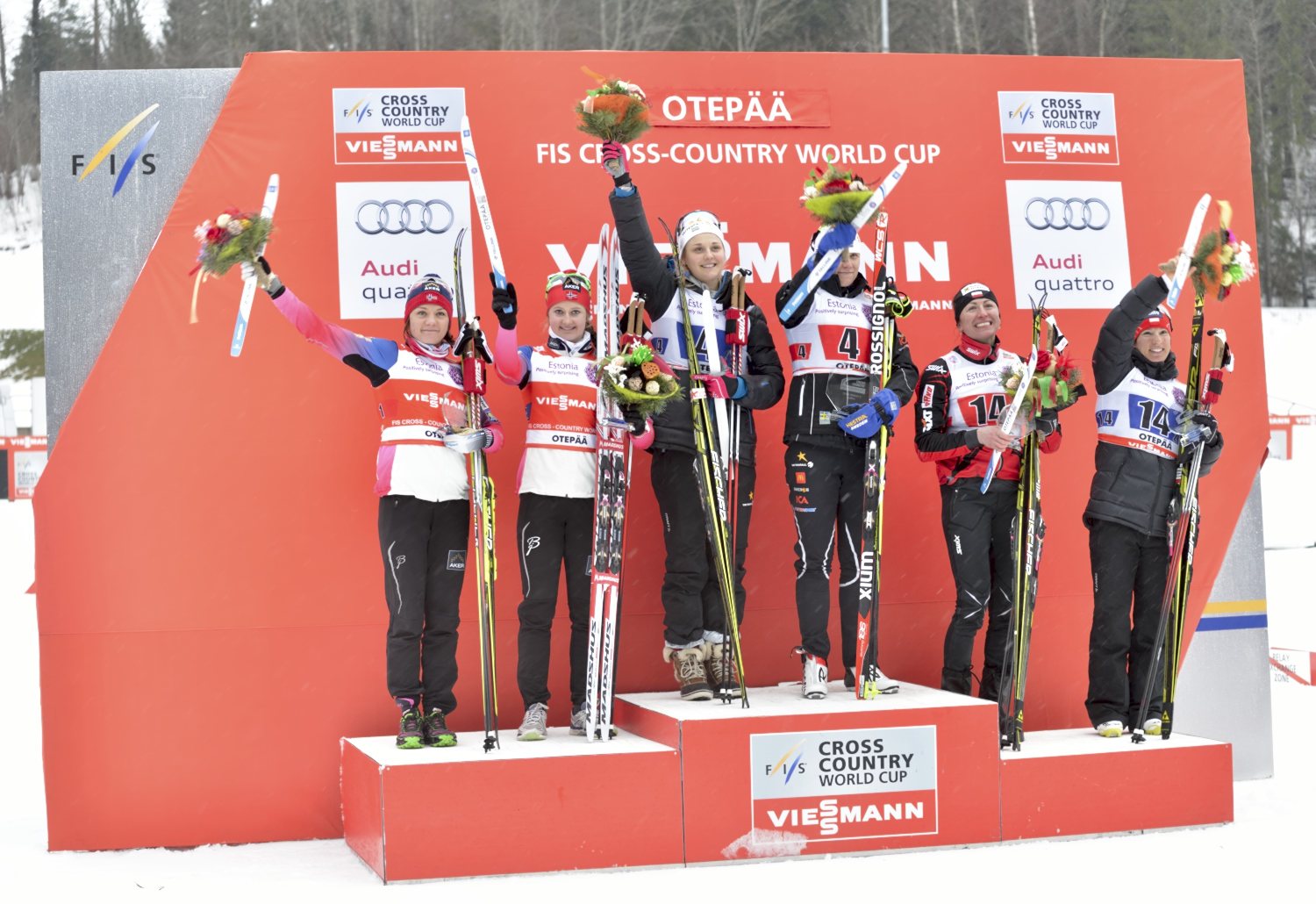
Last season, Nilsson and Ingemarsdotter won the only team sprint on the schedule — also freestyle technique — in Otepää, Estonia. There, they beat Norway’s Maiken Caspersen Falla and Østberg by 0.85 seconds, and Poland’s Justyna Kowalczyk and Sylwia Jaskowiec finished 0.95 seconds back in third.
Falla and Østberg rested on Sunday, while Mari Eide and Kathrine Rolsted Harsem represented Norway II. Fourth through seventh were separated by 2.77 seconds, with Falk (Sweden II) leading the chase group in for fourth (+18.24), followed by Caldwell in fifth (+20.57).
Germany II’s Lucia Anger edged Harsem in a photo finish for sixth by 0.01 seconds, 21 seconds behind the winners. Two Slovenian teams reached the final, placing eighth (+47.24) and 10th (+2:42.12), while Italy finished ninth (+55.98).
(Story continues below)
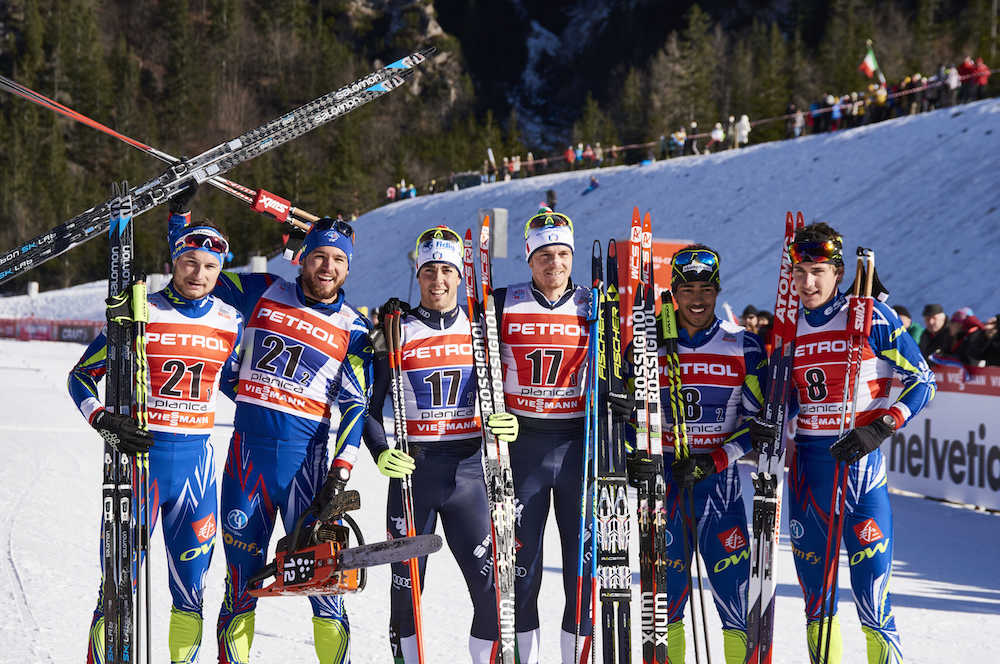
The men’s freestyle team sprint podium at the World Cup in Planica, Slovenia: with Italian winners Federico Pellegrino and Dietmar Nöckler (c), France I’s Renaud Jay and Baptiste Gros (l) in second, and France II’s Richard Jouve, age 21, and Valentin Chauvin, age 20, (r) in third. Yes, Gros is holding a chainsaw — a chain-free noisemaker borrowed from spectators. (Photo: Fischer/NordicFocus)
Italy, France, France
Minutes after the women’s final, the men’s final played out to produce the identical winner to Saturday’s sprint — Italy’s Federico Pellegrino — who essentially pulled off the same move as Nilsson, not long after she anchored the Swedish women to the win in 16:14.08. Pellegrino anchored Italy’s first team (with teammate Dietmar Nöckler) to the win in 14:44.82.
In yet another repeat, France occupied the remaining spots on the podium in the men’s race. Renaud Jay of France’s first team led five frontrunners into the exchange zone for the last time, with France I, Germany I, Italy I, Russia I, and Norway I all within a second of one another.
On the next lap, Jay’s teammate Baptiste Gros set a blistering pace and Pellegrino chased him up the longest climb on the course. There, they began to break away from Germany and France’s second team, and Gros continued to lead up the final ascent.
On that climb, Pellegrino pulled a “Nilsson,” so to speak, as he carried his momentum from the downhill draft to pass Gros before the top. The 25-year-old Pellegrino, who became Italy’s winningest Italian male skier of all time on Saturday with his seventh individual World Cup win, added another victory to his resume as he skated away toward the finish, looking back a few strides before and winning in 1.79 seconds.
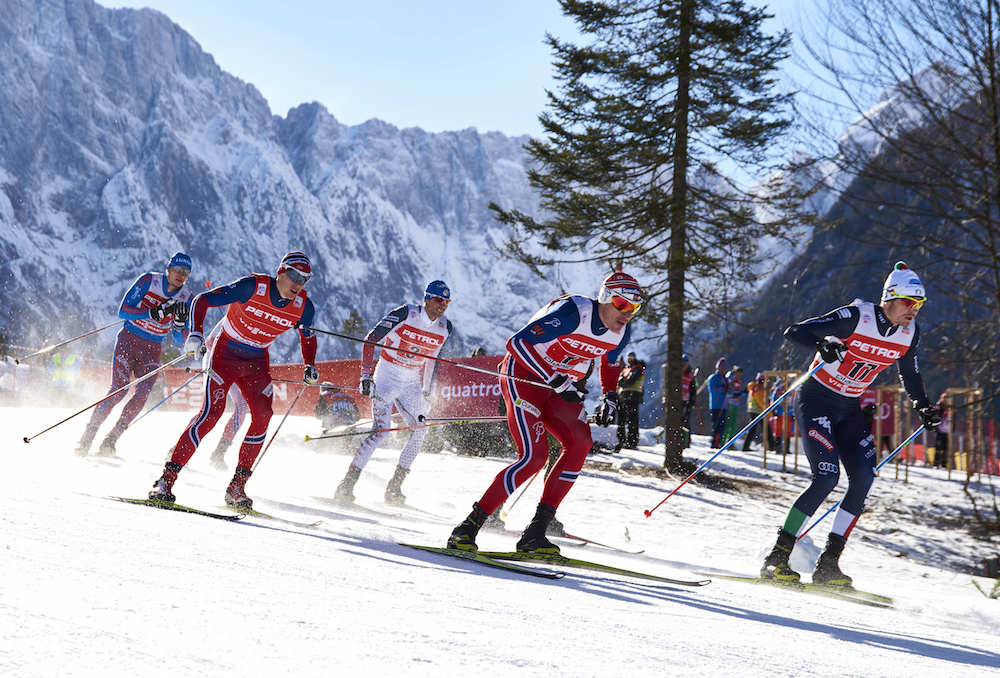
(From right to left) Italy’s Dietmar Nöckler leads Norway II’s Ola Vigen Hattestad, American Andy Newell, and Norway I’s Anders Gløersen and a Russian in the men’s freestyle team sprint final at the World Cup in Planica, Slovenia. (Photo: Fischer/NordicFocus)
France I’s Jay and Gros place second, and France II, with 20-year-old Valentin Chauvin and Richard Jouve, 21, held off Germany for third (+2.41).
Germany I, with Thomas Bing and Sebastian Eisenlauer, notched fourth (+2.93). Norway missed the podium for the second-straight men’s race with Norway I’s Anders Gløersen and Eirik Brandsdal in fifth (+4.51) and Norway II’s Ola Vigen Hattestad and Pål Golberg in seventh (+7.66), behind Russia’s Gleb Retivykh and Alexey Petukhov in sixth (+6.46).
Americans Andy Newell and Simi Hamilton crossed the finish line in eighth, but were disqualified for missing the tag in the zone on the second exchange.
Early in the race, Gløersen led though the first exchange to give Norway I an early lead, but they slipped to sixth with Brandsdal on the next leg, 1.3 seconds behind Norway II in first. Hattestad had brought Norway II into the lead, and by the fourth exchange, his teammate Golberg remained third, within half a second of Pellegrino and Gros. One lap later, Norway I and II came through the last exchange in fifth and sixth, 1 and 2 seconds out, respectively.
Norwegian commentators were quick to call Sunday’s final another instance of the Norwegians being “outclassed,” pointing out that six Norwegians occupy the top seven in the men’s overall World Cup standings. In the sprint standings, Pellegrino leads Norway’s Sondre Turvoll Fossli by nearly 200 points. Finn Hågen Krogh ranks fourth and Petter Northug is the third Norwegian in the top six.
Italian teammates Federico Pellegrino (l) and Dietmar Nöckler after winning Sunday’s World Cup freestyle team sprint in Planica, Slovenia.
“I realized a dream I had at a very young age,” Pellegrino told Italy’s La Gazzetta after Sunday’s win, according to translation. It was apparently Italy’s first team-sprint win since the women won in 2010 in Düsseldorf, Germany.
“In my early years of the World Cup, one of my first trips to the World Cup was in Düsseldorf, where they scheduled just a sprint and team sprint,” he added. “Seeing champions such [Italy’s Arianna] Follis and [Norway’s] Hattestad that could make a perfect weekend lit my imagination. I wondered if I could ever do it.”
For Nöckler, 27, it was his first World Cup win.
“I did not feel that good in the semifinal,” he told FIS after he and Pellegrino qualified second behind France’s Jay and Gros. France II won the other semifinal.
“I knew Federico is the best finisher in the world,” Nöckler added. “I tried to work hard to prepare a good position for him. We have won five Italian national championships together. It is great to win the World Cup.”
At 2015 Word Championships, Nöckler and Pellegrino earned bronze in the freestyle team sprint (behind Norway and Russia, respectively).
France’s Jay was thrilled to be on the podium after placing fourth on Saturday.
“I knew Baptiste was very strong today,” Jay told FIS. “I wanted to gain some meters before the last exchange so that Baptiste has advantage on Pellegrino, but Federico was too strong.”
For Chauvin, the weekend marked his first on the World Cup.
“It is just amazing,” he said of Sunday’s podium. “It is fantastic I could be on the podium with my friends. The whole team did great here during the whole weekend.”
Maiken Caspersen Falla (front left) edges Norwegian teammate and sprint rival Ingvild Flugstad Østberg in the women’s World Cup freestyle-sprint final on Saturday in Toblach, Italy. Falla won by 0.17 seconds, Østberg was second, and Sweden’s Stina Nilsson (not shown) placed third and another Swede Linn Soemskar (also not shown) placed fourth. Two Germans Hanna Kolb and Denise Herrmann (at left) placed fifth and sixth, respectively. (Photo: Fischer/NordicFocus)
Two Germans. Two Norwegians. Two Swedes. These national pairs composed the women’s World Cup 1.3-kilometer freestyle sprint final on Saturday in Toblach, Italy.
It was Norway who took the lead from the start, with 25-year-old Ingvild Flugstad Østberg pulling her teammate Maiken Caspersen Falla, along with the Swedish duo Stina Nilsson and Linn Soemskar.
Østberg remained in front for the first downhill of the 600-meter lap course, followed closely by Falla and Nilsson.
Coming off last weekend’s skate-sprint victory in Davos, Switzerland, 22-year-old Nilsson stuck with the two Norwegians until the final climb of the two-lap course. Last Sunday in Davos, Nilsson shared the podium with the two Norwegians, with Falla in second and Østberg in third.
Norway’s Maiken Caspersen Falla (2) leads her quarterfinal with (from left to right) Switzerland’s Nadine Faehndrich, Laurien van der Graaf, Italy’s Greta Laurent, Russia’s Natalia Matveeva, and American Sophie Caldwell (10) on Saturday in the women’s World Cup freestyle sprint in Toblach, Italy. (Photo: Fischer/NordicFocus)
With one last uphill to go, Falla, 25, took the lead from her teammate while Nilsson moved from third to second.
As the trio descended the final downhill into the stadium, Falla maintained herposition in front, while the battle for second ensued between Østberg and Nilsson.
Rounding the final turn into the 50-meter straightaway, Nilsson attempted to go wide on the the outside corner to get around Østberg and Falla. The Swede’s tactical maneuver, however, didn’t match Østberg’s raw speed.
The Norwegians went 1-2, with Falla winning the final in 2:47.28 minutes, just 0.17 seconds ahead of Østberg in second. Nilsson crossed the line in third, 0.61 seconds after Falla.
“It’s great to be on top again,” Falla told FIS after her second sprint victory of the season. She also won the classic sprint opener late last month in Kuusamo, Finland. “It was a … battle last week and again this week. I think it will be a great battle all season.”
Østberg said she had to be happy with second.
“I had really bad last 100 meters in Davos. I was focused on having a good finish here,” she told FIS. “If it was 20 meters longer I think I could have fought with Maiken for victory. I have been fourth [in the Kuusamo classic sprint], third [in Davos] and second. I am going to be dangerous next time.”
The top-three women in Saturday’s World Cup freestyle sprint in Toblach, Italy, with Norway’s Maiken Caspersen Falla (c) in first place, Ingvild Flugstad Østberg (r) in second, and Sweden’s Stina Nilsson (l) in third. (Photo: Fischer/NordicFocus)
Rounding out the top six in the final was Soemskar in fourth (+1.31), Germany’s Hanna Kolb in fifth (+1.59) and Denise Herrmann, also of Germany, in sixth (+2.31).
During a post-race interview with German broadcaster ZDF, Kolb commented on reaching the final. The 24-year-old German had done so twice before in the skate sprints at the 2013 and 2014 editions of the Tour de Ski, where she placed fourth and fifth, respectively.
“I am a little relieved that I was able to do it [reach the final] because it was a crazy amount of training throughout the summer,” Kolb said. “And in sprints, often small details are decisive. That it finally worked today makes up for all the effort.”
For Herrmann, it was her first appearance in a sprint final this season for her best result so far this winter.
“I am just happy that it worked out again to reach the final, because the start of the season was not good for me,” she told ZDF. “Step by step, I will try to tie it up to [past] results.”
Two U.S. Women in Top 10
Sophie Caldwell (U.S. Ski Team) racing to 10th in the qualifier at the women’s World Cup freestyle sprint in Toblach, Italy. She went on to place seventh overall after making it to the semifinals. (Photo: Fischer/NordicFocus)
Although there wasn’t an American pair in the final, two U.S. women ended up in the top 10.
Sophie Caldwell, 25, of the U.S. Ski Team took seventh overall, after qualifying in 10th, 3.23 seconds behind Østberg, the fastest qualifier in 2:49.45.
Caldwell went on to place second in her quarterfinal, 0.13 seconds behind Falla, before missing advancing beyond the semifinals by eight-hundredths of a second. She finished fourth in her semifinal behind Falla, Nilsson and Kolb, respectively, with Kolb finishing third and advancing as a lucky loser, 0.45 seconds behind Falla.
Their semifinal, with Falla setting the pace and finishing in 2:46.31, turned out to be the fastest women’s heat of the day. This was perhaps expected with players like Falla and Nilsson in the same semifinal.
“My semi final was really close and I knew there were a lot of fast skiers in it, so I had to make every second count in order to fight for a top two place or a lucky loser place,” Caldwell wrote in an email.
She tucked into fifth on the inside of the second large climb, alongside Kolb, Norway’s Heidi Weng, and Laurien van der Graaff of Switzerland. Nilsson attempted to split from the group on the second-to-last downhill, only to be reeled back in by Falla in second Caldwell, who had moved up to third. Meanwhile, Kolb closed in behind them.
The turn into the finishing stretch became a tossup, as Nilsson cut into the center lane, Caldwell went to the inside left and Kolb accelerated to the right of Caldwell.
“I moved into a great position coming into the last downhill, but things got a little jammed up coming into the last corner and I moved back to fourth,” Caldwell explained.
Caldwell and Kolb lunged at the line, but the German snatched third, and ultimately the lucky loser ticket to the final. Last week in Davos, Caldwell advanced as a two-time lucky loser to the sprint final, where she placed sixth.
“I was psyched with every aspect of today,” Caldwell wrote on Saturday. “Mentally I feel like I’m skiing with more confidence and my goal is to ski like I belong in front of each heat and not to just hope that I move on.”
Not far behind, Sadie Bjornsen recored her first top 10 of the season in ninth (after five consecutive top-20’s in as many individual World Cup races this season). She qualified sixth (+1.48), placed second in her quarterfinal, 0.28 seconds behind Østberg, and went on to finish fifth in the second semifinal — 0.46 seconds behind Østberg, who won that heat as well.
Like her teammate Caldwell, Bjornsen was also mere fractions away from making the final.
“Skate sprinting has always been a gamble for me in the past. 50% of the time I make the heats, 50% of the time I don’t qualify,” Bjornsen wrote in an email after the race.
On Saturday, the odds seemed to be in her favor.
“It started with my best qualifier ever, and advanced into some fun heats and skiing. I felt really good out there, and just missed the finals by a touchable hair,” she wrote. “But each week I am feeling more confident and excited about sprint racing.”
Sadie Bjornsen (U.S. Ski Team) racing to her best-ever sprint qualifier in sixth at the World Cup freestyle sprint in Toblach, Italy. She went on to make the semifinals and place 10th overall. (Photo: Fischer/NordicFocus)
In her quarterfinal, Bjornsen, 26, chased down two Norwegians, Østberg and Kathrine Rolsted Harsem. The three battled it out into the finishing straight, where Bjornsen chose the outside line in an effort to move into the top two.
Østberg outskated the two for the quarterfinal win in 2:47.34, while Bjornsen outlunged Harsem by two-hundredths of a second to move on.
In her semifinal, Bjornsen faced off against Østberg, Soemskar, Herrmann, Russia’s Natalia Matveeva, and Finland’s Krista Parmakoski. Østberg flew out of the start to take the lead, while Bjornsen hung in fourth as they approached the first climb.
Descending back into the stadium during the final downhill, Bjornsen leapt into third, behind Østberg in first and Herrmann in second. With 50 meters to go, Soemskar snuck into the mix, along with Matveeva.
In a lunge for the line, Soemskar placed second, 0.22 seconds behind Østberg, and Herrmanb took third another 0.02 seconds back. That close finish gave Herrmann the final lucky loser spot in the final, while Matveeva placed fourth (+0.44) and Bjornsen was fifth (+0.46) behind them.
“It might’ve been Sadie Bjornsen’s best skate-sprint race of all time on the World Cup,” U.S. Ski Team Head Coach Chris Grover said on the phone after the race.
In addition to Caldwell and Bjornsen, U.S. teammates Jessie Diggins and Ida Sargent also qualified for the heats and went on place 22nd and 28th overall, respectively, after finishing fifth and sixth in the same quarterfinal — the first one of the day.
“Great to have six athletes qualify for the heats again, but not really a big surprise,” Grover said in a USSA press release, referring to the four women and two men (Simi Hamilton and Andy Newell) who qualified on Saturday. “The women skied great. Sophie must have been mere hundredths from going through to the finals again as a lucky loser. She executed her race plan perfectly all day.”
In an email, Sargent called her qualifier “decent … although I felt a little flat and had trouble getting going,” the 27 year old wrote after qualifying in 24th (+5.71). Diggins qualified in ninth (+2.98).
“Seeing Simi ski so well and end up on the podium was incredible,” Sargent added, referring to Hamilton’s second-place finish for the U.S. men. “Even if it was a tough day for me personally it was an awesome day for the team, so I’m leaving the day feeling excited and inspired.”
“We’re really gaining momentum and it’s a big lift for the whole team!” Diggins wrote in an email.
“A big thing for me on a really short and tactical course such as Toblach is to learn to hold my ground and not get pushed around out there,” the 24 year old added. “Rounding the finishing corner, someone actually reached out a hand and shoved me, and in years past, I probably would have fallen down. But I didn’t let it get to me or impact my race, which I’m really pumped about!”
The fifth U.S. woman, Rosie Brennan, 27, narrowly missed qualifying in 35th. She was 1.91 seconds out of the top 30.
“We had great skis today and I felt better than last weekend so now it’s just moving on to tomorrow, which I am very much looking forward to,” Brennan wrote.
On Sunday, the women will race a 10 k classic individual start — the final race before the holiday World Cup break.
The World Cup women’s 6 x 1.2 k freestyle team sprint podium on Sunday in Otepää, Estonia, with Sweden (c) in first (Ida Ingemarsdotter/Stina Nilsson), Norway (l) in second (Maiken Caspersen Falla/Ingvild Flugstad Østberg), and Poland in third (Justyna Kowalczyk/Sylwia Jaskowiec). (Photo: FIS Cross-Country/Otepää World Cup)
While Norway’s first team dominated both its semifinal and most the final in the freestyle team sprint on Sunday in Otepää, Estonia, both Sweden’s first team and Poland maintained pressure on the Norwegians, before Stina Nilsson, a 2014 Olympic bronze medalist in the classic team sprint with teammate Ida Ingemarsdotter, surged through the final turn and secured a clear victory for Sweden’s first team.
“It was about time we won something again, but we have more to offer,” Ingemarsdotter told the Swedish TV station SVT after the race. “This was an important confidence builder, and it’s always a little bonus to beat Norway.”
Last season in Sochi, Russia, Ingemarsdotter and Nilsson teamed up to earn bronze in the team sprint at the 2014 Olympics. On Sunday, the duo beat Sochi’s team-sprint gold medalist, Ingvild Flugstad Østberg (who paired with Marit Bjørgen for the title), and Østberg’s Norwegian teammate Maiken Caspersen Falla.
Norway, Sweden and Poland took control of the top three by the halfway point of the Otepää 6 x 1.2-kilometer team sprint, and turned the first team sprint of the year into a fight for World Cup points for the rest of the field.
Poland opened with Justyna Kowalczyk as the scramble leg and Sylwia Jaśkowiec as the anchor. On her last of three laps, Kowalczyk took the lead from Falla, but on the final hill before the stadium, Falla passed Kowalczyk and sent Østberg out in first on the final leg, 0.22 seconds ahead of Jaśkowiec. Sweden’s Ingemarsdotter tagged Nilsson in third, 1.64 behind Norway. Meanwhile, Finland’s second team, with Aino-Kaisa Saarinen and Riikka Sarasoja-Lilja, was another 3.72 seconds back in fourth.
Not long after the last exchange, the 21-year-old Nilsson quickly closed the gap. She passed Jaśkowiec, 28, and was right on 24-year-old Østberg’s tails at the beginning of the lap, while Jaśkowiec latched on behind. Østberg tried to drop them both, leading them into the climb and up and over toward the finish, but the race turned into a three-way sprint by the finishing stretch.
Stina Nilsson (l) slingshot past Norway’s Ingvild Flugstad Østberg (c) and Poland’s Sylwia Jaśkowiec (r) to take the 0.85-second team-sprint victory for Sweden on Sunday in Otepää, Estonia.
Putting herself in second on the descent, Nilsson took advantage of fast skis and the draft off Østberg to slingshot past her, and put four-to-five meter gap on the Norwegian and Jaśkowiec as the trio rounded the last corner toward the finish.
In the straightaway, Nilsson increased the gap to cross the finish line with a clear victory, 0.85 seconds ahead of Østberg in second. Jaśkowiec was another tenth of a second back in third for Poland’s first-ever podium in a team sprint. It was also Kowalczyk’s first podium of the season.
“I knew that Ingvild is really strong, so I stayed behind her until the last turn, when I surged past her,” Nilsson told SVT. “It was marvelous. My skis were amazing, and it was super inspiring to race, and that meant a lot today. We both had a good feeling.”
“We felt good and tried to get a big gap,” Østberg told FIS. “Unfortunately the plan did not work as we had hoped but the second place is good.”
With the victory in Otepää, the Swedish duo will be among the favorites for the freestyle team sprint at the World Championships on their home turf in Falun next month.
While the top three teams duked it out up front, they separated themselves from fourth by nearly 16 seconds at the finish. Germany’s first team, with Hanna Kolb and Denise Herrmann, placed fourth (+16.54), and Finland’s first team, with Anne Kyllönen and Krista Parmakoski, finished fifth (+17.64).
Ida Sargent and Rosie Brennan, of the Americans’ second team, came through the first exchange in fourth, half a second behind Sweden, after Ingemarsdotter led the first lap. At the second exchange, Brennan tagged Sargent three seconds back in sixth, but remained in the top six with a slight gap to the remaining 10 teams in the field.
Sargent brought the team back to fourth and within 2.2 seconds of first on her second lap, but by the fourth of five exchanges, the U.S. slipped to seventh, six seconds behind. One lap later, they were back in sixth, 8.4 seconds back, and Brennan held that position to the finish, coming in sixth, 18.14 seconds after Sweden.
The first U.S. team, with Sadie Bjornsen and Sophie Caldwell, was knocked out in the semifinals after placing fourth and ended up 11th overall. The top-three teams from their semifinal (the U.S. second team, German first team and Poland) advanced based on time.
The Women’s Podium Stage 3 in Lenzerheide. Astrid Jacobsen (NOR), Ingvild Flugstad Østberg (NOR), Denise Herrmann (GER). Photo: Fischer/Nordic Focus
Ingvild Flugstad Østberg outshone her fellow Norwegians in Tuesday’s freestyle sprint race in stage 3 of the Tour de Ski. Setting the fastest qualifying time around the 1.5 k course, she continually proved her speed throughout the day to seize the coveted red leaders bib of the Tour.
Stage 3 in Lenzerheide, Switzerland, was a repeat of last Sunday’s race format in Oberhof, Germany. Unlike Oberhof, however, the course was firm and wide, quite different from last Sunday’s slushy and narrow trails in Germany. Temperatures were warm at 39 degrees Fahrenheit, but the snow was cool and compact. The course consisted of two 750 meter loops around the open stadium with one relatively gradual climb that steepened at the end and a descent back to the stadium, where a long final straightaway to the line allowed plenty of space for moves to be made in the final approach to finish.
The women’s quarterfinals kicked off with Østberg of Norway, in bib number one as the fastest qualifier, easily leading the heat to win the heat with Germany’s Hanna Kolb in second.
Van der Graaff lunging for the line at the 2012 Milan city sprints.
The second heat featured local favorite Laurien Van Der Graaf of Switzerland leading the first lap of the race until the Norwegian duo of Astrid Jacobsen and Heidi Weng pushed ahead on the final climb. Van Der Graaf had the strongest finish, however, and took the race back from the Norwegians at the last moment, with Weng in second and Jacobsen in third. It was quick heat with Jacobsen taking a lucky loser spot in the quarterfinal.
The third heat featured US skier Jessie Diggins. Getting a slow start, she wasn’t able to make a move in a race that was dominated by Germany’s Denise Herrmann, who won it well ahead of France’s Aurore Jean in second.
Heat four saw Italy’s 21 year old Greta Laurent lead the group from start to finish with America’s Sophie Caldwell skiing carefully behind her to finish second. Caldwell made a strong effort at the finish to pass Laurent, but finished just .06 seconds behind her.
The final quarterfinal heat was something of a group of death with Norway’s Marit Bjørgen, Slovenia’s Alenka Cebasek, Sunday’s sprint winner Hanna Erikson of Sweden, and the always quick Gaia Vuerich of Italy. The Germans Katrin Zeller and Stefanie Boehler rounded out the group.
Vuerich was the early leader, with Erikson hanging in behind her. Cebasek took over the front of the heat on the first downhill, before Erikson slipped past her and led the climb on the second lap with Vuerich following to finish in that order. Bjørgen was unable to keep up with the pace on the second lap and fell well behind. Starting the day as the leader of the Tour de Ski, Bjørgen appeared very disappointed, fighting off tears as she left the stadium.
The first semifinal began with Van Der Graaf taking the lead until the second lap, when Østberg skied ahead of her as they rounded the corner into the stadium. As the course began it’s second climb up the hill, Jacobsen took over the lead, with Østberg following and Van Der Graaf in third. As the racers came down the final hill and into the stadium it appeared to be Jacobsen’s race, but tiring at the end, she was passed by a hard charging Østberg and Van Der Graaf, with Jacobsen finishing in third and Kolb in fourth. Luckily for Jacobsen and Kolb the heat was fast, and they both moved on to the final in lucky loser positions.
The second semifinal was led early on by Finland’s Anne Kylloenen, a lucky loser, with Vuerich, Erikson, and Caldwell behind her. On the second lap, Caldwell made a push for the front on the climb and found herself in second place as the heat tucked down the last hill. Caldwell’s skis were clearly fast as she steadily gained ground on Kylloenen, finally overtaking her at the bottom of the hill as they rounded the corner into the stadium. Caldwell skied into the finish to win her semifinal heat with Herrmann overtaking Kylloenen at the end for second, and the Finn in third.
Sophie Caldwell racing to ninth in Davos (Photo: Fischer/Nordic Focus)
In the women’s final heat Østberg made a move right from the gun, taking the lead for the first lap with fellow teammate Jacobsen skiing right in behind her. On the start of the second lap Jacobsen moved ahead of Østberg and Van Der Graaf, with Herrmann and Caldwell following. On the final downhill it appeared that Jacobsen had successfully managed to stretch the race out with her charge up the last climb, as each skier had a sizeable gap between each other on the descent.
The race was not yet decided though, and on the finally straightaway it became close again with Østberg battling her way ahead and a late sprint from Herrmann brought her up the front as well. Østberg’s power at the end proved to be just enough to win the day, nicking her teammate Jacobsen by a toe to win with a time of 2:58. Jacobsen was second, .10 seconds behind, with Herrmann third, .80 seconds behind Østberg. Van Der Graaf, Kolb, and Caldwell finished the final in that order.
Ingvild Flugstad Østberg wins in Lenzerheide. Photo: Fischer/Nordic Focus
It was a big day for Østberg, she notched her first ever World Cup win while also taking the leader’s bib in the Tour de Ski and second place for the sprint competition. She appeared thrilled with her victory and told FIS after the race, “I felt really good and strong the whole day. I am so surprised and happy to win and to be the Tour leader.”
Østberg told Norwegian newspaper Dagbladet that she has no intention of getting an early bedtime tonight ahead of tomorrow’s 10 k classic race. “It’s probably someone who settles before midnight tonight, but it will at least not be me. I have always been up to midnight on New Year ‘s Eve and there will be no exception tonight. I should use it to digest everything that happened today” she said.
The result has been a long time in the making for Østberg, who excelled as a Junior but has been slow to find success on the World Cup level, at least by Norwegian standards as she has been overshadowed by her illustrious teammates.
“I have been patient and developed every year. I managed to improve my performance every winter, but it may not have always been easy to see, for there have always been some Norwegian who has been better than me” She told Dagbladet.
Herrmann, finishing in third, is now the Tour de Ski sprint leader, and she told German TV broadcaster ZDF after the race, surprised, “Wow, that was enough for the podium again.”
(Photo: Fischer/Nordic Focus)
Sophie Caldwell delivered another breakthrough performance today, reaching the final heat of a World Cup sprint for the first time after winning her semifinal heat, an achievement deemed huge by Head US National Team Coach Chris Grover. She finished sixth in the final heat and Grover explained that exhaustion played its part. “In the final she just ran out of steam, she skied great all day, skied technically well, she made smart moves out there, she just ran out of gas in the A final, and that’s just because she’s a little bit younger and still developing. She’s going to be a big name for the future.”
Caldwell discussed her race in an email with FasterSkier, highlighting her growing confidence and experience. “I’m getting more and more confident in my qualifiers, especially skating, and that feels really good…knowing that I can qualify if I have a decent day is definitely a boost of confidence.” She has also become savvier tactically. “In Oberhof I learned that I can conserve a lot of energy by following and leading usually isn’t the best strategy for me at this point. In both my quarter and semi, I settled into second place in the inside lane and tried to hold my own.
“I felt awesome in my semifinal, I don’t know what got into me there! I had talked a bunch of strategy with the coaches, especially about positioning with that final corner. I thought that I might be able to pick up a place or two by pushing not only over the top of the hill, but a little ways down the hill. I believe I was in 2nd over the top, and I pushed hard and my plan worked! I came into the corner first, so I was able to guard the inside and pick my lane into the finish.”
As for the final heat she said, “I’d like to say I made a tactical error out there, but I simply just got tired. I actually had one pretty decent move that put me into a good position coming around the lap, but then it was downhill (figuratively) and uphill (literally) after that.” Caldwell added that, ” I don’t think I could wipe the smile off my face after the final, even after I was exhausted and got a very solid last place.”
Like many of the other sprinters on the Tour, tomorrow will be Caldwell’s last race. “I’m going to race tomorrow and apparently I’m sitting in 6th for the Tour now, so that will be pretty cool to be on the front line for the mass start! I’m going to drop out of the Tour after tomorrow and rest up and spend some time with my family for a few days. After that, it’s back to the World Cup for a little eastern European section and then we’ll start to gear up for Sochi!”
Likewise, tomorrow’s classic race will be Østberg’s last day on the Tour de Ski before she heads home to rest and train for the World Cup races in Nove Mesto on January 11th and 12th. In any case she is not optimistic about holding onto her leaders bib, saying, “I am realistic enough to see that I will probably lose the jersey tomorrow. I just hope it turns to a different Norwegian girl” she told NRK.
Norwegian National Team Coach Egil Kristiansen defended the decision to send Østberg, and possibly Jacobsen as well, home after tomorrows race despite Østberg being in the leaders bib. “She is good enough to win the Olympic gold now. We must not lose focus on what’s most important this season” said Kristiansen.
Jacobsen is in fourth place overall, and second in the sprint category for the Tour de Ski, and Kristiansen says he has found himself in a difficult position with whether to let her continue the Tour after tomorrow. “The plan was that she should go [home] after the race tomorrow, but…Astrid is one that can stand on the podium here, we need to discuss what is most natural to do.”
For her part, Jacobsen seems eager to continue racing, but averse to openly challenging her coach’s decision in the Norwegian media. “What I think is that I’m happy to be in great shape” she said. “It is up to the boss if I can continue or not.”
Bjørgen was dealt a setback today as she looks to gain as much time on her teammate Theresa Johaug as she can before the final stage and its climb up the Alpe de Cermis that favors Johaug’s smaller frame and high tempo. Norwegian broadcaster NRK deemed it a “Sprint Fiasco” for Bjørgen. When asked if she thought this affected her Tour chances, she responded simply, “No.” But her tears after her quarterfinal heat indicated her disappointment. Gro Eide, a spokesman for the Norwegian National Team announced, “It’s nothing serious, but Bjørgen is struggling with stomach trouble.”
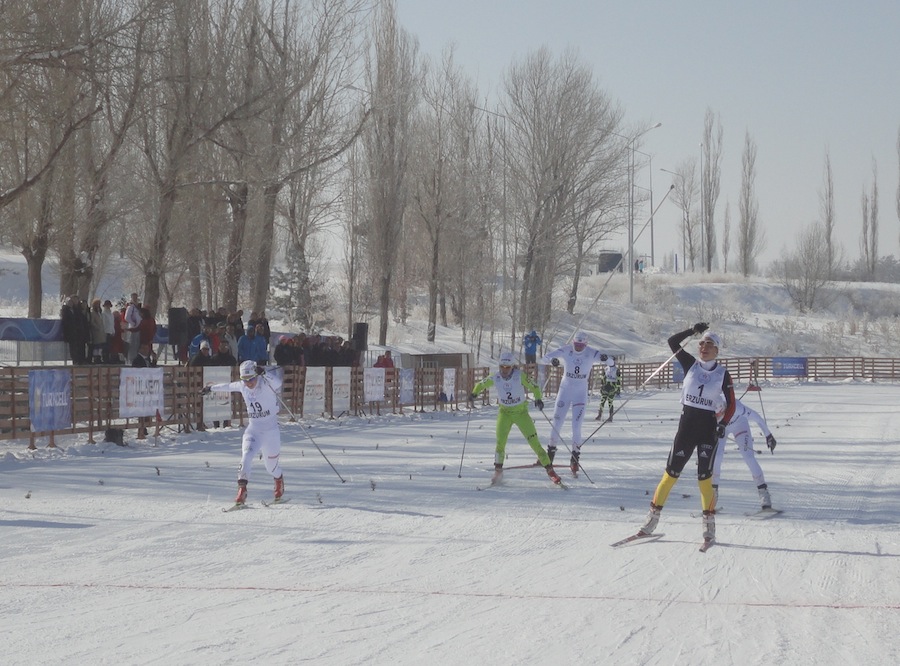
Hanna Kolb (GER), victorious in the U23 women's sprint on Tuesday in Erzurum.
ERZURUM, Turkey — After scoring points on the World Cup, a victory at U23 World Championships is still a big deal. Just ask Hanna Kolb (GER)—despite having placed 17th this weekend in Szklarska Poreba, Poland sprint, she still thought of her inaugural U23 title as an significant accomplishment.
“It is one of the greatest achievements for me,” she said to FIS marketing coordinator Michal Lamplot.
Hanna Kolb (GER) in qualifying.
“Even though I have won already some World Cup points…this individual title is really special for me. It was a perfect day for me.”
Indeed—Kolb was seeded first going into the qualifier, which she won by one second. In the final, she entered the stadium with Swedes Emma Wiken and Jennie Oeberg hot on her tail, but she held them off in the straightaway for the win. Wiken was the runner-up and Oeberg was third.
Tuesday marked the second day in a row the Swedish women put up an impressive performance. After second and third, Linn Soemskar (SWE) finished fifth.
“I did not expect to be on the podium today” said Wiken. “I have not been that successful in sprints lately.”
Oeberg was similarly modest. “This season has not been the best for me so the bronze medal feels like a victory.”
With three teammates in the final, Oeberg said the last heat was fun to ski.
The weather at Kandilli was once again sunny and frigid. The temperature eventually rose above the -20 C threshold, but two hours before the start, the it was -25 C: cold enough to freeze the diesel for the wax rooms’ generator and force volunteers to start a fire underneath it to thaw it out.
The women's A-final, exhausted in the finish pen.
Bjornsen Leads North American Effort in Fourteenth
Three North American women made it to the heats on Tuesday: Sadie Bjornsen, who qualified in 11th, Heidi Widmer (CAN), who was 16th in the prologue, and Becca Rorabaugh, who scraped into the rounds by less than a second in 29th.
“It was great to get some athletes in the rounds today; we didn’t do that yesterday,” said U.S. trip leader and USST development coach Bryan Fish.
Bjornsen (11) and Kolb (1) leading up the main hill in the first quarterfinal.
“Sadie skied well, she just got bumped out at the end there, but she skied well and said she’s feeling well, so that’s great,” said Fish.
Despite feeling stronger than she has all year in her quarterfinal, Bjornsen said she made a few tactical errors that cost her the semis. Hers was the first quarter of the day, and after skiing wide and in front up the main hill just out of the stadium, she let Kolb, the eventual winner, take control, and Kolb slowed and allowed the rest of the pack to catch up.
“I took the outside, which was super corduroyed and didn’t ski that well, so I lost my speed there, which was kind of a bummer. It was one of those tactical errors—it happens,” said Bjornsen.
She finished third in her heat, and might have advanced as a lucky loser had a subsequent heat not been faster.
Though disappointed, Bjornsen was mainly encouraged by the fact that she felt better than she has all year.
“I have felt like I’ve had pwer yet this year, so at the end of the day I’m happy, because now I’m really excited for the classic race,” she said, referring to the 10 k individual classic on Thursday.
“It was a little bit of a bummer; I’d have liked to ski more heats today, but then again these were my first heats this year, so at least I got to ski one.”
Heidi Widmer (CAN) fighting to catch back up after losing her ski in the stadium.
Canada’s Heidi Widmer started the day strong with a 16th-place qualifier, but had an unlucky quarterfinal—her ski came off before she left the stadium, though she was still able to come back for fifth in her heat and 27th overall.
There was quite a bit of jostling on Tuesday, and Widmer got on the unlucky end of it. Coming out of the stadium, both Widmer and Germany’s Sandra Ringwald tried to cut across to the inside around the corner to the first climb, and Ringwald’s skis crossed over hers.
“She was being aggressive,” said Widmer. “I tried to stand my ground and she went down.”
“I was stoked because I thought I had avoided the crash and thought I was really lucky, but then I went to stride on my left ski and it was not there,” she continued.
After scrambling to get it back on, she fought to catch back up to the pack, but to no avail. She shortened the gap, but the effort cost her, and she had nothing left for the finish.
“It was a really big bummer, because I felt really good today, and felt for sure I could have moved on,” said Widmer. “It’s hard to accept that, but I love sprint racing so I guess I have to love all aspects of it…. I’ve had upsetting days before, so that makes it easier to keep in perspective.”
Rorabaugh (USA) in the quarterfinals.
Rorabaugh was the next North American qualifier for the heats; she finished sixth in her quarterfinal and 30th overall.
“During the quarter I felt OK, but made a few tactical errors,” sad Rorabaugh. “I took the outside over the top of the hill, which is silly, and the girl I was skiing behind let a gap form.”
This is Rorabaugh’s third and final U23 Championships, and she’s trying not to take a last-chance approach to the week.
“It would be easy to put a lot of pressure on your last year, but I’m trying to be cognizant of that, because I don’t think it helps anything,” she said.
Rounding things up for the North Americans, Emily Nishikawa (CAN) finished 33rd and Marlis Kromm 36th (CAN).
Jessie Diggins (USA) sat out the sprint after coming down with flu-like symptoms during her flight from Poland to Turkey. Diggins and Fish said they were unsure if she would race the 10 k classic on Thursday or the skiathlon on Saturday.