From the FasterSkier archive — posts syndicated from athletes’ and coaches’ own blogs between 2004 and 2012, kept online as published. Current coverage is at fasterskier.com.
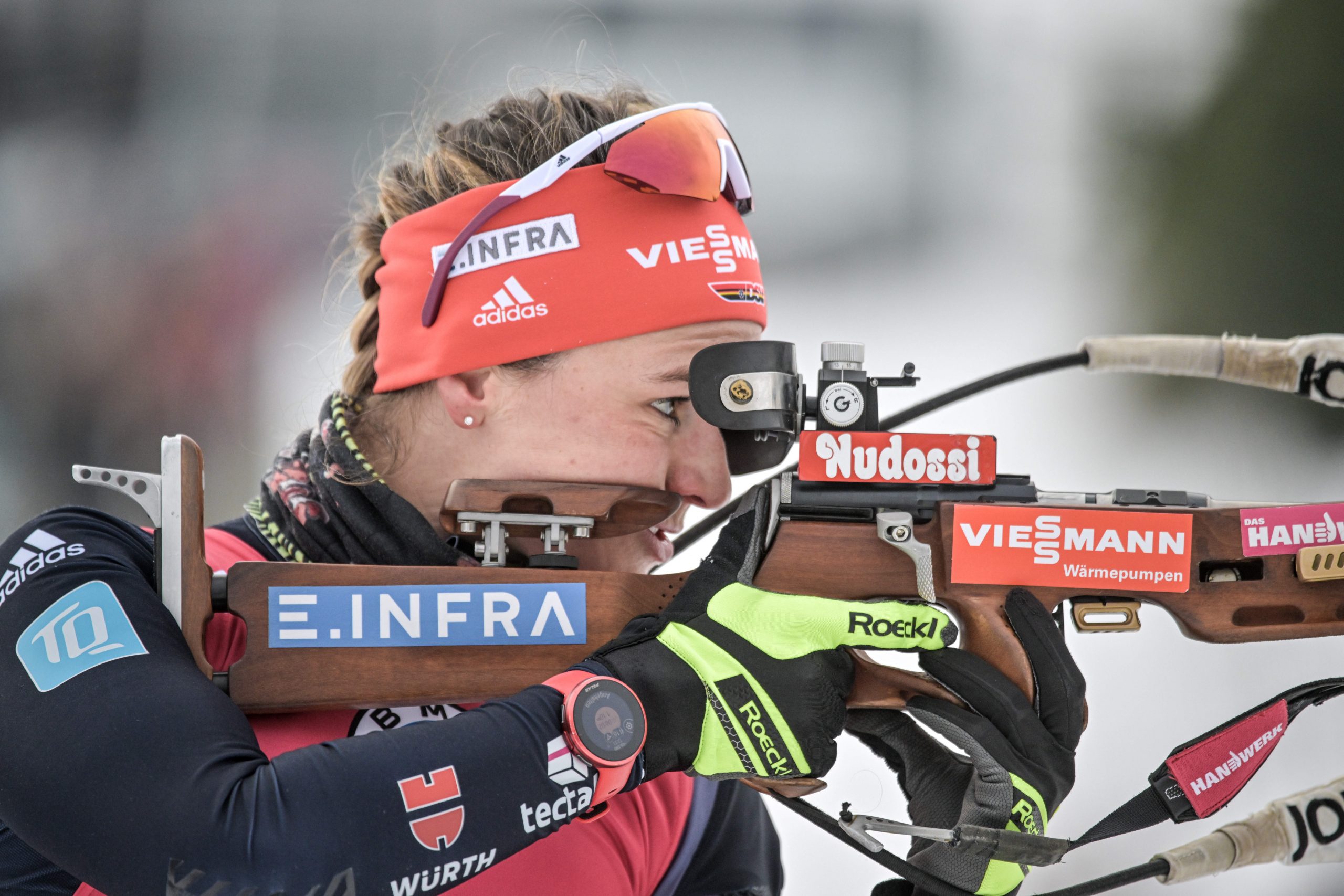
Denise Herrmann-Wick (GER) shooting from the standing position at the IBU World Championships Sprint in Oberhof, Germany. (Photo: NordicFocus)
Biathlon fans anticipated that the women’s 7.5km Sprint would be one of the most tightly-contested races of the BMW IBU World Championships, and it did not disappoint. In the end, only 2.2 seconds separated the new World Champion, Denise Herrmann-Wick of Germany, from the silver medalist, Hanna Oeberg of Sweden. Oeberg’s teammate, Linn Persson, finished third. These athletes will start at the front of Sunday’s 60-person Pursuit and try to stave off the chasers for another chance at a World Championship medal.
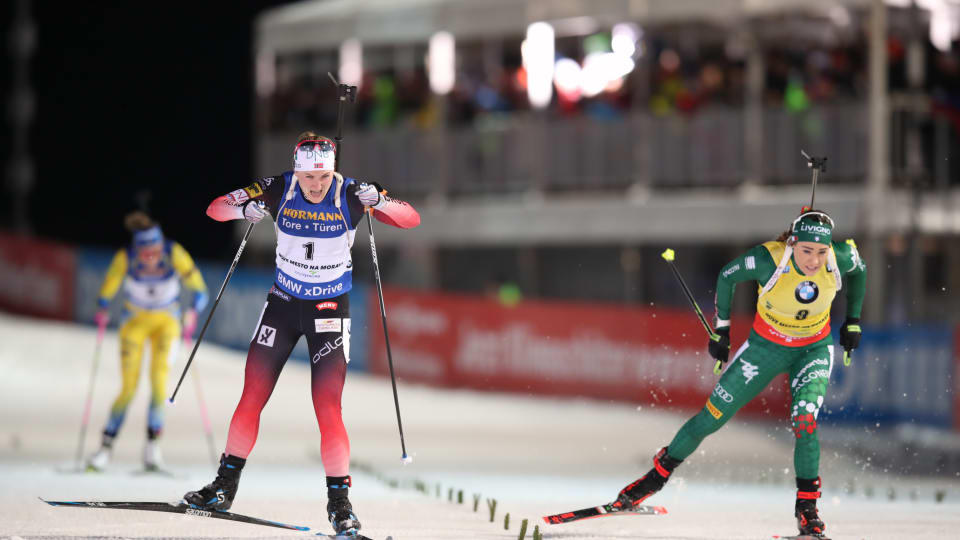
Hanna Oeberg (SWE) leaving the range in the lead of the IBU World Championships Sprint in Oberhof, Germany. (Photo: NordicFocus)
Fourteen women from seven nations have landed on the podium this winter. But among all those contenders, arguably no one had more pressure on them today than hometown favorite, Denise Herrmann-Wick. Ranked first in the World Cup Sprint standings, the 34-year-old revealed in Wednesday’s Mixed Relay that she has peaked perfectly for these races. Even with nine out ten hits, Herrmann-Wick is skiing fast enough that she could have a chance at a podium finish, but today she left nothing chance. Unfazed by tens of thousands of spectators cheering in unison after each shot, Herrmann-Wick steadily cleared ten out of ten targets. One word came to mind: impressive.
But the race wasn’t over. A few minutes later, Hanna Oeberg of Sweden managed the same perfect shooting, leaving the range for the final 2.5km loop with a nine second advantage over Herrmann-Wick. A hush of collective anxiety came over the full stadium of German fans. By the top of Oberhof’s signature Birxsteig climb, Oeberg’s advantage had dwindled to a near tie. It wasn’t until the final meters of the race, when Oeberg’s time ticked above Herrmann-Wick’s winning mark of 21:19.7, that the Thuringen Arena burst into cheers.
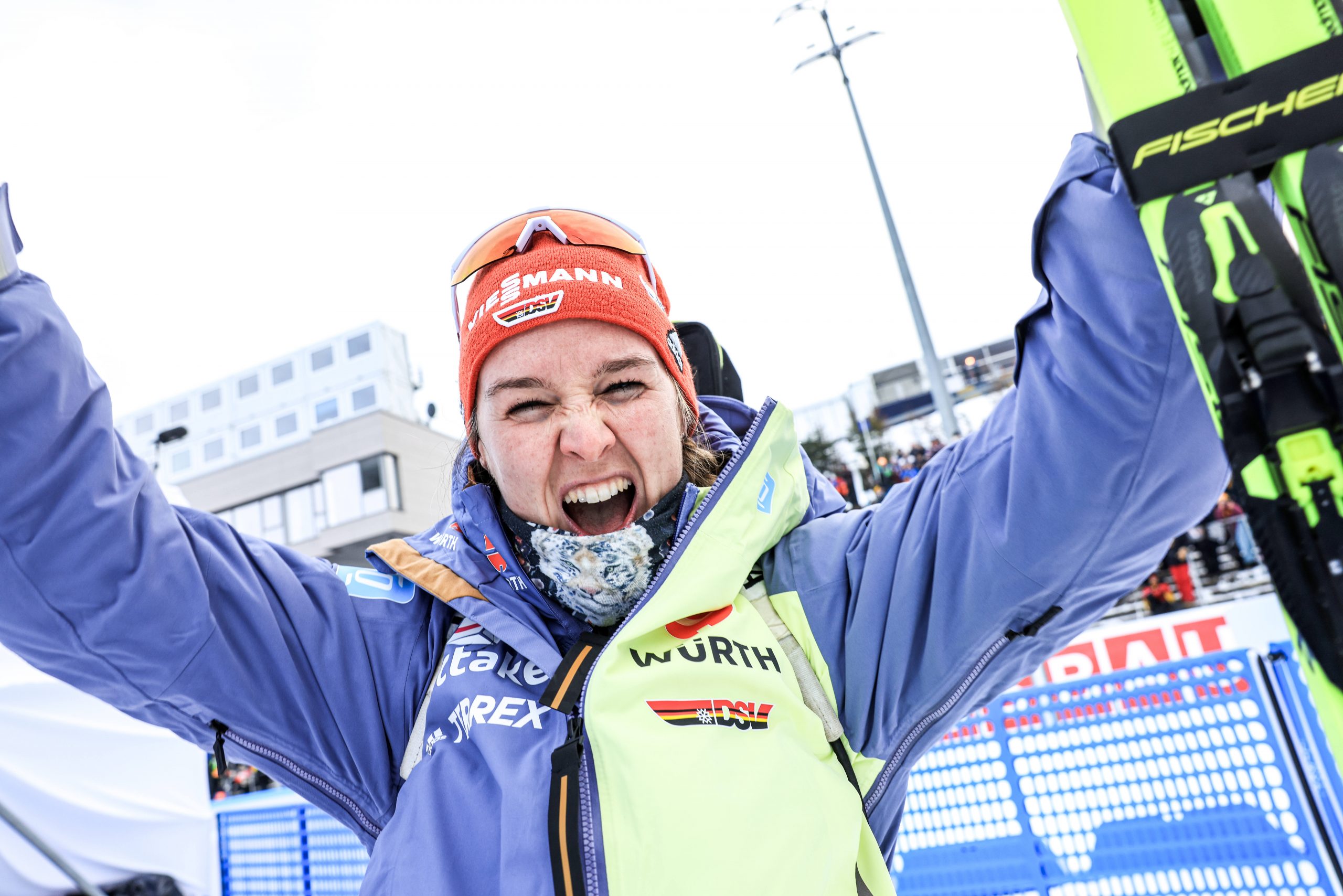
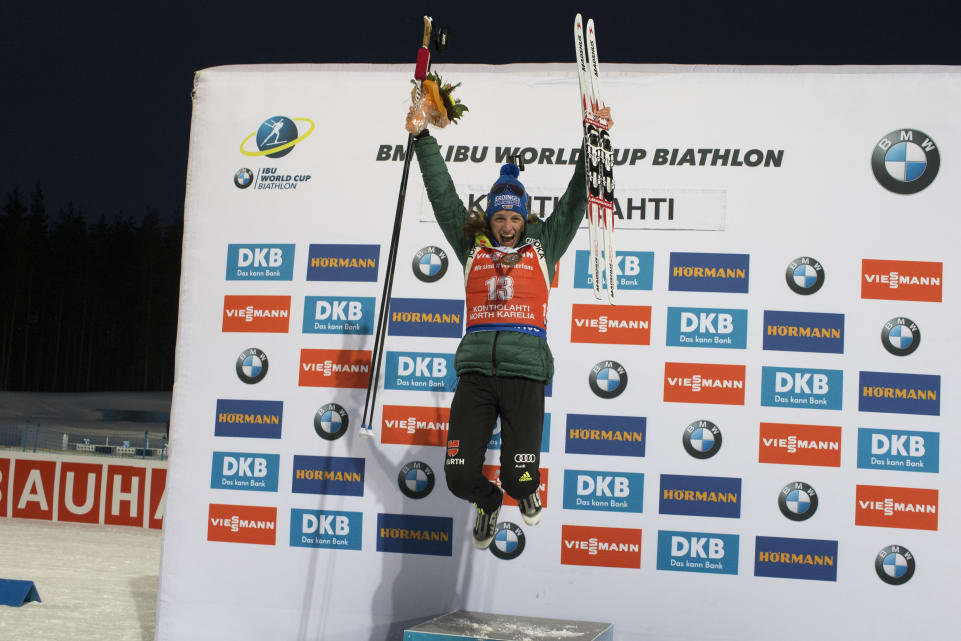
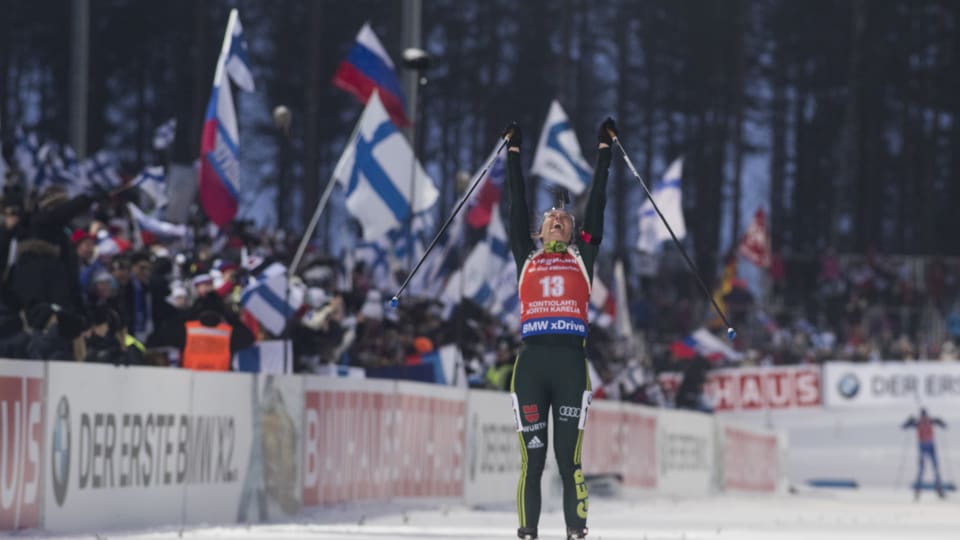
Denise Herrmann-Wick (GER) celebrates after winning the IBU World Championships Sprint in Oberhof, Germany. (Photo: NordicFocus)
The battle for gold was not limited to those two athletes. Wearing bib number two, Anamarija Lampic of Slovenia cleaned her prone targets, leaving the audience wondering if today might be the day for the former cross-country skier to break onto her first podium. But that kind of biathlon magic wasn’t to be; Lampic’s inexperience came through when she missed four targets in standing. With the 17th-ranked course time, she narrowly managed to qualify for Sunday’s Pursuit in 58th. It was Lampic’s teammate, Polona Klemencic, who stepped up and shined for Slovenia with the perfect shooting score to take her first career top-10 in 8th place.
Ingrid Tandrevold of Norway led the race after Shooting 1, showing once again that her ski speed and prone shooting skills are there. But the standing shooting slump which has been bothering her since January persisted and she missed two on her way to a 14th place finish. Lisa Vittozzi of Italy missed just one in standing but skied fast enough to briefly take the lead from Marketa Davidova of Czech Republic, who had hit 100% as she so often does in championship races.
The defending Olympic Champion in the Sprint, Marte Olsbu Roeiseland, was sitting way back in 26th after missing one in prone, but with a clean standing bout and the second-ranked course time, she pulled her way back to fourth, just five seconds shy of the bronze medal. She’ll be motivated for more in the Pursuit. The World Cup Overall leader, Julia Simon, was well on her way to a podium finish with eight hits before she missed the last two. Simon thrives in head-to-head races and will be a threat in the Pursuit even starting 1:02 back in 10th place.
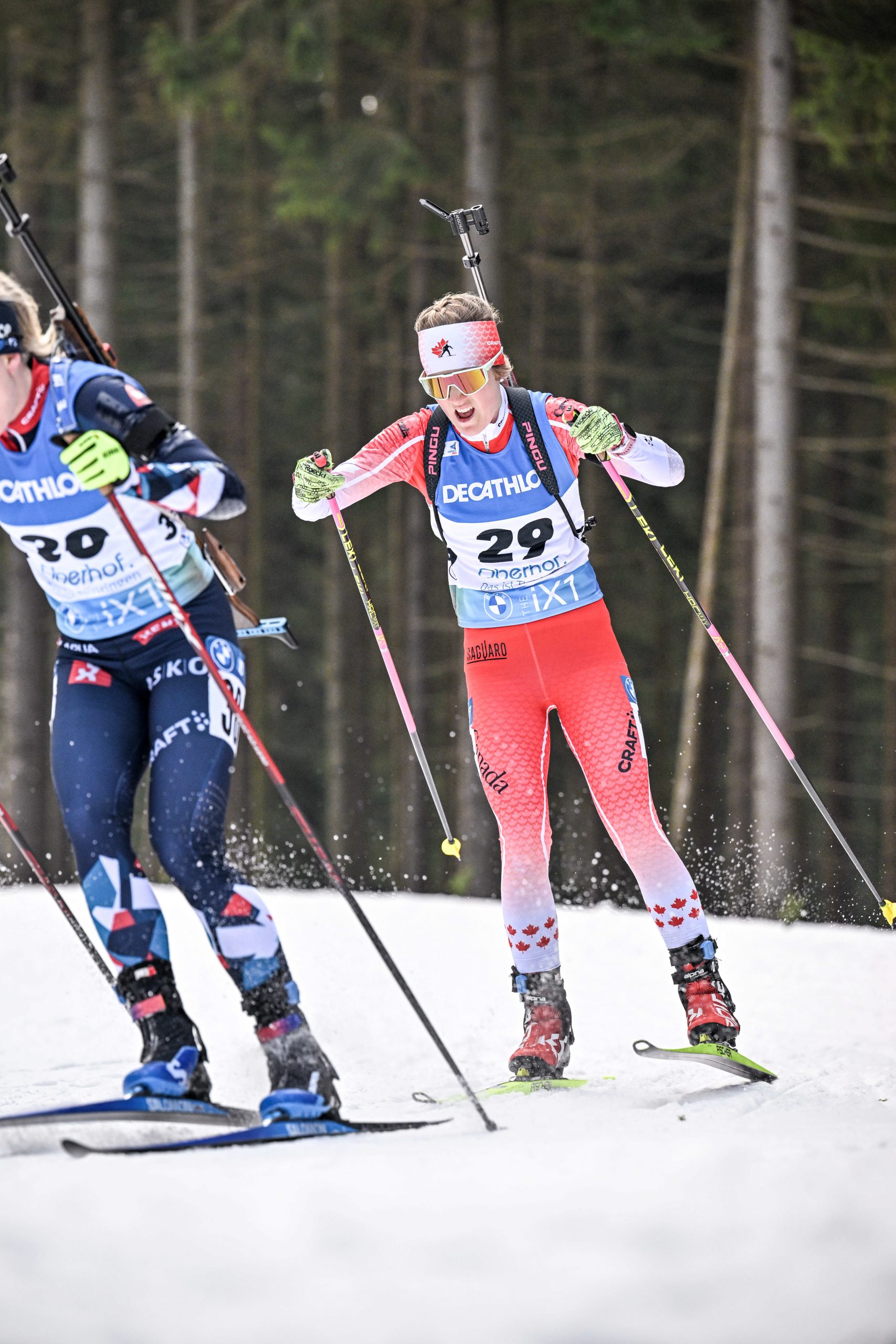
Emma Lunder (CAN) following Marte Olsbu Roiseland (NOR) in the IBU World Championships Sprint in Oberhof, Germany, where they finished 11th and 4th, respectively. (Photo: NordicFocus).
Less than one second behind Simon, Emma Lunder of Canada posted her best-ever Championship result in 11th. After a season-best ski performance on Wednesday in the Mixed Relay, Lunder knew anything was possible in today’s Sprint. “I was a bag of nerves,” she said. “I was more nervous for this than the Olympics, because I knew I had a chance.” Once she started, her good preparation kicked in and with a clear mind she executed to near perfection, with just one prone miss and a top-15 course time. Lunder attributes her excellent shape to staying healthy. She hasn’t been sick since last year’s Olympics, so she has been able to train continuously and make steady gains. She also credited her ski technicians for fast skis. In Sunday’s Pursuit, only 1:03 will separate Emma from Herrmann-Wick. To the podium, it’s just 37 seconds.
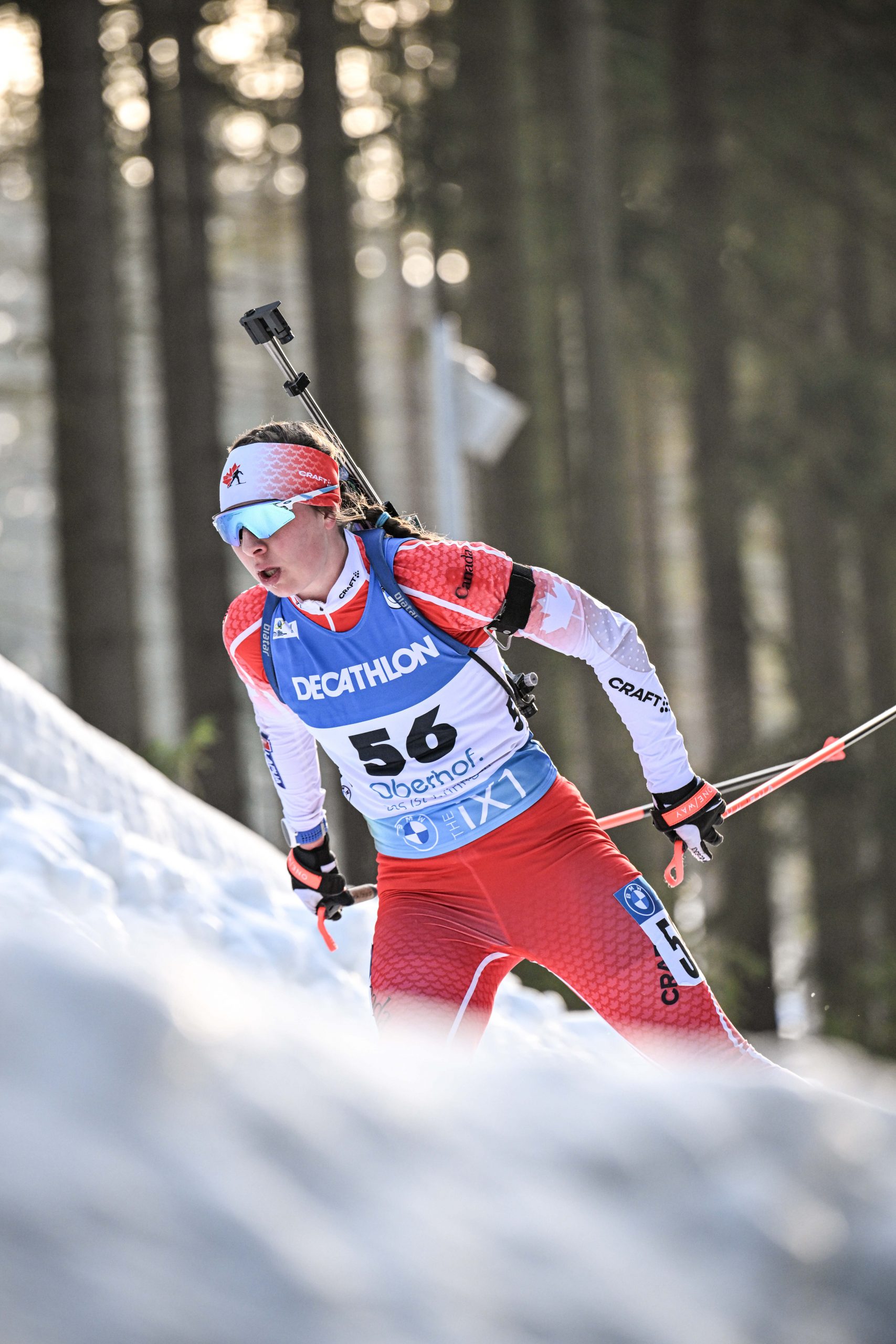
Nadia Moser (CAN) on her way to 48th in the IBU World Championships Sprint in Oberhof, Germany. Photo: (NordicFocus)
Two other North Americans qualified for the Pursuit. Nadia Moser (CAN) finished 48th with one penalty, and Deedra Irwin (USA) finished 55th with two. “I’ve barely trained for the last two weeks,” said Irwin after the race, referencing a sickness she came down with in January which required a round of antibiotics. “And this course is so hard. The headwind on that straightaway was brutal.” Some athletes were luckier than others, finding themselves in position to draft for the 500m windy straightaway approach to the range. Lunder put in a hard sprint to catch someone there. Chloe Levins, the second American today in 73rd, was alone every time on that section, but she performed well on the range, hitting nine of ten.
Joanne Reid (USA) shot clean in prone but suffered three penalties in standing to finish 75th. Competing in her first biathlon World Championships race, former Nordic Combined athlete Tara Geraghty-Moats (USA) similarly cleaned prone but struggled in standing, missing four to finish 86th. Canada’s Benita Peiffer rounded out their squad, missing five to finish 93rd.
Chloe Levins (USA) hit nine out of ten to finish 73rd in the IBU World Championships Sprint in Oberhof, Germany. (Photo: NordicFocus)
The women will be back in action on Sunday, but first it’s the men’s sprint, Saturday at 8:30AM Eastern Time.
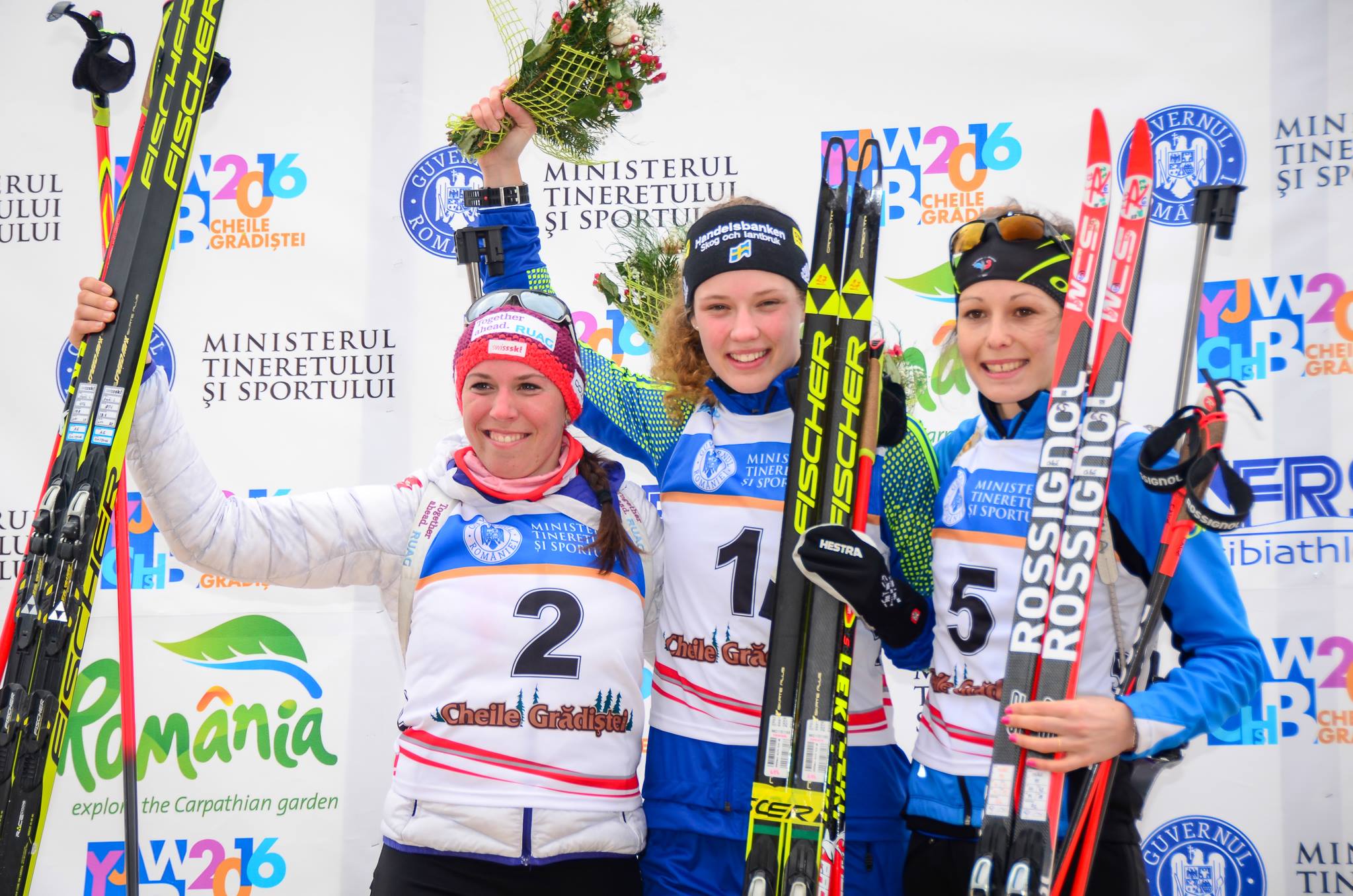
IBU World Championships women’s Sprint podium: Denise Herrmann-Wick (GER) in first, Hanna Oeberg SWE) in second at left, and Linn Persson (SWE) in third. Oberhof, Germany. (Photo: NordicFocus)
Let’s catch up with the IBU World Cup and the action from Saturday and Sunday in Pokljuka, Slovenia.
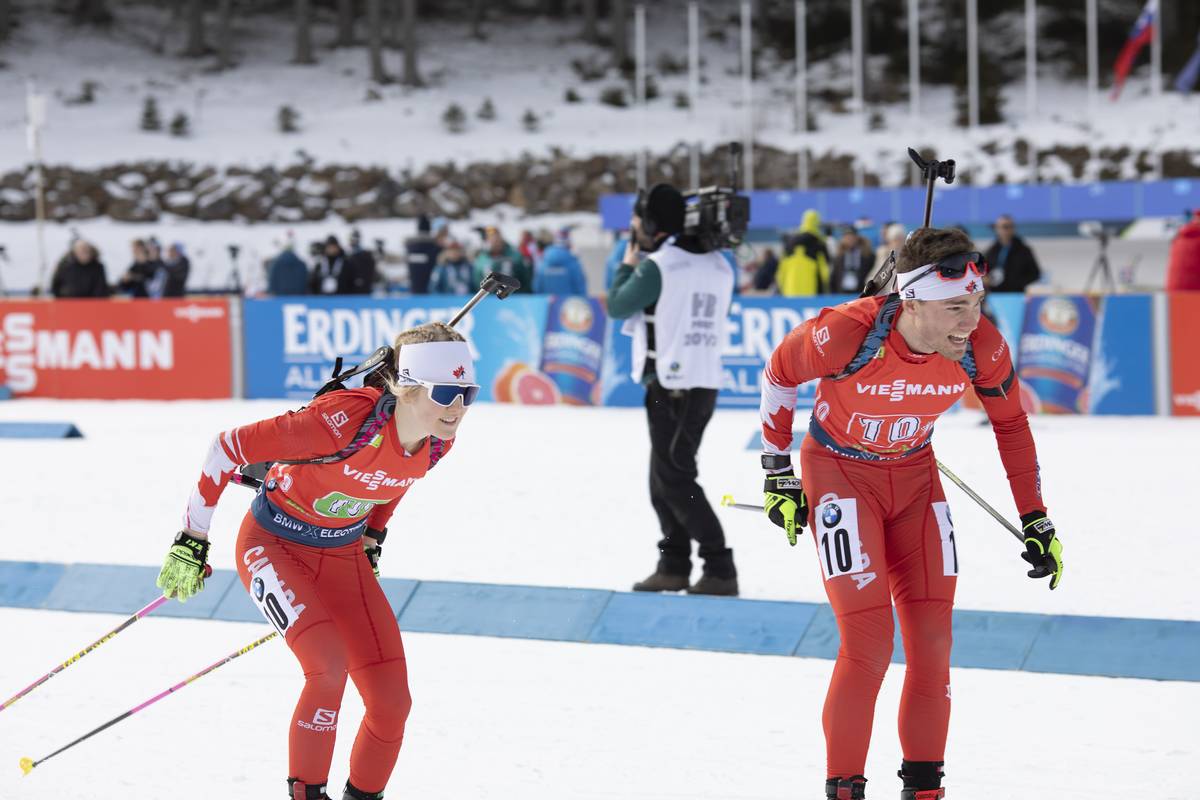
Emma Lunder and Christian Gow, (l-r) during the IBU World Cup biathlon, single mixed relay, in Pokljuka (SLO). The team placed fourth overall. (Photo: NordicFocus)
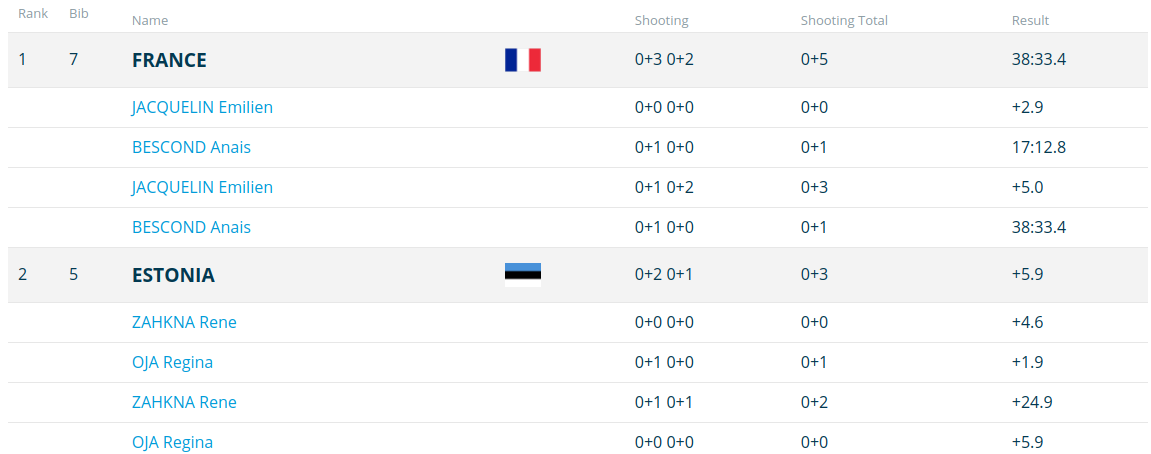
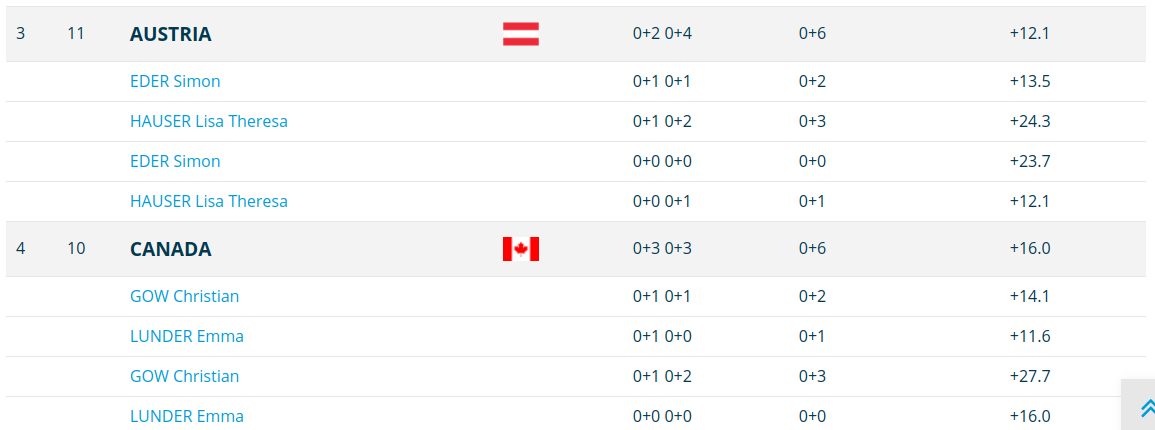
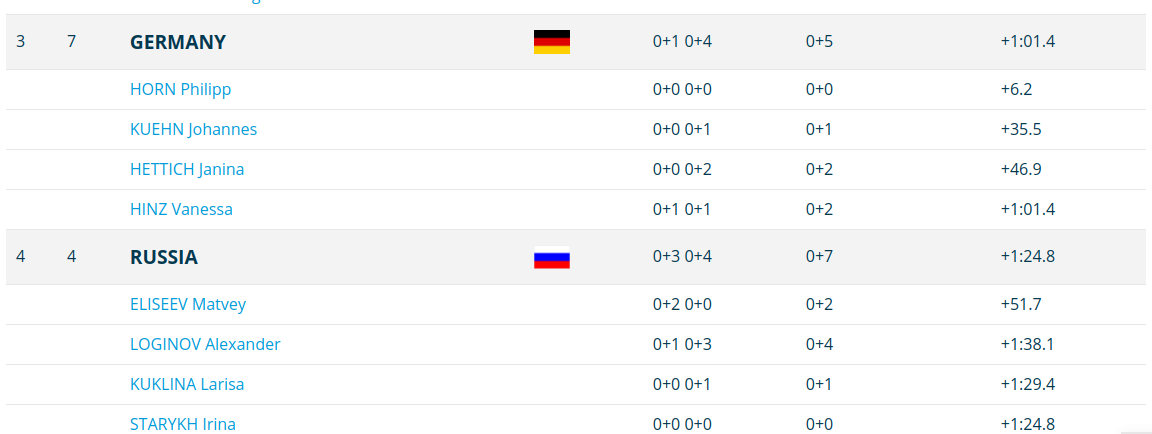
First up, the single mixed relay, in which teams of two are paired with each skier racing two legs and shooting two stages per leg. France took the win in 38:33.4 minutes shooting 0+5. The big news from the relay for North America, was Canada’s fourth place result. Christian Gow and Emma Lunder were 16 seconds back from first place France after shooting 0+6.
Jake Brown and Joanne Reid for the U.S. placed 23rd (+4:15.1; 0+14).
And it is worth mentioning, 26 different nations comprised the 26 team field. Which brings to mind a cool post on Twitter from the International Biathlon Union, and it speaks to the exciting nature of the sport. The Estonian team included Rene Zahkna, who placed 101st in last Thursday’s 20 k individual race. Two days later it was podium time.
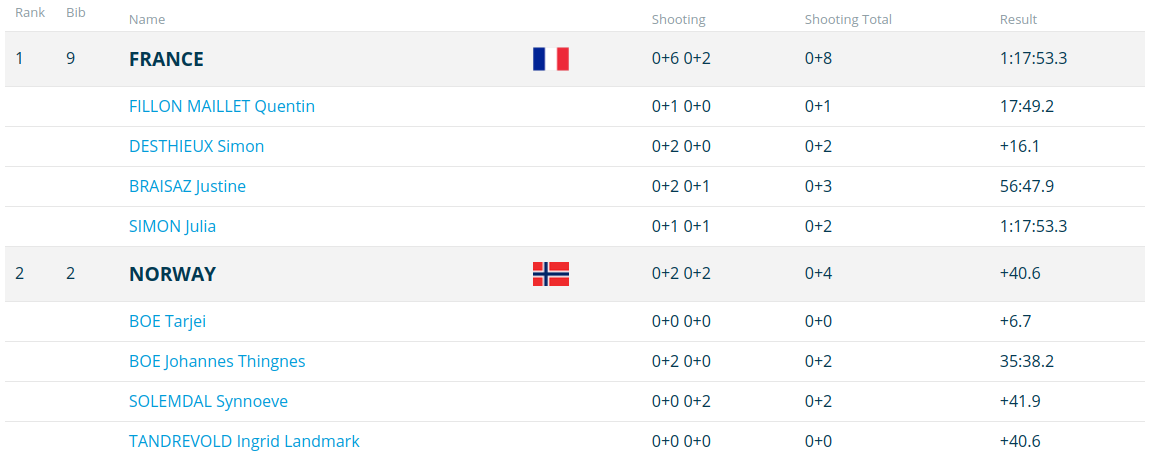
Next up, the 4 x 7.5 k mixed relay, which France won in 1:17:53.3 making it a clean sweep for the nation on relay day.
The U.S. team of Leif Nordgren, Sean Doherty, Susan Dunklee, and Clare Egan placed 12th (+4:10.6; 2+12). Canada’s Jules Burnotte, Scott Gow, Emily Dickson, and Megan Bankes raced to 18th (+6:47.5; 4+10).
The relay had 25 teams from 25 different nations represented.
France’s Quentin Fillon Maillet won Sunday’s 15 k mass start in Pokljuka, Slovenia. (Photo: NordicFocus)
And… on Sunday in Pokljuka, the racing began with the men’s 15 k mass start. No Johannes Thingnes Bø or Martin Fourcade on the podium’s top step: France’s Quentin Fillon Maillet placed first in 36:21.5 shooting 0+0+1+0. Germany’s Benedikt Doll placed second (+10.0 0+1+0+0), and yes, Johannes Thingnes Bø was on the podium in third (+10.3; 1+0+0+1).
Fourcade retains the IBU World Cup’s leader’s bib with 601 points. Fillon Maillet is second with 532 points, and Bø is third with 482. Bø sat out much of January’s racing for the birth of his first child.
No North American men qualified for the mass start race.
Egan raced to 26th (+3:31.8; 0+1+1+1) and Lunder to 29th (+4:12.5; 2+1+1+0).
Norway’s Tiril Eckhoff still leads the World Cup overall with 524 points, Dorothea Wierer of Italy is in second with 509 points, and Öberg sits in third with 456 points.
Racing on the IBU World Cup takes a hiatus for a bit. The 2020 IBU World Championships begin in Antholz, Italy on February 12th.
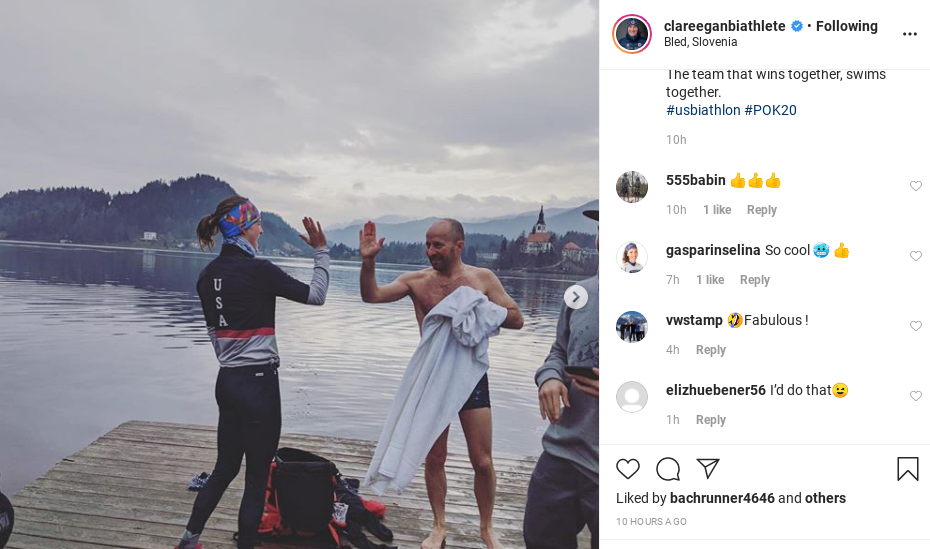
So we will leave on a light note as we piggyback on Egan’s Instagram account. She noted that U.S. Biathlon’s women’s coach Armin Auchentaller made a bet that he would “jump in the lake if anyone gets a top-10!”.
He took the plunge after Egan’s 6th place. Auchentaller may be onto something, The New Yorker recently called cold plunges a subversive joy.
The cold plunge. (photo: from @clareeganbiathlete on Instagram)
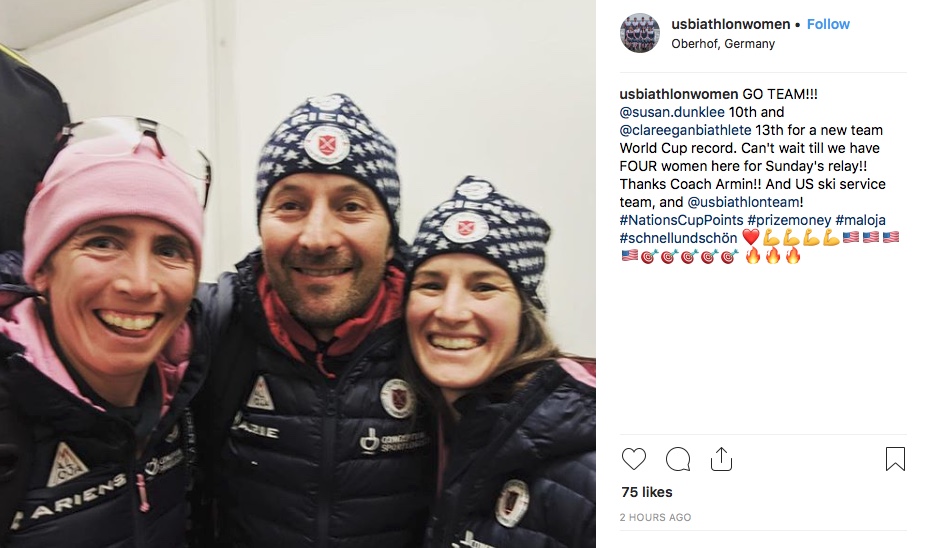
Stoked Biathletes after a record-setting day. From left to right, Susan Dunklee, women’s coach Armin Auchentaller, and Clare Egan. (Photo: @usbiathlonwomen Instargram screenshot)
The International Biathlon Union (IBU) came off a two-week break for the holidays today in Oberhof, Germany. The women raced the 7.5-kilometer sprint under mostly calm conditions on a course that had received fresh snow. The fir trees lining Oberhof’s ski tracks were loaded down from recent storms that have passed through the region.
The relatively calm and non-blizzard conditions were noted by US Biathlon’s Susan Dunklee in an email to FasterSkier.
“The sun peeked out in Oberhof this afternoon, truly a seldom occurrence,” Dunklee wrote. “The last couple days we trained in a blizzard but today the wind was relatively calm. The tracks were glazed but not too deep.”
In a clean shooting blitz, Italy’s Lisa Vitozzi earned her first career IBU World Cup win in a time of 22:34.6 minutes. With the shooting range flags sitting noticeably stagnant, clean shooting was also the pattern for the remaining two podium spots.
Anais Chevalier from France finished in second place, 5.3 seconds back, for her best result of the season. Hanna Öberg of Sweden was third after crossing the finish line 15 seconds back.
Beyond her clean shooting in her two shooting bouts, Vitozzi had the second fastest and third fastest course times for her first and second ski loops respectively. Vitozzi’s third lap was the 11th fastest.
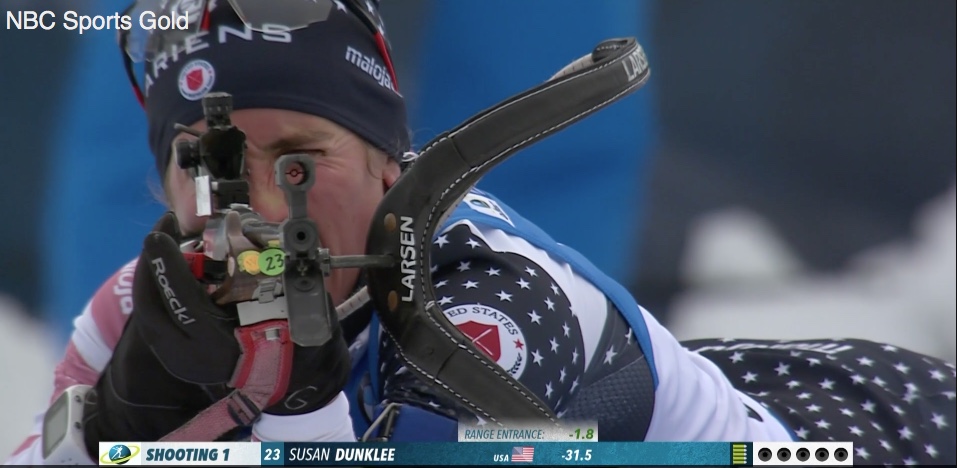
Susan Dunklee on the range during Thursday’s sprint in Oberhof, Germany. (Photo: NBC Gold screenshot)
The U.S. women’s biathlon team posted two top-15 performances on the day. Thirty-two-year-old Susan Dunklee placed a season-best 10th place while the thirty-one-year-old Egan placed 13th.
“I can’t remember a time when the US has put two women in the top 13 of a World Cup,” Dunklee wrote. “It has been a lot of fun to watch Clare come alive this season after years of hard work and it’s exciting to join her with a great result today.”
Prior to the holiday break, Dunklee’s best individual result was in Pokljuka, Slovenia’s individual race where she placed 11th after amassing a single penalty.
On Thursday, Dunklee was 40.8 seconds off the winning time while skiing one penalty loop after missing a single target in her prone stage. Dunklee’s performance displayed consistent ski speed and efficiency on the range. Her first ski lap was the 13th fastest, her second ski loop ranked 29th and her third ski course time improved to the 17th fastest.
Dunklee’s range times (defined by the time at the shooting range) were ranked ninth and 20th for her first and second shooting bouts in Thursday’s sprint.
“I spent the holiday break in Austria with the Canadian team and got in a high quality training block. It sure is nice to not have to fight jetlag right now,” Dunklee added. My shooting speed benefited a lot from working alongside the Canadians. My ski speed sometimes takes weeks to sharpen during the season and I think it is finally getting there.”
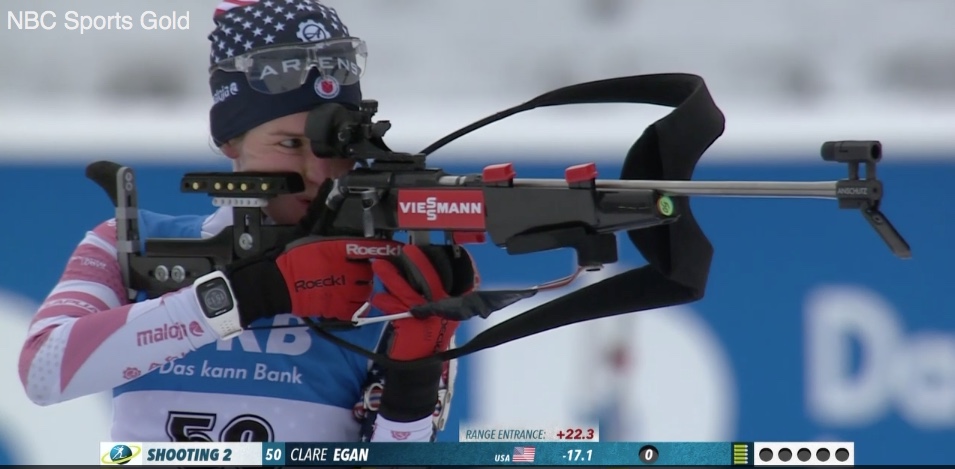
Clare Egan during her second shooting stage in Oberhof’s sprint on Thursday. (Photo: NBC Gold screenshot)
Today was one of my best results and yet it felt normal- and that’s a great feeling,” wrote Egan.
Her return to competition on Thursday was seamless despite the break. Her skiing and shooting showed no rust.
“My race today was definitely a ‘blowing-out-the-cobwebs’ experience,” Egan emailed. “But I still managed a top-20 ski time, only +:35. It’s very motivating to know that even on a day when I don’t feel great skiing, I am competing with the best.”
On Thursday, Egan’s 13th place was a result of her finishing 49.0 seconds back in a field of 100 starters.
“Today was a great day for both Susan and me- the first time that US Biathlon has had two women in the top-15 (AS FAR AS WE KNOW!),” Egan continued. “We are both competing at a high level right now, so it will be exciting to work together in Saturday’s pursuit to move up. The top 20 starters (today’s top 20 finishers) are all within 1 minute, so in a 10k race with 4 shooting stages, anything is possible.”
For Canada, Emma Lunder placed 46th (+1:49.2, 1+1), Rosanna Crawford 56th (+2:06.3, 1+1), Megan Bankes 87th (+3:07.9, 1+1), and Sarah Beaudry 89th (+3:21.2, 2+1).
Lunder and Crawford both qualified for the pursuit.
The women race again in Oberhof on Saturday in a 10 k pursuit.
Norway’s Marte Olsbu Røiseland out skiing Italy’s Dorothea Wierer for the win on Saturday’s 10 k pursuit in Nové Město, Czech Republic. (Photo: biathlonworld.com)
IBU World Cup Nové Město, Czech Republic 12.5 k / 10 k Pursuit
Johannes Thingnes Bø won his fifth race of the IBU World Cup season by taking the men’s 12.5-kilometer pursuit in Nové Město, Czech Republic in a time of 31:59.0 minutes. Bø skied four penalty laps on his way to victory. Russia’s Alexander Loginov also skied four penalty laps, and finished second 6.2 seconds back. The elder Bø brother, Tarjei Bø, placed third (+23.9) while skiing a single penalty lap after his final shooting round.
Christian Gow was the best placed North American in 21st (+2:38.8, 0+0+1+2). Also for Canada, Jules Burnotte was 35th (+3:46.8, 2+1+1+1). It was Burnotte’s second career World Cup start — he placed 33rd in Nové Město’s sprint. Scott Gow was 47th (+5:03.3, 0+0+2+2).
Sean Doherty was the highest ranked finisher for the U.S. in 27th (+3:07.4, 0+0+1+1). Leif Nordgren placed 54th (+6:14.1, 0+2+2+2), and Travis Cooper 58th (+7:22.6, 2+0+1+4).
In Saturday’s 10 k pursuit in Nové Město, Norway’s Marte Olsbu Røiseland made it back to back wins after placing first in Thursday’s sprint. Røiseland won in a time of 29:53.5 minutes while missing two targets — for two penalty laps — on her way to a razor thin margin of victory.
Italy’s Dorothea Wierer lost out on the podium’s top spot by 0.2 seconds after missing a single target in her last shooting stage. Sweden’s Hanna Oberg took third (+4.7) after skiing one penalty lap.
For the U.S., Clare Egan improved on her 26th place in the sprint to place 20th (+2:22.3, 0+1+2+0). Joanne Reid was 51st (+5:20.5, 0+1+2+1), and Susan Dunklee 53rd (+5:42.2, 2+2+4+1).
Canada’s Emma Lunder, after finishing a career best 17th in the sprint, dropped to 35th (+3:13.6, 3+1+0+2). Sarah Beaudry, also coming off a career best 12th in the sprint, placed 38th (+3:46.7, 1+1+2+1). Rosanna Crawford placed 52nd (+5:37.0, 0+0+3+3).
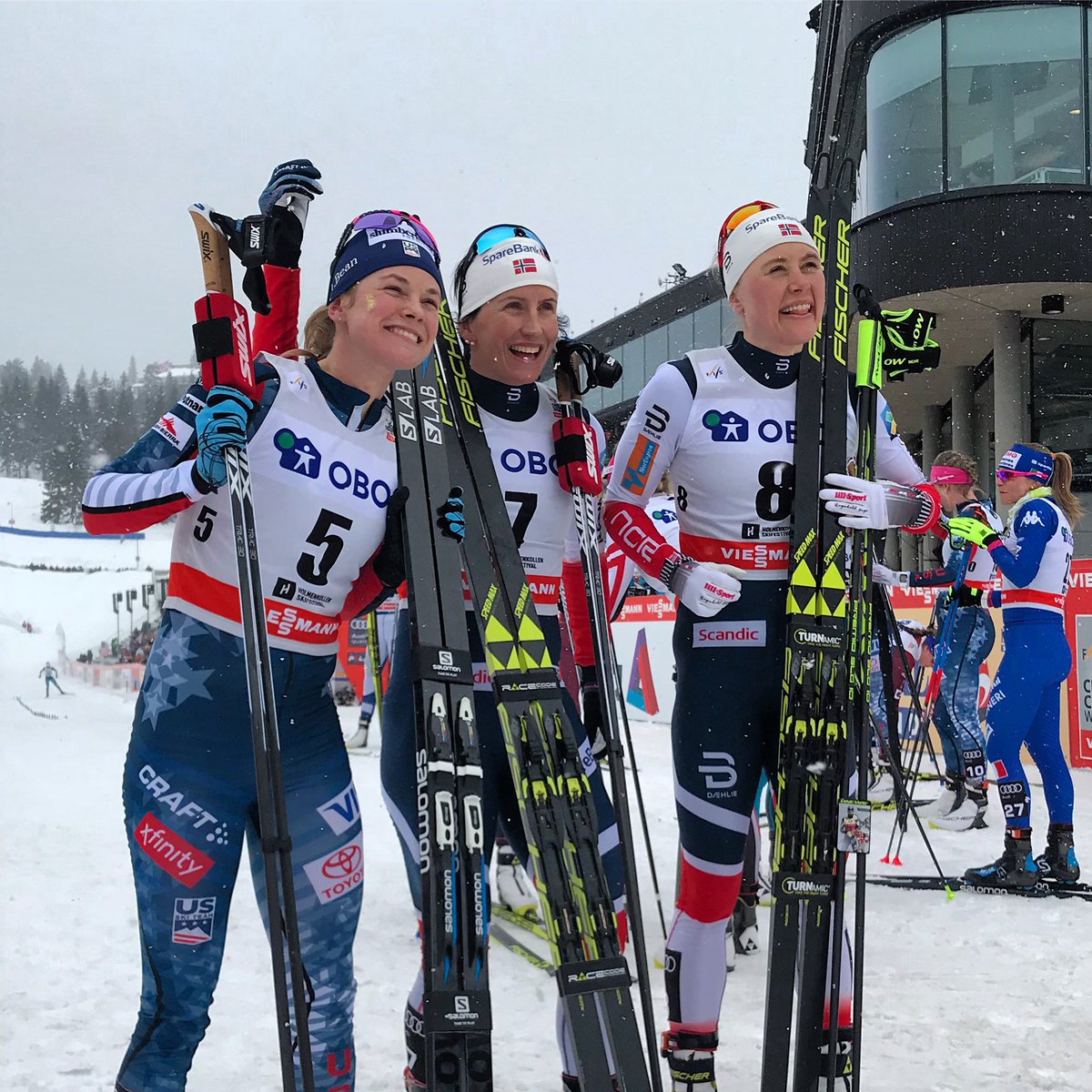
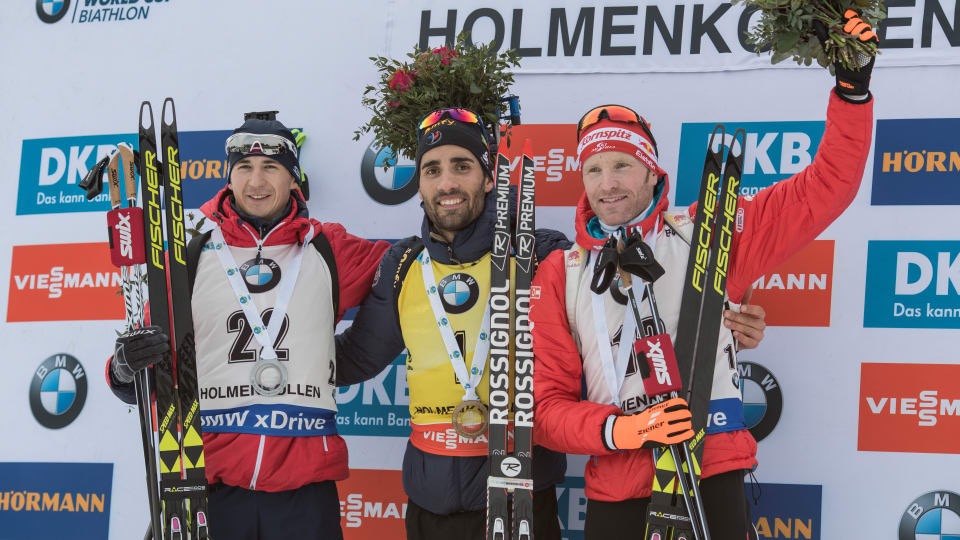
The Holmenkollen women’s 30 k freestyle mass start podium on Sunday in Oslo, Norway, with Jessie Diggins (l) in second, and Norway’s Marit Bjørgen (c) in first and Ragnhild Haga (r) in third. (Photo: FIS Cross Country/Twitter)
FIS Cross Country World Cup (Oslo, Norway): Women’s 30 k freestyle mass start
Marit Bjørgen, the Norwegian queen of distance cross-country events, racked up another victory at Holmenkollen in the women’s 30-kilometer freestyle mass start on Sunday for her seventh win in the World Cup’s ultimate distance event at the famed Norwegian venue. (She had previously won in 2005, 2010, 2012, 2014, 2015 and 2017).
But she did so in not-so-typical fashion. Instead of breaking the field mid-race and skiing to a comfortable win, like she did in the last race of the 2018 Olympics in PyeongChang, South Korea (a 30 k classic mass start), Bjørgen came from behind to win Sunday’s Holmenkollen 30 k and wasn’t able to let off too much before finish. She didn’t take the lead until less than a kilometer to go and put just enough time into her competition to take the win in 1:18:12.4 hours, while American Jessie Diggins outlasted the chase group of three to place second (becoming the first American woman to reach the Holmenkollen podium), 3.6 seconds behind Bjørgen. Norway’s Ragnhild Haga edged Sweden’s Charlotte Kalla by 0.1 seconds for third place (+4.3), while Kalla settled for fourth (+4.4).
The rest of the field was strung out, with Norway’s Astrid Uhrenholdt Jacobsen finishing fourth (+11.5) and Ingvild Flugstad Østberg nearly another 1 1/2 minutes back in fifth (+1:39.5). Finland’s Krista Pärmäkoski placed seventh (+1:51.7), Germany’s Stefani Böhler notched eighth (+2:10.2), Austria’s Teresa Stadlober ninth (+2:10.2), and Sweden’s Ebba Andersson 10th (+2:11.9). Less than a second behind Sweden’s Ida Ingemarsdotter in 11th (+2:22.8) was American Sadie Bjornsen in 12th (+2:23.4).
In the Distance World Cup standings, Diggins gained some valuable points to keep herself in third, now 63 points ahead of Pärmäkoski in fourth. Heidi Weng, who finished 18th on Sunday, still leads the distance standings by 104 points and Østberg is second, 51 points ahead of Diggins.
In the Overall World Cup, Weng leads by 153 points over Østberg. Diggins is another 104 points back in third, 100 points ahead of Pärmäkoski in fourth. At World Cup Finals next week in Falun, Sweden, a total of 300 points is up for grabs for the winners (50 for freestyle sprint, 50 for classic individual start, and 200 for freestyle pursuit).
The U.S. had three in the top 20 and four in the points (top 30) in Sunday’s 30 k, with Kikkan Randall in 19th (+3:21.9) and Caitlin Patterson in 28th (+4:13.1). Rosie Frankowski (Alaska Pacific University) missed the top 30 by about 28 seconds in 31st (+4:45.4), Liz Stephen placed 51st (+10:01.7) and Kaitlynn Miller (Craftsbury Green Racing Project) finished 53rd (+16:05.0).
Cendrine Browne led four Canadian women in 36th (+6:16.1), Emily Nishikawa was 44th (+7:36.1), Zina Kocher (Foothills Nordic) finished 47th (+8:52.0), and Dahria Beatty placed 49th (+9:45.1).
Germany’s Vanessa Hinz celebrates her first IBU World Cup win and podium in the women’s 12.5 k mass start on Sunday in Kontiolahti, Finland. (Photo: IBU/Biathlonworld)
IBU World Cup (Kontiolahti, Finland): Men’s and women’s mass starts
(Note: This rundown has been updated to include comments from Lowell Bailey and Rosanna Crawford.)
Germany’s Vanessa Hinz won her first International Biathlon Union (IBU) World Cup race (and achieved her first World Cup podium) and Austria’s Julian Eberhard won his first race of the season (and first mass start of his career) in the women’s 12.5 k and men’s 15 k mass starts on Sunday in Kontiolahti.
Germany’s Vanessa Hinz celebrates her first IBU World Cup win and podium in the women’s 12.5 k mass start on Sunday in Kontiolahti, Finland. (Photo: IBU/Biathlonworld)
Hinz shot an impressive 20-for-20 with the third-fastest range time and fifth-fastest shooting time to take the win in 35:47.9 minutes. Third after the first prone stage, she moved into second, then third after cleaning the next two stages. After knocking down her final five targets in the last standing, Hinz left the range almost 24 seconds ahead of France’s Anaïs Chevalier in second and 26 seconds ahead of Italy’s Lisa Vittozzi in third. Hinz stayed ahead of her challengers on the final loop, finishing 13.5 seconds clear of Vittozzi, who claimed second. Chevalier finished third, 16.8 seconds back, while Finland’s Kaisa Mäkäräinen was next across the line in fourth (+43.4) with a gap to Sweden’s Hanna Öberg in fifth (+1:02.1).
Vittozzi and Chevalier both cleaned the first three stages then had to ski a penalty lap after the last standing bout (0+0+0+1). Mäkäräinen missed three (1+0+1+1) yet skied the second-fastest course time on her home course, and Öberg missed two (0+0+2+0). The fastest course time of the day was clocked by Darya Domracheva of Belarus, who had to ski five penalty laps (0+1+1+3) and ended up 10th (+1:18.2).
“I always dreamed of shooting four times clean and today I did it,” Hinz, 25, said, according to an IBU press release. “I was so often close to the podium. I knew I could do it. Today, I said, ‘OK, let’s try it and if it works, it is OK … and if not there is another season waiting and other races.’ Now I am on top of the podium and it is crazy.”
Vittozzi, who placed fourth in the mass start at the 2018 Olympics, was glad to improve on a third-place finish in Friday’s sprint by placing second on Sunday.
“I have been third so many times and that was not satisfying for me,” Vittozzi said, one day after she won the mixed relay with her team in Kontiolahti. “Today I am very happy about my second place.”
For Chevalier, it was her first individual podium of the season and it came a day after she and Antonin Guigonnat won the single mixed relay. Chevalier, 25, was severely injured when she was hit by a car last spring, according to an IBU press release.
“I am very happy to be here today, because it was a very hard season,” she told the IBU. “I forgot how nice it is to be on the podium … I forgot that it was not easy, so I am very happy … I did my best on the last lap; [Vittozzi] was faster, but I am third and happy with that!”
Canada’s Rosanna Crawford shot 19-for-20 to place 13th (+1:25.9) with her only miss coming in the second prone stage (0+1+0+0). Her overall shooting and range times were 10th fastest of the 30-woman field, compared to her 26th-ranked ski time. Crawford had been in 11th after cleaning the final standing stage, then slipped two spots to finish 13th in her second mass start of the season.
“Since the skiing wasn’t feeling great today I made sure I was super focused in the range,” Crawford wrote in an email to FasterSkier. “I knew that was my only chance to get a good result today. My one prone miss was a bad trigger pull, but the rest were nice solid hits. I made sure to have a solid set up and then just trusted my rhythm and shooting.
“I knew that I wanted that top 15, so I just kept fighting and trying to stick with the women when they caught me,” she wrote of her last loop. “The last time up the wall I managed to stay close to [France’s] Anais Bescond, and hold off the two people behind me. Really happy to be in the top 15 again.”
Clare Egan was the lone American woman to qualify for Sunday’s mass start, and it was the second mass start of her career. She was on track for a top-15 result after missing just one target in the first three stages, but she had to ski three penalty laps on the last standing (0+1+0+3), which put her in 23rd by the finish (+2:05.6). Notably, she skied the 14th-fastest overall course time.
“I didn’t have quite the same energy level tonight as the last two days, but I still had the 14th rank course time and that means anything is possible in the race,” Egan wrote in an email to FasterSkier. “To put it in perspective, the winner of the race, Hinz, had the 13th rank, just 2 seconds faster than me. This is the first time I’ve felt totally comfortable skiing with the fastest women, and I certainly hope I can maintain this speed for one more week of World Cup racing.”
Egan was pleased with her 9-for-10 prone shooting and her clean standing stage (“which is the first time I’ve cleaned a standing stage in an individual race this entire year, believe it our not,” Egan wrote).
“But when I missed my second shot on the final stage, I let that throw me off my game, and really blew the rest of the stage,” she explained. “It’s so hard to keep 100% focus in every scenario, and I find it gets harder and harder towards the end of the race when I’m not necessarily the most lucid. I know that I have to work on so I have a goal to manage the final stage better next week and in the future.”
Her 23rd-place finish was one better than her previous World Cup mass start finish, which was 24th last season in Hochfilzen, Austria.
“In my only other mass start, which was last year at World Championships, I felt like an imposter,” Egan reflected. “Maybe because I was the first ‘reserve’ to get called up when one of the top women [did not start]. But this was totally different. I knew I deserved to be there today and was confident about competing with the other top women.”
“In my only other mass start, which was last year at World Championships, I felt like an imposter … This was totally different. I knew I deserved to be there today and was confident about competing with the other top women.” — Clare Egan (US Biathlon) on Sunday’s mass start
While the women raced Sunday night, the men’s 15 k mass start took place in the afternoon, when Eberhard passed the likes of France’s Martin Fourcade and Russia’s Anton Shipulin after a tangle late in the race to take the win.
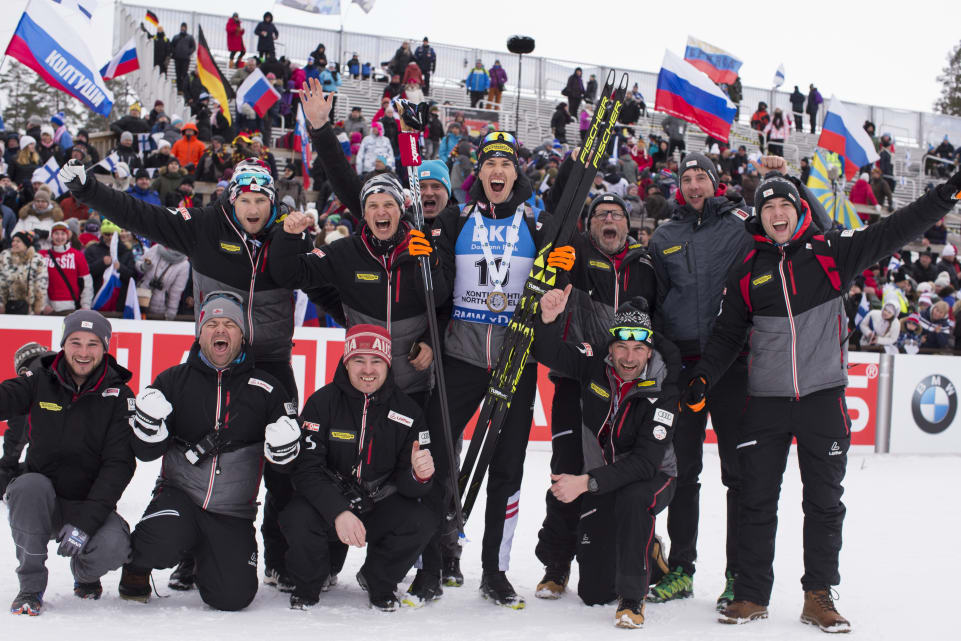
The Austrian team celebrating Julian Eberhard’s fourth career victory, his first this season and his first in a mass start on Sunday after the IBU World Cup men’s 15 k mass start in Kontiolahti, Finland. (Photo: IBU/Biathlonworld)
The Austrian had cleaned the first two prone stages to move into third by the race’s halfway point, behind Germany’s Benedikt Doll and Arnd Peiffer in first and second, respectively. Eberhard missed one in the next standing stage, yet left the range in second, 15 seconds behind Peiffer (who cleaned) in first, while Doll missed one as well to slip into third, 19 seconds back.
With two loops to go, Fourcade was coming back from two early prone penalties and found himself in fifth after a clean standing stage, less than a second behind Shipulin in fourth. On the next standing stage, Fourcade cleaned to take the lead and left the range about five seconds ahead of Shipulin (who also cleaned) in second.
Eberhard missed one yet remained in contention in third, 17 seconds behind Fourcade. On the last loop, Shipulin caught Fourcade before the course’s notorious climb known as “The Wall”, and Eberhard closed on the two frontrunners as they ascended it. Still several seconds behind over the top, he caught Shipulin on the bridge before the stadium, but the two tangled skis and Shipulin fell. Eberhard stayed upright and pulled even with Fourcade, passing him to take the win in 38:04.8. Fourcade finished second (+6.9) and Shipulin third (+19.3).
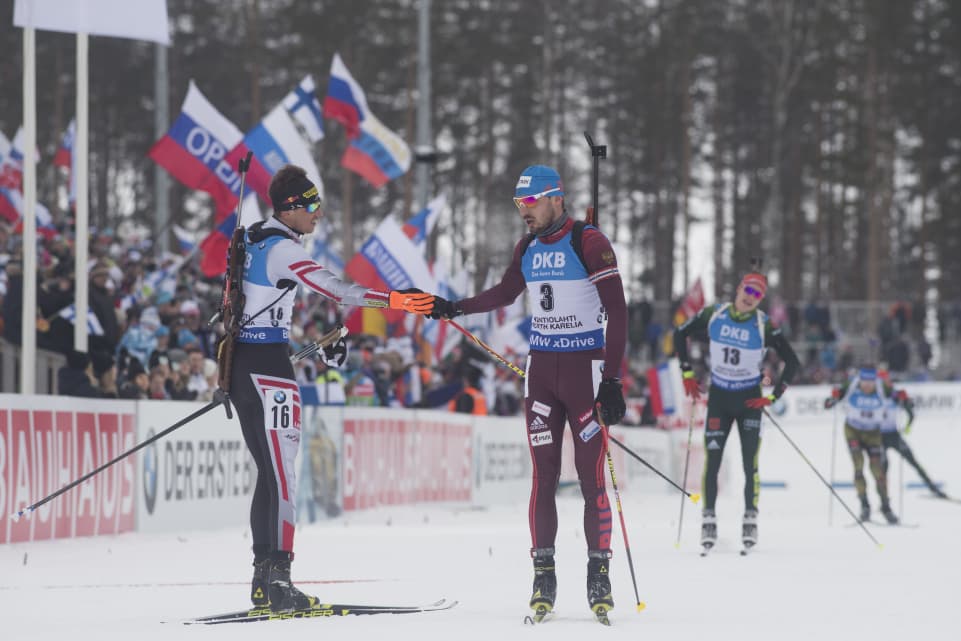
Austria’s Julian Eberhard (l) and Russia’s Anton Shipulin after the finish of the men’s 15 k mass start the IBU World Cup in Kontiolahti, Finland. Shipulin fell when his skis tangled with Eberhard’s. While Eberhard raced to the win, Shipulin placed third. (Photo: IBU/Biathlonworld)
“I wanted to be in a sprint with all three, but the bridge is too small for this,” Eberhard said, according to an IBU press release. “I came up the bridge with too much speed. Anton and I were in the same track and there was an accident. I apologized to Anton at the finish but he said these things can happen and it was OK with him.”
“I hold no grudge against Julian,” Shipulin told the IBU. “This can happen in sports and is all fair … I am in good shape and want to preserve this and perform my best in the last World Cups.”
Fourcade explained that illness caused him to sit out Thursday’s sprint, and he was only able to train three hours this week.
“It is really difficult to race in this situation without any feeling or training,” Fourcade told the IBU. “I did not know what to expect today but I am quite satisfied. I would have liked to win, but I used too much energy trying to come back in the early laps and had no energy when it was time to attack.”
Behind them, Doll picked off one place on the final loop to finish fourth (+21.9), passing his German teammate Erik Lesser, who finished fifth (+23.9). Peiffer followed in sixth (+27.1) as Germany had three in the top six.
American Lowell Bailey raced to 14th (+1:06.3) with two penalties, both of which came in the standing stages (0+0+1+1). Bailey had been fourth after cleaning the second prone, 16 seconds behind Doll in first, but slipped to 10th after missing one on the next bout. He had to ski another penalty lap on the last stage, and left the range in 14th.
Overall, Bailey posted the 10th-fastest shooting time, 15th-fastest range time and 18th-fastest course time.
“I finally felt like I was back in the spot that I ended last season,” Bailey wrote in an email when asked about his consistency. “I felt controlled and able to keep the pace with the top of the field throughout the race. It was nice to be back in the mix.
“Although I would have liked to see this ski speed a few weeks ago, better late than never!” he continued.
Next week’s World Cup in Oslo, Norway, will be his last of the season and his career.
“After nearly two decades of international racing, Oslo will be my final World Cup as a U.S. Biathlete,” Bailey wrote. “I’m sure it will be emotional but I hope to end my World Cup career on a high note!”
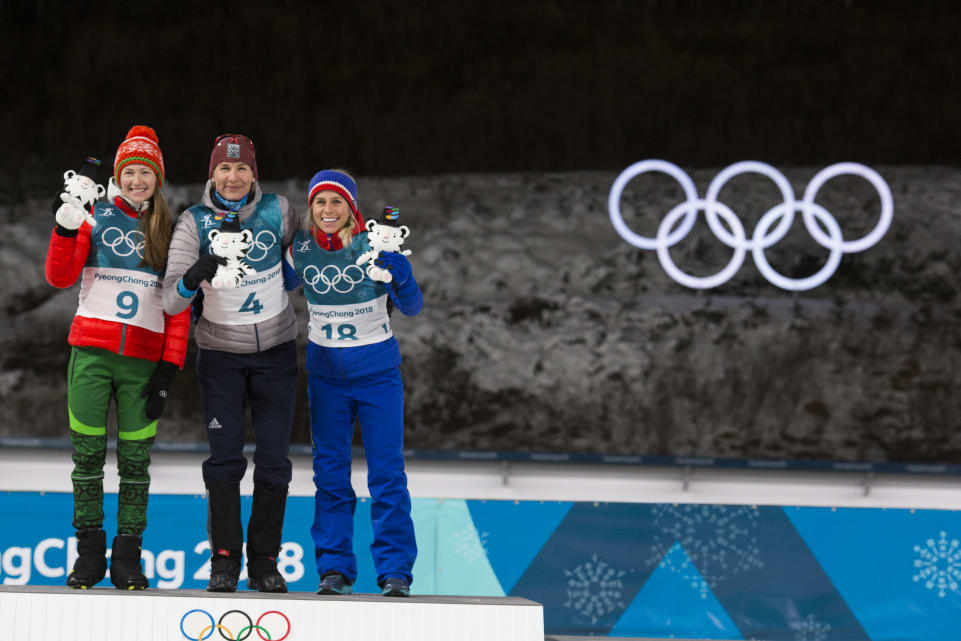
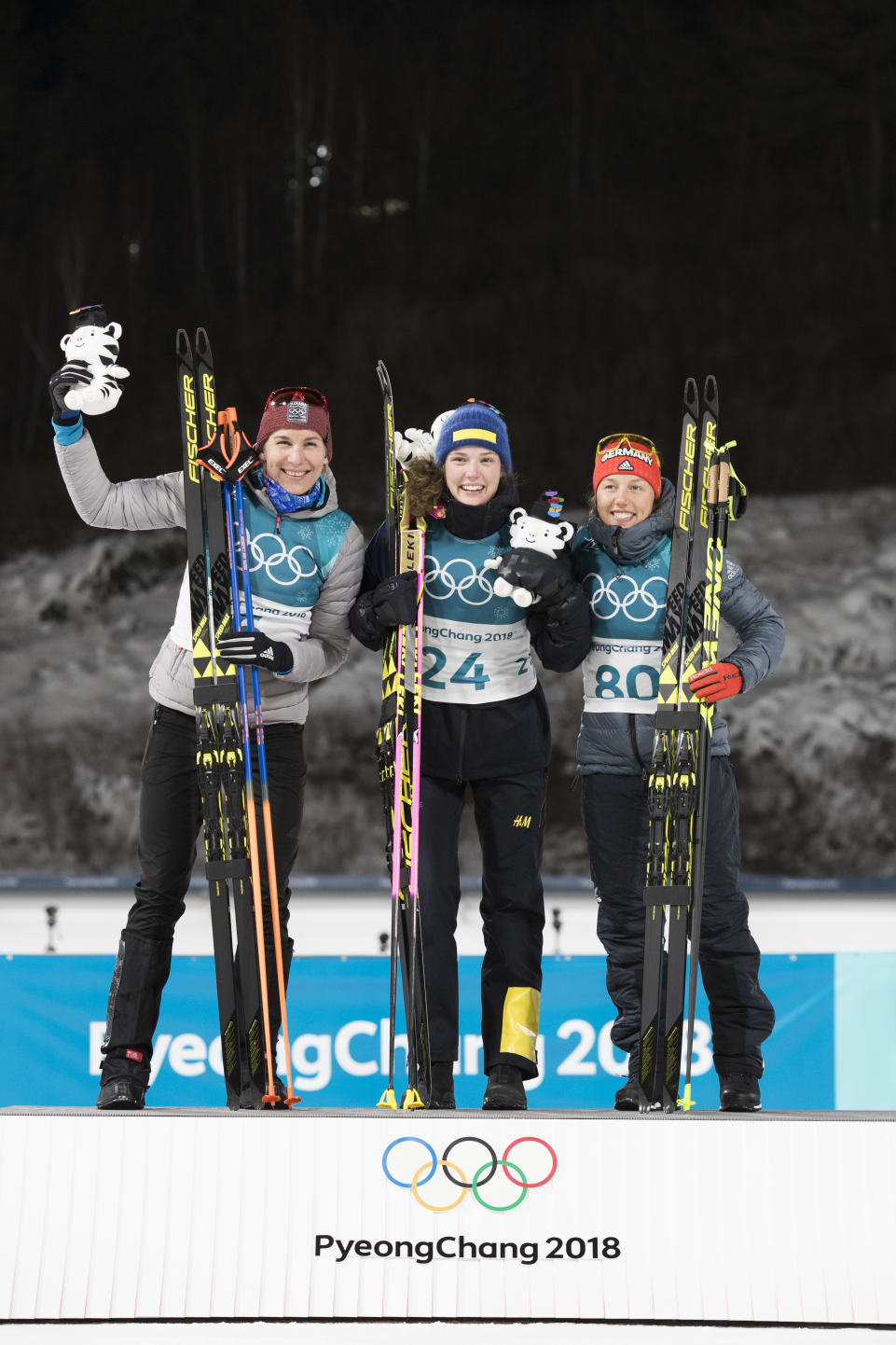
The women’s biathlon 12.5 k mass start medalists at the 2018 Olympics in PyeongChang, South Korea, with Slovakia’s Anastasiya Kuzmina (c) in first, Belarus’s Darya Domracheva (l) in second, and Norway’s Tiril Eckhoff (r) in third. (Photo: IBU/Biathlonworld)
Slovakia’s Anastasiya Kuzmina made her intentions pretty clear early on at these Olympics.
“I am missing my brother,” she said when asked of her younger brother, Anton Shipulin, who was one of the Russian athletes banned from competing at the 2018 Games in PyeongChang. “I hoped to the last moment that he will be able to compete here … I am really sorry about what happened and that my brother is not here. I am here to fight for medals for my entire family. I won the one medal, and I want to win another medal for my brother.”
That was after she placed second in the women’s 10-kilometer pursuit on Monday. Two days before that, she had finished outside the medals, 13th, in the Olympics’ opening biathlon sprint.
But Kuzmina, who was born in Tyumen, Russia, and started racing for Slovakia in 2008, has been an all-around threat in the sport for some time. At her first Olympics in 2010 in Vancouver, British Columbia, Kuzmina won her first Olympic gold in the sprint and took silver in the pursuit.
Four years later, at the 2014 Olympics in Sochi, Russia — the Games that would later lead to her brother and multiple other top Russians being sanctioned for their alleged involvement in a systematic nationwide doping scandal — Kuzmina, still racing for Slovakia, racked up her second Olympic gold in the sprint.
She had a child after each Olympics yet came back, Olympic cycle after Olympic cycle, to dominate at the highest level of the sport.
Now 33 and in her third Olympics, Kuzmina raced to second in both the pursuit and 15 k individual on Thursday in PyeongChang. Then, on Saturday, in the last non-relay event of the championships and on yet another windy evening, she captured her third-career Olympic gold — winning the women’s 12.5 k mass start by 18.8 seconds in 35:23.0 minutes.
At a post-race press conference, she dedicated that medal to her adopted nation.
“I got my third medal here,” Kuzmina stated though a translator. “The first medal was conquered for me. The second one was conquered for my brother because I was sad that he is missing here and he was supporting me, was able to support me. And now the third medal is for entire Slovakia, for my team, and for many people which were supporting me in the hard times.”
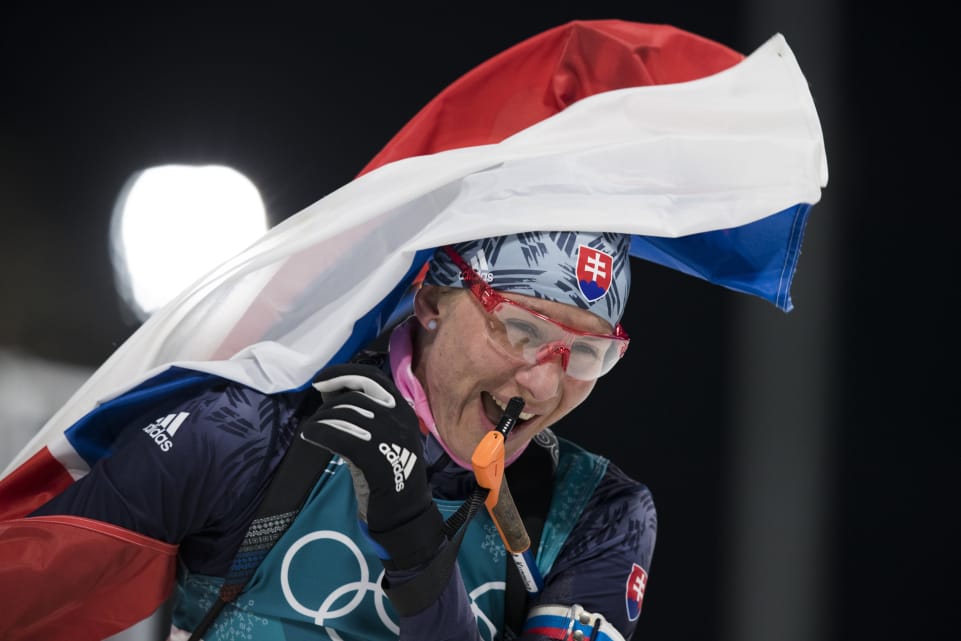
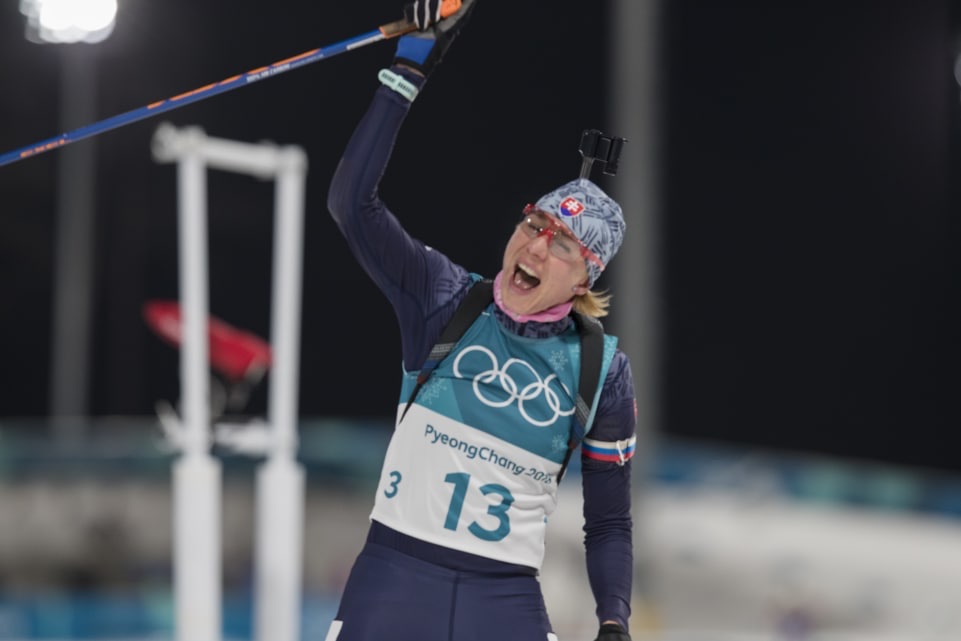
Slovakia’s Anastasiya Kuzmina with her nation’s flag celebrating her win in the women’s 12.5 k mass start at the 2018 Olympics in PyeongChang, South Korea. (Photo: IBU/Biathlonworld)
While Kuzmina’s win was resounding — she led from the first loop to the finish — it didn’t come without a blip. After cleaning three consecutive stages in the prone-prone-standing-standing mass-start format, she missed one in the final shooting bout. But even after a penalty lap, Kuzmina was still 24.7 seconds clear of Domracheva in second.
Leading into the range for each bout, Kuzmina generally cleaned quickly (shooting the fastest time on the first prone), slowing down slightly to hit the last shot of her second prone and a little bit more so on the third stage (17th-fastest shooting time) to ensure she stayed out of the penalty lap. Her last time in the range without anyone around her, Kuzmina posted the 30th-ranked shooting time and lost at least 20 seconds with her miss, but the win was still hers.
With her third gold, she became the first female biathlete to win at three consecutive Olympics. At Saturday’s press conference, she explained that she had thought her best chance for that medal would be in the sprint.
“When that didn’t happen I was really sad and nervous before the next races,” Kuzmina said. “But it happened here and the race was mass start, a different event than in Vancouver and Sochi, and it’s an incredible feeling. Nine years ago at the 2009 World Championships here in PyeongChang I won the first-ever medal for the Slovak Republic, for my homeland, and it was a silver medal and the race was mass start. I wanted to repeat it and to be again with a medal here in the same event in the same place, just nine years later.”
She’s not sure if she’ll have another kid over the next four years, or if she’ll be at the 2022 Olympics to try to win golds in four different Games.
“The next Olympics, at the moment I don’t know if I will quit my career or not or how long I will compete, how many years,” she said. “But I am not sure that I will be able to survive the next four years and compete in the next Winter Olympics.”
For Belarus, Domracheva claimed her first medal of the Games in second, after placing ninth in the sprint, then 37th in the pursuit and 27th in the 15 k individual. The silver was her fifth-career Olympic medal after she won three races in Sochi (pursuit, individual and mass start) and took bronze in 2010 in the 15 k individual.
Like Kuzmina, Domracheva has also been raising a small child in the leadup to PyeongChang. She and her Norwegian husband Ole Einar Bjørndalen, the most decorated Winter Olympian of all time with 13 medals, welcomed the birth of their first child, Xenia Bjørndalen, on Oct. 1, 2016.
Domracheva, 31, put herself in second on Saturday by the second stage, after cleaning both prone stages. She chased Kuzmina on the third loop, skiing less than 10 seconds behind her and at least 15 seconds ahead of Germany’s Denise Herrmann and Italy’s Dorothea Wierer in third and fourth. On the third shooting stage that followed, Domracheva shot a miss and had to ski a penalty lap, putting her in fifth and 44 seconds behind Kuzmina in first.
Wierer moved into second with clean shooting, setting out on the fourth loop 28 seconds behind Kuzmina.
On the final shooting, Wierer had her costly miss of the day, which dropped her to seventh and 39 seconds back. While several of the top contenders incurred penalties on that last standing, Domracheva cleaned to reclaim second, and Norway’s Tiril Eckhoff cleaned when it counted to leave the range in third, 9.3 seconds behind Domracheva.
While Kuzmina skied the overall fastest course time, her final loop only needed to be third fastest to secure the win. Heading into the final downhill that rounded into the stadium, she grabbed a Slovakian flag from one of her team’s staff members running beside her. The wind blew it directly into her face as she tried to wave it in front of the crowd, but it didn’t derail her nor erase the huge smile on Kuzmina’s face as she finished nearly 19 seconds clear of second place.
Domracheva skied the second-fastest last loop (and third-fastest course time overall) to claim second, a result she was pleased with.
“It was a tough race … because it was so high pressure during all races before,” Domracheva said at the press conference after. “The toughest was understanding that it was my last chance for an individual medal in these Games. And it was so important to keep this focus and continue to believe in yourself and I am very very happy that I have done that so well and took this silver medal.”
She acknowledged that several of her competitors were in a similar position of seeking a medal at these Games, including but not limited to Finland’s Kaisa Mäkäräinen (who finished 10th on Saturday with two penalties) and Eckhoff, who’s previous best result this week was ninth in the pursuit (Eckhoff is a two-time bronze medalist from 2014, in the mass start and relay).
“I knew that I was in some company of the girls who are quite strong, but who were so unlucky from the beginning of the Games,” Domracheva said. “And what kind of pressure … understanding that you try to do the best that you can, but something went wrong in the previous races, and this understanding of course gave me some kind of pressure. It was important to overcome this situation and start this mass start from zero.”
Eckhoff, 27, who overcame two penalties (1+0+1+0) en route to bronze (+27.7), attributed her result to some luck.
“I was lucky today and took a medal, but all year I trained for this, and I guess Kaisa did the same,” Eckhoff said at the press conference. “I was lucky, she was not. It’s hard for everyone I think, because of the conditions. And I know, Darya said it as well, it’s really tough when you don’t succeed here. And I am very happy that I managed it today.”
While the medalists skied into the finish separately and without any close competition, the race for fourth was a close one with Italy’s Lisa Vittozzi edging Sweden’s Hanna Öberg, Wierer and Belarus’s Nadezhda Skardino. She claimed fourth (+45.6). Öberg placed fifth (+46.5), Wierer sixth (+47.3), and Skardino seventh (+47.9), ahead of Norway’s Marte Olsbu in eighth (+51.6), France’s Marie Dorin Habert in ninth (+57.9) and Mäkäräinen in 10th (+1:00.9).
Only two out of 30 cleaned on Saturday, Skardino and Poland’s Monika Hojnisz in 15th (+1:36.2).
Germany’s Laura Dahlmeier finished 16th (+1:47.1) after two early penalties (1+1+0+0). She started the race by keeping pace with Kuzmina on the first loop as the two of them slightly gapped the field before the first prone. There, Dahlmeier missed one to drop to 22nd and about 35 seconds back. She missed one more on the second prone, which put her in 21st and 1:12.4 out of first. Previously, Dahlmeier had won two races this week (sprint and pursuit) and finished third in the 15 k individual.
No North Americans qualified for either of the mass starts. The men’s 15 k mass start is scheduled for Sunday at 6:15 a.m. EST.
It wasn’t the wire-to-wire triumph that Norway sometimes achieves, but the pre-race favorites got the job done despite a scare midway through, thanks to dominant skiing by Ragnhild Haga and smooth strength from anchor Marit Bjørgen.
Norway took gold in the 4 x 5 k relay by two seconds over Sweden in 51:24.3 minutes. Olympic Athletes from Russia took bronze (+43.3), Finland fourth (+1:02.6), and the United States fifth (+1:20.5).
The first leg went out with Natalia Nepryaeva of Russia setting a blistering pace, fracturing the field almost immediately. A number of racers tried to stay with her only to get shot off the back of the pack. Taking a different pacing strategy, Slovenia’s Anamarija Lampic made up ground in the final section of the first leg to tag off in second, with Norways’ Ingvild Flugstad Østeberg third, all within a few seconds of each other.
Part of Nepryaeva’s fracturing of the field led to U.S. lead skier Sophie Caldwell getting dropped, to tag off 1:01.5 minutes back in 11th place.
In the second leg, Charlotte Kalla of Sweden and Kerttu Niskanen of Finland clocked the fastest times, making up 24.4 and 9.9 seconds that had been lost to Russia and Norway by their teammates Anna Haag and Aino Kaisa Saarinen, respectively. In the meantime, Astrid Uhrenholdt Jacobsen of Norway had a disastrous relay leg and notched just the eighth-fastest split time, falling to fourth.
Yulia Belorukova of Russia continued to lead the race on that second leg, but Kalla tagged off at the end of the classic portion just 1.4 seconds back, and Niskanen in third (+10.1). Sadie Bjornsen made up three places to tag off in eighth (+1:05.2).
Jacobsen tagged Haga 29.8 seconds out of first. From that point, Haga gradually reeled in the leaders over the course of the 5 k skate leg. It was an absolutely dominant performance, with the fastest split time by 24.7 seconds in a less than 12-minute race.
Sweden’s Ebba Andersson led Russia’s Anastasia Sedova for the whole leg and stayed clear of the field, but Haga — the gold medalist in the 10 k skate — made up enough ground to finish her effort in third, 3.4 seconds back.
That was more than enough for Bjørgen to work with, and she and Swedish anchor Stina Nilsson quickly dropped Anna Nechaevskaya of Russia and set off on their personal duel for gold. Bjørgen led the whole way, but could not make any decisive move to drop the Swede. Instead, over the top of the climb she had about a second, which Nilsson could not close on the downhill or the final flats into the finishing straight: gradually, Bjørgen just added a meter and another to her lead and crossed the line with gold.
Nechaevskaya continued to lose time on the leaders, but still held on to bronze. Krista Pärmäkoski skied an aggressive effort for Finland to pass the team from Switzerland, which had been in fourth after strong legs from Laurien van der Graaff, Nadine Fähndrich, and Nathalie von Siebenthal. But 21-year-old Lydia Hiernickel was unable to keep the pace and Switzerland dropped to seventh by the finish, getting passed by not only Parmakoski and Jessie Diggins, but also Sandra Ringwald of Germany. The Germans finished sixth (+1:49.4) and Switzerland seventh (+1:51.5).
Kikkan Randall had skied the third-fastest split of the field (behind Haga and Andersson) in the third leg to bring the U.S. into sixth, and Diggins also skied the third-fastest split (behind Bjørgen and Nilsson) for her leg to bring the team up to fifth at the finish.
The Canadian team of Dahria Beatty, Emily Nishikawa, Cendrine Browne, and Anne-Marie Comeau placed 13th (+4:50.3) of 14 teams.
The women’s biathlon 12.5 k mass start medalists at the 2018 Olympics in PyeongChang, South Korea, with Slovakia’s Anastasiya Kuzmina (c) in first, Belarus’s Darya Domracheva (l) in second, and Norway’s Tiril Eckhoff (r) in third. (Photo: IBU/Biathlonworld)
Not even a miss in the final stage could keep Slovakia’s Anastasiya Kuzmina from her third medal of the 2018 Olympics, this time gold, in the women’s 12.5-kilometer mass start on Saturday at the Alpensia Biathlon Center.
Kuzmina took charge early in the five-loop race, leading Germany’s Laura Dahlmeier into the range for the first prone shooting stage. There, Kuzmina cleaned all five targets quickly to get back out on course in first, while Dahlmeier missed one to slip out of the top 20, while several other athletes cleaned.
Kuzmina went on to hit every target over the next two shooting stages to distance herself from second place, and even with a miss on the last standing stage, she left the range 24.7 seconds clear of Darya Domracheva of Belarus in second.
Domracheva had put herself in second with clean shooting in the first two stages, then dropped to fifth with a miss on the third stage. Italy’s Dorothea Wierer was up to second by the fourth shooting after three clean stages, then fell back to seventh with a miss on the last standing.
There, Domracheva cleaned to get back into silver-medal contention, 9.3 seconds ahead of Norway’s Tiril Eckhoff in third.
Heading into the final downhill into the stadium, Kuzmina had enough time to grab a flag from one of her team’s staff members running alongside the trail. She crossed the finish line first in 35:23.0 minutes without anyone close for her third-career Olympic gold (after winning the sprint at the 2010 and 2014 Games).
Domracheva skied on her own to second, 18.8 seconds behind, for her first medal of the 2018 Games (and fifth of her career after winning three races at the 2014 Olympics).
Eckhoff, who had skied two penalty laps, took third, 27.7 seconds behind Kuzmina, while Italy’s Lisa Vittozzi held off Sweden’s Hanna Öberg, Wierer and Belarus’s Nadezhda Skardino for fourth place (+45.6). Öberg placed fifth (+46.5), Wierer was sixth (+47.3), and Skardino seventh (+47.9), ahead of Norway’s Marte Olsbu in eighth (+51.6), France’s Marie Dorin Habert in ninth (+57.9) and Finland’s Kaisa Mäkäräinen in 10th (+1:00.9). Dahlmeier, who had won two races and placed third in another at these Olympics, finished 16th (+1:47.1) with two penalties (1+1+0+0).
Sweden’s Hanna Öberg on her way to a gold medal in the women’s 15 k individual at the 2018 Olympics in PyeongChang, South Korea. Öberg skied the sixth-fastest time and shot 20/20. (Photo: IBU/Biathlonworld.com)
PYEONGCHANG, South Korea — It was a day for firsts here at the 2018 Winter Olympics.
At the Alpensia Biathlon center, athletes for the first time saw mild temperatures, blue skies, and — perhaps most importantly for success in the individual race — tame winds. All welcome firsts at what’s been a blustery and downright chilly Games, and it came just a day after the race jury postponed the women’s 15 kilometer individual race due to high winds.
But another first was the most stunning. Twenty-two year old Swedish biathlete Hanna Öberg skied with panache and shot with zen-like nerves on the biggest athletic stage of her life to win gold in the rescheduled 15 k.
“It’s really big for me that I could take this step,” she said in a press conference. “And to have my parents here, it means a lot, and also my boyfriend. To share this with everyone means the most to me. It’s really big.”
The individual race is relentless in its capacity to shatter nerves. Five three-kilometer loops in total and twenty shots — four shooting rounds alternating prone and standing — and each miss carries a draconian one-minute penalty.
Anything can happen on individual race day. Shoot clean and the podium’s top step is within grasp. Miss and you plummet through the rankings. That means opportunity, but also stress.
While many of her competitors have experience trying to manage that stress (successfully or not), Öberg hadn’t been here before.
Sweden’s Hanna Öberg at the flower ceremony celebrating her gold medal in the women’s 15 k individual at the 2018 Olympics in PyeongChang, South Korea. (Photo: IBU/Biathlonworld.com)
“I’m 22 years old and last season was my first in the World Cup, and also my first World Championships, in Hochfilzen,” Öberg said, laughing at the incredible spot she had climbed to. “The season before that, I took two gold medals at the Junior World Championships. That’s also the last time that I shot four zeros in a competition.”
Öberg has only notched three top-10′s on the World Cup, and before Thursday’s golden performance, Öberg’s fifth in the pursuit here matched a career best.
But shoot clean in this race, and you’ve made your own opportunities to grab gold.
Opportunity knocked for Öberg after three clean shooting rounds. She left the range in first place on her fourth ski loop and kept pace, setting herself up for a tense five shot sequence. Enough Swedish fans populated the stands to cheer as each of Öberg’s targets fell. The final 3 k loop remained tense for the what ifs for the young Öberg: a snagged V-board or a corner skied too wide could mean a medal gone.
None of that happened, of course.
Öberg stopped the clock in 41:02.7, but she had to wait nearly half an hour to know that she had sealed the deal. She had an early bib and among the many athletes behind her in the start order was last season’s world number one, Laura Dahlmeier of Germany, a late starter in bib 80.
But Dahlmeier only shot 19/20, and couldn’t catch Öberg’s time on the tracks, ending up with a bronze medal instead.
“I think not just me, I think everybody knows that it was a really, really great day for Hanna,” Dahlmeier – who won the other two gold medals awarded so far at these Olympics – said in the press conference. “I think it was her first time to be on the podium, and it’s really great to be on the podium at the Olympics. It must be one of the best days of her life… with a clean shooting and good skiing performance, you can win a race. And today not so many athletes shot zero, I think just three athletes. It’s great for her and also for the whole Swedish team.”
“Of course I’m surprised,” Öberg said of her win. “I could not believe this before and I knew that maybe this performance today could have taken me to a medal but that I would win this race, it’s just unbelievable.”
Slovakia’s Anastasiya Kuzmina on course in the 15 k individual at the 2018 Olympics in PyeongChang, South Korea. Kuzmina finished second to earn her second medal of these Olympic Games, two match two sprint gold medals from 2010 and 2014. (Photo: IBU/Biathlonworld.com)
If it was a surprise for Oberg, it was a turnaround for Sweden, which did not send a women’s team to the 2014 Olympics because the Olympic Committee did not feel that any of the biathletes had the potential for acceptably strong results.
But in the 15 k, Linn Persson finished 11th and Mona Brorsson 14th; Brorsson was also 10th in the pursuit.
“I just want to say, I’m super impressed with Sweden,” American biathlete Susan Dunklee said in the finish area, when Dahlmeier was still out on course. “Holy shit. In 2014, Sweden did not take a women’s team to the Olympics. I felt so bad for the one woman on the team who was on the bubble for that and they decided not to take her, which I thought was really stupid. And then turn around, four years later, you have a potential gold medalist here, [and] couple of the top 10’s or something?”
The two pre-race favorites were Anastasiya Kuzminaof Slovakia and Dahlmeier, both of whom were already medalists at this Games.
Kuzmina placed second in the 10 k pursuit on Monday. If Öberg kept it together considering her lack of championship experience, Kuzmina faltered twice on the range despite hers. Kuzmina raced to gold in the 2014 Olympic sprint, and gold and silver in the 2010 Olympic sprint and pursuit, respectively.
Germany’s Laura Dahlmeier at the finish of the women’s 15 k individual biathlon competition at the 2018 Olympics in PyeongChang, South Korea, where she won bronze. (Photo: IBU/Biathlonworld.com)
Despite suffering a single miss in the first standing and second prone rounds, for two misses total, Kuzima finished with a time just 24.7 seconds behind Öberg’s. The Slovak made up her two-minute shooting penalty on the skis, clocking the fastest ski time for each of her five ski loops to earn her first career championship medal in the individual format race.
“To be honest, I have to say that this is the event which I had the smallest ambitions from [in] for all the individual-start events here,” Kuzmina said during the press conference. “But I told myself that this is another chance to get a medal, and I wanted to do everything like in training, everything perfectly, fully focused [on] each shoot.”
Germany’s Dahlmeier, a double-gold medalist in PyeongChang, having won the sprint and pursuit, won bronze (+41.2). She had a single penalty in her first shooting round.
“With the first shooting I had this miss and just tried to stay focused,” Dahlmeier said. “I know it with one miss, it must be possible to reach the podium, but it’s better to have a clean shooting, and after the first miss, I tried to stay focused.”
Shooting clean the remainder of her rounds, Dahlmeier charged on the skis. Of her five ski loops, two were the second fastest splits, three the third fastest.
Her German teammate Franziska Preussof Germany finished fourth, +59.0 with clean shooting, and Paulina Fialkovaof Slovakia placed fifth (+1:02.3) with one missed shot. Poland’s Monika Hojniczfinished sixth (+1:54.8) with one missed shot as well.
Three North Americans in Top 30
American biathlete Susan Dunklee was the best placed North American in 19th (+3:26.3), after two misses on the range.
Posting a 66th place on Saturday’s 7.5 k sprint, Dunklee had not advanced to contest the pursuit, which was disappointing for last year’s World Championships silver medalist.
“I’m still bummed about that day,” Dunklee said of the sprint. “But I think one of the things that biathlon does is train you how to be resilient and how to pick yourself up over and over again. It was certainly not the first day that sort of things happened to me. Maybe it’s the first day at a really big, big stage like this, but I think I’ve had lots of experience over the years for refocusing. You have to let yourself be sad for a few hours but then you have to set a deadline and say, OK, by this time of day, I’m going to just start only allowing myself to focus on the positives again and move forward.”
Thursday’s 15 k proved more to Dunklee’s liking. She’s mending a cold which she says has left her feeling sapped.
“I was so happy to have that extra day off [due to the wind postponement] and I’m slowly getting over this cold,” Dunklee explained. “It’s getting better and better each day but it’s not quite 100 percent. I felt like I could focus on the shooting range. My head was a little bit more clear, less foggy, so that was really nice.”
Dunklee’s teammate Joanne Reid finished 22nd (+3:34.1), for her best-ever result in top-level international competition, with just one missed shot. Reid was not scheduled to race Thursday’s 15 k individual, after finishing 86h – second from last – in the sprint.
Instead, Reid’s teammate Maddie Phaneuf had originally been penciled in for the individual, but came down with strep throat earlier in the week.
“I am really happy that I had a good race, just because I took Maddie’s spot here,” Reid added. “I didn’t want to go out there and have a bad day. And she is really disappointed that she didn’t get to race, so this one’s for her.”
Reid made the best of her opportunity. With her limited experience on the 3 k loop, Reid said her strategy required her to dial the pacing back slightly.
“There is nothing technical out here,” Reid said. “So you really are hammering, short recovery, you’re hammering, short recovery, you’re hammering, and then it’s this long downhill into the range. And if you are not really careful your legs will start shaking and that will throw off your shooting. So you have to be really focused the whole time and that can be really hard in a 15 k.”
Also for the U.S., Clare Egan finished 62nd (+6:53.6) with four penalties and Emily Dreissigacker 67th (+7:09.2), also with four penalties.
For Canada, Rosanna Crawford led the way in 26th (+3:48.7) with two penalties — both occurred in her first shooting round. During her interview, Crawford was upset for second-guessing herself during that round.
“I’m just frustrated,” Crawford said. “I made a correction in prone and then corrected back and missed where I corrected back to. I think I definitely could’ve hit 20. I know it’s a hard thing to do in biathlon, but I was feeling really confident on the range. I’m just really mad that I didn’t trust myself. This was my best chance to have a top 10. Hopefully I’ll qualify for the mass start but we’ll have to see.”
For now, Crawford remains on the “waiting list” for the mass start. Two athletes will have to drop out for a start position to open up for the Canadian.
“As I was warming up, I was like, ‘you have to trust yourself, you have to trust yourself’, and then I just didn’t do it,” Crawford said. “The next prone and the next standings, I did trust myself and I made a correction. All the hits were centered, so I definitely learned a lot. It’s unfortunate that you have to learn a lesson in an Olympic race. You wish that you could just go out there and do what you know how to do.”
Canadian Sarah Beaudry was close behind Crawford in 29th (+3:58.4) with one missed shot. It was the second-best result of her career, behind a 23rd-place World Cup finish in Oberhof, Germany, this January.
“Overall I’m really happy hitting 19 in my first Olympic race, and especially in race like the individual where it really counts,” Beaudry said. “I was really happy with that, especially because the last couple weeks I’ve been struggling with my prone position a bit, and I really felt confident and solid in my prone, so that was nice.”
Also for Canada, Emma Lunder finished 54th (+5:49.4) with three penalties and Julia Ransom was 74th (+8:31.4) with five missed shots.
It was a disappointing opening to the Olympics for Johannes Thingnes Bø of Norway, who despite winning eight World Cup races this season started the Games with finishes of 31st and 21st in the sprint and pursuit. But on Thursday he showed why he was a medal favorite and won the 20 k individual race – only by 5.5 seconds, but that margin becomes impressive when you consider that he had two penalties, and thus two minutes of penalty time, while silver and bronze medalists Jakov Fak of Slovenia and Dominik Landertinger of Austria (+14.2) shot clean.
Johannes Thinges Bø celebrates with Norwegian team staff after winning Olympic gold in the 20 k individual despite two missed shots. (Photo: IBU/Biathlonworld.com)
Sweden’s Sebastian Samuelsson followed up a silver medal in the pursuit with fourth place in the individual, missing one shot and notching a time 29.1 seconds behind Bø. France’s Martin Fourcade, gold medalist in the pursuit, missed two shots like Bø but finished in fifth (+42.4). Switzerland’s Benjamin Weger placed sixth (+48.6) with one penalty.
It was a good day for Canada on the back of strong shooting: Scott Gow placed 14th (+2:02.5) with one penalty for a career-best result result; he had previously had two 16th-place finishes on the World Cup this season. With the same shooting, Brendan Green placed 22nd (+2:26.6). Christian Gow had two penalties to finish 26th (+2:57.2). Canada’s fourth man, Nathan Smith, missed five shots and placed 81st (+8:11.9).
For the United States, shooting was not as successful and Tim Burke led the way in 41st (+4:01.9) with four penalties. With one less penalty Sean Doherty was close behind in 44th (+4:21.8). Lowell Bailey placed 51st with four penalties (+4:53.0) and Leif Nordgren missed five shots to finish 66th (+6:27.3).
Sweden’s Hanna Oeberg (center) won gold in the biathlon women’s 15 k pursuit, followed by Slovakia’s Anastasiya Kuzmina (left) in silver and Germany’s Laura Dahlmeier in bronze. (Photo: IBU/Biathlonworld.com)
A few days after teammate Samuelson scored a career-best result to earn silver in the pursuit, Hanna Öberg of Sweden used perfect 20-for-20 shooting to capture gold in the women’s 15 k individual. The 22-year-old’s previous best results were fifth place in both Monday’s pursuit, and in a World Cup race last season.
She bested the two pre-race favorites: Anastasiya Kuzmina of Slovakia had two penalties but still managed a silver medal, her second of the games, finishing +24.7. And double gold medalist Laura Dahlmeier of Germany had one penalty and earned bronze (+41.2).
It was a good day for both of those teams as Franziska Preuss of Germany finished fourth, +59.0 with clean shooting, and Paulina Fialkova of Slovakia placed sixth (+1:02.3) with one missed shot. Poland’s Monika Hojnicz finished sixth (+1:54.8) with one missed shot as well.
The United States was led by Susan Dunklee in 19th, with two penalties (+3:26.3). Her teammate Joanne Reid finished 22nd (+3:34.1), her best-ever result in top-level international competition, with just one missed shot. Clare Egan finished 62nd (+6:53.6) and Emily Dreissigacker 67th (+7:09.2) with four penalties apiece.
For Canada, Rosanna Crawford led the way in 26th (+3:48.7) with two penalties and Sarah Beaudry was close behind in 29th (+3:58.4) with one missed shot. Emma Lunder finished 54th (+5:49.4) with three penalties and Julia Ransom was 74th (+8:31.4) with five missed shots.
Montana State University student Johanna Talihärm of Estonia finished 50th (+5:36.8) with three penalties.
Thursday afternoon saw more of the same for the women’s cross-country ski events at this year’s Winter Olympics: Scandinavia filling up the podium, with American Jessie Diggins tantalizingly close to that breakthrough American podium in fifth. This time it was Norwegian Ragnhild Haga in first in the 10 kilometer freestyle individual start, Charlotte Kalla of Sweden in second (+20.3), and Finland’s Krista Pärmäkoski and Norway’s Marit Bjørgen tied for third (+31.9).
The bronze is Bjørgen’s 12th lifetime Olympic medal, moving her into a tie with fellow Norwegian Bjørn Dæhlie for the most Olympic medals won by a cross-country skier. Countryman Ole Einar Bjørndalen, a biathlete, holds the overall Winter Olympics record with 13.
Diggins was 35.2 seconds back of Haga in fifth. She was in seventh place through 1.6 k, up to fifth at 5 k, up to third at 6.2 k, and still in third at the 8.4-k time checkpoint, 1.9 seconds up on Bjørgen and five seconds up on Pärmäkoski. But her form seemed to break down over the final uphill, and Diggins lost just enough time on Bjørgen and Pärmäkoski over the final 1.6 k to slip off the podium.
Between a 4.6-second deficit to third in Saturday’s skiathlon and a 3.3-second gap here, Diggins has now missed two bronze medals by a combined 7.9 seconds over 25 kilometers of racing.
Jessie Diggins pushing to the finish in the Olympic 10 k skate. The American finished fifth. (Photo: FlyingPointRoad)
Sixth place went to Swiss skier Nathalie von Siebenthal (+49.8), who slowed slightly after a fast start that saw her with the second-ranked time through 1.6 k. Ingvild Flugstad Østberg (+1:05.5), in seventh, was the third Norwegian in the top seven.
Olympic Athlete from Russia Anastasia Sedova (+1:07.3), Austrian Teresa Stadlober (+1:15.6), and Olympic Athlete from Russia Anna Nechaevskaya (+1:24.3) rounded out the top ten.
Sadie Bjornsen (+1:42.1) in 15th and Kikkan Randall (+1:49.9) in 16th were the next two Americans. Randall started relatively early with bib number 23, and was the leader in the clubhouse when she crossed the finish line. Liz Stephen (+2:35.4) was 30th.
For the Canadians, Emily Nishikawa (+2:41.) led the way in 32nd. Dahria Beatty (+2:48.4) was 37th, Cendrine Brown (+3:11.9) 43rd, and Anne-Marie Comeau (+4:10.8) 62nd.
Also of note, Australia’s Jessica Yeaton, who lives and trains in Anchorage with Alaska Pacific University, recorded an Olympics personal best finish of 41st (+3:09.1). University of Alaska Anchorage student Casey Wright, also competing for Australia, finished 81st (+6:55.8).
University of Colorado skier and NCAA champion Petra Hyncicova of the Czech Republic finished 60th (+4:09.4). University of New Hampshire alum Annika Taylor of Great Britain finished 75th (+5:52.4).
And Jaqueline Mourau of Brazil, who lives and trains in Quebec, was 74th (+5:49.8).
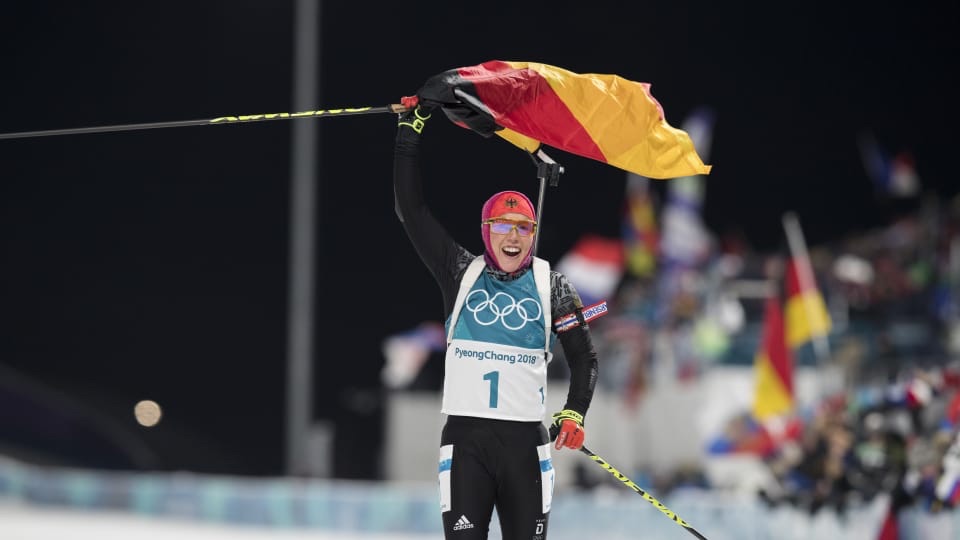
Gold medalist Laura Dahlmeier of Germany celebrates waiving a national flag as she crosses the line first in the women’s 10-kilometer pursuit at the 2018 Olympic Winter Games in PyeongChang, South Korea. (Photo: IBU/Biathlonworld)
It was almost another start-to-finish victory at the Olympic Winter Games in PyeongChang for the current golden girl of biathlon, Germany’s Laura Dahlmeier. But it came with a painful price to pay.
After starting the women’s 10-kilometer pursuit on Monday evening local time in freezing temperatures and with a 24-second lead following her sprint victory, Dahlmeier began the race intensely focused, again cleaning the first prone stage.
But this time she was not uncontested.
After starting in 13th position and almost a minute back to begin the pursuit, Slovakia’s Anastasiya Kuzmina, who’s currently second in the World Cup Total Score standings, caught up to Dahlmeier after both had incurred one penalty in the second prone shooting and avoided more by performing multiple adjustments on their rifle sights to deal with gusts of wind.
After closing a nine-second gap, Kuzmina passed her rival on the next loop. But Dahlmeier did not seem to mind someone else helping her to set the pace in once again difficult conditions on the course and range (the race jury reportedly debated a potential postponement), and tucked behind Kuzmina to wait for her next chance in the standing shooting. There Dahlmeier cleaned again, leaving the range with a 38-second lead after Kuzmina had to twice ski through the penalty lap, but still retained second place as the closest pursuer.
“On the third loop we raced together, and on the uphill part Anastasiya was really strong and I just wanted to follow her and we had a good speed together,” Dahlmeier later recounted at the post-race press conference. “And at the shooting range, I felt really comfortable. I know about my good standing shooting, and I just looked to my targets and wanted to hit the middle and it worked … During the last years I could improve my shooting in wind situations, but I didn’t especially train wind situations [for PyeongChang].”
“Laura is a very hard opponent to beat,” Kuzmina said at the press conference, via a translator. “She is able to fully focus on the shooting and she is able to shoot very good also in the strong wind, so you can fight with her on the skis of course, but you need to shoot very good to beat her.”
In her final shooting stage, Dahlmeier again cleaned all targets and left the range with a 55-second lead on Kuzmina, with France’s Anaïs Bescond right behind the Slovakian.
“If I would already think that I might miss a target when approaching the range for the fourth time, I believe that would be the wrong mindset. I just tried to concentrate on myself, on my own targets,” Dahlmeier told German broadcaster ZDF when questioned about the final shooting, when she probably could have afforded to compensate for one penalty lap. “I have proven often enough that I can hit [when it matters], in training we simulate that every day. And I just firmly believed that it will work out again today. And it did, so I am very grateful for that.”
With such a comfortable lead, nobody could challenge her anymore on the final loop. On the finishing stretch Dahlmeier had enough time to reach for a German flag handed to her from the stands, before crossing the line in a time of 30:35.3 minutes, with one penalty (0+1+0+0).
Anastasiya Kuzmina of Slovakia celebrates after crossing the finish line in second place in the women’s 10-kilometer pursuit at the 2018 Winter Games in PyeongChang, South Korea. (Photo: IBU/ Biathlonworld)
Fighting for the positions on the podium behind her, Kuzmina crossed the line 29.4 seconds back to claim the silver medal, winning the finishing sprint against Bescond, who had to settle for bronze (+29.6).
Bescond moved up from a 19th starting position largely thanks to her 19-for-20 shooting with just one penalty lap (0+0+1+0), though she also skied the fifth-best overall course time, while Kuzmina overcame four misses (0+1+2+1) with the fastest course time of the day, just as she had done in the sprint.
Almost another minute back, fourth place went to sprint silver medalist Marte Olsbu of Norway (+1:07.3, four penalties), fifth to Hanna Öberg of Sweden (+1:08.9, three penalties), and sixth to Dahlmeier’s teammate Denise Herrmann (+1:19.4, two penalties), who improved from starting in 21st position. Sprint bronze medalist Veronika Vitková of the Czech Republic fell back to seventh (+1:37.3, three penalties).
Going to the stands a few minutes after reaching the finish, Kuzmina hugged her friends and relatives, including her husband and a teary eyed woman (presumably her mother) who was wearing a sports jacket embroidered with Russian emblems. Herself a mother of two, Kuzmina is the older sister of Russian star biathlete Anton Shipulin, who was not invited by the International Olympic Committee (IOC) to compete as part of the neutral Olympic Athletes from Russia team in PyeongChang. An appeal to the Court of Arbitration for Sports (CAS) was denied just hours before the Opening Ceremony. Kuzmina has been racing for Slovakia since 2008, only competing for Russia at two Junior World Championships and never at senior-level championships.
“I am missing my brother. I hoped to the last moment that he will be able to compete here,” Kuzmina said about the topic when asked about it in the press conference, via a translator. “I don’t want to talk a lot about this issue. I am really sorry about what happened and that my brother is not here. I am here to fight for medals for my entire family. I won the one medal, and I want to win another medal for my brother.”
Kuzmina, 33, is an Olympic gold medalist in the sprint and silver medalist in the pursuit at the 2010 Olympics in Vancouver, British Columbia, and sprint gold medalist from 2014 in Sochi, Russia.
“This is a very special feeling to have the third medal from the third Olympics in a row,” Kuzmina explained. “Almost everybody who talked to me was [expecting] that I could win the sprint here, because I won the sprint in Vancouver and Sochi as well. That didn’t happen, but I am very glad that I managed to defend the silver medal in this event like in Vancouver eight years ago.”
For the 30-year-old Bescond it was her first medal at Olympic Winter Games, after she narrowly missed out four years ago in Sochi with two fifth places in the sprint and individual.
At 2016 World Championships she had taken silver in the 15 k individual in Oslo, Norway, and she’s also earned six medals with French relay teams. But last season was a down year where she started just one race at 2017 World Championships in Hochfilzen, Austria, and finished outside the top 50 before she rebounded with a third place in the pursuit at the World Cup test event last year in PyeongChang.
“Of course it was never granted that I make the podium,” Bescond said in the press conference, via a translation. “It was very difficult for me not being able to do the World Championships [in Hochfilzen]. This year I really wanted to perform very well, and the Olympic Games is the best thing you could think of, the Holy Grail. So I did think about last year this time, and I was very happy to have a very good race.”
“Laura really dominates our sport, but there a lot of good athletes out there,” Bescond stated when asked how her opponent could be beaten at these Olympics. “They are strong, they got lots of qualities, what you need to do is be faster on the skis and shoot better and faster, that’s it.”
Sounds easy enough.
But if her opponents couldn’t quite yet do it in the pursuit on Monday, the weather conditions and all the increased attention on Dahlmeier, who usually guards her private life closely, pushed her to her limits.
“I am extremely happy that everything worked out so well again today,” Dahlmeier told German broadcaster ZDF right after the race. “I tried to be fully focused on the shootings, on the course I didn’t feel quite as relaxed. On the one hand the conditions were very demanding, and the past two days have taken a toll on me with a lot of media appointments, a lot of additional stuff. At the moment I am feeling quite well, but of course it is cold and when the fingers thaw up, maybe some viewers know it, that hurts quite a bit.”
Soon after, Dahlmeier was no longer in the mood to celebrate, as she had fully exhausted herself for the victory. And her frozen fingers exposed to the cold in thin race gloves now seemingly really hurt, even though in the press conference before she had claimed that “I always spend a lot of time in the mountains and there it’s normal to have wind and cold temperatures, so perhaps I am a little bit used to it.”
“Primarily it was the cold. She is in extreme pain,” Stefan Schwarzbach, a manager and speaker for the German Ski Federation, later told ZDF after she had to cancel a planned studio appearance. “So when [her hands] thawed up she really had tears in her eyes, it was painful to watch. After the doping control she put herself to rest, she is just completely finished.”
At last year’s World Championships in Hochfilzen, where she won five medals, she physically collapsed after two races to the point that the German team doctor did not want her to start the mass start. In the end her stubbornness prevailed, and she also won that race overtaking American Susan Dunklee on the final lap.
“We already know that from last year, we just have to be careful with the sum of the exertions in competition,” Schwarzbach said. “And I believe the spectators will be accepting if she reduces the media work a little bit, and then hopefully can stand at the start line for the individual with full strength. … She will be all right, but we will reduce her program to what is necessary, even if it would have been nice to celebrate the second gold medal.”
North Americans Moving On Up
Canada’s Rosanna Crawford finished 19th in the pursuit as the best North American, moving up from 53rd at the start, based on her sprint result, to finish 19th (+2:27.7) for her best individual result at her third Olympics.
Canada’s Rosanna Crawford (22) during the women’s 7.5 k sprint on Saturday, Feb. 10 at the 2018 Olympics in PyeongChang, South Korea. She finished 53rd then went on to place 19th in the pursuit on Monday. (Photo: FlyingPointRoad)
On the range, Crawford managed to cope well with the windy conditions, shooting 18-for-20 with one miss in each of her standing stages (0+0+1+1). In an interview with FasterSkier after, she said she would have liked to avoid one mistake she made in the final shooting.
“[The wind] seems to have been more consistent,” Crawford said. “My zeroing went really well, I had my sights, I knew exactly where they were and what corrections I would need to make. So prone I was really confident. … In my last standing I didn’t mean to pull the trigger on my first shot, so that was a bit of a disappointment.”
She enjoyed her race despite the harsh weather and demanding tracks, skiing the 19th-ranked overall course time.
“For sure I love the 2k [pursuit loop] here,” Crawford said. “I [also] was 19th with 18-for-20 last year at the World Cup here. Yeah, the 2 k is so much fun. You just have to grit your teeth up that hill and then just rip along the top and back down to the range, and I love it so much. My skis were amazing. Our techs did such a good job. So I just had some fun out there today.”
Asked how she got into a better mindset following the sprint, Crawford said she called her older sister, a 2006 Olympic gold medalist in cross-country skiing.
“I had some really good chats with my sister Chandra,” Crawford said. “She’s a huge motivator for me and my biggest cheerleader now. She really just talked some sense into me to not be so down on myself after the sprint, so that was really helpful.”
Julia Ransom (Biathlon Canada) during the women’s 7.5 k sprint at her Olympic debut in PyeongChang, South Korea. She finished 40th then went on to place 28th in the pursuit on Monday. (Photo: FlyingPointRoad)
Teammate Julia Ransom also improved from her sprint position, moving up by 12 places to finish in 28th place (+3:03.0) with one miss in her last standing stage. She was one of just six women on Monday who shot 19-for-20, with no one shooting clean.
“I had some really solid shooting today hitting my first 15, missing my 18th or 17th shot,” Ransom recounted after the race. “I am a confident shooter in the wind, I know corrections fairly well, and I think you just have to make good shots and that’s all you can hope for”
On the course she skied the 44th-best course time after a faster first loop.
“My legs were not feeling as good as I was hoping they’d be, so I was really happy to keep it together in the range and just slowly work my way up and ski with the other girls,” Ransom concluded.
American Emily Dreissigacker racing to 47th in the women’s 10 k pursuit at the 2018 Olympics in PyeongChang, South Korea. (Photo: Ross Burton/US Biathlon)
Emily Dreissigacker, the lone American to qualify for the women’s pursuit, improved by four positions after starting in 51st to finish 47th (+5:01.4) with four penalties (0+1+1+2).
That was another improvement on her personal best at the World Cup-level, which she achieved in Saturday’s sprint. Before these Olympics, Dreissigacker’s best result on the International Biathlon Union (IBU) World Cup had been 56th place in a pursuit in Antholz, Italy, last month.
On the course she recorded the 54th course time, steadily holding her position on the three loops between the shooting stages.
“I think the skiing felt a little better than the sprint two days ago,” Dreissigacker said after. “Getting to ski with people is always really fun, and my skis were amazingly fast.”
Just like Crawford, she also preferred the loop the pursuit was raced on over other courses in PyeongChang.
“I really like the 2 k course,” Dreissigacker said. “You climb up and then you come back down, which is something that I really like. I think mentally especially, I’m like ‘All right, gotta get to the top of this hill and then I have time to recover,’ which is nice.”
“I really just like to try to keep things simple,” she said of her shooting performance and approach to the wind-exposed range. “Just relax, if the wind comes up just wait for it to pass or if it’s not going to pass take some clicks. I really think the simpler you can keep it the better.”
“The wind can be a little tricky,” she told US Biathlon, according to a press release. “In my first standing stage, actually, I had to wait out a pretty big gust of wind. All the people around me were waiting, too, and we’re all just standing there waiting for it to die. That’s kind of just how it is. You have to be able to deal with that … be able to wait and not freak out.”
Canada’s Emma Lunder finished 53rd (+6:16.8) after starting 54th then shooting four penalties (0+1+1+2).
“It was not great,” Lunder reflected. “Started out with shooting OK, unfortunately missed two in my last standing and just did not have it in the legs today, so the skiing was a big struggle.”
While not completely satisfied with her race performance, the 26-year-old Lunder said she was making the most out of her first Olympic experience.
“The whole time I was just trying to remind myself, I am at the Olympics, racing my first Olympics. It’s such a cool atmosphere, so even if the race isn’t going as well as I would like I am still pretty happy to be here,” Lunder explained. “The racing doesn’t feel different from a World Cup. It’s being at the Athlete’s Village with athletes from every sport all over the world, the best in the world, that’s been pretty special. I have [met] quite a few people who I never thought I would meet, so I have just been trying to take it all in and also try to perform as well as I can.”
Asked how she is dealing with the cold conditions and prepares for her upcoming races, Lunder added, “I would say a lot of it is energy management. When it’s this cold out I find I am a lot more tired, burning more calories just from shivering. So we have a therapist here with us. I will see her for some treatment, just take a bit of time to lay in bed and watch some movies, do whatever I can to rest up a little bit.”
The fourth Canadian, Megan Tandy, did not start,as she’s working to kick a cold in time for the next race on Wednesday.
“Disappointing news, but it is for the best,” Tandy wrote in an Instagram post before the race. “I have decided not to start the 10km Pursuit tonight in order to get healthy for our upcoming Individual Race. I will be cheering on my girls from bed, I know they can rock this stadium tonight.”
Estonia’s Johanna Talihärm, who skis collegiately for Montana State University and last year split her training time between Bozeman, Montana, and Estonia, finished 26th (+2:59.4) with another strong performance after a career-best 22nd place in the sprint. She incurred four penalties (0+1+2+1), and skied the 27th-ranked course time.
The biathlon competitions in PyeongChang continue on Wednesday with the women’s 15-kilometer individual and Thursday with the men’s 20-kilometer individual race.
Norway’s Maiken Caspersen Falla celebrates across the line after edging out Russia’s Natalia Matveeva and her Norwegian teammate Ingvild Flugstad Østberg in the women’s cross-country sprint on Saturday at the 2017 Blink Skifestivalen in Sandnes, Norway. (Photo: Axelar/Ørjan Dalseth)
The fans in the well-filled stands of the 1-kilometer rollerski city course in Sandnes, Norway, had many reasons to cheer loudly on Saturday, as their local heroes claimed victories in all four sprint events that concluded the 2017 Blink Skifestivalen (Ski Festival).
In the final race of the day, the men’s cross-country sprint was decided by the length of a rollerski, with Norway’s Sindre Bjørnestad Skar crossing first, just 0.1 seconds ahead of Sweden’s Teodor Peterson. Skar took the win with a time of 3:27.6 minutes after two laps around the flat course, which featured two short climbs over a ramp and a bridge. The third place on the podium went to Kasper Stadaas, also of Norway, 1.9 seconds out of first.
Norway’s Sindre Bjørnestad Skar (front) lunges across the line ahead of Sweden’s Teodor Peterson in the men’s cross-country sprint at the 2017 Blink Skivestivalen on Saturday in Sandnes, Norway. (Photo: NRK screenshot)
Second in Friday’s mass start, Skar advanced through the rounds on Saturday with narrow victories in his quarterfinal and semifinal as well. Last season, Skar won a World Cup at the freestyle sprint in Toblach, Italy, and achieved two other podiums. He raced to third in the sprint qualification at the World Championships in Lahti, Finland, and went on to finish 13th.
Andy Newell of the U.S. Ski Team (USST) was the lone North American starter of the day, and his run ended in the quarterfinal heats when he crossed the line in third, 1.1 seconds behind Norwegians Sondre Turvoll Fossli and 0.3 seconds behind Sivert Knotten. In an Instagram post, he mentioned breaking three poles in three races he competed in at this year’s Blink. He finished 16th in the 60 k classic and 18th in the 15 k freestyle mass start.
In the women’s cross-country sprint, a number of the last season’s top sprinters contended for the podium. Reigning Sprint World Cup champion Maiken Caspersen Falla emerged with the victory in the final with a time of 3:49.6 after keeping her challengers at bay in the long finishing straight. Russia’s Natalia Matveeva placed second (+0.8) and another Norwegian Ingvild Flugstad Østberg took third (+1.1).
Earlier in the day, Falla won her semifinal, after she advancing from her quarterfinal with a wildcard. Originally Falla had finished the heat more than 30 seconds back, following a spill from which she emerged with a slightly bloody right knee.
“Suddenly the asphalt was there,” Falla told Norwegian broadcaster NRK, according to a translation. “I am very happy that I was able to protect the face and head… I was really scared. I’m terrified.”
She explained that it had been a long time since her last crash on rollerskis, and that she likely had placed a pole on her own shoe. No other athlete was involved in the incident, and her semifinal heat started with seven athletes.
On Friday, Falla placed third in the women’s 10 k mass start after outlasting the group of skiers she was with in the finishing straight.
In the women’s biathlon sprint, French veteran Marie Dorin-Habert made a minor rookie mistake while leading when she knelt down on the shooting mat for another prone shooting, before realizing that all her competitors had correctly taken a standing-position stance. Maybe she had assumed that — like the men in Saturday’s sprint format — they also would have to shoot four times.
France’s Marie Dorin-Habert (l) erroneously kneels down to take the prone position in the second shooting stage of the women’s biathlon sprint at the 2017 Blink Skifestivalen on Saturday in Sandnes, Norway. In the lead until that point, she went on to finish third. (Photo: NRK screenshot)
She quickly stood back up, but after incurring a penalty she was overtaken by Sweden’s Hanna Öberg and Norway’s Marte Olsbu. On the final lap Olsbu managed to pass the Swede to claim the victory in a time of 7:57.3 minutes with two penalties, while Öberg finished second (+2.8, with two penalties) and Dorin-Habert third (+5.0, with one penalty) ahead of Sweden’s Emma Nilsson (+9.4, with two penalties).
Vetle Sjåstad Christiansen after winning the men’s biathlon sprint on the last day of the 2017 Blink Skifestivalen on Saturday in Sandnes, Norway. (Photo: Axelar/Ørjan Dalseth)
In the men’s biathlon sprint, racers skied four loops and shot in four stages. Coming into the final shooting stage, Norway’s Lars Helge Birkeland and Vetle Sjåstad Christiansen, along with France’s Simon Fourcade, had created a small gap to the rest of the field. While Birkeland and Christiansen hit all their targets, Fourcade had to ski one short penalty lap through a traffic roundabout. Turning sharp left into the finishing stretch, Christiansen overtook Birkeland and pushed hard until the line in a time of 12:09.6 with two penalties, while Birkeland finished 4.6 seconds back in seconds place (with one penalty). Fourcade held onto third place (+16.2, with three penalties) ahead of a chase group.
The excited fans also sang a little birthday tune for Norway’s Tarjei Bø — who turned 29 on Saturday — as he came into the finish in seventh place (+42.2) smiling and waving to the crowd.
No North American biathletes raced at this year’s Blink.
France’s Martin Fourcade (c) in first, Latvia’s Andrejs Rastorgujevs (l) in second and Austria’s Simon Eder (r) in third on the podium following the men’s 15 k mass start at the season-finale 2017 IBU World Cup in Oslo, Norway. (Photo: IBU)
Between breaking historic biathlon records and waiting for the imminent birth of his second child, France’s IBU World Cup dominator Martin Fourcade forgot one crucial detail of Biathlon 101 before Sunday’s final race of the season in the men’s 15-kilometer mass start: loading his ammunition clips.
Fourcade only realized he had started with four empty clips when he crouched down on the shooting mat for the first prone shooting, then signaled for help. His coach standing at the range reacted the fastest and threw him a full clip. Fourcade inserted it into his rifle and went on to hit all five shots, leaving the range in 18th position and 21 seconds behind the leaders, almost the time it takes to ski a penalty lap.
But what he and his coach had done strictly was not allowed: Fourcade would have had to wait and receive the spare clip from a race official, because the range is a “no-coaching zone”. While the race went on, Fourcade’s name was marked with an asterisk on the timing screens, and the race jury and technical delegate started discussing if Fourcade maybe should be disqualified or hit with a time penalty.
Fourcade later said he was aware the violation was under review, but decided to keep racing like normal. Before the second shooting he had compensated the gap passing the whole field to take the lead again, and received additional spare magazines this time from an official kneeling next to the first-lane shooting mat.
Seemingly undeterred by the problems, Fourcade went on to clean not only the second stage, but also the two standing stages to create a lead of almost 25 seconds, already celebrating as he left the famous Holmenkollen arena for the final loop. He was the only athlete in the field to shoot clean in all four stages, crossing the line in a time of 37:32.2 minutes under the huge applause of thousands of fans in the stands who had just witnessed a demonstration of his abilities. But would his victory stand?
“I am simply an idiot, because I forgot to reload my magazines before the start,” Fourcade explained during a press conference later. “Today I had a really good day in spite of this huge mistake. I succeeded getting back the time I lost, and then shot clean. I am really happy and proud of my competition. It was probably one of the best days in my career, but it was a competition full of stupidness.”
Behind him, Austria’s Simon Eder and Latvia’s Andrejs Rastorgujevs – usually known as a fast skier but shaky shooter – manged to also clean the final standing stage and went out on the last loop together. Rastorgujevs was faster there, overtaking and then distancing Eder to achieve the first World Cup podium of his career with two penalties in the race (0+1+1+0), 17.4 seconds behind Fourcade. Eder finished third (+32.4) with one penalty (0+0+1+0) to claim his third individual podium of the season (plus two in single mixed relays and two in men’s relays).
In his long career, Rastorgujevs, 28, had been on the podium at IBU European Championships, winning gold in 2014 and at Summer Biathlon World Championships on rollerskis, but never in a World Cup where he only had four fourth-place finishes to his name.
“The first podium in I think more than five years for me, after a lot of fourth, fifth, sixth, seventh, eigth, ninth, tenth places,” Rastorgujevs said during the press conference. “I am really happy, and I want to say a big thanks to my team and my service guys, who have worked very hard for this second place … I think today is a special day, and it’s also a big party for my team … Now I think this is opening the door for more podiums. We will see what happens next season.”
“Yesterday I joked about a podium [in an interview], I don’t know why I did that, but I am really happy I got this podium today,” Eder explained. “The third race in a row is always a problem for my body, I already know this. I prefer to have a rest day, so I knew it was gonna be hard today. I am happy I got the third place. I saw Andrejs behind me which made me happy, and tried to keep up with him as long as possible hoping for the third or maybe second place but he was too strong for me.”
Lowell Bailey (US Biathlon) shooting during a standing stage in the men’s 15 k mass start, the last race of the 2016/2017 IBU World Cup season, on Sunday in Oslo, Norway. He went on to finish 15th. (Photo: USBA/NordicFocus)
Halfway through the race, US Biathlon’s Lowell Bailey had been in the lead after two clean prone shooting performances, taking the first lane in the standing shooting. But he missed two targets in that stage and had to ski a penalty lap, and then missed another one in the final shooting.
“I think this was one of my best races of the season in terms of ski speed. I felt composed and focused in prone, and was happy with two cleans,” Bailey wrote in an email to FasterSkier. “In the first standing, I didn’t necessarily plan on shooting on point 1, but [Russia’s Anton] Shipulin did not want to lead in and I thought, if anything, it would be a bit of an advantage to be on point 1 if the wind came up. Those two misses set me back a fair amount, but I’m happy I stayed in the race mentally, only had one miss in the last standing, and was able to ski my way back into a top-fifteen.”
Bailey finished the race in 15th place with three penalties (0+0+2+1), 1:10.4 behind Fourcade. But had Fourcade actually won, or would he be disqualified or relegated back?
After the race, the competition jury could be seen on the TV broadcast deliberating the case for several minutes, and ultimately they decided to not take any actions against Fourcade.
“I knew after the first shooting I was under disqualification [review], because the way I got back my full magazine is not the way exactly to do it,” Fourcade said. “It was a possibility to be disqualified, so I wanted to show to everyone, to all the other athletes, to the audience, to the jury also, that it was my day. And if they decided to not give me the victory, I knew in my heart that I had it.”
“I think the jury was right,” Bailey wrote in his email. “I’ve been there. I know what it’s like to make a simple, costly mistake, and I think he definitely didn’t gain any advantage by NOT loading his clips.”
Aside from Rastorgujevs and Norway’s fourth-place finisher Emil Hegle Svendsen (+42.2 with two penalties), the athlete who would have stood to benefit the most from a punishment for Fourcade was Germany’s Simon Schempp, who had been in the lead in the mass-start score World Cup standings before the race. But just coming back from a lengthy illness after last month’s World Championships where he won the men’s mass start, Schempp only finished with a 20th place (+1:28.5 with three penalties) in the same discipline on Sunday, and thereby still lost that title to Fourcade.
“The hope was there, but with my current form it is very tough,” Schempp told ARD after the race. “I gave it everything I had. I am disappointed, but something like that can’t be fixed when you come here basically without any training. I lost a lot of points in the standings the last weeks, and I can still feel the illness in my bones. I can’t help it, it happens.”
But Schempp also did not want to get the award back “off the course” by a disqualification.
“I wanted to thank and to give all my respect to the team of Germany and to Simon Schempp, who decided to not ask for a protest,” Fourcade said in the press conference, unprompted. “That’s a big gesture. I really take my hat off to Simon Schempp. I must say how impressed I am by their class, they deserve much more than a crystal globe today.”
Bailey finished the season in eighth in the World Cup Total Score standings, a career best all the more impressive considering he skipped an entire week of races in Oberhof, Germany, for a longer rest and training break after Christmas. That paid off, with a gold medal in the men’s 20 k individual at World Championships in Hochfilzen, Austria, a second place in the sprint at the World Cup in PyeongChang, South Korea, and another second place in Kontiolahti, Finland, in the single mixed relay together with his teammate Susan Dunklee.
“This is, by far, the best season of my life,” Bailey wrote reflecting on his season. “At 35 years old, I can say that I’ve waited a long time for this season. I have so many people to thank, first among them, my wife Erika for believing in me through it all, and being by side every step of the way. It’s been so great to have her and my daughter on the tour for the majority of the season.”
Eckhoff Wins Final Mass Start at Home Despite ‘Squirrel Drama’
Norway’s Tiril Eckhoff crossing the finish line with the Norwegian flag to celebrate her victory in the women’s 12.5 k mass start at the 2017 IBU World Cup on Sunday in Oslo, Norway. (Photo: IBU)
“I hope I didn’t kill it,” was the first comment by Tiril Eckhoff after Sunday’s race to broadcaster NRK.
What the Norwegian was referring to was the only small thing that disturbed her victory in the women’s 12.5-kilometer mass start at her home venue in Oslo: a streaking squirrel crossed the course in a ditch before the longest climb seven kilometers into the race, right in front of a six-person lead group that included Eckhoff, France’s Justine Braisaz and American Susan Dunklee.
The little animal seemingly was confused which way it should try to escape, then jumped up when Braisaz tried to break, with Eckhoff almost running over it as well.
“That squirrel was my favorite part of the race,” Dunklee wrote in an email to FasterSkier. “It ran in front of me then I saw it collide with Justine. I couldn’t help but laugh!”
“Braisaz drove over the squirrel, so I just had to take my ski up and hope it goes well,” Eckhoff told NRK. “It’s good to see some wildlife in the forests of Norway.”
After the race she could have a good laugh about the incident, which her home country’s TV broadcaster dubbed “Eckhoff vs. ekhorn” and “ekhorndrama” by the Norwegian word for squirrel.
Reportedly the squirrel got away alive. And luckily it had not been Eckhoff vs. moose, another common dweller of the Norwegian forests.
Shooting 19-for-20 after she earlier in the season had never hit more than 16 shots in a four-stage race (0+0+1+0), Eckhoff took the lead after the final shooting ahead of Czech Republic’s Gabriela Koukalová, and pushed hard throughout the last loop to create a gap that allowed her to grab a Norwegian flag before the last ski bridge in the Holmenkollen arena, waving to the fans as she skied down the homestretch before crossing the line in a time of 34:23.1.
“I was very fed up with [always] going to the penalty loop,” Eckhoff said at the press conference. “So I just said to myself, ‘Now I’m gonna take those targets down,’ and I managed that, so now I’m really happy … because that has been my main issue.”
Eckhoff had won gold medals in the sprint and the women’s relay at last year’s World Championships at home in Oslo, where she grew up and still lives. But partly due to illnesses she struggled with this season, she didn’t return to form until after this year’s Hochfilzen World Championships. She went on to notch a second place in the sprint in PyeongChang, South Korea, and then a sprint win in Kontiolahti, Finland.
Behind Eckhoff, Koukalová finished Sunday’s race in second place (+22.6) with one penalty (0+1+0+0), thereby securing the World Cup title in the mass start discipline ahead of Germany’s Laura Dahlmeier, who finished ninth after shooting three misses (+54.2), not able to defend the small lead she held before the final but winning the overall World Cup Total Score title for the first time.
After the race, Sweden’s Hanna Öberg also received the IBU award for the “Rookie of the Year”.
“I was not under pressure today,” Koukalová said with a big smile at the press conference. “I had no expectations. I tried to imagine that I’m already somewhere else, at the athletes’ party this evening for example … It’s one of the best seasons of my life.”
“I am totally exhausted, and happy that there is no more race tomorrow,“ her rival Dahlmeier told German broadcaster ARD after the race. “The miss at the end ruined a better result today, and on the course it was also really tough for me. I have reached my limit now … I hope some energy comes back to celebrate the season tonight.”
Before the final shooting Dahlmeier’s teammate Franziska Hildebrand had been in the lead by almost 20 seconds thanks to three clean shooting performances, with her first individual podium of the season within her grasp. But she missed her very last shot, causing her coach to let out an audible swear, and she had to ski a penalty lap, which allowed the clean-shooting Eckhoff and Koukalová to pass her.
Coming back on the loop still in third place, Hildebrand was chased down by Finland’s Kaisa Mäkäräinen and Czech Republic’s Veronika Vitkova, who passed her shortly before the finish skiing down into the Holmenkollen arena. Mäkäräinen claimed the third place on the podium (+34.5) with two penalties (0+0+1+1), while Vitkova finished fourth (+36.1) and Hildebrand fifth (+39.0). Mäkäräinen’s teammate Mari Laukkanen, the winner of the preceding sprint and pursuit races in Oslo, finished sixth (+40.0) to round out the most successful weekend of her biathlon career.
“It has been some hard time the last two weeks,” Mäkäräinen said in the press conference, referring to the passing of Finnish shooting coach Asko Nuutinen. “I’m sure that has somehow affected my results in a negative way, and now yesterday and today I managed to get the power and do some better races. So I am happy with the result today. I just tried to focus on what I do, not thinking about the result that much.”
“It’s been a very special week with what happened to the Finnish girls, and I am very impressed with Kaisa and Mari,” Eckhoff said at the press conference.
Halfway through the women’s mass start, Dunklee had been in the lead after shooting clean in both of her prone stages, then held on with the top group on the course, mostly letting Eckhoff dictate the tempo.
But after also struggling on the range in Saturday’s pursuit race with ten penalties, Dunklee, who recently exhibited remarkably consistent shooting performances, started to miss and incurred three penalties in the first standing stage and another two in the last one (0+0+3+2).
“I am not entirely sure what has been off in standing this weekend,” Dunklee wrote in her email. “It’s frustrating. Maybe the biathlon gods thought it was time for a dose of humility. My ski form is the best it has been all year.“
In the end she came to the finish in 20th place, 1:43.8 behind the winner Eckhoff.
Still, Dunklee managed to retain the 10th position in the World Cup Total Score standings, another career best to end a season that included a silver medal in the mass start at the World Championships and another podium at the World Cup in Kontiolahti in the single mixed relay with Bailey.
“This is the sort of history making team that every athlete dreams of being part of during their lifetime,” Dunklee reflected on the season. “We have staff who have worked for decades believing this level is possible. Now the door has been opened. I don’t think they will have to wait decades for the next relay medals or World Championships podiums.”
Finland’s Kaisa Mäkäräinen celebrates her victory in the women’s 10 k pursuit at the 2017 World Cup in Ruhpolding, Germany. (Photo: IBU)
Over her 12-year storied biathlon career since the 2004/2005 season, Finland’s Kaisa Mäkäräinen had failed to reach the spot at the top of the podium during any World Cup race in Germany despite more than 50 race starts there.
But this weekend at the International Biathlon Union (IBU) World Cup in Ruhpolding, Germany, the 34 year old ended that streak and made it two for two, following up a sprint win on Saturday with a victory in the women’s 10-kilometer pursuit on Sunday that seemed never in doubt. She crossed the finish line in 30:58.0 minutes with just one penalty (0+0+1+0), more than a minute ahead of her closest challenger.
Maybe not thinking too much about her lead after the sprint was the winning strategy.
“Sometimes I was thinking about the results too much before the race and I never got a good race,” Mäkäräinen explained at Sunday’s post-race press conference. “When I finished thinking about which place I will get I have got better races. In biathlon you never know what will happen, better to live in that moment.”
In significantly improved conditions compared to the heavy snowfall during the men’s pursuit on Sunday morning, the preliminary decision happened early in the race when the Czech Republic’s Gabriela Koukalová and Germany’s Laura Dahlmeier, who had started closest to Mäkäräinen each shot two penalties in the first prone stage while the Finnish biathlete stayed clean.
Her lead to Italy’s Dorothea Wierer, as the next challenger who avoided the penalty lap in the first stage, increased to 69 seconds. And after just one more miss for the rest of the race, Mäkäräinen’s lead didn’t dwindle much, as she repeatedly returned to the course before her competitors even had arrived for the shooting.
“It was fun, I was really enjoying the race,” Mäkäräinen said at the press conference. “Here in Ruhpolding there are a lot of people watching, a big support all the way. And on the shooting range I didn’t feel that much pressure. I tried to enjoy that moment, coming on the range alone with all the crowd cheering for me.”
The podium of the women’s 10 k pursuit at the 2017 IBU World Cup in Ruhpolding, Germany, with (left to right) Czech Republic’s Gabriela Koukalová in second, Finland’s Kaisa Mäkäräinen in first and France’s Marie Dorin Habert in third place. (Photo: IBU)
After her initial setback, Koukalová shot flawlessly in the next three stages (2+0+0+0), including in the critical last shooting to claim the second place on the podium (+1:00.9), while the next three women chasing her all had to ski a penalty lap.
“I am very happy that I am feeling a little bit more stable than in the beginning of the season,” Koukalová said at the press conference. “But it’s becoming harder and harder [with] every start… I don’t know what happened [in the first shooting], I tried to focus for all targets but, I don’t know, sometimes it happens.”
France’s Marie Dorin Habert finished third (1+0+1+1, +1:23.1), defending her position on the last loop against an attack by Dahlmeier, who struggled a bit more on the range to place fourth (2+0+1+1, +1:32.7).
“Of course I am very happy about this position,” Dorin Habert said at the press conference. “I was very afraid [of Dahlmeier] on the last loop that she will come back… I don’t know if I prefer the pursuit to the sprint, I try to be strong in each race. But yes, this year the pursuit is better for me.”
Dahlmeier managed to overtake Sweden’s Hanna Öberg on the final loop but could not catch up to Dorin Habert.
“I am totally knocked out, I really exhausted myself,” Dahlmeier told German broadcaster ARD. “I felt strong on the course, but already had to ski alone or in front a lot during the prior loops. In the end I tried to bring out everything I had left, but I was just knocked out … We will have to analyze why the shooting misses especially in standing happened, but a fourth place now isn’t bad. “
The 21-year-old Öberg finished fifth (+1:39.4) with just one penalty in the final stage (0+0+0+1) for the best result in her first World Cup season. Last season, Öberg had been one of the stars of the Youth/Junior World Championships in Cheile Gradistei, Romania, winning the sprint and pursuit there and finishing second with Sweden’s relay.
“This is crazy,” Öberg told IBU TV in a post-race interview. “Fantastic. I was really confident on the range today. I am just a little bit sorry the last [shot] went out, but it’s incredibly good … I am taking a huge step since last year, and it’s so fun to see that I am closer to the lead.”
Dunklee Improves to 24th
American Susan Dunklee’s plan to catch up after starting 33rd (based on her sprint result the day before) hit an early setback when she missed three targets in her first prone stage, where Koukalová and Dahlmeier also had two misses.
Former German biathlon head coach Uwe Müßiggang mused in an analysis for ARD that the venue in Ruhpolding sometimes can become tricky due to thermal lifts in certain weather conditions creating hard-to-predict wind shifts.
“I am not entirely sure what went wrong in my first prone,” Dunklee wrote about her shooting in an email to FasterSkier. “There was more wind than at zero [pre-race target practice], but I checked the wind flags and took corrections. I don’t know if there are any funky thermals here. I don’t have a whole lot of experience with prone shooting on point 1 in Ruhpolding; I’m more familiar with how the wind works on points 10-15. Overall I am very happy with my shooting times today.”
American Susan Dunklee on the course in the women’s pursuit at the 2017 IBU World Cup in Ruhpolding, Germany. (Photo: USBA/NordicFocus)
But Dunklee didn’t let herself get discouraged after slipping back to 51st place when she came back on the course.
“You can never count on your position to hold steady in a biathlon race,” Dunklee said, according to a US Biathlon press release. “Whether you are in the lead or bringing up the rear, the task is the same … focus on one lap at a time and one stage at a time. It was disheartening to miss three in the first shooting stage, but my job was to continue executing my race plan no matter what.”
She went on to hit all but one shot in the next three stages (3+0+1+0), while also posting the eighth-ranked course time of the day — including the fastest time on the last loop, where she passed four more competitors to finish 24th (+3:07.2).
“The course was not deep, but if you strayed out of the narrow skied-in track, the fresh snow was excruciatingly slow which made it very extra difficult to pass,” Dunklee wrote in her email. “I posted my best ski splits of the year. My race shape has taken longer to come around than I expected this winter and I was a little worried about it. This performance gives me lots of confidence going forward.”
After also incurring two penalties in her first prone stage, Biathlon Canada’s Julia Ransom skied near the back of the field throughout the race and finished 53rd (+6:21.2) with three penalties (2+0+0+1).
Her teammates Rosanna Crawford and Megan Tandy were slated to start the pursuit in 55th and 56th, respectively, but chose not to race Sunday to get some additional rest. On her Facebook page, Tandy wrote, “The #goodnews: I’m not sick, nor have I been kidnapped or snowed in! The #badnews: no race for me today. We decided at the last minute that resting and recovering for next week is smarter than racing today.”
The IBU World Cup continues next week in Antholz, Italy, with the women’s 15 k individual on Thursday, Jan. 19, and the men’s 20 k individual on Friday, Jan. 20.
Sean Doherty (US Biathlon) after winning the final race of his last IBU Junior World Championships in Cheile Gradistei, Romania. In winning the junior men’s pursuit on Sunday, it was his fourth gold and 10th medal in six IBU Youth/Junior World Championships. (Photo: IBU YJWCH Cheile Gradistei 2016/Facebook)
(Note: This article has been updated to include comments from American Claire Waichler and Canadian Aidan Miller.)
Imagine a race where you’re in second place for the first half of it, then suddenly, you emerge out of the third of four shooting stages in first (disclaimer: this is a biathlon race), 13 seconds ahead of second place.
You cruise around the 2.5-kilometer course, entering the range for the fourth and final time, where you hit all five targets and set out on your final loop almost 40 seconds ahead of anyone else.
What goes through your mind? For US Biathlon’s Sean Doherty, it definitely wasn’t damage control.
“Let’s lock this up,” he recalled thinking in a phone interview on Sunday after the junior men’s 12.5 k pursuit at IBU Junior World Championships, the final junior race of his career.
“The pressure kind of changes when you’re in the lead. A lot of people fall into a track where, ‘I don’t want to mess this up.’ That’s the wrong mindset. You’re still in charge,” he said.
Sean Doherty on his way to securing a nearly 30-second win in Sunday’s pursuit at 2016 IBU Junior World Championships in Cheile Gradistei, Romania.
Doherty, 20, didn’t lose sight of that and raced to his first win of the week in Cheile Gradistei, Romania, with enough time to grab an American flag from a teammate and wave it high above his head as he crossed the finish line in first. That moment meant a lot to him, he said.
Previously, Doherty had placed third in the 15 k individual and second in Saturday’s sprint, behind Austria’s Felix Leitner, who won both previous races at this year’s worlds. On Sunday, Doherty hit 18 of 20 targets, missing one on his second and third stages, to secure the win by 29.6 seconds over Russia’s Nikita Porshnev in 36:01.1.
Porshnev had one penalty in the first stage, then three clean stages and the fastest overall course time to rise from 12th at the start to second at the finish. Leitner recovered from three late penalties (0+0+2+1) to land on the podium in third, 38.8 seconds after Doherty.
Before the flower ceremony, cameras panned on Doherty and Leitner, 19, casually chatting.
“We’ve been racing together off and on a bit; we’re just kind of buddies,” Doherty explained.
But do some of the other junior athletes look up to him?
“I always like to talk and discuss race strategies,” Doherty said. “I’ve been in all sorts of different positions with this stuff.”
Sunday marked his 10th career medal at IBU Youth/Junior World Championships. He had previously set the all-time record on Saturday with nine medals.
Sean Doherty before the flower ceremony at IBU Youth/Junior World Championships, where he won the final race of his junior career (the junior men’s pursuit) in Cheile Gradistei, Romania. (Photo: IBU YJWCH Cheile Gradistei 2016/Facebook)
“I didn’t know I had done it until a good ways after the [sprint] race,” Doherty recalled of becoming the most decorated biathlete at youth/junior worlds. “I was in the press conference [and a reporter] asked the question, and I didn’t know until that point that I had set a new record.”
When it came down to it, he insisted he was just like every other junior at the championships. He woke up each morning on race days and had to kill time while staying focused until 2:30 in the afternoon. Then, he’d put on his race suit, get into his pre-race routine, and get down to business.
“I get nervous just like any other human,” Doherty said. “There’s a lot of pressure for these races I just did, and I’m really happy with how I performed with it all, but it’s something that’s not that easy to deal with.”
“I get nervous just like any other human. There’s a lot of pressure for these races … I’m really happy with how I performed with it all, but it’s something that’s not that easy to deal with.” — Sean Doherty, US Biathlon A-team member and IBU World Cup skier, on podium expectations
He reached the podium in all three individual races at these championships and started Sunday’s pursuit 12 seconds behind Leitner as the second starter out of the gate. Mostly, Doherty said he focused on his own race and staying confident in his ability to catch Leitner.
“Even though it’s tempting to charge out of the game and try to catch Felix on the first lap, it’s not smart,” he recalled.
After cleaning his first prone stage, Doherty missed his first shot of his second prone. That wasn’t ideal, he explained, but he made a point to maintain his energy and keep a good headspace heading into his second loop.
“That wasn’t damaging, that one miss,” he said.
Meanwhile, Leitner cleaned the first two stages to remain in the lead, by 21 seconds over Doherty. He entered the range for the third time in first, well enough ahead of Doherty that he had fired off his shots before the American settled in.
While Doherty knew it was best to focus on himself, he couldn’t help but notice Leitner had missed two in that standing stage.
“I tried to stay to stay calm and not let what was was going on with him not affect me too much. I got a little excited and kind of jerked the last shot,” Doherty said.
He missed one, but emerged out of the penalty loop 13.4 seconds before Leitner.
“I just really wanted to finish the race off and I knew that I could do it,” Doherty said. “I just tried to think of it like training: I’ve done this before and nothing crazy needs to happen right now.”
Sean Doherty cleaned his final shooting stage to secure his lead (and ultimately the victory) in the junior men’s pursuit at IBU Youth/Junior World Championships in Cheile Gradistei, Romania.
The Austrian went on to miss another in his final standing stage (while Doherty cleaned) to fall to third. Russia’s Porshnev cleaned his last three stages to take hold of second place.
“This was my biggest comeback because in general, I am not so good with the shooting,” Porshnev said in the post-race press conference. “I was really lucky and I understood that if I want to be in the top I need to shoot well today.”
Despite missing out on a sweep of the individual races, Leitner said he was happy with third.
“At the moment I am really tired, but I am very happy with this whole week,” he said in the press conference. “It is like a dream. There are too many great athletes here, and I am happy with my [bronze] medal.”
For Doherty, capping his junior career with gold in the pursuit was perfect.
“I really couldn’t have imagined a better ending, really,” he said. “This is the perfect end to my junior career.
“I’m still pretty over the moon,” he added.
On Monday, Doherty planned to fly home to New Hampshire, where he’ll spend the next week recovering leading up to the IBU World Cup in Presque Isle, Maine — about a six-hour drive from his hometown. He is skipping Tuesday’s junior relay and the upcoming World Cup in Canmore, Alberta, which starts Thursday.
(Story continues below)
Sean Doherty won his final race of 2016 IBU Junior World Championships in Cheile Gradistei, Romania, the junior men’s pursuit by nearly 30 seconds on Sunday for his 10th career medal at youth/junior world championships. (Photo: USBA/NordicFocus)
Sean Doherty won his final race of 2016 IBU Junior World Championships in Cheile Gradistei, Romania, the junior men’s pursuit by nearly 30 seconds on Sunday for his 10th career medal at youth/junior world championships. (Photo: USBA/NordicFocus)
Sean Doherty won his final race of 2016 IBU Junior World Championships in Cheile Gradistei, Romania, the junior men’s pursuit by nearly 30 seconds on Sunday for his 10th career medal at youth/junior world championships. (Photo: USBA/NordicFocus)
Sean Doherty won his final race of 2016 IBU Junior World Championships in Cheile Gradistei, Romania, the junior men’s pursuit by nearly 30 seconds on Sunday for his 10th career medal at youth/junior world championships. (Photo: USBA/NordicFocus)
Sean Doherty won his final race of 2016 IBU Junior World Championships in Cheile Gradistei, Romania, the junior men’s pursuit by nearly 30 seconds on Sunday for his 10th career medal at youth/junior world championships. (Photo: USBA/NordicFocus)
Sean Doherty won his final race of 2016 IBU Junior World Championships in Cheile Gradistei, Romania, the junior men’s pursuit by nearly 30 seconds on Sunday for his 10th career medal at youth/junior world championships. (Photo: USBA/NordicFocus)
Sean Doherty won his final race of 2016 IBU Junior World Championships in Cheile Gradistei, Romania, the junior men’s pursuit by nearly 30 seconds on Sunday for his 10th career medal at youth/junior world championships. After winning both previous races at the championships, Leitner placed third. (Photo: USBA/NordicFocus)
Another Top 10 for Phaneuf
In the junior women’s 10 k pursuit, 20-year-old Maddie Phaneuf (US Biathlon X-team) started seventh and finished ninth with four penalties (1+0+1+2).
In fifth after the first prone stage and up to fourth following the second stage, Phaneuf slipped to seventh after a penalty in her first standing, then ninth with two more penalties on the final standing. She finished 2:08.8 behind the winner, Sweden’s Hanna Öberg, who won Saturday’s sprint and started the pursuit first, 1 second ahead of Switzerland’s Lena Häcki.
The junior women’s pursuit podium, with winner Hanna Öberg (c) of Sweden, Switzerland’s Lena Häcki (l) in second, and France’s Chloe Chevalier (r) in third. (Photo: IBU YJWCH Cheile Gradistei 2016/Facebook)
While Öberg cleaned the four-stage pursuit to win in 33:16.8, Häcki finished second, 13.7 seconds back, with six penalties (0+2+3+1) and the fastest overall course time by just over a minute.
“I felt crazy good on the skis today, it just went all by itself,” Häcki said during a post-race press conference. “After the three misses in the third shooting, it was then very difficult for me. But after I got the info from my coaches that I was still on course for the medals, I could really turn it up again.”
“I couldn’t believe I get the second gold medal in a row,” Öberg said, according to the event organizers’ Facebook page. “I was so tired during the race today. Lena is so great on skiing. I was not nervous on the shooting range and like yesterday, I was confident.”
France’s Chloe Chevalier rose from fifth to third (+41.9) with two penalties, both in the first stage (2+0+0+0).
“I am really happy to be on the podium,” Chevalier said. “After my first shooting it was very hard, but I was very motivated today so after that I did zero mistakes.”
Maddie Phaneuf racing at 2016 IBU Junior World Championships in Cheile Gradistei, Romania, where she notched three consecutive top 10 results. (Photo: IBU YJWCH Cheile Gradistei 2016/Facebook)
Phaneuf explained in an email to FasterSkier that she was hoping to reach the top six and flower ceremony that came with it for the second time this week. She placed fifth in the 12.5 k individual.
“But I also just wanted to stay in the top ten!” she wrote on Sunday. “I found myself consistently in around 5th place throughout the race. I was not happy with missing one in my first prone, but glad to be skiing fast and holding my positions.”
Despite feeling tired during the second half of the race, Phaneuf posted the sixth-fastest course time on the last loop.
“I just tried to ski hard and not let any girls pass me,” she wrote. “I was skiing mostly alone on that loop I think, I didn’t even know there was a Russian behind me until the last 500 meters before the finish.”
She held off Russia’s Kristina Reztsova by 3.6 seconds for ninth place, and finished 11.7 seconds out behind Germany’s Christin Maier in eighth. For Phaneuf, it was her third-consecutive top 10 of the week (after placing fifth in the individual and seventh in the sprint).
“I was really happy and surprised with my results overall,” she wrote. “The training I’ve been doing with [US Biathlon development coach] Jean [Paquet] all year is showing in my skiing and strength and it’s been really great!”
Also in the junior pursuit, Canada’s Leilani Tam von Burg placed 33rd (+6:13.2) after starting 28th. While the 20-year-old Ottawa native and Chelsea Nordic skier cleaned both prone stages, she missed three between the two standing stages (0+0+1+2). Siena Ellingson placed 50th for the U.S. after starting 48th, ending the day with six penalties (1+1+3+1). Canadian Kendall Chong finished 58th with eight penalties (3+1+3+2) after starting 51st.
While Doherty was the lone American in the junior men’s pursuit, Aidan Millar led the Canadian men in 37th (+6:00). He improved 18 places with 19-for-20 shooting (0+1+0+0) to post his best result of these championships (his third).
“I was pretty happy with how the race played out. Especially on the shooting range,” Miller wrote. “Felt pretty strong on my skis but faded a little in the last lap. Overall I was super disappointed with the championships. Going in I wanted a top 10 so obviously didn’t meet that. My shooting was no where near as good as it should have been which was the most disappointing part. Over the week my skiing felt better and better but still not as fast as it needed to be for a top 10.”
Also for Canada, Matthew Strum finished 47th with four penalties (1+1+0+2) after starting 37th, and Pearce Hanna placed 49th with 11 misses (2+4+3+2), slipping one spot from 48th.
Three Canadians in Top 20
Megan Bankes racing to 26th in the women’s 6 k sprint at IBU Youth World Championships in Cheile Gradistei, Romania. (Photo: IBU YJWCH Cheile Gradistei 2016/Facebook)
Three familiar Canadian youth skiers again landed in the top 20: Teo Sanchez in 17th (+4:54.9) and Adam Runnalls in 19th (+5:10.5) in the youth men’s 10 k pursuit, and Megan Bankes in 18th (+3:47) in the youth women’s 7.5 k pursuit.
The result stood as the second-straight 17th place for Sanchez, 18, of Wakefield, Quebec. He shot 95 percent with a single miss on the first standing stage (0+0+1+0). In all three races this week, Sanchez has shot 90 percent or better.
“I’m a little disappointed with my result considering my skiing. It was kind of frustrating to shoot so well but not ski very fast,” Sanchez wrote on Sunday. His course time ranked 48th overall.
“I feel like I could’ve been several spots higher,” he added. “17th place is still nothing to scoff at though. I think overall, three top 20’s is pretty awesome and it shows some pretty good consistency.”
For Runnalls, 80 percent shooting with four penalties (0+0+3+1) was right where he had been all week.
“I was a little nervous coming into today because I had never done a ‘real’ pursuit before,” Runnalls, 17, of Calgary, wrote in an email. “In Canada pursuits are usually started with 5 second gaps between starters but here at world juniors we start at the time we finished behind the winner of the sprint. This new style of pursuit was a little intimidating in the start gate.
“After my second clean prone shooting I tried to keep a clear head and not get ahead of myself,” he explained. “I knew that with 2 clean prones I was in a good spot and need to nail my standing.”
However, he described overthinking his first standing stage and slowing down too much.
“I tried too hard to find the perfect shot and didn’t follow my normal pattern, which caused me to only hit 2,” Runnalls wrote. “Coming into my second standing I told myself that this was a do or die moment and to not overthink it, follow my normal pattern which worked out with me hitting 4.
“I am super excited about my finishes here as it shows I belong here on the international stage,” he added. “I couldn’t be happier with the way I performed and with my overall result.”
Russia’s Viacheslav Maleev won the youth men’s pursuit in 30:14 after starting third (based on his third-place finish in Saturday’s sprint). He won by well over a minute after overtaking another Russian, the sprint winner Igor Malinovskii and beating him by 1:07.6 after Malinovskii had seven penalties (2+1+2+2).
Norway’s Harald Øygard, the 12.5 k individual champion, moved up from eighth at the start to third overall (+1:13.4) with two misses (1+0+0+1). Another Norwegian, Aleksander Fjeld Andersen placed fourth (+1:44.1) for the second-straight race.
Canada’s India McIsaac (54) and American Claire Waichler (behind, in bib 58) await their start during the youth women’s pursuit at IBU Youth/Junior World Championships in Cheile Gradistei, Romania. (Photo: IBU YJWCH Cheile Gradistei 2016/Facebook)
In the youth women’s pursuit, Kazakhstan’s Ariana Pantova started sixth and cleaned every target but one in her first stage to win her first world title in 27:15.2. Ukraine’s Anna Kryvonos rose from third to second place at the finish, 3.4 seconds back, and Germany’s Marina Sauter reached the podium for the second time this week in third (+1:02.9) after starting 14th. While Kryvonos had three penalties (0+0+1+2), Sauter had two (0+1+0+1).
Canada’s Bankes missed seven targets (2+1+2+2), but skied the seventh-fastest course time to place 18th. It was her second top 20 of the week, after finishing 19th in the 10 k individual.
“The goal for today was to continue my fast skiing in order to move up as many places as possible, and focus on hitting more targets,” Bankes wrote in an email. “Because the course and the race are both quite short, fast skiing was necessary, but good shooting was really important, especially in the first bout. My skiing felt pretty strong again today, however the snow on the course was pretty soft, which made my legs quite tired right off the start.”
She lost track of her position rounding the penalty loop twice after the last stage, and explained she was excited to learn she finished 18th.
“I knew today that my ski speed would definitely keep me in top 20 contention as long as I could hit a few targets,” she wrote. “Overall I’ve been very pleased with my skiing this week, and it’s nice to see my ski speed progressively get better over the last three years. My main issue this week was my shooting, which I was overall very disappointed with. … On a whole I am super stoked by the results I achieved this week, even if my races weren’t entirely perfect.”
Six places behind her, another Canadian, Nadia Moser placed 24th (+4:52.4) after starting 19th. Moser had eight misses (1+2+3+2) on the day.
American Claire Waichler started 58th and finished 33rd in the youth women’s pursuit on Sunday at IBU Youth/Junior World Championships in Cheile Gradistei, Romania. (Photo: IBU YJWCH Cheile Gradistei 2016/Facebook)
For the U.S., Claire Waichler picked off 25 places to end up 33rd (+5:29.5) with three penalties (0+1+2+0).
“This is my first time at world juniors so I was hoping to just have fun and experience competition at a higher level,” Waichler wrote in an email. “My skiing had been going well throughout the week but the shooting had been unusually rough. So my goal for the pursuit was to keep up the skiing and shoot a cleaner race — at least 70%. When I shot 85% and cleaned twice I was stoked.
“The competition is very strong and being able to chase down foreign girls during the whole race was educational,” she added. “And a top 20 isolate pursuit time was certainly more than I’d hoped for.”
Canada’s Emily Dickson followed in 35th (+5:48.1) with five misses (0+0+3+2) after starting 41st, Amanda Kautzer of the U.S. slipped three places to 55th with 10 penalties (3+2+2+3) and Canada’s India McIsaac went from 54th to 60th with 13 misses (3+3+4+3).
Two American men moved up in the pursuit, with Brendan Cyr rising to 35th (+6:49) with three penalties (0+1+2+0) after starting 46th. For the 18-year-old Maine Winter Sports Center biathlete, it was his first top 40 in his debut world championships.
His teammate Cody Johnson finished 41st (+7:11.1) with two misses (0+2+0+0) after starting 50th.
“I knew that I had plenty of time that I could make up in the Pursuit,” Cyr wrote in an email after starting in bib 46. “I knew that if I came into the range calm and focused on my own shooting process for each of the stages, while also keeping a good rhythm on the skis, I could put together a top-40 performance.
“The key to my success on the range was just making sure that every time I came to the mat, I was not rushing any of my process,” he added of his 85-percent shooting. “On the skis, the key for me was just making sure I kept a good rhythm throughout the race, most importantly towards the end.”
IBU Youth/Junior World Championships conclude with the three-person relays on Monday and Tuesday, with the youth relays on Monday.
Chloe Levins, Kautzer and Ariana Woods are slated to start the youth women’s 3 x 6 k for the U.S., while Dickson, Moser and Banks represent Canada.
In the youth men’s 3 x 7.5 k, Johnson, Vaclav Cervenka and Peter Carroll are listed for the U.S., while Sanchez, Runnalls and Zachari Bolduc are on the start list for Canada.
Sean Doherty (US Biathlon) racing to second in the men’s 10 k sprint at IBU Junior World Championships in Cheile Gradistei, Romania. It was his ninth-career medal in his sixth youth/junior worlds, making him the most decorated junior biathlete of all time at that level. (Photo: IBU YJWCH Cheile Gradistei 2016/Facebook)
Sean Doherty went for it on Saturday and the dividends paid off. The 20-year-old New Hampshire native became the most decorated athlete in the history of IBU Youth/Junior World Championships with his ninth career medal — silver in the junior men’s 10-kilometer sprint in Cheile Gradistei, Romania.
The 24th starter in a field of more than 100 men, Doherty, a US Biathlon A-team member and 2014 Olympian, established himself as the fastest skier almost immediately on a melting course amid balmy temperatures. By 1.7 k, he had put more than eight seconds into the field in first place. By the end of the first of three loops, he was 15 seconds of his biggest rival for the win: Austria’s Felix Leitner.
The men’s sprint podium at IBU Junior World Championships in Cheile Gradistei, Romania, with Austrian winner Felix Leitner (c), American runner-up Sean Doherty (l) and Germany’s David Zobel (r) in third. (Photo: IBU YJWCH Cheile Gradistei 2016/Facebook)
The winner of Thursday’s 15 k individual race, Leitner started in bib 2 on Saturday. An early leader, he cleaned the first of two stages, then missed one standing, but remained ahead to set the time to beat at the finish in 26:27.1.
Doherty emerged from the first prone with a single miss. The penalty put him 4.3 seconds behind Leitner heading into his second loop. During the second shooting, Doherty, a bronze medalist on Thursday, missed another in standing. He left the range 8.7 seconds down to Leitner and crossed the finish line in second, 11.5 seconds back.
The top-two times held firm despite challenges from France’s Emilien Jacquelin, who started 31st, and Germany’s David Zobel in bib 80. Both cleaned prone, and Jacquelin ranked second to Leitner after the first shooting, about two seconds ahead of Doherty. Two penalties in his standing stage dropped the Frenchman to fourth, where he would end up, 46.7 behind Leitner.
Zobel ended up on the podium with a single standing miss, leaving the range for the last loop in fifth and overtaking Jacquelin and Poland’s Mateus Janik to achieve third (+39.3). Janik slipped from third to 11th on the last loop with the 42nd-ranked course time on that loop.
In an email, US Biathlon Chief of Sport Bernd Eisenbichler stated he knew Doherty was having another medal-worthy day after the second shooting. After the first stage, he could tell that “only Felix Leitner [had] the ski speed to beat Sean with 0 or 1 penalties today,” he wrote.
Doherty posted the fastest overall course time by 6.5 seconds over Leitner.
“He was very aggressive today from the start,” Eisenbichler continued. “This is how you have to go for a Sprint race like today and I was very pleased to see that.”
This edition of Youth/Junior World Championships is Doherty’s sixth. Over the years, he has won three gold medals, earned four silvers and two bronze.
“Today’s race was a great sprint for me,” Doherty said in a US Biathlon press release. “I felt really good on the skis and I was able to ski the aggressive type of race that I want to. I’m looking forward to the pursuit.”
Doherty will start Sunday’s pursuit in second, 12 seconds behind Leitner, who has racked up three world titles in the last two years (including two this week).
“I think right now I am the happiest men in the world,” Leitner, 19, said in a post-race press conference. “After I missed the [standing target], I was thinking that is going to be harder because it was so hot, but I knew I am in a good shape and I thought I could get a medal. It is going to be interesting tomorrow.”
During the press conference, Doherty complimented the race organizers for their ability to deal with well-above freezing conditions this week. On Thursday, temperatures were around 7 degrees Celsius (45 Fahrenheit) under sunny skies.
“The people from Cheile Grădiștei did a great job preparing the tracks,” he said. “This weather has been very warm, but the conditions were quite good today and I think it was a great day for racing. I feel great and my shape is really good I am really excited for tomorrow.”
Zobel will start third in the pursuit, 27 seconds after Doherty.
“It was a tough race, but I think I did my best and I am really happy with the third place,” the German said of the sprint in the press conference. “I nearly died at my last loop.”
Sunday’s pursuits are the final individual races of the 2016 championships. Relays will follow on Monday and Tuesday.
Top 7 for Phaneuf
Maddie Phaneuf during her second shooting stage on Saturday in the women’s 7.5 k sprint at IBU Junior World Championships in Cheile Gradistei, Romania. She placed seventh overall.
In the junior women’s 7.5 k sprint, Maddie Phaneuf came within 0.9 seconds of her second-straight flower ceremony (top six) in seventh, 36.9 seconds behind the winner and 24.5 seconds off the podium.
Phaneuf (US Biathlon X-team) started ninth, and proceeded to clean prone and miss one standing to initially finish third behind France’s Chloe Chevalier (bib 6) and Ukraine’s Anastasiya Merkushyna (bib 4), respectively.
The 29th starter, Hanna Öberg of Sweden ultimately topped the field in 21:18.1 with perfect 10-for-10 shooting. She bumped Switzerland’s Lena Häcki in bib 11 out of first at the finish by 0.6 seconds for the win. Häcki took second despite two penalties (0+2) and another Swede, Anna Magnusson placed third (+12.4) with one miss (0+1).
France’s Lena Arnaud cleaned for fourth (+28.2), Chevalier placed fifth (+35.9) and Merkushyna was sixth (+36.0).
Overall, Phaneuf’s course time ranked ninth. The result was her third best in her third-and-final youth/junior worlds. Coming into these races, she explained in a previous email she had hoped to finish in the top 10.
“The skiing is on a good level now and the shooting was before already,” Eisenbichler observed of Phaneuf. “Before she had to rely on her shooting to make a good result, but now she is a more complete biathlete. Still a lot of work to do, but very much on the right way.”
Neither Doherty nor Phaneuf could be reached for comment on Saturday.
The women’s sprint podium at IBU Junior World Championships in Cheile Gradistei, Romania: with Swedish winner Hanna Oeberg (c), Swiss runner-up Lena Haecki (l) and Sweden’s Anna Magnusson (r) in third. (Photo: IBU YJWCH Cheile Gradistei 2016/Facebook)
For Öberg, it was her first individual podium in five youth/junior worlds.
“I wasn’t so nervous on the shooting range but on the last shoot I had to take an extra breath,” she said in the post-race press conference. “I was a little bit tired with the skiing. I knew at the beginning of the last loop that I have a few extra seconds but I didn’t know that the finish is going to be so tight. I am so happy I can’t believe it.”
Six-tenths of a second short of first, Häcki told the Swiss Ski Federation that she knew it was going to be close on the final loop. Her medal was the first for Switzerland at Junior World Championships since Benjamin Weger placed second in the 2009 sprint in Canmore, Alberta.
“My coaches informed me after the shooting that I only had a 15-second deficit to first place,” Häcki said. “I gave it all I had, but Hanna was a little faster than me in the end. But I won the second place and did not lose the first.”
With one miss, Magnusson, who started six places behind Häcki, sat in second with one loop to go. However, the Swede failed to match Häcki’s time, finishing 11.8 seconds behind her in third.
“I am really happy to be on the podium and especially with Hanna,” Magnusson said in the press conference. “We are both from the same small town from Sweden.”
‘It’s possible!’
The U.S. team’s second junior woman, Siena Ellingson finished 48th (+3:41.9) with four penalties (2+2). Paul Everett was 62nd in the men’s race with three misses (2+1), followed by Travis Cooper in 86th with seven penalties (4+3), and Brian Halligan in 92nd with six misses (2+4).
“Sean and Maddie showed the other US starters what’s possible of American athletes and that’s really important,” Eisenbichler wrote. “Needs very hard work to get there, but it’s possible!”
For Canada, Leilani Tam von Burg led the team with her second-straight top 30 with a career best 28th (+2:18.8) with one miss (0+1). Kendall Chong placed 51st (+3:58.7) with the same 0+1 shooting, and Charlotte Hamel was 62nd with two misses (1+1). Caitlin Campbell did not finish.
Matthew Strum was the top Canadian male in 37th (+2:37.1) with two penalties (0+2). Pearce Hanna was 48th (+3:06.9) with three misses (2+1), Aidan Millar 55th (+3:39.3) with five misses (2+3), and Alex Dupuis 69th with five misses as well (2+3).
Pearce Hanna (second from l) on his way to 48th in the men’s sprint at IBU Junior World Championships in Cheile Gradistei, Romania. (Photo: IBU YJWCH Cheile Gradistei 2016/Facebook)
Maddie Phaneuf racing to seventh in the women’s sprint at 2016 IBU Junior World Championships in Cheile Gradistei, Romania. (Photo: USBA/NordicFocus)
Siena Ellingson racing to 48th in the women’s sprint at IBU Junior World Championships in Cheile Gradistei, Romania. (Photo: USBA/NordicFocus)
Brian Halligan (r) en route to 92nd in the men’s sprint at IBU Junior World Championships in Cheile Gradistei, Romania. (Photo: IBU YJWCH Cheile Gradistei 2016/Facebook)
Sean Doherty racing to second in Saturday’s sprint at IBU Junior World Championships in Cheile Gradistei, Romania. (Photo: USBA/NordicFocus)
Doherty missed one in prone and one in standing but posted the fastest overall course time to place second in the men’s 10 k sprint at IBU Junior World Championships in Cheile Gradistei, Romania.
Sean Doherty bringing it home in second for his ninth-career medal at IBU Youth/Junior World Championships.
Aidan Miller at the start of the men’s 10 k sprint at IBU Junior World Championships in Cheile Gradistei, Romania.
Aidan Millar shooting in prone, on his way to 55th in the men’s 10 k sprint at IBU Junior World Championships in Cheile Gradistei, Romania.
Sean Doherty (24) celebrates his silver-medal performance in Saturday’s sprint at IBU Junior World Championships in Cheile Gradistei, Romania. (Photo: USBA/NordicFocus)
Sean Doherty at the press conference following his silver medal in the men’s 10 k sprint at IBU Junior World Championships in Cheile Gradistei, Romania. (Photo: IBU YJWCH Cheile Gradistei 2016/Facebook)
From left to right: American Sean Doherty, Felix Leitner (Austria) and David Zobel (Germany) during the awards ceremony at IBU Junior World Championships in Cheile Gradistei, Romania. (Photo: IBU YJWCH Cheile Gradistei 2016/Facebook)
Maddie Phaneuf (US Biathlon) racing to seventh in Saturday’s sprint at IBU Junior World Championships in Cheile Gradistei, Romania. (Photo: USBA/NordicFocus)