Tag: Hannah Falk

  • Dahlqvist Wins Ulricehamn’s Skate Sprint: Diggins Third, Scooping up More Points Towards the World Cup Overall

    Dahlqvist Wins Ulricehamn’s Skate Sprint: Diggins Third, Scooping up More Points Towards the World Cup Overall

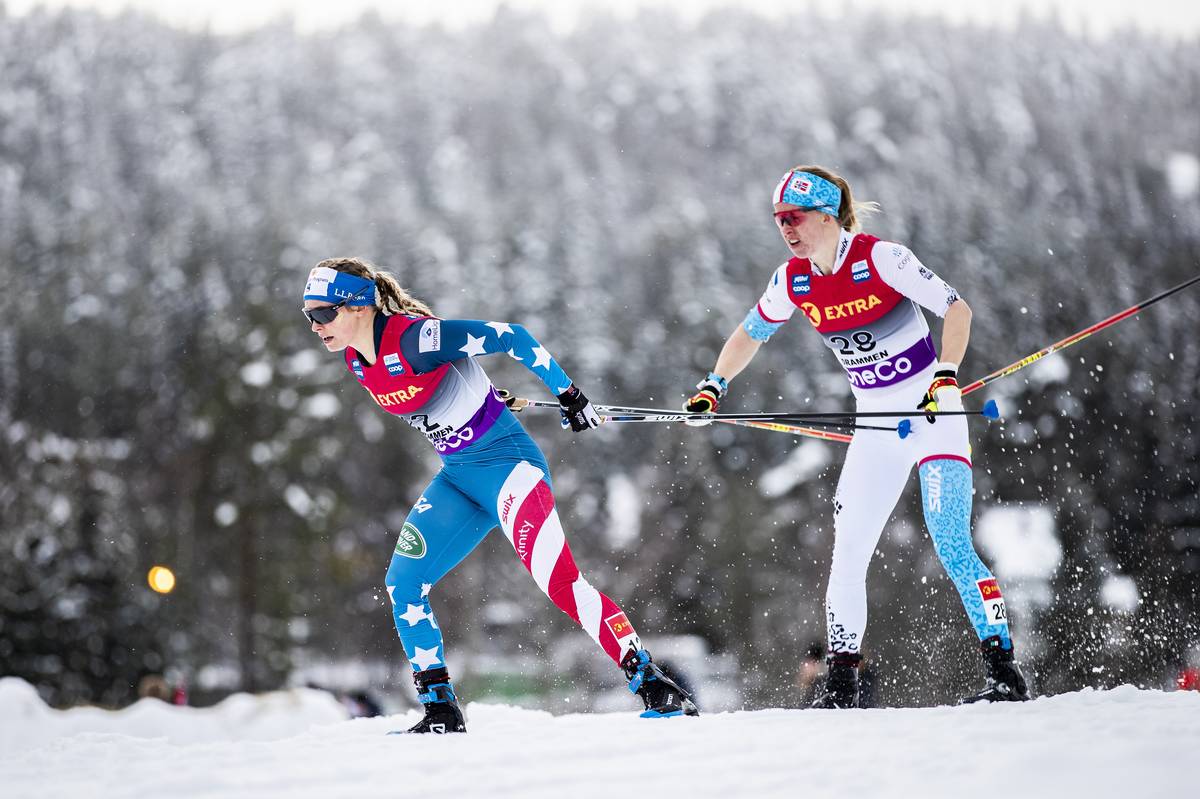
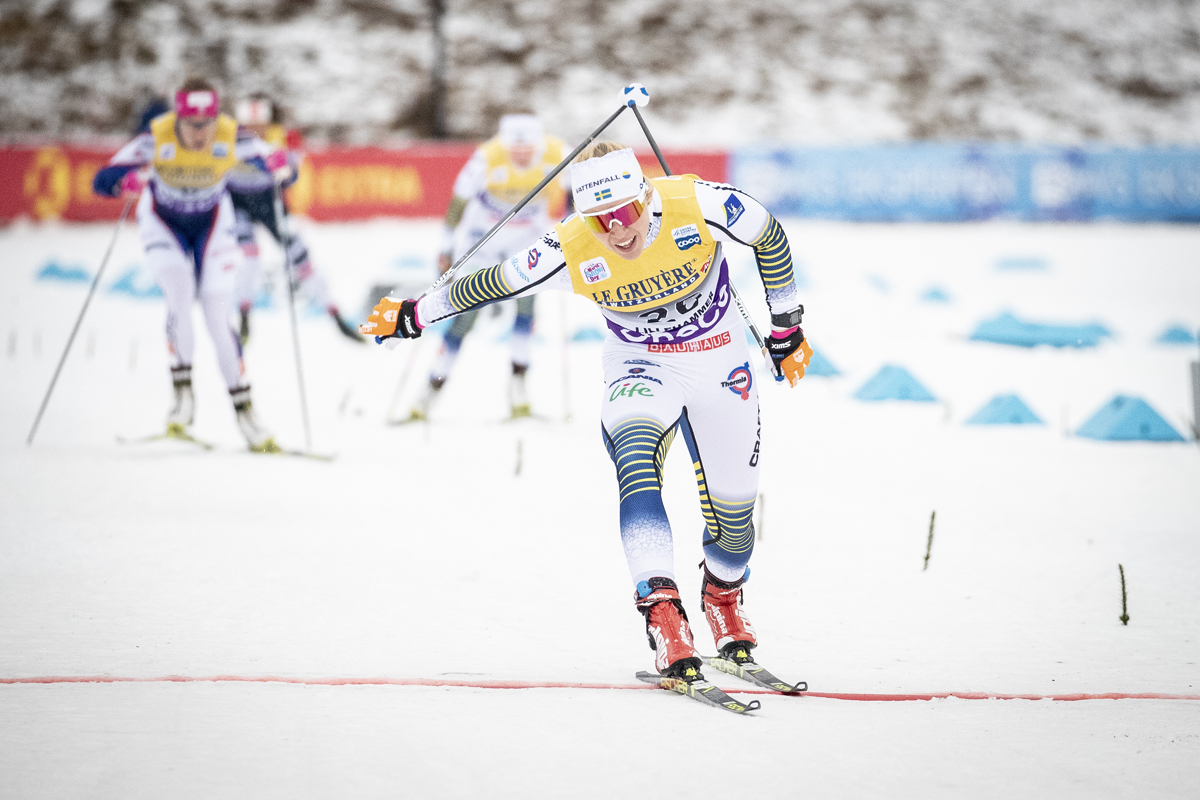
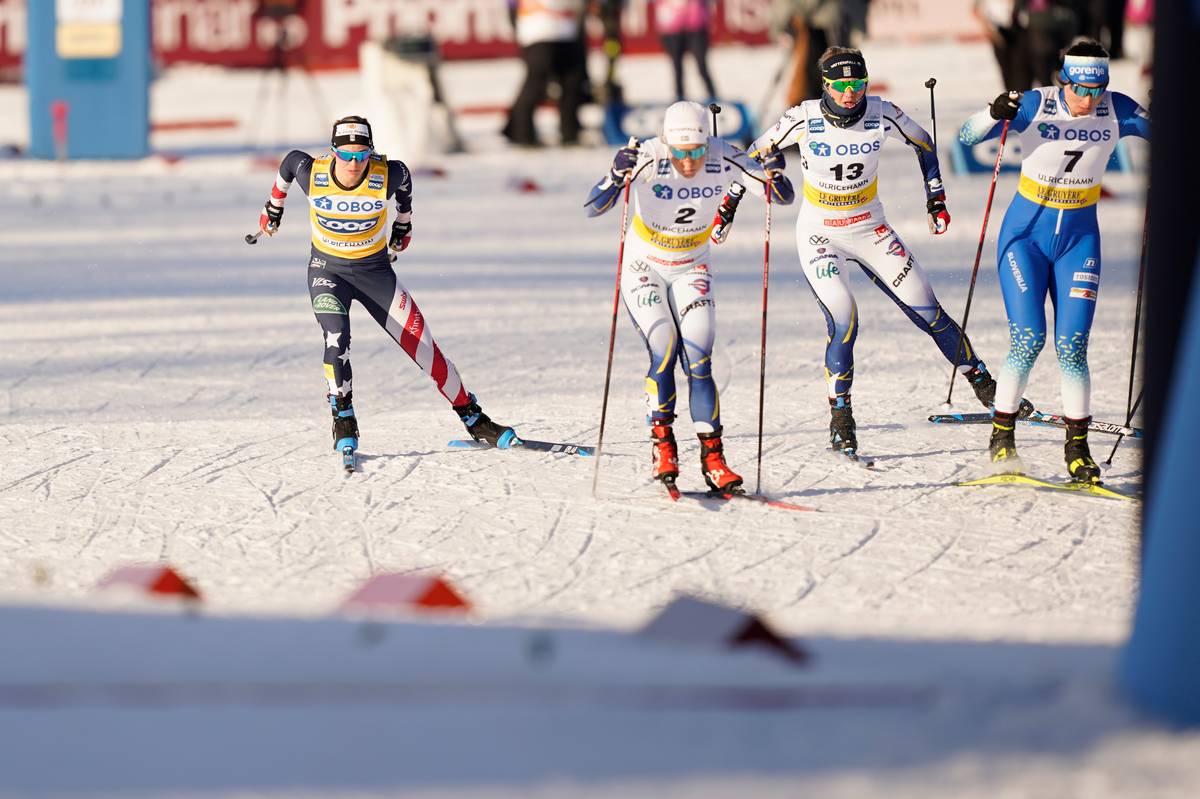
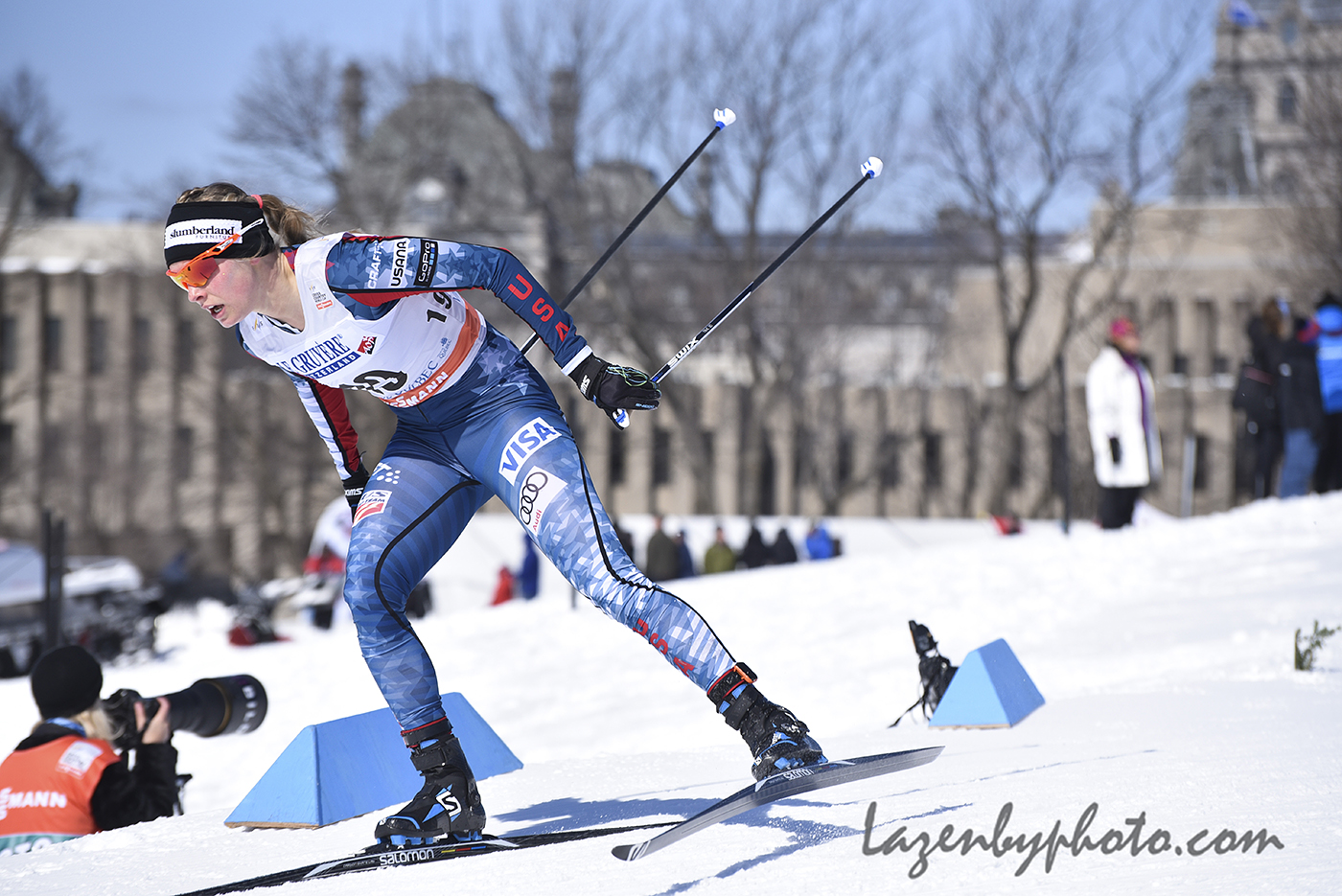
    Jessie Diggins (USA) looks for position during the start of the women’s final. (Photo: NordcFocus)

    The day was cloudless and cold in Ulricehamn, Sweden for the women’s 1.6-kilometer freestyle sprint. As has come to be expected of the Swedish women, they were clutch from the beginning on this course which favored sprint endurance, as the race time times pushed near the 3:30 mark for many. To put this into context, December’s skate sprint in Davos, won by American Rosie Brennan, had the fastest qualifying time, also from Brennan, of 2:40.03.

    Sweden’s Johanna Hagström (22) who trains in Ulricehamn was the fastest qualifier completing the 1.6 k course in 3:23.80. Hanna Falk, who is returning from a long recovery from a back injury was second (+1.12). Falk missed the entire 2019-2020 season. Jessie Diggins of the U.S. Ski Team was the top North American qualifier in third (+2.02).
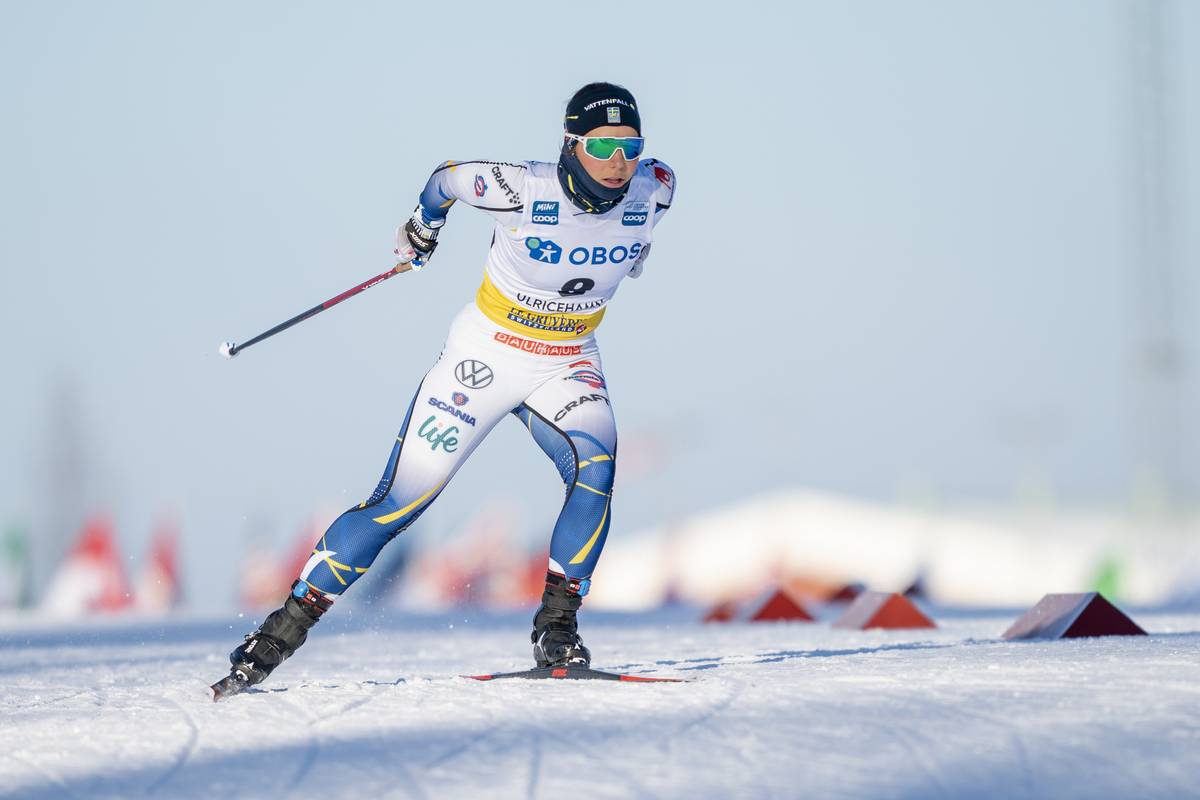
    Johanna Hagström of Sweden during the skate sprint qualifier in Ulricehamn Sweden. Hagström was the fastest qualifier. (Photo: Nordic Focus)

    Also qualifying for the U.S. were Sadie Bjornsen in 16th (+6.83), and Hannah Halvorsen 22nd (+8.12). Canada’s lone qualifier was Maya MacIsaac-Jones in 24th (+8.36).

    Diggins, who leads the World Cup overall, raced the second heat and shot to the front early. Leading wire to wire, she pressed every inch of the course, winning in 3:25.18, in what was the fastest quarter-final by three seconds.

    In the first semi, Diggins was matched up against Swedes Maja Dahlqvist, Jonna Sundling, and Falk. Thirty seconds into the race, Diggins was in a familiar spot — working from the front. This time around, this was no wire to wire act for Diggins. She was shadowed early by Swiss skier Nadine Faehndrich, and later on by the Swedes. Roughly 2:25 into the race, Diggins led into a right-hand corner. Sundling skated the double poled for a smidge of sunlight on the inside, then tripped up and fell. Diggins was slowed momentarily by the scrub of speed as she brushed Sundling and nearly fell. Diggins, however, remained on her feet. Sundling righted herself after a moment on the ground, caught the pack of skiers, and by the final straight was steamrolling for a place in the finals. Dahlqvist won the semi in 3:21.39, with Sundling amazingly slotting into second (+0.44), with Falk and Diggins third and fourth, respectively. Both advanced to the finals as Lucky Losers.
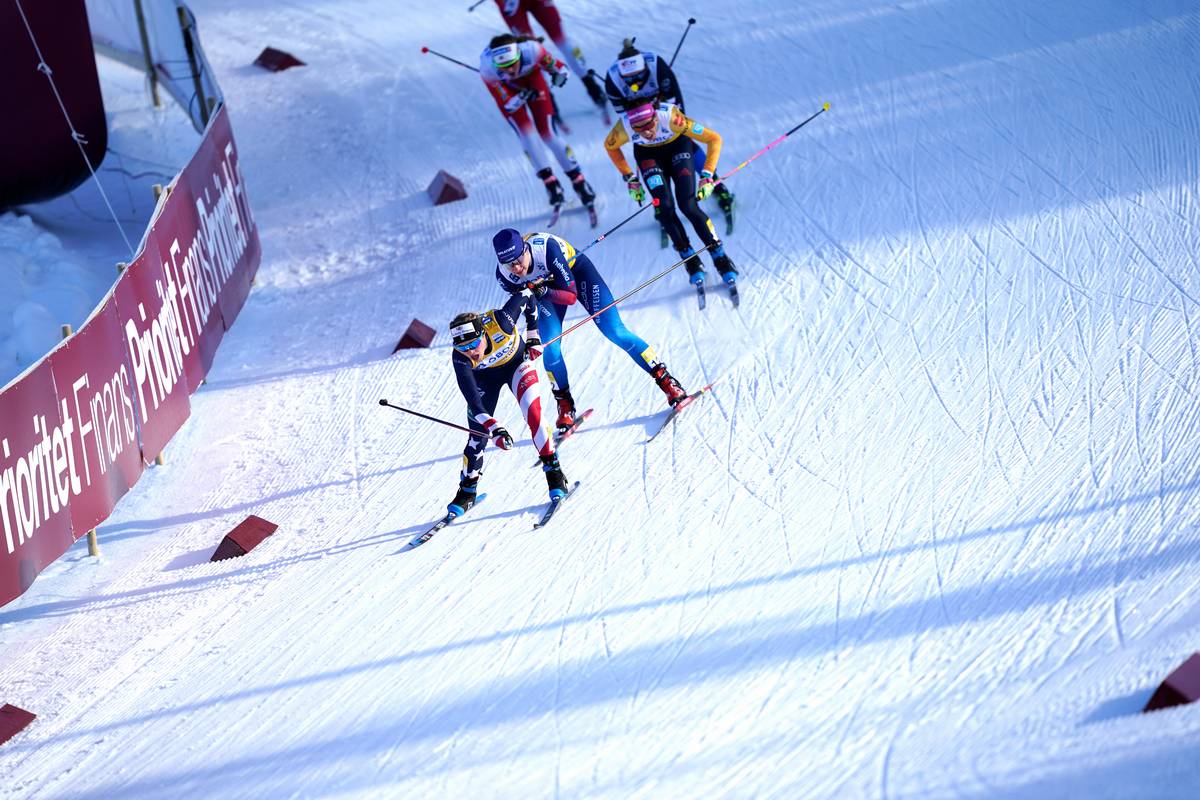
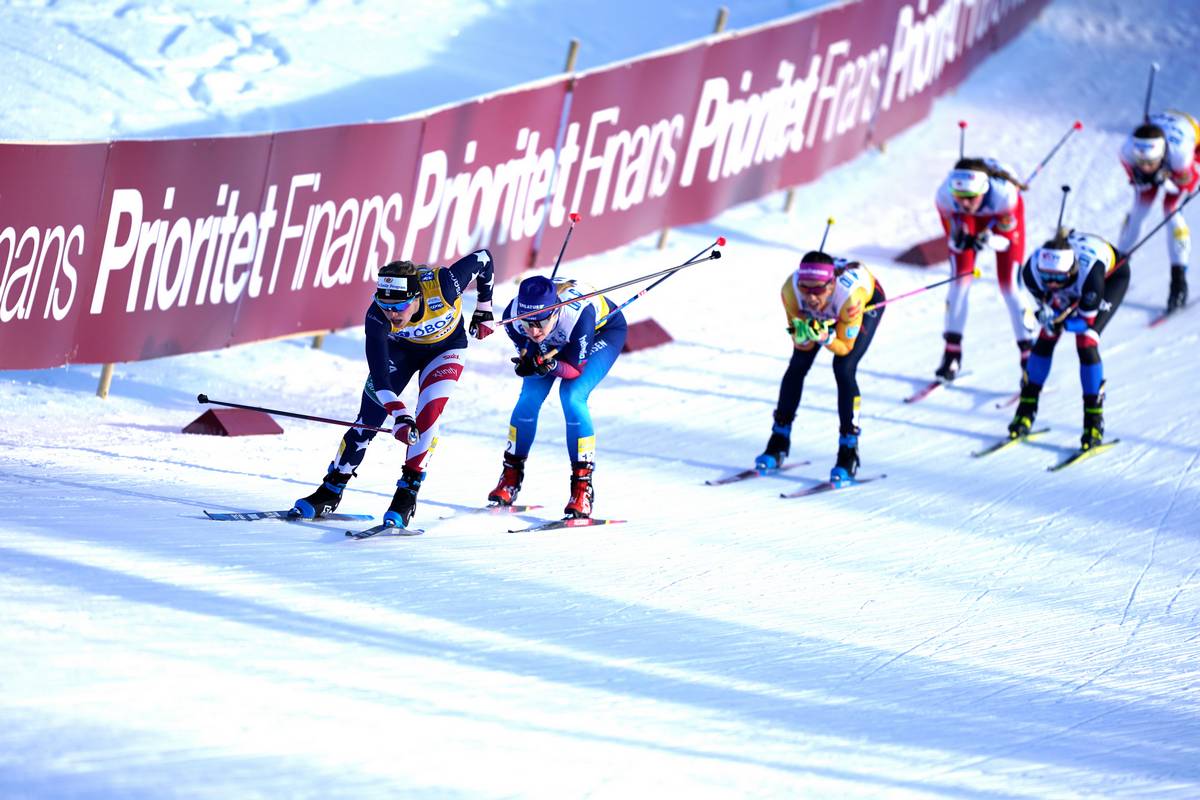
    Jessie Diggins racing her quarterfinal in Ulricehamn, Sweden. (Photo: NordicFocus)
    Jessie Diggins strategized to race in the front during her quarterfinal and semi in Ulricehamn, Sweden. (Photo: NordcFocus)

    The women’s final was loaded with four Swedes: Dahlqvist, Hagström, Sundling, and Falk, along with Eva Urvec of Slovenia, and Diggins. The narrative was spicy from the start. Sundling appeared to catch an edge moments after the start lanes opened up. She spun around, snapped a pole, as the five other skiers advanced unimpeded. (She soon received a new pole and was able to latch back onto the group later in the race.)

    Diggins’ tactics were more reserved. She did not work the course from the front but was positioned near the back as the race advanced. At 2:00 minutes, Dahlqvist led the line of skiers – who were tightly ordered in a line. There were no breakaways – only close-quarter sprinting as the skiers entered the finish straight. Diggins came in with considerable finish speed as did the three Swedes flanking around her.

    Dahlqvist won the race to the line in 3:20.59, Hagström was second (+.30), Diggins third (+0.39), Falk fourth ().72). Urevc came in fifth (+1.13), and Sundling, who never truly recovered from two falls in as many sprints, was sixth (+1.74).

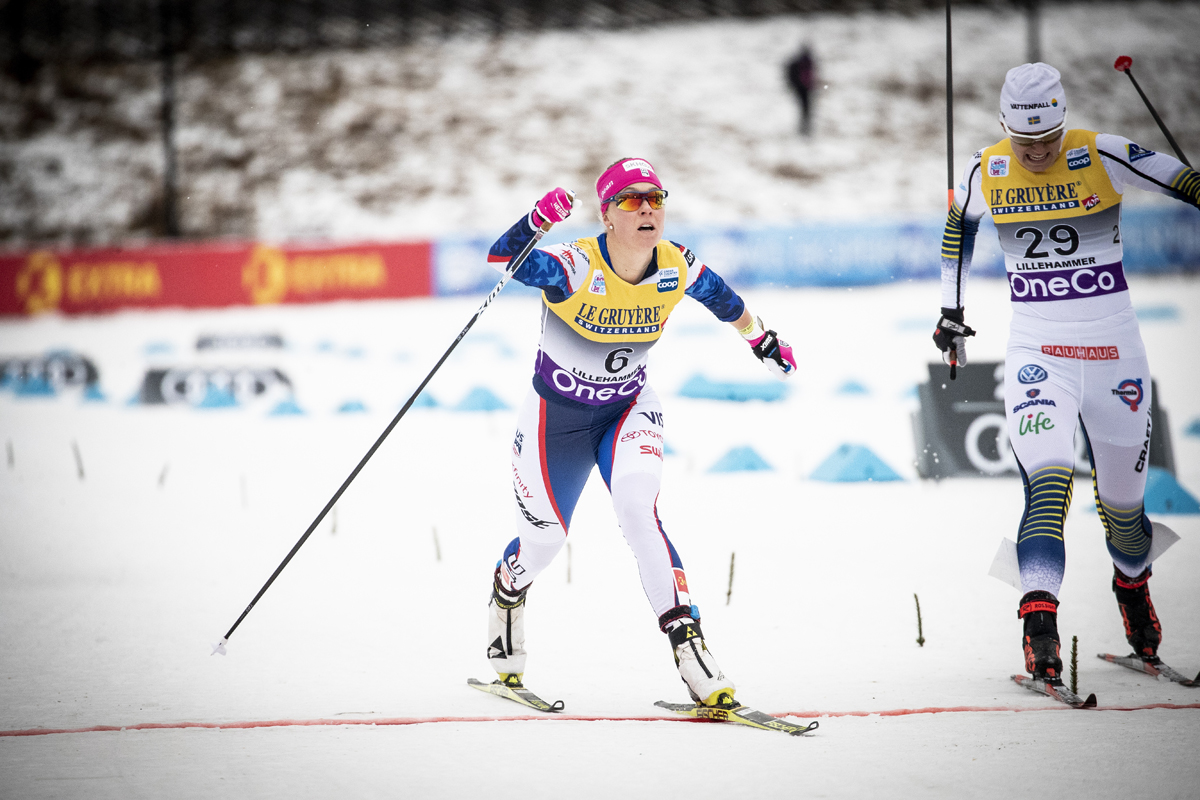
    Maja Dahlqvist (bib 13) and Johanna Hagström, both of Sweden power down the homestretch. (Photo: NordcFocus)

    At 26, this was Dahlqvist’s first career individual World Cup win. She has five team sprints wins on the World Cup. For Hagström, this was her second consecutive weekend as the top qualifier. Last weekend in Falun, a classic sprint, she qualified first. This was Hagström’s second World Cup podium, she placed third in the Cogne, Italy skate sprint in 2019. In Falun, last weekend, she was just off the podium placing fourth overall.
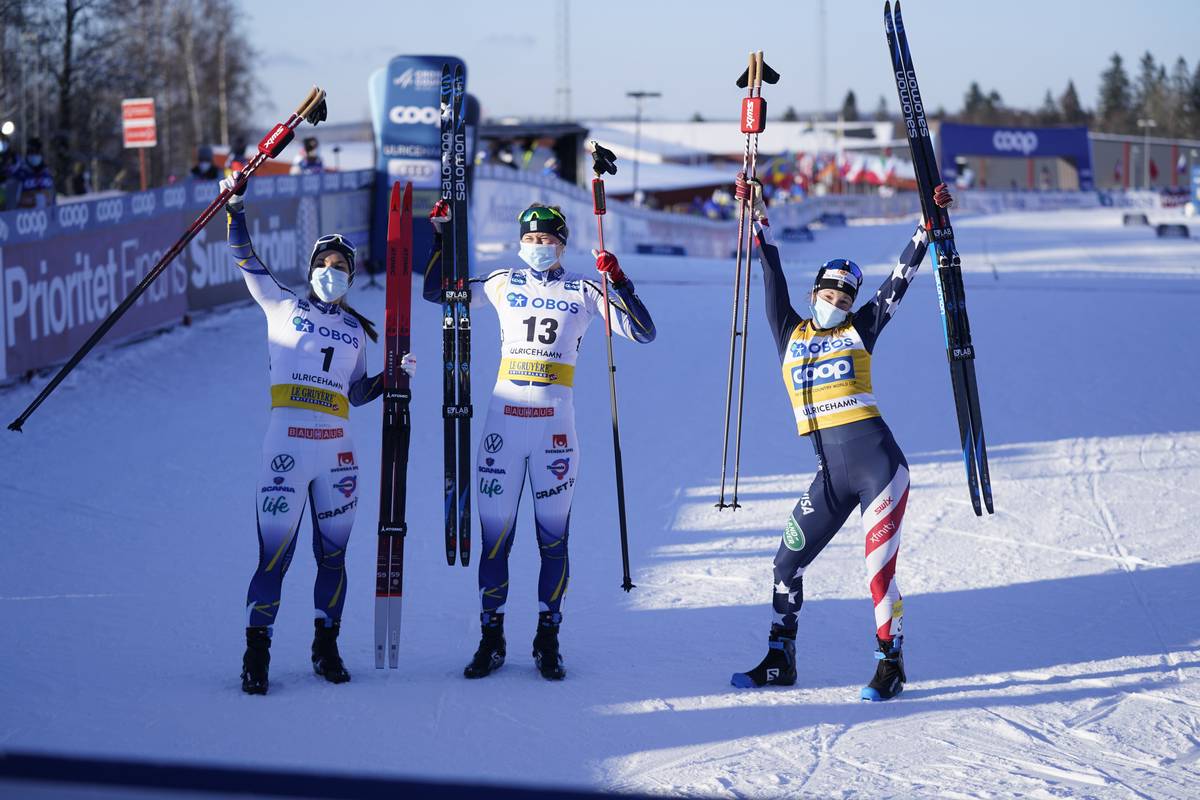
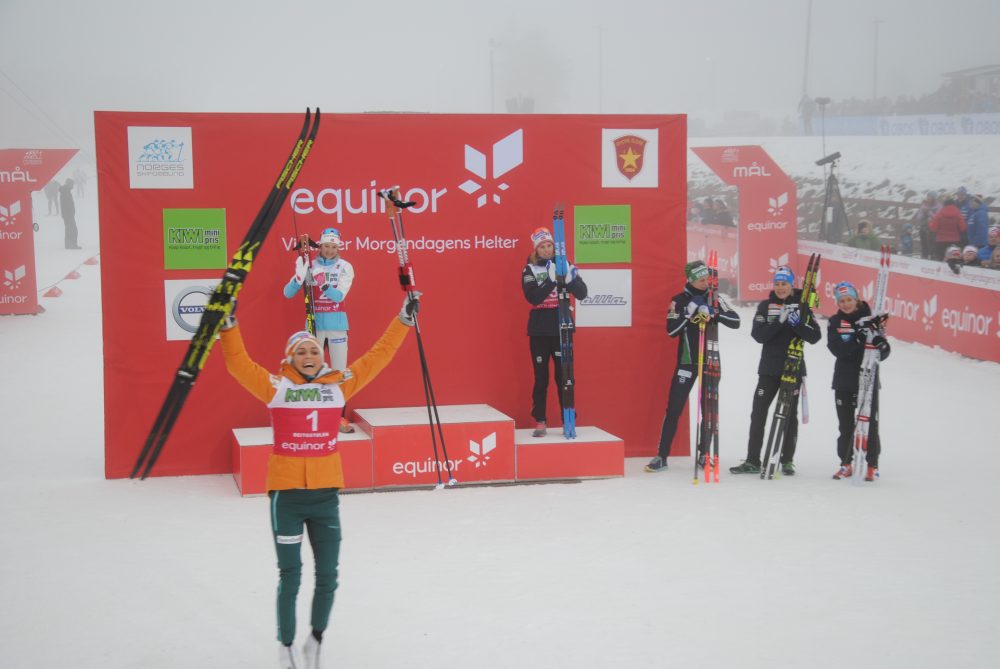
    Johanna Hagström  (SWE), Maja Dahlqvist (SWE) and Jessie Diggins (USA) celebrate being on the podium in Ulricehamn, Sweden. (Photo: NordcFocus)

    Saturday marked the 10th career World Cup sprint podium for Diggins – her seventh in skate technique. The 60 points she earned Saturday, placed her in control in terms of the World Cup overall. She leads Russia’s Yulia Stupak, who has not contested the last two races, by 303 points. Rosie Brennan (also not in attendance in Ulricehamn) is third overall, trailing Diggins by 355 points.
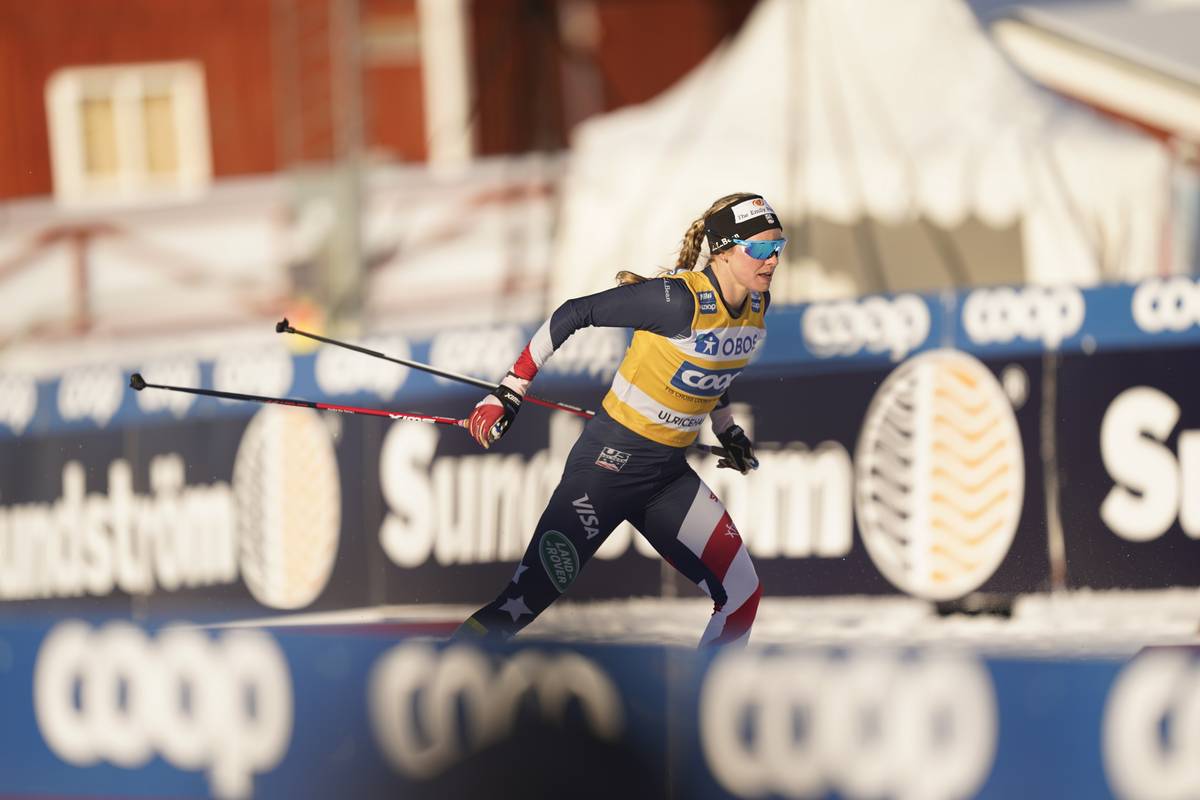
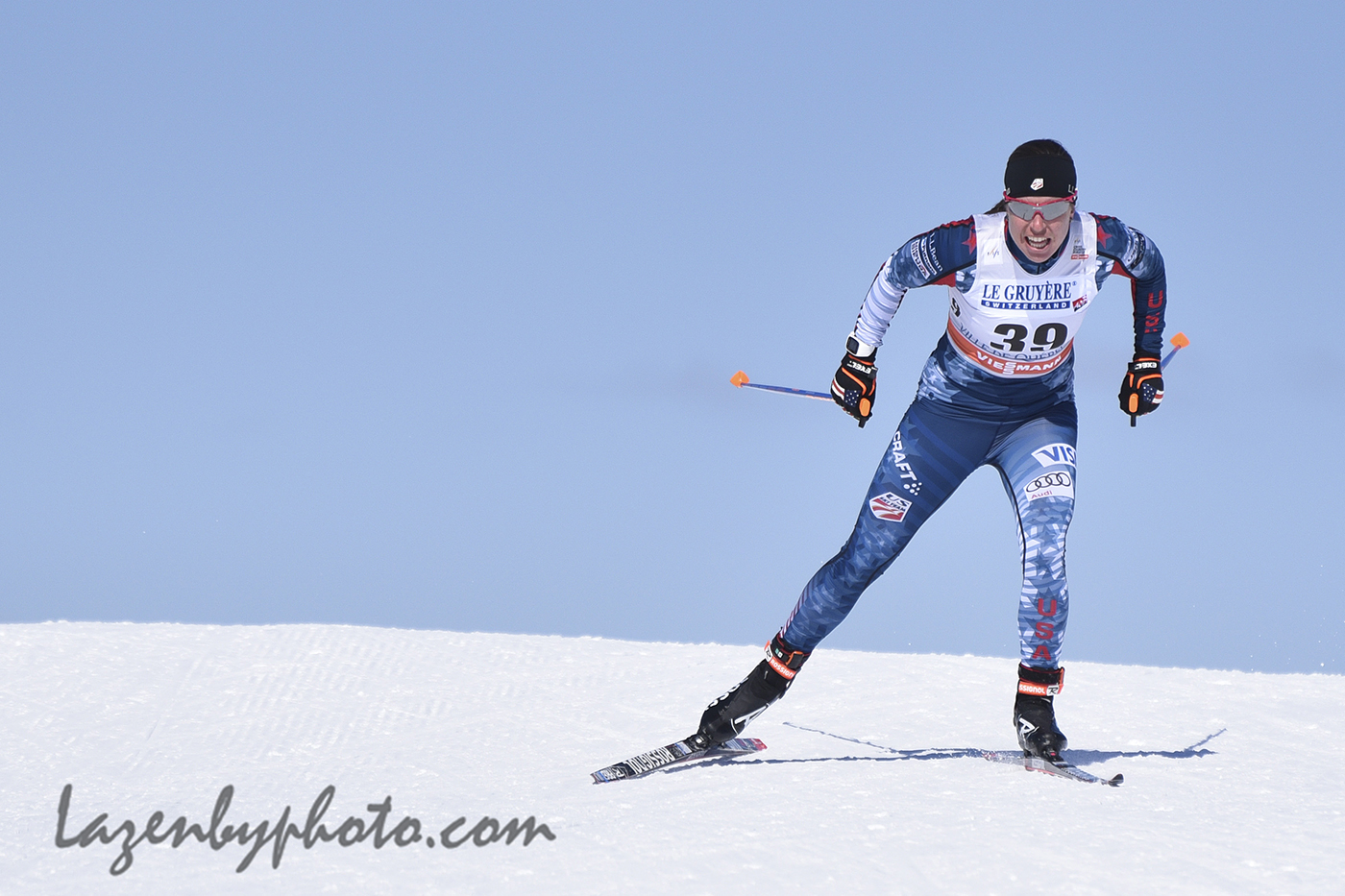
    Jessie Diggins wearing the yellow bib in Ulricehamn, Sweden as the leader of the World Cup overall. (Photo: NordicFocus)

    With the World Cup overall in her sights, Diggins, in a post-race interview said she is strategizing towards winning, but also maximizing her efforts when it comes to securing valuable points for the overall.

    Post-race interview with Jessie Diggins.

    “If you were in the front, even if you had a poor finishing lane, you were almost guaranteeing you were going to move on because it is just so hard for people to get around you,” Diggins said about her race day tactics. Advancing in Ulricehamn was as much a calculus of chasing a podium as it was placing her in contention for overall points.

    “I am and I think that is something I have learned is that it is OK to state, that you have a really big audacious goal, and it is OK to want to go after it,” said Diggins when asked if she was outright seeking the overall Crystal Globe. “In the last couple of weeks I got together with the coaches, and I was like alright we are going after this, we are going to do this as my season goal.”
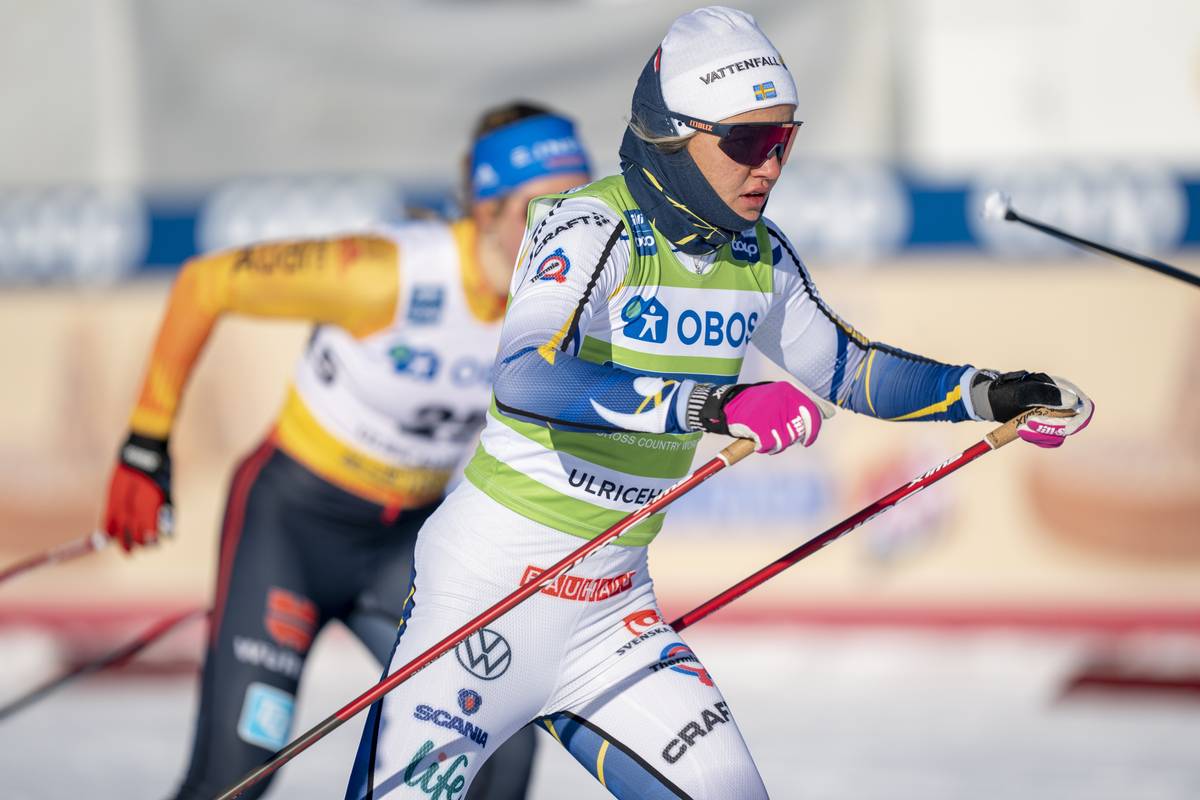
    Sweden’s Linn Svahn here in Ulricehamn. Svahn fell in her quarterfinal and placed 26th overall. (Photo: NordicFocus)

    One name missing from the semis and finals was Linn Svahn of Sweden. She has come to embody Sweden’s dominance in women’s sprinting.

    In a quarterfinal to watch featuring Svahn and Hagström, Hagström took control of the pacing with the five others in her draft. While tightly packed near the 2:08 mark, Svahn, who was skiing in third behind Magni Smedaas of Norway, lost her footing and fell. Svahn eventually crossed the line in sixth to place 26th overall.
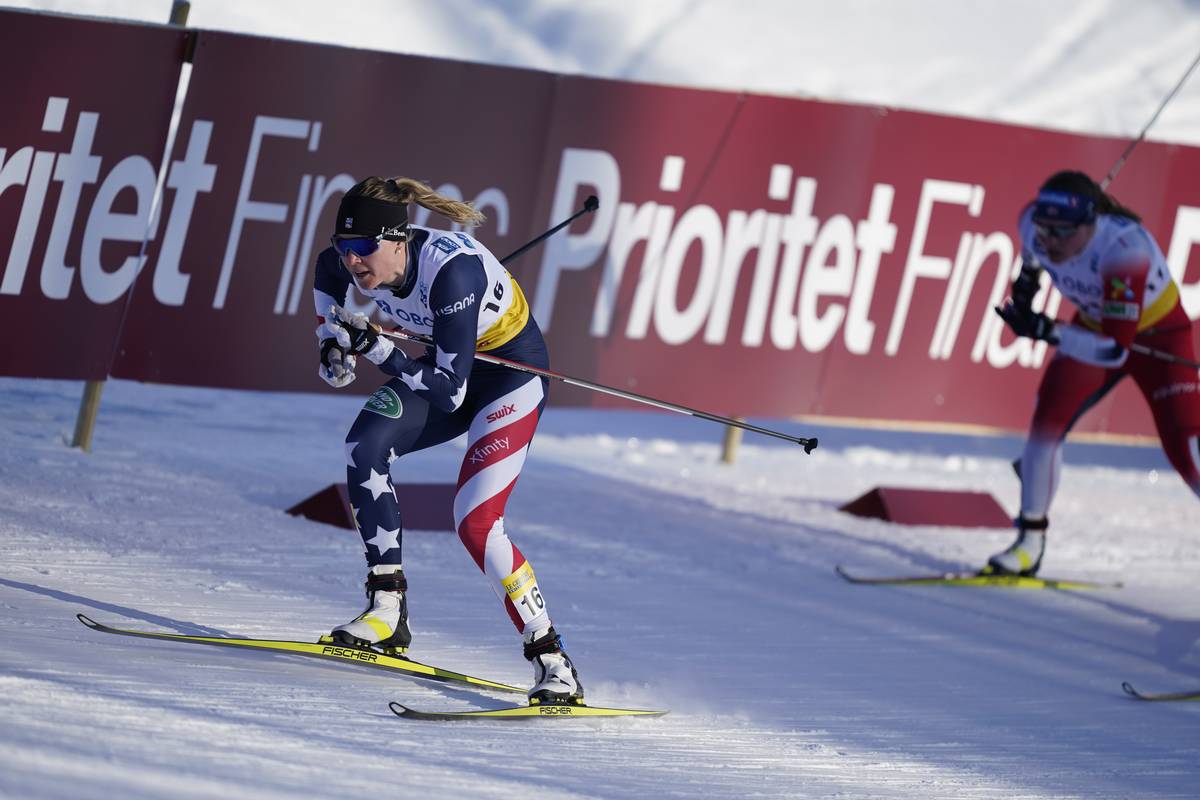
     

    Sadie Maubet Bjornsen (USA) during her quarterfinal and on her way to 15th place on the day. (Photo: NordcFocus)

    Maubet Bjornsen raced in the third quarterfinal where she placed third and did not advance. She was 15th overall in her third World Cup race of the season.

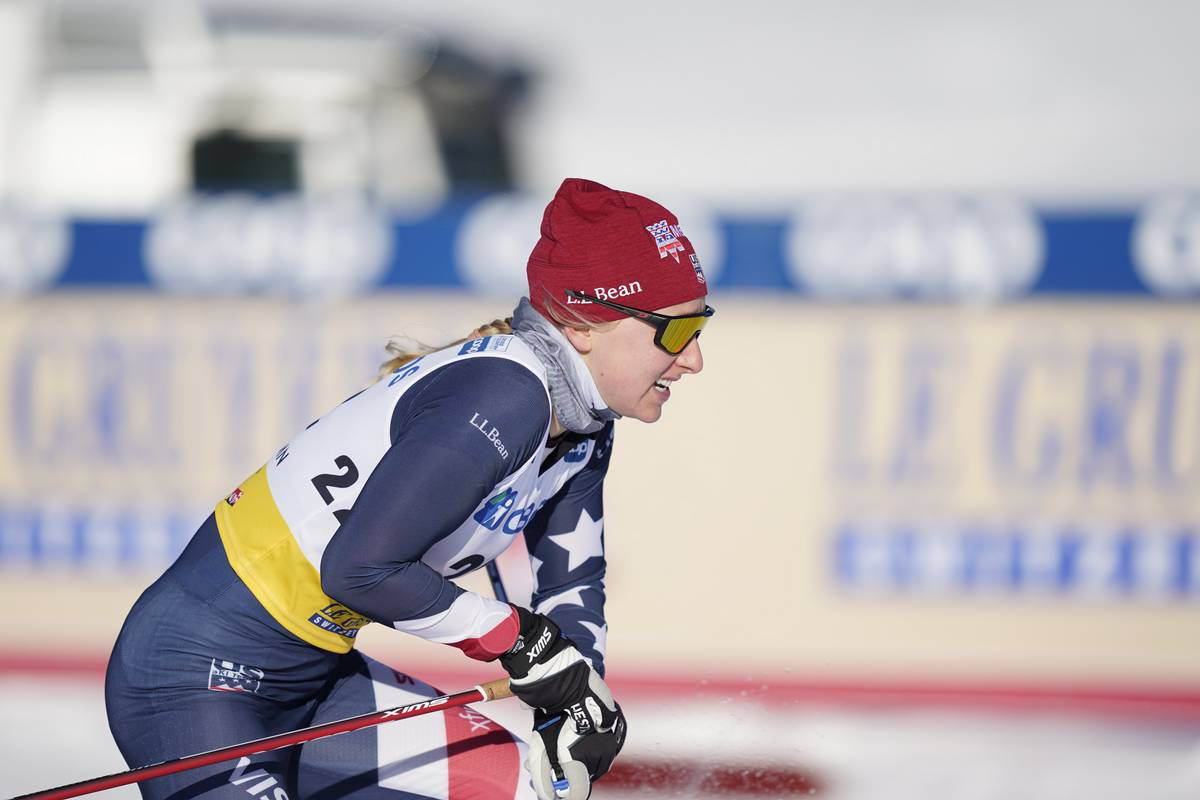
    U.S. skier Hannah Halvorsen earned her second career WorldCup points. She raced in the first quarterfinal where she placed fifth after snapping a pole early in the heat.

    “I collided with the German Victoria Carl heading out of the start as we both fought to get in a good position as the trail narrowed,” Halvorsen explained. “Her ski hit my pole and it snapped right away. Fortunately, I was able to free skate and hang on to the back of the group until I could get a spare.”

    She matched a career-best 23rd overall, she was 23rd earlier this season in Dresden, Germany’s skate sprint.
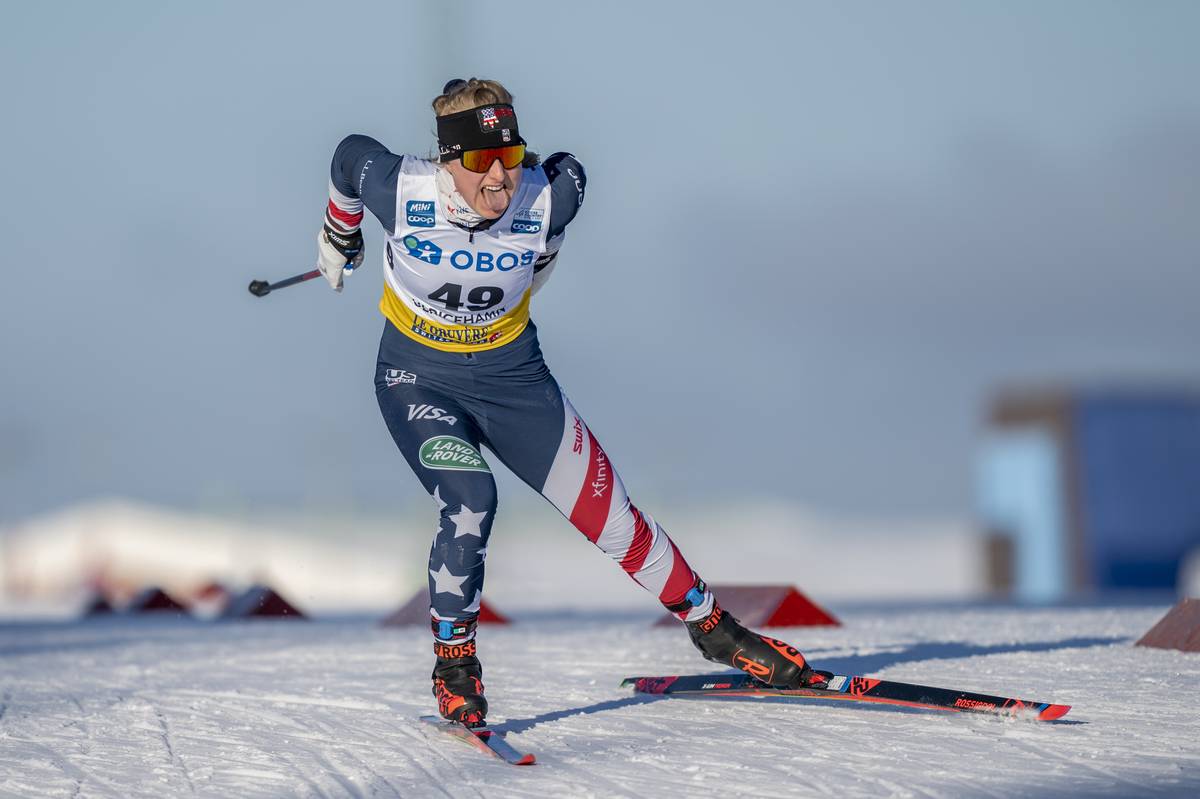
    Hannah Halvorsen (USA) does her best Air Jordan impersonation during qualification where she posted the 22nd fastest time. (Photo: NordcFocus)
    In her quarterfinal, Hannah Halvorsen snapped a pole early, to finish 23rd overall. (Photo: NordcFocus)

    Also in the first quarterfinal was Canada’s MacIsaac-Jones (25) who placed fourth. MacIssac-Jones earned a career-high mark 18th overall place – her third time in the World Cup points.

    “I’m very happy with the day,” MacIsaac-Jones emailed. “This was a very tactical course, so I stayed relaxed and worked to establish a good position without wasting too much energy off the start. I messed up in the last few hundred meters which is frustrating, but in general, it felt great to be in the mix and fighting to win.

    “The momentum on our women’s team just keeps building – we’ve worked hard to support each other these past few years, and I think the increased level we are consistently showing on the World Cup reflects that. Being in this environment where we are all setting ambitious goals for ourselves and pushing each other to improve helped me turn it around after last weekend.”
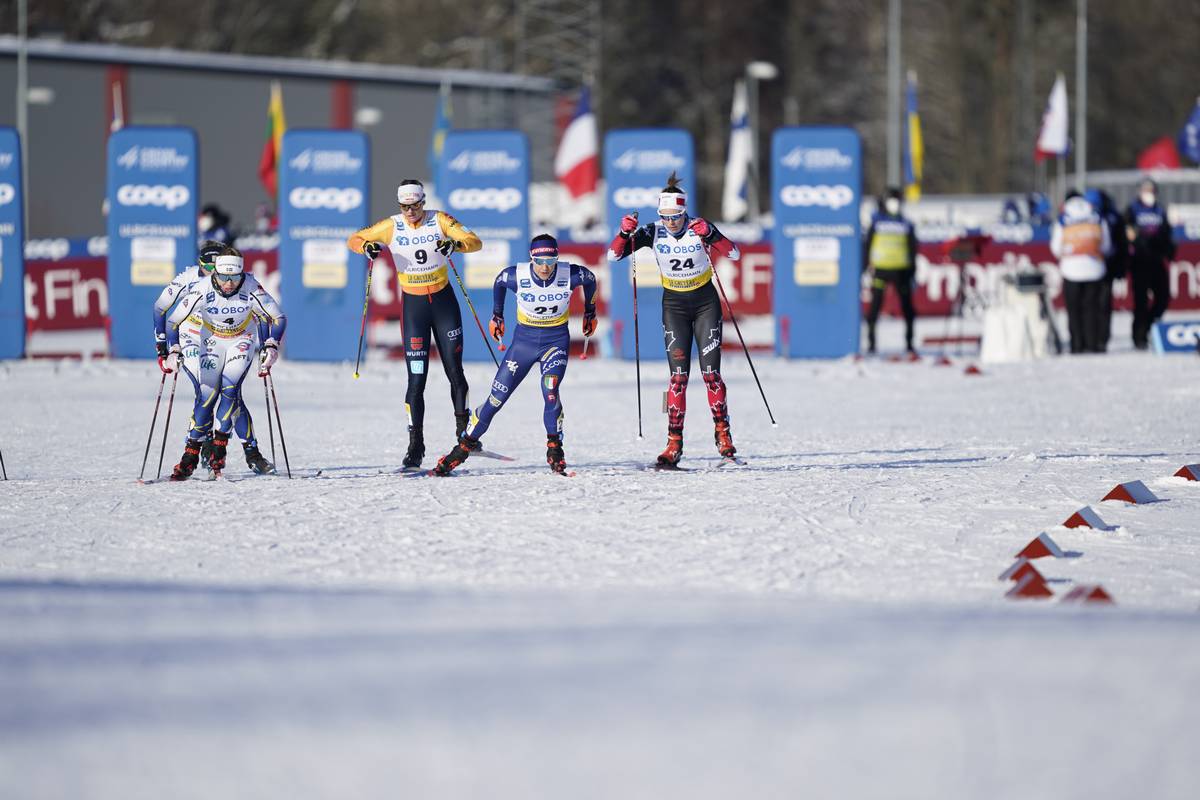
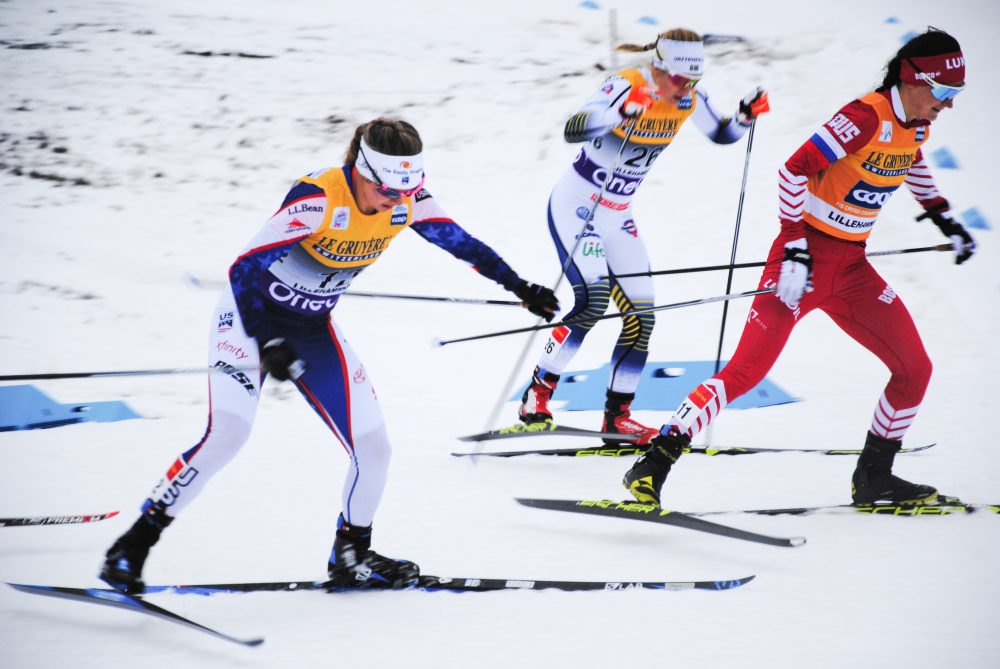
    Jonna Sundling (SWE), Victoria Carl (GER), Greta Laurent (ITA), Maya Macisaac-Jones (CAN), (l-r) racing in Ulricehamn, Sweden. (Photo: NordicFocus)

    Canada’s Dahria Beatty was just outside the points ending her day in 32nd, with teammate Cendrine Browne 37th, Katherine Stewart-Jone 42nd, and Laura Leclair 44th. Fifty-seven skiers began the qualifier.

    For the remaining Americans, Julia Kern finished in 38th, Sophie Caldwell-Hamilton 40th, and Alayna Sonnesyn 43rd.

    Post-race interview with With Matt Whitcomb discussing the women’s and men’s racing.
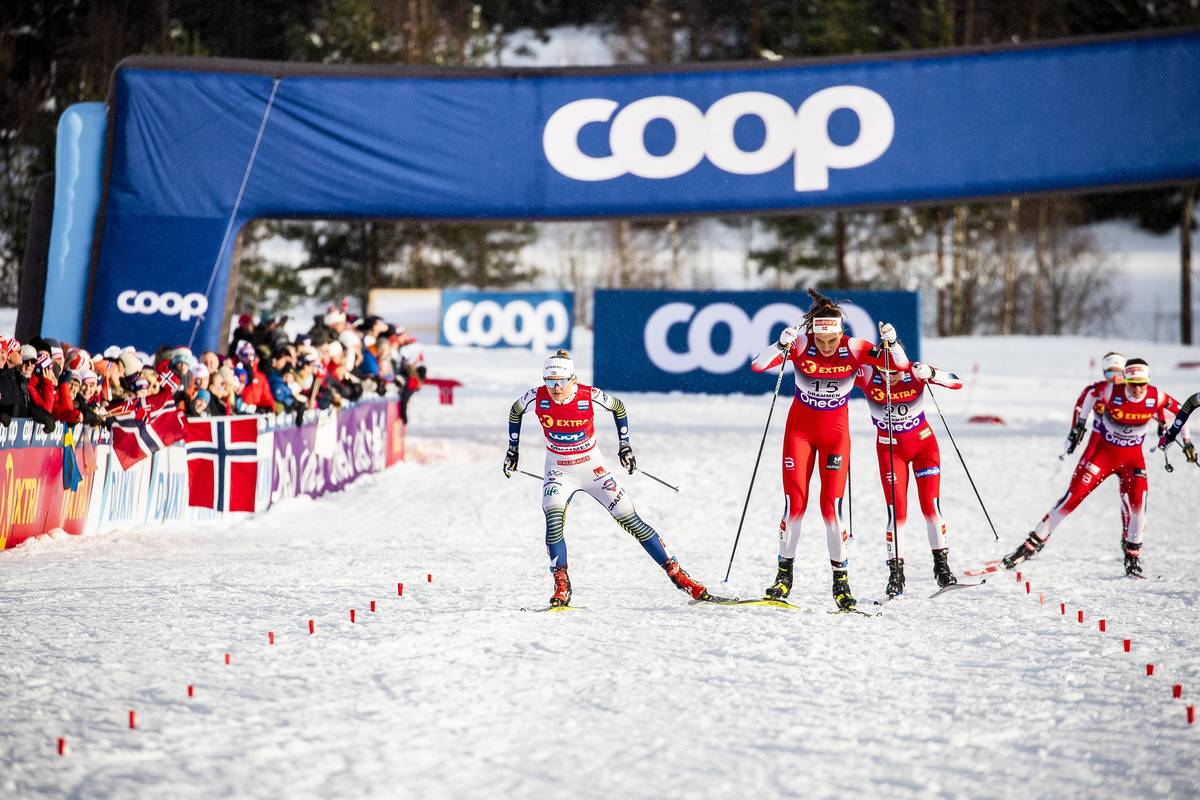
    Women’s Sprint Results | World Cup Overall

  • Relocated to Konnerud: Drammen will wait 365 Days while Klæbo and Sundling Celebrate Now

    Relocated to Konnerud: Drammen will wait 365 Days while Klæbo and Sundling Celebrate Now

    Men’s Sprint

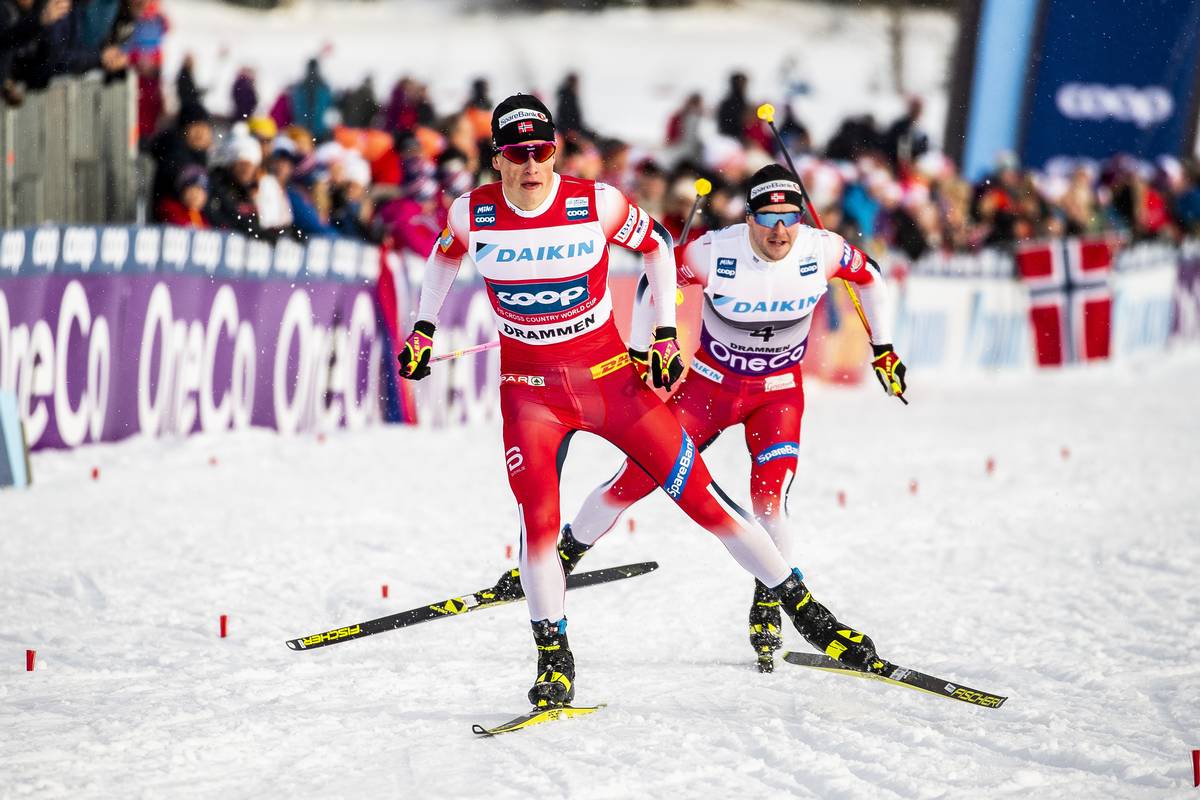
    Perhaps unsurprisingly, the Norwegian men showed up on form for today’s freestyle sprints in Konnerud, just outside the city of Drammen. As the venue was used for the Norwegian National championship at the end of January, most of the team has already had a dress rehearsal racing on the windy course. 

    Johannes Høsflot Klæbo of Norway, where he is found most often: winning down the stretch. (Photo: NordicFocus)

    It seems that Johannes Høsflot Klæbo, who sat out the national championships, did not need a dress rehearsal. He won the qualifier by a margin of nearly four seconds, continuing easily through the rounds to win the overall. This is Klæbo’s eighth sprint win of the season, matching last year’s record, and his 14th career World Cup freestyle sprint victory, the most of any male athlete. 

    Racing in the final with Klæbo were four of his teammates: Håvard Solås Taugbøl, Eirik Brandsdal, Sindre Bjørnestad Skar, and Erik Valnes, each of whom also raced in the national championship final on January 31st (and finished in a very similar order). Interrupting the all-Norwegian field was Alexander Bolshunov of Russia. 

    In the final, Klæbo hovered in the middle of the pack marking his teammates, with Taugbøl in the lead. When Brandsdal took control on the primary climb of the course, Klæbo swung outside of the group to move into second before tucking into the last downhill. As they passed under the arch and headed into the final straightaway, Klæbo engaged his unmatchable top gear, with Taugbøl and Brandsdal chasing. 

    After crossing in a photo finish, Taugbøl was deemed second (+0.65) — a World Cup career best individual result — with Brandsdal third (+0.69). Skar took fourth (+0.94), followed by Bolshunov in fifth (+1.92) and Valnes a late arriving sixth (+12.79).

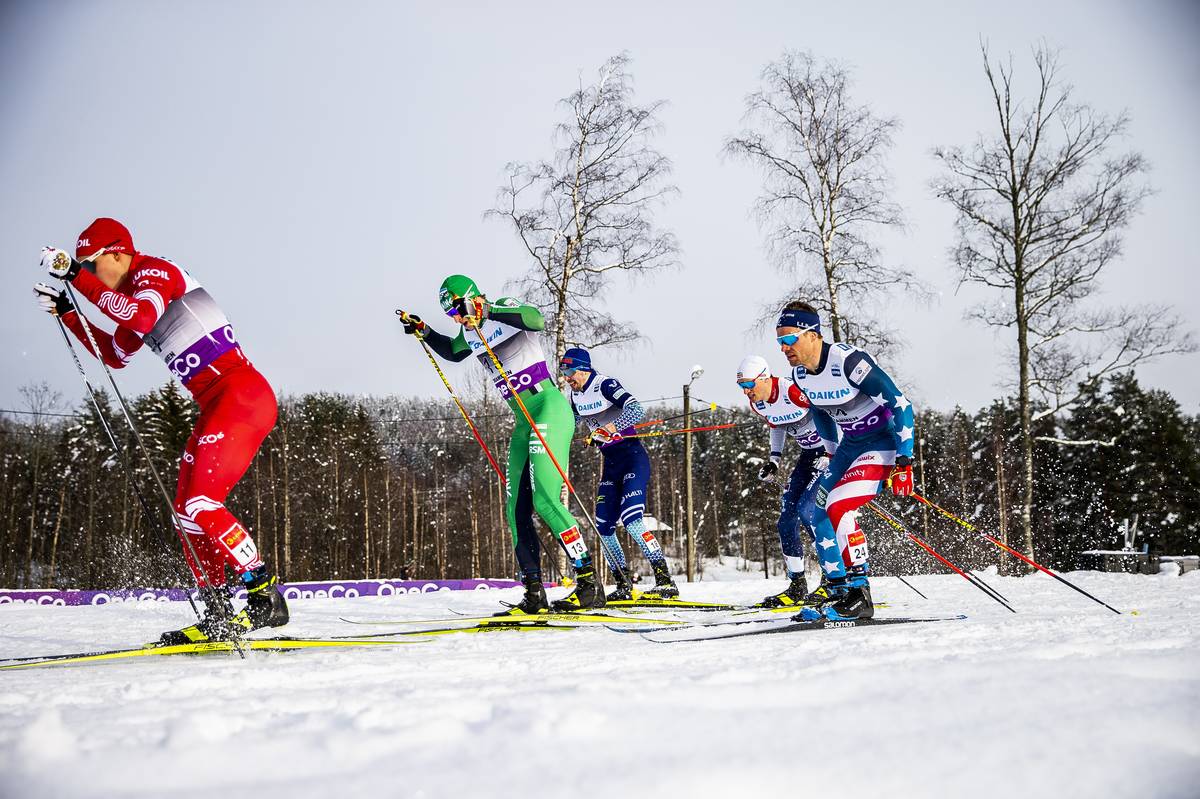
    Simi Hamilton (bib 24) during his quarterfinal in Konnerud. (Photo: NordicFocus)

    Simi Hamilton was the only American sprinter racing in Konnerud. He qualified in 24th and raced in the fourth heat of the quarterfinals, where he finished fifth, ending his day ranked the same in the overall as in his qualifier. 

    Men’s Qualification | Final Results

    Women’s Sprint

    The looping sprint course around the ol’ church in Drammen, Norway will have to wait another year, or at least until sufficient snow: the iconic city sprint was moved to Konnerud due to insuffient snow in Drammen. Winter, please, pretty please, return to places such as Drammen. 

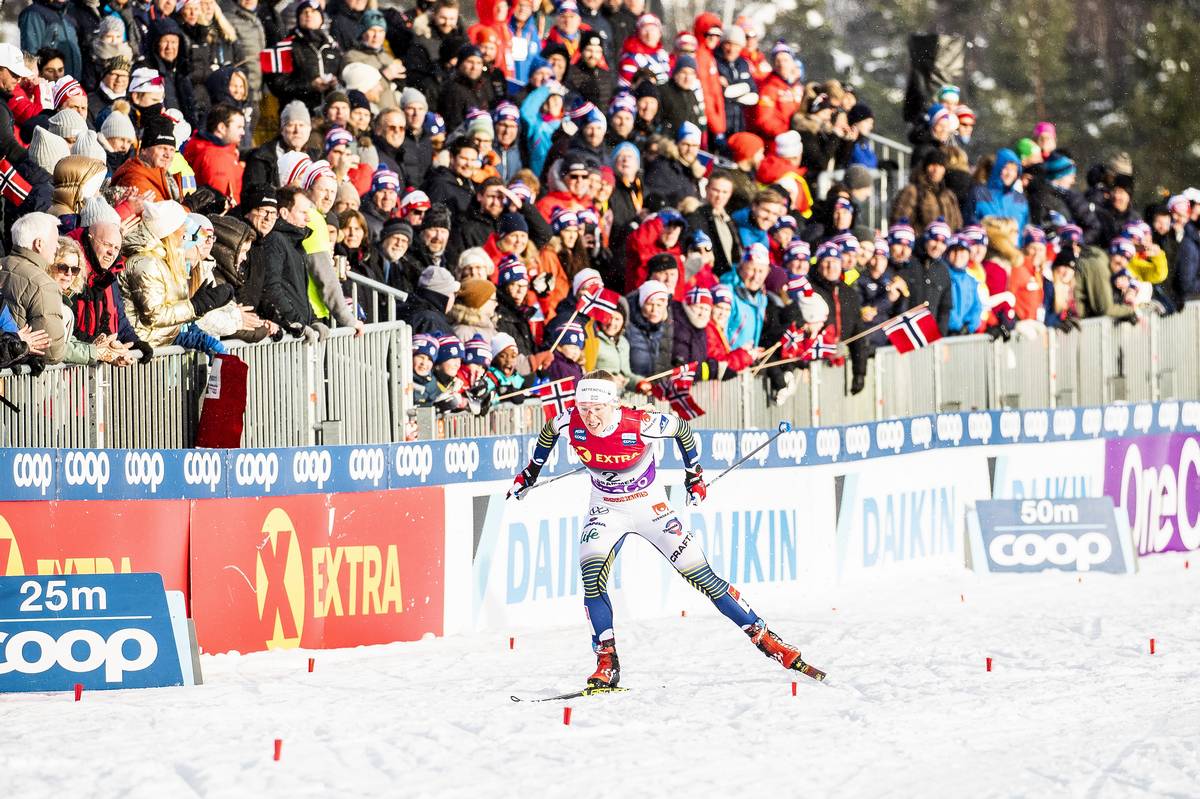
    Powering home for the Konnerud win: Jonna Sundling of Sweden. (Photo: NordicFocus)

    Although deep in Norway, but not so far from Sweden as the planes fly, Sweden took the win and third place in the World Cup’s relocated 1.2 k skate sprint in Konnerud. Jonna Sundling won the final in 2:38.41 — a toe and perhaps the tail of a ski ahead of Switzerland’s Nadine Faehndrich in second (+0.24). It was a photo finish for second through fourth. Linn Svahn, a U23 skier forgoing those championships, placed third (+0.39). Norway’s U23 Kristine Stavaas Skistad was fourth (+0.97), Sweden’s Maja Dahlqvist placed fifth (+5.70), and Anamarija Lampic of Slovenia sixth (+26.04). 

    Sundling powered down the final sraight outpacing Faehndrich in the final 100 meters. Sundling advanced to the finals as a lucky loser in the semis.

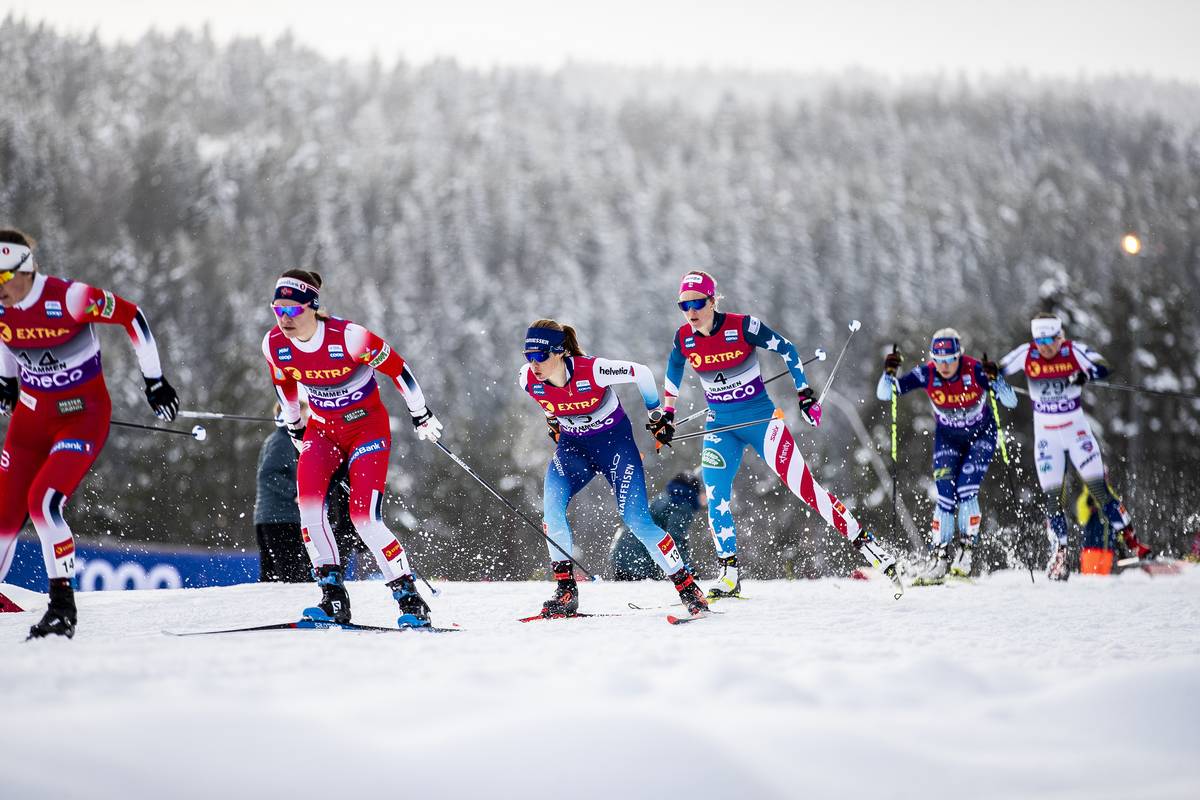
    Sadie Bjornsen (bib 4) during her quarterfinal heat in Konnerud. (Photo: NordicFocus)

    Sadie Bjornsen of the U.S. was the top American in 16th overall. Bjornsen qualified in fourth, 1.2seconds behind the top qualifier, Katja Visnar of Slovenia. Bjornsen placed fourth in the second quarterfinal and did not advance. 

    Jessie Diggins was the only other American to qualify.After qualifying in 12th , she placed sixth in the first quarterfinal, to end her day ranked 27th. Also for the U.S., Kaitlynn Miller placed 50th, and Becca Rorabaugh 54th. 

    Jessie Diggins sprinting in Konnerud. (Photo: NordicFocus)

    Of note, Swedish sprinter, Hanna Falk, who suffered a back injust prior to the season, started her first World Cup of the year. She finished in 30th.  

    Racing continues Saturday with the women’s 30 k classic mass start. The men race a 50 k in Oslo on Sunday. 

    Women’s Qualificiation | Women’s Sprint Results

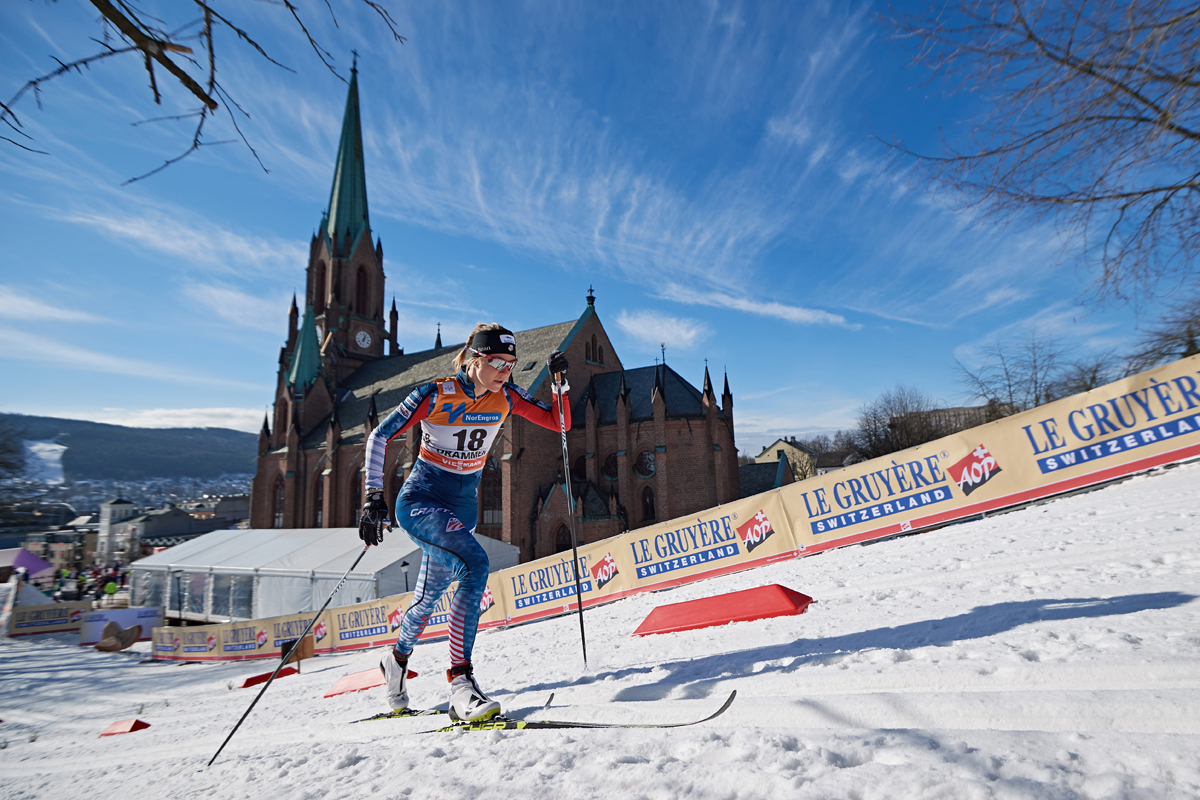
    This is Drammen with better snow and lovely skies: Sadie Bjornsen back in 2017. (Photo: Fischer/Nordic Focus)
  • Hanna Falk of Sweden out for the 2019-2020 Season

    Hanna Falk of Sweden out for the 2019-2020 Season

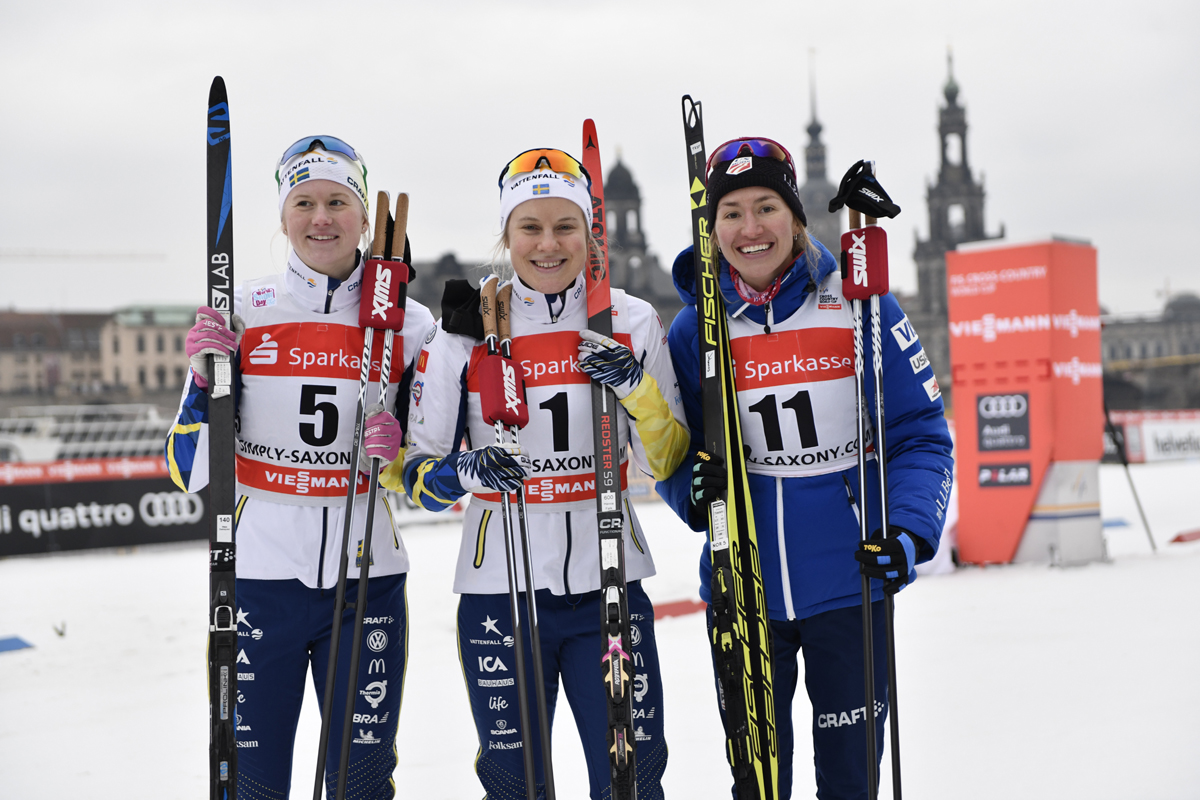
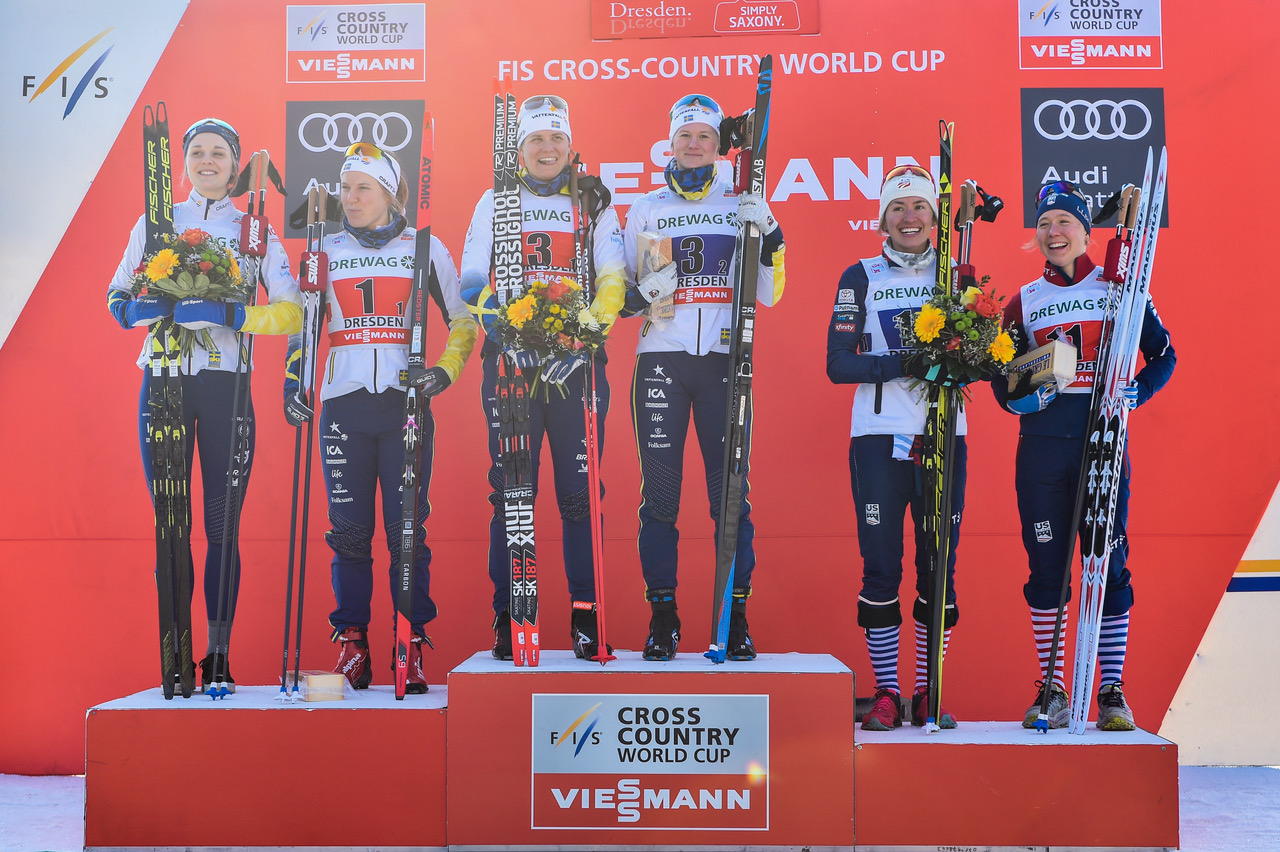
    The women’s 2019 freestyle sprint podium at the World Cup in Dresden, Germany, with Sweden’s Hanna Falk (c) and Maja Dahlqvist (l) in first and second, and American Sophie Caldwell (r) in third. (Photo: Fischer/Nordic Focus)

    Monday, thirty-year-old Hanna Falk of the Swedish National Team announced on Instagram she would miss the upcoming World Cup season due to a back injury.

    Falk wrote she had endured back pain for the last month and confirmed an issue with a disk. According to Falk, she had been able to manage her back pain the past few years, but currently the issue had “reached a new level.”

    A translation of the Instagram post stated she will need surgery and rehab before returning to the sport.

    Last season, Falk ended her 2018-2019 World Cup season ranked 20th overall in the sprint standings. During the 2016-2017 World Cup, Falk was ranked third overall. She was fourth overall in 2017-2018.

    Falk had three individual World Cup sprint podiums last season including a skate sprint win in Falun, Sweden and another skate sprint victory in Dresden, Germany.


  • Sunday Rundown from Lahti and Canada (Canmore Biathlon Sprints Cancelled)

    Sunday Rundown from Lahti and Canada (Canmore Biathlon Sprints Cancelled)

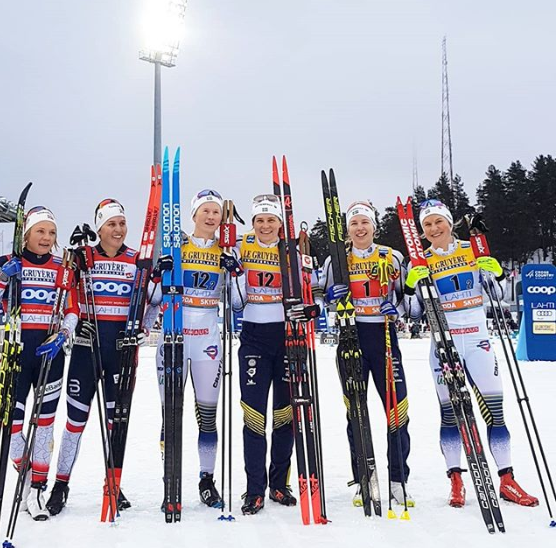
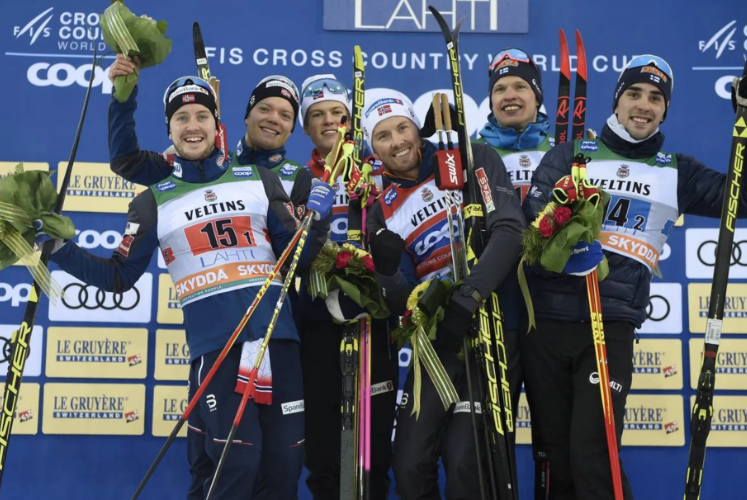
    2019 Lahti, Finland’s World Cup classic team sprint podium. From left to right, Norway I in second, Sweden I in first, and Sweden II in third. (Photo: @fiscrosscountry Instagram screenshot)

    FIS World Cup Lahti, Finland Classic Team Sprint

    Sunday in Lahti, Finland the women raced a 6 x 1.4-kilometer classic team sprint. U.S. fans saw their hopes for a podium snuffed out in the two semi-finals that determined the 10 teams advancing to the finals.

    In the first team sprint semi, the U.S. Ski Team’s (USST) Ida Sargent and Sophie Caldwell  placed sixth overall and did not advance. Sargent and Caldwell, constituting team USA I, were 10.78 seconds off the winning time of Sweden II’s Evelina Settlin and Hannah Falk, who won the first semifinal in 18:36.74 minutes.

    In the second semi, USA II’s Kelsey Phinney (SMS T2) and Julia Kern (USST D-Team) raced to seventh (+1:06.32). Norway I’s Tiril Udnes Weng and Maiken Caspersen Falla marked the fastest time of 18:31.09 minutes.

    In the women’s final, Sweden I’s Ida Ingemarsdotter and Maja Dahlqvist won in 18:24.96 minutes. Weng and Falla took second (+1.84), Sweden II’s Settlin and Falk placed third (+3.55).

    Women’s Results

    2019 Lahti, Finland’s World Cup classic team sprint podium. From left to right, Norway II in second, Norway I in first, and Finland I in third. (Photo: fis-ski.com screenshot)

    The men raced a 6 x 1.6 k classic team sprint in Lahti. Both U.S. teams entered raced in the second semi with neither placing well enough to advance. The second semi was won by Russia I’s Artem Maltsev and Gleb Retivykh in 19:31.22 minutes.

    In that semi-final, USA II’s Kevin Bolger and Logan Hanneman placed sixth (+6.60), USA I’s Simi Hamilton and Erik Bjornsen were seventh (+16.05).

    USA II placed 12th overall, USA I 14th in the final standings.

    Johannes Høsflot Klæbo and Emil Iversen of Norway won the first semi in 19:22.32 minutes.

    Norway I’s tandem won the final in 18:57.19 followed closely by Norway II’s Sindre Bjørnestad Skar and Eirik Brandsdal in second (+0.65). It was a photo finish for second and third, as Finland I’s Iivo Niskanen and Ristomatti Hakola finished 0.71 seconds back to take the third podium spot.

    Men’s Results

    ***

    Today’s IBU World Cup sprints in Canmore, Canada have been cancelled due to extreme cold temperatures. Current temperatures in Canmore are -17 degrees Fahrenheit. A temperature reading of -4 degrees Fahrenheit on the coldest part of the course is the minimum for IBU competitions.

    This race rundown will be updated.

    ***

    Western Canadian Championships, Telemark, Kelowna B.C., Relays

    Westerns wrapped up with club relays on a day where the thermometer flirted with cancellation before rising to -17C at 9am (that is 2 Fahrenheit, for residents of Liberia, Myanmar, and the USA).

    The relay event is intended to help build club spirit in a less competitive environment. In practice, many skiers just find two friends they want to ski with. Despite the cold, 105 teams competed today.

    In the open men category, the ‘BC Lost Boys’ team won easily, with Rémi Drolet, Gareth Williams, and Julien Locke finishing the 15km in 38:00.9. Drolet and Locke are teammates at Black Jack while Williams is a Telemark local. All three are national team members.

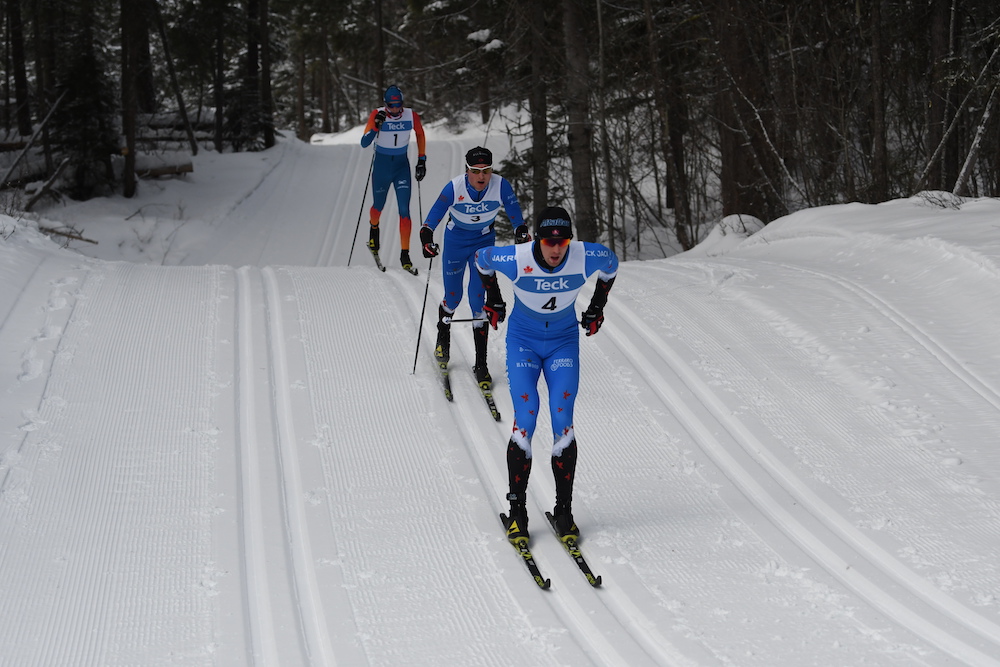
    Julien Locke leads Rémi Drolet and Sam Hendry in Saturday's mass start classic. The relay used the same 5km loop. (Photo: Doug Stephen)
    Julien Locke leads Rémi Drolet and Sam Hendry in Saturday’s mass start classic. The relay used the same 5km loop. (Photo: Doug Stephen)

    ‘Alberta 1’ placed second, at 1:47.1 back, with Thomas Manktelow (), Michael MacIsaac-Jones (AWCA), and Sam Hendry (Team R.A.D.) ‘BC Power, Speed, and Grace’ was third, with Tallon Noble (Strathcona), Michael Murdoch (Whistler), and Ian Williams (Telemark) at 2:26.8.

    The open women used the same 5km loop as the men (and the same as on Saturday). ‘BC Supernovas’ won in 47:25.7, with BC team members Paige Latta (Sovereign Lake), Elizabeth Elliot (AWCA), and Benita Peiffer (Whistler). ‘BC Avalanche’ took second at 1:33.4 with Katie Weaver (RMR), Gina Cinelli (Revelstoke), and Beth Granstrom (AWCA). ‘Just the Ladies – No Nick’ was just 3.5 seconds behind 2nd place with Claire Grall-Johnson (AWCA), Amanda Thompson (AWCA), and Hannah Jirousek (AWCA) representing Yukon/Ontario.

    Results: Relays, Full Weekend

  • Saturday Race Rundown: Dresden and Oberhof (Updated)

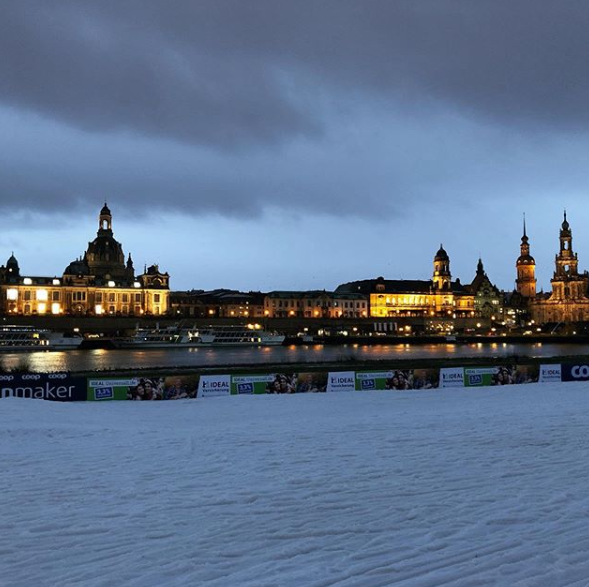
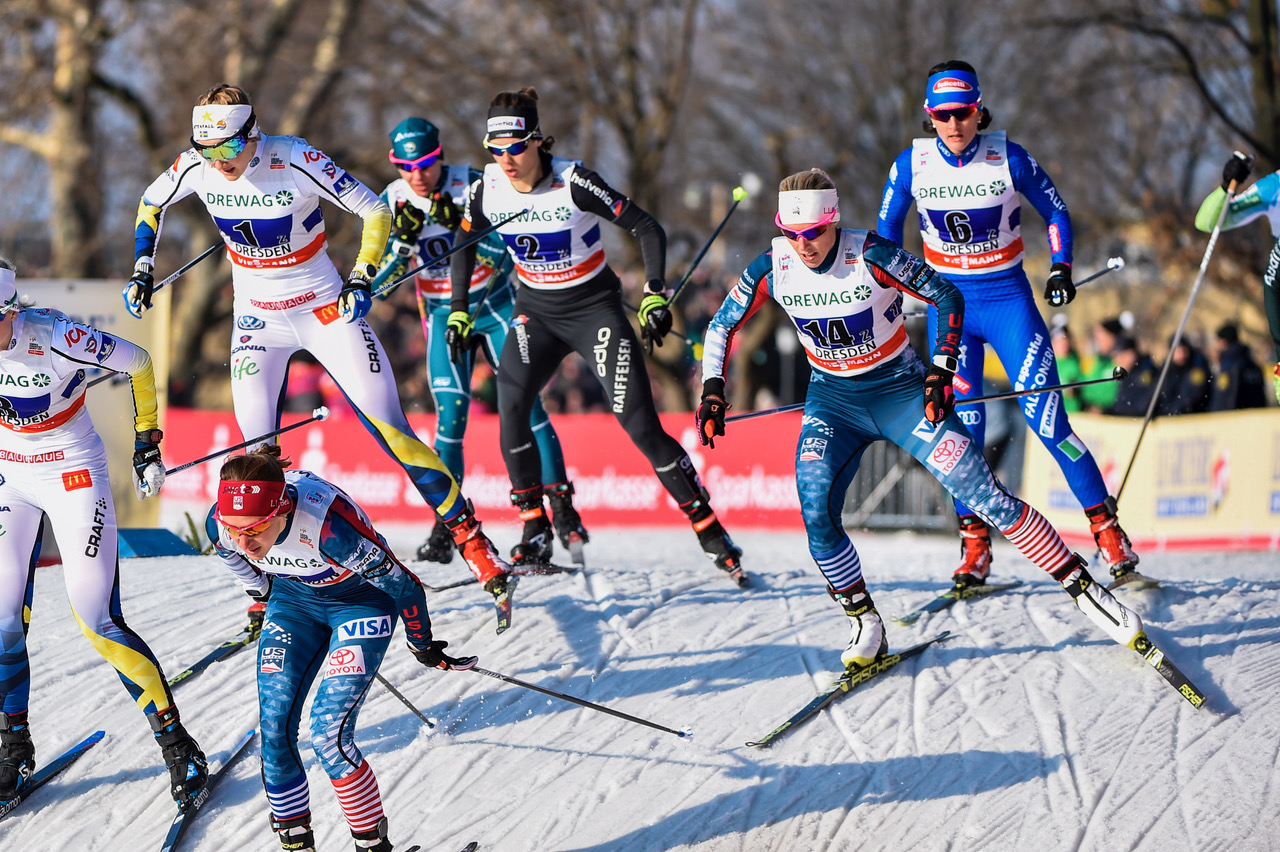
    Dresden, Germany looking good for the city sprints. (Photo: @skiweltcupdresden Instagram screenshot)

    FIS World Cup Dresden, Germany 1.6 k Freestyle Sprint

    The city of Dresden resting alongside the River Elbe hosted a 1.6-kilometer freestyle sprint for the second year running.

    Hannah Falk of Sweden, last year’s sprint winner in Dresden, won the qualifier in a time of 3:41.85 minutes. The U.S. Ski Team’s (USST) Sophie Caldwell was the second fastest qualifier (+0.49), with Falk’s teammate, Stina Nilsson, qualifying in third (+0.80).

    Canada’s Dahria Beatty placed 20th (+8.72) in qualification, while Julia Kern (USST D-Team) in her first European based World Cup qualified in 23rd (+10.84).

    Both Beatty and Kern were eliminated in the first heat which was won by Nilsson in 3:43.87. Beatty placed third (+1.18), Kern fourth (+1.25).

    Beatty ended the day in 16th place overall, Kern 19th.

    Caldwell advanced to the finals where she finished in fifth place, 2.61 seconds behind the day’s sprint winner Nilsson. Nilsson won the final in 3:48.49 minutes. It was an all Sweden podium as Maja Dahlqvist placed second (+0.24) and Jonna Sundling third (+0.54).

    No other North American women advanced to the heats.

    Hannah Halvorsen (USST D-Team) racing in her first World Cup placed 35th overall. Ida Sargent (USST) placed 38th, first time World Cup participant Hailey Swirbul (USST D-Team) 41st.

    Fifty-two women started Saturday’s sprint.

    Women’s Qualification | Women’s Final Results

    For the men, Italy’s Federico Pellegrino qualified first in 3:21.12 minutes. Britain’s Andrew Young was second fastest (+0.47), and Gleb Retivykh third (+1.27).

    In his return to World Cup skiing after racing the domestic circuit, American Andy Newell was the highest ranked North American in qualification, placing 19th (+5.58). Kevin Bolger (USST) qualified in 28th (+6.76).

    Newell and Bolger both raced the third heat where they were eliminated from the rounds. Newell placed fifth (+1.31), Bolger sixth (+1.45) in the third heat, which was won by Richard Jouve of France in 3:28:24.

    In the final standings, Newell ranked 25th, Bolger 29th overall.

    The race was won by Norway’s Sindre Bjørnestad Skar in 3:25.95 minutes. Retivykh placed second (+0.11), and Erik Valnes of Norway third (+2.83).

    Erik Bjornsen (USST) finished in 33rd (+7.43), Simi Hamilton (USST) did not start due to illness.

    For Canada, Bob Thompson placed 32nd overall, Lenny Valjas 47th (+9.55).

    Sixty-three men began the qualifier.

    Men’s Qualification | Men’s Results

    ***

    IBU World Cup Oberhof, Germany  10 k / 12.5 k Pursuit

    In the women’s pursuit Lisa Vittozzi of Italy, who was the first skier off today as she won Thursday’s sprint, also won the 10 k pursuit in a time of 32:32.9 minutes. Vittozzi had two penalties (0+1+1+0) on her way to the win.

    Anastasiya Kuzmina of Slovakia was second with four penalties (2+1+1+0), 14.5 seconds back. Kuzmina was the seventh starter, and began the race 30 seconds behind Vittozzi. Anaïs Chevalier of France place third (+27.9, 2+1+2+0). Chevalier was the second starter, beginning with a five second deficit.

    Susan Dunklee of the US Biathlon Team had a season best result, placing seventh overall (+1:01.2). Dunklee was the 10th starter, setting off 41 seconds back. Dunklee had five penalties (2+1+1+1) on her way to seventh place.

    Also for the U.S., Clare Egan, who place 13th in the sprint, fell back to 33rd in the pursuit after skiing seven penalty laps.

    For Canada, Emma Lunders placed 39th (+3:31.4) with six penalties on her day. Rosanna Crawford placed 52nd (+5:23.4) also with six penalties.

    Results

    In the men’s pursuit, Norway’s Johannes Thingnes Bø claimed the win in a time of 34:29.8 after three missed shots (0+1+1+1).

    Arnd Peiffer of Germany place second on Saturday, finishing 15.1 seconds back from Bø after one penalty (1+0+0+0). Italy’s Lucas Hofer snagged the third and final podium, finishing 15.8 seconds behind the winner after shooting clean.

    Two North Americans competed on Saturday, with American Sean Doherty finishing in 18th (+2:29.9) after skiing two penalties (2+0+0+0). Canadian Christian Gow also skied into the top 30, finishing in 27th (+2:57.4). Gow had two misses (1+0+0+1).

    Results

  • Sweden’s Sundling Scores First World Cup Win; Sadie Bjornsen Podiums in Lillehammer Skate Sprint

    Sweden’s Sundling Scores First World Cup Win; Sadie Bjornsen Podiums in Lillehammer Skate Sprint

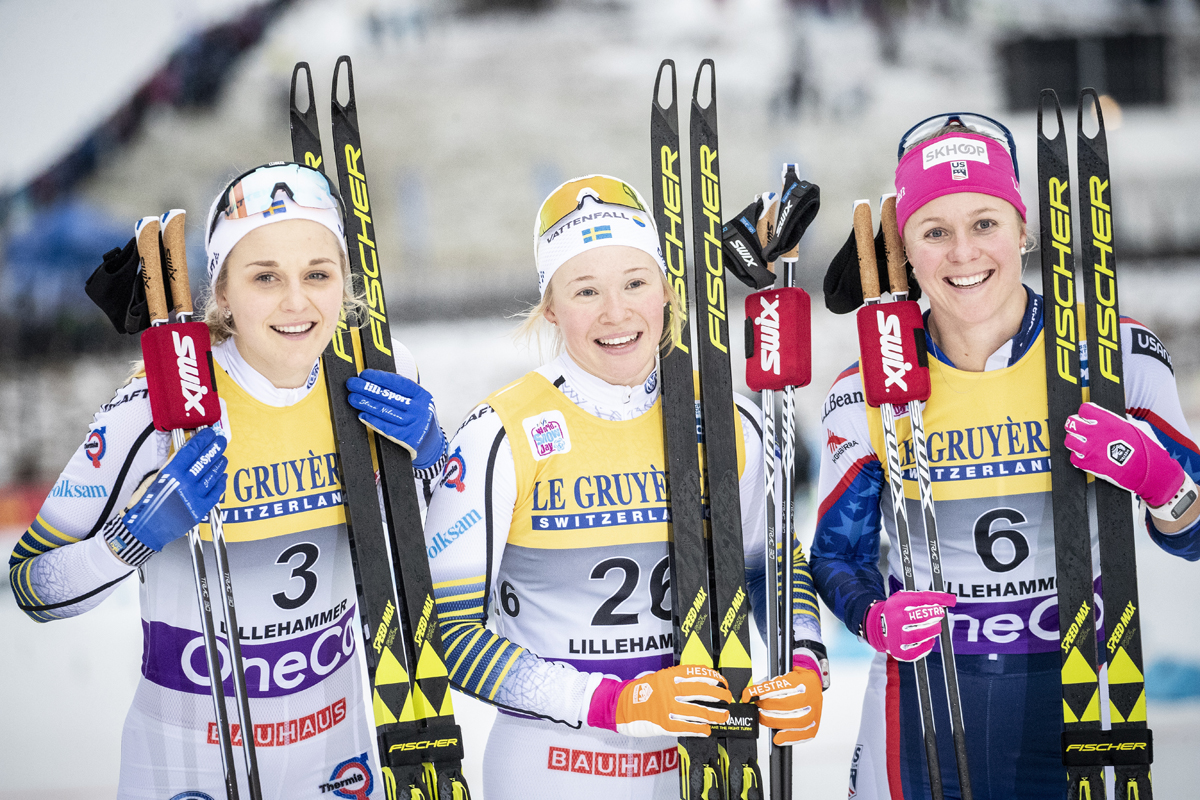
    The women’s podium from the 2018 1.3 k World Cup freestyle sprint in Lillehammer, Norway. Sweden’s Jonna Sundling (center) won, teammate Stina Nilsson (left) was second, and U.S. skier Sadie Bjornsen (right) third. (Photo: Fischer/Nordic Focus)

    With the two big climbs over 1.3-kilometer freestyle sprint course, the women’s World Cup freestyle sprint course in Lillehammer, Norway packs a quad-burning punch. With lungs then legs poaching any extra oxygen, the women’s final, which featured four of six athletes from Sweden, was a primetime show.

    Jonna Sundling of Sweden crossing the line first in the final of the women’s 1.3 k sprint in Lillehammer, Norway. (Photo: Fischer/Nordic Focus)

    Nilsson is a finisher, known for her closeout efforts in the finishing straight. But as she and twenty-three-year-old Sundling glided into the S-turns before the final 100 meters, Sundling’s skis looked to have a glide-advantage.

    It didn’t take long down the stretch for Sundling to pass Nilsson for her first career World Cup victory. She won in a time of 2:52.74 minutes. This was Sundling’s 29th World Cup start, and her second podium. She placed second last season in Falun’s skate sprint.

    Sundling qualified for the heats in 26th (+5.74). She advanced to the semis by winning the first heat. However, she was a lucky loser in the first semi-final to advance to the six-skier final.

    Nilsson placed second (+.34), the U.S. Ski Team’s (USST) Sadie Bjornsen was third (+3.03).

    Sadie Bjornsen of the US (bib 6) out lunges Sweden’s Ida Ingemarsdotter in the second semifinal during the 2018 Lillehammer, Norway World Cup skate sprints. (Photo: Fischer/Nordic Focus)

    For Bjornsen, she showed the early season form reminiscent of last season. During the 2017-2018 World Cup, Bjornsen posted a second place during the first weekend’s classic sprint, and a third place in the Lillehammer classic sprint the following weekend.

    This season, Bjornsen skied to an 11th place in the Ruka, Finland classic sprint and an 11th in the 10 k classic. With her near-the-front-of-the-pack skiing today, Bjornsen skied with assertiveness and confidence on her way to securing her first career World Cup skate sprint podium.

    It was Bjonrsen’s sixth career podium on the World Cup circuit.

    “I think sometimes I get easily pushed around a bit, it’s harder when your skis are not just going straight like classic,” Bjornsen said in the post-race press conference about her need to ski for position. “I was just focusing on trying to be in a position to really be in the front of the pack at the top of that climb. I kept finding some openings on the right side of the track to pass some people.”

    Bjornsen displayed keen instincts on the final climb. Even more impressive was her display of horsepower as she took a seam up the right-hand side, and began gapping fourth, fifth, and sixth place behind her.

    “Then coming into the finish, I tried to start free skating like three seconds before I wanted to because I knew that that speed would carry me across the finish,” Bjornsen said.

    Bjornsen was the fastest North American qualifier in sixth, 1.88 seconds behind the speediest qualifier, Sweden’s Hannah Falk, who stopped the clock in 2:56.43 minutes.

    Bjornsen advanced to the semis by placing second to Falk in the third heat. It was déjà vu in the second semi-final, where Bjornsen again placed second to Falk to secure a spot in the final.

    Bjornsen enters Saturday’s 10 k individual start classic in third overall for the Lillehammer three-day tour.

    The U.S. Ski Team’s Jessie Diggins skiing next to Russia’s Yulia Belorukova in the second heat during Lillehammer, Norway’s 1.3 k World Cup freestyle sprint. Diggins placed 17th overall.

    After qualifying ninth and 12th respectively, U.S. skiers Rosie Brennan (APU) and Jessie Diggins (USST) did not advance to the semi-finals. Diggins and Brennan raced in the second heat. Diggins placed fourth, Brennan fifth.

    Diggins finished the day in 17th, Brennan 21st.  

    Also for the U.S., Ida Sargent (USST) qualified 34th (+7.28), Kelsey Phinney (SMS T2) in 38th (+8.76), Caitlin Patterson (CGRP) 59th (+13.18), and Kaitlynn Miller (CGRP)  73rd (+20.78).

    USST athlete Sophie Caldwell did not start as she is fighting a cold.

    No Canadian women were entered.

    Racing continues tomorrow for the women with a 10 k interval start classic race.

    Women’s Qualification | Women’s Final Results

  • Johaug and Tønseth take Beitostølen, Norway Classic Openers

    Johaug and Tønseth take Beitostølen, Norway Classic Openers

    She’s back. Therese Johaug celebrates after winning the 2018 FIS 10-kilometer classic in Beitostølen, Norway.

    After an 18 month suspension for a positive out of competition positive doping test, during which Norway’s thirty-year-old Therese Johaug could build hour upon hour of base fitness and fine tune the engine with no race-stress, she arrived in Beitostølen, Norway on Friday and didn’t skip a beat.

    In temperatures hovering around 32 degrees Fahrenheit, and low-level clouds descending on the course, Johaug established herself as the early season favorite amongst a deep Norwegian National Team in Beitostølen’s FIS season opener 10-kilometer classic race.

    As the 52nd starter in a 60-skier field, Johaug never let off the throttle.

    The race was tight at the 1-kilometer time check, with national team skier Ingvild Flugstad Østberg marking the fastest time over Johaug by only 0.9 seconds. With nine kilometers to go, it was all Johaug, as she clocked the fastest times at the remaining checkpoints.

    Up by 4.3 seconds at 2.2k, the time back to the second fastest skier grew to 15.5 seconds at the race’s midpoint for Johaug. By the finish, Johaug did as she has done many times before, winning by a comfortable margin. She won in 25:42.6 minutes. Østberg, who ranked third in the World Cup overall last season, placed second (+23.9). Kari Øyre Slind was third (+59.8)

    Therese Johaug ready to start it all over again after her 18-month suspension.

    “It was special being here today,” Johaug told Norwegian broadcaster NRK according to a translation. “It feels incredible to back in the xc family again. To come up here and meet all the people that I’ve been skiing with for so many years, hear the cries from the crowds out in the course and the splits, it was a special feeling. It was so much. I was nervous before the start, but when I got started I really didn’t want it to end. I could have skied an extra lap.”

    The opening Beitostølen FIS races are the early season proving grounds for Norway’s elite cross-country athletes. The top-10 in the women’s race was riddled with names World Cup fans are familiar with.

    Astrid Uhrenholdt Jacobsen skied to fourth (+1:21.3), Haga Ragnhild fifth (+1:33.1), Anna Svendsen sixth (+1:42.8), and Heidi Weng, winner of last seasons overall World Cup finished seventh (+1:58.7).

    Annika Taylor, a former University of New Hampshire skier now skiing for Great Britain, raced her way to 21st (+3:49.3). 

    In similar conditions, the men raced a 15 k classic. Like the women’s field, it was a Norwegian who’s who of elite class skiers. But unlike Johaug setting an increasing time margin over any contenders, the men’s race was tight, separated by only 15 seconds for the top-five skiers 5 k into the race.

    At that point, with Didrik Tønseth in first and Emil Iversen in second, only a sliver of time, 0.1 seconds, differentiated the two. Martin Johnsrud Sundby and Johannes Høsflot Klæbo were gapped by 12.2 and 12.7 seconds respectively, as they skied through the time check in third and fourth place. Sjur Røthe came through in fifth (+15.8).

    Iversen, in bib 141, kept it close, setting the initial times to beat. Tønseth started three skiers back in bib 144. Through 10k, the two were still evenly matched: with Tønseth up by 3.4 seconds over Iversen.

    The men’s 15 k classic podium for the 2018 FIS opener in Beitostølen, Norway. Didrik Tønseth (NOR) in first, Norway’s Emil Iversen (left) in second, and Sjur Røthe (right) of Norway third.

    Tønseth won the race in 36:08.6 minutes, with his winning margin of 12.4 seconds over the second place Iversen only solidified in the closing kilometers. Røthe gradually moved up and finished third (+29.3).

    Sundby skied to fourth (+37.5), Hans Christer Holund fifth (+1:07.4), and Klæbo sixth (+1:17.5). British skier Andrew Musgrave finished seventh (+1:26.3). Musgrave is historically a stronger skate skier.

    One hundred and forty-three skiers finished the men’s race.

    Of note, thirty-two-year-old Petter Northug Jr., now a seemingly timeless presence on the Norwegian ski scene, was disqualified for classic technique violations. Prior to his DQ, Northug had been skiing in the top-20 for much of the race. Sundby was given a verbal warning for a classic technique violation.

    Several Canadians raced the 15 k classic. Russell Kennedy was the best placed Canadian finishing tied for 23rd (+2:37.6). Brian McKeever was 68th (+4:06.6), Ryan Jackson 110th (+5:39.1), Maks Zechel 113th (+5:56.5).

    Racing continues Saturday with a skate sprint.

    Beitostølen Women’s 10 k classic results | Beitostølen Men’s 15 k classic results


  • Friday Rundown: Beitostølen FIS Opening Race and More

    Friday Rundown: Beitostølen FIS Opening Race and More


    Norwegians Therese Johaug and Heidi Weng, (l-r) during the 2016 women’s 15 k skiathlon in Canmore, Alberta. (Photo: Fischer/NordicFocus)

    Welcome to The Rundown, your quick primer of need-to-know information about the day’s racing. We’ll be updating this digest as the day goes on with additional results, photos and quotes. The Rundown is NOT a race report; stay tuned for complete race reports later today with interviews from the day’s top racers.
    ***

    FIS cross-country Beitostølen, Norway: 10 k/15 k classic

    The race results are in from today’s 10-kilometer individual start classic FIS race in Beitostølen, Norway. The first of the season Beito races are used as a test pad for Norwegian athletes to gauge fitness and for some to make the rare jump to a coveted and scarce World Cup start. 

    Off of her suspension for using a banned substance, Norway’s Therese Johaug skied like she’d never been gone. Johaug was suspended for 18 months due to her violation.

    Johaug fired off the 10 k winning in 25:42.6 minutes. Ingvild Flugstad Østberg was second (+23.9). Rounding out the podium was Kari Øyre Slind in third (+59.8).

    Astrid Uhrenholdt Jacobsen skied to fourth (+1:21.3), Haga Ragnhild fifth (+1:33.1), Anna Svendsen sixth (+1:42.8), and winner of last seasons overall World Cup, Heidi Weng finished seventh (+1:58.7).

    The men skied a 15 k classic race Friday in Beitostølen. Didrik Tønseth won in a time of 36:08.6 minutes. In second was Emil Iversen (+12.4), while Sjur Røthe placed third (+29.3).

    Martin Johnsrud Sundby skied to fourth (+37.5), Hans Christer Holund fifth (+1:07.4), and Johannes Høsflot Klæbo sixth (+1:17.5).

    British skier, although based in Norway, Andrew Musgrave finished seventh (+1:26.3).

    One hundred and forty-three skiers finished the men’s race. Of note, Petter Northug Jr., now a seemingly timeless presence on the Norwegian ski scene, was disqualified for technique violations.

    buy temovate online


    Several Canadians raced the 15 k classic. Russell Kennedy was the best placed Canadian finishing tied for 23rd (+2:37.6). Brian McKeever was 68th (+4:06.6), Ryan Jackson 110th (+5:39.1), Maks Zechel 113th (+5:56.5).

    Beitostølen Women’s 10 k classic resultsBeitostølen Men’s 15 k classic results 


    ***

    Bruksvallarna, Sweden cross-country: 5 k/10 k freestyle

    In Bruksvallarna, Sweden FIS racing began with a 5 k freestyle for the women. Three of Sweden’s star skiers took the podium spots. Ebba Andersson won the tight race in 9:57.1 minutes, finishing only 2.6 seconds ahead of second place skier Charlotte Kalla. Known for her sprinting prowess, Hanna Falk was third (+15.7).

    One hundred and twelve skiers finished the race.

    For the men, after skating 10 k, the race was a tie for first. Sweden’s Jens Burman and Karl-Johan Westberg skied the fastest time. Both crossed the line in 19:11.0 minutes for the win. Japanese skier Keishin Yoshida placed third (+9.5).

    Daniel Rickardsson, of Sweden, skied to fourth (+12.9).

    Women’s results | Men’s results


  • Sweden Goes 1-2, U.S. Women Third in Dresden Team Sprint

    Sweden Goes 1-2, U.S. Women Third in Dresden Team Sprint

    The finish of the women’s 6 x 1.2 k freestyle team sprint final, with Sweden II’s Maja Dahlqvist (near) celebrating her win ahead of Sweden I’s Stina Nilsson (c) and American Sophie Caldwell (l), who placed second and third, respectively, in a photo finish. (Photo: Fischer/NordicFocus)

    DRESDEN, Germany — Just over 15,000 people gathered at the Elbe River bank on Sunday, some donned in sunnies and carrying sauce-laden brätwurst from pop-up food carts, though all took pause around 11:14:59 a.m. It wasn’t to take in the Altstadt baroque-style buildings that make up the city skyline, nor was it to bask in the bright, mid-morning sun hovering on the horizon.

    A new attraction had come to the capital city, and all eyes were on it: the start of the International Ski Federation (FIS) women’s 6 x 1.2-kilometer freestyle team sprint. The city race organizers had trucked nearly 5,000 cubic meters of manmade snow to the grassy green bank, creating a skiing venue where one had never previously existed before. (Dresden has never before hosted a World Cup; the closest place to find natural snow being around 95 kilometers away).

    Though it was the first of its kind, the crowd was still on edge as racers anticipated the snap of the gun for the women’s final. Even amid artificial conditions, the scene was naturally mystifying for onlookers.

    With the gunshot, life roiled back into those in the stands and competitors became absorbed in the race for the win. Leading out Lap 1 was Ida Ingemarsdotter, racing for Sweden’s second team with Maja Dahlqvist (who placed third in Saturday’s individual skate sprint).

    Ingemarsdotter was closely followed by her compatriot, Hanna Falk, who had won Saturday’s sprint and was racing for Sweden’s first team on Sunday. Hanna Kolb, racing for Germany I, Ida Sargent racing for U.S.A. I, and Alenka Cebasek racing for Slovenia, were all in hot pursuit.

    Also on course was Nadine Fähndrich of Switzerland, Giulia Stuerz on Italy , Jessica Yeaton of Australia, Caitlin Patterson (U.S.A. II), and Katharina Hennig (Germany II).

    U.S. Ski Team members Sophie Caldwell (l) and Ida Sargent after placing third in the World Cup freestyle team sprint on Sunday for their World Cup second podium together in the event. (They finished third in the pre-Olympic World Cup freestyle sprint last year in PyeongChang, South Korea.) (Photo: Fischer/NordicFocus)

    Through the exchange it was Ingemarsdotter in first, Falk second, Kolb third, and Sargent fourth. Coming through in seventh was Patterson, of the Craftsbury Green Racing Project, handing off to Kikkan Randall (U.S. Ski Team).

    “I think I tend to let myself accordion to much, so I had to watch that and really focus to stay in it,” said Patterson, who arrived in Dresden on Thursday after being crowned a four-time 2018 national champion last week in Anchorage, Alaska.

    “Being efficient … keeping it together and keep[ing] it tight,” Patterson added, referring to her race strategy on Sunday. “Because I know Kikkan has so much experience in heats and she can really maneuver well; she did such a good move on the last leg of that semifinal to keep us in it.”

    In the final, as Patterson handed off to Randall, while Sargent passed off to Caldwell (who had placed third in Saturday’s sprint). Still in the lead was Ingemarsdotter tagging to Dahlqvist, Kolb to her teammate Sandra Ringwald, and Falk to Stina Nilsson.

    The women stayed in a close pack, but thanks in part to the cheers of a large fanbase behind her, Germany’s Ringwald had worked her way to the front. As the skiers approached their third exchange, Germany had taken over the lead. Following Ringwald was Caldwell in second and Slovenia’s Vesna Fabjan in third. Randall was also gaining ground and gave the race back to Patterson in sixth as the field headed into Lap 3 of 6.

    Americans Sophie Caldwell (front r) and Kikkan Randall (14) racing together in the women’s 6 x 1.2 k freestyle team sprint final on Sunday at the World Cup in Dresden, Germany. USA I, with Ida Sargent (not shown) and Caldwell went on to place third, while USA II, with Caitlin Patterson (not shown) and Randall, finished eighth. (Photo: Fischer/NordicFocus)

    “This is my first real racing weekend back and yesterday was a little frustrating because my body felt good but I just didn’t quite have the speed fully ready yet,” said Randall, who had pulled out of the Tour de Ski due to an ongoing issue with one of her foot tendons and has been working on recovering since. “So I am really glad I got the opportunity to race today.

    “It was great to have Caitlin ski really strong and get into the final,” Randall added. “I just wanted to get six rounds and I did. It was fun, fast paced, and I am happy with the way I felt. Of course, it’s fun to have another team in the race, too, and kind of be working together a bit.”

    Caitlin Patterson racing for USA II in the women’s 6 x 1.2 k freestyle team sprint on Sunday at the World Cup in Dresden, Germany. (Photo: Fischer/NordicFocus)

    As racers struck out into Lap 3, Switzerland’s Fähndrich was at the helm, which she held until she tagged off to her teammate Laurien van der Graff. The Swiss skiers had a smooth exchange and van der Graff was out front. Breathing down her neck behind her, however, were two Swedes: Nilsson and Dahlqvist. As the group approached the course’s most notable climb, Nilsson powered her way around van der Graff and to the front, Ringwald in tow.

    With the fourth exchange coming into sight, the top two spots were with Sweden, Switzerland third. U.S.A. I was in fifth, U.S.A. II in eighth.

    “It’s hard to pass, so we definitely wanted to stay toward the front,” Caldwell said of her and Sargent’s plan heading into the final. “It’s such a short and fast course that anything can happen and I think it is always fun to be right there in the mix.”

    With just two laps to go, Falk, who came out of the exchange first, began to push the pace, while Fähndrich, Sargent and Ingemarsdotter chased her down. Though Falk had put a bit of a gap on the field by the course’s turn heading back to the stadium, it had closed by the course’s single climb. Here, Fähndrich made her move and maneuvered around Falk to the front.

    After the fifth exchange and heading into the final lap, the two Swedes, van der Graff, and Caldwell tried to separate themselves from the rest of the teams in the final. But within a few meters three more teams — Slovenia, and Germany I and II — had rejoined them.

    As they approached the aforementioned uphill, Nilsson went for it, propelling herself to the front. Dahlqvist went with her, and Caldwell dodged to van der Graff’s left, pulling a hard V1 to get around the Swiss skier. Approaching the finish, it was Dahlqvist to the far right, Nilsson in the middle and Caldwell to the left.

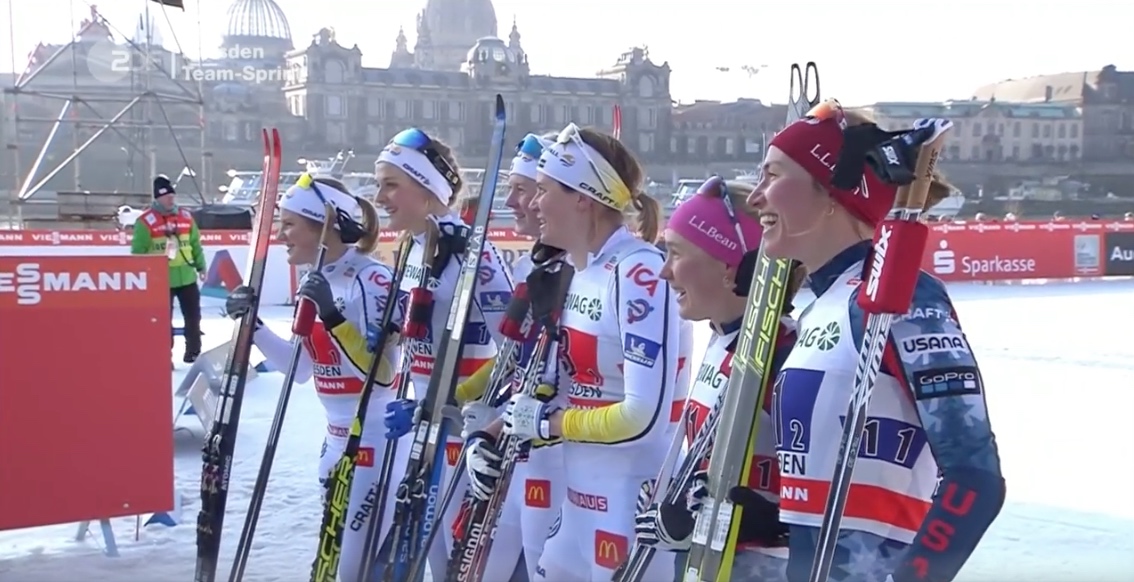
    The women’s 6 x 1.2 k freestyle team sprint podium at Sunday’s World Cup in Dresden, Germany, with Sweden II’s Ida Ingemarsdotter and Maja Dahlqvist in first (c), Sweden I’s Stina Nilsson and Hanna Falk in second (l), and USA I’s Sophie Caldwell and Ida Sargent in third (r). (Photo: Fischer/NordicFocus)

    Both Swedes appeared to have an edge on Caldwell, but the American made a gritty final few pushes and all three lunged for the line. Dahlqvist was just ahead and took it by 0.16 seconds over Nilsson, and Caldwell placed third for the second day in a row, just 0.07 seconds out of second place and 0.23 seconds out of first. Sweden’s No. 2 team had won it with a cumulative time of 13:33.40, about four seconds faster than the fastest semifinal.

    “I was actually left wishing the finish was a little longer, which I don’t know if I have ever said about a race before,” Caldwell, who leans toward sprint disciplines, said after the race. “Ida skied awesome and I was proud with how I skied, so it’s really fun when you feel like both legs kind of do their best and you get a good result to celebrate that with.”

    Finishing in fourth (+2.11) was Germany I, Slovenia placed fifth (+4.46), Germany II placed sixth (+4.62), Switzerland (+5.09) USA II eighth (+7.95), Italy I ninth (+10.89) and Australia 10th (+27.53).

    To start the day, Sweden I, with Falk and Nilsson had won the first semifinal in 13:37.97, by 0.17 seconds over Sweden II’s Ingemarsdotter and Dahlqvist. The top-six teams from that heat qualified for the final, with Switzerland in third, Italy in fourth, Slovenia in fifth, and Australia in sixth.

    The American teams took the top two in the second semifinal, with Sargent and Caldwell winning 13:46.51, and Patterson and Randall following in second, 0.11 seconds back. Germany I and Germany II qualified from that heat as well with fast-enough times.

    Sunday marked the first and last team sprint of the season so far before the Winter Olympics in PyeongChang, South Korea, where a freestyle team sprint will be contested on Feb. 21.

    The World Cup has two more weekends of racing before the Olympics, with all-classic races next weekend in Planica, Slovenia (classic sprint and 10/15 k classic individual starts), followed by freestyle races in Seefeld, Austria, on Jan. 27-28 (skate sprints and 10/15 k freestyle mass starts).

    Results: Semifinals | Final

    — Ian Tovell and Alex Kochon contributed reporting

    The women’s 6 x 1.2 k freestyle team sprint podium at Sunday’s World Cup in Dresden, Germany, with (from left to right) Sweden I’s Hanna Falk and Stina Nilsson in second, Sweden II’s Ida Ingemarsdotter and Maja Dahlqvist in first (c), and USA I’s Ida Sargent and Sophie Caldwell in third (r). (Screenshot: ZDF broadcast)
  • Svensson, Nilsson Delight Home Crowd in Gällivare Sprint; Beatty, Valjas Reach Heats

    Svensson, Nilsson Delight Home Crowd in Gällivare Sprint; Beatty, Valjas Reach Heats

    Sweden’s Stina Nilsson at 2017 World Championships, after she finished 13th in the women’s 10 k classic on Feb. 28. On Sunday, she won her first sprint of the season at Sweden’s FIS season-opener in Gällivare.

    For the third and final day of International Ski Federation (FIS) racing in Gällivare, the home crowd would not be let down. Both the men’s and women’s 1-kilometer classic sprints were won by Swedes, one of whom has established herself as one of the world’s best sprinters, ending last season second in the 2016/2017 Sprint World Cup at the age of 23.

    Stina Nilsson, now 24 and entering her fifth year of racing on the World Cup, tallied her first win of the season in Sweden’s season-opening sprint on Sunday. So did Oskar Svensson, 22, who competed at his first World Championships last season.

    The day started with 1 k qualifiers, which Nilsson’s teammate Hanna Falk won in 3:58.86 minutes. Nilsson followed in second, 1.9 seconds back, and the two advanced through their quarterfinals and semifinals (with Nilsson winning both) before meeting head to head in the final. Also advancing to the final were Russia’s Natalia Matveeva (who won the other semifinal), Yulia Belorukova and Evgeniya Shapovalova, as well as Switzerland’s Nadine Fähndrich.  

    In the final, Nilsson held off two Russians for the overall win, finishing first in 3:53.75. Matveeva finished 1.89 seconds later for second place, while Belorukova claimed third (+3.16). Falk placed fourth (+5.50), followed by Shapovalova in fifth (+6.09) and Fähndrich in sixth (+6.58).

    Rounding out the top 10 were Sweden’s Ida Ingemarsdotter and Jonna Sundling in seventh and eighth, respectively, followed by Russia’s Elena Soboleva in ninth and Sweden’s Anna Haag in 10th.

    (Article continues below)

    https://www.instagram.com/p/Bbr9CpXFp6O/?hl=en&taken-by=stinanilssoons

    The lone North American woman in Sunday’s sprint, Dahria Beatty qualified for the heats in 28th, 17.29 seconds out of first. She went on to finish fifth in her quarterfinal, 9.94 seconds behind Haag, who won that heat. Overall, Beatty ended the day in 23rd. She also raced the 5 k freestyle to start the long weekend in Gällivare and placed 56th in that race.

    “There were parts of the course I felt I skied really well in my qualifier today and other parts that definitely need some work,” Beatty wrote in an email. “I was happy with how my striding and double pole felt and my body was moving a lot better today than on Friday in the 5k Skate. The snow was tricky today and I didn’t carry my speed very well through the transitions and up the double pitched herringbone/run section on the back of the course.”

    Beatty, a 23-year-old member of Canada’s World Cup Team, flew to Sweden with most of her team on Nov. 11 to get some time on European snow and compete in some early FIS races before the start of the World Cup.

    “I was really happy to be able to ski a heat and get that feeling of pushing head to head with others,” she continued. “It’s always good to see where you are losing time or keep up in the heats to figure out what needs to be worked on before the next weekend. I am hoping I can take what I learned today and make some improvements for the World Cup opener next weekend.”

    Kikkan Randall of the U.S. Ski Team raced Friday’s 5 k skate and Saturday’s 10 k classic, but opted out of Sunday’s classic sprint. Sixty-seven women contested Sunday’s sprint qualifier.  

    Svensson Tops Men’s Sprint

    Meanwhile, Svensson, a member of Sweden’s national A-team, topped a field of 114 in the men’s classic sprint. He started out by winning the qualifier by 0.76 seconds over Russia’s Anton Gafarov in 3:24.06. 

    In the first quarterfinal, Svensson placed second to Russia’s Andrey Parfenov, finishing 0.14 seconds behind him, and both advanced to the semifinals. There, Svensson won the first semifinal by just 0.01 seconds over fellow Swede Teodor Peterson. They advanced to the final, along with four Russians: Gafarov, Alexander Panzhinskiy, Nikita Kriukov, and Maxim Vylegzhanin.

    Sweden’s Oskar Svensson leads Alex Harvey and others during their quarterfinal at the freestyle sprint at 2017 World Cup Finals in Quebec City last March.  (Photo: John Lazenby/Lazenbyphoto.com)

    In the finishing stretch of the final, Svensson and Peterson again lunged for the win, which Svensson took by 0.4 seconds in 3:21.63. Kriukov finished third, 2.12 seconds out of first, followed closely by Panzhinskiy in fourth (+2.18) and Vylegzhanin in fifth (+2.84). Gafarov ended the day in sixth (+22.99).

    Also in the top 10, Sweden’s Calle Halfvarsson placed seventh, Parfenov was eighth, Russia’s Alexey Vitsenko finished ninth and Sweden’s Johan Haeggström was 10th.

    Of the six Canadian men who raced on Sunday, World Cup Team member Len Valjas was the lone qualifier in 24th (+8.69). In the second quarterfinal, from which two lucky losers advanced to the semifinal, he finished sixth, 3.85 seconds behind the heat’s winner, Halfvarsson. That put Valjas 29th overall on the day.

    Julien Locke (Canadian U25 Team) raced to 39th in the qualifier, 12.32 seconds out of first and 2.36 seconds out of the top 30, for his best result of the weekend. He finished 72nd in the 10 k freestyle on Friday.

    “It was a long, twisty course with a fairly gentle profile with the exception of two very short, punchy steep sections,” Locke, who recently earned World Cup starts at Frozen Thunder trials, wrote in an email. “With all of the fresh snow the last couple days, the track was a soft on the corners and broken up on the climbs.

    “I felt that I skied well in the qualifier but was lacking tempo and glide speed on the climbs,” he continued. “The shape feels good and I was able to have a high output throughout the qualifier. I would have liked to race the heats as they would have been excellent race prep for the first World Cup on Friday.”

    Another Canadian, Knute Johnsgaard (World Cup Team) followed in 40th, 0.48 seconds behind Locke and 12.80 seconds out of first. Russell Kennedy, last year’s NorAm winner who trains in Canmore with Team R.A.D., raced to 43rd (+13.30). On Friday, he finished 48th in the 10 k skate.

    “It is always a bit hard with sprints, but the goal was to close really well,” Kennedy wrote in an email. “I felt strong and was much more happy with this sprint than my Frozen Thunder qualifier.”

    With firm tracks and good skis, Kennedy described his Gällivare qualifier as “super smooth.”

    “There was one pretty icy corner I thought it was kinda fun since there was a big berm you could ride but there were definitely some falls around that area,” he wrote.

    Not wanting to overburden his body before some of the other races he is targeting in the upcoming weeks, Kennedy opted out of Saturday’s 15 k classic.

    “I am trying to build my fitness a bit through these races so racing Friday was really good for my fitness and I took off Saturday to get some rest as I have a lot of races coming up that I want to perform well at,” he explained.

    Two other Canadians raced Sunday’s sprint qualifier, with Jess Cockney finishing in 48th (+14.05) and Jack Carlyle in 105th (+33.44).

    Results:

    Women: Qualifier | Final

    Men: Qualifier | Final

  • Another Sprint Victory for Nilsson; Falla Defends Sprint Crystal Globe in Quebec

    Another Sprint Victory for Nilsson; Falla Defends Sprint Crystal Globe in Quebec

    The women’s freestyle sprint podium at World Cup Finals on Friday in Quebec City, with Sweden’s Stina Nilsson (c) in first, Norway’s Maiken Caspersen Falla (l) in second, and Sweden’s Hanna Falk (r) in third. (Photo: John Lazenby/Lazenbyphoto.com)

    At the start of the season, Sweden’s Stina Nilsson had three individual World Cup wins to her name. Now, after taking Friday’s freestyle sprint title — and only two races left on this year’s World Cup calendar — Nilsson has quadrupled that number.

    The 23-year-old Swede raced to her ninth victory of the season on Friday in Québec City, crossing first in the women’s 1.5-kilometer freestyle sprint in a time of 3:01.87.

    The closest competitor to Nilsson was Norway’s Maiken Caspersen Falla, who crossed 0.42 seconds behind in second.

    The two went head to head from the start of the final, with Falla leading Nilsson into the first incline and through the first downhill. Norwegian Heidi Weng clung closely behind and by the second major climb, Nilsson was at the helm, but not for long. Falla forced her way to the front once again, forcing the Swede to pick up her pace. The two began to break away from the rest of the field with 500 meters to go.

    As they made their way down the third major descent, Nilsson moved around Falla and back to the lead, giving herself an edge on the Norwegian for the final climb. The two entered the final finishing stretch together, but with 50 meters left, Nilsson had knocked the Norwegian off the top spot.

    “I have had an amazing season,” Nilsson said during a televised interview with the International Ski Federation (FIS). “And I really like to compete in Quebec, so I am very happy with the race.”

    Norway’s Maiken Caspersen Falla celebrates her second-straight Sprint World Cup Crystal Globe on Friday at World Cup Finals in Quebec City. (Photo: John Lazenby/Lazenbyphoto.com)

    Despite missing the final during last weekend’s sprint in Drammen, Norway, and narrowly sneaking into Friday’s sprint final — she was the second lucky loser in her semifinal after a photo finish with Switzerland’s Nadine Fähndrich — Falla’s podium secures her as the overall sprint leader and awards her with her second-straight Sprint Crystal Globe.

    “When you have a really bad day as I did in Drammen, you’re very happy to be back on the podium,” Falla told FasterSkier during an in-person interview.

    “It’s great to be here and take the crystal globe home,” she added in an interview with FIS.

    Rounding out the final podium spot in third (+2.58) was another Swede, Hannah Falk, who had started the day with a qualifying win in 3:02.91. Despite breaking a pole early in her quarterfinal, she clawed her way back to second to automatically advance to the semifinal and ultimately reach the final.

    “I tried to just stay calm and knew that I got high speed in the end,” Falk told FasterSkier about how she handled exchanging poles after hers broke in the second quarterfinal.

    Falk finished the season ranked third in the Sprint World Cup, behind her teammate Nilsson in second and Falla in first.

    “I’m top number three in the Sprint World Cup so it was my goal today to take that podium,” Falk said.

    Also in the final, Sweden’s Ida Ingemarsdotter was the third Swede in the top four in fourth (+3.02). In her first World Cup sprint final, Fähndrich finished fifth (+3.41) and Weng placed sixth after breaking a pole (+32.36). 

    “I think I made all the right tactical decisions today,” Fähndrich told Swiss broadcaster SRF, according to a translation.

    Just by making the final, Weng essentially locked up the Overall World Cup title with a 325-point lead over Finland’s Krista Parmakoski in second. Norway’s Ingvild Flugstad Østberg another 73 points back in third and 123 points ahead of Nilsson in fourth overall.

    “My goal right now is to be top three in the world overall,” Østberg told FasterSkier after a three-woman crash (with Slovenia’s Vesna Fabjan and Switzerland’s Laurien van der Graaff) ended their runs in the second semifinal. Østberg finished the day in eighth.

    “I really have to fight for that because Stina is chasing me,” Østberg added of her overall podium goal. “The world champs in Lahti was not what I was hoping for so it will be a huge goal and really great if I could be third in the Overall World Cup.”

    Diggins 9th; Kern 24th in First World Cup

    U.S. Ski Team (USST) member Jessie Diggins was the top North American woman on the day, placing ninth overall after finishing fifth in her semifinal. Coming off of a silver medal in the freestyle sprint at this year’s Nordic World Championships, Diggins had high hopes for her performance in Friday’s final sprint.

    Jessie Diggins (U.S. Ski Team) racing to 11th in the women’s 1.5 k freestyle sprint qualifier on Friday at World Cup Finals in Quebec. She went on to reach the semifinals and placed ninth overall. (Photo: John Lazenby/Lazenbyphoto.com)

    However, with Nilsson, Falla, Falk, and Fähndrich all pushing the pace in her semifinal, Diggins missed advancing to the final.

    “My finishing speed has been good all season and especially from the last skate sprint we did in Lahti, so I had a lot of high hopes for today,” Diggins wrote in an email. “But in my semifinal there was a lot of fighting for position and it’s always frustrating when your whole heat finishes 1.4 seconds faster than the winner of the other semi! But, that is sprinting sometimes.”

    Along with Diggins, who qualified 11th, four other Americans made the heats: Sadie Bjornsen (who qualified sixth), Sophie Caldwell (18th), Rosie Brennan (27th), and Julia Kern (19th). Bjornsen was the next top finisher for the U.S., placing 16th, just 0.12 seconds away from advancing to the semifinals.

    “Sadie, in her quarterfinal, she did everything she wanted to do, she put herself in the absolute right position to be right here in second place coming into the finish straight and just barely missed, just got passed at the line,” USST head coach Chris Grover said.

    Bjornsen had been positioned in second through the final turn, until she was eventually outlunged by Falk.

    Sadie Bjornsen (U.S. Ski Team) racing to sixth in the women’s 1.5 k freestyle sprint qualifier on Friday at World Cup Finals in Quebec City. She went on to place 13th overall. (Photo: John Lazenby/Lazenbyphoto.com)

    “I just haven’t been able to find that perfect speed at the finishing stretch pretty much every sprint this year,” Bjornsen said. “I was trying to switch things up today and see if I could and I gave it my all and unfortunately didn’t take the draft right into the finish.”

    After qualifying with the sixth-fastest time, 3.47 seconds behind Falk, Bjornsen indicated that even if this season’s World Cup sprints are done, her perfection over the art of sprinting is not.

    “When I’m qualifying that well, I know I can sprint well, that’s like the most exciting part,” Bjornsen said.

    Also left wanting a little more on Friday was Caldwell, who finished 21st. Caldwell had been positioned in third coming into the final turn before the finishing stretch, when she fell after a near-run in with Sweden’s Anna Dyvik. The Swede was relegated to last in that quarterfinal.

    “Today was a really frustrating day for me and not the way I wanted to end the World Cup sprint season,” Caldwell wrote in an email. “My season has been solid and consistent, but I’ve had three crucial falls now and those bummed me out. Davos was entirely my own doing, but Toblach and today were pretty out of my control, which is frustrating because I don’t know what I could have done differently.”

    Caldwell plans to race both of the final two distance days of the World Cup season, though the sprint had been her primary focus.

    “I haven’t been able to do very much distance racing this year, so I have zero expectations and will hopefully be able to have some fun out there!” Caldwell wrote. “I am happy with the season and I feel like I’ve skied a little better than the results show due to some falls, but I’m eager to stay on my feet and accomplish more next season.”

    Julia Kern (U.S. Ski Team D-team/SMS) racing to 29th in the women’s 1.5 k freestyle sprint qualifier on Friday at World Cup Finals in Quebec City. In her first World Cup race, Kern ended up 24th on the day. (Photo: John Lazenby/Lazenbyphoto.com)

    In her first World Cup race, Kern qualified for the heats in 29th and raced in the day’s first quarterfinal — the same as Diggins, sprint leader Falla, Ingemarsdotter, and Fähndrich.

    “At the start line it almost felt like a dream because there I was at the start line next to some of the best skiers in the world, skiers who I have looked up to and watched race after race on my computer screen to learn and gain inspiration from,” Kern wrote.

    Kern explained that though she was a little nervous about starting the sprint on Friday, she cited her recent performances at U.S. Junior Nationals in Lake Placid, N.Y., where she won all three individual races, as giving her confidence. Though getting into the heats would require what she referred to as “a killer day”, the 19-year-old USST development team member pulled it off, ultimately crossing in fifth in her quarterfinal for 24th overall.  

    I felt like I had skied the qualifier pretty well technically, but I didn’t feel my extra spark I get when I am having a really good day so I was very surprised when Chris Grover told me I was hanging in 29th!” Kern wrote. “When it was confirmed that I was in the heats I was extremely excited and a little shocked. It has been something I have imagined over and over when I watch the World Cup sprints on my computer and for it to happen in my first World Cup was truly incredible.”

    With two more World Cup races to go, Kern is coming into them with a newfound confidence.

    “This is a huge confidence booster for me because it is easy to make a goal and have my teammates and coaches who believe in me tell me results like this are possible, but it is another thing to actually live up to it and believe it yourself too,” Kern wrote.

    Rosie Brennan (U.S. Ski Team) racing to 27th in the women’s 1.5 k freestyle sprint qualifier on Friday at World Cup Finals in Quebec City. She qualified for the first time in a sprint, and ended up 28th overall on the day. (Photo: John Lazenby/Lazenbyphoto.com)

    Advancing to the heats for the first time in her World Cup career was Brennan, who qualified 27th and finished the day in 28th.

    “The quarters were not what I had hoped for, but I didn’t really have too many expectations, I’ve never done it before,” Brennan said. “So I’m glad to have gotten that out of the way before the season was over and I have a good list of things to work on this summer.”

    Even with five U.S. women making the heats on Friday, the team was hungry for more.

    “On the ladies’ side, a decent qualification, but not actually really one of our best,” Grover said. “Great for Julia to get in there as a junior athlete, that was really exciting for Rosie to get in there, because that may have been the first time this season she’s actually been in. She’s been just on the outside so many times. So excited for those two guys. Kind of an OK qualification for the other three ladies … all those ladies skied really smart, but it just didn’t come together.”

    American Sophie Caldwell (18) chasing Slovenia’s Vesna Fabjan (8), ahead of Sweden’s Anna Dyvik, during their quarterfinal of the women’s freestyle sprint on Friday at World Cup Finals in Quebec City. (Photo: John Lazenby/Lazenbyphoto.com)

    Eight other American women competed in Friday’s sprint, though did not advance beyond qualification with Ida Sargent placing 36th, Erika Flowers 48th, Kaitlynn Miller 50th, Caitlin Patterson 53rd, Becca Rorabaugh 54th, Chelsea Holmes 55th, Jennie Bender 57th, and Liz Guiney 62nd. Liz Stephen did not start.

    Sargent explained that though she had been looking forward to this weekend’s races, a bout of pneumonia left her unable to compete at the level she had hoped to.

    I got sick in Lahti and just couldn’t figure out why I wasn’t getting better,” Sargent said. “They thought it was just a cold, but I kind felt like something was different and so, eventually I got diagnosed with pneumonia and I’m still on antibiotics for that. They said I was fine to race and that it wouldn’t do any damage. I didn’t have much hope for how it was going to go today, I was trying to stay optimistic, but there’s a reason with antibiotics and pneumonia.”

    For Canada, Dahria Beatty finished 41st, Emily Nishikawa 45th, Cendrine Browne 47th, Andrea Dupont 51st, Sophie Carrier-Laforte 56th, Katherine Stewart-Jones 59th, Annika Richardson 60th, Sadie White 61st, Frederique Vezina 63rd, Laura Leclair 65th, Katherine Weaver 66th, Mia Serratore 67th, Alannah MacLean 69th, Annika Hicks 70th, and Lisle Compton 71st.

    Results | World Cup Finals standings

    Overall World Cup standingsSprint World Cup standings (final)

  • For Diggins and Randall, Life’s Sweet with Silver and Bronze

    For Diggins and Randall, Life’s Sweet with Silver and Bronze

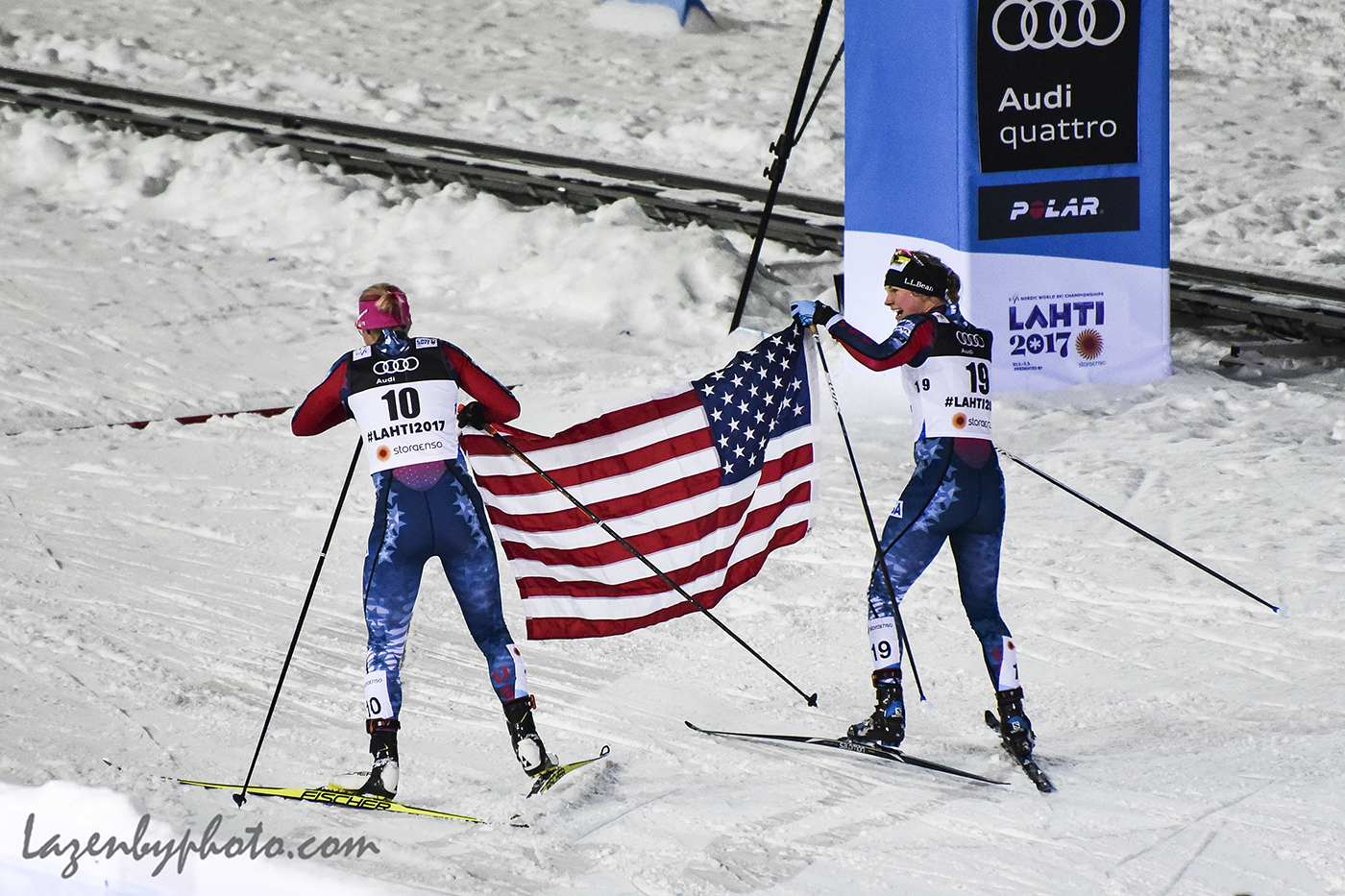
    An American sandwich: U.S. Ski Team members Jessie Diggins (l) and Kikkan Randall (r) sharing the podium with Norway’s Maiken Caspersen Falla (c) after Falla won the women’s freestyle sprint at 2017 Nordic World Championships on Thursday in Lahti, Finland. Diggins placed second and Randall was third. Diggins and Randall are now tied for the most World Championships medals with three apiece. (Photo: John Lazenby/Lazenbyphoto.com)

    LAHTI, Finland — Three: that’s the magic number. On a historic night in Lahti on Thursday, three of the four U.S. women entered in the 2017 Nordic World Championships 1.4-kilometer freestyle sprint advanced from their quarterfinals to the semifinals and eventually, the final.

    Toeing the start line for the American triad was the U.S. Ski Team’s (USST) Kikkan Randall, Jessie Diggins and Sophie Caldwell. Filling the final three spots were two Swedes — Hannah Falk and Ida Ingemarsdotter — as well as Norway’s Maiken Caspersen Falla.

    Not making the cut was the week’s sprint favorite, Stina Nilsson. The young Swedish superstar had crashed while cornering the final turn in her semifinal, taking out Russia’s Natalia Matveeva and earning herself a yellow card and relegation to last in the heat. Randall and Caldwell, who were both in Nilsson’s semi, maneuvered around the spill to advance in second and third, respectively.

    With no Nilsson, Sweden put its faith in Ingemarsdotter and Falk, while the U.S. comprised half of the field in the women’s final.

    “That’s for sure the funnest final I have ever been a part of,” Randall said during a post-race press conference. “Before we went to the start we did a little team cheer … we had such good energy between the three of us.”

    Norway’s Maiken Caspersen Falla (1) leading Sweden’s Hanna Falk (r) and Stina Nilsson (l) and American Kikkan Randall (10) during the first semifinal of the women’s 1.4 k freestyle sprint at 2017 Nordic World Championships in Lahti, Finland. Falla went on to win the final for the first gold medal of the championships and Randall placed third overall. (Photo: Fischer/NordicFocus)

    Feeding off each other’s energy as they started the race, the Americans remained grouped together through the first climb toward the back of the pack. Meanwhile, Falla found herself skiing in the front by the time the finalists crested the top of the first hill.

    “That’s my favorite tactic I am always using. If I am doubting or don’t know what to do, I take the lead and hope for the best,” Falla said during the press conference.

    The Norwegian kept it that way for the remainder race, distancing herself by close to 10 meters by the top of the second climb. With one final descent to go, she had tightened her hold on the World Championships freestyle sprint title.

    Leading the charge from behind was Ingemarsdotter. Diggins pressed closely behind to the Swede’s right, Randall to the left. Breathing down their necks were Caldwell and Falk.

    By the bottom of the descent, Diggins had moved around the Swedish skier. Randall continued press from behind, but so, too, did Falk.

    Norway’s Maiken Caspersen Falla celebrates her gold medal in Thursday’s freestyle sprint ahead of Americans Jessie Diggins (19) and Kikkan Randall (r), who placed second and third, respectively, at 2017 Nordic World Championships in Lahti, Finland. The third U.S. woman in the final, Sophie Caldwell (second from r) finished sixth. (Photo: Fischer/NordicFocus)

    In the final 100 meters, Falla staved off any attempts from Diggins, crossing first in a time of 3:02.34 minutes for the gold medal. Just 1.66 seconds back, Diggins claimed silver — her third World Championships medal and second individual silver.

    Though she placed second in last year’s Lahti World Cup freestyle sprint, Diggins admitted that the 2017 event was not where she had planned to put her focus for the week.

    “I was … targeting some other races this week,” the 25-year-old Diggins said during the press conference, noting that she has been feeling strong this year on the World Cup. She’s already won two individual races this season and placed second in the skiathlon Obsterdorf, Germany. At the start of Thursday’s sprint, she recalled thinking, ” ‘Why not? This could be my day.’ ”

    Jessie Diggins (U.S. Ski team) during qualification on Thursday in the 1.4 k freestyle sprint at the Lahti World Championships. She qualified in 19th and went on to finished second overall for her second-career individual World Championships silver medal. (Photo: John Lazenby/Lazenbyphoto.com)

    The Minnesota native proved it was, with her second-place finish tying her for the most champs medals won by a U.S. woman. The other woman to have three? After capturing third place (+3.76) on Thursday, that would be Randall.

    The U.S. Ski Team veteran and three-time Sprint World Cup winner, now has two individual World Championships medals, as well: a bronze on Thursday, a silver from the 2009 sprint in Liberec, and her 2013 freestyle team-sprint gold, which she earned with Diggins in Val di Fiemme, Italy.

    “It was a slow start to the season, and it took a lot of patience,” Randall said of some of her earlier-season performances and whether those had her worried as she entered World Championships. “But the shape was building and building, and I hoped to find the best shape here, and it worked!”

    This year’s world medal, however, is a bit different for the 34-year-old Alaskan. It’s one she’s won as a mom.

    The U.S. Ski Team’s Kikkan Randall lays it down during the women’s 1.4 k freestyle sprint qualifier on Thursday at Nordic World Championships in Lahti, Finland, where she qualified 10th and went on to claim bronze in the final. (Photo: John Lazenby/Lazenbyphoto.com)

    “I think it’s very encouraging to know that it’s only been 10 months [since I had a baby], and I have been able to come back to top form,” Randall said. “I was able to train well through my pregnancy, and come back to training pretty soon after the birth. So it’s great to see everything come together here.”

    Sweden was shut out of the medals; Falk placed fourth (+3.91) and Ingemarsdotter finished fifth (+4.42).

    Caldwell once again performed on the big stage. In front of a packed Lahti Ski Stadium and a global television audience, the 26-year-old Vermonter appeared unfazed. In fact she’s been in this spot before — she placed sixth at the 2014 Sochi Olympics in the skate sprint. Déjà vu all over again? Not exactly. But in Sochi, the sprint final did feature two athletes Caldwell faced in Lahti: Falla and Ingemarsdotter. And if familiarity breeds comfort, racing against teammates Diggins and Randall positioned her against known athletes, a book she’s read hundreds of times either in practice or in competition.  

    Caldwell, teammates with Diggins at the Stratton Mountain School in Vermont, qualified 13th. And her first pass through the media zone after placing second in her quarterfinal was the look of hyper-focus.

    By the time she moved onto the final as a lucky loser — after deftly angling around Nilsson and Matveeva — a grin broke through. 

    Sophie Caldwell (U.S. Ski Team) racing to 13th in the women’s freestyle sprint qualifier on Thursday at 2017 Nordic World Championships in Lahti, Finland. She went on to reach the final, where she placed sixth to tie her career best at a world championship (actually an Olympics, after placing sixth in the skate sprint in Sochi). (Photo: John Lazenby/Lazenbyphoto.com)

    Caldwell placed sixth in the final, 5.37 seconds in back of Falla after qualifying 13th, for her best result in her third World Championships.

    “Today was an incredible day for the team. I don’t know if we ever had three people in the final,” Caldwell said. “And to have Jessie and Kikkan on the podium is amazing.”

    Caldwell acknowledged the personal significance of the evening’s sprint. “It was a great day for me, this is the first final I made this year,” she said. “And I had strong feelings throughout the day. I feel like I felt better as the day went on, with the exception of the final where my legs got a little tired.”

    Of the four U.S. women that started Thursday’s sprint, all four qualified for the heats. Ida Sargent made the top 30 in 27th, behind her teammates Randall (10th), Caldwell (13th), and Diggins (19th). Sargent went on to finish fifth in her quarterfinal (4.6 seconds behind Matveeva, who won that heat)  for 24th overall.

    “I am just really proud of the athletes,” U.S. Ski Team Head Coach Chris Grover said. “All of the athletes that were competing today, all of the athletes on the U.S. program that were not competing today that were cheering from in front of the television this evening. … I am really proud of the team that we have collected here, in terms of the service team, and coaching team, medical and support team … and everyobdy that is surrounding that for USA.”
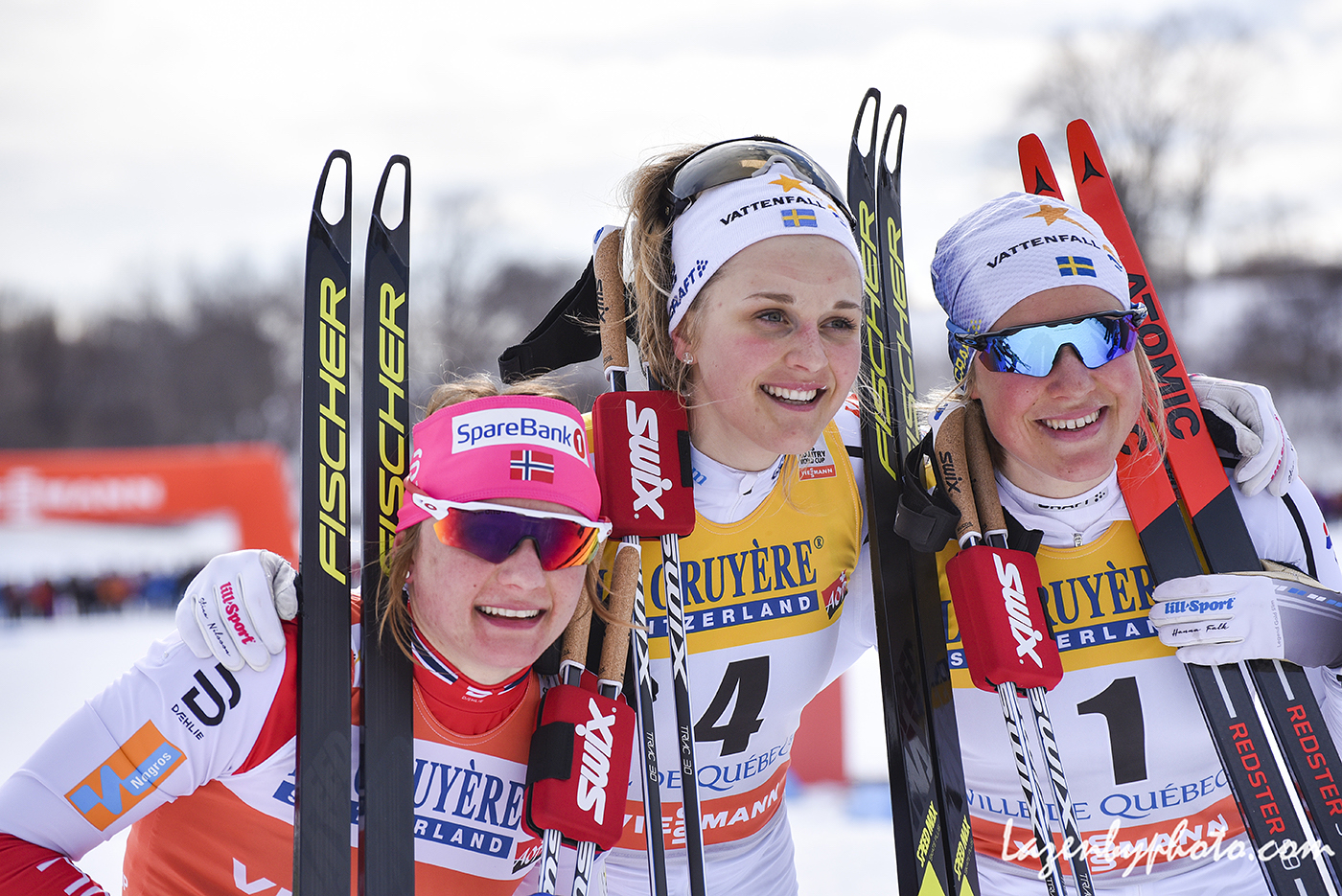
    Kikkan Randall (l) and Jessie Diggins celebrate their bronze and silver medals, respectively, in the women’s individual freestyle sprint on Thursday, the first day of 2017 Nordic World Championships in Lahti, Finland. (Photo: John Lazenby/Lazenbyphoto.com)
    “For us this was definitely a target event,” he explained.

    In five consecutive visits to Lahti, the U.S. has reached the podium in every World Cup skate sprint. Andy Newell started the trend back in 2008, but Randall got the ball rolling for the women’s program in 2013 and 2014, winning the skate sprint there both years. Also in 2014, Caldwell reached the podium for the first time in third place. In 2015, Randall scored another Lahti podium in third (while Diggins was just off it in fourth), and last season, Diggins placed second.

    So you can say freestyle sprint, especially in Lahti, have been the U.S. team’s jam for some time.

    “It’s been a great race historically for us,” Grover said. “When we looked ahead at what our best medal-potential races were for the championships, obviously skate sprints have been one of the best events for us for years in general, but in particular for these championships, we really targeted this day.”

    Canada entered three women, all members of its U25 Team, with Dahria Beatty placing 37th and missing the top 30 necessary to qualify for the heats by 3.67 seconds. Cendrine Browne finished 48th (+20.42) and Katherine Stewart-Jones 58th (+26.29) out of 107 women in the qualifier.

    Results

    — Harald Zimmer, Chelsea Little, and Alex Kochon contributed

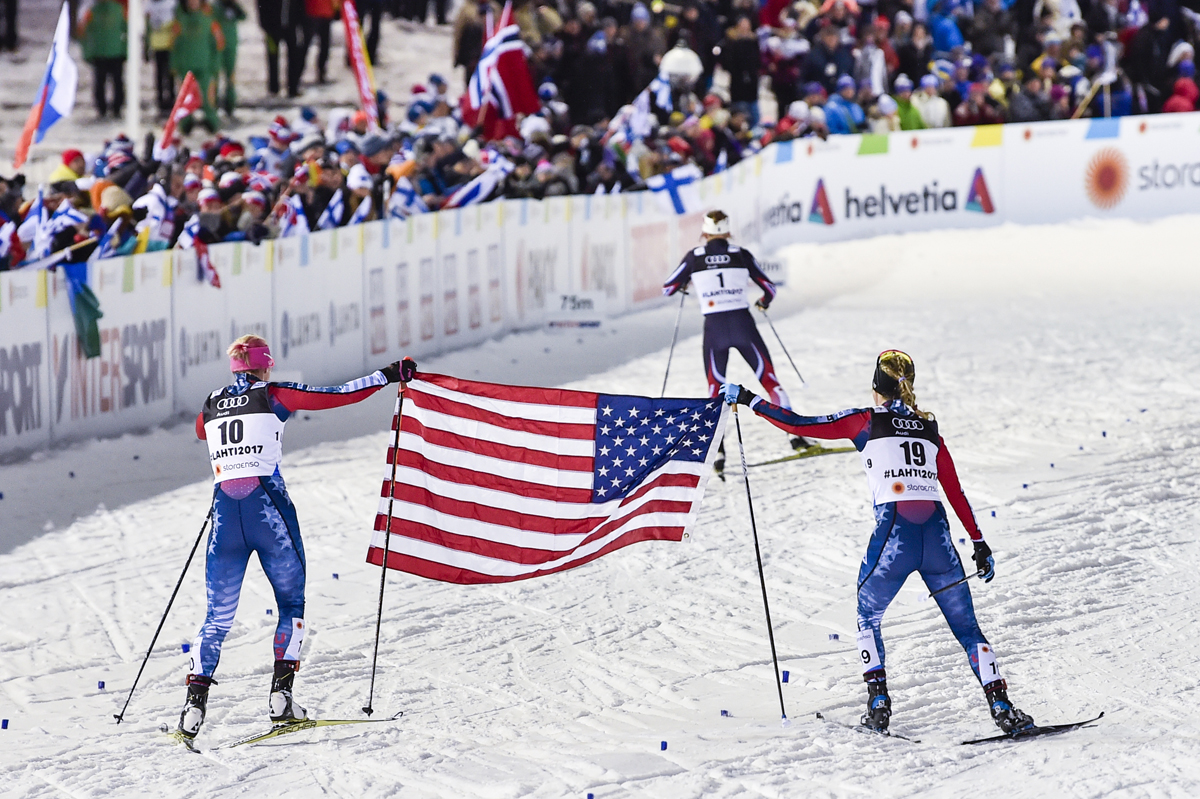
    Kikkan Randall (l) and Jessie Diggins (r) hold the American flag during a victory ski down the finishing lanes to celebrate their bronze and silver medals, respectively, in the women’s individual freestyle sprint on Thursday, the first day of 2017 Nordic World Championships in Lahti, Finland. Ahead of them, Norway’s Maiken Caspersen Falla celebrates gold. (Photo: Fischer/NordicFocus)
  • Unstoppable Bjoergen Wins Again, Randall 2nd in Oslo

    Kikkan Randall (USA) racing last month at the Olympics. She took home her 3rd career World Cup podium today.

    Oslo, Norway – Marit Bjoergen (NOR) has been nigh on unstoppable since the beginning of February, and has won every World Cup  race since the Olympics.  Today was no different though Kikkan Randall nearly pulled off the upset, leading the Norwegian star into the homestretch of the freestyle sprint in Oslo.

    Bjoergen won both races at the famed Holmenkollen Ski Stadium, and showed no ill effects from yesterday’s 30km.  The sprint victory did not come easily, but at the end, she showed the strength that won her five Olympic medals.

    And with wins by Bjoergen becoming rote, the story of the day belonged to Randall, the silver medalist in the freestyle sprint at World Championships last year.

    Randall has quietly been on fire since the start of the Olympics, but has not had an opportunity to race her premier event – the skate sprint.  She performed exceptionally well in the Olympics with great efforts and results in every event she entered.  Her 8th in the classic sprint was a career-best.

    But the last time she got to strap on her skate skis for an individual sprint was nearly three months ago in Davos, Switzerland.

    She took advantage of that opportunity today, showing the poise that allowed her to become the first American woman to win a World Cup race and a championship medal, skiing relaxed and strong toward the front of each of her heats.

    Randall qualified in 8th, and according to US Sprint Coach Chris Grover, that is always a good sign.

    “Typically when I see her [Randall] qualify in the top-10 in a skate sprint, it means it’s on, she is in good form,” he told FasterSkier.

    Randall spent most of the heats toward the front, in either first or second.  In the quarterfinals she cruised across the line next to Natalia Korosteleva (RUS) clear of the field after the pair broke away late in the 1.3km loop.

    In the semis, she was again matched with Korosteleva, as well as Swedish phenom Hannah Falk, Italian veteran Arianna Follis,  Vesna Fabjan (SLO), and Riikka Sarasoja (FIN).

    She started strong, moving right into 2nd place behind Falk.  Fabjan, riding fast skis, moved up on the flat terrain entering the first big climb.  Randall slipped back, to 3rd, then to 4th.  But over the top of the next rise she accelerated back up and snuck into 2nd, now behind Korosteleva.  Once again the two were able to open a small gap on the field in the homestretch and advance to the finals.

    Bjoergen did not have as easy a time.  She met Justyna Kowalczyk (POL) in the quarterfinals, and the two finished 1-2 in that heat.  They paired again in the semis, with Kowalczyk getting off the line slowly.  She attacked aggressively trying to move up, but Anna Olsson (SWE) and Celine Brun-Lie (NOR) controlled the race at the front, with Bjoergen in 3rd.

    Advancement for the two favorites was not guaranteed until Brun-Lie appeared to catch a tip entering the big climb causing her to crash into Olsson.  The two went down and Bjoergen and Kowalczyk suddenly had the lead and a berth in the finals.

    Bjoergen appeared spent after the heat, perhaps showing signs of fatigue form Saturday’s win in the 30km.

    Falk made it through as a lucky loser and joined Bjoergen, Kowalczyk, Randall, Korosteleva and Silvana Bucher (SUI), the other lucky loser, in the fight for the podium.  Fabjan posted the same time as Falk, but Falk got the nod in the photo finish, and Fabjan was done for the day.

    With the exception of Bucher, each of these women have multiple World Cup podiums under their belts, and despite Bjoergen’s recent dominance, any were capable of victory.

    Bucher, on the other hand, was a surprise to reach the finals.  A majority of her World Cup starts have come in distance races and relays.  Until today she had only cracked the top-30 in an individual sprint once before – a 26th against a weak field this year in Rybinsk.

    So the stage was set.  Randall again got off to a good start, immediately taking the lead.

    With major reconstruction on the stadium area, this was the first time any of these athletes had raced what will be next year’s World Championship course.

    Getting out to an early lead is very important noted Grover as the middle section of the loop is not wide – just enough room for two skaters abreast.  This makes it difficult to pass until the end.

    “She [Randall] was always in first or second and with this course, that is very important,” said Grover.  “Going out and getting an early lead and holding that lead is really critical.”

    Kowalczyk once again was very slow off the line, last place with a small gap to makeup before the race was 10 seconds old.  Such a disadvantage does not seem to phase the overall World Cup Champion, and as in the semifinal, she attacked immediately, and had moved into 1st over the top of the first small climb.

    Randall was to one side and just behind as Kowalczyk moved.  The Pole appeared to bump or step on the American’s pole almost causing Randall to go down.  She recovered impressively and did not lose any noticeable ground.

    With Bjoergen just behind, Randall attacked on the large climb.  She moved by Kowalczyk with Bjoergen just behind.  They held their position over the top and through the fast corners.

    Kowalczyk uncharacteristically ran out of gas, and could not hold the pace.  Korosteleva moved into 3rd.  The Russian had quietly maintained good position near Bjoergen, and took advantage as Kowalczyk faded.

    The three women came down onto the homestretch clear of the rest of the heat.  The finish is fast with a descent into the last flat, and some skiers free skated almost to the line.  Randall held her lead onto level ground, but Bjoergen put on a charge that no one could match, skiing away from Randall and Korosteleva.

    “I felt quite tired after yesterday’s 30 km and it is great that I also won the sprint,” said Bjoergen.  “The crowds here are just amazing and the atmosphere was great.”

    Korosteleva closed the small gap on Randall, and the two lunged for the line.  It looked closer than it was, and the photo finish camera showed Randall at least a foot in front for her third career World Cup podium.

    “We knew she was in awesome shape,” said Grover.  “All four of her Olympics were great races for her.  They just weren’t in her strongest disciplines.  We knew it was totally possible that either her or Newell would be on the podium today.”

    Added Randall, “I’m really proud because there are a lot of times out there when other countries look so much better, they have so much support, and it’s easy to get bogged down.  But I believed succeeding was possible for so long, so it’s good to show that it wasn’t just a one-time thing, but that we can consistently be on the podium.”

    Kowalczyk ended up 4th, clinching her first Sprint Cup title.  She already had wrapped up her second consecutive overall World Cup win.

    The race had added importance for Randall as her performance moved her up to 39th in the overall World Cup standings.  Only the top-50 skiers in the standings and Continental Cup leaders will start the World Cup Finals beginning on Wednesday in Stockholm.  Randall had been outside the top-50, but now has a start spot and will compete in Sweden.

    Complete Results