From the FasterSkier archive — posts syndicated from athletes’ and coaches’ own blogs between 2004 and 2012, kept online as published. Current coverage is at fasterskier.com.

Tag: Hannah Halvorsen

  • Hannah Halvorsen Studies Eating Disorders in Cross-Country Skiing from the Coaches’ Perspective

    Hannah Halvorsen Studies Eating Disorders in Cross-Country Skiing from the Coaches’ Perspective

    Hannah Halvorsen creates a video on eating disorders in cross-country skiing from a survey of coaches of all levels. (Courtesy photo)

    At 24-years-old, Hannah Halvorsen recently announced that she is ending the pro-skier chapter of her life, but it’s not the only transition she has on deck. This past weekend, Halvorsen also graduated from Alaska Pacific University (APU) with degrees in cognitive psychology and business administration. As a senior capstone project, focused on the psychology side of her studies, Halvorsen chose to research a topic she has been invested in throughout her time as a student-athlete: eating disorders in sport. 

    Given the size and scope of the topic, she began to explore ways to narrow the lens. She chose to focus on cross-country skiing to leverage her extensive experience as an athlete, but was still initially unsure of where to begin. 

    “I didn’t want to look at just, ‘how do we get them to go away?’ because I just don’t think that is feasible with the resources and education we have right now,” Halvorsen explained in a call.

    Ultimately, she chose to consider the topic from a perspective she had not encountered previously: that of the coach.

    “Not every nordic athlete has access to a dietician or to a counselor, depending on their insurance, depending on their family culture, their family support… But the majority of athletes have a coach and that’s a frequent person that they’re interfacing with. So I thought, ‘This is a really unique link that a lot of people have. How do we utilize that?’”
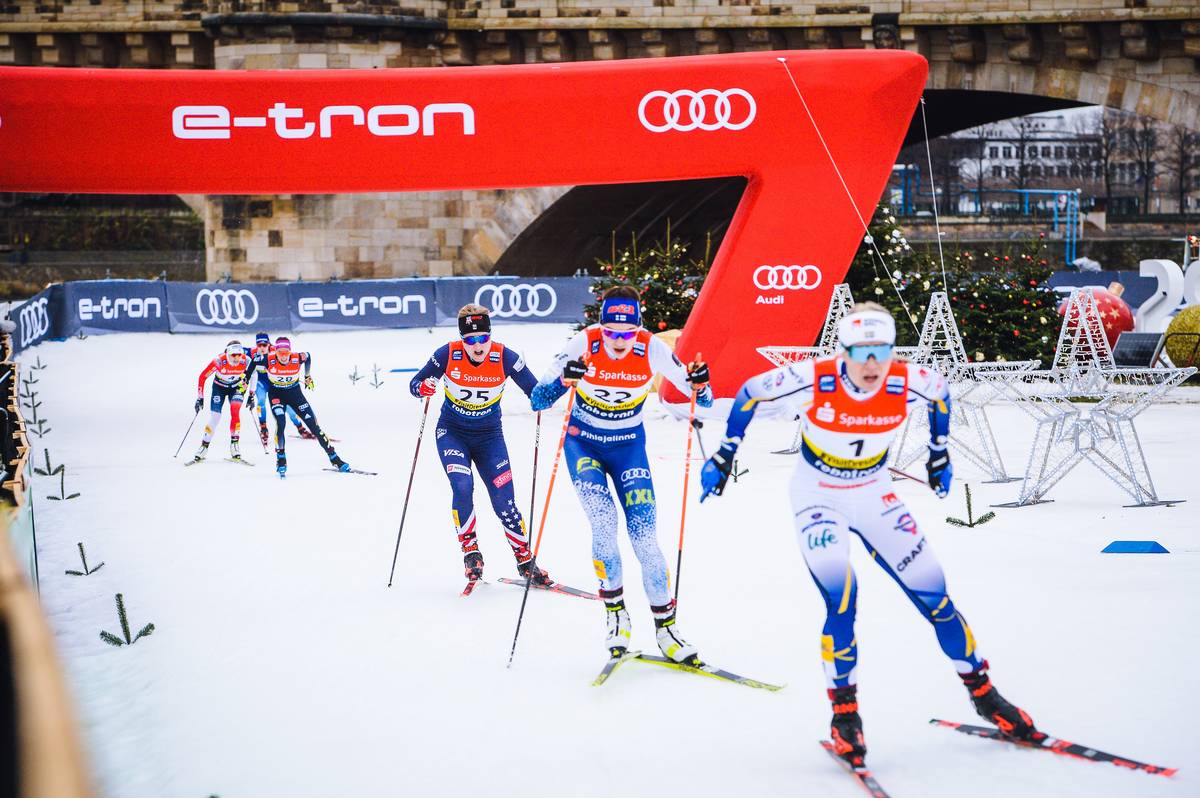
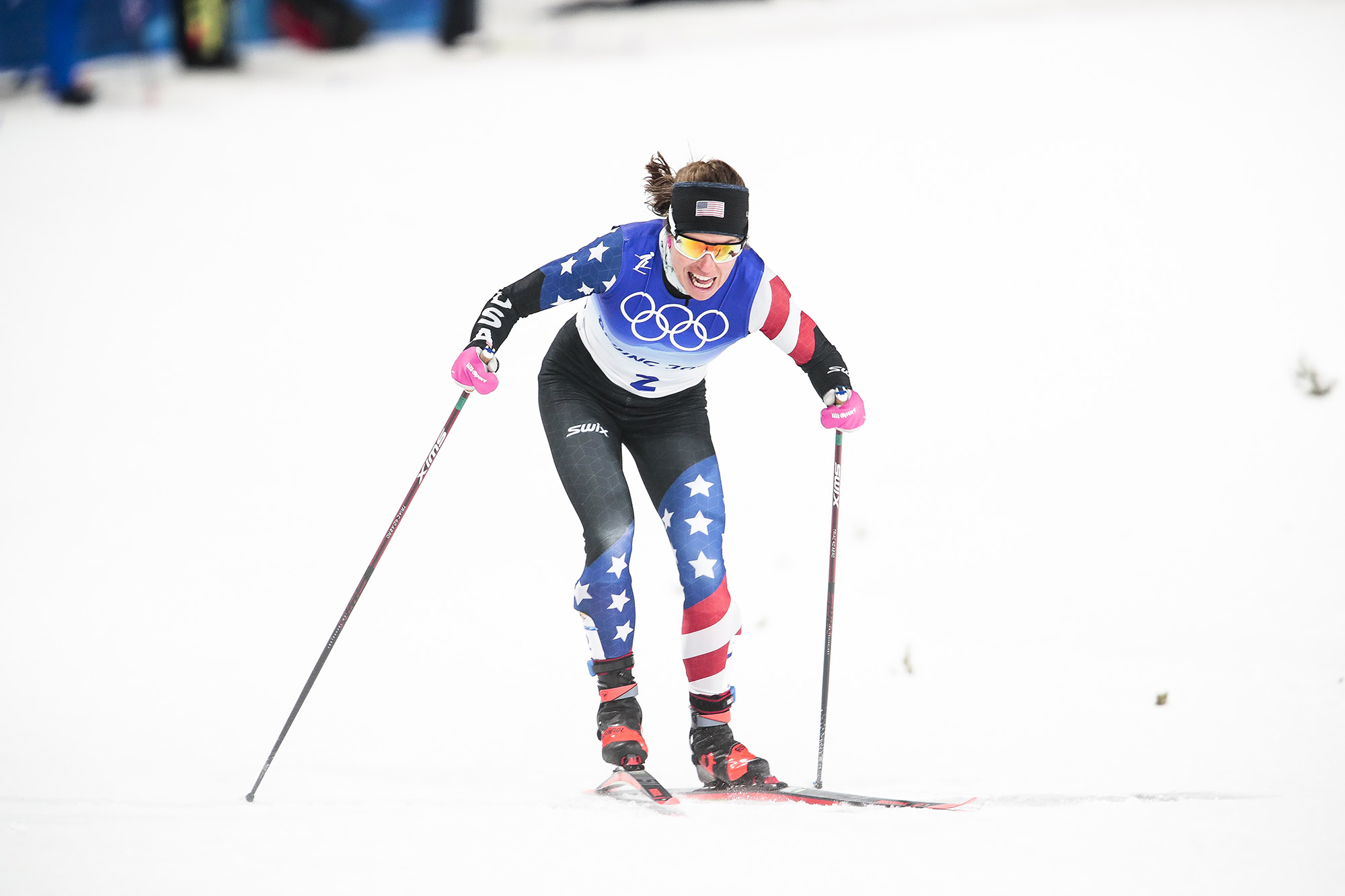
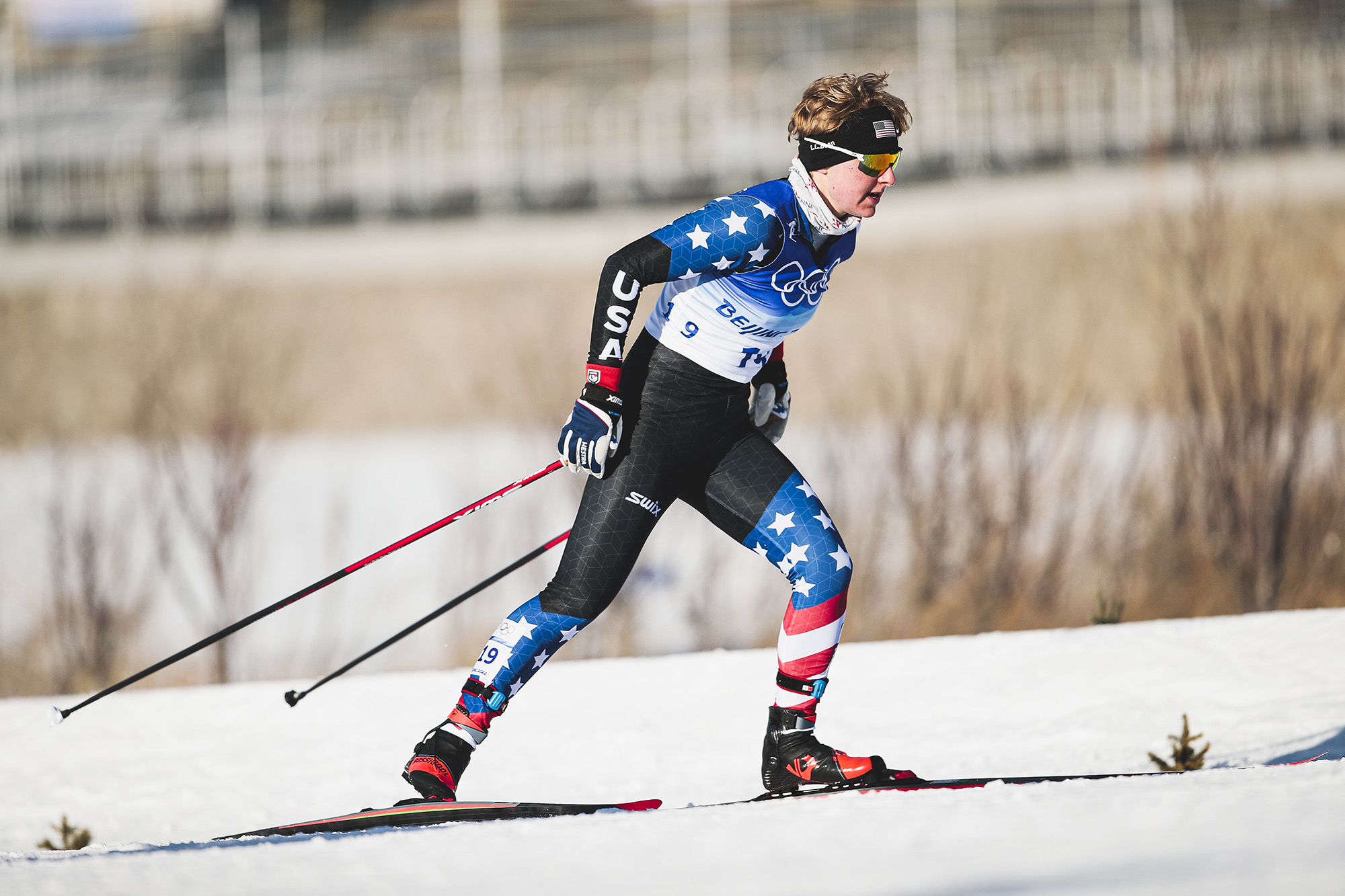
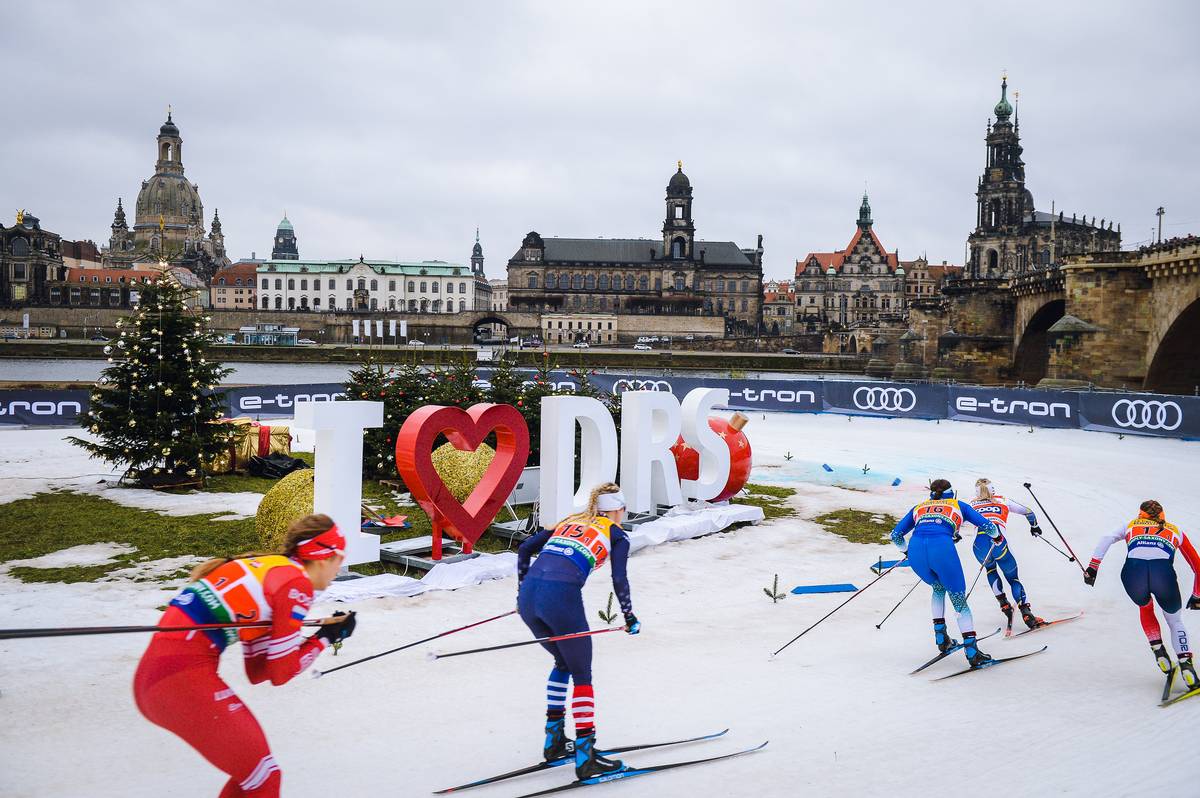
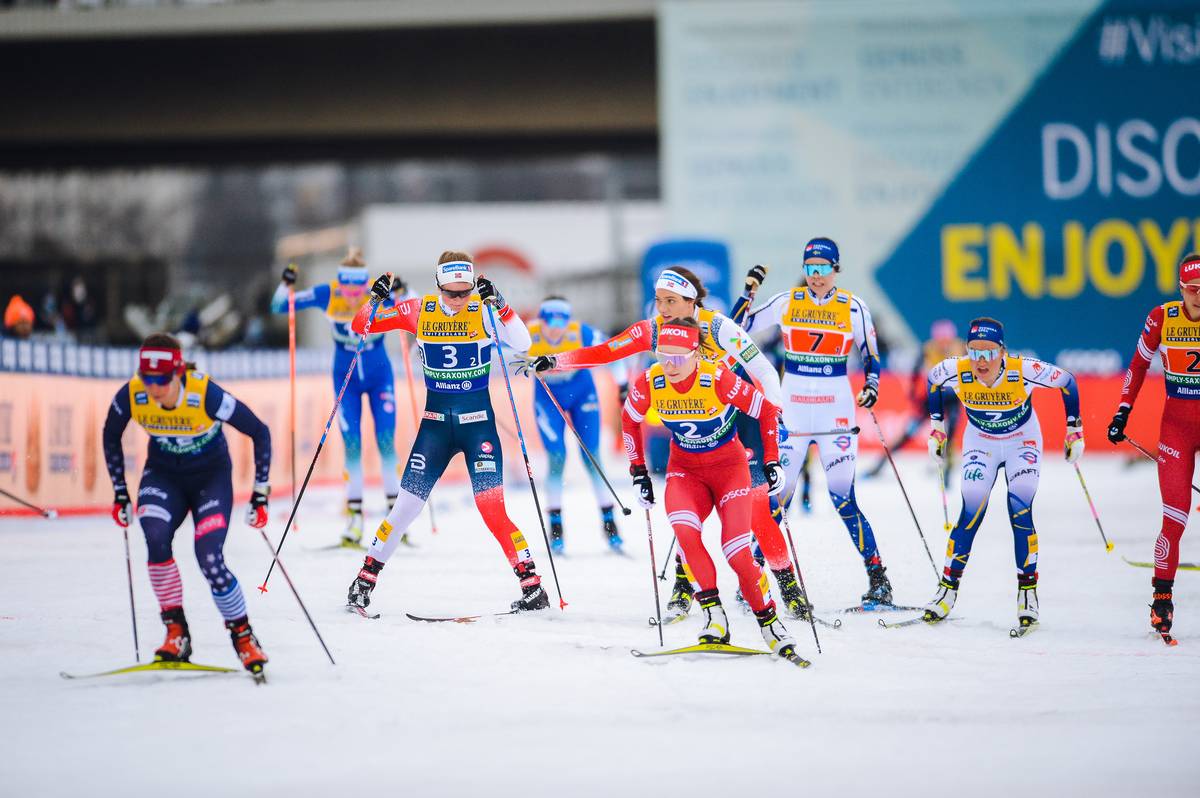
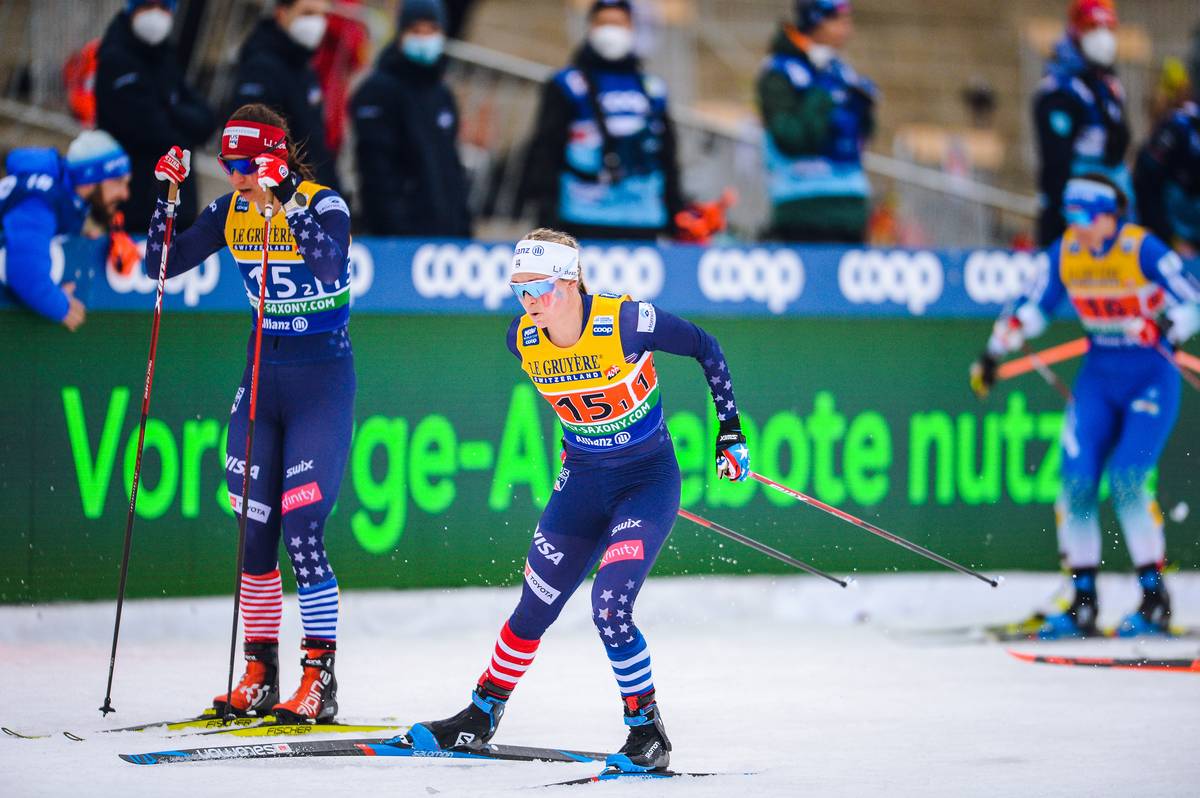
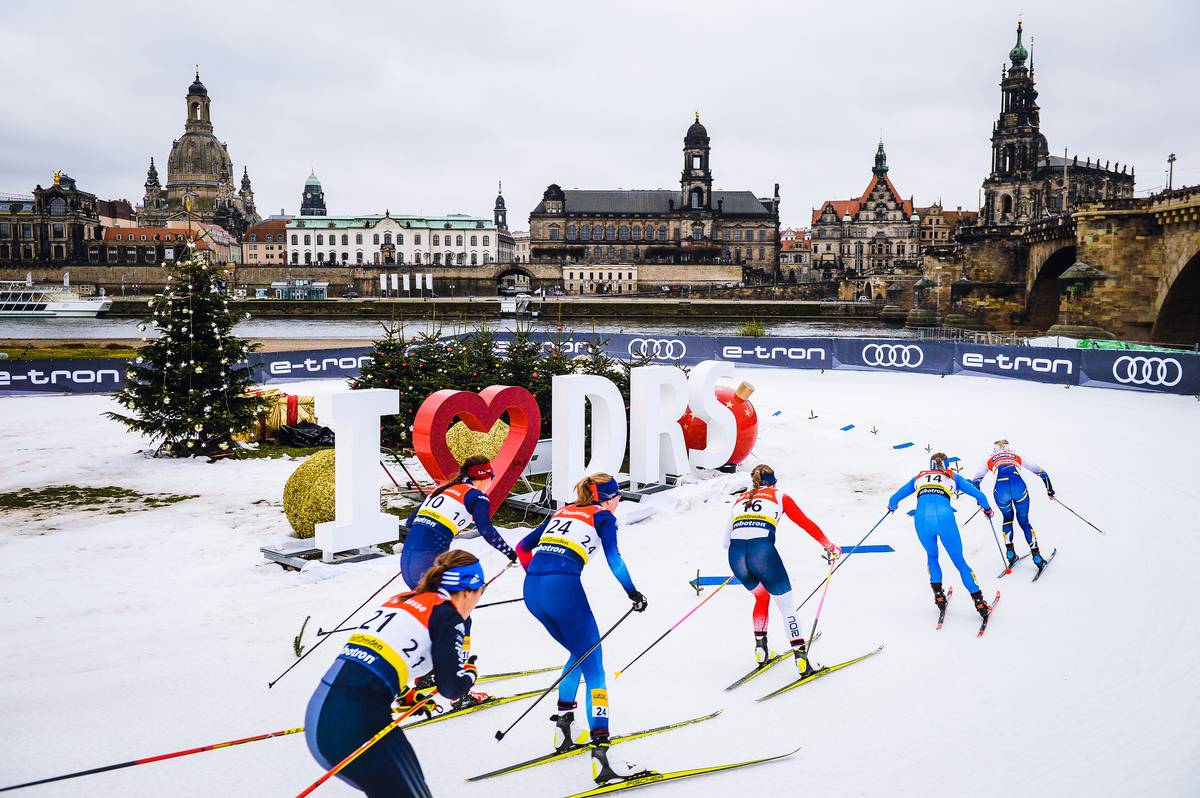
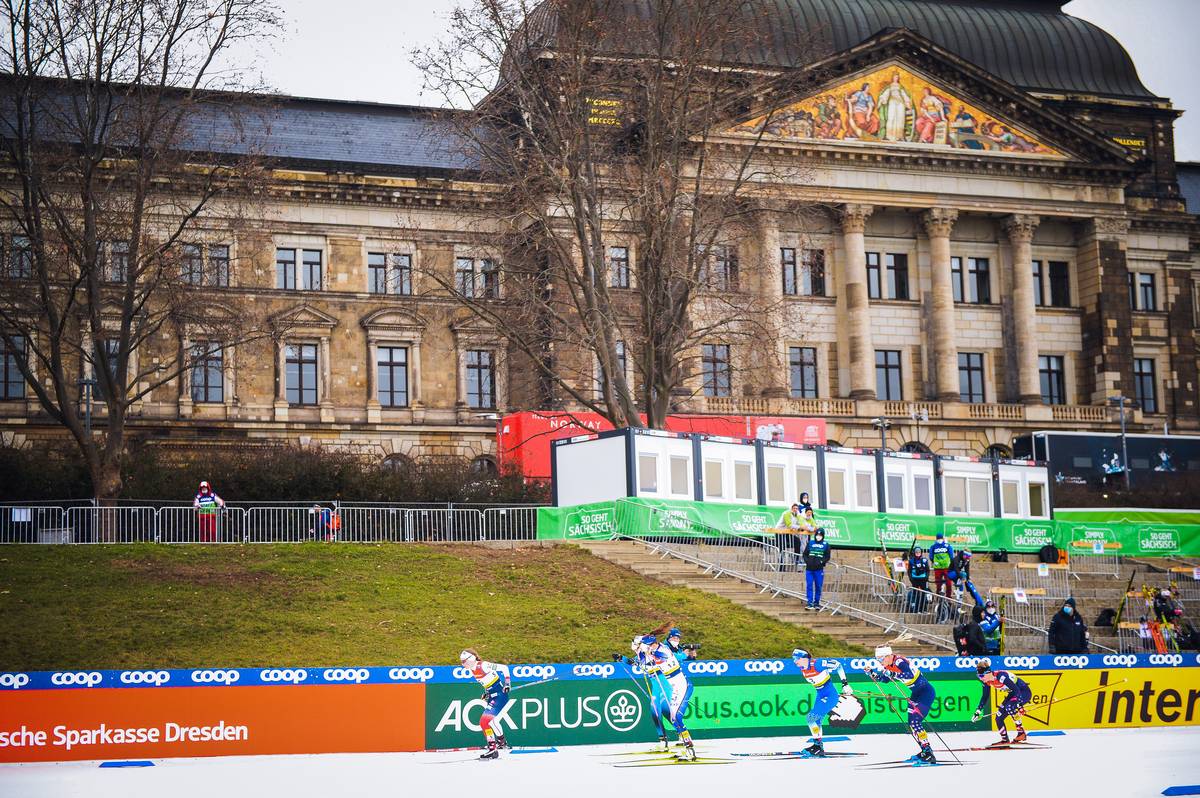
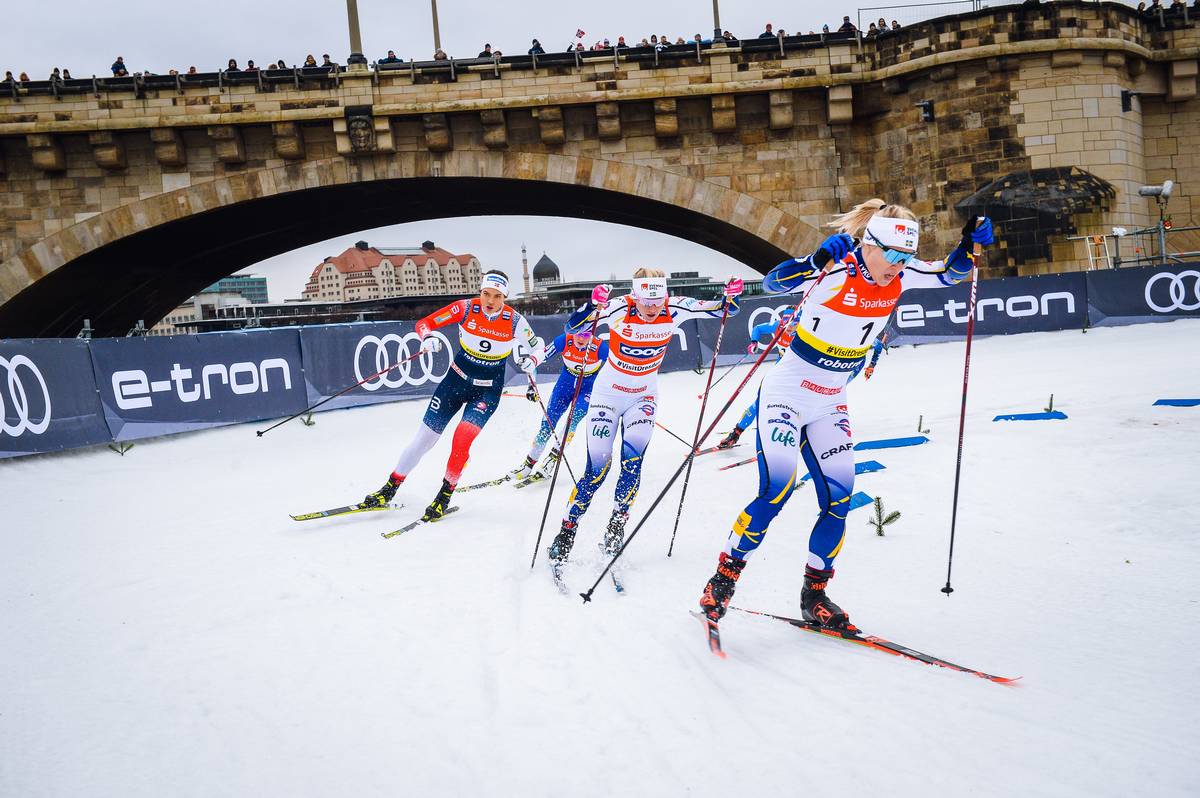
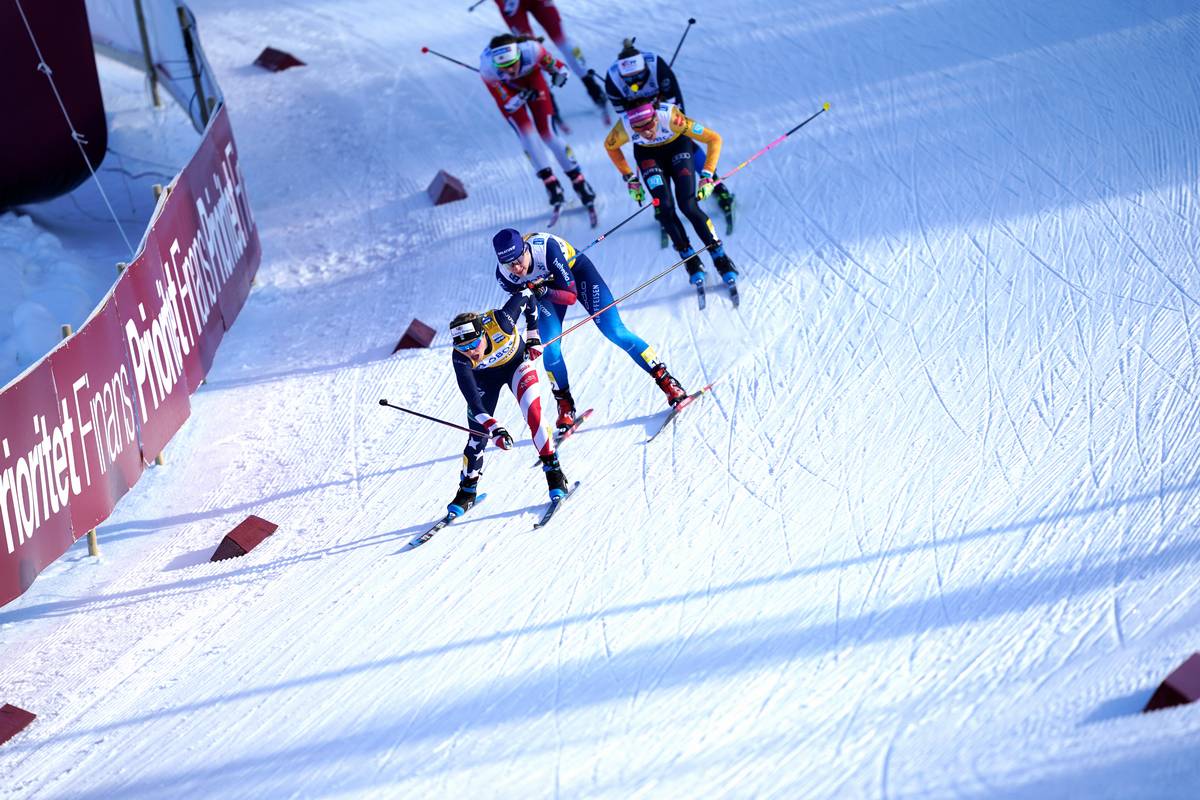
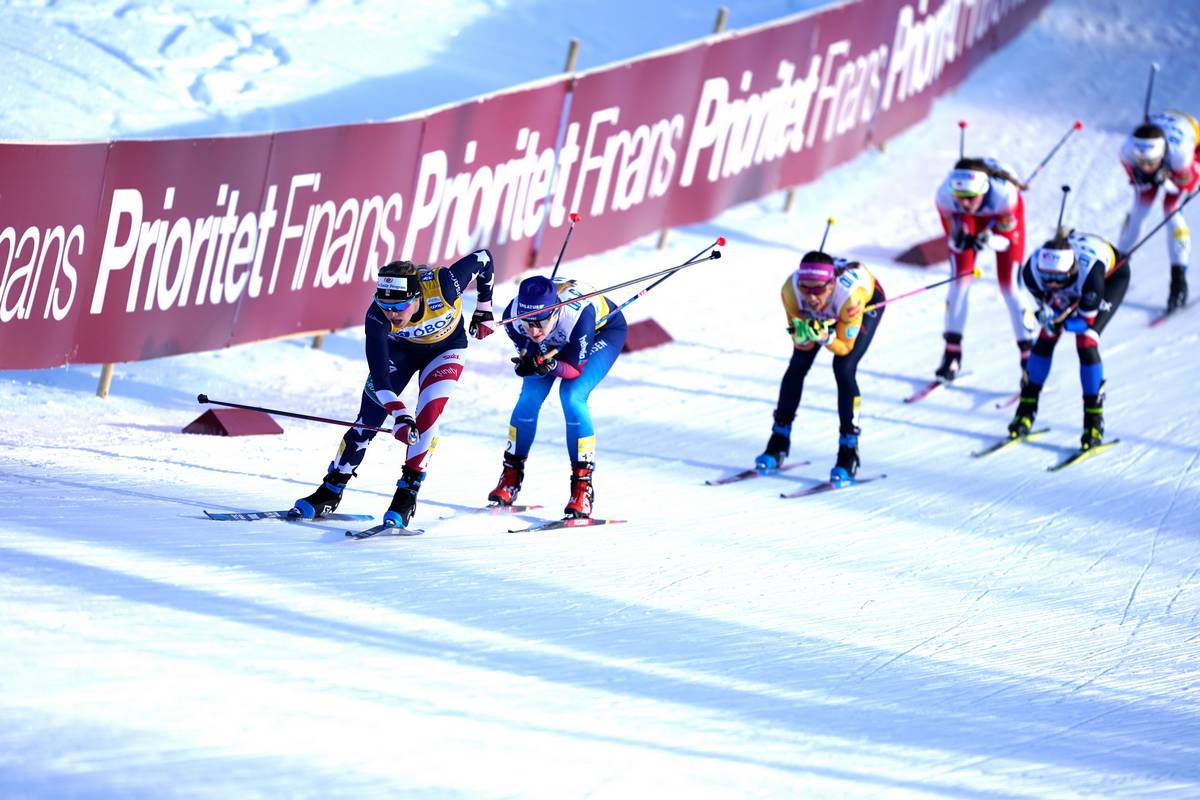
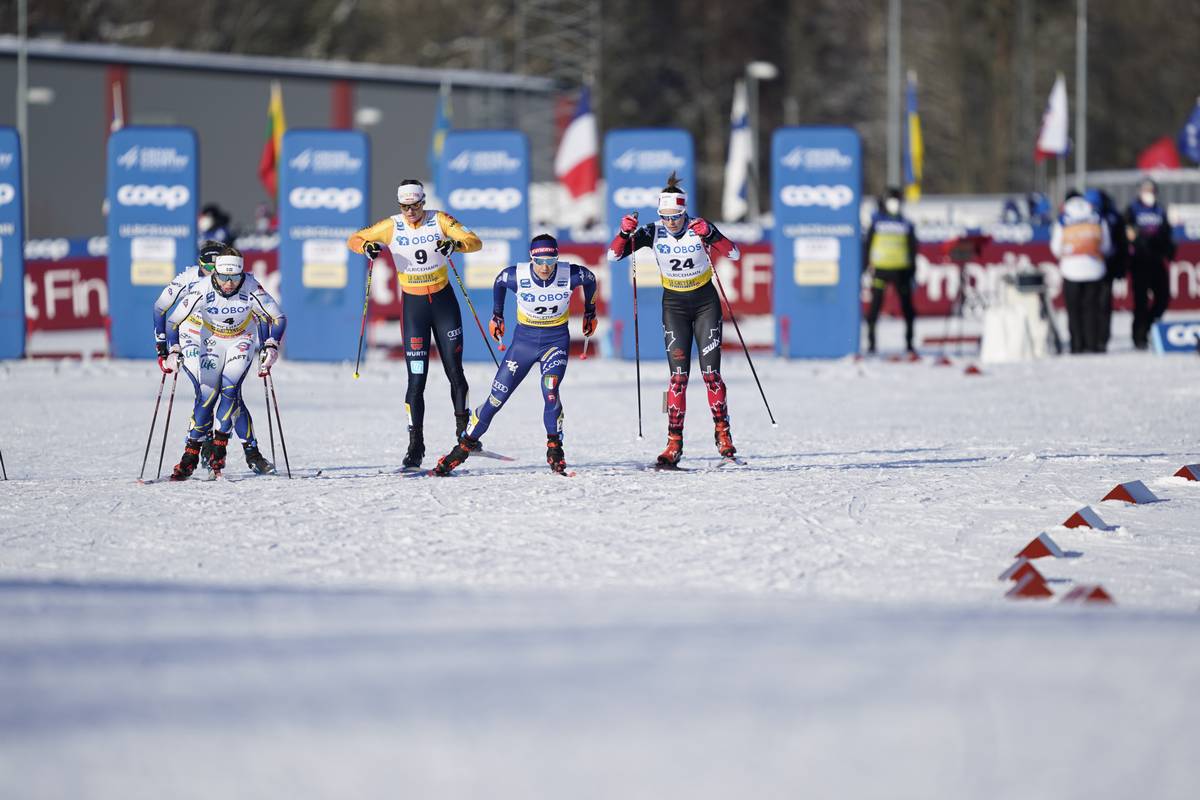
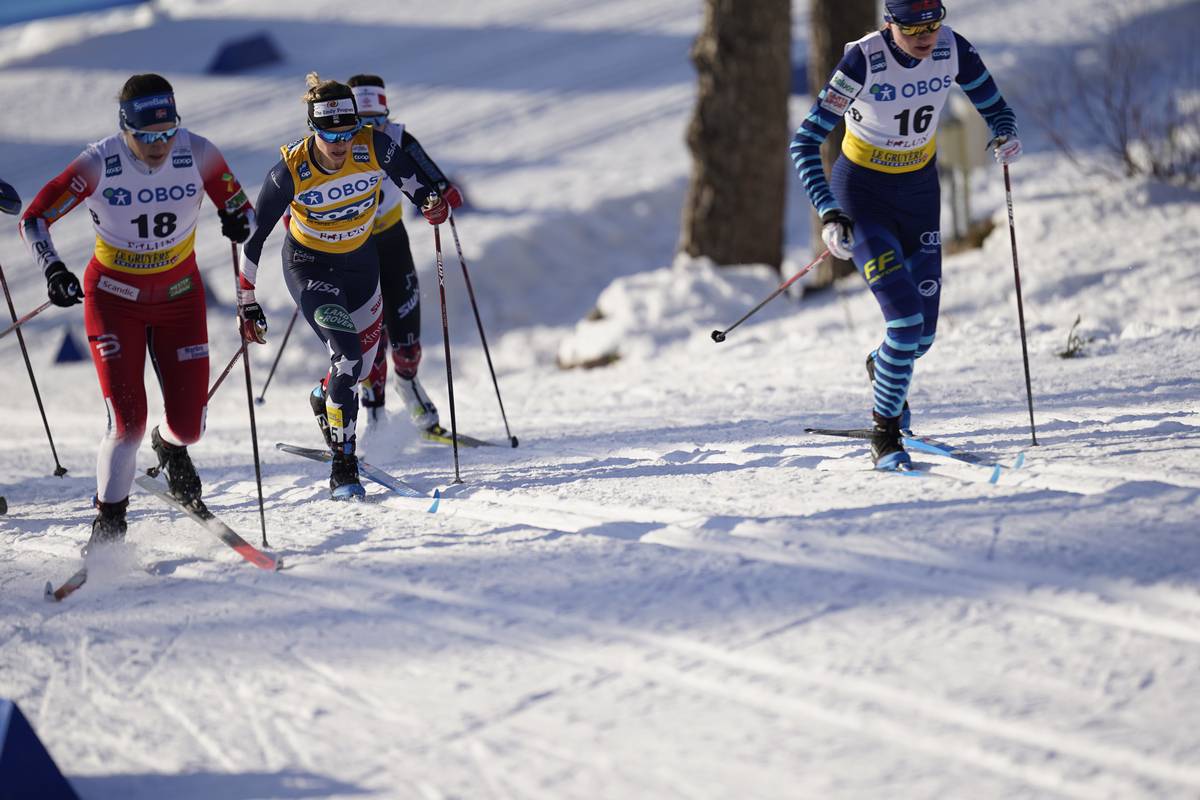
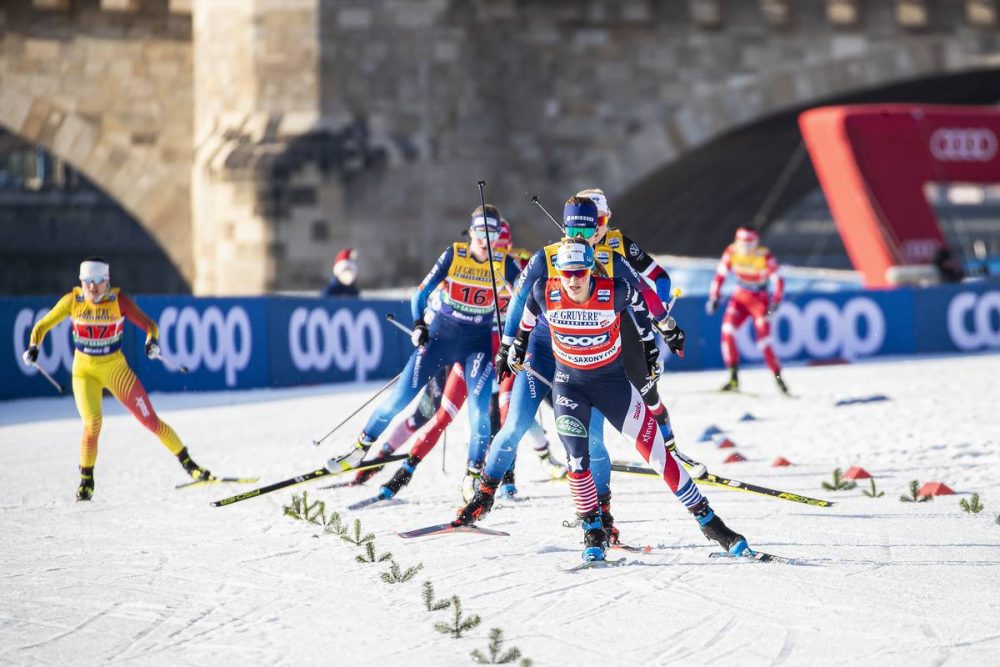
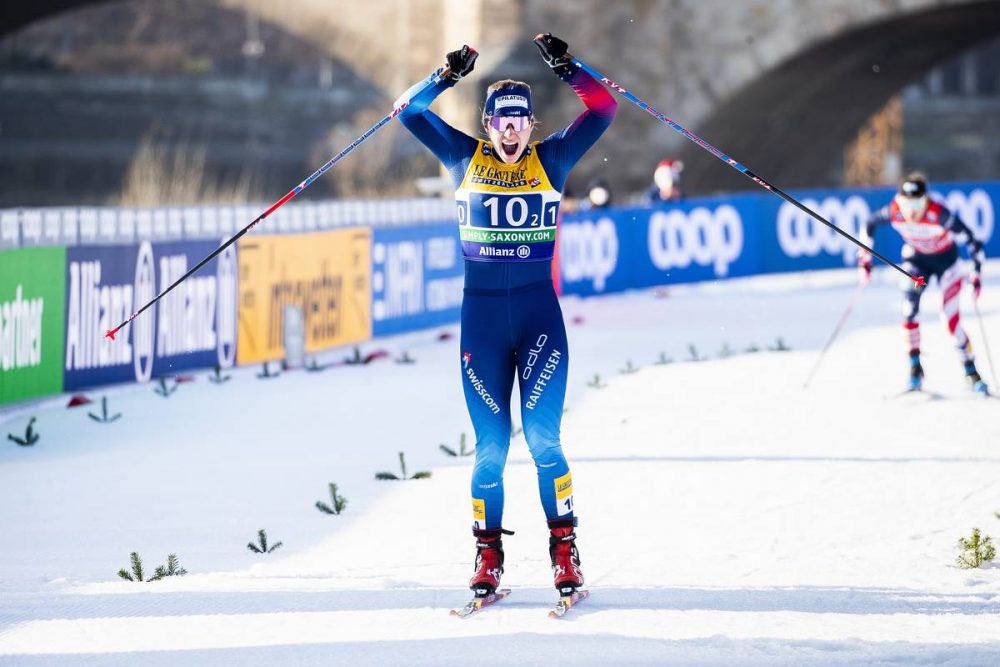
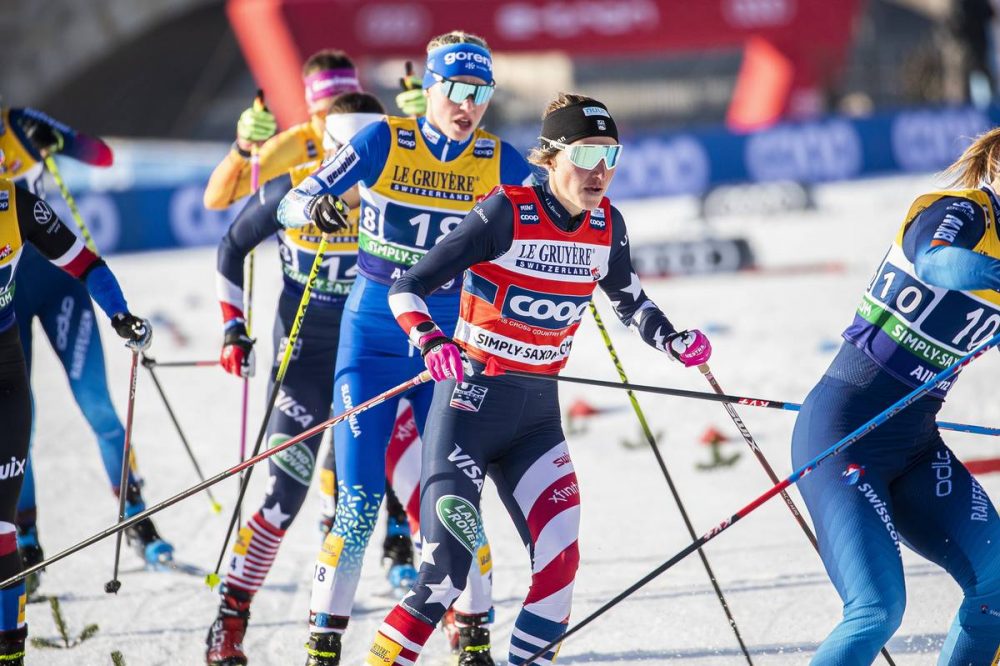
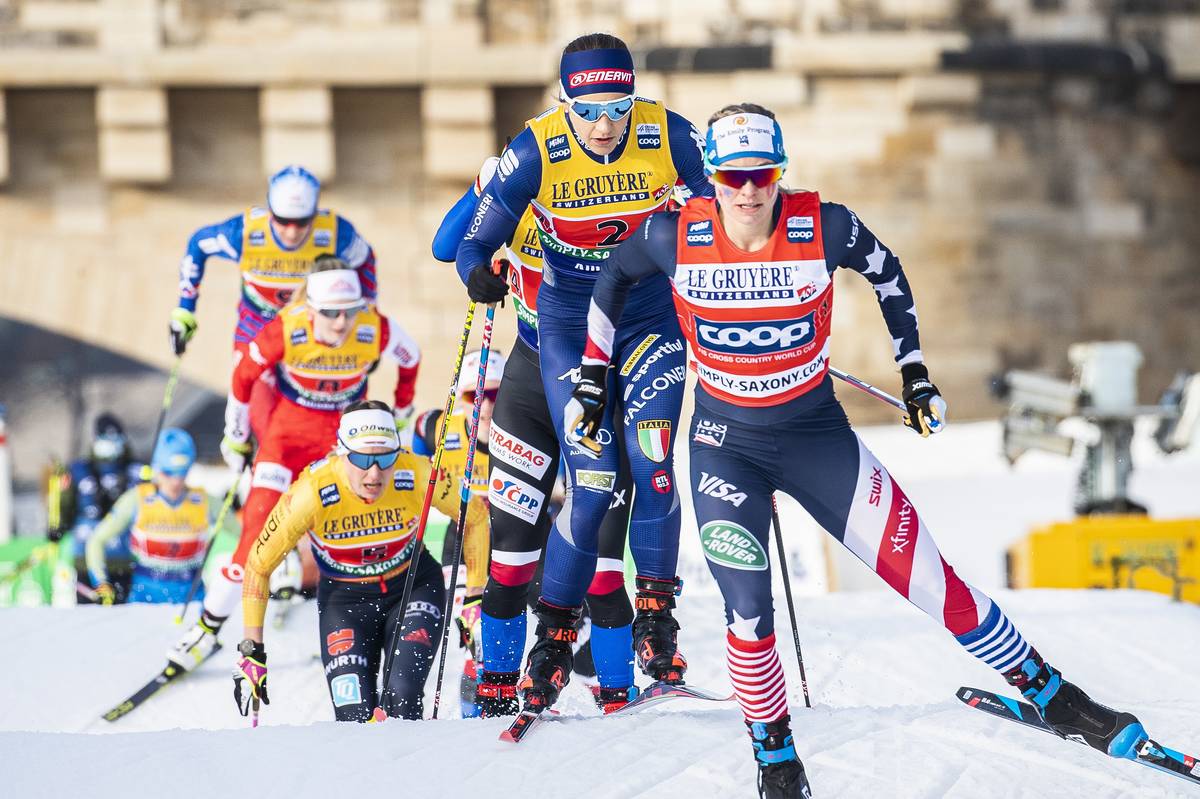
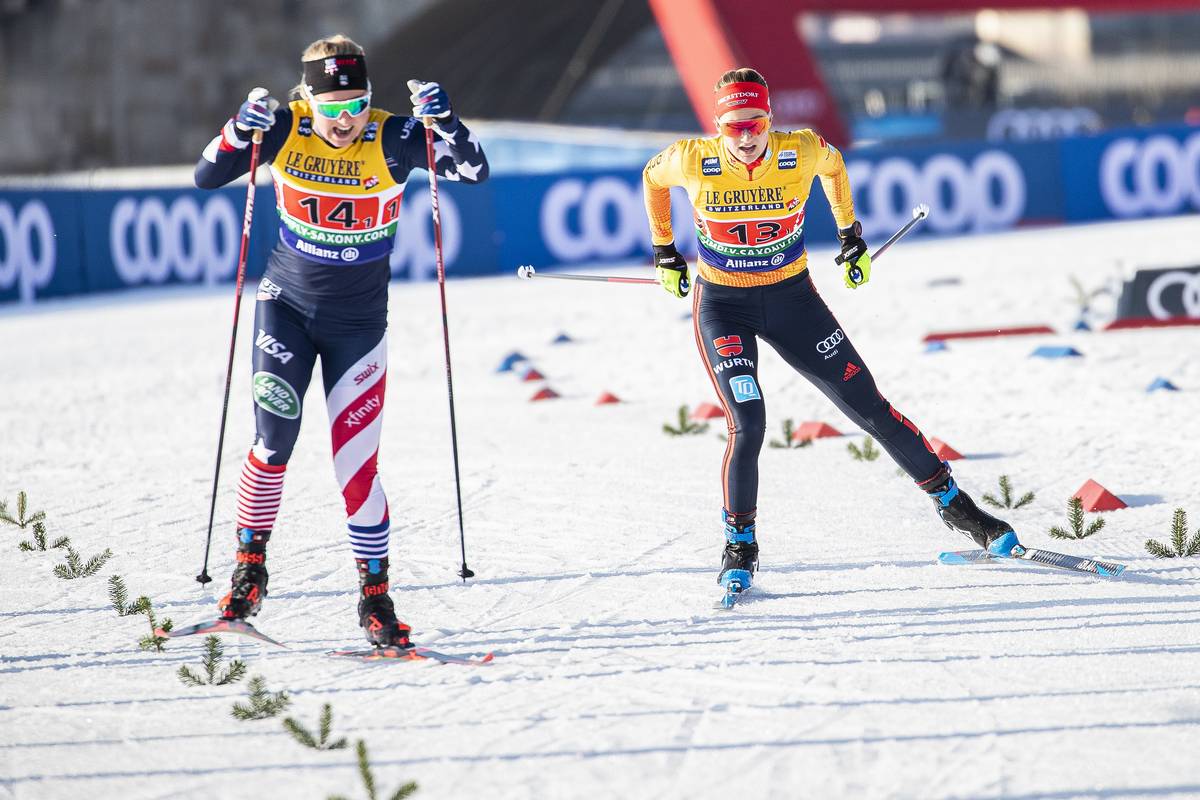
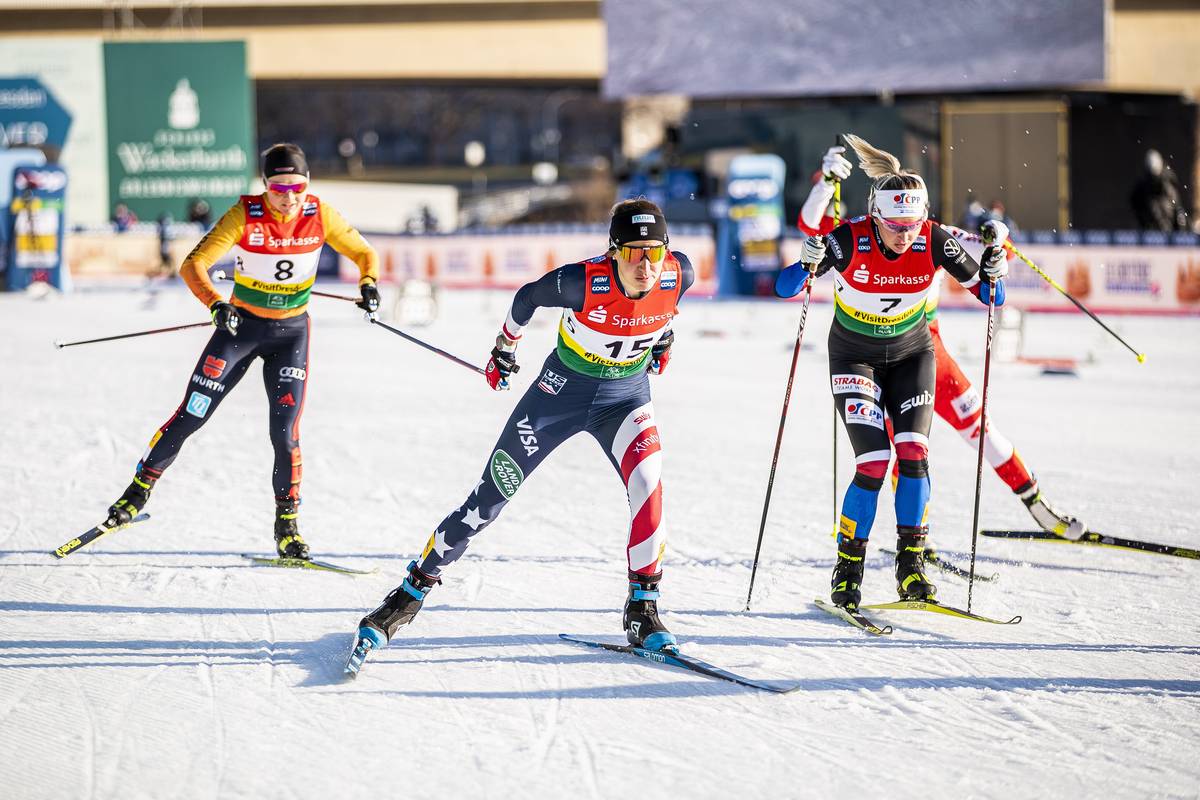
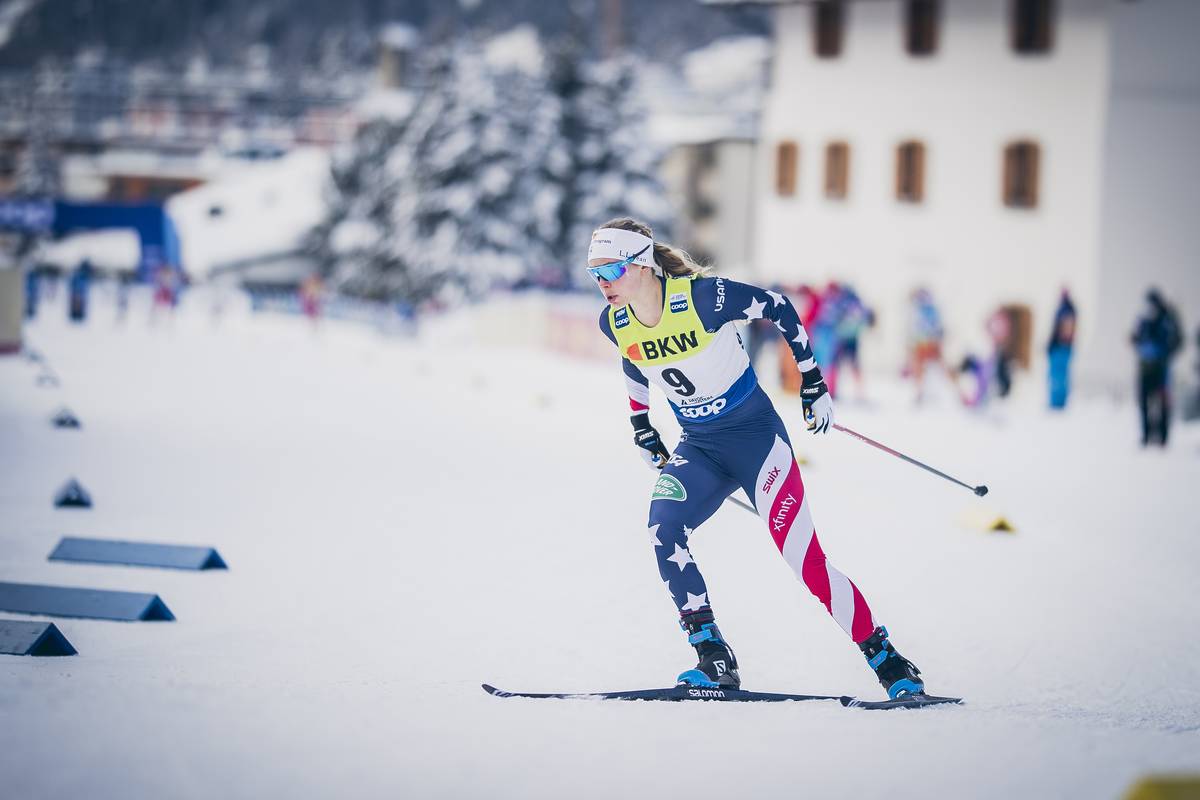
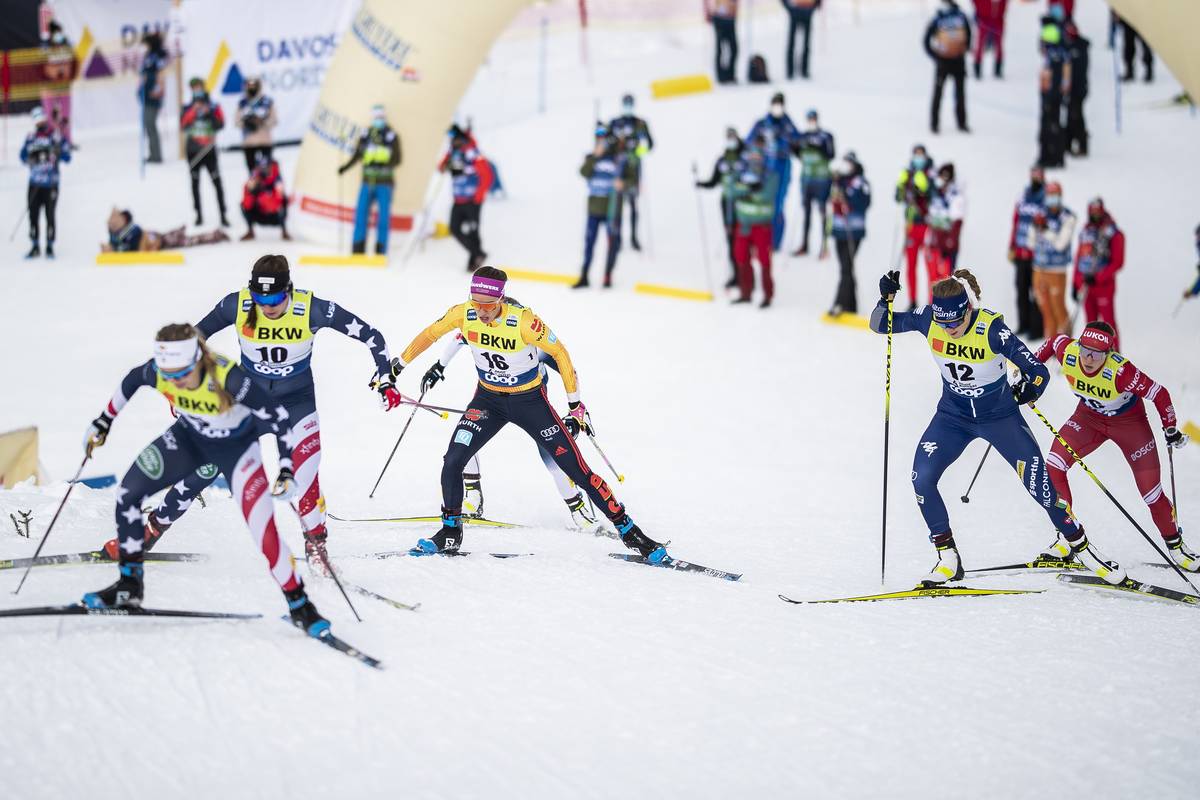
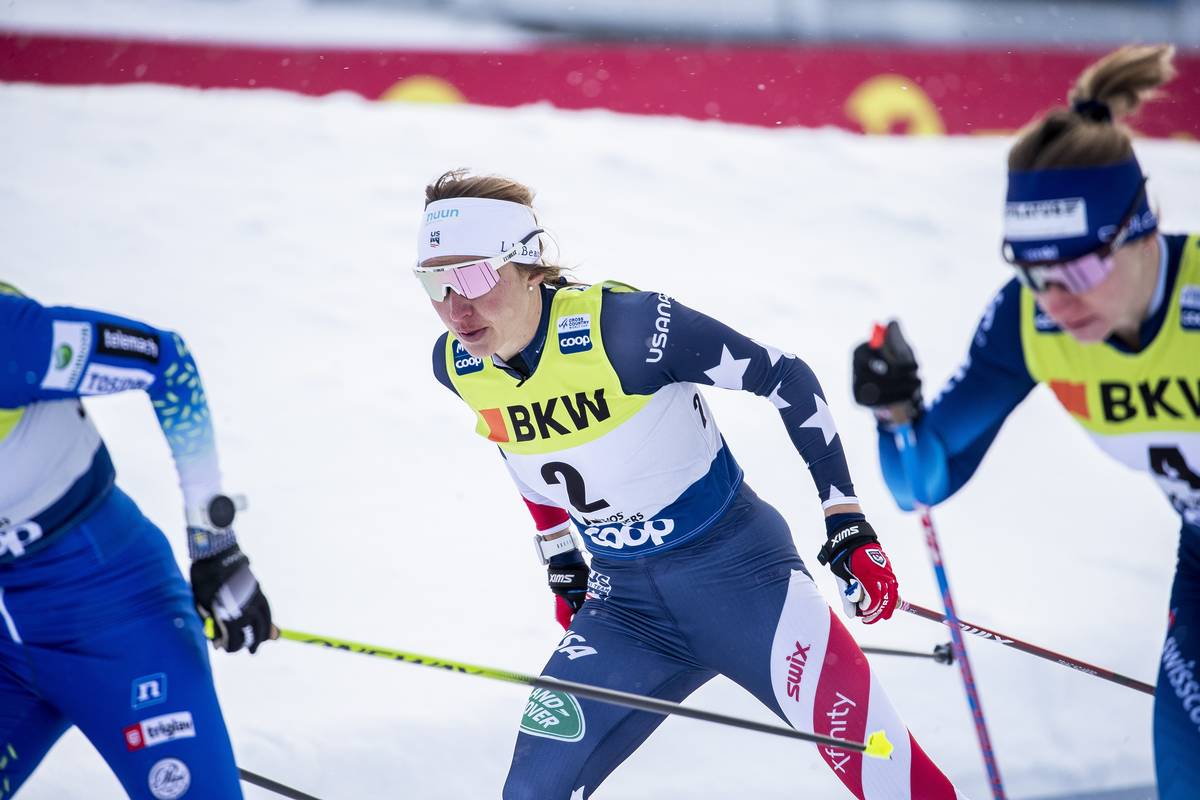
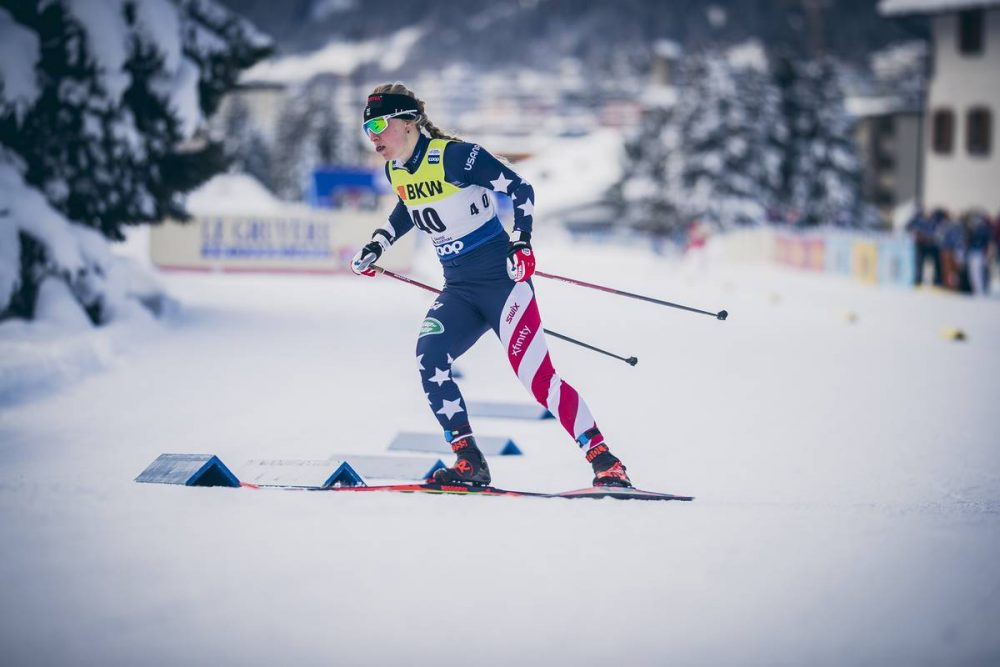
    Hannah Halvorsen races through the heats in Dresden during a December 2021 World Cup skate sprint. (Photo: NordicFocus)

    Rather than trying to identify a “solution” to a nuanced and multifaceted mental health condition, Halvorsen looked to collect a “broad perspective on what coaches think, what coaches feel, [and] what coaches see… I wondered what it looks like for them because they see athletes come and go all the time, and they see all different types of athletes.” Utilizing connections in the sport both internationally and domestically, she contacted coaches from the junior level through the World Cup.

    Looking to avoid factual answers that may just be regurgitated onto a survey from a basic Google search, Halvorsen sent coaches a list of four prompts, and asked them to submit their response as a video. “I wanted to see their mannerisms and their body language and the inflection in their voice when they were responding. Essentially, where they were at with [the topic].”

    Specifically, the questions were as follows:

    1. How do you see issues with eating disorders manifest in athletes who may or may not be struggling? What types of behaviors do you see that you associate with this problem? 
    2. What are some of the pressures or contributing factors that you either notice or athletes tell you are the reasons that an athlete starts down the path of an eating disorder?
    3. What do you see as the challenges with reducing the amount of eating disorders in sport? What types of obstacles make it hard for an athlete with an eating disorder to recover?
    4. Do you see a difference with eating disorders between male and female skiers? Such as prevalence, the root cause, how it manifests, or anything else.

    Setting her expectations low on what she would receive in return, Halvorsen was amazed as videos rolled in, and suddenly found herself with over three hours of thoughtful and in-depth responses. Some of the participants included: US National Team coaches Matt Whitcomb, Kate Barton, and Jason Cork; the Italian and Finish National Team coaches and Norwegian Women’s Team coach; current and former NCAA coaches like Cami Thompson Graves (Dartmouth), Maria Stuber (College of St. Scholastica), Marine Dusser (Univ. of AK Anchorage); elite post-graduate coaches Erik Flora (APU) and Andy Newell (BSF Pro); and junior level coaches Anna Schultz (Craftsbury), Molly Susla (Crested Butte), and Kris Hanson (Stillwater, MN).  

    The challenge then became condensing this footage into a concise and effective 15-minute montage, fit to a “script” that would connect the perspectives without redundancy or losing the attention of viewers. “I wanted to have this artistic effect of being [shorter] sound bites, so people would stay engaged.”

    The final project: Hannah Halvorsen’s senior project video.

    As she reflected on what she heard from coaches, Halvorsen identified some of the important themes that resonated with her and aligned with what she had learned through her studies on the subject.

    “There were some very noticeable overlaps. A lot of [coaches] said, ‘I’m not a medical professional, I’m not qualified in eating disorder rehab or therapy or treatment. I am not the person for that. It’s not appropriate for me, it’s not something I have the skills to do, and it’s unethical for me to be doing it.’ And it was honestly really nice to hear that at all different levels, coaches do know that this isn’t their job or role…

    “I also noticed that a lot of them talked about how eating disorders weren’t just about sports performance, or wanting to perform in sport. A lot of the coaches pointed out how it often came at a time where the athlete has a lot of other stress in their life, and this is just something that they have found control over, which is also something that I’ve researched and learned about in preparing for this video.”

    Halvorsen pointed out that this is a key distinction. While negative body image and a preoccupation with one’s physical appearance can be symptoms of eating disorders, the root cause is typically much deeper. In the endurance sport realm, an unhealthy need for control can run parallel to the type-A, perfectionistic mindset that may also contribute to athletic development and progress in sport.

    In her advocacy work in the eating disorder space, Jessie Diggins has often used the phrase “Genetics loads the gun, but the environment pulls the trigger.” Or, as Andy Newell put it in Halvorsen’s video, eating disorders are “stressful habits that manifest themselves as eating habits.”
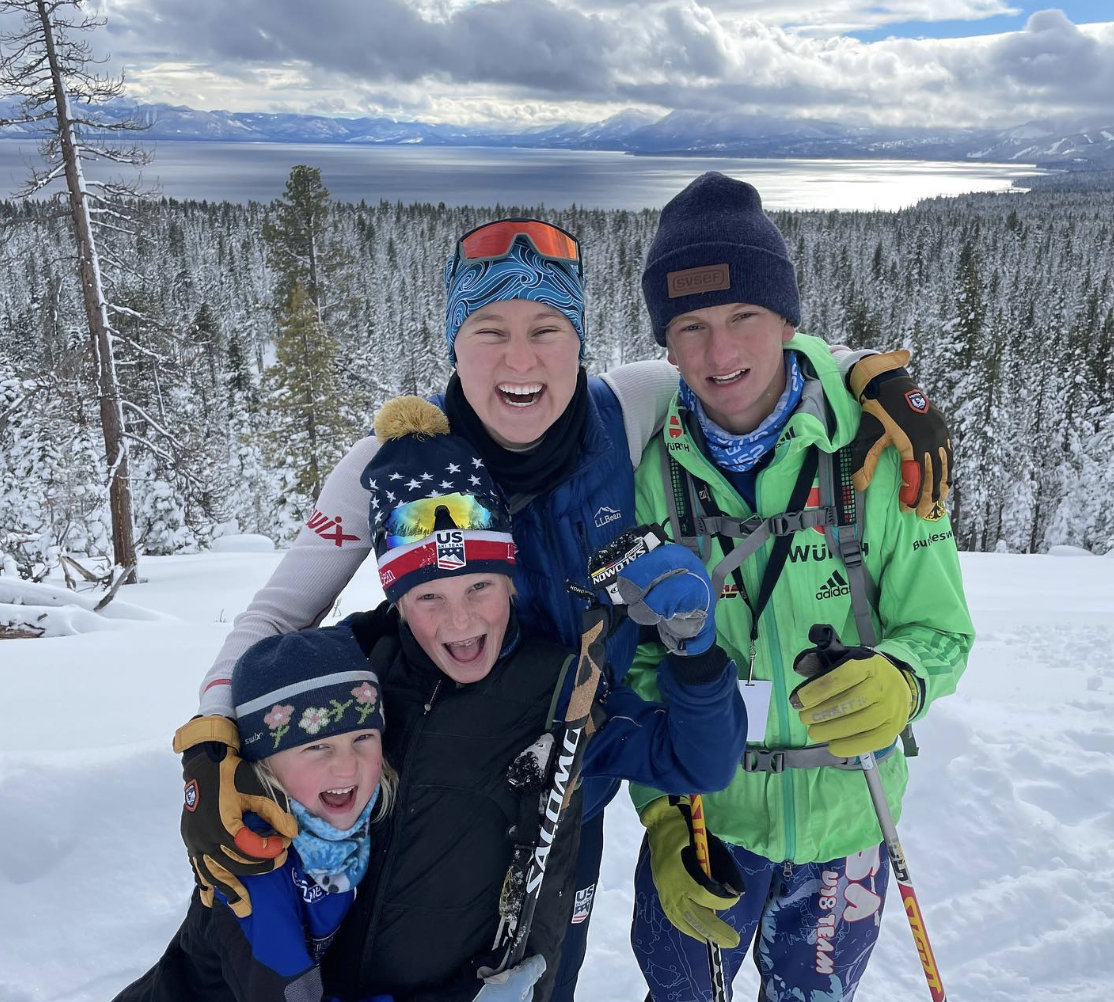
    Hannah Halvorsen spends time at home in Truckee, CA with three of her five siblings. (Photo: Instagram @hannah.g.halvorsen)

    “Another big takeaway that I would describe more as a tangible lesson from this,” Halvorsen continued. “And the coaches kind of led to it – is that the right role for a coach is to be in touch with athletes and be aware and there for them, so that if they do notice a change in behavior, they can be that link that helps the athlete get connected with the help that they need as soon as possible. They’re not the one to fix that problem, but they might be the first person who sees it. The first person who checks in with [the athlete] and says, ‘Hey, you should see someone about this.’ That, I think, is where I stand on the issue right now.”   

    Reflecting on her experience as a World Cup athlete and the responses of international coaches she received, Halvorsen indicated that she did not notice any significant differences in trends compared to the US, though this was an aspect she was looking to investigate. 

    “‘Does it vary culturally in how we see it, how it manifests, how we talk about it?’ Overall, I would say, the problems seem to come from the same issues. They seem to be similar in the way that athletes want to hide it. It’s kind of taboo to talk about it. It’s largely more taboo to talk about an eating disorder if you’re a male athlete. Those trends seem to hold very similar.”

    While the pervasiveness of eating disorders and disordered eating across genders in sport is a challenging project to take on, Halvorsen indicated that she left feeling positive about the direction progress is heading.   

    “Something that surprised me is that I didn’t give coaches enough credit for how in tune they are and how much they care and their capacity to communicate about this. There’s so much talk about how eating disorders are uncomfortable, they’re very secretive, no one wants to talk about them. And that was why I thought, ‘I’m gonna have to send this to 200 coaches because I’m going to maybe get five who are willing to talk.’ And that wasn’t the case at all. They talked in depth about it and I think that surprised me, and made me feel really optimistic, too, because coaches are willing to have this conversation and to be very authentic and real about it. And I left feeling a little bit more optimistic that people can get in touch with the help that they need, if they’re ready or wanting that help.”  

    Another aspect that Halvorsen pointed out was the development that has happened surrounding eating disorder research over the last decade. She noted a shift away from pigeon-holing the disease as a women’s issue – for example, the change from Female Athlete Triad to Relative Energy Deficiency in Sport (RED-S) – and stated that there are notable differences in studies that were conducted within the last two years, in comparison to those published five or ten years ago.

    “It needs to be acknowledged that there has been progress. There’s a lot more conversation about it. There’s a lot more training, there’s a lot more education and understanding of it. That needs to continually be part [of the solution].

    “We need people, particularly coaches and older teammates and people in the nordic community, to identify as lifelong learners… because it’s gonna keep changing and we’re gonna get better and better at knowing how to support athletes and how to make the environment better. And so I think committing to having an open mind and staying that way is really important.”
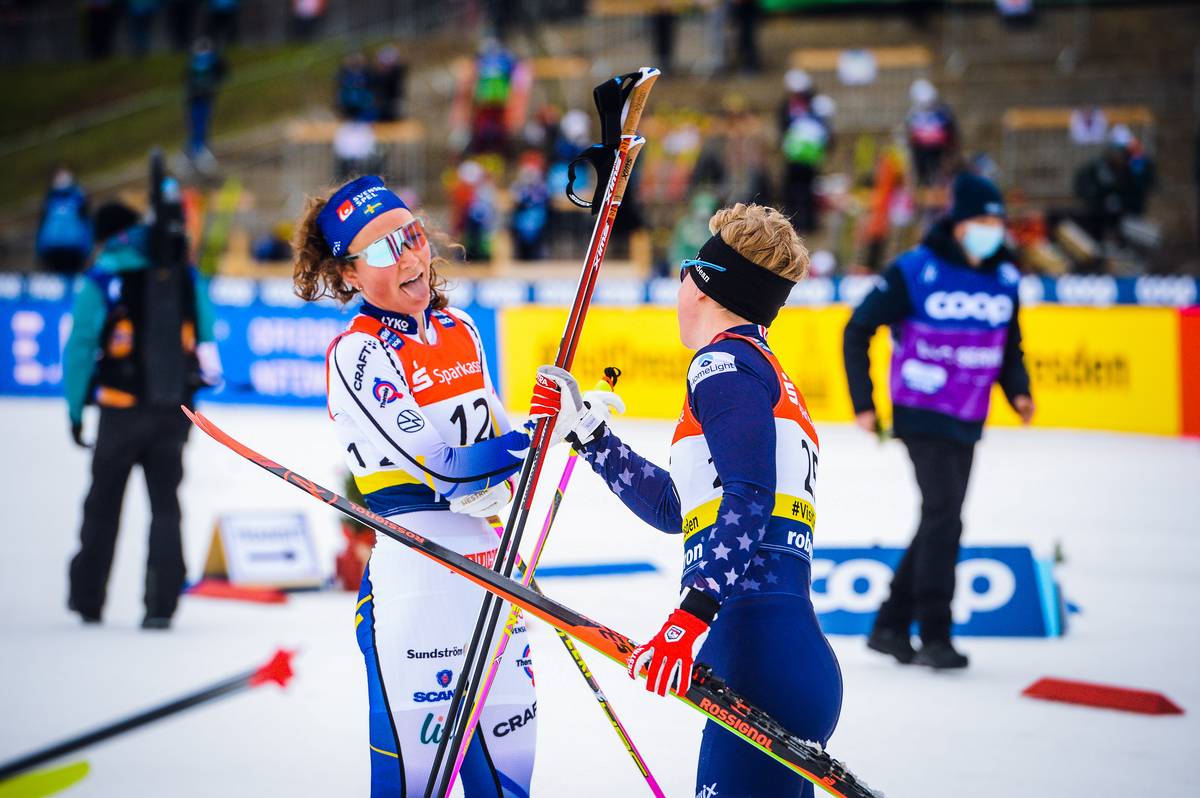
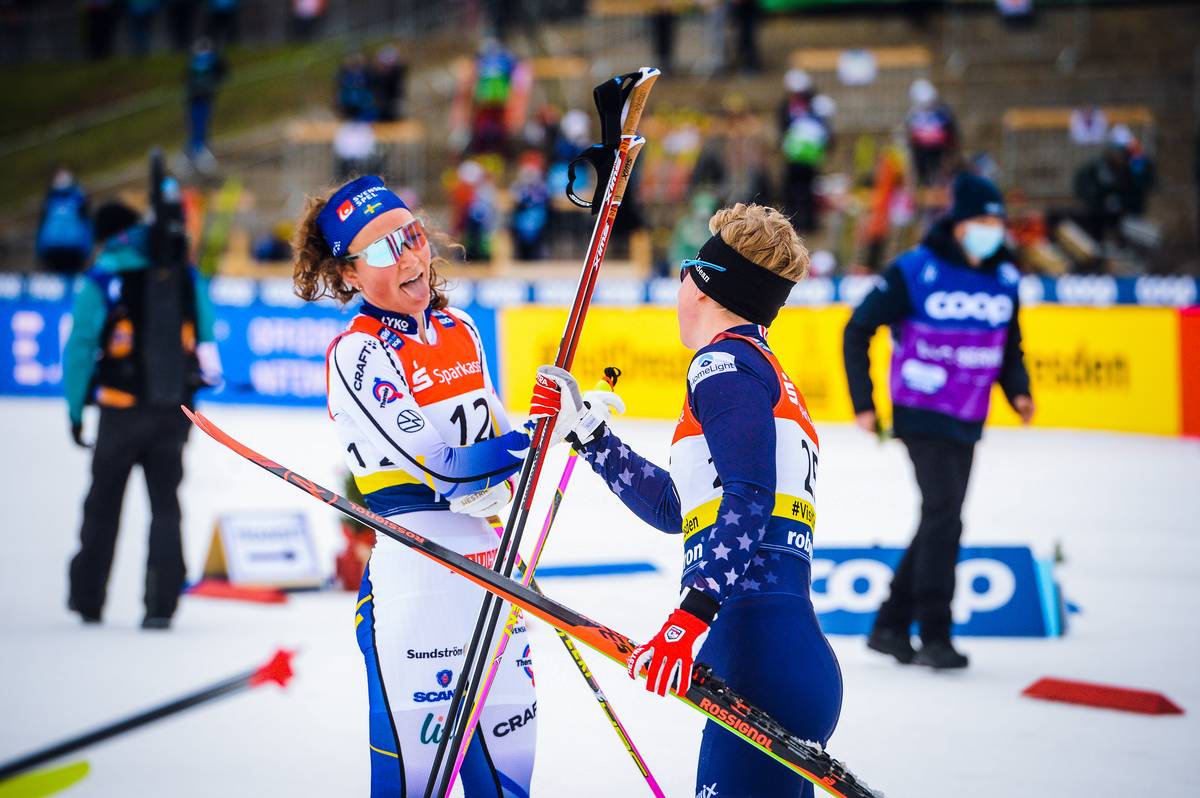
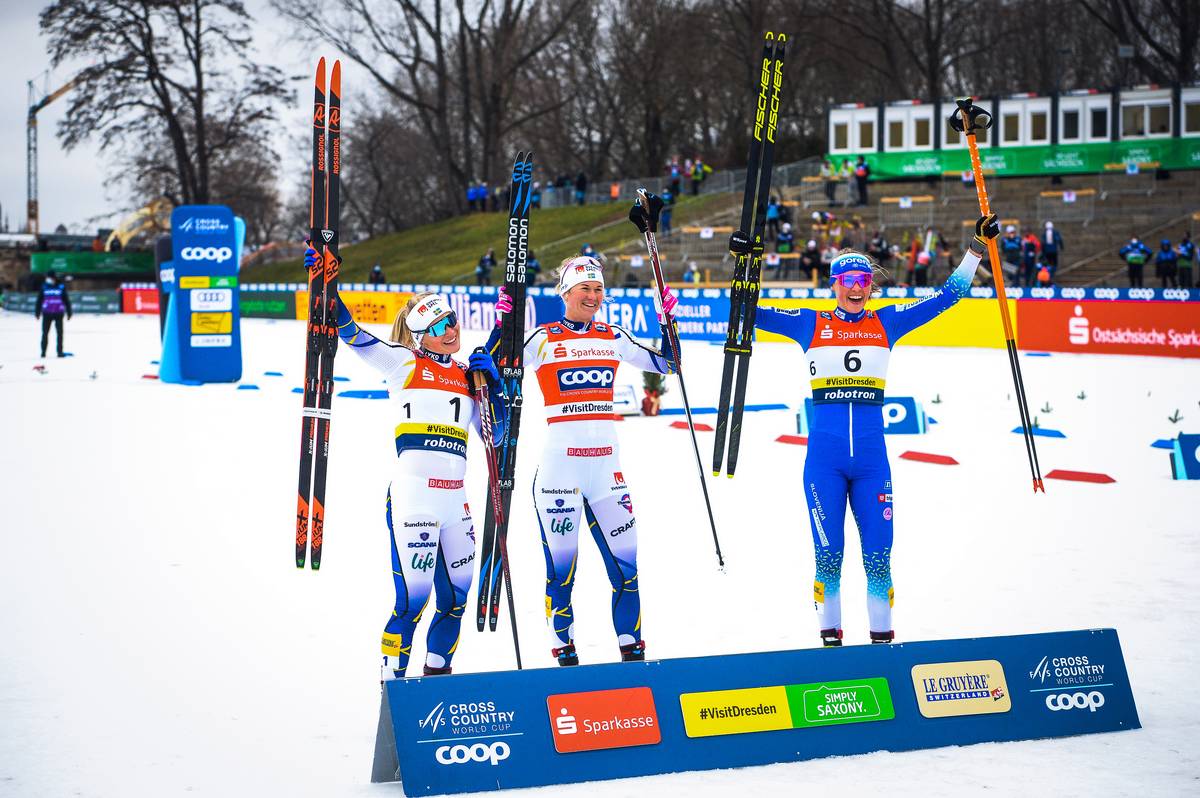
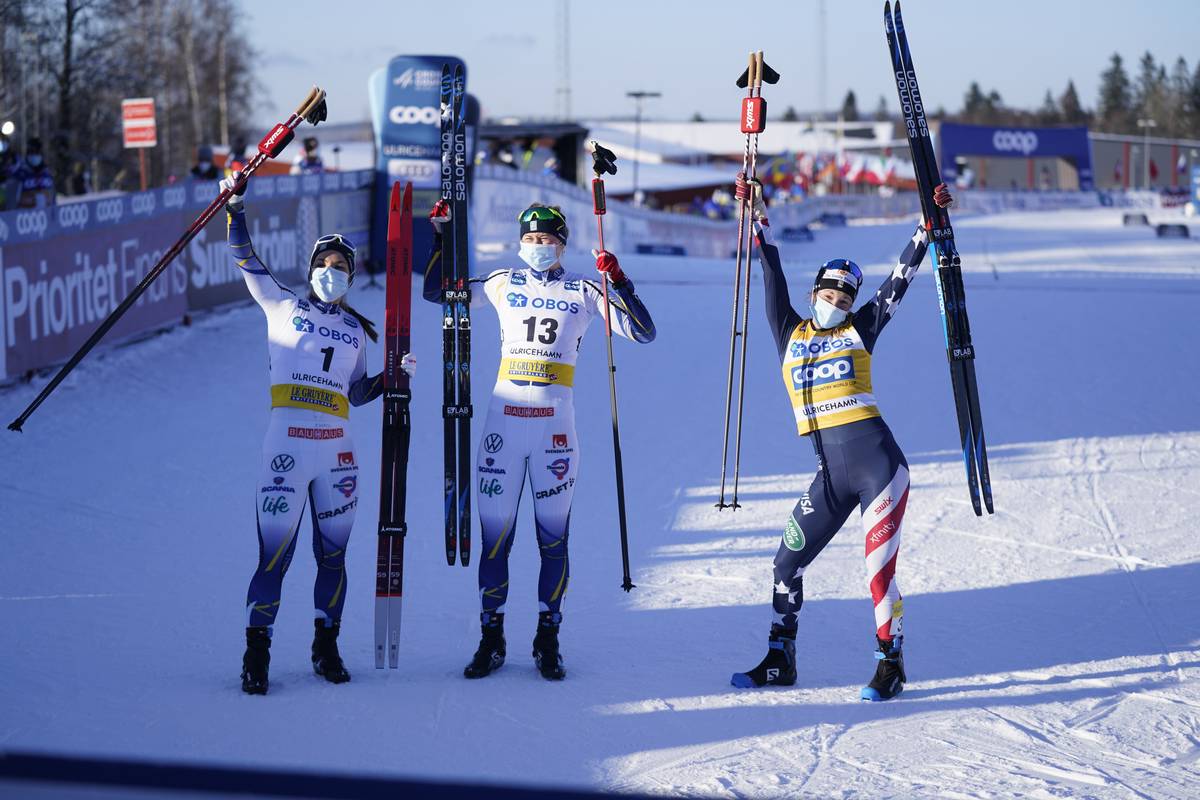
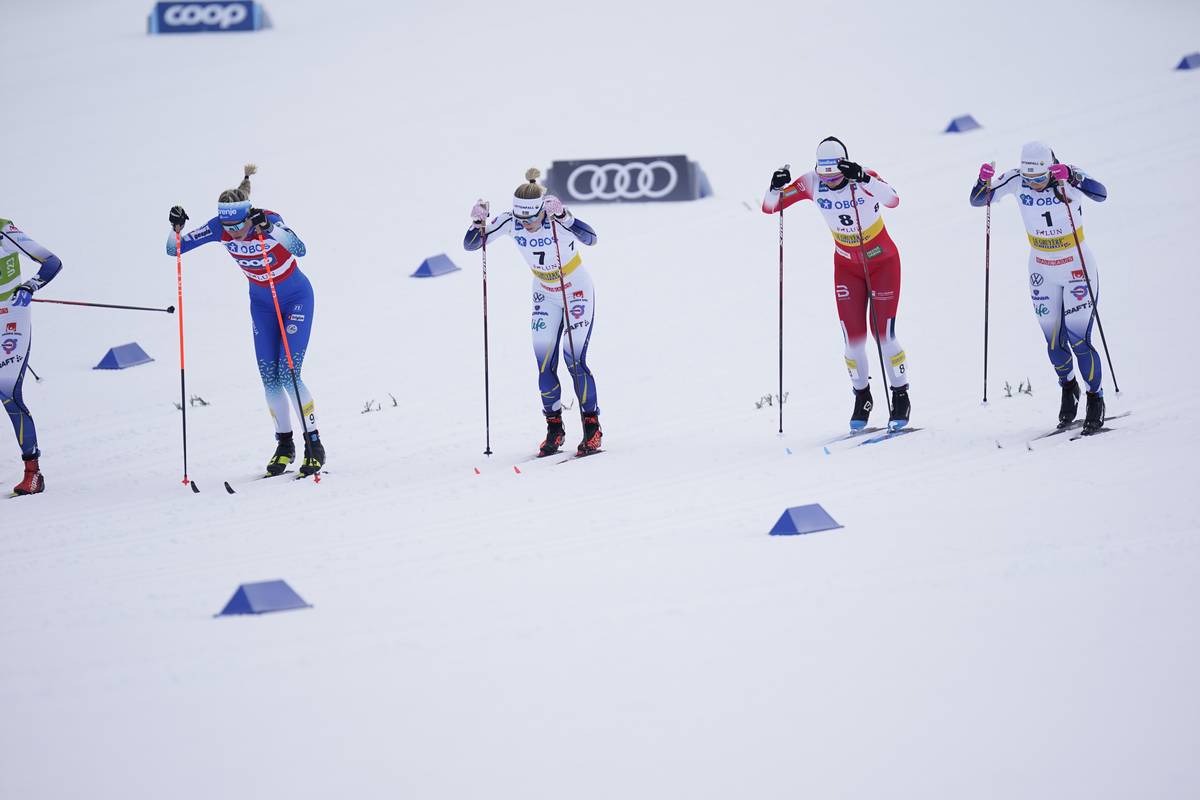
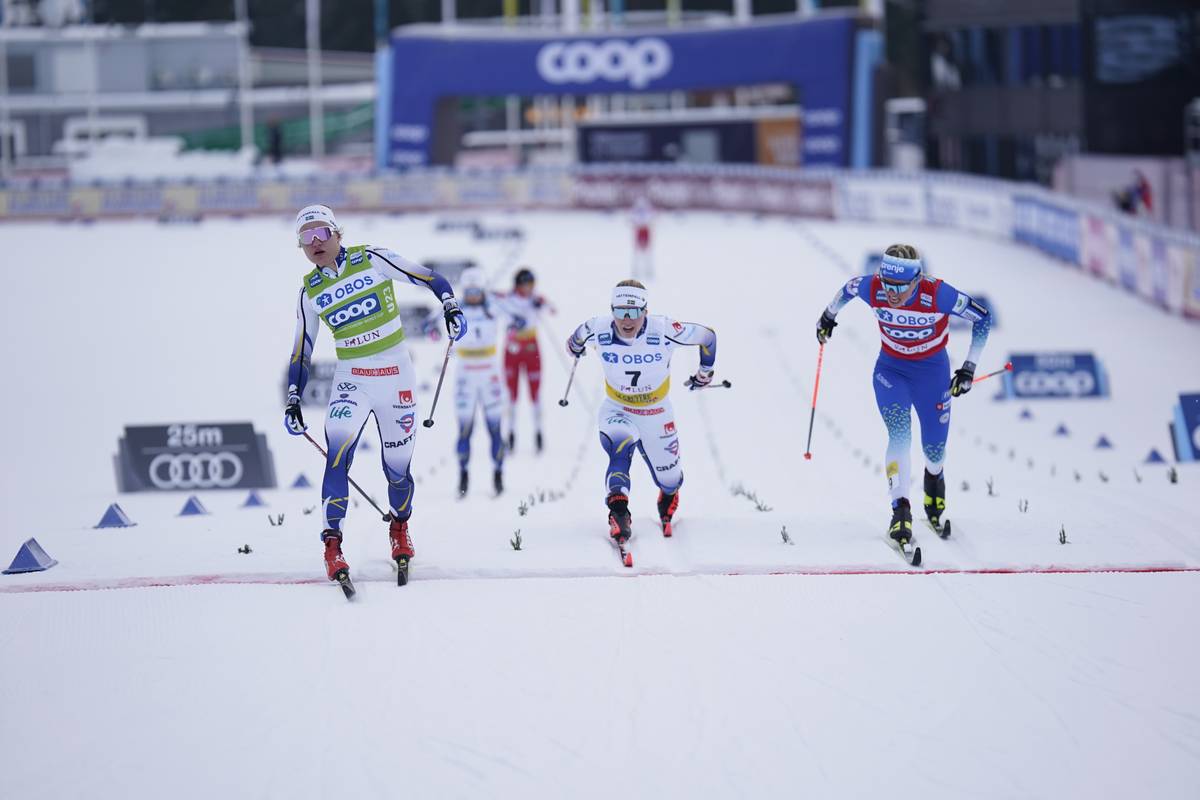
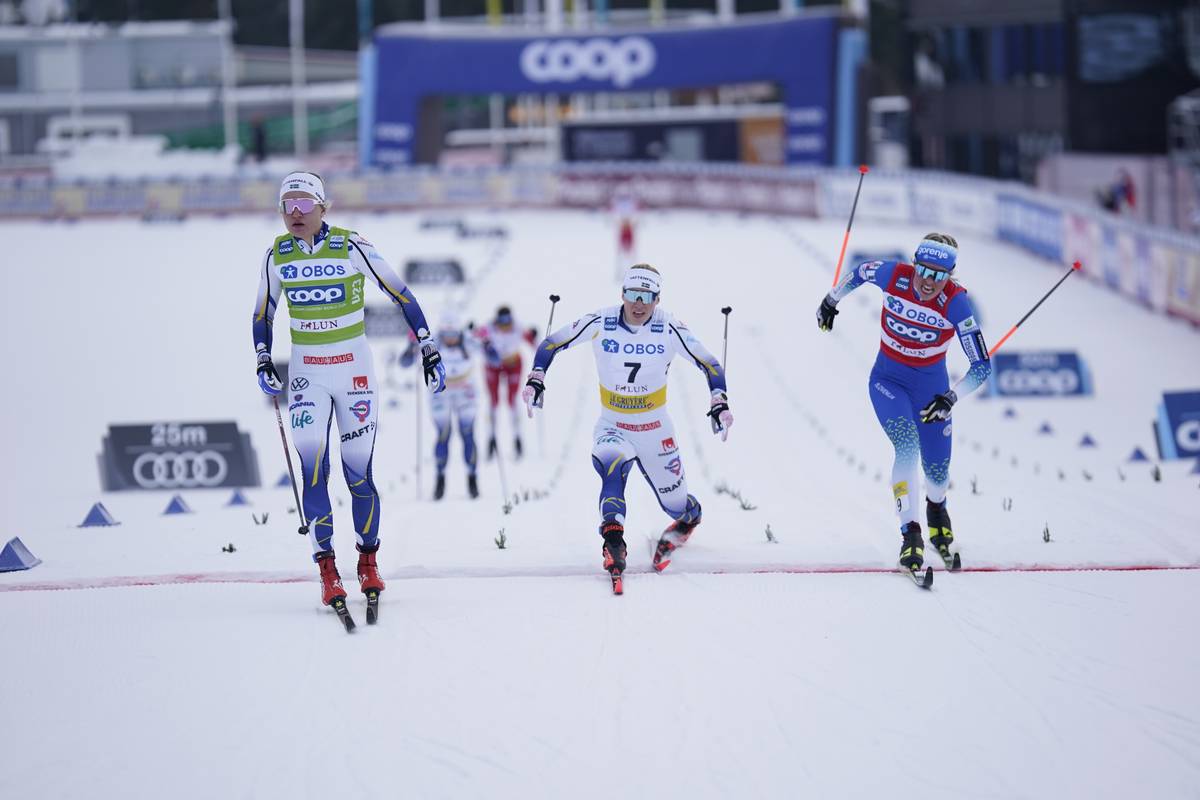
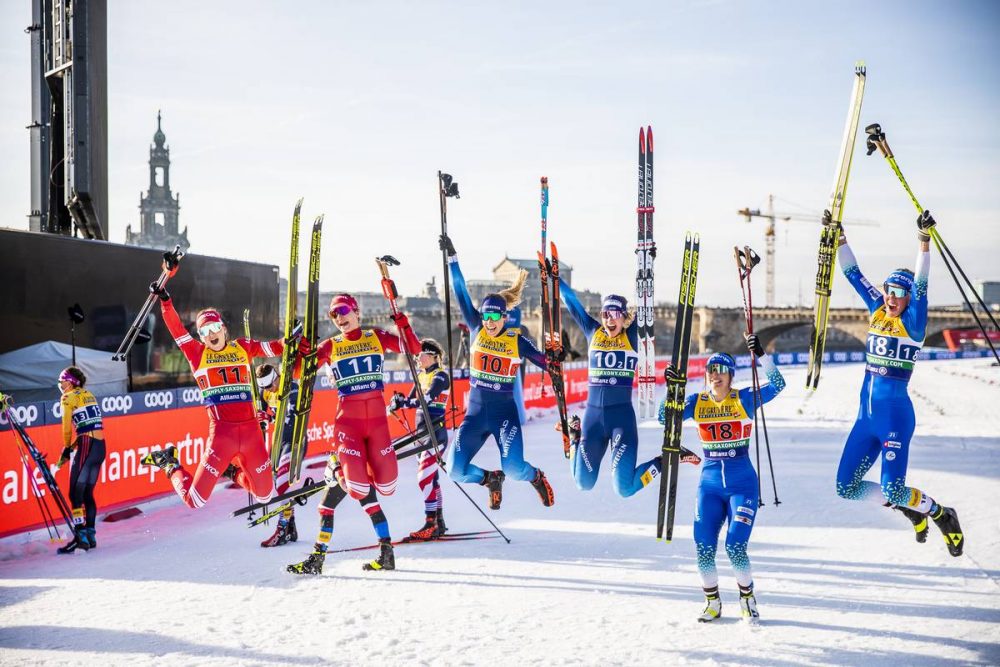
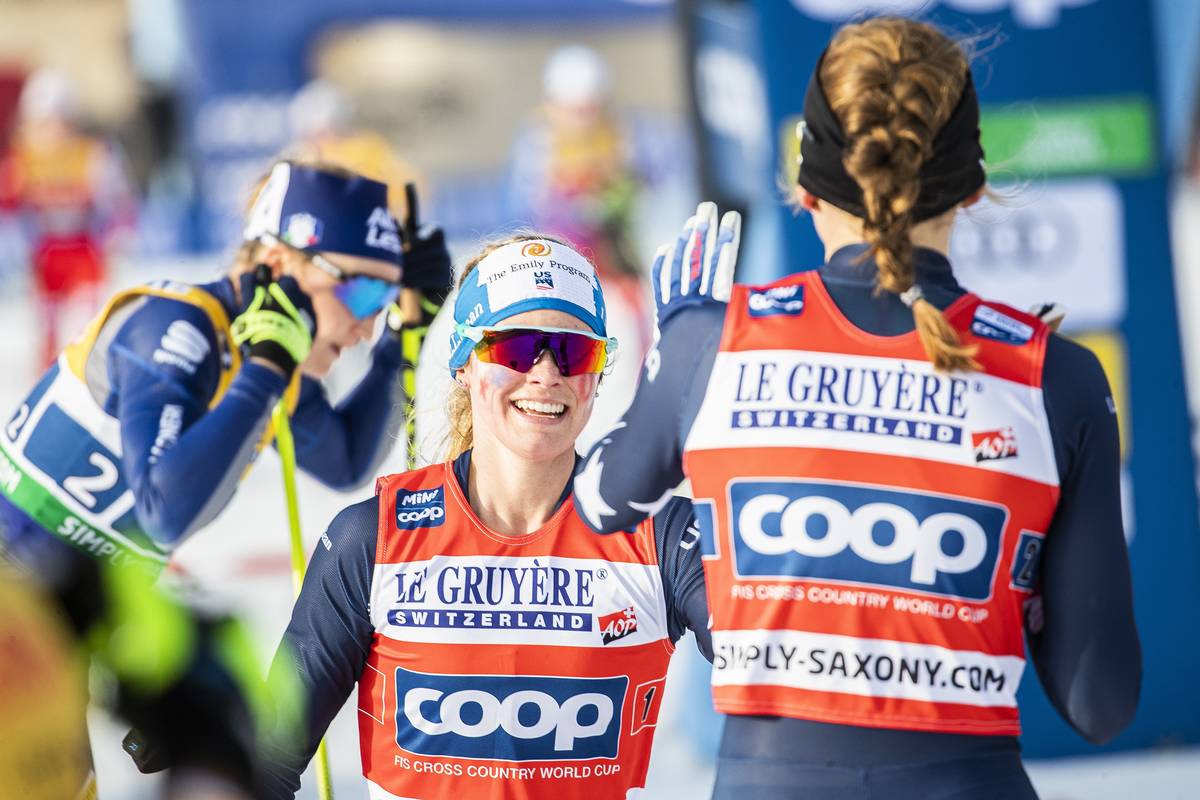
    Hannah Halvorsen congratulates Sweden’s Moa Lundgren at the finish of a skate sprint heat in Dresden, Germany in Dec. 2021. (Photo: NordicFocus)

    While it was not a focus of the questions posed to coaches, Halvorsen discussed her perspective from her experiences and research on what still needs to change in cross country skiing. 

    “I think that there is a subconscious cultural emphasis put on being lightweight, and that was being affirmed and validated and encouraged in subtle ways. Even if we’re saying the right things, athletes and kids and everyone is still aware of what is validated and when is affirmed and when is celebrated.”

    She discussed the overt messages a coach could give to athletes, such as an instruction to lose weight for performance or complementing a leaner aesthetic, however, she felt that more covert messaging is pervasive and perhaps more harmful. In particular, she identified aspects of traditional ski training that may skew focus and praise toward athletes with smaller body-types.

    “Every time I went to a summer training camp growing up, there was an uphill run test that, I think, held a lot of weight.”

    Halvorsen called the test “iconic” and expressed how the test felt like a measuring stick, both for one’s merit as a skier and as a basis for a social hierarchy among the athletes attending the camp. “There’s just a lot of, ‘That’s the cool athlete who can run uphill.’ And it holds for men and women.”

    Simultaneously, there are the challenges of a sport whose athletes race in lycra body suits throughout the winter, put in the most training hours during the heat of the summer.

    “That means a lot of shirtless time, a lot of shirtless social media, and a lot of emphasis put on doing things uphill. Uphill rollerski time trials, bounding intervals, uphill running time trials, mountain running races. I think all of that plays [into developing good fitness for ski racing], and I’m not saying ‘let’s get rid of it all, don’t do it.’ It just gets validated in a way that a doublepole time trial does not… There’s never quite as much emphasis being put on someone who’s really good on their skis, or really powerful, or really tactically gifted.”

    This leaves coaches in a catch-22; should they abandon a measuring stick that has served programs at all levels, both in the US and internationally, or are there alternatives?

    “[The uphill run test] is a good marker of fitness, and if there was a way that you only compared to yourself and didn’t use weight loss as a way of improving your times, you would be able to track your fitness. But there’s just no comparison. You could be a better skier than someone and if they’re a lot smaller than you, they probably are going to beat you in that. And no matter what your age is, it’s hard to not see that.”

    Denying the inextricable connection between size and uphill performance is not the answer in Halvorsen’s mind, as athletes will “see right through it.” Rather, she believes that an intentional shift in culture toward placing equal value on the myriad of athletic qualities that are less correlated with body size. 

    “How do you shift the weight to ‘it can still be valued, it should just be valued the right amount’? Like, ‘It’s one marker that we use, but we also want to see you improving on the doublepole tests. And if you lose a bunch of weight, you’re not going to. We also want to see you improving in speeds, and if you lose weight, you’re not going to improve in speeds.’ I think just giving it a little more balance is the only realistic, well-rounded solution that I see.” 
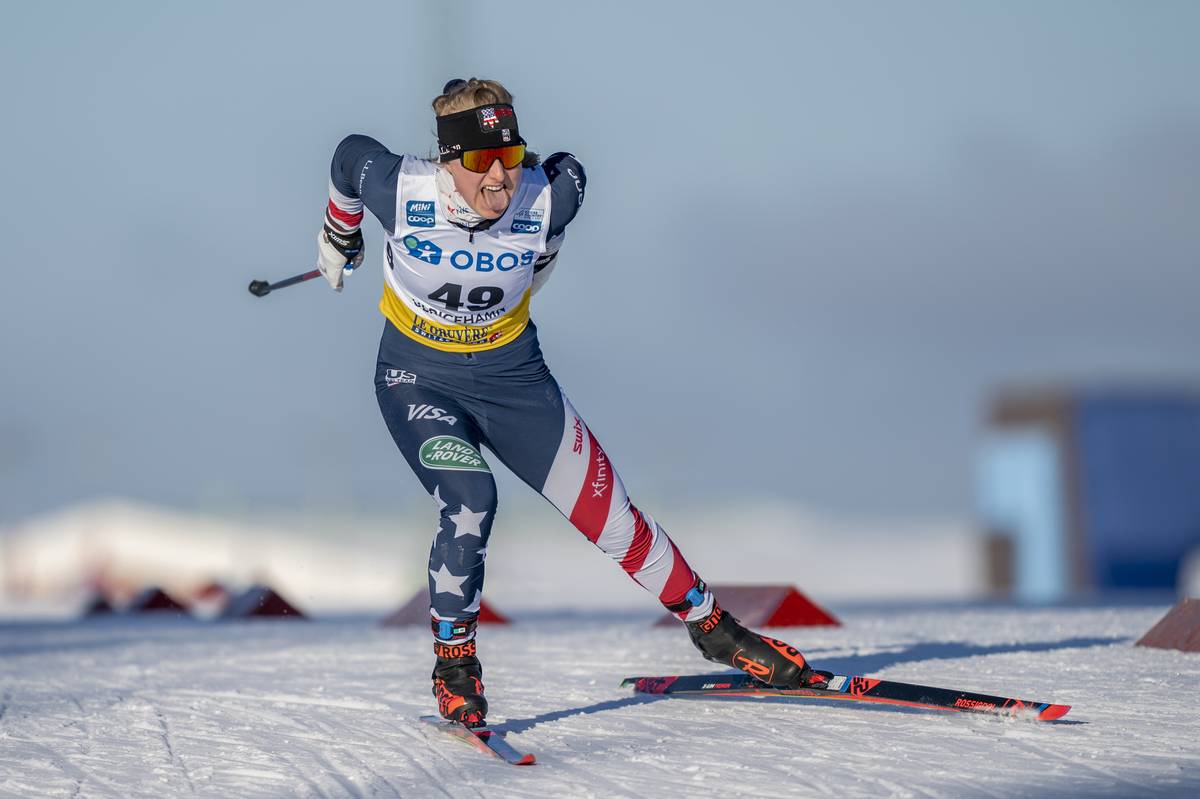
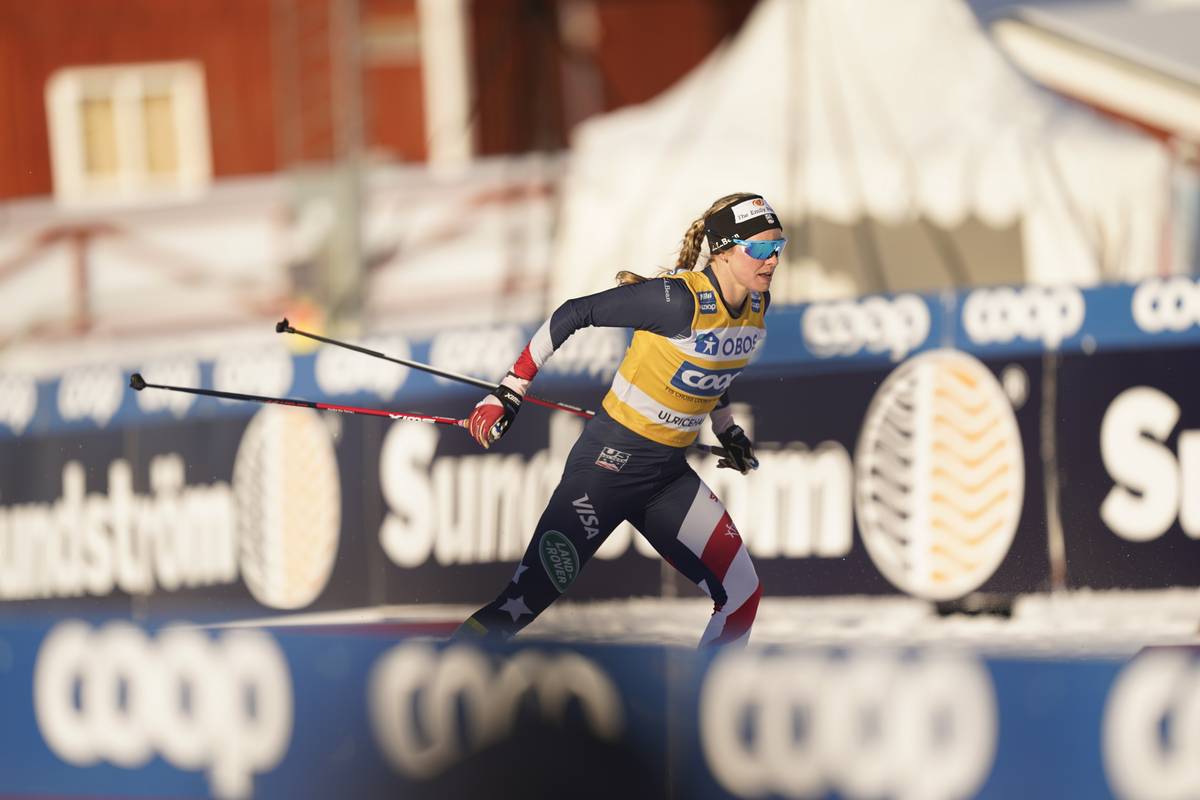
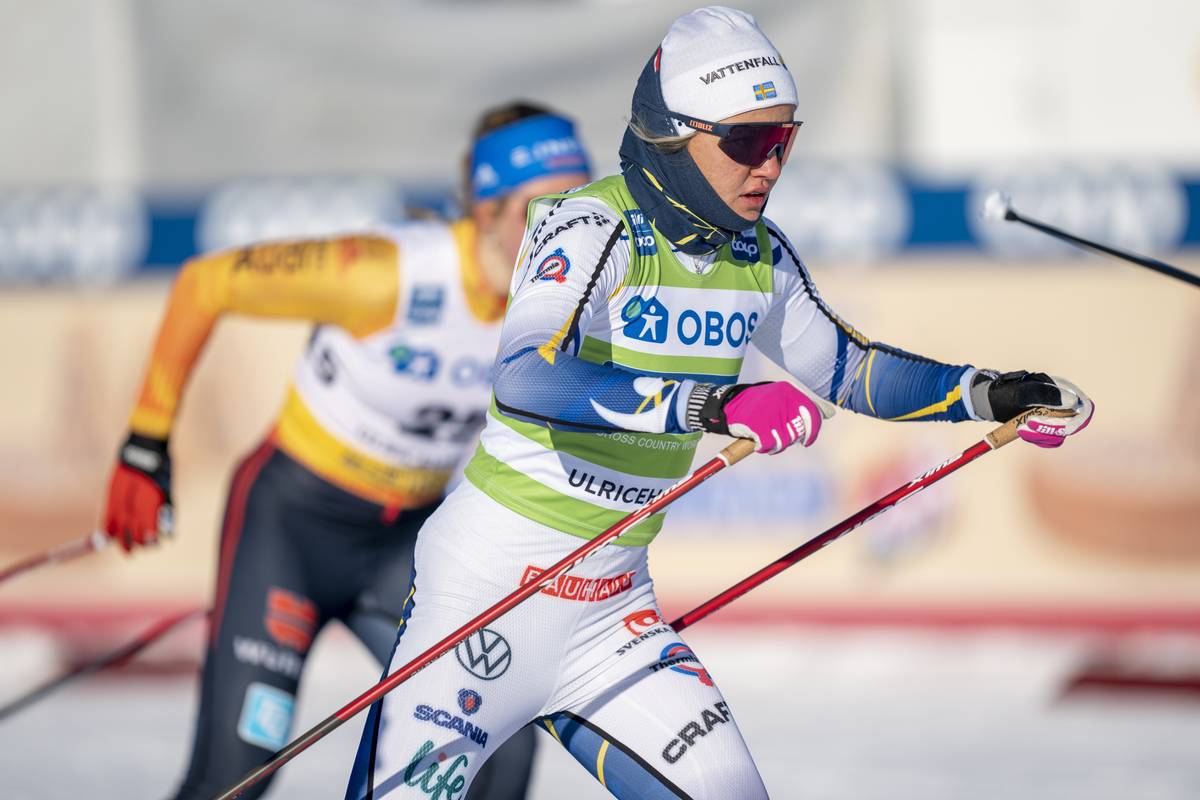
    Hannah Halvorsen pushes through the freestyle sprint qualifier in Ulricehamn, Sweden in Feb. 2021. (Photo: NordicFocus)

    Halvorsen described herself as “a little bit blunt” and “pessimistic” as she continued to discuss systemic changes she’d like to see in the future, namely, whether athletes at U16 and U18 training camps should be allowed to go shirtless. 

    “The kids who go to [U16 and U18] camp are the kids who are really cool and fast on their local teams. So every kid who’s on the local team is looking up to them, and looking at the pictures that they post, and I think that they help set the trend for their local teams. They bring home that culture.” 

    She proposed that instead organizers ensure that tee shirts and tanks that athletes receive at those camps be made of light weight, breathable material that remains comfortable even when training in heat and humidity. 

    These ideas are rooted in her own experiences as a junior. Attending her first U18 camp was Halvorsen’s first exposure to the unhealthy culture permeating sport, which interrupted the otherwise healthy and unencumbered relationship she had with food and her body, developed through her family culture. Diggins has also acknowledged the disordered eating she witnessed at junior camps as a triggering example she later followed once her eating disorder took hold.

    For Halvorsen, this led to a year of fixation on shrinking her body, with an aftermath of self-image and body dissatisfaction highs and lows that have persisted to the present.

    “People were talking about what they eat and their weight, and I put it all together and kind of became obsessed with it… I just spent all my energy and time obsessing over what I could eat and when, that I couldn’t see anything else. Making sure to time it so that people would see me eating so that they would hopefully not know that I was doing this. It made me so miserable. It wasn’t sustainable.”
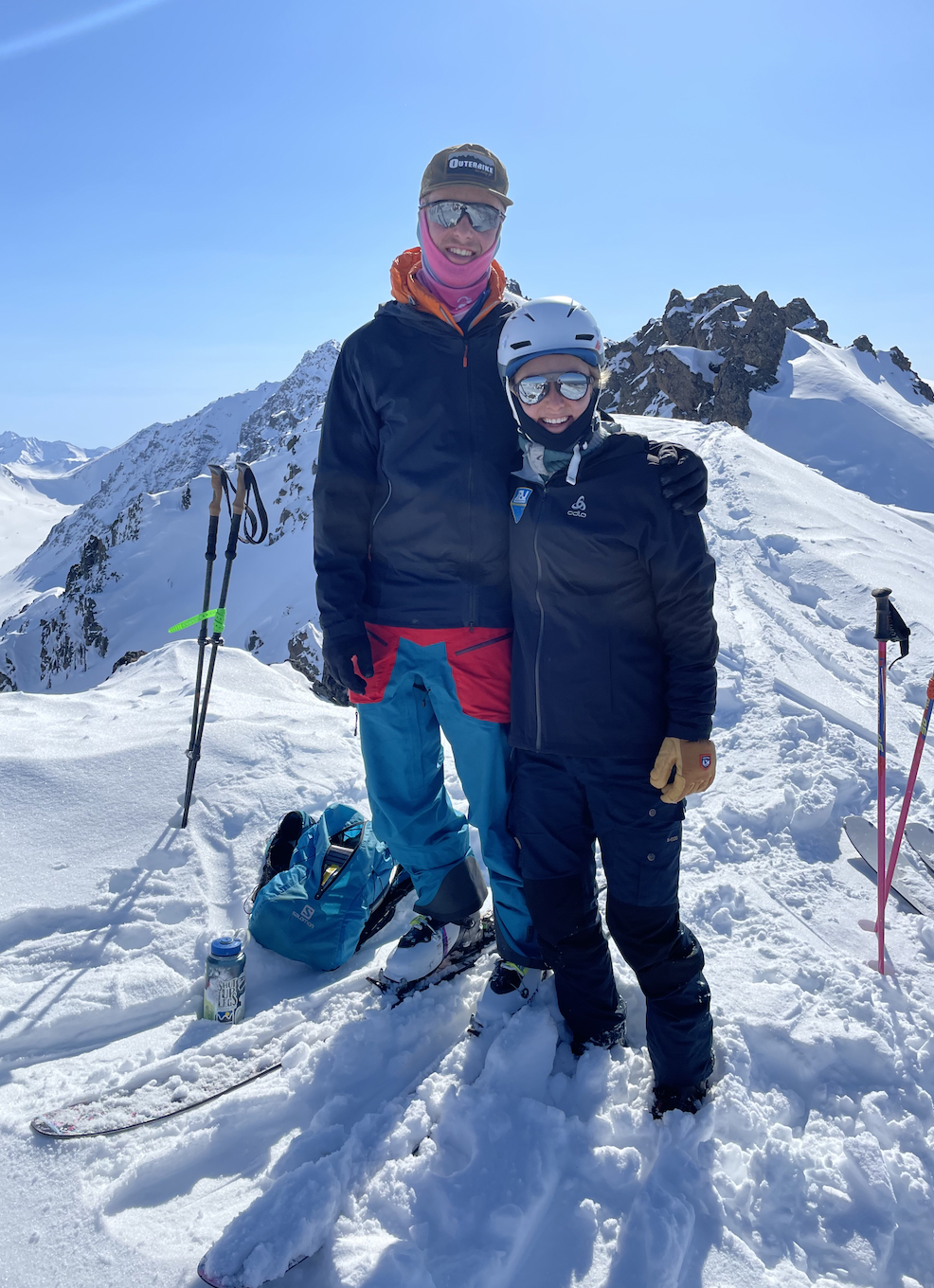
    Hannah Halvorsen and her brother Bjorn enjoy the Alaska backcountry after finishing the 2022 race season. (Courtesy photo)

    While plenty of change and education remains necessary to improve the climate surrounding athlete health, eating disorders, and RED-S, Halvorsen expressed optimism in the trends across sport culture and the outlook for future generations of athletes.

    “It’s such a difficult issue and I don’t know that it’s ever going to totally go away… We’re at a point right now where it’s becoming common knowledge this is an issue and a lot of people are open to having that conversation and learning about it and it’s not as secretive. And that’s huge, because now we have enough people on board that we can start to think, ‘So what are we gonna do about it? I don’t think that we only know. I think we’re flailing a little bit. I think we’re looking, we’re asking the right people, we are trying to figure it out, and we care and we want to make this better. But I don’t think that we’ve figured out exactly what to do and put that into action yet… 

    “But I feel optimistic because I think I see a lot of energy being put into, ‘We can’t just ignore this. This issue is huge. And we’re willing to spend the money and the time and energy even if it makes us uncomfortable to figure out what what that is that we need to be doing.’”

    Halvorsen is soon headed back to her home state of California for an internship in Berkeley that she described as “more on the business side” of her academic experience. However, she remains passionate about advocating for better education, support, and resources for coaches and athletes, and hopes to return to this type of work in the future. 

    “I just think there’s something so central about it, because it’s your body. It’s you. It’s so important. And I think everyone deserves the right to feel good in who they are. I don’t really care if people are good, medium, or slow at skiing, I just want them to feel good in their bodies. Skiing should be a way to feel good, not something that makes you feel bad about your body.”

  • Cross Country With a Twist: NordicX Event Lights Up Anchorage 

    Cross Country With a Twist: NordicX Event Lights Up Anchorage 

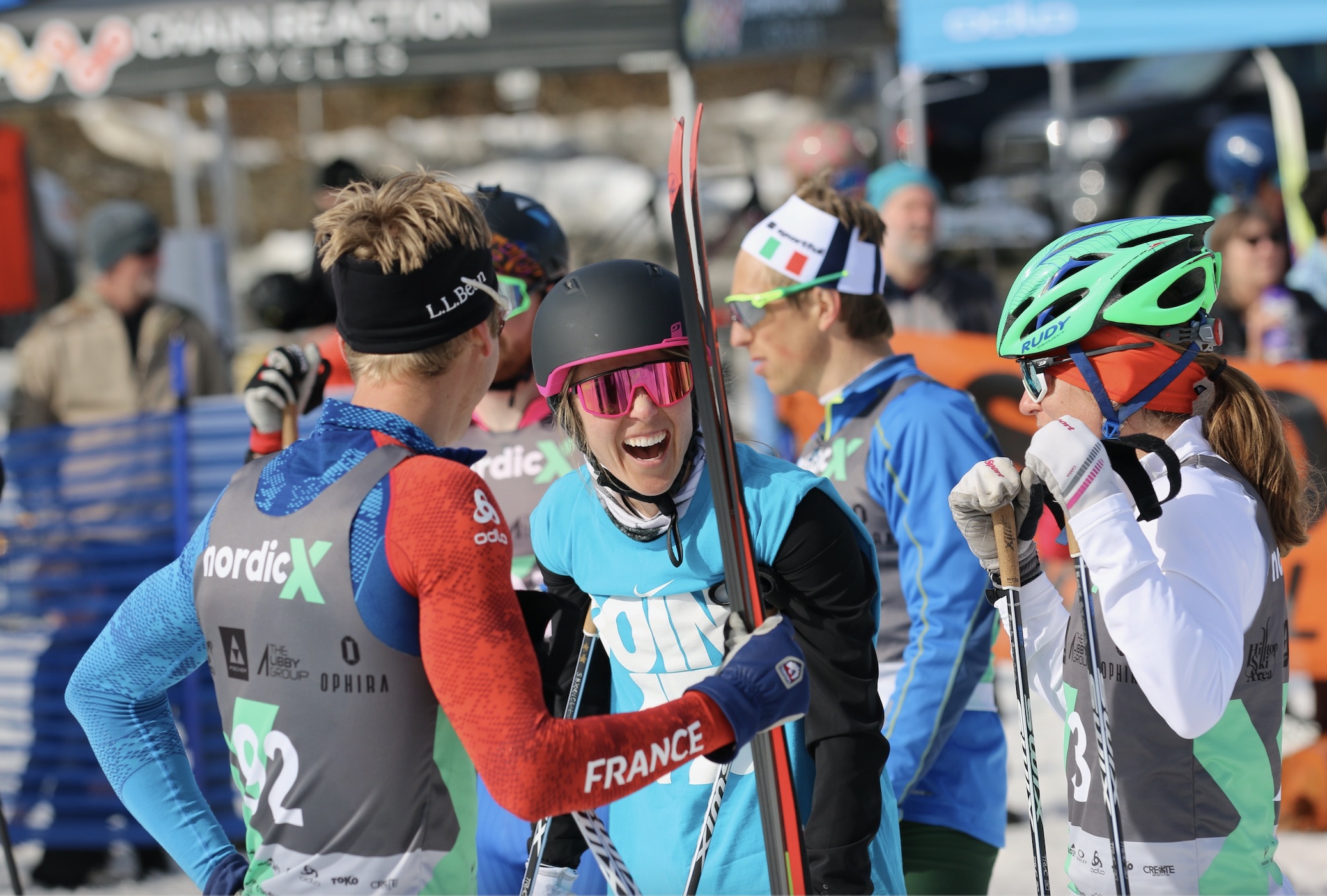
    Erik Bjornsen, Sadie Bjornsen Maubet, and Rosie Brennan enjoy a very different race atmosphere at NordicX. (Photo: Eric Maurer / NordicX)

    What comes to mind when you think of a cross country ski race? Depending on your location and how you choose to interact with the sport, there are likely a variety of answers to the question, but it’s likely that there are some common themes. 

    “Cross country events are pretty much all the same when you boil them down, you know?” said retired US Ski Team member and 2018 Olympian Reese Hanneman. “It’s a test of endurance and speed over a set course, and it’s timed, and you’re usually out there in the woods alone. And I mean, that’s what cross country [racing] always will be, but I always felt like there was room for more.”

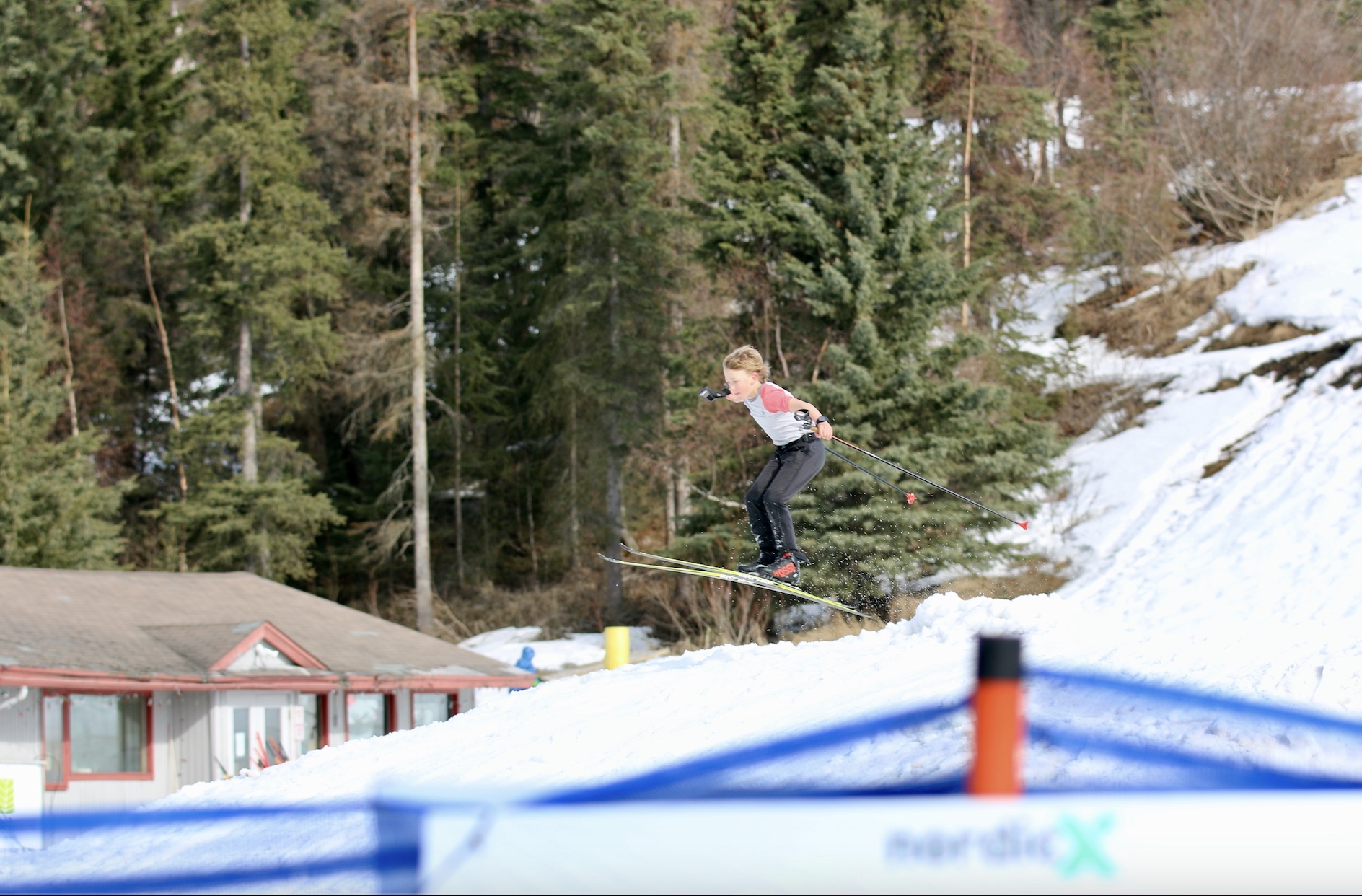
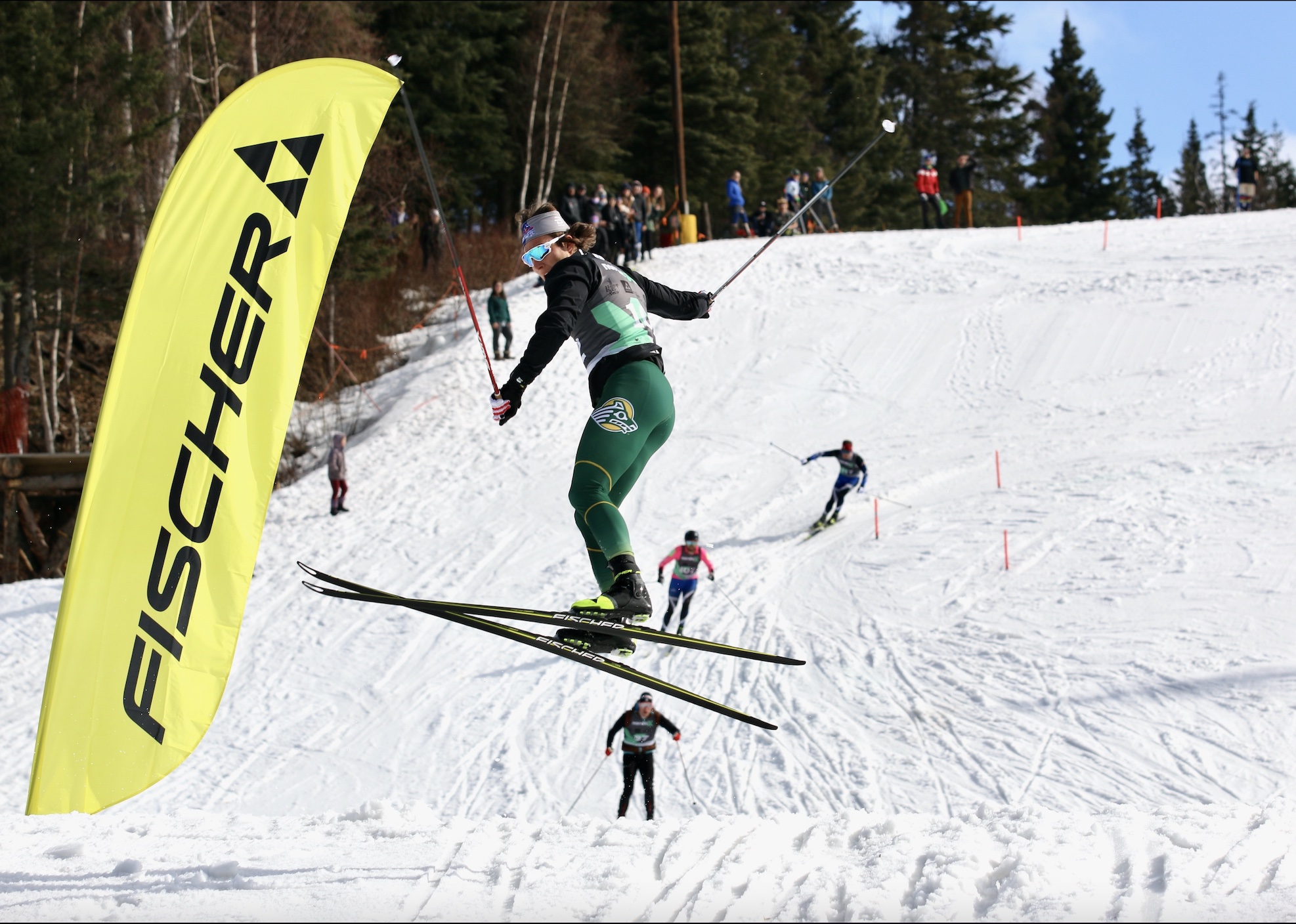
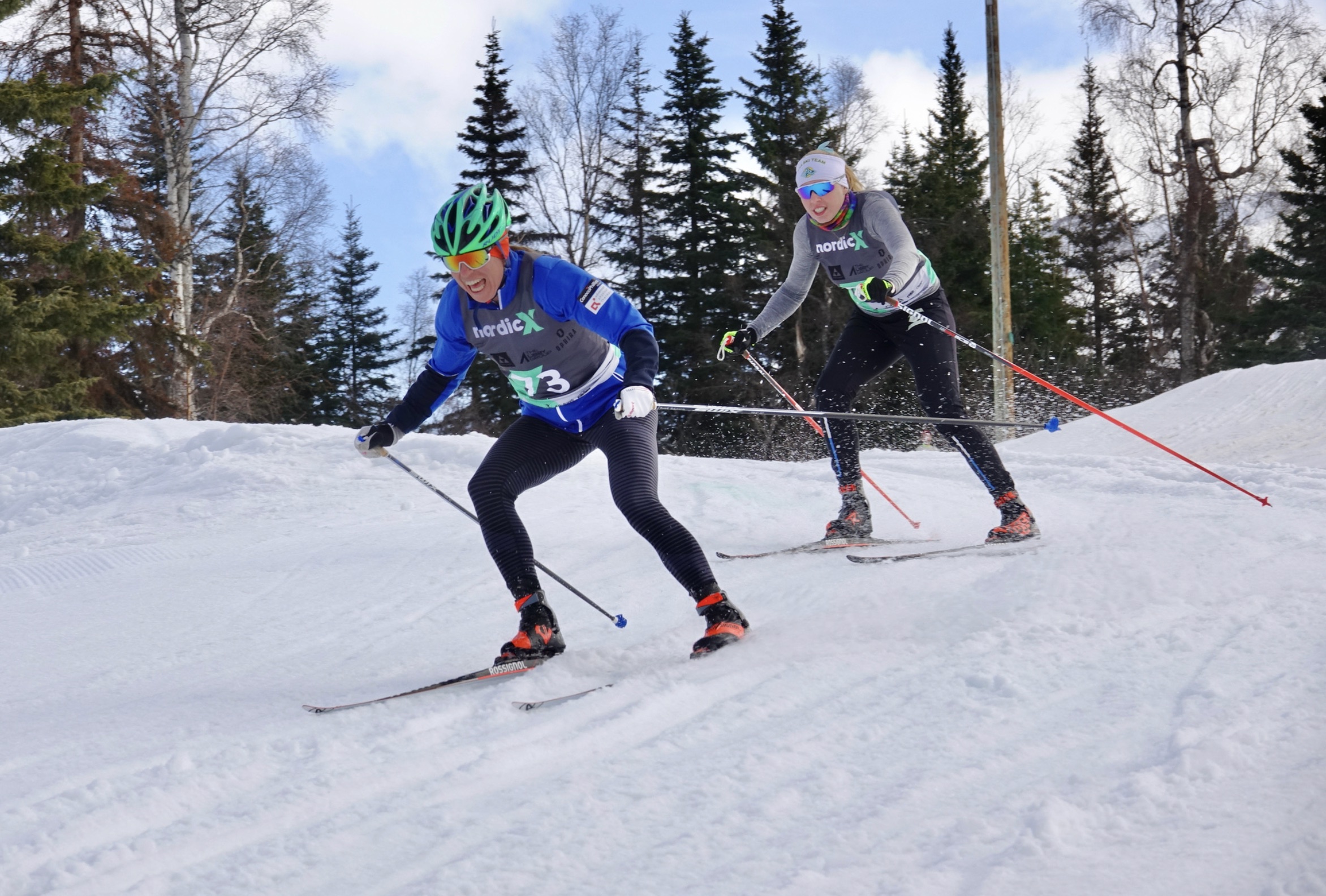
    In what he described as “living out [his] 10 year old dream”, Hanneman set out to break this mold. His dream came to fruition on April 2nd in his home of Anchorage, Alaska, as cross country skiers from the junior level to recent Olympians careened down the slopes at Hilltop Ski Area, rounding tight turns, skating uphill, and catching air – with some not-so-graceful landings – off of jumps before finishing amidst a festival atmosphere at the base. The event was NordicX, an untimed, head-to-head “nordic-cross” event where style points on the final kicker into the finish might earn you a lucky loser spot in the next round. 

    “I knew that there was a lot of appetite for [an event like] that because every time I coach kids, which has been quite a bit over my career, I see that same energy and excitement for hitting jumps and sessioning little whoopty-dos or tabletops. And basically, there’s no cross country event that caters to that.” 

    One of many kids enjoying the features on course and in the Kiddie Cross terrain park at NordicX. (Photo: Eric Maurer / NordicX)

    While Hanneman wanted a non-traditional event, he was not looking to eliminate the character or skills of cross country skiing altogether. He pulled from his experience competing in the 2016 Red Bull Nordix event at Lake Louise in Alberta, where he raced against other top international skiers including Norway’s Petter Northug and his US Ski Teammate Andy Newell.  

    “It was so fun and it was so crazy and scary and fast. And I was like, ‘Man, I need to bring this to Alaska.’”

    In creating his own event, he said he wanted to navigate the “delicate balance of new, exciting, and extreme, but also staying true to cross country skiing. It’s one thing to build a little booter next to the xc ski trail and ski ’round and ’round hitting it with your friends, and it’s another to try and package that experience into a full-on event that offers excitement for all ranges of skills and ages.”

    JC Schoonmaker does a 360 into the finish at NordicX. (Photo: Eric Maurer / NordicX)

    “I knew it needed the right venue,” Hanneman continued. “I wanted something ‘net downhill’ because otherwise I felt like it would be too similar to other xc races, a loop with the same start and finish meant that in order to have a huge downhill you would need a huge uphill. But I also wanted it to be ‘cross country’, so that it truly rewarded good cross country skiers, and so that cross country skis were truly the best tools for the job.” 

    As the course and conditions hinged on both the weather and Hilltop’s grooming, an official course map was never set. To ensure the event catered to skiers beyond the nucleus of elite skiers based in Anchorage, an A-, B-, and C-Line was established on each of the features, making air-time not requisite and allowing athletes to select a route that felt safe, at the expense of simply forgoing the fastest line, which might pay off in the end if it kept the racer upright with equipment intact. 

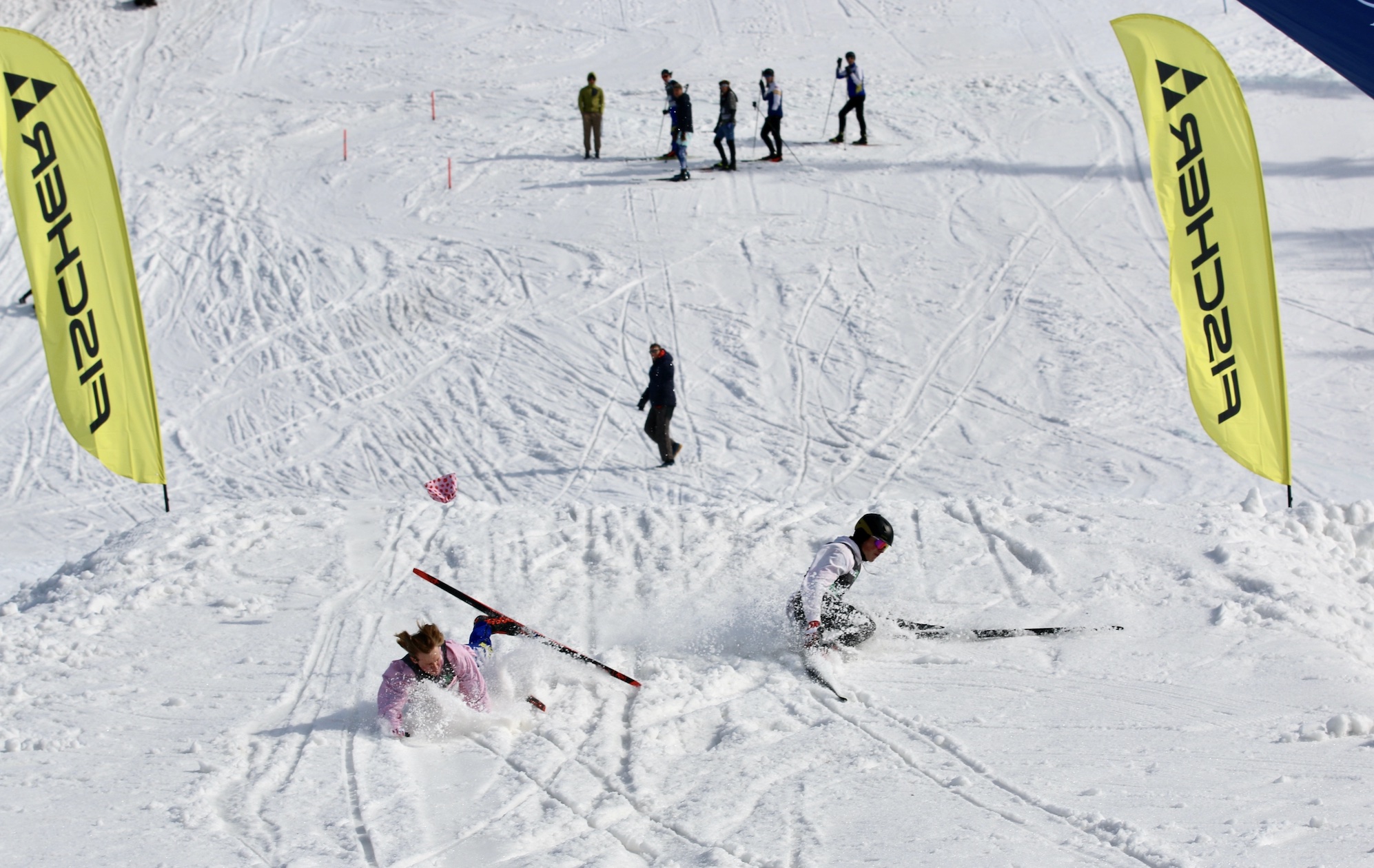
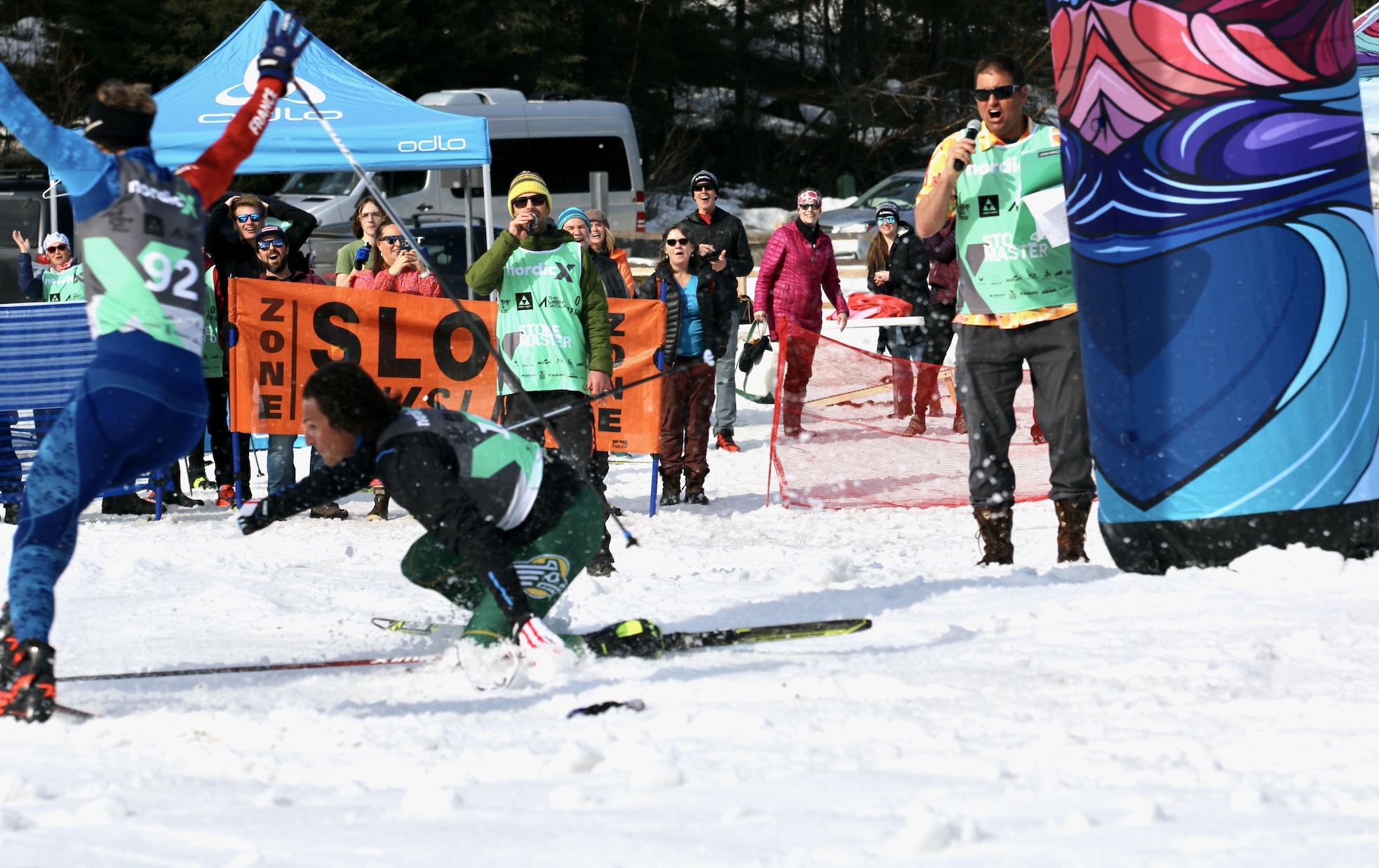
    Holding to the spirited theme of the event, Hanneman described it as “a freestyle event in both feel and in practice,” meaning there were no official course maps, no timing, and plenty of subjectivity in the results. Get sendy and try to 360 off the final kicker into the finish only to crash and stall out before the line? Style points – you just became the lucky loser and can move on. Flooded legs from the uphill sprint section cause you to catch an edge off the drop and yard sale? The crowd loved it – lucky loser spot for you also. 

    Not everyone stuck the landing at the finish of NordicX… (Photo: Eric Maurer / NordicX)

    No official prologue seeded athletes; after a few hours where skiers could preview the course, the event simply kicked off with heats of six in the quarterfinal, splitting the 100 athletes between open and junior men’s and women’s categories. Among the field were six Olympians: alphabetically, Erik Bjornsen, Rosie Brennan, Hannah Halvorsen, Logan Hanneman, Sadie Bjornsen Maubet, and JC Schoonmaker, most of whom ended up on the podium at the end of the day. Next year, Hanneman hopes to include additional categories for parents, masters skiers, etc. 

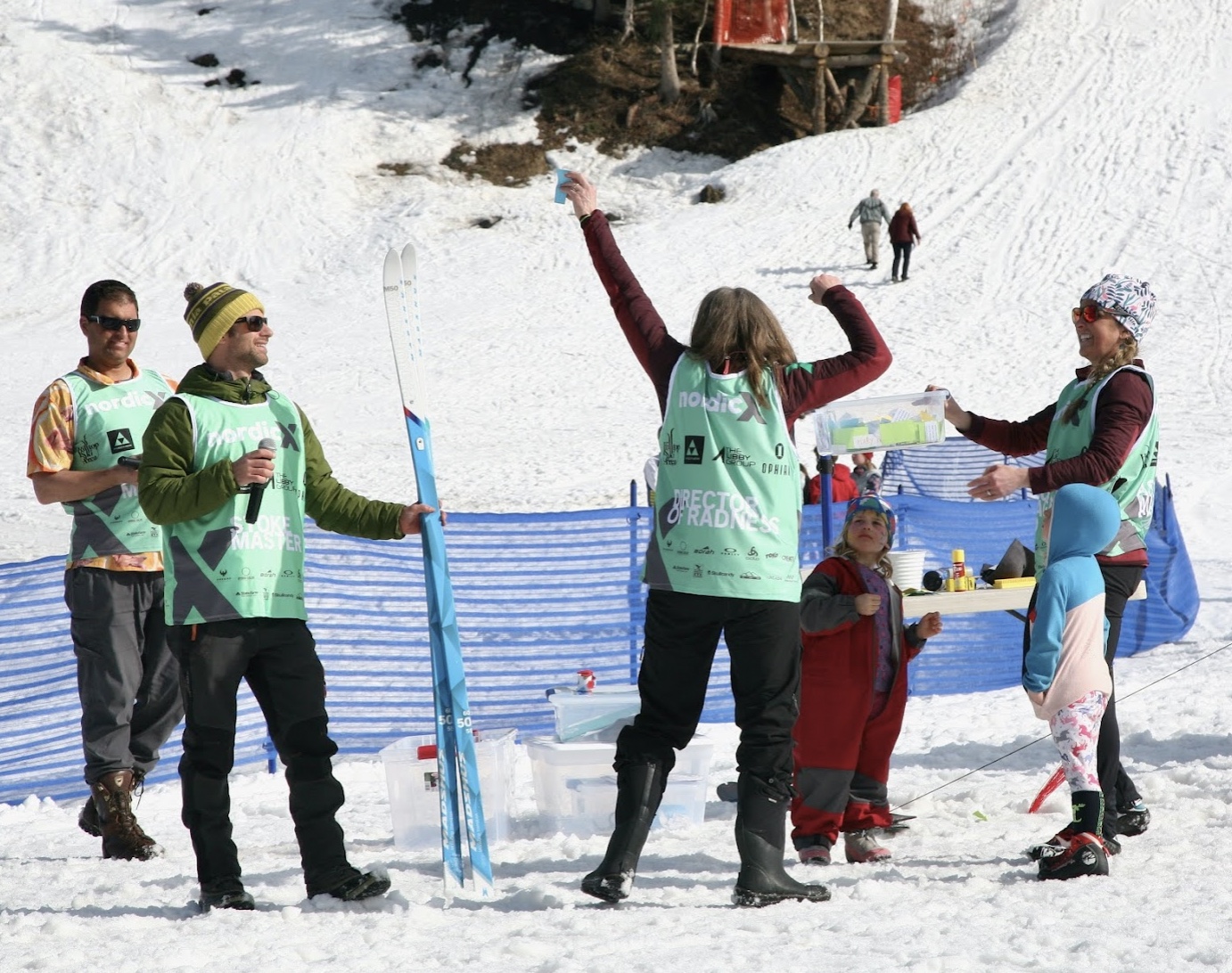
    For those who weren’t up for racing or couldn’t quite match the on-ski agility of Maubet or Schoonmaker, a continuous stream of raffles offered plenty of alternative opportunities to win. A DJ fed the energy at the base, while emcees Rob Whitney and Lee Bolling kept the momentum alive between heats, announcing the winners of numerous prizes from sponsor companies like Odlo, Fischer, Oakley, Skull Candy, Toko, and more.  

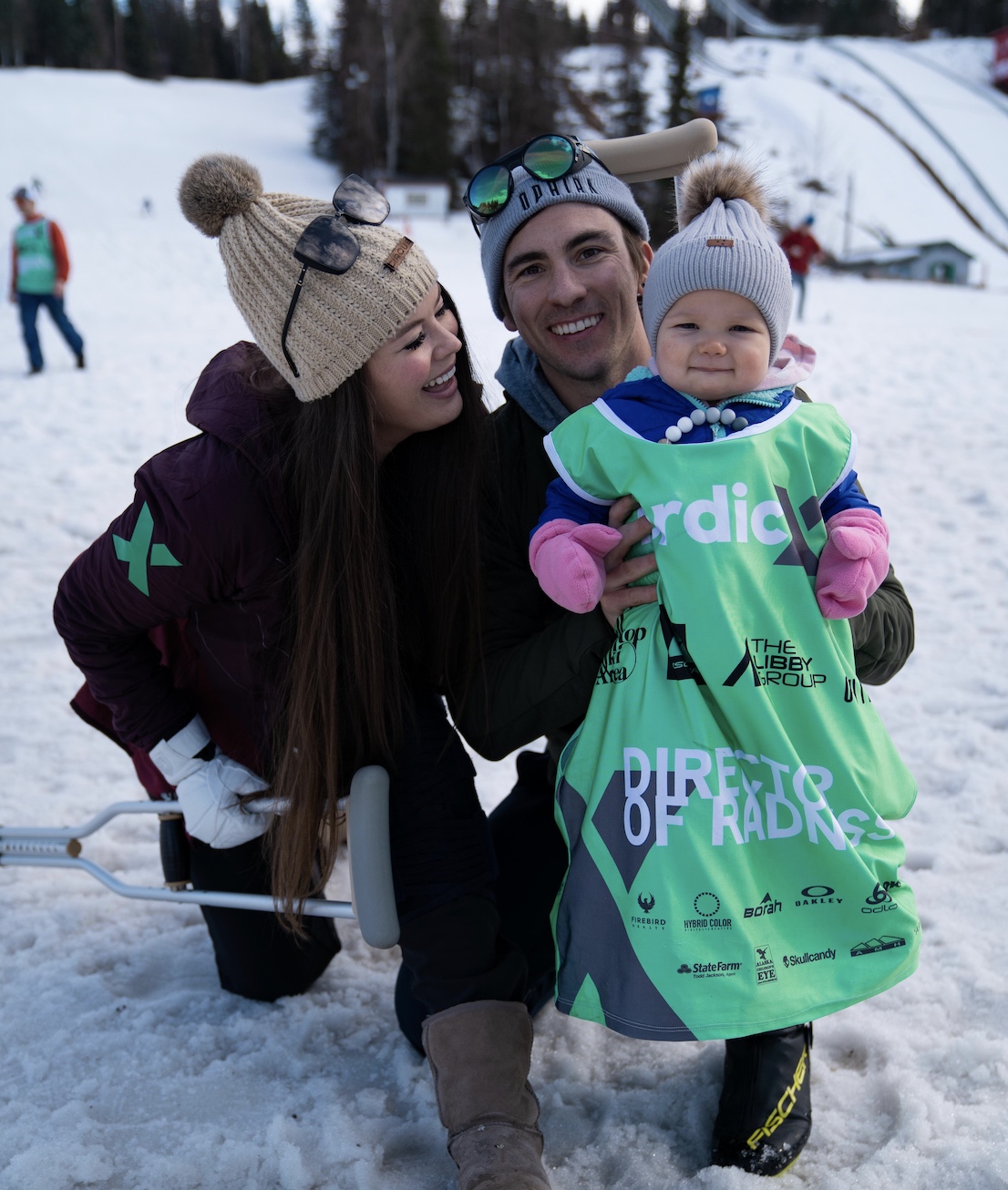
    Emcees, director of radness, associate director of send: keeping the energy high at the base with continuous prize drawings. (Photo: Eric Maurer / NordicX)
    Rosie Brennan charges around a tight turn as she races through the heats at NordicX. (Photo: Russell Hood / NordicX)

    Though these factors added to the festival atmosphere at the base, spectating alone was plenty exciting. In particular, the finish of the senior men’s final was one to watch. 

    “You couldn’t have scripted a better finish,” Hanneman laughed. “You had JC Schoonmaker, who’s one of the fastest sprinters in the world right now, and Erik Bjornsen, who was just on fire all day back from retirement. [They were] just completely sending it and just flying through this final steep slalom section, and Erik is trying to catch JC, and JC is trying to hold him off. They go to the finish, over this big table top, and everyone’s holding their breath. JC goes off it and does this massive spread-eagle.” 

    But he didn’t stick the landing. Landing a little too far in the backseat, Schoonmaker’s skis washed out from underneath him, leaving him sliding across the snow toward the inflated archway that marked the finish. He stalled out just before reaching the line.

    “Erik is coming at Mach 50, about to beat him to the line. JC has to roll over and, like, flops [his skis] over the line.”

    Erik Bjornsen sticks the landing, but JC Schoonmaker flops over the line first for the win.a (Photo: Eric Maurer / NordicX)

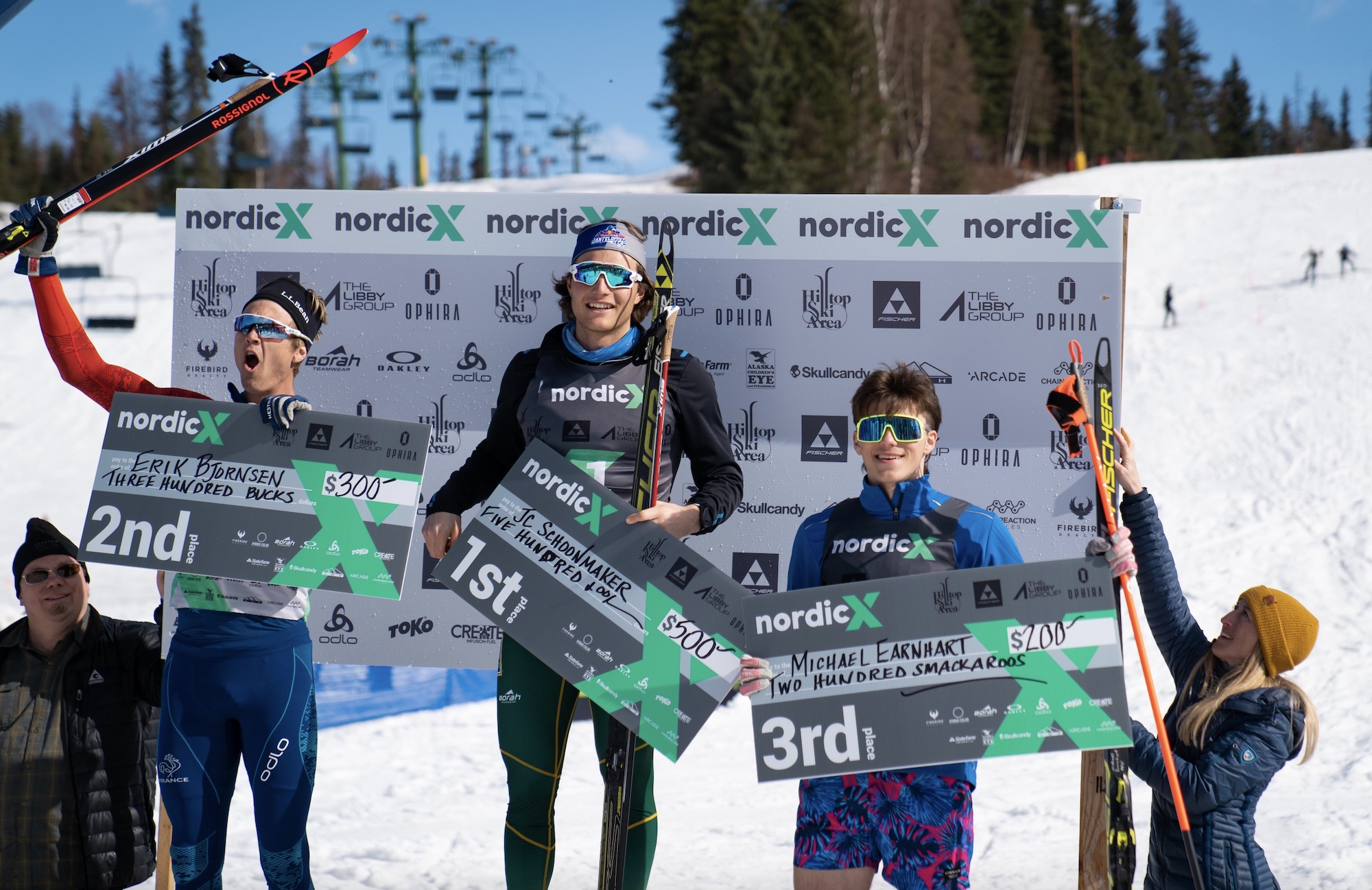
    From a photo finish, Schoonmaker was awarded the victory, with Bjornsen narrowly taking second. U20 APU athlete Michael Earnhart skied to third, taking the final podium step.

    “NordicX was one of the most fun races I’ve participated in,” wrote Schoonmaker after the event. “It took me back to middle school building jumps with my friends and seeing how far we push the skinny ski boundaries. Everyone who took part in putting the race on did a great job and with the spectators who came out, it really just had a good vibe to it. Everyone was having a great time and I’d definitely like to do it again. My highlight was watching some of the younger skiers before the race who were hitting the last jump doing 360’s and backflips and seeing how pumped up they were to be there.”

    The men’s NordicX podium: JC Schoonmaker came out on top in a dramatic photo finish with Erik Bjornsen, while Michael Earnhart took third. (Photo: Ophira Group / NordicX)

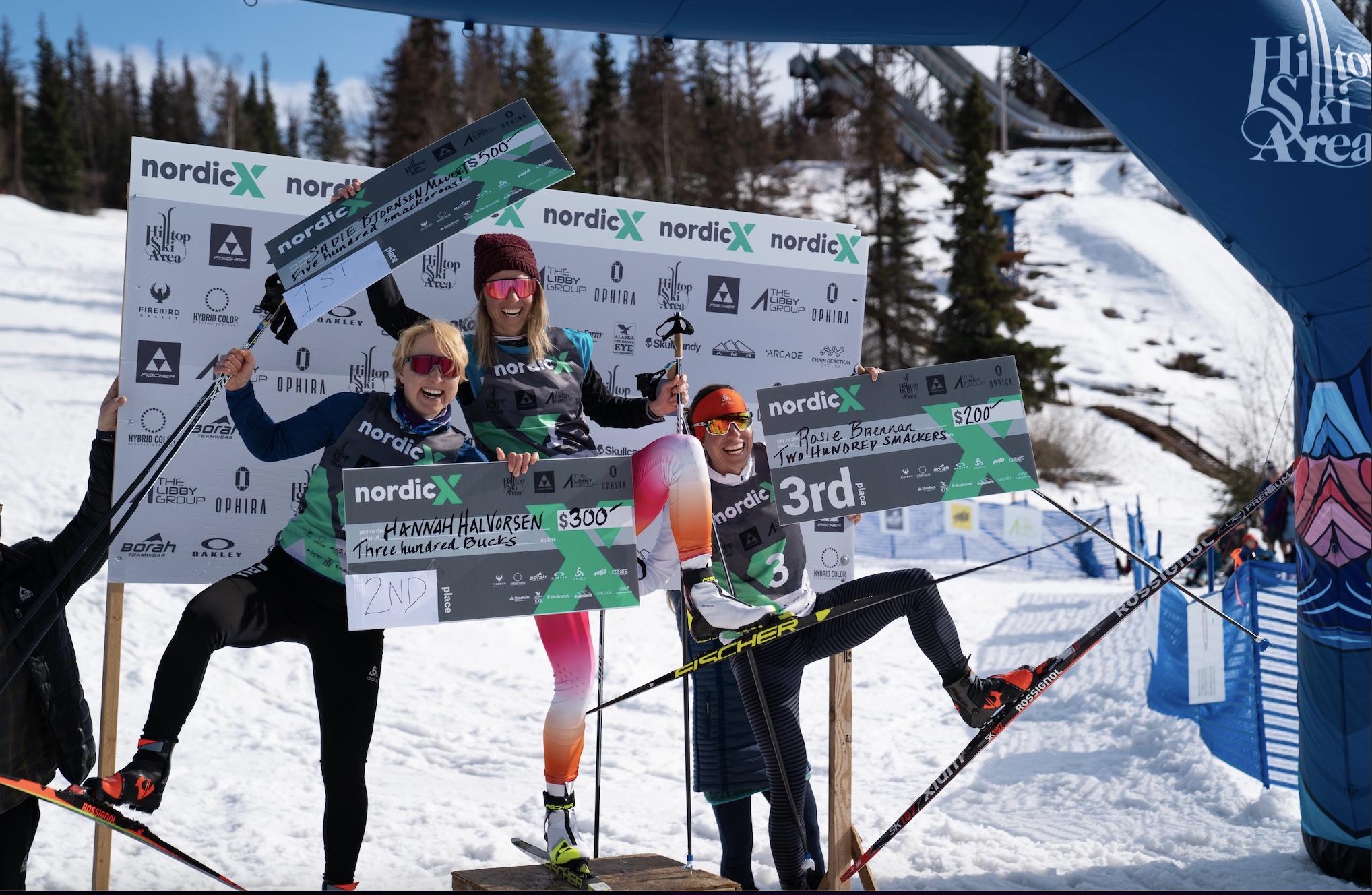
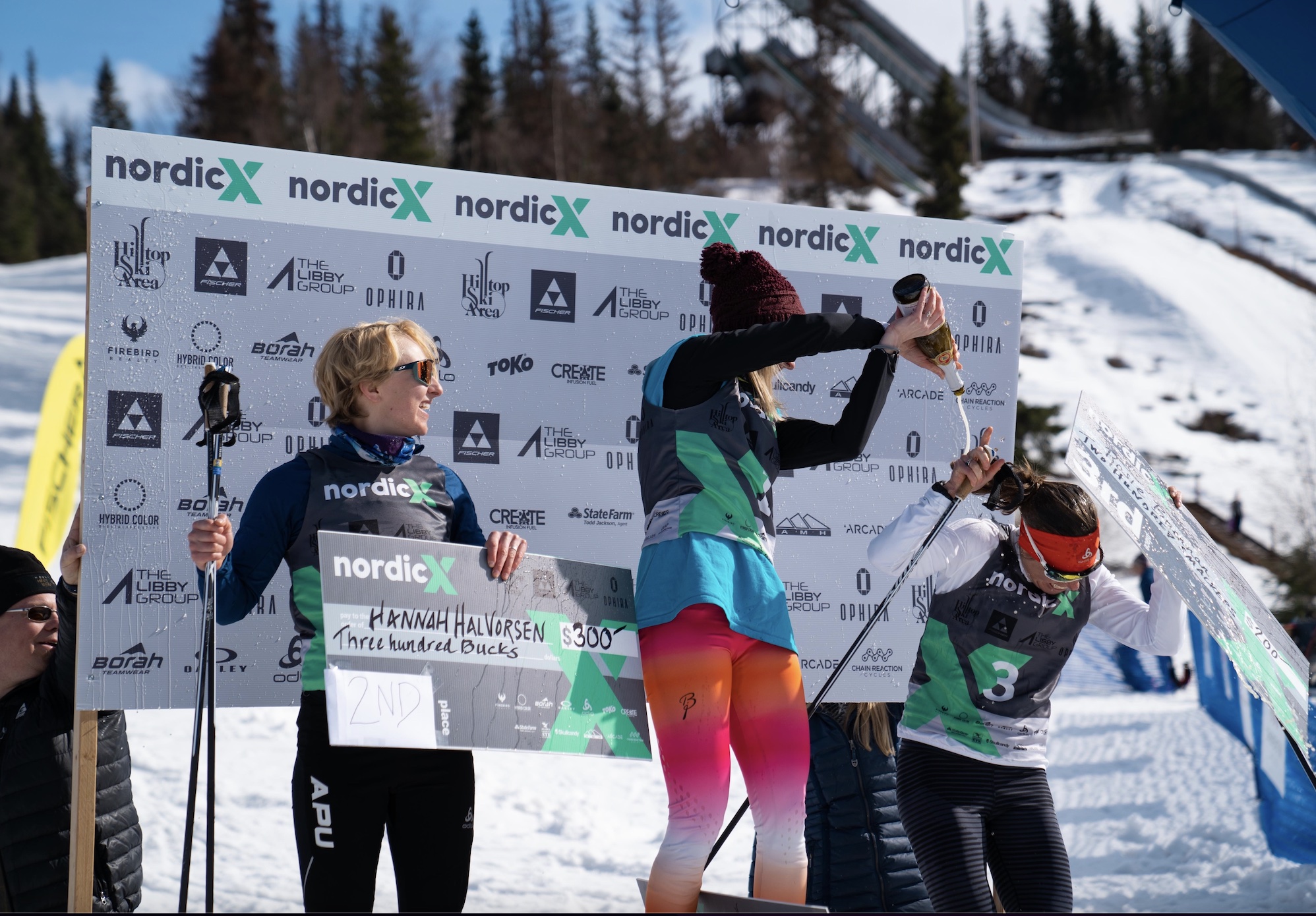
    In the senior women’s senior division, it was a current and former APU athlete sweep, with Sadie Bjornsen Maubet taking the win ahead of Hannah Halvorsen in second and Rosie Brennan in third. 

    “Nordic X was a super fun event, with a fun new twist to nordic skiing, and nordic ski spectating,” wrote Bjornsen Maubet. “Reese did an amazing job of dreaming up this super fun and social way to share our sport with our community… I relied on my thirty years of spending most of my days on nordic skis to attempt to gracefully make it down the little jump park. Though incredibly inspired by all the young kids catching tons of air, and throwing font and back flips, I figured I better save those moves for another life. The day was full of tons of laughs, cheers, and excitement. It felt special to put a bib on beside my previous teammates, and participate in the fun. 

    “I look forward to watching this spectator friendly event grow in the Anchorage Community. I think my husband had the most fun of us all, as he showed up with his chainsaw without the blade, some flares, and wearing a hat that said  ‘Make the Bjornsen’s Great Again’. He was the cheering squad of the day, representing his French blood and the famous French Team Valoche cheering squad.” 

    The women’s podium at NordicX: Sadie Bjornsen Maubet took the top spot ahead of Hannah Halvorsen and Rosie Brennan. (Photo: Ophira Group / NordicX)
    When you can’t spray, pour. Winner Sadie Bjornsen Maubet shares a champagne celebration with third place Rosie Brennan. (Photo: Ophira Group / NordicX)

    For Hanneman, there were also a number of smaller highlights he’s enjoyed looking back on. While marking the course with food coloring, he loved watching skiers riding the lift to the top of the course on their skinny skis, and seeing athletes from 13-year-olds to veteran racers sessioning the course to dial in their lines and strategize. During the heats, he watched a number of young athletes gain confidence, and perhaps some additional skills, after working through initial trepidation surrounding the new race experience. 

    “There were some juniors who you could see at the start of the day were pretty intimidated by the last part of the course, which was really steep and had some sharp slalom turns,” Hanneman explained. “It was definitely challenging their skill level. And by the end of the day, like they were coming through and just ripping, and they were having so much fun and you could tell they had gotten a lot better just in a couple hours.”

    One of many kids enjoying the features on course and in the Kiddie Cross terrain park at NordicX. (Photo: Eric Maurer / NordicX)

    For those 12 and under and too young to compete on the full course, there was a “Kiddie Cross” course, which included banked turns, tabletops, a rhythm section, and a number of other terrain park features for kids to play on and session.

    “The parents love it, right? Because the parents are just sitting there in the sun, watching their little kids just love cross country skiing.” 

    He commented that he had friends who had been trying to sell their child on cross country skiing but felt like it was a hard sell compared to downhill skiing. “They were like, ‘Oh, man, I’ve been trying to get her out on their cross country skis all year and they don’t want to go,’ and they brought him to this event and their kids were like on their on their cross country skis just doing laps up the hill 1000 times so they could go back and hit the jumps again. So for me, that right there is like the essence of this event.”

    A pair of NordicX racers ride the chairlift with their skinny skis. (Photo: Andre Horton / NordicX)

    In reflecting on the event and its impact on the local cross country ski community, Hanneman felt it added “a shot of energy… I mean, there’s so many cool races out there, but this is just a little bit different. And I think it gets people excited.”

    While the biggest air and most impressive skill was seen from the elite racers, Hanneman kept coming back to the youth participating in the event, highlighting that it really was his boyhood dream to see an event like this in Alaska. 

    “Something like this would have probably excited me for a whole year like knowing that it was coming. And I think the more people that we get excited about cross country skiing the better, because I think it can be a really fun sport, but, let’s be honest, sometimes it has this perception of being kind of slow and boring, and hard.”

    He described it as the type of event that could nudge skiers with that perception to give it a try, opening their eyes to what’s possible and how fun the sport can be. While there are perhaps other locations in the US that might be a candidate to host, Hanneman also explained why Anchorage is an ideal location for NordicX.

    Spectators catch the NordicX action from the base of the Hilltop Ski Area in Anchorage. (Photo: Eric Maurer / NordicX)

    “We have a huge ski market here, massive participation in high school skiing, and obviously a ridiculous number of elite-level racers here.” 

    On all accounts, the first year of NordicX was a success, which begs the question: what are the plans for next year? 

    “So many people came up and were like, ‘I can’t wait for next year.’ And I’m like, ‘Oh, man, I don’t know.’ I haven’t necessarily committed, you know? This was a crazy undertaking.”

    Since retiring from professional ski racing, Hanneman has been investing his time and energy in starting and serving as CEO for the PR agency, Ophira Group. He and his wife also welcomed a baby girl in March, 2021, and he’s remodeling their family home. He expressed that pulling off the inaugural event was already “pushing the limits” of what he should take on.

    Balancing CEO and family life with NordicX planning, Reese Hanneman hosts the xc ski event of his childhood dreams. (Photo: Ophira Group / NordicX)

    “I do want to say thank you to the team that we put together which includes Lauri Bassett (exec. administrator at Cross Country AK) and Rob Whitney, and the people at Hilltop, because without them, this absolutely would not have happened.”

    As for next year, “people are too excited about it for it to not happen again.” And he wants to see it happen for a second year. To pull it off, he anticipates putting together a larger team to more evenly distribute the workload, “just so that we can all maintain a healthy NordicX-life balance.”

  • Saying Goodbye to Some Big Names in Cross-Country: an International Retirement Roundup

    Saying Goodbye to Some Big Names in Cross-Country: an International Retirement Roundup

    Each year at the conclusion of the race season, there are always a few athletes who hang up their skis and step away from professional racing. The end of the four year Olympic cycle inevitably means a higher concentration of such announcements. Whether it was a fourth or a first appearance at the Games, or a near miss, the Olympics are always a target and their completion provides a good moment to move on. While the retirement announcements will likely continue into the spring, here is a roundup and recognition of the international athletes who have shared the news that they will be ending their ski careers. 

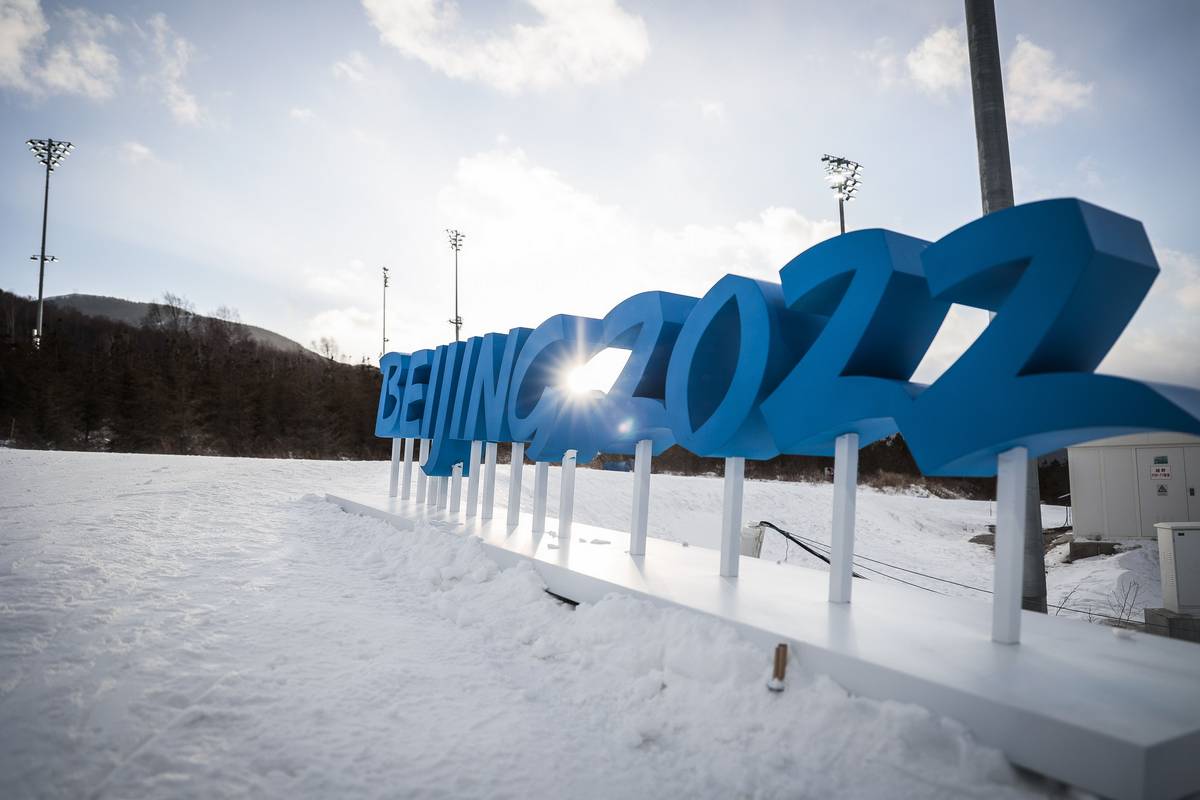
    A scene from the cross country venue in Zhangjiakou, China, host to the 2022 Olympic Winter Games. (Photo: NordicFocus)

    Four athletes from the Swiss team have announced that they will be moving on, chief among them – the king of the 15 k, Dario Cologna. At the age of 36, Cologna released his decision before the 2021/22 season even began, saying, “the decision came within the last months and after the Olympics, it will be the perfect timing for me. I have achieved everything I ever dreamed of in the sport.”

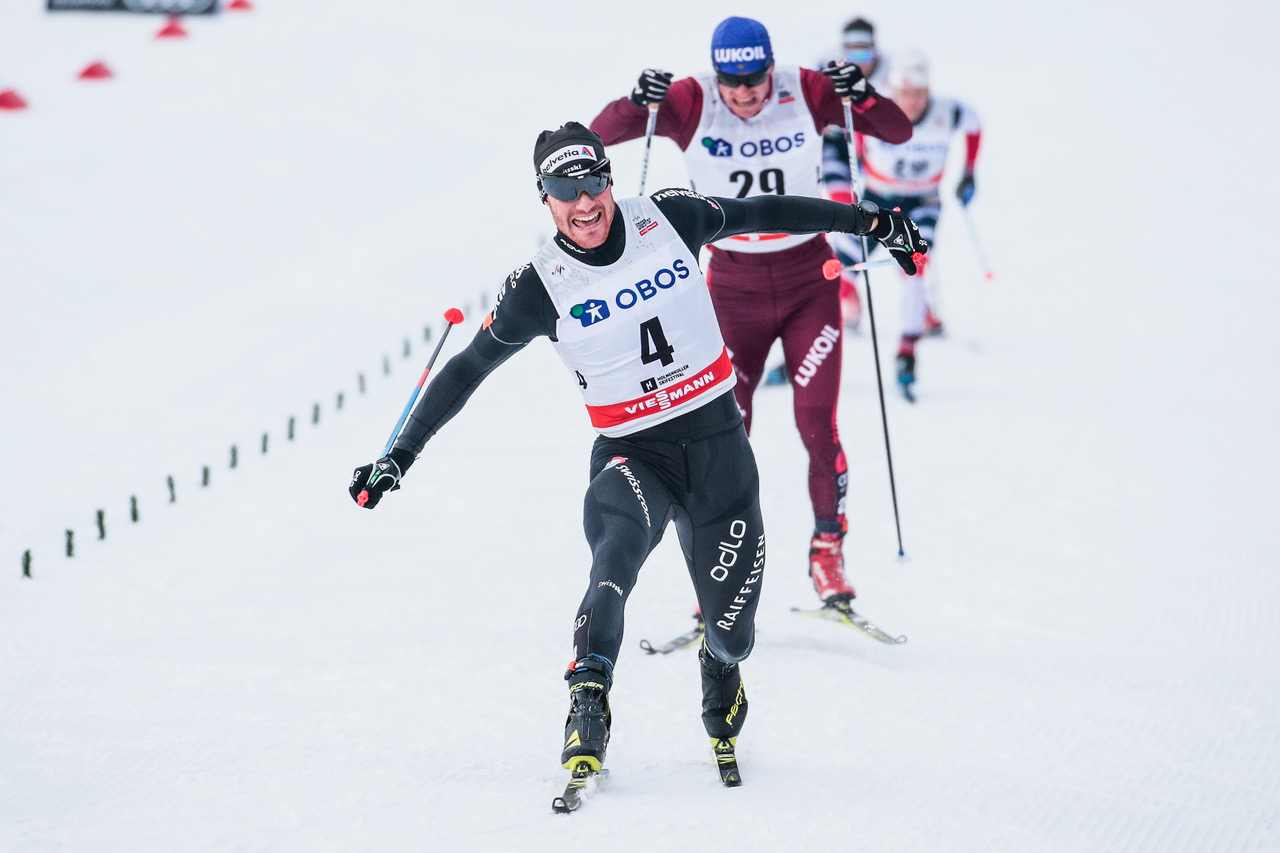
    Switzerland’s Dario Cologna lunges to the line at the 2018 Holmenkollen 50-kilometer freestyle race in Olslo, Norway. (Photo: NordicFocus)

    Cologna had his World Cup debut in 2006 and his first Olympic start came in 2010 in the 15 k skate event, where he finished first. This victory crowned him as the first Swiss cross-country skier to earn an Olympic gold medal. He went on to win three additional golds, in the 2014 Sochi Games he won both the skiathlon and the the 15 k classic, and in 2018 in PyeongChang added a gold in the 15 k skate. All told, Colgona had eighteen Olympic starts at four different games.

    In between Olympic years, he was equally successful. He won the Overall World Cup globe four times, first in the  2007/08 season, again in 2010/11 and 2011/12 and a few years later in 2014/15. In the 2007/08 season he also earned his first Tour de Ski victory, in spite of the fact that he never took a stage win that year. He won the grueling event three more times, in 2010/11, 2011/12 and again in 2017/18. 

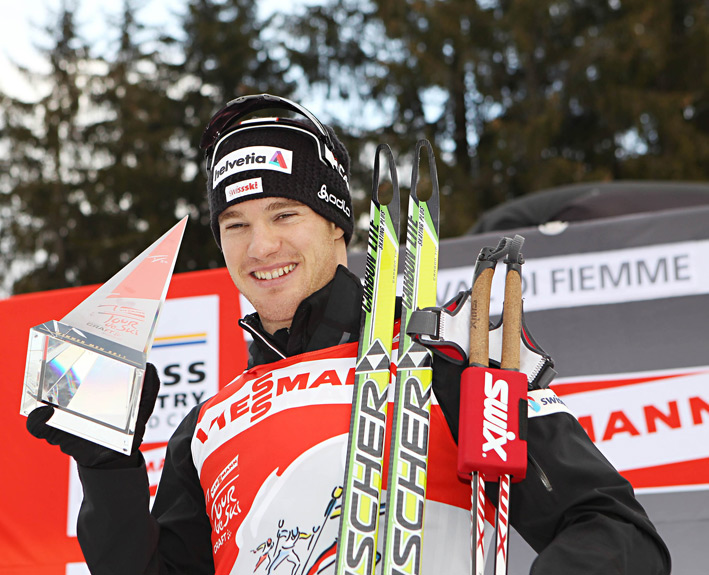
    Dario Cologna (SUI) with his trophy after winning the Tour de Ski in 2011 (Photo: Fiemme2013)

    After his final outing in the legendary Holmenkollen 50 k, Cologna wrote on Instagram, “I look back on a beautiful and successful career. 15 years ago I never dared to dream that one day I would be a four-time Olympic champion, World Champion, multiple Tour de Ski- and overall World Cup winner. In addition, I was privileged to travel to places I would never have seen and met great people, who became good friends.” 

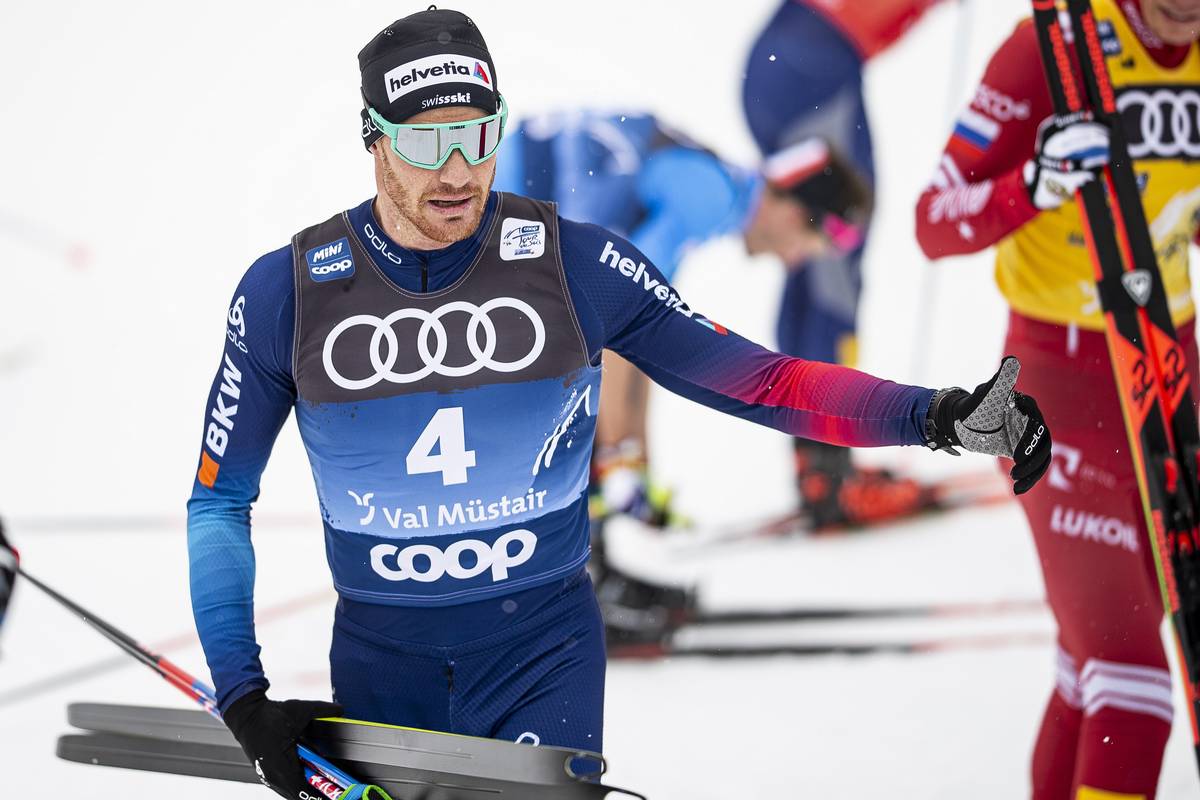
    Dario Cologna (SUI) after a 6th place finish in Val Mustair during the 2021 Tour de Ski. Photo: Nordic Focus

    Cologna’s teammate, Jovian Hediger, also announced his retirement prior to the start of this season. Hediger was known as a sprint specialist and has 107 World Cup starts to his name, having made his debut in 2009. His first and only podium appearance came in 2021 during the team sprint event in Ulricehamn, Sweden, where he and Roman Furger finished second. Hediger represented Switzerland at three Olympic games, beginning with Sochi in 2014 and ending most recently in Beijing (2022). 

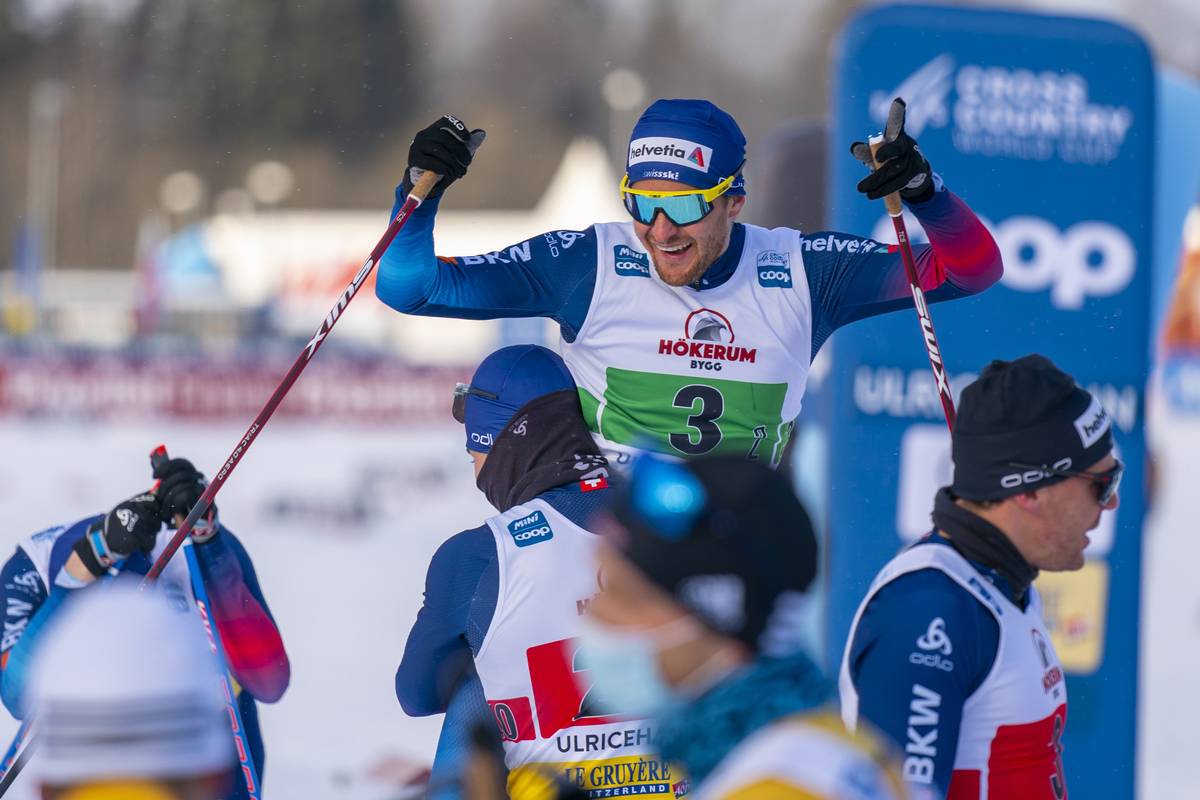
    Jovian Hediger (SUI) gets a boost from some happy teammates at the finish line in Ulricehamn Sweden. (Photo: Nordic Focus)

    Ueli Schnider of Switzerland is also stepping away from elite competition. Schnider has 62 World Cup starts and made two Olympic appearances, both in 2018 in PyeongChang where he finished 37th in the classic sprint and 41st in the 50 k classic mass start. 

    On the women’s side, Laurien Van Der Graaff of Switzerland is moving on. Van Der Graaff has long been a staple in women’s sprinting, beginning in 2011 with her first World Cup podium in Duesseldorf, Germany. In doing so, Van Der Graaff became the second Swiss female athlete ever to reach the podium and over the years she continued to pave the way for young Swiss female athletes. Her first victory came in 2017 in a skate sprint Tour de Ski stage race on home ground in Lenzerheide, Switzerland. 

    The women’s sprint podium in Rybinsk Russia, 2015 (from l-r): Natalia Matveeva (RUS) second, Jennie Öberg (SWE) first, and Laurien Van Der Graaff (SUI) third.

    Van Der Graaff partnered up many times with Nadine Fähndrich in team sprint events, resulting in four World Cup podium finishes. At the World Championships in Oberstdorf, Germany (2021), Van Der Graaff and Fähndrich teammed up again, earning a silver medal when they finished just hundreths of a second behind team Sweden. 

    Van Der Graaff shared with FIS, “for some time I was convinced that I would not continue skiing until Beijing 2022, but I made it and I am very proud of what I have achieved. However, now my time has come and I am excited for everything that is coming my way in this new chapter.”

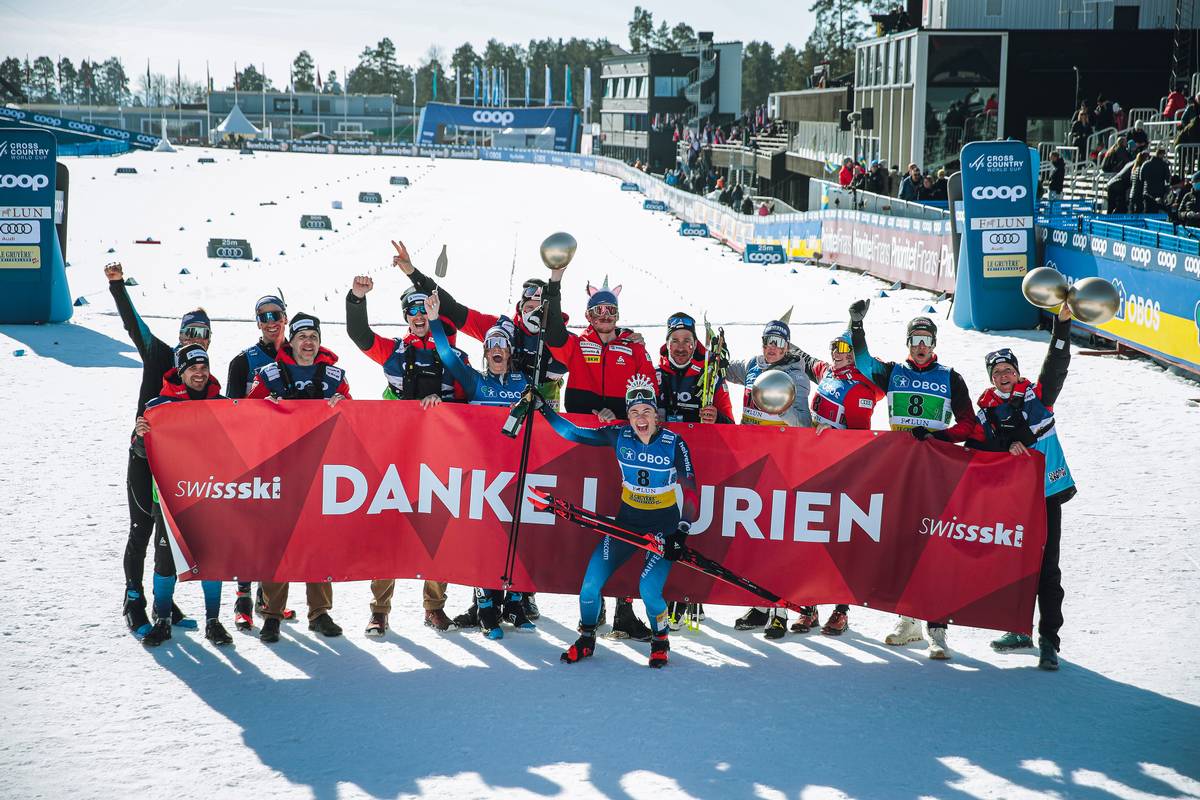
    The Swiss program celebrates the retirement of Laurien Van Der Graaff at the finish of the 4 x 5 k mixed relay in Falun. (Photo: NordicFocus)

    While some athletes knew from the outset of the season that this would be their last, others only recently came to the decision. Such was the case for Swedish star, Charlotte Kalla, who just announced her intentions within the last month. The 34-year said, “the curiosity about life outside of elite sports weighs heavier than what a continued investment would entail.”

    Kalla burst onto the World Cup scene at the age of eighteen. She earned her first victory in the next season, taking a stage win in Nove Mesto (2007) in the 10 k skate pursuit. In her first individual World Championships appearances, coming in Sapporo, Japan in 2007, Kalla finished 7th and 5th. To give you a sense of her consistency from then on, of the 34 World Championship events Kalla completed spanning 2007-2021, she finished in the top ten in 30 of those appearances with the exceptions being three 11th place finishes and one 18th. 

    Charlotte Kalla of Sweden on her way to Olympic gold in Vancouver 2010 (Photo: FS archives)

    Kalla represented Sweden at four different Olympic Games, Vancouver 2010, Sochi 2014, PyeongChang 2018, and Beijing 2022. She came away from these events with five individual podiums, including two gold medals and three team medals including her jaw-dropping relay performance in the relay in 2014 when she made up a 25 second deficit to bring the Swedish women their first Olympic relay gold since 1960. 

    Since then, the Swedish women’s team has come to dominate the World Cup circuit and Kalla has taken on a mentorship role within the team. “It’s an inspiring team to be a part of and many girls who have the right mindset to do their very best every day,” said Kalla in 2020. On March 22, 2022, Kalla announced on Instagram that the Swedish national competitions would be her last as an elite athlete. She wrote, “here I took my first [steps] as a seven-year old and it feels nice to end my career here.” 

    Charlotte Kalla (SWE), Marit Bjoergen (NOR) and Heidi Weng (NOR) claim the podium in the women’s Olympic skiathlon, Sochi 2014.  (Photo: Fischer / Nordic Focus.)

    Elisa Brocard of Italy is ending her ski-racing career at the age of 37. Brocard had her first World Cup start in 2006 and went on to contest 162 World Cup events. She represented Italy in three Olympic Games, beginning in Vancouver 2010, through PyeongChang in 2018. Her best season came in 2018 when she finished in the top-30 distance World Cup rankings and 38th overall. 

    Nadine Herrmann of Germany is leaving elite competition as well. She is the younger sister of Denise Herrmann who raced the cross-country World Cup circuit until she transitioned to biathlon in 2017 where she went on to win gold in the individual event at the 2022 Beijing Olympics. Nadine Herrmann finished in the top-thirty in her maiden World Cup appearance in 2018 in the Dresden city sprints. She went on to earn a number of top-thirty finishes, including a personal best individual finish of 18th in Dresden in 2020. At the age of 26, Herrmann has decided to move on, she wrote “My active sporting career is coming to an end. The last 14 years of performance sports have shaped me into the person who today can say in the best of my conscience, I gave it my all.” 

    Adrien Backsheider of France has also announced his retirement. Backsheider began racing on the World Cup circuit in 2013. He earned six World Championships starts and helped propel team France to a bronze medal in the men’s 4 x 10 relay in Falun in 2015 and again in Seefeld in 2019. Backsheider also has four Olympic starts, as he represented France in Sochi 2014, PyeongChang 2018, and Beijing 2022. He was a member of the bronze medal relay team in PyeongChang when the French again earned a podium spot in the 4 x 10 relay. Backsheider’s personal best individual World Cup finish came in Östersund, Sweden in 2020 when he finished 7th in the 15 k skate stage race during the Tour de Scandinavia. 

    The men’s 4 x 10 k relay at 2015 World Championships in Falun, Sweden, Norway with gold, Sweden with silver, and France with bronze . (Photo: Fischer/NordicFocus)

    Cendrine Browne of Canada is saying goodbye to professional ski racing as well, having concluded her career with a national title in the 45 k skate in Whistler, Canada. Browne made her World Cup debut in 2012 and went on to start 76 World Cup races. She made the Canadian Olympic team in 2018 and 2022 and also posted thirteen World Championships starts. Browne finished 16th in the 30 k skate mass start in Beijing, a personal best individual finish for her. In a statement to Nordiq Canada after the 45 k race, Browne said, “thank you to everyone in the ski community who has believed in me and cheered for me over the last ten years.” 

    Cendrine Browne reached a new personal best with her 16th place finish in the 30 k skate mass start in Beijing 2022 (Photo: NordicFocus)

    The notable retirement of the extremely successful, Therese Johaug of Norway has not been missed but will be receiving its own feature from FasterSkier in the coming weeks. Additionally, US Ski Team members Katharine Ogden, Hannah Halvorsen, and Caitlin Patterson have all shared news of their retirement, in addition to top SuperTour athletes Ian Torchia and Adam Martin. (Read Torchia’s retirement story here.)

    Stay tuned for more in-depth reporting on those athletes from FasterSkier.

  • Diggins Writes History as First American Woman to Earn Individual Olympic Medal With Bronze in the Freestyle Sprint

    Diggins Writes History as First American Woman to Earn Individual Olympic Medal With Bronze in the Freestyle Sprint

    This World Cup coverage is made possible through the generous support of Marty and Kathy Hall and the A Hall Mark of Excellence Award.  To learn more about A Hall Mark of Excellence Award or to learn how you can support FasterSkier’s coverage please contact info@fasterskier.com.

    The History:

    A survey of the last five Olympic cycles shows a clear trend in American women’s sprint results: upward. In the 2002 Games in Salt Lake City, no Americans qualified in the freestyle sprint. Tessa Benoit was the top qualifier in 38th, with an up-and-coming Kikkan Randall next for Team USA in 44th. Randall was then 20 years old. 

    In the freestyle sprint four years later in Torino, Randall was the only American to qualify for the heats. She was 10th in qualification, then moved to 9th in the final standings. Switching to classic for the 2010 Games in Vancouver, Randall again qualified in 10th to be the only American in the heats, this time racing her way up to eighth. 

    And then there was Sochi. 

    The 2014 Games in Sochi were a turning point for the American squad, with all four women qualifying inside the Top-30 in the freestyle sprint. This time, a new name topped the list for qualification: Sophie Caldwell in 9th. Not to be overlooked, USA also had Jessie Diggins 12th, Kikkan Randall 18th, and Ida Sargent 25th.

    Racing in her first Olympiad, Caldwell (now Hamilton) entered uncharted territory as she won her quarterfinal to advance into the semis, which she finished in a thrilling boot slide to be 0.1 seconds behind heat winner Ingvild Flugstad Østberg of Norway. Though she crashed in the final, she again moved the needle upward for the Americans by finishing sixth in the final heat. 

    The remaining American women also finished inside the Top-20, though none made it beyond the quarterfinals. Diggins was 13th, Randall 18th, and Sargent 19th.

    The American women’s sprint team prepares for the individual freestyle sprint. (Photo: NordicFocus)

    Carrying momentum from these Games through the next Olympic quad, the Americans had three women in the Top-30 for the classic sprint in PyeongChang in 2018, with Sargent just outside in 33rd. 

    This time it was Diggins in 7th – the top Olympic qualification result of any American woman – with Sadie Bjornsen 9th, and Caldwell 12th. 

    Despite it being her weaker technique, Diggins raced with confidence, landing in second in both her quarter and semi to advance automatically into the final. Losing touch with the leaders, Diggins repeated Caldwell’s historic result to finish 6th overall. 

    Perhaps a less apparent victory, Caldwell also raced into the semis, finishing 8th overall after taking third in her semi and missing a lucky loser spot in the final by just 0.18 seconds. Bjornsen was eliminated in her quarter after taking third in her quarter, on the wrong side of the lucky loser mark, but just barely, to end her day in 14th. 

    Fast forward four years and get excited. 

    Rosie Brennan (USA) on her way to the 2nd fastest time during qualification. (Photo: NordicFocus)

    Sweden’s Jonna Sundling smashed the qualification round of the 1.5-kilometer freestyle sprint, setting the mark at 3:09.03. The next name on the list? Rosie Brennan in second (+5.80), ahead of Nadine Fähndrich (SUI) in third (+6.62), Yulia Stupak (ROC) fourth (+7.98), and… Diggins in fifth (+8.69). 

    Have you been reading closely? Both Brennan and Diggins both exceeded the previous best result in qualification from any American woman in history. 

    Also posting a strong qualifier, Julia Kern was 14th in qualification (+11.66), rebounding from Saturday’s skiathlon which left her wanting more. The final American starter, Hannah Halvorsen, finished 43rd (+20.10)  in qualification – outside the Top-30, but still above Randall’s result from her first Olympic Games 20 years ago.

    Jessie Diggins (USA) skis the 5th fastest time during qualification. (Photo: NordicFocus)

    You may be wondering about the spread of times; the top-10 were nearly 11 seconds apart. After a quick descent out of the stadium, the course in Zhangjiakou features a 30-meter climb – nearly 100 vertical feet – followed by a sweeping downhill that leads back toward the stadium. From there, athletes face a 14-meter climb back into the stadium, finishing with a gradual rise to the line. Combined with cold dry snow, these factors can contribute to an above-average spread amongst the top qualifiers. 


    Here we go: the heats.

    Brennan lined up alongside Sweden’s Sundling in the first quarterfinal heat. With nerves running high, a false start brought the six women back into the gate after the first starting beep. On the second go, the women pushed through the wands cleanly, but on one of her first doublepole pushes, Brennan caught the edge of her boot, dropping down to her knees and losing any momentum she had picked up as the field rocketed away from her. 

    Not willing to let the day end there, Brennan collected herself and focused on the task at hand, regaining contact with the group at the bottom of the climb and grinding her way into second position, looking strong as she crested the top of the hill just behind Sundling and rounded the curve to head into the descent. 

    After stumbling out of the start, Rosie Brennan (USA) charges back to the front of her quarterfinal heat. (Photo: NordicFocus)

    Given the effort required for such a comeback, would there be enough left in the tank for the B-climb or had the matches been burned early? With Sundling holding steady in the lead Brennan was challenged by Slovenian sprint champion Anamarija Lampic as the women pushed up the final climb, but found another gear for a commanding second-place finish, +2.4 behind Sundling, but +0.7 ahead of Lampic, who would advance as a lucky loser. 

    The second heat featured medal favorite Maja Dahlqvist of Sweden, who qualified in sixth. Norway’s Tiril Udnes Weng set the pace, leading up the A-climb with Dahlqvist alongside, and Russia’s Natalia Nepryaeva on their tails. Powering out of the B-Climb, Dahlqvist held the advantage at the front, while Nepryaeva and Weng slid over the line in a photo finish for second and third. A closer look showed Weng’s boot accelerate as she reached forward, just in time to nip Nepryaeva at the line by 0.03 seconds for the automatic advancement to the semifinal. The second heat was six seconds slower than the first, leaving Nepryaeva out of the running for a lucky loser spot.

    A fast third heat saw Nadine Fähndrich of Switzerland and Maiken Caspersen Falla advance automatically, pulling Germany’s Victoria Carl over the line as the second lucky loser.

    Dancing and smiling in the start gate, Diggins got out with a clean start, positioned near the front and looking powerful as the women headed into the downhill curve out of the stadium. Around this curve, she was pushed to the outside as she skied defensively to dodge potential snags with the other skiers’ equipment, leaving the curve near the back of the pack.

    Jessie Diggins (USA) leads Emma Ribom (SWE) in the early rounds. (Photo: NordicFocus)

    Then, Diggins put on a show up the climb. Steadily moving up along the outside, she was perfectly balanced in a crisp V2 while other were in V1, catching the Swedish leader Emma Ribom. Leading over the top, Diggins kept the pace high to take the sting out of other sprinters. Carrying momentum out of the descent and again holding a strong V2 up the B-Climb, Diggins carried her lead through the finish to win by over 2 seconds, with Ribom next. There was no doubt that Diggins was looking good heading into the semi.

    In the final quarter, Julia Kern pushed the pace in the first half, positioning herself in the lead as the pack headed out of the climb. She held her position through the downhill and around the hard right turn, carrying momentum into the hill. Perhaps paying for her efforts early on, Kern was dropped on the final climb as Veronika Stepanova (ROC) and Sofie Krehl (GER) broke away before heading into the stadium. Kern kept herself in the fight, staying in contact with Alina Meier (SUI) through the false flat to the finish, but ended up fourth in the heat, +3.5 back from the leader and behind the mark needed for a lucky loser spot in the semis. A gusty and tactical performance in her first Olympic sprint appearance.

    Julia Kern (USA) led her quarterfinal early during the individual freestyle sprint. (Photo: NordicFocus)

    To regroup: we now have two Americans in the semi, matching the previous best result from 2018.

    Lining up in the first heat of the semis, Brennan got out of the start smoothly, tucking into the back of the back to safely descend out of the stadium and carry momentum out of the left-hand bend and into the A-climb. 

    Following the effective, albeit unforeseen, strategy from her first round, Brennan pushed her way up the A-Climb, moving from sixth place into the lead. The American kept the effort high as she pulled Sundling, Dahlqvist, Fähndrich. Brennan charged the downhill, stepping powerfully around the right hand bend to head into the B-climb at high speed. In the second climb, the two Swedes, Sundling and Dahlqvist, worked their way around Brennan, with Fähndrich also accelerating. No relief until the finish, Brennan did not let up in the undulating terrain that follows the B-climb, rounding the final curve in fourth place just behind Dahlqvist.  

    After setting a fast pace for the heat, Rosie Brennan finishes fourth in her semifinal to advance as a lucky loser. (Photo: NordicFocus)

    Sundling stretched out the spread of the top-four in the final stretch to take the win in 3:11.94, with Fähndrich second, Dahlqvist third, and Brennan fourth, +1.35 behind Sundling. Brennan’s efforts to keep the pace hot contributed to a lightning fast heat, with Sundling’s time nearly four seconds faster than the top finish in the quarterfinal. This left Brennan in good standing for a lucky loser spot in the final, but she would need to hold her breath to see what the second heat would decide.

    The second semi was quick out of the gate, with Sweden’s Ribom leading up the start of the A-climb. Diggins was comfortably tucked into the pack, beginning to set her race plan into action as she V2ed steadily up the side of the track, holding her form longer than the others as she moved into the lead. Nearing the high point, Diggins switched to a rapid tempo V1 with Norway’s Falla matching pace to head out of the climb in first and second. 

    Diggins sat in a low tuck at the front, stepping around the sweeping left-hander and heading into the B-Climb with Ribom and Falla trying to match pace and challenge at the front. Ribom moved ahead near the top of the climb to lead into the final curve. Diggins sat on the Swede’s tails, with Stepanova alongside. A bobble zapped some of Diggins’ momentum and could have been devastating, but the American kept her composure and stayed upright, staying in contact with Ribom as they headed into the finish lanes. 

    With Ribom in the lead, Diggins powered toward the finish line to secure a second place auto-qualifier spot for the final. She crossed the line +0.4 behind Ribom’s mark of 3:15.22, with Falla and Stepanova crossing in third and fourth a few meters back. 

    As the second heat times were roughly four seconds slower than the first, Brennan could let out a sigh of relief. The second lucky loser spot was now hers. 

    And now, we watch history unfold. Two American women in the final, as Brennan and Diggins set a new mark for the stars and stripes. 

    The final lineup saw Sundling, Dahlqvist, and Ribom racing for Sweden, alongside Diggins and Brennan, with Fähndrich representing Switzerland in red.

    Emma Ribom (SWE), Nadine Faehndrich (SUI), Rosie Brennan (USA) and Maja Dahlqvist (SWE), (l-r) get up to speed at the beginning of the women’s individual sprint final. (Photo: NordicFocus)

    Taking charge from the start, Sundling skied with authority, smoothly leading her teammates Dahlqvist and Ribom up the A-climb to put Sweden in first through third heading out of the climb. Diggins was fourth as they crested the high point, with Fähndrich on her tails and Brennan just behind.

    Utilizing the speed of her skis and her strength in the downhill, Diggins moved up alongside the Swedes in the descent, looking for position heading into the final climb. Maintaining her command of the race, Sundling rocketed off the front to gap the remaining five women who all remained in contention for a medal leaving the climb.

    Ribom quickly fell off the pack, leaving Dahlqvist leading a tight group of four over the undulating terrain that led to the final bend before the stadium. Diggins and Brennan looked to be boxed out as they headed around the final curve in third and fourth, respectively, but the Americans were patient versus panicked, which could put them at risk of a fall. 

    Coming out of the curve, Diggins accelerated around Fähndrich to challenge Dahlqvist for the silver medal. Brennan followed her teammate to surge past the fading Swiss athlete, setting the stage for a three-way sprint for two podium positions.

    Sundling had gold on lock, nearly three seconds ahead as she crossed the finish line in 3:09.68. 

    Jonna Sundling (SWE) with a commanding victory in the individual freestyle sprint comes to the finish with Rosie Brennan (USA) in the background on her way to fourth. (Photo: NordicFocus)

    In her wake, Dahlqvist and Diggins were taking it to the line, with the Swede carrying a slight advantage in the final meters. Still, with Brennan close behind and both Fähndrich and Ribom off the back, the Americans were almost guaranteed their first individual medal in history. 

    Skiing their fastest splits of the day, Dahlqvist held her ground to the silver medal (+2.88), with Diggins on her right, less than a ski length back for bronze (+3.16).  

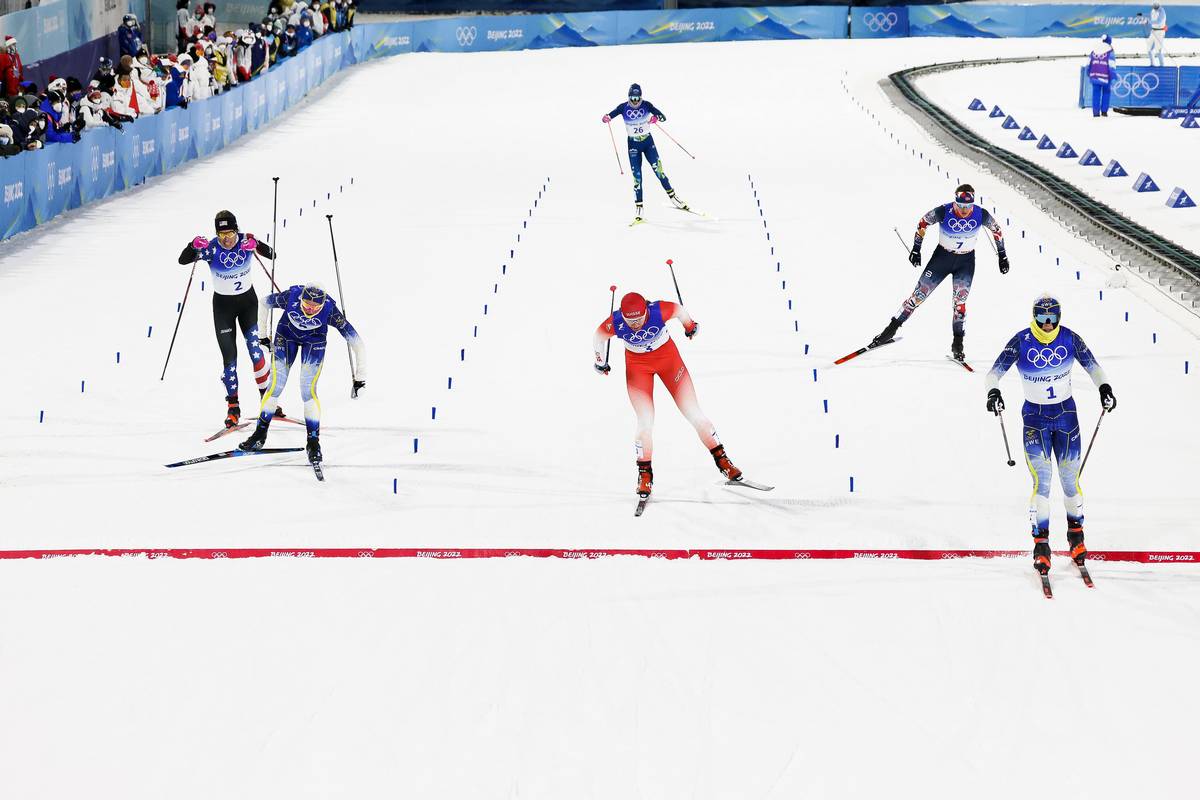
    Jessie Diggins crosses the line in third to earn the first individual Olympic medal in women’s cross country ski history. (Photo: NordicFocus)

    Just over a second back, Brennan crossed fourth (+4.49), for the second best individual finish in American women’s history. The Americans maintained a gap to Fähndrich in fifth (+7.21) and Ribom sixth (+11.11). 

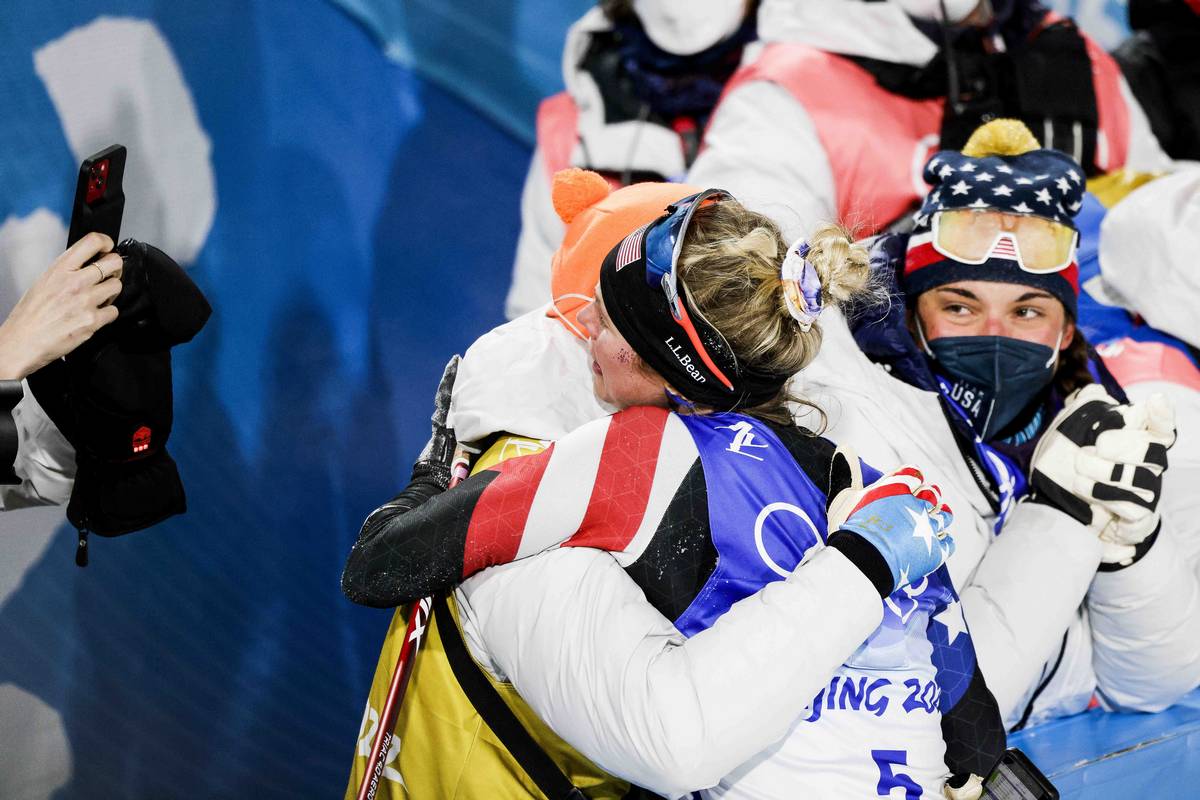
    Diggins collapsed to the ground, overcome by the emotion of what she had accomplished. Perhaps a testament to her team-centric approach, she was heard saying, “Good job, Rosie!” between gasps, as she got back to her feet to immediately hug the coaches, support staff, and teammates that lined the edge of the course.

    Jessie Diggins hugs her coaches and teammates after finishing third in the individual freestyle sprint in Zhangjiakou. (Photo: NordicFocus)
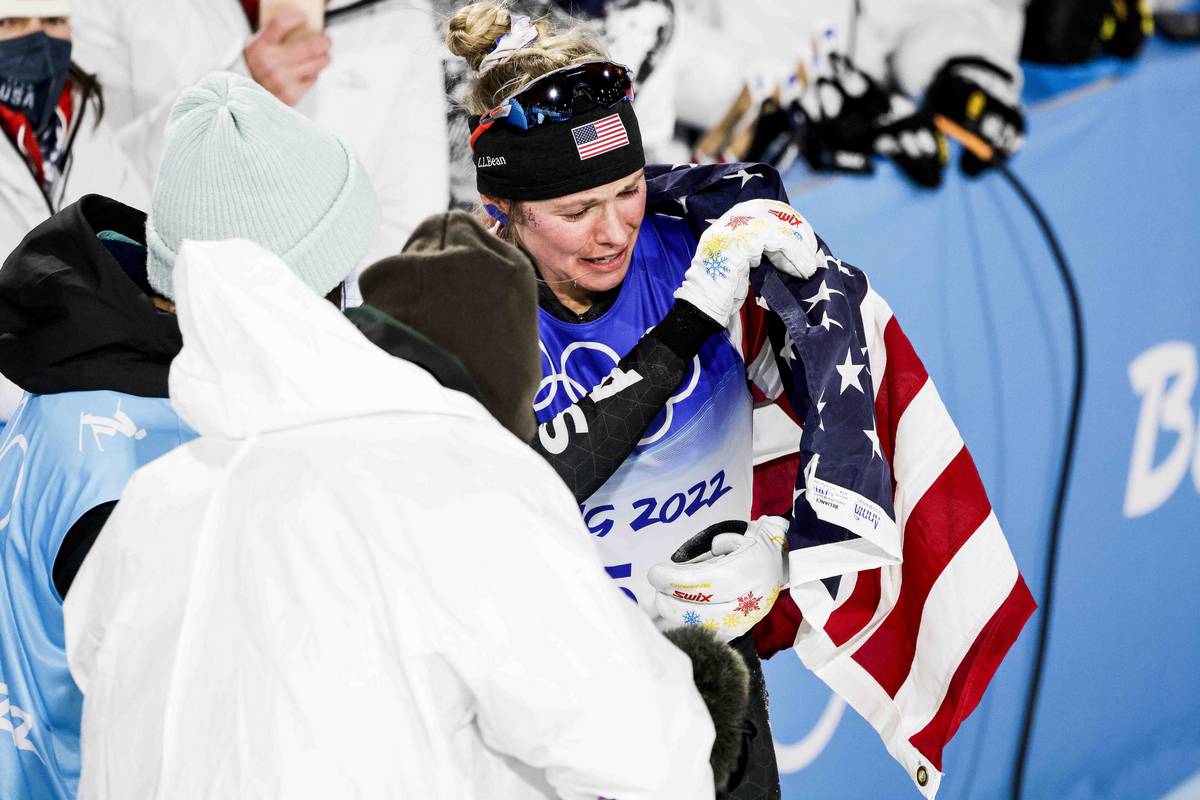
    An emotional Jessie Diggins wraps the American flag around her shoulders after taking bronze in the freestyle sprint. (Photo: NordicFocus)

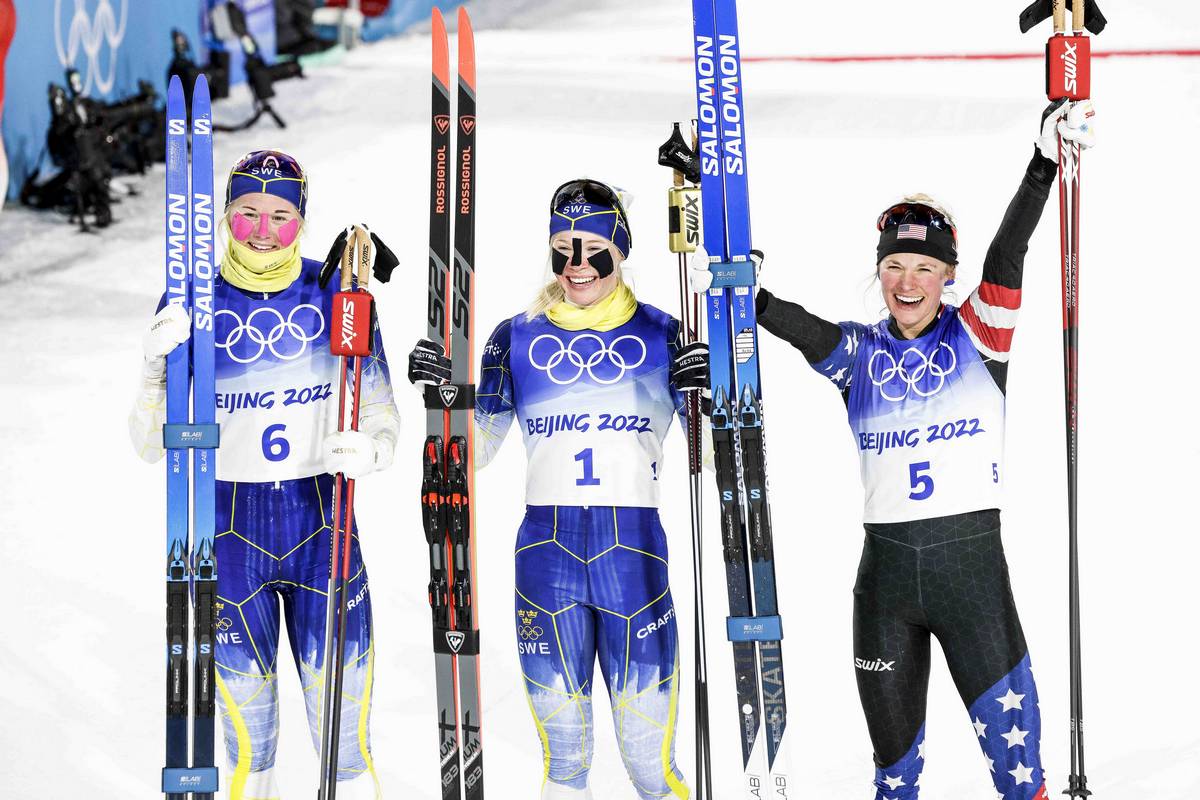
    Tearfully wrapping an American flag around her shoulders, Diggins was aglow as she savored the moment before heading back to the finish to stand alongside Sundling and Dalhqvist for the podium shot. 

    Jonna Sundling (SWE) takes gold in the freestyle sprint, ahead of Maja Dahlqvist (SWE) and Jessie Diggins (USA). (Photo: NordicFocus)

    Though she was the one whose name would be highlighted in history books, Diggins focus on the importance of those around her remained at the forefront as she celebrated the many victories of the American team in today’s event. 

    “It was so cool to be there with Rosie,” Diggins said in the mixed zone. “She’s skiing so amazingly well… and I’m just so grateful. That’s the overwhelming emotion, because it takes so much from such a huge team to make this happen. And we had obviously amazing skis, but also amazing teammates for years and years and years, helping me train, pushing me, supporting me – amazing coaches, amazing volunteer staff. You can’t even imagine how much it took from so many people, and so I’m just so thankful because I feel like this medal belongs to about 1000 different people. And I hope they really feel that and know that.”

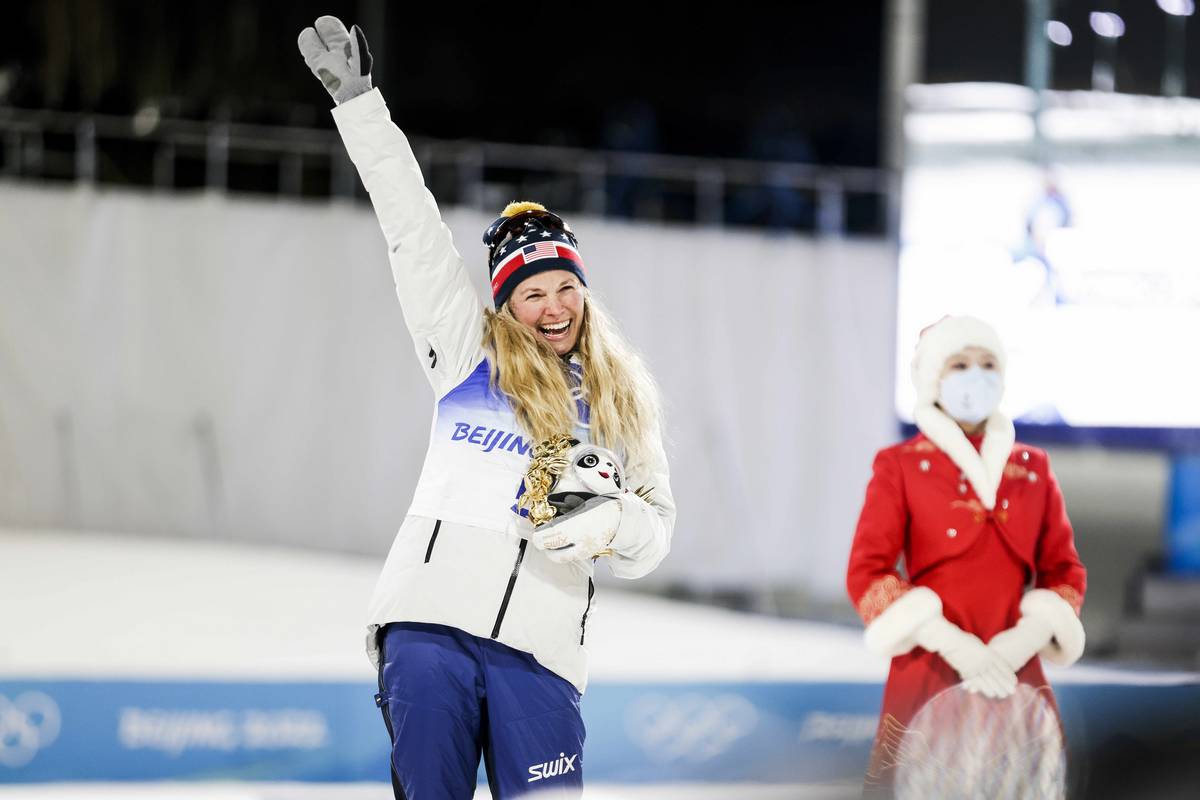
    Jessie Diggins takes Olympic bronze in the freestyle team sprint. (Photo: NordicFocus)

    Of her approach to the course, Diggins gave a simple response, acknowledging that she has a way of blacking out while having great races, “which is really annoying,” she laughed, “because I’d love to be able to remember exactly what I did.”

    “I was just so focused on trying to push as hard as I could,” Diggins explained. “Just trying to ski as well as I could and stay balanced. The snow felt a little greasy, so especially in the finishing lane, just trying to put as much power as I could into every single push. And honestly, that’s all I can remember.”

    Jessie Diggins (USA) on her way to the USA’s first ever individual women’s medal in the Olympics. (Photo: NordicFocus)

    Perhaps the FasterSkier audience needs no reminder that Diggins came into the 2022 Games as a gold medalist, having won the freestyle team sprint with Kikkan Randall in 2018, a day that brought many Americans, including this writer, to tears. Diggins was asked to reflect on the last four years, and the progress she’s made in her career. 

    “The last four years, I’ve really found my voice,” Diggins said confidently. “I’ve really found a lot of my purpose, and I feel like I’ve grown a lot. But also, I’m exactly the same person in pretty much every other way. I think one of the big things has been dealing with is the pressure and expectations, because there’s been a lot of it, and it hasn’t been easy. So for me, I think it was such a victory just to make it to the final and know that I’m skiing well. I came into this as prepared as I could be, which one of my biggest goals was to come in prepared. The second goal, cross the finish line with nothing left. And the third goal was to just have fun, and keep focusing on the process, because that’s what gets me where I am today. Like win, lose, or draw, it’s just focusing on the process and, and executing those process goals to the very best of my ability, because then I’m always proud of how I finished. I’m just proud of this effort today as I was at the skiathlon, even though they were different outcomes.”

    Jessie Diggins was all smiles as she passed through the mixed zone following her bronze medal performance in the women’s individual sprint. (Photo: Nat Herz/FasterSkier-ADN)

    Fourth place at the Olympics – fourth in the world on its most prestigious stage – is both a truly incredible feat and perhaps the most challenging final rank to wrap one’s head around. The “wooden medal”, just shy of the Olympic hardware skiers dream about from their youth. 

    “Fourth place was hard,” Brennan said honestly in the mixed zone. “You feel really happy and also frustrated at the same time. I have a lot of mixed emotions about it. But I did everything I could today, and maybe not everything went perfectly my way. But I have to be happy with that at the end of the day.”
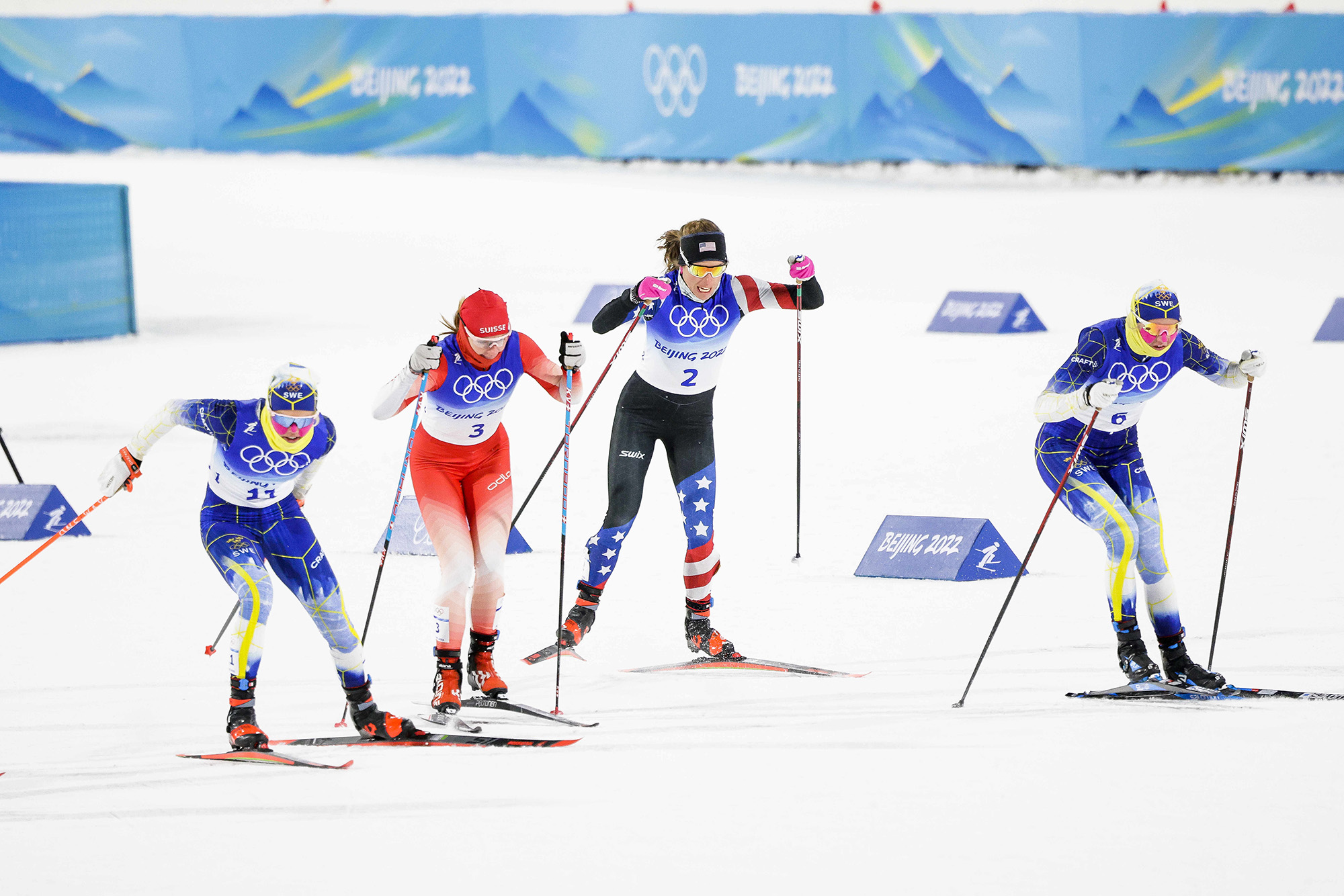
    Jessie Diggins (USA) and Rosie Brennan find their position in the early moments of the women’s final. (Photo: NordicFocus)

    Asked what she would have said if four years ago, someone told her she would be in this position, Brennan laughed, “I probably wouldn’t have believed it so much.”
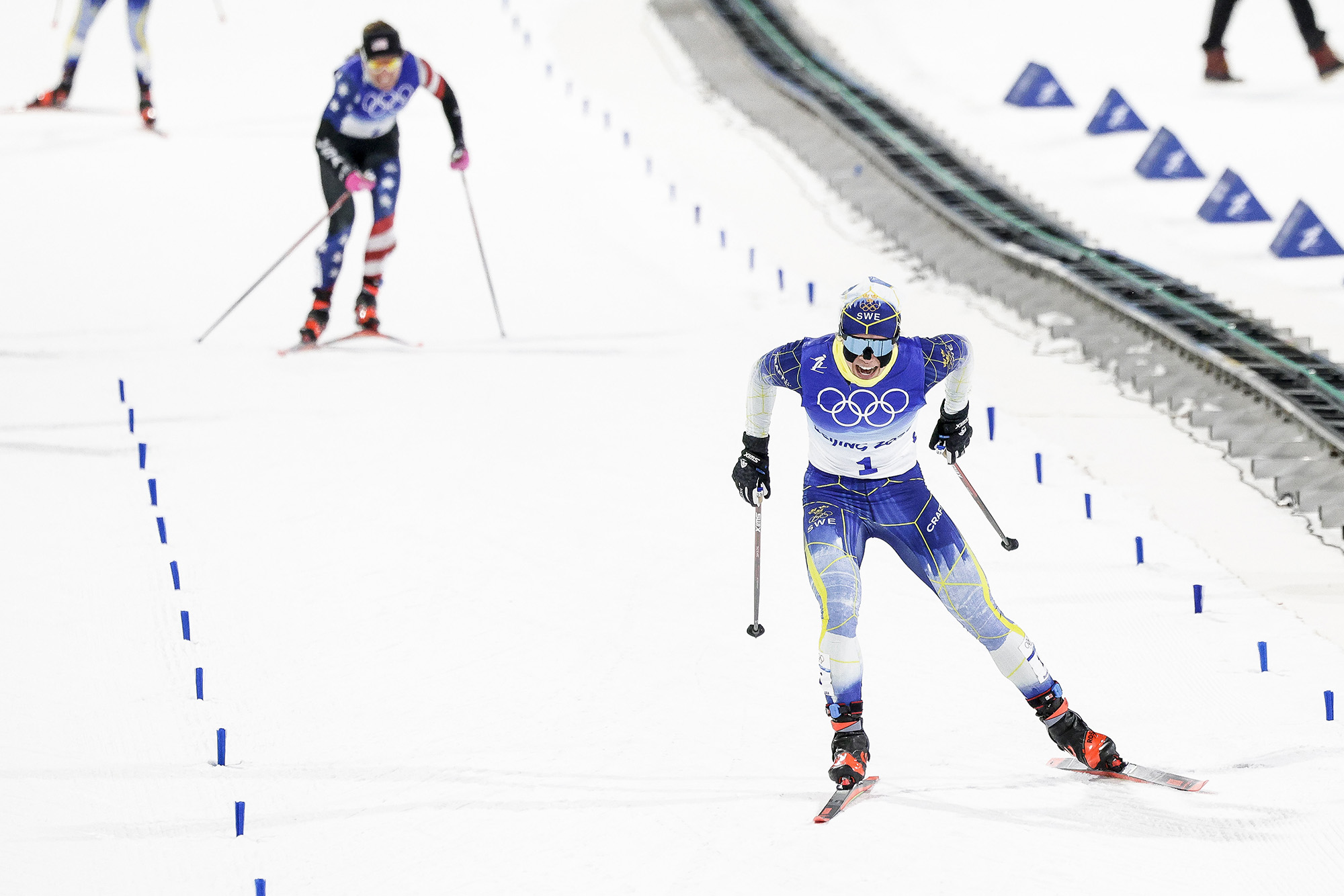
    She talked through a rough start to the day, sharing that she has always struggled with start gates and had spent the last six weeks practicing to ensure a clean start.

    “So, there I was on the ground, I was like, ‘So much for all that practice.’ But I knew my strength was in the climb, so I just had to pull it back [together] and focus on the all the time I had left and see what I could do to try and make it up.” 
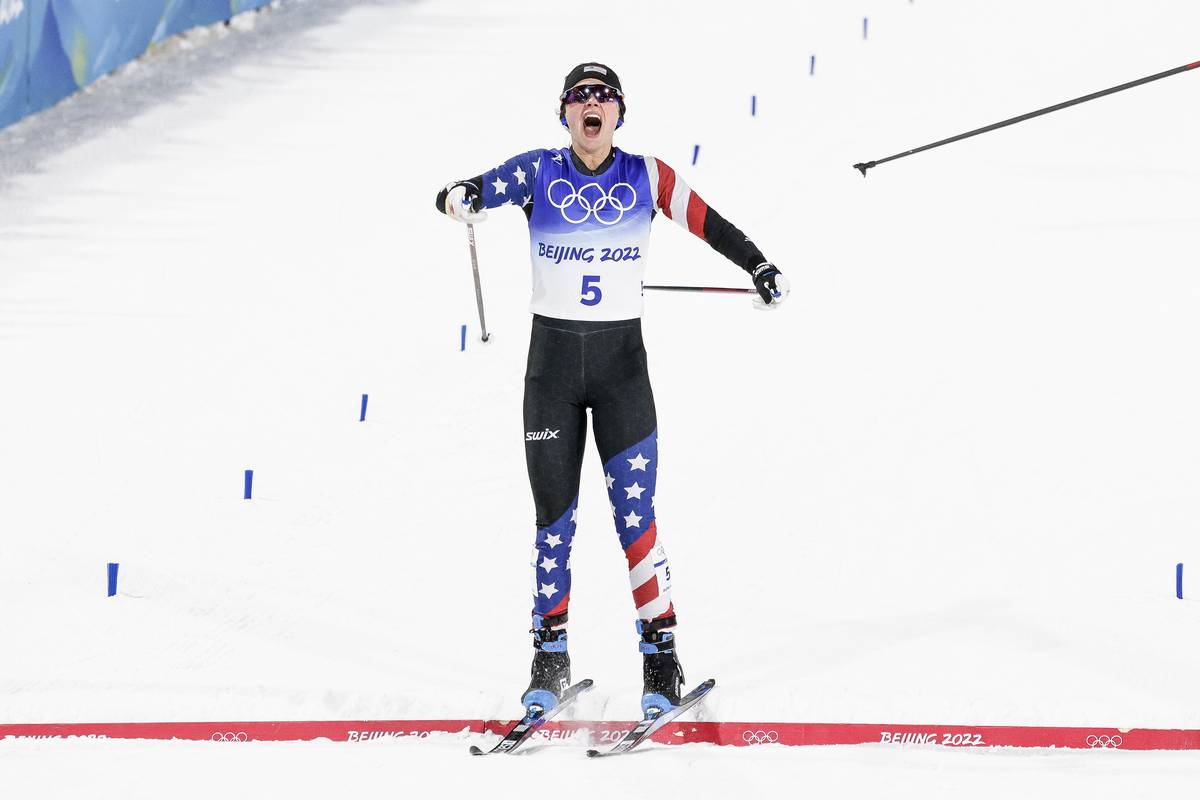
    On her approach through the heats, Brennan played to her strengths, recognizing she could take the lead, work the hills, and not let her heats unfold as a casual first 1200 meters with a tactical final sprint that might leave her in the dust.

    “My strength lies more in the endurance aspect of it,” she explained. “I tried to just keep the pace high so that I could count on being a lucky loser – by having a fast heat time. So that was my strategy in the semifinal, and it worked. Once I got to the final, I tried to then be a little more smart about my racing. I tried to be patient and wait until the last climb. I was a little far back, so I kind of got the door closed on me to make it through. So I had to kind of adjust and go for a strong finish sprint, which isn’t always my strength. But I did all I could do.”

    With Ben Ogden racing into the semis in the men’s race, it was an historic day for the American program as a whole. Speaking to this landmark day, Brennan concluded with an inspiring message for those who dream of following in their footsteps.

    “I think it shows the growing depth in our country. And I hope it shows a lot of people just to have some patience and keep training, keep going for it. You never know where you’ll end up.”

    Jonna Sundling (SWE) takes gold in her first Olympic appearance in the women’s freestyle sprint. (Photo: NordicFocus)

    Taking a closer look at the winner, Sundling is the 2018 World Champion in the freestyle sprint. Returning from injury, she has built her way into the season. Though Dahlqvist has shined as the undefeated World Cup star for Sweden, Sundling has crept up alongside, taking second to Dahlqvist in the individual sprint in Dresden, and working together to win the team sprint. Sitting out the Tour de Ski, Sundling beat Dahlqvist in their next matchup in a Scandinavian Cup race in Falun, Sweden.

    This is Sundling’s first Olympic appearance, though she and Dahlqvist will be a likely pairing in the classic team sprint next Wednesday.

    Once the final rounds were complete, Kern’s final placement was determined to be 18th. This marks a significant step forward from her first appearance in the skiathlon, where she finished 53rd. 

    Julia Kern (USA), who finished in 18th place overall, pushes to the finish during her quarterfinal round. (Photo: NordicFocus)

    “It was really tough out there, but a lot of fun to have a challenging course and give it my all,” Kern told FasterSkier in the mixed zone.

    Dahria Beatty 28th in qualification (+14.51) to be the only Canadian woman to make the heats. Beatty raced in the first semifinal, where she finished fifth in the heat to finish 25th on the day. 

    Just 0.7 seconds off the top-30 mark, Cendrine Browne was 35th in qualification (+15.82) with Olivia Bouffard-Nesbitt close behind in 40th (+16.89). Laura Leclair rounded out the Canadian team in 58th (+26.28). 

    Dahria Beatty (CAN) races in the quarterfinals on her way to 25th place overall. (Photo: NordicFocus)

    An Australian dual citizen who is a long-time APU team member, Jessica Yeaton was 52nd (+23.82) in the qualifying round. 

    Results:

    Qualification | Final

  • The Devon Kershaw Show: Diggins Bronze Medal Highlights Historic Day for Americans in Freestyle Sprint

    The Devon Kershaw Show: Diggins Bronze Medal Highlights Historic Day for Americans in Freestyle Sprint

    Get your cheese doodles ready.

    Here’s Nat and Devon breaking down (and celebrating) an historic day for the U.S. A bronze medal for Jessie Diggins stands as the highlight – she’s the first American woman to win an individual medal – but there were several other steps taken forward by the men and women wearing stars and stripes.

    In particular, Rosie Brennan popped the second fast time in qualification. Overcoming a bad pole plant-induced fall in her quarterfinal, she powered through to take second (to the eventual winner), building momentum each round to finish 4th, just meters behind Diggins .

    Ben Ogden races the quarterfinal of the men’s freestyle sprint during the 2022 Beijing Olympic Winter Games. (Photo: NordicFocus)

    And you’ve got all four American men – also a record – in the Top-30, and Ben Ogden skiing into the semis to finish one second behind Pellegrino and Klæbo, landing in 12th as the top American men’s sprint finish in history.

    So much more. Thanks for listening.

    After stumbling out of the start, Rosie Brennan (USA) charges back to the front of her quarterfinal heat. (Photo: NordicFocus)
  • Hannah Halvorsen’s Olympic experience ended in three minutes. It was still “perfect.”

    Hannah Halvorsen’s Olympic experience ended in three minutes. It was still “perfect.”

    Hannah Halvorsen made her appearance at the Olympics just two years after sustaining life-threatening injuries when a car hit her in an Anchorage crosswalk.

    Two years ago, Hannah Halvorsen sustained life-threatening injuries when a car hit her in an Anchorage crosswalk.

    On Tuesday, she raced at the Olympics in China.

    Her Games are likely over after a single three-and-a-half-minute qualifying sprint race — her qualifying time wasn’t fast enough to earn a spot in the medal rounds. 

    Hannah Halvorsen (USA) skis to 43rd in qualification in the freestyle sprint, her first Olympic appearance. (Photo: NordicFocus)

    But Halvorsen, 23, still seemed to arrive on a cloud when she greeted reporters after the race.

    “Just to be here, to be an Olympian — that took so much,” she said. “It doesn’t feel like three minutes. It feels about 12 years. So I feel very complete.”

    Halvorsen placed 43rd in the field of 90 in the skate sprint, about five seconds away from 30th place, the last qualifying position for the heats.

    The race was two years and three months after the accident in Anchorage. In it, Halvorsen suffered a traumatic brain injury and a skull fracture, a broken tibia and two complete knee ligament tears; it was weeks before she could walk and a year before she could ski.

    But within two months of returning to snow last season, Halvorsen, a member of the U.S. Ski Team’s development squad who trains with Alaska Pacific University, was racing on the top-level World Cup circuit in Europe. She cracked the top-30 in her second event.

    Halvorsen made another step forward this winter, earning a spot in a World Cup sprint semifinal heat for the first time in her career in a race in December in Dresden, Germany. She took 7th place on the day, ahead of Jessie Diggins in 8th.

    Last month, the U.S. Ski Team announced she’d earned a spot in Beijing.

    Hannah Halvorsen races the 10 k free in a December, 2021 World Cup in Davos, SUI. (Photo: NordicFocus)

    The meaning of that accomplishment just two years after her injuries, Halvorsen said Tuesday, is “simple, it’s cliche: It means you can do anything if you just take one step at a time, and if you have enough people who support you.”

    Halvorsen will stay in Zhangjiakou, the resort town outside Beijing where the ski races are held, through Feb. 18. 

    But the strength of the U.S. women’s team means it’s unlikely she’ll race again.

    Halvorsen said she’ll be skiing, having fun, and trading pins in the mean time. 

    Her experience so far, she added, has been “perfect.”

  • Dahlqvist and Sundling Cruise to Team Sprint Title; Diggins and Kern in 2nd

    Dahlqvist and Sundling Cruise to Team Sprint Title; Diggins and Kern in 2nd


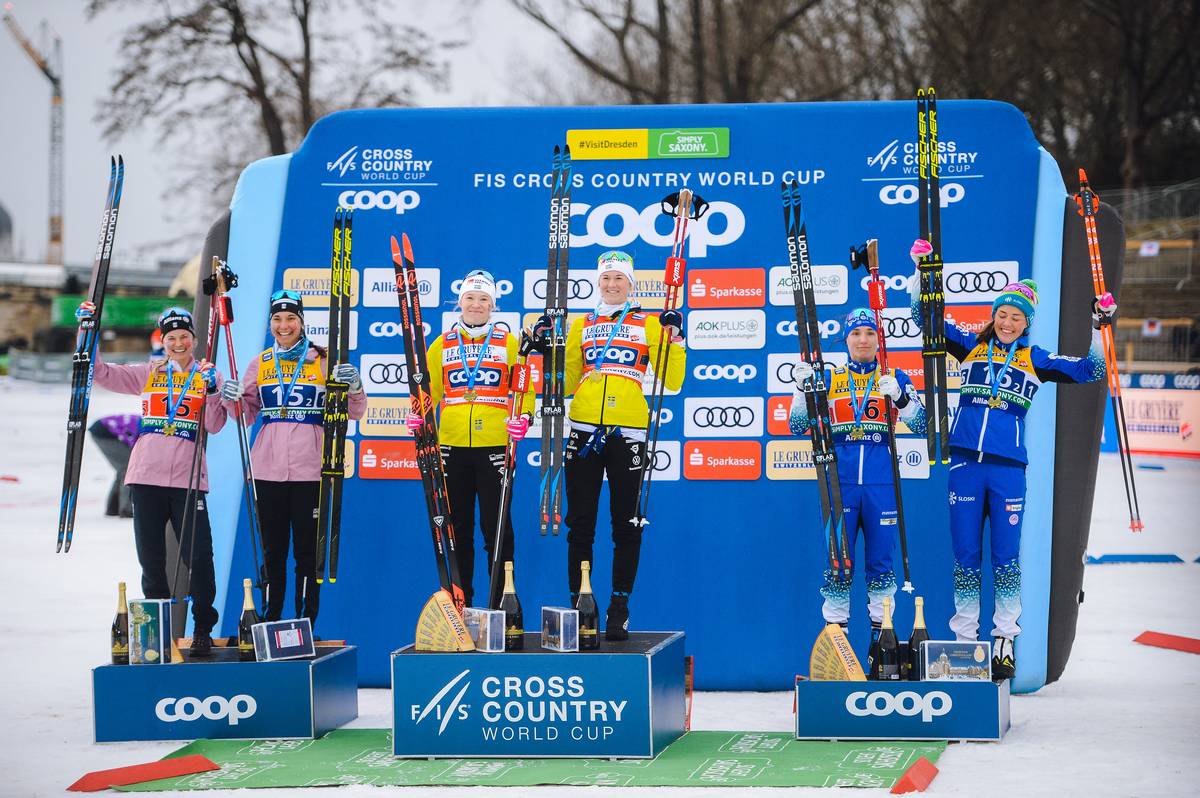
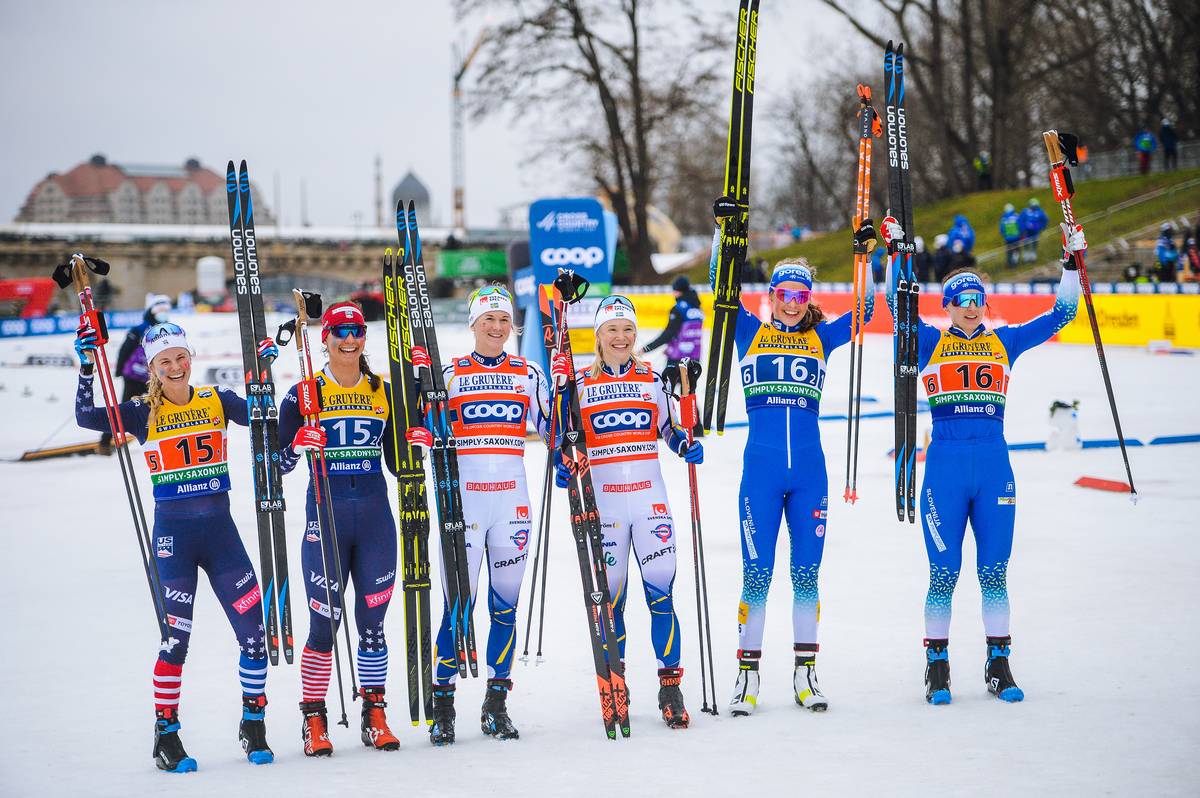
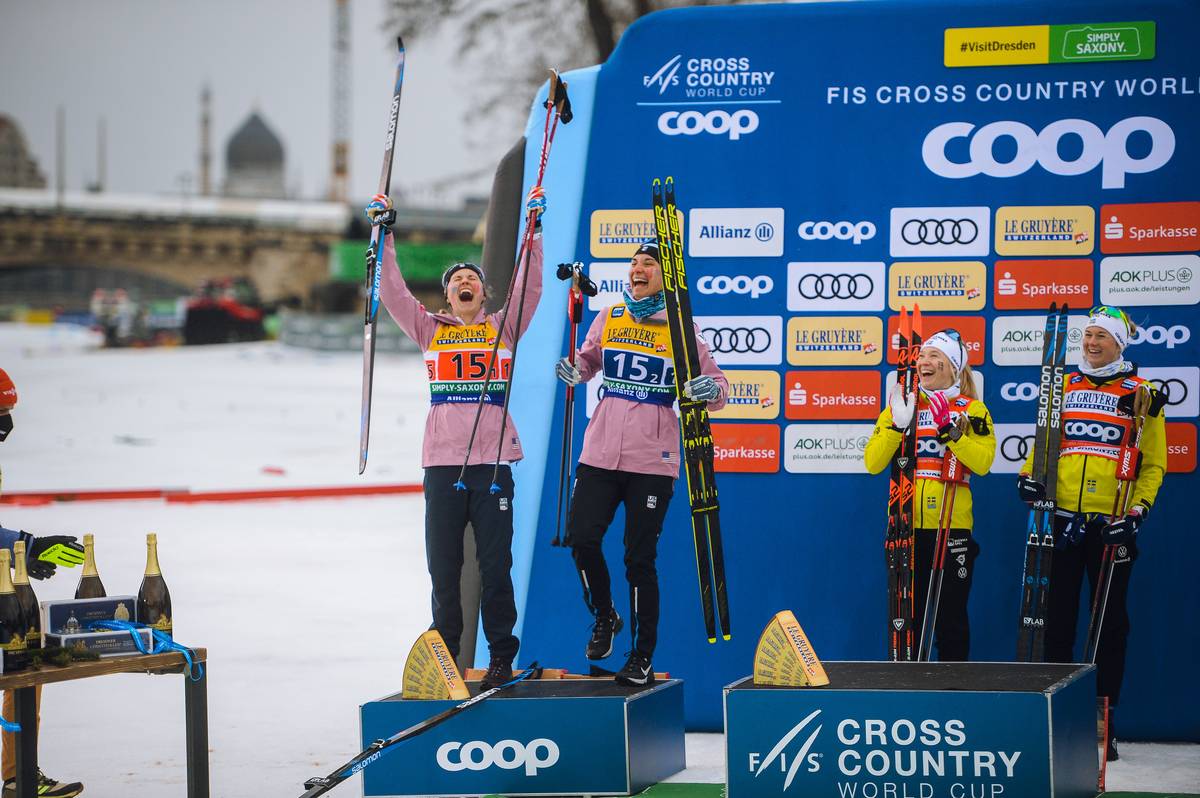
    The women’s team sprint podium in Dresden: The Sweden I duo of Jonna Sundling and Maja Dahlqvist took the win ahead of USA’s Jessie Diggins and Julia Kern, with Slovenia’s Eva Urevc and Anamarija Lampic in third. (Photo: NordicFocus)

    This World Cup coverage is made possible through the generous support of Marty and Kathy Hall and the A Hall Mark of Excellence Award. To learn more about A Hall Mark of Excellence Award or to learn how you can support FasterSkier’s coverage please contact info@fasterskier.com.

    By Ryan Sederquist

    Defending team sprint world champions Maja Dahlqvist and Jonna Sundling continued the Swedish women’s sprint dominance with a polished performance and confident victory Saturday morning in Dresden on day two of World Cup action in the German city. 

    With the city-scape of Saxony’s capital as the backdrop, the pair, who went 1-2 in the individual freestyle sprint on Saturday, got to the front and stayed there. 

    “We just want to be in front because it’s a tight course,” Dahlqvist told a FIS reporter after the race. With athletes taking six turns each on the 644-meter course, which contains a maximum climb of 14 meters and a total height difference of just 4 meters, opportunities to pull away were low and the chances of crashing were high. In order to stay focused on their job, maintaining a lead was crucial for the dynamic duo. 

    Body to body being the name of the game, Maja Dahlqvist tags her teammate Jonna Sundling as the women set pace during the team sprint in Dresden. (Photo: NordicFocus)

    “It’s difficult because [there are] people everywhere,” Sundling said when asked how she and Dahlqvist kept their calm in the bunched-up chaos. “The equipment – you want to keep it like it is – no broken poles and stuff. So, it’s difficult to focus on the right thing, but when you’re in the front, it’s easier.”

    The Swedes did have some company at the front throughout the 11 exchanges. One of the early challenges came from the Jessie Diggins – Julia Kern pairing, who qualified with the top time out of semifinal B. 

    Kern explained post-race that staying near the leaders was part of their strategy heading into the team sprint.

    “Jessie and I focused a lot on executing clean and fast tags, and tried to remain as far front in the pack as possible,” Kern said. “There is so much traffic and tangles that we wanted to avoid as much of that as possible. There was a strong headwind which made leading more costly, but it still is advantageous especially given how fast and firm the track was.”

    Another surprise at the front was from Finland. The team of U23 athletes, Jasmi Joensuu and Jasmin Kahara, nabbed the final automatic qualifying spot in the first semifinal. Despite squeaking into the final, the young women made their presence known throughout the race, moving alongside Sundling and Dalqvist into second at the end of the tenth lap before ultimately finishing in fourth. 

    Jessie Diggins heads into what would be later become a dicy turn. (Photo: NordicFocus)

    With Sundling leading off, Sweden set the pace through the first four laps, with different nations taking turns at their shoulder. Russia I took lap two, Norway II took lap three, and Slovenia, led by Anamarija Lampic, who was third in the individual yesterday, popped in on lap four. The Americans, who placed Diggins as their lead-off skier, patiently bided their time, content to sit in the tight grouping and stay on their skis. Unfortunately, a wrench was about to be thrown into that plan.

    On lap five, Diggins moved into second place. Coming around the penultimate turn, she swung to the outside and was tangled up with Eva Urevc of Slovenia, who tumbled over the top of the 2018 Olympic gold medalist in the event. Diggins kept her cool, quickly rose to her feet, and skied hard to the next exchange. She tagged off to Kern 4.1 seconds back. 

    “I got back our places as quickly and efficiently as I could,” Diggins told FasterSkier after the race. She also noted that she is headed into Christmas break with a fresh set of bruises to go along with her podium cheese. 

    “I’m always proud of the ‘never give up attitude’ and I think it really paid off for us today. We didn’t panic, we just skied as smooth and smart and hard as we could.” 

    Julia Kern powers into her leg during the team sprint in Dresden. (Photo: NordicFocus)
    Julia Kern navigates fast curves on course in Dresden. (Photo: NordicFocus)

    After the crash, Kern and Diggins kept their composure and gradually crawled back into contention. Kern explained post-race that Diggins had also crashed in the semifinal, which evidenced how they could rebound. 

    “I think the crashes actually lit the fire for Jessie and I,” Kern wrote in a text. “It got us ready to fight back. I had full confidence in Jessie that she would ski right back on to the group in the semifinal and that is exactly what she did. We remained very calm in the process which was key. So come the finals when it happened again, I just smiled a little since I wasn’t worried one bit and knew we would just do the same thing as the semi finals. I had confidence in how we were both skiing and feeling out there, and crashes are almost always a part of the game in Dresden.”

    By the next exchange, Kern had already lopped off 1.8 seconds of the deficit. By lap eight, Diggins was just 1.5 seconds out of the lead, which still belonged to Sweden. Going into lap nine, all of the major contenders were back. Trailing Sweden were the upstart Finns (+0.3), the United States (+0.6), and Russia (+1.1). The only key player seemingly out of the running was Slovenia, who sat 4.7 seconds out of the lead. 

    On the final lap, Sundling, the 26-year old two-time World Championship gold medalist, rocketed from the exchange zone with a stern tempo. Diggins matched it, slipping behind the sprint specialist. 

    Jessie Diggins heads out after receiving a tag from Julia Kern. (Photo: NordicFocus)

    At the final exchange, Diggins handed off to Kern 0.5 seconds from Sweden. Slovenia, with Lampic to close, was in fourth, a mere 1.9 seconds back. 

    In the final lap, Dahlqvist, who was a member of the pairings that won the team sprint World Championship title in 2019 and 2021, bided her time, happy to cruise through the first straightaway. After the first hairpin turn, she accelerated to a comfortable lead, leaving the competition in the wake of her strong V2-alternate strides. 

    Coming into the homestretch, Dahlqvist coasted across the line in first (15:45.81). Meanwhile, Kern was being challenged by Lampic, who had moved in front of Finland on the final bend. A great sprinter on the flats, Kern held off the three-time World Championship medalist, stretching her boot forward at the line for second (+1.11), with Lampic rounding out the podium to put Slovenia in third (+1.21).

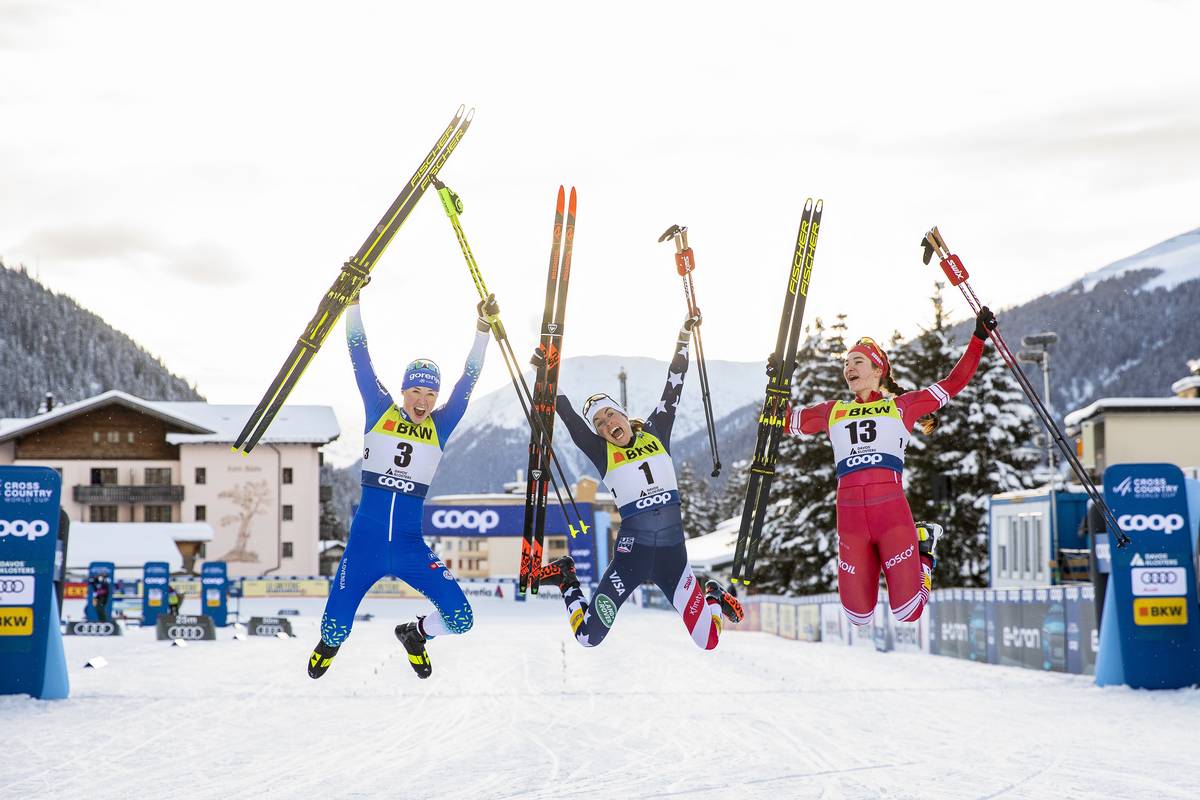
    The women’s team sprint podium in Dresden: The Sweden I duo of Jonna Sundling and Maja Dahlqvist took the win ahead of USA’s Jessie Diggins and Julia Kern, with Slovenia’s Eva Urevc and Anamarija Lampic in third. (Photo: NordicFocus)

    The last time a United States team earned a World Cup podium in the team sprint was in Jan. 2018 when Ida Sargent and Sophie Caldwell Hamilton took third in Dresden. Today was also Kern’s second-ever World Cup podium. She was third in the Planica individual sprint on Dec. 21, 2019. 

    We’ve seen Kern excel on fast and flat courses before, and asked whether 24-year-old identified this style of racing as a strength.

    “I think flat courses have been more of an advantage for me the past, but I feel my fitness is better this year so I actually enjoy the hills too,” Kern explained. “But given my background growing up skiing at the Weston ski track [outside of Boston, MA] on a golf course growing up, skiing on a flat, turny, manmade snow course, I always feel right at home in Dresden.”

    On approaching this style of racing, in comparison to typical World Cup courses with more climbing, Kern explained how she modifies her focus.

    “I don’t necessarily change my technique on the flatter course, but focus on staying stable and trying to use my legs as much as possible. I played around with a few different technique cues during training this week since the hardest part on the salted, icy fast snow is generating speed without wobbling or rushing the motions.”

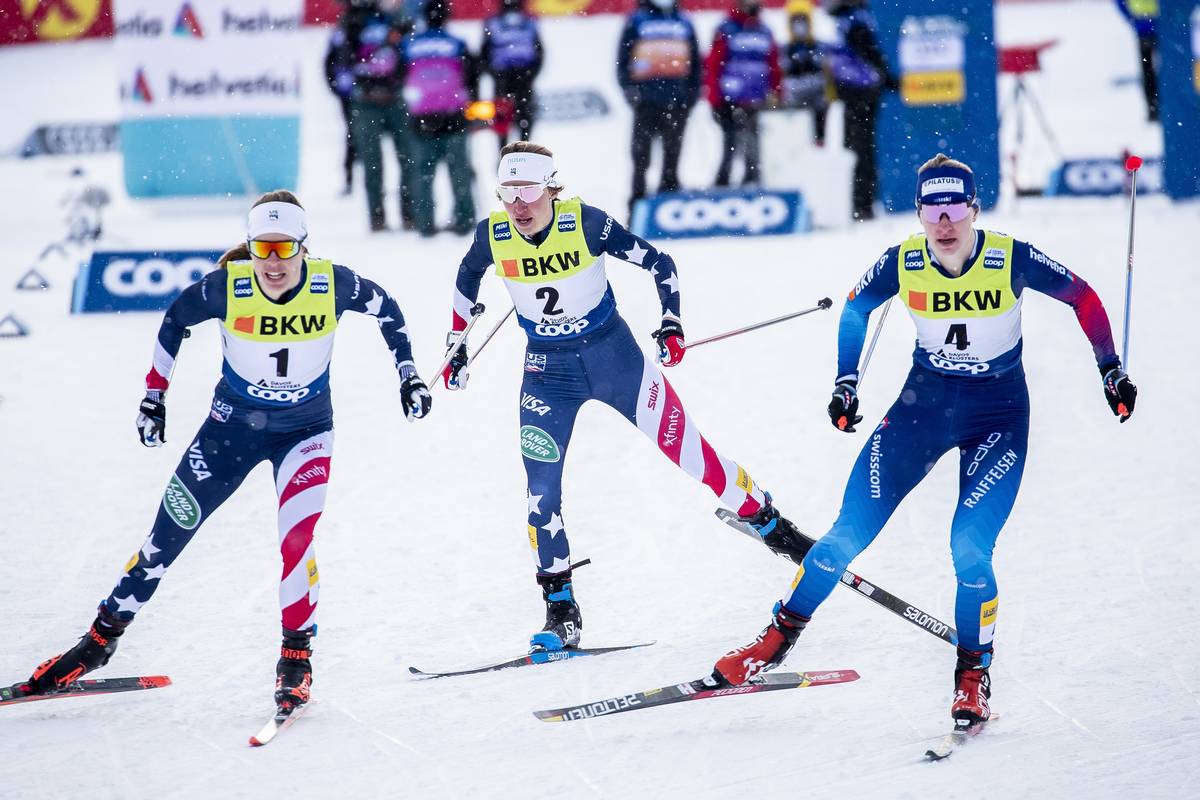
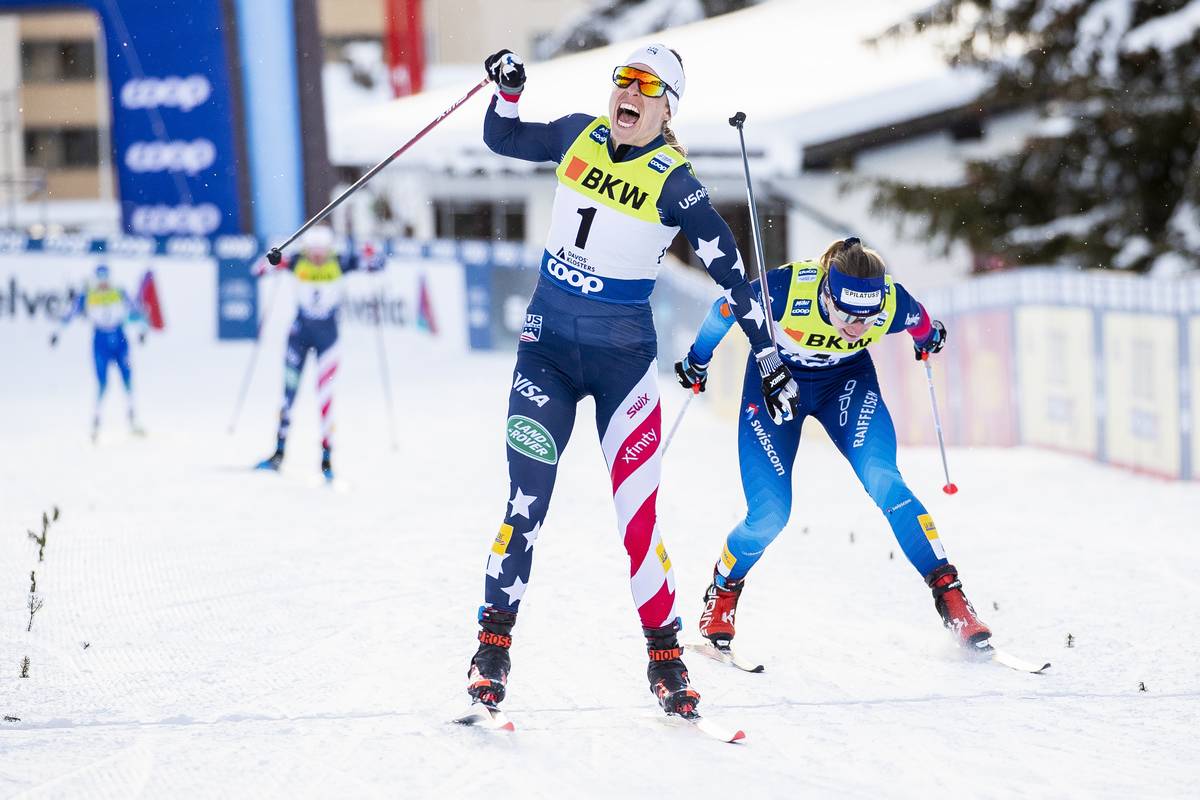
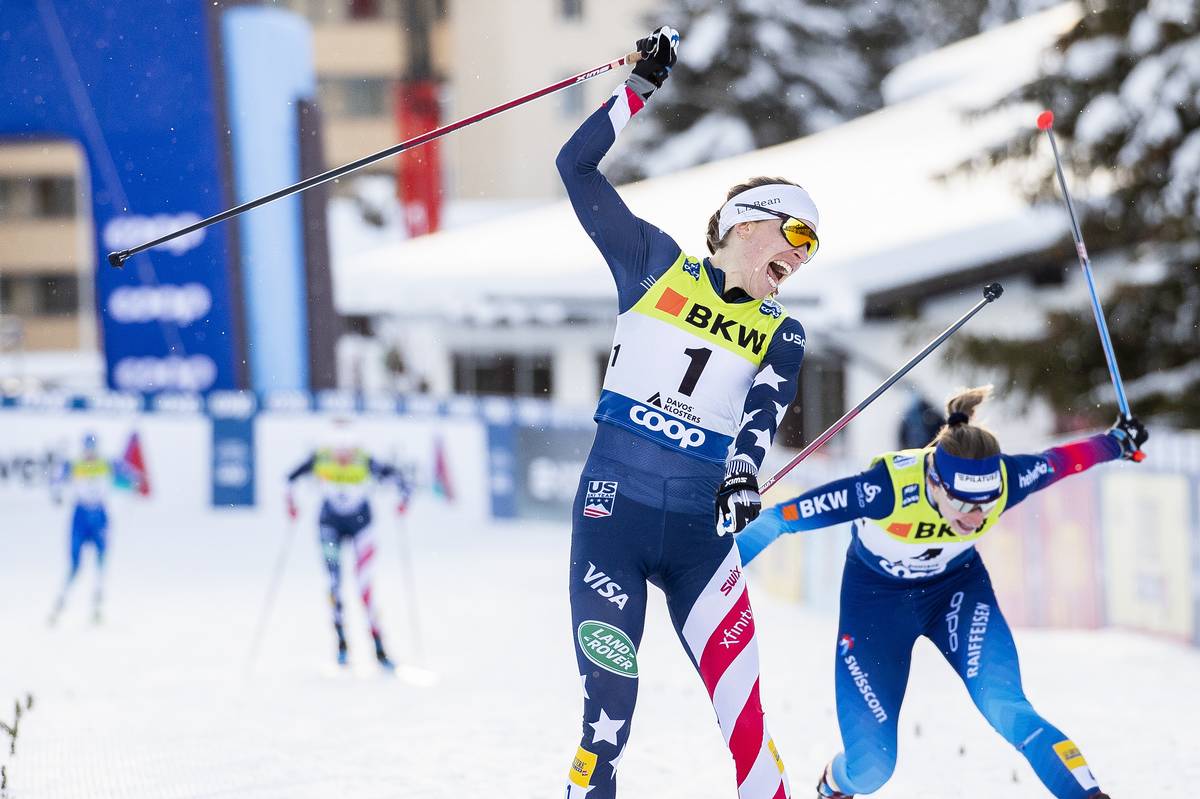
    Jessie Diggins and Julia Kern rebounded after two crashes to take the second step of the podium in the women’s freestyle team sprint in Dresden. (Photo: NordicFocus)

    Diggins, a veteran in the event, spoke highly of her partner’s efforts in Dresden.

    “Wow – I’m so proud of Julia. She was confident and smooth,” said Diggins fondly. “It was a bit of a battlefield out there. You really had to fight for position and she did so with such grace and poise and power and speed. I’m really, really proud of her.”

    Here’s the full audio clip from Diggins:

    A second American contingent of Hailey Swirbul and Hannah Halvorsen skied to 8th (+2.74) in a tight Semifinal A, but did not advance into the final.

    Hailey Swirbul (bib 9) comes in for the tag during the semifinal of Dresden’s team sprint. (Photo: NordicFocus)
    Hannah Halvorsen wrist-bumps Sweden’s Moa Lundgren after the semifinal round of Dresden’s team sprint. (Photo: NordicFocus)

    As Period 1 draws to a close, we take a look at the current World Cup standings. Diggins now sits in fifth place in the overall standings, trailing teammate Rosie Brennan by nine points in fourth. Maja Dahlqvist is the overall leader with 464 points. Dahlqvist, who has won every sprint this season, also leads the sprint standings, more than doubling the points of second place Lampic from Slovenia. Diggins in the third-place position in sprinting heading into the Tour de Ski. 

    After period 1, Maja Dahlqvist leads both the overall and sprint World Cup standings. (Photo: NordicFocus)

    Results:

    Team Sprint: Semifinal A | Semifinal B | Final

    World Cup: Sprint Standings | Overall Standings

  • Dahlqvist Unstoppable in Dresden; Hannah Halvorsen Earns a Career Best 7th, With Diggins 8th

    Dahlqvist Unstoppable in Dresden; Hannah Halvorsen Earns a Career Best 7th, With Diggins 8th

    This World Cup coverage is made possible through the generous support of Marty and Kathy Hall and the A Hall Mark of Excellence Award. To learn more about A Hall Mark of Excellence Award or to learn how you can support FasterSkier’s coverage please contact info@fasterskier.com.

    For the fourth year in a row, the city of Dresden, Germany was ready to host an exciting city Freestyle sprint on a 1.3-kilometer course.  A race that usually attracts fans from all over the world, for the second year in a row could not allow spectators on the course due to Covid.  The last race before the holiday break, the skiers were ready to have fun, and enjoy the challenging and icy course.

    Julia Kern (bib 10) takes the inside around a curve in Dresden. (Photo: NordicFocus)

    “It is so amazing, it is one of my favorite races of the year. I love it, it’s fast and furious.  it is going to be an exciting day of racing,” Julia Kern told FIS before the heats started. Kern’s family has roots in Germany, and she is often celebrated in Dresden as if she were a native.

    On the women’s side, World Cup Sprint Leader, Maja Dahlqvist (SWE) was ready to continue her great start to the season. On a win-streak, has been on the top step of the podium in each of the last four individual sprint races, including the first three of this season. A fifth win would make Dahlqvist the second woman to win five consecutive individual sprint events in the World Cup, after Norwegian legend Marit Bjørgen, who won 11 in a row from December 2003 to January 2005.

    Sweden’s Jonna Sundling set the mark in the qualifier, finishing the top spot in a time of 2:29.52. The American women placed four in the top-30 in qualification, with Hailey Swirbul leading the way in 7th(+2.39), followed by Kern in 10th (+3.49), Jessie Diggins in 17th (+4.87), and Hannah Halvorsen in 25th (+6.82).  

    The top American qualifier in Dresden, Hailey Swirbul races the quarterfinal. (Photo: NordicFocus)

    In the first heat of the women’s sprint, Swirbul stayed in contact with the lead pack until the final 100 meters. In the final straightaway, Swirbul pushed to the line to cross fourth in her heat.  Anamarija Lampic (SLO) and Kristine Stavås Skistad (NOR), who qualified in 6th and 9th, respectively, were the top two finishers in the heat.

    In the second heat, Kern (USA) raced alongside Dahlqvist, who comfortably cruised through the heat to take the win ahead of Italy’s Greta Laurent. Kern solidly maintained her position within contact with the leaders throughout the two-lap course, but finished fifth in the heat, unable to advance. 

    Hannah Halvorsen advanced from the quarters to the semis in Dresden. (Photo: NordicFocus)

    In the third heat, Hannah Halvorsen (USA) faced the top qualifier, Sundling, who won the classic sprint at last year’s World Championships in Oberstdorf, GER. Navigating through chaos, Halvorsen was able to stay on her feet after a crash between Nathalie von Siebenthal (SUI) and Magni Smeedas (NOR) leaving a group of three to fight for the top two spots.  Sundling was able to cross the finish line comfortably in first, with a photo finish between Halvorsen and Jasmin Kahara (FIN) behind her.  Halvorsen was able to outstretch Kahara in the bootslide, taking the second spot in her heat, and punching her ticket to the semi-final.

    Diggins (USA) raced in the final quarter-final heat, staying with the main pack throughout the laps, pushing up from 5th to 3rd as they headed into the final stretch. Diggins finished third in the heat but was able to advance to the semi-finals as a lucky loser. Lena Quintin (FRA) and Moa Lundgren (SWE) were the two automatic qualifiers from this round.

    Fast racing on icy tracks in Dresden makes staying upright and balanced an accomplishment of its own. (Photo: NordicFocus)

    In the first semi-final, Sundling and Dahlqvist set a steady-pace with the pack staying together throughout  both laps. Pulling to the front in the final 500 meters, Dahlqvist and Sundling cruised to the finish, crossing first and second, respectively. On their tails, Lampic and Skistad slid over the line in a photo finish, just 0.35 seconds behind Dahlqvist. Both these women advanced to the final as lucky losers.

    The two Americans, Diggins, and Halvorsen both raced in the second semi-final heat, which featured the inevitable twists and turns of sprinting. At the lap, 23-year-old Lea Quintin of France, who had qualified in second, snapped her left pole, leaving her searching for a new one while the pack skied away.

    Turning it up in the final stretch, Jessie Diggins and Hannah Halvorsen race the semifinal in Dresden. (Photo: NordicFocus)

    Meanwhile, Diggins and Halvorsen patiently waited near the back of the pack until the final straightaway where both made strong moves to contend for a spot in the final. Halvorsen powered from fifth place into a position to fight for second, but ended up just 0.27 seconds behind Eva Urevec of Slovenia who took the second automatic qualifier position. Diggins crossed a ski length behind Halvorsen, each less than a second behind Mathilde Myhrvold (NOR) who won the heat. 

    The final consisted of two Norwegians, two Swedes, and two Slovenian skiers fighting to claim the Dresden sprint title. 

    Dahlqvist follows Sundling on course in Dresden. (Photo: NordicFocus)

    Racing was tight and tactical, with all six women skiing together through the first loop.  Dahlvquist and Sundling led the whole way, controlling the pace at the front.  In the final 100m, Dahlvquist started to make her move, creating a small gap between herself and the field, to win in a time of 2:33:36. Sundling crossed just behind (+0.43) with Lampic closing fast for third (+0.64) to round out the top 3. Skistad ended her day in fourth (+1.64), with Myrhvold in fifth (+3.03) and Urevc in sixth (+6.15).

    The women’s individual sprint podium in Dresden. Maja Dahlqvist (SWE) wins her fourth straight this season (of four), ahead of teammate Jonna Sundling and Anamarija Lamic (SLO). (Photo: NordicFocus)

    The Americans put together an outstanding day overall with all four women finishing inside the World Cup points. After final rounds were decided, Halvorsen ended her day in seventh, a career-best result. Coming off a horrific accident in November, 2019, Halvorsen showed she is back on form in Dresden. 

    Introspective and progress-oriented, Halvorsen spoke to her day in Dresden, and how it helped her take a step forward with confidence in her ability to race into the semis and beyond.

    After strong work in the semifinal, Hannah Halvorsen and Jessie Diggins end their days in 7th and 8th, respectively. (Photo: NordicFocus)

    Diggins finished right behind Halvorsen in 8th place in the final rankings, while Swirbul ended her day in 16th and Kern ranked 22nd.  

    Two Canadian women raced the qualifier but did not advance into the rounds. Maya Macisaac-Jones led the Canadians in 52nd (+11.31), while Dahria Beatty finished 58th (+14.16).

    The Americans and Canadians debrief the qualifier in Dresden. (Photo: NordicFocus)

    With the win, Dahlvqist has taken over the overall World Cup lead from teammate – and roommate – Frida Karlsson (SWE). Diggins currently sits in 5th, behind teammate Rosie Brennan who ranks 4th. Now with a week off for Christmas, the teams will get some rest as they gear up for the Tour de Ski which starts on December 28th.   

    ​​When asked about  taking over the World Cup Lead from her teammate and best friend, Dahlvqist said in a FIS interview, “The most important thing is that it is still in our room”

    Looking good in Period I, Maja Dahlqvist wins five in a row. (Photo: NordicFocus)

    Results: 

    Qualification | Final

  • Nordic Nation: Challenges of the Pro-Athlete Journey with Hannah Halvorsen, Hailey Swirbul, and Kate Barton

    Nordic Nation: Challenges of the Pro-Athlete Journey with Hannah Halvorsen, Hailey Swirbul, and Kate Barton

    In this episode, we have U.S. Ski Team members Hannah Halvorsen and Hailey Swirbul along with development team coach Kate Barton. The original idea behind the conversation was to discuss a variety of challenges female athletes of all levels experience during their careers based on an infographic posted by the organization Voice in Sport, shown below. 

    An infographic from Voice in Sport showing some of the top challenges female athletes face. (Photo: Instagram @voiceinsport)

    As the conversation evolved, it became clear that this conversation will resonate with athletes of all genders, ages, and level of competition. Yes — being one of the fittest women in the world and getting to travel the world is a wonderful privilege that many of us might fantasize about, however, we often only see the highlight reel. From social media to pressure, and “balance” to competition between teammates, these women shared powerful insights into their lives as athletes and coaches at the highest level of our sport. Hopefully, this perspective helps listeners recognize and support the whole person inside the lycra, on days where the pieces come together on the World Cup, the days they fall short of the goal, and all the days in between.

    Some related reading that is discussed:

    Hannah Halvorsen With a New Plan (details her story of being struck by a car and early recovery; find a follow up story here)

    I Don’t Have a Six Pack, But a Car Hit Me and I Survived by Hannah Halvorsen

    Hailey Swirbul’s Instagram Post on Mental Health and Letter to Her Younger Self

    Brave Enough by Jessie Diggins (Reviewed on FS here, with more on her recovery and advocacy here.)

    Hailey Swirbul and Hannah Halvorsen, along with D-Team coach Kate Barton, discuss the challenges of the pro-athlete journey in today’s episode of Nordic Nation. (Photo: Instagram @hannah.g.halvorsen)


  • Elite Team Preview: APU

    Elite Team Preview: APU

    The APU Elite Team gathers for morning practice on the Hillside trails, Anchorage, Nov. 12, 2021. (photo: courtesy APUNSC)

    Team name and location: Alaska Pacific University Nordic Ski Center (APU, or APUNSC); Anchorage, Alaska

    Coaches: Erik Flora (head coach/director), Jack Novak (assistant coach)

    Current roster: Penny Smyth, APUNSC Marketing & Communications, writes:

    “Women’s Team: Rosie Brennan (USSS A Team), Hailey Swirbul (USSS A Team), Hannah Halvorsen (USSS D Team), Rosie Frankowski (World Cup Alternate), Becca Rorabaugh, Anna Darnell, Annie Gonzales, Marit Flora, Lily Pannkuk, Zoe Noble

    “Men’s Team: Logan Hanneman (USSS B Team), Scott Patterson (USSS B Team), David Norris (World Cup Start), Hunter Wonders (USSS D Team), Zanden McMullen (USSS D Team), Luke Jager (USSS D Team), Tyler Kornfield, Michael Earnhart, Thomas O’Harra, Forrest Mahlen, Garrett Butts, Ari Endestad, Karl Danielson, Bjorn Halvorsen, Chip Schoff”

    A total of nine APU athletes will be starting Period 1 World Cup races this season, though as we approach the Ruka opener later this week Smyth advises, “Scott [Patterson] won’t be joining the team until Lillehammer,” the season’s second race weekend, “due to hand injury.”
    Who’s new or who’s moved on: Smyth writes, “Sadie Maubet Bjornsen, a two-time Olympian and World Cup skier, retired after last year. We have some new skiers that have grown up through the APU Nordic program join the Elite Team, including Marit Flora and Lily Pannkuk. New to the men’s team is Bjorn Halvorsen, younger brother of Hannah Halvorsen!”

    Who’s still on this team, or otherwise involved in American skiing, from when we did this in 2012: Rosie Brennan, Becca Rorabaugh, Forrest Mahlen (athletes); Jack Novak (APU assistant coach); Greta Anderson (USST D-Team coach); Dylan Watts (Mt. Bachelor Ski Education Foundation head nordic coach); Kikkan Randall (Nordic Skiing Association of Anchorage Executive Director)

    Hailey Swirbul (left, third overall) and Rosie Brennan (first, wearing the yellow bib as World Cup overall leader) after the women’s 10 k skate in Davos, December 20202. (photo: Modica/NordicFocus)

    Top results last season: Brennan was fourth in both the overall World Cup and distance standings, and for one magical weekend in December was the best skier in the world, winning back-to-back races in Davos. She became the second American woman ever to wear the yellow bib, after Maubet Bjornsen, and kept it for roughly a month. It was a well-deserved coming-out party for the longtime APU athlete (note that she was also on this team nine years ago) currently in her third separate stint on the U.S. Ski Team, after most recently being cut in 2018 after she raced poorly in PyeongChang while unknowingly suffering from mono.

    Behind her, Swirbul finished the season ranked 23rd overall in the World Cup (21st for distance) and 4th in the U23 standings, picking up her first World Cup podium along the way, which she shared with Brennan. Maubet Bjornsen stayed home in Anchorage for the first half of the season, placed 10th in her first World Cup race in a year after returning to Europe, then at World Championships came within a combined 3.17 seconds of coming home from Oberstdorf with two medals.

    Swirbul, Maubet Bjornsen, and Brennan formed the first three-fourths of the American women’s relay team at World Champs, which came 0.8 seconds away from medaling. Norris recovered from Covid to post some of his best results yet, including 16th and 17th at World Champs, and Patterson had his best season in years, highlighted by a 10th in the World Champs 50 km; the two of them formed half of the American men’s relay team in Oberstdorf. (The team sent seven athletes total to World Championships.) Jager was a tantalizing 0.09 seconds out of the heats in his World Cup debut. Hanneman made three World Cup heats and finished the year ranked 29th in the Sprint Cup standings. Halvorsen returned from a year of grueling rehab from a car accident to finish 23rd in her first race back in two seasons – which was not an OPA Cup or a local citizens race but rather the World Cup sprint in Dresden.

    Hunter Wonders races at Government Peak Recreation Area, Palmer, Alaska, Nov. 14, 2021, in the season-opening Race to the Outhouse #1. David Norris is behind him. (photo: Eric Strabel for APUNSC)

    Domestically, Jager, Wonders, and Maubet Bjornsen won the December Anchorage JOQ races that were the unofficial U.S. Nationals west (also on a podium in these races: McMullen, Mahlen, and Frankowski), and Frankowski and Kornfield picked up a combined four podium finishes at the American Birkebeiner, including Frankowski’s win in the classic race.

    Smyth adds, “Locally, races happened for the rest of the elite team, where we had numerous podium sweeps and a Tour of Anchorage podium sweep in the women’s 50K with Rosie Frankowski (1) Becca Rorabaugh (2) and Anna Darnell (3) and then in the men’s 50K Tyler Kornfield (1) and Thomas O’Harra (2).”
    APU head coach Erik Flora, Independence Mine, October 2021. (photo: courtesy APUNSC)

    Coach’s comments: “The APU Elite team is more than 25 skiers strong. We had a great summer of training with a majority of the U.S. Ski and Snowboard D-Team joining us. U.S. Ski and Snowboard coaches joined the Elite team in July for training sessions, which was positive for the team! This brought some young energy to the daily grind along with a fun group to work with. October brought early snow in Hatcher Pass to finally get on skis for training with early November snow in town to follow. We feel ready for the race season to happen and are excited to see what the races bring moving into an Olympic year!”

    Hailey Swirbul (second from right, pink elbow sleeves) tags off to Sadie Maubet Bjornsen (far right) after the opening leg in the women’s 4 x 5 km relay at FIS nordic world ski championships, Oberstdorf, March 2021. (photo: Modica/NordicFocus)

    Related coverage: Rosie Brennan profile; Sadie Maubet Bjornsen retirement piece; Erik Flora profile from 2017; Ben Lustgarten op-ed on David Norris’s non-selection to the U.S. Ski Team

    Previously in this series: BSF | SMS | Team Birkie | Sun Valley

    Disclaimer: I live in Anchorage, and have trained with the APUNSC Masters program for eight seasons and counting. On the one hand, the Masters group has been an important part of my personal and athletic life for many years now; on the other hand, on a day-to-day basis the Masters team has basically nothing to do and no overlap with the APU Elite Team, and is not coached by Elite Team coach Erik Flora. I don’t receive free gear from APU, or anything in that vein, in exchange for writing about the APU Elite Team.

  • With Temps Bumping into Triple Digit Territory, some Tips and Tricks for Hot Weather Training

    With Temps Bumping into Triple Digit Territory, some Tips and Tricks for Hot Weather Training

    Kevin Bolger recovering from a hot track session in Bozeman. (Photo: @kevinbolger)

    As the Western US experiences unprecedented early summer temperatures FasterSkier reached out to some U.S. Ski Team athletes to get their tips and tricks for training in the heat. (Dehydration is serious. Look out for these signs that your fluids need to be replenished: Extreme thirst, infreqent urination, dark urine, fatique, and lethargy.


    We reached Kevin Bolger in Bozeman, Montana (the temperature at the time of writing: 94°F) where he was training before heading to Sweden.

    KB: My key tips and tricks are early, early mornings! I’ll look at what the weather and temps look like for the week and schedule my training accordingly- intensity in the cooler mornings, maybe make a session longer in the morning to avoid the afternoon heat. Above all, making sure I’m crushing A LOT of water/sport drink while I’m training but also especially when I’m not, and keeping up with my nutrition. The heat kills your body and burns everything faster, and I’ve noticed if I can stay fueled I feel better. I’ll also try and plan routes near water so I can get wet or jump in a river post-training, as well as smoothies, popsicles, ice cream to stay cool after a session and cold showers before bed!


    Hailey Swirbul (bib 5) racing the scramble leg in the 4 x 5 k relay at the 2021 World Championships during a warm-weather spell. (Photo: NordicFocus)

    Hailey Swirbul wrote to us from Anchorage Alaska where she was sweltering from a 70 degree Alaska day.

    HS: I would say my best trick is to squeeze one of those soft flask water bottles in your drink belt zipper pocket to make sure you have enough water on a hot roller ski, and eat gummies or sports drink (if you like it) to retain that hydration on your workout!! On a really hot day, it might behoove you to ask a random person at a trailhead for water mid roller ski during an interval set… and sometimes that happens to be FasterSkier’s own Gavin Kentch! True story. Also, ski boots DO in fact dry if you have to dive into a creek mid-ski. No measure is too extreme to beat the heat!!!


    Hannah Halvorsen (right) and Sadie Maubet Bjornsen enjoying the sun in Alaska (Photo: @hannah.g.halvorsen)

    Hannah Halvorsen was also in Anchorage when we reached out.

    HH: It has been crazy to see some of the temperatures around the country this summer! I have been training in Anchorage, AK since the beginning of June so I have to come out and say with full disclosure that I haven’t been experiencing the brutal temps that a lot of our U.S. Skiers are dealing with. That said, I am someone who really struggles to train in the heat, so if you do as well, here are some things that help me.

    First, drink more water. Sounds simple yet dehydration is a common mistake that is easier to make when it’s hot. I bring this point up because nordic skiers are famous for being uncomfortable and “toughing it out”, but there is no gain from dehydration, only a loss. You lose recovery and speed in training, your perceived effort increases, and your mood and sleep suffer. So this is a quick one that’s worth checking yourself on.

    Second, put electrolytes in your water. Heat comes with more sweating, and if you’re like me it can be quite a lot. This means that just replacing sweat with water won’t do the trick. Your body needs electrolytes to properly hydrate.

    Third, keep an eye on how much time you spend in the sun outside of training. This is something I learned from soccer tournaments. While laying on the beach or your deck might feel relaxing, it’s actually quite draining on your body. I find that if I spend all day in the sun in between workouts, my second session feels more tired and less focused.

    Fourth, buy some popsicle molds – we had these growing up and I LOVED it. You can make so many different types of popsicles and it is such a fun little treat. I like blending different fruits with yogurt and pouring them into the molds. You can also do popsicles with peanut butter, matcha powder, or chocolate chips. The popsicle mold is your canvas. I would love to see some new homemade popsicles so if you post them on your story on IG and tag me (@hannah.g.halvorsen) I will repost so we can all share ideas.


    Jessie Diggins in a scissor-modified race suit at the 2021 World Championships. (Photo: NordicFocus)

    Jessie Diggins is training in Stratton, VT and gave us her top tip for beating the heat.

    JD: My number one tip is to make sure you have enough hydration with you before, during and after training sessions. I like to use Nuun so I know I’m replacing electrolytes as I sweat, instead of just water in my drink belt. My other favorite way to cool down is to have a cold Nuun slushie in the car for right after my training sessions – a refreshing way to rehydrate that also tastes good and cools me down from the inside out!


  • Recharging the Batteries: The World Cup Squad Does April

    Recharging the Batteries: The World Cup Squad Does April

    For most serious ski racers, the training calendar begins anew somewhere around the first of May. As such, the weeks between the final World Cup races (or Spring Series in a typical year) and the beginning of May is regarded as “off-season”. 

    The primary goal is not necessarily to remain sedentary, rather to fill up your cup. To enjoy the activities that a full training and racing load might prohibit, to (safely) spend time with the friends and family after months away, and to savor the simple pleasures an unstructured life offers. 

    The author enjoys fast tracks in Crested Butte in March, before the thaw.

    Given the energy and capacity required for elite level cross country skiing, as you might expect, they grow no moss. Rather than scenes of vegging out watching Netflix, social media has shown epic backcountry skis, mountain bike rides, crust cruises, late season racing, and logging big kilometers on skinny skis. 

    To take a closer look, FasterSkier posed the following question to an assortment of other World Cup racers. 

    Q: How do you fill up your cup and recharge all the batteries physically, mentally, etc., so you’re ready come May to dive back in?

    A quick glance at Instagram shows Jessie Diggins diving directly into home renovations with her fiancé in their apartment in the Boston area, followed shortly thereafter by trail running in an undisclosed tropical looking destination. When sent the email for this article, an automatic reply indicated she would not be checking email during her vacation. Enough said, and very well deserved. 

    Here’s a look into the remainder of the squad. ** Warning: Jaw-dropping photos that leave you jonesing for big days on fat skis or in the saddle below.**

    Hailey Swirbul:

    “Oof, what a loaded question for me here! I felt super drained at the end of this season—mentally, emotionally, physically. I have been on a good-old-fashioned soul search a bit this season and into the spring where I am trying to find the right ratio of skiing to normal life that works for me. Because the winter pendulum swings fully to the “ski” side, my April pendulum has swung completely to the “normal life” side, which means packing in a year’s worth of what I would be doing if I wasn’t a Nordic skier into one month! I love the off season because it’s the one time of year where I’m not restricted in my activities. For example, if I want to go backcountry skiing or fish-scale ski tromping through the woods for 8 hours, great! If I want to build a jump in the backyard and learn how to do a 360 on skis, great! If I need to stay at home all day and catch up on the school work I’ve been putting off because of all those other fun things, also great. I don’t have to feel guilty if I don’t follow a strict training plan during this month, and that is something I really cherish.”

    To recharge mentally and physically, Hailey Swirbul enjoys skinning and skiing with friends near Girdwood, AK. (Courtesy photo)

    “I have been getting outside as much as I can, mostly on fat skis! I have Nordic skied 3 times (not including fish scale adventures), and one of those times was a FIS race on April 10th. It was actually pretty fun to put on a bib in a low pressure setting like that and be in the AK community with my teammates. My favorite adventure of the year so far was a 4 day hut trip glacier traverse called the Eklutna Traverse with my two friends and teammates, Hunter Wonders and Chip Schoff. I can certainly see how a mountaineering lifestyle could be quite addicting! After our recent FIS race weekend, I am actually more recharged than I could have hoped for! It was a great way to end the race season with a race that was FUN, instead of that horrendous 30k at Engadin for me! Yikes! I know I will be ready to add structure again when the season comes around, but that’s only because I have completely gotten rid of it during this off season. I’ve learned a lot about myself this year that I hope to carry with me.”

    Hailey Swirbul’s mental reset included an epic multi-day backcountry adventure, the Elkutna Traverse, which included navigating spectacularly blue glacial ice. Teammate Hunter Wonders is seen taking the lead here. (Courtesy photo)

    Scott Patterson: “We have had quite a cold and snowy spring up here in Alaska so I have been doing a lot of skiing both nordic and backcountry. The last few weeks I have really enjoyed the flexibility of going skiing wherever and whenever I want. Sometimes that involves full day excursions in the mountains and others it is more restrained to a lap or two around the groomed trail systems. We even had two FIS races this last weekend out at Kincaid in mid-winter conditions. 

    “Outside of skiing, I already enjoy the return to cooking my own food and having flexibility with meals.  I have also plugged back into my work (engineering) since I have been back to keep my middays occupied. My spring recharge is less lack of activity then more modification, but I will also be dialling things back for the next two weeks to make sure I have good energy and enthusiasm going forward. Now is one of the few times of year where I can sit back and enjoy not being out in nasty weather.”

    In addition to plugging back into his engineering job, Scott Patterson has been squeezing epic backcountry tours into his off-season reset. (Courtesy photo)
    Wider boards, heavier boots, and beautiful turns. Scott Patterson enjoys the Alaska backcountry during the off-season. (Courtesy photo)

    Hannah Halvorsen: “I’ve been using the off season to enjoy being outside with friends and teammates in a less structured way. Most of the year our training is focused on executing specific workouts so in the spring I love going for a nordic ski, backcountry ski, or a hike with no agenda other than to enjoy the outdoors and time with people I care about.”

    Hannah Halvorsen enjoys a ski with her mom, Julie. (Courtesy photo)
    Hannah Halvorsen gains an enviable ridge line on a backcountry powder tour. (Courtesy photo)

    David Norris: 

    “April is always a bit crazy for me. I try to take advantage of the final weeks of groomed trails while also fitting in all the fun activities that aren’t possible while on the road. Right after the season I got three great weeks of mountain biking and touring in New Mexico with Jessica before returning to Anchorage to catch up on work, get vaccinated, and ski a ton until the snow melts.”

    David Norris headed to the Southwest for some desert riding with his girlfriend, Jessica Yeaton. (Courtesy photo)
    David Norris trades skinny skis for an AT setup to embrace the unstructured spring season. (Courtesy photo)

    Julia Kern:

    “The springtime is my adventure and social season. I recharge in the spring by getting outside on non-cross country ski adventures with friends, such as climbing, backcountry skiing and downhill skiing. It is important for me mentally to connect with friends outside of skiing and do activities I don’t always have time and flexibility for in the training season. I think it is really important for me to get outside and do things only when I feel like, and lay low and do other things such as classes, design work or photography on the days I don’t feel like exercising. The spring is the time for unstructured activities where I can play outside when it is fun, but also make sure to take a step back and not see anything as ‘training’ but for a way to socialize with friends.”

    Julia Kern takes advantage of late season snow in the Northeast during the off-season. (Courtesy photo)
    Fitting in the activities that often don’t fit within the normal training grind, Julia Kern gets in some spring rock climbing sessions with friends. (Courtesy photo)

    Gus Schumacher: “I’ve been doing a lot of nordic skiing still, actually, because the snow in Anchorage is still so good. It fits into the ‘spring recharge’ goal by being very unstructured skiing, basically just doing whatever I want, whenever I want to do it. We had some races last weekend that were fun to do a little prep for, and I did a 200k ski on Wednesday, so I haven’t shut it down in any sense. Just doing what makes me feel happy and have fun. I’ve also been doing other things like backcountry skiing and some hockey, but more nordic than anything. Once the snow gets a little worse, I’ll chill out more and take some time, but for now it’s been fun to just keep the ball rolling!”

    Gus Schumacher takes his skinny skis off piste in the spring to complete the Arctic to Indian traverse. (Courtesy photo)
    Not hanging it up just yet, Gus Schumacher and JC Schoonmaker take advantage of the excellent late season conditions in Anchorage. (Courtesy photo)

    Alayna Sonnesyn:

    “This past season was one of the toughest seasons mentally I’ve gone through. By mid-season, I was already feeling burnt out and in need of a break. That being said, this spring I’ve been bouncing around out west, living out of my car and visiting friends and family. I would say it’s the first time I’ve really been able to appreciate springtime in the west and have been loving the sunshine and mountains. I recently invested in a backcountry ski setup and have absolutely loved getting outside to skin up a resort, adventure through the woods, and explore some new terrain. I also had my first experience going to Moab for some fun mountain biking, hiking, and spring skiing. All of these activities are refueling my ski tank and making me fall back in love with cross country skiing. Can’t wait to get the next season started!”

    Alayna Sonnesyn took a vacation out west for some mountain biking in Moab with friends. (Courtesy photo)
    Out for a backcountry ski in Colorado with former UVM teammate Lina Sutro, as well as Simi Hamilton and Sophie Caldwell Hamilton. (Courtesy photo)
  • Dahlqvist Wins Ulricehamn’s Skate Sprint: Diggins Third, Scooping up More Points Towards the World Cup Overall

    Dahlqvist Wins Ulricehamn’s Skate Sprint: Diggins Third, Scooping up More Points Towards the World Cup Overall

    Jessie Diggins (USA) looks for position during the start of the women’s final. (Photo: NordcFocus)

    The day was cloudless and cold in Ulricehamn, Sweden for the women’s 1.6-kilometer freestyle sprint. As has come to be expected of the Swedish women, they were clutch from the beginning on this course which favored sprint endurance, as the race time times pushed near the 3:30 mark for many. To put this into context, December’s skate sprint in Davos, won by American Rosie Brennan, had the fastest qualifying time, also from Brennan, of 2:40.03.

    Sweden’s Johanna Hagström (22) who trains in Ulricehamn was the fastest qualifier completing the 1.6 k course in 3:23.80. Hanna Falk, who is returning from a long recovery from a back injury was second (+1.12). Falk missed the entire 2019-2020 season. Jessie Diggins of the U.S. Ski Team was the top North American qualifier in third (+2.02).

    Johanna Hagström of Sweden during the skate sprint qualifier in Ulricehamn Sweden. Hagström was the fastest qualifier. (Photo: Nordic Focus)

    Also qualifying for the U.S. were Sadie Bjornsen in 16th (+6.83), and Hannah Halvorsen 22nd (+8.12). Canada’s lone qualifier was Maya MacIsaac-Jones in 24th (+8.36).

    Diggins, who leads the World Cup overall, raced the second heat and shot to the front early. Leading wire to wire, she pressed every inch of the course, winning in 3:25.18, in what was the fastest quarter-final by three seconds.

    In the first semi, Diggins was matched up against Swedes Maja Dahlqvist, Jonna Sundling, and Falk. Thirty seconds into the race, Diggins was in a familiar spot — working from the front. This time around, this was no wire to wire act for Diggins. She was shadowed early by Swiss skier Nadine Faehndrich, and later on by the Swedes. Roughly 2:25 into the race, Diggins led into a right-hand corner. Sundling skated the double poled for a smidge of sunlight on the inside, then tripped up and fell. Diggins was slowed momentarily by the scrub of speed as she brushed Sundling and nearly fell. Diggins, however, remained on her feet. Sundling righted herself after a moment on the ground, caught the pack of skiers, and by the final straight was steamrolling for a place in the finals. Dahlqvist won the semi in 3:21.39, with Sundling amazingly slotting into second (+0.44), with Falk and Diggins third and fourth, respectively. Both advanced to the finals as Lucky Losers.

    Jessie Diggins racing her quarterfinal in Ulricehamn, Sweden. (Photo: NordicFocus)
    Jessie Diggins strategized to race in the front during her quarterfinal and semi in Ulricehamn, Sweden. (Photo: NordcFocus)

    The women’s final was loaded with four Swedes: Dahlqvist, Hagström, Sundling, and Falk, along with Eva Urvec of Slovenia, and Diggins. The narrative was spicy from the start. Sundling appeared to catch an edge moments after the start lanes opened up. She spun around, snapped a pole, as the five other skiers advanced unimpeded. (She soon received a new pole and was able to latch back onto the group later in the race.)

    Diggins’ tactics were more reserved. She did not work the course from the front but was positioned near the back as the race advanced. At 2:00 minutes, Dahlqvist led the line of skiers – who were tightly ordered in a line. There were no breakaways – only close-quarter sprinting as the skiers entered the finish straight. Diggins came in with considerable finish speed as did the three Swedes flanking around her.

    Dahlqvist won the race to the line in 3:20.59, Hagström was second (+.30), Diggins third (+0.39), Falk fourth ().72). Urevc came in fifth (+1.13), and Sundling, who never truly recovered from two falls in as many sprints, was sixth (+1.74).

    Maja Dahlqvist (bib 13) and Johanna Hagström, both of Sweden power down the homestretch. (Photo: NordcFocus)

    At 26, this was Dahlqvist’s first career individual World Cup win. She has five team sprints wins on the World Cup. For Hagström, this was her second consecutive weekend as the top qualifier. Last weekend in Falun, a classic sprint, she qualified first. This was Hagström’s second World Cup podium, she placed third in the Cogne, Italy skate sprint in 2019. In Falun, last weekend, she was just off the podium placing fourth overall.

    Johanna Hagström  (SWE), Maja Dahlqvist (SWE) and Jessie Diggins (USA) celebrate being on the podium in Ulricehamn, Sweden. (Photo: NordcFocus)

    Saturday marked the 10th career World Cup sprint podium for Diggins – her seventh in skate technique. The 60 points she earned Saturday, placed her in control in terms of the World Cup overall. She leads Russia’s Yulia Stupak, who has not contested the last two races, by 303 points. Rosie Brennan (also not in attendance in Ulricehamn) is third overall, trailing Diggins by 355 points.

    Jessie Diggins wearing the yellow bib in Ulricehamn, Sweden as the leader of the World Cup overall. (Photo: NordicFocus)

    With the World Cup overall in her sights, Diggins, in a post-race interview said she is strategizing towards winning, but also maximizing her efforts when it comes to securing valuable points for the overall.

    Post-race interview with Jessie Diggins.

    “If you were in the front, even if you had a poor finishing lane, you were almost guaranteeing you were going to move on because it is just so hard for people to get around you,” Diggins said about her race day tactics. Advancing in Ulricehamn was as much a calculus of chasing a podium as it was placing her in contention for overall points.

    “I am and I think that is something I have learned is that it is OK to state, that you have a really big audacious goal, and it is OK to want to go after it,” said Diggins when asked if she was outright seeking the overall Crystal Globe. “In the last couple of weeks I got together with the coaches, and I was like alright we are going after this, we are going to do this as my season goal.”

    Sweden’s Linn Svahn here in Ulricehamn. Svahn fell in her quarterfinal and placed 26th overall. (Photo: NordicFocus)

    One name missing from the semis and finals was Linn Svahn of Sweden. She has come to embody Sweden’s dominance in women’s sprinting.

    In a quarterfinal to watch featuring Svahn and Hagström, Hagström took control of the pacing with the five others in her draft. While tightly packed near the 2:08 mark, Svahn, who was skiing in third behind Magni Smedaas of Norway, lost her footing and fell. Svahn eventually crossed the line in sixth to place 26th overall.


    Sadie Maubet Bjornsen (USA) during her quarterfinal and on her way to 15th place on the day. (Photo: NordcFocus)

    Maubet Bjornsen raced in the third quarterfinal where she placed third and did not advance. She was 15th overall in her third World Cup race of the season.

    U.S. skier Hannah Halvorsen earned her second career WorldCup points. She raced in the first quarterfinal where she placed fifth after snapping a pole early in the heat.

    “I collided with the German Victoria Carl heading out of the start as we both fought to get in a good position as the trail narrowed,” Halvorsen explained. “Her ski hit my pole and it snapped right away. Fortunately, I was able to free skate and hang on to the back of the group until I could get a spare.”

    She matched a career-best 23rd overall, she was 23rd earlier this season in Dresden, Germany’s skate sprint.

    Hannah Halvorsen (USA) does her best Air Jordan impersonation during qualification where she posted the 22nd fastest time. (Photo: NordcFocus)
    In her quarterfinal, Hannah Halvorsen snapped a pole early, to finish 23rd overall. (Photo: NordcFocus)

    Also in the first quarterfinal was Canada’s MacIsaac-Jones (25) who placed fourth. MacIssac-Jones earned a career-high mark 18th overall place – her third time in the World Cup points.

    “I’m very happy with the day,” MacIsaac-Jones emailed. “This was a very tactical course, so I stayed relaxed and worked to establish a good position without wasting too much energy off the start. I messed up in the last few hundred meters which is frustrating, but in general, it felt great to be in the mix and fighting to win.

    “The momentum on our women’s team just keeps building – we’ve worked hard to support each other these past few years, and I think the increased level we are consistently showing on the World Cup reflects that. Being in this environment where we are all setting ambitious goals for ourselves and pushing each other to improve helped me turn it around after last weekend.”

    Jonna Sundling (SWE), Victoria Carl (GER), Greta Laurent (ITA), Maya Macisaac-Jones (CAN), (l-r) racing in Ulricehamn, Sweden. (Photo: NordicFocus)

    Canada’s Dahria Beatty was just outside the points ending her day in 32nd, with teammate Cendrine Browne 37th, Katherine Stewart-Jone 42nd, and Laura Leclair 44th. Fifty-seven skiers began the qualifier.

    For the remaining Americans, Julia Kern finished in 38th, Sophie Caldwell-Hamilton 40th, and Alayna Sonnesyn 43rd.

    Post-race interview with With Matt Whitcomb discussing the women’s and men’s racing.

    Women’s Sprint Results | World Cup Overall

  • Post-Falun News Round-Up

    Post-Falun News Round-Up

    A dense field of men’s skiers during Saturday’s 15 k mass start classic in Falun, Sweden. The event was marred by several serious crashes. (Photo: NordicFocus)

    Crash and Burn in Falun: 

    News from around the scene has some World Cup skiers on the mend after Saturday’s mass start races in Falun, Sweden. A few notes from the men’s and women’s 10 k and 15 k mass start classic race: there were numerous crashes, some serious.


    According to an Instagram post from British skier Andrew Young, he crashed on the fourth lap of the men’s race. “I slid into and through (!) the wooden advertising banners and hit a wooden post on the other side.” On Twitter, Young posted data from his day racing that illustrated he hit the wooden post at 42.7 km/h (25 mph). 

    The initial fear was that Young had fractured his femur. X-rays ruled out a bone-break, yet he has experienced pain and swelling in his left leg. He aims to begin training at the end of this week.

    Andrew Young seen here racing in last Friday’s 15 k skate in Falun, Sweden. The British athlete suffered a nasty crash in Saturday’s was start race. (Photo: NordicFocus)

    This carnage, along with the numerous spills suffered from other athletes, prompted discussion about course safety in Falun. Some called for “netting” to catch athletes sliding of course in precarious situations much like we have grown accustomed to in high-stakes alpine skiing speed events. Devon Kershaw, in a podcast for FasterSkier, explained that the mass start course used in Falun was simply too easy, and allowed for congested skiing. In other words, no terrain feature, like a bury ling climb, could separate skiers. Skiers trailing near the back of the pack could catch up on the downhills where the crashes occurred. 

    An earlier version of this story reported Kerttu Niskanen of Finland had broken a bone during a crash on Saturday. Although she did suffer the injury, it was not caused by a crash. 


    Hannah Halvorsen racing in the 2020 Dresden, Germany sprints, where she earned her first World Cup points. (Photo: NordicFocus)

    Resilience: 

    In better news concerning athletes who have suffered a catastrophic injury and returned with a fury, U.S. Ski Team athlete Hannah Halvorsen was featured in a solid podcast interview on the “We Are Superman” podcast. It’s a good listen for anyone looking for some inspiration regarding resilience. FasterSkier has covered Halvorsen’s return to skiing as well as featured a first-person narrative of her struggle with body image.

    You can find the podcast episode here.


    WADA-RUSADA: 

    On Tuesday, the World Anti-Doping Authority (WADA) released a press release stating they would not be appealing the December decision from the Court of Arbitration for Sport (CAS) relating to its case against RUSADA, the Russian Anti-Doping Agency. In that December decision, CAS reduced Russia’s ban from international competition from four to two years. Much buzz surrounded the weakness of the CAS ruling. 

    Tuesday’s statement from WADA recognized they were unlikely to be successful in appealing the ruling to the Swiss Federal Tribunal. 

    “WADA was disappointed that the CAS Panel, based on its own assessment of proportionality, decided not to impose all the consequences that WADA sought (and not for the full four-year period),” claimed WADA in the press release. “However, the grounds of appeal to the Swiss Federal Tribunal are limited to procedural matters such as jurisdiction, the composition of the Panel and the right to be heard. The Swiss Federal Tribunal does not conduct a review of the merits and would therefore not interfere with the Panel’s assessment of the proportionality of the consequences. As a result, and following unanimous advice from in-house and external legal counsels, WADA strongly believes an appeal would have served no useful purpose and decided to refrain from doing so.”


  • Svahn Strikes Again in Falun; Diggins 8th

    Svahn Strikes Again in Falun; Diggins 8th

    Rosie Brennan charges up the first and longest climb on the sprint tracks in Falun, Sweden. (Photo: NordicFocus)

    This World Cup coverage is made possible through the generous support of Marty and Kathy Hall and their A Hall Mark of Excellence Award. To learn more about A Hall Mark of Excellence Award or to learn how you can support FasterSkier’s coverage please contact info@fasterskier.com. 

    If you had any question about the strength and depth of the Swedish sprint team, look no further than the qualification list from today’s classic sprint in Falun. Led by Johanna Hagström with a time of 3:14.18, Sweden put six women in the top-10. This number was repeated in the semi-final, leading into a half-Swedish final round on home soil.

    The sprint tracks featured the longest climb first, followed by a spiraling curve to send the women up the second climb. A sharp left turn and a roller brought the athletes back toward the stadium and into the final stretch. As the heats unfolded, this looked like a series of uphill sprints out of the track, some furious double poling, and some powerful cornering. 

    The profile of the sprint tracks in Falun, Sweden. (Photo: https://skidspelen.se/)

    Of the Americans in the heats, Jessie Diggins was the top qualifier in 15th, with Rosie Brennan 20th and Sophie Caldwell Hamilton, back from her mid-season Vermont training camp, in 25th. 

    During the first heat of the quarters, Diggins looked confident in her tactics, sitting in the middle of the pack. Making assertive moves to seize optimal tracks, she swung wide in the final curve to set herself up to capitalize on her double pole as she sprinted her way from fourth to first. Diggins ceded time at the line to Sweden’s Linn Svahn to finish comfortably in second. 

    Jessie Diggins skis to 8th in the classic sprint in Falun, Sweden. (Photo: NordicFocus)

    Racing in the first heat of the semis, Diggins looked to be employing a similar tactic of patiently waiting to pounce in the back half of the loop. Heading up the second climb in the 5th spot, she began to hammer, but by that time, Svahn and Norway’s Tiril Udnes Weng had created a small gap she could not close. Challenging Anna Dyvik of Sweden, Diggins powered over the final roller and worked her double pole, but was unable to make up any ground and finished 4th. 

    This ended Diggin’s day, putting her in 8th place overall.

    “Whew, today was exhausting!” wrote Diggins after the race. “I think all the all-out efforts in the cold finally started to catch up to me, as I was definitely getting pretty tired in my semifinal. But I was really proud of how I skied today – especially in really tricky kicking conditions with steep hills and tracks that were deteriorating, and a ton of herringbone out there! It’s a very encouraging step forward in my classic technical skiing. We also had great skis which is always important!”

    Advancing from the second heat of the semis, Slovenia’s Anamarija Lampic took the lead to pull the group through a fast heat. A few meters back, Sweden’s Jonna Sundling edged out Ane Appelkvist Stenseth and fellow Swede Hagström in a tight finish, which allowed all three women to advance to the final. 

    Poling in sync, the final round of the classic sprint in Falun takes to the tracks. (Photo: NordicFocus)

    Let’s regroup. Three Swedes, two Norwegians, and one Slovenian in the final: Svahn, Sundling, Hagström of Sweden; Weng, Stenseth of Norway; and Lampic of Slovenia. The two semifinal leaders, Svahn and Lampic, pushed the pace from the front, up and over the two significant climbs. Sitting in a tuck to conserve energy for a final sprint over the roller and toward the lanes, Svahn was on the tails of Lampic, with Sundling just behind. The Swedes gained ground over the roller, setting up an exciting race down the finish lanes.

    Anamarija Lampic and Linn Svahn push the pace during the final round of the classic sprint in Falun, Sweden. (Photo: NordicFocus)

    With the line just moments away, Svahn simply attacked the ground with her double pole, pulling ahead for a back-to-back win in Falun. 

    Just behind, Lampic and Sundling were virtually tied as they crossed the line in a photo finish. Though times were the same to the hundredth of a second, Lampic was declared second and Sundling third.

    Linn Svahn takes back-to-back wins in Falun, while Anamarija Lampic and Jonna Sundling slide in for the remaining podium spots. (Photo: NordicFocus)
    Anamarija Lampic (SLO) edges out Jonna Sundling (SWE) for second place in the classic sprint in Falun, Sweden. (Photo: NordicFocus)

    “I’ve been feeling a little bit tired since yesterday’s race, but it’s so fun to compete in Falun. I really enjoy racing on a home course, so it was a good day,” Svahn told FIS at the finish. 

    Despite her age, this is 21-year-old Svahn’s 7th individual win in a World Cup sprint, split almost equally between skate and classic. It is also her second consecutive classic sprint victory on the Falun tracks, as she stood atop the podium in February 2020, also alongside Sundling third place. 

    The women’s classic sprint podium in Falun. Linn Svahn nailed her second consecutive win on the course, with Anamarija Lampic (SLO) second, and Jonna Sundling (SWE) third. (Photo: NordicFocus)

    Svahn was also asked about the close finish and whether she was sure of her win in the moment.

    “I’m never sure of a victory until I pass the finish line first, but it’s cool to see how many strong girls we are competing in sprint races. I think the levels are really high now and it’s tough to win each race, but I’m really glad I managed to do that today, especially in a classic sprint, because it’s my goal this year.”

    Looking back, Brennan raced in heat 4 of the quarter finals, where she finished 4th, unable to advance. This left Brennan in 19th overall.

    Powering uphill, Rosie Brennan skis her way to 4th in her quarterfinal in Falun, Sweden. (Photo: NordicFocus)

    After a conservative start, Caldwell Hamilton skied her way into 2nd position at the top of the intermediate climb. Looking strong as she transitioned from double pole into diagonal stride over the last roller, she held her position around the final curve and into the finish lanes. Swinging around her and quickly closing the gap with her double pole, Sweden’s Hanna Falk overtook the American in the final meters. As the second heat ended up the fastest, Caldwell Hamilton was not able to advance and ended her day in 16th.

    “Today was a really solid race for me,” wrote Caldwell Hamilton in a post-race email. “It wasn’t my best, but it was my first time skiing the heats in a classic sprint this year (actually probably in 11 months) and after a qualifier that felt so-so, I was happy with how I skied my quarter. Falun is a very tough course with some big climbs and technical downhills, but I like those features in a classic course.”
    Sophie Caldwell Hamilton crests the intermediate climb on the sprint tracks in Falun, Sweden. (Photo: NordicFocus)
    “After the first few races of the tour, I took the opportunity to spend a few weeks at home in Vermont during a time where I wouldn’t be missing many sprints,” Caldwell Hamilton continued. “It was such a nice break and I had skiing at the nordic center our neighbors own, Wild Wings, that I could ski to from my house, so I was a pretty happy camper to just spend some time at home doing some solid training and taking a break from the World Cup scene. Now I feel mentally and physically recharged and ready to take on the last couple months of the season! My qualifier today felt a little like I hadn’t done an effort like that in awhile, but I think every race effort will help make that feel a little more normal.”
    Jessie Diggins and Canada’s Katherine Stewart-Jones (bib 29) climb side by side during the first heat of the quarterfinals in the classic sprint in Falun, Sweden. (Photo: NordicFocus)

    After qualifying in 29th, Canada’s Katherine Stewart-Jones landed in the first heat of the quarterfinals with Diggins. Stewart-Jones held strong with the lead group through the second climb, but fell off the pace to finish last in the heat, just behind Norway’s Anna Svendsen. Stewart-Jones was 30th in the final results.

    Outside the rounds, Julia Kern qualified in 35th (+12.95), Hannah Halvorsen 56th (+22.59), and Alayna Sonnesyn 65th (+30.2).

    Maya Macisaac-Jones (CAN) races to 54th in the qualifier of the Falun, Sweden classic sprint. (Photo: NordicFocus)

    Racing for Canada, Dahria Beatty qualified 48th (+17.29), Maya Macisaac-Jones 54th (+21.77), and Laura Leclair 58th (+24.77). 

    Qualification | Final Results 


  • Switzerland Bests Russia at the Line in the Team Sprint; Caldwell Hamilton and Diggins 4th for USA

    Switzerland Bests Russia at the Line in the Team Sprint; Caldwell Hamilton and Diggins 4th for USA


    Jessie Diggins leads the pack during the team sprint in Dresden, Germany. (Photo: NordicFocus)

    This World Cup coverage is made possible through the generous support of Marty and Kathy Hall and their A Hall Mark of Excellence Award. To learn more about A Hall Mark of Excellence Award or to learn how you can support FasterSkier’s coverage please contact info@fasterskier.com.

    Another lovely spring-like day in Dresden, Germany with vibrant green grass contrasting the ribbon of man-made snow along the Elbe River bank. On course in the women’s team sprint final, a ten-team affair became a relative runaway as it concluded. 

    For the uninitiated and new to the team sprint concept, two-athletes form a team, and they tag off to one another six times each. In other words, each athlete races a .65 k lap (one time around the Dresden course) and tags off to their partner. Each partner races six 0.65 k laps for a total of 7.8 k for the team. It is dizzying. And yes, it can seem like a blur of Lycra and skis and poles. Roller derby meets cross-country ski refinement is one way to describe it. 

    At the race’s midpoint, the racing blur was led by an upstart team from China, pulling the pack along in their yellow and red highlighted suits. Switzerland I, U.S. I, Slovenia, Russia I, and Germany I were separated by 2.8 seconds. Just enough time back for those in the rear to keep hope alive, and for viewers to see that no real breakaway and podium locks had been determined. We’ll call it semi-scrum in its organization.  

    Dinigeer Yilamujiang of China leads the women’s pack halfway through the team sprint in Dresden, Germany. (Photo: NordicFocus)

    5.2 k into the race, at the eighth exchange, Russia I played their hand as they burned fuel upfront. The race became a four-team affair with Russia I setting the pace, and Switzerland I, Slovenia, and the U.S. racing in the slipstream. This trend continued with the U.S. falling off slightly at 6.5 k, 1.4 seconds back. Not much time, but in a team sprint event, when drafting and maintaining a lock on those in front are key, it can appear to be a mighty gap. 

    Russia I continued it’s work up front and the pattern was set on the final tag. With 0.7 k to go, the Russians were up 2.3 seconds on the Swiss, 2.5 seconds on Slovenia, and 2.6 seconds on the U.S.

    Natalie Nepryaeva of Russia takes charge in the second half during the team sprint in Dresden, Germany. Caldwell Hamilton tucks in just behind. (Photo: NordicFocus)

    In that final lap, Fähndrich for the Swiss, reeled in Russia’s Nepryaeva, who at the onset seemed uncatchable, seized control of the front and took the win in 16:38.34 minutes. Nepryaeva crossed 0.32 seconds back to secure second for Russia I. Lampic crossed 1.12 seconds back for Slovenia’s third place. Caldwell Hamilton, slightly off the pace, finished in fourth (+3.01) for U.S. I. 

    Switzerland’s Nadine Fähndrich celebrates bringing home a team sprint victory with partner Laurien Van Der Graaff. (Photo: NordicFocus)

    “I felt very good and saw that Natalia [Nepryaeva] was already a bit tired and I could catch up a lot from behind. So I had a very good feeling, and was hoping and fighting to make it happen today,” said Fähndrich to Swiss broadcaster SRF about her team’s last loop. 

    Laurien Van Der Graaff and partner Nadine Fähndrich take the win for Switzerland in the team sprint in Dresden, Germany. (Photo: NordicFocus)

    Van der Graaff, Fähndrich’s teammate, added, “I knew I had to send off Nadine in a good position. So I fought and suffered on my last leg, and talked to myself the whole time ‘come on, just a little bit more until I can tag off to her’. We already saw yesterday that she’s in great shape, she’s the strongest athlete at the moment. And I knew in the end she’d make it.” 

    The women’s podium of the team sprint in Dresden Germany. Switzerland’s Laurie Van Der Graaf and Nadine Fähndrich took the win with Russia’s Yulia Stupak and Natalia Nepryaeva in second, and Eva Urevc and Anamarija Lampic of Slovenia in third. (Photo: NordicFocus)

    In recent years, the women’s team sprints have been dominated by Sweden. They have won eight of the last nine team sprint events – with a sweep of the last six. However, neither Caldwell Hamilton nor Diggins is a stranger to the podium in the event. Caldwell Hamilton was third in the event twice, once in the 2017 pre-Olympic World Cup event in PyeongChang and again in 2018 in Dresden. Both times, she raced alongside Ida Sargent, who retired in 2018. Diggins was a member of the 2018 Olympic gold medal team with Kikkan Randall, and the 2013 World Champs team sprint gold with Randall, along with a World Championship bronze from the classic team sprint in Lahti in 2017. 

    Sophie Caldwell Hamilton marks the leader around the bend during the team sprint in Dresden, Germany. (Photo: NordicFocus)

    “We fought hard out there, and I am so proud of all our teams for giving it out best effort!” wrote Diggins in a post-race email. “Personally I struggled a bit with positioning on such a short and tactical loop, but I was proud of how I held my own in city sprinting on a course that challenged me in different ways! I thought we had great skis and it’s nice to feel that we’re working our way into better and better racing form.”

    Both Caldwell Hamilton and Diggins were coming off of strong performances on the course in yesterday’s individual sprint event, finishing 2nd and 4th, respectively. Both seemed well matched for the flat and spicy course, with tight corners where the manmade snow crumbles to a dicey sugar.

    Jessie Diggins in control over the rollers during the team sprint in Dresden, Germany. (Photo: NordicFocus)

    “It was fast and furious out there today, as Dresden always is,” emailed Caldwell Hamilton. “I think Jessie and I both wanted to fight for a podium today and knew we were capable of it, but this race is a wild card and I think overall we skied quite well. For me personally, I always look back at these Dresden team sprints and wish I had skied more aggressively, but with so much carnage out there, you’re riding a fine line between aggressive and risky, so that sweet spot can be tricky to find. In hindsight, we can always find a small thing or two we would have done differently, but it’s still an effort I’m proud of and any time I get to team up with Jessie is an honor. Dresden hosted an exciting weekend as usual and now I’m looking forward to a little Christmas break in Seefeld!”

    Jessie Diggins and Sophie Caldwell Hamilton celebrate a 4th place finish in the team sprint in Dresden, Germany. (Photo: NordicFocus)

    Hannah Halvorsen and Julia Kern placed eighth in the final, 12.35 seconds off the winning time. The duop advanced to the final after placing fifth in the first semi-final. The top five teams from each semi advance to the finals.

    Hannah Halvorsen faces off with Germany’s Laura Gimmler during the team sprint in Dresden, Germany. (Photo: NordicFocus)

    A quick look to the overall standings as Period 1 draws to a close: Despite sitting out the city sprints in Dresden, Rosie Brennan is still in charge of the yellow bib with 377 points. Missing this World Cup stop was part of Brennan’s season plan. Russia’s Tatiana Sorina trails by 41 points in second (334 pts), followed by Norway’s Therese Johaug in third (301 pts).

    Women’s Team Sprint Final Results: Team Sprint Final Results

    Women’s Team Sprint Semi-final Results:  Semi-final 1 | Semi-final 2

    Overall World Cup Standings

  • Fähndrich takes First Victory in Dresden City Sprints, Caldwell Hamilton Second

    Fähndrich takes First Victory in Dresden City Sprints, Caldwell Hamilton Second

    Nadine Faehndrich (SUI) celebrates her win as Sophie Caldwell Hamilton (USA) lunges for the line. Photo: Nordic Focus

    This World Cup coverage is made possible through the generous support of Marty and Kathy Hall and their A Hall Mark of Excellence Award. To learn more about A Hall Mark of Excellence Award or to learn how you can support FasterSkier’s coverage please contact info@fasterskier.com. 

    Tight corners, flat laps, and fast skis, the Dresden city sprints are sure to provide some spice to the World Cup circuit. With sunshine and above-freezing temperatures you would be forgiven for thinking it was March instead of mid-December. The green grass lining the course could have fooled you too.

    The previous six sprint events held in this city have all been won by the women’s sprinting powerhouse country, Sweden. With the Swedes, Norwegians, and Finns still absent from the World Cup, the title was open to a new nation’s winner. Nadine Fähndrich of Switzerland seized the opportunity as she won in a time of 2:38.52. Sophie Caldwell Hamilton of the U.S.,  notched her first podium of the season, coming in second and Anamaria Lampic of Slovenia finished third. 

    Today’s podium: Sophie Caldwell Hamilton (USA) finished second, Nadine Faehndrich (SUI) with her first victory, and Anamarija Lampic (SLO) in third, (l-r). Photo: Nordic Focus

    Katerina Janatova of the Czech Republic won the qualifier with a time of 2:37.15. “I really like it here, I like the flat, I think it’s really fast,” said Janatova in a FIS interview before the heats, where she was eliminated in the semi-finals.

    All four U.S. women made the top thirty in qualification, led by Jessie Diggins in 12th at 2:41.47. She was followed by Julia Kern in 13th, Caldwell Hamilton in 15th, and Hannah Halvorsen in 26th. Returning from a year of injury rehabilitation, Halvorsen continues to demonstrate the meaning of tenacity, earning her first World Cup points with a 23rd place finish after being bumped out in the quarterfinals. In an email, Halvorsen wrote, “I think a lot of racers can relate to the feeling that you can have a bunch of people tell you that you’re good enough, but sometimes it takes a result to believe that for yourself. Making the heats makes me feel like I belong here, and that is a pretty incredible feeling because I have wanted to be a World Cup skier since I was little.”

    A career first “in the points” for Hannah Halvorsen – 2020 Dresden, Germany sprint. (Photo: NordicFocus)

    Diggins, Caldwell Hamilton, and Kern all advanced to the semi-finals where Kern was eliminated in the second heat. Both Diggins and Caldwell Hamilton advanced to the finals. 

    Through to the finals after a tight squeeze in the finish lanes in her semi-final, Caldwell Hamilton lined up with teammate Diggins, accompanied on the start line by eventual winner Fähndrich (SUI), Anamarija Lampic (SLO), Laurien van der Graaff (SUI), and Lucia Scardoni (ITA).

    Diggins tangled slightly with Scardoni (ITA) at the top of the first rise but escaped unscathed, only to avoid Lampic’s discarded broken pole on the ensuing descent. Caldwell Hamilton positioned herself well with a smooth corner into the second lap and slotted in behind Fähndrich (SUI). Despite a broken pole on the first lap, Lampic (SLO) made a strong recovery and pulled herself back into contention, dueling Caldwell Hamilton in a photo finish for second place which ultimately went to Caldwell Hamilton. Diggins followed in fourth (+2.60), with van der Graaff (+3.04) and Scardoni (+3.30) rounding out the top six. 

    Laurien Van Der Graaff (SUI), who finished 5th, congratulates teammate and winner, Nadine Faehndrich (SUI). Photo: Nordic Focus

    Today was the first World Cup victory for Fähndrich (SUI), who races on Peltonen skis, not often seen in the World Cup lineup. After her race, she told FIS, “Yeah it means a lot, it’s amazing, I just concentrate on my work and not too much on what is after the finish line.” She placed fourth in last weekend’s skate sprint in Davos. 

    Sophie Caldwell Hamilton (USA) celebrates her podium finish. Photo: Nordic Focus

    For Caldwell Hamilton, the second-place finish marked her first podium of the season and first individual podium since Davos last year where she finished third in the skate sprint. She finished just off the podium in fourth during the Dresden sprints last year. With today’s result, she moves into third place with 125 points in the overall sprint rankings behind Lampic (172 points) and Fähndrich (176 points) who has taken the top spot after her win today. 

    Post-race interview with Sophie Caldwell Hamilton: 


    Jessie Diggins during the 2020 Dresden skate sprints. (Photo: NordicFocus)

    As for Diggins, today was her first time through to the sprint finals this season. “For me, the best part was that I really, truly had fun out there,” said Diggins, whose last sprint final appearance was in Oberstdorf Germany last year where she finished third. “Seeing Hannah make the heats for the first time brought such an adrenaline rush, seeing so many of our boys in the semi and then Sim and Kevin in the final, and of course Sophie skiing like a boss! I’m so proud of this team and the atmosphere we’ve created in our little bubble, and we’re really feeding off one another’s happiness. My own day was exciting as city sprinting isn’t exactly what I’m known for, but my body felt good and I’m just so pumped to team sprint here tomorrow!” 

    Women’s Qualifier | Women’s Final 

  • Brennan Nails First World Cup Podium and Win in Davos; Caldwell Hamilton 5th (updated)

    Brennan Nails First World Cup Podium and Win in Davos; Caldwell Hamilton 5th (updated)

    Rosie Brennan was all smiles after her first World Cup victory and podium in Davos, Switzerland. Photo: NordicFocus

    This World Cup coverage is made possible through the generous support of Marty and Kathy Hall and their A Hall Mark of Excellence Award. To learn more about A Hall Mark of Excellence Award or to learn how you can support FasterSkier’s coverage please contact info@fasterskier.com.

    With a thick, fresh coat of fluffy white snow that fell over the last week, Davos, Switzerland looked regal as ever despite the smaller field and lack of spectators for today’s 1.5-kilometer freestyle sprint. FIS described conditions as hard-packed, elevating what Sophie Caldwell Hamilton, who landed on the podium in Davos the last two years, called in a pre-race interview with FIS as a “technical and tactical” two lap course. Pumping music and cheering coaches, though perhaps a muted version of the norm, made the stadium feel significantly more full than the no-spectator reality.

    With the Scandinavian teams out of the running as they withdrew from the December rounds of the World Cup due to Covid-19 concerns, it would be easy to focus on who did not in Davos. Let’s instead focus on who did. 

    Rosie Brennan during the skate sprint qualification in Davos, Switzerland. Brennan won the qualifier – a career-best for the American. (Photo: Nordic Focus)

    On a roll this season, Rosie Brennan won the qualifier by 1.75 seconds in a time of 2:40.03. Rounding out the Americans in the finals, Caldwell Hamilton took second, Diggins fifth, Julia Kern 10th, and Hailey Swirbul 18th. 

    Jessie Diggins racing to 5th in the Davos sprint qualifier. (Photo: Nordic Focus)

    In the quarterfinals, Caldwell Hamilton faced off with Switzerland’s Nadine Fähndrich in what would be the fastest heat. The pack stayed together in the first lap, but the two peeled off to finish comfortably off the front, Fähndrich in the lead. 

    The next heats were much closer. Brennan finished second in a pack of four behind Slovenia’s sprint star Anamarija Lampic in heat two, and after taking the lead in the second lap, Kern won the third heat. 

    Jessie Diggins (left) leads Julia Kern (bib 10) at the front of the group during the quarterfinal of the 1.5 k sprint in Davos, Switzerland. (Photo: NordicFocus)

    Dropping into a tuck on the last descent and on Kern’s tails in the fast and furious final turn into the stadium, Diggins was in a tough position. Rather than putting herself in position for the sprint to the finish, she maneuvered to avoid tangling skis with Kern and lost some of her momentum. Despite powering down the straightaway and throwing her boot, she took third in the heat and was not fast enough to earn a lucky loser spot. 

    Round the bend, Julia Kern in the lead heading into the final straight during the quarterfinal of the 1.5 k skate sprint in Davos, Switzerland. (Photo: NordicFocus)

    Swirbul was also eliminated in the quarters after taking fourth in her heat. 

    Hailey Swirbul climbs amidst the pack during the quarterfinal of the 1.5 k skate sprint in Davos, Switzerland. (Photo: NordicFocus)

    In the semis, the three remaining American women lined up together in a stacked first heat with Lampic and Fähndrich. Brennan and Caldwell Hamilton held strong in the middle of the group while the Swiss and the Slovene set the pace. The foursome stayed tight, jockeying for positions in the second lap. 

    It was anyone’s game in the final straight, but Fähndrich held the others off on home turf to win the heat with Lampic and Brennan in a photo finish for second and third, respectively, behind her and Caldwell half a ski length further back in fourth. Both were able to secure lucky loser positions to advance into the final. Kern was eliminated after finishing 6th in the heat.

    To the line, Rosie Brennan (L) leads Switzerland’s Nadine Fähndrich and teammate Sophie Caldwell Hamilton in the final sprint during the semifinal of the rounds in Davos, Switzerland. (Photo: NordicFocus) 

    Eva Urevc of Slovenia and Natalia Nepryaeva of Russia advanced from the second heat of the semifinals. 

    Fähndrich and Lampic again took the pace out hot in the final round, but Brennan kept herself in the mix. Challenging Fähndrich, she powered into the lead on the final climb, cresting the hill in front and dropping into a tuck on the downhill. Brennan held her lead out of the final turn and into the straightaway, but Lampic, Fähndrich and Nepryaeva were close on her tails. 

    Adrenaline pumping and poles lashing, Brennan held her lead by a narrow margin, pumping her fist in the air as she crossed the finish line in 2:37.36, breaking into a wide grin as she gasped for air.  

    Rosie Brennan celebrates her victory and first World Cup podium after the freestyle sprint in Davos, Switzerland. (Photo: NordicFocus)
    Rosie Brennan celebrates her victory and first World Cup podium after the freestyle sprint in Davos, Switzerland. (Photo: NordicFocus)

    “It’s wild,” Brennan told FIS after the race. “I’ve never considered myself a sprinter, so to find myself on the podium is something I couldn’t even dream of.” 

    Lampic finished on her tails in second (+0.28), with Nepryaeva and Fähndrich in a photo finish for the final podium spot. They finished third (+0.49) and fourth respectively (+0.53). 

    The women’s podium at the 1.5 kilometer skate sprint in Davos, Switzerland. (Left to right) Anamarija Lampic (SLO) 2nd, Rosie Brennan (USA) 1st, Natalia Nepryaeva (RUS) 3rd. (Photo: NordicFocus)

    After losing contact with the lead group, Caldwell Hamilton finished fifth (+6.83), with Urevc behind in sixth (+15.58).

    FasterSkier spoke with Brennan while she awaited a blood draw at antidoping. Still euphoric, Brennan recounted her day and a result that she called “pretty unbelievable” and hadn’t fully set in. In fact, she thought there may have even been a mistake in the timing when she saw her name at the top of the qualifying list. Brennan also discusses training separately with clubs throughout the season, then coming together as a full American squad in Europe.

    Post-race interview with Rosie Brennan.


    Exhale. Sophie Caldwell in the mix during the heats of the 1.5 k skate sprint in Davos, Switzerland. (Photo: Nordic Focus)

    In a post-race interview, Caldwell Hamilton discussed her own strategy to keep herself out of risk of becoming tangled up with other skiers while staying in contention throughout the heats. She also shared how significant today’s results are for the team as a whole, regardless of the presence of the Scandinavian teams.

    Post-race interview with Sophie Caldwell Hamilton.


    Hannah Halvorsen, qualifying in 38th, in her first World Cup since suffering devastating injuries when she was hit by an automobile in 2019. (Photo: Nordic Focus)

    Returning to the World Cup just over a year after being struck by a car and sustaining severe injuries, Hannah Halvorsen placed 38th in today’s qualifier. Halvorsen provided an optimistic comment on how she feels after her first race. 

    “It was such a thrill to be able to get back on the race course,” wrote Halvorsen in an email. “I was both nervous and excited going into today’s race because I wanted to put down my best race. Everything went really well today so I am quite happy. Thanks to the coaches and wax techs, I had great skis and support. This feels like a great starting point, and I hope to improve off of this as the season continues. It is such an opportunity and honor to be here. The US team performed incredibly well today, and I couldn’t be more proud to be a part of this team.”

    Post-race interview with U.S. Head Coach Matt Whitcomb.


    Results: Qualification | Final

    Taking the victory and the sled, Rosie Brennan stands atop the podium in Davos, Switzerland. (Left to right) Anamarija Lampic (SLO) 2nd, Brennan (USA) 1st, Natalia Nepryaeva (RUS) 3rd. (Photo: NordicFocus)
  • I Don’t Have a Six Pack, but a Car Hit Me and I Survived

    I Don’t Have a Six Pack, but a Car Hit Me and I Survived

    Hannah Halvorsen during the 2019 Quebec City World Cup sprint. (Photo: Doug Stephen)

    I’ve struggled with body satisfaction my entire life. I don’t just want to be skinnier, I want to be leaner, more defined, more like an… “athlete”. But last fall, I was hit by a car and I find myself wondering, is the body I have, not the body the insecure part of me craves, responsible for my return to sport?  

    Since I was little, the word “athlete” activated images of beautiful toned-muscled people in my mind. That has been my subconscious understanding of what an athlete is. I wish I could say it was all about their performances and abilities, and that’s certainly a huge part of it, but it’s not the whole story for me. When I search a famous athlete’s Instagram account, male or female, I don’t just look for pictures of them competing, I look at their bodies. How lean and defined are they? Most of all, do they have abs?

    This would probably be okay if it was truly noted without judgment, but it’s the farthest thing from that. It’s not the same as noticing that someone has cool sunglasses or they have good technique. It’s more personal. I take in that information about how they look and then, like it or not, I compare them to myself. 

    A lot of the time, I don’t have what I notice they have. I don’t have abs. 

    I don’t think I am alone in this. There are plenty of healthy athletes who wish they looked different. For me, it’s easy to see someone else and think “why would they want to change? They look perfect the way they are.” 

    But I always want to change things. This searing thought haunts me: “if I looked like this, I’d be happier.” Someone with any sense would tell me that’s not true, that happiness comes from accepting and loving yourself the way you are. I couldn’t agree more, but knowing that doesn’t make me accept myself all the time. 

    Before I raise any huge red flags, I would say I am not in a place of dangerous self-abhorrence. I am pretty content with myself and compared to some points during high school, I have come light years in accepting who I am. I can say with full confidence that I am a good athlete with my body exactly how it is.

    But for about a year in high school, I ate as little as I could bear. I spent all my waking energy figuring out how to lose weight, while not letting anyone notice I was eating less. I don’t think I kept it as hidden as I thought I did, but I was so lost in my own self-destructive mission, I didn’t see anything else. I didn’t even see that I was tired all the time, slow, and unfocused in training. I probably was a lot less enjoyable to be around too because I was so unhappy. I didn’t see that either. 

    I have evolved from this challenging time in my life, but that doesn’t mean every moment I am overwhelmed with self-love. Most days, I wish I could change something about myself. Now, these are fleeting thoughts instead of an all-consuming obsession with changing myself. 

    In this state of relative self-acceptance, I had a realization that dumbfounded me. I realized that I don’t appreciate my health. Even though I eat a healthy amount and take care of myself, I have no real gratitude towards my body. 

    Let me explain my discovery. 

    On November 1st, I was crossing a street and was hit by a car at what the police estimate was approximately  25mph. The result was two torn knee ligaments, a fractured tibia plateau, and a skull fracture. I suffered a traumatic brain injury. When that problem was sufficiently managed,  I underwent knee surgery. I have completed hundreds of hours of rehab. I lost a ski season. I’ve endured a variety of different forms of pain, and have learned more than I want to know about insurance and the medical billing system. I have seen enough doctors to last a lifetime and still go to physical therapy several times a week and do more therapy on my own daily. The whole experience has been traumatic and exhausting.

    Now let me tell you some of the positives. First and foremost, I have no permanent injuries. Some of the injuries are going to take a while to heal completely, such as the neck and back pain I have been dealing with due to the whiplash which caused my spinal cord to sprain. And some of the injuries were incredibly severe, such as the large hemorrhages (bleeding and bruising) in my brain. But nonetheless, there’s nothing at this point that I have to accept as a lifelong consequence from this accident. I’ve had doctors of different specialties examine my various injuries and the resounding response is, “It’s incredible you aren’t more injured from this”. 

    To bring this story full circle, my realization is that I might not have been as lucky if I wasn’t healthy. I take health for granted. I can’t help but wonder, “what would have happened if I had been as unhealthy as I was that year in high school when I was significantly underweight?” Would I have had worse injuries? Would I have been capable of healing? And even more mind boggling, would I have lived? 

    It’s hypothetical to compare my injuries from this car accident to the injuries I would have sustained if I had been in similar health to my high school low-point. I considered finding a doctor who could provide a quote for this piece to provide evidence to this realization, but I don’t think it is necessary. 

    The point is, it would be less advantageous to be hit by a car in worse health than in better health. I don’t think anyone will deny me that, even though I make it without a medical license of my own. 

    There are many physical ramifications of eating disorders such as frail bones and a decreased immune system. Basically, every system in the body is negatively affected; the nervous, muscular/skeletal, endocrine, digestive, cardiovascular, respiratory, hematopoietic (blood), etc. I share this not because I think everyone should optimize their health to prepare for the hazards of crosswalks. That would be a bit apocalyptic. 

    I share this story because it is an attempt to offer another perspective on how we view ourselves. I don’t expect anyone to read this and to live the rest of their life free from body image issues. I do hope it is a reminder that being healthy is something to be grateful for. As I move forward with my rehab and recovery, I recognize that my body is something to protect and care for. It is something of irreplaceable value. 

    Like I said in the title of this article, I don’t have a six pack, but a car hit me and I survived. 


  • FS News Roundup: Schumacher and Halvorsen win Awards; FIS Concludes Spring Meetings

    FS News Roundup: Schumacher and Halvorsen win Awards; FIS Concludes Spring Meetings


    Last week U.S. Ski and Snowboard announced the recipients of two awards. Gus Schumacher of Anchorage, Alaska, and newly minted U.S. B-Team member, won the Beck International Trophy recognizing the top athlete in international competition. He shared the honor with alpine skier Mikela Shiffrin. 

    Taking it. Gus Schumacher of the U.S. wins the World Junior’s 10 k classic. (Photo: Doug Stephen)

    Schumacher comes off a year during which he won the 10 k classic at World Juniors and anchored the men’s 4 x 5 k relay to their second consecutive Word Junior’s win in that event. 

    Hannah Halvorsen was honored as the recipient of the Buddy Werner Sportsmanship Award.The award recognizes the spirit of Buddy Werner, a former and beloved alpine member of the U.S.Ski Team. Halvorsen was struck by a car last year as she crossed a road in Anchorage, Alaska. Since then, Halvorsen has been rehabbing and preparing for an eventual return to elite level racing.

    Getting out for a bike ride. (Photo: Hannah Halvorsen)

    “This award immediately confirmed my suspicions that I am surrounded by a very loving bunch,” said Halvorsen. “Throughout this difficult season of injury, I haven’t gone a week without hearing from at least one of my teammates. Thank you to my teammates – not only for voting me for the Buddy Werner Award but for never forgetting about me. You guys are where I learned the value of sportsmanship,” Halvorsen posted on Instagram.


    News from the International Ski Federation (FIS)

    The International Ski Federation just concluded their spring meetings which were conducted online  due to travel restrictions related to the pandemic. Much of what we are reporting below comes from the FIS site and are proposals that must be approved by the FIS Council.

    The World Cup Calendar

    The Cross-Country Committee was tasked with developing “A” and “B” calendar options. The “A” calendar is the current proposed race schedule approved pre-pandemic with some slight changes. The alternate “B” calendar “sees competitions taking place in the same country/blocks if travelling has to be minimized and to give opportunity for potential quarantine periods,” said FIS. National Federations and organizing committees have until mid-June to submit a modified plan to FIS. This includes the possibility of running events without spectators.

    Other stipulations were proposed that help define a new look World Cup calendar. They include the following:

    • A World Cup will be held when a minimum of seven of the top-10 nations (from the 2019-2020 standings) can attend the event.
    • If the situation warrants, the “event preparation group” can limit the quota of athletes and staff. FIS writes, “The frame was set to a maximum of 4 athletes per nation plus the Overall World Cup Leader plus the COC leader.”
    • The Lillehammer World Cups were originally slated to be held on Dec. 5 and 6. An additional sprint was added for Friday, Dec. 4. The Lillehammer races, as scheduled, could be in jeopardy since Norway’s Ministry of Justice and Emergency Management recently proposed a “temporary law” restricting foreigners from traveling to Norway until January 1, 2021.  
    • The Swiss Ski Federation asked that the start date and the respective races for the 2020-2021 Tour de Ski not be confirmed until summer. 
    • The races in Prémanon, France – slated for Feb. 5 – 7, 2021 were canceled and placed on the 2021-2022 race calendar. 

    World Cup National Quota Reduced 

    Starts acquired via Nations Group status often provide developing athletes an opportunity to gauge themselves against the world’s fastest. However, in recent years, when World Cups are held in Norway, for example, the leaderboard is often congested with homegrown talent. This may not be the reason FIS took the following action, but it is reducing the maximum quota of athletes for host nations. Last season host nations were allowed a maximum of 15 athletes per gender.

    Next year, it has been proposed that host nations are allowed a maximum of ten athletes per gender with an additional two U23 athletes per gender. 

    Athletes Participating in Team Events will Earn Participants Individual World Cup Points

    Next season, depending on the team event’s final results, 4 x relay teams will be awarded individual distance points whereas team sprint participants will be awarded individual sprint points. Both sets of points will count towards an athlete’s World Cup Overall standing and their respective sprint or distance standing.

    Status of the Proposed FIS Fluoro Ban

    Last November FIS communicated it would ban Fluoros for the 2020-2021 season. However,  official guidelines detailing the ban and its enforcement have not been announced. Pierre Mignerey, the FIS Cross-Country race director, leads a working group responsible for the proposed ban. His group released little information during the recent FIS meetings. It appears a lab in Germany is developing fluoro testing equipment while the FIS working group continues to refine the wax ban’s protocols.

    Swedish tabloid Expressen Sport reported early this week that FIS faces a potential lawsuit if it follows through with the fluoro ban. The Expressen article quoted Christer Majbäck, the owner of SkiGo wax, as speaking against the proposed ban. According to the article, Italian wax company Maplus will file the lawsuit.