From the FasterSkier archive — posts syndicated from athletes’ and coaches’ own blogs between 2004 and 2012, kept online as published. Current coverage is at fasterskier.com.

Tag: Hannah Rudd

  • “It’s a Good Time to be an American Ski Racer”: A Look Inside the OPA Cup Finals Trip to Sappada, ITA

    “It’s a Good Time to be an American Ski Racer”: A Look Inside the OPA Cup Finals Trip to Sappada, ITA

    While World Cup Finals were underway in mid-March in Falun, Sweden, a second contingent of top American skiers was lining up roughly 2,000 kilometers south to race in the OPA Cup Finals in Sappada, Italy. Located along the northern edge of Italy near the Austrian border, the small town is nestled among the spectacular, jagged massifs of the Italian Dolomites, roughly an hour’s drive east of Toblach, which typically hosts the final stages of the Tour de Ski. The team spent the week prior to competition training in Toblach, which features similarly spectacular views, along with the benefits of the delicious food and drink one might expect when traveling in Italy. 

    For those unfamiliar with the OPA Cup, it is an international race series featuring predominantly European athletes racing just below the World Cup level. The US Ski & Snowboard development program typically facilitates a trip to OPA Cup Finals to provide athletes who may not have earned World Cup starts the opportunity to experience high level competition overseas. Qualification is based on national rankings, beginning with those racing on the World Cup, and proceeding through the top domestic racers, depending on declines. Often, there is overlap between the teams for the FIS Junior/U23 World Ski Championship teams and the OPA Cup teams, which may conveniently allow some athletes to prolong their stay in Europe and attend both events. 

    “Generally the trip is geared toward athletes that are a bit older, who either have had World Cup starts or on track for that,” explained US Ski Team Development Team coach Greta Anderson.
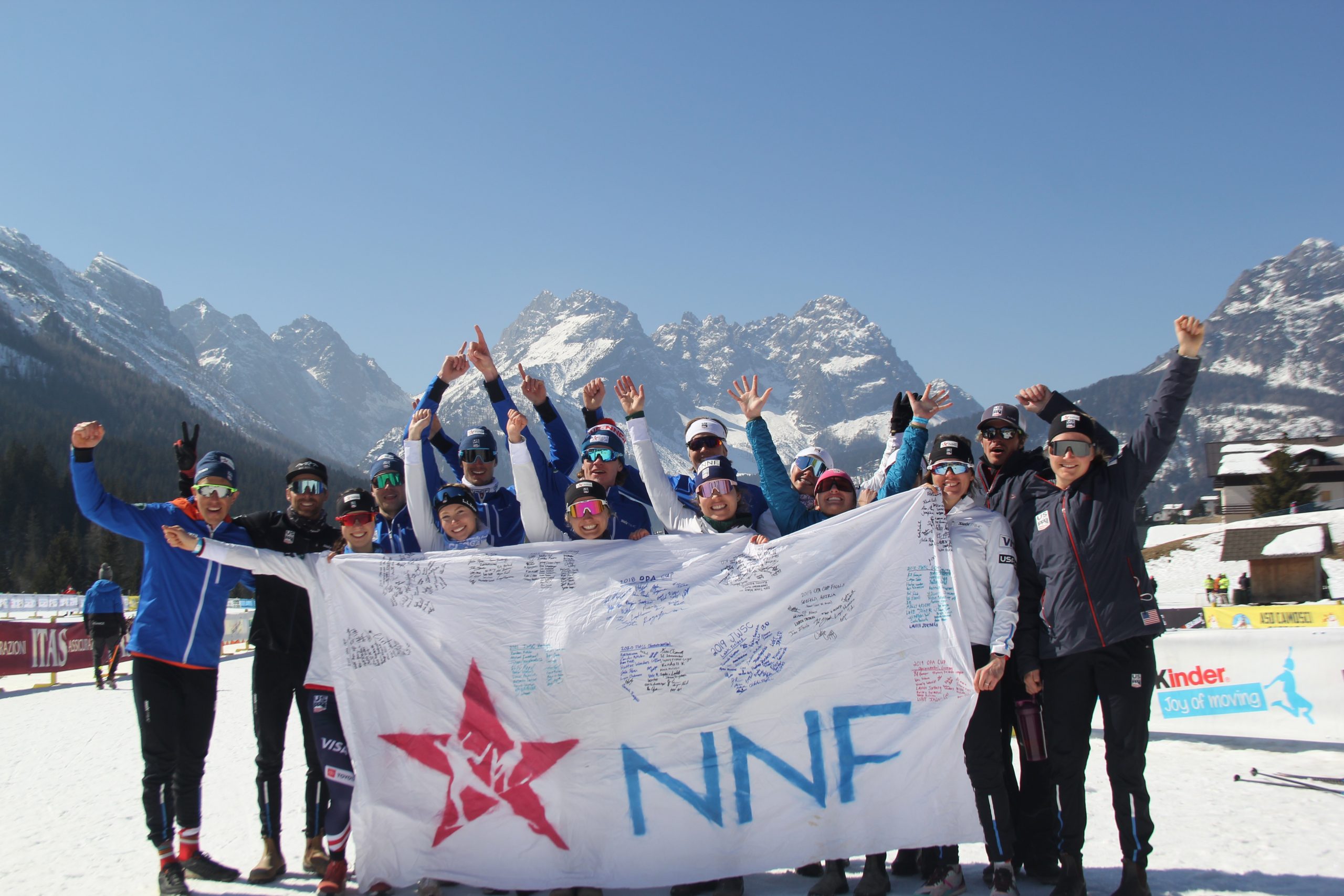
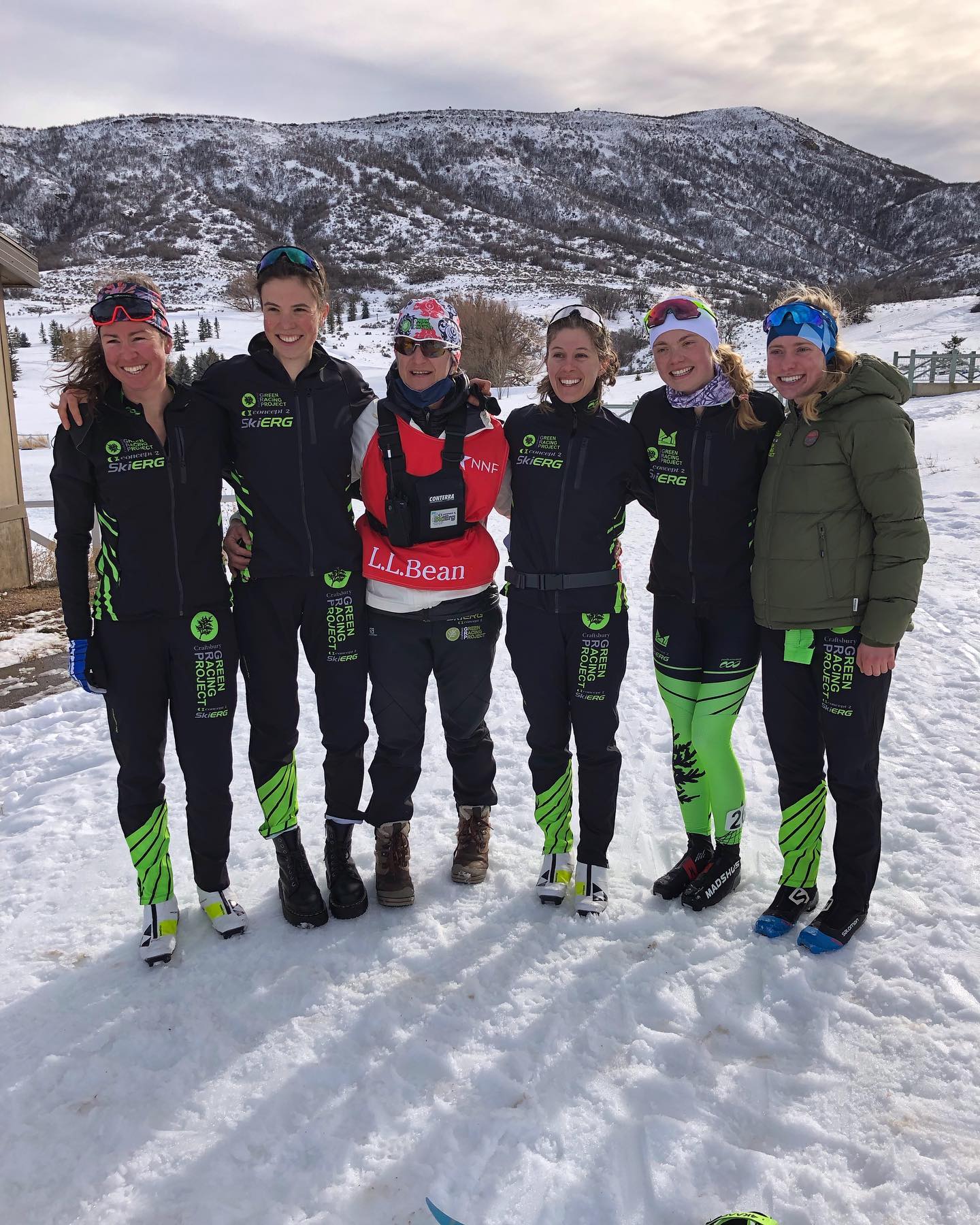
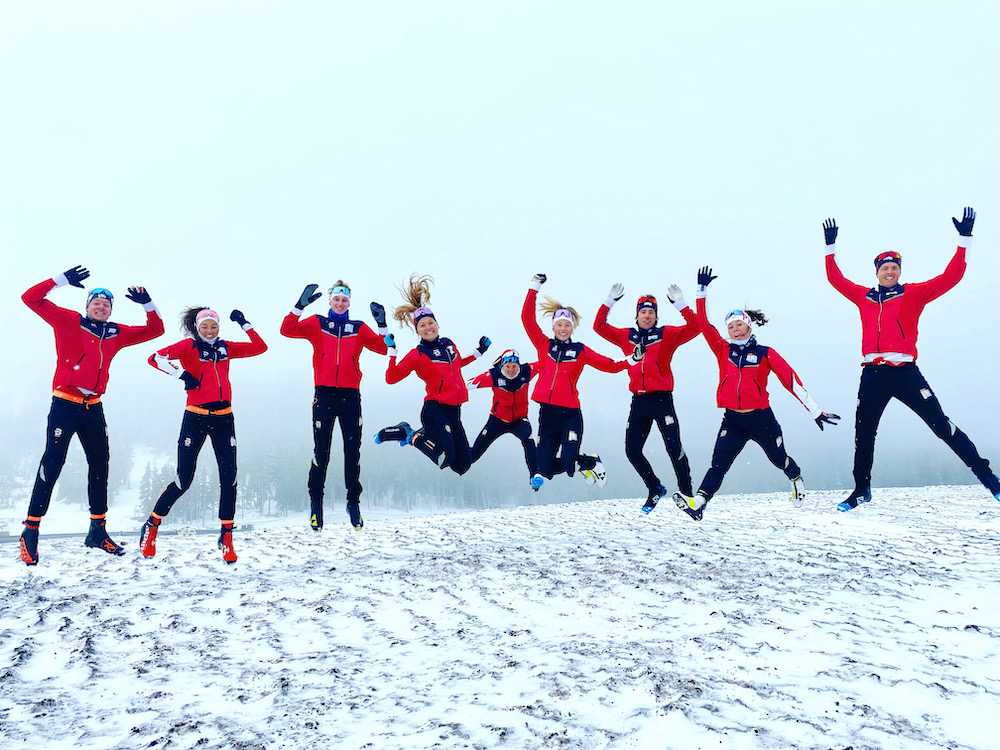
    The American OPA Cup Finals team celebrates fast races and bluebird days in Sappada, Italy. (Photo: Bryan Fish/NNF)

    Identifying it on its list of “Pillar Projects”, the National Nordic Foundation (NNF) helps subsidize the cost of the trip for the qualified athletes. The trip can accommodate up to 16 skiers, who are generally kept to an approximately even male to female ratio through the qualification criteria. This year, due to conflicting schedules and a number of declines, thirteen athletes attended, with nine women and four men. 

    In alphabetical order, the senior men included: Braden Becker (CGRP), Logan Diekmann (BSF Pro), Finn O’Connell (BSF Pro), Karl Schultz (SVSEF). Senior women included: Mariah Bredal (BSF Pro), Margie Freed (CGRP), Alex Lawson (CGRP), Hannah Rudd (BSF Pro), Becca Rorabaugh (APU), Lina Sutro (SMS T2), and Alayna Sonnesyn (SMS T2). 

    This year, two U20 athletes headed from World Juniors in Lygna, NOR to Italy along with D-Team coaches Anderson and Bryan Fish: Kate Oldham (Aspen Valley Ski Club) and Annie McColgan (UVM). 

    “It’s pretty cool that we have more racers that are racing professionally or post collegiately than, I think, ever in the US, and they have more clubs and places to choose from,” said Anderson. “There were several athletes that, especially because racing was shut down on the East Coast last year and I happened to be in Alaska and wasn’t wasn’t traveling very much before I took this job, it was kind of the first time I’ve gotten to work with them, or the first time I’ve gotten to work with them in three or four years. So it was really cool to get to know Alayna Sonnesyn a little better and Lina Sutro a little better, and Margie Freed and Alex Lawson, who I’ve seen race many times, but it was the first time I’ve gotten to really work with them and get to know them. The same with Braden Becker and Karl Schultz… So it was a pleasure on the trip to get to work with some new athletes that have come through different development systems and are excited about and ready to make that next step. And this racing circuit is a really good opportunity for that.”

    Anderson took the lead with organizing the trip and supporting athletes, working alongside US Ski & Snowboard Cross Country Sport Development Manager and long-time OPA Finals trip lead coach Bryan Fish. The wax support staff included BSF Pro Team head coach Andy Newell, former APU athlete and current staff member Peter Kling, and Jackson Hole comp team coach Jon Filardo. 

    US Ski & Snowboard Cross Country D-Team head coach Greta Anderson supports athletes during the Sun Valley SuperTour races in January. (Photo: Tobias Albrigtsen / @untraceableg)

    Anderson identified the OPA Finals trip as a key development opportunity for a number of reasons: though perhaps lower pressure than World Cup, it’s a professional race circuit with small but competitively dense fields, athletes race aggressively and tactically in a style younger athletes who have not yet raced at this level may not have experienced, and it offers the opportunity for an athlete to dial in some of the small but significant factors details that support success adapting to a new and different environment following long international travel.

    “Bryan’s been doing [the OPA Cup Finals] trip for a long time,” Anderson said. “So Peter Kling, who was on a coaching staff, and Becca Rorabaugh, they were like, ‘I’m pretty sure that we were on Bryan’s first ever OPA Cup trip.’ And it used to be that we started at the bottom of the results sheet and started looking upward for names. And right now we’re starting at the top and we don’t have to look very far down.”

    In two days of racing, the US had seven top-10 finishes, with another set of athletes finishing well-within the top-20. Highlighting the US team was SMS T2’s Sonnesyn, who took third in the 10 k classic on Saturday the 12th, and won the 10 k skate the following day. 
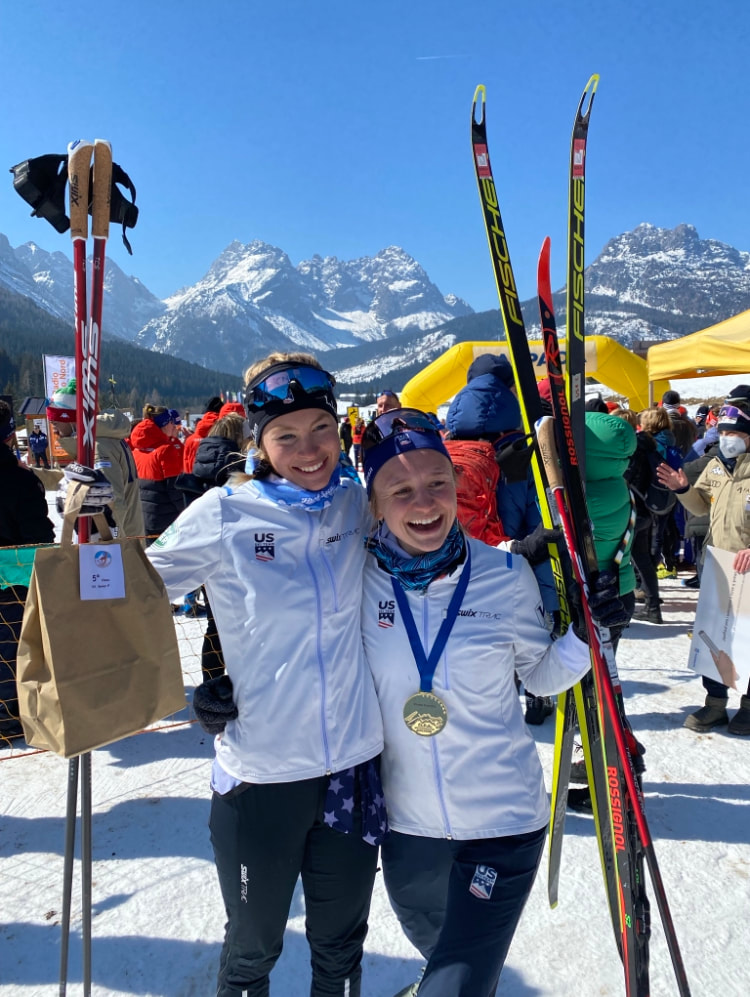
    Alayna Sonnesyn (SMS T2) takes the win in the 10 k skate at Opa Cup Finals in Sappada, ITA, with Mariah Bredal (BSF Pro) finishing just behind in fifth. (Photo courtesy of Alayna Sonnesyn)

    “It’s pretty special,” Anderson said of the performances in Sappada. “It’s awesome to get to see that. For Alayna to start a race and say like, ‘What’s my plan to try to win this?’ It’s not just, ‘Hey, we’re here to participate and learn,’ but ‘Hey, we’re here to participate and learn but also we’re going to try to win.’ And I think, with that comes — not only from staff but from racers — this level of professionalism. Okay, we’re going to select skis. We’re going to make sure we’re organized and in a good place. Where can we be? Where can we do feeds? How can we set you up to have the success you need to have? 

    “It just feels like a really good time to be an American ski racer.”

    After winning two of the first five SuperTour races this season, and finishing on the podium in each of the others, Sonnesyn was offered starts at the Tour de Ski, where she hoped she could achieve strong enough international results to qualify for the Olympic Team. But these goals did not come to fruition; Sonnesyn struggled to find the same race sensations while on the World Cup and tap into the fitness she knew was still there, which was reflected in results below her expectations. She shared her disappointment openly on her blog and social media, providing a relatable and important example to her followers that the pro-skier journey is not immune to bumps in the road. 

    “My experience on the World Cup this year – it was quite demoralizing, to be honest,” said Sonnesyn in a call from the airport as she was on her way to SuperTour Finals in Whistler. “And then, after the Tour de Ski, I got COVID. And it just really put a damper on the whole winter for me. And I started questioning like, ‘Okay, am I fit? And I like, can I race? Well, like, what have I been training for? This is really bad timing with COVID, too.’ So I was just pretty down. But then I was able to have really great SuperTour races, back in January and February, and then to be able to race internationally again in Italy. It wasn’t a World Cup, but it was still very high level of racing. So to have it go so well kind of reaffirmed to me that I belong on the international stage. And I definitely needed that, a little bit, just to give myself more confidence moving forward and motivation as well. So I’m really excited about the races and how they went and what I did to prepare for them and kind of my mental attitude around them, too.”
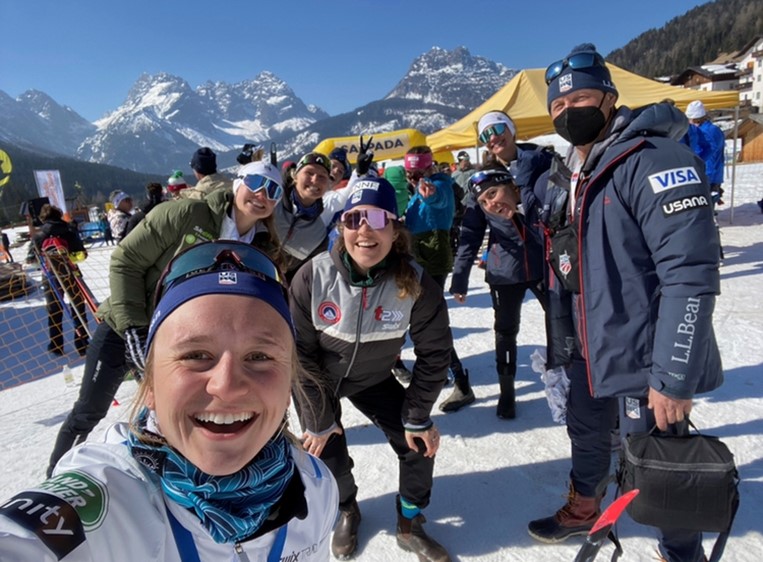
    A selfie in Sappada: the American team prepares for race day at Opa Cup Finals. (Photo: Alayna Sonnesyn)

    As she reflected on the trip and her experiences racing internationally over the last few seasons, Sonnesyn echoed Anderson’s sentiments about the progression of the American team at the event.

    “Compared to my first OPA Cup trip, which was in 2018, I think there were maybe two or three top 10 performances. And they were exciting, but for the most part, it was kind of like, ‘We’re just here to get the experience. We’re not really sure what we’re doing.’ And I think that the way the US is developing right now, the way that new courses are being built in Cable or Duluth, or wherever it is – they are preparing us better for racing internationally. And I think that was shown in the results that we had in Sappada. And it was just so exciting during that 10 k skate on Sunday to cross the finish line in first, and then turn around and see a ton of my other US teammates come in right behind me. That’s not something that was happening four years ago. So I think we are really developing and that is a huge thanks to so many different people and so many reasons, but it’s exciting to see.”

    Sonnesyn also spoke to the importance these international opportunities have provided her specifically, speaking from the perspective of what she dubbed a “bubble athlete” who has oscillated between World Cup and domestic racing over the last four seasons. She got her first World Cup starts in Quebec in March, 2019, and has been offered starts beginning in Period 2 each season since. Though this is a key stepping stone in the process toward consistent World Cup racing, she expressed that bubble athletes can have a challenging time planning seasons in advance and need to be prepared to adapt quickly to more frequent overseas travel.

    “I think that every single experience that an athlete has going and racing internationally, and traveling, and competing at that higher level, it all adds up to be super beneficial and a great learning experience. For example, I have gotten really great at overcoming jet lag, which the first couple of international trips I went on, I had no idea how to handle. I tried my best to do what I could, but it’s hard. And also to know what little things you want from home, like after being in Europe for four or five weeks, what do you really want from the US? 

    “And then also, how do you work in a new environment? A lot of times, if you’re going over to the World Cup, sometimes you’re provided a wax tech or sometimes not, or you have to bring your own, but you have to be willing to work with whoever you get.” 

    Sonnesyn explained that on the Sappada trip, she had worked with each of the techs before, but on her first trip in 2018, it was her first experience working with those wax staff members. Given the importance of ski choice and wax, working together effectively is imperative to an athlete’s success, but it requires dialogue and practice. 

    “Being ready to communicate effectively with the staff, what do you need? How do you want your skis prepared? What do you need from a hotel? All those things seem like such small little details, but they really add up with the more experiences you have.”
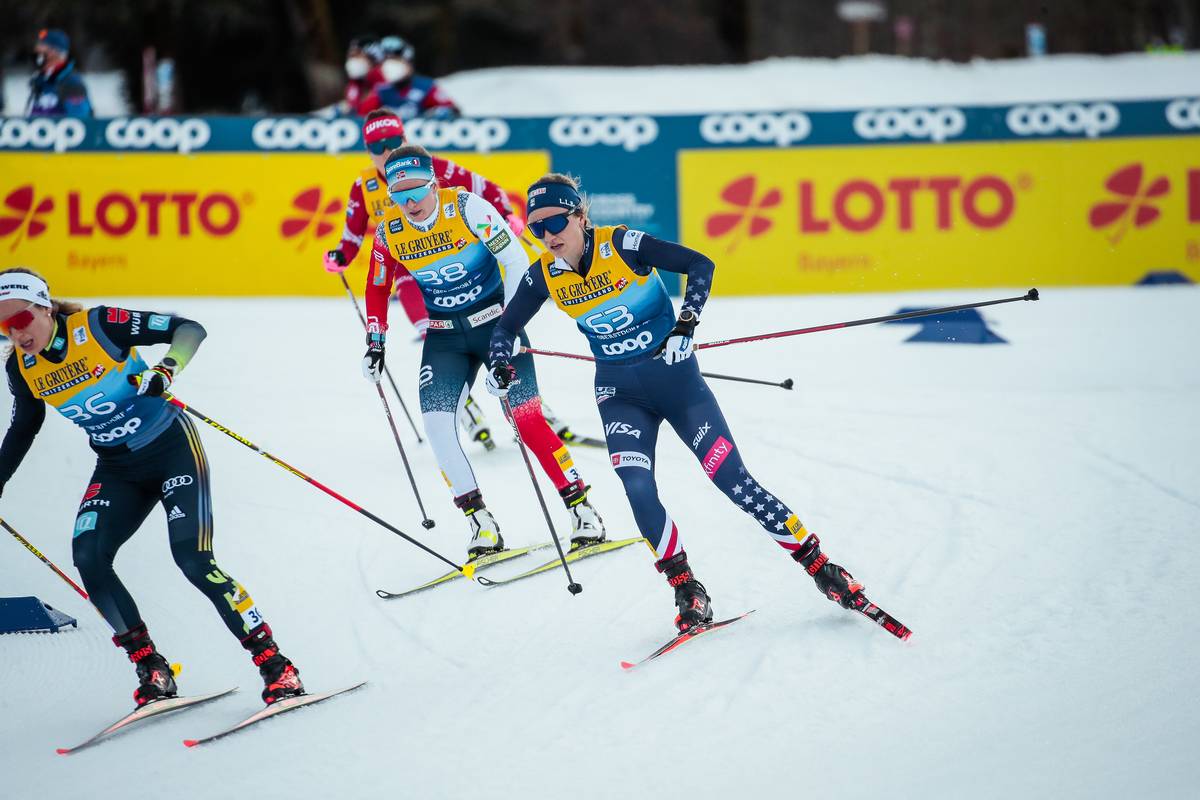
    Alayna Sonnesyn races in Oberstdorf, Germany during the 2021/22 Tour de Ski. (Photo: NordicFocus)

    She also spoke to the differences in the style of racing between the US and her international experiences, and how a trip like Sappada better athletes for what they might encounter should they be offered a World Cup start down the line. 

    “When it comes to racing: the courses in Europe are very challenging and very technical. Downhills, uphills, flats – whatever it is, there’s a lot of it, and you have to be ready to go for it. And then the competitors are fierce. They know how to be aggressive in a race, and you have to know how to hold your own. So it just helps to have that experience to understand how you approach the race. How aggressive are you going to be? How are you going to pace the race? How are you going to handle others around you?”

    With the highest levels of competition for our sport happening across the pond, it is easy to understand why opportunities like the OPA Cup trip provide an essential bridge for developing athletes. But it is not simply the facilitation of this trip that has led to marked improvement for the American team.

    “I think we’re open to change right now,” Anderson said as she reflected on her key takeaways from the experience in Italy and her first season coaching the D-Team. “I think the US, in a year with COVID, and lots of challenges logistically and politically in the world, we handle those changes better than almost any other country does. And I think that’s really shown here.” 

    Alex Lawson skates to 7th in the 10 k skate during OPA Cup Finals in Sappada, ITA. (Photo: Bryan Fish / NNF)

    While the OPA Cup crew was putting together a very solid day in the 10/15 k skate, the team of Rosie Brennan, Zak Ketterson, Scott Patterson, and Jessie Diggins had taken the win in the thrilling 4 x 5 k mixed relay in Falun. As the team in Sappada mingled near the finish to support the final racers as they skied through, Anderson said that a Swiss national team coach walked over and showed them the World Cup result on the phone. 

    Layered on top of the broader success at the OPA Cup Finals, Anderson expressed that this opened her athletes’ eyes to what might be possible for them in the years to come also. In particular, the Falun results of Zak Ketterson, a newcomer to the World Cup who ended his debut season with a 15th place finish in the 15 k skate and a mixed relay win.

    “[The guys racing at OPA Cup] are like, ‘Oh, man, I beat Zak sometimes’, or ‘I’m right with him’, ‘I trained with him in college.’ The level of confidence that brings… ‘Maybe maybe I can do that too.’”

    Moreover, Anderson expressed that this relay gold medal speaks to the equity of skiing in the US. “That we have good female athletes, and we have good male athletes, and we have a good balance of the two, and teams that are mutually supportive of each other,” she said. “Not every country has that.” 

    Boiling down the experience and her feelings as the season wraps up, Anderson concluded, “I have nothing but good things to say about our athletes right now. I’m really impressed with them. They handle the change better than anyone, and I think as a staff and from an organizational perspective, we’re trying to keep up, remove barriers, make sure they’re supported. And we’re open to trying new things, and it seems that we’re excelling in places where we’re willing to experiment and get our feet wet.”

    Kate Oldham (AVSC) races the 10k classic during Opa Cup Finals in Sappada, ITA. (Photo: Bryan Fish / NNF)

    Providing additional insights from the perspective of an OPA Cup Finals first-timer, FasterSkier also heard from U20 athlete Kate Oldham, who trains with the Aspen Valley Ski & Snowboard Club (AVSC) and competes for Middlebury College. Oldham took 11th place in both the 10 k classic and skate in the junior women’s category. 

    “Sappada was incredible,” Oldham wrote. “In congruence with the pre-camp in Toblach, the OPA Cup trip was unforgettable… My favorite ski to-date was on a long ski over the pass from Cortina to Toblach, stopping midway for trail side pastries and cappuccinos! Being with a group of older athletes was a valuable change from the World Junior trip because each team member brought new energy and experience to the group. Between that and the gelato shop next door to our hotel, the trip couldn’t have gotten much better!  

    “One of the things I think are most valuable about training and racing camps is the exposure to coaches and athletes outside one’s home team. For years I have been seeking out opportunities to attend regional and national camps that would bring new perspectives, training groups, and social dynamics to push me and help me adapt my own training method while making friends from schools and clubs all over the country. This winter I was lucky enough to have both my club coach and a group of skilled and passionate wax technicians/trip leaders selected from all around the US to lead the trips to Junior World Championships and OPA Cup finals. I know that over the six years I’ve been skiing competitively I have developed the competence to independently navigate high-level skiing events, but having techs to guide me through the process at the international level was extremely helpful, particularly when one of them I had worked closely with for those six years of training and racing.

    “With new coaches come new perspectives. Another set of eyes, a different experience, or a new phrase can be all it takes for the pieces of new advice to click into place. Or maybe a coach has a different perspective on the bigger picture of skiing that resonates with you unlike the philosophy you previously knew… which of the infinitely wide range of mindsets in ski racing works best for you? Which one reminds you why you love ski racing? Which one helps you stay motivated through the hardest parts of the season when the last thing you want to do is get out the door for training? Which one eases the heartbreak of coming so close to a goal but falling short despite your hardest effort? Without a doubt, cross country skiing is a delicate balance of internal and external factors, but having great teammates and coaches like the ones I got to know and work with in Europe this winter is certainly a key ingredient to the recipe for success in the lifelong pursuit of excellence on the race course and off.” 

    Full Results for OPA Cup Finals

  • In-Depth Race Coverage: Slow Heats with Tight Finishes in the SoHo SuperTour Classic Sprint

    In-Depth Race Coverage: Slow Heats with Tight Finishes in the SoHo SuperTour Classic Sprint

    By Rachel Bachman Perkins and Ben Theyerl 

    Precipitation was no longer a threat for the final day of racing in Soldier Hollow on Friday, a 1.5-kilometer classic sprint offered alongside the 2022 U.S. Cross Country Championships, yet classified as SuperTour only. However, athletes still faced unseasonably warm weather as blazing sun brought temperatures into the low 50’s on course during the midday heats. 

    Howling wind and rippling bibs could be heard as background noise as Adam Verrier called the event on the livestream, creating extra work for the athletes who would fight through degrading course conditions throughout the heats. This extra work showed in the times on course; with the combination of freestyle technique and significantly faster course conditions, Sunday’s sprint races featured times over a minute faster on average. A similar difference was seen even between the qualifier today at 9 a.m., when temperatures were still colder and tracks firmer, and the heats which began at 12:30 p.m. 

    Warm temperatures, degrading tracks, and loose granular spray set the stage for a challenging classic sprint in Soldier Hollow. (Photo: Tobias Albrigtsen / @untraceableg)

    “Sprint” seemed to perhaps be a misnomer, as times in the women’s heats climbed over five minutes and were well above four minutes in the men’s heats. Combined with a qualifier, this meant athletes who raced through the final saw between 16 and 20 minutes of racing, testing their endurance and fitness differently from the average sprint event.   

    Women’s Race: Katharine Ogden on Top from Qualifier to Final

    On the heels of a second place finish in yesterday’s 15k classic, Katharine Ogden (USST/SMS T2) set the bar in the qualifier, finishing in 3:51.79.

    Julia Richter (U of Utah) was the second fastest qualifier (+0.77), ahead of Lauren Jortberg (BSF Pro) in third (+1.48). Both Ogden and Jortberg won their quarterfinal to advance comfortably into the semis, however, Richter took fifth in Heat 4 and did not advance.

    In the first semifinal, two Craftsbury teammates Annika Landis and Caitlin Patterson led the way in the opening climb, with Ogden and Sydney Palmer-Leger (USST/U of Utah) sitting in third and fourth a few strides behind. Descending from the high point, a third Craftsbury racer, Michaela Keller-Miller, had pulled to the front, but was quickly overtaken by Patterson and Ogden as the pack headed into the final short herringbone climb before the long descent toward the stadium. Patterson and Ogden sat in low tucks, letting their fast skis glide as long as possible before transitioning to doublepole as they headed over the bridge and into the finish. 

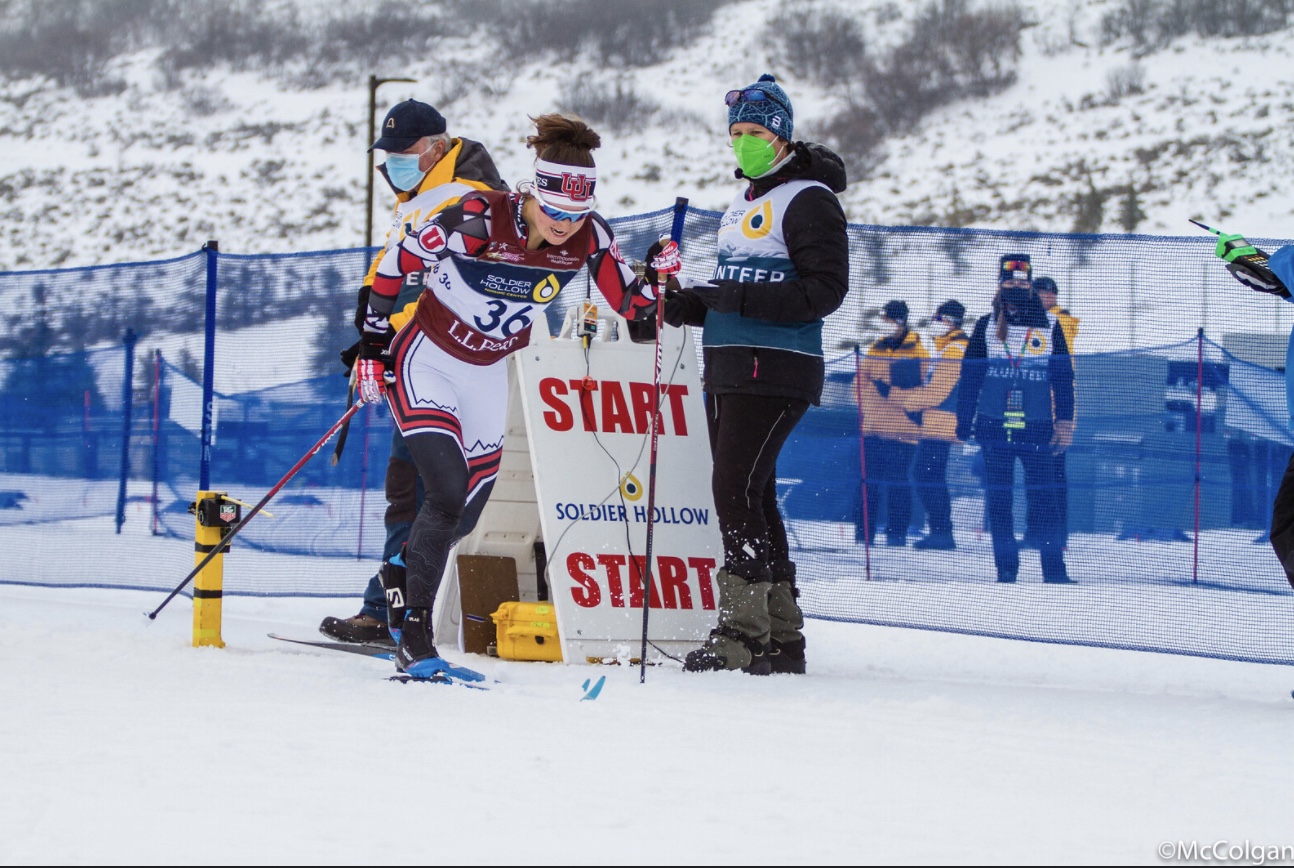
    Sydney Palmer-Leger heads out for the 10k interval start classic race during the 2022 U.S. Cross Country Championships in Soldier Hollow. (Photo: John McColgan)

    Upping the power in the final 200m, Palmer-Leger accelerated to make contact with Patterson as the women crossed over the bridge, but Patterson had better glide in the quick descent from the bridge’s exit, maintaining an advantage as they headed into the final stretch. Patterson tucked in on the tails of Ogden in the left-most track to go one-two in the heat, with Palmer-Leger not quite in the fight for an automatic qualifier spot finishing 1.5 seconds behind Patterson in third. 

    In the second semi, Bridger Ski Foundation (BSF) Pro Team members, Lauren Jortberg and Hannah Rudd lead the charging, looking as if their skis were gliding well as they pushed the downhills, perhaps with compromised kick as both showed signs of slipping in the final punchy climb. 

    In the long glideout, Lauren Jortberg moved from the far left side of the course outside of the track into the second track, losing some time on Rudd who had stuck with the second track from the start. Nevertheless, both held a significant gap over the remainder of the heat as they doublepoled over the bridge and into the finish lanes. Rudd took the win in 4:55.52, roughly +0.7 seconds ahead of Jortberg in second. 

    A few meters behind, Craftsbury teammates Margie Freed and Alexandra Lawson raced side by side to third and fourth, and as the heat proved to be seven seconds faster on average than the first, both advanced to the final.

    As the women’s final headed out of the stadium and toward the first climb, Lauren Jortberg who was the first in a train of two BSF skiers, had her ski stepped on as she was switching from doublepole to a run outside the track. This caused Jortberg to stand up, spin sideways and crash in slow motion. Rudd, who was just behind, quickly moved around Jortberg without going down, soon taking the lead charging up to top of the first climb with Patterson, Freed, and Ogden close behind.

    Patterson looked strong with solid kick as she chased a slipping Rudd up and over the final long climb, but it was Ogden on fast skis who quickly moved into second on the subsequent downhill.

    Over the last punchy climb the women ran. Heading into the long glideout, Ogden was off the front in the left-most track, but Rudd and Patterson remained within reach a few ski lengths behind. Descending off the bridge, the top three accordioned together, all choosing the same track with Ogden confidently leading the way to the finish. Patterson, who was in third, moved into her own lane to the right, slowly gaining ground on Rudd as they headed to the line. 

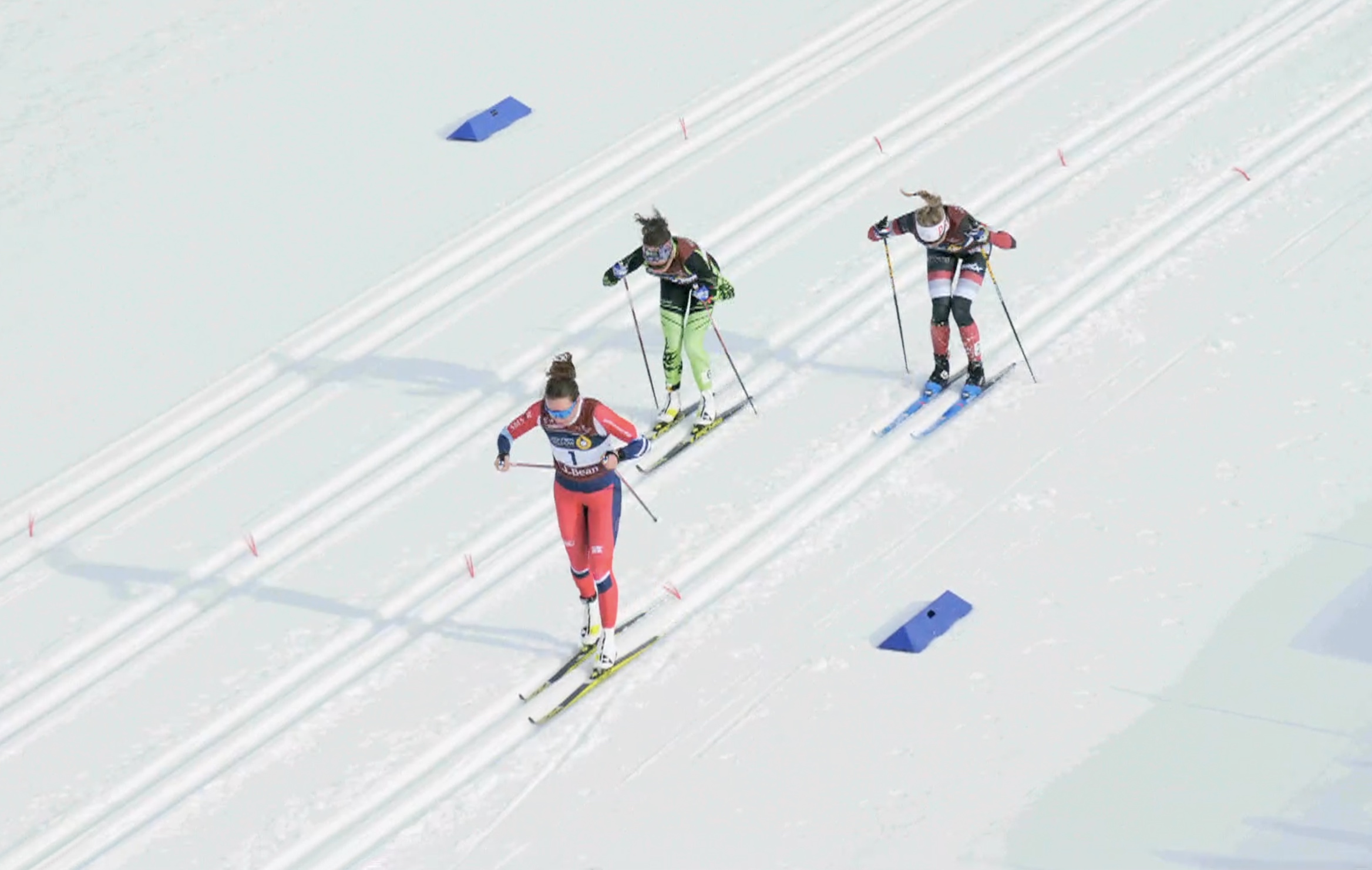
    Katharine Ogden leads Caitlin Patterson and Hannah Rudd to the line during the SuperTour classic sprints in Soldier Hollow. (Photo: Livestream Screenshot)

    Ogden maintained her lead to stop the clock in 5:01.63, while Patterson edged out Rudd for second (+0.98) and third (+1.53), respectively. After regaining contact with the pack following her crash, Jortberg finished fourth (+6.64), with Lawson fifth (+7.11), and Freed sixth (+21.55).

    “I was having a lot of fun out there today!” Ogden wrote to FasterSkier after the race. “The sprint was definitely on the long side, especially late in the day, but that did not significantly affect my strategy; I am confident in my endurance as well as my short duration power. I was really excited to have fast skis from Pat [O’Brien] and it was fun to experience the high level of sprinting in the U.S. currently. I also haven’t really done a full sprint day in a while so that was a lot of fun! It was also so impressive to see Caitlin get her fourth podium in as many races and to see Hannah Rudd have an incredible breakout performance today!”

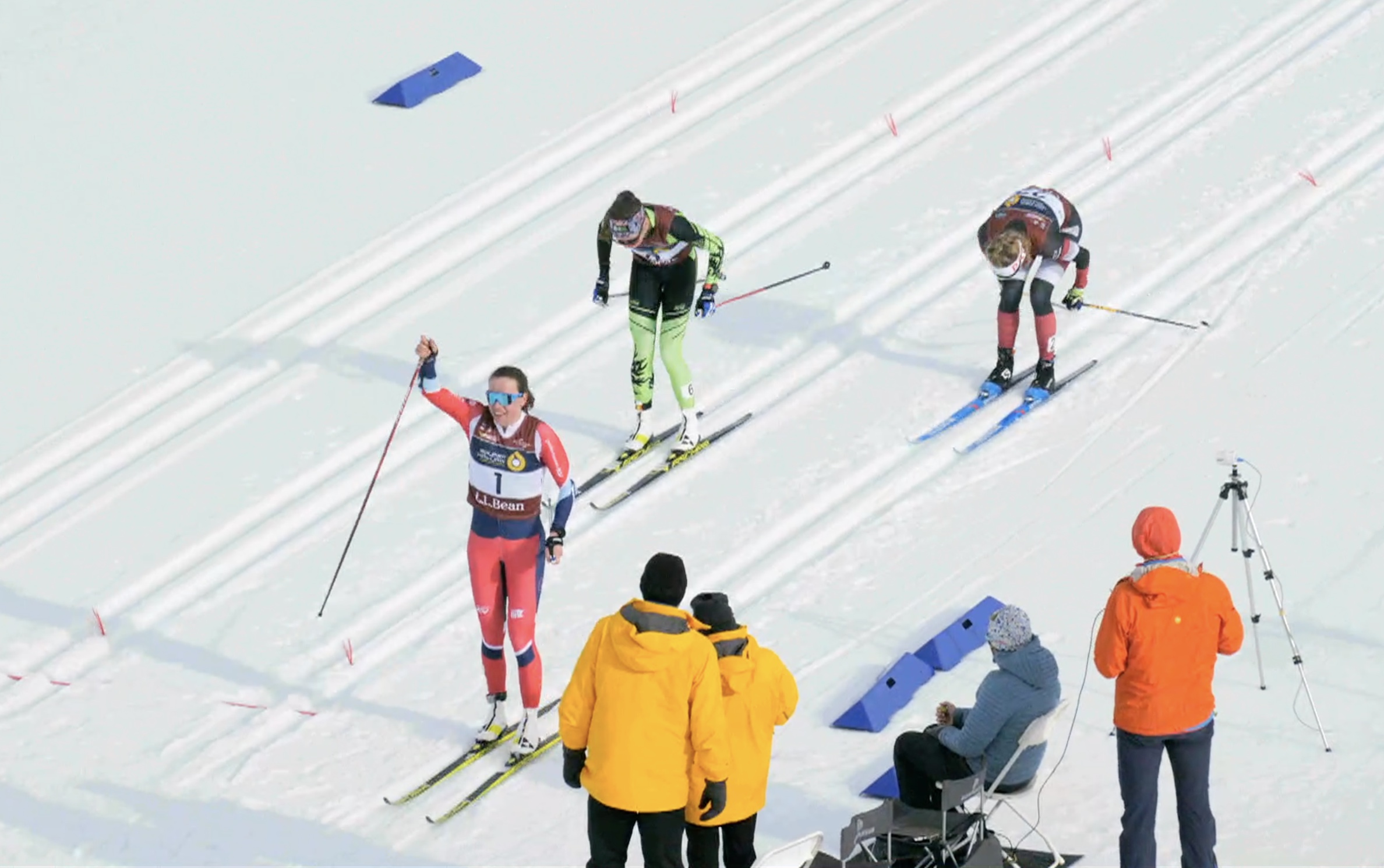
    Katharine Ogden celebrates her win in the classic sprint while Caitlin Patterson edges out Hannah Rudd for second and third. (Photo: Livestream Screenshot)

    In a post-race email, Patterson reflected on her experience racing through the heats. 

    “My racing today went fairly well, and it was a beautiful day to be out skiing and spectating,” wrote Patterson. “The sun-warmed snow became quite wet and broken apart for the heats, and combined with the wind, it certainly made a long sprint with plenty of herringbone and some sloppy tracks. I tried not to really think about the time duration much, it was mostly about getting from start to finish, however long it would take. All of the heats required some scrappy skiing, moving around through the slush and timing the length of the tuck. Now I’m really looking forward to some recovery after a good week!”

    Patterson also spoke to the week of racing in Soldier Hollow, where she finished on the podium four times in as many races, including wins in both the 10k individual classic and the skate sprint. But she was not the only person in a green suit putting together a successful week. Yesterday, she shared the distance classic podium with teammate Adam Martin. On Tuesday, Crafstbury went 3-4-5 in the 20k skate, with Lawson and Freed leading a chase group behind Frankowski and Patterson. And today, five CGRP women raced in the semis, with three advancing to the final. 

    “Everyone at Nationals is really feeling the fatigue, and myself and my team were no exception out there today. The race coughs are becoming quite terrible from so many days of racing at altitude, which is not the most fun to be coughing uncontrollably in this time of COVID. However, I was really proud of our whole team, with 5 women in the top 10! We have a really strong group, as evidenced by the performances in the distance races too; it came as no surprise to me that the women were awesome today, because training and doing intervals all summer and fall we’ve been neck-in-neck and pushing each other.”

    The women of Craftsbury with coach Pepa Miloucheva. CGRP put five women into the semifinal and three into the final of the SuperTour classic sprint in Soldier Hollow. (Photo: Facebook Crafsbury Green Racing Project)

    For Rudd, this was her first career SuperTour podium. Originally from Plymouth, MN, she graduated from University of Alaska Anchorage (UAA) in May, 2020 before heading to Bozeman to join the newly minted BSF Pro Team. Placing in the top-10 in each of the three stages of the 2022 U.S. Cross Country Championships, Rudd has steadily worked her way up the results list, finishing 10th in Sunday’s freestyle sprint, 8th in the 20k mass start free, and 6th in the 10k interval start classic. She ends her week in Soldier Hollow on a podium high note. 

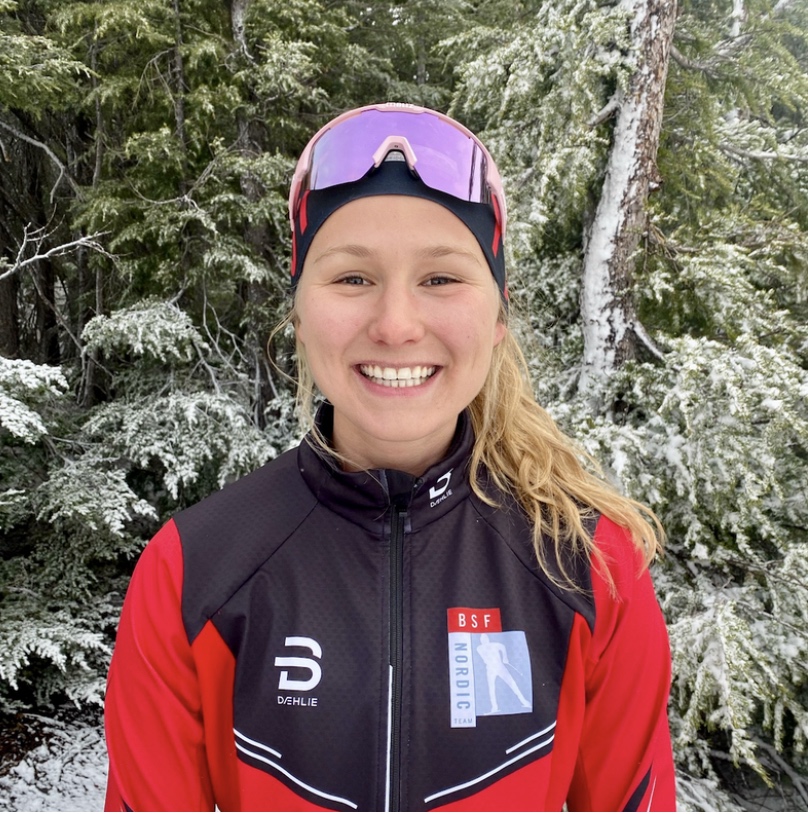
    Hannah Rudd is a member of the BSF Pro Team based in Bozeman, MT. (Photo: bridgerskifoundation.org)

    “Yesterday was a pretty exciting day for me!,” Rudd wrote to FasterSkier after the race. “The sprint course at Soldier Hollow this year was very challenging as it included three solid climbs. During the qualifier, the course remained very firm and fast. However, the temperature quickly began to rise throughout the day, and by the time the quarterfinals began, the sun was baking the course, the wind was blowing, and temps were nearing 50 degrees. This made the snow begin to transform and slow down and turned the tracks into mashed potatoes in some sections. 

    “I woke up in the morning feeling quite tired from the past week of racing so I was not sure how the day was going to play out,” Rudd continued. “I ended up qualifying in 22nd, so it was clear that I had some work to do in the heats. I felt like I was able to gain momentum and energy throughout the day, and progressed through the quarters, and semis and onto the final. Going into the final, I knew that my team’s skis were running really well so I tried to ski big and relaxed and put myself in a good position for the last downhill. It was pretty neat to be in a final with my BSF teammate Lauren Jortberg, who is an incredible sprinter and someone that I have learned a lot about sprint racing from over the past few years. I was extremely excited to land myself a spot on the podium and think it will help me to continue building momentum and confidence for the rest of the season!” 

    The podium ceremony for the women’s final following the SuperTour classic sprint in Soldier Hollow. Katharine Ogden took the win ahead of Caitlin Patterson and Hannah Rudd, with Lauren Jortberg 4th, Alexandra Lawson 5th, and Margie Freed 6th. (Photo: Facebook Craftsbury Green Racing Project)
    Men’s Race: Colorado’s Magnus Bøe Upsets Schoonmaker in the Final 

    In qualifying, JC Schoonmaker (USST/UAA) showed why he has been the U.S. Ski Team’s most reliable fixture of World Cup Classic heats this season, winning the qualifying with a time of 3:08.43, 6.42 seconds ahead of 2nd place Peter Holmes (Sun Valley SEF). Andreas Kirkeng (University of Denver) rounded out the top 3 (+6.57), in a field where the top 30 were all within 20 seconds of each other.

    With a dominant performance in qualification, the racing throughout the day always seemed to have one eye on where Schoonmaker was in the field. In his quarterfinal, Schoonmaker looked to start conservatively from the back of the field, which led the whole heat to sit back as well. When he moved to the front at the beginning of the first climb, the race surged forward with him. No one could match him, however, and he finished with a comfortable lead, with Kjetil Bånerud (NMU) taking the 2nd semifinal spot (+1.02).

    JC Schoonmaker prepares for a sunny and warm classic sprint in Soldier Hollow. (Photo: Tobias Albrigtsen / @untraceableg)

    The following two quarterfinals also previewed the competitors, and their preferred way of attacking the course, that would define the semifinal and final racing later on.

    The second heat set a stark contrast in pace to the previous heat, with Noel Keefe (U of Utah) and Bill Harmeyer (SMS T2) leading the field out hard from the gun. Hunter Wonders (APU) and Johnny Hagenbuch (SVSEF) were able to keep with the pair though, and ended up out-sprinting Keefe and Harmeyer going into the finish. Still, the duel between Keefe and Harmeyer led to a blistering pace for the heat overall, and they would claim the lucky loser spots for the semifinals.

    Then came the 3rd quarterfinal, featuring winner of today’s most aggressive racer award (unofficially handed out here, by Fasterskier), Ian Torchia (SMS T2), who in every heat he was in today would hammer out to the front of the pack while others seemed content to let the field play out. He was joined in the heat by Magnus Bøe (U of Colo.), who made his move on the first climb, stayed out in front, and came through in first place. Torchia, meanwhile, held onto second to advance automatically to the semifinal.

    The semifinals marked more an amalgamation of race strategies than anything unique. But it was an amalgamation – which requires multiple parts. And indeed, on a course known for rewarding smart-racing, and in conditions – above freezing, on man-made, wind-swept snow – that reward smart waxing as well.

    Magnus Bøe and JC Schoonmaker are off the line during the 2022 U.S. Cross Country Championships freestyle sprint stage. (Photo: Tobias Albrigtsen / @untraceableg)

    The first semifinal featured Schoonmaker and Bøe, both of which stayed back in the back during the early part of the course. Going into the first climb, Bøe took a look back, saw Schoonmaker and Harmeyer were sitting in fifth and sixth place, respectively, and decided to attack. He led over the top, into the downhill, and up the final climb. Schoonmaker successfully did maneuver through the pack to counter the move, and on the final climb took the outside line up, cutting in to tuck behind Bøe going into the final downhill. When they came up, Schoonmaker had used the draft to put himself out front, while Bøe held off a late-surge from Hunter Wonders (APU) to take the second qualifying spot into the finals.

    The second semifinal was again led out by Ian Torchia, who was then followed by former sprint National Champion Tyler Kornfield (APU). Kornfield seemed content to sit behind Torchia until the first climb, when he put in a burst of speed and broke open the field. The smartest racer, however, may have been Karl Schulz (SVSEF), who rode Kornfield’s attack, and then drafted, to go into the final climb with speed. By the time he hit the downhill, he had a gap which would remain unclosed. Kornfield, who had gone into the downhill in second, found himself joined by Noel Keefe and Ian Torchia into the final sprint for the second spot. As it would happen, all three would make it through to the finals, with Kornfield in second, and Keefe and Torchia being rewarded for their efforts early in the race by claiming the two lucky loser spots to the final.

    The A-final then looked like this: JC Schoonmaker, Magnus Bøe, Karl Schulz, Tyler Kornfield, Noel Keefe, and Ian Torchia.

    JC Schoonmaker races the qualifier during the SuperTour classic sprints in Soldier Hollow, UT. (Photo: Tobias Albrigtsen / @untraceableg)

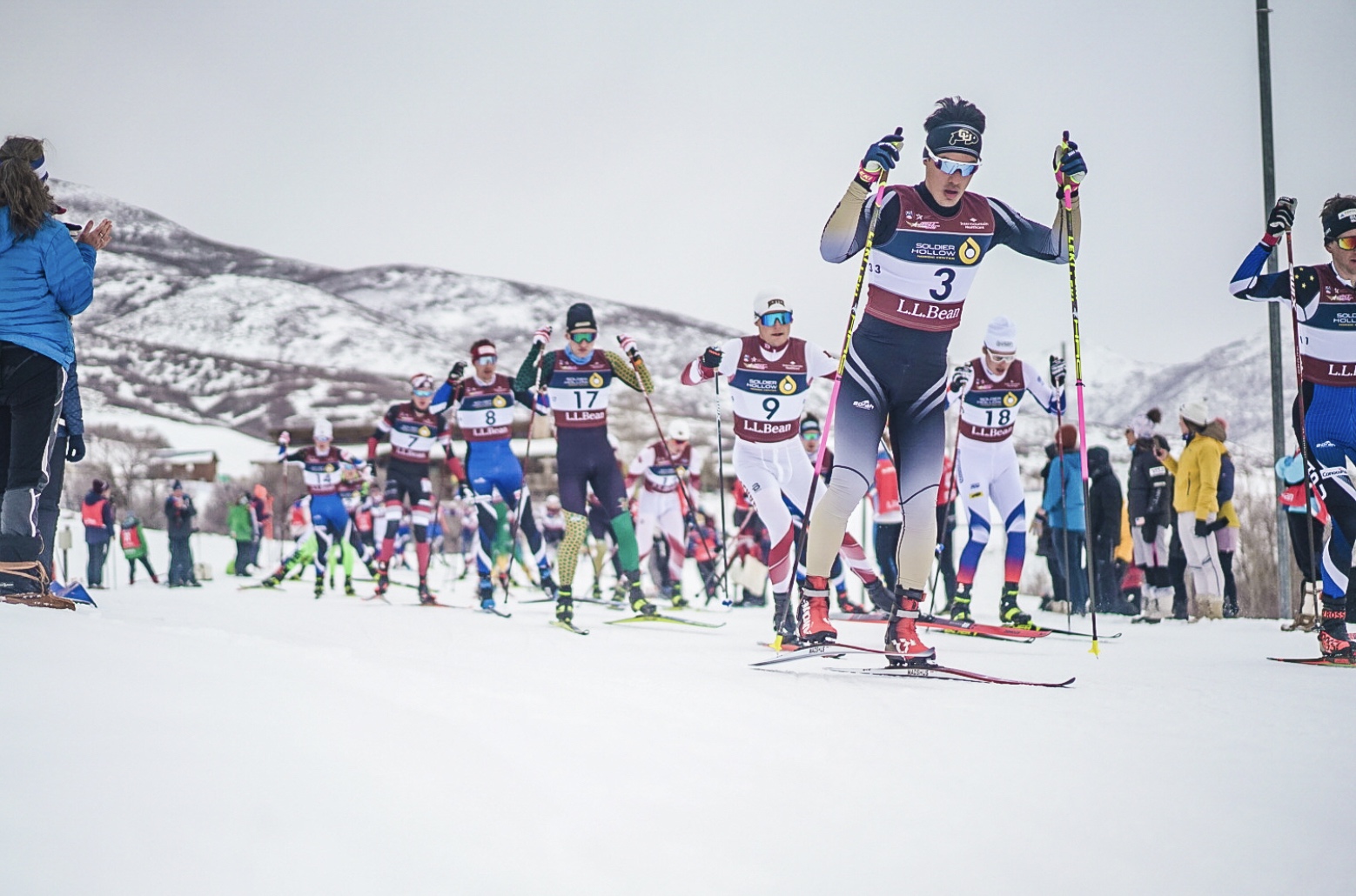
    With memories of Schoonmaker’s dominating qualifier in mind, it seemed like the field orbited around him off the line. Schulz found himself in front, but not going full bore to open the field up. Even Torchia, when he did make a move to the front, didn’t seem to do so with the same force that had marked his quarter and semifinal attacks. Schoonmaker waited until the first climb to move to the front, and then the final really was on. Schultz seized on the attack, and then put an extra-push into the downhill to try and open up an unclosable gap like he had in his semifinal. It was a good move, but one that didn’t prove to have the same force as his previous attack, and going into the final climb he was joined up with Bøe and Schoonmaker. 

    Then, Schoonmaker’s pace seemed to drop-off, with a few noticeable slips that progressed into a herringbone. Bøe, meanwhile, went for the herringbone from the get-go. He was the one that made contact with Schulz before the course gave way to a final downhill on the day. Schultz held a gap on the field through the glideout and over the bridge, but it proved not to be enough of a margin to feel comfortable in the final stretch. Meanwhile, Schoonmaker had fallen back to fifth.

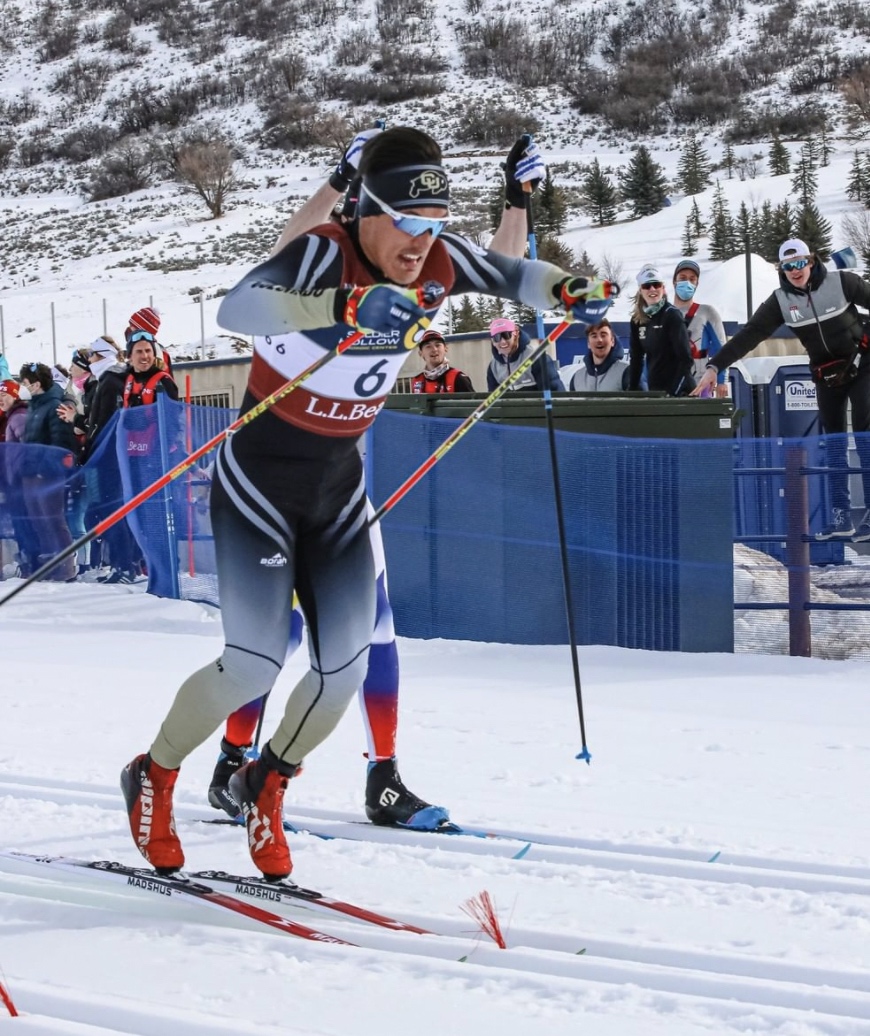
    Utilizing his dominating doublepole sprint, when they hit the final 100m it was all Bøe, who closed a significant gap to catch Schulz in the final 50 meters. Looking as if he was leaping forward with each push, Bøe switched lanes, overtaking Schultz just before the line and letting out a fist pump as he realized a SuperTour – and collegiate – victory in a time of 4:08.28. Pushing to the line, Schulz was a close second (+0.35). (Video clip here.)

    Magnus Bøe overtakes Karl Schultz just before the finish of the men’s classic sprint final. (Photo: Instagram @cubuffs)

    After a gap, Schoonmaker, who was fighting for the final podium spot alongside Kornfield and Torchia, crossed the line outside of the track in third place (+4.53). Kornfield was a half second back from Schoonmaker for fourth (+5.10), with Torchia fifth (+5.64), and Keefe sixth (+11.02).

    After the race Bøe explained that he changed his tactics in the heats relative to Sunday’s freestyle sprint, though he joked he thought it wise not to reveal everything. 

    “Today was a windy and slow-condition day,” Bøe wrote in an email. “There was headwind in the first half, and tailwind in the second half. Hence, pulling during the first half would be pointless. Furthermore, the second half, particularly for the last downhill there was very little to gain on the slipstream, due to the low speed and the ‘suctiony’ snow (cold conditions create better glide for the person coming behind on ‘heated tracks’). Therefore during all my heats I pretty much went all out from the top of the last uphill all the way to the finish, which on sunday would’ve been a suicide.”

    Bøe walked through the final, including how he reacted to lead changes and adjusted his strategy when the race began to play out differently than anticipated. 

    “The final started off very slow, but then the positioning battle developed gradually from under the bridge. My main focus was to keep my eyes on JC, since he was clearly the favorite of the day, and I knew I would do well if I laid it up to beat him. Hence I never fell for the temptation of passing him, even though I had many chances of doing so. However, he did get tired during the last climb and tried to get others to pass him. This is when Karl took off and gained a massive gap that at first seemed too late to close. As soon as I realized that JC might not be able to catch up, I committed to catching Karl by myself. I made sure to put in a great push before the downhill straight, and did the ‘supertuck’ to gain every single inch I could. Once I started double poling towards the last bend it was just heads down and maximum effort. Was never certain I would catch Karl, I thought maybe he’d have something left at the very end. But lucky for me he didn’t and I had just enough to pull it off.”

    University of Colorado’s Magnus Bøe heads out for the men’s 30k mass start free during the 2022 U.S. Cross Country Championships in Soldier Hollow. (Photo: Tobias Albrigtsen / @untraceableg)

    A dual citizen of Korea and Norway, 23-year-old Bøe has already built a robust resume in international ski racing, including competing for Korea during the 2018 Olympics in Pyeongchang. Earlier this week, Bøe was fifth in Sunday’s freestyle sprints and finished 11th in the 15k classic. His only down race of the series happened in the 30k mass start freestyle, where he finished 43rd (+12:30.9).

    “This week of racing has been up and down, from a miserable 30km where I got lapped, to today’s win. It’s been a lot of fun, and not least has been helpful for my shape. Next up is the Super Tour in Sun Valley, which I am looking forward to. Think I would be able to build on top of what I gained during this week.”

    For Schultz, today also marked a career-first SuperTour podium. The 23-year-old Lake Placid, NY Native raced for the University of Vermont (UVM) until graduating in May, 2020, then heading to Sun Valley. Schultz had a podium just-miss earlier this year in a freestyle sprint where he finished fourth during the opening weekend of SuperTour racing in Duluth, MN. 

    “I was pretty fatigued from the three races prior,” Schultz wrote after the race. “I knew there was a decent headwind on that first climb, so I decided I’d tuck in behind up and over the first climb. I figured I’d need to save my strength for the final climb and long finishing straight, so I played my cards well and pushed where I needed to, and it just worked perfectly. I’ve learned sprinting is about preserving energy for critical parts of the course, it couldn’t have gone better.”

    “And I won’t lie,” Schultz continued. “The spectators and everyone cheering allowed me to find another gear, especially up the last climb. I dug deeper than I have before.”

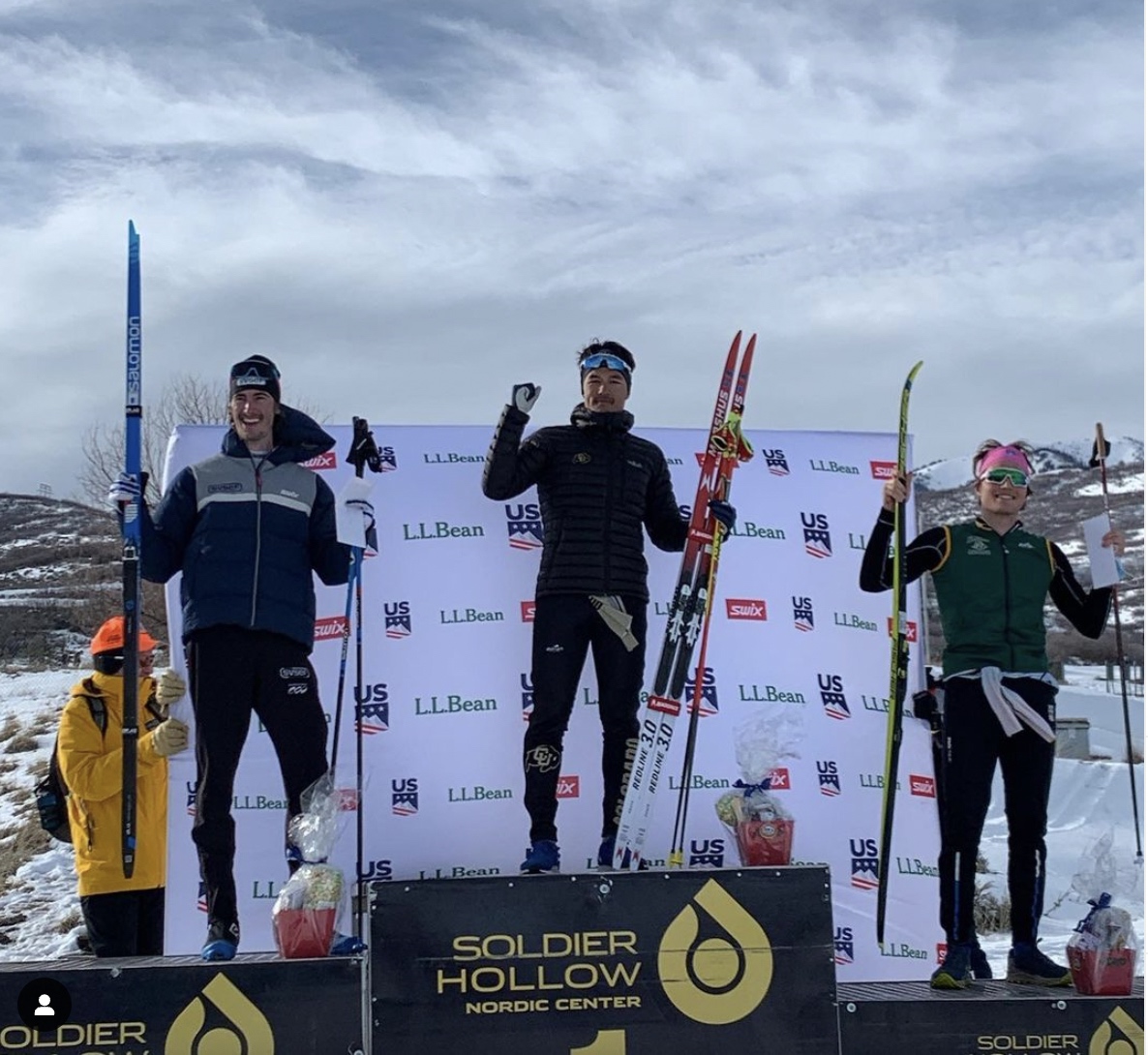
    The men’s podium of the SuperTour 1.5k classic sprint in Soldier Hollow: Magnus Bøe took the win ahead of Karl Schultz and JC Schoonmaker. (Photo: Instagram @nysefnordic)

    Writing to FasterSkier after the race, Schoonmaker explained how changing conditions forced athletes to make tough decisions about skis as well as tactics. 

    “It was a pretty crazy difference from this morning to the afternoon,” Schoonmaker explained. “The morning was icy and fast and the heats got really sloppy and slow.  I had amazing skis in the morning and in the heats I struggled a bit with choosing whether to go for more kick or glide. I ended up asking for less kick to free the ski up a bit and I’m still not sure what was the right call. It was just really challenging conditions.”

    Schoonmaker also explained that he had made fewer adjustments to the technique he had found such success with in Sunday’s skate sprint, however, the final proved to break the mold of what has historically proven to be the recipe for Soldier Hollow sprint racing.

    “For this course I tried to take a somewhat similar approach as in the skate race by respecting the draft on the last downhill and trying to be careful about the guys behind me there. In the quarterfinal I felt I was able to ski away and create a big enough gap so that I couldn’t get sucked back in by the draft. In the semifinal, I tried to stay more in the pack and use the draft for myself. The final was tricky because I was going to try and use the draft again but Karl put in a really good move on the last hill that I couldn’t match. Then I was leading the rest of the pack and I decided to push over and try to catch Karl rather than go to the back to find the draft. It ended up not working out so great, but I’m happy with the day and the tough effort.” 

    We conclude a week of racing at Soldier Hollow, then, with a race that highlighted the strength and depth of the domestic circuit of U.S. skiing at present. Variable conditions on a technical course, which racers approached with tactics as diverse as the regions they hail from, indicated that this is a field that represents top-level racing. It was a testament to the development and growth of the sport in this country that a top-level racer like Schoonmaker can come off the World Cup and find a field where every heat is raced with closeness and intensity in his own country. That bodes well, and is a great place to leave the last national gathering of the US ski racing community before its best representatives look to take a crack at the Olympic Games in Beijing next month.

    The spirit of the sport captured at the finish line as Alaska Winter Stars athlete Meredith Schwartz embraces her coach at the finish of the classic sprint in Soldier Hollow. (Photo: Tobias Albrigtsen / @untraceableg)

    FasterSkier extends congratulations to all athletes who competed in Soldier Hollow this week, commending their efforts in a fiercely competitive field through a variety of race formats and course conditions. Also, a big thank you to Tobias Albrigtsen and John McColgan, who generously shared their photos with us throughout the week. Stayed tuned for an upcoming gallery highlighting many of the fantastic images that were not included in our reports. 

    Full Results:

    Qualification | Women’s Final | Men’s Final

    Livestream Replay

  • Soldier Hollow SuperTour Rundown: Ogden and Bøe Win a Warm and Slow Classic Sprint

    Soldier Hollow SuperTour Rundown: Ogden and Bøe Win a Warm and Slow Classic Sprint

    Here’s a quick results recap from today’s SuperTour classic sprint in Soldier Hollow. Stay tuned tomorrow for detailed coverage including comments from athletes. 

    On a second warm and slow day of classic racing, temperatures in Soldier Hollow, UT climbed into the low 50’s as athletes raced through the heats of the 1.5 kilometer sprint. 

    In the women’s race, Katharine Ogden (USST/SMS T2) won each round of racing, from the qualifier to the final, where she stopped the clock in 5:01.63. Caitlin Patterson (CGRP) was second for women (+0.48), with Hannah Rudd (BSF Pro Team) in third (+1.53). 

    The men’s podium of the SuperTour 1.5k classic sprint in Soldier Hollow: Magnus Bøe took the win ahead of Karl Schultz and JC Schoonmaker. (Photo: Instagram @nysefnordic)

    The men’s final saw a surprise upset. After JC Schoonmaker (USST/UAA) won the qualifier, and took first in his quarterfinal, and semi, it was Magnus Bøe (U of Colo.) whose tactics and strength carried him over the line in 4:08.28 for the men’s win. Bøe narrowly edged out Karl Schultz (SVSEF) who finished second (+0.35), with Schoonmaker hanging on for third (+4.58).

    Full Results:

    Men’s Qualifier | Heats

    Women’s Qualifier (not available) | Heats

  • Elite Team Preview: Bridger Ski Foundation Pro Team

    Elite Team Preview: Bridger Ski Foundation Pro Team

    Bridger Ski Foundation athletes, 2021. (photo: courtesy BSF)

    Team name and location: Bridger Ski Foundation Nordic Pro Team (BSF); Bozeman, Montana

    Coaches: Andy Newell (Nordic Pro Team), Hannah Cole (Post Grad Team)

    Current roster: Finn O’Connell, Graham Houtsma, Hannah Rudd, Lauren Jortberg, Leah Lange, Logan Diekmann, Mariah Bredal, Reid Goble, Simon Zink, Erika Flowers

    Who’s still on this team, or otherwise involved in American skiing, from when we did this in 2012: No one; Torin Koos and Leif Zimmermann haven’t raced in years, though the third athlete on that team, Sawyer Kesselheim, was the guide for Paralympian Jake Adicoff in Adicoff’s silver-medal performance in the B3 classification 10-kilometer classic in PyeongChang

    Bridger Ski Foundation athletes, 2021. (photo: courtesy BSF)

    Top results last season: While the SuperTour obviously didn’t happen, BSF sent a strong team to the American Birkebeiner, the closest anyone came to a nationwide domestic field last year. BSF athletes came away with a combined four top-10 finishes in the skate race, including O’Connell in 4th, Flowers in 5th, Jortberg in 7th, and Rudd in 9th. Graham was 12th in this race, and Diekmann 23rd. In the classic race, O’Connell was 11th and Diekmann 15th. O’Connell had a pair of podium finishes in Sun Valley in March 2021, against a loaded regional field with multiple RMISA athletes, and was third in a RMISA race in January. Diekmann tied for first in a RMISA sprint qual in January, while Jortberg was second among the women. Flowers was 6th in a separate January RMISA race. Finally, going back to the ill-fated spring of 2020, Diekmann was scheduled to make his World Cup debut in the Québec City sprints before the races were cancelled, while Flowers was among the starters for the women.

    Andy Newell, Bridger Ski Foundation coach, 2021. (photo: courtesy BSF)

    Coach’s comments: Andy Newell wrote:

    “Off-season training for us has been super fun and productive. I’m really proud of the way the team has come tougher over the past year and a half. It’s always a risk when you create a new team from scratch, you never know what kind of team dynamic will play out. But this group does an amazing job working together, pushing one another, while also showing authentic support. We have a lot of fun.
    BSF athletes on snow in Bend, May 2021. (photo: courtesy BSF)
    “Our summer preparation started in May with our first ever team Bend camp with the US Ski Team. During the months of June and July we try to focus on solid, steady team training here in Bozeman alongside the BSF collegiate group and comp teams. This is an important time for the Pro Team to connect with the community and the younger members of the BSF club. Since then we have tried to prioritize high quality training camps each month. In August we had a great low altitude training camp in Cable, Wisconsin, an intensity camp with rollerski TT’s in Lake Placid in September, and our annual October training camp with the US Ski Team. I think because last season was so isolating we’ve tried to collaborate with the other elite teams as much as possible and have had a fun time working with Sun Valley, SMS, Team Birkie and others.
    “The Pro Team is itching to get on snow and get the season started. We will travel to Canmore in mid-November for more on-snow training and TT’s, then focus on our final preparations for the first SuperTours in the Midwest. The athletes have big goals this year so everyone is excited to return to a legit race calendar. Although we need to prioritize SuperTour racing our ultimate goal with this team is to get everyone racing in Europe whether that’s in World Cup starts, U23s, or other championship races.
    Bridger Ski Foundation athletes, 2021. (photo: courtesy BSF)
    “Folks can follow along from our team blog.”
  • Novak, Rudd Take Tour of Anchorage Wins

    Novak, Rudd Take Tour of Anchorage Wins

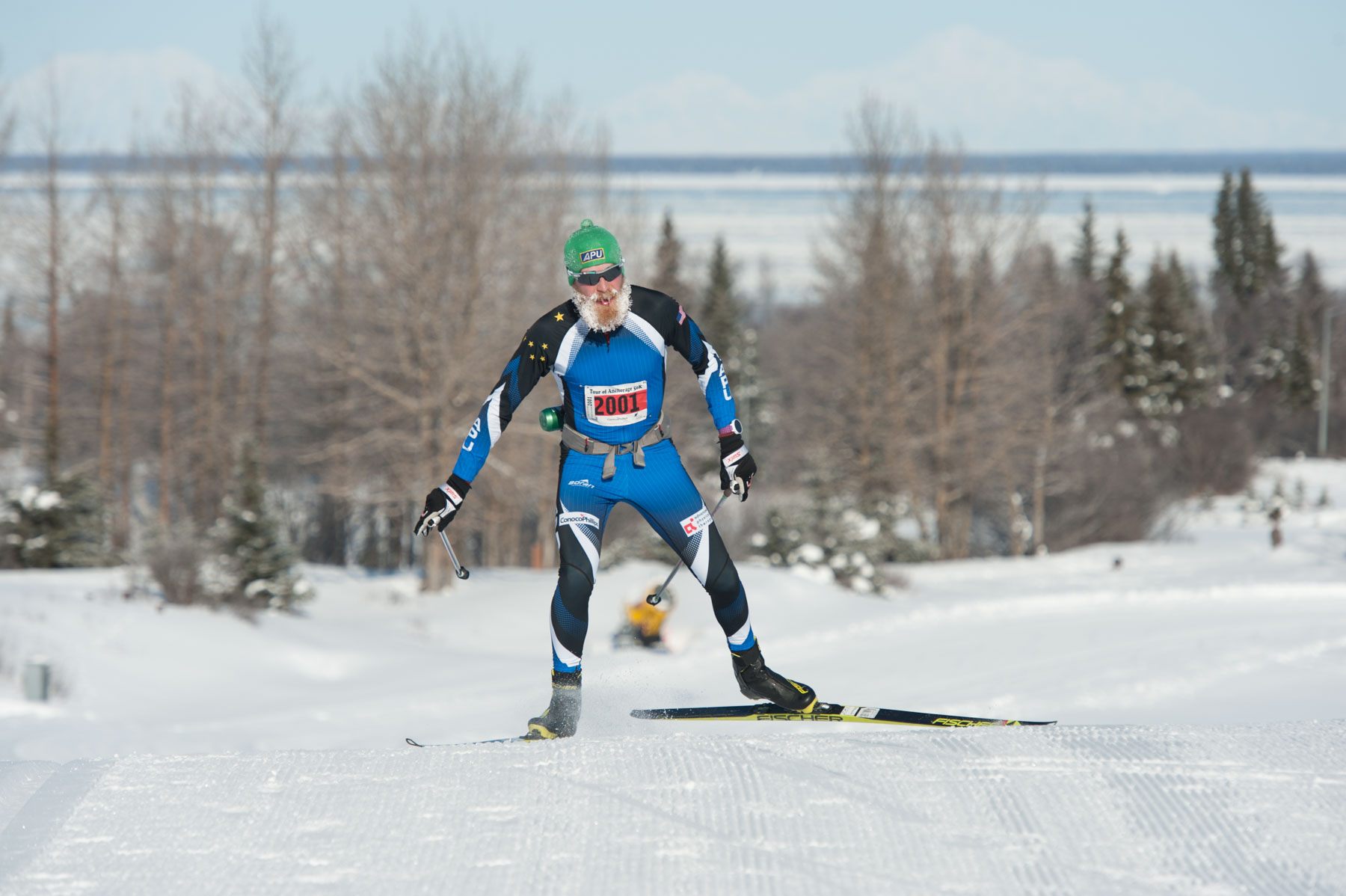
    Tour of Anchorage 50k men’s winner Jack Novak tops the final hill to win the race Sunday, March 4, 2018. (photo: Michael Dinneen)

    ANCHORAGE, Alaska — Hannah Rudd had never raced a 50 k before. Jack Novak was doing his second one in as many weekends. They took different paths to get there, but both ended up in the same place on Sunday afternoon: first in the flagship 50-kilometer freestyle race of the Tour of Anchorage.

    The 30th annual Tour (pearl anniversary!) set off from Service High School, beneath the foothills of the Chugach Mountains at the eastern edge of metropolitan Anchorage, on Sunday morning amidst essentially perfect conditions: 20 degrees Fahrenheit, no wind, and clouds giving way to sunshine by race’s end. It was a far cry from 2017, when temperatures were 4 below at the start, dipping to -12° F a few kilometers down the trail in a notorious icebox spot in the black spruce forest of Campbell Tract.

    While 2017 saw successful early solo breakaways for both the men’s and women’s champions, the strategy for this year’s winners was much more typical for a race that has hills at the start and at the end, but about 25 k of flat skiing in the middle: Join a pack near the start, ski with the pack over the flats, break away from the pack approaching the finish, don’t look back.

    For Novak, who was racing on Sunday in Anchorage just eight days after a top-50 finish in the American Birkebeiner in Wisconsin last Saturday, that break came a gutsy six kilometers out from the finish at Kincaid Park.

    Tour of Anchorage 50k men’s winner Jack Novak skis in a pack early in the race Sunday, March 4, 2018. (photo: Michael Dinneen)

    He was skiing with APU teammate Forrest Mahlen and local master skier Seth Downs at that point, Novak recounted in a post-race interview with FasterSkier. He and Mahlen had gone off the front by 10 k into the race, but realized that Downs was catching up to them, so purposefully slowed until he caught them. The three of them then skied together for the next 30+ kilometers… until Novak made the impetuous decision that it was time to go.

    “As we entered the Sisson Loop” at around the 44 k mark, Novak recounted of the point at which racers leave the flats of the Coastal Trail for the rolling hills of Kincaid Park, “I had just taken a pull on the front, so I moved back to third, and was just cruising in the back recovering. And right as we entered Sisson, Seth pulled over and decided it was time to feed, so he pulled his bottle out, and Forrest at that point thought it was a good idea to feed as well. And I took my waterbottle halfway out of my belt, but then realized that this was a great opportunity, so I shoved it back in and just went around on the edge of the trail, and just charged as hard as I could for the next six k all the way to the finish. And I was a little nervous, because I thought either this was going to be a winning move, or it was going to be a third-place move. And I was a little nervous, but I decided that I had to fully commit, and just go for it.”

    Going for it worked for Novak. By the time he crested the final climb up to the hilltop finish outside the Kincaid chalet, ice crystals flecking his eyebrows and caking his lumberjack beard, he was over a minute ahead of Downs (+1:05.7) and nearly two minutes up on Mahlen (+1:41.5), who had himself been top-40 in the Birkie last weekend.

    Rudd had a similar journey to Kincaid, initially skiing in a pack of several women occasionally joined by some of the slower first wave men. (Wave 1 at the Tour is the top 50 men, Wave 2 is a dozen or so elite women, then the remaining waves are co-ed. Much like at the Birkie, the lead women can keep apprised of their competition by virtue of the common start, but also often end up skiing with some men who started two minutes ahead of them in the first wave.)

    As late as the Chester Creek greenbelt, roughly midway through the race, Rudd was skiing with a lead pack of women that included Michaela Keller-Miller, Shalane Frost, and Alison Arians. But eventually the lead pack dwindled down to a lead pair, just Rudd and her University of Alaska Anchorage teammate Keller-Miller.

    Tour of Anchorage 50k women’s winner Hannah Rudd tops the final hill to win the race Sunday, March 4, 2018. (photo: Michael Dinneen)

    Rudd skied with Keller-Miller for some time, then made her move “with about 3 k to go,” the 19-year-old sophomore told FasterSkier after the race.

    Much like Novak’s surge before her, Rudd’s push may not have been easy, but it was effective. Rudd would ultimately cross the finish line in 2:38:54.4. Keller-Miller (+1:15.7) followed over a minute back in second, with Frost (+4:56.2) third. Frost had finished second to 2018 Olympian Rosie Frankowski in last year’s icy sufferfest.

    Rudd had never raced a 50 k before Sunday, but count her a fan. “I really like 50 k’s,” said. “I like the distance. It was really fun.”

    Rudd, who remains undefeated in lifetime 50 k races, had nothing but praise for her overall experience on the day: “It was really great. It’s an amazing trail system, beautiful day. Phenomenal course.”

    The only thing that gave her pause was the question of whether she could accept the prize given to the first-place finisher in the 50 k ($1,000 and a roundtrip ticket on Alaska Airlines), in light of NCAA regulations that generally proscribe accepting prize money greater than the costs of participating in a competition.

    “That’s still up in the air,” demurred the UAA student-athlete when asked about this immediately after the race. “Our Athletic Director is going to check on that.”

    Novak had no bar to accepting the money, but his plans for the windfall reflected the realities of life as a 24-year-old professional cross-country ski racer. “It’s probably just going to be put toward racing,” Novak said. “Pay the bills.”

    While Novak’s aims for his prize money were quotidian, he made it clear that it had still been a special day for him.

    “Today feels really good,” he reflected after his win. “It’s been a rollercoaster ride of emotions for the Tour over the past couple years, with shortened courses, changed courses, cold weather, warm weather, all that stuff… so it’s really nice to be able to put everything together, and get the victory.”

    Getting the win this year after earning the wooden medal for fourth the year before probably didn’t hurt. Neither did being born and raised in Anchorage — Novak graduated from South Anchorage High School, and placed seventh at State (behind Olympian Scott Patterson) in 2010 and fourth (behind Olympian Logan Hanneman) in 2011 — then finally winning the citizens race that has long served as the unofficial Alaska state championship.

    Reflecting the high level of skiing in the state, a dozen different Olympians, most of them locals, have won the Tour of Anchorage over the past 30 years, according to an email from race organizers: Adam Verrier, Sue Forbes, Audun Endestad, Kevin Brochman, Todd Boonstra, Lars Flora, Laura McCabe, Suzanne King, Abby Larson, James Southam, Holly Brooks, and Rosie Frankowski. The number only goes up if you count second- and third-place finishers — Reese Hanneman, Tyler Kornfield, Rachel Steer, Justin Freeman, and Ben Husaby among them — and should actually be fourteen for victors alone, counting skier Betsy Youngman and biathlete Jay Hakkinen.

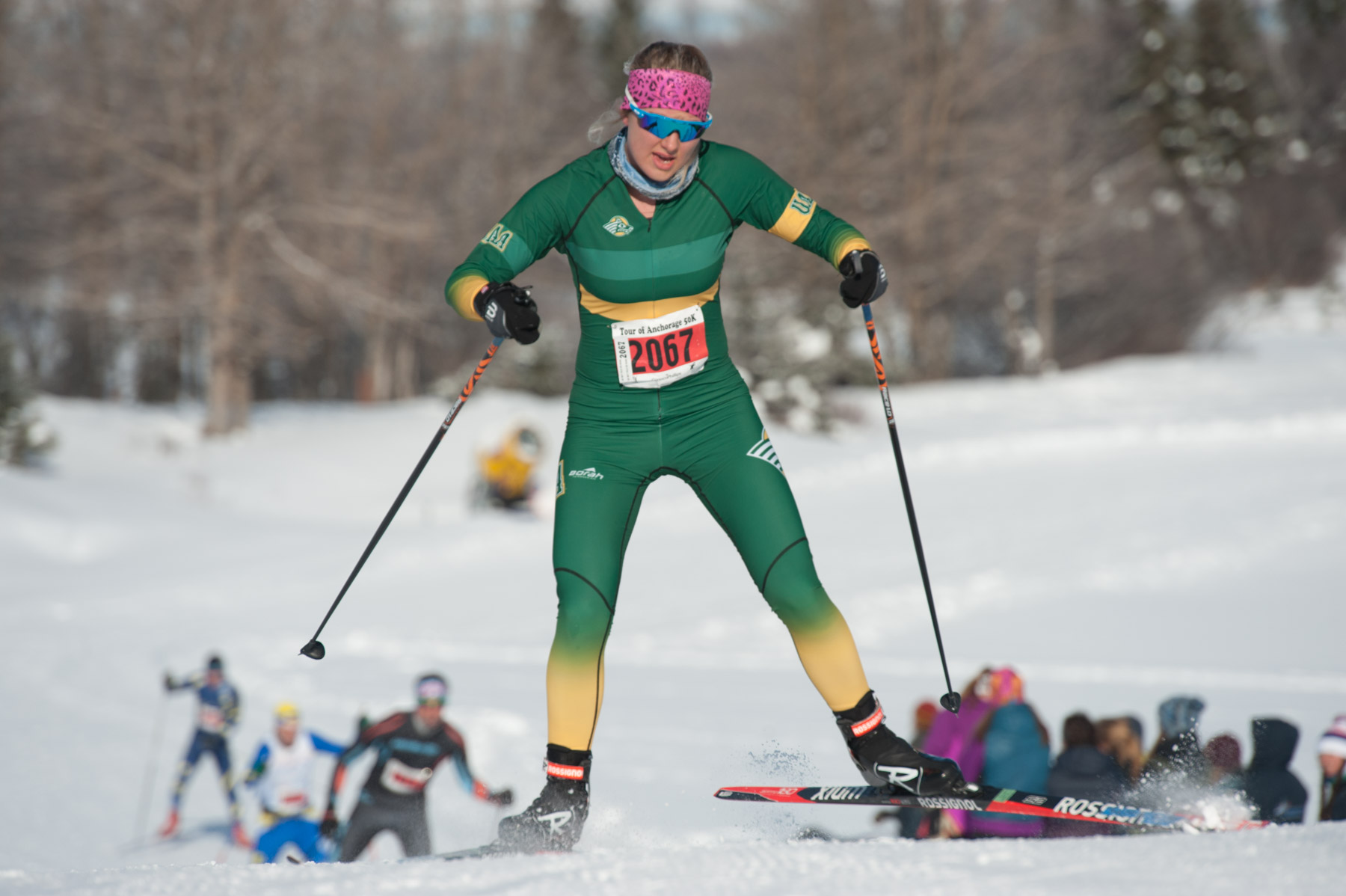
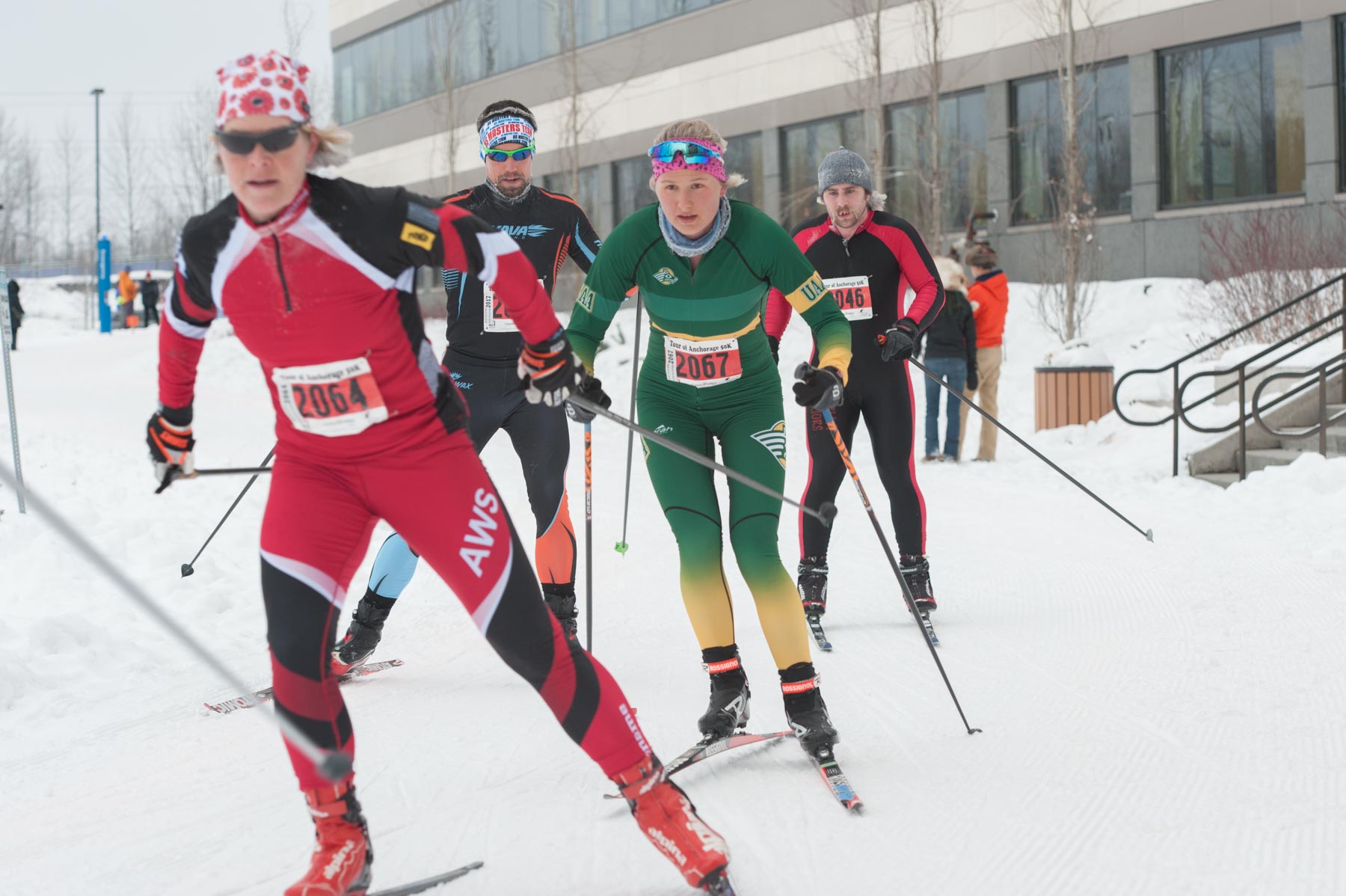
    Hannah Rudd (2067) follows Alison Arians (2064) midway through the 2018 Tour of Anchorage. (photo: Michael Dinneen)

    (2018 Australian Olympian Casey Wright was seventh among women on Sunday. Less than four minutes behind her came Brooks, a 2010 and 2014 Olympian for the U.S., who now describes herself as “a new mom of infant twins and a new business owner.” While Brooks raced the 50 k on Sunday, her husband, Rob Whitney, covered the entire route — including the 100-meter gain hors catégorie max climb of the Spencer Loop — towing a double Chariot with both six-month-olds inside. Plus diapers and snacks.)

    New dad Whitney may not have used the phrase “just cruising around” to describe his heavily laden trip across town, but it seemed appropriate for the unencumbered Novak.

    “Conditions today were phenomenal,” Novak said after the race, “sunny, 20 degrees — can’t complain about that. It was fun to just be out there skiing with my best friend, and Seth [Downs], and just be out there cruising around.”

    The change in weather conditions from 2017 didn’t hurt, either.

    “This year was so much more pleasant than last year,” Novak said after skiing on a day that was literally more than 30 degrees warmer than the last time he had done this race. “Last year I was wearing two long johns, and two long johns on top, and a vest, and two buffs, and I was still cold. And this year I was wearing just one long john top and bottom, and I was totally comfortable the whole time. And it was wonderful to just be out there, and just be skiing, and just not have to worry about freezing.”

    Inside the results and other races

    A total of 740 racers finished on Sunday, a sizeable field but down from a high of 2,050 in the mid-2000s, when the Tour was consistently the second-largest ski race in the country behind the Birkie. They ranged in age from 8-year-old girl Reine Soule and 8-year-old boy Jack Leveque (2:08 and 2:19, respectively, for the 25 k skate), to 88-year-old Reno Deprey (3 hours even for the 25 k classic).

    While the Tour of Anchorage draws the lion’s share of its competitors from, well, Anchorage, the rest of the state put in an appearance as well. Finishers hailed from throughout the road system, from Homer to Fairbanks, as well as from Galena, Gambell, Juneau, Nome, and Sitka. (While athletes in all five communities had to board a plane to make it to Anchorage, and Galena, pop. 470, is no metropolis, Gambell is likely the most notable home for any entrant in Sunday’s race. It is “a roadless Eskimo village,” says the local church, situated on St. Lawrence Island in the Bering Sea. It is closer to Siberia than to mainland Alaska.)

    A smattering of racers came up from the Lower 48 as well, enjoying a notable local sports weekend that features the Iditarod start on Saturday and a ski race on Sunday. The top Outside finisher in the 50 k at this year’s Tour was Hannah Smith of California, sixth among women. And Erik Pieh of Minnesota was 18th in the men’s 50 k.

    Three other races were also held on Sunday, although prize money was awarded only to the winners of the 50 k ($1,000 and the plane ticket for first, $500 for second, $100 for third). In the 40 k, which skips the hills of the Spencer Loop and most of the Hillside trails before proceeding through greenbelts to Kincaid, Lisa Anglen prevailed in a tight finish in the women’s race to take first place in 2:10:13.7. She was followed by Meredith Noble (+12.8) and Naomi Kiekintveld (+16.5).

    In the men’s 40 k, 13 of the top 17 finishers were junior boys; the 40 k often becomes a chance to unofficially see who is the fastest local junior not selected for Team Alaska for Junior Nationals. (One has to be 18 years old to race the 50 k.) The fastest junior this year was Thomas Bueler, 15, but he was 10:31 back from Andrew Boone, 36, in first (1:47:46.2). Third place went to David Funatake, 29 (+11:51). Next among junior boys were John-Mark Pothast in fourth (+13:17) and Jack Cater in fifth (+13:18).

    The 25 k skate, which goes from Alaska Pacific University to Kincaid, also had a strong youth movement feel as 12 of the top 14 finishers were junior boys, led by winner Joel Power, 15, in 1:15:39.8. Crashing the youth brigade were Gary Di Silvestri, 50, in second (+3.6) and Kevin Donley, 52, in third (+20.5). The unofficial juniors podium was filled out by Niko Latva-Kiskola in fourth (+6:04) and Hayden Ulbrich in fifth (+6:15).

    In the women’s 25 k skate, Homer skiers carried the day, with Emily Lints first in 1:30:39.1 and Hanna Young third (+38.5). Becky Butler of Anchorage was second (+14.0).

    And the 25 k classic, finally (same route as the 25 k skate), saw youth in the women’s race and experience in the men’s race. In the women’s race, former UAF skier Hannah Rowland, 22, led the way in 1:47:06.0, followed by 17-year-olds Avery Mozen (+17.7) and Kellie Arthur (+7:31.0). And in the men’s race, Gary Snyder paced an all-40-something podium in 1:27:16.4, followed by Cory Smith (+40.5) and Ben Arians (+4:50.3). Snyder and Arians are locals who raced against each other in Anchorage high school competition decades ago, and for most of the 25+ years since. (Snyder was first on the 25 k podium in 1990, then again in 2008 and 2010.) Smith transplanted to the area following a systematic search for the best ski town in the early 2000s, and also found time to found a humble ski news website called fasterskier.com.

    Next year’s Tour of Anchorage is tentatively scheduled for March 3, 2019.

    Results (all races) | Anchorage Daily News photo gallery

  • Tuesday Rundown: Swirbul 2nd at Junior Worlds; Loomis 3rd (Updated)

    Tuesday Rundown: Swirbul 2nd at Junior Worlds; Loomis 3rd (Updated)

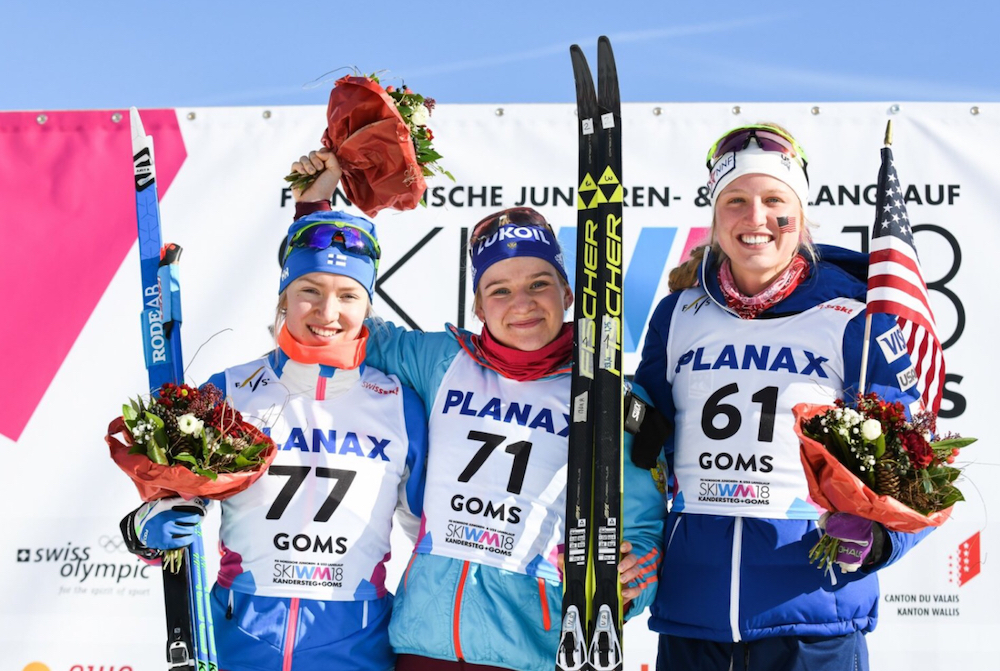
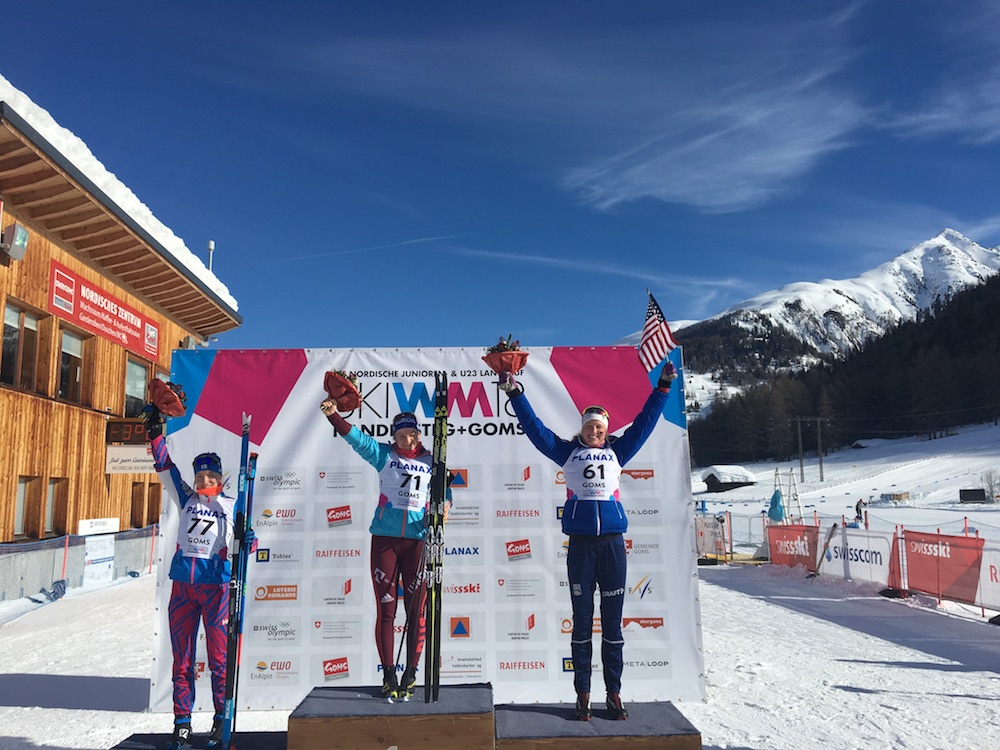
    The women’s 5 k classic podium at 2018 Junior World Championships in Goms, Switzerland, with American Hailey Swirbul (r) in second, Russia’s Polina Nekrasova (c) in first, and Finland’s Anita Korva (l) in third. (Photo: JWSC2018.ch)

    (This article has been updated to reflect that American Hailey Swirbul was in second for most of Tuesday’s 5 k race, not over one minute back as previously reported based on a live timing error. It has also been updated to include comments from Americans Hailey Swirbul, Ben Loomis, Stephen Schumann, and Gus Schumacher, Canada’s Antoine Cyr, University of Alaska Anchorage nordic head coach Andrew Kastning, and U.S. Ski Team Development Coach Bryan Fish.)

    Junior World Championships (Goms, Switzerland): 5/10 k classic

    Hailey Swirbul became the second American cross-country skier to earn an individual medal at Junior World Championships and first to take silver (Katharine Ogden claimed bronze in last year’s skiathlon) in the women’s 5-kilometer classic individual start on Tuesday in Goms, Switzerland.

    Swirbul, a 19-year-old University of Alaska Anchorage sophomore, also tallied the best American finish at a Junior/U23 World Championships since Jessie Diggins earned silver in 2014 in the freestyle sprint. It was Swirbul’s second medal the last two Junior Worlds after she teamed up with Hannah Halvorsen, Julia Kern, and Ogden to take bronze in last year’s relay.

    Going into this week’s championships, Swirbul, a Colorado native, explained she was aiming for a top 10 in one of the distance races. U.S. Ski Team Development Coach Bryan Fish pointed out that she wasn’t sure she’d feel up to racing on Tuesday.

    “She had been feeling under the weather so she didn’t come up and ski yesterday,” Fish said on the phone Tuesday. “It was a little bit of a shock to Hailey herself that she skied so fast because there was some contemplation of whether she would race or not.”

    “I made it a goal to stay relaxed and ski the race I would ski in a lower pressure race,” Swirbul wrote in an email. “I often find that I, and others, change their good race habits when at a high pressure event, so I was hoping to pace the race evenly and not start out too fast.

    “The key for interval starts for me is to only think about skiing smoothly and powerfully for the first few kilometers of the race, and I’ve been discovering that that usually leads to decent splits throughout my race,” she continued.

    She ended up racing to second place on Tuesday in the second race of 2018 Junior World Championships. The 61st starter (out of 84), Swirbul skied in second for most of the race, just behind Russia’s Polina Nekrasova, according to Fish.

    “She was basically tied for second and really had a strong second half of the course, and really skied solid in particular the last kilometer,” Fish said. “Always in the top five for sure, and well within striking distance [of the podium].”

    The women’s 5 k classic podium at 2018 Junior World Championships in Goms, Switzerland, with American Hailey Swirbul (r) in second, Russia’s Polina Nekrasova (c) in first, and Finland’s Anita Korva (l) in third. (Photo: Bryan Fish)

    She initially crossed the finish line in first place, more than a minute faster than the previous race leader. Her time remained faster than all but one of the women who started behind her — as Russia’s Polina Nekrasova (bib 71) took the win in 13:58.7 minutes, 14.4 seconds ahead of Swirbul.

    Finland’s Anita Korva started 77th and finished third, 25.4 seconds out of first.

    The Czech Republic’s Barbora Havlickova (bib 81) followed in fourth (+26.8), and Norway’s Kristine Stavås Skistad (bib 67) finished fifth (+31.9), and France’s Laura Chamiot-Maitra (bib 83) placed sixth (+34.9).

    “… I honestly had no idea I was in the running for the podium during my race, because about 20 girls had yet to finish, so it wasn’t until the last girls came in that I knew I claimed a spot!” Swirbul wrote.

    “It was a special moment when I ran down off of the course and I knew her split,” Fish said of Swirbul’s finishing time. “I knew she was sitting in second and they kept announcing and kept announcing, and I told her, ‘You will be second today,’ and it was kind of a combination facial expression of shock and elation. She really couldn’t believe it, but [I said], ‘You’ve got a big enough gap over third place and no one’s catching you.’

    “It’s our best Junior Worlds result ever,” Fish added. “Last year was the first individual medal we had ever won or team medal at Junior Worlds and to follow that up with a silver is incredible.

    “She was obviously on our podium relay last year, but she came in from U.S. nationals skiing well, qualified very high and she skied incredibly well today,” he explained. “Very fluid stride and did a great job shifting gears and doing a bit more running during the second half of the course.”

    “The result hasn’t hit me yet,” Swirbul wrote. “It was beyond what I expected, so my brain is still catching up to the reality! I’ve been dreaming of racing how I know I could for the past 3 years or so, and this season has finally been my chance to break through. I’m so fortunate that things aligned for me on the day that really counted. I couldn’t have done it without Bryan Fish’s unwavering belief in us athletes, and my mom and dad’s support all these years, of course.”

    Fish emphasized that while snow conditions have been “very, very good” and “very stable” in Goms, which received 1 1/2 meters (nearly 5 feet) of snow a week and a half ago, the waxing had been a bit challenging due to a temperature range of around -9 degrees to 5 degrees Celsius each day.

    “I’m sure there were some teams on klister, some on klister covered with hard wax,” he said of Tuesday’s classic race. “Our techs did a really good job and they were clever with what they came up with when I heard what they were trying. … They’ve been right in the ballpark the last few days and I think they really dialed it in today, and it was impressive kick and glide. To get a podium you ned to have everything going right and I definitely think we had the skis in our favor.”

    Halvorsen was the second-best American in 22nd on Tuesday, 1:10.1 out of first, Kathleen O’Connell finished 38th (+1:33.5) and Hannah Rudd was 59th (+2:24.1).

    Canada’s Natalie Hynes placed 36th (+1:30.5), Hannah Mehain was 45th (+1:53.3) and Annika Richardson was 67th (+2:53.7). Catherine Reed-Metayer did not finish.

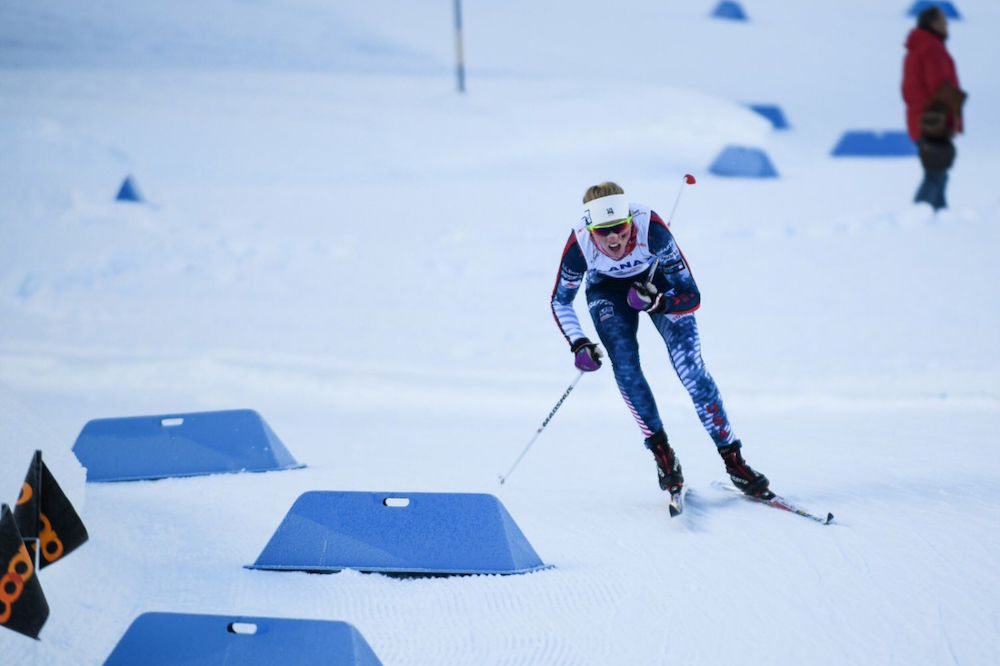
    Hailey Swirbul (University of Alaska Anchorage) navigating a downhill while racing to second place in the women’s 5 k classic at 2018 Junior World Championships in Goms, Switzerland. (Photo: JWSC2018.ch)

    Andrew Kastning, head coach of the University of Alaska Anchorage (UAA) nordic team, stayed up late the night before Alaska time to watch three UAA skiers (Swirbul, Rudd and Hynes) race on the Junior World Championships livestream.

    “Hailey has made classic technique a priority since she stepped on UAA’s campus because that’s where she had the most potential for gain,” Kastning wrote in an email on Tuesday. “She has been working hard on a more powerful and smooth stride on the uphills while getting over elbow pain when double poling. The course looked like it played well to her strengths and that strategy.

    “I saw one clip of her entering the big climb and could see that she was relaxed and striding really well,” he continued. “I knew then she was going to have a really good race.”

    He noticed that the course had some intimidating downhills and corners, but he knew Swirbul wouldn’t have a problem navigating them.

    “Hailey has a solid alpine skiing background and I figured if anyone would be willing to straight line the descents and flatten the corners then a massive amount of time could be saved,” Kastning wrote. “Hailey must have done that because she put 47 seconds on a Russian she was tied with at the high point. I was sort wondering if I was dreaming at moments and had to refrain from yelling and screaming because I’d wake up three daughters and a wife if I did. What a night, what a day. Seawolf Nation and USA are very proud this morning.”

    Ogden 7th, Cyr 12th

    In the men’s 10 k classic that followed, the excitement continued for Team USA, with 17-year-old Ben Ogden, of the Stratton Mountain School, racing to seventh in his Junior World Championships debut.

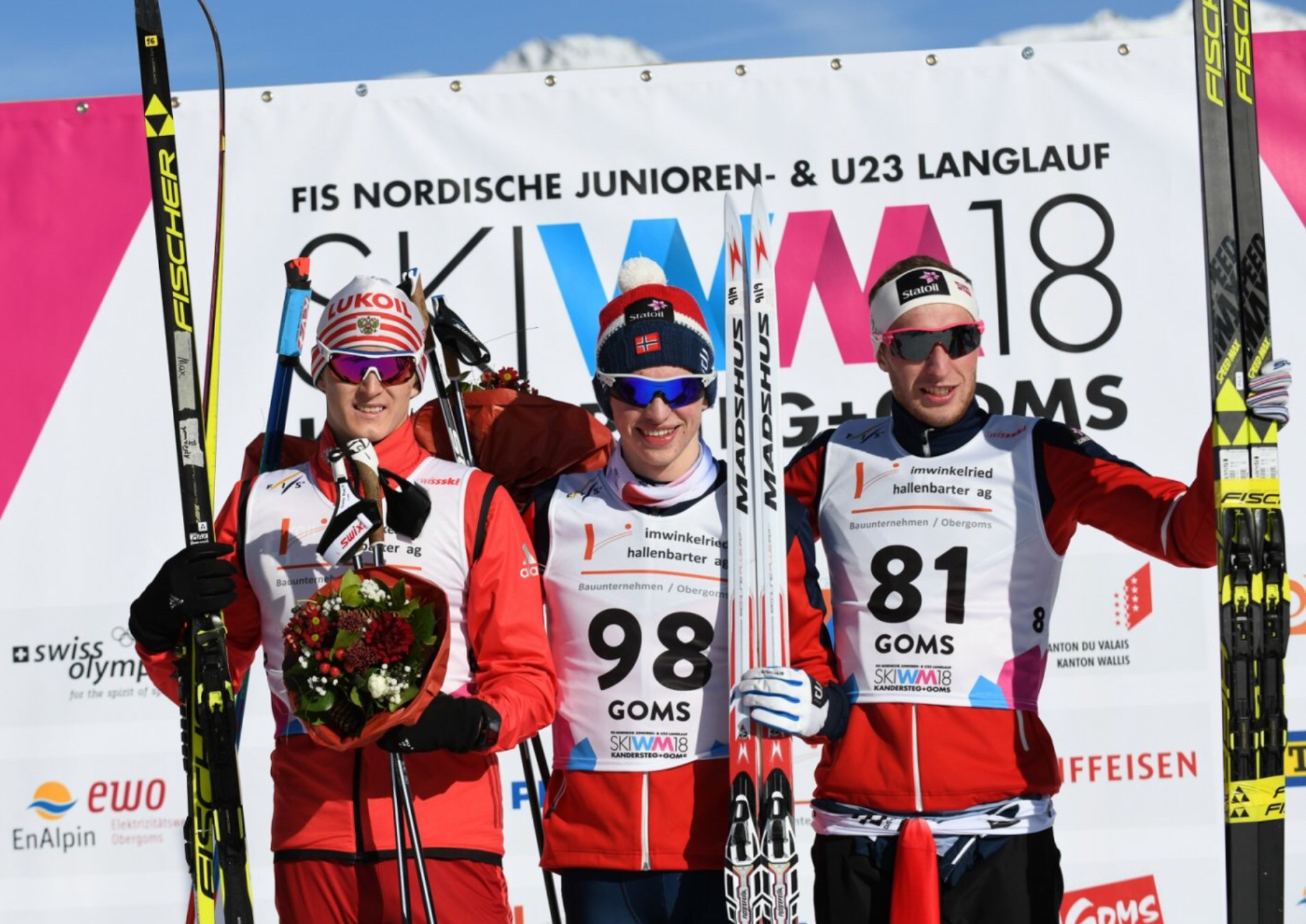
    The men’s 10 k classic podium at 2018 Junior World Championships in Goms, Switzerland, with Norway’s Jon Rolf Skamo Hope (c) in first, Russia’s Sergey Ardashev (l) in second and Norway’s Jørgen Lippert (r) in third. (Photo: JWSC2018.ch)

    Ogden started 72nd and crossed the finish line in first, 16.6 seconds faster than previous race leader Alexander Terentev of Russia. Six later starters ultimately bumped Ogden to seventh, and Norway’s Jon Rolf Skamo Hope took the win in 24:58.8, 40.5 seconds ahead of Ogden.

    Russia’s Sergey Ardashev placed second, 9 seconds back, and Norway’s Jørgen Lippert reached the podium in third (+27.9). Norway put four in the top five and Russia had two in the top six, making Ogden the first non-Norwegian or non-Russian male finisher on the day.

    According to race splits, Ogden skied an extremely consistent race, clocking the eighth, ninth or 10th fastest times throughout the 10 k.

    Canada’s Antoine Cyr placed 12th (+1:07.7) in the second race of his career at Junior World Championships. Two days ago, he finished 30th in the freestyle sprint. Cyr, 19, started 78th and also skied a consistent race, hanging mostly within the top 12 throughout it.

    “I knew that classic 10 km was good race for me,” Cyr wrote in an email. “On a good day I was hoping for top 30 but the course was hard and I knew that if I played it smart and paced myself I would be happy with my race.”

    He focused on skiing powerfully on his first lap, with big strides and strong double poling, and tried to attack the A-climb and “punchy climb towards the end of the loop” on the second and last lap.

    “A top 12 for us in Canada means a lot and with a 25th place in the [skate sprint qualifier] and a 12th place today I think it makes me realize that I have my place on the world level scene,” Cyr wrote. “… This race was a good redemption after my crash in the sprint. I am really happy with the results !!”

    Gus Schumacher notched his second top 20 of the week in 17th (after placing 19th in the skate sprint), finishing 1:19.1 out first first, Hunter Wonders placed 22nd (+1:39.1), and Canyon Tobin was 37th (+2:17.2) for the U.S.

    In an email, Schumacher, of Alaska Winter Stars, explained he had been aiming for a top 10.

    “For this race I really focused on keeping the first quarter super relaxed and then picking it up after that,” he wrote of his pacing. “During the race I felt like I raced the first lap well but somewhere on the second lap I must’ve pushed just a little too hard and gone over my threshold, because I really faltered in the middle of that one on the big sprint hill. Other than that I felt like I skied the flats and most of the gradual uphills well, especially before 7.5k.”

    Overall he added that he was “fairly satisfied … but I know that I can do better and that kind of hurts me. I just didn’t feel like I had the spark that I normally have towards the end of a race like this.” Moving forward, he had similar goals for the skiathlon and was excited for the relay.

    Canada’s Etienne Hebert finished 44th (+2:42.3), Ty Godfrey was 57th (+3:29.5), and Felix Longpre 58th (+3:29.7) out of 96 finishers.

    “It’s really exciting when you look at our day in general,” Fish noted. “We had two young boys with 2000 birth years; there was only three boys in the top 40 that had a 2000 year of birth and we had two. … That’s just really exciting for U.S. skiing in general, that we have athleetes showing up not just to participate, but to really perform.”

    Results: Women | Men

    ***

    The men’s individual normal hill/10 k Gundersen podium at the first Day of Nordic Combined Junior World Championships in Kandersteg, Switzerland, with American Ben Loomis (r) in third, the Czech Republic’s Ondrej Pazout (c) in first, and Norway’s Einar Lurås Oftebro (l) in second. (Photo: Josh Parker)

    Nordic Combined Junior World Championships  (Kandersteg, Switzerland): Normal hill/10 k Gundersen

    In the first competition of 2018 Nordic Combined Junior World Championships in Kandersteg, Switzerland (about 75 kilometers west of Goms), American Ben Loomis achieved the first podium of his career in his fifth Junior Worlds (counting his first in straight-up ski jumping), racing to third in the individual normal hill/10 k Gundersen on Tuesday.

    Ben Loomis (USA Nordic) jumping to seventh on Tuesday at 2018 Nordic Combined Junior World Championships in Kandersteg, Switzerland. He went on to place third in the 10 k for his first Junior Worlds medal. (Photo: Josh Parker)

    Loomis, a 19-year-old U.S. Nordic Combined national team member who grew up in Wisconsin, was recently selected to compete at his first Olympics next month in PyeongChang, South Korea. In an email, Loomis explained he found out just over a week ago, which motivated him to compete at a high level, but it didn’t change his plans or goals for his last Junior Worlds.

    “My focus of the winter has always been the Junior World championships so my Olympic nomination has not changed my training in the last few weeks,” he wrote. “Going into this week, and for the last 2 years now my goal was always a podium finish.”

    He started out Tuesday by jumping to seventh on the 106-meter “normal” hill, then started the 10 k race 38 seconds out of first.

    “The hill here in Kandersteg is very new which is nice because it feels similar to other modern jumps,” Loomis explained. “I was satisfied with my competition jump but not 100% happy. There are still a few things I need to fix on the technical side of my jumping.”

    The Czech Republic had the two best jumpers on the day, with Ondrej Pazout leading after the jump portion, followed by his teammate Jan Vytrval in second. Pazout started the 10 k with an 11-second head start on Vytrval and ended up holding off his challengers to secure gold, finishing first in 22:58.3. Norway’s Einar Lurås Oftebro raced from 10th after the jump to second at the finish, just 2.3 seconds behind Pazout, with the second-fastest 10 k time.

    Loomis passed four skiers to finish third, 8.3 seconds out of first, with the third-fastest time. Norway’s Johannes Lamparter slipped from third to fourth overall (+16.2), and Vytrval finished fifth (+21.6).

    “I knew with a good race a podium was still possible from 38 seconds back,” Loomis wrote. “The track here is really tough with technical decent which leaves good opportunity to make up time.”

    Working within a group, he caught up to third place on the first of four laps and was up to second on the second lap.

    American Ben Loomis (7) racing with Norway’s Einar Lurås Oftebro (l) during the 10 k Gundersen on Tuesday at 2018 Nordic Combined Junior World Championships in Kandersteg, Switzerland. Loomis went on to finish third for his first Junior Worlds medal and Oftebro placed second. (Photo: Josh Parker)

    “We had 5 or 6 guys in this group and on the 3rd lap I took the lead,” Loomis explained. “Towards the last hill on the 4th lap, I made a move alongside Einar Oftebro. Einar was strong on the last stretch and able to beat me as well as almost catching the leader Ondra.

    “Taking a step on the podium was an excellent feeling today,” he added. “I have been working very hard, especially towards this specific race for a long time now. Accomplishing this is a huge relief and very motivating for the future.”

    The U.S. had two in the top 15 with Stephen Schumann in 13th (+1:29.1). Schumann was 29th after the jump and started the 10 k 1:47 out of first, then posted the fifth-fastest course time to pick off 16 places.

    “Going into today I was really just hoping to put together a solid jump and a good race and hopefully finish within the top 10 like last year,” Schumann wrote in an email. “Unfortunately I did not have the jump I was hoping for. I was about 1 meter late off the end of the take off, taking away some of the power and height that my legs otherwise would have given me. Luckily the conditions on the hill were pretty consistent today so I knew about where I would be standing after jumping going into the race.”

    Given his starting position, he believed a top 15 was within reach. He ended up catching Italy’s Aaron Kostner, who started 27th, and the two worked together to catch one group after another.

    “I felt pretty good but he got me on the last lap,” Schumann wrote of Kostner, who finished about 20 seconds ahead of him in 11th place. “But over all it was a pretty good race and I finished with the 5th fastest time. Behind Aaron with the 4th fastest.

    “Overall I feel that had I had a little bit better jump on the hill I could have contended for a top 10 maybe top 5 but was happy with my race and my 13th place finish,” he added. “Coming across the line I was pretty sure Ben had finished in the top 5 at least, as I could see him going up the last hill as I was staring down it. But when I actually crossed the line and saw him I could tell he had gotten to the podium and I was psyched for him, went and gave him a hug and congratulated him.”

    Looking ahead to the rest of the week, Schumann’s hoping for a medal in the 4 x 5 k team event.

    “And personally I hope to finish in the top 10 in the 5km race with a better jump and another solid race,” he wrote.

    Also for the U.S., Jared Shumate placed 35th (+4:06.3), up from 49th in the jump, and Tucker Hoefler was 51st (+6:37.4), up from 53rd.

    Results: Jumping | Final

  • Halvorsen Eighth to Lead U.S. in World Juniors Sprint, Canada’s Ritchie 12th

    Halvorsen Eighth to Lead U.S. in World Juniors Sprint, Canada’s Ritchie 12th

    Moa Lundgren celebrates winning her first World Junior Championship after skating away from the field in the sprint in Ulrichen, Switzerland. (Photo: JWSC2018.ch)

    (Note: This article has been updated to include comments from American Hannah Halvorsen.)

    2018 World Junior Championships is off and running and two brand-new champions have been crowned. Moa Lundgren of Sweden took the women’s skate sprint title while the men’s final went to Tom Mancini of France.

    On a perfect blue-sky day nestled deep in the Swiss Alps, the world’s best skiers under the age of 20 raced around a hilly sprint course with a few wicked corners. There were broken poles and pole-tosses; crashes; and a men’s final decided by just a tenth of a second.

    “The competition was really high, and it was super cool to see so many high level skiers,” U.S. skier Gus Schumacher (Alaska Winter Stars) wrote in an email. “Nothing surprised me too much. I think it raced about as I expected, with even those crazy corners not being too unfair… my previous U18 trips and nationals races have exposed me to a big variety of tactics, so nothing was really new for me here.”

    The narrow margin of the men’s final saw Mancini nip Norway’s Jørgen Lippert at the line.

    “A very good race, I am very happy,” Mancini said in a TV interview after the race. “It’s a very good fight with the Norwegian and the Swiss. I am very happy. Sorry, I don’t speak English very good. I thank my family, my friends, and my coach. Voila.”

    Third place went to Valerio Grond of Switzerland, who qualified in 21st position but skied aggressively to win his semifinal before landing on the final podium.

    The results of the women’s final were somewhat delayed as Finland filed a protest, saying that third-place Frida Karlsson had obstructed Anita Korva, who ended up fourth. But the podium did not change. Lundgren had claimed a big win over Kristine Stavås Skistad of Norway.

    Both the U.S. and Canada had a representative in the semifinals. For the U.S., Hannah Halvorsen (U.S. Ski Team/APU) qualified in fifth and then finished second in her quarterfinal, earning an automatic spot into the semis.

    Once there, Halvorsen skied in third or fourth for much of the heat. Rounding the final corners she was still in fourth position and though she kept pushing, she couldn’t make up any ground on the women ahead of her. She ended the day in eighth, an improvement of a few places from her 11th-place result in the classic sprint at last year’s World Junior Championships in Utah.

    “The skate sprint was my target race this year,” Halvorsen, 19, explained in an email. “My goal was to podium and I believed if everything went according to plan I was capable. I felt healthy and fit, my skis were fast, my mind was in the right place, but I didn’t make it happen. It is easy to mull over tactics and strategies and ‘what if’ situations, but I think the truth is that there are a lot of girls here that are just as fast, fit, prepared, and motivated as me, and I think some of them were sincerely better than me today. Even though I didn’t reach my goal, I feel proud to compete against the best girls my age and be right in the mix.”

    She explained that she was excited about her strong qualifier. “It gives me a chance to see where I fall on an international stage,” Halvorsen wrote. “The top girls my age are starting to bridge the gap between world juniors and world cup, and I hope this qualifier gives me some idea of how much I need to improve to be fast enough to make world cup heats. Even though the top girls are faster than me, I can feel myself improving and getting closer.

    “I had a lot of fun having the opportunity to race and feel good in the sprint,” she added. “One of the takeaways from this race was realizing how important it is to keep improving and to never settle. I am excited to build on this result and hopefully be stronger and faster next year. But right now, I mostly look forward to more racing this week and season.”

    In the men’s field, Canada’s Graham Ritchie raced an impressive tactical quarterfinal. Qualifying in 25th, he was pushed to the back of his heat early thanks to taking the last choice of starting lanes.

    “I’d say it was intentional that I stayed at the back,” Ritchie explained in an email. “I knew if I was going to have any chance, it would be to just hold onto the pack for as long as possible and then see where it would go in the end from there.”

    Ritchie maneuvered his way towards the front and by the time the men hit the finishing stretch, he was speeding up and moved from fourth to second. A Russian athlete who had been among the leaders early in the heat crashed, leaving an extra opening.

    “I was in fourth at the time when he fell and he was in front of me, so this had a pretty big impact on my result depending on how fast he would’ve been in the finishing stretch,” Ritchie wrote.

    But regardless, Ritchie advanced to the semifinals, where he finished sixth in his heat for 12th overall.

    “I was pretty shot for the second half of the [semifinal] and couldn’t hang on to the pack, but it was an amazing experience and lots of fun!” Ritchie wrote. “I was stoked to have made the semi’s and was happy with outcome! My main goal for today most importantly was to qualify. My stretch goal for the day was to make semis and get a top 12. Finishing in 12th place was a really incredible and eye-opening experience. I’m still trying processing it, the feeling of accomplishing this goal feels amazing and I am so thankful for this opportunity!”

    “Great day for Graham today,” Ritchie’s coach at NTDC Thunder Bay, Timo Puiras, wrote in an email. “We were not expecting a top-12 result but it isn’t necessarily a surprise either… This result is definitely a big deal for Graham and the NTDC Thunder Bay program. The TBay program has had several athletes the past few years who I feel have the capacity for this kind of result so it feels great when it all comes together to happen. This result should serve as fuel for our other athletes to find the confidence to also have similar success.”

    Schumacher of the United States was also in Ritchie’s quarterfinal, and ended up fourth in the heat and just over two-tenths of a second away from a lucky loser spot in the semifinals. But he did not advance and ended up 19th on the day.

    “I was pretty confident in my speed,” Schumacher wrote in an email. “I knew that an eight second gap [in the qualifier] was small enough to be competitive in heats. My strategy was to just hang on up the first big hill and try to save my energy, then really punch it on the second hill. That strategy in my heat worked out pretty well. I thought I was a little too far back after the first hill, but I was able to come back and I had energy to really sprint up the end of the second hill.”

    Canada’s Antoine Cyr, also qualified for the heats, and had a spectacular wipeout in his quarterfinal and ended up 30th after qualifying in 25th.

    “I know that normally in the heats I am better [than in qualifying] and with the tight gap between all the juniors in the qualifier, it would give me a slight chance to go through,” Cyr wrote in an email. “On the top [of the first hill] I was in fourth place, right on their heels, but on the last uphill i got boxed in a little bit and could not accelerate fast enough. I found myself in fifth place. I went for it on the last corner knowing that I was taking a risk, and I crashed. I am bit bummed by the end of the day, but still really happy with a top 30. A first top-30 for me against the best in the world! I am not injured, just a couple of bruises – that snow was pretty hard packed, I can tell you!”

    In the junior men’s sprint, Canada’s Reed Godfrey finished a tough 31st, just 0.21 seconds out of making the quarterfinals. Etienne Hebert rounded out the Canadian finishers in 36th place (+11.81) in the qualifier.

    “Our entire Junior Mens team definitely have the ability to qualify in the top-30 and after that it came down to good tactics and good finishing speed to move through the quarters,” Puiras wrote. “The Canadian team was super pumped with the results today and are in great spirits. It was a great way to start the championships. We are looking for more great results this coming week.”

    Canyon Tobin was 41st in qualification for the U.S. (+13.46), followed by Karl Schulz in 54th (+16.90) and Luke Jager in 60th (+18.15).

    In the junior women’s race, both Margaret Gellert and Sofia Shomento of the U.S. made the quarterfinals but failed to advance, finishing 18th and 23rd. Teammate Hannah Rudd finished 35th in qualification, +18.15.

    For Canada, Annika Richardson finished 52nd (+24.09), Catherine Reed-Metayer 56th (+28.25), and Alexandra Racine 69th (+37.27).

    — Harald Zimmer and Alex Kochon contributed

    Results: men’s qualifier | women’s qualifier | men’s final | women’s final

  • Sunday Rundown: Seefeld, Goms, Ridnaun, Craftsbury

    Sunday Rundown: Seefeld, Goms, Ridnaun, Craftsbury

    US Biathlon’s Lowell Bailey (l) and Susan Dunklee after teaming up for bronze in the single mixed relay at 2018 IBU Open European Championships on Sunday in Ridnaun, Italy. (Photo: Manzoni/NordicFocus)

    IBU Open European Championships (Ridnaun-Val Ridanna, Italy): Single mixed & mixed relays

    Susan Dunklee and Lowell Bailey teamed up for the final day of the 2018 International Biathlon Union (IBU) Open European Championships in Ridnaun, Italy, and raced to a bronze medal in the single mixed relay.

    The American duo, both of which earned individual medals at last year’s IBU World Championships, finished just 9.1 seconds out of first, which went to Norway’s Thelka Brun-Lie and Vetle Sjåstad Christiansen. The Norwegians won in 35:39.6 with zero penalties and six spares. They took the lead after Brun-Lie’s second leg, where she cleaned both stages without spares.

    France placed second, 8.6 seconds back, with Julia Simon and Emilien Jacquelin, who combined for no penalties and 11 spares. They led the first half of the race, but slipped to second behind Norway on Simon’s second leg.

    Dunklee put the Americans off in second on her first leg, which she cleaned with a spare in each stage, then they slipped one place to third on Bailey’s first leg, where he cleaned as well and used three spares. In all, they used 10 spares and avoided the penalty loop, and finished half a second out of second place.

    “Over Christmas, we trained a little bit with the French athletes, including Jacquelin,” Bailey said, according to a US Biathlon press release. “So I know that he has quite a fast finish, and I thought I am kind of an old man here, I should maybe try to go harder on the first part of the lap. But he stayed with me all the time and had me in the end.”

    “It was a good opportunity to tune up the race shape, build some confidence and find that sharp feeling heading into the Olympics,” Dunklee told US Biathlon. “The single mixed relay is one of my favorite race formats and today was a blast!”

    Canada’s Sarah Beaudry and Carsen Campbell placed eighth of 24 teams in the single mixed relay, finishing 1:03.6 out of first with just eight spares and zero penalties. In 11th after the first leg, they moved into eighth on Campbell’s first leg, which he cleaned with one spare. Beaudry then cleaned her second leg without any spares, and Campbell anchored them to eighth.

    The U.S. entered a team in the mixed relay that followed, with Chloe Levins, Deedra Irwin, Paul Schommer, and Alex Howe placing 17th (+5:55.5) of 19 teams with no penalties and 12 spares.

    Ukraine won the mixed relay to conclude the championships, with Yuliia Zhuravok, Iryna Varvynets, Artem Pryma, and Dmytro Pidruchnyi combining for zero penalties and six spares and finishing in 1:11:40.1.

    Russia placed second (+11.7) with Victoria Slivko, Anastasia Zagoruiko, Evgeniy Garanichev, and Alexander Loginov combining for zero penalties and nine spares.

    Norway followed in third (+33.2) with Emilie Ågheim Kalkenberg, Kaia Wøien Nicolaisen, Håvard Gutuboe Bogetveit, and Fredrik Gjesbakk combing for no penalties and just four spares.

    Results: Single mixed relay | Mixed relay

    ***

    U.S. SuperTour (Craftsbury, Vermont): 5/10 k freestyle

    Two Alaska Pacific University (APU) athletes topped the podium on Sunday at the SuperTour in Craftsbury, Vermont, with David Norris winning the men’s 10-kilometer freestyle individual start in 21:54.9 and Becca Rorabaugh topping the women’s 5 k freestyle in 12:06.4.

    Norris won the men’s race by 6 seconds over Canada’s Andy Shields (Lappe Nordic) and Kevin Bolger of the Sun Valley Ski Education Foundation (SVSEF) placed third (+15.8). Kris Freeman (Caldwell Sport) was the third American in fourth overall (+23.7), and three Canadians took fifth through seventh with Michael Somppi (Lappe Nordic) in fifth (+27.9), Evan Palmer-Charrette (NTDC Thunder Bay) in sixth (+37.5) and Scott Hill (Barrie Cross Country) in seventh (+37.6), ahead of Brian Gregg (Team Gregg/LNR/CXC) in eighth (+39.4), Tad Elliott (Ski Club Vail) in ninth (+44.3) and Jack Hegman in 10th (+50.4).

    Rorabaugh won the women’s race by just 2.2 seconds over her APU teammate Rosie Frankowski in second, and Erika Flowers of the Stratton Mountain School (SMS) T2 Team placed third (+4.6). Two Craftsbury Green Racing Project (CGRP) skiers finished fourth and fifth, with Kaitlynn Miller in fourth (+12.1) and Liz Guiney in fifth (+22.5), Kelsey Phinney (SVSEF) was sixth (+25.8), and Canadians Olivia Bouffard-Nesbitt (Rocky Mountain Racers) seventh (+26.4) and Frederique Vezina (Pierre-Harvey National Training Centre) eighth (+36.0). Corey Stock, of the Bridger Ski Foundation (BSF) placed ninth (+39.9), and Felicia Geisor (CXC Team) was 10th (+44.4).

    On Saturday, the Craftsbury Outdoor Center hosted its 37th annual Craftsbury Marathon, with Nils Koons winning the 48 k men’s race in 2:28:51.0 hours and Hannah Dreissigacker winning the 48 k women’s race in 3:01.48.7.

    Results: Men’s 10 k | Women’s 5 k 

    Marathon (non-SuperTour) results

    ***


    Hannah Halvorsen of the U.S. Ski Team and APU on the start line in Ulrichen, Switzerland, after finishing fifth in the sprint qualifier. (FIS screencap)

    FIS Cross Country World Junior Championships (Ulrichen, Switzerland): Freestyle sprints

    Full report

    World Junior Championships kicked off today with freestyle sprints in Ulrichen, Switzerland. Moa Lundgren of Sweden claimed with women’s title by 1.89 seconds over Kristine Stavås Skistad of Norway in the final, with Sweden’s Frida Karlsson finishing third (+1.89).

    Hannah Halvorsen of the United States qualified in fifth place before skiing to second in her quarterfinal heat. Halvorsen hovered around third or fourth place through much of her semifinal and was unable to snipe any spots in the finishing straight, ending up fourth in the heat and eighth on the day.

    Fellow Americans Margaret Gellert and Sofia Shomento also made the quarterfinals, finishing 18th and 23rd, and Canada’s Hannah Mehain wound up 29th on the day.

    The new men’s junior world champion is Tom Mancini of France, who nipped Norway’s Jørgen Lippert by just 0.10 seconds to take the win. Valerie Grond gave the Swiss crowd a thrill by making it all the way to the final and taking home bronze, despite qualifying in just 21st position. The Swiss junior narrowly edged France’s Vincent Buiatti for the final step on the podium.

    Canada’s Graham Ritchie finished second in his quarterfinal after qualifying in 28th position, earning an automatic spot in the semifinals. There he finished sixth (+9.30 behind Mancini), winding up 12th on the day. Teammate Antoine Cyr also made the quarterfinals where he had an impressive crash, slinging off the trail and into the infield, finishing 30th on the day. For the U.S., Gus Schumacher was the lone qualifier for the heats. He finished fourth in his quarterfinal and was just 0.22 seconds away from a “lucky loser” spot in the semifinals. Schumacher finished 19th on the day.

    In the junior women’s race, Hannah Rudd of the United States finished 35th in qualification, +18.15. For Canada, Annika Richardson finished 52nd (+24.09), Catherine Reed-Metayer 56th (+28.25), and Alexandra Racine 69th (+37.27).

    In the junior men’s sprint, Canada’s Reed Godfrey finished a tough 31st, just 0.21 seconds out of making the quarterfinals. Etienne Hebert rounded out the Canadian finishers in 36th place (+11.81) in the qualifier. Canyon Tobin was 41st in qualification for the U.S. (+13.46), followed by Karl Schulz in 54th (+16.90) and Luke Jager in 60th (+18.15).

    Results: men’s qualifier | women’s qualifier | men’s final | women’s final

    ***

    FIS Nordic Combined World Cup (Seefeld, Austria): Individual normal hill/15 k

    Japan’s Akito Watabe after winning the 2018 Seefeld Triple Nordic Combined World Cup. He is the only athlete besides Germany’s Eric Frenzel to win the event. (Photo: FIS Nordic Combined)

    On the final day of the Seefeld Triple, Japan’s Akito Watabe completed his sweep of the three-day weekend and Norway’s Jarl Magnus Riiber reached the podium for the third-straight day, placing second. Germany’s Fabian Rießle placed third for his second podium in the last two days.

    Watabe jumped to first on the normal hill and started the 15 k Gundersen 48 seconds ahead of Riiber in second. He went on to win the race by 1:14.9 minutes in 34:58.6, becoming the only man besides Germany’s Eric Frenzel to win the Seefeld Triple in its five-year history.

    After jumping to fifth, Rießle won a photo finish for third (+1:57.9), edging Germany’s Vinzenz Geiger by less than a tenth of a second. Geiger moved up from ninth in the jump to fourth overall (+1:57.9).

    Norway’s Jørgen Graabak followed in fifth (+2:02.4), Frenzel placed sixth (+2:07.4), Norway’s Jan Schmid was seventh (+2:09.8), Finland’s Eero Hirvonen eighth (+2:13.5), Norway’s Espen Andersen ninth (+2:28.0), and Austria’s Mario Seidl 10th (+2:42.1) out of 28 finishers.

    No Americans contested the final day of the Triple, the last World Cup before the 2018 Winter Olympics in PyeongChang, South Korea.

    Results: Jumping | Final

    ***

    Jessie Diggins of the U.S. Ski Team (center) celebrates after winning the 10 k mass start freestyle in Seefeld, Austria, over Heidi Weng (left) and Ragnhild Haga of Norway. (Photo: FIS Cross Country/Twitter)

    FIS Cross Country World Cup (Seefeld, Austria): 10/15 k mass start freestyle

    Women’s report

    Men’s report

    In the final World Cup race before the 2018 Olympics, Jessie Diggins achieved the ultimate goal to give herself the utmost confidence heading into PyeongChang — winning the women’s 10-kilometer freestyle mass start at the World Cup in Seefeld, Austria, on Sunday.

    The win was her first of the season and fourth individual victory of her career. Diggins, a 26-year-old U.S. Ski Team member, pulled it off by attacking on a long climb and leaving Norway’s Heidi Weng, Ragnhild Haga and Ingvild Flugstad Østberg chasing. While Diggins was several seconds ahead over the top and all alone on the long descent that followed, Weng and Haga worked to close the gap — and nearly did in the finishing stretch. But Diggins held them off, winning by 0.7 seconds over Weng in second place and 1 second ahead of Haga in third, and threw her fists down in celebration as she crossed the line first in 23:08.5 minutes.

    “I just put my head down and it wasn’t pretty, but I just hammered,” Diggins told the International Ski Federation (FIS) in a televised post-race interview.

    She was the only non-Norwegian in the top five, with Østberg in fourth (+8.7) and Marit Bjørgen in fifth (+16.7). Austria’s Teresa Stadlober placed sixth (+16.9), Norway’s Kari Øyre Slind was seventh (+19.1), and American Sadie Bjornsen placed eighth (+20.5), ahead of Switzerland’s Nathalie von Siebenthal in ninth (+30.3).

    The U.S. had three in the top 15 with Kikkan Randall (U.S. Ski Team) in 14th (+48.5), and two more women in the top 30, with Caitlin Patterson (Craftsbury Green Racing Project) in 23rd (+1:00.7) and Liz Stephen (USST) in 29th (+1:18.2). Rosie Brennan (USST) finished 53rd (+2:26.9).

    Emily Nishikawa led the Canadians in 35th (+1:36.5), followed closely by teammate Cendrine Browne in 37th (+1:36.6). Dahria Beatty finished 45th (+1:58.9).

    Women’s Results

    Dario Cologna of Switzerland (center) won the men’s 15 k skate mass start in Seefeld, Austria, over Alex Harvey of Canada (left) and Martin Johnsrud Sundby of Norway (right). (Photo: FIS Cross Country/Twitter)

    The Olympics are nearing and so Switzerland’s Olympic legend Dario Cologna is ramping up: after winning the Tour de Ski, he took another win in the 15 k mass start skate in Seefeld, Austria, on Sunday.

    With much of the field staying relatively close together until the finish, Cologna nabbed the win by 1.4 seconds over Canada’s Alex Harvey, who took his second podium of the season in addition to also finishing third in the overall Tour de Ski.

    Norway’s Martin Johnsrud Sundby was third (+2.9), then teammate Didrik Tønseth in fourth (+5.9) and France’s Maurice Manificat in sixth (+7.5).

    The U.S. Ski Team’s Erik Bjornsen had a breakthrough day finishing ninth (+9.3), followed by Simi Hamilton in 12th (+12.4). Behind them, Scott Patterson placed 27th (+23.4), then Patrick Caldwell 49th (+1:26.2), Ben Lustgarten 55th (+1:42.7), and Tyler Kornfield 77th (+3:00.0).

    Canada’s Devon Kershaw and Graeme Killick finished 30th (+26.5) and 31st (+27.4), respectively. Len Valjas placed 58th (+1:53.1), Knute Johnsgaard 82nd (+3:23.1), Bob Thompson 87th (+4:27.5), and Julien Locke 92nd (+4:56.9).

    Men’s Results

  • Wednesday Rundown: SuperTour Finals Skate Sprints
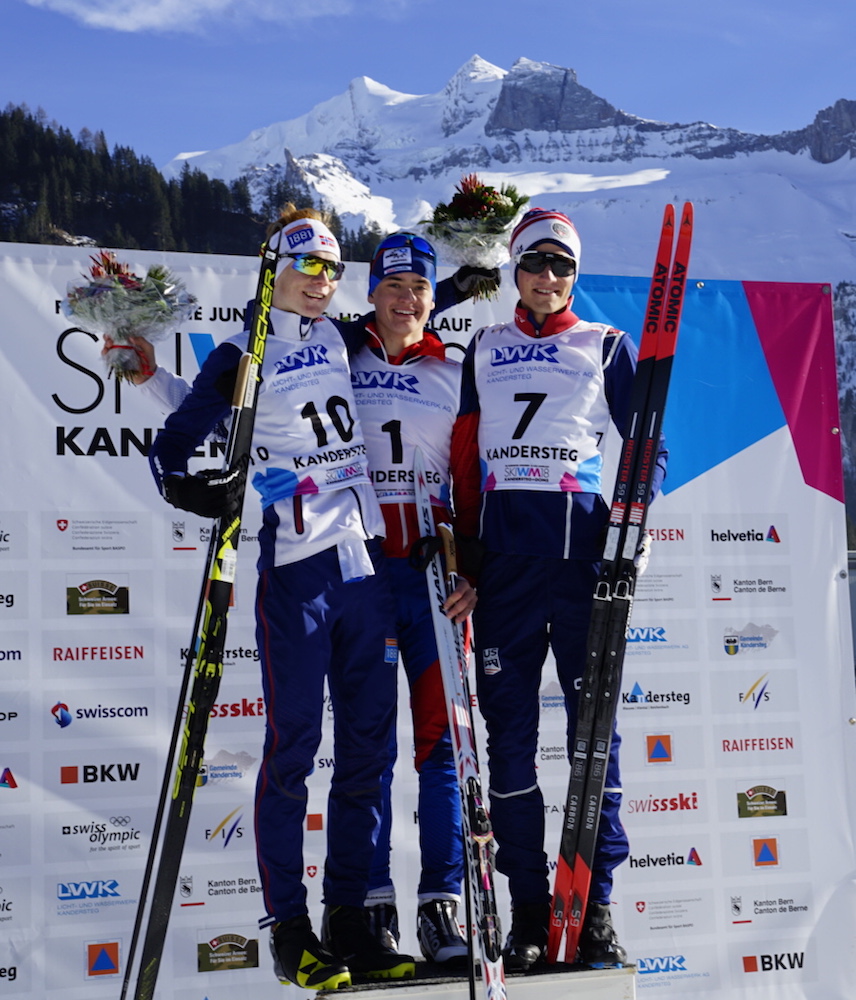
    Wednesday Rundown: SuperTour Finals Skate Sprints
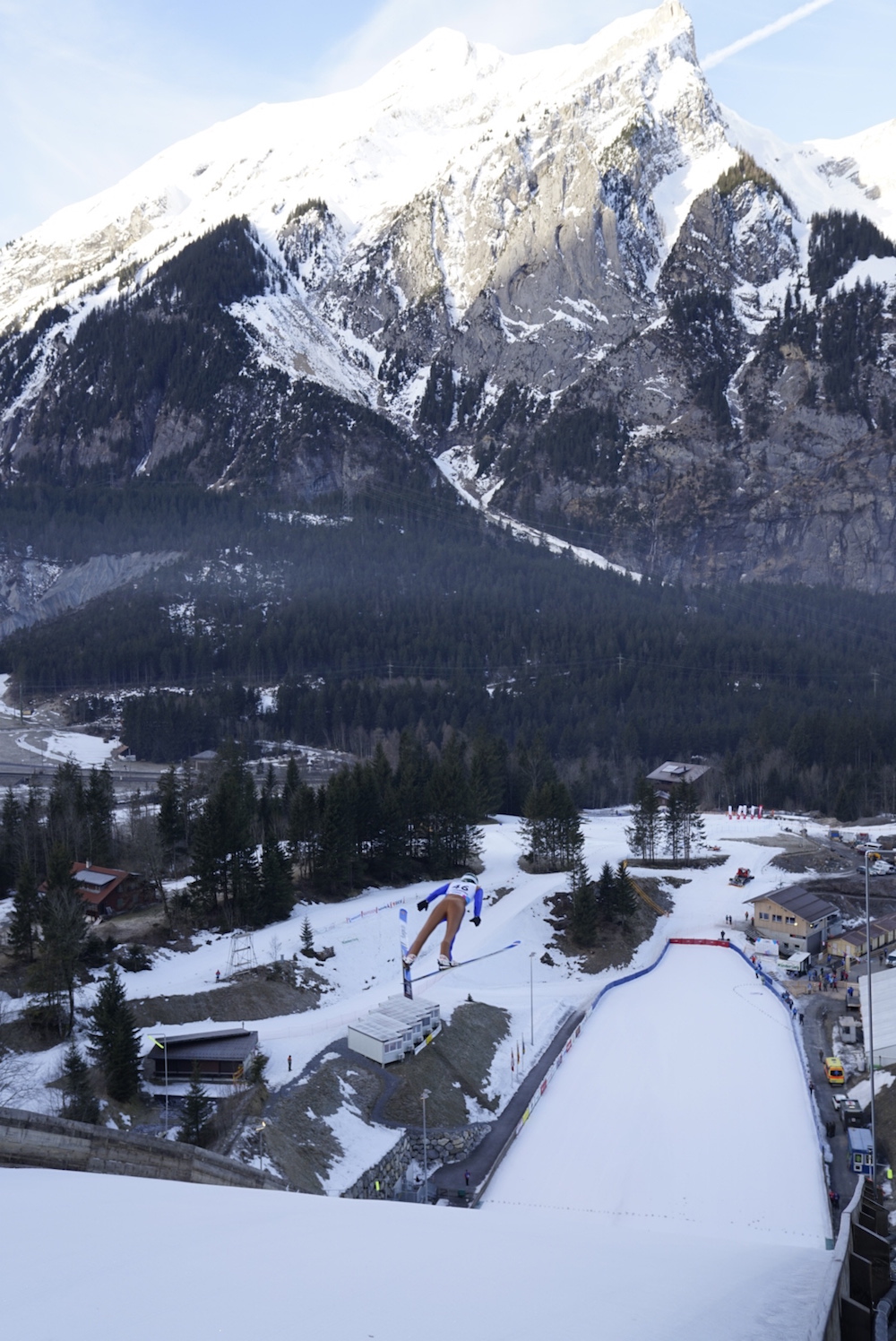
    Jessie Diggins (SMS Elite) leads fellow U.S. Ski Team member Kikkan Randall (APU) to the finish of the women’s freestyle sprint final on Wednesday at SuperTour Finals in Fairbanks, Alaska. (Photo: Max Kaufman)
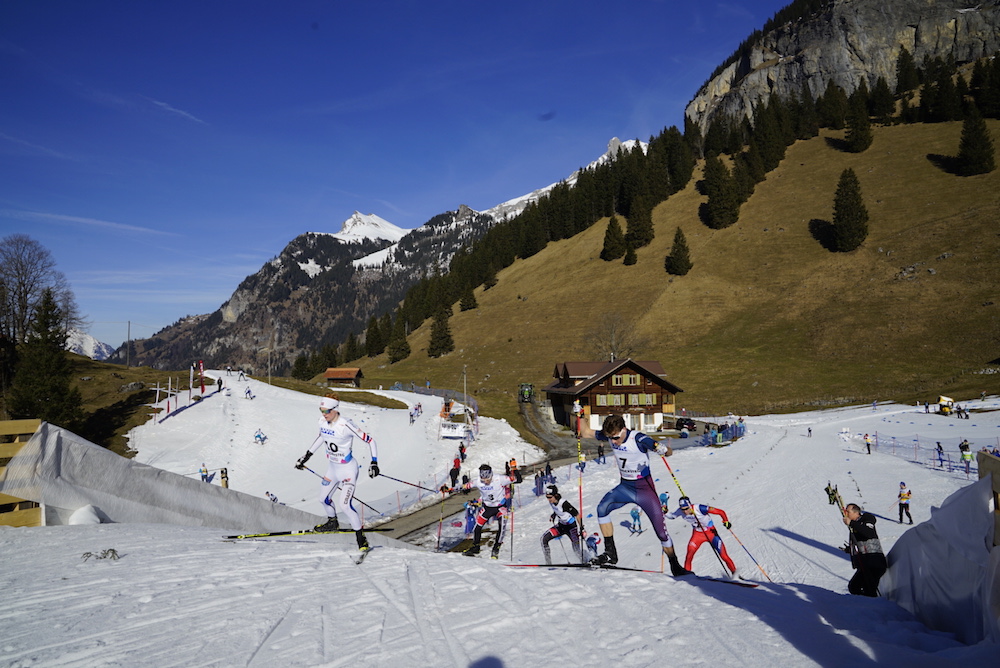
    U.S. SuperTour Finals (Fairbanks, Alaska): Freestyle sprints

    On Wednesday the 2017 U.S. SuperTour Finals, also referred to as Spring Series, the last of the year’s elite level sprints went down in Fairbanks, Alaska.

    The women raced a 1.5-kilometer course while the men skied a slightly longer 1.6 k course, both run at the Birch Hill Recreation Area in Fairbanks.

    Earlier in the week, Jessie Diggins of the Stratton Mountain School (SMS) Elite Team and U.S. Ski Team (USST) showed why she’s one of the World Cup’s top overall skiers as she dominated the SuperTour Finals skiathlon.
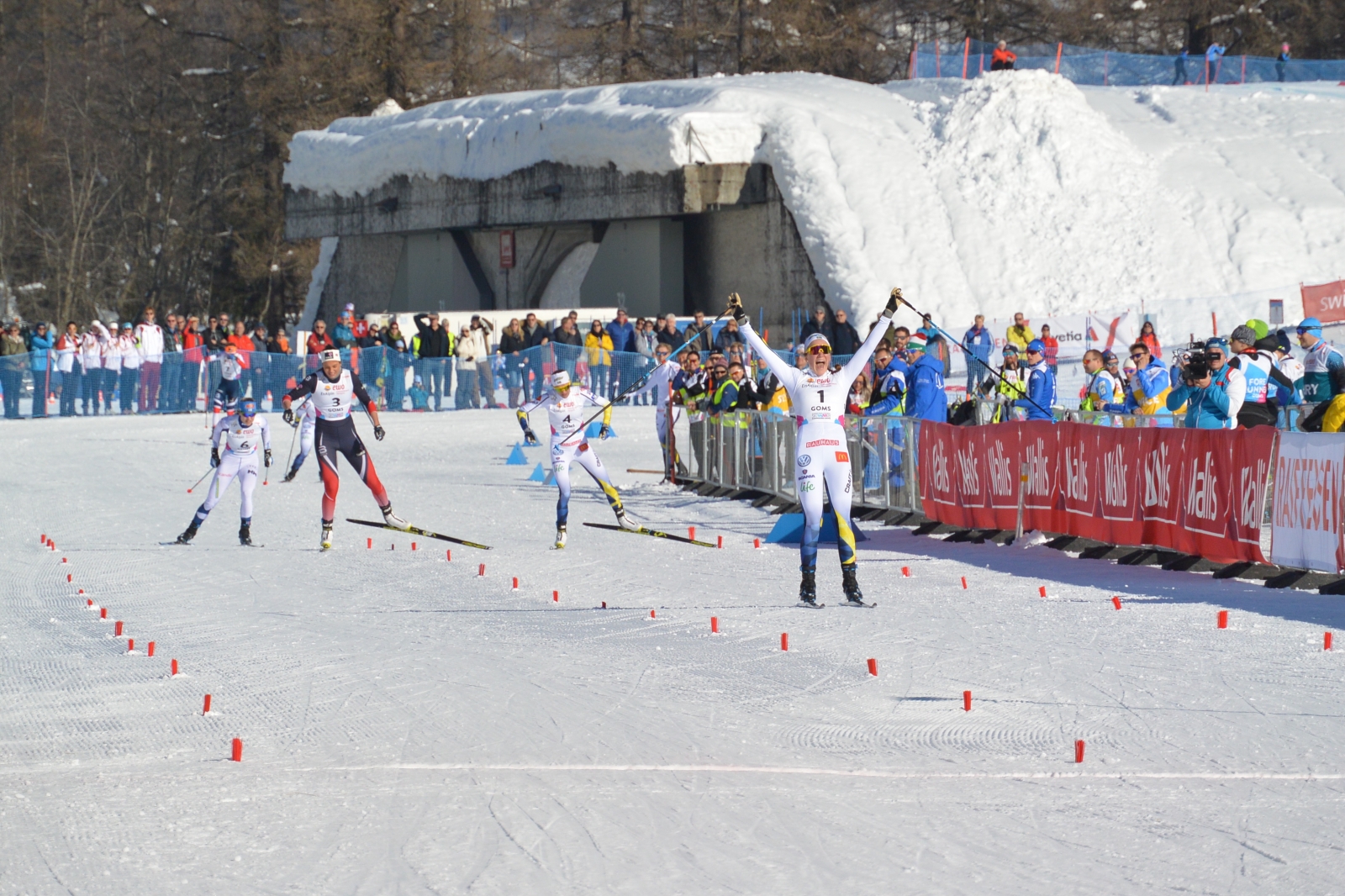
    Once again, and early on, Wednesday’s sprint had the appearance of another race to lose for Diggins. She qualified first, completing the course in 3:34.09 minutes. Her nearest competitor in qualification was Kikkan Randall of Alaska Pacific University (APU) and the USST, 6.72 seconds back.

    As the heats progressed the looks of a Diggins-Randall show was in the makes. Both skiers were convincing in their trajectory to the finals as they placed first in their respective quarters and semis. And in the finals it became a two-skier race with the pair skiing decisively off the front.
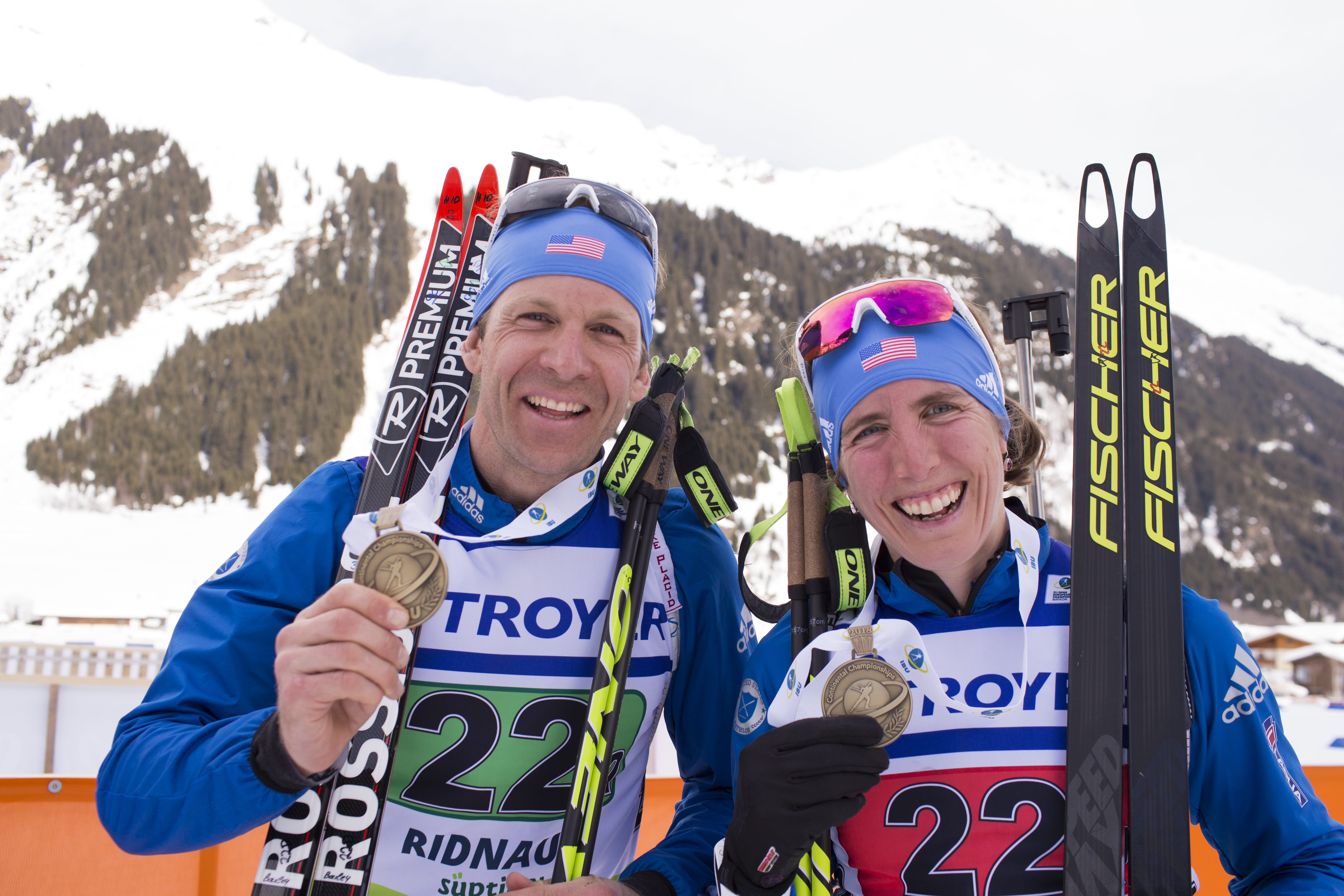
    Diggins scorched the finals, toeing the line in 3:30.39 minutes, nearly four seconds faster than her qualifying time. Randall, who skied in a tight race with Diggins until the closing stretch, placed second (+2.39).

    The women’s freestyle sprint podium at SuperTour Finals on Wednesday night in Fairbanks, Alaska, with Jessie Diggins (c) in first, Kikkan Randall (l) in second and Erika Flowers (r) in third. (Photo: Max Kaufman)

    Erika Flowers (SMS Elite Team) reached the podium in third (+15.65), ahead of her teammate Sophie Caldwell (SMS Elite Team/USST) in fourth (+19.03), Kelsey Phinney (Sun Valley Ski Education Foundation) in fifth (+23.06), and Ida Sargent (Craftsbury Green Racing Project/USST) sixth (+27.77).

    “I thought it was normal, given I set the pace, so I did it to myself,”  Diggins said on the phone, recalling the final. “I thought it felt like a pretty normal, brutal World Cup final. I was going out hard, playing for keeps, that is what you do when it comes to Spring Series, you still have fun but you race hard.”

    Asked is she felt any added pressure to perform well racing stateside, Diggins noted she attempts to keep things in perspective.

    “There is some pressure and at the same time there’s not,” Diggins added. “Because my goals for the year focused around World Championships and the Tour de Ski, that is where I am aiming to be fast and those are the targets I am intending to hit. So coming here, you are always wanting to ski fast … I feel like there is not an incredible amount of pressure because it is the end of the season and everybody is in a totally different place and mentally I am super excited for that place flight to Hawaii I am going to be on the day after the races. I think everyone is in very different places and I think it’s not fair for us to put pressure on ourselves. I think we just go out and have fun and race hard. This isn’t how you qualify for the Olympics and there is good reason for that.”

    SMS Elite Team Head Coach Pat O’Brien provided some insight into the large time gaps in the women’s final.

    “Coarse was pretty long and hard, I think it plays to people with some more muscular endurance and less fast twitch, especially this late in the season when people are tired,” O’Brien wrote in an email. “This isn’t a 3 min sprint on manmade that prioritizes finishing speed like a European World Cup. It was just straight tough out there! … No falls, just a bunch of tired ladies slugging it out at 8PM at night near the arctic circle. Hard work by all!”

    Local skier Logan Hanneman (APU), who grew up and attended college in Fairbanks, made the hometown proud. He eventually pulled out the win in the men’s final.

    Hanneman qualified fourth (+6.27) behind Simi Hamilton (SMS Elite Team/USST) who topped the qualifier in 3:11.35 minutes. (After the qualifier Hamilton pulled from the competition).

    Logan Hanneman (APU) leads Canada’s Evan Palmer-Charrette (13) of NTDC Thunder Bay and Tyler Kornfield (16), his APU teammate, in the men’s freestyle sprint final on Wednesday at SuperTour Finals in Fairbanks, Alaska. (Photo: Max Kaufman)

    In the men’s final, several skiers appeared to be in play for the win. Hanneman placed first in his quarter and semi. Canadian skier Evan Palmer-Charrette (NTDC Thunder Bay), also looked like a threat as he proved a knock-out type closer. Another guest skier, Norway’s Haakon Hjelstuen, a former Michigan Tech skier, skied heady and strong.

    Also appearing in the men’s finals were two skiers who are known to pounce when opportunity knocks: Tyler Kornfield (APU) and Dakota Blackhorse-von Jess (Bend Endurance Academy). Tad Elliott (Ski & Snowboard Club Vail) completed the six-skier final.

    Heading into the last technical descent on course Hanneman was third behind Kornfield and then Palmer-Charrette. A few tight corners remained with a climb back up to the finish.

    “I ended up taking the last sweeping left corner very wide and accelerated as I moved right,” Hanneman explained in an email. “Then we were able to hit the bottom of the climb basically 3 abreast. Once I saw that I had a lane open I just opened it up and went for it!”

    Here’s how the final played out: Hanneman placed first in 3:16.77 minutes, Palmer-Charrette was second (+1.08), Kornfield third (+3.84), Hjelstuen fourth (+3.98), Blackhorse-von Jess fifth (+6.38), and Elliott sixth (+7.17).

    It appears Hanneman was able to channel his nervous energy into positive forward momentum.

    “I definitely put a lot of pressure on myself to win this race,” Hanneman wrote of performing in front of his hometown crowd. “To have these races in my hometown is one thing, but then knowing that I could do well in the sprint added a lot of nerves to the equation. I definitely really wanted to perform well for the volunteers, the crowd, etc. they have supported me through all of the skiing programs here in Fairbanks for years and I really wanted to ski my best for them. I am so very happy that this is how it turned out!”

    Hunter Wonders (APU) won the junior men’s sprint in 3:32.76 (he was also the winner of Monday’s 11.25 k classic) with a hard-charging final push, Max Donaldson (University of Alaska Fairbanks) placed second (+0.40) and Logan Mowry (Nordic Ski Club of Fairbanks/FXC) was third (+4.76).

    For the junior women, Hannah Rudd (University of Alaska Anchorage) took the lead on the final climb and secured the win in 4:08.46, Dottie Anderson (Loppet Nordic Racing) placed second (+1.96) and Jenna Difolco (Nordic Ski Club of Fairbanks/FXC) was third (+7.64).

    Racing continues Friday with a mixed gender/mixed technique relay.

    Results: Women | Men | Junior Women | Junior Men

    The men’s freestyle sprint podium on Wednesday night at SuperTour Finals in Fairbanks, Alaska, with Fairbanks native Logan Hanneman (c) in first, Canada’s Evan Palmer-Charrette (l) in second and Tyler Kornfield (r) in third. (Photo: Max Kaufman)
  • Saturday Rundown: Holmenkollen, Kontiolahti, Jackson, and Lake Placid (Updated x4)

    Saturday Rundown: Holmenkollen, Kontiolahti, Jackson, and Lake Placid (Updated x4)

    The University of Utah ski team celebrating its first NCAA title since 2003 on Saturday at 2017 NCAA Skiing Championships in Jackson, N.H. (Photo: Jason Clay/Colorado)

    NCAA Skiing Championships (Jackson, N.H.): 15/20 k freestyle mass starts

    On the final day of the National Collegiate Athletic Association (NCAA) Skiing Championships in northern New Hampshire, the University of Utah pulled out a 16.5-point victory over the University of Colorado-Boulder (and finished 17.5 points ahead of the University of Denver) in the team standings, and the two previous NCAA champions from Thursday’s 5/10 k classic races, Martin Bergström and Petra Hyncicova, achieved their second-straight titles in as many nordic races this week.

    On a frigid Saturday morning in Jackson, N.H., with temperatures just below zero Fahrenheit for the start of the men’s 20 k freestyle mass start, Bergström, a Utah freshman from Sweden, outlasted the University of Colorado’s (CU) Mads Ek Strøm, a Norwegian senior and two-time 2016 NCAA champion, by 0.5 seconds to win his second-straight race in 46:02.8 minutes. Moritz Madlener, a German senior at Denver University (DU), placed third (+0.6). Just behind him CU’s Petter Reistad, of Norway, finished fourth (+1.2), and Dartmouth College’s Fabian Stocek, of the Czech Republic, placed fifth (+1.9).

    While temperatures warmed up to about 1 degree for the women’s 15 k freestyle mass start and the wind picked up to about 15-20 miles per hour, the women raced three laps around the Jackson Ski Touring Center’s race loop and navigated even faster downhills that caused a few crashes.

    Hyncicova used her love for downhills and skate races to capture her second consecutive NCAA title, breaking away with University of Vermont (UVM) junior Alayna Sonnesyn on the second lap. The Czech Republic native and CU junior attacked on the A-climb at the top of the course and won by 21.1 seconds in 39:21.6. Sonnesyn, of Minnesota, bested her third place from Thursday’s 5 k with a second-place finish on Saturday. CU’s Christina Rolandsen, of Norway, finished third (+38.9), ahead of Idaho native Anika Miller of Montana State University (MSU) in fourth (+44.0).

    Utah took fifth and sixth with Merete Myrseth (+1:01.5) and Guro Jordheim (+1:16.1), and had two other men in the top 10 (Martin Mikkelsen in 8th and Kevin Bolger in 10th) to achieve the alpine-nordic team title.

    In the women’s race, the Utes were the only team with all three women in the top 14, with Natalia Müller in 14th (+1:32.1).

    “The turning point of today is when Guro broke a pole, and she was back in the 20’s, and she and Natalia were skiing together,” Utah Director of Skiing Kevin Sweeney said, according to a team press release. “We told them that they had to go and they busted out and made a big move. The men’s results were tremendous, but whether or not we were going to win was based on those guys making the move. It was exceptional athleticism and gutsy performances.”

    The NCAA team title was the 11th for Utah and its first since 2003.

    “I am stunned with the win today,” Sweeney added. “In all my years of coaching, it was one of the most challenging four days of competition. I say that because the weather was incredibly cold and windy, and challenging from both a waxing perspective, as well as visibility and conditions. I know all the teams had to deal with it, but it really beat us up. It took a lot of perseverance and gutsy performances for us to win. We struggled a little bit in the slalom, but they were going for it and came up short.

    “We’ve been crunching numbers and have been able to beat Denver and Colorado by about 30 points on a really good showing during the RMISA season, but didn’t know if we could do it in the championships,” he continued. “Bergström was skiing at a whole new level this week, and Mikkelsen had stepped it up, and I knew Kevin Bolger could get top 10. I was also confident in the women, who have been skiing awesome, so I felt good there. It’s awesome to be able to take this new trophy back to our new ski building.”

    As for those earning All-American status on Saturday with a top-10 finish, Utah had five (Bergström 1st, Myrseth 5th, Jordheim 6th, Mikkelsen 8th, Bolger 10th), Colorado had four (Hyncincova 1st, Strøm 2nd, Rolandsen 3rd, Reistad 4th), Denver had two (Madlener, Dag Frode Trollebø 7th), MSU had two (Miller 4th, Johanna Talihärm 7th), Dartmouth had two (Stocek 5th, Luke Brown 9th), UVM had one (Sonnesyn 2nd), Northern Michigan University (NMU) had one (Adam Martin 5th), the University of Alaska-Fairbanks (UAF) had one (Sarissa Lammers 8th), UNH had one (Lizzie Gill 9th), and Bowdoin had one (Hannah Miller 10th).

    Stay tuned for a more in-depth report with quotes and photos from Saturday’s skate mass starts.

    Results: Men | Women | Team

    ***

    USSA Cross Country Junior Championships (Lake Placid, N.Y.): Freestyle team relays

    The 2017 U.S. Junior Nationals Alaska Cup winners, New England, at the awards ceremony on Saturday in Lake Placid, N.Y. (Photo: XCJuniorNationals2017/Facebook)

    [UPDATED] For the final day of 2017 U.S. Junior Nationals in Lake Placid, N.Y., regional divisions formed three-racer teams for the U16, U18 and U20 freestyle relays.

    Intermountain swept the U16 team events with Lane Myshrall, Skylar Patten and Johnny Hagenbuch winning the U16 boys’ relay by 3.6 seconds over the Midwest’s James Schneider, Alexander Nameth and Peter Moore in 23:00.4 minutes. Another 1.1 seconds back, Alaska reached the podium in third (+4.7) with Eli Hermann, Zander McMullen and George Cvancara.

    Intermountain’s U16 girls’ team of Sarah Morgan, Annabel Hagen and Sydney Palmer-Leger posted a 53.7-second victory over New England’s Charlotte Ogden, Anna Lehmann and Abigail Streinz, winning in 26:21.4. The Pacific Northwest finished 18.1 seconds later in third place (+1:29.9) with Fiona Max, Gretta Scholz and Annie McColgan.

    Alaska won the U18 boys’ relay with Luke Jager, Canyon Tobin and Gus Schumacher finishing in 21:42.9, 7.5 seconds ahead of New England’s Elliot Ketchel, Adam Glueck and Ben Ogden in second. The Midwest’s Anders Sonnesyn, Patrick Acton and Luc Golin rounded out the podium in third (+22.2).

    Rocky Mountain topped the U18 girls’ relay with Katja Freeburn, Ezra Smith and Maddie Donovan crossing first in 25:47.3. Just 5.8 seconds back, Intermountain’s Brooke Dunnagan, Anna Gibson and Sofia Schomento placed second, and the Midwest secured third (+16.7) with Margaret McCollor, Luci Anderson and Anja Maijala.

    The U20 men’s relay title went to New England, with Kam Husain, Koby Gordon and Daniel Streinz pulling out a 1.3-second win over Alaska’s Tracen Knopp, Logan Mowrey and Hunter Wonders in 21:53.1. Intermountain followed in third (+8.8) with Eli Jensen, Peter Wolter and Nathan Wells.

    The Midwest came up big in the U20 women’s relay, with Abby Jarzin, Hannah Rudd and Margie Freed finishing 10.1 seconds ahead of New England’s Alexandra Lawson, Mary Kretchmer and Mackenzie Rizio in 25:41.4. Another 1.1 seconds back, Intermountain’s Leah Lange, Maddie Morgan and Marin Coletta placed third (+11.2).

    New England won the Alaska Cup with 325 points, the same point total as Intermountain in second. Alaska placed third in the overall team competition with 295 points, just five points ahead of the Midwest in fourth.

    Results: U16 boys | U16 girls | U18 boys | U18 girls | U20 men | U20 women | Alaska Cup

    ***

    FIS Cross-Country World Cup (Oslo, Norway): Holmenkollen 50 k classic mass start

    (Race report)

    Left to right: Finland’s Iivo Niskanen, Norway’s Martin Johnsrud Sundby and Russia’s Alexander Bessmertnykh after placing second, first and third, respectively, in the Holmenkollen World Cup men’s 50 k classic mass start on Saturday in Oslo, Norway. (Photo: FIS Cross-Country/Twitter)

    In a historic Holmenkollen, Norway’s Martin Johnsrud Sundby took his second 50 k win in a row, claiming this year’s title in a time of 2:02:59.7 (he won last year’s Holmenkollen in a time of 2:08:41.9). Sundby is now the only male skier to win two consecutive World Cup Holmenkollen 50 k competitions. 

    Crossing behind Sundby in second was Finland’s Iivo Niskanen, 9.9 seconds back from the race winner’s time. In a three-way photo finish, Russian Alexander Bessmertnykh bested Norwegians Niklas Dryhaug, and Sjur Røthe in the lunge to the line, with Bessmertnykh taking third (+1:15.2), Røthe fourth (+1:15.2) and Dryhaug fifth (+1:15.2).

    Canada’s Alex Harvey was just two tenths of a second behind the three-way lunge, finishing in sixth (+1:15.4). Norway’s Christer Hans Holund crossed 2.2 seconds later in seventh (+1:17.2). Three more Russians rounded out the top ten, with Sergey Ustiugov finishing in eighth (+2:35.0), Andrey Larkov two tenths of a second behind in ninth (+2:35.2) and Sergey Turyshev in tenth (+2:42.2).

    The top U.S. skier for the day was Scott Patterson (Alaska Pacific University), earning World Cup points in 28th (+7:18.8). Canada’s Devon Kershaw crossed 33rd (+2:11:59.1) and American David Norris (Alaska Pacific University) finished 35th (+9:56.4).

    Two more Americans competed in Saturday’s Holmenkollen, with Noah Hoffman finishing in 38th (+11:02.6) and Ben Lustgarten 46th (+18:44.7). Canadian Russell Kennedy was the final North American to finish in 47th (+20:16.3).

    Results

    ***

    IBU World Cup Biathlon (Kontiolahti, Finland): Men’s & women’s pursuits

    (Race report)

    The IBU World Cup men's podium after the 12.5 k pursuit in Kontiolahti, Finland, where Arnd Peiffer of Germany outsprinted Simon Eder of Austria for the win. (Photo: IBU/Twitter)
    The IBU World Cup men’s podium after the 12.5 k pursuit in Kontiolahti, Finland, where Arnd Peiffer of Germany outsprinted Simon Eder of Austria for the win. (Photo: IBU/Twitter)

    After one day knocked down to the second spot of the podium, it was back to the usual winning ways for Germany’s Laura Dahlmeier in the 10 k pursuit. Dahlmeier caught Norway’s Tiril Eckhoff, who won Friday’s sprint, early in the race after Eckhoff had one penalty in the first prone and second-starter Dahlmeier cleaned. While Eckhoff picked up five more penalties as the race went on, finishing 15th (+1:12.0), Dahlmeier had just one – and cleaned when it counted, on the final shoot with France’s Marie Dorin Habert and the Czech Republic’s Gabriela Koukalova right there with her. Dorin Habert missed one shot and held on to second place (+16.5) despite the penalty loop, while Italy’s Lisa Vittozi picked up her first individual podium in third (+19.9).

    The win secured the overall World Cup title for Dahlmeier, her first. “That makes me really speechless,” she told Germany’s ARD broadcaster. “This is an amazing moment.”

    Susan Dunklee collected four penalties and dropped from fifth place to 14th (+1:02.8) for the United States. Teammates Clare Egan and Joanne Reid finished 45th (+3:24.7) and 52nd (+4:07.0), respectively.

    For Canada, Julia Ransom finished 53rd with three penalties (+4:14.0) and Emma Lunder 58th with four missed shots (+6:20.7).

    Results

    Earlier in the day, Martin Fourcade had started the men’s race in bib one and set out to win the men’s 12.5 k pursuit, but was undone by four errors on the shooting range. No matter: the French biathlete still picked up the World Cup crystal globe for the pursuit discipline after finishing fifth (+25.5 seconds) and now he’s skipping tomorrow’s mixed relays to go be with his wife, who is about to have their second child.

    Capitalizing on Fourcade’s errors were a group of chasers, among whom Arnd Peiffer of Germany managed to shoot 20-for-20. The race came down to a sprint finish between him and Simon Eder  of Austria; Peiffer took a 0.3-second win for his eighth career victory. Emil Hegle Svendsen of Norway finished third, +2.3 seconds, and Andrej Moravec of the Czech Republic fourth, +9.8.

    Besides Peiffer, the only other man in the field to shoot clean was Sean Doherty of the United States. That allowed Doherty to jump from 44th at the start to a season-best 18th (+1:19.5) at the finish, the top result for the American team. Lowell Bailey finished 27th (+1:57.2) and Leif Nordgren 43rd (+3:24.4) with three and four penalties, respectively.

    Christian Gow led Canada with just one penalty and a 37th-place finish (+2:36.0), a big improvement from his 50th-place starting position. Brendan Green placed 50th with three penalties (+4:47.3).

    Results

  • Friday Rundown: Kontiolahti & Lake Placid (Updated)

    Friday Rundown: Kontiolahti & Lake Placid (Updated)

    The women’s 7.5 k sprint podium on Friday at the IBU World Cup in Kontiolahti, Finland, with Norway’s Tiril Eckhoff (c) in first, Germany’s Laura Dahlmeier (l) in second, and Belarus’s Darya Domracheva (r) in third. (Photo: IBU)

    IBU World Cup (Kontiolahti, Finland): Men’s & women’s sprints

    [UPDATED] Fifth place is becoming a habit for US Biathlon’s Susan Dunklee, who shot 9/10 on Friday (1+0) and finished 34.9 seconds out of first for her third fifth-place result in the last three individual races.

    Twice at last week’s International Biathlon Union (IBU) World Cup in PyeongChang, South Korea, Dunklee placed fifth: first in the sprint and again in the pursuit. She ended her racing there with the U.S. women’s relay, which placed 14th.

    Back at it again on Friday in the women’s 7.5-kilometer sprint in Kontiolahti, Finland, Dunklee placed fifth behind Norwegian winner Tiril Eckhoff, who shot clean (0+0) and finished in 19:18.4 minutes.

    Germany’s Laura Dahlmeier started in bib 27, immediately after Eckhoff (bib 26) and ended up 18.3 seconds shot of the Norwegian’s time for second place (+18.3) with one standing penalty (0+1). Darya Domracheva of Belarus started 32nd and shot clean to notch third (+20.4) for her second podium of the season (including a silver medal in the IBU World Championships pursuit).

    The last starter in bib 94, Russia’s Daria Virolaynen shot clean and claimed fourth (+34.8), bumping Dunklee, the 33rd starter who initially finished fourth, by one-tenth of a second to fifth.

    All three of the U.S. women that raced on Friday finished in the top 60 to qualify for Saturday’s pursuit, with Joanne Reid taking 55th (+1:59.7) with clean shooting, and Clare Egan 59th (+2:07.4) with three standing penalties (0+3).

    Two Canadians qualified as well, with Emma Lunder in 56th (+2:02.8) with one miss (1+0) and Julia Ransom making the cut in 60th (+2:08.0) with one penalty (1+0) as well.

    In her first World Cup start, Canada’s 19-year-old Megan Bankes — coming off a gold medal at IBU Junior World Championships in Slovenia — placed 78th (+2:56.9) with three penalties (2+1).

    ***

    The men’s 10 k sprint podium at Friday’s World Cup in Kontiolahti, Finland, with France’s Martin Fourcade (c) in first, the Czech Republic’s Ondřej Moravec (l) in second and Norway’s Emil Hegle Svendsen (r) in third. (Photo: IBU)

    Lucky No. 13. That’s how many World Cup wins France’s Martin Fourcade has accumulated this season, including his victory in the men’s 10 k sprint in Kontiolahti.

    Thirteen wins puts him ahead of Norway’s Ole Einar Bjørndalen for the most wins in a single season, and Fourcade topped Friday’s race by just 0.6 seconds over the Czech Republic’s Ondřej Moravec in second place. (Bjørndalen finished about 30 seconds back in eighth.)

    Fourcade started 38th, after Moravec in bib 24, and had to ski a penalty lap after missing one in his standing shooting, but was able to top Moravec’s time by fractions of a second in 22:17.0 minutes.

    Moravec shot clean to reach the podium in second, along with Norway’s Emil Hegle Svendsen, who hit all 10 targets as well to place third (+9.4).

    One of the earliest starters in bib 3, Norway’s Johannes Thingnes Bø hit all of his targets and was the race leader until Svendsen finished 2.7 seconds faster than him. Bø ultimately ended up fourth, and Germany’s Arnd Peiffer, the fourth man in the top five to clean, placed fifth (+22.3).

    After eight straight races of placing in the top 10, Lowell Bailey finished 16th on Friday, 1:01.1 behind Fourcade despite clean shooting.

    Three Americans qualified for Saturday’s pursuit, with Leif Nordgren in 43rd (+1:36.8) with two penalties (1+1) and Sean Doherty 44th (+1:38.5) with one standing miss (0+1).

    Paul Schommer finished 84th (+3:02.5) with three misses (2+1).

    Two Canadians shot clean and qualified for the pursuit: Brendan Green in 45th (+1:41.4) and Christian Gow in 50th (+1:55.0). Scott Gow missed the top 60 in 67th (+2:21.9) with two penalties (1+1).

    Results: Women | Men

    ***

    USSA Cross Country Junior Championships (Lake Placid, N.Y.): 5/10/15 k classic individual starts

    The U20 men’s 15 k classic podium on Friday at 2017 U.S. Junior Nationals in Lake Placid, N.Y., with Hunter Wonders (c) of Alaska Pacific University (APUNSC) in first, Peter Wolter (l) of the Sun Valley Ski Education Foundation (SVSEF) in second, and Canada’s Étienne Hébert (r), of Montériski in third. (Photo: India Harvey)

    [UPDATED] On the third day of racing at U.S. Junior Nationals at the Olympic Jumping Complex in Lake Placid, N.Y., Julia Kern, representing New England and the Stratton Mountain School (SMS), completed her sweep of the U20 women’s races, winning Friday’s 10-kilometer classic individual start by 1 minute and 30.5 seconds in 32:32.3 minutes. (Kern had previously won the U20 women’s 5 k freestyle and classic sprint at Junior Nationals this week.)

    Intermountain’s Leah Lange (University of Utah) joined her on the podium on Friday in second place, and the Midwest’s Hannah Rudd (Loppet Nordic Racing) tallied third place (+1:38.6).

    The U20 women’s 10 k classic podium at 2017 U.S. Junior Nationals in Lake Placid, N.Y., with Julia Kern (c) of SMS in first, Leah Lange (l) University of Utah in second, and Hannah Rudd (r) of Loppet Nordic Racing in third. (Photo: India Harvey)

    In the U20 men’s 15 k, Alaska’s Hunter Wonders, of Alaska Pacific University (APUNSC), finished 37 seconds ahead of anyone else in 45:15.7. Intermountain’s Peter Wolter, of the Sun Valley Ski Education Foundation (SVSEF) took second (+37.1), and Canada’s Étienne Hébert (Montériski) placed third for the second time in three races, 49.1 seconds behind Wonders. Daniel Streinz (New England/Mountain Endurance) was the third American in fourth overall (+1:00.7).

    Coming of two-second place performances this week, Intermountain’s Sydney Palmer-Leger, of the Park City Nordic Ski Club (PCNSC) raced to first in the U16 girls’ 5 k in 16:42.1, 16.3 seconds ahead of Alaska’s Kendall Kramer (Nordic Ski Club of Fairbanks-FXC) in second. Novie McCabe (Pacific Northwest/Methow Valley Nordic Ski Educational Foundation), reached the podium in third (+21.9).

    The U16 girls’ 5 k classic podium on Friday at U.S. Junior Nationals in Lake Placid, N.Y., with Sydney Palmer-Leger (c) of PCNSC in first, Kendall Kramer (l) of NSCF-FXC in second, and Novie McCabe (r) of the Methow Valley Nordic Ski Educational Foundation in third. (Photo: India Harvey)

    A runner-up earlier in the week in the freestyle individual start, Intermountain’s Johnny Hagenbuch (SVSEF) took the win in the snowiest race of the day — the U16 boys’ 5 k — finishing just 2.5 seconds ahead of Alaska’s runner-up George Cvancara (Alaska Nordic Racing) in 15:06.8 in the closest race of the day. Intermountain had two on the podium with Skylar Patten (PCNSC) in third (+3.8).

    The U16 boys’ 5 k classic podium on Friday at U.S. Junior Nationals in Lake Placid, N.Y., with Johnny Hagenbuch (c) of SVSEF in first, George Cvancara (l) of ANR in second, and Skylar Patten (r) of PCNSC in third. (Photo: India Harvey)

    In the U18 boys’ 10 k, New England’s Ben Ogden (SMS) pulled out an 11.7-second victory to deny Alaska’s Gus Schumacher (Alaska Winter Stars) of his third-straight win of the week. Ogden finished first in 29:36.5, Schumacher took second for his third-consecutive podium, and Alaska’s Luke Jager (APUNSC) placed third (+29.2) for his second podium in three races.

    In the U18 girls’ 10 k classic, Intermountain’s Anna Gibson (Jackson Hole Ski Club) took the win for her second-straight podium in 33:59.7, 6.9 seconds ahead of Rocky Mountain’s Ezra Smith (Summit Nordic Ski Club), who notched her second podium of the week as well, in second. Mara McCollor (Midwest/Wayzata Nordic Team) also scored a podium in third (+11.2).

    Results: U20 women | U20 men | U16 girls | U16 boys | U18 boys | U18 girls

  • Alaska Skiing Saved: Local Supporters Gather at Suddenly Joyous Rally

    Alaska Skiing Saved: Local Supporters Gather at Suddenly Joyous Rally

    A supporter holds an updated sign at the #savealaskaskiing rally in Anchorage, Alaska, on Nov. 10, 2016. (Photo: Gavin Kentch)
    A supporter holds an updated sign at the #savealaskaskiing rally in Anchorage, Alaska, on Nov. 10. (Photo: Gavin Kentch)

    ANCHORAGE, Alaska – Thursday morning, University of Alaska (UA) President Jim Johnsen announced that the NCAA had declined to reach the school’s waiver request that could have led to the end of NCAA skiing in both Anchorage and Fairbanks. Thursday afternoon, the UA Board of Regents officially voted to support the president’s recommendation to leave both schools’ athletics teams intact.

    Thursday evening, it was time to celebrate. The previously scheduled #savealaskaskiing rally in Midtown Anchorage quickly became rebranded as something more jubilant. The food trucks were still there, the DJ was still there, and the supporters were still there, a cross section of the Alaska skiing community past and present. But the mood was suddenly upbeat rather than funereal.

    The Alaska Dispatch News reported that a crowd of “about 250” gathered on the lawn outside the Anchorage public library. FasterSkier estimates the crowd size as closer to one third of that. But no matter their numbers, they were there, and they were happy.

    “This is a huge relief for all of us [on the University of Alaska Anchorage (UAA) ski team],” said Charley Field, a junior alpine skier from Pemberton, B.C., addressing the rally. “I’ve never felt so relieved.”

    Field recounted that she had applied to only a single school, UAA, when making a college choice, and was thrilled to be able to continue there. “I’ve always wanted to graduate as a Seawolf,” Field said.

    University of Alaska Anchorage Seawolves skiers Hailey Swirbul (l) and Casey Wright (r), photographed on the UAA campus in Anchorage, Alaska, in October 2016. (Photo: Gavin Kentch)
    UAA skiers Hailey Swirbul (l) and Casey Wright (r), photographed on the UAA campus in Anchorage, Alaska, in October 2016. (Photo: Gavin Kentch)

    Another athlete, nordic skier Casey Wright, also spoke. The junior skier and Australian national had been defiant even in the face of adversity, telling FasterSkier two weeks ago – the day after news first broke of the ski team’s apparent demise – that “we’re going to rally together, and we’re going to have a memorable season.”

    Wright was happier at the rally, but no less confident. “We’re all going to try our absolute best to kick some butt” this year, she told the crowd, “and show everyone what it means to be a Skiwolf.”

    A common theme among all the speakers was heartfelt gratitude at the groundswell of support from across the state and around the world.

    “I can’t say thank you enough to all the people who wrote letters and signed the petition,” Field said. “We’re so blessed.”

    The UAA ski team released a video earlier Thursday thanking supporters for their help.

    André Horton, an Anchorage native, former member of the U.S. Alpine Ski Team and one of the guiding forces behind the formal #savealaskaskiing movement, expressed similar sentiments.

    “At one point yesterday,” Horton said, “the Board of Regents was getting one email [from #savealaskaskiing supporters] every two minutes. … I think if I were them, I would be uninstalling Outlook right now.”

    Horton audibly choked up as he addressed the assembled crowd. “They say there’s a rivalry,” Horton said, in reference to perhaps exaggerated antagonism between Anchorage and Fairbanks, “but when someone threatens our sport, we all pull together.”

    (A contemporaneous march in Fairbanks also featured strong turnout, including at least one marcher dressed as a polar bear in homage to the University of Alaska Fairbanks mascot, the Nanooks.)

    Another speaker, Anchorage’s Holly Brooks, echoed Horton’s reaction to the rapid rise of #savealaskaskiing.

    “It’s amazing how fast this community came together,” Brooks said from stage. The sheer numbers of people who signed the petition (over 5,000 as of Thursday evening) show “how amazing this small ski team is.”

    Former Whitman College and USST skier Holly Brooks addresses the crowd at the #savealaskaskiing rally in Anchorage, Alaska, on Nov. 10, 2016. (Photo: Gavin Kentch)
    Former Whitman College and USST skier Holly Brooks addresses the crowd at the #savealaskaskiing rally. (Photo: Gavin Kentch)

    Brooks attended Whitman College in the early 2000s, and skied collegiately there. But the Whitman ski program was cut a few years after she graduated. “That pulled at my heartstrings,” Brooks recounted, “and I wanted that not to happen again.”

    Brooks recounted that if she hadn’t skied in college, she wouldn’t have come to Alaska, wouldn’t have coached high school skiing, let alone for Alaska Pacific University, and never would have made two Olympic teams. NCAA skiing was very important to her in her journey to the Olympics, Brooks said, her relatively lackluster results as a college racer notwithstanding.

    “It was a really important time for me, even though it was not my fastest time as a skier.”

    Current UAA skier Hannah Rudd, a freshman from Plymouth, Minn., is working on becoming a faster skier right now.

    “Right now, we’re just really focusing,” Rudd told FasterSkier in an in-person interview when asked about the current priorities of the nordic team. “We’re getting into a lot of intensity right now. For sure, we’re going to keep on fighting for the team, but we are really focusing on our skiing and trying to have the best year that we can possibly have, so we can really prove ourselves.”

    Recounting recent events, Rudd said, “This whole last week has been quite, like, an emotional rollercoaster. But we woke up this morning, just thinking it was a regular day. We went to practice, and we could see, like, a big smile on our coach’s face, and he was like, ‘We have been saved!’ And it was one of the most exciting things that has happened.”

    Rudd said that it had been “amazing” to see 5,000 people sign a petition and stand up for college skiing in Alaska. “I come from Minnesota,” Rudd said, “where it’s a pretty big ski community, but Alaska – the ski community is just phenomenal. It’s been just so good to hear everyone’s responses and support. It feels good to have someone behind us.”

    Charlie Renfro, a lifelong Alaskan and former UAA skier, helped to organize the #savealaskaskiing movement and provide an avenue for that support. He was unapologetic about doing all this work even when college skiing – even in Alaska – typically suffers from a low profile within the American ski community.

    “I think it’s just really important to this community to have skiing be really visible,” Renfro told FasterSkier in person. “We’re a winter city, Fairbanks is a winter city, we believe in skiing. I think as long as there’s snow on the ground here, and as long as people are recreating outside, I think skiing needs to be represented at the university.”

    Renfro was optimistic about the next steps for this cause.

    “I think just figuring out how to harness this momentum that we’ve got going [will be the next challenge],” Renfro said, “and to be able to really get this group of people that’s supporting skiing to be able to reach out and fund the cause monetarily. And we’re not totally sure how we’re going to do it yet, but we’re just really happy that we’ve been able to unify, and hopefully moving forward we’ll be able to mobilize monetarily like we have for this.”

    Horton sounded similar notes, in an in-person interview before the rally, when asked what happens next year.

    “That is a 50-million dollar question,” Horton said, referring to the total amount cut from UAA’s budget this year alone.

    UAA assistant nordic coach Sara Studebaker-Hall (center, white hat) at the #savealaskaskiing rally in Anchorage, Alaska, on Nov. 10, 2016. Former UAA skier and current USST member Sadie Bjornsen (pink jacket) is to her left. (Photo: Gavin Kentch)
    UAA assistant nordic coach Sara Studebaker-Hall (center, white hat) at the #savealaskaskiing rally. Former UAA skier and current USST member Sadie Bjornsen (pink jacket) is to her left. (Photo: Gavin Kentch)

    “I think today’s success was very exciting for the community, yes, but I told everyone it should be a scaled success,” Horton said. “Meaning, we know cuts are going to be inevitable in the future. But what this has done is it’s galvanized very disparate communities of skiers all into one group. So I think, going into the future, we’re going to have a unified group of people able to make corrections in our spending, so that we can actually afford skiing the way we should.”

    Horton also addressed the question he had occasionally received over the past few weeks – why did someone who didn’t even ski for UAA care about this program?

    Horton’s answer was instantly relatable to any nordic skier who has ever pored over a USSA points list or sought out an event with a more favorable race penalty: “I’m very thankful, because I would have never made the national team [without UAA], because I utilized UAA’s points base,” Horton said. “Meaning like, without their rankings, I would not have been able to go to the Lower 48 and actually have a chance. So there are several races I know that were key, where I could ski fast enough against UAA guys that, by the time I got to the Lower 48, my rankings were there.”

    From a less utilitarian perspective, Horton also addressed the importance of visible role models. “As a younger kid even,” Horton continued, “you look up to these, like, really fit ex-World Cuppers that are at UAA, and that was pretty cool. And to go further with that even, if UAA goes away, I feel for the younger base of athletes. They won’t have that base I did. And you can’t replace it. If you rebuild a program, it takes years.”

    Horton’s views on the role of college skiing in developing American athletes were readily applicable to either nordic or alpine skiing. “I always told people this analogy,” Horton recounted: “For every one college athlete, you have 200 juniors. Just how the funnel works, how the pipeline works. So it’s like a pyramid, you know. You got your World Cuppers, your U.S. Ski Teamers, and your college skiers at the top. So every one of those you lose, you lose that junior base.”

    In the rally itself, Adam Verrier, a local longtime volunteer assistant coach for the UAA nordic team, closed by acknowledging future budget cuts and the need for secure funding moving forward. “This isn’t over,” Verrier said.

    The rally’s final speaker, Tlisa Northcutt, the development director for UAA Athletics, was glad to share the link to the Annual Fund to support UAA sports. The comparable site for UAF Athletics is here.

    Soon after Northcutt finished speaking, the rally dispersed. Junior skiers from local training group Alaska Winter Stars flocked to the waffle truck. Happy Skiwolves danced in front of the stage. The next morning, they would wake up and go to training.