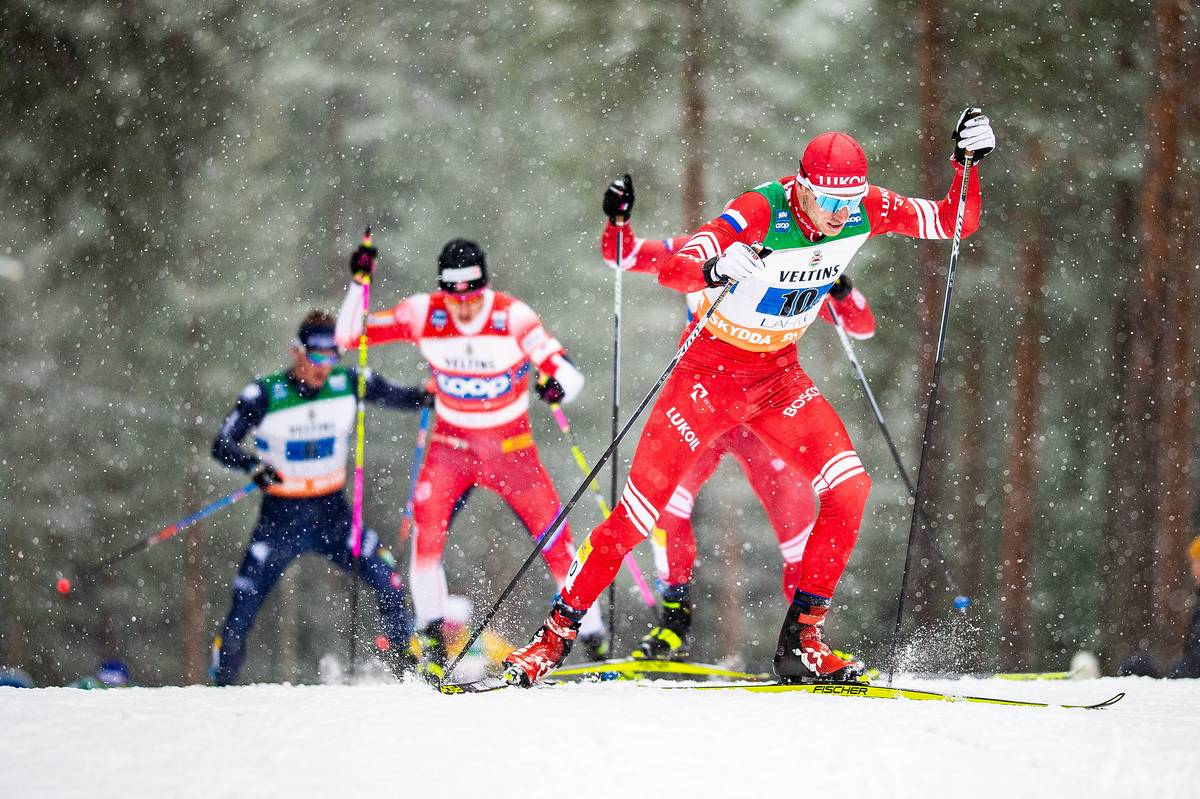
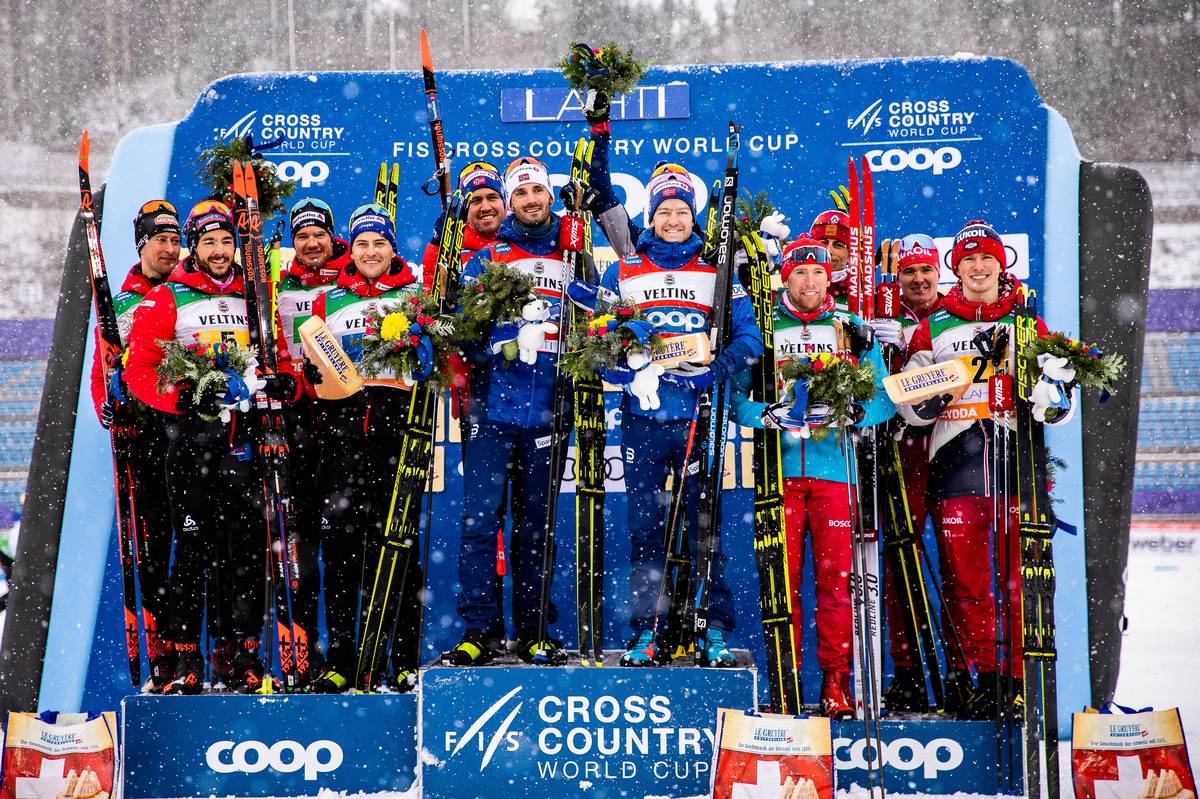
From the FasterSkier archive — posts syndicated from athletes’ and coaches’ own blogs between 2004 and 2012, kept online as published. Current coverage is at fasterskier.com.
This World Cup coverage is made possible through the generous support of Marty and Kathy Hall and A Hall Mark of Excellence Award. To learn more about A Hall Mark of Excellence Award, or to learn how you can support FasterSkier’s coverage, please contact info@fasterskier.com.
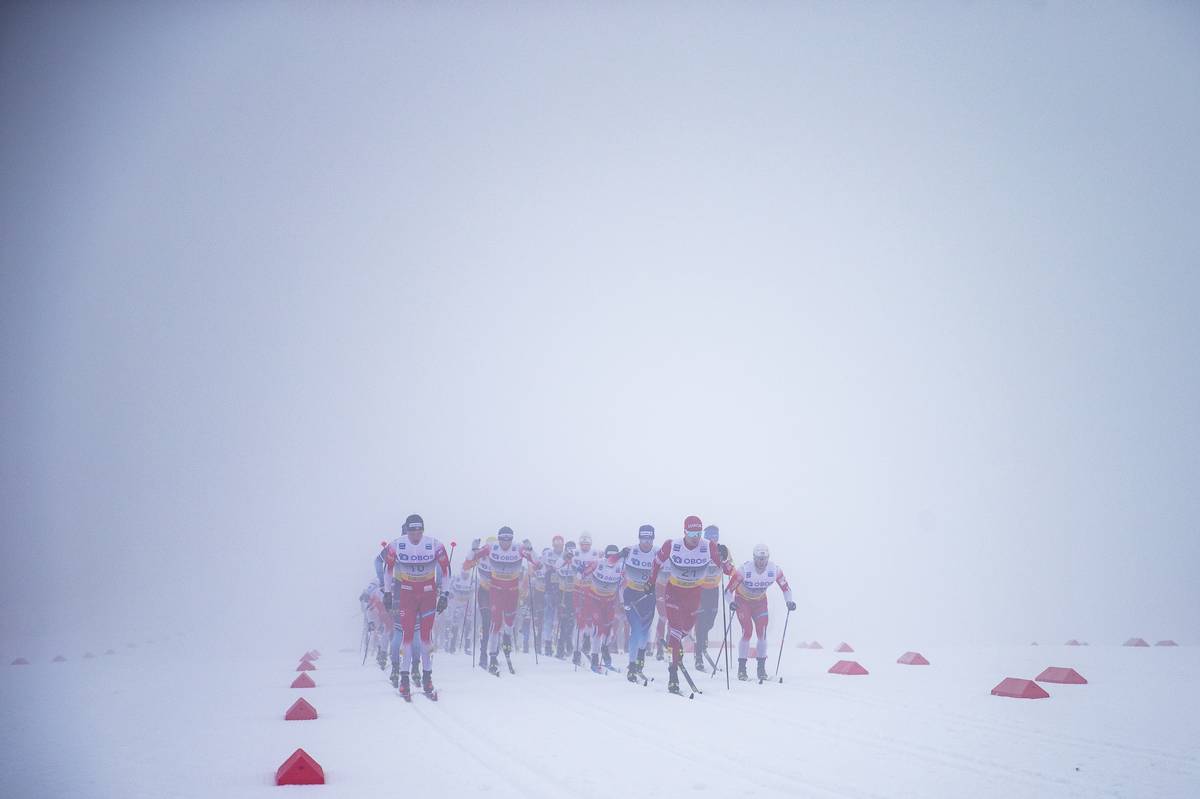
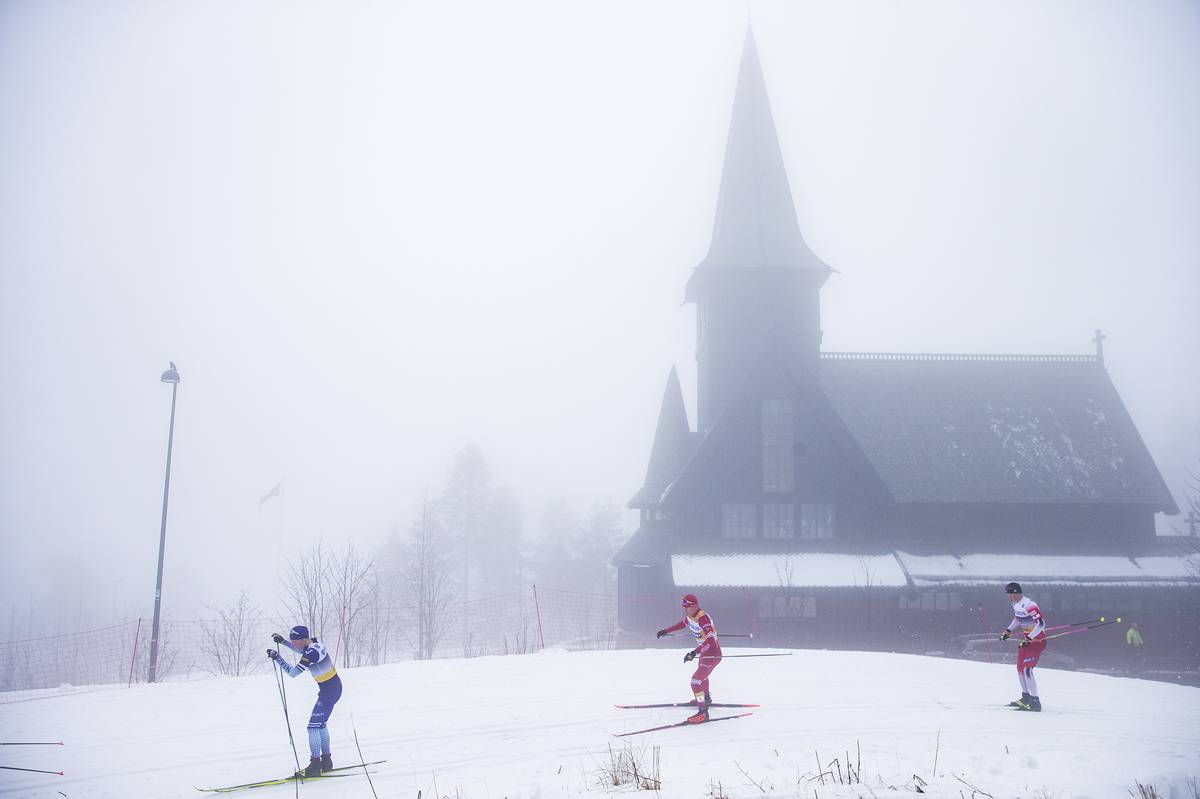
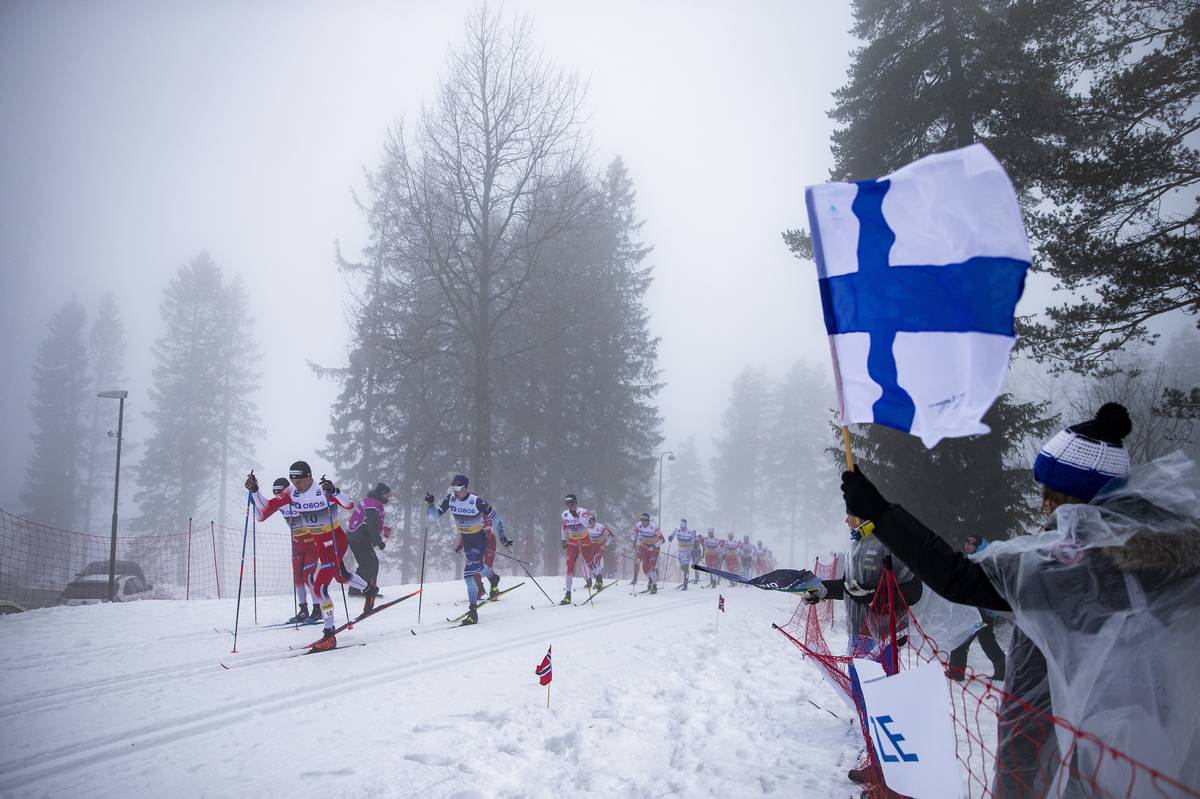
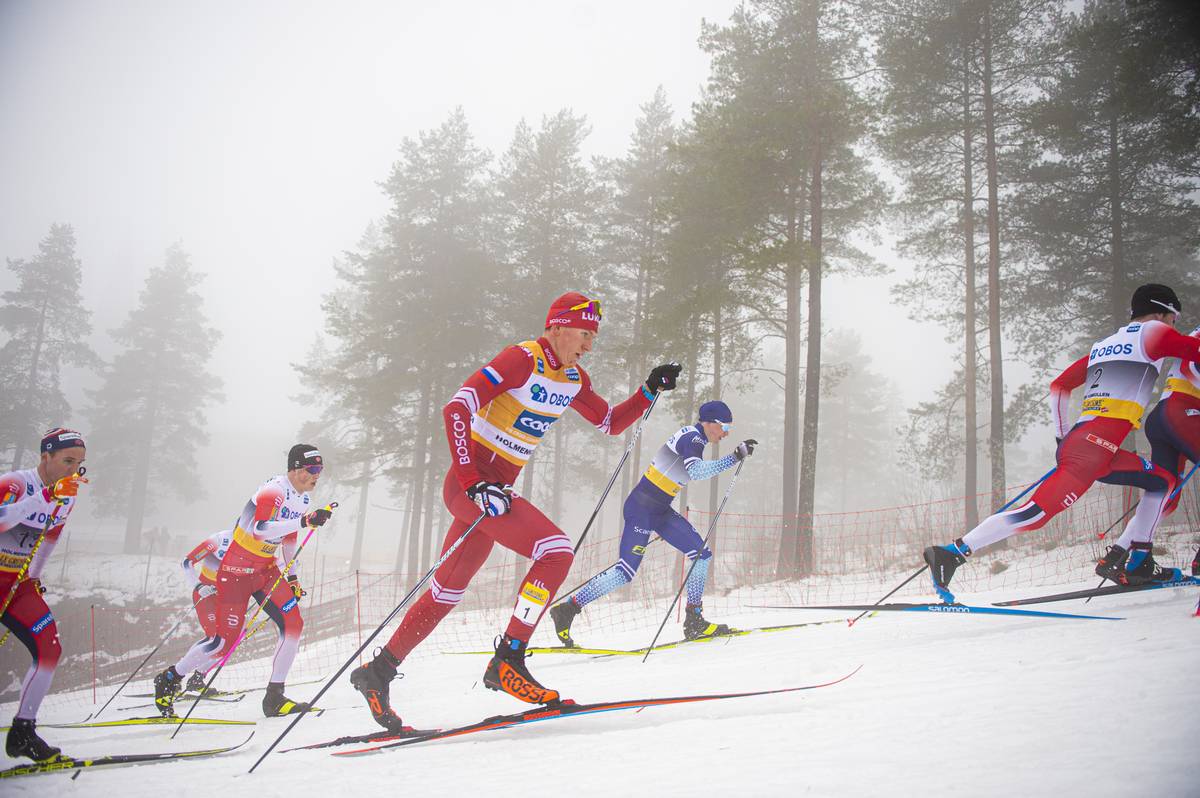
No other professional ski race can match the prestige and lore surrounding the Holmenkollen 50 kilometer race held in Oslo, Norway. Win it—and your name will be etched into history. Like all iconic sport competitions, once you are Holmenkollen champion, it’s a title which follows you forever. It’s also a title everyone desperately wants. Holmenkollen has earned its reputation; with over 6,000 feet (1,828 meters) of climbing, it’s generally viewed as the toughest 50 kilometer race in which professionals will compete. The focus this year would be all about Norway—and why not? Norwegian men have subdued the rest of the distance skiing world, having won each of the last 16 World Cup distance events and every distance event this season. Though with only 39 men starting, others were hoping for a chance to break through.
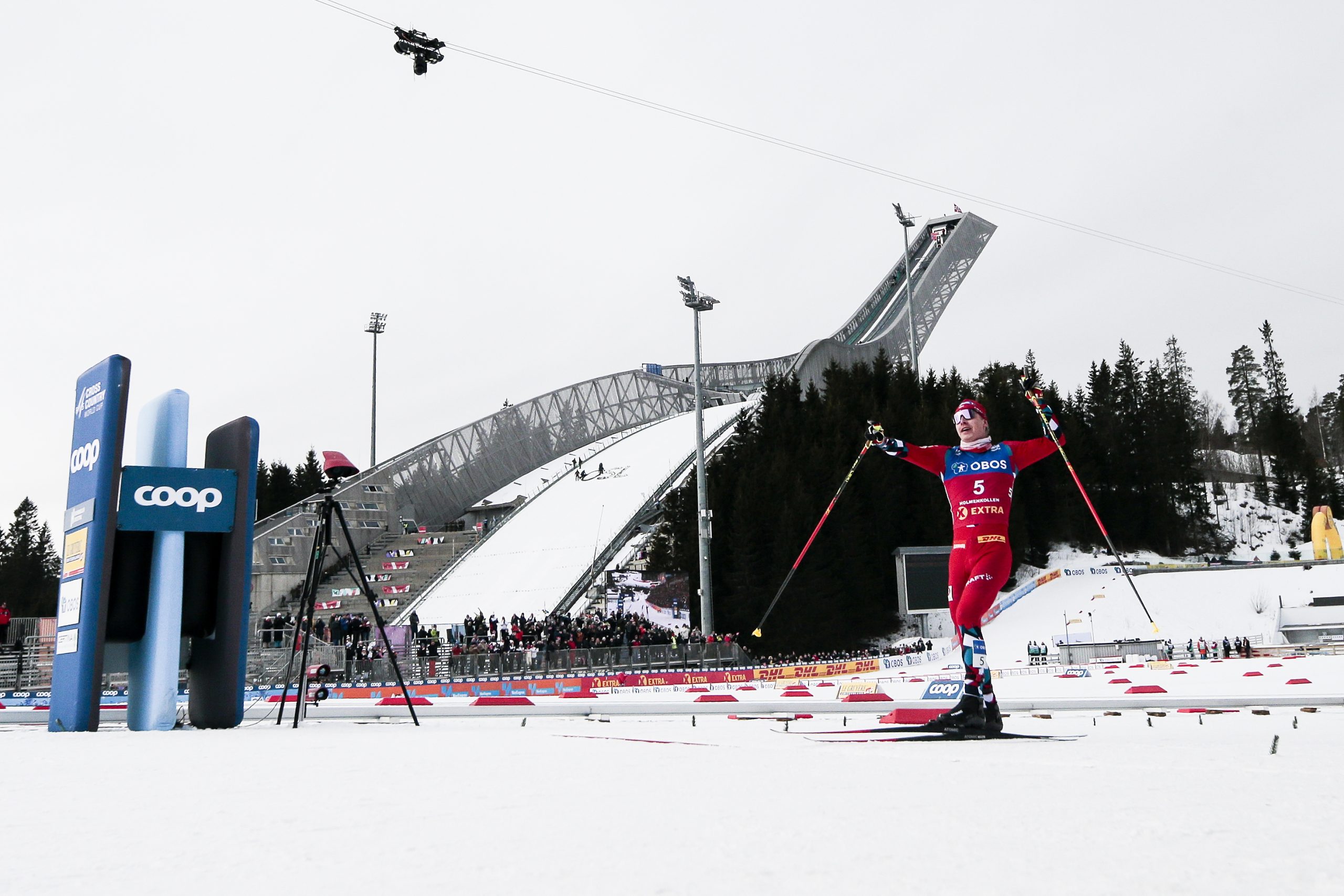
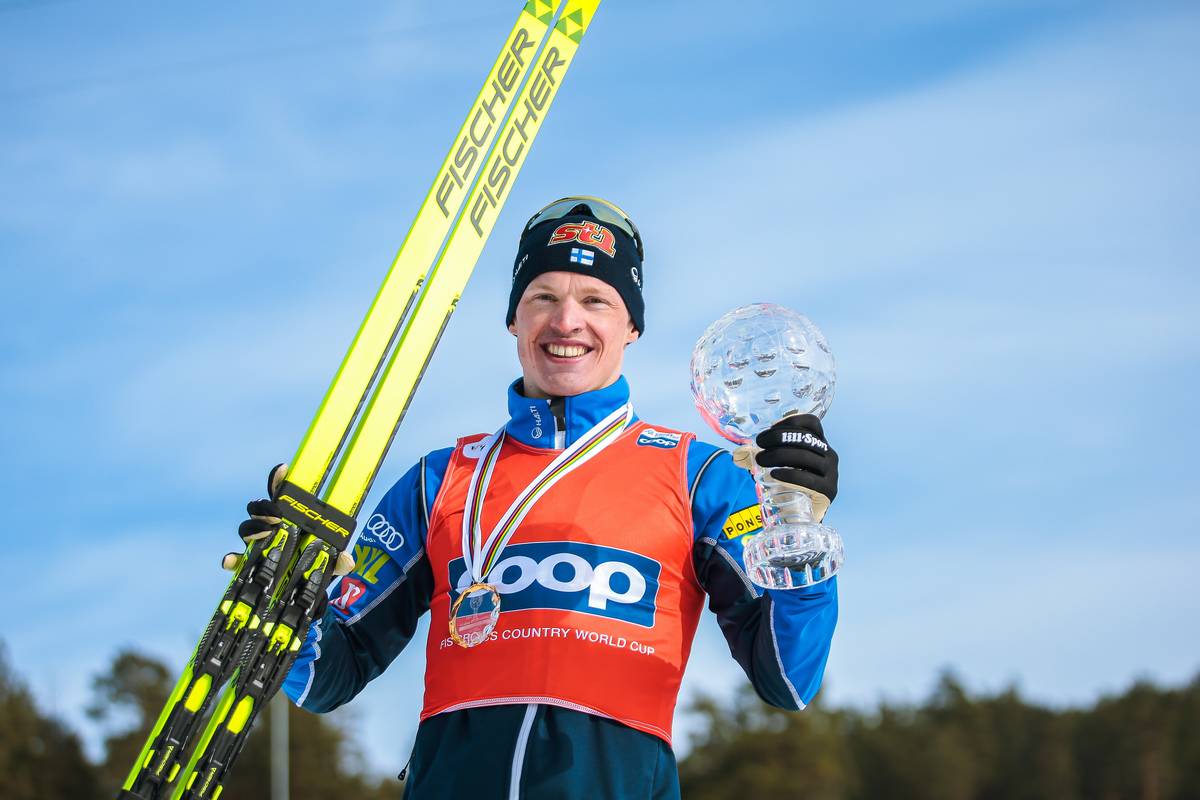
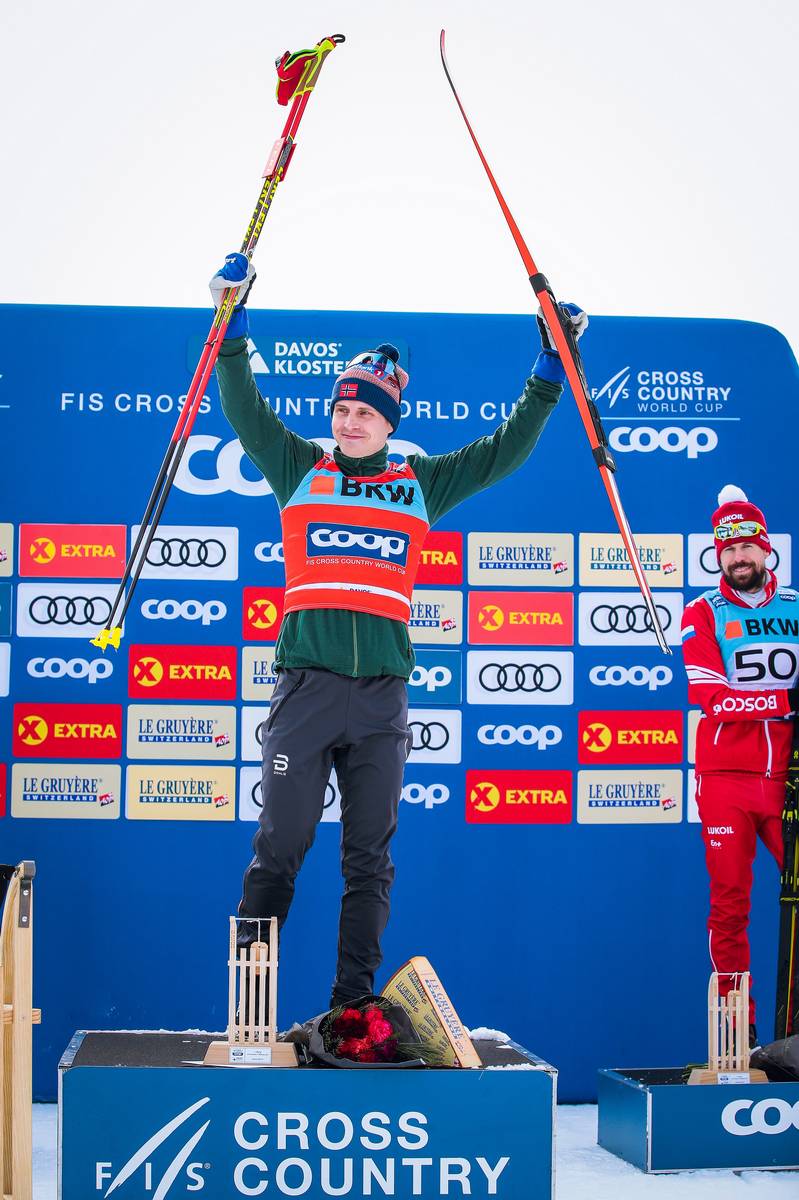
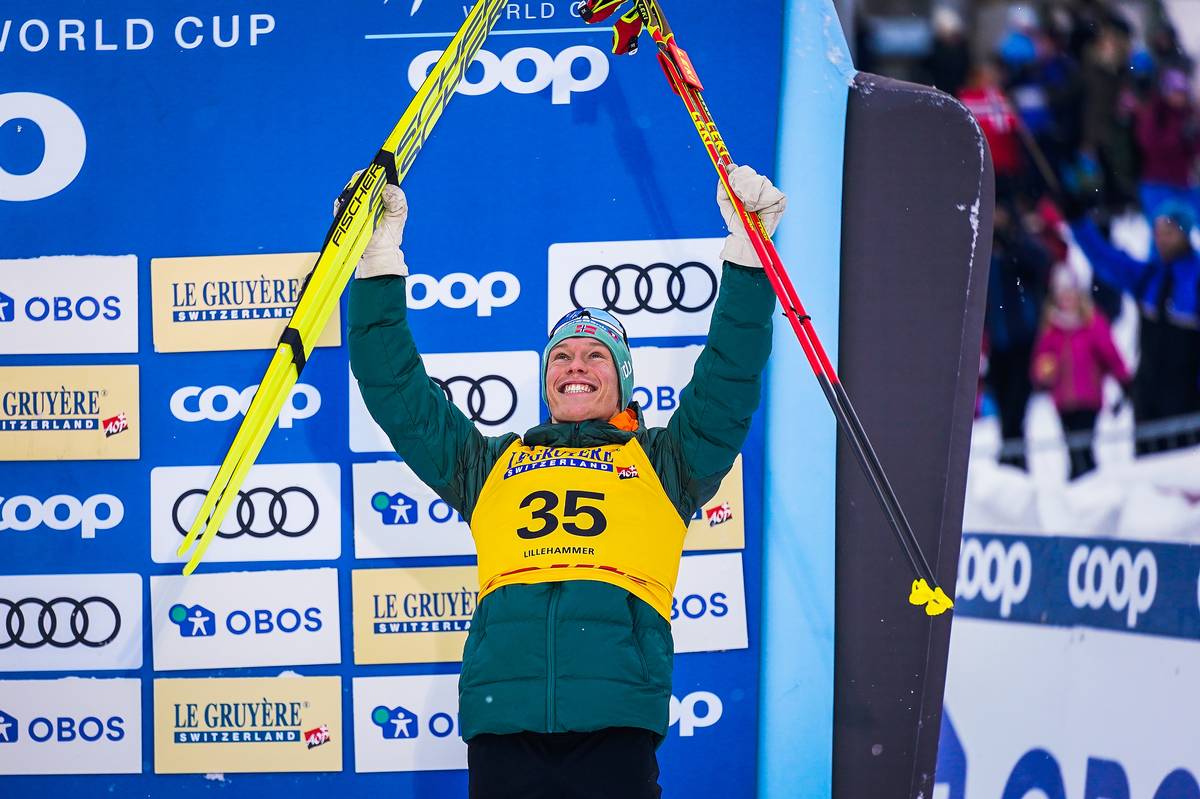
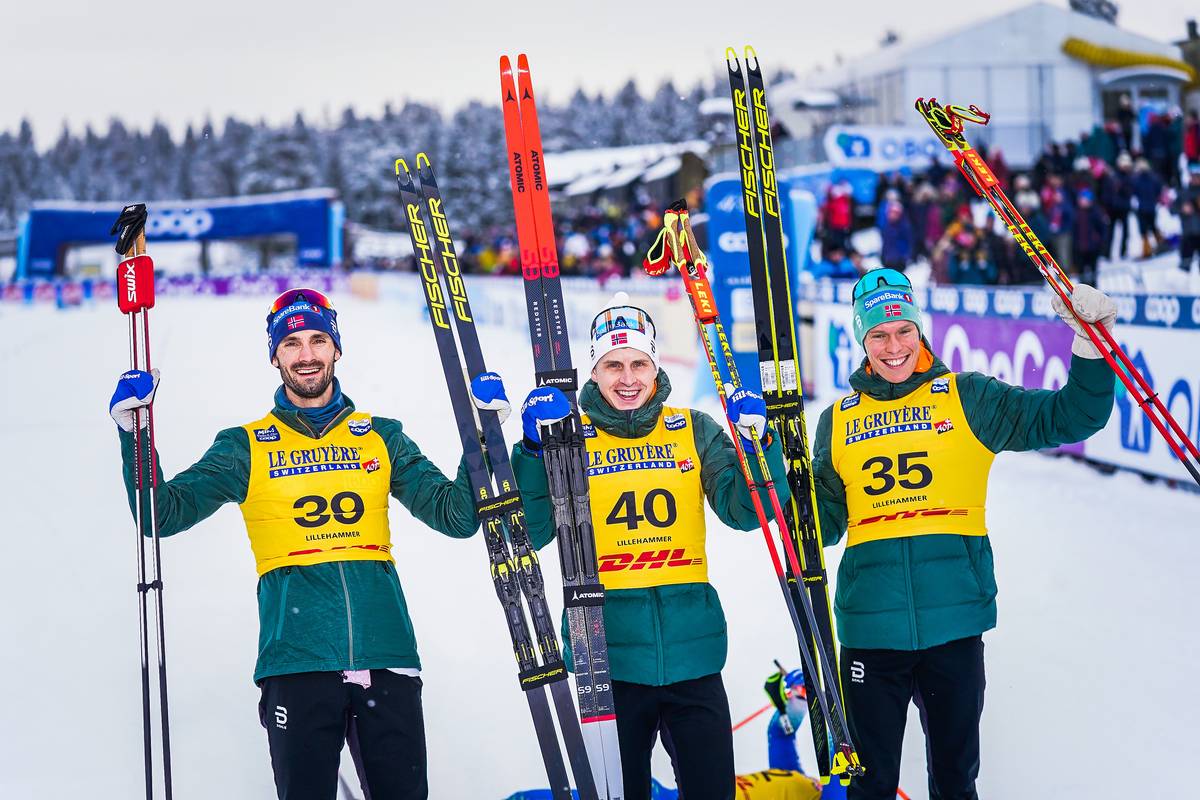
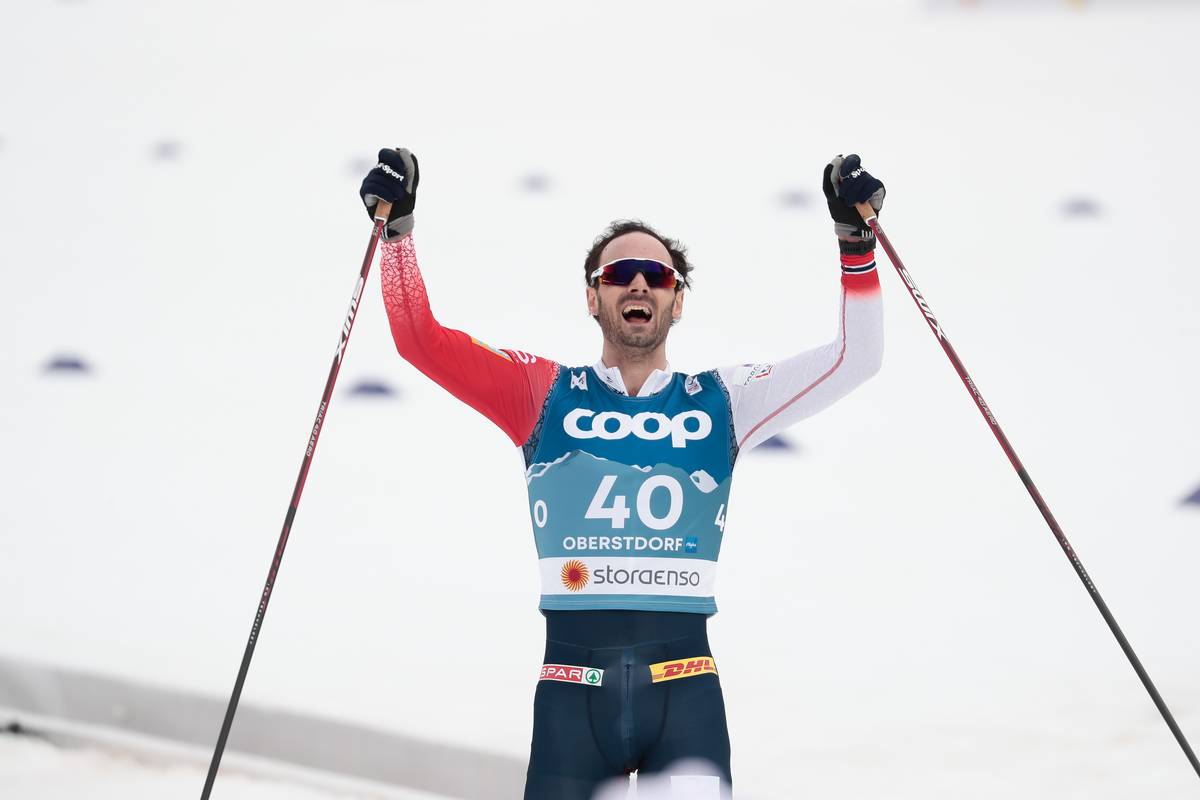
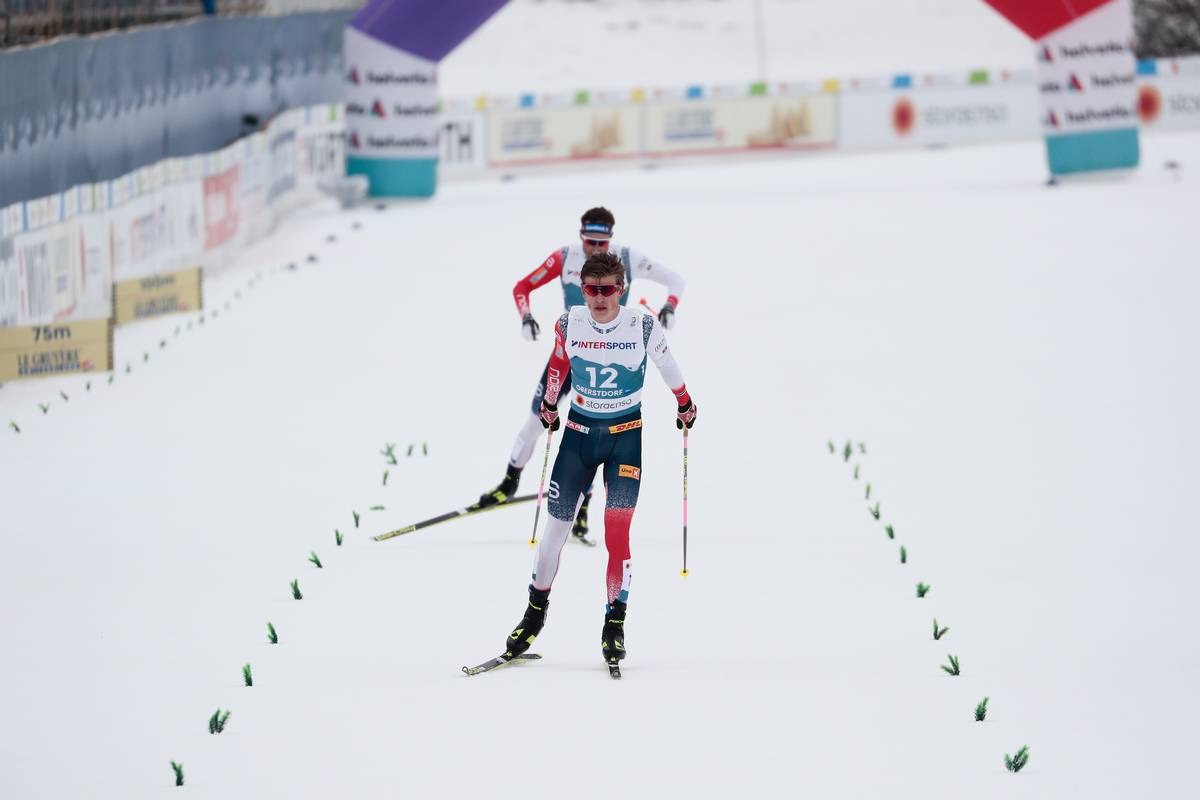
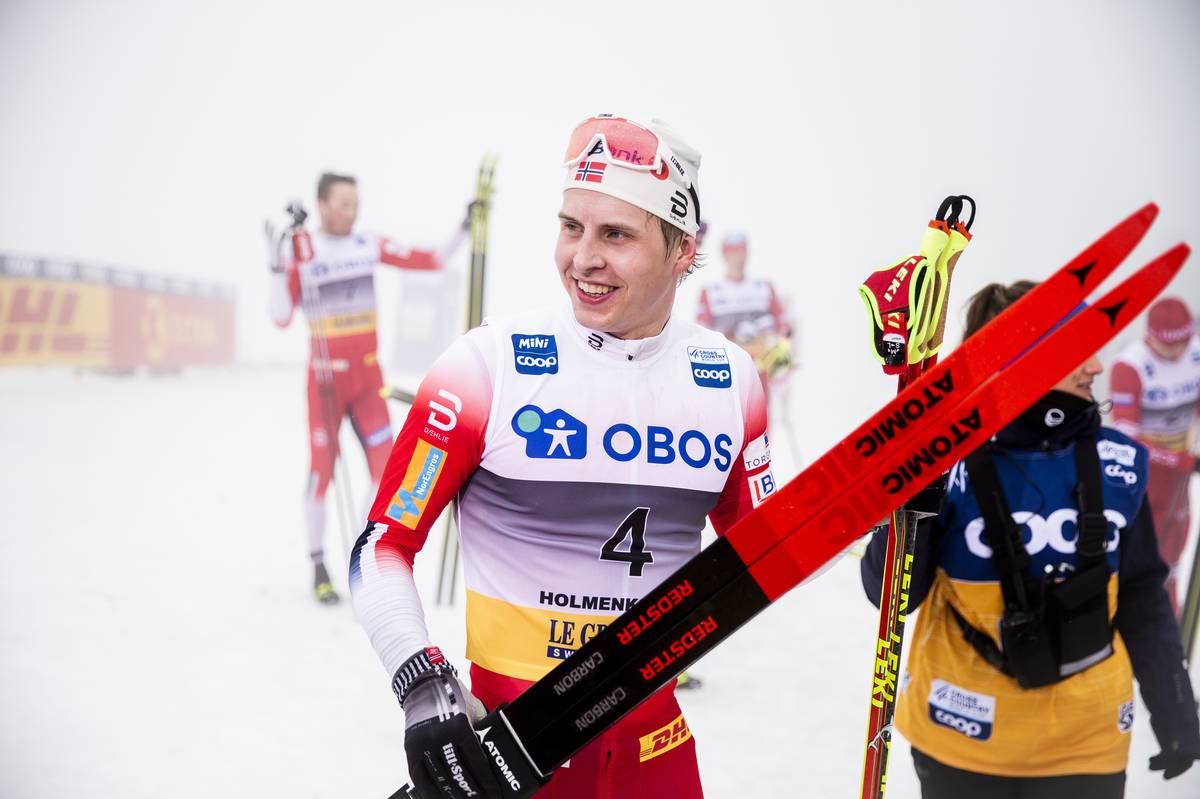
Simen Hegstad Krueger (NOR) celebrates a Holmenkollen victory after having been left off the Norwegian 50 k World Championship team last week. (Photo: NordicFocus)
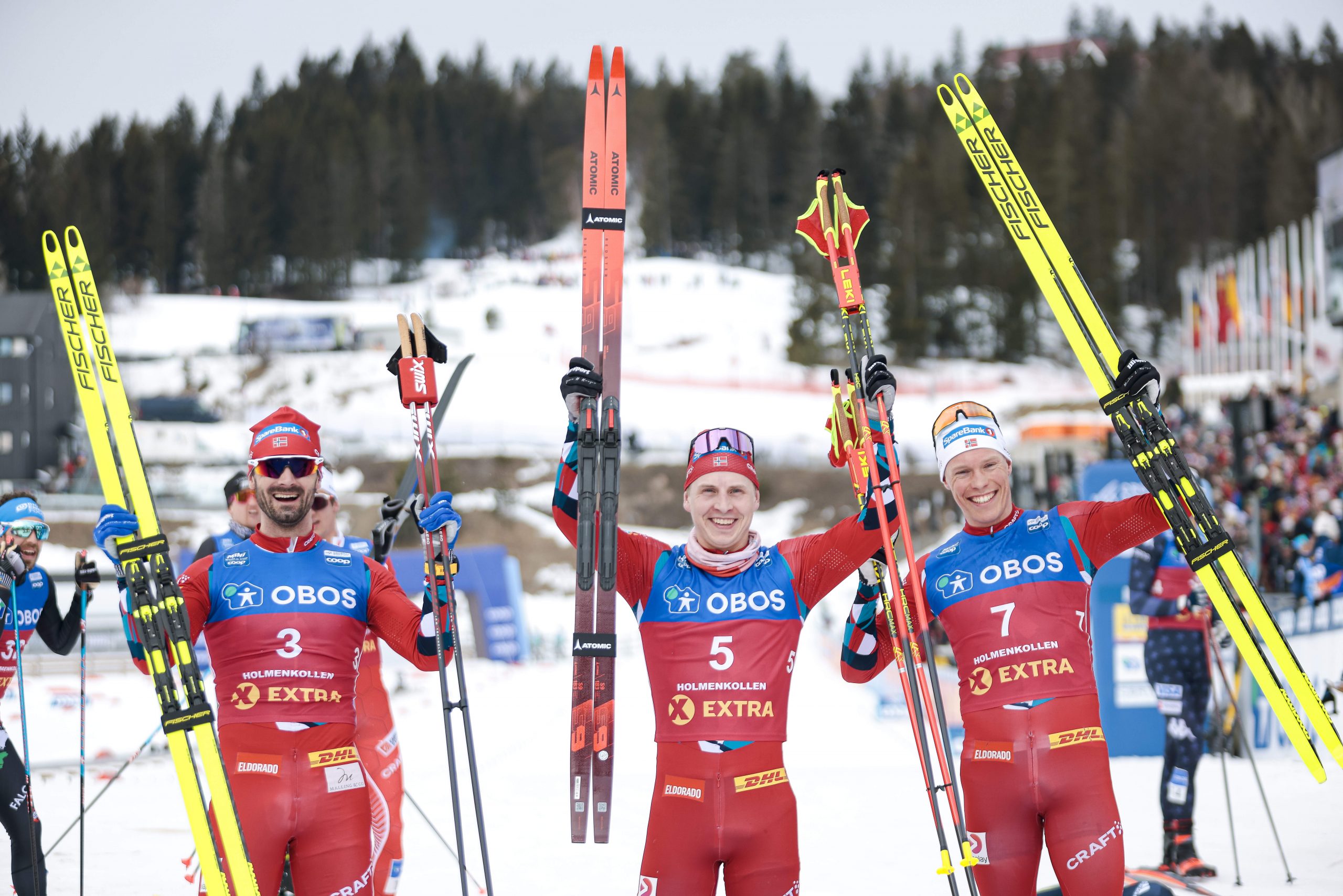
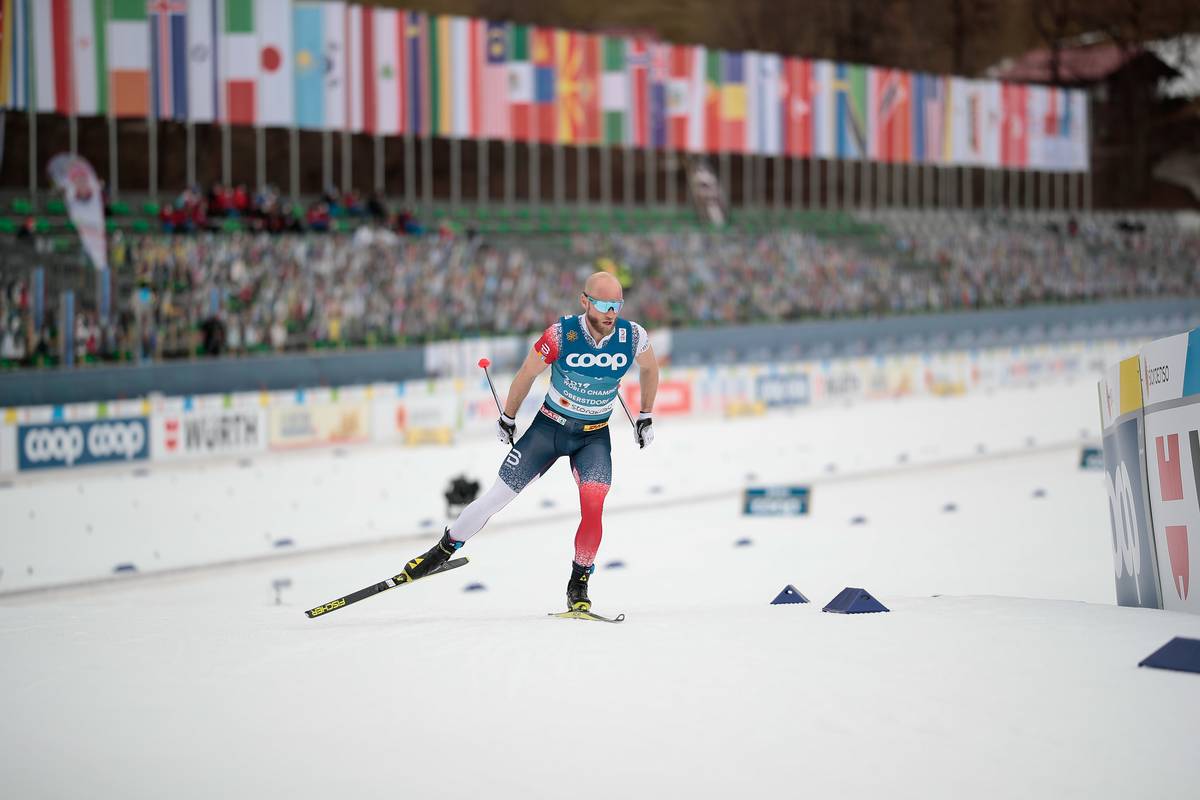
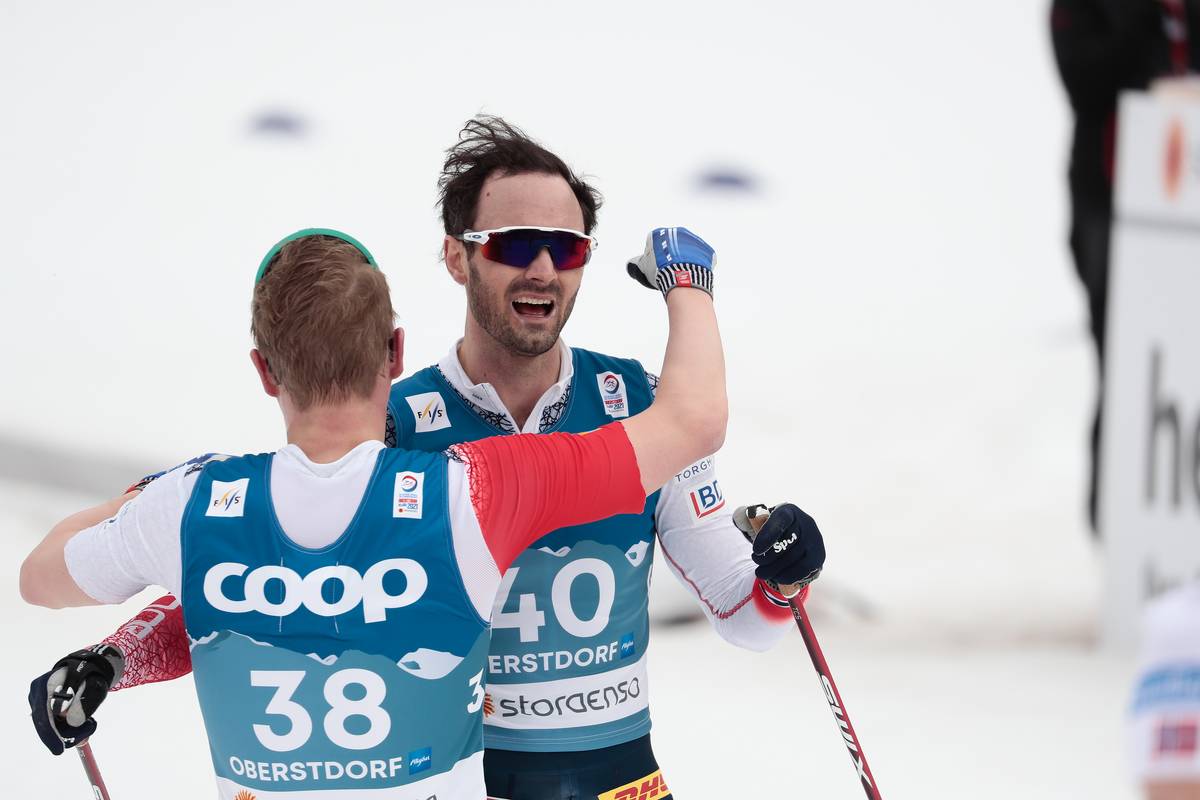
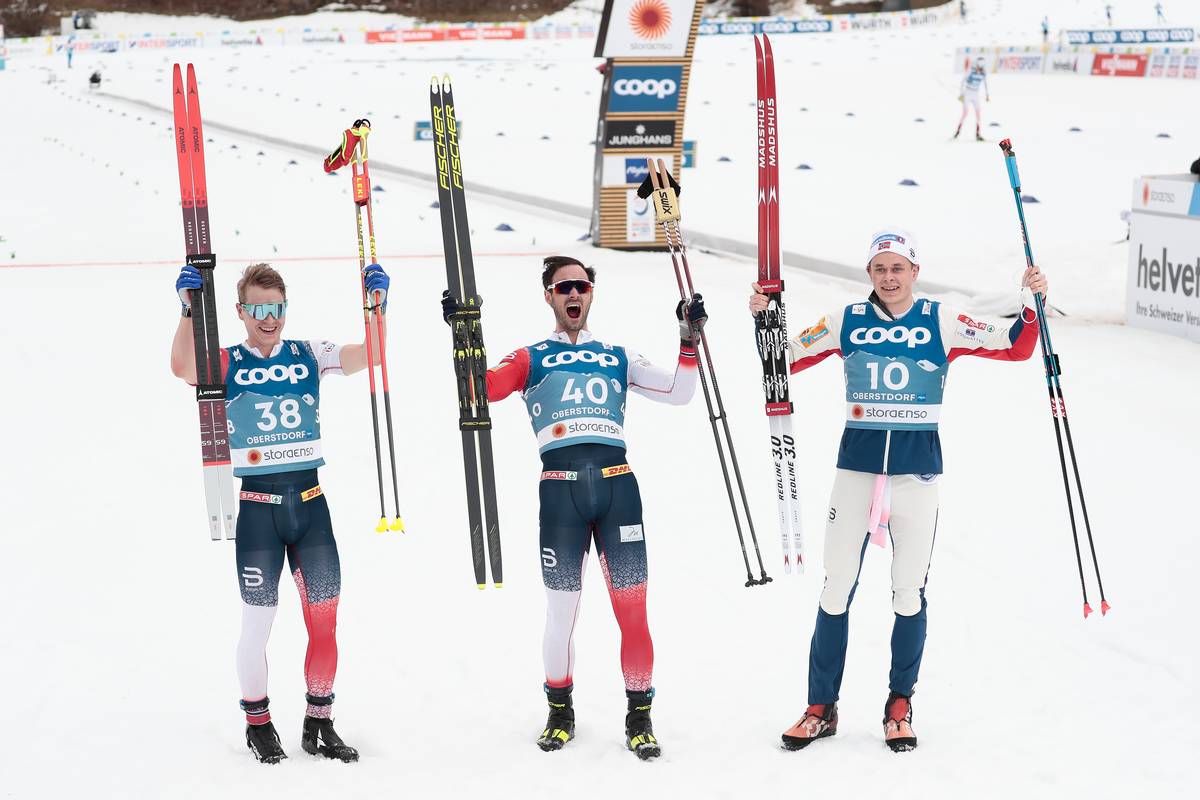
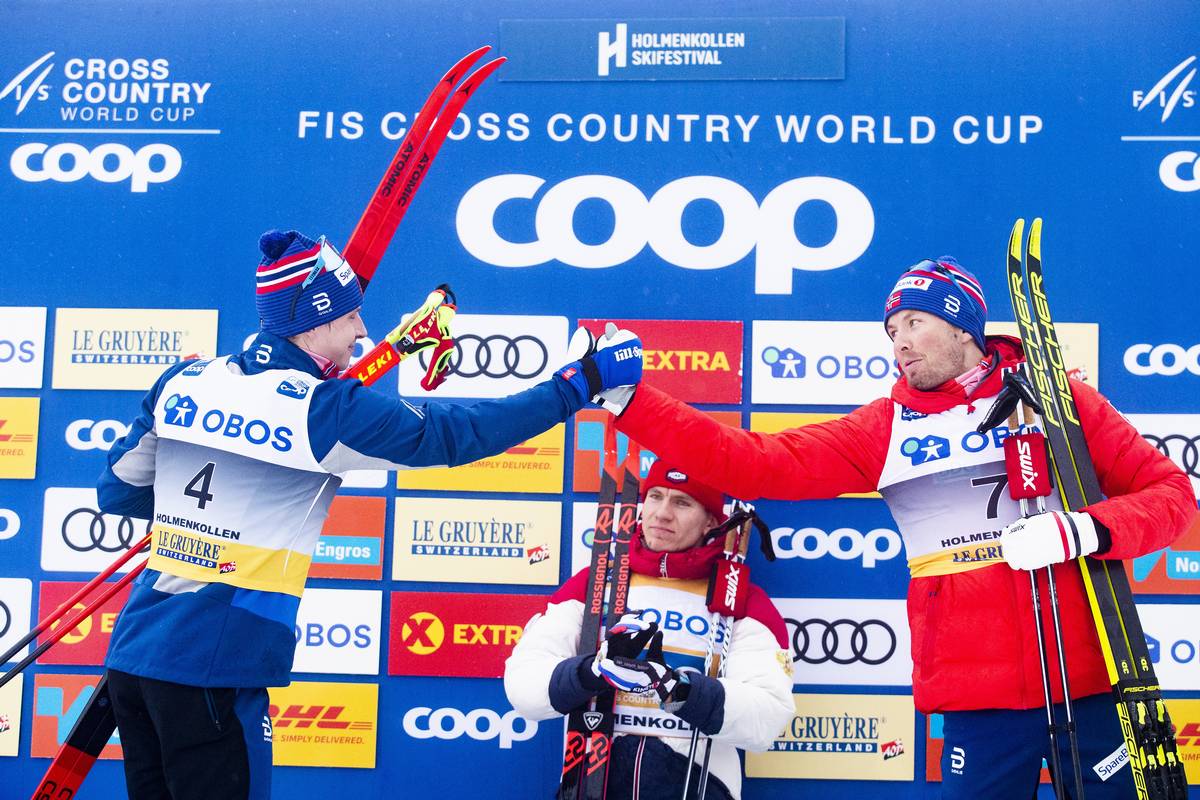
After dueling on the brutal Holmenkollen course, the Norwegian domination continued with Simen Hegstad Krueger (NOR) taking the win. He was followed by Hans Christer Holund (NOR) and Martin Loewstroem Nyenget (NOR). Norwegians took the top ten spots. Andrew Musgrave (GBR) was the top non-Norwegian finisher in 11th.
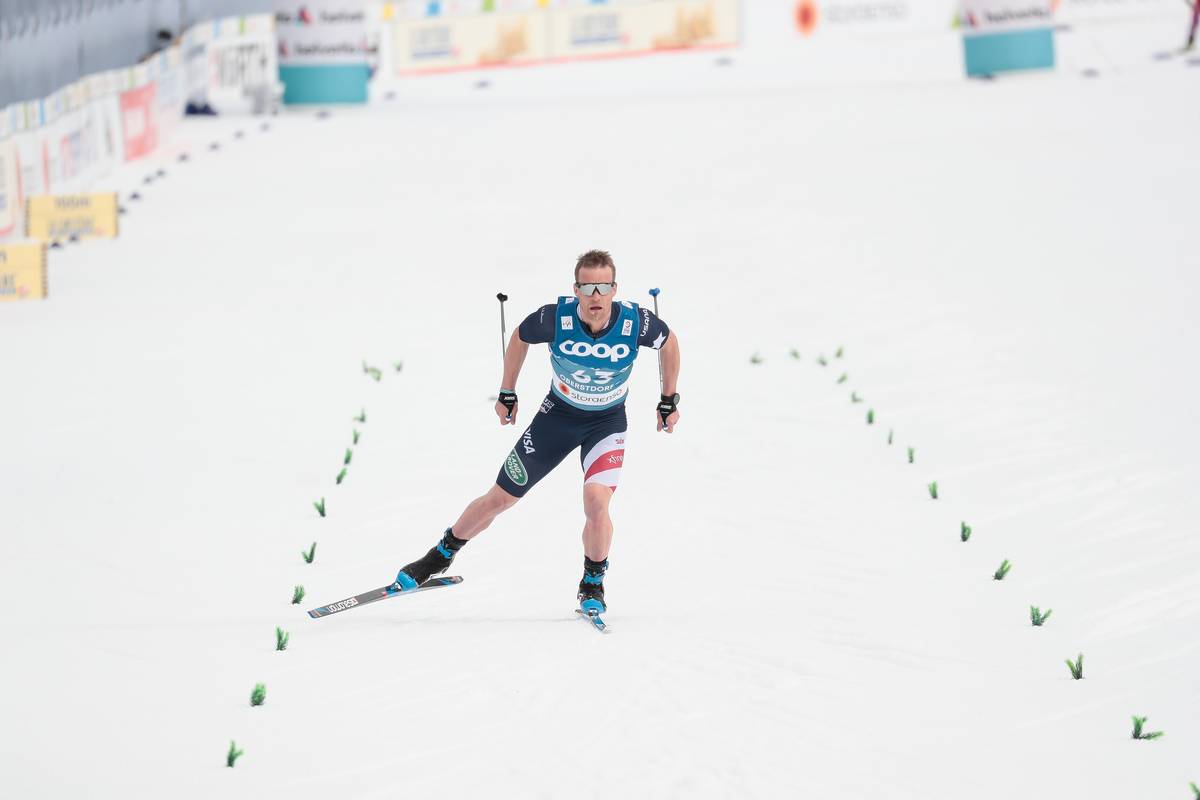
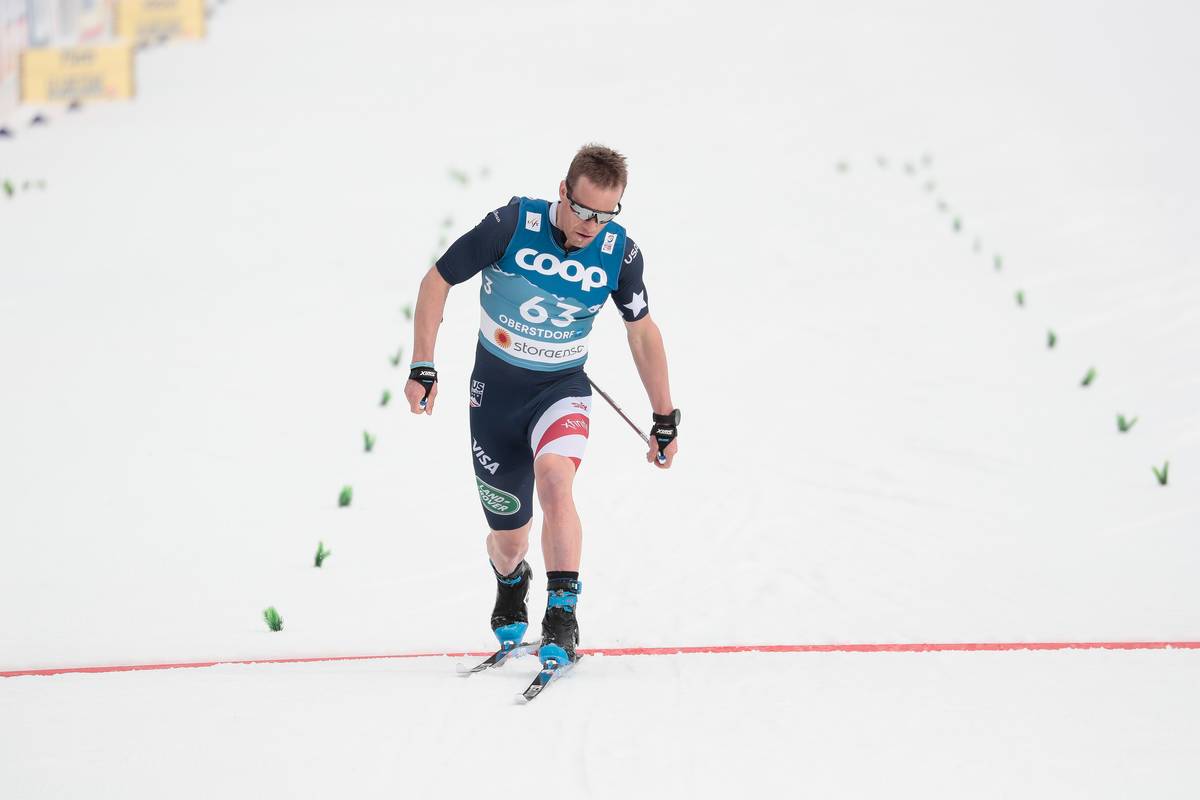
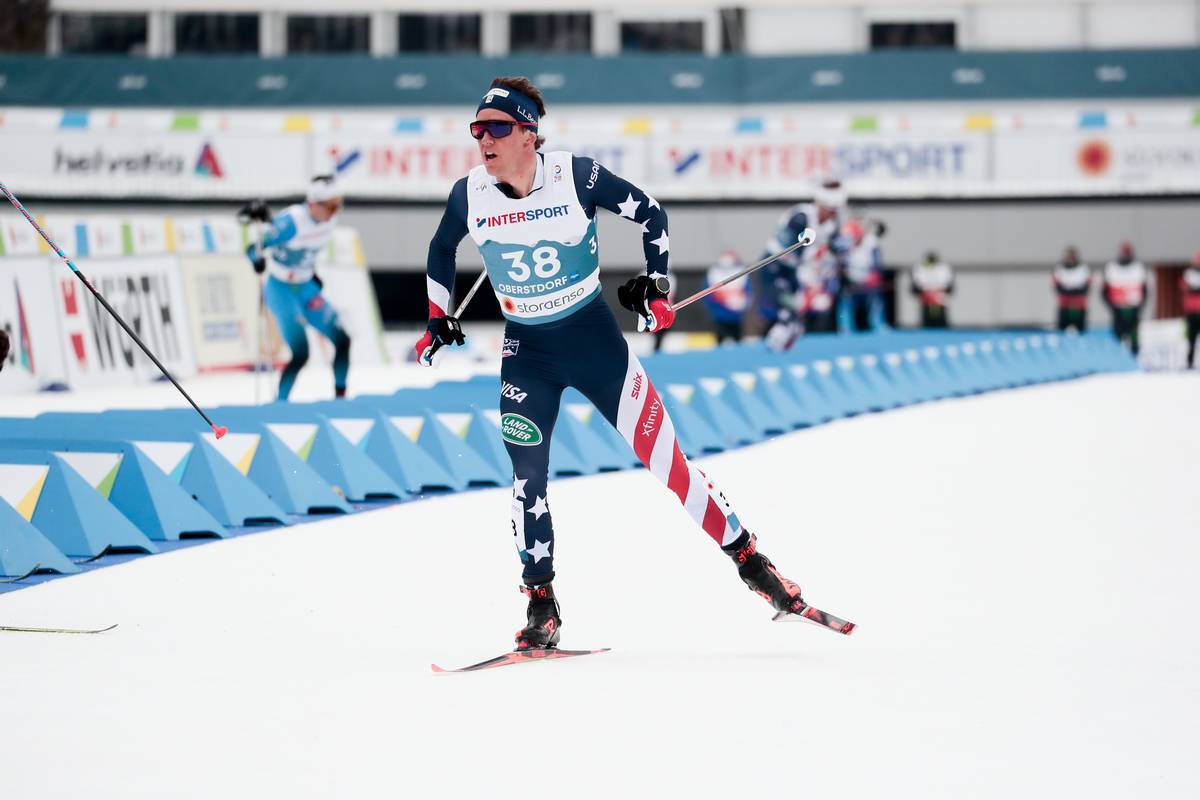
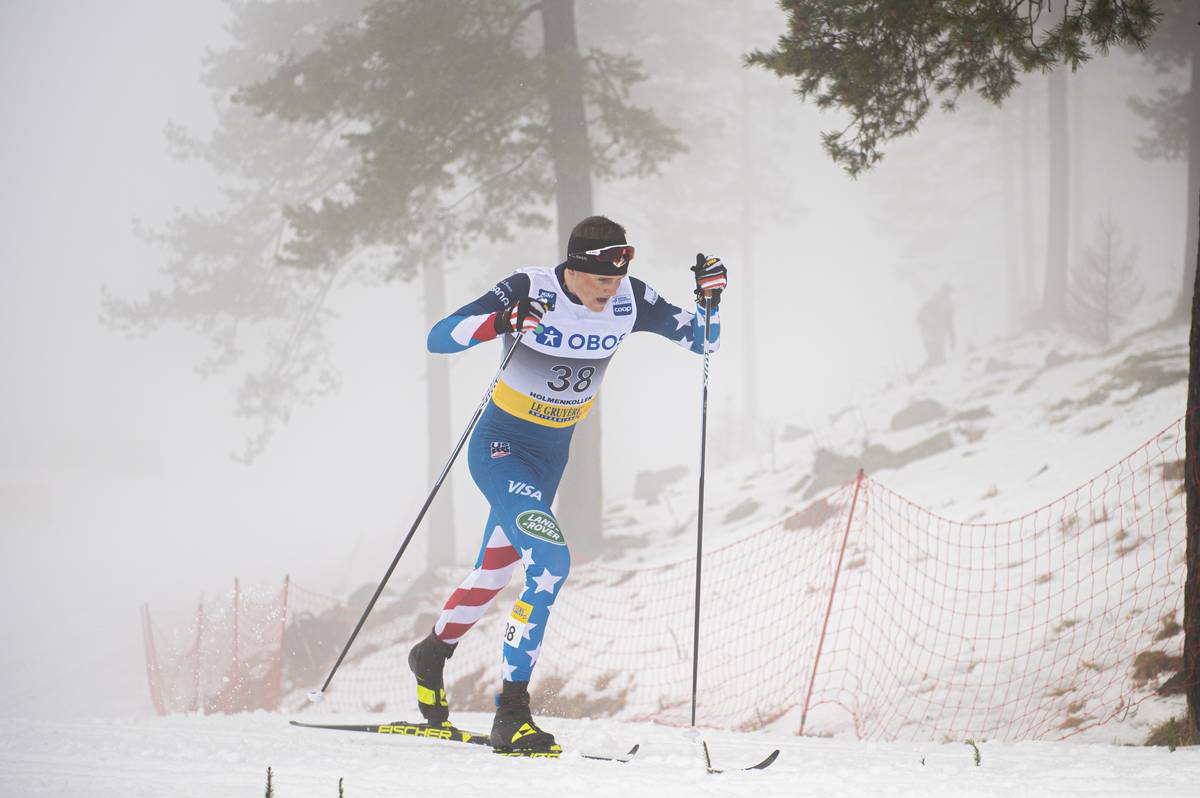
David Norris was rewarded for his globe-trotting taking the top American position, finishing 17th. “Today went well for me,” Norris said. “No major mishaps and I have pretty good energy considering my schedule. Third 50 in three weeks! I’m so grateful that the Steamboat Winter Sports Club allowed me to come here for two weeks. This has been a great experience.”
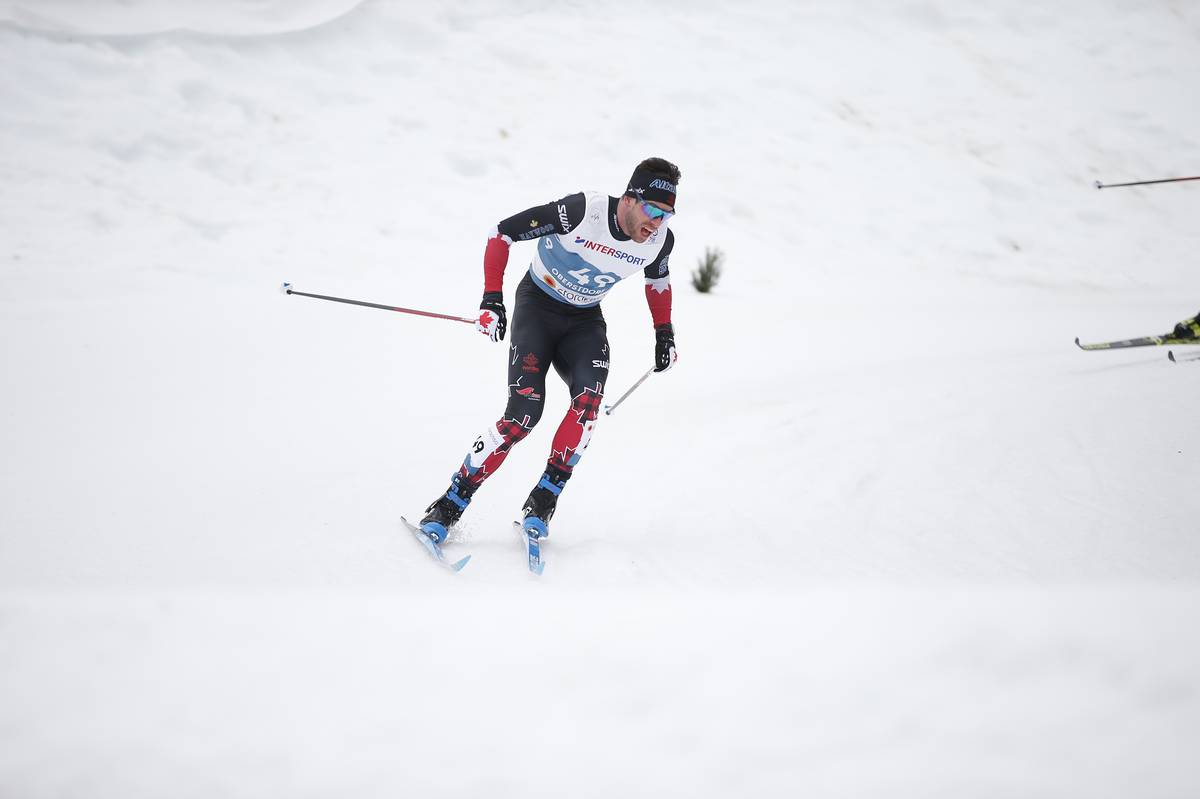
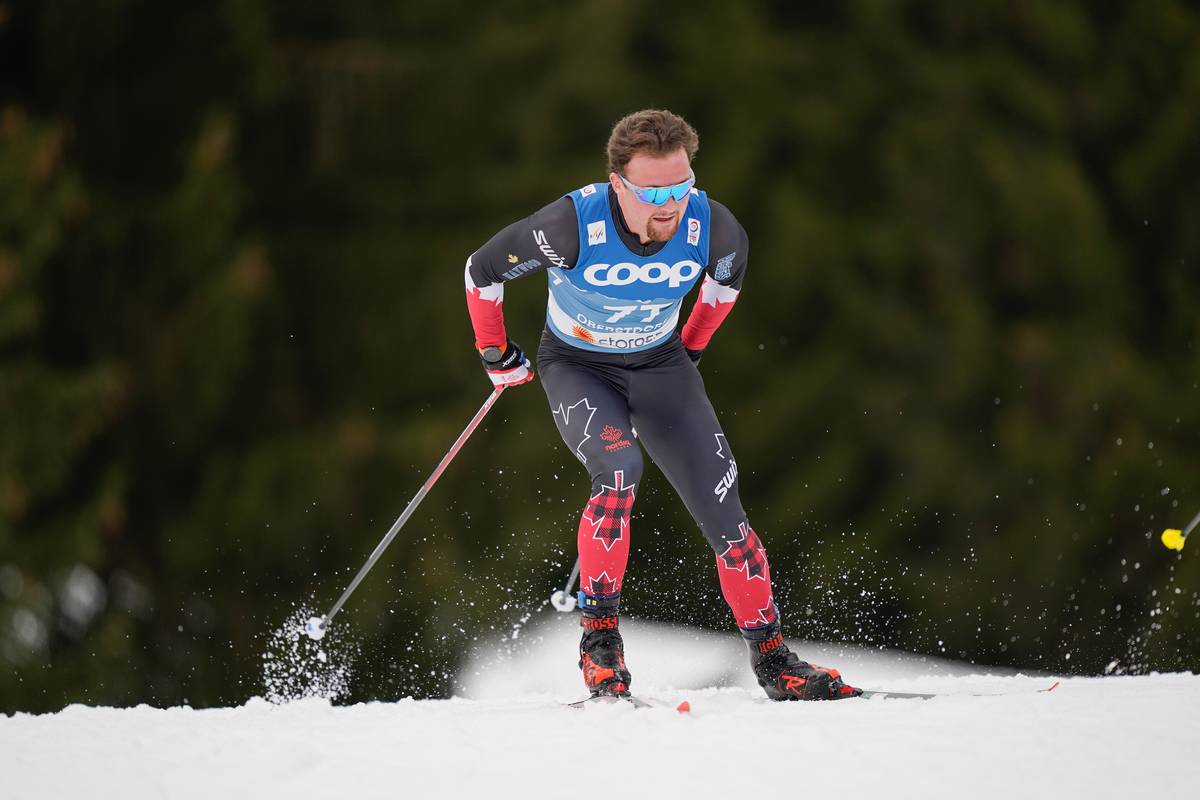
Among other North Americans, Scott Patterson was right behind Norris finishing 18th. Hunter Wonders was 23rd, followed by Gus Schumacher in 28th. The top Canadian was Olivier Leveille in 26th, while Russell Kennedy was 36th.
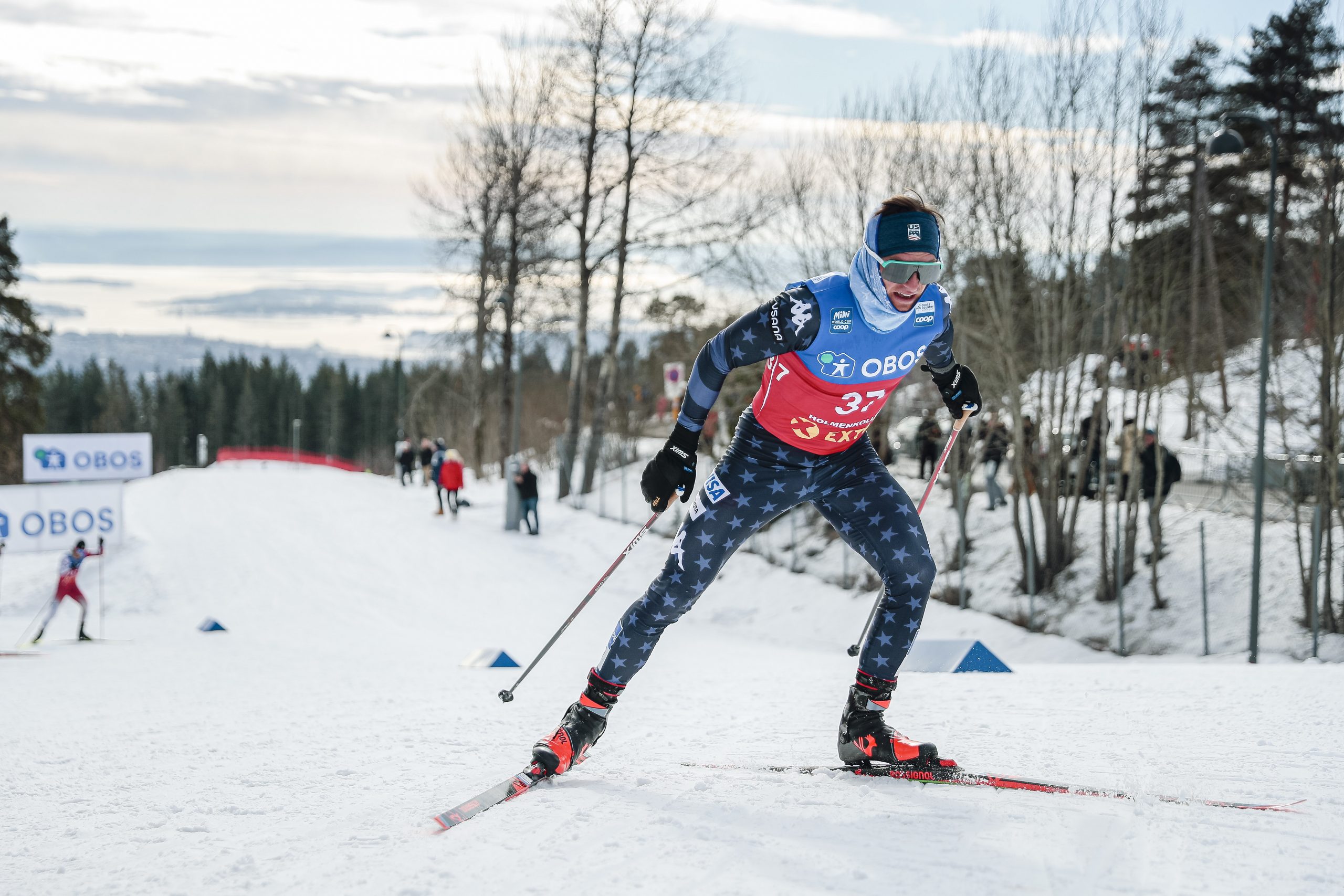
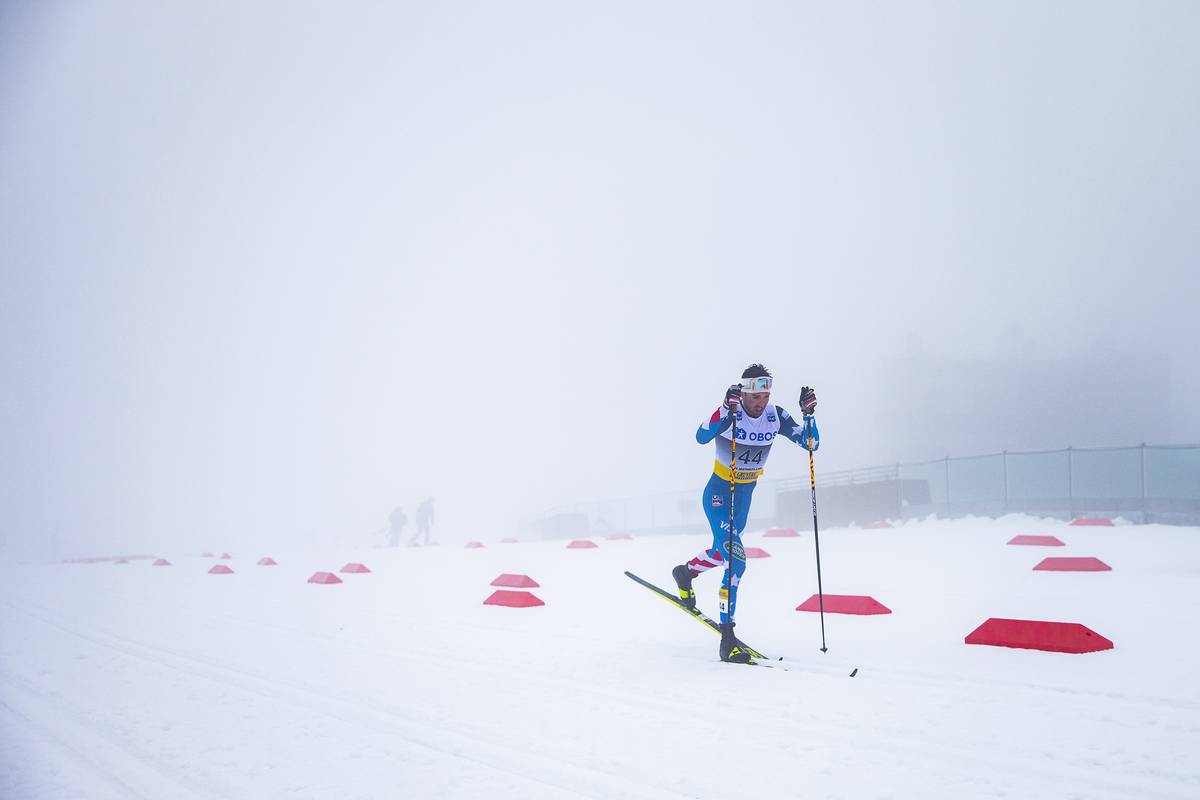
David Norris (USA) skied to 17th, having raced three marathons in three weeks across the world. (Photo: NordicFocus)
Holmenkollen 50 Kilometer Mass Start Freestyle
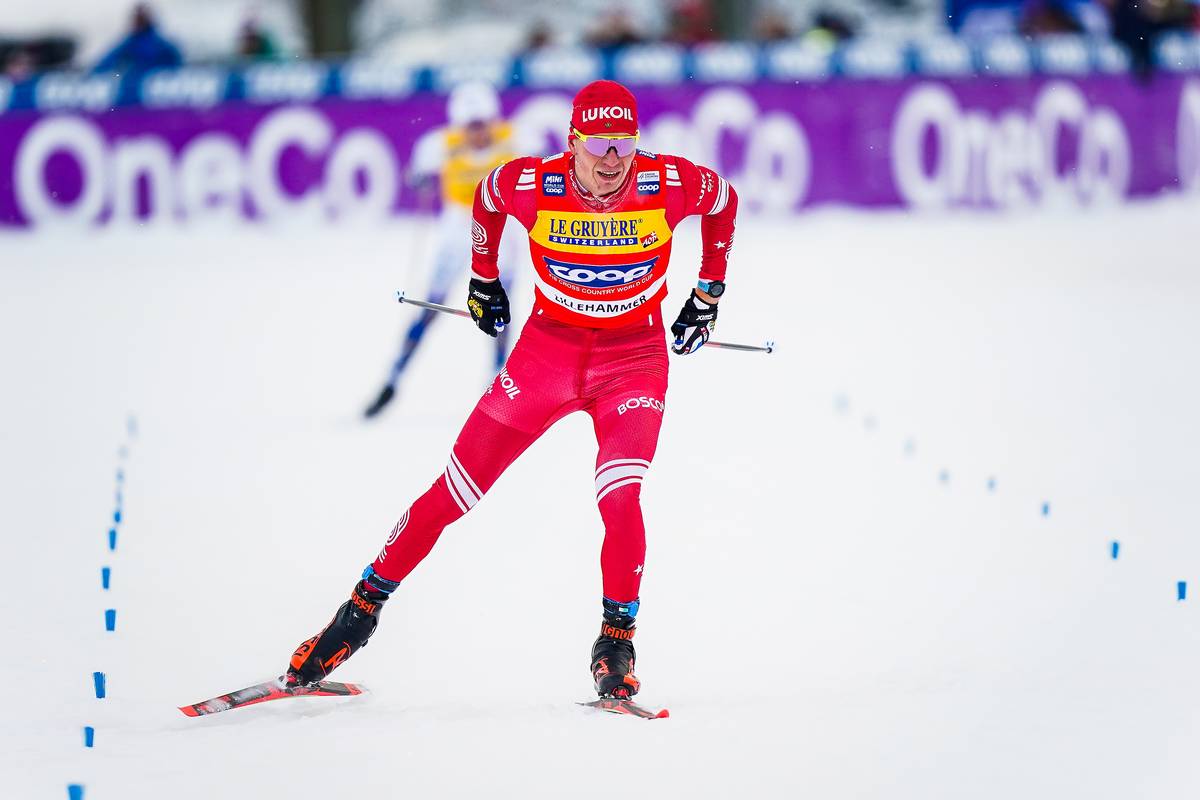
For Klaebo (NOR), a win today would go a long way to heal the wounds of last week’s second place finish at the World Cup 50 k. Klaebo would also be looking to eclipse countryman Martin Sundby for the most World Cup victories for a man in one season, currently both are tied with 14. Paal Golberg (NOR) would be in the difficult position of defending his World Cup Marathon victory from last week.
American fans would have their eyes on long distance standout David Norris who was attempting the unprecedented feat of winning the North American Birkebeiner, skiing in the World Championship Marathon the following week, and now, one week later, racing Holmenkollen.
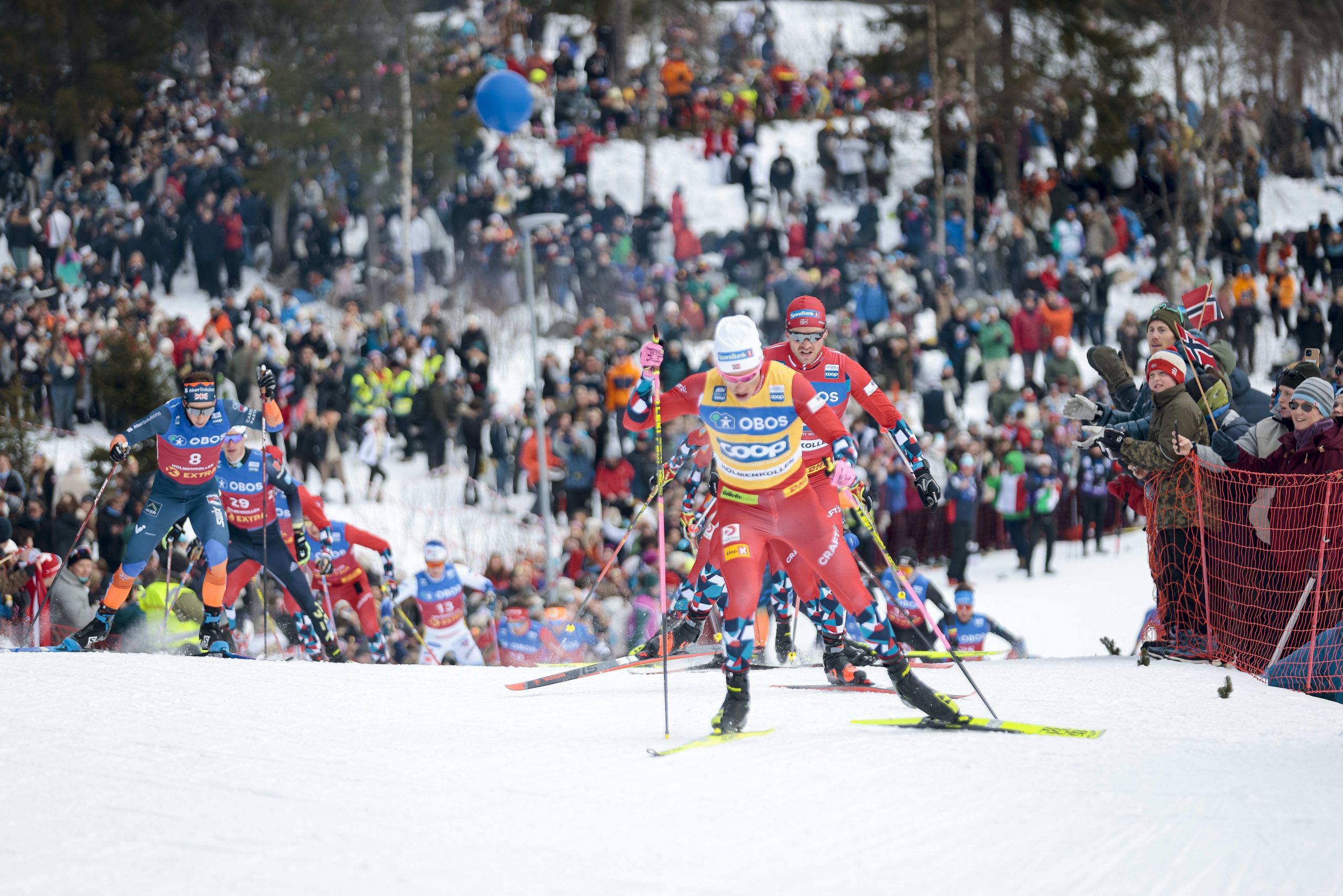
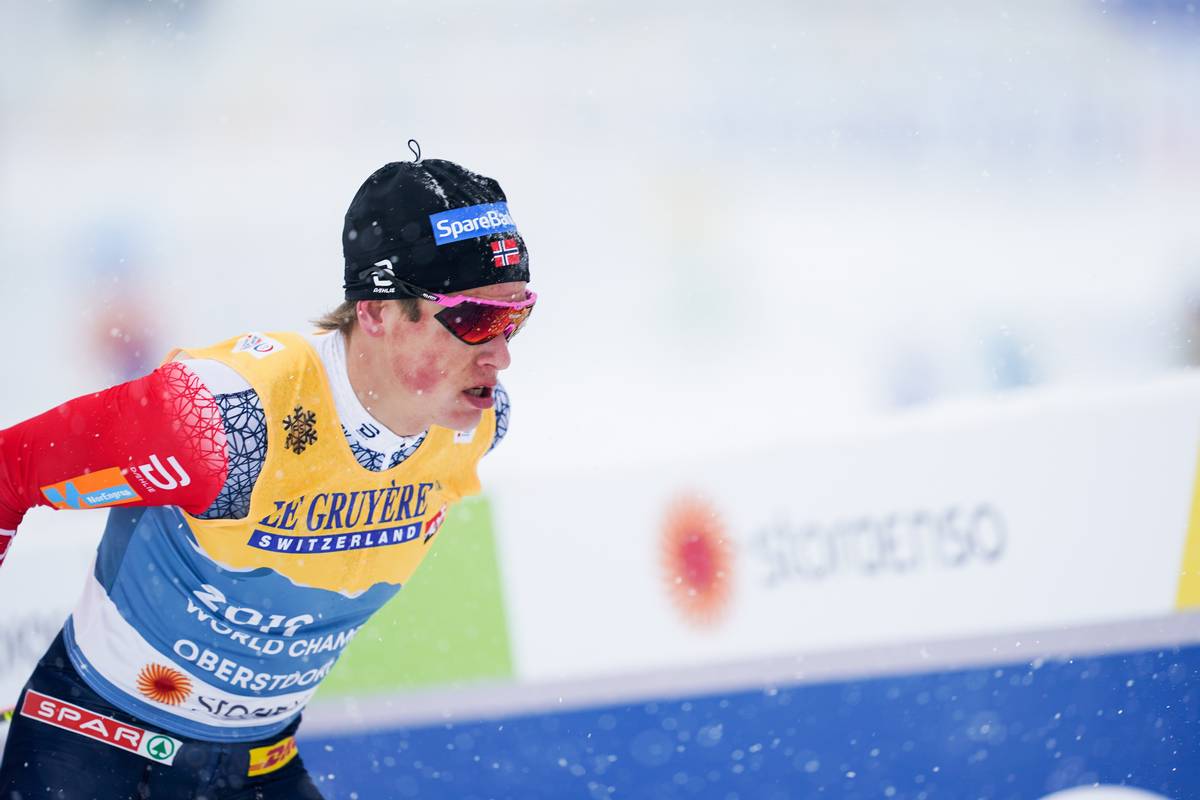
Johannes Hoesflot Klaebo (NOR) tried a different strategy this week going to the front of the race. But the big 50 k win still eluded him. (Photo: NordicFocus)
Klaebo took a different approach to today’s race as he went to the lead early and led through the first five kilometers. It was a marked contrast to the strategy he employed at last week’s World Cup 50 kilometer when he never went to the front. Early on, Klaebo seemed determined to not repeat last week’s events, quickly returning to the front whenever he was challenged. He was joined at the front by Golberg.
This pattern continued for the first 13.5 kilometers as the field stretched out at each bonus point sprint; then the inevitable contractions occurred, with Klaebo still out front. There were minor lead changes but each new leader was quickly replaced by Klaebo. The question was, would he maintain this strategy for the rest of the race?
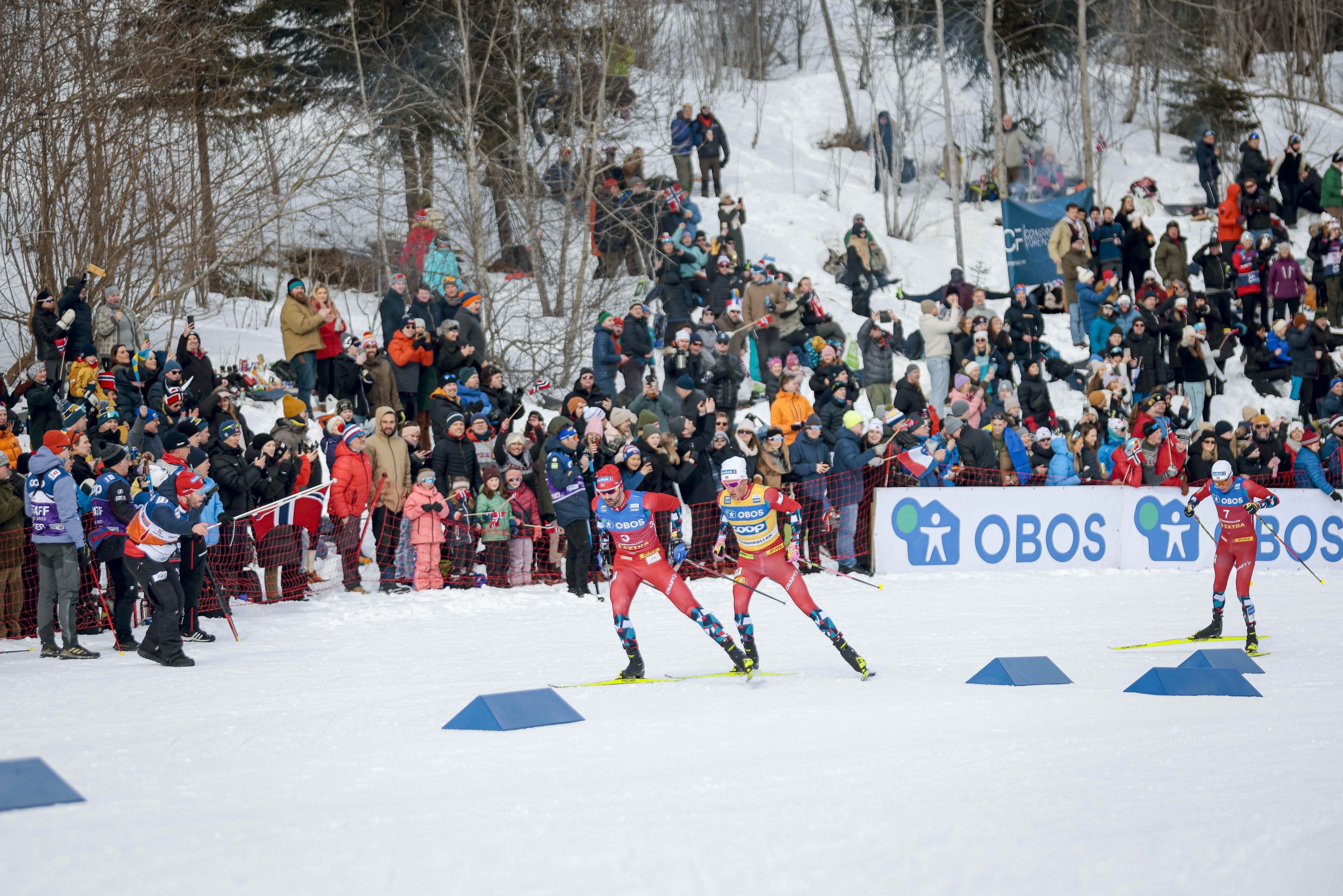
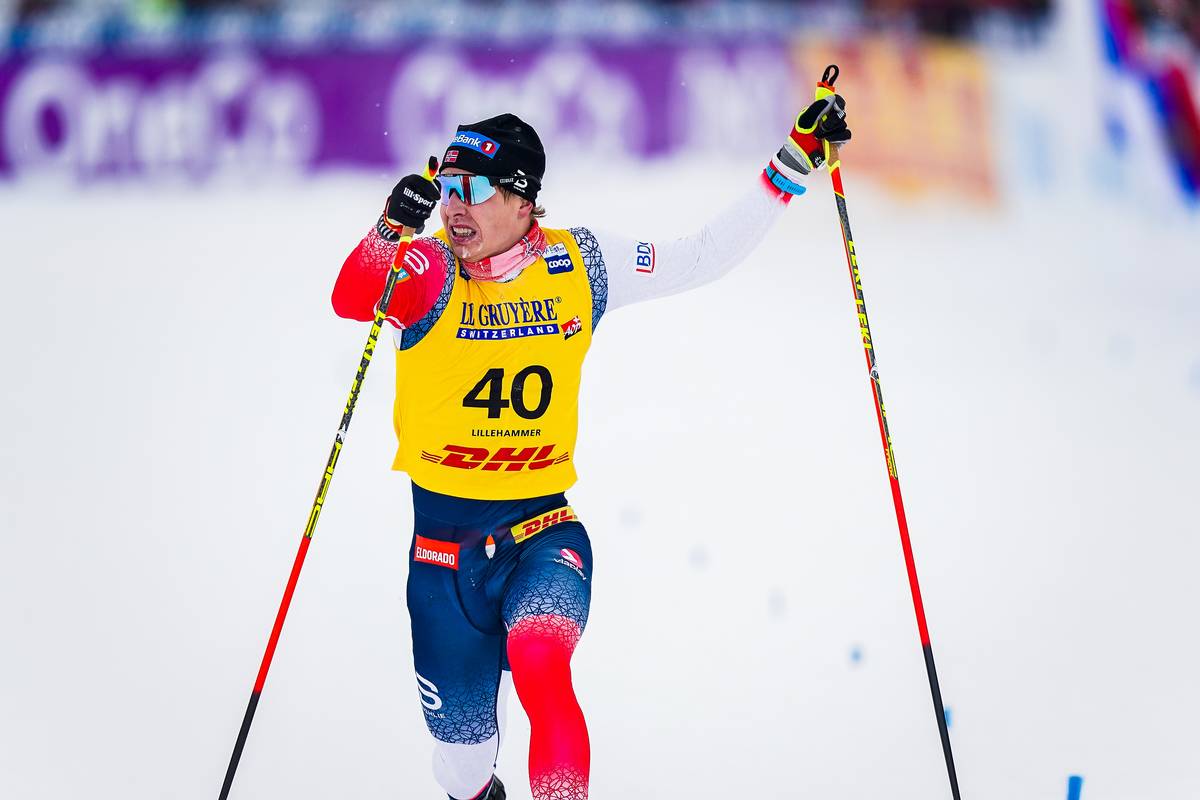
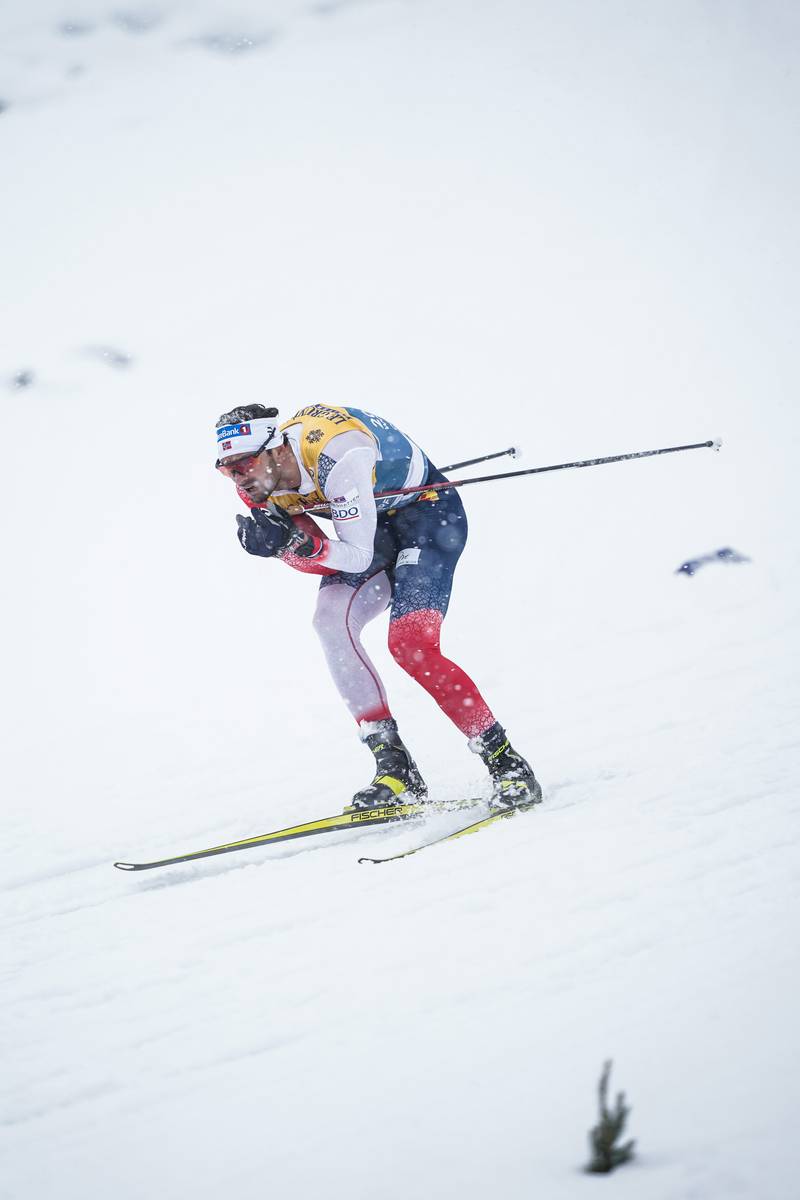
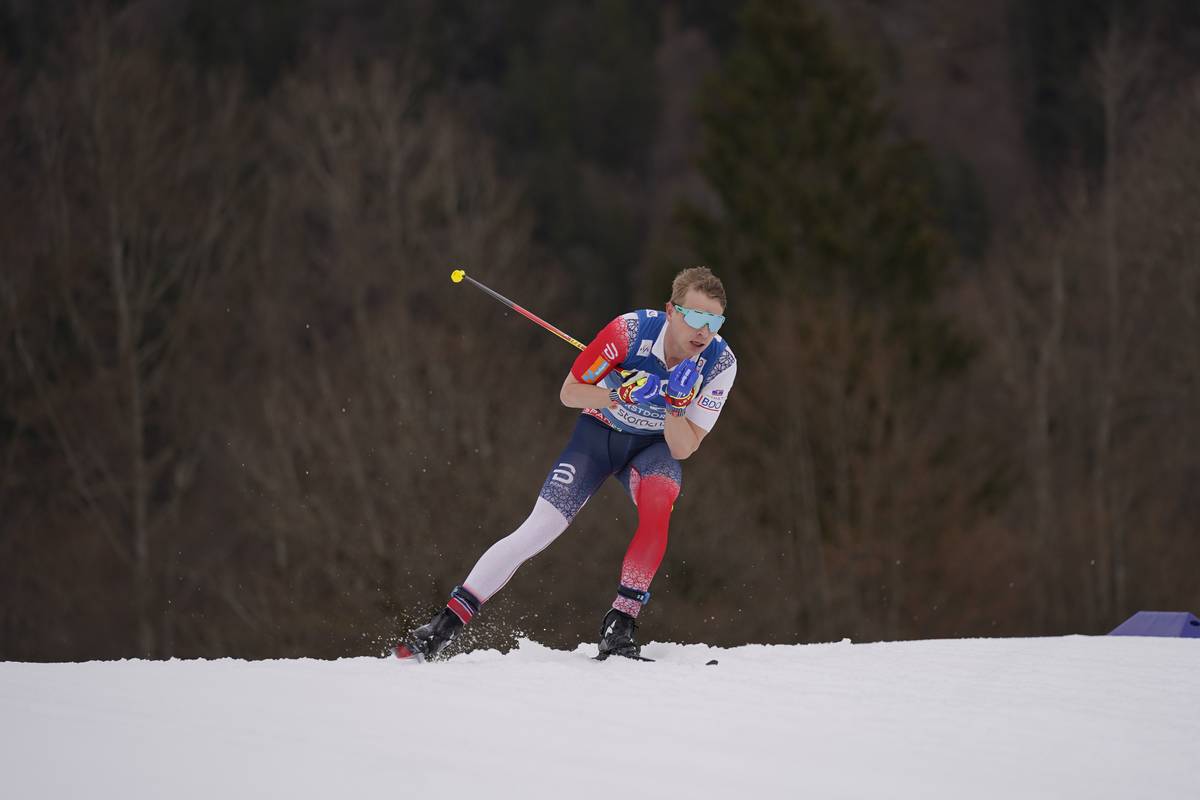
Simen Hegstad Krueger (NOR) gambled big going for an early ski exchange. It paid off with a Holmenkollen victory. (Photo: NordicFocus)
At 14 kilometers the answer was provided when Krueger (NOR) put in a turn of pace to lead the race. Klaebo now seemed content to sit behind Krueger. As skiers went through the stadium for the second time, all of the top contenders continued without exchanging skis. Krueger continued to lead with Klaebo pulling along side him for long stretches.
The Krueger-Klaebo duo continued to lead through the halfway mark of the race. Joining the front of the race was crowd favorite Andrew Musgrave (GBR) who generally shines at distance events; however, Musgrave’s time out front was short lived, and he wouldn’t be able to stay with leaders for long.
Even with Krueger and Klaebo out front, the field still had not fractured as there were still 30 athletes skiing in the lead pack.
At the start of third lap, the tone of the race would reset as the ski exchange strategy came into play. Kreuger and Holund (NOR) opted to exchange skis while Klaebo and Golberg remained on course. After the ski exchange, Kreuger and Holund dropped to 22 seconds behind the pack, but within one kilometer they had rejoined the back of the group.
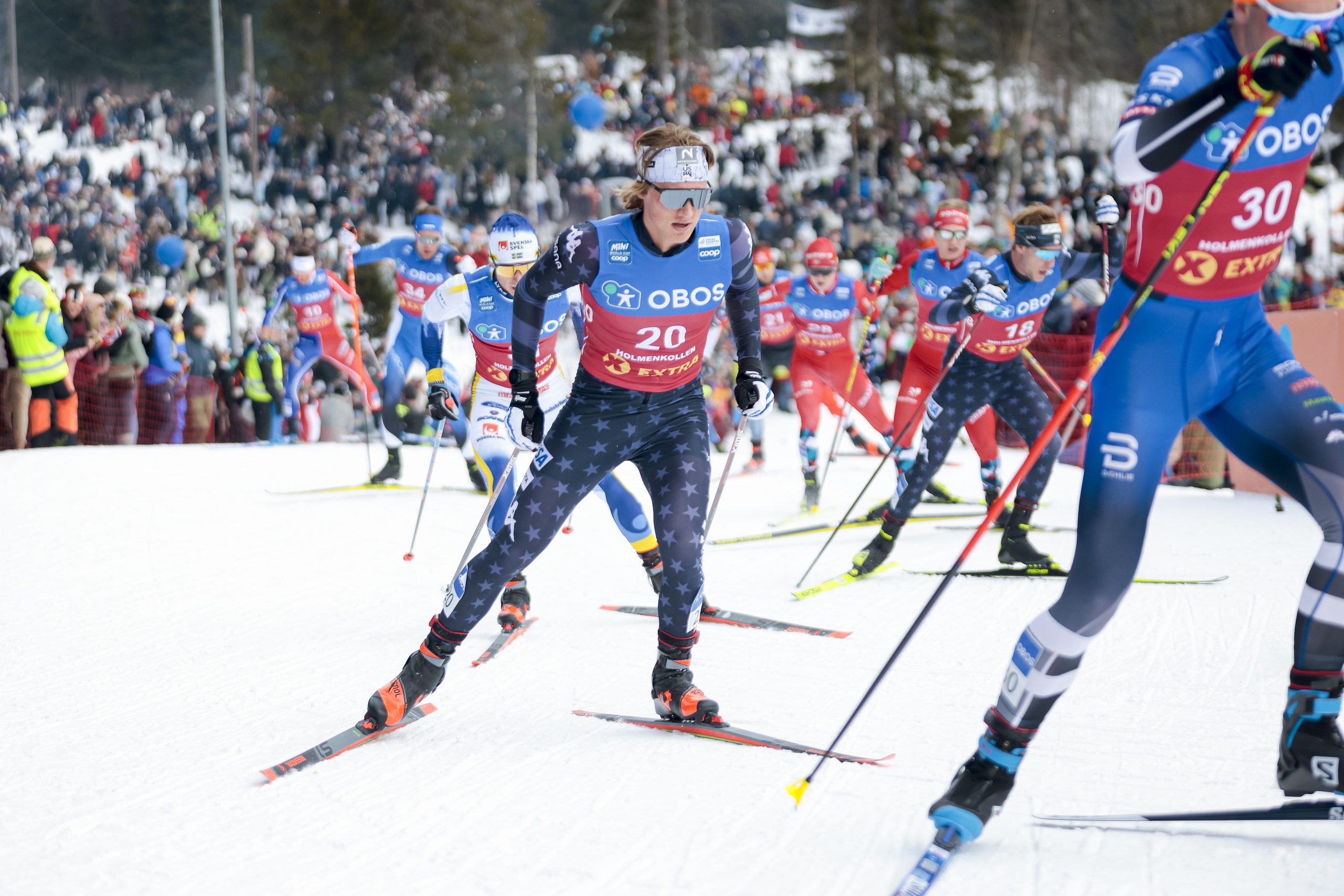
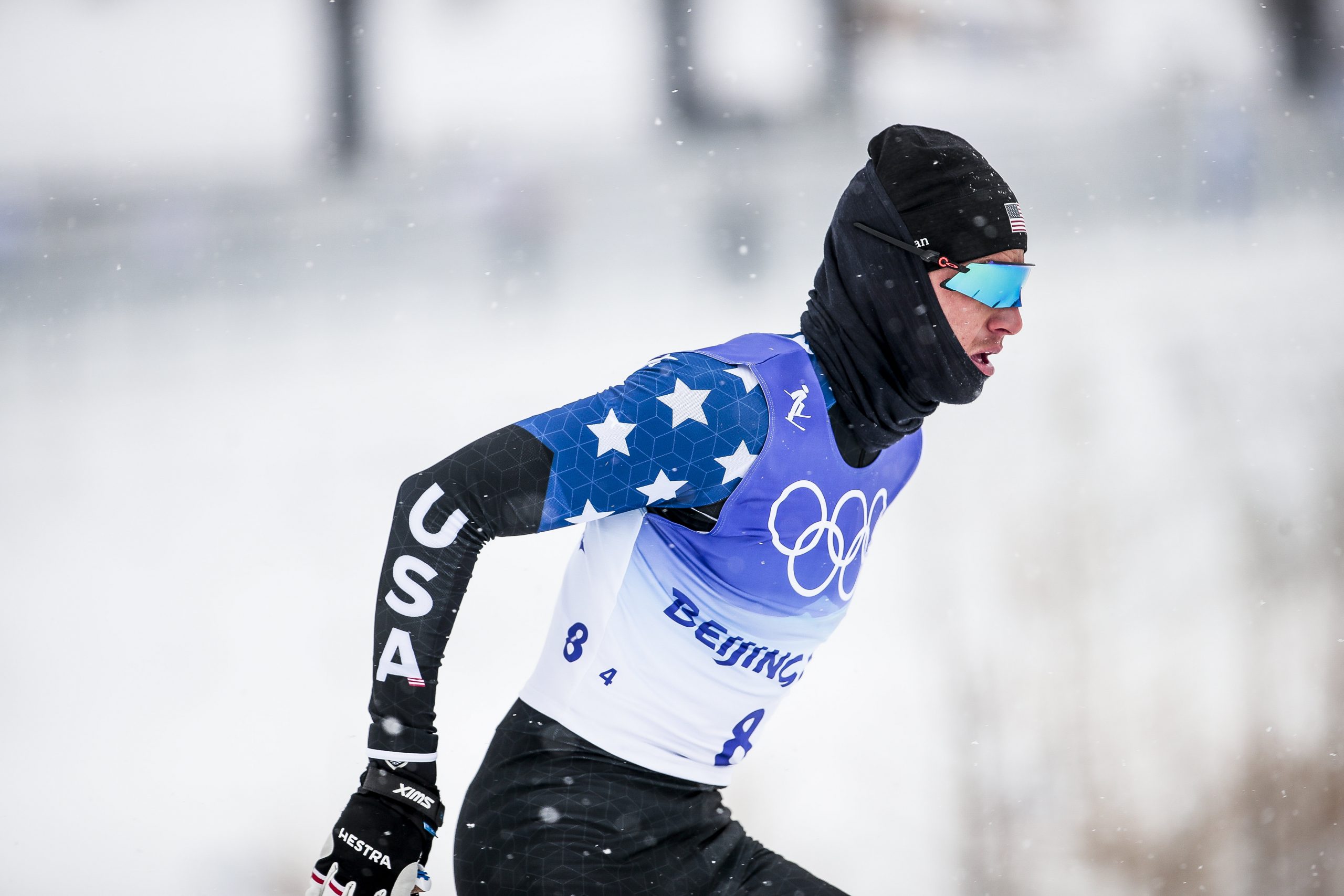
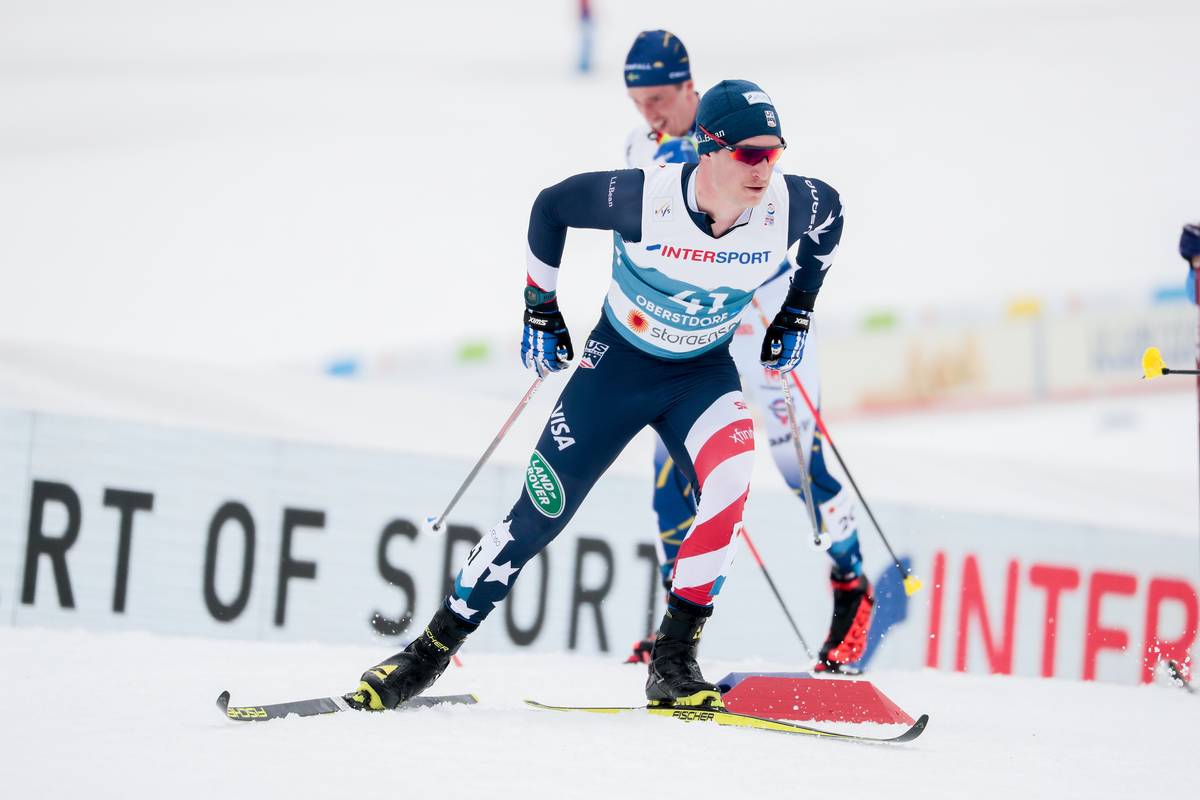
Gus Schumacher (USA) had a brief taste of life at the front at Holmenkollen. He would go on to finish 28th. (Photo: NordicFocus)
At 28 K, American fans received a thrill as Gus Schumacher surged to the front and went into third at the bonus point line. Also by this point, Holund had worked his way back to the front of the pack taking advantage of his fresh skis. Klaebo hung with him, and they began to seriously fracture the pack for the first time.
It was evident that Krueger and Holund had benefited from the ski exchange as they were out-gliding other competitors. Holund’s and Kreuger’s strategy had become clear: change skis early and press the pace, which is exactly what they did. In a moment, everything had changed as Holund and Krueger established a 10 second gap on the field where they were joined by lesser-known 22 year old Iver Tildheim Andersen (NOR) who had also changed skis early. The race was now getting serious with the lead three establishing a clear breakaway. Klaebo was suddenly 17 seconds off the lead.
The three leaders had gone all in with their strategy and there was no turning back now. They would be forced to defend their lead for another 17 kilometers. The strategy was put to a test at the fourth lap when the entire chase pack changed skis putting them further behind the break away pack, but giving them the opportunity to gain ground on faster skis. After the exchange, the pack was 42 seconds off the leaders.
Hans Christer Holund (NOR) broke away from Johannes Hoesflot Klaebo (NOR) to take second at Holmenkollen. (Photo: NordicFocus)
The chasers seemed determined to close the gap. By 36 kilometers, the lead had narrowed to 32 seconds, with the chasers gaining time with each kilometer. With only 10 kilometers to go, the gap was down to only 28 seconds. It would be nip and tuck for the leaders to try and hold off the pack.
With the pace quickening even more, the chase pack began to break up. Martin Nyenget (NOR) and Harald Oestberg Amundsen (NOR) moved to the front of the chasers. Klaebo and Golberg had fallen back by about five seconds. It appeared that the top two World Cup 50 kilometer finishers were running out of gas.
At 42 kilometers, Klaebo was desperately trying to hang on to the chase group but was laboring mightily. Toenseth and Nyenget were quickly dropping the rest of the chasers who were now down to only two skiers. At the front of the race, the strategy of working together was now gone. Krueger decided that he needed to press the pace with Holund going with him. Andersen was dropped from the lead group.
The final three kilometers has some of the steepest climbing in the race which Toenseth and Nyenget would try and use to catch the leaders as they put in a burst to close the gap, but the leaders were not to be denied. Krueger put on a burst of his own with half a kilometer to go pulling away from Holund to ski into the stadium with a five second lead. Holund was able to hang on for second with Nyenget finishing third. The young Andersen was able to hold on to fourth place for a dramatic Holmenkollen finish for him.
Once the exciting Holmenkollen drama was settled, it was all Norway in the top ten, but Klaebo would still be left searching for the landmark marathon victory which has eluded him throughout his career.
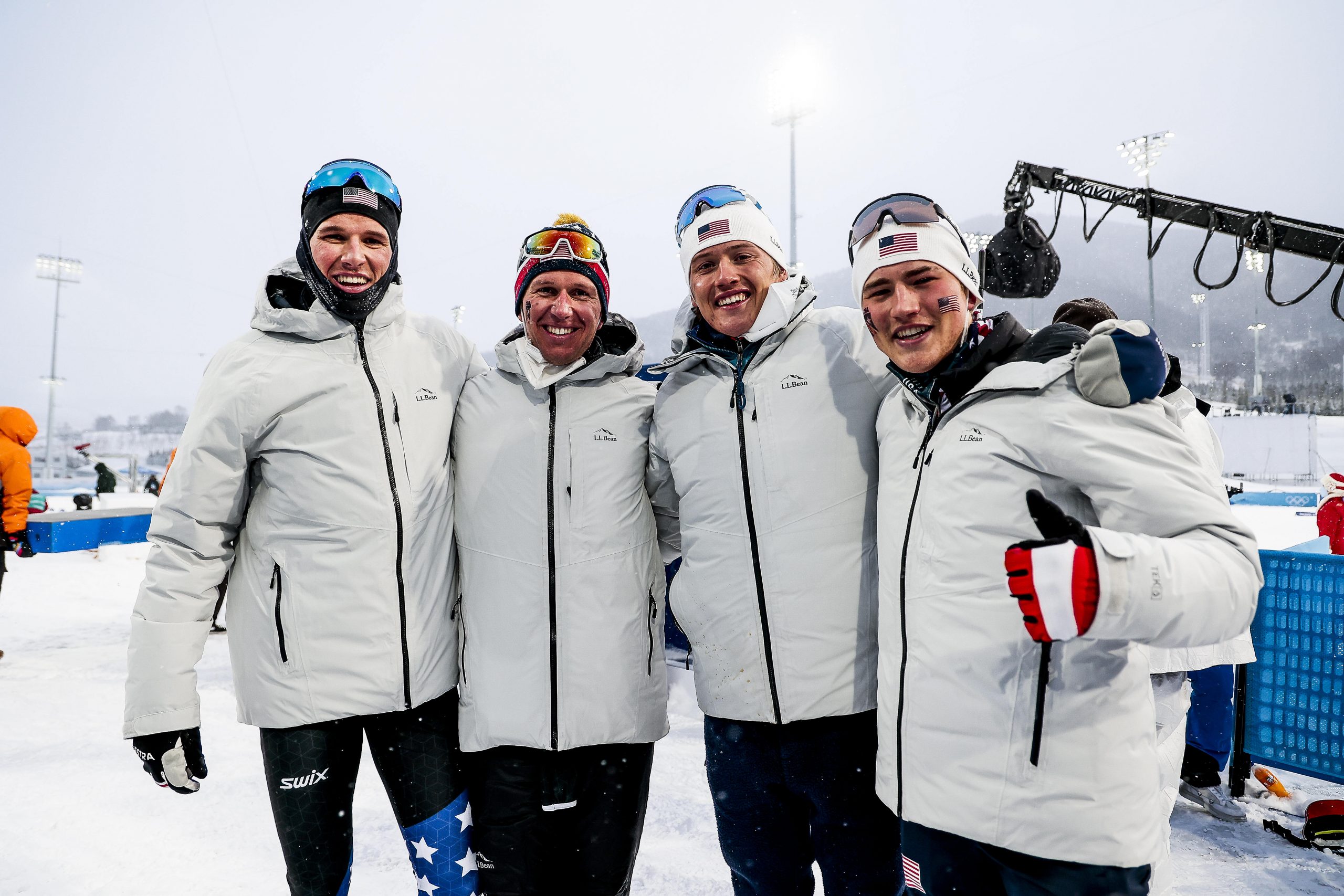
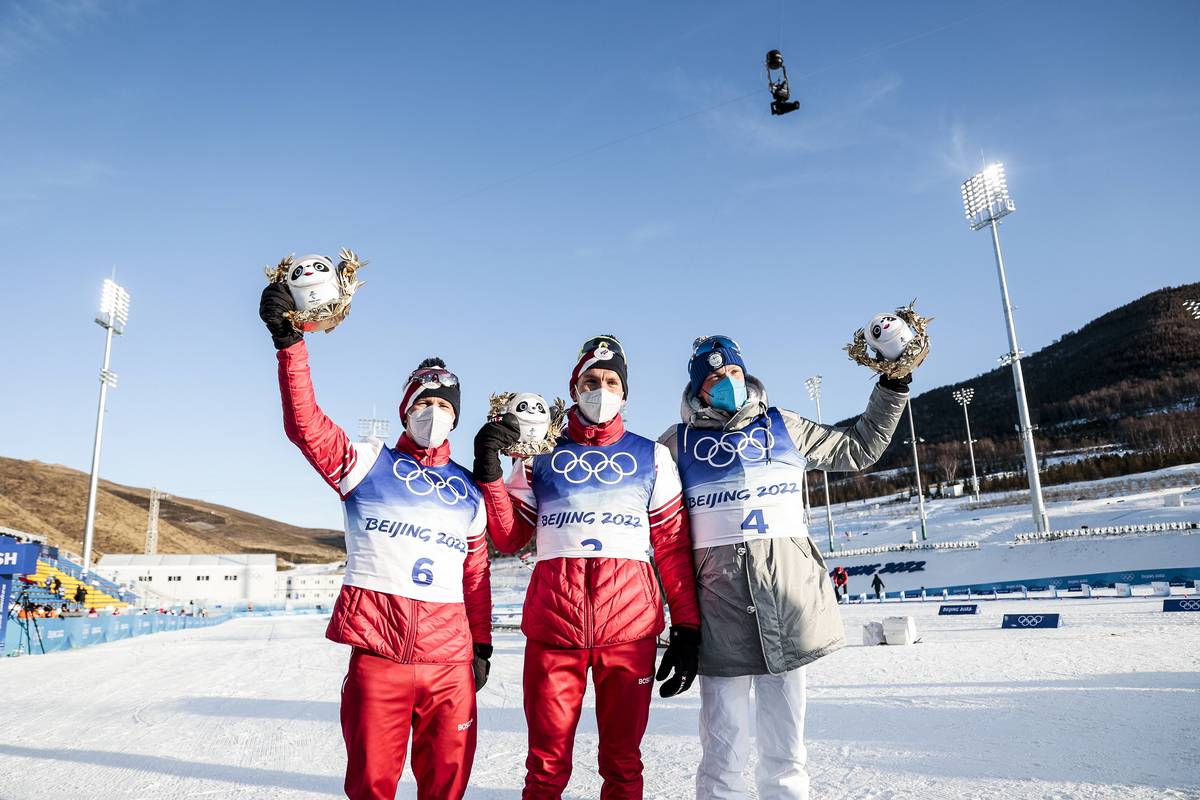
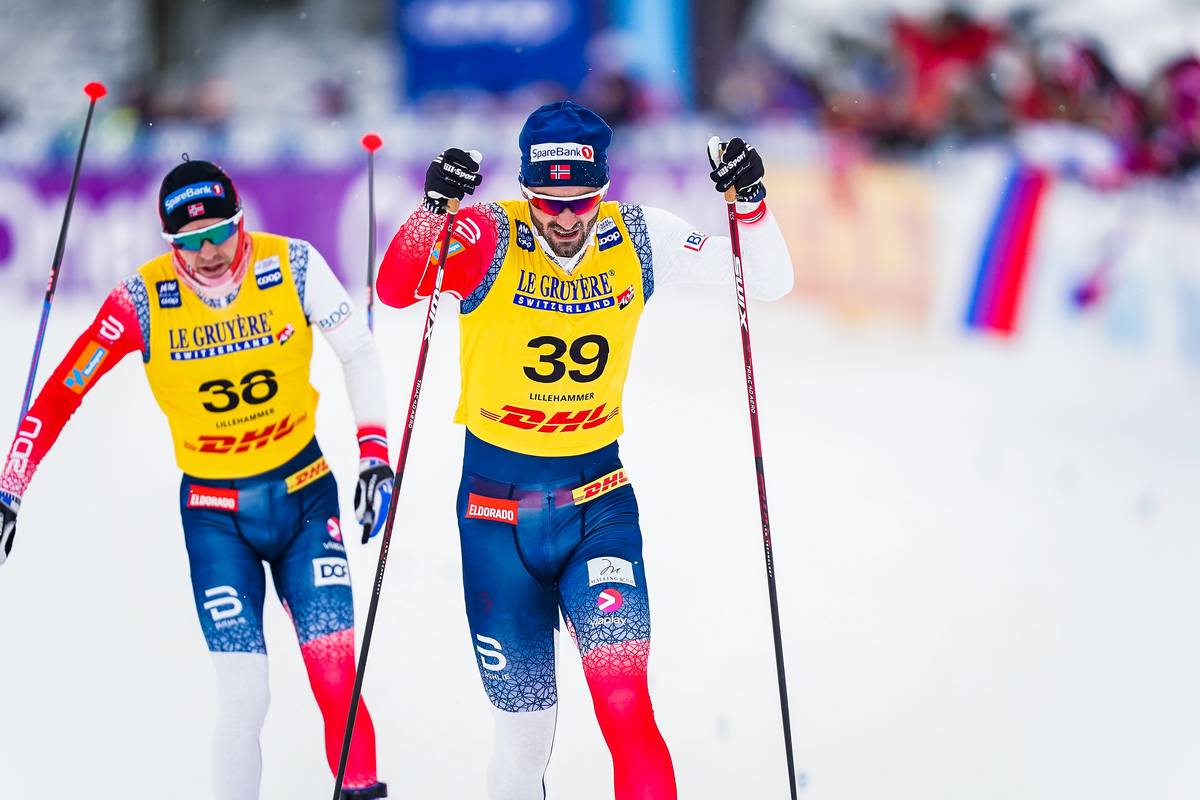
Hans Christer Holund (NOR), Simen Hegstad Krueger (NOR), Martin Loewstroem Nyenget (NOR), (l-r) conquered the mighty Holmenkollen course (Photo: NordicFocus)
Holmenkollen 50 Kilometer Mass Start Freestyle RESULTS
Holmenkollen 50 Kilometer Mass Start Freestyle RESULTS
This World Cup coverage is made possible through the generous support of Marty and Kathy Hall and A Hall Mark of Excellence Award. To learn more about A Hall Mark of Excellence Award, or to learn how you can support FasterSkier’s coverage, please contact info@fasterskier.com.
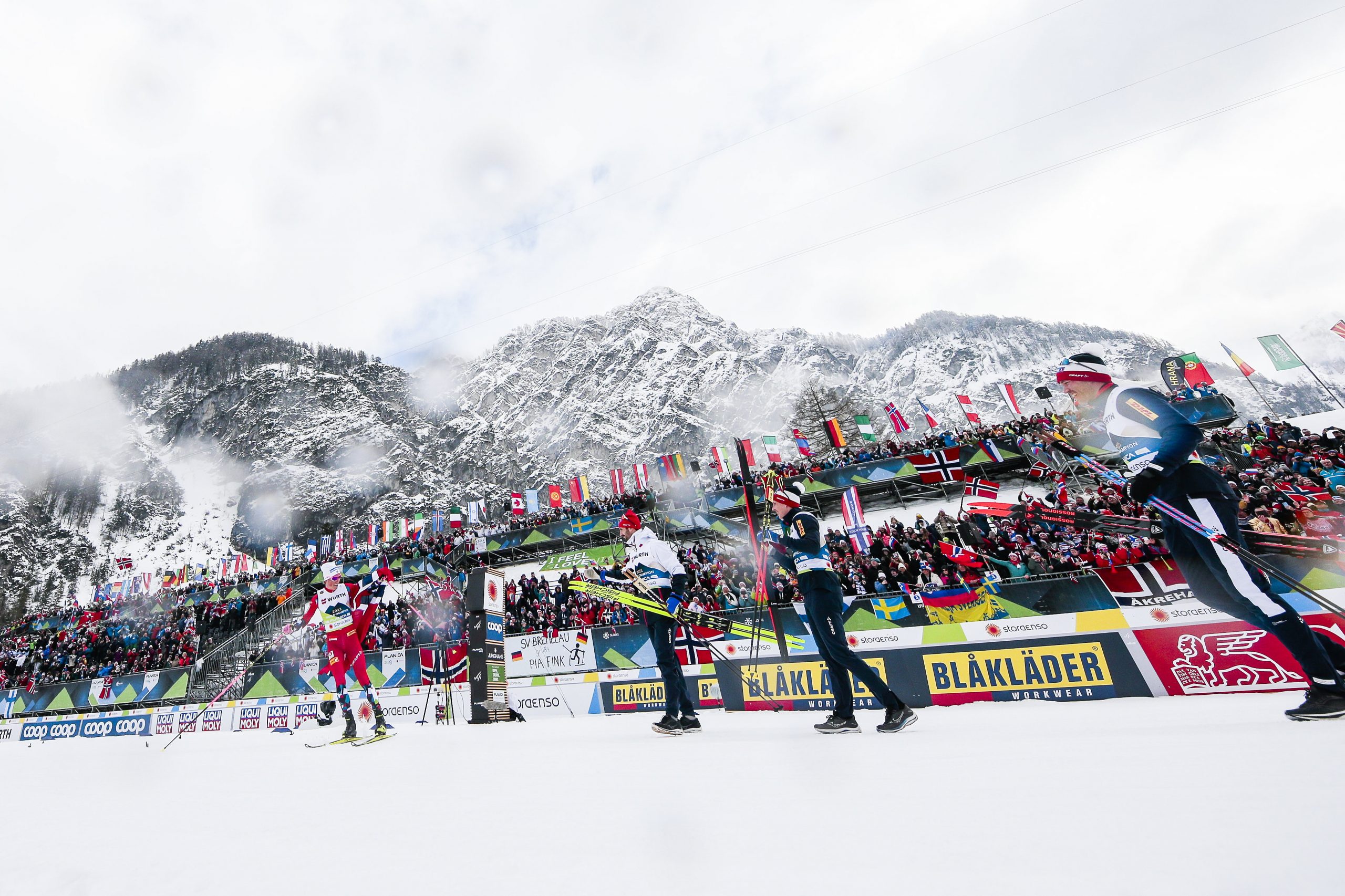
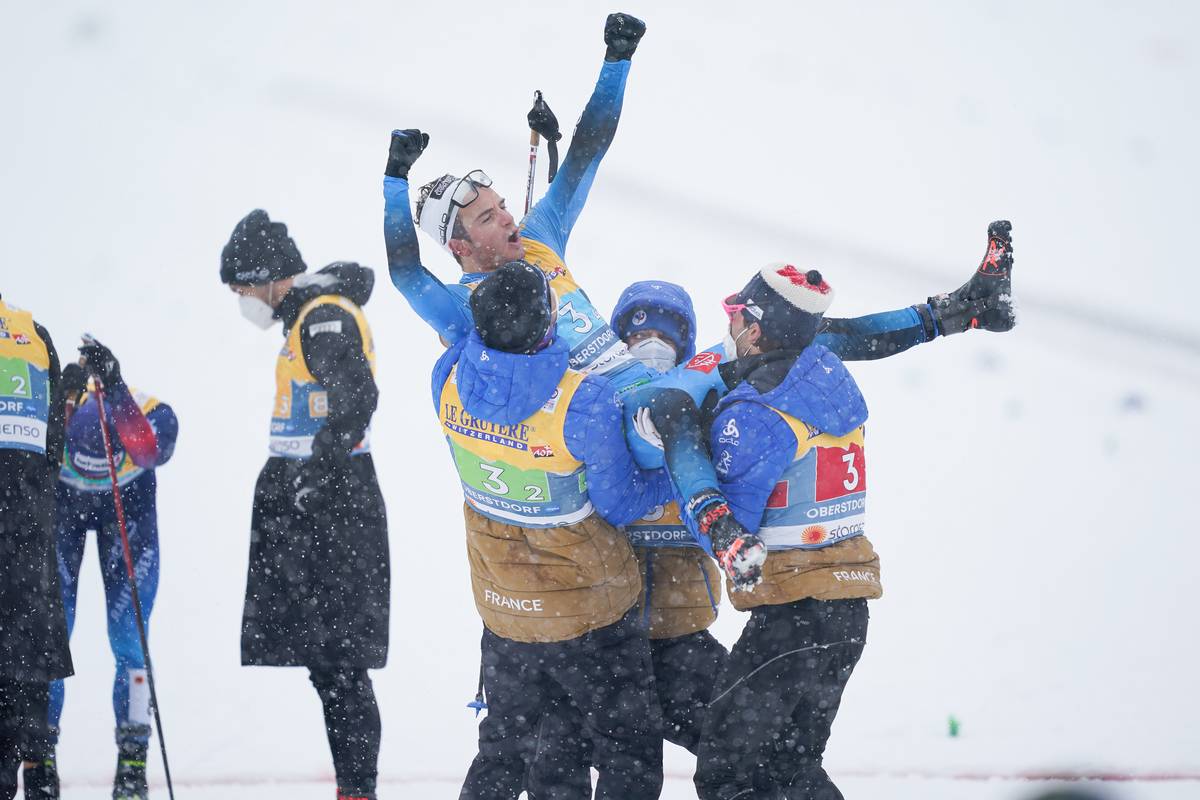
Foregone conclusion: Norway alone at the finish line. Johannes Hoesflot Klaebo (NOR), Hans Christer Holund (NOR), Paal Golberg (NOR), and Simen Hegstad Krueger (NOR) celebrate another Norwegian win in the Men’s Relay at the FIS World Championships in Planica, Slovenia. (Photo: Modica/NordicFocus)
In sport, sometimes “foregone conclusions” prove to have been premature; that can make for exciting racing. At other times, foregone conclusions prove accurately prescient; that makes for situations in which the anticipation of action and drama is entirely spoiled. In Planica, Slovenia, Team Norway spoiled (predictably) the excitement of the World Championship Men’s Relay, winning gold well ahead of second place Finland and third place Germany. Foregone conclusion, indeed . . .
North American teams were well represented in the relay field, with Canada holding its position in the group of medal contenders throughout the day by virtue of fine skiing by Xavier McKeever, Graham Ritchie, Antoine Cyr, and Olivier Leveille. They would finish fifth. Team USA’s performance was highlighted by the heroic classic skiing of Ben Ogden (he led the chase group for much of Leg 1), but that advantage would be undone in Leg 2, with later skiers being left with no chance to overcome the deficit. Team USA would finish seventh.
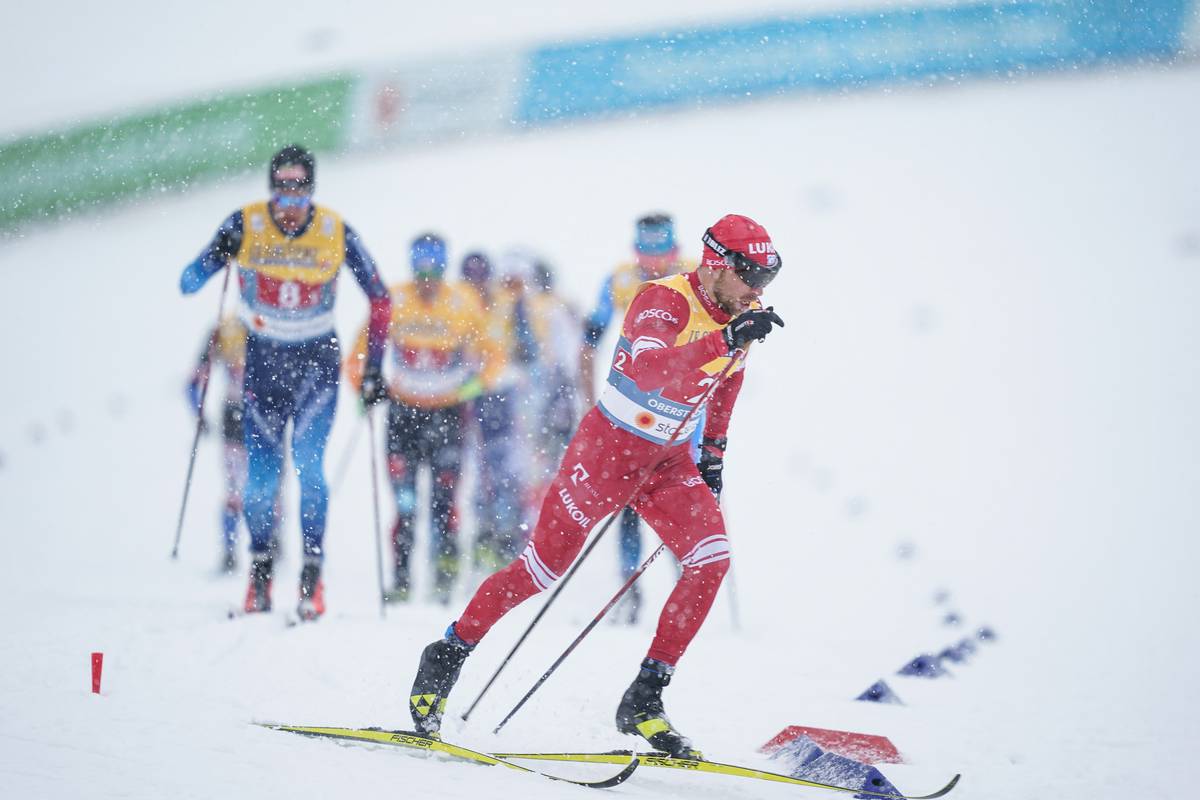
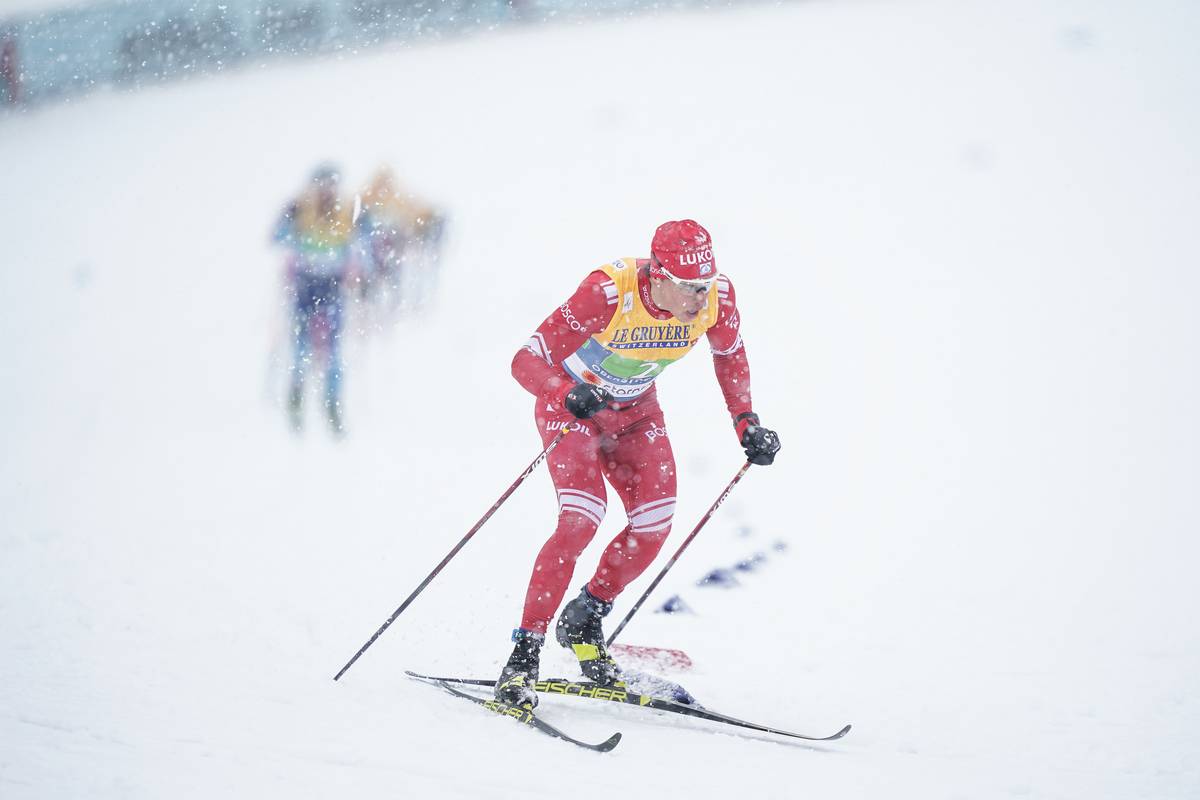
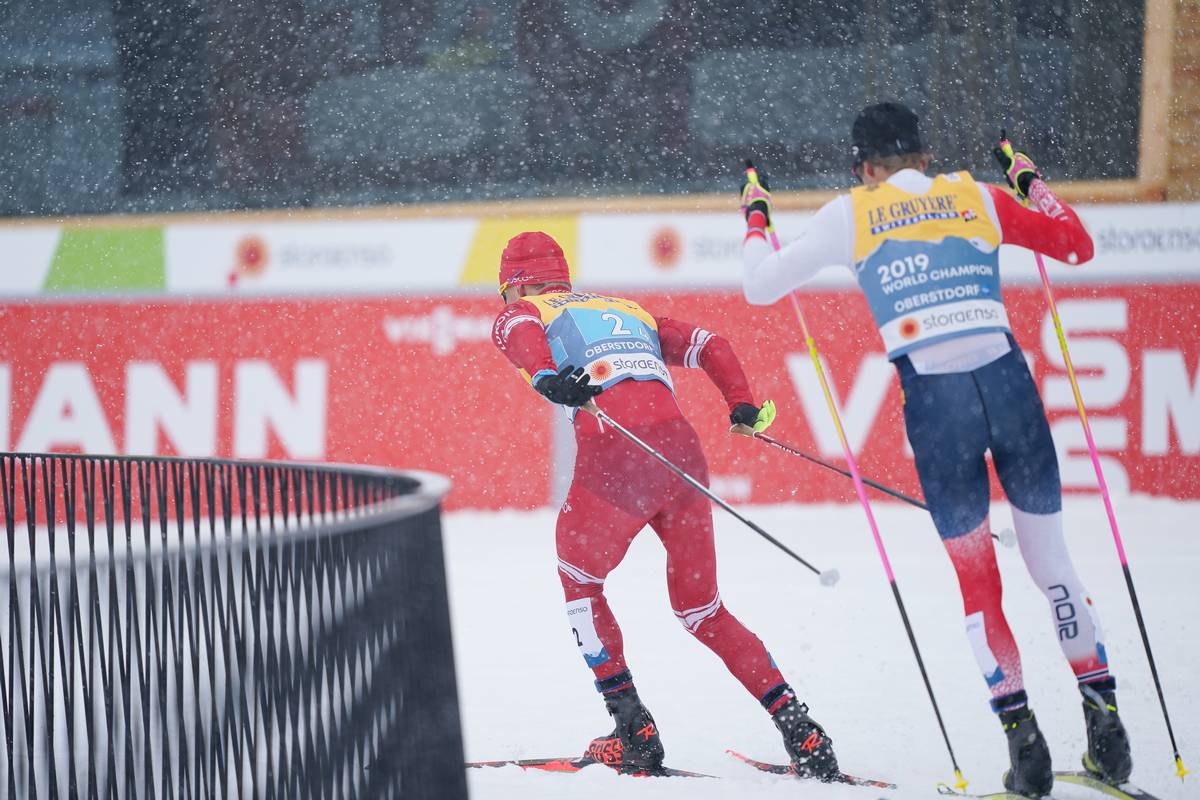
Alone from the start: the dominating first classic leg skied by Hans Christer Holund (NOR) all but decided the race’s outcome. (Photo: Modica/NordicFocus)
As is so often the case, the story at the front of the field was Norway . . . though even television broadcast cameras paid little attention to them. It’s not Norway’s fault that they dominate so completely; it’s not Norway’s fault that they win with such apparent ease. They appear so confident, so self-assured. But in the hours before the race, there was plenty of tension, indeed. The forecast for the day—snow then not snow, rain then not rain— elicited considerable worry among those responsible for ski preparation. If the forecasts came true, the classic legs could’ve become a horrible, unpredictable mess.
“If it rains for real, we gotta be on klister,” American, Ben Ogden, told FasterSkier’s Nat Herz. “If it snows for real, we gotta be on zeroes, and if it does this mixed [stuff], then we don’t know!”
Had the snow fallen, had the rains come, then athletic superiority (which Norway possesses in spades) potentially could’ve been undone. It’s been known to happen before . . . In the end, the threats of those earlier forecasts never materialized. The skies over Planica remained gray and temperatures remained relatively warm, but neither snow nor rain ever materialized. Skiers utilized a variety of ski prep tactics (Ogden skied on zeroes while many others chose klister); regardless, most seemed to benefit from both good glide and sufficient kick. The race didn’t come down to technological superiority . . . it remained a case of athletic superiority. Probably no one was more relieved than Norway. There was a lot more tension surrounding this event in the pre-race hours than there was during the race, itself. Once the starter’s pistol sounded, things were decided pretty quickly. Hans Christer Holund (NOR) made sure of that.
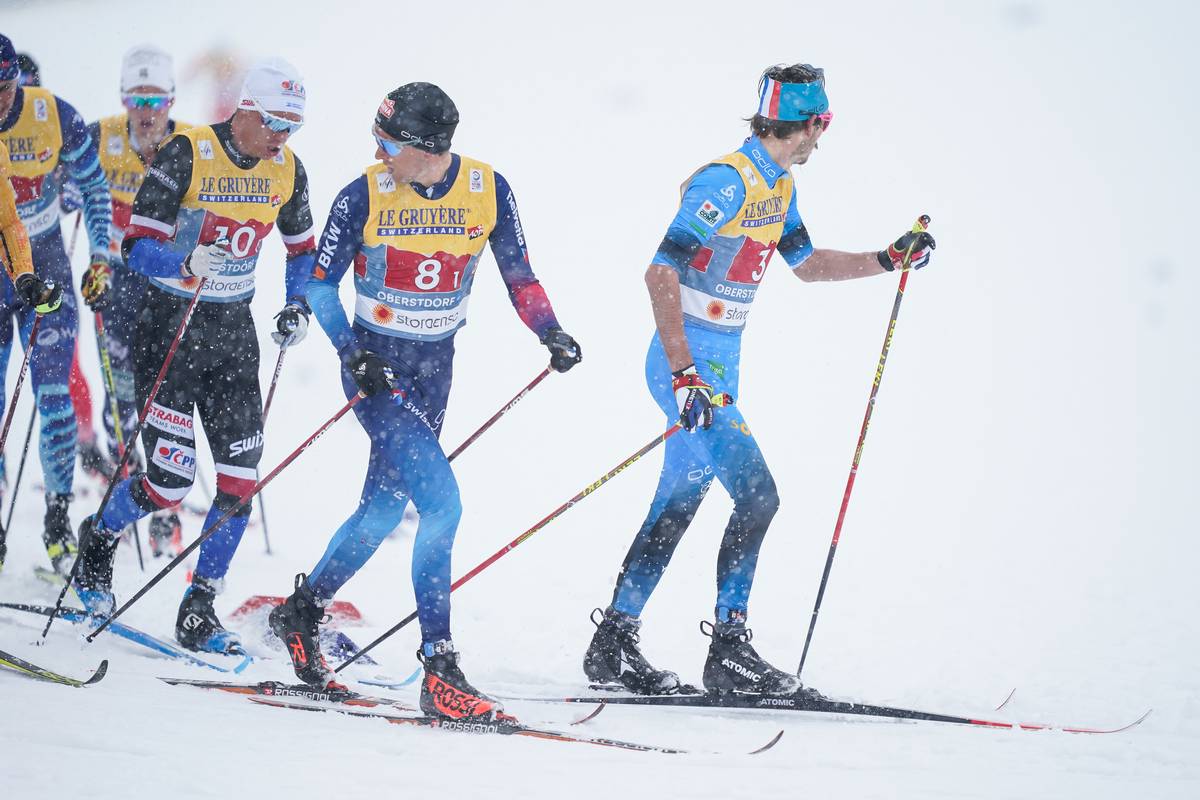
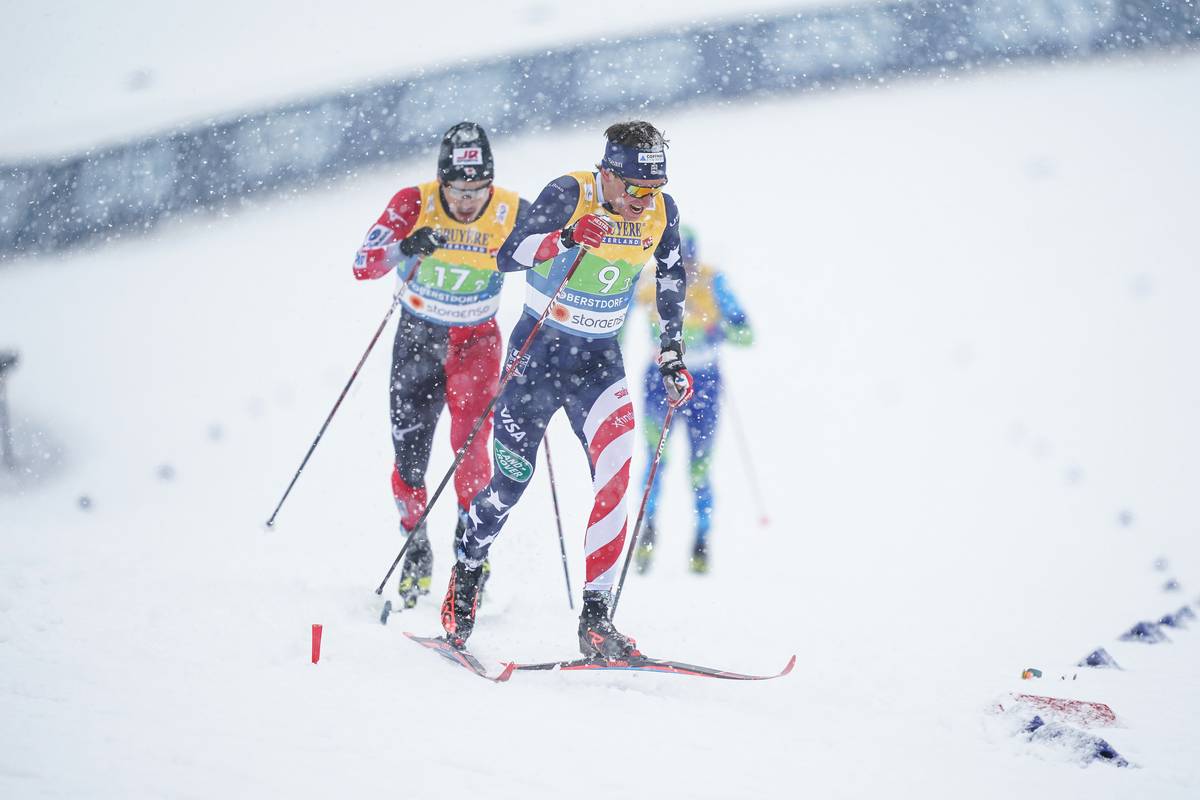
Ben Ogden (USA) would ski a brilliant scramble leg, driving the pace of the chase group through much of the first leg. (Photo: NordicFocus)
Men’s 4 x 10 k Relay
Holund got away almost immediately: Norway wouldn’t be a part of this relay story again until they crossed the finish line well ahead of all other teams. Behind Holund, though, the race played out in ways that were both predictable and surprising. Unlike yesterday’s Women’s relay in which each skier raced a single 7.5 k lap, the Men’s relay course offered each skier a pair of five-kilometer laps. Within that format, it was in the chase group where the action took place.
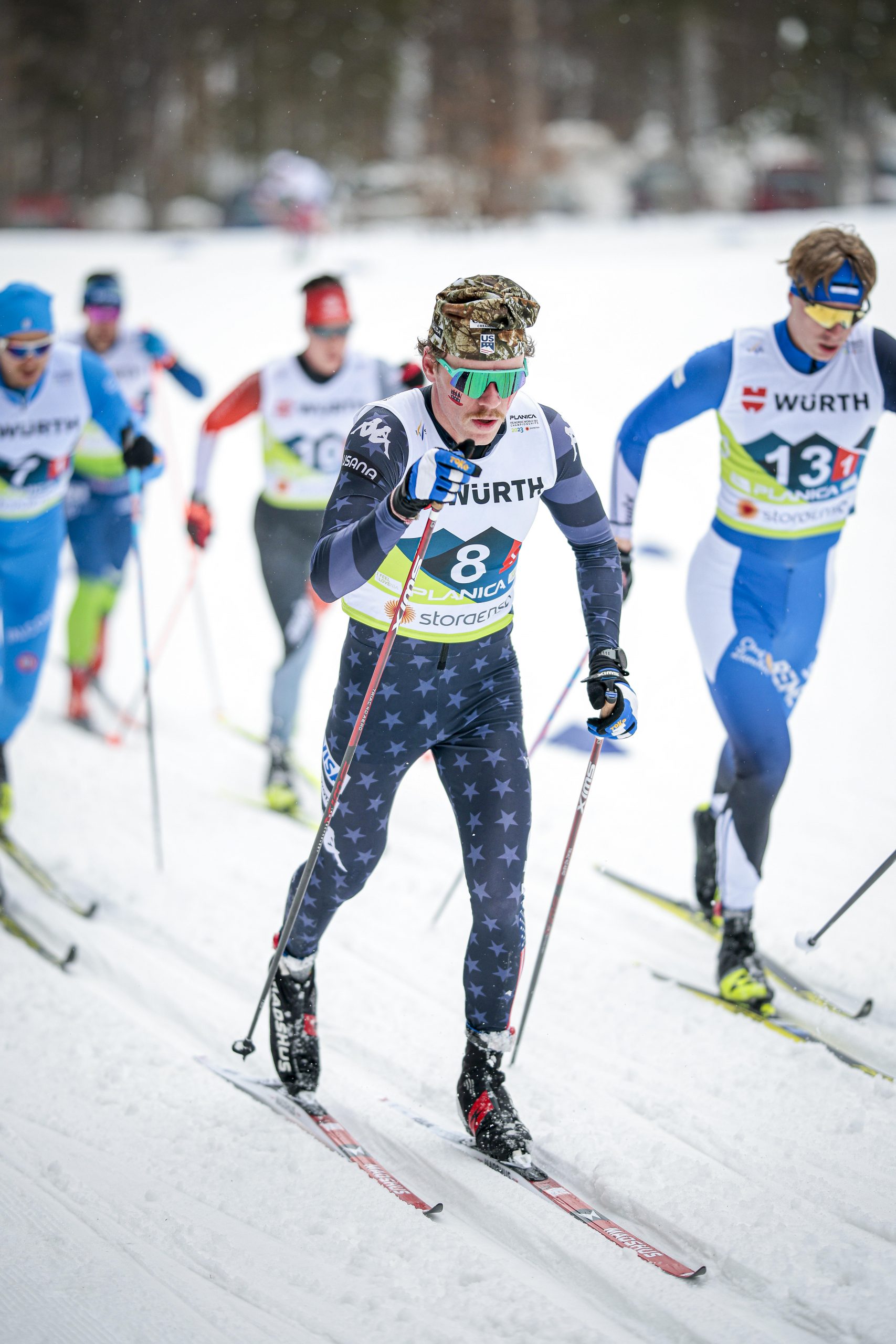
Ogden—jauntily sporting a camo-print US Ski Team hat, but not (visibly) wearing the normally-expected USA Team Relay socks—pushed the pace through most of the first leg. “It was a bit frantic at the beginning,” Ogden said. “The first time up the big hill, I had…a moment of ‘I could go get [Holund], but it would’ve been SO disastrous. In a 4 x 10 k, you gotta remember it’s still a distance race!”
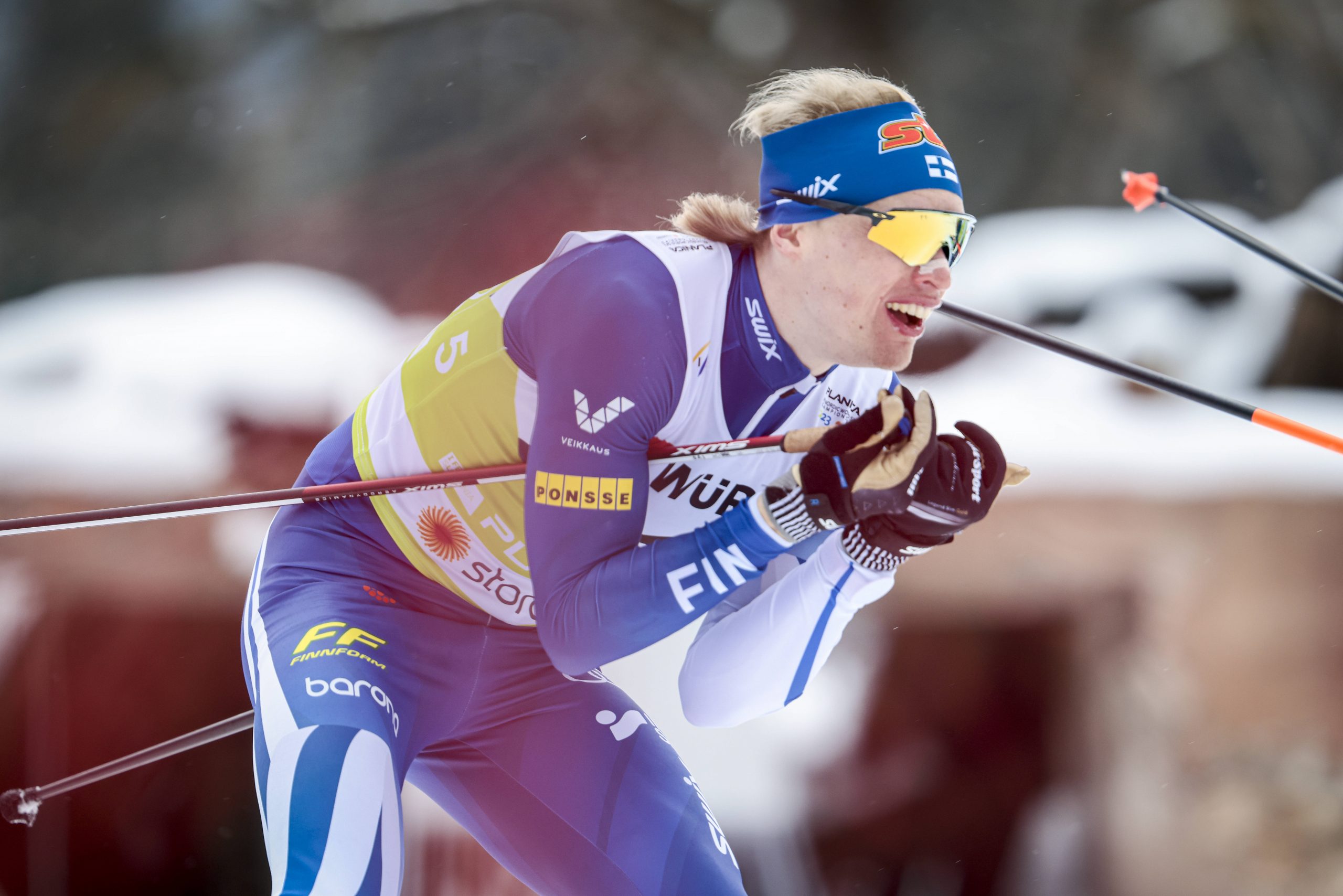
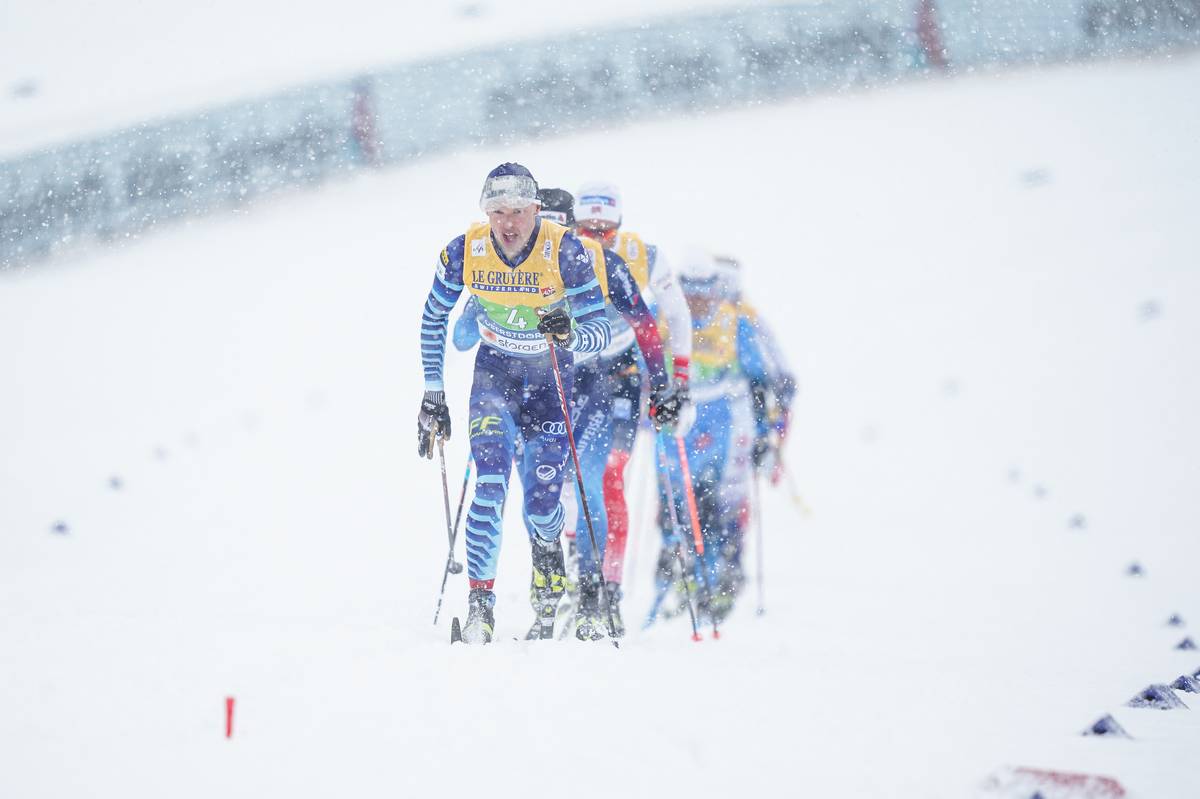
After Holund’s Leg 1 escape, Iivo Niskanen (FIN) was the animator in the chase group in Leg 2. His acceleration dropped the group, and set up Finland’s uncontested run to the silver medal. (Photo: Modica/NordicFocus)
Leg 2 was marked by the emergence of classic specialist, Iivo Niskanen (FIN), whose second lap surge separated his team from the others. Niskanen quickly established a considerable gap as the chase group behind him dwindled. American, Hunter Wonders, found himself dropped from the chase group: the USA would fall from contention, and Team Finland would not be challenged for the silver medal again. Likewise, Germany found itself gapped in these middle laps, but a late-race slowing of the chase group’s pace would allow Friedrich Moch (GER) to catch back on. His brave efforts would ultimately prove crucial to Germany securing a surprising bronze medal.
Ultimately, Norway (anchored by an easy-skiing Johannes Hoesflot Klaebo who had ample time to collect a Norwegian flag in his celebratory stroll down the homestretch) would win by nearly a minute, followed by Niko Antolla of Finland in second. Germany’s courageous Moch outsprinted Jules Lapierre (FRA) for bronze.
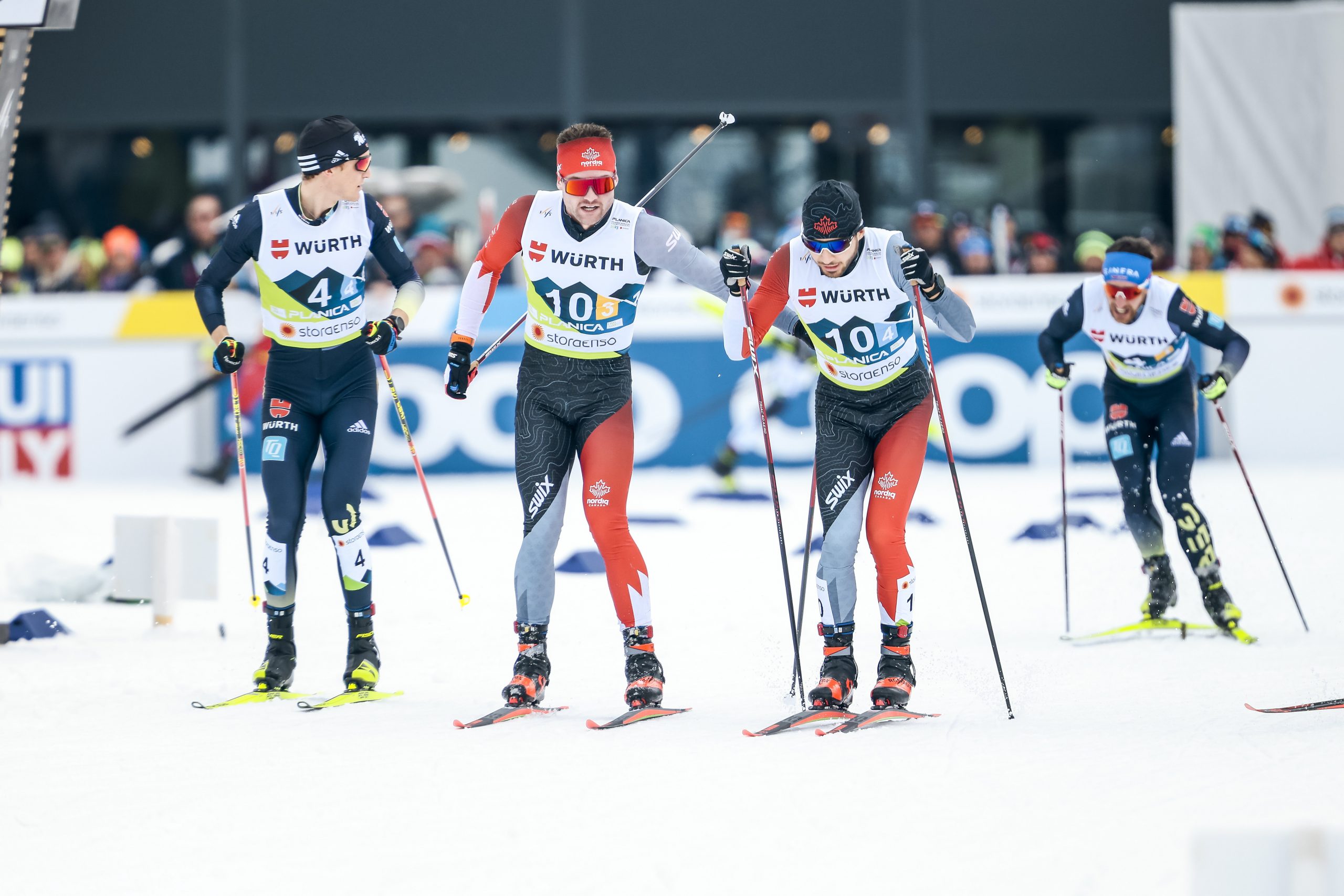
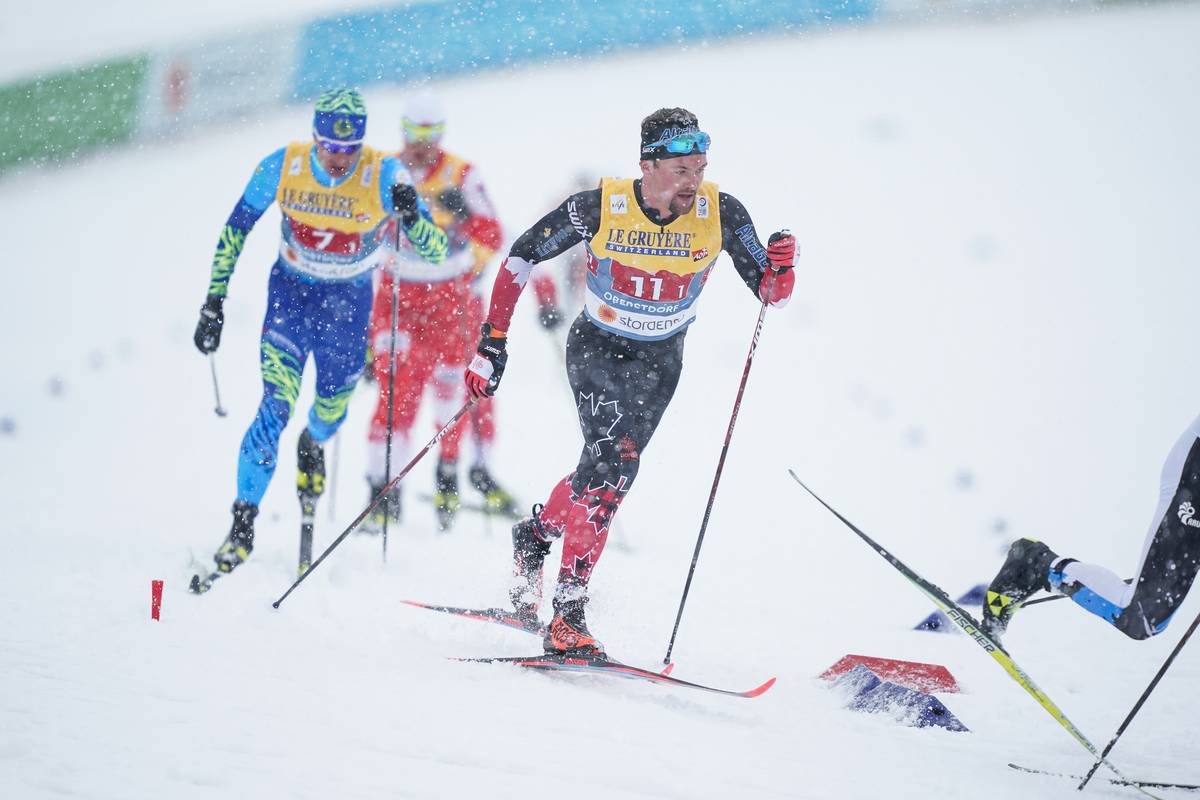
Team Canada’s Graham Ritchie tags Olivier Leveille ahead of eventual bronze medalist, Germany. (Photo: Modica/NordicFocus)
Team Canada remained in contention throughout the day—ultimately finishing fifth—boding well for the future development of this young team. “[It was] definitely a different experience,” said McKeever. “Being at the front…fighting for a medal.”
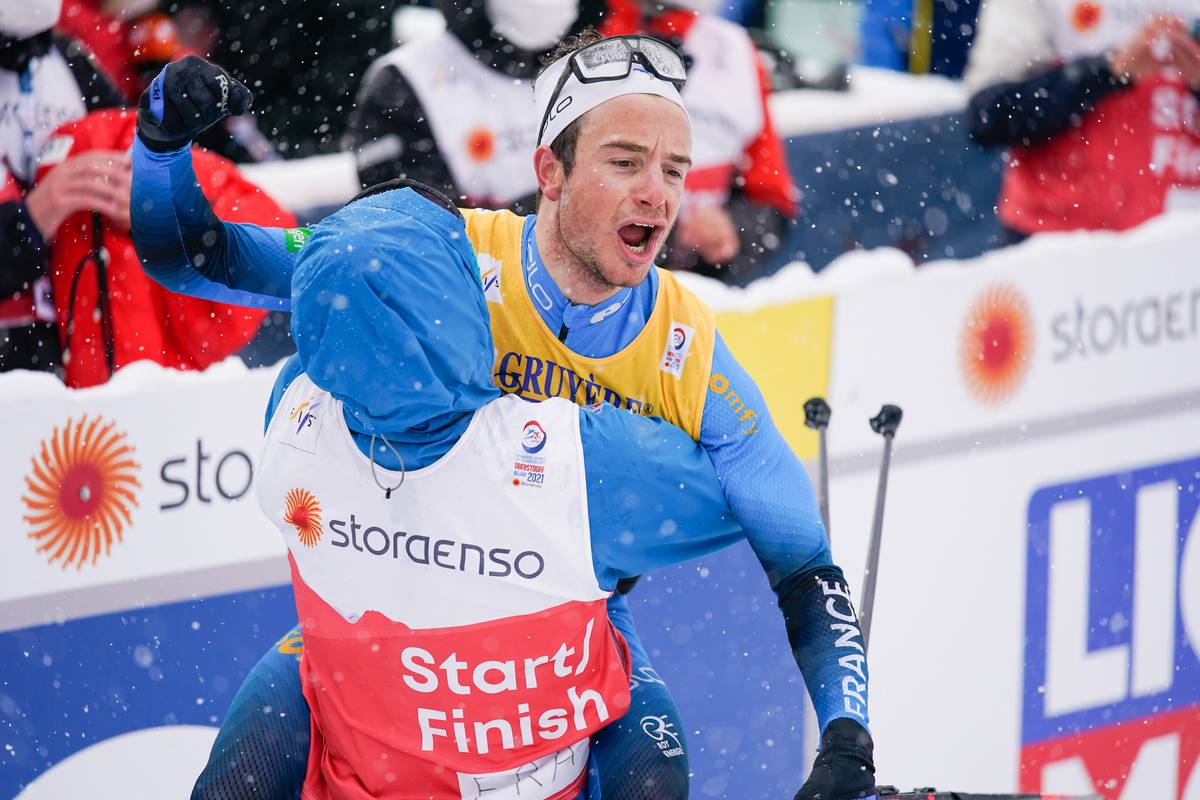
Not everything transpired entirely according to pre-race predictions: Team Germany—Janosch Brugger (GER), Friedrich Moch (GER), Jonas Dobler (GER), Albert Kuchler (GER)—celebrates a surprising bronze medal. (Photo: Thibaut/NordicFocus)
Tomas Petterson, a veteran sports reporter for the Swedish newspaper Expressen, joins us to recap the men’s 15 k at World Championships, and to discuss Sweden’s fantastic women’s team and the country’s hopes for its raw, talented men’s squad.
Reach us at devon@fasterskier.com and nat@fasterskier.com. Seven days down, four to go.
This World Cup coverage is made possible through the generous support of Marty and Kathy Hall and A Hall Mark of Excellence Award. To learn more about A Hall Mark of Excellence Award, or to learn how you can support FasterSkier’s coverage, please contact info@fasterskier.com.
What was old is new again: for the first time since equal-distance racing policies were put into effect this season, the men’s field was set to race a 15 kilometer individual start. This particular distance has been raced at World Championships since guys with names like “Sixten” were racing on hand-carved wooden skis, but the extra five kilometers added to the men’s new-normal 10 kilometer World Cup distance provided a hint of freshness to this traditional World Championship event.
Scott Patterson (USA) completes his 15th place effort in the 15 k individual start skate race on Wednesday. (Photo: NordicFocus)
If the 15 k distance blurred predictions before the race, the roster of contenders in the field brought those predictions back into focus. As the last World Championships in Oberstdorf in 2021, the 15 k skate was a Norwegian sweep: Hans Christer Holund, Simen Hegstad Krueger and Harald Oestberg Amundsen going 1-2-3. American skiers also provided reason to be optimistic as the Team Relay approaches later this week, with Scott Patterson finishing 15th, Gus Schumacher 19th, Ben Ogden 27th, Hunter Wonders 33rd. Canadian finishers included Olivier Leveille 28th, Graham Ritchie 46th, Xavier McKeever 60th.
Johannes Hoesflot Klaebo (NOR) was also on the start list this morning, competing in a 15 k World Championship or Olympic skate event for the first time in his career. Based on the Norwegian skiathlon sweep last week, indications were that the Norwegian podium sweep of two years ago could likely be re-created today; the Norwegian shuffle at the top of the race was on.
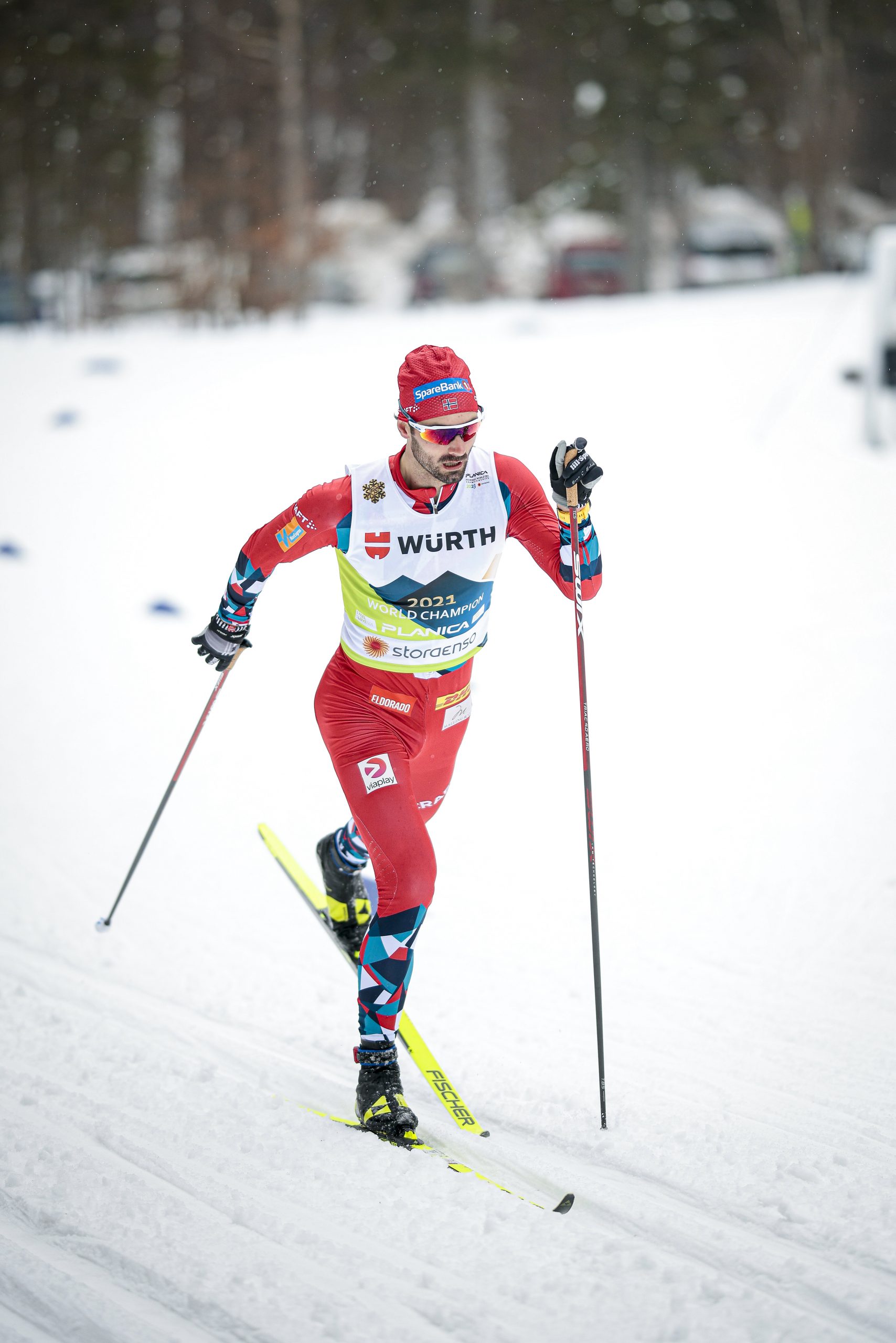
Simen Hegstad Krueger (NOR) completes his world championship effort in the 15 k individual start skate race Wednesday. (Photo: NordicFocus)
15 k Individual Start Freestyle
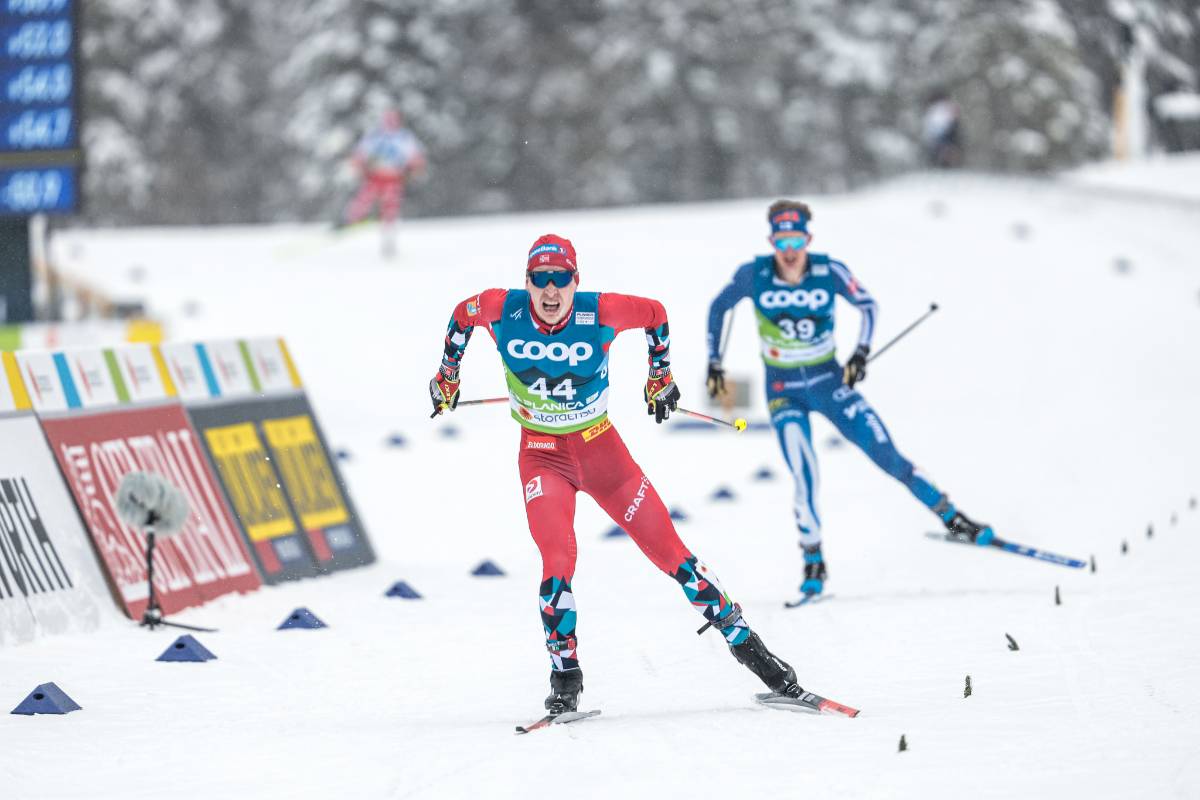
As to who would stand atop the podium, indications were clear from the beginning. Kreuger is known for his ability to come on strong late in his seasons and late in his races, so his emerging as the early leader in this race suggested his form might prove unbeatable. By the 2.2 k checkpoint, Krueger was already out in front of a tight-packed field. American, Ben Ogden, described Planica’s course as one that could, “make you feel like a king for the first four kilometers, and then [make you] go ‘oh no, I still have 10 k to go’” Accordingly, Krueger’s early lead was one that didn’t warrant anointing him too early. But when Krueger came to the top of the long, winding climb defining the middle section of the course at 7.7 k with a 23 second gap over Sweden’s William Poromaa—and then kept adding to that lead at each subsequent checkpoint—it seemed like the probable outcome was becoming clear. Krueger was on his way to winning his second individual World Championship of his career, and in as many starts in Planica. As on-air broadcaster, Chad Salmela, pointed out, Krueger has started 10 races at World Championships and Olympics, and medaled in nine of them.
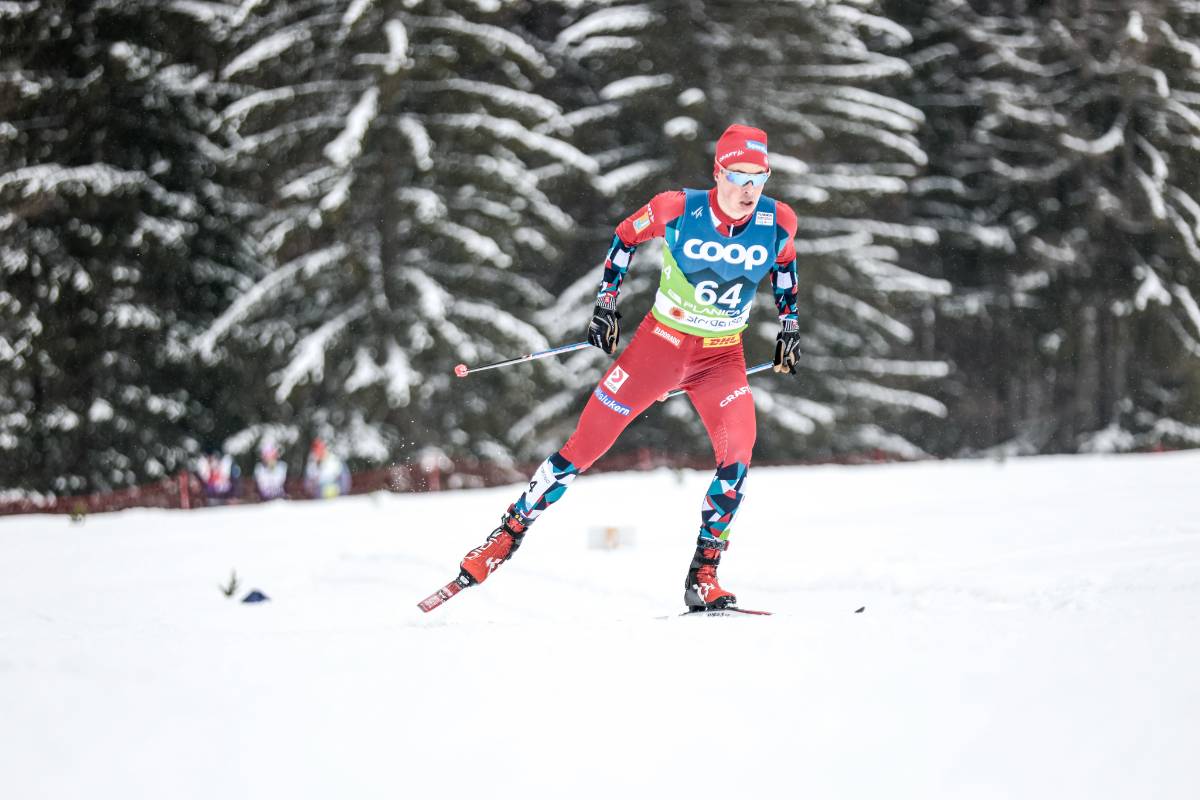
Krueger’s start position, bib 44, was relatively early among the main contenders. As a consequence, there remained considerable potential for drama to occur behind him as the field of contenders approached, but never matched, his high-mark at the later checkpoints. Holund started a minute behind Krueger in bib 46, but his checkpoint times put him in a closer race with Sweden’s Poromaa, with whom he traded on-course placings numerous times. Klaebo started in bib 48, two minutes behind Krueger, and through the first 2.2 k checkpoint was splitting seconds with him and leading the field, but Klaebo dropped to sixth place at 4.1 k and remained out of contention for the win the rest of the day. Amundsen—the 24 year old who had won a bronze at the Oberstdorf 15 k World Championships at only age 22—provided the late drama. Wearing bib 64, Amundsen led Krueger by 1.5 seconds at 2.2 k, was three seconds back at 5 k, and 11 seconds back at 7.7 k. When he put time into Krueger—he cut the gap from 11 seconds to 7.7 seconds in 3 k at the 10.8 k checkpoint—there was real intrigue. The gap grew in the last lap on the course, though even with a late push to finish 5.3 seconds back, Amundsen’s challenge to Krueger appeared to be over by the 12.8 k checkpoint. When he did cross the line, Amundsen had earned the second medal of his career, and Krueger took it as the sure sign he was safe to pull on the World Champions bib. Two years on from Oberstdorf, the 15 k skate podium had played a Norwegian shell game. 1st) Simen Hegstad Krueger, 2nd) Harald Oestberg Amundsen, 3rd) Hans Christer Holund.
Harald Oestberg Amundsen (NOR) followed up a 15 k bronze at 2021 World Championships in Oberstdorf with silver in Planica in 2023. “Maybe in Trondheim [in 2025], I will fight for the gold medal,” said Amundsen in post-race comments. (Photo: NordicFocus)In a post-race press conference, Amundsen—the youngest member of the Norwegian sweep—said, “It’s good to be on the podium. I trained a lot with [Krueger and Holund] the last few years, knowing they are the strongest guys after Oberstdorf.” As for what’s next, Amundsen sees one more step, literally: “Maybe in Trondheim [in 2025], I will fight for the gold medal.”
Patterson, Schumacher, and Ogden in Top 30 for Americans
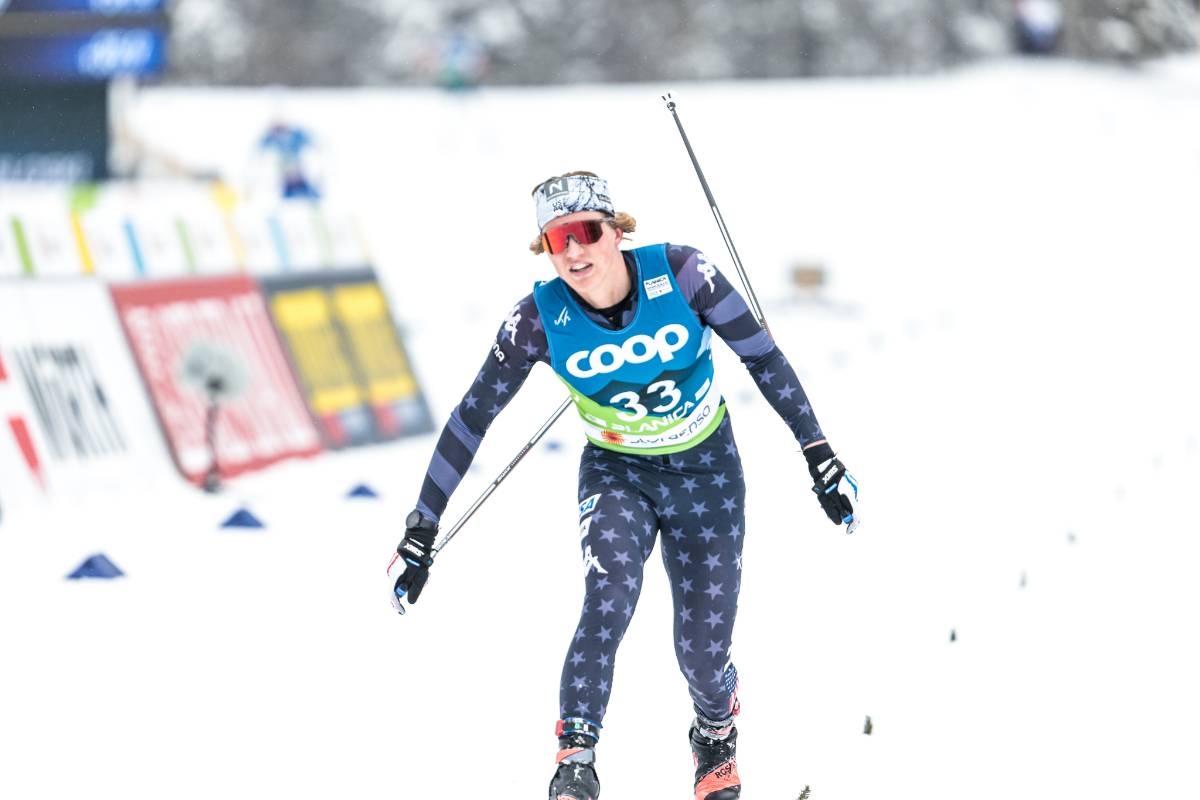
The American skiers started their day before the podium action began, with Schumacher (bib 33), Ogden (bib 36), and Wonders (bib 37) all taking part in the bar-setting through early checkpoints. At 2.2 k, Schumacher and Ogden were near the front of the early starters, and by 4.4 k were on top; Schumacher first and Ogden second with less than a second between them. From there, though, Ogden would say in post-race comments that he “ran out of steam in the middle on the climbs.” His check-point times faded from the top, but still made clear the American was having a consistent effort. He would finish 27th; his first distance top 30 at a World Championships.
Gus Schumacher (USA) skied to a career-best World Championship distance finish, taking 19th in the 15 k Freestyle. “Jessie Diggins said ‘if you push well and do everything right, you’ve got to be happy.’” (Photo: NordicFocus)
Schumacher continued to stay near the top of early-starters as he passed through the checkpoints. At each point past 5 k, he was slotting behind Andorran skier Ireneu Esteve Altamiras, and later France’s Maurice Manificat, Japan’s Naoto Baba, and Germany’s Jonas Dobler. The dividing line between early-starters and the main contention field was Sweden’s William Poromaa who bested the early group at each checkpoint past 5 k. As early starters filled in behind Poromaa at each check point, what became clear was that Schumacher’s early time marks were setting him up for a good finishing time. Schumacher sped through the final lap, eventually crossing the line standing in third place. He would ultimately find himself 19th. It was the best World Championships distance finish of his career, and a bounce-back for Schumacher after last week’s 38th place finish in the Skiathlon.
Of his quick return to form, Schumacher said to FasterSkier post-race that “my results have gone from really bad to really good a couple of times now, so I can start to have more confidence that when I give it my best effort, that might happen.” Schumacher also identified a belief in himself that emanated from advice given to him by newly crowned world champion teammate Jessie Diggins: “[After the Skiathlon] it was nice to have Jessie [Diggins] around. She said, ‘if you push well and do everything right, you’ve got to be happy.’” Schumacher also paused, and then reflected to FasterSkier’s Nat Herz that, “It’s a little crazy to think that [Jessie] is one of the best that’s ever skied, you forget that so easy because she’s such a good teammate.”
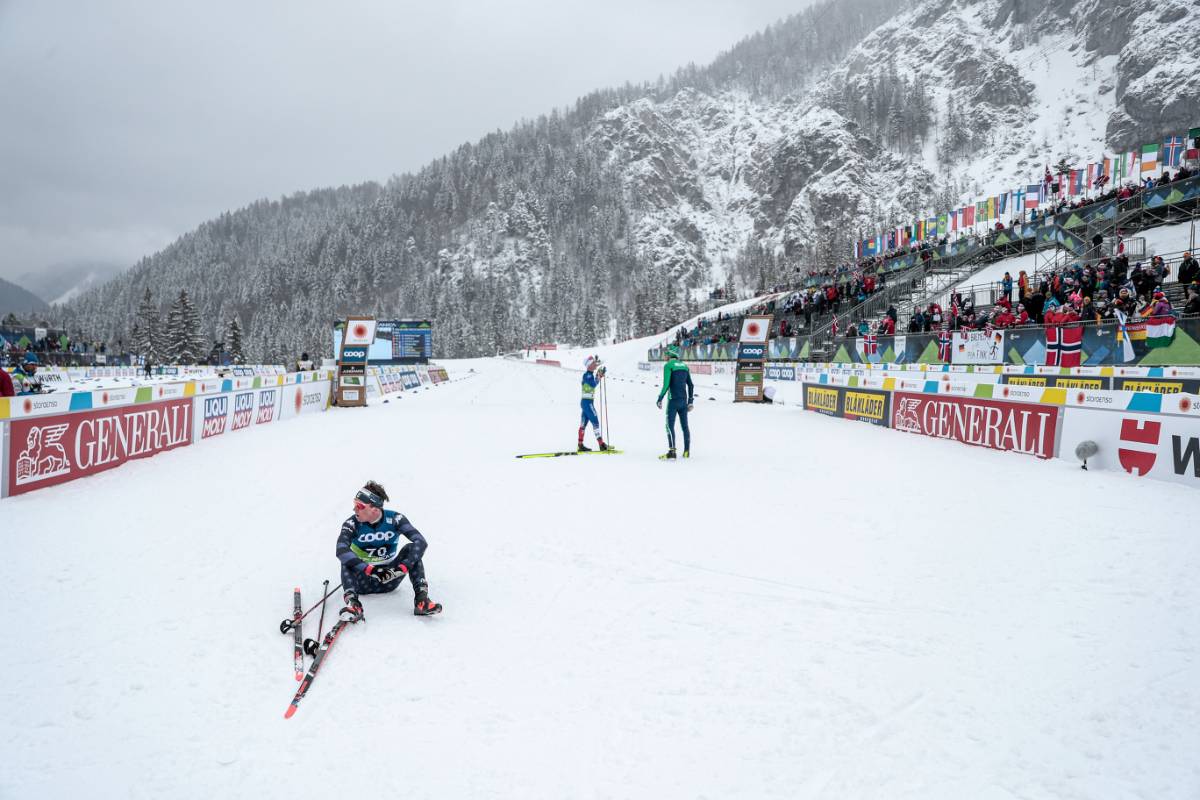
Scott Patterson rcovers at the finish line after skiing to a 15th place finish. Patterson highlighted a day in which the Americans posted three top 30 finishes. (Photo: NordicFocus)
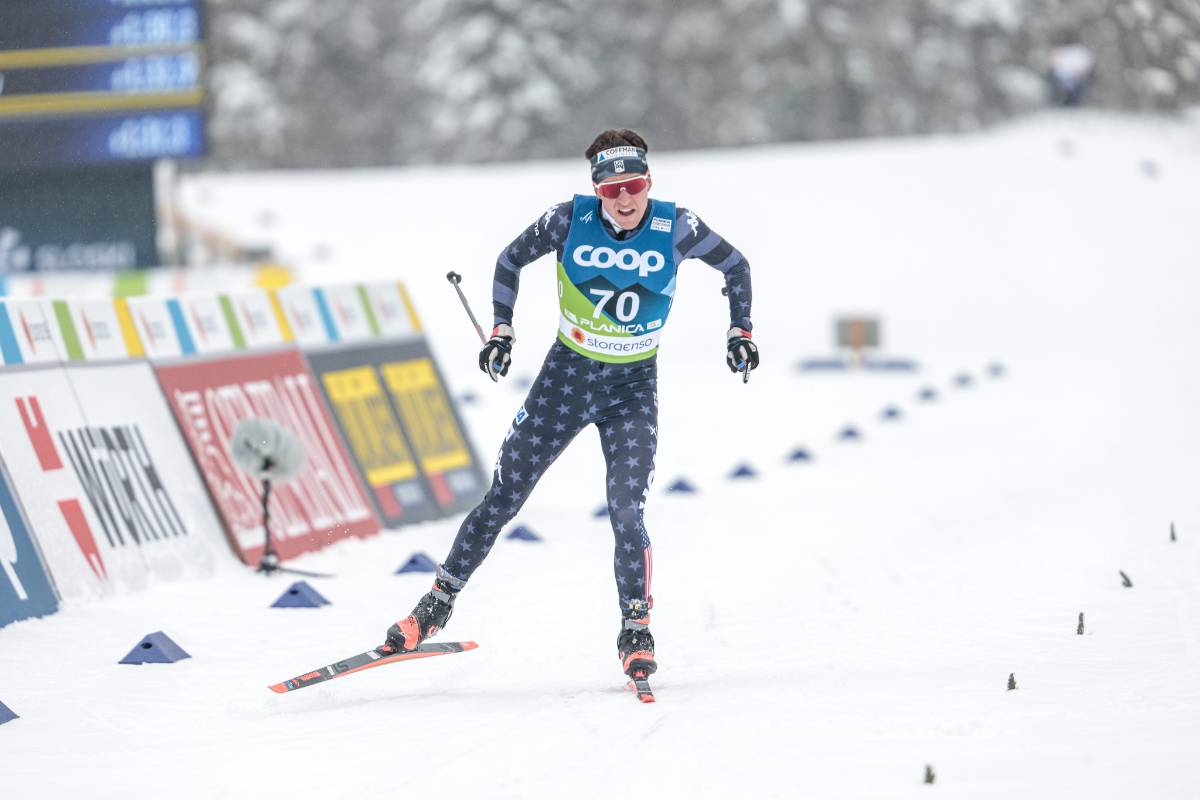
The top American performance of the day came from later start positions. Scott Patterson (USA) wore bib 70 on the day, working his was to an eventual 15th place finish. “I kept getting splits like ‘a couple seconds to eighth, you’re fighting for top ten,’ things like that,” said Patterson in post-race comments to FasterSkier. “[But] then I definitely fell apart in the last couple of kilometers and lost some time.”
Post-race, Patterson described his strange mix of disappointment and optimism from the 15th place result: “I wanted more from today,” he said. “Honestly, warming up, I went ‘I am not really feeling it,’ but I feel like I skied decent for how I was feeling.” Patterson added that he was “looking forward to the 50 k classic this weekend, for sure.”
15 K Results Point to Intriguing Team Relay
The World Championship program now turns back into a team affair, with the Women’s Team Relay event tomorrow and Men’s Team Relay on Friday. In the American camp, Gus Schumacher says they are “feeling pretty excited.” Part of that excitement may stem from today’s results, with Schumacher saying to FasterSkier that, “One of the Swedish guys pointed out that—besides Norway—there’s a lot of [team’s] that could battle it out, and I feel confident in my ability to contribute to that.”
This World Cup coverage is made possible through the generous support of Marty and Kathy Hall and A Hall Mark of Excellence Award. To learn more about A Hall Mark of Excellence Award, or to learn how you can support Fasterskier’s coverage, please contact info@fasterskier.com.
Norway has long been a dominant force in cross country skiing, but that dominance may never have been more clearly evident than now. Norwegian men have claimed victory in the last eight World Cup distance races. Thus far in Period I of the World Cup season, Norwegian skiers have claimed 13 of the 15 World Cup podium positions in distance races. Norway’s dominance seems impenetrable: injury interferes with one star performer, illness sidelines another; yet ever more Norwegians step up to fill the podium. Results in Davos would be no different, as Norway claimed the top six places in the Men’s 20 k Freestyle. Winner on the day was Simen Hegstad Krueger, followed by Hans Christer Holund in second, and Sjur Roethe third. Johannes Hosfloet Klaebo would finish fifth, securing his second-place position (behind Golberg) in the World Cup Overall points standings.
Simen Hegstad Krueger nearing the finish line in his convincing win in Davos’ World Cup 20 k Freestyle. (Photo: Nordic Focus)
Canadian skiers were coming off an historic day in which Graham Ritchie finished a career-best 17th in the World Cup Sprint, leading four Canadians into the quarterfinals. In Sunday’s 20 k, Team Canada’s successes continued as Ritchie finished 21st, followed closely by teammate Antoine Cyr in 24th. American finishers included Gus Schumacher 18th, Ben Ogden 22nd, Hunter Wonders 33rd, Scott Patterson 38th, and Zak Ketterson 43rd.
Men’s 20k Freestyle
If Klaebo’s World Cup campaign has been thrown into question by virtue of the many races he’s missed, then today was his chance to begin reclaiming some of those squandered points. World Cup Overall Leader, Paal Golberg (NOR), would be absent from both the sprint and distance fields in Davos. Klaebo has skipped numerous distance races this season, so much anticipation accompanied his name’s appearance on Sunday’s start list.
Klaebo appeared to ski his race conservatively, perhaps knowing that the new points system would reward more than just the day’s winner (finally, that system would be working in his favor). This weekend, Klaebo would earn points for his second place in Saturday’s sprint qualifier, for his second place in Saturday’s sprint final, and for his fifth place finish in the 20 k . . . all while Golberg nursed a cold back home in Norway. For Klaebo: mission accomplished.
But Sunday’s story was about far more than just Klaebo: Facing twenty kilometers skied over four laps of a five kilometer course, racers in Davos’ 20 k freestyle seemed likely to join up with other skiers in gaps of 22-23 places. In the otherwise random selection of start positions, this seemed most likely to benefit Norwegians Krueger and Holund who were separated in the starting order by 22 places—Holund would start earlier, with Krueger starting 22 places later. Predictably, Krueger and Holund were able to pair up at the beginning of Holund’s second lap, enabling Holund to convert his 8th place standing at the 10 kilometer checkpoint into a sizable lead at his finish. But Holund’s time would need to stand up against that of Krueger who still had one more lap to race. Ultimately, Krueger was able to drive on toward the finish—alone in his last lap—to finish in 42:12.3, besting Holund by 22 seconds.
In his post-race interview, Krueger elaborated on his feelings for Davos. “It’s amazing. I love this course. It’s my favorite track,” he said. “It was a really good feeling to take the victory today.”
Of being able to team up with Holund during today’s 20 k, Krueger beamed, “We made up a good pace,” he said. “And a great team effort as well.”
Gus Schumacher (USA) skiing to 18th in the 20 k Freestyle at Davos, Switzerland. (Photo: Nordic Focus)
Numerous North American men also had impressive weekends in Davos, as Schumacher (USA) has begun finding the distance-racing form for which he has become known. He finished 18th on the day, followed closely by Canada’s Ritchie at 21st. Going into the holiday break, North American skiers should feel reassured by their season’s preparations, and optimistic for the Tour de Ski and FIS World Championships to come later in the season.
USA Team Leader in Davos, Chris Grover, commented on Schumacher’s race: “Gus had a great day,” Grover said. “That was cool to see him take another step forward. He ended up getting a ride with Krueger towards the end of the race. It really helped to hold him in the top twenty.”
As for Team USA’s plans for the holiday break, Grover described a number of different plans for athletes and staff: “A lot of the main athletes are staying in Davos,” he said. “Obviously, it’s close to Val Mustair where the Tour starts. It’s a little bit of a logistical challenge; typically, people will try to take a little bit of recover. Then they’ll try to have a little bit of a training block. You can’t go into the Tour carrying fatigue.”
As Period I of FIS Cross Country World Cup 2022 comes to a close, the Norwegian ownership of the podium seems unchallenged. They have survived illness and injury, they have thrived in a system where the greatest challenge in skiing may not be climbing onto the World Cup podium, but climbing into a Team Norway race suit. Any skier qualifying for this team has a chance to claim World Cup glory . . . at least until the following weekend when yet another Norwegian star is likely to rise.
Graham Ritchie (CAN) capped a strong weekend in Davos with his 21st place finish in the 20 k Freestyle. He was also top North American in Saturday’s World Cup Sprint, finishing in a career-best 17th place. (Photo: Nordic Focus)
This World Cup coverage is made possible through the generous support of Marty and Kathy Hall and A Hall Mark of Excellence Award. To learn more about A Hall Mark of Excellence Award or to learn how you can support FasterSkier’s coverage please contact info@fasterskier.com.
Johannes Hoesflot Klaebo (NOR) cruising to victory in Sunday’s 20 K World Cup Freestyle Pursuit, and posting a clean sweep of sprint and distance events in the season’s first FIS World Cup weekend. (Photo: NordicFocus)
Snow-covered Ruka, Finland set a wintry stage for the third day of World Cup cross-country racing, as the men’s field returned to the trails to contest a 20 k Freestyle Pursuit. Johannes Hoesflot Klaebo skied a smart, economical race to claim the victory (his third of the weekend), and was joined on the podium by Norwegian teammate Paal Golberg, and Italian sprint-specialist Federico Pellegrino (who advanced to bronze medal position upon the ultimate disqualification of Sweden’s Kalle Halfvarsson).
Among North American finishers, Canadians Graham Ritchie and Oliver Leveille were 47th and 55th, respectively, while American finishers included Scott Patterson 14th, Hunter Wonders 30th, Zak Ketterson 32nd, Gus Schumacher 36th, and Ben Ogden 50th.
In 2017, Klaebo swept the opening weekend of World Cup Races at Ruka on his way to an eventual 2018 Overall World Cup Championship It may not have been his goal to repeat such a sweep in 2022; nonetheless, Klaebo has silenced any who may have doubted his readiness for another season of dominance. At this early point in the season, Klaebo definitely looks like the skier to beat.
On his way to victory in the Men’s 20 K Pursuit, Norway’s Johannes Hoesflot Klaebo (in yellow bib) consistently marked the pace-making efforts of his teammate, Han’s Christer Holund (on left). (Photo: NordicFocus)
20 K Freestyle Pursuit
Sunday’s Freestyle Pursuit incorporated start positions determined by finishing statistics in Saturday’s Individual Classic 10 k. Having won Saturday’s race, Klaebo started first with an advantage of twenty seconds over the second starter, Paal Golberg. As it turned out, a number of other starters—including some starting nearly a minute back—would play significant roles in today’s race.
In the absence of Russian skiers, World Cup mass start races are likely to revolve around Klaebo. With any Klaebo-led pursuit race apt to evolve into a mass start strategy, it will always be unlikely that Klaebo—the world’s best sprinter—will volunteer do the lion’s share of the work. Predictably, while Klaebo’s pace was brisk at the beginning of Sunday’s race, he soon eased up and allowed himself to be caught by a charging chase pack led by Klaebo’s Norwegian teammate, Hans Christer Holund. The train of chasers behind Holund included Norwegians Martin Lowestroem Nyenget, Golberg, Erik Valnes, Emil Iverson, Mattis Stenshagen; Swedes Kalle Halfvarsson and William Poromaa; Pellegrino of Italy, Friedrich Moch of Germany, and the lone Brit, Andrew Musgrave. With Klaebo now skiing in the group—and Holund setting the tempo—this lead pack of a dozen proceeded to maintain a pace that effectively excluded all others from the race for medals.
American skiers spent the early part of the race grouped in the 30’s, with Scott Patterson having moved up 20 places from his 51st place starting spot. Patterson would continue to ski strongly throughout the race, eventually forming a group of only four chasers closely pursuing the lead group. Patterson would ultimately finish the day in a remarkable 14th place, after having begun his race near the back of the pack.
Hunter Wonders (USA) skied from an original 54th starting position to finish in the first chase group with a very impressive 30th place finish. (Photo: NordicFocus)
Holund drove the pace through the halfway mark, knowing that Valnes, Golberg, Halfvarsson, Pellegrino—and of course Klaebo—all possessed far superior sprinting skills. Musgrave also pushed the pace through the later kilometers, but neither he nor Holund could break the other contenders—nor did they put a dent in Klaebo who seemed contained, confident, and relaxed throughout the race.
With less than two kilometers to race, Klaebo moved to the front (shadowed by Pellegrino). Klaebo’s victories at Ruka have all been delivered by a surging attack on the final hill before the finish, and Sunday’s race proved no different. Klaebo led the pack into the bottom of the final hill, increasing his tempo and jump skating over the top of the hill with the other contenders faltering in his wake. Halfvarsson sought space far to the skier’s left, possibly even leaving the race course, though in a manner that did not seem to give him any advantage or to shorten his distance to the finish line. Ulitmately, both Halfvarsson’s skis veered outside the course markers for just a stride or two. In the eyes of the FIS jury, that small infraction was sufficient to merit his disqualification. Third place on the podium was awarded to Pellegrino who had started the race in the 14th position, and moved up to 3rd for what is likely to have been his first World Cup distance medal. In a post-race interview, and emotional Pellegrino spoke of goals well beyond what he had accomplished on this day: “The main goal this season will not be in sport, but with my wife at home.” Pellegrino and his wife are expecting their first child.
Sunday’s Ruka World Cup Pursuit was an especially satisfying day for sprinter Federico Pellegrino (ITA), who notched his first World Cup Distance Race podium. (Photo: NordicFocus)
This World Cup coverage is made possible through the generous support of Marty and Kathy Hall and the A Hall Mark of Excellence Award. To learn more about A Hall Mark of Excellence Award or to learn how you can support FasterSkier’s coverage please contact info@fasterskier.com.
Following the men’s Olympic 50-turned-28.6 k in Zhangjiakou, long-time American distance champion Kris Freeman and Devon Kershaw called Scott Patterson an “Olympic Specialist”, commenting on how Patterson had found many of his top results at either World Ski Championships or during the Olympics in PyeongChang and Zhangjiakou.
His top championship results are this: 8th in the 30 k free in Beijing, 11th in the 15/15 k skiathlon; 14th in the skiathon and 10th in the 50 k classic during the 2021 World Ski Championships in Oberstdorf, Germany; 21st in the skiathlon in the skiathlon during the 2019 World Champs in Seefeld, Austria; 18th in the skiathlon, 21st in the 15k skate and 11th in the 50 k classic during the 2018 Olympics in PyeongChang.
Until today, Patterson had raced into the Top-20 on the World Cup five times individually, with his best result – and only other individual Top-10 – arriving in 2017 in the 30 k skiathlon during a pre-Olympic World Cup in PyeongChang. This event saw just 31 finishers, and a scan of the results sheet shows only a small number of names that frequent this site.
Scott Patterson races to 7th place during the 15 k individual start skate in Falun. (Photo: NordicFocus)
But here in Falun, Sweden, Patterson popped a 7th place finish in the 15-kilometer individual start skate, finishing 42 seconds behind winner Didrik Tønseth (NOR) as the first non-Scandinavian athlete on the tails of five Norwegians plus Calle Halfvarsson of Sweden.
Roughly another 40 seconds back, Team Birkie’s Zak Ketterson was rolling too. In a steady effort that saw him inside the Top-20 throughout the day, he not only his first World Cup points, but finished 15th, +1:20.8 on Tønseth.
In short, Patterson and Ketterson shaped the final men’s distance race of the season into a high note for the U.S. And both men did it as early-starters, before the seeded group.
Zak Ketterson (bib 8) leads Logan Hanneman during the 15 k individual start skate in Falun. (Photo: NordicFocus)
Diving into the race, a winning strategy looked to be a conservative first of four laps on the championship-caliber course in Falun. While the top-three established themselves early, the eventual winner, Tønseth, did not make his charge for the win until the final lap. 23-year-old Harald Østberg Amundsen (NOR) was on top at the first lap, followed by Halfvarsson of Sweden, and then Tønseth. At the half, it was Halfvarsson on top, with Amundsen and Tønseth just under four seconds back. Then, Tønseth slowly turned the dial upward.
With one lap to go, Tønseth had five seconds on the Swede, and ten on his young countryman. With just over 2 k to go, this lead had grown to +13.3 seconds, of which he ceded very little through the finish. Tønseth stopped the clock at a ripping 31:57.6, knocking down the time of Halfvarsson who had started eleven bibs earlier. The Swede kept the second spot on the podium (+9.0), while Amundsen, who faded in the second half, kept pace from the back-half of the seeded group to finish third (+20.4).
Sweden’s Calle Halfvarsson sets the mark at the finish of the 15 k skate in Falun, while Scott Patterson races the final meters in the background. (Photo: NordicFocus)Norway’s Didrik Tønseth wins the 15 k individual start skate in Falun. (Photo: NordicFocus)
Today marked Tønseth’s second consecutive podium, after taking 3rd at Holmenkollen last weekend, and his career first World Cup victory in freestyle. It had been a nearly three year stretch since his previous World Cup podium, which took place in Québec City in March, 2019.
“I’m happy to end it like this,” Tønseth told FIS after the race. “This year has been pretty good, to finish it off with victories – I’m really happy with that. Considering the last two seasons before this one have been tough, and it was not working, but this one has been better and better, and I ended up at the top, so I’m really happy.”
Norway’s Didrik Tønseth wins the 15 k individual start skate in Falun. (Photo: NordicFocus)
On his season highlights, Tønseth continued, “For me, the most important is that my body works and I can train it. I can train hard, and things respond, and I’m happy to go ski fast.”
Asked his feelings on sharing the podium with teammate Amundsen, Tønseth said, “He is a rookie, but he showed last year, he is a good cross country skier. I’m happy for him to be on the podium and I’m happy to beat him as well.”
Falun’s 15 k skate podium: Didrik Tønseth (NOR) took the win ahead of Calle Halfvarsson (SWE) and Harald Østberg Amundsen (NOR). (Photo: NordicFocus)
Expanding on the conservative start – though the eventual podium athletes would simply reshuffle themselves throughout the race, the remainder of the top-10 saw some changes, like France’s Clement Parisse falling from fourth place at the halfway mark to 8th at the finish, and two Finns, Remi Lindholm and Iivo Niskanen, dropping from fifth and seventh at the first lap to 14th and tenth at the finish.
Meanwhile, the seemingly more patient starters, like Martin Løwstrøm Nyenget, who won last weekend’s 50 k classic at Holmenkollen, were climbing the rankings at time checks. Nyenget was in eighth at the half, before ascending to fifth at the finish (+23.6), just behind his teammate Hans Christer Holund, who took fourth (+21.2).
Both Patterson and Ketterson exemplified this tactic also, knocking off three spots each between the halfway mark and the finish. Propagating a banner day for North America, Canada’s Olivier Léveillé was also steadily climbing the ranks, moving up from 16th at 7.5k to finish 9th (+48.9). Léveillé’s teammate Antoine Cyr had skied up from 37th at the half to finish 25th (+1:42.3), while fellow Canadian Phillippe Boucher took 29th (+1:45.0) as the third member of his team inside the top-30.
Canada’s Antoine Cyr skis to 25th in Falun’s 15 k free. (Photo: NordicFocus)
While Patterson was 15th in Falun last year, and has aforementioned strong results on championship courses like this one, Patterson said in a post-race call that the venue has actually been a challenge for him through his career. Though it’s a championship course, it lacks the high altitude factor of Zhangjiakou, where Patterson thrived, and has just one major climb, the signature “Morderbakken” which rises 65 vertical meters over the course of roughly 0.6 k. Gaining from his experiences racing on this course, Patterson shared what he’s done to solve the puzzle.
“A lot of my approach today was trying to find some of the same feelings as last year, which was a lot of pushing hard, working through all the transitions. There’s a lot of time out there — beyond Morderbakken, there’s a lot of twisting down hills and gradual flats where it’s easy to lose time. But if you’re on form and thinking about it all the time, it’s a good place to gain time.”
Scott Patterson takes 7th place in the 15 k individual start skate in Falun. (Photo: NordicFocus)
Patterson also shared that he was unsure how his form would be today, as he was carrying fatigue from his performance at the Holmenkollen, which he identified as below his expectations.
“I started questioning my fitness. So it was nice to turn that around today with a good race and actually remind myself that I can ski well again and also appreciate a good distance skate race.”
Overall, the season has been one of high highs and low lows for the 30-year-old. A late-fall broken wrist inhibited his ability to capitalize on the fitness he built over the summer, along with his early-season results, which would be critical for making the 2022 Olympic team. Patterson discussed the turning point of his season, which will end on a high note.
“[I hit a] big turning point going into nationals, where I had a lot of pressure, but I felt like I was actually starting to find my form and race well. So that was one big point, just coming into nationals and actually pulling out those results to make the Olympic team. But also, just going into the Olympics, I I had a really good training block in Bozeman. I was staying with my parents instead of going over to Livigno, like a lot of the US Olympic team. And I think that was really productive for me getting some altitude training, but also just keeping the stress low, which really helped going into the Olympics.”
Here’s the full interview with Patterson, including non-race season highlights and how a trivia night in Lahti helped bring the North American contingent closer together, making today’s results even more exciting for Patterson to be part of.
Adam Martin pushes to the line at the finish of the men’s 15 k individual start skate in Falun. (Photo: NordicFocus)Canada’s Xavier McKeever down the home stretch in the men’s 15 k free in Falun. (Photo: NordicFocus)
Outside the Top-30 for the U.S., Crafttsbury’s Adam Martin skied to 44th (+2:20.9), while Logan Hanneman finished 52nd (+2:58.4), and Peter Holmes took 68th (+4:20.0). For Canada, Thomas Stephen was 61st (+3:32.2), while Xavier McKeever was 62nd (+3:36.9).
Post-race interview with Matt Whitcomb:
With World Cup individual racing now complete for the 2021/22 season, awards for both the overall and distance champions were handed out today in Falun.
Though he was 10th today, Finland’s Iivo Niskanen ended his season with 493 points, overtaking previous leader Alexander Bolshunov (RUS) to win the distance standings. Bolshunov remained in second, trailing by 75 points. After a remarkable Olympic run, Bolshunov missed the final two distance races on the World Cup following FIS’ ban of Russian and Belarusian athletes on March 1st. Also unable to compete in the final two World Cup distance events after contracting COVID-19, Johannes Høsflot Klæbo finished third, at an 80 point deficit.
Finland’s Iivo Niskanen is the 2022 World Cup distance champion. (Photo: NordicFocus)
With Niskanen still the only podium member present to accept his awards, this leaderboard was reshuffled for the overall standings. Having won the 2021/22 Tour de Ski and consistently proved his range beyond the sprint course, Klæbo ran away with the overall World Cup victory to finish with 1375 points. He’s had some cake, but receiving the crystal globe will have to wait for the time being.
Bolshunov held his ground in second place, 497 points back, while Niskanen took third in the overall standings, 631 points behind Klæbo.
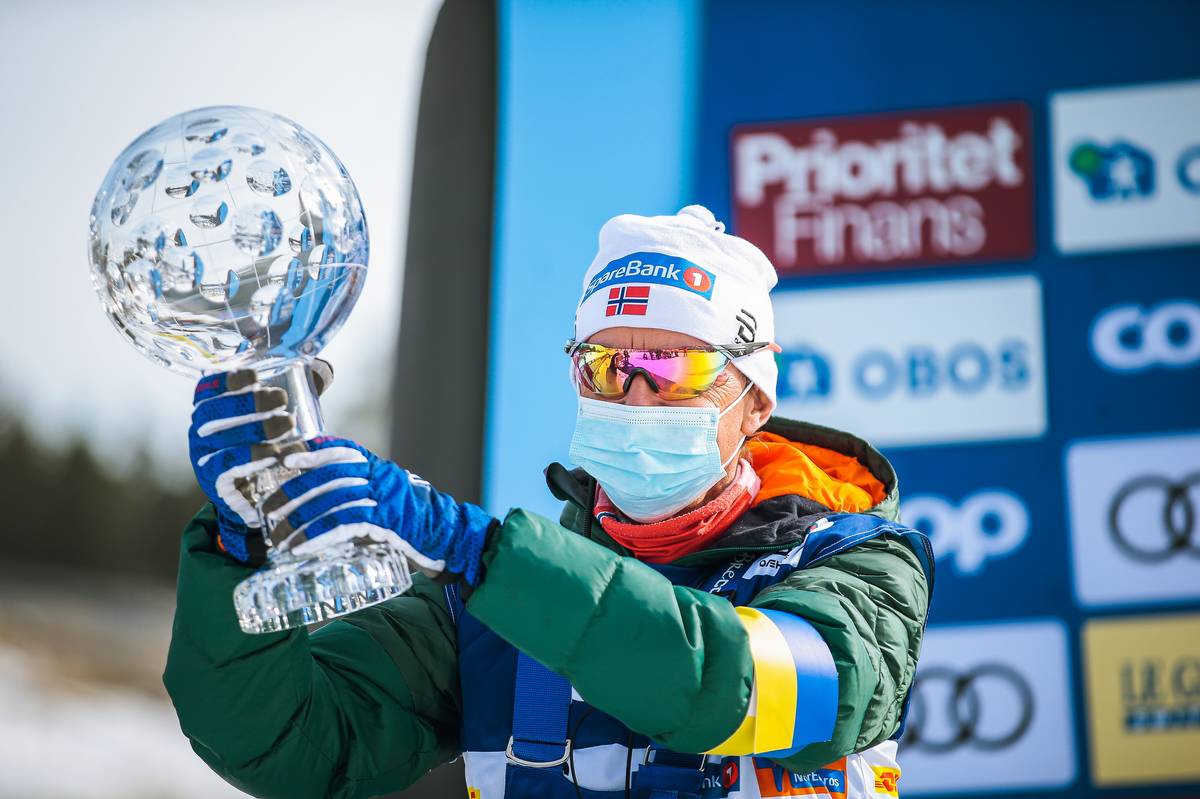
A Norwegian coach accepts the overall World Cup crystal globe on behalf of winner Johannes Høsflot Klæbo. (Photo: NordicFocus)
You can expect more analysis on the seasons of these World Cup champions, but first, we’ve got one final day of World Cup racing on deck. The final day of racing in Falun will feature a mixed-gender 4 x 5 k relay in the morning, followed by a mixed team sprint in the afternoon.
ZHANGJIAKOU, CHINA — The 28 kilometers that Alexander Bolshunov raced Saturday was only enough to take him just past the halfway point of the race he’d entered at the Winter Olympics.
But Bolshunov, who competes for Russia, is still going home with the gold medal.
That development is the result of a decision by race organizers to shorten the Olympics’ iconic 50-kilometer marathon event in the face of brutal wind and cold.
But they’re now facing harsh criticism from some competitors, coaches and fans of the sport, who denounced the decision — made just one hour before the start — as avoidable and unnecessary.
“It was an absolutely ridiculous decision,” Andrew Musgrave of Britain, a long-distance specialist, told reporters after finishing 12th. “If you can race 28.4 k, I don’t see why on earth you can’t race 50 k. Cross-country skiing’s meant to be the ultimate test of endurance.”
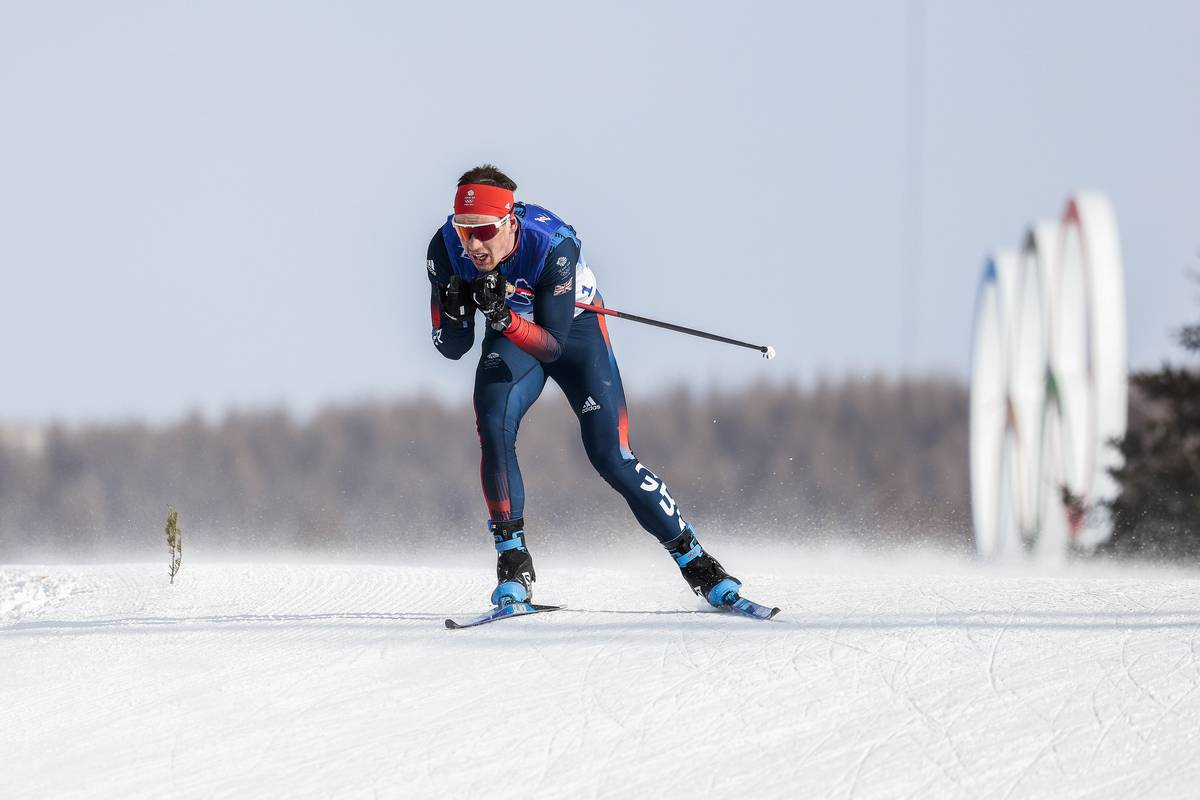
Andrew Musgrave (GBR) races the abbreviated Olympic marathon, cut to 28-kilometers due to weather conditions in Zhangjiakou. (Photo: NordicFocus)
The International Ski Federation (FIS), which oversees Olympic cross-country skiing, would not comment beyond their statement announcing the change, saying the officials responsible for the change were in meetings after the race.
“The decision was taken in regards to the athletes’ safety, to reduce the time of exposure of athletes in those conditions,” the announcement said.
Conditions at the cross-country skiing venue in Zhangjiakou, the mountain resort area outside Beijing that’s hosting the Olympic races, were extreme Saturday.
Strong winds shuddered windows and blew clouds of snow through the stadium and across the trails; a weather bulletin posted two hours before the race pegged temperatures at 3 F, with winds gusting at 30 mph to produce a wind chill of -21 F. Athletes ended up racing in neck warmers and layers of tape covering their cheeks to protect from frostbite.
Cheeks protected with tape, Scott Patterson (USA) follows Sjur Røthe (NOR) during the men’s 28 k skate. (Photo: NordicFocus)
But forecasters from the Beijing Games’ organizing committee had been predicting difficult conditions for days. The International Biathlon Union moved up its race scheduled for Saturday to Friday, citing low temperatures and strong winds in the forecast.
Athletes in Saturday’s 50-kilometer cross-country race, which was scheduled for 2 p.m., were still girding for a tough race in the cold when organizers sent a bulletin to teams at noon. The update said all options were on the table: “cancellation, rescheduling, shorter distance” or a course change.
The 28-kilometer distance, plus a one hour delay, were announced 45 minutes later.
Reactions were mixed, and a number of athletes and coaches said they understood the decision.
“It’s not ideal. But what is ideal about a day like today?” said Matt Whitcomb, the U.S. Ski Team’s head coach.
Organizers, he added, have athletes’ best interests in mind. “They’ve got a lot riding on their wise choices, and to be a little bit conservative because of the cold and exposure is not a bad thing,” he said.
Scott Patterson, who placed eighth as America’s only competitor, said it felt like a “half-measure” to reduce the race’s length, adding that he would have preferred a delay to Sunday.
Polish cross country skier Dominik Bury races the men’s marathon, shortened to 28 k due to extreme weather at the venue. (Photo: NordicFocus)
But he was also skeptical that running the race at its original distance would have substantially changed the results.
“Those top guys were strong, and they would have been strong with 20 more k,” he said in an interview. “No fault to the organizers. I think they had a tough decision and made a decent call with it.”
Others, though, fell on a spectrum from frustrated to irate.
“Everyone wants to run 50 kilometers. Not 30,” Markus Cramer, one of the coaches for the Russian team, told Norwegian media. “Most teams are not happy.”
Musgrave, the British athlete, called the decision a “f@*king joke” on Twitter, and raced in a headband — not even a hat. Retired Norwegian superstar said the race should have either been postponed or canceled outright. And Petter Skinstad, a Norwegian ski racer and television commentator, said the decision destroyed years of training for athletes that specialize in longer distances.
“Why on earth is a 30 k okay and not a 50 k, and why on earth didn’t they do as biathlon and do the race a day in advance?” he said in a message — a point echoed by Hans Christer Holund, one of Norway’s top finishers in the race.
Norway’s Hans Christer Holund tucks into the downhill during the men’s 28 k mass start freestyle. (Photo: NordicFocus)
Biathlon officials said discussions about moving their race earlier started several days beforehand, with the forecast released by the Beijing Olympics organizers, said Max Cobb, a member of the International Biathlon Union’s executive board and president of the U.S. Biathlon Association.
Cobb, who stressed that he was not commenting on the ski federation’s decision Saturday, said the change in the biathlon schedule was not made lightly.
That’s because Olympic events are carefully sequenced to minimize conflicts in television broadcasts between different sports — and because of the risk that a forecast changes and renders a schedule change unnecessary.
“We really relied on the strong track of the meteorology team. And they’ve been nailing it,” he said.
In the end, and perhaps because the hour-long delay gave the winds a chance to subside, competitors said they didn’t end up feeling especially cold — and could have survived another 22 kilometers of racing.
“In retrospect, we could have raced all 50 kilometers, because the weather improved,” Bolshunov, the winner, said at a news conference after the race. “I didn’t get cold. It was only waiting for the awards ceremony that I got just a little shivery.”
Ivan Yakimushkin, the Russian who won the silver medal in the event, said he didn’t freeze during the race, either.
“I even broke a sweat,” he said.
The ROC’s Alexander Bolshunov (center) and Ivan Yakimushkin (right) race to gold and silver in the men’s 28 k freestyle in Zhangjiakou. (Photo: NordicFocus)
The men’s 4 x 10 k relay itself lacked for drama, but fortunately there’s plenty going on in the Norwegian team for us to talk about. Devon and Nat are back to break down Russia’s convincing win in the relay, the most disappointing silver ever for Norway and a gold-like bronze for France.
Emil Iversen (NOR), Paal Golberg (NOR), Hans Christer Holund (NOR), Johannes Hoesflot Klaebo (NOR), (l-r) were the only team not celebrating their medal after the 4 x 10 k relay (Photo: NordicFocus)
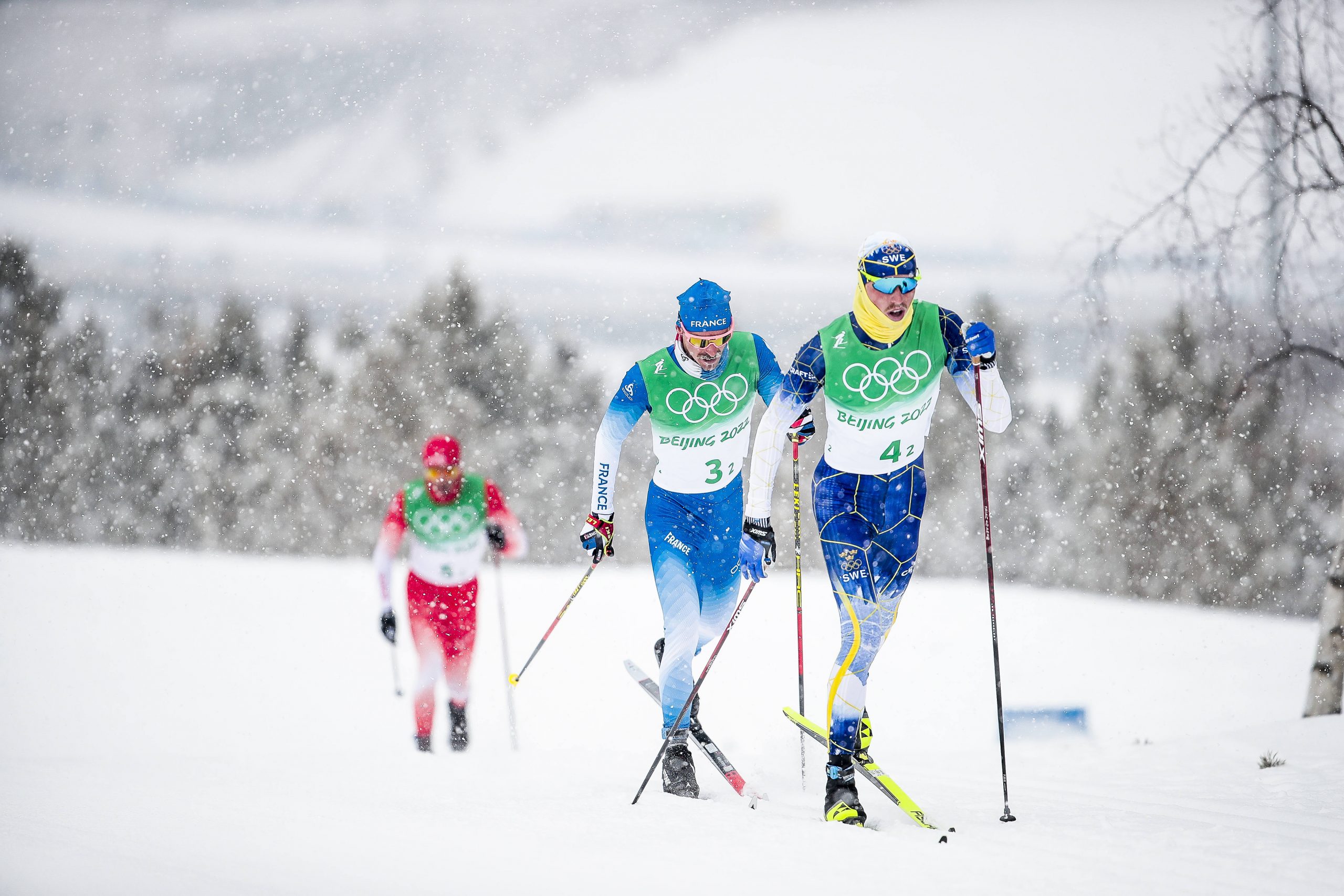
Early stages, Emil Iversen (NOR), Alexey Chervotkin (ROC), Richard Jouve (FRA), and Oskar Svensson (SWE) (l-r) lead the men’s 4 x 10 k relay. (Photo: NordicFocus)
This World Cup coverage is made possible through the generous support of Marty and Kathy Hall and the A Hall Mark of Excellence Award. To learn more about A Hall Mark of Excellence Award or to learn how you can support FasterSkier’s coverage please contact info@fasterskier.com.
After a thrilling women’s relay event on Saturday, it was the men’s turn to compete, each athlete skiing the laps of 3.3-kilometers for a total of 4 x 10 k. In a surprising turn of events, more snow than has fallen in a decade came down in Zhangjiakou over the last 24 hours, altering the otherwise stable man-made conditions the men have raced to this point. Conditions being what they were, heavy snowfall and 11°F on challenging courses, this made for an especially long race.
The ROC proved to best handle the conditions, winning gold in 1:54:50.7. Norway skied to silver (+1:07.2), with France taking bronze (+1:16.4), while the American men skied to ninth (+8:05.6), with the Canadians in 11th (+9:10.4).
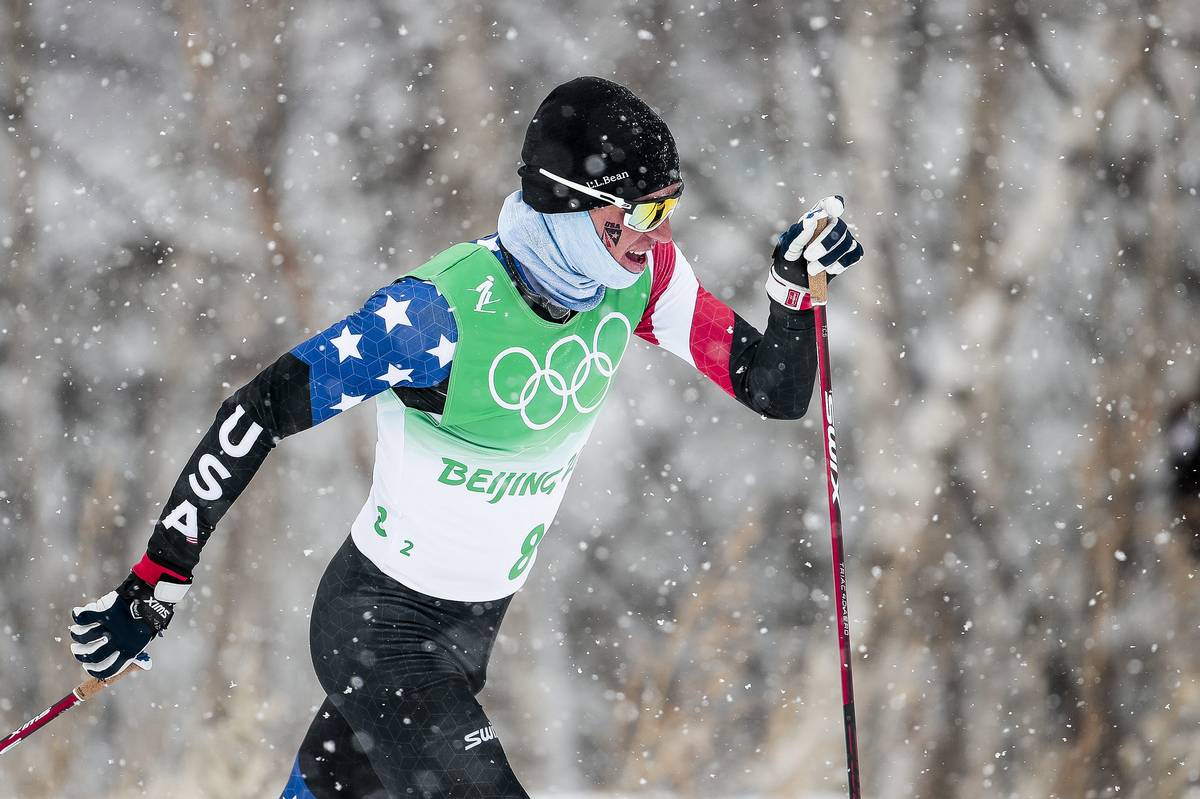
Scott Patterson skis the second leg of the men’s 4 x 10 k relay through unprecedented conditions. (Photo: NordicFocus)
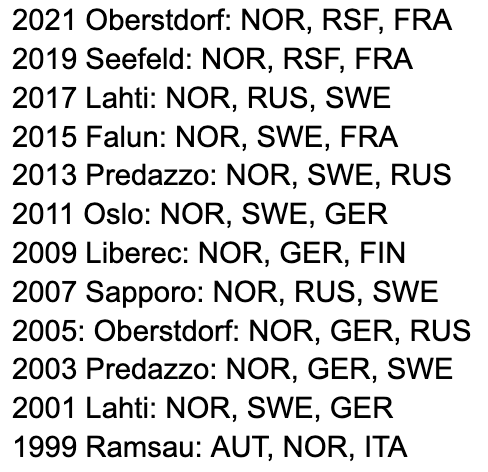
Men’s skiing for the past few years has been dominated by two nations, Norway and Russia (or as they are known at these Games, the Russian Olympic Committee (ROC)). When it comes to the men’s 4 x 10 k relay however, Norway has historically been in a class of its own.
Results summary for men’s 4 x 10 k relay at World Championships since 1999.
Since Team Norway’s all-around poor showing at Sochi in 2014, which included the men’s team finishing 4th, they have not lost a championship relay. Indeed, looking at relay results from World Championships, you have to dig all the way back to 1999 to find Norway not winning gold, when Norway finished second to Austria in Ramsau. Their performances at the Olympics have been less dominant but most relevant for today’s race, they won gold in PyeongChang in 2018 with the same man, Johannes Høsflot Klæbo, in the anchor leg.
As such, despite the Norwegian men’s struggles thus far at these games, it seemed likely that fans would be seeing another battle between Norway and the ROC for top spot. Fifteen nations were represented on the start line and as the first leg was underway Sunday morning, the race appeared to be playing out remarkably similarly to the World Championships in Oberstdorf last year.
A brief recap for those who don’t remember, in heavy snowfall, ROC athlete Alexey Chervotkin made an early move and ended his leg with nearly a minute lead on the rest of the field which was later eaten up and the win went to Norway. Today it was a different story.
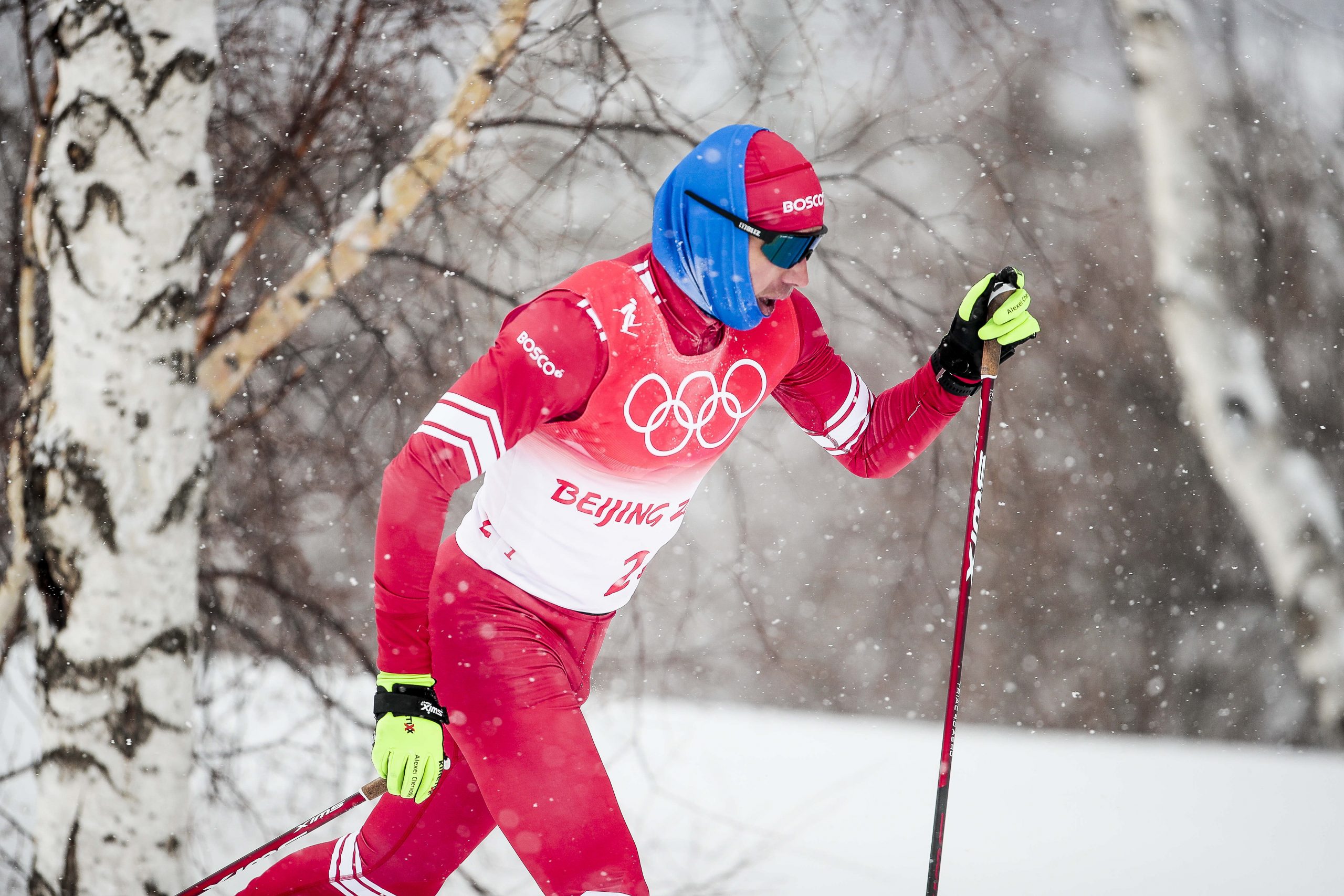
Alexey Chervotkin (ROC) making a decisive early break (Photo: NordicFocus)
Chervotkin was once again in the scramble position for the ROC and he put the hammer down right from the start gun. At 4.3 k he had a gap of +12.6 seconds to the rest of the field and that was the closest anyone got to the ROC for the rest of the race. Although it took three more athletes and another hour and forty-one minutes of skiing to seal the deal.
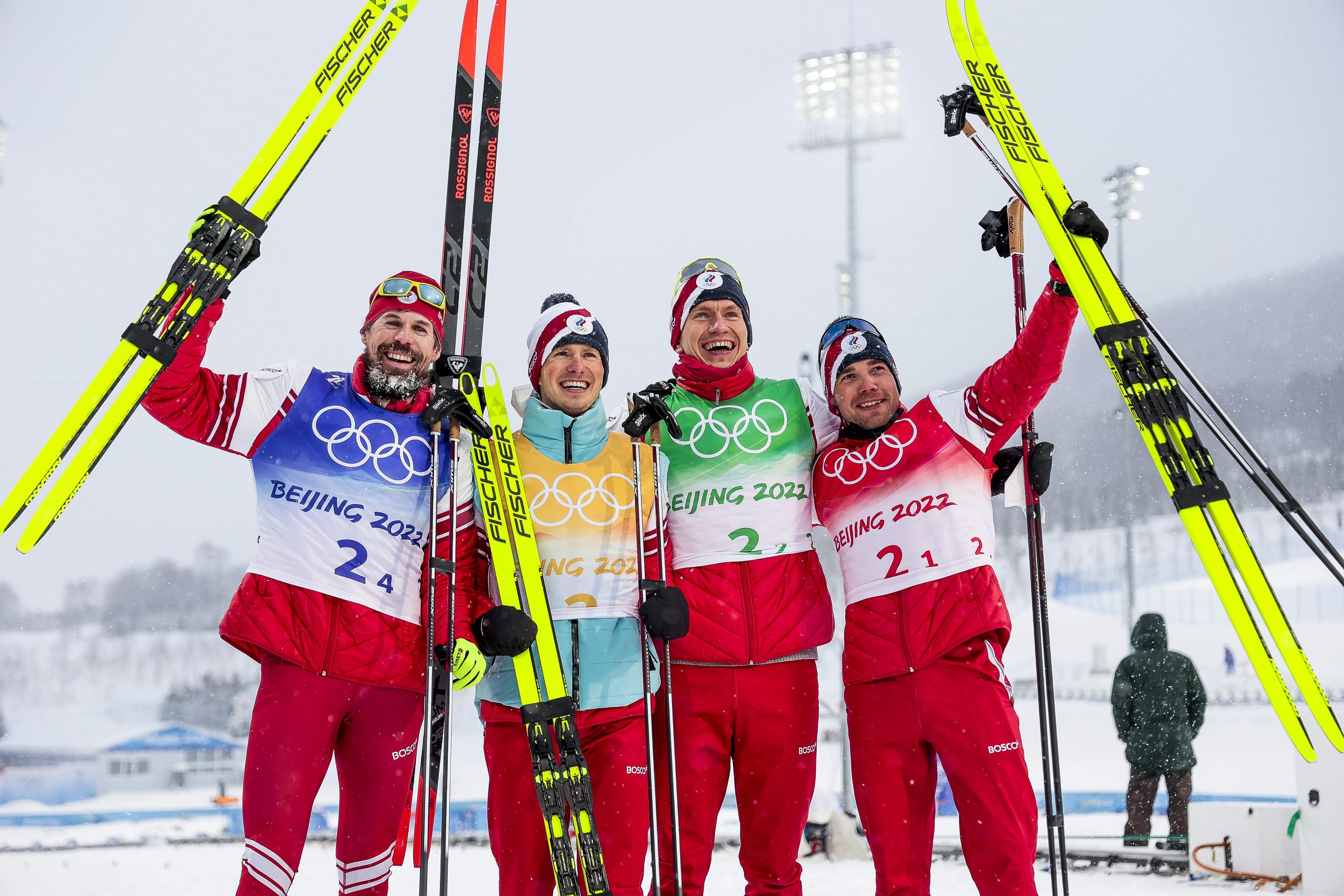
All smiles for Sergey Ustiugov, Denis Spitsov, Alexander Bolshunov, Alexey Chervotkin, (l-r) after taking Olympic gold for the ROC for the first time in over forty years. (Photo: NordicFocus)
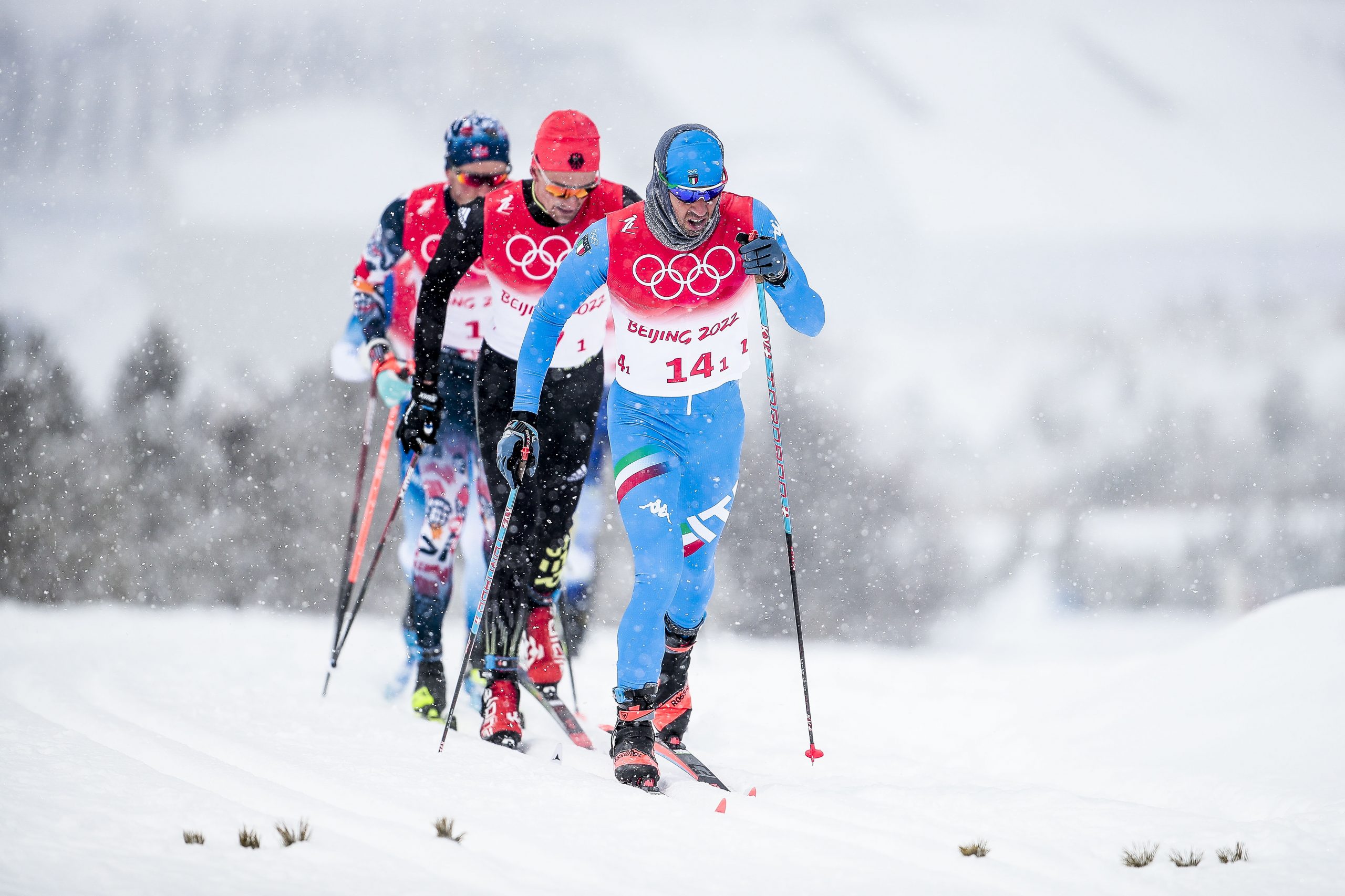
Making his first appearance at these games after some controversy regarding a start in the 15 k classic, Emil Iversen took the first leg for Norway. For the majority of his leg, Iversen did the work to pull at the front of the chase group, which was composed of teams Italy, Germany, Sweden and France. No doubt inspired by the German women’s relay performance, Janosch Brugger skied a strong leg for Germany, ultimately pulling away with Italy’s Federico Pelligrino in the final kilometers of their leg.
Federico Pellegrino (ITA) leads Janosch Brugger (GER) and Emil Iversen (NOR) (Photo: NordicFocus)
With Iversen fading fast on the final lap up the A-climb, Brugger and Pelligrino gapped the Norwegian by 10 seconds, coming into the first exchange +23.5 and +24.1, respectively, behind Chervotkin of the ROC. Next came Iversen, who tagged his teammate, Pål Golberg, with a gap of +34.4 to the ROC.
Despite the hard work put in by Chervotkin, the conditions were such that it took him 30:14.7 to ski 10 k, which is much slower than we might normally expect. Chervotkin had taken 5th place in the 15 k classic on Friday in 38:51.7 with stable conditions; five additional kilometers in roughly 8.5 minutes longer.
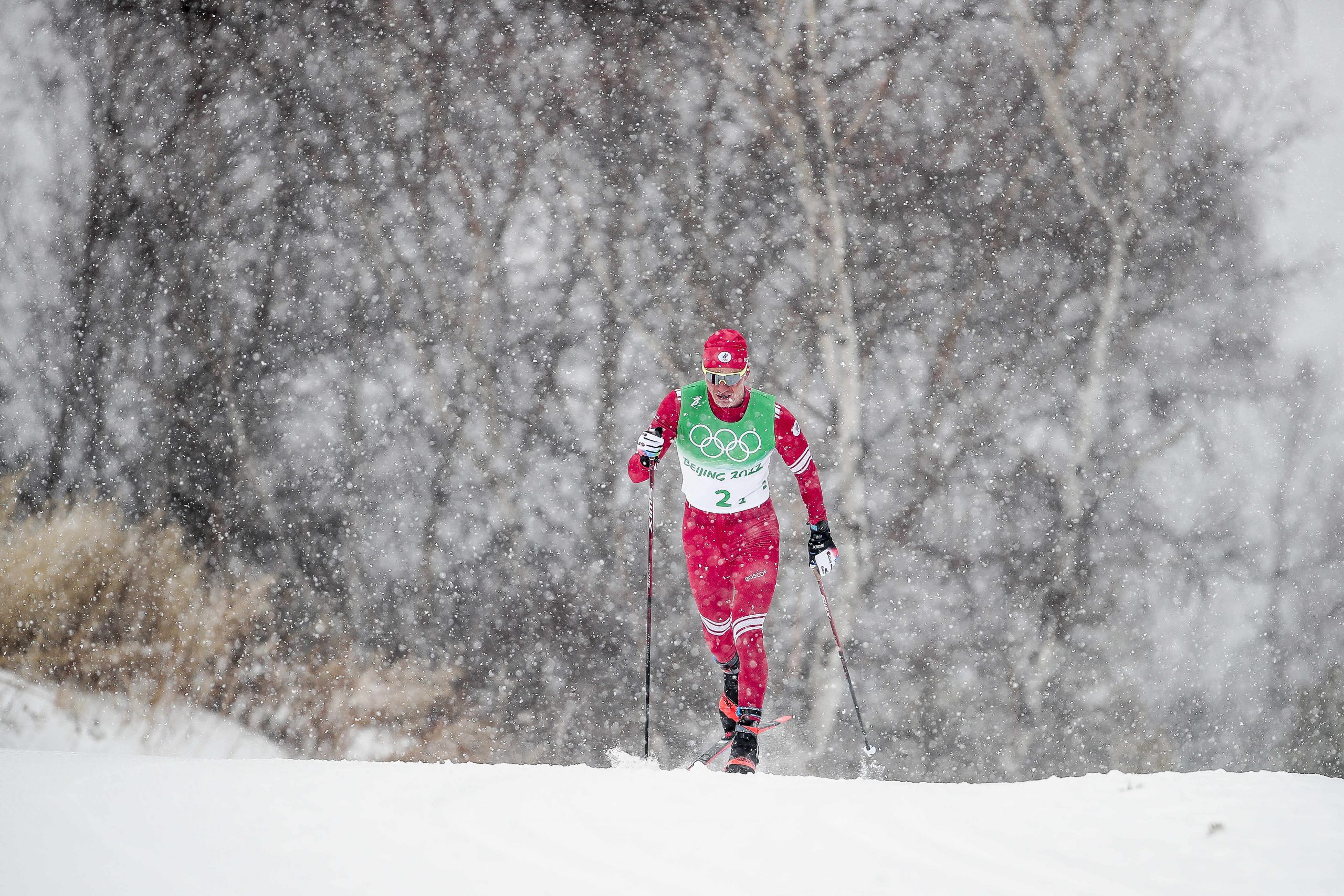
Gliding on his own through falling snow, Alexander Bolshunov (ROC)(Photo: NordicFocus)
With the first leg complete, it was skiathlon winner Alexander Bolshunov who took over for the Russian Olympic Committee. Grinding out front on his own, Bolshunov continued to put time into the rest of the field, widening his lead to +37.8 through 13.3 k, up to +44.5 at 16.6 k and +59.5 at the completion of his three laps.
Behind him, Golberg worked quickly to close the gap to Italy and Germany, legs which were being skied by Francesco de Fabianiand Friedrich Moch. Over the course of his second lap, Golberg began to pull away, creating a ten second gap to the chasers. However, as the skiers completed the third, and their final, 3.3 k lap, things were shaking up.
Pål Golberg (NOR) who would later fade and be caught by William Poromaa of Sweden (Photo: NordicFocus)
Iivo Niskanen, having been tagged in 11th position and +1:47.5 behind, was executing another outstanding classic performance, gaining time on everyone in the field. With the Finn closing quickly, what had been two chase groups merged to one.
Moch for Germany, William Poromaa for Sweden, Hugo Lapalus for France and Niskanen for Finland were all battling for bronze medal position as de Fabiani of Italy faded off the back. Up the final A-climb that had been the undoing of Iversen one leg earlier, Golberg too began to slow.
Hugo Lapalus (FRA) and William Poromaa (SWE) both skiing well (Photo: NordicFocus)
This show of weakness was all Poromaa needed to up the pace, and by the time they entered the stadium for the second exchange, the Swede had caught the Norwegian.
Golberg tagged Hans Christer Holund, +59.5 behind Bolshunov who had given way to Denis Spitsov. Poromaa handed over to Jens Burman, +59.7 behind the ROC. Behind them, Niskanen had moved his team from 11th to 4th and gained 36 seconds on the ROC as he tagged Perttu Hyvarinen. Lapalus of France handed off to Clement Parisse, +1:09.7 back.
Showing his classic strength, Iivo Niskanen (FIN) works to close a big deficit (Photo: NordicFocus)
Having switched to freestyle technique, the third leg was underway and suddenly there was a pack of five nations vying for silver and bronze position, the ROC nearly a minute ahead and all but secured the gold.
Despite the deep snow, Spitsov (ROC) seemed to have no trouble maintaining his advantage as Holund (NOR) took up the mantle of the chase. Through 23.3 k, Holund led the train, still trailing +51.4 behind the ROC.
Perttu Hyvarinen (FIN) fading fast (Photo: NordicFocus)
After Niskanen’s effort, the Finnish team was dropping quickly with Hyvarinen at the helm and was soon out of contention. Florian Notz, skiing for Germany, was also beginning to fade, seeming to drift off the back on each uphill and regain time on the downhill. Eventually, as the chase group entered the stadium for the final lap of their leg, Notz lost contact, bringing the group down to three nations, Norway, Sweden and France.
Hans Christer Holund (NOR) leads a train of chasers (Photo: NordicFocus)
Spitsov still clear off the front, Holund continued to lead the chase. With each section of downhill it became clear that the skis of Parisse (FRA) were not gliding like those of Burman (SWE) and Holund (NOR). In spite of this, and perhaps thanks to the trailside encouragement of his teammates, Parisse dug deep to stay in contact with the Swede and the Norwegian.
Denis Spitsov (RUS) holds a tuck, skiing through deep snow on his own (Photo: NordicFocus)
With 1:27:09.3 on the clock, Spitsov tagged off to Sergey Ustigov, still well clear of the rest of the field. Gaining a few meters on the Frenchman, Holund and Burman tagged their anchor legs with virtually no time between them, +44.9 and +45.4 behind the ROC. A few seconds later, Parisse gave way to the veteran Maurice Manificat, +49.2.
Clement Parisse (FRA) who hung tough in the third leg to help secure bronze for France (Photo: NordicFocus)
This lengthy battle now in its final stages, Manificat worked to close the gap to Sweden and Norway, making the chase pack a group of three once again.
The skis still looked to be a challenge for France as Norway’s anchor, Klæbo, pulled away from the other two by thirteen seconds on the descent towards the stadium, in a move that appeared to be largely unintentional. Not letting up, Manificat took on the task of closing on Klæbo once again, pulling Sweden’s Johan Häggström with him. The second time up the last A-climb of the 3.3 k loop, Manificat busted away from the Swede, catching Klæbo, who appeared to be out for an easy distance ski.
Maurice Manificat (FRA) in the closing moments of his relay leg (Photo: NordicFocus)
Through the stadium for the final time with 36.6 k complete, Ustigov and the ROC was +1:04.3 clear of France and Norway.
To put it bluntly, the last 3.3 k were hard to watch. Knowing he had no chance of beating the Norwegian in a sprint finish, Manificat continued to push to his limit, his ski speed not doing him any favors. Klæbo was all too happy to sit in behind, drafting easily as Manificat tried his best to shake him. In the end, Klæbo did not even have to reach into his bag of tricks, he simply out-glided the Frenchman, who could do nothing about it.
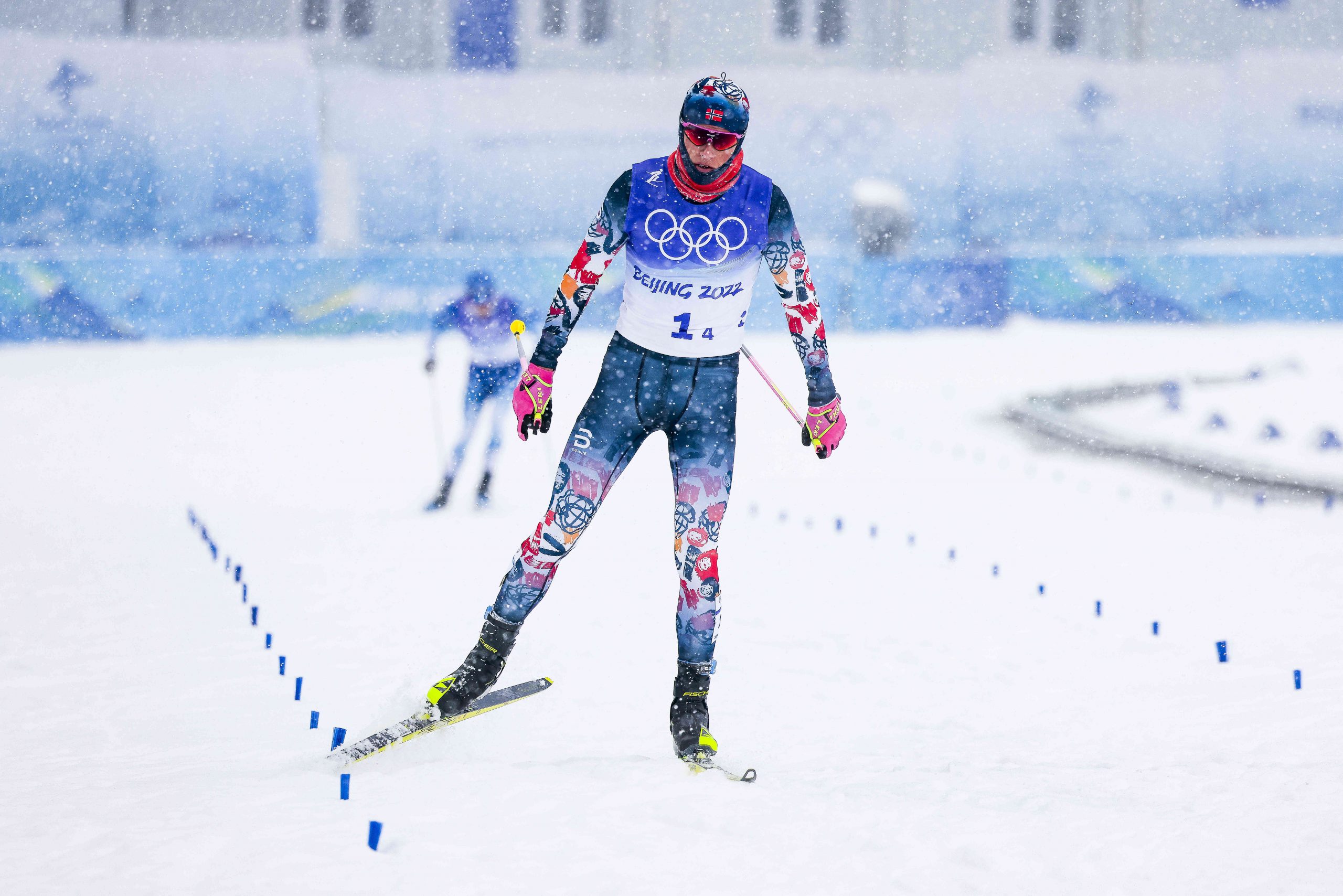
No big moves from Johannes Høsflot Klæbo (NOR) as he brings home the silver medal for Norway (Photo: NordicFocus)
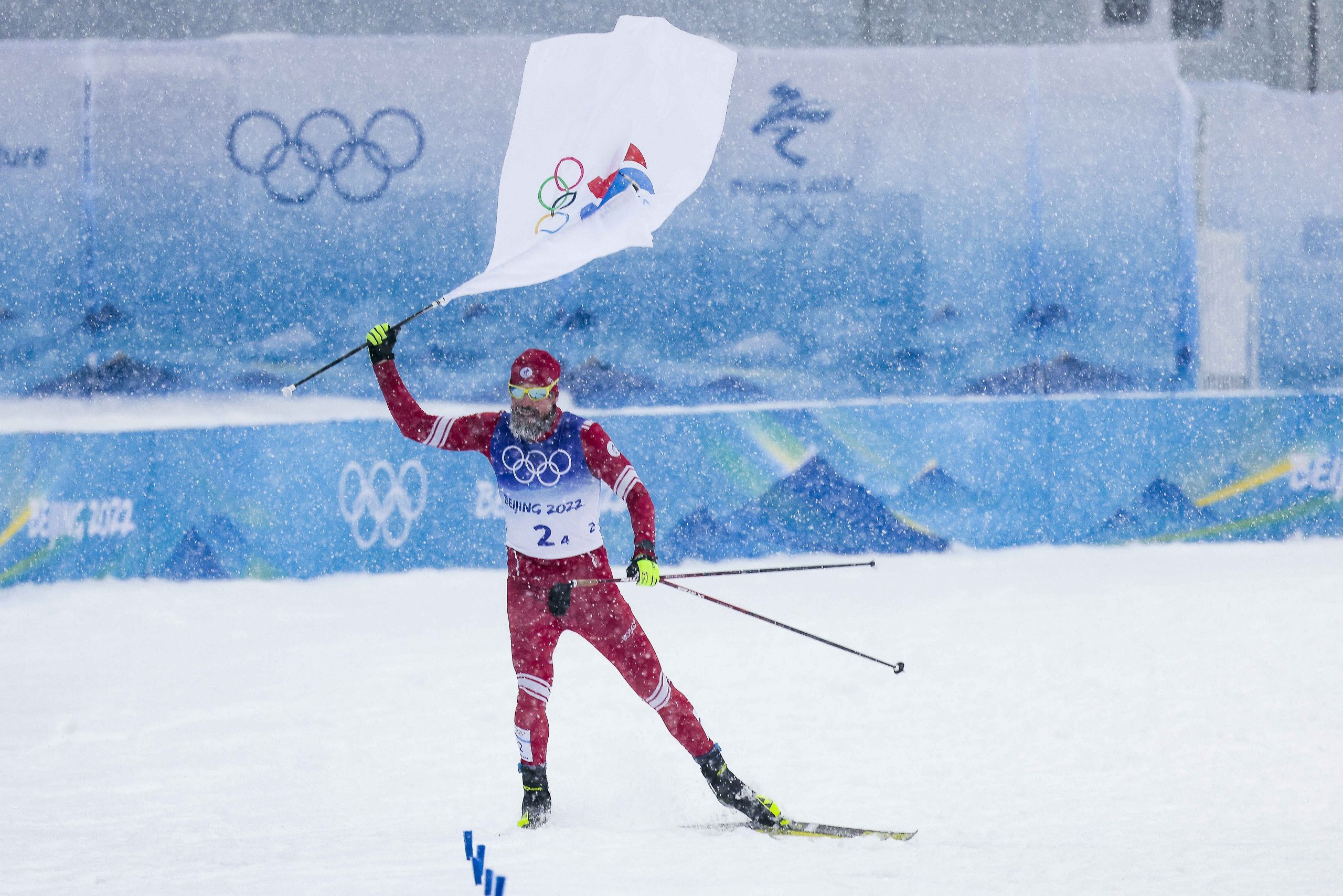
Many meters ahead, Ustigov cruised into the stadium, grabbed an ROC flag and waved it triumphantly as he crossed the finish line before any challengers had even entered the stadium. Finishing in a time of 1:54:50.7 the men secured the second relay gold medal of the Games, after the ROC women brought home gold in the 4 x 5 k yesterday.
Chervotkin, who gave the ROC such a strong start, said of winning gold, “we were aiming for this. We tried to achieve it, and for several years we haven’t been able to. Today everything aligned. Everything was super. The weather seemed to be hard and there was snow but it was in our favor so everything was great.”
Alone with a flag, Sergey Ustiugov (ROC) heads for gold (Photo: NordicFocus)
Despite the consistent strength of the Russian team, they have not won a 4 x 10 k relay in over forty years. The last time they topped the podium in this event it was under yet another name, as the Soviet Union, at Lake Placid in 1980. Of course in recent years, they have consistently been runner-up, earning silver in 2021 Obserstdorf, 2019 Seefeld, 2018 PyeongChang and 2017 Falun.
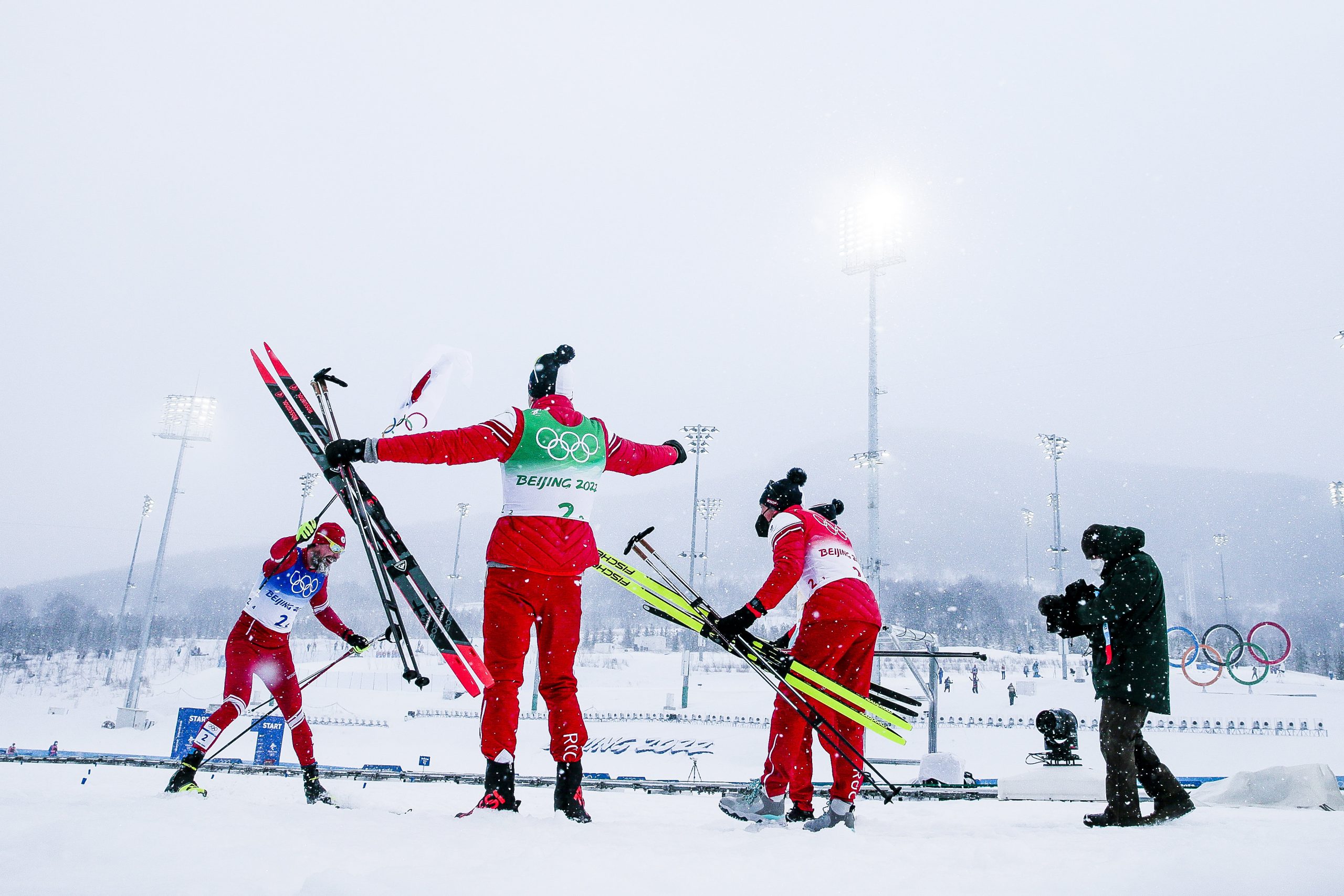
Ustigov crosses the finish line unchallenged as his teammates wait to congratulate him (Photo: NordicFocus)
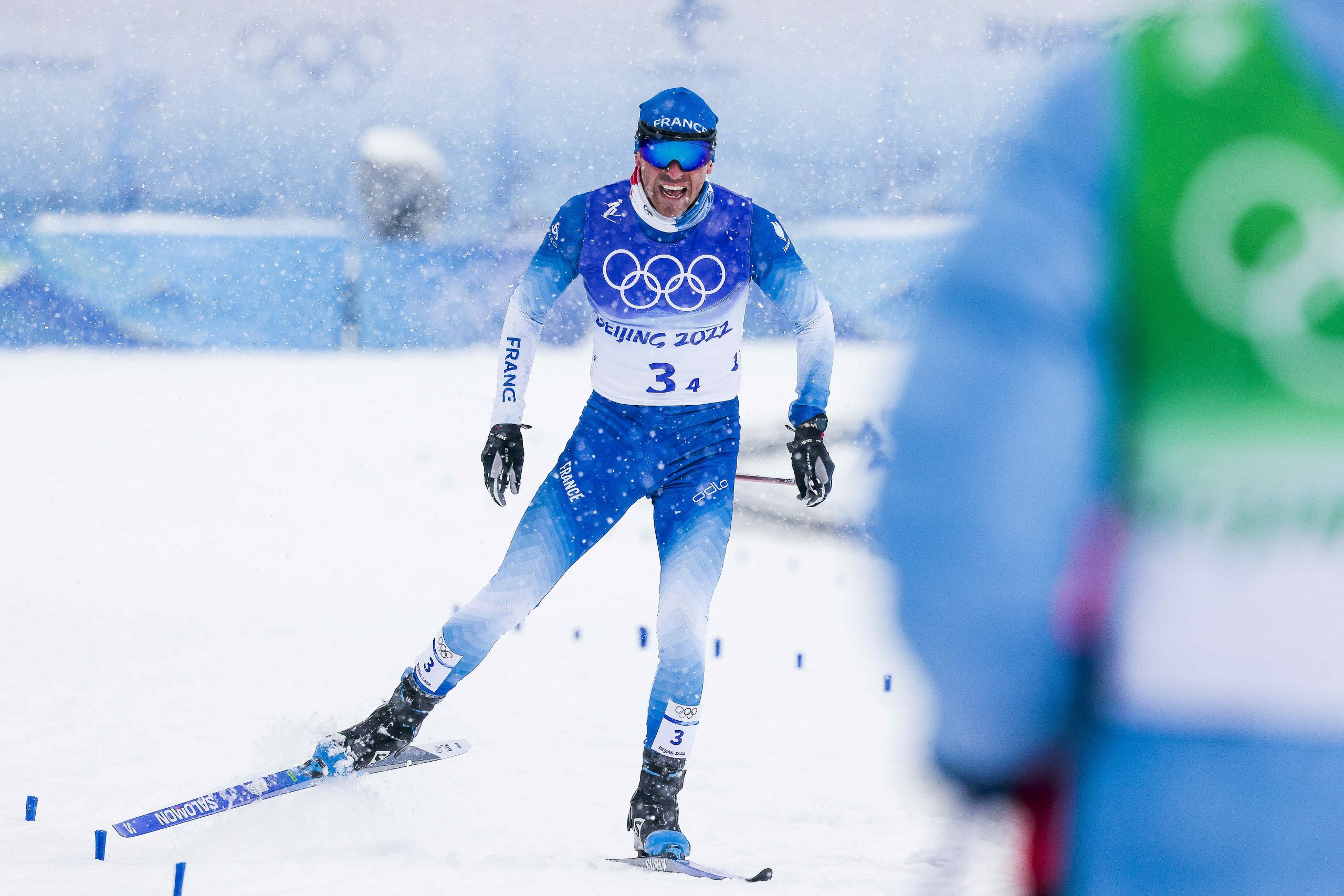
Today the positions were reversed as Klæbo skied slowly across the line for silver, having simply glided away from Manificat in the closing stages. He was met by rather somber congratulations from his teammates, particularly in comparison to the French who celebrated their bronze as if it were gold.
Elation for the French at having secured another Olympic bronze in the men’s relay (Photo: NordicFocus)
After the race, Klæbo said, “when you’re doing a relay, you’re doing it as a team and that is the beautiful part of it, so it’s always fun to race the relay and do it together. We all need to be satisfied with today’s result, and I guess we’re going to celebrate it in the evening and then some of us need to start preparing for the next race. But still we’re going to enjoy this evening.”
His teammate Pål Golberg spoke about the challenging conditions, saying, “The course was tough before and with the snow and wind today, it was even tougher. So I mean, with altitude and everything it’s challenging but we did our best today. The four Russian guys were better so just take the hat off to them and try to be satisfied with the silver.”
Emil Iversen (NOR), Pål Golberg (NOR), Hans Christer Holund (NOR), Johannes Høsflot Klæbo (NOR), (l-r) were the only team not celebrating their medal (Photo: NordicFocus)
If Norway has held a monopoly on gold in the men’s relay, then the same can be said about the French and bronze. This is the third consecutive Olympics that France has earned bronze in the men’s 4 x 10 relay and Maurice Manificat has played a part in all of them. Similarly, in the last four World Championships, France has collected bronze in three of them.
When asked about winning another medal at the Games, Manificat replied, “four Olympics for me and some medals in the relay since Sochi, so for sure it’s an amazing feeling.”
Regarding the challenge of trying to drop Klæbo he said, “I tried, in the big uphill and I give my best, I give all I had. Medal in relay is the best medal. Because you share it together. We thought all the year about the relay, it’s our soul.”
Teammates congratulate Maurice Manificat (FRA) on a gutsy final leg to bring France the bronze medal (Photo: NordicFocus)Clement Parisse (FRA) and Richard Jouve (FRA) share a moment at the finish. (Photo: NordicFocus)
With three teams lapped out of the race and the spread between the ROC and 12th place finishers, the Czech Republic at +10:07.1, the day was evidently a tough one.
Improving on an 11th place finish in PyeongChang, the American men skied to 9th place today, +8:05.6 behind.
Luke Jager skis the scramble leg for the Americans during the Olympic 4 x 10 k relay. (Photo: NordicFocus)
Luke Jager took the scramble leg for Team USA, putting the team in 13th, +2:39 behind at the conclusion of his leg.
“I felt kind of like I’d become sort of aware of some of the subtleties of how scramble legging in skiing works in the last years, but it was sort of like, all that went out the window,” Jager told FasterSkier from the mixed zone. “For a lot of reasons: the course is really hard, the altitude was really hard, and 10 k versus five or 7.5, was a really big difference. At the end of the day, I just wasn’t fit enough to be where I want to be and there was no hiding to be had. So, I feel like I learned a lot from it, but I just feel like I need to go home and train a lot more.”
While Jager chalked it up as a disappointment, he contrasted the statement it with: “that’s obviously multifaceted. There’s pros to it all, and I’m really thankful to be here.”
Up next was Scott Patterson, who started the Games with an impressive 11th place finish in the skiathlon. Patterson bumped the team up into 11th place, though the time gap continued to widen at +4:23.2.
“I think as we’ve seen in every race this week, those courses are pretty unforgiving,” Patterson explained. “I felt like I had to go out and ski my own race and not really think too much about what everyone else was doing, just go move into the race and try to ski well. It was a little bit interesting place where Luke tagged me off, but I think I picked off some people and put us in a good spot, so I’m happy with that.”
Gus Schumacher races the third leg of the men’s 4 x 10 k relay. (Photo: NordicFocus)
Patterson tagged Gus Schumacher who maintained their position in 11th place and finished his leg +6:04 behind. In the anchor position, Kevin Bolger moved past both the Japanese and Czech team to put the team in 9th place.
“I’m proud of us for coming together the team,” said Schumacher after the race. “We’ve all had some tough races here… It hasn’t been easy for us. I think it’s a little bit hard especially to have the girls’ success – there’s some pressure there.”
While the team was seemingly unanimous that this pressure was self-imposed and that it had been a relief to feel they had “nothing to lose and everything to gain,” the Americans also affirmed that they brought hopeful energy to the day, looking to take a step forward as a team, regardless of what that looked like on paper.
Over the last four Olympic cycles, the Americans have been 11th place in the last two Games, along with 12th in 2006 and 13th in 2010. It might not be a medal, but it was, in fact, a step forward for the program.
“I think we all really put it out there and yeah, good energy,” Schumacher concluded.
Kevin Bolger (USA) skiing the anchor leg for Team USA (Photo: NordicFocus)
The Canadian team was led out by Graham Ritchie who ended his leg in 14th, +2:42 behind. Antoine Cyr took the second classic leg and moved up one position to 13th, +4:23.2.
In the transition to skate, Olivier Léveillé skied Canada’s third leg, again moving the team up one position to 12th, +6:44.6. Rémi Drolet anchored to bring the team home in 11th position, +9:10.4.
Antoine Cyr (CAN) skiing the second leg for Canada (Photo: NordicFocus)American men’s 4 x 10 k relay team: Kevin Bolger, Scott Patterson, Luke Jager, and Gus Schumacher (l-r) (Photo: NordicFocus)
“The relay is really a game of staying in contact,” Matt Whitcomb told FasterSkier in the mixed zone. “When you lose contact, it becomes a different race. Time expands immeasurably. So I’m very proud of the way that these guys tackled the project that they’re handled today. There’s also – and I say it with a Canadian over my shoulder – this is one of our favorite rivalries: our northern friends. And it really is a friendly and very fun rivalry, where we’re always giving each other splits back and forth, and I’m proud of both teams today. And I’m also excited for our guys to come out just a little bit on top.”
The next Olympic cross country ski event will be the men’s and women’s team sprint, happening on Wednesday, February 16th.
The first podium of the 2022 Olympic Games following the men’s 30 k skiathlon. Alexander Bolshunov (ROC) dominated the event for gold, ahead of teammate Denis Spitsov who took silver, and Iivo Niskanen (FIN) bronze. (Photo: NordicFocus)
This World Cup coverage is made possible through the generous support of Marty and Kathy Hall and the A Hall Mark of Excellence Award. To learn more about A Hall Mark of Excellence Award or to learn how you can support FasterSkier’s coverage please contact info@fasterskier.com.
On the heels of the women’s opening Olympic race, a colorful lycra field in their Sunday best lined up to race the men’s 30-kilometer skiathlon. While the women raced a four-lap 15 k event, men faced double the distance – over 75% longer by finish time – though they were greeted by much more favorable weather. It was sunny, still, and clear. Classic tracks were crisp and firm, and the familiar sound of poles powerfully planting and pushing off from cold snow, akin to the blasters of Storm Troopers in the classic Star Wars films, was not obscured by wind ripping through the stadium.
A quick nod to the start list for North American fans: Scott Patterson and Gus Schumacher were the only men racing in stars and stripes today, while Olivier Léveillé, Antoine Cyr, and Rémi Drolet raced for Canada.
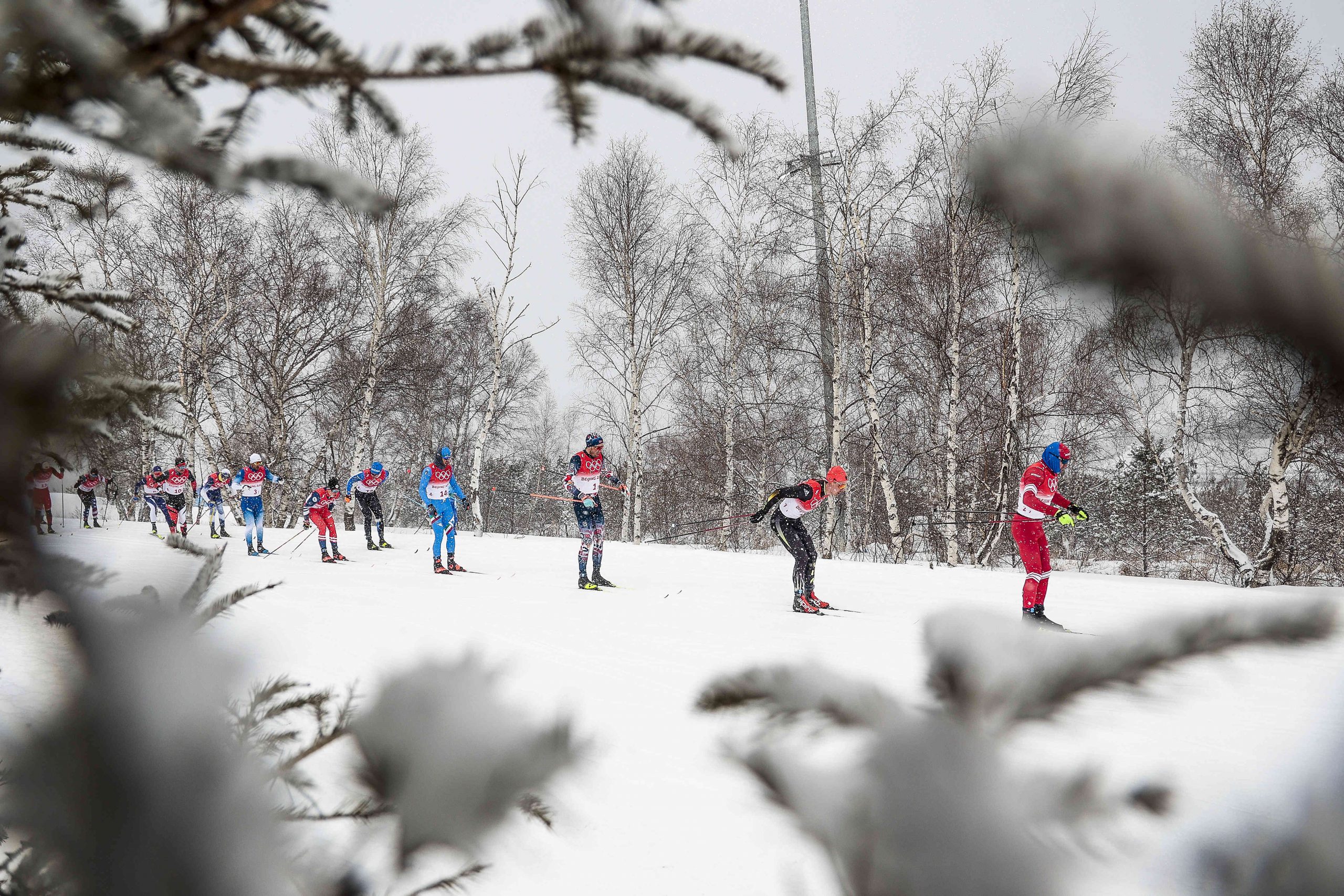
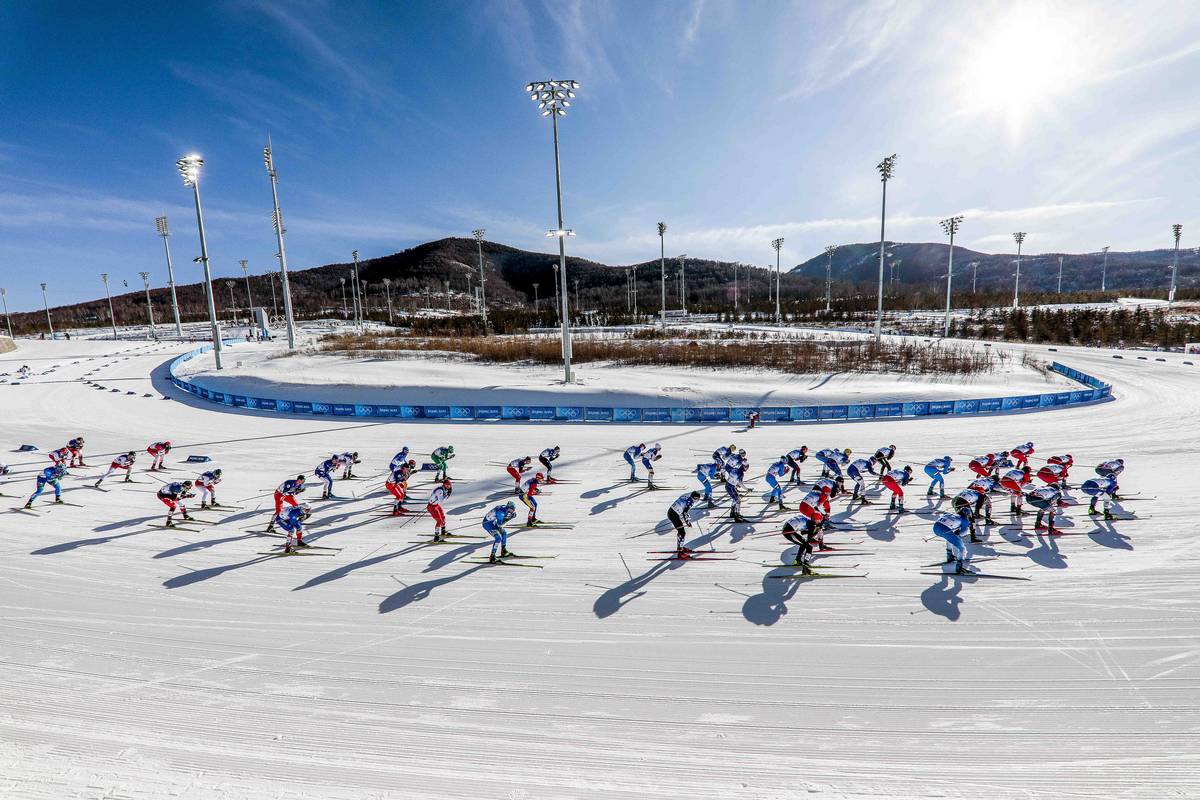
Athletes take to the course for the men’s 30-kilometer skiathlon, the opening event of the 2022 Beijing Olympic Winter Games. (Photo: NordicFocus)
To review the last two Olympiads, the 2018 Games saw a Norwegian sweep of the skiathlon podium, with Simen Hegstad Krüger breaking away to win gold by eight seconds ahead of his teammates Martin Johnsrud Sundby and Hans Christer Holund. After testing positive for COVID-19 shortly before his scheduled departure for Beijing, Krüger is currently riding out his quarantine in a hotel room, resolutely training on a spin bike in hopes of making it to the 2022 Games in time for the final event, the men’s 50 k freestyle. Sundby retired from World Cup level racing after the 2021 World Championships in Oberstdorf, Germany, in which he earned an auto start as the reigning champion in the 15 k classic. This season, Sundby raced a series of marathon and longer races in Italy during January. This leaves only Holund returning to the Olympic skiathlon in 2022.
In 2014, it was a dog fight to the finish, with Dario Cologna of Switzerland taking gold by just 0.4 seconds over Marcus Helner of Sweden. Near the peak of his career, Norwegian powerhouse Sundby was one second behind Helner in third.
Athletes take to the course for the men’s 30-kilometer skiathlon, the opening event of the 2022 Beijing Olympic Winter Games. (Photo: NordicFocus)
Over the first 15 k of classic racing, two names that have not yet been mentioned, from countries who have not been on the podium in the last two Olympic competitions, pulled away from the field. Leading the charge was the king of the 15 k classic, Finland’s Iivo Niskanen. Niskanen has won seven World Cup 15 k classic events, including a grueling race through falling snow in Lenzerheide, SUI at the beginning of the 2021/22 Tour de Ski. The Finn was second to Johannes Høsflot Klæbo (NOR) a week later in Val di Fiemme, ITA, near the other end of the Tour.
On Niskanen’s tails over the first four laps was Alexander Bolshunov of the Russian Olympic Committee (ROC). Bolshunov was fifth and seventh in the two most recent 15 k classic events, amidst a start to the 2021/22 World Cup season that did not match his previous three seasons of racing. Bolshunov was the World Cup distance champion in 2019, 2020, continuing his dominance to win both the distance title and the overall World Cup title in 2021. He also earned three silver medals in the 2018 Games – he was the runner up in the 50 k classic, and supported the ROC to second place finishes in the relay and team sprint – in addition to a bronze medal in the classic sprint.
Iivo Niskanen (FIN) leads Alexander Bolshunov (ROC) as the pair drops the field during the classic leg of the 30 k skiathlon. (Photo: NordicFocus)
Leading into this season, Bolshunov has had a less than ideal buildup. The 25-year-old experienced a bike crash in addition to a tooth infection that required multiple surgeries, interrupting his ability to train with the consistency and volume – rumored to be over 1,200 hours annually – that has contributed to his strength over the last quadrennial.
At the 5 k checkpoint, the top-10 racers were spread by less than 5 seconds, before Bolshunov and Niskanen began to pull away. At 10 k the duo had built a 12 second lead to the chase pack, led by Denis Spitsov (ROC), and between 10 k and the pit-box at 15 k where athletes switched from classic to skate, this lead more than doubled to 30 seconds.
The chase group of Hans Christer Holund (NOR), Denis Spitsov (ROC), and Pål Golberg race the classic leg of the men’s 30 k skiathlon in Zhangjiakou. (Photo: NordicFocus)Alexander Bolshunov (ROC) begins to pull away from Iivo Niskanen (FIN) at the start of the 15 k skate leg of the men’s skiathlon. (Photo: NordicFocus)
Niskanen and Bolshunov left the transition from classic to skate together, but over the next lap, Niskan’s wheels began to fall off. At 16.3 k, Bolshunov was already 13.5 seconds ahead, with Spitsov racing on his own, nearly 18 seconds behind Niskanen and closing fast. Originally podium favorites, two Norwegian chasers worked together roughly 1:06 behind Bolshunov, sitting well over 30 seconds out of third place.
Looking like his body had flooded with lactate and his matchbox was suddenly empty, Niskanen was unable to respond as Spitsov reeled him in, eventually leaving the Finn in his wake by the end of the first skate lap. From then on, the podium story looked to be pre-written.
At 20 k, Bolshunov had more than 40 seconds on Spitsov, with Niskanen in no man’s land 1:03 behind the leader, and 50 seconds ahead of the Norwegian chasers. At 25 k, Bolshunov had grown his lead to nearly a minute over his countryman, and 1:50 to Niskanen.
With well over a minute lead on second place, Alexander Bolshunov (ROC) takes a bow as he enters the stadium to win the men’s 30 k skiathlon. (Photo: NordicFocus)
Entering the stadium, Bolshunov had all the time in the world to savor the victory of his first Olympic gold medal.
Before rounding the bend into the final straight, Bolshunov took a deep bow. He accelerated around the final bend toward the sidelines, where he collected a ROC flag. Coasting down the lanes, Bolshunov waved this flag over his head with one hand, while pumping his left fist into the air, basking in the glory of a dominant performance on the world’s most prestigious stage.
Alexander Bolshunov celebrates a dominant victory, earning his first Olympic gold medal at the men’s 30 k skiathlon. (Photo: NordicFocus)Olympic champion Alexander Bolshunov welcomes his teammate Denis Spitsov (right) to the finish of the men’s 30 k skiathlon, going one-two for the Russian Olympic Committee. (Photo: NordicFocus)
Bolshunov took off his skis, unable to stop smiling, as he turned around to greet his teammate Spitsov, who crossed the line for silver 1:11.0 behind. Niskanen had padded his lead enough over the first half of the race so that his hold on a medal was never threatened. Regaining his form over the final kilometers, he skied smoothly through the stadium to collect the bronze medal in third (+2:00.2).
“I just couldn’t keep pace with those Russians,” Niskanen told the Finnish news outlet Yle after the race. “They were just ridiculously fast today. Unbelievable, the speed they can ski at. It was even a little bit surprising that I wasn’t able to respond to them at all.”
Iivo Niskanen pushes to the line for a bronze medal in the men’s 30 k skiathlon. (Photo: NordicFocus)
Spread over the next minute, Holund took fourth (+2:30.9), with Golberg in fifth (+2:52.5).
While a glance at his FIS profile this season might not have identified Spitsov as a favorite, the 25-year-old was fourth in the event in the 2018 Games in Korea, where he also collected a Bronze medal in the 15 k freestyle. Spitsov collected a slew of top-10 World Cup results over the subsequent seasons, and was named to the 2021 World Championships, before he crashed while training at the venue in Oberstdorf, sustaining a fracture in his left hand that left him unable to compete. Racing back into form this season, Spitsov was fourth and seventh during the 15 k classic stages of the Tour de Ski, where he finished 4th overall.
Whenever the podium is dressed predominantly in Russian Red, speculation arises that the state sponsored doping that overshadowed any Russian performance at the 2014 Sochi Games has continued through 2022. This is especially true when an athlete runs away with a race, despite facing a field made of the top athletes in the world who have all, presumably, prepared in a way that maximizes their potential on the race course. FasterSkier’s Nat Herz voiced this speculation during Bolshunov’s post-race press conference, asking if there was anything the Russian champion would like for people to know regarding his performance on the day.
“Well, people don’t become Olympic champions all of a sudden,” Bolshunov stated matter of factly. “In the past several years, I have been proving this in every race that I participate in, and I achieved distinguished results and I fight to the end. As to doping – you’re hinting at doping – when I hear about this, I don’t feel good at all. When I hear these words, I want to turn and just walk away because I just hate hearing this, because this should have nothing to do with sports.
“We have clean sportsmen, clean athletes here at the Olympics. We go through doping tests almost every day and we have to fill out these forms where we indicate where we will be training from which hour to which hour, when the training session starts, when it finishes and so on…”
Alexander Bolshunov takes the men’s 30 k skiathlon win in Zhangjiakou. (Photo: NordicFocus)
Bolshunov continued to explain a system akin to American doping control, where athletes need to report their whereabouts daily, including all details on training, travel, and even times of day when they might be running errands, or otherwise not at a location where an anti-doping agent could arrive unannounced to collect a sample. In his mind, this level of testing makes questioning whether or not the Russian program is competing fairly a moot point.
“I believe that it’s wrong to ask us these questions. Well you don’t achieve these results all of a sudden — you don’t become an Olympics champion because it takes years and years of training. This is very hard and if you personally want to see how we train, please, we invite you. You are welcome. And these training sessions are very difficult — believe me. And after you will have seen how we train, I believe that you and your audience will never have these questions again. So I believe these are not the best questions to be asked. They’re irrelevant.”
Scott Patterson tucks in behind Alexey Chervotkin (ROC) during the 30 k skiathlon. (Photo: NordicFocus)
Off screen, yet another impressive comeback was underway. At the transition from classic to skate, Scott Patterson sat in 19th place, 2:15 behind the leaders. Steadily picking skiers off, Patterson moved into 16th by 20 k, and was tied with Germany’s Lucas Bögl in 11th at the 25 k checkpoint. Jules Lapierre and Clement Parisse of France were within reach in 9th and 10th, only a few seconds ahead.
Over the final kilometers, Patterson passed Parisse and pulled ahead of Bögl, but was passed by Artem Maltsev (ROC) to maintain his position in 11th place (+4:00.2) at the finish. This result matches Patterson’s Olympic career best result; he was 11th in the 50 k freestyle in the 2018 Olympics, after finishing 18th in the skiathlon earlier in the Games.
If you’ve followed Patterson’s trajectory this season, you’re aware of two things: first, that he sustained a wrist injury from a mountain bike crash that left him in need of surgery just five weeks before the opening World Cup races in Ruka. He joined the team a week late for the Lillehammer mini-tour, racing in a brace that left him unable to fully utilize his poles.
Patterson finished 70th in the 15 k free in Lillehammer, followed by a 75th place finish in the same event the following weekend in Davos.
The second thing you’ll have noted about Patterson’s season is that the trend from that moment forward pointed toward a very different result. Stepping back to the summer, Patterson had put together several impressive trail races, including breaking a storied course record at the Crows Pass Crossing in August, in which he had competed in seven previous summers. It was evident that his fitness was at an all time high before the crash.
At the U.S. Cross Country Championships in Soldier Hollow in January, Patterson broke away to win the men’s 30 k skate by over 11 seconds, and was second in the 15 k classic two days later racing in a perfect storm of above freezing temperatures with mixed precipitation, on skis that perhaps were not up for the task.
Scott Patterson races to 11th in the men’s 30 k skiathlon during the 2022 Olympic Winter Games. (Photo: NordicFocus)
Speaking to FasterSkier after the race, Patterson called a spade a spade, acknowledging that he had a “slow start to the season.” However, he found confidence in his racing in the years prior, where he came into peak form surrounding February championship events, regardless of what his Period 1 results looked like.
“[The Olympics] also get right into the races that I really like – a 30 k, then towards the end the 50 k. I think also the little bit smaller fields at the World Champs or Olympics kind of help. It’s a little less chaotic, where I can just kind of get in my groove and ski. So, [how prepared I am] was a little unknown going in. I had some confidence coming off Nationals, and I had a good training block [afterward], so I was optimistic, but it definitely was a big question mark how it would go. Obviously, it started out pretty strong, and I’m looking forward to more racing.”
Scott Patterson takes 11th in the men’s 30 k skiathlon. (Photo: NordicFocus)
Patterson was asked to quantify the extent to which the cold and the challenge of the course factored into the time gaps seen at the finish. Patterson acknowledged the altitude, and the speed of the snow, but ultimately concluded that at an Olympic event, the results are not unexpected.
“It’s the Olympics like people just go hard,” he said simply. “I think we saw that in 2018 where no one sits around at an Olympic race. And we saw that for sure today with Iivo and [Bolshunov] – really strong off that classic leg. And I don’t think there’s any way to hide out here with these long hills and tough course – especially with the way they groomed it, where you don’t have tracks on the downhills. It’s hard to recover, so you have to work for a lot of it. And a lot of these hills are just that grade kind of in between V2 and V1. Or if you switch early to V1, you’ll be V1-ing for a long time.”
With that, Patterson headed out to “go pee in a cup”, acknowledging that he was heading to doping control, and in response to a question on the winners, that they likely were too.
Gus Schumacher races the men’s 30 k skiathlon during the 2022 Beijing Olympic Winter Games. (Photo: NordicFocus)
Schumacher, in his first Olympic performance, was 39th (+9:04.5). The 21-year-old gave an emotional response in the mixed zone, saying felt “depleted and empty” after his race. Showing maturity beyond his years in the sport, Schumacher fielded questions from the media regardless, stating that he felt he had paced the race well, but his energy was not what he had hoped for, and he took pride in simply finishing the race. His next statements, uttered while clearly choked up behind his N95, were powerful.
“I think when I was younger, I would have seen someone like myself have a tough race on a big stage and kind of be disappointed [in them]. And I am disappointed. But I want younger people to know that it’s a long process, and there are going to be bad days. And sometimes there are going to be a lot of bad days – this season hasn’t been my best. But I know I’m doing the right things, and more years of doing that, it’s just going to get better. I don’t want people to doubt me – I don’t really care that much [if they do] – but that is something that’s on my mind, because I’ve doubted people before. But I know there’s a lot of people at home that believe in me, and that have supported me to get to this point. And I know that they’re proud of me. And that means a lot.”
Gus Schumacher races in his first Olympic event, the men’s 30 k skiathlon. (Photo: NordicFocus)Olivier Léveillé leads the Canadian men in 31st in the men’s 30 k skiathlon. (Photo: NordicFocus)
Just outside the Top-30, Olivier Léveillé was the top Canadian finisher in 31st (+7:32.2), with Antoine Cyr a minute and a half behind in 42nd (+9:16.2). Drolet was lapped just before the 20 k checkpoint and did not finish the race.
The Planica World Cup cancellations this month brought the skiing world to the perilous edge of what it feared most, but hoped wouldn’t happen – the central focus of this ski season, and the sport’s biggest moment, the Olympics – affected by the Omicron COVID-19 variant. Over the last week in the Italian Alps, the sport went over that edge. This Olympics, as with everything in the world right now, will have to deal with the frustration, confusion, and all around uncertainty that’s de rigueur during this pandemic.
On January 23rd, NRK first reported that Norwegian national team sprint coach Arild Monsen had tested positive while at the team’s pre-Olympic camp in Seiser Alm, Italy. That set into motion a close contact, self-isolation, and testing regime with the stakes very clear – if athletes tested positive, suddenly the Olympics would be up in the air.
Aided by a win in the final hill climb, Heidi Weng took third place in the 2021/22 Tour de Ski overall standings. (Photo: NordicFocus)
On Tuesday the 25th, despite the best efforts of the team, Heidi Weng and Anne Kjersti Kalvå tested positive for COVID. Close contact tracing led to an announcement from the Norwegian Ski Federation that the scheduled charter flights for the Norwegian Men’s Team on today were canceled.
The story has since followed two lines of development. First, new cases that are still emerging from the outbreak at the Norwegian National camp in Italy, and second, the Norwegian Ski Federation’s plans to get athletes to Beijing in time for their first competition on February 5th.
On the former the latest update, as reported again by NRK today, is that Simen Hegstad Krüger has tested positive for COVID. Krüger’s test is the first within 10 days of the start of Olympic competition, meaning that the 2018 gold medalist of 30-kilometer skiathlon will not get the chance to defend his title. The news has hit the Norwegian team hard. In a statement to NRK, teammate Hans Christer Holund said “It’s terribly sad. A lot of hard work is behind getting to the Olympics, then it goes in the sink, and it is very sad for Simen.”
Simen Hegstad Krüger had a commanding win in the 15-kilometer skate in Davos in December, 2021. (Photo: NordicFocus)
As to travel plans, The Norwegian Ski Federation announced its updated plan to get their athletes to Ziangjiakou just hours ago. The men’s team will now fly direct from Verona, Italy to Beijing on a chartered flight on January 30th. The women’s team will follow suit out of Zurich, Switzerland on February 1st. That cuts out a trip back to Norway that was planned for the National Team before flying to Beijing. It also assumes no new infections in either the men’s or women’s teams. In NRK’s report, Espen Bjervig, National Team Manager, explained that the plan reflects “so many unknown factors. You never know what will turn up around the next turn. But you just have to cut through.”
Bjervig also pointed out that the plan is designed to move along with the COVID situation that is now underway in the Norwegian camp. “Fortunately, it is flexible with the girls. There are charter flights every day from Zurich between February 1st and 4th. The scheme for the boys presupposes that no infection appears.”
It is a big assumption, but one that allows there to be hope that for the individual athletes, and for ski fans alike, these Olympic games may be the exciting showcase of the world’s best skiers – many of whom are from Norway – that we have all looked forward to watching together.
This World Cup coverage is made possible through the generous support of Marty and Kathy Hall and the A Hall Mark of Excellence Award. To learn more about A Hall Mark of Excellence Award or to learn how you can support FasterSkier’s coverage please contact info@fasterskier.com.
After a warm and rainy fall, temperatures dropped just in time for the athletes arrival in Lillehammer, Norway this weekend. The original program for Saturday’s competition was a 30 k skiathlon but low snow conditions forced a last minute change and the race became a 15 k individual start skate. Between last season’s cancelled races due to COVID and this season’s snow shortage, the athletes will have to wait another year to return to the iconic course out of the Birkebeineren Ski Stadium. Instead, the race was held in the former Biathlon stadium where saved snow farming was already in store, creating a 3.6 k loop to be completed four times for the men. In spite of this, the scene at the start line was one of winter as the athletes lined up, jumping out of the start gate to light snow and 18 degrees Fahrenheit.
Arnaud Chautemps (FRA) and Hugo Lapalus (FRA), (l-r) after a snowy 15 k skate (Photo: NordicFocus)
While individual start races can often be about one or two skiers dominating splits from the start, today’s race was initially difficult to discern. For one, with fewer cameras on the course than this spoiled reporter has become accustomed to, the race was harder to follow visually. For another, after a concentration of Norwegian starters in the bib range of 31-42, many of the Russian men did not start for another ten minutes or more, with seeded red-bib wearing Alexander Bolshunov (RUS) starting a full fifteen minutes after the unseeded, and eventual winner, Simen Hegstad Krüger of Norway. As such, a rephrasing of the popular saying “don’t count your chickens until they’ve hatched,” to “don’t count on your position until you’ve crossed the finish line” aptly applies.
Simen Hegstad Krüger (NOR) looking strong on his path to victory (Photo: NordicFocus)
After the Norwegian men’s absence in the 15 k skate pursuit last weekend in Ruka, they appeared to be re-asserting their depth and strength in their home country, and it was clear through the early splits. But as more Russian’s headed out on the course it seemed that perhaps we would see a repeat podium sweep. At 3.7 k Sergey Ustiugov (RUS) had the fastest time, followed closely by Bolshunov (RUS) with another three of their compatriots in the top 10, while Hans Christer Holund and Johannes Høsflot Klæbo were the sole Norwegians in 5th and 10th respectively. At 6.1 k it was the Czech skier, Michal Novak, who held the lead while Krüger (NOR) had worked his way up, though the Russians still held places four through six, and nine.
Sergey Ustiugov (RUS) started hot, ultimately finishing outside the top twenty. (Photo: NordicFocus)Alexey Chervotkin (RUS) ends up the lone Russian in the top ten, finishing in fourth position. (Photo: NordicFocus)
However, as the race wore on the Russian’s began to fade quickly while the Norwegian wave rode to the front once more.
Skiing steadily Krüger (NOR) ticked off the kilometers, followed closely by his teammate Holund. At the 4.6 k mark, Krüger was in fourth, at 7.4 k he had the second fastest split, and by 9.8 k he had taken the lead. When early race leader, Ustiugov (RUS) crossed the finish line +1:08.7 behind the Norwegian for an eventual 24th place finish we saw Krüger flash a little grin to the camera from his place in the leaders chair. The only remaining question was Bolshunov (RUS) who started in bib 70.
Alexander Bolshunov (RUS) heads towards the finish (Photo: NordicFocus)
Through 6.1 k Bolshunov was in sixth position, at 7.4 k he was in first though he dropped to fifth at 8.3 k. When he passed 9.8 k in 6th it seemed clear that Krüger would take gold and sure enough, Bolshunov was unable to gain anything over the last 5 k, finishing in 14th, +44.3 seconds back from Krüger.
“It was such a tough race with Holund [starting] thirty seconds ahead of me,” Krüger told FIS after the race. “We had to give everything we had, I know he’s in good form and I gave everything to be in front of him. It was a good battle.”
Simen Hegstad Krüger (NOR) slides over the line, clinching his spot in the leader’s chairl. (Photo: NordicFocus)Hans Christer Holund (NOR) finishing strong for second place, behind him Sjur Røthe (NOR) finishes 9th. (Photo: NordicFocus)
Hans Christer Holund held steady for a second place finish, just 1.6 seconds behind his fellow countryman. The dark horse of the day was Martin Løwstrøm Nyenget of Norway, who moved from 10th place at 9.8 k to finish third, his first outright World Cup podium. (Nyenget was third in the Classic Pursuit stage of the 2020 FIS Ski Tour in Östersund and had the fastest time of the day).
Martin Loewstroem Nyenget (NOR) celebrates his third place podium finish (Photo: NordicFocus)
Thus it was another podium sweep for the men’s 15 k skate, this time the red, white and blue colors belonging to Norway. Indeed, if there were any doubts about their power as a nation, a quick look at the results would clear things up. With seven of the top ten places and ten of the top twenty, their presence is hard to miss. As Krüger said, “it was a good day for the Norwegian team.”
Norwegian men sweep the podium: Hans Christer Holund (NOR), Simen Hegstad Krüger (NOR), Martin Løwstrøm Nyenget (NOR), (l-r). (Photo: NordicFocus)
Leading the North American contingent, Gus Schumacher finished the day in 38th position, +1:39.6 behind Krüger but only about 18 seconds behind the 30th place skier. In a field with more Norwegian starters than a weekend hosted by a different country, this result is significant despite not being inside the FIS points.
Gus Schumacher (USA) skiing to 38th place (Photo: NordicFocus)
Behind him was Antoine Cyr of Canada in 42nd who finished 11th in the classic 15 k in Ruka last weekend. In an interview with FIS before the race, Cyr said, “Ruka is always a hard weekend for us because we come from North America, it’s a long way from home. But, it’s a good course and yeah, I was so happy with the result.” When asked about the different courses for this weekend’s races in Lillehammer Cyr answered, “This weekend is going to be hard, skating is not my strong suit, I prefer classic but, it’s the World Cup, like any other World Cup we’re going to give one-hundred percent”.
Antoine Cyr leads the Canadian men for the day (Photo: NordicFocus)
Following Cyr, the Canadian men finished 56th for Olivier Leveille (+2:28.3), 57th for Russell Kennedy (+2:28.6) and 69th for Graham Ritchie (+3:44.2).
Zanden McMullen was the second US finisher in 48th place (+2:03.9). He was followed by Hunter Wonders in 63rd (+2:52.3), David Norris in 64th (+2:54.3), Ben Ogden in 67th (+3:32.2) and Scott Patterson in 70th (+3:35.8).
Today marked Patterson’s return to the World Cup following a recent surgery on his right wrist. While cleared by his doctors to race, Patterson still remains compromised and does not yet feel he is on form for World Cup racing. Here is some additional insight he provided via email.
“My wrist is improving, but is definitely still limiting my racing,” Patterson wrote. “I’m just over 5 weeks out of surgery. In order to protect the repair, I have been skiing in a brace and raced in that today. While this removes a lot of the stress from my wrist itself, it does modify my technique and make certain elements of skiing considerably more difficult. Today in racing, I felt that with the brace my wrist itself was ok, but the balance of my energy expenditure was thrown off. In racing, I was unable to really utilize my upper body. On a steady grindy course like today, that meant that I was working my legs way harder than necessary for the speed I was skiing. This resulted in the feeling of never aerobically taxing myself while still just skiing tired. I also feel that my recent training has been a lot of threshold and I’m not quite ready for race efforts.
“I knew coming into today that I was a bit underprepared for racing. In prioritizing my wrist recovery, I have not done any time trials and was even limited in intervals recently by a cold I caught in the weeks before travel. Overall, I feel that my fitness is pretty good, but I need a little time to find race form and figure out how to manage my wrist recovery while minimizing limitations. I am working towards skiing and racing without a brace, but even once I remove the brace it will take some time to regain trust in the strength of my wrist. The bit of skiing I have done without it feels very naked and unprotected. I also need some time to build back into skiing transitions well and pushing V2 into the hills which were both laid wayside with all my one pole skiing.”
Scott Patterson races his first World Cup of the season, five weeks post-op from a surgery on his right wrist. A brace can be seen adding bulk under this glove. (Photo: NordicFocus)
Keeping focus on the long game, Patterson concluded with his approach to Period 1 as he eases his way back into racing.
“For now I am putting all my energy into wrist recovery and taking the races one by one. Today was not the way I wanted to start, but there are a lot of factors around my wrist holding me back and I’m still feeling on track for goals later in the season.”
Racing continues tomorrow a 4 x 7.5 k relay to finish out the long weekend in Lillehammer.
We have a quick update to the information we published last week regarding cross country broadcast schedules from Tom Horrocks, Communications Manager for the Davis U.S. Cross Country Ski Team. After finalizing schedules, NBC will have all World Cup events available for streaming through their PeacockTV platform.
As mentioned in the first post, there is also a new streaming platform, Ski and Snowboard Live, which is owned by the production company InFront. This platform will have all World Cup events available, except those taking place in Austria and Switzerland. These broadcasts will have English commentary, whereas NBC typically will not have commentary.
The 2021 West Yellowstone Ski Festrival has been cancelled due to lack of snow. (Photo: Instagram @yellowstoneskifestival)
West Yellowstone Ski Festival Cancelled:
It has been a dry start to the winter across much of the West. Ski, Run, Bike Montana announced yesterday that the annual West Yellowstone Thanksgiving ski festival on the Rendezvous Ski Trails has been cancelled due to lack of snow. This cancellation includes the FIS races scheduled on the 27th. Typically, elite athletes use this race as a tune-up before the SuperTour begins the first weekend of December, this year in Duluth, MN.
To those who have already registered for clinics, passes, or events, expect an email from organizers. Additional updates can be found on Facebook and Instagram.
Spending Thanksgiving in West Yellowstone has also become an annual tradition for many club skiers and cross country ski enthusiasts looking to kick off their season with a week of sliding on well-groomed snow. Let’s hope this, the first cancellation in 32 years of the event, is an anomaly.
Kevin Bolger took second in the freestyle sprint in Gällivare, Sweden. (Photo: www.fis-ski.com)
FIS Races in Sweden and Norway:
Piggybacking on Devon Kershaw’s discussion of opening FIS races in Scandinavia and Finland, we’ll take a look at results from two primary events this weekend, first in Gällivare, Sweden and second in Beitostølen, Norway.
Perhaps the most important result to highlight took place in the men’s freestyle sprint on November 19th. After placing 14th in the qualifier, Kevin Bolger raced his way onto the podium for a second place finish behind Johan Haggström (SWE). Marcus Grate (SWE) took third. Bolger also raced the 15k classic on the 20th where he finished 37th (+2:23).
Kevin Bolger took second in the freestyle sprint in Gällivare, Sweden. (Photo: Instagram @kevinbolger)
Bolger spent much of his summer training in Sweden alongside his partner, top Swedish athlete Maja Dahlqvist. Bolger will join the U.S. Ski Team for the opening World Cup races this weekend in Ruka, Finland.
(Find full results from the races in Gällivarehere.)
Moving on to Beitostølen where most of the Norwegian National Team showed up to throw down, vying for World Cup starts and foreshadowing their readiness to contend. Though other top international racers were in the field, Norway swept all four podiums.
For the women — no surprises here — Therese Johaug won both the 10k classic and skate distance races by a significant margin. Teammate Heidi Weng took the second spot on the podium both days, finishing 43 seconds back in the classic and 35 seconds back in the skate. Silje Theodorsen was third in classic (+1:18.9) and Ragnhild Haga was third in skate (+45.1).
Also posting strong results for USA, Sophia Laukli of the U.S. Cross Country D-Team placed 7th in the 10k skate (+1:24.0). Laukli caught a ride on Weng’s tails, which she credits for her strong result. We just noticed how well she was able to match the Norwegian. Laukli also placed 15th in the 10k classic (+2:28.3).
Sophia Laukli raced to 7th place in the 10k skate in Beitostølen. (Photo: Instagram @sophialaukli)
On the men’s side, racing was a bit tighter. In the 15k classic, Hans Christer Holund took the win ahead of Emil Iversen (+17.3) and Håvard Moseby (+24.5). In the 15k freestyle stage, Harald Østberg Amundsen, who took third (despite a late crash) in the event at his first senior World Championships last year, edged out Sjur Røthe who finished 2.4 seconds back. Emil Iversen, on back-to-back podiums, was third (+13.4).
Harald Østberg Amundsen skis his way onto the podium in his first senior World Championships. (Photo: NordicFocus)
(Find full results from the races in Beitostølenhere.)
The World Cup kicks off on Friday November 26th with a men’s and women’s classic sprint.
A train, led by Alexey Chervotkin (RSF), winding through the snow. (Photo: NordicFocus)
This World Championship coverage is made possible through the generous support of Marty and Kathy Hall and their A Hall Mark of Excellence Award. To learn more about A Hall Mark of Excellence Award or to learn how you can support FasterSkier’s coverage please contact info@fasterskier.com.
After the tropical conditions of the past week, the men were greeted with heavy snowfall for Friday’s championship 4 x 10 k relay competition in Oberstdorf. Temperatures hovered around freezing and the snow fell thick and fast as the scramblers lined up at the start. Eighteen nations were represented at the start line with thirteen completing the whole race.
The start to a snowy 4 x 10 k relay at the 2021 World Championships. (Photo: NordicFocus)
On paper Norway was the team to beat out on the track. Of the last 15 men’s relay titles at a World Championship, Norway has won all but one. The last time Norway failed to win the men’s relay was in 1999 when team Austria finished 0.2 seconds ahead of Norway. And in the end on Friday after striding and skating through fresh snow for 40 k, it was once again team Norway that crossed the line in first, but what a race it was to get them there.
Johannes Hoesflot Klaebo (NOR), Hans Christer Holund (NOR), Emil Iversen (NOR), Paal Golberg (NOR), (l-r) 2021 Relay World Champions. (Photo: NordicFocus)
The team most likely to challenge Norway was Russia, or the Russian Ski Federation as they are represented at these championships. The bar was set from the beginning. Despite conditions not favoring an early breakaway, Alexey Chervotkin (RSF) made a move just 1.4 k off the start, putting distance between himself and the pack.
Hugo Lapalus (FRA), out of the tracks, while Alexey Chervotkin drives the bus. on the scramble leg. (Photo: NordicFocus)Making a move that stuck on the first keg: Russia’s Alexey Chervotkin pushed over the top. (Photo: NordicFocus)
At 4.7 k, Chervotkin had stretched his lead to +14.1 seconds and the group seemed largely unprepared to mount an organized counterattack. Perhaps expecting the Russian to fade or simply unable to respond, Norway’s Pål Goldberg remained tucked in the rear of the pack. At 6.6 k the margin was +33.6 to Russia. Save for Chervotkin’s effort out front, the pace remained World Cup-pedestrian. At one point, the skiers nearly halting completely at the crest of the sprint hill, playing chicken for who would descend first. Through 8 k the gap to Russia was nearly one minute.
No man’s land, atop the climb, Michal Novak (CZE), Beda Klee (SUI), Hugo Lapalus (FRA), (l-r) bring the pace to a walk as no team wants to chase Russia down. (Photo: NoricFocus)
Entering the first exchange the chase pack had split in two, with France leading and Norway off the back in 10th position. In a post-race interview Golberg said of his race, “it was a bit of a tough start. I chose a different choice [of ski] from the seventeen other skiers so that was really stupid but fortunately I have three skiers on my team that are better than everyone else here today so I’m really happy for them.” One of those skiers was Emil Iversen who took over for Norway on the second leg. His work linked Norway up with the rest of the chase pack, now being led by Iivo Niskanen of Finland. Ivan Yakimushkin had taken control for RSF, but already, with the hot pace set by Niskanen, the gap was down to +30.4 seconds to Norway.
Ivan Yakimushkin, Russia’s second leg skier, sensing the group led by Iivo Niskanen closing in on the second leg. (Photo: NordicFocus)
At 13.3 k Niskanen, Iversen, and Dario Cologna of Switzerland were closing in on Yakimushkin. After 40 minutes on the clock they had overtaken the Russian. The pack now comprised six nations (France and Sweden also in contention), with team Canada drifting around eight seconds behind. Again on lap two through the stadium the pace slowed to a halt before the descent, unrelenting snow adding an extra challenge to the lead.
At the base of the Burgstall climb on his final lap, Iversen (NOR) made his move, directly shadowed by Niskanen (FIN). To the soundtrack of much excited shouting from the coaches, the pair closed in on the exchange zone, with Russia now off the back.
Iivo Niskanen of Finland doing the work to reel in Russia on the second leg of the 4 x 10 relay. (Photo: NordicFocus)
Wednesday’s 15 k skate champion, Hans Christer Holund, contended the first skate leg for Norway. His lead over Russia being +23.6 seconds at the tag zone. Followed by Perttu Hyvarinen, Finland’s third leg, Holund broke trail out front through deep snow as behind him, Artem Maltsev for RSF turned on the burners, starting to forge the gap. At 23.3 k there was just six seconds between them and the Finn was fading fast. At 24.7 k Holund was alone out front, +12.1 ahead of RSF and Finland now in third. As the athletes battled through their last loop, the wheels seemed to come off for Maltsev (RSF) and Clement Parisse of France and Jens Burman of Sweden moved to the fore.
Norwegian work horse on the third leg: Hans Christer Holund. (Photo: NordicFocus)
Into the final exchange Holund handed team anchor Johannes Høsflot Klæbo a +25.5 second lead over France and Sweden (virtually neck and neck), and a +35 second lead to Russia, for whom Alexander Bolshunov would be taking anchor.
Johannes Hoesflot Klæbo (NOR) biding his time for the final show-down. (Photo: NordicFocus)
With Klæbo (NOR) out on his own in deep snow, Bolshunov was on the hunt. The ten second lead over Russia held by Sweden and France was immediately absorbed and once again there was a pack of five teams in contention behind Norway. At 31.4 k Bolshunov had only gained 0.5 seconds on Klæbo but that was soon to change. By 33.3 k he had broken away from the chase pack and was +15.8 behind. Each of the two athletes played to their respective strengths, Klæbo cruising easily while he waited for his ride to catch up and Bolshunov grinding away with metronomic consistency.
Locked in for battle, Norway versus Russia to conclude the Men’s 4×10 k championship relay. (Photo: NordicFocus)
By 34.7 k the duel was on – the world’s best playing hot and cold as they ticked away the kilometers toward the finish line. With Norway absent for much of the Wold Cup season, these two rivals have not had many head-to-head opportunities this year up until this moment. For his part, Bolshunov never moved to pull away from Klæbo who boasts a peerless finishing kick. Once atop the course’s final major run up the Burgstall climb, when Bolshunov had gained no ground, this chess march was all but done.
Klaebo (NOR) not giving an inch to Bolshunov (RSF). (Photo: NordicFocus)
Entering the corner into the final sprint hill before the finish there was virtually no gap between the two skiers, though in reality the game had tipped in Norway’s favor. While Bolshunov may dominate the distance races, Klæbo remains king of the sprint and once he made his up-skate move, there was nothing the Russian could do. The decisive moment came half way up the hill as Klæbo catapulted himself away with an unmatched turn of pace, setting up for an easy cruise down the finish straight, sealing the deal on gold for Norway once again in a time of 1:52:39. Twelve seconds later, Bolshunov crossed the line, meaning silver for RSF.
The deal has been sealed, Johannes Hoesflot Klæbo (NOR) celebrates victory as a defeated Bolshunov (RSF) gives up before the line. (Photo: NordicFocus)
Rewind a bit and the fight for bronze was unfolding on the Burgstall climb as Jules Lapierre of France made a break, gaining ten seconds of advantage over Sweden, Finland and Switzerland.
Jules Lapierre (FRA) gets a boost after bringing home bronze for France. (Photo: NordicFocus)
Though that advantage shrunk on the descent, it remained enough to give France third place, finishing + 1:12.6 behind Norway and four seconds ahead of Sweden in fourth.
No shortage of enthusiasm from team France after their third place finish. (Photo: NordicFocus)
For team USA, David Norris raced the scramble, handing over to Scott Patterson in 11th position at the first exchange.
Scott Patterson for the U.S. settles into a pacing groove on the second leg of the 4 x 10 k relay. (Photo: NordicFocus)
Patterson remained steady through his laps and tagged Simi Hamilton, still in 11th. Over the course of his 10 k, Hamilton gained one position and tagged Gus Schumacher in 10th place.
“It was awesome,” Hamilton said of the racing and wild Oberstdorf weather. “It was, I mean a pretty crazy, bizarre, different weird day with the conditions. You know like, you never really know what to expect when you wake up and its basically 32 and dumping all day. It’s going to make for a pretty different race but I’m super proud of our team.
“I think we put together just four really good consistent legs. Our skis were awesome, my boards were running really really well. The climb was tough for me, as kind of a “sprinter” when you mix in a four-minute climb its always tough for me but thankfully I was able to kind of rely on some good glide to recover from the top down to the stadium each time so that was great. But yeah, these boys are… it was maybe the most fun relay I’ve ever skied on, on the World Cup or World Championship just because, I don’t know we had a really good energy going today. We all came out and fought hard and I think this is the type of energy that you know eventually will land us on the podium. I won’t be on that team, but it’s cool to be a part of it. I’m stoked, it was a great way to end the championships for me and it was a fun day.”
Simi Hamilton, leg three skier for the U.S. (Photo: NordicFocus)
Schumacher and Friedrich Moch of Germany battled it out, the advantage ultimately going to Germany who finished in 7th, Schumacher crossing the line 8th for the United States.
Graham Ritchie (CAN) keeping Canada’s team in contact during the scramble leg. (Photo: NordicFocus)
Team Canada, who posted a strong start by Graham Ritchie, ended the day in 10th place. Skiing leg two for Canada was Antoine Cyr, followed by Russell Kennedy with youngster Remi Drolet holding the anchor position.
In a snow globe, Russell Kennedy of Canada during leg three of the 4 x 10 k relay. (Photo: NordicFocus)
This year’s World Championships conclude for the men on Sunday with a 50 k classic mass start event.
This World Championship coverage is made possible through the generous support of Marty and Kathy Hall and their A Hall Mark of Excellence Award. To learn more about A Hall Mark of Excellence Award or to learn how you can support FasterSkier’s coverage please contact info@fasterskier.com.
Here we are in the back half of the 2021 World Championships in Oberstdorf, Germany. As athletes strive for their peak fitness, storylines from the World Cup season, pandemic, and historic World Championship results intertwine to set the stage for the 15-kilometer interval start classic.
Sundby who had not raced a World Cup this season, had an auto start as the reigning 15 k champion – made the best of his opportunity. (Photo: NordicFocus)
Out of the woodwork and starting in bib 19 was Norway’s Martin Johnsrud Sunby, who earned an automatic start based on his long sought after victory in the 15 k classic during the 2019 World Championships in Seefeld, Austria, his first career individual win at a World Championship or Olympic Games. Because his start was based on this result, he added to the four additional Norwegians on the start list, rather than taking a spot away.
The 36-year-old Sundby has a storied history on the Norwegian National team, but has not raced on the World Cup since the 2020 50 k classic at the Holmenkollen, where he finished 12th. He had two top-5 World Cup results last season, two in skiathlon and one in the 15 k classic, but this season he has only cracked the top-10 once while racing domestically and is listed as DNF or DNS for each of the three 15 k skate opportunities he was presented. Dark horse?
Picked as a favorite for the 15k, the beast that is Bolshunov came up slightly short of the medals on Wednesday when he placed fourth overall. (Photo: NordicFocus)
Perhaps the more obvious storyline, who may resonate with Sundby’s slew of not-quite-gold individual World Championship results, is whether the Russian Ski Federation’s Alexander Bolshunov could repeat his win in Saturday’s 30-kilometer skiathlon, where he collected his career first gold medal to hang above his collection of four silver medals. Positioned well above the field in the overall and distance World Cup standings, all eyes were on Bolshunov in bib 22 as he time trialed through the woods on the tracks in Oberstdorf.
In an individual start where athletes are seen passing checkpoints at a variety of times, it can be difficult to assess the performances without a look to the splits at checkpoints. That said, Bolshunov exhuded confidence and strength as he pushed over the top of each climb, worked every corner, and rhythmically grinded through the woods, his bright yellow and purple glasses a contrast to his typical stoicism. By 1.8 k, he had 4 seconds over the rest of the field.
But the story was not pre-written for us. Roughly 80% of the field started behind Bolshunov, and the string of Norwegian’s were looking equally strong.
The 22-year-old Harald Østberg Amundsen of Norway – with only three World Cup starts, shines with a third place in the 15 k skate at World Championships. (Photo: NordicFocus)
Perhaps a new-to-us name, Harald Østberg Amundsen of Norway was one of Bolshunov’s biggest threats. I’ll fill you in — it looks as if we’ll want to get to know him.
The 22-year-old has several noteworthy results in the 15 k skate event: 2nd in 15k skate at the Norwegian National Championship in 2020, followed by a 3rd place result in 2021 behind Sjur Røthe and Simen Hegstad Krüger. Amundsen also has a 1st, 3rd and 4th in the event in domestic FIS races this season while Norway was sitting out the World Cup due to concerns for COVID-19 management and athlete safety in the opening weekend of events in Ruka.
A U23 World Champion in the 30 k skate, Amundsen has just three World Cup starts, one this season in the 15 k skate in Falun where he landed in 8th, overshadowed in our coverage by the three Norwegian men ahead of him and a career best result and first top-10 for Gus Schumacher, who finished 9th.
Harald Østberg Amundsen skis his way onto the podium in his first senior World Championships. (Photo: NordicFocus)
Starting in bib-10, Amundsen set the bar for his more experienced teammates, and the rest of the field for that matter. As splits rolled in, he was just over 5 seconds back on Bolshunov at the 5 k, seven seconds at the 10 k, and then the plot began to twist.
Perhaps the Russian began to fade or perhaps the Norwegians had an untapped gear, but by 12.9 k, Amundsen was over 18 seconds ahead of Bolshunov.
Within the last kilometer, cameras followed Amundsen as he rocketed down a hill into a hairpin curve that spit skiers back into a final steep climb. At the apex of the curve, his skis sunk into the degrading corn snow, sending him into the back seat and costing him his balance. Amundsen shot out of the corner into the fencing, however, with no broken equipment — and unfortunately, no momentum — he rebounded to head to the finish, where his time flashed green on the leaderboard, more than 27 seconds ahead of the field.
Amundsen had plenty of time to soak in this moment, as his time was not challenged until his teammates starting much deeper in the field entered their last 5k of the race.
Hans Christer Holund beats the clock in the 15 k skate. (Photo: NordicFocus)
Progressively working his way up was Norway’s Hans Christer Holund in bib 40, who took bronze in the skiathlon on Saturday. He set the fastest split at the 6.6 k mark by 1.6 seconds, incrementally building his lead until it was 9.1 seconds at 10 k, 15.9 seconds at 12.9 k, and ending with a bang, 20.2 at the finish. He stopped the clock with a time of 33:48.7.
Hans Christer Holund smashes the 15 k skate in Oberstdorf, Germany, winning by a margin of more than 20 seconds. (Photo: NordicFocus)Hans Christer Holund celebrates a gold medal performance in the 15 k skate. (Photo: NordicFocus)
Looping around his teammates in a surge of emotion and adrenaline, Holund was ecstatic at the finish. A second gold medal to keep his 2019 50 k freestyle gold medal company.
“It’s amazing, I don’t know what to say,” Holund told FIS breathlessly after the race. “I am as shocked now as I was in Seefeld two years ago. I had a really good day — this track is super tough, and it’s tough conditions. I knew I was going to have a good race as long as I was staying calm in the first round and tried to push harder later in the race.”
On course, Norway’s Simen Hegstad Krüger raced to second overall in the 15 k Wednesday. (Photo: NordicFocus)Simen Hegstad Krüger and Hans Christer Holund celebrate a job well done in the 15 k skate. (Photo: NordicFocus)
Also climbing his way up the time standings was Krüger, who sat in 11th at the 5 k and 6th at the halfway point. He overtook Amundsen by the 10 k mark and continued to surge, though he could not make any headway on Holund. He finished solidly in second place for a silver medal (+20.2), with Amundsen holding on for bronze (+35.6).
The men’s podium of the 15 k skate: Hans Christer Holund takes gold ahead of Simen Hegstad Krüger and Harald Østberg Amundsen. (Photo: NordicFocus)
Bolshunov took fourth (+43.7) with his teammate Artem Maltsev 5th (+50.7), interrupting the string of five Norwegians in the top 7. That’s right: Røthe in 6th (+55.3) and our dark horse, Sundby, in 7th (+55.9).
Alexander Bolshunov collapses at the finish of the 15 k skate in Oberstdorf. (Photo: NordicFocus)Disappointment on display as Bolshunov takes fourth in the 15 k skate. (Photo: NordicFocus)
Perhaps with the weight of a U23 World Championship gold medal in an individual start distance event — the 10 k classic — Gus Schumacher started in bib 14 to kick things off for the Americans. It was clear that it would not be Schumacher’s day as he hovered well outside the top-30, finishing 51st (+4:02.3).
Gus Schumacher, in his first individual championship event, skied to 45th. (Photo: NordicFocus)
Coming off of top-20 finishes in skiathlon and wearing higher bib numbers were Scott Patterson and David Norris. After 15 k, Patterson held the top spot for Americans in 27th (+2:22.0), with Norris a few spots behind in 34th (+2:47.6).
“It was a tough race,” said Patterson in a post-race interview. “I think I started out pretty strong, skiing where I wanted to be. But the conditions started to deteriorate on laps two and three. I definitely suffered because of that and bled a lot of time. The winner started thirty seconds behind me and just blew by me. It definitely was not quite what I wanted but I think there are still some good signs for later in this week.”
Though official start lists have not been released, both Patterson and Norris will race the 50 k classic on March 7th.
Scott Patterson races to 27th in the 15 k skate in Oberstdorf, Germany. (Photo: NordicFocus)
“I had higher expectations, but I know given the circumstances and that it is a tough day I felt like I fought through it and did my best,” said Norris of his race. “I cannot complain. My skis were good. All the support was there, I just did not feel my sharpest.”
A name we associate more with sprinting, Simi Hamilton finished just 0.1 second outside the top-30 in 31st (+2:34.2). After ending his team sprint with Schumacher in the semifinals, Hamilton spoke with optimism after his race.
Down the final straight for Simi Hamilton in the 15 k skate. (Photo: NordicFocus)
“I never really know what to expect in an individual start,” said Hamilton after the race. “I’m a good mass start skier because I think that requires a little more sprint tactics and you always have someone to ski with. These individual start races are tough for me, mentally and physically. Just not having trained for races like this, they’re tough, but I know that I’m fit right now. With the focus on the team sprint, fitness is a big thing for that kind of race, so just being distance fit kind of comes with that territory.”
Simi Hamilton, for the U.S., toes in for 31st in the 15 k skate. (Photo: NordicFocus)
Hamilton discussed the changing conditions as skiers lapped the course. Tracks became softer and wetter, though hardpack conditions on the flats held up well. The biggest climb became soft and slow, even more taxing than it otherwise might have been. He shared that they could only check out the downhill that took out Amundsen once before the race began, but the tacky corner with a fresh groom was nothing like the conditions in the back half of the race. “You have to expect the unexpected,” he stated with a laugh.
Hamilton complemented the techs for their job producing fast skis and finished with a positive outlook on his day.
“It was nice to get an effort in like that,” Hamilton said. “It kind of validates a lot of the work you’ve been putting in for other races, so it was fun.”
Canada’s Russell Kennedy rounds the fateful corner on the tracks in Oberstdorf. (Photo: NordicFocus)
Racing for Canada, Russell Kennedy cracked the top-30 (+2:34.1).
Next up for Canada was Phillipe Boucher in 50th (+4:00.2), with Remi Droulet close behind in 52nd (+4:02.7), and Graham Ritchie rounding out the Canadian field in 67th (+5:15.3).
Graham Ritchie of Canada skis to 67th in the 15 k skate. (Photo: NordicFocus)
The field of all skiathlon athletes leaves the stadium in Oberstdorf, Germany. (Photo: NordicFocus)
This World Championship coverage is made possible through the generous support of Marty and Kathy Hall and their A Hall Mark of Excellence Award. To learn more about A Hall Mark of Excellence Award or to learn how you can support FasterSkier’s coverage please contact info@fasterskier.com.
With swaths of bare ground peeking through the melting snow, skis rattling through tracks and swooshing across the lanes, and short-sleeved race tops, World Championship racing continued in a warm Oberstdorf, Germany for the men’s 15k/15k skiathlon. Swirling through the stadium after each 3.75 kilometer lap, four in classic then another four in skate.
For some historical context, Norway’s Sjur Røthe won the event in 2019 during the World Championships in Seefeld, Austria by a margin of just 0.1 seconds over Russia’s Alexander Bolshunov, with Martin Johnsrud Sundby crossing the line just 0.6 seconds later. Because of this victory, Norway was able to enter five men in today’s skiathlon, compared to four representing other countries.
Two years prior at the World Championships in Lahti, Finland, Russia’s Sergey Ustiugov took the win ahead of Norwegian’s Sundby, who had fallen 500 meters from the finish, and Finn Hågen Krogh. The message – the 30 k championship skiathlon comes down to the wire.
With Bolshunov clearly on form this season and a pack of hungry Norwegians in pursuit, today’s mass start event looked again to be a Russia versus Norway dog fight.
Alexander Bolshuov leads the men’s field during the classic leg of the World Championship 15k/15k skiathlon in Oberstdorf, Germany. (Photo: NordicFocus)
As a large lead group of men slowly whittled down in the classic leg, Bolshunov held a steady position at or near the front alongside Finland’s Iivo Niskanen, who was 4th in 2019, and a slew of strong Norwegian racers that included Røthe, Hans Christer Holund, Emil Iversen, Johannes Høsflot Klæbo, and 2018 skiathlon Olympic champion, Simen Hegstad Krüger. These men entered and left the exchange together, with a steady stream of chasers not far behind.
Alexander Bolshunov (RUS) leads Iivo Niskanen (FIN) and Emil Iversen (NOR) during the classic leg of the World Championship 15k/15k skiathlon in Oberstdorf, Germany. (Photo: NordicFocus)
A train of Norwegians near the front of the pack during the 15k/15k skiathlon in Oberstdorf, Germany. (Photo: NordicFocus)
Bolshunov and company swapping skis. (Photo: NordicFocus)
In the chase pack at the exchange and sitting in 11th place at the 16 k checkpoint was Scott Patterson. The American started in bib 38, well inside the inner workings of the accordion of racers that stretched and compressed over the first few laps. Nonetheless, Patterson steadily worked his way up through the field, looking to build on his 18th place finish in the event at the 2018 Olympics and 30th place finish the subsequent year in Lahti. With 11 k to go, Patterson was tucked in with Russia’s Ivan Yakimushkin and Alexey Chervotkin, roughly 21 seconds behind the leaders and reeling in Niskanen and Jens Burman of Sweden.
Scott Patterson (bib 38) skis his way up through the men’s field during the World Championship 15k/15k skiathlon in Oberstdorf, Germany. (Photo: NordicFocus)
Back at the front, it was still Bolshunov versus five Norwegians with Great Brittain’s Andrew Musgrave interjecting the pattern, though fitting within the red-blue-white color scheme.
With 6 k to go the pack whittled further. It was Røthe, Bolshunov, Holund, then Krüger, with Iversen and Klæbo chasing with pained faces a few seconds behind. Musgrave had fallen off the pace, and the chasers led by Patterson in 8th position were over 1:20 back.
The eventual winner, Bolshunov, setting the tempo on the skate leg. (Photo: NordicFocus)
Johannes Høsflot Klæbo (NOR) marks Andrew Musgrave (GBR) in the final laps of the World Championship 15k/15k skiathlon in Oberstdorf, Germany. (Photo: NordicFocus)
There was no question that Bolshunov looked strong and confident at the front; the spring in his V2 and full-body power in his V1 were enviable after 26 k’s of racing. But he had bobbled on a descent the previous lap as the men stepped as if on hot coals around a corner, a reminder that anything could happen in the final lap. The Norwegians were matching his every move, albeit from a few meters behind.
With 2 k remaining, Holund took to the front, pulling Bolshunov who finally showed signs of fatigue, with Krüger on his tails. Hop-skating up a rolling climb and building his small gap, Holund continued to hammer, but the threesome rejoined on the downhill.
Attacking the final roller with a seemingly superhuman tempo, stepping around a hairpin, and dropping into a tuck, Bolshunov took back the lead and tore away at the front. He created enough of a gap over Holund and Krüger that he could look over his shoulder, raise his arms, and take in the victory as he crossed the finish line in a time of 1:11:33.9.
Alexander Bolshunov raises his arms in celebration as he crosses the line for the win in the World Championship 15k/15k skiathlon in Oberstdorf, Germany. (Photo: NordicFocus)Alexander Bolshunov for the win with Simen Hegstad Krüger and Hans Christer Holund behind. (Photo: NordicFocus)Simen Hegstad Krüger (bib 9) and Hans Christer Holund of Norway finish second and third, respectively, in the World Championship 15k/15k skiathlon in Oberstdorf, Germany. (Photo: NordicFocus)
Krüger took the silver medal (+1.1) with Holund just behind for bronze (+1.7).
Alexander Bolshunov roars in celebration of victory at the World Championship 15k/15k skiathlon in Oberstdorf, Germany. (Photo: NordicFocus)
Today marks Bolshunov’s first individual World Championship gold medal. He holds two individual silver metals, one in the aforementioned skiathlon and another in the 50 k freestyle in 2019. He also helped the Russian team to second place in the 4×10 k relay and team sprint.
“I felt fine in the first half, then on the last uphill, I was repeating ‘I have to win today. I have to win today,’” Bolshunov told FIS through a translator in a post-race interview. “On the final descent, I could understand that this is the day that I finally achieved this task.”
Silver and bronze: Simen Hegstad Krüger (L) and Hans Christer Holund (R) of Norway finish second and third, respectively, in the World Championship 15k/15k skiathlon in Oberstdorf, Germany. (Photo: NordicFocus)The men’s podium of the World Championship 15k/15k skiathlon in Oberstdorf, Germany. Alexander Bolshunov (RUS) took the win ahead of Simen Hegstad Krüger (NOR) and Hans Christer Holund (NOR). (Photo: NordicFocus)
After a gap, Klæbo was next across the line in 4th (+21.5) followed by Iversen in 5th (+22.1) and Røthe 6th (+47.3).
Johannes Høsflot Klæbo and Emil Iversen ski to 4th and 5th in the World Championship 15k/15k skiathlon in Oberstdorf, Germany. (Photo: NordicFocus)
For the Americans, the excitement continued as Scott Patterson made his way with the chase pack toward the finish. He sat in 9th with 2k to go, but his group was nine men deep. As they made their way into the stadium and sprinted toward the line, Patterson was unable to hold this position, ending his day in a nearly indistinguishable photo finish with Niskanen. It was decided Niskanen edged him out for 13th, leaving Patterson 14th (+2:03.3), less than three seconds behind Yakimushkin who led this chase group.
“It was great, we had awesome skis today, classic felt pretty good,” Patterson said after the race. “The last lap the front guys definitely turned it up a bit and started spreading things out. But, kind in the transition I was able to put a pretty good switchover and get on some more guys… It is the first race of World Champs, I have not raced in a month. I felt good, so looking forward to some more racing. I think without a pack, I think 15 k skate next, I think it could be even better, I felt strong out there. Really excited for this week coming up.”
Scott Patterson skis to 14th in the World Championship 15k/15k skiathlon in Oberstdorf, Germany. (Photo: NordicFocus)
Commenting on the course conditions, Patterson continued, “It was definitely different than yesterday out there on the course; it was skiing really well. It was pretty consistent all the way around, the corners weren’t nearly as deep as we have had the last couple days. Honestly, this cloudy weather and a little rain over night made it really nice skiing. Consistent fair racing for everyone, I think. And we had awesome skis…the best thing.”
Behind this group but steadily holding his ground inside the top-20, David Norris finished 17th (+2:19.8). This is Norris’s best individual finish on the world stage since he took 16th in a 15 k freestyle in Falun, Sweden in March, 2019. Leading the American men, he took 20th in the 2019 World Championships in the 50k freestyle, finishing 24th in the 50k classic a week later at the Holmenkollen in Oslo, Norway.
David Norris cracks the top-20 with a 17th place finish in the World Championship 15k/15k skiathlon in Oberstdorf, Germany. (Photo: NordicFocus)
“It was good,” Norris put his race simply. “The classic was pretty mellow until it wasn’t with about 3 k to go before the exchange. That was the first time I really flooded and started to suffer. But then, I got through the exchange and then worked up in the skate with groups of seemed like groups of three and four. We kind of worked our way up until we caught a good chase pack.
“By the first 3 k of the skate I was really kind of still suffering the final effort in the classic,” Norris continued. “Then all of a sudden, my legs got under me and I felt pretty free — it is the best I have felt all season skating. And that was awesome.”
David Norris bumps fists with Imanol Rojo of Spain after the World Championship 15k/15k skiathlon in Oberstdorf, Germany. (Photo: NordicFocus)
At the 20k mark, Norris was roughly 30 seconds back on Patterson’s group, but made up 10 seconds over the last two laps.
“I worked my up until I was in the group with Scott and then it was kind of funny, because I mean, I was a little bit suffering on the climbs and dangling, and Scott was at the front kind of pushing, but I felt really good in the rolling terrain and flats, so I’d usually make up any ground I lost and I held kind of strong in that position, but I wasn’t really in it for the fight at the front of that group.”
Hunter Wonders skis to 31st in the World Championship 15k/15k skiathlon in Oberstdorf, Germany. (Photo: NordicFocus)
Fellow Alaskan Hunter Wonders was the next American, just outside the top-30 in 31st (+4:25.7). 21-year-old Ben Ogden rounded out the American starters in 45th (+6:27.4).
Antoine Cyr races to 27th in the World Championship 15k/15k skiathlon in Oberstdorf, Germany. (Photo: NordicFocus)
Racing for Canada, Antoine Cyr skied his way into the top-30 finishing 27th (+4:01.9). A minute back, Remi Droulet took 39th (+5:02.4), with Phillipe Boucher finishing 51st (+7:46.1).
Canada’s Remi Droulet skis to 39th in the World Championship 15k/15k skiathlon in Oberstdorf, Germany. (Photo: NordicFocus)
58 men finished the race with an additional 11 starters ending their day early after being lapped by the leaders. Racing continues on Sunday with the team sprint.
The sinuous Lysebotn Opp rollerski course. (Photo: Blink 2020 screenshot)
Times are what they are. Precautions are the name of the game. This year’s Blink Festival in Norway played to a reduced field and limited spectators due to COVID precautions. Some races, as will be noted, included modified race rules to limit close contact between athletes.
Lysebotn Opp – 06/08
The Lysebotn Opp is perhaps the marquee event. It features lovely fjord views and a grueling 7.5-kilometer uphill skate switchbacking up a mountainside. In normal years, the Lysebotn Opp is a mass start event. This year, however, it was an individual start affair.
Therese Johaug won the women’s event in 33:11 minutes. Heidi Weng placed second (+00:34), and Helene Marie Fossesholm was third (+02:20). All three skiers are from Norway with Johaug and Weng seasoned veterans with Fossesholm an upstart 19 year old relatively new to the elite level scene. Fossesholm won two individual golds at the 2020 Junior Worlds winning both the 5 k classic and the 15 k mass start skate. According to FIS, she has competed in three World Cups and notched a fifth place in last season’s 10 k mass start skate in Falun.
For the men, Norway’s Simen Hegstad Krüger won in 29:25. Hans Christer Holund was third (+01:02), and Håvard Moseby third (+01:21). Moseby, the relative unknown on the podium is 21 and placed third in the 2020 U23 Worlds 30 k mass start skate.
Therese Johaug (bib 28) winning the 2020 Lysebotn Opp. (Photo: 2020 Blink Festival FB page)
Skate Sprint – 07/08
The second day of cross-country racing featured a skate sprint. For those used to larger fields and six-skier-deep heats, things looked a bit different. This was head-to-head racing, two racers per heat, as skiers advanced to the finals. Racers were required to remain in their respective lanes throughout the race which resulted in no drafting.
Norwegian sprinter Maiken Caspersen Falla won the day with Mathilde Skjærdalen Myhrvold placing second overall. Myhrvold lost the final by 1.4 seconds. Myhrvold is 22 years old and has raced two World Cups, both in Norway.
Kristine Stavås Skistad (21) placed third overall. She lost to Falla in the second semi in a photo-finish.
Johannes Høsflot Klæbo did as he does: win sprints. The star of the show placed first in the final, 1.5 seconds in front of second place GjøranTefre. At 25, Tefre raced nine World Cups last year with his best result an eighth place in Oberstdorf’s classic sprint. Klæbo has won the last four World Cup sprint titles. Erik Valnes placed third overall. He lost out to Tefre in the second semi by 0.1 seconds.
In the individual start 10 k classic, run on a 2.5 k closed loop, Tiril Udnes Weng won in 24:57.9 minutes. Fossesholm raced to second place, 3.9 seconds back, with Johaug in third (+12.1).
Klæbo took the crown in the men’s 15 k classic over a field that featured some of Norway’s top distance talent. He won in 35:08.9, just 0.2 seconds ahead of Moseby, who was second overall in the Lysebotn Opp. Daniel Stock was third (+2.1).
If you are looking for more, as in the view-from-the-comfort-of-home experience, Norwegian broadcaster NRK has archived the 2020 Blink Festival races. You can find a menu of races here.
En mass: early in the Oslo 50 k classic. (Photo: NordicFocus)
Oslo in late winter – it’s be hit or miss. Fog. Bluebird. A maritime climate, with plentiful moisture in the air, a slight drop in temps can morph the Holmenkollen ski complex into a ping-pong-ball-world. Athletes were mere shadows striding into and out of view on a foggy- drizzly day at the Holmenkollen. As spectators were limited to trail side spots as the main stadium was closed due to the Covid-19 virus, for some concerned, it was a slog for the 50-kilometer classic to close out the European portion of the World Cup. (That’s right- it’s ocean hopping time for the entourage post-race as the World Cup moves to North America.)
Sunday church along the Holmenkollen course: Iivo Niskanen (FIN), Alexander Bolshunov (RUS), Johannes Høsflot Klæbo (NOR), (l-r). (Photo: NordicFocus)
Let’s cut to the chase. The main action over 50 k involved main pack attrition. The sharp end pack remained robust with skiers through 18 k, as skiers passed through the main stadium as Sjur Røthe of Norway came through first. That much didn’t matter beyond a minor foot note in the day’s narrative, as a handful of Norwegian’s took pace leading chores throughout the race.
On a day that many would have preferred to practice their own personal art of hygge, the main pack remained 20 deep at 30 K. The top-20, which contained all the key skiers, was separated by a scant 5.6 seconds. A group that big surely provided its own sense of Norwegian coziness despite the high heart rates. Of those 20 athletes, four were Russian, two Swedes, one Finn, one Swiss — the rest Norwegians. Charging through was overall World Cup leader Alexander Bolshunov. There was Emil Iversen, Pål Golberg, Martin Johnsrud Sundby, Simen Hegstad Krüger, Didrik Tønseth, Hans Christer Holund, and Johannes Høsflot Klæbo. Bundled in there was Dario Cologna of Switzerland, and Iivo Niskanen of Finland, who was lucky enough to have fans and there chanting “Iivo-Iivo”.
Start of the race: Roughly 50 k to go. (Photo: NordicFocus)
Men’s 50 k classic mass start: Fog and Oslo style. (Photo: NordicFocus)
With so many skiers clustered together, and the tactics less explosive than simply see who could hang on, the camera shots at each turn of the race through the main stadium turned to the spare classics skis racers had the option of swapping into. The lure of fresh kick or speed, seemed like tempting race candy. Halfway through, at roughly 25 k, it appeared that Golberg was one of a few of the main contenders opting for a fresh pair. The rest skied through the ski exchange zone, at least content for another lap with their boards.
Lapping through at 30 k, scores of skiers opted for fresh kick and glide. Post-ski-exchange, the front pack soon coalesced into two orderly lines, like marching soldiers, as they crested a hill roughly an hour twenty into the race.
No matter any skiers herculean efforts to pop off the front, this was a simply a group affair. Any potential burst of speed, or pulse for bonus points, was absorbed. Ski speed or kick, seemingly equalized among the scrum. The question simply was this: which human engine would last the longest? Forty kilometers in, and the front group had winnowed 13 skiers separated by about seven seconds. Bolshunov led, followed by Røthe and Cologna.
Pål Golberg (NOR), Sjur Røthe (NOR), Iivo Niskanen (FIN), and Johannes Høsflot Klæbo(NOR), (l-r). (Photo: NordicFocus)
Then it was two — barely. Just after the two hour mark, Krüger spiced up the pace. Striding and double poling in earnest, at 47.7 k. Krüger was only shadowed by Bolshunov, as the Norwegian’s late in the race move stuck. Røthe, Cologna, and Holund fell off in third, fourth, and fifth, respectively, to just over 11 seconds back.
Two stallions double poling into an eerily silent stadium. That was probably not such a bad thing (although fans present are always better), as one can imagine the fans falling silent had they been there in droves. Russia’s Bolshunov out sprinted Krüger to win in 2:08:05.3, 0.9 seconds better than the second place Norwegian.
“I knew that Bolshunov is strong on the final 100m so I tried to get rid of him before that,” Krüger told FIS. “I felt really good today so I knew that I could really push myself before that. But he is strong and it’s hard to get rid of him. I almost made it but I am really happy to be on the podium. It’s an amazing feeling.”
Yellow bib and the Oslo 50 k win: Alexander Bolshunov and Simen Hegstad Krüger, down to the wire. (Photo: NordicFocus)
An irrepressible Bolshuov. (Photo: NordicFocus)
“Me, the team and the skis were all working together perfectly today and I am very happy to win here,” Bolshunov said after the race. “Because compared to Trondheim, where I had no possibility to do something with my skis, it was more important for me to win here today.”
That Trondheim race mentioned by Bolshunov was the final stage of the SkiTour 2020 in which he lost the overall due to poor skis.
For Bolshunov, this made for back-to-back 50 k classic wins in Oslo. Last season he won in a final sprint that saw Russia sweep the podium. And for Krüger, this was a career best in a 50 k race. He was seventh in last season Oslo 50 k. Lastly, when it comes to classic skiing, this has been a breakout year for Krüger – he is an athlete we had often considered a skate specialist.
“In the last lap I heard that I can fight for the podium and this is where I got some more energy,” Iversen said to FIS. “So I am really happy to stay 50km all in because I am not known as the best athlete in our team so it is nice for me to show the coaches and all that I can stand a hard and long 50km. I am really proud of that.”
Emil Iversen skiing to third overall in the 2020 Oslo 50 k classic. (Photo: NordicFocus)
The Oslo 50 k classic podium: Simen Hegstad Krüger (NOR) second, Alexander Bolshunov (RUS) first, and Emil Iversen (NOR) third, (l-r). (Photo: NordicFocus)
This was a tough day for the Americans, who started four athletes. Ben Lustgarten (CGRP) finished in 47th (+13:20.1), and Adam Martin (CGRP) 50th (+15:10.1). David Norris and Ian Torchia did not finish as they pulled due to illness.
“It was one of the toughest races I’ve been in,” Martin emailed. “I made a blunder by selecting zeroes and paid for it in the first lap. I used my one ski exchange as soon as I could at 6k with 44k to go. I spent a large majority of the race skiing by myself in windy conditions with no racers in sight. I am thankful for the spectators that cheered me on many k’s.
Adam Martin during the Olso 50 k. (Photo: NordicFocus)
Lustgarten reiterated the day’s difficultly.
“The race today was absolutely brutal,” Lustgarten explained in an email. “The conditions were not as tricky as we thought because it was just rain and super saturated wet tracks, instead of the new snow they called for in the morning. Still the tracks were glazed wet and breaking down, and also got really slow after a lap or so because of the fluoros fading from the skis. I had amazing skis for my first pair.
“I was able to stick with the lead pack for about 1.5 laps (we did 8 laps of 6.2km). I felt really good, my skis were amazing, fast and great kick. I started to fade a bit on the steep climbs and lost contact with the main front pack. Basically after that I skied alone or around a few other skiers for the rest of the race. The wind was tough being alone, and just forcing myself to ski well and try to keep my pace up. I swapped skis after 4 laps and unfortunately had a bit less kick on my second pair, in addition to fatigue and glazed tracks I found myself herring boning most of the steep climbs, but they were nice and fast for a few laps. My triceps started cramping about 20km earlier than most 50s, with about 30km to go. That was uncomfortable and not a great sign. My second half of the race was more about holding on and trying to finish the race instead of racing as hard as I could. I find at Holmenkollen it takes everything I have to just try and ski ok and finish the race because of how hard the course is. I was proud to finish today in such challenging conditions, even though my fitness didn’t feel amazing. Overall I was really happy with the skis and our wax techs deserve a shout out for that!”
Ben Lustgarten (front) fog bound and Oslo 50 k determined. (Photo: NordicFocus)
“This was a very tough weekend for our team, but I’ll say this first: We’ll be back next year to swing again,” U.S. World Cup Coach Matt Whotcomb explained. “Whether we are coaches or athletes, the process of figuring out this race is why we do this job. It’s just so difficult here, and we love it. We’ve been near the top and the bottom on the same weekend, and in each of those cases, the result is always over-shadowed by the experience with the crowd. This is a major-league sporting event in these woods, with crowds in the tens of thousands, strapping speakers to trees, screeching trumpets, blazing fires, and cheering for everyone. In fact, they cheer extra-loud for athletes who aren’t having a good race. In terms of uncracking the Holmenkollen, the courses, conditions, and 30/50k race formats are so difficult that anything but near-perfect skis, fitness, and health will put an athlete way off the mark. We just didn’t pull any triple cherries this weekend. We were also hit by a cold that caused us to scratch Sadie on the morning of her race, and it lead to David pulling out after three laps. I had the chance to talk to David in the feed zone as things were starting to go sideways, and I told him to pull out. He said, “But that’s not what I do.” It’s not my style either, frankly, but it would’ve been a season-ender for him to finish the race ill. There was no other way; he was pale green. Just behind David on the course, Ian was puking (on his birthday), so he had to drop out, too. So, like I said, it was a tough weekend. And while I support David and Ian in their need to drop out of today’s race, I’m also very proud of Ben and Adam for finishing this beast.”
Sunday, for the men’s 4 x 7.5-kilometer relay in Lahti, Finland the scene was decidedly more fitting for winter sport: The race began amidst falling snow despite bare firs and hardwoods lining the course. It’s been a sparse winter in Lahti.
Eleven teams contested the relay, with ten nations represented; Russia fielded two teams. The U.S. was not represented.
First leg pack racing in Lahti, Finland. (Photo: NordicFocus)
Russia II’s Andrey Sobakarev and Russia I’s Ilia Semikov leading out the first leg of the men’s 7.5 k relay in Lahti. (Photo: NordicFocus)
For the first 7.5 k leg, Russia I’s Ilia Semikov and Russia II’s Andrey Sobakarev animated the sharp end with several pulses of energy to make a slinky of the pack. Norway’s Pål Golberg took some commensurate pulls too. The calories expended broke this into a front group of six teams at the first exchange separated by 2.4 seconds. The teams came through in this order: Norway, Russia I, Germany, Finland, Russia II, and Italy. Switzerland and Sweden, who had been loosely attached to the pack here and there, had popped – coming through roughly 20 seconds back.
Leg 1 of the men’s 4 x 7.5 k relay in Lahti, Finland: Pål Golberg (NOR), Ilia Semikov (RUS), Lauri Vuorinen (FIN), Bjoern Sandstroem (SWE), Beda Klee (SUI), Giandomenico Salvadori (ITA), (l-r). (Photo: NordicFocus)
The second leg played out much like the first, with the Russian teams, Norway, Italy, and Finland maintaining a gap. Finland’s Iivo Niskanen kept Finland in the hunt, and Russia II’s Alexey Chervotkin took a runner through the 13.6 k time check – otherwise the drama was subdued.
Through the woods, a leading Iivo Niskanen of Finland. (Photo: NordicFocus)
During the first skate leg, the front group ballooned modestly to seven with the addition of Germany beyond the original six teams. As the third leg skate moved towards the tag off for leg four, Finland had popped for good, and coming down into the stadium for the tag, it became a five team affair, with Russia I, Russia II, Germany, Norway, and Italy coming through in that order. Switzerland tagged off in sixth (+6.9).
Artem Maltsev of Russia II taking the pull: fourth leg of the men’s 4 x 7.5 k relay in Lahti, Finland. (Photo: NordicFocus)
During the fourth leg the Russians gave several hungry digs. But on the first pass through Lahti stadium at 25 k with a long glide out speeding into the lap area, Norway’s anchor, Johannes Høsflot Klæbo, clearly sported the slickest pair of skate skis as he moved to the front with little friction under his feet. And we all know how Klæbo can close.
At 27.5 k, the start of the last lap, Germany was no longer in the podium game. Five teams came through in a line led by the indomanable Klæbo. For the final 2.5 k lap, Klæbo killed the pace initially and then Russia I’s Andrey Melnichenkov tried in earnest to pull away and thin out the latched on Klæbo, Italy’s Stefan Zelger, and Switzerland’s Roman Furger. To no avail. Like he’s done before in countless sprints, Klæbo tapped into his vast stores of fast twitch muscle fiber and pulled away in the home stretch for the Norway win in 1:09: 53.
Johannes Høsflot Klæbo in his element: the finish straight. (Photo: NordicFocus)
The closer: Johannes Høsflot Klæbo. (Photo: NordicFocus)
Norway’s combo of Golberg, Hans Christer Holund, Sjur Røthe, and Klæbo momentarily reclaimed the men’s relay title over Russia -the Russians had won the last two relays, one in Lillehammer this season, the other in Ulricehamn, Sweden last year.
Switzerland’s Beda Klee, Dario Cologna, Jason Rueesch, and Furger placed second (+1.2), and Russia I’s Semikov, Alexander Bessmertnykh, Denis Spitsov, and Melnichenkov were third (+1.7).
For the Swiss, this was thier first men’s World Cup relay podium in nearly a decade.
“Russia has won the previous two relays, it was time to take the throne back,” Golberg told FIS after the race.
Klæbo’s comments to FIS post-race underscored his finish speed gift. “In the start it was quite high speed and I think that all of the other guys saw that it was really difficult to get a gap,” Klæbo said of his leg. “So I was just in the front and slowing the pace down, it was almost just like training, it was a really slow pace. But in the end it was all-in and I think it was a really fun and interesting race.”
Racing continues in Drammen, Norway on Wednesday with a classic sprint.


 This World Cup coverage is made possible through the generous support of Marty and Kathy Hall and A Hall Mark of Excellence Award. To learn more about A Hall Mark of Excellence Award, or to learn how you can support FasterSkier’s coverage, please contact info@fasterskier.com.