
From the FasterSkier archive — posts syndicated from athletes’ and coaches’ own blogs between 2004 and 2012, kept online as published. Current coverage is at fasterskier.com.

Tag: Harald Amundsen

  • Patterson a Strong Eighth, Krueger with the Win in Canmore 15 k

    Patterson a Strong Eighth, Krueger with the Win in Canmore 15 k

    This coverage is made possible through the generous support of Marty and Kathy Hall and A Hall Mark of Excellence Award. To learn more about A Hall Mark of Excellence Award, or to learn how you can support FasterSkier’s coverage, please contact info@fasterskier.com.

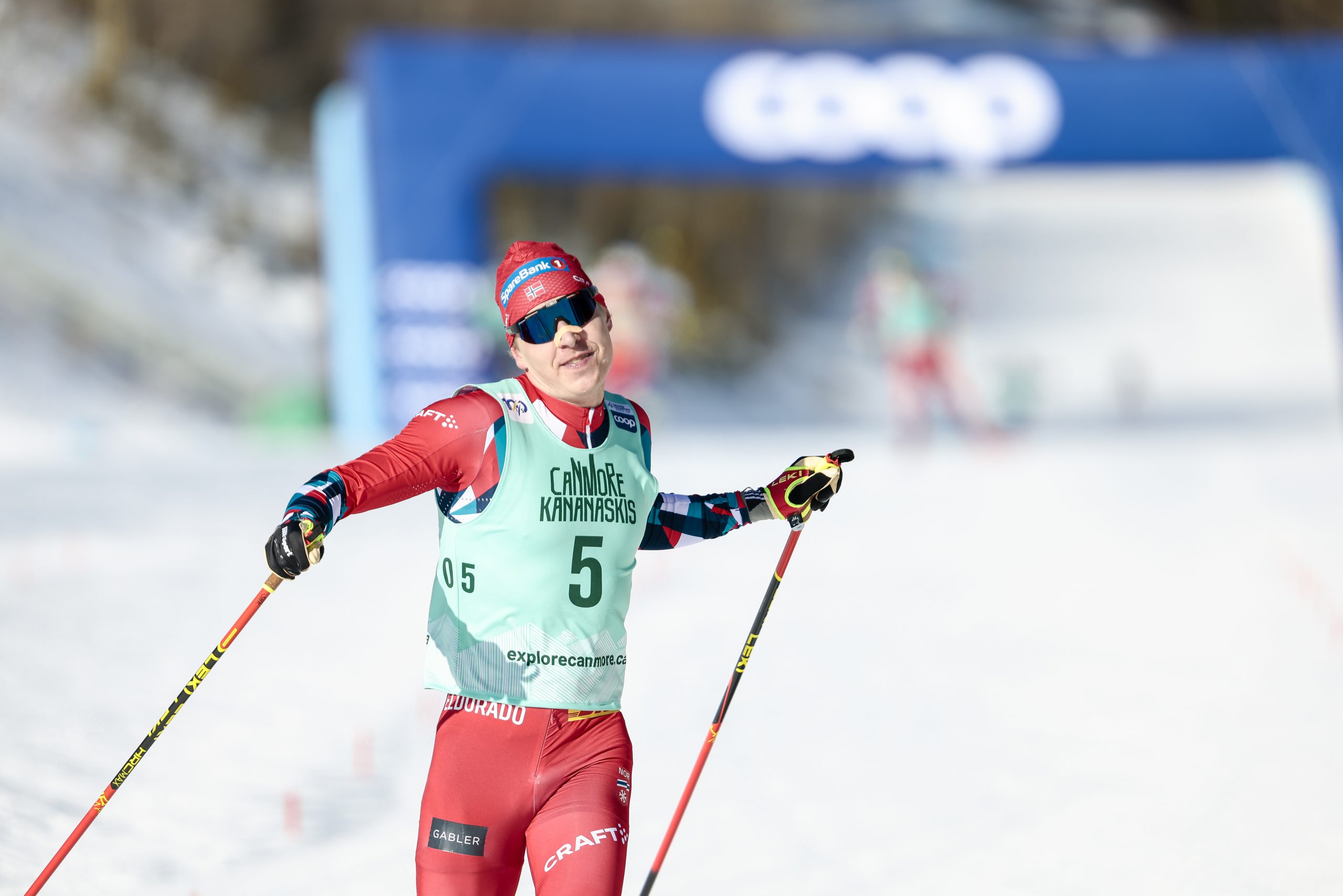
    Simen Hegstad Krueger (NOR) made a solo breakaway that the field was unable to match. (Photo: NordicFocus)

    In the men’s Overall World Cup competition, Harald Oestberg Amundsen (NOR) holds a commanding 300 point lead over teammate Erik Valnes. While Amundsen and Paal Golberg (NOR) have a stranglehold in the distance competition, the fight for third is fierce. Andrew Musgrave (GBR) has a 15 point lead over Martin Loewstroem Nyenget (NOR), Simen Hegstad Krueger (NOR) and Hugo Lapalus (FRA). And lurking ready to pounce to redeem an illness-plagued season is Johannes Hoesflot Klaebo (NOR) who is only 16 points behind Musgrave. Klaebo would have extra motivation today: with a win, he would become the first man to win 75 individual World Cup events.

    Like the women’s event, the men’s format today was changed due to problems with the arrival of timing equipment to a 15-kilometer mass start.

    Often, men’s mass start Freestyle races are purely tactical affairs. But today that was not the case as Krueger and Mika Vermeulen (AUT) both put in individual breakaways that the field was unable to match. In a brave solo effort, Krueger ended up taking the victory, Amundsen was second, and Mika Vermeulen held on for third.

    Scott Patterson (USA) was able to stay with the lead pack to grab an eighth place finish. (Photo: NordicFocus)

    American Scott Patterson had a great day finishing eighth. Due to the larger field given to host countries, there were 12 Americans at the start line. Other American finishers were Gus Schumacher 22nd, Zanden McMullen 23rd, David Norris 27th, Peter Wolter 36th, Luke Jager 39th, Hunter Wonders 40th. In his first World Cup start, Michigan native Reid Goble was 44th, Braden Becker 45th, Michael Earnhart 47th, Graham Houtsma 49th, and Ben Ogden 54th.

    The top Canadian finisher was Samuel Gary Hendry in 30th. He was followed by Antoine Cyr, 37th, Remi Drolet 42nd, Leo Grandbois 46th, Aidan Kirkham 50th, Xavier McKeever 51st, Scott James Hill 52nd, Felix-Olivier Moreau 53rd, Eamon Wilson 55th, and Adam Heale 57th. Olivier Leveille and Micah Steinberg did not finish.

    Men’s 15 k Mass Start Freestyle

    The pace at the start was very controlled and skiers stayed together in a large pack with Amundsen, Musgrave and Klaebo setting the early tempo. There were two Bonus Points sprints that had the potential to break up the field. As it turned out, this contrived means of breaking up the field would not be needed.
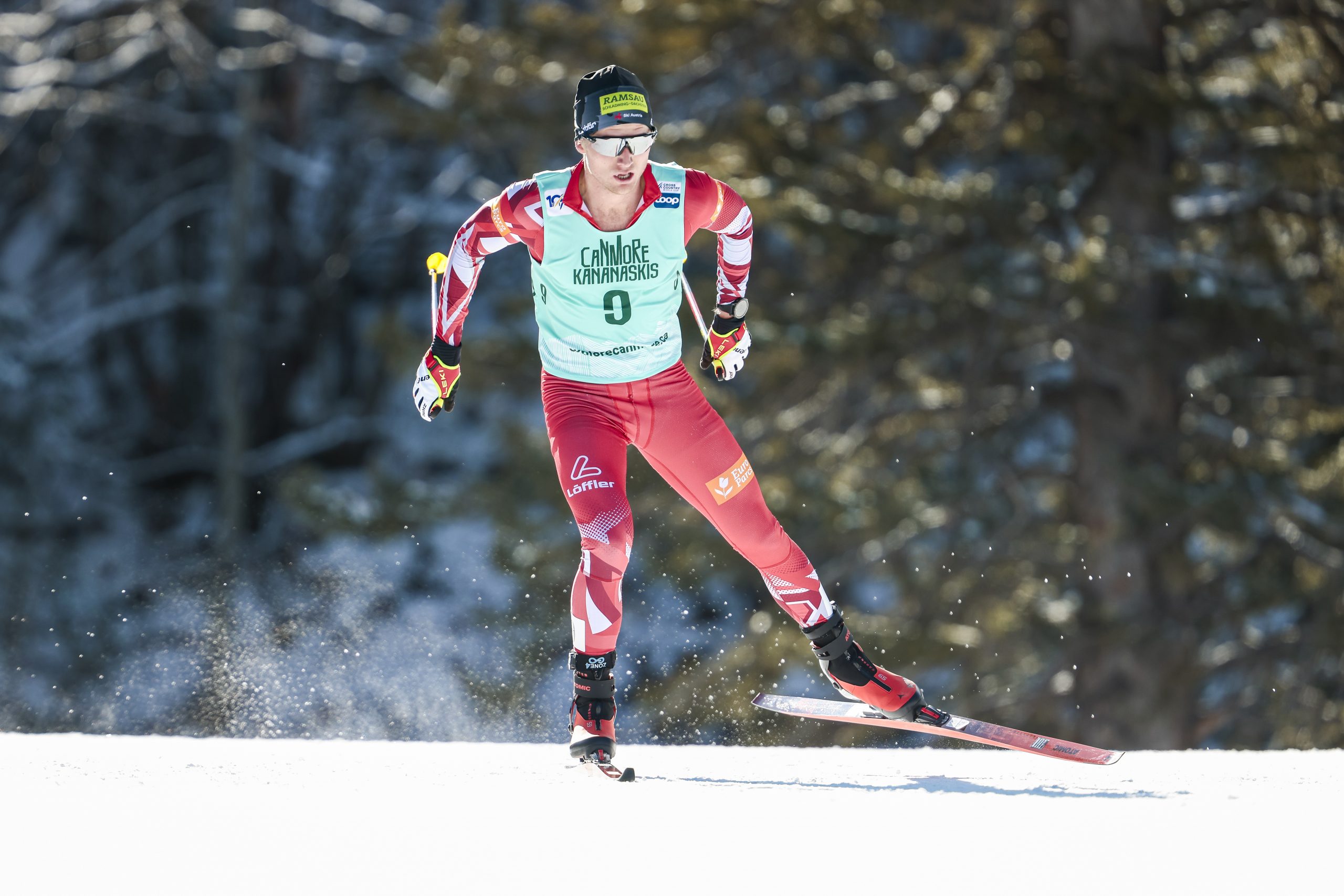
    Mika Vermeulen (AUT) made the first of two solo breakaways, and was able to hang on for third. (Photo: NordicFocus)

    At the start of the second lap, Vermeulen (AUT) pushed to the front and established a bit of a gap on the field, but the pace was still pedestrian. Nonetheless, he had created a seven second lead over Musgrave. Vermeulen continued to put a gap on the field, and no one from the group chose to pursue him. Whether intentionally or not, Vermeulen was now on a solo breakaway.

    At 5.2 kilometers, Vermeulen still held a 5.3 second lead, and none of the leaders deemed it a threat. He was close enough to keep an eye on, and the pack was content to let him set the pace. The breakaway allowed Vermeulen to claim the top bonus points at 6.7-kilometers. After the bonus mark, he continued to hold a five second lead on the field.

    But relentlessly, momentum took over and the pack swallowed up Vermeulen with Krueger taking the lead. Sensing that the pack was not in the mood to chase a break, Krueger began to slowly pull away from the pack. By the time they had reached the 8.4-kilometer mark, Krueger had established an eight second lead on the rest of the field which was led by Friedrich Moch (GER).

    Once Krueger’s breakaway looked unstoppable, Harald Oestberg Amundsen (NOR) charged to the front of the chase group to take second place. (Photo: NordicFocus)

    Krueger’s efforts at a breakaway seemed like a much more legitimate threat than Vermeulen’s had been as he continued to press the pace and stretched his lead to over 15 seconds at 8.9 kilometers. During Krueger’s break, Scott Patterson (USA) had used the opportunity to move into fifth place and was toward the front of the chase pack.

    The next bonus Sprint was at 10.5 kilometers and Krueger easily took it as his lead had swelled to over 17 seconds. Could one man hold off the entire pack for another five kilometers? It was a tall order, but Krueger has a history of strong solo performances, and he looked to be in excellent form.

    At 11.3 Krueger looked like an unstoppable locomotive. His lead was 22 seconds; it looked like no one would be able to chase him down. Patterson still remained in the middle of the chase group and was fighting for podium position.

    Gus Schumacher (USA) had another good day finishing 22nd. (Photo: NordicFocus)

    By the final lap, Krueger had stretched his lead, and it looked like the pack had given up on fighting for first place and was now jockeying for podium positions. Amundsen moved to the front of the chase group, but it was clearly not an effort to reign in Krueger.

    By 12.7-kilometers Krueger had beaten the field into submission. With over a 20 second lead, the race was now his to lose. Another story playing out in the chase group was Patterson’s performance, who was sticking with the chase group in eighth place.

    As the field entered the final stretch it was clear that Krueger’s gamble was going to pay off. He still was holding onto his 20 second lead.

    As the group entered the stadium Krueger coasted to victory and glanced back to watch the battle unfolding behind him. The pack was surging with Amundsen jumping to the front to take second place and Vermeulen hanging on to third. Patterson was able to capture eighth place, turning in a great day for the American.

    In a format that is usually dominated by pack tactics, the script for the men was upended today by Krueger and Vermeulen whose brave solo breaks made for an entertaining race.

    After the race Krueger was clearly excited. “It was almost the perfect race for me today,” he said. “After the format was changed, I decided to make it as tough as a race as possible. The last lap I feared I had used a little too much energy.” But clearly, he hadn’t, and was able to turn in a spectacular performance.

    At the podium ceremony, the European winners truly seemed to relish receiving Canmore’s signature cowboy hat as a prize; none more than Vermeulen who notched his first podium finish.

    The European racers can’t seem to get enough of the Canmore cowboy hats. Harald Oestberg Amundsen (NOR), Simen Hegstad Krueger (NOR), Mika Vermeulen (AUT), (l-r) (Photo: NordicFocus)

    RESULTS:

  • Klaebo Rules 20 k Mass Start. Schumacher-Patterson Top Twenty

    Klaebo Rules 20 k Mass Start. Schumacher-Patterson Top Twenty

    This coverage is made possible through the generous support of Marty and Kathy Hall and A Hall Mark of Excellence Award. To learn more about A Hall Mark of Excellence Award, or to learn how you can support FasterSkier’s coverage, please contact info@fasterskier.com.

    As the eyes of cross-country World Cup competitors begin to turn their gaze toward North America, one task remained for them before they could begin to focus on packing their bags for the long journey west. That task was the 20 k Mass Start Freestyle contested today in Goms, Switzerland. In the men’s competition, none of the leaders could afford to look too far down the road. Harald Oestberg Amundsen (NOR) still led the Overall Crystal Globe competition by 201 points over Erik Valnes (NOR) going into today’s race. And while it’s a sizeable lead, he certainly wasn’t in the position to put things on cruise control just yet.  Valnes wasn’t racing today, but always lurking was the ever-present Johannes Hoesflot Klaebo (NOR) who, after an up and down season marred by illness, was looking to reassert his dominance on the World Cup scene.

    Ever the master technician, Johannes Hoesflot Klaebo (NOR) (number nine) was able to reassert his dominance today. (Photo: NordicFocus)

    The race for the Distance Championship has some interesting twists and turns going on. Amundsen also leads that competition, but his lead was only 78 points over Paal Goldberg (NOR). More intriguing is that Andrew Musgrave (GBR) was in third place in the Distance Cup, but his lead was only one point over Hugo Lapalus (FRA). A podium finish in any of the Cups for Musgrave would be a huge feather in his cap, but he would need to be extra vigilant to try to fend off the surging Lapalus.

    For the Americans, it was time to sharpen the sword and get ready to come home in good form. The regular duo of Ben Ogden and Gus Schumacher would be joined by Scott Patterson, Peter Wolter, Zak Ketterson, and Kevin Bolger for the final tune-up before the return to North America.

    Mass Start Freestyle races can be very tactical affairs; racers will often remain grouped in a moderately-paced pack for much of the race. FIS has tried to reduce this strategy by introducing bonus points into distance races. In today’s race, there were bonus points at 9.5 and 14.5 kilometers. First place at a bonus section gains a racer an additional 15 points toward the Distance and Overall standings. Musgrave or Lapalus might try and steal a page from Jessie Diggins’ playbook in the Oberhof 20-kilometer race and push hard at the bonus section sprints.

    There was a little bit of rain overnight in Goms that froze and made the conditions fast as it mixed into the snow. Today, FIS didn’t have to worry about skiers dawdling on the course. The finishing times revealed just how fast the conditions were, and how willing racers were to take advantage of the conditions as Klaebo claimed victory in a time of 39:25—for a race of 20 kilometers! Klaebo’s countryman, Simen Hegstad Krueger, was second, with Jules Lapierre (FRA) taking third. Amundsen was able to protect his Cup standings by finishing fourth. Musgrave finished 12th and his podium rival Lapalus was 13th, allowing Musgrave to maintain his slim margin in the Distance competition. But now there were four skiers within 16 points of him; Klaebo is one of them.

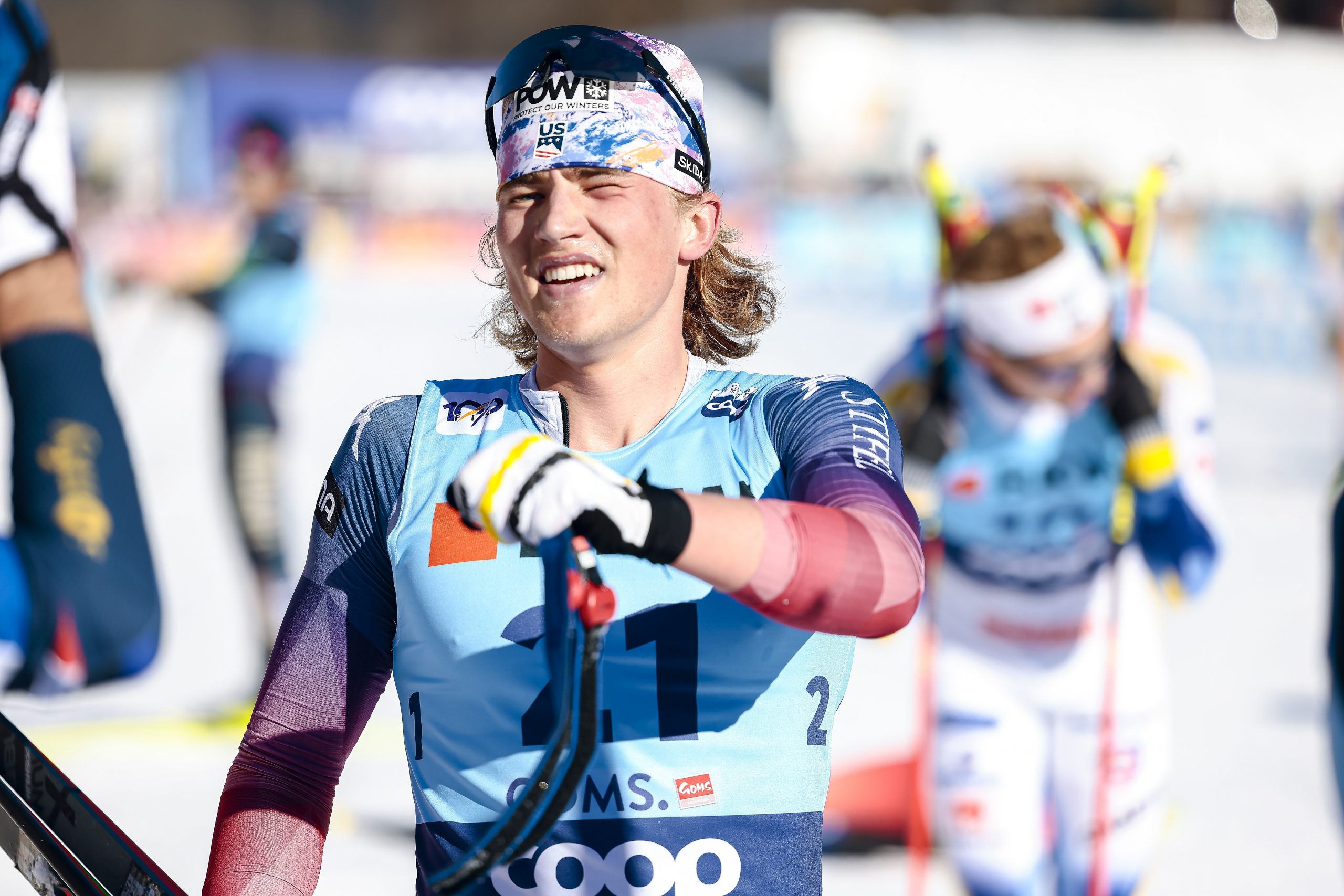
    Gus Schumacher (USA) was the top American finisher: 14th, only 12 seconds from the podium. (Photo: NordicFocus)

    After the race Klaebo, said that “it was fun and [I] felt really strong.” When asked about his chances for the Overall Cup, he admitted that he was too far back to contend for the Overall competition but was happy to be feeling good again, feeling normal, and going to Canada with a good feeling.

    The top American was Gus Schumacher in 14th place in a time of 39:49. He was followed by Patterson in 18th, Ogden 35th, Bolger 42nd, Ketterson 43rd, and Wolter 49th.

    Antoine Cyr was the top Canadian, only 37 seconds off the lead in 22nd. Sasha Masson finished 36th, Xavier McKeever 55th, Thomas Stephen 57th, and Derek Deuling 61st. Max Hollmann did not finish.

    After the race, Schumacher revealed that his strategy was “to try to relax in the pack as long as possible so I could have the energy to move up when it got hard. . . . Also, I wanted to ski the downhills well to take places where it was a bit easier. Honestly, I struggled to maintain a good position in the first couple of laps, so that part didn’t go super well, but I had energy when it started to string out and made those said ‘money moves’ into some bonus points.”

    Men’s 20 k Freestyle Mass Start

    Amundsen and Musgrave went to the front early and set a quick pace. Skiers stayed together in one large pack, spreading out as they proceeded down the first technical downhill turn. Even though the skiers looked relaxed, the conditions made the pace fast as everyone was clearly working hard through the tight, high-speed corners.

    At 4.5 kilometers, Friedrich Moch (GER) pushed to the front keeping the pace brisk and didn’t give the group a chance to let up.

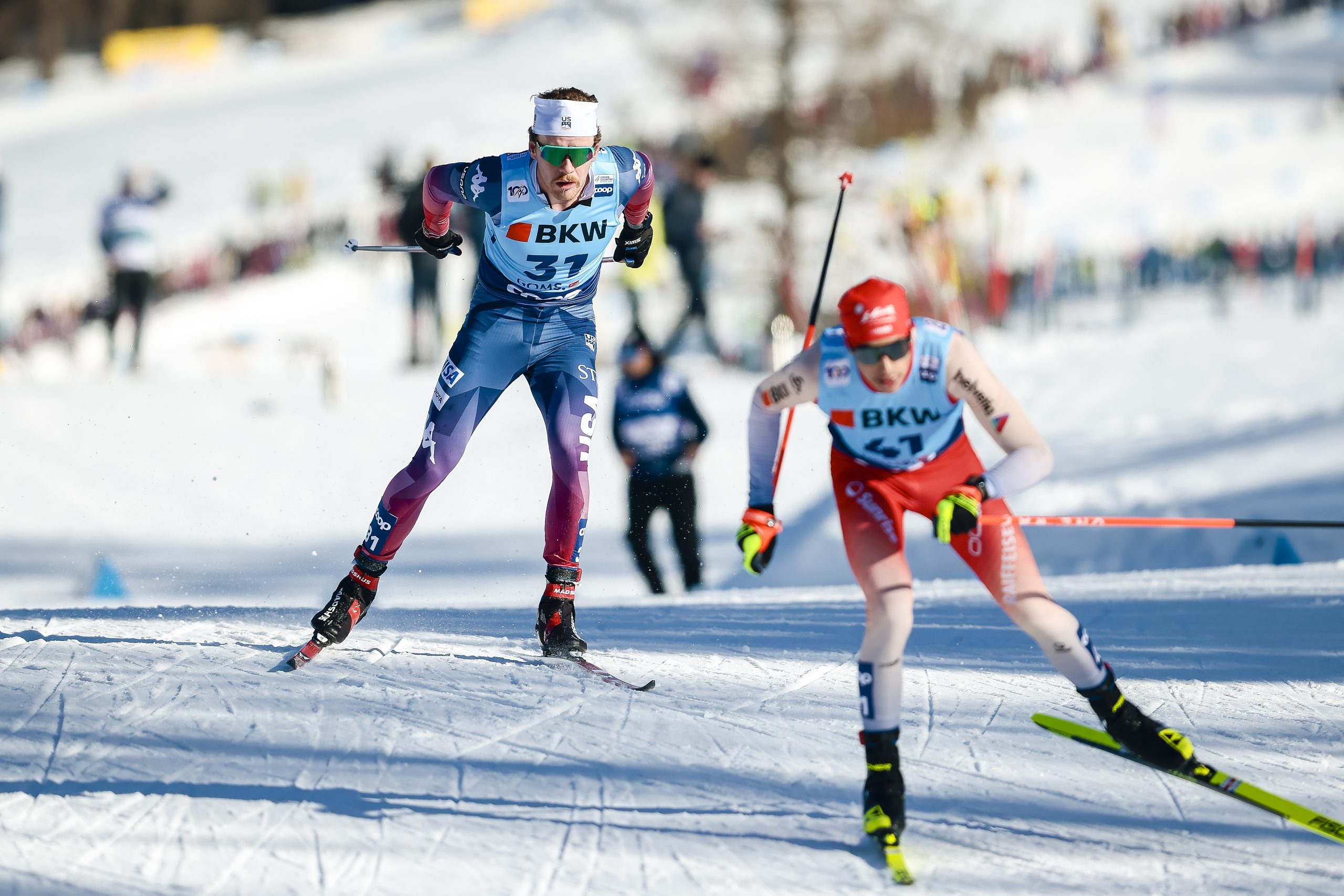
    Ben Ogden (USA) (number 31) had a good start but couldn’t quite keep up with the fast pace. Ogden would finish 35th. (Photo: NordicFocus)

    Ben Ogden had been pushed down to 23rd but was only six seconds off the lead as all of the top skiers were fighting for position.  The racers continued in one large pack with Amundsen never straying far from the front. But the standings were a little deceptive as only 14 seconds separated first from 44th.

    The speeds were fast as skiers struggled to stay on the marked course as they worked through the fast tight corners. As the pack approached the first time bonus, the pace quickened even more and the pack spread out. Klaebo then did what he does best: put in a quick sprint to head to the front, easily taking the winner’s 15 bonus points.

    After the fight for bonus points was over, Musgrave went back into the lead. All of the jockeying back and forth for points had little additional effect on spreading out the field. There were still 39 skiers within 16 seconds of the lead.

    At the next bonus section Klaebo again went to the front to claim the full 15 points. As it turned out, it was Klaebo, not Musgrave who would utilize the bonus points tactic. As Klaebo surged, he was joined by Schumacher who took a run to the front crossing the bonus line sixth. Beda Klee (SUI) was also cheered on by the hometown crowd as he shot into the lead for a brief time after the bonus sprint.

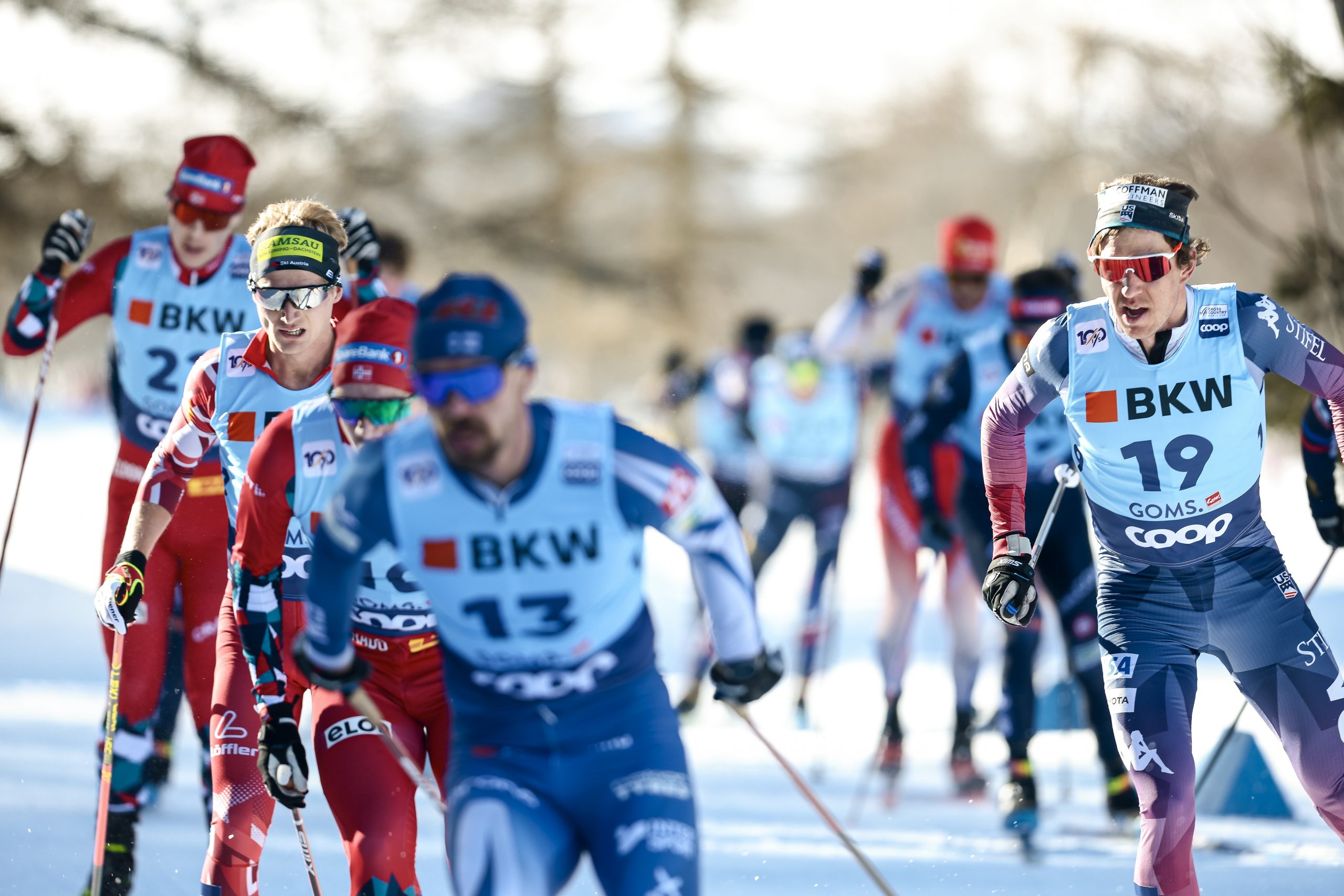
    Scott Patterson (USA) (number 19) had a strong day finishing 18th. (Photo: NordicFocus)

    At 16 kilometers the intensity ratcheted up as skiers without a big finishing sprint knew that they would need to create a gap to have a chance at the finish. Joining that group was Scott Patterson who had moved up to 15th, still only ten seconds off the lead. Patterson had been looking to rebound after what he called “a tough weekend in Oberhof.”
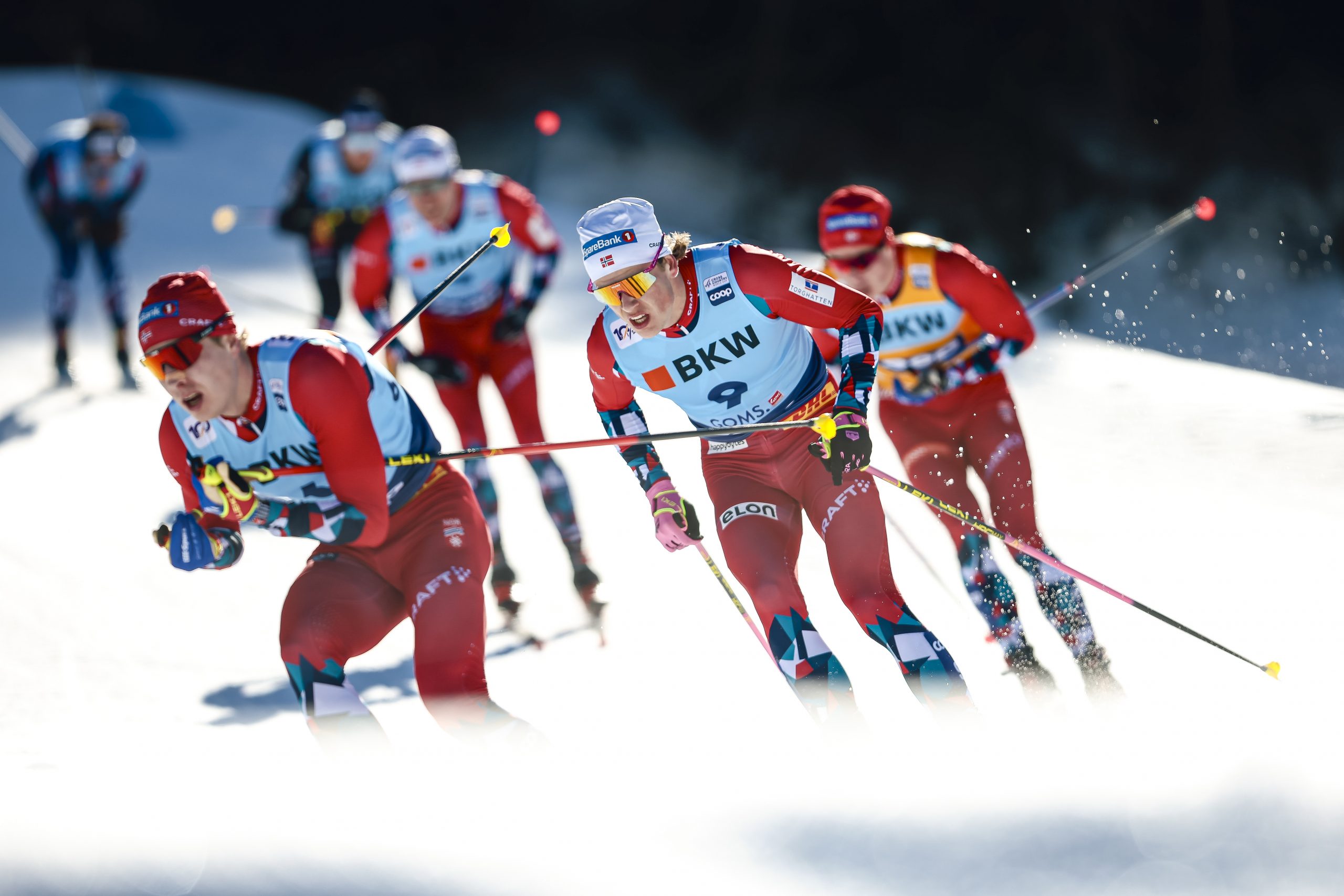
    “I tried to ski smooth but stay near the front,” Patterson said. “That worked well until the leaders started really pushing the last lap. I didn’t quite have the speed and energy but [I’m] still quite satisfied with a strong result to finish off this European block.”

    As the intensity continued to increase, Krueger, Amundsen, Klaebo, and Golberg began to assert their dominance. They quickly broke the lead pack into a group of six skiers that included Jules Lapierre (FRA) who was coming off his recent triumph up Alpe Cermis in the Tour de Ski. It was then Krueger and Klaebo who went to the front, and the pair separated from the lead pack. As the duo hit the final kilometers, they skied in tandem with Krueger taking the lead and Klaebo marking his every move. Going into the final hill before the stadium, Krueger desperately tried to make a break, but couldn’t separate himself from Klaebo. Klaebo never panicked and stayed on Krueger’s tails the entire way. Entering the stadium Klaebo switched on the after-burners; in a flash he was past Krueger. Klaebo had put on such a quick intense burst that he was able to slow down at the finish and take a look around to enjoy the sights.

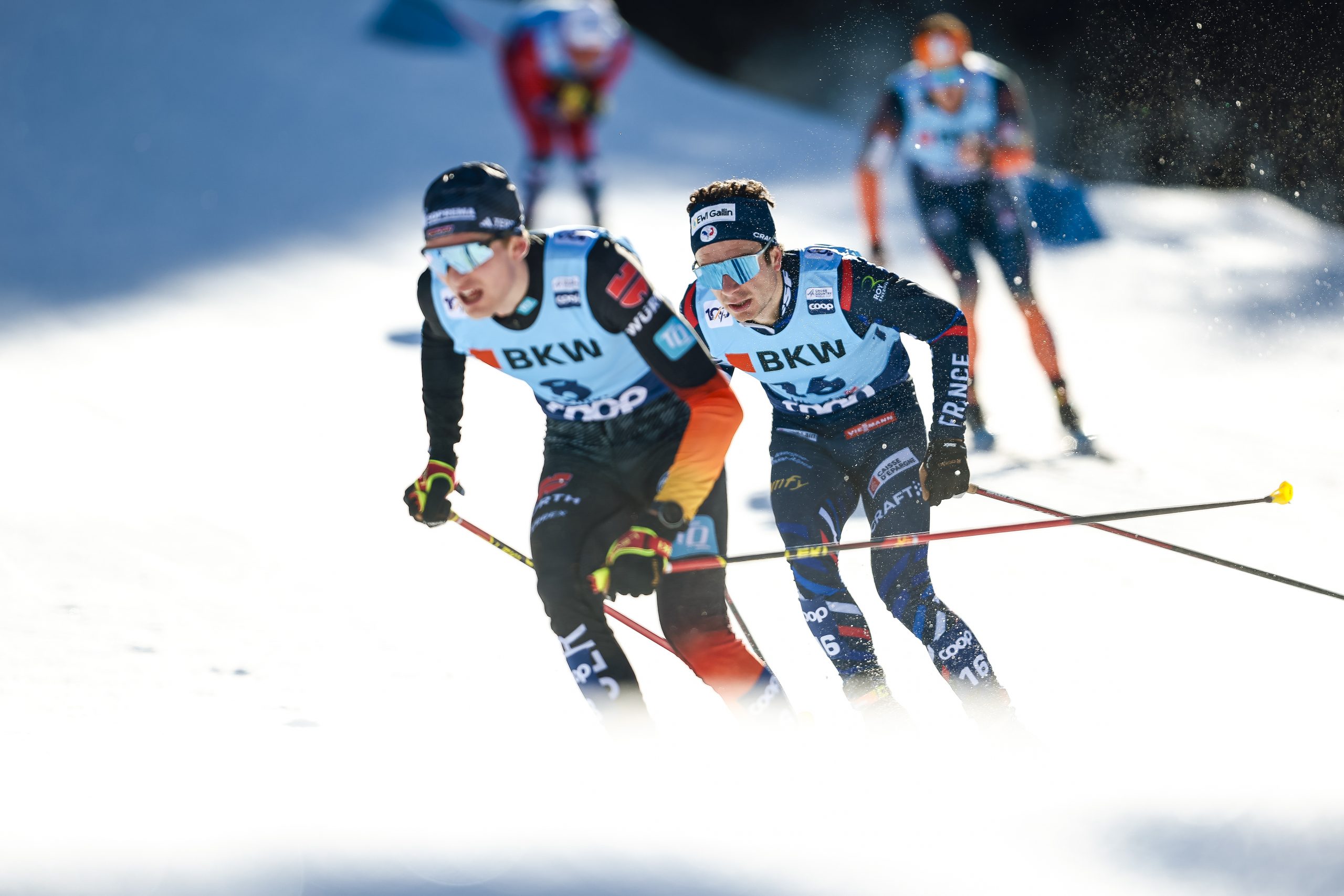
    Jules Lapierre (FRA) (number16) continued to roll, having won the Alpe Cermis climb in the Tour de Ski, and taking third in today’s race. (Photo: NordicFocus)

    While the two Norwegians were battling for the victory, Jules Lapierre (FRA) had moved to the front of the chase group and held on to finish third.

    Schumacher finished strong to claim 14th, but the placing was a little deceptive as he was only 12 seconds off the podium.

    Klaebo’s finishing time of 39:25 was testimony to the fast conditions, and to the willingness of the racers to take advantage of the speedy course and keep the pace fast the entire way.

    Next stops on the World Cup: Canmore, Alberta, followed by Minneapolis, Minnesota. Be sure to continue to visit FasterSkier for our in-depth coverage as the world of cross -country skiing comes to North America.

    20 k Freestyle Mass Start RESULTS

    World Cup Standings

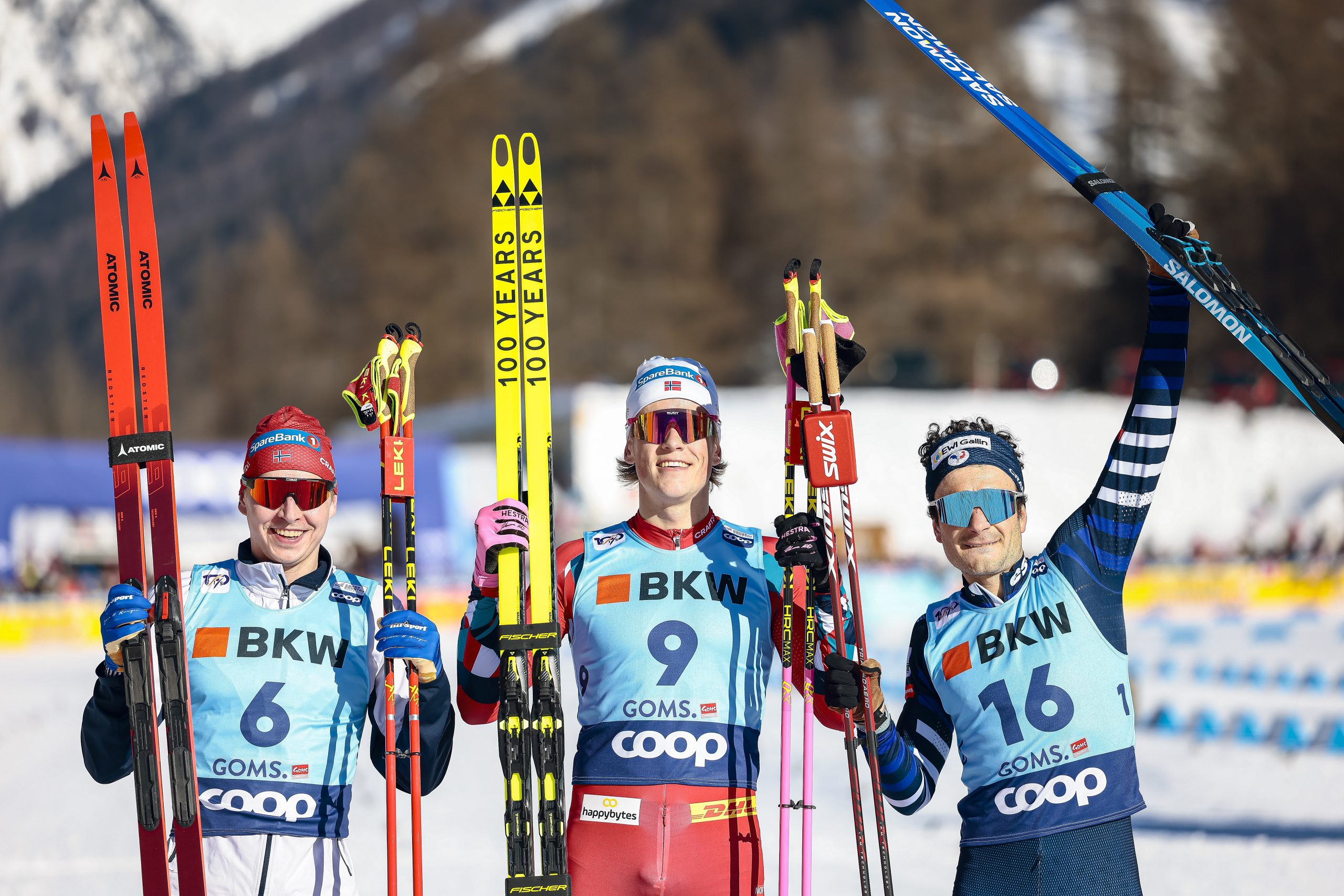
    Simen Hegstad Krueger (NOR), Johannes Hoesflot Klaebo (NOR), Jules Lapierre (FRA), (l-r) were the Goms podium finishers. (Photo: NordicFocus)
  • Amundesen Protects Big Lead Going Into TDS Finale

    Amundesen Protects Big Lead Going Into TDS Finale

    This coverage is made possible through the generous support of Marty and Kathy Hall and A Hall Mark of Excellence Award. To learn more about A Hall Mark of Excellence Award, or to learn how you can support FasterSkier’s coverage, please contact info@fasterskier.com.

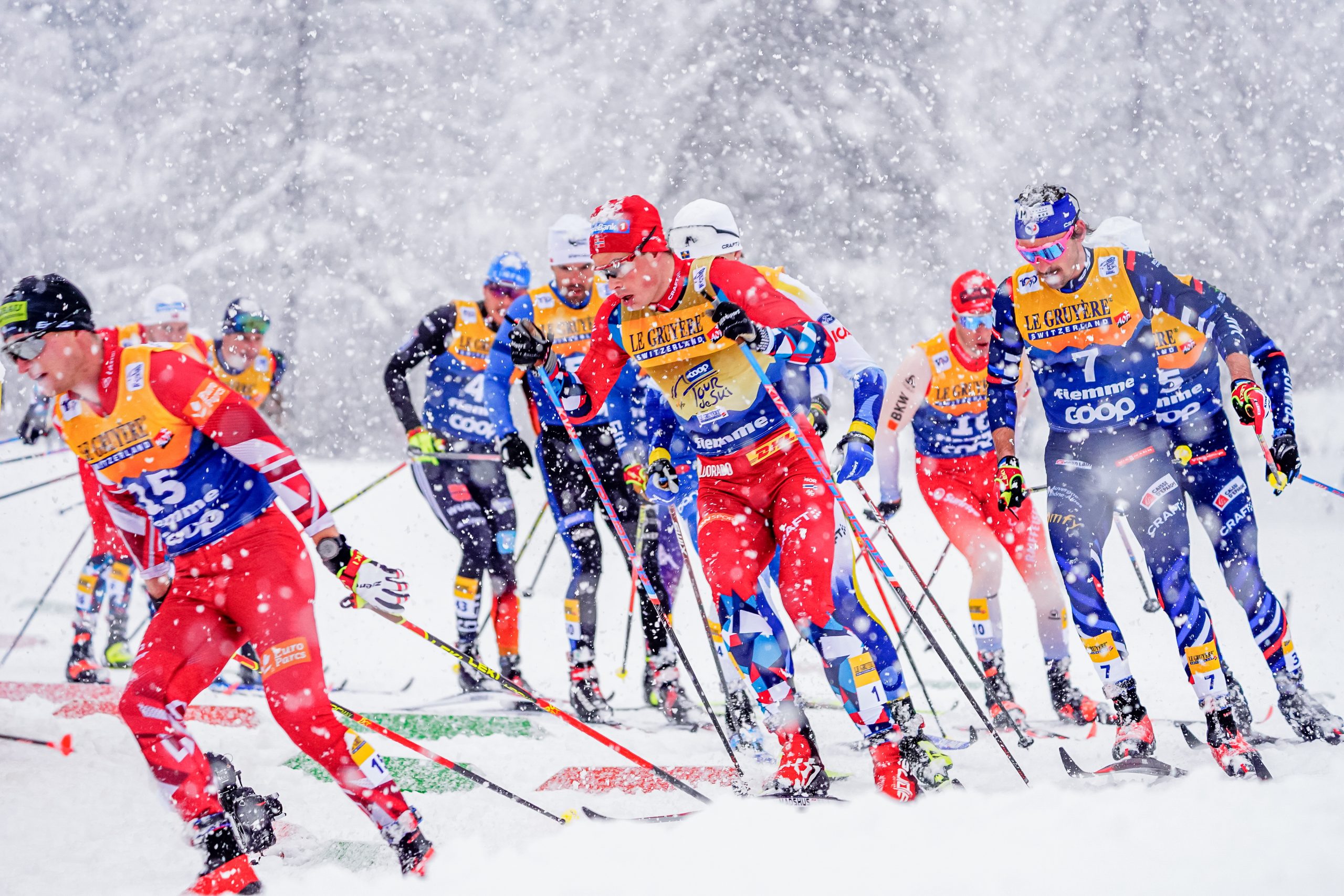
    Harald Oestberg Amundsen (NOR) (center) played it smart by playing it safe today. He stayed near the front and kept an eye on anyone who might dare to make a break. (Photo: NordicFocus)

    The men’s Tour de Ski (TDS) began last week with team Norway back on its heels as France and the USA challenged Norway’s domination; that seems a lifetime ago. Ever since the third race, in Toblach, Italy, Norway has been dominant again with no other country really giving it a run for the overall title. The Tour is Harald Oestberg Amunden’s (NOR) to take. Going into today’s 15 kilometer Mass Start Classic race, in Val Di Fiemme, Italy, Amundsen is 1:39 ahead of countrymen Henrik Doennestad, and Martin Loewstroem Nyenget.

    But a very tantalizing question remains as to whether a non-Norwegian man can find the podium at the end of the Tour? As to that question, the answer is a definite: it’s possible. Hugo Lapalus (FRA) is only two seconds out of second place behind Doennestad and Nyenget. Likewise, Friedrich Moch (GER) and Beda Klee (SUI) are only seconds behind the Norwegian duo. So, while the race for the top spot is definitely Amundsen’s to lose, other countries are knocking on the door to gain a spot on the podium.

    A 15 kilometer mass start Classic race is a tough format in which to gain ground, so any efforts by Lapalus and Moch to join the Tour podium leaders would be a tall task. They couldn’t risk too much today as they would need to leave themselves in contention for Sunday’s final race, the climb up Alpe Cermis. But given the razor thin margins separating second and seventh place of only eight seconds, it wouldn’t take much to dislodge the current Norwegian monopoly. The men’s race for first place might lack the drama of the women’s, but the race for second and third is scorching hot.

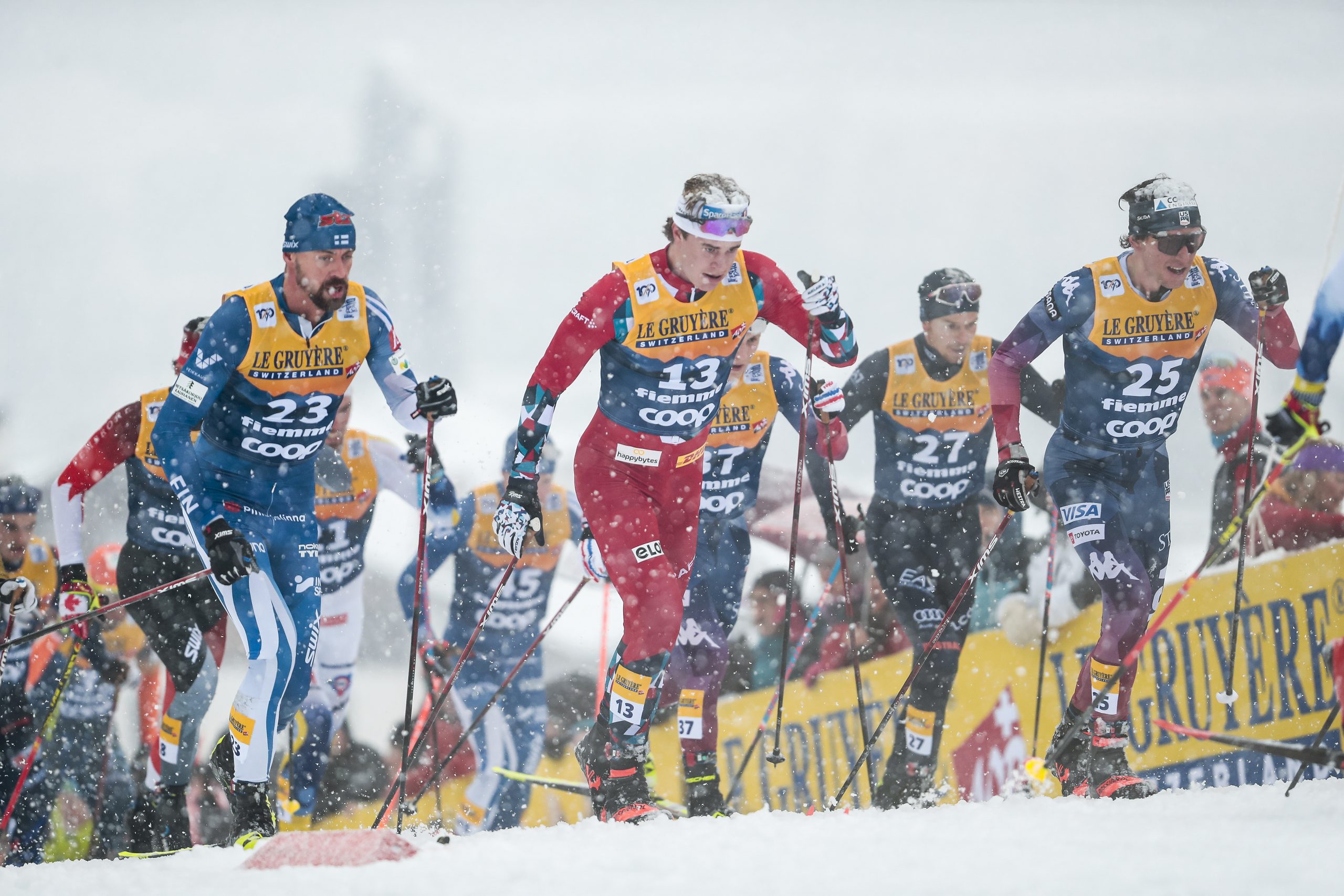
    Scott Patterson (USA) (far right), is one of only two Americans left in the Tour. He had a nice performance today, only 16 seconds behind the winner. (Photo: NordicFocus)

    For the American men, the bright promise they showed early in the Tour has faded away as illness decimated the team; just as it has much of the Tour. There were only two Americans left on the start line, Scott Patterson, (4:54 behind the Tour leader, and Zanden McMullen (7:37 behind the Tour leader).

    At the conclusion of a very tactical race, it was Erik Valnes (NOR) taking the victory. He was followed by William Poromaa (SWE) in second, and Cyril Faehndrich (SUI) third. American Scott Patterson had a nice day finishing 27th, only 16 seconds off the lead. He was closely followed by Zanden McMullen in 31st, 17 seconds behind first.

    The top Canadian finisher was Olivier Leveille in 33rd, and Antoine Cyr in 41st.

    An interesting finishing time was delivered by Sprinter Lucas Chanavat who has continued with the Tour even after the Sprints were concluded. He finished 54th, the last skier to finish, 3:37 behind the leaders and over 1:40 behind the second to last skier. It could be debated whether it’s sandbagging or smart tactics by the Sprinter to keep his Tour alive.

    Men’s 15 Kilometer Classic Mass Start Race

    Much like the Classic race two days ago in Davos, skiers again faced extremely challenging waxing conditions in Val di Fiemme. It was snowing hard with temperature right around freezing. Again, wax technicians faced difficult choices. As racers marched to the start line to begin the race, lots of zero skis could clearly be seen; along with some skiers choosing klister. The American men were split on ski setup. According to U.S. coach Kristen Bourne, Patterson chose zero skis while McMullen was on klister. Bourne told FasterSkier that zeroes and klister skis were tested for both the men’s and women’s races with a mix of skis finally selected for both races. “It was definitely a mixed bag,” said Bourne. “Another day of our kick team really working trying to figure it out.” The decision was ultimately the athlete’s to make. “The skier and the tech would talk about it and make the decision together.” But the new fluoro rules threw another curve into ski choice. Under the rules for Classic races, skiers are allowed to present two pairs of skis for pre-race fluoro testing 30 minutes before the start. Bourne indicated that it’s ultimately the athlete’s choice to decide which pair of skis to choose from between the two pair which clear fluoro testing; a fairly nerve wracking dilemma. Things become even more complex as there is a kick adjustment zone after skis have been fluoro tested where kick zones, and only kick zones, can be adjusted just before the race.

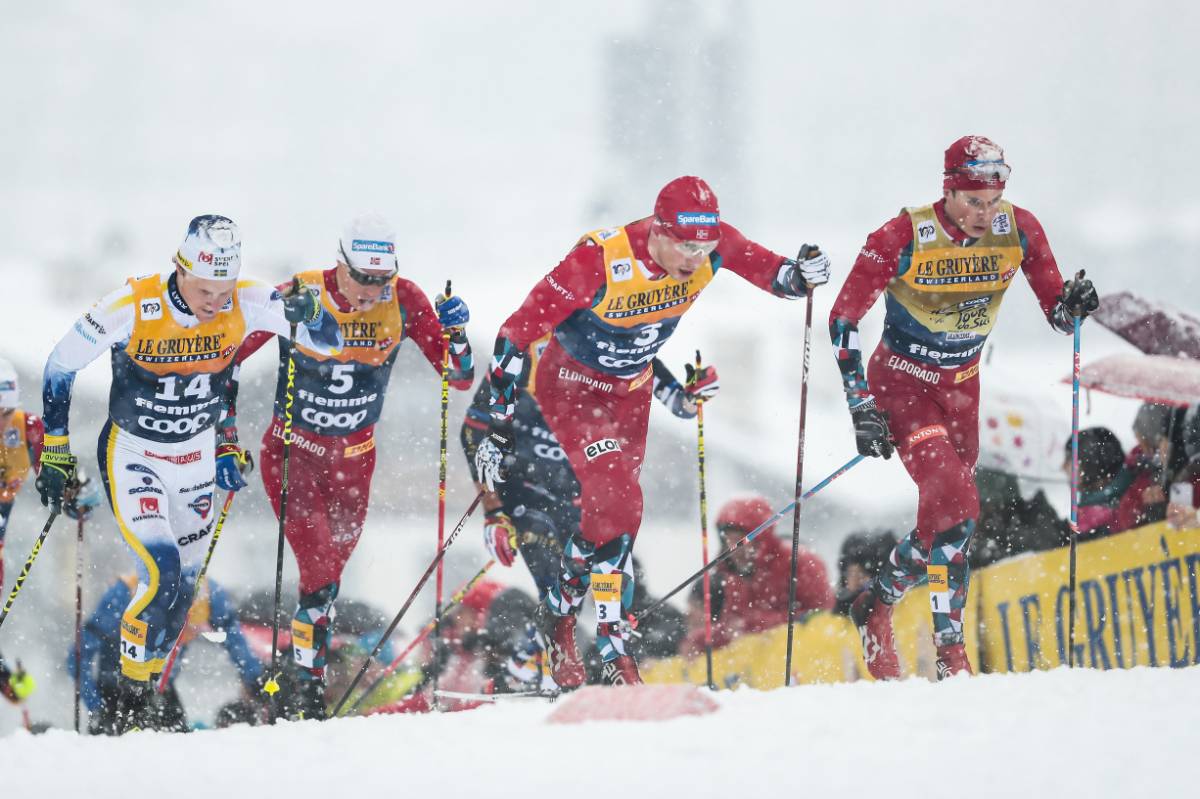
    Martin Loewstrom Nyenget (NOR) (bib five), did enough to put himself into third place for tomorrow’s decisive race. But he only has a five second advantage. (Photo: NordicFocus)

    Unlike Thursday’s 20 kilometer race, this course was on a 2.5 kilometer lap which would help with kick zone icing issues.

    The weather played an outsized factor today’s race strategy as well. The conditions would make it difficult for any skier to make a break. A mass start would also contribute even more to that same dynamic.

    Olivier Leveille (CAN) gave fans an early thrill when he went to the lead at the 1.4 kilometer mark. Leveille was fighting for an early time bonus at the 2.3 kilometer point, but ultimately was in fifth at the timing check. The Bonuses helped to string out the field a little, as Edvin Anger (SWE) took the time bonus sprint, nudging out Erik Valnes (NOR) who needed the bonus time to help his podium fight.

    After the bonus point sprint, the field coalesced again into one mass pack. Podium contender Beda Klee (SUI) took a brief shot at the front, but it was short lived. At 3.5 kilometers, the tone of the race seemed set; it was clear that pack racing tactics were going to take hold. The athletes really didn’t have much option, as trying a break in these conditions—this early—would likely be a fool’s errand.

    The pack conditions meant that skiers outside the top ten would also have a chance to hang with the leaders. This gave McMullen a chance to ski with the Tour front runners as he pushed himself up to sixth. At this point the race was so congested that there was only a 16 second gap between first and 53rd.

    With Amundsen having a big lead, he was unlikely to push the field; he was content to simply check any big moves made by podium contenders. Halfway through, Doennestad and Nyenget went to the front to try and push, but they too were unable to break up the field. One kilometer later, Erik Valnes gave the front a shot, but it turned out to be more of a chance to grab bonus points at 8.5 kilometers instead of a legitimate attempt to break things up. He stayed near the front after the bonus mark, but wasn’t seriously pushing the field.

    Amundsen continued to hang out at the front to avoid the congestion of the big pack. Then, after the bonus Sprint, Jens Burman was the next athlete to step up to make a little charge to break up the field. His effort was also doomed, and the field again quickly consolidated. The conditions—coupled with the effects of the mass start—were proving just too difficult for anyone to make a break from the pack.

    Zanden Mcmullen (USA) was one of two American skiers in today’s race. He finished 31st, but only 17 seconds behind the winner. (Photo: NordicFocus)

    With only 2.5 k to go, it was still one giant pack with only 12 seconds between first and 51st. Amundsen, however, was leaving nothing to chance and went to the front. The virtual race for second and third in the TDS was still extremely tight with racers within a couple of seconds.

    Even though the pack was close to the finish, the pace was still extremely relaxed. Several more skiers had tested the waters of going to the front only to abandon the opportunity after a few seconds. The race had now devolved into a giant touring pack with a Sprint finish looming. All the podium contenders were playing it safe with no one pushing the front, and everyone jockeying for a good spot for the finish.

    With one kilometer to go, skiers began to seriously race. Cyril Faehndrich (SUI) (brother of Swiss star, Nadine Faehndrich), made a break with about half a kilometer to go. William Poromaa (SWE) and Valnes fell in behind him.

    Cyril Faehndrich (SUI) had a career best day finishing on the podium for the first time in a World Cup race. (Photo: NordicFocus)

    The race immediately became a three man sprint between Valnes, Faehndrich and Poromaa. In this situation, Valnes had the clear sprinting advantage. He double poled to the front and was able to push by Poromaa, who took second, and Faehndrich, who took third. For Faehndrich, it was his first World Cup podium. Tour leader Amundsen was only eight seconds behind the group and played a tactically smart race by not taking chances and preserving his large advantage going into tomorrow’s finale. While not the most thrilling race, it was smart tactics by the top contenders who were betting on making a bid in tomorrow’s climb up Alpe Cermis.

    The racing strategy and weather created an interesting finishing time, where the winner of the men’s race was only three minutes faster than the Women’s winner!

    Hugo Lapalus (FRA) kept himself in podium contention by finishing eighth today. He’s now only five seconds from a podium spot. (Photo: NordicFocus)
    Impact on Tour de Ski Standings

    Today’s race was really just about setting things up for tomorrow’s finale. Amundsen now has a 1:34 lead over teammate Erik Valnes, and a 1:42 lead over Martin Nyenget. But the race for second and third is still very tight. Lapalus, Moch, Klee, and Doennestad are all within seconds of the podium; tomorrow’s fight for second and third will be intense.

    Men’s 15 Kilometer Mass Start Results

    Tour de Ski Standings.

    Harald Oestberg Amundsen (NOR) preserved his big lead going into tomorrow’s final stage. (Photo: NordicFocus)


  • Concluding the 2021/22 World Cup Season, Sundling and Halfvarsson Cruise to Gold in Mixed Team Sprint

    Concluding the 2021/22 World Cup Season, Sundling and Halfvarsson Cruise to Gold in Mixed Team Sprint

    This World Cup coverage is made possible through the generous support of Marty and Kathy Hall and the A Hall Mark of Excellence Award.  To learn more about A Hall Mark of Excellence Award or to learn how you can support FasterSkier’s coverage please contact info@fasterskier.com.

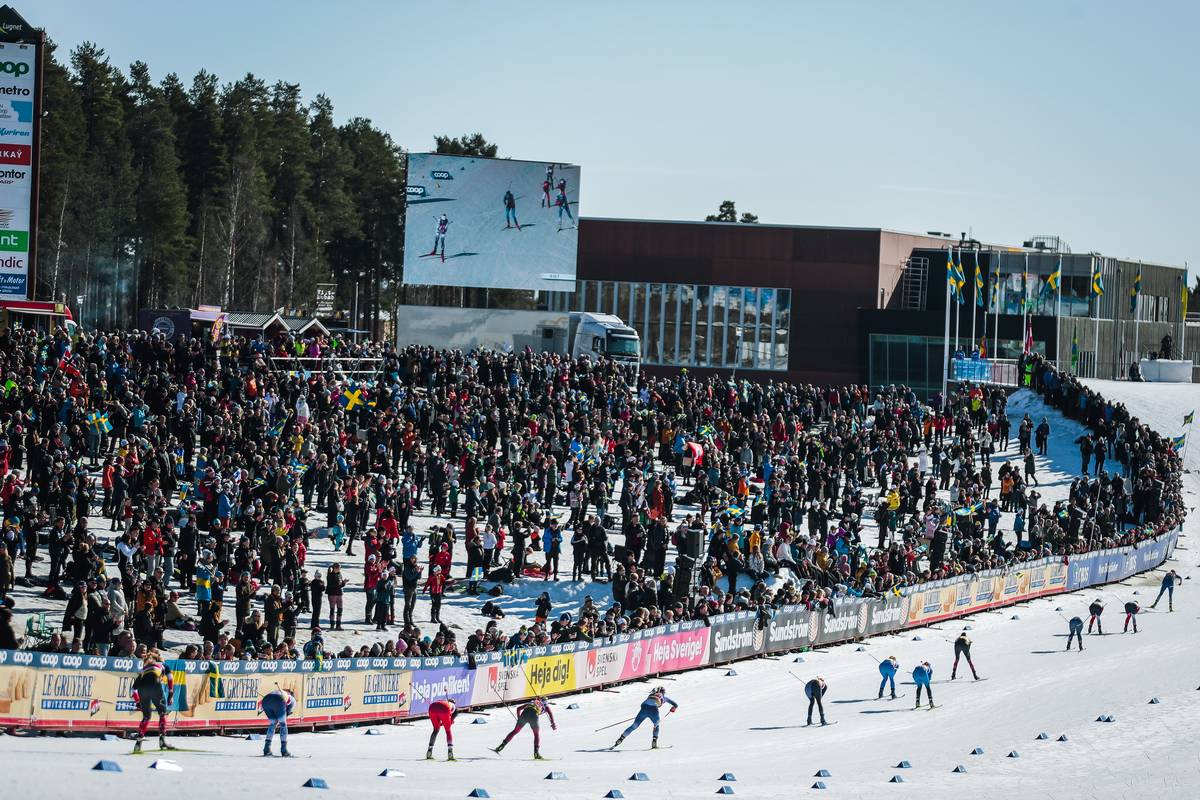
    A packed stadium for the final day of World Cup racing in Falun Sweden (Photo: NordicFocus)

    We’ve arrived at the final event of the 2021/22 World Cup Season and the second new event of the day. It was a fast and furious mixed team sprint in Falun, Sweden, happening just hours after the mixed team relay which ran in the morning. In the first iteration of this event, teams composed of one woman and one man raced six laps of a 1 k course each, making for 12 k of skiing total.

    To keep things spicy, the last two teams in the exchange after the even-numbered laps 2 -10 were eliminated. So although seventeen teams started the competition, only seven made it to the finish. In order to limit the chaos, given the number of teams, there was no tagging in the exchange, just a finish line and a start line for the athletes to gauge themselves. 
    The atmosphere in the Lugnet Ski Stadium was festive as fans enjoyed the 45°F degree weather and sunshine. “I think this is very nice to be together with the men,” said Nadine Fähndrich of Switzerland, “it makes more team spirit between the men and the women.” She alluded to the feeling of both the athletes and the spectators during the mixed team relay in which Team USA I took the gold in an exciting race. “I’m excited for the [race] and to [enjoy] the atmosphere here,” she concluded. 

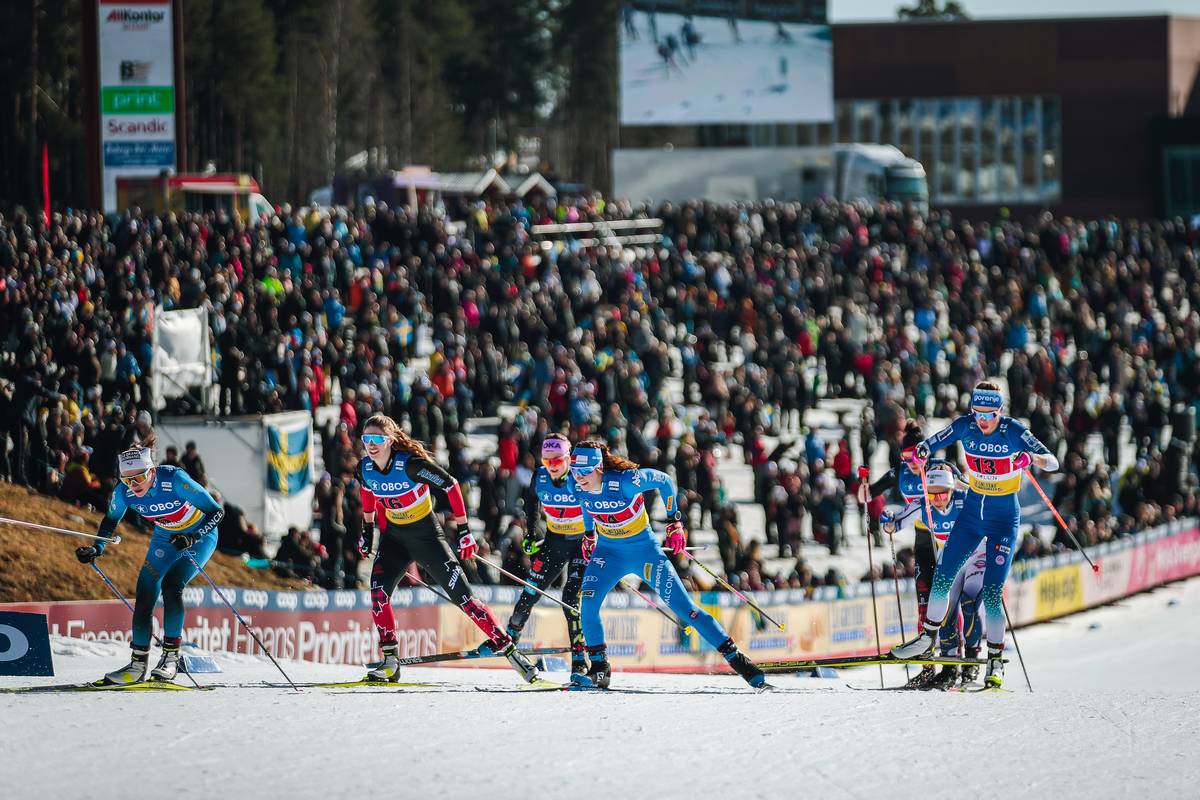
    The women head out for one of six laps for the mixed team sprint event (Photo: NordicFocus)

    With Team USA I taking the victory and Team USA II coming in 14th, the Americans did not enter a team in the mixed sprint event. Out of the seventeen teams that started, twelve nations were represented in the start list and only five nations made it to the finish. 
    The women started and as would be expected, Jonna Sundling skiing for Sweden I, was at the front. She was paired with Calle Halfvarsson who earned his first podium finish since 2018 in the 15 k freestyle on Saturday. 

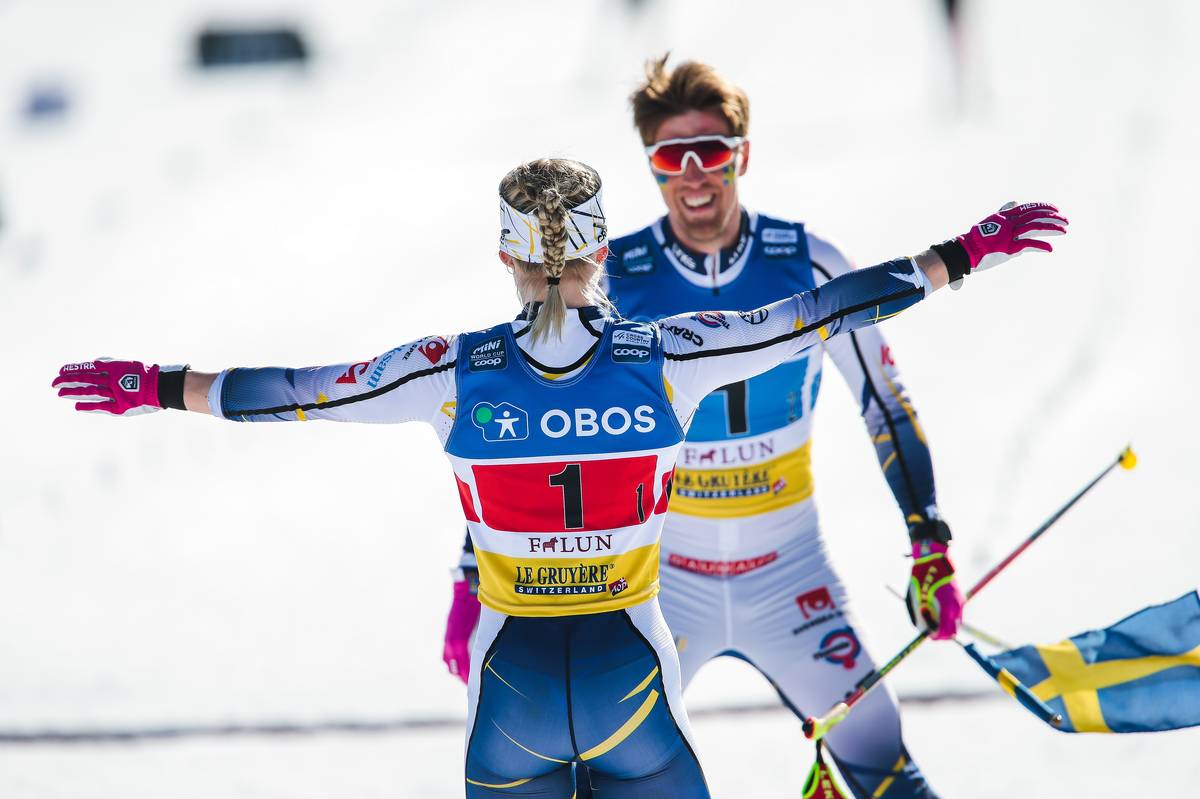
    Celebrations for Team Sweden I after dominating the mixed team sprint (Photo: NordicFocus)

    The first round of eliminations at 2 k took Estonia and France II out of the running. As Sundling concluded her second lap, she had created a +2.1 second gap and Halfvarsson seized this opportunity. Instead of waiting around for the rest of the field, he pushed hard and grew the gap to +3.84 seconds on his next 1 k lap. This same lap saw Benjamin Moser of Austria fly off the course on the corner descending into the stadium, taking himself and his teammate Teresa Stadlober out of the race. Latvia was also eliminated in that round. 

    Benjamin Moser (AUT) slides out on a fast corner (Photo: NordicFocus)

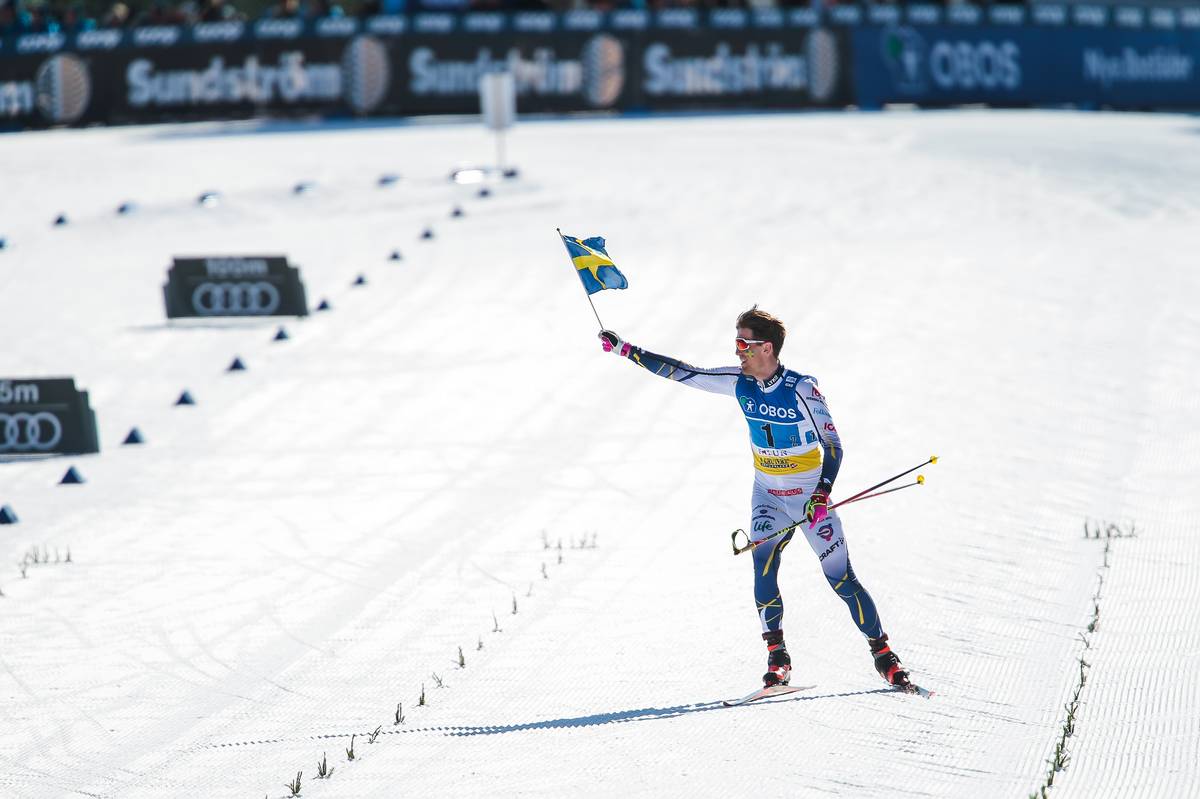
    Once Sweden I had made their move, it stuck. At 5 k they were +9.61 seconds ahead, at 7 k they were +22.2 ahead, at 11 k the gap was up to +26.84. After 23:05.91 of cumulative race time, Halfvarsson crossed the finish line waving a Swedish flag.

    “It’s easy when I go with Jonna [Sundling],” he said to FIS after the race, “she is so fast, it’s no match.” For her part, Sundling said, “It was a little bit exciting before the race, how to ski, how should our tactic be… but it felt like we did a really good race and ended up first so it’s really fun.” 

    Calle Halfvarsson enjoys a big time cushion as he and Jonna Sundling take gold in the first ever mixed team sprint event (Photo: NordicFocus)

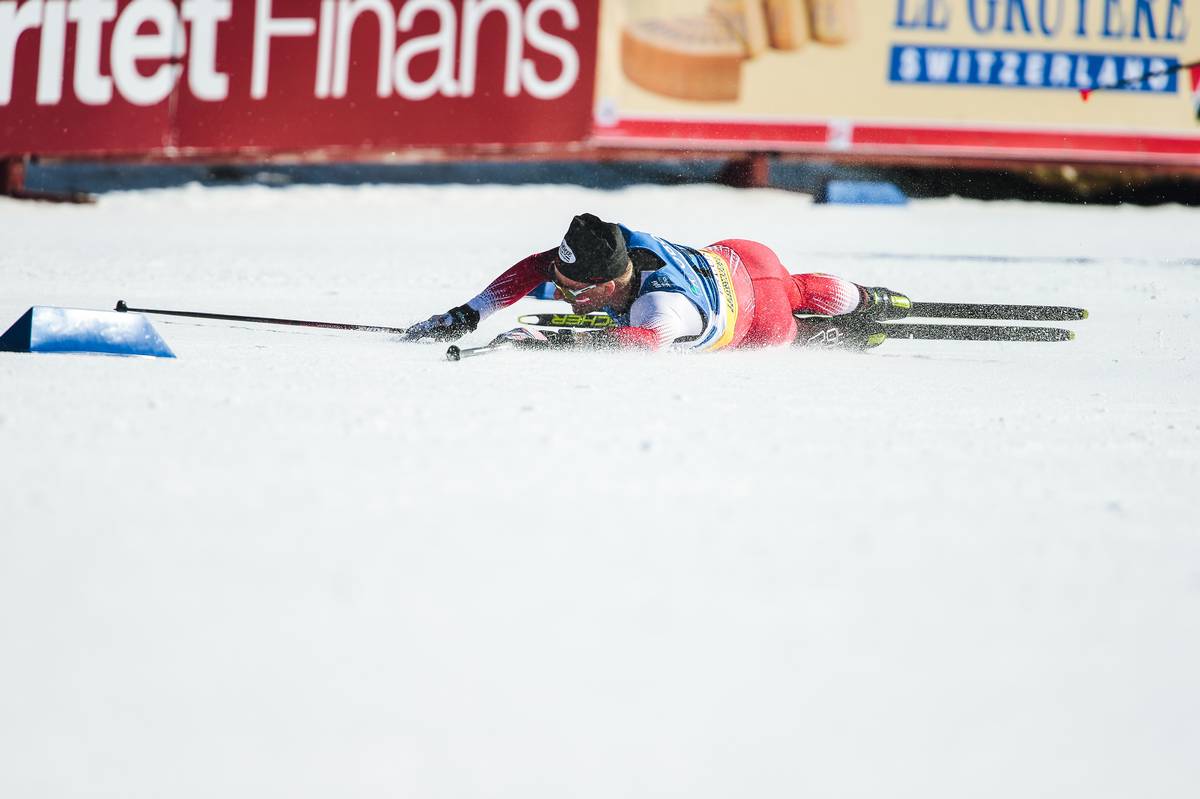
    Rewinding a bit, the women’s third lap saw Fähndrich shoot off the course in the same fashion as Moser. Minutes later, Joni Maki of Finland I and Harald Østberg Amundsen of Norway I both went down on the corner entering the exchange area. A quick recovery by Amundsen ensured that his team stayed in the race but Maki and his partner Jasmi Joensuu were eliminated, along with Fähndrich and Janik Riebli for Switzerland. 

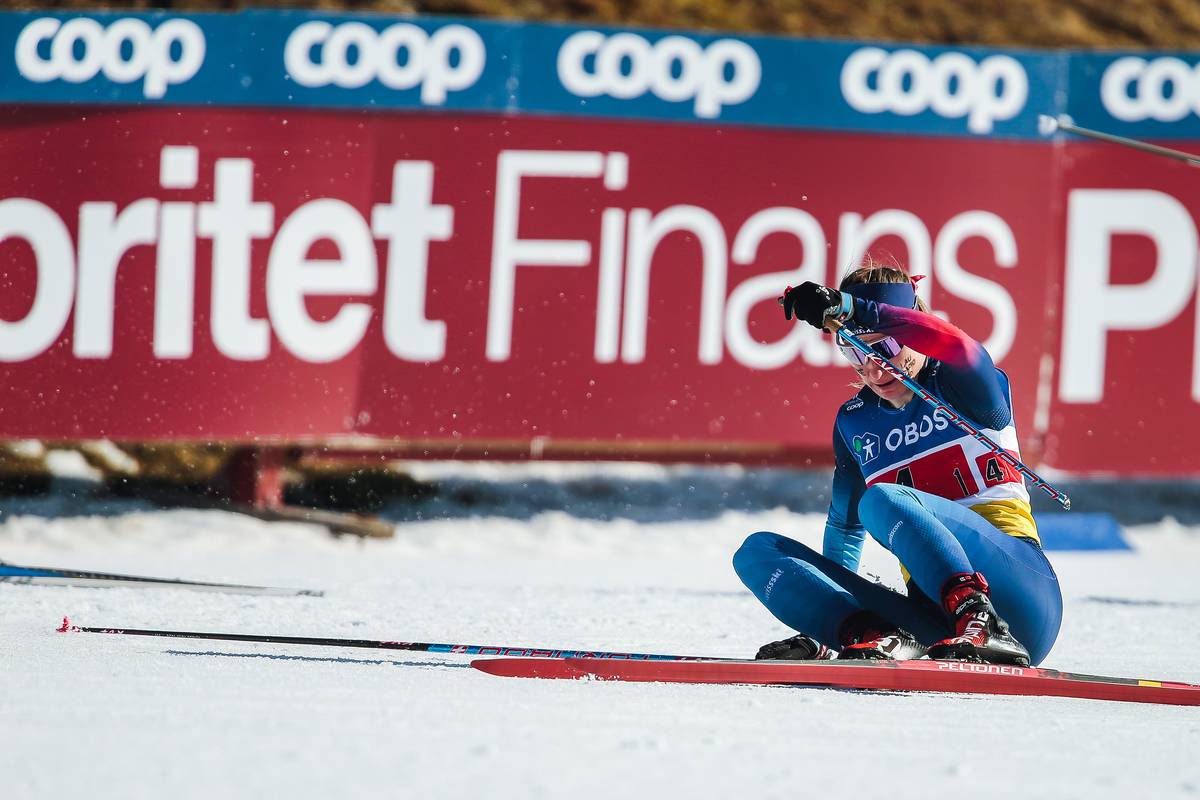
    Nadine Fähndrich (SUI) picks herself up after a fall during the mixed team sprint event (Photo: NordicFocus)

    The fourth round of elimination took out Slovenia and Finland II, though due to the tight nature of the eliminations, the women were starting unless it was clearly evident that they were one of the last two. Thus we saw Anamarija Lampic (SLO) battling Tiril Undes Weng of Norway II for second, even though Slovenia had already been eliminated. 

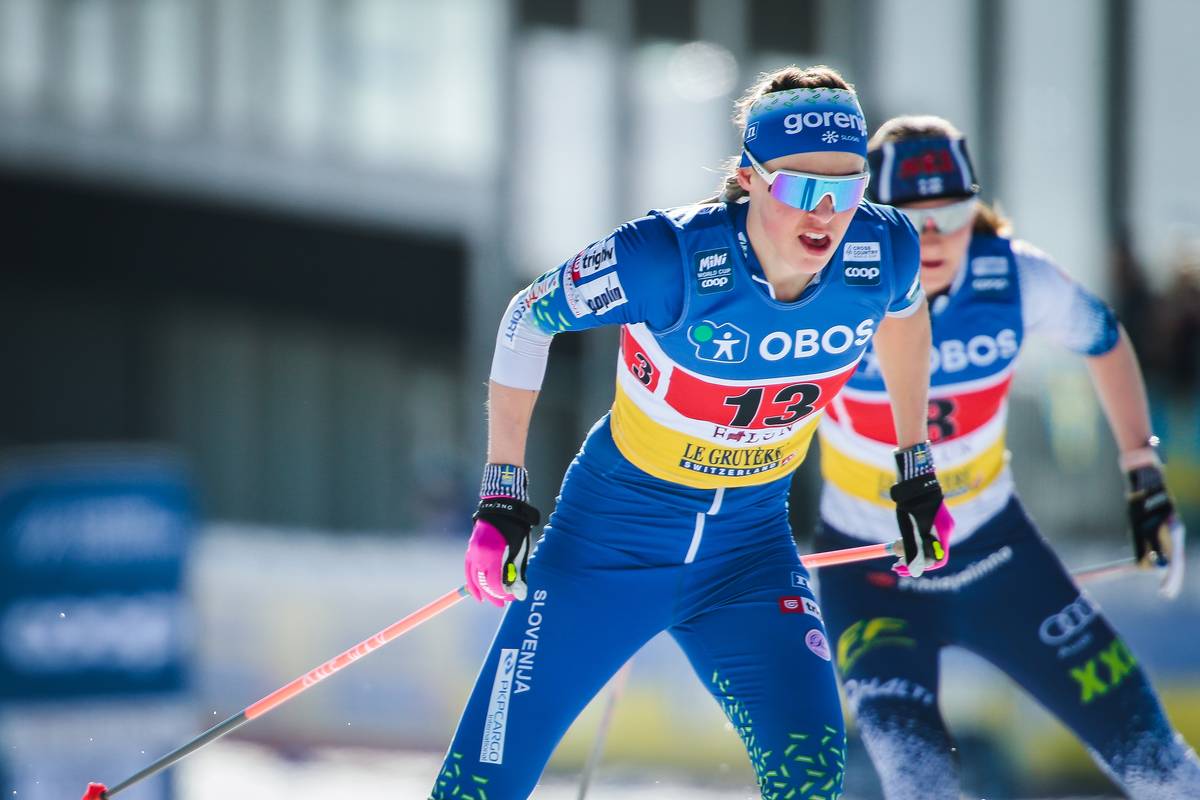
    Anamarija Lampic (SLO) teamed up with Vili Crv (SLO) for the mixed team sprint (Photo: NordicFocus)

    Entering the 10th exchange and the fifth elimination, Sweden I was 19 seconds ahead, with Norway I and II duking it out behind. This meant that it was the twins, Tiril and Lotta Udnes Weng battling each other for their final lap.

    With Canada II and France I eliminated, the men took off for their sixth and final lap. Amundsen of Norway I was just ahead of Martin Nyenget of Norway II, though entering the stadium Nyenget used the slip stream to move in front of his compatriot. With Sweden I well across the line in gold medal position, a tight sprint between the two Norwegians ultimately went to Nyenget, meaning Norway II earned silver and Norway I came away with the bronze. 

    Harald Østberg Amundsen (NOR) and Martin Loewstroem Nyenget (NOR) during the early stages of the mixed team sprint (Photo: NordicFocus)

    Italy with Nicole Monsorno and Federico Pelligrino finished fourth. Sweden II ended up fifth, and Germany I came in sixth. Canada I (Dahria Beatty and Graham Ritchie) were the last team to avoid elimination and finish in seventh. 

    Dahria Beatty (CAN) and Graham Ritchie came in seventh in the mixed team sprint (Photo: NordicFocus)

    With the last race of the day complete, the World Cup season has come to a close. For North-American ski fans, Canadian Nationals will be combining with US Super Tour Finals for a culminating event series in Whistler, Canada. The racing begins March 20th and you can find more details about the event here. 

    Results: Mixed Team Sprint

  • U23 World’s Mixed Relay Rundown

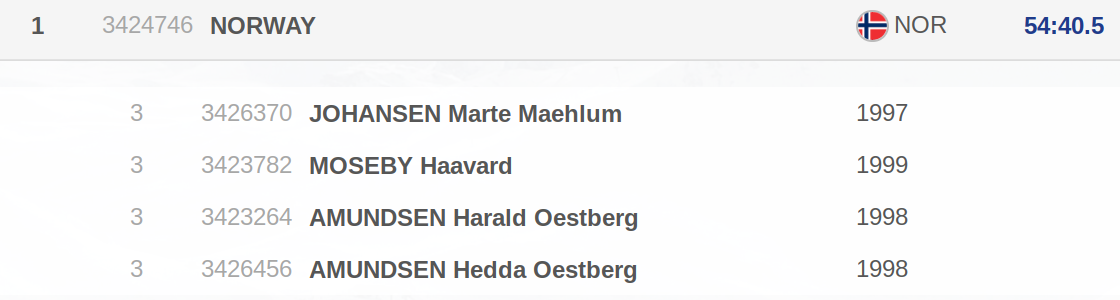
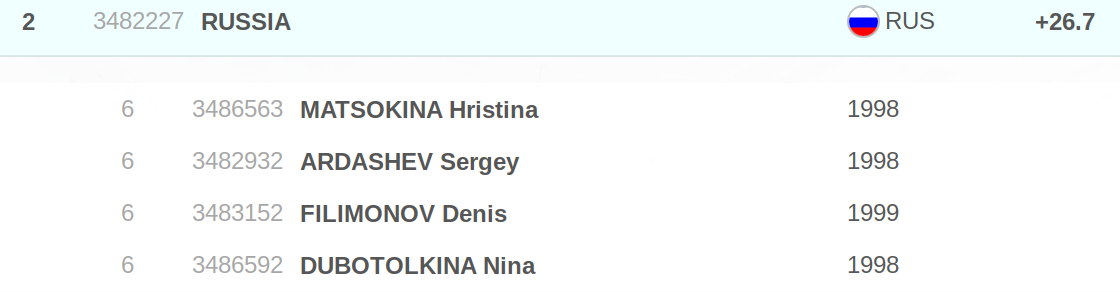
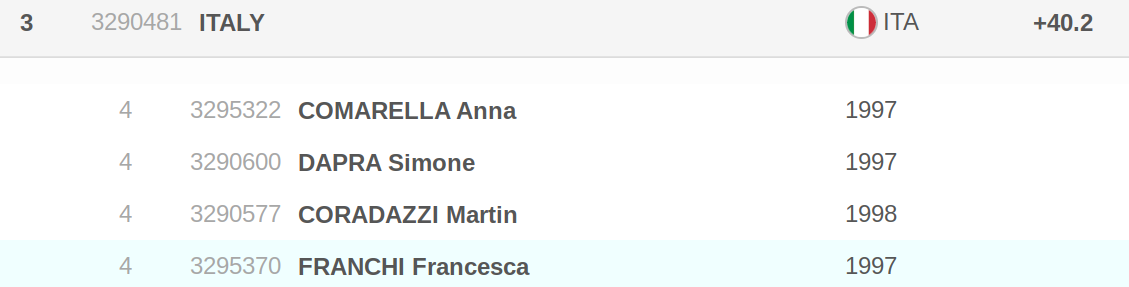
    U23 World’s closed out today in Oberwiesenthal, Germany with the 4 x 5 k mixed relay. Norway, which had struggled in both the junior women’s and junior men’s relay won in 54:40.5 minutes. Russia followed in second (+26.7), and Italy third (+40.2).

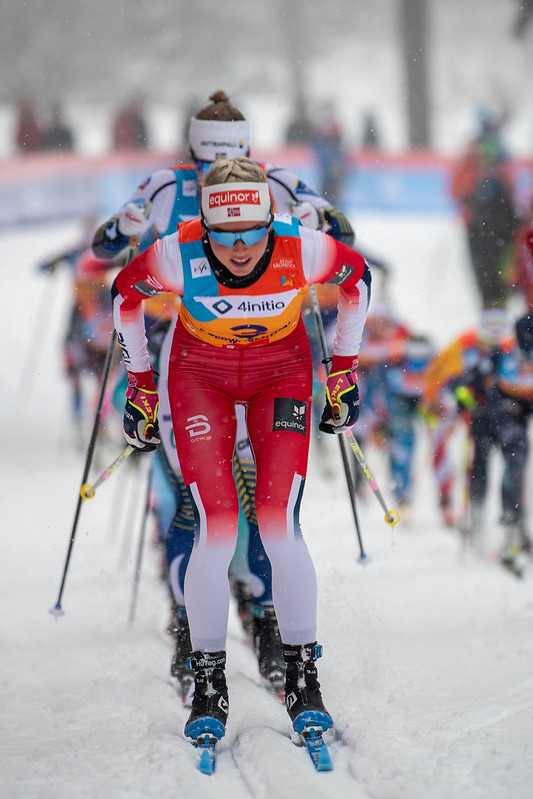
    Norway’s Marte Mæhlum Johansen of Norway at the start of the U23 4 x 5 k relay. (Photo: Doug Stephen)

    The U.S. placed fifth (+54.6) of the 15 teams finishing the event.

    Hailey Swirbul (bib 5) and Sweden’s Moa Olsson (bib 2). (Photo: Doug Stephen)

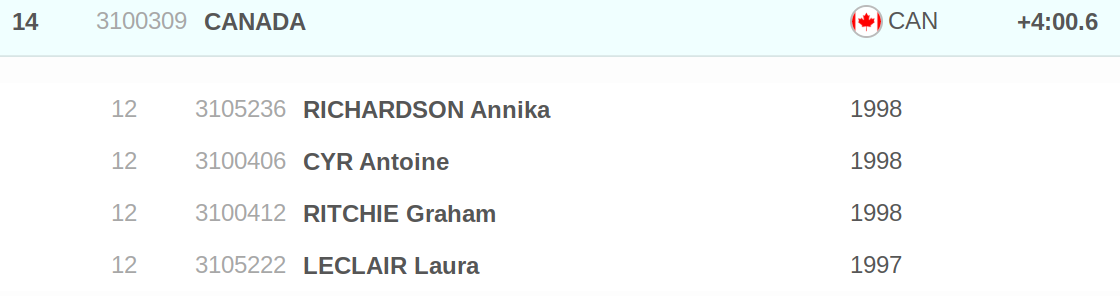
    Canada’s foursome of U23 skiers finished in 14th (+4:00.6).

    Results

  • Closing the Gap: A Game of Seconds

    Closing the Gap: A Game of Seconds

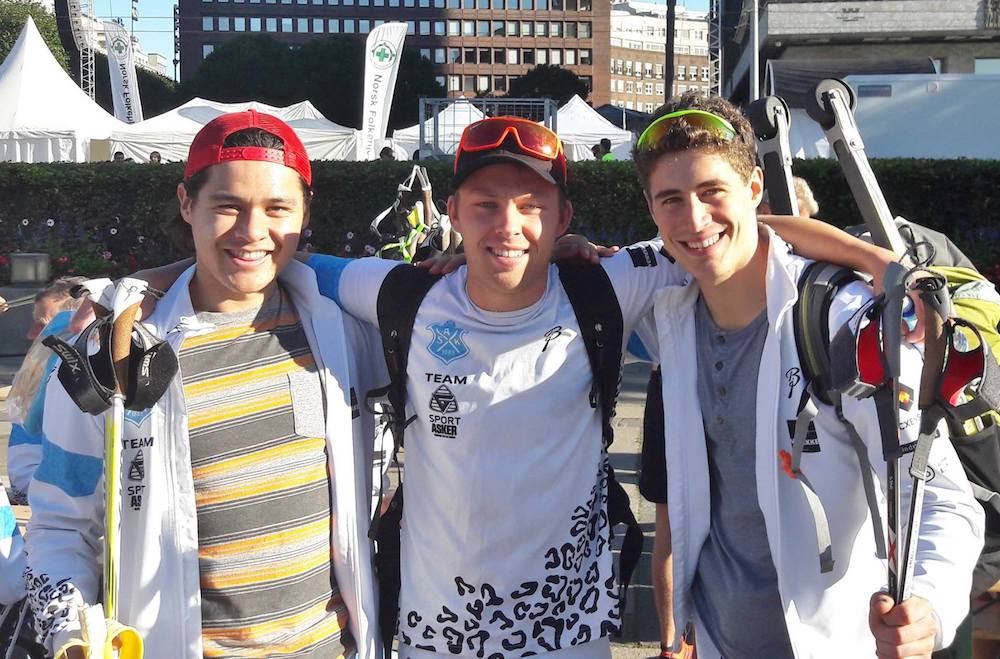
    Canadians Ryan Jackson (l) and Maks Zechel (r) with Team Asker coach Ola Kvisle at the Oslo Marathon 10 k rollerski race in Oslo, Norway. (Photo: Anne Haarstad)

    Editor’s Note: The following is part of a series proposed by Maks Zechel, a 20-year-old Canadian cross-country skier embarking on his first season training abroad. In August, he recently made the big move to Norway, where he’ll be training and racing with Team Asker for the entire winter. Through these updates, Maks hopes to share his personal “observations, stories and lessons learned” to help close the gap between North American and Scandinavian nordic skiing. Previous posts: #1, #2, #3, #4, and #5.

    ***

    It was a typically frigid day of January ski racing in Thunder Bay, Canada (any Canadian cross-country skier will have grimaced just from reading that). Halfway through the A-final of the Ontario Cup U16 classic sprint, I was already far behind the leaders, Tony Gunka and Ryan Jackson. The previous day I had won the distance classic race, my first ever “O-Cup” medal, finishing only three seconds ahead of Ryan, and now my expectations were higher than ever. The margin between us in the qualifier that morning? Three seconds.

    Swinging around a fast corner into the last big climb of the race, already out of contention for the win, I looked at the ground in front of me and just skied as hard as I could. I had nothing to lose, so I skied my best. As I crested the hill, I suddenly noticed that I had caught Ryan and Tony and was dropping them. Elated by the empty track ahead, I double poled as hard as I could.

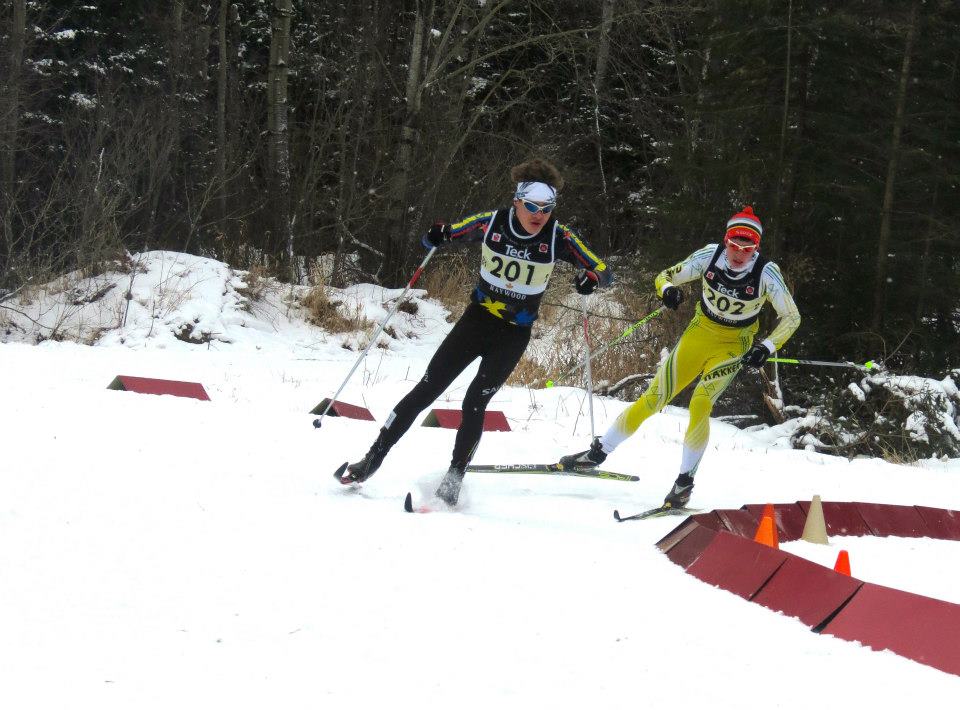
    Ryan Jackons (front) and Maks Zechel turning the final corner during a 2013 classic sprint in Thunder Bay, Ontario.

    Suddenly, Ryan and I were neck-and-neck again. We turned the final corner and could see the whiskers marking the finishing lanes, tantalizingly close. Side by side, neither of us able to see, just focusing on slamming those poles down. We remained stubborn until the finish, with Ryan pulling in front right before the line.

    The remainder of the season continued in much the same way, and strangely the margin between Ryan and I in most of our races, no matter the distance, was three seconds. We didn’t know it at the time, but every time one of us lost to the other, we both won.

    Since that year, Ryan and I have been close friends and competitors, even roommates for a year. We have both had good and bad years of results, but I have continually been inspired to push my own limits by his work ethic and accomplishments. On Sept. 15, Ryan joined me here in Norway, where we begin our latest venture to see how fast we can become.

    Ryan arrived in the middle of my second testing week with Team Asker, where I was happy to achieve new personal bests in the uphill running test, skate time trial (not too difficult as I went the wrong way last time…), and the double-pole sprint qualifier. Most of these improvements are likely due to being more familiar with the courses and being more comfortable here, but regardless it was nice to move forwards.

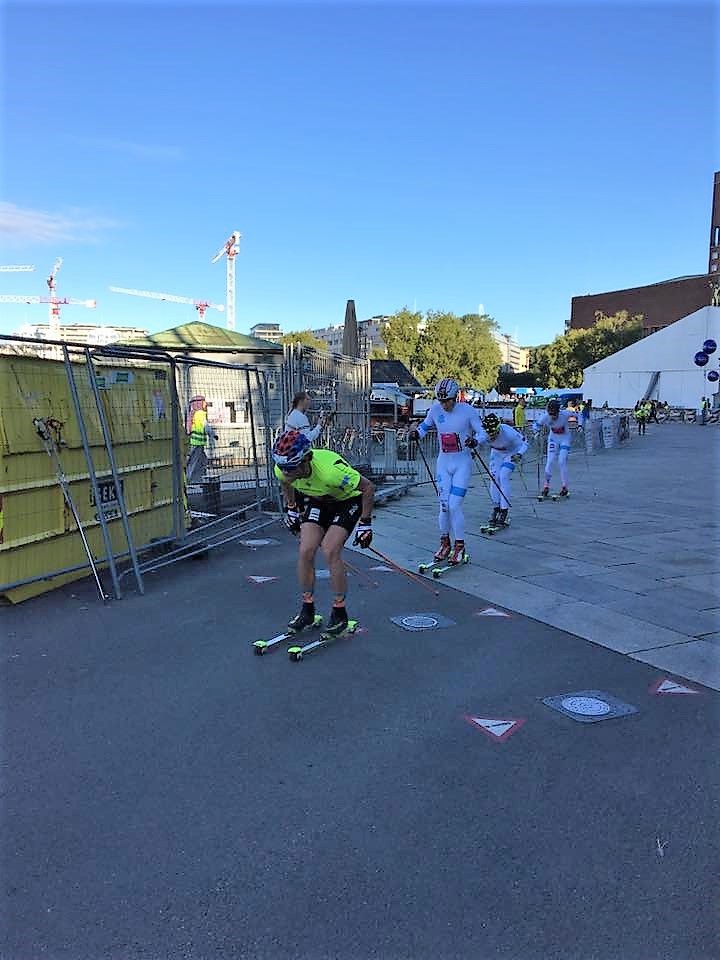
    Testing week was highlighted by the replacement of our regular uphill double-pole test with a 10-kilometer classic rollerski race in downtown Oslo, as a part of the Oslo Marathon race weekend. The week prior to this race, Team Asker held a 10 k qualification race, where the top-10 Asker skiers were selected to race in the Oslo Marathon for the team prize of $30,000 NOK (approx. $4,673 Canadian). This qualification race was the most tactical rollerskiing race that I have ever competed in. About 16 of us raced eight laps of a mostly flat 1.4 k loop. Like a road-biking race, positions were constantly changing. It was great for me to practice staying calm and absorbing speed changes so as not to waste energy, but I still regularly found myself catching up to the lead pack after being “accordion-ed” off the back of an attack. Having been sick that entire week, I didn’t have an excellent race, but it was enough for me to qualify (see a video of the race, and me flying off the course on the first lap, below).

    The night before the Oslo Marathon was not the usual quiet, pre-race evening. Having crossed the finish line of the uphill running race at around 7 p.m., I biked home where I met Ryan and helped him settle in for his first night in Norway. A long pre-race sleep was quickly lost to our excitement of having finally both made it to Norway, a trip that has been in various stages of planning since we first discussed the idea on an offseason run through Vincent Massey Park in Ottawa two years ago.

    After a short night, we were out the door before 7 a.m. to take the train to Oslo for a 9 a.m. race start. The big stress that morning was how we would survive the race without suffering broken limbs or equipment. I had skied the course the weekend before with Team Asker, and in just that easy ski through the streets of Oslo, we broke three pole tips. The race organizers were predicting that 50 percent of the field would break poles.

    I thanked the “ski gods” for the perfect sunny day and dry pavement that the morning had brought, as I outlined the obstacles of the race for Ryan: a fast downhill right after the start leading into a sharp turn and funneling the race through a narrow, cobblestoned street guarded by waist-high posts in the middle of the race course; multiple stretches of streetcar rails; sewer grates and small curbs to be hopped; more sections of cobblestones; and a downhill finishing stretch marred by manhole covers and pavement dished out by years of traffic. Oh, and then we had to jump two tall timing mats across the finish line. At least road cyclists can use bikes designed for cobblestones when they race Paris-Roubaix, not so with rollerski wheels that fit perfectly between cracks. It was an excellent opportunity to work on agility while racing with 60 other skiers and being filmed by NRK … at least that’s what I told myself. (See course preview below)

    https://www.youtube.com/watch?v=0i7U4lvBXOY&feature=youtu.be

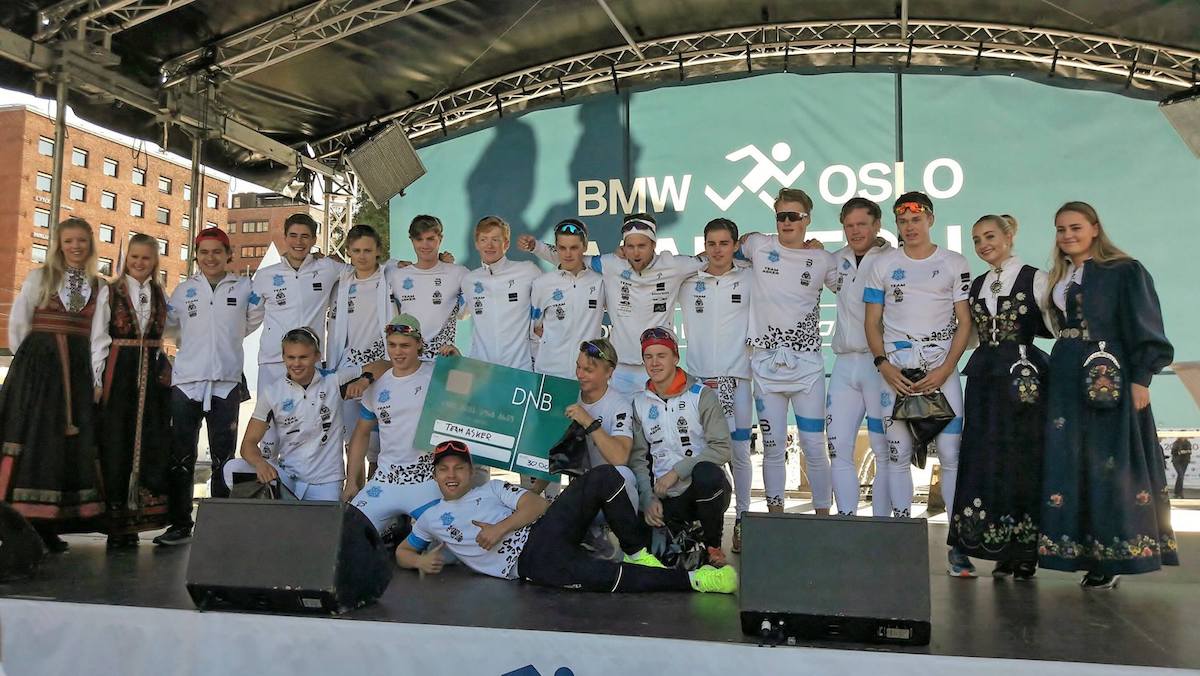
    In typical skier fashion, we complained a lot about the race conditions until the race started, the field spread out and it ended up being surprisingly easy for most people to stay on their feet. Our team raced well and we won the team competition, with teammates Erland Kvisle and Harald Amundsen coming third and fourth behind Junior World Championships medalists Thomas Helland Larsen and Magnus Kim. Andrew Young, a World Cup sprint medalist, was fifth. I finished 18th, 1:45 minutes behind the winner.

    Part of the lead group at the Oslo Marathon 10 k classic rollerski race on Sept. 16 in Oslo, Norway. (Photo: Sindre Ryan)

    How do I react to these results? I finished 19 seconds behind the winner in the qualification race and 1:45 back in the Oslo Marathon, both against world-class competition. On the outside, these margins seem like nothing, but in reality they represent a massive gap between where I am now and where I hope to be in the coming years. It is easy to dismiss seconds as being irrelevant, but these seconds mean everything in the winter. This winter, 19 seconds in a 10 k race at a Scandinavian Cup could mean the difference between finishing in the top 50 and finishing in the top 100. If I am unwilling to fight for those seconds now, then the winter’s results will reflect that. To close a gap of seconds, it will require a lot more than just improving my recovery strategies or drinking a litre of beet juice a day. My fight for seconds has to be taken to every interval session and time trial and become a mantra taken into race season.

    It may not be such a big gap now, but come winter, this game of seconds will become a real life battle for minutes. For Ryan and I, this is nothing new, but now the stage is bigger than ever before. To come three seconds behind the other will mean ten spots on the results sheet. It is a daunting reality for any skier, but I am lucky to have a friend from home to pursue these challenges with. In a foreign place, teammates and friends are more than just people to hang out with — they’re family.

    Norwegian Phrase of the Week

    It’s not the fart that kills you, it’s the smell. – Petter Solberg

    Translation: It’s not the speed that kills you, it’s the slam (crash).

    *A quote from Norwegian professional rally car racing legend, Petter Solberg, known for speaking “Noglish” (Norwegian-English), resulting in excellent quotes lost in translation.*

    Team Asker on the podium after winning the team competition at the Oslo Marathon 10 k classic rollerski race on Sept. 16 in Oslo, Norway. (Photo: Anne Haarstad)

    ***

    About Maks: Maks Zechel is a competitive cross-country skier who secretly wants to become a professional mile runner. He loves hiking and going on canoe trips with his family, as well as peanut butter cups in ice cream. Johan Olsson is his favourite skier and he hopes to race the Cortina-Toblach stage of the Tour de Ski one day. He enjoys writing about his experiences. Follow him on Instagram @makszechel.

  • Closing the Gap: Lessons in Risk Taking and VO2 ‘Maks’ Testing

    Closing the Gap: Lessons in Risk Taking and VO2 ‘Maks’ Testing

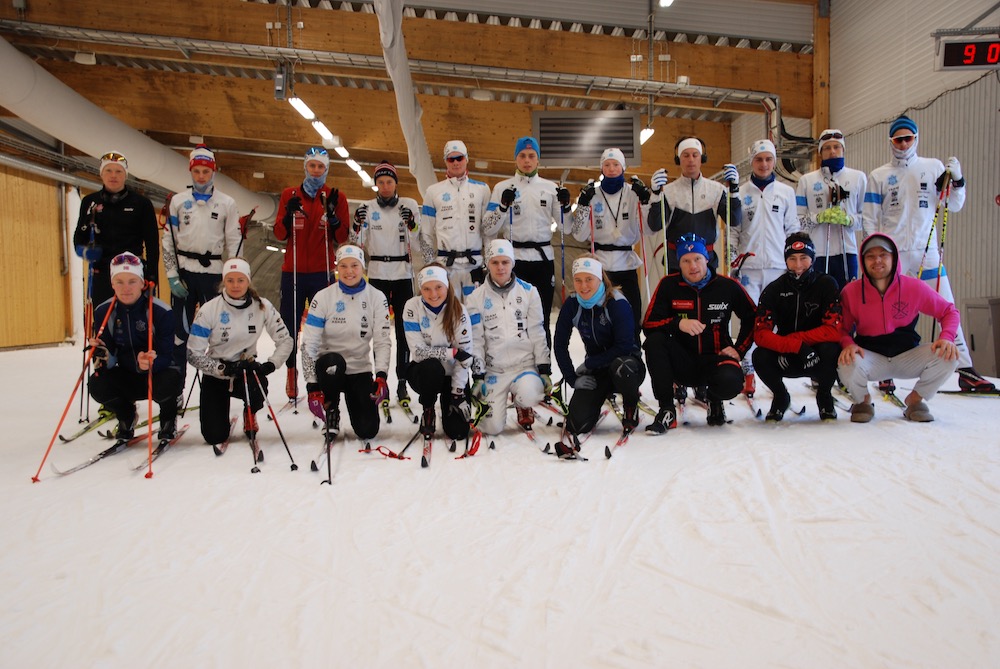
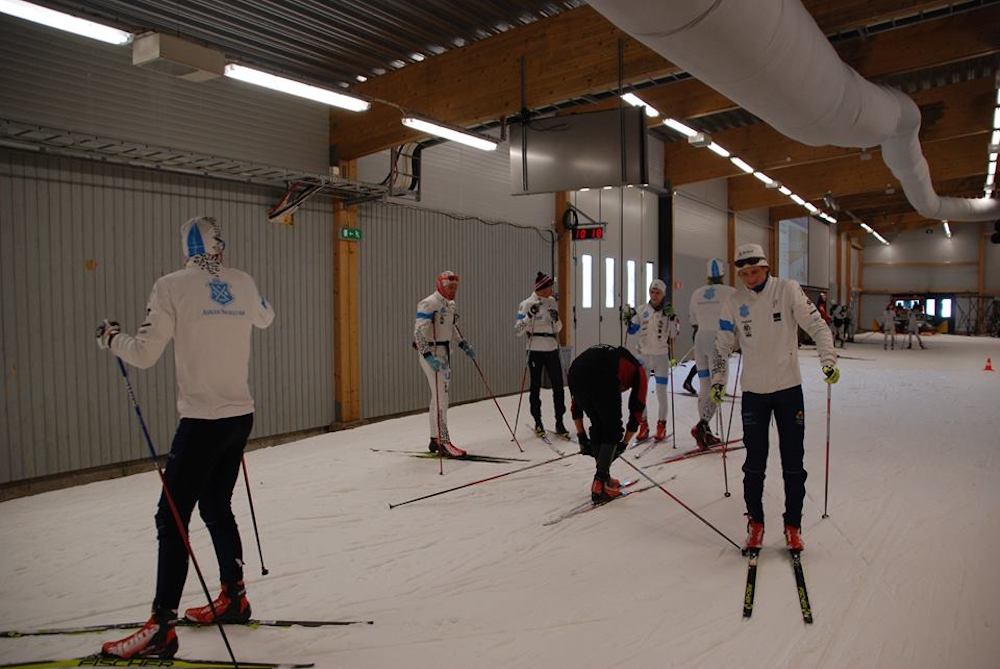
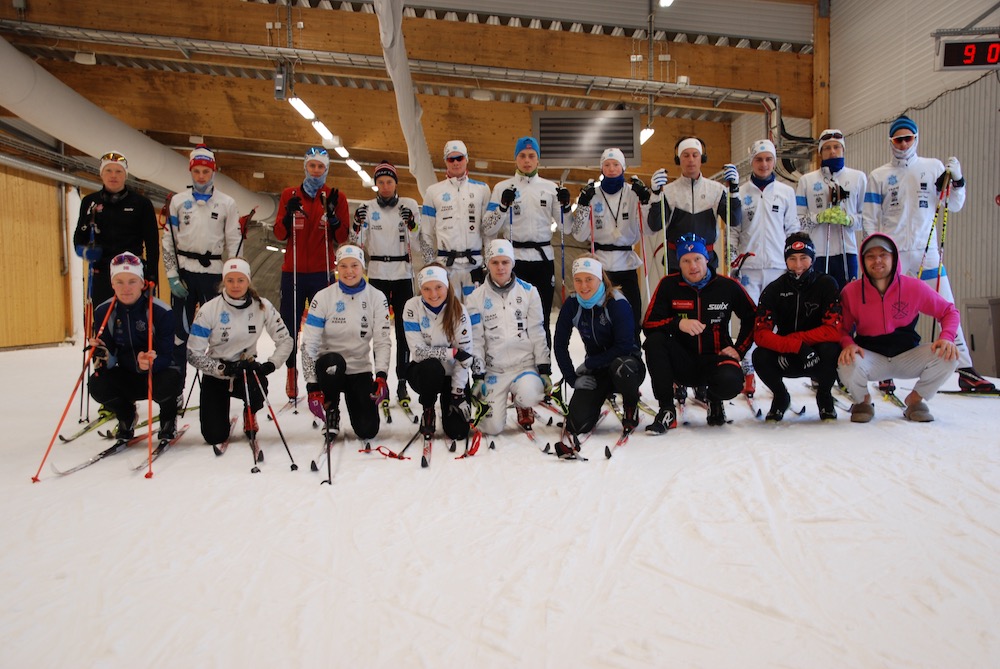
    Team Asker gets together for a group shot in the ski tunnel in Torsby, Sweden. (Photo: Johanna Lier)

    Editor’s Note: The following is the fourth post in a series proposed by Maks Zechel, a 20-year-old Canadian cross-country skier embarking on his first season training abroad. He recently made the big move to Norway, where he’ll be training and racing with Team Asker for the next nine months. Through these updates, Maks hopes to share his personal “observations, stories, and lessons learned” to help close the gap between North American and Scandinavian nordic skiing. Previous posts: #1, #2, #3, and #4.

    ***

    I never thought that on my 20th birthday I would be shivering at the top of a ski resort, a thick fog obscuring the spectacular view of Oslo, listening to 30+ Norwegians sing the Norwegian birthday song for me. But I guess turning 20 was bound to be different!

    “No more excuses,” was my first thought. Gone is the security of being a teenager. Rather than impressing people with maturity, it now feels like it is expected. I think it’s a good thing, but it doesn’t make being an adult any easier. My trip to Norway has been full of moments when I suddenly realized, “Oh, I guess I’ll just have to figure this out on my own.” My parents are no longer always present to make introductions, so now it is up to me to advocate for myself. Risks taken as an adolescent do not come with the expectation to produce results. “I’m impressed,” people say, and they applaud you just for trying. But adults are expected to see things through to completion.

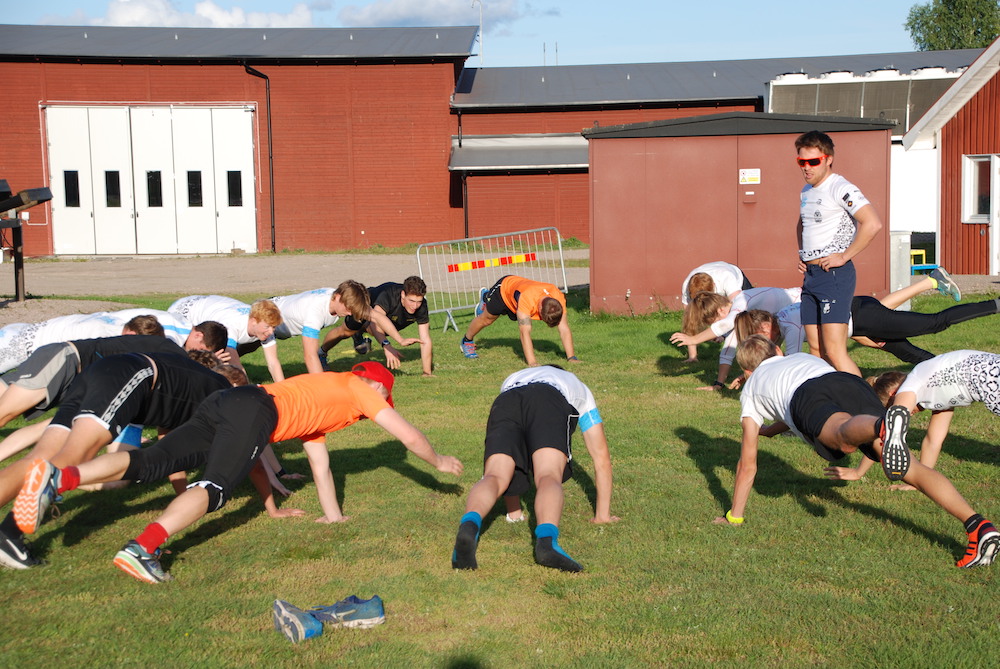
    Team Asker group core session after a ski in the tunnel in Torsby, Sweden. (Photo: Johanna Lier)

    Back on a cold, foggy Norwegian ski slope at the end of August, my teammates and I were about to tackle 6 x 6 minute Zone 4 bounding intervals. In Norway, bounding with poles is called elghufs, or “moose-hooves”. I had never done a bounding workout of this duration and intensity. Despite this, I decided to take a risk and stick with the best runner on the team, who was two and a half minutes faster than me on our last uphill running test. I stuck with him from the first interval, and stayed with him as he threw in big surges on the plateaus between climbs. He added these surges because he is trying to get better at working the flat sections of ski races in the winter, which happens to be one of my goals as well. We did the whole workout together, and I stayed with him until he got away on a downhill and a steep climb at the end. I took a risk in a workout, not caring if I blew up halfway through, and it allowed me to train at a higher intensity than I would have thought possible.

    Earlier this summer I listened to a “TED Talk” by Eduardo Briceño on “the learning zone and the performance zone”. At first it didn’t seem like a life-changing lesson, but since I arrived in Norway, his ideas have led me to think differently about my actions, and in particular, my training. Briceño discusses how people, from office workers to athletes, fail to improve at what they do, whether it is a hobby or a job, because they do not give themselves the opportunity to take risks, make mistakes and learn. In our society, the “performance zone” is the default; this is where we only do the things we are comfortable with, because we want things to be perfect, because that is how we envision our end goals to turn out. Briceño argues that we should encourage employees, athletes, and ourselves, to spend more time in the “learning zone,” where we break our ideal performance into the things we need to work on to get there. It is only here that we get better, because it is here that we allow ourselves to try things that we would otherwise never attempt for fear of failure. In the learning zone, risk and creativity produce the most astounding results. Having reached higher comfort levels, it is possible for someone to apply their repeated failures and lessons-learned to a better end result.

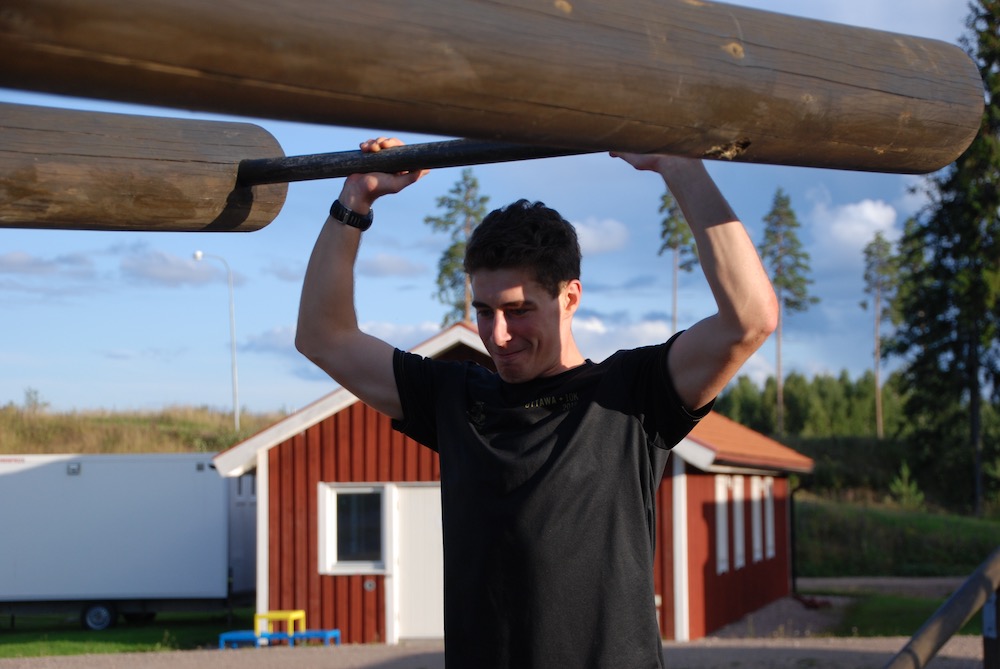
    Author Maks Zechel doing pull ups: “the most popular Norwegian strength exercise.” (Photo: Johanna Lier)

    A few days after “birthday elghufs”, Briceño’s ideas come back to me as I am training in the ski tunnel in Torsby, Sweden. I am back here for a long-weekend training camp with Team Asker. In the tunnel I confront a skiing related fear of mine, developed over a few years of poor performances in classic races. I dread the feeling of my grip giving way while striding up a hill. I am determined to become a better classic skier, the technique I was strongest in when I was younger, so I work hard at anything that I believe will make me a better classic skier: bounding intervals, core, double poling, hours of video technique work, and skiing without poles. If I can ski up a hill legs-only, then surely I can do it with poles in a race, right? Whenever I am on skis, I challenge myself to stride up the steepest hills without poles, but it becomes a challenge that I must perform to perfection, otherwise in my mind I have failed as a classic skier. The pressure that I put on myself leads me to shuffle stiffly and tentatively up hills, not allowing myself any room for error. The result is a poor imitation of the principles of classic skiing, lacking any weight shift, pop in the ball of my foot, or ankle compression. Sure, I made it to the top of the hill, but I didn’t summit the mountain.

    On our first morning in Torsby we have a distance classic ski in the tunnel. Rather than skiing slowly around the tunnel for a couple of hours, our coach has added some variety to our workout: one lap legs-only, one lap thinking about good striding on the hills (not thinking about heart rate), and one lap with a short “race pace” acceleration. The variety in this workout is important in early season skiing so that we can take advantage of our short time on snow to train our muscle memory to ski properly, getting rid of lazy habits developed while rollerskiing.

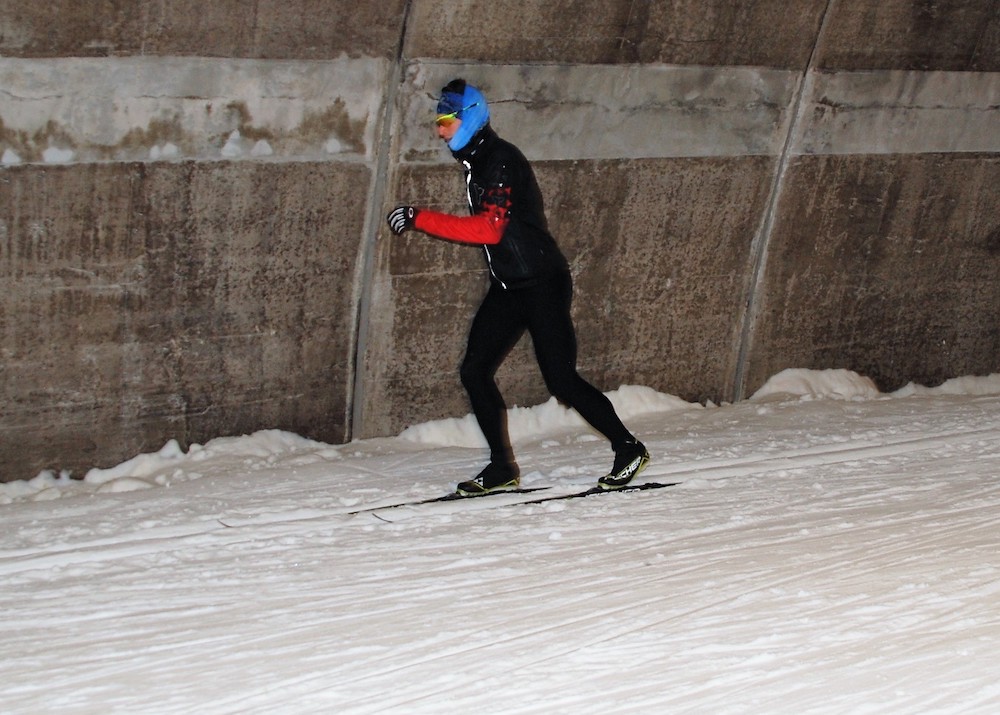
    Maks Zechel working on legs-only in the ski tunnel in Torsby, Sweden. (Photo: Johanna Lier)

    On my legs-only loops, I decide to take a risk. Instead of pressuring myself to make it up the entire hill, I ski as dynamically as I can, focusing on full commitment to each ski and compressing the wax pocket as if I had perfect grip. Although frustrating, I know that it is better for my development to ski properly up half the hill, than to shuffle up the entire thing. A few times I am rewarded with making it to the top, and other times I almost face plant spectacularly in front of the Norwegian junior national team coach.

    The risk of embarrassment is one that I am willing to take. I made a decision to escape my comfort zone when I left Canada, leaving behind family, friends, and a team that I have trained with for nine years. I left behind the chance at another year of racing on the NorAm circuit and seeing marginal, or perhaps substantial, improvements up the results board. I was sick of feeling like there was an order to things. If I beat a friend of mine during a race, that meant that I had had a good day, but if someone finished ahead of me who I was supposed to beat, then the day was unsuccessful. To me, this type of racing environment was toxic, as I struggled through a season of failed expectations. I am fortunate to have had the means to come to Norway, where simple training aspects, things that had lost their magic over the years, are now bringing back the same giddy excitement that skiing originally gave me. I am in a place filled with potential opportunities, but now I need to have the guts to seize them.

    Team Asker reparing for an intensity workout in the ski tunnel in Torsby, Sweden. (Photo: Johanna Lier)

    While training in Torsby, we were lucky enough to be there at the same time as the Norwegian junior national team and national recruit team (a step below the national senior team), as well as Anders Gløersen, Charlotte Kalla, Stina Nilsson, and Hanna Falk. I watched some of the members of the recruit team doing offset sprints, and it was the fastest I have ever seen someone sprint on skis in real life. Rather than being intimidated, I felt almost relieved to watch some of my idols skiing this fast. The mystery was gone; this is how fast you have to ski to be great, as simple as that, and now I could spend the entire weekend shadowing some of the best skiers in the world.

    On our first day in Torsby I had the opportunity to do two things for the first time in my life: rollerski on a treadmill and take a VO2 max test (maximum rate of oxygen consumption). Naturally, because of my name, I prefer to say it in Norwegian: VO2 maks.

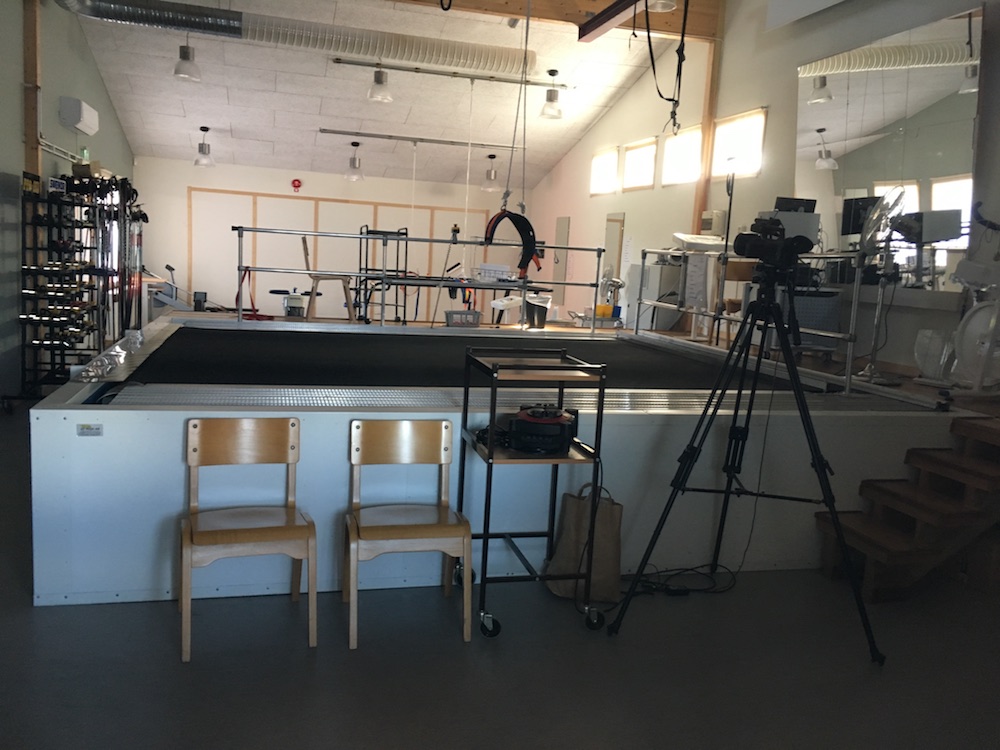
    After an initial stumble on the treadmill, I found it quite easy to classic rollerski on. Before the test started I warmed up on a few different gradients and speeds, unable to stop smiling at myself in the large mirror in front of me. Here I was, rollerskiing in the same laboratory that has tested countless World Cup skiers! The test began at a gradient of 10 percent and speed of 10 kilometers per hour, with the gradient increasing every minute until it reached 18 percent. This felt remarkably steep. From then on the gradient remained the same, but every 30 seconds the speed increased.

    The rollerski treadmill/testing lab in Torsby, Sweden. (Photo: Maks Zechel)

    During testing there is a harness around your waist so that you don’t fall off the treadmill, a heart rate monitor around your chest, and a mask strapped to your head to measure oxygen consumption. It’s a lot of gear hanging from your body, and your head has to remain relatively steady, but once the test started I found that the pain was an adequate distraction from all of this. Unfortunately, during my test a strap on my mask came undone and the mask fell off while I still had something left to give, so I was robbed of the chance to ski until collapsing (the skier’s dream). My VO2 max result was 74.5 ml/kg. Last year Harald Amundsen, the top skier on the team, reached a VO2 max of 85 ml/kg as an 18 year old (an exceptional result).

    Being in a new place, with a new team, and in close proximity to many of the world’s best skiers, there is a lot to take in. It is important for me to absorb as much as I can during my time here, but it is also important to stay consistent with things that I have been working on before I got here. If I jumped to apply every newly learned training philosophy to my training, I would be all over the place and have no chance to improve. I am allowing myself to take risks and make mistakes while staying true to some of the basics that got me to where I am. In the midst of so many talented and competitive skiers, I am trying to create a learning space for myself, devoid of expectations, so that I can learn without restrictions. When winter finally comes, I hope that I can translate my learning to some fast performances on skis. I have had a lot of practice translating after all…

    Norwegian Phrase of the Week

    Norwegian: Kan jeg få skyss?

    Translation: Can I have a ride?

    Norwegian: Kan jeg få et kyss?

    Translation: Can I have a kiss?

    *An important distinction that could add an unexpected twist to your ride to practice, as skyss and kyss sound almost exactly the same.*

    ***

    About Maks: Maks Zechel is a competitive cross-country skier who secretly wants to become a professional mile runner. He loves hiking and going on canoe trips with his family, as well as peanut butter cups in ice cream. Johan Olsson is his favourite skier and he hopes to race the Cortina-Toblach stage of the Tour de Ski one day. He enjoys writing about his experiences. Follow him on Instagram @makszechel.

  • Closing the Gap: Coming to Norway

    Closing the Gap: Coming to Norway

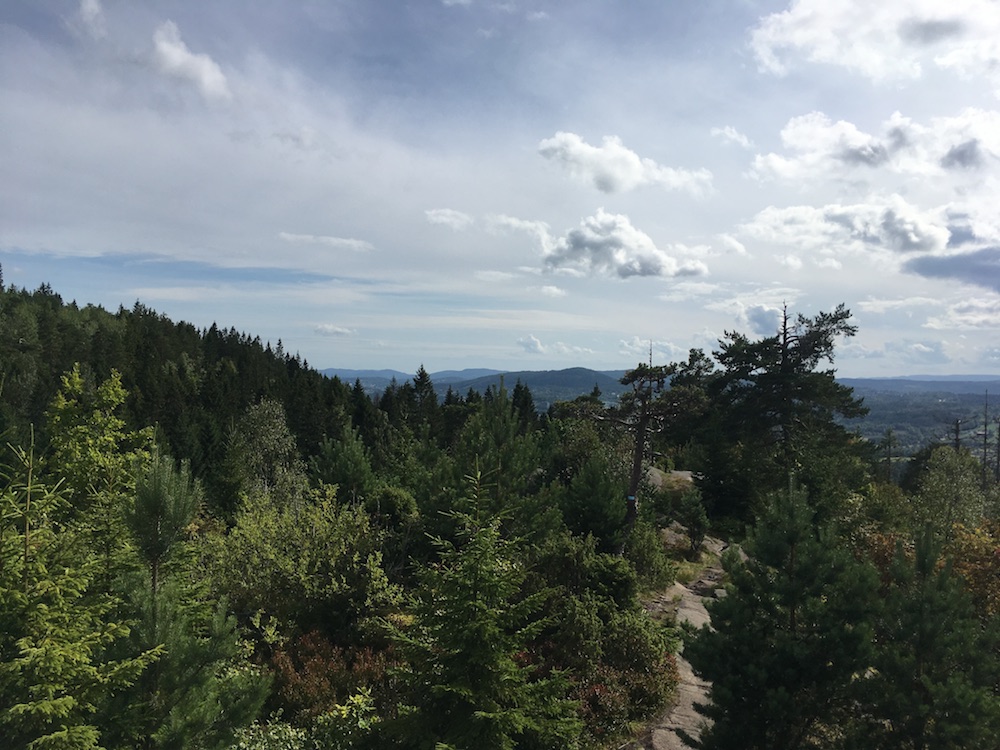
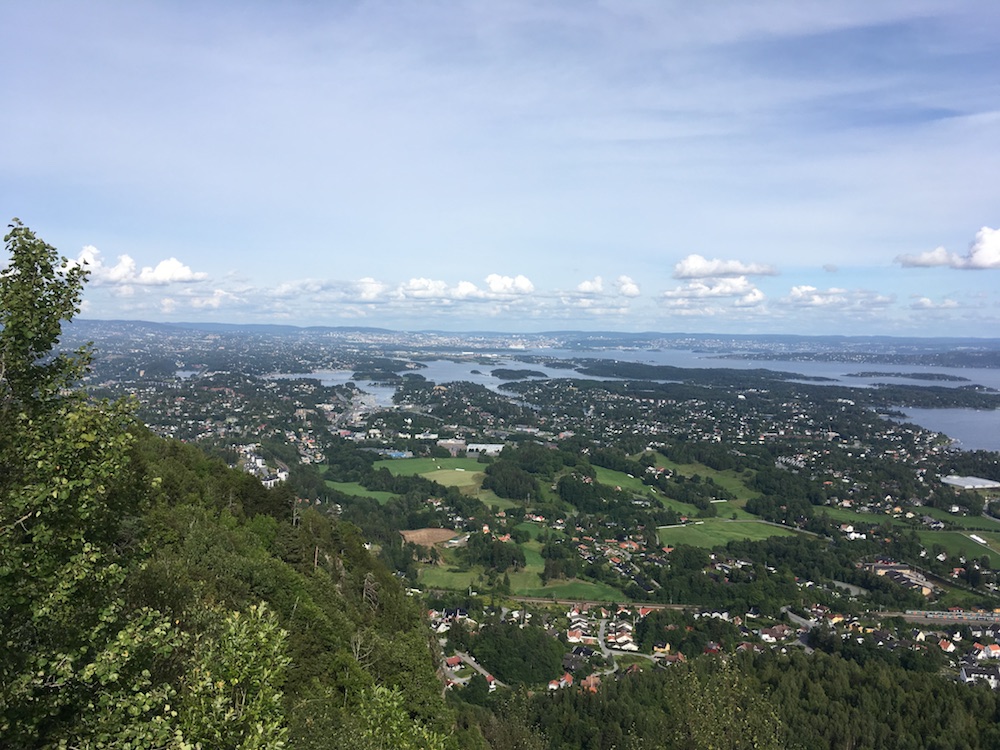
    The views from the running trails around Asker, Norway. (All photos: Maks Zechel)

    Editor’s Note: The following is the second post of a series proposed by Maks Zechel, a 19-year-old Canadian cross-country skier embarking on his first season training abroad. He recently made the big move to Norway, where he’ll be training and racing with Team Asker for the next nine months. Through these updates, Maks hopes to share his personal “observations, stories, and lessons learned” to help close the gap between North American and Scandinavian nordic skiing. Read Post #1.

    ***

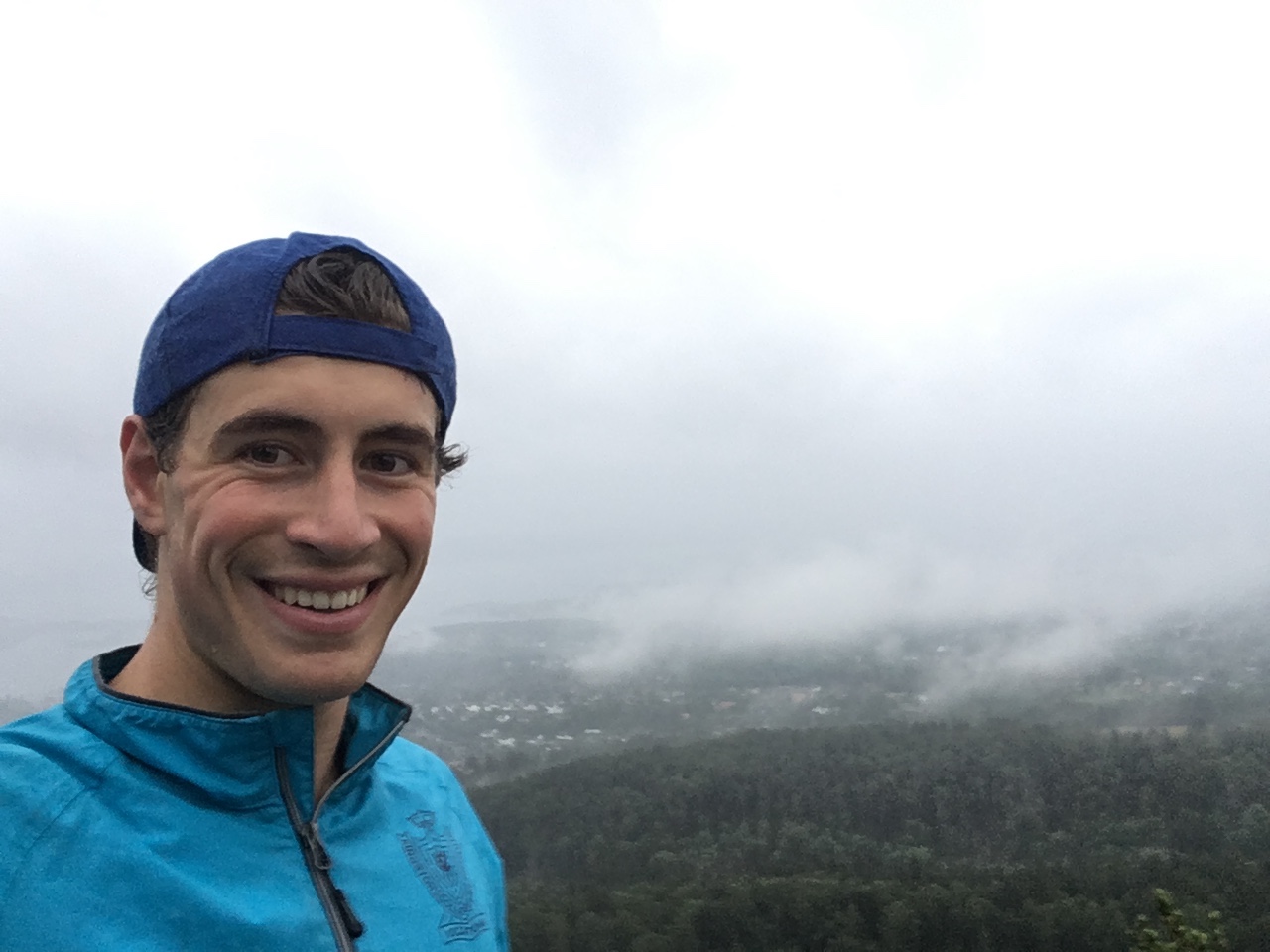
    Maks Zechel during his early days exploring Asker, Norway, his hometown until next spring. (Courtesy photo)

    Ideas: they pop into my head, always big, and they seem so simple at the time, but as soon as I take the first step, the path ahead becomes overwhelming. Many people know this right from the start, but I am continually learning exactly what it takes to bring wild dreams into existence. This year I found out that moving to a new country is not the smooth transition that I had pictured. I knew there would be challenges, but I did not expect to regularly feel that it was impossible for every piece to fall into place. Moving to Norway to train and ski race for a year may sound like a nice holiday, but it took many steps for me to get here. These included securing a visa, finding affordable accommodation, joining the ski team most likely to help me succeed, and navigating the ever-unpredictable world of language barriers and cultural differences.

    Visas can take one to three months to process and you usually need a good reason to be living in your destination (e.g. you have a job or are studying in that country). Canadians, like myself, can stay in Norway for up to 90 days without a visa. For longer stays, there is a special option for young Canadian adults that allows you to go to Norway for an “extended holiday” of sorts. I am lucky enough to have Swiss grandparents and to have lived in Switzerland for two and a half years, so before I came to Norway I went through the process of obtaining my Swiss passport (which was stereotypically efficient). As a Swiss citizen I am entitled to live and work in Norway as long as I register at a police station within three months of arriving and prove that I can support myself, have health insurance, etc. Figuring out visas can be intimidating when you get started, but there are many options and it helps to call or book yourself an appointment at a Norwegian embassy.

    Another difficult task is trying to find accommodations in a country where you do not know anyone. I looked for places primarily on www.finn.no and wrote several emails to potential landlords in both Norwegian (roughly translated) and English. I rarely received replies and had difficulties playing phone tag with various landlords. I recommend starting your housing search six months before you plan on arriving, as long-term renting options disappear quickly. In the end, I found a basement that an older couple was renting because my mum has a friend, who has a Norwegian friend, who has a colleague, who became one of my landlords. Lesson learned: use your connections, no matter how distant.
    Looking towards Oslo/Inner Oslofjord from “Skaugumsåsen”.

    Through connections at Nakkertok, I am fortunate to know John Halvorsen, a Norwegian citizen and former elite athlete — he represented Norway in the 10,000-meter at the 1992 Barcelona Olympics. John put me in touch with a few people in Norway who could explain how the Norwegian skiing world works and recommend clubs where I would have the most success.

    Naturally, my initial wish was to live in Lillehammer — host of the 1994 Winter Olympics (before I was born). Lillehammer is surrounded by endless rollerskiing, including multiple rollerskiing tracks; has a ski season beginning in October; is just 20 kilometers from Sjusjøen, legendary for its beautiful and endless ski trails; and home of the Lillehammer Skiklubb, the biggest club in Norway. It sounds ideal, but Lillehammer is different from most Norwegian towns and cities, where there are many small clubs instead of one big one. Lillehammer Skiklubb has had a lot of success and so it is difficult to join their team.

    I think that it is better to be an important member of a small team than an overlooked member of a large team. From talking to other Canadians, I have found that often the biggest deterrent they face in moving to Norway, or in the trip being successful, is that they are worried about being lonely. I knew that my best chance of success in Norway would be to form good connections with as many people as I could, which would help me get rides to training, allow me to have a better relationship with my coach, and help me make friends.

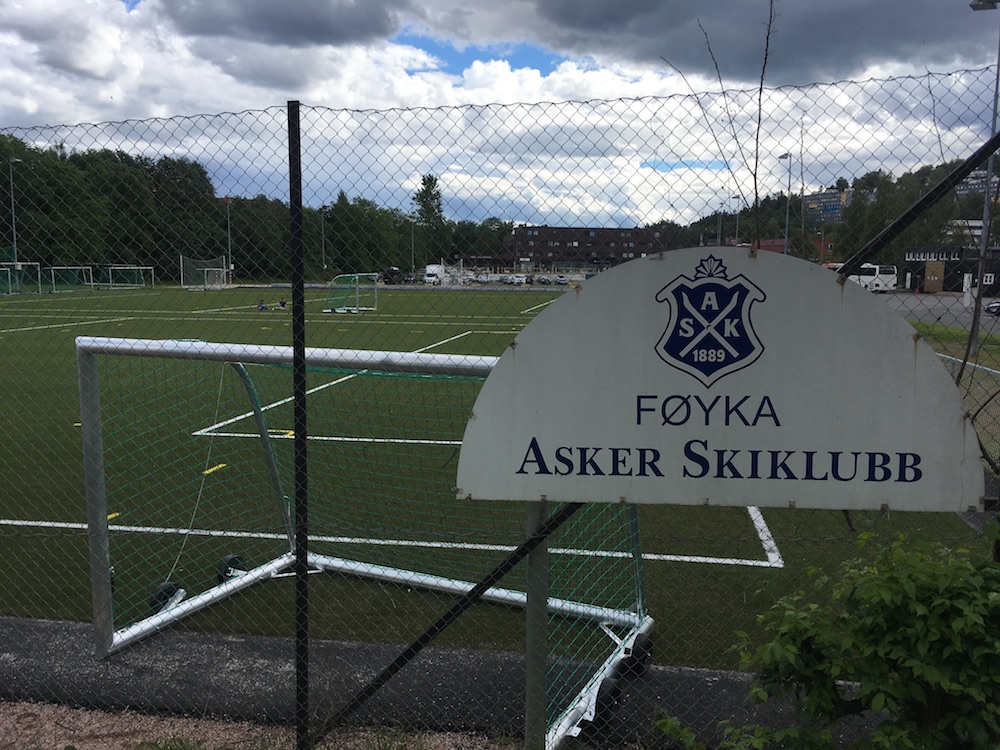
    Asker Skiklubb soccer fields

    Team Asker was recommended to me by John and a few other contacts in Norway. The club has about 25 athletes in its junior/senior program (large compared to most Norwegian clubs), including Harald Amundsen, a bronze medalist in the skiathlon and a member of Norway’s gold-medal winning relay team at the 2017 Junior World Championships at Soldier Hollow in Utah. From what I’ve seen in Germany and Norway, many European ski teams are based out of sports clubs. Asker Skiklubb has many different teams, from handball and bandy to track and field and ski jumping. This has its advantages, as Asker’s cross-country ski team has access to the club’s full-sized rubber track, multiple soccer fields, and a small rollerski track. Just 20 k southwest and 25 k northeast from Asker are the world-class rollerski tracks of Drammen and Holmenkollen, where Team Asker regularly does workouts. Through a parent of an athlete on the team, we also have access to a rollerski treadmill. There are many other strong programs near Oslo, including BSK Ski Elite (Bækkelagets Skiklubb’s junior/senior program) and Team Konnerud (known in Norway for its strong women’s team and hosting the Drammen World Cup).
    Asker Skiklubb has a…camping trailer??

    My flight arrived in Oslo on Aug. 1 and I have been living in my new home for two weeks now. Asker is a beautiful, although admittedly rainy town set against a hilly forest with endless running trails. Most of the area looks out over a portion of the Inner Oslofjord, an extension of the North Sea. The town is modern and bike friendly with paths everywhere, but it doesn’t fail to retain its traditionally European “at your own risk” character. In some places, Asker has bike paths the size of roads, and in others, there are roads that surely only a bike could navigate. Last week I was convinced I was biking along a “bikes and pedestrians only” path, raised and separated from the main road that it followed, only to meet a car pulling onto the path from its driveway. As I learn about Asker and Norwegian culture, I look forward to more surprises in the coming weeks … so long as those surprises don’t contain headlights.

    Norwegian Phrase of the Week:

    Cashier: Trenger du poser?

    (Translation: Do you need bags?)

    Me: Ughh, Mastercard, takk.

    (Translation: Ughh, Mastercard, thanks.)

    Cashier: Vil du kvitteringen?

    (Translation: Would you like your receipt?)

    Me: Ingen poser, takk!

    (Translation: No bags, thanks!)

    Cashier: …

    (Translation: …)

    Quick Tips for Moving Abroad:

    1. Make sure that your passport doesn’t expire until six months after your last day in your destination.
    2. Confirm that your health insurance covers you abroad. Furthermore, in Ontario, you have to get a temporary health card if you will be away for more than 7 months.
    3. Consider setting up a bank account once you arrive at your destination (foreign e-transfer fees are huge and ATM fees add up quickly when withdrawing cash regularly).
    4. Buy plug adapters and confirm that your devices/appliances work with the voltage ratings of your destination.

    Useful Websites:

    Norwegian Visas: www.udi.no

    Norwegian Rentals/Buy & Sell: www.finn.no  

    Team Asker (Asker): www.asker-skiklubb.no/Langrenn

    BSK Ski Elite (Oslo): http://ski.bekkelagets.no/p/14814/bsk-elite

    Konnerud IL (Drammen): http://konnerud.no/ski/gruppene/gruppe-15/

    ***

    About Maks: Maks Zechel is a competitive cross-country skier who secretly wants to become a professional mile runner. He loves hiking and going on canoe trips with his family, as well as peanut butter cups in ice cream. Johan Olsson is his favourite skier and he hopes to race the Cortina-Toblach stage of the Tour de Ski one day. He enjoys writing about his experiences. Follow him on Instagram @makszechel.