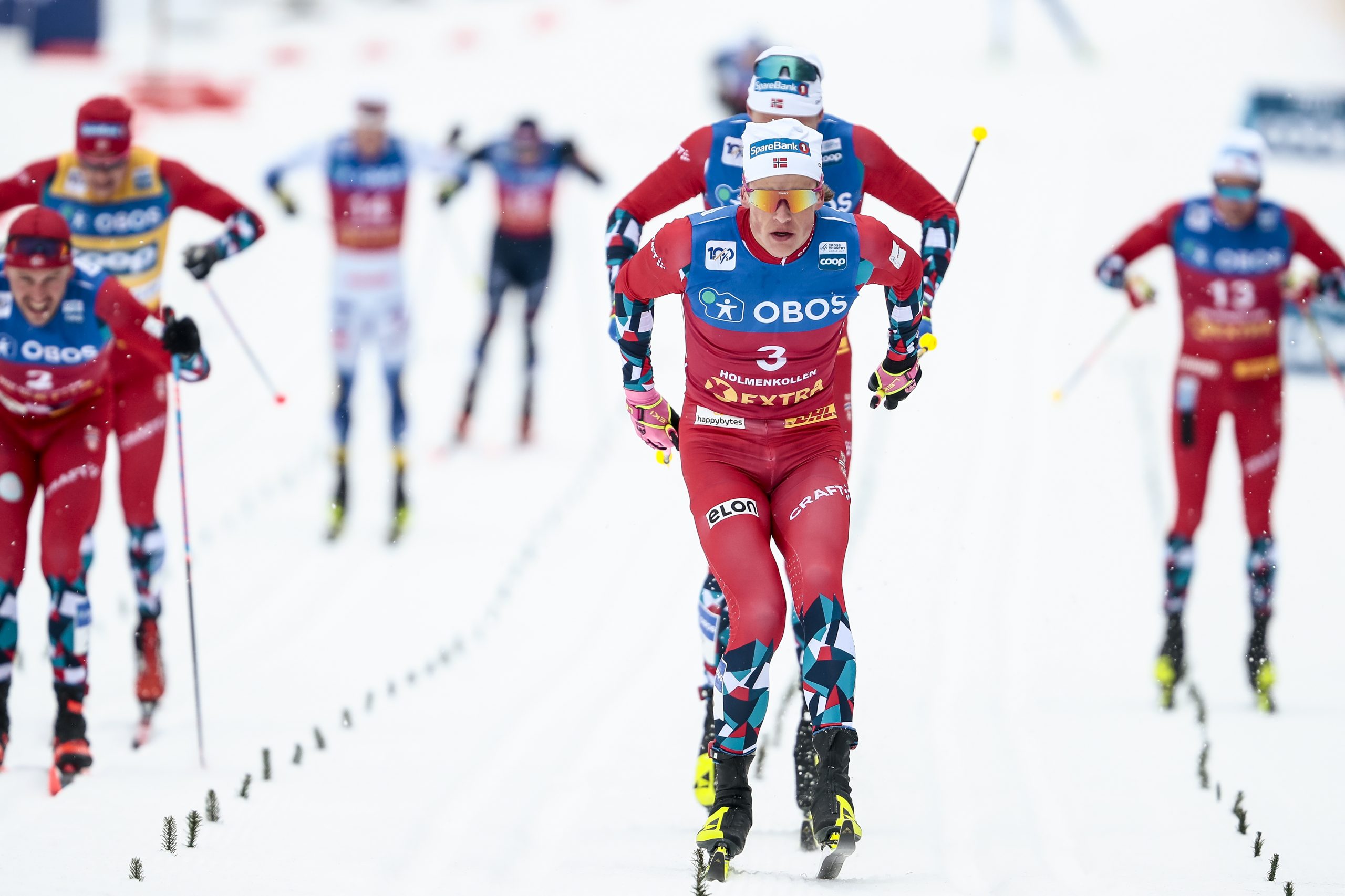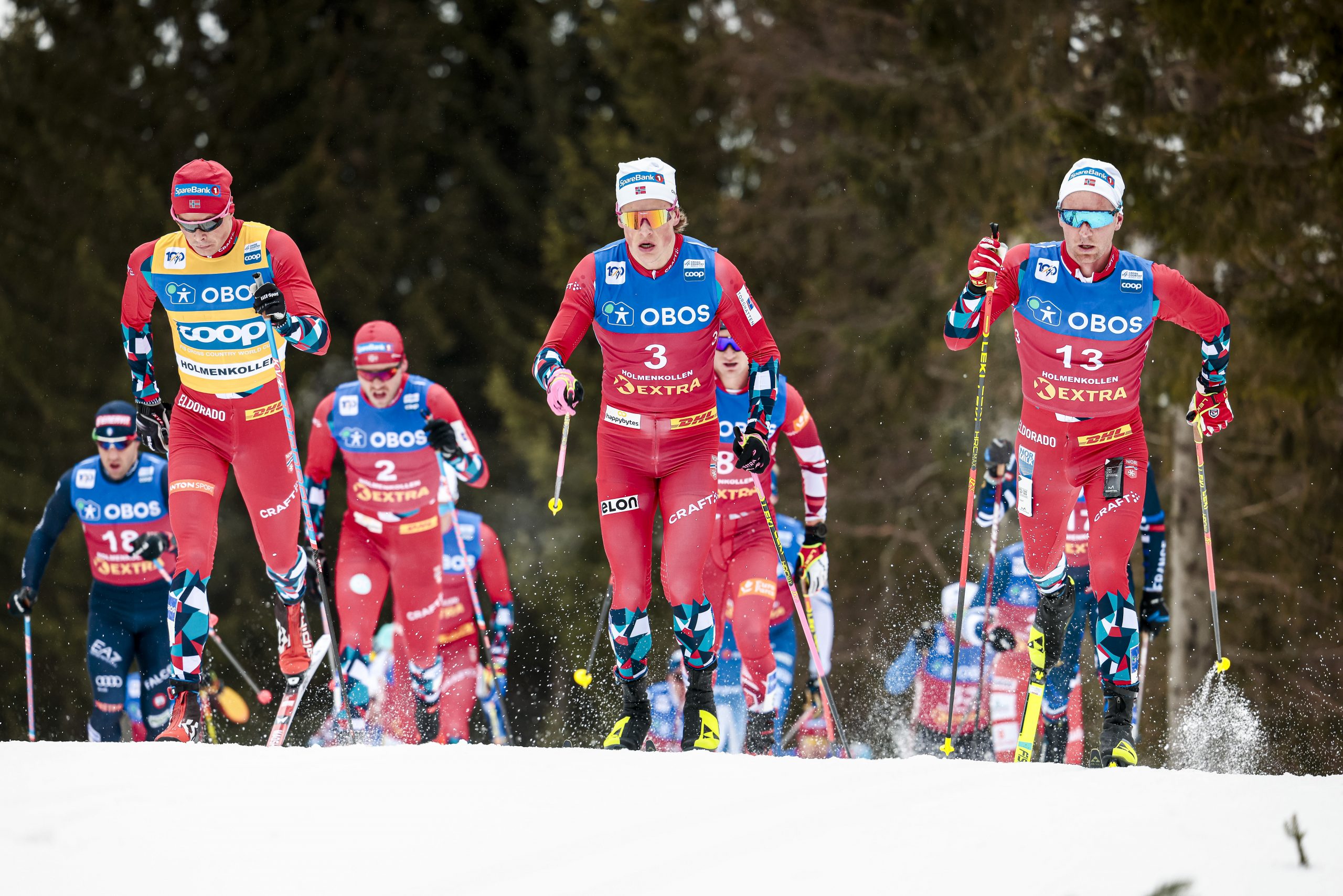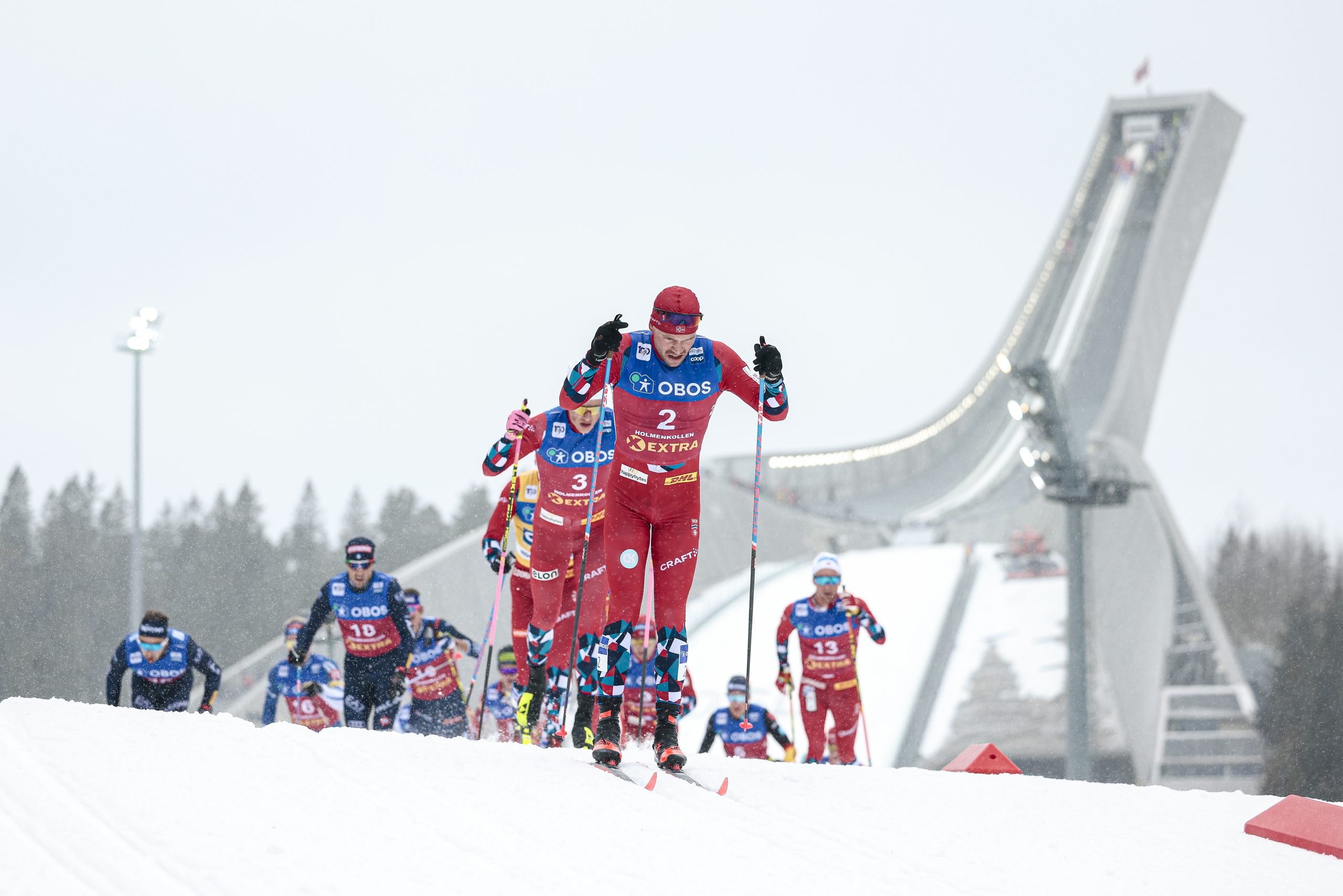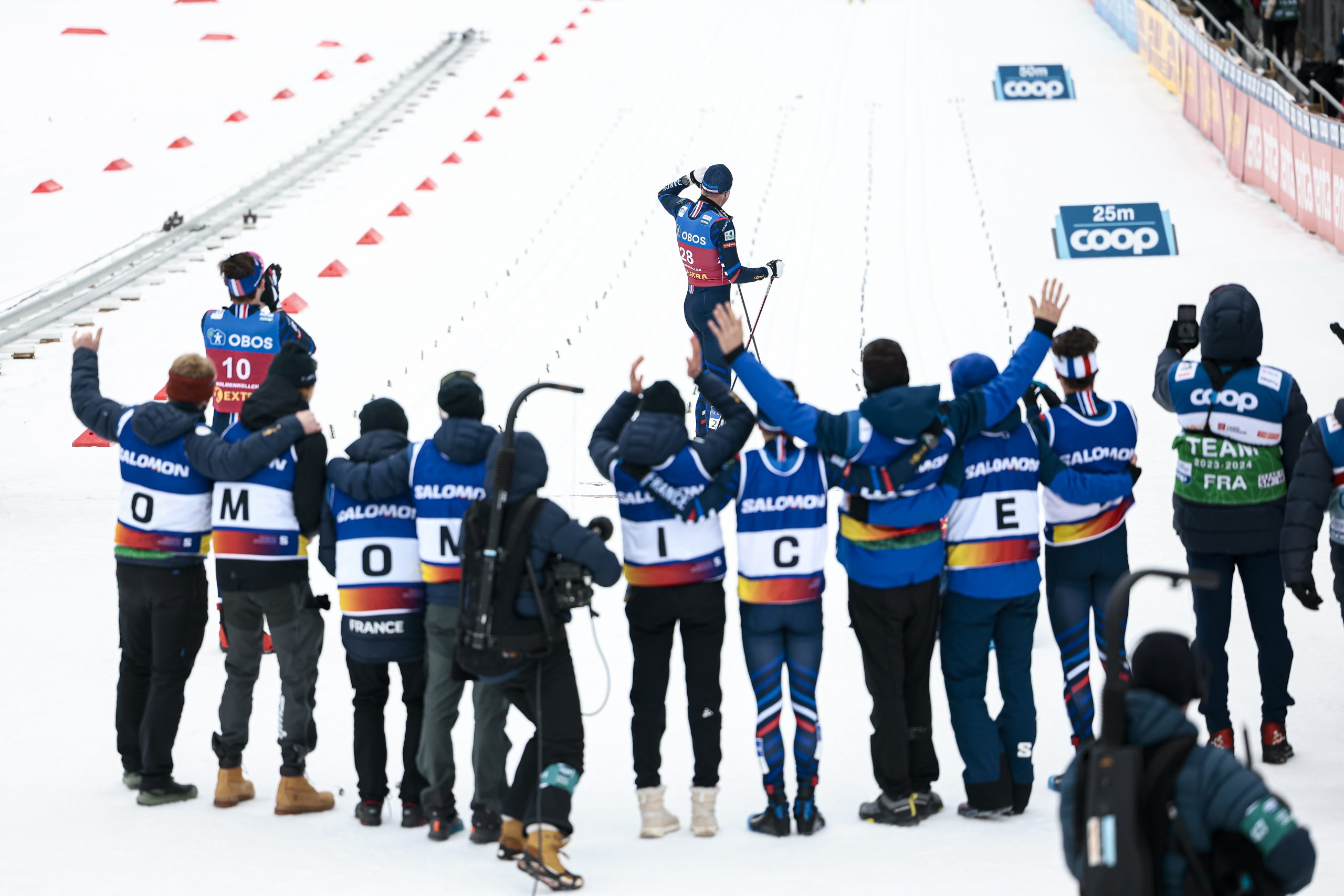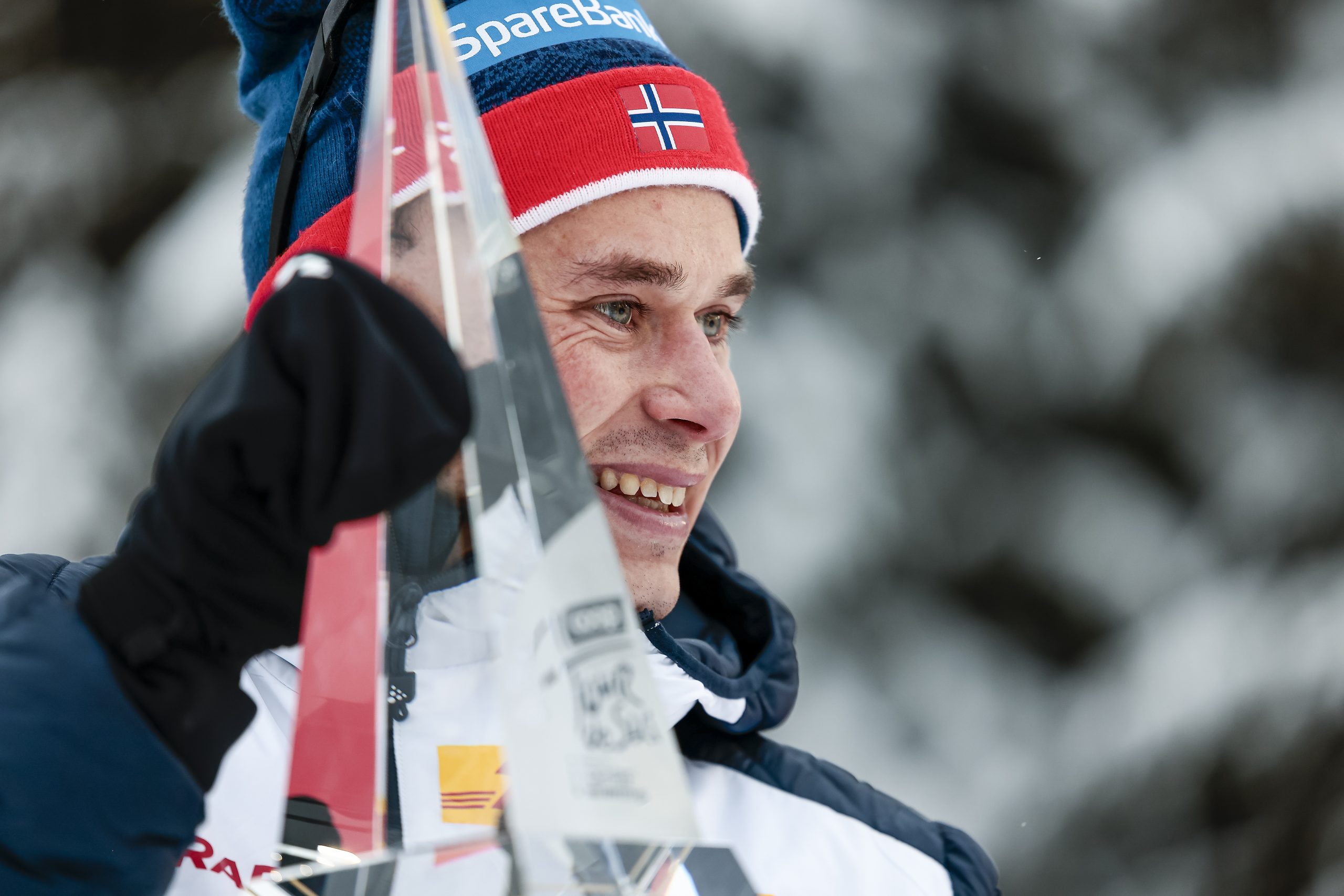
Tag: Harald Oestberg Amundsen

  • Final Piece in Historic Puzzle—Klaebo Claims Distance Globe

    Final Piece in Historic Puzzle—Klaebo Claims Distance Globe

    This coverage is made possible through the generous support of Marty and Kathy Hall and A Hall Mark of Excellence Award. To learn more about A Hall Mark of Excellence Award, or to learn how you can support FasterSkier’s coverage, please contact info@fasterskier.com.

    Johannes Hoesflot Klaebo (NOR) had won it all—except for a Distance Crystal Globe. Today in Lake Placid, he finally added that most elusive piece of hardware to his expansive trophy case. (Photo: Modica/NordicFocus)

    The Kingdom of Norway expects much of its sport heroes. Johannes Hoesflot Klaebo knows this . . . that may be why this naturally gifted sprinter may have long coveted the prize that a skier of his sort is least likely to earn: World Cup Distance Crystal Globe. If he could capture that prize, he could place his name among those of revered strong men of cross-country skiing. But first he’d need to get past another Norwegian strong man: Harald Oestberg Amundsen, himself a past winner of both the Distance and All-Around Crystal Globes, and a skier who trails Klaebo by only 12 points heading into this final Distance race of the 2026 season. A Norwegian skier would go home from Lake Placid with the Distance Crystal Globe tucked safely in the overhead compartment of a chartered jet liner. But which Norwegian?

    Twenty kilometers of mass-start racing through the forests and hills of Mt. Van Hoevenberg would answer the question. But the manner in which that question would be answered would have bearing on ski history, as well. That’s because Klaebo could choose to employ more than one strategy in today’s race. He could park himself behind Amundsen, presumably sprint past him at the end, and claim the Cup regardless of his placing in today’s race. Norwegian fans would love to see a Norwegian claiming the Cup, but they would prefer to see the victory be claimed in a different way. What Norway would love to see is dominance delivered at the hands of the sport’s most dominant skier. The “dominance” strategy is far more risky—it could backfire, it could get counter-attacked, it could conceivably allow Amundsen to overcome a self-exhausted Klaebo. But that’s what Norwegian fans long to see.

    Back in 1983, Norwegian speedskater, Rolf Falk-Larssen won the World All Around Speedskating Championship by virtue of winning three of the championship’s four races. That was the rule back then—anyone who wins three of the four races is automatically crowned champion, regardless of their performance in the fourth race. Falk-Larssen won the 500 m, the 5,000 m, the 1500 m. Technically, all he had to do was finish the 10,000 (the final race of the championship) in order to wear the victor’s wreath and be proclaimed World Champion. He would finish that final race, but the way he raced it was also the reason that, to this day, few Norwegians are willing to even mention Falk-Larssen’s name. When Falk-Larssen had the chance to truly dominate, he chose, instead, to mail it in: he soft-pedaled the 10 k . . . finishing a full 37 seconds (that’s a lot) behind the race winner, Tomas Gustafson of Sweden, whose four-race performance actually accumulated a point-total that exceeded Falk-Larssen’s championship-winning total. Falk-Larssen was crowned champion, but the Norwegian crowd never forgave him.

    Norway expects much of its champions. Witness the racing strategies of Marit Bjoergen, of Therese Johaug, of Bjoern Daehlie, of Thomas Alsgaard. They were dominators, setting a blistering pace from the very start of any race, heedless of the consequences, daring any other racer to challenge them. Consider the tactics of Norwegian athletes in other sports: World and Olympic champions like hurdler Karsten Warholm or middle distance runner Jakob Ingebritsen—both of whom race from the front in daring, victory-or-death style. Norwegian fans love this . . . seeing the champions who throw caution to the wind, who stamp their authority onto every race situation, who prove true dominance.

    Fast-forward to Lake Placid New York, and the final race of the 2026 FIS World Cup cross-country ski season. At Mt. Van Hoevenberg, Klaebo could’ve been interested in only one thing: the World Cup Distance championship. In his long and illustrious career, it’s the one prize that has eluded him. He’s won the Overall Crystal Globe six times. He’s won the Sprint championship too many times to count. In this miraculous 2026, Klaebo has proven time and again that he is the man to beat. And though he is the world’s premier sprinter, he has shown that he can win from the front even when the world’s best Distance skiers are chasing him.

    The stage was set for 20 kilometers of racing on the steep and rainy trails of Mt. Van Hoevenberg.

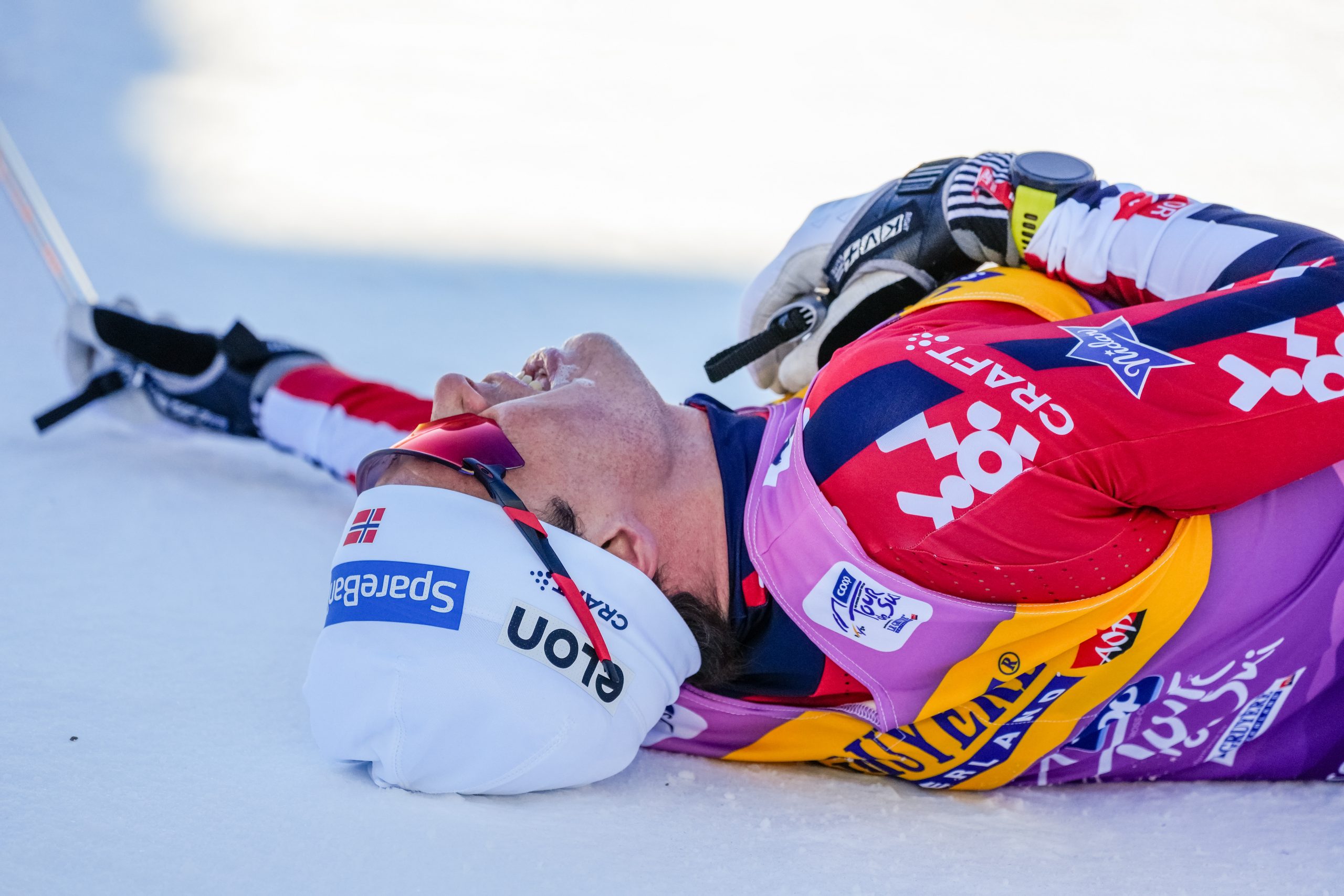
    With his win in the 20 k Mass Start Freestyle at the World Cup Final in Lake Placid, Johannes Hoesflot Klaebo (NOR) completes the sweep of all sweeps. (Photo: Thibaut/NordicFocus)
    20 k Freestyle Mass Start

    In the old days of racing—especially on the trails around Van Hoevenberg—racers in Distance events would disappear into the trees, emerging from the forest hours later with practically no one having seen what transpired out on the course. Not today . . . the final race of the World Cup season was designed for the fans: five laps of four kilometers/lap. The crowd would get to see plenty of the racers, and that crowd ha already proven its ability to shower the skiers with cheering and support.

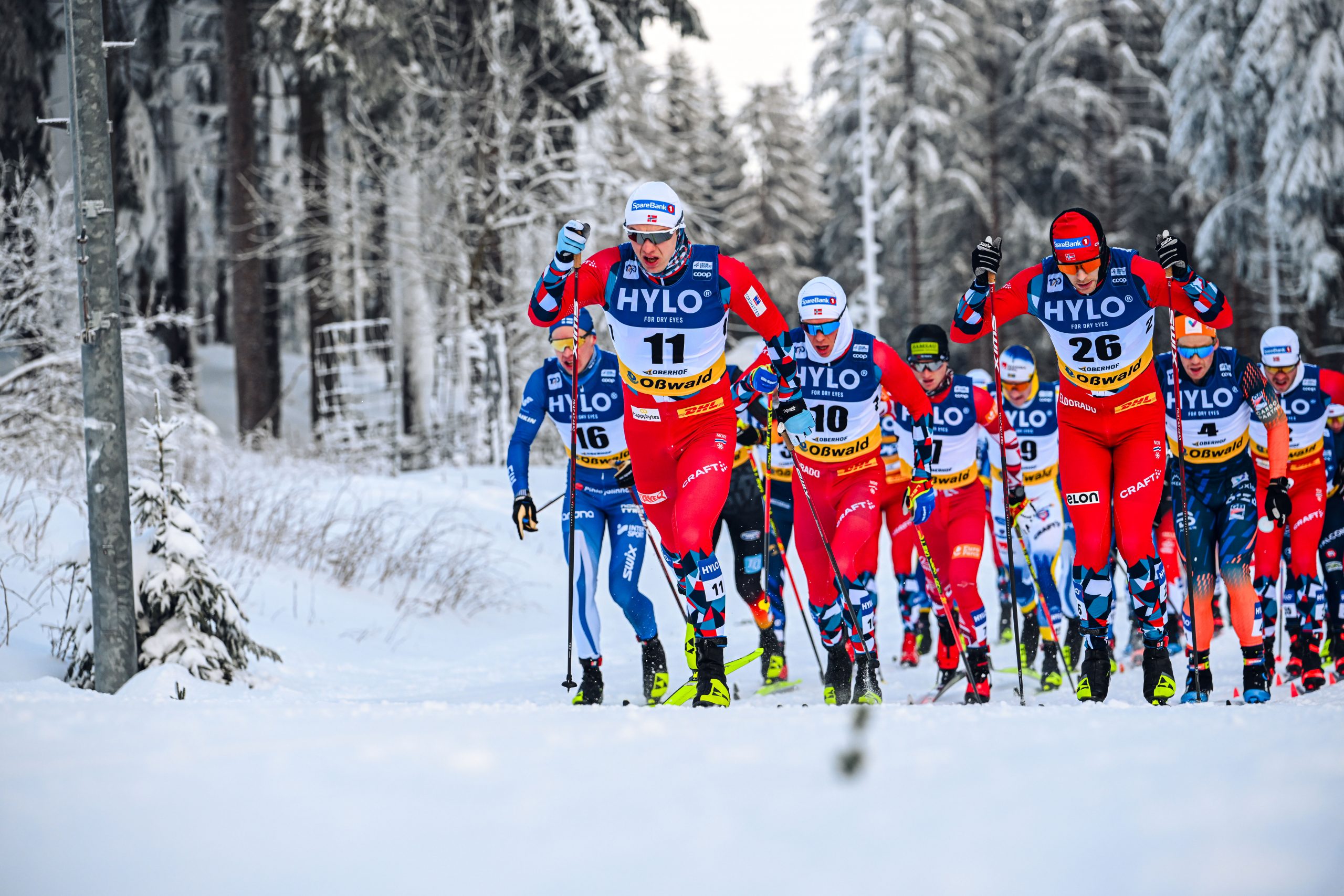
    The start order was determined by World Cup points; six of the top seven starting spots were claimed by Norwegian skiers (their total monopoly only prevented by the presence of the sixth starter, Italy’s Elia Barp). It’s been a long season, and the final 20 k is a long race. The field can be forgiven for taking it easy at the start. But Mika Vermeulen (AUT) is not an especially patient competitor . .  he would go to the front in the second kilometer to give the race some honest pace. Vermeulen’s effort seemed to remind the Norwegians of what they were supposed to do; by the 4 kilometer mark, Amundsen had powered to the front, followed by Klaebo and Pellegrino. A crowd of Norwegians and French race suits followed them. The players were all in position.

    Schumacher hovered around the top ten, continuing to show his skills as a mass-start racer. The field began to break up on the course’s challenging downhills; Schumacher continued to hold his own.

    At eight kilometers, Klaebo moved forward to  take control. That’s because racers were offered World Cup bonus points at 9 k and at 17 k, and Amundsen had admitted in pre-race interviews that he would plan to pursue those points. If he could snatch some of those points, he could close the gap on Klaebo. Huh . . . Klaebo grabbed those 15 bonus points for himself, followed by Amundsen’s 12 point second place consolation prize. Amundsen had hoped to narrow the gap. Instead it widened by three points.

    Soon after the bonus sprint, five Norwegian race suits began inexorably to pull away: Andreas Fjorden Ree, Mattis Stenshagen, Emil Iversen, Klaebo, and Amundsen. Schumacher eased his way forward to seventh position, just three seconds behind the leaders. The pace was fast, but fans could wonder if the skiers were really leaving it all out there. Who could blame them? All season long, Klaebo’s teammates—his closest rivals—had done all they could to drop the guy. Usually, whomever attempted to do so would find themselves dropped and distanced by their own teammates. It looked as though no one was willing to make such a risky play. But in that lull, Einar Hedegart had rejoined the leaders.

    At the 17 kilometer mark, Klaebo again moved forward to seize the bonus points. Klaebo 15 points, Reee 12, Amundsen 10. Barring any unforeseen disasters, Klaebo had the points-lead he needed to claim the Distance Cup. Now the Norwegian fans would eagerly watch how he would race to the finish.

    After the bonus sprint, the course returned to the finishing stretch utilized inhte Sprint course . . . Klaebo knows this part of the course so well. And he used the same tactic that took him to a Sprint victory just two days ago. Resplendent at the front, Klaebo turned on the jets up the final slope, jump-skating away from his rivals. Amundsen followed gamely, but the gap widened just enough to deprive Amundsen of the draft on the subsequent downhill. Klaebo was not to be denied in the final sprint, gliding across the line for his 113th World Cup victory, and the first Distance Crystal Globe of his career.

    Hedegart held on for third, perhaps inspiring the young biathlete to continue competing as a skier in seasons to come. Pellegrino would finish his final race in 13th place, securing his place on the third step of the World Cup Overall podium. Schumacher would race in the main chase group throughout the race, but would fade to 20th at the finish.

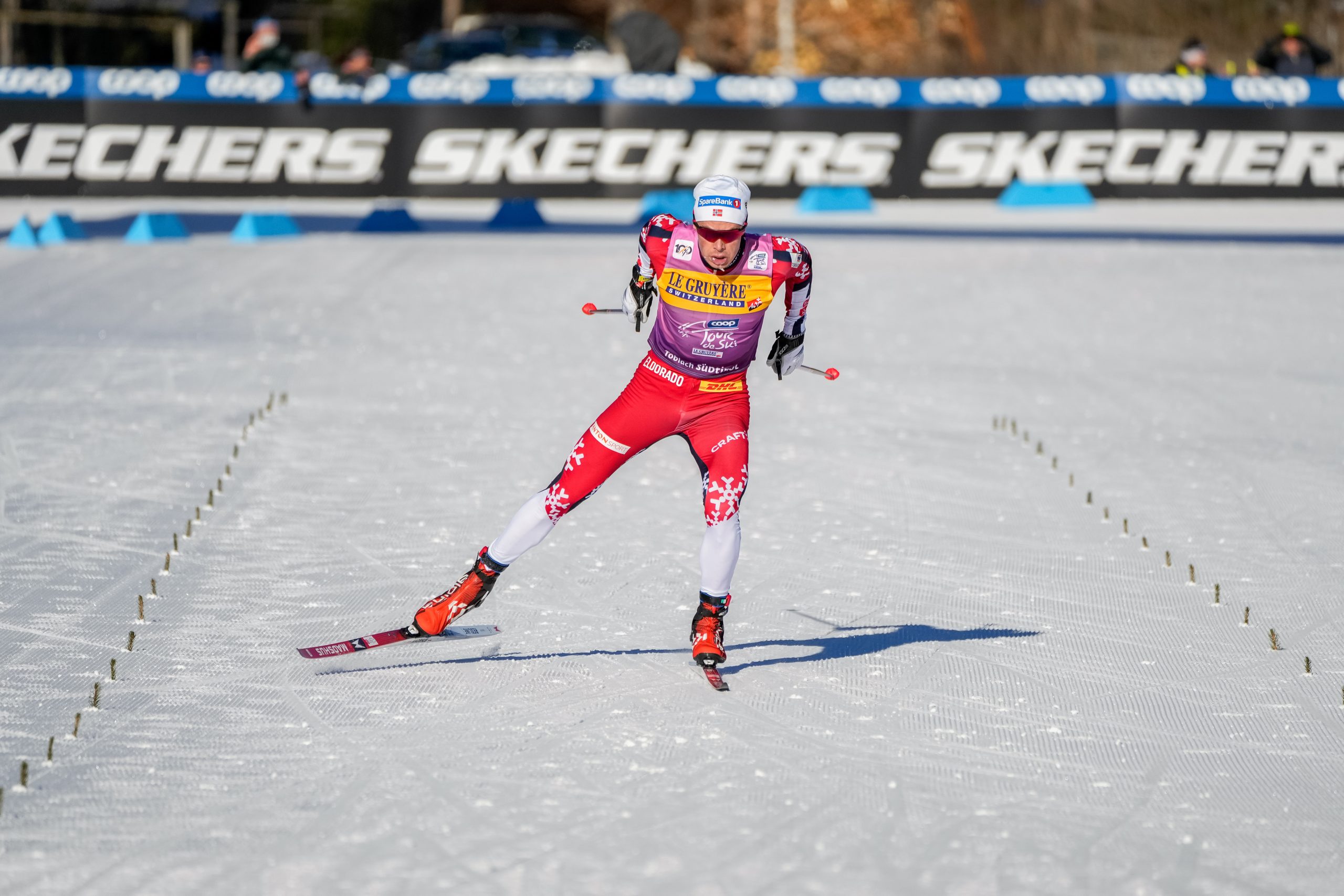
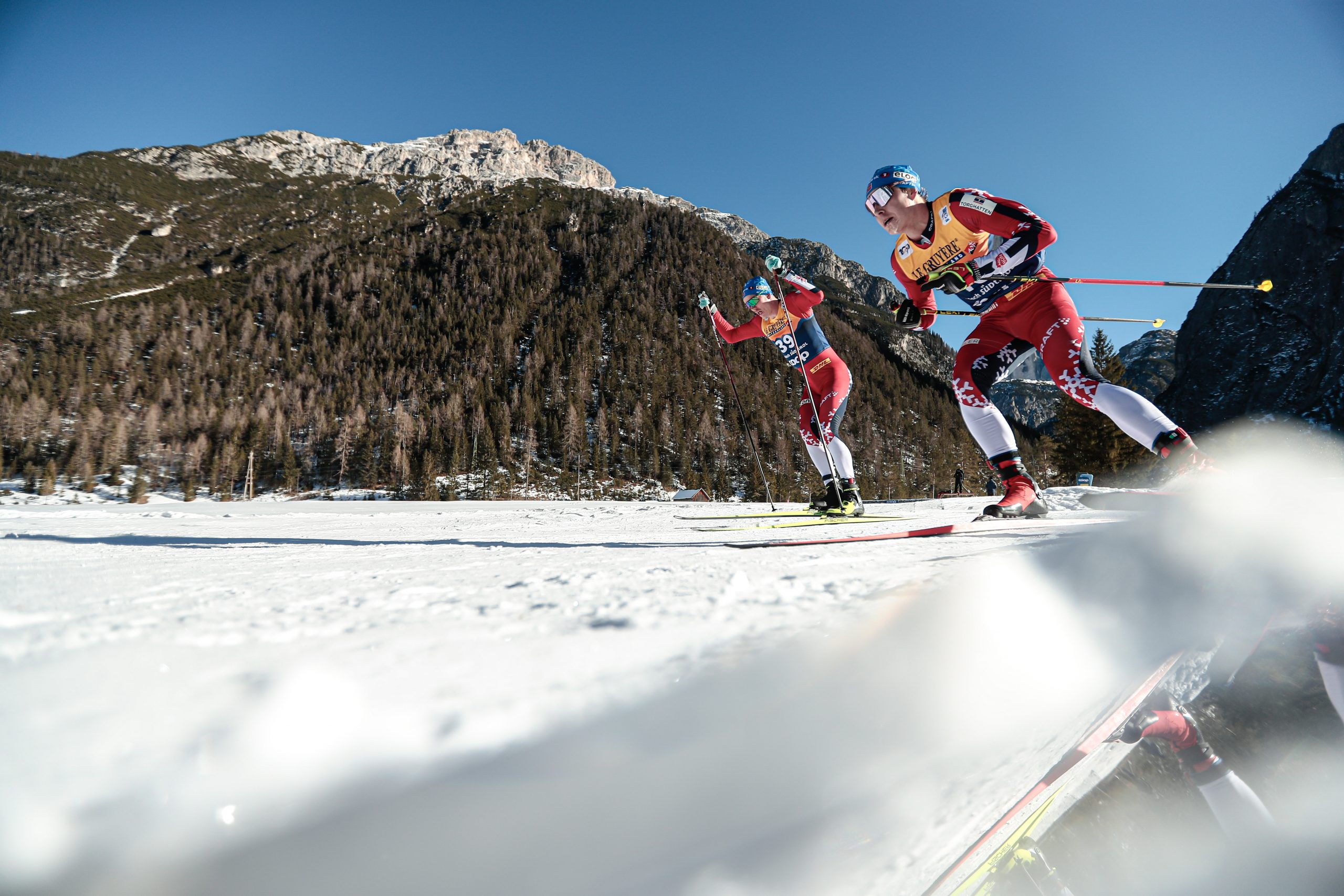
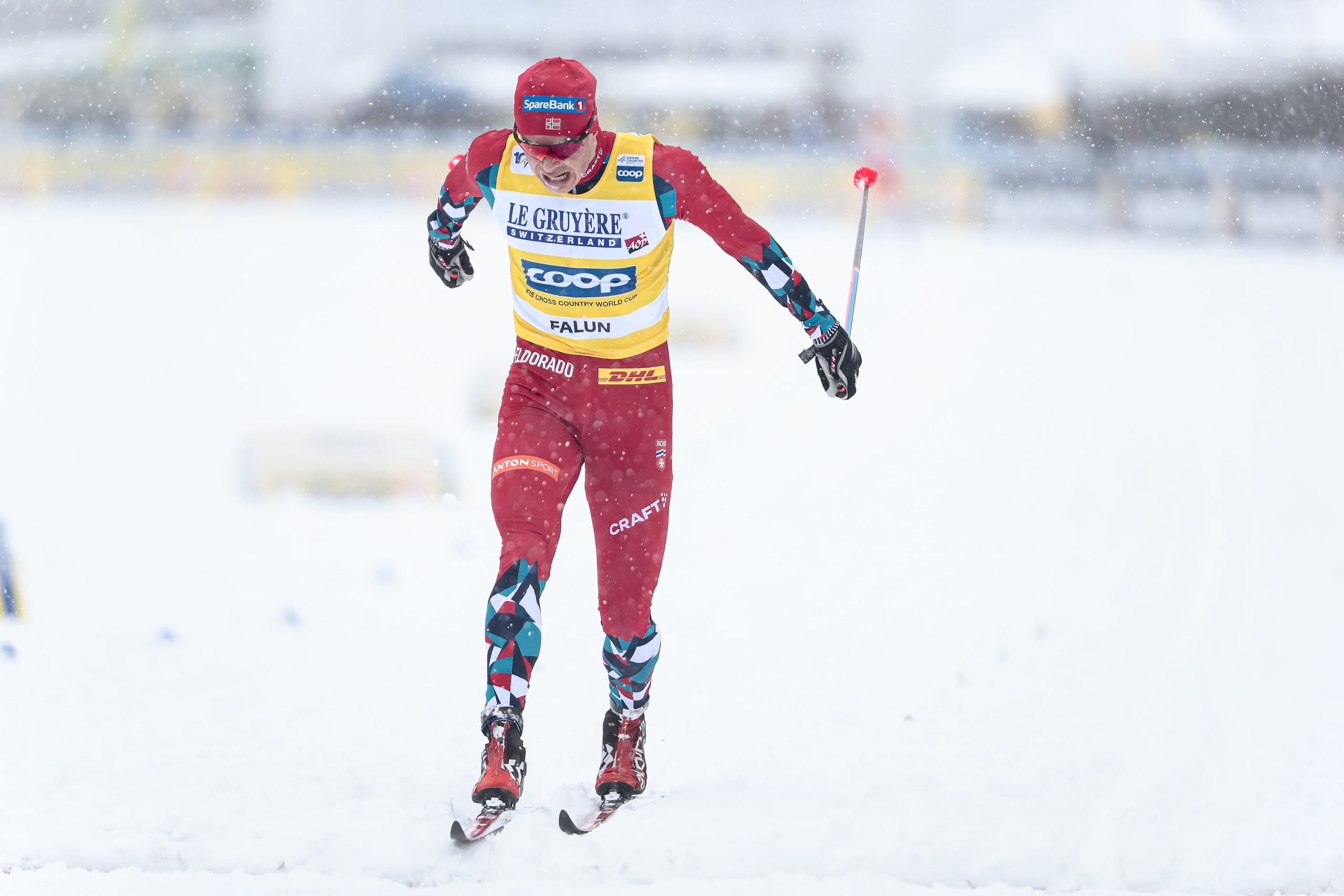
    Harald Oestberg Amundsen (NOR) chased Johannes Hoesflot Klaebo (NOR) through an entire season of Distance races. They finally settled the issue over twenty kilometers in Lake Placid. (Photo: Thibaut/NordicFocus)
    Dominance, indeed

    Not every Norwegian ski hero has been a front-runner. Norwegians began to learn of—and begrudgingly to accept—the strategic brand of racing that Pettter Northug employed during his brilliant career: sitting in and sprinting, snatching mass-start Distance races from Distance specialists. Perhaps Northug’s strategy became acceptable because it was so obvious that he was killing himself to hang on to the pace set by the Distance skiers just so he could have a chance to sprint at the end. Norwegian fans admired the effort, the tenacity, the fight. And they wanted a Norwegian skier to win, too. Northug delivered repeatedly, but Northug was an athlete of a different sort—spending off-season weeks gambling lavishly in Las Vegas, and getting into all sorts of trouble in Norway on account of his love of fast cars and strong drink. Northug definitely earned his place in the skiing Pantheon, but even his Norwegian countrymen remain unsure of him.

    The only real way to capture the love of the Norwegian ski fans is to dominate the competition. Klaebo knows this . . . and what he delivered was a season that included a Tour de Ski, a Sprint Globe, a Distance Globe, an Overall Globe, and six Olympic gold medals. Dominance, indeed.

    Referring to his haul of Crystal Globes, Klaebo said, “It’s going to be overweight getting back home, that’s for sure.

    “I always try to focus on a part of the course where I can use a different part of tracks to get an advantage,” Klaebo said. “Today I felt like I was pushing hard up the last uphill, and Harald was right behind me all the way. I managed to get a small gap at the end!

    “I saw it coming!” said Amundsen. “I tried to find his back and stay there. I knew that he would go fast on the last uphill. I just tried to follow.”

    “We had a great team effort,” said Amundsen. “And second place, in the end, was quite good.”

    Now, Team Norway will pack up its trophies and its flowers and its wheels of Gruyere cheese, and head back home to the land of Nordic skiing, and the cheering hordes of Nordic skiing fans.

    “I’m glad the season is over now,” said a smiling Klaebo after the race. “It’s time to rest a little bit.”

    And a well-deserved it will be. We’ve watched a remarkable season scripted by the greatest of all time. We’re unlikely to see such a season again.

    World Cup Final—Men’s 20 k Mass Start RESULTS

    Love Stories Like This? Help Keep Them Coming.

    Feature stories like this one take time, access, and care to produce. If you value thoughtful storytelling and independent ski journalism, please consider becoming a Voluntary Subscriber. Your support directly fuels the work we do to cover the people, places, and moments that make our sport special.

    Join the FasterSkier community!
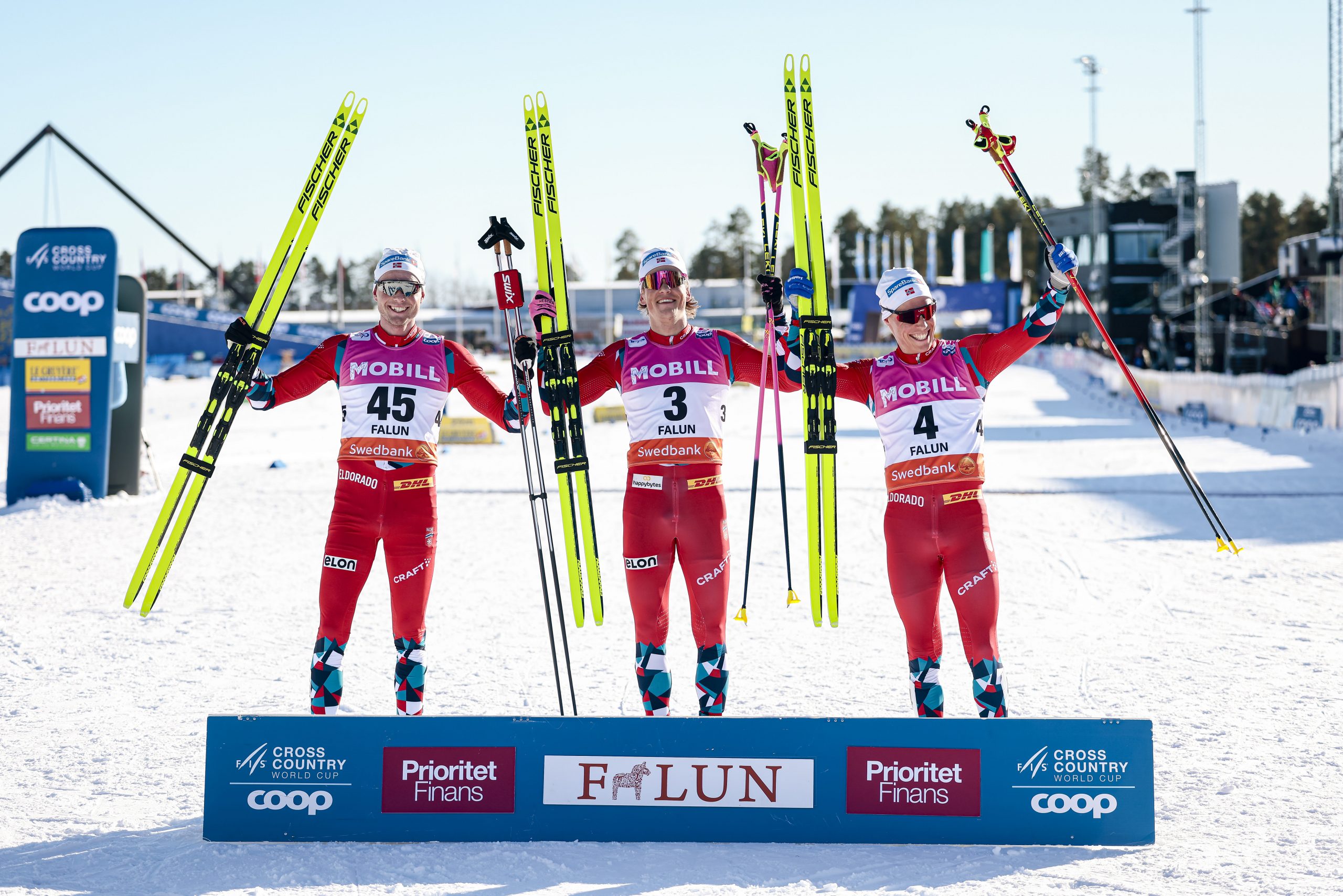
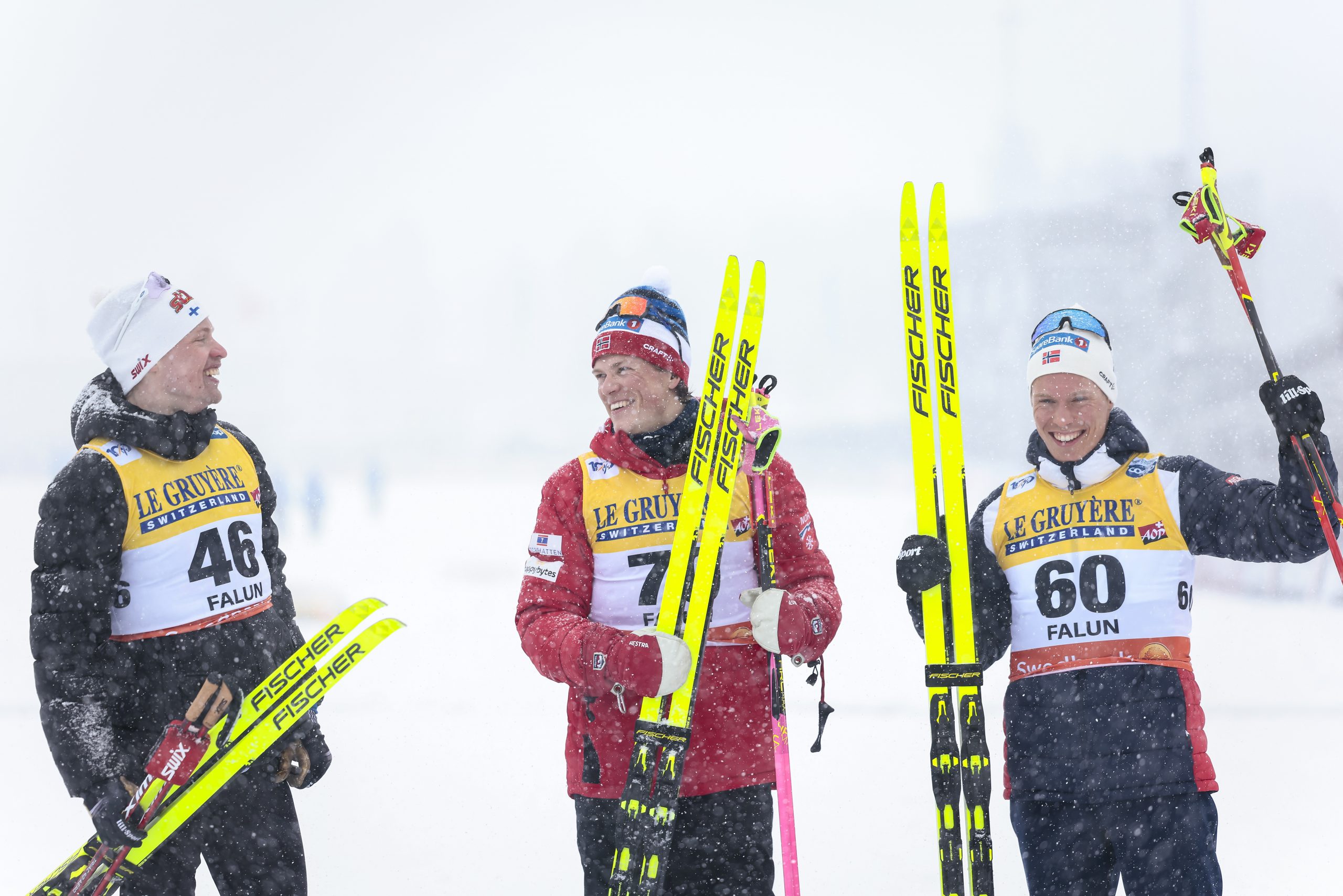
    Here at the end of all things, another Norwegian podium. Harald Oestberg Amundsen (NOR), Johannes Hoesflot Klaebo (NOR), Einar Hedegart (NOR) celebrate the end of a long season. (Photo: Modica/NordicFocus)


  • Never Count Him Out . . . Klaebo Returns in the 10 k

    Never Count Him Out . . . Klaebo Returns in the 10 k

    This coverage is made possible through the generous support of Marty and Kathy Hall and A Hall Mark of Excellence Award. To learn more about A Hall Mark of Excellence Award, or to learn how you can support FasterSkier’s coverage, please contact info@fasterskier.com.

    A week ago, it looked likethe competitive season of Johannes Hoesflot Klaebo (NOR) might be over. Today, he returned to dominate the 10 k Classic Interval Start at the World Cup Final in Lake Placid. (Photo: Thibaut/NordicFocus)

    Two seasons ago in Minneapolis, the energy of an American crowd lifted an American skier—Gus Schumacher—to a surprising win in the 10 k Freestyle Interval Start. The FIS World Cup returns to the USA, but in a very different environment. Mt. Van Hoevenberg is an historic cross-country skiing destination and two-time host of the Olympic Winter Games (1932 and 1980), but the village of Lake Placid is tiny—barely 3000 residents. Not only is it small, but it’s really really far away from any urban centers that might provide spectators for these World Cup Finals events. New York City is nearly five hours away by car; Boston even farther. Even the closest airport (Albany, NY) is nearly three hours away, even in good weather. Many cross-country ski fans will undoubtedly arrive at Mt. van Hoevenberg for the chance to see their ski-heroes, but the crowds are not likely to be anything like what those heroes experienced two seasons ago in Minneapolis. Still, Americans will be enjoying the rare benefit of racing on home turf. Perhaps Schumacher—or another American on the rise—would be able to break through?

    Team USA sent Schumacher to the starting line along with his partner in the silver-medal-winning Team Sprint, Ben Ogden. Rounding out the American roster were Luke Jager, JC Schoonmaker, Zanden McMullen, John Steel Hagenbuch, Reid Goble, Benjamin Dohlby, Michael Earnhart, Zachary Jayne, Brian Bushey, and Hunter Wonders.

    As is often the case, Norwegian names crowded the ranks of seeded skiers: Emil Iversen, Harald Oestberg Amundsen, Mattis Stenshagen, Andreas Fjorden Ree, and Lars Heggen would toe the starting line, joined by a late-arriving Johannes Hoesflot Klaebo whose arrival was delayed while he—and Team Norway—debated his fitness to compete. After a dramatic fall (and subsequent concussion) in the Sprint semfinals in Drammen last week, Klaebo’s condition had remained in question. before the race, he admitted he might not be at his absolute best, but he felt he owed it to the fans gathered in Lake Placid to make an appearance.

    The arrival of Amundsen had never been in doubt, as he continues to joust with Klaebo in their rivalry for the Overall and Distance Crystal Globes. Like Klaebo, Amundsen remarked that he had been looking forward to this journey to Lake Placid.

    “I spoke with Ben Ogden, and he said it would be lots of people and a good vibe,” Amundsen remarked to FasterSkier in post-race interviews. “So I was looking forward to it. They are traveling to Europe and staying there a whole winter, so now it’s our turn to travel here and get some good races.”

    And a sentimental favorite during this World Cup Finals weekend would be Italy’s Federico Pellegrino who has announced that this World Cup season will be his last. At the end of this weekend, he will hang up his skis and glide off into retirement. Pellegrino’s chances for a fond farewell were improved by the announcement that his old friend and long-time rival, Klaebo, would not be competing in Saturday’s Sprint event.

    But, c’mon, the story of the day is the three point lead enjoyed by Amundsen over Klaebo in the chase for the World Cup Distance title. A week ago, it looked like Klaebo would run the table: Distance, Sprint, and Overall. Who knew this race could be so close. With as much as Klaebo has won this year, it would be understandable to assume that he would win all the Crystal Globes. But Amundsen has never been far behind . . . and with the disastrous collision between Klaebo and Ogden in the Drammen Spritnt (that resulted in Klaebo’s hospital stay for a concussion), Amundsen was able to ski well enough in the Holmenkollen 50 k to slide into the Distance lead.

    Amundsen would ski brilliantly in Lake Placid’s 10 k Classic Interval Start, battling snowy conditions, fighting his way to a fourth place finish behind Ree and Stenshagen. But it was Klaebo—who just a week ago looked like his season might be over—to reclaim what should rightfully have been his along.

    With the energy of a cheering and rowdy Lake Placid crowd,  Ben Ogden (USA) couldn’t hold back. (Photo: Modica/NordicFocus)

    Schumacher and Ogden would both claim impressive finishes: seventh and 11th, respectively.

    “I wanted to go out easy,” said Ogden. “But there was no hope of that with this many people cheering! I really had to fight for it at the end, but I wouldn’t have it any other way.”

    “The last couple of kilometers, it was really fun to hear so many people cheering,” said Schumacher. “And to know that what’s going to make them happy is me going as hard as I can.”

    Never Count Him Out

    Serious contenders in any Classic ski race would normally include Savelii Korostelev (AIN). But like his compatriot, Dariya Nepryaeva, Korostelev is a citizen of Russia. Despite his competing as an Individual Neutral athlete (AIN), he would not have qualified for an American visa. Korostelev would not get the chance to be on the starting line in Lake Placid.

    Snow continued to fall heavily during the Men’s race, gathering in fluffy inches on the course. Skiers continued to struggle, both uphill and down, and conditions looked likely to heavily influence the eventual results.

    Gus Schumacher (USA) would follow the example of his fast-starting teammate, Ben Ogden. Schumacher would finish seventh, Ogden 11th. (Photo:  Thibaut/NordicFocus)

    Ogden started in bib 20 with a loud and energetic fan club cheering him on. Ogden would lead the first 50 starters at the first checkpoint, but would find himself overtaken by Stenshagen, Pellegrino, Amundsen, and Schumacher. That’s right, Gus was on course, and charging.

    Klaebo would ease off the starting line, knowing that the accumulating snow was likely to favor earlier starters. His effort appeared measured; nonetheless, he was fastest through the first checkpoint, leading Amundsen (the only other skier whose placing probably concerned him) by 6.3 seconds, a lead that Klaebo extended to 16 seconds at 3.8 kilometers. If Klaebo was in race-shape today, Amundsen could find himself in trouble in Sunday’s 20 k Mass Start.

    Schumacher trailed Klaebo by only 20 seconds at the halfway mark. Between them could be found Pellegrino, Stenshagen, Ree, and Amundsen. Ogden still maintained a top-ten position, and he was able to spend some time in the leader’s chair while he waited for the arrival of later starters.

    Harald Oestberg Amundsen (NOR) wore the red leader’s bib in the Distance category. He is dertimined to fight to the end in his rivalry with countryman, Johannes Hoesflot Klaebo. (Photo: Modica/NordicFocus)

    As the race played out, the Norwegians gravitated to the top of the list of finishers. Stenshagen would take over the lead, only to be supplanted by Ree. Schumacher would cross the line just behind Pellegrino, and only 25 seconds behind Ree. But the crowd and the headlines were awaiting the arrival of Klaebo, His splits had been fastest throughout the race, and Klaebo was hoping for even more than the win. Klaebo needed to put his recent concussion behind him, and put Amundsen in his place.

    Amundsen—wearing the red Distance leaders bib—would cross the line and into the third slot . . . but that was not to last. Likewise, the red bib was soon to transfer back to the shoulders of Klaebo. To no one’s surprise—but to everyone’s surprise—Klaebo glided across the finish line for the win, some 14 seconds ahead of second place Ree, and 25 seconds ahead of fourth place Amundsen.

    “It was a tough fight, tough conditions,” said Amundsen. “But I think it was fair conditions for everyone.”

    “It was so much people, I couldn’t hear my own thinking,” grinned Amundsen.” That’s a good thing!”

    “I’m second place in the World Cup Overall, so I’m fighting for that,” said Amundsen. “And I’m twelve points behind Johannes for the overall, so it will be a close fight on Sunday. I need to take some points in the sprints during the race, and beat him in the end . . . we’ll see.”

    With two races remaining in the season—one of which (tomorrow’s Sprint) he is likely to skip—it really does appear that Klaebo will complete the near-perfect season, gathering up not only every Olympic gold medal, but the full slate of Crystal Globes—Sprint, Distance, and Overall—as well.

    World Cup Final Men’s 10 k Classic RESULTS

    Love Stories Like This? Help Keep Them Coming.

    Feature stories like this one take time, access, and care to produce. If you value thoughtful storytelling and independent ski journalism, please consider becoming a Voluntary Subscriber. Your support directly fuels the work we do to cover the people, places, and moments that make our sport special.

    Join the FasterSkier community!

    World Cup racing continues this weekend from Lake Placid and Mount van Hoevenberg:

    Saturday, March 21

    10:30 am | Women’s Sprint Qualification Free

    11:05 am | Men’s Sprint Qualification Free

    1:00 pm | Women’s Sprint Final Free

    1:00 pm | Men’s Sprint Final Free

    Sunday, March 22

    12:30 pm | Men’s 20km Mass Start Free

    2:30 pm | Women’s 20km Mass Start Free

    4:30 pm | ONE LAST LAP w/Jessie Diggins & the Retiring Stars

  • Klaebo Is Coming to Lake Placid

    Klaebo Is Coming to Lake Placid

    This coverage is made possible through the generous support of Marty and Kathy Hall and A Hall Mark of Excellence Award. To learn more about A Hall Mark of Excellence Award, or to learn how you can support FasterSkier’s coverage, please contact info@fasterskier.com.

    Johannes Hoesflot Klaebo (NOR) took all six gold medals awarded in men’s cross-country skiing at the Olympics last month. (Photo: Barbieri/NordicFocus)

    Johannes Hoesflot Klaebo made the call late Tuesday night… he’s racing.

    According to the Scandinavian press, Klaebo departed Oslo’s Gardermoen airport at 6:25 Wednesday morning, beginning a roughly 20-hour journey to Lake Placid, where he’ll arrive about a day and a half before Friday’s 10-kilometer classic interval start. The Norwegian Ski Federation confirmed the news in a press release on Wednesday morning.

    “I can see this isn’t going to be an optimal buildup, both with the long travel and not being able to adjust to the time difference,” Klaebo said. “But I want to be part of the World Cup finale in the USA.”

    The decision came after Klaebo did a training session on Tuesday morning in Trondheim and responded well. National team doctor Ove Feragen gave him the green light.

    Ben Ogden (USA) checks on Johannes Hoesflot Klaebo (NOR) after their crash eliminated them from the race in Drammen, Norway. (Photo: Nordnes/NordicFocus)

    “After the fall during the sprint in Drammen, and some quiet days at home, Johannes has gradually resumed training and normal activity,” Feragen said. “He has responded well to this, without any recurring symptoms after the fall. After observation and further examinations, we have concluded that he is fit to compete.”

    Klaebo has been sidelined since March 12, when American Ben Ogden fell across the Norwegian’s skis during Classic Sprint semifinals in Drammen, Norway. The resulting crash sent Klaebo’s head into the hard-packed snow. He was diagnosed with a mild concussion, withdrew from the Holmenkollen 50k, and scrapped a planned media tour in New York City that included sit-downs with CNN, NBC, the New York Times, and the Wall Street Journal.

    Now the question shifts from whether Klaebo will race to how much he’ll race. He’s not committing to the full program.

    Harald Oestberg Amundsen (NOR), Johannes Hoesflot Klaebo (NOR), and Martin Loewstroem Nyenget (NOR), (l-r) share the Skiathlon podium in Falun, Sweden, on March 1st, 2026. (Photo: Thibaut/NordicFocus.)

    “My expectations for performance are not sky-high,” Klaebo said. “I’ll do my best despite a poor buildup and potential jet lag. Whether I race one, two, or three events in Lake Placid, I’ll decide once I get to the USA and get skis on my feet.”

    The stakes are real despite the measured tone. Klaebo has already clinched the overall World Cup — his sixth, tying Bjoern Daehlie — and the sprint globe. But he trails Harald Oestberg Amundsen by three points in the distance standings after missing the Holmenkollen 50k. Two distance events remain: Friday’s 10 k Classic and Sunday’s 20k Freestyle Mass Start. A clean sweep of the overall, sprint, and distance globes would be a first in Klaebo’s career.

    “For cross-country skiing, it’s especially important to have World Cups in the USA,” Klaebo said. “I’ve been looking forward to this finale for a long time.”

    Racing begins Friday at Mt. Van Hoevenberg. Klaebo will be on the start line — jet lag and all.


    Love Stories Like This? Help Keep Them Coming.

    Feature stories like this one take time, access, and care to produce. If you value thoughtful storytelling and independent ski journalism, please consider becoming a Voluntary Subscriber. Your support directly fuels the work we do to cover the people, places, and moments that make our sport special.

    Join the FasterSkier community!


    Ben Ogden (USA) and Johannes Hoesflot Klaebo (NOR), along with Oskar Opstad Vike (NOR), (l-r) on the Olympic sprint podium last month.  It should be made clear that Ogden and Klaebo have a strong respect for one another, to say the least. (Photo: Vanzetta/NordicFocus)
  • Klaebo’s Lake Placid Decision Day Is Today

    Klaebo’s Lake Placid Decision Day Is Today

    This article was made possible through the generous support of our voluntary subscribers. If you value coverage like this, please support FasterSkier with a voluntary subscription.

    Fans from across the United States who will be in Lake Placid are anxiously hoping Johannes Hoesflot Klaebo (NOR) is well enough to travel and race in Lake Placid this weekend. (Photo: Authamayou/NordicFocus)

    Johannes Hoesflot Klaebo has been included in Norway’s 22-athlete squad for this week’s World Cup finals at Mt. Van Hoevenberg in Lake Placid, N.Y., BUT the six-time Olympic gold medalist’s participation hinges on a decision being made today.

    Klaebo, 29, suffered a mild concussion in a dramatic crash during the sprint semifinals at last Thursday’s World Cup in Drammen. American sprinter Ben Ogden lost his footing on the icy course and fell across Klaebo’s skis, sending the Norwegian backward and slamming the back of his head into the hard-packed snow. Klaebo lay on the ground for several minutes before being helped off course and transported to a hospital for evaluation.

    The Norwegian Ski Federation confirmed the concussion diagnosis on Friday, and Klaebo withdrew from Saturday’s 50-kilometer race at Holmenkollen.

    “He shall make an evaluation together with the national team doctor on Tuesday and would potentially travel on Wednesday,” Klaebo’s manager, Lasse Gimnes, told Norwegian broadcaster NRK on Monday. If cleared by national team doctor Ove Feragen, Klaebo would travel to New York on Wednesday — arriving just two days before Friday’s 10-kilometer classic interval start.

    The crash also disrupted a planned trip to New York City for media appearances with CNN, NBC, the New York Times, and the Wall Street Journal — a reflection of the enormous international attention Klaebo has drawn since his record-setting six-gold performance at the Milano Cortina Olympics. Those in-person interviews have been scrapped, though some may shift to virtual formats.

    Johannes Hoesflot Klaebo (NOR) poses with the FIS Crystal Globes he won last season at World Cup Finals in Lahti, Finland. (Photo: Thibaut/NordicFocus)
    The distance globe is on a knife’s edge

    The distance cup title is the central subplot heading into the finals. Before Holmenkollen, Klaebo held a 128-point lead in the distance standings. But with the Norwegian watching from home on Saturday, Amundsen’s 131-point haul vaulted him into the distance lead: Amundsen now sits at 939 points, three ahead of Klaebo’s 936. Martin Loewstroem Nyenget climbed to 914 in third. Just two distance events remain — Friday’s 10-kilometer classic interval start and Sunday’s 20-kilometer freestyle mass start. If Klaebo can travel and race, the margin is thin enough that a single strong result could flip the standings again. If the concussion keeps him out, the distance globe almost certainly goes to Amundsen.

    Klaebo has already clinched both the overall World Cup — his sixth, tying Bjoern Daehlie’s all-time record — and the sprint globe.

    Norway’s men’s squad: Harald Oestberg Amundsen, Martin Loewstroem Nyenget, Einar Hedegart, Andreas Fjorden Ree, Mattis Stenshagen, Emil Iversen, Johannes Hoesflot Klaebo, Lars Heggen, Even Northug, Ansgar Evensen, and Even Solem Michelsen.

    Jessie Diggins soaks in all the energy from the home crowd during her warmup in Minneapolis — the last time the World Cup was on American snow. (Photo: Leann Bentley/USST)
    Diggins’s farewell, and notable absences

    The Lake Placid finals will serve as the final competitive races for Jessie Diggins, the most decorated cross-country skier in U.S. history. The women’s overall cup and distance cup are both decided, with Diggins winning with a comfortable margin over Sweden’s Moa Ilar in second. The three-time Olympic medalist and three-time overall World Cup champion announced before the season that this would be her last, and a farewell on home snow in front of an American crowd at the first-ever U.S.-hosted World Cup finals is about as fitting a send-off as anyone could script.

    Klaebo is not the only notable question mark heading into the weekend. Norway’s Kristine Stavaas Skistad and Mathilde Myhrvold have opted to skip the finals to prepare for part two of Norwegian nationals in Harstad next week. Sweden’s Ebba Andersson has also pulled out.

    Norway’s women’s squad for Lake Placid includes Astrid Oeyre Slind, Heidi Weng, Kristin Austgulen Fosnaes, Karoline Simpson-Larsen, Nora Sanness, Karoline Groetting, Julie Bjervig Drivenes, Tiril Udnes Weng, Julie Myhre, Lotta Udnes Weng, and Milla Grosberghaugen Andreassen.

    The men’s freestyle mass start gets started at the US National Championships in Lake Placid, NY, 1/8/26. (Photo: Nancie Battaglia)
    A historic venue

    The Lake Placid finals mark the first Cross-Country World Cup finals ever held in the United States and the return of World Cup racing to Lake Placid for the first time since 1979. Racing kicks off Friday at Mt. Van Hoevenberg with the 10-kilometer classic interval start, followed by a freestyle sprint on Saturday and a 20-kilometer freestyle mass start on Sunday.

    This is a developing story. FasterSkier will update when Klæbo’s decision is announced.


    Help Support Our Olympic Coverage!

    If you value the thoughtful work and access FasterSkier provides, please consider becoming a Voluntary Subscriber. Your support directly fuels our work to cover the people, places, and moments that make our sport special.

    Join the FasterSkier community!


  • Hedegart Emerges From the Fog to Win Holmenkollen 50 k as Klæbo’s Absence Reshuffles the Distance Globe

    Hedegart Emerges From the Fog to Win Holmenkollen 50 k as Klæbo’s Absence Reshuffles the Distance Globe

    This coverage is made possible through the generous support of Marty and Kathy Hall and A Hall Mark of Excellence Award. To learn more about A Hall Mark of Excellence Award, or to learn how you can support FasterSkier’s coverage, please contact info@fasterskier.com.

    The start of the Holmenkollen Men’s 50 k Freestyle in Oslo, Norway. (Photo: Authamayou/NordicFocus)

    For nearly two hours on Saturday, 77 men disappeared into a stubborn curtain of fog that clung to the hillsides above Oslo, their figures swallowed by the mist somewhere between the stadium and the high point at Frognerseteren. When it was over, only one emerged with his arms in the air, and it was the one freestyle specialist who had been topping shorter freestyle distance races most of the season.

    Einar Hedegart, the 24-year-old former biathlete who only committed fully to cross-country skiing in November, surged past Harald Oestberg Amundsen in the final meters to win the Holmenkollen 50 k Freestyle in 1:51:38.2 — his first victory on cross-country skiing’s most storied stage, in just his seventh World Cup start.

    “This is the greatest feeling I’ve ever had,” Hedegart said after the finish. “This is just a nostalgia stadium. [A] legendary race, almost all my heroes have won this race, and especially Petter Northug. This might be the reason why I’ve been so motivated my whole life to be a cross-country skier.”

    Einar Hedegart (NOR) celebrates winning Norway’s most iconic race. www.nordicfocus.com. (Photo: Authamayou/NordicFocus)

    But the result that will echo loudest across the sport happened away from Oslo. Johannes Hoesflot Klaebo, the overall World Cup leader, was home nursing a mild concussion from a hard crash in the Drammen sprint two days earlier. Klaebo, who has already compiled a nearly perfect season, winning the Tour de Ski, all six Olympic races, secured the FIS Overall Crystal Globe, the FIS Sprint Crystal Globe, and only needed to keep racing the remaining distance races to take the clean sweep of the season with the FIS Distance Crystal Globe. BUT his absence from the start line meant zero points scored in the distance standing today. And with Amundsen’s second-place finish today, the distance crystal globe race was blown wide open: Amundsen now leads the distance standings by three points, 939 to 936, with two distance races remaining at the World Cup Finals in Lake Placid.

    Klaebo posted to Instagram yesterday: “Took a fall yesterday and hit my head pretty hard, but luckily everything is all good in the hood. Ended up with a concussion, so I’ll take some days off from both training and the internet just to make sure everything settles properly. Only got one head, so have to take good care of it.”

    He had been scheduled to fly to the United States on Sunday, but will now stay in Norway for a few extra days, hoping to recover in time for Lake Placid.

    Einar Hedegart (NOR) emerges from the fog to take the win. (Photo: Nordnes/NordicFocus)
    A Race Defined by Fog

    The Holmenkollen 50 k — first raced in 1888, a fixture of the World Cup since 1982, and a race that draws an estimated 100,000 fans to the forested hills above Oslo — returned to the calendar Saturday after a one-year absence. For the first time, the men’s and women’s 50 k races were held on the same day, the women starting 45 minutes behind the men in a format designed to create an all-day spectacle. The fog, however, had other ideas. Conditions were so thick that spectators along the course could hear the racers before they could see them.

    The course — six laps of 8.3 km with 334 meters of climbing per lap — was firm and fast after overnight salting despite an air temperature of 5.0°C. The salted, compact surface was ideal for skating, and the winning time of 1:51:38 came in roughly four minutes faster than the last time the Holmenkollen 50 k was contested in freestyle.

    Harald Oestberg Amundsen (NOR) on his way to second place. (Photo: Authamayou/NordicFocus)

    Through the first three laps, the race unfolded as a cautious tactical affair. A large pack of roughly 40 skiers stayed together, with Martin Loewstroem Nyenget, Mattis Stenshagen, and Federico Pellegrino taking turns at the front. The first athlete to make a decisive tactical move was Iver Tildheim Andersen, who changed skis early at the stadium after the third lap while the rest of the pack continued through. The fresh skis gave Andersen a burst, and when the lead group stopped for their own ski exchange one lap later, he suddenly found himself alone at the front with a roughly 15-second advantage.

    “Just stick with the field as long as possible and then hopefully be in position when the group starts swarming,” Hedegart said of his plan. “But today I was really offside, like 70 percent of the race. So I was lucky that no one took a gap.”

    The chase group — reduced to roughly eight athletes, all Norwegian once France’s Victor Lovera fell off the pace — gradually closed on Andersen through the fifth lap, with Hedegart, Simen Hegstad Krueger, Amundsen, Nyenget, Andreas Fjorden Ree, and Kasper Andersson Herland trading pulls at the front. By the time the group reached the final lap, they had swallowed Andersen, and the race became a question of who had saved enough for the final kilometers.

    Simen Hegstad Krueger (NOR) tried his best to get away for the win. (Photo: Authamayou/NordicFocus)
    Krueger’s Late Charge and Hedegart’s Final Kick

    Krueger, who was celebrating his 33rd birthday the day before, was omitted from the Norwegian Olympic team despite multiple Olympic medals in his career and was the winner of the last freestyle Holmenkollen 50 k. He drove the pace through the final lap. He pushed hard over the climbs near the iconic Holmenkollen church, stringing out the group and shedding Andersen off the back. But Krueger couldn’t sustain the pressure all the way to the finish, and as the group of seven came around the final corner and up the short, steep ramp before the descent into the home stretch, the sprint was on.

    Amundsen launched first, throwing everything he had at the final few hundred meters. But Hedegart, who had looked labored at points earlier in the race, found a gear no one could match. He came alongside Amundsen, took the lead in front of the grandstand crowd, and raised his fist in celebration as he skied across the line.

    “I felt, like, better,” Hedegart said of his position in the back of the pack through much of the race. “So I was just laying in the field, and I had to remind myself he did the same,” he added, referring to his idol Northug, whose trademark move was stalking from behind before unleashing a devastating sprint.

    Harald Oestberg Amundsen (NOR), Mattis Stenshagen (NOR), and Martin Loewstroem Nyenget (NOR), (l-r) stayed in the lead pack. (Photo: Authamayou/NordicFocus)

    Hedegart crossed in 1:51:38.2. Amundsen finished four-tenths of a second behind. Nyenget was third at +1.1. Ree took fourth (+1.5), followed by Herland (+2.1), Krueger (+3.0), Moseby (+4.8), and Andersen (+16.8) after his brave solo effort. Norway swept the top eight positions.

    France’s Lovera was the first non-Norwegian in ninth (+48.1), followed by AIN athlete Savelii Korostelev in 10th (+1:24.2).

    Zak Ketterson (USA) led the way for the Americans in the chase pack racing for 11th place; he ultimately finished 18th. (Photo: Authamayou/NordicFocus)
    Ketterson Fights for 11th in His Adopted Home

    Zak Ketterson, who spent the summer and fall living and training in Oslo, found himself in the thick of a battle for 11th place, a fight he learned about from coaches stationed along the fog-shrouded course.

    “I had heard from coaches on the side of the trail that our pack was fighting for 11th, and that was super cool,” Ketterson said. “I actually felt pretty fresh at the end and thought my finishing sprint would be pretty good, but I didn’t time it well and got really boxed in on the last couple turns into the finish.”

    Ketterson ultimately finished 18th (+1:54.2), part of a chase pack that came across the line within seconds of each other. He said everyone in the group knew a sprint was coming on the final lap.

    The fog made the tactical picture nearly impossible to read. “I couldn’t see more than 10 meters in front of me,” Ketterson said. “It definitely made it difficult to assess where I was relative to the leaders in the later laps. It also made some of the corners feel way sketchier because you couldn’t really choose an optimal line with such limited visibility.”

    For Ketterson, the race carried personal significance beyond the result. Having trained on the Holmenkollen course through the Norwegian summer and fall, he knew every climb and descent intimately. “This is definitely one of the most iconic and cool races we get to do,” he said. “It was especially special for me this year since I trained on this course all summer and fall living in Oslo. The highlight was definitely having my wife Julie and her family out there cheering me on.”

    What made the performance all the more impressive was the state of his body coming in. “I honestly feel like I am really running on fumes,” Ketterson said. “To be honest, I was not sure if I would even start this race in the morning. I felt so bad, and honestly, my body has felt super up and down in the last few weeks. I’m really curious to see how my body responds to this race. I was pleasantly surprised by how decent it felt, but I feel like the next week could go either way. Especially with the international travel tomorrow.”

    Brian Bushey (USA) gaining experience on his way to 59th place. (Photo: Authamayou/NordicFocus)
    The Rest of the North Americans

    Hunter Wonders was 45th (+5:46.9), Kevin Bolger was 48th (+6:51.3), and Brian Bushey was 59th (+12:24.9).

    Canada’s Xavier McKeever finished 41st (+5:11.4), while Thomas Stephen was 43rd (+5:18.1).

    Harald Oestberg Amundsen (NOR) takes over the FIS Distance Globe lead with just two distance races remaining. (Photo: Authamayou/NordicFocus)
    Distance Globe: Three Points

    The ramifications of Saturday’s race land squarely on the crystal globe picture. Before the race, Klaebo held a 128-point lead over Amundsen in the distance standings and a 636-point lead in the overall. With Klaebo watching from home, Amundsen’s 131-point haul (including bonus points) vaulted him into the distance lead: Amundsen now sits at 939 points, three ahead of Klaebo’s 936. Nyenget climbed to 914 in third.

    Klaebo’s overall World Cup lead, at 2,071 points to Amundsen’s 1,566, remains secure with a 505-point cushion. But the distance globe — awarded to the season’s best across distance events only — will come down to the final two races: a 10 k Classic Interval Start and a 20 k Freestyle Mass Start in Lake Placid, March 20-22.

    If Klaebo can travel to Lake Placid and race, he’ll have every opportunity to reclaim the lead. If the concussion keeps him out, the distance globe is likely to belong to Amundsen.

    Kasper Andersson Herland (NOR), who finished fifth, celebrates with Einar Hedegart (NOR), (l-r) at the finish of the Holmenkollen. (Photo: Authamayou/NordicFocus)
    A Star Made for This Stage

    Hedegart’s career trajectory is one of the season’s best stories. A junior biathlon world champion who struggled with his shooting, he drifted toward cross-country skiing after a surprising second-place finish at the Holmenkollen World Cup last season. He spent the summer training with a cross-country team while bringing his rifle to every camp, undecided. In November, after winning the popular pre-World Cup cross-country race in Beitostoelen, Norway, by a wide margin and missing eight of 20 shots in a biathlon event, he committed to leaving the rifle at home.

    Since then: an Olympic bronze in the 10 k Freestyle behind Klaebo, a team sprint gold partnered with Klaebo, victories in the Engadin Marathon, and now the Holmenkollen 50 k — a distance he had never raced at the World Cup level. He was asked whether his approach of sitting back resembled Northug’s famous stalking tactics.

    “Yeah, I felt like Petter,” Hedegart said. “So I was just lying in the field, and I had to remind myself he did the same.”

    For a race that dates to 1888, that has been won by the sport’s mythical stars, and that is contested before the King of Norway in a stadium surrounded by 100,000 fans, there is no small amount of weight to what happened Saturday at the Holmenkollen. Hedegart is, by every measure, now a cross-country skier.

    The season concludes with the World Cup Finals in Lake Placid, New York, March 20-22. Three races remain. The distance globe is separated by three points. And the world waits to see whether Klaebo can make it to the start line.


    Holmenkollen Men’s 50 k Freestyle FINAL RESULTS

    FIS Men’s Crystal Globe SPRINT STANDINGS
    FIS Men’s Crystal Globe DISTANCE STANDINGS
    FIS Men’s Crystal Globe OVERALL STANDINGS


    Love Stories Like This? Help Keep Them Coming.

    Feature stories like this one take time, access, and care to produce. If you value thoughtful storytelling and independent ski journalism, please consider becoming a Voluntary Subscriber. Your support directly fuels the work we do to cover the people, places, and moments that make our sport special.

    Join the FasterSkier community!


    Harald Oestberg Amundsen (NOR), Andreas Fjorden Ree (NOR), and Martin Loewstroem Nyenget (NOR), (l-r) share the Holmenkollen 50 k Freestyle in Oslo, Norway. (Photo: Authamayou/NordicFocus)
  • Evensen Stuns Drammen as Klaebo and Ogden Crash Out of Semifinals

    Evensen Stuns Drammen as Klaebo and Ogden Crash Out of Semifinals

    This coverage is made possible through the generous support of Marty and Kathy Hall and A Hall Mark of Excellence Award. To learn more about A Hall Mark of Excellence Award, or to learn how you can support FasterSkier’s coverage, please contact info@fasterskier.com.

    Ben Ogden (USA) and Johannes Hoesflot Klaebo (NOR), (l-r) moments after their Semifinal crash in Drammen, Norway. (Photo: Nordnes/NordicFocus)

    The greatest cross-country skier in history was lying on the snow, his arms wrapped over his face, his hands holding the back of his head, and the city of Drammen — where the man-made course magically appears on top of the streets, and Norwegian children crane from balconies to watch the racing — went very, very quiet.

    Johannes Hoesflot Klaebo did not finish on Thursday. Neither did Ben Ogden. The gold and silver medalists from the Olympic sprint classic in Milano Cortina just last month, the two men who have defined this event all season, were tangled together on the hard-packed final downhill before the hairpin, while the semifinal raced on without them.

    After the chaos of the semi-final, which took down the two fastest qualifiers, a 25-year-old Norwegian named Ansgar Evensen — who had changed into Skiathlon boots between the quarterfinals and semifinals because he felt so unsteady on his feet — surged from sixth place in the final to cross the line first.

    Evensen won ahead of Jiri Tuz, the 21-year-old Czech who earned a career-best second place. Kristian Kollerud of Norway, racing in his very first World Cup start, took a remarkable third, and Harald Oestberg Amundsen, the 2024 overall World Cup champion, finished fourth.

    It was the kind of day that maybe only Drammen — with its icy hairpin, its drafting effect, and its knack for producing chaos at precisely the wrong moment — could deliver.

    Johannes Hoesflot Klaebo (NOR), Bernat Selles Gasch (ESP), Theo Schely (FRA), Ludek Seller (CZE), and Vili Crv (SLO), (l-r) in the first Quarterfinal. (Photo: Nordnes/NordicFocus)
    Qualification and Quarterfinals

    Klaebo’s dominance was apparent from the opening qualification. He posted a 2:24.88, nearly three seconds faster than Ogden’s 2:27.47, with the next 28 qualifiers separated by less than five seconds. That kind of gap on a world-class field in sprint qualification puts his dominance in perspective.

    Klaebo, as he always does, chose the first quarterfinal heat. He won it easily — clocking 2:37.14 — compared to his qualifier, a notably conservative time that suggested he was managing his energy for the rounds ahead.

    Simone Mocellini (ITA), Ben Ogden (USA), and Aron Aakre Rysstad (NOR), (l-r) in the second Quarterfinal. (Photo: Nordnes/NordicFocus)

    Ogden, the lone American in the top 30, qualified second and chose Quarterfinal 2 alongside Italy’s Simone Mocellini and Norway’s Even Northug. He entered the bottom of the final climb up to the iconic finish on the steps of the Neo-Gothic Bragernes Church behind the leaders, but unleashed a powerful double-pole to charge into second place, advancing comfortably.

    The quarterfinals also produced some early drama. Northug, who had been enjoying a strong sprint season, was disqualified from Heat 2 after receiving his second written reprimand of the season, this time for a classical technique infraction.

    And quietly, in Heat 3, Evensen advanced as a photo-finish second behind Sweden’s Alvar Myhlback.

    Ben Ogden (USA) and the medical team check on Johannes Hoesflot Klaebo (NOR). (Photo: Nordnes/NordicFocus)
    The Crash

    The first semifinal will be remembered for the crash.

    Klaebo had won his quarterfinal from the front and appeared to be cruising. Ogden, too, looked comfortable. But on the icy final descent heading toward the hairpin around the fountain behind the start gates, the pack compressed. Klaebo held tight to the inside along the fencing, leaving him vulnerable when the skis began to cross. Contact was made. Ogden’s feet swept out from under him and fell right in front of the Norwegian. Klaebo had no place to go, skiing right into Ogden, which launched him into the air, spinning backward, ultimately hitting the back of his head on the hard-packed snow.

    Ben Ogden (USA) walks off after the crash in the Semifinals. (Photo: Nordnes/NordicFocus)

    Listening to the broadcast, the silence in Drammen was palpable. Ogden scrambled to his feet with only one ski still attached; Klaebo did not immediately follow. Replays showed Klaebo had not only hit his head on the hard snow, but may also have been struck in the head by a trailing ski as he fell. Both men would be listed as DNF — a designation almost never seen next to Klaebo’s name in a decade of dominance.

    Anton Grahn of Sweden, who had been near the front, took the semifinal win. Tuz advanced automatically in second. Alvar Myhlback of Sweden finished third but would not be fast enough to advance as a lucky loser. The crash all but guaranteed that the top four finishers from Semifinal 2 would all advance to the final.

    After the crash in Semifinal 1, Semifinal 2 with Harald Oestberg Amundsen (NOR), Kristian Kollerud (NOR), Jules Chappaz (FRA), Ansgar Evensen (NOR), Noe Naeff (SUI), and Davide Graz (ITA), (l-r) race for the finals. (Photo: Nordnes/NordicFocus)
    Semifinal 2 and the Path to the Final

    The second semifinal, then, was a race with diminished stakes but no shortage of quality. Chappaz drove the pace from the front and never relinquished it. Kollerud, the 21-year-old in his club racing suit, making his World Cup debut, finished an impressive second.

    Behind them, Amundsen and Evensen advanced as lucky losers, separated by just hundredths of a second. The final would feature three Norwegians, a Frenchman, a Czech, and a Swede — but no Klaebo and no Ogden.

    Entering the finish stretch. (Photo: Nordnes/NordicFocus)
    The Final

    Half the final field was under 23 years old. Tuz, Kollerud, and Grahn — all 21 — represented a generational shift on a day when the established order had been upended.

    Tuz, perhaps emboldened by his semifinal crash survival, went hard from the gun, leading over the opening climb. It was a brave tactic from a young racer in only his second World Cup final. Behind him, the more experienced campaigners — Amundsen, Evensen, Chappaz — bided their time, trusting that the Drammen draft would bring them back and leave them well rested for the final climb.

    It did. The group had reformed as they skied behind the fountain. As they navigated the icy turn, Grahn — who had been skiing near the front all day — lost his footing on the hairpin and crashed, his race effectively over. He would finish sixth on the day.

    The final dash for the line. (Photo: Nordnes/NordicFocus)

    Grahn’s fall opened a lane on the outside. Evensen, who had been sitting sixth, saw it and calmly worked his way around the dicy turn.

    “When Anton fell in the last corner, I had every opportunity,” Evensen said afterward. “So I took it from fifth place to first on the final.”

    What followed was one of the great finishing surges in Drammen’s long sprint history. Amundsen and Kollerud were locked in their own battle, focused on each other. Chappaz was charging. But Evensen — who had finished fourth on this same course back in 2023, who knew exactly how the final 50 meters of this city sprint played out — found a gear that nobody else could match.

    Harald Oestberg Amundsen (NOR), Jiri Tuz (CZE), Kristian Kollerud (NOR), Jules Chappaz (FRA), and Ansgar Evensen (NOR), (l-r) had an exciting finish in Drammen. (Photo: Nordnes/NordicFocus)

    He crossed the line first, fist clenched, pounding his chest. Tuz nipped Kollerud for second by four hundredths of a second. Amundsen was fourth, just 0.43 seconds off the win.

    “It was super cool and I love to ski in Drammen,” Evensen said in a post-race interview with FIS, still catching his breath. “I had to change boots to my combi boots because I felt so unbalanced in the quarterfinal. But that’s how it is. Have to stay on your feet to win. And unfortunately for Johannes and Ben, they weren’t as stable today.”

    Kristian Kollerud (NOR) waits for final confirmation of his podium. (Photo: Nordnes/NordicFocus)
    Kollerud’s Debut

    The feel-good story of the final belonged to Kollerud, who stood on the podium in his club racing suit — not the Norwegian national team uniform — soaking in a result he could not have imagined when he woke up that morning. A podium in your first World Cup start doesn’t happen. Except when it does.

    He picked up a written reprimand for a classical technique infraction during the semifinals, but it was his first of the season and carried no further consequence. What will carry forward is the confidence of knowing he can compete with the best in the world.

    Tuz, too, earned a career milestone. The Czech U23 athlete had made the final in Milano Cortina but never stood on a World Cup podium before Thursday. He now has a silver medal from Drammen.

    Jiri Tuz (CZE) celebrates his podium in Drammen, Norway. (Photo: Nordnes/NordicFocus)
    Standings and What’s Next

    Klaebo’s DNF stung, but his World Cup position remains commanding. He leads the overall standings at 2,071 points (636 points more than Amundsen in second), the sprint standings at 835 points (283 points in front of Lars Heggen), and the distance standings at 936 points (128 points in front of Amundsen).

    Barring further incident, Klaebo will sweep the overall, distance, and sprint crystal globes for the season.

    Whether he gets the chance to race for them this weekend, however, is now in question. Norwegian national team doctor Ove Feragen told TV2 that Klaebo was taken to the hospital following the crash for precautionary testing related to the head impact. Feragen said Klaebo was conscious, in stable condition, and not believed to be seriously injured, but the severity of the fall warranted evaluation. His status for Saturday’s 50 k Freestyle Mass Start at the historic Holmenkollen in Oslo remains uncertain.

    The season concludes with World Cup Finals in Lake Placid, New York, March 20-22, where Ogden and the American men will race in front of a home crowd. With four races left, a lot of exciting racing remains.


    Drammen Men’s Classic Sprint QUALIFICATION RESULTS

    Drammen Men’s Classic Sprint FINAL RESULTS


    Love Stories Like This? Help Keep Them Coming.

    Feature stories like this one take time, access, and care to produce. If you value thoughtful storytelling and independent ski journalism, please consider becoming a Voluntary Subscriber. Your support directly fuels the work we do to cover the people, places, and moments that make our sport special.

    Join the FasterSkier community!


    Jiri Tuz (CZE), Ansgar Evensen (NOR), and Kristian Kollerud (NOR), (l-r) share the Classic Sprint podium in Drammen, Norway. (Photo: Nordnes/NordicFocus)
  • He Just Wins—Klaebo Again in Lahti 10 k

    He Just Wins—Klaebo Again in Lahti 10 k

    This coverage is made possible through the generous support of Marty and Kathy Hall and A Hall Mark of Excellence Award. To learn more about A Hall Mark of Excellence Award, or to learn how you can support FasterSkier’s coverage, please contact info@fasterskier.com.

    With his win Lahti’s World Cup 10 k Classic, Johannes Hoesflot Klaebo (NOR) continues a level of dominance rarely seen in international sports. (Photo: Thibaut/NordicFocus)

    Johannes Hoesflot Klaebo may be tired, but far more daunting than any mere fatigue is what Klaebo’s rivals find themselves facing: futility.

    Weekend after weekend, race after race, kilometer after kilometer, finish line after finish line, Klaebo is proving himself to be all but unbeatable. He toys with his rivals in Sprint races, whether Classic or Freestyle; he takes advantage of his superior speed and tactical acumen in Mass Start races of every distance. He even displays superior pacing, restraint, endurance, and discipline in Interval Start events. And when Klaebo skis the anchor leg of your relay, then your team wins. Such athletic dominance is not a thing that lasts—and even Klaebo is likely to find himself beaten soon—but when an athlete’s on an historic streak like this, it’s a remarkable thing for fans of the sport to witness.

    In Lahti, Klaebo’s dominance was on display again, as he glided to yet another World Cup victory in the 10 k Classic Interval Start. Mid-race splits identified Russian independent skier, Savelii Korostelev as a challenger, but Klaebo would pull away from him in the end, bettering the young Russian’s finishing time by 34 seconds. Between them, Martin Loewstroem Nyenget mounted a challenge of his own. While Nyenget has emerged as one of the dominant Classic skiers of this generation, still he trailed Klaebo at every checkpoint. Ultimately, Nyenget would finish second, but still some 22 seconds behind.

    If all these skiers want to beat Klaebo, they need to find another way to do it. Maybe the best tactic is to simply wait. Everybody gets sick some day, don’t they? Everybody shows up flat now and then, right? Perhaps the best tactic to employ in chasing Klaebo is to stop chasing. Just let him flame out at some point, and hope to be the one best positioned in the crowd to catch the bridal bouquet when it flies through the air.

    Savelii Korostelev (AIN) was the early leader at numerous checkpoints. He would finish third on the day behind the efforts of Martin Loewstroem Nyenget (NOR) and eventual race winner, Johannes Hoesflot Klaebo (NOR). (Photo: Thibaut/NordicFocus)
    Men’s 10 k Classic

    Korostelev entered the World Cup circuit and Olympic events after Russia’s long exile, hoping to establish himself at the top of the cross-country ski standings (as he had already accomplished in races within Russia over the past two seasons). Korostelev must be asking himself “Just how fast do I need to go?” Well, “Historically fast” would appear to be the answer to Korostelev’s question.

    Here’s the pertinent question for anyone in the field not named Klaebo: just how far will they go in pursuit of this guy? It’s an especially pressing question for Klaebo’s Norwegian teammates who are compared to him on a week-by-week basis, and who are all hoping to position themselves to be his heir (even as he shows no signs of considering retirement). Any number of those Norwegian stars may have hoped to topple Klaebo in an Olympic event. He was vulnerable, after all; racing every single event while other skiers got to pick and choose. For Harald Oestberg Amundsen, for Martin Loewstroem Nyenget, for Emil Iversen, for Mattis Stenshagen, for Lars Heggen, for Einar Hedegart—all of whom had been identified as skiers with the potential to steal away one of Klaebo’s gold medal opportunities—the chase to catch Klaebo may ultimately ruin them. In the Olympics, most of them appeared flat, as though they may have over-trained, or delayed their much-needed rest, or failed to taper sufficiently in their quest to grab a career-defining medal. Alone among them, Iversen appeared satisfied to follow Klaebo’s lead, joining Klaebo for much of his training throughout the off-season and competitive-season even though it meant that Iversen was unlikely to achieve any sort of advantage over him. Iversen was smart enough to know that Klaebo’s prowess could lead them both to Olympic medals, and that’s precisely what happened. The rest of the Norwegian contingent left Milan-Cortina with anumber of medals, but draped in quite a bit less glory than they might have hoped.

    And here’s the dilemma for Klaebo, himself: how does an athlete seek to maintain the form that they have? Is it possible to just hold one’s position, or does an athlete need to keep getting better? And how much risk is involved in attempting to improve? Just ask Klaebo’s Norwegian teammates . . . they’re trying as hard as they can, trying new things, risking greatly. And it’s not working. If anything, their efforts are opening the door for the stars of other nations that are approaching from behind. Matthis Desloges (FRA) claimed numerous silver medals in the recent Olympics—medals originally thought reserved for Norwegian skiers. And as the World Cup tour enters Period 4, Norwegian skiers find themselves delivering results well down the page, rather than stacking all the Norwegian finishers at the top, which was the norm for much of the pre-Olympic season.

    Martin Loewstroem Nyenget (NOR) must be wondering what he needs to do. In Lahti, he delivered a striking performance in the 10 k Classic, only to find himself trailing Johanes Hoesflot Klaebo (NOR) at every checkpoint. (Photo: Thibaut/NordicFocus)

    Wearing bib 54, Klaebo was the first of the true contenders to start, meaning he would receive less info communicated to him on course when compared to other later-starting contenders. In what is often considered Klaebo’s most challenging event (the interval start 10 k) Klaebo would find himself needing to overcome that small disadvantage as well as the best efforts of his rivals.

    Korostelev came through 3.4 kilometers a full 20 seconds ahead of American, Gus Schumacher, but even Korostelev found himself overtaken by Klaebo who came through the checkpoint three seconds ahead of the neutral-skiing Russian. Klaebo would continue extending his lead over Korostelev to nearly 12 seconds by the halfway point of the race. The only questions that remained would be answered by the other contenders starting behind Klaebo. Among those, Nyenget was the first to test the waters, coming through the 3.4 kilometer mark 3.8 seconds behind Klaebo. Nyenget would lose more time on his way to the end of the lap, crossing through the stadium with a deficit of six seconds . . . still ahead of Korostelev, but dropping just a bit farther behind Klaebo.

    Klaebo held his advantage at 6.1 kilometers, but then he began extending his lead on the way to 8.4 kilometers, crossing that checkpoint 22 seconds up on Korostelev. Klaebo would only continue to extend that lead, crossing the line with a 34 second advantage. Nyenget would continue to battle, ultimately besting Korostelev but still falling 22 seconds short of Klaebo.

    Another weekend passes, another Klaebo sweep. How long can he keep this up? After yesterday’s victory in Lahti’s Freestyle Sprint, Klaebo spoke of his level of fatigue at this juncture in the World Cup season. Who could blame him for being tired? After all, he swept all the Men’s events at the Olympic Winter Games of Milano-Cortina; and this in the middle of his historic World Cup winning streak that began weeks ago, and appears likely to extend well into the future. Unfortunately for those hoping to wait him out, Klaebo seems all but immune to the factors that typically topple those at the top. “The last two weeks has been that I’m sick in the middle of the week, and then I’m racing in the weekend,” said Klaebo. “So, we’ll see if I can stay healthy now during the week so I can participate in Drammen (next week’s Sprint races). That’s the goal.”

    And that’s a problem for the rest of the field: when Klaebo sets a goal, he tends to achieve it. Anyone anticipating Klaebo falling short of that goal may have a while to wait.

    Lahti Men’s 10 k Classic Interval Start RESULTS

    Love Stories Like This? Help Keep Them Coming.

    Feature stories like this one take time, access, and care to produce. If you value thoughtful storytelling and independent ski journalism, please consider becoming a Voluntary Subscriber. Your support directly fuels the work we do to cover the people, places, and moments that make our sport special.

    Join the FasterSkier community!
    The torch isn’t being passed just yet. Savelii Korostelev (AIN), may be one of the heirs apparent in the world of international cross-country skiing, but Johannes Hoesflot Klaebo appears far from ready to make room at the top. (Photo: Thibaut/NordicFocus)


  • Klaebo Extends Historic Run with Falun Skiathlon Victory

    Klaebo Extends Historic Run with Falun Skiathlon Victory

    This coverage is made possible through the generous support of Marty and Kathy Hall and A Hall Mark of Excellence A Hall Mark of Excellence Award. To learn more about A Hall Mark of Excellence Award, or to learn how you can support FasterSkier’s coverage, please contact info@fasterskier.com.

    The Men’s 20 k Skiathlon gets underway in Falun, Sweden. (Photo: Authamayou/NordicFocus)

    With fresh snow overnight and temperatures hovering just above freezing, it was the kind of conditions that keep ski technicians guessing and athletes second-guessing. A week removed from the Olympics in Italy, the World Cup resumed for the second day with a 20-kilometer Skiathlon on a course that rewards patience and punishes weakness.

    And while viewers looked on, whether to witness something historic or something new, Johannes Hoesflot Klaebo won again.

    Klaebo covered the 10 k classic and 10 k freestyle in 48:41.8, edging teammate Harald Oestberg Amundsen by 0.7 seconds and Martin Loewstroem Nyenget by 0.8 seconds in a Norwegian podium sweep. The victory extended one of the most remarkable streaks in modern cross-country skiing and tightened his grip on the overall standings and, maybe more importantly for the remaining season-long narrative, extended his lead in the FIS distance ranking for the Distance Crystal Globe.

    The race was familiar and predictable, with Nyenget driving much of the pace, Amundsen staying close, and Klaebo remaining measured in the pack. When the decisive move came in the final sprint, Klaebo, once again, not only had the answer, but made it look easy.

    “This was a tough one,” Klaebo graciously said on the FIS broadcast after the race. “I think Martin was very strong today. I think he was in the front almost for 20 k.”

    Martin Loewstroem Nyenget (NOR) leads, Andreas Fjorden Ree (NOR), Johannes Hoesflot Klaebo (NOR), Harald Oestberg Amundsen (NOR), and the rest of the field at a frenzied pace at the beginning of the Men’s 20 k Skiathlon in Falun, Sweden. (Photo: Thibaut/NordicFocus)
    Classic Leg: Bonus points that created a breakaway

    The men opened with three laps of the 3.4-kilometer red course, climbing the Mini Mördarbacken each time. Conditions sat just above freezing, with fresh snow complicating the classic wax call. Athletes chose between traditional kick wax and zero-skis, the latter relying on a texture sanded into a softer base material underfoot.

    The pace was honest from the gun. At 5.4 kilometers, where bonus World Cup points were on offer, Nyenget and Klaebo pushed hard, with Klaebo claiming the maximum 15 bonus points, followed by Nyenget and Amundsen. That acceleration fractured the field.

    A lead group of Norwegians formed with Nyenget, Amundsen, Klaebo, and Andreas Fjorden Ree. Arsi Ruuskanen of Finland and Savelii Korostelew, competing as a neutral athlete, also managed to maintain contact. Behind them, a gap had opened to a chase pack led by American Gus Schumacher.

    By the end of the classic leg, the leaders had established a gap that would prove decisive.

    Martin Loewstroem Nyenget (NOR) continued to set a fast pace at the front of the Men’s Skiathlon. (Photo: Authamayou/NordicFocus)
    The Exchange and the Mördarbacken

    Transitions in a Skiathlon are rarely glamorous or decisive, but a skier can lose contact with the lead if they don’t stay calm. Amundsen executed a clean ski exchange and briefly looked poised to dictate terms once the field switched to the blue 5-kilometer skate loop.

    That loop includes the full Mördarbacken, a long, layered climb that television struggles to do justice. The ascent, which parallels the ski jumping landing hill, builds in segments, steepening before easing slightly when it cuts across the slope, then rising again one last time. It is not just a memorable climb in name, but once you have skied it, you will never forget the ‘Murder Hill.’

    Nyenget continued to press the pace up front. Klaebo, as he often does, sat tucked in, attentive and measured.

    On the first lap of the skate course, the lead group remained six, with the four Norwegians, Ruuskanen, and Korostelew. By the second ascent of Mördarbacken, it was effectively a three-Norwegian affair with Korostelew, Ree, and Ruuskanen fading slightly and fighting to limit losses and eventually finishing fourth, fifth, and sixth, respectively.

    Behind them, the chase pack raced for seventh.

    Martin Loewstroem Nyenget (NOR), Johannes Hoesflot Klaebo (NOR), and Harald Oestberg Amundsen (NOR), (l-r) crest the second to last climb. (Photo: Thibaut/NordicFocus)
    The Finish

    With less than a kilometer remaining, the three Norwegians — Klaebo, Amundsen, and Nyenget — remained locked together. Nyenget, who historically has the least sprint speed, had done the bulk of the visible work, setting the tempo on both classic and skate sections.

    At the top of the final climb before descending into the stadium, the trio jockeyed for position, no one wanting to lead only to be overtaken by those in the draft. Nyenget took the lead, but was predictably passed by Klaebo on the far side of the stadium, and at the line, it unfolded as it so often does, Klaebo easing up to wave to the crowd with Amundsen outsprinting Nyenget behind him.

    “It was very hard,” Klaebo said during his post-race interview with FIS on the broadcast. “But at the end, I managed to keep up with [Nyenget] and managed to do a good last sprint at the end.”

    The margins were small. The pattern was not.

    Klaebo now has 12 consecutive victories across World Cup and Olympic competition. The last race he entered without winning was the final climb of the Tour de Ski, where he managed his effort to secure the overall title rather than contest the stage.

    “To be honest, I don’t think I have a goal anymore for this season,” he said. “I think the main goal is completed, and now I’m just going to enjoy the last races and see how it goes.”

    Gus Schumacher (USA) seemed to do the majority of the work at the front of the chase pack. (Photo: Authamayou/NordicFocus)
    Schumacher: Fast Skis, Hard Hills

    Gus Schumacher finished seventh in 49:38.6, 56.8 seconds behind Klaebo and spent much of the day managing a gap that opened during the classic leg and never fully came back.

    The decisive acceleration came when the Norwegians lifted the tempo in pursuit of bonus points. Schumacher felt it immediately.

    “In the classic, when it got fast, my kick was not great, so it was hard to fight for anything,” he said. “I was kind of just getting up the hills, but the pace was fast the whole time.”

    He believed the separation was coming regardless.

    “I think that gap was going to open at some point, no matter what,” he said. “Just because of how they were skiing from the start, mostly Nyenget, I think.”

    Schumacher was on zero skis for the classic portion.

    “I was on zeros. I think most people were on zeros,” he said. “Some people looked good, and I don’t know, there’s some variation there for sure.”

    On the flats, he felt competitive.

    “The gliding sections were great for me. My skis were really fast,” he said. “But the hills were tough.”

    After the exchange, Schumacher exited the stadium aggressively and led the chase group for stretches on the first lap of the skate course. The leaders, however, continued to gain time on the full ascent of Mördarbacken.

    Asked to describe the climb, Schumacher was more measured than dramatic.

    “Honestly, compared to a lot of the other climbs they do, I feel like it’s not horrible,” he said. “I enjoy it partly because it’s not insanely long and it’s got some steps to it.”

    That does not mean it is easy.

    “It definitely climbs pretty far and has some steep parts,” he said. “But as far as big climbs go, that’s one of my faves.”

    What does it demand?

    “Same as other climbs,” he said. “Just fitness, technique, poise… the whole deal.”

    Kevin Bolger (USA) during the classic leg, on his way to 36th place on the day. (Photo: Authamayou/NordicFocus)
    Bolger: Boxed In Early, Fighting Back Late

    Kevin Bolger finished 36th in 51:12.8, but his race was shaped early.

    “It’s always hard to feel the pace when you start mid to back of the field,” Bolger wrote in an email afterward. “I’ve always tried to just relax, let the stringing out happen, and take the gaps where they form and make some jumps.”

    He later learned from Gus Schumacher that the leaders had opened aggressively from the gun.

    “I heard they started quite hard,” Bolger said. “So I think it was just a hot pace from the start and things just naturally spread out.”

    For Bolger, the defining moment came within the first lap of the classic leg.

    “Unfortunately, I got stuck behind Andrew Musgrave and went from mid pack to last after the first lap,” he said. “So it was a lot of work to catch back up after that.”

    In a Skiathlon, that kind of early compression can cost dearly. Once the field stretches, passing becomes energy-intensive, and the leaders ease the pace.

    The waxing decision, at least, felt clear.

    “Waking up and seeing the fresh snow and the temperature around zero, it was clear it was going to be zeros,” Bolger said. “But you never know what the techs are mixing up in the truck. As you run out to the start, you look around to see what other people have under their skis.”

    Bolger chose zero skis and was confident in the call.

    “I went with zeros, and I was very happy with that decision,” he said. “Tim Baucom and I did some good testing and landed on zeros because they were running the best for me, and I was super happy with that.”

    By the time the race shifted to the skate leg, the front group was already out of reach. Still, Bolger felt he had something left.

    “I was really happy with my classic leg,” he said. “Even with getting stuck early and having to work to catch back up, finishing that classic leg with the energy I had, I knew I could put together a good skate.”

    The full Mördarbacken climb on the blue loop remained the critical point.

    “I think everyone knows when that massive climb is in the mix, that’s a very critical part of the course and a tipping point for a lot of people,” Bolger said. “If I can get up that hill with the group, I’m in. Once there’s separation, the chances of that coming back are small.”

    He described the climb bluntly.

    “She starts pretty gradually, and you feel confident at the bottom,” he wrote. “But she turns boys into men real quick, or men into boys quick at the top.”

    In soft conditions, with lactate building, the final pitch can expose anyone.

    “It’s hard to keep the legs moving when the lactate’s flowing,” he said. “It’s really hard to describe it, but that’s the best way to say it.”

    JC Schoonmaker (USA) finding joy in the distance racing as he builds fitness and experience with the longer races.  (Photo: Thibaut/NordicFocus)
    Schoonmaker: Finding Value in the Distance

    JC Schoonmaker finished 58th in 52:40.4, but the placement did not tell the full story of his day.

    “The longer distance was pretty tough, but also fun to do that kind of race again,” Schoonmaker wrote afterward. “Even though it was a tough day and not my best race, I find a lot more enjoyment in a 20 k like that, where I’m 60th or whatever, than a sprint qualifier where I’m 35th. Cool to push yourself and ski in a pack.”

    Falun’s Skiathlon rewards positioning and sustained pace more than sharp accelerations. For Schoonmaker, the takeaway was direct.

    “Today shows me that I probably need to have a bit more pace to be competitive in these longer races,” he said. “Just overall need to be fitter and stronger than I am right now.”

    He felt competitive through the classic leg, especially in tricky waxing conditions hovering around freezing.

    “The conditions were a bit tricky for sure,” he said. “Whenever zeroes are in the mix as well as wax, it can be a little stressful.”

    Schoonmaker chose kick wax rather than zero skis, a minority decision in the field.

    “I ended up going on wax, and I think I was probably one of the only guys in the field to do that, so I was a bit nervous at the start,” he said. “But they worked great for me, and I think I made the right call.”

    The transition to skate proved costly.

    “I felt more competitive in the classic leg, had a bit of a blow up as soon as we switched to skating, and found my flow after a bit, but just lost too much time right after the transition there,” he said.

    Then came the full Mördarbacken climb, twice.

    “The Mördarbacken is a tough one, I think mostly because it’s just so long,” Schoonmaker said. “It has a lot of grade fluctuations, which I think is cool in a hill and a bit of a grind, but I like the way it skis.”

    Other American Finishers:

    Hunter Wonders – 47th place

    Zanden McMullen – 61st place

    Antoine Cyr (CAN) on his way to a top ten.  (Photo: Authamayou/NordicFocus)
    Canada: Cyr Inside the Top Ten

    Antoine Cyr led the Canadian contingent, finishing 10th. It was a controlled race from Cyr, who held position through the classic leg and limited losses on the climbs during the skate.

    Other Canadian Finishers:

    Olivier Leveille – 53rd place

    Remi Drolet – 54th place

    Max Hollmann – 55th place

    Sasha Masson – 66th place

    Johannes Hoesflot Klaebo (NOR) charges for the win once again at the end of the Men’s Skiathlon in Falun, Sweden. (Photo: Authamayou/NordicFocus)
    The Larger Arc

    Falun is more than just another stop as it will host the 2027 World Championships. It is also a venue that rewards discipline. The gradual terrain away from the stadium invites packs, and the big climbs around the ski jumping hill expose any fitness weaknesses.

    For Klaebo, it was another example of restraint followed by precision.

    He leads the overall standings. He leads the sprint standings. The distance standings remain mathematically contested, but days like this narrow the space for drama as we move towards the final races.

    After sweeping the Olympics, one might have expected a pause, yet there has not been one.

    In Falun, the snow was fresh, the wax calls uncertain, and the climbs unforgiving. The result, however, was familiar.

    And with three weeks remaining before the World Cup finale in Lake Placid, what now remains is not a question of whether Klaebo has delivered a historic season, but how complete it might become.


    Falun World Cup Men’s 20 k Skiathlon – RESULTS

    Men’s World Cup – OVERALL STANDINGS

    Men’s World Cup – DISTANCE STANDINGS


    Love Stories Like This? Help Keep Them Coming.

    Feature stories like this one take time, access, and care to produce. If you value thoughtful storytelling and independent ski journalism, please consider becoming a Voluntary Subscriber. Your support directly fuels the work we do to cover the people, places, and moments that make our sport special.

    Join the FasterSkier community!


    Norwegians Harald Oestberg Amundsen, Johannes Hoesflot Klaebo, and Martin Loewstroem Nyenget (l-r) share the Men’s 20 k Skiathlon podium in Falun, Sweden. (Photo: Authamayou/NordicFocus)
  • So Many Red Suits . . . And Klaebo In a League of His Own

    So Many Red Suits . . . And Klaebo In a League of His Own

    This coverage is made possible through the generous support of Marty and Kathy Hall and A Hall Mark of Excellence Award. To learn more about A Hall Mark of Excellence Award, or to learn how you can support FasterSkier’s coverage, please contact info@fasterskier.com.

    In the absence of any other aggressive pacemakers, Johannes Hoesflot Klaebo (NOR) was left to set the pace in Goms’ 20 k Classic Mass start. (Photo: Authamayou/NordicFocus)

    Klaebo wins . . . we saw that coming.

    Let’s face it: cross-country ski racing can be kinda boring. Races are long (even the short ones), speeds are really not that high, even the fastest accelerations occur in slow motion when compared to many other sports. There’s a bit of a draft that can protect opportunistic sprinters, but not really all that much. And even the most hotly contested World Cup races are typically dominated by a synchronized clot of red Norwegian suits striding up the trail in near-perfect unison, beautiful to witness, but kind of dull in its predictability. Watching cross-country ski racing isn’t for every sports fan, especially when predicting the winners is becoming such an un-challenging task.

    But I’m not bored: I’m fascinated. And I find myself even more fascinated with each passing week. Here’s what fascinates me: how can a skier just continue getting stronger and stronger? Wouldn’t that be awesome for all the rest of us to experience? Knowing that we could just keep getting better and better? Coaches, counselors, motivational speakers all tell us that it’s possible: keep working harder and you’ll just keep getting stronger. But the performances of athletes at all levels show us that this rosy prediction just isn’t true. There’s a limit, a breaking point, a glass ceiling. Plenty of athletes work hard, and all the skiers in these World Cup races are fully committed and supremely talented. Yet even the very best athletes plateau, even the strongest racers stumble. And the margins at the tippy-top of athletic performance become amazingly thin, showing that almost any world-class contender can win on any given day. Ironically, FIS World Cup rankings from second place through last place are regularly re-shuffled: Gus Schumacher was second yesterday, today he’s 22nd. But the guy in first place is often the same guy. Johannes Hoesflot Klaebo wins more than half of the World Cup races he enters—that’s just crazy. Klaebo won again today, and he did it in an offhanded fashion that makes it appear he has only himself to compete against. I’m fascinated . . .

    Johannes Hoesflot Klaebo (NOR) waits for the second and third place finishers at the end of the 20 k Classic Mass Start in Goms, Switzerland. (Photo: Authamayou/NordicFocus)

    Goms, Switzerland offered these final World Cup events prior to the arrival of these same athletes at Olympic venues in two weeks. Spectators are fully aware that the race we watch this week may not be the same as the race conducted a few weeks from now. Dominance in January can translate into further dominance in February, but there are plenty of miles to cover between now and then. Germ-filled airline flights and nights of fitful sleep, breakfasts and lunches and dinners to orchestrate, supplements and strategies to employ, training to undertake, reset and recovery to seek. And somewhere deep inside an athlete’s body, the systems are churning . . . getting ready for a day when speed and endurance are needed, when courage and fortitude may lead to victory and glory, or to humiliation and defeat. Goms offered as accurate an approximation of those Olympic races as it’s practical to stage: Olympic races staged in Val di Fiemme will include a Team Sprint (like Friday’s Team Sprint), and a Classic Sprint (like yesterday’s Classic Sprint). But today’s 20 k Classic Mass Start may not offer a precise predictor of the Olympic 50 k Classic Mass Start. Fifty kilometers is really really far . . . and plenty can happen in those 50 kilometers. The 20 k is more straightforward, and offers less space for multiple attacks to occur. It’s possible that a 20 k field will wait for a single significant move. That’s the way things played out in Goms, today.

    John Steel Hagenbuch (USA), Zak Ketterson (USA) moved steadily through the field during the FIS World Cup 20 k Mass Start in Goms, Switzerland. (Photo: Authamayou/NordicFocus)

    North American men performed well in today’s 20 k, especially considering the stress and accumulated fatigue of such a long and arduous World Cup weekend: Zak Ketterson was 18th, Xavier McKeever 19th, Schumacher 22nd, Antoine Cyr 34th, Hunter Wonders 36th, Zanden McMullen 38th, Remi Drolet 40th, Max Hollman 41st, Thomas Stephen 45th, Zach Jayne 52nd, John Steel Hagenbuch 55th, Luke Jager 59th. Many of those skiers began today’s race with start positions waaaay back in the field, spending 20 kilometers dodging pole tips and ski tips on their journey forward. Theirs was a decidedly different race from the calm, controlled, unmolested effort afforded the leaders. But everyone who’s ever started at the front got there by battling their way from the rear. The North Americans are battling . . .

    “There is a lot of scrambling in a field like that, especially when you are starting in a further-back bib,” said Ketterson. “The key is to just stay relaxed during the first two laps, because all those little moves have to be repaid with interest later in the race. It’s just about being smart with your energy.”

    “(Today’s race) was part of the progression,” said Schumacher. “This is sort of my overload; now I’ll recover, absorb it, and hopefully be fitter going forward. Travel day tomorrow headed to Livigno, and incorporating recovery by just chilling out, basically enjoying the Alps. Bunch of snow just fell kind of all over, which is cool.”

    Norwegian race suits dominated the front of the 20 k Mass Start, with a brief appearance by a lone skier in blue, France’s Mathis DeLoge. The Olympic 50 k in Val di Fiemme may prove different. (Photo: Authamayou/NordicFocus)
    Norway, Norway, Norway, Norway, Norway, Norway, Norway

    While it may not always be evident on the surface, there’s drama in every meter of a Mass Start race—emergencies averted, difficulties overcome, disasters dodged, over-crowding endured, loneliness faced. Racers usually want to avoid as much drama as possible, and the racers least likely to encounter difficulty are those who start in the front row.  Four Norwegians made up the front row—Klaebo, Amundsen, Mattis Stenshagen, and Andreas Fjorden Ree. They’d lead the field out onto the first of four loops, monitoring the early pace set by pre-race favorite, Klaebo.

    Lap 1 appeared to be a freebie. It’s understood that the pace would get high, but for every kilometer that Klaebo controls the pace at the front, it will be all that much more difficult to dislodge him later in the race. Klaebo is a fast skier, but his strategy is typically not one that attempts to shed other skiers. He’ll control the pace at the front, waiting for someone else to take control. If no one does, then Klaebo will likely win the sprint at the end. If another skier does attempt to assert themselves, then Klaebo will ride their tails and likely win the sprint at the end. Anyone who wants to beat Klaebo needs to drop Klaebo, and they need to do so well before the finishing straightaway approaches.

    The other skiers likely to test Klaebo’s long-form endurance—including Klaebo’s own Norwegian teammates—were decidedly passive in Goms. And Iivo Niskanen—the skier most likely to test the strength of the field two weeks from now Val di Fiemme—was absent from the Goms start list. Through five kilometers, the leaders continued to be relaxed. Klaebo, Harald Oestberg Amundsen, Andreas Fjorden Ree, Emil Iversen (NOR), Mathis Deloge (FRA) and Savelii Korostelev (AIN) who had started far back in bib 33. Schumacher came through the five kilometer mark in 12th place, only two seconds behind the leaders.

    Off the front, and receding into the distance: Johannes Hoesflot Klaebo (NOR), Emil Iversen (NOR), Harald Oestberg Amundsen (NOR) made Goms’ 20 k Classic Mass Start into a three-man race. (Photo: Authamayou/NordicFocus)

    Through 7.5 kilometers, Norway continued to enjoy the presence of eight skiers in the top 12, a level of numeric-dominance that Norway will not enjoy when the 50 k is run in Val di Fiemme (where Team Norway will be limited to four starters). The Norwegians were accompanied only by the persistent French, Korostelev, and Estonia’s surprising star, Alvar Elev. A small spit occurred in the field at 9.2 kilometers where bonus points were offered and Klaebo led a mini-break ahead of Iversen and Amundsen. What had looked like a pedestrian pace was revealed to have been a pace at which the vast majority of the skiers had been just barely holding on. Klaebo tapped the accelerator, and the field strung out helplessly behind him. Norway took the points for the first eight positions, but only Iversen and Amundsen were able to hold their positions at the front with Klaebo.

    Korostelev led the chase of the three leading Norwegians, and the rest of Team Norway appeared perfectly willing to let him do so. Valnes latched on to Korostelev’s tails,and the other remaining Norwegians lined up behind Valnes. If this were a bike race, viewers could assume that team tactics were being employed—Norwegians lining up to defend Klaebo’s lead, and forcing other nations to chase. But today made it look like the field simply stretched out in a ranking of available strength and endurance. Anyone who could’ve gone faster would certainly have gone faster.

    Though not exactly in dramatic fashion, the race continued to unfold at the front. Classic skiing creates a unique drafting dilemma: in order to be as close as possible to the skier in front, the following skiers are compelled to match the striding and/or double-poling tempo of the leader. It makes cross-country skiing uniquely picturesque, but it removes any advantage that a skier might seek by choosing a different tempo. Remember Therese Johaug? Her supernaturally-high tempo always appeared awkward and uncomfortable whenever she skied in the company of other racers. Fortunately for Johaug, she spent very little time in the company of other racers during her racing career. Today in Goms, the three dominant Norwegians set a steady pace ina predictable tempo. Iversen and Klaebo are in-season and off-season training patners: it makes sense that they’d adopt a similar tempo. Amundsen was the outlier of the three, but he followed their tempo in lockstep. Here’s the thing—if no skier seeks to take an individual advantage, then we can safely assume the at the advantage goes to Klaebo.

    Korostelev continued to lead the chase group, but trailed by an ever-widening margin. With one lap remaining, the gap had stretched to nearly 40 seconds. With four kilometers to go, Klaebo was seen tightening his pole straps. Another bike race analogy: when a rider reaches down to tighten the straps on their shoes, they’re preparing for the sprint. For Klaebo to have done so—so quietly and so matter-of-factly—must have caused the hearts of his rivals to sink. He’s not hanging on, he’s preparing to pounce.

    Klaebo would’ve been likely to outsprint both Iversen and Amundsen at the finish line . . . and while that may be the plan he intends to follow in Val Di Fiemme in a couple of weeks, it’s not the only winning strategy he possesses. Today in Goms, Klaebo showed that he can win in the most understated—though thrilling—way. He simply skied away. One little uphill (one of those from yesterday’s Sprint course) and he trotted lightly up it, exposing the truth that Iversen and Amundsen may have been close to their performance limits all along. Amundsen chose an inside line on the hill, but stalled on the steeper slope he ascended. Iversen sought better kick on an outside line beyond the groomed tracks, but continued to slip just a bit. And Klaebo just cruised off the front in a nonchalant manner that went all but unnoticed. None of the course-lining spectators even cheered. The decisive moment of a World Cup Mass Start Distance race, and almost no one even saw it happening. Well, Iversen and Amundsen might’ve noticed . . . both came nearly to an exhausted standstill at the top of the hill. Klaebo would get away to a gap of 40 seconds, ultimately coasting easily across the finish line followed by Iversen and Amundsen. Klaebo has shown in the past that he is a master of preparing for major championships. He appears ready, again.

    There have been plenty of easy-looking wins in Klaebo’s illustrious career, but few of those 107 individual wins ever looked easier than this. And, for additional perspective, this “easy” win came in a 20 kilometer Classic Mass Start race ahead of the world’s finest Distance skiers. Team France found itself overmatched—no pesky Frenchmen tweaking the race pace today. Team Norway found that it really has only one contender for gold—the rest of them can fight it out for silver and bronze. Korostelev found that the dominance he’d enjoyed in the last few seasons behind Russia’s curtain did not translate into similar dominance on the World Cup (but who knows what he’ll look like in the Olympics). And Iivo Niskanen—watching the race on TV from his sofa in Finland—would’ve seen that Klaebo is ready for any surge that the courageous Finn may choose to throw down in Val di Fiemme. It won’t be the same race as today in Goms, but Klaebo’s performance today makes it difficult to image how different the final outcome may be. Good luck, Iivo. Good luck Savelii. Team Norway is strong, and their man, Klaebo, is off the charts.

    There was one exciting moment: watching the eight-man chase group sprint to the line, where Stenshagen outsprinted Korostelev for seventh place. Korostelev tested himself against Team Norway, and found himself overmatched. Team Norway had faced another Russian challenger, and had stuffed him into the back seat. There’s a bitter rivalry there, one likely to be played out again when the Olympics get underway at the Nordic venues of Val di Fiemme in February. There won’t be quite so many Norwegians for Korostelev to deal with, but he might find that at least a few of those Norwegians—likely Amundsen, Iversen, and Klaebo—will be up the track, dividing the medals amongst themselves in the final kilometers.

    Men’s World Cup 20 k Mass Start RESULTS

    Help Support Our Olympic Coverage!

    FasterSkier will have our own Nat Herz on the ground at the Olympics, which, to be honest, is a very big financial lift for us. If you value the thoughtful work and access FasterSkier provides at championships like this one, please consider becoming a Voluntary Subscriber. Your support directly fuels the work we do to cover the people, places, and moments that make our sport special.

    Join the FasterSkier community!
    So many red suits . . . Emil Iversen (NOR), Johannes Hoesflot Klaebo (NOR), Harald Oestberg Amundsen (NOR) continue Norwegian dominance in World Cup Distance racing in Goms, Switzerland. (Photo: Authamayou/NordicFocus)
  • The Trial in Trondheim

    The Trial in Trondheim

    This coverage is made possible through the generous support of Marty and Kathy Hall and A Hall Mark of Excellence Award. To learn more about A Hall Mark of Excellence Award, or to learn how you can support FasterSkier’s coverage, please contact info@fasterskier.com.

    The men’s 20-kilometer Skiathlon at Granåsen never felt like an ordinary World Cup. From the moment the athletes stepped into the start pen, there was a tension in the air that didn’t match an early-December race. The stadium filled slowly; the fog sat low; the snow clung wetly to the klister underfoot. Yet the energy was unmistakable. It felt charged, anticipatory, almost uneasy.

    You could see it most clearly in the uniforms. Twelve Norwegians stood in the field of 91, and every one of them carried something heavier than usual race nerves. This wasn’t just about points. It wasn’t just about winning. It wasn’t even about bragging rights.

    Today, for Norway, was about the Olympics.

    Earlier that morning, Austria’s Mika Vermeulen summed it up bluntly when asked what he expected:

    “The Norwegians need to go fast to qualify for the Olympics.”

    It was the truth that everyone else was dancing around.

    On paper, this was a World Cup Skiathlon. On snow, it became something else entirely: an unofficial Olympic sorting ceremony, shaped by weeks of controversy, public criticism, and a federation under scrutiny.

    The start of the Men’s 20 k Skiathlon Trondheim (NOR). (Photo: Modica/NordicFocus)
    A Race Run Under a Shadow

    The tension surrounding this race didn’t begin in Trondheim. It started with a roster decision — or, in the eyes of many Norwegians, an omission. Emil Iversen, the veteran racer with a World Championship gold and a decade of elite podiums behind him, was left off the opening World Cup weekend in Ruka.

    The decision rippled across Norwegian media.

    The loudest voice belonged to Johannes Høsflot Klæbo.

    In a widely circulated VG article, Klæbo called the decision “dårlig håndverk”poor workmanship — and argued that if the goal was to send the fastest athletes, Iversen had earned his seat on the plane.

    “If you are good enough, you should get to go,” he told VG.

    Former national-team director Espen Bjervig fired back in Stavanger Aftenblad, criticizing both Klæbo and Iversen for speaking publicly about selection practices, arguing that it “creates noise and negativity.”

    Suddenly, what is typically a quiet, internal Norwegian debate had spilled into full public view. Selection wasn’t just a technical matter — it was a national storyline.

    And this Skiathlon, the only one before the Olympics, sat squarely in the center of that storm.

    Iivo Niskanen made his way to the front during the classic leg, but ultimately faded to 25th place on the day. (Photo: Modica/NordicFocus)
    The Classic Leg: A Tense, Measured Beginning

    When the field set off into the opening 10 k of classic skiing, the pace was high but controlled. Nobody wanted to take on the risk of an early break. The lead shifted lightly — Finland’s Iivo Niskanen testing, Norway’s Martin Loewstroem Nyenget responding — but the main pack stayed dense, the elastic never stretching too far.

    What stood out was not who led, but how closely the Norwegians watched one another. Every surge drew an immediate answer. Every gap in the pack was filled. There was a vigilance to their movements: unspoken, but unmistakable.

    Behind them, American Gus Schumacher skied with patience, always hovering near the front third, avoiding trouble. Ben Ogden played the elastic back-and-forth of the pack, feeling the surging, slowing, and reshuffling that characterizes Skiathlon racing.

    Nothing broke the race open. But everything pointed toward what was coming.

    Emil Iversen (#37, white hat), Zanden McMullen (#26 USA), Andrew Musgrave (GBR), Gus Schumacher (#18 USA) and Ben Ogden (#24 USA) navigate the pack during the classic leg. (Photo: Modica/NordicFocus)
    The Transition: When the Real Race Began

    At the stadium, skis were neatly arranged in assigned pens; in the grandstand, the crowd pressed forward on their seats, and the atmosphere shifted. The transition from classic to skate is always an inflection point in a Skiathlon. But today’s felt like the release of a held breath.

    As athletes stepped out of classic skis and into skate gear, the pace vaulted. The race’s character changed instantly — no longer steady, but sharp. No longer patient, but aggressive.

    Within seconds of leaving the exchange zone, the field stretched into a long, thin line—athletes who had looked comfortable in the first half suddenly fought to hold contact. The front swallowed the course in powerful V2 tempo, and what had been a race of restraint transformed into a race of revelation.

    From this point on, the Skiathlon resembled more of a Norwegian internal selection trial than a World Cup.

    With Johannes Hoesflot Klaebo (NOR) and Emil Iversen (NOR) at the front, Federico Pellegrino (ITA), Elia Barp (ITA), (l-r) and the rest of the lead pack try to match pace during the initial kilometers of the skate leg. (Photo: Modica/NordicFocus)
    The Skate Leg: Norway Sorts Itself Out

    With 10 kilometers to go, the lead group had thinned to about twenty athletes. By the next climb, it was closer to fifteen. And among those fifteen were eleven Norwegians — each racing not only the field but each other.

    Every shift in tempo felt deliberate.

    Every climb tested hierarchy.

    Every acceleration seemed to ask a quiet question:

    If this is for a trip to Milan–Cortina, who survives?

    Nyenget pushed the climbs with authority. Harald Østberg Amundsen pressed from the front like a man intent on staking a claim. Mattis Stenshagen floated with the leaders, unfazed by the fire around him. And somewhere in that pack, Emil Iversen — overlooked just one week earlier — had battled from the 37th starting position and was skiing with a visible urgency, a visible hunger.

    The pace was unrelenting. When Andrew Musgrave surged near 15 km, the field snapped back immediately. No one would be allowed to disrupt the internal Norwegian calculus.

    This was not a race that welcomed outsiders.

    Behind them, Schumacher held position just beyond the front group, skiing an intelligent and confident race on a day that didn’t cater to anyone not wearing red. Ogden fought through the volatility of the middle pack as the front repeatedly drove the pace into the threshold.

    Ben Ogden (USA) finding his skate legs in his first freestyle race of the season during the 20 k Skiathlon in Trondheim (NOR). (Photo: Modica/NordicFocus)
    American Reactions: Schumacher and Ogden Describe the Chaos

    Schumacher, who had circled this Skiathlon as a key Olympic-learning opportunity, said the day unfolded exactly as he expected:

    “I’m still kind of building into the season… but I’ve got some good skiathlon experience, and they don’t feel so crazy now. Treat it like a race, try to do my best, and definitely learn some stuff.”

    He found those lessons quickly — particularly in the transition to skate:

    “The pace was definitely hot… right out of the start of the skate, they went hard. A lot of those fitness guys are trying to put some distance to the faster people. It’s tough on this course. I felt ready for it, but struggled a little bit with the skis. They were digging too much in the hills.”

    And he could feel the intensity radiating from the Norwegians:

    “It absolutely was their Olympic trial. There’s definitely some intensity from their side. A lot of those guys are really nervous — and to be honest, they don’t seem to be having that much fun right now. It’s a tough fight for those four spots.”

    Ogden, who finished 35th, echoed the shock of the pace — especially coming off a demanding classic leg:

    “The pace today was probably the hardest thing for me. The classic was just so fastand I haven’t skated a lot this year. It came after the world’s hardest 10k classic.”

    He battled through the skate leg, trying to recalibrate on the fly:

    “I don’t think I skated very well. I didn’t push into the downhills very well, and I was just tired. You can go hard in the classic and still be competitive in the skate, but you have to be a little more tactical.”

    And, like Schumacher, he found himself needing to rewrite his goals mid-race:

    “Reevaluating your plan on the fly is always the hardest part. Once your plan falls apart, it’s easy to lose a little bit of grit mentally. Today, the goal just became to hang onto the back and try to beat a couple of them.”

    Maybe it isn’t in focus, but what is clear is Harald Oestberg Amundsen (NOR), Mattis Stenshagen (NOR), Johannes Hoesflot Klaebo (NOR), Emil Iversen (NOR), Jan Thomas Jenssen (NOR), Erik Valnes (NOR), Martin Loewstroem Nyenget (NOR), (l-r) all charging up the final climb of the 20 k Skiathlon in Tronheim, Norway. (Photo: Modica/NordicFocus)
    The Final Kilometers: A Reckoning on the Last Climb

    With three kilometers left, the stadium roar began to build. The final climb hovered ahead — long, grinding, decisive. The pack tightened—the Norwegian national and club team suits clustered near the front. And then the sorting began in earnest.

    Amundsen drove up the hill with power.

    Klæbo hovered, always exactly where he needed to be.

    And Iversen — the man left off the Ruka start list — refused to yield a single meter, emerging along the outside edge of the trail toward the front of the pack.

    The race crested the final hill, swept through the big left turn, and spilled into the descent where Skiathlon medals — and today, Olympic dreams — are so often decided.

    Klæbo did what only Klæbo does: timed the moment flawlessly, slid into open snow, and glided away with the control and confidence that has defined his career. Behind him, Amundsen locked up second.

    But all eyes were on third.

    There, straining every muscle, skiing with unmistakable desperation and defiance, was Emil Iversen.

    He crossed the line in third place — a podium on the only Skiathlon before the Olympics.

    For him, it was not just a race result.

    It was a reclamation.

    Johannes Hoesflot Klaebo (NOR) leads a Norwegian train down the home stretch. (Photo: Thibaut/NordicFocus)
    A Sweep That Spoke Volumes

    Norway swept the top eight.

    The best non-Norwegian — the always-impressive Mika Vermeulen — finished ninth.

    The top nine were separated by five seconds.

    The top fifteen by fifteen seconds.

    It was depth displayed as dominance, and dominance displayed as a message.

    For Klæbo, the picture is clear.

    For Amundsen, clearer still.

    For Stenshagen, it was a breakthrough.

    And for Iversen, it was a revival that carried the weight of the last two weeks on its shoulders.

    For the American men, Schumacher’s 21st showed consistency and smart racing in a field that spent much of the day executing internal warfare—Ogden’s 35th offered lessons in reading a volatile race and surviving wave after wave of pace changes.

    Harald Oestberg Amundsen (NOR), Johannes Hoesflot Klaebo (NOR), Emil Iversen (NOR), (l-r) take the Skiathlon podium in Trondheim (NOR). (Photo: Thibaut/NordicFocus)
    What This Means for the Olympic Picture

    Klæbo, with a smirk on his face, didn’t hesitate after the race:

    “I think I made the team now for sure.”

    He wasn’t wrong.

    Amundsen likely solidified his place as well.

    Stenshagen made himself hard to ignore.

    And Iversen forced the federation to confront the conversation it had hoped to avoid.

    Performance is supposed to matter.

    And Iversen delivered the clearest performance of anyone not named Klæbo.

    In the eyes of fans, teammates, and media, he didn’t just earn consideration — he demanded it.

    Emil Iversen may be the happiest person in Trondheim (NOR) today. (Photo: Thibaut/NordicFocus)
    A World Cup in Name Only

    As the sun faded over Granåsen and crews raked the sugary snow from the corners, it became apparent that what we had just witnessed was something far larger than a World Cup.

    This race was a referendum on form.

    A public test of internal politics.

    A stage where the world’s strongest skiing nation sorted itself out in real time.

    The stadium announcer called it the men’s 20 k Skiathlon.

    But everyone who watched, coached, raced, or cheered knew better.

    This was the reckoning.

    This was the day Norway began choosing its Olympic distance team.

    This was ‘The Trial in Trondheim!’


    Men’s 20 k Skiathlon RESULTS


    Love Stories Like This? Help Keep Them Coming.

    Feature stories like this one take time, access, and care to produce. If you value thoughtful storytelling and independent ski journalism, please consider becoming a Voluntary Subscriber. Your support directly fuels the work we do to cover the people, places, and moments that make our sport special.

    Join the FasterSkier community!


    Emil Iversen (NOR) was so happy to be back on the World Cup podium, but clearly his smiles were about something even bigger. (Photo: Thibaut/NordicFocus)
  • Klaebo’s 100th: Norwegian Sprint Cauldron Boils Over in Trondheim

    Klaebo’s 100th: Norwegian Sprint Cauldron Boils Over in Trondheim

    This coverage is made possible through the generous support of Marty and Kathy Hall and A Hall Mark of Excellence Award. To learn more about A Hall Mark of Excellence Award, or to learn how you can support FasterSkier’s coverage, please contact info@fasterskier.com.

    Erik Valnes (NOR) and Johannes Hoesflot Klaebo (NOR), (l-r) crest the final climb before descending into the stadium during the World Cup Classic Sprint in Trondheim (NOR). (Photo: Modica/NordicFocus)

    Johannes Høsflot Klaebo’s 100th World Cup win did not arrive with the roar he’d grown used to on this course.

    Granåsen last March had been a cauldron—tens of thousands of fans in plastic ponchos, rain pouring sideways, the World Championships turning Trondheim into a temporary capital of the sport. Eight months later, on the first Friday of December, the same stadium felt smaller. The sky was already dim by early afternoon, the floodlights casting a clean, blue-white glare across sugary tracks. The weather had finally cooperated—no rain, firm snow, kick wax that actually bit—but the crowd was thin enough that you could hear individual cowbells and specific voices when the finalists swung into the stadium.

    Still, the stakes were anything but small. Norway flooded the start list with a full Nations-Group, 12 men in red suits, all chasing the same thing: an Olympic ticket to Milano–Cortina. Russia’s return to the World Cup had been confirmed in principle earlier in the week, adding long-term uncertainty to an already cutthroat season, but there were no Russian suits on the start line in Trondheim.

    And in the middle of it all, on the same course where he’d taken six gold medals at Worlds, Klaebo lined up for a classic sprint with 99 World Cup victories to his name and the chance to round the number off in his own backyard.

    By the end of the afternoon, the number would be 100. The route there was messier—and more revealing—than the record book will show.

    Ben Ogden (USA) on his way to posting the fastest qualification time. (Photo: Modica/NordicFocus)
    A qualifier that flipped the script

    The first jolt of the day came from the American side of the results sheet.

    Ben Ogden, the 25-year-old Vermonter who has been quietly (and sometimes not so quietly) remaking the U.S. men’s sprint profile, didn’t just survive the qualification round—he beat the entire Norwegian armada on their home snow. Ogden set the fastest time of the morning, ahead of Johannes Hoesflot Klaebo in second and a 19-year-old Swede, Alvar Myhlback, in third.

    For U.S. head coach Matt Whitcomb, the signal was as much about skis and process as it was about the scoreboard.

    Norway had sent out its complete Nations-Group—extra men beyond the regular quota—12 in total, and every one of them qualified for the heats. To outski so many Norwegians in a Norwegian sprint, Whitcomb later pointed out, is not an accident. It takes real form and excellent skis.

    Ogden’s own description of the qualifier sounded almost deliberately un-dramatic, as if he were trying to file the moment under “routine” before the day had even finished.

    “They all feel the same for me, for the most part,” he said afterward. “I definitely knew I was having a good one, skiing pretty fast, but you never know till you cross the finish line. In the middle of the race, I don’t think about that too much—I just sort of think about the next hurdle… At the bottom of the hill, I think about getting to the top, at the top, I think about pushing hard into the downhill, and on the downhill, I think about skiing the corner at the bottom of the hill well. That’s kind of the way it goes mentally for me. I definitely felt good, felt strong. I just felt like I could push and push and push and still have some energy, so it’s a good feeling for sure.”

    Behind him, the margins were tight everywhere. Gus Schumacher and Jack Young both hovered just outside the top 30; Kevin Bolger lurked not far behind.

    JC Schoonmaker, representing APU and still the same powerful sprinter who has lived on the brink of significant breakthroughs for several seasons, slid into the heats in 24th.

    If Ogden’s run lit the American side of the results board, Myhlback’s qualification told a different kind of story—a long-distance skier breaking into the sprint world by almost ignoring one of its foundational assumptions.

    Alvar Myhlback (SWE) double poling the qualification (and heats) on skate skis in Trondheim (NOR). (Photo: Modica/NordicFocus)
    The double-poling kid from Bjursås

    On the face of it, a 1.4-kilometer classic sprint in Trondheim is not where you’d expect to see the aftershocks of Vasaloppet.

    Myhlback, a 19-year-old Swede from Bjursås, arrived in Trondheim already something of a legend in a different corner of the sport. In March, he had become the youngest winner in the hundred-year history of the Vasaloppet, staving off the best of the Ski Classics field over 90 kilometers of classic racing and double-poling his way under the blue arch in Mora.

    His recent résumé reads like a long-distance syllabus: victories at Vasaloppet, the Klarälvsloppet, Alliansloppet, and the Blink Classics roller-ski race, all in the three-hour-plus universe of Ski Classics racing.

    Yet in Trondheim, he and the coaches around him made a choice that felt deeply rooted in that marathon background. While almost the entire field stuck to traditional classic setups—grip wax underfoot, long diagonal-stride climbs—Myhlback rolled to the start on skate skis, no kick wax, no plan to stride. His day would be decided on pure upper-body power and glide.

    He stuck with that choice all afternoon. In qualification, he was third, just 0.24 seconds behind Klaebo and less than half a second behind Ogden, double-poling up the long climb where others were striding. In the heats, he doubled down, literally: double-poling on skate skis in a classic sprint, in a World Cup final, on a course where the kicks of Norwegian diagonal stride have defined the past decade.

    That he advanced at all would have been a story. That he finished the day on his first World Cup podium, sandwiched between Oskar Opstad Vike (second place) and Lars Heggen (fourth place) in a final dominated by Norwegians, turned it into something else.

    It also sharpened an old talking point: Norway’s legendary wax trucks versus a kid who effectively opted out of grip wax altogether, trusting that his marathon-honed double-poling engine could hang on a course built for diagonal stride.

    Oskar Opstad Vike (NOR), JC Schoonmaker (USA), Amund August Korsaeth (NOR), Alvar Myhlback (SWE), (l-r) during their quarterfinal. (Photo: Modica/NordicFocus)
    The corner that wouldn’t let go

    If qualification belonged to Ogden and the chemistry of Norwegian wax trucks, the afternoon’s defining feature was a corner—and the way it kept finding Americans.

    Granåsen’s men’s sprint course climbs from the start to a right-hand turn that looks elementary on a map and on television. It’s not an overtly decisive feature: no off-camber sweeping change of direction, no opportunities for bold attacks, just too early on the course to gain a significant advantage. Yet, over and over again, as head coach Matt Whitcomb later put it, “that corner has become a problem spot.

    In the men’s quarterfinals, Schoonmaker arrived there in a good spot, charging with what Whitcomb described as “gas to burn.

    Then he tangled with Italy’s Simone Mocellini at the top of the climb, went down, and his day ended with a broken pole and a replay that U.S. coaches will be watching for years.

    “Today was definitely a step in the right direction, Schoonmaker wrote afterward. “It builds some confidence for the next races and for the season. I feel good and feel like I’m skiing pretty well, but it’s just not quite coming together the way I would like. I’m happy with the spot I’m in at the moment.”

    Italy’s Simone Mocellini and JC Schoonmaker (USA) crest the final climb before descending into the stadium, but they were out of contention to advance. (Photo: Modica/NordicFocus)

    In an Olympic year, that kind of tempered optimism reads differently. Under the U.S. selection procedures for Milano–Cortina, an individual top-eight finish in one of the Olympic events—sprint classic, 10 k skate, 20 k skiathlon, 50 k classic—can lock in an athlete’s nomination through objective criteria. For sprinters like Schoonmaker and Ogden, these early-season classics are more than just race days; they’re auditions with permanent consequences.

    Ogden’s quarterfinal, by contrast, looked like the blueprint for surviving that fraught middle of the course. He surged early, stretched his heat into a line, and controlled the race in a way that kept him clear of chaos. He won his quarter almost casually, looking like a man who had solved Granåsen’s puzzle.

    Then the semifinal brought him back to the same corner.

    Ogden selected quarterfinal five—the last men’s heat in the rotation, the one where recovery time before the semifinal is shortest. By the time he lined up again, he could feel the effort in his arms; the plan, he said, was to sit in the pack early and save his move for the big climb.

    Instead, the day tightened around a single moment.

    “In the semifinal, I was kind of feeling the quarterfinal in my arms a little bit, he said. “So I thought, all right, I’ll just sort of sit in the pack here and wait until that big climb and try and do what I do on that. But I kind of paid the price early on, getting tangled up in that corner. I don’t think Harald [Østberg Amundsen] obstructed me or anything of the sort—he just happened to step on my tip. And when that happens, people who have ski raced will know that your ski comes to a stop, and you can’t really move it. And then that kind of caused me to get spun around, and we both went down.”

    Harald Oestberg Amundsen (NOR) and Ben Ogden (USA), (l-r) cross the line in their semifinal heat after the two tangled on the courses first corner. (Photo: Modica/NordicFocus)

    “Definitely [a] frustrating way to end the day, especially when I was feeling so good. But these things happen. And there’s always tomorrow.”

    Whitcomb, who has coached through more sprint generations than most of the field has been alive for, sounded almost exasperated with that stretch of trail.

    “This is probably the most competitive sprint we’ll race all year, until Drammen, he said, noting that every team—not just Norway—is living with Olympic selection pressure this winter. “For us, that corner is not an important part of the race, but it keeps becoming one… It’s a place where you should be skiing stable, defending your space, not trying to drop into the stadium with maximum speed.

    The Americans, in other words, left Trondheim with film to study as much as with results to celebrate. Ogden’s ninth-place finish—best in the U.S. men’s camp and agonizingly close to that top-eight Olympic criterion—is both a milestone and a marker.

    Alvar Myhlback (SWE), Lars Heggen (NOR), Johannes Hoesflot Klaebo (NOR), (l-r) battle down the finish stretch of the individual classic World Cup sprint final in Trondheim (NOR). (Photo: Modica/NordicFocus)
    Five Norwegians, one Swede, and a milestone

    By the time the men’s final lined up, the race had distilled into a different kind of pressure.

    Norway had put five men into the last six: Klaebo, Oskar Opstad Vike, Erik Valnes, Lars Heggen, and Ansgar Evensen. The lone non-Norwegian was Myhlback, the kid on skate skis, bib 3 set alongside four pairs of Fischer classic boards and one more pair of Atomics.

    On paper, the stakes were layered. For Klaebo, it was win number 100 and the chance to keep an almost absurd streak alive: seven straight wins in Granåsen sprints, counting Worlds.

    For Vike and Evensen—both already rising up the sprint standings—a podium here, in the hardest sprint of the season and on home snow, would strengthen an Olympic case in front of national coaches who did not have unlimited roster spots to hand out. Under IOC rules, each nation can take a maximum of eight men and eight women in cross-country; FIS allows only four athletes per gender per event.

    From the gun, it was clear this would not be one of Klaebo’s processions.

    Vike drove the pace early, taking the field up the major climb and over the top with a small gap. Heggen, just 20 and already a three-time junior world champion, looked at home in the front half of the pack. Valnes hovered near Klaebo, doing what he has done for seasons now: protecting his status as Norway’s most consistently useful classic sprinter.

    Klaebo, for once, did not look invincible on the climb. He came over the top under pressure, with Vike controlling the line, and Myhlback momentarily buried deeper in the pack.

    Then, on the descent back into the stadium, the familiar pattern snapped back into place.

    Whitcomb described what happened there with a kind of forensic appreciation: “Klaebo’s signature move, popping out of his tuck to give two short, almost invisible pushes, gaining just enough speed to own the entry into the turn.”

    From there, the physics feels pre-written: better speed into the corner means better speed out of it, and better speed out of it means that when the straightaway arrives, the race belongs to him.

    Vike held on for a second. Behind them, Myhlback produced one last, pulsing double-pole assault, hauling himself from sixth off the final corner past Heggen and Valnes to grab third—the lone white and blue Swedish suit in a sea of red, and his first World Cup podium.

    The official result sheet will show a clean column of numbers: Klaebo first in 2:59.89, Vike +0.31, Myhlback +0.34, Heggen, Valnes, and Evensen rounding out the six. The messy part—the decisions that got them there—was already being replayed on screens in wax trucks and team vans before the snow had stopped squeaking.

    Johannes Hoesflot Klaebo (NOR) celebrates his 100th World Cup victory in front of his home crowd in Trondheim (NOR). (Photo: Modica/NordicFocus)
    “Number 100. I’m taking it here.”

    When the stadium interviewer finally put a microphone in front of Johannes Hoesflot Klaebo, the question almost wrote itself: had he, as some had suggested, deliberately eased off in last weekend’s distance race in Ruka to engineer his 100th win on home snow?

    Klaebo, grinning, swatted the idea away.

    “Number 100. I’m taking it here, he said. “To take it and to also do it in a sprint—it’s special… I wish I could say that. But no, I didn’t. I just feel like it was a perfect place, and doing this at the start of the weekend is really good. Now we can really just enjoy the weekend and hopefully some more good racing the next couple of days.

    At 29, he is now the first man to reach 100 World Cup wins and only the second athlete overall, joining fellow Norwegian Marit Bjørgen, who finished her career with 114.

    Whitcomb, who has been on the circuit for the entirety of Klaebo’s rise, sounded as if he were still trying to convince himself the story was real.

    “It almost doesn’t seem like a true story, he said. “Given that he won every race at World Championships in his backyard, given that he won his 100th World Cup in his backyard… and yet he does it. And that’s, I guess, the point of this whole thing.

    Today’s win, he noted, was not a walkover. Klaebo was genuinely under pressure on the climb. He had to make the pass on the descent. For an athlete whose dominance can sometimes feel inevitable, that mattered—it turned the milestone into a race rather than a coronation.

    Johannes Hoesflot Klaebo (NOR) jumps for joy after his 100th career World Cup victory. (Photo: Modica/NordicFocus)
    Norway’s sprint cauldron—and everyone else inside it

    For the Norwegian men’s team, Trondheim’s result sheet reads less like a celebration and more like a spreadsheet.

    The host nation deployed its full quota: twelve athletes, all of whom qualified into the top 30.

    Seven Norwegians made the semifinals. Five made the final. The internal competition for Olympic places—which Norwegian media routinely describe as more cutthroat than the Games themselves—tightened another notch.

    Evensen, who podiumed in Ruka and again came close here, is building what looks suspiciously like a “you can’t leave me home dossier. Vike’s second place gives him a marker race in front of home coaches. Heggen, not long removed from the junior ranks, now has “World Cup final in Trondheim on his resumé. Valnes remains what he has been for several years: the quiet constant, who makes every relay debate harder.

    All of it plays out under the exact challenging numbers that govern every other nation: eight men, eight women total; four start spots per event. In a year when Russia’s gradual reintroduction will eventually change World Cup standings, and when nations like Sweden are suddenly finding new men’s sprint stars in unlikely places, no Norwegian result feels expendable.

    For the Americans, the lens is different but just as sharp. U.S. selection procedures put heavy weight on top-eight finishes in events that mirror the Olympic schedule; Ogden’s ninth today falls just outside that automatic tier but lands him firmly in the heart of the conversation as the season unfolds. Schoonmaker’s “step in the right direction, as he put it, is also a reminder that sometimes the key line on a selection sheet is not a single result but a trend—of qualification, of speed, of that “look in his eyes Whitcomb referenced.

    And somewhere beyond the World Cup bubble, Myhlback’s coaches and sponsors in the Ski Classics universe are waking up to a fact they probably already suspected: the kid who won Vasaloppet isn’t only a marathoner. His decision to show up in Trondheim, on skate skis, for a classic sprint, and walk away with a podium is going to complicate every conversation about where he belongs.

    Ben Ogden (USA) although a tangle during the first corner of the semifinals left him wondering what might have been there was a lot of positives today for Ogden in Trondheim (NOR). (Photo: Modica/NordicFocus)
    A quieter Granåsen, and a long season ahead

    As the stadium emptied on Friday evening, Granåsen sounded more like a training venue than a World Championships site: a few kids sliding around on the outrun, the soft hiss of sprinters cooling down, coaches trudging back to wax trucks under a sky already leaning toward night.

    Inside those trucks and team rooms, the day’s big moments were already being analyzed into data points. For Klaebo, the milestone win will sit at the top of his personal mythology, another chapter in the story of a hometown kid who has somehow bent the sport around his own arc. For Norwegians like Vike, Evensen, Heggen, and Valnes, the Trondheim sprint will live on as Exhibit A, B, C, and D in Olympic selection debates that will stretch deep into January.

    For Ogden and Schoonmaker, the corner that took them down will become homework—grainy replay clips, course maps, and, eventually, new lines in the U.S. sprint “playbook the team keeps for every World Cup venue.

    And for Alvar Myhlback, who insists he is still a long-distance skier first, Trondheim may end up feeling like an interruption: a single day on a familiar course in Norway when he parked the marathon skis, rolled out on skate boards, and proved that his double-poling engine works just fine in the cramped, chaotic, oxygen-starved world of classic sprinting.

    The World Cup moves on quickly—20k skiathlons on Saturday, 10k skate starts on Sunday, Davos and the Tour de Ski looming just ahead. But for one early-winter afternoon in Trondheim, on a course that is beginning to feel like the sport’s central stage, the story belonged to a corner, a kid on skate skis, and a 29-year-old Norwegian who somehow made history again in his own backyard.


    Complete Results

    Trondheim Men’s Classic Sprint RESULTS

    Trondheim Men’s Classic Sprint QUALIFYING


    Love Stories Like This? Help Keep Them Coming.

    Feature stories like this one take time, access, and care to produce. If you value thoughtful storytelling and independent ski journalism, please consider becoming a Voluntary Subscriber. Your support directly fuels the work we do to cover the people, places, and moments that make our sport special.

    Join the FasterSkier community!


    Oskar Opstad Vike (NOR), Johannes Hoesflot Klaebo (NOR), Alvar Myhlback (SWE), (l-r) take the individual classic sprint podium in Trondheim (NOR) – Klaebo’s 100th World Cup victory. (Photo: Modica/NordicFocus)
  • Norway’s Depth Rules Holmenkollen 10 k Freestyle

    Norway’s Depth Rules Holmenkollen 10 k Freestyle

    This coverage is made possible through the generous support of Marty and Kathy Hall and A Hall Mark of Excellence Award. To learn more about A Hall Mark of Excellence Award, or to learn how you can support FasterSkier’s coverage, please contact info@fasterskier.com.

    Winner of the 10 k Freestyle, Norway’s Harald Oestberg Amundsen (r) Congratulates his teammate, Einar Hedegart (l) on the young biathlete’s surprising second place finish in Holmenkollen. When it comes to World Cup cross-country skiing, Norway never seems to run out of Norwegians . . . (Photo: Authamayou/NordicFocus)

    Holmenkollen has traditionally been the site of the season’s most significant 50 k race, and many in Norway are fairly grumpy to have it removed from the schedule. For the racers in today’s substitute 10 k Freeestyle, though, many may be quietly grateful to race a shorter distance, even though the strains of racing ten kilometers is potentially even more painful, and nearly as stressful, as the marathon event it replaces.

    Johannes Hoesflot Klaebo (NOR) is entered, though his performance in yesterday’s 20 k Classic suggests that his finest form may lie behind him on the trails and podiums of Trondheim. Even so, Klaebo remains a threat in any technique over any distance. His performance would be worth watching as he enters the final portion of the World Cup season with his eye on defending his lead in the overall standings.

    Klaebo’s Norwegian teammates always arrive eager to snatch podium places; today, the top of the podium may be available as well. Simen Hegstad Krueger, Jan Thomas Jenssen, Andreas Fjorden Ree, Iver Tildheim Andersen, Harald Oestberg Amundsen, Martin Loewstroem Nyenget, Paal Golberg, Jan Thomas Jenssen, Mattis Stenshagen, and Einar Hedegart all appeared eager for headlines of their own, especially in front of this most famous and knowledgable Norwegian crowd.

    And who the heck is Einar Hedegart? Well he’s the guy who almost stole the whole day. Amundsen only narrowly managed to secure the win ahead of his little-known young teammate, with the third step on the podium being filled by the redoubtable Klaebo.

    The American men have appeared a bit flat of late, with the exception of Gus Schumacher who continues to race strongly, delivering a 24th place finish today in Holmenkollen. He was followed by other Americans, including Kevin Bolger 29th, and Ben Ogden 33rd, and JC Schoonmaker 59th. Canadian men continue to ski strongly with Olivier Leveille 21st, Remi Drolet 41st, Thomas Stephen 50th, and Xavier McKeever 63rd.

    Hugo Lapalus (FRA) always races with typical French panache, but his efforts left him just short of the podium again in Holmenkollen. Leading at many of the early checkpoints, he would finish the day in seventh. (Photo: Authamayou/NordicFocus)
    10 k Freestyle

    Hugo Lapalus (FRA) represents the style and determination with which the French team often races; he set a fast pace from the very first kilometers, supplanting Hedegart at the earliest checkpoints. But it was the Norwegian journeymen who delivered the most surprising results, dominating all later race splits until the arrival of eventual winner, Amundsen.

    Klaebo came through the first checkpoint six seconds behind Hedegart, perhaps indicative of healthy and intelligent pacing on the part of the World Champion. Of course, it may also have been an indication that Klaebo’s speed was not coming nearly as easy as he’s come to expect.

    Johannes Hoesflot Klaebo (NOR) was able to claim a podium finish in Holmenkollen behind Amundsen and Hedegart. He’ll hope to protect his lead in the World Cup overall standings as the season concludes next week in Lahti, Finland. (Photo: Authamayou/NordicFocus)

    Klaebo moved into podium contention at 7.4 kilometers, only 5.9 seconds out of the lead. But his tempos and energy did not appear to be as light as in the past, and the fatigue of Trondheim appeared likely to prevent him from challenging today’s leaders. He lost a bit more time in the final climbs of the Holmenkollen lap, but still managed to overtake Iver Tildheim Andersen and Andreas Fjorden Ree (tied for fourth).

    Hedegart never faltered, but Amundsen proved just slightly faster in the closing kilometer.

    “It was very hard,” said Amundsen of his victory. “(Hedegart) set a fast time early on, and I was struggling to keep up with the pace. But I had a really good finish. I’m really happy with my tenth World Cup victory.”

    “He’s very strong,” said Amundsen of his podium mate, Hedegart. “Probably the best biathlon athlete I’ve ever competed against.”

    So that’s who Einar Hedegart is, and that’s where he came from. We’ll need to add another name to the seemingly-endless list of Norwegians who, on any given day, can rise up to challenge even the best in the world.

    Men’s 10 k Freestyle Interval Start RESULTS

    A podium finish in Holmenkollen; perhaps now FIS will update Hedegart’s athlete profile to include a headshot . . . (Photo: FasterSkier)
  • Amundsen Returns to the Top, Schumacher 10th in Cogne 10 k

    Amundsen Returns to the Top, Schumacher 10th in Cogne 10 k

    This coverage is made possible through the generous support of Marty and Kathy Hall and A Hall Mark of Excellence Award. To learn more about A Hall Mark of Excellence Award, or to learn how you can support FasterSkier’s coverage, please contact info@fasterskier.com.

    Just a little faster than the rest at each checkpoint, Harald Oestberg Amundsen (NOR) demonstrated both dominance and control with his victory in Cogne’s World Cup 10 k Freestyle. (Photo: Vanzetta/NordicFocus)

    10 k Freestyle is a speed race . . . and so much faster than the fastest runner in my home town can RUN a 10 k that it’s not even funny. Age grouper racers and recreational skiers might think, “Great! Finally, a distance that’s manageably short!” But that’s not the way World Cup skiers are put together. For the world’s best skiers, 10 k is likely to be the hardest distance they’ll race. The only thing scarier than 10 k would be a 5 k; World Cup racers are eternally grateful that they almost never compete over that brief, incendiary distance. 10 k is bad enough . . .

    There are all kinds of things that can go wrong in ten kilometers. Go out too hard, and you’ll totally blow up (think “lactate-bloated slug crawling across the finish line”). Go out too easy, and you’ll finish a full-time zone behind the winners (build speed early, or you’ll never have speed at all). Everyone who wants to race well is going to take massive risks in this short, evil race. That’s just the way it goes. And in order to do well, you’ll need to challenge a virtual rogues-gallery of Norwegian ski-stars: Simen Hegstad Krueger, Harald Oestberg Amundsen, Martin Loewstroem Nyenget, Iver Tildheim Andersen. World Cup winners, Crystal Globe hoisters, World Championship medalists, Olympic heroes—some of whom have never even stood on the podium at their own national championships. It’s a crazy world.

    In the end, it was that phalanx of Norwegian greatness that the field could not overcome. Though Iivo Niskanen definitely tried (he would lead at early checkpoints and finish a remarkable sixth in a race that was anything but his specialty), it was Amundsen who took the win ahead of his countrymen, Andersen and Nyenget.

    After a mid-season break to recover from illness, Gus Schumacher (USA) appears to be returning to form. He would finish 10th in Cogne’s Freestyle 10 k. (Photo: Authamayou/NordicFocus)

    Gus Schumacher (USA) continued his return to form with a 10th-place finish. Having controlled his opening speed without reaching too far, he began picking off earlier starters. He would hold his form through the finish for 10th place. After a few weeks at home in Anchorage to recover from mid-season illness, Schumacher seems to be rounding back into form in time for the World Championships.

    “It does feel like I’m coming back to myself,” said Schumacher, “But there’s always more shape to find, and I think another bit at altitude here than going low and doing some racing/hard efforts/rest should set me up well.”

    Among other American finishers, Ben Ogden delivered a steady and controlled 24th place finish, Zak Ketterson 32nd, Zanden McMullen 43rd, Hunter Wonders 46th, Walker Hall 48th.

    Canadian finishers were Antoine Cyr 30th, Remi Drolet 35th, Olivier Leveille 40th, Julian Smith 65th,

    Iivo Niskanen (FIN) always races to win—a level of determination and stubbornness that made him an early leader in Cogne’s 10 k Freestyle. He would fade to sixth, but showed that he may be returning to form in time for the World Championships in Trondheim. (Photo: Vanzetta/NordicFocus)
    10 k Freestyle

    Niskanen is an emotional guy—not what might be expected of the phlegmatic and stoic residents of the cold northern countries, but it’s true. A few weeks ago, he was visibly agitated by his failure to win the Classic Mass Start in Les Rousses. Second was simply not good enough, and he stormed out of the finish area, acknowledging neither his rivals nor the media. Then, on Friday, Niskanen was disqualified for a technique infraction in the Classic Team Sprint. Classic racing is his thing, and he just hasn’t been able to pull it together of late. Niskanen has something to prove.

    Strange, then, that Niskanen would choose to mount that effort in a Freestyle race. Decades ago, when Skating began changing World Cup and World Championship events, it was the immortal Finn, Juha Meito, who suffered the most. A towering and dominant figure who made his bones through the power of the double pole, Mieto began the transition to skating, looking like a reindeer on skates. He would definitely improve, but his Skate technique still appeared strained and wooden. Niskanen is far better than that, but he’s still another Finn who appears far more comfortable in the Classic tracks.

    Iver Tildheim Andersen (NOR) on his way to second-place in the 10 k in Cogne (ITA). (Photo: Nordic Focus)

    Nevertheless, Niskanen rocketed out of the starting gate, determined to make his mark in Cogne’s 10 k Freestyle. Total commitment, high risk: he was the leader at most checkpoints up through the mid-point of the race. Then, the inexorable fade began. Niskanen is a supremely talented endurance athlete, so he was able to hold onto his form better than most. Even so, he couldn’t hold back the Norwegian tide. Niskanen faded a bit at each subsequent checkpoint—third at 5.4 kilometers, fourth at 6.6, fifth at 8.7—ultimately finishing sixth. Skiers with good early-season form are taking a break right now to rest up for the World Championships in a few weeks. Niskanen, it would seem, is racing himself into form.

    Other contenders struggled to overcome race mistakes of their own. World Cup Distance leader, Simen Hegstad Krueger, attempted the negative split strategy, but he had given up too much speed early on. He would only advance to fifth place. Hugo Lapalus (FRA) never got it going in the early kilometers; there simply wasn’t time for him to recover the placings he surrendered early on. Lapalus would finish 11th. Calle Halfvarsson (SWE) started fast (top four in early splits), then faded to 14th. Like Halfvarsson, new Italian sensation Victor Lovera might’ve been a little too enthusiastic; top three in early splits, then fading to 13th.

    Gus Schumacher (USA) on his way to tenth-place in the 10 k Freestyle in Cogne (ITA). (Photo: Nordic Focus)

    Schumacher was the one who made the best use of a conservative strategy with split times that moved consistently up through the field—24th, 14th, 9th, 7th—before settling into 10th as the podium contenders turned on their finishing surges. For a skier who lost a few weeks of World Cup starts to illness, it was a masterfully controlled race for Schumacher.

    “Definitely felt controlled for the first half,” Schumacher explained. “And then got super hard in the last lap, which is about exactly what I wanted. I would wish for more pop in that last 2 k, but I think that speaks to just not being fully acclimated still for 5000+ feet.”

    “Today’s effort was definitely better after some racing last week,: Schumacher continued. “I think the altitude adjustment has been the hardest part for me. Anything over 4500ft feels tough on this sea-level guy! The time off definitely freshened me up mentally, which I think is huge in a long season like this with the big goals at world champs still a month away.”

    Ben Ogden (USA) sometimes starts like a rocket. Today, in Cogne, he was controlled and consistent. (Photo:  Authamayou/NordicFocus)

    Like Schumacher, Ogden controlled his race effort, measuring his speed and never seeming to go too deep. He would finish 24th, seemingly with more to give. That’s a good strategy on the road to Trondheim.

    Edvin Anger (SWE) raced well on the day, hovering around sixth at most checkpoints, then closing in the final kilometer for a top-four finish. A few weeks ago, Anger had made the mistake of speaking a bit too flippantly when he suggested that he would’ve beaten Klaebo in a sprint (Klaebo was staying home in Norway that weekend). Since then, Anger (who wears the green U23 leader’s bib) has had trouble living up to his own predictions. Today’s fine finish in a 10 k Freestyle suggests that he may begin to show the results that his obvious potential has often suggested.

    Edvin Anger (SWE) continues is stellar season with a fourth-place finish in the 10 k Freestyle in Cogne (ITA). (Photo: Nordic Focus)

    But it was the Norwegian stars who began appearing at the top of the splits with each passing checkpoint, and none mastered it better than Amundsen—starting fast, utilizing a tempo just a bit quicker and snappier than all the others, and holding on without visible stress. Amundsen led at the first checkpoint, then relaxed into a holding pattern behind Niskanen at 2.1 and 3.3 kilometers before beginning to tighten the screws on his effort for a long, controlled surge to the finish line. It was a bit strange to watch: Amundsen led at every subsequent split, but only by a little bit—a display of dominance, but also of control. It really was an impressive performance, one that the field may find difficult to overcome when the show moves to Trondheim.

    Men’s 10 k Freestyle RESULTS

    Iver Tildheim Andersen (NOR), Harald Oestberg Amundsen (NOR) and Martin Loewstroem Nyenget (NOR), (l-r) share the 10 k Freestyle podium in Cogne (ITA). (Photo: Nordic Focus)
    Harald Oestberg Amundsen (NOR) returns to the top of the podium. in Cogne, Italy. He’ll be a favorite in the 10 K at the World Championships next month in Trondheim. (Photo: Vanzetta/NordicFocus)
  • Toblach 20 k—Amundsen Goes All In

    Toblach 20 k—Amundsen Goes All In

    This coverage is made possible through the generous support of Marty and Kathy Hall and A Hall Mark of Excellence Award. To learn more about A Hall Mark of Excellence Award, or to learn how you can support FasterSkier’s coverage, please contact info@fasterskier.com.

    Harald Oestberg Amundsen (NOR) shows the strain of his effort following the 20 k Freestyle Interval Start in Toblach, Italy. His wide margin of victory moved him into direct contention in the Tour de Ski overall standings. (Photo: Vanzetta/NordicFocus)

    In an earlier age of cross-country skiing, nearly all races were against the clock (not mass start events). One-by-one, skiers disappeared into thick forests, there to battle conditions and strategies and personal demons on their way to distant finish lines. It was an old fashioned test of determination and fitness, an unforgiving contest that’s been all but forgotten by modern skiing’s lap-courses and sprints and mass-starts. It’s been said that the Tour de Ski is going soft . . . but not today.

    Stage Three of the 2024-2025 Tour de Ski was a daunting 20 k Freestyle Interval Start racing across a single 20 kilometer lap up and down the valley above Toblach, Italy. Everybody raced the same course, but some paid for it more dearly than others. The question to consider is whether or not those who went all in on today’s 20 kilometer course will still have the energy to contend as the Tour de Ski continues.

    The Tour de Ski began with Sprint and Mass Start Distance events, allowing sprinters to stay near the front of affairs. At the start of Stage Three, Johannes Hoesflot Klaebo (NOR) enjoyed a 34 second lead over his nearest competitor, Richard Jouve (FRA). Italian sprinter Federico Pellegrino (ITA) occupied third, Edvin Anger (SWE) fourth, Ben Ogden (USA) fifth, Erik Valnes (NOR) sixth. But lurking just behind them was a menacing pack of the world’s best Distance skiers led by Gus Schumacher (USA) only two seconds behind Valnes, and reigning Tour de Ski champion—and World Cup Overall champion—Harald Oestberg Amundsen (NOR) who sat only twenty seconds behind Valnes, 1:02 behind Klaebo. Canada’s Antoine Cyr began the day in 11th place, just 1:15 from the lead.

    But all that was about to change . . .

    With a fifth place finish, Klaebo managed to maintain his overall lead in the Tour de Ski. But Amundsen clawed back 46 seconds, putting himself in position to contend through the remainder of the tour.

    Ben Ogden (USA) described his 20 k Freestyle Interval Start as “my best distance race ever!” (Photo: Vanzetta/NordicFocus.)

    Ogden blazed to a fantastic ninth place—just under a minute behind Amundsen—to secure a position in the top three of current Tour standings.

    “Today will absolutely go down as my best distance race ever!” said Ogden. “Really pumped with that and with the progress I have made in skate in the last few years.”

    In the finishing area, Ogden pointed jubilantly to his binding system, noting that this was his first World Cup experience for the new boot/binding design created for Madshus by Rottefella.

    “Today was my first race on the new Rottefella Skate X system. With It being a long race with a ton of V2 there was no better time to take it and I was really excited with how It preformed. Excited for more races on it!”

    Schumacher led the rest of the American finishers in 34th, followed by Zanden McMullen 52nd, JC Schoonmaker 53rd, Jack Young 71st. Among Canadians, Olivier Leveille finished the day in 48th, followed by Cyr who tumbled down the overall standings with a 56th place finish.

    Harald Oestberg Amundsen (NOR) dominated the field in the 20 k Freestyle Interval Start in Stage Three of the 2024-2025 Tour de Ski. (Photo: Vanzetta/NordicFocus)
    20 k Freestyle Interval Start

    Climbing gradually to the base of the Drei Zinnen Alpine ski area at the top of the valley near the Olympic hamlet of Cortina d’Ampezzo, Toblach’s 20 k Freestyle course offered fewer steep climbs than the typical World Cup course. Even so, the possibility of misjudging the challenges of the distance was a very real threat to any racer’s performance and, ultimately, to their place in the overall standings. It’s a risky prospect—start too fast, and you’ll swim the final kilometers through a murky sea of lactic acid. Start too slow, and you’ll never make up the time at the end.

    Pre-race interviews included commentary on the Toblach-Drei Zinnen course from former Tour de Ski champion, Petter Northug (NOR). “The crucial part is to find the right speed in the beginning,” said Northug. “It’s a tough 10 k, so the right speed the first 2 k is the key.”

    For Amundsen, the “right speed” seemed to be pedal to the metal. He started faster than anyone else, and still found himself able to hang on to that speed all the way to the finish line.

    Amundsen started 44th followed by Klaebo who started 58th. By the first time check at 2.1 kilometers, Amundsen had already begun to build a considerable lead announcing his intention to press the issue, and return himself to the top of the results.

    Jan Thomas Jenssen (NOR) was caught by his teammate, Simen Hegstad Krueger (NOR). They would ski the remainder of the 20 kilometer distance together, though Krueger did not appear to receive much draft-benefit from the pairing. (Photo: Modica/NordicFocus)

    Simen Hegstad Krueger (NOR) was able to chase down his teammate, Jan Thomas Jensen. They would pair up through the entire race, though mid-race camera angles usually showed Krueger to be leading the pair (so he was not receiving as much of an advantageous draft as he might’ve hoped). Ultimately, Krueger raced his way to the second step of the podium.

    Klaebo came through the first time check at 2.1 kilometers a full 21 seconds behind Amundsen, a gap that would stretch to over 40 seconds at the 10.6 kilometer time check. It was obvious that Amundsen was throwing caution to the wind in his search for time advantages in the overall standings.

    Andrew Musgrave (GBR) led the field at many of the mid-race time checks, only to find himself bested by eventual race winner, Harald Oestberg Amundsen. (Photo: Modica/NordicFocus)

    Andrew Musgrave (GBR) stormed through all early time checks, fighting bravely to a podium finish behind Amundsen and Krueger.

    Ultimately, Klaebo conceded 46 seconds to Amundsen in the overall standings. Perhaps it was a calculated effort to save a bit of energy in contrast to Amundsen’s all-in strategy. Or perhaps Amundsen simply took this opportunity to put his stamp on this Tour and establish a level of distance-dominance that will lead him to victory atop Alpe Cermis at the end of the week.

    “I wanted to have revenge from the first two races,” Amundsen said during post-race interviews. “I was ready to be fast in the beginning, and maybe the opening was a bit too hard. But I was able to adjust during the race and from the top 10 k down I was quite fast . . . just an incredible race for me.”

    Ben Ogden (USA) drives to a ninth place finish in Toblach’s 20 k Freestyle Interval Start. He claimed a spot on the current Tour de Ski Podium as racing continues tomorrow with a Classic Pursuit. (Photo: Vanzetta/NordicFocus)

    Tour de Ski racing continues tomorrow with a Classic Pursuit race with start positions based on results from today’s Interval Start race. Ogden expressed the bold strategy shared by most racers at this level:

    “Certainly won’t hold back with an eye towards the sprint but will be focused on doing the best I can with the energy I have. Easy to blow up and lose a lot of time this late in the tour, so really trying to avoid that.”

    Men’s 20 k Interval Start RESULTS

    Standings after Stage Three of the 2024-2025 Tour de Ski. Ben Ogden’s (USA) terrific 20 k Interval Start effort maintains his position in the top three, while Harald Oestberg Amundsen closes the gap to current leader Johannes Hoesflot Klaebo (NOR). (Photo: FasterSkier)
  • Schumacher Fifth in 20-K Skiathlon–Norwegians Sweep Podium

    Schumacher Fifth in 20-K Skiathlon–Norwegians Sweep Podium

    This coverage is made possible through the generous support of Marty and Kathy Hall and A Hall Mark of Excellence Award. To learn more about A Hall Mark of Excellence Award, or to learn how you can support FasterSkier’s coverage, please contact info@fasterskier.com.

    It was a fantastic day for Gus Schumacher (USA) who finished fifth. (Photo: NordicFocus)

    Today’s race—the 20 kilometer Skiathlon— marks the last day of competition in Lillehammer, Norway. On the men’s side of the racing there has been complete dominance of the weekend by Norway, with only one non-Norwegian man making a podium all weekend. Since the beginning of the World Cup season, only three non-Norwegian men have made a podium. With 12 Norwegian competitors donning race bibs today, the odds of continued Norwegian podium dominance seemed good, and the array of Norwegian hopefuls seemed endless.

    But the Skiathlon is a bit of a fickle event. It isn’t often competed, so athletes aren’t as well trained for it and therefore things can be slightly unpredictable. It also combines techniques making it usually harder for one person to dominate and has the wildcard bit of the ski exchange where lots can go wrong. There were also two bonus point sections throughout the race which could help mix things up.

    For team USA Gus Schumacher seemed to be the best hope going into the race. Last week in Ruka he finished eighth in the 20 kilometer Freestyle mass start, and 18th in the 10 kilometer Classic, which is an encouraging average. But for him or any other American to even breach the top ten, he would have to break through the fusillade of Norwegian talent.

    In the end Schumacher was able to hang with the best in the world, was in contention all race, and in a remarkable performance was the top non-Norwegian in the race finishing fifth. He was less than one second from the win and a mere 0.6 seconds off the podium! It was a brilliant day for Schumacher who raced at a consistent pace all day and it served as another announcement that he has arrived at the upper echelon of Distance racing. He beat out Andrew Musgrave (GBR) by about a second which gave the Brit a sixth place finish, and Schumacher even managed to vanquish the great Johannes Hoesflot Klaebo, who finished eighth, by almost nine seconds.

    “My strategy was to be as far forward as I could, being a split course (barriers separated Classic and Freestyle sections on the course) there wasn’t a ton of room,” Schumacher said after the race. “I think that saved a lot of energy being near the front, and I had good Classic skis and was able to stay relaxed so the pacing wasn’t too much of an issue. Coming into the finish I had good energy and was able to move up into a good spot. I could tell my skis weren’t the best, I was able to stay in the group, but I wasn’t passing people. I wasn’t really doing a ton of calculating, but I knew I needed to move up on that sprint hill and nice to get by Muzzy (Musgrave). Put myself in a great spot I thought, was maybe a percent or two slower on the skis going into the finish and that made it hard to slingshot and get on that podium. Otherwise, I was super close.”

    Harald Oestberg Amundsen (NOR) ended up taking the victory in a photo-finish over Jan Thomas Jenssen (NOR), with Martin Loewstroem Nyenget (NOR) coming in third.

    Other American finishers were Ben Ogden in 25th, Zanden McMullen 26th, Hunter Wonders 46th, and John Steel Hagenbuch 57th.

    After the race, Schumacher and Ogden commented on the unique nature of Skiathlons, “I don’t do much to prepare for Skiathlons,” said Ogden. “For me just upping my fitness and improving my fatigued technique is way more valuable than dialing in anything particularly specific to Skiathlons.” Schumacher shared Ogden’s laid back preparation for Skiathlons. “Honestly, this one I didn’t do much. Sometimes I practice the transitions … I think the biggest part is just coming in (to the transition) being relaxed and not stressing about a second or two. In the warm up I definitely try to do both techniques.”

    Ogden reported that he is pleased with his fitness at this juncture, “things felt pretty good, I am happy with the trajectory and where I am at with only three weeks on snow. Stoked for the rest of the season!”

    The top Canadian finisher was Antoine Cyr in 27th. He was followed by Olivier Leveille who was 38th, Max Hollmann 49th, and Xavier McKeever 52nd. Sasha Masson did not finish.

    Gus Schumacher (USA), (far left number 11) stayed with the lead pack from start to finish (Photo: NordicFocus)

    The 20 Kilometer Skiathlon

    The first half of the Skiathlon is performed in the Classic technique and the Norwegians wasted no time going to the front as a group with Amundsen, the current Overall leader going to the lead. Nyenget, and Andreas Fjorden Ree (NOR) were with him. The only non-Norwegian in the top six early on was Beda Klee (SUI).

    Nyenget put in an early burst with Ree going with him, but the two were quickly reeled in by the pack. And, at about 3.8 kilometers, sensing that the race was getting fast quickly, Klaebo joined the lead group along with Nyenget who began to seriously press the pace. Schumacher was in an excellent position at this point sitting in eighth place. Soon, Classic specialist Iivo Niskanen (FIN) joined the lead group and went to the front taking the lead from the Norewegian pack. To have any chance of a podium, Niskanen would have to have a good performance in the Classic leg and use his best in class technique to try and take some of the punch out of the Norwegians’ legs.

    Iivo Niskanen (FIN) used his Classic prowess to stay in the race, but faded on the Freestyle leg. (Photo: NordicFocus)

    Niskanen continued to force the pace in front of a sea of red Norwegian jerseys which was led by Klaebo. Niskanen’s speed was having its desired effect and it began to string out the field. A lead pack was clearly now established with Schumacher hanging in the middle of it maintaining his eighth place position as the pack surged through the first bonus point spot at 7.1 kilometers. Also hanging in with the top 10 was perennial crowd favorite Musgrave.

    Schumacher was riding fast Classic skis. “In Classic, I think I had some of the best skis in the field. My kick was really good and other people were struggling a bit, that helped me stay relaxed on the hills, and on the downhills they were at least as fast if not faster (than others).”

    The lead group was down to 12 skiers with Hugo Lapalus (FRA) trying to break up the Norwegian domination. As they came into the stadium for the transition zone the lead pack was led by Nyenget with Lapalus with him. But it was Klaebo first out of the transition onto his skating skis.

    Schumacher had maintained his eighth place standing out of the transition. The next best Americans were McMullen in 24th and Ogden in 25th, followed by  Wonders in 41st place, and Hagenbuch in 59th.

    It was often a wall of Norwegians at the front with Amundsen holding on to take the win. Harald Oestberg Amundsen (NOR), Johannes Hoesflot Klaebo (NOR), Andreas Fjorden Ree (NOR), (l-r) (Photo: NordicFocus)

    As the Freestyle section wore on, Niskanen began to fade, and at 12 kilometers rather shockingly it was Lapalus and Musgrave going to the front. They were being marked by a Norwegian quartet of Simen Hegstad Krueger (NOR), Klaebo, Amundsen, and Nyenget. Schumacher was still skiing a steady race and had maintained his eighth place position all race.

    At about 13.5 kilometers Klaebo had enough of watching others at the front and easily slid into the lead and tried to control the pace. But Klaebo didn’t stay up front for long and let Musgrave take the lead. It didn’t appear that Klaebo would have his normal ability to control a race from the front today as Krueger, and Lapalus were still with him. Schumacher continued to race at an incredibly consistent pace and was still in eighth place.

    With about 4 kilometers to go the pace picked up with Krueger setting the tempo. His speed began to string out the lead group a bit, but they were able to reconsolidate on the uphill. Lapalus was surprisingly still at the front with Krueger.

    Gus Schumacher (USA)(number 11) skied a tactically smart race, hanging with the pack then surging at the finish. (Photo: NordicFocus)

    With about 2.5 kilometers left Lapalus had been pushed down to eighth but was still in striking distance. But now five out of the top seven spots were Norwegians with Musgrave and Schumacher being the odd men out.

    Ben Ogden (USA) (number 44) had a solid performance finishing 25th. (Photo: NordicFocus)

    With about two kilometers to go, the leaders’ pace began to quicken even more. The increased speed fractured the chase group as Amundsen was out front grinding down the back of the lead group. Surprisingly, Klaebo was at the back of that pack, and it looked like he was having trouble hanging on. It was Schumacher who was keeping pace with the leaders which was still a group of seven, led by four Norwegians.

    Zanden Mcmullen (USA) (number 33 far left) put in a strong showing finishing 26th. (Photo: NordicFocus)

    Coming into the final uphill the racers reached top pace and began to jockey for the final sprint to the finish with Amundsen out front. As they entered the stadium it was the four Norwegians in a pack with Schumacher right with them. Amundsen put in a quick surge to take the win in a dramatic photo finish over Jenssen who was right behind, finishing second by about a boot length. Schumacher had put in his own surge and finished fifth, only eight tenths of a second behind the winner, about half a second off the podium, and was the top non-Norwegian. Musgrave finished sixth about a second behind Schumacher.

    Schumacher tried to push for the victory but, “in Skate, the skis were marginally worse than the Norwegians’. Still really good skis and absolutely competitive. In the finish that was a bit of a factor, I wasn’t perfect either, they were only slightly worse than the Norwegians’ which is saying something because they are pretty dialed in here, so we did a great job today.”

    Gus Schumacher (USA) gave a strong final push but finished just off the podium. (Photo: NordicFocus)

    It was another impressive display for Schumacher who has been showing that he belongs at the top of distance races and today proved to be among the best in the world.

    Lillehammer Men’s Skiathlon Results

    Harald Oestberg Amundsen (NOR) was able to eke out a victory by the length of a boot. (Photo: NordicFocus)
  • Norway Rules in Lillehammer—Nyenget Scorches 10 k Freestyle

    Norway Rules in Lillehammer—Nyenget Scorches 10 k Freestyle

    This coverage is made possible through the generous support of Marty and Kathy Hall and A Hall Mark of Excellence Award. To learn more about A Hall Mark of Excellence Award, or to learn how you can support FasterSkier’s coverage, please contact info@fasterskier.com.

    Martin Loewstroem Nyenget (NOR) crushed the field in Lillehammer’s World Cup 10 k Freestyle Interval Start. (Photo: NordicFocus)

    There will be a Cross-Country World Championships in Trondheim, Norway later this winter—and it looks like the anticipation of those important race days on the International Ski Federation (FIS) calendar is causing this season to be viewed in a whole new way. In seasons past, the rewards of performing well in the year-long FIS World Cup standings would’ve inspired many skiers to enter every single available World Cup race, even when they were tired (rationalizing that everyone else would’ve been tired), maybe even when they were sick (can’t afford to take a day off in which some other skier could steal their points). Even the exhaustion-inducing, plague-generating Tour de Ski (and the massive number of points it offers) has generally been seen to be so important that skiers risked ruining their whole season by skipping it. Not anymore: FIS has already announced plans to investigate alternative scheduling—and reconfigured scoring values—of future Tour de Ski events so that racers will continue to consider it valuable. As for the tightly packed races of World Cup weekends, World Championship contenders are already selectively entering—and selectively skipping—those. And the season is only two weekends old.

    With what’s certain to be the astronomical value of a Norwegian victories in World Championship races contested on native soil, Team Norway seems to be taking a different approach to those days on the FIS calendar. Last week in Ruka, Finland, Johannes Hoesflot Klaebo was said to have displayed mild cold symptoms—he did not start Sunday’s 20 k Freestyle Mass Start, a race he truly was likely to have won (healthy or not). This on a weekend when he had already earned his way into the FIS World Cup overall leaders bib (Klaebo’s absence from Sunday’s 20 k would deliver the bib to Norwegian teammate—and defending Crystal Globe winner—Harald Oestberg Amundsen).

    Eight Norwegians raced into the top ten of Lillehammer’s 10 k Freestyle, including names that are fairly new to international audiences like Andreas Fjorden Ree (NOR) who would finish an impressive fifth. (Photo: NordicFocus)

    In this weekend’s Lillehammer World Cup races, Team Norway is entitled to a whole host of starters—eight for being the nation of a World Cup overall winner (Amundsen), and another four as the host nation of the weekend’s racing in Lillehammer. Twelve Norwegian starters lined up for the Men’s 10 k Freestyle—Iver Tildheim Andersen, Mattis Stenshagen, Didrik Toenseth, Simen Hegstad Krueger, Paal Golberg, Martin Loewstroem Nyenget, Jan Thomas Jenssen, Andreas Fjorden Ree, Sander Haukvik-Jensen, Einar Hedegart, Ole Tafjord Suhrke, and Amundsen—but no Klaebo on the roster. Team physicians have suggested that his case of the Ruka-sniffles continues . . . so no racing for him on Friday. He’s likely to rise from his sick bed just in time to smack around the rest of the competition in Saturday’s Sprints. Then we’ll see what he has left for Sunday’s Skiathlon. What’s evident is that Klaebo (perhaps more than any other skier) is planning his season so that “what he has left” on race day will find him at his absolute best when the World Championships come to Trondheim.

    Other teams’ star athletes are already following suit: Team Sweden’s Frida Karlsson followed up her utterly dominant performance in Ruka’s 20 k Classic Individual Start by skipping the 20 k Freestlye Mass Start only two days later (a race in which she would’ve been certain to contend for the win). But the World Cup is filled with fine athletes, and so many of them DID race the event in Lillehammer. In the end, Norway continued its dominance with eight skiers in the top ten and a decisive a victory for Nyenget, followed by Krueger in second and Amundsen in third.

    Among Americans, Gus Schumacher finished 25th, followed by Ben Ogden (31st), Zanden McMullen (32nd), John steel Hagenbuch (38th), Hunter Wonders (53rd), Michael Earnhart (64th), Zak Ketterson (72nd).

    Canadian racers in Lillehammer included Antoine Cyr (35th), Max Hollmann (37th), Xavier McKeever (63rd), Olivier Leveille (66th), Sasha Masson (68th).

    Gus Schumacher (USA) followed up his eighth place finish in Ruka’s 20 k Mass Start with a 25th place finish in the 10 k Freestyle in Lillehammer. (Photo: NordicFocus)
    10 k Freestyle Interval Start

    Fans of American skiing were eager to see if Ogden could make a mini-comeback after a less-than-stellar couple of races (and a DNS in the 20 k Mass Satrt) in Ruka a week ago. Though cameras were able to follow Ogden for the first meters of the start, he looked to begin very conservatively, very relaxed.

    “I’m always trying to be as good as I can be in all the races,” said Ogden. “That being said I have an emphasis on sprinting this season as I want to target the individual and team sprint at world champs. Lots of work to be done on both.”
    The more I race the better I get,” Ogden continued. “Always has been that way for early season, that’s how todays 10k fits into the master plan.”
    Fans were also eager to see if McMullen and Schumacher could repeat their top ten finishes of a week ago in the Ruka 20 k Mass Start. Team USA’s season continues to be one in development.

    “Definitely pretty had conditions,” said Schumacher. The hills, especially, were quite soft . . . kinda no matter what you did, it seemed like that last lap was really hard.”

    Naoto Baba (JPN) was one of the leaders among early starters. He would finish an excellent 17th in Lillehammer. (Photo: NordicFocus)

    Strong early splits by Joe Davies (GBR) and Naoto Baba (JPN) gave hope to the early starters, but once the wave of Norwegians took to the course, all earlier contenders turned back into pumpkins. Andersen displaced early-leader, Davies by a whopping 23 seconds at the 3.5 kilometer mark. Racing in a pair of distinctly un-Nordic mirror-backed shades, Andersen (winner of last year’s Lillehammer World Cup 10 k Freestyle) blitzed all earlier starters and appeared positioned to repeat his 2023 Lillehammer 10 k World Cup win. But Andersen would find himself replaced in the leader’s chair by Krueger, who would then be displaced by Nyenget’s stunning 22:58 finish.

    “The condition today was really tough,” said, Nyenget. “I worked really hard with my motivation—this track and also this condition is not my favorite—but today I had a fantastic good day and good skis, so then it was a great experience.”

    Harald Oestberg Amundsen (NOR) defended his hold on the World Cup yellow leader’s bib with his third place finish in the  10 k Freestyle in Lillehammer.(Photo: Modica/NordicFocus)

    Late starter, Amundsen, skied brilliantly to claim third place on the podium, and in active defense of his World Cup Overall leader’s bib (ahead of Nyenget by 47 points). But the day was definitely Nyenget’s whose victory was made even more impressive when the finishing gaps are considered: more than a minute separated the top ten finishers.

    “Last week in Ruka I was really happy,” Nyenget comented after the race. “But to take this win is something extra. Obviously one of my best races, I think.”

    Naturally, all Norwegian team skiers are conscious of the bright media spotlight that illuminates their performances each week. Ironically, Nyenget’s career-day may be overlooked in the selection for World Championship starting positions since the 10 k Freestyle is not one of the events slated to be contested in Trondheim later this season. But it’s always a special occasion for any Norwegian skier to find himself atop a World Cup podium.

    “It’s a special season with the championship in Trondheim,” said Nyenget. “So fantastic to have a great start for this season.”


    Lillehammer 10 k Freestyle Interval Start RESULTS

    Simen Hegstad Krueger (NOR), Martin Loewstroem Nyenget (NOR) and Harald Oestberg Amundsen (NOR), (l-r) lead Norway’s dominance in Lillehammer by sweaping the podium. (Photo: NordicFocus)
  • Klaebo Captures Falun 20 k, Amundsen Hoists the Globe

    Klaebo Captures Falun 20 k, Amundsen Hoists the Globe

    This coverage is made possible through the generous support of Marty and Kathy Hall and A Hall Mark of Excellence Award. To learn more about A Hall Mark of Excellence Award, or to learn how you can support FasterSkier’s coverage, please contact info@fasterskier.com.

    Gjoeran Tefre (NOR), Johannes Hoesflot Klaebo (NOR), and Martin Loewstroem Nyenget (NOR): another all-red Norwegian podium in the 2024 World Cup finale in Falun, Sweden. (Photo:  Modica/NordicFocus

    The 2023-2024 FIS World Cup season ends as it began—an all-Norwegian podium. After 20 kilometers of Mass Start Freestyle racing, the race was decided among a crowd of red race suits as Johannes Hoesflot Klaebo sprinted to first, followed by Gjoeran Tefre second, and Martin Loewstroem Nyenget third.

    It’s been a season defined by the accomplishments of Klaebo (with 16 individual race wins and the Sprint Globe), but concluding with the awarding of the World Cup Overall Crystal Globe to Klaebo’s teammate, Harald Oestberg Amundsen (who also won the Distance Globe). And few teams in the world of sport dominate their discipline quite like the Norwegian men’s team does in cross-country skiing.

    Klaebo missed nine race starts this season (due to illness), including the entirety of the points-rich Tour de Ski. Still, of the 24 races he entered, he won 15—an extraordinary level of consistency, excellence, and dominance. Regardless, the lead built in the World Cup Overall standings by Harald Oestberg Amundsen (NOR) was such that Klaebo would have needed to win Falun’s 20 k Freestyle—and win all the bonus points—while Amundsen finishing far down in the standings. Coming into today’s race, Klaebo trailed Amundsen by `112 points. With maximum of only 130 points available in todays race (100 for the win, 30 bonus points), Klaebo would have needed to run the table AND have Amundsen basically fall off the edge of the map. While the likelihood of a Klaebo win was fairly high, the odds of Amundsen performing so poorly were quite low.

    Making his first World Cup start since 2023, Gjoeran Tefre (NOR) demonstrated the true depth of Norwegian skiing in finishing a close second behind Johannes Hoesflot Klaebo (NOR). (Photo: Modica/NordicFocus)
    20 k Freestyle Mass Start

    A massive men’s field—94 starters—lined up to challenge Falun’s four-lap course. Unlike the Women’s 20 k Freestyle Mass Start (contested earlier in the day) that began with a full-gas effort from eventual race winner, Jessie Diggins (USA), Klaebo and Amundsen led the field out of the stadium at a moderate pace.

    Scott Patterson (USA), Gus Schumacher (USA), and Zanden McMullen (USA) came through early checkpoints in the top twenty among a solidly packed lead group. Leading through the middle kilometers of the race, Mika Vermeulen (AUT) took the first bonus points followed by Klaebo and Amundsen. Soon after, Hugo Lapalus (FRA), Jens Burman (SWE), and Friedrich Moch (GER) moved toward the front to assist Vermeulen in making the pace in front of a train of red-clad Norwegians.

    Harald Oestberg Amundsen (NOR) raced in the lead group all day, keeping an eye on his rivals, and defending his lead in the World Cup Overal standings. (Photo: Modica/NordicFocus)

    Amundsen spent his race situated between fifth and tenth positions, a place unlikely to jeopardize his Overall standing while allowing him to keep an eye on other contenders in front of him. Ultimately, Amundsen began to show signs of fatigue at the rear of the 16-man lead group as a steady, regular increase of pace eventually began whittling away the contenders with every rise in elevation and increase in speed. Pace was made in the final lap by Iver Tildheim Andersson (NOR) and Gjoeran Tefre (NOR) (winner of the recent Norwegian National Championships 10 k), in the company of Klaebo and Vermeulen. With one kilometer remaining, Martin Loewstroem Nyenget (NOR) drove to the front to challenge Klaebo. But, as he has done so many times before, Klaebo powered into the lead down the final descent into the stadium. Tefre followed closely—and gave good chase down the finishing straightaway—but Klaebo was simply not to be denied, crossing the line for his seventh straight World Cup victory.

    “Since Oberhof it’s been really amazing,” said Klaebo in post-race interviews. “So it’s good to finish up this way.”

    Nyenget held on for third. Amundsen secured his World Cup Overall championship with a 17th place finish, only ten seconds behind the winner.

    Schumacher and Patterson finished in the lead pack, 12th and 15th, respectively. Other American finishers included McMullen 27th, Kevin Bolger 44th, Zak Ketterson 45th, Peter Wolter 60th, Michael Earnhart 79th. Among Canadians, Antoine Cyr was 26th, Sam Hendry 39th, Xavier McKeever 68th, Sasha Masson 73rd, Pierre Grall-Johnson, 85th.

    Scott Patterson (USA) concluded his distinguished World Cup career with a 12th place finish, only 9.1 seconds behind the winner. (Photo: Modica/NordicFocus)

    After eight World Cup seasons, the Falun 20 k represented the final race of Scott Patterson’s (USA) distinguished career, one highlighted by eighth and 11th place finishes in the Olympics, and a top-ten finish in the World Championships 50 k.

    Men’s 20 k Freestyle Mass Start RESULTS

  • Klaebo Tops Niskanen in 10 k Classic Duel

    Klaebo Tops Niskanen in 10 k Classic Duel

    This coverage is made possible through the generous support of Marty and Kathy Hall and A Hall Mark of Excellence Award. To learn more about A Hall Mark of Excellence Award, or to learn how you can support FasterSkier’s coverage, please contact info@fasterskier.com.

    Iivo Niskanen (FIN) and Johannes Hoesflot Klaebo (NOR) at the finish line of Falun’s World Cup 10 k Classic in which Klaebo claimed his 15th victory of the 2023-2024 World Cup season. (Photo: Modica/NordicFocus)

    The guy is just unbelievable . . . on a day when steady snow fall, swirling winds, and temperatures just above freezing would seem to allow fewer racing advantages for Johannes Hoesflot Klaebo (NOR), still he bested the best Classic skier in the world—Iivo Niskanen (FIN)—in a 10 k Classic Individual Start. Coasting to a 22 second win over Niskanen and Martin Loewstroem Nyenget (NOR), Klaebo delivered the 15th individual World Cup win of his 2023-2024 season, and the 83rd win of his remarkable World Cup career.

    “With the snow and the conditions and everything, it was a really tough one,” said Klaebo in post-race comments. “The season so far has been really good. I’m looking forward to finishing it up tomorrow.”

    Finishing eighth on the day, Harald Oestberg Amundsen (NOR) succeeded in protecting his lead in the World Cup Overall standings. While Klaebo took back 31 points from Amundsen with today’s race victory, Amundsen has proven to be a master of damage control in recent races. Amundsen maintains a lead of 112 points—a comfortable gap ahead of Klaebo as they enter tomorrow’s final World Cup race of the season. In order to snatch the World Cup Overall title from Amundsen, Klaebo would need to win tomorrow’s 20 k Mass Start—AND win all the bonus points—while Amundsen would finish no better than 39th. Sport is a crazy environment, and the mathematics suggest that such a turnaround remains possible, though only if disaster strikes Amundsen. Even Klaebo is not likely to wish for that sort of conclusion.

    Antoine Cyr (CAN) skied to another impressive finish—11th place—in a breakthrough season. (Photo: Modica/NordicFocus)

    Canada’s Antoine Cyr delivered a tremendous 11th place finish in Falun. Other Canadian finishers included Xavier McKeever 45th, and Sam Hendry 66th. American finishers included Gus Schumacher 24th, Zanden McMullen 27th, Zak Ketterson 41st, Scott Patterson 68th, Peter Wolter 84th.

    Iivo Niskanen (FIN) was one of the leaders at every mid-race checkpoint, but his post-race comments implied that he may have chosen poorly when it came to skis for Falun’s tricky conditions. (Photo: Modica/NordicFocus)
    10 k Classic Individual Start

    The women’s race (earlier in the day) was skied on zeros (skis prepared by roughing up the kick zone with sandpaper). With similar conditions for the men’s race—temperatures near freezing, swirling winds, falling snow, and deteriorating tracks—the men’s teams seemed likely to make similar equipment choices.

    Niskanen had the disadvantage of the earliest start position among the contenders, so he was forced to go it alone—and on skis that he later described as having been the wrong choice. Klaebo, Niskanen, Martin Loewstroem Nyenget (NOR), and Henrik Doennestad (NOR) continued to top the mid-race checkpoint standings with Klaebo coming through third in the first few checkpoints, then establishing himself at the top of the leader board at 4.3 k. From then on, Klaebo would lead at all intermediate checkpoints, eventually coasting across the line for a 22 second win over runner-up Niskanen and third-place Nyenget.

    Canadian, Antoine Cyr, delivered a fine race result (11th), benefitting from the opportunity to follow eventual fifth place finisher, Henrik Doennestad (NOR). Cyr reset his own efforts as Doennestad passed, and tailed him gamely all the way through the finish line. It was brave, cagey racing on Cyr’s part.

    Harald Oestberg Amundsen (NOR) measured his efforts and controlled his pacing throughout the day, making sure that his World Cup Overall lead remained protected. (Photo: Modica/NordicFocus)

    Amundsen maintains a lead in the overall standings, so he is the skier in the field with much to lose. His expertly executed race could be seen in his chosen strategy: start slow, and gradually increase the pace. Amundsen’s checkpoint splits: 18th, 20th, 16th, 14th, 7th, 5th. It was evident that Amundsen managed his effort to make sure he would not blow up. How remarkable it is to watch athletes at the top of their game as they seek to measure their efforts and control circumstances.

    10 k Class Individual Start RESULTS

    Iivo Niskanen (FIN), Johannes Hoesflot Klaebo (NOR), Martin Loewstroem Nyenget (NOR), (l-r), the podium of the Men’s 10 k Classic Individual Start in Falun, Sweden.  (Photo: Modica/NordicFocus)
  • Klaebo Finally Triumphs at Holmenkollen

    Klaebo Finally Triumphs at Holmenkollen

    This coverage is made possible through the generous support of Marty and Kathy Hall and A Hall Mark of Excellence Award. To learn more about A Hall Mark of Excellence Award, or to learn how you can support FasterSkier’s coverage, please contact info@fasterskier.com.

    Johannes Hoesflot Klaebo (NOR) controlled the pace through every one of Holmenkollen’s 50 kilometers, including the final few meters to the finish line. (Photo: Modica/NordicFocus)

    Years ago—when Johannes Hoesflot Klaebo (NOR) was still just a world Cup newbie—fans watched him trip over a klister-fed snow-snake on a Holmenkollen downhill, and go flipping ass over tea kettle. It’s the very last time most of us remember seeing him fall in a race. Since that day, he has been nearly infallible: winning World Cup Sprints at will, cherry-picking distance wins when courses and conditions suit him, collecting multiple medals at World Championships and Olympic Games, battling Russian superstars and winning a 50 k World Championship race (only to be stripped of the victory when a FIS jury decided he impeded Alexander Bolshunov), missing whole portions of seasons due to injury or illness, occasionally dominating the Tour de Ski, giving friendly and considerate interviews to reporters and the media, waiting through to the very end of a seemingly endless line of autograph seekers at the recent World Cup venue in Minneapolis, and winning more than half of the World Cup events he enters. Still, lots of ski-fans don’t like him (Russian ski-fans seem to openly despise him). Is the too-neatly coiffed hair? The casual ease with which he often dominates? The coy confidence in his post-race grin? The sprinter’s tactics he often employs? The equipment advantages he seems to enjoy? The resentment that his consistent success may inspire is kind of understandable . . . but any true ski fan should tip their hat to anyone who races with such skill and grace.

    Klaebo’s dominance—and ease, and confidence, and post-race grin—were on prominent display on Norwegian skiing’s biggest stage: the Holmenkollen 50 k Classic Mass Start. With Norwegian royalty in attendance—and in front of an estimated 100,000 cheering Norwegian fans—Klaebo sprinted to victory down the finishing straightaway ahead of teammates Martin Loestroem Nyenget, Paal Golberg, Harald Oestberg Amundsen, and Didrik Toenseth. Jens Burman (SWE) and Federico Pellegrino (ITA) broke up the Norwegian sweep in sixth and seventh, respectively . . . but the show on the big stage was definitely a Norwegian one.

    Canadian Antoine Cyr spent the entire day in the lead group, only being gapped in the final kilometers to finish a laudable 20th. His Canadian teammate, Sam Hendry, would finish 33rd.

    ADVERTISEMENT

    Americans enjoyed good finishes as well, especially considering the many extra Norwegian entrants (12, in all) who tend to crowd into the top places of any Norwegian-hosted World Cup distance race. Within that talent-laden field, Scott Patterson skied strongly to 25th and Gus Schumacher to 28th. Other American finishers included Zanden McMullen 45th, Michael Earnhart 50th, Peter Wolter 55th.

    “Holmenkollen is always one of my favorites on the World Cup,” said Patterson. “It’s the only time outside of world championships and Olympics that we get to race 50k. Going into a race over twice as long as anything else the season brings a different vibe. There’s more time to chill, build small packs, and move forward with second or even third winds. This year had all those features for me with strong feelings early and late but some weak points in the middle.”

    The history and tradition surrounding Holmenkollen is a story of its own, but the subtext of today’s race involved the scrutiny and intensity of the season-long race for the Overall Crystal Globe. Having won the points-rich Tour de Ski earlier in the season (when Klaebo was sidelined due to illness), Amundsen wears the yellow leaders bib. He entered the day buoyed by a lead of 236 points over Klaebo. With 500 points remaining available to anyone who can win-out at the end of the season (190 points available to the winner at Holmenkollen), Klaebo still has a chance to catch Amundsen. But Amundsen is unlikely to just disappear from the results sheet. Those circumstances set the stage for a critical race at Holmenkollen. Both men needed to do well, both men needed to not do poorly. Skiing across the finish line shoulder to shoulder would probably satisfy them both (compared to the disasters that might otherwise occur in a race of such distance and difficulty). How ironic it is that the goal of the day should be a 50 kilometer tie? Neither skier could afford to lose any ground, so they’d suffer through 2+ hours of grueling, hill-climbing, Classic-klister skiing in order to maintain the status quo. Either man had to know that there was little to gain, and many many kilometers of stressful, fast-paced racing across which to not gain it. World cup ski racing is cruel like that . . .

    Johannes Hoesflot Klaebo (NOR) stayed near the lead throughout a long day of racing at Holmenkollen, shadowed every step of the way by his rival and countryman, Harald Oestberg Amundsen (l). (Photo: Modica/NordicFocus)
    Holmenkollen 50 k

    The high hills above Oslo are home to Holmenkollen, Norway’s most famous Nordic ski complex. In the shadow of the facility’s towering ski jump, the trails of the Holmenkollen are laid out, six laps of 8.3 kilometers each, winding twice each lap through the packed stadium. Overcast skies and temperatures just below freezing greeted ski techs on race morning. The day would be ideal klister conditions; very fair racing was anticipated. Norwegian skiers have won 17 of the last 18 World Cup Classic distance races, and 12 Norwegians were included in the 57-man Holmenkollen field. Last year, Norwegians claimed the top ten finishing positions. Hometown fans were understandably confident.

    Amundsen (wearing the yellow bib of World Cup Overall Leader) and Klaebo lined up next to each other on the front row. The pace was measured and steady from the beginning, with the field remaining together through the first laps. Intermediate sprints were included each lap, with World Cup points awarded to the first ten crossing the line. Perhaps sensing the need to prevent Klaebo amassing bonus points, Amundsen sprinted forward to contest the first sprint. Klaebo held him off at the line with a masterful throw of the boot, and the field began quickly to settle back in to its early pace. That would be the pattern for much of the day as Klaebo would win five of the six bonus points sprints—typically just ahead of Amundsen. With them finishing 1-2 in nearly every sprint, Klaebo managed to pick up only a handful of points.

    Though certainly fast, the ongoing pace of the men’s field seemed civil and organized compared to the from-the-gun slugfest that epitomized yesterday’s women’s Holmenkollen race.  It wasn’t until 5.9 k that Iivo Niskanen (FIN) and Andrew Musgrave moved to the front, but the field stayed together and controlled through the first lap.

    Nyenget surged to the front forty minutes into the race just before the end of the second lap. His tempo seemed to imply the effort was serious, and Klaebo accelerated to mark the move at 16.6 kilometers. After passing through the stadium, a lead group of Nyenget, Klaebo, Niskanen, and Amundsen formed briefly. The contenders were definitely marking one another, and began to gap the field after the third bonus points sprint. The mini-break attracted the attention of Golberg and Friedrich Moch (GER), who moved themselves to within range of the leaders.

    The leaders also began engaging the strategy of double poling outside the set tracks, implying that their klister may have been icing up slightly. Each skier had the option of changing skis once on the day, and commentators began speculating that those changes could come sooner rather than later. Niskanen led the field through the end of lap 3, where all the primary contenders elected to switch skis. Among skiers in the lead group, only Lauri Lepisto (FIN) skied through without exchanging skis, rendering him the leader of the Holmenkollen, albeit briefly. The field soon came back together, and a group of twenty contenders (nine of whom were Norwegian) raced on with 25 kilometers still to go.

    Norwegians set the pace for most of the day at Holmenkollen. Crossing in front of Holmenkollen’s iconic ski jump, Paal Golberg (NOR) leads his countrymen, Johannes Hoesflot Klaebo and Harald Oestberg Amundsen. (Photo:  Modica/NordicFocus)

    Klaebo stayed ahead of Amundsen in each of the six bonus sprints (winning the first five, outright, only surrendering the final sprint to a surge from Jens Burman of Sweden). Following the final sprint, the lead group was reduced to ten: Niskanen, Klaebo, Amundsen, Golberg, Burman, Pellegrino, Poromaa, Scheley, Toenseth, and Nyenget). Klaebo led the group through the stadium with 3.5 kilometers remaining, displaying the tactics that have brought him so many wins. Klaebo entered the final straightaway in the lead—a position that offered very little chance for anyone to best him. Predictably, he held off his rivals to the line, finishing comfortably ahead of Nynget, Golberg, and Amundsen.

    “Finally I won a 50 k!” Klaebo said in post-race interviews, “which is something I’ve been waiting for for a bit.”

    With two sprints and two distance races remaining in the World Cup season, Klaebo will have chances to eat further into Amundsen’s lead. Likewise, Amundsen will have chances to defend that lead, a defense of which he appears entirely capable.

    Maurice Manificat (FRA) pauses to salute the cheering crowd at the finish line of Holmenkollen, the final race of his long and distinguished career. (Photo: Modica/NordicFocus)

    After a long and storied World Cup career, Maurice Magnificat (FRA) paused to salute the crowd just before the finish line, then stepped across into retirement. It was an emotional moment that the crowd stayed around to see, cheering loudly as Magnificat skied into the arms of teammates clad in special bibs spelling out “Merci Momo.”

    Holmenkollen 50 k Classic Mass Start RESULTS

    ADVERTISEMENT


  • Picking a Winner—Team Norway’s Unique Dilemma

    Picking a Winner—Team Norway’s Unique Dilemma

    Erik Valnes (NOR) has proven to be one of the most consistent performers among the many World Cup stars on Team Norway. But his chances of winning the season-long Crystal Globe may be limited by the decisions of his own team. (Photo: Authamayou/NordicFocus)

    Team Norway has swept most distance race podiums this season, and has consistently placed a rotating series of Norwegian stars atop those podiums, as well. It’s become a foregone conclusion that a Norwegian man will win the Overall World Cup title this season. Even so, if any of those Norwegian contenders miss a couple of races, their chances of contending for the season-lone Crystal Globe all but evaporate. Just ask Johannes Hoesflot Klaebo; He’s podiumed in almost every race he’s entered this season, but illness kept him from racing in the points-rich environs of the Tour de Ski; therefore, he’s not likely to be adding to his collection of Crystal Globes this season.

    Harald Oestberg Amundsen (NOR) has been a consistent World Cup winner all season—including an overall victory in the Tour de Ski—but lately he is being overshadowed by the momentum of his countryman, Erik Valnes (NOR). (Photo: Barbieri/NordicFocus)

    Now the Scandinavian Nordic Ski website, Langrenn, reports that it’s Erik Valnes’ turn to be passed over. Valnes has been the hottest skier on the tour lately, with victories in both sprints and distance races including the 20 k Mass Start Freestyle last weekend in Oberhof, Germany. Curiously, Valnes is being passed over by Team Norway for a starting spot in the 20 k Mass Start Classic scheduled for this upcoming weekend. Valness will receive only one distance distance race start, while current World Cup Overall leader—Harald Østberg Amundsen, who leads Valnes by 229 points in the overall standings—will receive two starting opportunities in distance races. There’s nothing to suggest that Valnes is unhealthy, nothing to suggest that he’s slumping or unfit. He’s definitely a podium contender—in any event or discipline—and Norway is leaving him on the bench. Speculation exists that Team Norway has already chosen the eventual winner of the Crystal Globe: Amundsen.

    It’s a strange circumstance when a team can select the winner, but no other ski-nation—and no other individual skier—has emerged to challenge that level of dominance. Certain Norwegian ski-stars on the women’s side are sitting out the races scheduled for this weekend in Goms, Switzerland—Astrid Oyre Slind, Kristen Stavaas Skistad, Silje Theodorsen—but for each of them the issues are reported to be illness or sharpness. The women’s team still seems to be chosen by a form of natural selection. For men’s team selections, however, there seem to be other forces at work. For Amundsen’s sake, we hope he skis well. If he falters, Team Norway will have a lot of explaining to do . . .

    Harald Oestberg Amundsen (NOR) hoists the crystal trophy awarded to the winner of the Tour de Ski. He may well hold more FIS Crystal by season’s end. (Photo: Modica/NordicFocus)