The second half of this year’s NCAA Championships took place Saturday in Lake Placid, New York, with a 20 k mass start classic which both the women’s and men’s field would race in true, dynamic, mass start style. Packs came, moves went and, in the end, one skier would come out the strongest on the day in both the women’s and men’s races.
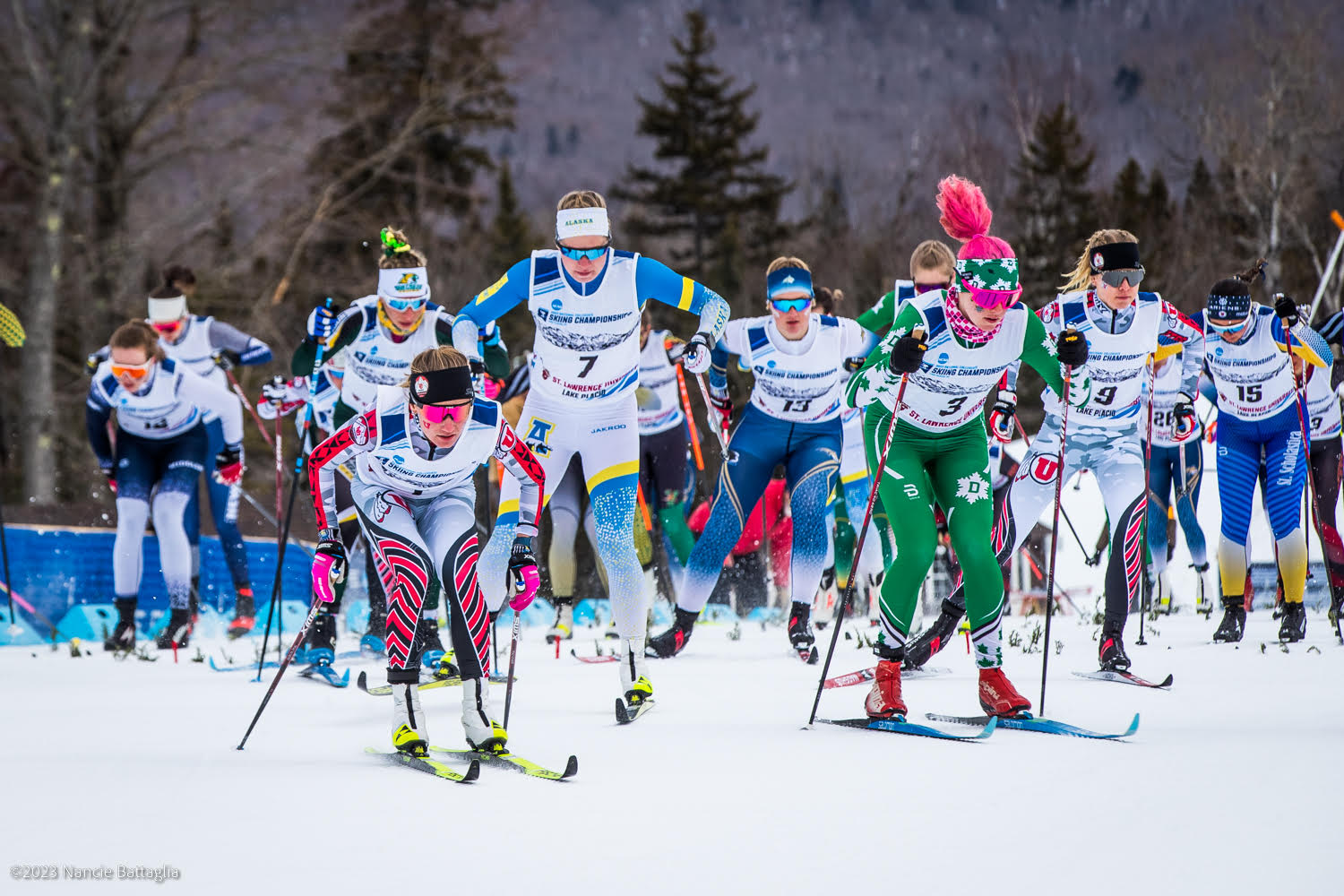
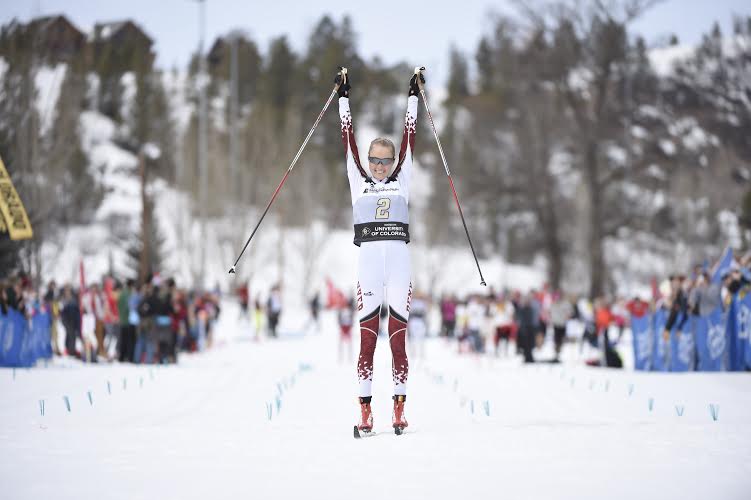
Novie McCabe controlled the pack for much of Saturday’s 20 k mass start. McCabe became just the fifth three-time NCAA Women’s Champion with her win. (Photo: (c) 2023 Nancie Battaglia)
Thursday’s results left open the possibility for plenty of history to be made. After dominant performances in Thursday’s 10 k/5 k skate race, Novie McCabe and Joe Davies opened the possibility to complete a “sweep” at this year’s Championship, winning both Skate and Classic races. Davies could have become only the second North American male to do so, after Ben Ogden completed the feat last year, and also the first British skier (Davies is half-Canadian, half-British, and competes for Team Great Britain). Novie McCabe, meanwhile, came into Saturday as the defending Classic champion, with a chance—after Thursday’s win—to become the fifth women to win at least three NCAA Championships, joining Laura Wilson (4), Katerina Hanusnova (4), and Antje Maempel (4), and Katharine Ogden (3).
And while there was the possibility of history being made by individuals, the entire women’s field was bound to make history by starting on the day. In a first move towards equal distance racing, the NCAA Championship mass start was a 20 k for both the men’s and women’s field.
The team standings also added intrigue around some historical implications. The University of Utah (UU) and University of Colorado (CU) went into the final Nordic day of NCAA competition separated by just a 1.5 points, 358 for UU, and 356 for CU, at the top of the team standings. With Alpine skiers having completed their part of the combined scoring competition, it would come down to the Nordies out at Mt. Van Hoevenberg. UU had the chance to complete the first 4-peat in modern NCAA history (since ski jumping was dropped in 1977), and Colorado had a chance for its first NCAA Championship since 2015, the last time the Championship was held in Lake Placid.
Temperatures hovered right below the freezing mark on an overcast day in the Adirondacks, as the best collegiate skiers from the country looked to end the season in mass start, pack-style, fashion.
Women’s 20 k Classic Mass Start
The extra 5 k to the Women’s Mass Start this year only extended the tension. As the women’s field started to split mid-way through the race on Saturday, a trio of University of Utah skiers—all of them already NCAA Champions—started to push from the front. Novie McCabe, Sophia Laukli, and Sydney Palmer-Leger were joined by University of Alaska-Fairbanks’ (UAF) Mariel Pulles, and University of Colorado’s (CU) Hanna Abrahamsson. The five skiers traded some leads and pulls, but throughout the race, one skier appeared to control pack surges just a little more than the others, seeming to have an idea of when and where she wanted to make a move.
Novie McCabe controlled a pack that also contained her teammates Sophia Laukli and Sydney Palmer-Leger. The UU girls finished first, third, and fifth, propelling the Utes to their fourth consecutive NCAA Championship. (Photo: (c) Nancie Battaglia).
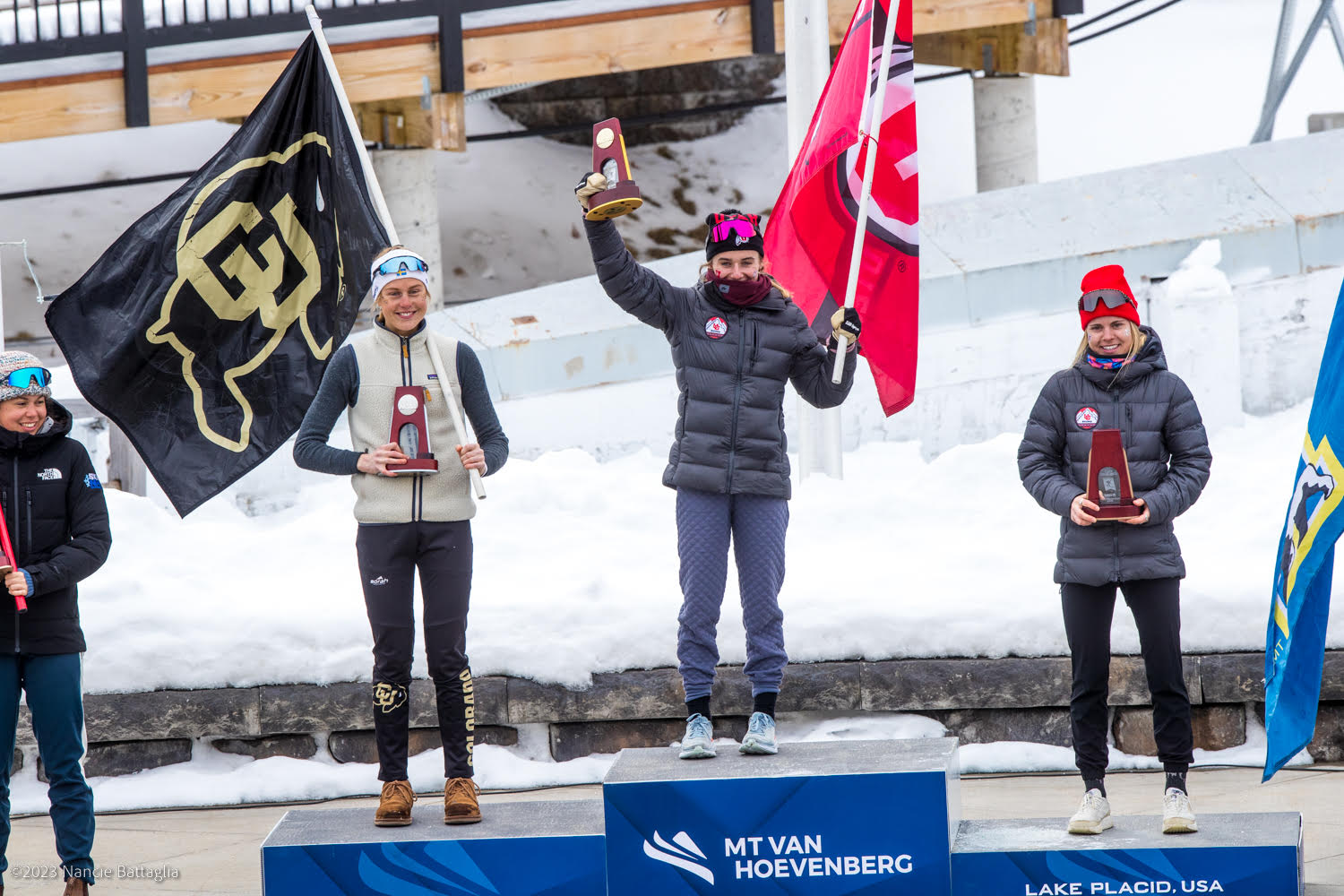
That was McCabe, and when the group started to wind around the Lake Placid course one last time, she decided to go. By the end of the lap, she was on her own. McCbe went on to complete her sweep, winning her third NCAA Championship. Her teammates Sophia and Palmer-Leger came through in third and fifth, with Abrahamsson in second and Pulles in fourth splitting the UU girls results. First, third, and fifth though, was enough to all but guarantee that the University of Utah Utes would make history by winning their fourth consecutive NCAA Championship. The trio of McCabe, Laukli, and Palmer-Leger scored the highest team score in an event of the entire NCAA Championships.
In post-race comments to FasterSkier, McCabe wrote that, “I am really excited that we managed to pull off the team win! The Alpiners had some crazy good performances which really helped us out and it was cool to be able to keep that lead today. My time at Utah has been really amazing and I feel so lucky to be part of the team, so being able to contribute to the win was a really great feeling!”
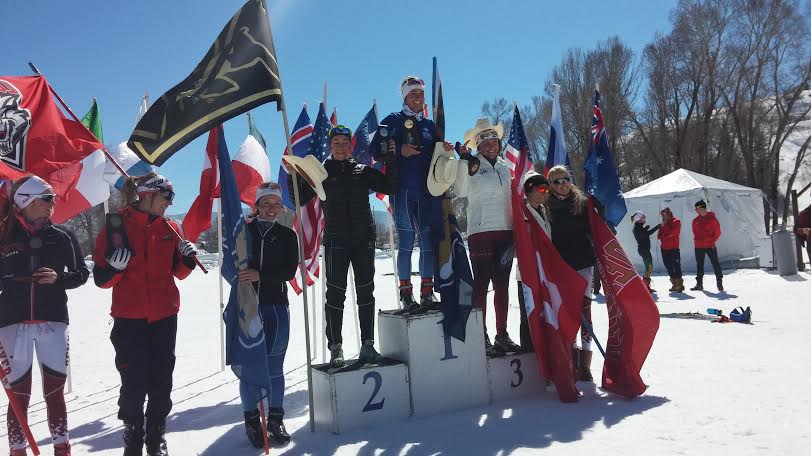
The University of Utah Utes became the first team in modern NCAA Championships history to win four consecutive titles, with their Nordic team leading the way. (Photo: (c) 2023 Nancie Battaglia)
UU Head Coach Miles Havlick wrote to FasterSkier about what distinguished this latest UU Championship: “This year was very much a team effort,” Havlick wrote. “Everyone both on the Alpine side and Nordic understood that their jobs were to score as many points as they could for the team, and it was very evident today. Both in the women’s race and men’s, each of our skiers left every ounce of energy out on the trails and I am super proud of that.”
Havlick also highlighted McCabe’s place not just in this year’s Championship, but in that whole string of Team Championships: “She was definitely on form this week,” he said. “And she will certainly go down as one of the best Ute skiers of all time.” Havlick recognized that the Utes dominance has been part of a feedback loop of determined skiers begetting more determination for each other, “Any one of them, Novie, Sophia, and Sydney, have the ability to take both titles. It has benefitted each of them to have the competition of each other in training day-in and day-out.”
For McCabe, there’s more ahead too, with Havlick being the first to say that after her NCAA sweep, “it will be fun to see how she stacks up she heads back over to Europe for the final World Cups of the season.”
Men’s 20 k Classic Mass Start
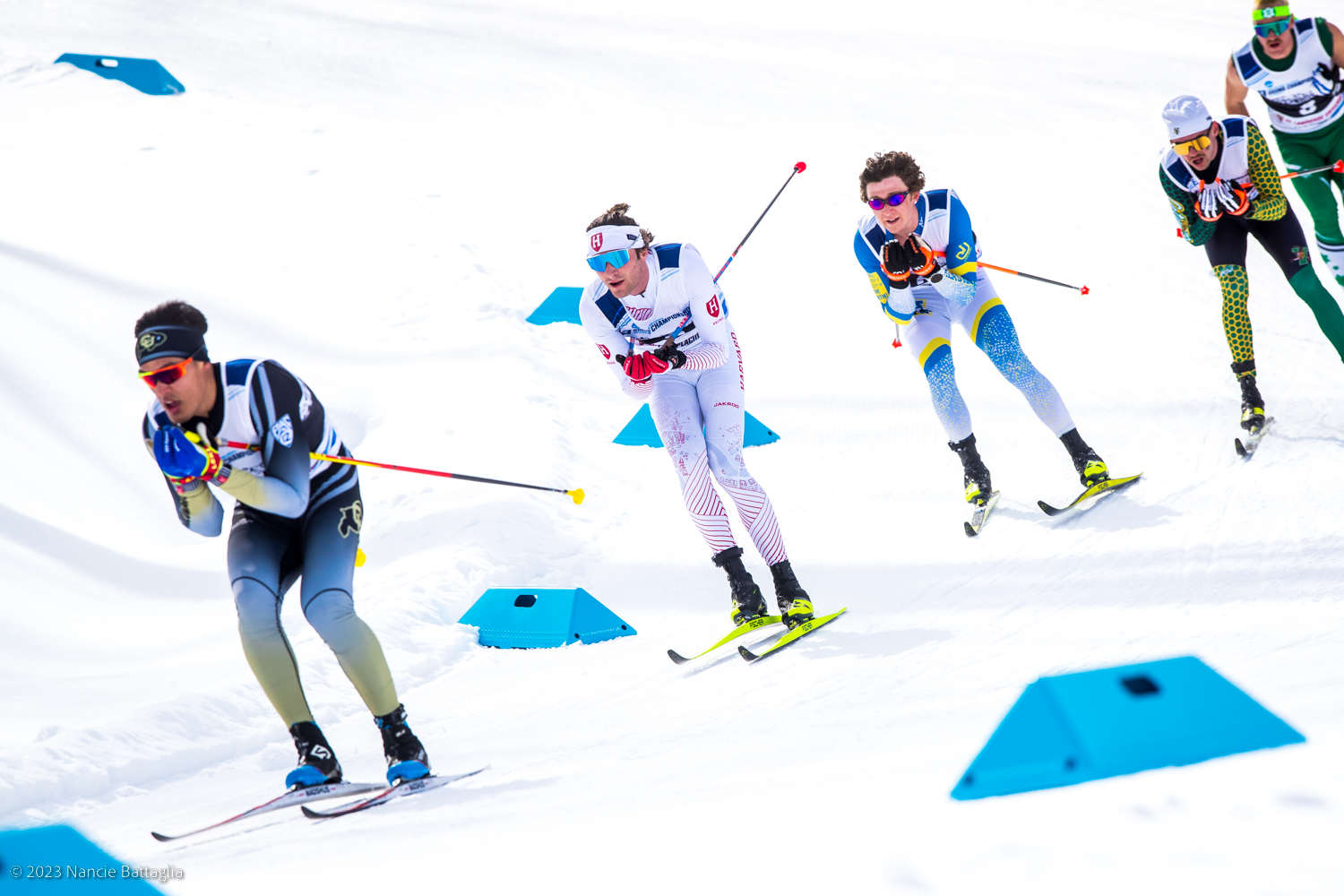
John Steel Hagenbuch has made the tough new course at Lake Placid a kind of home field this season. In January, he won the 30 k freestyle mass start at the World University Games, and was the bronze medalist in that Games’ pursuit as well. He swept this year’s St. Lawrence Carnival, and was runner-up in Thursday’s NCAA Championship race. Neon headband wrapped around his Big Green suit, the Dartmouth Junior was ready to light out for a win from the lead pack of three skiers that had formed mid-way through Saturday’s race.
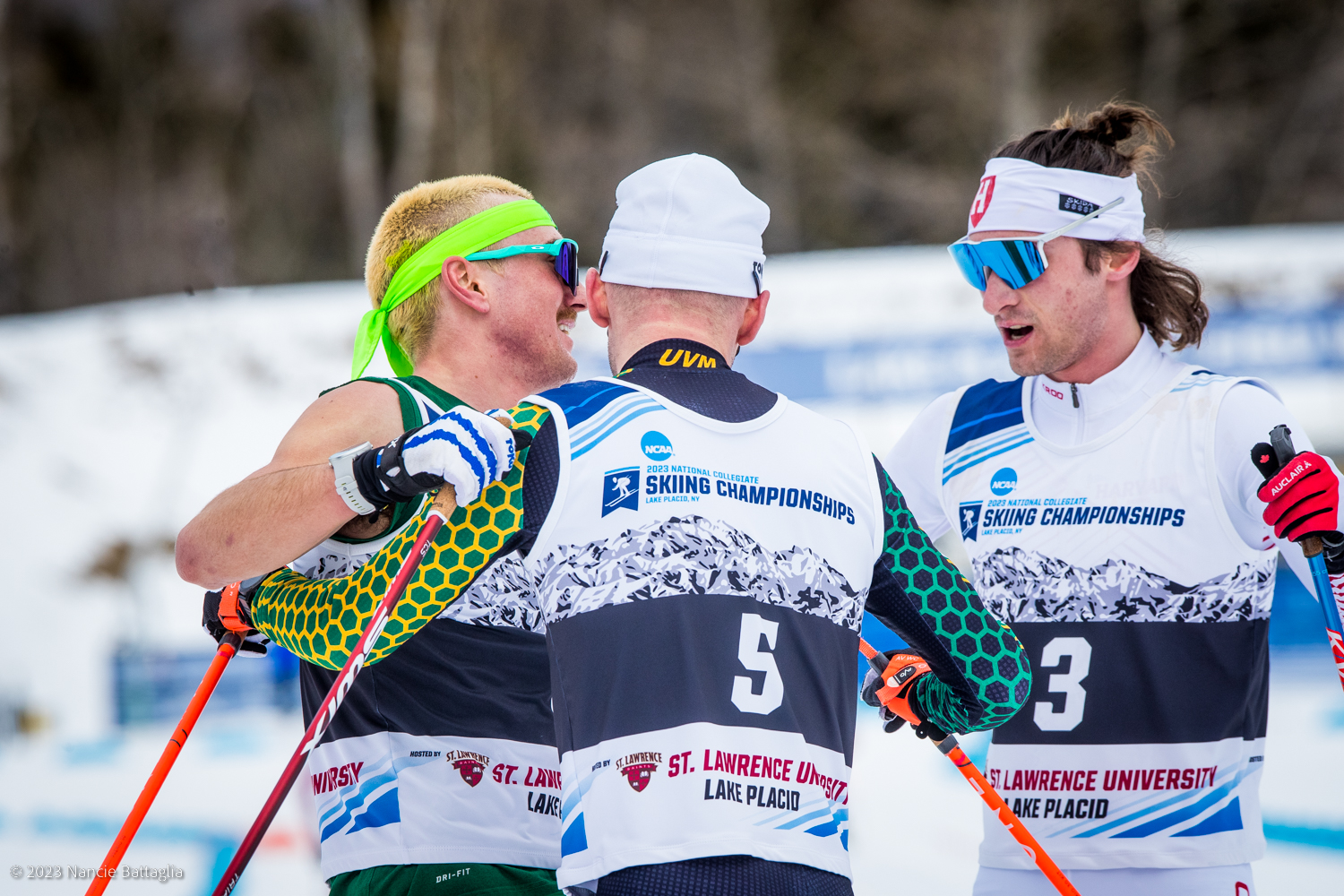
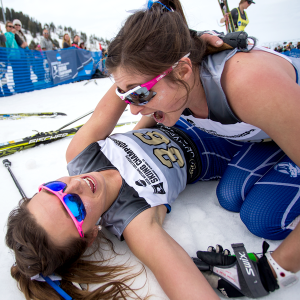
The men’s lead pack embraces after a 20 k pitched battle: (L-R) John Steel Hagenbuch (Dartmouth), Jacob Nystedt (UVM), and winner Remi Drolet (Harvard). (Photo: (c) 2023 Nancie Battaglia)
For a little bit, it seemed Hagenbuch had left it all behind. University of Vermont’s Jacob Nystedt was dropped. Harvard’s Remi Drolet though, was just out of the picture. Then, as the finish came into focus, so did Drolet. The Canadian National Team member steadily, and then suddenly, passed Hagenbuch; a final battle concluded before they hit the finishing straight. Remi Drolet crossed the finish line to win his first NCAA Championship, and the first for the Harvard Crimson Nordic Ski Team in its history.
“I tried to be aggressive throughout the race, and us top three eastern guys. [Hagenbuch and Nystedt] were able to pull away from the pack by pushing the uphill fairly hard every lap” wrote Remi Drolet in post-race comments to Fasterskier. “Apart from [the tactics], I think I just really wanted it. I wasn’t sure I had it in me going into the race, but I was able to dig really deep.”
Harvard Head Coach Chris City wrote to FasterSkier that there was an underlying confidence heading into today that helped boost Drolet and the Harvard team,:“[Remi] is such a strong classic skier and it’s a course that really asks a lot in terms of striding. His seventh place [Thursday]—a first All-American for our program—gave us a feeling that Remi was in a good place to compete in a classic.” Pre-race confidence translated to, “one of the most exciting collegiate races I’ve seen,” added City.
Remi Drolet became the first Harvard NCAA Champion in program history with his win in the 20 k classic Saturday. (Photo: (c) 2023 Nancie Battaglia)
Excitement during the race crescendoed afterward, as both coach and athlete recognized that the result of one race extended far beyond the finish line, “It feels really nice to know that I wrote this down as a goal with [the Harvard team] at the beginning of the season, and that we were able to come together to make an NCAA title happen wrote Drolet. “I’m so proud of him and of his teammates,” Coach City wrote, “and of the many other Harvard skiers who helped build the program to where we reached today.”
Collegiate Skiing Comes to a Close, with more to come
College skiing is a circuit uniquely attuned to constant transition; so, as the banners and barriers come down in Lake Placid, coaches and athletes are looking back, and beginning to look ahead.
For many programs, they will be looking not just at historic firsts at the top of the results, but the ranks of the All-American finishes that marked an individual achievement, powered by a whole program’s efforts. To be designated an All-American, skiers place in the top ten of an event.
NCAAs leave Lake Placid with many programs having achieved milestones. Harvard saw its first NCAA All-American and Champion with Remi Drolet, while University of Alaska-Fairbanks saw seven All-American finishes over two days of racing. (Photo: (c) 2023 Nancie Battaglia)
Remi Drolet’s history-making finishes for Harvard—a first All-American for the Crimson on Thursday, and a first NCAA Championship for the Crimson Saturday—is a stark and impressive example. Dartmouth College, the University of Colorado, and the University of Utah all showed impressive signs of sustained top performance, with four All-Americans between the Women’s and Men’s race on Saturday.
That was nearly matched by the University of Alaska-Fairbanks (UAF), which had three All-Americans today, and a total of seven in this Championships. For the Nanooks, that is a sign of something special growing. “We come away from these championships both proud of what we accomplished, and also hungry for more” wrote UAF Assistant Coach Benjamin Buck to FasterSkier. “We came closer to winning the overall nordic competition than I think anyone expected.”
After all the scores are tallied, honors awarded, and results sheets posted, the athletes and coaches leaving Lake Placid are looking at one aspect of the College circuit that doesn’t seem to change, even as the participants constantly do. Take it from this year’s winner, Novie McCabe: “The college ski community is just so great and everyone is supportive of each other,” she said. “It’s really just such a lovely group of people. Yes, winning was a goal of mine, but mainly, I’m just happy I got to experience racing in this insane atmosphere!”
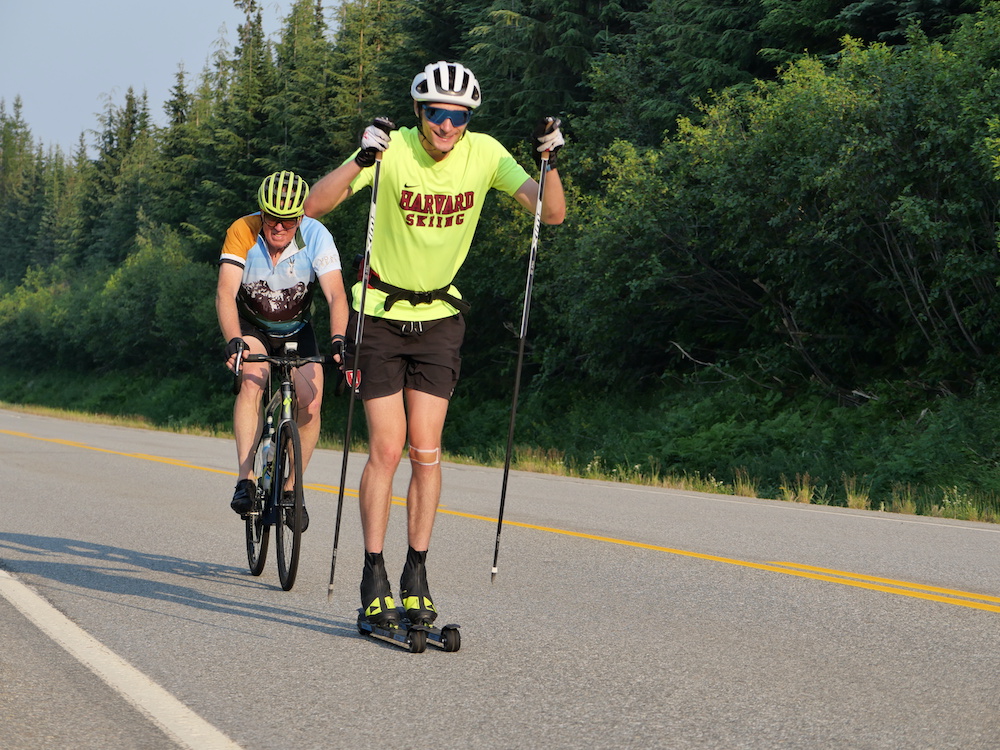
Rémi Drolet rolling up to Nancy Greene Summit, supervised by coach Dave Wood. (Photo: Peggy Hung)
Rossland, BC native Rémi Drolet had a lot going on during the first year of the pandemic. In his first year on the Canadian senior national ski team, he was studying theoretical physics at Harvard.
His junior career ended with a silver medal and an individual fourth place in the 2020 World U20 Championships, right before COVID cancelled the final World Cups and Canadian Senior Nationals. This was also his first season living in a foreign country as an Ivy league freshman.
The previous (18/19) season, as an 18 year old, he collected two silver medals at Senior Nationals behind Lenny Valjas before his first World Cup starts. Drolet was the third best Canadian in the Québec mini-tour, beaten only by retiring athletes Alex Harvey and Valjas.
These results put him onto the national team as a first year senior, and also set expectations high for the 20/21 season.
FasterSkier caught up to Drolet at home in Rossland, suitably distanced in a park near his home. After a brief publishing delay related to this author’s day job, Drolet updated his status in an email from Muonio, Finland.
University Life
Pandemic life in the USA last season was remarkably varied, depending on the state a skier lived in.
“I wasn’t able to actually make it to Boston itself,” Drolet explained. “All classes were online, which made some things difficult. And I definitely miss being there, miss seeing all my friends.”
Collectively, IVY League schools cancelled all sports programs for the 2020-2021 academic year, leaving student-athletes in a challenging predicament.
“A lot of athletes and a lot of other athletes at Harvard just decided to take a leave of absence and take the year off because of that. Even then there were very few students who were allowed on campus, basically, just certain years and those students that needed to be there for personal reasons.”
In terms of his individual handling of the circumstances, Drolet shared a silver lining.
“[There were] some logistical issues, but overall, I think I took advantage of it pretty well, because I was able to be living at home the whole year.”
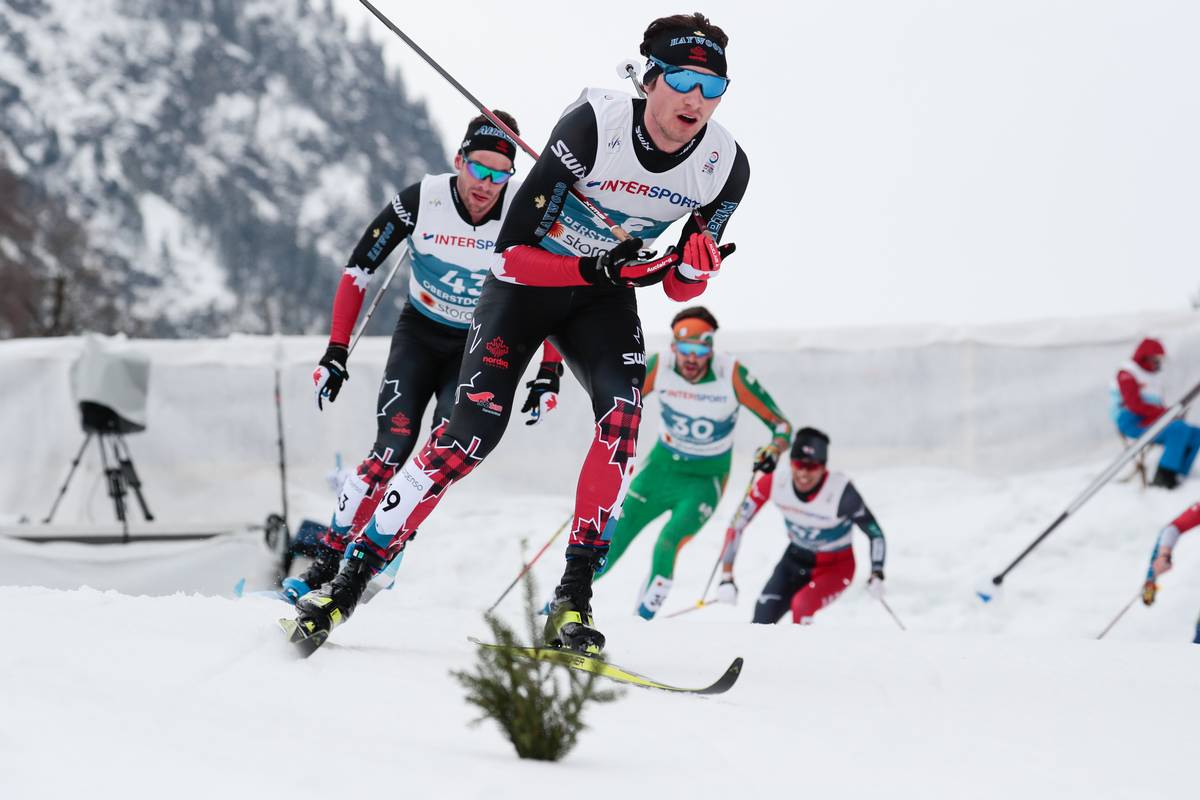
Rémi Drolet races the 50km freestyle during the 2021 World Championships in Oberstdorf, Germany. (Photo: NordicFocus)
Rossland is an outdoor enthusiast’s heaven. There are endless trail options, nicely paved roads, and a small population which ensures a minimum of traffic on roller ski routes. The Rossland Range, an offshoot of the Monashee Range, provides moderate elevation including the famous Seven Summits trail. FasterSkier, in Rossland on a mountain bike vacation, saw Drolet rollerskiing while driving to the campsite before running into coach Dave Wood at the grocery store.
At the Races
There were no FIS races in Canada last season. None.
As best FasterSkier can determine, the Canadian who got the most starts in the 20/21 season was Sam Hendry, who was studying and skiing at the University of Utah. For Canadians not attending school in the US, the only options were the World Cup and World Championships. Pandemic restrictions in British Columbia included skiing only at your home trails, which meant most athletes weren’t able to train with their peers from other clubs. Clubs could organize interval start ‘races’ for one training group at a time.
“My first race of the year was the World Cup in Lahti,” recalled Drolet.
That first race was the 30km skiathlon, won by Emil Iversen in a Norwegian sweep. Most of the athletes had raced multiple WC weekends or the Tour de Ski already. While some of the countries skipped some weekends, those athletes were able to enter Scando Cup races during the break.
Logistics at the World Cup
It’s no secret that moving country to country, each with slightly different restrictions and rules in place, to follow the World Cup poses challenges during a global pandemic.
“Even beyond the fact that we hadn’t had any races, it was a lot of logistical issues just coming there. We had to be careful with COVID and try and navigate inconsistent regulations at the venues. For example, that first weekend in Lahti, we had some false positives on the team, and so we all got put into quarantine right before the relay race. And then, probably an hour before the start of the race, we all got told that they were false positives, and the wax techs just ran to the wax truck and prepared skis as best as they could. It was definitely a challenge to get it all together.”
After time to rest and digest, Drolet reflected on his racing and training during what was hopefully the apex of challenges amidst the pandemics.
“I think this whole year wasn’t, wasn’t my best racing year. We had a couple training errors leading up into the season, kind of related to a lot of fatigue from school that was managed poorly going into the World Cups.”
With a short racing season, there wasn’t much time to change course. Returning to Canada to reset would have required quarantining at home instead of training.
“Things gradually improved throughout the season, and I got a couple of decent races in, but not totally where I want it to be… I think I definitely learned a lot of things that I should do. And a lot of things I should be careful to avoid to manage energy properly and be as ready as I can for each race.”
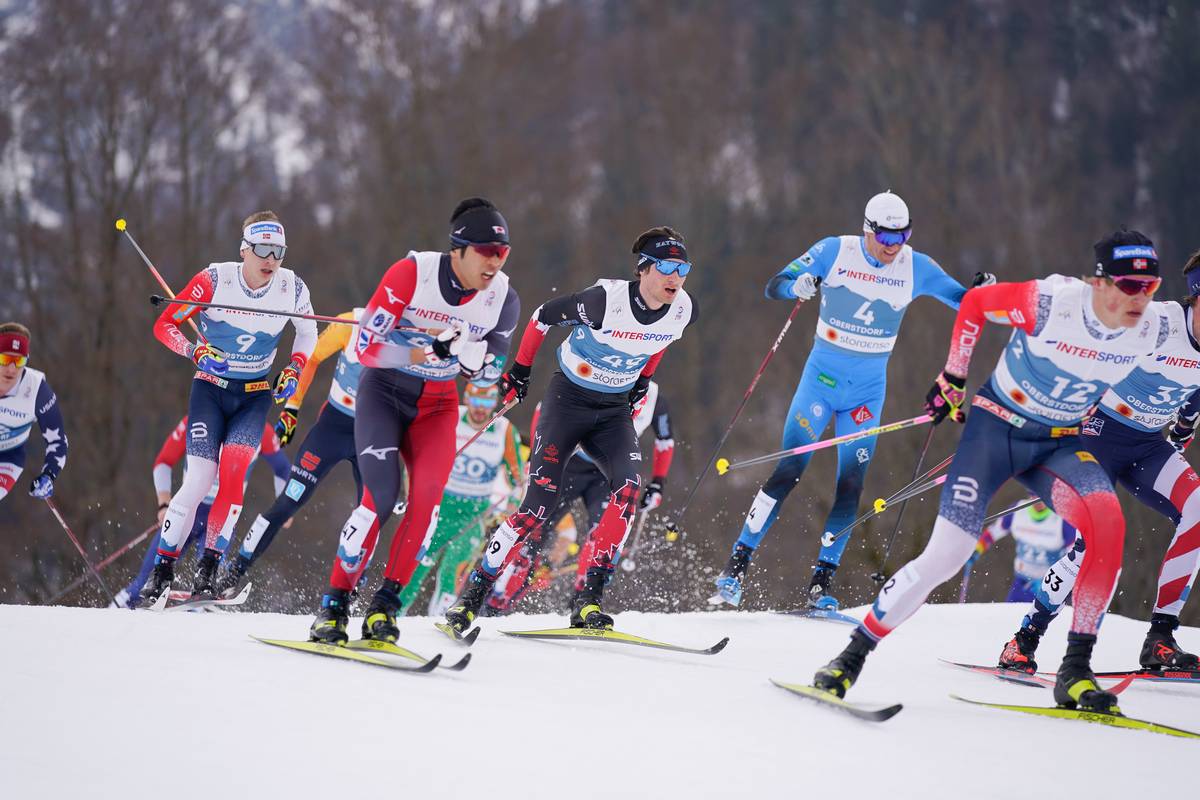
Rémi Drolet (center) races the 50km freestyle during the 2021 World Championships in Oberstdorf, Germany. (Photo: NordicFocus)
Coaching
Drolet had two coaches last season. Erik Bråten was the national team coach and Dave Wood was his personal coach. Drolet shared that he is happy to again work with Bråten this season, as he will be the WC coach in Europe for 21/22.
“I think he’s very good at fostering a strong team atmosphere and making sure everything’s well organized and that athletes don’t have to think about every small detail all the time. And that makes a really big difference so that you can just get up and kind of focus on training. And he was very accommodating. Especially for me to do a lot of schoolwork while I was over there.”
While working in Canada for NC, Bråten often promoted the idea that skiers need to race in Europe to learn what the standard is and then return to their home training environment to raise their skiing to that level. Drolet agreed with this approach.
“I found it really hard to judge how I stacked up to the rest of the world, and just how fast I needed to be. What benchmarks I needed to be hitting. I mean, you see some data, but it’s hard to really see what that feels like until you’ve actually done it. It also brings a lot of confidence, I think, knowing exactly what you need to achieve, kind of makes it more tangible, rather than just chasing something more abstract.”
There are few things more abstract than theoretical physics, but Drolet is clearly energized by a concrete sense of where he needs to be.
Dave Wood spent many years as head coach at Cross Country Canada, working with athletes like Beckie Scott and Devon Kershaw. He moved to Rossland to become the head coach of the Black Jack club team just as Drolet aged out of Track Attack.
“Pretty much everything I know about being an athlete, I know from Dave. And I definitely wouldn’t be where I am without him… One thing he’s really taught me that’s important is: ‘to be good, you have to be good at being good.’ And I guess to clarify… you need to set yourself up for success, rather than just doing the minimum and getting to the start line.”
The 21/22 Training Season
Drolet committed to taking a gap year from Harvard to focus on skiing, with the hope of racing period 1 of the World Cup and qualifying for Beijing. There were three national team camps, three more than in 2020. The first, scheduled for Penticton, was moved to Vancouver Island to escape extreme wildfire smoke.
The second camp was in Mammoth, California, a Canadian tradition for elevation training.
“The training camp in California, especially, was excellent, and we got in some good hours at altitude to get ready for the season,” Drolet wrote from Muonio. “I always love the time we spend down there and it was really great to have the whole team together for a few weeks. Eric de Nys also started on as the Development coach, and he has been doing a great job so far!”
The final camp was Frozen Thunder in Canmore, which in the current travel climate is even more important for spending hours on snow before the season starts.
When Nordiq Canada published the list of athletes selected for period 1, the list of names was short, and Drolet’s name was not present.
“I would have liked to go, but I did not race fast enough last year to qualify.”
Adversity is a large part of being a ski racer and the response to each challenge is revealing. Drolet is not arguing legal interpretations of the criteria or motivations of the selectors here, focusing instead on what he can control.
Racing Again
De Nys led a group of Canadians to early season races in Finland and Sweden.
On November 12th in Muonio, FIN, Drolet was 25th in the classic sprint, one of three Canadians to qualify for the heats. Some names in the final are familiar to ski fans: Sergey Ustiugov, Federico Pellegrino, and Erik Valnes have all won world cups.
The next day, the 15km classic was dominated by Norway and Russia, with only Iivo Niskanen in first and Drolet in 15th adding colour to the top 16.
“The racing in Muonio is not necessarily so different from racing at a NorAm or a Canada Cup,” Drolet wrote. “You still get ready the same way and show up on race day ready to race as fast as possible. There are some things that are different, though. First off, you need to deal with jet lag and be really on it so that you are properly rested for the races. The whole setup is also a bit different. “
This trip was planned as a learning experience for the NexGen athletes.
“Everyone stays at one big hotel and eats at the same restaurant, which makes it feel like more of a big event. It just feels more concentrated. Then, of course, some of the world’s top skiers show up, so the competition is a lot stiffer than when racing in Canada. I think if there’s anything I’ve learned it would just be a reinforcement of the importance of managing your time outside the races as effectively as possible.”
“Whether it is just meals and proper rest or the warmup for your race, there are small things that the best do better. It is good to be able to observe what they do and try to incorporate it myself.”
Drolet finished the Muonio 15km 1:42 behind Niskanen and 50 seconds behind Ustiugov.
“I am satisfied with the results in Muonio,” he wrote. “I am judging them by a combination of time gaps, placing, and execution. I think it was overall not bad for the first races of the year, and I hope I can keep improving as I get more competitions under my belt.”
The next weekend, the Canadians moved from Muonio to Gällivare in Sweden where Drolet finished 17th and 16th in the distance races.
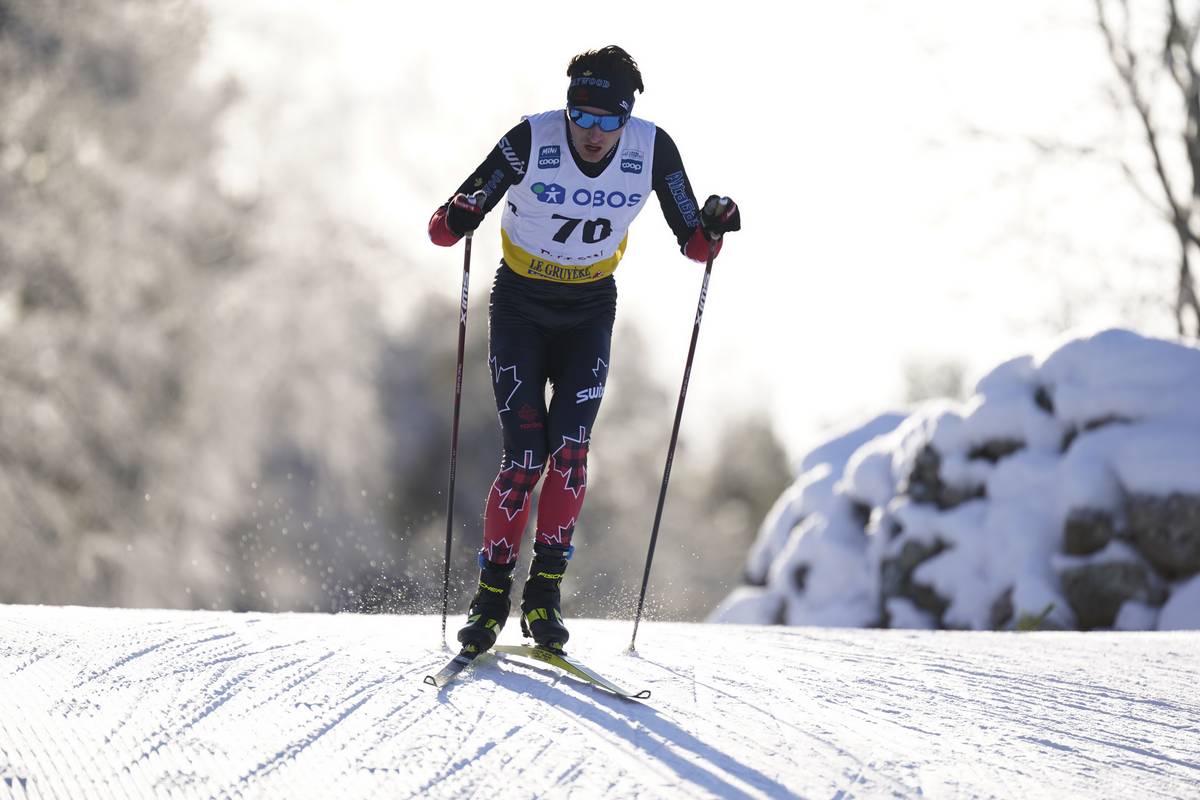
Rémi Drolet (CAN) races the 15k freestyle in Falun, Sweden in January, 2021. (Photo: NordicFocus)
Up Next
“My plan is to compete in these early season races in Scandinavia then head back home for the Western Canada Cups. I think having this amount of high level racing before Christmas will allow me to be optimally prepared for the Olympic Trials races in January.”
Drolet was 6th in the free sprint at Sovereign Lake, and won the 15km individual classic.
After WCC weekend 1, Drolet reflected on his Euro trip.
“It was it was good, some [races] were better than others,” he said. “But it was I think it was really worthwhile to go over there and get some races in really early in the year against some really strong guys. I think it prepared us well for the season and I feel happy I went there.”
The opportunity to race at home in Rossland for the second Western Canada Cup weekend was derailed by an ‘atmospheric river’ storm that damaged the snowpack at ski areas through southern BC and that race weekend will now be held at the backup venue, Sovereign Lake.
Living in Rossland
“Whenever I think about it, I just feel extremely lucky to have been born here. I just love, love, love living here. So fortunate that I’ve lived here my whole life and been able to benefit from everything that comes with living in Rossland. And then, yeah, Dave moved here at just the right time for when my skiing career was getting started. And it’s all been really amazing.”
Watch this space for upcoming stories from Dave Wood recorded during this author’s recent trip to Rossland.
Linn Eriksen of the University of Denver celebrates her win in the women’s 15 k classic mass start at the 2016 NCAA Skiing Championships in Steamboat Springs, Colo. (Photo: Jamie Schwaberow/NCAA Photos)
In March, FasterSkier recently published an article (Part I) on college ski racing in the U.S. and what a change to National Collegiate Athletic Association (NCAA) Championships might require in regards to adding a sprint race. In the second part of the series, we explore why men’s and women’s race distances are different at the collegiate and World Cup level and whether this constitutes a need for change.
***
Men | Women. Women | Men. Scanning the athletics webpage for an American institution of higher education that boasts a varsity sports team becomes a sail down the Casiquiare canal, with gender bifurcation an obligatory outcome.
Resting under the canopy of NCAA sports, however, nordic skiing presents itself as somewhat of an anomaly. Shared race days. Shared coaches. Shared course site. Shared team. At the surface level, gender in collegiate nordic skiing is almost arbitrary.
Olivia Amber (r) of Colby College and teammate Amy Bianco celebrate their top-20 finishes in the women’s 15 k classic mass start at the 2016 NCAA Skiing Championships in Steamboat Springs, Colo. (Photo: Colby.edu)
Yet, closer inspection reveals one particular area in collegiate cross country skiing where the genders differ: Race distance. In most individual nordic events at the college level, the course length of women’s and men’s races are not the same. The trend is a 5-kilometer deficit for women’s race events in comparison to men’s events.
For Molly Peters, the head nordic coach at Saint Michael’s College and former NCAA All-American in nordic skiing for Middlebury College, this is a problem.
“We’re sending a message to all the young women who have a goal to ski in college,” Peters said in a phone interview. “I just can’t imagine that they feel like their equal as people or athletes when they look and they see, ‘Oh, look every single race I’m going to be skiing 5-kilometers less.’ How are men every going to look at women equally and how are women ever going to look at themselves as being equal if you’re always skiing 5-kilometers less?”
With that in mind, Peters promised herself to reshape the sport.
“It had to be my mission in life to get it changed,” Peters said. “I feel like my best bet to get it changed is to change the NCAA Championships because everyone bases all their racing off of what the NCAA does. Every EISA [Eastern Intercollegiate Ski Association] Carnival is basically not equal because they follow whatever the NCAA does. It all trickles down.”
The Trickle Effect: One Theory on Why Race Distances Differ
A single change can create countless more. When Title IX was passed in 1972, a change was instituted in the treatment of both genders by federally funded college institutions. Within the realm of campus athletics, the alteration brought about numerous others, including an increase in the number of women participating in college sports, the scope of sports available to women and men (in certain instances, harmfully so), and perceptions of women who choose to ‘play.’
Recent Middlebury College returnee, Annie Pokorny, points out that this sort of ‘trickle down’ change should not be looked at lightly.
“When women entered sport, some rules were tweaked to account for physiological differences, but also to support the idea that athletics could be harmful to women, (particularly their reproductive systems,” Pokorny wrote in an email.
Pokorny is completing her undergraduate senior thesis on feminist philosophy and the philosophy of sport. While she admits she is not an expert, her studies and experience in nordic skiing quantify her knowledge on the subject.
Pokorny explained that myths surrounding the female body and exercise in the 20th century, caused men “to adjust sport to make it safer and more “womanly”), which turned into a conceptual connection between women and the need to protect them.”
“That conception turned into tradition, one that still thrives today in the form of shortened distances for female endurance athletes,” Pokorny added.
The top 10 in the women’s 5 k freestyle race at the 2016 NCAA Skiing Championships in Steamboat Springs, Colo. (Photo: Matt Johnson/MSU)
For Pokorny and Peters, these types of traditions were made to be broken.
“The best things that have ever happened are from people changing tradition,” Peters said. “My purpose is to get the NCAA Championships changed to be the same distance for men and women because that will trickle down to the smaller races.”
But implementing change in the NCAA Championship event and NCAA skiing is no easy task.
“NCAA skiing is comprised of a wide variety of institutions: Division I, II and III; private and public; and large and small,” Dave Stewart, head nordic coach at the University of Denver, wrote in an email. “Any choices about race format, distances, etc. must take into consideration the perspectives of this diverse group and, ideally, the decisions should be made with the goal of broadening participation at the NCAA level and increasing competition.”
If Stewart is right, the question becomes: Would making race distances equal between men and women broaden participation and increase competition?
A Second Theory & the Distance Debate: Should Men Race Shorter or Women Race Farther?
When it comes to long distance endurance events, some research argues women fare better than men.
“Women can race just as long as men,” Montana State University (MSU) incoming senior Anika Miller said on the phone. “If [the NCAA] wanted us to do a 50 k in college, sure we could do it, but it wouldn’t make any sense athletically.”
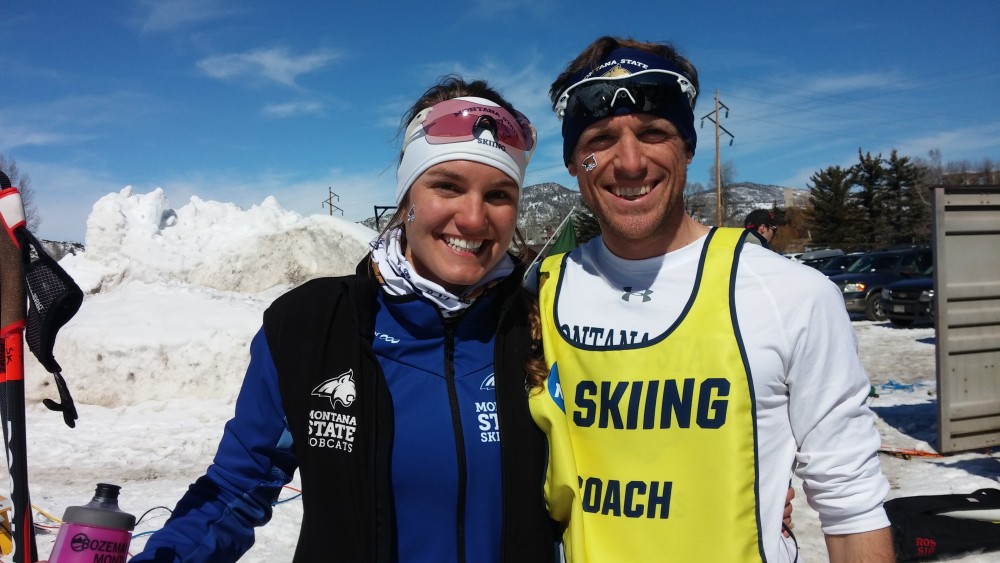
Montana State University’s Anika Miller (l) with head coach Matt Johnson after Miller took won the women’s 5 k freestyle at the 2016 NCAA Skiing Championships in Steamboat Springs, Colo. (Courtesy photo)
Miller — a native of McCall, Idaho, and this year’s NCAA champion in the 5 k freestyle — doesn’t doubt the ability of women to race the same distance as men.
What she questions is whether it’s necessary for women to do so.
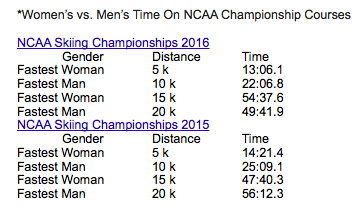
“It’s kind of a hard conversation to have as a female athlete because you don’t want to say that women are inferior,” Miller said. “My opinion on it is that the race distances are good as they are as far as women doing a shorter distance than the men. Because time wise … for the 15 k versus the 20 k at least, sometimes the guys only race it five minutes different than the women, which isn’t really that large of a margin, [meaning] effort wise, it’s more equal.”
The point Miller makes is that women and men are currently racing equal. Equal amounts of time on course, at least in the 15 k and 20 k events (*see men’s and women’s course times).
Oscar Friedman, coming off his senior season at Dartmouth where he was a captain of the men’s nordic team, also argued that close to equal amounts of time on course is more important than equal course distances between men and women.
“The point of having those different race distances was to make the men’s and women’s races equally competitive,” Friedman said on the phone. “That being said, if women are internalizing it, then that’s a bigger issue. If there’s a push from within the sport, women should be the ones deciding the race distances.”
The push from women within the sport varies, but much revolves around whether women race longer or men race shorter distances. Kelsey Phinney, coming of her senior season and also a captain at Middlebury, admitted that originally the idea of equal distances didn’t appeal to her because she assumed women would be required to race farther.
“I think the misconception has been that equal distances meant that women had to race longer,” Phinney on the phone. “But it doesn’t mean that women have to go 10 k and 20 k it could mean that men go 5 k and 15 k. Or that the races range from sprints to 30 k.”
Rachel Hampton, an incoming senior at Harvard University, advocated that while women are capable of racing men’s distances, men would benefit from racing shorter lengths.
“There’s a feminist side of me that wants to say that girls can do anything boys can do and there’s no theological reason why we shouldn’t be able to race the same distance as them,” Hampton said on the phone.
“I will say I sometimes feel bad for the guys because it seems like they only race long races. I think if we added sprinting and a few 5 k races for the guys and did a wider range of distances, that would be better for them. And I think if the men were on that plan, the women could then get on the same distance plan.”
However, when men competing in college were asked if they would be willing to race the same length as women, responses were often shaped by race distances at other levels of nordic competition.
“Shortening the men’s distances would be a huge disservice because as I see it, the goal of NCAA skiing is to make American skiers as competitive as possible on the World Cup,” Friedman said. “I would be completely against shortening the men’s races. But if women want to make the call and race longer, they should fully be able to do that.”
For a few women, however, simply adjusting the women’s race lengths to match those of the men sends a certain message: Women have to be like men to be equal.
“I think the message it sends depends a lot on whether you shorten the distance of men or you increase the distance that women have to race,” Bates College ’16 grad and skier Britta Clark said on the phone. “Trying to increase the distance that we race in the name of equality, but at the same time really just saying that equality is women doing what men do, I don’t think it’s necessarily speaking to the issue.”
Clark’s point is supported by Dartmouth College Women’s Head Nordic coach and Director of Skiing Cami Thompson-Graves, also a member of the NCAA Men’s and Women’s Skiing Rules Committee, chair of the USSA Cross Country Committee, and most recently, a member of the International Ski Federation(FIS) Ladies’ Cross Country Committee.
“I don’t feel the need for women to do men’s distances,” Thompson-Graves said on the phone. “Why don’t we just do women’s distances? Why can’t we just be different … I’m a big believer in being proud to be a woman, and not a little man.”
Harvard’s Rachel Hampton leads a Dartmouth skier during the 2016 Colby Carnival. Hampton went on to compete at the NCAA Skiing Championships in Steamboat Springs, Colo. (Photo: FlyingPointRoad.com/Harvard Facebook)
Increasing women’s distances strikes some as a forfeiture of female identity for one that is male. Which is one reason Peters more strongly advocates for decreasing men’s distances to be the same length as women’s.
“In skiing, I think the men should come down,” Peters said. “The 20 k is really irrelevant, even at the international level. I see nothing wrong with the 5 k, I think men should do 5 k. Five k is super exciting and can be a great race. I think it should be 5 k, 10 k, 15 k, and then add in the relays and sprints.”
However, a men’s 5 k race doesn’t appear on numerous nordic race calendars — national or international — either.
“I don’t think at the national or international level men race 5 k so maybe that’s a distance skill set that would only be applicable to college skiing in the U.S.,” Raleigh Goessling, coming of his senior season at the University of New Hampshire, said on the phone. “If the race distances were changed, I feel like the distances that are contested at other levels of the sport and other formats should also play into it.”
The Window Between U.S. College Racing and the World Cup
At the international level, women and men rarely race the same distance. FIS course lengths — like the NCAA — are designed around the gender of the athletes competing.
FIS Cross-Country Committee Chair and Norwegian Olympian Vegard Ulvang indicated that similar to college racing in the U.S., FIS race distances have been different for decades. One potential reason for these differences aligns with Porkorny’s findings. According to Ulvang, how female athletes were viewed in endurance sports when they started ski racing influenced the original length of women’s race courses.
“The history behind the differences comes from the time where the nations believed that women were weaker — [with the] first female race in 1952,” Ulvang wrote in an email to FasterSkier. “Today we of course know better. Female athletes are better prepared for longer distances than men, so principally the distances should be equal.”
Principality does not always equal response. Ulvang indicated that even if the race distances should principally be equal, one major driving force for the committee to keep women’s race distances shorter than men’s rests on the race experience for spectators.
“The argument has been that the time gap between the 20 best women is bigger than that of the men,” Ulvang wrote. “Longer distances would create a ‘worse TV product’ — with one racer skiing alone [during the race].”
T.V. time does not strike Peters as an excuse for NCAA Championships and U.S. college cross-country ski schedules to follow the same format as the World Cup.
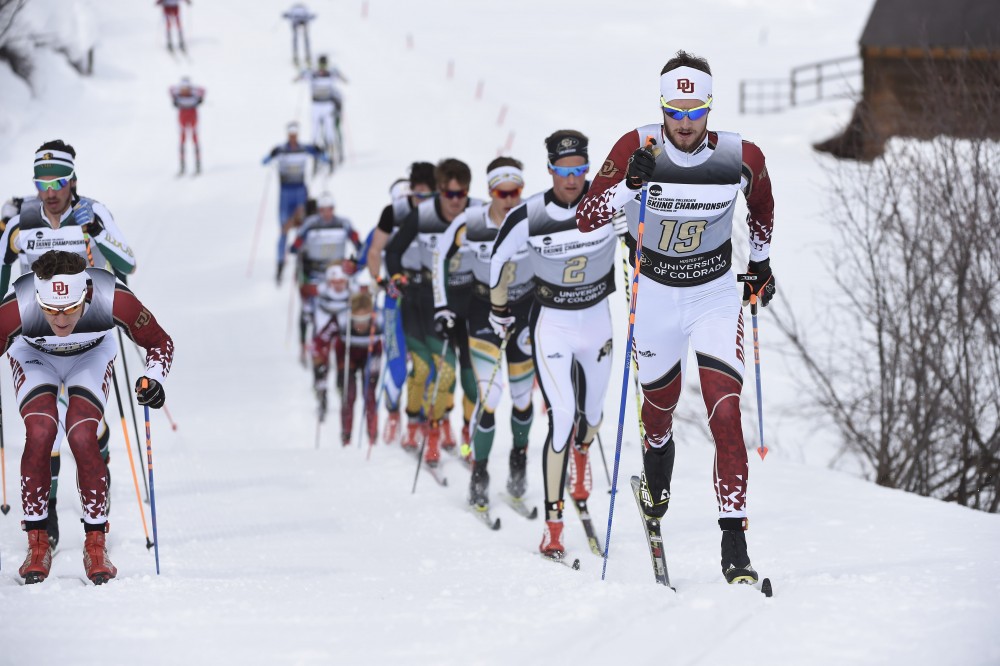
The men’s 20 k classic mass start at the 2016 NCAA Skiing Championships in Steamboat Springs, Colo. (Photo: Jamie Schwaberow/NCAA)
“A lot of people will say well, look at what they do at the Olympics, and look at what they do at the World Cup — it’s vastly different,” Peters said. “The women do so much less. But that doesn’t make it right. That’s a reason why NCAA follows it and EISA follows it, but that doesn’t make it right.”
Stewart, who has helped the Denver Pioneers achieve five NCAA Championship titles, supports the idea that NCAA skiing in the U.S. could act as a catalyst for change.
“As long as FIS schedules longer races for men than for women in international championships, there will be some resistance to equal distances at other levels, but I see no reason why the NCAA should not be a trendsetter and work to turn the tide on this,” Stewart wrote in an email.
He supports equal distances in cross-country skiing, seeing it as a statement that should be sport-wide, not just within NCAA nordic skiing.
“Equal distances for men and women should be implemented in our sport, both at the NCAA and international levels,” Stewart wrote. “We have had equal distances in the sports of swimming and track and field at the international and collegiate levels for many years. Equal distances would reinforce gender equity and would send the right message about our sport.”
Yet, when it comes to World Cup race lengths versus those contested at the NCAA, some argue the Championship event is already sending a message to other levels of cross country competition.
“I actually think that NCAA’s, where the women race 15 k and the men race 20 k, is much more equal than on the World Cup when the women race 15 k and the men race 30 k,” Rosie Brennan, Dartmouth grad and current U.S. Ski Team (USST) member, said on the phone.
Brennan is not opposed to a more balanced race length distribution between men and women. Her concern with changing race distances at the World Cup and NCAA collegiate level is ensuring that the racers’ performance and perspective are taken into account.
“I think it would be nice if they tried to make the [race distances] a little closer,” Brennan said. “I also think the reason the distances were different in the first place was the idea that the time the race takes should be fairly equivalent, so the effort is the same. If the time differences [between men and women] are getting to be much greater, to the point that the races are no longer requiring the same amount of effort, then I think it’s worth proposing some sort of a change and [is] something to re-visit over time.”
Brennan’s suggestion to visit the race experience for athletes doesn’t go unsupported. Men’s and women’s race distance differences have been discussed at the collegiate and World Cup level. But the actual number of times the topic has been statistically ‘re-visited’ remains a bit blurry.
Regarding conversations within the college circuit, Peters indicates that implementing changes to men’s and women’s race distances has been thrown around for some time.
“Patty Ross, who coaches at Middlebury, she’s been fighting it for 25 to 30 years and she’s had no success,” Peters said.
Ross could not be reached for comment.
Within the FIS Cross Country Committee, Ulvang indicated that the turn of the millennium was when most conversations regarding the different course lengths at the World Cup level of racing began.
“[The] question has been discussed in the FIS committee a few times the last 15 years,” Ulvang wrote.
Beyond that, four-time Olympian, USST member, Fast and Female USA President, FIS athlete rep, and now a new mother Kikkan Randall revealed that World Cup athletes have also had at least one opportunity to make their opinion about equal distances known.
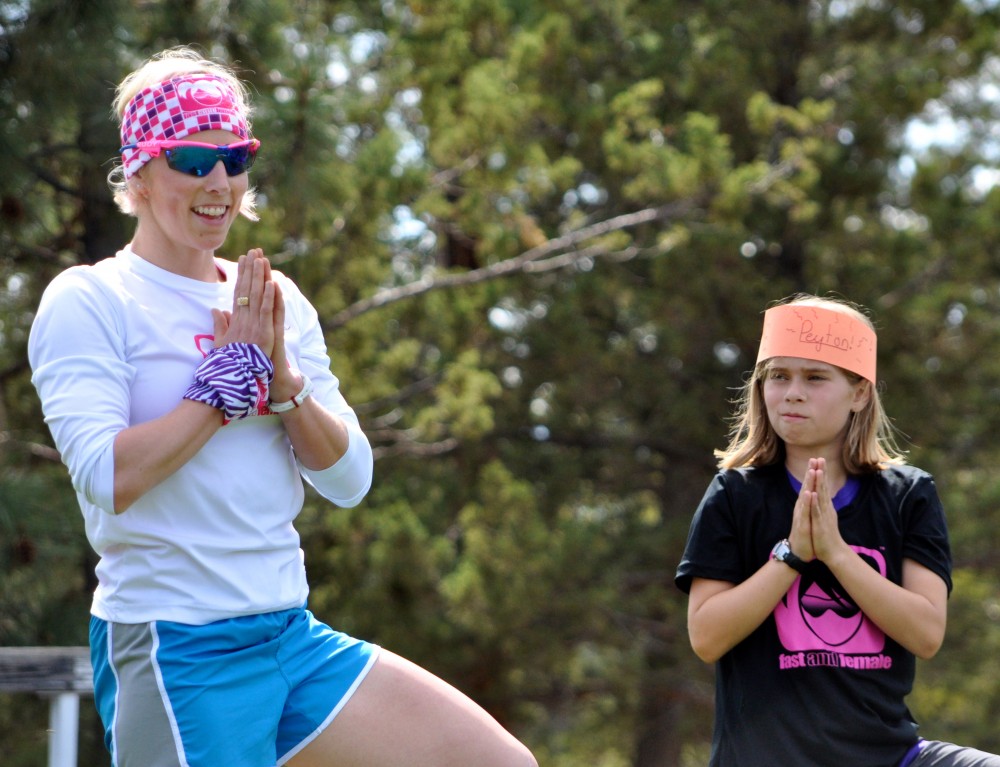
Fast and Female USA President Kikkan Randall leading a Fast and Female session two years ago in Bend, Ore. (Photo: Matt Whitcomb)
“It’s an interesting topic that actually comes up quite often on the World Cup,” Randall said. “As the athlete rep to FIS, I do a survey at the end of each season and couple years ago, as part of the survey, I sent out that question [of equal distances].”
The responses Randall received found most women on the World Cup circuit — at least a few years ago — did not want to race the same distances as men.
“The majority of women actually said that they were not interested in racing the same distances as the men,” she said. “I’m considering putting that same question on the survey again this year because the comment was brought up a couple times this spring.”
And how might women racing on the World Cup respond to shortening men’s distances to make the lengths equal? The question has not been posed, but Randall may incorporate it into her next athlete poll.
“That would be another interesting take on the same question,” Randall said. “This year on the World Cup I feel like the distances were reduced a little bit with so many tour [multi-stage] events, so again it’d be an interesting time to poll the athletes and see how they feel.”
Conclusion: Connecting Part I and Part II
As long as there is snow around, colleges with nordic programs in the U.S. will continue to attract a cohort of cross-country skiers looking to compete, while simultaneously continuing their education. For many, choosing college over a club team is not the end of a cross-country skier’s long term career. It is also the potential beginning.
“The way our country is, you’re always going to have athletes choosing to go to college after high school no matter what path they’re on,” Brennan said. “So I think the more that that can be facilitated, the better it is. I mean there are a lot of good club programs that offer alternatives for people who choose that, but I think the NCAA can provide a route as well.”
Some individuals also see the NCAA as an opportunity for Americans to attend college in the U.S. and potentially compete against athletes from other countries.
“As a venue for athletes to develop into international level skiers, [the NCAA circuit] is a great place because there are really high-level skiers from all over the world in the small microcosm of NCAA skiing,” Chad Salmela, outgoing nordic coach of the College of St. Scholastica, said on the phone.
With an assured influx of athletes choosing skiing and school — and the opportunity for some to race international athletes at ‘home’ — many don’t deny the difficulty of disconnecting U.S. collegiate racing and higher levels of nordic competition.
“From a purely objective standpoint, I would say that a junior athlete who chooses to skip college (at least until they are completely done with their racing career, whenever that may be) and pursue ski racing full-time starting at age 18, is much better set up to ski faster on the World Cup level later in their career,” current USST member and former Middlebury skier Simi Hamilton wrote in an email.
“However, because of the small numbers of junior skiers we have in our country (relative to all the other skiing powerhouse nations), college is a great way to keep kids engaged and in touch with racing during a period of their lives when they may have decided they want to do something completely different,” he added.
Yet, if NCAA racing is to preserve itself as one potential path for athletes looking to make professional steps in the sport, college and World Cup racers alike agree that conversations about change — be those for adding sprinting or making race distances equal between men and women — need to continue.
“I think incorporating sprints at the NCAA is definitely worth talking about and pushing forward because that’s at least one-third of the races we do [on the World Cup], if not more,” Brennan said. “I think trying to stay current is a valuable thing.”
Ida Sargent, a Dartmouth grad and current USST member, agreed that sprinting deserves spotlight attention in present-day skiing.
“I can obviously only speak for the women’s distances but I liked how there was a short and a longer distance race,” Sargent wrote in an email regarding NCAA race distances. “I think a more important change would be adding in more sprint races. We race a sprint almost every weekend on the World Cup and when I was in college we would have one a year at the most.”
With one more year of college racing left at MSU, Miller also pushed adding more sprint races to the college race circuit to foster cross country skiers’ development.
“I think it’s unfortunate that we don’t have sprinting,” she said. “Because that’s such a great development tool.”
Though Miller and Sargent are at odds with Pokorny’s press for equal distances, all three do seem to agree that changing customs can create better opportunities and a better outlook for cross-country skiers.