
From the FasterSkier archive — posts syndicated from athletes’ and coaches’ own blogs between 2004 and 2012, kept online as published. Current coverage is at fasterskier.com.

Tag: havard klemetsen

  • Sunday Rundown: Lillehammer, Östersund & West Yellowstone (Updated x6)

    Sunday Rundown: Lillehammer, Östersund & West Yellowstone (Updated x6)

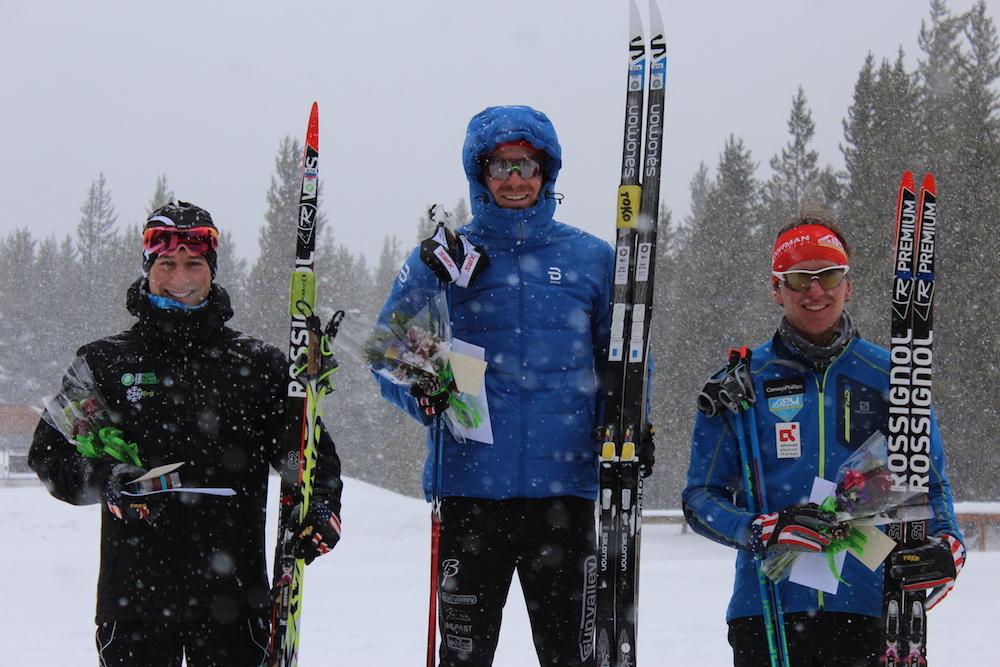
    Matt Gelso (SVSEF) topping the SuperTour podium for the second-straight day on Sunday in West Yellowstone, Mont. Joining him on Sunday's 15 k classic podium: CGRP's Ben Lustgarten (l) in second and APU's Scott Patterson (r) in third.
    Matt Gelso (SVSEF) topping the SuperTour podium for the second-straight day in West Yellowstone, Mont. Joining him on Sunday’s 15 k classic podium: CGRP’s Ben Lustgarten (l) in second and APU’s Scott Patterson (r) in third.

    Welcome to The Rundown, your quick primer of need-to-know information about the day’s racing. We’ll be updating this digest as the day goes on with additional results, photos and quotes. The Rundown is NOT a race report; stay tuned for complete race reports later today with interviews from the day’s top racers.

    (Note: This Rundown has been updated to include comments from U.S. Nordic Combined’s Bryan Fletcher, who placed ninth on Sunday at the World Cup in Lillehammer, Norway.)

    ***

    U.S. SuperTour opener in West Yellowstone: 10/15 k classic

    Matt Gelso made the case that he can win any discipline and format when it comes to cross-country skiing, topping the SuperTour podium for the second-straight day of the circuit’s opening weekend in West Yellowstone, Mont. Gelso, of the Sun Valley Ski Education Foundation (SVSEF) Gold Team, won the men’s 15-kilometer classic individual start in 42:57. He finished 32.2 seconds ahead of Ben Lustgarten of the Craftsbury Green Racing Project (CGRP) in second, and Scott Patterson, of Alaska Pacific University (APU), clocked in 1:16.8 back in third.

    In the women’s 10 k classic, Liz Guiney (CGRP) tallied the distance victory in 33:52.8. Katharine Ogden, of the Stratton Mountain School (SMS) and U.S. Ski Team D-team, finished 7.7 seconds back in second place, while Craftsbury put two on the podium with Kaitlynn Miller in third (+28.4).

    Results

    Nordic Combined World Cup in Lillehammer: Two individual comps and a relay
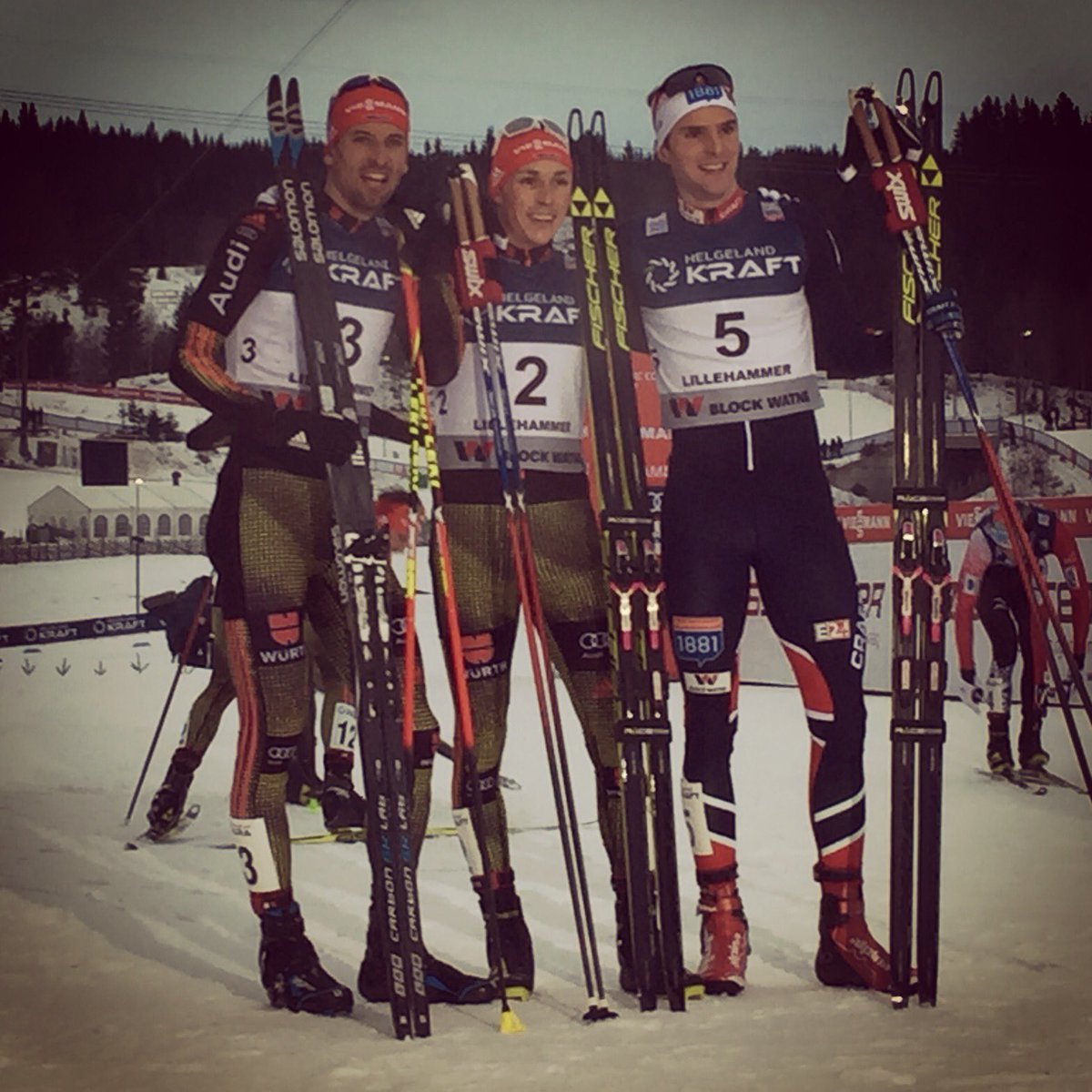
    German winner Eric Frenzel (c) with teammate Björn Kircheisen (l) in second and Norway's Jørgen Graabak (r) in third on Day 3 of the Nordic Combined World Cup in Lillehammer, Norway. (Photo: FIS Nordic Combined/Twitter)
    German winner Eric Frenzel (c) with teammate Björn Kircheisen (l) in second and Norway’s Jørgen Graabak (r) in third on Day 3 of the Nordic Combined World Cup in Lillehammer, Norway. (Photo: FIS Nordic Combined/Twitter)

    [UPDATE) Twenty-second in the jump. Ninth at the finish. That’s a bit more like it for U.S. Nordic Combined’s Bryan Fletcher. The American jumped to 22nd on Sunday on the large hill in Lillehammer, Norway, then raced to ninth in the 10 k Gundersen start cross-country race. He finished 1:22 minutes behind race winner Eric Frenzel, who notched his second-straight individual victory and third win (including Friday’s team event) of the Nordic Combined World Cup’s long weekend in 25:13.6.

    “Going into the race on Sunday I was confident that with a good race I could move up quite well,” Fletcher wrote in an email. “So I just set out to ski my own race and right from the start I was moving up. Top 10 was the goal and I was happy to accomplish that.”

    Germany went 1-2 with Björn Kircheisen in second (+10.8) and Jørgen Graabak of Norway finished third (+23.4) on Day 3 in Lillehammer. Fletcher’s younger brother Taylor Fletcher placed 26th (+2:21.1), moving way up from 48th in the jump (with the fastest overall course time). Also for the U.S., Ben Berend placed 49th (+4:30), and Ben Loomis was 52nd (+5:16).

    The Nordic Combined World Cup is turning out to be all about Germany (most) all of the time, with Frenzel and Johannes Rydzek at the forefront, after Rydzek won both opening World Cup competitions last weekend.

    On Friday, the German teammates started off the three-day series with a victory in the first 4 x 5 k team event of the season. They teamed up with Kircheisen and Fabian Riessle for first, beating Norway by 31.5 seconds with a winning time of 49:34.9.

    Norway’s squad, with Mikko Kokslien, Espen Andersen, Håvard Klemetsen, and Graabak, finished second without anyone else in sight. Austria took third (+1:23.7) with David Pommer, Mario Seidl, Wilhelm Denifl, and Phillipp Orter.

    Finland placed fourth, Japan was fifth, France sixth, the Czech Republic seventh, Italy eighth, and the U.S. ninth (+4:19.1), ahead of Russia in 10th.

    The order for the U.S. team was Bryan Fletcher, Berend, Loomis, and Taylor Fletcher. They rose as high as sixth during Bryan’s first leg, but dropped to eighth and finally ninth.

    On Saturday, in the individual normal hill/10 k competition, Frenzel overtook Rydzek for the win in 24:35. Rydzek started the day by winning the jump, and Frenzel ranked fourth heading into the 10 k Gundersen start. Frenzel overcame a 24-second deficit at the start to pass Rydzek and beat him by 15 seconds at the finish. Germany ended up sweeping the podium with Riessle in third (+25.8), after Riessle improved from 11th at the start with the second-fastest course time.

    Also on Saturday, Taylor Fletcher led the Americans in 26th (+1:51.2) after jumping to 44th and starting 2:02 minutes back from Rydzek. Fletcher skied the ninth-fastest course time.

    Bryan improved from 43rd at the start to 32nd (+2:32.9), Loomis ended up 43rd (+5:02.6) and Berend 44th (+5:33.4).

    “Going into this weekend I was feeling good and had some solid jumps in training so I knew that I was capable of a decent performance,” Bryan wrote on Sunday. “However, I struggle to put all the pieces together through the weekend. The team event was a good performance on my part and it was fun to ski with our young guys too. In Saturday’s event, I was close but had a rather unusual race in which I just couldn’t get going and fell off the pace quickly. Sunday however it all came together with a decent jump and race to finish 9th. This is more indicative of my true level at the moment so I was happy to finally fall into form.


    “This is definitely a result that I was hoping for in this period,” he continued. “I would like to finish in the top 10 consistently this year and it was a bit of a shaky start but I am starting to find the rhythm now. I hope to continue this momentum in Ramsau.”

    Results: Friday’s relay | Saturday’s normal hill/10 k | Sunday’s large hill/10 k

    ***

    IBU World Cup in Östersund: 10/12.5 k pursuits

    Men’s report | Women’s report

    Lowell Bailey came oh-so-close to fourth place on Sunday. Just two fewer misses and he could’ve been in the hunt, but that’s how biathlon goes.

    US Biathlon’s top man so far this season, Bailey started 13th in the IBU World Cup 12.5 k pursuit on Sunday in Östersund, Sweden, and by the first prone stage, he was up to seventh with clean shooting. Two-and-a-half kilometers later, he was back in the range and shooting without a miss again. Bailey headed out on his third loop in fourth, and more or less held that position through the third shooting — cleaning yet again in standing.
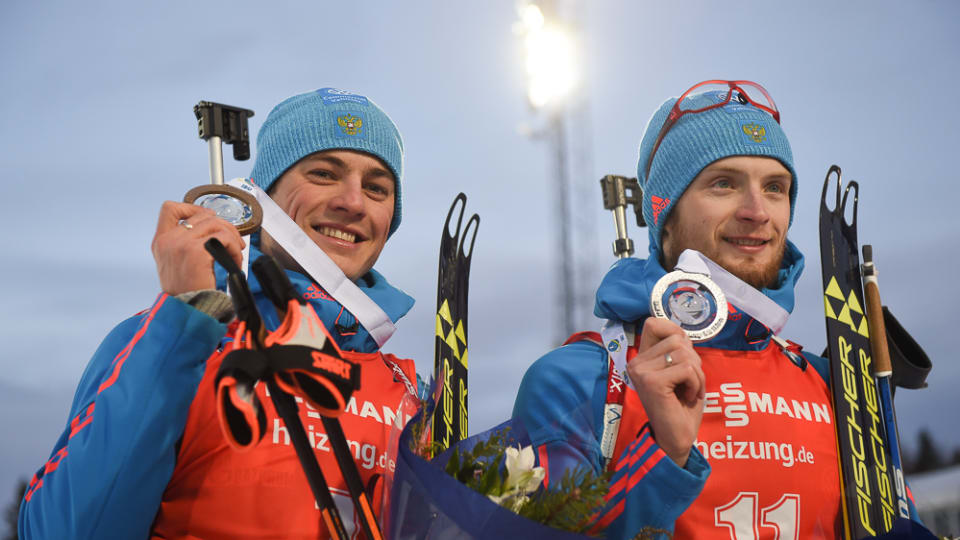
    Russia went 1-2 in the men's 15 k pursuit on Sunday at the IBU World Cup in Ostersund, Sweden, with Anton Babikov (l) winning his first World Cup and Maxim Tsvetkov (r) placing second. (Photo: IBU)
    Russia went 1-2 in the men’s 15 k pursuit on Sunday at the IBU World Cup in Ostersund, Sweden, with Anton Babikov (l) winning his first World Cup and Maxim Tsvetkov (r) placing second. (Photo: IBU)

    But two misses on the final standing dropped him to ninth, and on the final loop, Bailey slipped six spots to 15th at the finish. With two penalties (0+0+0+2), Bailey finished 1:21.8 behind the winner, Russia’s Anton Babikov, who hit 19-of-20 targets en route to his first World Cup victory and podium. Russia took second place as well with Maxim Tsvetkov shooting clean (0+0+0+0) and finishing 10.5 seconds behind his teammate, and France’s Martin Fourcade pushed through four penalties (2+0+0+2) to place third (+15.2).

    Fourcade started the day in first, after winning Saturday’s sprint, and lost the lead on the final stage, with two misses sending him to the penalty lap. On that last shooting, Babikov (the seventh starter) took control, and Tsvetkov (who started 11th) moved up from skiing in third for most of the race to second place.

    Also for the U.S., Tim Burke placed 35th (+2:39.2) after starting 29th, with four penalties (0+1+2+1).

    Canada’s Scott Gow finished 47th (+3:34.8) with three misses (0+0+2+1), Brendan Green was 50th (+3:45.5) wit five misses (1+3+0+1), and Macx Davies 51st (+3:54.6) with four penalties (0+0+2+2).
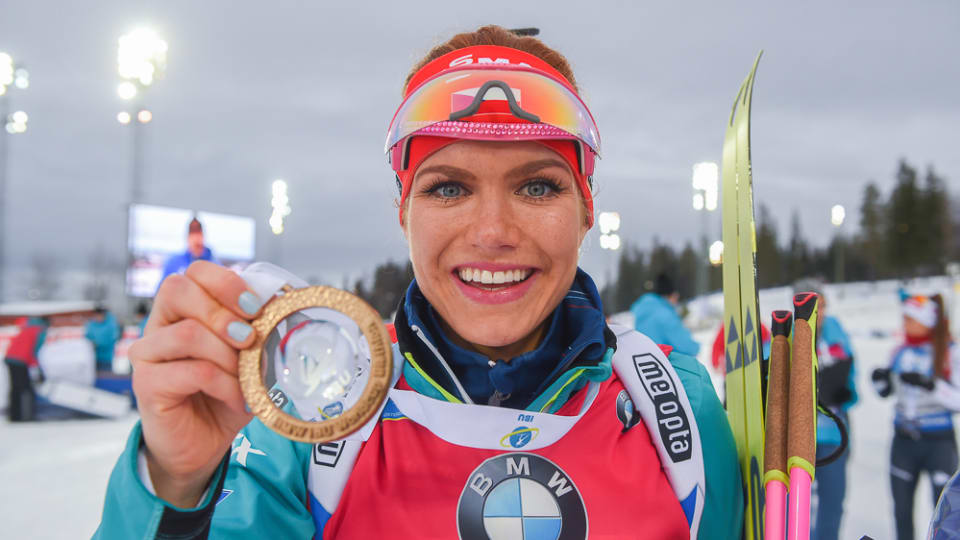
    Gabriela Koukalová of the Czech Republic with her first-place prize after winning Sunday's 10 k pursuit at the IBU World Cup in Ostersund, Sweden. (Photo: IBU)
    Gabriela Koukalová of the Czech Republic with her first-place prize after winning Sunday’s 10 k pursuit at the IBU World Cup in Ostersund, Sweden. (Photo: IBU)

    In the women’s race, Gabriela Koukalová (formerly Soukalova, you’ll get used to it, we promise), took her third-place finish in Saturday’s sprint and catapulted herself into first on Sunday in the 10 k pursuit. Koukalova shot 19-for-20, missing just one on the first standing (0+0+1+0) to cross the finish line first, 8.4 seconds ahead of Germany’s Laura Dahlmeier.

    While Koukalova, of the Czech Republic, took the win in 31:43.3, Dahlmeier placed second (after starting fourth) with two penalties (0+1+1+0). Italy’s Dorothea Wierer improved from 19th to third (+21.4) at the finish, with perfect shooting (0+0+0+0).

    Switzerland’s Lena Häcki also cleaned for fourth (+36.3), after starting 12th.

    The first out of the gate (the winner of Saturday’s sprint), France’s Marie Dorin Habert dropped to seventh, more than a minute and 15 seconds back, with six penalties (2+1+2+1).

    American Susan Dunklee moved up to 22nd (+2:55.7) after starting 27th, despite five penalties (2+2+0+1).

    Also for US Biathlon, Clare Egan improved to 30th (+3:35.4), up from 44th, with three misses (0+0+1+2).

    Joanne Reid (US Biathlon) finished 47th (+4:59.6) with four misses (1+1+1+1), and Canada’s Julia Ransom finished 58th (+6:36.8) with eight misses (2+0+4+2).

    Results: Men | Women 

    ***

    FIS Cross-Country World Cup in Lillehammer: 10/15 k classic pursuits

    Women’s report | Men’s report 

    Martin Johnsrud Sundby is the man to beat once again after winning the men’s 15-kilometer classic pursuit on Sunday in Lillehammer, Norway. The Norwegian started seventh and overcame a 50-second deficit to Sweden’s Calle Halfvarsson, the leader going into the final day of the mini tour. Halfvarsson dropped to fifth, while Sundby rose to first and brought another Norwegian Johannes Høsflot Klæbo to the top with him. Klæbo started sixth, 3 seconds ahead of Sundby, and placed second, 2.3 seconds behind him. Finland’s Matti Heikkinen took the final spot on the podium in third (+2.7), by 0.9 seconds over Norway’s Emil Iversen in fourth. Halfvarsson was 6.3 seconds back in fifth, his Swedish teammate Marcus Hellner sixth (+6.8), Norway’s Pål Golberg and Finn Hågen Krogh seventh (+9.9) and eighth (+15.0), respectively, and Canada’s Alex Harvey ninth (+16.2), ahead of Finland’s Iivo Niskanen in 10th (+52.0)

    Canada had two in the points with Devon Kershaw rising from 43rd to 27th (+2:08.5). Len Valjas placed 48th (+3.44), Graeme Killick was 53rd (+3:53.9), Knute Johnsgaard 72nd (+6:20.3), Bob Thompson 81st (+8:16.3), Andy Shields 83rd (+9:57.3).

    For the U.S., Noah Hoffman rose to 36th (+2:39.5) after starting 48th, Erik Bjornsen finished 57th (+4:33.3), and Eric Packer finished out his first overseas mini tour in 68th (+5:45.1).
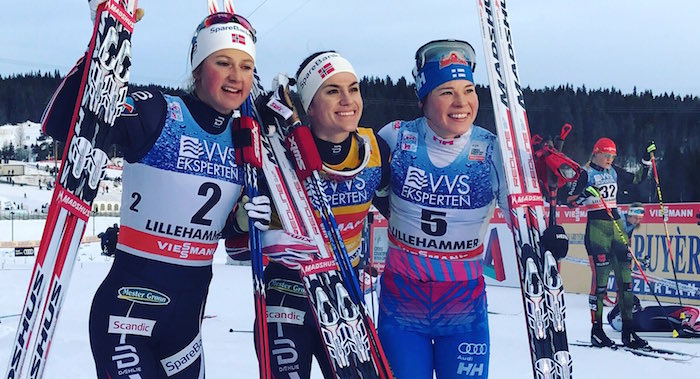
    Heidi Weng (c) held onto her lead to win the Lillehammer mini-tour by 16.1 seconds over Norwegian teammate Ingvild Flugstad Østberg (l). Finland's Krista Parmakoski was third after losing a shot at second thanks to a crash. (Photo: FIS Cross Country/Twitter)
    Heidi Weng (c) held onto her lead to win the Lillehammer mini-tour by 16.1 seconds over Norwegian teammate Ingvild Flugstad Østberg (l). Finland’s Krista Parmakoski was third after losing a shot at second thanks to a crash. (Photo: FIS Cross Country/Twitter)

    Heidi Weng of Norway started the 10 k pursuit in first place, and that’s where she finished it, 16.1 seconds ahead of teammate Ingvild Flugstad Østberg. Finland’s Krista Parmakoski rounded out the podium in third, after skiing up from a fifth place starting position and passing Østberg near the end of the race but then crashing on a downhill and losing valuable seconds. Nevertheless her effort gave Parmakoski the fastest ski time of the day.

    Jessie Diggins, who started the race in third position after winning yesterday’s 5 k skate, made an early bid to ski with Østberg but ultimately lost ground, ending eighth, +1:39.4.

    Instead it was Marit Bjørgen who took fourth, +57.5. Stina Nilsson of Sweden was one of the biggest movers of the day, skiing from 27th at the start all the way up to fifth, +1:26.1.

    Following Diggins, Sadie Bjornsen finished 11th, +1:51.2. The American had started in a pack of skiers and stayed there for most of the race. Liz Stephen was 38th (+3:31.8), and Rosie Brennan and Caitlin Patterson 41st (+3:50.2) and 42nd (+3:56.8). Ida Sargent rounded out the U.S. results in 57th (+5:39.7).

    Emily Nishikawa led the Canadians in 46th (+4:08.5), with Cendrine Browne and Dahria Beatty 52nd (+4:41.5) and 59th (+6:08.2).
    Results: Women | Men

  • Norwegian NoCo Team Likes Taste of Park City

    Norwegian NoCo Team Likes Taste of Park City

    Norwegian nordic combined A-teamer Mikko Kokslien (l) and Bryan Fletcher of the U.S. Ski Team riding together near Park City, Utah. The Norwegian national team spent nearly three weeks in the area for altitude training during a joint camp with the Americans. (Photo courtesy of Mikko Kokslien)

    In their first collective visit to Park City, Utah, several members of the Norwegian nordic combined team couldn’t get over the place.

    There was never a cloud in the sky, and even unseasonably cold days weren’t that bad. People were nice, the motorists were considerate, and the training possibilities were endless.

    Following a three-week camp with the U.S. nordic combined squad last month, Norwegian A-team member Mikko Kokslien wasn’t the only one considering buying a condo there.

    Norwegians Magnus Krog (l) and Håvard Klemensten followed by U.S. Ski Team member Bryan Fletcher (far right) and some others during a group rollerski with the U.S. nordic combined team in Park City, Utah. The joint dryland camp took place June 6-26. (Photo courtesy of Dave Jarrett)

    His teammate, Håvard Klemetsen, who was last in Park City about 11 years ago, was sure he’d be back as well.

    “We are not use to so open and friendly people, especially when we where out training,” Klemetsen, 33, wrote in an email after their camp from June 6-26. “In our culture people don’t say hello when they meet strangers – I like the open and enthusiastic people in Park City.”

    Reflecting on the trip from home in Lillehammer, Kokslien, 27, wrote that the altitude camp was the best of his career. He was last in Park City in 2006 during the World Cup ‘B’ competitions, but didn’t exactly get a feel for the area.

    “Now we had good time and really enjoyed staying in Park City,” Kokslien wrote. “Maybe I’ll move there some day.”

    History in the Making

    By the time the five Norwegian athletes, including Magnus Krog, Gudmund Storlien and Jørgen Graabak, and their head coach, Kristian Hammer, left a week ago, U.S. head coach Dave Jarrett knew they had a good time. In the first joint camp between the teams, his skiers enjoyed having them around as well.

    In a phone interview, Jarrett said their ties with Norway have historically been strong. He could personally trace it back to the summer of 1992 when he hosted Norwegians Baard Jørgen Elden and Fred Børre Lundberg for a few weeks in Steamboat Springs, Colo. Lundberg went on to win world titles and Olympic gold medals, and Elden later coached Jarrett on the U.S. Ski Team. Today, Jarrett said they remain close friends.

    While Norwegian no-co skiers had trained in the U.S. in the decades since, they had not made an official team trip until this year. Head coach Kristian Hammer scheduled the American altitude camp last winter, taking Jarrett up on his longstanding offer.

    U.S./Norwegian NoCo Camp:

    Who: U.S. and Norwegian nordic combined teams.

    What: Three-week joint dryland camp in Park City, Utah. Involved jumping, rollerski intervals, OD run-rolls, road biking, golfing and more.

    Roll call: Every member of the U.S. team attended at least part of the camp, including Johnny Spillane and Todd Lodwick.

    Norway’s A-team was there,  minus Magnus Moan (coming off Achilles surgery in May) and Jan Schmid (busy with final exams)

    “I’ve always extended the invitation for years for them to come to Park City, but it was only until now that Kristian really pulled the trigger on it,” Jarrett said.

    With plans in place, Hammer asked for some help with logistics, and Jarrett gladly jumped in to help with accommodations and ground transportation. The team, which included two coaches and a PT for part of the trip, stayed in condos overlooking Park City’s golf course. Kokslien played several rounds with U.S. Ski Team member Taylor Fletcher.

    “He got me the first day, but the next day I might’ve played my best round ever,” Fletcher wrote in an email.

    Aside from meeting up for barbecues and dinner, athletes from both teams spent most of their time training together – first on the jumping hill and later on rollerskis and road rides.

    Fletcher, 22, wrote that he learned a lot from the Norwegians during the jumping portion of camp. His older brother, Bryan, said it was nice to show them around for a change.

    “It’s not an every-day opportunity that another team gets to come to the U.S. and train,” Bryan said on the phone. “Hopefully they’ll have a good report to send home to other athletes so that next year and the year after that, more people will want to come here instead of being solely based in Europe.”

    Role Reversal

    The Americans are typically the ones playing tourist, traveling to Norway in late August for training camps and racing in Lillehammer’s annual uphill sprint race in early September. This year, the U.S. team heads to France on July 8, where they will spend a week chasing cyclists in the Tour de France before competing in first races of the FIS Grand Prix in Sochi, Russia. There they’ll also get a chance to preview the 2014 Olympic venue.

    U.S. nordic combined teammates Johnny Spillane (l), Billy Demong (c) and Bryan Fletcher working out in Park City during their training camp in June. (Photo courtesy of Dave Jarrett)

    They’ll return to Park City for nationals in August, but Jarrett said he was trying to get his to central Europe in September/October for additional camps with the Norwegians. Next year, he said there was a good chance Team Norway would be back in Park City.

    “They were pumped about coming back next year,” Jarrett said. “Kristian and I talked about [them] coming back in October possibly next year. That’s a good time for training here, it’s still sunny whereas other places it’s starting to get rainy and snowy.”

    In the past, Norwegians sometimes avoided altitude training, believing it did little to boost performance, Jarrett said. While they spent the first few days following a rigid protocol to acclimate to Park City’s 7,000-foot elevation, Jarrett said they joined his team for most workouts thereafter.

    “You didn’t hear the typical, ‘Oh it’s so hard, I feel this bad,’ things like that,” Jarrett said. “They were all into it and we had great weather and they were pretty psyched about doing it again.”

    Jarrett was excited to have them there for a change.

    “It was awesome for us to have three weeks with those guys, not just cross-country wise but almost more importantly on the jumping hill,” he added. “We usually have to pay to go to Europe to do that so this was almost no cost to us to have them here.”

    Kokslien snapped a photo while in awe of the U.S. nordic-combined jumping facility in Park City.

    Kokslien wrote that while the main purpose of the camp was altitude training, it was just as important for them to learn from the Americans, especially Olympic gold medalist Billy Demong.

    “In the summer we don’t often get to see how the other teams are training, so its also nice in a way we can learn and see how they are working in the US,” he wrote. “I have always looked up to and learned a lot from Bill. To be with him and the rest of the American team, gives me and our team a good motivation for the winter. The American team has a really good work ethic, and I think many can learn from them.”

    Demong explained in an email that such relationships have existed for years and didn’t end at competitions. In a World Cup race last season, Demong teamed up with Kokslien to pass several people for his best result of the year – third. Kokslien was second.

    It helped that Demong and his teammates spoke some Norwegian.

    “When it comes to training, we can have sessions with the Norwegian team and it becomes almost like one big team,” Demong wrote. “We do long easy skis without egos and time trials and interval sessions constructively pushing each other to go faster and learn from one another. Also the contact on the jumping hill is always very important as they are some of the best.”

    — Audrey Mangan contributed reporting.