From the FasterSkier archive — posts syndicated from athletes’ and coaches’ own blogs between 2004 and 2012, kept online as published. Current coverage is at fasterskier.com.
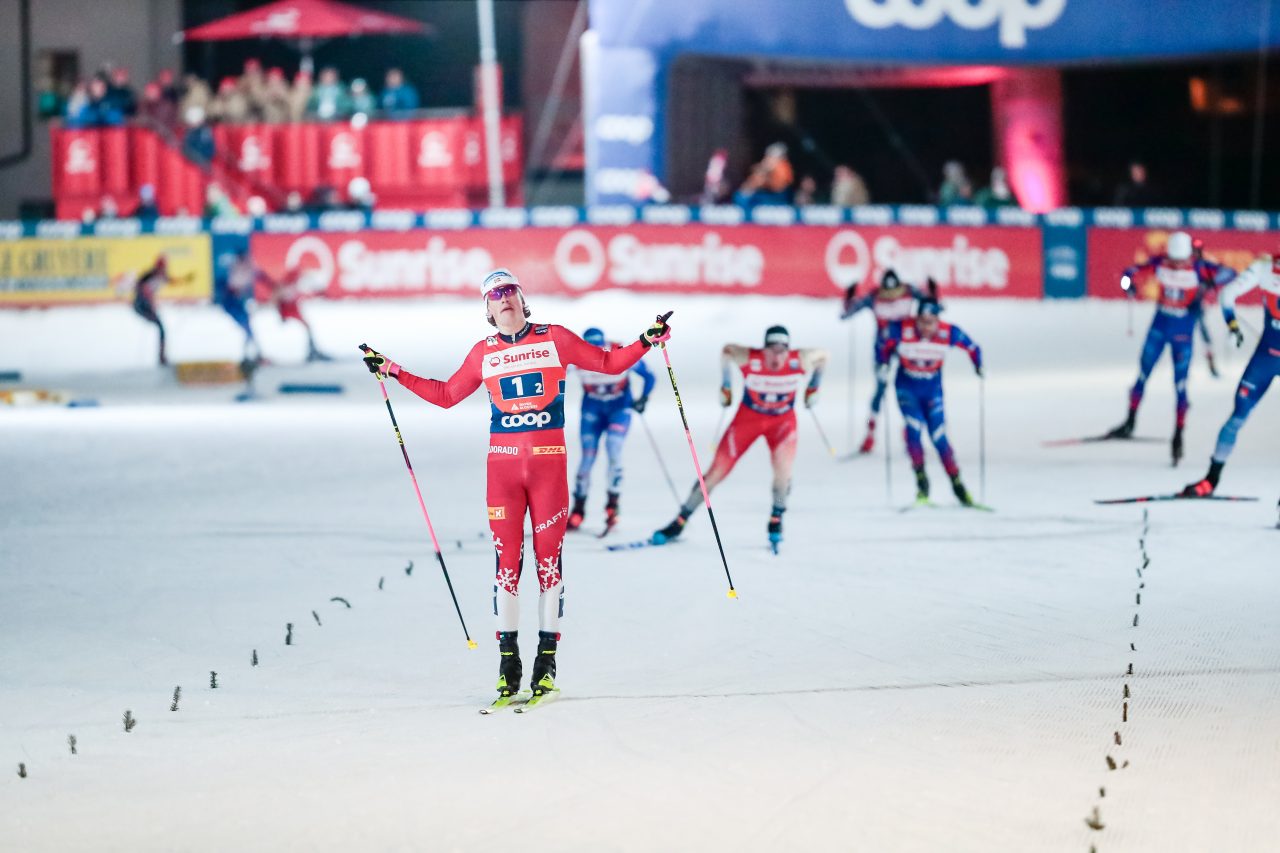
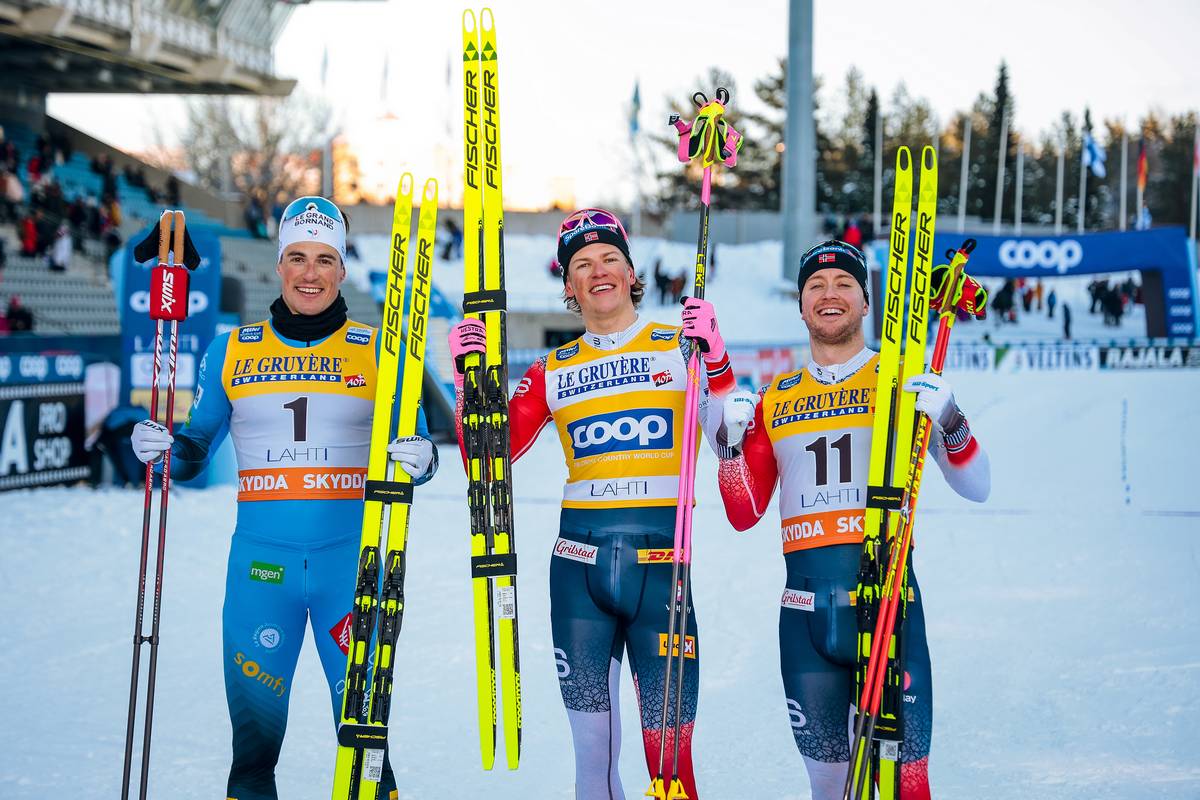
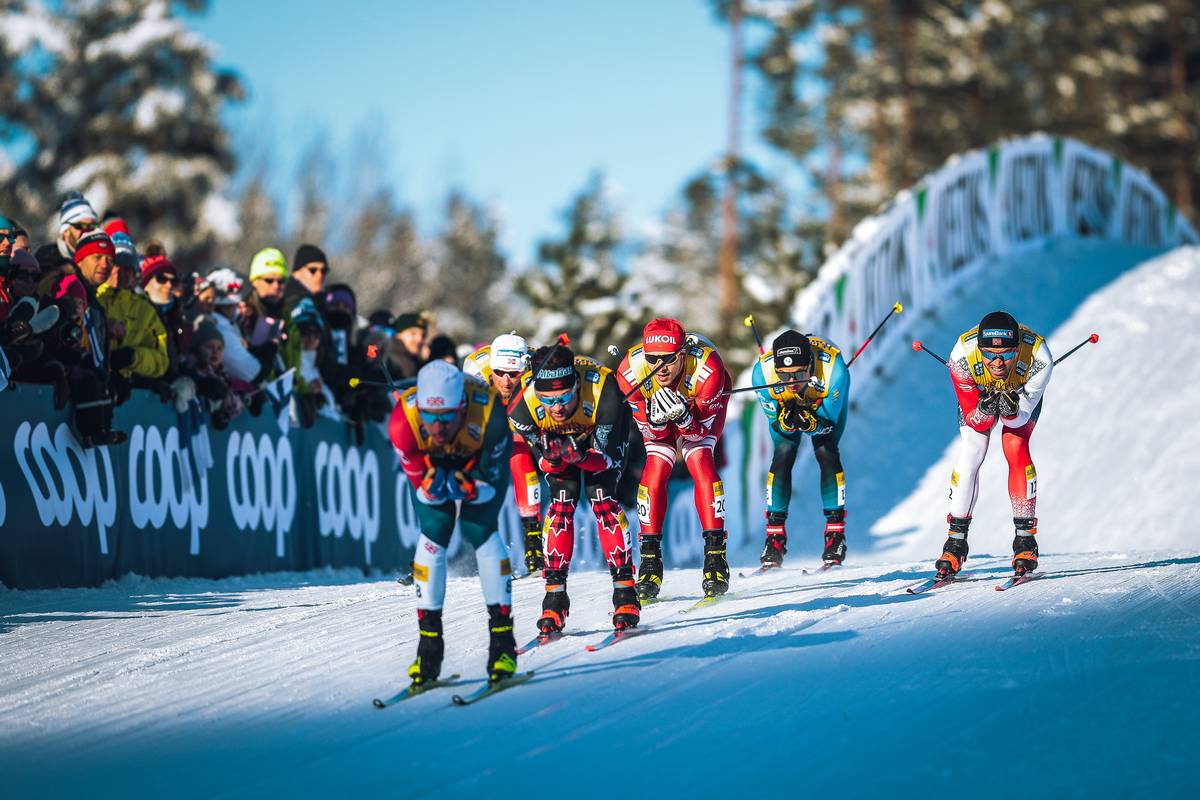
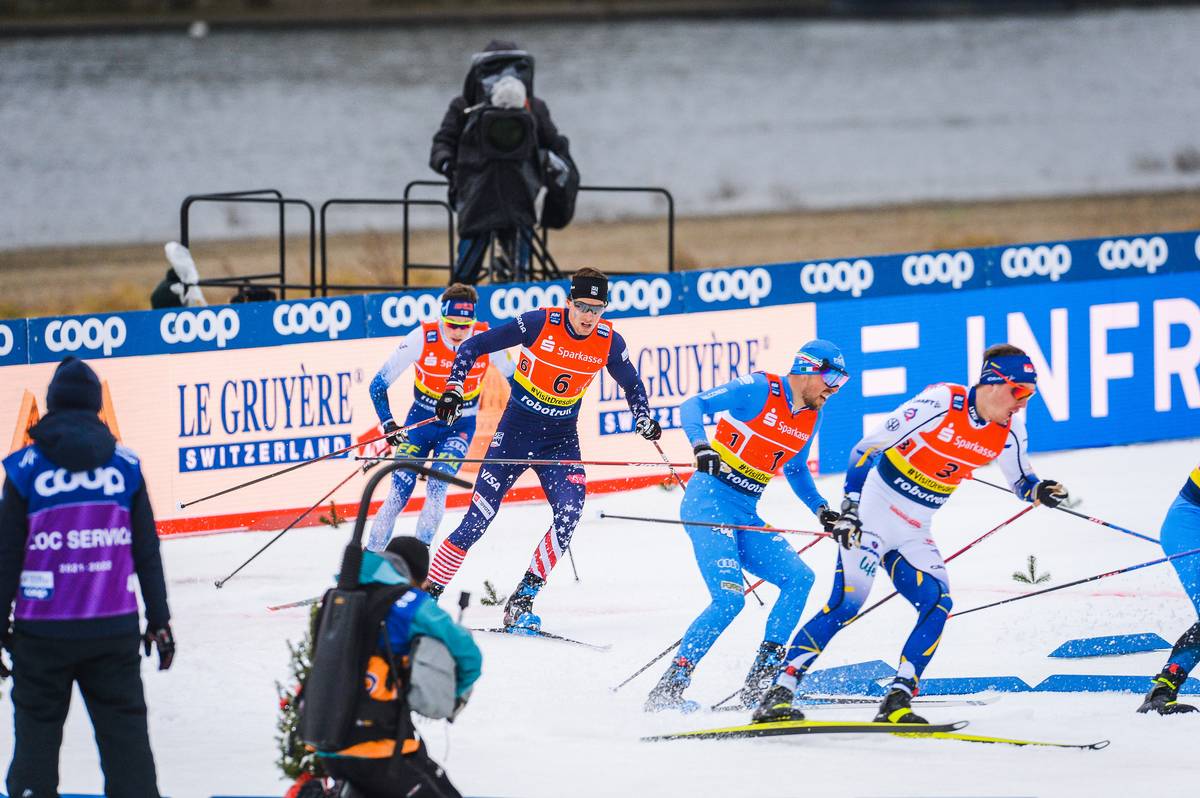
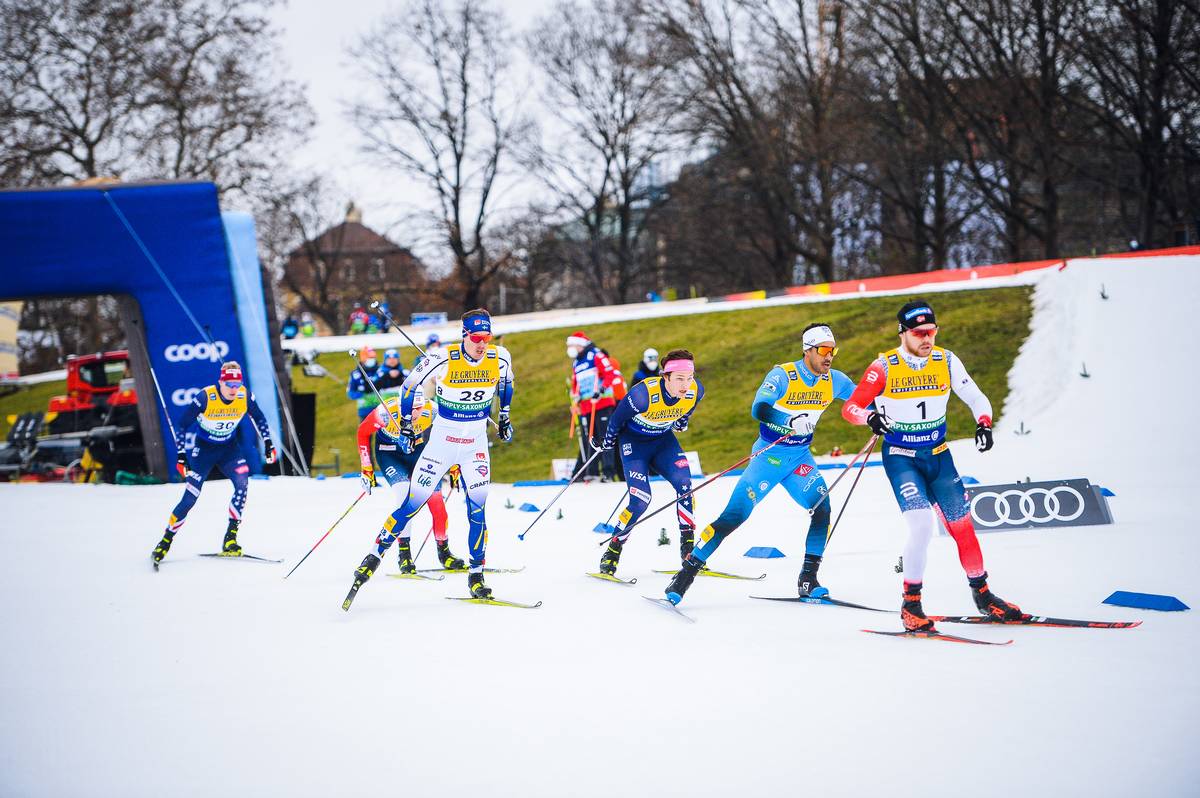
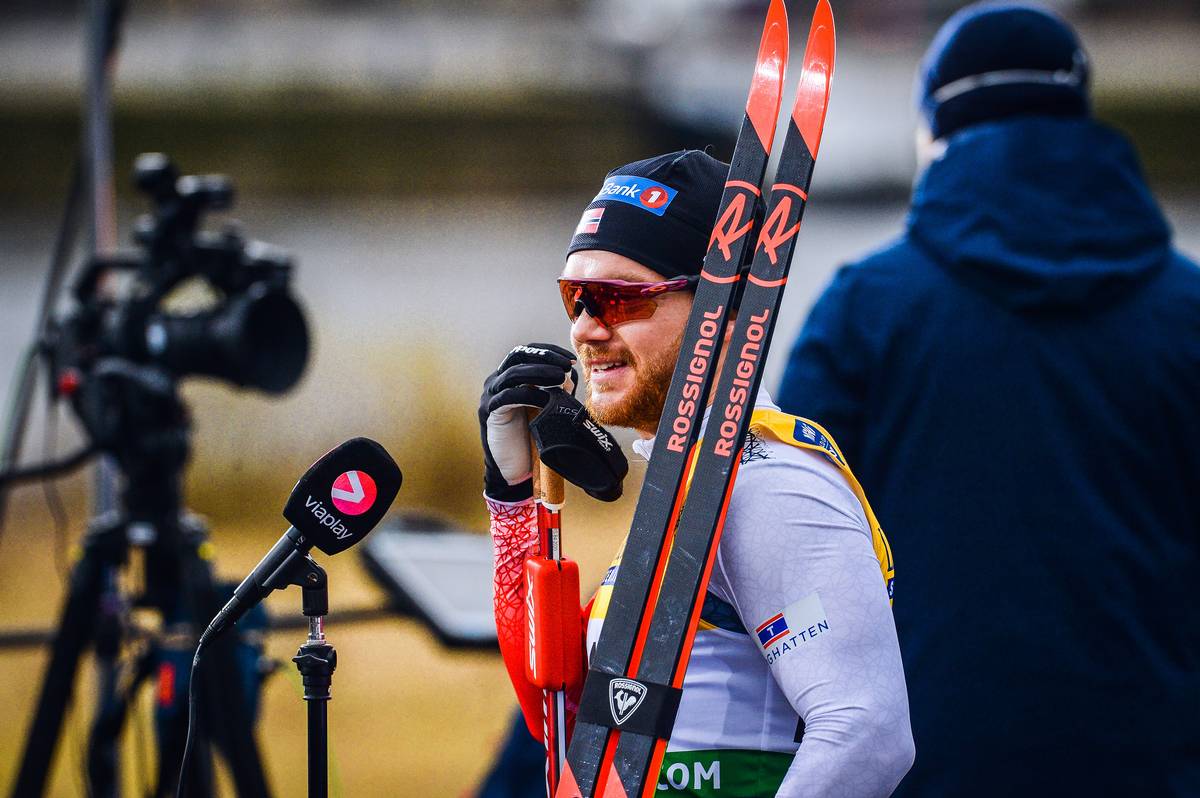
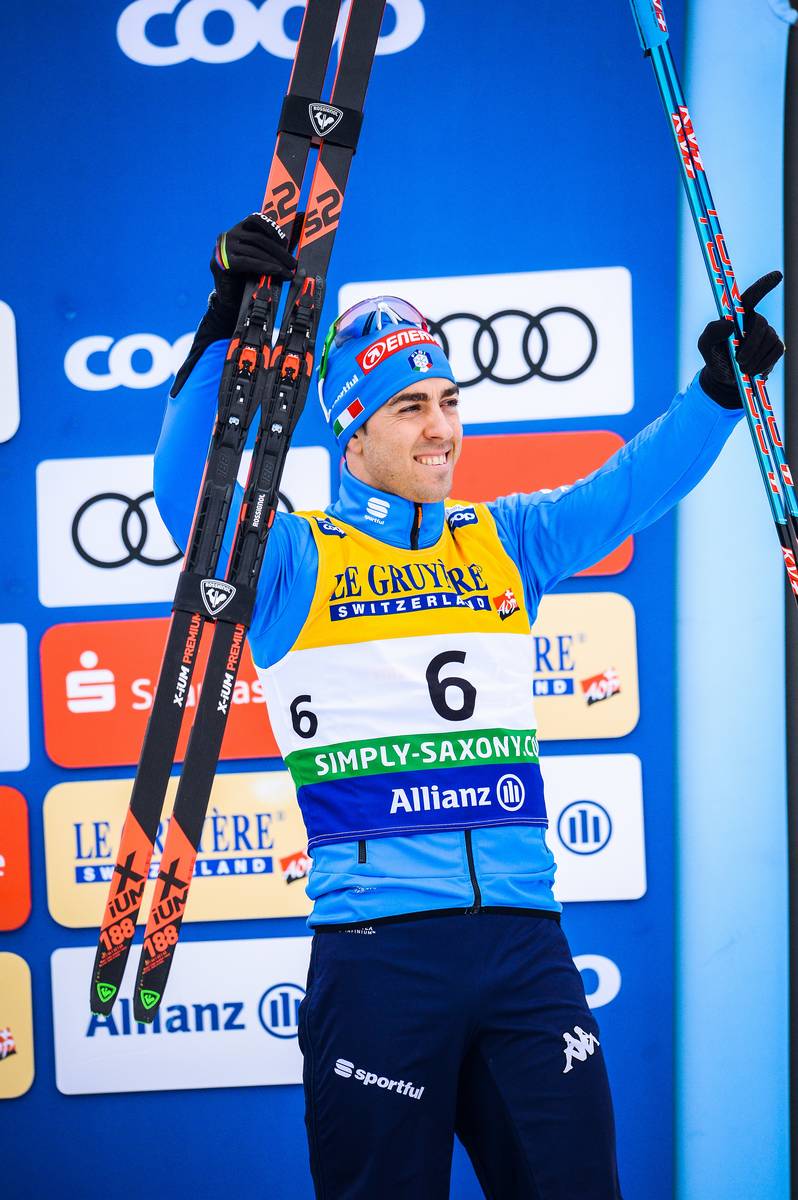
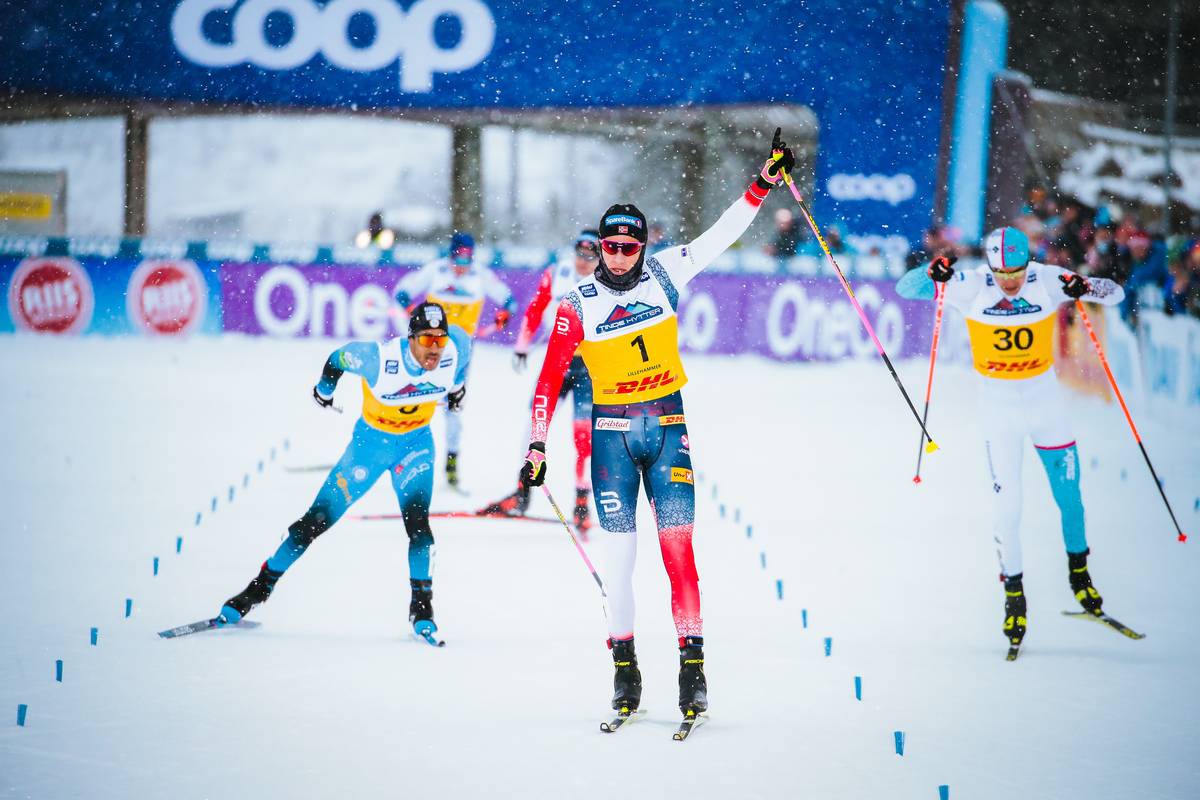
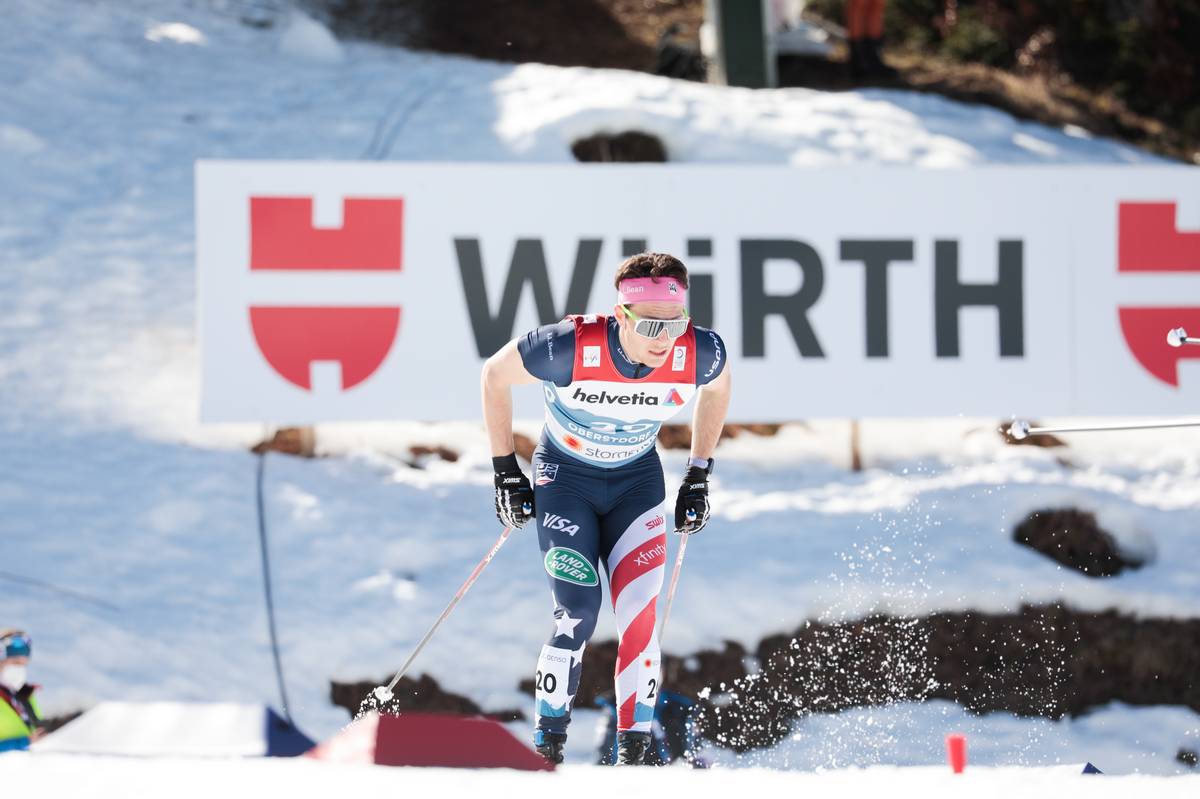
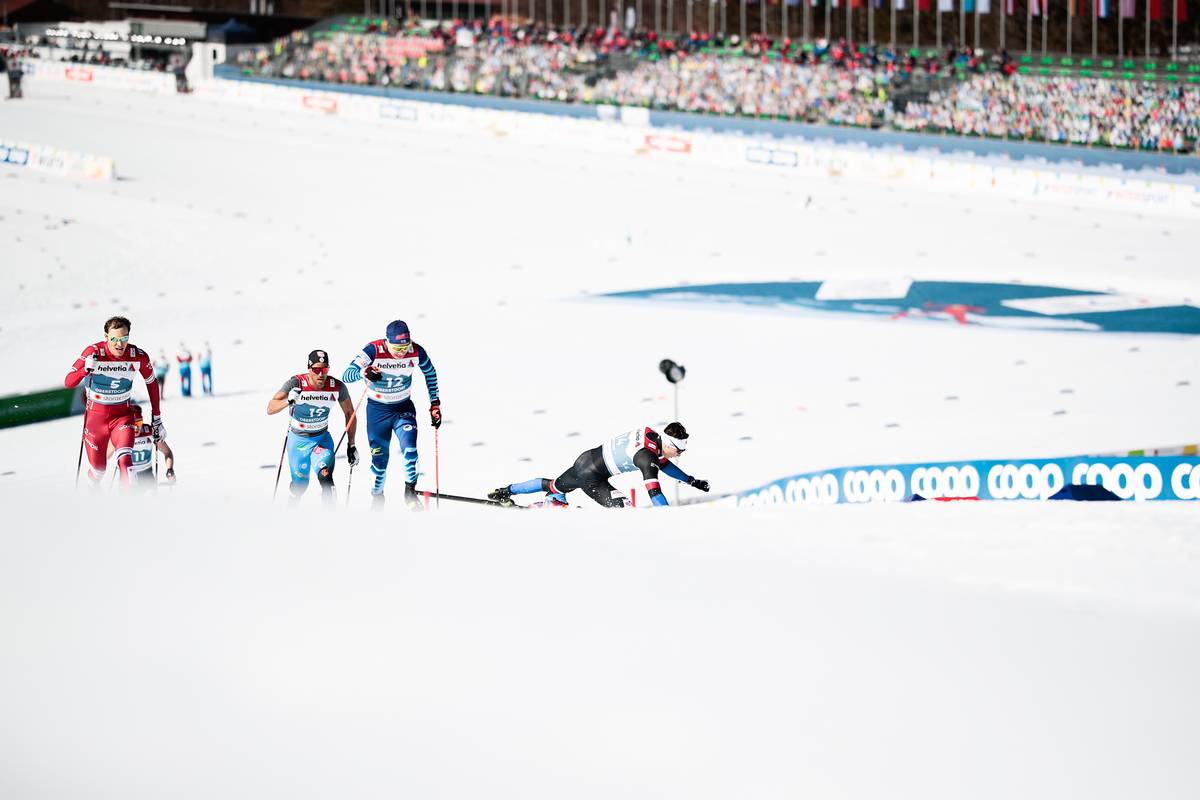
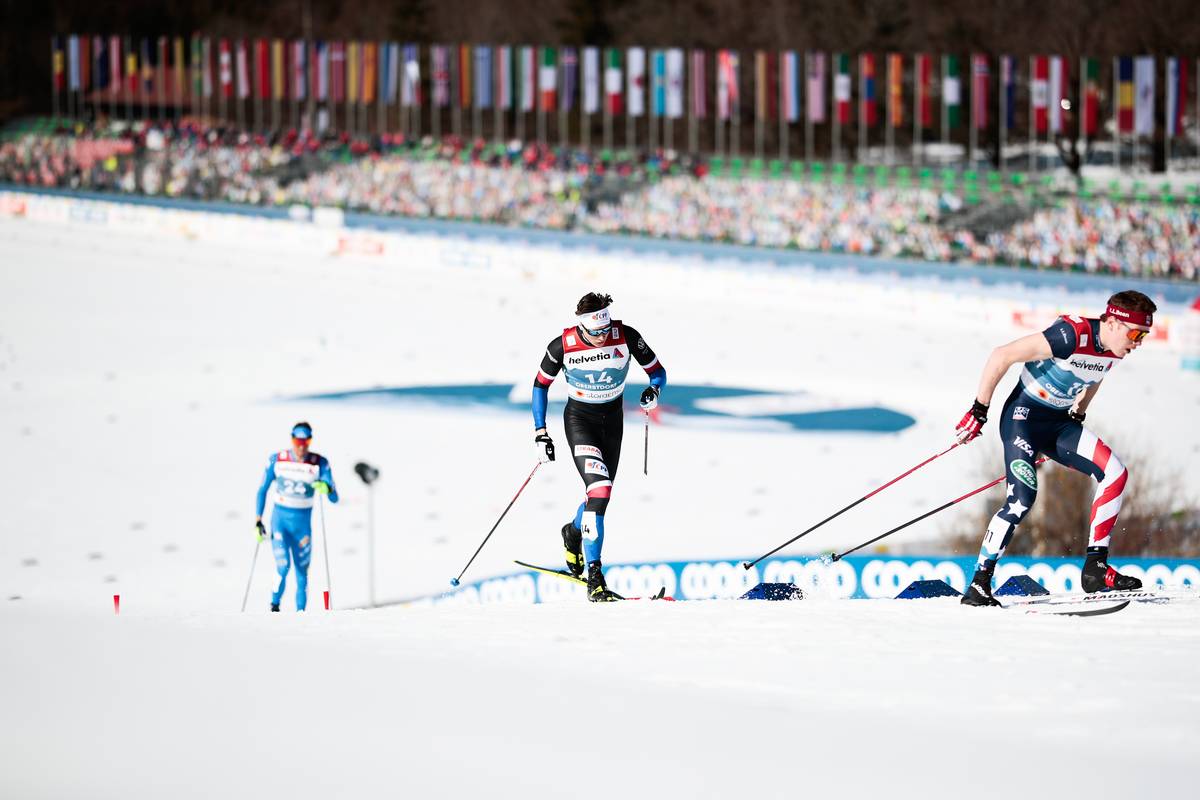
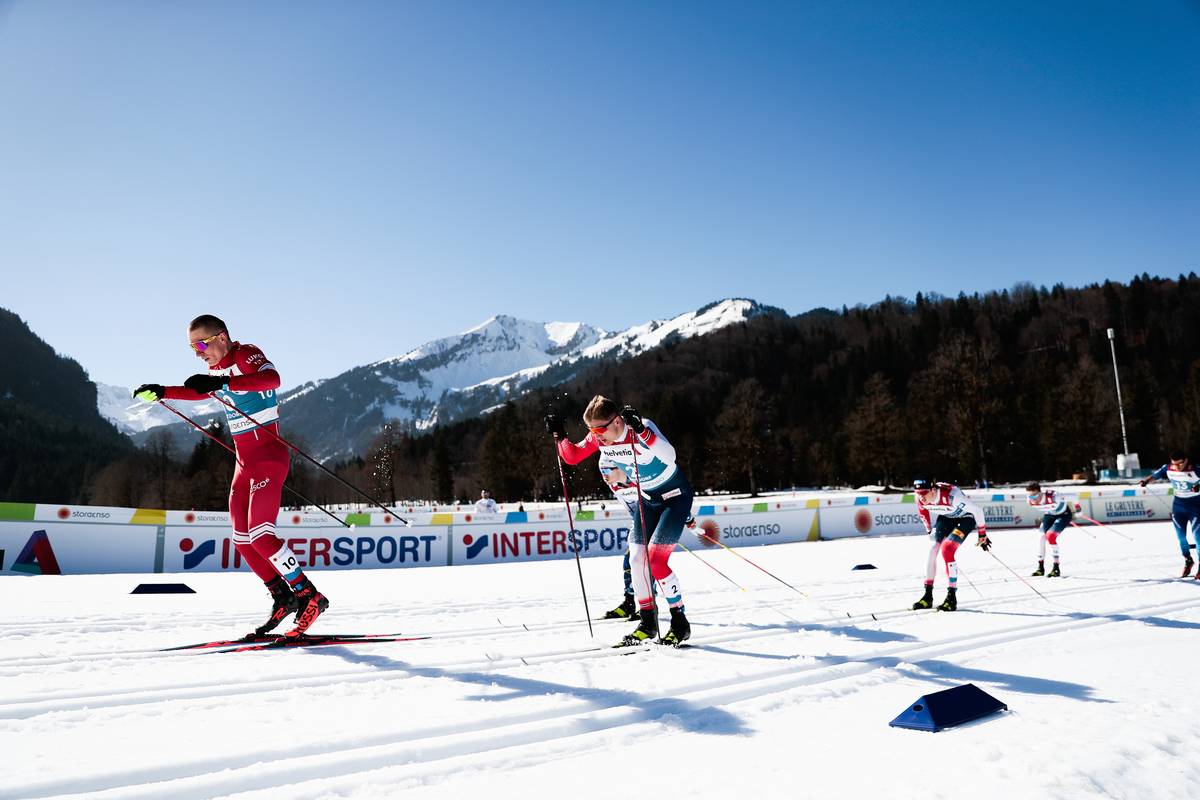
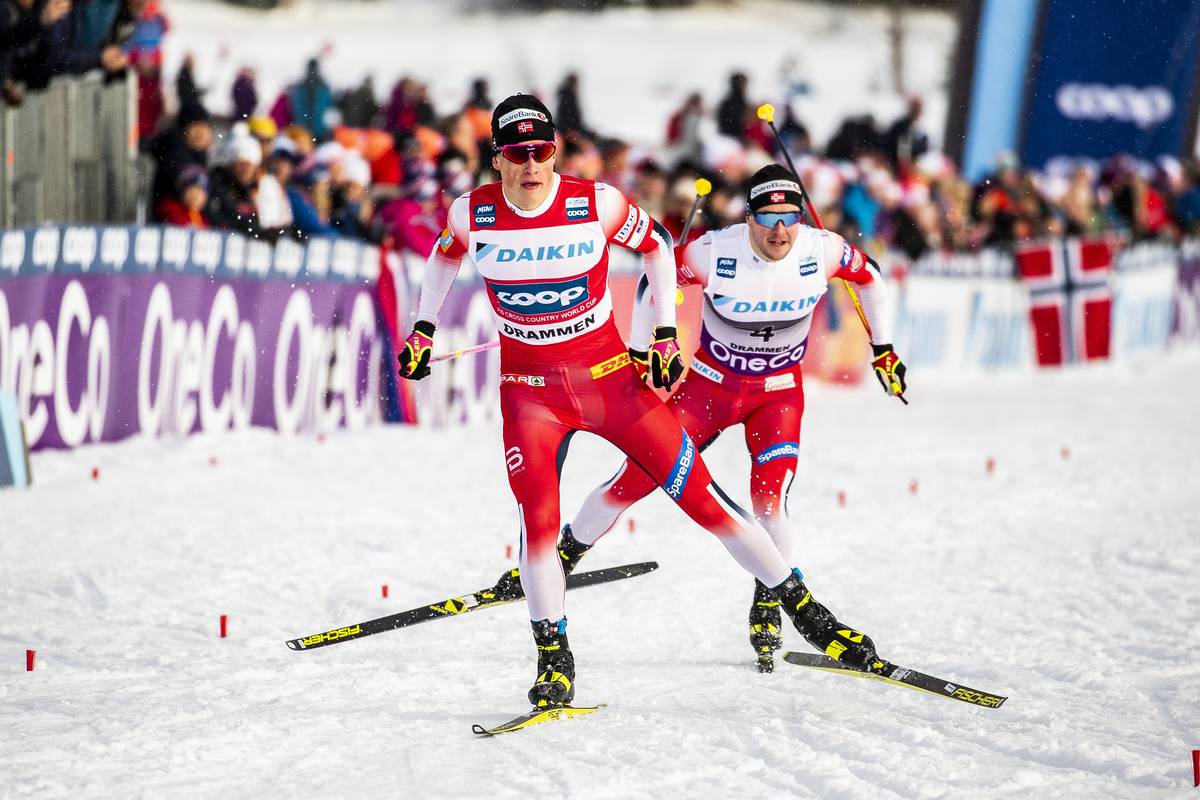
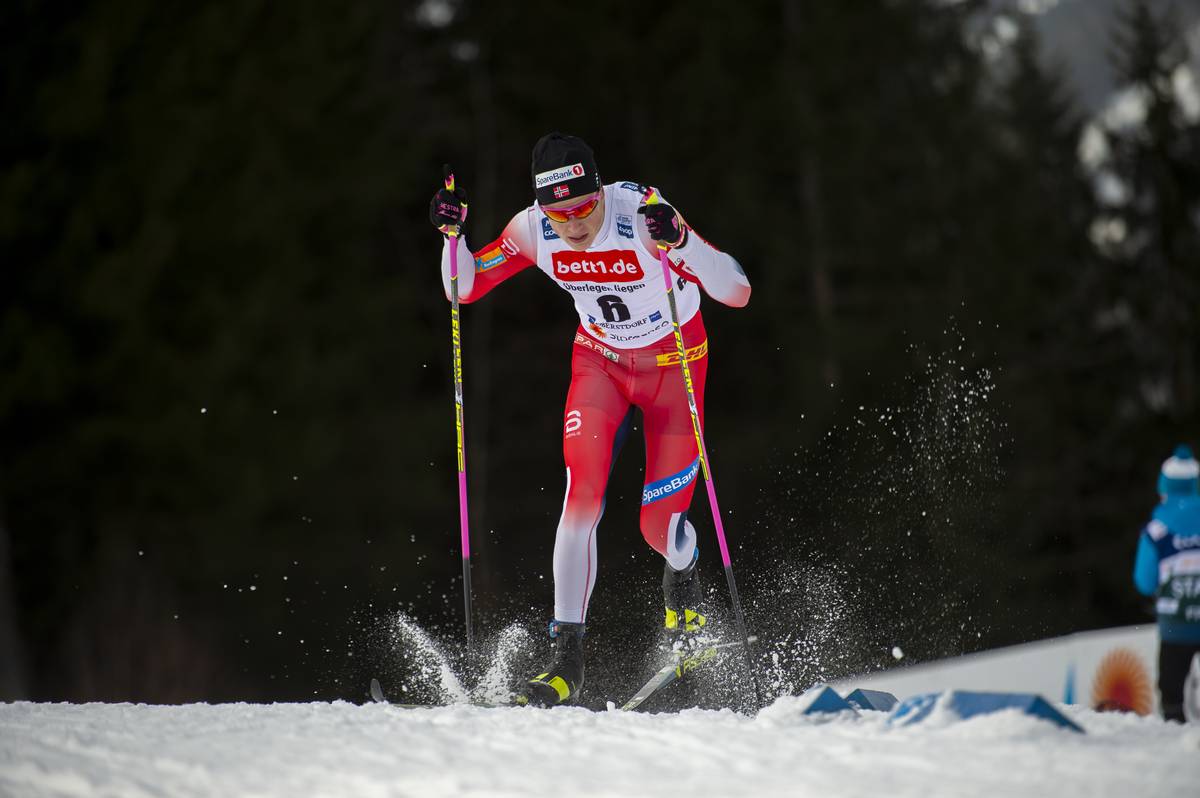
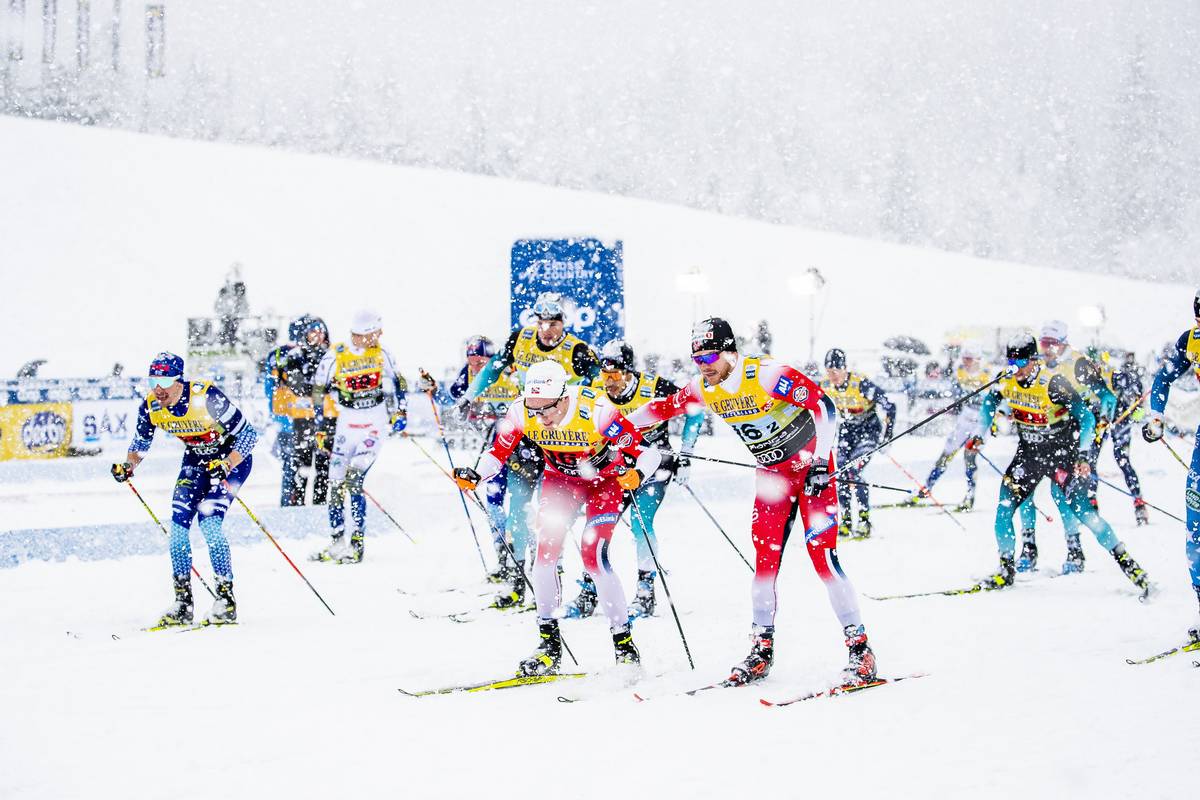
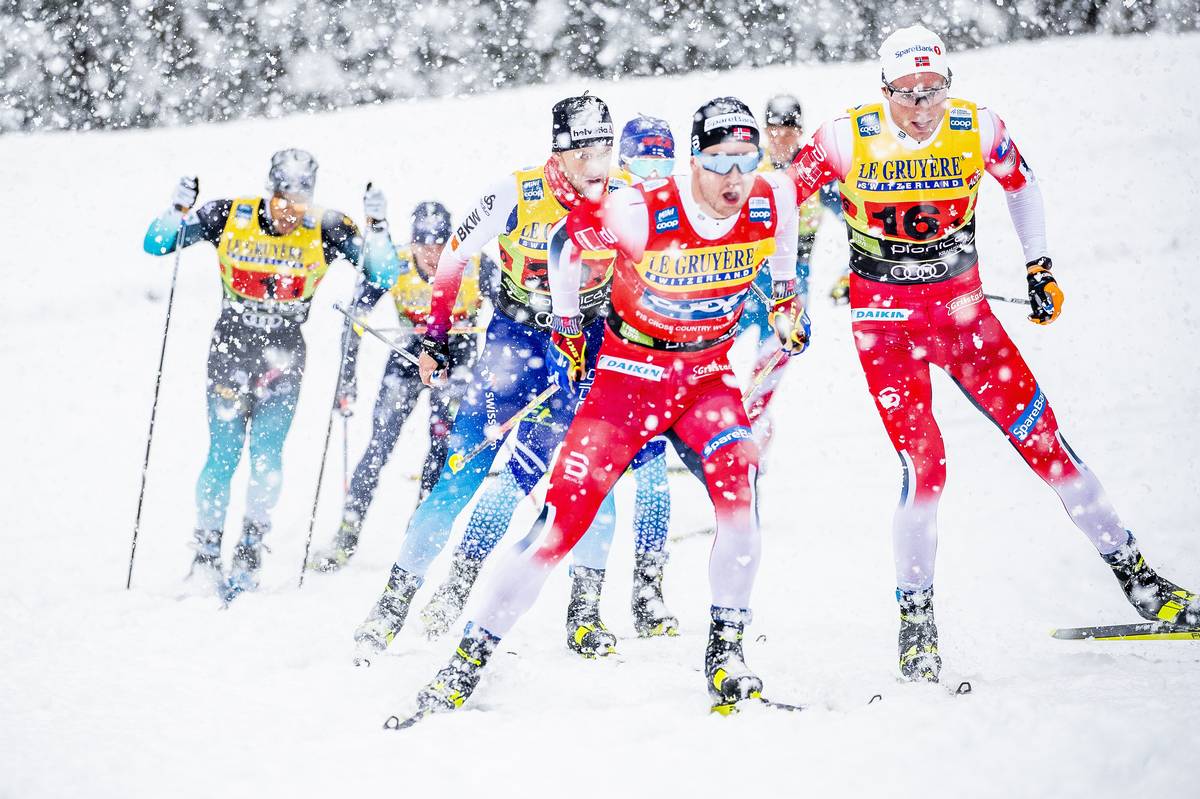
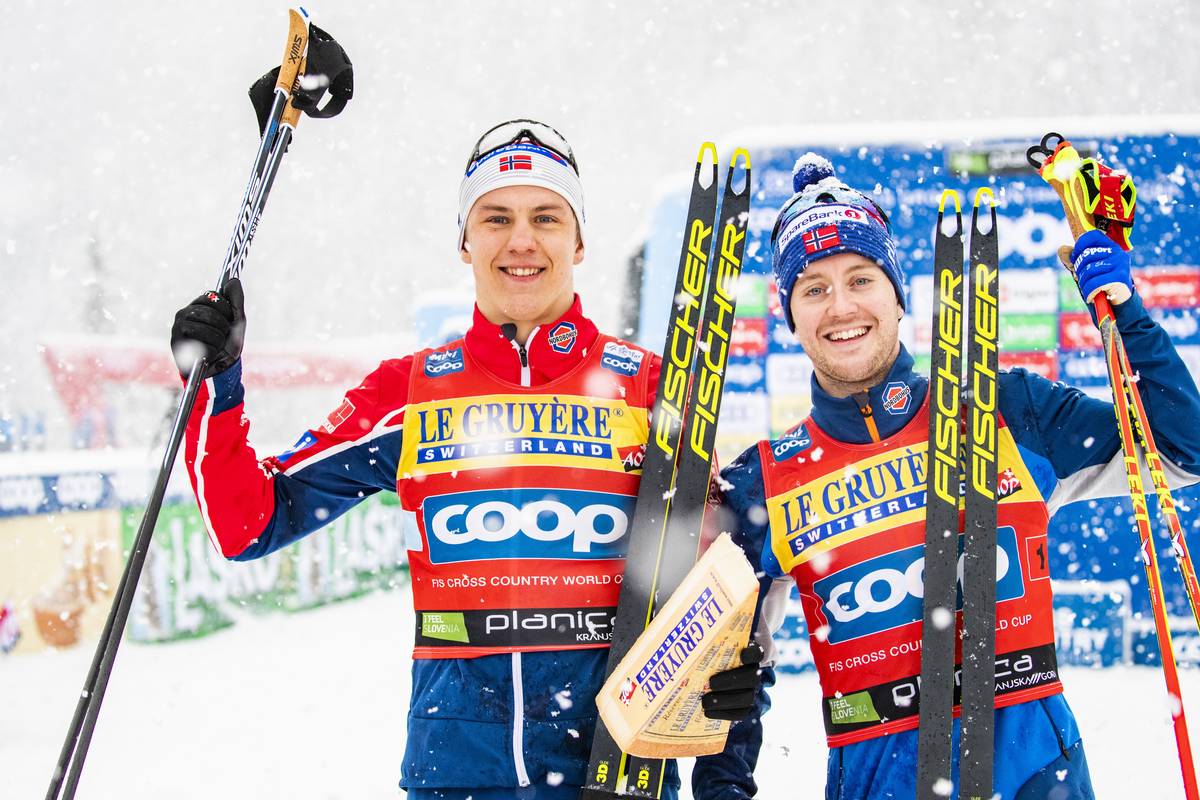
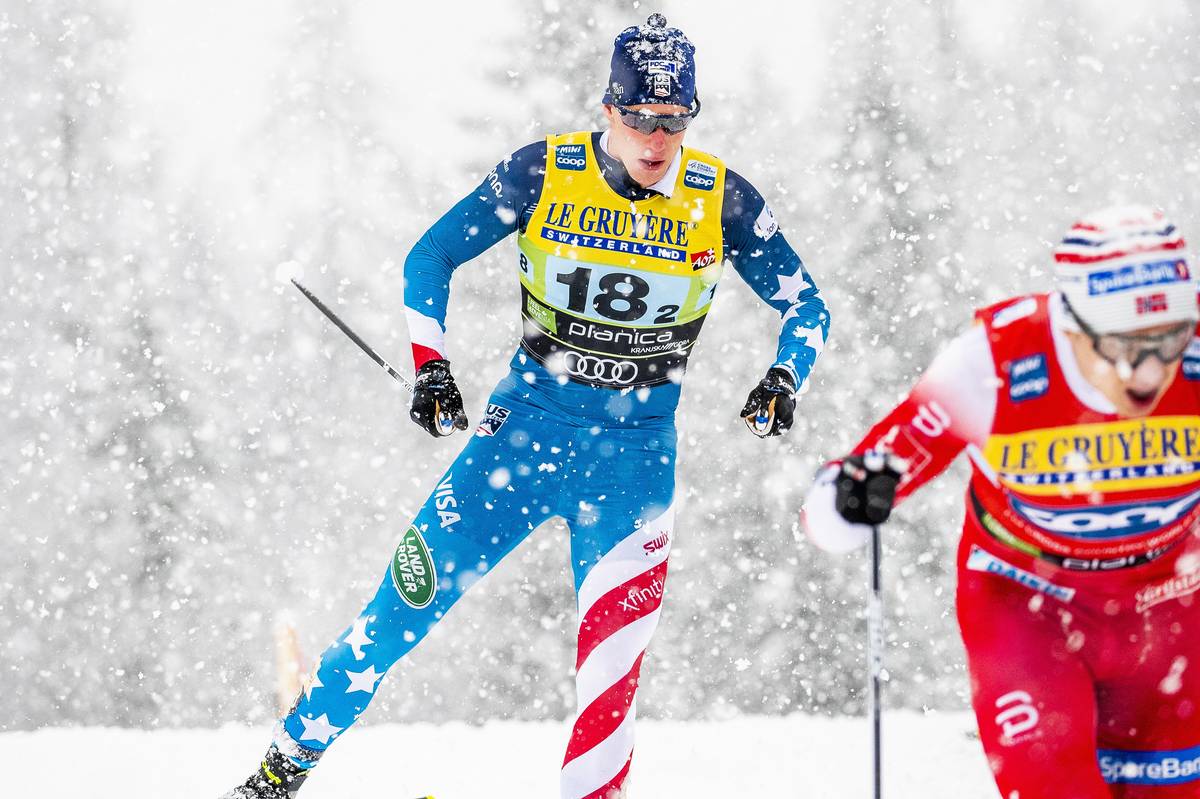
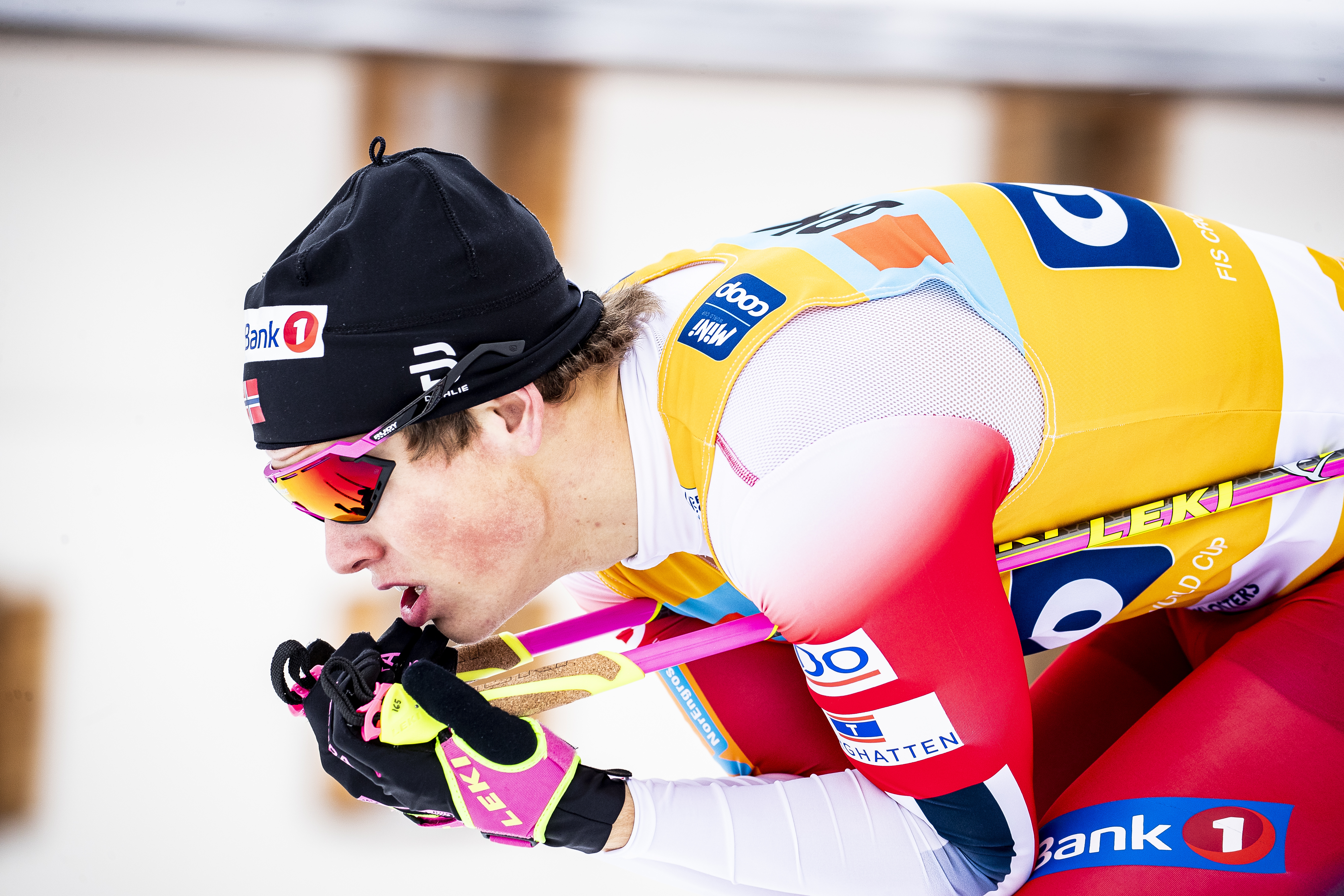
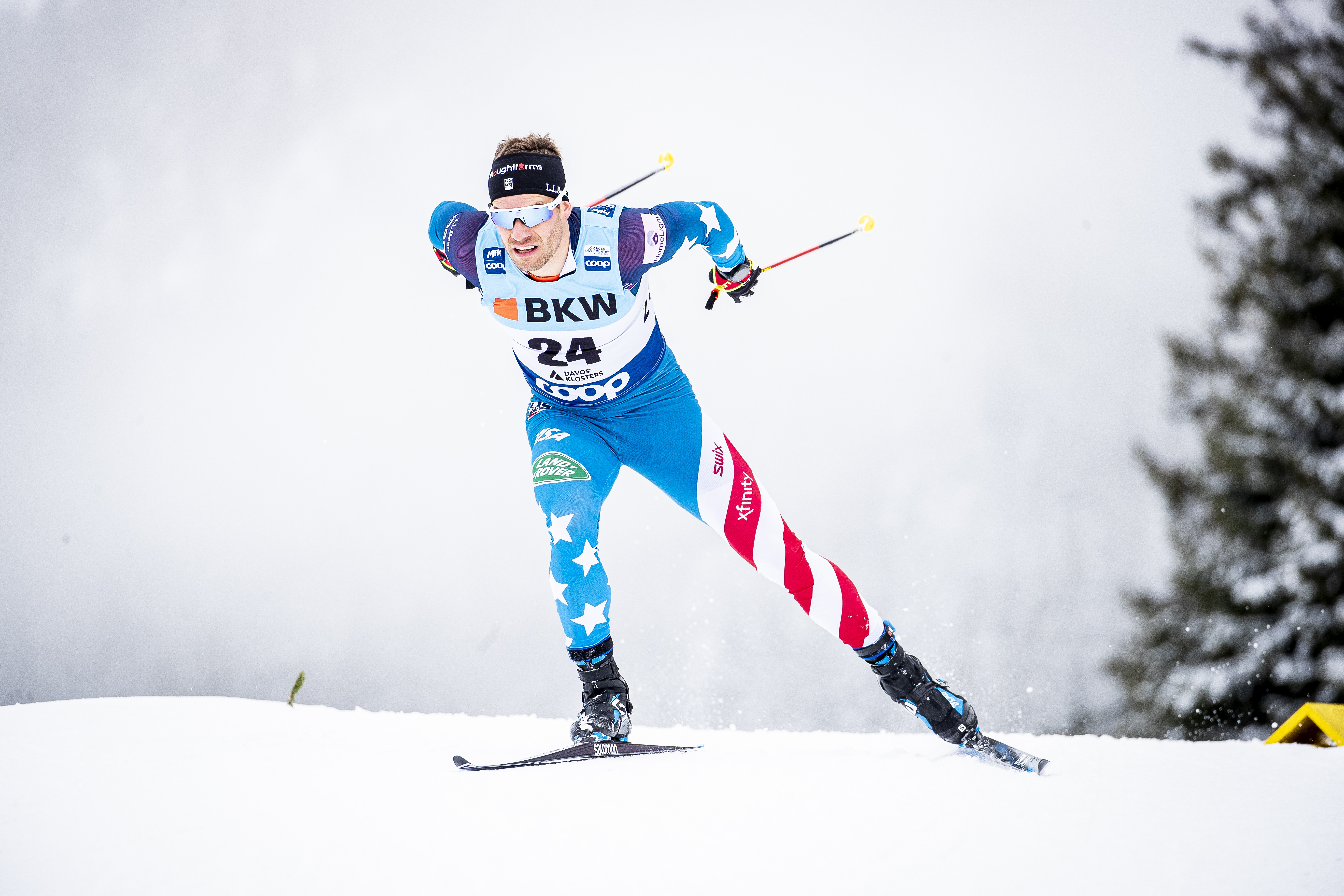
Johannes Høsflot Klæbo, in typically dominating fashion, anchored the Norwegians to a victory in the team sprint in a World Cup in Switzerland earlier this month. (Photo: Modica/NordicFocus)
In cross-country skiing, sprinting is a notoriously inconsistent discipline for a single competitor to dominate. The short distance leaves little time for racers to recover from even small mistakes; sharp corners and tight spaces often produce race-ending crashes.
Which makes the track record of Norway’s Johannes Høsflot Klæbo almost impossible to comprehend.
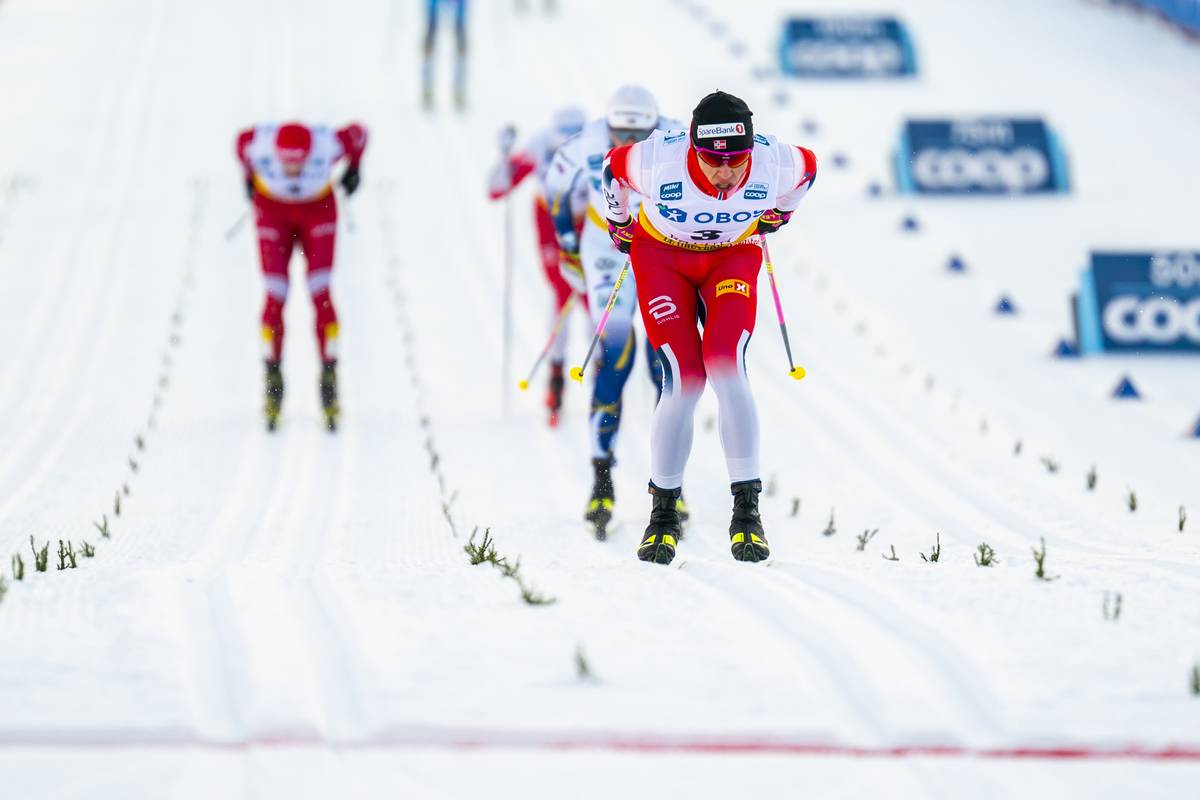
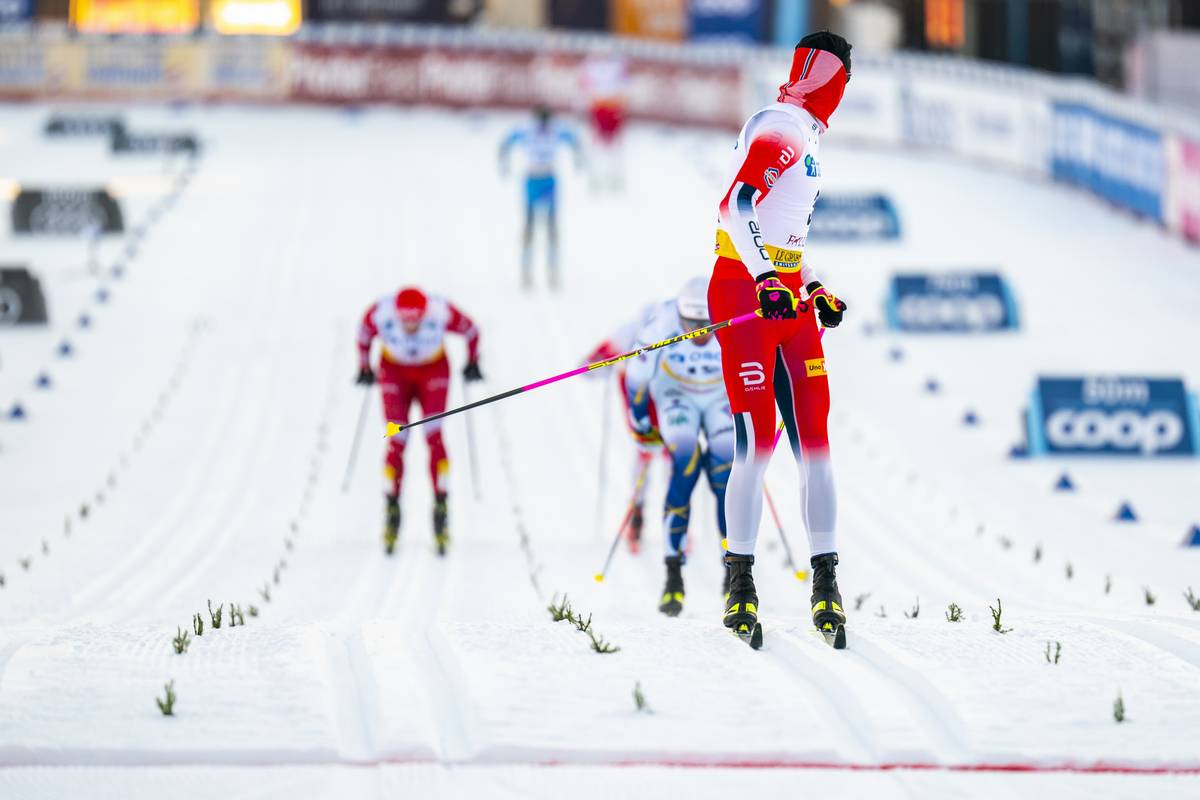
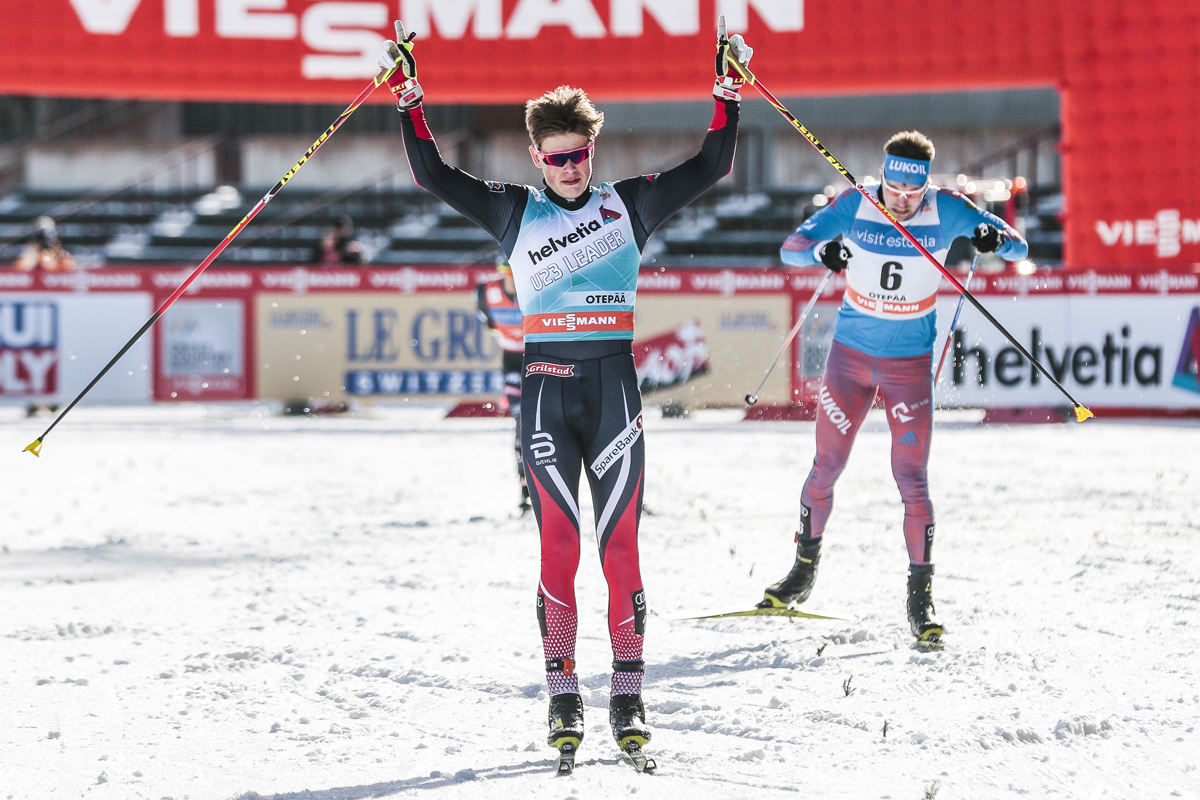
Klæbo, a five-time Olympic gold medalist, has won the last 10 straight sprint races he’s entered on the World Cup — the highest level of international competition. He often crosses the finish line far enough ahead of his rivals — if you can call them rivals — that he has time to unstrap his poles before crossing the finish line.
Klæbo, 28, has won five out of the six Olympic and World Championships sprints he’s contested, and 52 of his 69 sprint World Cup starts — missing the World Cup sprint podium just once since 2018, according to data from the International Ski Federation.
So: How do you beat this guy?
FasterSkier, when the World Cup made its swing through Canada and Minnesota last season, decided to pose that question to an array of the circuit’s athletes and coaches. We’ve put together a kind of brief oral history below, seeking to appropriately describe Klæbo’s supremacy and the best ideas about how to take him down.
Enjoy.
What kind of tactics would you use to beat Klæbo in a sprint?
Håvard Solås Taugbøl, a Norwegian World Cup racer and one of the nation’s (and globe’s) best sprinters: That’s the $1 million question. I have never managed to do it.
Swiss sprinter Valerio Grond: Maybe break his poles or something? I don’t know.
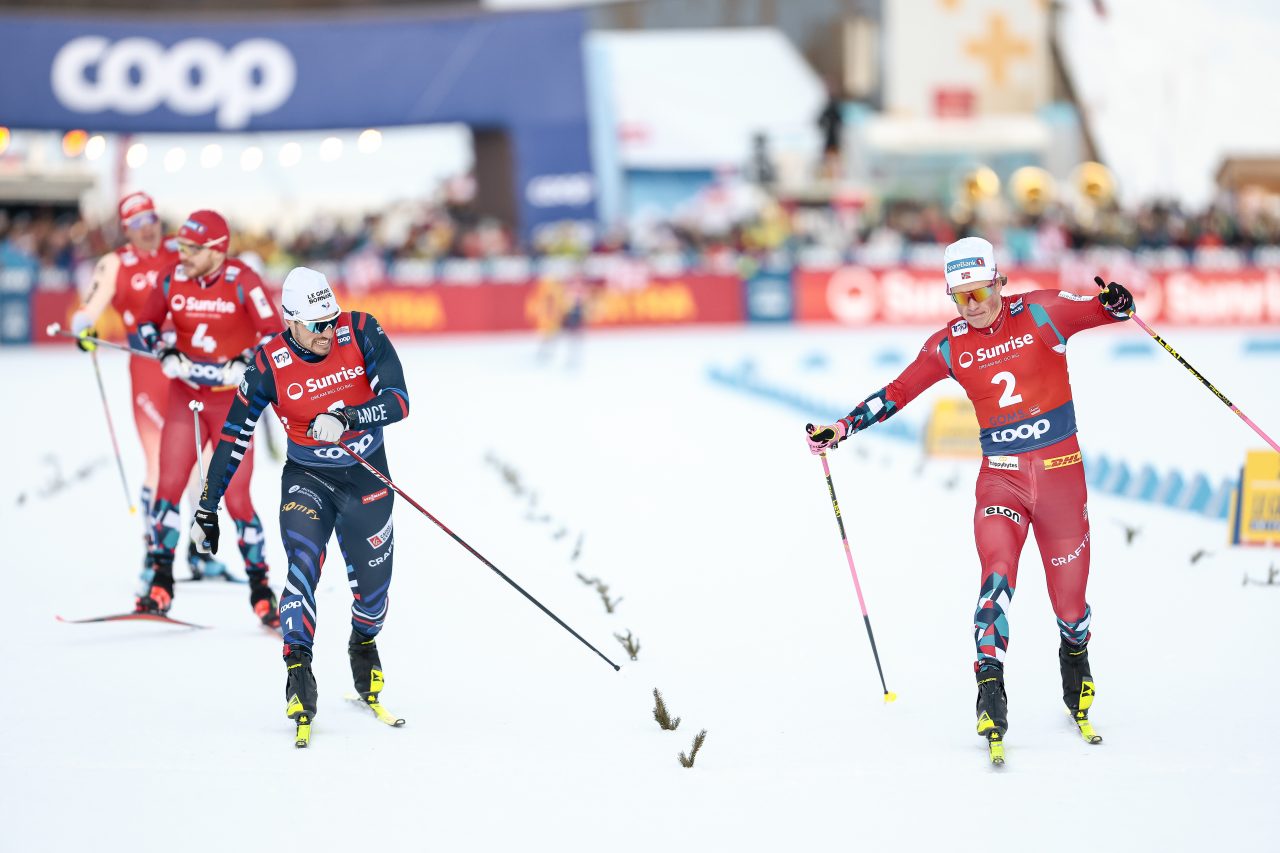
French sprinter Lucas Chanavat: I mean, if I had the answer, I would have won the last one. You just focus on yourself, do the best race you can. It’s about my strengths. I think you have to be really perfect on every move you do. That’s the fun part about competing with him. It’s, like, you have to be perfect. And that’s really motivating.
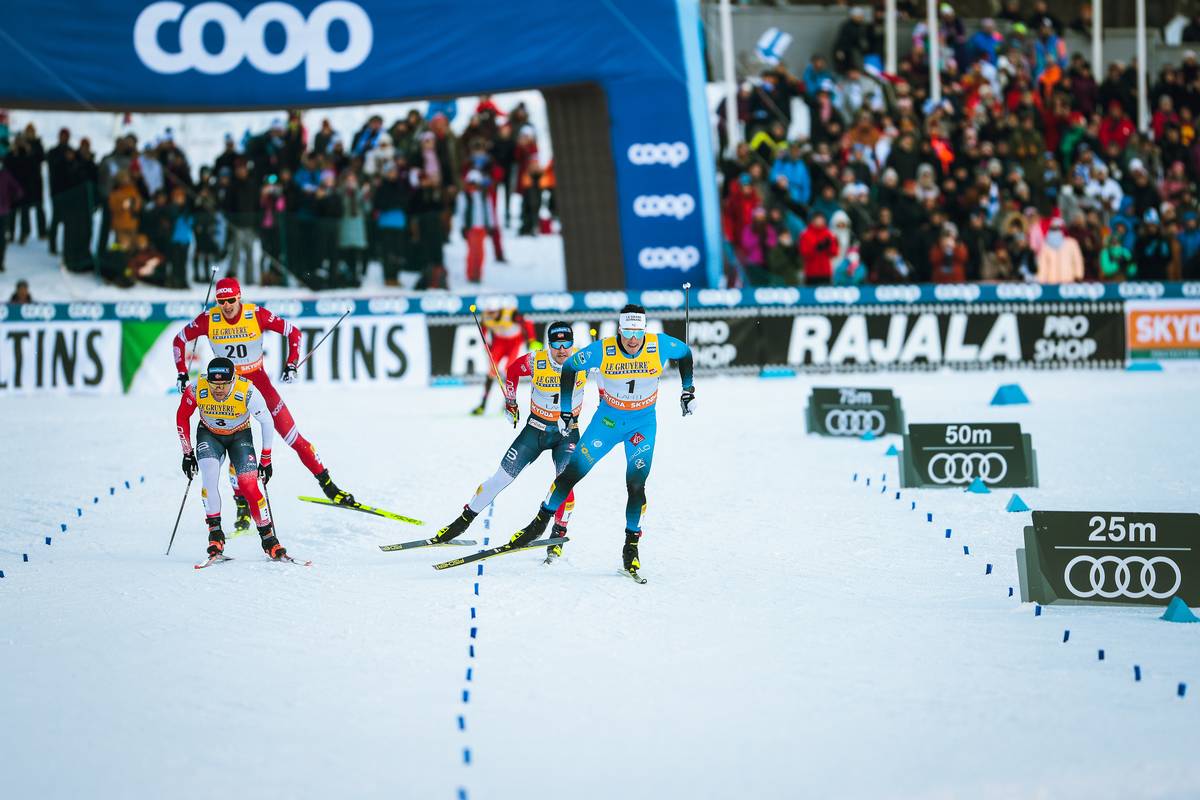
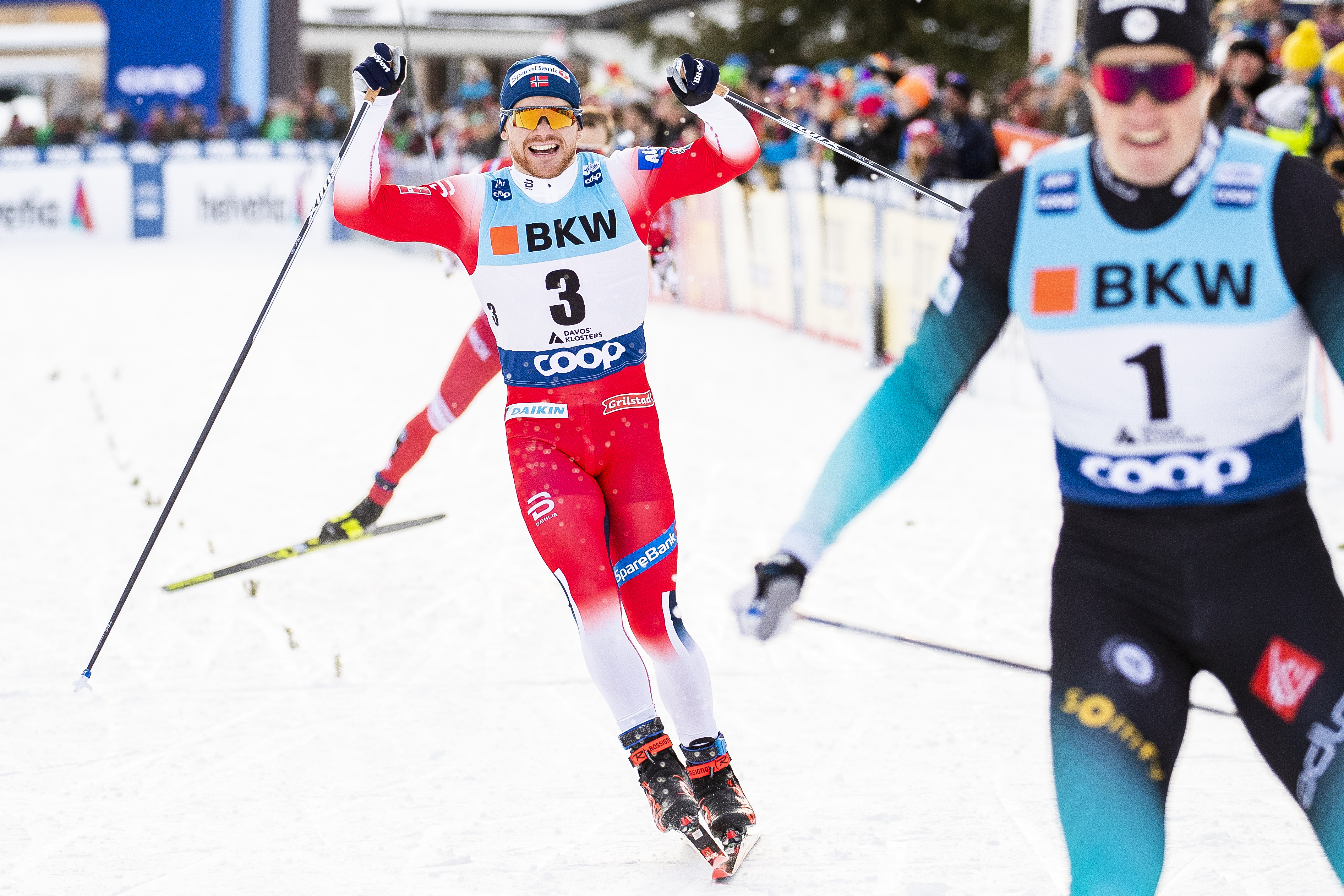
Lucas Chanavat of France alllllmost beat Klæbo at a World Cup sprint race in Switzerland last year. But he didn’t. (Photo: Modica/NordicFocus)
Sweden’s team manager, Anders Bystrom: I think, first of all, you have to mentally know that he’s not unbeatable. Because I think many people think so. He’s shown that he is almost unbeatable, so it’s fair that people think that. But we don’t talk about him like that.
Jonna Sundling, the Swedish Olympic champion from 2022 in the women’s sprint: I would go hard from the start, and don’t leave any power. Just go, all that I have. I don’t think I could take him in the final meters — he’s too quick for me. The men, maybe they’re scared sometimes — I don’t know, I think they can do more than what they think they can do. Maybe.
Maja Dahlqvist, a Swedish Olympic sprint medalist: I would try to sprint him down, like waiting til the end. But I guess a lot of people try to do that, and people are not so successful.
Grond: If he’s in his top shape, he’s almost unbeatable. He’s really, really always in a good spot. But when he’s maybe not in the best spot, you have to take advantage of this and put in an attack.
Canadian national team coach Robin McKeever: Break his pole?
Swedish sprinter Edvin Anger: I think we need to push him really hard, and take our chances. I don’t think I need to go hard early, but I think I need to have a good place. And when I take my chance, I really need to take my chance. And I need to push from the place in the track that I think is best for me. I can’t wait to see what he will do, because I need to do the thing first.
Norwegian sprinter Erik Valnes: How to beat Johannes in sprint is all about him being in bad shape. [Laughs] I think maybe it’s about the finish — or, to be able to have a good finish after a high-speed final. There are many things that have to be right to beat him. You just need to start the finishing sprint before him, and be ahead. Because as long as you’re behind him, you’re one step behind him in the mind games as well.
McKeever: I think the only way is by surprising him. And they’re trying.
What makes Klæbo so good at sprinting?
Chanavat: He’s strong in every aspect of the sprint race. He has, like, amazing turns, an amazing finishing sprint, he’s insane in stamina. He’s good at everything. He’s the GOAT [Greatest Of All Time].
Grond: He’s so good in every technique and part of the race, and also tactically. He’s simply the best skier in history.
Dahlqvist: He’s good in everything. He can go hard, he can wait, he can go from the start.
Norwegian distance specialist Simen Hegstad Krüger: He often likes to control the heat and he gets a lot of respect. And you have — I think there’s a lot of guys that think there’s no chance to beat him so they just give him room and then they give it away to him. He has earned the respect but especially in sprint you can’t give anything away and you have to take your place and take your positions. And I think he’s the best in that but I think sometimes he gets the best positions a little bit too easily.
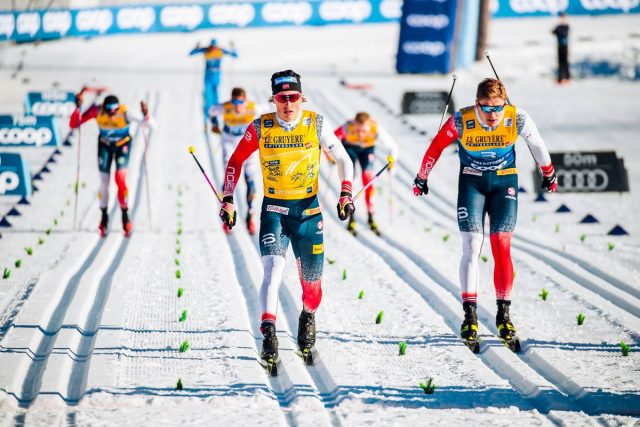
Klæbo wins a Tour de Ski stage just ahead of his Norwegian teammate Erik Valnes. (Photo: Modica/NordicFocus)
Valnes: I’ve been angry with myself sometimes because of bad tactical decisions. Because many times I’ve just, in my unconsciousness — you think, ‘Just follow him, and you’ll get a good result.’ But then you will not get past him.
Bystrom: If you meet him in a heat, you almost adapt to what he’s doing. Because you have to see, ‘Okay, what’s Johannes going to do now?’ Because you know he has this X-factor in many parts of the course.
Does Klæbo have any weaknesses in sprinting?
Chanavat: You should probably ask him. That would be the best.
Klæbo: That’s going to be a secret. [chuckles] I don’t think I will tell everyone. I think I’ll keep that for myself and I’ll tell everyone when I’m done racing. That’s my answer.
Norwegian sprinter Even Northug: Maybe none.
Valnes: No. That’s the thing with him. He’s not having any weaknesses. You can say, like, maybe double-poling long flats. But he’s quite good there.
Krüger: Not that I’ve seen so far. Even in distance races, it’s not so many weaknesses to find.
French sprinter Jules Chappaz: I think running [uphill], like in Ruka [the Finnish ski resort that hosts the season-opening World Cup races each year]. First it was the ‘Klaebo run,’ but now I think I’m really good at it. Maybe, hopefully next year in Ruka, I can run faster, beat him. [He didn’t.] He is sick a lot of times — maybe that’s sort of his weakness.
Klæbo coasts to the win in Ruka this year, beating everyone, including Jules Chappaz. (Photo: Modica/NordicFocus)
Anger: It’s a hard question. But I think we need to push him and then make him a little stressed — that’s what I think.
Bystrom: Mayyyyyybe it’s skating without poles — using your legs to be able to, maybe, go past him. But it’s really hard to say. He’s the best. He’s shown that many times. He’s so good in so many areas. It’s hard to say there’s one where you could beat him when there’s 28 areas where you can’t beat him.
Are there ways athletes can train over the long-term, like over next summer or multiple seasons, to beat Klæbo?
Chappaz: Just trying to focus on ourselves. This spring, I will compete in the Ski Classics [marathon races] to improve my double poling. To look to the Olympics, 2026, with the Val di Femme finish — I hope it will improve my double poling skills, to [be able to] beat him.
Dahlqvist: Maybe they need another team like us, like the Swedish women, because you can use your team more. So, maybe a whole team needs to be stronger, to try to beat the Norwegian. They could do team tactics in a way, like everyone knows where they will go.
Anger: I’m still young — I’m just 21 years old. And he has a lot of training hours. A lot more than I have. With one or two years more, with good summers, also with a lot of hours, I think it will be better for me. And maybe I will be better in the final — I’m good in the quarters and the semis right now, but maybe I miss a little in the finals. I need to be a little harder and stronger.
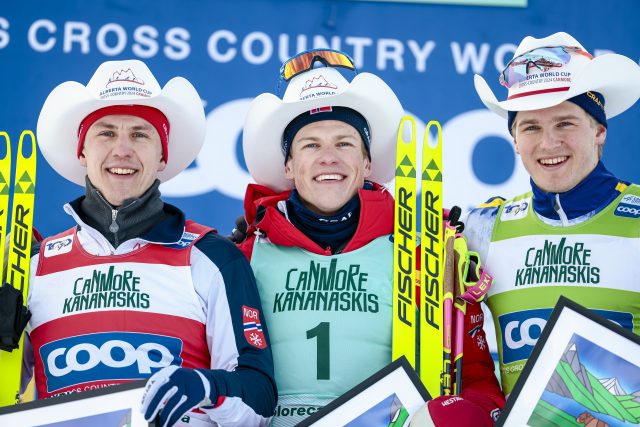
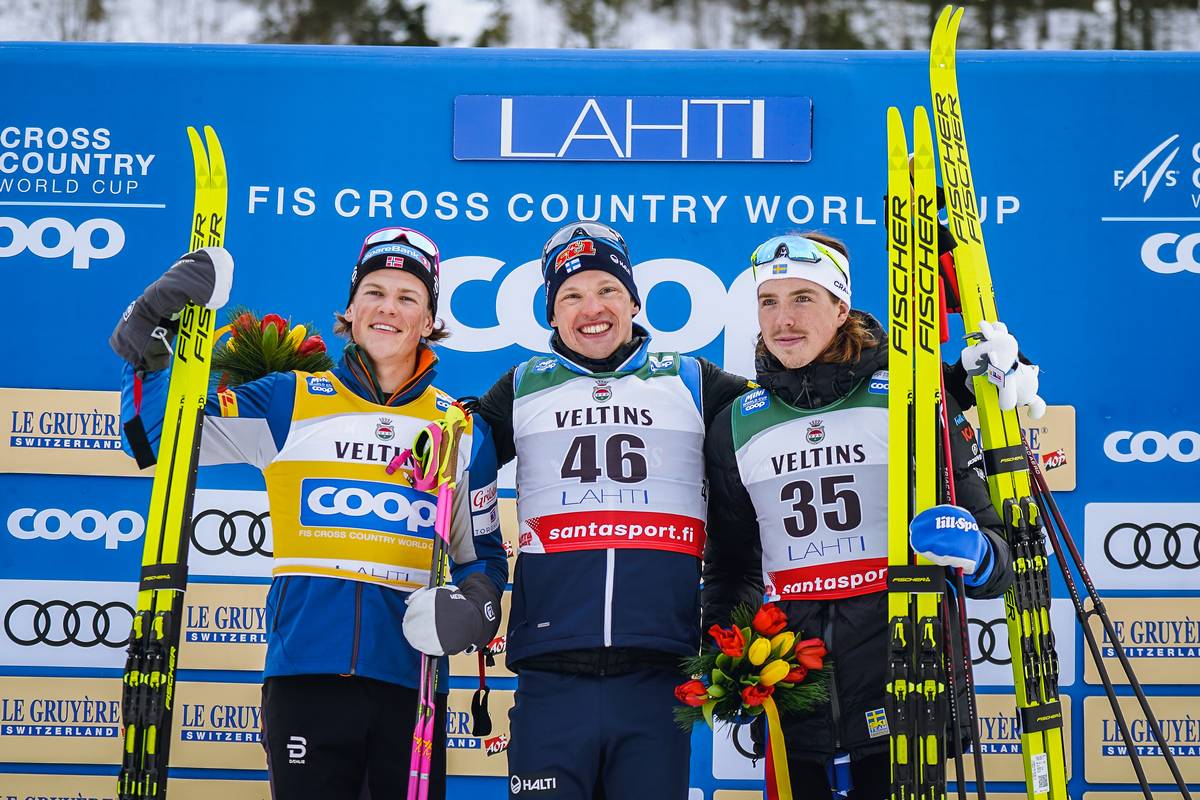
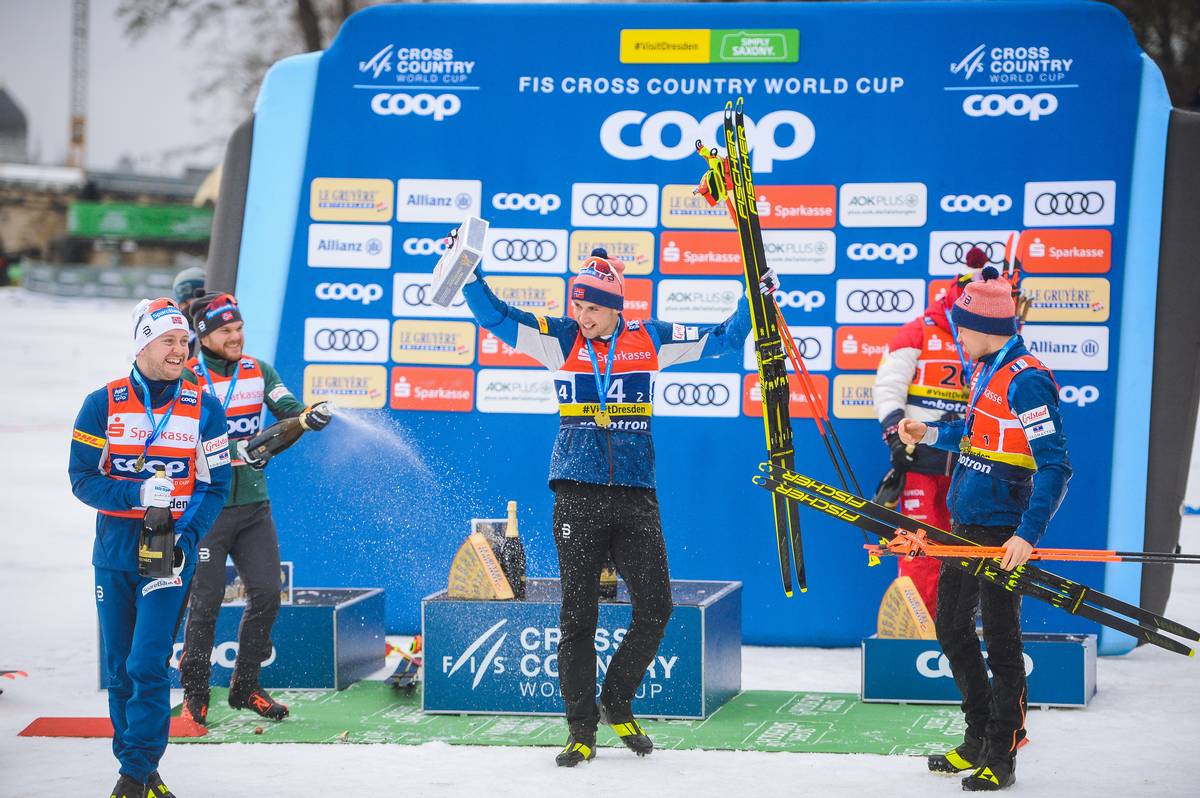
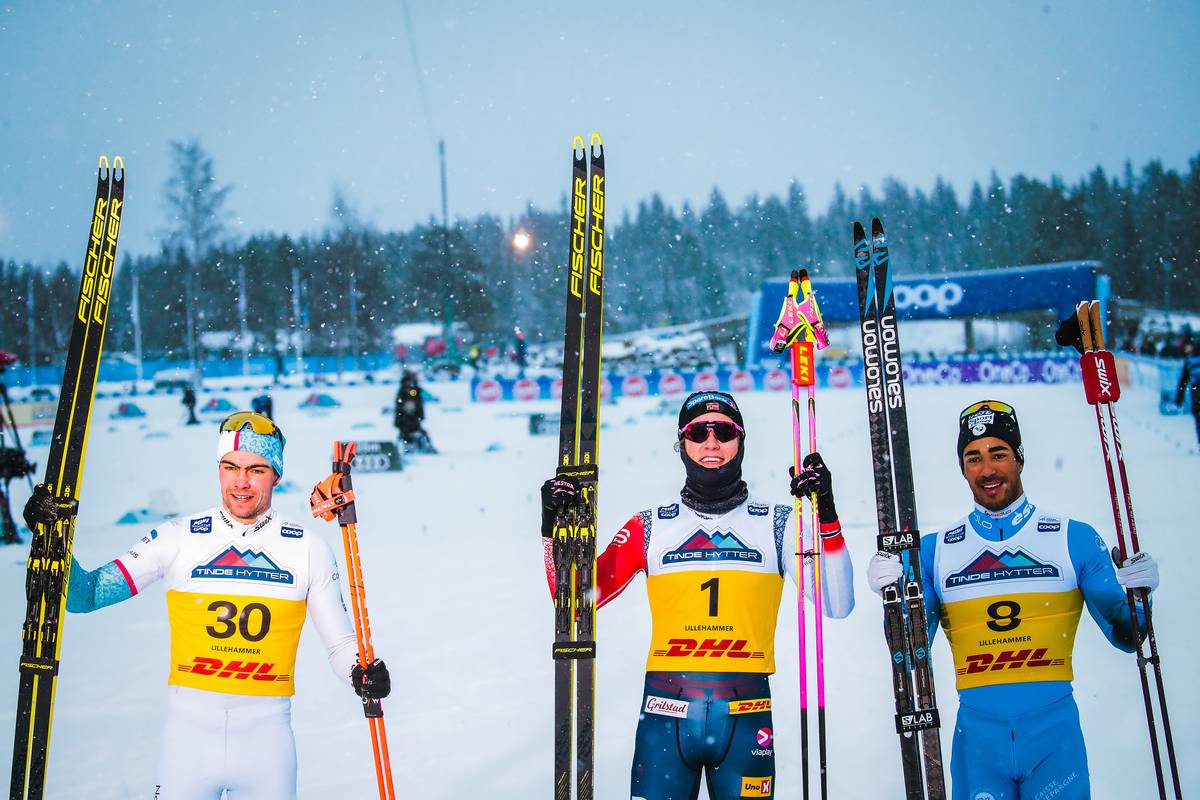
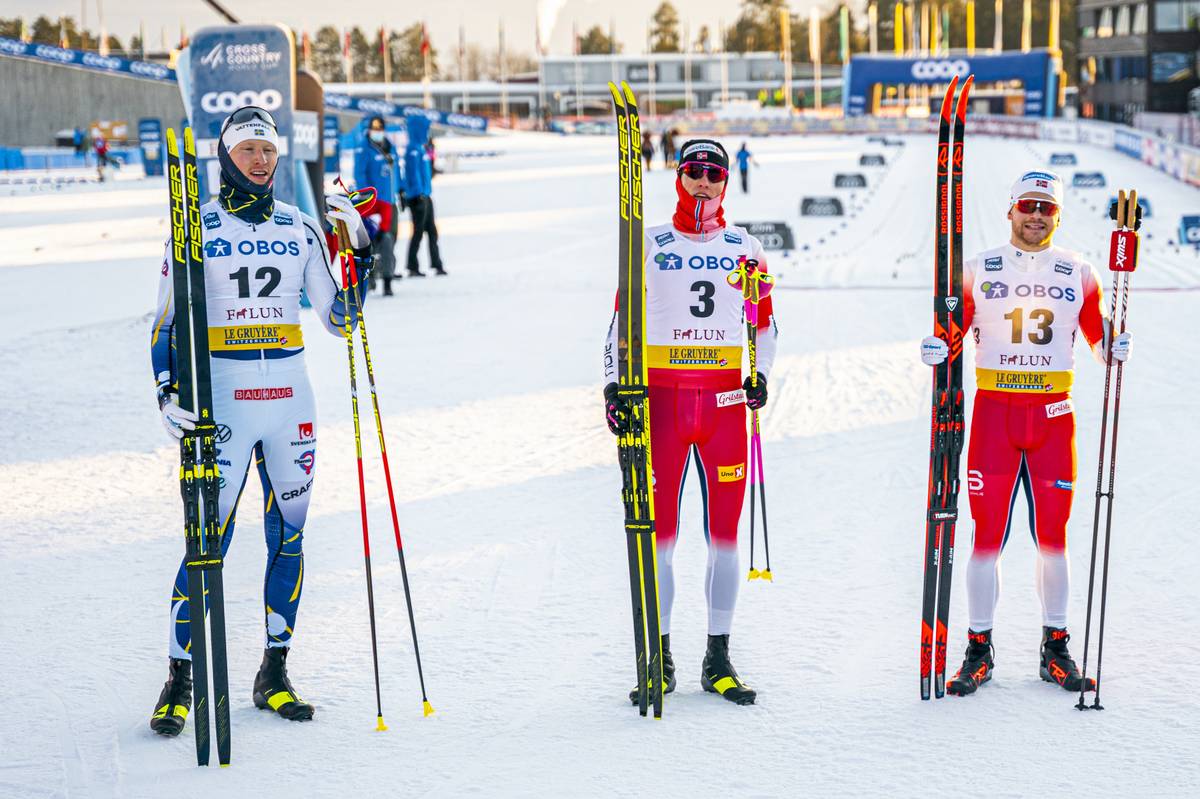
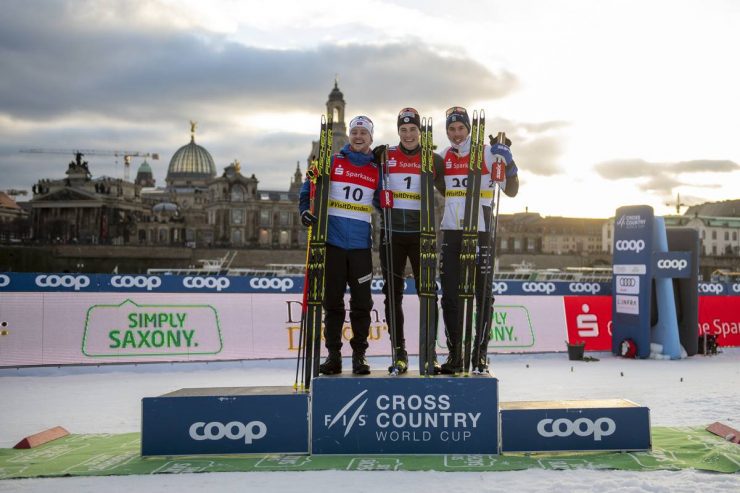
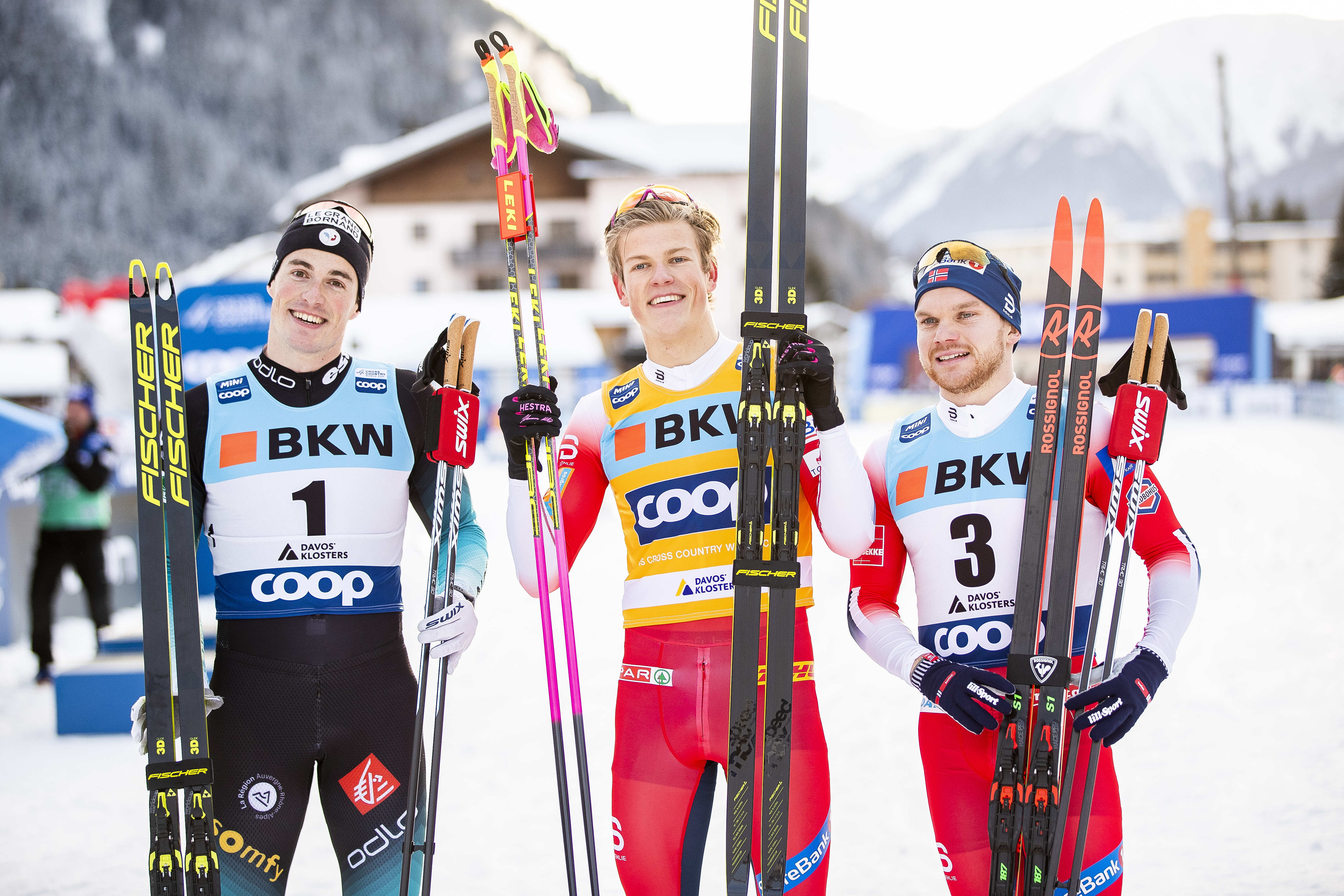
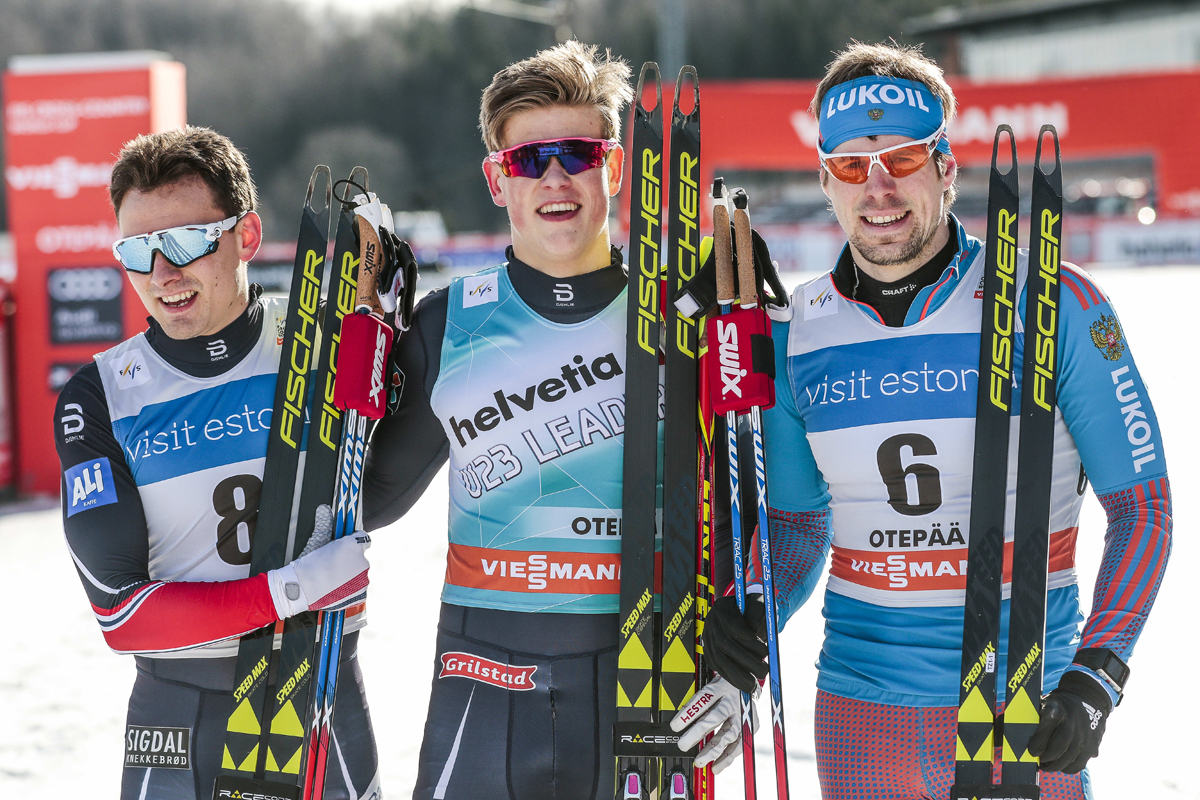
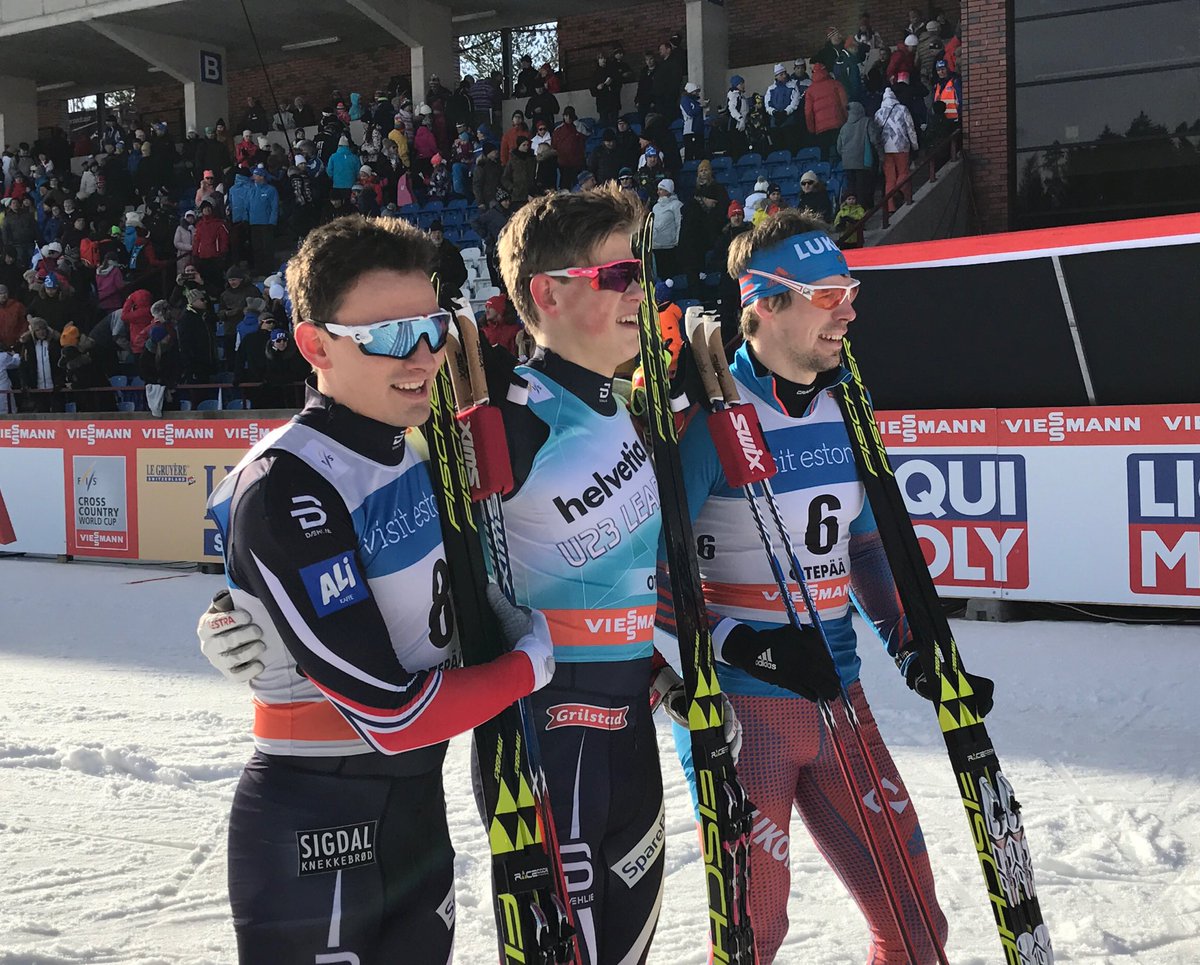
Valnes, Klæbo and Anger pose for a podium photo after Klæbo won a World Cup sprint in Canada last year. (Photo: Modica/NordicFocus)
Grond: We’ve just got to work hard. It’s also about learning how to ski against the best skier, for me. So, I’m trying, also, to get some experience on how they ski and where I can be better than them.
Valnes: It’s more about improving the base level, the capacity, the VO2 max. If you have that base, from May until September, then you can build a little bit on that with specific training in October and November and just before the season starts.
McKeever: The reality is, how do you beat Klaebo? Have him age out a little bit.
Northug: Training.
Norwegian national team coach Eirik Myhr Nossum: You have to train, of course. But there were a lot of people training for the 100-meter dash, as well: Usain Bolt still won. So, if everybody in the world trains the best they can, still one will win — and it’s hard to beat Johannes. It’s possible, but he’s probably the best skier that’s ever been. And now it’s harder than ever, and he still wins.
Corresponding with a social media post from Johannes Høsflot Klæbo, the Norwegian news outlet NRK reported yesterday that each of the men’s national team sprinters who competed in Lahti last weekend has tested positive for COVID-19. Head sprint coach Arild Monsen told NRK that Håvard Solås Taugbøl was the first to test positive on Monday, followed by Erik Valnes, Pål Golberg, Sindre Bjørnestad Skar and Johannes Høsflot Klæbo on Tuesday. According to Trondheim regional newspaper Adresseavisen, the final Norwegian sprinter who raced in Lahti, Even Northug, has also been affected.
Johannes Høsflot Klæbo (NOR) takes the win in Lahti’s freestyle sprint ahead of Lucas Chanavat (FRA) and Sindre Bjørnestad Skar (NOR). (Photo: NordicFocus)
“It must have occurred in and around the stay in Lahti,” Monsen explained to NRK. “Håvard was the one who noticed symptoms on Monday. The others have little or no symptoms.”
Given the proximity to the upcoming sprint races in Drammen, Norway, Monsen indicated that these men would not be attending the competitions.
“What happens after that, we just have to look at. It’s boiling in many fields in the world now. This is smaller than other things, even though it is [disappointing] for those they concern,” Monsen continued.
At this time, no other athletes from the Norwegian program who attended the competitions in Lahti have tested positive. While the transmission link between the sprinters is clear, some athletes participated in both sprint and distance races, including Klæbo, who won the freestyle sprint and took second in the 15 k classic.
The men’s 15 k classic podium in Lahti: Iivo Niskanen (FIN) took the win in his signature event, ahead of Johannes Høsflot Klæbo (NOR) and William Poromaa (SWE). (Photo: NordicFocus)
Team doctor Øystein Andersen indicated to NRK that the original source of the outbreak remains unknown.
“It’s hard to say [how this began],” Andersen said. “Everyone came from their own bubbles before this race, after they returned home from the Olympics. We must now first map out whether there are more [positive cases] and conduct infection tracking, so that we avoid more infection.”
As the World Cup Finals slated for March 18-20th currently remain listed as “canceled” on the FIS calendar, it is unclear whether these athletes will be able to compete on the World Cup again this season.
Klæbo told NRK that “most indications are that the season is over,” however, the loss of competition would not significantly impact his season outcome. Klæbo currently leads the World Cup overall standings by nearly 500 points over Russia’s Alexander Bolshunov, who is also unable to compete as FIS banned athletes from Russia and Belarus from competition for the remainder of the season. The next closest athlete to Klæbo is Finland’s Iivo Niskanen, who sits nearly 800 points back with limited scoring opportunities remaining. As the Falun World Cups feature a mixed relay and team sprint, this leaves two sprints and two distance races, worth 100 World Cup points each, currently confirmed on the FIS calendar.
If World Cup Finals are held at an alternate venue, athletes could score a maximum of 50 points per day, with the opportunity for up to 200 bonus points should they win the three-day mini-tour.
This still leaves fewer than 800 points on the table, and as such, it looks like Klæbo will win the overall World Cup regardless of whether he competes again this season.
Klæbo also leads the World Cup sprint standings with a 210 point lead over Richard Jouve, and is 237 points of third-ranked Lucas Chanavat, both of France. Classic sprint events are scheduled for Drammen on Thursday, followed by another classic sprint in Falun on Friday, March 11th. If World Cup Finals take place, there will be a third sprint opportunity there, raced freestyle. This leaves 200 points available without the World Cup finals, and 250 including them.
Norway’s Pål Golberg tested positive for COVID following the weekend of World Cup racing in Lahti. (Photo: NordicFocus)
“There is nothing to do but take it easy,” Pål Golberg said to NRK. “It’s [disappointing] that it’s coming now, but we can be very happy that we managed to avoid more infection in the camp before the Olympics when people became infected in Seiser Alm.”
On what is next, Golberg continued, “If I do not develop symptoms, it may be relevant to go to Falun next weekend. And then there are many [domestic] races over the late winter. Then we will see if it is worth it.”
This World Cup coverage is made possible through the generous support of Marty and Kathy Hall and the A Hall Mark of Excellence Award. To learn more about A Hall Mark of Excellence Award or to learn how you can support FasterSkier’s coverage please contact info@fasterskier.com.
By Rachel Bachman Perkins and Ian Tovell
During a brief reprieve from racing, the top tier of international racing made its way from the high desert of Zhangjiakou, China to a venue tucked into snow-capped pines and nestled amongst the lakes of southern Finland. With more start spots per country than during the Games and some athletes choosing a weekend away from the World Cup, a number of new faces appeared on the start lists in Lahti for the 1.6-kiilometer freestyle sprint.
Logan Diekmann (BSF Pro) makes his first World Cup appearance in the 1.6 k freestyle sprint qualifier in Lahti, FIN. (Photo: NordicFocus)
For the U.S., these names included Logan Diekmann (BSF Pro Team) and Bill Harmeyer (SMS T2), both of whom earned their first World Cup starts this weekend via their performance on the SuperTour circuit this season. These athletes joined Kevin Bolger, Logan Hanneman, and Zak Ketterson; the Team Birkie athlete also earned his first World Cup starts earlier this year at the Tour de Ski.
Diekmann currently leads the SuperTour sprint standings with 119 points. He was second in the freestyle sprint during the U.S. Cross Country Championships in Soldier Hollow in January and skied to 5th in the sprint in both Duluth and Lake Placid.
Harmeyer was ranked third in the sprint standings with 83 points, behind Noel Keeffe who is currently racing at the 2022 U23 World Ski Championships in Lygna, NOR. Harmeyer has consistently posted top-five times in qualification during the SuperTour sprint races, and has raced into the final in three out of six SuperTour sprints. A fall in the quarterfinal during US Nationals left him in 24th after qualifying in fifth.
Bill Harmeyer (SMS T2) makes his first World Cup appearance in the 1.6 k freestyle sprint qualifier in Lahti, FIN. (Photo: NordicFocus)
Lucas Chanavat (FRA) was the top qualifier finishing the course in a time of 2:57.85. All five of the Americans finished outside the top-30 in qualification, but Canadian Graham Ritchie cracked into the heats for North America in 27th (+7.73).
The quarterfinal rounds played out mostly as expected, with Chanavat and Johannes Høsflot Klæbo (NOR) advancing from the first round after a close finish. Norway’s Håvard Solås Taugbøl and Olympic silver medalist Federico Pellegrino of Italy crossed the line first and second in heat two, spread by just 0.06 seconds. Winning the third heat, Andrew Young (GBR) crossed the line in 3:04.32, just ahead of Russia’s Gleb Retivykh (+.20).
The fourth quarterfinal heat saw a close finish, as Sindre Bjørnestad Skar (NOR) took the race to the line alongside Richard Jouve of France and Alexander Bolshunov of Russia were right at his heels. Skar won the closing sprint with Jouve +0.01 behind and Bolshunov in third (+0.07). Michal Novak (+.49) of the Czech Republic finished in fourth, with both Novak and Bolshunov narrowly missing out on lucky losers.
Fast racing in the fifth heat saw four competitors advance to the next round. Janik Riebli (SUI) won the heat in a time of 2:59.56, while China’s Qiang Wang finished second (+.10) to move onto the semis. A top prospect for the Chinese ski program, this is Wang’s first World Cup appearance since the pandemic began. Wang was fifth in qualification during the Olympic freestyle sprint in Zhangjiakou, where he took second in his heat to Norway’s Erik Valnes before being issued a disqualification for obstruction and being relegated last in the heat.
Qiang Wang (CHN) leads at the start of the fifth quarterfinal heat in Lahti. (Photo: NordicFocus)
Following the pace of the leaders, Maciej Starega (+.64) of Poland and Arnaud Chautemps (+1.61) of France crossed the line third and fourth to advance into the semis as lucky losers.
In the first semifinal, five skiers all remained close coming into the finish to vie for the two automatic spots. Pellegrino was able to hold the field off and win the semi with a time of 2:59.57, however, he was later disqualified, pushing him to sixth place. Klæbo crossed in second (+.07), guaranteeing his spot in the final, while Chanavant and Taugbøl were third (+.21) and fourth (+.37), respectively. Due to Pellegrino’s disqualification, Taugbøl was able to make it through to the final as a lucky loser.
In the second semi, Retivykh held off a push from Skar to win in 2:59.67, with the Norwegian 0.02 behind. Wang crossed third (+.34) with a time fast enough to earn the second lucky loser spot in the final.
Sindre Bjørnestad Skar leads his heat during the freestyle sprint in Lahti, FIN. (Photo: NordicFocus)
In the final, an early tangle between Wang and Retivykh as the two rounded a corner sent the Chinese athlete to the ground, losing contact with the pack.
The remaining five men stayed close as they powered through the course. Rounding the bend into the final 100 meters, four skiers remained in contention for the podium, but it was Klæbo who slingshot from the outside, putting his closing speed on display as he threw his boot to win a photo finish with Chanavat in 2:58.34, Skar and Taugbøl on their tails.
Johannes Høsflot Klæbo with a look before taking the win in the freestyle sprint in Lahti, FIN. (Photo: NordicFocus)
The Norwegian had advantage at the finish, with Chanavat just 0.04 seconds back in second place. Skar held off his teammate for the final podium spot in third (+.23), while Taugbøl took fourth (+0.58). Retivykh crossed a few meters back in fifth (+0.90), while Wang rebounded from his crash to finish 7.77 seconds behind in sixth.
A close race for second and third heads into the final 25 meters in Lahti. (Photo: NordicFocus)
“It was amazing,” Klæbo told FIS after the race. “It isn’t so many days since we competed in the Olympics, but still, it’s always fun to race.”
Klæbo commented on the excitement of racing in Lahti, which has hosted many championship events including the 2019 World Championships. He added that the racing on these tracks is often tight, which keeps it exciting for spectators – of which there were many today. When asked about racing in front of a crowd after nearly two years of empty stadiums, Klæbo smiled.
“It was amazing. I think what they have done, and finally seeing the end of the COVID situation – I think it’s amazing. It’s always great to compete against a big crowd, and it was amazing today as well.”
Johannes Høsflot Klæbo (NOR) takes the win in Lahti’s freestyle sprint ahead of Lucas Chanavat (FRA) and Sindre Bjørnestad Skar (NOR). (Photo: NordicFocus)Graham Ritchie races in the quarterfinal of the freestyle sprint in Lahti, FIN. (Photo: NordicFocus)
After finishing fifth in a tightly spread third quarterfinal heat, Graham Ritchie bumped up from his bib rank to finish 24th.
Kevin Bolger was the top American qualifier in Lahti in 33rd (+8.90), just 0.41 seconds off the mark needed for the top-30. On his tails was Diekmann in 34th (+9.14), with Hanneman close behind in 39th (+9.79). Ketterson was next for the U.S. in 49th (+12.13), with Harmeyer next in 50th (+12.28).
Kevin Bolger leads the American men in 33rd during the freestyle sprint qualifier in Lahti, FIN. (Photo: NordicFocus)Antoine Cyr (CAN) races the qualifier of Lahti’s freestyle sprint. (Photo: NordicFocus)
Outside the top-30 for Canada, Antoine Cyr was 40th in qualification (+9.99), with Olivier Léveillé next in 46th (+11.79), followed by Phillippe Boucher in 55th (+14.02) and Rémi Drolet in 58th (+15.87).
Racing continues tomorrow with a 15 k individual start classic.
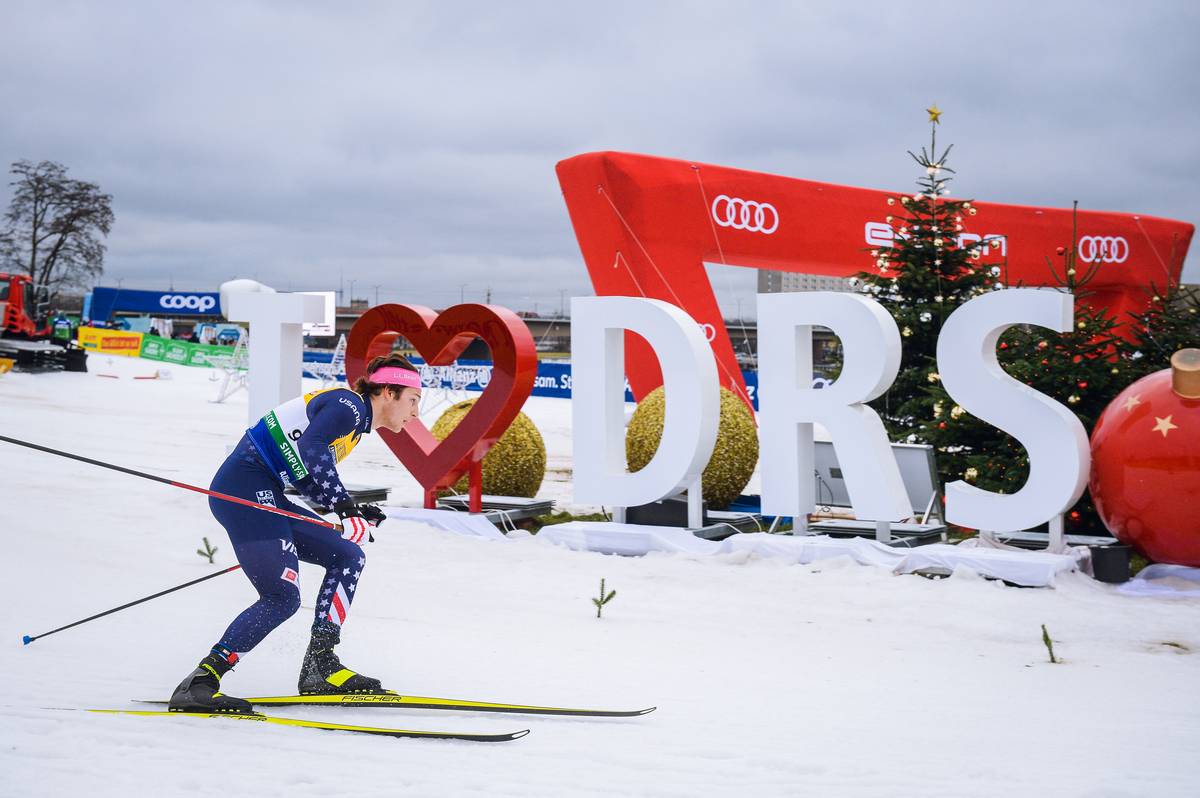
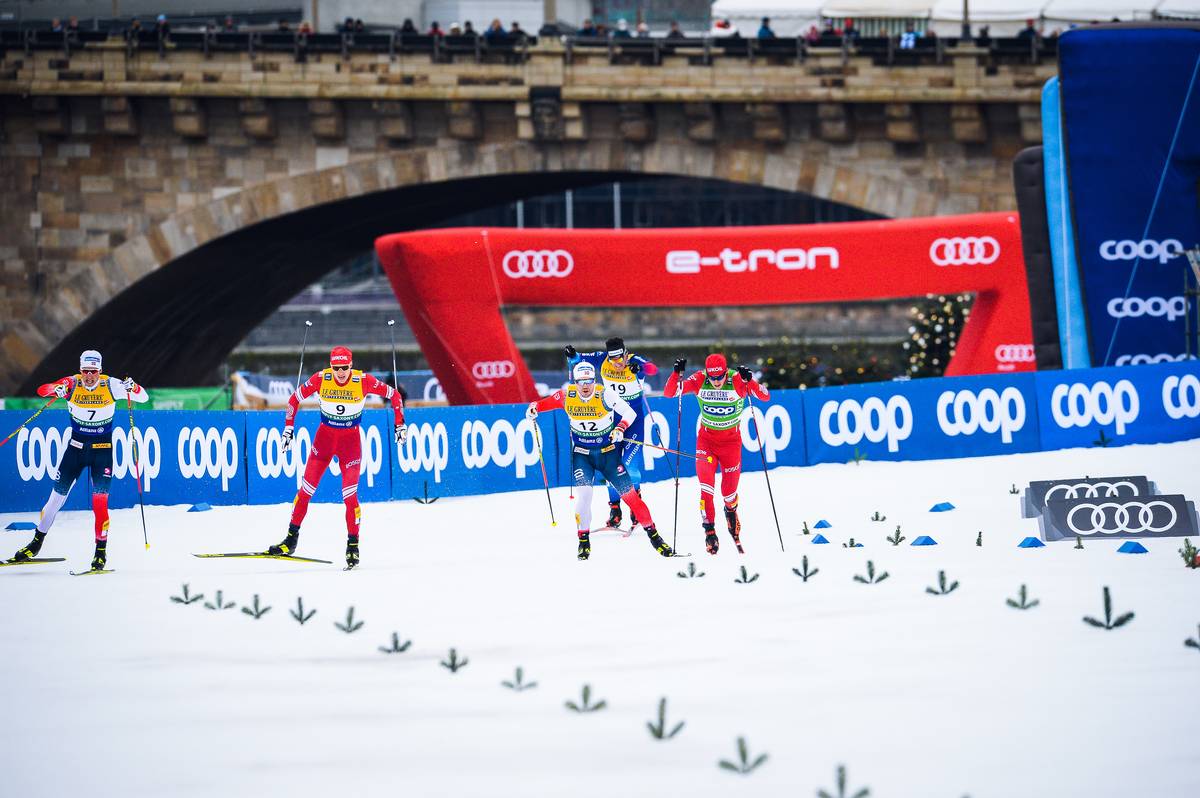
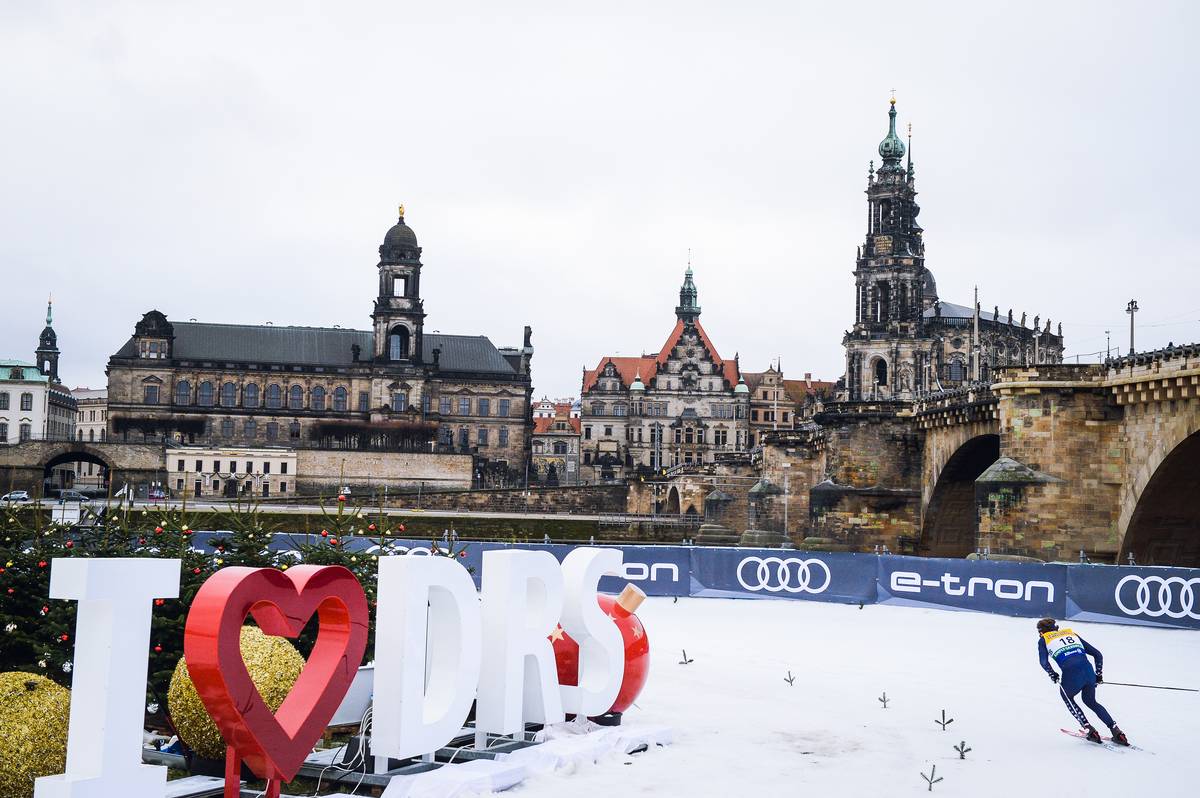
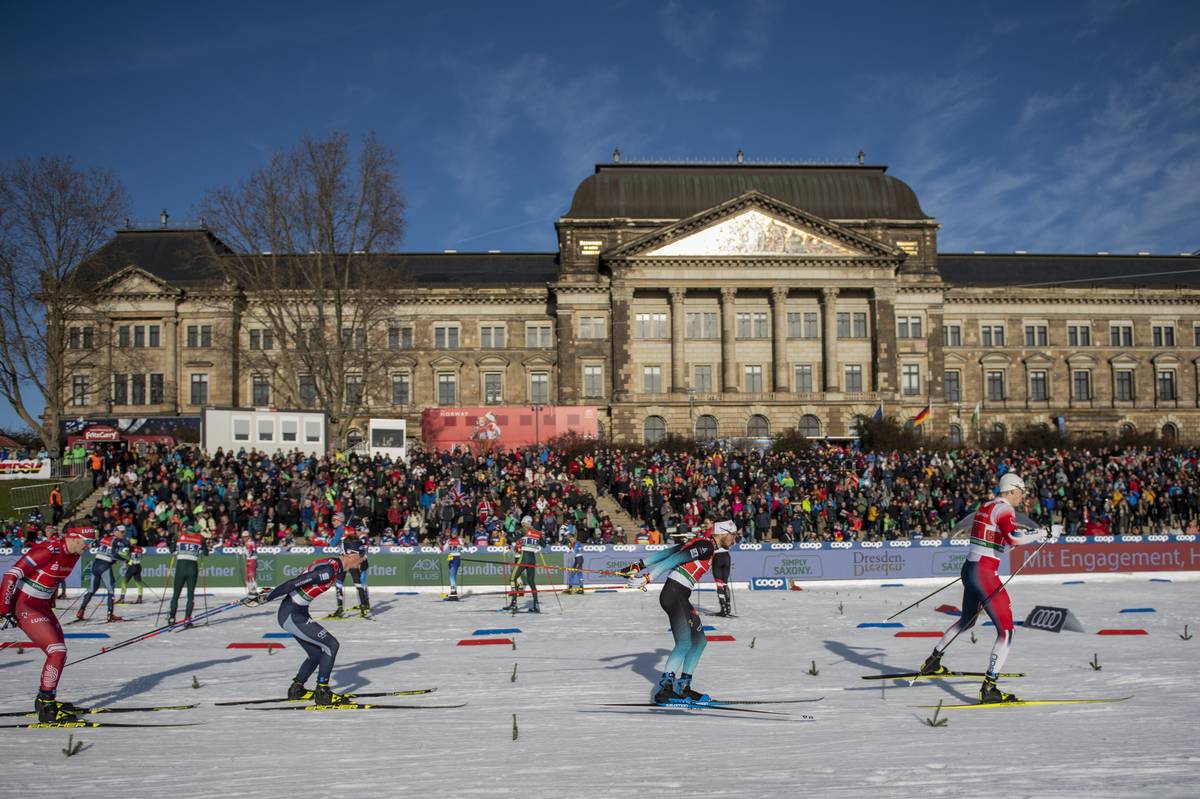
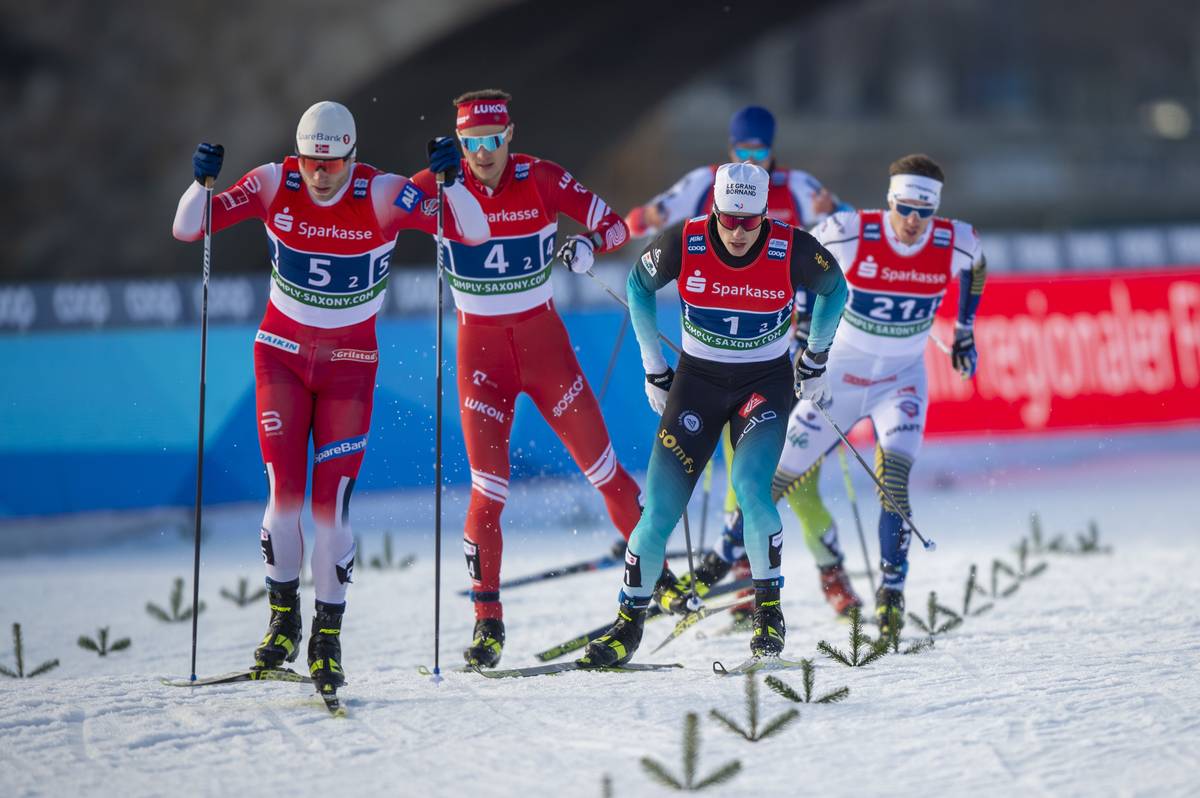
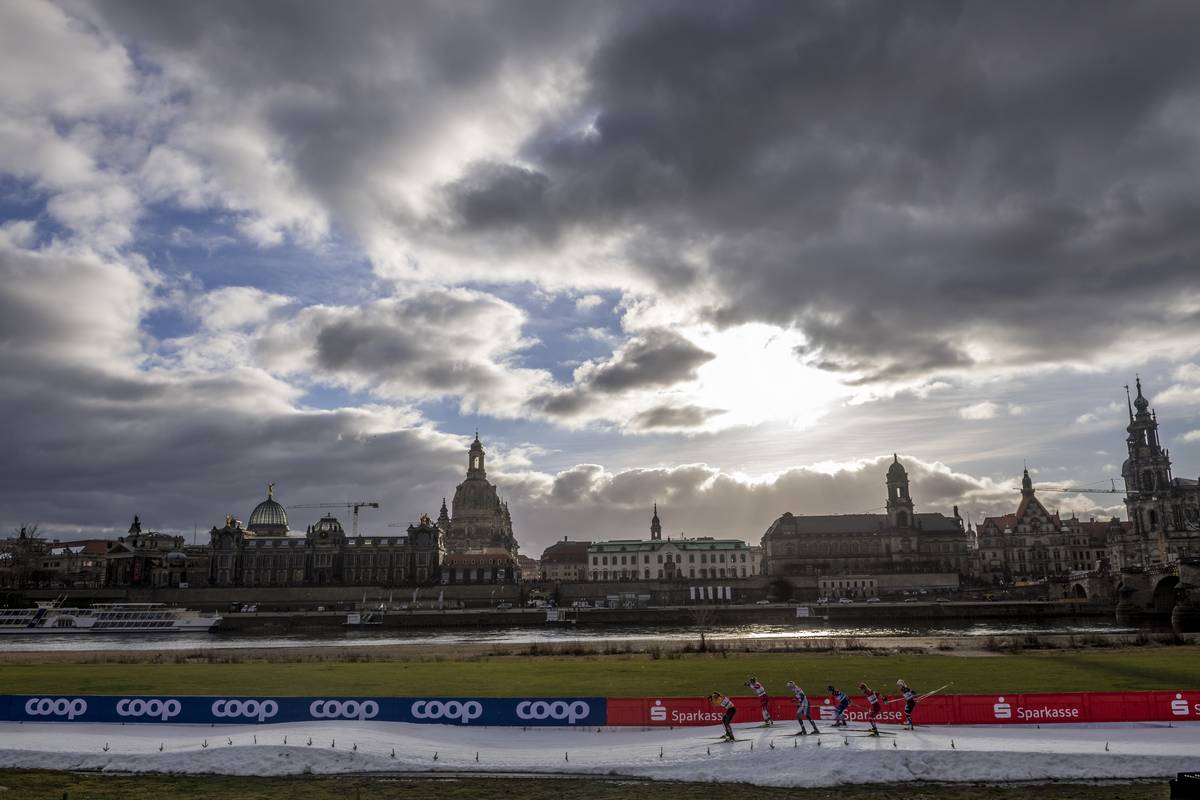
Overcast skies mute the spectacular architecture along the River Elbe, which provides the backdrop for the sprint track in Dresden, Germany. (Photo: NordicFocus)
This World Cup coverage is made possible through the generous support of Marty and Kathy Hall and the A Hall Mark of Excellence Award. To learn more about A Hall Mark of Excellence Award or to learn how you can support FasterSkier’s coverage please contact info@fasterskier.com.
In the wake of the American women taking second to the Swedish powerhouse duo, and yesterday’s top two spots on the podium, Maja Dahlqvist and Jonna Sundling, the men’s team of JC Schoonmaker and Kevin Bolger lined up to race the freestyle team sprint final on the track in historic Dresden, Germany.
“Together again,” wrote Bolger in a post-race email. “We teamed up 3 years ago when JC came over for his first World Cup and didnt ski great then together, but being able to team up again and move to the final after a really solid semi was super rad today! He skied really well all weekend and I’m so impressed with how he’s looking, so it made today really fun!”
Six quick laps each, eleven exchanges total, on a flat and fast city 0.65-kilometer loop with minimal recovery means flooded legs and tight racing. Like a series of just-over one minute intervals with equal rest, athletes take a conservative start, accruing fatigue while minimizing the opportunity for crashes and broken equipment to decide the race, over fitness and tactics. As the number of remaining laps dwindles, the pace steadily builds, like a bottle rocket, until the critical point arrives in the last few laps and leaders explode off the front in an effort to take control of the outcome.
Kevin Bolger navigates a tight curve during the men’s team sprint in Dresden, Germany. (Photo: NordicFocus)
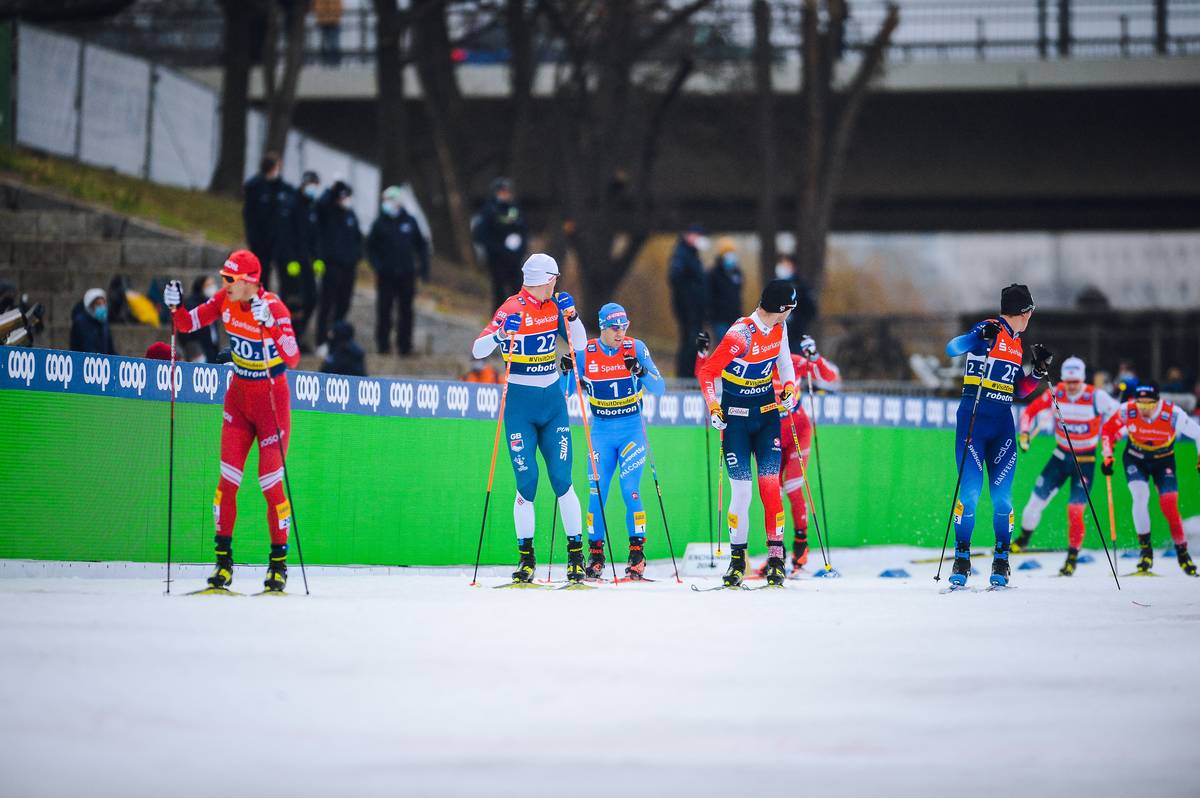
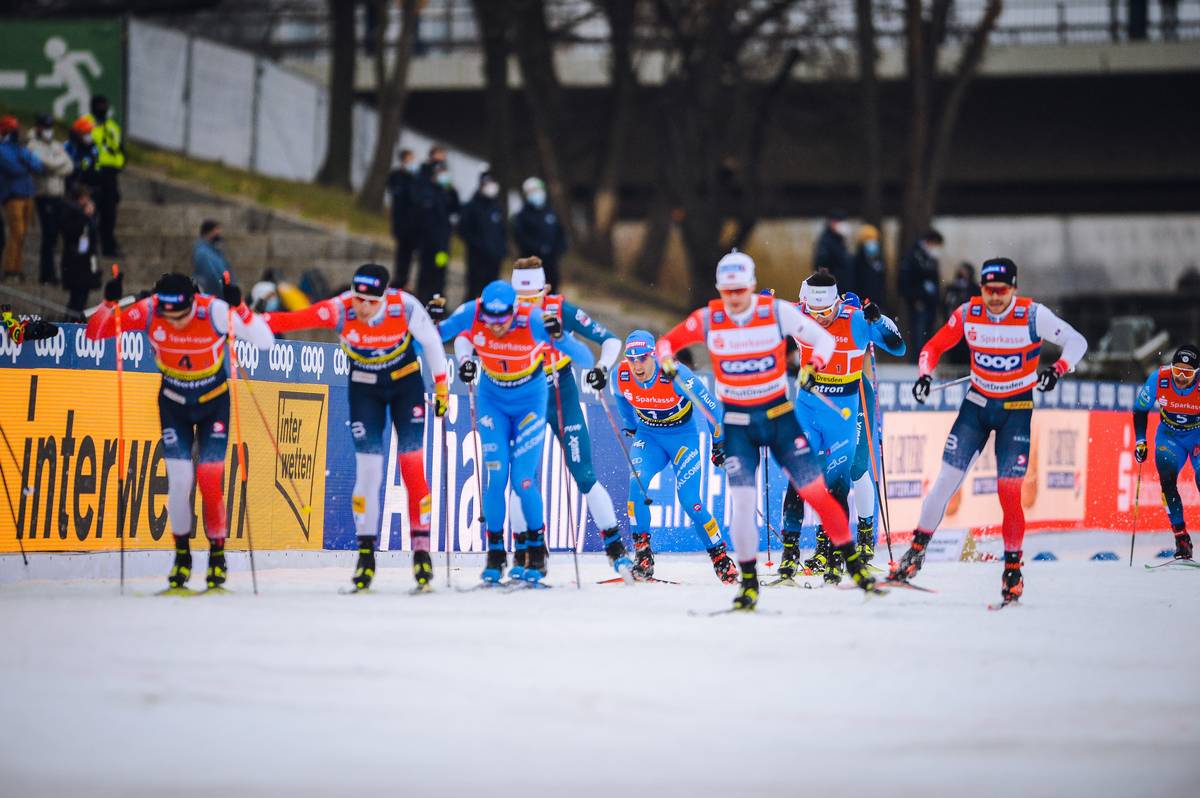
As expected from a lap that lasted just over a minute, the whole pack of ten teams stayed very tight through the halfway mark. The Norway II team of Thomas Larsen and Even Northug spent time at the front, putting in quick surges at the beginning of each leg to re-establish their position.
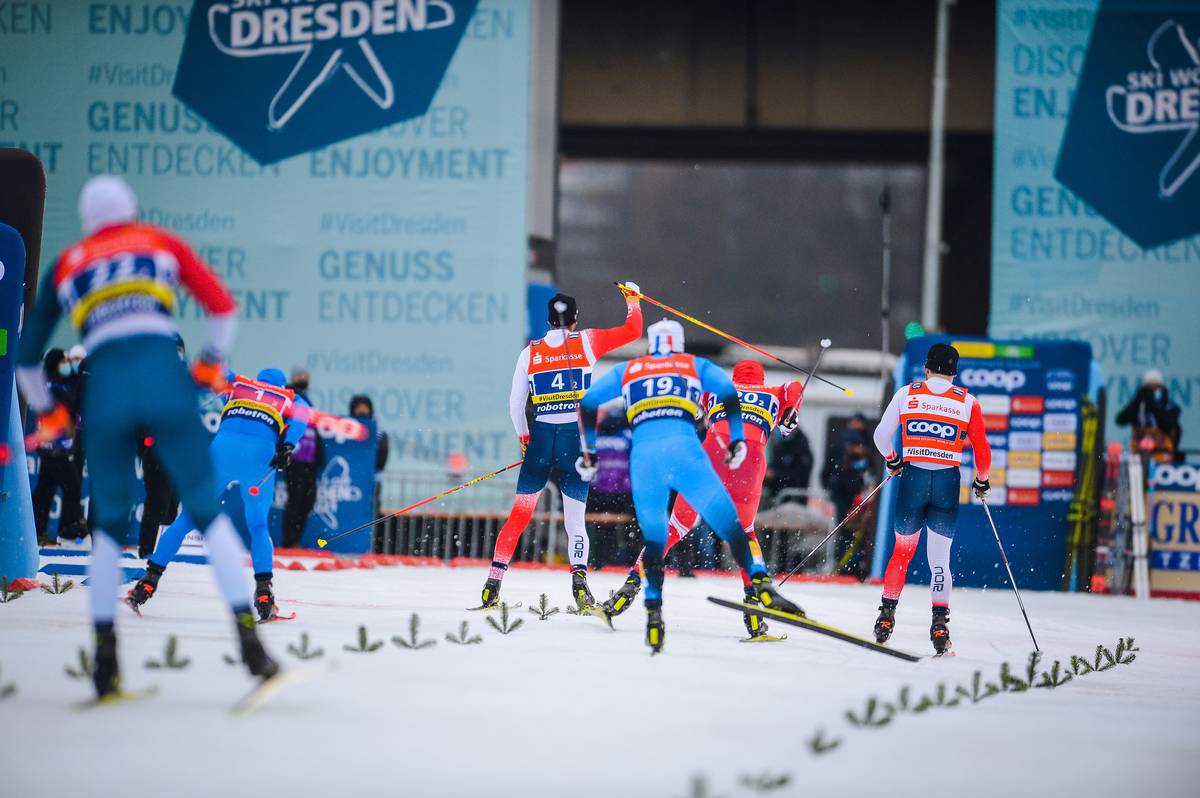
Tagging off after lap 6, the team tagged off with Great Britain on one side, and the Norway I team of Sindre Bjørnestad Skar and Håvard Solås Taugbøl, on the other. Still very much in the mix were the Russia I pairing of Alexander Bolshunov tagging Gleb Retivykh, Italy’s Francesco di Fabiani and Federico Pellegrino, and France’s Richard Jouve and Lucas Chanavat.
The leaders wait for a tag during the Dresden team sprint. (Photo: NordicFocus)
At the half, the Americans remained in contact near the back of the pack, as Bolger tagged Schoonmaker in 9th (+2.0).
Coming into lap 9, Bolshunov made a move to the front to take the reins for Russia I, with both Norway teams and Jouve quickly responding to his tempo, while Italy and Great Britain worked hard to maintain contact. This burst set the tone for the final three laps.
As Retivykh unsuccessfully attempted to drop Taugbøl and Northug in lap 10, the pack in pursuit began to stretch out. While all remained in contact with the leaders, Great Britain began to look out of the running for a win, with Italy and France remaining a podium-threat in fourth and fifth. The teams behind thinned rapidly.
Still tight at the Tag, Norway II, Italy, and Norway I (left to right) head out for another lap during the Dresden team sprint. (Photo: NordicFocus)
In Bolshunov’s final lap, he rocketed off the front, skiing powerfully through his legs with an aggressive forward lean, carrying momentum between each push. Whereas the early laps, rounding the tight curves looked careful and calculated, the men shot around the degrading bends, losing no speed as they pushed into the straightaways.
Tagging off for the final lap, Northug accelerated ahead of Retivykh, free skating powerfully off the first roller to regain the lead for Norway II. Feet quickly stepping around the first curve, Norway II looked in control with Norway I and Russia not ceding the win just yet. Italy and France remained on their tails, still in position for the podium.
Coming into the final curve hot, Taugbøl made an attempt to slingshot Norway I to the lead, but the tactic was thwarted by the closing speed and power of Northug. Standing up to pump his fist into the air, Northug coasted over the line for the win in 14:19.34, while Taugbøl narrowly edged out a hard-closing Retivykh to make it Norway II, Norway I (+0.42), then Russia I (0.62) for the podium.
Even Northug pumps his fist as he takes the win, while the second and third spots on the podium remain up for grabs behind him. (Photo: NordicFocus)
“It was amazing,” Northug told FIS at the finish. “We struggled a little bit in the semifinal, but in the final we did everything right. Thomas sent me out first on the final lap and that was the plan. It was good.”
Speaking to the experience of racing with Northug, Larsen spoke highly of his partner, and of putting the Norway II team ahead of Norway I on the podium.
“It’s fantastic, he’s an incredibly good skier,” Larsen said. “He hasn’t had so many chances in the World Cup so far, but now he shows with yesterday and last week, he shows that he is one of the best in the world. I think this was a dream team today, and it’s cool to be the underdogs and just take it home.”After a fast final leg by Pellegrino to keep his team in the mix for the top-three, Italy was next over the line, narrowly missing the podium in fourth (+0.78), with Chanavat bringing the French I team home in fifth (+1.21). Knowing he was no longer in position to snag top-three, Great Britain’s Andrew Young relaxed in the final stretch, coasting over the line in sixth (+3.84), followed by a sizable gap to the next racers.
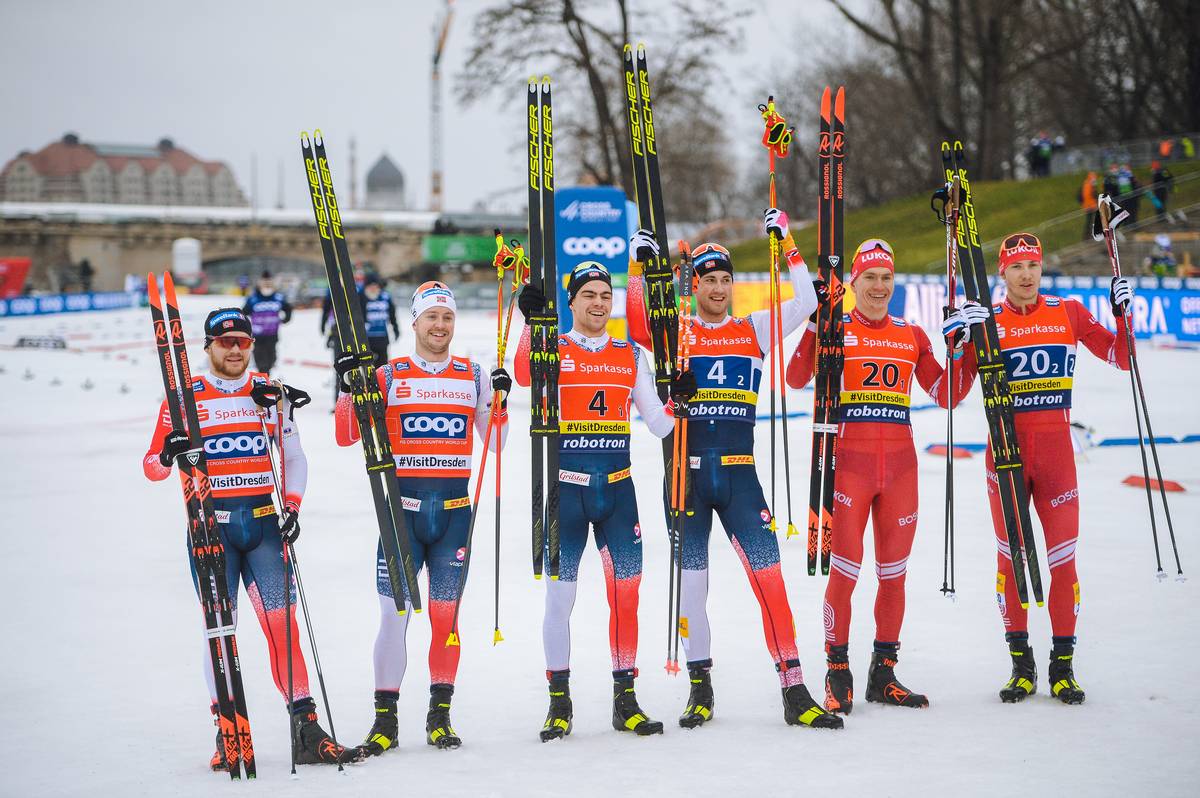
The men’s podium of the team sprint in Dresden: The Norway II team of Thomas Larsen and Even Northug took the win ahead of Norway I, Sindre Bjørnestad Skar and Håvard Solås Taugbøl, and Russia I, Alexander Bolshunov and Gleb Retivykh. (Photo: NordicFocus)
After losing contact in the final laps, Schoonmaker brought the American team to the line in 9th (+11.36).
“Dresden is a really fun event,” Bolger said after the race. “I think it’s something a lot of us skiers on the a World Cup enjoy to mix things up!”
Bolger explained that he and Schoonmaker “just wanted to stay out of trouble — and try as best as we could to put ourselves into a position to where we could attack when we needed to… I was hoping for more of a tactical final but it seemed like Bolshunov had a different plan and really pushed the pace for my leg the whole time, which made it really hurt, but I think that makes it really fun and competitive!”
Providing insights into the team’s tactics and his experience during the final, Schoonmaker provided the following comment in a post-race email from the road.
“I would say our main strategy going into the final was to conserve energy while staying in the top half of the field so that we would be able to match any moves made later in the race,” Schoonmaker explained. “It seems everyone had the same plan in mind, though, so it was tough to make that work. We were a little too far back to make anything happen when the pace picked up in the second half of the race. In Dresden, it really seems to be all about being out front because passing is just hard on a short, narrow and turny course. It’s a super fun format with the short laps, but also very challenging!”
Racing in semifinal B, Luke Jager and Logan Hanneman skied to 10th (+10.96), with the Canadian duo of Russell Kennedy and Graham Ritchie not far behind in 12th (+14.91). Neither team advanced to the finals.
With champagne spraying, Even Northug and Thomas Larsen step off the top spot of the team sprint podium in Dresden. (Photo: NordicFocus)
Despite sitting out the weekend in Dresden, Norway’s Johannes Høsflot Klæbo currently leads both the World Cup overall and sprint standings. Klæbo is roughly 150 points ahead of Sergey Ustiugov (RUS) in the overall, and 60 points ahead of Taugbøl in sprinting.
Leading the American men, Schoonmaker sits in 11th place in the sprint standings with 112 World Cup points, and 20th in the overall. Schoonmaker is also the second ranked U23 skier, trailing Russia’s Alexander Terentev by 219 points.
Ben Ogden also ranks inside the top-30 in sprinting, sitting in 23rd with 46 points. Ogden is 4th on the U23 list, with Gus Schumacher 20 points behind in 7th. Luke Jager sits in 13th of the 21 athletes on the U23 list, with Zanden McMullen close behind in 16th. The future of American skiing is looking bright.
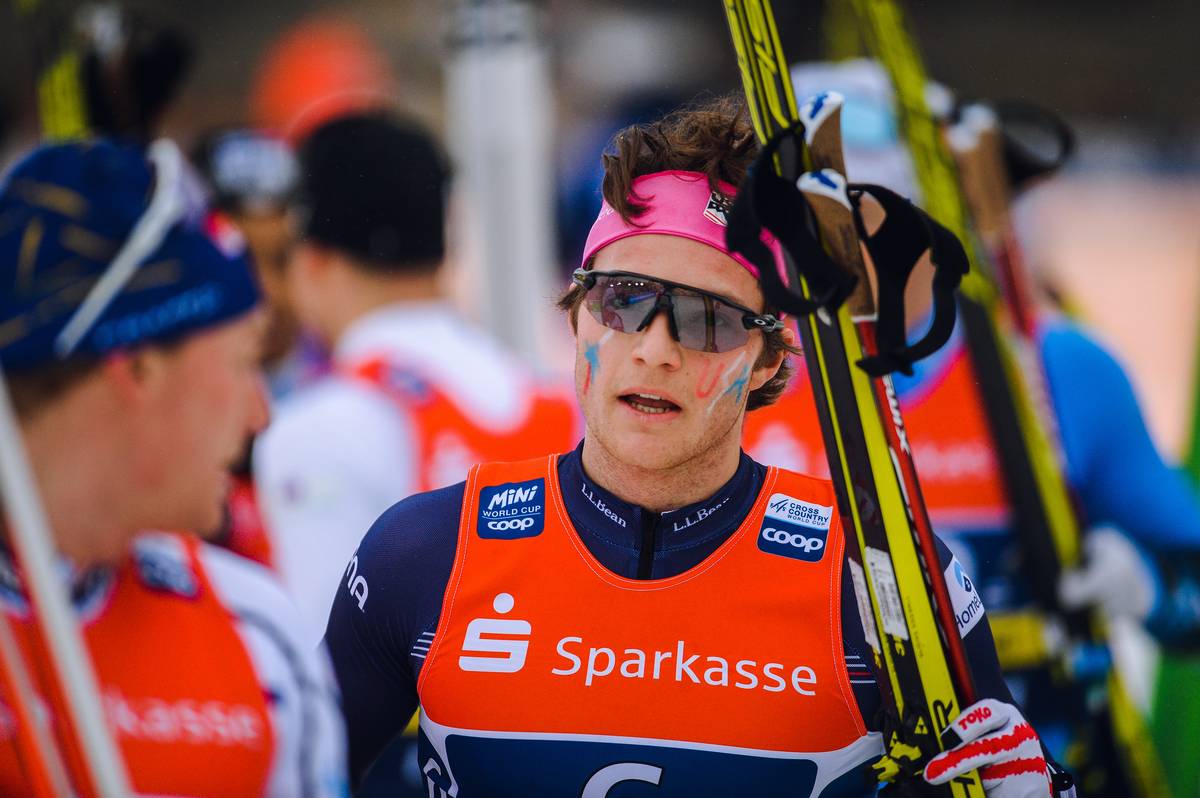
Face painted with stars and stripes, JC Schoonmaker leads the American men in the overall, sprint, and U23 World Cup standings. (Photo: NordicFocus)
After a holiday break, racing continues with the Tour de Ski, which kicks off in Lenzerheide, SUI on December 28th.
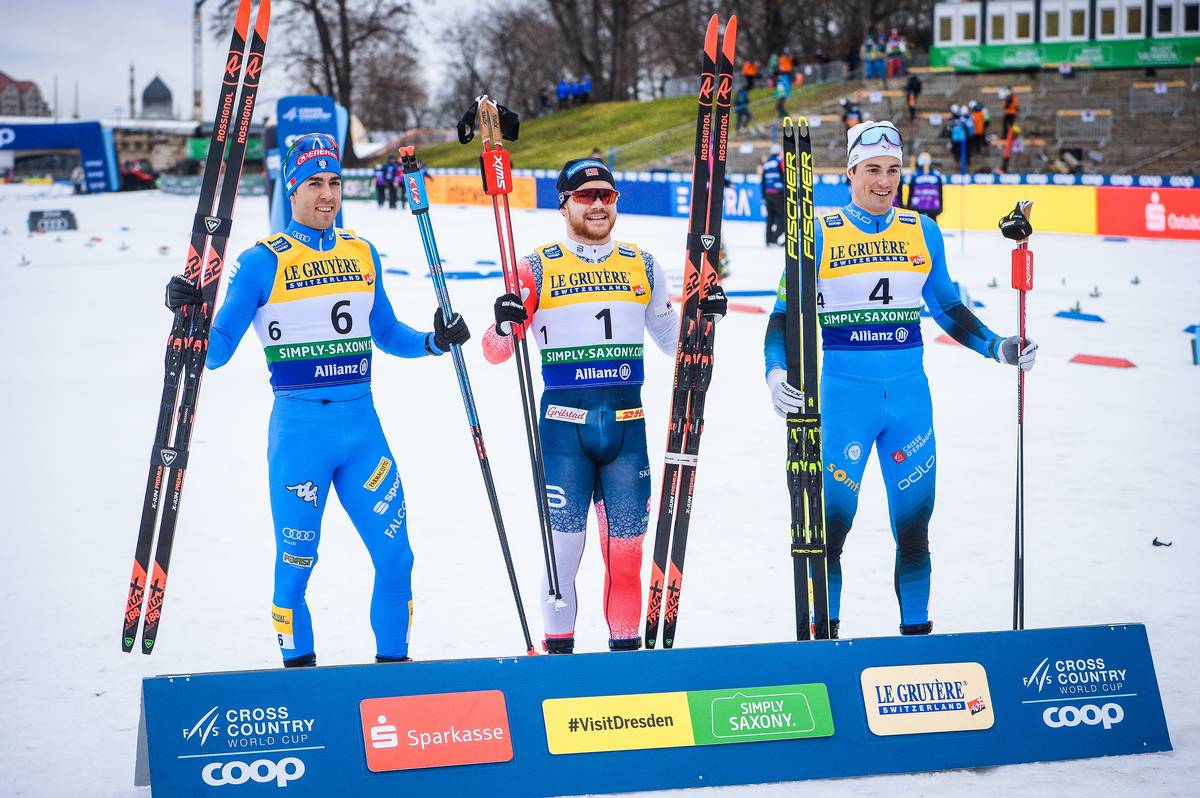
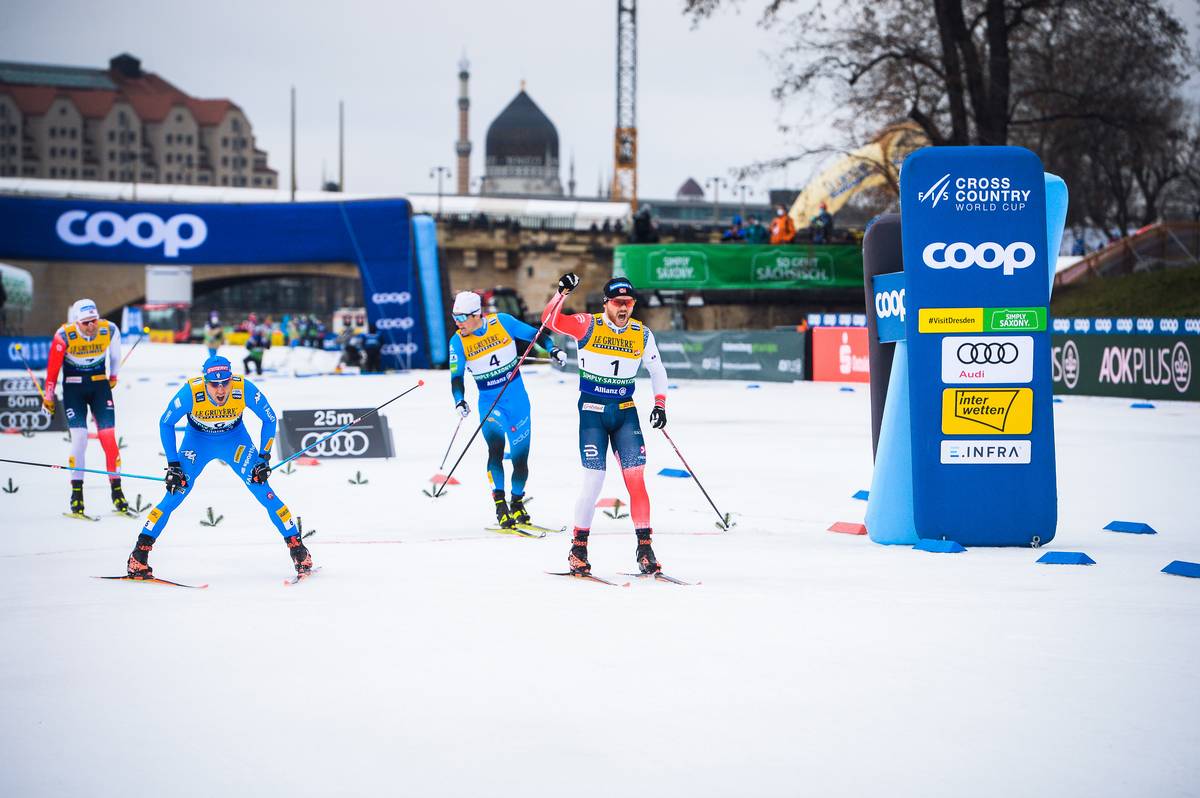
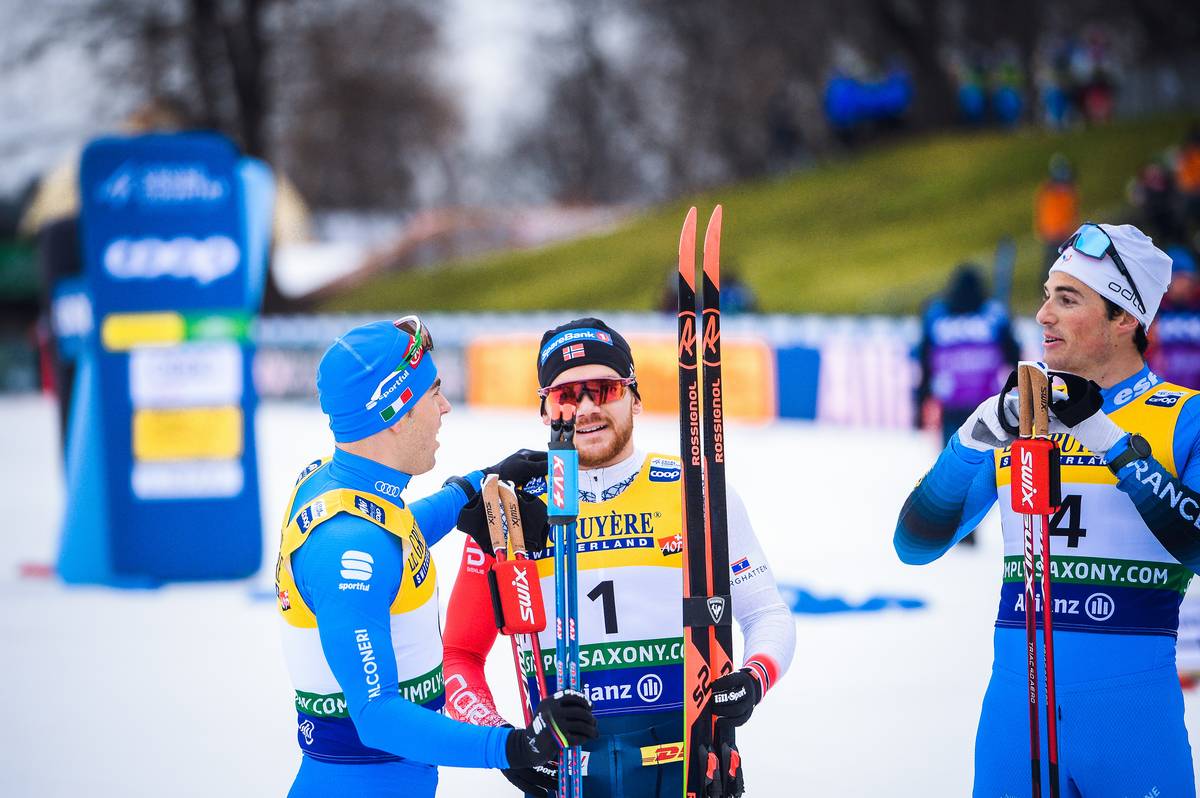
The men’s podium of Dresden’s individual freestyle sprint. Håvard Solås Taugbøl (NOR) took the win ahead of Federico Pellegrino (ITA) and Lucas Chanavat (FRA). (Photo: NordicFocus)
This World Cup coverage is made possible through the generous support of Marty and Kathy Hall and the A Hall Mark of Excellence Award. To learn more about A Hall Mark of Excellence Award or to learn how you can support FasterSkier’s coverage please contact info@fasterskier.com.
With Christmas decor lining a ribbon of snow providing a better indication that we are nearing the end of Period I and heading into the holiday season than the surrounding green grass in Dresden, Germany, athletes took to the track in the city for yet another iteration of its thrilling sprint weekend. Humid conditions well above freezing made for fast racing on the two-lap course, which often sees spicy turns and tactics, without a significant climb to separate the field in a deciding manner.
If you’d like a throwback from January, 2018, here’s a video clip from Instagram where Simi Hamilton painfully face-plants, just after having broken the pole of Johannes Høsflot Klæbo. This left Hamilton with a lip full of carbon-fiber splinters and plenty of abrasions from the harsh granular track. Good times.
After the first three weekends of racing, 21-year-old JC Schoonmaker sat in second place in the U23 World Cup standings, and 27th in the overall World Cup ranks. Showing he was ready to build on this platform, Schoonmaker smashed the qualifier, finishing third, 1.16 seconds behind Norway’s Håvard Solås Taugbøl and roughly 0.3 behind Richard Jouve of France, who qualified in second.
In an episode of Nordic Nation recorded earlier this week, Schoonmaker, along with teammates Ben Ogden and Gus Schumacher, discussed how their results in the early season races have encouraged them to raise their limits and take chances in their sprinting as they transition into their senior racing careers. Instead of choosing heat four or five, which they explained shows that one is limiting their potential on the day to the semifinal, they wanted to begin racing in earlier heats with the top qualifiers. Thus increasing their risk of being knocked out early, but also learning what it takes to advance further through the rounds.
JC Schoonmaker skis to 3rd in qualification in Dresden. (Photo: NordicFocus)
Today, Schoonmaker raced in heat one alongside Taugbøl and Jouve, along with Even Northug (NOR), Johan Häggström (SWE), and teammate Logan Hanneman, who qualified in 7th, 28th, and 30th, respectively.
The first lap of the race, the pace was fast but the men looked cool, each carefully navigating the hairpin curves and not racing aggressively. As they accelerated in the second lap, Schoonmaker kept himself in contact with Jouve, who was not in the lead, but still racing in a position of control at the front with Taugbøl. Dropping into a tuck coming off a roller and safely rounding the hairpin, Schoonmaker headed to the final straight behind Jouve. As they powered through the final lanes, it was Taugbøl and Jouve at the front for a photo finish, with Northug finishing just ahead of Schoonmaker close on their tails for third and fourth.
JC Schoonmaker marks Richard Jouve (FRA) during the first quarterfinal heat in Dresden. Logan Hanneman stays in contact with the pack in bib 30. (Photo: NordicFocus)
As the remaining quarterfinals progressed, it became clear that Heat 1 was the fastest, allowing both Northug and Schoonmaker to advance to the semifinals.
Hanneman also stayed in contact through the round, finishing 1.88 second behind the leaders, but sixth in the heat. After the final rounds were decided, Hanneman’s position was 30th overall on the day.
Also racing in the quarters, Canada’s Graham Ritchie qualified in 16th and raced in the fifth quarterfinal heat. In a competitive position throughout the second lap, Ritchie came into the final hairpin on the inside of the curve, looking to slide up in position heading into the final stretch. Perhaps lacking real estate along the v-board, Ritchie went down, losing his position and ability to advance further. He ended his day in 26th.
Graham Ritchie pushes the pace in the quarterfinal in Dresden. (Photo: NordicFocus)
A post-race Instagram story posted by Ritchie’s coach Erik Bråten captioned “sh*t happens” showed his ski tip had broken off and the base had delaminated — not ideal.
Racing in the first semifinal, Schoonmaker looked comfortable and smooth, approaching the round in a similar way as the first in terms of his positioning heading into the second lap.
At the front, Italy’s Federico Pellegrino, last year’s winner, set the tone alongside Taugbøl, with Jouve in a strong position on their tails.
Lapping through the finish, JC Schoonmaker stays in position with the leaders to advance into the final round. (Photo: NordicFocus)
Putting faith in his boards and catching a quick draft, Schoonmaker again dropped low coming down the last roller and into the final curve. Once again, he was following Jouve and in contact with the front of the pack, however, as they headed into the final lanes, he was only in position to take fifth in the heat, unable to advance into the final round.
Still a very strong overall result, Schoonmaker ended his day in 9th overall.
In a post-race interview, Schoonmaker discussed his decision to select heat one, along with his rollerski warm up, maintaining the headspace needed to perform between rounds, and what’s next for him over the next few weeks. A quick note, we had some trouble with WiFi connection, which interrupted some of Schoonmaker’s comments. The trials of remote reporting from eight time zones away.
Taugbøl took the win in the first semi, with Pellegrino narrowly staying ahead of Chanavat in second and third. Jouve was just 0.3 seconds behind his teammate, leaving the two Frenchman in wait to see whether they would advance as lucky losers.
A close finish for the top-four, JC Schoonmaker crosses in fifth in his semifinal heat. (Photo: NordicFocus)
Lead changes and tight racing developed the plot line of the second heat of the semis, which featured Northug and his teammate Sindre Bjørnestad Skar fighting for position at the front with two Russians, Gleb Retivykh and Alexander Terentev, who beat Klæbo in the opening sprint in Ruka and currently ranks just ahead of Schoonmaker in the U23 standings.
Each unable to break away at the front on the fast and flat tracks, Northug, Skar, and Retivykh came to the line in unison, throwing their boots for a three-way photo finish. Though their times were indistinguishable, it was determined that their finish order was just that: Northug, Skar, Retivykh, with Terentev a ski length behind in fourth. Men crashed in every direction crossing the line, falling to the ground and gasping for air to evidence the intensity of the effort.
Heading into the finish, the second semifinal was tight between two Russians and two Norwegians. (Photo: NordicFocus)
By the clock, Jouve and Terentev were on the wrong side of the cusp for lucky loser. They ended their day in the semis, while Retivykh and Chanavat advanced to the final.
More lead changes and thrill, Chanavat took the lead in the first lap of the final. Lapping over the finish line for the first time, Taugbøl moved to the front while Pellegrino lurked on their tails. Down the backstretch, the Italian moved up alongside Chanavat, skiing powerfully on Taugbøl’s tails as they safely rounded the first hairpin. Not looking to cede space, Taugbøl held himself in a position of command at the front.
Around the final curve, Pellegrino tried to sneak around the outside of Taugbøl, but could not quite gain enough ground to find the lead. Heading into the final straightaway, Pellegrino was attacking the track with a powerful V2, but it was still Taugbøl with the advantage at the front, crossing the line just 0.15 seconds ahead of the Italian.
Norway’s Håvard Solås Taugbøl takes his first World Cup victory ahead of Federico Pellegrino (ITA) and Lucas Chanavat (FRA). (Photo: NordicFocus)
In pursuit, France’s Lucas Chanavat crossed the line a ski length behind Pellegrino for the third step of the podium (+0.68), with Northug, Skar, and Retivykh crossing a few meters behind to close out the final round in fourth (+1.22), fifth (+2.01), and sixth (+6.15).
Today’s result marked Taugbøl’s fist career World Cup victory.
“It feels pretty good,” he told FIS humbly after the race. “It’s of course a goal I have tried to reach my whole life, and to do that in Dresden in a show sprint venue, it’s really fun and I’m proud of myself today.”
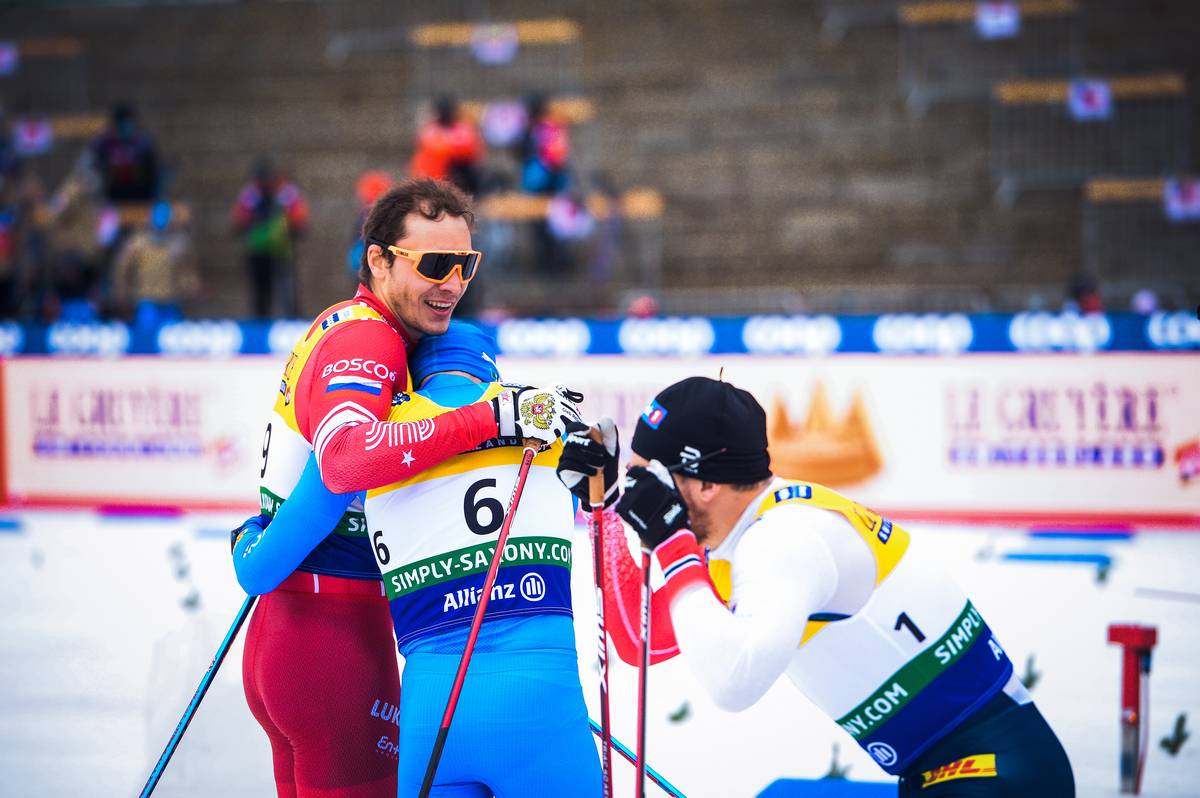
The men’s podium congratulates one another on their efforts in Dresden. (Photo: NordicFocus)Sportsmanship and respect on display at the finish of the men’s sprint in Dresden. (Photo: NordicFocus)
Taugbøl also spoke to his highly-respected opponents with whom he shared the podium.
“Of course to beat guys like Pellegrino and Chanavat, it’s a dream come true. If you try to count how many podiums and victories they have, I can’t count so far. So it’s amazing to be there with them.”
Norway’s Håvard Solås Taugbøl earned his first World Cup victory on the tracks in Dresden. (Photo: NordicFocus)
Despite not adding another win to his resume, today’s result perhaps marks a turning point in the start of Pellegrino’s season. The Italian, who has been a force in skate sprints for many seasons now, had not raced in a final yet this season.
In an Olympic year that features a freestyle sprint, Pellegrino will be looking to find his peak form in February. The Italian was 11th in the event at the 2014 Olympics in Sochi, and took second in the classic sprint, his weaker discipline, in PyeongChang in 2018, just behind Klæbo.
Italy’s Federico Pellegrino skis back into form in Dresden. (Photo: NordicFocus)
Outside the top 30, Kevin Bolger, who was 6th in the individual sprint in Dresden last year, qualified in 42nd (+7.97). Bolger was roughly two seconds outside the top-30.
Following Bolger, Ben Ogden finished 51st in the qualifier (+9.37), with Luke Jager in 63rd (+10.73).
Ben Ogden races the qualifier with the spectacular skyline of Dreden in the background. (Photo: NordicFocus)
Racing for Canada, Russell Kennedy took 48th (+8.85) in qualification.
The weekend of city sprinting continues tomorrow with men’s and women’s team sprints.
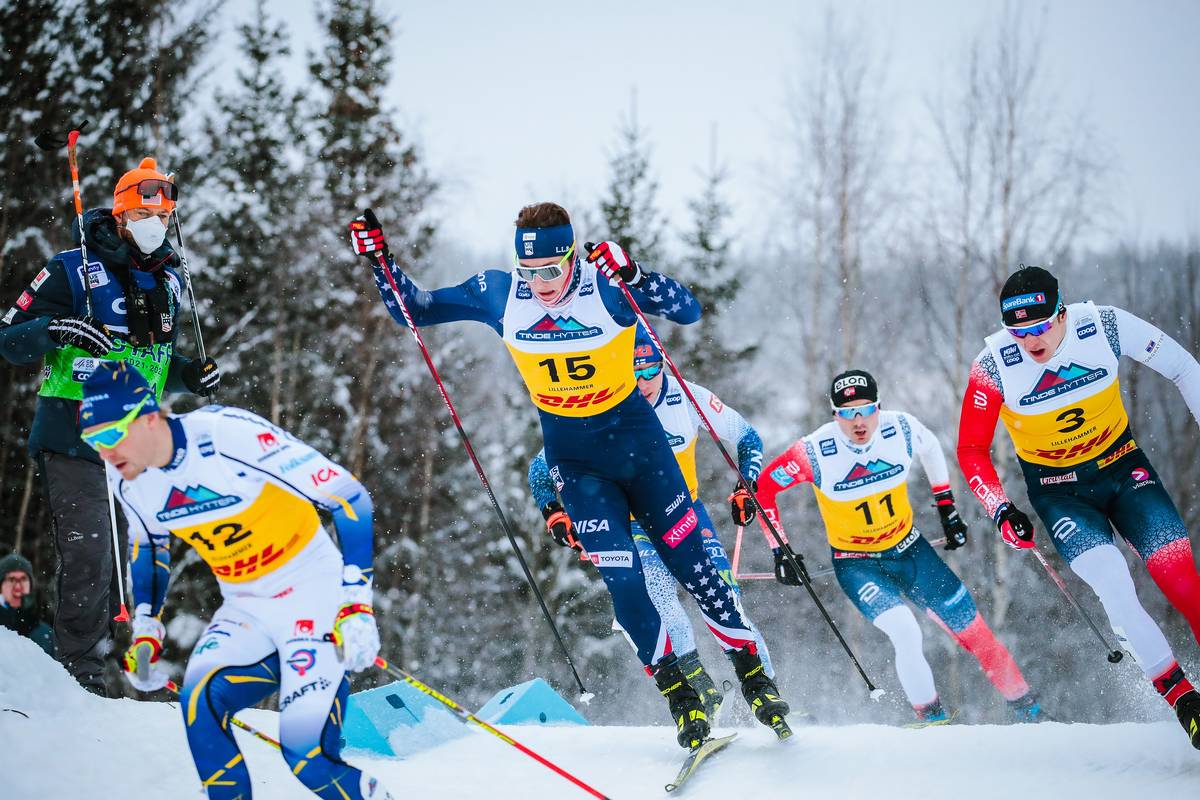
The men’s freestyle sprint podium in Lillehammer: Johannes Høsflot Klæbo takes the win ahead of teammate Thomas Helland Larsen and France’s Richard Jouve. (Photo: NordicFocus)
This World Cup coverage is made possible through the generous support of Marty and Kathy Hall and the A Hall Mark of Excellence Award. To learn more about A Hall Mark of Excellence Award or to learn how you can support FasterSkier’s coverage please contact info@fasterskier.com.
Last weekend in Ruka, a new season of World Cup racing came in like a lion. Right off the bat, there were so many storylines to follow. Here, we’ll focus on those in the men’s sprint.
The international cover story was the big upset: 22-year-old Alexander Terentev of Russia beat Norwegian sprint-champion Johannes Høsflot Klæbo, who has more World Cup sprint wins than any other athlete in the field. Even more entertaining: Terentev matched Klæbo’s signature run, which he typically employs to drop his competitors on a final climb, accelerating to the finish in a league of his own. Klæbo’s tactic failed. He was matched at the top of the final climb with a few hundred meters to go, and Terentev was strongest in the final stretch. This made one thing certain: Klæbo would be ready to throw down in his home country as the World Cup swung to Lillehammer.
As evidence, Klæbo won the qualifier with a nearly two-second lead ahead of the next athlete, Lucas Chanavat of France, with Terentev nearly three seconds back in fifth.
The FasterSkier cover story last weekend was the three American men – JC Schoonmaker, Ben Ogden, and Luke Jager – who qualified and finished in the top-20, led by Schoonmaker in 7th. The Americans proved they were fit, and ready for the tight and aggressive style of World Cup sprinting. Hope abounds as these men, along with those who fell just outside the top-30, showed they were capable of results that mirrored those of the women’s team, which has received the majority of the media attention over the last several seasons.
JC Schoonmaker is the top-American qualifier for the second weekend in a row. Schoonmaker qualified in 15th today in Lillehammer. (Photo: NordicFocus)
Today during the 1.6-kilometer freestyle sprint in Lillehammer, the Americans showed that last weekend was not a fluke. Three men qualified for the heats, led by Schoonmaker in 15th (+5.61). Kevin Bolger was 24th in qualification (+6.25), followed by Ben Ogden in 28th (+6.63).
As the sprint featured in the 2022 Olympic program will also be freestyle, these events will be especially in focus as we move through the World Cup season. For the Americans, an athlete finishing in the top-8 (final results, not qualification) has met the objective criteria for team selection, essentially punching their ticket to Beijing.
In the quarterfinals, Bolger raced in the stacked first heat along with the top-3 qualifiers, Klæbo, Chanavat, and Erik Valnes (NOR). For the first two minutes of racing, Bolger sat confidently on the Norwegian’s tails, keeping enough contact with the leaders to vie for a lucky loser spot in the final stretch. Despite rounding the final bend in fifth, Boger skied his way into fourth, in a photo finish with Chanavat. Given the depth of his heat, Bolger ended up with a fairly comfortable lock on a spot in the final as one of two lucky losers.
Klæbo won this round comfortably, followed by fellow Norwegian, Thomas Helland Larsen.
Ogden raced in heat two, where he was not able to keep himself in contention with the leaders. Ogden skied to sixth in the heat, which was won by Håvard Solås Taugbøl and Richard Jouve in a photo finish.
Ben Ogden stays in contact with the pack during the quarterfinal of the freestyle sprint in Lillehammer. (Photo: NordicFocus)
Perhaps surprising given his legacy in skate sprints, Italy’s Federico Pellegrino was also knocked out in the second heat of the quarters. Pellegrino had qualified in 19th, and finished the semi together with Jouve and Taugbøl, but was ultimately not fast enough for the lucky loser spot.
Racing in heat five with stars and stripes on his suit, buff, and gloves, Schoonmaker tactically skied his way into the semis. The American was tucked into the leaders’ draft on early downhills, moving up on the final climb at roughly the two-minute mark. Here, Schoonmaker challenged the men at the front as they headed into the final hairpin before the closing straightaway. Coming to the line with Gleb Retivykh (RUS) and Sindre Bjørnestad Skar (NOR), Schoonmaker threw his boot forward to clinch second place in the heat, automatically advancing to the next round.
JC Schoonmaker skis his way into the semis during the quarterfinal of the freestyle sprint in Lillehammer. (Photo: NordicFocus)
Guaranteed a top-12 finish, Schoonmaker was one step closer to his Olympic goal, and would race in the semi-final in back-to-back sprint races. Without a deep dive into the stats here, let’s just say: it’s been a minute since an American has done that. And he’s only 21.
The semis were half-Norwegian: four in the first heat with Bolger, and two in the second heat with Schoonmaker.
Bolger skied in the middle of the pack during the opening kilometer of his semi, again marking the leaders and staying in good position for the final push. Rounding the bend into the stadium, Bolger ended up just off pace at the back of the pack as Klæbo led the way to the finish with enough room to stand up before gliding across the line.
While Klæbo was comfortable in his position, the three men heading to the line on his tails were not. Again in a photo finish, Taugbøl and Jouve fought for the second spot, with Larsen alongside. Taugbøl edged out the Frenchman in the boot slide, with Larsen setting a fast time in fourth, awaiting results from the second round to determine lucky losers. Bolger finished the round in sixth.
Kevin Bolger marks Johannes Høsflot Klæbo during the semifinal in Lillehammer. France’s Lucas Chanavat races on the left in bib 2. (Photo: NordicFocus)
The second semifinal was a nail biter. With numerous lead changes and a spread of just 0.5 seconds at the finish, it was anyone’s game. Schoonmaker again looked confident pushing the pace, staying in the mix with leaders throughout the meat of the course. Rounding the bend and heading into the final straightaway, he was in excellent position on the tails of Sweden’s Marcus Grate.
Charging down the final straight, Grate and Finland’s Lauri Vuorinen pulled ahead slightly as the remaining four men remained matched. These men went 1-2, while the remainder of the field crossed the line a ski length behind in a four-way photo finish. Ultimately, the order was determined to be: Alexander Bolshunov, Erik Valnes, Finn Hågen Krogh, then Schoonmaker, all separated by 0.1 seconds.
To the line, JC Schoonmaker fights for millimeters, crossing in a four-way photo finish in the semifinal. Marcus Grate (Bib 12) holds the lead. (Photo: NordicFocus)
Take a moment to let the names of the men finishing around Schoonmaker sink in.
As fat flakes began to fall, the athletes kept their warm-up layers on until the two-minute warning, springing up and down and running sprints to stay warm and sharp for the final go. On home turf, the closing round was half-Norwegian, with Klæbo, Taugbøl in their national team suits and Larsen racing in his leopard-print club suit.
Leaving nothing to chance, Klæbo held his ground near the front of the pack, tucking in Grate’s draft in the early downhills, and putting his foot on the gas as the men headed up the final climb with less than a minute of racing to go. Pulling ahead as they headed into the straightaway, Klæbo looked like he was on cruise control, powering through the first half in V2, before looking over his shoulder, then raising his arms in celebration as he cruised across the line alone for the win in 2:52.48.
Redemption: Johannes Høsflot Klæbo takes the win in the opening sprint stage of Lillehammer’s mini tour. Norway’s Thomas Helland Larsen (Bib 30) edged out France’s Richard Jouve for second and third, respectively. (Photo: NordicFocus)
A couple of ski lengths behind him, Larsen and Jouve fought to the line for the final podium spots. The Norwegian pulled ahead as he slid across the line for second (+0.58), with Jouve just behind for third (+0.78).
“It was a really tough race today, and it’s been quite a week from last week,” Klæbo told FIS at the finish line. “I’m really satisfied to cross the finish line first, and it was a special day.”
Commenting on the new course used today in Lillehammer, which, at roughly 1.6k, was nearly 200 meters longer than the previous one, Klæbo spoke favorably of the change.
“I think it’s really cool that we have changed the tracks a little bit. It’s something different and I think they have done an amazing job here to make this happen, and to also have this nice track. So I’m really satisfied.”
Johannes Høsflot Klæbo congratulates countryman Thomas Helland Larsen after the two went 1-2 in Lillehammer’s freestyle sprint. (Photo: NordicFocus)
Rounding out the top-six, Taugbøl took fourth (+1.68), ahead of Vuorinen in fifth (+4.43) and Grate in sixth (+20.73).
Once the final round was settled, it was concluded that Schoonmaker ended his day in 11th, followed by Bolger. Ogden ended his day in 30th. None of the Americans would hit the Olympic qualification standard today, but it remains clear that they are well within reach.
After returning to their hotel down in town, Schoonmaker provided the following feedback on his pacing and strategy today relative to last weekend in Ruka:
“This course was a lot longer than Ruka, so I had to think a lot more about pacing especially in the qualifier. I tried to take it out fairly conservative so I could finish strong on the last section. In the heats, I actually had a pretty similar strategy to Ruka of trying to relax in the pack for as long as possible before trying to push to the front in the end. I tried to pick a heat that had guys who were closest to my time in the qualifier so that I would be able to hang in the pack easier than if I had chosen quarterfinal #1 with all the top qualifiers. I felt like I followed the plan well and was really happy with the way I skied.”
Remarking on his day and racing in the semis on back-to-back weekends, Schoonmaker gave a very process-oriented response.
“It was an awesome experience to race against so many big names and to feel like I was in the mix. I wish I had had a little bit more to give in the end of that semi to move on but still really happy with it. I’m pumped to have made semis twice in a row now because each time I get past the quarters, I’m doubling my heat experience and getting a step closer to making the final.”
In his post-race email, Bolger explained that he found the course used today in Lillehammer to be “really cool, really fun, and very hard.”
“I think it allowed a lot of good spectating, and I think coming into the weekend we all thought it was going to be an easier course, but we all soon found out that it it was a very challenging course — very physically demanding, and a lot of work… its also nice to do something new, instead of the same courses all the time.”
On his approach to the day and heat selection, “It was a bit scary picking heat 1 for my quarterfinal,” Bolger wrote. “I did something similar back at world champs in Seefeld, but I knew if i could put together a good race that I could compete with those guys, and talking with [Chris] Grover, we both decided it could be a great heat to get into the semis either by qualifying out right or as a lucky loser.”
He added that he would have preferred the second semifinal heat, but this was out of his hands.
“Tactically though, not much changes [with heat selection], especially on a course like today where I don’t think there were so many tactics. I just wanted to ski big and own my space, I was lucky enough to take the back of Klæbo and follow him for a while, which was brutal but great. Also, I think having killer skis played a big factor in today and helped me advance as far as I did so a huge shout out to our wax crew and my tech Oleg!”
Last weekend, in Ruka, Bolger qualified in 57th, well outside the heats. He explained that he was “searching for more this weekend”, while recognizing that racing in Norway, which allows the home country to enter additional athletes, would make it an even harder job. He equated it to narrowing the Top-30 down to a Top-15 in terms of the density of fast times and percent back needed for qualification today.
“Coming here and putting together a really strong day and having a high result definitely boosts my confidence in myself and my training,” Bolger continued. “But it is just one race. t+There is a lot of racing to be done yet and I’m just looking forward to the opportunity to get in another good race next weekend in Davos and to hopefully have an even better day! Lastly, I think how this men’s team is vibing together and how we are all feeding off each other’s success — I owe a lot to them. Being out there today in the heats with Ben and JC gives me a lot of extra fighting strength. We all believe in each other and and get each other super hyped. I think that helps a lot on a sprint day!”
There were several near-misses outside the top-30, including Luke Jager, who was just 0.7 seconds off the time (2:52.31) needed for qualification in 33rd.
Just missing the top-30, Luke Jager skis to 33rd in the qualifying round of Lillehammer’s freestyle sprint. (Photo: NordicFocus)
Gus Schumacher qualified in 41st, just over a second out of the heats, followed closely by Canada’s Russell Kennedy and Graham Ritchie in 42nd and 43rd, respectively.
Rounding out the North American men’s squad, Logan Hanneman (USA) finished 45th, with Olivier Levielle (CAN) 48th, and Antoine Cyr (CAN) 56th.
In a post-race interview, Matt Whitcomb shared insights into the new course in Lillehammer, as well as how athletes selected their tactics for the two-lap course, his perspective on the men’s racing, and a detailed explanation of why qualification for the heats in World Cup sprinting is a unique skill that athletes need to hone.
Leading the way for Canada, Russell Kennedy skis to 42nd in the qualifying round of Lillehammer’s freestyle sprint. (Photo: NordicFocus)
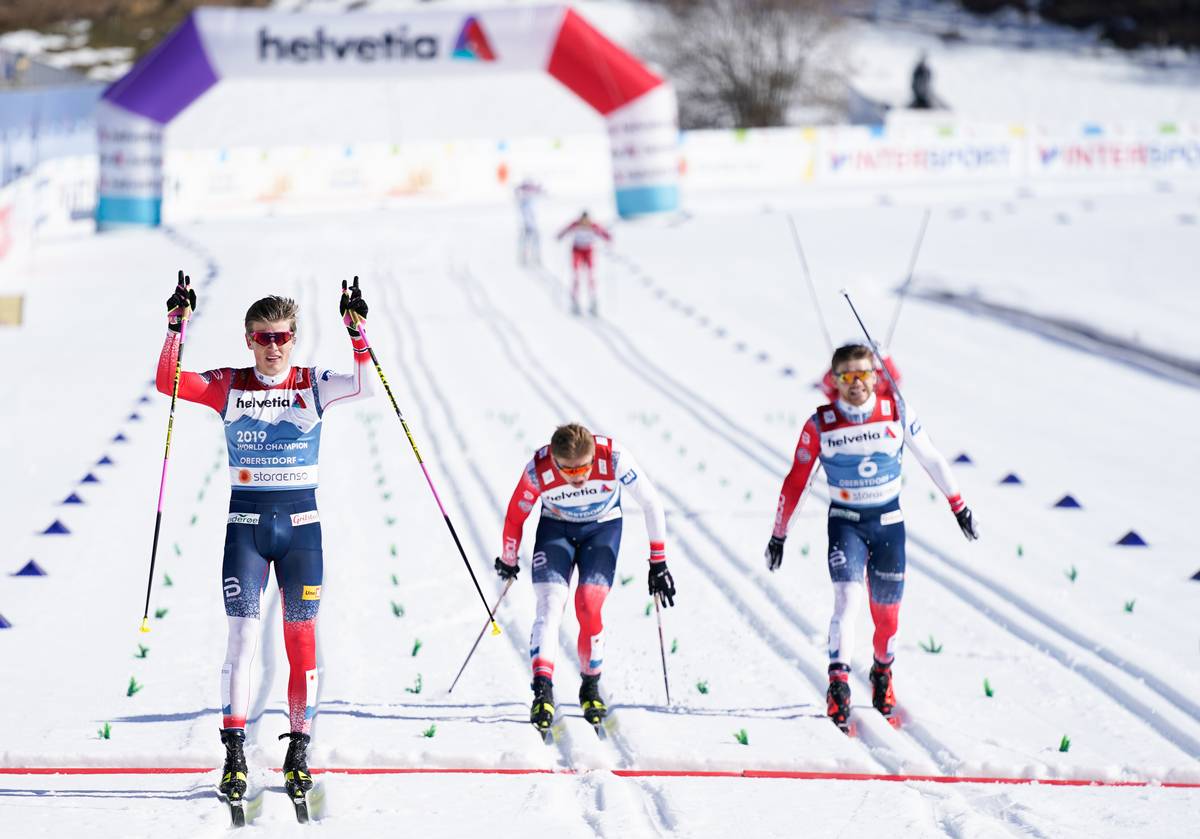
Norsk triple. Johannes Høsflot Klæbo (left) raises his hands in victory as Valnes (middle) and Taugbøl (right) lunge for the line. (Photo: NordicFocus)
This World Championship coverage is made possible through the generous support of Marty and Kathy Hall and their A Hall Mark of Excellence Award. To learn more about A Hall Mark of Excellence Award or to learn how you can support FasterSkier’s coverage please contact info@fasterskier.com.
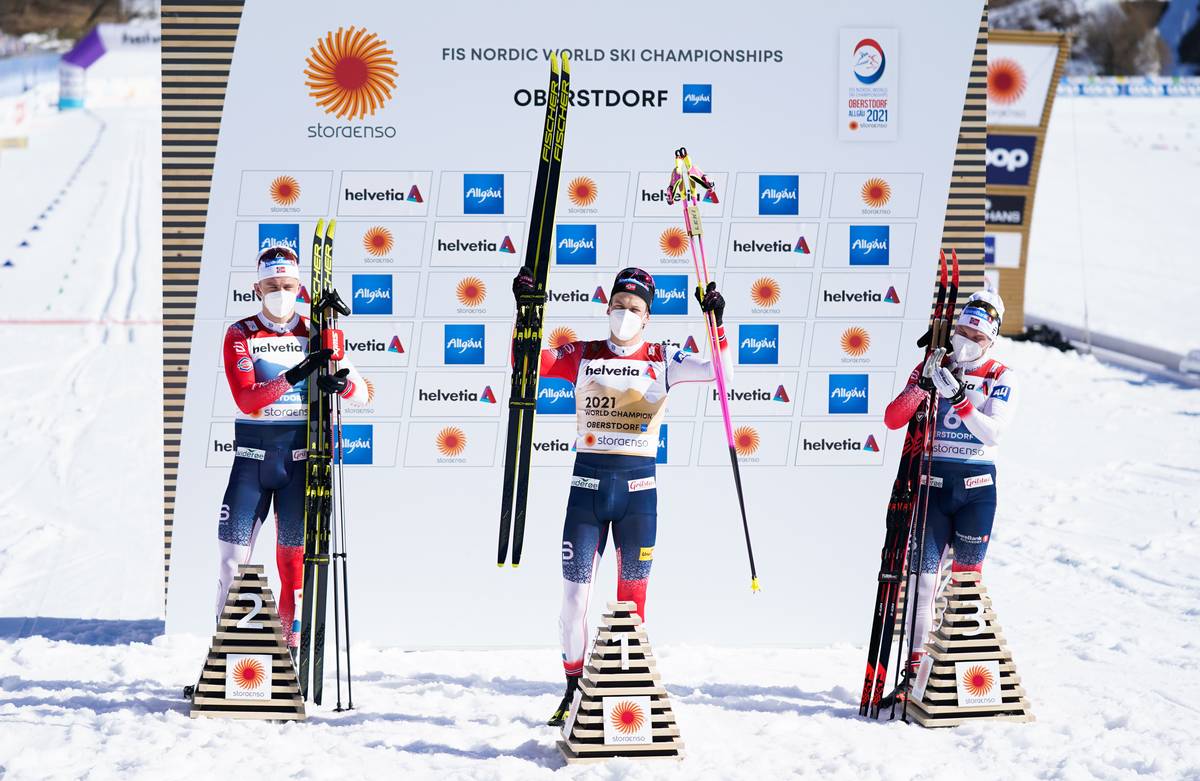
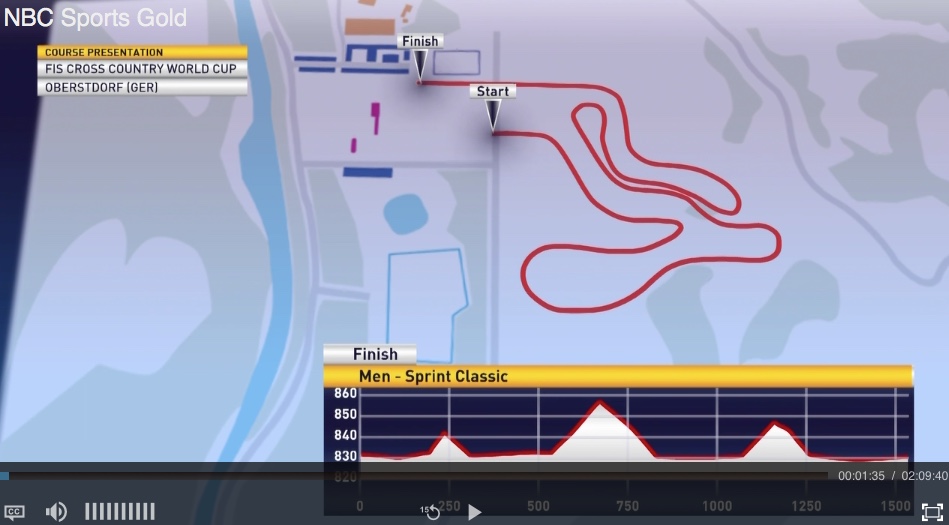
Against the backdrop of hundreds of cardboard cut-out fans, the men battled for the first medals of the 2021 World Championships in Oberstdorf, Germany. Despite warming temperatures, conditions were firm and fast for the 1.5 k classic sprint, likely due to the application of salt to help with freezing. The course featured three climbs with the last being the most significant and sustained.
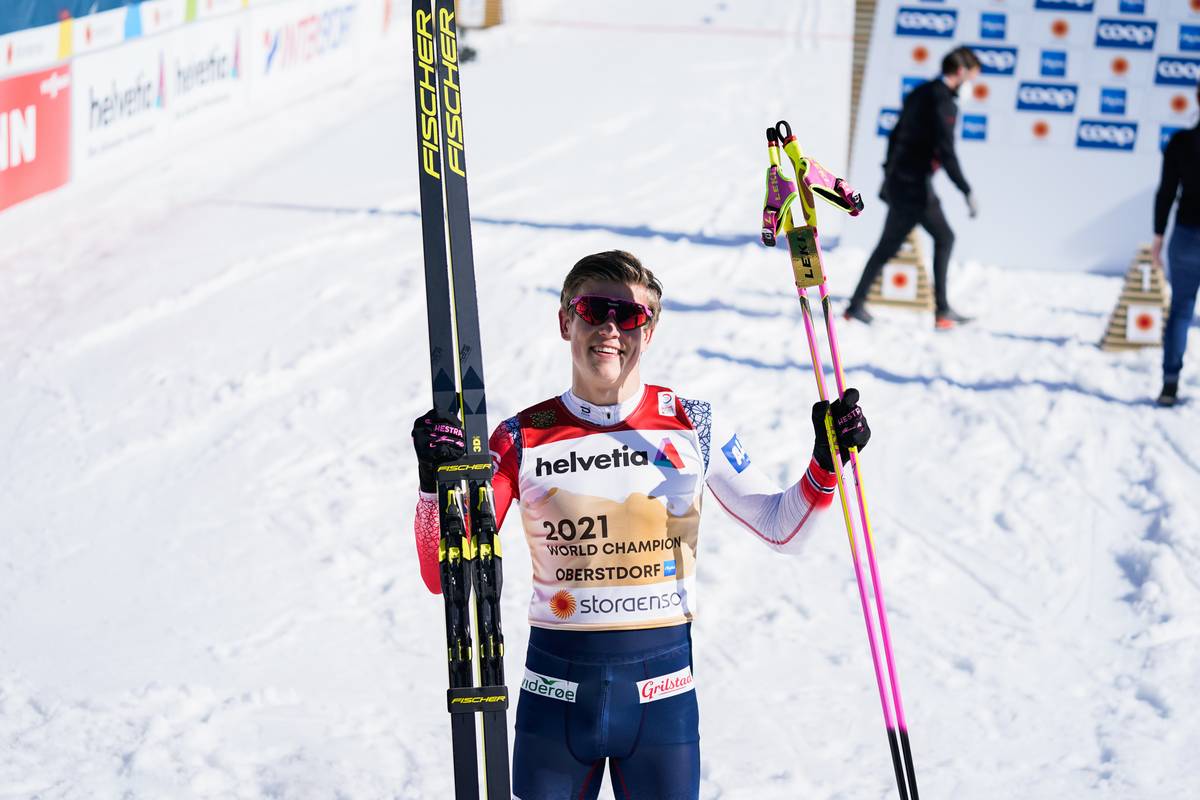
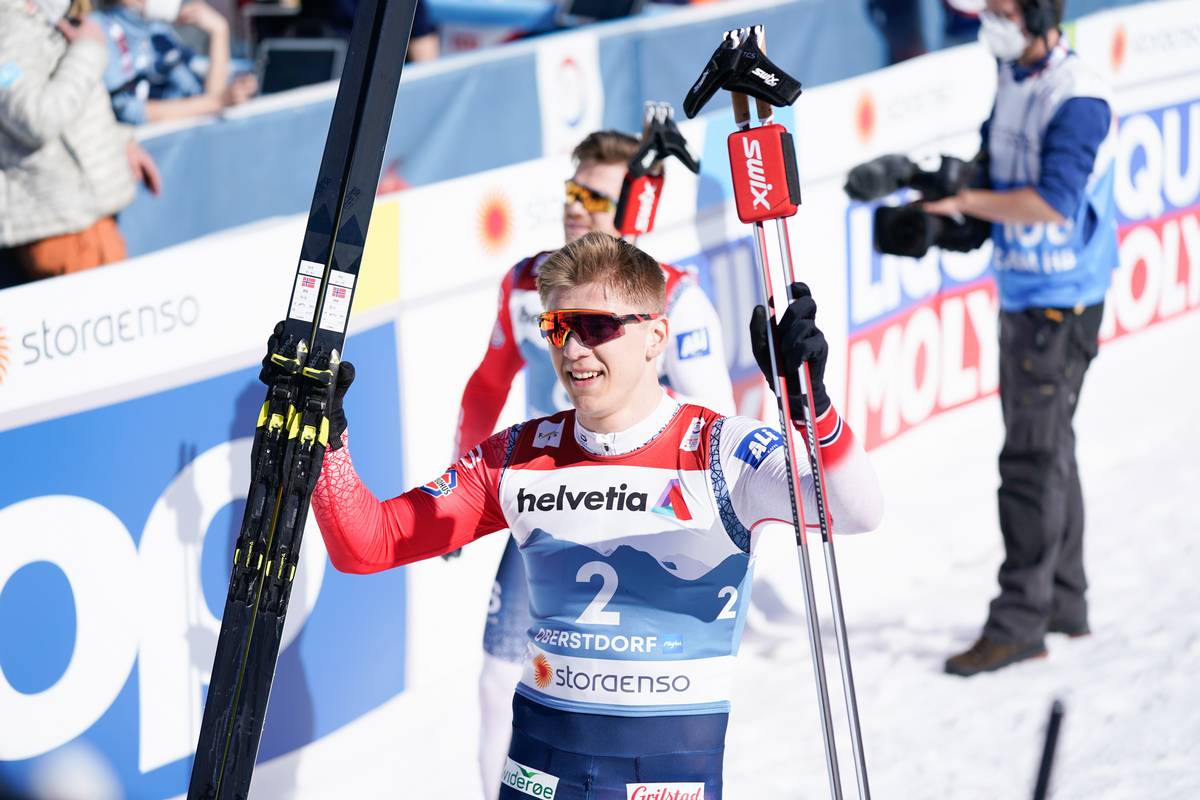
A smiling Klæbo after being the first athlete to complete back-to-back sprint victories at World Championships. (Photo: NordicFocus)
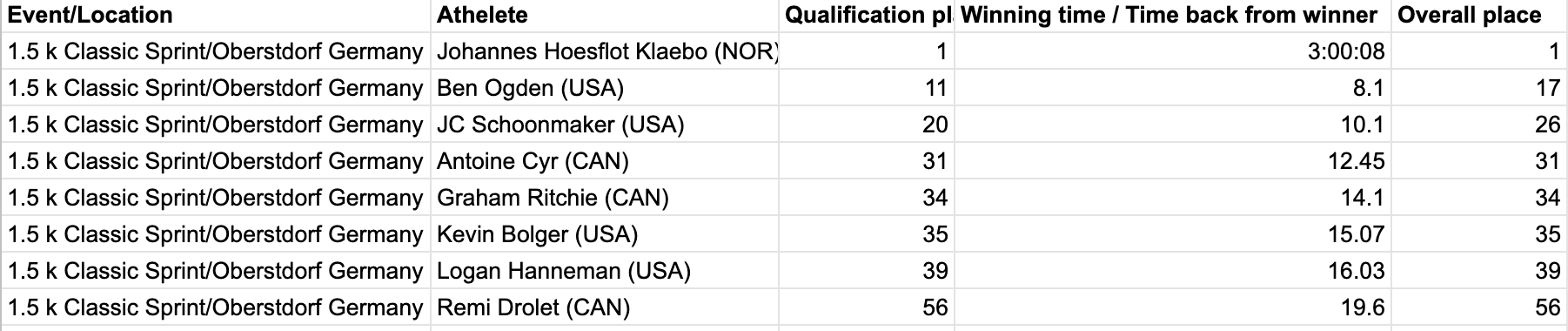
From start to finish, the day belonged to Johannes Høsflot Klæbo who won the qualifier in a time of 3:00:08 and took his second consecutive sprint World Championships gold medal, becoming the first male athlete in history to repeat back to back sprint golds, winning the final in a time of 3:01.30.
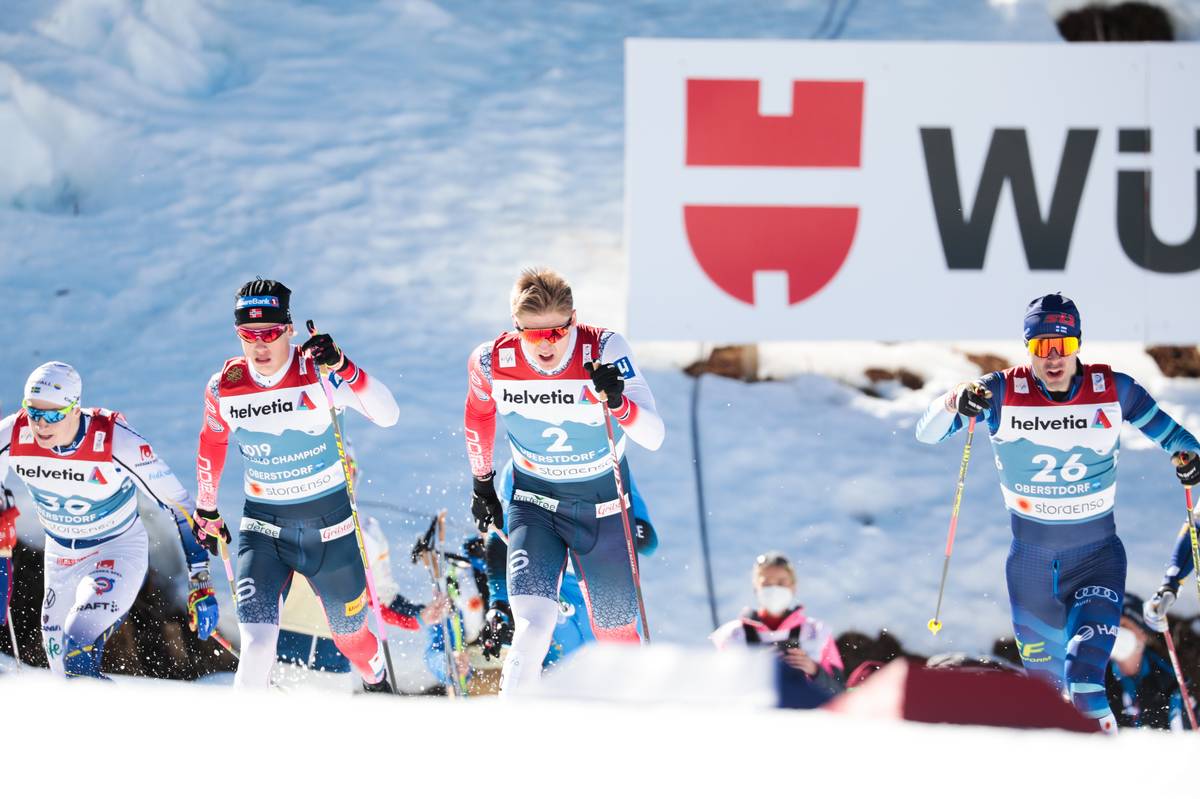
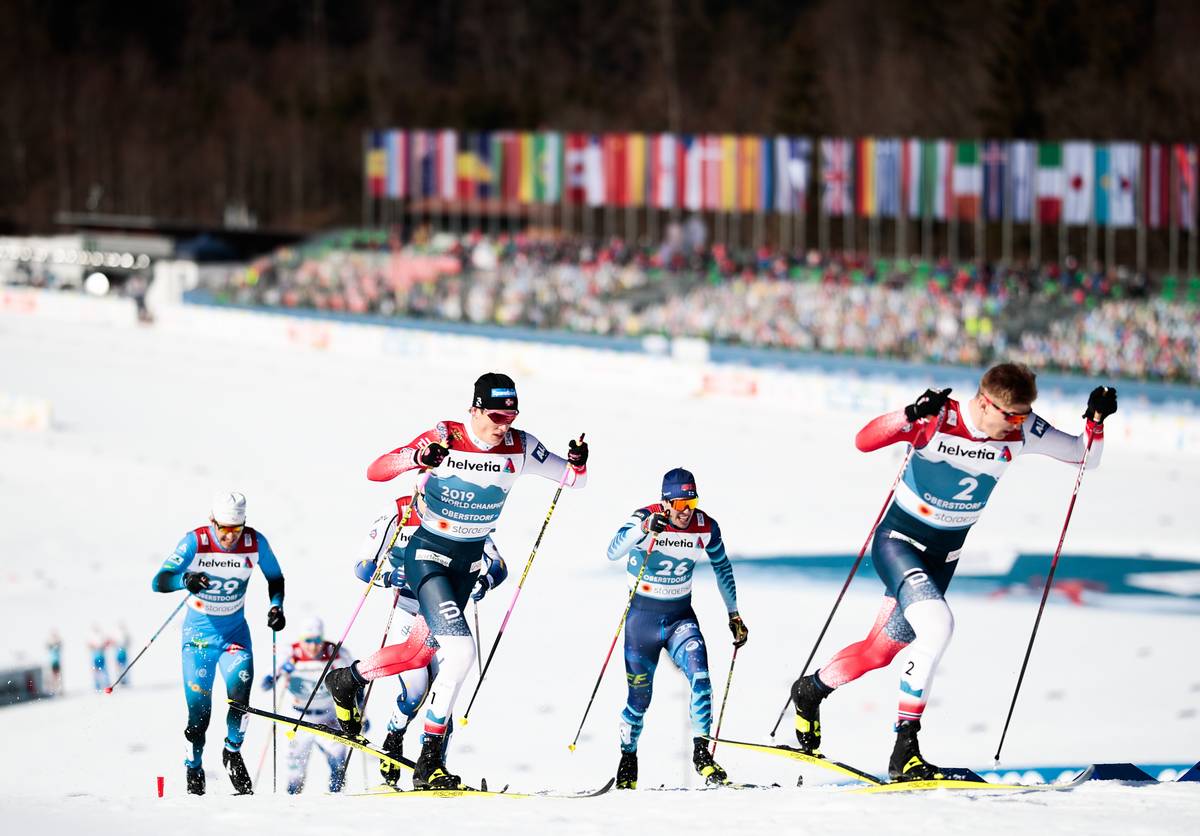
As in the women’s race, the final hill proved to be the decisive factor throughout the quarterfinals and into the remaining rounds. The hill was no stride-fest, but instead a full-on sprint-run. Competing in Heat 1, Norwegians Erik Valnes and Klæbo easily gapped their competitors on the climb and advanced with ease.
The eventual 1-2 skiers charging. Valnes (bib 2) and Klæbo (left). (Photo: NordicFocus)Valnes (bib 2) and Klæbo (left) lead over the crest of the hill in their quarter-final heat. (Photo: NordicFocus)
Racing in Heat 2 was J.C. Schoonmaker for the United States who qualified in 20th position. Schoonmaker came in 6th in his heat to finish 26th overall. After the race, Schoonmaker said, “I did not feel my best today but it was a solid result I think for my first World Champs, and I think I can walk away, I learned a lot and I think I am happy with it. But definitely saw it going better and I hoped it was going to go better. But, yeah I think it was overall still good.”
A sleeve-less JC Schoonmaker (USA) racing through warm temps in the quarter-final rounds. (Photo: NordicFocus)
His teammate, Ben Ogden, qualified in 11th position and raced in the fifth quarterfinal. Ascending the final climb in that heat, Francesco De Fabiani of Italy found himself caught in the slush and went down, taking Cerny Ondrej of the Czech Republic down with him.
Ondrej Cerny (CZE) taking the stumble. (Photo: NordicFocus)Ogden was able to move around the crash and capitalize. (Photo: NordicFocus)
Ogden ended up fourth after a solid fight in his quarterfinal and 17th overall. In a post-race interview, Ogden said about his day, “It was good in general. The qualifier was really good. I was happy to be able to feel fast in that. And then in the heats were a little tricky, as they often are. Just remembering that this is only my second heat so far this year since World Juniors last year. I have a lot to learn and that was my first ever World Cup level heat. So, yeah, I am really excited with the whole day, and we will be looking forward to the skiathlon in a few days”
In the semi-final rounds, once again Klæbo and Valnes went one-two in the first semi. Given this was the faster semi, Alexander Bolshunov (representing the Russian Ski Federation at these championships) and Oskar Svensson of Sweden, also advanced from this heat as lucky losers. Coming from the second semi-final was Håvard Solås Taugboel of Norway and Sergey Ustiugov (RSF) who bested the likes of skate sprint legend Federico Pellegrino and steady sprint finalist Gleb Retivykh to advance to the final.
Bolshunov (RSF) and Valnes race against a picturesque backdrop through the sprint rounds (Photo: Nordic Focus)
Preparing for one last round, the three Norwegians, two Russians, and lone Swede took their start positions, having shed hats and layers as the temperatures and efforts increased. Steady through the first part of the course, again the final climb marked a crucial moment. Taking the inside lane Klæbo stomped his way up the hill using his trademark technique. However, it was his teammate Valnes who was first over the crest. As they descended into the stadium Klæbo shot to the outside and took off. Valnes was left to fend-off his teammate Taugboel to secure second place while bronze went to Taugboel, making it a Norwegian triple.
Triple Norwegian podium for the first championship event of 2021 (Photo: NordicFocus)
Speaking to FIS after the race Klæbo said, “I don’t know what to say. I’ve been so nervous the last couple of days. It’s been a really strange season with not so many competitions and I think we made some decisions that weren’t so good when we were sitting at home watching the Tour de Ski, but today it feels great and is a dream come true.” When asked about the conditions he replied, “I think it was a really tough day, the conditions were really good today, I think it was the right decision to salt it yesterday. It’s really hard out there when it’s so warm, and you are losing a lot of energy.”
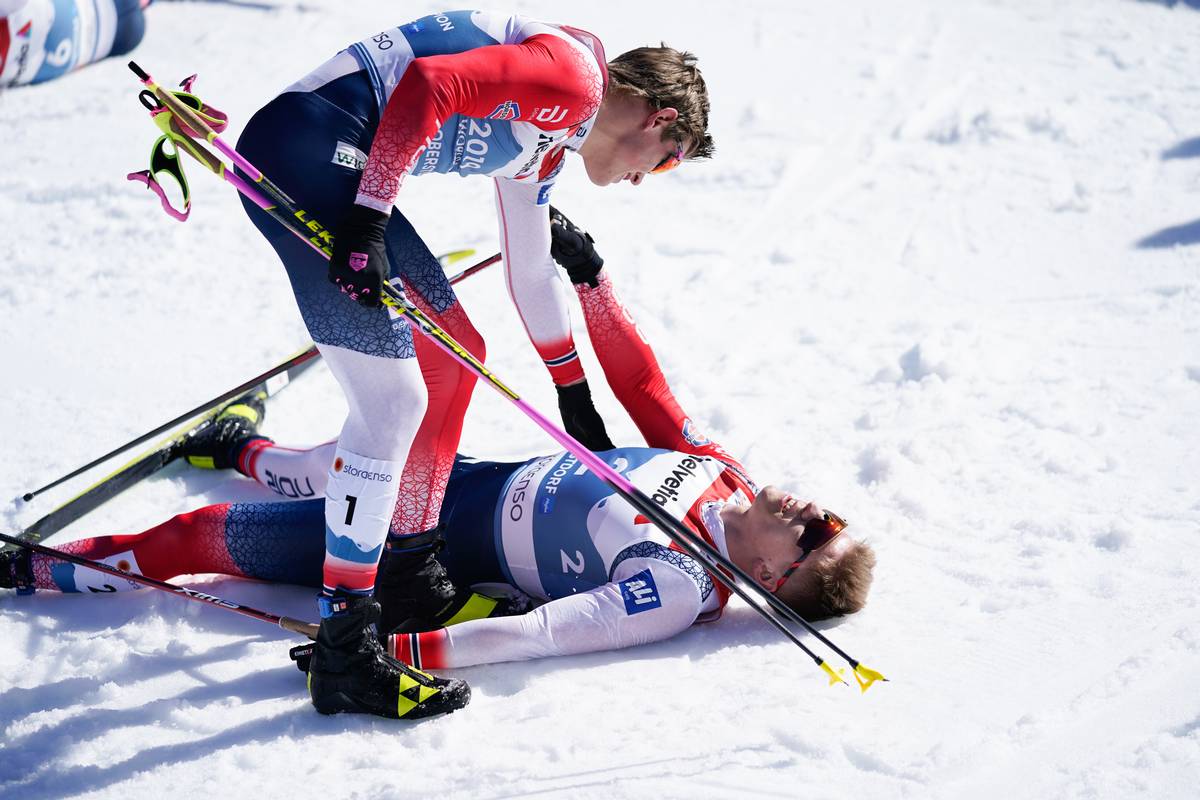
Klæbo congratulates a tired teammate, Valnes, after they finish 1-2 in the classic sprint. (Photo: NordicFocus)
Klæbo came out of his first World Championships in 2019 with three gold medals after winning the individual sprint as well as the team sprint and relay event with teammates. After this victory on Thursday it seems like he is well on his way to another successful championship. For his teammate Valnes, this is his first time competing at World Championships. Valnes has made one other podium appearance this season when he won the classic sprint at the season opener in Ruka, Finland. This is also the first time at World Championships for Taugboel who has had three individual World Cup podiums throughout his career, all in sprint events.
Valnes after placing second in the classic sprint (Photo: Nordic Focus)
Racing continues on Saturday with a 30 k skiathlon.
The men’s classic sprint podium in Falun, Sweden : Oskar Svensson (SWE) second, Johannes Høsflot Klæbo (NOR) first, and Håvard Solås Taugbøl (NOR) third, (l-r). (Photo: NordcFocus)
This World Cup coverage is made possible through the generous support of Marty and Kathy Hall and their A Hall Mark of Excellence Award. To learn more about A Hall Mark of Excellence Award or to learn how you can support FasterSkier’s coverage please contact info@fasterskier.com.
Squeaky snow, firm tracks and a fanless Falun was the backdrop for the men’s 1.4-kilometer classic sprint in Falun, Sweden on Sunday. The racing capped a three day series on the championship courses that hosted an individual start skate Friday and a mass start classic Saturday.
The qualifier and heats revealed the nature of the men’s sprint field – indeed a more challenging mix of skiers with Norway present. The Falun stop represents the second World Cup weekend since early December in which Norway arrived with a slate of skiers. We’ll get to this, but one-third of the 12 spots in the semis were earned by Norwegians.
Erik Valnes won the qualifier in 2:46.83 with pre-race favorite Johannes Høsflot Klæbo third (+2.23). And as if risen from the pandemic ashes after suffering a tough go with Covid-19, Russia’s Sergey Ustiugov, in his first weekend of racing this season, qualified fourth (+2.49).
JC Schoonmaker (20) of the U.S. was the lone North American to advance into the heats after qualifying in 11th (+5:06). Schoonmaker placed 18th overall for his third World Cup top-20. His best result remains 14th place in the skate sprint in Dresden, Germany, earlier this season.
Marcus Grate (SWE), Haavard Solaas Taugboel (NOR), James Clinton Schoonmaker (USA), (l-r) during the quarterfinals. (Photo: NordicFocus)
Schoonmaker began the fourth heat and skied near the front a minute into the race. His prospects to advance began to fade slightly nearing the two minute mark as he slotted into fourth place cresting a punchy climb. The Tahoe, California native finished fourth (+0.88) as Finland’s Lauri Vuorinen won the heat in 2:52.36.
Anton Persson (SWE), James Clinton Schoonmaker (USA), Håvard Solås Taugbøl (NOR), (l-r) during the Falun, Sweden classic sprint quarter-finals. (Photo: NordicFocus)
“In my heat I wanted to try and stay relaxed and make sure I wasn’t leading on the last downhill into the stadium,” Schoonmaker explained. “I felt like I was exactly where I wanted to be on the second climb but ended up getting a little crowded in over the top and from there I was just barely too far back to move on. I feel like I’m skiing with more confidence in these world cup heats but I just need to gain more experience in the packs in order to break into those semis.”
Schoonmaker will be part of a loaded American team headed to World Juniors/U-23s beginning in Vuokatti, Finand on February 6th. “I feel really good heading into U-23s,” said Schoonmaker. “I think I’m skiing well and I know I have the speed that is needed to ski at a high level. The U-23 field is super competitive so I can’t wait to mix it up with those guys in Vuokatti and keep the momentum rolling.”
A trio of Americans just missed out on qualifying in Falun. (Their qualifying place also represents each athlete’s standing in the overall.) They were Kevin Bolger in 31st (+9.74), Luke Jager, in his first career World Cup start, 32nd (+9.79), and Logan Hanneman 33rd (+9.83). Also for the U.S., Simi Hamilton qualified 37th (+10.57), and Hunter Wonders 68th (+17.20).
Just missing the heats in 31st, Kevin Bolger racing in Falun. (Photo: NordicFocus)
Luke Jager in his first career World Cup start, qualified in 32nd. (Photo: NordicFocus)
Logan Hanneman qualified in 33rd. (Photo: NordicFocus)
Antoine Cyr was the top Canadian, finishing in 49th. He was followed by Russell Kennedy in 51st, Pierre Grall-Johnson 54th, and Graham Ritchie 62nd.
The Sharp End
On a course requiring mandatory sprint-speed and power-bursts, endurance, and drafting, the sharp end racing tactics in the men’s first semifinal lulled well into the race. Atop the course’s final serious climb, none of the skiers opted to lead into the sinuous descent back towards the stadium. That is until Oskar Svensson of Sweden took the opportunity and skedaddled over the top leading Valnes, Federico Pellegrino of Italy, Gleb Retivykh of Russia, and Klæbo into the s-turn’s maw. This was a similar tactic the Swede used to his advantage taking the overall win in Val di Fiemme earlier in the season.
Sweden’s Oskar Svensson (bib 12), during the Falun, Sweden classic sprint. (Photo: NordicFocus)
As he does, Klæbo outpaced Svennson down the straight winning the first semi while Svensson placed second.
The second semi’s reveal was loud and clear at 1:00. Ustiugov powered up the first and longest of the climbs, gained roughly 10 meters on the five chasers, and never relented the lead. In fact, rather than cede ground, he looked to have a 15 to 20 meter lead gliding into the finish straight. He won in 2:51.06, 2.01 seconds ahead of second place Lucas Chanavat of France.
High hips and extended: Russia’s Sergey Ustiugov charging in Falun. (Photo: NordicFocus)
Contesting the final were, Klæbo, Svensson, Ustiugov, Chanvat, Valnes, and Norway’s Håvard Solås Taugbøl.
Ustiugov led out with pedal-down gusto to dictate this final’s narrative. The tactic, with a savvy crew of skier’s along for the ride, did not pay podium dividends for the Russian. Although dominating his semi, Ustiugov, who last won a World Cup sprint in December 2017, could not sustain his seminfinal’s moxy.
He was first around the 1:10 mark cresting over the longest climb, but the five skiers shadowing Ustiugov in the final were able to sit in his draft. Svensson shot around the Russian to lead into the second major climb. Svensson ran up the outside track, while Ustiugov ran up the inside. And Klæbo simply Klæboed. Again the Russian propelled himself into first up over the final climb. However, the group did not hesitate to determine who led into the downhill as Ustiugov was already zipping away in a tuck. Klæbo, Svensson, and Valnes all descended behind the Russian by a few meters.
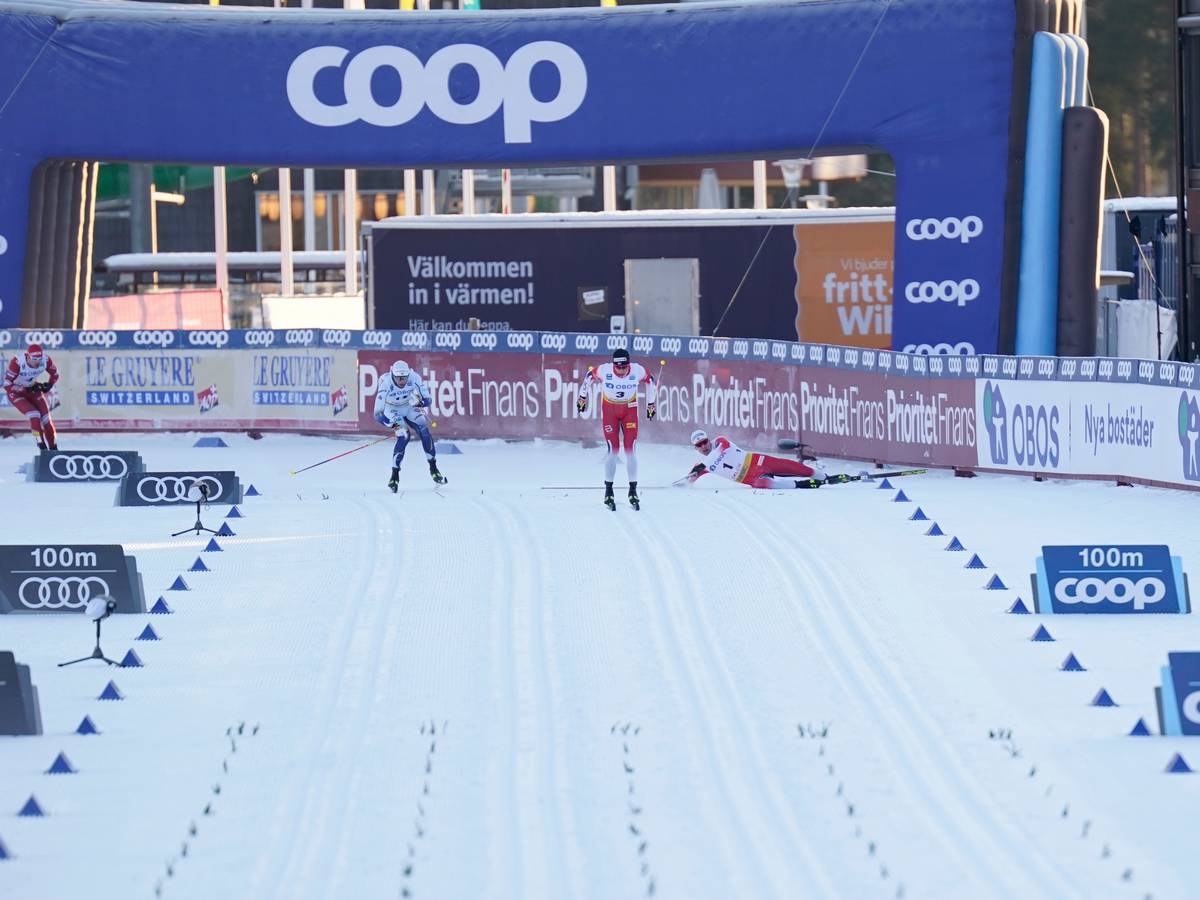
Down through the S-turns and a sliver before the final roller, Klæbo, Svensson, and Valnes overtook Ustiugov. Klæbo slotted into the finish straight first, with Valnes tight behind. Yet as Valnes, taking the corner hot, tried to quick-step around, he lost his footing and slid out. Klæbo took the win 2:48.22, Svensson placed second (+1:45) and Taugbøl third (+2.80).
Sliding out of the tracks and off the podium, Erik Valnes of Norway had his hopes dashed in the Falun, Sweden classic sprint. (Photo: NordicFocus)
“It was a very hard race out there, but I was really glad when Ustiugov was heating up the pace, really high there,” Klæbo told FIS after the race. “My goal was to be second before the last downhill and in the quarterfinals, semi, I was number five, so I thought I would try to be in a better position. Yah, it worked quite good.”
Johannes Høsflot Klæbo poling towards the finish line in Falun. (Photo: NordicFocus)
Johannes Høsflot Klæbo with a glance behind to see the damage done. (Photo: NordicFocus)
According to Klæbo, he will not race again on the World Cup before this year’s World Championships in late February.
“This will be my last weekend before the World Championships so I am really glad I had the opportunity to go all the way to the final and have these four heats and everything,” he said. “It was a really nice to do it before the World Championships but Ustiugv was really strong and I am glad to see him back again.”
The day marked the 25th career World Cup sprint win for Klæbo, 11 of which are in classic technique. This is Klæbo’s first World Cup sprint appearance since the opening weekend in Ruka, Finland, also a classic race, in which he placed second to Valnes.
This was the third World Cup podium for Taugbøl and the second for Svensson. Rounding out the top-six, Ustiugov placed fourth (+2.97), Chanavat fifth (+11.18), and Valnes, who slowly strode down the straight after righting himself, sixth.
World Cup racing continues with an all-sprint weekend in Ulricehamn, Sweden. Saturday features a skate sprint, Sunday a skate team sprint.
Athlete training in Lillehammer, Norway prior to the FIS World cup. (Photo: NordicFocus)
On Tuesday morning, the Norwegian Ski Federation (NSF) and announced a new sponsorship agreement, set to begin on 1 May. Sparebank will remain the federation’s title sponsor for 10 million kroner, approximately US $950,000. It’s a two-year agreement with an option for a three-year extension.
The amount is a reduction from the 15 million kroner (US $1,416,750) in the previous contract.
Norwegian Ski Federation Logo
The new deal comes at a time of uncertainty as global economies sputter due to the coronavirus pandemic. In part because of the economic crisis and partly due to sponsorship losses, the NSF slashed its 2020 budget by 50 million Norwegian kroner, approximately $4,800,000. On Friday, the federation issued a press release published by langrenn.com announcing a layoff of 96 employees, two-thirds of its workforce. The remaining workers have taken pay cuts as they cope with a changed financial landscape.
Before Christmas, Sparebank and the federation had ceased sponsorship discussions. According to langrenn.com, “a few weeks ago” negotiations resumed.
With reduced funding, the national team athletes will lose their annual training stipends of 120,000 kroner. Stars such as Johannes Hosflot Klæbo and Therese Johaug may not be affected by this loss, but it could be significant for other athletes.
In the new agreement, Sparebank retains prime space on athletes’ headgear, but little else. Previously, sponsorships were organized top-down: Norwegian athletes had to sign a non-compete agreement covering around 80 different brands, with only minor opportunities to procure their own sponsorships.
With the loss of the stipend, athletes are free to find their own sponsorships. Marketing themselves may enter into the work-life-training balance.
“They have the opportunity to [recoup the lost stipend] by going out and selling themselves,” said Espen Bjervig, the federation’s cross-country manager. “It may not be the best timing the way the market is now. But I think the athletes have a strong foundation especially locally. In addition, the clubs of the athletes may also have the opportunity to use their sponsorship on the athletes,” said Bjervig to NRK. “But if there are athletes who are struggling to get sponsors, then we will see what we in the Ski Association can help with.”
Veidekke, a prominent civil engineering company, also ended its sponsorship of the ski federation. In an article on the Finnish outlet is.fi, Helge Dieset, Veidekke’s communications director, said that the company had decided to cease sponsorship at the end of the year, before coronavirus.
Along with 13 other businesses, Veidekke had been a co-sponsor, a tier below the title sponsor. They sponsored not only the national sprint team: some of their money supported the federation’s five regional development teams.
Even before the current budget crisis, team management had already intended to reduce the size of the national team, due to reduced quotas on the World Cup and in the Olympics.
In the linked article, former Norwegian skier and current cross-country analyst on Norwegian television, Petter Soleng Skinstad speculated that veteran athletes might be the first to feel the axe: “Probably it is first and foremost established top runners who will disappear out of the A team.”
As the federation sorts out its future, athletes are training individually. According to Ski-Nordique.net, national team training camps had already been postponed until July at the earliest.
Before the new deal with Sparebank, Håvard Solås Taugbøl, of Lillehammeer SK, told Ski-Nordique, “This is a very critical situation. We hope that another sponsor can come and help [the] regional teams, which are so important for the development and motivation of young people.” In 2020, Taugbøl earned three World Cup sprint starts.
With the layoffs announced last Friday, “The goal now is to take quick enough measures to secure jobs so that we can resume normal operations and continue as normal as possible when this is over,” said NSF secretary general Ingvild Bretten Berg. “We have talented and committed employees in [NSF]. In a difficult time not only for us, but also for many around us, it is important to take care of each other as best we can.”
Perhaps unsurprisingly, the Norwegian men showed up on form for today’s freestyle sprints in Konnerud, just outside the city of Drammen. As the venue was used for the Norwegian National championship at the end of January, most of the team has already had a dress rehearsal racing on the windy course.
Johannes Høsflot Klæbo of Norway, where he is found most often: winning down the stretch. (Photo: NordicFocus)
It seems that Johannes Høsflot Klæbo, who sat out the national championships, did not need a dress rehearsal. He won the qualifier by a margin of nearly four seconds, continuing easily through the rounds to win the overall. This is Klæbo’s eighth sprint win of the season, matching last year’s record, and his 14th career World Cup freestyle sprint victory, the most of any male athlete.
Racing in the final with Klæbo were four of his teammates: Håvard Solås Taugbøl, Eirik Brandsdal, Sindre Bjørnestad Skar, and Erik Valnes, each of whom also raced in the national championship final on January 31st (and finished in a very similar order). Interrupting the all-Norwegian field was Alexander Bolshunov of Russia.
In the final, Klæbo hovered in the middle of the pack marking his teammates, with Taugbøl in the lead. When Brandsdal took control on the primary climb of the course, Klæbo swung outside of the group to move into second before tucking into the last downhill. As they passed under the arch and headed into the final straightaway, Klæbo engaged his unmatchable top gear, with Taugbøl and Brandsdal chasing.
After crossing in a photo finish, Taugbøl was deemed second (+0.65) — a World Cup career best individual result — with Brandsdal third (+0.69). Skar took fourth (+0.94), followed by Bolshunov in fifth (+1.92) and Valnes a late arriving sixth (+12.79).
Simi Hamilton (bib 24) during his quarterfinal in Konnerud. (Photo: NordicFocus)
Simi Hamilton was the only American sprinter racing in Konnerud. He qualified in 24th and raced in the fourth heat of the quarterfinals, where he finished fifth, ending his day ranked the same in the overall as in his qualifier.
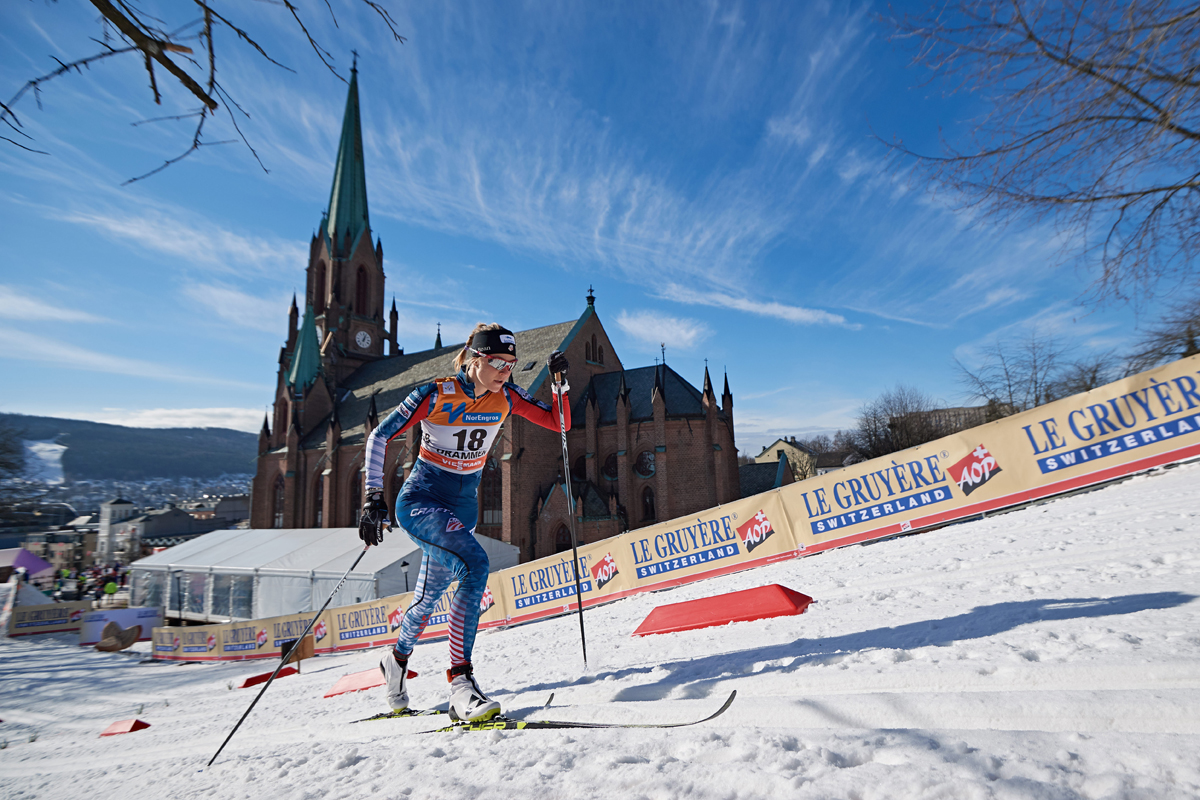
The looping sprint course around the ol’ church in Drammen, Norway will have to wait another year, or at least until sufficient snow: the iconic city sprint was moved to Konnerud due to insuffient snow in Drammen. Winter, please, pretty please, return to places such as Drammen.
Powering home for the Konnerud win: Jonna Sundling of Sweden. (Photo: NordicFocus)
Although deep in Norway, but not so far from Sweden as the planes fly, Sweden took the win and third place in the World Cup’s relocated 1.2 k skate sprint in Konnerud. Jonna Sundling won the final in 2:38.41 — a toe and perhaps the tail of a ski ahead of Switzerland’s Nadine Faehndrich in second (+0.24). It was a photo finish for second through fourth. Linn Svahn, a U23 skier forgoing those championships, placed third (+0.39). Norway’s U23 Kristine Stavaas Skistad was fourth (+0.97), Sweden’s Maja Dahlqvist placed fifth (+5.70), and Anamarija Lampic of Slovenia sixth (+26.04).
Sundling powered down the final sraight outpacing Faehndrich in the final 100 meters. Sundling advanced to the finals as a lucky loser in the semis.
Sadie Bjornsen (bib 4) during her quarterfinal heat in Konnerud. (Photo: NordicFocus)
Sadie Bjornsen of the U.S. was the top American in 16th overall. Bjornsen qualified in fourth, 1.2seconds behind the top qualifier, Katja Visnar of Slovenia. Bjornsen placed fourth in the second quarterfinal and did not advance.
Jessie Diggins was the only other American to qualify.After qualifying in 12th , she placed sixth in the first quarterfinal, to end her day ranked 27th. Also for the U.S., Kaitlynn Miller placed 50th, and Becca Rorabaugh 54th.
Jessie Diggins sprinting in Konnerud. (Photo: NordicFocus)
Of note, Swedish sprinter, Hanna Falk, who suffered a back injust prior to the season, started her first World Cup of the year. She finished in 30th.
Racing continues Saturday with the women’s 30 k classic mass start. The men race a 50 k in Oslo on Sunday.
Sunday’s men’s 1.5-kilometer classic sprint course in Oberstdorf, Germany deserves some recognition. Site of the 2021 FIS Nordic Ski World Championships, racers were offered a glimpse into how the world’s foremost sprinter, Johannes Høsflot Klæbo of Norway, would navigate it’s kicker climbs, steep descents, and roughly three minute and thirty-second effort.
The sprint course offered three distinct climbs, one at 0.2 k, the largest at 0.52 k, and the third starting at 1.1 k. The descents mirrored the inclines of the ascents and offered little respite or recovery for skiers near their engine’s redline.
We are focusing on Klæbo, despite the other twenty-nine skiers in the heats, because he was simply a master of pacing, a master of conserving energy on the three-climb course, and freakish in his ability to run away from his five competitors in the final.
Klæbo qualified in first. The margin back to Erik Valnes of Norway in second was 2.72 seconds. Pål Golberg, the third-fastest qualifier was 5.03 seconds back. There were big-time gaps back to the field of qualifiers.
Johannes Høsflot Klæbo crushing the men’s sprint qualifier in Oberstdorf, Germany. (Photo: NordicFocus)
Valnes and Klæbo opted for the first quarterfinal. It was here that Klæbo played his tactical hand. He was in no hurry on this endurance sprint course to move to the front and pull others along in his wake. Klæbo sat in fourth on the second hill as Valnes was the heat’s workhorse. Klæbo appeared relaxed, not itching to move to the front. Klæbo moved to third around 2:00 minutes as they crested the course’s highpoint. The third hill, as most sprinters appeared on fumes, is where Valnes and Klæbo pulled ahead. Over the top, the duo glided into a 20-meter lead. Down the stretch, Valnes poled ahead for the quarterfinal win as Klæbo pulled up, stopped poling several meters before the finish — as if he were checking out for a lunch break.
The third hill would be Klæbo’s charm.
Along with Valnes in the first semifinal were Italy’s Federico Pellegrino (4th qualifier), Golberg, Håvard Solås Taugbøl also of Norway (5th qualifier), and Russia’s Sergey Ardashev. This would be the semifinal to watch.
Again, Klæbo played the conservation of energy tactic. Up the second climb, Golberg, Taugbøl, Valnes, and Pellegrino strode four across with Klæbo lurking a meter back. The second hill was in the rearview mirror around the two-minute mark. It’s approximately another twenty seconds of descent and working flat before the next decisive climb.
As the skiers approached the base at 2:26, Klæbo and Valnes ramped up – they pulled away as they ski-ran up and over the top. Klæbo had been sitting behind Valnes, sucking up in his draft into the final straight. There, Klæbo pulled around his teammate for the semifinal win.
Federico Pellegrino of Italy pushing over the top in the Oberstdorf, Germany classic sprint. (Photo: NordicFocus)
The final featured Klæbo, Valnes, Golberg, Pellegrino, and Oskar Svensson of Sweden and Russia’s Gleb Retivykh. Really, for Klæbo, this was essentially a rematch of his semi.
Again, Klæbo was cautious from the start. There was no real earnestness to shoot to the front. His show would come later. There was only patience from an athlete who knew he could pounce late in the game.
Pellegrino, on the second climb, began to accelerate. He ran outside the tracks in what looked less like a decisive move, and more a burst to position himself tactically in front over the top. For his part, Klæbo matched Pellegrino and strode up alongside the Italian.
At 2:35 at the base of the final climb, Klæbo unleashed. It was textbook Klæbo-running. He was gone with a near 20 meter gap over the top. By the finish line, Klæbo looked to put 10 more meters on his competition as he won in 3:29.46. Golberg was second (+1.99), Valnes third (+2.37), and Pellegrino fourth (+3:06).
In yesterday’s 30 k skiathlon, Klæbo registered a rare DNF (did not finish) as he pulled from the competition.
“I think the sprint was much better than the 30 k yesterday,” Klæbo told FIS after the race. “Yesterday was a really terrible day and today was a bit better. In the end, it was really cool to win here. Yah, I think my shape isn’t the best but I am really happy to find the win here and to have the Norwegian guys here.
“I think it was a really good decision yesterday to jump off after 15 k I think, it was really nice to fight for a win today. And for sure I am really looking for the World Championship here next year.”
Johannes Høsflot Klæbo of Norway cruising in for the Oberstdorf, Germany classic sprint win. (Photo: NordicFocus)
Hands up for the win: Johannes Høsflot Klæbo makes it 5 for 5 for sprints this season. (Photo: NordicFocus)
What was clear after today was that Klæbo had mastered the course. Anything can happen in a year. And anything can go down in a sprint – broken poles, clipped skis, or slide out on a corner. This much was true exiting Oberstdorf: it will be Klæbo’s race to lose at the 2021 World Championships.
It was a down day for the American men. No skiers qualified for the heats. Simi Hamilton placed 32nd overall and was +15.94 in qualification. Andy Newell was 41st (+17.48), Tyler Kornfield 55th (+20.88), and Noel Keeffe 64th (+25.33).
Simi Hamilton during the Oberstdorf, Germany classic sprint qualifier. (Photo: NordicFocus)
Andy Newell during the sprint qualifier in Oberstdorf, Germany. (Photo: NordicFocus)
For Canada, Bob Thompson placed 54th and was +20.14 in the qualifier, Paul Grall-Johnson was 58th (+21.74), and Graham Ritchie 61st (+22.92).
World Cup Standings Shakedown
Coming out of Oberstdorf on the men’s side, Russia’s Alexander Bolshunov remains in command. In first overall with 1457 points, Bolshunov has a 235 point lead on second place Klæbo for the overall lead. Sunday, Bolshunov earned 36 World Cup points after placing seventh overall, Klæbo earned 100 points for the sprint win. If you are keeping score at home, you will note 140 points for Bolshunov’s win in Saturday’s 30 k skiathlon. On yesterday’s course, racers had four opportunities to score bonus points – Bolshunov snatched up 40 of them during the race.
Alexander Bolshunov of Russia in the yellow bib. He leads the overall World Cup. He placed 7th on Sunday’s classic sprint in Oberstdorf, Germany. (Photo: NordicFocus)
Klæbo leads the sprint overall with 350 points. This was Klæbo’s fifth sprint win of the season. He has won every sprint entered thus far. He skipped the skate sprints in Planica, Slovenia and Dresden, Germany.
The World Cup takes a break next weekend and restarts in Falun, Sweden with a classic sprint on February 8.
All Norway in the men’s classic sprint podium in Oberstdorf, Germany: Pål Golberg in second, Johannes Hoesflot Klaebo first, and Erik Valnes third. (Photo: NordicFocus)
Spectators gather in Dresden, Germany to watch the team sprint. (Photo: NordicFocus)
It was dizzying in Dresden for the skate team sprints. The man-made loop of lightning-fast snow had skiers going literally round and round for a total of 11 exchanges between teammates. Each skier skated a single 0.7-kilometer lap, for a total of 7.8 k. Each skier raced six laps. Turn your head dizzy.
Maja Dahlqvist (bib 15) and teammate Linn Svahn maintain their lead in the final laps of the Dresden team sprint. (Photo: NordicFocus)
The Women’s Final
The finals consisted of ten teams. Sweden I animated the race with its display of pull ahead speed late in the race. Sweden I featured Maja Dahlqvist, who won this event last year with Stina Nillson. This year, Dahlqvist and Linn Svahn, yesterday’s skate sprint winner, had the pleasure of burning plenty of matches in Dresden.
Sweden I’s tactics were clear: late in the race, with several exchanges remaining, apply speed to the front, separate from the pack, and position themselves for the win. According to FIS, that has been somewhat easy for Sweden to do of late: Sweden has won seven of the last eight women’s team sprint World Cup events. This includes the last five in succession.
So it was today, as Dahlqvist tagged to Svahn on the final lap with a 0.8-second gap on Switzerland I’s Nadine Faehndrich. Norway I came through 3.6 seconds back, and Sweden II another 0.4 seconds behind.
That was the race. Faehndrich was able to close down and give Svahn a scare at the line for a photo-finish.
The finish line item read: Sweden I in first at 15:43.7, Switzerland I second (+0.09), and Sweden II third (+3.27).
The U.S. team of Julia Kern and Sophie Caldwell placed fifth overall (+6.61). The U.S. pairing advanced out of the semis after placing third behind Norway I in first and Switzerland I’s Laurien Van Der Graaf and Nadine Faehndrich.
Sophie Caldwell (bib 3) finds her line heading into the u-turn before the exchange zone. (Photo: NordicFocus)
Julia Kern (bib 3) shows poise in the pack during the team sprint. (Photo: NordicFocus)
Canada I’s Katharine Stewart-Jones and Dahria Beatty placed third in the second semi-final — in a photo finish with Germany I for second — and did not advance as a lucky loser. In the team sprint format, the two top teams advance, with the six remaining spots in the final given to the next six fastest teams via lucky loser spots. Canada I placed 11th on the day.
Canada II’s Maya Macisaac-Jones and Katherine Weaver were 23rd overall.
Laurien Van Der Graaff (SUI), Nadine Faehndrich (SUI), Maja Dahlqvist (SWE), Linn Svahn (SWE), Evelina Settlin (SWE), Linn Soemskar (SWE), (l-r) take the podium positions. (Photo: NordicFocus)
The Men’s Final
Looking for some smooth skiing technique cues for high speed skate skiing? Look no further than the Frenchman crossing the line in first on Sunday for France I. Lucas Chanavat — paired with Jay Renaud — was the kinesthetic perfection of coaches advising – and sometimes commanding — athletes to ski big and tall.
Lucas Chanavat (bib 1) put on a clinic this weekend in Dresden, Germany. (Photo: NordicFocus)
On Dresden’s quick 0.7 oval loop and deteriorating snow, Chanavat was simply big and smooth and just enough faster than the others.
In an event that saw five teams on the final tag within 1.4 seconds, France did not exactly have this Dresden team sprint nailed shut.
With the front five teams out of trouble, they came into the final straight drag race style. As noted, France I pipped in for the win. Sweden I’s Marcus Grate and Johan Haeggström were second (+0.09), and Russia I’s Andrey Krasnov and Gleb Retivykh third (+0.18). Norway I’s Håvard Solås Taugbøl and Sindre Bjørnestad Skar were fourth (+0.56).
Great Britain’s James Cluget and Andrew Young were eighth overall (+7.07).
Canada I’s Graham Ritchie and Bob Thompson were 14th overall, with Canada II 20th. For the U.S., JC Schoonmaker, a junior skier for the University of Anchorage Alaska, and Kevin Bolger were paired. They placed 21st for the day.
Marcus Grate (SWE), Johan Haeggstroem (SWE), Renaud Jay (FRA), Lucas Chanavat (FRA), Andrey Krasnov (RUS), Gleb Retivykh (RUS), (l-r) earn top honors in the men’s team sprint. (Photo: NordicFocus)
The metaphors are rife when describing the rough and tumble nature of the urban environment. Most often we think of pine forest, alps, and Hansel and Gretel valleys as the backdrop for the World Cup. To foster interest and in-fill a dense schedule of racing, city-sprints are nothing new when it comes to populating the World Cup calendar. Places like Dresden provide a contextual backdrop to a Europe steeped in history. The city is often a reminder of darker times, as it’s historic architecture was destroyed in World War II.
The city, since rebuilt to historical specs, is the place to be post Tour de Ski.
As a sprint specific weekend immediately following the Tour, the field is absent one notable name from Norway: Johannes Høsflot Klæbo. He placed third overall in the Tour and took the weekend to recover.
The World Cup show goes on. And perhaps one of the most stable and finest skate ski technicians out there took center stage. France’s Lucas Chanavat earned his third podium of the season and his second career World Cup victory with a win on Saturday in Dresden. Chanavat won the two-lap 1.3-kilometer qualifier in 2:14.72.
Lucas Chanavat of France (bib 1), where he was all day, out front during the Dresden city sprints. (Photo: NordicFocus)
In a tight qualifier in which the top-10 were separated by 1.75 seconds, three Americans qualified for the heats: Logan Hanneman in 21st (+3.65), nineteen-year-old junior skier JC Schoonmaker (in his debut World Cup) 24th (+3.80), and Kevin Bolger in 28th (+4.00).
Bolger finished 25th for the day after placing fifth in the second quarterfinal. Schoonmaker was 30th overall and in the points, as he slotted into sixth in that same quarterfinal heat. Hanneman ended up 29th overall, after skiing to sixth in the first quarterfinal.
For Canada, Bob Thompson placed 34th, Graham Ritchie 46th, Antoine Cyr 51st, and Pierre Grall-Johnson 66th.
Bib 1, JC Schoonmaker at last week’s Senior Nationals in Houghton Michigan. (Photo: Reese Brown)
JC Schoonmaker in the points for the U.S., during the Dresden, Germany skate sprint. (Photo: NordicFocus)
Post-race comments from Marine Dusser, Head Coach at University of Alaska Anchorage
Stats aside, this was a tricky course for a basic two-lap oval sprint race. Crashes and slides were plentiful. Staying on your feet, an obvious must, was problematic for some. Most notable was a clash during the fourth quarter, where France’s Richard Jouve clipped the back of Italy’s Federico Pellegrino’s skis. It occurred on the lap corner where skiers seemed to be magnetically attracted to the tightest line up against the v-boards.
Not a bad tactic. But the high risk move didn’t always pay off. Pellegrino went down, as did Jouve, in a gnarly tumble. Pellegrino took a moment on course to disparage Jouve. Both skate sprint savants, Pellegrino placed an uncharacteristic 27th and Jouve 22nd.
The scene was a reminder that those who fired from the start, got out front, and remained there, set themselves up for success. With no true kicker hills on course, coupled with the high speed tracks, remaining in the front and out of trouble proved to be the recipe for success.
Chanavat played those tactics to perfection. He won his quarterfinal, semi-final (in a photo-finish with Norway’sSindre Bjørnestad Skar), and the final by skiing boss-like out front in 2:14.81.
Number one in the qualifier, number one in the final. Lucas Chanavat is the champion in Dresden. (Photo: NordicFocus)
The only mishap in the final was for Håvard Solås Taugbøl of Norway, who snapped a pole early on the first lap. Skiing the remainder of the lap with a single pole, he ultimately placed sixth, only 1.86 seconds back.
“I felt good today, especially in the final stretch,” Chanavat told FIS after the race. “I saw the crazy falls because Richard Jouve is usually fighting there (in the 180° turn) during the final and he was unlucky today again but he will be back stronger soon. I was hoping for a World Cup victory this year but I was not expecting it to happen so fast.”
Skar took second place (+0.61), Sweden’s Johan Haeggström third (0.96). Pål Trøan Aune of Norway placed fourth (+1.04), and Jay Renaud of France fifth.
The men’s podium on the streets of Dresden. Lucas Chanavat (FRA) takes the win ahead of Sindre Bjørnestad Skar (NOR) and Johan Haeggström (SWE). (Photo: NordicFocus)
The men’s podium of the freestyle team sprint in Planica, Slovenia. The Norway I team of Sindre Bjørnestad Skar and Erik Valnes took the win over the Norway II and Finland teams. (Photo: NordicFocus)
From under the umbrella to inside the snow globe. Fat flakes were falling in Planica, Slovenia at the start of the freestyle team sprint. A painful mix of speed and endurance, each team member skied three 1.2-kilometer laps for a total of 7.2 k. Comprising the victorious Norway I team, Sindre Bjørnestad Skar and Erik Valnes stopped the clock at 16:54.52. Fellow countrymen Håvard Solås Taugbøl and Gjøren Tefre took the Norway II team to second place (+1.29) followed by the Finnish team of Ristomatti Hakola and Joni Mæki in third (+1.43).
Coming into the third exchange at the halfway mark of the race, the pack of athletes included all ten teams, no one able to break apart the masses in the slow conditions. A variety of teams including Norway, Finland, and France took turns trying to create a gap, but wasting energy too early in the slow snowy conditions risked hazard.
The Norway II team of Håvard Solås Taugbøl and Gjøren Tefre tag off in a tight field during the freestyle team sprint in Planica, Slovenia. (Photo: NordicFocus)
By the fourth exchange, there was no longer time to wait. Skar of Norway I pushed by Tefre of Norway II began to surge. He quickly created a small gap to all but Richard Jouve of France and Hakola of Finland I who went with the leaders in red.
Though the density was lowered, the spread of the top eight teams was less than nine seconds as they made the final exchange. Having mingled with the leaders throughout, the American duo of Kevin Bolger and Logan Hanneman sat in fifth, less than three seconds back on the Norwegians.
Densely packed inside a snow globe, Norway pushes toward a 1-2 sweep in the freestyle team sprint in Planica, Slovenia. (Photo: NordicFocus)
Winding up the energy in the final leg, Norway again made a push to break apart the field. Allowing them to lead to the climb at halfway, then working his way around the outside, yesterday’s sprint champion Chavanat made a go at the lead. Cresting the hill, Chavanat’s V2 was outmatched by two men in red jump-skating as though indefatigable even after 3.5 k’s of sprinting.
Valnes exploded off the front, leaving the threesome of Tefre, Mæki, and Chavanat duking it out to a close finish. Bobbling as he crossed into an opening, Tefre tangled skis with Mæki, but both men lost little momentum as they headed into the final straightaway.
Perhaps spent from his attempt to lead, Chavanat’s tempo could not match the others and he was overtaken in the final meters. Tefre slid his boot over the line just ahead of Mæki, leaving the French team 0.07 seconds off the podium.
The Norway I team of Sindre Bjørnestad Skar and Erik Valnes took home the cheese at the freestyle team sprint in snowy Planica, Slovenia. (Photo: NordicFocus)
“It was a challenging day [for conditions], just as yesterday,” Skar told FIS at the finish line. “But it’s the same for everyone so you just have to deal with it and do your best.”
He explained how the wet falling snow affected tactics and how the race unfolded for the Norway I team.
“It was so close and then with this weather it is almost impossible to go alone in the front. I tried the last half, but it was difficult, but we had to try and Erik was the best guy at the finish.”
Kevin Bolger accelerates out of the exchange during the freestyle team sprint in Planica, Slovenia. (Photo: NordicFocus)
After losing contact with the leaders in the final lap, the Americans held on for 7th place (+21.19).
In a post-race call, Whitcomb explains that the team of Bolger and Hanneman was not finalized until the morning, when original anchor Simi Hamilton, who took 12th in the rain yesterday, was forced to withdraw after coming down with a cold. Because of the adjustment, the team lost their start position in the semifinal and began at the back of the field. The men finished eighth in the fast first round, from which the top three teams went on to be the top three teams in the final. The Americans advanced to the final with the last lucky loser spot.
Post-race interview with Matt Whitcomb on the men’s team sprint.
Kevin Bolger (second from left) keeps the USA team in contact during the freestyle team sprint in Planica, Slovenia. (Photo: NordicFocus)
“Logan and I had the weather on our side today!” wrote Bolger in an email. “I was skiing well but punched it to the front of my semi-final on the second lap and got a bit flooded from that. Luckily, Logan skied really well on his final lap to bring us into qualifying contention!
“The Final felt a lot better,” he continued. “I skied a lot more conservatively and tactically better and am happy with how I moved forward. I was a bit surprised when Logan came into the Tag zone leading but was ready to head out and give it my all for the last lap!”
Logan Hanneman stays in the mix behind Norway during the freestyle team sprint in Planica, Slovenia. (Photo: NordicFocus)
At 26-year-old, Sun Valley native Kevin Bolger is in the midst of his third season of World Cup starts, landing inside the top-30 on eight occasions. Hanneman, who hails from Fairbanks, AK, has much less experience on the World Cup. Whitcomb explains how weekends like this one, where many of the all-arounders are resting for the Tour de Ski, consequently narrowing the field and improving the odds of sprinters like Hanneman who are often on the cusp of qualifying for the rounds.
Post-race interview with Matt Whitcomb on Logan Hanneman’s development on the World Cup.
“The final was just nuts,” wrote Hanneman in an email about his day. “It was snowing so hard. The pace was much more pedestrian than the semi final. I found myself with an open lane up the last hill of my second lap, and made what I thought was a low energy move up into the lead… turns out it was all adrenaline because come my last lap I was dying. But Kevin skied great during the whole final, and we were able get beat some teams in the final. Very happy with the day for sure!”
The men’s podium of the 1.5-kilometer freestyle sprint in Davos, Switzerland. Johannes Høsflot Klæbo (center) took first ahead of Lucas Chavanat of France (L) and Håvard Solås Taugbøl of Norway (R). (Photo: NordicFocus)
Davos, Switzerland: gifted athletes, throngs of spectators lining the course, plenty of Vitamin-D and a spectacular day for the 1.5-kilometer freestyle sprint. Racers chased down and skied away from their long afternoon shadows as the sun moved across the cloudless bluebird sky.
The crowds were in for a treat. In sprint racing, heats often have significant variance. Some will be fast, some will be slow with a final upsurge in intensity at the end. In today’s event, heats were fast and tight. Winning times were comparable, lucky losers waited with bated breath through the end.
Improving upon their performance in the opening classic sprint in Ruka, two Americans qualified for the heats. Simi Hamilton qualified in 8th and Kevin Bolger in 30th.
Lucas Chavanat of France models composure during the 1.5-kilometer freestyle sprint in Davos, Switzerland. (Photo: NordicFocus)
In the first heat of the quarterfinals, Johannes Høsflot Klæbo, who had qualified in 5th, threw down against France’s Lucas Chavanat, who was the top qualifier. Perhaps making a statement, Klæbo set the tone of the heat, quickly moving to the front and holding his position to comfortably take the heat with Chavanat behind him.
During his round, Hamilton marked the leaders, the Italian favorite Federico Pellegrino and Erik Valnes of Norway. Hamilton maintained contact throughout, fighting through the finish to place third in his heat. His time survived the three subsequent heats each by a fraction of a second to advance as a lucky loser.
Italy’s Federico Pellegrino leading Erik Valnes of Norway in the quarterfinals of the 2019 skate sprint in Davos, Switzerland. (Photo: NordicFocus)
Simi Hamilton hunts down the leaders in the quarterfinal of the 1.5-kilometer freestyle sprint in Davos, Switzerland. (Photo: NordicFocus)
Onto the semis. In the first heat, Chavanat took control from the gate and held it through through the last turn, the stacked group of competitors tucked in closely behind him. Klæbo stayed tucked into the middle of the pack. In the final straightaway, Klæbo swung around overtaking his teammate Valnes in the final meters, besting Chavanat by a toe.
In a tuck and on the hunt. Not an easy victory for Johannes Høsflot Klæbo during the 1.5-kilometer freestyle sprint in Davos, Switzerland. (Photo: NordicFocus)
In the second wave, Hamilton stayed just behind the Norwegian leaders Håvard Solås Taugbøl and Sindre Skar — in the mix but out of trouble. In the final stretch, a pack of five contenders charged toward the finish. Crossing in a photo finish with Gleb Retivykh of Russia, Hamilton was deemed 4th and advanced again as a lucky loser.
At the start of the final, none of the men took the reigns and the first climb looked calm. Chavanat emerged at the front after the descent, but the field behind him stayed tight. Dueling once more, Klæbo tucked in just behind Chavanat, marking him closely and staying low in his draft.
In the final high-velocity stretch, Klæbo and Chavanat were neck-in-neck as the crowd roared. Leading by inches, Klæbo charged with unmatched tempo. He added two jump skates before throwing his boot across the line ahead of the Frenchman in a photo finish. Chavanat was just 0.05 seconds behind Klæbo. Laughing breathlessly, they embraced and congratulated each other at the finish.
Johannes Høsflot Klæbo of Norway checks his position relative to his opponent, Lucas Chavanat of France, at the finish of the 1.5-kilometer freestyle sprint in Davos, Switzerland. (Photo: NordicFocus)
Johannes Høsflot Klæbo (NOR) and Lucas Chavanat (FRA) congratulate one another after a photo finish in the final of the 1.5-kilometer freestyle sprint in Davos, Switzerland. Klæbo won by a margin of 0.05 seconds. (Photo: NordicFocu)
Håvard Solås Taugbøl of Norway finished third (+1.36) — his first career World Cup podium, followed by Sindre Skar (+1.54), Retivykh (+3.19), and Hamilton (+4.82).
“It was a really tough fight and Lucas was very strong all day,” Klæbo told FIS at the finish. “It was really cool to see that he was that strong again. In the quarter-final, the speed was really high and I was trying my best at a final and was a bit in front of him, but it was a really good fight.”
Håvard Solås Taugbøl of Norway celebrates his podium finish at the 1.5-kilometer freestyle sprint in Davos, Switzerland. (Photo: NordicFocus)
Klæbo’s victory makes him the first male athlete to win five consecutive World Cup sprint events. The last athlete to do so was Marit Bjørgen who won a remarkable eleven in a row between 2003 and 2005. He also became the first athlete to win three World Cup sprint events in Davos. Today’s third consecutive win allowed him to surpass Pellegrino, who won in 2014 and 2015.
In his interview with FIS, the sprint champion was also asked about sharing the podium with his teammate.
“It was really cool to have Håvard on the podium today,” said Klæbo. “I think in Norway we are quite happy today.”
Hamilton has a history of racing well in Davos. He placed 12th last season and 9th in 2017. At 5,100’ Davos is one of the highest elevation venues on the World Cup, but much lower than his 8,000′ hometown of Aspen, Colorado.
In his post-race interview, Hamilton shares why this course suits him well and how this performance gives him confidence on the season ahead. He also discusses his opening performance in Ruka and the tight spread throughout the heats.
Simi Hamilton skis to an 8th place result in the qualifying round of the 1.5-kilometer freestyle sprint in Davos, Switzerland. (Photo: NordicFocus)
Post-race interview with Simi Hamilton.
In a post-race call, head coach Matt Whitcomb discussed Hamilton’s performance, fitness, and headspace going into the qualifier.
Post-race interview with Matt Whitcomb about Simi Hamilton’s sprint day in Davos.
Racing in the speedy second heat of the quarterfinals with Hamilton, Bolger was eliminated after finishing sixth in his heat and finished 30th.
“It was a step in the right direction,” wrote Bolger in an email. “Last year I came here and qualified 31st so to be on the right side of that this year felt good! I’ve been struggling a bit to find my form so to get into some heats today is a big confidence booster going forward.
“Simi and I had a ripper of a heat and it was really awesome to see him go all the way through to the final,” he continued. “I wish I could have joined him but [it will happen] in time. I’m excited to find some more fitness and keep progressing into semi-finals and hopefully some finals this year!”
Kevin Bolger crests the top of the climb during the 1.5-kilometer freestyle sprint in Davos, Switzerland. (Photo: NordicFocus)
Whitcomb gives depth to Bolger’s performance and the role it plays in terms of his starts for the season.
Post-race interview with Matt Whitcomb about Kevin Bolger’s performance and physiology.
Outside of the heats, Logan Hanneman finished in 31st after skiing the same qualifying time to the hundredth of a second as Bolger (+6.86). (It apears that in the event of a tie, the skier with the lower FIS points is the winner.) Canada’s only entrant Russell Kennedy finished 42nd (+8.07).
Canada’s Russell Kennedy qualified in 42nd during the 1.5-kilometer freestyle sprint in Davos, Switzerland. (Photo: NordicFocus)
Logan Hanneman on course during the qualifying round at the 1.5-kilometer freestyle sprint in Davos, Switzerland. (Photo: NordicFocus)
Post-race, Whitcomb explains why the tie in the qualifier went to Bolger for who advanced to the heats.
Post-race call with Matt Whitcomb about qualification.
Norway’s 20-year-old Johannes Høsflot Klæbo won his first World Cup on Saturday in the men’s 1.6 k freestyle sprint in Otepää, Estonia, while Russia’s Sergey Ustiugov (6) placed third. (Photo: Fischer/NordicFocus)
Johannes Høsflot Klæbo is young enough that he could have started at the U23 World Championships in Soldier Hollow, Utah, earlier this month. And the 20-year-old Norwegian probably would have done well there.
But the 2016 Junior World Champion in the freestyle sprint and 10-kilometer classic races held in Râsnov, Romania, already has his sights set much higher this season, targeting next week’s senior International Ski Federation (FIS) Nordic World Ski Championships in Lahti, Finland.
And on his steep career ladder progression, he took another important rung on Saturday by stepping on the top of the podium for his first World Cup victory in the men’s 1.6 k freestyle sprint in Otepää, Estonia. In the final, Klæbo pushed hard right out of the start gate and never relinquished his lead, crossing the line first in convincing fashion in a time of 3:06.53. He also won the qualifier earlier in the morning, and advanced with relative ease through the rounds, winning his quarterfinal heat and placing second in his semifinal.
“I felt strong today and knew that those who were in the final [with me] are strong in the finish stretch, so I thought my chance would be to just go for it and that worked,” Klæbo told Norwegian broadcaster NRK, adding with a smile that he might use the same tactic for the World Championships.
The men’s freestyle sprint podium on Saturday at the World Cup in Otepää, Estonia, with Norway’s Johannes Høsflot Klæbo (c) taking his first World Cup win, Norway’s Finn Hågen Krogh (l) in second, and Russia’s Sergey Ustiugov (r) in third. (Photo: Fischer/NordicFocus)
His teammate Finn Hågen Krogh — who had narrowly beaten Klæbo in the semifinal — placed second in the final (+0.60) after taking the inside lane in the last turn and staying far right in better groomed snow to push past Tour de Ski winner Sergey Ustiugov of Russia on the finishing stretch. Ustiugov ended up third (+1.0).
“To win here, it’s unbelievable,” Klæbo told FIS in a finish-line interview. “I think I have learned a lot and it’s tough to be in the final because everyone is so good, but I am very satisfied with this race.”
Norwegian media have already started to compare him to his star teammate Petter Northug Jr., a comparison Klæbo is not too fond of insisting that he is his own man. And at Norwegian national championships in Lygna a week ago, Klæbo was eager to prove that he is more than a sprint specialist, winning the freestyle sprint but also the silver medal in the 15-kilometer classic race, only behind Didrick Tønseth but ahead of overall World Cup leader Martin Johnsrud Sundby.
At the start of this season, Klæbo placed second in the World Cup mini tour in Lillehammer, Norway, finishing behind Sundby in the 15 k classic pursuit. On Saturday, Sundby broke his pole right at the start of the sprint qualifier and quit the race skiing into the woods, while the young Klæbo left his more experienced national and international competitors no chance in the final.
“This is huge,” Klæbo told NRK. “I’ve been in so many finals, and I feel that this was due. It’s kind of crazy to do this before the World Championship”
“I was struggling in the quarterfinal, I did not feel that good,” Krogh told FIS, according to a press release. “I changed skis and then I felt better in every heat. In the final the lane I chose in the last corner was faster and I could carry on good speed in the homestretch.”
“To finish third is nice,” Ustiugov told FIS. “I would be disappointed if I had not finished in top three today. Finn was very fast on the homestretch today.”
Last season’s World Cup sprint winner Federico Pellegrino of Italy placed fourth (+4.77), ahead of two more Norwegians with Sindre Bjørnestad Skar in fifth (+15.53) and Håvard Solås Taugbøl in sixth place (+32.94). Klæbo now also sits in second place in the World Cup sprint standings behind Pellegrino.
Narrow Misses for Best North Americans
For the U.S., Simi Hamilton started his race day with a solid qualification in seventh position just 4.01 seconds behind the winner Klæbo; despite having to race on a newly modified course in Otepää that he believes doesn’t favor his strengths.
“I definitely felt good in my qualifier,” Hamilton told FasterSkier on the phone after. “There are two really big climbs in this course, and I think they kind of suit the more distance-type skier a little bit better because both of them are just pretty long 30-45 second climbs, and the conditions were definitely getting pretty slippery out there even by the qualifier. So that’s kind of an environment I struggle in a little bit or at least have in the past.”
“I was psyched with a seventh [place],” he commented on his qualifying result. “It’s a long course which I tend to struggle a little bit with, too, but being able to qualify in the top 10 on a course that is a little over 3:10 [minutes long], I think that’s a good time for where I am with my fitness right now especially leading to World Champs.”
American Simi Hamilton (7) chasing down Norway’s Eirik Brandsdal (13) in the quarterfinal. Brandsdal won the heat in a photo finish, two-hundredths of a second ahead of Hamilton in the World Cup freestyle sprint in Otepaa, Estonia. (Photo: Fischer/NordicFocus)
“The tactic that I was focusing on the most all day was just trying to ski the first half of the course as efficiently as possible,” Hamilton explained. “I felt like I did that pretty well, slipped into second and felt really good about that position. I was able to take my own lane coming up that really long hill on the backside and I think that was tactically really good, because I could just ski that hill the way I wanted to and I wasn’t in danger of getting boxed out or anything.”
Hamilton came onto the finish stretch behind Brandsdal, pushing next to him before lunging in a photo finish to narrowly place second (+0.02), and was able to keep Krogh just behind him in third (+0.22). Krogh still advanced as a “lucky loser” with his time, while Retivykh finished fourth (+1.14) and was out.
“I felt good for the V1 part and just tried to punch it over the top and get a really good draft off of Brandsdal,” Hamilton said. “I just focused on getting in his stream and coming into the stadium, I still felt like I had some energy in my legs and was able to turn on a pretty decent finish stretch. I was psyched about that for sure.”
In a stacked semifinal heat and in worsening snow conditions, Hamilton had to race against the dominant Tour de Ski winner Ustiugov, Skar, Taugbøl, and the two Finnish skiers: Ristomatti Hakola and Martti Jylhä.
“In my semis, I toasted my legs a little bit on the first climb just trying to get through that really deep snow,” Hamilton explained. “Coming over the top, I think I was still in a good position. I think I was third there but I couldn’t get an open lane on the long climb coming up the backside, so I just kind of struggled behind I think Taugbøl … and I think Ustiugov was on my left coming up that and he did a really good job punching it up and over that V1 section and with really good speed into that long downhill.”
Hamilton tucked down trying to conserve energy and momentum on the downhill section, and with only Jylhä and Hakola gapped a little had to go into a four-way finishing sprint.
“I took a really good move coming into that last 180 into the finish stretch and Ustiugov was right in front of me, and then the Norwegians were in front of him, and they were all staying close to the V-boards on the right side because they were trying to ski that corner really narrow,” Hamilton recalled of the final turn. “I just took it a little bit wider and then cut narrow at the end of it, and I was able to basically get past Ustiugov a little bit … But that move spit me into the middle lane at the finish stretch, and that lane was getting pretty chewed up with so much traffic all day. It was definitely pretty soft in there and I think Ustigov’s lane on the left was staying pretty firm and icy all day. So I was bummed I couldn’t really throw down a better last 100 meters. I did what I could, but I was definitely getting a little caught up in that soft stuff and couldn’t really rely on my power to try to get down the home stretch.”
Simi Hamilton (U.S. Ski Team) racing to seventh in the men’s 1.6 k freestyle sprint qualifier on Saturday at the World Cup in Otepaa, Estonia. (Photo: Fischer/NordicFocus)
Skar won the semifinal ahead of Ustiugov (+0.15) to advance directly, with Hamilton (+0.33) ranked just behind Taugbøl (+0.29) as the outcome of the photo finish. Taugbøl’s time was enough to advance as a lucky loser. Hamilton ended up eighth overall on the day.
“Regardless I was happy with the fourth [though I] obviously would have liked to advance into the finals,” Hamilton said. “And I feel good about where my fitness and speed is right now, and just kind of one or two things didn’t line up for me in that semi and you know it’s a bummer. But at the same time Thursday [the freestyle sprint in Lahti] is a big day and hopefully some more things will line up on that day and that is the main goal. So I feel good about where everything is going for World Champs right now.”
Hamilton stated that he does not to plan to race on Sunday, training and then traveling in the evening to Finland a day earlier to be rested before the sprint at World Championships.
Canadian World Cup Team member Alex Harvey, who had skipped the World Cup trip to Korea for a recovery and training block, snuck into the sprint heats in 29th place (+10.26) after a mishap, avoiding elimination by less than a second.
“I felt good in the qualifier but right out of the start, in the first corner, I hit an icy patch and almost crashed, right at the base of the first uphill,” Harvey wrote in an email. “My ski hit my pole and I broke a basket. After that I had to get my momentum back and I think that I actually skied pretty decent but lost some time and speed there. So I guess you can say I got lucky to end up on the good side of the top 30!”
Canada’s Alex Harvey (29) chasing Great Britain’s Andrew Young (11) and Italy’s Federico Pellegrino (l) in the quarterfinal of the men’s 1.6 k freestyle sprint at the World Cup in Otepaa, Estonia. Harvey finished third in the heat for 15th overall. (Photo: Salomon/NordicFocus)
Harvey believed the redesigned course in Otepää suited him relatively well, though he was not too stoked about one modification:
“I think the length of the course suits me well,” he wrote. “The only thing I didn’t like was a short finishing stretch…we are used to a really long one here so I was looking forward to that, but this year there was a 180-degree turn just before the finish so that made the opportunity to pass in the finish not as good.”
In his quarterfinal, Harvey had to race against Pellegrino, Norway’s defending sprint world champion Northug (who’s been trying to round back into shape in time for this year’s championships), as well as Andrew Young of Great Britain.
“My quarterfinal was super slow, from the start I knew I had to be top 2 to move on,” Harvey recalled. “Young kinda picked it up right at the top of the second climb (the steeper wall) so he tried to gap the field or at least stretch it for the long downhill into the stadium.”
Pellegrino managed to pass Young on the final turn into the finish stretch and created a little gap gliding the last meters over the line in first, while Harvey had to sprint for second place against Young who lunged across the line falling down. After a photo finish, Harvey was determined to be 0.04 seconds behind Young to place third (+0.60), while Northug was fourth (+1:45). Harvey’s time was not fast enough for a lucky loser spot and he finished the day in 15th. Young went on to finish last in his semifinal for 12th overall.
“I feel good about my finish, I was able to re-accelerate quite well after that 180 degree turn and almost got by Young in that short finish so that was a good sign for my finishing speed. Now I just gotta work on my lunging game…” Harvey wrote. “15th is not too good but I think the most important in a pre-worlds weekend like that is the feeling you have on the skis, and today it was very good.”
Harvey wrote that he plans to race the 15 k classic individual start on Sunday in order to keep his strong position on the overall World Cup ranking, though he doesn’t intend to race this distance at World Championships.
“I’m feeling good heading into Lahti,” Harvey concluded. “I did a very similar camp as I did before the 2013, 2014, 2015 championships and the 2016 Tour of Canada so I know it’s the right thing for me!”
Andy Newell (U.S. Ski Team) racing in the quarterfinals of the men’s 1.6 k freestyle sprint on Saturday at the World Cup in Otepaa, Estonia. He finished sixth in the heat for 27th on the day. (Photo: Fischer/NordicFocus)
Hamilton’s teammate Andy Newell started the day by qualifying in 16th.
“Qualifying today I felt decent,” Newell wrote in an email. “I think my legs are still recovering a little bit from last week [a training block in Valadalen, Sweden]. I was missing a little bit of that pop on the steep climb. That was a decisive part of the heats as well, so if I were a little stronger there it would have been a much better day.”
In his quarterfinal with the finalist Skar as well as the semifinalists Jylhä and Hakola, Newell could not quite keep up in the finish sprint and placed sixth (+1.89), for 27th overall.
“Positioning in the heat was tricky,” Newell wrote. “It’s always hard to pass in skate sprinting so I should have positioned myself better before the last S-turns.”
“I’m feeling healthy and strong going into this weekend and into Worlds so I can’t complain,” he added. “I wish today would have gone better because its always great practice to race as many rounds as you can leading into the championships, but in general I’m in a pretty good place leading into Lahti.”
Canada’s Len Valjas missed qualifying for the heats in 40th, as did his teammate Devon Kershaw in 50th.
Erik Bjornsen of the USST was 53rd, Canada’s Jess Cockney was 54th and Knute Johnsgaard 56th, and the fourth U.S. starter Ben Lustgarten in his first World Cup finished the qualifier in 64th place.
According to U.S. coach Matt Whitcomb, Bjornsen and Lustgarten planned to compete in the men’s 15 k classic race on Sunday. Fellow distance specialist Noah Hoffman originally had looked forward to that race as well, but decided to not make the trip to Otepää after an illness last week.
For Canada, Harvey, Valjas, Kershaw, Cockney, Johnsgaard, and Graeme Killick were all listed to start Sunday.
The men’s 4 x 7.5 k relay podium at 2017 IBU World Championships on Saturday in Hochfilzen, Austria, with Russia (c) in first, France (l) in second, and Austria (r) in third. (Photo: IBU World Champs/Twitter)
IBU World Championships (Hochfilzen, Austria): Men’s relay
[UPDATED] Russia’s four-man relay team hit nearly every target on Saturday, using a total of just three spares to clean 40 targets, and stayed out of the penalty loop to capture gold in the men’s 4 x 7.5-kilometer relay at the International Biathlon Union (IBU) World Championships in Hochfilzen, Austria.
It was the last team event and the second-to-last day of the championships, with the men’s and women’s elite mass starts remaining on Sunday. Anton Shipulin anchored the Russians to first, 5.8 seconds ahead of France’s Martin Fourcade, after Shipulin cleaned his prone stage and used one spare in standing to hold onto the lead his team built. Fourcade cleaned both stages to secure silver for his team, and Austria took bronze (+20.1) with anchor Dominik Landertinger.
After Russia’s Alexey Volkov used one spare in each of his shooting stages and came through the exchange in seventh, Maxim Tsvetkov and Anton Babikov both cleaned without any spares to bring the team into fourth, then first, respectively.
France’s first leg Jean-Guillaume Béatrix shot clean as well and tagged Quentin Fillon Maillet in second. Fillon Maillet then needed one spare in prone, but cleaned standing to take the lead, tagging Simon Desthieux in first. Desthieux used three spares in prone, but avoided the penalty lap before tagging Fourcade in third, 12 seconds behind Austria in second. Fourcade closed the gap and clinched second, and France combined for a total of just four spare rounds.
Austria achieved bronze in front of a home crowd with Daniel Mesotitsch, Julian Eberhard, Simon Eder, and Landertinger combining for 10 spares and no penalties.
Finishing 8.5 seconds after Austria, Germany placed fourth. Italy was a minute and a half out of first in fifth, Ukraine took sixth (+1:41.3), and the U.S. placed seventh (+1:50.5) with Lowell Bailey, Leif Nordgren, Tim Burke, and Sean Doherty. Bailey initially put the team in fourth at the first exchange, 12.4 seconds out of first, then Nordgren tagged Burke in sixth, 17 seconds behind. Burke used four spares to clean and tagged Doherty in seventh, about a minute back. The Americans used a total of eight spares but had no penalties.
Canada finished 13th (+3:35.5) with Christian Gow, Scott Gow, Macx Davies, and Brendan Green. They were 39 seconds out of first and in 12th place after Christian Gow’s first leg, then slipped to 14th before Davies moved them back into 12th by the last exchange. Canada had a total of 10 spares and zero penalties.
FIS Cross-Country World Cup (Otepää, Estonia): Freestyle sprint
In the last World Cup before the upcoming 2017 International Ski Federation (FIS) Nordic Ski World Championships next week in Lahti, Finland, five U.S. women qualified in the top 12 of the women’s 1.3-kilometer freestyle sprint, and Jessie Diggins reached the final on Saturday in Otepää, Estonia.
Diggins started the day by placing 12th in the qualifier, 3.93 seconds behind Sweden’s Stina Nilsson in first (and her U.S. teammates Kikkan Randall in third, Sophie Caldwell in fourth, and Ida Sargent in 10th) before winning her quarterfinal and semifinal. In the final, Diggins wad gapped by the leaders on the final climb and finished fifth (+6.82).
The women’s freestyle sprint podium at the Otepaa World Cup on Saturday in Estonia, with Swedish winner Stina Nilsson (c), Norway’s Maiken Caspersen Falla (l) in second and Heidi Weng (r) in third. (Photo: FIS Cross Country/Twitter)
Nilsson won the final in a time of 2:49.96 minutes, just ahead of Norway’s Maiken Caspersen Falla (+0.27) who lost her balance and her speed with it on the last corner. The two had broken away from third place and Nilsson led into the final straightaway and held Falla off for the win. Norway took second through fourth with Heidi Weng in third place (+3.75) and Astrid Uhrenholdt Jacobsen in fourth (+4.91).
Randall initially finished her quarterfinal in third position and would have been out, but advanced when Russia’s Natalia Matveeva was relegated to last for obstruction. In the same semifinal as Diggins, Randall fell cresting a small hill over a tunnel and finished fifth (+13.30) for ninth overall on the day.
Caldwellplaced second in her quarterfinal heat behind the day’s winner Nilsson, then stumbled halfway up a climb early in her semifinal, but stuck with the pack to finish fifth (+1.83) for 10th overall.
Sargent raced in the same quarterfinal as Falla and narrowly missed advancing to the semifinal in third place, fewer than 0.2 seconds behind Switzerland’s Laurien van der Graaff in second and 0.35 seconds behind Falla, who won that heat. Sargent placed 13th on the day.
Sadie Bjornsen qualified 25th and finished fourth (+2.82) in the same quarterfinal as Randall for the 25th overall.
Canada’s Dahria Beatty also qualified for the sprint heats in 30th place, and finished sixth in her quarterfinal for 29th overall.
Also for Canada, Cendrine Browne finished the qualification in 48th place and Katherine Stewart-Jones was one position behind in 49th.
Also for the U.S., distance specialists Chelsea Holmes and Rosie Brennan placed 58th and 60th, respectively.
The men’s freestyle sprint podium on Saturday at the World Cup in Otepaa, Estonia, with Norway’s Johannes Høsflot Klæbo (c) taking his first World Cup win, Norway’s Finn Hågen Krogh (l) in second, and Russia’s Sergey Ustiugov (r) in third. (Photo: FIS Cross Country/Twitter)
In the men’s 1.6-kilometer sprint, Norway’s Johannes Høsflot Klæbo achieved the first World Cup victory of his career in a time of 3:06.53 minutes, holding onto a lead he had created with an attack right out of the start gate in the final. His teammate Finn Hågen Krogh placed second (+0.60), taking the inside lane in the last turn to push reigning Tour de Ski winner Sergey Ustiugov of Russia to third (+1.0).
For the North Americans, it was a day of narrow misses.
For the U.S., Simi Hamilton started his race day by qualifying in seventh position, and placed second in his quarterfinal. He then closely missed out on the final after placing fourth in his semifinal in a four-way sprint photo finish (+0.33), just 0.04 seconds behind the third place and lucky loser time of Norway’s Håvard Solås Taugbøl, who advanced. Hamilton ended the day in eighth overall.
Canadian World Cup Team member Alex Harvey snuck into the sprint heats in 29th place in the qualifier, then just missed out on advancing from his quarterfinal in a photo finish for second with Great Britain’s Andrew Young, who took it by 0.04 seconds. Harvey finished third in that heat, 0.6 behind Italy’s Federico Pellegrino, for 15th for the day. Young went on to finish sixth in his semifinal for 12th overall, and Pellegrino advanced as a lucky loser from the same semifinal and was fourth in the final (+4.77).
American Andy Newell qualified 16th and finished sixth (+1.89) in his quarterfinal for 27th overall.
Canada’s Len Valjas missed qualifying for the heats in 40th place, as did his teammate Devon Kershaw in 50th.
American Erik Bjornsen was 53rd, and for Canada, Jesse Cockney 54th and Knute Johnsgaard 56th. In his World Cup debut, Benjamin Lustgarten placed 64th in the qualifier.
Canada’s Alex Harvey (l) and Len Valjas celebrate their World Cup freestyle team sprint win on Sunday in Toblach, Italy. (Photo: WDR/ARD broadcast screenshot)
FIS Cross-Country World Cup (Toblach, Italy): Freestyle team sprint
The Canadians pulled the upset on Sunday in the first team sprint of the season, coming from eighth place and 2.1 seconds back at the last exchange to take the win in the men’s 6 x 1.3-kilometer freestyle team sprint final in Toblach, Italy.
For Len Valjas, it was his first World Cup victory and first time back on the podium in four years. For Alex Harvey, the team’s anchor leg who secured the 0.5-second win over Sweden’s Oskar Svensson, it was a flashback to his team-sprint gold (with teammate Devon Kershaw) at 2011 World Championships. He hadn’t reached the podium in a team sprint since.
“This is unreal,” Valjas, a 28-year-old member of Canada’s World Cup A-team, told the International Ski Federation (FIS) in a televised interview. “Honestly, we were hoping for a good result today, but I had no idea it was going to be this good.”
Harvey did the unthinkable on Sunday, taking the lead on the last climb and into the downhill before the finish. In the preceding women’s team-sprint final and throughout the semifinals earlier in the day, no one had won the race by leading into that downhill. Harvey changed that, surging from third at the base to first by the top, ahead of Sweden’s Svensson and Italy’s Federico Pellegrino.
As he rounded the final lefthand corner into the finishing straight in first, Harvey unleashed one last push to distance himself from his competitors, crossing the line in 16:02.1. Svensson (who teamed up with Karl-Johan Westberg for Sweden I) followed him in second (+0.5), just ahead of Pellegrino (who teamed up with Dietmar Nöckler for Italy I) in third (+0.6).
“I’m feeling good, but I had a really good teammate,” Harvey told FIS. “We said we needed to stay near the front and try to have a good exchange. … People say, ‘Oh, you can’t win the race in the exchange, you can only mess up,’ but today we were moving really well in the exchange and that put me in a great position for the last lap.”
Despite leading for much of the six-leg, 12-lap race, Norway missed the podium with Norway II (Håvard Solås Taugbøl/Pål Golberg) in fourth (+1.1) and Norway I (Sindre Bjørnestad Skar/Johannes Høsflot Klæbo) in fifth (+1.9).
The U.S. men, Andy Newell and Simi Hamilton, placed sixth (+2.6), after Hamilton came on strong on his final lap to overtake both Russian teams and France, among others, after starting the last leg in 11th and 4.5 seconds out of first.
In the women’s 6 x 1.3 k freestyle-sprint final, Russia’s Natalia Matveeva notched her second-straight victory, beating Norway’s Maiken Caspersen Falla and Sweden’s Hanna Falk down the finishing stretch after Falla led up and over the final climb. Matveeva finished in 18:00.9 for Russia I, teaming up with Yulia Belorukova for the win after a three-way photo finish for first. Sweden I’s Falk (who teamed up with Ida Ingemarsdotter) edged Falla by seven-hundreths of a second for second place (+0.04), and Norway I (Falla and Astrid Uhrenholdt Jacobsen) placed third (+0.11).
The U.S. women’s team, Sophie Caldwell and Kikkan Randall, reached the final and ended up 10th (+20.6), with Randall moving up from 14th at the final exchange.
American Simi Hamilton (5) racing for the win with Norway’s Sindre Bjørnestad Skar (r) as they lead the men’s final down the finishing stretch of Saturday’s 1.3 k freestyle sprint at the World Cup in Toblach, Italy. Skar won the photo finish with Hamilton by 0.03 seconds. (Photo: Fischer/NordicFocus)
The feeling was beyond déjà vu. Simi Hamilton remembered the exact moment so clearly: almost exactly 13 months ago, he had led the World Cup men’s freestyle-sprint final in Toblach, Italy, into the last climb and ensuing descent into the stadium. There he was, leading the six-man final and racing for first place. Italy’s Federico Pellegrino took it from him after taking advantage of the downhill draft, slingshotting from second to first, while Hamilton secured second. It was the second podium of Hamilton’s career and first in a non-stage World Cup.
Great moment, but on Saturday, the U.S. Ski Team member was out to make it even better on the same 1.3-kilometer sprint course in Toblach.
In an instant, Hamilton recalled his positioning on that last hill and how those final seconds played out last season as he approached the last hill of Saturday’s final. Hamilton charged from behind to put himself in second by the top, right behind Pellegrino.
“I remember thinking coming down that long downhill, ‘This is awesome because this is exactly what Federico did to me last year,’ ” Hamilton said on the phone after Saturday’s race. “He got a really good draft off of me coming down that downhill and he was able to slingshot through the corner and into the finish stretch so I was really psyched. I was like, ‘This could be a really good thing right now.’ ”
His observations were spot on as the U.S. sprinter — who has worked to improve his distance racing as well — slingshot around Pellegrino to lead into the final curve before the finishing straight. There, he skied over a pocket of softer snow, which caught him off guard and put him back on his heels, he said.
“It kind of it messed with my head a little bit,” Hamilton said. “So I think it took me a second to recover from that, and I was just focusing so hard on not doing anything really stupid in the last 100 meters with the snow conditions kind of being a little funky there.”
At the same time, he knew he had as good a shot at ever at winning.
“I knew that I was fighting for first right there and fairly confident I was going to be on the podium at that point, but I really wanted that first spot, especially with having gotten second last year,” the 29-year-old Colorado native said.
Behind him, Norway’s Sindre Bjørnestad Skar had also taken advantage of the draft, as well as Hamilton’s slight bobble under the archway banner 100 meters before the finish, and came up on Hamilton’s left side to challenge him for first place.
The two went stride-for-stride to the line, which ended in a photo finish for first. Skar celebrated across the line, holding one arm high, while Hamilton teetered out of exhaustion and face planted alongside him. It took several moments to determine the actual winner. Finally, the results revealed that the 24-year-old Skar had taken it by three-hundredths of a second (winning the final in 2:47.91 minutes) for his first individual World Cup victory. For Hamilton, second place marked his first podium this season and the fourth of his career.
The men’s freestyle sprint podium at Saturday’s World Cup in Toblach, Italy, with American Simi Hamilton (l) in second, Norway’s Sindre Bjørnestad Skar (c) in first and Norway’s Johannes Høsflot Klæbo (r) in third. (Photo: Fischer/NordicFocus)
“He had a really really solid last 100 meters,” Hamilton said of Skar. “We both threw for the line and he was just coming up a little faster than I was. … It was a little frustrating, for sure, to be second again for the second year in a row, but at the same time he skied really well, and all of those other guys in the final. It is great to share the podium with a bunch of other really talented, strong skiers, who are the best sprinters in the world.”
Norway had two on the podium with 20-year-old Johannes Høsflot Klæbo in third (+0.66).
Pellegrino missed out on the podium by 0.61 seconds in fourth (+1.27), Switzerland’s Jovian Hediger placed fifth (+1.84) and another Norwegian Håvard Solås Taugbøl was sixth (+3.77).
For Skar, who turns 25 on Jan. 22, the victory (which was his third podium this season and his career) was another check mark on his list of season goals.
“Getting my first World Cup victory and then qualifying for the World Championships was one of my goals this year and it seems like that’s going well,” he told NRK after.
After qualifying in fourth (0.78 seconds behind Taugbøl, who won the qualifier in 2:47.38), Skar went on to win the first men’s quarterfinal in a photo finish with Hediger, then placed second in the first semifinal. Taugbøl won that semifinal by just six-hundredths of a second over Skar, while Hamilton was just another 0.05 seconds back in third and Hediger 0.03 seconds behind Hamilton in fourth. All four advanced to the final, where Skar positioned himself in the middle of the pack for much of the two-lap race, skiing in third up the second-to-last climb.
“It was almost like a lottery,” Skar said of the frequent change of leaders in the final during a post-race, televised interview with the International Ski Federation (FIS). “I just tried to stay calm and to have a good sprint.”
He had a feeling that he had the edge on Hamilton, but “it was very, very tight,” Skar said.
For Hamilton, who qualified fifth (+0.83), the podium confirmed what he had been searching for. So far this season, he has only competed in six World Cup races. Three of them were sprints, and his best result before Saturday had been 18th in the skate sprint at the Tour de Ski’s first stage in Val Müstair, Switzerland. After leaving the Tour after Stage 2, Hamilton competed in two OPA Cup races last weekend in Planica, Slovenia. There, he won the skate sprint and finished fifth in the 10 k skate.
“That definitely increased my confidence and I felt much better about where I was fitness-wise and speed-wise with those races last weekend,” Hamilton said. “And I knew that I have skied this course well before and I really enjoy racing here. It is a great place and I love it, and I was just psyched to see what I could do today, and fortunately it ended pretty well.”
U.S. Ski Team Head Coach Chris Grover said it was “incredible” that Hamilton has placed second in Toblach’s sprint two years in a row.
“It’s been fun watching him train on this course this week,” Grover said on the phone Saturday. “He did a big intensity session on the sprint course on Thursday, and when you watch him do it, he just looks like somebody who could be on the podium in this race, and of course he looked like that last week when he won the OPA Cup, too. He was able to go out there and make moves at will and see an opening and take it.
“He’s shown a mastery of this course, and his fitness is quite high,” Grover added. “It’s also worth mentioning that we had incredible skis today. Athletes kept coming back saying, ‘My skis are incredibly fast!’ That’s a key part of the equation.”
As for Hamilton’s form leading up to World Championships late next month?
“I’m hoping that I am not peaking right now because obviously we have quite a bit more time to go before Lahti, but I am definitely feeling like things are still going in the right direction,” Hamilton said.
All 7 Americans Advance
Men and women combined, five Americans and two Canadians started Saturday’s sprint — held less than a week after the nine-day Tour de Ski (TDS) ended last Sunday. Three of those Americans were women; the two Canadians were both men. Just one of them completed the Tour. Most of the competitors in Toblach this weekend did not compete in this year’s TDS.
Of those seven North Americans, all of them finished in the top 30 of their respective qualifiers on Saturday to advance to the heats.
Hamilton led the group in fifth, and just another 0.27 seconds back, his U.S. teammate Andy Newell qualified in sixth, 1.1 seconds behind Taugbøl.
Canada’s Alex Harvey racing to eighth in the men’s 1.3 k freestyle sprint qualifier on Saturday at the Toblach World Cup in Italy. (Photo: Salomon/Nordic Focus)
Canada’s Alex Harvey qualified eighth (+1.73) and Len Valjas 23rd (+4.16) out of 70 starters. (Of note: Russia’s TDS winner Sergey Ustiugov finished last in the qualifier in 70th, nearly 42 seconds off Taugbøl’s time.)
In the first men’s quarterfinal, Newell took third at the finish, 0.38 seconds behind Skar in first. Their quarterfinal time wasn’t fast enough to put Newell through as a lucky loser, and he ended up 13th on the day for his best result this season. In his fourth World Cup sprint this season, Saturday marked Newell’s first time qualifying in the top 30.
“Skate skiing and I haven’t been on great terms the last year or so haha,” Newell wrote in an email. “But in all seriousness I knew this year was meant to be a rebuilding process for me so I’m happy to be back on track.
“I finished last season not ever wanting to race a sprint race again, so I knew mentally and physically it was going to take some work to build back up to being a medal contender again,” he added. “I have to keep reminding myself that it’s still just January and to be patient and continue to try to make small gains and build throughout the season. Points and standings aren’t important to me at this time, just staying healthy and strong and building toward the World Championships and especially the Olympic year.”
Harvey raced to fourth in the second quarterfinal, 0.42 seconds behind Hamilton, who won that heat. The Canadian ended up in a photo finish with Norway’s Sondre Turvoll Fossli for third in that quarterfinal and missed it by 0.08 seconds. Neither Fossli nor Harvey advanced to the semifinals, and Harvey placed 17th overall (moving him up to fourth in the overall World Cup standings).
“I think that was my best qualifier in two years so I was a bit surprised,” said Harvey, who was coming off a career-best seventh in the TDS and had originally planned to skip the individual sprint to rest up for Sunday’s freestyle team sprint, according to a Cross Country Canada (CCC) press release. “It was such an easy trip to come down to Toblach. I just felt if I’m doing race prep I might as well put a bib on and see what happens. I felt a lot of speed today and was quite happy.”
Harvey noted the precise tactics of the Toblach sprint with a “good course here that has you always turning left,” he told CCC. “You need to keep on the inside lane because it is a little quicker, especially with the fresh snow, so if you took the lead it was hard for someone to go by you. I was just not quick enough from the start.”
Valjas also finished fourth in his quarterfinal, 1.58 seconds behind Pellegrino who won that heat, to place 20th overall. While Valjas remained in contact with the leaders throughout, he found himself at the back of the group early and moved up slightly to secure fourth at the finish.
Three U.S. Women in Semis
Meanwhile in the women’s race, the three U.S. entrants — Sophie Caldwell, Ida Sargent and Kikkan Randall — qualified for the heats in 15th, 16th and 27th, respectively.
Caldwell’s 15th-ranked qualifying time was 4.82 seconds behind the qualifying winner, Norway’s Maiken Caspersen Falla, who completed the 1.3 k course in 3:10.89.
American Sophie Caldwell racing to 15th in the women’s 1.3 k freestyle sprint qualifier at the World Cup in Toblach, Italy.(Photo: Fischer/NordicFocus)
Sargent was another 0.27 seconds back in 16th (+5:09), and Randall was 7.52 seconds off Falla’s qualifying mark.
All three U.S. women reached the semifinals, with Caldwell and Sargent automatically advancing after taking second in their quarterfinals. In the first quarterfinal, Caldwell finished 0.18 seconds behind Sweden’s Hanna Falk, and Sargent was 0.23 seconds behind the winner of the fifth quarterfinal, Slovenia’s Vesna Fabjan. Randall reached the semis as a lucky loser, after placing fourth in the fourth quarterfinal, 1.42 seconds behind Germany’s Sandra Ringwald in first.
For Randall, it marked her first semifinal appearance in two years (she took last season off to have a baby).
“I am feeling a little closer to my normal sprint gears every race,” Randall wrote in an email on Saturday. “Today’s qualifier was a good start. In the quarterfinals I was in a really fast heat and just tried to stay relaxed in the pack. We had really fast skis today and I was able to be strong in the finish so it was really exciting to advance to the semis.”
In the first semifinal, Randall and Caldwell squared off against a stacked heat with Norway’s Falla, Sweden’s Falk and her teammate Ida Ingemarsdotter, and Russia’s Natalia Matveeva. During the first lap, Caldwell positioned herself in third and trailed Matveeva and Falla on the descent before the start of Lap 2. There, on the downhill, Randall rode up into Caldwell and both tumbled to the ground and out of contention before the second lap.
“Our skis were incredibly fast today and that was actually a little bit of the problem,” Randall explained. “When our pack came down the hill that first time in the semi, everyone came together into the corner. The other girls went right so I could really only take the inside. I came up on Sophie faster than expected and tried to sneak by on the inside. But there wasn’t much space and I think I may have knocked her boot with my ski.
“When she lost balance there was nowhere to go and my skis went underneath her as we fell,” she continued. “I feel really bad because I think I caused the crash. It was a real bummer because I think both of us were feeling good and ready to mix it up. But luckily we are both OK and there was no broken bodies or equipment.”
U.S. teammates Kikkan Randall (l) and Sophie Caldwell (r) after colliding in the first women’s semifinal on Saturday at the World Cup skate sprint in Toblach, Italy. (Photo: ARD broadcast screenshot)
In what appeared to be a slow-motion tangle, both Randall and Caldwell appeared to smile at each other as they realized their misfortune. Caldwell particularly had trouble freeing her ski. The two finished fifth and sixth in that heat (Randall 22 seconds back in fifth, and Caldwell a minute back from Falla as the winner of that semifinal in sixth).
“[Kikkan] asked if I was okay and apologized,” Caldwell recalled. “It’s a bummer, but it’s unfortunately part of ski racing and there are no hard feelings.”
“We’ve had problems with that same thing before,” Grover noted. “Everyone from behind runs up on everyone who’s in front, and then, depending on if you’re pinched on the inside, or if you can make some space on the outside, you can end up making it through or you can end up in some trouble. It’s a pinch point, a tough point on the course, for sure.”
He added that Randall “took full accountability” for the crash, and there were no hard feelings.
“She felt quite bad about it, and Sophie bears no grudge about it because she knows that’s the kind of thing that happens in sprint racing all the time,” he said. “Those guys are good and they are going to be sprint teammates tomorrow, so we’ll start looking forward to the next day.”
Grover said his staff had to make the tough call of picking two women out of three for Sunday’s team sprint.
Sargent raced to sixth in the second semifinal on Saturday, just 0.86 seconds out of first. She had moved up to third on the final climb, trailing Norway’s Astrid Uhrenholdt Jacobsen and Germany’s Ringwald, respectively, and held her position on the final curve into the finishing straight. There, both Jacobsen and Sargent were overtaken by Slovenia’s Fabjan (who came on strong for second place) and Switzerland’s Laurien van der Graaff (third), following Ringwald in first.
Kikkan Randall (U.S. Ski Team) racing to a season-best 10th on Saturday in the World Cup freestyle sprint in Toblach, Italy. (Photo: Fischer/NordicFocus)
At the end of the day, U.S. women occupied 10th through 12th place, with Randall in 10th, Caldwell in 11th and Sargent in 12th.
“I tried to stay relaxed in the heats, but I felt really good so I just tried to ski near the front of the pack,” Sargent wrote in an email. “The course is really frustrating though with a long downhill with a draft that brings everyone back together but I just tried to stay out of trouble. I thought that I was in a great position in the semifinal going into the finish but then I hit something and I’m not really sure what it was, but it stopped my ski dead and I almost fell. After that bobble it was hard to get going again and so I was really bummed to lose all the places and not advance.”
For Sargent, 12th was her best result in over a year.
“I felt really strong today so I’m happy with my fitness at this point in the season,” she wrote. “We had a small staff this weekend but they did an amazing job and I’m very thankful for such awesome skis!”
In terms of how the U.S. coaches made the call for between those three for Sunday’s team sprint, Grover said it wasn’t easy.
“… As luck would have it, we had three athletes finish 10, 11, 12 on the day today, which did not make it any easier,” he said. “You actually had three athletes who are fairly evenly matched in a lot of respects right now, in terms of how they’re skiing. In the end, we decided that we really wanted to have Kikkan’s experience, in team sprint in particular and in closing out a team sprint, and in the second leg, we wanted Sophie to be able to rely on her aerobic conditioning at the moment … It was a very hard decision for us … I really wish we had a fourth woman here, so we could start two teams.”
Matveeva Gets First Win in Nearly a Decade
While the three U.S. women missed Saturday’s final, Russia’s Matveeva — who hadn’t won a World Cup race since 2007 — went on to outlast Falla for her 12th-career individual podium. Eight years ago, Matveeva tested positive for EPO was was suspended from competing from December 2009 to March 2011. After that, she reportedly had two ACL tears. Now 30, Matveeva captured her second-career sprint win on Saturday by eight-hundredths of a second over Falla.
Russia’s Natalia Matveeva (l) winning Saturday’s freestyle sprint final, by 0.08 seconds over Norway’s Maiken Caspersen Falla (r), for her first World Cup win since October (!) 2007. Sweden’s Hanna Falk (3) placed third. (Photo: Fischer/NordicFocus)
“I’ve waited a lot of time to be [here],” Matveeva told FIS in a post-race interview. “I’m very happy and the Russian team is very happy. Thank you very much my service team. Good job today.”
Matveeva charged to an early lead in the final, while Falla challenged her on the first of two climbs on the second lap. Matveeva followed her closely leading into the last climb, where Falla beat her to the top with a quicker-tempo V1. As the two descended into the stadium with a slight gap to Falk in third place, Matveeva drafted Falla then rode up alongside her, taking the outside line around the turn. The two sprinted toward the line, with Matveeva getting one extra push in for first place in 3:04.13.
“I don’t feel particularly well so second place is all right, but of course it’s frustrating to be beaten in the final stretch,” Falla told NRK. “I knew she would be fast in the final stretch. I’m a little lighter than everyone else, and that’s not an advantage.”
At the same time, Falla wasn’t bitter.
“It’s good that more people are fighting for the top spots before the World Championships; it’s more exciting then,” she said. “We have to see the positive in it all.”
Falk took the final spot on the podium in third (+2.41), and Ringwald was one second shy of it in fourth (+3.46). Ingemarsdotter finished fifth (+5.88) and Fabjan was sixth (+19.39).
In Sunday’s 6 x 1.3 k freestyle team sprint, Caldwell and Randall are teaming up in the first women’s semifinal, while their men’s team of Newell and Hamilton will be in the second men’s semifinal. Also in that second men’s semifinal are Canada’s Valjas and Harvey.
The women’s (top) and men’s (bottom) podiums at the World Cup 1.3 k freestyle sprints on Saturday in Toblach, Italy. Russia’s Natalia Matveeva (top center) won the women’s final, ahead of Norway’s Maiken Caspersen Falla (top left) and Hanna Falk (top right). American Simi Hamilton (bottom left) took second in the men’s final, behind Norway’s Sindre Bjørnestad Skar (bottom center) and ahead of Norway’s Johannes Høsflot Klæbo (bottom right) in third. (Photo: FIS Cross Country)
FIS Cross-Country World Cup (Toblach, Italy): Freestyle sprints
Simi Hamilton is back on the World Cup podium and was three-hundredths of a second away from the win on Saturday in the men’s 1.3-kilometer freestyle sprint in Toblach, Italy. The American qualified fifth and went on to win his quarterfinal then advance as a lucky loser in third out of him semifinal. In the men’s final, Hamilton waited until the last hill to strike and used his conserved energy in the two-lap race to outlast the likes of Italy’s Federico Pellegrino and Norway’s Johannes Høsflot Klæbo at the finish. Hamilton put it all on the line in a photo finish with Norway’s Sindre Bjørnestad Skar, with Skar taking his first individual World Cup victory in 2:47.91. Hamilton placed second for his first podium of the season and fourth of his career. It was also Hamilton’s first time in the final this season.
Klæbo was the second Norwegian on the podium in third, 0.66 seconds behind Skar, Pellegrino placed fourth (+1.27), Hediger was fifth (+1.84), and Norway’s Håvard Solås Taugbøl (who won the qualifier to start the day in 2:47.38) took sixth (+3.77).
“I just had a good feeling that I was a little bit before [Hamilton],” Skar said in a post-race interview with FIS of his immediate finish-line celebration before confirming that he won. “It was very, very tight.”
Skar, who turns 25 on Jan. 22, qualified fourth and won his quarterfinal and finished second in his semifinal, 0.05 seconds ahead of Hamilton.
Also for the U.S., Andy Newell qualified for the heats in sixth and took third in his quarterfinal for 13th overall. Canada’s Alex Harvey qualified eighth and finished fourth in his quarterfinal for 17th overall, and the second Canadian racing this weekend, Len Valjas, qualified 23rd and took fourth in his quarterfinal for 20th.
In the women’s race, Russia’s 30-year-old Natalia Matveeva notched the 12th individual podium of her career (all in sprints) and first victory since 2007. She challenged Norway’s Maiken Caspersen Falla on the last climb and overtook her in the finishing stretch of Saturday’s 1.3 k skate sprint final for the win in 3:04.13. Matveeva qualified fourth to start the day, then placed second in both her quarterfinal and semifinal en route to the victory. Falla won the qualifier in 3:10.89, and continued to dominate her quarterfinal and semifinal before ending up second on the day, just 0.08 seconds out of first.
“I’ve waited a lot of time to be [here],” Matveeva told FIS afterward. “I’m very happy and the Russian team is very happy. Thank you very much my service team. Good job today.”
Sweden’s Hanna Falk reached the podium in third (+2:41), Germany’s Sandra Ringwald placed fourth (+3.46), Sweden’s Ida Ingemarsdotter was fifth (+5.88), and Slovenia’s Vesna Fabjan sixth (+19.39).
Americans Kikkan Randall and Sophie Caldwell tangled in the first semifinal and ended up 10th and 11th, respectively, at the end of the day. Also for the U.S. Ski Team, Ida Sargent qualified for the heats in 16th (behind Caldwell in 15th while Randall qualified 27th), and reached the semifinals as well, placing sixth in the second semifinal after skiing in third into the finishing stretch. Sargent ended up 12th for her best result in over a year.
Finland’s Kaisa Mäkäräinen posts a 22-second win for her first victory of the season and first time shooting without a miss in an individual race since the Ruhpolding sprint almost exactly a year ago. Dunklee leads North Americans in 33rd and qualifies for the pursuit, along with Canada’s Rosanna Crawford (55th), Megan Tandy (56th) and Julia Ransom (60th).
Ski Classics Kaiser Maximilian Lauf (Seefeld, Austria): 60 k classic
[UPDATED] Imagine knee-deep snow drifts over the course of 60 k. That’s what faced racers in Saturday’s Kaiser Maximilian Lauf, the fourth stop in the 2016/2017 Ski Classics series, in Seefeld, Austria.
Team Santander’s Kateřina Smutná and Andreas Nygaard fared best in the conditions, racing to the women’s and men’s victories in 3:43:48.7 and 3:21:44.5, respectively.
Smutna won the women’s race by 10.8 seconds over Astrid Øyre Slind (Team United Bakeries), and Britta Johansson Norgren (Lager 157 Ski Team) finished more than three minutes later in third place (+3:35).
“It was the right decision to go with kick today,” Smutná said after, according to a Ski Classics press release. “It was hard for us to be in the lead and open the tracks for men. We waited for them to catch up and do the work on our behalf. I noticed it was tough for Britta because she was double poling. So, Astrid and I decided to work together in the final section of the course, and it worked perfectly.”
The men’s race was much closer with Nygaard holding off his Team Santander teammate Tord Asle Gjerdalen by 0.6 seconds. Stian Hoelgaard (Team Leaseplan) placed third, another 0.6 seconds back.
“It was a tough race because there was so much snow on the course,” Nygaard said, according to the press release. “At some point, we were knee-deep in soft snow. The pace was slow, but you get tired after a while because you have to work hard when it’s snowing like this. I just kept telling myself that I need to keep up with the guys and win the race in the end. This is something that I didn’t expect to happen when the season started. Let’s see how long I can keep the yellow [leaders] bib.”
The overall Ski Classics series leader, Nygaard is also the sprint leader as well. On the women’s side, Johansson Norgren possesses both the overall and sprint bibs as well.
FasterSkier Editor-at-Large Chelsea Little placed 17th.