Tag: Hawaii

  • No Longer Skiing’s Most Eligible Bachelor, Ellefson Ramps Up Training

    No Longer Skiing’s Most Eligible Bachelor, Ellefson Ramps Up Training

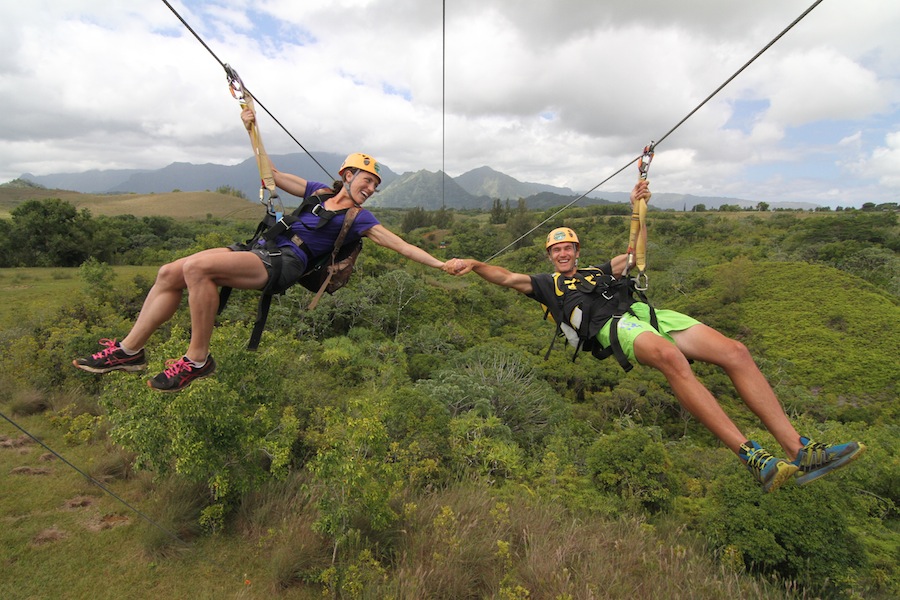
    Sarah and Sylvan Ellefson showing the love while on a zip line in Kauai, Hawaii, during their honeymoon earlier this month. The two were married Aug. 11 and spent eight days in Hawaii immediately after. (Sylvan Ellefson courtesy photo)

    Thousands of miles from the U.S. mainland on the northern island of Hawaii, Sylvan Ellefson tweeted photos from his honeymoon in Kauai. He posted the first the day after arriving with his new wife, Sarah Ellefson, formerly Wright.

    “Lounging after a casual 3hr waterfall run,” wrote Ellefson, the 25-year-old defending SuperTour champion.

    Friends and family tweeted back in retaliation. Training? They should be relaxing for crying out loud! Ellefson responded two days later.

    “She made me,” he tweeted. “All I want is another Piña Colada.”

    Sylvan and Sarah Ellefson (formerly Wright) on their honeymoon in Kauai, Hawaii. (Courtesy photo)

    Between kicking back at luaus and happy hour, riding zip lines and exploring a 4,300-acre ranch on four wheels, Ellefson and his bride enjoyed plenty of R & R on their eight-day getaway. The two were married Saturday, Aug. 11, at a lakeside ranch near his hometown in Vail, Colo., and left for Kauai the following Monday.

    Slightly more than two weeks later, Ellefson was back home resting before an interval session with his Ski and Snowboard Club Vail (SSCV) team. That morning, he ran 30 minutes, did 1 ½ hours of strength and an hour double pole.

    “It’s been a big day,” Ellefson said on the phone Monday afternoon.

    But he was ready to get back at it since arriving home a few days earlier. Once back in the U.S., the Ellefsons headed to Minnesota, where Sarah – a former University of New Hampshire skier – is from. Then they went to Boulder, where Sarah lives while studying physical therapy, to watch the USA Pro Am Cycling Challenge last weekend.

    “I’m jazzed to be moving around again,” Ellefson said. “The wedding week was pretty crazy and then the honeymoon was nice and relaxing, kind of.”

    He laughed.

    Here’s the rest of FasterSkier’s interview with Ellefson, which details everything from the wedding-day downpour to what the Colorado native and World Championships hopeful has planned for this season.

    ***

    FasterSkier: Now that you’re a husband, how do you feel?

    Sarah and Sylvan Ellefson were married Aug. 11 at Piney River Ranch near Vail, Colo. (DavidLynn Photography)

    Sylvan Ellefson: Totally different. I feel like a whole different person. No, I’m kidding. It doesn’t feel any different at all other than I’ve got this hunk of metal on my finger. I keep playing around with it, I’m sure I’m going to lose this thing here.


    FS: Tell me about the wedding. How did you decide to get married there and how did it go?

    SE: We got married at the Piney River Ranch. It’s north of Vail, half an hour by dirt road. We originally wanted to [get married] at the top of Vail Mountain, which is where my parents got married, but then Sarah’s mom came into town and I told them to go check out this one other place just to see if they wanted to do that. They went up to Piney River Ranch last August, I think it was, and checked it out and I’m pretty sure we booked it that same day that they went up there.

    Everything [the ceremony, reception, etc.] was up there. It started at four, and it was super nice when we got up there. The clouds were kind of moving around the mountains … and then right before the wedding was supposed to happen, we started the procession and everyone was outside on the wedding deck. It started raining a little bit, and then the rain started coming down pretty hard and people started opening umbrellas. All of a sudden it was a torrential downpour and then it started hailing (laughs). It was crazy. Everyone went back into the dressing rooms and everything, and we had to talk to the ranch owners to figure out what we wanted to do. We looked at the clouds coming, and it just looked like it was going to be some kind of pretty crazy weather.

    We ended up having a super-intimate wedding; it was actually really nice. We moved everybody in under the covered area. The lake that was behind us started steaming because of the contrast of the hail and the air and everything. The backdrop was really cool, and obviously I didn’t get to see it because I was looking right at Sarah and the crowd the whole time.

    Sylvan and Sarah Ellefson (center) celebrate their marriage with their wedding party at Piney River Ranch on Aug. 11 near Vail, Colo. (Courtesy photo)

    [Note: The rain stopped after the ceremony and the skis remained clear all night.]

    We did the wedding there and then everyone ate and we danced for a bunch of hours. We had a bonfire and a keg back behind the camping area, right behind where the wedding was, and we just hung out around the fire until two in the morning. It was super fun and everyone that was up there camped and then cruised down the next morning. We stayed in a cabin that was up there.

    The next morning we woke up and kind of cleaned everything up and Sarah and I rode down the dirt road back into Vail on this tandem mountain bike. It’s probably like eight or nine miles to Piney River, but it’s a really bumpy dirt road.


    FS: How was Hawaii?

    SE: We had an awesome trip. We were literally at our hotel maybe five percent of the whole time we were in Kauai. … We got in really late the first night and then the next morning we met with the concierge to kind of figure out what we wanted to do, and it was basically, like, bam, bam, bam, everything after that. Right after that we went for that three-hour run up to a waterfall. That night we went to a luau. The next morning, we went zip lining for a half day and then we found a swimming hole and chilled there for a while. We had to go hit up happy hour at the bar that afternoon, otherwise we were paying like 12 dollars per drink (laughs).

    Newlyweds Sylvan and Sarah Ellefson spent a day and a night at Kauai Ranch in Hawaii, where several movies like Tropic Thunder, Dragonfly and The Descendants, were filmed. They explored on a four-wheeler and stayed in a yurt. (Courtesy photo)

    Probably the coolest part of the whole honeymoon, though, was we went to this ranch called Kauai Ranch and it is the ranch where, like, “Tropic Thunder” and “Dragonfly” and part of “The Descendents” was filmed. We stayed at this really sweet little canvas yurt-tent. It was like this [4,300]-acre ranch and we went an explored it running one morning and then we got to use this four-wheeler vehicle, the Gator, for another five hours in the afternoon and we didn’t even cover all the trails that were on the ranch.


    FS: Did you rest at all?

    SE: Oh yeah. We probably slept, like, nine hours a night. It was nice. Leading up to the wedding it was, like, five hours, six hours, five hours, five hours.


    FS: When did you and Sarah get engaged and how did you meet?

    SE: We got engaged last July 22. We met at Carnival Crush, you know that little tradition that the East-coast skiers have on Valentine’s Day? Sarah gave me a live goldfish when we were juniors in college and it kind of just sparked after that. I think that was four and a half or five years ago. She said it was our first pet together. I didn’t know how to take that. I think she was joking, but I took her seriously, so jokes on her!

    Sylvan and Sarah Ellefson take to the dance floor at their wedding on Aug. 11 at Piney River Ranch. (Courtesy photo)


    FS: And you two recently had dinner with Kikkan?

    SE: I had no idea she was going to be in town and she texted me last Thursday night [Aug. 23], like, ‘Hey I’m in Vail. We should catch up, grab some food or something.’ And I was like, ‘Yeah, Friday night.’ It was good to see her because I haven’t seen her before we left Spring Series.


    FS: Whom have you mostly trained with this summer?

    SE: [In] May, I did the Bend camp, and then a couple weeks later we came back to Bend with the junior team and a couple post-grad students and the Bend locals, like [XC Oregon’s] Ollie Burruss and Matt Briggs were there, so I trained there for about half of June.

    When we came back I mostly trained with a lot of the junior and then the college guys that are here for the summer, like Conor Wallace and Sean Woods and Tony Ryerson. Actually [SSCV nordic director] Dan [Weiland] and [head coach] Eric [Pepper] have been getting out on the rollerskis quite often this summer so they’ve kind of been training partners as well. And then Cal Deline and Parker McDonald, Christian Shanley, all those juniors.

    [Team HomeGrown teammate] Ryan Scott was here for a week in July right before the wedding, and we had a good training week together. I just missed [U.S. Ski Team members and Homegrown teammates] Tad [Elliott] and Noah [Hoffman]. They came right after the wedding when I went to Hawaii. I think they did a bunch of skiing with the juniors here and the other college guys.


    FS: How’s training gone so far?

    Sylvan Ellefson (front) joins the Ski and Snowboard Club Vail junior team in Bend, Ore., for an on-snow camp this past spring. (Courtesy photo)

    SE: Training’s actually been really awesome this summer. I think it’s always really great to kick it off with training in Bend in that May-June period. To be on snow that early in the season is kind of exciting instead of being on rollerskis and getting in the habit for the entire summer it’s fun to be able to ski on snow. You’re still kind of used to it. And then come July, you’re just starting to pick things up. I did a lot of running races and biking races this summer and those have been going pretty well and it’s fun because we have a pretty competitive local race series for [trail] running and [mountain] biking, so I’ve been doing those.


    FS: You blogged about placing third for the first time in a pro mountain bike race in July. Was that a goal of yours?

    SE: It’s a pretty competitive race series. A lot of the guys actually do race pro and race around the U.S. and I scored a third place in one of the races. I was pretty psyched for that because I’m usually like fourth every time.

    If I train biking, it’s more like a recovery thing and if I do the bike races, it’s more of an intensity spot. For me, it’s good to keep that race vibe going to make sure I get that race feeling every now and then, and I don’t totally forget before the first race pops up at the beginning of the season.


    FS: How does your training plan this summer compare to last year?

    SE: Basically when I was over in Europe, I definitely got my butt kicked, which I think was good and bad. It kind of sucks to get your butt kicked sometimes, but it’s also a really good learning experience.

    Every time I felt like there was something I could work on, I wrote it down and sent it to Eric and Dan and we compiled a list of things to work on this summer to help me get ready for the upcoming race season. It ranged from doing more double-pole sessions to changing up our intervals a little bit, like, changing formats of races like having the preems. We’ve been doing a lot of intervals where we switch from just Level 3 and just Level 4 to doing a Level 3 piece with some Level 4 in between and then dropping back down to L3 and bringing it up again.

    I noticed in a lot of the mass-start races, you can see on TV the front of the pack is usually so calm and collected. When you’re in the front, you get in a really good rhythm. I was watching all these races I was in on the World Cup last year, seeing these guys up front it just looks like it’s so easy. What they don’t show is in the back, it’s just nuts because it’s all the people who are probably racing a couple of their first races or whatever and they’re just really stressing out, me included. They’re trying to get a good spot and it requires more energy to ski at the back of the pack, especially in the beginning of the race. Until I start skiing better, I’m not going to be at the front of the pack so I need to kind of adjust to that back-of-the-pack skiing. For me, that was being able to, maybe fresh off the bat, hold onto like a Level 2 or even a Level 4 pace and then dropping back into a threshold pace without totally going under, being able to recover from it.


    FS: How are you feeling heading into this season?

    SE: I think my confidence going into this year is much better, which will be good. I’m not going to lie, lining up when I was in Rybinsk for my first mass start, looking at the people that I was lined up next to it was like, ‘Holy crap, these are all the people that I’ve ever watched on TV and now I’m standing next to them.’ Obviously, everybody’s going to have that shock value. I think going into this year, it’s more focused for me on a result more than experience. It’s not in my head that I’m just going to be racing World Cup this year, I want to be racing fast and I want to be getting results.

    I think the first period will be good for me. What qualified me to go over to Europe last year were like 10 and 15 k skate and classic races, and I’m pretty excited to race those first races because I think there’s three 15 k’s and maybe one 10 k. I’m excited about that. I’m pretty excited with how my prologue and sprinting has been going, and then this fall, hopefully I’ll be able to ramp it up a little bit in Lake Placid and Park City and Canmore with these top-tier sprinters in the U.S., Simi and Newell.


    FS: So you’re going to take advantage of a paid-for trip to the World Cup (as the SuperTour winner) and race Period 1 in Europe and Canada? Are you worried about relying on World Cup results to qualify for World Championships, rather than stay home and qualify domestically?

    SE: I wasn’t really sure what I wanted to do. It was kind of a tactical decision because the world champs team is decided off your FIS points, but it’s kind of taking a chance. If I were to race in the U.S. and I was racing as well as I did at the beginning of last season, I would be getting good enough FIS points to bring me to World Champs. On the other hand, I would be giving up and opportunity to go race the World Cup, and I feel like that would be just a wasted opportunity.

    Dan and Eric and I all decided that it would probably be best if I just took advantage of that opportunity. Assuming that I go into the first period as fit as I was last year, then I think me on a perfect day, skiing like I would at the top of my game, would land me a top-30 result, which is something that I’m looking for in this upcoming period.

    The biggest reason that I’ve decided to go over to Europe this first period, I guess it depends on my ultimate goal. My ultimate goal is to progress U.S. skiing and kind of help the U.S. men to get to that next level. I think if I were to stay home that would be a little bit of a disservice to that.

    I’m approaching this season similar to how I approached last season. If I stick to a similar plan just upping my hours from last year, I think that technically my body should react well to it. Hopefully period one shouldn’t be smooth sailing necessarily, but it should hopefully feel good while I’m racing over there. If I’m feeling good, hopefully I’ll be getting that top-30 spot that I want.


    FS: What other goals do you have?

    SE: I would love to get a top 30 on the World Cup. One of my goals is to win a race at U.S. nationals this year and then I guess another goal is just to rank in the top five for both sprint and distance in the U.S. at the end of next season. I think now I’m ranked fourth in the sprint, somehow, and seventh for distance.

    [Note: Last year, Ellefson mostly made the top 60 in his first World Cup starts. He was third in the 15 k skate at U.S. nationals and finished the SuperTour series as the overall winner despite injuring his ankle in Sweden at the end of the season.]


    FS: Looking back at the jump you made last year, what do you attribute your success to?

    SE: I think my change in training and also it was kind of a change in confidence. The previous year, I had won two SuperTour races and just getting that feeling of winning a race is pretty cool. You know who you’re racing and you can beat them or you’re at that level, so you know you have the opportunity to bring yourself up to that next level.

    Actually at the beginning of the [season] last year, I think it was November, I kind of changed [it] up. I never really prepped for a season like I had before last year, and I basically just did more intervals than I ever had the November before. I made sure I gave my body enough time to recover before those first races in Bozeman and West Yellowstone and I seemed to benefit [he won two SuperTour races in Bozeman and was second in two of the openers in West Yellowstone].

    I’ve never skied that well early season so I was a little bit worried about U.S. nationals about how I’d be skiing there, but my body I guess … was fit and skied well. Unfortunately I got sick right after [nationals], and then went to Minnesota, skied well [he was second and third at the Minneapolis SuperTour], but got sick again after that. I was on antibiotics twice in, like, three weeks and I think it took a toll on my body before I went to Europe.

    Then I had a good experience on the World Cup, and I honestly had no idea what to expect when I cam back to the U.S. I was racing every weekend, but I wasn’t able to train that much because I still wasn’t feeling 100 percent. When I came back to Vermont and I stayed with Liz Stephen, I skied, like, once, I went on a run once and then just kind of went into Spring Series without having trained that much, but I think my body held onto a lot of that fitness from the entire winter. My only goal was I really just wanted to get that World Cup spot for the fall, and I tried to race my butt off and ended up getting that spot, which I was super psyched about.


    FS: And now you’re feeling good and the ankle is better?

    SE: It’s great. My PT here in Vail has just done wonders for me. It’s all healed up and all that good stuff now. It’s pretty exciting for me not having to worry about that anymore.


    FS: Next Monday, you wrote that you’re going back to school at Red Sandstone Elementary. What will you be doing?

    SE: I’m a teacher’s assistant at my old elementary school. I go in for about 2-3 hours everyday when I am around. 4th graders. It’s super fun!

    ***

    While Ellefson took care of business in Craftsbury, Vt., where he clinched the overall SuperTour title in late March, he also had some fun while staying at the home of his friend and U.S. Ski Team veteran, Liz Stephen. Her father helped film the following, and if you’re really into their music video, Ellefson said “The Bland” has another one coming soon.


  • Canadian National Team Wraps Up Maui Training Camp

    Canadian National Team Wraps Up Maui Training Camp

    Justin Wadsworth, head coach of the Canadian National Ski Team, made a deal with his athletes two years ago: if they collectively produced four or more World Cup podiums, he would bring them to Hawaii for a summer training camp. The team surpassed that benchmark and delivered six podiums in 2010-2011 in addition to World Championships gold.

    Off to Maui they went in June 2011 for Canada’s first camp on the islands. Wadsworth raised the bar accordingly to ten podiums in 2011-2012 for the team to earn its way back, and again his athletes outdid the standard. Every one of Canada’s World Cup skiers stood on the podium last winter for a total of 15 medals.

    As a result, Devon Kershaw, Alex Harvey, Lenny Valjas and Ivan Babikov camped (literally) in Maui again for just over two weeks this June. On Thursday, they packed up and boarded a plane back to Canmore, Alberta, to resume training on the Haig Glacier.

    The goal of the camp, like last summer, was to pack in quality volume training at high altitude, with a focus on sustained steep uphill technique. On the heels of such a successful season, Wadsworth’s goal was also to maintain motivation and momentum.

    “For us it’s about working really hard and having a lot of fun along the way,” he wrote in an email. “We need to keep the stoke high for the athletes, which means making things interesting, challenging and fun.”

    In Maui, interesting and challenging amounted to 20-25 hours of training per week and around 60,000 feet in elevation gain over the course of 14 days. “Fun,” inevitably, involved taking advantage of Maui’s legendary surf.

    It’s only July, but season-long strategy is prominent in Wadsworth’s mind. With World Championships and two Canadian World Cups on the horizon, he said their focus is definitely a little different than last winter. Competing well in Canada and Val di Fiemme will be important, but so will the Tour de Ski and planning out the season wisely around races where Wadsworth expects his team to reach the podium.

    “We as a team need to be really smart in our race choices, and how we plan the year. You can’t just go into the season and try to do it all and win every time,” Wadsworth said.

    The elevation of the Maui camp, while good preparation for any season, was also undertaken with an eye on the 2014 Olympics fewer than two years away.

    “It’s a bit tough with World Championships low this year, but … we are working on the altitude side of things leading to Sochi,” Wadsworth wrote.

    At the conclusion of the camp, he thought everyone had been skiing well and looked fit —“So I look forward to more of the same like last year.”

    There is a long offseason yet to go before the World Cup begins again in November, but Wadsworth said his team is building up to match, if not surpass, its past results. He may need to come up with new motivating camp destinations for future summers.

    “It’s great to be at a point where everyone on our World Cup team has stood on a World Cup podium, and when I say that it means Devon, Alex, Ivan, Lenny, Chandra, Peri and Dasha — everyone knows what it takes, and as a team we support each other to keep being there,” Wadsworth said.


  • Canadians Escape “Monsoon June” For Hawaii

    The Canadian National Ski Team (CNST) escaped Canada for their second training camp of the year – to the islands of Hawaii.

    “When we came out of the Haig Glacier last year, about a year ago exactly, it was pouring rain, we had been snowshoeing out for numerous hours, and people were kicking around other places to train at this time of year,” said Head Coach Justin Wadsworth in a recent interview with FasterSkier.

    Somehow Hawaii came up, and Wadsworth promised that if the team could collectively produce more than four World Cup podiums, they would have a camp on the islands.

    By the end of the season, the team had produced six, including a gold medal in the team sprint at World Championships, and in turn, Wadsworth delivered, getting them out of “monsoon June,” in Canmore, as several local athletes have nicknamed it.

    True to form, the entire time the team was in Hawaii, Canmore was rainy and cold. Wadsworth said escaping Canmore to train elsewhere had been really good, as “the athletes like it, the pavement is great, and the weather has been good.”

    For the Canadians, the main goal of the camp was to get some high-quality altitude training.

    The athletes stayed at high altitude on Mt. Halaekala, a volcano on the island of Maui, and were doing a lot of long rollerskiing and running workouts, as well as working on efficiency at high altitude.

    “We’re working on nailing the same technique for a long period of time,” said Wadsworth.

    The Canadians were able to rollerski from the town of Paia, at sea level, up to around 7,000 feet, where the park officials asked them to shelve rollerskis in favour of running or biking the rest of the way up to 10,000 feet.

    If you think the Canadians were vacationing in cushy style, think again. Gaining 10,000 vertical feet in a day is a serious workout – Wadsworth said that the long grinding uphill workouts took around four hours to complete. Additionally, the athletes were camping high on the volcano, and were put through 30-hour training weeks.

    However, Wadsworth did allow them to come down and sample some of the things Hawaii is more known for: on rest days and evenings, they managed to surf  and hit the beach.

    But they didn’t have a ton of time – over the course of the first 10 days of the camp, the team had one rest day, and “really good, really hard intensity and strength training.”

    Wadsworth described the entire team as “excited and motivated” by the new terrain and location.

    “The quality of camp that you just couldn’t get anywhere else because of the intangibles,” he said. “It’s easily one of the best camps we’ve ever had.”

    While the team usually trains at the Beckie Scott High-Performance Training Center, at the Haig Glacier just outside of Canmore, at this time of year, Wadsworth said that financially the Hawaii camp was not a major difference.

    The team reduced costs by camping, found cheap flights, and overall Wadsworth said he felt they were receiving plenty bang for their buck.

    “Our objectives were to have a high altitude training site with good rollerskiing, running, and biking,” he said, “and Hawaii was one of the only places we could have it.”

    Wadsworth also mentioned the number of professional athletes who choose Hawaii as a training location, including Canadian cyclist Ryder Hjesdal, downhill skiers Julia Mancuso and Aksel Lund Svindal, as well as plenty of elite triathletes.

    Justin Wadsworth (l) giving instructions to Lenny Valjas (r) at a CNST training camp last fall

    The entire team was present at the camp, with the notable exception of Dasha Gaiazova.

    “Dasha has been excluded from the World Cup Team training camps at this time, and is currently pursuing alternative training options,” said Wadsworth.

    “We expect to have Dasha’s training program finalized over the next couple of weeks.”

    Wadsworth declined to comment further on the situation.

    The camp wrapped up last weekend, when the team flew back to Canmore for a little time at home.

    And what is Wadsworth going to use for motivation next year?

    “I’ve told them, next year they need 10 podiums if we’re even going to consider coming back,” he said.

  • Catching Up with Quick Canadians: An Interview with Chandra Crawford and Dasha Gaiazova

    Catching Up with Quick Canadians: An Interview with Chandra Crawford and Dasha Gaiazova

    Chandra Crawford (left) and Dasha Gaiazova after their 1-2 finish in the classic sprint in Rovaniemi, Finland.

    Chandra Crawford and Dasha Gaiazova are currently the only women on the Canadian World Cup squad. But their lack of teammates hasn’t held them back so far: Crawford, a 2006 Olympic gold medalist, won the FIS sprint in Rovaniemi that weekend, and Gaiazova skied to 24th place in the World Cup sprint in Kuusamo, en route to 48th place overall in the mini-tour.

    Crawford didn’t have an excellent start to the World Cup season, but Head Coach Justin Wadsworth told FasterSkier that he wasn’t worried.

    “Where Chandra is right now, it actually hasn’t been that bad,” he said. “We knew going into this year that our focus was her training for January and February. We’ve done a lot of threshold work and working on different parts of her physiology. She knew she was going to sacrifice some of these results in the early races to be there later, because we just didn’t want to skip over some part of her physiology.”

    A couple of weeks ago, FasterSkier caught up with Crawford and Gaiazova at a coffeeshop in Rovaniemi, Finland, with a decorating style that Crawford called “garage sale chic.”

    FasterSkier: So there’s only two of you, huh?

    Crawford in Rovaniemi.

    Chandra Crawford: This is 200 percent better than some of my trips last year! [Dasha and I] have been kind of offset the last couple of years. The last time we had a good solid troupe together was a while ago. I had a big off year for injury and she had a stellar rocking year, so now we have the band back together.

    FS: Hopefully you both have a stellar rocking year this year…

    CC: Yeah, we finally synchronized!

    FS: So you just get to travel with the boys all the time – how is that?

    Dasha Gaiazova: It’s good! Everyone’s so friendly and supportive of each other. And when we have a chance to hang out with American girls we certainly do, so that’s always fun. On the World Cup, Kikkan’s great, we know where she is and when we’re in the same place we’ll get together. I think we’ll have more girls joining us later in the season for World Championships. It’s been going really well and I think it will get even better with the girls.

    CC: It puts a lot of different pressures on having such a small crew. If one of us gets sick or something happens back home, and one of us can’t come on a trip, then it’s like, boom, you’re on your own. So that’s different, the energy and the consequences.

    DG: Don’t break a leg.

    CC: No.

    FS: Do you have a separate women’s team?

    CC: We’re all one team. We have a World Cup team and a Development team, but this past year we’ve done everything together with only very microscopic differences between those two. Everyone lives in Canmore. Part of the national ski team deal is that everyone has to move to Canmore.

    Gaiazova in Rovaniemi.

    DG: The way it says it in the contract is that you commit to spending six months a year in Canmore, which basically translates to moving [if you’re in Europe in the winter]. So we’ve all been in Canmore for many years. Chandra was born there, and those who weren’t have moved there a long time ago, since their junior days. So we all train together all summer.

    CC: It’s a super centralized system. Right now we have a really strong center in Quebec, too…

    DG: They join us for camps and stuff.

    CC: …at least with the guys, which is really cool this year because it’s such an important thing in such a far-flung country like ours, that we can all work together and use each other has been amazing. I’ve been really enjoying getting to work with those guys and their coach. Everyone from Quebec is doing a great job and there are some Westerners who are living at that center, going back and forth. And that’s the way to become a successful nation – sharing the love and good people. It’s a sport that’s not big on our continent so we’ve got to do something to work together.

    FS: I know you’ve trained with Kikkan some – do you think that’s something we could be doing more, getting the two countries together?

    CC: We made a huge step this year. In the past it wasn’t really possible. Our past coach was not interested in working with the Americans. But now our coach is an American! It’s totally different. Right from the first camp he was lining us up, lining our camps up as much as possible with the American crew, which is totally amazing for us. It’s really great for the women’s side in particular.

    DG: They’re just such good girls, too.

    CC: And then we went to Park City and Kikkan decided to come to our camp! It was initially going to be a U.S. camp but then they changed it to Sun Valley, but she came with us. And then she attracted all these Alaskans.

    DG: Liz [Stephen] came…

    CC: Liz lives there, but Katie Ronsse, and Morgan Smyth showed up, all these people who were training in Alaska. So that was really cool to see all these people come to this big amazing camp.

    FS: Are you guys over here fort the rest of the winter, or will you be racing domestically at all?

    CC: Noooooooo.

    DG: We’re focusing on the sprints, so we’ll do the next three World Cups after Gaellivare, and then we’re going to go home, do some training, skip the Tour de Ski, and come back for some more sprints.

    FS: Are you ever going to do the Tour?

    DG: I’ve done the Tour once, the very first edition of the Tour, I was actually in it. I didn’t finish. But Chandra here did. She crossed the finish line.

    CC: 42nd.

    FS: Hey, finishing is pretty impressive.

    CC: It’s cool that we got to do it.

    DG: It’s definitely not in the short-term plans.

    FS: Maybe the long-term plans?

    DG: Possibly, one day, maybe.

    CC: Maybe when we’re in our thirties.

    DG: Thirties, that’s coming up pretty soon!

    CC: This right now is a good tour for me, though. Five weeks, three World Cup sprints, and having these two tune-up races [in Beitostoelen and Rovaniemi] is for me essential, because I haven’t gotten to race much in the last couple years, so it’s good to get some stepping stones on the way to the World Cup.

    DG: Forget the last couple years, even just after the summer! After taking six months off, it’s like, I forget how to do this!

    FS: How do you feel about the upcoming World Cups?

    DG: We hope to do really, really, really well. That’s the plan.

    CC: We need to get a top-20 to qualify for World Championships, to be prequalified. So that might not seem like a real impressive goal, but it’s nice to have something realistic to focus on, and if we both get it by Davos, we’re going to go alpine skiing for half a day and treat ourselves.

    DG: We’ll celebrate!

    CC: Similarly our team has a really hilarious little bet going with Justin where if we get some criteria, like we have five podiums this winter, or if we get a medal at World Championships, and a couple of podiums, there’s a couple different combinations, if we do that, then we can have a training camp in Hawaii in the spring.

    FS: Wow, that sounds nice! Good luck!

    CC: We have our incentives and that’s what we’re working towards.

    FS: Was that your idea or his idea?

    CC: I think he threw it out there in one of our team meetings.

    DG: I think there was some talk going about having a training camp in Hawaii. And one talk led to another, to the goals, and it was like, hey, well, if you achieve certain standards, then we’ll reward you with a Hawaii camp.

    FS: Would you bring your skis?

    DG: No.

    CC: We’d bring rollerskis. We’d rollerski the volcano.

    DG: It would be fun to rollerski.

    FS: You don’t want to do any sand skiing?

    DG: I’ve done it before. It’s so hard! You can’t even last for half an hour. So rollerskiing up the volcano road will be great.

    FS: It seems like you guys are psyched to have Justin working with you this year. How does his approach differ from what you had before?

    CC: Well, we’ve had a new coach every year for four years.

    DG: Five!

    CC: So it’s been an amazing time to learn about different coaching styles. That’s the positive, I guess. But we’ve got something really solid in place now, he’s really committed. He’s got a place in Canmore and his kids are going to school in Canmore, so I think he’s going to last. It’s amazing to have that chance, to start a new year and go “well, how did last year work?” instead of just a whole new can of worms. That alone is going to be useful, building something up. It’s great having a coach with that much experience as a racer himself, and being married to Beckie [Scott] and having all that success to draw on.

    FS: Does Beckie hang out with you guys?

    DG: She comes…. it’s really cool to see her. You know, she just had a daughter. Once in a while she’d come for the workouts with us. Just having here there is like, wow, this is awesome. So for sure she makes appearances. She appears at the right moment. It’s been really cool to have her, and Justin also, share some bits and pieces from Beckie’s training and how she approached things.

    CC: I feel like he has this ace in his back pocket, which he can play at any time. If you start a sentence with Beckie did, dot dot dot… instantly, we’re so calm. Oh, Beckie did this, and then she won. Oh, Beckie did this and then this happened. Oh, Beckie had a hard time with this and it’s like “yessss!” It’s such a strong, powerful anecdote to zing out at us.

    DG: It’s kind of ironic, I feel, that we had to get Justin lured away from the American team to have Beckie back. She’s been racing for, I don’t know, a decade, probably more, for the Canadian team, and I’ve never had a ski trip with her, ever. I’ve never had a race trip with Beckie in my life. And now that Justin’s coaching us, I can hang out with her!

    CC: We were just on that edge, being nine years younger than her.

    FS: It seems like there were so many Canadian women, and now it’s just the two of you. Is it just a generational thing? It seems like Beckie would have inspired more women to ski.

    CC: We noticed that, in about 2005. Like, we love Beckie and Sara Renner and Milaine Theriault, but who are we going to pass the torch to when we’re older and faster? Just kidding girls, forever young.

    That’s how Fast and Female started, we were like, where are the juniors? And there’s a good group now, and amazing group I’d say at the World Cup Academy, a group of ten girls. I think one of the most important things is to have minimum team sizes because that gives hope to the next crew. If you send two women or no women on a trip, or you name a training center with 15 guys and one girl, the young girls looking up and aspiring to try to make that team are immediately going to shut down, because it’s not realistic, so I think that’s important. I know it’s painful for people to take the third girl instead of the twelfth guy, if that guy is really fast, but I think that’s important.

    DG: And there are girls, like you said, at the Academy that are really really bright. I think it is a bit of a generational thing. There’s us and then there’s lots of developing girls, and nobody just knocking on our door. But there will be more girls. Chandra is working really really hard on that one. That’s her other job.

    CC: Aw, thanks. I do really care about it.

    Coming up later on FasterSkier: Part Two, or, How Fast and Female is moving into a brave post-Olympic World.