From the FasterSkier archive — posts syndicated from athletes’ and coaches’ own blogs between 2004 and 2012, kept online as published. Current coverage is at fasterskier.com.

Tag: Hayley Wickenheiser

  • Five Questions for President Bach and the IOC Executive Board (Editorial)

    Five Questions for President Bach and the IOC Executive Board (Editorial)

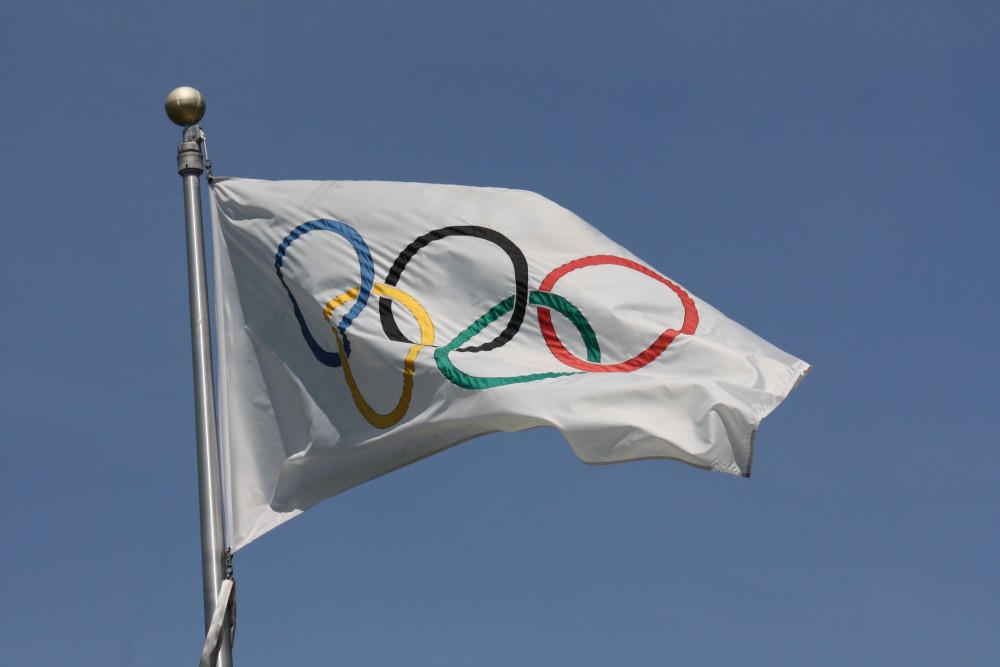
    The Olympic flag will fly at the upcoming 2016 Summer Olympics in Rio de Janiero, Brazil, next month but what message is its governing body, the International Olympic Committee, sending in its most recent decision regarding Russia? (Photo: Wikimedia Commons)
    Early next month, the Olympic flag will fly at the upcoming 2016 Summer Olympics in Rio de Janiero, Brazil, but what message is its governing body, the International Olympic Committee, sending in its most recent decision regarding Russia? (Photo: Wikimedia Commons)

    Note: The following is an editorial from FasterSkier’s editorial board, consisting of its editors, and is not meant to reflect the opinions of our broader staff.

    ***

    On Sunday, the International Olympic Committee (IOC) Executive Board decided against an all-out ban on Russian athletes at the 2016 Summer Olympics, which start Aug. 5 in Rio de Janeiro, Brazil.

    Instead, the IOC asked each individual sports federation (IF) to do a rigorous review of the Russian entries for Rio and determine whether they have undergone sufficient drug testing to be deemed “clean” and cleared to compete.

    The IFs have been left just 12 days and no guidance for how to do this.

    The decision was the culmination of a long process – just how long depends on who you ask.

    Perhaps the process began in 2010, when whistleblower Vitaly Stepanov initially contacted the World Anti-Doping Agency (WADA) with information about systematic doping in Russia.

    Or perhaps the process began in December 2014, when German documentarian Hajo Seppelt finally broadcast Stepanov’s information to the public on ARD. It was quickly seen around the world.

    Later, WADA commissioned several independent reports, the first of which revealed extensive systematic doping in track and field. The first report, led by former WADA President Dick Pound, dropped in November 2015. Maybe the process began then.

    Or maybe things only got going in the last week. The last of those reports was published last Monday. Professor Richard McLaren’s report showed government-organized manipulation of anti-doping efforts in Russia, including at the 2014 Olympics in Sochi.

    After that, the IOC had to act. The report led to even stronger calls for a complete ban on Russian athletes in Rio, and also at the next Winter Olympics in 2018 in PyeongChang, South Korea.

    Instead of enacting such a ban, the IOC Executive Board delivered a confusing, unclear decision where Russian athletes may participate after meeting supposedly stringent criteria which are not defined; where Russians with past doping violations are treated differently than those from other countries; and where Russian athletes in different sports may be treated completely differently from one another.

    The result will be neither fair to clean athletes who were affected by the Russian government’s manipulation of hundreds of positive doping samples over the last five years, nor to Russian athletes themselves.

    Some have noticed. Canadian biathlete and two-time Olympian Brendan Green was one of many sharing this image:

    Screen Shot 2016-07-25 at 4.04.14 PM

    With this in mind, here are some questions for IOC President Thomas Bach and his Executive Board.

    1) Do you listen to athletes? 

    A group of influential athlete representatives held a press conference after McLaren’s last Monday. Among them were Canadian cross-country skier Beckie Scott, the chair of the WADA Athlete Committee, and IOC Athletes’ Commission chair Adam Pengilly.

    The group advocated for an unequivocal ban on Russian athletes in both Rio and PyeongChang. Before the McLaren report had even dropped, Pengilly explained, they had circulated a letter stating those aims. The letter was endorsed by athlete representatives from more than 20 different sports federations. Clearly, there was widespread support for such a position.

    After the McLaren report came out, that position was solidified.

    “We would like to highlight our belief that WADA must allow Professor McLaren and his team to continue their investigation, that Russia should be banned from the Rio Olympics, Paralympics, and other international events, and that International Federations must enact sanctions so as to protect clean sport,” the WADA Athlete Committee said in a statement.

    It has been clear for quite some time that the Olympics are not about the needs or wishes of the athletes, but that was underlined by the Executive Board’s decision.

    “I believe that the Russian federation has mocked the Olympic movement and I worry about the future of clean sport, I worry about the future for clean athletes, the Olympic movement and the Olympic Games,” Pengilly said told the BBC, where he later said he was “embarrassed” by the Executive Board’s decision. “Some have suggested the IOC has passed the buck and I’d have to agree. There’s been an abdication of responsibility here.”

    Fellow IOC Athletes’ Commission member Hayley Wickenheiser, the Canadian four-time gold medalist in ice hockey, had this to say:

    Screen Shot 2016-07-25 at 3.19.43 PM

    2) Do you listen to WADA?

    For years – literally – WADA obfuscated, ignored whistleblowers and failed to take action when provided with compelling evidence of doping in Russia.

    But in the last few weeks, it appeared that WADA had grown a backbone. After the McLaren report was delivered, the WADA Executive Committee published a list of seven recommendations.

    The very first one: “The International Olympic Committee (IOC) and the International Paralympic Committee (IPC) to consider, under their respective Charters, to decline entries, for Rio 2016, of all athletes submitted by the Russian Olympic Committee (ROC) and the Russian Paralympic Committee.”

    WADA also suggested that Russian government officials be banned from attending Rio.

    That might be the main recommendation that the IOC actually upheld: in their decision they wrote that “Nobody implicated [in the McLaren report], be it an athlete, an official, or an NF, may be accepted for entry or accreditation for the Olympic Games.”

    In the McLaren report, Russian Minister of Sport Vitaly Mutko is named as having interfered with at least one positive doping case. Russian President Vladimir Putin’s name is mentioned in the report as having personally appointed a Deputy Minister of Sport who helped hide positive tests.

    Will either be banned from Rio? Is that under the purview of any international federation, or only the IOC? Will President Bach sign deny those credentials himself?

    Otherwise, WADA – a body which is partially funded by the IOC, but did not have the power to enact a ban on Russian athletes itself – was left in the cold.

    “WADA is disappointed that the IOC did not heed WADA’s Executive Committee recommendations that were based on the outcomes of the McLaren Investigation and would have ensured a straight-forward, strong and harmonized approach,” said WADA President Sir Craig Reedie. “The McLaren Report exposed, beyond a reasonable doubt, a state-run doping program in Russia that seriously undermines the principles of clean sport embodied within the World Anti-Doping Code.”

    3) What do you mean by “reliable adequate international tests”?

    The IOC clearly wanted the process to approve Russian athletes for the Rio Games to be onerous, or at least to seem that way.

    Darya Krishna will be the only Russian track and field athlete competing in Rio. The IAAF cleared her because she lives in Florida and has thus been outside the Russian system. Other federations have clearly not been so strict in making their decisions. (Photo: Wikimedia Commons)
    Long jumper Darya Klishina will be the only Russian track and field athlete competing in Rio this August. The IAAF cleared her because she lives in Florida and has thus been outside the Russian system. Other federations have clearly not been so strict in making their decisions. (Photo: Wikimedia Commons)

    “Under these exceptional circumstances, Russian athletes in any of the 28 Olympic summer sports have to assume the consequences of what amounts to a collective responsibility in order to protect the credibility of the Olympic competitions, and the “presumption of innocence” cannot be applied to them,” the IOC wrote in the preamble to its decision.

    And so the board mandated that all athletes be subjected to review by their relevant IFs.

    “The absence of a positive national anti-doping test cannot be considered sufficient by the IFs….The IFs should carry out an individual analysis of each athlete’s anti-doping record, taking into account only reliable adequate international tests, and the specificities of the athlete’s sport and its rules, in order to ensure a level playing field.”

    Yet there is no definition of reliable – which testing agencies does this include? And there is no definition of adequate – how many tests, over what period of time?

    Russian Olympic Committee member Alexander Zhukov was invited to give a presentation to the IOC Executive Board. In it, he asserted that since the first WADA report Russian athletes have been repeatedly tested by international anti-doping agencies and, according to the IOC press release, “the vast majority of the results were negative.”

    Yet, the main agency tasked with these tests, UK Antidoping, reported via WADA in June that 16 percent of scheduled tests could not be collected from athletes; a further 736 tests were canceled or declined; and that doping control officers were sometimes harassed and intimidated when they tried to collect samples.

    Is this international testing reliable and adequate?

    4) Is this fair to Russian athletes?

    Without a definition of what constitutes reliable and adequate testing, outcomes for various sports are already vastly different.

    The International Association of Athletics Federations (IAAF) has banned all but two Russian track and field athletes from the Games. (The IOC went on to actually kick out one of those two, Yuliya Stepanova, a whistleblower who helped bring the entire scandal to light. Nice.)

    Meanwhile, the International Tennis Federation took only about an hour to apply the IOC’s supposedly rigorous standards and decide that all seven Russians set to compete in the Olympics were just fine. On Monday World Archery approved three. Neither of those sports were referenced in the McLaren report. Triathlon, where four positive samples were “disappeared”, announced that Russia will still be able to enter a full quota of six athletes in Rio; only four other countries were even able to qualify the maximum number of athletes.

    Somewhere in the middle are FINA, the International Swimming Federation, which has kicked seven Russians off of its qualification lists, and the International Federation of Gymnastics, which vowed to carefully follow the IOC’s guidelines in approving athletes for competition.

    In the past weeks Bach has talked extensively about the need to balance collective punishment for government action against individual justice. He has said that clean Russian athletes who had nothing to do with the scandal should not be punished. But it seems clear now that in some sports they will be, whereas in other sports they will not (or their doping teammates might even be able to compete alongside, or instead of, them).

    5) Is this what zero tolerance means?

    One of the IOC guidelines states that any Russian athlete who has served a doping ban cannot compete in Rio.

    One can almost see the logic: with many tests manipulated, the chances are higher that those athletes could have had a second positive test. If true, this should have led to a second and potentially longer ban which they would still be serving.

    But maybe not — what if they did reform and are now clean? The provision sends an extremely confusing message: past dopers from some countries are allowed a second chance, but there’s no redemption if you’re from Russia. How is that zero tolerance, much less fair?

    When Justin Gatlin and Tyson Gay (American sprinters previously banned for doping) likely medal in the men’s 100 meters, how will a Russian track and field athlete feel? Probably that it’s absolutely fine to dope – as long as you’re not from Russia.

    Zhukov has said that Russia will not appeal this provision to the Court of Arbitration for Sport (CAS), which is lucky, because it would almost certainly not stand up. Not only does it represent a double standard, but a 2011 ruling in advance of the 2012 Olympics already made it clear that athletes who have already served their doping bans cannot be banned from the Olympics.

    So, President Bach and the Executive Board, whose advice were you following?

  • FS Podcast: The McLaren Report and Beyond

    FS Podcast: The McLaren Report and Beyond

    mclaren report podcast


    A busy, busy week on the anti-doping front. The big news for cross-country fans was the hit Norway’s reigning World Cup champion Martin Johnsrud Sundby took regarding his asthma-medication use two seasons ago. But casting an even bigger net — one that has implications for global sport and Russia in the both short and long term — was the McLaren report released Monday morning. (You can find the full McLaren report here).

    In this podcast episode, FS takes a shallow dive into the report, illuminates the thoughts of athletes on both the World Anti-Doping Agency (WADA) Athlete Commission and International Olympic Committee (IOC) Athlete’s Commission, and seeks some answers from FS Editor-At-Large Chelsea Little. Yup, there’s a lot in there.

    You’ll hear from Richard McLaren, WADA’s independent counsel/investigator, Beckie Scott (Canada) chair of WADA’s athlete committee; Adam Pengilly (United Kingdom) of the IOC athletes’ commission for skeleton/bobsleigh, Hayley Wickenheiser (Canada) of the IOC athletes’ commission for ice hockey, and Ben Sandford (New Zealand) of the WADA athletes’ commission for skeleton.

    Note: The interview with Little was recorded Thursday before the International Biathlon Union (IBU) responded to the McLaren report with a press release on Friday.

    Press play (the arrow) to listen to the episode.

  • IOC Membership and Regulations Combined to Reliably Hand Beijing 2022 Games

    IOC Membership and Regulations Combined to Reliably Hand Beijing 2022 Games

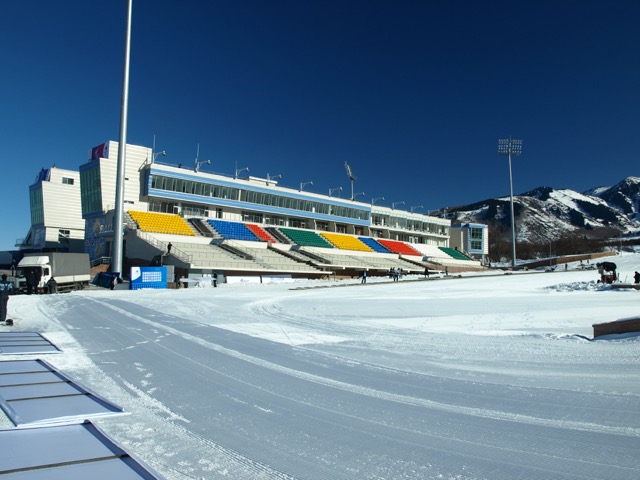
    The Soldatskoe nordic venue, which would have hosted competitions had Almaty, Kazakhstan, won their bid for the 2022 Olympics. Unlike the city venue which hosted 2015 FIS World Junior and U23 Championships, Soldatskoe, here before the 2011 Asian Games, has lots of snow. (Photo: Matt Pauli)
    The Soldatskoe nordic venue, which would have hosted competitions had Almaty, Kazakhstan, won their bid for the 2022 Olympics. Unlike the city venue which hosted 2015 FIS World Junior and U23 Championships, Soldatskoe, here before the 2011 Asian Games, has lots of snow. (Photo: Matt Pauli)

    When Beijing won the bid for the 2022 Winter Olympics, some sports fans cheered, remembering happy memories of the 2008 Summer Olympics and smiling with certainty that China would deliver a Games.

    Others raged and lamented, since Beijing is hardly known for its winter sports culture. The other candidate, Almaty, Kazakhstan, offered a ready-made winter experience with mountains and snow all packed in close to the city center.

    What was clear was that it was not one of the most exciting or hyped-up host city elections in IOC history. Many people – fans and IOC members alike – weren’t particularly excited about either bid.

    That was summed up by the fact that one IOC member abstained from voting: he or she traveled all the way to Kuala Lumpur, Malaysia, for the 128th IOC Session and then presumably decided, you know what, I don’t really care.

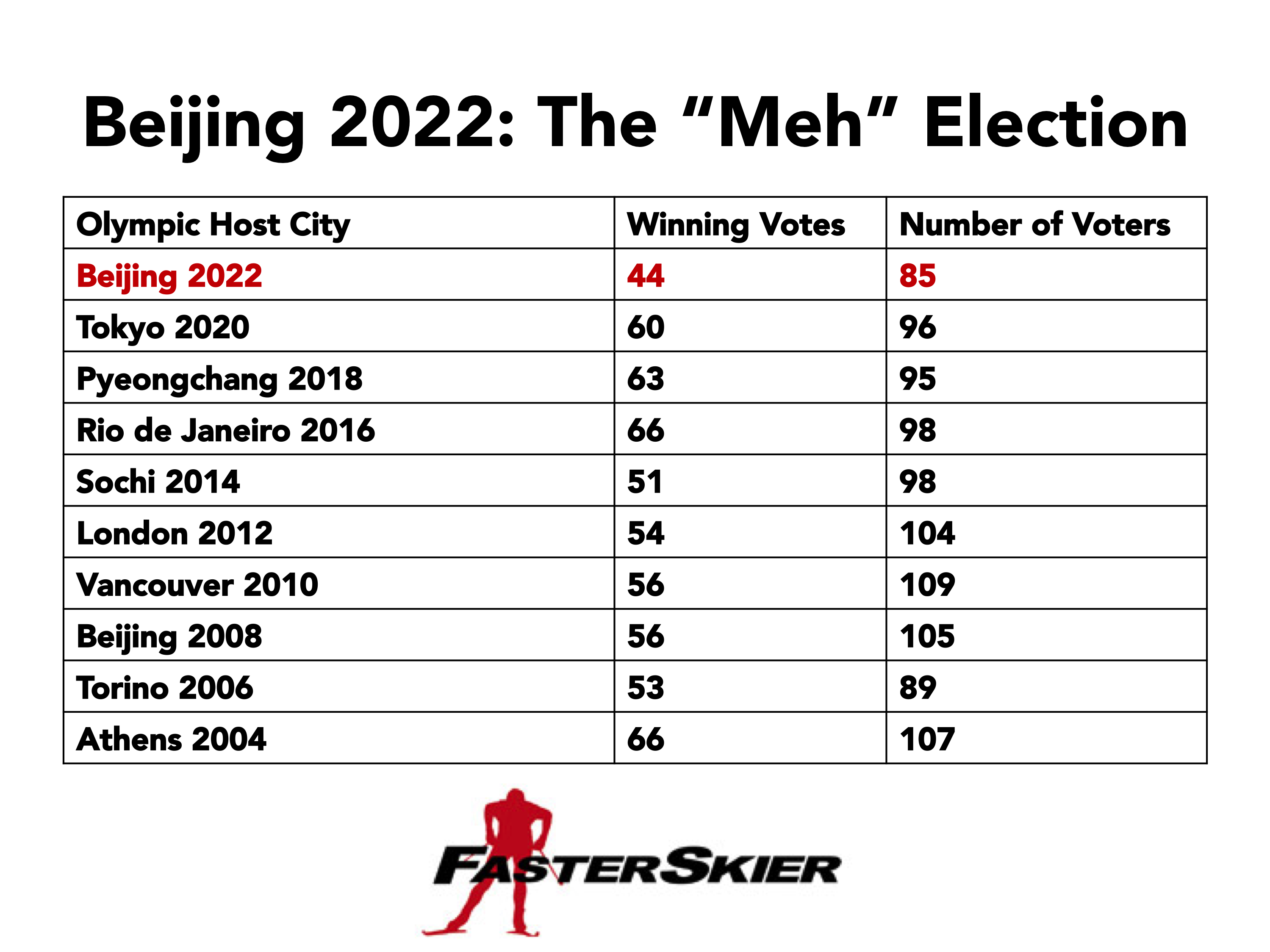
    And it was reflected in the fact that Beijing won with just 44 votes from IOC members, the least votes received by a winning bid in the last two decades.

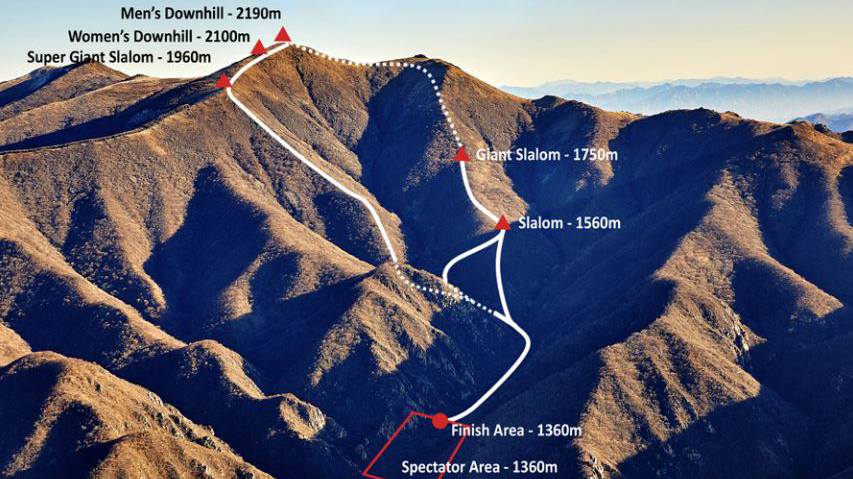
    Meanwhile, this is what the alpine venues an hour outside of Beijing looked like in January 2015, according to the IOC Evaluation Commission.
    In comparison, this is what the alpine venues an hour outside of Beijing looked like in January 2015, according to the IOC Evaluation Commission.

    Not since 1993, when Sydney was elected host of the 2000 Summer Olympics, has a winning bid received less than 50 votes. And more recently, most have received many more: 60 for Tokyo to win the 2020 Summer Games, 63 for PyeongChang to win the 2018 Games, and 66 for Rio de Janeiro to win the 2016 Games.

    Close margins, on the other hand, are not so rare. Sochi 2014 and London 2012 each won by four votes, just like Beijing 2022, while Vancouver 2010 had only three votes more than its rival, PyeongChang.

    Part of the reason that the tally was so low is simply that there were fewer IOC members to vote. The IOC has a maximum of 115 members, but there are currently only 100. Election of new members is on the docket for the IOC session in Kuala Lumpur.

    Of those 100 current members, just 85 were present to vote. The president does not vote unless needed for a tiebreak, while members from a bid country cannot vote in host city elections, which ruled out China’s three members.

    Eleven more IOC members were “excused”, meaning that they did not come to the session in Kuala Lumpur at all.

    By contrast, in the last decade between 95 and 109 IOC members have voted in all previous host city elections.

    Beijing infographic 2

    Winter Athlete Reps Did Not Vote

    Among the excused members were two of the most recently-elected IOC members, and the only two who competed at the last winter Olympics.

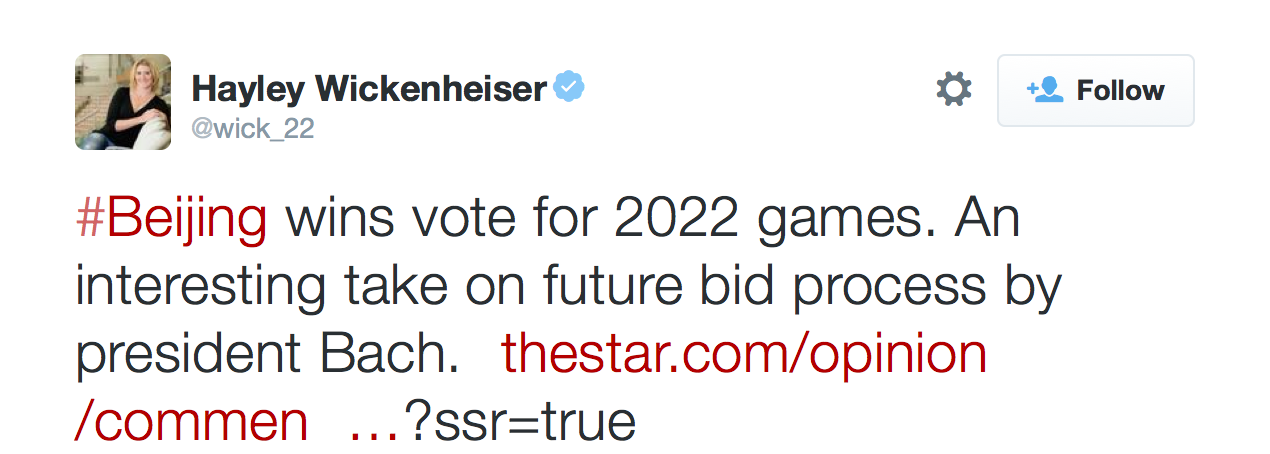
    Canada’s Hayley Wickenheiser, a hockey player who appeared in five Olympic Games, did not go to Kuala Lumpur. Instead she tweeted about the result.

    Screen Shot 2015-08-01 at 2.49.44 PM

    Yes, an interesting take… on an election that she could have taken part in. No reason for her absence was announced. She also did not attend the Candidate City presentations in Lausanne, Switzerland, in June.

    Ole Einar Bjørndalen, the most successful winter Olympian of all time, also did not attend, citing the need to train for the upcoming World Cup season. The biathlete told Norwegian newspaper VG that he had discussed his absence with IOC President Thomas Bach.

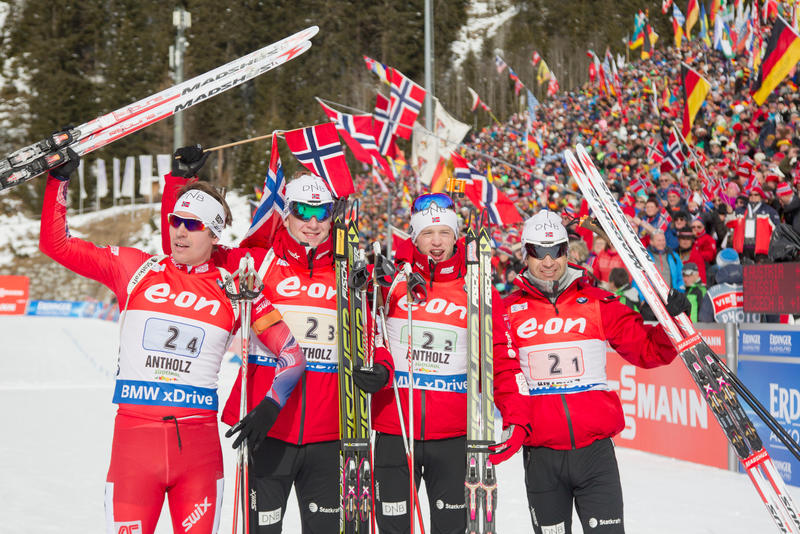
    The Norwegian men including Ole Einar Bjørndalen (right) celebrate after winning the 7.5 k team relay in Antholz, Italy, in January 2015. (Photo: IBU/ChristianManzoni)
    The Norwegian men including Ole Einar Bjørndalen (right) celebrate after winning the 7.5 k team relay in Antholz, Italy, in January 2015. (Photo: IBU/ChristianManzoni)

    “In agreement with the IOC President and the head of the IOC’s Athletes’ Commission I’m not going to attend the congress in Kuala Lumpur where Olympic organizers for 2022 will be selected,” he said. “However, I have given my professional input to the Executive Committees in discussions beforehand.”

    Bjørndalen also skipped the Candidate City presentations in June, as well as the previous IOC session in December (which was during the 2015 World Cup season; he had already notched three top-tens in the first week of racing).

    He told VG that he had gotten approval from both Bach and Claudia Bokel, the chair of the Athletes’ Commission, to focus on his career until April. The 41-year-old plans to retire after 2016 World Championships, which will be contested on his home turf in Oslo.

    But at the moment, Bjørndalen also skipped the Blink summer ski festival in Norway, citing illness. He reportedly caught a respiratory bacterial infection.

    Regardless of the reasons, it’s unfortunate that Bjørndalen and Wickenheiser could not attend the session and vote. They are the two IOC members with the most recent winter Olympic experience.

    And, more than that, they competed at the Sochi Olympics – the very Games that the IOC is trying to leave far, far behind them with their Agenda 2020 reforms. The $51 billion price tag is something the IOC does not want to see as a precedent, and Bjørndalen and Wickenheiser are the only two IOC members to directly experience what that massive budget gave, or did not give, to the athletes.

    It would seem that their opinions could have been informed, valuable, and from a unique perspective. Not only did they miss the vote, but by excusing themselves from the last two IOC sessions they also missed the chance to talk directly with other IOC members.

    One might reasonably think that the IOC has little motivation to give more say to athletes, when the athletes elected to IOC membership do not attend IOC sessions or vote on important decisions – which is a pity, because the majority of athletes likely want more input and transparency in the way the biggest competitions of their careers are organized.

    Lack of Visits to Bid Cities

    Another problem is that after the 2002 Salt Lake City bidding scandal, IOC members are no longer allowed to visit bid cities.

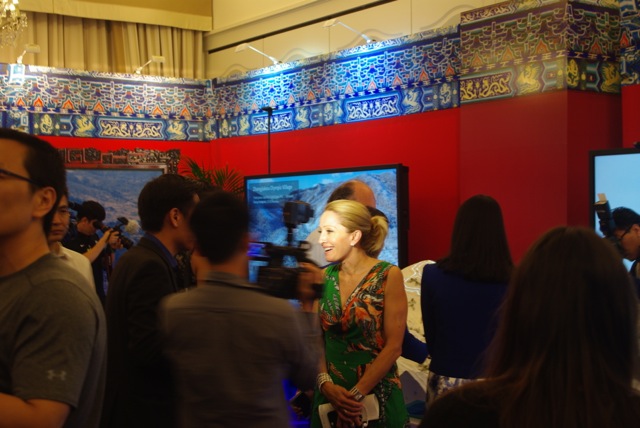
    Without being able to visit bid cities, IOC members must rely on other information to make their decisions. At the 2022 Candidate City presentations in Lausanne, Switzerland, in June, the Beijing room was both more attractive, and more packed.
    Without being able to visit bid cities, IOC members must rely on other information to make their decisions. At the 2022 Candidate City presentations in Lausanne, Switzerland, in June, the Beijing room was both more attractive, and more packed.

    That was because before 2002, several IOC members had to resign after it was revealed that they had received special treatment from the organizing committee in an attempt to earn votes.

    The change in policy likely helped clean up some corruption in the IOC. But it creates problems for IOC members trying to decide where the Olympics should be held: all they have to base their decision on is what they have read and seen, be it from the IOC’s own Evaluation Commission or from the media.

    This would be bad enough if the playing field was equal, that is if no IOC members had ever visited any of the bid cities on their own.

    But the field is far from equal. In the 2022 race, Beijing had the advantage of hosting the 2008 Olympics, meaning that almost all of the IOC members had been there. By contrast, they weren’t allowed to get the same feel for Almaty.

    And even outside of sports situations, members were much more likely to have traveled to Beijing for business or leisure than they were to have seen Almaty.

    That may change soon. Kazakhstan in 2012 became one of the 50 largest economies in the world. And buoyed by oil and natural gas production – the country is the third-largest non-OPEC supplier of energy to the European Union – Kazakhstan is aiming much higher by 2050.

    But the fact remains, at this point, most people have not been to Almaty.

    One group that has? The few journalists allowed to officially visit the two host city bid sites.

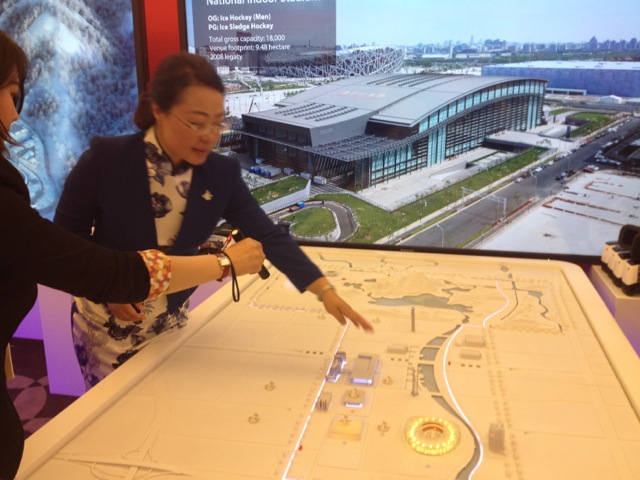
    In the Beijing presentation room, the big committee was on hand to demonstrate through dioramas the vision of Games infrastructure. Is this the same as being able to see proposed sites in person?
    In the Beijing presentation room, the big committee was on hand to demonstrate through dioramas the vision of Games infrastructure. Is this the same as being able to see proposed sites in person?

    Robert Livingstone of GamesBids.com wrote that he was pleasantly surprised by Almaty, and that most of the lines touted by the bid committee that he had assumed were just PR exaggerations turned out to be true.

    The opposite was the case in Beijing: when he visited in March, the time the Paralympic Games will be hosted, there was no snow in the mountains and the ski resorts were already closed for the season.

    After the vote, Livingstone wrote, “Arguably I was in a much better position to cast a vote in the host city election than most of the members, but of course it doesn’t work that way… Shouldn’t the members experience the city and the facilities as they will expect the athletes to, especially if they want to verify the quality of the athlete experience? If IOC members shared my on-site experiences do you think at least two of them may have changed their votes to Almaty? I’m certain that would have been the case.”

    Another illustration of the importance of site visits is how the Evaluation Commission members themselves voted: eight of the nine members preferred Almaty, according to Inside The Games.

    But despite their reporting, the Evaluation Commission could not convince IOC members to reach the same conclusion.

    Who is Voting?

    So who are the people who are voting and, to some extent, ignoring the advice of the IOC commission which inspects potential host cities?

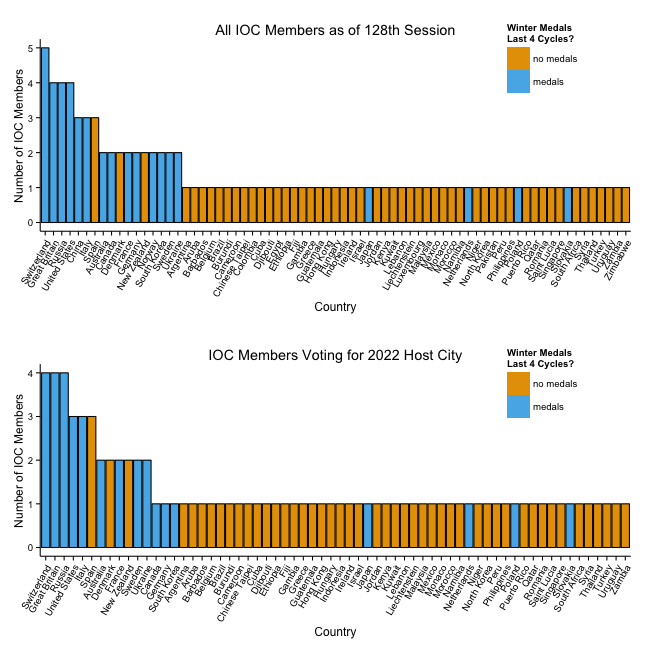
    More than half of the members come from countries which have not won a winter Olympic medal in the last four cycles. And many countries which are successful at the winter Games – for example, Austria, the Czech Republic, Belarus, Finland, and Slovenia – have no IOC members at all.

    Ten of the fifteen members who did not vote came from countries with strong winter sports programs. For example, not only did Bjørndalen not vote, but neither did the other Norwegian IOC member, Gerhard Heiberg, who led the 1994 Lillehammer Olympic Organizing Committee.

    That meant that of the voting members left, 59% came from countries without a strong winter sports program.

    countries

    In terms of sports, some members are former international or Olympic athletes themselves, and others are longtime administrators, officials, and financiers of sport – or just businesspeople or royalty with an interest in sport.

    Of those with a discernible sporting background, either as an athlete or as an administrator of a specific sport before they went on to organize national Olympic committees or international federations, just nine worked in winter sport. The rest come from a summer sports background.

    And for snow sports, the number is even more grim. Of the 98 medal events in the 2014 Olympics, 61 were held on snow: biathlon, nordic sports, alpine skiing, freestyle skiing, and snowboarding.

    That’s 62%.

    But of the 100 current IOC members only Bjørndalen and Gian Franco Kasper, the head of the International Ski Federation, come from a ski background either as an athlete or an administrator.

    That’s 2%.

    It’s not to say that IOC members without a winter sports background are incapable of making decisions about where to host a winter Games. There are many factors which are common between all Olympics: financing, culture, convenience of venue layout, security that the Games will be delivered.

    Beijing was an expert in some of those, for instance the economic backing of the Chinese government. And a lack of snow was not its only shortcoming in the bid process. For instance, the venues in Almaty were much closer together, a factor which reportedly swayed some voters. Easy access and having venues integrated to the city culture should be a focal concern when organizing a Games.

    But with no winter sports experience, perhaps it’s easier for voters from a hot country to line up their priorities in terms of financing and the lucrative marketability of China’s enormous consumer base. These voters might not appreciate the extent to which skiers and snowboarders prefer real snow to the manufactured stuff.

    Or, perhaps more importantly to the IOC, how competitions in a real mountain atmosphere are nicer to watch on television. Or how in some disciplines, an abundance of natural snow is much safer for competition than a combination of manmade slush and salted-up ice.

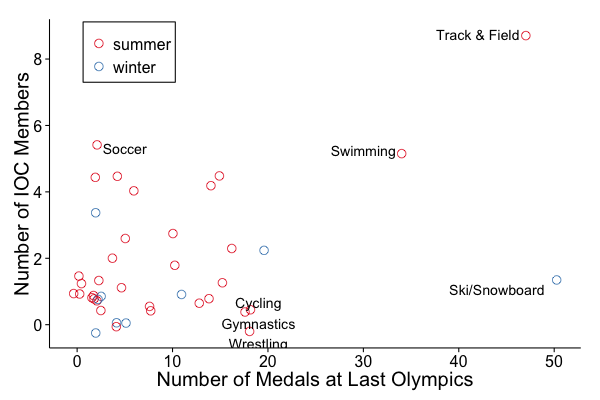
    Meanwhile, the trend of IOC membership being generally out of balance with the number of medals awarded by sport isn’t just a winter sports problem. It persists when summer sports are added to the mix, too.

    sports

    And that’s not to say that IOC membership should track a country’s Olympic success. After all, the goal of the Olympic movement is inclusion and harmony, not domination by the likes of Russia, China, and the United States. Diversity is a good thing.

    It’s also not to say that IOC membership should tightly track sports popularity. If nothing else, that would stifle creativity, continue to cut opportunities for smaller sports, and be difficult to adjust to as the Olympic sport lineup continually changes.

    Members have far more to offer than simply their cultural or sports background. Financial or broadcast skills are certainly valuable to the IOC; so are perspectives on diversity and global challenges.

    But it can’t help feeling like those most affected by the negative aspects of the Beijing 2022 bid were not represented at the table when it came time to vote. The skiers and sliders who will be competing far outside Beijing, potentially to empty stadiums on manmade ice amongst brown hills, weren’t there. Nor were some countries with expertise in those events.

    There are 15 spots open for new IOC members: how will they be filled? Only time will tell.