From the FasterSkier archive — posts syndicated from athletes’ and coaches’ own blogs between 2004 and 2012, kept online as published. Current coverage is at fasterskier.com.
As Birkie Fever is fully here with the 2020 race starting in just eight days, Hayward’s Steve Morales brings us back to the early days of the race and the beginning of New Moon Ski and Bike Shop.
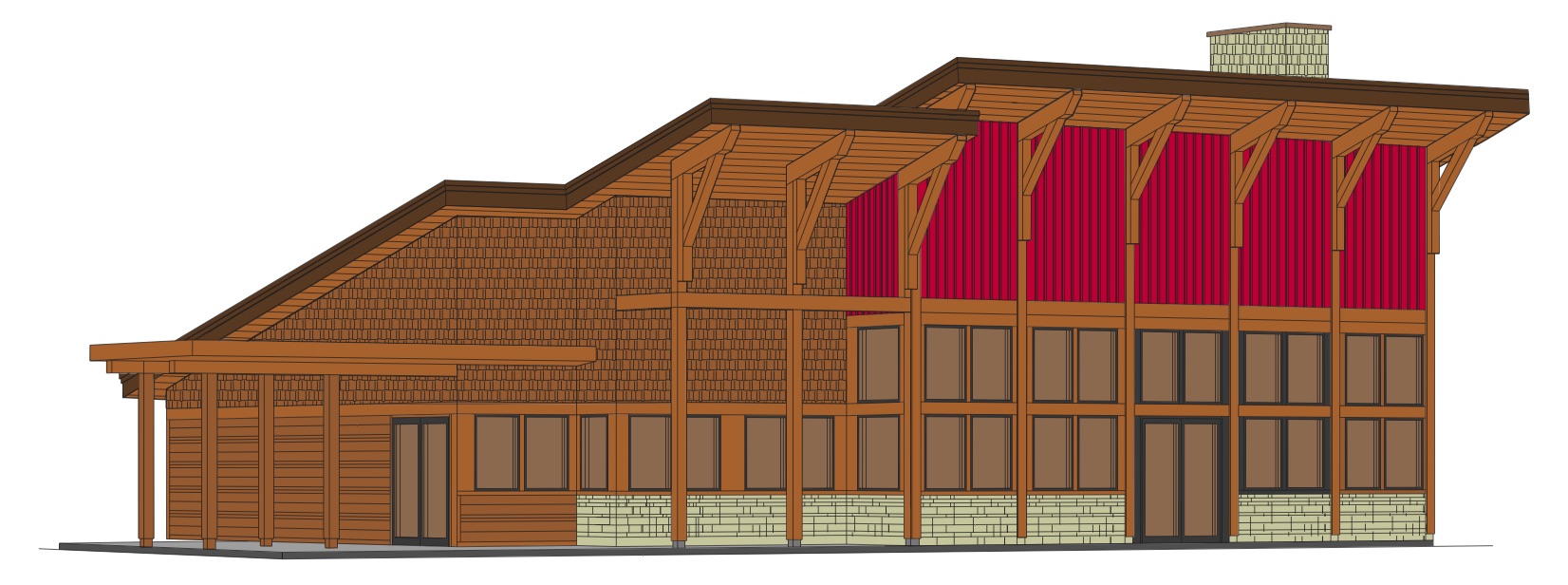
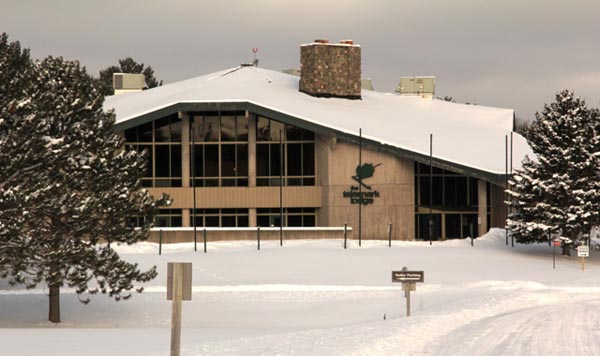
Rendering of the new Samuel C. Johnson Family Outdoor Center at the halfway point of the Birkie Trail near Seeley, Wis. (Photo: ABSF)
(Press release)
2500 Donors from 37 states & Canada Help ABSF to Reach Capital Campaign Goals
Hayward, WI (May 25, 2018) — The American Birkebeiner Ski Foundation (ABSF) has been enhancing the quality of lives for nearly half a century. For generations, ABSF events and the award-winning Birkie Trail system have been motivating adventurous spirits to embrace an active, outdoor lifestyle. In support of providing the infrastructure, spaces, and places to keep that spirit alive, the ABSF is pleased to announce completion of the second and final phase of their Honoring the Legacy – Ensuring the Future capital campaign.The resulting initiatives will change the face of the Birkie Trail for participants, volunteers, visitors, and surrounding communities for years to come.
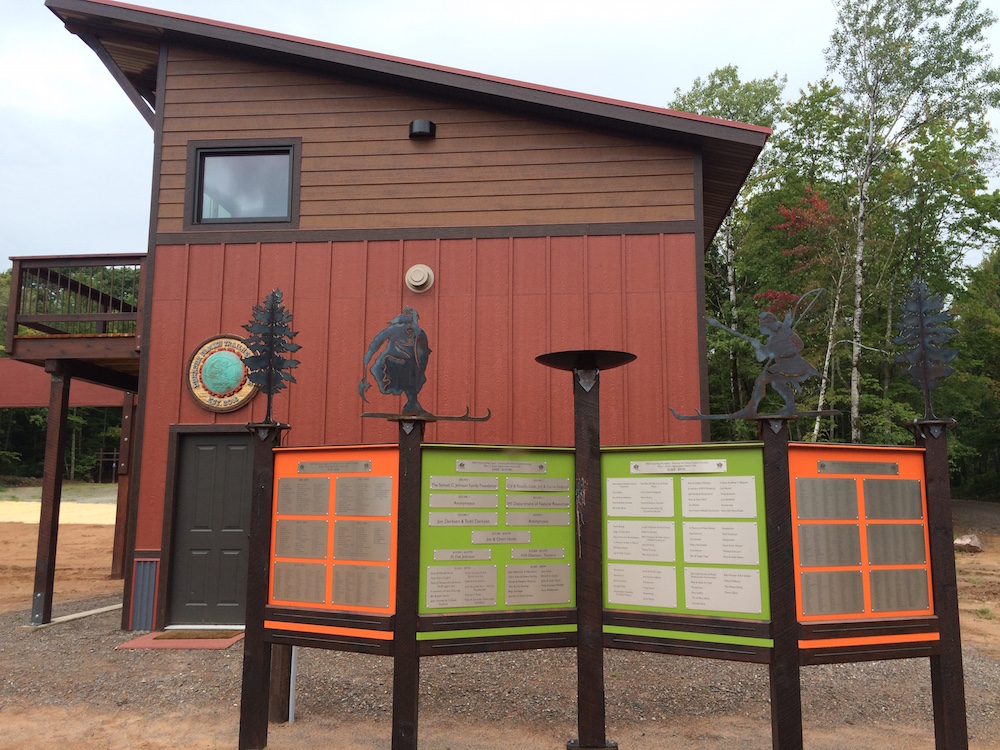
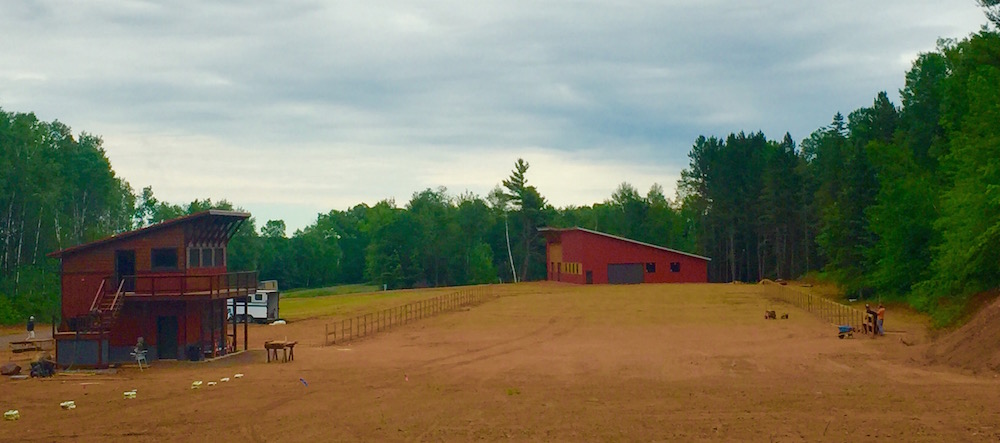
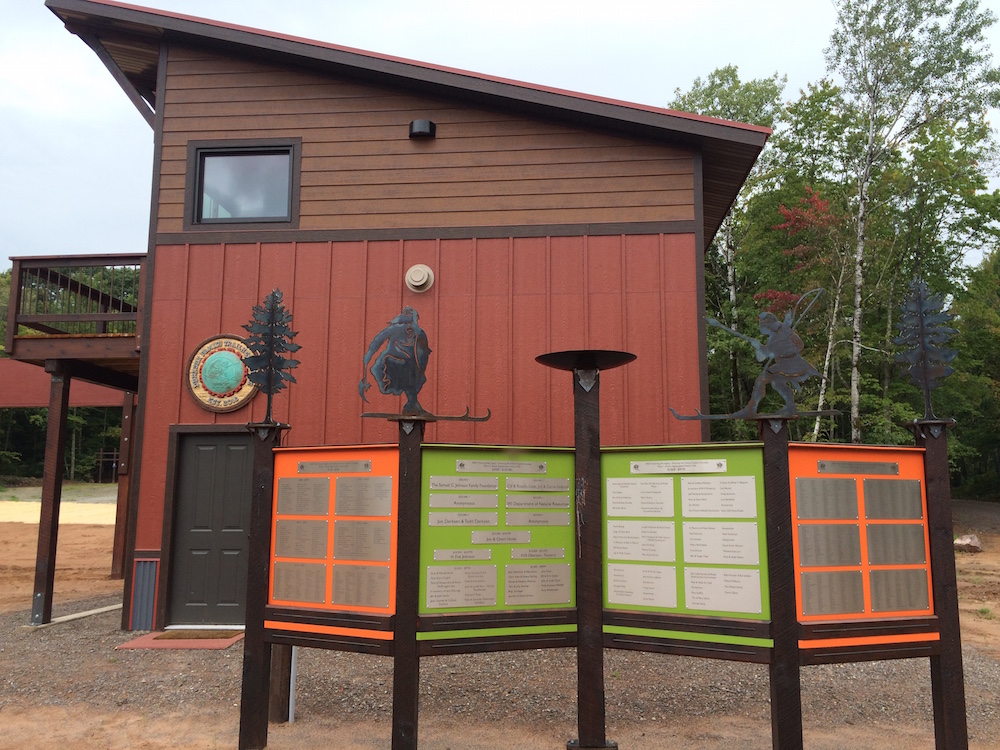
At the heart of phase two of the capital campaign is the creation of the Samuel C. Johnson Family Outdoor Center. The new 4,000 square foot facility will be located at the halfway point of the Birkie trail at the WI County Highway OO Trailhead near Seeley, WI. With an estimated 100,000+ Birkie Trail users each year, the Samuel C. Johnson Outdoor Center will provide a gateway and year-round hub for people to access and utilize the world-class trail for hiking, biking, running, skiing, and year-round events. Facility amenities will include a gathering hall, heated restrooms, changing rooms, and a waxing and bike repair room. Named in memory and honor of Samuel C. Johnson, the Johnson family from Racine and Cable, WI, respectively, provided the lead gift for the structure through the Johnson Family Foundation. This is not the first philanthropic support the ABSF has received from the Johnson family over the years (SC Johnson Wax, Johnson Financial Group, Johnson Family Foundation). Johnson Financial Group (Johnson Bank) is the longest-standing Birkie event sponsor through their ongoing support of the Barnebirkie youth ski tour, while the Johnson Family Foundation and Johnson Financial Group supported the creation of the Tony Wise Museum of the American Birkebeiner, and the family was personally instrumental in assisting the ABSF with procurement of the land for the American Birkebeiner Trailhead, along with other philanthropic efforts.
“We are extremely grateful to the Samuel C. Johnson Family and the many generous donors who helped us to reach our capital campaign goals,” said Ben Popp, ABSF Executive Director. “We’re humbled by the supportof the Birkie community, by their sustained belief in what we do, and are thankful we can continue to make theBirkie lifestyle dreams a reality for generations to come.”
The groundbreaking ceremony for the Samuel C. Johnson Family Outdoor Center is slated for June 9, at 2:00pm, 3.3 miles East of Seeley, WI, at the County Highway OO Trailhead. The public is invited to attend.
In addition to support from the Samuel C. Johnson Family, a grant for development of the trailhead was approved through Sawyer County and with the help of County Administrator, Tom Hoff. Funding will come from the Stewardship Acquisition and Development of Local Parks Grants program and the Recreational Trails program of the Department of Natural Resources (DNR). In addition, grant funding was made possible through the Huelsmann Foundation and the Judd Alexander Foundation. Funds will be received from the Johnson Family over three years, with DNR funds acquired throughout the construction process. In addition, over 2500 individual donors from 37 states and Canada supported the second phase of the Honoring the Legacy –Ensuring the Future capital campaign. Other donors playing an integral role in the Samuel C. Johnson Family Outdoor Center and associated Birkie Trail infrastructure enhancements include:
Brent Carlson, M.D. Great Room, Classroom, and Entry foyer – Supported by Brent Carlson, M.D., the rooms will provide gathering spaces for groups, clubs, families, and schools, before and after they embark on outdoor adventures on the Birkie Trail.
New Moon Ski & Bike Shop Ski Waxing & Bike Repair Room – Supported by New Moon Ski & Bike Shop of Hayward, WI, this tech room will enable skiers and bikers to prepare and repair their equipment for their Birkie Trail experiences.
Virkus Workout Room — Supported by Gus and Julie Virkus, this room will provide a year-round space for outdoor Birkie Trail users to learn and practice skills to encourage an active, outdoor lifestyle.
GymRage Outdoor Circuit Course — Supported by Thom and Utina Malnourie, this outdoor, multi-station fitness course will adjoin the Samuel C. Johnson Family Outdoor Center.
Key Log Rolling Crossing — Supported by Jay and Judy Hoeschler and located near the new Samuel C. Johnson Family Outdoor Center, this Birkie Trail connecting bridge will allow safe passage over WI County Highway OO for all users of the Trail system.
Becker Law Link — Supported by Becker Law Firm, this recreational tunnel will enable Birke Trail users to travel beneath WI County Highway 77, on race day and every day.
Plans for all projects are underway with completion dates ranging from fall 2018 to spring 2019; final approvals, permitting, and plan revisions are currently in progress.
Previously completed phase two capital campaign projects include an initial investment in snowmaking infrastructure for low snow years; procurement of a new dump truck, snowplow, skid steer, snow bucket, and Arctic Cat snowmobile; construction or renovation of trailside cabins including the addition of running water and solar-powered generators at each. Trailside cabin benefactors include Timber Trail Cabin (Anonymous Family, Cable, WI); Franzen Firetower Trail Cabin (Greg & Marilyn Franzen); Strand-Johnson Gravel Pit Trail Cabin (William Johnson); and Mandli Boedecker Trail Cabin (Mike & Jane Mandli). These gifts are in addition to thousands of donors who made the initial phase of the capital campaign a smashing success.
The American Birkebeiner Ski Foundation is a 501(c)(3) non-profit organization with a mission to promote and conduct the finest international cross-country ski competition and healthy, active lifestyle events; to serve as good stewards of the American Birkebeiner Trail; and to support healthy and active lifestyles among people of all ages and abilities. As the sole steward of the over 100-kilometer Birkie Trail system, the ABSF spends an estimated $350,000 annually on ongoing trail maintenance, mowing, and grooming.
About the American Birkebeiner® Ski Foundation and Birkie® Events
Located in Hayward, Wisconsin, the American Birkebeiner Ski Foundation (ABSF), a 501(c)(3) organization, is known for its signature American Birkebeiner Ski Marathon held each February. Today, the Birkie has grown to encompass a variety of year-round, silent sport events that promote a healthy, active lifestyle for thousands of outdoor fitness enthusiasts. The ABSF also acts as steward of the legendary Birkie Trail, providing year- round grooming, mowing and maintenance to all 100+ kilometers. From the iconic American Birkebeiner ski race, to the Birkie Trail Run Festival, and Fat Bike Birkie, the ABSF and the Birkie Trail attract skiers, runners, bikers, trekkers, and hikers, from around the world. Learn more at www.birkie.com.
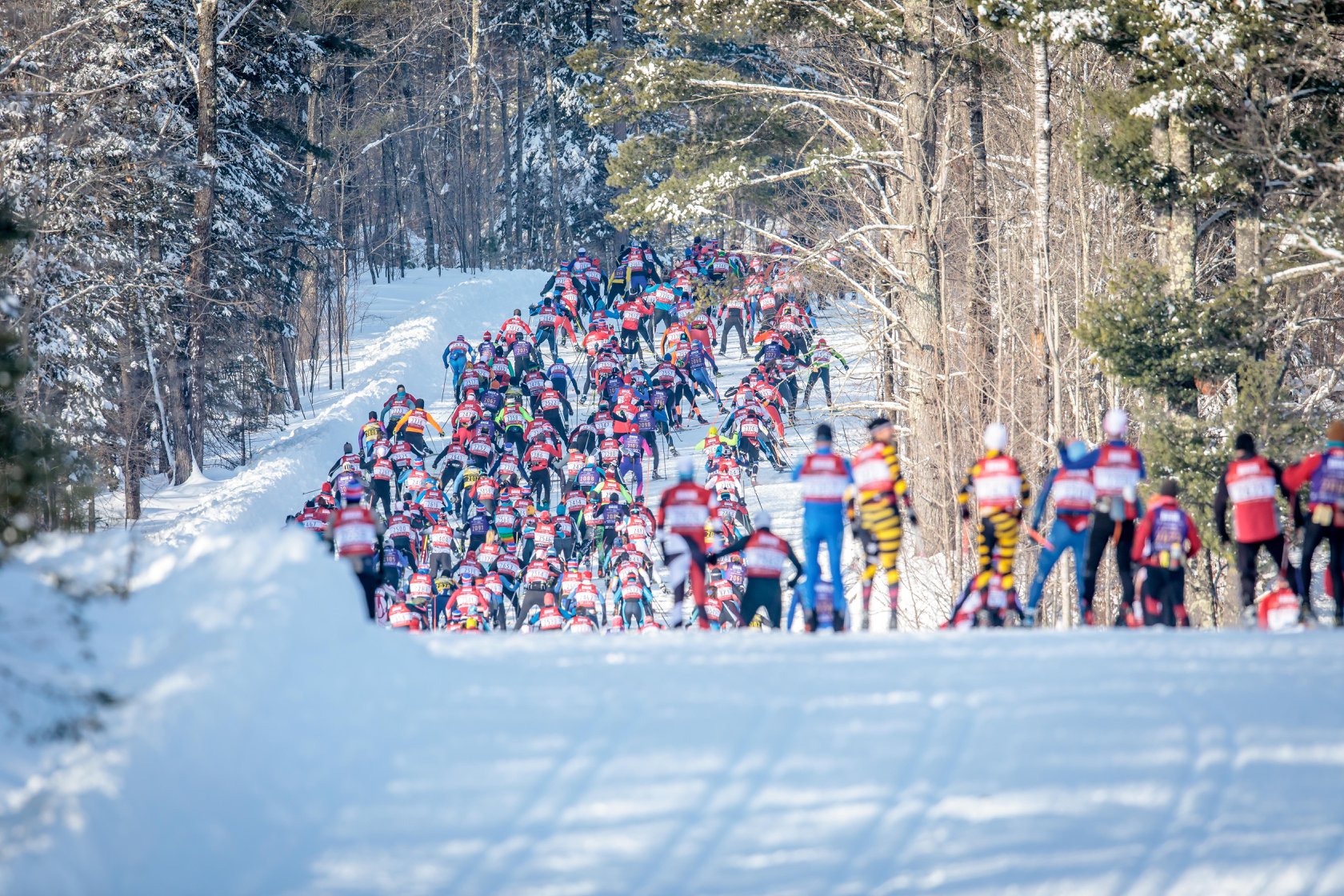
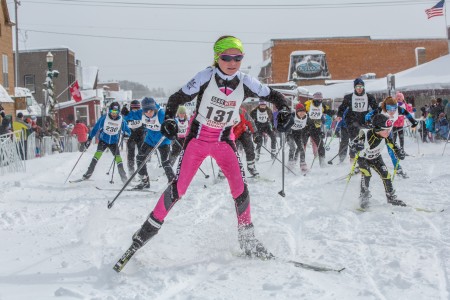
The start of Wave 2 of the 2018 American Birkebeiner 50 k skate race, which author Katie Miller was in. (Photo: American Birkebeiner Ski Foundation)
The following was written by Katie Miller, a former University of New Hampshire (UNH) ski racer who recently completed her first American Birkebeiner and 50-kilometer ski marathon, after registering for the race last year. That race was canceled due to low snow, but Miller returned for this year’s edition on Feb. 24. She currently lives in southern N.H. where she does her best to “juggle a full-time job as a criminal defense investigator with the desire to get outside and ski all day everyday!”
***
The pull of the storied American Birkebeiner brought me to register for the 2017 race. I had heard nothing but positive reviews of the Birkie. I had not even experienced the race yet and I was bummed when it was cancelled in 2017. Fast forward to 2018, my excitement level was high and my expectations of the race were all over the place. This was the largest cross-country ski marathon in North America. This was my first 50K. This was the longest race I had ever done. I had trained as much as I could while working full time. I had skied as much as I could considering the January and February thaw we experienced in southern NH. I rolled my eyes while embracing the New England weather as I ran in 70-degree weather four days before the race. And as I stood in the start pen surrounded by thousands of other people all ready to conquer the 50K it dawned on me that this was F*&%ing awesome.
The view of the Main Street finish the day before the 2018 American Birkebeiner, as seen from the International Bridge. (Photo: Katie Miller)
Now rewind two days, getting to the race in Wisconsin made the finish line that much sweeter. Thursday morning set to travel with my parents, a.k.a. the best support crew, we left for the airport at 4 a.m. Our flight from Boston to LaGuardia went off smoothly and we landed in N.Y. with a three-hour layover ahead of us. Plenty of time to relax, have some food, and get back to the gate. With 45 minutes before our flight departed we got to the gate, sat down, and were informed our departure gate had been changed to a different terminal, forcing us to go in and out of security, again. We got through security for the second time smoothly, apart from a few expletives from my mom as she had to throw out another bottle of water and off we went on our second flight. We landed in Minneapolis at 5 p.m., picked up our bags, got our rental car, and were on our way, seemingly without hitch! After a quick dinner stop at LOLO American Kitchen (yum!) in Stillwater, Minnesota, we started the drive to Cable … in a snowstorm.
Two-and-half hours later, driving on slow, snow-covered roads in a rental car lacking the proper tires for these slippery roads, the car starts to lose power. Fifteen miles outside of Hayward, on the highway, with NOTHING in sight, a rare car passing us every few minutes. We putter along for another 5 miles as I am on the phone with the rental car’s emergency roadside assistance, a lovely woman who is struggling to figure out where we are to send a tow truck. It is 10:30 p.m. and stress levels are high in our failing rental car. We pull to the side of the road, five miles from Hayward. A few minutes later we attempt to continue driving. The power seems to have returned to the car, we can drive over 20 mph now. I feel slightly relieved, but we still have 40 miles to our cabin in Cable. Thankfully, we make it to our cabin, safe and exhausted at 11:30 p.m. I get to sleep after 12 a.m., which would be 1 a.m. in the time zone we started our travel in a long 21 hours ago. Not an ideal travel day.
Pre-race powder ski on Birkie Ridge. (Photo: Katie Miller)
Friday morning, with one day to go before the race, I wake up ready to put the long travel day behind me and get out for a ski. With six inches of new powdery snow and a questionable car, that was not going to be as easy as I planned. Luckily the car made it through the rest of weekend without a problem. I headed to Birkie Ridge for a deep powdery ski on the ungroomed trail. My ski was a mix of skating, double poling, and single sticking trying not to tire myself out in the deep snow. There were a few other skiers as I started and by the end the trail was full of people getting out and getting ready for the next days races.
Every skier I passed smiled or said hi, some asked questions about the trail (not that I knew the answers), but everyone seemed happy to just be there for the race. I skied as easy as I could in the deep snow, just happy to be skiing, anxious for the next day. I had no idea what to expect with the size of the race and the distance. It was exciting but nerve wracking. Post-ski, my parents and I had lunch at the Brickhouse Café in Cable. A friendly, delicious café with breakfast, lunch, baked goods, and coffee, I highly recommend it! With our confidence in the rental car cautiously optimistic we made our way south to the expo (and possibly my dad’s favorite part of the weekend: free stuff! When the Clif wonders why their energy gels disappeared so quickly midafternoon, I know why….). I picked up my bib, explored the expo, bought some Birkie gear, and got my new Birkie gear bag.
With each event moving closer to race time, the stress of travel and the excitement of the race was taking over. The moment we got to downtown Hayward and I climbed the stairs up the Birke bridge and looked down main street towards the finish a huge smile took over my face. I could not wait to be at the top of the bridge tomorrow during the race. Fast-forward to Saturday morning, I had checked, double checked and triple checked my backpack and gear, making sure I had everything I needed. The quality of the organization of the race and entire weekend is better than any event I have ever been to. From busing to the start, volunteers with information everywhere you look, feed stations full of volunteers handing out much needed fuel, to having a place to change after the race, it was simple and stress free. The best kind of race environment for racers and spectators alike.
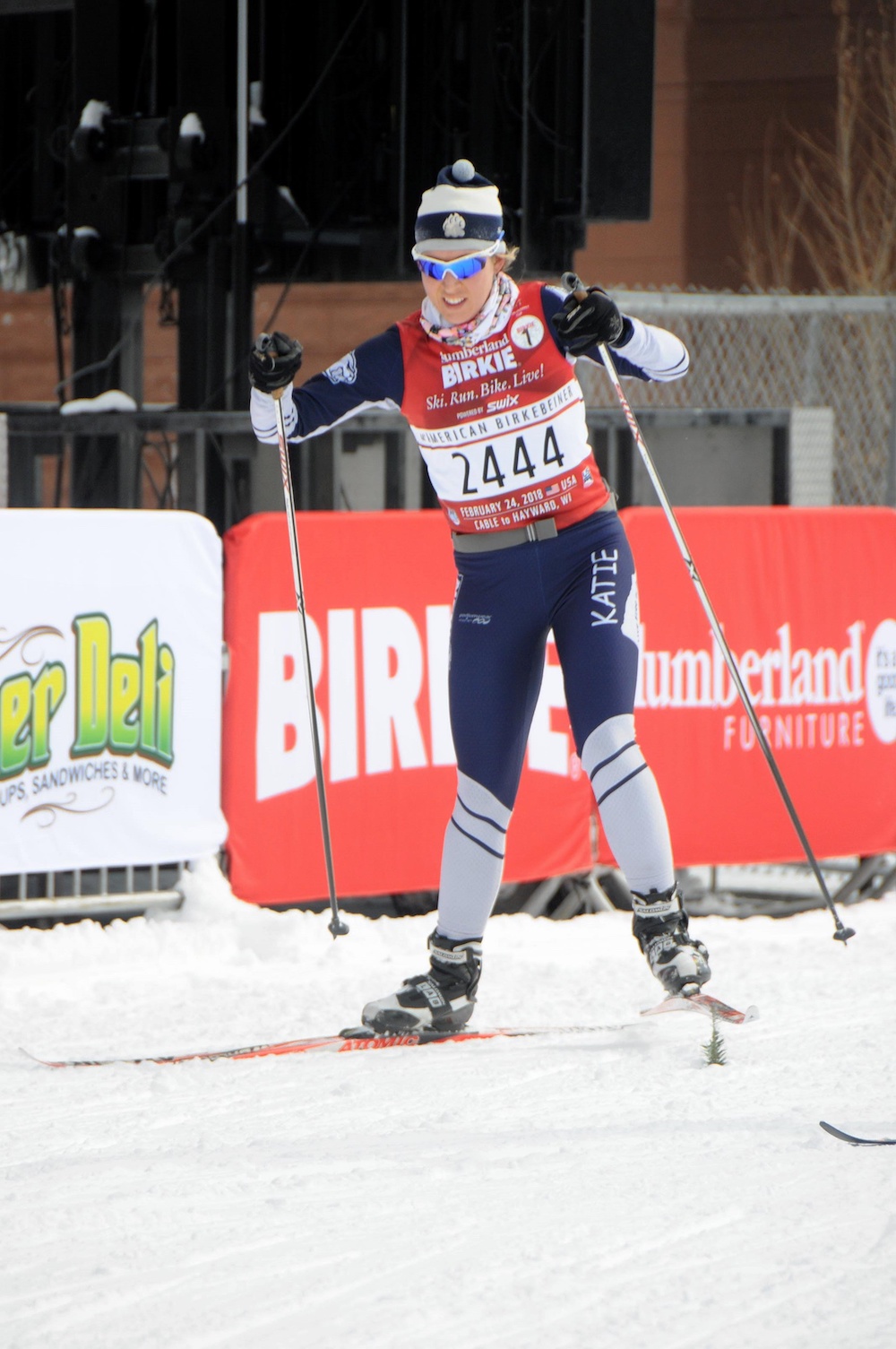
Author Katie Miller finishing her first American Birkebeiner 50 k ski marathon on Feb. 24 in Hayward, Wisconsin. (Photo: Marathonfoto)
Now back to the race, standing in the start pen, the excitement palpable as thousands of skiers wait to start their race journey that day. The starts guns go off, I wait for the people in front of me to move forward and off I go. The beginning kilometers of the race was a slow accordion of movement down the trail. Doubling poling being more effective, and safer for my poles, than trying spread out and skate. As the kilometers started to tick by, the crowd thinned, and the trek to Hayward was on! Three hours of skiing has never gone by so quickly. I smiled and laughed out of pure bliss the entire 50K. I laughed as I tried to open my GUs during the race without dropping them. I laughed (and tried not to fall) going around the sharp rutted corners lined with snowmobilers, the rowdy crowd cheering and waiting for people to fall. I laughed when my water bottle froze after 20K. I laughed as my quads cramped up climbing “bitch hill”. Why? Because there was a priest with a megaphone telling jokes on the hill followed by two nuns cheering.
I marveled at the beautiful skiing and the other racers that surrounded me as I skied. The feeling of cresting the top of the bridge, like Rocky at the top of the Philadelphia steps, was an indescribable feeling, one of pure joy. Looking down main street towards the finish, the street lined with cheering people, was a feeling that was worth all 50K. I skied up those last 200 meters feeling like I could take on the world. It was the most amazing, captivating race I have ever done. I’ve caught Birkie fever (caution: highly contagious) and I don’t think I’m ever going to shake it.
The love of skiing, the hard work of the Birkie organizers and amazing volunteers (and a big party…) brings all these people together and that is a special thing.
I was smiling the entire 50K and I’m still smiling a week later. I think I can speak for everyone waiting for next year’s race when I say…can we do it tomorrow?
***
Miller, 29, finished 15th in her age group (25-29) in 3:01:44.1 hours.
Wave 2 of the 2018 American Birkebeiner on course. (Photo: American Birkebeiner Ski Foundation)
Little Bellas, a national organization dedicated to helping young women realize their potential through cycling, announces the Birkie Weekend Camp in Hayward, WI, Saturday, August 12th at the Highway 00 Trailhead.
The Birkie Weekend Camp is an all-girls adventure program designed to get girls hooked on the sport of mountain biking. The one-day program will focus on improving skills and having fun.
“We’re so excited to be bringing the Little Bellas program to even more girls this year,” said Little Bellas executive director Sabra Davison. “Over the last ten years we’ve seen how learning to ride, and working with mentors and other girls can change girls’ lives. We can’t wait to get back on the bikes this summer. To be connected with the Birkie is a big deal and, as a nordic skier myself, I know the cultural weight anything around this trail bears. We can’t wait to bring more girls on bikes to such a well loved place.”
Kristy Maki, American Birkebeiner Ski Foundation Operations Manager added, “The American Birkebeiner Ski Foundation is excited to partner with Little Bellas to bring the Saturday BirkieCamp to Hayward, WI. The ABSF encourages everyone to live a healthy, active lifestyle and this program is a great step to getting more girls out on the trail. We hope girls come from all over to learn from great female mentors what is possible and how much fun being active on bikes can be!”
Registration for the weekend program is now open. More information can be found at LittleBellas.com.
More info about Little Bellas: Little Bellas was founded by professional cyclist Lea and Sabra Davison in 2007, and is going strong into its tenth year. The program started in Middlebury, Vermont with the goal to help young women realize their potential through cycling. They aim to create a community that will empower girls through the sport, emphasize the importance of goal-setting, promote healthy lifestyles and recognize the benefits of strong female bonds. In the ten years since they have expanded to be a national organization with programs running in twelve states, ranging from Arkansas to California to Wisconsin. Throughout their ten years, their mentors have worked with over 2000 girls.
About the American Birkebeiner Foundation: The American Birkebeiner Ski Foundation is a 501(c)(3) non-profit organization dedicated, as reflected in the Birkie Mission Statement, to hosting one of the world’s best cross country ski events, the American Birkebeiner, maintaining one of the nation’s premier recreation trails, and promoting healthy lifestyles for people of all ages. The American Birkebeiner is made up of several events in addition to the 51K and 55K Birkie marathon races and the 24K Kortelopet race (the second largest ski race in North America).
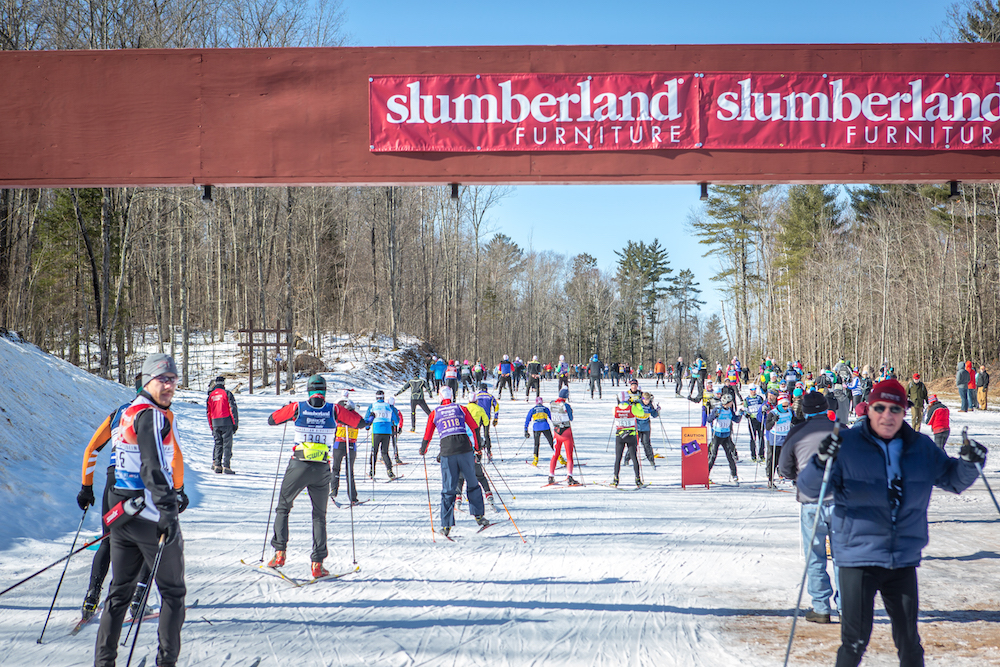
The scene at 2017 BirkieFest on Feb. 25 at the American Birkibeiner trailhead near Cable, Wis. The iconic race was canceled this year due to a lack of snow and a casual ski on a 5 k loop and festival at the trailhead was held in its place. (Photo: American Birkebeiner Ski Foundation)
The following firsthand account was written by FasterSkier intern Ian Tovell, who attended this year’s American Birkebeiner in February, which was canceled due to lack of snow. Instead, the 2017 BirkieFest was held on Feb. 25 at the new Birkie trailhead and start area near Cable, Wis., with an estimated 10,000 people coming out for a casual ski on a 5-kilometer loop, on-snow demos, live music, food and a beer garden. Photos from Ian, FasterSkier contributor Vince Rosetta, and the American Birkebeiner Ski Foundation.
***
The 2017 American Birkebeiner will be a race that no one will ever forget. It will be remembered for a tremendous amount of effort from Ben Popp and his hard-working staff. Even though there was no race, it was a great event with 10,000 of likeminded friends and a lot of great food, live music, and the ability to check out the latest-and-greatest gear.
I was very excited to race in my third Birkie after missing the race in 2016. Heading into Birkie week, I was obviously worried, like most racers were, as the weather did not look like it was going to corporate. With high optimism, I left Boston to head to Hayward, Wis., with my two travel companions in hopes the race would still happen.
On Friday we headed to the OO trailhead to see if we could get some skiing in. As we were headed to the trail, we got the news the race was going to be canceled and turned into a non-competitive ski in Cable at the start. After traveling all that way, that wasn’t going to stop us from getting in some skiing.
However, my friend forgot his boots that day. Knowing the skiing was not going to be that great, I offered to run the trail so he could ski. We were able to do about 10 k worth of skiing on icy and grassy trails, but it was great just to be out on the Birkie Trail. We were not the only ones that had the same idea as we saw a bunch of other hopeful skiers getting some kilometers in as well.
On Saturday, we headed to Cable to join some 10,000 skiers that wanted to check out the 5 k loop and get some more skiing in. All things considered, the loop was in great shape. As the day went on and more people joined in, the trail became crowded to the point that it was difficult to ski with much speed.
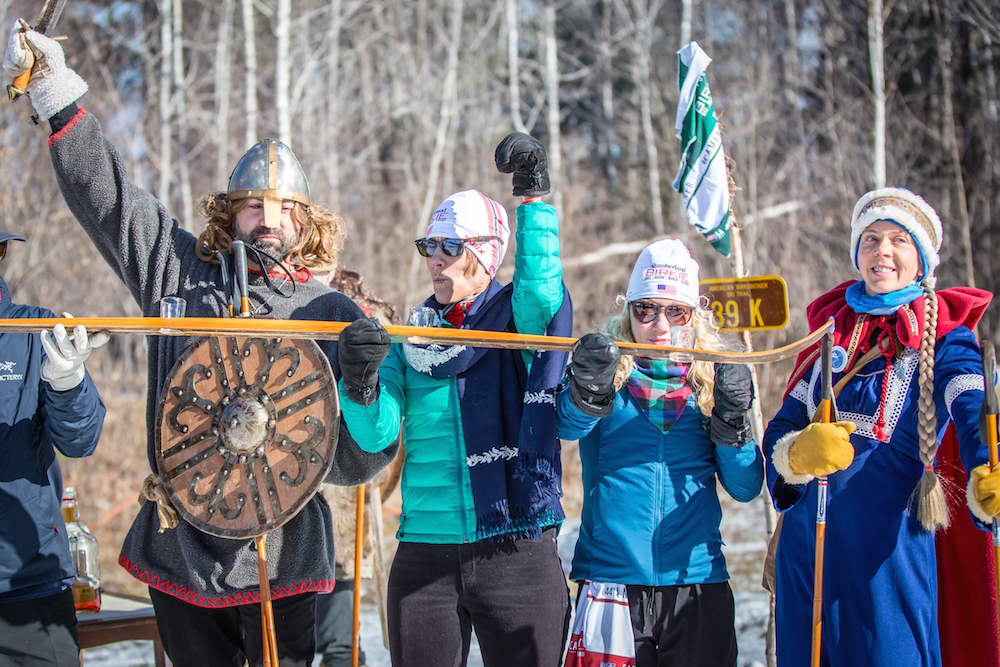
The famous 39K Club Shot Ski trailside at 2017 BirkieFest near Cable, Wis. (Photo: American Birkebeiner Ski Foundation)
The highlight of the course was at 4.8 k, where the 39K Club was there with its shot ski, making sure that the Birkie spirit was alive and well and getting everyone excited just to be at BirkieFest.
After a quick two-lap ski we were off to the food tent to get the famous on-course cookies and chicken-noodle soup. We were fortunate to test out some fat bikes at the demo, which was a ton of fun because we were able to ride them on the Fat Bike Birkie race trail. After listening to some live music, collecting our fair share of free ski ties and other goodies, we headed back to our hotel to start planning our trip for Birkie 2018.
Though my 2017 Birkie experience was not the one I was hoping for, just being on the Birkie trail with 10,000 other people felt like any other Birkie. The atmosphere and camaraderie at this race is unmatched in my experience, and being a part of it is truly special. This year was such a great time even without skiing that I know that it will be the most memorable Birkie of my career. I am looking forward to returning to Cable and Hayward in 2018.
***
Editor’s note: 2018 Birkie registration opened May 1. The 2017 event marked the second official cancellation in the Birkie’s 44-year history. An article in the Birch Scroll 2017 spring edition (page 15) confirmed that 2017 race fees will not be refunded and presented numbers to explain why. The total cost of organizing the 2017 Birkie Week amounted to more than $854,000 dollars. Read the article here.
Dressed for success at 2017 BirkieFest. (Photo: American Birkebeiner Ski Foundation)
A young skier at 2017 BirkieFest. (Photo: American Birkebeiner Ski Foundation)
Fat biking at the 2017 BirkieFest. (Photo: American Birkebeiner Ski Foundation)
Family time at 2017 BirkieFest. (Photo: American Birkebeiner Ski Foundation)
Skiers on the 5 k loop at 2017 BirkieFest on Feb. 25 near Cable, Wis. (Photo: Ian Tovell)
The “39 k” shot-ski station at 2017 BirkieFest near Cable, WIs. (Photo: Ian Tovell)
The scene at the 2017 BirkieFest on Feb. 25 at the Birkie trailhead near Cable, Wis. (Photo: Vince Rosetta)
The scene at the 2017 BirkieFest on Feb. 25 at the Birkie trailhead near Cable, Wis. (Photo: Vince Rosetta)
The scene at the 2017 BirkieFest on Feb. 25 at the Birkie trailhead near Cable, Wis. (Photo: Vince Rosetta)
Hayward, WI (February 25, 2017) – The American Birkebeiner Ski Foundation’s BirkieFest 2017 brought over 10,000 skiers and spectators to the American Birkebeiner Trailhead and new start area near Cable, WI. Skiers from around the world and across the country took to the Birkie Trail for a quick ski on the 5K loop painstakingly saved and crafted by the Birkie Trail Crew for the event.
The American Birkebeiner is North America’s largest cross-country ski race which normally runs from Cable to Hayward, Wisconsin, finishing on the snow-covered Main Street of Hayward. However, after days of unseasonable weather, rain, and snow storms that missed the Hayward and Cable areas, the American Birkebeiner Ski Foundation was regretfully forced to cancel the 44th Annual Slumberland American Birkebeiner, Kortelopet, and Prince Haakon cross-country ski races.
“Of course, we were really disappointed that we weren’t able to host a ski race, but if there is a silver lining, BirkieFest is certainly it. Over 10,000 skiers and their family and friends enjoyed the day skiing, eating, listening to great music and having a great time in the north woods,” said Ben Popp, American Birkebeiner Ski Foundation Executive Director. “I’m really proud of our Birkie team, the Nordic community, and the Cable, Seeley, and Hayward communities – it was certainly an all hands on deck effort! We consider this the first day of training for Birkie 2018!”
Skiers spent the day skiing a 5K loop on the Birkie Trail crafted from snow caches stored in the woods along the trail system. Festival goers enjoyed live music, a beer garden serving Birkie Brew-Ski crafted by Lucette Brewing Company, Birkie Brats by Louis Finer Meats, Norwegian waffles, shopping in the Birkie Store, on-snow ski and fat bike demos, biathlon demos, and more. Skiers and spectators were bused to the brand new American Birkebeiner Trailhead for the day of Nordic fun.
“This past week was a great learning experience, it taught us things that will make us even more successful in the future,” said Chris Campbell, Birkie Trail Manager. “We learned so much about snow management. We’ve never needed a snow cache on the north end of the trail and we used every snowflake we could muster for our 5K course today. It was certainly worth it.”
The 45th Annual Slumberland American Birkebeiner week of events is slated for February 22-25, 2018 with registration opening on May 1, 2018. The ABSF is hosting the Fat Bike Birkie, the world’s largest fat bike race on March 11, 2017 at the American Birkebeiner Trailhead near Cable, WI. “The Cable area was pleased to play a part in helping to host the BirkieFest today. Skiers were really happy with all the hard work that the Birkie staff and countless volunteers put into make this event possible,” said James Bolen, Executive Director, Cable Area Chamber of Commerce.
The American Birkebeiner Ski Foundation received a $12,450 JEM Grant from the Wisconsin Department of Tourism. From left to right: Regional Tourism Specialist Julie Fox with Ben Popp, ABSF Executive Director, and Nancy Knutson, ABSF Director Marketing/Communication)
HAYWARD, Wis. (Feb. 9, 2017) – The American Birkebeiner Ski Foundation is racing into the new year with a marketing campaign aimed at promoting its Kortelopet (Korte) cross-country ski race and the importance of a healthy, active lifestyle. With help from a $12,450 Joint Effort Marketing (JEM) Grant from the Wisconsin Department of Tourism, the American Birkebeiner Ski Foundation looks to increase participation in the 29 kilometer race slated for Feb. 23, 2018. This year’s will take place on Friday, Feb. 24.
“This project clearly demonstrates that funding tourism marketing initiatives produces a sound return on investment for the local economy,” Governor Walker said. “Tourism is part of Wisconsin’s economic foundation and its continued growth is a priority for my administration because of the nearly 191,000 jobs it supports, the tax revenues it generates and the positive image it projects for the State.”
The Korte is known as a half-marathon distance cross-country ski race. Traditionally held the same day as the world-famous full marathon Birkebeiner (Birkie), the Korte will now take place the day before the Birkie in order to provide Korte skiers with a unique race experience and to allow for the potential of doubling race participation from 3,000 to 6,000 over the next 7 to 8 years. Event organizers hope that moving the Korte to its own day will increase the number of participants by 10 percent each year. This year’s Korte event is expected to attract more than 10,000 participants and spectators to the Hayward area, generating an estimated $1.6 million in visitor spending.
In 2016, the American Birkebeiner and Kortelopet races drew skiers from 46 states and 22 countries. The Kortelopet race provides yet another medium to speak to skiers, both domestically and internationally, about northwestern Wisconsin and the skiing opportunities available on the Birkie Trail. The American Birkebeiner Trail system was recently voted the No.1 cross-country ski destination in the United States by USA Today/10Best.
“The American Birkebeiner is North America’s most prestigious cross country ski race, and each year Wisconsin’s Northwoods welcomes thousands of skiers and spectators from around the world,” said Tourism Secretary Stephanie Klett. “We’re thrilled to support the expansion of the Korte event so more athletes can participate and ultimately grow the overall economic impact of the Birkie weekend.”
In 2015, the tourism economy in Wisconsin totaled $19.3 billion, a more than four percent increase from 2014. Since 2010, tourism activity in the state added 18,717 jobs to the economy, an 11% increase in travel and hospitality employment opportunities for Wisconsin residents. Visitors generated $1.5 billion in state and local revenue. Wisconsin taxpayers would need to pay $640 per household in order to maintain current government services. Total business sales in Sawyer County reached more than $113.7 million in 2015, supporting 971 jobs and $9.9 million in state and local taxes.
“We are incredibly pleased to have been selected as a recipient of the Wisconsin Department of Tourism JEM Grant and the opportunity it affords us to grow the Kortelopet race. The grant provides us with the means to promote the race itself, helps us to encourage a healthy, active lifestyle, all the while increasing tourism in northwestern Wisconsin,” said Ben Popp, Executive Director, American Birkebeiner Ski Foundation. “We are grateful for the opportunity and excited to get started.”
In fiscal 2016, the Department funded 57 JEM projects, awarding a total of more than $1.1 million. Visitor expenditures driven by the marketing from these projects will exceed $31 million. JEM grant funds are available to non-profit organizations for the promotion of Wisconsin tourism events and destinations. The state can fund up to 75 percent of a project’s first-year advertising and marketing costs, and provide support for second- and third-year projects with decreasing amounts for funding until projects become self-sustaining. For information on the JEM Program and application materials, visit http://industry.travelwisconsin.com.
The mission of the Wisconsin Department of Tourism is to market the State as the Midwest’s premier travel destination for fun by executing industry-leading marketing programs and establishing strategic partnerships. The Department plays a significant role in generating greater economic impact and jobs for Wisconsin. The portal for traveler information can be found at: www.travelwisconsin.com.
A look at the new permanent start and American Birkebeiner Trailhead during construction this summer in Cable, Wis. (Photo: ABSF)
It has been an exciting 2016 for the American Birkebeiner Ski Foundation (ABSF). After a successful completion of the Phase 1 fundraising program in 2015, the ABSF secured a land purchase that will give North America’s largest ski race, known as the Birkie, a permanent start area for events.
The Phase 1 campaign also supported the construction of a warming shelter at the new start, which is open year-round, several aid-station buildings along the trail, which can be used throughout the year, and also the construction of brand-new Birkie offices and the Tony Wise Museum in Hayward, Wis.
Just like in previous years, the ABSF has been busy in the offseason, making improvements to the American Birkebeiner (including the 50-kilometer skate and 55 k classic marathons, set for Feb. 25, 2017) and its trail system.
In mid-December, FasterSkier checked in with Ben Popp, ABSF executive director, on the phone to discuss some of these changes and what future Birkie participants can expect.
***
FasterSkier:First off, congratulations on the new start-line purchase and trailhead. That seemed to be a goal the Birkie had for years. Can you tell us why that was such an important piece of the Phase 1 fundraising campaign?
The Derksen Family Trailhead Warming Shelter at the new American Birkebeiner Trailhead. (Photo: ABSF)
Ben Popp: We are really excited for this new trailhead. We recently had the first event there, a youth biathlon camp and it was great to see the potential this new trailhead will bring. I skied up from Boedecker and when I got to the new trailhead, I had a warm place to change, people were hanging out, there were nice new bathrooms for people to use. Upstairs, the kids were meeting and getting lessons before they headed out to the trail.
You finally see that when you have facilities like this it brings in other people as well as the skiers. There was a woman inside reading a book while her husband was out skiing longer. It’s that whole concept that I am excited to see at the start line. It is something that can be used for events other than the Birkie. It is going to be the start for a JNQ [Junior National qualifier] meet, the Wisconsin state championship and the newly announced race that the Hayward high school nordic team is putting on this winter.
Phase 1 fundraising raised $715,000 dollars from more than 1,400 donors. They will all get to reap the benefits and be able to enjoy a first-class facility and help build the nordic community.
During the week between Christmas and New Years, we will have the big building heated and have concessions inside to support the 300-400 high school kids who are up here to ski. Before they huddled up into buses and hung around Double OO. Now they will have a warm building to hang around at, wax skis and get something to eat.
FS:Now that Phase 1 is complete, what does Phase 2 entail? How is the fundraising coming along?
BP: It has been a very busy fundraising season for us. The Birkie staff has been all over promoting the Foundation and the new development phases. The feverish pace has picked up for sure. We’ve been out a lot, as far as Traverse City and everything in between. It is important to work with USSA [the U.S. Ski & Snowboard Association], The Loppet, and Endurance United to strengthen the nordic-ski message in this area. People expect us the be a leader in this movement because we are looked on to be the innovators and spokesperson for this community. The community is small but extremely passionate, and we as a group need to capitalize on this if we want the sport to grow. Our message is to support us, but in doing so you are supporting the community and the whole nordic industry. Having spokespeople like Kikkan [Randall and Jessie [Diggins] out there winning and supporting the USSA, it is, in turn, helping us grow.
Phase 1 was the land purchase and trailhead. With that accomplished, we moved into Phase 2 and that focuses on improving the trail. The question always comes up about snowmaking and we finally have an opportunity to pursue this with power and water at the new start line.
We are starting to explore the possibility of storing snow during the summer like they do in Canada and in Europe. Some of our staff just got back from Europe where they met with a bunch of people from the FIS [International Ski Federation] and World Cup venues to talk about this very topic.
Between the skiers and the bike riders, we estimate that there are over 100,000 people using the trail all year long. That leads to a lot of erosion concerns and Phase 2 addresses these concerns. If we can improve the way the trail drains and stop erosion we could easily ski on just two inches of snow.
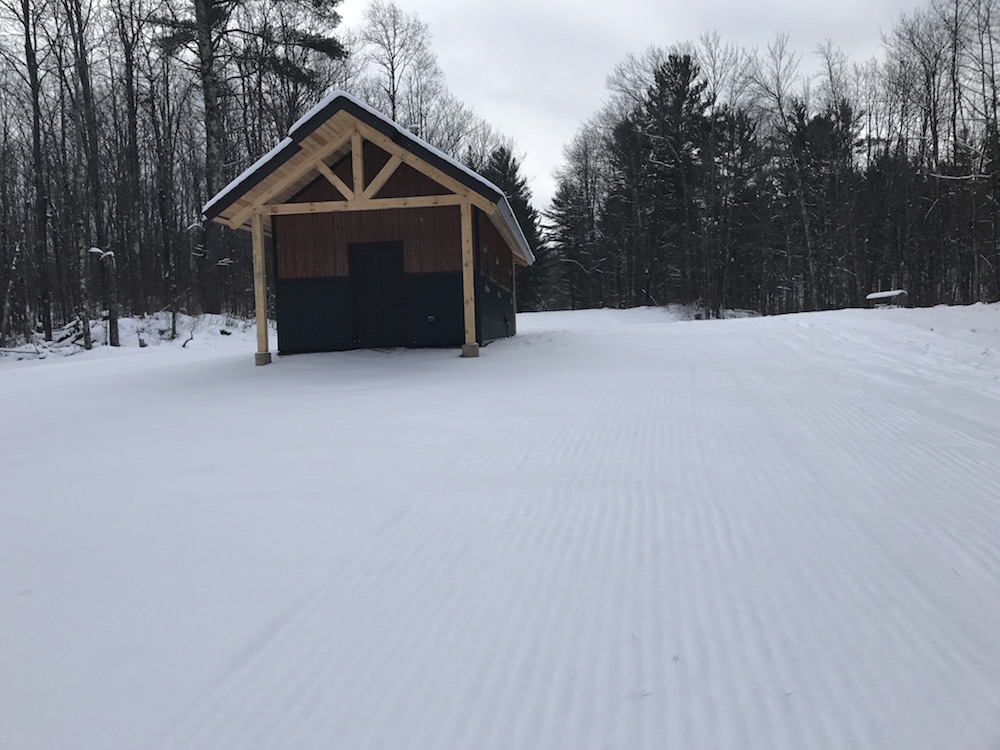
The Timber Trail warming shelter on the Birkie Trail. (Photo: ABSF)
Another part of Phase 2 is the aid stations. Every aid station is now going to have heated buildings with water that are open year-round. The idea is that it’s a building that is open to the public year-round for water and shelter. For the 30 events that use the trail, they will provide a place to store race-day equipment and everything that gets used for the events.
Other parts to Phase 2 include extending the classic trail south of Double OO. It’s not a full second trail but there are some places we can separate the skate and classic trail past Double OO.
Other items include putting an underpass under [Route] 77 for skiers and bikers. We are working in conjunction with the Wisconsin DOT and using some grant money to find a way to not to have to block that road during our race and other races that use that intersection.
We are also working on replacing some of our older pieces of equipment. Our oldest PistenBully is 17 years old, so with upwards of 100 k of trail, these machines really take a beating.
We are looking to get wider PistenBullys to accommodate the width of the course better. Right now it takes us three passes to groom the trail. Wider PistenBullys will reduce that to only two passes. Fewer passes mean faster and more importantly, better grooming.
We want to wrap up Phase 2 around December 2017. The fundraising goal for Phase 2 is right around $1.6 million dollars which is twice as high as Phase 1 was. We raised about 35 percent now and are close to $600,000 raised to this point. We are getting there and are excited about the response.
FS:Recently the Birkie Trail got two very prestigious awards, being named the best cross-country ski trail in the U.S. as voted by USA TODAY’s 10 Best Readers’ Choice travel award contest and, in conjunction with the Hayward Lakes Visitors and Convention Bureau, earned a 2016 Champions of Economic Impact award. What do these two awards mean to the American Birkebeiner Ski Foundation, the towns of Hayward and Cable, and also for the trail itself?
BP: We have the trail but also the community support to host the nordic community. The town’s “all-in” mentality of letting the Birkie Foundation take care of the trail, we (the community or Hayward and Cable) will take care of the people who are here to ski and make sure they have a great time outside of skiing. That was a huge part of us getting these two awards. The future is very exciting for us and the community. Being so close to the Twin Cities and their enormous nordic community makes us very lucky because we can be the destination that some of these other great cities and resorts have become. The area has turn into a four-season, all-year-round destination spot.
In terms of what the Birkie means to the cities of Cable and Hayward financially was shown in a recent 2013 University of Wisconsin economic study that estimated the silent sports lifestyle in Hayward and Cable brings in close to $22 million dollars to the community. That is a huge number for a town of 3,000 people. That includes visitors coming up to ski, bike, ride ATVs, hunting, and fishing, etc. It also includes people renting hotel rooms and buying second homes here. That goes back to my point of the towns embracing this lifestyle because bars and restaurants realize that there are other things people want to do up here once they are done skiing.
All the construction in Phase 1 and Phase 2 has been from local contractors in the Cable/Hayward area. Again, building that sense of community that helped us get these awards.
FS: How did the decision to separate the 29 k Kortelopet race from the Birkie come about? Was it due to logistical problems and too much traffic, or something else?
BP: Obviously, the biggest change is moving the Korte, America’s second largest ski race, to Friday. We started thinking about doing this about two years ago. The question is why? We knew two years ago that this race wasn’t the race experience we wanted to give participants. They missed out on the opportunity to see the crowds that lined Main Street and cross the finish line there. Starting at the airfield [jn Cable] and ending close to there just wasn’t the event experience we wanted. The current setup worked but didn’t give the experience we were proud of. People told us time and time again that they wanted to be a part of the atmosphere at Main Street, and not just be an afterthought of the Birkie.
The biggest factor that prompted the move other that the atmosphere was demographics. The majority of the Korte participants are women and 40 percent are under the age of 23. Basically, its kids and women and those are two demographics that are vital to us and ones that we needed to get excited about the race. The concept was that if we can give these two groups and event experience that was as good as or better than the Birkie and then get them to get more kids and women involved in the events then it is a huge win for us. We were willing to take on the risk, extra costs and manpower to accomplish this because we felt it was important to get these two demographics excited about skiing.
FS:With the Korte starting at OO, what changes did you have to make to that area to be able to hold that many racers at once, compared to previous years where the field was pretty thin by the time they got to OO?
BP: We did a lot of work at Double OO for the new Korte start and for the Birkie. We will eventually have a new building there as a result of Phase 2, which will really help support or races as well as the mountain bike races in the summer.
Since the Korte start is almost as big as the Birkie start we did a lot of work widening parts of the trail that leads from the start to “Picnic Table Hill”. The start line for the Korte will be on the south side of Double OO. If you skied from the current Double OO cabin and went left down the hill to that flat area, you will be right at the new start line. We widened that area by two acres and also added a walking path for spectators. They will walk from the building over the bump and through the nostalgic arches which is pretty cool because that part of the trail won’t be used for the Birkie anymore. (Basically, once you cross Double OO, Birkie racers in previous years went right up the hill, in 2017, we will cross the street and turn left.) Everyone will funnel through the new Korte start on Saturday since all the aid stations and infrastructure will be there from Friday’s race.
We reworked that corner so it isn’t off-camber anymore and also worked on the descending hill into the Korte start area. Once the skiers cross the road both races will join at that point. in past years, the classic race didn’t join the skate race until Picnic Table Hill. Now they join once everyone crosses Double OO. The course is now 70-feet wide as it goes up the hill to the top of Picnic Table Hill.
We also worked on the righthand turn from the Picnic Table Hill descent. That has always been a nasty hill so now it just flows straight instead of turning to the right. That should help with the flow of the race and support the large group of Korte skiers that will be coming down that hill.
After all these course changes, the Birkie is just a bit shy of 51 k. Last year the race was a bit longer because of the added 2 k section at Fish Hatchery. This year, we are taking that section out for the skate race so it puts the skate race close to 50.5 k and the classic race is just shy of 55 k, sitting at 54.6 k.
In the future, the classic race might get a bit shorter as we continue to work that trail south of Gravel Pit. There are a few places that we can put in a new classic trail as we go south but for now, the distances are staying very close to the advertised 50 k and 55 k distances.
FS:What changes are being made to the expo and race weekend this year in order to support the racers who are entered in the Korte race?
BP: Basically, everything is staying the same. The whole event weekend ends up just being four hours longer. The events on Thursday are just starting a little bit earlier. In the past, we started all the events around noon. This year we are starting at 8 a.m. Overall, the events are spread out a little more.
We are turning downtown into a big festival over the race weekend. We are going to have live bands, food vendors and family events to help improve the excitement of the race and to support the spectators there waiting for their loved ones to finish.
The expo will stay the same for this year. Feedback from most of the vendors we talked to said that the current setup is the extent of what they can handle in terms of manpower, product and race-weekend support. It will be interesting to see. After the race, we will ask for feedback and change things up and adjust things that happened or didn’t work. For now, we just ask everyone to go into it like they normally would and let us know your thoughts and feeling after the race.
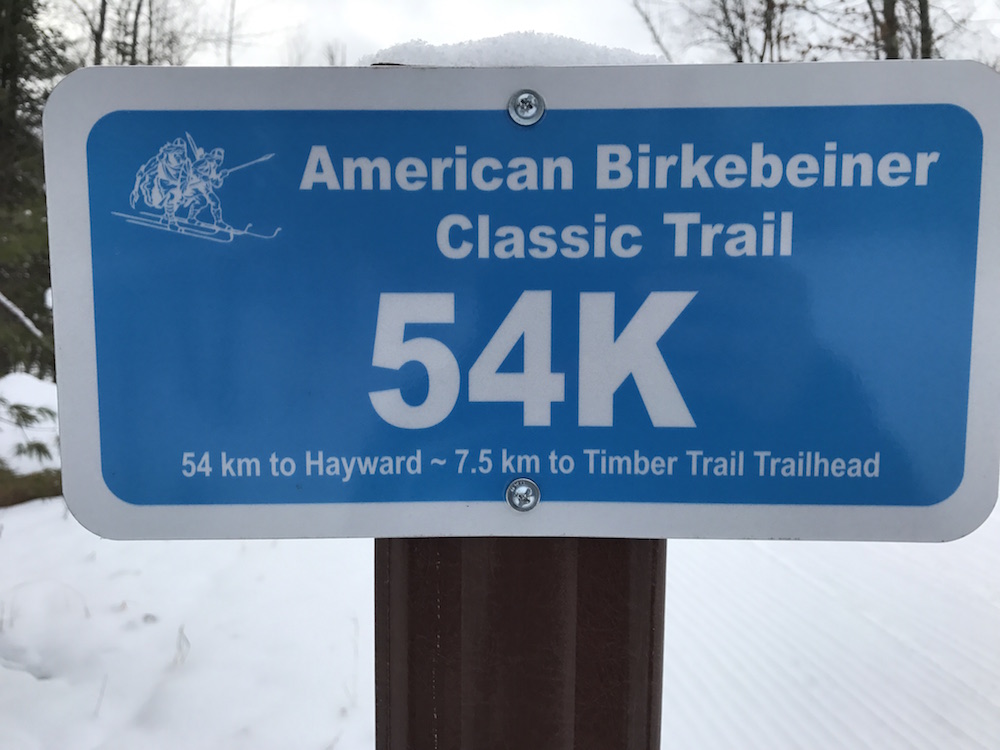
One of the Birkie’s new kilometer markers on the classic trail. (Photo: ABSF)
FS:On a recent trail run, I noticed the new trail markers. What was the 15 k mark is now 37 k to Hayward mark?
BP: All the signage on the trail has been redone this year. It now counts down to Hayward instead of counting up just like the race. Also, every sign is unique because they are now directional. The staff at Apple Awards designed the signs to tell you how may kilometers to Hayward, Firetower, Boedecker, Double OO etc. The classic trail signs will be blue and the skate trail signs will be red. It gets interesting when the two courses meet at Double OO because the race distance will be different. This just reflects the extra length for the classic race.
FS:After last year’s warm weather and the warm lake conditions, have you considered reworking the finish to avoid the lake?
BP: Downtown is critical for the race. We have to get into Hayward to finish the race. We have looked at a few worst-case scenarios if Lake Hayward is deemed unskiable. The alternative routes we looked at involving a few different turnoffs onto the snowmobile/ATV trail then go around the backside of New Moon into town.
If we have snow to work with and the lake ice isn’t safe, then it is possible because we will have snow to move around and can activate the other backup plans we have talked about. If it is a warm year with no snow and no ice, then it becomes a little more challenging.
Telemark Resort (Photo: Tom Held)
FS:Visitors and guests to the old Telemark Resort will remember the hall of fame wall covered with past Birkie winners. Now with the opening of the new Tony Wise Museum of the American Birkebeiner, the hall of fame has an official home. What did it mean to the history of the race to get the hall of fame and museum established in a permanent location?
BP: The museum provides the tradition and inspiration that the Birkie is all about. Having Kikkan here last year and Jessie being a Birkie Ambassador this year is great. They provide the inspiration and role models for kids and adults.
The Birkie is all about tradition. With Telemark closing, we were going to lose a lot of that tradition with the Hall of Fame and other aspects of the race potential being lost forever. We were approached by an extremely qualified woman lives in Cable and worked for the Smithsonian and she wanted to take on the museum project. She helped raise the money to build the museum and to relocate the Birkie offices all under one roof.
The museum far surpassed all expectations we had for it. Having so much history and tradition in one building is incredible. We have a lot of hands-on interactive displays, personal stories, and history of Tony Wise and his family. The is so much potential for the museum to grow in the future. We still have a storage room of archived pieces that was donated to us by the Lewis family from Telemark that we haven’t even begun to look at yet. It will be fun to see how the museum evolves in the future.
It is great to see how many people have come from states that have never heard of the Birkie, who might be in town for vacation or visiting family, and see their reaction as the walk around the museum experiencing the Birkie history for the first time.
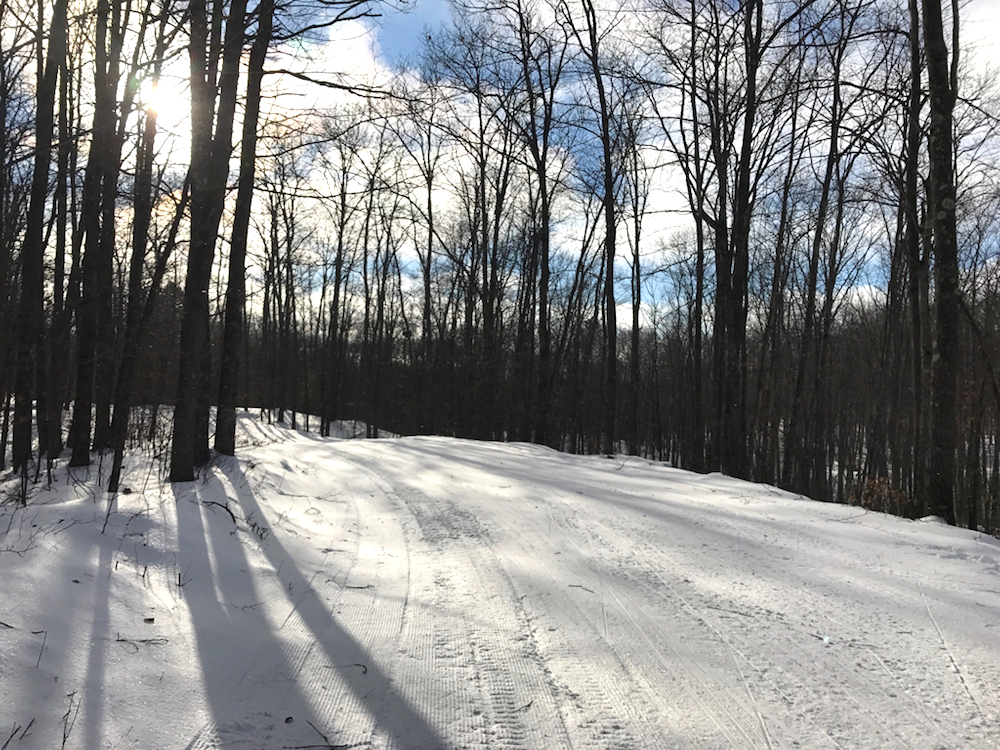
The Birkie trail as seen this past weekend between Cable and Hayward, Wis. The entire trail is covered, with less than a five-inch base, according to a groomer on Saturday, Dec. 31. (Photo: Vince Rosetta)
***
Author’s note: The Birkie Foundation has been working hard to give fans, spectators and racers the best experience possible for this years race weekend. If you are interested in supporting the American Birkebeiner Ski Foundation all the information can be found on its website.
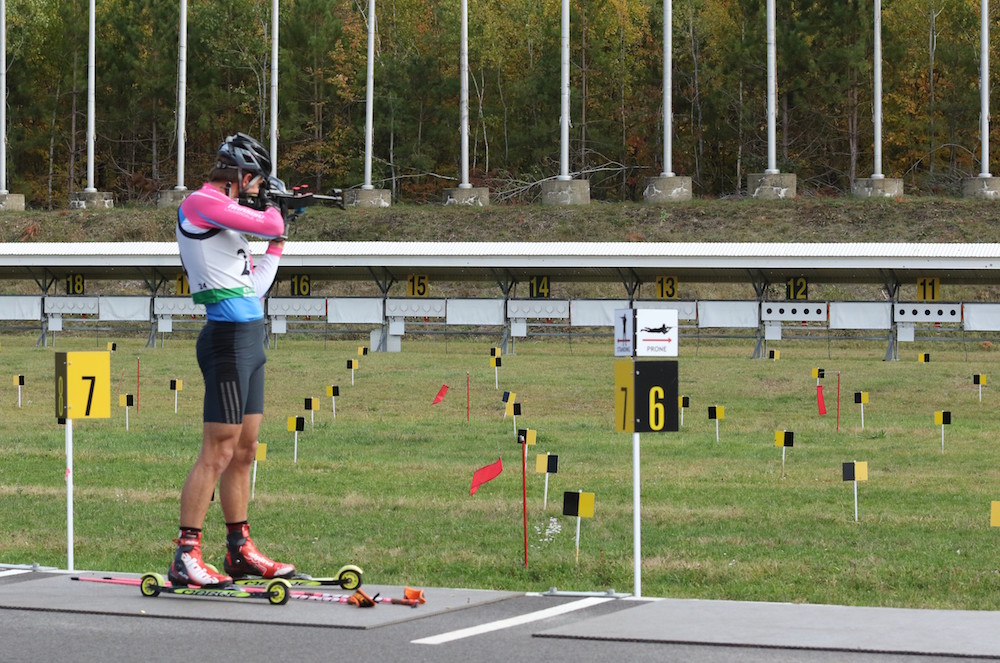
Paul Schommer, of US Biathlon’s National Development Group, shooting in Jericho, Vt., at rollerski trials this fall. (Courtesy photo)
Welcome to “17 Questions for 2017″, where we are catching up with American and Canadian national-team members before the beginning of the winter season.
***
After graduating from the College of St. Scholastica in 2015, Paul Schommer was identified as a potential biathlon talent by the US Biathlon Association. He has been going full bore in his new sport ever since and was recently invited to the national team’s pre-World Cup camp in Canmore, Alberta. Part of US Biathlon’s senior national development group, the 24-year-old Schommer was on the short list for a World Cup starting spot which he ultimately lost out on to Russell Currier, but proved that he’s getting close to the top level of American biathlon just a short time after switching sports.
1. Biggest change in your life in the last five or so months since the ski season ended?
I would have to say the biggest change in my life has been moving out to Lake Placid full time. Training in Hayward was great, but coming out to Lake Placid and having all the resources here has been an amazing opportunity. The staff here really makes it possible for us to concentrate on becoming a better athlete by taking care of simple daily tasks. For example, I step out the door and roller ski to the range, which is already set up by all the coaches, and do my workout. When I return back my room has been cleaned by a housekeeping staff member and I head to the cafeteria where food is hot and ready. To me, that’s just amazing and it’s because of all the awesome people here at the OTC that make it happen. It’s also incredible to have world class coaching day in and day out. It really makes a huge difference and am stoked to be able to be here training with the team.
2. Biggest change in your training?
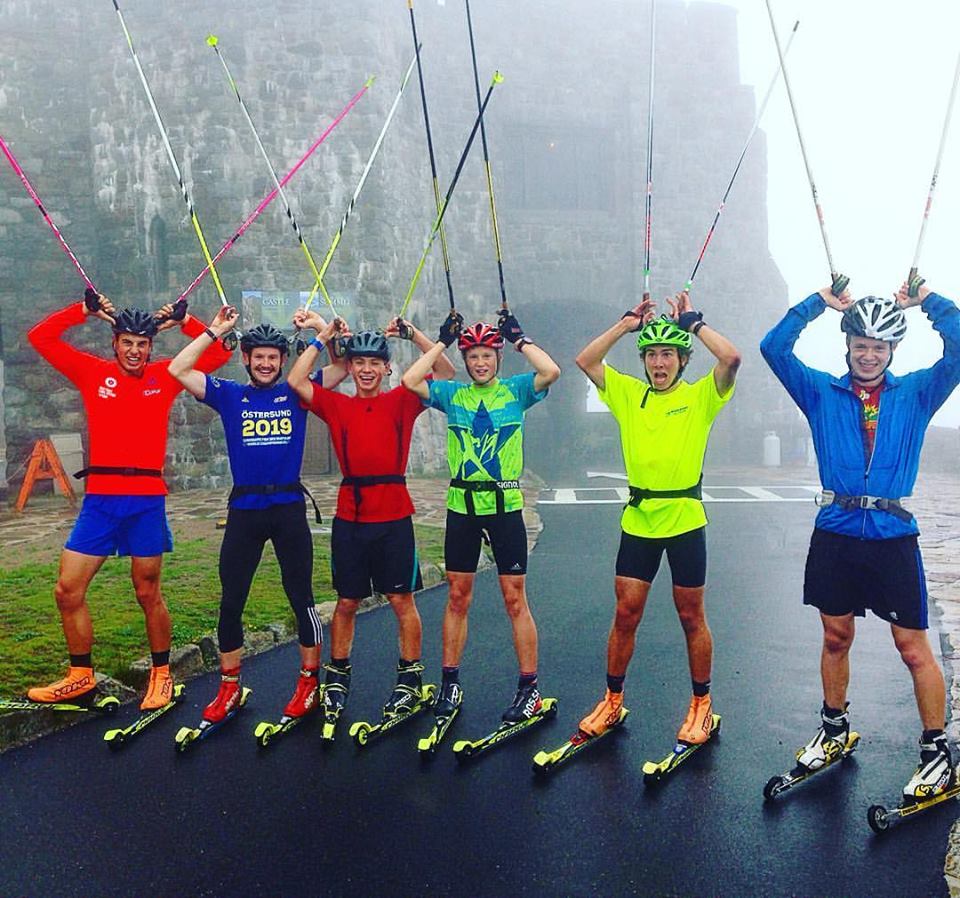
Paul Schommer (left) after the Climb to the Castle rollerski race in September, where he placed third, in Wilmington, N.Y. (Courtesy photo)
I would say sheer volume and intensity has increased in the past year. My coach at St. Scholastica Chad Salmela and I have been working on increasing my aerobic efficiency ever since I got to Duluth, and I am now starting to reap the benefits of that training. My ability to come back day after day and train at a higher level has allowed me to increase my quality training. In conjunction with this, I have not been working a part-time job like in years past. Due to my financial situation in the past, I have always had to work a part-time job to support myself. However, this year I decided if I was going to do biathlon, I would have to do it right. Money is always tight but thankfully God has put a lot of people in my life that have helped out a ton. The increase in training is definitely a result of the work done with Chad while at St. Scholastica, but being able to recover properly between workouts also makes a huge difference.
3. Major areas of improvement you’ve seen so far?
I touched briefly on my physiological improvement in the previous question, but biathlon is two sports in one. As my ski performance has continued to improve, so has my shooting performance from day to day. The first year of biathlon is an up and down roller coaster, have good days only to be followed by terrible days. The key is to find consistency, which is coming around more and more. As I have become more and more comfortable on the range, I am able to hit more targets consistently. A lot of this has come from lots of dry fire in the past year and shooting more rounds this summer than last year.
4. Whom you’ve been working closest with this offseason (coaches or training partners)?
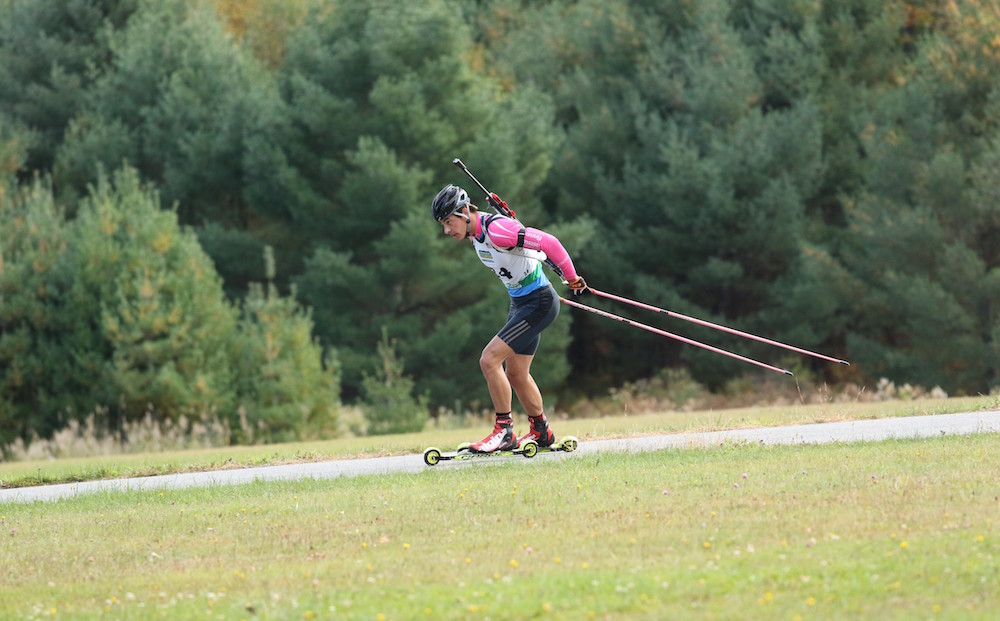
Schommer competing at rollerski trials in Jericho, Vt., this fall. (Courtesy photo)
While I was in Hayward this summer, I was all by myself. It was awesome to have that time to myself, work through things on my own and not have to rely on anyone else. However, being able to come to Lake Placid for camps made a huge difference and always helped keep me stay motivated. When in Lake Placid, I worked with Jean Paquet most the time, the head Development Coach at USBA. Working with Jean has been great and I’ve always jived well with him. For a training partner, Jake Brown and I do most of our workouts together. We have a really healthy competitive relationship with each other which allows us to push each other in workouts but still have fun. We are great friends and having him in Lake Placid makes things enjoyable both during and after training.
5. Best trip in the last five months (and why)?
Most my traveling is for training purposes, and I don’t have much expendable income for travel beyond that. So when I do have a few days off, I tend to use it to see those I love, whether that be heading home to see family or meeting up with friends. It’s hard to pick on specific trip that means more than another as each one holds its own special meaning. I mean, The Bjorn Bakken Ski Championships of America are a huge deal, the biggest deal, and I had a blast, but also moving my younger brother into college this fall was also awesome, but in a totally different way. So simply put, I’ve had a lot of awesome trips in the past five months and I can’t really say one was better than the other. And what made them all awesome wasn’t because of where I went, but because of the people that were there.
6. Favorite cross-training?
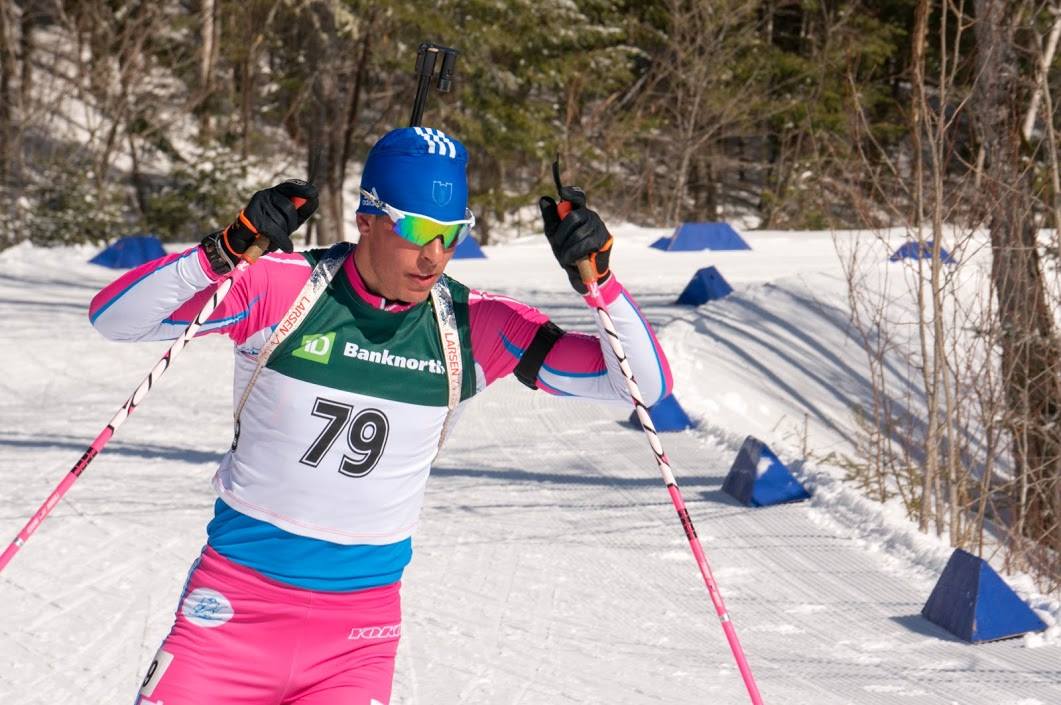
Schommer competing at U.S. National Championships in Maine in March. (Courtesy photo)
Normally I would say mountain biking but this summer I did a lot of paddling in a surfski and really grew to love it. There are so many lakes in the Hayward area and I had a blast going and exploring these on days where it was too hot to double pole, or just wanted a break from the usual training grind. I had a few evenings where I was the only one on the lake with the sunset reflecting of the glassy water and all seemed right in the world.
7. Favorite non-athletic activity or pastime this summer?
Probably the exact opposite of that, just sitting around doing nothing. Where I live this summer I didn’t have internet or phone service so I spent a lot of time just sitting around reading and praying, and it was awesome. When I would be in Lake Placid and have internet, I would start to miss the disconnected life I had back in the woods of northern Wisconsin. I loved just hanging out on the porch in the evening just chilling. It was so peaceful and relaxing. It makes me sound old and boring but I loved it.
8. Song that was your jam this summer?
King of My Heart by Steffany Gretzinger. There were a lot of times I was out skiing or doing a workout and this song would just be playing in my head and would just bring a smile to my face.
9. All-time favorite race moment?
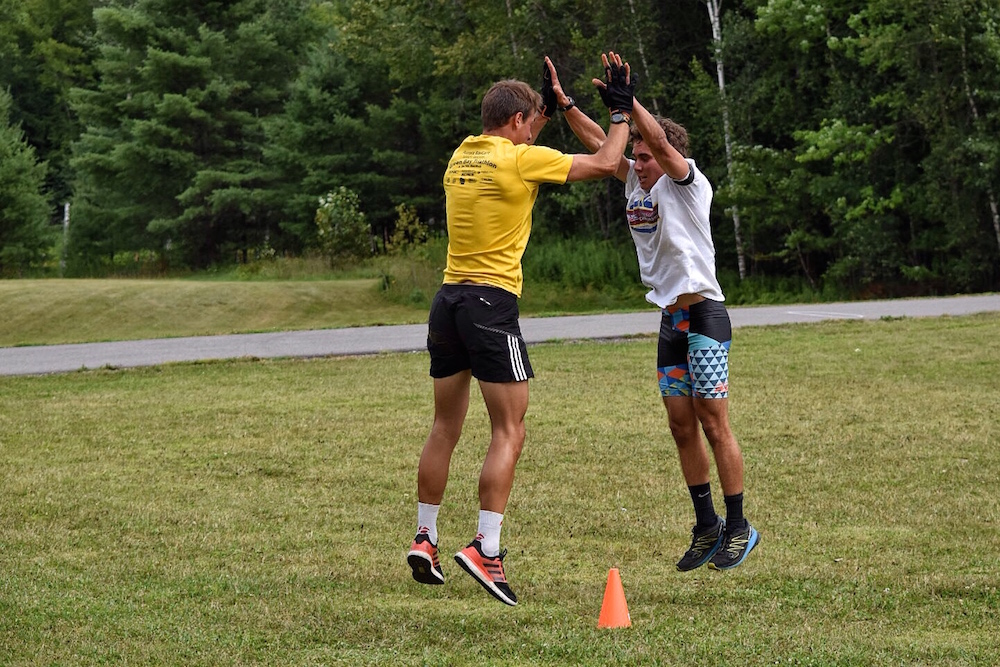
Paul Schommer (l) and Jake Brown doing high-five partner burpees during a strength workout at the U.S. Biathlon development camp in Jericho, Vt. Find their workout here. (Photo: Katrina Howe)
I would have to say the Minneapolis SuperTour at Wirth in 2010. I was a senior in High School and it was my first year ski racing competitively. I was having a bit of a rough season and was having trouble putting together a good race. Before the race my older brother Philip told me, “Paul, if you’re flowing keep it going, if you’re pressin’, you’re messin’.” I took his advice and for the first kilometer or two just tried to flow. As the race continued, I just kept passing people so just kept it flowing. At the finished I was the fastest J1 of the day, which even took me by surprise as my best finish prior to that had been 12th. The best part was at this time absolutely no one knew who I was as I just started competing. When I was looking at results a kid next to me turned to his friend and asked, “Who the heck is Paul Schommer?”
10. First thing you pack in your bag when you leave for Europe?
Positive attitude.
11. Venue/event you’re most excited to visit this season?
Anywhere I get to race and haven’t been to already. I love going to new places and meeting new people so I hope I have the opportunity to go to new places and meet new people this season. When the season concludes, I always look forward to heading back to the Ski Haus for the Bjorn Bakken Ski Championships of America, the greatest backyard ski race on the planet. They always have a great course to really test the skills.
12. Who will win the men’s and women’s World Cup titles this year?
On the women’s side I’d have to go with Marie Dorin Habert. On the men’s side, I think it’s going to be a tight race between Martin Fourcade and Johannes Thingnes Boe.
13. Biggest sacrifice you feel you’ve made choosing this career path?
I don’t really feel like I have sacrificed much. Right now, I am thankful to have this opportunity and don’t have any regrets.
14. If you could change one thing about your sport, what would it be?
Have people know what it actually is. Haha, this is a blessing and a curse at the same time. Not many people in the US know what biathlon and right off the bat guess it is biking and running. However, this also gives me an opportunity to introduce people to the sport and in turn help grow it. Biathlon is a very spectator friendly sport, which is evident by the fact that it is the most watched winter sport in central Europe. Talking with some people of USBA it sounds like they are going to be doing a few things in the coming year to help bring biathlon to Americans which is pretty exciting.
15. What did you have for breakfast this morning?
I’m on this new diet so I had an orange peel, half a banana, and a peanut. I’m only kidding, I had oatmeal.
USSA President and CEO Tiger Shaw warms up for the Slumberland American Birkebeiner, skating on Hayward’s Main Street. (Photo: USSA/Tom Kelly)
When Caitlin Gregg was the first woman across the line in the 51 kilometer 2016 American Birkebeiner, she wasn’t wearing her U.S. Ski Team suit.
Most team members don’t when they are at domestic races in the U.S., and club loyalty is one of Gregg’s trademarks. She instead represented Loppet Nordic Racing.
But just 15 minutes after she finished, there was another guy who was wearing the U.S. Ski Team colors, and he was finally crossing the start line in Wave 9. It was not only his first Birkie, but also his first cross-country ski race.
“I guess I could have pulled rank and asked them to move me up, but I wanted to see what it was like in that group,” U.S. Ski and Snowboard Association (USSA) President and CEO Tiger Shaw said in an interview on Tuesday. “There were tons of people faster than me in that group. The only challenge is on some of the uphills, you have everybody who is falling back from earlier waves who you are catching, so it’s a bit of an escalator. But that dissipated. I was nicely surprised that after 10 or 15 k, everybody had fallen into their speed.”
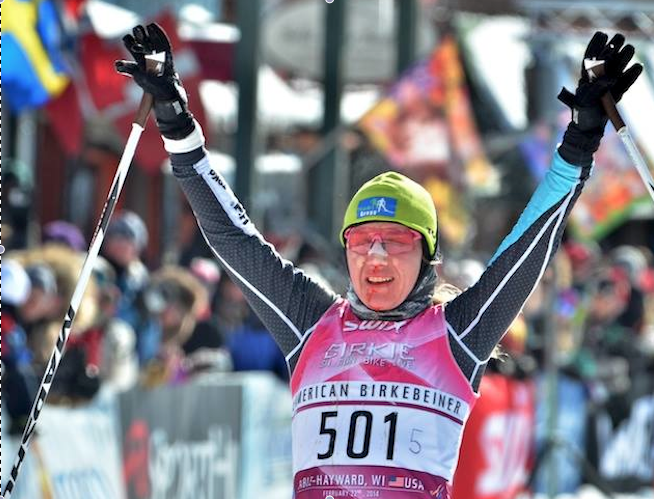
Caitlin Gregg after winning her record fourth Slumberland American Birkebeiner from Cable to Hayward, Wisconsin. (USSA/Tom Kelly)
There was a veritable contingent of USSA folk at the Birkie this year, including Vice President Communications Tom Kelly and Nordic Domestic Programs Director Robert Lazzaroni, as well as star athlete Kikkan Randall, who didn’t race because she’s pregnant but was on hand to soak up the scene.
And what a scene it was. Shaw, a two-time Olympian and NCAA Champion alpine skier, has attended cross-country World Cup races in Europe, but the Birkie was an entirely different experience.
“It is both a world class event and a Gran Fondo,” Shaw marveled. “Meeting these people who have done the Birkie a double digit number of times, it’s a lot of people. That gives you an amazing perspective… I was able to be there for Thursday night through Sunday afternoon. I got a chance to take in the Barnebirkie and all the kids races and everything that happened on Main Street.”
And then there was the race itself. Although Shaw came to the finish hours after the first men and women, there were still die-hard fans out cheering for him and the others who started in the last wave.
“People had been there since ten o’clock cheering for the elites,” he said of crossing the lake into Hayward. “People are still standing around in their insulated boots, jumping up and down, drinking hot tea or coffee or jägermeister or whatever else, screaming and ringing bells for five hours. It was impressive. That’s cool, and it’s not easy when it’s drizzling in the 30’s, or other years when it’s below zero. I love that.”
USSA has recently partnered with the Birkie, which Kelly said resulted in “dramatic gains” in membership for the national organization this year.
Shaw was pleased to meet some of those new members. While he might be well-recognized at alpine events, this was not the case in Hayward, Wisconsin.
“I had a lot of really fun conversations,” he laughed. “Usually people didn’t recognize me, but if I was in a conversation and I introduced myself, they would kind of say, ‘oh! Well hello!’ Like, what are you doing here?”
And the CEO wasn’t just talking the talk, he was walking the walk – or skiing the ski.
USSA President and CEO Tiger Shaw cheers on kids in the Barnebirkie race of the American Birkebeiner. (Photo: USSA/Tom Kelly)
“It was especially fun when I was wearing my Craft and L.L. Bean gear, either about to race or in the race or after the race, and people realized I wasn’t just there watching,” he said. “I was there competing, if I guess you could call it that. That made a difference. It just drops everybody’s guard, if they have one up.”
After skiing with septuagenarians doing their 30th Birkie and feeling his own small moments of glory when he passed other competitors, Shaw was left marveling at the scale of the event.
“There are some season-ending races for all age groups in alpine,” he explained. “The Sugar Slalom in Stowe is an example, the Loveland Derby. But you’re talking about maybe 500 or 600 participants, not 10,000. There’s no way to do something like that in alpine. I’m not sure if there’s anything equivalent in snowboarding. Jumping, not so much from a participation level, but there are a lot of spectators at the Springer Tourney in summer.”
The Birkie is an entirely different animal.
“This dwarfs anything I’ve ever seen,” Shaw said. “Especially when you think of the cumulative group which is part of it. We just ran a Big Air event at Fenway Park in Boston, where we had 27,000 people watching over two days and a handful of participants because it was an elite event. But the Birkie, if you count support people and the families of people participating, that’s probably 27,000 people there. And that’s not in a metro area.”
Ski racing in America: still packed and enthusiastic, even when it’s 32 degrees and raining. (Photo: USSA/Tom Kelly)
Speaking of elite events, Shaw is still hopeful that USSA can find a way to host a top cross-country competition in a big city. But that would be totally different than the Birkie.
“This was about participating and being part of it, feeling it, whether you are a participant, elite or otherwise, or a volunteer, or you have a kid racing,” he said. “You can see that it’s really part of people’s lives.”
Shaw, who finished in 4:49:23, enjoyed it all, and appreciated how those not racing were if anything more enthusiastic than the racers themselves.
“They were having such a good time despite it being 32 degrees and raining, which it was on Friday during most of the kids’ events,” Shaw said. “It rained half the time when we were in the race too, and nobody cared. The volunteers at all the stops, the medical personnel, the crazy people playing in bands on the side of the trail and cheering for us, the shotski group, it’s hysterical. It was fun.”
The trip illustrated many aspects of why Shaw is eager to work with the nordic community.
“There’s a lot of fans,” he noted. “Cross-country has a bigger group of participants through all the age groups than any of our sports. In alpine we don’t have racers racing their whole life. In cross-country you do. It’s a unique opportunity for the sport to empower those people, and locally they support their clubs.”
Shaw hopes that they will support USSA and the national team as well, but knows that USSA has to offer something in return. He’s working on it.
USSA President and CEO Tiger Shaw is ready to race, posing on Main Street before the American Birkebeiner. (Photo: USSA/Tom Kelly)
“The goal there is to figure out how USSA can best become re-involved on a large scale,” he said. “USSA kind of dwindled in relevance in cross-country below the sanctioned race level and the elite team level. We are working with everybody to see how do we help out again with the efforts that are already happening.”
Shaw also met with Birkie directors, as well as higher-ups at CXC and Loppet Nordic Racing. Those are among the clubs USSA consider models in the cross-country world.
“There’s extremely good coaches, education, and knowledge in the CXC division, especially around Minneapolis,” Shaw said. “One thing that we can do is gather together the best practices from the divisions and clubs, and combine that with what [U.S. Ski Team coaches] Chris Grover and Matt Whitcomb believe are the best practices, and distribute that nationally. We want to standardize it to raise the whole tide of instruction and coaching, technique and preparation, how to keep parents involved and keep it fun. That’s a role that we can play.”
He hopes to see USSA playing a role far greater than it has in the last decade, when the national governing body’s involvement in nordic sport was mainly at the national competitive level and with the national team itself.
“We’d love to see every cross-country skier in the country be a follower of the U.S. Ski Team and to be a USSA member if it makes sense,” he said. “But it has to be an affordable, sensible membership with the right benefits. Maybe we can one day be like USA Swimming where there isn’t a kid in a club that isn’t a member – they are ubiquitous, and they provide a lot of services. That’s what we’re trying to provide.”
As USSA works toward that goal, Shaw seemed to genuinely relish the chance to try cross-country racing out for himself in the continent’s biggest and craziest competition.
“Even though I only raced as a citizen, it helps me appreciate watching the cross-country events at all levels now,” Shaw said. “I get it about stepping on somebody’s pole, and how to get around someone at my own level. If you’re feeling strong and blow by a bunch of people, you start thinking, wow, I’m pretty good. When in fact, you’re just a citizen. But it’s thrilling nonetheless!
“It’s a taste of what it must be like to be a Kikkan or all of those elite athletes,” he concluded. “It reminded me of when I was racing, that feeling of being a contender and being able to turn it on when you want to turn it on.”
Caitlin Gregg (Team Gregg/U.S. Ski Team) en route to winning the Boulder Mountain Tour in Sun Valley, Idaho, earlier this month. (Photo: Toko)
After winning World Championships bronze in 2015 and, after years of racing, a U.S. Ski Team nomination come spring, Caitlin Gregg nonetheless found herself out of sorts when the World Cup kicked off in November.
“Basically since the first weekend on the World Cup I just felt off,” Gregg said in an interview on Wednesday. “I couldn’t really figure out what it was. I had some races where there were good moments, but I just wasn’t able to put it together and I didn’t feel like myself. I felt like something needed to be reset.”
There were good moments: the classic leg of a skiathlon in Lillehammer, or parts of races in the Tour de Ski. Competing in the grueling ten-day race series for the first time, Gregg hoped that as the races piled up she would feel better and better in comparison to the field.
But by the time the Tour was finished, and she crossed the line at the top of the Alpe Cermis in 42nd place overall out of 43 women’s finishers, Gregg was ready to do something differently.
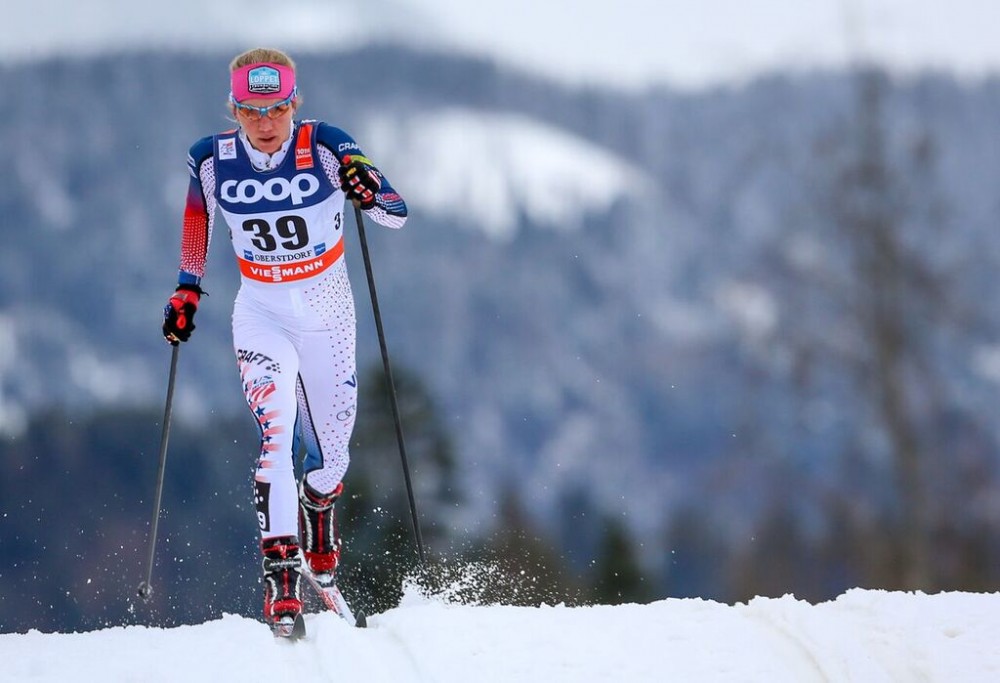
Caitlin Gregg racing to 49th in the 10 k classic mass start at Stage 5 of the Tour de Ski in Oberstdorf, Germany. (Photo: Marcel Hilger)
“I made a tough decision – well, tough but not tough – to come back to the U.S.,” the Vermonter-turned-Minnesotan explained. “Tough in the sense that it’s always hard to leave opportunities for World Cup starts behind, but not so tough because I’m on the ‘B’ team and any extra day I’m over there, I’m paying for it.”
While the other American finishers from the Tour headed to Seiser Alm, a high-elevation training site in Tyrolian Italy, Gregg went home to North Minneapolis.
“I thought it would give me a good boost mentally and would give me the strength I needed for the next month of training,” Gregg said. “So I spent two weeks at home, and I worked at the Boys and Girls Club and skied with my Loppet Nordic Racing teammates and recharged, and then hit the ground running with my training.”
It seems to have worked.
“Since then, everything has been really good,” a relieved Gregg said. “My heart rates and lactates are back to normal and my energy feels great, so I’m pretty psyched.”
The Greggs traveled to Wisconsin, mecca of the American Birkebeiner, to support the Birkie Tour; Caitlin’s husband Brian won the Seely Hills Classic.
Then while Brian headed East for SuperTour racing, picking up three top-10’s in Lake Placid, N.Y., and Craftsbury, Vt., Caitlin Gregg stuck in the Midwest. She entered and won the Three Rivers Rennet in Bloomington, Minn., where she was fourth overall, and trained with her old friends.
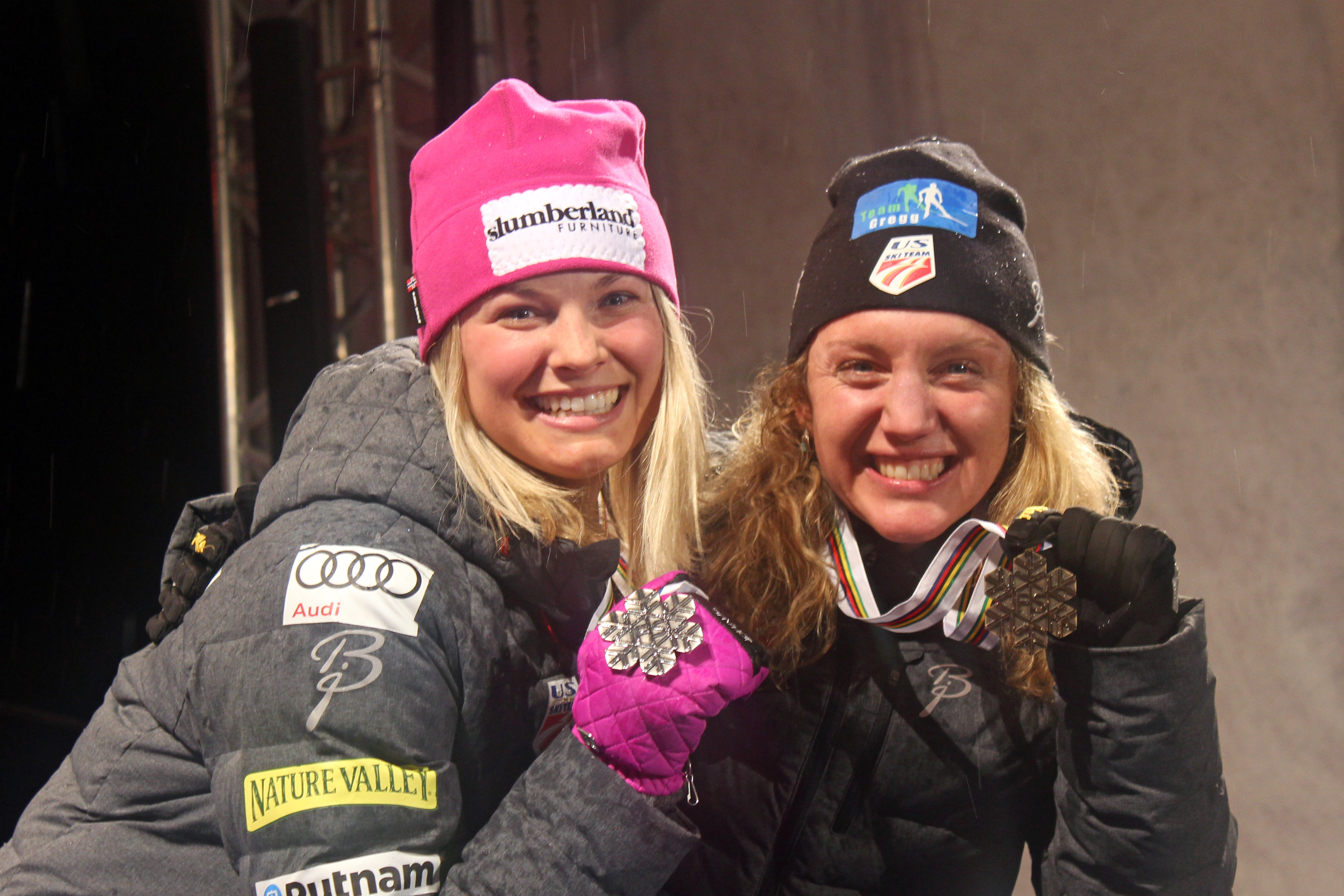
Americans Jessie Diggins (l) and Caitlin Gregg (r) hold up their silver and bronze medals from the 10 k freestyle at the 2015 FIS Nordic World Ski Championships in Falun, Sweden.
“I think I’m a unique athlete in the sense that so much of my career has been through community involvement,” she said. “Not just financial support – that for sure – but honestly, I’ve trained with more juniors and masters than I have with elite racers. Whether it’s early morning intervals or training in the dark, or doing a local citizens’ race, that’s where I get my energy.”
She also made a detour to race, and win, the Boulder Mountain Tour in Sun Valley, first training at elevation in Frisco, Colorado.
Gregg is hoping that energy will carry her to another Birkie win on Saturday, and then on to the Ski Tour Canada, the final period of World Cup racing for the season.
“This year is big because I’m tied with an [Austrian] guy named Manfred Nagel for the most Birkie wins,” Gregg explained. “I think if I win I will be the all-time winningest, which is pretty cool. So I’m going to keep trying to do that for the rest of my life – they’re going to have to pull me off the Birkie trail some day. I’m actually standing on the trail right now.”
Gregg won her third Birkie title in 2014, and missed the event the next year in preparation for World Champs – ultimately a successful move. But coming back to the race is clearly beyond exciting for one of its biggest cheerleaders.
“The Birkie is huge because of the community,” Gregg said. “We’ve spent years here in Hayward… I know some elite racers on the World Cup don’t quite get it. But I think it is an event that brings home why people get excited for us when we have international success on the World Cup. Skiers here are psyched to be on your same equipment, or to know what your latest modes of training are, or the heart rate variability stuff, or what your drink mix is for the Birkie. It really brings home the sense that there’s an awesome ski community here.”
Caitlin Gregg, winner of a particularly frigid 2014 Birkie. (Photo: American Birkebeiner Foundation)
In the end, Gregg plans for this to be one more season where the Birkie fits in well with her World Cup racing goals.
“It’s funny because the Birkie motto is Ski, Run, Bike, Live, and it really is part of my life,” she said. “Sometimes the Birkie is what elite racers do when they are done with their careers. I like that Brian and I have been able to integrate it into our international careers – and other athletes too, like Holly Brooks, Tad Elliott, and Matt Liebsch. It’s not just something that you do when you’re done racing.”
And after Saturday’s race, whatever the outcome, she will focus intensely on recovering and preparing for Canada.
“For the first time maybe in my career, I feel like my age comes into play as a benefit,” Gregg laughed. “I don’t think a 50 k takes as much out of me as someone who is in their early 20’s. Finally there’s a perk to being old and having a zillion hours underneath me!”
But seriously.
“My training leading up to this race has been good, and it’s going to be a fast year this year with the conditions,” she said of possible post-marathon fatigue.
So I think it’s not going to be a problem. I’ve talked to a lot of coaches and gotten some good insight into what to do afterwards for recovery.”
Holly Brooks winning the 2012 American Birkebeiner, four-tenths of a second ahead of Caitlin Gregg (l), for her first Birkie title. (Photo: Darlene Prois/ABSF)
Each year, leading up to the third week in February upward of 11,000 people get sick. It isn’t a sickness that would cause a widespread panic, but rather one thousands of Midwesterners actually looked forward to each year, and it’s called Birkie fever.
The 42nd running of the American Birkebeiner takes place Saturday, starting in Cable, Wis., and ending some 30 miles (or 50-plus kilometers) south in Hayward, Wis. The race filled up in November, with all 10,500 allotted entries accounted for before the first of the year. In total, 10,517 skiers from 18 countries were registered for the three Saturday races, almost 7,000 of them are entered in the 51 k skate race. That’s a big change from 1973, the first time the Birkie was held. Back then, there were 34 men and one woman as race participants.
The race course has gone through several changes since 1973, from the direction skiers raced to the length of the race. This year’s race has a few changes that will add a some interesting twists. For one, the race is longer. The classic race is now 55 k and the skate race now 51 k. The extra distance was due to a relocation of the final aid station and the extension of the finish line, pushing it farther down Main Street.
The International Bridge was a fixture in the Birkie before. (Photo: ABSF)
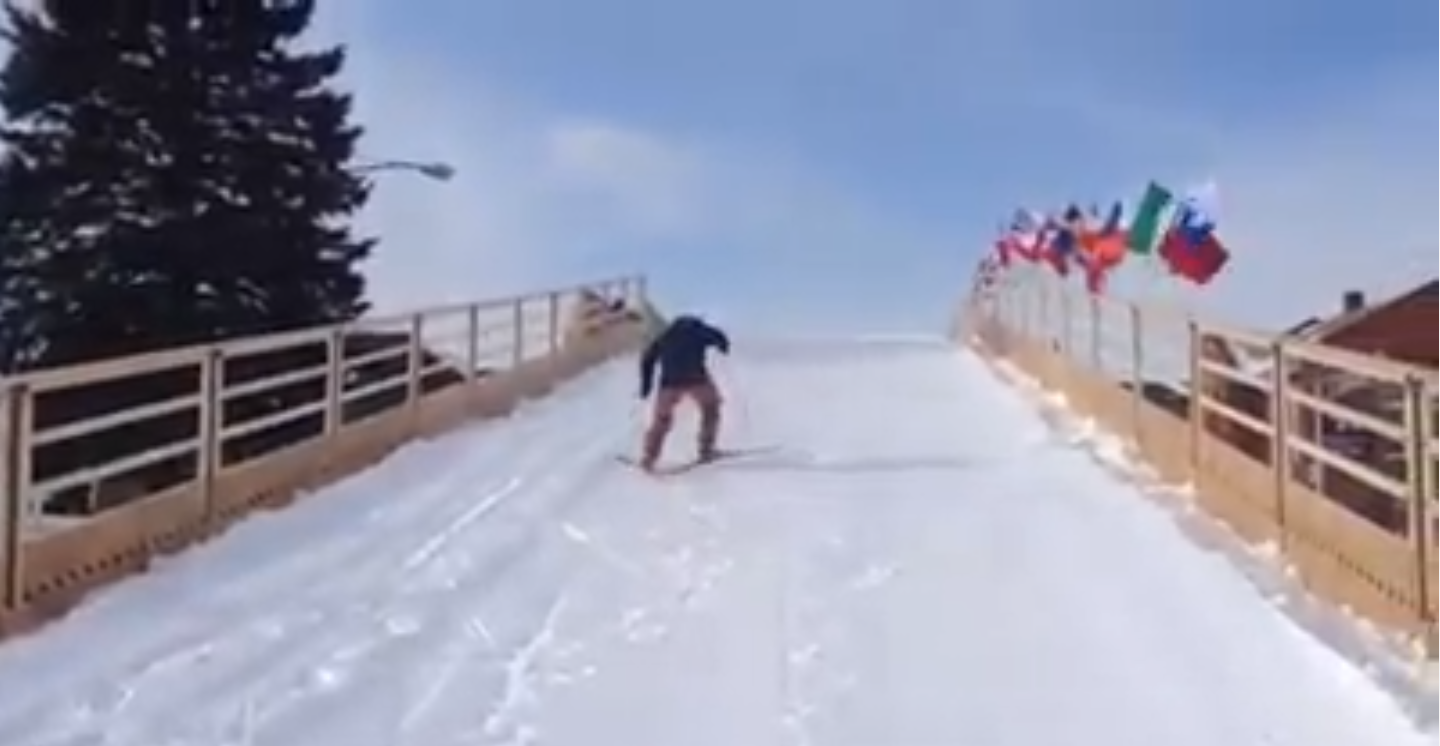
The biggest change that has garnered some of the most attention is the new bridge the American Birkebeiner Ski Foundation (ABSF) finished assembling on Wednesday over Highway 63, a kilometer from the finish.
The International Bridge adds no length to the race, but it does add a 17-vertical-foot hill before the finish. Previously, once skiers were five kilometers from the finish, it was a flat ski to Main Street. The new manmade hill adds a 10-percent climb to legs that already have some 50 kilometers of climbs in them.
This isn’t the first time the International Bridge has been a fixture on the Birke course. In the late ’70s and early ’80s when the race finished at the Telemark Resort in Cable, the bridge was the last hill skiers needed to climb before they finished. The temporary bridge is 100-feet long and spans 30 feet over the highway.
The bridge was needed to eliminate the traffic congestion problems the race brought during the weekend. Funding for the ramp and other changes is a part of phase one of the ABSF’s multiple-year fundraising program.
The past two years, the Birkie has been a part of the FIS Marathon Cup, a season-long international competition that crowns a winner with the highest points after a series of races of 42 k or farther. This means it attracts some of the world’s best long-distance racers and this year’s women’s field is a reflection of that. In the elite wave, the top four women in the FIS Marathon Cup are entered: Tatjana Mannima of Estonia, American Holly Brooks, Aurelie Dabudyk of France, and Antonella Confortola of Italy. Confortola finished second in last year’s Birkie.
Brooks was leading the FIS Marathon Cup, but skipped last week’s stop at the Tartu Marathon in Estonia to head to Hayward to prepare for the Birkie.
“I’m really excited for this year’s Birkie,” Brooks wrote in an online message this week. “It’s been a couple of years since I’ve been here and it’s great to be back — both at the Birkie and on ‘home soil!’
“I’ve been bouncing from country to country racing marathons and I decided last fall that I would spend two weeks here in Hayward,” she explained. “I have great friends that I’m staying with and it feels fabulous to be in a house [rather than a hotel].”
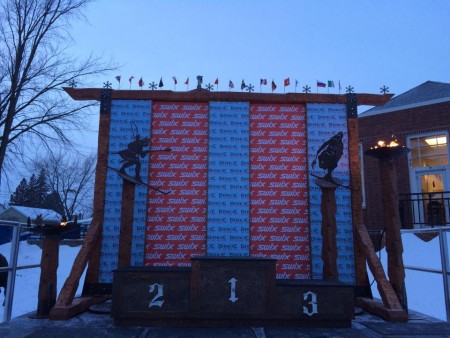
The new podium awaits for the winner of this year’s race. (Photo: ABSF)
Coming into the race, Brooks ranks second in the overall FIS Marathon Cup standings, just seven points behind Mannima. Brooks won the Birkie in 2012 and knows the course well.
“I‘ve seen the whole thing start to finish… both at distance pace and race pace. That’s more than I can say for some of the courses I’ve raced this winter!” Brooks wrote. “Not sure how much of a true advantage it gives me but it puts my mind at ease a bit. I know where people including myself have made moves.”
Two year ago at the Birkie, Mannima lost a photo finish and placed second to three-time Birkie champion Caitlin Gregg, who is currently in Sweden representing the U.S. at the FIS Nordic World Ski Championships in Falun. American Caitlin Patterson (Craftsbury Green Racing Project) finished third in 2013 and seventh last year, and could prove to be a threat in this year’s elite race.
In an email on Wednesday, Patterson wrote that she was looking forward to skiing part of the Birkie trail on Thursday, refreshing her memory “of some of its notable features, and seeing the new bridge and finish line if possible.
“My preparations have been going well — mostly I’ve been focused on recovering after recent Craftsbury Supertours, building up my energy, and actually keeping my training skis pretty short and easy,” she explained. “At this point in the season I have to trust the endurance and fitness I’ve built up during the past year, and mostly just stay sharp and excited for the race, which I most certainly am!”
In terms of her goals and expectations for Saturday’s race, Patterson felt anything was possible.
“The past two years of racing the Birkie have taught me that it’s a race in which you have to test your limits but where you never quite know what will happen, where you must always be thinking quickly and ready to react throughout all 50+k,” she wrote. “I believe that I’m in very good shape, so my goals are to trust my fitness, ski with confidence and enjoyment of the sport… and to make it onto the podium!”
“I’ve seen the whole thing start to finish … I know where people including myself have made moves.” — Holly Brooks on her Birkie advantage
The men’s field is also competitive. Most of the FIS Marathon leaders didn’t race last weekend’s Tartu Marathon to fly to the U.S. to prepare for the Birkie. Overall FIS Marathon Cup leader Petr Novak of the Czech Republic is racing along with France’s Benoît Chauvet,who sits in second place, only 85 points behind Novak. Second-and-third place finishers from last year’s Birkie, Simone Paredi and Sergio Bonaldi of Italy, are also listed to start. Bonaldi won the Birkie in 2013.
Tad Elliott (119) racing in the men’s 30 k classic mass start at U.S. Cross Country Championships in January in Houghton, Mich. (Photo: Christopher Schmidt)
For the U.S., Birkie winners Tad Elliott (Ski & Snowboard Club Vail Elite) and Matt Liebsch (XC United/Team Strong Heart) will be racing, along with 2014 U.S. Olympian Brian Gregg. Elliott won in 2012 and Liebsch took first in 2009.
This trio has had a pretty intense history in the Birkie. When Elliott won in 2012, Liebsch placed second and Gregg took third. The difference between first and third was only 14.8 seconds.
In a phone interview, Liebsch mentioned how team tactics played a part in previous Birkies, but that would not be the case this year.
“In the past, you would have these teams come over with five or six guys and it would essentially be like a cycle race,” Liebsch said. “The fast sprinters would just sit in the back while his teammates did all the work up front setting the pace and sending guys off the front to disrupt the flow of the race. This year is a little different because there aren’t the multiple-person teams.”
Liebsch added that the style of racing here is different than at European marathons.
The 2011 American Birkebeiner men’s podium (from left to right): with France’s Benoit Chauvet in second, Norway’s Tore Martin Gundersen in first and Russia’s Andrey Tyuterev in third. (Photo: Andy Caniff/Swix Sport USA)
“In Europe, the pace is extremely fast due to the fact that teams have ten or eleven guys,” he said. “Here in the United States, the pace is slower and many of the Europeans don’t like that pace so they would send guys off the front if the pace got to slow.
“Most of the European guys are here to get FIS points to improve their standings for the overall FIS Marathon Cup title,” he added.
Chauvet is currently second in the overall FIS Marathon Cup and has the biggest team entered in the Birkie with four total teammates, while the overall leader, Novak will race solo.
“The strategy for most of the European guys will be to stay up front, in the top eight, get points and then head back to Europe,” Liebsch said. “This could really help out the fast American guys like Tad, Brian, me and Lex [Treinen] because the pace won’t be crazy fast like most European races can be.”
In an email, Treinen predicted that U.S. guys would have a good showing: “Matt looks like he’s in good shape and he and [Brian] Gregg would love to take home a Midwest victory here,” he wrote. ” … I have been training specifically for the Birkebeiner for at least two weeks and I even did some intervals recently, so I feel like I am in better shape than ever before.”
Elliott has spent some time in the Midwest and won last month’s Seeley Classic race that was held on the Birkie course.
“I am excited to race the Birkie,” Elliott wrote in an email. “It will be three years since I last raced here! I am looking forward to a great event. I have had some health issues again sneak in this last month, but I have a few tricks up my sleeve. My twin brother is also my wax tech coming with me from Colorado. Hoping [he] can keep me in the race this year!”
The biggest factor going in the weekend is the weather. There was a concern of a lack of snow but over the last few weeks the area has gotten enough snow to make the course set up nicely for the race. The wind and cold temperatures are an immediate concern. On Tuesday, organizers canceled Thursday’s elite sprints because of the predicted well-below-zero temperatures at the scheduled start time. Early predictions show Saturday morning’s temperatures to be around 4-degrees Fahrenheit.
Online registration for the Junior Birkie closes Thursday, Feb. 19. (Photo: James Netz)
(Press release)
HAYWARD, Wis. (Feb. 18, 2015) – Due to cold weather, the Junior Birkie races will start one hour later at 10:00 a.m. instead of 9:00 a.m. as originally scheduled on Friday, Feb. 20. Start times have also been compressed.
The Barnebirkie will go off as scheduled at 12:30 p.m.
New Junior Birkie start times are listed below:
10:00 a.m. U12 & U14 Boys 3 km
10:05 a.m. U12 & U14 Girls 3 km
10:10 a.m. U16 Boys & Girls 3 km
10:15 a.m. U19 Boys & Girls 5 km
10:25 a.m. U10/8 Boys & Girls 1.5 km
11:00 a.m. Junior Relay
Online registration for the Junior Birkie will close at 7:00 p.m. Thursday, Feb. 19. Skiers can pick up race bibs at the National Guard Armory in Hayward starting at 7:30 a.m. on Friday, Feb. 20.
The Junior Birkie starts at 9 a.m. near the Hayward Primary School and finishes on Main Street.
CXC elite-team head coach Bill Pierce recently accepted a position as nordic director of Snow Mountain Ranch YMCA of the Rockies in Granby, Colo. (Photo: CXC/Facebook)
Almost a decade ago, Bill Pierce and Yuriy Gusev took a walk in the Cable/Hayward area of northern Wisconsin, where Gusev, the director of Central Cross Country (CXC) since 2005, decided to root the CXC Team and Junior Program (and later an adaptive program and CXC Academy).
Pierce, who built custom homes at the time through his own company, Pierce & Associates Design/Build, Inc, wanted to show Gusev a thousand-acre parcel — a potential site for a big idea.
A competitive cross-country skier and runner up until the mid-80s, when he studied at the University of Wisconsin-Milwaukee School of Architecture and Urban Planning, Pierce moved to Hayward and found part-time work in 1997, grooming the Birkie trail on a need-basis with one broken-down snowcat.
“When I went to Hayward, my first job to get paid skiing was [as head coach] at Hayward High School,” Pierce said Thursday on the phone. “That was enough money for one month over five to make a living off of so I did other things.”
It wasn’t long before he was chairman of the American Birkebeiner Board of Directors and landed his first full-time coaching job in 2007. He built his home in Seeley and dreamt of more for Hayward: a charter school and training center for nordic skiers — and not just any nordic center: a multi-use events center.
“If you want to be mainstream and survive as a business, you can’t just be nordic,” Pierce reflected.
In his development near the Birkie’s “00” halfway point, ski trails touch every lot. Yet without Telemark Resort open, the area remains without a nordic center.
Thinking back to his idea, he imagined opening the events center to non-skiing attractions: music festivals, beer-and-wine tastings, bike shows, and more. Unless its developers were subsidized, they would have to — selling trail passes four or five months a year wasn’t going to pay the bills, he said. But with the offseason revenue, they could fund their dream of a true nordic-training center.
To this day, Gusev has kept that same goal in sight and taken steps, such as researching the potential of Telemark Lodge, to make it a reality. It’s been on Pierce’s mind for the last two decades, and he said the 1,000-acre parcel remains on the market.
“It’s a soft market and soft economy … [and] we’re looking at another piece of land south of here,” he said. “There’s opportunities.”
An estimated 60 athletes and coaches attended the 2014 CXC/Loppet Nordic Racing/F.A.S.T. dryland camp in Ironwood, Mich., earlier this summer. Here, athletes were caught in action during a bounding workout. (Photo: Bill Pierce/Facebook)
But Pierce, CXC’s elite head coach since May 2013, couldn’t wait on that. In the last few years, he applied for other jobs, including with the American Birkebeiner — which Gusev knew about as a board member — and as executive director at Soldier Hollow in Midway, Utah.
One position near Winter Park in Granby, Colo., stuck. Pierce accepted the Snow Mountain Ranch YMCA’s offer to come on as its first full-time nordic director this fall, and he sat down with Gusev to tell him about it three weeks ago.
“I knew that sooner or later Bill will leave and we were somewhat planning on it,” Gusev wrote in an email. “We have discussions with other staff about possible options if that would happen. We also had plans to add additional staff this fall even before Bill notified us about his leaving.
“It is definitely a loss for CXC and the Midwest Nordic community but Bill is following his passion and I’m glad he found something that he is very excited to be involved in,” he added. “We all at CXC wish Bill the best in his new venture.”
“It was a hard choice,” Pierce explained. “I’d come back in a second to work for [CXC]. It was a lot of factors, some of them were personal…”
In post on CXC’s Facebook page on Thursday, Pierce announced his departure and move to Colorado on Oct. 1.
“… Life is extremely short and we really won’t ever know what the next day will bring,” he wrote. “In the past year, I have seen a lot of loss and it has been a difficult one. I lost my Mom, two very close friends and colleagues in John Hugus and Igor Badamshin, and I lost my marriage. It is time for a change.”
CXC’s former high-performance advisor and CXC Team coach, Badamshin died of an apparent heart attack while skiing on the Birkie trail in January. He was 47.
Hugus, who founded the Knicker Nordic Ski Club in Wausau, Wis. — of which Badamshin was also head coach — and served as secretary of the Central Wisconsin Skiing Association, died last October at 57 after batting multiple myeloma for 17 years.
“With Igor’s death and coaches leaving to do different things, I’m leaving because I feel like I can do something more for developing the sport, to help people enjoy it and enjoy winter,” Pierce said on the phone.
His first job with CXC came in 2007, when Gusev hired him as a full-time head coach of CXC’s Junior Development Team. He worked there until 2010 and went on to co-found F.A.S.T. Performance Training with his wife Kathy, spending the next three seasons working to establish a high-performance mecca in Hayward.
It wasn’t for naught. Athletes like Ben Saxton, now on the U.S. Ski Team’s D-team, came up through F.A.S.T., and Nichole Bathe, a University of Alaska-Fairbanks sophomore and CXC training partner, have already achieved top national results.
Gusev had brought International Paralympic Committee (IPC) World Cups to Cable, and in the last year, landed the 2015 IPC World Championships and 2016 U.S. Junior National Championships. But Pierce said the next step — creating a permanent nordic or training facility — required teamwork.
“Any project of that size takes a group of people and collaboration,” he said. “Everyone wants to be a part of that growth. I think people need to realize more that we need to work together to do that.
“No matter how small, you are just doing the right thing. If you’ve got four or five kids, just coach ’em. … You’ve just got to stick at it year after year and just be consistent what you do. It’s a long, long process.” — Bill Pierce, F.A.S.T. Performance Training founder and CXC elite-team head coach, who recently took a job as Snow Mountain YMCA’s nordic director
“You think of Hayward as a destination,” he added. “You get a few hundred people every weekend.”
Upon a recent visit to Winter Park, he estimated 1,000 people in the area on a weekday.
“That’s a destination,” he observed. “I call it an adventure park or activity park. They’ve done a good job of becoming a true destination.”
While he said Hayward’s not quite there yet, “they’re different animals,” he explained. Snow Mountain’s YMCA of the Rockies has been around for more than 100 years. “The Birkie trail has been groomed for twenty years,” he pointed out.
Birkie racers on the Birkie Trail (Photo: ABSF/Kelly Randolph)
Since then, the American Birkebeiner has grown its fleet to three PistenBullies and roughly four snowmobiles under Pierce. Formerly the Birkie’s head groomer, who oversaw 88 k of trails and 14 pieces of equipment, he retired from grooming last year to return to full-time coaching.
“I love sitting on the groomer at night; it’s a blast,” he said. “[But] I don’t have to sit on it every night for eight hours.”
As for that job: “I felt like I did what I wanted to do and it was time to leave and do something else,” he explained.
Leaving the Midwest, where he was born in southern Wisconsin, went to school in Milwaukee, and spent 14 years in Minneapolis, was about timing as well.
“I’ve always moved around — I haven’t been home in three years,” he explained. “That was actually one of the considerations: when you’re on the domestic circuit, you’re on the road from October to March. … To me, it wasn’t a sacrifice, it’s just hard.”
He began researching other opportunities to educate himself. When he discovered the opening at Snow Mountain, the idea of expanding an existing nordic area with 100 kilometers of trails, adding to mountain-bike terrain and cultivating the fat-bike craze there was too good to pass up.
“Of all the jobs I’ve looked at, this is an accumulation of all the duties in one,” Pierce said. “I kind of look at it as three phases: running the center, overseeing the coaching, and overseeing the trails. It’s a year-round job.”
And while it will be a transition — from elite coaching to building a nordic culture from the ground up — he said he’s ready.
“The relationships that have been formed with many people, colleagues, and athletes cannot be matched or replaced,” he wrote on Facebook. “I loved all aspects of the position but most of all I really enjoyed coaching the Master skiers. They truly are trying to find enjoyment and re-creation in this sport and it was so rewarding to see progression and enjoyment from these athletes and people!
“The hard part is leaving the relationships,” Pierce explained on the phone. “I won’t forget them, I just wont see them as much as I did now.”
At a CXC masters camp late last month, he had CXC Development Coach Andrew Keller run more than half of the sessions. Keller will fill in as elite coach during the transition this fall, Gusev confirmed.
“Of all the years that I’ve coached masters, this was the best,” Pierce said, adding that they have another masters camp next week. “Being a coach … is being able to look at someone and tell them how to change, and … the level of professional and social relationships that you build…
“You’ve just got to be consistent and keep doing it,” he said of his passion and advice to other coaches. “No matter how small, you are just doing the right thing. If you’ve got four or five kids, just coach ’em. … You’ve just got to stick at it year after year and just be consistent what you do. It’s a long, long process.”
In October, he’ll start all over again in Colorado, assessing what is needed there. Unsure of what the future holds, he’s excited by the challenges and possibilities.
Editor’s Note: The following training-camp recap was written by Jenn Jackson, a member of NDC Thunder Bay and Canada’s Junior National Team. Last month, her training centre, located in Thunder Bay, Ontario, returned to one of its favorite places south of the border: Wisconsin. To submit your own camp writeup, please email info@fasterskier.com with the subject line: “Camp Recap.”
***
As summer slowly begins to turn to fall, the National Development Centre of Thunder Bay made its way south for its final dryland camp of the year.
From Aug. 16 to 27, athletes of NDC Thunder Bay could be found rolling along the roads near Hayward, Wis. The team has hosted camps in the area before; taking advantage of the quiet, well paved roads, and extensive trail systems, which play host to the American Birkebeiner in late February.
The start of NDC’s swim-run-ski triathlon time trial in Hayward, Wis., which according to coach Timo Puiras “is a bit of a tradition at the Hayward camp.” (Photo: NDC Thunder Bay)
“There was a nice variety of terrain so we could concentrate on exactly the technique and training aspect we were focusing on for any particular training session,” NDC Head Coach Timo Puiras wrote in an email. “Living on the lake at Crest Hill resort meant we could access a wide variety of training venues right from our front door making recovery and rejuvenation post workout ideal.”
Puiras explained that, for most of the team, the focus of the camp was high quality roller ski volume, but that some of the more senior athletes had “ … a more intensity driven camp.”
During the 12-day camp, the group completed three intensity sessions, all involving rollerskiing – a marked change from the NDC’s typical summer intensities, which are done almost exclusively running or ski striding.
One of these workouts was a rollerski-sprint paceline, which the team adopted from Canadian World Cup Team coach Tor-Arne Hetland after a collaborative camp earlier this summer in Bend, Ore.
“We do the paceline to practice good form and speed,” NDC athlete Andy Shields explained. “With the drafting component we get to use very fast movements without it being too fatiguing. When we get to the head of the train, the sprit at the front simulates a sprint to the finish line.”
To ensure everyone was competitive within the paceline, assistant coach Victor Wiltmann inventoried and reassigned rollerskis to athletes according to who was strongest in the sprints and who needed a little extra speed.
For new athletes Julian Smith and Sam Greer, this was their first training camp with the team and was a very positive experience.
“It was incredible,” Smith wrote. “You are isolated, you spend a lot of time with your teammates and you get to learn a lot about all of them.”
Depositing technology for the blackout, which coach Timo Puiras explained was meant “to encourage team building and to prohibit screen time in the afternoon.” (Photo: NDC Thunder Bay)
This isolation was not only geographical, but technological as well.
“The technology blackout was a bit of an experiment,” Puiras wrote. “I had two main goals for the technology blackout: to encourage team building and to prohibit screen time in the afternoon, most importantly just before sleep. I was curious to see if preventing screen time in the afternoon would have any effect on recovery and sleep. Obviously this was a highly unscientific, subjective observation, but no one on the camp got sick and everyone’s mood stayed notably positive.”
Without their electronics, the athletes enjoyed the lakeside facilities, “… spending quality time together, swimming in the lake, playing guitar, and slacklining” Smith wrote. In the evenings, some athletes would do supplementary sprint workouts, dashing from the sauna down to the docks and into the lake.
Midway through the camp, the athletes hit their longest single-session day with a four-hour classic rollerski. Rather than staying to the familiar roads near the Crest Hill, the coaches mapped out a 65-kilometre loop which wound its way up and around Cable – where the team would use CXC’s team gym for strength, then back to the resort.
Guest athlete, Holly Brown during four-hour classic roller ski workout (Photo: NDC Thunder Bay)
On the workout, Puiras commented: “I am fairly certain that this is the first time in my career that after 4 hours of roller skiing every single athlete was still positive and could have easily kept on going for more.”
That positivity wavered slightly for some as the final intensity workout of the camp approached: the swim-run-ski triathlon time trial, which according to Puiras “is a bit of a tradition at the Hayward camp,” and challenged some of the land-loving athletes with a 230-metre lake swim.
In an effort to have men and women finish close to the same time, the men’s run and roller ski courses were slightly longer (4.7 k and 12.8 k) than the women’s (3.5 k and 9.0 k). As the athletes finished the TT, it was the women who seemed to have the edge on the shorter course. For results, click here.
The team has now returned to the north side of the border so the student-athletes can prepare for the start of the academic semester at Lakehead University and Confederation College.
With more than half of the training season behind them, “Everything is on track and looking positive for the fall training season,” Puiras wrote.
The team will train locally in Thunder Bay until mid-October when they head west to Canmore for Frozen Thunder. In the meantime, they have a testing week scheduled, as well as the Pancake Run.
***
The National Development Centre of Thunder Bay is one of three high performance training centres in Canada. Last year the team had athletes qualify for both Junior and Under 23 World Championships, and won numerous medals at Canadian Nationals. They are currently running a campaign to compensate for severe funding cuts to their program, to learn more visit: TeamUpNDC.com and follow @NDCTBay on Twitter.
Karl Nygren (l) and Dmitriy Ozerskiy working Level 3 skate intervals during one of three CXC elite camps this summer near Hayward, Wis. (Photo: Bill Pierce)
Note: This is the 11th preview in our U.S. elite-team series, the “The 12.” We asked coaches to tell us what’s new and whom to look out for this season, and we’ll publish the final U.S. preview as well as Canadian training-centre profiles in the coming weeks.
Team: CXC Team
Coaches: Bill Pierce (elite head coach), Yuriy Gusev (executive and athletic director), Igor Badamshin (high-performance advisor, CXC Team head coach), Andrew Keller (development coach), Andrew Poffenberger (sports manager).
Roster: Karl Nygren, Eric Wolcott, Tom Bye, Dmitriy Ozerski; Corrine Malcolm
Eric Wolcott, Scott Johanik and Andrew Nadler during Level 3 running/ski walking intervals at a CXC Team camp earlier this summer near Hayward, Wis. (Photo: Bill Pierce)
Who’s new: Bye, who raced for Eden Prairie High School and is taking a post-grad year before skiing for the University of Utah, according to Pierce.
Ozerski, a Russian, joins the team as a marathon skier and trained with CXC for nearly 2 1/2 months this summer in Cable and Hayward, Wis. He’s back in Russia now, but Pierce says he’ll return for the opening SuperTour races in November in West Yellowstone, Mont.
Previously on the US Biathlon national team, Malcolm had to do some soul searching this spring when she was not renominated. She moved back to her college town of Bozeman, Mont., to finish her degree at Montana State University. Upon visiting her hometown of Hayward for the CXC Regional Elite Group (REG) camp earlier this summer, Malcolm signed on with CXC, but will continue to train in Bozeman.
Who’s missing: Jennie Bender (now with the Bridger Ski Foundation in Bozeman), Brian and Caitlin Gregg ( joined the Methow Olympic Development team in Washington while continuing to live and train in the Twin Cities), Nichole Bathe (University of Alaska Fairbanks freshman), Adam Martin (Northern Michigan University freshman), Doug Debold, who “went on with life,” according to Pierce.
Top results last season: In a phone interview, Pierce said the team’s in a rebuilding year and moving on after some less-than-stellar results in 2012/2013. Nygren, 26, went from second on the overall U.S. SuperTour standings in 2011/2012 to 19th last season, logging his best results in sprint qualifiers at the SuperTours in Minneapolis and Madison, Wis.
A CXC junior development coach from 2007 to 2010 who went on to lead his own F.A.S.T. Performance Training team, Pierce became CXC’s elite coach in May and started off by meeting with his athletes, including returners Nygren and Wolcottt.
“A lot of them are in flux and weren’t satisfied where they were, Karl especially,” Pierce said. “He has the gifts and the talents to do that, and we’ve already been making big steps in the first three months of training.”
Wolcott, 26, “felt fatigued and not recovered from his workouts,” Pierce explained. “We’re in a rebuilding year with him, too.” He was sixth in the freestyle sprint qualifier at U.S. nationals in January in Midway, Utah, and went on to tie Nygren (and Ozerskiy) for second in the freestyle sprint qualifier in Madison.
Coach’s comment: Coming into the CXC picture in May, Pierce said he didn’t have a chance to recruit, but that’s already on his radar. This season, he said each of his athletes have set realistic goals — not necessarily Olympics-oriented — because there are so many other races and objectives to focus on throughout the winter.
“We’re looking at the top SuperTour spot,” he said. “Our goal is to get athletes to the top of the SuperTour, to get them to the World Cup, to get them to the OPA Cup, and as times goes on we hope [the unit] steps up.”
According to Pierce, “Corrine was about to give up on biathlete and I didn’t think she should do that yet. … She’s got to put in some training and we’ll see what happens when she does some cross-country racing.” He asked her to compete at the North American Biathlon Rollerski Championships (which doubled as US Biathlon overseas camp trials) last month, “just so she stays engaged in biathlon,” he said. After two days of racing in Jericho, Vt., she ended up 14th.
This week, Nygren will join the U.S. Ski Team (USST) and National Training Group (NTG) in Lake Placid, N.Y., then meet CXC in Park City, Utah, for the beginning of another USST camp in late September. CXC will then travel north as a unit to Canmore, Alberta, for some on-snow training in October on Frozen Thunder.
As for the transition, Pierce said he’s impressed with guys like Nygren, who have stuck with the team through several coaching changes in the last few years.
“They’re resilient and they’re patient,” Pierce said. “Karl’s first year was [USST Development Coach Bryan] Fish’s last year and my last year at CXC. He’s seen four coaches in six years. Good or bad people have left for different reasons.
“I look at Karl and I see what he’s got to tweak,” he added. “Physically he’s one of the biggest and strongest there is, but why isn’t he the fastest and why did he decline last year? I think at first, [the athletes] were skeptical to listen to me because they’ve heard this before and results have ebbed and flowed, but I think they’re willing to give it a chance.”
Scenes from the 2012 “Train Like A Birkie Champion” camp: featured skiers Tad Elliott (black and yellow) and Matt Liebsch (fourth from left) lead fundamental movements and balance work. (Photo: F.A.S.T./Facebook)
Bill Pierce gets it. If you’re a citizen or master athlete in the Midwest, chances are you’re not training year-round for the Birkie – or at least you have other races and diversions to keep you entertained through the summer.
And if one of those interests is mountain biking, you might be signed up for the Chequamegon Fat Tire Festival from Sept. 13-15 in Cable and Hayward, Wis.
Perfect, thought Pierce, the outgoing director of F.A.S.T. Performance Training who recently took over as head coach of the Central Cross Country (CXC) elite team. Let’s give those athletes a dryland camp with a mountain-bike twist. And let’s get Tad Elliott back to northern Wisconsin.
Both elements were relatively easy to pin down, Pierce explained on the phone earlier this week. At the end of last year’s “Train Like A Birkie Champion” camp, Elliott, a former U.S. Ski Team (USST) member who’s still pursuing professional skiing while mixing up training with his other love – mountain biking (he was on the U23 national team) – vowed to make the trek from Durango, Colo., back to Seeley, Wis. Then Pierce suggested adding a mountain-bike option to the three-day camp.
“I suggested it and he jumped on it,” Pierce said. “It was done for a marketing reason. The citizen-master athlete does not train for skiing from May ’til March. They’re doing multiple things, and I think one of their main goals is to enjoy an exercise program that’s two or three sports.”
Pro skiers Tad Elliott (second from left) and Matt Liebsch (second from right) with Rivers Eatery owners Mick and Beth for the Saturday-night dinner at last year’s “Train Like A Birkie Champion” camp. (Photo: F.A.S.T./Facebook)
From Sept. 6-8, F.A.S.T. will sponsor its third consecutive “Train Like A Birkie Champion” camp, which Pierce timed strategically before the Fat Tire Festival that attracts some 2,500 riders annually. Last October, the citizen/masters’ camp that featured Birkie champs Elliott and Matt Liebsch had 15 or 16 participants, Pierce said. This year, he’s hoping for as many as 30.
“We’re kind of taking advantage of fall training,” he said. “For almost all masters and citizens, [it] doesn’t get thought about until Sept. 1.”
While Liebsch won’t be at this camp (the Minnesota native and Gear West race services director held his own earlier this summer), Boulder Nordic Sport race service director and former USST member David Chamberlain will, according the schedule.
Elliott will lead a mountain-bike skills and training session on the afternoon of Sept. 7, and about $1,500 dollars of the money raised through registration and a silent auction will go to him.
Another $2,000 to $4,000 dollars generated by the camp will go to the Birkie Skier Development Grant Program, which has doled out more than $200,000 dollars over the years to nordic programs across the U.S. Last year, the American Birkebeiner Ski Foundation (ABSF) awarded 10 grants to programs in Wisconsin and Minnesota totaling $11,000 dollars. Pierce hopes his fundraiser will supplement the ABSF’s yearly donation.
“They’ve given funds all over the country,” Pierce said. “The revenue is entry fees, $20, 40 or $50,000 in their budget; [they] give it as a line item. We’re trying to help them.”
“Train Like A Birkie Champion (On a Mt. Bike!)” Camp Schedule
Friday, September 6, 2013
8-9:00am: Check in at Lenroot Lodge, Seeley, WI
9-10:30am: Intro to the fundamental movements of Nordic skiing. Dry land drills and skills.
10:30-Noon: Double pole and V2 fundamentals on roller skis.
Noon-2:00pm: Lunch at the Sawmill and video review after.
2-5:00pm: V1 skate technique work with video.
5-6:15pm: Strength instruction and session.
6:45-8:30pm: Fish fry at the Sawmill and discussions with Dr. TBD.
8:30-10:00pm: Discussions and demos on ski selection and waxing by David Chamberlain from Boulder Nordic Sport.
Saturday, September 7, 2013
7:30am: Morning run or bike for 20 min. with exercises.
8-9:00am: Breakfast on your own.
9-10:15am: Stretching with Dr. Jim Mullens
10:30-Noon: Basic classic technique session and video with Bill, David, and Tad.
Noon-2:00pm: Lunch at the Sawmill with video review after.
2:00-4:30pm: An additional skate/classic roller ski workout session(specific strength) or an afternoon training and skills session with Tad on the mountain bikes.
4:30-5:30pm: How to deal with repairs in a race: flats, broken chains or spokes, etc…
6-7:30pm: Pizza dinner at the Rivers Eatery in Cable.
7:30-Done: Chat with a Champion, dessert and coffee during discussions with Tad about his pursuit of a US Olympic Team position.
Sunday, September 8, 2013
7-8:00am: Breakfast on your own.
8-10:30am: Classic or skate technique and video with Bill, David, and Tad.
10:30-Noon: Video review from the morning session.
Noon: Camp departure.
Camp Fee: The fee for this camp is $224.00. It includes 2.5 days of coaching and sport instruction, two lunches, two dinners, and some swag. The camp is limited to the first 30 registrations. All proceeds from this camp go to supporting Tad Elliot and also a gift to the Birkie Skier Development Fund.
The 2013 Worldloppet Annual General Meeting met in Cable and Hayward, Wis., from June 13-16. (Photo: ABSF)
Thirty-five years ago, Tony Wise rounded up delegates from eight nations – including himself – and threw some mud at Telemark Lodge in northern Wisconsin.
Five years earlier in 1973, Wise founded the American Birkebeiner, a 48-kilometer cross-country ski race from Cable to Hayward, Wis. He dreamed up the creation to commemorate the Norwegian Birkebeiners, which skied little Prince Haakon to safety in 1206, and the race evolved into the largest ski marathon in North America.
Wise had no way of knowing what it would become, but he had big plans. It wasn’t long before he was thinking internationally and sharing his vision of a Worldloppet with different nations hosting marathons across the globe.
“His concept was to provide average citizen skiers the opportunity to achieve something on a truly global scale,” explained Wise’s former PR director, Tom Kelly, now the vice president of communications at the U.S. Ski and Snowboard Association. “Some 35 years later, it’s gratifying to see his dream still growing.”
In March of 1978, nine nations met in Uppsala, Sweden, to officially form the Worldloppet federation. The series drew slightly more than 50,000 participants that year with nine races. The Worldloppet has held an Annual General Meeting (AGM) every year since in each of its member nations, which grew to 16 last year with the addition of Russia and its Demino Ski Marathon.
Worldloppet Races:
1. Jizerská padesátka, Czech Republic 2. Dolomitenlauf, Austria
3. Marcialonga, Italy
4. König Ludwig Lauf, Germany
5. Tartu Maraton, Estonia
6. La Transjurassienne, France
7. Finlandia-hiihto, Finland
8. Vasaloppet, Sweden
9. Engadin Skimarathon, Switzerland
10. Birkebeinerrennet, Norway
11. Bieg Piastow, Poland
12. American Birkebeiner, U.S.A.
13. Gatineau Loppet, Canada
14. Sapporo International Ski Marathon, Japan
15. Demino Ski Marathon, Russia
16. Kangaroo Hoppet, Australia
17. Marcha Blanca & Ushaia Loppet, Argentina*
18. Merino Muster, New Zealand*
19. Vasaloppet China, China*
20. Fossavatn, Iceland*
*Associate members pending inspection and approval at 2014 AGM
In 2012/2013, the grand total for race participation in all 16 races exceeded 135,000 people. Last weekend, the AGM returned to Cable for the first time in 15 years, and approximately 45 delegates made one of the federation’s most historic decisions to date.
Four nations were tentatively named associate members: Argentina, China, Iceland, and New Zealand. The idea was to open the gate to more countries eager to host Worldloppet marathons and loosen some requirements, namely the participant minimum.
“It wasn’t too controversial,” said Worldloppet Executive Committee member Dennis Kruse, who represented the overseas nations (U.S., Canada, Japan, and Australia) at the AGM meeting from June 13-16.
The federation had been talking about adopting these races since last year’s meeting, when it welcomed Russia as a full member. According to the Worldloppet constitution, a marathon can become part of the circuit if it meets certain criteria (i.e. it’s the only Worldloppet race in that country, has existed for at least five years, has computer timing and has a minimum of 1,000 participants). The size standard was where nations like Argentina struggled.
“In the last few years we’ve kind of adopted a new theme or model,” Kruse said. “We think that Worldloppets should really be the voice of nordic skiing across the world.”
That meant letting Argentina host its race, the Marcha Blanca and Ushaia Loppet, as long as it passes inspection in the coming year. Next June, the AGM will meet again and vote to confirm the associate nations’ status – and if all goes well, those races will be on the 2013/2014 Worldloppet calendar.
Associate members will pay federation dues and attend meetings, but won’t have voting rights. Kruse said that isn’t a huge deal because nations can be promoted to full members if they expand to meet all criteria.
“China, we expect in a few years, will come back to us and say we would like to be a full member,” Kruse said.
Besides the anticipated economic boost to developing ski nations (the American Birkie brings in around $5 million to the area each year), the addition of four nations to the series makes a longer to-do list for Worldloppet Passport holders. Kruse said that’s a good thing.
Worldloppet Secretary General Angelo Corradini from Italy enjoys a dance with a local Ojibwa Chippewa dancer during an Indian Pow Wow at the 2013 Worldloppet Annual General Meeting last weekend at Lakewoods Lodge near Cable, Wis. (Tom Kelly)
One man – a Worldloppet Master – has filled his Passport book with the required 10 races 25 times, he said. One woman has achieved 20 Worldloppet Masters, which means she’s completed at least 200 marathons in various nations.
“They just keep doing this repeatedly on a gerbil track, just circling the globe doing world marathons,” he said. “This gives them another challenge.”
The federation hadn’t decided whether Global Skiers needed to complete the four associate races as well as the required 16. Either way, Kruse felt their addition would give avid Worldloppet racers a better shot at getting into capped races.
Some of the most popular marathons, like Sweden’s Vasaloppet, the Norwegian Birkebeinerrennet and Italy’s Marcialonga, have sold out in minutes. The Vasa is currently the largest race in terms of participants, limiting registration to 15,800 skiers for its 90 k classic race. The American Birkie recently set its cap at just under 10,000 for its 50 k skate, 54 k classic and 23 k Kortelopet events. For the first time in Birkie history, registration for its 2014 events can only be submitted online.
How quickly registration fills up is actually a problem for Worldloppet race organizers, and its something they’ve been trying to remedy as marathon popularity has grown, Kruse said. For certain races, like the Vasa, Marcialonga and Norwegian Birkie, people have been known to enter their information online ahead of time and press send as soon as registration opens. That can pose a problem for people living several time zones away.
“We’ve said we need to be user-friendly for our skiers coming from outside the country,” said Kruse, a former Birkie president who now serves as competition director. “There’s definitely an effort by every country, and we do the same.”
With races like the Birkie filling up faster every year, one might wonder how long marathons will be a hot item and whether their prime audience of masters is aging with them.
Kruse said the Birkie went through some stagnant years, but has recently seen a resurgence in participation and younger average age from what it used to be in the mid 40s and 50s.
“Our [average participant age] was creeping upward, that’s why I felt like we needed to invest in financial support for youth programs,” he said. “I said, ‘Look, it doesn’t take much to predict the future, and nobody skis the Birkie when we’re all dead.’ ”
More people in the 20- to 30-year-old bracket are doing the Birkie now, he said, but generally, it’s an older population that has the time and financial ability to travel the world and complete Worldloppets.
“Typically people are doing this when their kids are gone, when their career is not on the fast track for promotion any more, or they’re retired,” he said.
But a trip to Argentina might be appealing to anyone, and so might the chance to ski with some of the world’s best.
“There’s not many sporting events where a guy in his 60s gets to line up with Peter Northug, with top international skiers who are doing the same course at the same time,” Kruse said. “Obviously some skiers want to have really good results and some skiers want to have a tourist experience and come visit.”
More than 9,000 participants prepare to start the full-, half-distance and 13 k races at the American Birkebeiner in Cable, Wis., on Feb. 25, 2012. (Photo courtesy of Darlene Prois/ABSF)
Those unfamiliar with the American Birkebeiner and cross-country ski culture in the Midwest might not get it.
How does a point-to-point ski marathon in northern Wisconsin sell out in record time year after year? Especially after last season, which was marked by low-snow across the continental U.S., how does it draw 10,000 participants?
For the year-round employees at the American Birkebeiner Ski Foundation (ABSF) in Hayward, Wis., it’s not rocket science. They consistently put on a good race from Cable to Hayward, which brings people back.
But a 50-kilometer ski marathon, mostly made up of masters and citizens, is only as good as Mother Nature allows, and last year was no walk in the park. Organizers scraped snow off soccer fields and transported 120 truckloads to Main Street. There, they spread the pristine white stuff 6 inches to a foot deep for the ½-kilometer finish.
The ABSF also made sure the Birkie trail was in tact, unloading 500 totes of snow – each weighing 300 pounds – on the course, and shoveling 75 totes by hand. Despite all the sweat that went into it, groomers and organizers alike emitted a relaxed yet down-to-business vibe. Entering the 40th anniversary of the American Birkebeiner, snow seems to be one of the furthest things from their minds – for now.
On a sunny Tuesday afternoon in Wisconsin, ABSF executive director Ned Zuelsdorff said they had a few dustings recently, but that probably wasn’t driving registration sales. The Birkie (with the option of a 50 k skate or 54 k classic) and 23-k Kortelopet sold out on Monday (Oct. 15) at 3 p.m., more than a month earlier than it did last year on Nov. 21.
According to Zuelsdorff, registration has closed progressively earlier over the last several years – meeting its 10,000 cap this year in record time. That grand total includes Birkie, Korte and 13 k Prince Haakon participants. On Tuesday, there was some room left in the 500-person Haakon race, and the ABSF saved spots for elite and international skiers.
“It’s fun for us to have set this record,” Zuelsdorff said on the phone. Last year, the three races drew about 9,600 people. This year, they’re already at 9,700 or so. According to public relations director Susan Kendrick, 62 percent signed up for skating and 38 percent registered for classic.
“We now can really focus on getting everything together for the 2013 Birkie, the 40th anniversary, and it’s just really nice to see,” Zuelsdorff added. “It’s just an exciting thing that people are so enthusiastic about coming here.”
The hype surrounding its 40th anniversary, known as the “Big 4,” might have something to do with it. The Birkie started with 11 founding members in 1973. They kept the tradition going for 10 straight years, and today, anyone who completes 20 Birkies is dubbed a Birchlegger. Zuelsdorff estimated there were 1,200-1,300 Birchleggers registered for the upcoming Birkie on Feb. 23.
What’s more, he said at least 200 registrants have done more than 30 Birkies.
“The numbers indicate that we have about 15 percent first-time skiers, which says to me that we’ve got 85 percent that have been here at least once before,” he said. “There’s a lot of people that keep coming back year after year.”
However, each year, the race grows slightly and fills up even faster. Zuelsdorff said that was likely because of the growing impact of the Birkie and word of mouth.
“A week ago, I was at the Twin Cities Marathon expo, we had a booth there, and so many people mentioned that the Birkie is on their bucket list,” he said. “Evidently, roughly 1,500 of our skiers are putting a check on their bucket list this year because they plan to be here.”
When it comes to registering for America’s largest ski marathon, one of 16 international Worldloppets, a sense of immediacy has also infiltrated people’s minds. That makes snow less of a concern. Years ago, registration typically picked up around December or January, Zuelsdorff said.
“Now with the way things have been going over the past couple of years, [our registration employees have] been largely in here all summer making sure that people get assigned to the correct waves and that everything is corrected as far as data,” Zuelsdorff said. “I guess there no longer is the option of waiting to see what the winter’s like before you decide to sign up.”
U.S. Ski Team member Tad Elliott celebrates winning the 2012 American Birkebeiner 50 k skate race in Hayward, Wis. (Photo: Darlene Prois/American Birkebeiner)
When the head of F.A.S.T. Performance Training in Hayward, Wis., Bill Pierce heard Tad Elliott pulled off a cross-Atlantic trip to win the American Birkebeiner last February, he knew he had to have him back in town.
Matt Liebsch, one of the Midwest’s nordic heroes and 2009 Birkie champion, thought the same.
In July, F.A.S.T. held its first “Train Like a Birkie Champion” citizens training camp of the year after Liebsch, an XC United skier, reached out to Pierce about coordinating clinics. Pierce was all for it, and Liebsch suggested adding Elliott, a U.S. Ski Team (USST) member and former Central Cross Country (CXC) skier, to coach at future camps. Pierce immediately sought him out for the second one Oct. 26-28.
Matt Liebsch, 2009 American Birkebeiner 50 k skate race champion (ABSF photo)
“I talked to Tad about two months ago and I said, ‘I’ve got one open weekend,’ ” Pierce said on the phone Wednesday. “He said, ‘That’s the same one I’ve got.’ ”
Empathizing with Elliott’s busy USST schedule, one in which Pierce figures “hardly gives [its athletes] time to sit down,” he was impressed with Elliott’s enthusiasm.
“The cool thing about this kid is, against the advice of his coaches and his dad, he flew home [from the World Cup] … and did the race and flew back to Europe,” Pierce said of Elliott, who won the Birkie’s 50-kilometer skate with the second-fastest time in race history.
Elliot will pull off a similar yet smaller-scale feat when he leaves the upcoming USST camp Canmore, Alberta, one day early to coach at the “Train Like a Birkie Champion” weekend clinic Oct. 26-28 in northern Wisconsin. According to Pierce, Elliott will fly out of Canada early Friday, Oct. 26, and will arrive in Minneapolis by noon. There, Liebsch will drive him to Seeley, just north of Hayward, to lead a dryland skills-and-technique session that evening. After three days of instructing, he’ll fly home Sunday night to Park City, Utah.
“I love going back to the Midwest and seeing the huge enthusiasm they have there for nordic skiing,” Elliott wrote in an email. “I will get to do the Birkie clinic with one of my close friends Matt Liebsch [and hopefully see] his wife Mary-Beth and their two young kids Grant and Samantha. I got to stay with them for two weeks last year and they took incredible care of me. Looking forward to seeing Bill Pierce. Sounds like this clinic is really well organized looking forward to going to it.”
“He’s doing this because he likes the Birkie,” Pierce said. “The kid’s got so much positive energy.”
Pierce likes to tell his juniors about Elliott and his USST teammate Noah Hoffman and their results at the 2006 Junior Olympics. Seven years ago, they finished around 28th and 30th place, he said. Now look where they are.
“It’s kind of cool to see where these kids come from and a progression,” Pierce said. “They made a choice to pursue a passion, and that’s what the focus is for.”
More on the “Train Like a Birkie Champion” Camp Series:
Purpose: This camp designed for the Master/Citizen athlete that wishes to improve and progress their skiing while fitting the demands of lifestyle, family, and work into their schedule. Sessions will be held on technique, flexibility, strength, and ski skills along with discussions on the body and the affect of aging.
Abilities: This camp is designed and open to all abilities of skiers. You do not have to roller ski to attend this camp. We are showing you what it takes to progress to your goals of skiing no matter where you are with your abilities as a Nordic skier. So, whether you are an elite wave athlete or an aspiring athlete wishing to compete in your first Birkie, this camp will train, inspire, and motivate you to your best Birkie! Don’t pass on a great opportunity to train with and meet Birkie Champions.
Guest coaches include 2012 Skate Champion Tad Elliot and 2009 Skate Champion Matt Liebsch.
Participation limited to 30 athletes.
CAMP SCHEDULE
Friday, October 26, 2012:
3-5pm: Check in at Lenroot Lodge and Sawmill Saloon
5-6:15pm: Intro to the fundamental movements of Nordic skiing with Bill Pierce. Dryland skills and technique
6:45-8:30pm: Fish fry dinner at Moose Lips with discussions with Dr. Brent Carlson.
8:30-10pm: Discussions and demos on skis and waxing at Moose Lips.
Saturday, October 27, 2012:
7:30am: Morning run and swing out
8-9:00am: Breakfast on your own
9:00-10:15am: Flexibility and stretching session with Jay Tapper.
10:30am-Noon: Basic skate technique session with video with Bill, Matt, and Tad.
Noon-2:00pm: Lunch at the Sawmill Saloon, video review.
2-5:00pm: Skate roller ski session with specific strength drills and skills with Bill, Matt, and Tad.
6-7:30pm: Dinner at the Rivers Eatery in Cable
8-9:30pm: Chat with the Champions, dessert and coffee at Rivers Eatery with Matt and Tad.
Sunday, October 28, 2012:
7-8:00am: Breakfast on your own
8-10:00am: Classic or skate technique session with specific strength and video with Bill, Matt, and Tad.