Tag: heart rate training

  • When a Falling Race Heart Rate Is a Warning, Not a Win

    When a Falling Race Heart Rate Is a Warning, Not a Win

    This article was made possible through the generous support of our voluntary subscribers. If you value coverage like this, please support FasterSkier with a voluntary subscription.

    This is a follow-up to my last article, Speed Creates the Load, Not Intensity. Before going further, it helps to define terms. Intensity is reflected in the heart rate response. Load is the physiological stress that drives adaptation. This piece takes a different angle, using high-intensity workouts and race heart rates to assess fitness and monitor for overtraining.

    Over the last two decades, much of my coaching has involved working with athletes who are underperforming, overtrained, or struggling to regain fitness. When the data is available, one of the first things I examine is the relationship between training intensity and speed across the season. I am looking for improvements in efficiency, but I am also paying close attention to what happens during races and hard workouts.

    Race data is almost always the most revealing.

    I recently reviewed the training of a top domestic athlete whose sustainable race heart rate fell by roughly 10 to 15 beats per minute between November and March. Why? Given the time of year, that should immediately raise concerns. A substantial decline in sustainable race heart rate during the competitive season rarely points to improved fitness. More often, it is a warning sign that the athlete is carrying excessive fatigue, is no longer capable of producing the same muscular power, or has entered a state of overtraining.
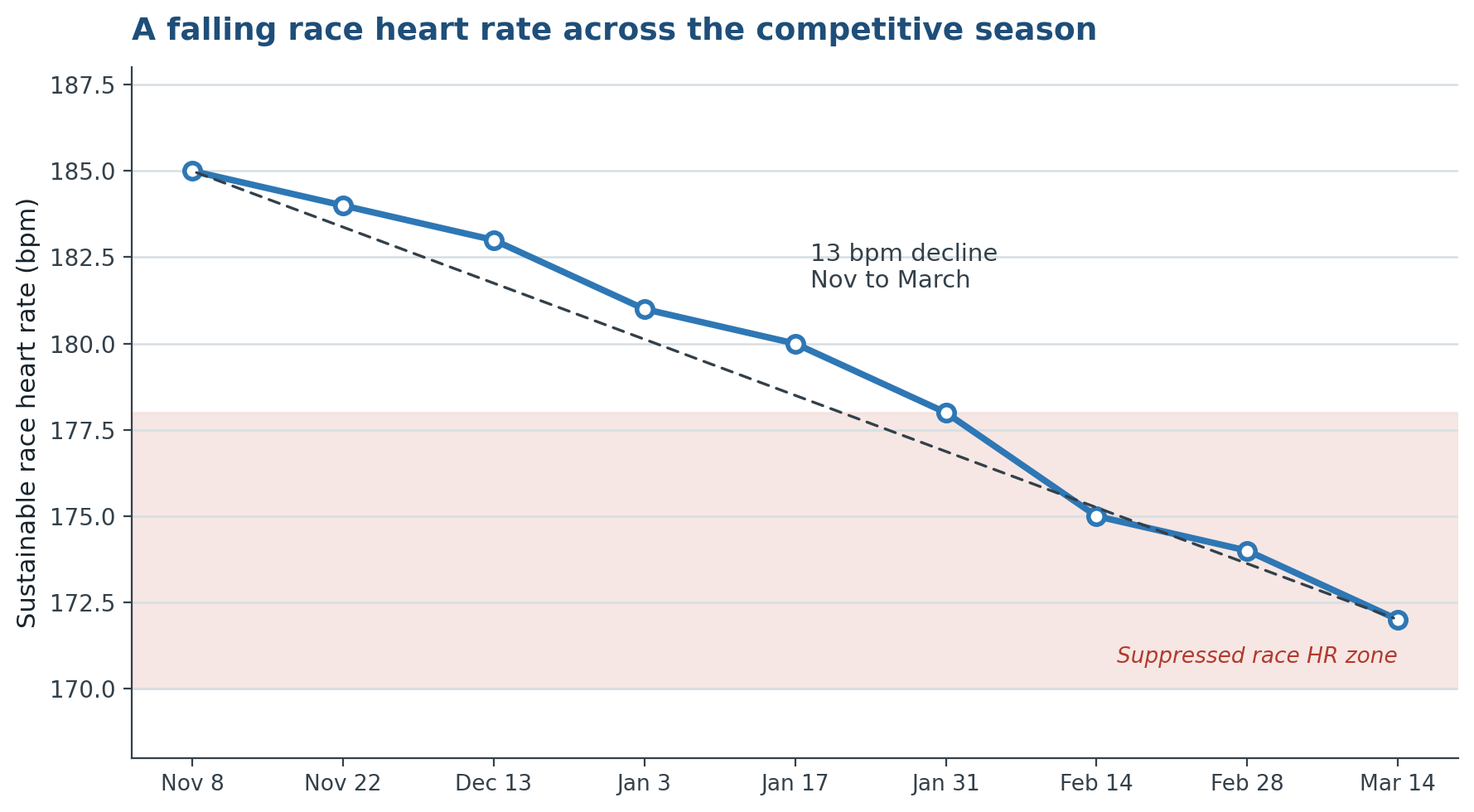
    An illustrative competitive season. Sustainable race heart rate slides 13 bpm from November to March. With no gain in speed to explain it, that slide reads as a fatigue signal, not a fitness one. (Chart: FasterSkier)

    A reduced race heart rate means less cardiac output unless stroke volume increases enough to compensate. In well-trained athletes, that compensation is usually very small. The result is less oxygen delivered to the working muscles, reduced oxidative metabolism, slower lactate clearance, diminished phosphocreatine resynthesis between surges, and ultimately a reduced ability to sustain high race speeds. In simple terms, the athlete cannot create the same physiological demand because the muscles are no longer capable of producing the same amount of work.

    When a Lower Race Heart Rate Reflects Improved Fitness

    A declining race heart rate is often misunderstood. Some physiologists and coaches suggest it reflects improved cardiovascular function. That can be true, but only if performance has clearly improved.

    The critical question is simple: is the athlete racing faster?

    If an athlete is producing greater speed or power at a lower heart rate, several physiological adaptations have likely occurred:

    • Greater stroke volume. The heart pumps more blood with each beat, allowing similar cardiac output with fewer beats.
    • Improved movement economy. Better technique and neuromuscular coordination reduce the oxygen cost of movement.
    • Greater peripheral adaptations. Increased mitochondrial density, capillary density, and oxidative enzyme activity improve oxygen extraction and utilization.

    If these adaptations have occurred to a meaningful degree, performance should improve. The athlete should be racing faster while holding a similar physiological level, not racing at a lower heart rate.

    In my experience, I have never seen an athlete race at a substantially lower heart rate because they became fitter or more economical. The improvement almost always shows up as increased speed or power, not as a dramatically reduced race heart rate. If race performance is unchanged, or worse, declining, a lower heart rate is unlikely to be explained by improved fitness.

    This distinction matters because many coaches correctly recognize that heart rate decreases at submaximal workloads as fitness improves. That is exactly what we expect during aerobic training. Racing is different. At maximal or near-maximal effort, the goal is to maximize performance, and that rarely shows up as a lower heart rate.

    Is Stroke Volume Really the Explanation?

    Stroke volume is frequently cited as the reason trained athletes can race with lower heart rates. While that explanation sounds plausible, it probably accounts for only a negligible part of what we observe during maximal competition.

    In trained endurance athletes:

    • Stroke volume reaches near-maximal values at roughly 40 to 60 percent of VO2max.
    • Beyond that intensity, further increases in cardiac output come primarily from increases in heart rate.
    • Stroke volume changes relatively little in already well-trained athletes.
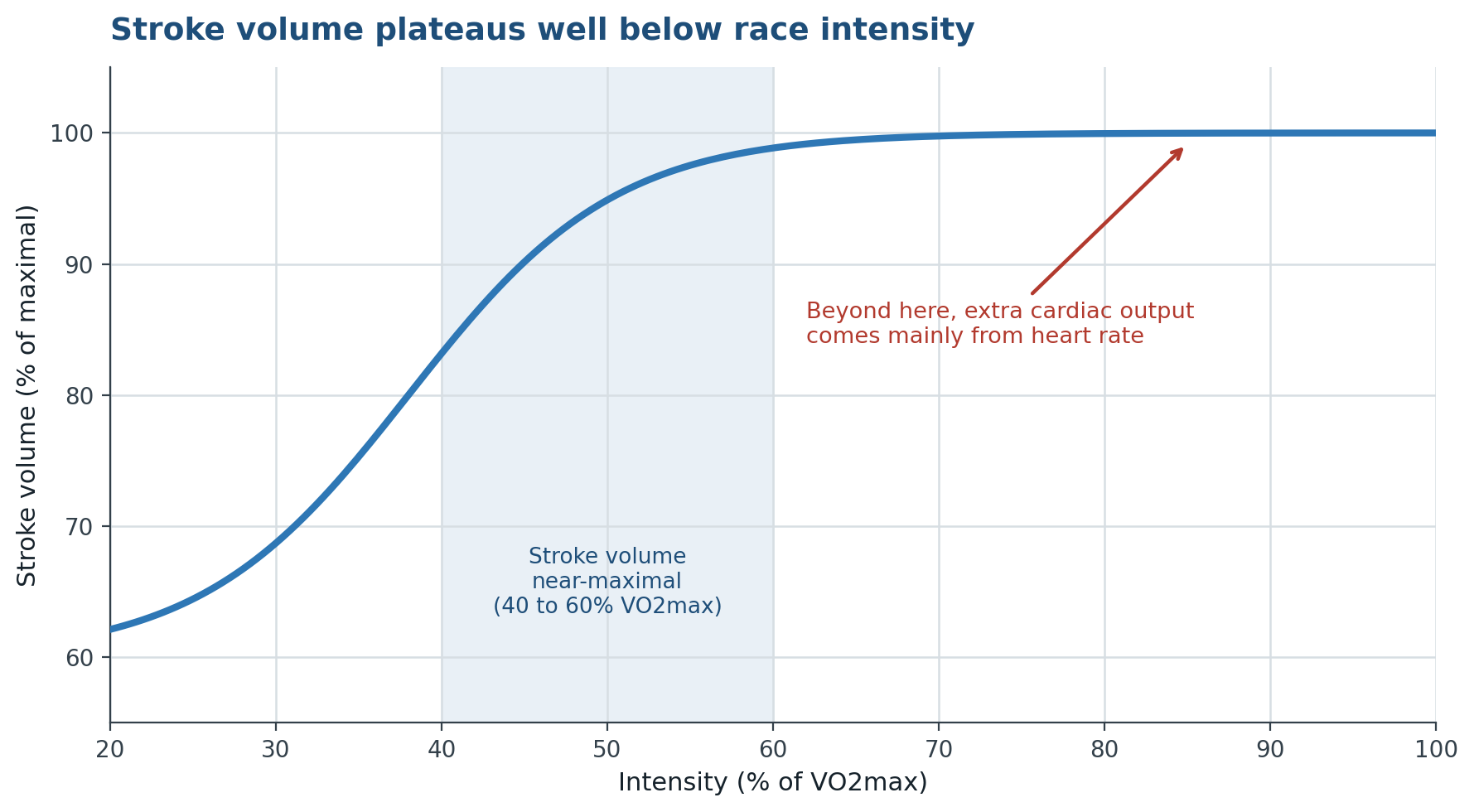
    Stroke volume reaches near-maximal values at roughly 40 to 60 percent of VO2max. At race intensity, it has little room left to climb, so a falling race heart rate is unlikely to be explained by rising stroke volume. (Chart: FasterSkier)

    So if an athlete’s sustainable race heart rate falls from 185 to 175, it is unlikely that stroke volume has increased enough to fully maintain cardiac output. The science does not support that explanation in most well-trained athletes. Something else is going on, and extended fatigue, maladaptive training, and long-term overload are the likely causes.

    The Muscles Drive the Heart

    One concept that is often overlooked in endurance physiology is that heart rate responds to muscular work. It does not create it. The muscles generate the metabolic demand and the cardiovascular system responds. If neuromuscular power production declines, metabolic demand falls. The heart no longer needs to pump as rapidly because the muscles are not asking for the same amount of oxygen. This aligns closely with a concept I first wrote about nearly twenty years ago and returned to in my previous article:

    Speed creates the load, not intensity.

    The muscles create the demand. The heart responds. When an athlete loses the ability to generate force, speed, and power, race heart rate falls as a consequence. The cardiovascular system may be functioning normally. It simply is not being driven to the same level because the neuromuscular system has become fatigued.

    When a Lower Race Heart Rate Is a Warning Sign

    A falling heart rate is one of the earliest objective signs that an athlete may be accumulating excessive fatigue. When athletes become excessively fatigued, they often lose the ability to recruit muscle fibers effectively and sustain race-specific power. Because muscular demand falls, heart rate falls with it.

    Rather than interpreting the lower heart rate as improved efficiency, coaches should ask whether the athlete is still capable of producing the same speed or power.

    Warning signs include:

    • Sustainable race heart rate declines progressively over a few weeks to months. Monitoring heart rate helps catch this early, so training can be adjusted before it becomes a bigger problem.
    • Race performance stagnates or deteriorates despite similar perceived effort.
    • Legs feel flat and heavy, as if they never really warm up.
    • The athlete cannot respond to the demands of uphills or changes in pace.
    • Heart rate remains well below normal race values even during maximal effort.
    • Recovery between hard sessions becomes progressively slower.
    • Easy training may still feel normal while racing and high-intensity training become increasingly difficult.

    This pattern is often described as parasympathetic overreaching, although terminology varies. Regardless of the label, suppression of maximal or sustainable race heart rate by 5 to 15 beats per minute over weeks should never be ignored. It frequently reflects excessive cumulative training load, inadequate recovery, or overtraining. Waiting until performance completely collapses is waiting too long. In many athletes, a declining race heart rate is one of the first objective indicators that recovery and adaptation to previous training were insufficient.

    Coaches sometimes celebrate lower lactate values as improved aerobic fitness. During excessive fatigue, however, reduced lactate production often reflects reduced muscle recruitment rather than improved metabolic efficiency. The athlete cannot produce enough power to generate high lactate concentrations.

    Chronically low glycogen availability, whether from excessive training or inadequate carbohydrate intake, can also suppress race heart rate and lactate. The athlete cannot generate the metabolic demand required to reach previous racing intensities.

    The heart is reactive, not proactive. It responds to the metabolic demand created by the working muscles. When the muscles cannot produce force because of fatigue, the cardiovascular system has less work to do. A lower heart rate is therefore often the consequence of reduced performance, not the cause.

    Why Elite Athletes Rarely Race at Maximal Heart Rate

    Elite endurance athletes rarely spend an entire race at maximal heart rate. As performance improves, limitations increasingly shift away from the cardiovascular system and toward the muscles’ ability to generate force repeatedly while resisting fatigue.

    Improvements in neuromuscular power, economy, and fatigue resistance allow athletes to sustain higher speeds without requiring proportionally higher heart rates.

    As athletes become capable of producing greater speed and power, they generate a larger physiological stimulus. The cardiovascular system responds to that demand, but it is the neuromuscular system that ultimately determines how much work can be produced.

    Practical Coaching Implications

    Heart rate should never be interpreted in isolation. Always evaluate it alongside speed, power, performance, and perceived effort.
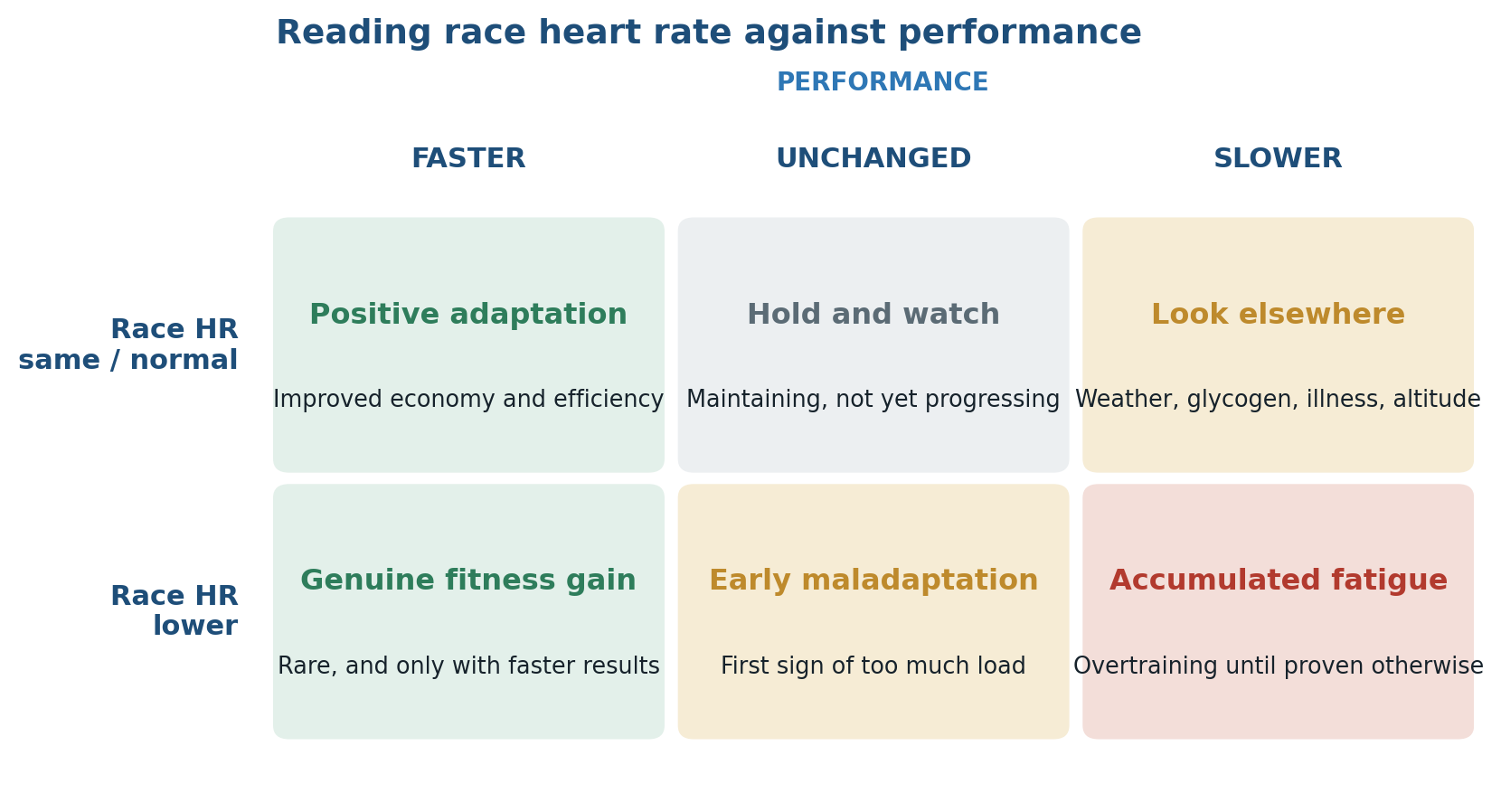
    Reading race heart rate against performance. Green is adaptation, amber is a flag to investigate, red is accumulated fatigue until proven otherwise. (Chart: FasterSkier)
    • Similar heart rate plus faster performance equals positive adaptation, improved economy, and greater efficiency.
    • Lower heart rate plus unchanged performance equals the early stage of maladaptation to training loads.
    • Lower heart rate plus slower performance equals a clear indication of accumulated fatigue, inadequate recovery, illness, low energy availability, or excessive training load.
    • Normal heart rate plus declining performance equals a reason to consider environmental conditions, glycogen availability, illness, altitude, or reduced movement economy.

    Over the course of a successful season, athletes should become capable of producing greater speed and power while maintaining similar race heart rates. When race heart rate falls substantially without a corresponding improvement in performance, assume fatigue before assuming fitness. That mindset will keep many coaches from overlooking one of the earliest objective signs of excessive training stress.

    A lower heart rate should never be viewed as evidence of improved fitness on its own. If an athlete is racing faster, producing more power, and performing better, a modest reduction in heart rate may simply reflect positive adaptation. But when race heart rate falls while performance stagnates or declines, resist the temptation to credit what may actually be the earliest objective sign of excessive fatigue. The goal is to catch a falling heart rate during hard efforts early and adjust training as soon as possible. Weeks or months of inaction will greatly increase recovery time and cost additional effective training time.


    Help Support Our Coverage!

    If you value the thoughtful work and access FasterSkier provides, please consider becoming a Voluntary Subscriber. Your support directly fuels our work to cover the people, places, and moments that make our sport special.

    Join the FasterSkier community!


  • How to Go Easy (and Why): An Introduction to the Polarized Training Model

    How to Go Easy (and Why): An Introduction to the Polarized Training Model

    French skiers Delphine Claudel and Lena Quintin stop to refuel during a training camp on the Glacier de la Grande Motte near Tignes, FRA. (Photo: NordicFocus)

    I grew up playing soccer. Every practice was hard. “No pain, no gain,” and all of that. By tenth grade, I was burned out and quit. 

    I started rock climbing. Every day at the crag was about pushing your limits. This was before indoor gyms or any concept of training other than doing as many pull ups as possible. I plateaued, got frustrated, and quit. 

    Then I had a go at running. I read some books, but skipped the training methodology parts and cherry picked the workouts. Every run was hard. Every interval was done to exhaustion. I plateaued, got frustrated, and quit. 

    Then I got into cycling. I began to hear of “easy” rides. I knew pros who rode around for four or five hours at such a pedestrian pace that they were talking the whole time. ‘How insanely boring!’ I thought. ‘Where’s the fun in that?’ So I went hard every time because it’s more fun. And guess what? I plateaued, got frustrated, and quit.

    Fortunately, I didn’t learn my lessons the really hard way – through injury – but I still learned them the really stupid way –  by throwing away any potential I might have had. 

    You can’t go hard all of the time. It’s as simple as that (at least on paper).

    Scott Patterson enjoying a training day in Seiser Alm, ITA in January 2021. (Photo: Caitlin Patterson / Instagram @scottgpatterson)

    The Basics of Polarized Training

    Make your easy days easy and your hard days hard. 


    That is the backbone of a Polarized Training model. I had no problem making my hard days hard–they were all hard days after all. Full gas. Gun to tape. But in hindsight, I realize how depleted and chronically fatigued I was. I thought that was the desired effect, but it meant my training became less and less productive. 

    It’s the easy days that are actually the hard part.

    First: I hear your inner dialogue. “Who wants to go easy? It’s unproductive. It’s a waste of precious time. It looks lame on Strava.” But the science says everyone should want to go easy. Metabolic efficiency is the name of the game.

    If hard workouts train the engine to create more horsepower, then the easy sessions improve the gas mileage. 

    Secondly: let’s define easy. Training intensity is commonly split into five zones. (Some systems use three and others use seven, but I’ll be referring to a five zone system.) Zones 1, and especially 2, define the ranges of easy. Heart rate is the typical metric, especially for cross country skiers and runners, while cyclists typically use power. 

    SMS T2 athletes Lauren Jortberg, Lina Sutro, and Alayna Sonnesyn find bluebird conditions for a crust ski up Broken Top near Bend, OR in May. (Photo: SMS T2 Blog)

    Identifying Your Easy Zones

    The theoretically simple method for establishing heart rate zones is to work backwards from your maximum heart rate where each zone represents a percentage of the max. The challenge is that there’s very little agreement on how to best calculate one’s max heart rate without actually experiencing it. 

    A more accurate method is to undergo a lactate threshold test, where heart rate zones are calculated based on the amount of lactate measured in the bloodstream. More accurate, but more difficult to conduct, and not universally accessible.

    So how can we determine what is easy and what is too hard? 

    In an effort to keep easy easy, I’m going to define it as conversational pace. You should be able to talk in complete sentences without having to… pause… to take in… more air… to finish your sentence. This is mediocre science and not especially objective, but with some practice, it’s not difficult to find that upper limit of talkability. 

    If you’re a numbers person, you can likely conduct your own ramp test where – after a warm up period – you progressively increase speed/effort while reciting poetry or singing along to what’s in your AirPods. Mark the heart rate where you lose the rhythm, and that’s a decent estimate of your upper limit for Zone 2.

    Your new goal on easy days will be to keep your heart rate below this threshold, not necessarily at this level. For those accustomed to pushing the pace on every session, slowing down enough to keep your heart rate in the appropriate zones might feel like a big adjustment. There’s no real way around it – you’ll need to buy in, and trust the process/science. Maybe use it as an excuse to get out with a training buddy who is generally slower than you and give the whole “pedestrian pace, talking the whole time” thing a go.

    Worst comes to worst, you give it an honest try and decide you prefer to just go hammer, then go back to your old ways. That’s the beauty of being a recreational athlete – at the end of the day, we’re just pursuing hobbies we find rewarding and enjoyable. 

    * A note for Strava users: don’t rely too much on the Relative Effort number. As a metric of intensity over time, it seems optimized to capture long, hard efforts like an hour-long tempo run where your heart rate stays high for the entire hour. It doesn’t handle intervals very well since the rest periods sort of cancel out the high intensity efforts. 

    For example, Strava gave 60 points to a 55 minute tempo run with an average heart rate of 158; however, an 57 minute interval session (9x600m on the track) with an average heart rate of 147 only got 35 points. To me, both sessions were equally hard, but the tempo run scored 25 points higher. 

    Strava does allow you to use your perceived exertion in place of heart rate for calculating Relative Effort. When I enabled this override, the tempo run scored an 87 while the track workout got a 147. (My easy efforts aren’t affected much.) Personally, I’ve found the Relative Effort score, along with the weekly log and Fitness and Freshness, far more useful (and accurate?) with this tweak. Here’s a deeper dive into that black hole.

    French athletes Lucas Chanavat (left) and Maurice Magnificat (right) out for a rollerski during a training camp in Tignes. (Photo: NordicFocus)

    The Purpose of Polarized Training

    Now we can talk about why the easy is important. 

    Stress + rest = growth/adaptation/strength/speed. That is the basic formula. Our bodies are designed to adapt to load, but we have to give ourselves the opportunity to make those adaptations. Too much volume or intensity and the body will stop absorbing. Not enough recovery and the body will stop adapting. Best case, your performance plateaus. Worst case, you get injured. 

    The Krebs Cycle. The stuff of High School nightmares. But the essence of the endurance athlete. The Krebs Cycle is the pathway by which our bodies put gas in the tank. It is the process by which our mitochondria – magical little intracellular thingies – convert carbohydrates, fats, and proteins into the specific energy required by muscles to contract. In oversimplified terms, the more efficient the mitochondria are, the faster and longer we can go. And it appears that the best way to train mitochondrial efficiency is with training in Zone 2. (If you want to seriously nerd out, this podcast with Dr Iñigo San Millán, perhaps the Father of Zone 2,  is a deep dive in a submarine to depths of the ocean.)

    The easy/Zone 2 is considered so important that it typically makes up 70-80% of elite athletes’ training volume. The other 20-30% is hard (high Zone 3, Zone 4, and rarely into Zone 5). For the athlete who doesn’t have all day, every day to train, that means you only get a couple of hard sessions per week. Keep the rest easy.

    Some that’s hard, lots that’s easy – that’s the essence of putting Polarized Training into practice.


    Example Training Plan Template

    Monday Easy short or Rest if needed
    Tuesday Hard long
    Wednesday Strength/core maintenance
    Thursday Hard short (intervals) 
    Friday Easy short or Rest if needed
    Saturday Easy long OR Hard long AND Sunday is Easy
    Sunday AM: Hard short (intervals) + PM strength/core maintenance


    My training template is based on my work schedule and typical life obligations. I’ve given myself a max of three hard sessions a week with one of them longer (2-3 hrs ride or mountain run–the fun stuff!) and the others around an hour of intervals. My strength/core maintenance sessions typically fall into the easy category and don’t require much recovery (no delayed onset muscle soreness). But my schedule is also very flexible. If I’m tired, I can move a hard session to another day or skip it that week. If I get too busy or stressed, then I can modify the program without too much frustration.

    I’m fortunate that I can train/play seven days a week, as long as I’m recovering adequately. However if your schedule only allows for training three days a week, you can still apply the basic formula and have one hard day and two easy days.

    Richard Jouve doublepoles up an incline during a team training camp in Tignes, FRA. (Photo: NordicFocus)

    For some of you, this may be common sense and describe how you’ve been training for years. For others, this is quite a departure from your norm and will take a concerted effort to implement. But whether your goal is optimal performance or staying healthy for years to come, investing in a polarized plan, and especially leaning into the Zone 2 work, will pay dividends.

    Lastly, I think any discussion about training principles/plans needs to have the overriding theme ofpush yourself, but be kind to yourself’.

    Be flexible. Training plans aren’t written in stone. Don’t beat yourself up if work, family, weather, fatigue, or lack of motivation keeps you from your intended workout. Take a walk, play with the kids, lie down on the sofa—whatever it takes to reset and be ready for another day. One workout will not make or break, but constant self-criticism will sink the ship.