From the FasterSkier archive — posts syndicated from athletes’ and coaches’ own blogs between 2004 and 2012, kept online as published. Current coverage is at fasterskier.com.
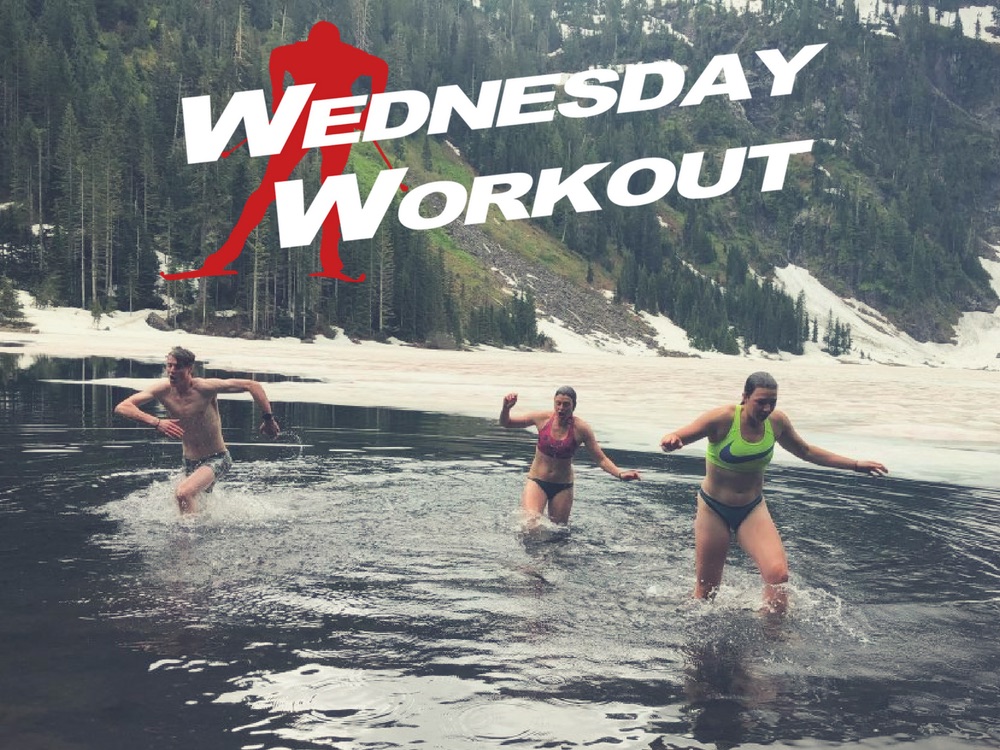
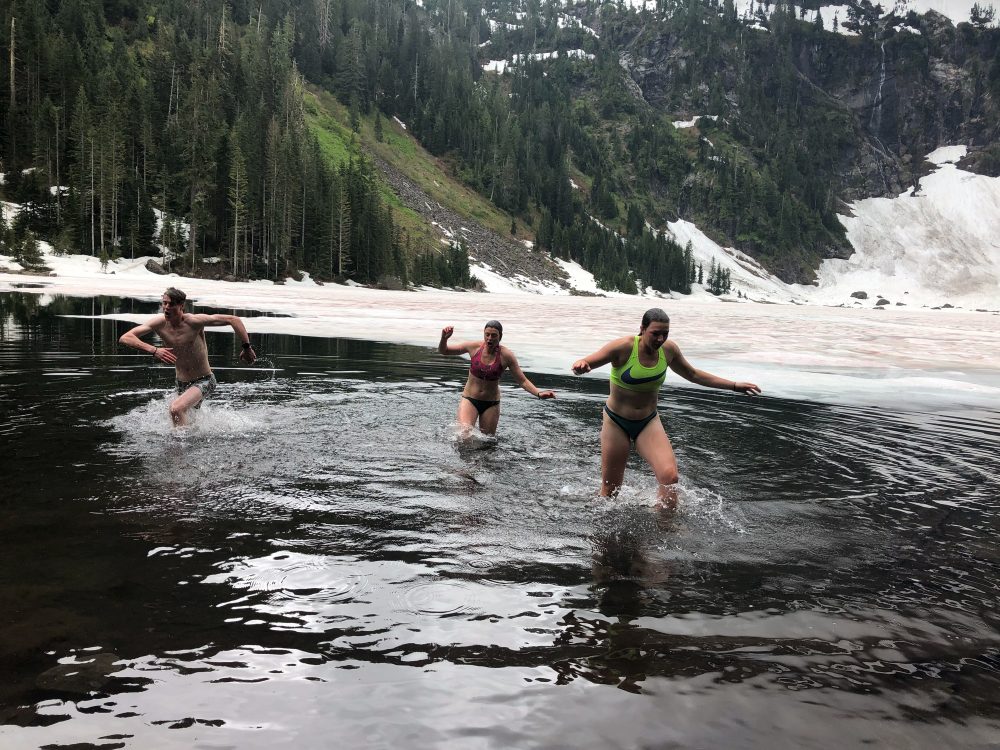
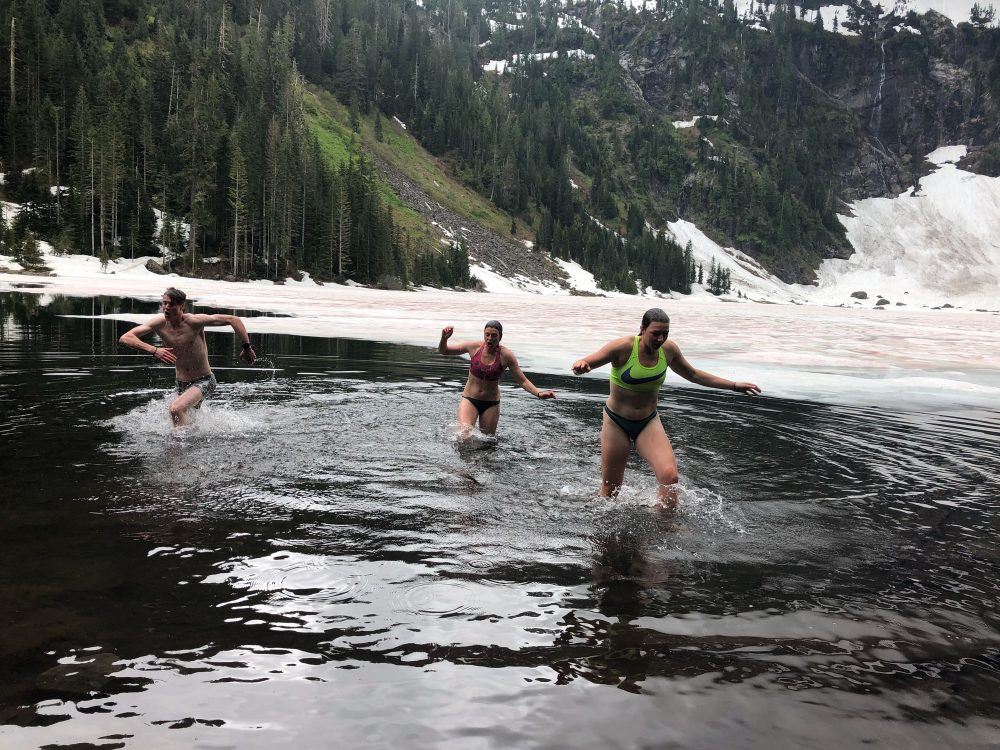
Mooney siblings (from left to right) Scott, Heather and Brooke after jumping into Lake 22 just outside of Seattle, Washington, following Brooke’s graduation from the University of Washington in June. “With two siblings peer pressure works wonders, not going to be the wimpy one who doesn’t jump in!” Heather wrote. (Courtesy photo)
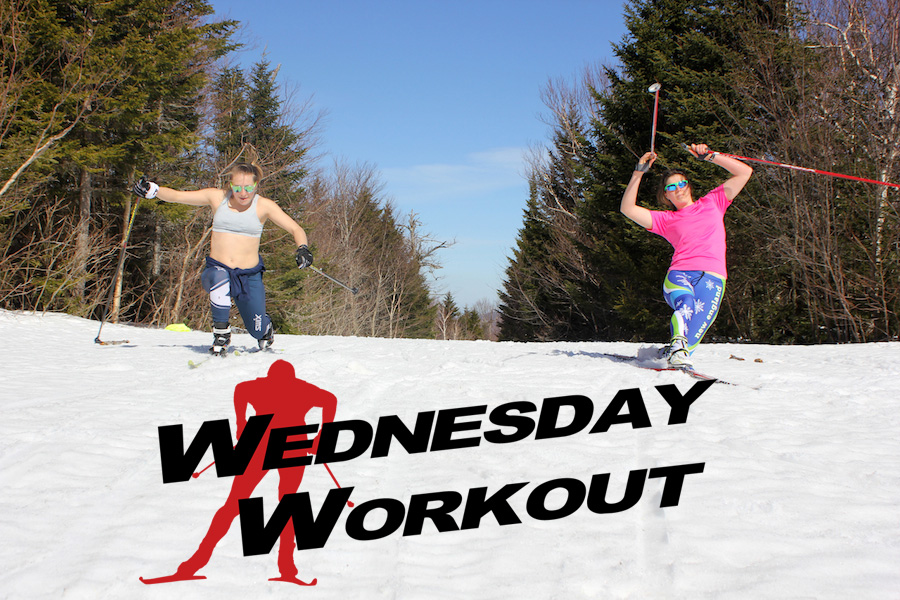
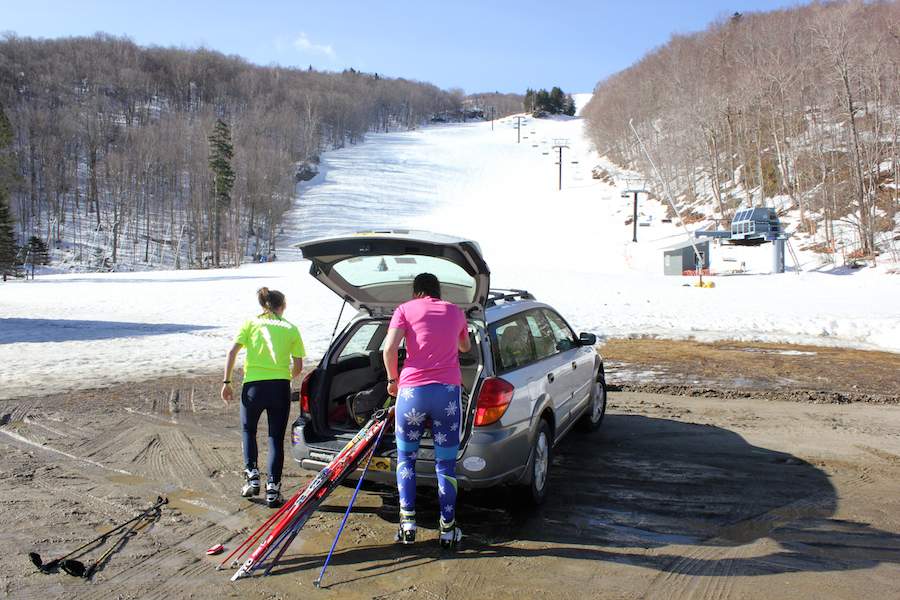
Today’s Wednesday Workout is brought to you by the Mooney sisters, Heather, 24, and Brooke, 22, who grew up skiing in Peru, Vermont. Brooke is currently training with USRowing out of Princeton, New Jersey, while Heather is still skiing competitively and living in Bozeman, Montana. We interviewed the Mooney sisters earlier this summer; read the complete article here.
***
The following workout is a family hike that focuses on easy distance and mental recovery. The Mooney sisters emphasized the importance of taking a plunge in “a cold body of water” at some point, either during or post-hike. Again, plunging into a cold body of water is key to the workout.
Jumping into a glacial mountain lake may not seem very pleasant — one look at their brother Scott’s face in the above photo above tells it all all — however, the momentary chill is actually said to benefit both the body and psyche (think of the Finns).
Research shows that exposing the body to cold water, even in the form of a shower, can bring about positive physiological and psychological effects by increasing blood flow to the brain and extremities.
“Besides the recovery aspect, plunging in cold water is proven to make you happier! (Thanks Mom for encouraging this from a young age),” Brooke and Heather wrote in a joint email to Fasterskier.
So bring on the rugged slopes and ice-capped waters. The frigid never stopped nordic skiers before.
The Workout: Easy distance family hike
Terrain: Mountainous
“Either a favorite mountain at home, or a thoughtfully selected new location from travel guide Mom (such as Lake 22 at Brooke’s graduation in Seattle a few weeks ago),” the siblings wrote in June. “Ideally somewhere with a nice view, or natural feature, with a lake or river for jumping in afterwards.”
Length of workout: As long or as short as desired
Purpose: “Goals are to enjoy being outside with your family, or friends, or dog, or neighbor. Attention should be focused on appreciating nature and great company and how fortunate you are to have close friends/family to enjoy being outside with!” they wrote. “Attention should be specifically not focused on heart rate, duration, distance, or Strava segments (except for in the one instance when we went to our cousin’s wedding in Atlanta, found the biggest hill around via Strava, and naturally decided we needed to try and get the KOM, but it was still a family adventure).”
No. 1 Suggestion: “Trust that the less you think of it as ‘training’ the better it will be for you!”
Mooney siblings (from left to right) Scott, Heather and Brooke after jumping into Lake 22 just outside of Seattle, following Brooke’s graduation from Washington University in June. “With two siblings peer pressure works wonders, not going to be the wimpy one who doesn’t jump in!” Heather wrote. (Courtesy photo)
Perhaps you have heard of them. Or at least seen them. At 6 feet and 6 feet 2 inches tall, respectively, the Mooney sisters, Heather and Brooke, are hard to miss. But their height is not the only reason the two women stand out.
The sisterly pair also share a talent for the sports they pursue. At one point, for both of them, that sport was skiing. And at one point, for both of them, it was not.
Having grown up in Peru, Vermont, where the Green Mountain range serves as the town’s backdrop and skiing is the norm, the two were certainly primed with the ideal environment for becoming interested in nordic.
“Our school bus had a ski rack on the side of it because we would ski at recess,” Heather recalled during an in-person interview this month in Bozeman, Montana. “In southern Vermont, that is what everyone did.”
“That” meant skiing. Their mother had picked it up as an adult and also worked as a promotion manager for a skiing magazine. Their father was the headmaster at Vermont Academy, providing the the family access to a plethora of trails directly from their residential backdoor.
Both parents were also active outdoor enthusiasts, encouraging Heather, Brooke and eventually their younger brother Scott, to partake in anything that got them moving: swimming, hiking, soccer, tennis. (It didn’t hurt the family’s sporting M.O. that their father had been Yale’s soccer goalie as an undergrad.)
By the time she was a freshman, Heather had enrolled at the Stratton Mountain School ski academy. Three years later, her sister Brooke had as well. (Heather and Brooke are two years apart, but Heather skipped first grade).
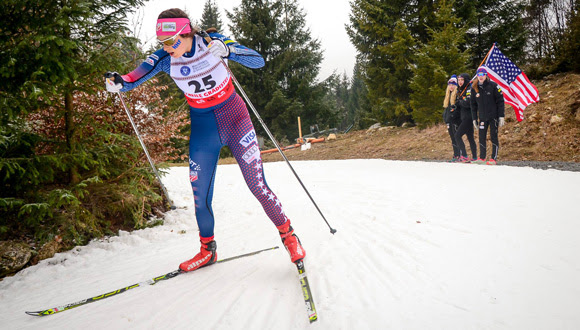
Heather Mooney racing to 42nd in the women’s 10 k freestyle at the 2016 U23 World Championships in Rasnov, Romania. (Photo: FIS)
They became well-known names on the eastern ski circuit. They also found national and international success while still U18s. Heather qualified for Junior Nationals four times, Junior Worlds twice and U23 Worlds in 2016. By her junior year in high school, Brooke had qualified for three Junior Nationals.
As J2 skiers, both Mooney girls received coaching from Pepa Miloucheva, the head ski coach at the Craftsbury Outdoor Center. With a background in sculling, as well as ski orienteering, Miloucheva had her eyes on Heather and Brooke, who showed the potential to qualify for Junior Nationals in rowing as well. Both girls were invited to a youth rowing camp held at the Outdoor Center.
“The director told me I needed a snorkel,” Heather reminisced with a laugh. “But Brooke was very good.”
***
During an early season training session at the University of Washington (UW) this past year, Brooke sat down for testing on a rowing ergometer. She pulled for the alloted test time, one minute, and stopped. Her sustained pace was 615 watts.
National team coaches could not recall any other woman surpassing 600 watts, The Seattle Times reported.
“You don’t have to know rowing to see her strength,” UW head rowing coach Yasmin Farooq told the Times. “Watch her and you think, holy smokes, this woman has some serious power.”
Unofficially, Brooke holds the watts record for an American woman on the rowing machine. Officially, she was named the Pac-12 Women’s Rowing Athlete of the Year in May and is now living in Princeton, New Jersey, one month removed from UW. She’s also a national-team recruit.
Her invite to join USRowing came in December, and following her graduation from UW in June, Brooke headed back east. In Princeton, she is training with U.S. rowing veterans like Meghan Musnicki and Elle Logan — both multiple Olympic gold medalists — with the hope of working toward a spot on the 2020 Olympic team (selection won’t take place until 2019).
“I kind of figured I would be pretty crazy to turn down this opportunity, whether it leads to greater results or not, I had to try it,” Brooke told FasterSkier on the phone.
The seeds of opportunity were planted in the initial rowing camp Brooke attended in Craftsbury. She spent her senior year at Vermont Academy, where she took up rowing as her newfound, full-time passion.
“I knew I wasn’t going to want to keep on skiing through college, so I figured I might as well try rowing,” Brooke said.
She filled out a few higher-education recruiting questionnaires and received a response from UW. As one of the top rowing schools in the country, UW had her attention. Throughout her four undergraduate years, Brooke developed into one of the country’s top college rowers, even with a slight scare before her senior season.
***
When Brooke first started getting headaches in the summer of 2016, the doctors told her she was dehydrated. At a sculling camp in Craftsbury post-doc visit, her headaches continued. Most of the time, they got progressively worse throughout the day.
Brooke Mooney, who was recently recruited to the U.S. women’s national rowing team, during a sculling camp in Craftsbury, Vt. in 2016. (Photo: Craftsbury Outdoor Center)
“I would be able to get up in the morning and work out a little bit, but if I didn’t work out before 9 o’clock, I couldn’t workout,” Brooke recalled. “I would just lay on my bed in so much pain.”
With dehydration as her diagnosis, she did what she could to work out. Sometimes the headaches would lapse, but most often they would not.
“I started the school year in and out of headaches. I talked to the team doc and went to the headache clinic,” Brooke said.
It wasn’t until April, almost a year after her headaches began, that Brooke was given an MRI. The results: she had a cyst in her optic chiasm. The mass was pushing on her optic nerve and needed to be removed, or else it could expand and cause permanent damage to her vision, even blindness.
Her eye doctor allowed her to finish the race season (for rowing, championship racing occurs in the spring) before removing the cyst. Following her surgery in June 2017, Brooke was not allowed to train or work out for eight weeks the summer before her senior year at UW.
“I was so worried,” Brooke said, particularly when she found out that her team would be racing the famed Head of the Charles Regatta that fall.
“I wanted to race that more than anything and I panicked that I was going to miss my opportunity because of the surgery,” she said. “But then I ended up making it … every once in awhile, a good break is really beneficial.”
***
If you peruse Heather’s blog, one post from April 2017 blares the title “On Burnout and Bye for Now.” This was her informal farewell to cross-country skiing.
The post itself came two years after she graduated from Middlebury College, a time when skiing held great promise for Heather. She had capped off her senior year with seven collegiate wins and had also qualified for the 2012 Youth Olympic Games as a college sophomore.
Following graduation, Heather signed on with the Craftsbury Green Racing Project (CGRP), but later found things weren’t aligning the way she had hoped they would. Particularly, she felt she was not performing to her expectations, given the amount of support she had (according to Heather, CGRP covers most of their athletes’ expenses for food, housing and travel.)
“I thought I was done for good,” Heather, now 24, continued. “Pepa [Miloucheva] was the one who encouraged me not to look at it that way.”
Even with Miloucheva encouraging her not to give up completely, Heather forfeited skiing, and even gave up physical activity for a bit.
“In the beginning of the summer when I quit, I was like, ‘I’m not exercising, I’m not being an athlete, I’m just doing whatever what I want — I can be happy without skiing,” Heather said. “Very quickly I realized that I need exercise to be happy.”
That summer in Truckee, California, Heather landed a coaching gig that gave her the opportunity to travel to Australia. By the fall, she decided to move to Bozeman, with plans to gain residency at Montana State University and enroll in its architecture graduate program.
In Bozeman, she reconnected with Austin Caldwell, a longtime friend from Vermont and the current head coach of the Bridger Ski Foundation Elite team. The two went for a few early fall skis together and Heather soon found herself attending Caldwell’s agility practices, then interval sessions. When the winter hit, Heather even jumped into some races, but only as many as she chose.
In all, she competed in about a dozen SuperTour races, finishing last season ranked 36th overall on the circuit. Heather also raced to 14th in the 50-kilometer American Birkebeiner skate race in February.
“It was really refreshing to step out of expectation,” Heather said. “I feel like we all get into such definitions of like how we should be in the sport. I realize [now] there are so many different ways to engage with it. Likely that’s how we many of us will reach our potential, is by engaging in a way that works for you as a person.”
After a break, Heather is currently planning to defer from MSU and focus once more on skiing.
“It’s been exciting for me slowly lose that anxiety of how I should be performing and how I wanted to perform,” Heather said. “I look at how can I work with myself, versus trying to fit myself into the pro-athlete mold.”
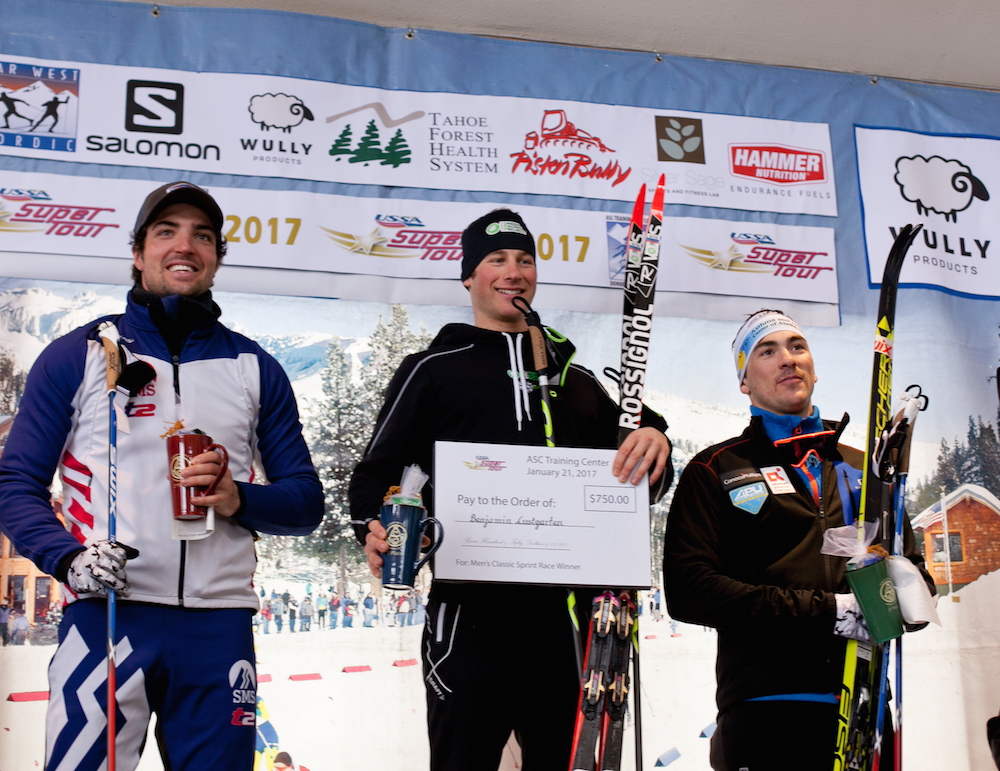
Ben Lustgarten (Craftsbury Green Racing Project) with his $750-dollar check for winning the men’s SuperTour classic sprint on Saturday near Truckee, Calif. Stratton’s Ben Saxton (l) placed second and APU’s Reese Hanneman (r) was third.
Lustgarten, of the Craftsbury Green Racing Project, raced to a 1.58-second victory in the men’s A-final at the Auburn Ski Club in Soda Springs, Calif., finishing in 3:03.4. Ben Saxton, of the Stratton Mountain School (SMS) Elite Team, placed second, and Reese Hanneman, of Alaska Pacific University (APU), was third (+2.77).
Hannenman’s younger brother Logan also reached the final and placed fourth (+4.5), Dakota Blackhorse-von Jess (Bend Endurance Academy) was fifth (+5.86), and the third APU skier in the final, Tyler Kornfield sixth (+18.69).
Blackhorse-von Jess started the day off as the fastest qualifier in 2:58.8. Saxton qualified second, 4.1 seconds back, Logan Hanneman qualified third (+4.2), and Lustgarten fourth (+6.5). Blackhorse-von Jess went on to win his quarterfinal and place second in his semifinal, while Lustgarten and Saxton both won their quarterfinals and semifinals.
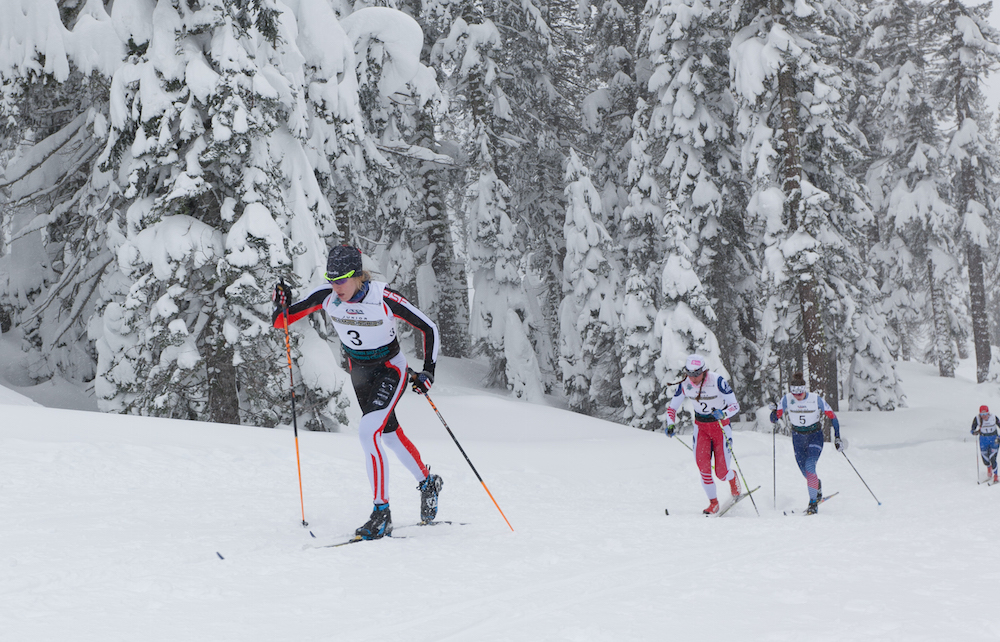
Jennie Bender (3) of the Bridger Ski Foundation leading Stratton’s Julia Kern (2) and Sun Valley’s Deedra Irwin (5) during the second women’s classic sprint semifinal at Saturday’s SuperTour near Truckee, Calif. Bender went on to win the semifinal, as well as the final.
In the women’s A-final, Jennie Bender of the Bridger Ski Foundation, coming off a classic sprint win at nationals, scored another victory in 3:29.07. She edged Craftsbury’s Kaitlynn Miller by just seven-hundredths of a second, and Stratton’s Julia Kern placed third (+3.42). Racing at home, Hannah Halvorsen (Sugar Bowl Academy) finished fourth (+3.88). Craftsbury had three in the women’s final with Caitlin Patterson in fifth (+3.93) and Heather Mooney in sixth (+27.35).
Miller proved to be the woman to beat throughout the day, winning the qualifier in 3:30.9, along with her quarterfinal and semifinal. Kern qualified second (+3.2) and Bender third (+4.6). Bender went on to win her quarterfinal and semifinal as well before facing off with Miller in the final.
NorAm Western Canadian Championships (Whistler, B.C.): 10/15 k classic
It was interval-starts day at Western Canadian Championships at Whistler Olympic Park and national-team veteran Emily Nishikawa completed the four laps of the women’s 10 k classic in 30:35.5 to win ahead of teammate Dahria Beatty, 16.5 seconds behind. Maya MacIsaac-Jones completed the national team and Alberta World Cup Academy (AWCA) sweep in third (+1:36.5).
Sovereign Lake’s Hannah Mehain, of the national junior team, was the top junior for the second-straight day in eighth overall (+3:22.1).
In the men’s 15 k, Lappe Nordic’s Andy Shields won the six-lap race in 40:34.2, showing some of the form that won him the NorAm overall last season. National-team member Jess Cockney collected his second-straight podium, finishing second, 4.3 seconds behind Shields. Evan Palmer-Charrette (NTDC Thunder Bay) completed the podium in third (+55.1).
FIS Cross-Country World Cup (Ulricehamn, Sweden): 10/15 k freestyle
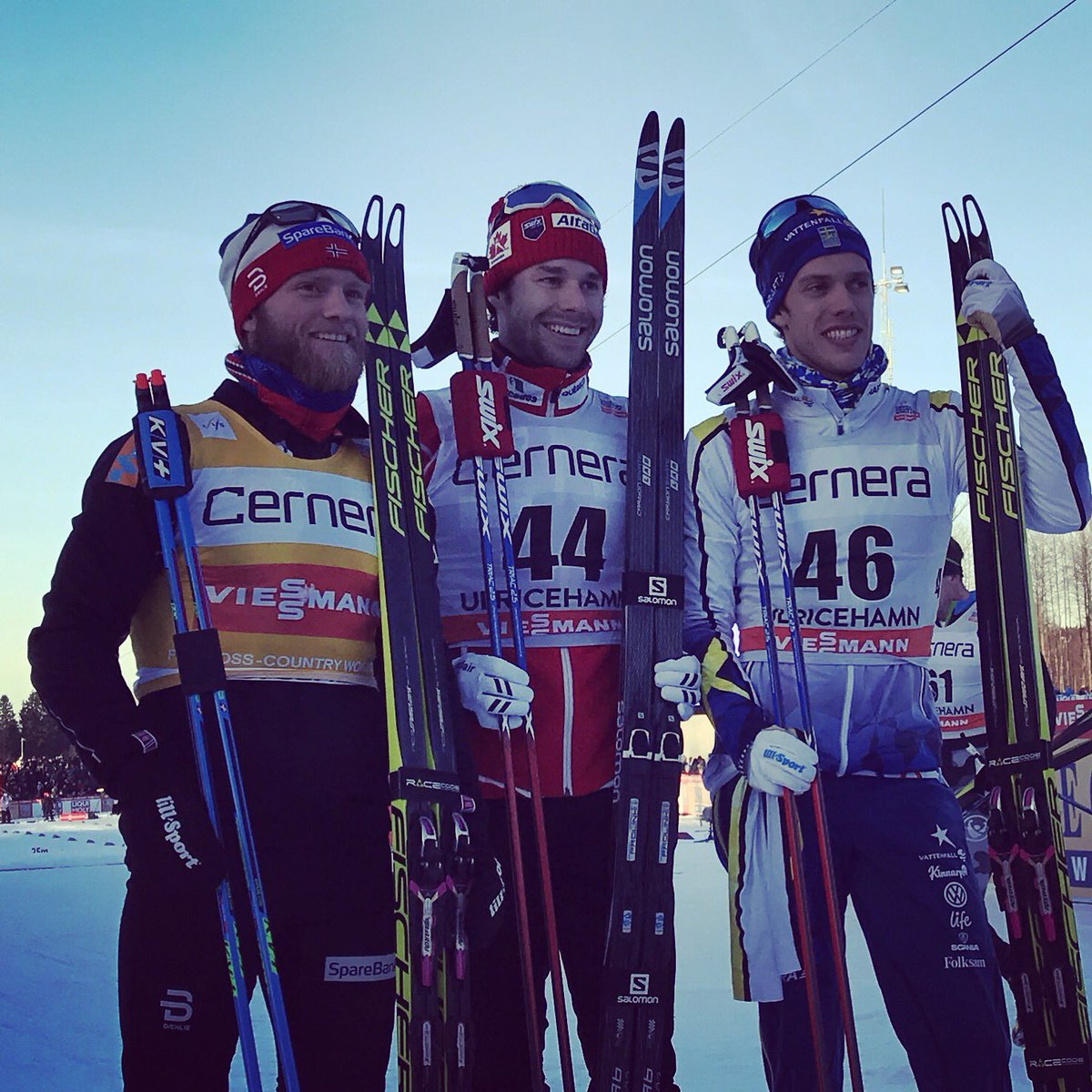
The men’s 15 k freestyle podium at Saturday’s World Cup in Ulricehamn, Sweden, with Canadian winner Alex Harvey (c), Norwegian runner-up Martin Johnsrud Sundby (l), and Sweden’s Marcus Hellner (r) in third. (Photo: FIS Cross Country/Twitter)
First individual win of the season (second straight, after winning last weekend’s team sprint), fifth individual victory of his career. That’s the latest news on Canada’s Alex Harvey, who won the World Cup men’s 15-kilometer freestyle individual start on Sunday in Ulricehamn, Sweden, for his first victory in a 15 k skate race and fourth individual podium of 2016/2017.
To say Harvey is on a roll is an understatement. On Saturday, he beat Norway’s Martin Johnsrud Sundby by 6 seconds after starting a minute behind the Norwegian defending World Cup champion. Harvey’s fastest time across the line in 32:46.2 held up through 76 finishers, with Sweden’s Marcus Hellner coming somewhat within range after starting a minute behind him. Hellner ended up 14.3 seconds back from Harvey at the finish for third place, behind Sundby.
Switzerland’s Dario Cologna missed the podium by 0.5 seconds in fourth (+14.7), and Norway’s 24-year-old Daniel Stock broke through in fifth (+16.2) for his first World Cup top 20.
Great Britain’s Andrew Musgrave placed sixth (+18.7), Sweden’s Daniel Rickardsson was seventh (+25.0), Norway’s Finn Hågen Krogh eighth (+32.2), Russia’s Petr Sedov ninth (+33.9), and Japan’s Keishin Yoshida 10th (+34.2).
American Erik Bjornsen landed in the points as he tied Norway’s Simen Andreas Sveen for 28th (+1:09.2), leading fellow U.S. Ski Team members Noah Hoffman, who placed 41st (+1:28.8), and Simi Hamilton in 53rd (+1:56.2). Also for the U.S., Matt Gelso, the Period 1 SuperTour leader from the Sun Valley Ski Education Foundation (SVSEF) Gold Team, finished 68th (+3:00.3).
Harvey’s Canadian World Cup teammates Len Valjas finished 35th (+1:17.7) and Devon Kershaw 38th (+1:22.2). Knute Johnsgaard (Canadian U25 Team) did not start.
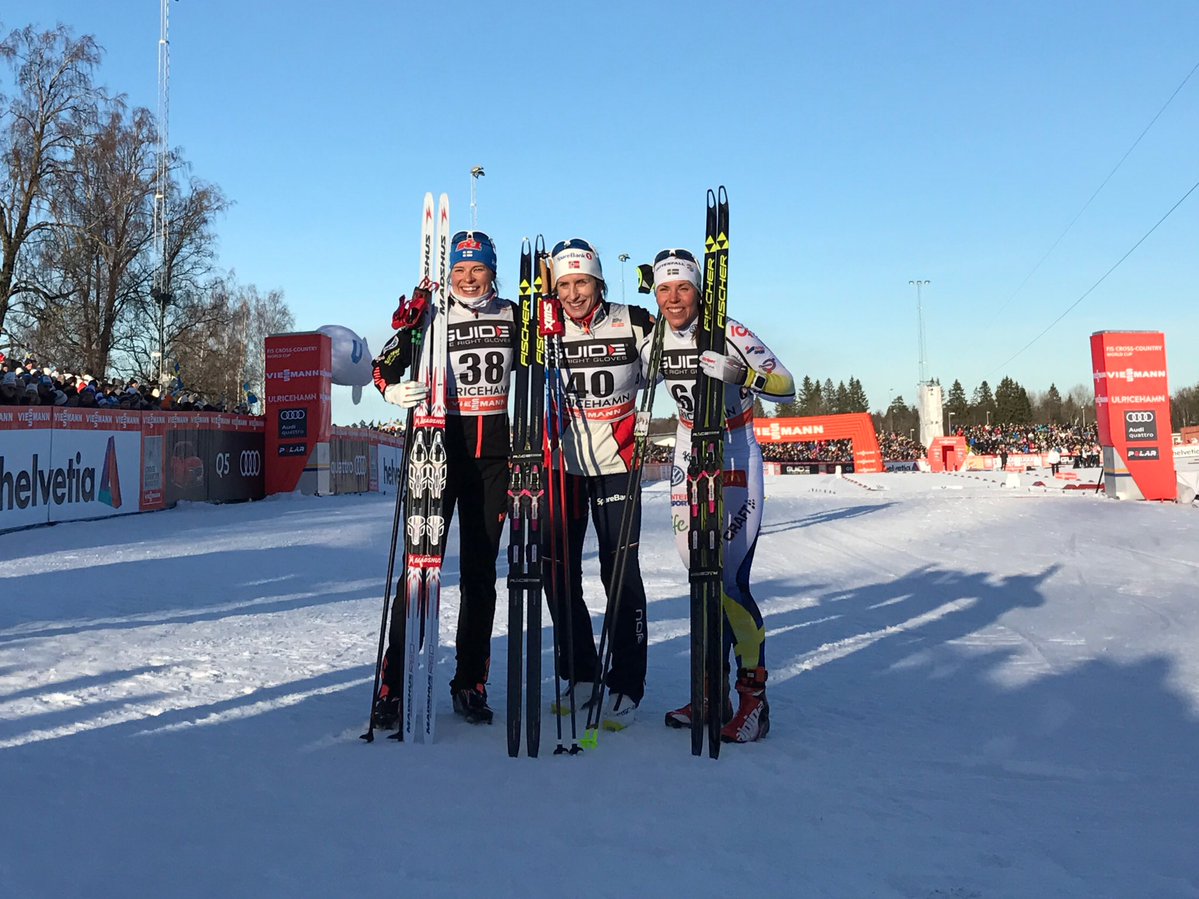
The women’s 10 k freestyle podium on Saturday in Ulricehamn, Sweden, with Norwegian winner Marit Bjørgen (c), Finland’s Krista Parmakoski (l) in second and Sweden’s Charlotte Kalla (r) in third. (Photo: FIS Cross Country/Twitter)
In her first World Cup race in over a month and at a brand-new World Cup venue, Norway’s 36-year-old Marit Bjørgen returned to her winning ways, topping the women’s 10 k freestyle on Saturday in Ulricehamn.
Bjørgen started 40th out of 61 finishers and took the lead from Finland’s Krista Parmakoski at the finish with a time of 23:46.3 minutes. Parmakoski, who started a minute ahead of her in bib 38, ended up second, 10.7 seconds back. Sweden’s Charlotte Kalla reached the podium for the second time this season in third (+24.9).
“It is always great to win,” Bjørgen said, according to an International Ski Federation (FIS) press release. “I stayed at home for five weeks and was training. It is great to come back with a victory. I know that the training I had done was good. It was an amazing atmosphere today by the course. There were people cheering everywhere.”
Norway swept fourth through sixth with Astrid Uhrenholdt Jacobsen in fourth (+25.7), Ragnhild Haga in fifth (+32.3) and Heidi Weng in sixth (+34.0).
American Jessie Diggins raced to seventh (+34.9), ahead of Sweden’s Hanna Falk, who recorded her best distance result in eighth (+36.4). Norway’s Ingvild Flugstad Østberg finished ninth (+44.8), and Germany’s Sandra Ringwald was 10th (+56.6).
“I didn’t have the snappy good feelings I was hoping to have in my body today, but it was a solid race,” Diggins wrote in a post-race email to FasterSkier. “It’s always hard when you know that on your best days you are capable of more, but at the same time we had great skis, and it was really fun for me to be able to ski with my teammates today!”
The U.S. had three in the top 20 and four in the top 30 with Sadie Bjornsen in 12th (+1:00.5), Liz Stephen in 16th (+1:07.3) and Rosie Brennan in 24th (+1:30.7).
Cendrine Browne as Canada’s lone woman in the race achieved 35th (+1:52.0) for her career best in an individual race. Also for the U.S., Kikkan Randall placed 40th (+1:59.6) and Liz Guiney of the Craftsbury Green Racing Project 52nd (+2:33.2).
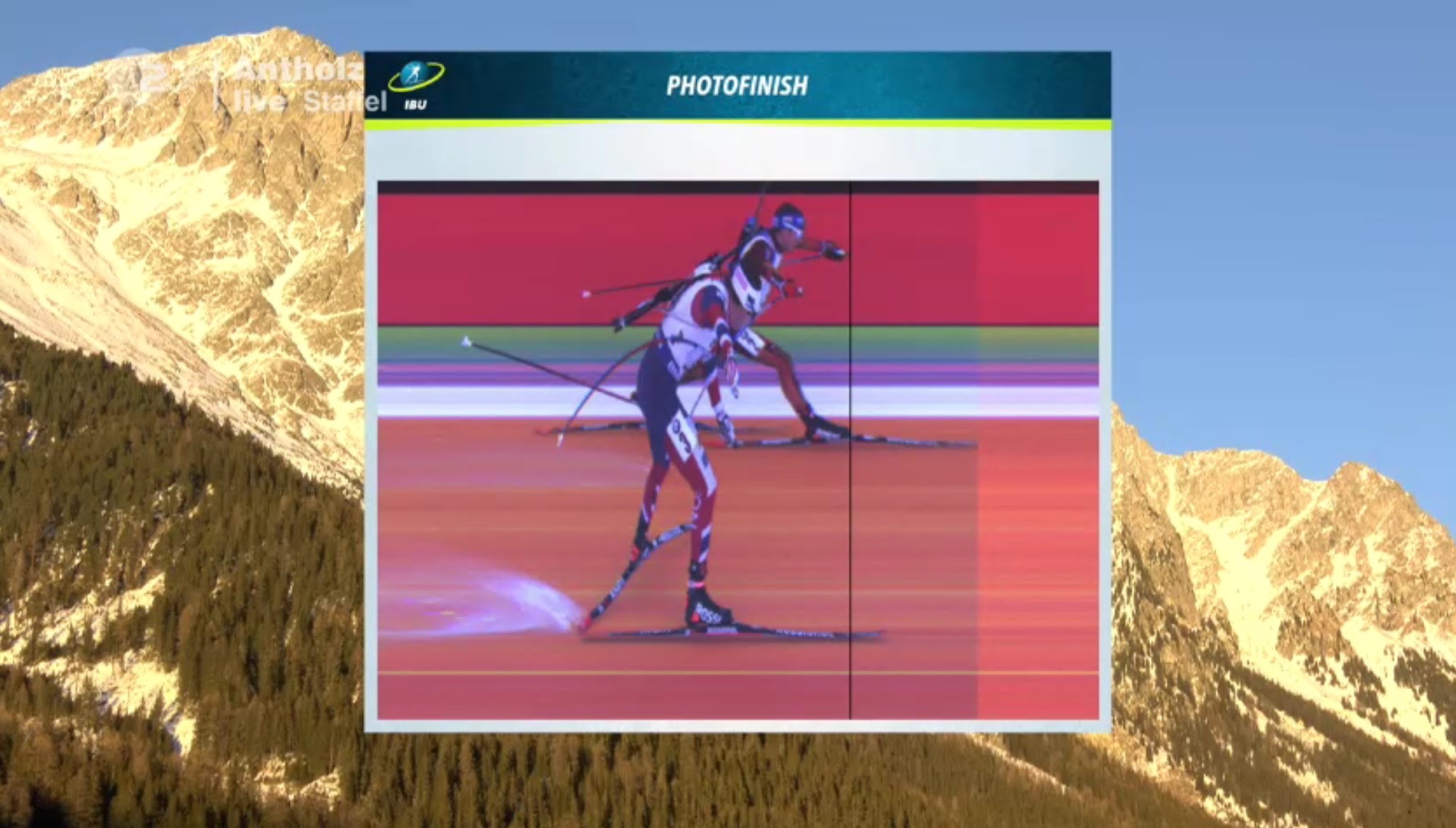
The photo finish of the men’s 4 x 7.5 k relay on Saturday at the IBU World Cup in Antholz, Italy, with Germany’s Simon Schempp outlunging Norway’s Emil Hegle Svendsen. (Photo: ZDF broadcast screenshot)
For the U.S. men, top six was a target for the 4 x 7.5 k relay on Sunday in Antholz, Italy, according to US Biathlon Men’s Coach Jonas Johansson.
Mission accomplished. In the final team event before 2017 World Championships, Lowell Bailey, Leif Nordgren, Tim Burke, and Sean Doherty combined for sixth, finishing 1:04.9 minutes behind the German winners. The Americans used a total of 10 spares but avoided the penalty loop, as did the Germans who used seven spares to clean the eight-stage race and won it in 1:13.57.2.
Germany’s Simon Schempp narrowly outlasted Norway’s Emil Hegle Svendsen in the finishing stretch to secure the victory for Germany (with teammates Erik Lesser, Benedikt Doll and Arnd Peiffer) by one-tenth of a second. Norway finished second with nine spares and no penalties (with Lars Helge Birkeland, Henrik L’Abee-Lund, Johannes Thingnes Bø, and Svendsen), and Russia secured third (+33.6) with nine spares and zero penalties as well (with Maxim Tsvetkov, Evgeniy Garanichev, Dmitry Malyshko, and Anton Babikov).
Ukraine used a total of just five spares and had zero penalties for fourth (+46.7), and Austria took fifth (+49.2) with eight spares and no penalties, after Austria’s Dominik Landertinger skied away from Doherty on the final loop and finished 6.9 seconds ahead of him for fifth place.
For the U.S. men, sixth was close to their team-best fifth with the same lineup in last year’s World Cup relay in Presque Isle, Maine. The same group also took sixth in Ruhpolding, Germany, last year as well.
With all four making US Biathlon’s World Championships team, announced Saturday, they will likely be aiming for a best championships result early next month in Hochfilzen, Austria.
Canada (Christian Gow, Scott Gow, Macx Davies, and Brendan Green) finished 16th (+4:13.8) on Saturday with two penalties and 11 spares. Scott Gow skied them up to 15th by the second exchange but they dropped to 18th after Davies had two penalties on the third leg. With Green anchoring and using just one spare, they recouped two places before the finish.
In the women’s race, Germany’s Nadine Horchler achieved a lifetime dream with her first World Cup win, after starting in bib 30 and earning her start as a reserve athlete. Germany took first and second with Laura Dahlmeier in second, and the Czech Republic’s Gabriela Koukalova placed third. Susan Dunklee of the U.S. was the lone North American starter and finished 24th after leading at the start of the second loop.
FIS Nordic Combined World Cup (Chaux-Neuve, France): Individual large hill/10 k
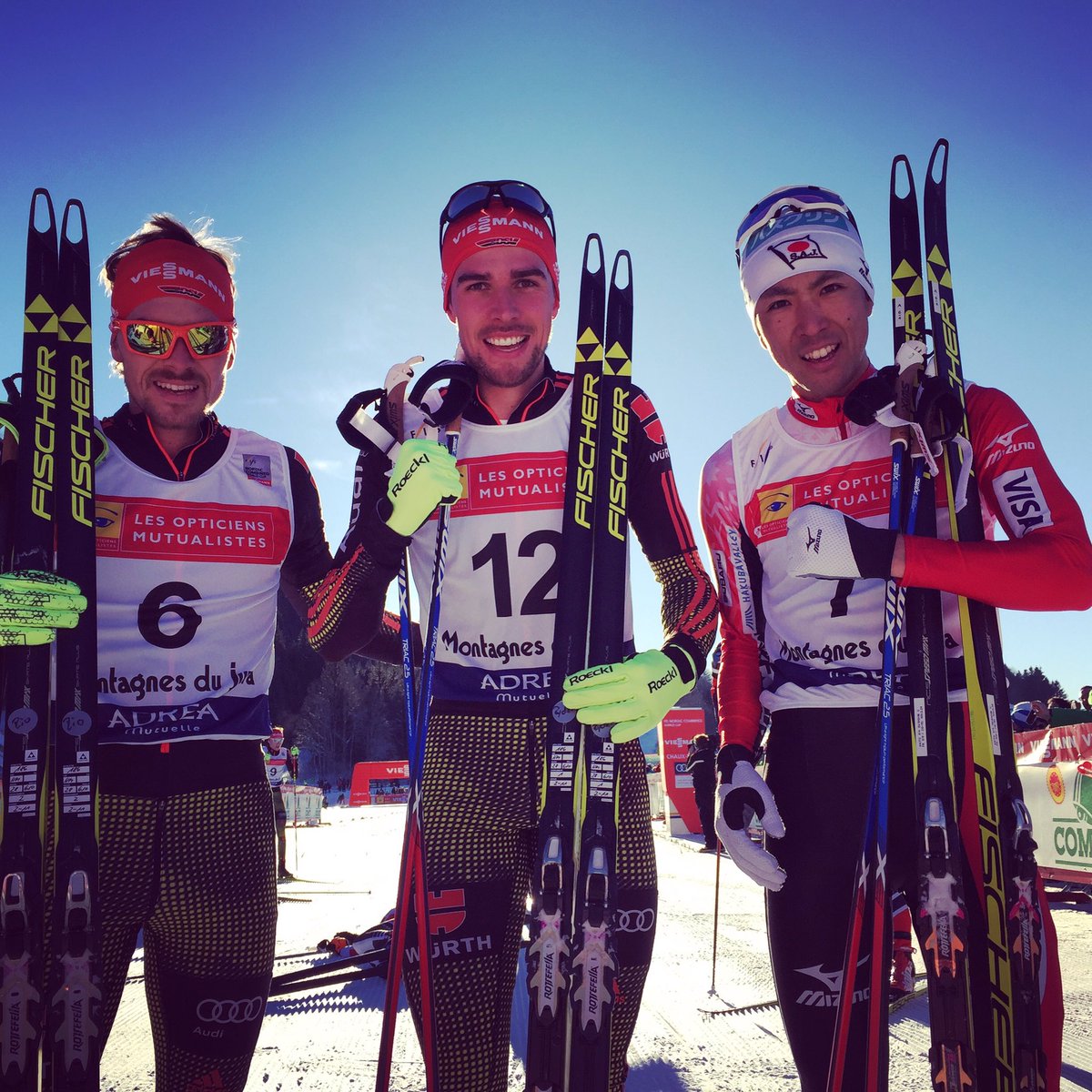
Saturday’s Nordic Combined World Cup podium in Chaux-Neuve, France, with German winner Johannes Rydzek (c), German runner-up Fabian Rießle (l) and Japan’s Akito Watabe (r) in third. (Photo: FIS Nordic Combined/Twitter)
The first part of Saturday’s Nordic Combined World Cup individual large hill/10 k competition was a shining moment for U.S. Nordic Combined skier Ben Berend, who jumped to second for a total of 127.5 points, trailing only Norway’s Jarl Magnus Riiber with 139 points in Chaux-Neuve, France.
Berend flew farther than Germany’s Eric Frenzel, who jumped to third on the Chaux-Neuve large hill.
Later in the day, they started the 10 k Gundersen in that order, with Riiber heading out first, followed by Berend 46 seconds later, then Frenzel 53 seconds back in third.
Germany’s Johannes Rydzek started 1:15 minutes back in 12th and skied the fastest 10 k to take the victory at the finish (in 23:01.7). He held off his German teammate Fabian Rießle by 2.8 seconds for the win, after Rießle started sixth and 1:01 back. Japan’s Akito Watabe reached the podium in third (+5.7) after jumping to seventh and starting the race 1 second behind Rießle.
Frenzel ended up fourth (+8.3), and the fourth German in the top five, Björn Kircheisen improved to fifth (+22.6) after starting 11th.
Riiber dropped to 15th (+54.0), and Berend fell outside the top 30 to end up 32nd (+2:26.0) with the 39th-ranked course time.
Berend finished 12.2 seconds ahead of his U.S. teammate Taylor Fletcher, who placed 34th (+2:38.2) after the jump put him in 48th.
Bryan Fletcher was 49th after the jump but did not start the 10 k.
The Nordic Combined World Cup continues Sunday in Chaux-Neuve with another large hill/10 k.
Ski Classics #5: La Diagonela (Zuoz, Switzerland): 50 k classic
[UPDATED] Under “blue skies, no wind and perfect track conditions” in the Swiss Engadin Valley on Saturday, according to a Ski Classics press release, Russia’s Ilya Chernousov and the Czech Republic’s Kateřina Smutná won the men’s and women’s La Diagonela, respectively, in Zuoz, Switzerland.
Chernousov, of Team Pioneer Investments, and Tord Asle Gjerdalen (Team Santander) led a large pack of men into the final major climb on the 50 k course. There, Gjerdalen attacked and Chernousov matched him, accelerating away from his competitors up the last steep pitch to the finish, according to the press release. He finished in 2:03:39.6 hours, holding off Gjerdalen by 1.5 seconds, while Øystein Pettersen (Team BN Bank) finished third (+3.0).
In the women’s race, Smutná (Team Santander) pushed to break up the field around the halfway point, where the men caught the women. Britta Johansson Norgren (Lager 157 Ski Team) hung with Smutná, but lost contact over the last 5 k. After finishing second in the last two Ski Classics races, Smutná took the win by 1:03.2 minutes in 2:20:49.2. Nordgren finished second, ahead of Sara Lindborg (Team Serneke) in third, who finished more than three minutes later (+4:17.4).
Team R.A.D.’s Russell Kennedy (r) powering through the snow to finish at the top Canadian in ninth in the men’s 15 k freestyle on Sunday, Dec. 11, at the Sovereign Lake NorAm/SuperTour. (Photo: Marie-Éve Bilodeau-Corriveau)
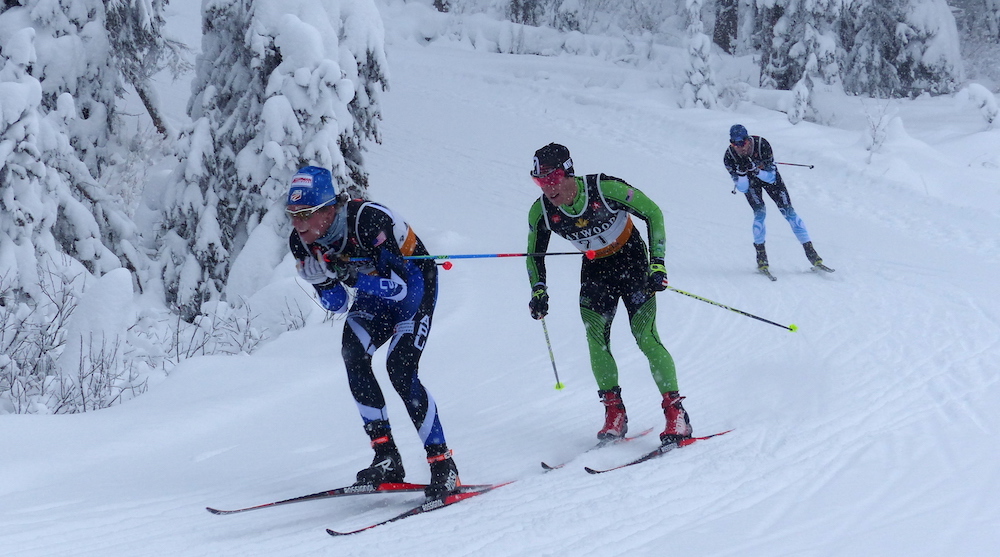
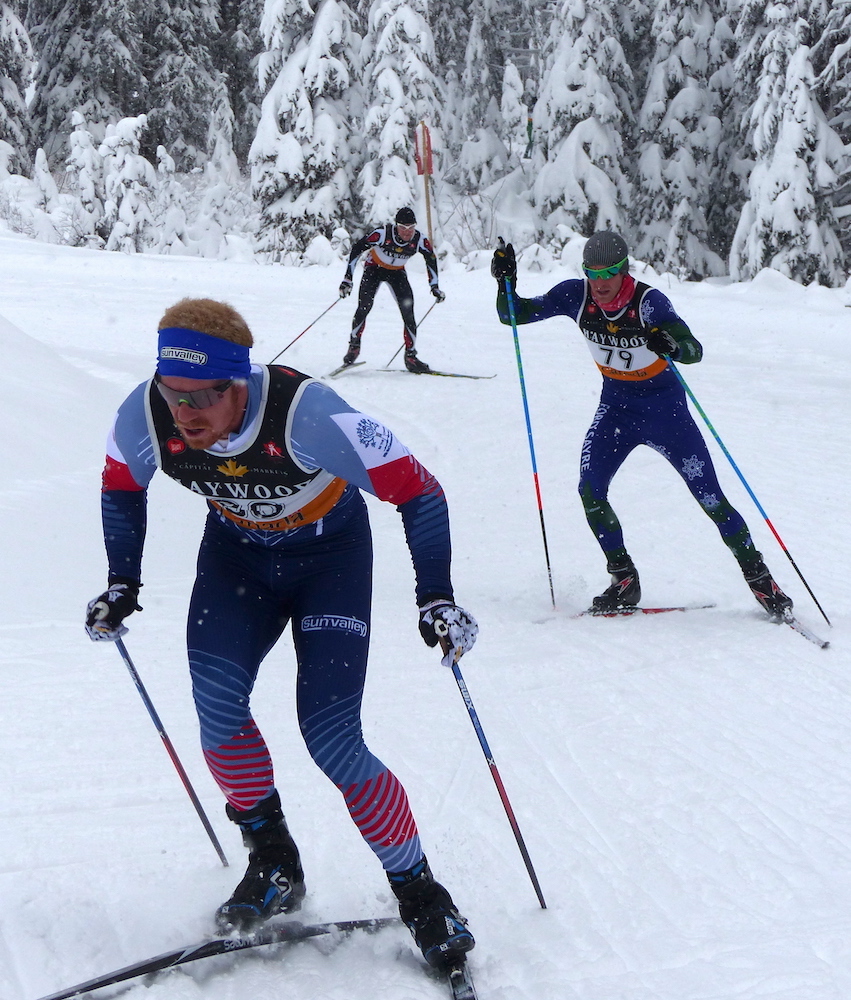
VERNON, B.C. –The combined Noram/SuperTour last weekend at Sovereign Lake, British Columbia, produced some exciting skiing and some challenging photography conditions with almost non-stop snowfall both days. Some of our best photos that didn’t make the two-day race recap are included below, but first, a little background and feedback:
The NorAm circuit has not been a fully North American circuit since 2006. This year, Canada and the U.S. planned two combined NorAm/SuperTour events in Bozeman, Montana, and Sovereign Lake, B.C. With the relocation of the Bozeman event to West Yellowstone, Sovereign Lake became the only combined event of the season.
While many athletes dream of a return to the glory days of this series, the 2006/2007 birth of the SuperTour coincided with a second Continental Cup quota spot, allowing each country to send one “COC” leader of each gender. Effectively, each country became a “continent” in the eyes of the International Ski Federation (FIS). Combining the two series could reduce North America to one COC position per gender.
FasterSkier asked athletes and organization leaders what they thought of the 2016 combination of the early season NorAm and SuperTour:
“I think what became very clear last year [in] the discussion with the coaches and the Canadian people, instead of trying to send to our athletes East to West, maybe it’s better to send them North to South. In terms of saving cost, obviously, and more competition between better athletes, [this] is better to improve the quality of our athletes in Canada and the US.” — Robert Lazzaroni, U.S. Ski & Snowboard Association (USSA) nordic domestic program director
“If you back to the NorAm races, when we used to do them with the U.S., when Devon Kershaw was racing Justin Wadsworth … ‘x’ number of years later, the one guy is coaching the other guy. Crossing over generations is very important.” — Thomas Holland, Cross Country Canada (CCC) high performance director
“The altitude at West Yellowstone is too high to use it as a selection race for the Canadian team.” — Holland, on applying the FIS limits to selection races.
“I think it’s an incredible opportunity. I think we as North Americans don’t get the opportunity to have such a competitive field and I think coming together and making each other better is super important and think there’s just so much more to learn.” — Julia Kern, Stratton Mountain School (SMS) Elite
“I really like it. This has been a very well-run, well-organized event. It’s really fun to race against other athletes, more people than the usual SuperTour field. It would be awesome to have more.” — Kaitlyn Miller, Craftsbury Green Racing Project (CGRP)
“I can’t express to you how much I love it and how happy I am. I’ve been telling everyone I run into that I absolutely love it, and I would wish that the entire circuit could be combined the way it is today. I know that logistically, that’s not totally possible, but it’s so good for us, it adds such a depth of field. It’s just so much more fun, I love it. Yeah, I love it.” — Olivia Bouffard-Nesbitt, Alberta World Cup Academy (AWCA)
“I think it’s awesome. I think we should do more of these, for sure. Rossland and Silver Star and Canmore, it’s always beautiful snow and great grooming, and a really hilly, challenging course. I think all three of those have some really good terrain; it’s always fun to come up here and get a little bit different than our usual back courses back home.” — Jennie Bender, Bridger Ski Foundation (BSF)
“It’s been great. I’ve been amazed at the professionalism here. They’ve put on an amazing event. For us in North America, we have it unique that we are separate from Europe and it’s cool to be able to challenge each other against the Canadians, and I think we should have more of it.” — Heather Mooney, CGRP
“It’s just great. In sport and in skiing, I always believe that you need to race against the best. That’s why we’ll be racing in Europe in February. It’s a super good idea, and I don’t know why we didn’t do it earlier. They’re so close to us, so we need to race against them, and they need to race against us.” — Antoine Briand, Pierre-Harvey National Training Centre (CNEPH)
“I think it’s incredible. Last year at our athlete meeting at Canadian Nationals, I made that point very strongly a couple times. I raced U.S. nationals in Houghton last year. That was an awesome event, I thought. Having a higher level of competition benefits everyone and then when we get to racing deeper fields in Europe, we’re not caught quite as offguard.” — Evan Palmer-Charrette, Thunder Bay National Team Development Centre (NTDC)
“I think it’s awesome. I think it’s better for both the Americans and the Canadians. Everybody that I’ve talked to likes it. It raises the level of competition, we’re still competing for SuperTour points and NorAm points respectively. It just makes a deeper, faster field.” — Reese Hanneman, Alaska Pacific University (APU)
“It raised the level of competition a lot, brings everyone’s game up, I think it’s good for North American skiing.” — Cole Morgan, Sun Valley Ski Education Foundation (SVSEF)
“It’s the best, we need to do this all the time. It’s so good to mix it up and see all of our best racers. I think if you look back generations, guys like [Chris] Jeffries and [George] Grey and Kersh [Devon Kershaw], like [Ivan] Babikov, they cut their teeth on a combined circuit. I think their success on the world cup is definitely in part due to that. I hope we get a couple more opportunities to keep racing each other.” — Ben Saxton, SMS Elite (Note: Jeffries is the AWCA head coach, Grey placed eighth in the skiathlon at the 2010 Vancouver Olympics, Kershaw was second overall in the 2012 World Cup, and Babikov is one the Canadian World Cup coaches.)
“I think it’s a great idea. It’s really nice to get some deeper fields, to get the Americans and Canadians racing together. It wasn’t so fun to watch the podium here, to watch it filled up with Americans, but when all the Canadians go down in the semi, that was happens. We’ll be down at US Nationals for sure.” — Angus Foster, NTDC Thunder Bay
“It’s really good, because the level is really high with the U.S. Good for us to see other skiers, and other fast guys.” — Alexis Dumas, CNEPH, the second Canadian and 15th overall in the men’s 15 k
“I love it! I think it’s like the best thing for our sport. The camaraderie, and also you learn so much from your peers, it’s super important and so valuable.” — Chelsea Holmes, APU
“I love it, I hope we do more. I think it’s awesome for everyone involved.” — Katharine Ogden, SMS Elite
“I love it. It’s fun having a bigger field and a new venue. I love Silver Star, this place is hard to beat.” — Erika Flowers, SMS Elite
APU’s Reese Hanneman earned the NorAm leader’s big in Saturday’s sprints. (Photo: XTS Photography)
Three Canadians won’t be advancing to the A final. CNEPH’s Simon Lapointe (standing) watches NTDC TBay’s Angus Foster try to stand up with Lapointe’s ski stuck through his bib. Evan Palmer-Charrette is more interested in breathing after getting the wind knocked out of him. (Photo: XTS Photography)
Bend Endurance Academy’s Nick Michaud passes the 83% test during the heats. (Photo: XTS Photography)
Denver U and Finland’s Jasmi Joensuu powers to a 17th place qualification. (Photo: XTS Photography)
Cole Morgan and Reese Hanneman are easily through to the A final. (Photo: Russell Kennedy)
SMS Elite’s Katherine Ogden was the top junior with her second overall in the 10km free. (Photo: Marie-Éve Bilodeau-Corriveau)
Junior Gareth Williams found the one hour drive worthwhile, qualifying 27th overall and top junior, before winning the junior men heats. (Photo: XTS Photography)
FasterSkier was on the scene, learning how to spell Joensuu’s hometown of Kuortane. (Photo: XTS Photography)
Get your hot chocolate here! (Photo: XTS Photography)
The open women’s A final. (Photo: XTS Photography)
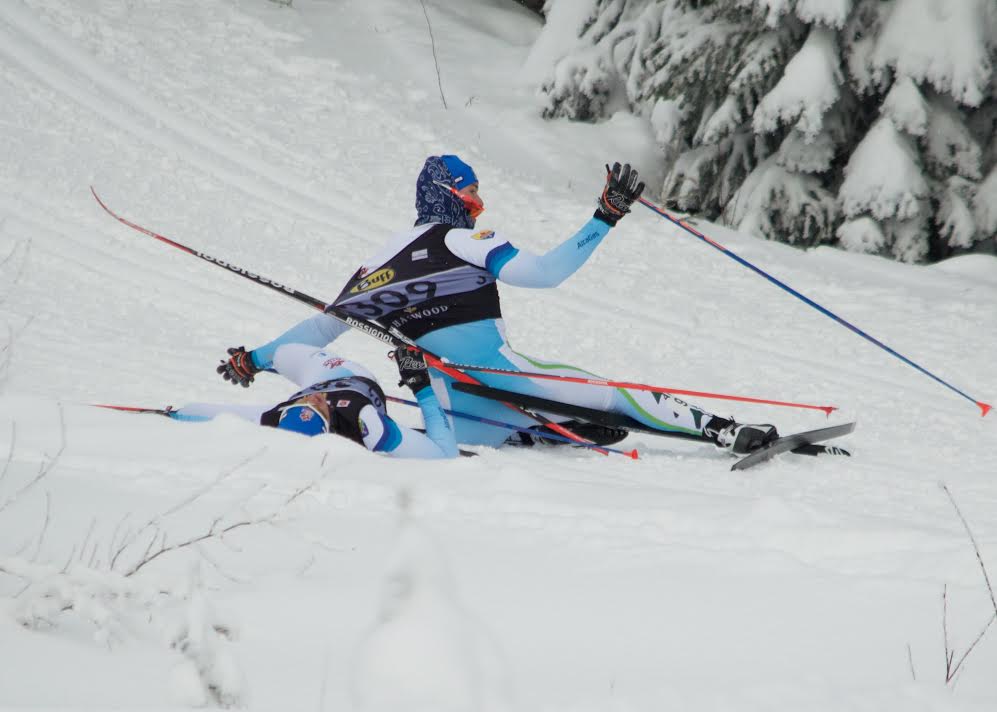
Angus Foster (309) untangles himself after a semifinal crash at the Sovereign Lake NorAm/SuperTour on Dec. 10, as his NTDC Thunder Bay teammate Evan Palmer-Charrette tries to get his breath back. The ski through the bib belongs to Simon Lapointe. (Photo: Shelley Woodman)
Vail’s Tad Elliot leads Brian Gregg to third and fourth place. (Photo: XTS Photography)
APU’s Jack Novak can hear his teammate Scott Patterson coming up fast on his way to victory. (Photo: XTS Photography)
Two each from NTDC TBay and Dartmouth on the final climb of the loop. (Photo: XTS Photography)
Three skiers on three different laps. Canmore’s Sebastian Boemler-Dandurand leads Dartmouth’s Paolo Takagi-Atilano and APU’s David Norris. (Photo: XTS Photography)
SVSEF’s Matt Gelso leads Denver U’s Lars Hannah through the falling snow. (Photo: XTS Photography)
Team R.A.D.’s Russell Kennedy (r) powering through the snow to finish at the top Canadian in ninth in the men’s 15 k freestyle on Sunday, Dec. 11, at the Sovereign Lake NorAm/SuperTour. (Photo: Marie-Éve Bilodeau-Corriveau)
AWCA’s Olivia Bouffard-Nesbitt in the lap lane on her way to a second day as top Canadian. (Photo: Marie-Éve Bilodeau-Corriveau)
CNEPH’s Antoine Briand stretches for the last lucky loser spot in semifinal 1. (Photo: Russell Kennedy)
Sovereign Lake’s junior Hannah Mehain was 20th overall in the 10 km free. In the sprint, she qualified 8th overall before easily winning the junior A final. (Photo: Jeff Bassett)
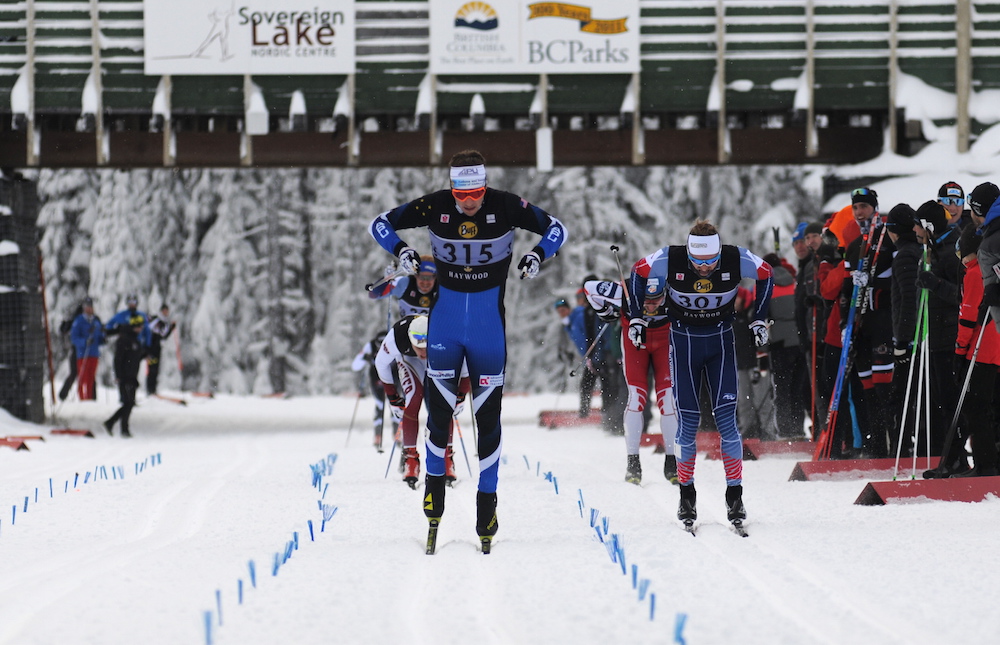
APU’s Reese Hanneman (315) leading down the finishing stretch of the Sovereign Lake NorAm/SuperTour men’s classic sprint final on Dec. 10, with Sun Valley’s Cole Morgan (r), the University of Denver’s Moritz Madlener (behind Hanneman), Stratton’s Ben Saxton (behind Morgan), and Sun Valley’s Matt Gelso (behind Madlener) chasing. (Photo: Doug Stephen)
VERNON, B.C. — It might’ve been the first Canadian NorAm of the season, but the Americans made it all about themselves in what also doubled as their second stop on the U.S. SuperTour circuit this past weekend at the Sovereign Lake Nordic Centre.
U.S. skiers kept Canada off the podium in the classic sprints and freestyle intervals starts on Saturday, Dec. 10, and Sunday, Dec. 11, with Olivia Bouffard-Nesbitt, of the Alberta World Cup Academy (AWCA) and Canadian U25 Team, coming closest in fourth on Day 1.
On Saturday, Bouffard-Nesbitt started off the very first NorAm race, a 1.2 k classic sprint, with a qualifying win. She went on to advance in second in her quarterfinal and third in her semifinal, before finishing fourth in the A-final, 1.49 seconds out of first.
American Julia Kern of the Vermont-based Stratton Mountain School (SMS) Elite Team (formerly the T2 Team) won the women’s final in 3:17.04, after qualifying fifth and placing second in both her quarterfinal and semifinal. Kern led two Craftsbury Green Racing Project (CGRP) teammates, Liz Guiney and Kaitlynn Miller, in second (+0.67) and third (+0.91) on the podium, respectively.
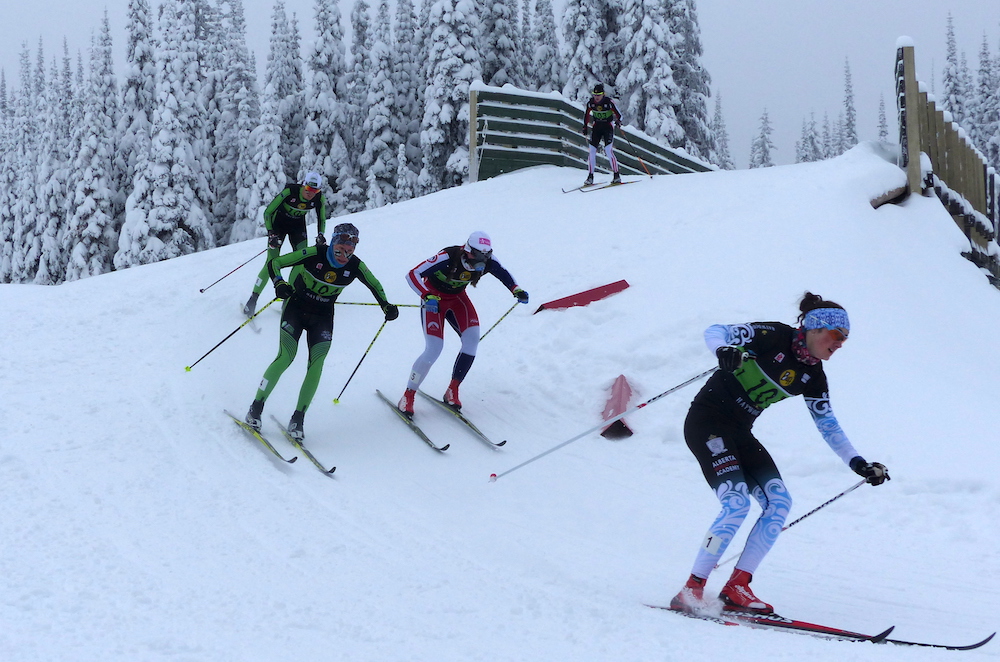
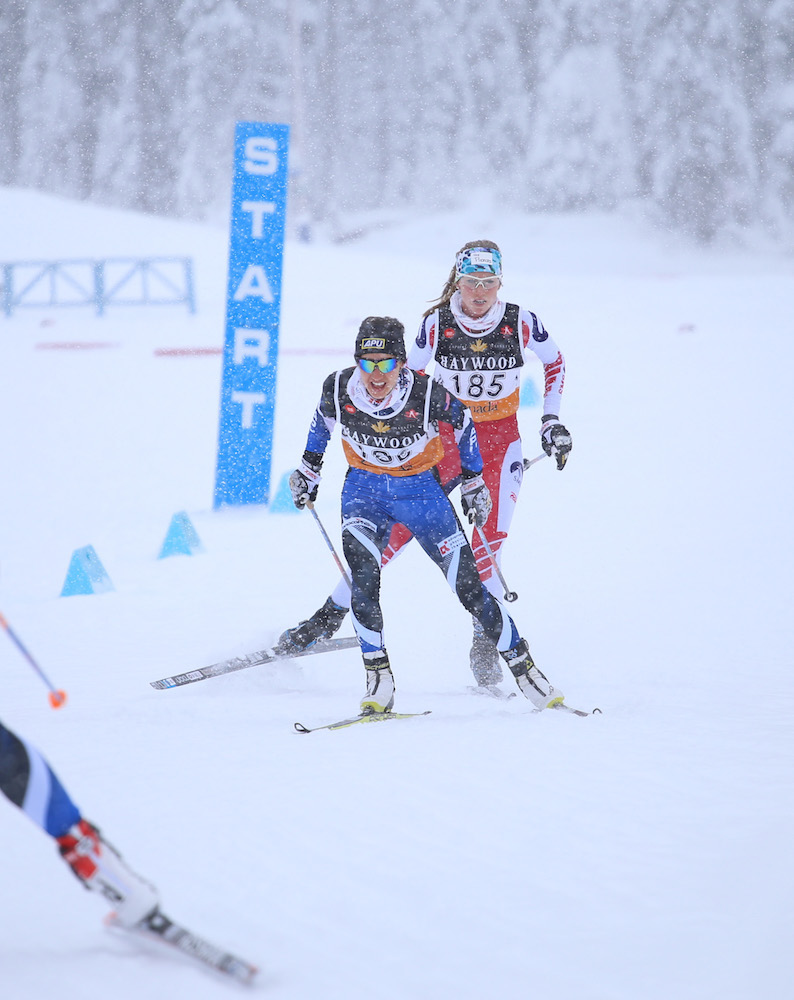
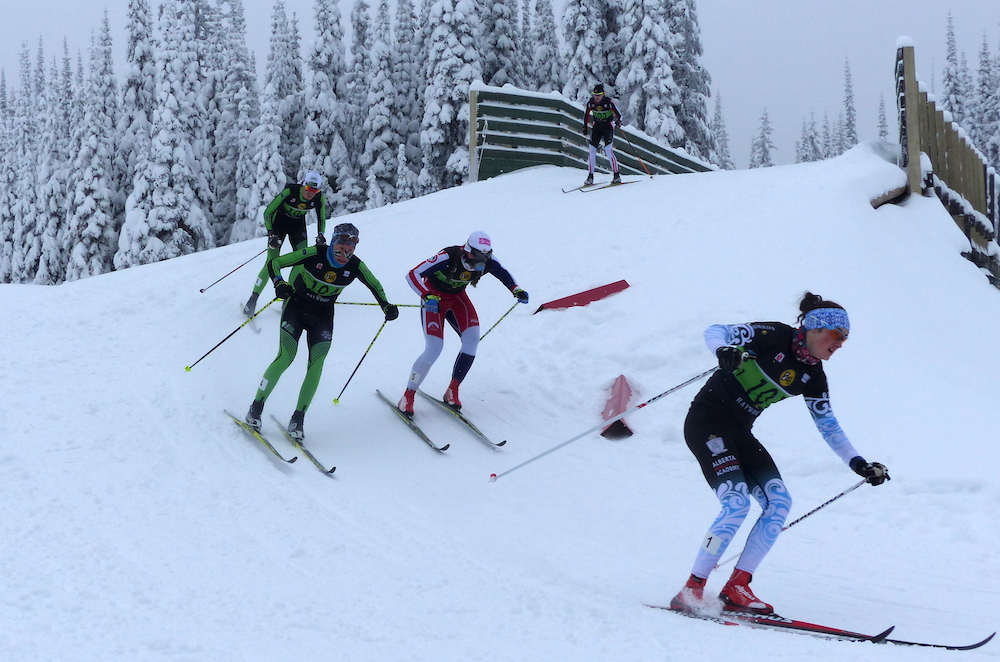
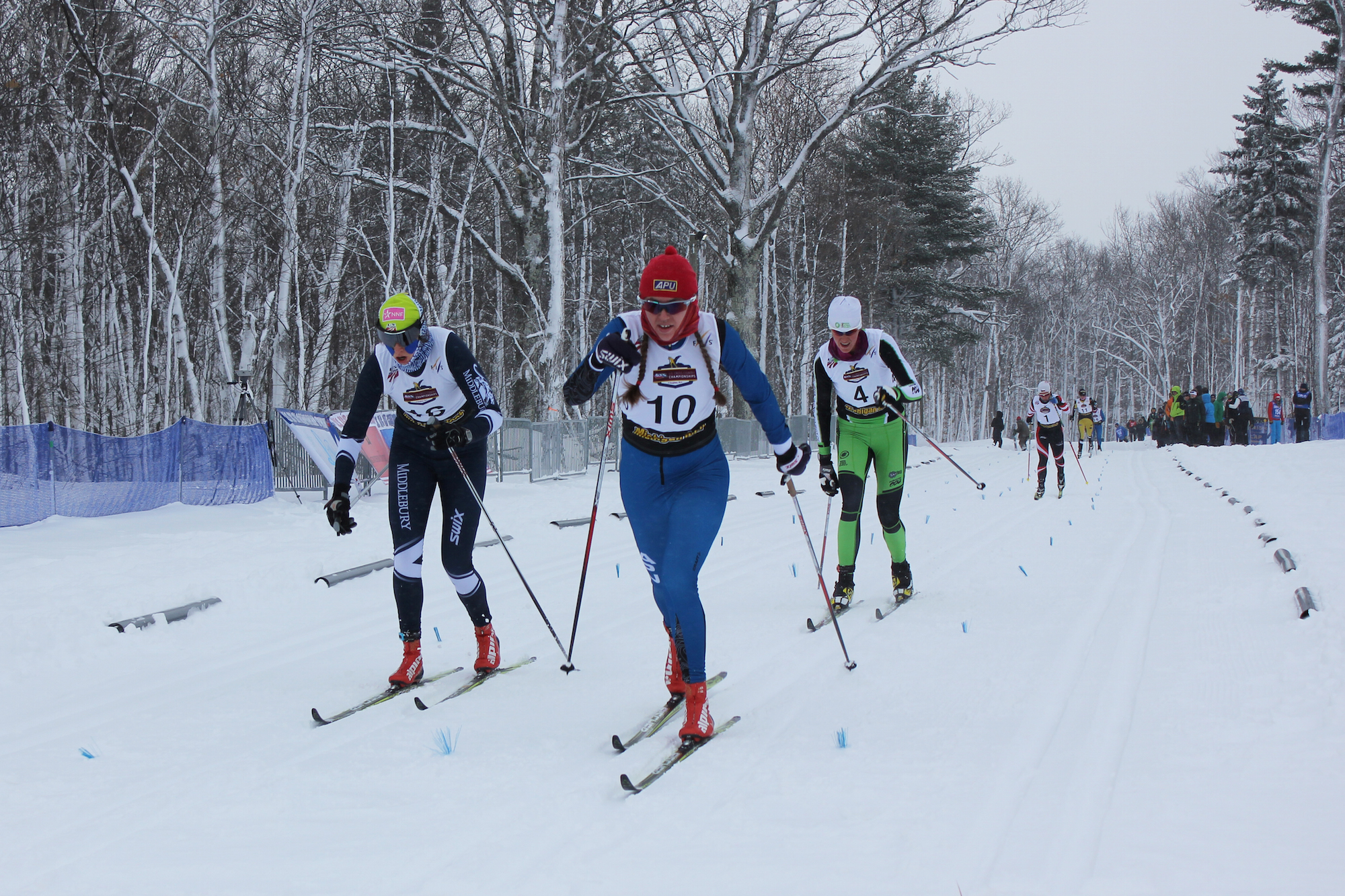
Olivia Bouffard-Nesbitt (AWCA) leads the Americans through the bridge turn in the women’s classic sprint A-final on Saturday, Dec. 10, at the Sovereign Lake NorAm/SuperTour. Stratton’s Julia Kern (second from r) made a tactical choice more than a minute earlier, which gave her the inside position on Craftsbury’s Kaitlynn Miller (l) and the advantage she needed to win. (Photo: Peggy Hung)
Bouffard-Nesbitt led the six finalists into the finishing straight after opening up a wide gap at the top of the second climb.
“Yeah, those Americans,” Bouffard-Nesbitt told FasterSkier after the race. “I was in first until we hit the final finishing straight, and then I just got out-double poled by three of the girls.”
Kern, a U.S. Ski Team Development Team member and Dartmouth student, credited tactical choices for her victory.
“In the quarterfinal, I made the mistake of not taking the outside, which turned into the inside turn on the second downhill,” Kern said.
The second downhill on Sovereign’s sprint course has a gentle right turn leading into a high-speed left, followed by the long climb and then two sharp left turns to the finish. Keeping control of the inside for the last three turns gave Kern the ideal position to take the second skied-in finish lane to cross the line first.
Guiney followed Kern to second, leaving Miller with the fresh snow in lane three.
“I was in third the first half of the course, just stayed in the mix,” Miller said of the final. “I really like the striding hill at the end.”
Despite being slowed in the final straight, Miller loved the conditions.
“This course is really nice, the conditions are awesome,” she said. “I love all the fresh snow. We had really great skis today, so that always helps.”
While Bouffard-Nesbitt was disappointed that there wasn’t a Canadian on the podium, she was happy with her day.
“I haven’t really sprinted this year,” she said, referring to a stress fracture in her foot that put her on crutches for several months this summer. “The intensity I’ve done since I’ve been back on my feet has been almost exclusively controlled Zone 3.”
The fourth American in the top five, Jennie Bender of the Bridger Ski Foundation (BSF) qualified third and finished fifth overall (+3.8). The SuperTour leader after West Yellowstone’s first two races of the season, she was disappointed with fifth.
“It was a tough field out there,” Bender said. “It’s a really short course, lots of turns, three different 180-degree turns. I kind of got swallowed up on the last downhill and lost a little gusto.”
Asked if she was tempted to double-pole the course, Bender laughed and said, “I was! I might of been interested to do it during the qualifier, but I was third, and yeah, I’ll keep the striding.”
A third Craftsbury skier in the A-final, Heather Mooney qualified ninth and went on to finish sixth in the final (+19.84).
“It’s a really fun course, fun with lots of transitions,” Mooney said. “Off the start of the final, I was really excited that we had three from our team. I just didn’t quite have it at the beginning, caught back up a little bit, but I was definitely on and off the back of the pack. Came in last, but it was a good day.”
All six of the women’s B-finalists were American, with Becca Rorabaugh of Alaska Pacific University (APU)ultimately placing seventh, Erika Flowers (SMS Elite) eighth, Mary O’Connell (CGRP) ninth, Jessica Yeaton (APU) 10th, Mary Rose of the Sun Valley Ski Education Foundation (SVSEF) 11th, and Anne Hart (SMS Elite) 12th.
“I definitely wasn’t skiing as fast as I would like to be,” MacIsaac-Jones said, “but I am definitely just happy to be racing and on snow.”
She was eliminated after placing fifth in her quarterfinal and skipped the 10 k freestyle on Sunday for a distance training session instead.
***
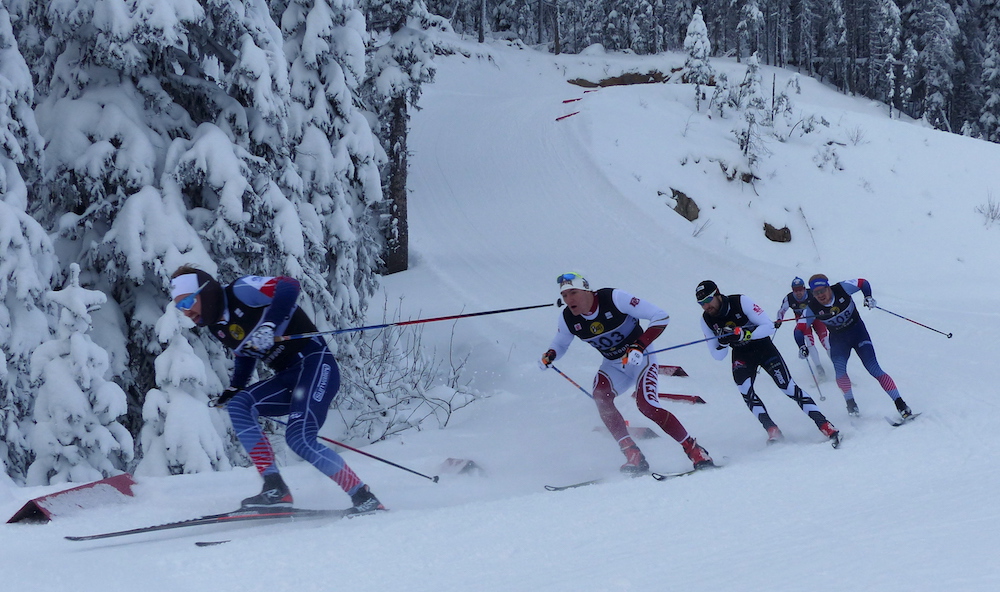
The men’s final on the first downhill at the Sovereign Lake NorAm/SuperTour on Dec. 10 near Vernon, B.C. Sun Valley’s Cole Morgan leads Denver’s Moritz Madlener, CNEPH’s Antoine Briand, Sun Valley’s Matt Gelso, and Stratton’s Ben Saxton Saxton in pursuit of APU’s Reese Hanneman (not shown). (Photo: Peggy Hung)
The men’s classic sprint shared the same 1.2 k course and the same American domination of the podium after a semifinal crash took three Canadians out of contention.
Reese Hanneman (APU) double poled to the win in 2:38.08 after qualifying 15th. Cole Morgan (SVSEF) and Ben Saxton (SMS Elite) rounded out the podium in second (+0.87) and third (+1.92), respectively.
“I had a really bad qualifier, for me. I chose a classic ski,” Hanneman said of his qualification round. “But I think [grip wax] was much slower, as the heats showed.”
He described the A-final as fast from the start.
“I had a decent start; I was in second behind Cole up until the top of the first climb. I made a pass, double poled by him, and I was kind of leading into the big climb,” Hanneman recalled.
“Then he and I were side by side, one and two, with a little gap. Then up the steep pitch, he took the lead and I tucked in behind him and just followed him over the bridge. I was able to close down the gap and then pass him and then turn on the jets coming in the final double-pole section.”
Morgan, who won the qualifier and was one of the four others on skate skis in the final, was also pleased with his tactics.
“I did the same tactic as I did in every heat, try to be in second place coming into the big downhill before the last hill,” Morgan said. “[I] was able to lead over the top, but didn’t have the same finish as Reese did.”
Saxton double poled all four laps, as did Hanneman, Morgan and many of the top men.
“I think that was the faster call, but it was definitely a physical task those last heats there,” Saxton said.
Another double poler in the final, the University of Denver’s Moritz Madlener ended up fourth (+1.92) after qualifying third.
“Considering how much we trained the last couple of weeks, it was a great result,” he said.
For Madlener, who is originally from Germany, this marked his first visit to Canada.
“This is German territory. The last time there was a World Cup here, the first five were Germans,” he said, probably not realizing that it was 11 years to the day since that 30 k pursuit event.
The lone finalist on grip wax, Matt Gelso (SVSEF) finished fifth (+3.88) after winning his crash-marred semifinal. Antoine Briand of the Pierre-Harvey National Training Centre (CNEPH) was the lone Canadian in the A-final, with a lucky loser time that was faster than Gelso’s winning time from the other semifinal.
Angus Foster (309) untangles himself after a semifinal crash at the Sovereign Lake NorAm/SuperTour on Dec. 10, as his NTDC Thunder Bay teammate Evan Palmer-Charrette tries to get his breath back. The ski through the bib belongs to Simon Lapointe. (Photo: Shelley Woodman)
For a few Canadian athletes, the crash in the second semifinal was the defining moment of the day. Only 50 metres into the race, Gelso used his inside position in the tight pack to pull in front of Angus Foster, of the Thunder Bay National Team Development Center (NTDC), but Gelso skied over Foster’s ski, triggering a chain reaction.
“[Gelso] got through, but I went down, had two other Canadians go down with me,” Foster said after. “Probably the hardest crash we’ve ever had.”
Foster fell sideways in front of NTDC teammate Evan Palmer-Charrette.
“I just got unlucky, [Foster] fell right in front of me, and I just pitchforked over him, got the wind knocked out of me pretty bad,” Palmer-Charrette said. “Unfortunate, but that’s racing.”
CNEPH’s Simon Lapointe was the third skier in the tangle. Lapointe got up quickly, but a broken binding required him to wait for a coach to run over with a spare ski.
Palmer-Charrette was slow to get up, leaving Foster pinned in place. Foster finished the heat with three holes in the back of his race bib and likely a few ski-shaped bruises underneath.
Lapointe, one of the top Canadians sprinters, was the most frustrated with the semifinal crash. He left the finish area with a quick French-language “nothing to say” before going on to win the B-final by 1.06 seconds over Palmer-Charrette in 2:43.31.
None of the three Canadians protested to the jury member at the finish. Asked directly about whether there was cause for a protest, Foster said “That wasn’t a clean move, but that happens. People make mistakes. Still frustrating, but….”
Gelso was surprised to find only one skier with him at the top of the second climb. “We both went for a track at the same time, and I don’t know what happened,” Gelso said later, “but I’ve been on both ends of that.”
Everyone interviewed spoke favorably of the combined NorAm/SuperTour weekend.
“It’s really nice to get some deeper fields, to get the Americans and Canadians racing together,” Foster said. “It wasn’t so fun to watch the podium here.”
APU’s Scott Patterson leading Canadian junior Ty Godfrey (Team R.A.D.) during the men’s 15 k freestyle interval start on Sunday, Dec. 11, at the Sovereign Lake NorAm/SuperTour. (Photo: Peggy Hung)
Day 2 at Sovereign proved to be more populated with Americans sweeping the top five and nearly the top 10 in the men’s and women’s distance freestyle interval starts.
In the men’s 15 k, Scott Patterson (APU) topped the field by 13.2 seconds with a winning time of 40:00.2. Gelso reached the podium in second — his third this season in four SuperTour races — and Tad Elliott (Ski Club Vail) placed third (+26.6).
The U.S. swept the top eight with Brian Gregg (Team Gregg) in fourth (+54.8), Paddy Caldwell (SMS Elite/Dartmouth/USST) in fifth (+1:20.5), Ben Lustgarten (CGRP) in sixth (+1:27.4), Madlener in seventh (+1:31.3), and Kyle Bratrud (CXC Team) in eighth (+1:33.5).
Russell Kennedy of the Canmore-based Team R.A.D. was the top Canadian* in ninth (+1:38.8), and John Hegman (SVSEF) finished 10th (+1:44.2).
(*While Kennedy lives and trains in Canada, he is originally from Truckee, Calif.)
Out of 112 finishers in the men’s race, nearly 50 were American, and two were Australian national team members.
“Gelso’s definitely in good shape so it was good to hear splits out there that I was leading,” Patterson said. He started in bib 94 behind Gelso in bib 80.
“Fifteen k skate’s kind of been my game, one race I can always fall back to and know I can ski pretty fast,” Patterson added.
Asked about the event doubling as a SuperTour, he said it added competition.
“I would have loved to see the Canadians in West [Yellowstone], but it’s a weird course, makes sense to skip it,” he said of the SuperTour’s usual first stop on the circuit (one of the few places in the U.S. with reliable early season snow) at the Rendezvous Ski Trails in West Yellowstone, Mont. The SuperTour opener was originally scheduled for Bozeman, Mont., which would have been a NorAm as well, but moved because of low snow.
“It’s always fun to have a bunch of people that you don’t know all that well,” Patterson added. “This is my first time in Silver Star and it’s been great. Real winter, and we’ve been lacking that in Anchorage [Alaska].”
After spending a good chunk of last season in Europe on the World Cup, Patterson noted that even those venues tend to rely on manmade snow.
“It’s nice to have dumping snow out here,” he said.
“I think the third lap, things started to slow down,” Patterson added about the race itself. “I was getting ice through my glasses and eyes. It made things feel a little more closed in, feel like it’s snowing harder. I think it slowed down a little bit, but maybe that’s just getting tired, too.”
Sun Valley’s Matt Gelso (front) charging a false flat on his first lap of the men’s three-lap 15 k freestyle on Dec. 11 at the Sovereign Lake NorAm/SuperTour, followed by Welly Ramsey (Ford Sayre). (Photo: Peggy Hung)
Gelso recalled a slower last lap as well, but was pleased with his effort.
“It’s a great course, and it was fun,” he said.
Gelso was strongly in favor of combining the two North American circuits whenever possible, recalling a conversation he had with some U.S. and Canadian national-team members at 2015 World Championships.
“Devon Kershaw and a bunch of the Canadians and Americans were staying in the same hotel, and we were talking about how cool … instead of having one Canadian, one American that goes to the World Cup on the Continental Cup, why [doesn’t the International Ski Federation] give North America three spots for Canada and the US, and all of our races are together?” he said. “Sometimes it will be three Americans, sometimes it will be three Canadians, sometimes it will be two and one, whoever’s racing fast. The more we are racing together, I think the better we’re going to fare internationally.”
“I mean, we’re friends with these guys, we know who they are,” Elliott said of racing with Canadians. “Michael Somppi, Kevin Sandau, they’ve been visited us at U.S. nationals last year. Silver Star’s gorgeous, great skiing, great course, well-run races, so it’s always a pleasure to visit here.”
Elliott, a former U.S. Ski Team distance skier, described feeling surprised with his effort on Sunday after what he called a “great sprint” in West Yellowstone (in which he placed 14th) followed by a head cold, which forced him to skip the West Yellowstone distance race.
“I rested all week indoors, and I felt incredible today,” he said.
Kennedy in ninth called his race a solid start, but had hoped to finished a “little higher up.”
“The U.S. guys are skiing super-strong right now, you could just see it out there,” Kennedy said. “I thought I was skiing pretty well, and then got some splits off of Gelso, and OK, they’re moving. I am hoping when we have [World Championships] trials in Park City, we’ll be a little bit more up there, but we’ll see. It’s good to have that competition, too. You can’t rest anywhere, you have to push everywhere, so that’s good.”
Asked about the NorAm/SuperTour combo, he was also positive.
“It’s good for us to have the extra competition and it’s good to race new faces,” Kennedy said. “Especially in sprints, you get used to the same tactics from the same people. When you have someone new, it’s nice to have to adjust your tactics and be prepared for what they’re going to do when you don’t know them as well. In distance, it’s really cool to have new guys to chase. I can kind of know the Canadians, what’s happening with them, but I was chasing down David [Norris] today, and he kind of surprised me how strong he was on the last lap, it was good to have that extra push, for sure.”
The second-fastest Canadian man of the day, Alexis Dumas (CNEPH) placed 15th (+2:13.1).
“I feel really fast on the one-skate, and the uphill was good, too,” Dumas said after. “I improved a lot my offset this summer, so it was good for this course.”
In terms of season goals, he’s looking to qualify for U23 World Championships, where he’d like to achieve a top 20.
***
Chelsea Holmes leads Erika Flowers at the 5 k mark of the women’s 10 k freestyle interval start on Sunday, Dec. 11, at the Sovereign Lake NorAm/SuperTour. (Photo: Marie-Éve Bilodeau-Corriveau)
In the women’s 10 k, Chelsea Holmes (APU) took the win in 30:42.9, topping the time of the race’s previous leader, Katharine Ogden (SMS Elite) by 13.4 seconds. Stratton had two on the podium with Flowers in third, 36.4 seconds back from Holmes.
“The course was really hard, but my techs and coaches gave us really good skis,” Holmes said after. “Today, I had the most amazing team, all the boys finished and they were cheering so hard.”
Holmes started 30 seconds after Flowers and 1 minute behind her APU teammate Rosie Frankowski.
“Chelsea started right behind me, and her and Frankie [Frankowski] and I all skied together for most of it, which made it a lot more fun cruising through the snow,” Flowers recalled. “We had a good little crew going, so it was hard, but hard with friends.”
Frankowski finished with Holmes and 59.9 seconds off her winning time in sixth place, behind Gregg in fourth (+40.8) and Rose in fifth (+51.7). APU had three in the top seven with Rorabaugh in seventh (+1:09.8). Craftsbury’s Guiney placed eighth (+1:17.9), Deedra Irwin (SVSEF) was ninth (+1:18.4), and Kern, Saturday’s sprint winner, 10th (+1:24.8).
For the second day in a row, Bouffard-Nesbitt was the top Canadian woman, placing 13th (+1:51.8). Of the top 20, the U.S. swept all but three places: 13th, 18th with NTDC’s Annika Richardson, and 20th with Sovereign Lake’s own Hannah Mehain. (Both Richardson and Mehain belong to Canada’s Junior National Team.)
“I’ve never had an easy race at Silver Star,” Bouffard-Nesbitt said after Sunday’s 10 k. “It was really hard as usual. To be honest, all morning, I feel pretty wrecked from yesterday’s race. Whole body, that sprint really took a toll on me. I was kind of just trying to play the hand I was dealt the best I could, make the most of it. I think I’m happy with it.”
Asked how she felt about being the top Canadian for the second-straight day, albeit outside the top 10, she replied, “Let’s say, bittersweet. Obviously, we want to have Canadians represented at the top of these fields, among the Americans, but of course I’m happy to be top Canadian.”
Regardless, she was glad to have the competition.
“We not coming here to have easy wins; we’re coming here to be challenged,” Bouffard-Nesbitt said. “I’m very happy to have them here, and I’m very happy when they can show us what fast racing looks like.”
Sixty-two women finished the distance race, and about half were American. Most of the NorAm field is headed to Rossland, B.C., for next weekend’s NorAm, which is not a SuperTour and will not count toward the U.S. Ski & Snowboard Association’s (USSA) national ranking list.
Olivia Bouffard-Nesbitt of the Alberta World Cup Academy (AWCA) leads the American train around the bridge corner into the finish straight in the A-final of Saturday’s NorAm classic sprint at Sovereign Lake in British Columbia. She went on to finish fourth behind Julia Kern (second from r), Liz Guiney (back left) and Kaitlynn Miller (l), respectively. (Photo: Peggy Hung)
Welcome to The Rundown, your quick primer of need-to-know information about the day’s racing. We’ll be updating this digest as the day goes on with additional results, photos and quotes. The Rundown is NOT a race report; stay tuned for complete race reports later today with interviews from the day’s top racers.
***
Canadian NorAm/U.S. SuperTour at Sovereign Lake: Classic sprint
[UPDATE] U.S. skiers filled the open category podiums on the first fully North American NorAm event in recent years on Saturday at Sovereign Lake near Vernon, B.C. With NorAm points, SuperTour points and FIS points on the line there was a great turnout of the top skiers.
In the open women’s 1.2-kilometer classic sprint, Julia Kern of the Stratton Mountain School (SMS) won in 3:17.04 after qualifying fifth. Liz Guiney of the Craftsbury Green Racing Project (CGRP) finished second, 0.67 seconds back, and her CGRP teammate Kaitlynn Miller rounded out the podium in third (+0.91). Olivia Bouffard-Nesbitt (Alberta World Cup Academy) was the top Canadian in fourth (+1.49) and the lone Canadian in the final. Jennie Bender (Bridger Ski Foundation) placed fifth (+3.8) and Heather Mooney was sixth (+19.84).
On the same 1.2 k course, Reese Hanneman (Alaska Pacific University) made up for his 15th qualifying time to take the men’s final win in 2:38.08. Cole Morgan of the Sun Valley Ski Education Foundation (SVSEF) took second in the final (+0.87) after winning the qualifier, and Ben Saxton (SMST2) was third (+1.92). Matt Gelso (SVSEF) finished fifth (+3.88), after precipitating a semifinal crash that took three Canadians (Angus Foster, Simon Lapointe and Evan Palmer-Charrette) out of contention, but didn’t result in a protest. The lone Canadian man in the final, Antoine Briand (Pierre-Harvey Training Centre) placed sixth (+11.98).
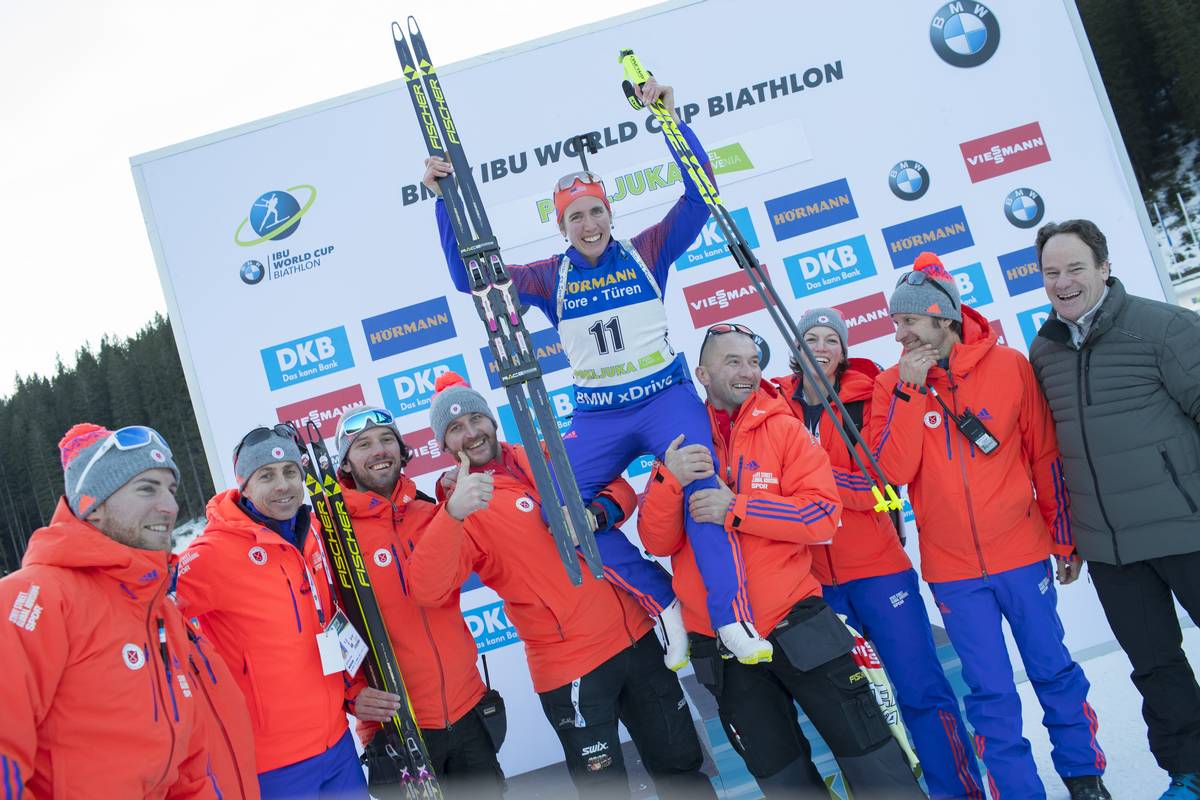
Susan Dunklee being hoisted up by her US Biathlon support team at the IBU World Cup in Pokljuka, Slovenia, after tying her career-best result in a pursuit. Dunklee placed fifth on Saturday for a season best as well. (Photo: USBA/NordicFocus)
Another day at the front of the pack, and another day of (nearly) perfect shooting for Susan Dunklee, who raced from 11th to fifth for her first flower ceremony (top six) of the season at the IBU World Cup in Pokljuka, Slovenia.
Dunklee (US Biathlon) cleaned the first three of four stages in Saturday’s 10-kilometer pursuit to move into second with one standing stage remaining. In that final shooting stage, she had her first miss of the day, yet still left the range in second, 22 seconds behind Germany’s Laura Dahlmeier in first. Dunklee finished out the race with the 21st-ranked course time on the last loop (her first-loop time was the fastest in the 56-woman field) and placed fifth, 24.1 seconds behind Dahlmeier — who won her second-straight race in Pokljuka. Dahlmeier finished first in 30:43.1 despite two prone misses on the second stage, which put her as far back as fifth (0+2+0+0). Finland’s Kaisa Mäkäräinen finished second, 16.8 seconds back, with two penalties as well (0+0+1+1), and Eva Puskarcikova of the Czech Republic reached the podium in third (+18.7) with a single miss followed by three clean stages (1+0+0+0). One spot ahead of Dunklee, reigning World Cup champion Marie Dorin Habert of France clawed her way up to fourth (+18.8) after starting 17th, with one penalty (0+0+1+0).
For Dahlmeier, it was her 10th World Cup victory and fifth in a pursuit.
“My motto is ‘Scheiß da nix, dann feid da nix’,” Dahlmeier told Germany’s ZDF, which vaguely translates to “Don’t worry be happy,” or “Just do it.”
“That was worth gold today. I was a bit surprised about my two misses in prone. Apparently I already had an aberration in the first stage, then I clicked [adjusted the sights] and was a bit surprised that the two misses still happened,” she added. “… Then came the standing shooting, and there I tried to keep calm again. The race is only over once you cross the finish line, and that became true again today. I am happy that the race flipped again like this.”
Canada’s Julia Ransom cleaned three consecutive stages before missing two on the last standing. She finished 34th for the second day in a row, 2:33.5 behind Dahlmeier. Rosanna Crawford placed 49th with three penalties (2+1+0+0) and Clare Egan of the U.S. was 56th with six misses (2+0+1+3). Canada’s Megan Tandy, with seven penalties (1+1+3+2) did not finish.
In the men’s 12.5 k pursuit, the first man out of the start, Martin Fourcade of France, held his lead to the finish, hitting all 20 targets and winning in 30:27.4. Norway’s Emil Hegle Svendsen rose from fourth at the start to second at the finish (+6.0) with clean shooting as well, and Russia’s Anton Shipulin placed third for the second-straight day (+6.2), with one penalty in the last stage (0+0+0+1).
Friday’s sprint runner-up, Johannes Thingnes Bø of Norway, ended up fourth (+48) with two misses on the last stage (0+0+0+2), Germany’s Simon Schempp placed fifth (+59.8) after starting sixth, and had one miss (0+0+1+0), and Michael Rösch of Belarus cleaned for sixth place (+1:21.0) after starting 16th.
Lowell Bailey (US Biathlon) finished 18th (+2:01.6) for the second day in a row, with one prone penalty in the first stage (1+0+0+0).
Biathlon Canada’s Christian Gow picked off two places for a new career best in 31st (+2:41.7) with a single prone penalty (0+1+0+0).
Tim Burke placed 42nd (+4:09.8) for the U.S. (after starting 53rd) with five standing penalties (0+0+2+3), Canada’s Scott Gow finished 48th (+4:39) with five misses as well (2+1+0+2), and the third Canadian in the race, Brendan Green was 57th (+5:36.4) with five penalties (+5:36.4).
Norway’s Ingvild Flugstad Østberg (c) won her first World Cup race of the season on Saturday in the 15 k freestyle individual start in Davos, Switzerland. Joining her on the podium: Norway’s Heidi Weng (l) in second and Finland’s Krista Parmakoski (r) in third.
Norway’s Ingvild Flugstad Østberg is back on top of the podium after a 7.9-second win in Saturday’s 15-kilometer freestyle in Davos, Switzerland, over — you guessed it — her teammate Heidi Weng.
Østberg started 38th (out of 59) and led at every split to take the win in 37:44.4, her first this season and her first in a 15 k. Weng started a minute ahead of her in bib 36 and ended up second, while Finland’s Krista Parmakoski notched third (+16.7) for her third podium of the season, ninth in her career and second skate podium.
The next fastest woman, American Jessie Diggins finished 37.6 seconds off the podium in fourth (+54.3), ahead of Russia’s Yulia Tchekaleva in fifth (+1:00.5) and Switzerland’s Nathalie von Siebenthal in sixth (+1:05.6). Ragnhild Haga of Norway was seventh (+1:10.8), Finland’s Riitta-Liisa Roponen eighth (+1:21.4), Italy’s Ilaria Debertolis ninth (+1:32.2), and Sweden’s Anna Haag 10th (+1:35.5).
The U.S. had two in the points with Liz Stephen in 28th (+2:17.5). Kikkan Randall was 2.3 seconds outside the top 30 in 33rd (+2:30.2), and Caitlin Patterson placed 44th (+3:21.6). Rosie Brennan did not start.
Emily Nishikawa led Canada in 34th (+2:33.5) for her best result this season, Dahria Beatty was 42nd (+3:15.2), and Cendrine Browne 54th (+4:07).
Weng remains the Overall World Cup leader by 70 points over Østberg, Parmakoski ranks third, and Norway’s Marit Bjørgen, who is not competing this weekend in Davos, is currently fourth.
[UPDATE] In the men’s race earlier on Saturday, Martin Johnsrud Sundby racked up another victory in Davos’s 30 k freestyle, beating his fellow Norwegian Anders Gløersen by 13.7 seconds with a winning time of 1:07:31.6 hours. Gløersen took second for his first podium in a year (he was third in the Davos 30 k last December) and Finland’s Matti Heikkinen reached the podium for his second-straight race in third (+25.7).
Canada’s Alex Harvey placed 12th (+1:29.4) and his teammate Graeme Killick notched 21st (+2:24.2) for his second-best World Cup result (after placing 19th in a skiathlon last March at the Ski Tour Canada).
Devon Kershaw was the next top North American in 43rd (+3:52.9), six seconds ahead of the lone American in the race, Noah Hoffman in 44th (+3:58.9). Canada’s Andy Shields placed 64th (+6:33.9).
Former Middlebury College skiers Emily Attwood (l) and Heather Mooney lunge at the finish of their final hill climb sprint in the spring of 2014. (Photo: Lander Karath)
It’s that time of year … to kick back and live a little! If you have a hill and residual snow nearby, this one’s for you. The following workout was published two years ago. Read the original here.
***
[circa April 2014]
MIDDLEBURY, Vt. — Unless you’re the audacious Liz Stephen or Overall World Cup Champion Therese Johaug, you’re probably not a huge fan of hill climbs. However, when the mid-April temps turn our favorite trails into puddles, nordic ski enthusiasts have to get creative to get their on-snow skiing fix before spring training begins.
Former Middlebury skiers Emily Attwood (l) and Heather Mooney get ready to climb up then ski down the Middlebury Snow Bowl in the spring of 2014. (Photo: Lander Karath)
In Middlebury, skiers at the local college are doing just that by taking advantage of the remaining of snow at the Middlebury College Snow Bowl, an college-owned downhill ski area only 20 minutes from campus.
I joined Heather Mooney (Peru, Vt.) and Emily Attwood (Cape Elizabeth, Maine) this past week to take advantage of the long awaited spring weather and to get in a late season ski at the same time. For this retired ski racer, the workout was certainly exhausting but left me full of energy for the rest of the day.
Preparation:
Finding a location for the hill climb and norpine is easy in a place like Middlebury where the alpine ski area is closed and the snow remains in relative abundance. In many western ski areas these circumstances can also be found with the exception of the few mountains that are still open. If this is the case, they most likely won’t allow you to ski, due to the lack of leashes, but it doesn’t hurt to check.
Once the ideal spot is found, there’s not much needed for a spring hill climb and norpine other than a pair of skate rock skis, classic poles (skate poles are too big for the climb as well as the descent), and of course, a sense of adventure. However, there are a few accessories that make this workout even more enjoyable. For example, bring a Jammypack so your favorite jams can aid you in your struggle your up the hill, and provide a sick soundtrack for the cruise down.
In addition, make sure to start your climb in the morning, as warm spring temperatures make the snow pretty soft, wet, and slow later in the day.
The Workout:
Once you’ve adorned your Jammypack, jumped on your skis, and hit the snow you have a long trek ahead of you. Most alpine ski areas are fairly steep so be prepared for a haul to the top. At times it can feel like progress in the softening snow is nonexistent, but little by little the hills get conquered.
Once you reach the final ascent of our climb, those who are more ambitious can decide to have a final hill sprint. My two companions decided to have such a race, once again proving that cross county ski racers have some of the most competitive personalities in the sports world.
While you can choose to sit out of the final sprint (as I did), it aids in keeping those post-season legs fit and fresh with a little bit of intensity. It also certainly adds to the sense of accomplishment and exhilaration of climbing to the top of a massive alpine ski area.
Once at the top, the real fun begins. After taking a rest from the 45 minutes of climbing, make your way down the slopes for some awesome twists and turns.
This part of the workout is called norpining. As the name suggests, its a combination of nordic and alpine skiing. While nordic skis don’t have great edges, they certainly make for a fun (and somewhat unstable) 20+ minute cruise to the bottom. It may take a few turns to get used to skinny skis on a steep slope, but by the time you reach the base you’ll be rearing for more.
Julbo, the French eyewear brand dedicated to Mountain Performance Eyewear has increased its Nordic skiing presence in the United States with strong results and a focused core of skiing athletes. “This is my second season on the Julbo Team, and it’s an honor to be a part of such a successful, adventurous and inspiring group,” explained Noah Hoffman.
Hoffman leads a crew of Nordic athletes that include recent National Champion Scott Patterson, APU racer Lex Treinen, SMS/ T2 racers Ben Saxton and Annie Pokorny, U23 team member, Heather Mooney, and former Birkie Winner and national stalwart, Matt Liebsch.
Annie Pokorny (SMST2) at the top of the coach’s climb for the SuperTour 1.3 k classic race course in Sun Valley, Idaho.
SUN VALLEY, Idaho — Armed with plenty of shovels and smiles, the Sun Valley Ski Education Foundation crew has been moving snow to make the next stop on the SuperTour circuit happen at the Lake Creek venue in Sun Valley, Idaho.
“We’re cautiously optimistic that we’ll be able to do both races [at Lake Creek], with the sprint race happening here for sure,” Sun Valley Ski Education Foundation (SVSEF) Nordic Director Rick Kapala said on Wednesday afternoon.
With close to six inches of snow currently covering the trails, according to Sun Valley’s assistant nordic program director Kelly Sinnott, local volunteers and coaches are putting their shovels to work to increase that numerical amount by the work hour.
The SuperTour races are scheduled for Saturday and Sunday, with a classic sprint followed by 10- and 15-kilometer classic individual starts. On Thursday morning, temperatures were below freezing, around 28 degrees Fahrenheit in Sun Valley.
“We spent hours [on Tuesday] shoveling the course and there’s a crew out there today as well,” Sinnott said on Wednesday.
While a decent snow storm might be the preferred way of covering the race course, many of the volunteers don’t seem to mind scooping snow for the sake of this weekend’s SuperTour races.
“I was out here yesterday, I would say three-plus hours,” said Mel Dyke, of Hailey, Idaho, a snow-shoveling volunteer, and webmaster for 5B Nordic News.
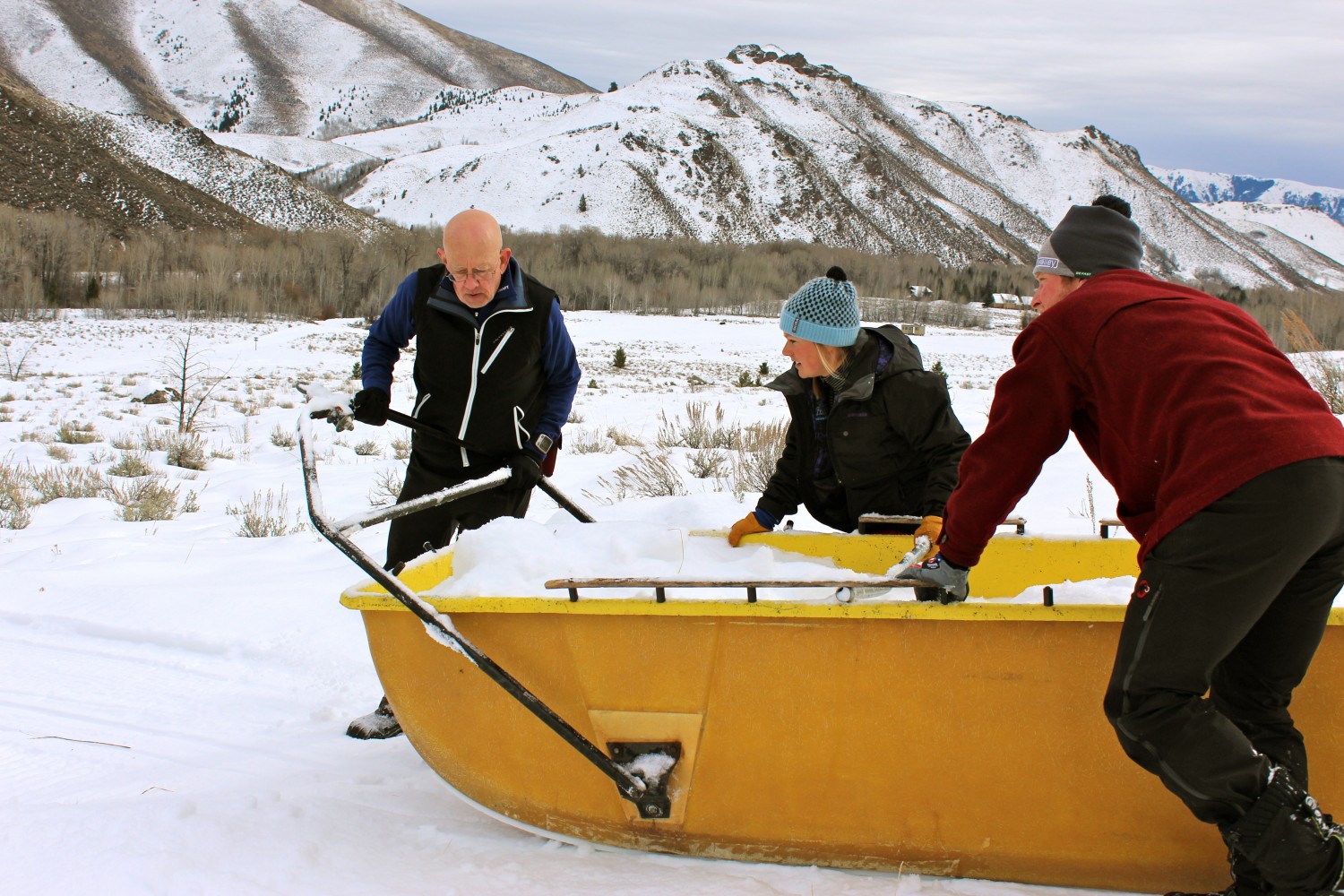
(Left to right): Mel Dyke (volunteer), Kate Barton (Burke Mountain Academy coach) and Colin Rogers (SVSEF Gold Team head coach) push a sled full of snow on Wednesday afternoon to dump onto the SuperTour 10/15 k classic distance race course in Sun Valley, Idaho.
“There were three crews of 15-20 people yesterday,” he said. “I’m just doing it because it’s fun.”
While pushing snow piles is not everyone’s idea of “fun,” the dedicated group of individuals working out on the trails for free will make the Sun Valley SuperTour races possible.
“We’ve got a community of people that just jump in and do it. And we’ve had a few low snow years so we’ve had to do a lot of this,” said Bob Rosso, another volunteer and owners of Elephant’s Perch sports speciality shop in Ketchum.
“We’re die hard cross-country skiers,” Rosso added. “When the race coordinators call out for help, people show up.”
Still, even with a soldiery of willing snow-shovelers, why not use host trails with enough coverage nearby?
Kapala points to the quality of the race course at Lake Creek as motivation for making it the preferred race site.
“One of the biggest concerns that the coaching community has with regards to the early SuperTours is that we’re able to have appropriately difficult courses,” Kapala said.
“We could go to Galena, and we could make the races work there … but putting the work in here gives the athletes an opportunity to test themselves appropriately on the kinds of courses that they need to be prepared to ski on,” he said. “These are homologated, FIS [International Ski Federation-standard] courses, they have A-climbs and that’s important.”
On top of the promise of challenging racers, the Lake Creek venue offers coaches, spectators and skiers a perspective like no other.
“One of the unique things about the Lake Creek venue, is it’s really open,” said Kapala. “You can stand in one spot and watch the entire race happen.”
Kids ski around the SuperTour 1.3 k classic sprint course, while athletes and coaches convene in the Lake Creek stadium center in Sun Valley, Idaho.
Alex Howe (CGRP) (r) leads Caitlin Patterson (CGRP) Wednesday morning before the last downhill of the SuperTour 1.3 k classic sprint course in Sun Valley, Idaho.
Paddy Caldwell (SMST2) rounds a turn while teammates stride up the coaches’ climb in the the background during a Wednesday morning ski on the SuperTour 1.3 k classic sprint course in Sun Valley, Idaho.
Heather Mooney (CGRP) smiles and strides into the final turn before the las downhill on the SuperTour 1.3 k classic sprint course in Sun Valley, Idaho.
Wednesday morning, skiers from Stratton Mountain School and the Craftsbury Green Racing Project practice striding up the coach’s climb of the SuperTour 1.3 k classic sprint course in Sun Valley, Idaho.
Bob Rosso, with shovel in hand and plenty to spare, is ready to help scoop snow Wednesday afternoon onto the SuperTour 10/15 k classic distance race course in Sun Valley, Idaho.
Comp coach Tom Smith (SVSEF) (r) pulls Gold Team head coach, Colin Rogers (SVSEF) out to shovel snow onto the SuperTour 10/15 k classic distance race course in Sun Valley, Idaho.
Left to right: Sam East, Mel Dyke, and Grace Dyke get ready to hit the trails with their shovels and smiles.
Volunteers (left to right) Grace Dyke, Mel Dyke, Sam East, and Gary Storey trek across the Lake Creek trail bridge on Wednesday afternoon to shovel snow onto the SuperTour 10/15 k classic distance race course in Sun Valley, Idaho.
Head coach for SMST2 Patrick O’Brien and Mike Sinnott pushing piles of snow Wednesday afternoon onto the SuperTour 10/15 k classic distance race course in Sun Valley, Idaho.
Bob Rosso, Mike Sinnott, Gary Storey, Kate Barton, Kelly McClowskey, and Colin Rogers shovel snow onto the SuperTour 10/15 k classic distance race course in Sun Valley, Idaho, in 2015.
“When the race coordinators call out for help, people show up,” says Rosso while shoveling snow Wednesday afternoon onto the SuperTour 10/15 k classic distance race course in Sun Valley, Idaho.
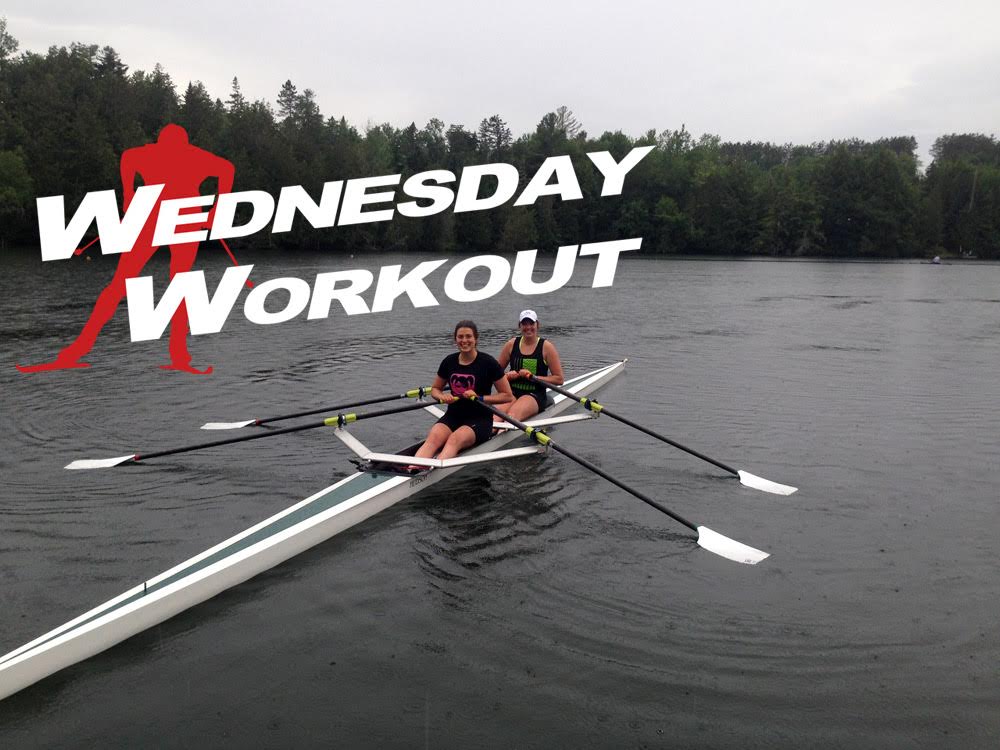
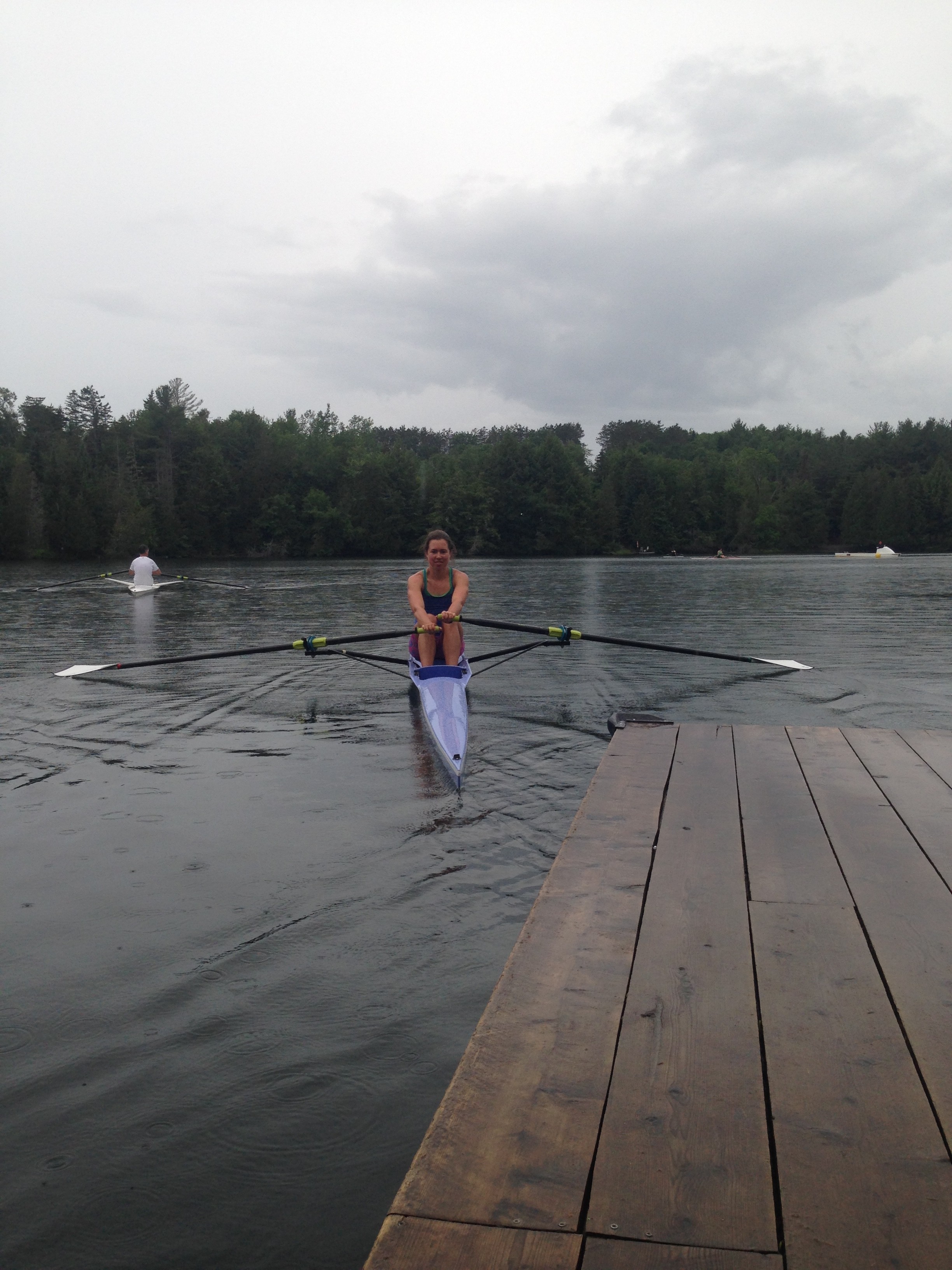
CGRP skier Heather Mooney gets out on the water with her sister, Brooke, as part of her cross training program. (Photo: Heather Mooney)
This week’s Wednesday Workout comes from the Craftsbury Green Racing Project, centered at the Craftsbury Outdoor Center in Vermont. With professional rowers also based at the center, the GRP ski team takes advantage of the center’s facilities to partake in full-body cross training. Don’t have access to rowing equipment? You can partake in one of the exercises below on an erg, which are located at most gyms.
***
CGRP skier Caitlin Patterson heads out on the water for a rowing workout out. (Photo: Heather Mooney)
The Craftsbury Green Racing Project has a couple afternoons each week for cross training built into our general training plan. Our cross training activities of choice include mountain biking, road biking, and rowing, and in a big volume week we have plenty of time for just about all of them. Although it is easy to spend as most of our training hours doing exercise that will relate directly to speed on skis, we like to mix up or routine with other activities to get our other muscles working, minimize the monotony of one activity, and to learn something new.
Several of us enjoy rowing and the prime facilities, equipment, and coaching available to us at the Craftsbury Outdoor Center make it it very easy. A few times a week, the GRP rowers host “community rowing” where residents from around the area come to work on their rowing. For us on the nordic side of things, it’s a good chance to learn from our fellow GRP rowing teammates.
Rowing is good cross training for skiing as it is another full body sport — and aerobic once you’re good at it. It also requires good balance to keep your boat upright, which involves the use of all the limbs and a strong core to connect them. With some basic skills, it is a great option to know the technique on a rainy day at the gym on a rowing erg.
There are a lot of options from hard intervals to just easy steady state workout, with benefits ranging from speed to strength to endurance — just like in skiing — and can be done either on the water or on an erg. Many of us go out for an easy row, “Level 1”, like we’d go for an easy run or bike or ski, but here are some more advanced options that our fellow GRP rowers use:
The “workout”, courtesy of Steve Whelpley, one of the GRP rowers:
5 x 5: Five minutes at 24 strokes per minute (spm) done five times with two minute rest. Ii is a simple Simple workout that builds aerobic capacity and power.
10 minutes pieces: Four minutes at 22 spm, three minutes at 24 spm, two minutes at 26 spm, one minute at 28 spm. Typically do it three to four times. it builds in intensity and forces power at the lower ratings.
40/20 seconds: 40 seconds on 20 seconds off, two sets of 10 intervals with a longer break in between them. These shorter intervals build anaerobic capacity, and with short enough rest, they force a lot of oxygen exchange and heavy breathing.
Rowing is great cross training as it is a full body workout. Like skiing, it necessitates a lot of oxygen consumption, builds VO2 max, and encourages more anaerobic development since it can be more power based than skiing, as well as being slightly antagonistic exercise to stay healthy and well rounded. Moreover, although there are no uphills in rowing, there also are no downhills, so it is a good chance to work on endurance with no breaks.
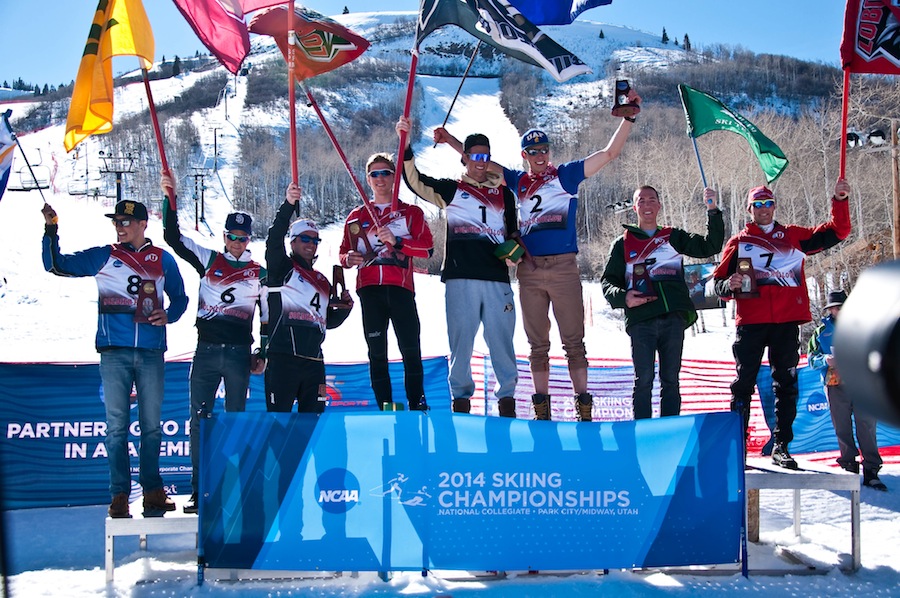
The men’s podium in the 20 k freestyle mass start at the 2014 NCAA Championships in Soldier Hollow. (Photo: http://bertboyer.zenfolio.com) All proceeds from photo sales will be directly donated to NNF.
LAKE PLACID, N.Y. — Come Wednesday, the 148 best collegiate skiers in the U.S. will descend upon Lake Placid for the 2015 NCAA Skiing Championships. Hosted by St. Lawrence University, NCAA’s will serve as the premier collegiate races of the season as skiers aim for both individual and team success. The last time Lake Placid hosted the Championships was 33 years ago in 1982, when the national races were only for men.
The nordic portion of NCAA’s will take place on the trails of the Mt. Van Hoevenberg, the site of the cross-country events in the 1980 Olympic games. The first day of competition on Wednesday will comprise of the 5- and 10-kilometer women’s and men’s freestyle interval starts, while Friday will feature the 15/20 k classic mass starts. Conditions should be pristine in the Adirondacks as recent weather has provided ample snow and below average temperatures.
The 2015 NCAA Championships will have similar team favorites in 2014. At last year’s championships in Park City, Utah, the University of Denver dominated the nordic races to win the overall team title. With several departures from the Pioneers’ squad, however, other schools from the west and east will look to capture the trophy.
The University of Colorado enters the NCAA’s as the top-ranked team from the Rocky Mountain Intercollegiate Ski Association (RMISA). The Buffs earned the most combined points throughout the season and were recently crowned the RMISA regional champions. If that wasn’t enough to boost their pre-championships confidence, their history in the east certainly will. Colorado has won the last two national collegiate titles in the east in 2011 and 2013.
Utah and Denver followed close behind in the 2015 RIMSA points rankings and will likely be Colorado’s top competition in New York, while the University of Vermont will look to extend its Eastern Intercollegiate Ski Association (EISA) dominance to the national stage. The last time Vermont won the NCAA team title was in 2012 in Bozeman, Mont.
University of New Hampshire’s Annika Taylor races in the 2013 NCAA Championships.
The East:
If there are two skiers from the EISA to know before the start of NCAA’s, they are Middlebury College’s Heather Mooney and University of New Hampshire’s Annika Taylor.
With five wins apiece in the 2014/2015 season, Mooney and Taylor have shut out the rest of the eastern competition from the top of the podium. While their fight for eastern dominance will continue in Lake Placid, it remains to be seen how they will match up with the western and central women.
The Middlebury College women’s nordic team has qualified a full team for the first time in many years, including Mooney, Kelsey Phinney and Stella Holt. The trio has won many women’s nordic competitions throughout the season and will look to do the same in Lake Placid. If the recent EISA Regional Championships results are any indication — where Mooney and Phinney finished second and third, respectively, in the 15 k classic mass start — the Panthers are well on their way to their goal.
Paddy Caldwell (Dartmouth College) finishes the men’s 15 k freestyle in fourth place at the 2015 Cross Country Championships in Houghton, Michigan.
If the eastern women have been defined by two individuals, the region’s men are characterized by dueling schools — Vermont and Dartmouth. The Vermont trio of Rogan Brown, Jørgen Grav and Jack Hegman ended the eastern season ranked second, third and sixth, while Paddy Caldwell, Fabian Stocek and Silas Talbot took the first, fourth, and fifth spots.
Caldwell, who spent a large chunk of the season in Europe at the U23 World Championships in Almaty, Kazakhstan, enters as one of the favorites at NCAA’s. Last year, his best finish was fifth in the 20 k freestyle mass start. Talbot’s best finish at 2014 NCAA’s was 11th in the 20 k freestyle.
Brown’s best finish at the same championships was 13th in the 20 k freestyle, while Grav’s was 20th in the 10 k classic.
The West:
Rune Malo Ødegård of CU races to first in the 10 k individual classic at the 2014 NCAA Championships in Soldier Hollow. (Photo: http://bertboyer.zenfolio.com) All proceeds from photo sales will be directly donated to NNF.
If Caldwell wants to step atop the NCAA podium, he’ll have to overcome the RMISA frontrunners from the University of Colorado, Rune Malo Ødegård and Mads Ek Strøm. With the exception of one race, the two have alternated on the top rungs of the 2014/2015 RIMSA podium in every single competition. By the end of the regular season, Ødegård won five of 10 races while Strøm won four.
Ødegård is no stranger to NCAA’s as the Norwegian won two national titles in 2013 and 2014. His wins made NCAA history, as he is the first collegiate skier to repeat as an individual national championship in the classic discipline. Strøm earned his national title in the 20 k freestyle mass start in 2014.
While the two Buffs are the RMISA favorites, there are several other standouts to watch in this week’s races. German Moritz Madlener of DU and enters Lake Placid as the third-ranked westerner after earning bronze in four western qualifiers. The University of Utah’s Niklas Persson is another potential top finisher. The Ute finished third at 2014 NCAA’s in the 10 k classic. Mats Rudin Resaland of the University of New Mexico is also another top contender, and will look to improve on his bronze from last year’s 20 k freestyle.
The University of New Mexico’s Emilie Cedervarn is the top-ranked western woman after winning the last four RMISA races of the season. The Utes’ Veronika Mayerhofer is close behind for total wins in the west with three. Denver’s Sylvia Nordskar will look to repeat her podium performances from 2014 NCAA’s where she placed second and third. The Norwegian only raced the first four RMISA races this season. She won both the races in the Utah qualifiers and placed first and second at the Colorado invite before taking a six-race hiatus.
Other skiers to watch from the West are the Buffs’ Petra Hyncincova and the Utes’ Sloan Storey.
Central:
Kyle Bratrud of Northern Michigan University racing to 52nd in the men’s 15 k freestyle at 2015 World Championships in Falun, Sweden.
Kyle Bratrud of the University of Northern Michigan is the favorite from the central region after a successful season that saw him win the 15 k freestyle at the 2015 U.S. nationals and compete at the U23 World Championships in Almaty, Kazakhstan, followed by senior World Championships in Falun, Sweden.
Bratrud will look to overcome the fatigue of weeks of international racing and travel to fight for a spot on the NCAA podium. In 2014, he was the top American in the 10 k classic in sixth overall.
Joining Bratrud in the quest for collegiate success will be teammates Fredrik Schwenke and Erik Soderman. If the UNM trio can repeat their impressive performances from U.S. nationals, they have the possibility of leading the men’s nordic at NCAA’s. Last year, the men finished third overall in the 10 k classic and helped their coach, Sten Fjeldheim, earn 2014 national coach of the year.
Logan Hanneman of the University of Alaska – Fairbanks is another strong skier to watch from central.
Despite the graduation of Rosie Frankowski, the central women have a chance at top performances from NMU’s Jordyn Ross and Michigan Tech’s Deedra Irwin, among others. They will look to build on the region’s successful 2014 Championships to gain more starting spots in future national events.
Live timing will be available at BartTiming.com. FasterSkier will be on site for both days of nordic racing, so stay tuned for recaps from Wednesday and Friday.
The men’s mass start begins at the 2015 EISA Regional Championships (photo: Mt Van Hoevenberg)
Lake Placid, NY
Bright sun, perfect snow conditions and a torturous course with climbs around every corner: what more could you want to close out the regular season of EISA competition? Collegiate racers from across the area converged on the Olympic trails of Mt. Van Hoevenberg this past weekend for the EISA Regional Championships hosted by St. Lawrence University. While Regional performances were on the line, the events also served as a precursor to the NCAA Championships to be held on the same courses in less than two weeks time. Competitors were eager to test out the race course and measure their fitness as training narrows toward the final events of the season.
The men’s races were largely dominated by UVM and Dartmouth, and both events saw the return of Sophomore Paddy Caldwell to prime form after a few weeks back stateside following the U23 World Championships. The women’s field was again bested by Middlebury’s Heather Mooney and UNH’s Annika Taylor, who have battled back and forth all season.
The event schedule for the weekend mirrored that of the upcoming NCAA Championships: 5 and 10-kilometer freestyle individual-start races, followed by 15 and 20-kilometer mass start classical races.
Friday: 5/10km Freestyle
Cold conditions yet again, though sun and calm skies made for pleasant skiing as temps warmed throughout the day. The men’s race was a tale of two laps. The Ladies 5km race course is notorious for its climbing: one might describe the elevation profile as a glorified triangle, featuring sustained climbing with little recovery followed by a mostly non-technical descent back to the stadium. A flat lap lane in the stadium area provided only a brief mid-race respite for the men, who then had to set out once more into the woods to tackle the grueling climbs all over again.
UMPI racer Hilary Saucy begins the 5k freestyle on Friday (photo: Mt Van Hoevenberg)
After suffering his first freestyle loss of the season at the Middlebury Carnival, Dartmouth racer Paddy Caldwell returned to the top of the field on Friday, posting the fastest lap splits on both rotations around the course. He got the better of his closest skating rival, UVM’s Rogan Brown, by a whopping 37 seconds.
With the strongest race of his season, Dartmouth skier Jan Ketterson grabbed the final podium spot in 3rd.
Racers from UVM and Dartmouth ended up taking all spots in the top eight. Austin Meng of host St. Lawrence and Raleigh Goessling of UNH were the only two skiers to sneak into the top 10 among the sea of green suits with ninth and 10th place finishes, respectively.
With one lap of the tough course to test themselves on, the women’s race was no less daunting.
This second race came down to a familiar battle that has been playing out over race courses all season: Mooney vs. Taylor. With Taylor of UNH starting a minute behind her rival, the splits were in her favor, but on this first day it was Middlebury’s Mooney who took top honors, fending off Taylor by 16 seconds.
Despite the familiar scene in the top two spots, it was the women of UVM who truly dominated the majority of the top ten, taking places 3-6. Led by Stephanie Kirk’s podium performance, the Catamount women were a force to be reckoned with in the team score and certainly looked to be on top of their game when it counted.
UNH also put in a solid day. With Katrin Larusson inside the top ten and Maddy Pfeifer in 13th, the Wildcats followed the Catamounts in the team score and pushed the typically strong Middlebury women into third.
Saturday: 15/20km Classic
Conditions for classic racing could not have been better on Saturday, as a truly festive atmosphere surrounded the entire racing scene. The men faced four laps of the same daunting Ladies 5k loop, in sunny conditions warming from the single digits to the high teens.
A preview of events to come: SLU and UNH racers speed toward the finish past NCAA banners for next week’s Championship (photo: Mary B)
Dartmouth’s Paddy Caldwell tested the field early, opening a small gap before being absorbed in the stadium area and feed zone. It was during second half of the race that the pacing exam really began, as Caldwell accelerated into the climbs and emerged from the woods at the end of the third lap with a clear gap on his competitors. By the fourth lap Caldwell was out of sight of the field, and he cruised home uncontested for the win.
The chase pack consisted of around ten men, all UVM and Dartmouth racers save for Per Lindgren of UNH.
Lindgren yo-yo’ed off the chase pack at first, but as the group seemed to realize Caldwell would be uncatch-able they appeared to back off and begin a more tactical race for the remaining podium spots.
Those spots were eventually won by Jorgen Grav (UVM) in second and Fabian Stocek (DAR) in third, setting up another battle of green suits in the team score. By a narrow four-point margin it was Dartmouth who took the win over the Catamounts. The men of Williams College capped a strong season by placing third.
The women’s race broke apart as well, with racers stringing out and shifting position throughout the three laps of competition. At the front it was again Heather Mooney and Annika Taylor duking it out. Among a swarm of cheering fans and teammates, it was Taylor who emerged victorious in the final race of the EISA season.
Good friends and training partners this past summer in Truckee, California, Taylor and Mooney are good friends and were quick to congratulate each other on great races and a great EISA campaign, as both seniors capped their Carnival careers with dominant seasons.
In a close finish for the final podium spot, the Panthers picked up another strong result from Kelsey Phinney who, along with Stella Holt, helped the Middlebury women to the top team score of the day.
The UVM women were unable to match their dominant performance of the day prior, and fell to third in the team score behind Taylor and her Wildcat teammates.
—
Results for the entire weekend can be found via BartTiming
With the EISA season ending on Saturday, UVM earned their fifth-straight overall EISA Championship Victory. Also of note were the presentations of both the EISA Service award and EISA Coach of the Year award. Former long-time Williams head coach Bud Fisher received the EISA Service award, while UNH’s Cory Schwartz was recognized as EISA Coach of the Year.
The 2015 NCAA Championships, hosted by St. Lawrence University, will be held March 11-14 in Lake Placid. For more information, please visit the official event website by clicking HERE
MIDDLEBURY, Vt. — Cold temperatures have been the norm for this season of EISA racing. The Middlebury Carnival was no exception, as some of the coldest predicted temps of the season lead to changes in race schedules in hopes of maintaining a safe and fair event. New snow also came along with the cold temperatures, creating slow and grueling conditions for both Friday and Saturday’s competitions. The Tormondsen Family Race Course, site of action at the 2013 NCAA Championships, featured plentiful natural snow and pristine conditions. A 10-kilometer classic race was held on Friday for both men and women, while 5 and 10-kilometer freestyle races were contested on Saturday.
Friday: 10 k Classic
Eirik Fosnaes (UNH) and Hugo Fontaine (LAV) round a corner in the men’s 10k classic at Middlebury (photo: Silke Hynes)
A familiar scene took place in the women’s race on Friday: three racers battling it out for the win, while others chased for fourth. Despite the individual-start format, it was once again the trio of Heather Mooney (Middlebury), Annika Taylor (UNH) and Corey Stock (Dartmouth) claiming the podium. The Panther cheering squads were out in force, and on her home course Mooney prevailed by 10 seconds over Taylor. Stock settled for third, another 23 seconds back.
With the exception of occasional appearances by other strong racers, the top of the women’s field has been relatively consistent this season. Mooney, Taylor and Stock have finished on the podium in many of the past few races, with Mooney and Taylor taking the lion’s share of the wins.
Mooney led the Panthers to a win in the team score, though the women of Bates College were the only team to put three racers in the top 10 en route to second place. Hallie Grossman, Sadie James and Tara Humphries finished in fifth, eighth and 10th place, respectively, helping the Bobcats edge the UVM women by one point.
The men’s podium was a much closer affair, with the top three men separated by a mere eight seconds. Jorgen Grav of UVM took the top spot, with Dartmouth’s Silas Talbot taking second.
Not far behind was Laval’s Frederic Touchette, who ended up less than three seconds behind Talbot. The first three men had a clear gap to fourth, as classic specialist Per Lindgren picked up his third top-10 of the season in 4th, 26 seconds back.
Saturday: 5/10 k Freestyle
Annika Taylor skates to a win in the Middlebury 5km freestyle (photo: Silke Hynes)
While the thermometer may have read a little warmer than the low single-digits of Friday, a damp day and some wind made Saturday’s freestyle event feel quite frigid. Most racers, accustomed to such conditions after multiple weeks of battling the cold, were well-prepared with buffs, face-tape and overboots.
Through the cold snow it was Annika Taylor of UNH who took the win for the women, swapping places with Friday’s classic champion Heather Mooney of host Middlebury. Mooney nearly earned a sweep of the weekend, finishing less than three seconds from the win.
For the second day in a row Dartmouth racer Corey Stock took third, and the women’s podium players remained consistent for both days of competition.
In the men’s race, Rogan Brown of UVM continued an impressive streak of freestyle performances with a win over Dartmouth’s Paddy Caldwell. Recently returned from strong results at the U23 World Championships in Almaty, Kazakhstan, Caldwell was unable to match Brown’s pace and settled for second place.
Finishing on the podium for a second day in a row was Catamount Jorgen Grav who, along with Jack Hegman in fifth, gave UVM a decisive hold on the team score for the event. In fourth was Laval’s Frederic Touchette.
The EISA will take a break this coming weekend. The EISA Regional Championships will be held February 27th and 28th in Lake Placid, New York. Saint Lawrence University will host the events on the 1980 Olympic trails of Mt. Van Hoevenberg, and will also play host to the 2015 NCAA Championships two weeks later.
Having trouble viewing the video? Click here. Also, check out our post-race interviews with the top-3 finishers at the bottom of the article.
CRAFTSBURY, Vt. — The cold spell that hit Vermont’s Northeast Kingdom couldn’t stop competitors from heating up the sprint course in the opening day of the Feb. 6-8 Craftsbury SuperTour. Skiing 1.4 and 1.6-kilometer loops at the Craftsbury Outdoors Center, the country’s best – in addition to the EISA college circuit – gave it their all in the freestyle event.
In the men’s 1.6 k sprint, Kris Freeman (Freebird) skied a tactical race to overcome Alaska Pacific University’s Reese Hanneman in the closing meters and win the final. Coming into the stadium he trailed Hanneman, but accelerated to ski even with the APU athlete. When they reached the line the two lunged, with Freeman barely besting his competitor. With a time of 2:59.07 Freeman bested Hanneman by 0.06 seconds to take the win.
Freeman, who trailed the pack after the start of both the final and semifinal, said that despite a slow begging he was able to maneuver his way to the front of the pack.
“I have a horrible start in skate sprints. The douple-pole only transition into skate is particularly difficult for me. I had to fight really hard to get into positioning,” he said in a post-race interview. “Reese [Hanneman] is really good at taking up two lanes and so he managed to keep me behind him the whole time. Coming in the finish, in the semi and the final, it was me and him. He got me in the semi an I got him in the final.”
After the Craftsbury SuperTour weekend Freeman is traveling to Falun, Sweden to compete in the 2015 World Championships. He explained that his preparations are going well before the eighth World Championships of his career.
“I’ve been feeling really good and it’s fun to feel good. My body feels good and I’m recovering in races. That’s all I can ask for,” he added.
In third was Eric Packer (APU) who skied in sixth for much of the race before surging through the pack on the final hill. He trailed Freeman’s time by 2.03. Behind Packer in fourth and fifth were a pair of University of Vermont skiers – Jørgen Grav (+2.72) and Cole Morgan (+2.84), who were the first college skiers. Friday’s race also served as the opening day of the Dartmouth Carnival, and the two UVM skier led their team to a convincing lead in the men’s nordic portion of the event. Rounding out the heat was Alexis Turgeon (CNEPH) who trailed by 9.44 seconds.
The women’s 1.4 k sprint was equally exciting, with Bridger Ski Foundation’s Jennie Bender claiming victory by a large margin. Bender crossed the line with a time of 3:01.29, outlasting a late charge by Erika Flowers of Stratton Mountain School T2.
Bender almost missed a shot at the podium after a fall in the semifinal, but recovered to place first in the heat.
“Sometime breaking stuff and falling takes you out and sometime it gives you a little bit of extra fire,” she said of the fall in the semifinal. “It fired me up so I was able to catch back up. I was nervous that I would be lost in that shuffle but it ended up working out in my favor.”
Bender entered the final worried that the energy she spent to advance from the semifinal would hinder her performance in the final. However, she skied the heat with a cool head and a sound plan that ultimately earned her the victory.
“There was a group of four of us jockeying for a position the whole way up. I knew the most important part was staying with the pack and saving it for the finish,” she said of the final.
Behind Bender was Flowers, who trailed the BSF skier by 1.90 seconds. Claiming the final spot on the podium was Middlebury’s Heather Mooney who was the first college skier in Friday’s competition and finished 4.25 seconds behind Bender. She, along with teammate and ninth-place finisher Kelsey Phinney, led the Middlebury team to win the women’s nordic portion of the day’s Dartmouth Carnival.
Rounding out the final were Becca Rorabaugh (+4.95) of APU, Chelsea Holmes (+8.26) of APU, and Kaitlynn Miller (+9.81) of the Craftsbury Green Racing Project.
SuperTour and EISA competition continues tomorrow with a 10 k freestyle individual start for both the men and women at 10:30 and 12:00 EST. Saturday also marks the addition of Eastern Cup racing, which, in addition to the 10 k, will include a 5 k for both junior boys and girls that begins at 9:30.
EISA Women await the start of the 4×3 mixed-gender relay (photo: Silke Hynes)
Huntington, VT
It is only once every few years that Saint Michael’s College hosts an EISA event. Before this past weekend the most recent SMC Carnival was in the winter of 2010, just prior to the Vancouver Olympics. For their competitions this year, racers were treated to great snow and enthusiastic hosts at the Sleepy Hollow Ski and Bike Center in the woods of Huntington, Vermont. It was a weekend of classic-only racing on narrow, wooded trails, and heavy snowfall throughout the first day of racing contributed even more to the scenic locale.
Friday’s races were 5 and 10-kilometer classic races in individual-start format, while Sunday featured a rare and exciting event: a 4×3 kilometer mixed-gender classic relay.
Friday: 5/10 kilometer classic
Heather Mooney (Midd) powers to a snowy win in the 5k classic (photo: Silke Hynes)
Racers arriving and skiing Thursday afternoon were greeted by a relatively flat course featuring long, non-technical descents and smooth gradual climbs. With the recent World Cup exploits of Petter Northug and Dario Cologna double-poling an entire 15k classic race on skate skis in Davos, Switzerland earlier this season, there was hushed talk of some racers attempting the same on Friday. The fast snow and gradual nature of the course certainly lent itself to the idea.
Upon waking the morning of the race, competitors were greeted with three to four inches of fresh snow on the race loop, with more falling heavily. A relatively benign course was suddenly transformed into a grueling test through slow conditions.
That didn’t stop two UVM skiers, Cole Morgan and Tobias Trenkle, from opting out of kick wax and putting their poling power to the test: the two Catamounts took to the course on skate skis and were able to earn top-15 finishes. Despite the commendable upper-body devotion of Morgan and Trenkle, kick wax proved to be the way to go this day, as Fabian Stocek of Dartmouth strode his way to a win in the men’s 10k event. The win marked the first EISA victory for Stocek, a sophomore from the Czech Republic who honed his US skiing chops at Holderness before racing for the Big Green.
Stocek was followed by UNH racer Eirik Fosnaes in second and UVM’s Jack Hegman in third. Hegman is a native of Huntington, Vermont and spent much of his formative years training and racing at the venue. Another Hegman, younger sibling Ben, also finished in the top-10 with a tenth place result.
A very notable race on Friday was that of Colby skier Silas Eastman. Eastman, with a previous best finish of 12th in this season’s Bates Carnival 20k classic, burst into the top-10 for the first time in a big way. Eastman narrowly missed the podium and nabbed fourth place in the grueling blizzard conditions.
For the first time this season, Fosnaes led the UNH men to the top of the team score, besting UVM by just three points. Dartmouth finished in third another four points back, likely hindered by the absence of common scoring members Patrick Caldwell (racing at U23 World Championships) and Silas Talbot (racing down the road in the Craftsbury Supertour)
Cole Morgan (UVM) tackles the 10k classic on skate gear (photo: Silke Hynes)
Conditions were consistent all day, and the women raced through blizzard conditions as well for their event. Absent from the race was the previous weekend’s double-victor Annika Taylor of UNH, and topping the results was Heather Mooney of Middlebury.
Between the two of them, either Mooney or Taylor have won every EISA race this season, and neither show signs of slowing down. Mooney took the win with a commanding 30 second margin over runner-up Mary-kate Cirelli. A fresh face to the UVM squad but no stranger to the Vermont scene after racing just down Route 7 in Rutland during high school, Cirelli has been on the podium in nearly every race this season. Despite her consistently-strong performances Cirelli is still searching for her elusive first EISA victory.
In another mark of a strong day for the Mules of Colby, Olivia Amber skied to 3rd place to round out the podium, though the Middlebury women owned the top-10 en route to another strong team finish. Stella Holt (seventh) and Kelsey Phinney (eighth) helped the Panthers top both UVM and UNH on the day.
Saturday: 4x3k Mixed-gender Classic Relay
Second-leg male racers await the tag from their first-leg female teammates (photo: Silke Hynes)
Cold temperatures and new snow from the day prior combined to create slow conditions for this event, but bright sunshine and a lack of wind made for an incredibly bright atmosphere. It seemed everyone was excited to take part in such a unique event: a mixed-gender relay had not been held for at least eight years on the EISA circuit, and team spirits were running high with flags, glitter and face-paint in abundance.
For racers and spectators alike, the race could not have unfolded with more excitement. The lead changed several times over the course of each leg as skiers fought hard over two steep climbs and a chaotic exchange zone.
Six top teams stuck together for much of the first lap, but a strong race by Middlebury’s second-team scramble leg Kelsey Phinney gave her teammate Jacob Voltz the lead heading up the first of two significant climbing sections on the course.
Voltz was eventually chased-down by a group of skiers including Silas Eastman of Colby, who had shown his top form in the classic technique the day prior. Eastman was able to tag off at the front of the race to his Mule teammate and perennially-strong classic skier Amy Bianco. Bianco led with a small gap to the field up the long climb on leg three.
The lead for Colby wouldn’t last, however, as Middlebury’s hard-charging Heather Mooney caught up to the front of the race during her leg of the event. Mary-kate Cirelli also moved up to put UVM in a scoring position.
In the final exchange Mooney tagged her teammate Patrick McElravey only a few seconds before Cirelli handed off to fellow Catamount Jack Hegman. Up the first significant climb Hegman had McElravey in his sights and was pushing hard to give chase. Despite the gutsy effort by Hegman, McElravey was able to hold the gap. In the end the first Middlebury team of Stella Holt, Adam Luban, Mooney and McElravey was awarded the victory over UVM.
Though they rarely spent much time leading the race itself, the top team from Dartmouth was consistently in the mix, and took the final spot on the podium.
Competitors begin the 20k classic mass start at the Bates Carnival (photo: Silke Hynes)
Editor’s note: We’re seeking collegiate contributors from across the U.S. If you’re interested in seeing your collegiate region and circuit represented with similar articles, and would like to contribute or know someone that would be interested in submitting recaps and photos, please email info@fasterskier.com.
***
Most New England ski racers are familiar with the courses at Black Mountain of Maine, perennial host of events ranging from the high school level up to the National Championships. Most of those racers are also familiar with the old New England weather adage, “if you don’t like the weather, wait five minutes.” In classic East Coast fashion this first EISA competition, hosted by Bates College, featured a little bit of everything: cold, wind, sun and snowstorms…sometimes all within a single race.
Despite marginal coverage in places thanks to a January thaw, snowmaking, shoveling and other enthusiastic volunteer squads combined to create fair and exciting courses. All events were able to take place on full 5-kilometer loops. On Friday, “Chummy’s Loop” played host to 15 and 20-kilometer mass-start classic races. On Saturday, “Ray’s Loop” was the scene of 5 and 10-kilometer freestyle events.
Friday: 15/20k Classic Mass-start
A fast first kilometer of flat and downhill terrain caused both the women’s and men’s races to string out quickly. In each case, a lead pack of 10-15 skiers became established by the beginning of the second lap, with chasers eagerly battling for positions inside the top-30 and coveted points toward the NCAA Championships this year in Lake Placid, NY.
For the women, much of the lead pack consisted of racers from UVM, Dartmouth and Middlebury. Along various portions of the course leads would change, though there were no significant breakaways until the final lap.
Only a week removed from successful races at US National Championships in Houghton, MI, it was Heather Mooney of Middlebury and Annika Taylor of UNH who entered the final downhill into the stadium together with a clear gap to eventual third-place finisher Alayna Sonnesyn of UVM.
The women’s field heads out of the start during the 15k classic race (photo: Silke Hynes)
Taylor trailed slightly heading into the flat section and may have had an eye to slingshot into the lead down the final stretch, but once the double-poling ensued it was clear that the tall, powerful frame of Mooney would be too much to overtake.
Mooney sealed an individual victory for the Panthers, while the Catamount women of UVM topped the team score thanks to the podium by Sonnesyn (in her first EISA race), as well as sixth and eight-place finishes by Mary-kate Cirelli and Marion Woods, respectively.
The men’s race saw a similar situation form by the midpoint in the race, with a small pack of skiers breaking away from the rest of the field. A mid-race snow squall made conditions interesting, but did little to dramatically affect the outcome of the race.
One notable exception to the tactical skiing of the lead pack was Carleton racer Colin Abbott, who pushed away from the field early in the race and skied alone for much of the first three laps. At first glance, the name Carleton may be unfamiliar to some readers: located in Ottawa, the university was a guest of the Bates Carnival this season. Along with Universite Laval from Quebec City, the welcome addition of Canadian teams to the EISA circuit has added a new level of excitement and unique depth to the carnival events.
As the kilometers ticked away with Abbott still alone in front, the movement within the lead pack became more tense. Based on his recent success in distance and mass-start events, many spectators and coaches were likely all wondering the same thing: when was Paddy Caldwell (Dartmouth/USST) gonna chase this guy down?
Sure enough, the Sophomore from the Big Green made his move in the later stages of the race, catching up to Abbott and skiing with him up the brutal stretch of striding that encompassed the rear slope of the infamous “High School Hill”. Despite his push for the lead, Caldwell wasn’t able to surpass Abbott in the finish, crossing the line a few seconds behind.
The podium was completed by another racer from north of the border, Laval skier and former Canadian National Team member Frederic Touchette.
The Dartmouth men were able to take top honors in the team score, with Caldwell leading his teammates Fabian Stocek and Silas Talbot into fourth and sixth place, respectively.
Saturday: 5/10k Freestyle
After frigid temps the night prior and a windy morning with bitter wind chill values, the freestyle races on Saturday were postponed slightly. The wind barely died down for the women’s race, however, and competitors battled gusts in the stadium area strong enough to knock an unsuspecting racer off balance.
That was no problem for the Middlebury women’s team, who looked in absolute control of their technique and pacing on Saturday. Heather Mooney repeated her top performance on Friday to earn a sweep of the weekend, while her teammates Kelsey Phinney and Stella Holt crossed the line in sixth and tenth position, respectively. All three of Middlebury’s scorers looked particularly smooth, snappy and energetic despite the cold snow and wind.
Paddy Caldwell laps through during the men’s 10k freestyle (photo: Silke Hynes)
UNH skier Annika Taylor also continued a great opening carnival weekend, finishing just over two seconds behind Mooney for her second podium in as many days. Dartmouth skier Corey Stock rounded out the top three.
The wind began to die down and conditions sped up slightly for the men, who raced two laps for 10 kilometers. In his preferred technique, it was Paddy Caldwell’s race from start to finish. Using a smooth, efficient tempo on the climbs and breaking into his unmistakable and deadly-effective V2 on flatter sections, Caldwell powered to a 46-second victory over Harvard’s Akeo Mayfeld-Carucci.
Mayfeld-Carucci earned his top EISA finish with his second-place result, while the ever-consistent Silas Talbot of Dartmouth claimed third to give Dartmouth a strong presence on the podium.
The third racer from Dartmouth, Fabian Stocek, placed seventh to give the Big Green another team victory.
EISA racing continues next week at Trapp Family Lodge in Stowe, VT with host UVM.
Rosie Brennan (APU) celebrates her definitive win in the women’s 1.5 k classic sprint on Tuesday at U.S. Cross Country Championships in Houghton, Mich., where she notched her third national title. (Photo: Jake Ellingson)
HOUGHTON, Mich. — As Rosie Brennan plowed through the fresh powder and tried to pick out what she thought was the best lane for the women’s 1.5-kilometer classic sprint at U.S. Cross Country Championships on Tuesday, she thought, this is brutal.
Not only did she have to start first in the qualifier, which began at 10 a.m. after nearly half a foot of fresh snow had fallen since two hours earlier, when the groomer last passed over the Michigan Tech course, but Brennan had nobody starting directly behind her, either. Caitlin Gregg (Team Gregg/Madshus) in bib No. 2 had scratched.
“I had no idea how fast I was going relatively, plus I was plowing the tracks for everybody so it actually was kind of unfortunate,” Brennan recalled with a laugh. “But I just tried to tell myself that if I skied well, that I had to be moving fast enough and just hope for the best.”
The Alaska Pacific University (APU) veteran ended up second in the qualifier, 1.16 seconds behind Eliška Hájková, a 2013 University of Colorado Boulder graduate and current Boulder Nordic Junior Racing Team coach, who clocked the fastest time of 5 minutes, 18.63 seconds.
After the race, several described it as more like a prologue or even a distance race than a typical sprint. At least for many, it felt that way.
“I kind of felt like I was doing a 5 k,” said Brennan’s APU teammate Becca Rorabaugh, who qualified 10th.
Fortunately for the racers, the track got faster by the time the heats rolled around at 12:30 p.m., and there were more options that the one track Brennan picked to lead 136 women out in the qualifier.
The organizers re-groomed the loop after the men’s qualifier ended at 11:50, and with wet snow from a northwest wind off Lake Superior about 10 miles north, the course set quickly before the women’s quarterfinals started 40 minutes later.
It was still about 7 degrees with a biting wind shooting across the stadium start and finish, but racers seemed unfazed once they got moving. With the snow still falling, as long as they could find a skied-in track, they were generally happy.
Rosie Brennan leading her quarterfinal in Tuesday’s 1.5 k classic sprint at U.S. Cross Country Championships in Houghton, Mich. (Photo: Christopher Schmidt)
The blizzard let up by the afternoon, right about the time Brennan started to come into her own. With three SuperTour victories out of four races on the circuit this season (and a national podium on Sunday), she had the confidence — and she soon realized she had the ski speed as well.
“I thought it would be more prudent to be patient basically on top of the big climbs because it’s still half a [kilometer] to the finish,” she explained, “But I just noticed how fast my skis were.”
Seeing that, the 26-year-old Park City, Utah, native decided to take advantage of the gap she had created and extend her lead on the downhills then up the final gradual climb to the finish.
Brennan won her quarterfinal by 2.55 seconds over 17-year-old Katharine Ogden of the Stratton Mountain School (SMS) in second. In the semifinal, she again stole the show ahead of 16-year-old runner-up Hannah Halvorsen (Sugar Bowl Academy) and Anne Hart (SMST2), who advanced as the lucky loser in third, 1.18 seconds behind Brennan.
Ogden in fourth — ahead of Erika Flowers (SMST2) in fifth and another New England skier, Julia Kern (Cambridge Sports Union) in sixth — did not advance. The three women went head-to-head in the B-final (along with Hájková, Michigan Tech’s own Deedra Irwin, and APU’s Rosie Frankowski), where Ogden bested Hájková by nearly a second to win the heat and tie her best-senior-nationals result in seventh.
Stratton’s Katharine Ogden (l) winning the women’s classic-sprint B-final for seventh overall on Tuesday, ahead of Eliška Hájková (Boulder Junior Nordic Racing Team), at U.S. Cross Country Championships in Houghton, Mich.
“I kind of went in with not a lot of expectations, just hoping to do the best I could and I was pretty psyched with how it ended up,” Ogden said. “It’s also really cool to see Julia Kern [who qualified in third], is a junior; she was in my heat, and Hannah Halvorsen is even younger than me and she [was] in this A-final.”
Six women lined up for the A-final, four of them ages 23 and under. Brennan and Rorabaugh were the most experienced in the group, and Hart had raced one national A-final before, but none of the other three — Halvorsen, Liz Guiney (Craftsbury Green Racing Project) and Heather Mooney (Middlebury College) — had previously made it that far in national sprint.
“At that point, it was just very exciting,” Halvorsen recalled. “I wasn’t really worried — I just wanted to have fun out there. It was just an honor to get to race with those super-fast girls and go as hard as I could.”
For Brennan, it was a matter of business. She wondered if she had the snap she needed to win her third national title, especially given how long the course felt and how cold it was.
“It’s hard to feel great all the time,” Brennan said. “I really just tried to trust the fitness that I’ve built and try to keep skiing and not look back and just keep going.”
That’s exactly what she did, and to no one’s surprise in the final.
Rosie Brennan (2), leads Liz Guiney (4), Anne Hart (15) and Hannah Halvorsen (23) shortly after the start in the women’s 1.5 k classic sprint final at U.S. Cross Country Championships in Houghton, Mich. (Photo: Christopher Schmidt)
“I knew Rosie was just gonna blow it out of the water so I just tried to hang on,” Rorabaugh said with a laugh.
Brennan did just that, surging to front of the pack out of the start, slightly ahead of Rorabaugh and Guiney, and directly in front of Hart before the downhill out of the stadium. According to Rorabaugh, Brennan attacked on the course’s two steeper climbs — most notably on the slight downhill in the middle and on the second hill about two-thirds of the way through.
“It’s kind of like training, like, ‘Oh, Rosie’s going away on a hill again, this is my chance to hang on,’ ” Rorabaugh said.
But unlike some training sessions in Anchorage, Alaska, this time, Brennan dropped Rorabaugh and the rest of the field for good.
“I actually was putting most of my time in over the top of that first uphill and in the downhill,” Brennan said. “And then I guess the second uphill, I just surged to the top of that and then just tried to relax and ski it in.”
Becca Rorabaugh (10) leads Heather Mooney (l) and Liz Guiney (4) into the finish in the semifinal of the U.S. Cross Country Championships women’s 1.5 k classic sprint on Tuesday in Houghton, Mich.
Just like each of her preceding heats, she won the final comfortably by 6.82 seconds in 4:52.72.
Rorabaugh sensed a couple women gunning behind her for second, so she sped up on the final gradual climb before the stadium straightaway.
“I figured they were close enough that I should just go as hard as I could, so I was happy that the finishing stretch was striding today,” she said of the still-dragging conditions.
After securing the win, Brennan looked behind her to welcome her teammate and the rest of her competitors (including Guiney as a former Park City teammate) across the line. She and Rorabaugh embraced after delivering the 1-2 APU punch, and Guiney, who finished 3.67 seconds later, stayed 2.4 seconds ahead of Hart for her first national podium in third.
“[I’m] tired, cold. I’m ecstatic, honestly,” Brennan said with a laugh after. “Last year, I technically got the national championship [in the classic sprint], but I was second [to Russia’s Natalja Naryshkina] so to win outright is that much sweeter. I really like classic sprinting so it was just good — good course and good skiing for me.”
“It’s hard to feel great all the time. I really just tried to trust the fitness that I’ve built and try to keep skiing and not look back and just keep going.” — Rosie Brennan (APU), two-time national classic sprint champion
APU’s Rosie Brennan (c) and Becca Rorabaugh (l) on the podium in first and second, respectively, and Liz Guiney (Craftsbury Green Racing Project) in third in the women’s classic sprint at U.S. nationals in Houghton, Mich. (Photo: Christopher Schmidt)
It was also her fourth win out of six SuperTour races this year. Rorabaugh said she was happy the two could team up to take first and second.
“We work really hard together all the time so it’s really great to have it play out like this,” she said.
Guiney, a 23-year-old, first-year senior who qualified in fourth, placed ninth the last two years at nationals in the classic sprint (in 2013) and freestyle sprint (in 2014).
“It’s really exciting,” said Guiney, who won her quarterfinal ahead of Frankowski and placed third in her semifinal behind Brennan and Rorabaugh, respectively. “It’s kind of a cool realization for me that I can be up there.”
Hart improved upon her best nationals finish (which was fifth in the 2013 skate sprint) in fourth on Tuesday, about 13 seconds behind Brennan, and explained her main goal after qualifying in 15th was to keep an open mind and chip away at the heats.
Anne Hart (SMST2) leads her quarterfinal ahead of Middlebury’s Heather Mooney (16) and Northern Michigan University’s Vivian Hett (6). (Photo: Christopher Schmidt)
“It was really anyone’s day out there,” she said. “When you look at [Sunday’s 15 k] skate race with Kyle [Bratrud] having such a standout race, you just have to remember that anything can happen.”
Hart won her quarterfinal by 1.32 seconds over Mooney, advanced out of the semifinal in third, and by the time the final rolled around, she was mostly aiming to stay in front of her fellow U23 competitors.
“[Stratton coach] Pat [O’Brien] gave us stunningly fast skis today, so all of the starts the plan was, I figured Rosie was going to be the fastest out there,” Hart recalled. “I was just like, if I can just get myself right behind her and stay on her as long as possible…”
She did so on the first climb, but by the second hill, she thought, “ ‘OK, maybe not,’ ” Hart said. “From there on out, it was just kind of battling for spots and with U23’s, every spot matters, so I was just willing myself to the finish line.”
Her father was cheering her on from the sidelines, which helped, she said.
“I graduated from Dartmouth last year and the first year out of college, I’ve been told a million and a half times by everyone and their mother that … it’s really different,” Hart said. “I just had what I call a bunch of vanilla races [to start the season], and so it’s just a confidence booster to say, ‘I’m doing this for a reason, I can do this.’ … So it’s gonna help me sleep better at night I think.”
“It’s just a confidence booster to say, ‘I’m doing this for a reason, I can do this.’ ” — Anne Hart (SMS T2 Team), fourth
Sixteen-year-old Hannah Halvorsen celebrates her quarterfinal win on Tuesday in the women’s 15 k classic sprint at U.S. Cross Country Championships in Houghton, Mich.
Halvorsen in fifth (+15.16) said her parents also buoyed her throughout the day.
“My parents were really believing in me so I decided I’d give it what I have and I was pretty surprised that I was able to do really well in the heats,” Halvorsen said. “I had a lot of fun skiing with some fast girls.
“I’ve been training this year with World Juniors kind of on my mind, but just trying to focus on the process and ski as well as I can,” she added. “So we’ll see what happens and how the points play out.”
Twenty-year-old Mooney in sixth (+15.36), in her senior year at Middlebury, improved upon her two eighth-place finishes at nationals in the classic sprints in 2013 and 2011.
“I was in the A-final at Spring Series when I was a J2, same race, but I was psyched [about today],” she said after qualifying 16th. “[I] tried to go into it without any expectations … definitely was intimidated by a six-minute sprint course, but just took each one as it came.”
As for her goals for the rest of the season — and whether U23 World Championships are at the heart of them — Mooney said not necessarily.
“This sounds really silly — I’d like to race fast enough to be among the top U23’s, but I love college racing and this is my last year and I’m really excited to try to race really consistently and be at the top of the college circuit, focusing on NCAAs,” she said. “I’d love to make [U23 World Championships], but also I’m going to spend the winter in the East and I’m excited for that.”
Note: The defending freestyle sprint champion and 2013 classic sprint champion, Jennie Bender of the Bridger Ski Foundation crashed out of contention while leading up and over a climb near the end of her quarterfinal. She placed fifth, 7.8 seconds behind Rorabaugh as the quarterfinal winner, and did not advance to the semifinals.
“I was leading, then I was on my face,” Bender recalled in an email. “Knocked the wind out of me. … I am pretty disappointed, because I came into this race with high hopes, but that’s sprint racing. Looking forward to the skate sprint.”
Emily Attwood (l) and Heather Mooney lunge at the finish of their final hill climb sprint.
Middlebury, Vt. — Unless you’re the audacious Liz Stephen or Overall World Cup Champion Therese Johaug, you’re probably not a huge fan of hill climbs. However, when the mid-April temps turn our favorite trails into puddles, nordic ski enthusiasts have to get creative to get their on-snow skiing fix before spring training begins.
In Middlebury, skiers at the local college are doing just that by taking advantage of the remaining of snow at the Middlebury College Snowbowl, an college-owned downhill ski area only 20 minutes from campus.
I joined Heather Mooney (Peru, Vt.) and Emily Attwood (Cape Elizabeth, Maine) this past week to take advantage of the long awaited spring weather and to get in a late season ski at the same time. For this retired ski racer, the workout was certainly exhausting but left me full of energy for the rest of the day.
Former Middlebury skiers Emily Attwood (l) and Heather Mooney get ready to climb up then ski down the Middlebury Snowbowl in the spring of 2014. (Photo: Lander Karath)
Emily Attwood (l) and Heather Mooney start their 45 minute ascent to the top.
Middlebury Snowbowl Hill Climb and Norpine
Middlebury Snowbowl Hill Climb and Norpine
Emily Attwood (l) and Heather Mooney lunge at the finish of their final hill climb sprint.
Middlebury Snowbowl Hill Climb and Norpine
Middlebury Snowbowl Hill Climb and Norpine
Tired, happy, and on top of the world.
Middlebury Snowbowl Hill Climb and Norpine
Heather Mooney (l) and Emily Attwood navigate the Middlebury Snowbowl on their nordic skis.
Middlebury Snowbowl Hill Climb and Norpine
Middlebury Snowbowl Hill Climb and Norpine
Preparation:
Finding a location for the hill climb and norpine is easy in a place like Middlebury where the alpine ski area is closed and the snow remains in relative abundance. In many western ski areas these circumstances can also be found with the exception of the few mountains that are still open. If this is the case, they most likely won’t allow you to ski, due to the lack of leashes, but it doesn’t hurt to check.
Once the ideal spot is found, there’s not much needed for a spring hill climb and norpine other than a pair of skate rock skis, classic poles (skate poles are too big for the climb as well as the descent), and of course, a sense of adventure. However, there are a few accessories that make this workout even more enjoyable. For example, bring a Jammypack so your favorite jams can aid you in your struggle your up the hill, and provide a sick soundtrack for the cruise down.
In addition, make sure to start your climb in the morning, as warm spring temperatures make the snow pretty soft, wet, and slow later in the day.
The Workout:
Once you’ve adorned your jammypack, jumped on your skis, and hit the snow you have a long trek ahead of you. Most alpine ski areas are fairly steep so be prepared for a haul to the top. At times it can feel like progress in the softening snow is nonexistent, but little by little the hills get conquered.
Once you reach the final ascent of our climb, those who are more ambitious can decide to have a final hill sprint. My two companions decided to have such a race, once again proving that cross county ski racers have some of the most competitive personalities in the sports world.
While you can choose to sit out of the final sprint (as I did), it aids in keeping those post-season legs fit and fresh with a little bit of intensity. It also certainly adds to the sense of accomplishment and exhilaration of climbing to the top of a massive alpine ski area.
Once at the top, the real fun begins. After taking a rest from the 45 minutes of climbing, make your way down the slopes for some awesome twists and turns.
This part of the workout is called norpining. As the name suggests, its a combination of nordic and alpine skiing. While nordic skis don’t have great edges, they certainly make for a fun (and somewhat unstable) 20+ minute cruise to the bottom. It may take a few turns to get used to skinny skis on a steep slope, but by the time you reach the base you’ll be rearing for more.
MIDWAY, Utah — With the first race of the 2014 U.S. Cross Country Championships taking place Saturday, FasterSkier took to the trails of Soldier Hollow to preview the course and get a sense of how racers were feeling about the four-race series. Between wax testing, tactic planning, and pickups, athletes expressed excitement about the 10 and 15 k races.
However, with a challenging 5 k course at altitude, many also said they were wary that skiing hard from the start might not be the best strategy. With possible Olympic bids on the line, everyone is looking to ski their best.
Check FasterSkier for up-to-date results and reports as the championships unfold as well as live timing on summittiming.com and complete results on the event website, uscrosscountrychamps2014.com.
Take a look at our photo gallery to see the Soldier Hollow course from our perspective, and read a selection of quotes from racers in the championships.
The morning fog that often blankets the Hollow makes for many a beautiful and cold morning.
The morning fog that often blankets the Hollow makes for many a beautiful and cold morning.
The bridge that takes racers into the finish.
The finish zone at Soldier Hollow in Midway, Utah, where the U.S. Cross Country Championships will kick off with tomorrow’s 10 and 15 k individual classic races.
The stadium.
A view of Soldier Hollow’s stadium from the highest point of the 5 k olympic course.
The largest climb on the course, Hermods Hill, covered in manmade snow.
Athletes and coaches testing skis in the stadium.
Athletes testing skis and doing pickups in the stadium at Soldier Hollow in Midway, Utah, where the U.S. Cross Country Championships will kick off with tomorrow’s 10 and 15 k individual classic races.
Snowmakers have blow much of the snow used on tomorrows course, and can be seen in the distance.
“I’m pretty excited! It’s a really fun course this year. It’s great to get to stride on so many hills. For me my biggest challenge will be to stay focused on good technique an not getting into that pain cave too early. I have a tendency to want to go really hard really fast and that won’t do so well on this course.” — Heather Mooney (Middlebury College Ski Team, past Junior World team member)
“It’s the first time that I’ve ever skied the olympic 5 k course. It will be fun. There are a lot of big ups and big downs. Pacing is definitely key, and it’s important to find the perfect spot between going hard and not blowing up too soon. Hopefully the conditions will be the same as right now because it’s fantastic.” — Jennie Bender (Bridger Ski Foundation, national champion in the classic sprint and third place in the skate sprint in 2013 U.S. Cross Country Championships)
“It’s always cool to be in SoHo. It’s a great place to race. I’m starting the week with the skate sprint. It’s a new course so that adds a new dynamic. I think it’s going to be really nice that they’re adding some more hill.” — Torin Koos (Bridger Ski Foundation, national champion in the classic sprint and 30 k in the 2013 U.S. Cross Country Championships)
“It’s awesome. It’s one of the best spots I’ve ever been. … The course is really tough. It’s steep uphills and the downhills are very fast so you have to stay concentrated the whole time.” — Moritz Madlener (Denver University freshman, formerly on the German national C-team and Junior World team)
“I’m excited. It’s beautiful weather and great tracks and it’s fun having everyone here so it should be a fun day. …
For me [the biggest challenge is] gonna be skiing in control the whole time and not kind of blowing up and then walking in the last 5 k, so just kind of ski strong throughout the race as opposed to super hard during one specific section.” — Erika Flowers (Stratton Mountain School T2 Team)
The junior men’s relay gets underway on the last day of competition at the 2013 Junior World Championships in Liberec, Czech Republic. Photo: Eric Packers.
Ask any athlete what their favorite race is, and nine times out of ten their answer will be: “relays.” The four-person event fittingly caps off the World Junior Championships every year — the preceding individual races identify new world champions, but the relay is where athletes go to truly ski for flag and country.
It was with awareness of this fact that the American 4 x 5 k and 4 x 3.3 k relay teams lined up together for their final races of the week on Sunday in Liberec, Czech Republic. On a fast, hard track the U.S. women placed tenth, matching their 2012 performance in Turkey, and the men finished twelfth.
Heather Mooney (Middlebury College) scrambling for the U.S. in the 4×3.3 k relay at World Junior Chamionships. Photo: Eric Packer.
Is it what they were hoping for? Yes and no. A few standout individual legs highlighted the group performance while a mishap or two dashed greater team ambitions. But sometimes racing is a mixed bag, and at the end of a week of high profile skiing most athletes were riding the high of competing against the best in the world.
One of the standout performances came from Heather Mooney (Middlebury College) in the women’s relay. She scrambled for the U.S. on classic skis to put the team in ninth at the first exchange and within nine seconds of third place.
Skiing in her favorite relay position, Mooney held on to the leaders for a good while. Russia’s team led the pack through the first leg, and Mooney kept the blue suit within her sights for longer than she expected to.
“My skis were really fast, so I’d gain a lot on the down hills, and also on the double pole parts I was able to pick up some time,” she wrote in an email. “3 k races are always the most difficult for me, definitely the most painful races out there. Coming up the big hill, about three minutes to go, I was hurting a lot, and just out of contact with the pack.”
Through the pain Mooney noticed the Russian scrambler, Alisa Zhambalova, not too far away, and the sight gave her a second wind.
“I really wanted to give our team a chance, so tried to really dig deep to tag off in that pack,” she said.
Mary O’Connell (Dartmouth College), U.S. leg number two. Photo: Eric Packer
She nearly succeeded, and came through the tag zone just behind the Norwegian team at the back of the chase group.
“Knowing your teammates are counting on you, it makes it a little easier to find the truly painful gear,” Mooney said. “My goal was to get there today, without blowing up, so although I wasn’t able to bring it in with the pack, I’m happy I was able to ‘roll my eyes back,’ as Pepa [Miloucheva] tells me!”
Mooney tagged off to Mary O’Connell (Dartmouth College) 29 seconds behind the leaders, and from there O’Connell sought to reel the Norwegian team in.
“Heather had a great leg,” O’Connell said. “I left the exchange zone and saw Norway right ahead of me and tried to bridge the gap. But then I sorta just died.”
She gave everything she had, but felt tired during her leg.
“I just felt…a little off my game,” O’Connell said. “I was pretty disappointed with my leg. Relays are hard because you’re not just racing for yourself but for your team, but I can say that I gave everything I had all the way.”
She posted the 11th-fastest split to hand off to Emily Hannah (Harvard University) in tenth place, 1:23 down to the leaders. The U.S. would hold the position for the remainder of the relay. Hannah and Corey Stock (Dartmouth College), the American’s anchor, skied the rest of the race by themselves and finished 2:43 off Sweden’s winning time.
Hannah also said she felt off after a week’s worth of racing.
Emily Hannah (Harvard University) skiing the third leg for the U.S. Photo: Eric Packer.
“I did not feel very good today, I just felt flat and tired, like I didn’t have anything extra to give,” she said. “Even though it wasn’t my best race, though, I had a lot of fun… I am really glad that I got to see the level that international skiers my age are at; it gives me a more definite sense of where I need to be.”
At the end of the day, the team focused on positives from the team camaraderie and a hard-working support crew.
“Again, the team is great here,” O’Connell said. “Everyone is so supportive and the coaches and wax techs just did an amazing job.”
Mooney agreed, adding that it was eye-opening simply to be in Liberec against the best U20s in the world.
“It is really motivating to be here, to see what the best looks like,” she said. “I’m excited to go home, into the rest of the season and next year, really knowing what I need to try and get there.”
Cory Stock (Dartmouth College) bringing it home. Photo: Eric Packer.
Junior Men’s Relay
Like the women, American men’s squad approached the race on Sunday with an extra sense of higher purpose. On top of all the usual relay excitement they wanted to redeem themselves of disappointing individual results from earlier in the week, and to it together on the dramatic team stage.
The Americans’ second man, Ben Saxton (F.A.S.T. Performance Training), put it this way: “We were super mentally ready to hang with the big dogs, to suffer and hurt and be in the hunt.”
Logan Hanneman (University of Alaska, Fairbanks) closely tailing the leaders in the first leg of the relay before an unlucky fall. Photo: Eric Packer.
Such a mentality can be powerful, and perhaps it was that desire to suffer with the leaders that propelled Logan Hanneman (University of Alaska, Fairbanks) to position the American team just behind the leaders early in the scramble leg, right around fourth place.
Things were looking good for the U.S. until bad luck struck on Hanneman’s second lap. He fell on an inopportune downhill and the pack got away from him with the lost momentum. The race suddenly became a matter of catching up for the remaining three and a half legs.
“My leg was going really well, until I fell on the second lap on this huge downhill,” Hanneman said. “So I lost a lot of places. So that wasn’t so great, but I was right with the leaders until then.”
He tagged off to Saxton in 14th, 34 seconds behind Russia at the front of the pack. Hanneman was, understandably, frustrated with the end result, both from his relay and from earlier in the championships.
“The week was interesting. I know I can ski better, however I played the cards I was dealt,” he said. “That’s racing. It was another great experience though.”
Out on the course, Saxton did his best to catch back on to the pack. He skied the seventh-fastest split out of the second-leg skiers to do it, passing five teams along the way to bring the U.S. back in the hunt for a top-10. Though happy with that kind of feedback, Saxton noted that attempts to ski well from that far back were difficult.
Ben Saxton (F.A.S.T. Performance Training) on the second leg. Photo: Eric Packer.
“I went pretty hard out of the start and tried to relax on the hills the first lap,” Saxton said. “The problem wasn’t the fitness, it was that when we weren’t in the top group the pace was just slower and we proceeded to lose time. Trying to bridge that gap was suicide, but we were losing time staying there so it was a weird situation.”
In addition to the physical challenges of closing the deficit, it was a tough spot to ski from mentally, particularly because the team had been so fired up before the start.
“That fall could’ve happened to anyone, it was just a very unfortunate fall,” Saxton said. “Everyone just went their hardest. It was really just such a bummer because we were more mentally ready than I’ve ever seen us.”
Saxton tagged off to Kyle Bratrud (Northern Michigan University) in ninth, who skied the first skate leg on “pretty tired” legs. He skied with a Japanese athlete for most of the 5 k and handed the race off to Sawyer Kesselheim (Bridger Ski Foundation) in 11th, 1:22 down from the leaders.
Kesselheim skied with Japan’s Tomoki Sato skied and caught up to another skier on the last climb before the finish, only to get passed again in the final stretch.
“I pushed hard up the last hill and created a gap but got out-sprinted in the finishing zone,” Kesselheim said. “I wish I could have saved more for the end but it was fun and a good experience.”
Though unhappy with their result on paper, the team was able to focus on highlights from the week at the conclusion of the race. They’re more motivated than ever, and for at least one athlete the best part of the week was that the individual competitors came together as a team by the end of the week.
“The greatest part of the week was the people,” Saxton said. “The friends I got to know better from America and those new ones I met just this week will never really leave and in cross country skiing, which is a sport that’s incredibly people-driven, that’s quite the gift to take from any trip, especially this one.”