From the FasterSkier archive — posts syndicated from athletes’ and coaches’ own blogs between 2004 and 2012, kept online as published. Current coverage is at fasterskier.com.
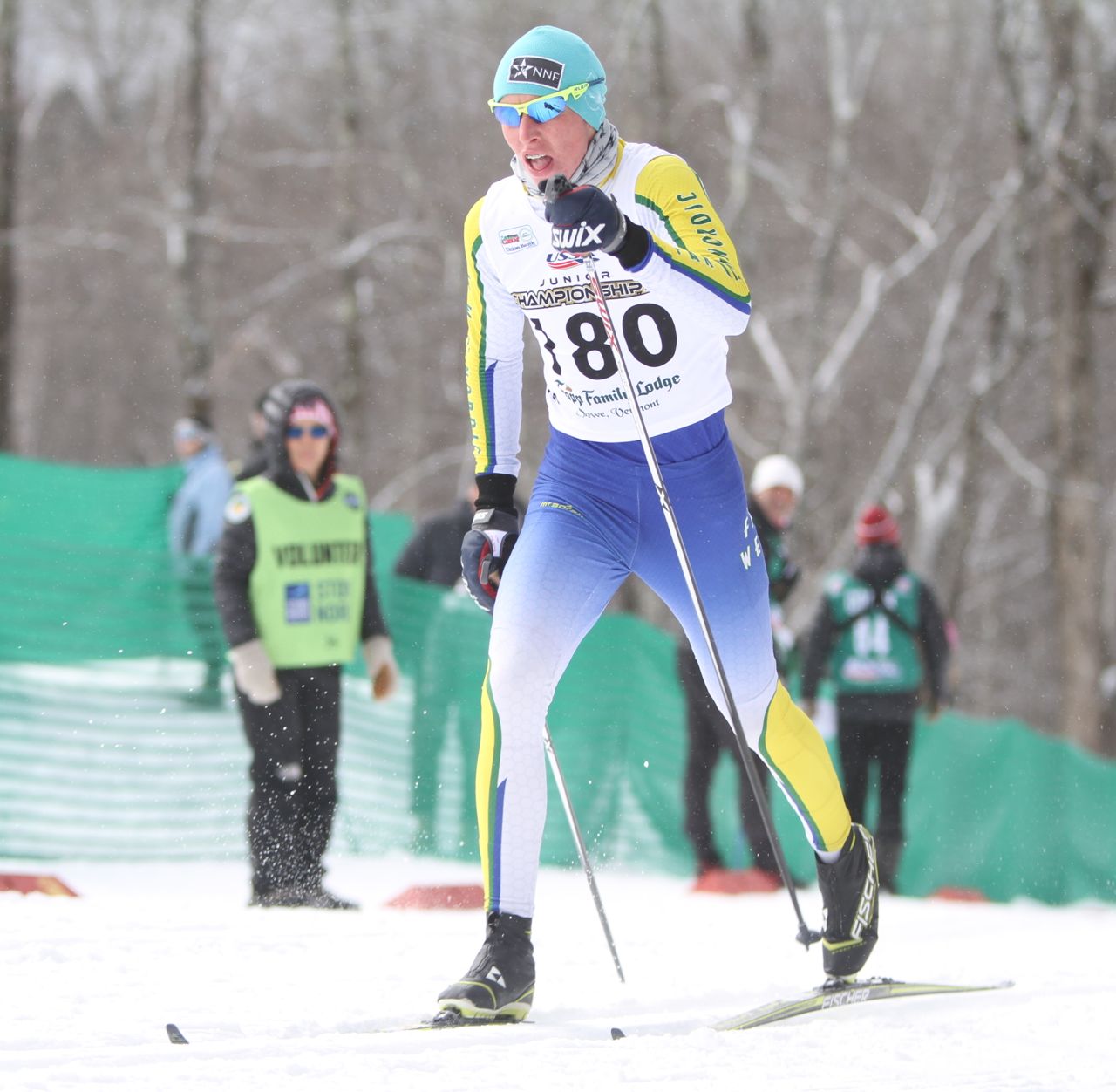
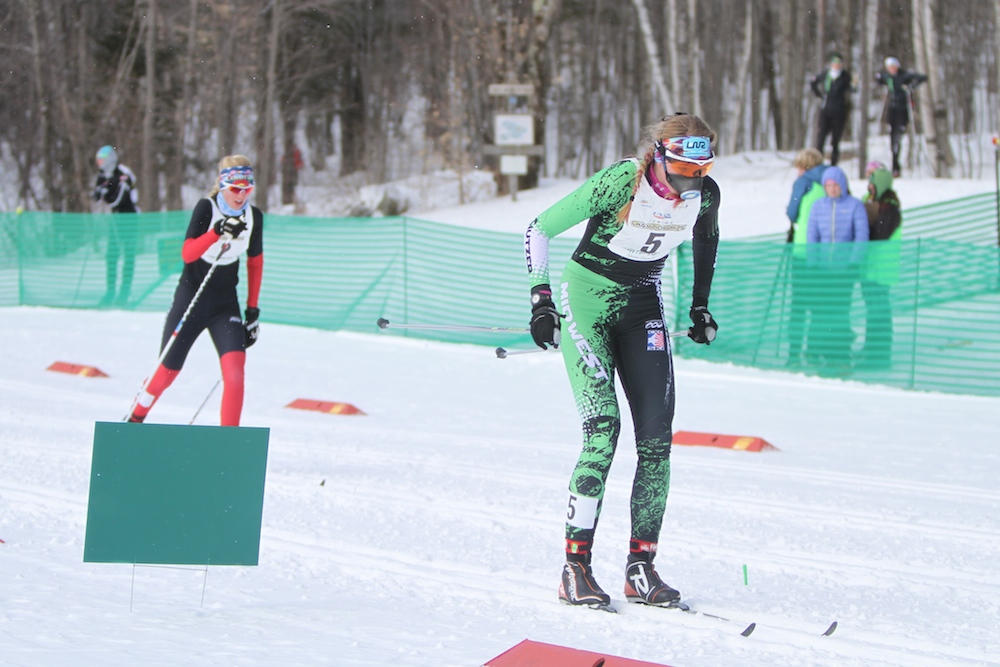
STOWE, Vt. — It was a jam-packed day of classic sprinting up at Trapp Family Lodge on Wednesday, with 54 heats determining six champions at Junior Nationals between the U16, U18 and U20 men’s and women’s categories.
While some races were snowy, others were windier, and a few were neck-and-neck to the line, the conditions remained relatively consistent throughout in temperatures around 10 degrees throughout the day. The sun began to set soon after the U20 and U18 women’s finals, making for a picture-perfect ending on Day 2 of 4 at Junior Nationals.
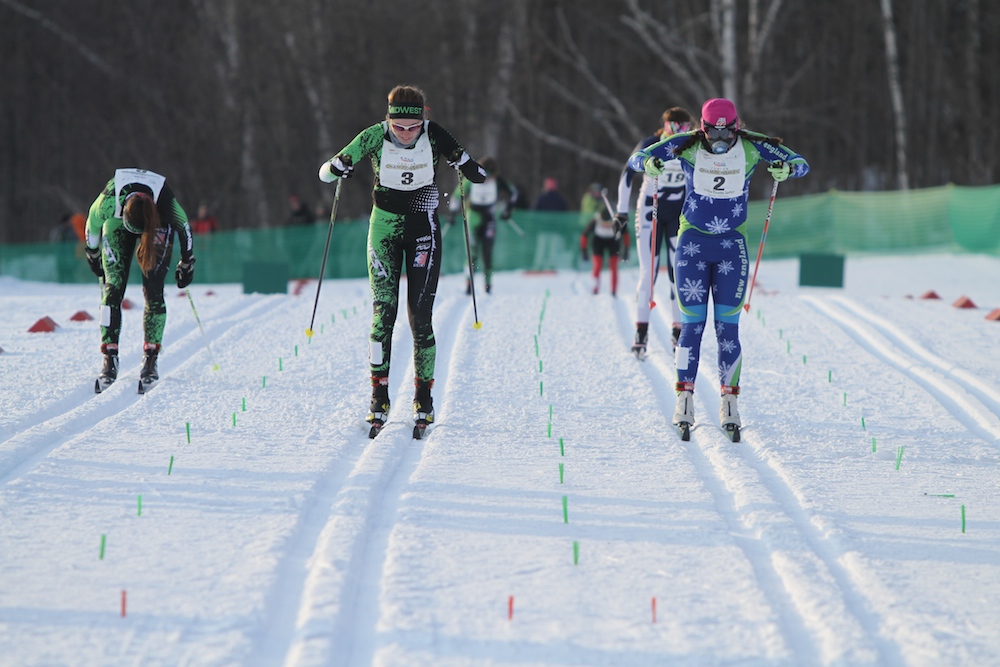
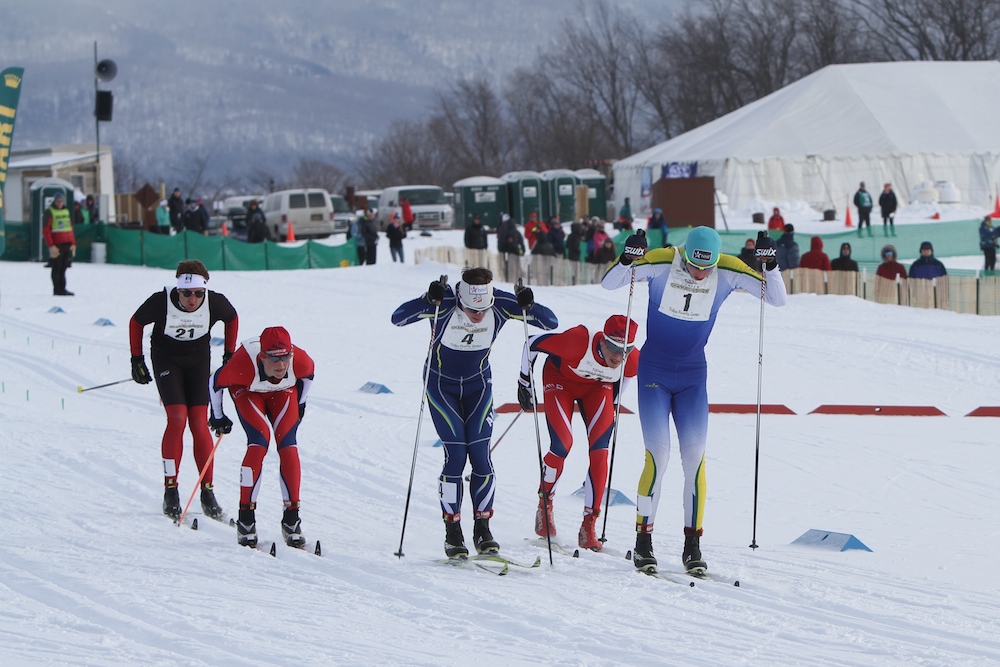
Julia Kern (r) racing to a classic-sprint title at Junior Nationals on Wednesday in Stowe, Vt., edging Mattie Watts (c) and Vivian Hett, both from the Midwest.
FasterSkier’s coverage is made possible through the generous support of Madshus.
STOWE, Vt. — Four-hundred and thirty-four athletes whittled down to 180 in 30 quarterfinals. Fifty-four heats total, all on the top of the mountain at Trapp Family Lodge over the course of nine hours.
It was a full day of racing on Day 2 of U.S. Junior Nationals on Wednesday, with men’s and women’s 1.4-kilometer classic sprints determining six national champions.
Below you’ll find the list of who made the top 10 in the U16, U18 and U20 races. Every athlete that did so raced Trapp’s open-aired sprint course four times — nailing fast-enough times to advance after each round. The top six made the A-finals, and the next six battled for seventh through 12th place (and All-American status in the top 10). Complete results
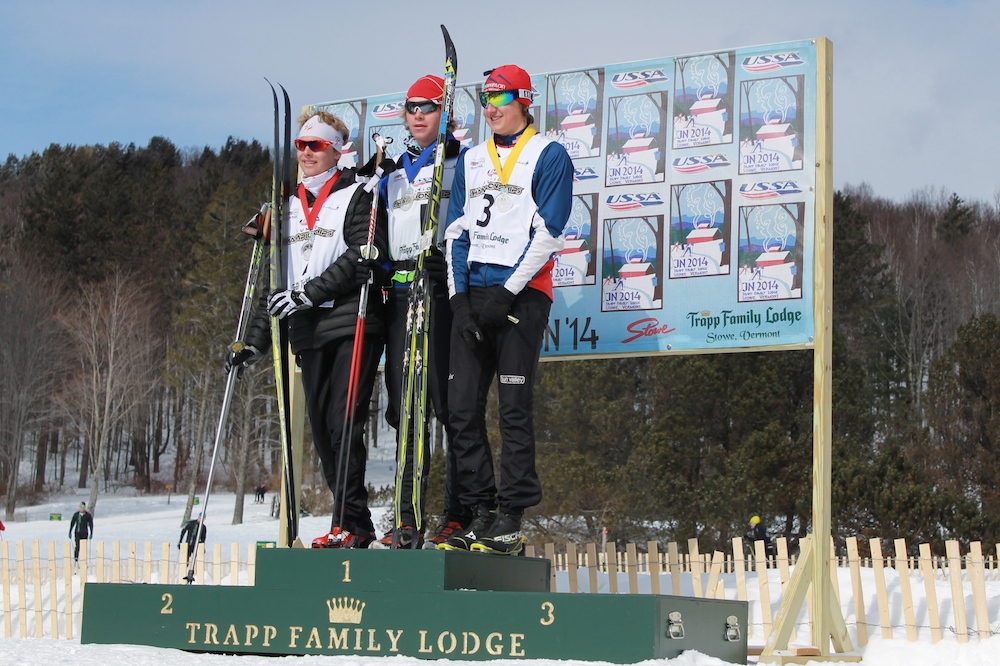
The Junior Nationals U16 men’s classic sprint podium with New England’s Forrest Hamilton (c) of Mansfield Nordic, the Pacific Northwest’s Leo Lukens (l) of Mt. Bachelor in second, and Intermountain’s Zach Williams (r) of Sun Valley in third.
U16 Men
Forrest Hamilton (Mansfield Nordic/New England)
Leo Lukens (Mt. Bachelor/Pacific Northwest)
Zach Williams (Sun Valley/Intermountain)
Benjamin Koenig (NSCF-Fairbanks-FXC/Alaska)
Everett Sapp (New York SEF/Mid-Atlantic)
Tracen Knopp (Alaska Nordic Racing/Alaska)
Daniel Streinz (Maine WSC/New England)
Matthew Hoefler (Alaska Winter Stars/Alaska)
Dawson Knopp (ANR/Alaska)
Will Balcao (AWS/Alaska)
Fun Facts: Hamilton didn’t have to travel far to win his first national title; he’s a student at Champlain Valley Union High School 40 miles from Stowe in Hinesburg, Vt. His longtime teammates call him ‘Fo-Money.’ “I guess that’s my ski-trail name,” he says.
Amanda Kautzer (r) of Loppet Nordic Racing/Midwest, crests the final hill in Wednesday’s 1.4 k classic sprint A-final before winning her first title at Junior Nationals, ahead of runner-up Hailey Swirbul (Aspen/Rocky Mountain), in Stowe, Vt.
U16 Women
Amanda Kautzer (Loppet Nordic Racing/Midwest)
Hailey Swirbul (Aspen Valley SSC/Rocky Mountain)
Leah Lange (Park City NSC/Intermountain)
Hannah Halvorsen (Sugar Bowl/Far West)
Leah Brams (Cambridge Sports Union/New England)
Claire Benton (LNR/Midwest)
Jordan Floyd (Steamboat Springs/Rocky Mountain)
Chloe Levins (Mountain Top/New England)
Lizzie Larkins (Auburn/Far West)
Anna Johnson (Mesabi East/Midwest)
Fun Facts: Mini Kikkan?Kautzer has pink hair just like the three-time World Cup Sprint champion from Alaska, and she just nabbed her first Junior Nationals victory after placing fifth in the 5 k classic on Monday. “I was not expecting anything like this this week,” Kautzer says. She’s originally from Southeast Asia and lived there until she was 3. “I was born in Singapore, which is about as far away from a snowy climate as you can get,” she says. “From super warm to super cold, I like the transition.”
Far West’s Peter Holmes (1) leads his semifinal in Wednesday’s 1.4 k classic sprint at Junior Nationals in Stowe, Vt. He went on to win his second national title in as many races.
Fun Facts: This was Holmes’ second title in as many races at Junior Nationals. “I always wear the same socks when I race,” he says.“I haven’t washed them since I’ve been here.”
U18 Women:
Julia Kern (Cambridge Sports Union/New England)
Mattie Watts (Endurance United/Midwest)
Vivian Hett (LNR/Midwest)
Zoe Snow (CSU/New England)
Sarah Bezdicek (LNR/Midwest)
Katharine Ogden (Stratton/New England)
Emily Hyde (Mt. Bachelor/Pacific Northwest)
Hannah Peterson (Durango/Rocky Mountain)
Olivia Ekblad (Methow Valley Nordic/Pacific Northwest)
Racquel Wohlk (Nordicwerks/Midwest)
Fun Fact: With at least five national titles in the last two years, Kern, 16, racked up her first victory of the 2014 championships. In her free time, she says she likes to surf around New England in places like Cape Cod or Hampton “and do photography and film stuff.”
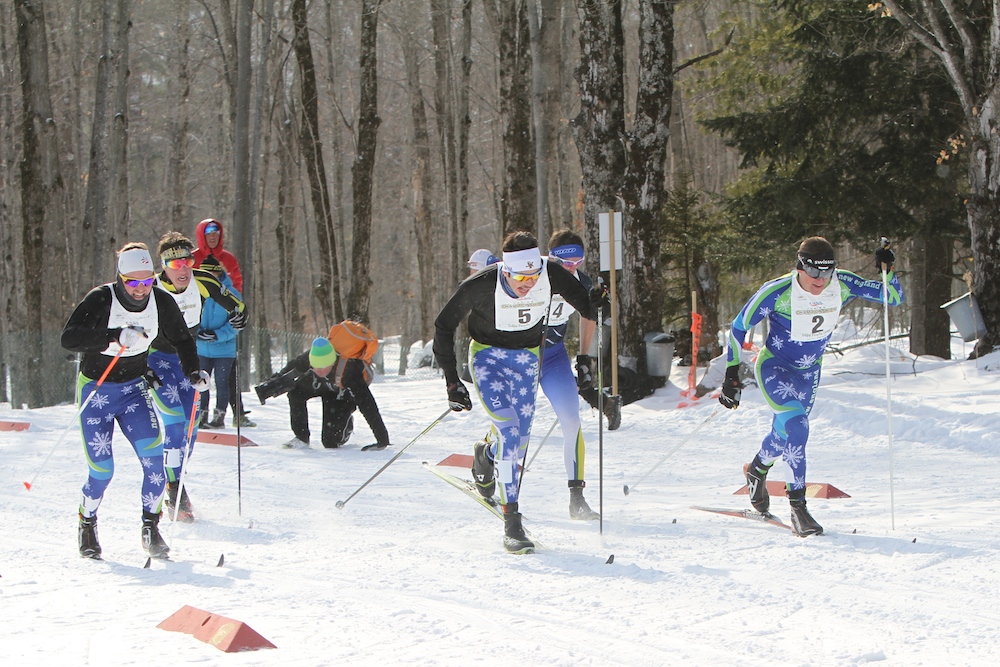
Three New Englanders race for gold in the U20 men’s classic sprint A-final: with Fabian Stocek (2) ultimately taking first, Cole Morgan (l) placing second overall and Jack Hegman (5) finishing third at Junior Nationals in Stowe, Vt.
U20 Men:
Fabian Stocek (Holderness School/New England)
*Cole Morgan (University of Vermont/New England)
Jack Hegman (UVM/New England)
Jack Schrupp (Gunstock/New England)
Patrick McElravey (Middlebury/Far West)
Haakon Sigurslid (Durango/Rocky Mountain)
Scott Harrison (LNR/Midwest)
Luke Brown (LNR/Midwest)
Connor Gray (BSF/Intermountain)
Andrew Egger (LNR/Midwest)
*Top American
Fun Facts: Originally from the Czech Republic, Stocek, 19, is a freshman at Dartmouth College and according to a NENSA blog post from a couple years ago, a fierce competitor at the game Twister. Morgan, a UVM sophomore, won his second-straight U.S. title in as many races at this year’s Junior Nationals. He shared the podium with his college teammate, Hegman, who hails from Huntington, Vt.
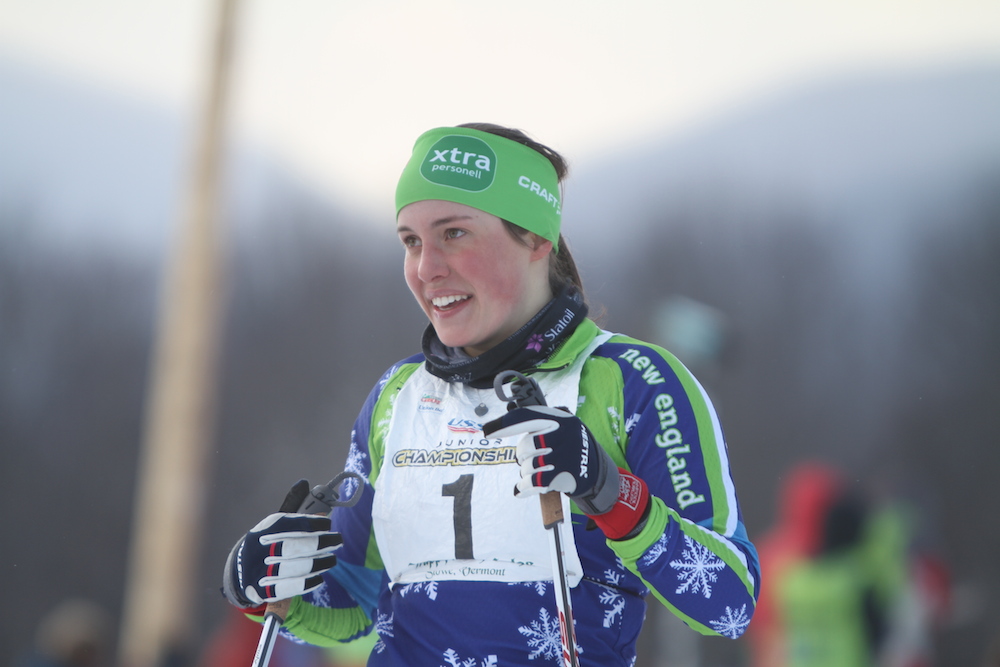
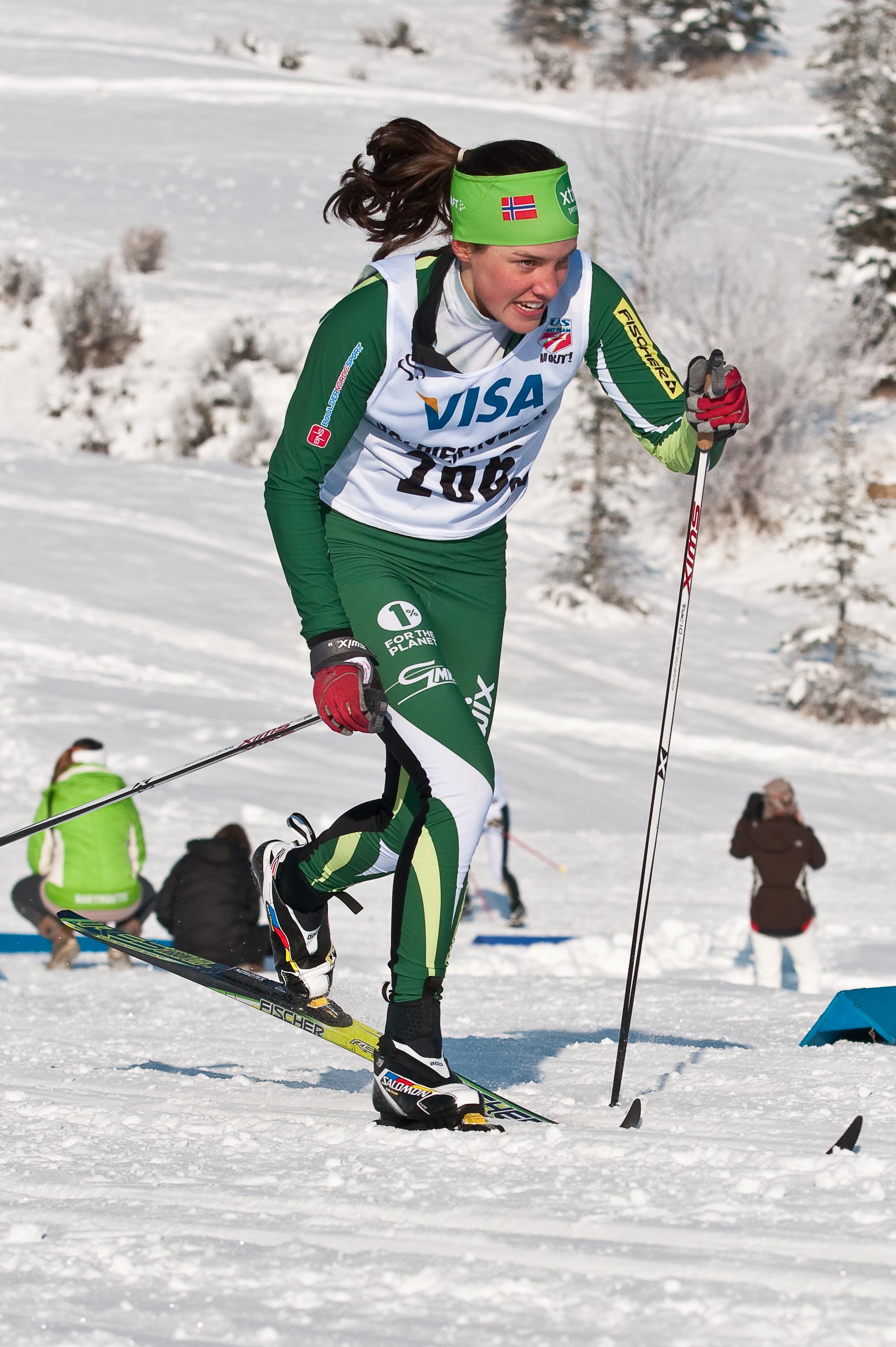
New England’s Heidi Halvorsen after winning Wednesday’s classic sprint for her first national title at 2014 Junior Nationals in Stowe, Vt.
U20 Women:
Heidi Halvorsen (New England)
Ulrika Axelsson (Michigan Tech/Great Lakes)
Kelsey Phinney (New England)
Hannah Benson (Williams Outing Club/New England)
Kristen Bourne (Northern Michigan University/Midwest)
Sadie James (Bates College/New England)
Nora Gilbertson (St. Olaf College/Midwest)
Marion Woods (Alaska Winter Stars/Alaska)
Joelle Rommo (BSF/Intermountain)
Maddy Pfeifer (Andover Outing Club/New England)
Fun Fact: According to Halvorsen, 18, she has podiumed five times at Junior Nationals, and this was her first victory. A 2013 graduate of the Green Mountain Valley School Ski Academy, Trapps was her home course. When she’s not skiing: “I have a lot of grannie pastimes,” she says, “like knitting and troll making and quilting.”
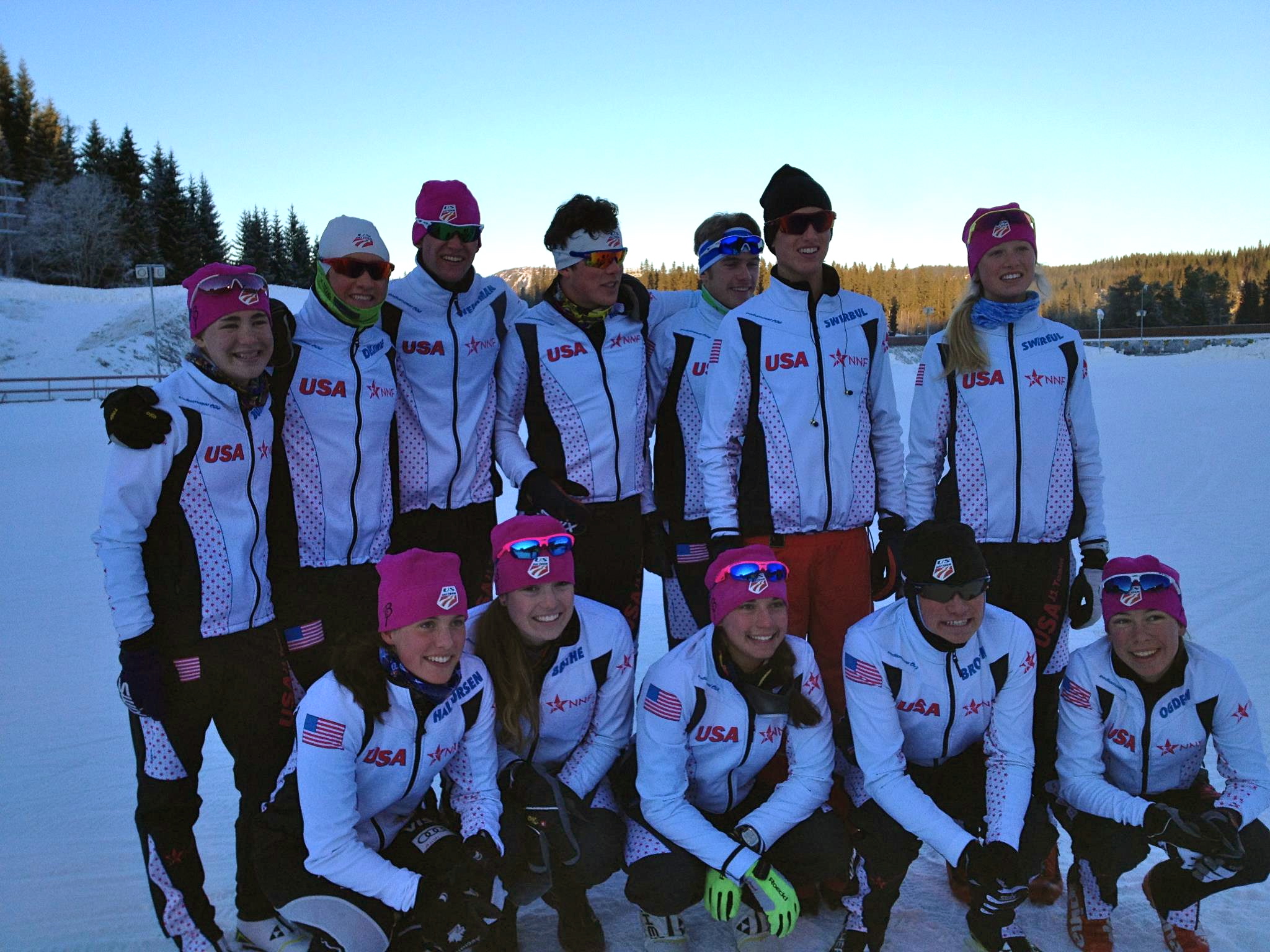
The American J1 Team wrapped up competition in Trondheim, Norway, on Sunday. Photo: Adam St. Pierre.
At the end of this week, twelve skiers under the age of eighteen return home to the U.S. from racing in Trondheim, Norway, against the fastest of their peers in the world. The American experience at the J1 Scando Cup is generally highlighted by a few decent results here and there. Last Friday through Sunday the girls’ team set a new standard, putting two individuals in the top 10, skiing to a second-place finish in the 3 x 3 k relay and giving a few European coaches a good scare.
Heidi Halvorsen (Green Mountain Valley School) and Katharine Ogden (Stratton Mountain School) headlined the team’s individual performances on Friday and Saturday to set the team up for success in the relay. The championships began on Friday with a classic sprint under the lights, in which Halvorsen posted the second-fastest qualifier, made it to the A-final and fnished fifth overall. For Halvorsen, the result was an important step towards gaining confidence internationally and putting a series of frustrating results from U.S. Nationals firmly in the past.
Halvorsen competing in the classic sprint qualfier at U.S. Nationals this January. Photo: Bert Boyer.
“Going into the races in Norway I was a little frustrated, and discouraged,” Halvorsen in an email. “I hoped that I would be able to improve on my results from last year, but at the same time I was also strongly doubting that happening. However, after qualifying second in the classic sprint the first night I gained a little confidence in the possibility that I could actually get some good results.
With a fifth in the classic sprint, twelfth in the 4 k freestyle and silver medal from the relay now under her belt, she’s feeling better about the rest of the season as the season transitions to February.
“Coming out of this week I’m happy that I was able to prove that I did in fact deserve to come to this trip,” Halvorsen said. “It’s a little bit of a much needed confidence booster, after Sr. Nats, to see that you really are in the running for the top spots, and that you can actually compete against the other countries’ best girls.”
GMVS coach Justin Beckwith says Halvorsen’s recent results have been a long time coming.
“She’s been showing a lot of promise on race days and in training, great things have been in the works for a while,” Beckwith said. “She had a great sprint at nationals and the distance races were a little interesting, so it’s neat to see it all come together for her.”
Halvorsen wasn’t the only one to have a great weekened in Trondheim. Stratton Mountain School J2 Katharine Ogden was sixth in the freestyle race, 30 seconds by the winning time from Tiril Weng (NOR). Ogden and Halvorsen teamed up with Julia Kern (Cambridge Sports Union) on the final day of racing to put together the best relay finish the U.S. has ever had on the trip.
Katharine Ogden (SMS) competing at U.S. Nationals. Photo: Bert Boyer.
“The highlight of my trip was definitely the relay,” Halvorsen said.
Kern scrambled for the Americans and tagged off to Ogden in fourth place in a small pack. Odgen maintained the position so that when Halvorsen got the tag to anchor, she could see the podium in front of her.
“At that point I knew that I had to bring us to at least third, so that we could all podium,” Halvorsen said.
With Norway’s first two teams and and a skier from Finland in front of her, Halvorsen picked off two places on the course’s major hill. She even started to gain on the Norwegian girl in the lead, but in the end there wasn’t enough trail left to make up the gap. She brought the U.S. home in second, 8.8 seconds behind Norway I and 8.1 seconds ahead of Norway II in third.
“It was a really fun race and we were really excited to make it up on the podium,” Halvorsen said.
Adam St. Pierre, one of the American coaches on the J1 trip, said that after Ogden’s and Halvorsen’s individual results from the first two days they had hoping for a podium, but second place was an added bonus.
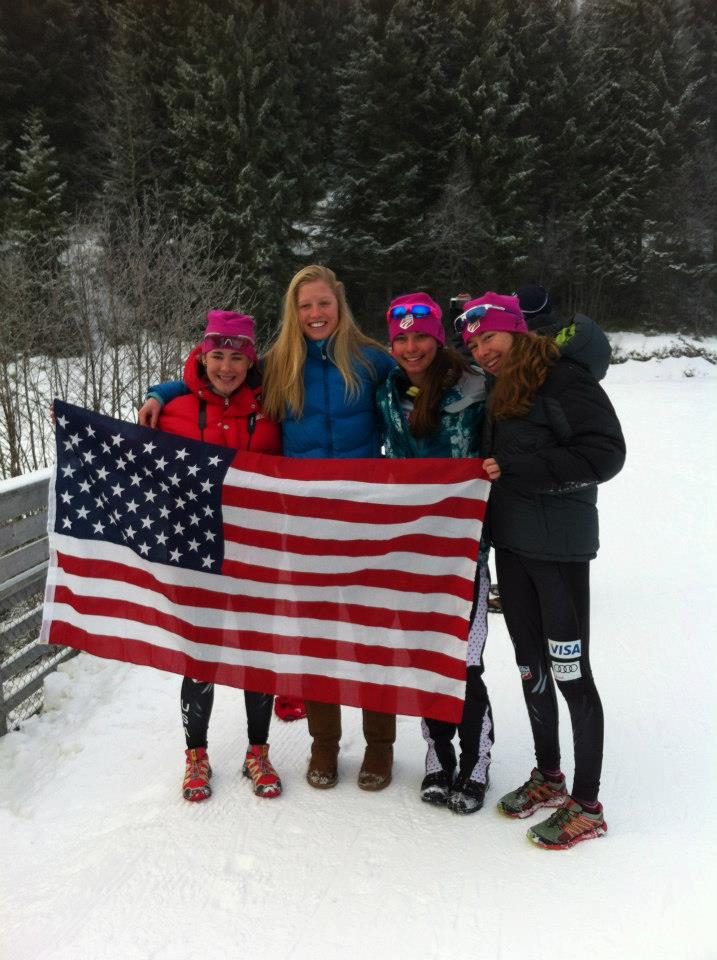
Members of the girls J1 team with the American flag. Photo: Adam St. Pierre.
“We would have been psyched with a third, but a second in a pretty convincing fashion was awesome,” he said. “We had a Norwegian friend helping us this week, mostly translating and teaching us where to park, and he was talking with the Norwegian coaches and they were legitimately worried about our girls, which was kind of cool.”
Halvorsen says she’s already internalized the lessons from the international racing experience. This is not her first J1 Scando trip, but her results from this week have instilled a new kind of confidence in her skiing.
“I think the biggest thing I learned was just to ski well and try and be confident.,” she said. “Last year I had no expectations going into it, and I was intimidated by all the Scandinavians, who I thought all looked stronger and faster than me. Also Finland’s matching hats, polos, t-shirts, sweatshirts, warmups, puff coats, and snow pants seemed to add to the intimidation I already felt. But this year I knew that it’s the same as any other race, just with many more spectators speaking many more languages.
“We can compete with them. If you ski like you know how to ski in America, you can still do well in Europe.
According to St. Pierre, many athletes on the trip have already started to absorb the lessons of the international experience.
“I think it’s definitely an eye-opener for a lot of the kids,” he said. “These kids are used to being the top in the country. They win races; they get on the podiums… So a lot of the boys have been talking already, like, ‘What are we going to do, what are they doing that we’re not,’ you know, ‘What’s it going to take for us to compete with these guys.’ And I think for a lot of these guys that ends up being the big benefit of this trip.”
The twelve U.S. athletes on the trip stayed in Norway for a few days after the last race to train together on the Trondheim trails.
“The true measure of success will be whether these kids continue to train, continue to get better and eventually find themselves at an even higher level of competition,” St. Pierre said. “I think we’re already starting to see some positive effects from the J2 camp, from REG camps where these kids know each other. They’ve trained together before at a national level, pushing each other to get better. So hopefully they can go home and be pleased but not satisfied, and keep working hard.”
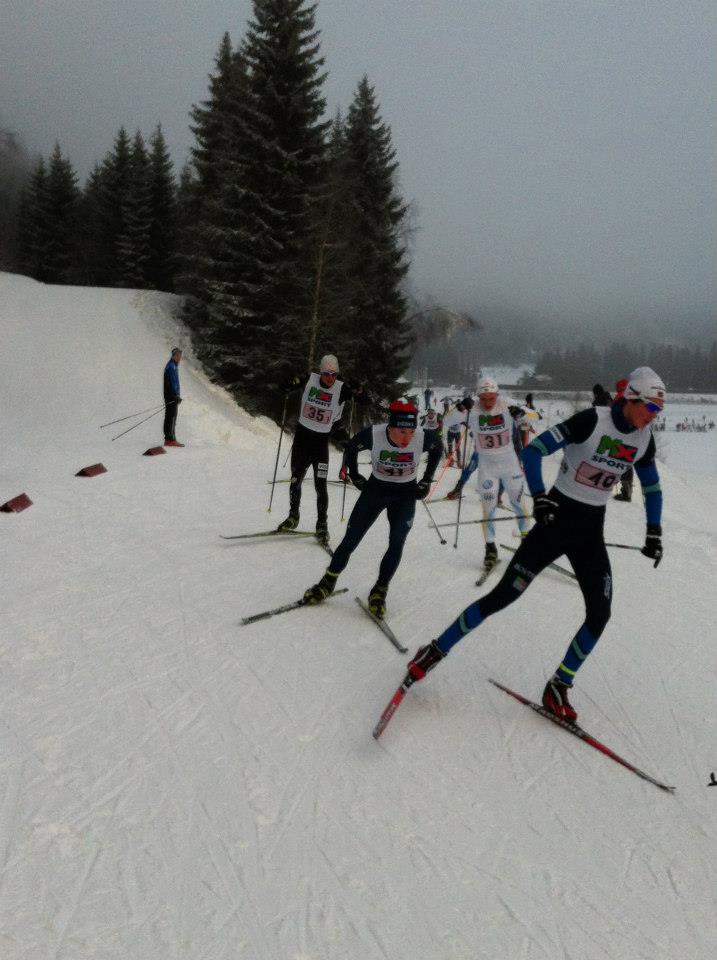
Cal Deline (bib 35) scrambling for the U.S. in the boys relay. Photo: Hailey Swirbul.
Girls Classic Sprint
5. Heidi Halvorsen (GMVS)
20. Hailey Swirbul (Aspen Valley SSC)
23. Nichole Bathe (Central Cross Country)
26. Julia Kern (CSU)
32. Katharine Ogden (SMS)
47. Gretchen Burkholder (Steamboat Springs WSC)
Boys Classic Sprint
13. Cully Brown (Ski & Snowboard Club Vail)
40. Evan Weinman (SSWSC)
43. Haakon Sigurslid (Durango Nordic)
54. Hamish McEwan (SMS)
59. Keegan Swirbul (Aspen Valy SSC)
61. Cal Deline (SSCV)
Girls 4 k Freestyle
6. Katharine Ogden 12:24
12. Heidi Halvorsen 12:33
23. Julia Kern 12:46
30. Gretchen Burkholder 13:05
33. Nichole Bathe 13:17
34. Hailey Swirbul 13:18
Boys 5 k freestyle
44. Keegan Swirbul 21:38
46. Cal Deline 21:38
48. Cully Brown 21:46
51. Evan Weinman 21:48
58. Hamish McEwan 22:12
59. Haakon Sigurslid 22:15
Girls 3 x 3 k relay
2. USA I (Julia Kern, Katharine Ogden, Heidi Halvorsen) 21:38
11. USA II (Nichole Bathe, Gretchen Burkholder, Hailey Swirbul) 22:48
Boys 3 x 5 k relay
8. USA I (Cal Deline, Keegan Swirbul, Cully Brown) 32:21
15. USA II (Evan Weinman, Hamish McEwan, Haakon Sigurslid) 32:59
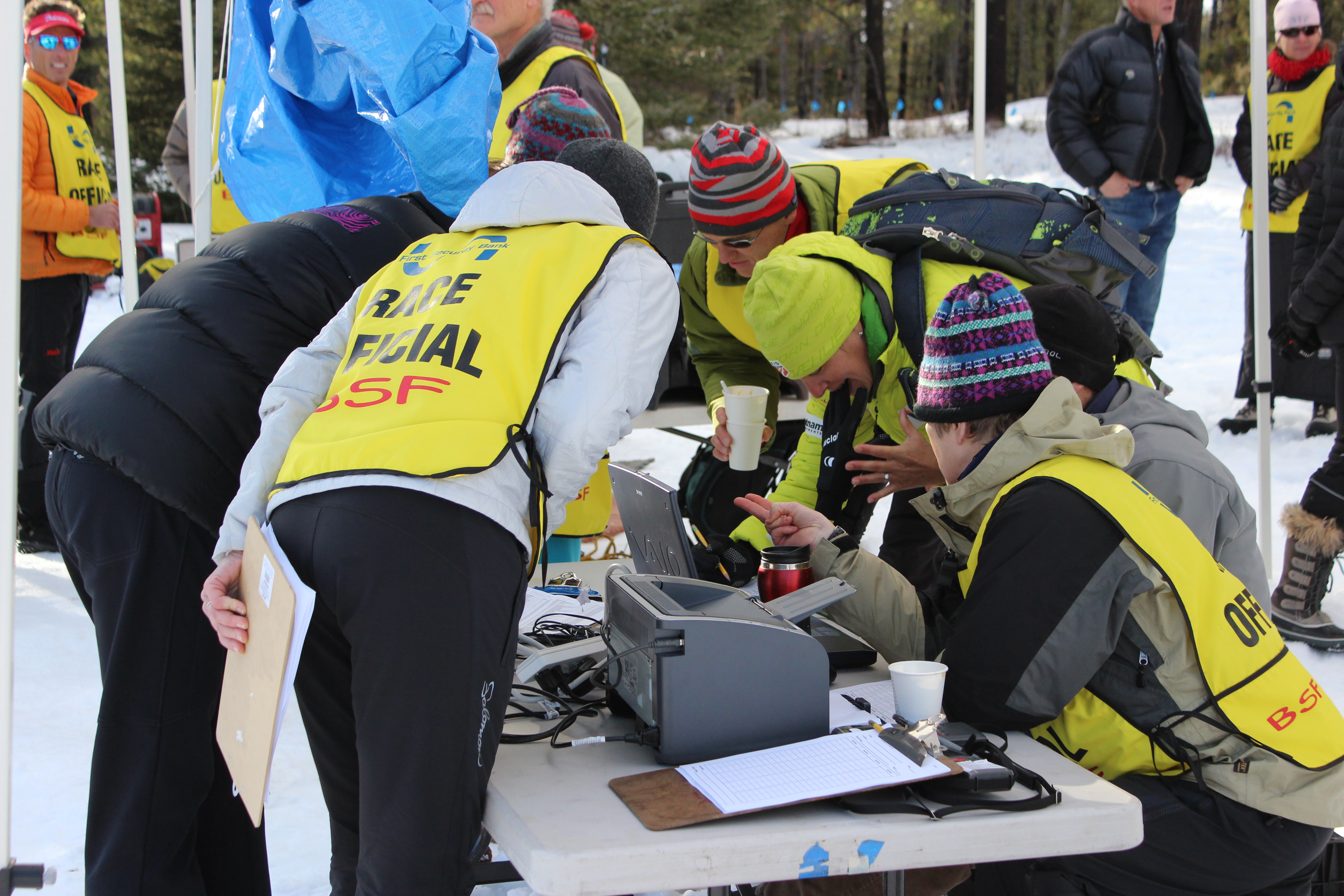
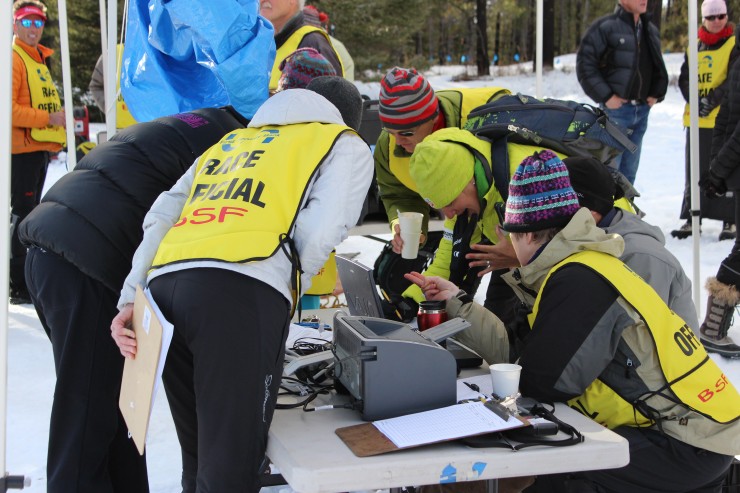
Race officials converge on a timing laptop at SuperTour races in Bozeman, Montana, earlier this season as they try to iron out problems in the results from a classic sprint qualifier.
In some ways, regional races aren’t a big deal. When the U.S. Ski Team nominates Olympians next season, they aren’t going to go back and check someone’s results at an Eastern Cup or the Tour de Ski Fairbanks.
But in others, they are a very big deal. Juniors rely on these races to qualify for Junior Nationals, the ultimate, season-long goal of many young competitors; college and senior racers use them as tune-ups for carnivals and nationals, and to gauge how their training is going; masters relish the opportunity to hammer out a hard effort and chase age-group glory.
And in the past few years, regional races have gotten bigger and bigger, both in size and importance. Ten years ago, there were only seven FIS-sanctioned series in the U.S., and one of them was that year’s Olympic Games in Utah. Five years ago, there wasn’t a FIS race east of the Mississippi until U.S. Nationals at the beginning of January, and none in New England until the UVM Carnival in February.
This year, there have been four FIS series already, in New England, Montana, and Alaska, and 17 more are on the schedule. The points at regional races have gotten better and better, and can seriously help an athlete’s season ranking.
“If you’re looking purely at the numbers, and the level of points available at our races now, that is certainly increasing, and to the people that are there chasing those points it could certainly be more serious,” New England Nordic Ski Association (NENSA) Executive Director Zack Stegeman told FasterSkier in an interview on Thursday.
And that’s exactly what regional organizations like NENSA want.
“I think that all the organizers in New England have always worked very hard to make these events as good as they can possibly be,” he said. “That’s why we have such great regional races – our venues, and organizers, and NENSA itself has been trying hard to really raise the bar. The abilities of our venues and our community to continually step it up speaks volumes.”
Arguably, nowhere is this trend more apparent than in New England. The opening races of the Eastern Cup series were held last weekend at the Craftsbury Outdoor Center in northern Vermont; Saturday featured almost 400 racers, while Sunday’s number was close to 500.
Which makes it scary when something goes wrong. On Saturday, Craftsbury was on tap to hold a classic sprint qualifier followed by 30-racer heats for the open division, plus 12-person J2 heats and a separate bracket for the next 12 fastest J1’s and OJ’s. Instead, due to timing problems, the heats had to be scrapped entirely and a second qualifier was held in the afternoon.
“We’re constantly evolving and learning from events, whether they go really well, or whether they are a bump in the road,” Stegeman said. “Saturday was definitely one of the latter.”
Cascading Failure
Craftsbury, which hosted a highly successful SuperTour Finals and Distance Nationals in March, has been moving towards using its own timing system. While Summit Timing was in charge of the March races, staff learned the ropes and were ready to implement their own system for the Eastern Cups.
Once the unofficial women’s results were posted, though, it was clear that there had been trouble with timing the morning’s qualifier.
“Once we posted unofficial results, we saw that there were major problems,” Stegeman said. “We tried to run through one fix and put them up again, and that’s when we realized, wait, the thing we’re doing to try to fix it isn’t working… and we identified all the timing equipment malfunctions and our inability to salvage those results.”
With limited daylight in northern Vermont, the race jury and timing crew decided that they wouldn’t have time to reconstruct the results and still run heats, so the immediate consequence was the cancellation of the heats and a second time trial instead. Although there was certainly some initial griping, racers seemed to buckle down and motivate for round two. Coaches quickly got to work re-waxing dozens of pairs of skis.
But for Sheldon Miller, an occasional racer, talented cyclocross competitor, and Craftsbury’s media and computer guru who was heading up the timing crew, the problems were just beginning. When FasterSkier contacted him on Monday afternoon, he was still wading through timing equipment just to get to his desk.
After setting up three Summit timers at the start and three at the finish, Miller had felt confident in his timing system. Ever since the central timing laptop that all those timers fed into crashed mid-race, he has changed his tune.
“It’s great to have all those individual timers, but when the thing that’s consolidating all of that information goes down, it doesn’t really do a whole lot of good in a near-term sense,” he told FasterSkier.
On Saturday, he had the data on the timers, but no way to get it off of them without having it reduced to gobbledygook. But by late Tuesday afternoon, he had unraveled the multiple failures that had created and then heightened the whole mess.
“Saturday’s qualifier results preparation was derailed by a failure of the timing computer and subsequent crashes of XL part way through the men’s race,” Miller wrote in an e-mail.
Despite the “cascading failures”, as he described them, Miller has since been able to reconstruct the data from the morning race by counting backwards from the last finisher. With three separate timers in each place, he had been pretty sure it was possible – but on a sprint day, results need to appear fast, and there simply wasn’t time.
NENSA and Craftsbury had to move on to plan B.
“We wanted to ensure that everyone who had invested the time and the effort to come race walked away with a result that counted,” Stegeman said. “That was really important to us. We were disappointed that we couldn’t do the heats, because they’re really fun.”
But it was the right thing to do, and Stegeman believed that the team had handled the situation as well as it could have.
“Were I to talk to a race organizer, that’s the big thing I would suggest, would be to identify that timeline,” he said. “For us, it was, how much time do we have to repair these results, before we have to just say, too bad, we can’t fix them, we have to run another individual-start before we run out of daylight.”
Public Relations
The change in format did cause problems. Some athletes, for instance, left the venue after the first set of unofficial results were posted, believing that their day of racing was over since they hadn’t qualified for heats. Since Miller has now recovered the morning results, they will receive points, but initially, they were simply DNS for the afternoon race.
Saint Michael’s College was one of those teams, but head coach Molly Peters didn’t seem to hold a grudge.
“It was a bummer to hear about what happened,” she wrote in an e-mail to FasterSkier. “I didn’t make a big deal about it, mainly because I didn’t really know what happened. I was under the impression that they were trying to recover the morning’s results and if they did then they would take the best result… As a race organizer myself, it is hard to get mad. I understand that things happen and it looks like they did what they had to do to make sure it was a valid race.”
Green Mountain Valley School racer Heidi Halvorsen, who placed second in the morning qualifier but won the afternoon edition, agreed.
“The race organizers and all the volunteers at Craftsbury worked unbelievably hard and ran a great race,” she told FasterSkier. “With no snow anywhere else in New England, it was amazing that they have had skiing for the last few weeks, and they were even able to hold races. So it is impossible to criticize the organizers for the timing fluke, they made the best of the situation and overall the race was run very smoothly.”
With so few options for salvaging the race, the biggest question was actually how organizers communicated what was going on to athletes and coaches. At no point did unofficial men’s results ever appear; while that was a good decision, not all racers understood why. A second set of unofficial women’s results were posted, which observers initially assumed had corrected the problem, but those turned out to be wrong too.
It’s unclear exactly what could have been done to prevent teams like Saint Michaels from leaving, or to spread the word that the unofficial results were wrong. While some coaches picked up on the fact immediately, simply based on where their athletes sat on the list, there didn’t seem to be any official announcement that the results were under review.
Stegeman said that he and the jury had hesitated to post anything that was “still fluid,” believing that it could add to the confusion. While they were intently focused and racing against a clock of their own to solve problems, talking to athletes in the parking lot didn’t seem like a good use of time. At several points, they sent “runners” (coaches, as well as J2 and BKL athletes) out into the parking lots to update the community on what was happening. Stegeman was unsure how well the messages were conveyed.
Lessons – And More Questions
As a timer, the lessons from Saturday’s race were simple for Miller, who held himself accountable for the failures even though he isn’t trained as a timer and despite the apparent forgiveness of others.
“The biggest thing is the importance and necessity of having completely independent systems,” he told FasterSkier on Monday. “On Saturday I had three timers, literal timing machines, at the start, three literal timing machines at the finish. On Sunday we added another completely separate system that had nothing to do with what I was doing, as backup. We had two complete parallel systems running that we were able to cross-check against, as well as, should the cascading failures that we had on Saturday occur again, we could just jump off that burning ship and on to the other one.”
That, however, brings up some interesting issues. How many volunteers are needed to time a race with two completely independent systems? Craftsbury has a notoriously deep, loyal, and dedicated volunteer base, but can every venue be expected to have the same – or to pay a thousand dollars or so for a timing company, without a solid guarantee of a better outcome?
NENSA itself has had problems with sprint timing before, both in Weston and in Rumford, Maine; in at least one of those cases, timing had been hired out to professionals. And it’s not just NENSA. Already this year, there have been inconsistencies at other sprints.
“Truthfully, I was much more paranoid during the Bozeman sprints, when they kept erasing the heats and putting up different people, because the World Cup was on the line,” CXC racer Jennie Bender, the winner of the morning qualifier but not the afternoon edition, wrote in an e-mail.
At the Bozeman SuperTours, unofficial qualifier results were allegedly never posted for the classic sprint; or if they were, they were taken down during a protest and organizers continued to distribute bibs while racers and coaches only had access to the hypothetical sprint brackets. As it turned out, those sprint brackets were based on an initial set of qualifier results which were incorrect due to an inadvertent tripping of the timing wand when there should have been a ghost.
There were also other problems with the classic sprint results. Skiers were not initially assigned to the correct heats – for instance, in every sprint, the first, tenth, eleventh, twentieth, twenty-first, and thirtieth fastest qualifying skiers should be assigned to heat one, and so on. The brackets had to be redrawn once the error was caught. Racers in the first heat were already lining up when the announcement came that bibs would be redistributed.
So while organizers always hope for smooth sailing, it’s certainly not a given. There is guaranteed to be more problems in the future, somewhere in the country, whether at a regional race, a SuperTour, or something even bigger.
“It seems to me that there are variety of issues that skiing in North America is grappling with: homologation, climate change’s effect on skiing at large as well as racing in particular (e.g. the desire to have more mass starts vs. too little snow or too short of a loop to support them adequately), smaller clubs or organizations’ ability to provide racers with FIS-scored events (and the inherent requirements the governing body mandates) at a feasible cost, and more,” Miller wrote in an e-mail. “We’re in a very productive time in North American skiing, but these tensions are ones that continually need to be engaged creatively for the sport to continue to thrive.”
Given these challenges, it’s important for race organizers to keep in mind the advice from Stegeman and Miller. Always have completely independent backup systems; set cutoff times for decisionmaking when something goes wrong; keep all the stakeholders involved and informed.
Stegeman believes that his region’s venues are up to the task. For one thing, NENSA is committed to education, and runs seminars for TD’s, race organizers, and even Bill Koch League (elementary school) race officials. But for another, he’s seeing the level of organization at New England venues rise all the time.
“The venues themselves are investing more and more in equipment,” Stegeman said. “Craftsbury had a top-notch camera set up on the finish line anticipating very tight finishes in sprint heats. You wouldn’t have seen that a few years ago. So there’s equipment investment, those are more tangible examples, but there’s investment in the human capital too. Venues all over New England are getting really good people on board from an event organizer standpoint right up to the grooming. Because expectations are rising right along with the rise in field sizes.”
At the end of the day, Bender, too, was optimistic.
“Everyone there saw the panic rise in the hardworking Craftsbury crew once the timing started to malfunction, and knowing many of them, I am sure that all the kinks will be worked out before the next event,” she wrote in an e-mail. “They did a great job on the course and snowmaking, and although some of the coaches and athletes may have been frustrated, it’s just a ski race.”
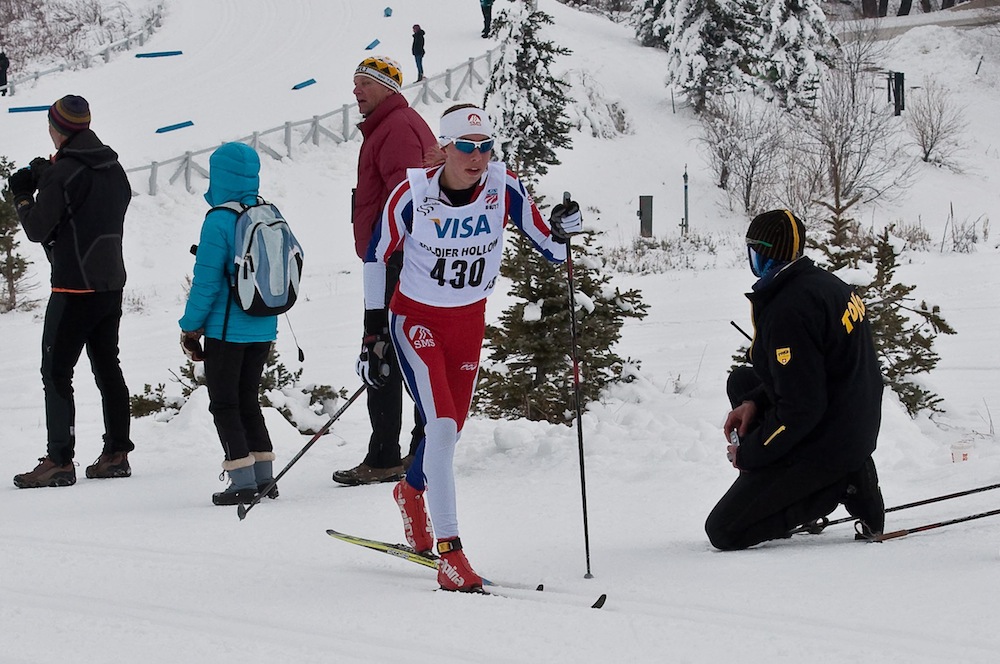
Members of the National Training Group during a threshold workout at Soldier Hollow last week. Photo: Matt Whitcomb/U.S. Ski Team.
Members of the U.S. Ski Team’s National Training Group (NTG) spent last week in Park City, Utah, for a training camp centered on group training and exposure to the resources at the Center of Excellence. Athletes joined interval sessions with the national team on the rollerski track at Soldier Hollow and underwent a series of physiological tests for assessment and feedback on their development.
The camp was a new addition over last year’s schedule; the result of a decision by USST coaches to further focus on development.
“Back in the spring we sat down and decided that we’d put in another camp into our development pipeline specifically for this NTG and have them come out to Park City with the intent to get them into the COE,” said Bryan Fish, USST development coach.
Quality training was the camp’s primary goal, but with the COE nearby athletes were also able to work with the USST’s staff of physiology, strength and nutrition experts.
“The feedback we got was very positive; the athletes felt like they got a lot of education out of being here,” Fish said. “We could send them home with test results and feedback, which we provided to their club coaches, on areas where they’re strong, areas where they can improve.”
Emily Hannah, Marion Woods and Mary O’Connell. Photo: Matt Whitcomb/U.S. Ski Team.
Over the course of the week, Fish said the workouts and test results he saw were encouraging.
“What I’m seeing in the REGs and the J2 camp is that our athletes are indeed getting more fit and more prepared, tactically and technically. We’re seeing that in the physiology results that come in house,” Fish said. “For us, from the national team coaching staff, what we saw was hugely positive. It’s a testament to the clubs and these athletes that we’re training more; training better.”
One such workout to provide positive feedback were threshold skate intervals at Soldier Hollow, which the NTG athletes completed alongside resident national team athletes across multiple disciplines — cross country, nordic combined and biathlon were all represented in the same workout.
“Our general premise, from my perspective, is to get our best athletes together on occasion to train and compete,” Fish said. “They don’t have to train together 24/7 but getting together and going head-to-head they all learn and they all improve.”
With most of the U.S. nordic combined team, biathlete Jeremy Teela and several U.S. cross-country athletes on the course with the NTG skiers at the same time, the threshold workout got “kinda frisky,” said nordic combined skier Billy Demong.
“With all these cross country skiers and our guys, we went a little harder than we planned.”
Too fast or no, Fish thought the collaboration was a valuable experience.
“There’s a part of the training that’s intensity-based and another that’s tactical,” he said. “There’s a balance, and I feel you have to let a little bit of that go and train like you’d race. It was a prime opportunity to get in good tactical training on the Soldier Hollow courses, and for the most part they did a good job.”
Billy Demong leading the pack through the flats during threshold. Photo: Bryan Fish/U.S. Ski Team.
David Sinclair and Heidi Halvorsen were the men’s and women’s winners of the 4th App Gap Challenge, a roller ski duathlon from Waitsfield to the top of Appalachian Gap in northern VT. The race was the final event of a week-long training camp for 16-18 year old skiers at Green Mountain Valley School in Waitsfield. Men skied 7 k and women skied 5 k.
Sinclair’s winning time of 30:34 set a new course record by 5 seconds. Eli Enman was the second male finisher in 32:36; Noah Brautigam placed third in 33:36. Halvorsen eclipsed the women’s course record by 58 seconds, finishing in 28:18. She was followed by Emily Stitt at 30:04 and Kristin Halvorsen in 31:06.
Skiers started at 30-second intervals. The men went from the intersection of Route 17 and German Flats Road, while women started further up Route 17 at the entrance to the Battleground condominium development. In a nod to the course profile, skiers started out skating on relatively easy grades. The climb got steeper as racers approached the Mad River Glen Alpine ski area, where they transitioned to classic gear for the final climb to the top of the gap. Grades exceeded 10% in some spots on the way to the summit. After the first kilometer or so, there was little shade to shelter athletes from the sun.
In its first two years, the race was open only to those attending the GMVS summer camp, according to GMVS Nordic director Justin Beckwith. This was the second year the duathlon was open to other skiers.
Heading to the finish (Photo: Abby Weisman)Approximately 150 – 200 meters to the finish (Photo: Abby Weisman, NENSA)Note the sign on the right…(Photo: Abby Weisman, NENSA)