From the FasterSkier archive — posts syndicated from athletes’ and coaches’ own blogs between 2004 and 2012, kept online as published. Current coverage is at fasterskier.com.
This coverage is made possible through the generous support of Marty and Kathy Hall and A Hall Mark of Excellence Award. To learn more about A Hall Mark of Excellence Award, or to learn how you can support FasterSkier’s coverage, please contact info@fasterskier.com.
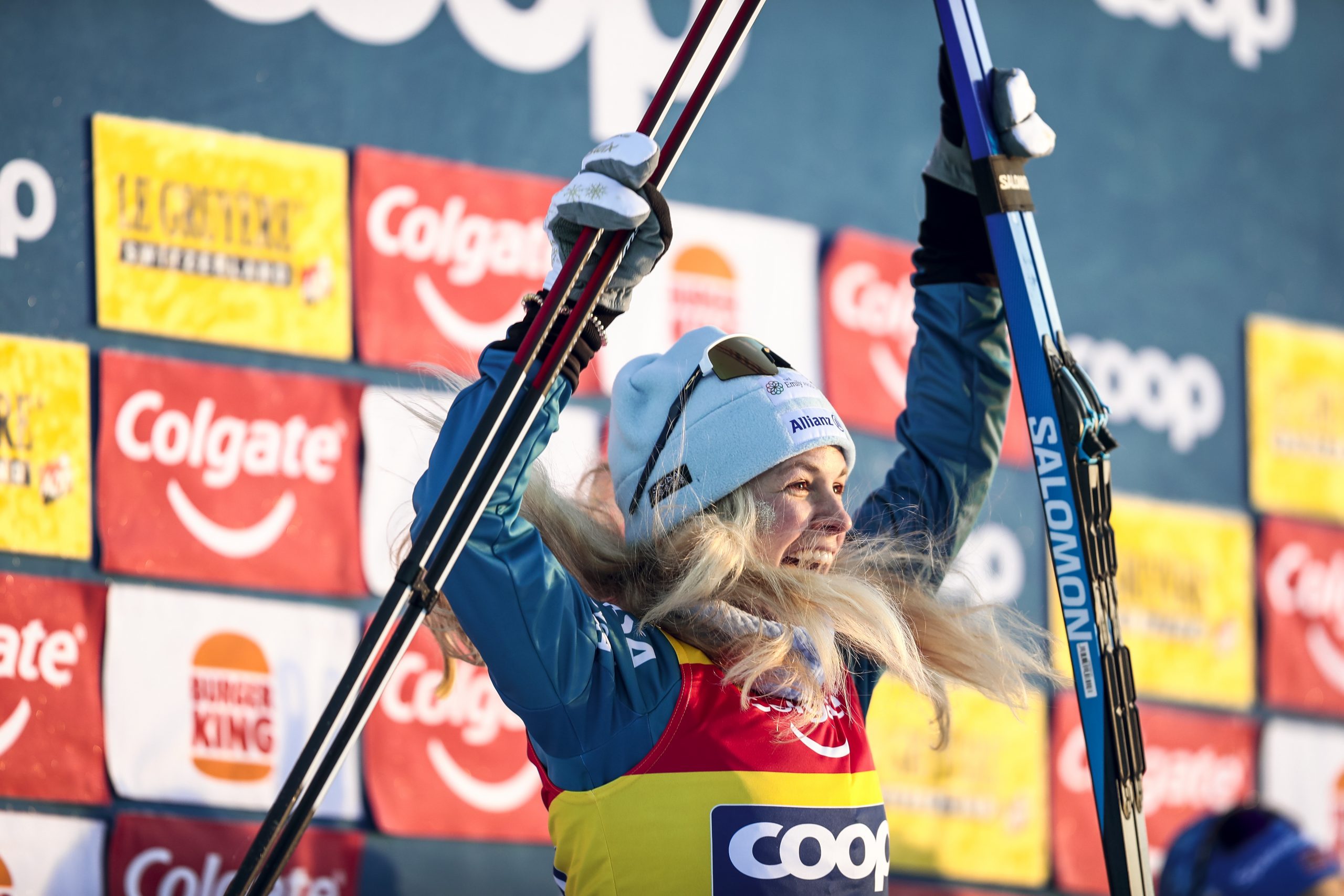
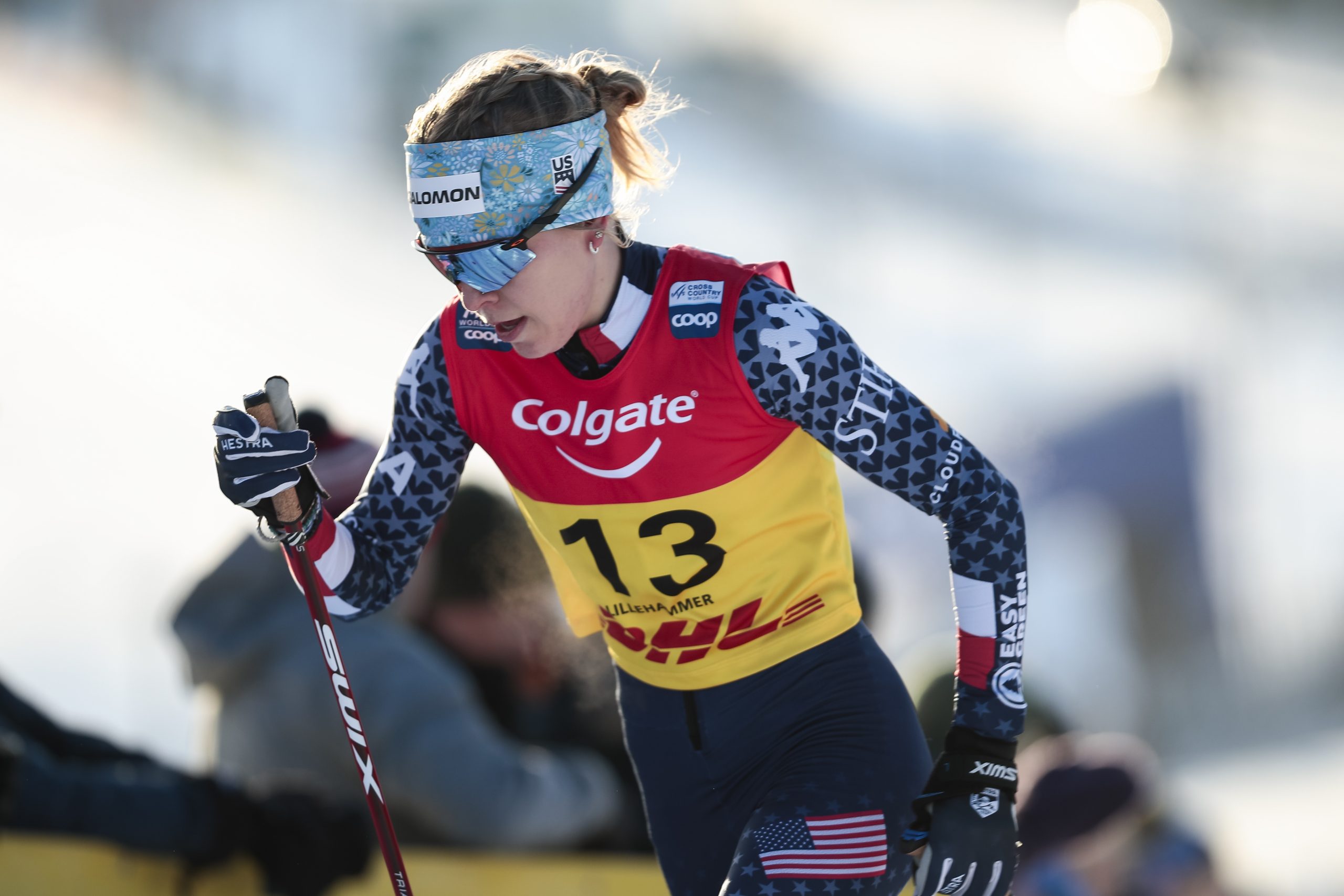
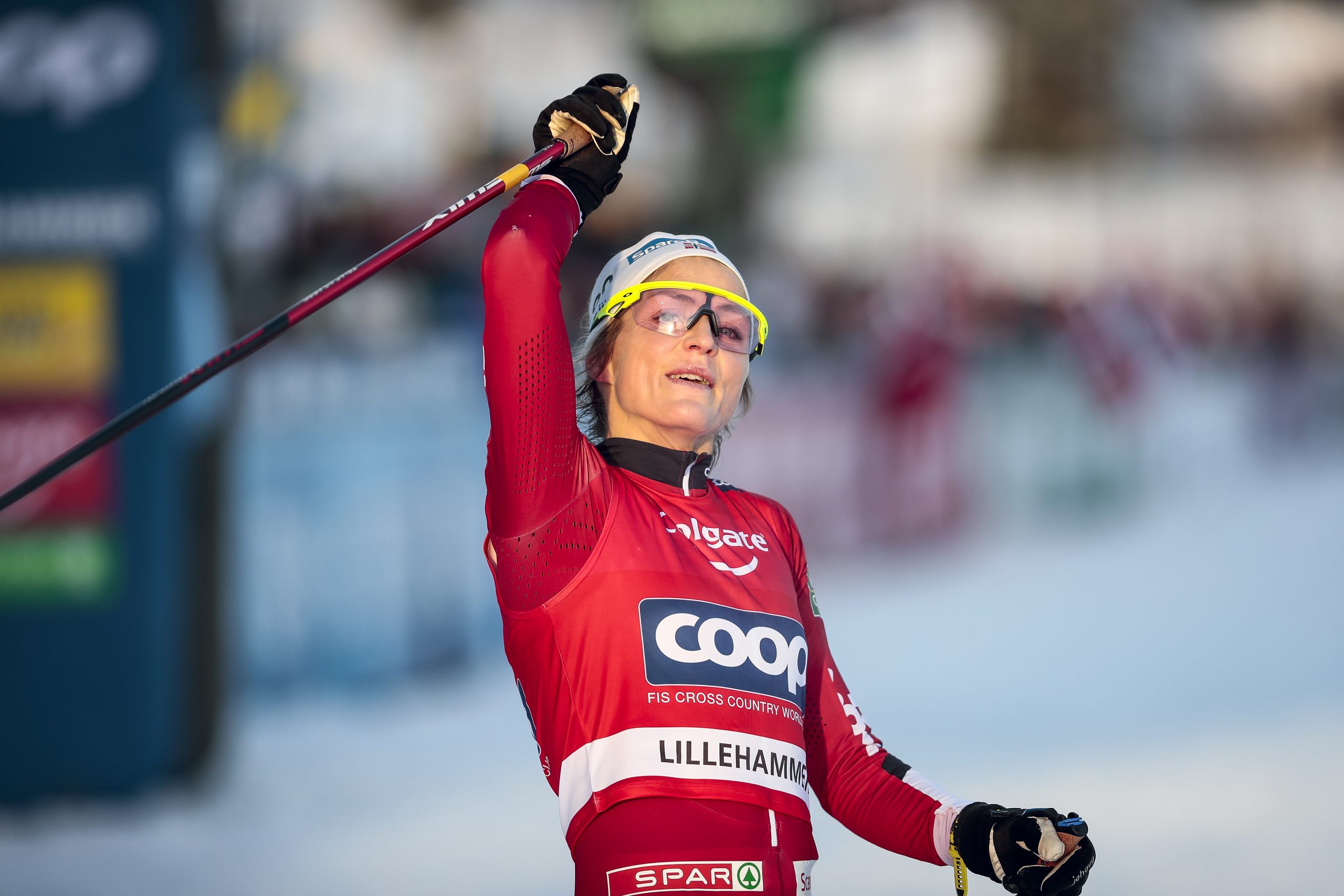
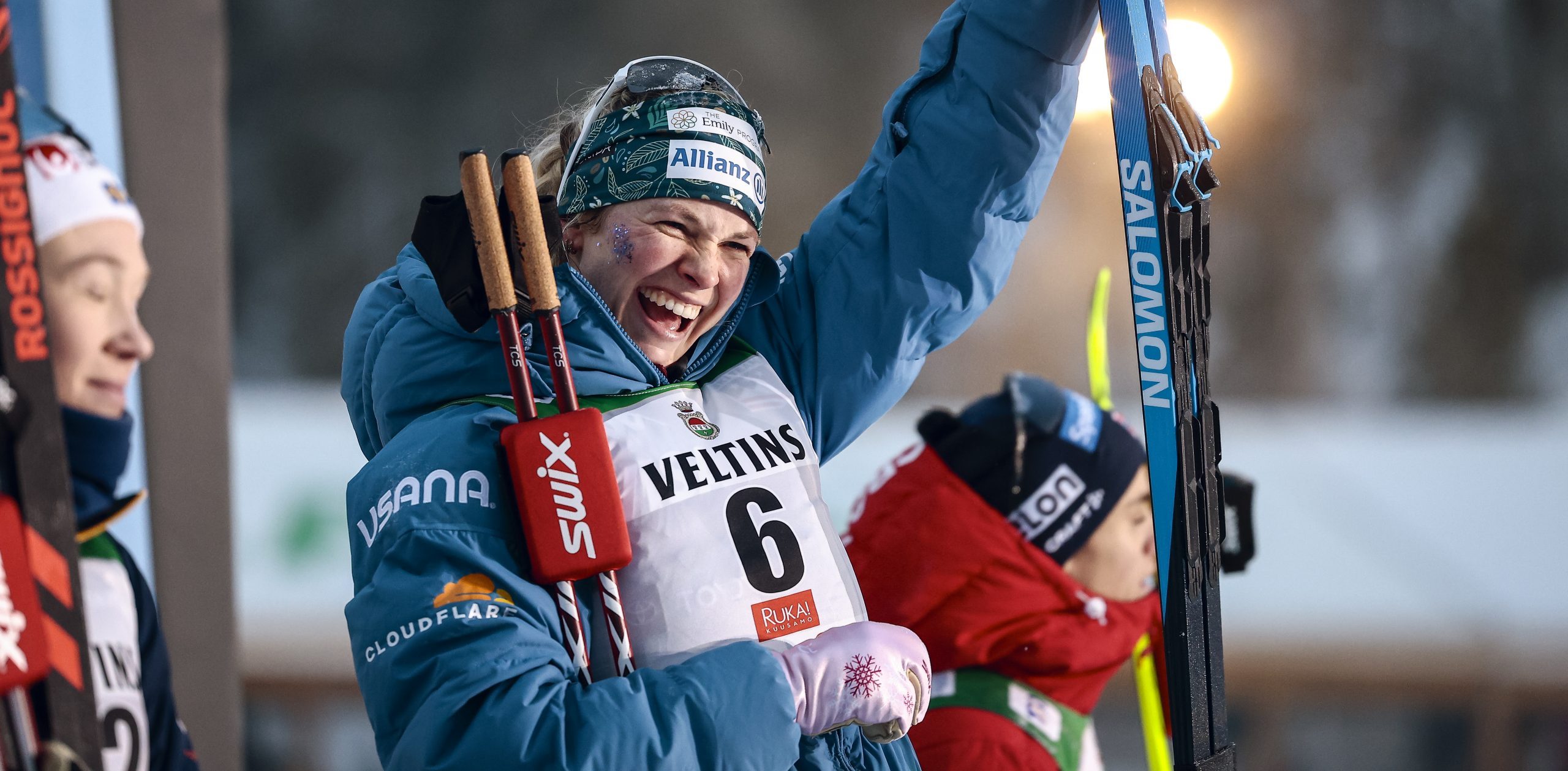
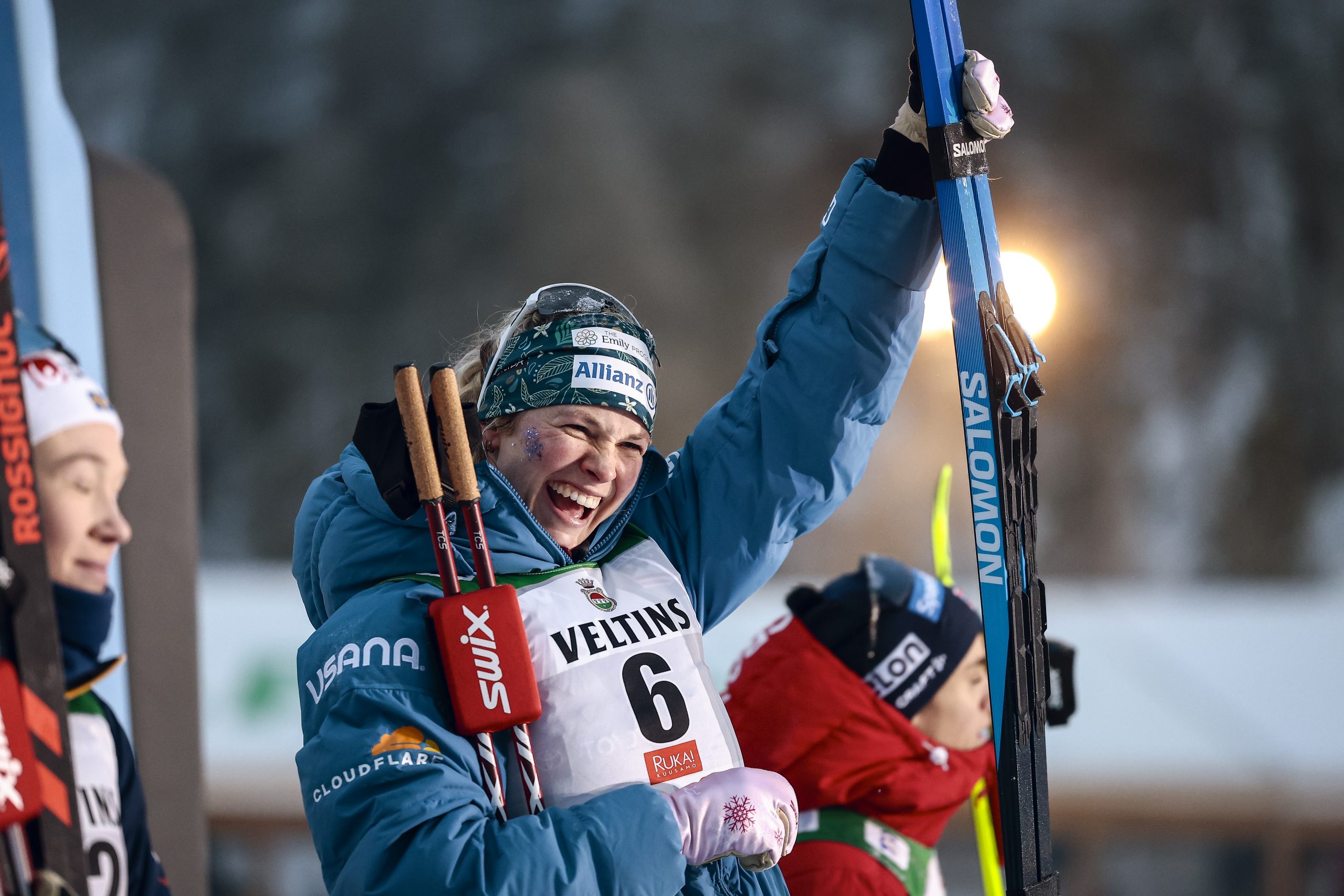
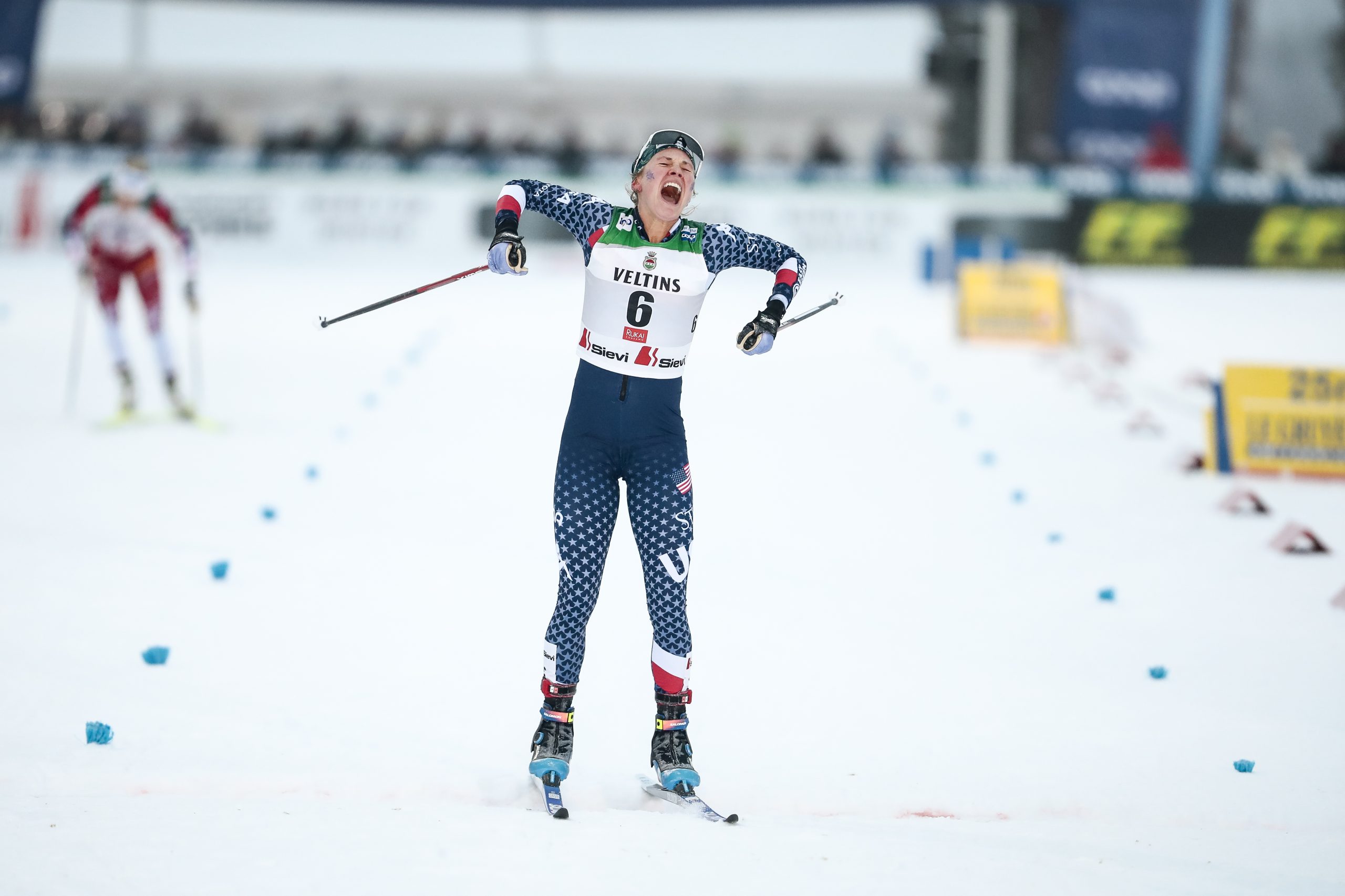
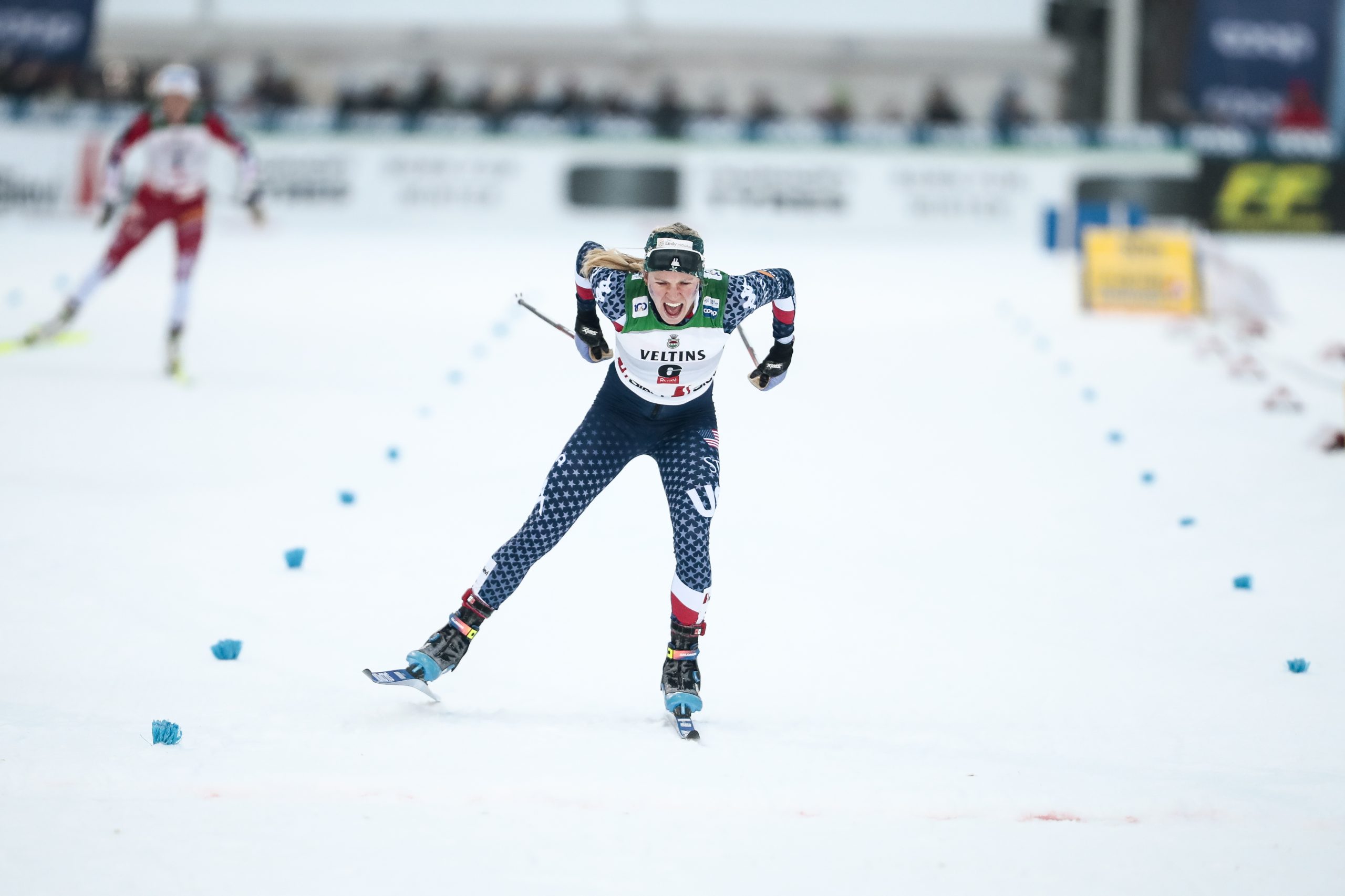
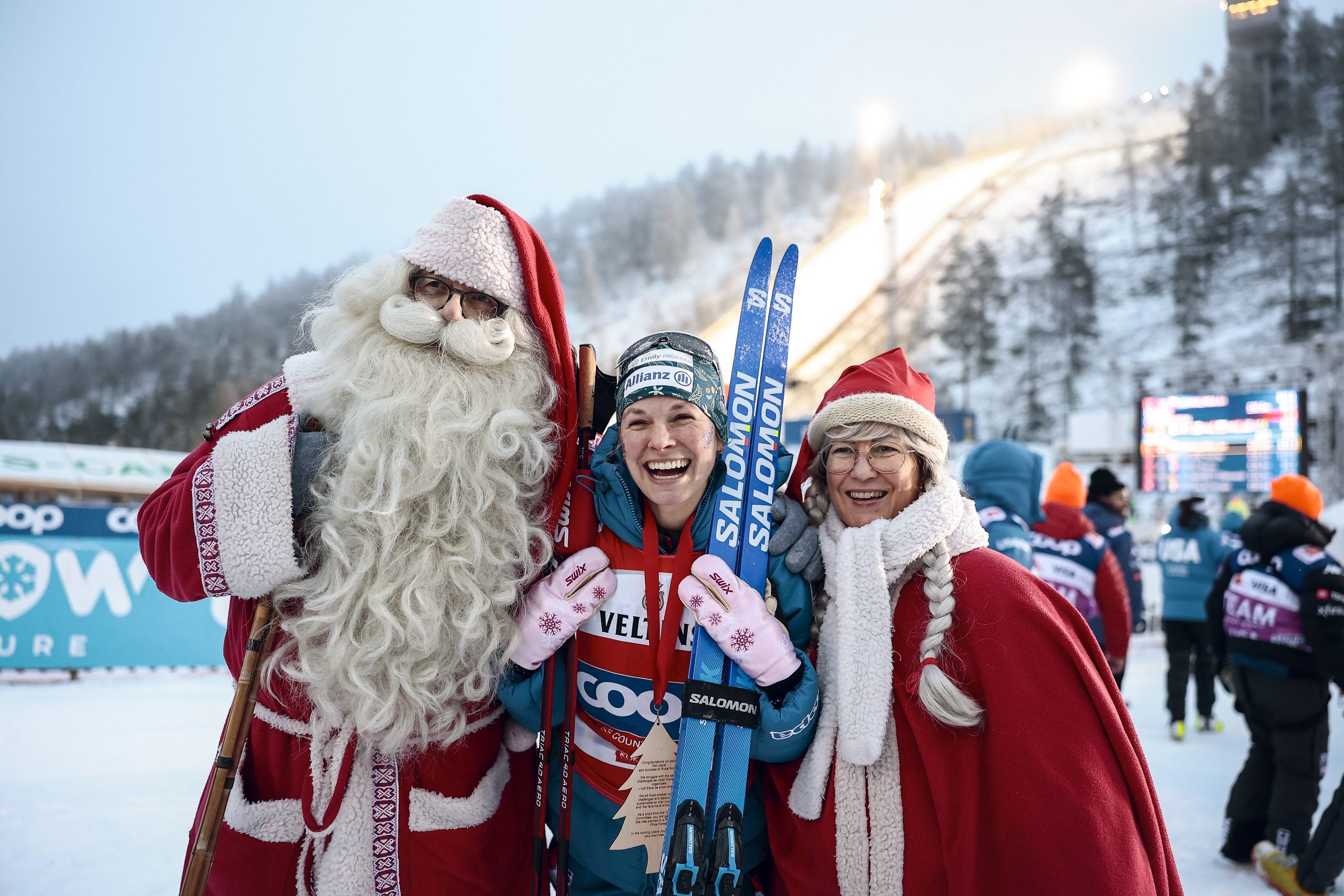
Jessie Diggins (USA) celebrates an entire career as she crosses the finish line of the 20 k Mass Start in Lake Placid. Thousands of fans in attendance celebrated with her. (Photo: Thibaut/NordicFocus)
While the men’s 20 k Mass Start Freestyle (raced earlier in the day) was the source of anticipation and intrigue, the Women’s 20 k was more likely to become a glorious victory lap. At the very beginning of the 2025-2026 season, Jessie Diggins had announced that this season would be her last. The most decorated American cross-country skier—and the winner of three World Cup Overall Crystal Globes—would hang up her skis after the final race in March in Lake Placid. Back then, that final day was still many months and many miles away. Today, Diggins toed the starting line for the beginning of these final kilometers. The staging of a glorious victory lap was entirely appropriate, and Diggins would make it one whether she won the day’s race, or not. That’s how she’s raced her entire career: joy in the competition, celebration in the victory, satisfaction in the effort, gratitude for the team. She’s left us breathless as many times as she has exhausted herself at finish lines, her effort as pure as the snow into which she has toppled after victories and defeats, alike. Her total effort and utter devotion could never have been in doubt. We have loved watching her give it all. Today, in Lake Placid, we were given one last precious opportunity to do so.
How ironic, then, that nature chose to rain, literally, on this parade. Spring conditions in the Adirondack Mountains are notoriously capricious. Lake Placid sits at the highest elevation of any village in the east, and the combination of elevation and proximity to both the Great Lakes and the Atlantic coast makes it a place for weathers to converge, for clouds to gather, where the mountains wear late-season robes of white, where the skies deliver showers of snow—and of rain. We’re often reminded that cross-county skiing is a winter sport—and racing through difficult conditions is the expectation, not the exception. So if there’s a victory lap to undertake, then a full-on storm of freezing rain seems like an appropriate way to do it.
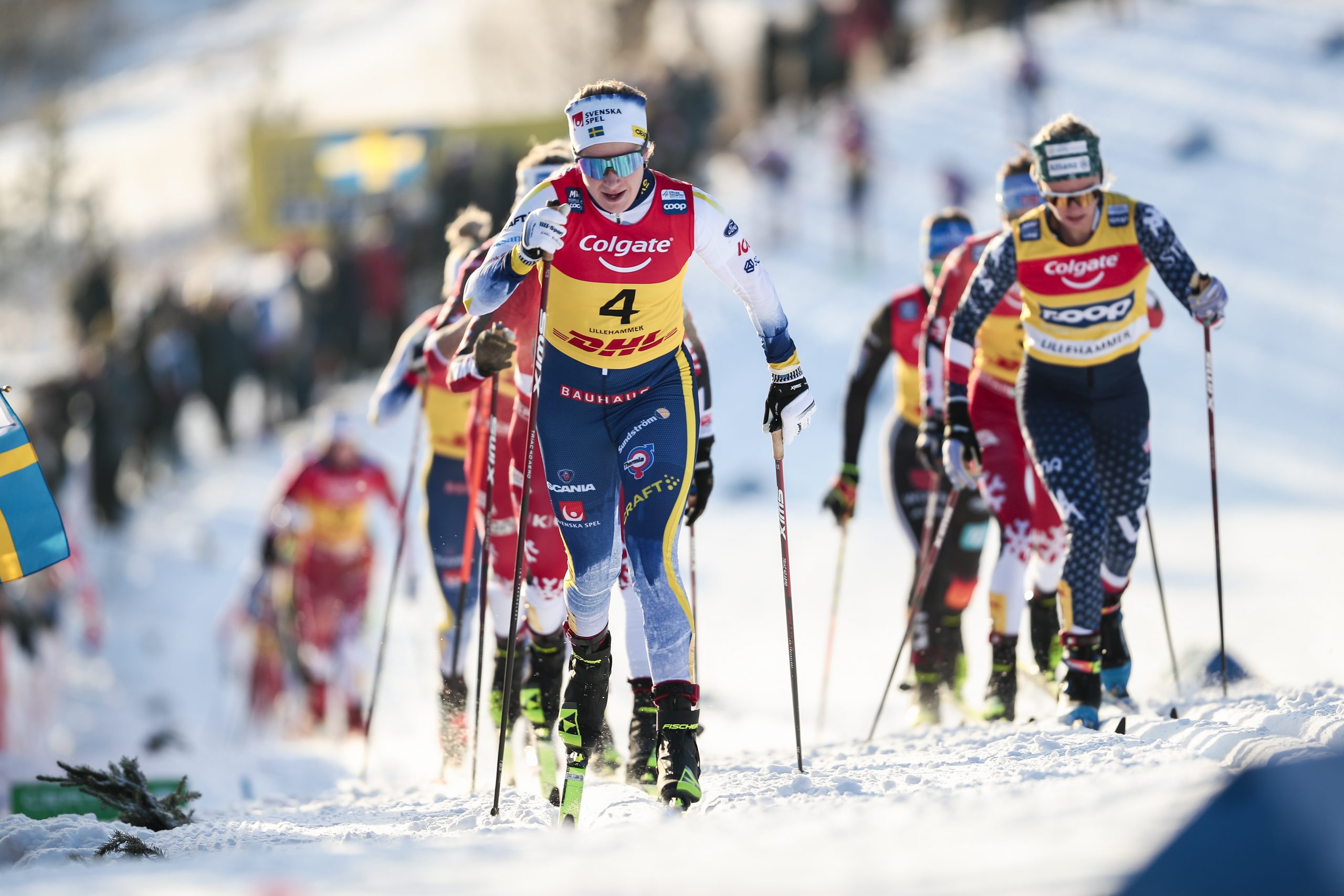
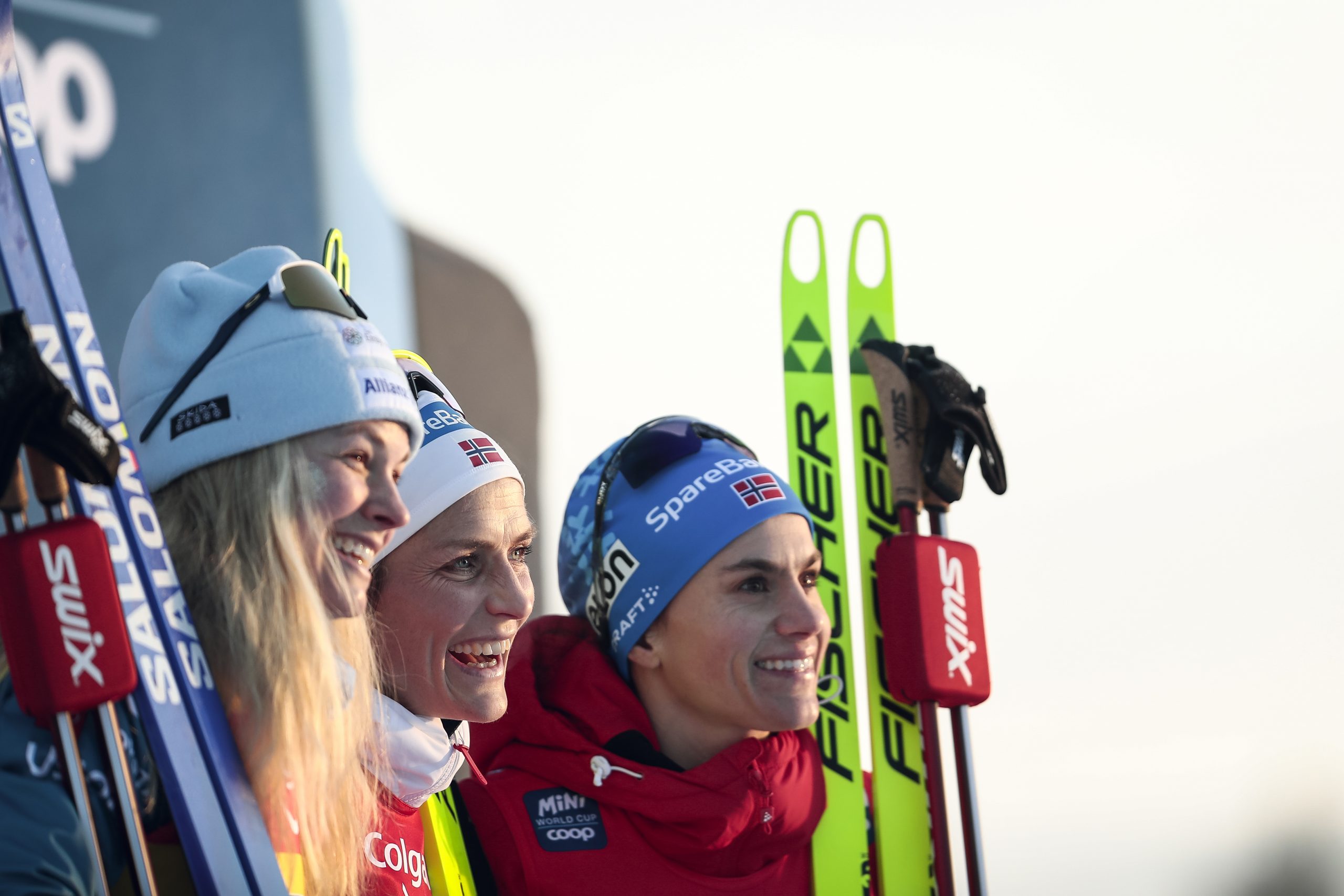
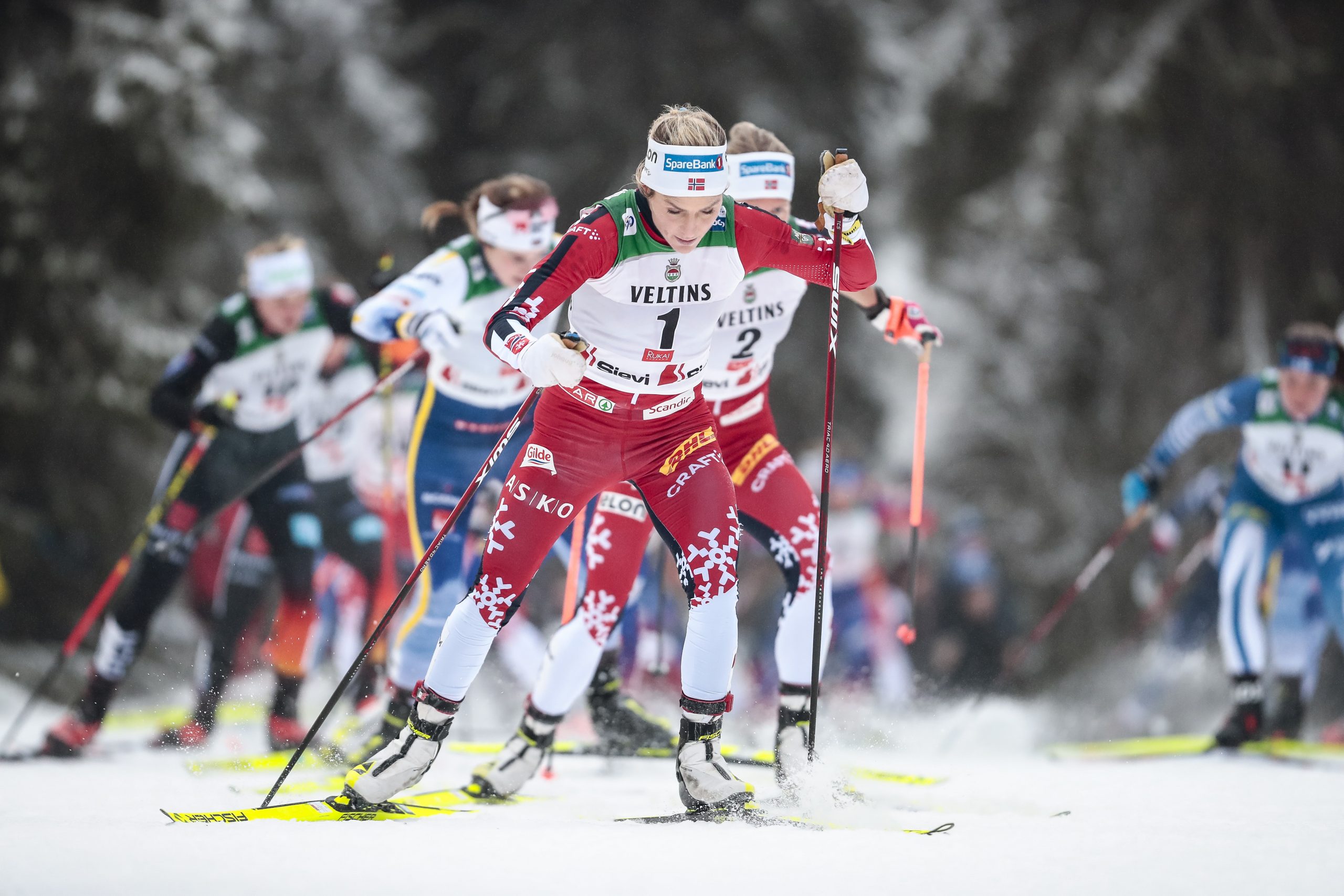
Heidi Weng (NOR) and Frida Karlsson (SWE) provided the pace for much of the 20 k Mass Start in Lake Placid, but they didn’t manage to drop the most dangerous sprinter, eventual race winner, Jonna Sundling (SWE). (Photo: Thibaut/NordicFocus)
20 k Mass Start
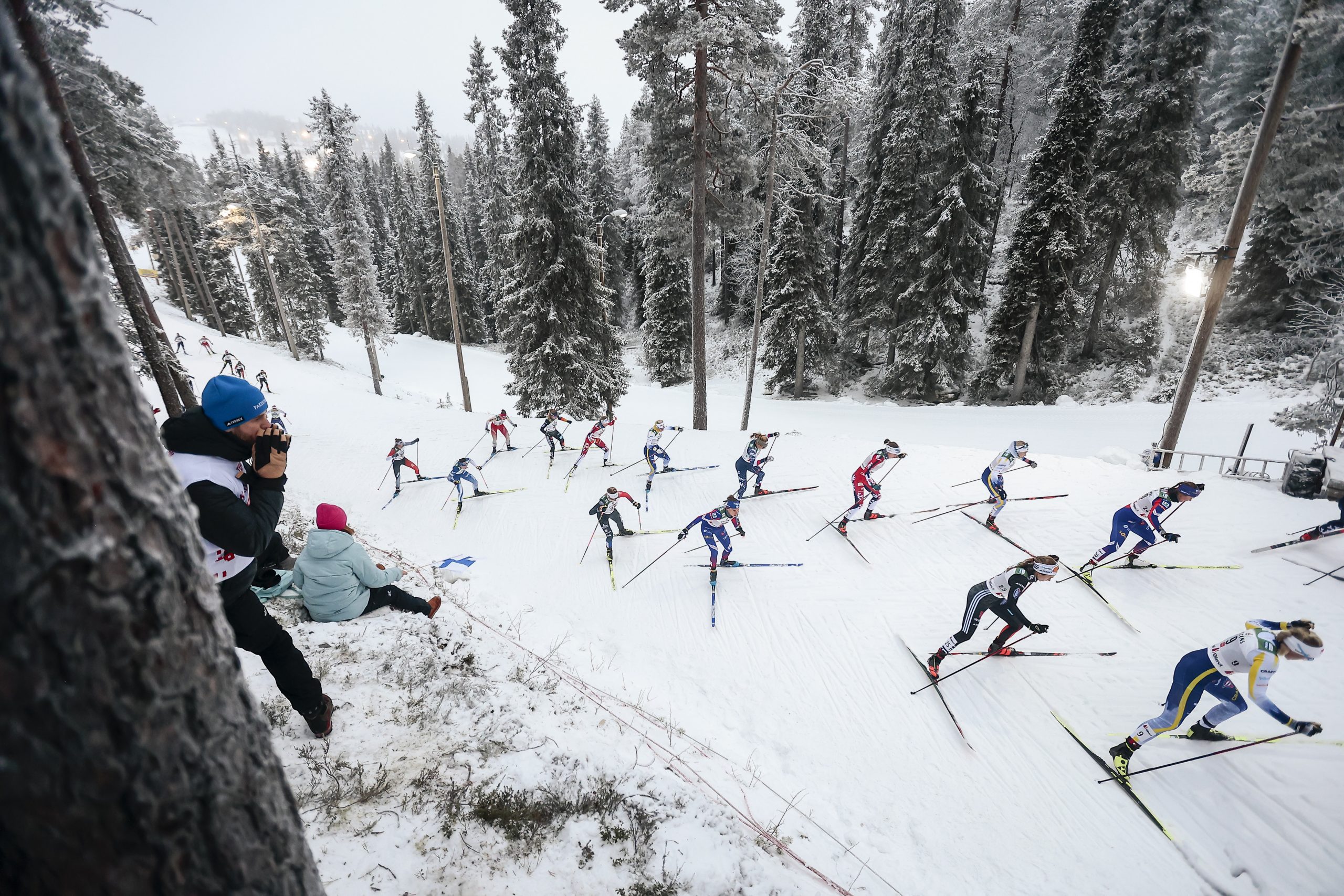
Fans knew who to watch: Frida Karlsson, Heidi Weng, and Diggins. And Diggins has a strategy that she folows in mass-start events: allow others to set the pace on uphills, even letting herself get gapped, only to close those gaps on subsequent downhills. When she uses that strategy, she keeps herself in contention for as long as possible.
At the 8 kilometer mark, those contenders remained together, and were in the company of numerous others who could play a part in the strategy of tis race. Astrid Oeyre Slind has begun to find the form that eluded her in Milano-Cortina,and Linn Svahn and Jonna Sundling lurked in the lead pack, hoping to be there at the end where their lightning-fast sprints could perhaps snatch victory from the distance specialists.
Karlsson set the pace in the early kilometers, but not at the uber-speed that has often been seen in women’s racing over the past few seasons. Weng came forward to take over the pace-making just prior to the bonus points line at 9 kilometers, moving Karlsson back into the pack where she is far less comfortable. So uncomfortable, in fact, that Karlsson immediately ran headlong into an unexpectedly fallen Slind. Both of them ended up in a tangle as Weng and the leaders glided away. Weng captured the bonus points that she needed to maintain her position on the podium of the Distance competition. Weng continued to push the pace, but all the logical contenders seemed capable of preventing her from breaking away.
Diggins moved to the lead at the 12 kilometer mark, using her fast skis and descending ability to glide to the front before powering up a mid-lap hill. Karlsson (who had weaved her way back to the lead) took up a position at Diggins’ shoulder. These two—along with Weng and Slind—would do their best to undo the strengths of the sprinters in the kilometers that remained. But with Diggins, Sundling, and Svahn still in contention, Karlsson and Weng were leaving things a bit late.
Karlsson, Weng, Diggins, and Sundling came through in order at the final bonus points line, seemingly less interested in those points than they were in positioning themselves for all that was likely to transpire in the final two kilometers. At the top of the final uphill, Norwegian Karoline Groetting surged to the lead. She was pursued by Karlsson and Weng, with Sundling and Diggins just behind. One kilometer to go, one major downhill to navigate . . .
Years ago—at the beginning of what was to become an historic career—a young and impetuous Jessie Diggins was often seen to lose control on downhills. She would ultimately overcome that limitation, becoming one of the best and most daring downhillers on the World Cup scene. Today in Lake Placid, though, Diggins’ past caught up with her. Every competitor would be exhausted at this point in a 20 k race, and maintaining control on any fast, winding downhill would be tremendously difficult. As the leaders descended a steep lefthand curve, Sundling picked an outside line that was especially fast. The video replay shows Diggins seeming to notice Sundling’s acceleration. The shift in Diggins’ posture made it clear that she felt the need to accelerate a bit, herself, but the extra step she took shifted her weight to the tails of her skis. Just like that, Diggins went down. Less than a kilometer from the end of the race—just minutes from the end of an astounding career—Diggins fell from contention. Not one to lie in the snow feeling sorry for herself while a race is going on, Diggins sprung to her feet and took off in pursuit of the leaders. Her race for today’s podium may have been over, but Diggins was far from being done with the racing. If only one kilometer remained in her career, Diggins intended to race her heart out over that final kilometer.
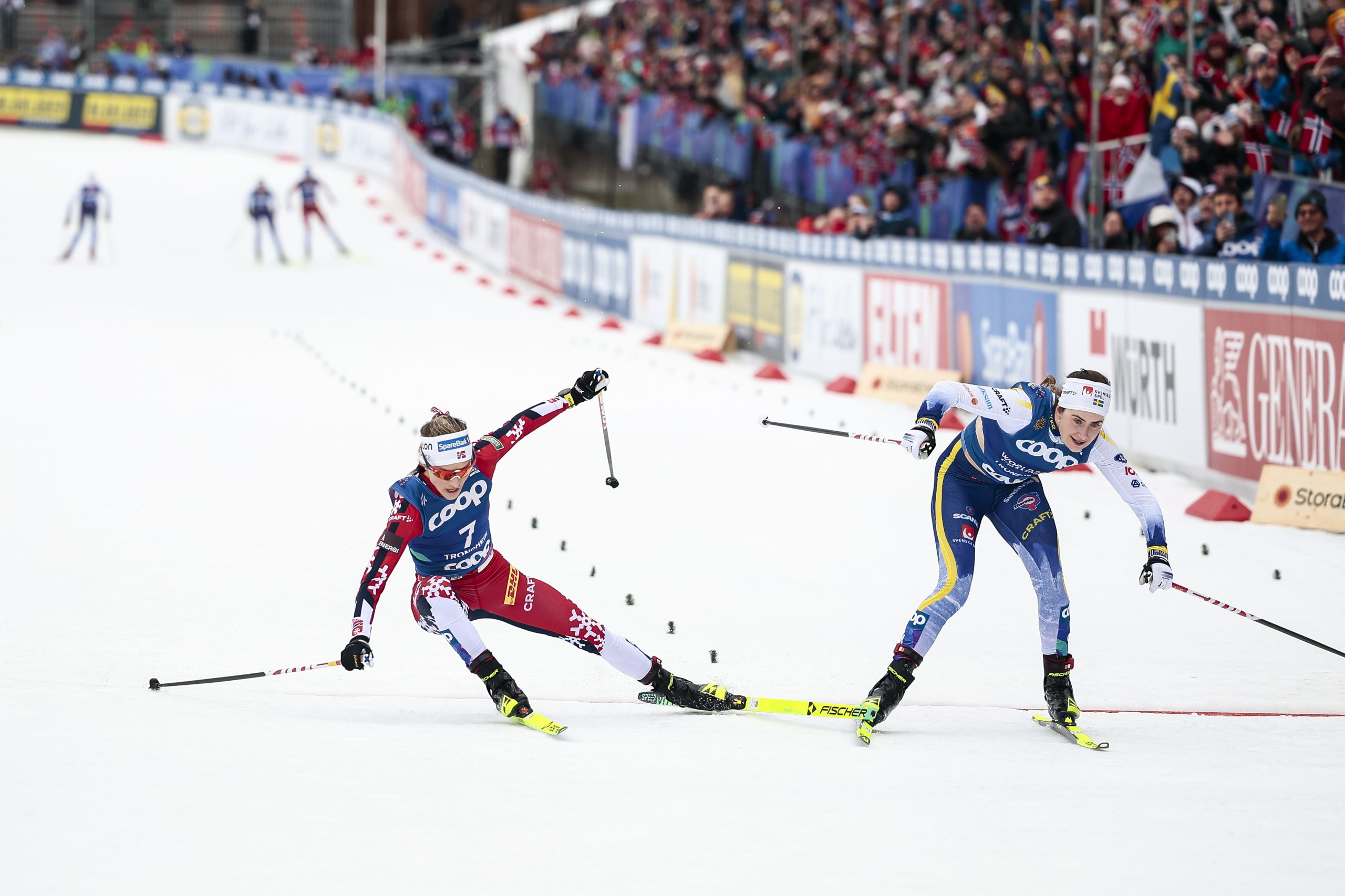
Jonna Sundling (SWE) was the skier everyone else in the field was most determined to drop. They didn’t . . . (Photo: Thibaut/NordicFocus)
At the front, Sundling’s daring downhill move had produced the speed she needed, and she stormed off the front followed only by the other best sprinter, Svahn. Weng was game in giving chase, but she had no chance of catching the two Swedish speedsters. Sundling first, Svahn second, Weng third. Diggins would recover from her tumble on the turn to finish 12th.
The last fifteen years have represented a golden age in women’s cross-country skiing, and there is one skier, in particular, whose career has spanned those years: Jessie Diggins. From the dominance of Justina Kowalczyk, to the excellence of Marit Bjoergen, to the determination of Charlotte Kalla, to the brilliance of Therese Johaug, to the spotlight she shares with the truly dominant team of Swedes, Diggins has born witness to the best this sport has had to offer. From them, she learned her craft. With them, she elevated a sport and thrilled an audience. The sport will miss her exuberance and her joy, her silliness and her seriousness. Thank you, Jessie, Diggins, for doing your best, for leaving it all out on the course, and for taking us all with you on this glorious victory lap.
Feature stories like this one take time, access, and care to produce. If you value thoughtful storytelling and independent ski journalism, please consider becoming a Voluntary Subscriber. Your support directly fuels the work we do to cover the people, places, and moments that make our sport special.
This coverage is made possible through the generous support of Marty and Kathy Hall and A Hall Mark of Excellence Award. To learn more about A Hall Mark of Excellence Award, or to learn how you can support FasterSkier’s coverage, please contact info@fasterskier.com.
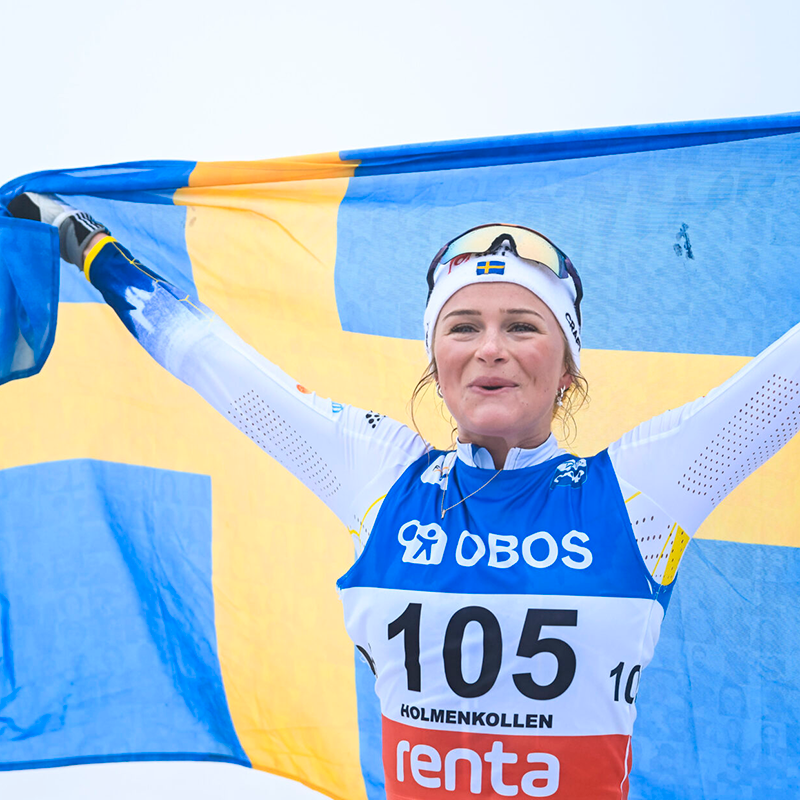
Frida Karlsson (SWE) claimed her third Holmenkollen win, her second at the 50 kilometer distance. (Photo: Authamayou/NordicFocus)
The prize for winning Oslo’s Holmenkollen 50 k is lifelong bragging rights. Such is the nature of the prestige afforded this event within the Nordic ski community. Norwegian fans, especially, remember certain years, certain races, certain rivalries; especially those that are memorable for the racing conditions that challenged the athletes. Fans are likely to remember this 2026 edition, and the thick, stubborn fog that enveloped the racers throughout the 50 kilometer distance. Stadium announcers regularly reminded the audience that racers were entering the stadium . . . otherwise, fans might not have known. The fog may have appeared thicker and soupier through the lens of broadcast cameras, but it’s certain that the fog hung close to the ground, obscuring skiers’ views of the course, of the crowds, and of their competitors. Perhaps that had something to do with the more measured pace the leaders selected. By the halfway point of the race, the entire women’s field was still together (not at all the normally expected state of affairs in women’s mass-start Distance racing). The regular cast of contenders remained at the front—Frida Karlsson (SWE), Ebba Andersson (SWE), Heidi Weng (NOR), Astrid Oeyre Slind (NOR), Jonna Sundling (SWE), and Jessie Diggins (USA)—but none of them seemed eager to race off alone.
Karlsson would emerge from the fog first, crossing the finish line all alone to claim her third Holmenkollen race, and her third at the 50 kilometer distance. Behind Karlsson, her Swedish teammates—Linn Svahn and Jonna Sundling—would sprint across the line in second and third, just ahead of Heidi Weng (NOR), Nora Sanness (NOR) and Jessie Diggins (USA).
“It’s such a magic day for our team,” beamed Karlsson. “It’s our first “triple” in the distance, and it’s sick!”
Alison Mackie (CAN) followed up a win at the U23 World Championships with a 14h place debut in the Holmenkollen 50 k. (Photo: Authamayou/NordicFocus)
Canada’s Alison Mackie remained in the top 10 through the halfway mark, and continued to make her presence felt throughout the 50 kilometer distance. . A young skier with a bright future, Mackie was certainly making he most of her first Holmenkollen. She would finish the day in 14th, sandwiched between established distance-racing stars Kristin Austgulen Fosnaes NOR) and Astrid Oeyre Slind (NOR).
Kendall Kramer (USA started 45th (out of 50 starters), but in the close company of the 46th starter, Delphine Claudel (FRA), a world class Freestyle competitor. If they could work together, they could make up many places in a hurry. By the five kilometer mark, Claudel had managed to work her way all the way up to the front . . . but Kramer was nowhere to be seen. Claudel would hang on to finish 28th. Kramer would cross the line 41st.
Clearly the best . . . Frida Karlsson (SWE) raced away from her rivals, exiting the fog to claim victory in Holmenkollen’s historic 50 k Freestyle. (Photo: Authamayou/NordicFocus)
Holmenkollen 50 k Freestyle
The Holmenkollen 50 k consists of six laps of an 8.3 kilometer loop, demanding 1000 feet of climbing per lap. And this day in Oslo, race organizers elected to stage the race in a manner that put both the women’s field and the men’s field on the course at the same time, albeit separated by half a lap’s distance. The men’s field would come through at the end of the bonus points at 19.6 kilometers just before the women started, providing a head start of approximately a four kilometers. Stragglers from the men’s field would ultimately be caught by the women. Likewise, stragglers from the men’s field would later be caught by the women. In the thick fog that hovered over the course during today’s race, there was plenty of opportunity for mild confusion.
Karlsson Weng, Andersson, and Slind would ease to the front, providing the early pace, but not going straight to the accelerator as they might have done on a normal day. Behind them, another predictable tier of racers followed, including Nepryaeva, Sundling, and Diggins. The men’s field had already passed through 20 kilometers in a massive, cohesive unit. It was possible that the bizarre conditions on the day would influence the women’s field to do the same.
Diggins won the bonus points at the three kilometer check point, gaining another 12 points over her closest rival in the chase for the Crystal Globe, Moa Ilar (SWE). Diggins would again remain ahead of Ilar at the 11.3 bonus points line. Diggins would collect eight points by crossing the line fourth.
Just before the end of the second lap, Slind stumbled and fell. She would need to spend extra energy to rejoin the leaders, if she was even able to. The field would slow a bit in the feed zone, but Slind would still have a gap of nearly eight seconds to make up . . . and Weng, Andersson, Karlsson, and Diggins continued to make the pace at the front.
Karlsson upped the pace as they approached the 27.9 bonus points line, gapping he rest of the field in the company of Weng and Karoline Groetting (NOR). Diggins led the rest just nine seconds behind, but it seemed that a gap was forming. Diggins would use the technical downhills of the Holmenkollen course to rejoin the leaders, though she also dragged other sprinters forward. With twenty kilometers remaining, the leaders had yet to get rid of Sundling and her Swedish teammate, Olympic Sprint champion, Linn Svahn. Karlsson and Weng would’ve known that their chances of victory relied on their ability to drop those sprinters. All the leaders opted to switch skis at the end of the lap. They would all be on new skis for the final two laps.
Karlsson used the first uphill of the fifth lap to break away. She was followed briefly by Groetting, bu by the top of the slope, Karlsson was away, disappearing into the fog at the front. Groetting would dangle alone in the fog ahead of a chase group led by Svahn. Diggins would continue to bob at the back—on again, off again—repeatedly showing her ability to close gaps and make up ground.
With 12 kilometers to go, Karlsson was away, in full flight, and powering through the fog. Her lead would continue to grow: ten seconds, 15 seconds, 30 seconds, ultimately extending to nearly two minutes. The solo chaser, Groetting, would be caught by the chase group that now consisted of six: Weng, Svahn, Sundling, Groetting, Nora Sanness (NOR), and Diggins. Diggins may be leading the World Cup Distance standings, but Karlsson was continuing to prove that she is the premier Distance skier in the world.
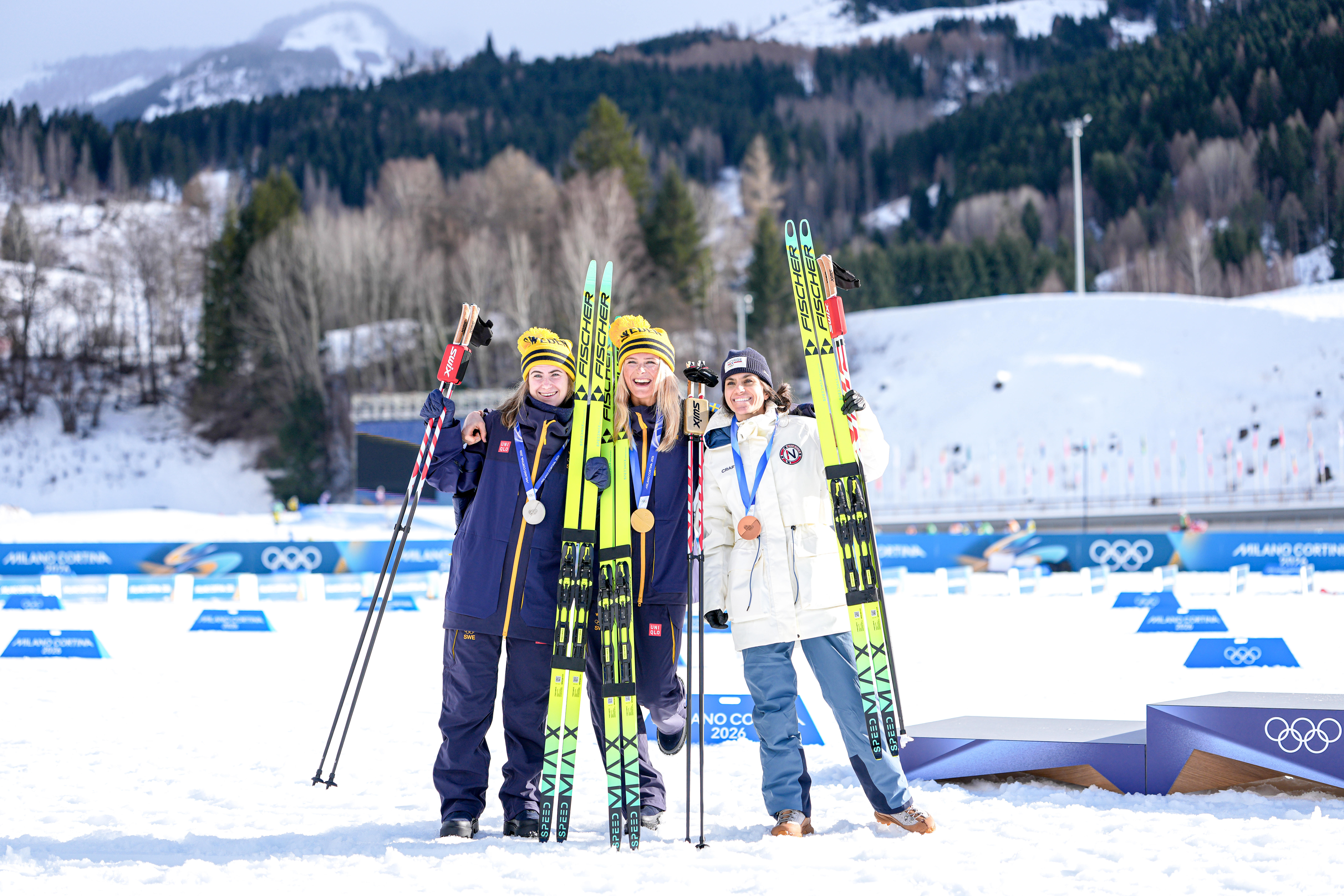
Linn Svahn (SWE), Frida Karlsson (SWE), Jonna Sundling (SWE) made up what Karlsson described as “Our first triple” in World Cup Distance podiums. (Photo: Authamayou/NordicFocus)
Karlsson would ski the last lap alone to claim her second Holmenkollen 50 k victory. The chase group would decide the podium with a sprint to the line, in which Svahn would outsprint Sundling. Weng would cross fourth, ahead of Sanness and Diggins.
Karlsson had shown the potential to exit the recent Olympic Games in possession of four gold medals . . . her performances would deliver only two (the Skiathlon, and the 10 k Freestyle). After the disastrous tumble of Ebba Andersson in the Team Relay (which allowed Norway to steal away the gold medal), and Karlsson’s own illness that kept her from competing in the 50 k, Karlsson appeared still to have something to prove when she toed the Holmenkollen starting line in Oslo. She would ski away from the rest of the best, stamping her authority on this historic race and claiming the sort of lifelong bragging rights that only the Holmenkollen can provide.
Feature stories like this one take time, access, and care to produce. If you value thoughtful storytelling and independent ski journalism, please consider becoming a Voluntary Subscriber. Your support directly fuels the work we do to cover the people, places, and moments that make our sport special.
Good luck finding the finish line . . . Linn Svahn (SWE) and Jonna Sundling (SWE) race through Holmenkollen’s thick fog toward the Swedish flag held aloft by race winner, Frida Karlsson (SWE). (Photo: Authamayou/NordicFocus)
This coverage is made possible through the generous support of Marty and Kathy Hall and A Hall Mark of Excellence Award. To learn more about A Hall Mark of Excellence Award, or to learn how you can support FasterSkier’s coverage, please contact info@fasterskier.com.
Jessie Diggins (USA), Frida Karlsson (SWE), Heidi Weng (NOR) in a finish for the ages . . . Falun’s 2 x 10 k Skiathlon came down to a three-skier drag race. (Photo: Authamayou/NordicFocus)
Cross-country ski racing fans know how the Women’s field races—flat out, wire to wire, merciless. That’s what made Falun’s 2 x 10 k Skiathlon look like an indicator of just how challenging and exhausting last week’s Olympic races must’ve been. The predicted contenders were together at the front, but the pace was unexpectedly conservative.
“When Karlsson is ‘on,’ she goes for it,” said on-screen commentator, Kikkan Randall. But Frida Karlsson (SWE) wasn’t going for it. She skied to the front of the Skiathlon field numerous times, but never seeming to have an intention to truly press the issue, or to attempt to break away. Fans will remember that Karlsson fell ill during the Olympic Games (after gold medals in both teh Skiathlon and the 10 k Freestyle), eventually choosing not to start the 50 k Classic where she had been the odds-on favorite to take gold. That race was only one week ago, so if Karlsson was then too sick to ski, it’s not inconceivable that she might still be feeling the effects of that sickness. Usually, Karlsson would race from the gun. Not today . . .
In a race that was oddly lacking for fireworks, the three prime contenders still managed to separate themselves from the rest of the field . . . but not from each other. Twenty kilometers of measured racing came down to a three-way sprint in a crowded finishing straightaway. With 50 meters remaining, Karlsson, Jessie Diggins (USA), and Heidi Weng (NOR) sprinted in a three-abreast dead heat, a drag race that was ultimately won by the narrowest of margins by a resurgent Weng. Diggins would finish a breathtaking .1 seconds behind, with Karlsson less than a second behind her.
Canadian skiers posted impressive finishes with Liliane Gagnon 17th, Alison Mackie 20th, Jasmine Drolet 37th, and Olivia Bouffard Nesbitt 41st.
Kendall Kramer (USA) has come out of the Olympic Games with new condifence and refined fitness. She skied to a career-best ninth place finish in Falun’s World Cup Skiathlon. (Photo: Authamayou/NordicFocus)
Just behind the lead group, Kendall Kramer (USA), would post a career-best placing, skiing forward from her #35 starting position to finish the day in ninth. Other American finishers included Hailey Swirbul 33rd, Rosie Brennan 35th, Novie McCabe 42nd, and Emma Albrecht 44th.
“I must have gotten a 50k fitness boost they talk about!” said Kramer. “This felt like the easiest race all season, and I could go faster at every point, felt in control and like I had more and more energy. I got a lot of semi-altitude training done during the Olympics and have just been enjoying skiing around since then! Usually, I falter off during the spring due to a long XC running season before Nordic starts, so without that this year, things look a little different with trajectory.”
Heidi Weng (NOR) has always been a contender, and often finishes on the World Cup podium, but she hadn’t had a World Cup win in four years. Falun’s Skiathlon delivered her some long-awaited redemption. (Photo: Authamayou/NordicFocus)
Classic Leg
Falun’s racing conditions would be challenging for ski technicians: 1.2 degrees Celsius (just over 34 degrees Fahrenheit) with very high humidity. Snow had fallen earlier in the day, so a nightmare wax-scenario was a very real possibility. And struggling through the ten kilometer Classic leg can prove disastrous. Randall mentioned the difficulty of preparing skis for the day’s conditions. “Many of the skiers had brought both pairs of skis to the start line . . . deciding which way to go,” she commented. Having been in that position, herself, during her long and storied World Cup career, Randall described the situation as “nerve wracking.”
Karlsson, Weng, Simpson-Larsen, and Diggins al seemed to be in possession of expertly prepared skis; they went to the front to begin making pace. Moa Ilar (SWE)—Diggins’ primary challenger in the season-long World Cup standings—appeared to struggle initially as her skis proved slick on the uphills.
Mackie latched on to the tail of the chase group as well, though she appeared to be struggling bravely with slippery skis. Early in the race, Kramer maneuvered through the field to overcome her early start position, skiing forward into a chase group that hovered ten seconds behind the leaders.
“I had perfect skis in Classic—kick every step and shooting ahead on the downhills,” said Kramer. “So I was granted some standing up rest time. I could double pole more than other girls were doing and that saved me a lot of leg energy. A good classic day does not always happen for me, but when I get the perfect kick (thank you, Per-Erik!!!) classic is very comfortable for me. When I am sloppy, I can’t hang with the pack at the start and am out of it from the beginning. I was happy to actually execute my fitness and stay with the leaders from the start and hang on from there- I’m learning in World Cup mass starts, if you’re not in it from the start (sprinting off the line), you’re out of it, so that was knowledge I carried with me here!”
As the pace settled, Diggins appeared confident, Weng appeared determined, Karlsson appeared tentative. Diggins would win top bonus points (15) at the 5.4 kilometer bonus sprint. Her closest World Cup rival, Moa Ilar, was eighth, earning three points. After ten kilometers of racing, the leading three would approach the ski exchange together. Diggins entered the ski exchange in front, but a bit of extra fiddling with her pole straps cost her time. She would start the skate leg near the back of the ten-skier lead group.
Kramer’s high start number meant her ski exchange gate was far down the line from the leaders (and off camera). Throughout the Classic leg, she had continued to press forward through the field, moving up to eighth place on the course and re-establishing contact with the lead pack. A slower exchange left her off the back of the lead group as the skate leg began. Still, Kramer’s position was only 11 seconds behind the leaders.
Frida Karlsson (SWE), led much of the day, but she was never able to deliver the sizzling agression that often accompanies her mass-start efforts. (Photo: Authamayou/NordicFocus)
Freestyle Leg
The skate loop would include Falun’s infamous climb, the Mördarbacken. Karlsson went to the front up the climb, followed by Weng. Diggins seemed content to remain within the lead group while her rivals did the work. Having been gapped slightly after the ski exchange, Kramer settled into a three-person chase group with Maia Dahlqvist (SWE) and Nora Saness (NOR).
Another bonus sprint was offered at the 14 kilometer mark. And the slower pace had allowed Ilar to rejoin the lead group along with Daria Nepryaeva (AIN). Ilar would finish third at the bonus, earning 12 points. But she would make up no distance on Diggins who crossed first to earn 15 points.
The slower pace of the day had also allowed another dark horse to sneak into contention. With five kilometers to go, the leaders became aware of the presence of Olympic Sprint champion, Linn Svahn (SWE) wearing bib 32. Always a capable Distance skier throughout her career, Svahn is enjoying a period of great form in these days following the Olympics. If the leaders failed to drop Svahn before the finishing straightaway, she would definitely steal the whole race.
Karlsson had not skied like herself this day, but when she saw Svahn in the lead pack, something seemed to click. Straight to the front went Karlsson. But it was a counter-attack by Weng that truly animated the race. Up a steep climb, Weng raised her tempo and established a bit of a gap over Karlsson. Behind them, Diggins tried to limit the damage in third, followed by a wobbling Nepryaeva and a game Svahn who appeared calm in her willingness to let a gap develop. Nobody panicked yet, but Weng had made her intentions clear. With four kilometers to go, she was committed to the finish line.
Diggins is a seasoned and experienced racer with enough mass-start races under her belt to know that gaps can be overcome by skiers who resist panicking on the parts of the course that are their weakness, and taking advantage of those parts of the course that are their strengths. For Diggins, her strength is found in the downhills where she is often able to close gaps. She knew she might still have a chacne to bridge up to Weng and Karlsson. With three kilometers remaining, Diggins regained contact.
Weng continued applying pressure, with the top three establishing a considerable gap ahead of Svahn. Within the final two kilometers, Karlsson again moved to the the front. She would know that her career results placed her no better than third among the sprint abilities of this lead group. Either she would drop Weng and Diggins, or one of them would snatch victory from her.
The final kilometer of the Freestyle loop re-traces the finish of Falun’s Sprint course, where it’s well known that leading over the final hill can be disastrous. Falun’s infamous draft favors those who follow up the hill and slingshot down the other side. Karlsson continued to insist on leading, though all three contenders seemed to stall at the top of the final uphill where Karlsson had still not managed to gap Weng, and while Diggins struggled she did not lose contact. With the Sprint-draft downhill ahead of her, Karlsson was in an unenviable position. She managed to maintain her position at the front as the trio entered the finishing straightaway. Fortunately, that straightaway was groomed three skiers wide, as the leaders charged toward the line three abreast. With 20 exhausting kilometers already in tehir arms and legs, the sprint would be as much about resolve as it was about sprint ability. Karlsson took the middle, Diggins eased past her on skier’s right, but it was Weng on the left who proved to have the most energy remaining. Four years removed from her last individual World Cup victory, Weng raised her arms in victory, elation, and relief. Diggins would cross just .1 seconds behind her, and less than a second ahead of a totally spent Karlsson.
Svahn would finish fourth, 11 seconds behind, just ahead of Nepryaeva. Kramer would conclude her day in ninth place, posting the best finish of her young World Cup career.
Diggins continued to extend her lead in the race for the 2026 Overall World Cup Crystal Globe, a competition that will be decided—and a trophy that will be awarded—at the season-concluding races a few weeks from now in Lake Placid, New York.
Feature stories like this one take time, access, and care to produce. If you value thoughtful storytelling and independent ski journalism, please consider becoming a Voluntary Subscriber. Your support directly fuels the work we do to cover the people, places, and moments that make our sport special.
The cost of doing business: athletic carnage among podium finishers at the finish line of the Women’s 2 x 10 k Skiathlon in Falun. (Photo: FasterSkier screenshot)
We’re done and dusted at the Olympics after a rockin’ women’s 50 k — the first-ever at the Games. Devon and Nat smash out a recap of the epic breakaway and the knock-down-drag-out battle for bronze.
We’ll be back next week. Reach us in the mean time at devon[at]fasterskier.com and nat[at]fasterskier.com. We’re really grateful for all the support during the Olympics — thanks for notes and encouragement.
A reminder: This is a homegrown podcast done by two guys working long hours and late nights. We’re also paying real money to be here in Italy. If you can, support the show and FasterSkier’s ongoing coverage with a voluntary membership.
Help Support Our Olympic Coverage!
FasterSkier will have our own Nat Herz on the ground at the Olympics, which, to be honest, is a very big financial lift for us. If you value the thoughtful work and access FasterSkier provides at championships like this one, please consider becoming a Voluntary Subscriber. Your support directly fuels the work we do to cover the people, places, and moments that make our sport special.
This article was made possible through the generous support of our voluntary subscribers who have helped put our Nat Herz on the ground at the Olympics. If you value coverage like this, please support FasterSkier with a voluntary subscription.
Joy at the end of a trying Olympiad: Ebba Andersson (SWE) celebrates her victory in the Olympic 50 k Classic. (Photo: Vanzetta/NordicFocus)
TESERO, ITALY — Two weeks of Olympic cross-country ski racing all comes down to this . . . fifty grueling kilometers of this, to be precise; a distance that women have raced only a few times on the World Cup and/or World Championship schedule, but a distance at which they are able to truly show their skills, their tenacity, and their ability as cross-country skiers.
These Olympics began with lofty expectations—in some cases, outrageously lofty—placed upon many skiers: Karlsson was seen as likely to win four golds: she started strong (winning gold in both the Skiathon and the 10 k Freestyle), but found herself benched by illness in the 50 k. Ebba Andersson was seen as a threat to topple her Swedish teammate, Karlsson, only to find herself toppled in a famously awkward and memorably catastrophic fall that cost Sweden the gold medal in the Team Relay. Jonna Sundling was billed as the best sprinter in the world (and was seen as likely to steal a medal in the Skiathlon, as well). Her moment in the Sprint spotlight was stolen by her own teammate, the rejuvenated Linn Svahn. And numerous mainstream reporters myopically favored Jessie Diggins to medal in all six events. After all, she’s the defending World Cup Overall Champion, right? And she’s currently leading the World Cup standings in both Overall and Distance, isn’t she? Reading those stats would seem to suggest that she’s the best skier in the world . . . and she may actually be that best skier, but the only skier who consistently lives up to such superlative headline predictions is the unmatchable Johannes Hoesflot Klaebo (who won all six of the men’s events here in the Olympic Winter Games of Milano-Cortina).
Jessie Diggins (USA) showed the sort of resilience and courage fans have come to expect, overcoming a disastrous ski exchange to race her way back into medal contention. (Photo: Barbieri/NordicFocus)
Diggins would fight through an unfortunate ski change, and endure a long struggle in returning to the group of bronze medal contenders, only to find herself gapped on the final uphill. Diggins would finish fifth behind fourth place, Kristin Austgulen Fosnaes. Ahead of them, Andersson would ski brilliantly and tirelessly to claim gold, well ahead of of Weng, and minutes clear of the third place performance from an elated Nadja Kaelin (SUI).
“If you had told me even a year ago, I’d be in the fight for a bronze medal in a 50k classic, I would not have believed you,” said Diggins. “It’s taken so much work from so many people for so many years to get here, and I’m just really proud of it.”
Among other Americans, Rosie Brennan would finish 16th. Hailey Swirbul would cross the line in her comeback Olympics to finish 20th while Kendall Kramer would finish 27th. Canadians would place all their finishers in the top 30: Jasmine Drolet 18th, Sonjaa Schmidt 26th, Katherine Stewart-Jones 28th, and Amelia Wells 29th.
Olympic 50 k: Heidi Weng (NOR), and Ebba Andersson (SWE), set the pace from the beginning. (Photo: Vanzetta/NordicFocus)
Women’s 50 k Classic
Pre-race intel reported that Sweden’s Frida Karlsson had taken ill, and was choosing not to race in today’s 50 k. Without Karlsson’s singular presence to push the pace (as she did during her dominant victory in last season’s World Championship 50 k in Trondheim), the race was left without a known direction or strategy. Like Karlsson, Sundling was a DNS, reducing the chances that the medals would be decided in flat-out sprints. Weng hoped to duel it out with Diggins and Andersson down the final kilometers.
The Olympic 50 k is conducted in a mass start format, seven laps of 7+ kilometers/lap raced in the Classic technique. On an unseasonably warm day—40 degrees (Fahrenheit) and sunny skies—waxing and base prep were likely to play outsize roles in the results. Within the first three kilometers, a lead group of a dozen skiers—containing all the prime contenders—began to ease off the front. The early pace was made by Andersson, followed by Weng, Diggins, Teresa Stadlober (AUT), and Astrid Oeyre Slind (NOR). Val di Fiemme’s challenging hills quickly began whittling away at the lead group as Andersson continued driving the pace, stringing out Weng and Diggins in her wake. Slind inexplicably pulled up on a challenging climb, stalling other contenders behind her including Kerttu Niskanen (FIN), Johanna Matintalo (FIN), and Dariya Nepryaeva (AIN). Slind would drop out of the race only a few kilometers later, a frustrating result for a skier who had entered these Games with such high hopes..
Jessie Diggins (USA) was an early animator in the Olympic 50 k. After a troublesome ski exchange, she’d come back to be part of the battle for the bronze medal (ultimately won by Switzerland’s Nadia Kaelin). (Photo: Barbieri/NordicFocus)
By 8.5 kilometers, a solid chase group would form involving Fosnaes, Niskanen, Matintalo, and Karoline Simpson-Larsen (NOR). At the front, the lead group had been reduced to three—Andersson, Weng, and Stadlober—as Diggins began to show the strain of he early pace. Even Stadlober had begun to wobble as the chasers continued to concentrate their pursuit.
Diggins was the first of the contenders to switch skis (at the 14.4 kilometer mark at the end of the Lap 2). She immediately regretted her decision as her klister-waxed skis tripped her dramatically on her way out of the exchange zone. Stumbling along the track—gasping and yelping audibly—Diggins lost considerable time, finding herself dropping to ninth place, 1:11 behind the leaders. Diggins would need to rely on her new skis working their way into the conditions, in the hope that they would ultimately provide an advantage. But even more time had been lost to the leaders who, themselves, had not shown any dissatisfaction with their own skis.
“I knew I had to switch early,” said Diggins. “I’m so glad I did. It was just a really gritty race. Literally every muscle in my body started cramping with three laps to go. So I can confidently say I could not possibly have tried harder or gotten more out of my body.”
“After that first pair of skis, she switched pretty early,” said US coach, Kristen Bourne. “But we also had a lot of confidence in that second pair . . . so we also had a lot of confidence giving her the the go-ahead to switch.”
The race settled into a few slow-developing stories:
Weng and Andersson were off the front, deciding gold between them.
Stadlober raced on alone in bronze medal position, but she found the gap behind her being eaten into by Niskanen and Fosnaes.
Diggins had fallen from contention, though her fortitude and pride were likely to prevent her from dropping out of her final Olympic event.
And then Diggins began coming back . . . maybe she began overhearing all of us commentators wondering if she might drop out of this race. That may be just the sort of motivation that Jessie Diggins needs. Diggins drove to the tails of Fosnaes and Niskanen. Together, they closed the gap to Stadlober who was pursuing better traction in the the snow outside the Classic tracks. While Diggins’ skis may have been a disaster in the first few meters after the exchange, it’s possible they were proving to have been a shrewd decision.
Andersson and Weng changed skis at the end of the fourth lap, where Andersson was pitched over her ski tips by her own sticky kick wax. At the end of lap four, Diggins had moved into bronze medal position as the chase group entered the stadium. Fosnaes was the only skier who opted to exchange skis. Stadlober, Kaelin, and Niskanen continued in pursuit of Diggins.
Soon after 30 kilometers, Andersson found her skis to be an advantage over Weng’s. By 34.2 kilometers, Andersson had opened a 20 second gap. She was still 45 minutes from the finish line, but Andersson was beginning to stretch her advantage.
Now in a group with Niskanen, Fosnaes, Kaelin, and Stadlober, Diggins may have sensed that her best chance to claim the bronze medal was not to be found in breaking away (thereby risking blowing up, herself) but to sit with this group in anticipation of a bunch sprint that would favor her own abilities. With two laps remaining, the chase group had decisions to make. Among those racers, only Diggins had already changed skis. Among this group, it was likely that someone would stop to make the change. If they did, they could find a late-race advantage, or they might find themselves giving up an advantage (in the time spent changing skis) that would be impossible to overcome. Kaelin, Stadober, and Niskanen all chose to change skis. Ultimately, all the chasing skiers would regroup, and immediately start considering their strategies. Diggins was the sprinter in the group; her advantage would be realized if the group came to the finish line together. Stadlober, Niskanen, Fosnaes—those are not sprinters—their only chance would be to drop Diggins and Kaelin before the finish line approached. Two laps to go . . .
And who the heck is Eliza Rucka-Michalek? The young Polish skier had been chasing all by herself for the last 40 kilometers. She finally connected with the chase group midway through he final lap, but would find that the efforts expendeded in reahing this group would be too costly to allow her to attack again. Rucka-Machalek would cross the line eighth.
The final kilometers were led out by Kaelin who was followed by an exhausted, but game, Fosnaes. Diggins shadowed them both, but the final climb would be excruciating for all. Kaelin had the best traction on the Zorzi climb; Fosnaes slipped a bit, as did Diggins who lost momentum when she stepped out of the tracks behind Fosnaes. Kaelin would maintain her advantage over the top of the climb, holding on for bronze, followed by Fosnaes and Diggins.
“I’m so grateful for our entire staff behind the scenes,” said Diggins. “They have been like, putting my body back together so that I could be out there today fighting. And I just, I wanted to do that for them. I wanted them to know like, ‘Hey, I am so grateful. Like, I’m gonna finish this. I’m gonna leave it all out there.’ And honestly, the most special thing was that I got to hug my mom on the side of the course before the race, and it’s just so cool to know that they were here for my last Olympics, and I got to end it on a beautiful day in a venue that I love so much. I’m just really proud of this last Olympics and really grateful and really happy, and I’m leaving here just full of joy and probably needing a new body.”
“I mean, we’re super proud of this team,” said Bourne. “And to walk away from this Olympics being like our most successful ever by having a variety of people—three different people—getting Olympic medals is, excuse my language, but #%&!@ insane! And I mean, man, we’re just super proud and stoked to keep the season going after a little bit of rest.”
Friends and rivals: Heidi Weng (NOR) and Ebba Andersson (SWE). (Photo: Vanzetta/NordicFocus)
Weng raced bravely and strategically in what may have been her final Olympics. She would claim silver, falling just short in her own quest for individual Olympic gold.
Andersson would continue extending her lead—20 seconds, 40, 60, 90—to claim a gold medal to go along with her three silvers earned at these Games. Here at the end of an Olympic campaign that found her hitting the deck again and again—including that spectacular somersault and subsequent one-ski scooter-pushing during the disastrous (though ultimately silver-medal-winning) Swedish relay—Andersson raced across 50 grueling kilometers to find glory at the finish line. Individual Olympic gold was finally hers, as well as respect and redemption after days of trials and tribulations.
FasterSkier will have our own Nat Herz on the ground at the Olympics, which, to be honest, is a very big financial lift for us. If you value the thoughtful work and access FasterSkier provides at championships like this one, please consider becoming a Voluntary Subscriber. Your support directly fuels the work we do to cover the people, places, and moments that make our sport special.
Heidi Weng (NOR), Ebba Andersson (SWE), Nadja Kaelin (SUI), on the podium of the Women’s 50 k Classic Mass start, the final cross-country event of the 2026 Olympic Winter Games in Milano-Cortina. (Photo: Barbieri/NordicFocus)
That was a banger. We’re deep into the Olympics now, and Devon and Nat return for the third straight night to recap the women’s relay. One more race — the Norwegian men versus the world — and then everyone gets two days off.
Reach us at devon[at]fasterskier.com and nat[at]fasterskier.com. We’ll be back tomorrow.
A reminder: This is a homegrown podcast done by two guys working long hours and late nights. We’re also paying real money to be here in Italy. If you can, support the show and FasterSkier’s ongoing coverage with a voluntary membership. We’re also offering a bonus during the Olympics: a WhatsApp group with notes on Nat’s experiences in Italy, the food he’s eating, interview transcripts and more.
Send nat[at]northernjournal[dot]com a confirmation of your voluntary membership and the number he should use for WhatsApp and we’ll get you signed up. You can also Venmo him directly at @nat-herz if a membership isn’t for you. We’re suggesting a minimum of $10, but we also won’t turn anyone away who wants to join because of an inability to pay.
Help Support Our Olympic Coverage!
FasterSkier will have our own Nat Herz on the ground at the Olympics, which, to be honest, is a very big financial lift for us. If you value the thoughtful work and access FasterSkier provides at championships like this one, please consider becoming a Voluntary Subscriber. Your support directly fuels the work we do to cover the people, places, and moments that make our sport special.
This article was made possible through the generous support of our voluntary subscribers who have helped put our Nat Herz on the ground at the Olympics. If you value coverage like this, please support FasterSkier with a voluntary subscription.
Norway claimed the Team Relay gold medal in the Olympics of Milano-Cortina. Heidi Weng (NOR) skied the anchor leg all alone . . . she never would’ve expected that. (Photo: Vanzetta/NordicFocus)
On paper, no one beats Sweden. After the first three events of these Olympics, Sweden had won all three gold medals. Before the games began, most ski-experts gave few other nations a chance of grabbing any gold in Women’s Cross-Country . . . especially not in the relay. Just consider Sweden’s roster: Linn Svahn, Ebba Andersson, Frida Karlsson, Jonna Sundling. Svahn is the world’s best sprinter. With two silver medals thus far, Andersson has proven herself the second best distance skier at these Olympics. The first two gold medals in Olympic distance races have been won in peerless fashion by Karlsson. And Sundling has been Sprint racing’s World Championship and Olympic Gold medalist. If you wanted to construct a relay team that was certain to win gold, those are the names you’d print on your entry.
On paper, no one beats Sweden, but cross-country ski racing is a sport that regularly refuses to follow the script, and Olympic medals aren’t handed out based on which team submits the most impressive set of skier résumés. Ski racing happens out on a snow covered course between start lines and finish lines: punishing uphills, treacherous downhills, sharp curves, and variable snow. It’s not a running race . . . and the challenges of racing at high speeds on long, flexible skis with no metal edges means that just about anything can happen.
And it did . . .
The field of the 2026 4 x 7.5 k Olympic Relay leaves the starting line. Drama would be soon to follow. (Photo: Barbieri/NordicFocus)
Scramble
Skiers call Leg 1 of the relay the “Scramble Leg,” a self-evident appellation that often finds teams assigning a capable sprinter to the task. The first kilometer of Leg 1 can be a crowded scrum—shoulders rubbed, elbows thrown, ski tails trod upon, poles at risk. The job of the Leg 1 skier is simple: weave through traffic, stay out of trouble, don’t get dropped. The Val di Fiemme course has already shown that it challenges racers with its tight turns and slushy snow. Falls have been common and consequential in Nordic events thus far in the Olympics. And a race day that offered 40 degree temperatures and light rain made the waxing a bit of a tricky prospect for the first two Classic legs.
Racers would ski two laps of 3.75 kilometers each. Though the field endured the rippling effects of a crash in the opening kilometers, the race settled quickly into a pack of 12 contenders. By the second lap of Leg 1, Svahn had begun to open a gap—not so much a breakaway as it was a demonstration of a team racing at a different level. Norway’s Kristen Austgulen Fosnaes and Italy’s Iris di Martin Pinter gave chase, but it appeared that the expected Swedish dominance had begun.
Julia Kern (USA) maintained her position in the top 12, but seemed to be struggling a bit to do so. The American team has struggled with slow Classic skis thus far in these Olympics, but Kern appeared determined to keep her team in contention.
Ebba Andersson (SWE) had a nightmare of a day on the course of the Olympic Relay. (Photo: Vanzetta/NordicFocus)
Leg 2
Kern had continued moving forward through the field, and tagged Rosie Brennan with Team USA in seventh place. Early in the second leg, Andersson suffered an awkward fall that allowed Norway’s Astrid Oeyre Slind to move to the front. Slind and Italy’s Caterina Ganz did their best to add to their advantage as Andersson struggled to overcome the deficit. Just like that, Sweden had a problem: Slind was now racing to win, and Ganz was racing in her home country. Both appeared energized and fresh.
Andersson ultimately reeled in Ganz, but Slind continued to widen the gap. Behind her, the brilliant Classic technician, Kerttu Niskanen had worked Finland back into the race alongside Italy. Brennan continued to maintain USA’s place in the top seven, as Andersson continued working her way back toward the front. Team Swedn knew htat if it could get back to Slind, then Karlsson and Sundling would likely still be able to deliver victory.
And then the wheels fell off the Swedish juggernaut . . . and in most spectacular fashion. Andersson had often appeared uncomfortable during her relay leg. Then, on a fast slushy downhill, she caught the tentative outer edge of a high-speed snowplow, somersaulting her across the course in a violent, end-over-end crash that left her briefly stunned and scattered. Andersson scrambled quickly to her feet, only to find herself standing on only one ski, the other one coasting down the slope with a broken binding. Andersson sprinted forward to collet her ski, but the damage to the binding was too severe. Only one thing left to do: run for it. Cradling her crippled ski in her arms, Andersson began frantically scooter-pushing her way up the course. There are plenty of places on a world-class ski course where coaches and team personnel wait with spare poles (just in case one gets snapped). When skiers break a pole, it’s definitely going to affect their progress and their placing, but those poles will likely be replaced pretty quickly. A broken ski is another matter, entirely . . . and the likelihood of a coach standing in the right place wearing skis preppred with decent race wax is not all that high. Andersson knew her team’s chances were fading, and she ran for her life. Eventually, a coach appeared with a ski that must’ve been a decent match, and Andersson was able to get back into the race.
“Yeah, it was a lot of emotions going through my whole body and the mind at that moment,” said Andersson in post-race interviews. “And, yeah, it was a completely disaster. And first I was thinking, ‘oh, I need to fix it by myself.’ But then I understood that, okay, I won’t be able to do it. So then I just tried to go as fast as possible down the hill and to one of our coaches that was running with a new one. After that, I just tried to minimize the disaster that was already done.”
But the damage had been done. Sweden now trailed by over a minute, and a rejuvenated Team Norway was forcing the pace at the front.
Frida Karlsson (SWE) overcame much of the deficit created by Andersson’s disastrous fall, but the gap was simply too great. Sweden would settle for silver. (Photo: Barbieri/NordicFocus)
Leg 3
Karlsson would start with a deficit of 1:18. She’d start whittling away at that gap as soon as she took to the course. Slind would hand Karoline Simpson-Larsen a lead of 23 seconds over Finland and Switzerland. But every fan’s attention would have been directed to Karlsson as she began Leg 3 with a deficit of 1:18. Karlsson appears to be in tby far the best form of any of the distance skiers at these Olympics, but so wide a gap would be nearly impossible to solve. Nonetheless, she set off in pursuit.
Novie McCabe skied brilliantly to move Team USA into fifth place, but even as she did she found her position eclipsed by the flashing white suit of Karlsson who appeared determined to bring Sweden back into medal position. Like Karlsson, Martina diCenta turned up the speed to overtake Switzerland’s Marina Kaelin, moving the host nation back into third place as the field neared the stadium.
Joy at the finish line: Heidi Weng (NOR) celebrates Norway’s unlikely victory in the Olympic 4 x 7.5 Relay. (Photo: Vanzetta/NordicFocus)
Anchor Leg
Simpson-Larsen handed Weng a lead of 48 seconds, followed another nine seconds later by Italy. Yet another nine seconds later, Karlsson tagged Sundling, who set off in pursuit of the medals. Finland’s Jasmi Joensuu held second place, and Italy’s Federica Cassol clung stubbornly third . . . but Sundling was flying, and Italy and Finland would have no answers for a hard-charging World and Olympic champion.
The anchor leg played out in three segments. At the front, Weng continued to race on alone, checking her speed on each downhill curve, but working the uphills and flats like the former World Cup champion she is. In the medal chase, Sundling was storming forward through the contenders, having already caught Italy, and reeling in Finland before the beginning of the penultimate lap. Behind the medal struggle, Diggins led a small group of chasers poised to claim prizes if any other disasters befell the leaders.
In the end, Weng would hold on to Norway’s lead, jubilantly sprinting across the line even with a lead that needed no such efforts. She screamd with joy at the finish line where she was immediately embraced by her teammates. Norway had felled Goliath, and proved the experts wrong. Behind them, Sundling would shed Joensuu and coast across the line for silver. Sundling skied into the embrace of her teammates, but their posture was anything but celebratory. Finland would claim bronze, followed by Germany, United States, and Italy.
On paper, no one beats Sweden. But cross-country ski racing is a sport raced on snow rather than paper, and Olympic medals are won, not given. Sweden can be proud of an Olympic sliver medal in the Team Relay, but the gold that Norway takes home will be one that will be treasured and remembered for ages.
FasterSkier will have our own Nat Herz on the ground at the Olympics, which, to be honest, is a very big financial lift for us. If you value the thoughtful work and access FasterSkier provides at championships like this one, please consider becoming a Voluntary Subscriber. Your support directly fuels the work we do to cover the people, places, and moments that make our sport special.
The race was ON from the gun: We recap the women’s 20-kilometer pursuit, which was a rough go for Jessie Diggins and a tight fight between the Scandinavian heavyweights.
Alaskan Holly Brooks, the retired Olympic World Cup racer, joins us after watching the race in person. We hope to get proof of life from Devon soon.
In the mean time, reach us at devon[at]fasterskier.com and nat[at]fasterskier.com. We’ll be back tomorrow.
Help Support Our Olympic Coverage!
FasterSkier will have our own Nat Herz on the ground at the Olympics, which, to be honest, is a very big financial lift for us. If you value the thoughtful work and access FasterSkier provides at championships like this one, please consider becoming a Voluntary Subscriber. Your support directly fuels the work we do to cover the people, places, and moments that make our sport special.
This article was made possible through the generous support of our voluntary subscribers who have helped put our Nat Herz on the ground at the Olympics. If you value coverage like this, please support FasterSkier with a voluntary subscription.
At the Olympic Women’s Skiathlon podium press conference in Val di Fiemme, the three medalists provided insight into their performances, discussing equipment choices, team dynamics, and the mental preparation that shaped one of the Games’ defining races.
Heidi Weng, who earned bronze, reflected on the significance of winning a medal at a venue tied closely to her career. Thirteen years after claiming her first major championship medal in Val di Fiemme, Weng spoke with noticeably more confidence — in English — while acknowledging the emotional weight of racing, bolstered by the presence of her Italian wax technician. Technically, Weng admitted the classic portion of the race was stressful, particularly on the uphills where grip felt uncertain. The race turned for her once she switched to skating, where she immediately felt freer and more powerful. Despite Olympic stakes, Weng said her routine remained largely unchanged from previous championships, with only a sharper focus on the moment.
Gold medalist Frida Karlsson fielded questions that ranged from equipment to philosophy. She revealed she raced the classic leg on a 10-year-old pair of skis she affectionately called her “golden pair,” skis she has owned since before becoming an elite athlete and which seem to resurface whenever championships arrive. Karlsson also described her unconventional training approach, explaining that she does not track heart rate or lactate and instead trains by feel. She credited recent altitude camps with Norwegians Johannes Høsflot Klæbo and Emil Iversen for teaching patience and discipline.
Much of Karlsson’s confidence, she said, stemmed from the Swedish team environment. With multiple athletes capable of winning gold, the squad has embraced a shared mentality built on mutual belief. Seeing teammates succeed reinforces the sense that winning is possible — a mindset cultivated intentionally through visualization during team meetings before the race.
Silver medalist Ebba Andersson echoed those themes, describing her long partnership and rivalry with Karlsson at both club and national levels. That history, she said, has transformed competition into inspiration, pushing both athletes to higher levels. With another Olympic opportunity approaching later in the week, Andersson emphasized that momentum and belief remain high.
Together, the press conference painted a picture of an Olympic podium shaped as much by trust — in skis, teammates, and oneself — as by tactics and fitness, underscoring why this skiathlon resonated far beyond the finish line.
On the ground reporting by FasterSkier’s Nat Herz.
Help Support Our Olympic Coverage!
FasterSkier has our own Nat Herz on the ground at the Olympics, which is a significant financial lift for us. If you value the thoughtful work and access FasterSkier provides at championships like this one, please consider becoming a Voluntary Subscriber. Your support directly fuels our work to cover the people, places, and moments that make our sport special.
This article was made possible through the generous support of our voluntary subscribers who have helped put our Nat Herz on the ground at the Olympics. If you value coverage like this, please support FasterSkier with a voluntary subscription.
Ebba Andersson (SWE), Frida Karlsson (SWE), Astrid Oeyre Slind (NOR), Jessie Diggins (USA), and Teresa Stadlober (AUT), (l-r) lead the field out of the start during the opening race, the 20 k Skiathlon, at the 2026 Milano-Cortina Olympic Winter Games in Tesero, Italy. (Photo: Vanzetta/NordicFocus)
PREDAZZO, ITALY — The snow in the Tesero Cross-Country Ski Stadium sat in that uneasy middle ground—soft, glazed, and ready to decide races in small, brutal ways. It sat like the snow of March more than that of early February, ready to punish skis that went outside of the traffic lines, a little slushy where the sun found it, and it turned the opening day of Olympic cross-country into something more challenging than spectacular. Not just strength, not just tactics—also the small, decisive physics of momentum lost and regained, of skis that either release cleanly or cling, of a tip that vanishes into wet snow at exactly the wrong moment.
A Skiathlon is built to expose those details. Ten kilometers of classic to write the first draft—who’s fresh, who’s brave, who’s overreaching—then a transition that feels like a breath held too long, then ten kilometers of freestyle to reveal what was real and what was merely early. It is the most honest event on the program and, sometimes, the cruelest: it doesn’t only ask who is the best skier today? It asks what else failed to cooperate?
On Saturday in Val di Fiemme, Sweden arrived with a plan that looked less like a plan than a certainty. Frida Karlsson (SWE) and Ebba Andersson (SWE) skied the opening classic like athletes who had been waiting for this specific hour, not simply training toward it. Heidi Weng (NOR) carried her own bright energy into the skate leg and outlasted the late cracks around her for bronze. Behind them, the Americans—Jessie Diggins, Julia Kern, Rosie Brennan, and Novie McCabe—worked through a day where the sensations were often better than the splits, and where Diggins’ race, in particular, became a case study in how thin the margin is between a medal and an explanation.
Ebba Andersson (SWE) and Frida Karlsson (SWE), (l-r) showed they were in top form throughout the race. (Photo: Vanzetta/NordicFocus)
Sweden’s patience, Sweden’s pressure
The results tell the shape of it quickly. Karlsson won in 53:45.2, Andersson followed 51 seconds back, and Weng took bronze at 55:11.9.
But the split ranks show how they built it.
Karlsson was first at 10 k at the end of the classic leg (27:24.4) and the fastest split again in the 10 k freestyle segment (25:49.7).
For Karlsson, the victory arrived with clarity rather than chaos. She said the moment only fully registered when she grabbed the Swedish flag in the finish straight — when she realized it was real. The skis, she said, were “super,” the body “felt amazing,” and the alignment of those pieces reflected years of work with her coach and team. “I’ve never been as much in love with skiing as I am now,” she said, calling the win a once-in-a-lifetime moment — one she plans to ride forward, rather than dissect.
The only athlete under 26 minutes on the skate leg. Andersson was right there in classic—third at 10 k (27:25.3)—then held her silver with the fourth-fastest skate segment (26:41.1).
Andersson framed the result not as a surprise but as an arrival. “It means a lot,” she said, noting that this was her third Olympic Games but her first individual Olympic medal. In conditions she described as “very wet” and mentally taxing, she said the race demanded constant commitment — the willingness to keep the pace even when fatigue made that decision feel irrational. It was, she added, the product of a preparation plan she trusted, one that now allowed her to move forward with momentum rather than relief.
Heidi Weng (NOR) was a bit off during the classic leg, but found her legs during the freestyle leg to charge her way to the bronze medal. (Photo: Vanzetta/NordicFocus)
Weng’s race was the opposite kind of inevitability: not the best classic, but close enough (fifth at 10 k, 28:03.6) to keep the door open; then the second-fastest freestyle leg (26:34.8) to kick it in.
Weng later confirmed that the race unfolded exactly as those lines indicated. She said she didn’t feel at her best during the classic portion, but once those skis came off, “I had so much power. It was an amazing feeling.” Despite nerves she described as the strongest she’d ever felt, the skate leg became something closer to joy — three laps where she felt happy rather than hunted, and where her energy proved decisive.
This was the story on the ground, too: a front group that looked stable until it didn’t, and then a medal fight that shifted from who can hang on? to who still has electricity when everyone else goes dim.
Astrid Oeyre Slind (NOR) went for the win, coming into the exchange with the top Swedes, but faded in the freestyle. (Photo: Barbieri/NordicFocus)
Astrid Øyre Slind (NOR) deserves her own paragraph because she skied the first half like a spoiler and the second half like a warning. At the changeover, Slind was second at 10 k classic (27:25.0), effectively welded to the Swedish pair, the one non-Swede who could match their calm pace on the front end. Then the skate leg happened. Her freestyle segment (27:44.2) was 13th-fastest, and she slid from the medal conversation to sixth overall.
Afterward, Slind didn’t pretend it was anything else. She said she “completely died out there” on the skate portion and described the skate leg as feeling “hopeless.” That’s Skiathlon truth: you can be perfect for half a race and still spend the other half paying interest.
Jessie Diggins (USA) fell at an unfortunate time during the first lap and did not have great skis during the classic. (Photo: Vanzetta/NordicFocus)
Diggins, the season-long wager
Jessie Diggins finished eighth, 2:21.1 behind Karlsson. If you only read that line, you might miss the more useful information for the rest of these Games: Diggins’ body is not the problem.
Her splits are almost paradoxical. Diggins was 15th at 10 k (28:52.8), and then she produced the third-fastest freestyle segment (26:39.1) in the entire field. If the Olympics are an argument about peaking, that’s evidence—strong evidence—that she arrived with the fitness to fight for wins.
Diggins said as much in the mixed zone, with microphones practically stacked in front of her. “I am in the best shape of my life, and my body felt really, really good,” she said.
And yet, she also sounded like an athlete reciting the essential checklist for how an Olympic race has to go right. “There are a lot of things that need to come together for a good ski race to happen,” she said, describing “puzzle pieces” that “need to lock into place.”
Diggins came into these Olympics after a season that asked her to be visible everywhere—chasing the overall World Cup Crystal Globe, carrying the weight of expectation that comes with being the most decorated U.S. cross-country skier in history. The critique is familiar and not irrational: race too much, arrive tired. Diggins’ counter-belief is equally familiar and, for her, historically true: racing sharpens her, racing brings her up to her best. Saturday’s skate split supports Diggins’ version of the story.
So why wasn’t it a medal day?
Start with the two things Diggins named immediately: a fall, and classic skis that weren’t working the way they needed to.
“I had a crash on the first lap where my tip just disappeared in the slush,” she said, and she explained why that particular spot mattered: “it was a tough spot where you lose all your momentum.”
Jessie Diggins (USA) posted the third fastest freestyle leg, eventually catching Teresa Stadlober (AUT) to finish in eighth place. (Photo: Barbieri/NordicFocus)
Then came the other part—more delicate to describe, but impossible to ignore at this level: “the classic half, the things out of my control did not go very well,” Diggins said.
U.S. program director Chris Grover was more explicit in his post-race assessment, saying the team missed the classic setup—“wrong kick/glide combination”—and that Diggins spent too much energy working in classic as a result. In a skiathlon, “working too hard” in the first half is rarely just a feeling; it becomes a number later.
The key nuance—one that should frame every Diggins paragraph for the rest of these Games—is that she didn’t implode. She stabilized. The crash cost time and, maybe more importantly, cost free speed at the exact moment the course turned back uphill. But Diggins insisted the crash itself wasn’t the main reason the day slipped away. “The crash wasn’t that big of a deal to me,” she said. “Yes, I did lose some time, but that wasn’t the bigger problem today.”
Her response was almost clinical: “stay calm, work your way back… ski the best that you can ski.” And that’s what the freestyle split looks like: not panic, not surrender—just the third-fastest skate leg in the field.
If you want an Olympic moral, it is probably this: peak fitness is necessary; it is not sufficient. You need skis. You need timing. You need the kind of luck that doesn’t show up on the wax chart but reveals itself when your tip either rides the slush or dives into it.
Heidi Weng (NOR) celebrates the bronze medal as she crosses the line. (Photo: Vanzetta/NordicFocus)
The bronze fight that became an energy test
Behind the Swedish gold-silver pairing, the day’s most compelling drama was the fight for third—because it kept changing hands in real time as athletes discovered, one by one, what they’d brought to the skate leg.
Weng’s bronze was not a casual podium; it was earned by acceleration. Her second-ranked freestyle segment (26:34.8) is the signature of someone who didn’t just survive the transition but arrived there with something stored.
Nadja Kälin (SUI) finished fourth—her best-ever Olympic result by a wide margin—and her race reads like a smart decision made early and defended late. She described saving energy during the classic portion and then trying to go with Weng when the medal became available, only to find Weng “too strong.” Kälin’s splits support that she belonged in that conversation: eighth in the classic and sixth on the freestyle segment, good enough to hold fourth overall.
Slind’s fade is the counterexample—proof that no classic heroism is automatically convertible into skate speed in wet conditions.
And if you want to understand why Weng’s energy mattered so much, look at who clustered just behind the podium: Kerttu Niskanen (FIN) in fifth, Slind sixth, Katerina Janatová (CZE) seventh, then Diggins eighth. This was not a race where the field shattered completely; it was a race where the last ten kilometers graded everyone on what they had left.
Rosie Brennan (USA) was the top American halfway through the race as she came into the transition to freestyle. (Photo: Vanzetta/NordicFocus)
The rest of the Americans—plans, pride, and the grind
Behind Diggins, the U.S. women had a day that was quieter on the leaderboard but still useful for the team’s internal map of these Games.
Julia Kern finished 24th in a photo finish cluster at 58:02.4. Novie McCabe was 26th at 58:06.1. Rosie Brennan finished 37th (1:00:06.0).
Julia Kern (USA) was the second fastest American, skiing to 24th place. (Photo: Vanzetta/NordicFocus)
Kern framed her race as execution—sections where she wanted to push, moments where she wanted to draft and guard technique—and, in classic Kern fashion, she made it sound like survival was an intentional skill: she said she “died 20 times” and “kept coming back to life.”
Novie McCabe (USA) fought her way to 26th place on the day. (Photo: Barbieri/NordicFocus)
McCabe called the race “medium,” said the classic start felt hot and chaotic, and described finding her groove later. In the mixed zone, she also pointed to the team atmosphere—“super amazing,” “keeping things light”—which matters more than it sounds like it does when you’re staring down two weeks of Olympic pressure.
Although she faded in the freestyle leg, Rosie Brennan (USA) showed she is in great classic form. (Photo: Vanzetta/NordicFocus)
Brennan’s day is its own category because it intersects with something bigger than form: health. In the mixed zone after the race, she discussed external iliac endofibrosis restricting blood flow to her legs and causing cramping during skating, while also noting that her classic skiing felt in good shape. That context makes her split profile feel less mysterious: she was 16th at 10 k, but 49th on the freestyle segment.
Rosie Brennan (USA) has been dealing with health issues that have made skating especially challenging, but her teammates were there to help at the finish. (Photo: Barbieri/NordicFocus)
Grover acknowledged the same dynamic—good classic sensations, skating limitations—and framed it as information the team can carry into the rest of the championships.
That’s what opening-day races do at the Olympics. They crown medalists, yes. But they also establish what kind of Games it might be—for each athlete, for each wax room, for each team trying to decide where to spend its confidence.
Ebba Andersson (SWE), Frida Karlsson (SWE), and Heidi Weng (NOR), (l-r) celebrate the first cross-country ski podium of the Olympic Winter Games. (Photo: Vanzetta/NordicFocus)
What Saturday revealed about the Games to come
The easiest narrative is Sweden’s. Karlsson and Andersson made a statement that wasn’t only about today: first race, first chance, gold and silver, with Karlsson posting the fastest classic and the fastest skate segment in the field. It’s the kind of performance that turns the rest of the women’s field into economists—studying gaps, calculating where time can be found, wondering if the Swedes are simply better or if their timing and preparation have landed more perfectly on this particular snow.
But the more interesting narrative, especially from an American perspective, is Diggins’ split sheet.
Eighth place is not what she came here for. She said it plainly in the way she talked about home, community, and wanting to race in a way that “make[s] them proud.” Yet the race also offered a kind of reassurance that you don’t always get when a favorite misses the podium: the fitness signal is green.
Diggins’ third-ranked freestyle segment is the kind of number that doesn’t happen by accident. It suggests that the season-long wager—the racing, the belief that racing sharpens her rather than dulls her—has not left her empty. It suggests that if the U.S. team can find the right skis in the same wet, tricky conditions, Diggins can still play offense in the remaining distance races.
Ebba Andersson (SWE), Frida Karlsson (SWE), and Heidi Weng (NOR), (l-r) celebrate on the Olympic podium of the Women’s 20 k Skiathlon. (Photo: Barbieri/NordicFocus)
And it also reinforces the oldest Olympic truth: medals are rarely won by having one thing go right. They are won when the body is ready, and the skis are right, and the moment doesn’t ask for a recovery surge at the exact place where momentum is hardest to rebuild.
Diggins, asked how she recalibrates, returned to process: calm, work back, ski your best. She also sounded, quietly, like an athlete relieved to have begun. “It’s nice to know… my body’s in a good place,” she said. “It’s nice to get things rolling and get into the rhythm of things.”
The Olympics are never a single race. They are an accumulating story, written in conditions that change by the hour and decided by margins so small they can be hidden inside a clump of slush. On the opening day in Val di Fiemme, Sweden wrote the cleanest version of that story—sharp, bright, and undeniable.
Everyone else wrote something messier. But messy doesn’t mean finished.
For Diggins and the U.S. team, Saturday was the frustrating kind of evidence: proof that the engine is there, paired with proof that the sport still demands the other pieces. The Skiathlon exposed the puzzle, exactly as it is. Now the Games move on, and the next start will ask a simpler question—one that is still brutally hard to answer:
Can all the pieces lock into place on the same day?
Olympic Winter Games – Women’s Skiathlon – RESULTS
On the ground reporting by FasterSkier’s Nat Herz.
Help Support Our Olympic Coverage!
FasterSkier has our own Nat Herz on the ground at the Olympics, which is a significant financial lift for us. If you value the thoughtful work and access FasterSkier provides at championships like this one, please consider becoming a Voluntary Subscriber. Your support directly fuels our work to cover the people, places, and moments that make our sport special.
Norway’s greatest competitive advantage in cross-country skiing has always been depth. In an Olympic selection season, that depth becomes a headache. When the federation gathered to finalize its 2026 team, the conversation was not about who belonged at the Games — those results and calculus had been logged. It was about which version of the team could survive illness, underperformance, and the cruel compression of Olympic schedules. For several skiers who have already proven themselves capable of standing on a World Cup podium — and perhaps even an Olympic one — the answer would be no. Not because they weren’t good enough. But because someone else fit the puzzle a fraction more cleanly.
Johannes Hoesflot Klaebo (NOR) leads a train of Norwegian men in Lahti (FIN) last March. (Photo: Thibaut/NordicFocus)
Eight Men, Eight Women — Complete
The Norwegian cross-country Olympic squad now includes eight men and eight women, a balance that reflects the depth of talent and strategic breadth of Norway’s cross-country program.
With these 16 names confirmed, Norway’s roster boasts a mix of seasoned champions and hungry young stars — from Klæbo’s Olympic pedigree to Vike’s breakthrough sprint talent.
Harald Oestberg Amundsen (NOR), Mattis Stenshagen (NOR), Johannes Hoesflot Klaebo (NOR), Emil Iversen (NOR), Jan Thomas Jenssen (NOR), Erik Valnes (NOR), and Martin Loewstroem Nyenget (NOR), (l-r) come up the final climb during the Skiathlon in Trondheim (NOR) in December. (Photo: Modica/NordicFocus)
The Final Pieces of a Puzzle: Iversen and Vike
For weeks, the most hotly debated part of Norway’s Olympic selection revolved around the last two men’s spots.
Emil Iversen, the veteran 34-year-old World Cup stalwart and World Champion team sprinter, secured one of the final berths — a decision that stirred both emotion and controversy. Iversen missed out on earlier national team standing but made a compelling case this season with solid World Cup performances, including in Tour de Ski events that carried significant weight in the selection criteria.
On the younger side, Oskar Opstad Vike earned the final spot. The 22-year-old sprinter’s rise — riding strong sprint results, including a World Cup top ten — gave the selectors a promising specialist to bolster Norway’s Olympic squad.
The decision to include one established distance racer (Iversen) and one sprint threat (Vike) over alternative combinations was no accident. It reflects not only this season’s results but also the complexity of Olympic event programming — multiple distance races, relays, and sprint competitions demand versatility and redundancy.
Emil Iversen (NOR) during the Skiathlon in Trondheim (NOR) earlier this season. (Photo: Modica/NordicFocus)
What Was on the Line
Norway’s selection strategy rested on ranked criteria that put top priority on World Cup results this season, followed by last season’s performances and past championship achievements. This emphasis on objective metrics aims to ensure that the athletes selected are not just popular choices, but the ones statistically most expected to deliver in Val di Fiemme.
It’s no surprise that Johannes Høsflot Klæbo leads the team — the multiple World Cup overall and sprint title holder is already one of the greatest of all time, and his results this season keep him in clear contention for medals across disciplines.
Meanwhile, Mattis Stenshagen has been one of the season’s breakout distance performers, boasting both World Cup podiums and a strong Tour de Ski showing that solidified his place on the team.
Erik Valnes (NOR), Johannes Hoesflot Klaebo (NOR), and Oskar Opstad Vike (NOR), (l-r) share the podium in Falun (SWE) in last season. (Photo: Modica/NordicFocus)
Notable Near-Misses and Debates
Not everyone who hoped for an Olympic ticket got one.
One of the most talked-about stories this season was Lars Heggen, the 20-year-old sprint phenom who has burst onto the scene with impressive results, including a World Cup sprint victory this past weekend. Many voices in ski media argued passionately for his inclusion, citing his explosive form and tactical range. But in the end, selectors opted for experience and proven Olympic relevance — a choice that sparked debate across Norway and beyond.
Another compelling case was Andreas Fjorden Ree, whose World Cup performances and near-victory finishes led many to forecast him as a certain medal contender. His exclusion — by mere fractions in selectors’ evaluations — was described as “brutal” by some commentators, underscoring just how competitive this national squad truly is.
Kristine Stavaas Skistad (NOR) leads Maja Dahlqvist (SWE) down the homestretch of the opening stage of the Tour de Ski in Toblach (ITA) in December. (Photo: Modica/NordicFocus)
Women’s Squad: Balance of Experience and Youth
While the men’s selection drama took center stage, the women’s squad also reflects a dynamic mix of talent:
Veterans like Heidi Weng bring Olympic experience and tactical acumen.
Sprinters and all-rounders like Kristine Stavås Skistad and Karoline Simpson-Larsen add valuable firepower.
Milla Grosberghaugen Andreassen and Ingrid Bergene Aabrekk represent the up-and-coming generation making their impression through World Cup and Norwegian Championship results.
Selectors reportedly evaluated performances not just from the World Cup and Tour de Ski, but also through the Norwegian National Championships — especially when managing variables like injury and form.
Heidi Weng (NOR) during the final climb of the Tour de Ski in Val di Fiemme (ITA) earlier this month. (Photo: Vanzetta/NordicFocus)
Looking Ahead — Milan-Cortina 2026
The Winter Olympics kick off on February 6, 2026, and cross-country skiing begins early with the women’s skiathlon on February 7. In Val di Fiemme — a venue steeped in Nordic history — Norway will arrive with one of the deepest teams in the field.
For a nation where cross-country skiing is practically a national pastime, these selections carry huge anticipation. Every name on this roster is now poised to chase Olympic gold, silver, or bronze — but behind them are stories of near-misses, fierce competition, and strategic choice-making that defined this winter’s most compelling selection drama.
Let the Games begin.
Love Stories Like This? Help Keep Them Coming.
Feature stories like this one take time, access, and care to produce. If you value thoughtful storytelling and independent ski journalism, please consider becoming a Voluntary Subscriber. Your support directly fuels the work we do to cover the people, places, and moments that make our sport special.
This coverage is made possible through the generous support of Marty and Kathy Hall and A Hall Mark of Excellence Award. To learn more about A Hall Mark of Excellence Award, or to learn how you can support FasterSkier’s coverage, please contact info@fasterskier.com.
Okay, who else didn’t sleep last night? It felt like waiting for Santa Claus on Christmas Eve — that fizzy, restless anticipation you can’t shake, even as an adult who should know better. Part of it was simply the joy of finally watching World Cup racing again after eight long months. But more than that, this morning in Ruka felt like the beginning of something bigger: the start of the Olympic year, the opening chapter of a season that will define so many careers, answer so many questions, and launch a web of storylines that will stretch from today all the way to Milano-Cortina.
This year, the stakes are different. For veterans, it’s legacy. For rising athletes, it’s opportunity. For everyone, it’s a race against time.
And for those of us who follow this sport as if it were a second bloodstream, the first race in Ruka is the moment winter starts breathing again.
Frida Karlsson (SWE) poses with Mr. and Mrs. Claus following the 10k Classic in Ruka (FIN). (Photo: Modica/NordicFocus)
Before the Gun: What Was at Stake
Even before the racers hit the snow, there were subplots everywhere.
Norway opened the season in a moment of transition. Therese Johaug — retired again and pregnant with her second child — leaves a vacuum on the women’s team that hasn’t existed in over a decade. Who leads now? Is Heidi Weng’s late-career renaissance real? Is this the year Norway’s depth must finally be enough?
Sweden, meanwhile, enters the Olympic season with the most complete women’s distance squad on earth. Their classic technique is crisp, balanced, efficient — a signature advantage on days like this.
Finland carries the emotional core of the weekend. Krista Pärmäkoski, racing her final season, took her last opening-day start in Ruka on home snow. Kerttu Niskanen, always a threat in classic, lined up ready to test herself in front of the home crowd.
And for the United States, the arcs were wide-ranging:
Jessie Diggins begins the final season of her career.
Rosie Brennan enters winter in deeply untraditional circumstances after an Epstein-Barr reactivation.
Julia Kern arrives healthier and steadier than in years.
Sophia Laukli brings a redesigned training life out of Norway.
And three additional American women (Kate Oldham, Kendall Kramer, and Alayna Sonnesyn) who begin the short, intense race for Olympic qualification.
Alayna Sonnesyn (USA) lunges for the line at the end of the 10k Classic in Ruka (FIN). (Photo: Modica/NordicFocus)
A Day Shaped Before It Started: New Snow, Glazing Tracks, and Wax Tech Calculus
Ruka had been bitterly cold in recent weeks — until a foot of new snow fell and temperatures climbed toward freezing. The result was a wax technician’s nightmare: soft snow in the shade, glazing climbs in the sun, and a classic course twisting through varying microclimates.
Kick wax that worked at the start failed on the climbs. Skis that kicked well on the climbs dragged on the flats. Double-pole sections demanded freedom; the final climbs demanded grip. There was no perfect answer — only compromise and risk.
This race was always going to reward the skiers with the best technical balance and the wax techs bold enough to choose the right kind of “wrong.”
Moa Ilar (SWE) charges down the finishing stretch at the end of the 10k Classic in Ruka (FIN). (Photo: Modica/NordicFocus)
The Race: Karlsson Sets the Standard, Weng Returns, Ilar Rises, Diggins Surges
1.1 km — Jessie Diggins Takes the First Lead of the Season
From the moment the race began, the tone was unmistakable.
With bib #1 Julie Bjervig Drivenes setting the baseline, Jessie Diggins blasted through the first checkpoint with the early lead — 1.3 seconds ahead of Frida Karlsson.
It was classic Diggins: joyful, aggressive, fearless.
3.3 km — Karlsson’s Stride Takes Control
By 3.3 km, the race reshaped itself. Frida Karlsson, with her strong hip stability and long, economical stride, surged into the lead on the climbing sections. Diggins, whose double-poling and downhill flow looked excellent, lost time on the steepest pitches and slid to seventh.
Behind Karlsson, Sweden formed a front of precision:
Moa Ilar at +3.0
Ebba Andersson at +5.1
Three Swedes in the top three splits.
A message, delivered early.
6.1 km — Heidi Weng Charges Back Into the Story
Heidi Weng, skiing 30 seconds behind Diggins, mounted the late charge of the day. She began cutting into Karlsson’s lead — from 14 seconds at 6.1 km to only 10.5 by the line.
After several up-and-down years, Weng signaled something unmistakable: she’s not done yet.
Final Kilometers — Diggins Closes Hard, Ilar and Andersson Duel, Fosnæs Threatens
Jessie Diggins mounted her own push on the flats and downhills, gaining time between 6.1 and 8.1 km. She crossed the line in a time that held the top spot until the final seeded skiers, ultimately placing fifth — one of her strongest classic results ever on this course.
Moa Ilar executed a poised final push, taking third and bumping Andersson to fourth. Kristin Austgulen Fosnæs threatened Diggins’ time but ultimately finished behind her in sixth.
Jessie Diggins (USA) was all smiles after the 10k Classic in Ruka (FIN). (Photo: Modica/NordicFocus)
Jessie Diggins: Racing the First Day of Her Last Season
As Diggins enters the last year of her storied career, her goals have nothing to do with podiums.
“My goals are really not about race results at all,” she said. “My goals for the season are to be happy and healthy and just in the present moment… just really soaking in the moment and the feeling of, like, wow, I get to do this.”
She brought that joy directly into today’s start.
“I just wanted to go hard and use this race to get the season started.”
And yet, the question remains: when Diggins puts on a bib, does instinct overtake the plan?
“I do like to push myself to the max whenever I race — maybe not 100% where I’m scraped off the snow, but really darn close,” she said.
“It’s part of my training plan with Cork — we use early season races to build sharpness.”
On a tricky waxing day, Diggins was clear-eyed about the team effort.
“I was really happy with my skis… a great mix of just enough kick but also really free. We needed the skis to be fast in the double-poling, and knowing I was going to herringbone the climbs anyway, we went for that in-between.”
For Diggins, this wasn’t just a top-five finish. It was a signal: the last season of her career may feature some of her best classic skiing.
Rosie Brennan (USA) with her signature long stride during the 10k Classic in Ruka (FIN). (Photo: Modica/NordicFocus)
Rosie Brennan: “This Is Uncharted Territory”
Rosie Brennan entered the winter with one of the most unconventional lead-ups of her career — a necessity after an Epstein-Barr reactivation forced her into weeks of “micro-intervals” and tightly controlled volume.
Her return to full-distance racing revealed both progress and uncertainty.
“If I’m honest, I had a little higher expectations for myself today, so I’m feeling a bit mixed about it,” she said.
“There were some moments of skiing I was really happy with and some that left me wanting more.”
The hardest part, she explained, has been adapting to Europe — travel, fatigue, recovery — with a body that no longer responds as it used to.
“It’s been a really hard adaptation to Europe with a body that isn’t as resilient as I’m accustomed to… this is uncharted territory for me, and I just don’t know what will happen.”
Still, she holds hope — and patience.
“I have to keep trying and experimenting and figure out what will work for me this winter. I’m sure there will be a lot of ups and downs in the process.”
For Brennan, today wasn’t a verdict — it was the next step in a complicated, courageous return.
Ebba Andersson (SWE), Julia Kern (USA), (l-r) push up the climb in Ruka (FIN). (Photo: Modica/NordicFocus)
Julia Kern: A Personal Best Hidden Behind the Result Sheet
Julia Kern’s final ranking might not have turned heads on the results page, but the performance meant far more than the number beside her name. For Kern — often a slow starter in Ruka — today marked meaningful progress.
“Actually, I’m proud of my race today,” she said. “If you just look at the result… You would think I’d be quite dissatisfied, but this was a personal best for me in the opening Ruka 10km.”
The opener in Ruka has long been one of the toughest venues for her, a course whose steep climbs, cold temps, and early-season timing rarely align with her strengths.
“This was my eighth time doing this race, and the result has never been great or representative of other races later in the season,” Kern explained. “I was proud of having moments out there where I skied with good technique, and my body had good energy.”
Her long-term confidence remains intact — today was a step, not a verdict.
“Of course, I want to climb higher in the results list, but my result today doesn’t worry me,” she said. “I use this race to race myself into shape and wake up the body for the sprint tomorrow and the rest of the season.”
Like many in the field, she dealt with some of the day’s most fickle challenges: a mix of new snow, fog, drizzle, and instant glazing that made finding kick nearly impossible.
“It was on and off snowing/light fog or drizzle… a classic Ruka day where the tracks seem to glaze in an instant,” she said. “The glaze made it really challenging to kick from the start, and even harder in the second lap.”
But where the climbs demanded compromises, the flats rewarded her strengths.
“Otherwise the conditions felt fast on the downs and flats,” Kern added, “and I felt strong on the flatter terrain today.”
Kern leaves day one not discouraged, but energized — a skier who knows this course never tells the whole story and who trusts what today’s moments of good skiing suggest about what’s ahead.
Heidi Weng (NOR), Frida Karlsson (SWE), Moa Ilar (SWE), (l-r) share the podium of the 10k Classic in Ruka (FIN). (Photo: Modica/NordicFocus)
The Podium: Sweden Opens the Olympic Year With Authority
The final standings reflected both power and depth:
Frida Karlsson (SWE) 23:31.8
Heidi Weng (NOR) +10.5
Moa Ilar (SWE) +18.3
Ebba Andersson (SWE) +21.2
Jessie Diggins (USA) +27.6
Kristin Austgulen Fosnæs (NOR) 37.2
Sweden finished with three in the top four. Karlsson earned her 16th career victory; Weng her 139th career podium; Ilar her 9th.
On the Finnish side, Krista Pärmäkoski delivered a valiant final Ruka classic performance. Kerttu Niskanen, traditionally a force here, struggled to find her usual early-season spark.
And for the Americans, the opener delivered clarity: Diggins strong, Brennan resilient, the younger athletes gaining essential early-season data for Olympic qualification.
The 10k Classic podium with Heidi Weng (NOR), Frida Karlsson (SWE), Moa Ilar (SWE), (l-r) in Ruka (FIN). (Photo: Modica/NordicFocus)
What It All Means
Today’s 10k classic didn’t answer every question — but it answered enough to shape the early contours of an Olympic year:
Sweden has the momentum.
Norway has a leader again.
Finland is beginning a farewell tour.
The U.S. has real reasons for belief — and real reasons for patience.
The waxing cabins will decide as much as the athletes.
The Olympic shadow looms over every split, every selection, every training day.
And for those of us lying awake the night before the opener, waiting for winter like children waiting for Christmas — the season is here again.
It begins in Ruka, with a direct path to the Olympics in Italy, and ends in Lake Placid.
Feature interviews like this one take time, access, and care to produce. If you value thoughtful storytelling and independent ski journalism, please consider becoming a Voluntary Subscriber. Your support directly fuels the work we do to cover the people, places, and moments that make our sport special.
Frida Karlsson (SWE) looked pretty comfortable in the reindeer pelt-covered leaders chair following the 10k Classic in Ruka (FIN). (Photo: Modica/NordicFocus)
Remember on the last episode where we talked about how exciting we thought the women’s skiathlon would be? It delivered every ounce, and maybe a little bit more. We’ve got a full recap here.
Reach us by email at devon@fasterskier.com and nat@fasterskier.com. We’ll be back after Tuesday’s the individual start races.
Therese Johaug (NOR) and Ebba Andersson (SWE), (l-r) lunge for the line and the win. (Photo: Modica/NordicFocus)
This coverage is made possible through the generous support of Marty and Kathy Hall and A Hall Mark of Excellence Award. To learn more about A Hall Mark of Excellence Award, or to learn how you can support FasterSkier’s coverage, please contact info@fasterskier.com.
The final race before the 2025 Trondheim World Championships treated viewers at home and a sparse crowd Falun, Sweden to the very best of Mass Start skiing. After over fifty minutes of tactical pacing, relentless climbing, and breakneck descents, Jessie Diggins surged to crack a pack with which she had skied since the 1.6-kilometer mark—a dramatic, eleventh-hour masterclass that claimed her 25th individual World Cup win and 63rd individual podium. Heidi Weng (NOR) and home-soil star Ebba Andersson (SWE) finished 0.7 and 0.8 seconds behind Diggins; teammate Julia Kern led the Chase Group to take 6th place.
Diggins outsprints Heidi Weng (NOR) and Ebba Andersson (SWE) to win the Women’s 20 k Mass Start Freestyle in Falun, Sweden. (Photo: NordicFocus)
The Women’s 20 k Mass Start provided everything the avid ski racing fan might have hoped for: strategy, surprises, and suspense, culminating in seat-leaping final sprint. The opening 10 kilometers unfolded in the positional poetry of an 18th-century naval battle—with spandex-clad ships probing each other’s weaknesses, flanking and falling behind, slipping ahead and then stepping aside; steadily pushing the pace while awaiting the right moment to fire an anaerobic fusillade.
From the starting gun it was Diggins, Andersson, Victoria Carl (GER), and Weng trading the lead of a dense pack of skiers; notably absent was Distance Leader Astrid Øyre Slind (NOR), who withdrew an hour before the start due to an aggravation of her Celiac disease (according to Langrenn.com). On the first lap, no early leads emerged, and while the first ascent of the Mordarbaken—the course’s high-point and key climb, a 550-meter grind with 60 meters of vertical and grades approaching 16%—may have presaged a difficult day, a descending gap by the four frontrunners quickly disappeared.
By the 5.6k timecheck and the second time up Mordarbaken, Nora Sanness (NOR) had worked her way alongside Diggins, Andersson, Weng, and Carl. While Sanness appeared to test her skis through the ensuing downhills, she did not meaningfully separate.
The leading group continued to contain 17 women within seven seconds of one another through the 8-kilometer mark, including Americans Sophia Laukli in 9th and Julia Kern in 11th.
(From front): Victoria Carl (GER), Ebba Andersson (SWE), Nora Sanness (NOR), and Heidi Weng (NOR), along with Diggins, formed Sunday’s lead group. (Photo: Modica/NordicFocus)
However, as the race neared the halfway point, the strain of the course’s long opening climbs—and a near-imperceptible acceleration from the (now five) frontrunners—gradually but decisively fractured the field. Andersson, Diggins, Carl, Sanness, and Weng crested Mordarbaken a third time (at 9.6k) within three seconds of each other, and five seconds ahead of the now-emerging Chase Group 1.
By the 11.4k timecheck, the gap against Chase Group 1 (led by Pia Fink (GER) and Flora Dolci (FRA)) had grown to 11 seconds; by the fourth Mordarbaken climb (at 13.6k), it had expanded to a likely-insurmountable 25 seconds. As Diggins continued to trade the helm with her four co-captains, Kern remained snug in Chase Group 1, while Laukli had fallen into a No-Man’s Land (11 seconds off Chase Group 1, and 32 seconds ahead of Chase Group 2).
Diggins leads through the closing pitches of Lap 4/5. (Photo: NordicFocus)
At the 16-kilometer mark, viewers had enjoyed four laps of intelligent, technical Mass Start maneuvering, but had yet to see the sort of furious broadsides our earlier naval analogy would suggest.
Then, with one lap remaining, the fireworks began. Moments after leaving the stadium, Carl went down hard—planting her own pole directly into the top of her right ski, and tumbling into a ski-splaying, snow-spraying fall which Diggins narrowly dodged. Although Carl recovered relatively quickly, receiving a new pole from one of the Team USA coaches, the damage was done—the five had become four.
On the grinding pitches up, out of the stadium to the base of the Mordarbaken, the lead-changing and pace-testing continued with renewed intensity, trembling towards frantic as Swedish onlookers chanted “Ebba! Ebba! Ebba!” in a relentless tattoo. Midway up, Sanness ventured a breakaway but couldn’t open meaningful ground; the four leaders remained together over the final crest of the Mordarbaken with Diggins, the last of the group (and perhaps wary of sidestepping another fall), scrubbing speed through the opening descent before regaining contact.
The descents in Falun are just as infamous as the Mordarbaken and Jessie Diggins (USA) is brilliant at both. (Photo: NordicFocus)
Two “Sprint Hills” —overlapping with Friday’s Sprint course—remained. At the base of Sprint Hill One, Diggins launched the first true attack of the race, lunging towards the front of the group. Weng responded on a hair-trigger, marking Diggins’ move—but too closely! The Norwegian stepped on Diggins’ pole basket mere feet from the top of the climb; for a moment, both skiers staggered, in danger of falling; the front four reeled! In a gasp, their skis were back beneath them, and the four leaders stumbled on with no change in position but no gap opened—frantic smoke, but no fire!
They plunged to the base of Sprint Hill Two, scarcely a kilometer remaining, Diggins leading by a hairsbreadth. She cast a glance over her shoulder and broke into a jump-skate on the inside of the trail’s lefthand arc, gaining at most a desperate meter on her three pursuers—and then hesitating, her tempo dropping, her meter seized and then lost in the space of second! Another attack, foiled!
Andersson, avatar of the screaming spectators, matched Diggins on the outside; the Swede devoured the scant distance between them and lunged towards the crest; towards, perhaps, another win—but Diggins was not finished. A second sharp look behind and the American erupted into another jump-skate—a huge move, the move; the roaring cannonade we were waiting for since the starting pistol—Diggins was away; she was over the top and hurtling down towards the stadium, with Andersson, Weng, and Sanness completely off-guard and now precious fractions of a second behind. They hurtled after her, matching her deep tuck and then her signature free-skate as the trail leveled off, then clutched at her with powerful V2s over the rolling trail-crossing and into the final downhill, the final corner.
Diggins was low; her skis were, perhaps, just fast enough to carry her home. Weng pulled ever so slightly ahead of Andersson and the two were both upright, surging, pummeling the snow with their poles, as Diggins remained in that final, nail-bitingly-long tuck and free-skate. Then Diggins was up and poling, too, at the absolute last impulse of her momentum—had the race been ten meters longer, it seemed, the Scandinavians would have reclaimed her.
But it wasn’t, and they didn’t.
Diggins crossed the line in 54:27.4, with Weng in second and Andersson in third, each less than one second behind her. Sanness took fourth, 5.9 seconds back; Carl, finishing between the leaders and Chase Group 1, finished fifth, 27.2 seconds back. And, in sixth place—absent from the leader-focused cameras for the final kilometers of the race, but now outsprinting Fink and Dolci at the front of Chase Group 1—Julia Kern!
Rounding out the American squad, Sophia Laukli was 16th; Alayna Sonnesyn and Sydney Palmer-Leger were 25th and 26th, respectively.
Diggins remains free-skating as Andersson and Weng close the gap in the final meters of the 20 k Mass Start Freestyle. (Photo: NordicFocus)
Reached for comment by this outlet, Kern stated that the American Women entered today’s race energized, inspired, and cognizant of the determinative Mordarbaken.
“We were nervously watching the Men’s race and so amped by Gus [Schumacher]’s result, and it looked like the skis were running really well, so we were really excited when we headed out,” Kern said. “My plan was to be as far up in the front as possible. I knew that on the big ‘Murder-baken’ things would start to string out and gaps would form, so I really tried to be in good position.”
Executing this plan was hard-fought. “I honestly didn’t feel as good today as I did yesterday, but I just knew and told myself—‘You will recover, you just need to hang on, every [climb].’ I was in the Chase Pack, just hanging on for dear life and on the ropes, frankly, for a lot of the race, but I had amazing skis. Coming into the Sprint Course I was able to ski [past] the pack and found this extra gear and energy; my sprint legs kicked in […] and had an incredible finish, catching the two girls, Pia [Fink] and Flora [Dolci] who had skied away, actually, on the Mordarbaken.”
“It was so cool to see Jessie win, and Gus on the podium, and overall our techs just crushed the skis. For me, it was just—‘Believe, keep hanging on’—and then waiting for the Sprint Course because that’s where I felt most confident and most excited to make my move.”
Julia Kern outsprints a fractured Chase Pack to take 6th place in the 20 k Mass Start Freestyle. (Photo: Modica/NordicFocus)
Diggins, interviewed by FIS ahead of her podium appearance, told a similar story of pacing, persistence, and team inspiration.
During the Men’s race, she said, “Julia and I were jumping up and down screaming at the TV. It definitely got me really excited and really sweaty, and warmed up for the race.”
“I really like this course. To be totally honest, I was starting to cramp up, and if the fourth lap had gone a little faster I probably would have been off the back”—but she held on to “see what happens.” Diggins, too, credited speedy skis for her decisive surge. “Huge congrats to the wax techs. They’ve been working super hard all weekend,” and their work—and the American performances today—will set the tone going into the World Championships.
“This was a win for the whole truck and the whole team—it’s awesome momentum going into Trondheim.”
The American Women, coaches and wax techs celebrate Sunday’s results. “This was a win for the whole truck and the whole team—it’s awesome momentum going into Trondheim,” said Diggins. (Photo: NordicFocus)
This coverage is made possible through the generous support of Marty and Kathy Hall and A Hall Mark of Excellence Award. To learn more about A Hall Mark of Excellence Award, or to learn how you can support FasterSkier’s coverage, please contact info@fasterskier.com.
Ebba Andersson (SWE) hadn’t won a World Cup race since 2023 in Trondheim, a drought that she broke in dramatic fashion with her striking victory in Falun’s 10 k Classic Interval Start. (Photo: NordicFocus)
World Cup Nordic racing is a funny thing: so many of the race venues provide large grandstands at the finish lines, though almost no fans fill those seats. It’s not because too few fans attend the races; especially in Scandinavian countries—where fans really do know their cross country skiing—the most energetic and vociferous cheering sections are found on the significant parts of the race course where cheering can have the greatest effect on the skiers those fans root for. That’s why Ebba Andersson (SWE) may have experienced a different race from what most other skiers experienced today in Falun. On her way to a masterful victory in the Classic 10 k Interval Start, Andersson would have ascended the daunting Mordarbacken climbs amid a gloriously deafening wave of Swedish exhortation. The Swedes love Nordic skiing, and Andersson delivered just the sort of victory those fans hoped for.
Heidi Weng (NOR) spent many seasons as a “podium machine” in the FIS World Cup. As her second place finish in Falun’s 10 k Classic will attest, she appears to be returning to that winning form just in time for the upcoming World Championships in Trondheim. (Photo: NordicFocus)
Andersson had not won a World Cup event since 2023 (in Trondheim). So when she stormed through the race’s intermediate checkpoints with leads that continued to grow ahead of Norway’s Heidi Weng (ultimately second on the day) and Germany’s Victoria Carl (the final podium finisher), the crowd knew that Andersson’s long winless drought was over. She seems to be rounding into form just in time for the world Championships, set to begin in ten days in Trondheim where this same event—10 k Classic Interval Start—is on the championship schedule.
Jessie Diggins (USA) raced into tight contention with the leaders at all intermediate checkpoints on the Falun course, holding her pace and her technique to the very end where her efforts earned her an impressive fourth place. Naturally, all eyes were on her now-infamous left foot where she has dealt with issues of plantar fasciitis. Falun’s Classic course—one designed to reward skiers who stride most efficiently (rather than just those who can crank the double pole)—would pose a serious test for Diggins, a test she passed with flying colors.
Jessie Diggins (USA) showed that all her hard work on her classical technique this summer had not been lost while she was plagued by plantar fasciitis in January. (Photo: NordicFocus)
With the FIS World Championships just days away, most national teams are coming into clearer focus. Other American finishers in Falun included Sophia Laukli 26th, Julia Kern 30th, Alayna Sonnesyn 34th, Kate Oldham 43rd, and Sydney Palmer-Leger 48th. Canadians were led by Alison Mackie (straight off her double medal performance at the Junior World Championships) in 31st, and Amelia Wells 60th.
Even so, significant starters were absent from today’s race. Norway’s Astrid Oyre Slind (leader in the FIS Distance standings) was a late-announced non-starter. Therese Johaug (NOR) is presumably at home training in anticipation of World Championships, as must be her Swedish rival, Frida Karlsson. Those are other likely contenders for World Championship medals in Trondheim, though it would’ve taken a lot for either of them to unseat an excellent and inspired Ebba Andersson on this cold, windy day in Falun.
Heidi Weng (NOR), Ebba Andersson (SWE), Victoria Carl (GER) on the 10 k Classic podium in Falun, Sweden. (Photo: NordicFocus)
Falun 10 k Classic Interval Start
With overcast skies and cold temperatures (minus 6.4 Centigrade at race time), Falun dawned chilly and windy. The waxing would be fair, but the conditions would continue to challenge as the tracks began filling with steadily falling snow.
“(It’s) a complicated course: 3.75 kilometer red loop, followed by a 3.75 kilometer blue, and finally a 2.5 kilometer blue,” explained US Coach, Matt whitcomb. “You have the small Mordarbacken, then you have the big Mordarbacken, And you don’t want to do those hills any more, so you go to the 2.5, which is just the field, plus the Sprint loop, and finish.”
“It’s a wintry day; people are going to have to pace this really well,” Whitcomb explained. “There’s not a lot of time in a 10 k. Our plan is to take it out hot.”
Fans can always count on Jessie Diggins (USA) to give it her all. In Falun, her fearless brand of racing delivered a fourth place finish, and extended her lead in the season-long race for the Overall Crystal Globe. (Photo: NordicFocus)
Diggins would start 60th, well after all her closest rivals. She’d have all the information available to her as she made her way around a Falun’s winding course. Diggins was third at 2.5 kilometers, seven seconds behind a streaking Andersson, and just another three seconds behind Carl. After Diggins’ recent win in the Cogne 10 k Freestyle World Cup, she has shown that she can manage the challenges of this distance. And her ability to work hard and suffer during races is already well established. In Falun, Diggins did race with intensity (as she always does) but also with an impressive degree of control, maintaining even splits (in relation to her rivals) all the way to her fourth place finish.
Starting 48th, Weng was able to compare her on-course performance to that of Carl and Andersson. By the time Carl finished, she led by over 30 seconds . . . but Andersson and Weng were still on course, and storming through progressive checkpoints. Andersson, especially, seemed buoyed by the cheering of the Swedish crowd, a wave of support and enthusiasm that she rode all the way to the finish line. While Weng was able to overcome the early lead of Carl, Andersson was not to be caught on this day.
Victoria Carl (GER) was the earliest starter among serious contenders, setting the early pace and claiming a third place finish in Falun’s 10 k Classic. (Photo: NordicFocus)
“It has really been a struggle for me to this victory again,” said Andersson. “It’s the first time I’m standing on top of the podium here in Falun, on home ground. So I’m really happy.”
I struggled with Covid last season, Andersson explained. “Now it feels great again to take this victory, and to do it in front of the home crowd.”
Complete Falun 10 k Classic Interval Start RESULTS
Heidi Weng (NOR), Ebba Andersson (SWE), Victoria Carl (GER) after Falun’s 10 k Classic Interval Start. (Photo: NordicFocus)
This coverage is made possible through the generous support of Marty and Kathy Hall and A Hall Mark of Excellence Award. To learn more about A Hall Mark of Excellence Award, or to learn how you can support FasterSkier’s coverage, please contact info@fasterskier.com.
Therese Johaug (NOR) set a blistering pace throughout Lillehammer’s 20 k Skiathlon, dominating the field from start to finish. It’s not a “comeback” anymore. (Photo: Modica/NordicFocus)
It’s weird . . . Skiathlon is hardly ever contested on the World Cup Tour, but is always on Olympic and World Championship event rosters. That means that Olympic and World Championship medals—and the everlasting fame accompanying the winning of those medals—are handed out in an event that hardly anyone ever does. In some years, there is a Skiathlon staged within the Tour de Ski, but the World Cup field can go years in a row without waxing up two different sorts of skis on race morning.
Lillehammer’s 20 k Skiathlon was staged as a dress-rehearsal for the World Championships to be held in Trondheim later this winter. If today’s results are predictive of that later event, the Norwegian hosts are likely to be very satisfied, indeed. Therese Johaug (NOR) returned to the form that made her the most dominant distance skier of her generation, quick-tempoing her way to a 42 second victory over Heidi Weng (NOR) and Jessie Diggins (USA).
In post race interviews with FasterSkier, Diggins commented on her own progression as a Classic skier: “I have worked really really really hard,” she said, “As evidenced by the fact that I’m literally looking around in Classic races watching technique and making notes!”
Jessie Diggins’ (USA) third place finish in Lillehammer’s 20 k Skiathlon maintained her lead in the Overall FIS World Cup standings. (Photo: Modica/NordicFocus
Diggins entered the day in the World Cup leader’s bib, followed closely by Johaug and Weng. Frida Karlsson continues to nurse a foot injury sustained some weeks ago; she elected not to start today’s Skiathlon. Likewise, Rosie Brennan (USA) is dealing with an undisclosed injury here in the early part of the World Cup season; she chose not to start on Sunday in Lillehammer.
Among American finishers, Sophia Laukli skied to an excellent 11th, ahead of Julia Kern (20th), and Alayna Sonnesyn (43rd). Sydney Palmer-Leger did not finish the race.
Canadian finishers included Liliane Gagnon (34th) and Katherine Stewart-Jones (39th).
In the early kilometers of Sunday’s Skiathlon, Ebba Andersson (SWE) worked with Jessie Diggins (USA) and Therese Johaug (NOR) to keep the pace high. As it turns out, Johaug really doesn’t need any help in that regard. (Photo: Modica/NordicFocus)
Women’s Skiathlon
Hoping to challenge Johaug in a mass-start event? Get a good warmup—a REALLY good warm up—because Johaug is going to go from the gun. No waiting around, no easing into anything, no tactical shenanigans: Johaug just goes. From the start of Sunday’s Skiathlon in Lillehammer, there was a glaring difference between the tempo chosen by Johaug and the tempo chosen by everyone else. Johaug’s metronome is simply set to a much more rapid setting. She doesn’t create the same sort of per-stroke power that her rivals employ, but it’s apparent that the sum total of her many-more pole plants is sufficient to more than make up any power deficit.
Lillehammer’s Skiathlon consists of four laps of a 2.5 k Classic course, then a ski exchange, followed by three 3.3 laps of a Freestyle course. Within the first two kilometers, Johaug’s pace setting had begun to string out the field, creating an eleven-person breakaway group that included Diggins, Weng, Kerttu Niskanen (FIN), Astrid Oeyre Slind (NOR), Ebba Andersson (SWE) Jonna Sundling (SWE) Victoria Carl (GER), Emma Ribom, Katarina Hennig (GER), and Kristin Austgulen Fosnaes (NOR). The early pace created by Johaug and Andersson quickly trimmed away Fosnaes, Hennig, Sundling, Carl, and Ribom, leaving the top five contenders to continue on as a group.
Kern and Laukli skied the opening kilometers together solidly positioned in the top 20.
“The pace in the classic leg started super hot, and it was a quick realization that I wouldn’t keep up,” said Laukli. “But I was anticipating this a bit. Instead of stressing, I’m happy how I just found my rhythm and stayed in control, focused on technique and skied fast but made sure to be conservative so I could ski faster in the skate. So, I’m happy that I managed to play out this tactic well.”
Nearing the end of the Classic leg, Johaug began to reassert the pace, stringing out the lead group. By the ski transition, Johaug led Slind, Weng, and Andersson by eight seconds, with Diggins just another two seconds behind. Diggins would transition quickly, leading the chase group in pursuit of Johaug.
At one point in the broadcast, on-screen announcer Andrew Kastning, was heard to say “We’re seeing a bit of a surge from Johaug.” A more accurate analysis might be that Johaug never, ever, stops surging. She looks not unlike a determined, stubborn little kid racing in a field of adults . . . never willing to let anyone else’s ski tips be out front. Earlier in her career, the World Cup field would simply let her ski away (not that they really could’ve stopped her). Now, after her recent comeback, the primary contenders are not willing to surrender so early, skiing closely in Johaug’s wake for as long as possible. Bet that hurts . . .
Sophia Laukli (USA) showed how far she’s come as a classic skier in the first leg of Lillehammer’s 20 k Skiathlon. (Photo: Modica/NordicFocus)
Laukli exited the transition in 12th (1:22 behind the leader), attesting to the great improvements she continues to make in Classic skiing. She had no other skiers around her, and would be forced to ski much of the skate leg alone. Kern also skied a solid Classic leg, exiting the transition in 15th in the company of a group of chasers.
Ten seconds, twenty, thirty, forty . . . Johaug continued to press the issue, and her lead over the chasing four continued to grow. Andersson did most of the pacing in the chase, but the camera switches between Johaug and her pursuers made it look like they were racing different events. Johaug’s intensity never waned, while the four in the chase group must’ve begun considering conserving their energy in the race for silver.
Less than a kilometer from the finish, Diggins skidded unsteadily through a sweeping downhill curve, allowing Weng to jump to the lead, an advantage she was able to hold through the finish line. Andersson and Slind crossed the line moments later to round out the top five.
Laukli continued driving forward in pursuit of a group containing Carl, Niskanen, Sundling, and Krist Parmakoski (FIN). She would latch on to the group a kilometer before the finish, having brought Fosnaes up with her. Laukli would finish the day in 11th.
“I would definitely still consider myself a freestyle specialist, and will obviously still work the uphills best,” said Laukli. “But I’ve focused a lot on improving on the flats and descents this year so I can be more in the mix. The first few races this year have shown me that I can now ski more than just uphills, so it means I can be much more motivated and ambitious with skate results in general.”
Kern’s 20th place finish suggests that she’s left her early season question marks behind her, and is rounding into form.
Therese Johaug (NOR) had plenty of time to celebrate at the finish line of the Lillehammer Skiathlon. With a World Championship Skiathlon event scheduled for Trondheim later this winter, Norwegian fans are certainly thrilled to have her back on the team. (Photo: Modica/NordicFocus)
Johaug allowed herself to ease up slightly, just enough to wave to the Norwegian crowd as she crossed the finish line more than 40 seconds ahead of her pursuers. We can stop calling it a “comeback” now. Therese Johaug is the dominant distance skier on the FIS World Cup circuit . . . almost as though she’s never been away at all.
After the race, Diggins was seen in a smiling discussion with Johaug in the finish area: “I was complimenting her on her Classic technique!” Diggins confessed. “I saw that her wax was slipping, and I saw that she held super strong and stable and upright . . . I really admire that, because it’s incredibly hard to do. I think it was really cool to watch. I also think you should never waste an opportunity to compliment someone when they’ve done something well. So I wanted to make sure I told her that!”
Devon has a cold, but don’t let that deter you — he perseveres, and we welcome special guess Zanden McMullen after his breakout weekend in Ruka. We’ve got recaps of the astonishingly entertaining racing in Finland, plus bonus discussion of sponsorship feuds and other news.
Send us your questions, comments, fan mail and hate mail: nat@fasterskier.com and devon@fasterskier.com. We’ll be back after Lillehammer.
This coverage is made possible through the generous support of Marty and Kathy Hall and A Hall Mark of Excellence Award. To learn more about A Hall Mark of Excellence Award, or to learn how you can support FasterSkier’s coverage, please contact info@fasterskier.com.
Jessie Diggins (USA) celebrates a hard earned victory in the Ruka 20k Freestyle. (Photo: NordicFocus)
Going into today’s 20 kilometer mass start Freestyle race, the American team was a little back on its heels. This early in the season, it’s way too soon to talk about redemption. But after a difficult day yesterday across the board for team USA, it was time for some introspection and time to figure out some lessons learned. After a disappointing day, USA head coach Matt Whitcomb was very candid when he told FasterSkier that, “Our staff had a long debrief after the races (yesterday) were completed, where we took a hard look at our ski preparation process, and some potential areas where mistakes in ski speed may have been made.” Yesterday’s races created an opportunity to learn. Today would hopefully create an opportunity to shine.
And shine they did. After today’s performance, the American team may decide to have those debriefings every day. In yet another thrilling performance Jessie Diggins (USA) battled with Therese Johaug (NOR), Heidi Weng (NOR), and Jonna Sundling (SWE) to win an incredibly exciting race. It was another epic day in Ruka for Diggins who sprinted past her competition in an all-out drag race at the finish to claim a thrilling victory. Sundling took second, with Weng finishing third.
Today marked the first Distance Freestyle race for Johaug since her return to the World Cup. Prior to her retirement she dominated Distance racing in a way like no one ever had. She tried several times to impose her will on the field today, along with her teammate Heidi Weng. But every time she would try to make a move off the front another skier—most often Diggins or Sophia Laukli (USA)— was able to keep the gap just short enough to stay in contact. Of course, the Swedish women were in the mix as well with Sundling eventually working with Diggins to create a four person lead pack rocketing into the stadium. Sweden was missing its star Frida Karlsson, who didn’t start the race, but it probably wouldn’t have made a difference in a Freestyle sprint to the finish as Diggins answered every move by every competitor. It was yet another smart, strong, and gutsy performance by the American star.
Jessie Diggins (USA) was able to find another gear at the finish which no one could match. (Photo: NordicFocus)
Immediately after the race, Diggins commented that, “It was so fun out there.” She continued, “I might have frozen my eyes a little.” She also commented about how things felt a lot better than last year when she had her pole stepped on, lost her glove, froze her hand, and received a bloody nose in the process. “I’ve been so happy this year and feeling like I’m in a really good place.” She commented upon the final kilometer of the race when the lead group of four racers were together, “I tried to be too cute with the draft and I thought I might have messed this up. In the last k I was thinking save it up and try to find the line. I had amazing skis, the techs nailed it.”
Sophia Laukli also had a great day finishing 10th. Other American finishers were Rosie Brennan in 20th, Julia Kern 30th, Alayna Sonnesyn 31st, Sydney Palmer-Leger 35th, and Haley Brewster 42nd.
The top Canadian skier was Liliane Gagnon in 28th. She was followed by Katherine Stewart-Jones in 33rd.
The 20 Kilometer Freestyle
Not surprisingly at the start of the race Johaug went out to the front right from the gun. She was joined there by Diggins, and long distance specialist Astrid Oeyre Slind (NOR). But the race looked quite different for the first 4k than any other distance race with Johaug in it before her retirement. Before retirement, Johaug would go out faster than anyone and then hold the gap she had created. Today, Johaug went to the front, but the pack was still with her. Diggins and Heidi Weng were right at her side and there wasn’t the initial large gap which Johaug was known for creating earlier in her career.
Try as she might, Therese Johaug (NOR) could not assert her will upon the field. (Photo: NordicFocus)
Just before the 5.1 kilometer mark was the biggest hill on the course which the skiers would have to traverse four times. After cresting the hill for the first time, the skiers were still pretty much all together. But shortly after the hill a defined lead group of around 20 racers broke out. The most noticeable thing at this point was that Johaug was still not able to break from the field. In her pre-retirement competitions in a race of this distance she would have clearly asserted herself by now, not so this time around. It was a theme which would occur throughout the race.
Hanging with the front group was Sophia Laukli who was in ninth place. Rosie Brennan was a little off the front, ten seconds back in 21st.
At about eight kilometers Weng went to the front to set the tempo with Johaug, Slind, Ebba Andersson (NOR) and Diggins with her. While Weng’s surge did separate the lead group from the rest of the racers, it didn’t sever the lead pack which was still a group of about 15 skiers.
Interestingly at the 8.8 kilometer mark where 15 bonus points were available Diggins rather casually went to the front to claim the full bonus points. It was a reminder of her strategy from last year when she was in the hunt for the Overall Championship and was working for bonus points in every race. Diggins calmly surged to the front, claimed her points, and then melted back into the middle of the lead group.
At the 10.8 kilometer mark it was still Johaug out front with Weng right behind her setting the tempo. But Diggins was hanging right with them with Laukli impressively keeping pace in fifth place. Brennan was still in contact, only 9.3 seconds back.
But every time Johaug and Weng climbed up the hills they put in a little extra effort, and it started to have an effect on the pack as they would be able to create a little space between them and the field. But on the flats, the gaps would close down, and there would again still be about 15 skiers in contention.
Sophia Laukli (USA) was with the lead pack until the last several kilometers. (Photo: NordicFocus)
At 13.1 kilometers Johaug and Weng put in a quick surge and finally began to find the gap which they had been working so hard to create. In seemingly the blink of an eye, they established a ten second lead on the field. The skier in front of the chase group trying to close the gap was now Laukli who was working furiously to chase down Johaug and Weng. Diggins was at the back of the chase group, and Brennan had dropped to 27 seconds back. It was a big effort by Laukli and she may have paid a price for it. She told FasterSkier that, “I found that I was skiing quite controlled so I really wanted to make a move and try to catch back up with the leaders. When it’s a mass start my best chance is being part of a small break away so that it’s not a big group of girls at the finish, so I wanted to see if that could happen. I didn’t feel like it really cost me but I did realize pretty quick that the way the course was laid out that the move wasn’t really going to pay off when the downhills brought everyone back together again. But I’m glad I tried because I know it will work when there are longer uphills or it’s a longer race next time.”
At this point Brennan was clearly having troubles. “I was doing my best to stay as close to the front as I could, and unfortunately I just got blocked when that gap was made. I was actually feeling pretty good at that moment, so I was a bit frustrated that I couldn’t bridge that gap. I don’t think I had the top end speed I needed to be competitive, but I think I definitely had the pace to stay with that front group, but tactically, didn’t play it well.”
Johaug and Weng kept on hammering away at the front and relentlessly began to assert their will. It looked like history was going to reestablish itself with Johaug being able to wear down the entire field of World Cup skiers with everyone else just trying to hang on. But Diggins had worked her way back to the front of the chase group and was now in charge of trying to close the gap. The pack was on the ropes but hadn’t been knocked out yet. Diggins tenaciously clung to the front and was now working with Sundling. The pair separated themselves from the rest of the chase group and brought themselves to within striking distance of Weng and Johaug.
Jessie Diggins’ (USA) grit and tactics kept her in the race. Her final burst of speed gave her the victory. (Photo: NordicFocus)
Methodically, Diggins and Sundling chipped away at the Norwegians’ lead. Just past the 17.5 kilometer mark Diggins and Sundling had finally closed the gap with a tremendous effort. Diggins later revealed to FasterSkier that the gap she had to overcome was partly due to her getting a little too “cute” with strategy. “During the whole race I was kind of playing around figuring out how much of a sling shot (there was) and essentially timing the distance, how far back could I be and still come back into contact on the flats. I think knowing it was likely to come down to a sprint finish, it was important for me to figure out how I could get away with as little work on the steep climbs as possible while still keeping contact. At one point I mis-timed it and go too far off the back, which is when I had to work pretty hard to get back up there. That’s when Sundling and I were working together to make contact with Heidi and Theresa. I got a little too cute.”
It was now a group of four skiers. Diggins, Sundling, Weng, and Johaug were together in their own lead pack. It was now time to start thinking about the finish and who could win the final sprint. But Diggins had been thinking about a sprint finish way earlier in the race. She told FasterSkier that she starts thinking about the sprint finish, “probably in the first k. I start looking around and seeing who’s skiing aggressively where is the fast snow, where is the deep snow, what lines are working, if the pack is strung out will it stay strung out. So, there’s a lot of note taking going on in my brain during the race.”
Diggins looked like she was paying the price for having spent so much energy catching the two Norwegians. In a sprint finish she could probably handle Weng and Johaug even if she was tired. But Sundling is a strong sprinter, and she was showing no signs of letting up.
With less than a kilometer to go Diggins appeared to struggle to maintain contact with the first three leaders. There was now only one last climb before the stadium finish and that’s when the sprint began. The four skiers all went into overdrive up the hill with none of them able to initially break the others. But that is when Diggins amazingly found another gear. Suddenly, Johaug was dropped, and Diggins surged to the front. She shot by Weng and Sundling exploding to the finish line letting out a scream in exaltation, not distress, as she stormed across the finish. In an amazing display combing tactics, speed, strength, and sheer will, Diggins was able to blow past the other best skiers in the world and take the win. Sundling held on for second, with Weng taking third. It was another great day for Diggins in Ruka.
Reports of our demise are greatly exaggerated. Apologies for the tardiness of this episode, but we’re back with a wrap from Falun, the last World Cup weekend of the season. It’s just Devon and Nat kicking it old school again here, but we’ll return soon with some guests. Seriously.
Send us your 2025 predictions, Russian troll comments and Gjøran Tefre memes: devon@fasterskier.com and nat@fasterskier.com. Thanks for hanging out with us for the whole World Cup season.
We’re grinding on with our third episode in four days. Hope you’re still listening. If you don’t get the hat reference, read our coverage.
We’ll be back with another episode after the last race in Canmore. To keep you from podcast withdrawal later in the week, we’ll roll out some interviews we did with a couple of international athletes here. Then we’ll be back again from Minneapolis this weekend.
Speaking of Minneapolis, if you’ll be there in person, we’re hosting a live show where we’ll be taping Sunday’s episode in front of an audience — though we’ll need all 12 listeners to show up for it to really be an actual audience. More details soon — the event is at Utepils Brewery near the venue, with an exact time to be determined, but it will be after the last race of the day.
Questions? Comments? Email us: devon@fasterskier.com and nat@fasterskier.com. Thanks so much for listening.