From the FasterSkier archive — posts syndicated from athletes’ and coaches’ own blogs between 2004 and 2012, kept online as published. Current coverage is at fasterskier.com.
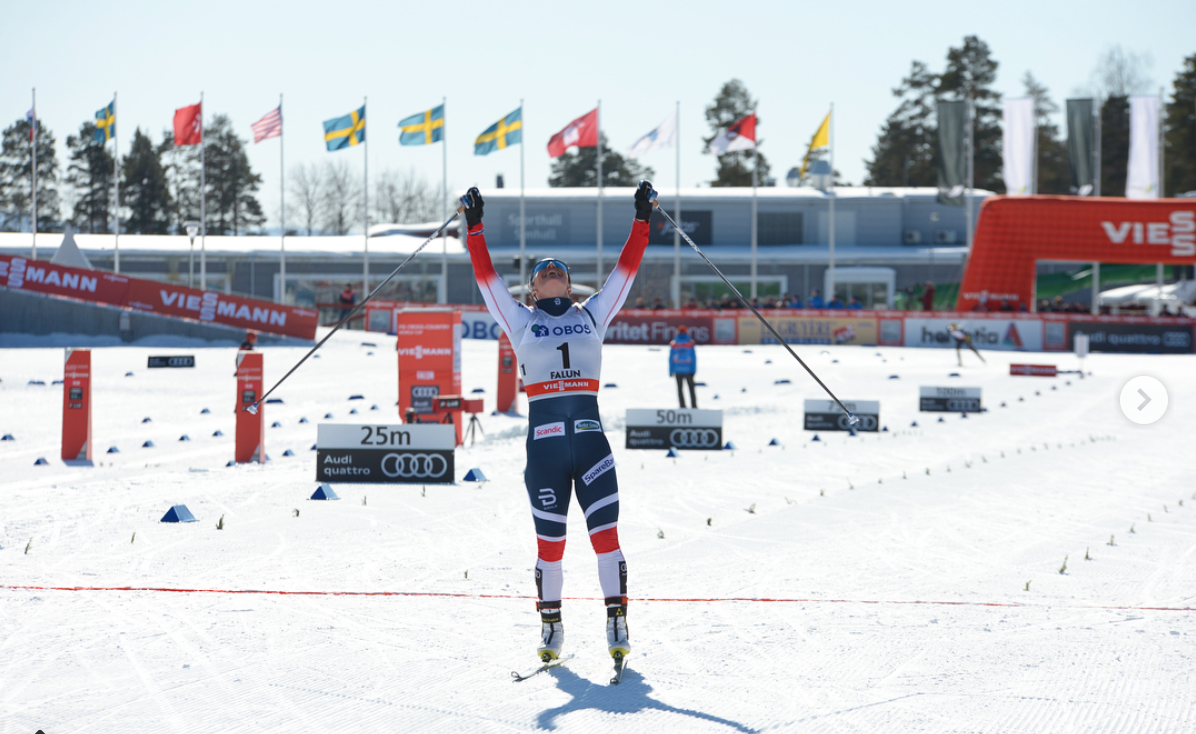
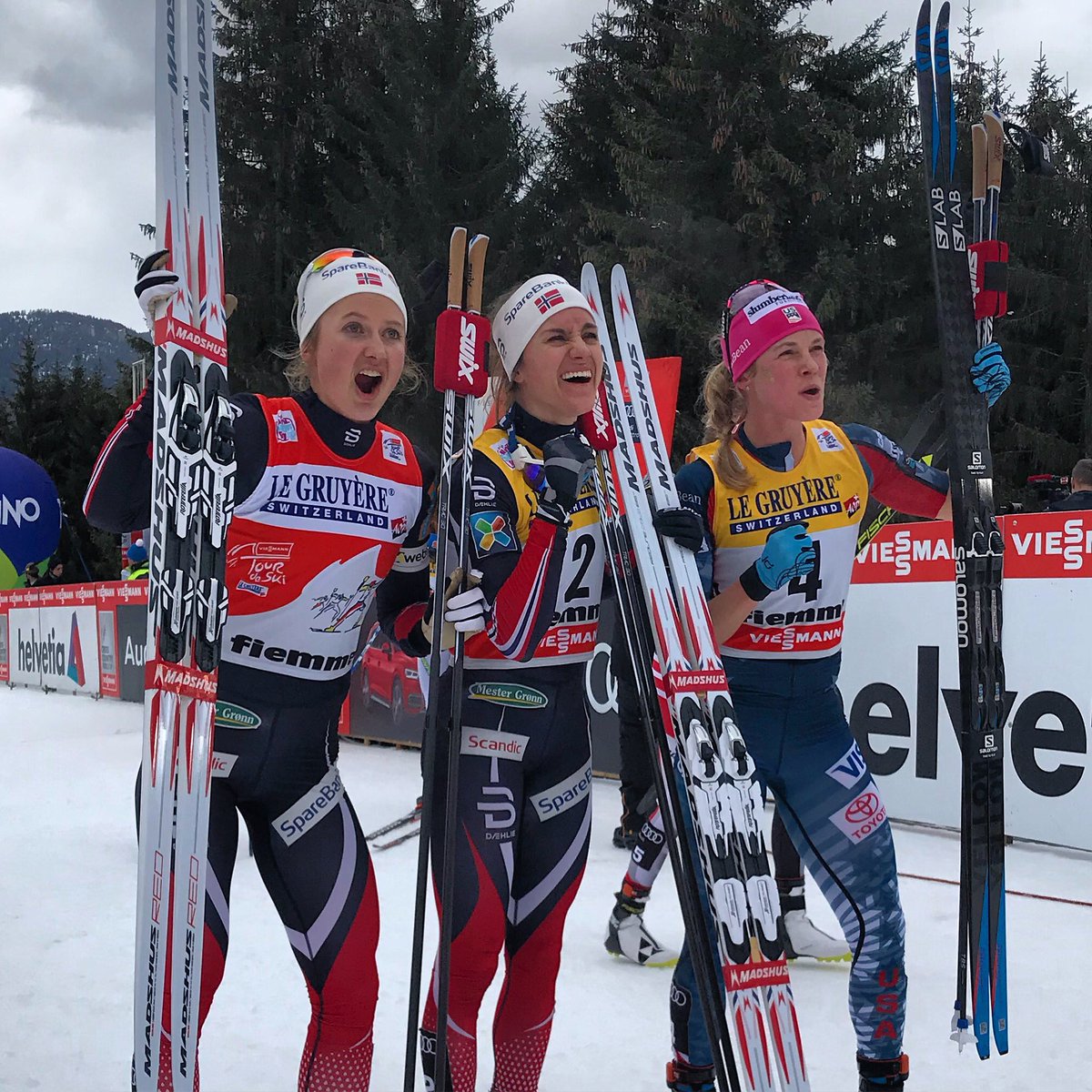
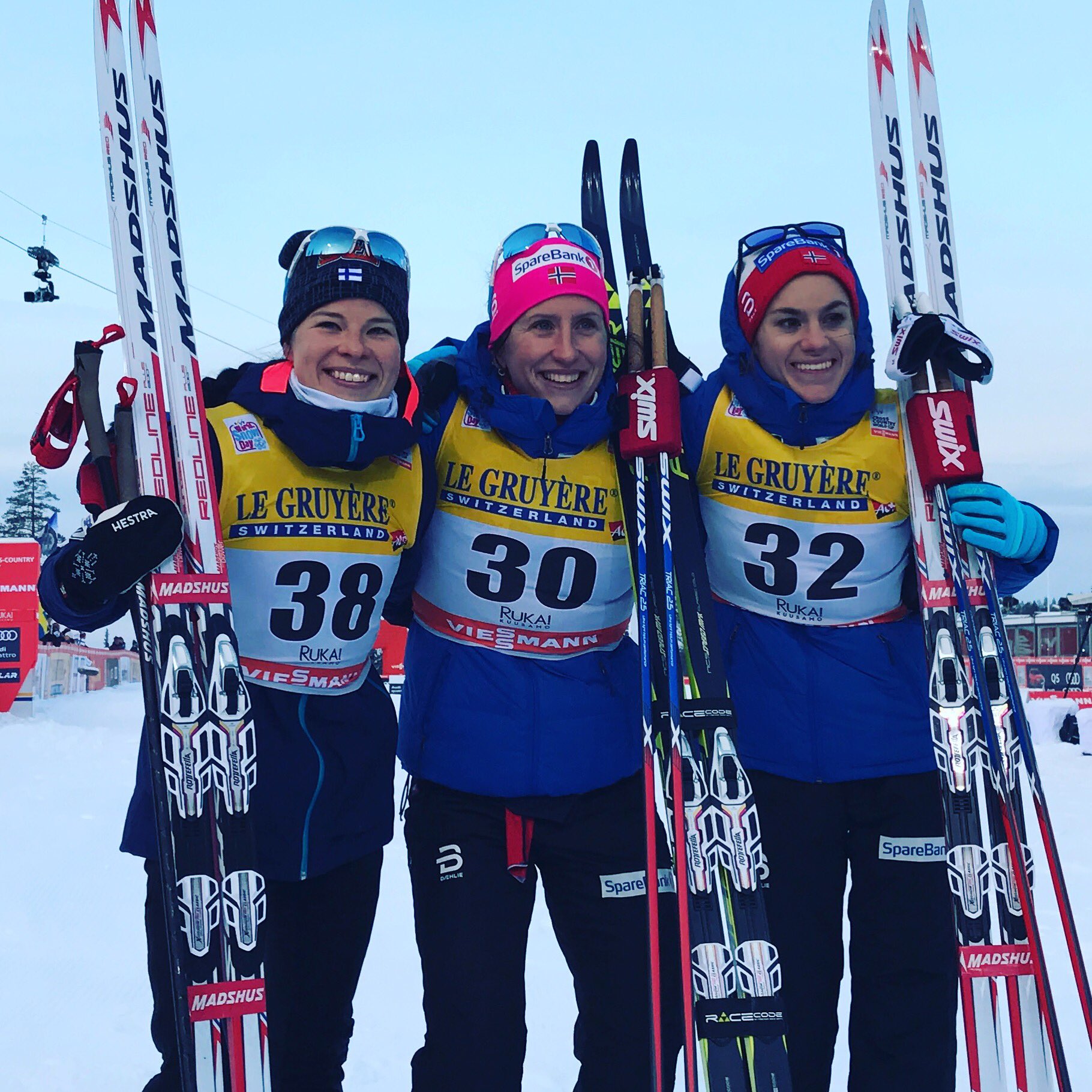
Norway’s Marit Bjørgen celebrates her overall win in the last race of 2018 World Cup Finals, the 10 k freestyle pursuit, on Sunday in Falun, Sweden. (Photo: Svenska Skidspelen/Instagram)
FIS Cross Country World Cup Finals (Falun, Sweden): 10/15 k freestyle pursuits
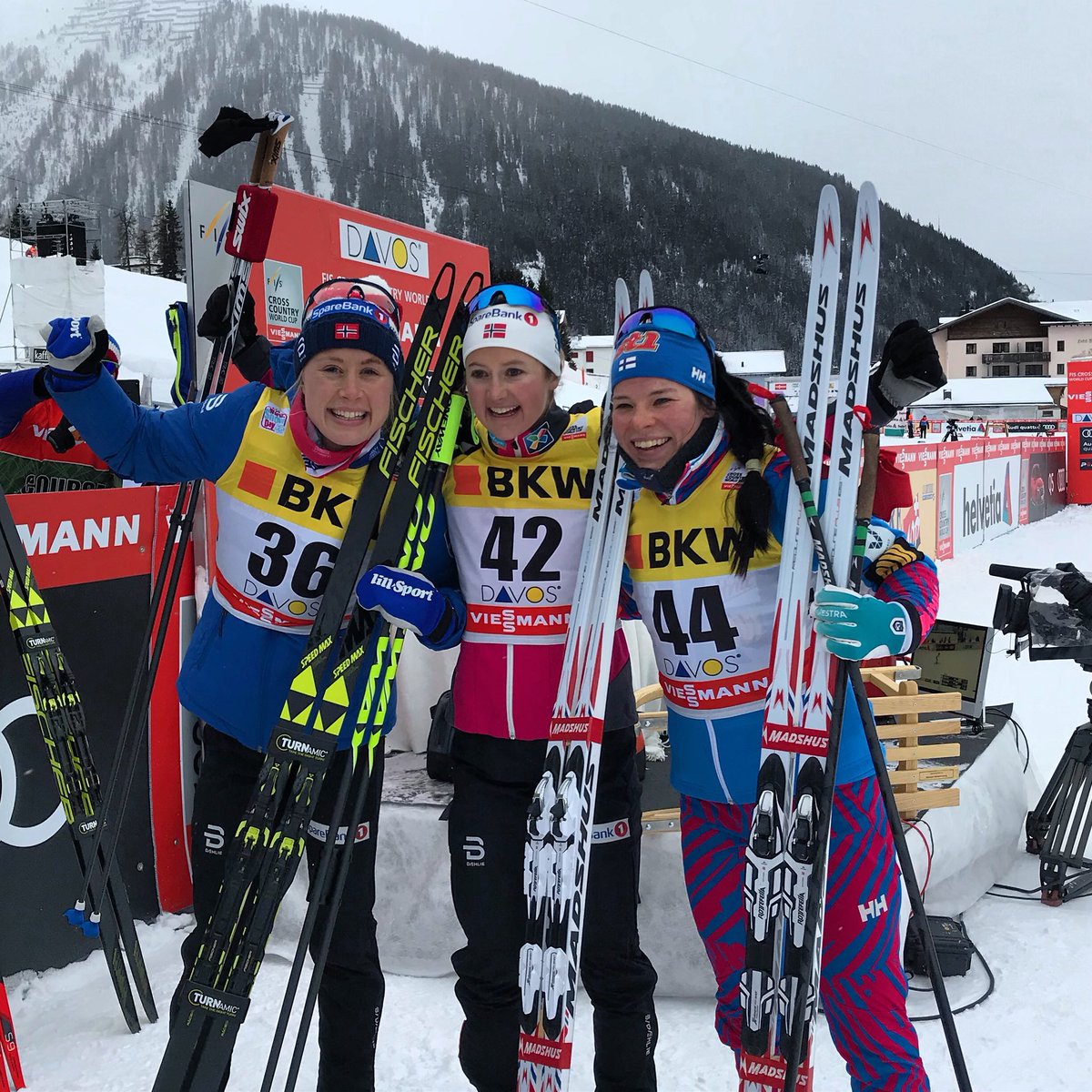
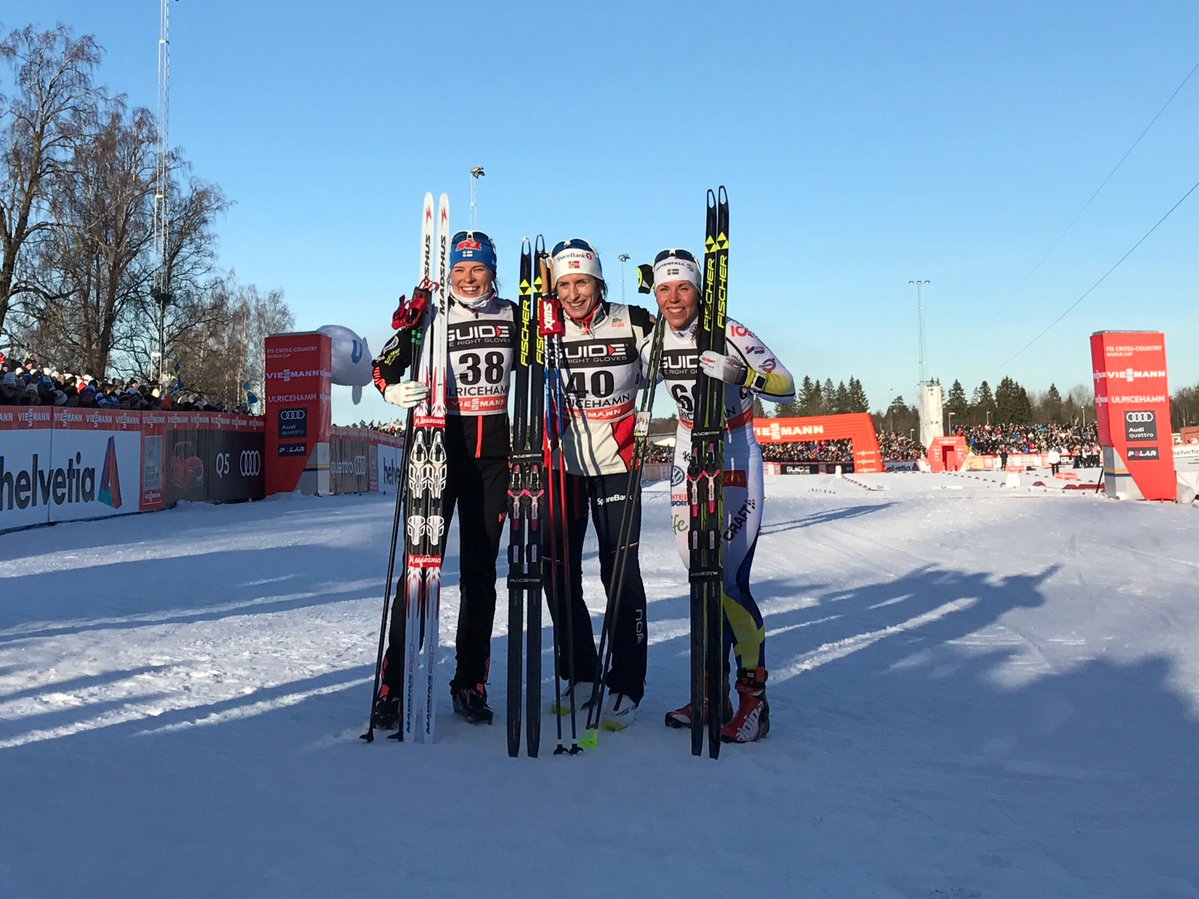
In the last women’s race of the World Cup season, U.S. Ski Team members Jessie Diggins and Sadie Bjornsen made it one they’ll remember for a long, long time as Diggins raced to second in the 10-kilometer freestyle pursuit and Bjornsen outlasted two Norwegians for third. The two finished the World Cup Finals mini tour in second and third, respectively, behind Norway’s Marit Bjørgen who won it in 24:18.9 minutes.
Bjørgen started with a 36-second cushion to her Norwegian teammate Ingvild Flugstad Østberg in second. Diggins started third, 41 seconds back, just ahead of Finland’s Krista Pärmäkoski in fourth (+43.0), based on their cumulative performances over the last two days of the mini tour (skate sprint and 10 k classic mass start).
While Østberg, Diggins and Pärmäkoski formed a chase pack, Diggins dropped them in pursuit of Bjørgen on the first lap. The American continued to push the pace throughout the three-lap race, coming within 16.7 seconds of Bjørgen at the finish.
Meanwhile, during the pursuit, a chase group of five, which included Bjornsen, caught Østberg and Pärmäkoski. The group of seven dwindled to three on the last two climbs, where Bjornsen and Norway’s Astrid Uhrenholdt Jacobsen and Ragnhild Haga broke away in a race for third.
The three were even entering the finishing stretch, where Bjornsen then beat them in a final 100-meter push to the line. Bjornsen claimed third (+1:11.5) for her fourth podium of the season and first in a distance skate race. Haga followed in fourth (+1:12.0) and Jacobsen fifth (+1:12.8), while Pärmäkoski placed sixth (+1:16.2), Sweden’s Charlotte Kalla seventh (+1:17.9), Østberg eighth (+1:19.0), Sweden’s Jonna Sundling ninth (+1:30.5) and Ebba Andersson 10th (+1:44.7).
Bjornsen now has five-career individual World Cup podiums to her name, and this is the first in a skate race longer than 5 k.
Diggins clocked the fastest time of day in 23:54.4, while Haga was second-fastest (+10.7) after starting the race in 17th. Bjørgen’s time ranked third, Jacobsen was fourth-fastest and Bjornsen fifth-fastest.
Diggins’s performance elevated her to second in the Overall World Cup standings, just 40 points behind Norway’s Heidi Weng (who placed 18th in the pursuit) in first for the second-straight year. Østberg slipped to third overall, 22 points behind Diggins. In the Distance World Cup, Weng took the title by 63 points over Østberg in second, while Diggins was another 32 points back in third.
Bjornsen ended up sixth in the Overall World Cup and 10th in the distance standings.
Also for the U.S., Caitlin Patterson raced from 46th at the start to 35th (+3:58.4) with the 22nd-fastest time of day, Sophie Caldwell placed 36th (+4:00.7), Kikkan Randall finished her last World Cup race in 43rd (+4:33.3) with the 29th-fastest time, Rosie Frankowski placed 46th (+4:41.3), Liz Stephen 50th (+4:57.2) in her final World Cup race, Kaitlynn Miller 56th (+6:13.8), and Ida Sargent 57th (+7:06.4).
For Canada, Cendrine Browne picked off 10 places to finish 39th (+4:14.4) with 27th-fastest time of day, Emily Nishikawa finished 48th (+4:43.7), Dahria Beatty 54th (+6:04.3), and Zina Kocher 60th (+9:28.4).
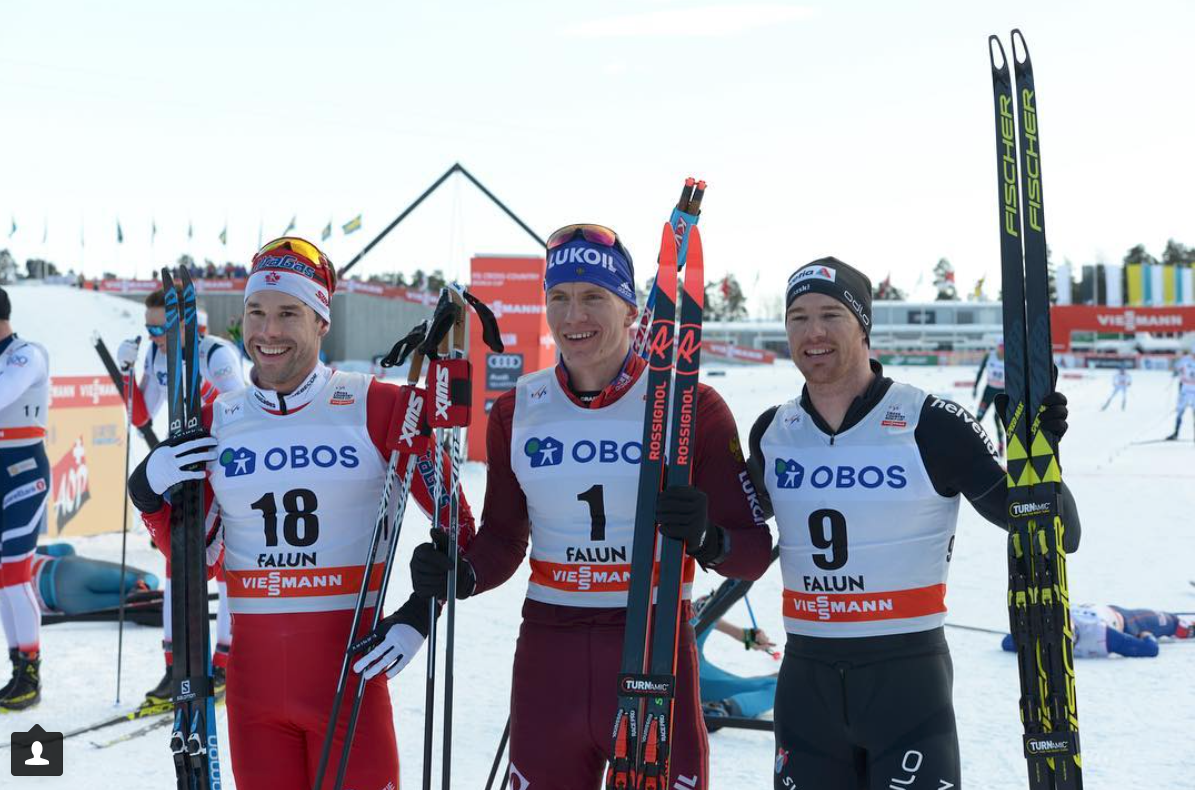
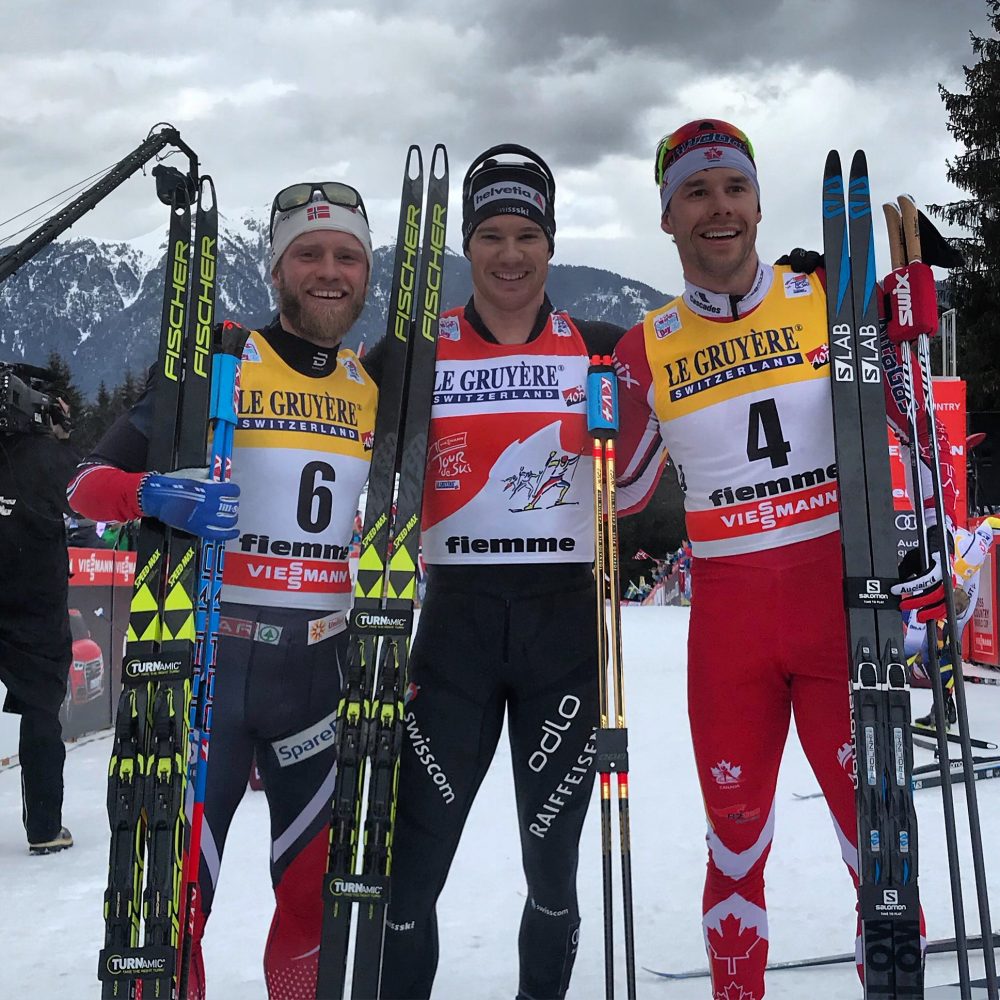
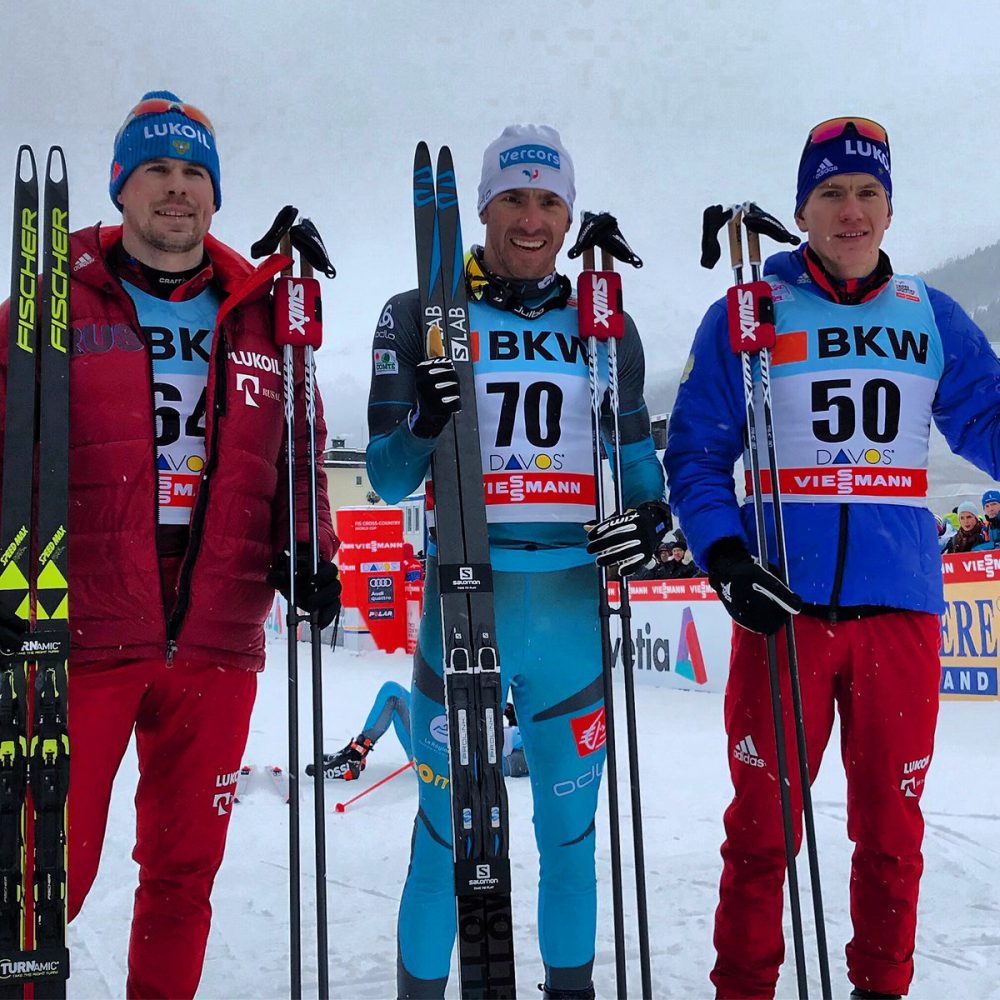
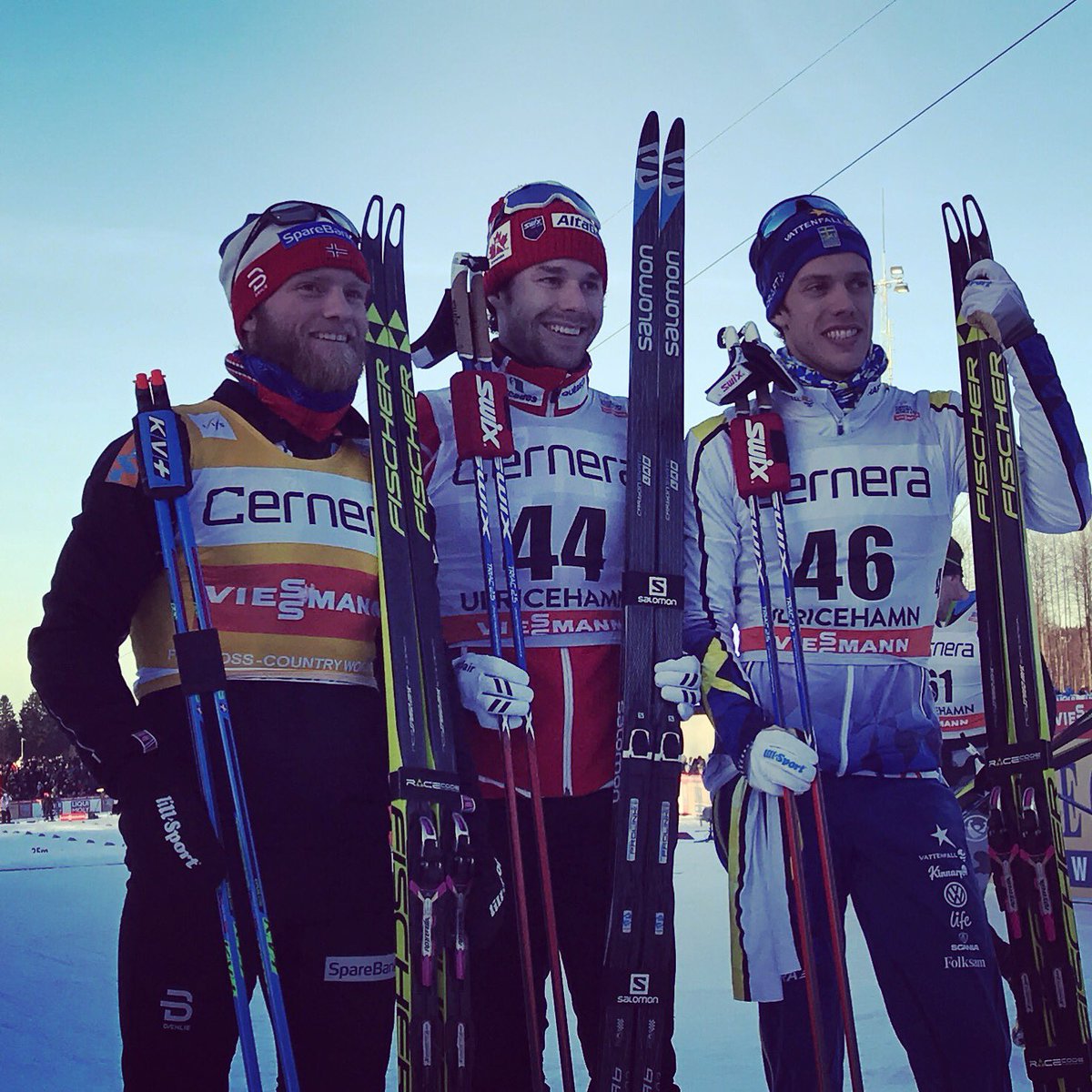
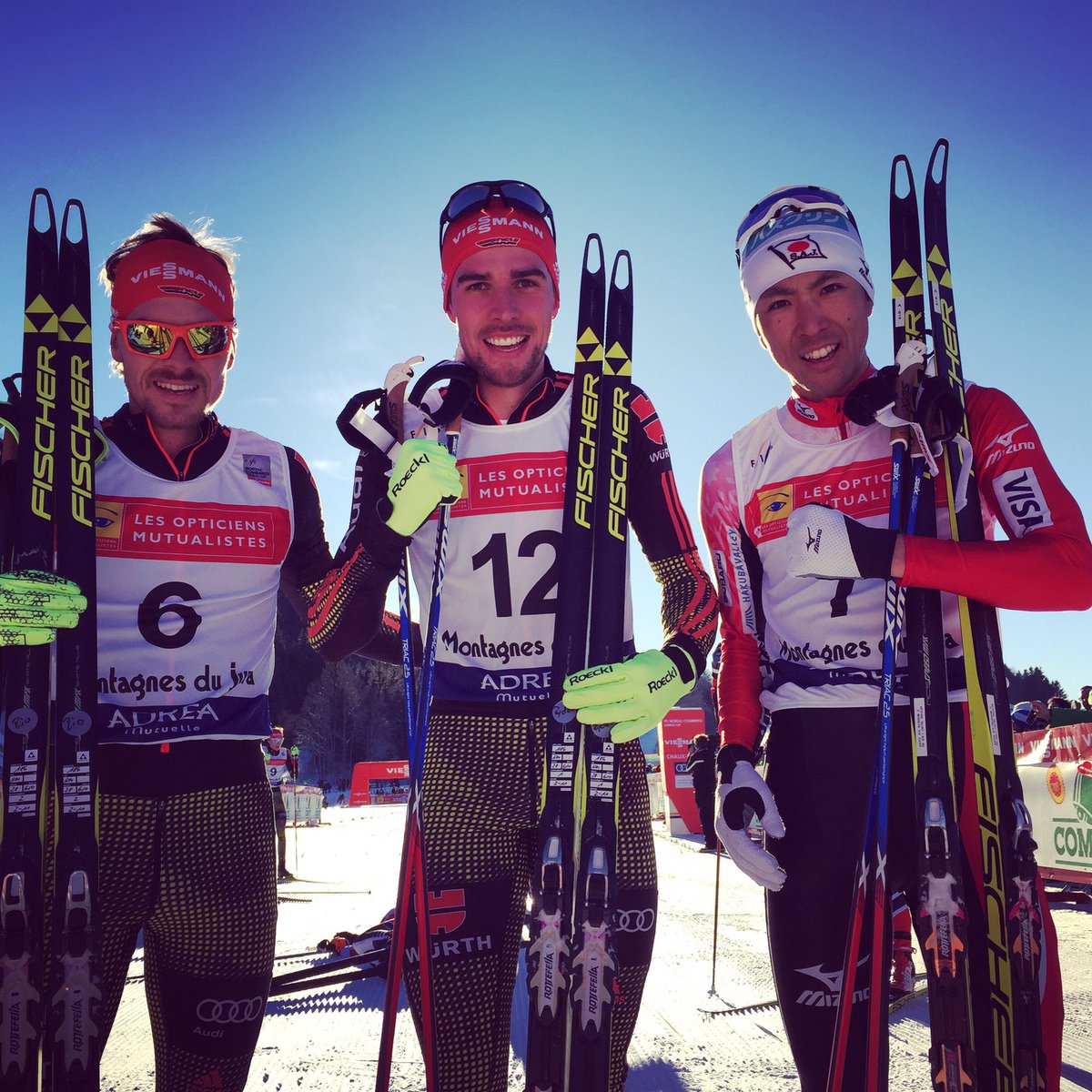
The men’s 15 k freestyle and 2018 World Cup Finals podium, with Russia’s Alexander Bolshunov (c) in first, Canada’s Alex Harvey (l) in second and Switzerland’s Dario Cologna (r) in third. (Photo: Svenska Skidspelen/Instagram)
In the men’s 15 k freestyle pursuit that followed, Russia’s Alexander Bolshunov started 38 seconds clear of Norway’s Johannes Høsflot Klæbo in second, and Sweden’s Calle Halfvarsson and Italy’s Federico Pellegrino headed out together another second later in third and fourth, respectively.
Norway’s Martin Johnsrud Sundby started the race in seventh (+53.0), and Switzerland’s Dario Cologna followed in ninth (+56.0), while Canada’s Alex Harvey started 1:16 back in 18th.
While Bolshunov skied the entire race on his own and won the weekend mini tour in 35:03.3, a number of racers battled for second, with Sundby moving into second in the chase pack, ahead of seven others, less than 2 k in. Several skiers found themselves at the front of that group, including Cologna, Halfvarsson, and even Harvey (with Harvey leading the chase at 9.3 k), while the time gap to Bolshunov grew.
With about 2 k to go, the group was down to six. Harvey attempted an attack, but Cologna matched him. Then, on one of the course’s final climbs, Cologna made his move to get a slight gap, but lost his balance slightly on the downhill, allowing Harvey to catch back up.
With one last uphill to go, Harvey was in the driver’s seat in second, Cologna in third and Sundby in fourth. That order held to the finish, with Harvey claiming second, 47.1 seconds behind Bolshunov, Cologna placing third (+47.5) and Sundby fourth (+48.7). Just behind them, Russia’s Maxim Vylegzhanin crossed in fifth (+50.3), ahead of Norway’s Hans Christer Holund in sixth (+51.7), Halfvarsson in seventh (+54.1), and Norway’s Sjur Røthe in eighth (+54.9). Nearly 10 seconds later, Norway’s Niklas Dyrhaug outlunged two Russians for ninth (+1:04.1): Denis Spitsov in 10th (+1:04.2) and Andrey Larkov in 11th (+1:04.3).
Harvey, who finished the season in fourth in both the Overall and Distance World Cup standings, won the time of day in 34:34.3. Holund had the second-fastest course time, 1 second off Harvey’s time, after starting the race in 22nd.
Harvey’s Canadian teammate Devon Kershaw tallied his fifth-straight distance top 30 in 28th (+2:21.9), after starting 27th, and Graeme Killick finished 56th (+4:33). Julien Locke did not start.
For the U.S., Erik Bjornsen clocked the 22nd-fastest time en route to 38th (+3:10.4), after he started 51st. Simi Hamilton improved 10 places to finish 49th (+4:07.8), Scott Patterson and Paddy Caldwell worked together to move up from 72nd and 73rd, respectively, to 58th (+4:41.5) and 59th (+4:41.6), respectively, at the finish. Kevin Bolger placed 60th (+4:43.5) and David Norris 64th (+5:09.8).
While Klæbo slipped from second to 25th in the pursuit (+1:45.8), the Norwegian still won his first Overall World Cup by 119 points over Cologna in second. Sundby placed third, 29 points out of second and 82 points ahead of Harvey.
Cologna claimed the Distance World Cup Crystal Globe by 41 points over Sundby, and Holund reached the Distance World Cup podium in third, 58 points out of second and just 5 points ahead of Harvey in third. France’s Maurice Manificat had been third heading into the final day of racing, but finished the pursuit in 26th (+2:11.9) and dropped to fifth in the final distance rankings.
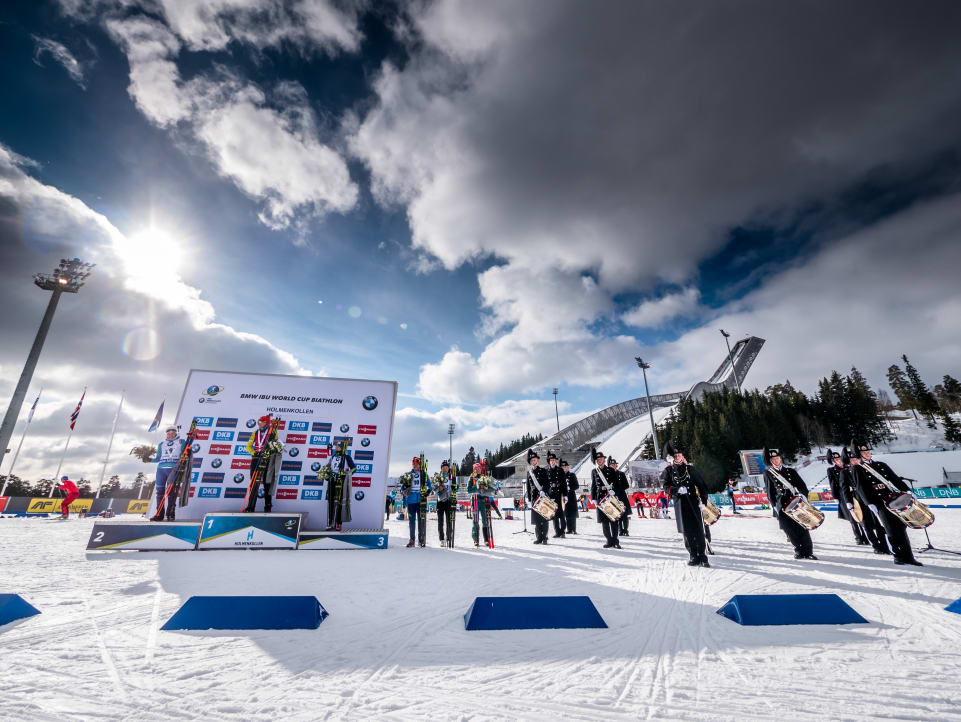
In her last race of the season, Susan Dunklee returned to the podium. The American started fourth in Sunday’s 10-kilometer pursuit at the International Biathlon Union (IBU) World Cup in Oslo, then made her way into third by the final shooting stage. Dunklee shot 18-for-20 (1+0+1+0) and finished 29.5 seconds behind the winner, Darya Domracheva of Belarus, who missed two targets as well (1+0+1+0) and finished first in 30:37.4. Slovakia’s Anastasiya Kuzmina started the race in first (ahead of Domracheva in second) and ended up second (+9.2) with four penalties (0+2+2+0).
Canada’s Julia Ransom and Rosanna Crawford finished together in 51st and 52nd, respectively, both 4:52.4 out of first. Ransom had four penalties (0+1+1+2) while Crawford missed five (1+3+1+0). Emma Lunder did not finish.
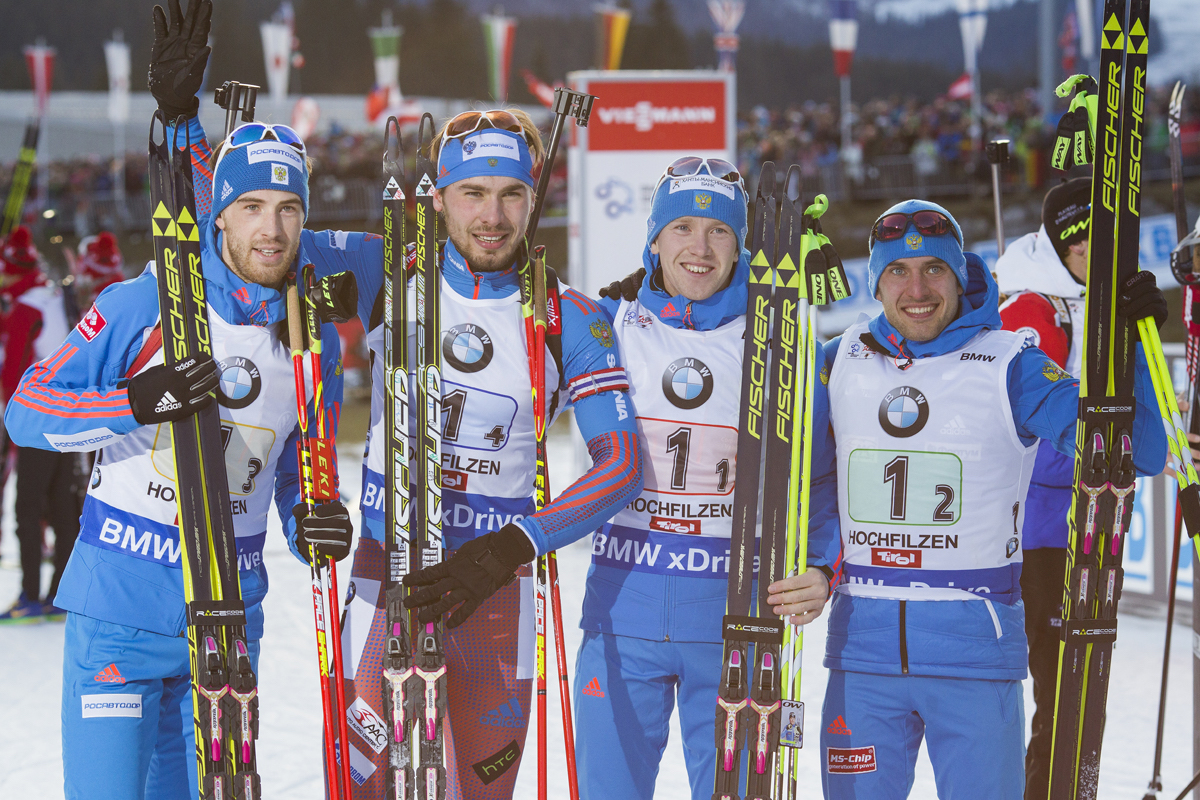
In the men’s 4 x 7.5 k relay on Sunday, Norway’s team of Lars Helge Birkeland, Henrik L’Abee-Lund, Tarjei Bø, and Johannes Thingnes Bø used just three spare rounds to clean eight shooting stages and took the win in 1:13:13.7 hours. Austria finished 50.3 seconds back in second place, with Dominik Landertinger, Felix Leitner, Simon Eder, and Julian Eberhard, with a total of five spares. Russia’s Maxim Tsvetkov, Anton Babikov, DmitryMalyshko, and Anton Shipulin raced to third (+56.9) with just four total spares.
The U.S. men placed seventh (+2:01.5) with eighth spares, after Lowell Bailey put the team in seventh on the first leg. Sean Doherty skied them up to sixth on the second leg, Tim Burke slipped to 10th on the third leg, and Leif Nordgren posted the seventh-fastest anchor leg to put them in seventh at the finish.
Canada placed 16th (+5:42.4) with Christian Gow, Scott Gow, Brendan Green, and Macx Davies. The team had been in 19th at the final exchange, but Davies skied them up to 16th with the 14th-fastest anchor leg. In all, they used 10 spares.
As the kilometers and shooting stages ticked by, it looked possible that L’Abée-Lund would do it again, or at least come close. After two prone stages, one standing stage, one penalty lap, and 7.5 kilometers of skiing, L’Abée-Lund hit the trails together with the man who is always a pre-race favorite: Martin Fourcade of France.
Over the next 2.5 kilometers, Fourcade skied faster, but wasn’t able to put too much of a gap on the Norwegian. Fourcade came into the range with a 4.5-second lead and hit his first target before L’Abée-Lund started shooting.
Fourcade kept right on going, hitting all five targets for a score of 18/20 on the day, and cruised to victory.
When asked at the post-race press conference whether the win was easy, Fourcade replied, “It wasn’t, because the fight on the beginning was really tight. I had a lot of pressure on the standing shooting. So I must say I’m really satisfied about the win today. I heard it’s my 10th win in Holmenkollen and I’m the most-awarded biathlete in Holmenkollen. It’s probably my favorite place on the World Cup. I’m really happy I did that.”
L’Abée-Lund missed two and fell out of podium contention.
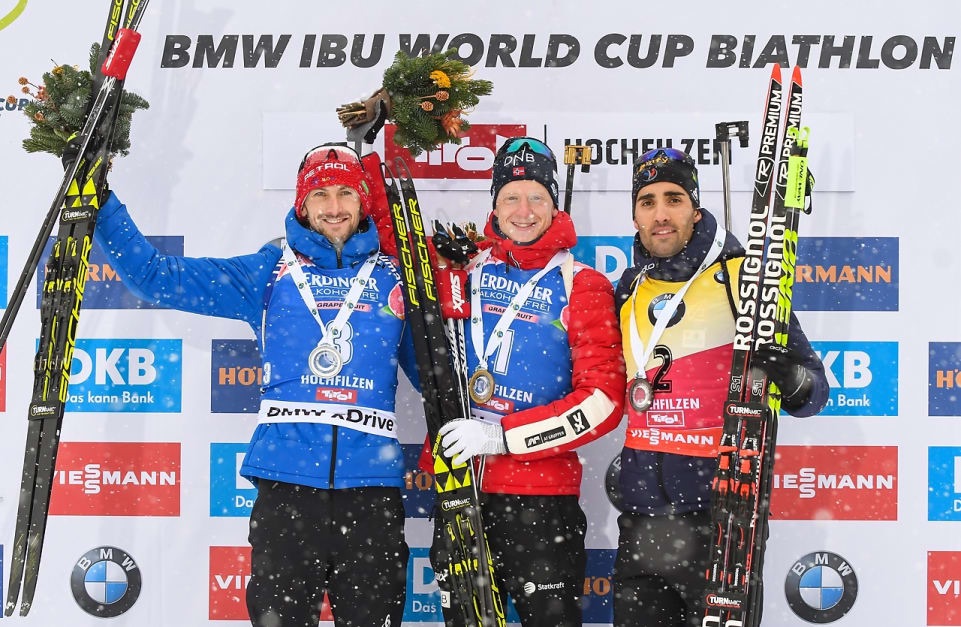
In his absence, Johannes Thingnes Bø – the more favored Norwegian – also missed a shot on the final stage. Italy’s Lukas Hofer cleaned and went past him into second, and that was the podium at the finish.
It was Fourcade’s seventh win in a season where he has never been off the podium in a World Cup race (although he was twice off the podium at the Olympics), and he now has a 49-point lead over Bø in the World Cup Total Score standings with three individual races to go.
“It’s really nice fight,” Fourcade said in a press conference. “I must say, I’m surprised [to say it], but I like it. Johannes is an amazing opponent. No matter what happens in Tyumen, I know that I will thank him for the fight we had. Even if he wins the World Cup, I don’t want that, but I will thank him. I really appreciate the good fight, the fair fight we had, and the good biathlon show we made for people.”
“I think I have maybe 10-percent chance to win this,” Bø said of the overall World Cup title. “So it’s not a big chance, but you know, many things can happen. I know for sure that Martin will probably on the podium every race next weekend. And then there is no chance for me to win the globe. So then I have to just do my best and then we see, but it has been a good season no matter what happens, and it’s a big step in my career.
Hofer finished 18.1 seconds back in second place with one penalty, and Bø 32.5 seconds back reached the podium despite four missed shots.
“I went out [from the last shooting stage] and my trainer told me, ‘It’s only a small gap, only four seconds,’ ” Hofer said, although he actually led Bø by nearly 15 seconds at that point. “I think they told me this so that I keep pushing on the last loop. I tried to keep some energy for the last 600 meters a the end. When I saw Johannes and that I had a bigger gap to him, I was really happy.”
“I knew that Hofer is one of the strongest guys on the last laps,” Bø said. “But I was feeling really good today, so I was thinking there was a chance [to catch him]. We had really good material and skis. And I had good shape today, but in the end of the last lap, I saw there was no chance. So then it was just to look behind and secure the third place. “
Fourth place went to Russia’s Maxim Tsvetkov (+42.7), who cleaned the whole race and moved up from bib 28. L’Abée-Lund finished fifth (+45.2).
US Biathlon’s Sean Doherty started the day in bib 14, and cleaned all his prone targets to stay in contention for a top 10. He missed a shot in each standing stage but still finished 17th on the day (+1:34.2), tying his second-best result of the season.
“I’m really happy with today,” Doherty said. “I really had a goal in mind to stay in my own lane, on the range there. Skiing with these top guys, the pace is really high, so stay focused on my [shooting], and I did that well. I’m happy with how I shot and how I executed this race. I obviously left two in standing there, but those were just my mistake … Standing is usually stronger for me, but I was kind of pushing the limit, which you have to do if you’re still trying to make up some time on the range. So I was just a little hasty at times, and that’s just kind of my nature.”
Doherty had the 23rd-fastest course time on the day.
“It’s been a pretty lousy season in a lot of ways,” he said. “There were some good moments before Christmas, and it’s good to finish on a really strong note with Finland and with these races here. So I’m really happy about that – it’s nice for the body to be picking up. But it’s a little bit of a bummer that we are not going to Russia, because I’m starting to ski better, and really feeling like I’m in good form for some more racing.”
Teammate Lowell Bailey started in 42nd and had two missed targets to move up to 28th (+2:07.2), thanks to the 19th-fastest course time of the day. For both him and Tim Burke, who finished 47th (+4:12.6) with four penalties, it was the last individual World Cup starts for long careers, as the U.S. is boycotting next weekend’s World Cup stage in Tyumen, Russia.
Leif Nordgren finished 40th (+3:07.5) with four penalties, three of which came in the second prone stage. He had the 27th-fastest course time.
“It was a really good race except for one stage,” Nordgren said. “That second prone stage set me back quite a bit. But I was really happy with my skiing today. [Ski speed] came just a couple weeks late after the Olympics unfortunately. I definitely feel a lot stronger now, and it’s too bad it’s the end of the season. But it’s nice to end on a high note. You don’t have to be pissed off all spring.”
For Canada, Scott Gow finished 51st (+4:59.7) and younger brother Christian Gow 54th (+5:07.4) with five and two penalties, respectively.
Susan Dunklee (US Biathlon) racing to fourth in the women’s 7.5 k sprint on Thursday at the IBU World Cup in Oslo, Norway. It was her best individual result of the season by two places. (Photo: USBA/NordicFocus)
Susan Dunklee had been looking for something all season, a sort of spark. And while the U.S. biathlete hadn’t necessarily found it on Thursday, she had still pulled off fourth place in the women’s 7.5-kilometer pursuit at the International Biathlon Union (IBU) World Cup in Oslo, Norway.
“I feel like right now I’m relying on good habits to carry me through the rest of the season,” Dunklee, 32, of US Biathlon, said in a phone interview on Thursday. “Normally you need more than just that, you need that spark.”
Last year in Oslo, Dunklee placed seventh in the sprint. They year before, she finished eighth in the 2016 Oslo World Championships sprint at the Holmenkollen biathlon venue.
The flower ceremony for the IBU World Cup women’s sprint on Thursday in Oslo, Norway, which American Susan Dunklee appeared in after placing fourth. (Photo: IBU/Biathlonworld)
On Thursday, she shot clean (hitting all 10 of her targets) and finished 35.7 seconds behind the winner, Slovakia’s Anastasiya Kuzmina, and 6.5 seconds out of third, which went to Ukraine’s Yuliia Dzhima.
The race was Dunklee’s last World Cup sprint of the season, since US Biathlon (along with several other teams) is boycotting next week’s final World Cup in Tyumen, Russia.
“I feel like that spark has been missing a little bit so I was really surprised to be able to put this one together,” she said. “But maybe there was too much spark, maybe I wanted things too much and now I’m finally kind of letting go a little bit and that’s what I needed to do all along.”
A two-time Olympian who raced at five World Championships, Dunklee has been competing internationally in biathlon for the last nine years after a relatively late start in the sport. The daughter of Stan Dunklee, a two-time Olympic cross-country skier, she started skiing at age 2 but didn’t learn to shoot until age 22 when she joined US Biathlon’s development program after graduating from Dartmouth College.
And despite currently being the veteran member of the US Biathlon women’s team, Dunklee said she still gains a great deal from her younger teammates. Clare Egan, 30, who switched from cross-country ski racing to biathlon five years ago, raced to a career-best 13th in last week’s sprint in Kontiolahti, Finland.
“I was definitely inspired by Clare’s race last week,” Dunklee said. “I’ve never seen her so composed and confident out mixing it up with the top ladies in the field and that got me excited for the team. … I often feed off of other people performing well.”
US Biathlon had another breakthrough on Thursday when Sean Doherty finished 14th in the men’s 10 k sprint later in the afternoon in Oslo. It was his season best as well and just one place short of tying his career-best individual World Cup result of 13th (which he achieved in a sprint during the 2015/2016 season in Presque Isle, Maine).
“Sean just had his best result of the season today, so the whole team’s kind of rounding into form just in time,” Dunklee said of the season’s end.
Slovakia’s Anastasiya Kuzmina racing to her fifth World Cup win of the season in the 7.5 k sprint in Oslo, Norway. (Photo: IBU/Biathlonworld)
Kuzmina, who won the women’s race in 21:31.8 minutes with one prone penalty (1+0), started the sprint a minute and a half behind Dunklee, who headed out of the gate in bib 10. Despite cleaning both stages, Dunklee knew she was in second on her final loop after hearing about the kind of race Kuzmina was having. The Slovakian posted the fastest overall course time to overcome her early penalty and beat Belarusian Darya Domracheva, who shot clean, by 8.9 seconds. Dzhima also shot 10-for-10 (as did the rest of the top-seven women) and finished 29.2 seconds off Kuzmina’s winning time.
While Dunklee initially finished first and was bumped to second by Kuzmina just under a minute later, she knew there were plenty of later starters capable of strong performances that could bump her off the podium. Considering that, Dunklee, who skied the 18th-fastest course time and had the 14th-fastest range time, said she was “very happy” to finish in the top six and earn flower-ceremony recognition.
Asked how she felt about the last races of the season, Dunklee said she was trying not to overthink it.
“I’m not looking at it like this is the last sprint, I’m looking at it like, well, just one more,” she said. “I’m going to try to put everything I can into doing the best I can this weekend because there’s nothing else to save it for.”
While Dunklee will start Sunday’s 10 k pursuit 36 seconds back in fourth based on her sprint result, her three teammates missed the sprint top 60 required to qualify for the pursuit. Egan finished 68th (+2:44.8) with three penalties (1+2), Joanne Reid was 75th (+3:02.2) with three misses (1+2) and Emily Dreissigacker placed 83rd (+3:24.8) with three penalties (2+1) as well.
Meanwhile, three Canadian women qualified for the pursuit. Rosanna Crawford placed 38th (+1:51.8) with one standing penalty (0+1), Julia Ransom was 46th (+2:10.1) with one miss (0+1) and Emma Lunder in 57th (+2:28.2) with one penalty (0+1) as well. Also for Canada, Sarah Beaudry finished 84th (+3:30.7) with three penalties (1+2).
Sean Doherty (US Biathlon) racing to 14th in Thursday’s 10 k sprint for a season-best individual result at the IBU World Cup in Oslo, Norway. (Photo: USBA/NordicFocus)
In the men’s sprint that followed, Doherty was one of nine in the top 14 that shot clean, and he finished 47.1 seconds out of first. Norway’s Henrik L’Abée-Lund won the race with perfect shooting for his first World Cup win with a time of 26:10.3.
Four years ago, Doherty made his World Cup debut in Oslo, where he finished 82nd in the sprint. He explained in an email that he has fond memories of the venue.
“The skiing on and off the race course is fantastic and it’s always a special atmosphere,” wrote Doherty, now 22.
He started in the middle of the field in bib 53 and kept himself competitive with the race leaders with flawless shooting and the 33rd-ranked course time. His overall range and shooting times ranked 24th and 26th fastest, respectively.
Norway’s Johannes Thingnes Bø, who started 30 seconds behind him in bib 54, went on to finish second, 6.1 seconds behind L’Abée-Lund. Bø led throughout the race even after skiing a penalty lap after his standing stage (0+1), but lost time to his teammate, L’Abée-Lund, on the last loop.
“That’s what you hate, being in the lead after the last shooting and not in the lead in the finish,” Bø told German broadcaster ARD after in an English interview. “It’s not the best feeling, but I fought with what I had, just wasn’t enough.”
“He was a great marker for me to chase,” Doherty said of Bø. “After cleaning heading out onto the [last] loop I knew I was having a good one.
“I felt strong skiing today, which in turn helps your confidence on the range,” Doherty continued. “As for the good shooting I have been working on some good things in the days leading up to today and I was able to execute my race plan on the range as I wanted. Which I am very happy about.”
He was pleased to put together a complete race in the last sprint of the season, especially considering how it sets him up for Saturday’s 12.5 k pursuit.
“It feels good to end the season on some good momentum and it is fun to be towards the top of a extremely competitive field,” Doherty said. “Now I am just looking forward to the possibilities of the pursuit.”
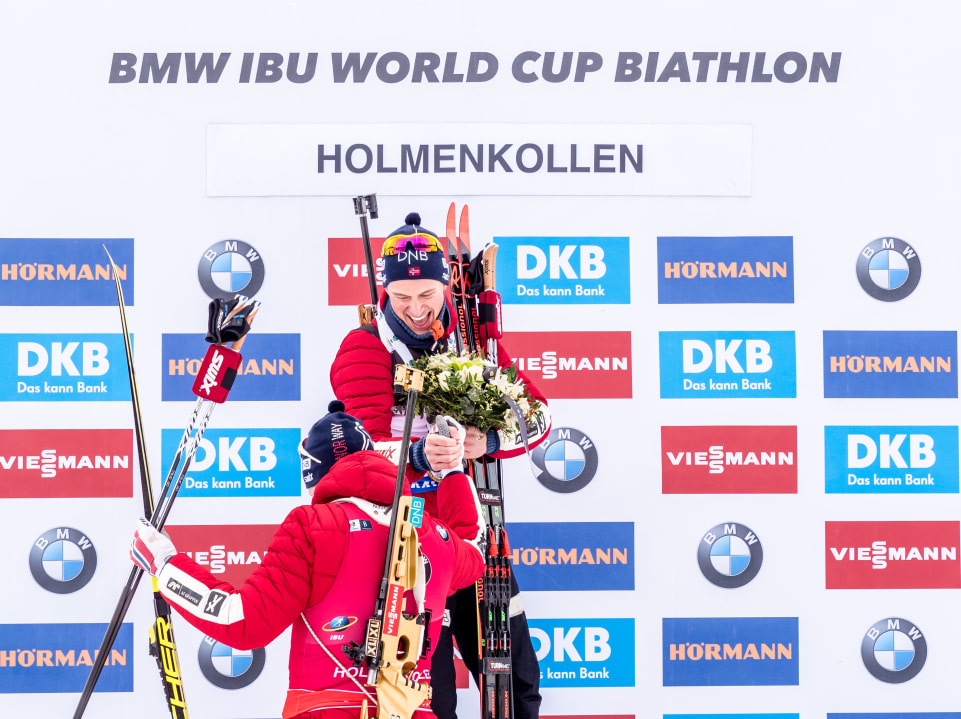
Henrik L’Abée-Lund (top) and his Norwegian teammate Johannes Thingnes Bø after they placed first and second, respectively, in the men’s 10 k sprint at the IBU World Cup in Oslo, Norway. (Photo: IBU/Biathlonworld)
In the pursuit, L’Abée-Lund will start six seconds ahead of Bø in second and seven seconds ahead of France’s Martin Fourcade in third. Fourcade placed third on Thursday, 6.9 seconds back, after shooting clean but falling and breaking a pole on a downhill.
“I just tried to push one more time in the downhill to get more speed and I pushed aside my ski, I fell, I broke my pole, and I lost seconds for the victory today,” Fourcade told ARD in English. “It’s a good place close to Johannes [for the pursuit], but today wasn’t my time.”
Austria’s Julian Eberhard, who placed fourth, just 0.2 second behind Fourcade, will start the pursuit at the same time as Fourcade.
With one race to go, Fourcade leads the overall World Cup Total Score standings by 37 points over Bø in second.
“It will be tough, it will be almost impossible,” Bø said of beating him. “Today I was ahead but I have to beat him in every race and actually make more points [than him].”
A total of four American men qualified for Saturday’s pursuit, with Lowell Bailey finishing 42nd (+1:41.1) with two penalties (0+2)), Leif Nordgren 43rd (+1:43.3) with one miss (0+1) and Tim Burke 57th (+2:12.8) with four penalties (2+2). In his second World Cup start, Alex Howe finished 89th (+3:39.5) with four misses (3+1).
For Canada, the Gow brothers qualified for the pursuit, with Scott Gow placing 49th (+2:02.1) with one penalty (0+1) and Christian finishing 56th (+2:12.3) with clean shooting. Brendan Green finished 71st (+2:31.3) with two penalties (1+1) and Macx Davies was 96th (+4:27.2) with four penalties (2+2).
“There is no special secret,” Kuzmina said of her five World Cup wins and Olympic gold (in the mass start) this winter. “It’s hard work before the season, good work together with my team, great support from my family and that is all.”
Born in Russia and the sister of Russian biathlete Anton Shipulin, she said she’s looking forward to the Tyumen World Cup.
“Tyumen is my home, where I was born, and I am really really excited for the time there and to see my family,” she said.
Racing in Oslo continues with the women’s relay and men’s pursuit on Saturday, followed by the women’s pursuit and men’s relay on Sunday.
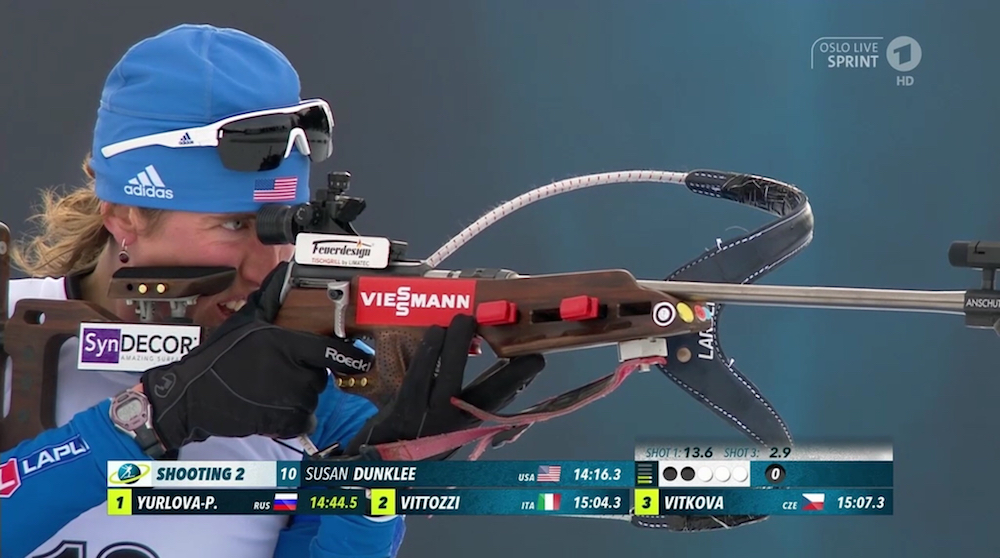
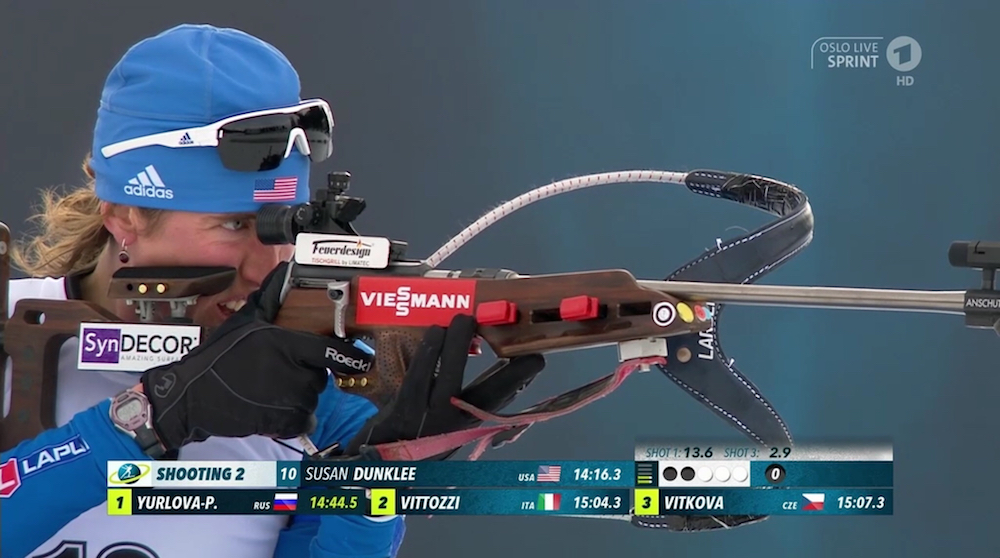
American Susan Dunklee cleaning her second-straight shooting stage of the women’s 7.5 k sprint on Thursday at the IBU World Cup in Oslo, Norway. (Screenshot: ARD broadcast)
IBU World Cup (Oslo, Norway): Women’s and men’s sprints
In her last International Biathlon Union (IBU) World Cup sprint of the season, Susan Dunklee (US Biathlon) raced to a season-best fourth place in the women’s 7.5-kilometer sprint on Thursday at Holmenkollen in Oslo. Dunklee shot clean and finished 35.7 seconds behind Slovakia’s Anastasiya Kuzmina, who had a single prone miss (1+0) but skied the fastest course time to win in 21:31.8 minutes.
Darya Domracheva of Belarus finished 8.9 seconds back for second place with perfect 10-for-10 shooting. The rest of the top-seven finishers also shot clean, with Ukraine’s Yulia Dzhima placing third, 29.2 seconds out of first and 6.5 seconds ahead of Dunklee.
Rosanna Crawford led Canada in 38th (+1:51.8) with one penalty (0+1), and two of her teammates also qualified for Sunday’s pursuit by finishing in the top 60: Julia Ransom in 46th (+2:10.1; one penalty) and Emma Lunder in 57th (+2:28.2; one penalty). Sarah Beaudry finished 84th (+3:30.7; three penalties).
Four Americans competed, with Clare Egan finishing 68th (+2:44.8; three penalties), Joanne Reid 75th (+3:02.2; three penalties) and Emily Dreissigacker 83rd (+3:24.8; three penalties).
Sean Doherty (US Biathlon) racing to 14th in Thursday’s 10 k sprint for a season-best individual result at the IBU World Cup in Oslo, Norway. (Photo: USBA/NordicFocus)
In the men’s 10 k sprint that followed, Sean Doherty (US Biathlon) raced to his best result of the season as well, and was one place away from tying his career best, placing 14th with clean shooting.
Doherty finished 47.1 seconds off the winning time set by Norway’s Henrik L’Abée-Lund, who notched his first World Cup win in 26:10.3. He also shot clean, while his teammate Johannes Thingnes Bø missed one in his standing stage to come 6.1 seconds short of winning at the finish. Bø finished second, while France’s Martin Fourcade placed third (+6.9) after shooting clean but falling on a downhill and losing valuable time.
Doherty posted the 24th-fastest overall range time, 26th-fastest shooting time and 33rd-ranked course time. The 22-year-old New Hampshire native was one of nine men in the top 14 that shot clean. His individual World Cup career best is 13th, which he notched during the 2015/2016 season in a sprint in Presque Isle, Maine. His 14th place on Thursday bested his 17th-place finishes in a sprint and a pursuit earlier this season.
Four out of five of the American men competing qualified for Saturday’s pursuit, with Lowell Bailey finishing 42nd (+1:41.1; two penalties), Leif Nordgren 43rd (+1:43.3; one penalty) and Tim Burke 57th (+2:12.8; four penalties). In his second World Cup start, Alex Howe finished 89th (+3:39.5; one penalty).
Canada’s Scott Gow and Christian Gow qualified for the pursuit, with Scott placing 49th in the sprint (+2:02.1; one penalty) and Christian finishing 56th (+2:12.3) with clean shooting. Brendan Green finished 71st (+2:31.3; two penalties) and Macx Davies was 96th (+4:27.2; four penalties).
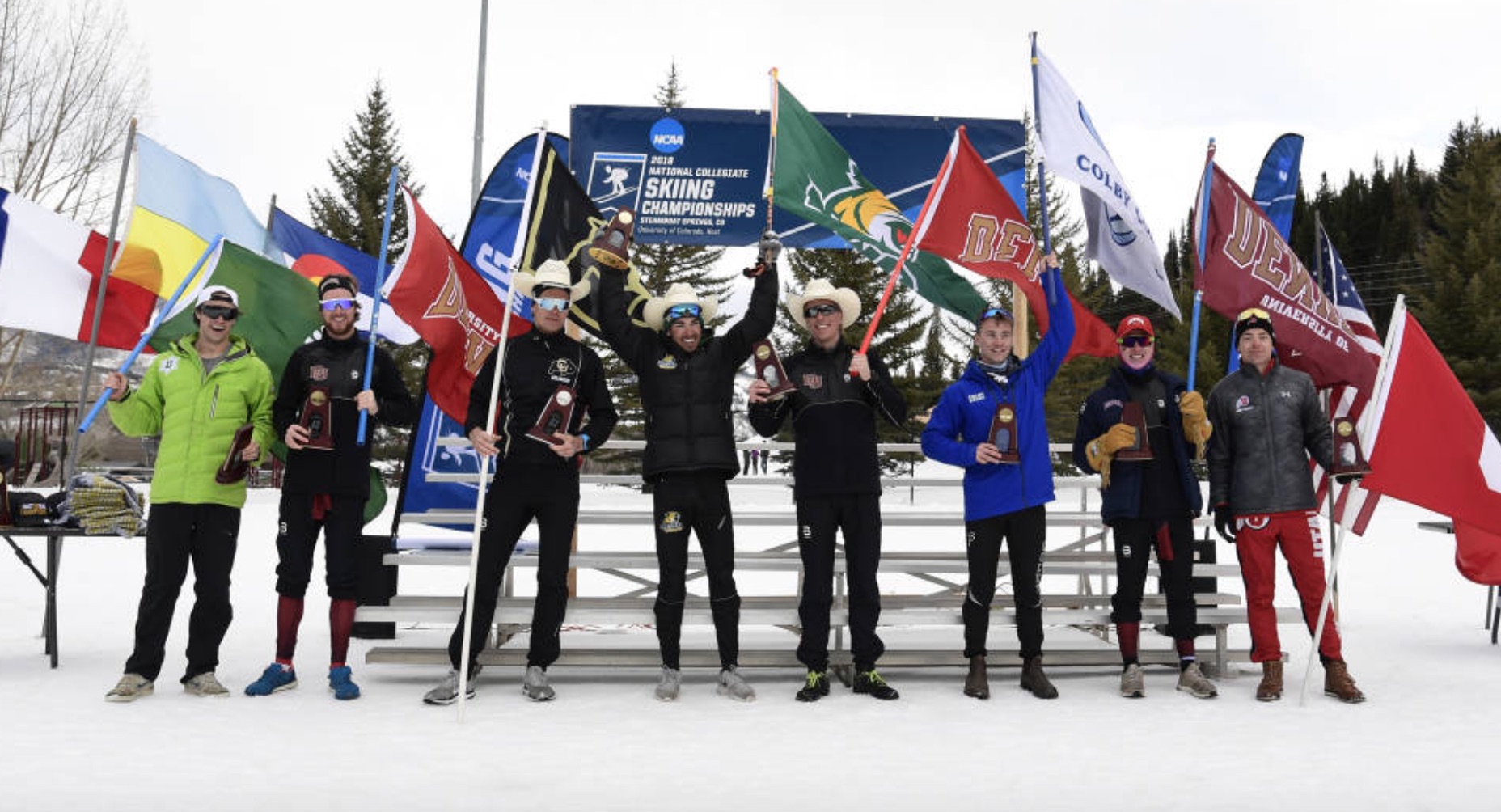
The top finishers in the men’s 20 k freestyle mass start at 2018 NCAA Skiing Championships in Steamboat Springs, Colorado, with Northern Michigan University’s Ian Torchia (c) in first. (Photo: Dartmouth Sports/Clarkson Creative)
NCAA Skiing Championships (Steamboat Springs, Colorado): 15/20 k freestyle mass starts
On the fourth and final day of NCAA Skiing Championships at Howelsen Hill in Steamboat Springs, Katharine Ogden skied to her second-straight national title, Ian Torchia became an NCAA champion and the University of Denver (DU) won its 24th NCAA National Championship.
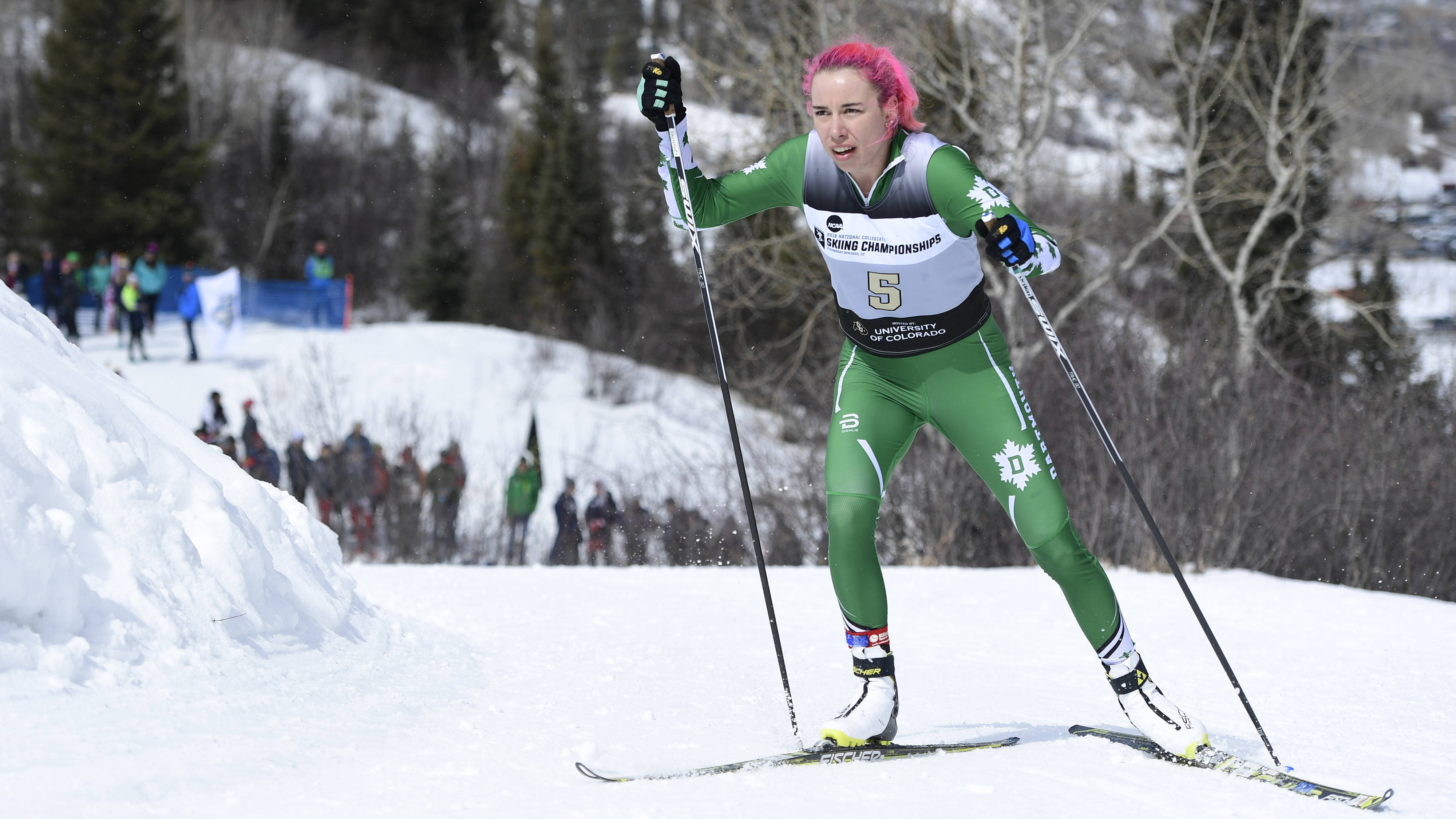
Dartmouth freshman Katharine Ogden racing to her second-straight victory of the 2018 NCAA Skiing Championships in Steamboat Springs, Colorado. She won Saturday’s 15 k freestyle mass start by more than 38 seconds. (Photo: Dartmouth Sports/Clarkson Creative)
Ogden, a Dartmouth College freshman, raced to a 38.4-second victory in the women’s 15-kilometer mass start, finishing in 43:22.0 minutes for her second win in as many races at 2018 NCAA Championships. She won the 5 k classic on Thursday and with her win on Saturday, she became the first Dartmouth skier in 56 years to win two national titles in the same year, according to a Dartmouth press release.
On the second of three laps, Ogden broke away early with close to 10 k to go. According to the press release, she had a “quick fall” near the end of the second lap, but that didn’t derail her as she had time to grab sunglasses from Dartmouth men’s coach Brayton Osgood and a Dartmouth Lone Pine flag before the finish.
At this year’s championships, Ogden’s two titles are accompanied by victories from Dartmouth men’s alpine skiers Brian McLaughlin (who won the giant slalom) and Tanguy Nef (who won the slalom). This marked only the second time that Dartmouth’s Big Green won four individual titles in a single NCAA Championships; that also occurred 61 years ago.
“Katharine absolutely wanted this one, and she really likes to win,” Dartmouth Director of Skiing and Women’s Nordic Head Coach Cami Thompson Graves said in the press release. “She wasn’t about to let a fall slow her down, she has such a great competitive fire. But she also showed her playful side grabbing Brayton’s glasses and smiling all the way to the finish line!”
Hailey Swirbul of the University of Alaska Anchorage placed second and Linn Eriksen (DU) reached the podium in third (+46.3). Denver had three in the top 10 with Jasmi Joensuu in ninth and Taeler McCrerey in 10th. Also landing in the top 10 for All-American honors were Guro Jordheim of the University of Utah in fourth, Emma Tarbath (Montana State University) in fifth, Petra Hyncicova of the University of Colorado Boulder (CU) in sixth, Christina Rolandsen (CU) in seventh, and Lauren Jortberg (Dartmouth) in eighth.
Torchia, an Northern Michigan University (NMU) junior and U.S. Ski Team Development Team member, became the seventh NCAA champion in NMU Wildcats nordic skiing history, according to an NMU press release. Fredrick Schwenke was the Wildcats’ last nordic champion; he won the 2015 NCAA Championships 20 k classic.
Torchia drew bib 1 for Saturday’s 20 k freestyle mass start and crossed the finish line first in 54:21.0, just 2 seconds ahead of CU’s Alvar Alev. Eivind Kvaale (DU) finished just four seconds back in third, and Denver had three in the top seven with Dag Frode Trollebø in fourth and Lars Hannah in seventh. Darmouth’s Cal Deline placed fifth, Zane Fields of Colby College finished sixth, and the 20 k freestyle’s 2017 NCAA champion Martin Bergström (Utah), who also won Thursday’s 10 k classic, placed eighth. CU’s Petter Reistad and Sondre Bollum finished ninth and 10th, respectively.
In the team standings, Denver beat Colorado by 41 points for the overall win with a total of 604 points between the nordic and alpine events at this year’s championships. Dartmouth placed third, 114.5 points behind Colorado, and Utah was another 63 points back in fourth.
According to a DU press release, Denver has won at least one national championship in each of the last five athletic seasons (skiing: 2013/14, 2015/16, 2017/18; hockey: 2016-17; men’s lacrosse 2014/15), joining only Stanford on the list of schools that have done so in the last five seasons. (Oregon, West Virginia, Penn State, Oklahoma, Ohio State and Florida could potentially join that list later this year.)
“It feels incredible,” said DU head coach Andy LeRoy said in the press release. “I am so happy for all of our athletes, they’ve been training all week and all season and to do it in Steamboat in front of our crowd is special.”
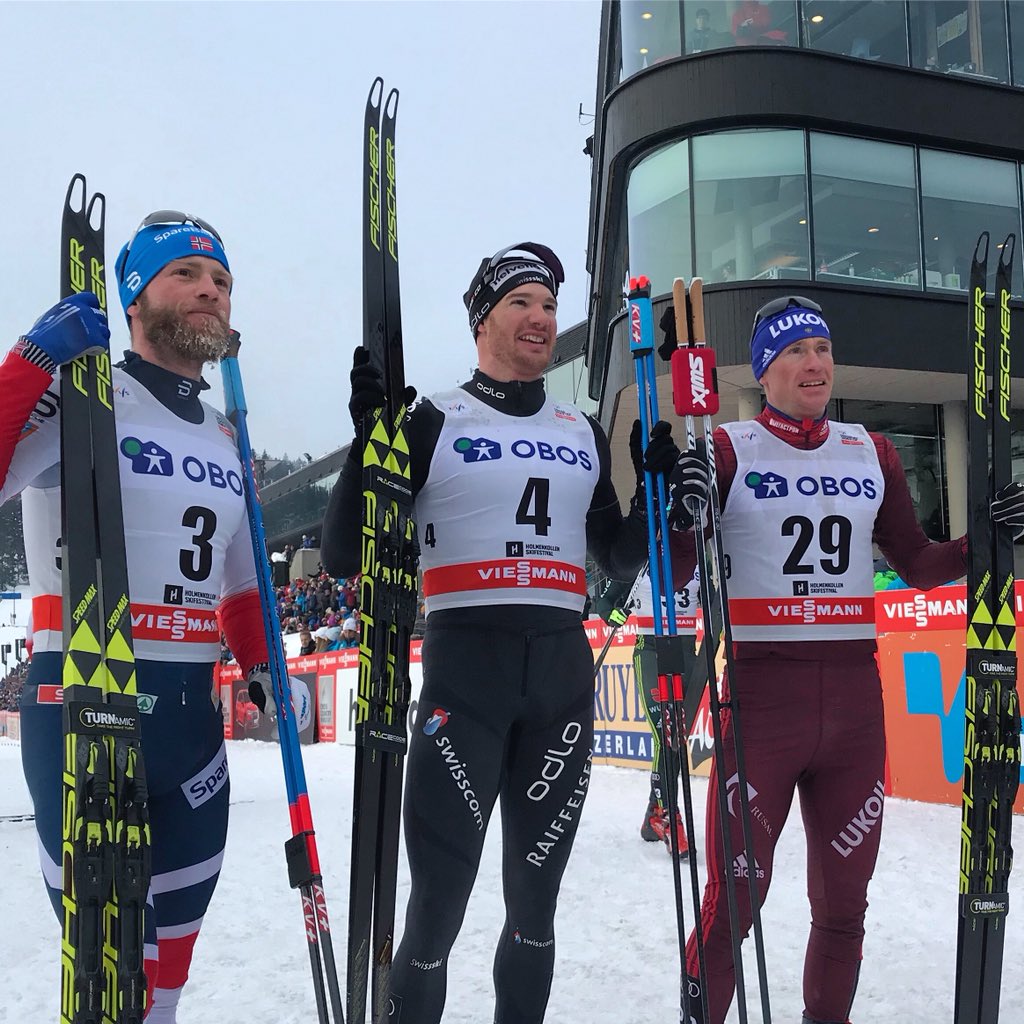
The Holmenkollen men’s 50 k freestyle mass start podium on Saturday at the World Cup in Oslo, Norway, with Switzerland’s Dario Cologna (c) in first, Norway’s Martin Johnsrud Sundby (l) in second, and Russia’s Maxim Vylegzhanin (r) in third. (Photo: FIS Cross Country/Twitter)
FIS Cross Country World Cup (Oslo, Norway): Men’s 50 k freestyle mass start
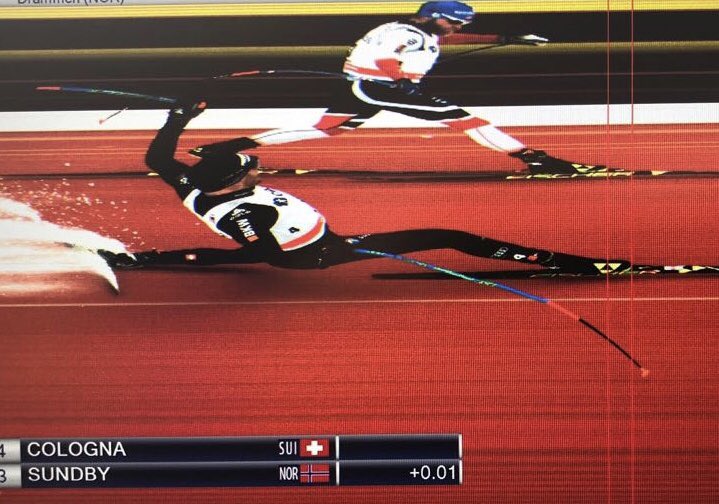
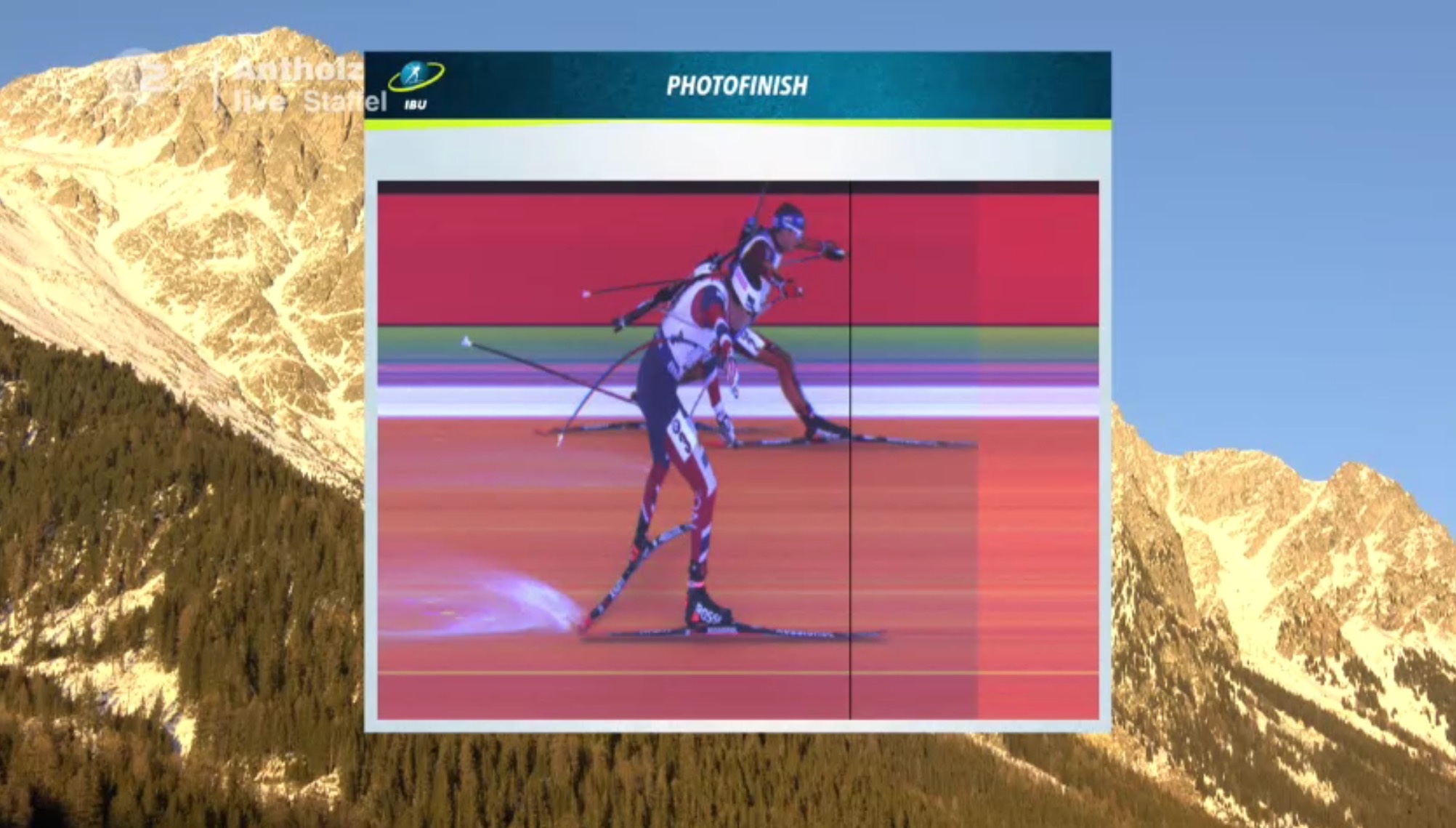
A four-time Olympic champion, Dario Cologna of Switzerland won his first 50-kilometer World Cup race on Saturday, topping the podium in the famous Holmenkollen 50 k freestyle mass start after outlunging Norway’s Martin Johnsrud Sundby (who won the event last year) for the win in 2:01:48.1. Sundby finished one-hundredth of a second behind for second place, ahead of Russia’s Maxim Vylegzhanin, who was 1.1 seconds back in third in his first World Cup race since November of last year.
The photo finish for first between Switzerland’s Dario Cologna (near) and Norway’s Martin Johnsrud Sundby at the Holmenkollen 50 k freestyle mass start on Saturday in Oslo, Norway. Cologna got it by 0.01 seconds. (Photo: FIS Cross Country/Twitter)
Norway’s Sjur Røthe came out on top in a race for fourth (+4.2), ahead of Russia’s Denis Spitsov in fifth (+4.4) and his Norwegian teammate Hans Christer Holund in sixth (+4.5). Great Britain’s Andrew Musgrave followed in seventh (+15.1), Germany’s Florian Notz placed eighth (+25.9) and Canada’s Alex Harvey finished ninth (+32.4), ahead of France’s Robin Duvillard in 10th (+33.5).
Scott Patterson led the U.S. in 16th (+56.3) coming off an 11th place in the 50 k classic mass start at last month’s Olympics, and Canada’s Devon Kershaw finished in the points in 28th (+3:43.6). Just outside the top 30, Canada’s Graeme Killick finished 34th (+4:55.1).
Also for the U.S, David Norris placed 38th (+6:19.7), Paddy Caldwell was 46th (+8:12.3), Noah Hoffman 49th (+10:27.9), Kevin Bolger 52nd (+12:44.2), and Simi Hamilton did not finish.
Canada’s fourth man in the race, Andy Shields finished 47th (+8:13.6).
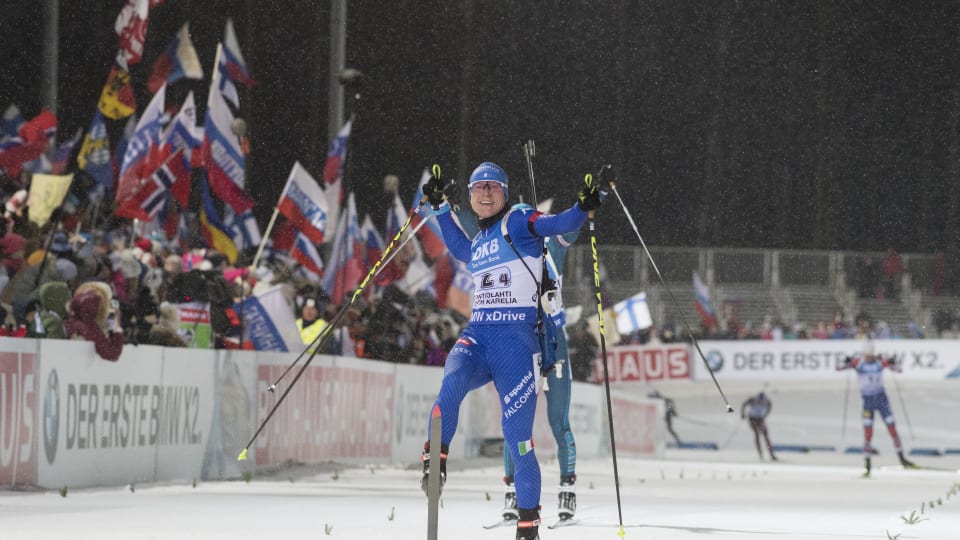
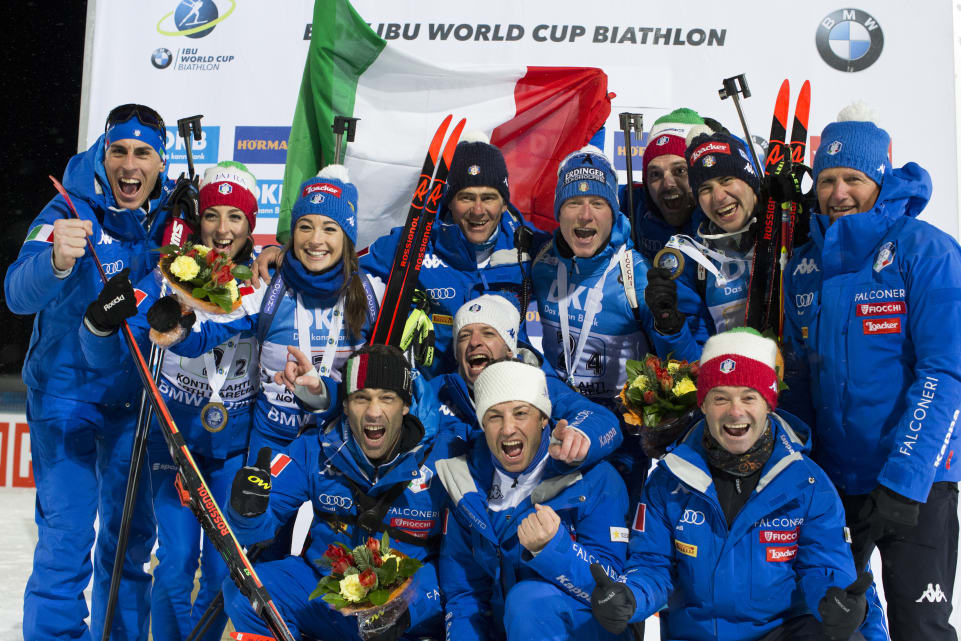
Italy’s Lukas Hofer celebrates his team’s win in Saturday’s mixed relay at the IBU World Cup in Kontiolahti, Finland. (Photo: IBU/Biathlonworld)
IBU World Cup (Kontiolahti, Finland): Single mixed relay & mixed relay
(Note: This rundown has been updated to include comments from Christian Gow and Sean Doherty.)
In the last single mixed relay and mixed relay of the International Biathlon Union (IBU) World Cup season, France and Italy came out on top, with France winning the two-person single mixed relay and Italy taking first in the coed mixed relay.
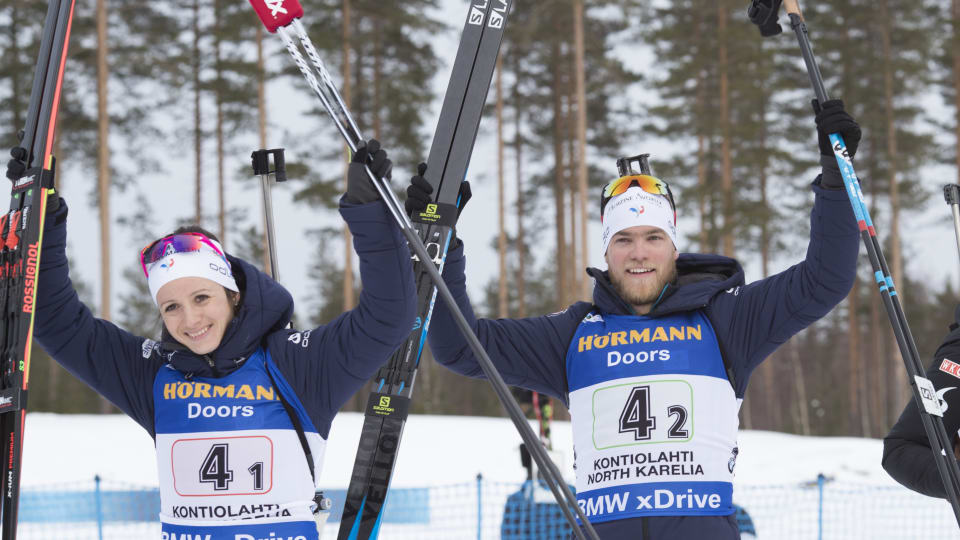
France’s Anaïs Chevalier and Antonin Guigonnat after winning Saturday’s single mixed relay at the IBU World Cup in Kontiolahti, Finland. (Photo: IBU/Biathlonworld)
France’s Anaïs Chevalier and Antonin Guigonnat combined for zero penalties and six spares to finish first in the single mixed relay in 33:29.1 minutes. Guigonnat as the team’s anchor secured the win by just 2.4 seconds over Austria’s Julian Eberhard while Norway’s Johannes Thingnes Bø finished 4.4 seconds back for third.
Chevalier put France in fifth after the first leg, 15.5 seconds behind Ukraine’s Iryna Varvynets in first. Guigonnat used just one spare on his first leg to move them into fourth, 9.2 seconds back while Norway led at the second exchange. On Chevalier’s second leg, she shot clean in both stages to lead through the final exchange, with Ukraine skiing just 6.2 seconds back in second.
On the final leg, Guigonnat used two spares and stayed out of the penalty lap, keeping the team in first through the finish. Eberhard skied the second-fastest course time on that leg to elevate Austria (with Lisa Theresa Hauser) from fourth at the tag to second place at the finish, and Bø skied all the way up from eighth to third place for Norway (with Marte Olsbu) with the fastest course time.
Ukraine’s Artem Tyschenko used just one spare but slipped to fourth with the 11th-ranked course time on that leg, as he finished 10.8 seconds behind Norway.
Behind Russia in fifth and Italy in sixth, Canada placed seventh (+23.8) with Rosanna Crawford and Christian Gow. The duo combined for zero penalties and six spares, and put themselves in third place early in the race. Crawford skied them into third on the first leg, using just two spares and tagging Gow 7.4 seconds out of first.
Gow went on to take the lead after cleaning prone without any spares, and he cleaned standing as well but slipped back to third while Bø took the lead. Gow tagged Crawford in third, 8.9 seconds behind Norway in first.
“I didn’t think too much about being tagged in third,” Gow recalled in an email to FasterSkier. “It was exciting for sure, but I let it fade to the background so that I could focus on my job both on the track and in the range. It was great to leave prone in first place! It was also surprising, but it was a good place to be in.
“My skiing was ok today,” he continued. “It is a really challenging and demanding race format that we don’t get a lot of practice with. I was sick after the Olympic Games and only finally coming around the past couple days. The Sprint race was horrendous for me, so today was much better than that. In the range I just focussed on myself and trusted my shooting. I tried my best not to get caught up in the race going on around me and it worked to my benefit.”
Crawford then slipped to seventh and 21 seconds back with three prone spares, but avoided the penalty lap, and Gow held onto seventh through the finish, using just one spare and skiing the eighth-fastest course time on that leg.
“We are both happy with this result,” Gow wrote. “I think that we are both looking at the 23 second gap to first and thinking that if things had worked out just a bit better we could be there. It can be both exciting and frustrating to be that close to the podium. We know we can do it, it’s just a matter of putting it together on the right day. We are happy with 7th, but hungry for more.”
Susan Dunklee and Lowell Bailey finished 14th for the U.S., 1:13.0 out of first with one penalty and 14 spares. The penalty came on Dunklee’s first leg during her standing stage, after she had cleaned prone without any spares. She tagged Bailey in 14th and he brought them up to 11th, using three spares on that leg, then Dunklee came through the final exchange in 13th after using four spares to clean. Bailey lost one place on the final leg, using four spares but staying out of the penalty lap.
Twenty-six teams competed in the single mixed relay, compared to 23 in the mixed relay that followed.
Team Italia celebrates its win in the IBU World Cup mixed relay on Saturday in Kontiolahti, Finland, with its relay members Dorothea Wierer, Lisa Vittozzi, Dominik Windisch, and Lukas Hofer. (Photo: IBU/Biathlonworld)
In Saturday’s 2 x 6 + 2 x 7.5 k mixed relay, Italy nabbed a 1.5-second victory over Ukraine in 1:15:08.3. Dorothea Wierer, Lisa Vittozzi, Dominik Windisch, and Lukas Hofer — the same Italian team that took bronze in the mixed relay at last month’s Olympics, although in a different order — combined for the win with one penalty and 13 spares.
Ukraine, with Anastasiya Merkushyna, Vita Semerenko, Artem Pryma, and Dmytro Pidruchnyi, had zero penalties and just three spares throughout the whole race. For the second-straight relay on Saturday, Norway placed third (+9.1) with Synnøve Solemdal, Tiril Eckhoff,Henrik L’Abée-Lund, and Tarjei Bø totaling zero penalties and nine spares.
Italy’s lone penalty came in Vittozzi’s second leg, but it didn’t derail the team as it improved from sixth to fifth with Vittozzi, who skied the third-fastest course time on that leg. She tagged Windisch 6.8 seconds out of first, and Windisch, who had anchored the team in the Olympics, took the lead by the final exchange after using two spares to clean. Hofer left the exchange just 3.3 seconds ahead of Norway’s Bø but used just one spare and skied the second-fastest anchor leg to finish first, beating his rivals up Kontiolahti’s infamous climb known as “The Wall”. Ukraine’s Pidruchnyi also shot clean with a single spare and clocked the fastest anchor leg to move his team from fourth to second place. Bø lost one place and finished third after using one spare as well and skiing the third-fastest anchor leg.
Russia followed in fourth, France fifth, Sweden sixth, Germany seventh, Austria eighth, and the U.S. ninth (+2:48.4). The U.S. team, with Clare Egan, Joanne Reid, Tim Burke, and Sean Doherty, had one penalty and 11 spares. Egan cleaned her first prone but had to ski a penalty lap after her standing stage, tagging Reid in 17th, 58.7 seconds out of first.
Reid used three spares on the second leg and moved up to 13th by the second exchange, and Burke used three spares as well to pick off one more place and tag Doherty in 12th. Doherty skied the eighth-fastest anchor leg and used two spares to clean to put the team in ninth at the finish.
“I don’t consider two spares to be anything special, but today it was enough to make up some ground,” Doherty wrote in an email to FasterSkier.”I felt strong skiing, more like myself which is fun even if it’s a little late in the season. We had very good skis which always helps. I have done quite a few laps on this course over the years so the lines and transitions are pretty refined, so that is where I made time on the course.
“I am happy with my leg. I enjoyed my little battle for 9th,” he continued. “I can’t speak too much for the other members of the relay tonight but I think 9th is a solid effort.”
Canada finished 17th (+4:34.9) with Emma Lunder, Julia Ransom, Scott Gow, and Brendan Green combining for one penalty and 13 spares. Lunder put them in 12th at the first exchange and Ransom skied up to 10th, but Scott Gow had a penalty on his standing stage to drop to 16th. Green lost one more place on the last leg despite only requiring two spares.
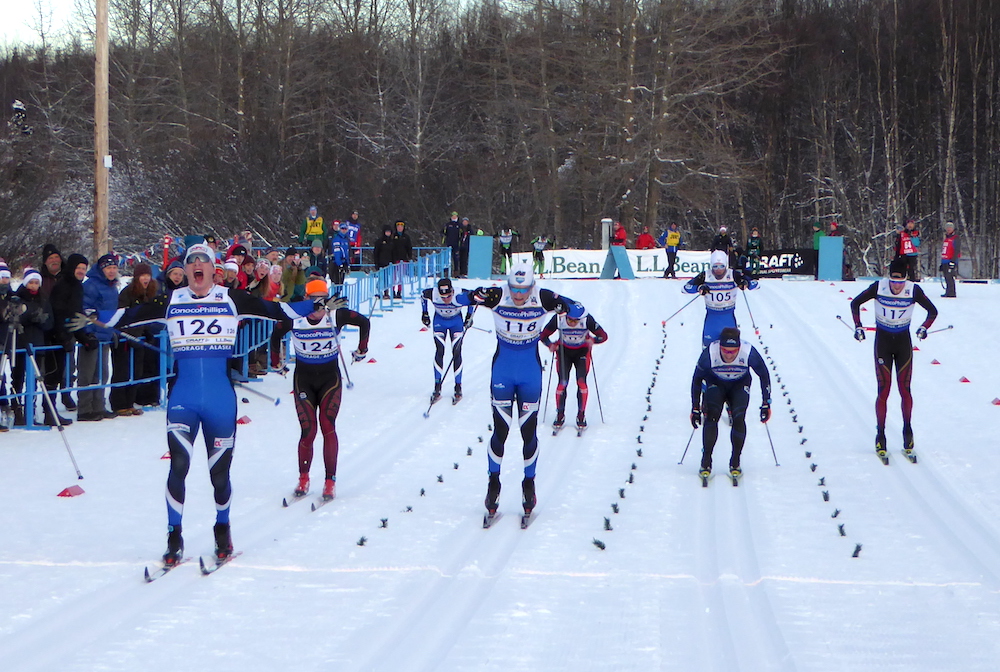
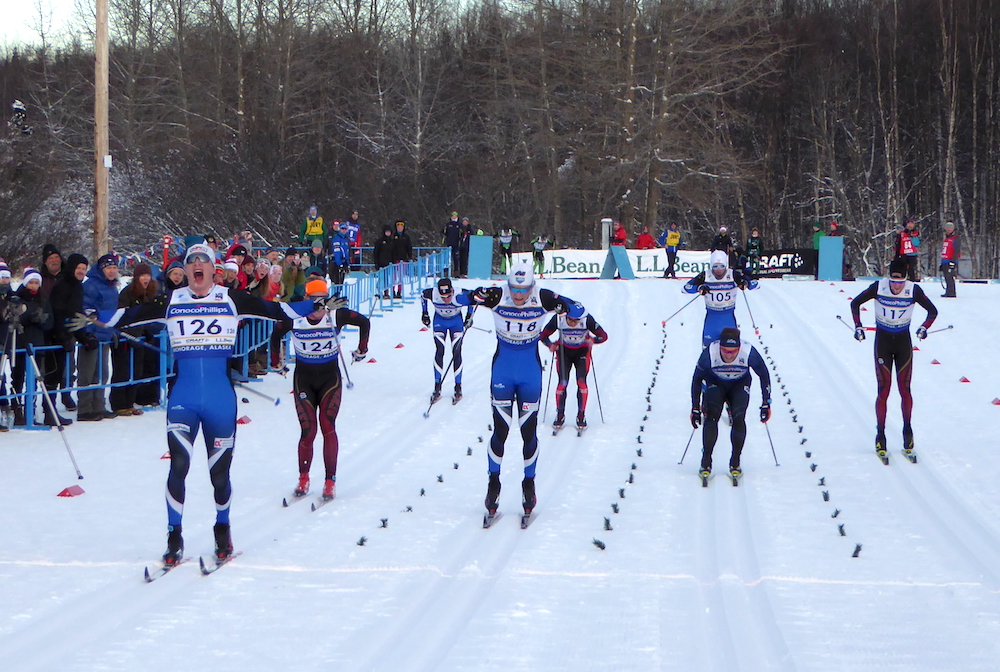
APU’s Tyler Kornfield (126) leads APU’s Eric Packer (118) and DU’s Eivind Romberg Kvaale (124) to the line in the men’s 30 k classic mass start at 2018 U.S. Cross Country Championships on Sunday in Anchorage, Alaska. Kornfield, Packer, and Kvaale finished first, second and third, respectively. Kris Freeman (10, second from left) was fourth overall and the third American.
U.S. Cross Country Championships (Anchorage, Alaska): 20/30 k classic mass starts
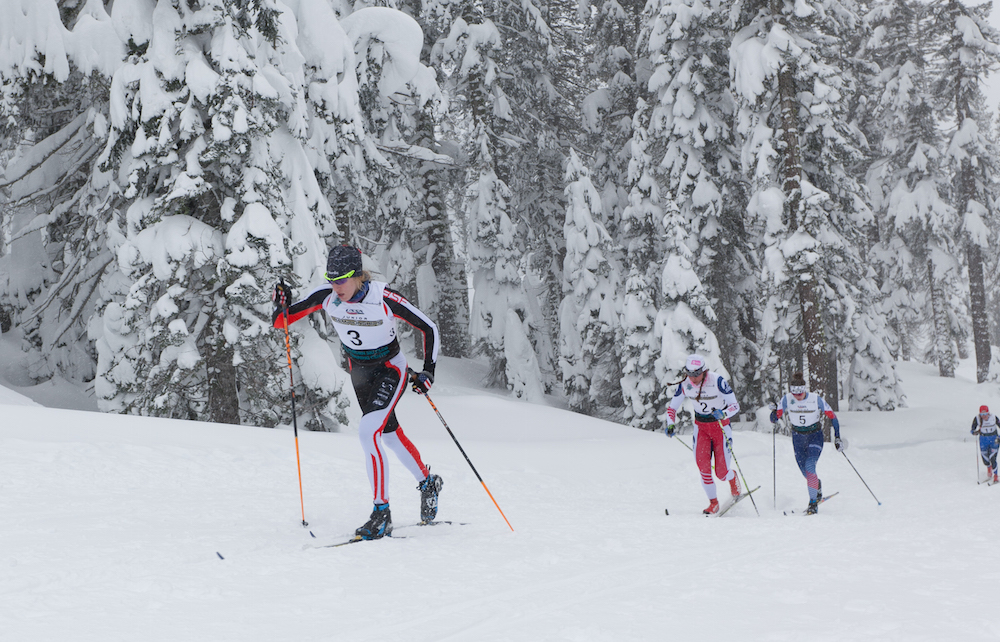
Sweden’s Hedda Bångman denied Caitlin Patterson of her first outright victory of the week at 2018 U.S. Cross Country Championships, but Patterson as the first American racked up her third-straight national title in the women’s 20-kilometer classic mass start at Kincaid Park on Sunday in Anchorage, Alaska.
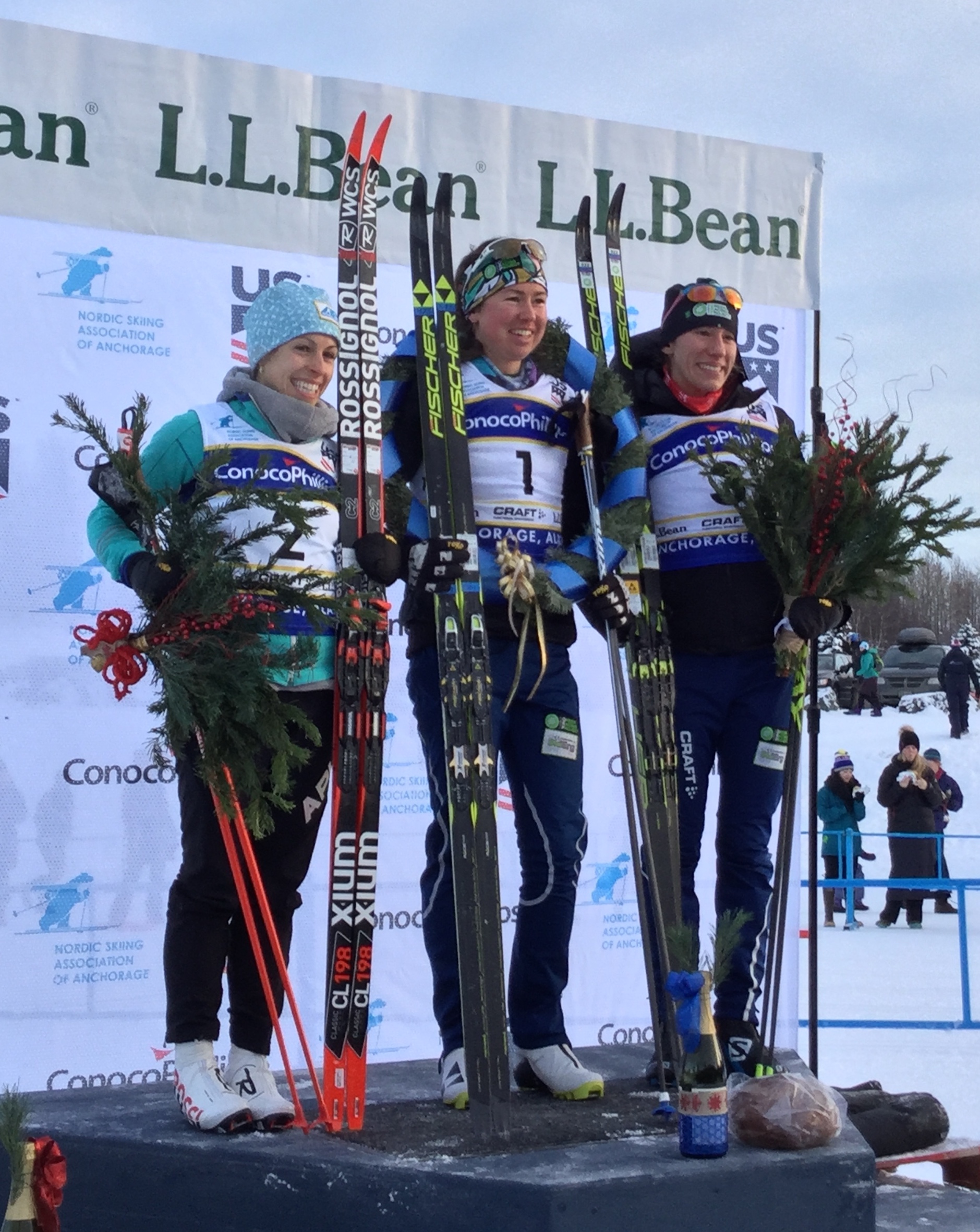
The top-three Americans in the women’s 20 k classic mass start on Sunday at 2018 U.S. nationals in Anchorage, Alaska, with Caitlin Patterson (1) of the Craftsbury Green Racing Project (CGRP) in first, Rosie Frankowski of APU (l) in second, and Kaitlynn Miller (r) of CRGP in third.
Bångman, a 22-year-old freshman at the University of Colorado Boulder (CU), pulled off a 15.9-second win in the mass start, crossing the line in 1:00:55.3 hours. Patterson, of the Craftsbury Green Racing Project (CGRP), finished second, but was the top American in the event for the third time this week, and Rosie Frankowski, of Alaska Pacific University (APU), notched third (second American), 19.6 seconds back.
Rounding out the top 10 was Jessica Yeaton, who trains with APU and races for Australia, in fourth (+44.1), Kaitlynn Miller (CGRP) as the third American in fifth overall (+1:13.5), Alayna Sonnesyn of the University of Vermont (UVM) in sixth (+1:25.3), Chelsea Holmes (APU) in seventh (+1:55.4), Norwegian CU skiers Christina Rolandson and Anne Siri Lervik in eighth (+1:55.7) and ninth (+1:56.1), respectively, and Erika Flowers of the Stratton Mountain School (SMS) Elite Team in 10th (+2:14.6).
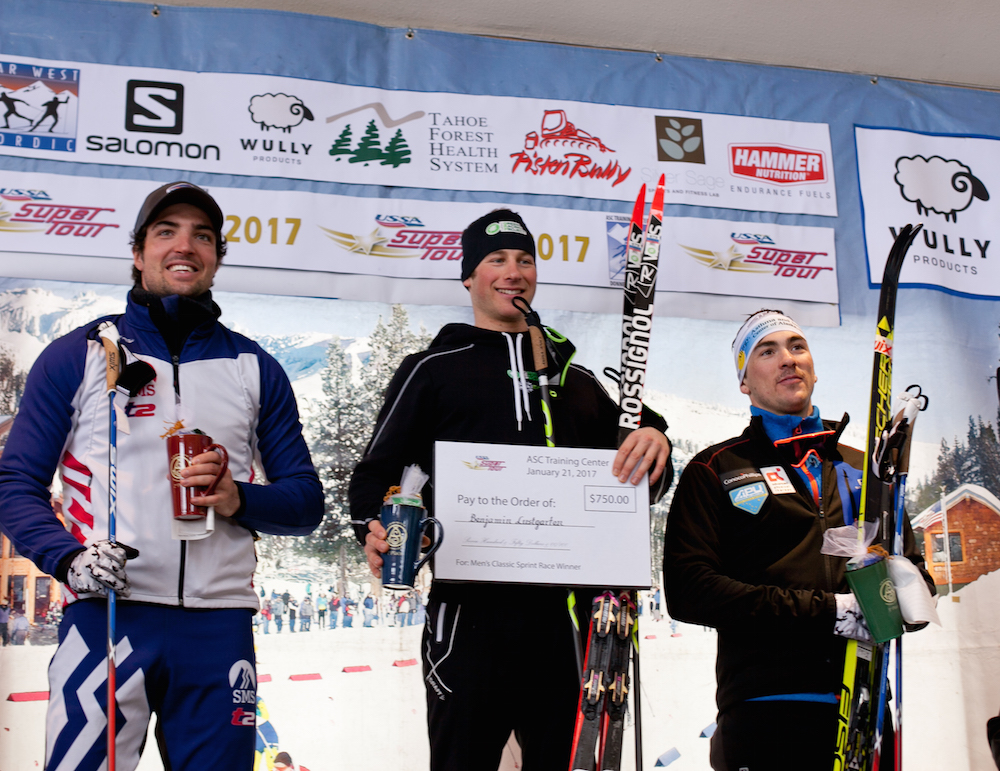
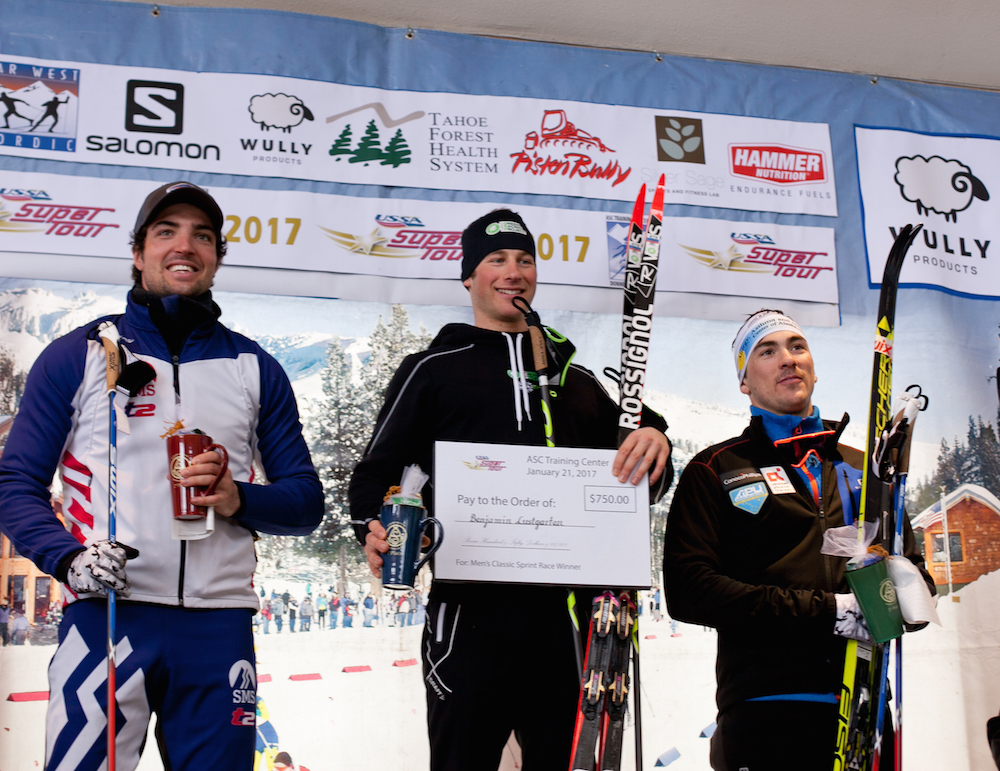
The men’s 30 k classic mass start was incredibly close, with APU’s Tyler Kornfield taking his first-ever distance national title (he was the 2012 classic sprint national champion) in 1:21:43.6. He edged his teammate Eric Packer by 0.7 seconds at the line, and Eivind Romberg Kvaale, a sophomore at the University of Denver (DU), finished 1 seconds back in third.
Kris Freeman (Caldwell Sport) was just off the overall podium in fourth (+1.6), but was the third American. Another DU skier, Dag Frode Trollebø, also from Norway, finished fifth (+2.0), and APU had three in the top six with David Norris in sixth (+2.5). Noah Hoffman (Ski & Snowboard Club Vail) finished seventh (+2.6), Scott Patterson (APU) eighth (+3.6), and Craftsbury’s Adam Martin and Ben Lustgarten followed in ninth (+14.7) and 10th (+14.9), respectively. With Brian Gregg (CXC/LNR/Team Gregg) in 11th (+16.1), the men’s top 11 were separated by less than 17 seconds.
IBU World Cup (Oberhof, Germany): Men’s and women’s relays
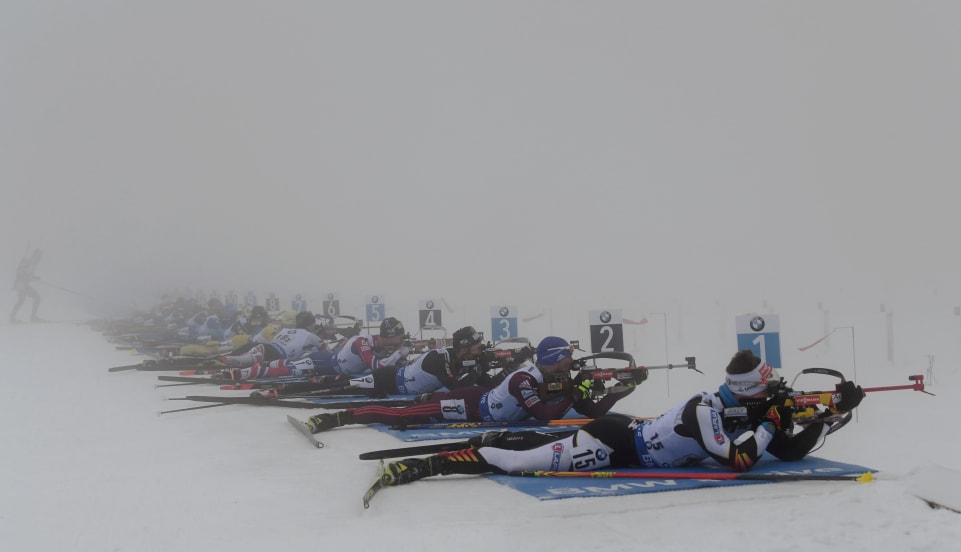
Racers on the range during the men’s 4 x 7.5 k relay on a foggy Sunday at the IBU World Cup in Oberhof, Germany. (Photo: IBU/Biathlonworld)
The Swedish men’s team and French women won the second relays of the International Biathlon Union (IBU) World Cup season on Sunday, with Sweden winning the men’s 4 x 7.5 k relay by 1:10.8 over Italy, and France besting Germany by 32.4 seconds.
Notably, most of the top teams didn’t start all of their “A” teamers.
In the men’s race, Sweden’s Martin Ponsiluoma, Jesper Nelin, Sebastian Samuelsson, and Fredrik Lindström combined for their first win together — and the first win for most of the members on the team.
“It is a dream when you are a kid to compete in a World Cup,” Samuelsson said, according to an IBU press release. “To have a win is really amazing!”
The Swedish women’s team also landed on the podium in third (+48.2).
“What a race by the whole team,” said Lindström, who also has one non-relay World Cup win (from 2012) to his name. “It could not be better.”
Conditions could not have been much more difficult for shooting on Sunday, with the fog that had descended early in the day for the women’s race worsening for the men’s race. When there wasn’t fog, there was wind.
Misses were common throughout the two races, and even with racers being able to use three spares per shooting stage to clean, there were a high number of penalty laps.
But the Swedish men kept their penalties to a minimum, with just one for the entire team and a total of nine spare rounds used among them. After Ponsiluoma came through the first exchange in sixth, Nelin skied them into third, Samuelsson picked off another place despite skiing a penalty after his standing stage to put them in second, and Lindström anchored them to first.
“The conditions today were so special. Somehow I felt not so nervous, I was calm and had luck on my side,” Lindström said at a post-race press conference about his nearly flawless shooting (0+0; 0+1).
“I have never [been first] before,” he added. “Not like this in a relay at least. That’s really fantastic.”
“I had to look up to see if I was aiming the right way,” Nelin said after cleaning prone (0+0) then using two spares to clean standing (0+2). “I had no idea where I was aiming, so it was really difficult. But I hit, and it was good. Maybe these conditions fit me and I should never see anything.”
Italy placed second with Thomas Bormolini, Lukas Hofer, Dominik Windisch, and Thierry Chenal combining for two penalties and 11 spares. Hofer had skied them up from eighth to second, and Windisch then took the lead on the third leg to put them in first at the final exchange, 1 minute ahead of Sweden. But Chenal slipped with the seventh-fastest last leg time and a penalty after standing.
“Being on the podium with the team is always a special feeling,” Hofer said at the press conference. “For Thierry, it’s the first year in the World Cup, and he does a really good job, not just today. I am really happy that he could close out this relay. Second place is like a win for us.”
Norway placed third (+2:04.6) with Vetle Sjåstad Christiansen, Henrik L’Abée-Lund, Lars Helge Birkeland, and Tarjei Bø. Together, they had three penalties (two from L’Abée-Lund and one from Birkeland) and 14 spares.
“I grew up on Holmenkollen so I practiced a lot there [in fog],” L’Abée-Lund said. “But today was really really hard, I didn’t see anything in prone. Standing was OK, but prone was really difficult.”
“It’s great to be on the podium,” Christiansen said. “Of course Norway always wants to win, but today we are very happy for our brothers in our neighbor-country Sweden.”
The Canadian men placed 10th (+6:23.1) out of 25 teams with Christian Gow, Scott Gow, Brendan Green, and Carsen Campbell having a combined six penalties and 20 spares. Three of those penalties came on Scott Gow’s second leg, two from Campbell’s anchor leg, and one on Christian Gow’s first leg.
After a penalty on his first prone stage (1+3), Christian cleaned standing with a spare (0+1) and tagged Scott in 11th, 53 seconds out of first. Scott then had two penalties in prone and three in standing, but managed to improve to eighth given how much everyone else was struggling with the shooting as well. Green kept them in eighth with two clean stages (0+2, 0+3), and Campbell, in his first World Cup relay, cleaned prone (0+2) but had two standing penalties (2+3) to put the team in 10th at the finish.
In an interview with German broadcaster ARD halfway through the race, Canadian coach Matthias Ahrens called the range conditions, which ranged from thick fog to unpredictable wind, “very hard to assess.”
“… To be honest, the good thing was that conditions were very bad,” he later added. “So regarding visibility, almost everyone was on the range at the same time [with the same irregular conditions]. They had to wait very long, and of course had bad conditions to shoot, but much of the field was there at the same time.”
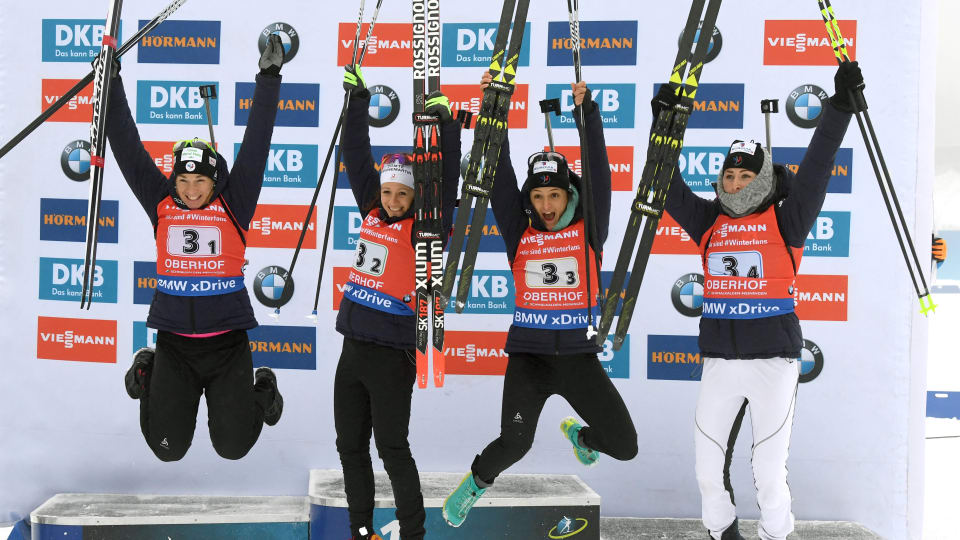
The French women’s team, of Anais Bescond, Anais Chevalier, Celia Aymonier, and Justine Braisaz, celebrate their relay victory on Sunday at the IBU World Cup in Oberhof, Germany. (Photo: IBU/Biathlonworld)
In the women’s race, with better shooting visibility, France’s Anais Bescond, Anais Chevalier, Celia Aymonier, and Justine Braisaz took the win in 1:12.42.4, with one penalty and 10 spares. After Bescond put them in first through the first exchange, 6 seconds ahead of Italy in second, Chevalier had to ski a penalty loop after prone but cleaned standings (1+3, 0+0) and tagged off in second, 23 seconds behind Italy, now in first.
One loop later, France was back in first thanks to Aymonier, who cleaned with just two spares (0+0, 0+2), and they extended their lead from 0.8 seconds at the last exchange to 32 seconds at the finish with Braisaz, who shot 0+1, 0+3, and skied the fastest anchor leg.
“I know that it’s always good for Justine to start in the first position, so I really wanted to pass the relay to her in that,” Aymonier said in a press conference after.
“I was nervous, too,” Braisaz said. “That kind of shooting turned my mind upside down, actually. The crowd was very loud, and … I wasn’t very focused on what I did. It was a bit foggy, too, so that made it harder. But finally it was a French day, maybe.”
“In my mind the whole team is really strong, and really able to get the first place,” Bescond said. “After years and years and years behind Germany’s team we finally did it. So just Oberhof spirit I think.”
Germany placed second with Vanessa Hinz, Denise Herrmann, Franziska Preuss, and Maren Hammerschmidt. They combined for two penalties and 13 spares; with a penalty on Hinz’s first leg and one more on Hammerschmidt’s last shooting. After being tagged in 14th, Herrmann skied them into fourth, 40 seconds out of first, and Preuss elevated them to second, which Hammerschmidt held onto.
“I was struggling a little bit in the prone shooting,” Herrmann said. “But the skiing was good today, and also the standing [shooting]. I tried to go fast on the track and catch some girls.”
Sweden, with Linn Persson, Anna Magnusson, Elisabeth Högberg, and Mona Brorsson, avoided the penalty loop and used eight spares to reach the podium for the first time in six seasons. In sixth place at the first exchange, they slipped one place to seventh on the second leg, but Högberg raced them up to fourth with near-perfect shooting (0+0, 0+1) with one leg to go. Brorsson then anchored them to third with clean shooting (0+2, 0+1) and the third-fastest last leg.
“It’s just super nice for us! I am super happy,” Magnusson said. “We were very emotional at the finish.”
When Brorsson was asked if she believe she could fight for the podium, she responded, “Not really. But I said to Linn, ‘Maybe it is our day today. Please let it be our day today.’ ”
The Canadian women finished 14th (+6:37.5), out of 20 teams, with two penalties and 13 spares. Sarah Beaudry initially put them in 15th after shooting 0+1, 0+2, then Julia Ransom had a standing penalty (0+2, 1+3) to slip one place to 16th. Megan Tandy picked off three places with clean shooting (0+0, 0+2) and tagged Emma Lunder in 13th, and Lunder had a penalty in prone but cleaned standing (1+3, 0+0) to finish in 14th.
The men’s overall 2018 Tour de Ski podium atop Alpe Cermis after the final Stage 7 hill climb: with Switzerland’s Dario Cologna (c) in first, Norway’s Martin Johnsrud Sundby (l) in second and Canada’s Alex Harvey (r) in third. (Photo: FIS Cross Country/Twitter)
Dario Cologna of Switzerland added a fourth Tour de Ski (TdS) title to his list of accolades on Sunday, winning the 2018 edition of the race in dominant fashion, with a 1:26.5-minute win over Norway’s Martin Johnsrud Sundby. And Canada’s Alex Harvey scored his first TdS overall podium in third.
The 31-year-old Cologna started the 9-kilometer freestyle pursuit up Alpe Cermis 1:15 ahead of Kazakhstan’s Alexey Poltoranin in second. Russia’s Sergey Ustiugov, slated to start third, did not start due to a back injury. Thus Harvey was the third man off the start line, 1:23 behind Cologna.
(Sweden’s Marcus Hellner, 13th after Saturday’s Stage 6, also did not start the Tour’s final stage.)
Early on, Cologna started putting time into his competitors, extending his lead on Poltoranin to 1:20.5 and Harvey to 1:24 at 1.8 k.
By 4 k, however, Harvey had used his speedy skiing on the flatter portions of the race leading up to the climb to catch Poltoranin, and the two clocked through that checkpoint 1:19.4 behind Cologna. Behind them, Russia’s Alexander Bolshunov skied just ahead of Sundby, another 21 seconds and 22 seconds back, respectively, in fifth and sixth.
While Harvey clawed back a few more seconds on Cologna, he was still 1:17.8 back at 6.2 k, with Poltoranin just 0.7 seconds behind him in third.
Harvey remained in second until around 8.5 k; with just a half kilometer to go, Sundby had caught both Poltoranin and Harvey, passing them both. Sundby held that position and finished second, 1:26.5 behind Cologna, who won in 28:52.1.
Harvey stayed strong for third (+1:30.6) while Poltoranin dropped off the Canadian’s pace in the final half kilometer and finished fourth (+1:41.7). Norway’s Hans Christer Holund placed fifth (+2:17.8), Bolshunov lost a spot to finish sixth (+3:09.7), France’s Jean-Marc Gaillard finished seventh (+3:16.7), Sweden’s Daniel Rickardsson eighth (+3:20.8), and Russia’s Alexey Chervotkin and Andrey Larkov took ninth (+3:33.5) and 10th (+3:37.8), respectively.
France’s Maurice Manificat, known for his strength in freestyle hill climbs and pursuit races, rose from 14th to 11th (+3:45.7) with the second fastest time of day, 12.8 seconds slower than Sundby as the time of day winner in 28:36.4. Cologna’s time was fourth fastest (+15.7), behind Russian U23 skier Denis Spitsov in third (+14.3) (Spitsov started 20th and finished 13th). Holund’s time ranked fifth (+20.6) and Harvey’s time was sixth fastest (+23.6) of the 43 men that finished the race.
The lone American man to complete this year’s Tour, Paddy Caldwell (U.S. Ski Team) skied the 22nd fastest time of day for 38th overall (+11:54.8).
Heidi Weng (center) celebrates her second Tour de Ski victory, with teammate Ingvild Flugstad Østberg second and the U.S. Ski Team’s Jessie Diggins third. (Photo: FIS Cross Country/Twitter)
In the women’s hill climb that kicked off the day, Heidi Weng raced to her second consecutive TdS title. The Norwegian started the day within two seconds of teammate Ingvild Flugstad Østberg, and the two skied together for the flat section of the nine-kilometer stage of the competition. But when the climbing got steep on Alpe Cermis, Weng left her teammate behind and eventually racked up a 48.5-second win.
The battle for third was less predictable. Jessie Diggins of the United States started the day in fourth, but made up the ten seconds to third-place KristaPärmäkoski of Finland in the first few kilometers. The pair climbed together for a while before Diggins attacked. Pärmäkoski tired on the final sections of the Alpe Cermis and Diggins took the podium in definitive style, 2:23.2 behind Weng and 24 seconds ahead of Pärmäkoski. It’s the first overall Tour de Ski podium for Diggins or any American athlete.
Teresa Stadlober of Austria finished fifth (+3:09.4), Kerttu Niskanen of Finland sixth (+4:17.0), Russia’s Anastasia Sedova seventh (+4:49.6), and Switzerland’s Nathalie von Siebenthal eighth (+4:56.1).
Sadie Bjornsen started eighth and slipped one spot to finish ninth (+6:15.0), giving the U.S. two top-ten finishers in the Tour de Ski for the first time. Liz Stephen finished 16th (+8:25.8) and Rosie Brennan 24th (+10:59.6).
En route to her win, Weng notched the fastest time of the day on the 9 k stage. Stadlober’s time was second, Diggins third, Østberg fourth, and Stephen fifth.
32 women finished this year’s edition of the Tour de Ski.
Leif Nordgren (US Biathlon) skiing the second leg of the IBU World Cup men’s 4 x 7.5 k relay on Sunday in Hochfilzen, Austria. The U.S. men ended up ninth overall out of 26 teams. (Photo: IBU/NordicFocus)
Strong gusts of wind on the range required strong nerves and a lot of luck in the women’s and men’s relay races that concluded the International Biathlon Union (IBU) World Cup in Hochfilzen, Austria, on Sunday afternoon.
While the relays concluded with teams on the podium one might expect there, tempestuous weather conditions that at times made it almost impossible to hit the targets also gave outsiders a good chance, and both the U.S. men and Canadian women remained in contention for a long time. The men’s 4 x 7-5-kilometer relay was particularly wild with more than 100 penalty laps, and it began with a big surprise.
Belgium’s starter Michael Rösch tagged off in first place for the first time in the history of that team, representing a country that until now, rarely had enough athletes for a relay and had thus far had a 24th place at the 2016 World Championships to its credit. And on his tails was Norway’s Ole Einar Bjørndalen, and shortly behind them US Biathlon’s Lowell Bailey in third.
The three aforementioned athletes all raced in the Olympic relay more than a decade ago at the 2006 Winter Games in Torino, Italy, but back then Rösch raced for Germany and won gold with his team.
“I wanted to tag off in first at all costs, to see the Belgian flag at the top,” Rösch told TV broadcaster ARD on Sunday while the race was still going on. “But Ole made it really hard for me. … I was on my last fumes, I tumbled into the finish, I was just seeing black, but it definitely was worth it.”
Just a turn behind, Bailey had gotten off to a strong start for the U.S. team, temporarily taking the lead out of the arena on the first lap before shooting clean in his prone stage to put himself in the lead group of seven. Facing strong wind in his standing stage, Bailey missed two targets but avoided the penalty lap with his last spare in that stage (0+0, 0+3), and tagged off to teammate Leif Nordgren in third position, 23.8 seconds out of first.
Nordgren ended up with a penalty in his first prone after missing two targets, and returned to the course in fifth. While his penalty had increased the gap to first by 50 seconds, Nordgren made up a few seconds with a clean standing bout, hitting all targets without requiring a spare (1+3, 0+0).
Italy and France passed him on the final loop, and Nordgren handed off in seventh, 1:34.2 minutes behind Norway setting the pace up front.
“The team came pretty close to a good result today in a relay with nasty weather,” Nordgren wrote on his Instagram account. “Personally I’m quite disappointed with my skiing, it’s been a struggle to find the top gears so far this season and I’m far from where I know I should be. It’s a long season though and there is still plenty of time to turn it around.”
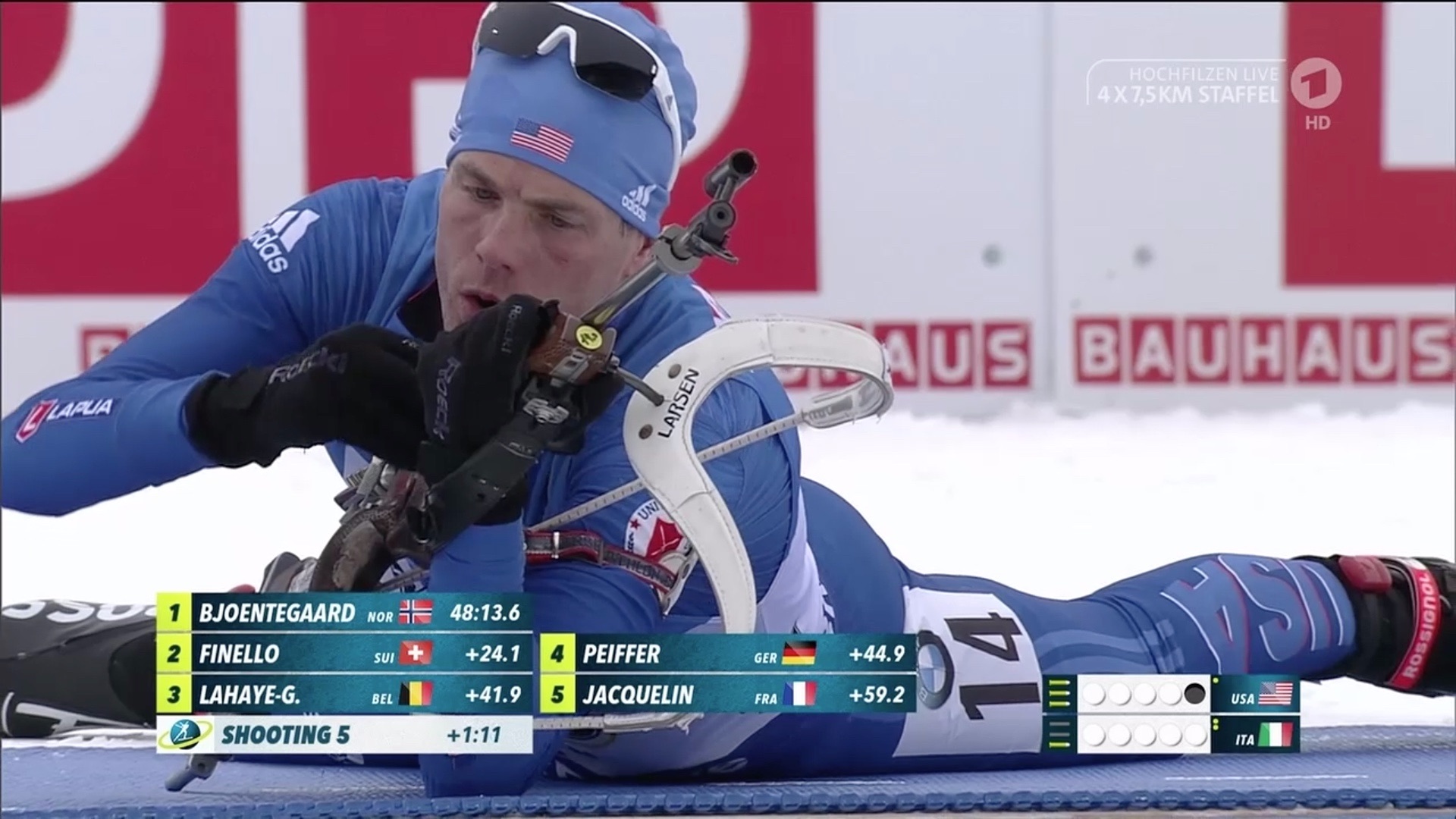
US Biathlon’s Tim Burke loading a spare in his prone stage of the men’s relay at the 2017/2018 IBU World Cup in Hochfilzen, Austria. The team went on to finish 9th. (Screenshot: ARD broadcast)
Taking over next for the U.S. was Tim Burke, who pointed out this was one of the most challenging races in terms of wind that he’d experienced.
“This was definitely one [of the] windiest races that I have taken part in,” Burke wrote in an email to FasterSkier. “We knew it would be very challenging right from the start but our team tried to look at it as an opportunity for a top result. I feel like our team did a great job at avoiding any big disasters on the range and this allowed us to stay near the front for most of the race.”
After only needing one spare in his prone shooting to hit his last target, Burke incurred a penalty in his standing stage (0+1, 1+3), but kept his position on the final loop in a hard race against Switzerland’s Jeremy Finello to exchange still in seventh, now another minute back (+2:49.4).
“I was not surprised to see a mix of different teams near the front today,” Burke wrote. “It was one of those days that any team could find themselves with multiple penalty loops after a windy shooting stage.“
Taking over from Burke as the U.S. anchor leg was Sean Doherty, coming off two strong shooting performances in the sprint and pursuit earlier this week.
U.S. relay anchor Sean Doherty taking aim in difficult wind conditions during his standing stage of the men’s relay at the 2017/2018 IBU World Cup in Hochfilzen, Austria. His team finished ninth. (Screenshot: ARD broadcast)
In his prone stage, Doherty again shot clean and fast (with the second-fastest prone shooting time on his leg) and overtook Switzerland to move into sixth. He kept that position on the course, vying for a position in the top five with the teams from France, Italy, Ukraine, and Russia also in his vicinity.
“Today was a crazy one for sure,” Doherty wrote in an email. “The conditions on the course were decent, firm tracks and we had good skis. The wind was whipping, so that really just made some sections a lot harder than normal when you added in the head wind. I have done races in bad weather before but today was amongst the most windy.
In the standing stage, Doherty hit his first four shots in another fast sequence before missing the last one. It looked as if he had thought that final shot was also a hit as he dropped his rifle slightly, but then realized he had to load spares. Unable to clear the last target, Doherty ended up with the team’s third penalty.
“With the shooting you try to get a general idea of how far the wind is pushing the shots and do the best you can,” Doherty explained. “It’s a total toss up and the finish order is just a ranking of who battled the wind the best and had most to least luck along the way.”
He set out on his last loop in eighth place with Ukraine’s Dmytro Pidruchnyi and Switzerland’s Mario Dolder right ahead of him, and Russia’s Anton Shipulin ten seconds behind.
“The fight on the last lap is always tough,” Doherty wrote. “Although I felt better today I was not able to hang with the two guys I left the range with. I was able to ski a good lap but not enough to hold off Anton.”
After Shipulin passed him up the big last climb, Doherty came to the finish in ninth position, 3:38.3 minutes behind the winners with a team total of three penalties and 13 spares.
“We were not too excited with the end result because we saw the potential was there for a top 5,” Burke concluded for the team. “We are also all far from our best on the tracks right now, but are hopeful that will come with more racing.”
Norway Successful with Its ‘Second Unit’
Norway’s Lars Helge Birkeland, Erlend Bjøntegaard, Henrik L’Abée-Lund and Ole Einar Bjørndalen (left to right) following their victory in the men’s relay at the 2017/2018 IBU World Cup in Hochfilzen, Austria. (Photo: IBU/Biathlonworld)
Norway started the men’s relay race without Emil Hegle Svendsen, who was sidelined with a cold, and also rested brothers Johannes Thingnes Bø and Tarjei Bø, both of whom had already won races this season.
But shooting was more important than skiing in a relay decided by strong crosswinds on the range, and that’s where the Norwegians coped by far the best. While Norway also required nine spares, which usually is a rather average performance in a relay, on Sunday this was the top shooting performance of the men’s relay.
After veteran Bjørndalen, Henrik L’Abée-Lund and Erlend Bjøntegaard had created a fairly comfortable lead of almost a minute on the first three legs, Lars Helge Birkeland anchored them to the victory by shooting clean in prone and only needing one spare to hit every target in his final stage despite some widely spread shots.
“It is really nice; a good start for Norway and good self confidence for the the rest of the season,” L’Abée-Lund said at the post-race press conference.
“It’s always fun to compete on the highest level with the best guys,” Bjøntegaard said. “I think I did pretty good on my leg today. It was tough conditions as it was for everyone else. I am just happy to show what I am capable of.”
“It feels great, it was an amazing feeling on the last loop, and really satisfied with my own leg,” Birkeland said. “I just decided to be offensive and attack and don’t think about the others and just do my own race. … We have a really strong team with a lot of good guys, so we don’t need to have all the best at the start to have a chance to win.”
All hopes for Germany’s Simon Schempp to contend with Birkeland for first were dashed when Schempp required three spares to clear both his prone and standing stages, narrowly avoiding the penalty lap twice.
Due to the huge distances between the top-three teams, the final loop was more of a cool down for their anchors, with Norway taking the win in 1:21:21.8 hours, just under two minutes ahead of Germany, with Erik Lesser, Benedikt Doll, Arnd Peiffer and Schempp, in second (+1:54.9, with zero penalties and 17 spares).
“At least we avoided the penalty loop, for me it was definitely close in standing,” Peiffer told German broadcaster ARD. “There was so much wind that it was impossible to shoot calmly and controlled. … It was clear that today there would be some upsets, like Belgium being in the mix in front. You just had to somehow avoid the penalty lap.”
“The last years in Hochfilzen we have never been on the podium, so it’s the first time in like six years we are back again,” Peiffer said at the press conference. “So that’s a good start for us because normally we are struggling here and we don’t know why.”
France, which had rested its star Martin Fourcade and started Jean-Guillaume Beatrix, Simon Desthieux, Emilien Jacquelin, and anchor Quentin Fillon Maillet, finished another 40 seconds later in third (+2:34.0, with three penalties and 13 spares).
Another 20 seconds back, Sweden with Peppe Femling, Jesper Nelin, Sebastian Samuelsson, and Fredrik Lindström crossed the line in fourth (+2:54.8, with three penalties and 12 spares).
“Today was very hard, very strange result, because when we look at all the penalties on the result list it was just crazy,” Beatrix said at the press conference. “I am satisfied for the team, and I am also really satisfied for the newcomer Emilien because it’s his first two weeks on the World Cup and first relay, and he did a every good job and brought us to the podium.”
“Today I was a little bit stressed, because the French guys are so strong and I had to be at their level, so I am happy to do a good relay today,” the 22-year-old Jacquelin said.
And what happened to the brave team from Belgium? With three athletes who had just made an overnight trip from an IBU Cup race in Lenzerheide, Switzerland, they came through the second exchange in second place after Florent Claude only needed one spare in standing. On the last two legs, however, three penalties for both Tom Lahaye-Goffart and Thierry Langer put them in 16th at the finish (+6:24.9) , which was still a team-best relay result for Belgium.
Just ahead of them in a finishing sprint anchored by Brendan Green was Biathlon Canada, with a lineup that earned bronze at the 2016 World Championships in Oslo, Norway. On Sunday, however, the Canadians’ race began with difficulties for brothers Christian Gow (1+3, 2+3) and Scott Gow (1+3, 2+ 3), each having to ski three penalty laps and exchanging in 21st position already 4:45.7 minutes back. Then Nathan Smith (0+0, 0+2) and Green (0+3, 0+3) were able to move them up a bit again, with Smith putting them as high as 13th by the final exchange and Green anchoring them to 15th (+6:22.5, with six penalties and 20 spares).
Of 26 teams in the men’s relay, Norway and Germany were the only ones that succesfully avoided the penalty lap.
Hochfilzen World Champs Women’s Podium Repeats
Later on Sunday afternoon in the women’s 4 x 6 k relay in slightly better conditions than the men’s race, last season’s reoccurring winner Germany struck gold again.
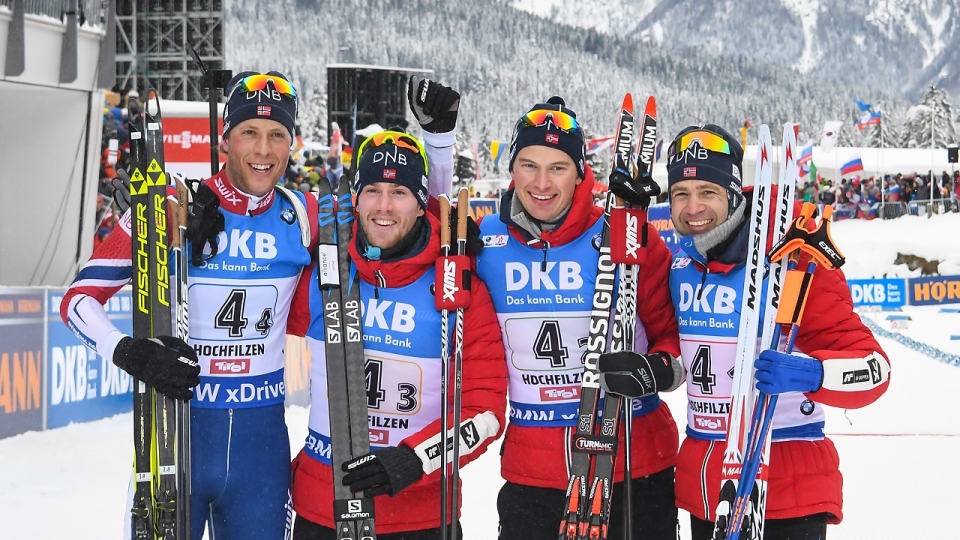
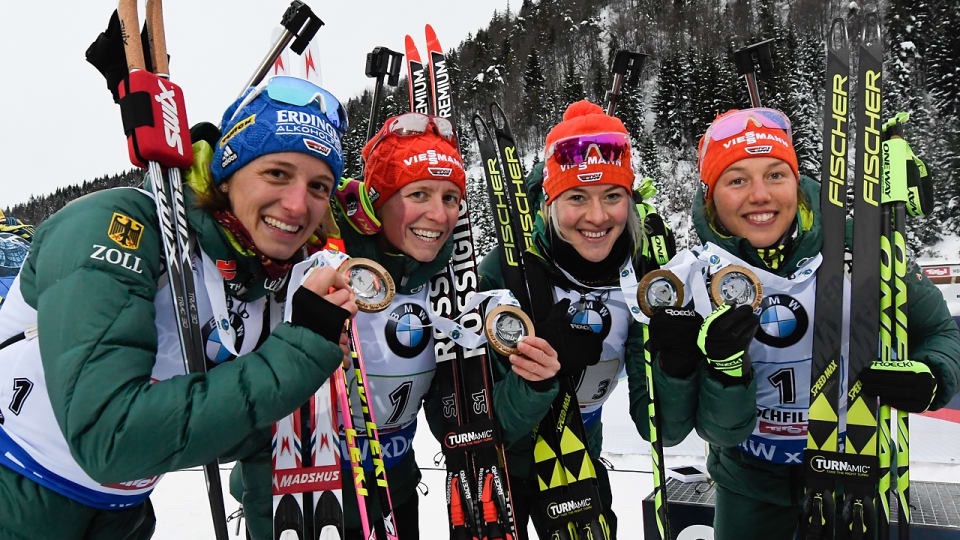
Germany with (left to right) Vanessa Hinz, Franziska Hildebrand, Maren Hammerschmidt and anchor Laura Dahlmeier shows off their medals following their victory in the women’s relay at the 2017/2018 IBU World Cup in Hochfilzen, Austria. (Photo: IBU/Biathlonworld)
The victorious world-champion quartet of Vanessa Hinz, Franziska Hildebrand, Maren Hammerschmidt,and Laura Dahlmeier won with a large lead ahead of Ukraine (+44.9) and France (+1:04.5). The first-, second- and third-place teams were a repeat of last season’s World Championships relay in Hochfilzen this past February.
Fighting for position with Ukraine and Switzerland on the third leg, Hammerschmidt got her team on the road to victory when she cleaned every target within 24 seconds despite difficult conditions to reclaim the lead, erasing the gap she had been handed of almost 30 seconds to first.
“For me it was very important to have a good standing shooting today, because the last two days were not so good,” Hammerschmidt said at the press conference. “I thought it was one of my best standing shootings, and I was so happy to go on the last loop and fight for every second to give to Laura.”
Dahlmeier returned to the World Cup after missing last week’s opening races with a cold, then had no major problems defending the lead. Dahlmeier used just one spare in each of her shooting stages, while Switzerland’s Irene Cadurisch as the closest pursuer had to ski a penalty lap. Germany finished in a time of 1:14:36.4, with zero penalties and nine spares.
“It’s a really cool feeling to be here again,” Dahlmeier said at the press conference. “Especially with the team. We know we can make a good race, but it’s important for every person to be good on the range and on the tracks. Relays are special races.”
“From the last year we have good memories about Hochfilzen … and today it was a good place, too,” Hildebrand said “I was really impressed with [Ukraine’s] Yulia Dzhima’s standing shooting, because she took all targets out while I used two extra bullets and was happy I could go out on the track again.”
Ukraine’s Olena Pidhrushna anchored her team, with Vita Semerenko, Yulia Dzhima and Valj Semerenko, to second (+44.9), thanks to the best team shooting performance of zero penalties and five spares, and despite a fall on the first leg by Vita Semerenko.
“I think our team spirit is very strong, without that we wouldn’t be on the podium, so I am very thankful to all the girls and our staff for making this happen,” Valj Semerenko said at the press conference, via a translator.
“My start this season was not so good … Actually today I was so nervous ahead of the relay,” Pidrushna explained. “But I saw that we had a little bit of extra time at the last exchange, and I calmed down a little bit and it worked well in the end. … And I think my team believes in me [to anchor it successfully].”
Twenty seconds behind her, France with Marie Dorin Habert, Celia Aymonier, Justine Braisaz and the current women’s World Cup leader Anaïs Bescond, passed Russia’s Ekaterina Yurlova-Percht on the final loop to claim third place (+1:04.5, with two penalties and 13 spares).
“Honestly at the beginning when I started I didn’t think a podium was still possible, but loop after loop I thought maybe I can still catch a podium [position],“ said Bescond, who skied the fastest course time on the final leg amidst strong competition.
A few seconds behind, Russia with Victoria Slivko, Tatiana Akimova, Irina Starykh, and Ekaterina Yurlova-Percht finished fourth (+1:09.0, with no penalty and nine spares).
Another 16 seconds back, Switzerland, with Elisa Gasparin, her older sister Selina Gasparin, Lena Häcki and Cadurisch finished fifth (+1:25.7, with two penalties and 12 spares) for Switzerland’s best women’s relay result, which fulfilled its national qualification criteria for the Olympics.
Canada in Contention
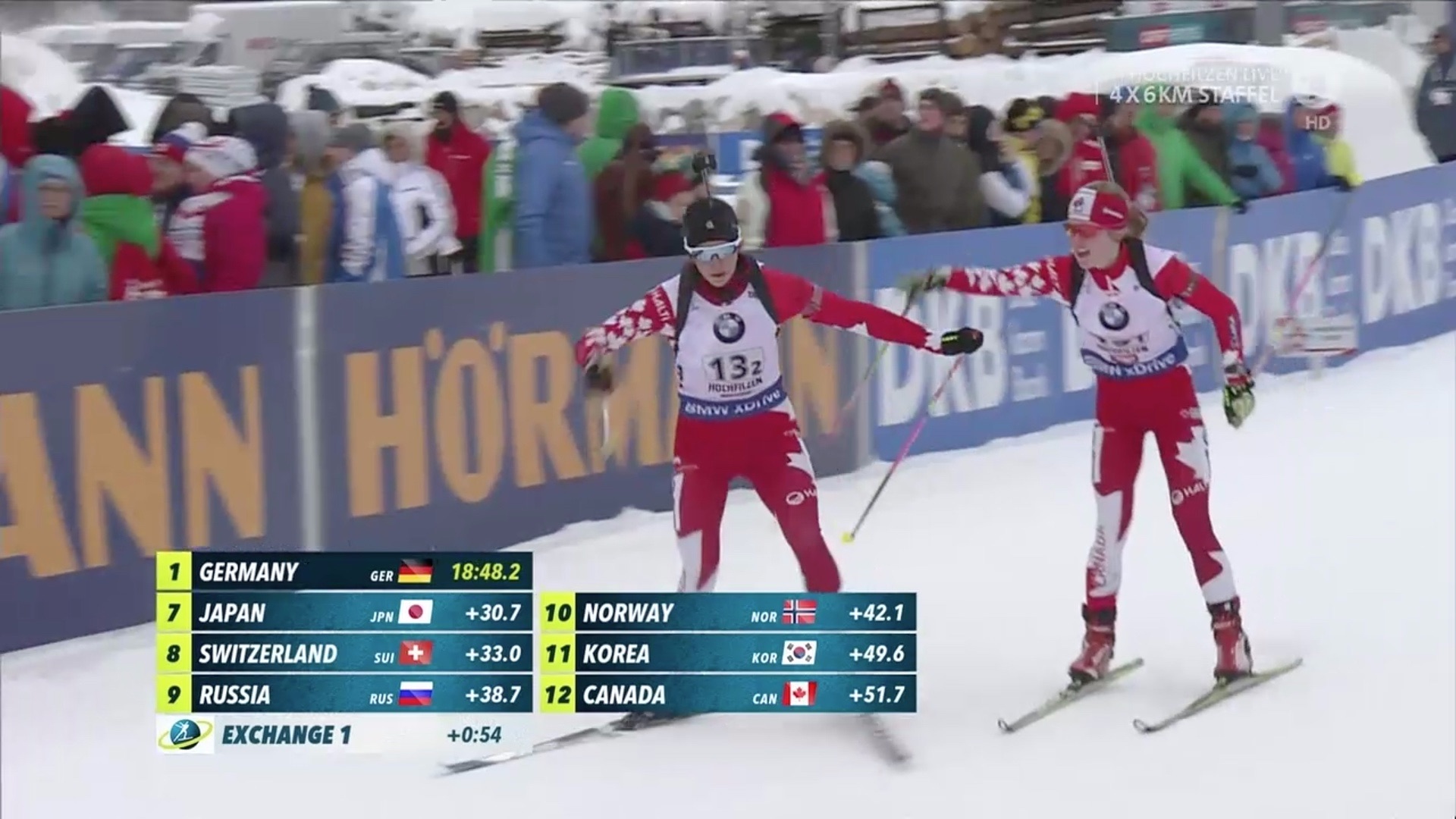
For Biathlon Canada, Emma Lunder started off the race in the middle of the field, and managed hit all her targets with one spare in her prone stage to leave the range in 16th position.
Biathlon Canada’s starter Emma Lunder (r) exchanging to Rosanna Crawford in the women’s relay at the 2017/2018 IBU World Cup in Hochfilzen, Austria. Crawford temporarily moved up to fifth before the team finished in ninth position. (Screenshot: ARD broadcast)
While a number of competitors, including France’s Dorin Habert, incurred penalties, Lunder again needed just one spare to clean (0+1, 0+1) and moved Canada up to 1oth. After losing a few more seconds on her last loop to the leaders, with Germany’s Hinz up front, she tagged Rosanna Crawford in 12th position, 51.7 seconds back.
Crawford started out fast and also needed just one spare to hit all five prone targets, improving by three places to ninth.
“It was a tricky shooting day today, you really had to be aware of the wind, and be prepared to do a correction even part way through a bout of shooting,” Crawford wrote in an email. “In prone I made a correction of 5 left and 2 up and it was enough to keep me pretty centred.”
Then in her standing stage, she picked off four more positions with clean shooting and no spares to leave the range in fifth place, while most teams around her needed spares or even incurred a penalty in seemingly difficult wind conditions.
“I was really happy with my standing today,” Crawford explained. “I saw Brendan [Green] right before zero and he said that it’s worthwhile to take your time and make each shot a good one. So I really thought about that as I came into the shooting, there was a big gust right off the start, so I waited and could hear the women around me missing. Each shot was really precise. My shooting time was 33 seconds which is really slow for standing but still the 2nd fastest of my leg, which says a lot about the wind today!”
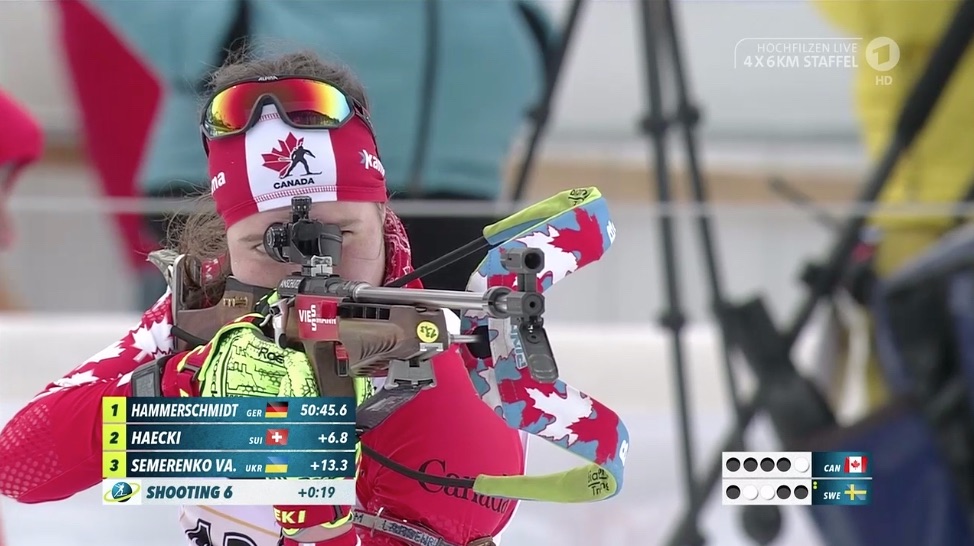
Biathlon Canada’s Megan Bankes shooting in her standing stage in the women’s relay at the 2017/2018 IBU World Cup in Hochfilzen, Austria. The team finished ninth overall. (Screenshot: ARD broadcast)
Crawford tagged Megan Bankes in fifth (+36.3), after having regained 15 seconds on the leaders and skiing the second-fastest course time on the final loop.
“It’s always fun to tag off in a high position but today was a bit of a lucky draw for what you got in the range,” Crawford concluded.
The 20-year-old Bankes as Biathlon Canada’s youngest team member started out just as fast, nearly maintaining that time gap on the first loop.
“I was super stoked to be tagged in such a good place, but I definitely still felt that I was able to ski my own race,” Bankes wrote in an email. “I wanted to ski my best, and not lose to much time on the tracks, but also be controlled on the range, because I knew it was going to be a tricky shooting day.”
She was able to get through the prone stage with two spares in a stage when all leading teams needed them, keeping her in fifth. Bankes followed that up with just one spare in her standing shooting, temporarily moving up to fourth after overtaking Sweden’s Mona Brorsson.
“Coming into the range I was focussed on my own shooting more than anything else,” Bankes wrote. “I knew that the wind was pretty variable, and that I needed to make sure I took good, smart shots, and correct appropriately for the wind. I was super happy with how I ended up doing on the range, and also with my speed on my first couple of laps.”
On the last loop, Brorsson and Russia’s Starykh passed her, and Bankes came through the final exchange in sixth place (+1:28.8).
“I died a bit at the end, but I still managed to tag Julia in a good position, so for me it was a pretty great race!” Bankes concluded.
Shown on television in the exchange zone, looking back at the final curve to see when Bankes would arrive, Ransom took over as the anchor and skied a very fast first loop, just 1 second off the fastest pace on that loop.
She then managed to still clean all five targets in a controlled fashion, leaving the range again in fifth position, with Switzerland in sight and Russia nearby as well.
After a slower second loop, Ransom struggled to clean all her targets in the final stage, but avoided the penalty lap with her last shot and left the range in ninth position. Sweden’s anchor Anna Magnusson was still in sight, 10 seconds ahead, but extended her lead on the final loop, while Japan’s anchor Rina Mitsuhashi was already more than a minute behind Ransom in 10th.
Ransom crossed the line in ninth place (+2:31.6) with zero penalties and nine spares for the team.
“A top 10 is a decent result for our team, it’s nice that we were fighting for a top 6 for most of the race,” Crawford wrote. “Our team has come a long way and I’m really proud to be a part of this team! Emma and Megan had a great leg and Julia an awesome prone and then it was quite windy for her standing, but most teams have their strongest women on the last leg, so it’s always a hard fight!”
In other good news for Biathlon Canada this weekend, the team finished eighth in an IBU Cup mixed relay and national team member Megan Tandy raced to 11th place in the sprint followed by ninth place in the pursuit this weekend in Lenzerheide, Switzerland.
“Another #perfect#shooting day! I was hoping for more, but you gotta work with what you got – in my case very heavy legs skiing. Nonetheless, a solid race,” Tandy wrote on Instagram after shooting clean in both the sprint and mixed relay.
The U.S. Women and Nation Cup Standings
US Biathlon could not start a women’s relay on Sunday because it only has three women currently on the World Cup circuit: Susan Dunklee, Clare Egan and Emily Dreissigacker. US Biathlon had hoped that its fourth woman Kelsey Dickinson, would qualify for the first trimester of World Cup racing by scoring necessary points at the IBU Cup opener in Sjusjøen, Norway. But unfortunately that did not work out.
In addition to Dickinson missing out on the World Cup starts because of that technicality, and her teammates now missing out on one of only three opportunities on the World Cup competition calendar to prepare for the relay in the upcoming Olympics, this also means they lost out on valuable points for the Nation Cup Score. That ranking is its own award category in the World Cup season (last year Germany won it for both the women and men), but more importantly for the North American teams, also determines the starting quota for the following season.
With a third of the races counting towards that already completed (unlike at World Championships the races at the Olympics don’t apply, neither do pursuits and mass starts), the U.S. is currently in 21st position for the women with 676 points and in danger of losing its fourth starting position for next year again, which would make team selections and travel planning even harder.
While certainly not impossible — last year the U.S. women also did not start a relay in Pokljuka, Slovenia — it will be a bit of an uphill battle to make that up the rest of the season, requiring a number of strong results. For instance, South Korea is currently 357 points ahead in 17th, the benchmark for a fourth quota spot.
The Canadian women are currently in 14th position with 1220 points. Last season they were 15th and the U.S. 14th. For the men’s teams, Canada is currently in 12th position with 1260 points, the U.S. is 13th with 1198.
The teams will now travel to Annecy-Le Grand Bornand, France, for the next World Cup from Thursday, Dec. 14, to Sunday, Dec. 17.
Caitlin Patterson (Craftsbury Green Racing Project) charging up the wall climb en route to the win in the women’s 10 k freestyle on Sunday at the Sovereign Lake NorAm/SuperTour near Vernon, B.C. (Photo: Peggy Hung)
NorAm/SuperTour (Sovereign Lake near Vernon, British Columbia): 10/15 k freestyle
VERNON, B.C. — The combined NorAm and SuperTour event at the Sovereign Lake Nordic Centre continued with individual-start distance races and continued with the theme of U.S. domination of the leaderboard.
Ian Torchia, of Northern Michigan University (NMU) and the U.S. Ski Team D-team, started the day with a big victory in the men’s 15 k freestyle, finishing in 36:29.7 minutes and on the heels of Canadian Para-Nordic guide Graham Nishikawa, who started 30 seconds ahead of him and ended up sixth. Jack Hegman of the Sun Valley Ski Education Foundation (SVSEF) placed second, 19.0 seconds back, to complete his good weekend. Canadian Para-Nordic superstar Brian McKeever rounded out the podium in third, 22.6 seconds back.
Graham Nishikawa (l) and Ian Torchia worked together after Torchia closed the 30-second gap en route to a victory in the men’s 15 k freestyle on Sunday at the Sovereign Lake NorAm near Vernon, B.C. (Photo: Peggy Hung)
The women were next to get some time in the sunshine with two laps for 10 k. Caitlin Patterson of the Craftsbury Green Racing Project (CRGRP) upgraded from Saturday’s silver to gold on Sunday with winning time of 27:13.0. Rosie Frankowski of Alaska Pacific University (APU) snatched second, 30.7 seconds back. Caitlin Gregg (Team Gregg) raced to third, 1 second behind Frankowski.
Former Canadian national-team biathlete Zina Kocher started her new cross-country career as the top Canadian in seventh (+1:31.2).
The weather was a repeat of Saturday: -2 degrees Celsius, windless and sunny. Smiles were evident everywhere, even for athletes who didn’t quite nail the pacing on an unforgiving course.
France’s Maurice Manificat (c) after winning the men’s 15-kilometer freestyle on Sunday in Davos, Switzerland. He finished ahead of Russians Sergey Ustiugov (l) and Alexander Bolshunov in second and third respectively. (Photo: FIS Cross-Country/Twitter)
FIS Cross Country World Cup (Davos, Switzerland): 10/15 k freestyle
After a day of sprinting, cross-country racers returned to the Davos World Cup venue on Sunday for the women’s 10-kilometer and men’s 15-kilometer freestyle individual start competitions.
For his first World Cup win in almost two years, France’s Maurice Manificat took the men’s 15 k race title in a time of 33:56.2. Exactly 4 seconds flat behind Manificat in second place was Russia’s Sergey Ustiugov. Ustiugov’s teammate Alexander Bolshunov, finished 10 seconds behind Ustiugov and 14.6 seconds behind Manificat for the men’s third and final podium spot.
The remainder of the men’s top ten included Norway’s Simen Hegstad Krüger in fourth (+21.3), Switzerland’s Dario Cologna in fifth (+26.5), Sweden’s Marcus Hellner in sixth (+35.4), Russia’s Denis Spitsov in seventh (+36.1), Hans Christer Holund of Norway in eighth (+36.9), Russian Alexey Chervotkin in ninth (+54.2), and Alex Harvey of Canada in 10th (+1:01.2).
The next best male North American finisher was American Patrick Caldwell in 41st (1:50.2).
Canada’s Devon Kershaw placed 44th (1:59.8), Graeme Killick 59th (+2:27.8), Russell Kennedy 68th (+2:43.4), and Julien Locke in 94th (4:27.5). Knute Johnsgaard did not start.
For the U.S., Noah Hoffman finished 48th (2:05.5) and Scott Patterson 88th (3:46.2). Simi Hamilton did not start and Andy Newell did not finish.
The women’s 10 k freestyle podium on Sunday at the Davos World Cup in Switzerland, with Norway’s Ingvild Flugstad Østberg (c) in first and Ragnhild Haga (l) in second, and Finland’s Krista Parmakoski (r) in third. (Photo: FIS Cross Country/Twitter)
In the women’s 10 k, 75 starters finished the 10 k course with Norway’s Ingvild Flugstad Østberg claiming first in a time of 25:28.5. Her Norwegian teammate, Ragnhild Haga finished 5.9 seconds behind her for second place. Krista Pärmäkoski of Finland raced to the third and final podium spot, 7.9 seconds back from Østberg’s winning time.
Rounding out the women’s top ten was Heidi Weng in fourth (+14.5), Austria’s Teresa Stadlober in fifth (+16.4), Switzerland’s Nathalie von Siebenthal in sixth (+16.4), Finland’s Kerttu Niskanen in seventh (+24.9), Sweden’s Charlotte Kalla in eighth (+26.8), Norwegian Marit Bjørgen in ninth (+35.9), and Astrid Uhrenholdt Jacobsen in tenth (+37.6).
Leading the U.S. women was Sadie Bjornsen in 12th (+44.6), seven seconds outside the top ten. The next two Americans finishers were within 3.1 seconds of each other, with Kikkan Randall finishing 14th (+56.8) and Jessie Diggins in 15th (+59.9).
Also scoring World Cup points for the Americans, Rosie Brennan finished in 17th (+1:11.2) and Chelsea Holmes in 29th (+1:32.9).
The U.S.’s Liz Stephen and Sophie Caldwell finishedin 40th (+1:58.5) and 52nd (+2:20.1), respectively.
For the Canadians, the team was led by Cendrine Browne in 45th (+2:05.9), followed by Emily Nishikawa in 50th (+2:18.4). Dahria Beatty placed 73rd (+2:53.0) and Katherine Stewart-Jones 79th (+3:44.6).
IBU World Cup (Hochfilzen, Austria): Men’s and women’s relays
Men’s and women’s relays took place on the final day of racing in Hochfilzen, with Norway winning the men’s 4 x 7.5 k and Germany topping the women’s 4 x 6 k by considerable margins.
Norway’s Ole Einar Bjørndalen, Henrik L’Abée-Lund, Erlend Bjøntegaard, and Lars Helge Birkeland raced to first in 1:21.21.8 hours, nearly two minutes clear of Germany in second, after taking the lead on L’Abée-Lund’s second leg. They avoided the penalty loop and used a total of nine spares, and never lost hold of first place for the rest of the race.
Germany raced to second (+1:54.9) with Erik Lesser, Benedikt Doll, Arnd Peiffer, and Simon Schempp, with zero penalties and 17 spares, after Peiffer lifted them from fourth to second on the third leg. Schempp held them there, despite using a maximum of three spares on each of his shooting stages, in the final leg.
France claimed third (+2:34.0) with Jean-Guillaume Béatrix, Simon Desthieux, Emilien Jacquelin, and Quentin Fillon Maillet, despite three penalties and 13 spares. Two of their penalties came on Beatrix’s first leg and another in Fillon Maillet’s final shooting. After being tagged in fifth, Jacquelin raced them up to third on the third leg and Fillon Maillet held onto that position for the last spot on the podium.
The U.S. men finished ninth (+3:38.3) with Lowell Bailey, Leif Nordgren, Tim Burke, and Sean Doherty, after they combined for three penalties and 13 spares. Bailey avoided the penalty lap and put them in third at the first exchange, while Nordgren slipped to seventh after a penalty, Burke remained in seventh with one penalty as well, and Doherty had one more penalty to anchor the team to ninth.
Canada placed 15th (+6:22.5) with six penalties and 20 spare rounds, with Christian Gow, Scott Gow, Nathan Smith, and Brendan Green. After being tagged in 21st, Smith raced them up to 13th, using just two spares to clean. Green anchored them to 15th after using six spares and skiing the 15th-ranked time on that last leg.
In the women’s relay that followed, Germany won by 44.9 seconds over Ukraine, with Vanessa Hinz, Franziska Hildebrand, Maren Hammerschmidt, and Laura Dahlmeier using nine spares while staying out of the penalty lap.
After Hinz raced them into first, Hildebrand slipped to fourth after using four spares on the second leg. Hammerschmidt raced the fastest third leg to put them back in first, and Dahlmeier held them there to the finish, crossing first in 1:14:36.4.
Ukraine (0 penalties, 5 spares) took the lead on the second leg but ultimately settled for second with Vita Semerenko, Yuliia Dzhima, Valj Semerenko, and Olena Pidhrushna. Dzhima put them in second heading into the race’s halfway point, but Valj Semerenko lost two places to tag Pidhrushna in third. Pidhrushna used just two spares on the final leg to bring them to second, about 20 seconds ahead of France in third.
Despite a tough first leg for Marie Dorin Habert, in which she had two penalties and tagged off in 14th, France rose to third place at the finish (+1:04.5) thanks to strong skiing and shooting from anchor Anaïs Bescond.
The team had a total of two penalties and 13 spares. Celia Aymonier used four spares to put them in ninth after the second leg, and third-leg Justine Braisaz lifted them one more place to seventh before Bescond skied the fastest last leg to pick off four more places.
Canada placed ninth (+2:31.6) with Emma Lunder, Rosanna Crawford, Megan Bankes, and Julia Ransom, with no penalties and nine spares. Crawford put them in fifth after the second leg, Bankes lost one place on the third leg, and Ransom slipped three more with three spares on her final shooting to finish ninth.
US Biathlon’s Sean Doherty (79) racing to 22nd in the IBU World Cup men’s 10 k sprint on Friday in Hochfilzen, Austria. On Saturday, he raced up to 17th for his best pursuit result on the circuit. (Photo: US Biathlon/NordicFocus)
One day after winning the International Biathlon Union (IBU) World Cup men’s sprint, Johannes Thingnes Bø held onto first place in the men’s 12.5-kilometer pursuit on Saturday in Hochfilzen, Austria. In difficult conditions with heavy snowfall and strong gusts of wind, the Norwegian decided the race when he shot clean in the final standing stage. He reached the finish line uncontested on the last loop in a time of 36:41.1 minutes, almost a minute ahead of Slovenia’s Jakov Fak (+58.8 with one penalty) and last season’s Overall World Cup winner Martin Fourcade (+1:10.0 minutes with five penalties).
“Best start of the season so far in my career,” the 24-year-old Bø said after his third victory of the season in a post-race press conference. “I have to enjoy it, you never know what the next races will bring.”
2:12.8 minutes behind him, US Biathlon’s Sean Doherty finished 17th for his best career result in a World Cup pursuit, improving by on an 18th place from a pursuit last season in Kontiolahti, Finland.
A day after scoring his first points of the new World Cup season in 22nd and shooting a perfect 10-for-10 in Friday’s 10-kilometer sprint, Doherty shot 18-for-20 in the pursuit (1+0+1+0).
“I am very happy with the race today,” Doherty wrote in an email to FasterSkier. “The execution on the range was good in the tough conditions we had today. It’s nice to have a solid back-to-back set of races here. … The ski shape is still a ways off but it’s heading in the right direction.”
In very difficult conditions in the first standing stage, several of the top racers like Norway’s Henrik L’Abee-Lund and Germany’s Arnd Peiffer incurred multiple penalties and to slip out of contention. Meanwhile, Doherty hit all but one of his targets in that stage and moved up to 16th. On the next loop he maintained that position about 1:50 back.
“The course was slow today, although not too soft,” Doherty commented on the conditions. “Fortunately it was not as snowy and windy as yesterday afternoon. There was a steady wind but it was manageable. I am pleased with my work on the range. If you want to compete at this level you have to shoot well.”
After the race up front had been decided in a final duel between Bø and Fourcade in the last stage, Doherty once again shot clean in the last standing stage and moved up to 11th. On the final loop, he could not quite hold that position and a small group passed him, yet coming onto the finishing stretch he was able to keep Ukraine’s Dmytro Pidruchnyi 0.4 seconds behind him in a push for 17th (+2:12.8).
“Unfortunately I didn’t quite have the legs to back up the solid shooting, as was clear on the last lap,” Doherty wrote. “Looking over my shoulder I saw that big pack of guys and I just tried to give it all I had. I wasn’t able to hang on but I was glad to be in that situation nonetheless.”
Starting out in 19th place based on his sprint result, Biathlon Canada’s Nathan Smith finished the day in 31st, 3:02.2 after Bø with three penalties (1+1+0+1).
After the first shooting stage, Smith had moved into 14th despite incurring a penalty.
“The wind was a bit changeable, especially in the first prone where it was blowing quite strongly,” he explained in an email after the race.
Smith skied the next lap in a group that included Germany’s Simon Schempp, who eventually would finish the race in podium contention, and got into a slight tangle with Schempp in a right-hand turn at the far point of the course, but both remained on their feet.
“I started pretty aggressive on the first lap but wasn’t able to maintain the speed of those around me after that,” Smith wrote. “I didn’t see who was tangling with me on that turn, but it was definitely an odd place to attempt an inside pass. I can’t say yet that things are turning around in the skiing department. I think I will just have to be very very patient.”
In the second prone stage, Smith incurred another penalty and dropped to 29th place, almost two minutes behind the leaders. He cleaned the first standing stage that followed, then had one more miss in the fourth and final stage.
“My shooting was pretty good once again today, given the challenging conditions,” Smith wrote. “It was definitely tougher conditions today, although the temperature was low enough that the falling snow wasn’t sticking to my glasses. The tracks were a little soft, and quite slow, especially out of the track where athletes were skiing.”
He started the final loop in 27th position and “like the previous ones, I was mostly focused on trying to minimize the number of skiers passing me,” Smith wrote. “It’s fun to pass but when you’re not feeling it its important to try and conserve energy.”
On the final meters of the race, he went head to head with Italy’s Thomas Bormolini and finished 0.4 seconds behind him for 31st.
“I thought I could take Bormolini but he got the middle track,” Smith recalled. “I tried my best in the outside and made a little ground, but the snow was just too deep over there. Tactically it would’ve been best to be in front heading through the tunnels [that are leading into the stadium].”
Smith’s teammate Brendan Green finished 33rd (+3:15.7), also with three penalties ( 1+0+1+1), after climbing nearly 20 places from his starting position by using his extensive experience to deal with snowy conditions that he described as “a classic Hochfilzen day”.
“Today was a much better race for me,” Green wrote in an email. “Yesterday felt completely off for some reason, so to be able to put together a solid performance today is reassuring. … I’m quite happy with the shooting considering the conditions. I was really hoping to shoot clean in the last bout, which would have made for a really great day, but all in all I’m happy with how I performed.”
After incurring that third penalty in the last standing stage, Green, who started 52nd, came back on the course in 37th place. He recalled seeing a group ahead of him, which he was able to catch by skiing the 17th-fastest course time on the final loop.
“I attacked early on and skied my way past a train of 5 athletes, and was able to hold them off for the rest of the loop with the exception of [Belgium’s] Michael Roesch. This was my strongest ski of the season which is hopefully a sign that my shape is coming around. It seems that no matter what I do, I struggle to find my form early on in the season.”
Doherty’s teammate, Lowell Bailey, the only other American who qualified for the pursuit, moved up from 53rd to finish 36th (+3:20.6) with three penalties (0+2+1+0).
The two remaining Canadian starters, Scott Gow and Christian Gow, finished 48th (+5:08.4) and 49th (+ 5:13.7), respectively, with Scott ending up with seven penalties (1+1+3+2), while his younger brother Christian had five penalties (2+0+1+2) and improved five places from the sprint.
Bø and Fourcade in Sync… Until Final Shooting
The two dominant athletes of the IBU World Cup season so far swapped the lead out on course and dueled on the range in Saturday’s pursuit. In the end the podium was nearly a repeat of Friday’s sprint, with Bø in first, and Fak and Fourcade flipping positions in second and third, respectively.
Medal ceremony for the men’s 12.5-kilometer pursuit at the 2017/2018 IBU World Cup in Hochfilzen, Austria, with Norway’s Johannes Thingnes Bø (c) in first place, Slovenia’s Jakov Fak (l) in second place, and France’s Martin Fourcade (r) in third place. (Photo: IBU/biathlonworld)
In the first shooting bout, Bø incurred two penalties to lose his 12-second head start on Fourcade, but he set out on his second loop just a second behind Fourcade. In the second prone stage, the two both shot clean, after shooting alongside each other and almost hitting their targets in a synchronous rhythm, before starting the third loop together.
While not quite able to hold up with Fourcade and Bø on the course with the 35th-ranked overall course time, Fak, who had started the day in third, was able to keep in touch with the leaders due to another solid shooting performance.
The 30-year-old, Croatian-born Fak, who has been racing for Slovenia since the beginning of the 2010/2011 season, is coming back from a slight slump last season, but is looking back on a storied career that includes a third place in the 2014/2015 World Cup Total Score and two gold medals at the 2012 and 2015 IBU World Championships.
By his own account, in preparation for the new season Fak mostly trained with the Ukrainian women’s team, which is coached by one of his old mentors. “They shoot good and I wanted to beat them and I guess that also works in the men’s field,” he said with laugh at the press conference.
In the first standing stage, Bø and Fourcade each incurred a penalty, and while Fourcade shot his sequence slightly faster, Bø was able to easily make up a six-second gap on the next loop, taking the lead again up the first big climb.
“[I] had a perfect race together with Johannes,” Fourcade said at the press conference. “We each did half the [work] in the front and it was a smart move because we wanted to keep the advantage and we knew the answer would be on the final shooting.”
Fak also had his only miss of the day in the third stage, but managed to improve his position as conditions worsened and a number of athletes had several penalties in this stage. Russia’s Maxim Tsvetkov and Germany’s Schempp were the first ones to clean this stage to leap into podium contention. Bø’s older brother Tarjei also cleaned.
Norway’s Johannes Thingnes Bø shooting in the standing position in difficult weather conditions on his way to the victory in the men’s 12.5-kilometer pursuit at the 2017/2018 IBU World Cup in Hochfilzen, Austria. (Photo: IBU/biathlonworld)
In the final stage Johannes Bø and Fourcade again stood side by side on the range, but this time Fourcade missed three while Bø hit every target to embark on the last loop with nearly a minute lead.
“He got the answer, and I didn’t…,” Fourcade sighed when he tried to explain what had happened in his final shooting. “With the snow conditions I went on my shooting mat a little late, I first had to open my rifle [sights snow cover] and I was simply a bit late compared to Johannes by just one or two seconds. … Then I heard that Johannes had a good shooting and I tried to shoot faster to catch him, and that was totally wrong today.”
“The people are always speaking about a fight of Martin against the Norwegian team,” Bø stated in the press conference. “Of course both me and him think about this, but still we fought together out there, we exchanged in the first position [helping each other], and that was a smart move for us.”
Fak managed to shoot clean again to leave the range for the last time in second, and while he could be relatively sure of second place, a fierce fight for third ensued behind him.
“It was very hard on the track, but I managed to stay calm on the shooting range and tried to shoot as [few] mistakes as I could,” Fak said. “It was only one mistake and so I am pretty happy about that, because if we look at the weather it was not so easy on the shooting range. On the track I used my shooting as an advantage, and it got me in the second position on the last lap, so I just needed to go a little faster in the beginning and then cruise to the finish.”
A group of Schempp, Tsvetkov and Tarjei Bø also came through the final stage with a clean shooting performance, and Fourcade joined them after he had completed his three penalty laps.
Fourcade led that group going into the longest climb of the course, then tried to break away, pushing hard over the crest of the hill with only Schempp able to stay on his tails into a corkscrew downhill section.
Schempp and Fourcade had a minor tangle as they positioned themselves on the slightly uphill finishing stretch, and Fourcade ended up outlasting Schempp in the final meters by half a second
“It was a big fight with Simon but also with Tarjei and Maxim Tsvetkov from Russia,” Fourcade said. “It was a big battle, and then at the finish line we crossed our skis. The advantage of being in the first position is that you can choose your own line, it’s what I did, and when I crossed my skis with Simon because I saw he chose the same line I went to the other line. … I said to Simon that I was sad, because I didn’t want to do it this way, but I fought really hard on the track to get the first position and choose my own track because it’s a big advantage.”
“In the finish sprint I really wanted to take the innermost lane, so wide right, and thought he’d take the middle lane,” Schempp told German broadcaster ARD in a post-race interview, according to a translation. “But then he still pulled onto my side and we tangled up and got a little bit into each other’s way, but everything is all right.”
Tarjei Bø came to the finish a second later in fifth (+1:11.9) with two penalties (1+0+1+0), while Tsvetkov finished sixth (+1:12.3), up from a 20th starting position, with just one penalty (1+0+0+0).
“I am happy I am in the top six, but I am a bit sad that I can’t fight today for a top three,” Tsvetkov told the IBU in an interview, via a translator.
“[Actually] I can’t understand why I missed today,” he added with a laugh when questioned about his lone penalty, which only he, Fak, and two more athletes achieved in this race.
The IBU World Cup in Hochfilzen concludes on Sunday with the first men’s 4 x 7.5 k and women’s 4 x 6 k relays of the season.
Fourcade announced during the press conference that he plans to skip the relay to focus on next week’s races in front of a home crowd in Le Grand Bornand, France.
Canada’s Alex Harvey (3) celebrates his win in the men’s 50 k freestyle mass start, his first individual gold medal at a World Championships, on Sunday at 2017 Nordic World Championships in Lahti, Finland. He beat Russia’s Sergey Ustiugov (l) by 0.6 seconds while Norway’s Sjur Røthe (9) can be seen coming in for sixth place, behind (not pictured) Finland’s Matti Heikkinen, Great Britain’s Andrew Musgrave and Norway’s Martin Johnsurd Sundby, respectively. (Photo: NBC Sports screenshot)
FIS Nordic World Championships (Lahti, Finland): Men’s 50 k freestyle mass start
After a week of missing out on the medals at 2017 Nordic World Championships, Canada’s Alex Harvey, a four-time World Championships medalist from 2011, 2013 and 2015, achieved his first individual gold medal in the final race of this year’s World Championships in Lahti, Finland.
Harvey, 28, won the men’s 50-kilometer freestyle mass start in a drag race to the finish. Entering the final descent into the stadium with Norway’s Martin Johnsrud Sundby and Russia’s Sergey Ustiugov, Harvey rode his fast skis past both of them then had the most finishing kick in the final straightaway for a 0.6-second victory. He finished in 1:46.28.9 hours, while Ustiugov followed him across the line in second and Finland’s Matti Heikkinen from behind for third (+1.4), after passing Sundby around the outside of the last corner.
Canada’s Alex Harvey (c) celebrates gold in the men’s 50 k freestyle mass start on Sunday at 2017 Nordic World Championships in Lahti, Finland, with Russia’s Sergey Ustiugov (l) and Finland’ Matti Heikkinen (r) joining him on the podium in second and third, respectively. (Photo: Cross Country Canada/Twitter)
Sundby appeared to miss a pole plant soon after Heikkinen passed him and let off the pace a few meters before the finish. That’s where Great Britain’s Andrew Musgrave continued to accelerate and took fourth place, 2.9 seconds behind Harvey and 0.1 seconds ahead of Sundby in fifth. Norway’s Sjur Røthe followed another 0.4 seconds back in sixth, Switzerland’s Dario Cologna was seventh (+8.9), Norway’s Petter Northug eighth (+12.3), France’s Maurice Manificat ninth (+13.4), and Norway’s Hans Christer Holund 10th (+14.3).
“I had really good skis,” Harvey said in a post-race interview with FIS. “I knew if I came into the corner in second place, that was the optimal position. So I was able to fight hard and hit that last corner in second and slingshot by Martin along the flat and then that was good after that.”
“This is the best race of my life, for sure,” he added. “So I’m really happy.”
Tad Elliott (Ski Club Vail) led the Americans in 27th (+3:16.8). Noah Hoffman (U.S. Ski Team) finished 50th (+8:53.1) and Kyle Bratrud (CXC Team) did not finish.
Canada started four men, with Devon Kershaw finishing 38th (+5:45.5), Graeme Killick 43rd (+7:04), and Knute Johnsgaard in 55th (+12:03.3).
For Harvey, the medal is his fifth at three World Championships and his first individual gold after winning the classic team sprint with Kershaw in 2011.
IBU World Cup (PyeongChang, South Korea): Men’s and women’s relays
Between the men’s and women’s relays on Sunday at the International Biathlon Union (IBU) World Cup in PyeongChang, South Korea, Canada had two teams in the top eighth, with its men’s team finishing seventh in the 4 x 7.5 k and women’s team eighth in the 4 x 6 k. Behind them, the U.S. men finished 10th and U.S. women 14th.
France won the men’s relay by 33.8 seconds over Austria, using a total of 10 spare rounds but avoiding the penalty lap. Martin Fourcade anchored France to the win in 1:12:09.5 hours, after Jean-Guillaume Béatrix initially tagged them in first, his older brother Simon Fourcade raced them into second with near-perfect shooting (using just one spare to clean), and Simon Desthieux picked off one more place to give Fourcade a 16-second lead for the final leg.
Austria achieved second place with Lorenz Wäger, Simon Eder, Julian Eberhard, and Dominik Landertinger combining for zero penalties and nine spares.
Norway finished third (+45.4) with Vetle Sjåstad Christiansen, Ole Einar Bjørndalen, Vegard Gjermundshaug, and Henrik L’Abée-Lund. They had one penalty on Gjermundshaug’s third leg, and used a total of eight spares.
Canada’s Christian Gow, Scott Gow, Nathan Smith, and Brendan Green finished seventh (+3:03.1) with zero penalties and nine spares. After Christian tagged his older brother Scott in ninth, Scott raced them into sixth place before Smith slipped four places to 10th at the final exchange. On the final leg, Green raced them into seventh, requiring two spares to clean.
The Americans finished about nine seconds later in 10th (+3:12.8) with Lowell Bailey, Leif Nordgren, Paul Schommer, and Sean Doherty combining for zero penalties and nine spares, just like Canada. Bailey had originally put them in second at the first exchange, Nordgren dropped to seventh, then Schommer to 13th, before Doherty finally brought them back to 10th out of 24 teams.
In the women’s relay, Germany pulled off a 22.8-second win over Norway, with one penalty and eight spares. Nadine Horchler put Germany in third at the first exchange, then Maren Hammerschmidt raced them into first by the race’s halfway point. From there, Denise Herrmann, a former cross-country World Cup regular, had to ski a penalty lap and tagged off in second, 13.5 seconds out of first. With teammate Laura Dahlmeier sitting out the relay, Franziska Hildebrand anchored Germany to the win in 1:07:35.6 after she used just one spare to clean.
Norway placed second with Kaia Wøien Nicolaisen, Hilde Fenne, Tiril Eckhoff, and Marte Olsbu accumulating one penalty and 11 spares. Olsbu beat out the Czech Republic’s Gabriela Koukalová by one-tenth of a second at the finish, as the Czechs placed for third (+22.9), with Jessica Jislová, Eva Puskarčíková, Lucie Charvátová, and Koukalová (with a total of one penalty and nine spares).
Canada took eighth (+1:34) with Rosanna Crawford, Julia Ransom, Megan Tandy, and Emma Lunder. Crawford tagged in second at the first exchange, Ransom slipped one place to third, Tandy lost another place to tag in fourth, and Lunder ultimately anchored them to eighth.
The U.S., with Clare Egan, Susan Dunklee, Joanne Reid, and Maddie Phaneuf, finished 14th (+3:08.3) with one penalty and 10 spares. After Egan had a penalty on the first leg, Dunklee skied the fastest second leg to move the team from 19th to 14th, then Reid put them in 11th by the final exchange. Twenty-one teams competed in the women’s race.
Ski Classics 90 k Vasaloppet (Sälen to Mora, Sweden)
John Kristian Dahl (r) of Team United Bakeries outlunges Ski Classics sprint leader Andreas Nygaard (r) of Team Santander for the win in Sunday’s 90 k Vasaloppet in Mora, Sweden. (Photo: Visma Ski Classics)
[UPDATED] In Sunday’s 93rd annual 90-kilometer Vasaloppet from Sälen to Mora, Sweden, the ninth event of the Ski Classics series, John Kristian Dahl (Team United Bakeries) outlasted Andreas Nygaard (Team Santander) by one-tenth of a second for the win in 3:57:18.1 hours. The race came down to a five-way fight for first, with Stian Hoelgaard (Team Leaseplan) finishing 0.6 seconds back in third. The top 15 men were all within 21.7 seconds of the podium, and Brian McKeever, a member of Canada’s Para Nordic Ski Team, placed 20th (+2:31.1).
“It has been a fight all day,” Dahl said, according to a Ski Classics press release. Three days ago, he had been unsure about starting the Vasaloppet following a back injury. “I was tired already after 30 k and had to let go of the lead group, but I fought my way back taking it step by step and hill by hill.”
In the women’s race, Britta Johansson Norgren (Lager 157 Ski Team) broke away from the field to win by 1:37.9 minutes in 4:19.43.4.
Astrid Øyre Slind (Team United Bakeries) finished second, and Sara Lindborg (Team Serneke) placed third, 9 minutes and 4.2 seconds behind Norgren. Kateřina Smutná (Team Santander) dropped out of the race about halfway through.
“I am very tired but also so happy to win today,” Norgren said, according to the press release. “It felt pretty easy until Oxberg [Sweden] with 30 k to go, but then it got really tough and I had to fight all the way to the finish.”
It was Norgren’s first Vasaloppet win after placing second the last three years. She increased her lead in the overall Ski Classics to 215 points over Smutná, while Tord Asle Gjerdalen continues to lead the men’s overall standings ahead of his Santander teammate Nygaard, who is 349 points behind in second place. Gjerdalen did not race Sunday’s Vasaloppet.
The photo finish for first in the IBU World Cup men’s 4 x 7.5 k relay on Saturday in Antholz, Italy, with Germany’s Simon Schempp (r) edging Norway’s Emil Hegle Svendsen (l) by 0.1 seconds. (Photo: IBU/Christian Manzoni)
For Germany and Norway, it was a two-way battle for first following the final exchange of the men’s 4 x 7.5-kilometer relay on Saturday at the International Biathlon Union (IBU) World Cup in Antholz, Italy.
There, thanks to third-leg Johannes Thingnes Bø, Norway had taken the lead by 17.7 seconds over Germany and built a 38-second gap to Russia in third. Ukraine was another nine seconds back in fourth, skiing just ahead of France and the U.S. in fifth and sixth through the exchange, respectively.
So for the U.S. in Saturday’s relay, the last one before 2017 IBU World Championships in Hochfilzen, Austria, next month, it was a fight for a team-best result — which would have been fourth.
Before we get to where they finished, let’s remember where the U.S. men’s relay started: in bib 24 of 25, at the back of the pack.
Lowell Bailey raced them into sixth at the first exchange and 8.6 seconds out of the lead, with Russia’s Maxim Tsvetkov reaching the exchange first. Bailey had skied the fifth-fastest course time on that leg and shot quickly to clean with one spare in each of his two shooting stages.
Eighth after the first prone stage, he moved into sixth after his standing shooting. One loop later, he tagged his teammate Leif Nordgren in sixth.
Leif Nordgren (US Biathlon) skiing the second leg of the men’s 4 x 7.5 k relay on Saturday at the IBU World Cup in Antholz, Italy. (Photo: USBA/NordicFocus)
Nordgren proceeded to jet into third after his prone stage, despite using two spares to clean.
“It was a big bummer to miss two in prone, but the rest of the group also missed so I was able to leave towards the front,” Nordgren explained in a US Biathlon press release.
He used one more spare to clean his standing stage and remained in third heading into his final loop. There, Nordgren’s lack of racing this season caught up to him (this was his fifth World Cup race of the season), and he tagged off in ninth, 27.6 seconds behind Russia’s Evgeniy Garanichev in fifth.
“In the last loop I was holding on for dear life,” Nordgren told US Biathlon. “Those other guys have a lot more racing under their belts this year. I have four [races], so that made for a hard loop.”
While Nordgren and teammate Tim Burke had a shaky tag, which Burke described as a “bit of a collision,” Burke was able to emerge from it unscathed. He went on to ski the fourth-fastest third leg to bring the U.S. to sixth.
“I felt solid on course today,” Burke wrote in an email, after posting the third-fastest course time for that leg.
He used three spares to clean prone — any more misses and he would’ve had to ski a penalty loop — and started his second loop in ninth. The next time in the range, Burke cleaned standing without any spares and set out on his last loop in seventh.
“I pushed hard all the way to the shooting point before prone, which, in hindsight, was probably a bit too aggressive,” he reflected. “For standing my goal today was stay aggressive and I was happy with how that worked out.”
Burke started his last loop with France’s Simon Desthieux. “We were able to really push on the last loop and pull the others back,” Burke explained. “I wanted to hand off to Sean with the group that would fight for third place.”
Burke tagged his teammate Sean Doherty in sixth, 11.6 seconds out of third and just 4.3 seconds behind fourth. Meanwhile, Norway had taken the lead after Bø’s standing stage with clean shooting (and after using just one spare to clean prone) while Russia dropped to third with a total of four spares from Dmitry Malyshko.
Germany’s third-leg skier Arnd Peiffer took the lead after a miss-free prone stage, and using one spare in standing, left the range just 6 seconds after Bø to bring Germany into second at the final tag, 17.7 seconds from first.
Over the last three loops and two shooting stages, Norway’s anchor Emil Hegle Svendsen and Germany’s final skier Simon Schempp drew closer, with both cleaning prone without a miss. At the start of the second loop, Schempp was within 12.7 seconds of Svendsen. Back in the range for the last time, Svendsen missed his second and fifth shots, requiring two spares, and Schempp needed one spare to clean, and the two set out on the final loop together, with Svendsen leading by 0.3 seconds.
The two went head to head all the way to the finish, where Schempp ultimately outlunged Svendsen in a photo finish by one-tenth of a second. He secured the win for Germany in 1:13:57.2 hours, and the team — with Erik Lesser, Benedikt Doll, Peiffer and Schemmp — used a total of seven spares to avoid the penalty loop.
“I gave it everything I had in the end, and wanted to attack a little earlier but [Svendsen] attacked incredibly up the bridge,” Schempp recalled in a post-race interview with ZDF. “I had a feeling that we crossed the line pretty much together. Then I had to wait what the computer would show as a result.”
“He was a little stronger,” Svendsen told NRK after. “I have no other explanation than that. I had to make sure I did not ski into him … so I lost a little momentum there.”
At the last World Cup relay in Ruhpolding, Germany, Norway won with Ole Einar Bjørndalen, Vetle Sjåstad Christiansen, Henrik L’Abee-Lund, and Svendsen. Russia finished second, Germany was third, and the U.S. was 12th.
“I think we presented ourselves with top ski speed today, and on the shooting range it clearly went better than in Ruhpolding, especially for me,” Lesser said, referring to his penalty and the team’s total of nine spares in the Ruhpolding relay (compared to Russia, which had two, and Norway with five spares in Ruhpolding).
“We still have those seven spares, I can remember the last time we became World Champions we only had two spares, so we definitely can get down there, but it was a cool final rehearsal,” Lesser said.
Norway took second with Lars Helge Birkeland, L’Abée-Lund (who brought the team from fourth to second at the second exchange), Bø, and Svendsen, after using nine spares.
Russia ended up third (+33.6), with Tsvetkov, Garanichev, Malyshko, and Babikov, with a team total of nine spares as well, and Ukraine pulled off fourth (+46.7) with just five total spares, with Artem Pryma, Sergey Semenov, Vladimir Semakov, and Dmytro Pidruchnyi.
Ukraine embarked on the last leg in fourth, 1:04 minutes out of first and just ahead of France in fifth and the U.S. in sixth.
On their first loop together, Doherty moved into fourth, trailing Russia’s Babikov in third by about eight seconds. With France’s Quentin Fillon Maillet, Doherty bridged the gap to Babikov, passing the Russian but remaining in fourth as the Frenchman skied into third.
In their prone stage, Doherty used one spare and Fillon Maillet cleaned to leave the range just ahead of him in fifth, while Doherty followed in sixth. Five teams continued to fight for the podium, with Ukraine’s Pidruchnyi leading them in third.
Pidruchnyi didn’t miss a shot in either stage to hold that position until his final loop, where Babikov passed him to claim the third spot on the podium, 12.9 seconds ahead of him.
Sean Doherty (US Biathlon) crossing the finish line in sixth for the U.S. men’s 4 x 7.5 k relay on Saturday at the IBU World Cup in Antholz, Italy. (Photo: USBA/NordicFocus)
In the final standing stage, Doherty and Austria’s Dominik Landertinger both used one spare and left the range in fifth and sixth, respectively. France dropped out of contention when Fillon Maillet had to ski a penalty lap.
“It was really exciting,” Doherty said of the last shooting in an interview with IBU TV. “The pace was really high. Came in and just tried really hard to focus on my own work, knowing there were some guys close in front and behind me. Luckily only one spare, and I was able to get out of there with staying out of the [penalty] loop.”
While Doherty left the range about three seconds ahead of Landertinger, the Austrian passed him during the first kilometer of their final loop. Landertinger extended his gap to Doherty to 12 seconds with less than half a kilometer remaining and anchored Austria to fifth (+49.2), 2.5 seconds out of fourth. Doherty finished sixth for the U.S. (+1:04.9), 15.7 seconds out of fifth.
Behind him, France’s Fillon Maillet finished seventh (+1:34.7). In all, Austria used eight spares and the U.S. had 10, but both avoided the penalty lap. France accumulated 14 spares and one penalty.
“Today’s sixth place was a very strong effort for the team,” Doherty told US Biathlon. “I am very happy to be skiing up in the mix and looking at the podium. There is still room to improve for World Championships, but it seems we are headed in the right direction.”
“Today we showed that we are competitive with the best in the world,” Bailey said in the same press release. “With 10 extra rounds, this is far from our best, but it is a big step in the right direction and exactly where we want to be heading into world champs.”
For the U.S., sixth was one place back from its team-best fifth, which it achieved with the same four men last year at the World Cup in Presque Isle, Maine.
“We are very satisfied with the result today,” Burke said. “With the exception of Lowell, it has been a bit of slow start for the rest of us with a mix of injuries and illnesses. This was definitely important for our confidence heading into World Champs.”
For every man on the team except Bailey, Saturday marked the last World Cup race before World Championships, which start Feb. 9.
Burke planned to stay in Antholz for the next two weeks to prepare.
“I feel like I am still not near my best, but at least I have been consistently in the mix the past two weeks,” Burke wrote. “Hopefully with a good training block over the next two weeks, I can still come to a higher level for World Championships.”
Bailey competed in Sunday’s 15 k mass start and finished 16th, 1:33.4 behind Norway’s Bø, who cleaned the four-stage race to win in 37:04.3. Bailey had two penalties in his last two stages (0+0+1+1), and in his first World Cup mass start, Canada’s Scott Gow finished 30th (+4:09.9) with four penalties (1+0+2+1).
The Canadian men’s relay finished 16th on Saturday (+4:13.8), with Christian Gow, Scott Gow, Macx Davies, and Brendan Green combining for two penalties and 11 spares. Both penalties came on Davies’s third leg. While the team was in 15th after Scott Gow’s second leg, they dropped to 18th on the third leg, but Green recovered two places to finish 16th.
Ben Lustgarten (Craftsbury Green Racing Project) with his $750-dollar check for winning the men’s SuperTour classic sprint on Saturday near Truckee, Calif. Stratton’s Ben Saxton (l) placed second and APU’s Reese Hanneman (r) was third.
Lustgarten, of the Craftsbury Green Racing Project, raced to a 1.58-second victory in the men’s A-final at the Auburn Ski Club in Soda Springs, Calif., finishing in 3:03.4. Ben Saxton, of the Stratton Mountain School (SMS) Elite Team, placed second, and Reese Hanneman, of Alaska Pacific University (APU), was third (+2.77).
Hannenman’s younger brother Logan also reached the final and placed fourth (+4.5), Dakota Blackhorse-von Jess (Bend Endurance Academy) was fifth (+5.86), and the third APU skier in the final, Tyler Kornfield sixth (+18.69).
Blackhorse-von Jess started the day off as the fastest qualifier in 2:58.8. Saxton qualified second, 4.1 seconds back, Logan Hanneman qualified third (+4.2), and Lustgarten fourth (+6.5). Blackhorse-von Jess went on to win his quarterfinal and place second in his semifinal, while Lustgarten and Saxton both won their quarterfinals and semifinals.
Jennie Bender (3) of the Bridger Ski Foundation leading Stratton’s Julia Kern (2) and Sun Valley’s Deedra Irwin (5) during the second women’s classic sprint semifinal at Saturday’s SuperTour near Truckee, Calif. Bender went on to win the semifinal, as well as the final.
In the women’s A-final, Jennie Bender of the Bridger Ski Foundation, coming off a classic sprint win at nationals, scored another victory in 3:29.07. She edged Craftsbury’s Kaitlynn Miller by just seven-hundredths of a second, and Stratton’s Julia Kern placed third (+3.42). Racing at home, Hannah Halvorsen (Sugar Bowl Academy) finished fourth (+3.88). Craftsbury had three in the women’s final with Caitlin Patterson in fifth (+3.93) and Heather Mooney in sixth (+27.35).
Miller proved to be the woman to beat throughout the day, winning the qualifier in 3:30.9, along with her quarterfinal and semifinal. Kern qualified second (+3.2) and Bender third (+4.6). Bender went on to win her quarterfinal and semifinal as well before facing off with Miller in the final.
NorAm Western Canadian Championships (Whistler, B.C.): 10/15 k classic
It was interval-starts day at Western Canadian Championships at Whistler Olympic Park and national-team veteran Emily Nishikawa completed the four laps of the women’s 10 k classic in 30:35.5 to win ahead of teammate Dahria Beatty, 16.5 seconds behind. Maya MacIsaac-Jones completed the national team and Alberta World Cup Academy (AWCA) sweep in third (+1:36.5).
Sovereign Lake’s Hannah Mehain, of the national junior team, was the top junior for the second-straight day in eighth overall (+3:22.1).
In the men’s 15 k, Lappe Nordic’s Andy Shields won the six-lap race in 40:34.2, showing some of the form that won him the NorAm overall last season. National-team member Jess Cockney collected his second-straight podium, finishing second, 4.3 seconds behind Shields. Evan Palmer-Charrette (NTDC Thunder Bay) completed the podium in third (+55.1).
FIS Cross-Country World Cup (Ulricehamn, Sweden): 10/15 k freestyle
The men’s 15 k freestyle podium at Saturday’s World Cup in Ulricehamn, Sweden, with Canadian winner Alex Harvey (c), Norwegian runner-up Martin Johnsrud Sundby (l), and Sweden’s Marcus Hellner (r) in third. (Photo: FIS Cross Country/Twitter)
First individual win of the season (second straight, after winning last weekend’s team sprint), fifth individual victory of his career. That’s the latest news on Canada’s Alex Harvey, who won the World Cup men’s 15-kilometer freestyle individual start on Sunday in Ulricehamn, Sweden, for his first victory in a 15 k skate race and fourth individual podium of 2016/2017.
To say Harvey is on a roll is an understatement. On Saturday, he beat Norway’s Martin Johnsrud Sundby by 6 seconds after starting a minute behind the Norwegian defending World Cup champion. Harvey’s fastest time across the line in 32:46.2 held up through 76 finishers, with Sweden’s Marcus Hellner coming somewhat within range after starting a minute behind him. Hellner ended up 14.3 seconds back from Harvey at the finish for third place, behind Sundby.
Switzerland’s Dario Cologna missed the podium by 0.5 seconds in fourth (+14.7), and Norway’s 24-year-old Daniel Stock broke through in fifth (+16.2) for his first World Cup top 20.
Great Britain’s Andrew Musgrave placed sixth (+18.7), Sweden’s Daniel Rickardsson was seventh (+25.0), Norway’s Finn Hågen Krogh eighth (+32.2), Russia’s Petr Sedov ninth (+33.9), and Japan’s Keishin Yoshida 10th (+34.2).
American Erik Bjornsen landed in the points as he tied Norway’s Simen Andreas Sveen for 28th (+1:09.2), leading fellow U.S. Ski Team members Noah Hoffman, who placed 41st (+1:28.8), and Simi Hamilton in 53rd (+1:56.2). Also for the U.S., Matt Gelso, the Period 1 SuperTour leader from the Sun Valley Ski Education Foundation (SVSEF) Gold Team, finished 68th (+3:00.3).
Harvey’s Canadian World Cup teammates Len Valjas finished 35th (+1:17.7) and Devon Kershaw 38th (+1:22.2). Knute Johnsgaard (Canadian U25 Team) did not start.
The women’s 10 k freestyle podium on Saturday in Ulricehamn, Sweden, with Norwegian winner Marit Bjørgen (c), Finland’s Krista Parmakoski (l) in second and Sweden’s Charlotte Kalla (r) in third. (Photo: FIS Cross Country/Twitter)
In her first World Cup race in over a month and at a brand-new World Cup venue, Norway’s 36-year-old Marit Bjørgen returned to her winning ways, topping the women’s 10 k freestyle on Saturday in Ulricehamn.
Bjørgen started 40th out of 61 finishers and took the lead from Finland’s Krista Parmakoski at the finish with a time of 23:46.3 minutes. Parmakoski, who started a minute ahead of her in bib 38, ended up second, 10.7 seconds back. Sweden’s Charlotte Kalla reached the podium for the second time this season in third (+24.9).
“It is always great to win,” Bjørgen said, according to an International Ski Federation (FIS) press release. “I stayed at home for five weeks and was training. It is great to come back with a victory. I know that the training I had done was good. It was an amazing atmosphere today by the course. There were people cheering everywhere.”
Norway swept fourth through sixth with Astrid Uhrenholdt Jacobsen in fourth (+25.7), Ragnhild Haga in fifth (+32.3) and Heidi Weng in sixth (+34.0).
American Jessie Diggins raced to seventh (+34.9), ahead of Sweden’s Hanna Falk, who recorded her best distance result in eighth (+36.4). Norway’s Ingvild Flugstad Østberg finished ninth (+44.8), and Germany’s Sandra Ringwald was 10th (+56.6).
“I didn’t have the snappy good feelings I was hoping to have in my body today, but it was a solid race,” Diggins wrote in a post-race email to FasterSkier. “It’s always hard when you know that on your best days you are capable of more, but at the same time we had great skis, and it was really fun for me to be able to ski with my teammates today!”
The U.S. had three in the top 20 and four in the top 30 with Sadie Bjornsen in 12th (+1:00.5), Liz Stephen in 16th (+1:07.3) and Rosie Brennan in 24th (+1:30.7).
Cendrine Browne as Canada’s lone woman in the race achieved 35th (+1:52.0) for her career best in an individual race. Also for the U.S., Kikkan Randall placed 40th (+1:59.6) and Liz Guiney of the Craftsbury Green Racing Project 52nd (+2:33.2).
The photo finish of the men’s 4 x 7.5 k relay on Saturday at the IBU World Cup in Antholz, Italy, with Germany’s Simon Schempp outlunging Norway’s Emil Hegle Svendsen. (Photo: ZDF broadcast screenshot)
For the U.S. men, top six was a target for the 4 x 7.5 k relay on Sunday in Antholz, Italy, according to US Biathlon Men’s Coach Jonas Johansson.
Mission accomplished. In the final team event before 2017 World Championships, Lowell Bailey, Leif Nordgren, Tim Burke, and Sean Doherty combined for sixth, finishing 1:04.9 minutes behind the German winners. The Americans used a total of 10 spares but avoided the penalty loop, as did the Germans who used seven spares to clean the eight-stage race and won it in 1:13.57.2.
Germany’s Simon Schempp narrowly outlasted Norway’s Emil Hegle Svendsen in the finishing stretch to secure the victory for Germany (with teammates Erik Lesser, Benedikt Doll and Arnd Peiffer) by one-tenth of a second. Norway finished second with nine spares and no penalties (with Lars Helge Birkeland, Henrik L’Abee-Lund, Johannes Thingnes Bø, and Svendsen), and Russia secured third (+33.6) with nine spares and zero penalties as well (with Maxim Tsvetkov, Evgeniy Garanichev, Dmitry Malyshko, and Anton Babikov).
Ukraine used a total of just five spares and had zero penalties for fourth (+46.7), and Austria took fifth (+49.2) with eight spares and no penalties, after Austria’s Dominik Landertinger skied away from Doherty on the final loop and finished 6.9 seconds ahead of him for fifth place.
For the U.S. men, sixth was close to their team-best fifth with the same lineup in last year’s World Cup relay in Presque Isle, Maine. The same group also took sixth in Ruhpolding, Germany, last year as well.
With all four making US Biathlon’s World Championships team, announced Saturday, they will likely be aiming for a best championships result early next month in Hochfilzen, Austria.
Canada (Christian Gow, Scott Gow, Macx Davies, and Brendan Green) finished 16th (+4:13.8) on Saturday with two penalties and 11 spares. Scott Gow skied them up to 15th by the second exchange but they dropped to 18th after Davies had two penalties on the third leg. With Green anchoring and using just one spare, they recouped two places before the finish.
In the women’s race, Germany’s Nadine Horchler achieved a lifetime dream with her first World Cup win, after starting in bib 30 and earning her start as a reserve athlete. Germany took first and second with Laura Dahlmeier in second, and the Czech Republic’s Gabriela Koukalova placed third. Susan Dunklee of the U.S. was the lone North American starter and finished 24th after leading at the start of the second loop.
FIS Nordic Combined World Cup (Chaux-Neuve, France): Individual large hill/10 k
Saturday’s Nordic Combined World Cup podium in Chaux-Neuve, France, with German winner Johannes Rydzek (c), German runner-up Fabian Rießle (l) and Japan’s Akito Watabe (r) in third. (Photo: FIS Nordic Combined/Twitter)
The first part of Saturday’s Nordic Combined World Cup individual large hill/10 k competition was a shining moment for U.S. Nordic Combined skier Ben Berend, who jumped to second for a total of 127.5 points, trailing only Norway’s Jarl Magnus Riiber with 139 points in Chaux-Neuve, France.
Berend flew farther than Germany’s Eric Frenzel, who jumped to third on the Chaux-Neuve large hill.
Later in the day, they started the 10 k Gundersen in that order, with Riiber heading out first, followed by Berend 46 seconds later, then Frenzel 53 seconds back in third.
Germany’s Johannes Rydzek started 1:15 minutes back in 12th and skied the fastest 10 k to take the victory at the finish (in 23:01.7). He held off his German teammate Fabian Rießle by 2.8 seconds for the win, after Rießle started sixth and 1:01 back. Japan’s Akito Watabe reached the podium in third (+5.7) after jumping to seventh and starting the race 1 second behind Rießle.
Frenzel ended up fourth (+8.3), and the fourth German in the top five, Björn Kircheisen improved to fifth (+22.6) after starting 11th.
Riiber dropped to 15th (+54.0), and Berend fell outside the top 30 to end up 32nd (+2:26.0) with the 39th-ranked course time.
Berend finished 12.2 seconds ahead of his U.S. teammate Taylor Fletcher, who placed 34th (+2:38.2) after the jump put him in 48th.
Bryan Fletcher was 49th after the jump but did not start the 10 k.
The Nordic Combined World Cup continues Sunday in Chaux-Neuve with another large hill/10 k.
Ski Classics #5: La Diagonela (Zuoz, Switzerland): 50 k classic
[UPDATED] Under “blue skies, no wind and perfect track conditions” in the Swiss Engadin Valley on Saturday, according to a Ski Classics press release, Russia’s Ilya Chernousov and the Czech Republic’s Kateřina Smutná won the men’s and women’s La Diagonela, respectively, in Zuoz, Switzerland.
Chernousov, of Team Pioneer Investments, and Tord Asle Gjerdalen (Team Santander) led a large pack of men into the final major climb on the 50 k course. There, Gjerdalen attacked and Chernousov matched him, accelerating away from his competitors up the last steep pitch to the finish, according to the press release. He finished in 2:03:39.6 hours, holding off Gjerdalen by 1.5 seconds, while Øystein Pettersen (Team BN Bank) finished third (+3.0).
In the women’s race, Smutná (Team Santander) pushed to break up the field around the halfway point, where the men caught the women. Britta Johansson Norgren (Lager 157 Ski Team) hung with Smutná, but lost contact over the last 5 k. After finishing second in the last two Ski Classics races, Smutná took the win by 1:03.2 minutes in 2:20:49.2. Nordgren finished second, ahead of Sara Lindborg (Team Serneke) in third, who finished more than three minutes later (+4:17.4).
Eric Frenzel (r) leads German teammates Vinzenz Geiger (c) and Fabian Rießle (l) toward a sweep of the podium in the Nordic Combined World Cup individual normal hill/10 k on Sunday in Ramsau, Austria. (Photo: FIS Nordic Combined/Facebook)
Welcome to The Rundown, your quick primer of need-to-know information about the day’s racing. We’ll be updating this digest as the day goes on with additional results, photos and quotes. The Rundown is NOT a race report; stay tuned for complete race reports later today with interviews from the day’s top racers.
***
FIS Nordic Combined Continental Cup in Klingenthal
[UPDATE] Ben Loomis tallied two top 10’s and his U.S. Nordic Combined teammate Ben Berend notched eighth place this past weekend at the Continental Cup in Klingenthal, Germany.
Loomis ended the three-day series on Sunday by placing fifth in the large hill/10 k for his second-best result at the Continental Cup level (he finished fourth last year in the normal hill/10 k competition in Park City, Utah). Loomis put himself in position by jumping to sixth then racing to fifth, 49.9 seconds behind Japan’s winner Go Yamamoto, who finished in 24:06.4.
Florian Dagn of Austria placed second (+6.0) after jumping to first. Yamamoto jumped to second and headed out on the course seven seconds behind him.
Norway’s Sindre Ure Soetvik placed third (+28.8), after starting the 10 k in third. Germany’s David Welde finished fourth (+36.0), moving up after jumping to eighth.
Also on Sunday, Berend placed 15th (+2:25.3) and Jasper Good was 35th (+3:07).
Berend started the long weekend out with an eighth-place finish in the large hill/5 k on Friday. He jumped to fourth and finished the ski race in eighth, 1:09.2 minutes behind Germany’s Maximilian Pfordte, who won in 10:58.9.
Pfordte posted the best jump to start the 5 k first, then held his lead for a 16.4-second victory over Yamamoto in second. Dagn placed third (+18.3) after jumping to second, and Yamamoto’s jump ranked third.
Also for the U.S., Good finished 21st (+2:05.8) for his best result of the weekend, Loomis was 28th (+2:50.5) and Stephen Schumann 29th (+2:52.1).
On Saturday, it was Loomis who tallied another eighth place for the U.S. in the large hill/10 k. He jumped to 10th then improved to eighth, finishing 58 seconds behind German winner Tobias Simon. While Simon dominated the jump as well as the race, winning by 10.1 seconds, Yamamoto repeated in second place and Austria’s Thomas Joebstl reached the podium in third (+38.3).
Berend finished 25th (+1:45.9) and Good 45th (+3:24.9) on Day 2.
The Nordic Combined World Cup resumed this weekend in Ramsau, Austria, with Germany not only topping but sweeping the podium in both individual normal hill/10 k competitions.
On Saturday, Team Germany swept the top four, with Johannes Rydzek notching his third individual win of the season, ahead of teammates Fabian Rießle (+1.5) and Eric Frenzel (+8.7). Vinzenz Geiger completed the sweep in fourth (+15.0), a career best for the 19 year old after placing seventh earlier this month in Lillehammer, Norway.
Frenzel led after the jump on the 98-meter hill, which put him 2 seconds ahead of the second-best jumper, Austria’s Mario Seidl, in the 10 k Gundersen start. (Seidl went on to place seventh.)
Rydzek posted the third-best jump and started 10 seconds back, while Rießle started another 10 seconds later in seventh. Rydzek went on to ski the fifth-fastest course time and Rießle was third fastest en route to first and second at the finish.
Americans Taylor Fletcher and Bryan Fletcher finished 27th (+1:17.6) and 29th (+1:18.4), respectively, and Adam Loomis was 47th (+3:16.2).
Taylor started 41st, 1:18 back, and Bryan started five seconds later in 43rd. Bryan posted the seventh-fastest course time and ended with a photo finish with Finland’s Arttu Maekiaho, which Maekiaho took by 0.1 seconds for 28th. Loomis started 50th.
Day 2 in Ramsau went to Frenzel, who won the normal hill/10 k in 22:49.4. Rießle repeated in second (+0.8) and Geiger improved on his career best for his first podium in third (+23.4). Seidl again jumped to first and this time ended up fourth (+24.3).
Frenzel started third and raced to first, Rießle moved up from fourth in the jump to second, and Geiger made the most of his second-best jump.
Taylor Fletcher skied the third-fastest course time to move up from 46th after the jump to 22nd at the finish (+1:20.2). Bryan Fletcher finished 32nd (+1:33.5), losing one place after starting 31st.
The Nordic Combined World Cup goes on holiday break until resuming Jan. 7-8 in Lahti, Finland.
The NorAm mini tour in Rossland, British Columbia, wrapped up with a classic pursuit race on Sunday.
In the women’s 10 k classic, APU’s Chelsea Holmes continued her strong form, winning the mini tour with an aggregate time of 1:08:04.4. Holmes finished the 10 k in 35:35.4 minutes, 6.2 seconds behind fastest woman of the day, Katherine Stewart-Jones (NTDC Thunder Bay).
SMS Elite’s Erika Flowers continued her podium-filled visit to Canada with the third-fastest ski of the day, 48.1 seconds behind Stewart-Jones, to take second overall, 2:23.9 behind Holmes. AWCA’s Olivia Bouffard-Nesbitt was the fifth fastest in the 10 k to hold on to third overall (+3:25.2), while Stewart-Jones was just 0.5 seconds back in fourth overall.
NTDC Thunder Bay’s Evan Palmer-Charrette used a fourth-fastest ski in the 15 k to keep the overall title, with an aggregate time of 1:28:54.0. Alexis Dumas (CNEPH) skied 1:14.7 faster than Palmer-Charrette to climb from sixth at the start to second overall (+52.2). AWCA’s Jack Carlyle had the second-fastest time of the day, 29.9 seconds behind Dumas, to climb into third overall (+1:10.1).
National Para-Nordic guide Erik Carleton had the third-fastest 15 k time, 1:01.3 back, but it wasn’t enough to catch Team R.A.D.’s Russell Kennedy, who placedfourth overall (+1:20.8).
Full results (with tabs for the overall and time of the day)
***
FIS Cross-Country World Cup in La Clusaz: Men’s and women’s relays
Team Norway I emerged victorious in Sunday’s men’s 4 x 8 k mixed relay event in La Clusaz, France, with Didrik Tønseth leading the winning group’s first classic leg.
After crossing in seventh, Tønseth handed off to Martin Johnsrud Sundby for a second classic leg. Sundby dropped a spot, finishing his classic leg in eighth. Sundby tagged off to Anders Gløersen for the first freestyle leg.
Gløersen rocketed the team to first, and held the position straight through his 7.5 k. The final leg for Norway’s winning team went to Finn Hågen Krogh. The Norwegian men’s team completed the relay event in a total time of 1:11:25.7
Second place overall, two-tenths of a second behind, was team Russia, led by Evgeniy Belov for the first classic leg. Belov handed off to Alexander Legkov for the second classic leg, with Legkov putting down the third fastest time by the time he returned to the exchange zone.
The third and first freestyle leg for Russia went to Alexey Chervotkin, who maintained the team’s third place position. Anchoring the team was Sergey Ustiugov, who managed to maneuver the team from third place to second during his final freestyle leg.
The men’s 4 x 8 k relay podium on Sunday in La Clusaz, France, with Russia in second (left four) Norway first (center four) and France third overall. (Photo: FIS Cross-Country/twitter)
Rounding out the men’s mixed relay podium on Sunday was France I (+7.7).
Jean-Marc Gaillard led team France’s first classic leg, racing in a sixth position into the exchange zone. Gaillard handed off to Alexis Jeannerod, who moved up to fifth place by the end of his classic leg.
Skiing the third and first freestyle leg was Clement Parisse who held onto fifth place and tagged off to Maurice Manificat for the final freestyle leg. Manificat managed to move around Sweden’s Axel Ekstrløm and Germany’s Lucas Bøgl for third place overall.
Neither Canada or the U.S. entered a men’s relay team due to illness.
In the women’s 4 x 4 k relay event, it was another Norwegian team who stood atop the podium.
Ingvild Flugstad Østberg led the women’s first classic leg, skiing in first place until her hand-off to Marit Bjørgen. Bjørgen maintained the first place position during her classic leg, tagging off to Ragnhild Haga.
Haga completed the first freestyle leg for Norway, handing off to Heidi Weng, who anchored the team’s last freestyle leg. The Norwegian women finished in a total time of 39:23.3.
In second was team Finland, 50.2 seconds behind Norway’s winning time. Aino-Kaisa Saarinen started the first classic leg for Finland, passing off to Anne Kyllønen.
The women’s 4 x 4 k mixed relay podium on Sunday in La Clusaz, France. Norway (c) took the win ahead of team Finland in second (l) and Sweden in third. (Photo: FIC Cross-Country/Twitter)
Taking on the first freestyle leg for Finland was Riitta-Liisa Roponen, who tagged off to Laura Mononen for the final freestyle leg.
Rounding out the relay podium in third overall was team Sweden (+1:08.9). Emma Wiken raced the first classic leg, who tagged off to Stina Nilsson for the second classic leg. Maria Rydqvist raced the first freestyle leg and handed off to Anna Dyvik, who anchored the team to third.
Only one U.S. women’s relay team was entered on Sunday, with both Jessie Diggins and Sadie Bjornsen out due to illness. Sophie Caldwell led the U.S.’s first classic leg, followed by Rosie Brennan. Liz Stephen followed Brennan, taking on the first freestyle leg. Anchoring the team was Kikkan Randall in the final freestyle leg. The Americans finished in seventh overall (+2:26.0).
Canada also entered a women’s team in Sunday’s relay. Emily Nishikawa led the first classic leg, and handed off to Cendrine Browne for the second classic leg. Dahria Beatty raced the first freestyle leg and tagged off to Sophie Carrier-Laforte, who anchored the team to 12th overall (+4:07.9).
IBU World Cup in Nove Mesto: Men’s and women’s mass starts
Gabriela Koukalová of the Czech Republic looks to her home crowd as she wins the women’s 12.5 k mass start on Sunday at the IBU World Cup in Nove Mesto, Czech Republic. She fended off Germany’s Laura Dahlmeier (r), who took second. (Photo: IBU)
Despite skiing in 14th at one point in the men’s 15 k mass start on Sunday, France’s Martin Fourcade came back to win the International Biathlon Union (IBU) World Cup in Nove Mesto, Czech Republic.
That makes him seven for eight in individual races so far this season.
Fourcade started with bib 1 as the overall World Cup leader and finished first in 36:18.9 minutes, despite a penalty on his second prone that put him in 14th and 22 seconds back heading out on his third loop.
He rebounded with a clean third shooting to move into third, 2.5 seconds behind Ukraine’s Dmytro Pidruchnyi in first and 1.3 seconds behind Russia’s Anton Babikov in second.
By the final shooting stage, Fourcade was back in first with clean shooting (0+1+0+0), 28 seconds clear of Babikov in second. Babikov had his first penalty of the day on the final stage (0+0+0+1) to drop out of contention.
Germany’s Simon Schempp (1+1+0+0) came out on top of an eight-way battle for second place on the final loop. Schempp took it, 8.3 seconds after Fourcade and 1.1 seconds ahead of Babikov in third (+9.4).
The Czech Republic’s Ondrej Moravec was 0.3 seconds off the podium in fourth (+9.7), Pidruchnyi placed fifth (+10.2), Russia’s Matvey Eliseev finished sixth (+11.0), Norway’s Ole Einar Bjørndalen was back in the top 10 in seventh (+11.3), France’s Quentin Fillon Maillet notched his second-straight top 10 in eighth (+13.7), and Norway’s Johannes Thingnes Bø finished at the back of that pack in ninth (+19.8).
American Lowell Bailey missed the top 20 by 10 seconds in 21st (+1:17.1). He had three penalties, two of which came on the last stage (0+1+0+2) to drop him from ninth to 20th at the start of the final loop.
Bailey retained his spot in ninth in the overall World Cup standings, while Fourcade continues to lead, 158 points ahead of Shipulin in second.
In the women’s 12.5 k mass start, Gabriela Koukalová delivered to her home fans in Nove Mesto, Czech Republic, racing to her second win of the season in 34:42.1.
“I was so nervous before the race so it was amazing,” Koukalová said, according to an IBU press release. “I have so many emotions; it’s even more emotional than at the Olympics. I would like to say thanks to all the spectators and I hope I was able to make a nice Christmas present to all of them.”
The defending World Cup champion beat the current World Cup leader, Germany’s Laura Dahlmeier, by 3.1 seconds after shooting a single penalty and cleaning the last two stages (0+1+0+0) to move into first. Dahlmeier missed two on the first stage to drop 23rd, but cleaned her last three stages (2+0+0+0) to capture second at the finish. She passed three athletes on the last lap, including Italy’s Dorothea Wierer, who ended up third (+9.7) with one miss (1+0+0+0).
“I don’t really know what happened with those two misses,” she told German broadcaster ARD. “But in terms of skiing I had a great day on the course, and I had skis that were the bomb. It’s just a lot of fun when you can make the podium reaching the second place despite a large deficit in the beginning. I am overjoyed.”
Germany’s Vanessa Hinz rebounded from Friday’s sprint (where she placed 73rd) to end up fourth (+15.5) with a single penalty (0+0+1+0). None of the 29 finishers hit every target, and American Susan Dunklee did not start.
Dahlmeier leads the overall World Cup standings by 98 points over Finland’s Kaisa Mäkäräinen, and Koukalova is third, just seven points behind Mäkäräinen. Dunklee is 11th.
The IBU World Cup now goes on holiday break until resuming Jan. 5 in Oberhof, Germany.
The third IBU Cup was held on Dec. 16-17 in Obertilliach, Austria. In the men’s 20 k individual on Friday, the top three finishers were France’s Antonin Guigonnat, with a winning time of 49:58.6, Russia’s Yury Shopin in second (+32.2), and Germany’s Florian Graf in third (+35.6). Each of the top three had one miss, and Canada’s Matthew Hudec was the top North American in 34th (+4:11.3) with two penalties (0+2+0+0). Also for Canada, Carsen Campbell finished 38th with three penalties (1+2+0+0), Matthew Neumann was 53rd with three penalties (0+2+0+1) out of 118 finishers.
In the women’s 15 k individual on Friday, Germany’s Karolin Horchler took the win with clean shooting (0+0+0+0) in 44:54.7. France’s Coline Varcin was 1.1 seconds back in second with one penalty (1+0+0+0), and third went to Russia’s Daria Virolaynen (+30.2), who had one miss as well (0+1+0+0). Canada’s Nadia Moser was the top North American in 35th (+5:10.8) with two penalties (0+1+1+0). Also for Canada, Erin Yungblut placed 66th with five penalties (0+3+0+2).
In the men’s 10 k sprint on Saturday, two Norwegians took first and second with Henrik L’Abee-Lund winning in 23:29.9, and Vetle Sjastad Christiansen 13.9 seconds back in second. Third was claimed by Germany’s Phillipp Nawrath (+29.5) and all of the top three shot clean. Neumann led Canada in 47th (+2:20) with one miss (1+0). Campbell missed two (1+1) and finished 59th (+2:47.4), and Hudec was 64th (+2:58.9) with two penalties as well (1+1). Canada’s Pearce Hanna finished 87th, with two misses (2+0), out of 125 finishers.
In the women’s 7.5 k sprint, Russia swept the podium with Virolaynen winning in 20:31.5, followed closely by Uliana Kaisheva (+3.7), and then Anna Nikulina (+23.1). Virolaynen missed one (0+1), Kaisheva cleaned (0+0) and Nikulina had a standing miss as well (0+1). The top North American was Canada’s Megan Bankes in 30th (+2:08.1), with one prone penalty (1+0). Also for Canada, Sarah Beaudry finished 34th (+2:18.1), with two standing misses (0+2), Yungblut was 45th (+2:40.6) with clean shooting (0+0), and Moser finished 49th (+2:45.5) with two misses (1+1), out of 85 women.
Two members of the Norwegian mixed relay, Johannes Bø and Marte Olsbu, celebrate their win in the first IBU World Cup race of the 2016/2017 season on Sunday in Östersund, Sweden. (Photo: ZDF screen shot)
Welcome to The Rundown, your quick primer of need-to-know information about the day’s racing. We’ll be updating this digest as the day goes on with additional results, photos and quotes. The Rundown is NOT a race report; stay tuned for complete race reports later today with interviews from the day’s top racers.
***
IBU Cup in Beitostølen: 7.5/10 k sprints
[UPDATE] With the second set of men’s and women’s sprints canceled Saturday and moved to Sunday in Beitostølen, Norway, the first IBU Cup relays of the season were bumped off the schedule, and no North Americans competed on Sunday. (American Russell Currier placed 44th in the IBU Cup sprint on Friday.)
In the women’s 7.5 k sprint, Marketa Davidova of the Czech Republic pulled out a 3.6-second win over Germany’s Nadine Horchler, and Germany had two on the podium with former cross-country skier Denise Herrmann in third (+29.9). Davidova hit 9 out of 10 targets (1+0) en route to the victory in 24:18.3. Horchler missed just one target as well (0+1) and Herrmann (who won the IBU Cup women’s sprint two days earlier) had three penalties (1+2) but skied fast enough for the podium.
In the men’s 10 k sprint, Russia’s Matvey Eliseev edged his teammate Dmitry Malyshko by just 3.2 seconds for the win in 26:16.8. More than a minute later, Norway’s Henrik L’Abee-Lund placed third (+1:15.9) with four penalties (1+3). Both Eliseev and Malyshko had one miss apiece, with Eliseev missing one in prone (1+0) and Malyshko missing one standing (0+1).
The next IBU Cup is set for Dec. 6-11 in Ridnaun, Italy.
The first race if the International Biathlon Union (IBU) World Cup season went to Norway, which won Sunday’s co-ed mixed relay (2 x 6 k + 2 x 7.5 k) by nearly 34 seconds over Germany in Östersund, Sweden.
The Norwegian team of Marte Olsbu, Fanny Horn Birkeland, Ole Einar Bjørndalen, and Johannes Thingnes Bø used a total of six spare rounds to get to the finish line first in 1:10.57.1.
Germany, with Franziska Hildebrand, Laura Dahlmeier, Benedikt Doll, and Arnd Peiffer, used the same amount of total spares for second place (+33.7), and both teams avoided the penalty loop.
Italy took third (+44.2), with Lisa Vittozzi, Dorothea Wierer, Lukas Hofer, and Dominik Windisch using a combined 12 spares and having one penalty loop during Hofer’s standing stage.
The Italians narrowly held off Russia (Olga Podchufarova, Tatiana Akimova, Maxim Tsvetkov, Anton Shipulin) by 0.3 seconds for the final spot the podium.
France placed fifth (+1:13.3), Sweden was sixth (+1:20.9), the Czech Republic seventh (+1:20.9), and the U.S. eighth (+2:38.5).
Susan Dunklee started first for the Americans using three spares to clean (0+1, 0+2), then tagging off to Clare Egan, who didn’t need any spares for prone, but had to use all three and skied two penalty loops in standing. Lowell Bailey used just two spares (0+1, 0+1), and Tim Burke locked up eighth for the team with a flawless prone and three spares in standing (0+0, 0+3). In all the team used 13 spares and had two penalty loops.
Of 24 teams in the race, Canada (Julia Ransom, Megan Tandy, Scott Gow, and Brendan Green) was among the four that were lapped. In seven out of eight stages, the team combined for 11 spares and two penalties.
FIS Nordic Combined World Cup in Ruka: Individual Large Hill/10 k
Germany’s 24-year-old Johannes Rydzek celebrating his first of two wins on Saturday at the Ruka Nordic Combined World Cup in Kuusamo, Finland. He now has eighth career individual World Cup victories. (Photo: FIS/NordicFocus)
Germany’s Johannes Rydzek can do the Usain-Bolt-victory stance all the way to the next Nordic Combined World Cup after winning the first two competitions of the 2016/2017 season, with another individual large hill/10 k win on Sunday in Kuusamo, Finland.
Rydzek posted the fifth-best jump after Norway’s Jarl Magnus Riiber, Watabe, Denifl, and Austria’s Mario Seidl, respectively. Rydzek started the 10 k Gundersen 1:04 minutes after Riiber and posted the seventh-fastest course time to capture first. Riiber slipped to 10th (+1:07.5) at the finish, with the 37th-ranked course time of 42 in the cross-country race.
Of note, Frenzel improved from 27th in the jump to 17th (+1:32.4) at the finish with the second-fastest course time.
Bryan Fletcher was one of two Americans in the race, finishing 31st (+3:40.7). His jump ranked 40th, but he skied the fourth-fastest course time to pick off nine places. Taylor Fletcher placed 40th (+6:24.4), improving slightly from 43rd in the jump.
The Nordic Combined World Cup now moves to Lillehammer, Norway, for a team and two individual competitions Dec. 2-4.
Visma Ski Classics Prologue in Pontresina: 8 k Classic
Petter Eliassen of Team Leaseplan Go (left) and Katerina Smutna of Team Santander (right) celebrate after winning the Visma Ski Classics 8 k prologue in Pontresina, Switzerland. (Photo: Visma Ski Classics)
The Visma Ski Classics series started off in Pontresina, Switzerland, with 8-kilometer time trials for both men and women.
In the women’s race, an individual interval start seeded last to first, Kristin Antonsen of Team Synnfjell set an early best mark. But as the previous season’s top women hit the course times began to come down, and the race ended as a battle between Britta Johansson Norgren of Team Lager 157 and Katerina Smutna of Team Santander. Smutna ended up with the win by just 0.66 seconds over Johansson Norgren, with Sara Lindborg of Team Serneke third (+20.66).
The men’s race was a team interval start, with the teams separated by five minutes and with skiers at 15 second intervals within that span. Last year’s Visma Ski Classics Champion, Petter Eliassen of Team Leaseplan Go, came out on top with a time of 19:42.66. Bastien Poirrier of Team Gel Interim Rossignol was second (+8.53), leading five members of his new France-based team into the top ten and turning heads along the way. Morten Eide Pedersen of Team BN Bank was third (+15.80).
Twenty-four-year-old Finnish A-teamer Iivo Niskanen notched his second-career World Cup victory the men’s 15-kilometer classic on Sunday, Day 2 of the Ruka World Cup in Kuusamo, Finland.
The men’s podium in Sunday’s 15 k classic at the Ruka World Cup in Kuusamo, Finland: with Finnish winner Iivo Niskanen (c) and Norway’s Emil Iversen (l) in second and Martin Johnsrud Sundby (r) in third. (Photo: NBC Sports screen shot)
Niskanen started 21st of more than 90 in the men’s field and finished in 35:27.6, which stood as the fastest time all day. After the finish, he paced between the leader’s chair and the finishing pen, even jogging around the stadium and course. But every time he looked the Finnish crowd, he was all smiles.
Niskanen held off three Norwegians in the top four, with Emil Iversen 10.2 seconds behind him in second, Martin Johnsrud Sundby 11.2 seconds back in third, and Didrik Tønseth missing the podium by about six seconds and tying Sweden’s Johan Olsson for fourth (+17.0). Norway’s Finn Hågen Krogh placed sixth (+18.3), Sweden’s Calle Halfvarsson was seventh (+21.2), Russia’s Alexander Bessmertnykh was eighth (+24.3), Finland’s Matti Heikkinen ninth (+32.0), and Great Britain’s Andrew Musgrave 10th (+33.8).
Canada’s Alex Harvey was close behind in 11th (+35), and was the lone North American man in the points on Sunday. His teammate Devon Kershaw missed the top 30 by 4.5 seconds in 33rd (+1:23.4).
Erik Bjornsen led the U.S. men in 41st (+1:37.2). Canada’s Graeme Killick was 53rd (+2:12.9), American Noah Hoffman was 64th (+2:42.6). For Canada, Len Valjas was 76th (+3:19.8), Jess Cockney 78th (+3:26), Knute Johnsgaard 85th (+3:53.4), and Andy Shields 91st (+4:26.1), and for the U.S., Eric Packer 87th (+4:01) and Andy Newell 88th (+4:17.4) out of 96.
In the women’s 10 k classic earlier in the day, Marit Bjørgen of Norway picked up her first win of the season, a 4.6-second win over Finland’s Krista Parmakoski.
Marit Bjørgen of Norway (center) collected her first World Cup win of the season in the 10 k classic in Ruka, Finland, ahead of Finland’s Krista Parmakoski (left) and Norway’s Heidi Weng (right). (Photo: FIS Cross Country/Twitter)
It is the 103rd World Cup win for the 36-year-old Bjørgen, who took last season off to have a baby. Norway followed up Bjørgen’s win with third and fourth place finishes by Heidi Weng (+12.7) and Ingvild Flugstad Ørtberg (+36.8).
Parmakoski also led a good day for the Finnish team, with Laura Mononen coming in seventh (+50.0). She was just behind sixth-place Nicole Fessel of Germany (+42.4).
Jessie Diggins led the U.S. women’s team with a 13th-place finish (+1:09.0), one of her best distance classic races ever outside of Tour and mini-tour stages. Sadie Bjornsen followed in 17th (+1.14.9), and 2016 SuperTour champion Caitlin Patterson of the Craftsbury Green Racing Project scored points in 28th (+1:45.4). The U.S. Ski Team rounded out its results with Rosie Brennan 39th (+2:22.2), Kikkan Randall 43rd (+2:29.7), Ida Sargent 44th (+2:30.4), and Sophie Caldwell 61st (+3:13.4)
Cendrine Browne and Emily Nishikawa slotted into 58th and 59th for Canada, +3:04.8 and +3:07.1, respectively. Dahria Beatty finished 74th (+3:54.4).
Brendan Green racing to sixth for Canada in the men’s 4 x 7.5 k relay at the IBU World Cup in Hochfilzen, Austria. Sixth place remains the Canadian men’s second-best relay result. (Photo: Biathlon Canada/NordicFocus)
The men’s 4 x 7.5-kilometer relay at the IBU World Cup in Hochfilzen, Austria, was marked by frequent lead changes on Sunday, leaving the big question of which nation — out of several — would actually win.
At one point, US Biathlon’s Tim Burke was sitting in first place as his team’s second skier. But in the end, three of the “usual suspects” prevailed, with Russia catching up to and eventually overtaking Norway at the very end of the final lap. France claimed the third podium spot, and Canada and the U.S. finished sixth and eighth, respectively.
For Canada, sixth place stood as the second-best men’s relay finish since the same four skiers placed fifth at last season’s World Cup in Oslo, Norway. With Christian Gow, Nathan Smith, Scott Gow, and Brendan Green racing in the same order as they did in Oslo, the Canadians rose to sixth during the second half of Sunday’s race and ended up 21.3 seconds off the podium in Hochfilzen.
With a clean prone stage and one spare in standing, Christian Gow, 22, tagged Smith 25.7 seconds behind Latvia in first. The Latvians had been elevated by a flawless leg from their scramble skier, Andrejs Rastorgujevs. On the second leg, Lativa slipped to 23rd (and was ultimately lapped on the final leg), while Canada moved into seventh with Smith.
“It was a lot of fun to race and to be so close to the top of the field,” Christian wrote in an email. “I am happy with how well I held it together in the range and out on the course! It was an all round very good day for me.”
Smith explained that while his men’s team repeated its sixth-place result from last year’s Hochfilzen relay, the competition was a lot tighter on Sunday.
“It was a much more exciting race to be in, with constant changes,” he wrote.
“Each time I went into the range I could still see the leaders,” Smith added. “This might’ve led me to be overly aggressive in shooting as I knew a quick clean could get me up there. Unfortunately I didn’t have any of those…”
Smith needed all six spares — three for each shooting — but knocked down all his targets to avoid the penalty lap. He noted that “6 spares is a lot on this course. Ski times are so close that it really all came down to shooting accuracy and speed. The rest of the guys had phenomenal shooting, though. I’ll admit I was the one that didn’t race to my potential today.”
With the seventh-fastest course time, Smith overtook three teams to move the Canadians into seventh, 49.3 seconds back at the second exchange. From there, Scott Gow cleaned without needing any spares and also skied the seventh-fastest course time for his leg to put his team in sixth (+59.0) before the final leg.
“My goal today was to try and not rely on spares, and the end result was exactly what I wanted,” Scott, 25, wrote in an email. “My skiing felt good today and my shooting was perfect, so overall I’m very happy.”
Canada’s anchor leg, Greene used one spare in both prone and standing and posted the fifth-fastest course time of his leg to secure sixth. He was able to still overtake Sweden’s Jesper Nelin, while Germany’s Simon Schempp moved ahead of him.
“Austria has been great to us,” Green said with a laugh. “It’s hard to say what it is. I think right now momentum is building on the team with some good results early in the season. But I think as a team we are more confident now.
“The biggest thing for me is knowing if I don’t perform, one of the younger guys will, so that removes some pressure because the expectations for the team are not all on one athlete anymore,” Green added.
A 29-year-old team veteran, Green felt the pressure on the final leg after his teammates skied as high as fifth during the race.
“There was a lot of pressure out there on that last leg today but I’m happy with how I handled it,” Green said.
He considered the Gow brothers to be the difference-makers on Sunday, and Smith agreed.
“The Gows are a lot stronger this year skiing and can fight with the top teams now,” Smith wrote. “I think a relay medal is within reach if we can all lay down our best on the same day.”
After using nine spares, the Canadians ended up behind Russia in first, with Alexander Volkov, Evgeny Garanichev, Dimitry Malyshko, and Anton Shipulin winning in 1:11:40.8. Norway placed second, 3.1 seconds back, with Henrik L’Abee-Lund, Johannes Thingnes Bø, Tarjei Bø, and Emil Hegle Svendsen. France was more than a minute back in third (+1:01.9), and Austria finished fourth 9 seconds later. Germany placed fifth (+1:18.4), 4.8 seconds ahead of Canada.
According to Smith, sixth place wasn’t necessarily a surprise. The team ranked seventh in the relay based on last season’s results. At the same time, coming close to a team best was always a good thing.
“All of us put forward strong legs to get in to the top 6 and that is an accomplishment we are all proud of,” Christian wrote. “I am hoping that we can match or hopefully even improve upon our 5th place relay from last year. That will be a tall order to say the least, but today was a good sign that we are on the right track!”
“That was some high-pressured racing today. We are all pretty happy for sure,” Green told Biathlon Canada.
“It was a really exciting race. I mean when you look at how the position changed, and now at the end still a good fight for the sixth place with the Swedes. I’m very happy that we made it,” Ahrens said.
Asked which athlete he would single out he added: “You know I’d have to pick all four, they put their work in, and not having a penalty and shooting very solid all throughout. But also the skiing, really fighting it out there, attacking … And our anchor Brendan at the end, when Schempp passed him to go with him and catch the Swede was the highlight.”
“It’s a young season, but so far, besides our other relay, the mixed relay in Östersund, it’s definitely a highlight,” he added.
Sean Doherty on his way to anchoring the U.S. men’s 4 x 7.5 k relay to eighth on Sunday at the IBU World Cup in Hochfilzen, Austria. (Photo: Fischer/NordicFocus)
The U.S. men placed eighth (+2:06.6) with Lowell Bailey, Burke, Leif Nordgren, and Sean Doherty requiring a total of 12 spares and one penalty lap.
Sixth after Bailey’s first leg, in which he used one spare in prone and cleaned all of his targets, the U.S. moved into eighth with Burke, who ended up skiing a penalty lap after using all three spares on his second shooting (0+0, 1+3). Nordgren used a total of three spares between his two stages (0+2, 0+1) before tagging Doherty in ninth. Doherty recovered to eighth despite five spares (0+3, 0+2) with the sixth-fastest anchor leg.
“I was really happy with the performance. I felt a little bit better on course today, too,” Bailey wrote in an email, ”which is encouraging leading into the Pokljuka World Cup next week. I think we are satisfied as a team, but we all know that we have the potential to be on the podium…”
“We’re all capable of much more,” Nordgren wrote in an email. “This was a good starting point, but as we get deeper into the season we’ll be expecting more.”
Shipulin Attacks for the Win
n a large field of 27 starting countries, Russia came out at the top, requiring just six spare rounds and no penalty laps. Russia’s anchor Anton Shipulin achieved his first podium of the season on Sunday, and later said in the post-race press conference that he felt that he was “doing better and better race by race.” He put an exclamation mark to this statement on Sunday, outsprinting Norway’s Svendsen on the last meters.
The Russian men’s relay team won the IBU World Cup 4 x 7.5 k on Sunday in Hochfilzen, Austria, with (from l to r) Dmitry Malyshko, Anton Shipulin, Alexey Volkov, and Evgeniy Garanichev. (Photo: Fischer/NordicFocus)
“After the last shooting stage, I saw Emil was not too far away from me and I knew I had to attack and catch him; I was a bit better on the track, so that was basically the plan,” Shipulin said through a translator. “This was not just my victory; all of the guys on the team were really great today.”
Norway had decided to give superstar Ole Einar Bjørndalen some rest, with L’Abee-Lund starting in his place, then handing off to the Bø brothers and finally closing with Svendsen. For quite a while they looked like the eventual winners, with Tarjei Bø handing over to Svendsen with a 30.8 second lead over Russia at the final exchange. But that gap wasn’t enough.
Svendsen still led by 18.1 seconds after the penultimate shooting, and many local as well as Norwegian fans that had traveled to Austria loudly chanted the typical “Hey!” with every target he cleaned while uncontested in the range (0+0). He still came into the final stage first, but then required two spares and his lead shrunk significantly to 10.4 seconds when he left the stadium.
Seeing the opportunity to catch Norway, Shipulin began his chase up the last climbs, posting the best course time on the final loop and sprinting past Svendsen as they approached the finish. Just 3.1 seconds behind Russia in the finish, Norway required seven spare rounds, and had no penalties.
Despite the close loss, the Norwegians weren’t too disappointed: “The team did a good job today, and we are satisfied with the race,” L’Abee-Lund said during the press conference.
“I feel my shape and confidence is coming back,” Johannes Thingnes Bø said.”Hopefully after the New Year I will come back and fight with Fourcade, Schempp and the best.”
13.12.2015, Hochfilzen, Austria (AUT): Norway’s Johannes Thingnes Bø leads France’s Quentin Fillon Maillet (c) and Italy’s Lukas Hofer during the second leg of the men’s relay at the IBU World Cup in Hochfilzen, Austria. (Photo: Fischer/NordicFocus)
France grabbed the last spot on the podium, finishing more than a minute behind Russia, also requiring six spares and no penalty lap. The team chose a lineup of Simon Fourcade, Quentin Fillon Maillet, Simon Desthieux, and Martin Fourcade, and was skiing just outside the top three for most of the race.
Then, anchor Martin Fourcade, last year’s overall World Cup winner and runner-up in Friday’s sprint and winner of Saturday’s pursuit, managed to move them up one position after he required just one spare in his prone shooting. On the next loop, he crashed descending down a bridge before the final shooting stage, a mistake that didn’t cost France the podium, yet ended any chances to catch up to the two leading teams before the last shooting.
“It was not a perfect race, but I’m satisfied with it,” the team’s starter Simon Fourcade said in the press conference, after using one spare in prone and handing off in eighth. “I had some little mistakes in the shooting … But yeah, satisfied with the race today, and satisfied to see that my ski level is back.”
Local favorite Austria, with Sven Grossegger, Julian Eberhard, Simon Eder, and Dominik Landertinger placed fourth (+1:10.9) and just 9 seconds off the podium, despite having to ski two penalty loops, which all the other top teams avoided. They used a total of 13 spares, two of which came from Landertinger on his first stage, but the Austrian anchor closed out the race with a flawless standing stage and the second-fastest time behind Shipulin on the final loop.
“A little bit more would have been possible, the two misses in prone shooting are really annoying,” Landertinger told Austrian broadcaster ORF. In the pursuit the day before, he had already achieved the best individual result of the season so far for his team.
Germany’s Simon Schempp, who had battled Martin Fourcade for the win in the other two races this weekend, again skied a very strong last lap with the third-fastest time behind Shipulin and Landertinger and only required two spares. With that performance he elevated his squad from 10th to fifth place (+1:18.4), after his teammates Erik Lesser, Andreas Birnbacher and Benedikt Doll struggled throughout the race with shooting. Uncharacteristically, Germany required 16 spares, the second-most of any team on Sunday, and narrowly avoided the penalty lap on four of eight stages.
Arguably the biggest surprise of the day was Sweden in seventh (+1:26.1), with Torstein Stenersen, Ted Armgren, Fredrik Lindström and Jesper Nelin. Aside from Lindström, the team had little World Cup experience. Despite that, Sweden managed to stay near the top the whole race and even tagged off in third place on the last exchange, before Nelin missed three targets on his leg and fell back a bit to seventh place, finishing 2.9 seconds after Canada and 40.5 seconds ahead of the U.S.
Martin Fourcade (FRA) racing earlier this season in Hochfilzen, Austria. Today he turned in a strong anchor performance to help the French men to a World Cup relay win.
Weather in the mountains is unpredictable, and that certainly affected the World Cup biathlon field in Antholz, Italy, today.
At 11:45 in the morning, the women’s relay field set off, in unassuming weather; by the time the second-leg skiers had come into the range for standing, a massive fog had rolled in that made it impossible to see the targets. The race was cancelled, mid-go.
A few hours later, the men’s relay was delayed for 30 minutes and eventually started at 2:45 in the afternoon.
“First the zero was delayed because fog similar to what the girls faced rolled in,” Canada’s Scott Perras explained. “They knew the race had to start by 3 otherwise they would run out of day light, and Antholz is not like some of the other tracks that have night races. There are no lights on the course.”
It began raining when the men were zeroing – then it began to snow. Canada had as strong a start as anyone, with Jean Philippe Le Guellec cleaning all ten targets with no spare rounds. He left his standing stage in first place, but was overtaken by Germany, Norway, and France and tagged off in fourth place.
“My training block over Christmas had been cut short with the extreme colds out east,” Le Guellec explained in an e-mail. “As such, top race form wasn’t the priority for today and I definitely felt it on the last lap! Talk about red lining an engine… That was pure suffering.”
Le Guellec hopes that treating the race like training will allow him to tag off still in first if he’s in the same position in the Olympics.
“Peak form will be the goal for Sochi and if I have the luxury and honor to lead a lap, I’m sure hoping that my form will carry me to the wire then,” he wrote.
By the time the second-leg skiers like Perras took over up, thick flakes were falling all around them, slowing the track and obscuring targets. The difficult skiing took a double toll on the range.
“It was not easy shooting today,” Norway’s Henrik L’Abee-Lund told NRK television. “My legs were like jello.”
Andreas Birnbacher of Germany was in the lead coming into the standing stage, but used all of his spare rounds trying to knock down two pesky targets and still ended up skiing a penalty loop. L’Abee-Lund used two spare rounds and Perras all three.
“I missed my targets in standing because I was little excited and the shooting seemed more solid than I expected, so I put three shots quickly too high,” Perras said. “From there I just told myself to calm down and make sure I have stopped on the target before pulling the trigger.”
L’Abee-Lund moved into second behind Alexis Boeuf of France, the only one of the first group of racers to shoot clean. Despite using all three spare rounds, Perras escaped still in third position. It would have been surprising if he had been paying attention to his competitors, which he luckily was not.
“Honestly I was pretty focused on myself in the range,” he said. “I was aware that the others were missing when I was shooting, but there is no way to know if they would have penalty loops or not. There was pressure but we are getting more and more used to this situation which is great!”
As the skiers hit the trails, where snow was piling up in serious fashion, Boeuf looked especially beleaguered. He’d had the second-fastest first loop and the fastest second loop, but his final loop was just the 16th-fastest, more than 55 seconds slower over 2.5 k than Bjorn Ferry of Sweden, who had the fastest split. Known more as a shooter, Ferry was indeed perfect on the range, but was also the strongest skier and moved Sweden from 14th into fifth place.
“The start of my race was very good, but I had a big problem on my last lap,” Boeuf said in the press conference. “I hope it will be better in Sochi, we will see. Today it was just a personal problem.”
L’Abee-Lund blew by Boeuf to a 35-second lead by the handoff just 2.5 k later. Meanwhile, Perras tried to hold off Birnbacher, who finished up his penalty loop and made a move towards the front. He eventually passed Perras, who stuck with him until the exchange.
“On my last lap I had a big smile at first, not because I was happy with my shooting but the relief from hitting that last shot felt exhilarating,” Perras said. “I was happy to still be in the game I didn’t think too much about what place I was in. I didn’t know hat Birnbacher was coming but I could not have done much more. I was gassed from skiing the first two laps on my own and trying to catch the leaders. When he went in front I just focused on keeping up.”
The penalties continued to come fast and strong; on the third leg, Martin Eng took Norway out of the running with two penalty loops. On the fourth leg, Nathan Smith took two penalty loops of his own for Canada.
Instead, at the front, it was France and Sweden who battled it out on the anchor leg, with both Martin Fourcade and Carl Johan Bergman shooting perfectly.
“It was a really good fight,” Fourcade told the IBU in a video interview with the rest of the French team. “I wanted to drop him before the last loop, but Carl Johan was really strong on the shooting range, so I had to push really hard on the last loop.”
Bergman didn’t get demolished by the powerful Frenchman (who said that “my legs and my skis weren’t the best of the year today”), but he couldn’t overtake him either. France took a 2.6-second win in the relay.
Germany finished third, +38.8, and Norway fourth, +1:34.6. The Norwegian team was a “B” squad, as was the Russian team; the best racers from both countries are sitting out to prep for the Olympics.
“I’m just happy to have done well today, but you can’t forget that two of the best teams in the world (Norway and Russia) were not here,” Martin Fourcade told French newspaper L’Equipe. “The important thing, that will be in two weeks in Sochi. We will fight for the gold.”
Canada finished sixth, a best in the careers of any of the men involved. The team had been in fourth place at each of the first three handoffs (by Le Guellec, Perras, and Brendan Green) before dropping to sixth with Smith’s shooting woes.
“I think in general we are happy with today,” Perras said. “We had never made a prize ceremony and our previous best was a 7th place. So far this year we have been 9th, 8th and 6th so we are happy with the trend. I think the biggest thing we will take away from today is that we prevailed despite all the chaos, and we put a little more high pressure experience in the bank.”
Le Guellec agreed.
“Considering a lot of spares, two penalty loops and that our skis weren’t great either: it’s an amazing result,” he said. “This is by far the best battle laid out by the team yet… this is a new level (girls and boys). You can tell everyone has worked very hard in the summer to bettering themselves and it has hugely paid off. I don’t think anyone was expecting such strong performance though! Again: fuel going into Sochi.”
Martin Fourcade at World Championships in Nove Mesto, Czech Republic, last month.
In the early going of Saturday’s 10 k World Cup sprint in Sochi, Russia, it looked like it might be a close race.
After the first shooting, four of the sport’s big names were all ranked within four seconds of each other. Martin Fourcade of France had the fastest time. But also shooting clean, Evgeniy Ustyugov of Russia was just 1.8 seconds back, followed by Erik Lesser and Arnd Peiffer of Germany. Behind them, Norwegians Henrik L’Abee-Lund and Tarjei Bø hovered within ten seconds of the lead.
On Thursday, Fourcade had put on a dominating show of ski prowess en route to winning the 20 k individual, besting Germany’s Andi Birnbacher despite having an extra minute of penalty time.
And so it was perhaps not surprising that by the time Fourcade, who in bib 50 was the latest starter of the group of six, cleaned his standing stage, it wasn’t a close race at all. He had put 30 seconds into Lesser in the intervening 3.3 kilometers. Ustyugov, meanwhile, had missed a shot, and sat in third just ahead of L’Abee-Lund.
The real question was how much more time Fourcade could pick up by the finish. He turned that lead into a 42.3-second win, solidifying his place as the man to beat when the Olympics hit these trails next year. In good news for the home country, it was Ustyugov who made it into second, as Lesser faded and lost 20 seconds in the last lap of skiing.
L’Abee-Lund took third place for the first podium of his career.
It was Fourcade’s 16th podium of the season, a new record for a male biathlete.
“This is a warning shot to competitors,” NRK commentator and 1998 Olympic gold medalist Halvard Hanevold said of these two days of competitions.
Maybe next time don’t ask him about Svendsen…
Fourcade certainly feels the same way. It’s true that his biggest rival, Norway’s Emil Hegle Svendsen, is sitting these races out. But Fourcade insisted in Thursday’s press conference that Svendsen’s presence wouldn’t have made a difference in his results.
“What I think about Svendsen?” Fourcade asked in response to a question from IBU Communication Director Peer Lang. “He’s a great champion and he had wonderful results at World Championships, but I was better this year. I don’t care if he’s there or not.”
After Thursday’s hard-packed and fast trails, Saturday brought some fresh snow and much softer conditions, taking if anything an extra toll on racers’ legs even though Thursday had already been universally described as brutal.
“It was even harder today, with the soft snow,” L’Abee-Lund said in a press conference. “The uphills were harder and the downhills were slow and hard.”
It took some other tolls, too – Maxim Tsvetkov of Russia went flying off the course, over the snowbank and into the trees on a downhill corner (video here), and had to pull out of the race.
All this is a preview for the Olympics, and Fourcade likes it. In fact, he said that he didn’t feel like these races were anything special; instead, he achieved the wins by just being himself.
“I am just a man with two arms and two legs,” he said in Saturday’s press conference. “I am in really good shape now. This week, my goal was to get a good feeling for the Sochi tracks.”
Mission accomplished: he has picked up good information.
“I don’t care if the track is flat or soft or hard, I want to do everything to win gold next year,” Fourcade told German broadcaster ZDF.
If he skis anything like he has this year, it seems inevitable. Having already locked up the World Cup Total Score, Fourcade is set to take a lot of hardware back to France with him. These two wins gave him both the Sprint and Individual trophies as well, and he had already clinched the Pursuit title.
In the last discipline, the mass start, Fourcade holds a lead going into the final competition in Khanty-Mansiysk, and seems likely to take the title as well.
While Ustyugov was the only Russian to make the podium, the team had plenty to celebrate as his third-best ski time was also bested by Alexey Slepov, who skied the second-fastest time. Dmitry Malyshko had the fifth-best time and junior Alexandr Loginov the ninth-fastest. If the team can get their shooting together, the possibilities in Sochi seem good.
But of all the podium finishers, L’Abee-Lund was perhaps the happiest.
“It has been almost within reach so many times,” the 26-year-old told NRK. “Today it worked out completely, and it feels great. I’m very happy with the race and it was incredibly fun.”
Tim Burke and Lowell Bailey finished 28th and 30th with two and one penalties, respectively, to lead the U.S.; Leif Nordgren finished 40th with one missed shot and Russell Currier 91st with five penalties.
For Canada, both Scott Gow and Jean Philippe Le Guellec shot clean to place 49th and 52nd. Scott Perras had five penalties and just edged Currier in 90th.