Tag: Herman Martens Meyer

  • U23/Junior Worlds Recap: Weekend Highlights from Soldier Hollow

    The U.S. women's relay after taking a historic third in the 4 x 3.3 k relay at 2017 Junior World Championships on Sunday at Soldier Hollow in Midway Utah, with (from left to right) Hailey Swirbul, Katharine Ogden, Julia Kern, and Hannah Halvorsen. (Photo: FlyingPointRoad.com)
    The U.S. women’s relay after taking a historic third in the 4 x 3.3 k relay at 2017 Junior World Championships on Sunday at Soldier Hollow in Midway Utah, with (from left to right) Hailey Swirbul, Katharine Ogden, Julia Kern, and Hannah Halvorsen. (Photo: FlyingPointRoad.com)

    For fans of North American skiing, some of the last races of U23 and Junior World Championships at Soldier Hollow in Midway, Utah, proved beyond captivating, surpassing most expectations and previous results.

    But for the U.S. junior women’s relay, a group of four that had set a goal two years ago at a U.S. development training camp, the podium was exactly where they had envisioned themselves.

    Relay bronze

    Hailey Swirbul, Julia Kern, Hannah Halvorsen, and Katharine Ogden went out and achieved that very goal on Sunday, racing to third in the 4 x 3.3-kilometer relay on the final day of Junior Worlds.

    According to Ogden, who became the first American to capture an individual bronze two days earlier in the women’s 10 k skiathlon, the foursome were at a camp two years ago in Lake Placid, N.Y., when they walked into a store together. In the 1980 Olympic village, they found red-white-and-blue tube socks — just like the socks the U.S. Ski Team women wear in World Cup team events — on sale. They each bought a pair and made a goal of wearing them together in the relay at World Juniors.

    “The four of us have a group message, and it wasn’t unusual to open that message and see a note from someone who just couldn’t contain their excitement for this relay and had to share it with the rest of us… and this was up to two years ago!” Swirbul explained in an email. “We didn’t just think or hope we were capable of this result, I think we all KNEW we could do it deep down. It was kind of surreal to wake up on the morning of the race and think, ‘Today is the day, this is what we have been waiting for for so long! Let’s do this.’ ”

    So just by getting to the relay start line on Sunday, they achieved their goal. But they knew they were capable of a top, even best-ever, result.

    Hailey Swirbul tucking into the stadium as the first skier on the U.S. women's 4 x 3.3 k relay team at 2017 Junior World Championships at Soldier Hollow in Midway, Utah. (Photo: FlyingPointRoad.com)
    Hailey Swirbul tucking into the stadium as the first skier on the U.S. women’s 4 x 3.3 k relay team at 2017 Junior World Championships at Soldier Hollow in Midway, Utah. (Photo: FlyingPointRoad.com)

    Swirbul started the team off by skiing to eighth in the first classic leg.

    “My leg of the race started out fast — exactly what I had expected going into it,” Swirbul wrote. “The first kilometer flew by, and before I knew it, I was cresting the peak of the biggest climb of the course with legs that felt like they were made of lead! I tried to stretch them out on the downhill and hung onto the girls around me through the rolling last kilometer of the race. That 3k was tough!!”

    She tagged off to Kern, who moved the team into sixth by the race’s halfway point. Kern came down with a cold last Wednesday and sat out Friday’s skiathlon to rest of for the relay.

    “I was feeling a lot better today but definitely not 100% healthy,” Kern wrote in an email. “My goal was to go out and ski the best leg I could and fight hard to the finish because every second counts. I wasn’t really nervous until I was hanging around in the start pen waiting to see Hailey throw down a strong first leg. I was most nervous that I wouldn’t be able to ski well since I am not completely healthy and let the team down.”

    She focused on skiing strong over the second half of the course, “since it played my strengths and I knew people would be hurting at the point,” Kern wrote. She tagged Halvorsen in sixth, about 25 seconds out of third and 45.5 seconds behind Italy in first.

    Skiing the first skate leg for the U.S., Halvorsen focused on third place. She attacked on the climb known as “Horseshoe Hill”, passing Sweden and France to take that position, but France’s Laura Chamiot-Maitral passed her back on the downhill.

    After the race, Halvorsen told the U.S. Ski Team media that she had learned a lot about pacing the 3.3 k after placing 13th in the 5 k freestyle earlier in the week (following Ogden, who fifth).

    “I realized I just needed to trust myself and not start so fast — just be calm and slowly catch up,” she said.

    The final exchange of the 4 x 3.3 k relay, with Americans Hannah Halvorsen (second from left) before tagging Katharine Ogden (l) in fourth, right behind France in third. (Photo: FlyingPointRoad.com)
    The final exchange of the 4 x 3.3 k relay, with Americans Hannah Halvorsen (second from left) before tagging Katharine Ogden (l) in fourth, right behind France (6) in third. (Photo: FlyingPointRoad.com)

    Halvorsen tagged Ogden in fourth at the final exchange, just 2.1 seconds out of third.

    “I knew that no matter what, I needed to catch up to third place,” Ogden reflected in an email. “I honestly didn’t even think about pacing myself and just went hard from the tag.”

    On the long, sustained climb on the backside of the 3.3 k loop, Ogden passed France’s Lena Quintin to move into third. As she soared down the other side, within view of her teammates, Ogden continued to push the pace to lock up third.

    “I know Katharine’s technique really well so when I spotted a black dot skiing along I knew it could only be Katharine,” wrote Kern, Ogden’s teammate for the last two seasons at the Stratton Mountain School (SMS) in Vermont. Kern, Ogden and Halvorsen are all members of the U.S. Ski Team (USST) development “D” team.

    “I waited a few more seconds but still no one came and I knew she had third locked in!” Kern wrote.

    “I was crying when I saw her all alone,” Swirbul told the USST.

    “I came into the finish and saw the team standing there cheering for me and it was an incredibly special moment,” Ogden reflected.

    She finished third, 25.8 seconds behind Russia in first and just 5.2 seconds behind Italy in second. France’s Quintin finished about 40 seconds later in fourth. The bronze was the first for a U.S. women’s relay at Junior Worlds.

    The first U.S. women's team to podium at Junior World Championships: (from left to right) Hailey Swirbul, Katharine Ogden, Hannah Halvorsen, and Julia Kern, after placing third in the 4 x 3.3 k on Sunday at 2017 Junior World Championships at Soldier Hollow in Midway, Utah. (Photo: FlyingPointRoad.com)
    The first U.S. women’s team to podium at Junior World Championships: (from left to right) Hailey Swirbul, Katharine Ogden, Hannah Halvorsen, and Julia Kern, after placing third in the 4 x 3.3 k on Sunday at 2017 Junior World Championships at Soldier Hollow in Midway, Utah. (Photo: FlyingPointRoad.com)

    “This week at worlds has been amazing,” wrote Ogden, 19, who left the championships with two bronze medals in her final year of Junior Worlds eligibility. “Wonderful skiing and good weather and unprecedented results for the whole team…”

    “It was really incredible to stand up at the medals ceremony the other night,” she told the USST. “The only thing I can think of that would be better is standing up there with my friends.”

    “This has been a dream for us for more than two years,” Swirbul, and 18-year-old University of Alaska Anchorage freshman, told the USST. “To see that dream come true — I was crying, happy, hugging and screaming — all in one emotion.”

    “I was so happy but not in shock — because I knew we could do it,” Halvorsen, 18, of the Sugar Bowl Academy, told the USST.

    Halvorsen, of Truckee, Calif., brought her little sister up on the podium with her.

    “After having my whole family here: parents, grandparents, four brothers, and baby sister, it was special to bring the littlest one up to the podium,” Halvorsen wrote in an email.

    “There is no one I would rather be on the podium with than my best friends and teammates,” Kern, 19, wrote. “Not only did I share the experience with my best friends, but on home soil with all my family and friends there to celebrate with us!

    “I am just proud of our team because everyone skied so well and brought their A game today,” Kern continued. “And to have [USST development coach] Bryan Fish there to help us make it happen was amazing because he has worked so hard to help us become the fastest skiers we can be and this has always been a dream of his as well!”

    “I am so lucky to be in this generation with these tough competitors that double as amazing teammates, and I think our country is just getting started with more exciting results to come!” Swirbul wrote.

    Russia took the lead on the third leg and stayed ahead of Italy for gold, finishing first in 34:45.3 minutes, with Polina Nekrasova, Lidia Durkina, Anna Zherebyateva, and Mariya Istomina. Italy secured second (+20.6) with Martina Bellini, Anna Comarella, Francesca Franchi, and Christina Pittin, while France was fourth (+1:05.0) with Juliette Ducordeau, Flora Dolci, Chamiot-Maitral, and Quintin. Sweden finished fifth (+1:20.3), and Canada placed 12th (+4:41.3) of 12 teams, with Natalie Hynes, Lisle Compton, India McIsaac, and Annika Richardson.

    In the junior men’s 4 x 5 k relay that followed, Norway eked out the win over Russia by 0.4 seconds, with Herman Martens Meyer, Jon Rolf Skamo Hope, Harald Østberg Amundsen, and Thomas Helland Larsen, in 49:36.1. After the first leg, which Germany’s classic-sprint winner Janosch Brugger led, the race was a Norway-Russia battle for first, with Russia leading through the second and third exchanges before Larsen outlunged Vladislav Vechkanov at the finish.

    Russia took silver with Vechkanov, Egor Kazarinov, Kirill Kilivnyuk, and Yaroslav Rybochkin, ahead of France, which skied most of the race in third in finished in that position (+1:05), with Martin Collet, Camille Laude, Hugo Lapels, and Arnaud Chautemps.

    Of 12 teams, the U.S. finished ninth (+4:28.8) with Bill Harmeyer, Kam Husain, Wyatt Gebhardt, and Hunter Wonders, after skiing in sixth during the first two classic legs, then slipping to ninth on the third leg.

    Canada followed in 10th (+5:21.6), with Antoine Blais, Ryan Jackson, Philippe Boucher, and Gareth Williams, after skiing in ninth for the first two legs.

    Relay results: Women | Men

    ***

    Another Ninth for Caldwell, Hegman 11th

    Paddy Caldwell switching to skate skis during the halfway point of the men's 30 k skiathlon on Jan. 4 at 2017 U23 World Championships at Soldier Hollow in Midway, Utah. (Photo: FlyingPointRoad.com)
    Paddy Caldwell switching to skate skis during the halfway point of the men’s 30 k skiathlon on Jan. 4 at 2017 U23 World Championships at Soldier Hollow in Midway, Utah. (Photo: FlyingPointRoad.com)

    The day before, in the last races of U23 World Championships on Saturday, American Paddy Caldwell matched his personal best from two days earlier in the 15 k freestyle, placing ninth in the men’s 30 k skiathlon.

    Caldwell had been 10th at the ski change halfway through the race, following his U.S. teammate Jack Hegman in ninth by half a second.
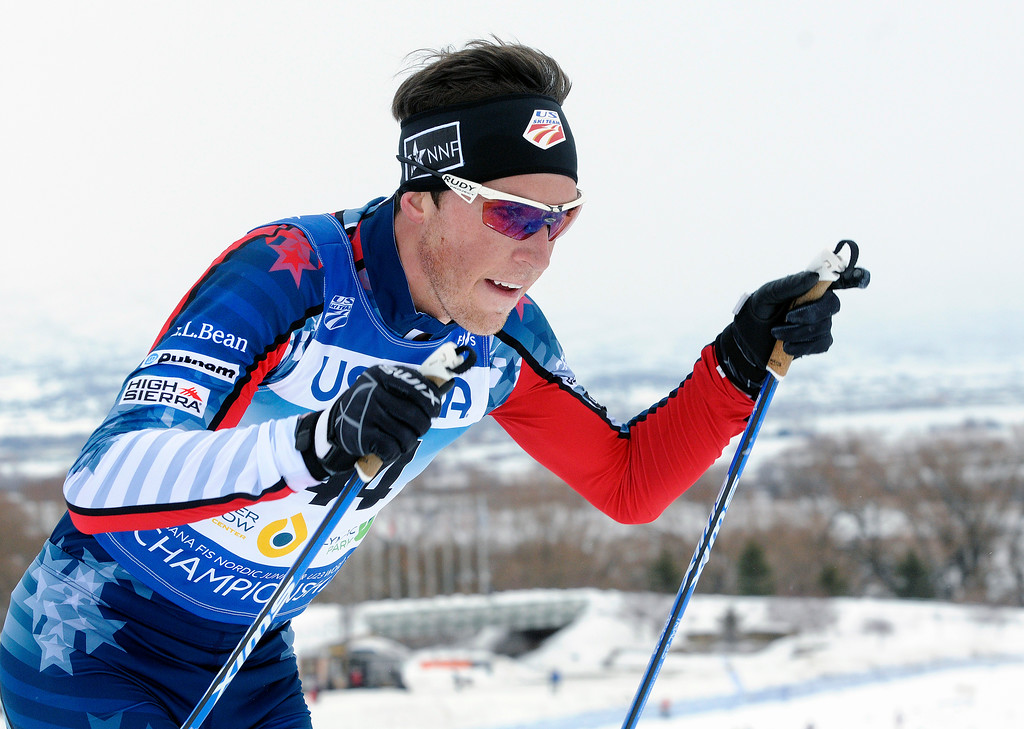
    Paddy Caldwell, of the Stratton Mountain School and U.S. Ski Team, racing to ninth in the men's 15 k freestyle at 2017 U23 World Championships at Soldier Hollow in Midway, Utah. (Photo: U.S. Ski Team/Tom Kelly)
    Paddy Caldwell, of the Stratton Mountain School and U.S. Ski Team, racing to ninth in the men’s 15 k freestyle at 2017 U23 World Championships at Soldier Hollow in Midway, Utah. (Photo: U.S. Ski Team/Tom Kelly)

    “Starting off in the classic leg I was trying to stay relaxed and maintain position,” Caldwell wrote in an email. “For the first half of the classic I was at the tail end of the lead group then started to lose some time over the last part of the classic.”

    He and Hegman started skiing together about 8 k into the 15 k classic leg, and remained together for most of the rest of the race. At the transition, they were about 44 seconds behind eighth place and 13 seconds ahead of 11th.

    “I was really struggling with breathing during the classic leg so I tried to relax for the first part of the skate leg and maintain our position,” Caldwell wrote. “We put in a surge on the second lap of the skate to try to catch the group ahead of us (5th-8th) but they were just out of contact. On the last lap I put in one last push early on to break away from the French skier in 10th and got just far enough ahead to hold him off on the last climb before the long decent into the stadium.”

    With the sixth-fastest skate leg, Caldwell (SMS/USST D-team) finished ninth, 9.2 seconds ahead of France’s Jean Tiberghien in 10th. Nearly 20 seconds after Tiberghien, Hegman finished 11th (+1:53.5) for a career best at his first U23 Worlds.

    American Jack Hegman (SVSEF) racing to 24th in the men's 15 k freestyle on Thursday at 2017 U23 World Championships at Soldier Hollow in Midway, Utah. (Photo: FlyingPointRoad.com)
    American Jack Hegman (SVSEF) racing to 24th in the men’s 15 k freestyle on Feb. 2 at 2017 U23 World Championships at Soldier Hollow in Midway, Utah. (Photo: FlyingPointRoad.com)

    “I think I am slightly better at skating, but felt really good about my classic skiing today,” Hegman, of the Sun Valley Ski Education Foundation (SVSEF) Gold Team, wrote in an email. “ I think I was able to gain some good time on the classic portion and then hold on in the skate. In the skate portion I tried to follow Paddy as long as I could and conserve energy. I lost quite a bit of time in the last 2k but thankfully didn’t lose too many places.”

    With a top 12 at U23 Worlds, Hegman meets the U.S. selection criteria for 2017 World Cup Finals, which will take place in Quebec City in mid-March.

    “For the entire skate leg, when I realized I was in the top 12, all I was thinking about was holding onto that top 12 position,” Hegman wrote.

    The two led three U.S. men in the top 15, with Adam Martin (Northern Michigan University) not far behind in 15th (+2:23.3). For Martin, it was his first skiathlon in three years (he finished 40th in the 20 k skiathlon at 2014 Junior Worlds in Val di Fiemme, Italy).

    Adam Martin (Northern Michigan University) racing to 15th in the men's 30 k skiathlon on Saturday at 2017 U23 World Championships at Soldier Hollow in Midway, Utah. It was his first top 20 in two U23 Worlds. (Photo: FlyingPointRoad.com)
    Adam Martin (Northern Michigan University) racing to 15th in the men’s 30 k skiathlon on Saturday at 2017 U23 World Championships at Soldier Hollow in Midway, Utah. It was his first top 20 in two U23 Worlds. (Photo: FlyingPointRoad.com)

    “I wanted to go out hard enough to establish a decent position, but also wanted to conserve sufficient energy to ski a strong back end of the race,” Martin wrote of Saturday’s eight-lap race.

    He skied most of it with the Czech Republic’s Petr Knop, who ultimately finished 14th, 1.4 seconds ahead of Martin.

    “Sometimes I was following, and sometimes I led and tried to catch up to the skiers in front of us,” Martin wrote.

    “I’ve never been top 20 at one of these competitions before, so top 15 is cool,” he added. “I think I’ve had very decent races this week!”

    “It is awesome to see three of us in the top 15 today,” Hegman wrote. “I think having the momentum from this week with so many good performances helped us quite a bit today. Also our skis were awesome today (and all week).”

    “I am really happy with my results all week,” wrote Caldwell, who notched top 20’s in all three races, including 18th in the classic sprint to start the championships. “It was an amazing week of racing for USA and I was really happy to end on a high note.”

    Russia swept the men’s 30 k skiathlon podium with Alexander Bolshunov, Alexey Chervotkin, and Denis Spitsov, respectively, after the three skied together for most of the race, well ahead of France’s Jules Lapierre and Switzerland’s Jason Rueesch in pursuit of them. As the Russians descended down the final hill — clear of any outside contenders for the podium — they locked arms and coasted into the stadium together. Just before the finish line, they stopped to cross as one.

    According to a USST press release, the competition jury had to review timing and scoring records, as well as consult photo assets and the finish referee to determine who finished first, second and third. Gold went to Bolshunov, who also won the 15 k freestyle two days earlier, with an official finish time of 1:15:31.5 hours. Chervotkin was listed as second (+0.2) and Spitsov third (+0.5).

    Lapierre crossed 11 seconds later in fourth, about three seconds ahead of Rueesch in fifth (+14.3).

    Evan Palmer-Charrette (NTDC Thunder Bay) led the Canadian men in 26th (+5:44.6). Alexis Dumas of the Pierre Harvey National Training Centre (CNEPH) finished 33rd (+9:02.7) out of 36 finishers. Several North Americans did not finish, including Canada’s Julien Lamoureux and Julien Smith, and American Cal Deline.

    In the U23 women’s 15 k skiathlon earlier on Saturday, Canada had three in the top 30, with Dahria Beatty (Alberta World Cup Academy/Canadian National U25 Team) in 19th (+2:18.1) for her third top 20 of the week. Katherine Stewart-Jones (NTDC Thunder Bay/NST U25 Team) placed 21st (+2:29.3) for her best result at U23 Worlds, and Frederique Vezina (CNEPH) notched a personal-best 29th (+3:36.2). The team’s fourth skier, Jenn Jackson, did not finish.

    Jesse Knori, of the University of Colorado-Boulder (CU) led the U.S. women in 30th (+3:40.1). Alayna Sonnesyn (University of Vermont) followed in 31st (+3:42.5), Nichole Bathe (University of Alaska Fairbanks) was 33rd (+4:36.9), and Corey Stock (Bridger Ski Foundation) 36th (+5:42.1).

    Another CU skier, Petra Hyncicova, who raced for her native Czech Republic, placed 22nd (+2:30.7) for her second-best result of the week after placing 20th in the classic sprint.

    Norway’s 19-year-old Lotta Udnes Weng won the 15 k skiathlon for her first gold of U23 Worlds, finishing in 40:50.9 minutes and besting Finland’s Johanna Matintalo by 3.8 seconds. Russia’s Yana Kirpichenko captured third (+13.9), edging Weng’s twin sister, Tiril Udnes Weng in fourth (+15.6).

    “On paper, this is not my best distance,” Lotta Weng, a six-time Junior Worlds medalist, told the USST. “But I knew I could do well in both classic and skate, and that if I had a really good day, I could ski for a gold medal … I knew I would have a good sprint and I was just trusting it.”

    Skiathlon results: Men | Women

    ***
    American Ben Loomis (10) racing to a career-best ninth in the individual normal hill/5 k competition on Feb. 4 at Nordic Combined Junior World Championships at Soldier Hollow in Midway, Utah. (U.S. Ski Team - Tom Kelly)
    American Ben Loomis (10) racing to a career-best ninth in the individual normal hill/5 k competition on Feb. 4 at Nordic Combined Junior World Championships at Soldier Hollow in Midway, Utah. (Photo: U.S. Ski Team/Tom Kelly)

    Ninth for Loomis

    Also on Saturday, in the last individual competition of nordic-combined Junior Worlds, 18-year-old American Ben Loomis notched his first top 10 in his third Junior Worlds appearance.

    Loomis started the day by jumping to 10th on the normal hill at Utah Olympic Park in Park City, his home training base. That put the U.S. Nordic Combined skier 58 seconds out of first and 11 seconds behind Finland’s Arttu Mäkiaho in ninth for the start of the 5 k race at Soldier Hollow. While Loomis didn’t catch Mäkiaho (who raced to second place for his second-straight individual medal after winning the normal hill/10 k to start the week), Loomis picked off one place to finish ninth, 1:22.3 minutes behind the winner, Germany’s Vinzenz Geiger.

    “My goals for the 5k competition were to jump into the top ten, and to not lose any ground during the race,” Loomis wrote in an email. “I was able to do this, but was still hoping for a higher finish.”

    He explained that a snow flurry during the jumping competition left the last 20 starters on the hill waiting for it to pass. Loomis was the fourth-to-last to jump, out of 49 starters.

    “I was able to stay relaxed, focused and have my best competition jump of the week,” he explained. “The home hill advantage made a huge difference in my jumping. Prior to this week, I had little jumps on the hill this winter. Luckily, I know the hill well and was able to get in rhythm with the jump very quickly.”

    Considering his starting position in the 5 k, which is half the distance of the usual 10 k in nordic-combined competitions, Loomis said he knew he needed to move up quickly, but do so in a controlled manner.

    “5 k really places a big importance on the jumping,” Loomis told the USST. “It’s a lot harder to make up time, and these Europeans are really quick.”

    He paced his first 2.5 k, and by the second lap, he worked with Norway’s Lars Ivar Skaarset — who had caught Loomis after starting 12th — to rein in Slovenia’s Matevz Malovrh, who started fourth and was fading. While Skaarset finished 17.4 seconds ahead of Loomis for eighth place, they both beat Malovrh, who placed 10th, 1.8 seconds behind Loomis.

    “Overall, I am very happy with my 9th place result. I was hoping for a little more, but to be 9th in the world is very special,” Loomis wrote. “I am already looking forward to next year’s competitions and approaching them with even more experience.”

    Earlier in the week, Loomis placed 18th in the normal hill/10 k and skied the third leg of the men’s 4 x 5 k team event, in which the U.S. placed seventh (with Elijah Vargas, Grant Andrews, Loomis, and Stephen Schumann). After Vargas tagged Andrews in 10th, Andrews skied them into ninth, and Loomis brought the U.S. up to seventh, which Schumann held during the final leg.

    The U.S. had two in the top 15 on Saturday, with Schumann in 15th (+1:44.3), up from 20th after the jump. Grant Andrews placed 33rd (+2:40.0) and Tucker Hoefler finished 46th (+3:56.9).

    Geiger won Saturday’s normal hill/5 k after jumping to first then starting with a 4-second lead over Japan’s Yuto Nakamura in second. Mäkiaho passed seven people to finish second, 22.6 seconds after Geiger, who won in 12:14.9 minutes. France’s Laurent Muhlethaler started fifth and captured third (+23.9), while Nakamura missed the podium in fourth (+42.8).

    “It’s great to be on top of the podium today, after the 10k it was so hard for me due to some illness and an injury after I fell at the World Cup in Chaux Neuve,” Geiger said. “It just feels amazing to be Junior World Champion now.”

    Results: Normal hill/5 k

  • Sunday Rundown: PyeongChang, Soldier Hollow & Eastern Canadian Champs (Updated x3)

    The women's 4 x 3.3 k relay podium on the final day of 2017 Junior World Championships at Soldier Hollow in Midway, Utah, with Russia (c) in first, Italy (l) in second, and the U.S. (with Hailey Swirbul, Julia Kern, Hannah Halvorsen, and Katharine Ogden) in third. (Photo: FlyingPointRoad.com)
    The women’s 4 x 3.3 k relay podium on the final day of 2017 Junior World Championships at Soldier Hollow in Midway, Utah, with Russia (c) in first, Italy (l) in second, and the U.S. (with Hailey Swirbul, Julia Kern, Hannah Halvorsen, and Katharine Ogden) in third. (Photo: FlyingPointRoad.com)

    FIS Nordic Junior World Championships (Midway, Utah): Junior relays

    Hailey Swirbul, Julia Kern, Hannah Halvorsen, and Katharine Ogden on the podium. That’s right. Two days after Ogden became the first American to earn an individual medal at Junior World Championships, those four U.S. junior women listed above did the same, placing third in the 4 x 3.3-kilometer relay on the last day of 2017 Junior World Championships at Soldier Hollow in Midway, Utah.

    The team credited their lucky socks, similar to the red-white-and-blue striped socks the U.S. women’s World Cup team wears for relays and team events.

    “We gave everything we got,” Kern said in a televised post-race interview.

    “It’s the dream,” Ogden said.

    In fourth at the last exchange, Ogden anchored the team to third, 25.8 seconds behind Russia, which won in 34:45.3 minutes with Polina Nekrasova, Lidia Durkina, Anna Zherebyateva, and Mariya Istomina.

    Italy placed second (+20.6) with Martina Bellini, Anna Comarella, Francesca Franchi, and Christina Pittin.

    Canada finished 12th (+4:41.3) with Natalie Hynes, Lisle Compton, India McIsaac, and Annika Richardson.

    [UPDATED] In the junior men’s 4 x 5 k relay that followed, Norway’s Thomas Helland Larsen outlasted Russia’s Vladislav Vechkanov by 0.4 seconds for the team win in 49:36.1.

    Norway’s gold-medal team included Herman Martens Meyer, Jon Rolf Skamo Hope, Harald Østberg Amundsen, and Larsen, while Russia took silver with Egor Kazarinov, Kirill Kilivnyuk, Yaroslav Rybochkin, and Vechkanov.

    France rounded out the podium in third (+1:05), with Martin Collet, Camille Laude, Hugo Lapels, and Arnaud Chautemps.

    The U.S. finished ninth (+4:28.8) with Bill Harmeyer, Kam Husain, Wyatt Gebhardt, and Hunter Wonders, and Canada followed in 10th (+5:21.6) with Antoine Blais, Ryan Jackson, Philippe Boucher, and Gareth Williams. Twelve teams finished the men’s relay, the final race of 2017 Junior World Championships.

    Results: Women | Men

    ***

    FIS Cross-Country World Cup (PyeongChang, South Korea): Freestyle team sprint

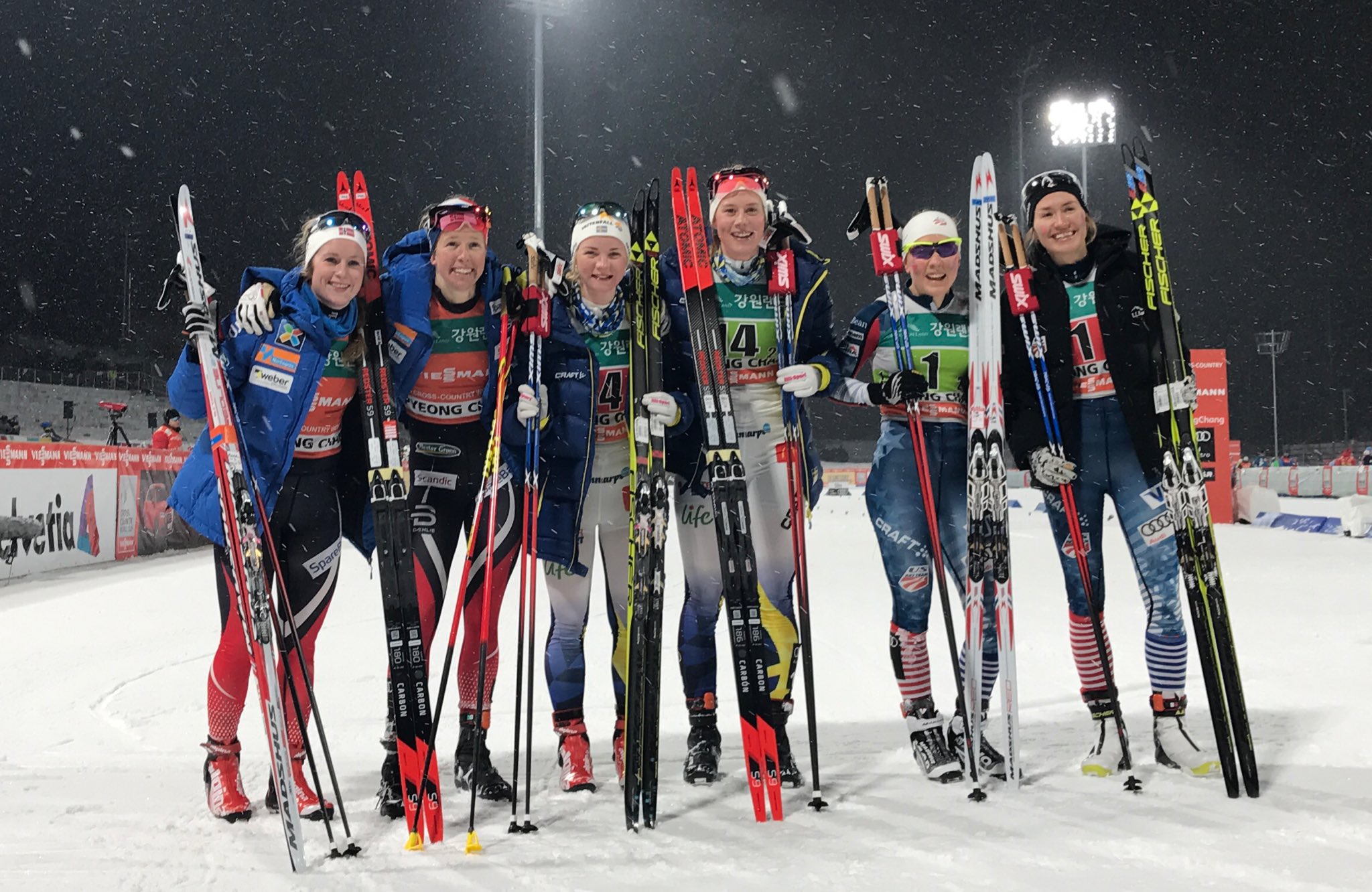
    The women's freestyle team sprint podium at the PyeongChang World Cup on Sunday in South Korea, with Sweden's Elin Mohlin and Maria Nordström (c) in first, Norway's Anna Svensen and Silje Øyre Slind (l) in second, and USA I's Ida Sargent and Sophie Caldwell (r) in third. (Photo: FIS Cross Country/Twitter)
    The women’s freestyle team sprint podium at the PyeongChang World Cup on Sunday in South Korea, with Sweden’s Elin Mohlin and Maria Nordström (c) in first, Norway’s Anna Svensen and Silje Øyre Slind (l) in second, and USA I’s Ida Sargent and Sophie Caldwell (r) in third. (Photo: FIS Cross Country/Twitter)

    The U.S. women had one team on the podium and one just 0.35 seconds off of it on Sunday in the World Cup 6 x 1.4-kilometer freestyle team sprint in PyeongChang, South Korea.

    USA I, with Sophie Caldwell and Ida Sargent, skied in third for most of the race and ultimately finished third, 6.11 seconds behind Sweden’s Elin Mohlin and Maria Nordström in first (in 20:37.11 minutes). Norway took second, 1.71 seconds back, with Anna Svensen and Silje Øyre Slind, while USA I edged USA II, with Caitlin Patterson and Liz Stephen for third. Patterson and Stephen ended up fourth (+6.46), ahead of Slovenia’s Katja Visnar and Anamarija Lampic in fifth (+14.46).

    Fifteen women’s teams competed on Sunday, with 10 of them reaching the final. Canada placed 14th overall with Annika Hicks and Sadie White.

    In the men’s 6 x 1.5 k freestyle team sprint, Russia’s Gleb Retivykh picked up his second win in in PyeongChang, after winning Friday’s classic sprint. He teamed up with Andrey Parfenov for the victory in 19:34.11, beating France (Baptiste Gros/Lucas Chanavat) by 0.03 seconds in a photo finish.

    Russia had two teams on the podium with Russia II’s Artem Maltsev and Nikita Kriukov in third (+5.52). Andy Newell and Simi Hamilton (USA I) fell off the leaders’ pace to finish fourth (+24.23), 18.71 seconds off the podium.

    USA II, with Scott Patterson and Matt Gelso, finished ninth (+54.85) in the final, and Canada’s Jess Cockney and Len Valjas placed 13th of 14 teams.

    Results: Women | Men 

    ***

    NorAm Eastern Canadian Championships (Cantley, Quebec): 15/20 k freestyle pursuits

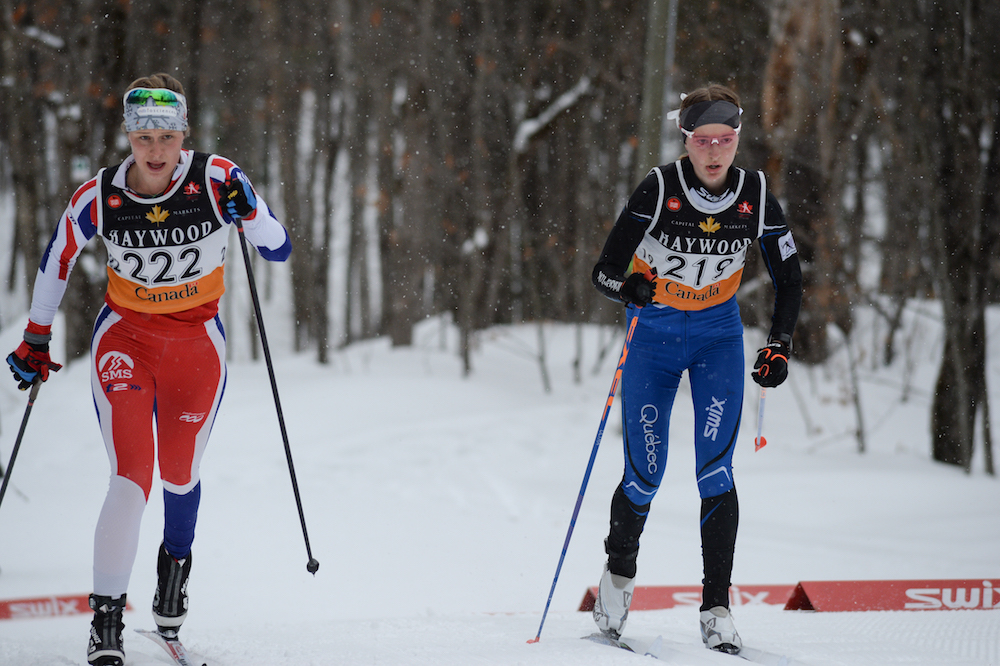
    SMS Elite's Anne Hart catching Nakkertok's Zoe Williams in the interval start classic, day two of Eastern Championships. (Photo: Ian Austen)
    SMS Elite’s Anne Hart catching Nakkertok’s Zoe Williams in the interval start classic, day two of Eastern Championships. (Photo: Ian Austen)

    The NorAm mini tour at the Nakkertok Nordic Centre wrapped up with freestyle pursuits.

    In the men’s 20 k, AWCA’s Russell Kennedy posted the fastest time of 53:42.68 to move up from third to take the overall victory in 1:33.22.  Lappe Nordic’s Andy Shields started first but couldn’t hold off Kennedy, finishing 36 seconds behind with a 6th best time, 1:01.46 slower. AWCA’s Dominique Moncion-Groulx wrapped up a strong weekend with the fourth best time of day, 37.92 back, to take third overall, 58.53 behind Kennedy.

    SMS Elite’s Anne Hart won the women’s 15 k pursuit in dominant style, starting first and winning time of day in 47:36.10 for an overall time of 1:17:39. AWCA’s Maya MacIsaac-Jones started third and finished second with the second best time of day, 31.36 seconds back for a combined deficit of 51.39 seconds. CNEPH’s Sophie Carrier-Laforte started second and ended third, 2:14.81 down after a sixth best time of day 2:05.47 back.

    Results: Pursuit | Full Weekend

  • Germany’s Brugger Pulls Upset; Harmeyer Leads U.S. Men in 12th in Junior Worlds Classic Sprint

    Germany's Janosch Brugger (4) celebrates his classic sprint win by 0.04 seconds over Norway's Petter Stakston (l) on Monday at the first day of 2017 Junior World Championships at Soldier Hollow in Midway, Utah. (Photo: FlyingPointRoad.com)
    Germany’s Janosch Brugger (4) celebrates his classic sprint win by 0.04 seconds over Norway’s Petter Stakston (1) on Monday at the first day of 2017 Junior World Championships at Soldier Hollow in Midway, Utah. (Photo: FlyingPointRoad.com)

    On the first day of 2017 Junior World Championships at Soldier Hollow in Midway, Utah, there was one man who appeared to be dominating the 1.5-kilometer classic sprint from top to bottom. Norway’s 19-year-old Petter Stakston, in his second Junior Worlds, started Monday off with a qualifying win, by 0.61 seconds over Finland’s Turo Sipilä, in 3:45.33 minutes.

    Then he won the first men’s quarterfinal of the day and proceeded to win the first semifinal as well.

    “I felt very good today,” Stakston told the U.S. Ski Team media in a post-race interview. “I was strong in the prologue … I tried to take the lead in every single heat and just go as fast as I could.”

    But Germany’s Janosch Brugger foiled his streak in the final, coming from behind in the finishing stretch to take the win by 0.04 seconds in 3:43.00 minutes.

    “It was good until the last 100 meters,” Stakston reflected after placing second. “Janosch Brugger was a bit stronger and took it, but I’m very happy.”

    Brugger started Monday off with the fourth-fastest qualifying time, 3.06 seconds behind Stakston. He went on to place second in his quarterfinal (by 0.48 seconds to another Norwegian, Jo Svinsås), then finished third in his semifinal, 0.6 seconds behind Stakston in first.

    The 19-year-old Brugger advanced as a lucky loser to the final, where he timed his strike to take his first gold in three Junior Worlds appearances, and his first podium as well.

    “I didn’t have any strategy; it’s only pushing as hard as I can,” Brugger said in an interview with the U.S. Ski Team media. “It means everything because on this day, you’re the best cross country-skier in the world and it’s exciting.”

    Brugger outlasted five others in the men’s final, which included four Norwegians (Stakston, Svinsås, Herman Martens Meyer, and Thomas Helland Larsen) and Finland’s Verneri Suhonen.

    Meyer reached the podium in third (+3.83), while Larsen placed fourth (+11.32), Suhonen was fifth (+12.97), and Svinsås sixth (+16.42).

    All Four U.S. Men Qualify

    The four American men racing on Monday qualified for the heats, with Bill Harmeyer (University of Vermont Ski Team) leading them in 11th (+7.03), Logan Diekmann (Utah Ski Team) in 23rd (+10.74), Kam Husain (Stratton Mountain School) in 27th (+11.71), and Lance McKenney in 29th (+11.91).

    Two Canadians qualified in the top 30 as well, with Étienne Hébert (Montériski) in 13th (+8.57) and Reed Godfrey (Team R.A.D./Canmore Nordic) in 25th (+11.55). Antoine Blais (Skibec) missed the qualifying cutoff by 0.05 seconds in 31st for his best result at his second Junior Worlds, while Ty Godfrey (Team R.A.D./Canmore Nordic) finished 36th (+12.99).

    In the heats, Harmeyer ended up fourth in the first quarterfinal, 1.13 seconds behind Stakston, but advanced as one of two lucky losers to the semifinal.

    “Out from the gun, I gave it some gas, but immediately realized that these guys were going pretty fast,” Harmeyer, 19, reflected in an email after his first Junior Worlds race. “So I decided to cool down a bit, and fall in behind the two Norwegians in my heat. Things settled in pretty quick, and I just tried to stay relaxed.

    “Going into the second climb, where the guys and gals courses split, I tried to make a move,” he added. “I moved up from 6th to 3rd or 4th around the outside, and was in a good position going into the final climb. Up the final climb, I got boxed out a bit, and went into the final downhill in 4th. Coming through the finish, I knew that lucky looser was a possibility, so I gave it everything I had.”

    Harmeyer made it to the first semifinal, where he faced off against the eventual top-three finishers (Brugger, Stakston and Meyer). Four of the men in his semifinal made it to the final.

    The Vermont native described the beginning of his semifinal as similar to his quarterfinal.

    American Bill Harmeyer doing a tele turn on his way back to the stadium after a broken pole took him out of contention in the first men's semifinal on Monday at 2017 Junior World Championships at Soldier Hollow in Midway, Utah. He finished sixth in the semifinal. (Photo: FlyingPointRoad.com)
    American Bill Harmeyer doing a tele turn on his way back to the stadium after a broken pole took him out of contention in the first men’s semifinal on Monday at 2017 Junior World Championships at Soldier Hollow in Midway, Utah. He finished sixth in that semifinal for 12th overall. (Photo: FlyingPointRoad.com)

    “I played the same cards going into the first hill, and made the same move going into the second hill as I did in the quarter,” Harmeyer wrote. “I was in 4th or 5th going into the final climb, and the group was still tight. Thats when I went down. I’m not sure if I got tangled with myself or if I got tangled with the Russian but I went down pretty hard.”

    Upon trying to stand back up, his pole snapped.

    “I finally got back up and started making my way up the hill as [U.S. development coach] Bryan Fish came sprinting down with another pole,” he recalled. “At this point, the guys in the heat were already headed down towards the finish. All I could do was enjoy the race at that point!”

    Harmeyer finished sixth (+23.23) and did not advance to the final to end up 12th overall.

    “I’m really happy with my performance today, but more happy with the team’s performance,” he wrote. “I think it was awesome to see all the guys, and three of the girls [Julia Kern, Hannah Halvorsen, and Lauren Jortberg] make it into the rounds. The wax techs and coaches have put everything into the athletes, those guys are awesome! It’s a total honor being able to represent the USA on home soil, and I’m looking forward to an exciting week of racing to come!”

    He was the lone North American to reach the semifinals after Husain finished sixth in the second quarterfinal (1.5 seconds behind Svinsås as the winner of that heat), Godfrey was fifth in the third quarterfinal (7.59 seconds out of first), McKenney was fourth in the fourth quarterfinal (2.02 seconds out of first), and Hébert finished fourth (+1.43) and Diekmann sixth (+3.98) in the fifth quarterfinal.

    At the end of the day, Harmeyer led the U.S. in 12th, followed by McKenney in 20th, Diekmann in 27th, and Husain in 29th.

    Canada’s Étienne Hébert (13) leads American Logan Diekmann in their classic-sprint quarterfinal on Monday at 2017 Junior World Championships at Soldier Hollow in Midway, Utah. Neither advanced to the semifinals, with Hébert finishing fourth (+1.43) and Diekmann sixth (+3.98) in that heat. (Photo: FlyingPointRoad.com)
    Canada’s Étienne Hébert (13) leads American Logan Diekmann in their classic-sprint quarterfinal on Monday at 2017 Junior World Championships at Soldier Hollow in Midway, Utah. Hébert finished fourth and Diekmann sixth in that heat for 17th and 27th overall, respectively. (Photo: FlyingPointRoad.com)

    Hébert was the top Canadian in 17th overall, followed by Godfrey in 25th.

    “It was a pretty awesome race for me today,” Hébert said, according to a Cross Country Canada (CCC) press release. “I couldn’t expect any more from myself as that was pretty much the best race I have done all year.

    “I just knew at the beginning of the race I wouldn’t be able to go with those guys in the final 100 meters,” the 18 year old added. “They were just too big so I tried to just go for it and I did. I was able to hold them off until about 200 metres when they passed me.”

    According to Godfrey, also at his first Junior Worlds, he raced the fastest qualifier he could have and enjoyed his quarterfinal.

    “The most challenging part for me was the finishing stretch,” Godfrey told CCC. “I was in pretty good contention for most of the course, but the biggest difference between myself and the other guys is their power to the finish. [This performance] gives me a little extra motivation for next year.”

    Stay tuned for a separate women’s classic sprint report.

    Results: Qualifying | Final

  • Junior Worlds Photos: Classic Sprint

    Photos from Monday, Day 1 of the 2017 USANA Nordic Junior World Championships at Soldier Hollow in Midway, Utah, which kicked off with the junior women’s and men’s classic sprints. All photos: FlyingPointRoad.com. Click images to enlarge.

    Results (brackets): Men | Women

    Qualifying results: Men | Women

  • Monday Rundown: Soldier Hollow & Almaty (Updated)

    American Bill Harmeyer doing a tele turn on his way back to the stadium after a broken pole took him out of contention in the first men's semifinal on Monday at 2017 Junior World Championships at Soldier Hollow in Midway, Utah. He finished sixth in the semifinal. (Photo: FlyingPointRoad.com)
    American Bill Harmeyer doing a tele turn on his way back to the stadium after a broken pole took him out of contention in the first men’s semifinal on Monday at 2017 Junior World Championships at Soldier Hollow in Midway, Utah. He finished sixth in the semifinal. (Photo: FlyingPointRoad.com)

    FIS Nordic Junior World Championships (Midway, Utah): Classic sprint

    [UPDATED] On the first day of Junior World Championships at Soldier Hollow in Midway, Utah, three U.S. women, four U.S. men and two Canadian men finished in the top 30 to qualify for the heats in the women’s and men’s classic sprints.

    Of those nine North Americans, three reached the semifinals: Julia Kern, Hannah Halvorsen and Bill Harmeyer, all representing the U.S.

    Germany’s Janosch Brugger beat out four Norwegians and a Finn in the men’s final, finishing in 3:43.00 minutes, just 0.04 seconds ahead of Petter Stakston of Norway. Norway had two on the podium with Herman Martens Meyer in third (+3.83).

    Harmeyer reached the semifinal after qualifying in 11th and placing fourth in his quarterfinal. He advanced with a fast-enough time after finishing 1.13 seconds behind Staktson, who won that first men’s quarterfinal. In the first semifinal, Harmeyer stumbled on the course’s biggest climb, broke a pole and ended up sixth, 23.23 seconds behind Stakson, who also won that heat.

    Also for the U.S., Kam Husain qualified 27th and finished sixth in the second quarterfinal, 1.5 seconds behind Norway’s Jo Svinsås, who won the heat.

    In the third men’s quarterfinal, Canada’s Reed Godfrey finished fifth, 7.59 seconds behind Russia’s Vladislav Vechkanov in first, after Godfrey qualified in 25th.

    American Lance McKenney qualified in 29th and went on to finish fourth in the fourth quarterfinal, 2.02 seconds behind Russia’s Egor Kazarinov, who won that heat.

    Two North American men raced in the fifth quarterfinal, with Canada’s Étienne Hébert finishing fourth (+1.43) and American Logan Diekmann finishing sixth (+3.98) behind Norway’s Thomas Helland Larsen in first. Hébert qualified in 13th and Diekmann 23rd to start the day.

    In the women’s final, Russia’s Polina Nekrasova won decisively, beating out two Germans, Antonia Fräbel in second (+3.56) and Coletta Rydzek in third (+4.58).

    Kern, of the U.S., qualified in 11th then placed second in the first quarterfinal, just 0.19 seconds behind Nekrasova, to automatically advance to the semifinals. In the first semifinal, Kern fell and ended up fifth, 28.05 seconds behind Nekrasova, who won that heat as well.

    Halvorsen qualified 13th then won the fifth quarterfinal by 0.75 seconds. She went on to place sixth in the second semifinal, 8.14 seconds behind Fräbel in first.

    American Lauren Jortberg qualified 27th and placed fourth in the second quarterfinal, 4.4 seconds behind Norway’s Kristine Stavås Skistad, who won that heat.

    Results (brackets): Men | Women

    Qualifying results: Men | Women

    ***

    World University Games (Almaty, Kazakhstan): 5/10 k classic

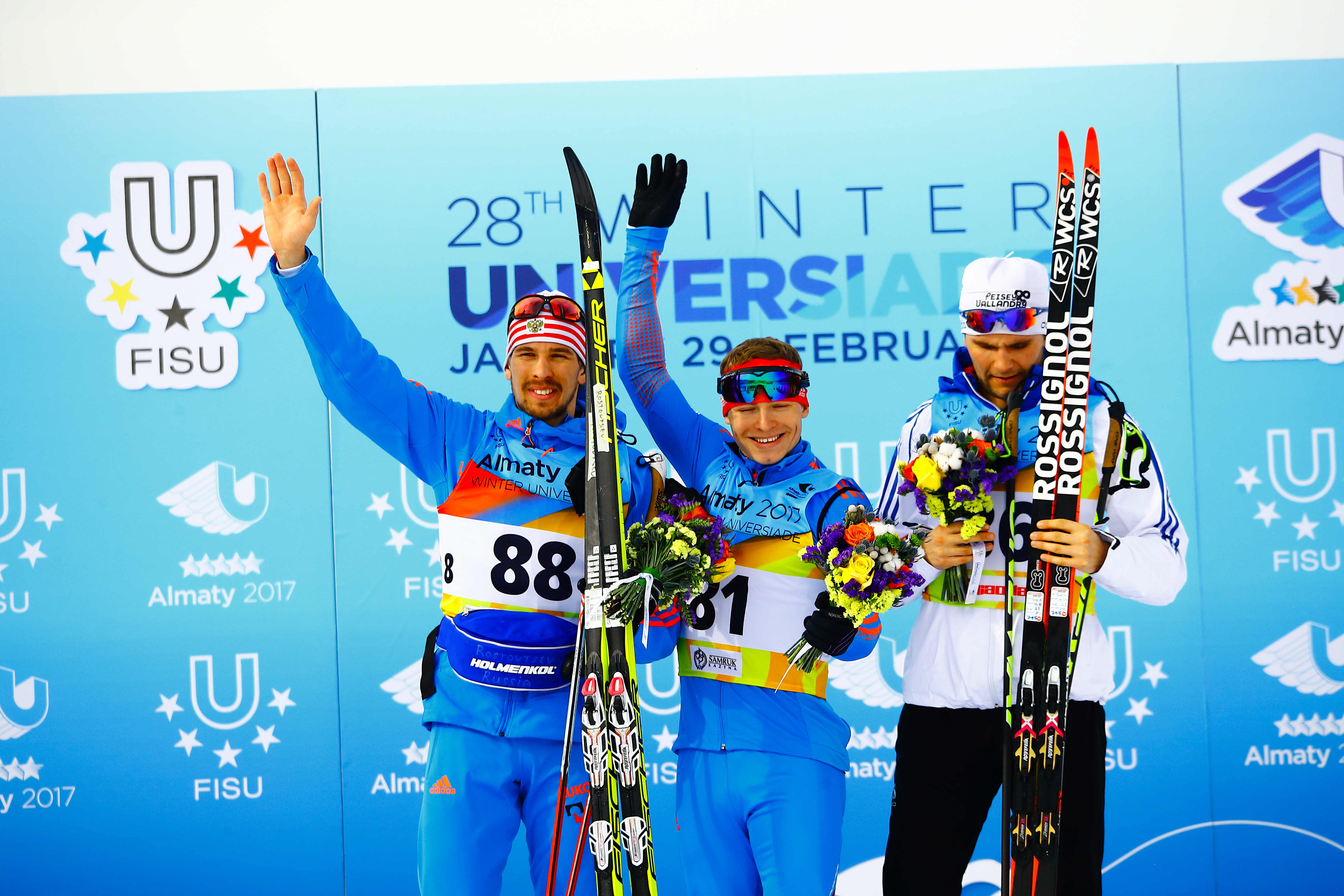
    Dmitriy Rostovtsev and Valeriy Gontar of Russia (l, c) and Alexandre Pouye of France on the podium for the men's 10 k classic at 2017 World University Games in Almaty, Kazakhstan. (Photo: Almaty2017.com)
    Dmitriy Rostovtsev and Valeriy Gontar of Russia (l, c) and Alexandre Pouye of France on the podium for the men’s 10 k classic at 2017 World University Games in Almaty, Kazakhstan. (Photo: Almaty2017.com)

    Russia took four of the six available podium spots in the opening day of nordic racing at the World University Games in Almaty, Kazakhstan.

    In the 10 k classic, Valeriy Gontar took an 8.9-second win over Russian teammate Dmitriy Rostovstev. It was an upgrade for Gontar, a student at Penza State University, who was third in this event at the 2015 Universiade. Rostovtsev is a former podium finisher at U23 World Championships. Alexandre Pouye of France was third, +21.8.

    Vincent Mason of the University of Wyoming had the best U.S. finish, clocking in at 44th (+2:54.0). Teammate Will Timmons finished 73rd and Sam Wiswell 80th, Mitchell Hollman (Air Force Academy) 82nd, Kevin Geisen (Western State) 84th, and Cameron Moore (Western State) 85th.

    For Canada Jordan Cascagnette (Team Hardwood) finished 49th, +3:12.3. Conor Thompson (Université Laval) finished 53rd, Carrington Pomeroy (Nakkertok) 57th, William Dumas (Skinouk) 58th, Gavin Shields (Lappe Nordic) 59th, and Alexis Morin (Université Laval) 77th.

    In the women’s 5 k classic, Lilia Vasilieva earned a 13.3-second victory over Russian teammate Anna Nechaevskaya, a podium finisher at last year’s Russian National Championships. Anna Schevchenko of Kazakhstan – who started the season on the World Cup and finished 32nd in the La Clusaz 10 k – was third, +15.2.

    Elise Sulser led the United States in 23rd place; the University of Wyoming skier was 1:58.4 off the pace. Teammate Meghan Kent was 48th and Yara Thomas 49th. Emma Malmqvist (Colorado Mesa University) placed 50th, Sierra Jech (State University of New York) 60th, and Sierra Foster (Oregon State University) 61st.

    For Canada, Christel Pichard-Joliceur (Université Laval) was one spot behind Sulser in 24th (+2:02.5). Emma Camicioli (Rocky Mountain Racers) placed 40th, Shelby Dickey (Highlands Trailblazers) 43rd, and Kyla Vanderzwet (Nakkertok) 47th.

    Results