From the FasterSkier archive — posts syndicated from athletes’ and coaches’ own blogs between 2004 and 2012, kept online as published. Current coverage is at fasterskier.com.

Tag: high school

  • Alaska High Schools Call a ‘Wax Truce’

    Alaska High Schools Call a ‘Wax Truce’

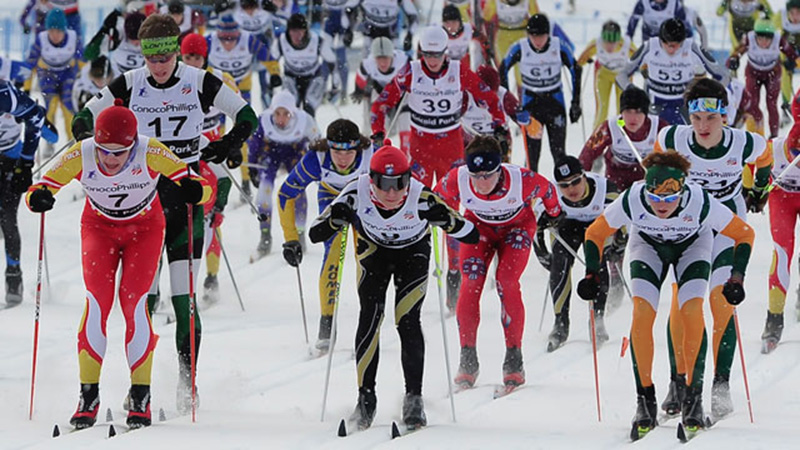
    The scene from an Alaska Nordic Skiing State Championships mass start. In Anchorage, high-school nordic coaches recently agreed to ban fluorinated glide wax in non-championship races throughout the 2015/2016 season. (Photo: http://asaa.org/sports/nordic-ski/)
    The scene from an Alaska Nordic Skiing State Championships mass start. In Anchorage, high-school nordic coaches recently agreed to ban fluorinated glide wax in non-championship races throughout the 2015/2016 season. (Photo: asaa.org)

    Anchorage-area schools decided that it had gotten out of hand, so they called a truce.

    “Anchorage region coaches agreed to not use fluorinated glide waxes during all non-championship races,” Anson Moxness, head coach at West Anchorage High School in Anchorage, Alaska, wrote in an email. “Because flouros are expensive and bad for your health. None of the schools really have adequate ventilation systems and many are doing waxing around the skiers.”

    Such bans on fluorinated waxes are becoming increasingly common around the country. Moxness cited various divisions and regions around the country that had agreed to similar bans, including the Eastern Intercollegiate Ski Association (EISA).

    Different coaches had different reasons for supporting the ban, but among coaches interviewed, support was unanimous:

    “I am all for this for many reasons,” Cory Schwartz, head coach of the University of New Hampshire (UNH) nordic team, wrote in an email. “First is the health concerns around putting on powders — even though we all use masks and try to the best of our ability adhere to safety suggestions, none of the college teams have a ventilated wax truck. So we are using masks while ironing on and brushing but the powder gets all over the truck, our skis, and body.”

    Evidence suggests that there are health risks associated with fluoro waxes. Fluorinated compounds are useful in waxes for their ability to repel water, making the skis faster. But they’re also much more expensive.

    “We’re looking at an order of magnitude difference in per gram wax costs of CH and HF waxes,” Moxness wrote. “I don’t see a reason to be spending that much money on waxes for non-championship races.”

    Tools of the trade: Anchorage-area high schools will have one less variable to worry about with the recent decision to ban flourinated glide waxes for all non-championship races.
    Tools of the trade: Anchorage-area high schools will have one less variable to worry about with the recent decision to ban fluorinated glide waxes for all non-championship races.

    He added that the success of this rule depends on coaches’  compliance.

    “If skiers choose to wax skis at home, which some of them do, we have no control over what they put on their skis. If we establish that it is cheating to use anything with fluorination and are consistent in our message, I think it will succeed,” Moxness wrote.

    “Where this will fail is if the coaches aren’t fully behind the fluoro ban, which we all were at our preseason meeting. From what I’ve seen, my skiers realize what we’re doing and the reasons behind it and they respect the ban.”

    “I think the success of the ban lies on the shoulders of the coaches and the parents,” South Anchorage High School Coach Sam Sterling wrote in an email. “If they advertise it as something that is good for the sport, I think it will succeed. If they give their athletes reason to doubt it … then, maybe it won’t. Hopefully, in a couple years the ban will just be a normal part of the AK high school ski scene and nobody will give it a second thought.”

    Chugiak High School in nearby Eagle River is one of the schools involved in the truce. Head coach Cody Priest also supported the ban.

    “Another reason it’s nice,” he wrote in an email, “is that I don’t have to ‘draw the line’ on my team on who gets what wax. With a competitive girls team I would want to use expensive wax on at least my first five, then maybe not the others. How do you explain that to the team?

    “Plus on race day I wont be testing different top coats,” he continued. “I will be just ensuring that I have the correct hardness of base wax.”

    The coaches contacted were also unanimous that the extra time spent testing skis with fluorinated wax was not time well spent.

    “The main thing I see is that [the ban] allows the coaches to actually… coach,” Sterling explained. “The impact of the ban goes beyond the obvious benefits of decreasing exposure to fluoros and reducing overall expenses for high school programs. Each team ranges from junior national champions to foreign exchange students who have never seen snow until coming to Alaska. The more time coaches can spend working with these athletes, and not dealing with waxing, the better off the sport will be.

    Sterling sees it as a simple misallocation of resources.

    “There’s a lot of [coaching] experience and motivation in Alaska high school skiing,” he wrote. “It’d be great to see this resource going more to the development of the athletes, and less towards making a fast pair of skis. It’s a step in the right direction and it was great to see unanimous approval from the Region IV coaches in adopting the ban.”

    Schwartz explained that in the East, there is some concern their region is falling behind others when it comes to testing wax in different snow conditions, “But I do not agree with that,” he wrote. “I actually am more excited to go to the race to see the race instead of being in a wax trailer all day.”

    In addition to being better for individual families bottom lines, Sterling and Moxness explained it’s better for the sport as well.

    “It also lowers barriers of entry into the sport,” Moxness wrote. “If a parent is interested in waxing their kid’s skis and they only have to invest maybe $50 in waxes to have skis that are competitive, instead of $300, they are much more likely to get and stay involved.”

    “That means more growth of the sport and parents who may be more likely to invest that saved money in better quality equipment, which makes way more of a difference than wax.”

  • Nordic Club or High School Athletic Program

    A few days ago I wrote an article about the roles of high school teams in the context of the national development pipeline. One of my interview requests went to Bryan Fish, and came back as the following excellent personal commentary piece. You can find the original article here, and the rest of the interviews here.

    untitled1

    By Bryan Fish – CXC Team Vertical Limit Head Coach

    I was asked to comment on high school and club Nordic skiing. I’ll take this opportunity to discuss my personal thoughts and experiences on how high school and clubs can work together to be extremely effective.

    The most fundamental goals of a high school or club program are the same: provide the tools, skills and facilities to allow athletic improvement. Improvement might happen at different rates and the overall level of development might vary for particular athletes. None the less, every athlete in any program would like to see advancement from their present level.

    Another important point is that athletes want to be challenged. The type and level of challenge may be diverse for different athletes, but pursuit and progress keeps athletes motivated and interested. There is a certain balance that needs to be attained. Challenging an athlete excessively can stifle motivation and progress. An effective program needs to be aware of individual needs and differences.

    I think the most complex aspect of a program is to create individual practices as well as an entire system that engages, motivates and progresses all the athletes in a program. Every program has a broad range of goals, levels and personal strengths. CXC Team Vertical Limit integrates our juniors and Masters into our elite sessions at times when appropriate.Defining “what is appropriate” is an art. I do strongly feel that a “one size fits all” plan actually fits very few, if any. A successful program provides the appropriate support to each athlete or specific level of athletes. Providing support is similar to spinning plates. Each plate needs a little push from time to time, but the plates find their own balance, rhythm and momentum when they have a little time to themselves.

    Photo by Michael Henderson from Brisbane (Bardon), Australia
    Photo by Michael Henderson from Brisbane (Bardon), Australia

    Skiers need items to work on, ample time and independence to explore the path to best learn the new skill. The goal of a program should be to work with each athlete or group and then move to the next group of athletes to maintain this balance of support followed by personal time for the athletes to work on their own.

    Our general goal as programs is to motivate, challenge and keep athletes inspired in the sport of skiing. Cross Country skiing has many characteristics to keep skiers interested – climatic, equipment, ability to glide and balance on one ski (which is often a long learning curve).Each aspect of the sport needs to be recognized and addressed with creativity and a progressive plan.

    There are so many different aspects of skiing which makes this sport unique. Face value points out skate and classic, sprint, mid-distance and long distance, but possibly the most interesting items lie in all the physical and technical attributes a cross country skier must have to be “well-rounded.” Skiing requires excellent endurance fitness as well as great dynamic balance and coordination. Skiers need to be efficient on the uphill sections and fearless and agile on downhill sections. Cross country skiing requires strength in the lower body to maintain glide on one leg as well as strength in the upper body because the double pole is the most fundamental ski stroke. Not to mention adaptation to different snow types, waxing and ski selection.

    Options are excellent to provide opportunity in a number of paths. The younger the athlete, the more options one should explore. There does become a time and level of proficiency in any activity that requires a more concerted effort if excellence in that activity is to be gained. For example, a college student eventually has to commit to a discipline of study or a college graduate must commit to one full time occupation. It is rare to witness personal excellence in pursing a multitude of paths. Eventually one path needs to be chosen and full commitment put forth. The question is, “At what time must this be made in Cross Country Skiing?” That question revolves mainly around the personal goals of the specific skier.

    Skiers that are in a club setting typically are training in some form of cross country skiing throughout the whole year versus 2-5 months commonly witnessed in high school athletics.The spinning plate analogy certainly comes into play here. Those athletes that “keep the plates spinning” all year long should consistently progress while those athletes that haven’t touched ski training in several months likely have to retrace some original steps. Personal goals dictate the best path for the particular athlete.

    The more detailed goals of a high school program and club program can be different. High school may revolve around dual meets, sectionals and state championships while club programs may follow a path more consistent with USSA Regional Junior Qualification events, US Junior Nationals and Junior Worlds. The events might be different, but the fundamental goals are the same and that is to develop, encourage and support positive progression.

    My biggest concern with either club or high school racing is the time put forth to train versus race. I view racing as a test and practice as preparation for the test. I feel a common trend in the US is to race too often and train too little. I suspect results in the classroom could suffer if a student was tested in the same subject three of the five days in school, yet it is not uncommon to see athletes in the same age bracket race three times per week. The athletes need time to “study” to progress their skills on the ski trails.

    Top high school athletes often want to do both high school and USSA racing. Such a goal can be achieved, but it requires proactive planning as well as cooperation and communication from the athlete, high school coaches, club coaches and parents, alike.

    I think it is critical that personal coaching perspective be placed as a secondary priority and the athletes’ best interest be placed as the primary focus. A blended plan might take more time but these are often the athletes that put forth the greatest commitment and hence should be taken under consideration. This planning is particularly important as it relates to the number of races a particular athlete competes in.

    Honesty is critical in the sense that going in numerous directions can easily generate a compromise in many senses of the word. Hopefully, the club coach and high school coach are willing to compromise because doing both programs in their entirety is often not what is in the best interest in progression of their skiers.

    It can and is being done. A successful blend of high school and club programming all revolves around cooperation, compromise, communication and proactive planning. Most importantly, it requires putting the specific goals and aspirations of the athlete first.

  • Dazed and Confused

    Dazed and Confused


    One of the movies in my video library is the 1993 ‘classic’ Dazed and Confused , a film about the night that follows the last day of school at a 1976 Texas high school. During the movie the main character, Randall ‘Pink’ Floyd, played by Jason London is continually pressured by his high school football coach to show a commitment to his team throughout the summer.

    Whenever I watch this movie I am reminded of the rules that many Nordic ski coaches around the country have to deal with at public high school programs. These rules were created with the intention of protecting young student/athletes against the pressure to over commit themselves. Don’t get me wrong, if a skier would rather spend the summer playing soccer or skateboarding that is great. But what about those who would like to focus on skiing?

    In Massachusetts our public high school programs fall under the governing body of the Massachusetts Interscholastic Athletic Association (MIAA). They have tons of rules that prohibit any sort of coaching out of season. To make matters worse, the “season” runs from the first Monday after Thanksgiving until the State Championship race in the middle of February. So if a skier qualifies for the New England J2 Championship, the Eastern High School Championship or even Junior Nationals they cannot receive any help from their high school coach.

    Among the many rules that the MIAA enforces are two that are the trickiest to deal with. The first, “The Bona Fide Team Player Rule,” handles the time within the season and states that a student/athlete may only miss ONE practice per season to pursue other athletic interests. This would include going to a club practice or extra race instead of a scheduled high school practice or race. This rule makes it impossible for coaches to hold centrally located practices for higher level, serious skiers to attend in place of their high school practice and also makes going to JOQs difficult if the high school league has a race scheduled.

    The second, the 50/50 rule, effects time outside of the season and states that a coach may only work with a group if less then 50% of the group is on their team during the season. So technically a coach could not even go for a hike with their son or daughter if that child were on their ski team!

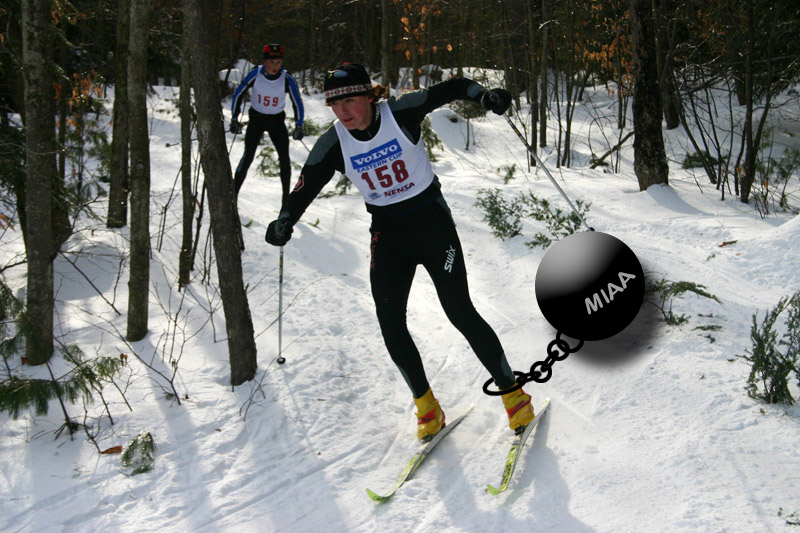
    State governing bodies for high school athletics can be like a ball and chain.

    So why does this all matter? Some athletes can attend a private ski school if their goal is to excel at a sport. But this isn’t for everyone – both financially and developmentally. But this is often the only option for those who are focused on achieving a high level.

    Another option would be to continue going to school at their local high school, train on their own without a team, but follow a program set up by their coach. Again, this has worked for some highly disciplined skiers and is a reasonable option, but is not ideal. So what can we do? After all, the goal is to give these skiers the tools they need to excel at skiing and in life in general.

    There have been some successful examples of clubs and high schools coexisting. CSU in the Boston area struggles with MIAA restrictions, but still manages to train excellent skiers. But some of this success has to do with the proximity and most is because of the amazing work of a few very dedicated individuals.

    In some other states, rules are more relaxed, allowing for happy coexistence. In Jackson, Wyoming, for example, the club program now works in conjunction with the high school and everyone benefits.

    So what to do? Taking on state bureaucracy is usually a losing battle. These rules are not only about skiing – it is the usually blunt hammer approach – all rules apply to all sports. I would love to hear how others have dealt with this issue.

    Until then the MIAA will keep me “Dazed and Confused. ”